Article

Seasonal Variation and Genetic Evaluation of Needle Catechin Content in Half-Sib Families of Pinus taeda


1
College of Forestry and Landscape Architecture, South China Agricultural University, Guangzhou 510642, China
2
Guangdong Key Laboratory for Innovative Development and Utilization of Forest Plant Germplasm, Guangzhou 510642, China
3
State Key Laboratory of Tree Genetics and Breeding, Research Institute of Forestry, Chinese Academy of Forestry, Beijing 100091, China
4
Liaoning Provincial Research Institute of Poplar, Gaizhou 115213, China
*
Authors to whom correspondence should be addressed.
These authors contributed equally to this work.
Plants 2026, 15(11), 1666; https://doi.org/10.3390/plants15111666
Submission received: 30 April 2026 / Revised: 22 May 2026 / Accepted: 27 May 2026 / Published: 29 May 2026
(This article belongs to the Special Issue Research on Genetic Breeding and Biotechnology of Forest Trees)

Abstract

The biosynthesis and accumulation of plant secondary metabolites are tightly regulated by environmental fluctuations, serving as a crucial interface mediating plant–environment interactions. Nevertheless, the phenotypic instability of secondary metabolism-related traits induced by environmental variability has hampered the precise breeding of stress-resistant cultivars. Pinus taeda is an key timber tree species in southern China, and its foliar catechins exhibit substantial stress-resistant potential. However, phenotypic variation driven by seasonal changes has limited the germplasm innovation and genetic selection of this species. In this study, 54 half-sib families of P. taeda were used as experimental materials. Combined with near-infrared spectroscopy (NIRS) and the BLUP model, we systematically analyzed the seasonal variation characteristics, genetic parameters of catechin content (CC), and genetic gains under different breeding strategies across four seasons. Our results demonstrated that family and season had extremely significant effects on CC (p < 0.001), whereas the season × family interaction effect was not significant, indicating that the genetic expression of CC is stable across seasons. CC was higher in spring and winter but lower in summer and autumn; specifically, the mean CC in summer was 47% lower than the peak value in spring (26.95 ± 0.46 μg·g−1), reflecting a resource trade-off between growth and defense metabolism. Genetic parameter analysis revealed that family-mean heritability (0.373–0.714) was higher than individual heritability and within-family heritability, with August identified as the optimal selection season. The maximum genetic gain across the three breeding strategies (individual selection, family selection, and combined selection) reached 7.86%, among which individual selection exhibited the smallest fluctuation in genetic gain. Finally, three superior families and 14 superior individuals were screened out. This study elucidates the seasonal genetic pattern of foliar CC in P. taeda, clarifies the optimal selection stage and efficient breeding strategies, and provides theoretical guidance and material support for the genetic improvement, germplasm innovation, and resource utilization of secondary metabolic traits in this ecologically and economically important tree species.

1. Introduction

Seasonal fluctuations in environmental factors frequently interfere with the growth and development of perennial trees throughout their life cycles [1]. To survive in such dynamically changing environments, trees have evolved intricate physiological and metabolic mechanisms to establish a dynamic physiological defense barrier [2,3]. As key “chemical weapons” enabling plants to adapt to and resist adverse conditions, secondary metabolites—including flavonoids such as catechin, proanthocyanidin, and quercetin—exhibit accumulation levels that are directly linked to plants’ chemical defense capacity [4,5,6,7]. However, constrained by internal resource availability and seasonal environmental variability, plants allocate fewer resources to defense when a greater proportion of resources is invested in growth during specific physiological periods [8]. This resource trade-off and precise allocation strategy between growth and defense drive pronounced seasonal dynamics and spatial heterogeneity in the synthesis and accumulation of metabolites [9]. Consequently, phenotypic evaluation at a single time point fails to accurately reflect the genetic potential of individual trees, which not only increases the difficulty of screening superior genetic resources in complex habitats but also constitutes a key bottleneck limiting tree genetic improvement [10,11].
It is well established that the physiological responses of forest trees to seasonal environmental changes are inherently governed by intrinsic gene regulation [12]. Heritability, a pivotal parameter in forest tree genetic improvement, serves as a core indicator for assessing the selection potential of target traits [13]. Previous studies have demonstrated that under fluctuating natural conditions, genotype–environment interaction (G × E) interactions elicit divergent genetic effects of the same genes across seasonal transitions [14,15,16]. Currently, however, assessments of the genetic potential of target traits in forest trees—such as secondary metabolite yield, stress resistance, and wood properties—remain confined to specific growth stages (e.g., seedling phase or growing season), with insufficient consideration of their genetic instability across seasons. This oversight has resulted in a notable neglect of the relationship between heritability and seasonal environmental variations [17,18]. Additionally, numerous studies have shown that fluctuations in water availability are often correlated with changes in flavonoid and phenolic acid content [19], with the composition of terpenoid volatiles in conifers exhibits distinct species specificity and is regulated by environmental factors [20,21]. Thus, exploring the variation patterns of genetic parameters and genetic effects of target tree traits across seasonal changes will facilitate the precise identification of superior forest germplasm, individual trees, and families with strong environmental adaptability, thereby further accelerating the pace of genetic improvement.
In recent years, the rapid development and widespread application of near-infrared spectroscopy (NIRS) technology have enabled large-scale, rapid, non-destructive, and high-throughput precise phenotyping of forest germplasm resources. This has laid a technical foundation for conducting dynamic trait monitoring and cross-seasonal, whole-life-cycle genetic evaluation of trees, effectively addressing the challenges of phenotypic evaluation posed by the spatiotemporal heterogeneity of metabolic traits [22,23]. For instance, Provaznik et al. [24] employed hyperspectral technology to perform needle phenotypic analysis across two seasons in a Pinus sylvestris clone seed orchard, verifying the operability and reliability of high-throughput phenotyping technology in the study of tree cross-seasonal traits. Furthermore, the best linear unbiased prediction (BLUP) model can effectively eliminate the random environmental interference, integrate individual phenotypic observations and family kinship information, accurately separate the environmental effects from individual phenotypic values, enable efficient estimation and precise dissection of the true genetic contribution (i.e., breeding value) of individual trees, and significantly improve the accuracy of genetic evaluation [25,26]. However, in breeding practice, individual selection strategies based on breeding values unilaterally pursues the maximization of short-term genetic gain for target traits, which is likely to result in the high concentration of selected superior individuals within a few core elite families, a sharp narrowing of the genetic base, an overly uniform population selection pattern, and reduced capacity to cope with climate change and biotic–abiotic stresses [27,28,29,30]. Therefore, how to steadily enhance the genetic gain of important genetic traits such as secondary metabolism, maintain the genetic diversity of the breeding population, and develop a balanced selection strategy that balances short-term benefits with long-term sustainability has become a core scientific problem urgently requiring resolution in the field of current precise tree breeding.
Pinus taeda L., an evergreen arbor of the genus Pinus in the family Pinaceae, is one of the most widely cultivated and highest-yielding industrial timber tree species worldwide, and also serves as a key pillar of wood production in forested areas of southern China [31,32]. Needles of P. taeda are rich in flavonoids such as catechin, which are natural bioactive raw materials with broad application potential in stress resistance, defense, and biomedicine [33,34]. However, existing cultivars exhibit low quality and limited quantities; moreover, traditional breeding has long focused on growth rate [35], wood quality [36], stem morphology [37], and disease resistance [38], leading to a paucity of research on secondary metabolic traits in needles that possess important physiological and economic value. Furthermore, the long-term lack of systematic analysis on the genetic rules governing catechin content (CC) across different seasons has hindered the conversion of needle resource advantages into breeding gains, thereby limiting the potential of P. taeda in comprehensive whole-plant improvement and production applications.
Thus, this study used 1697 individuals from 54 half-sib families of P. taeda as experimental materials. By integrating the NIRS model and BLUP model, we systematically analyzed the variation characteristics and genetic parameters of CC in P. taeda needles across different growing seasons, and evaluated the impact of different selection strategies on genetic gain. The main research objectives were as follows: (i) to analyze the dynamic variation characteristics of CC in P. taeda needles across different seasons; (ii) to estimate the genetic parameters of CC in different seasons and assess the impact of genotype × season (G × S) interactions on the accuracy of genetic evaluation; (iii) to compare the genetic gains of three breeding strategies—individual selection, family selection, and combined selection—and screen out elite materials with both high CC and genetic stability. The findings of this study will provide a scientific basis for the precise breeding of secondary metabolic traits in P. taeda, and also offer a reference for the multi-season genetic improvement of other perennial woody plants.

2. Results

2.1. Seasonal Dynamic Variation of Catechin Content

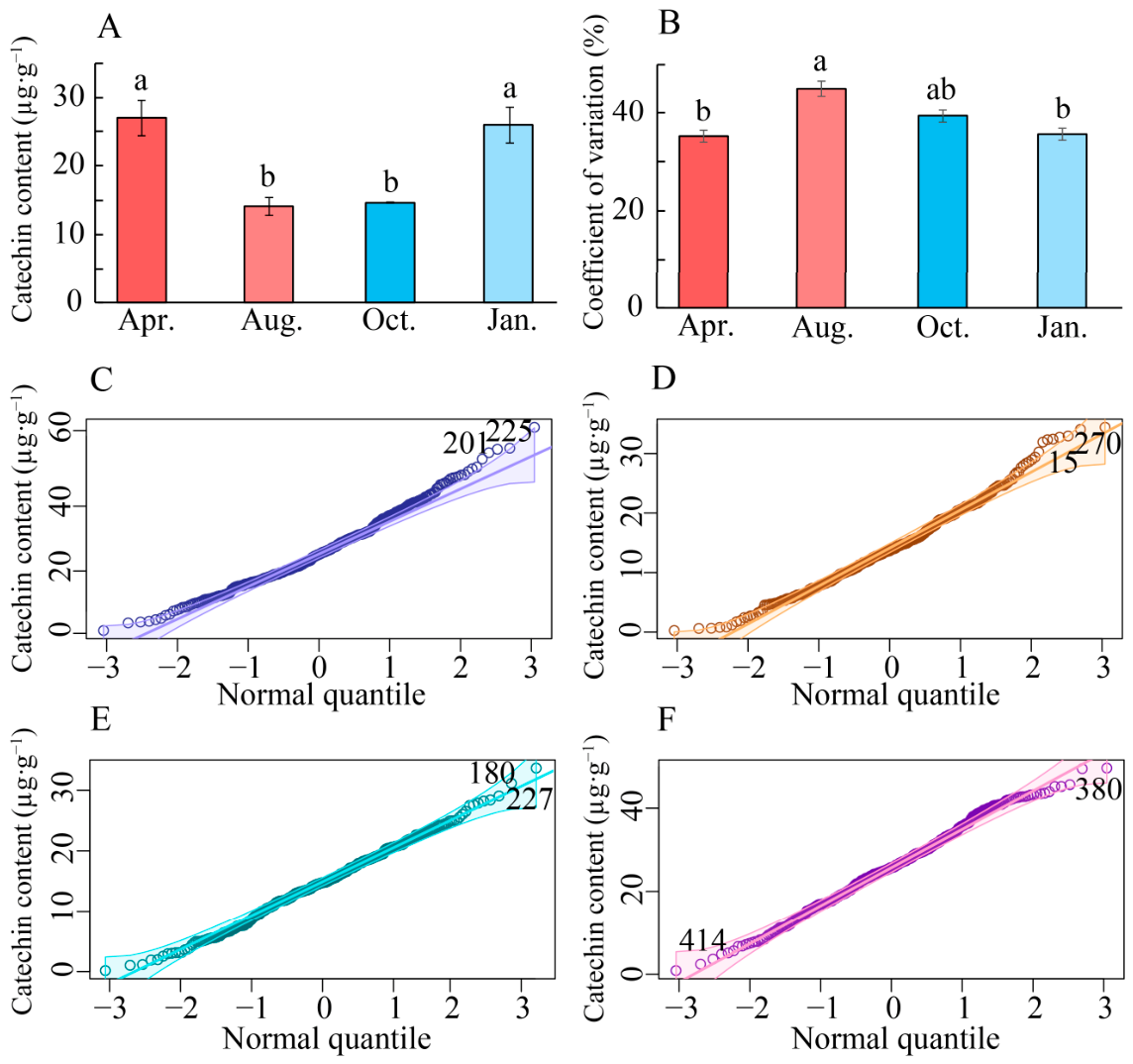
Two-way analysis of variance (ANOVA) showed that both season and family exerted extremely significant main effects on needle catechin content (CC) in P. taeda needles (p < 0.001), with season being the dominant source of phenotypic variation in CC. The season × family interaction effect was not statistically significant (p = 0.101), indicating that the genetic expression of CC is stable across season and that the relative genetic ranking of families is not significantly affected by seasonal fluctuations (Table 1). Needle CC in P. taeda exhibited a bimodal accumulation pattern, with higher levels in spring and winter, and lower levels in summer and autumn. Specifically, CC in April (26.95 μg·g−1) and January (25.94 ± 0.45 μg·g−1) was extremely significantly higher than that in August (14.15 ± 0.39 μg·g−1) and October (14.65 ± 0.41 μg·g−1) (p < 0.001) (Figure 1A). Analysis of the coefficient of variation for CC across seasons showed that the inter-family variation was higher in August and October, suggesting greater selection potential during these periods (Figure 1B). In addition, the CC data in each season were normally distributed (Figure 1C–F), supporting the validity of subsequent genetic parameter analyses.

2.2. Family Genetic Variation and Seasonal Accumulation Characteristics of Catechin Content

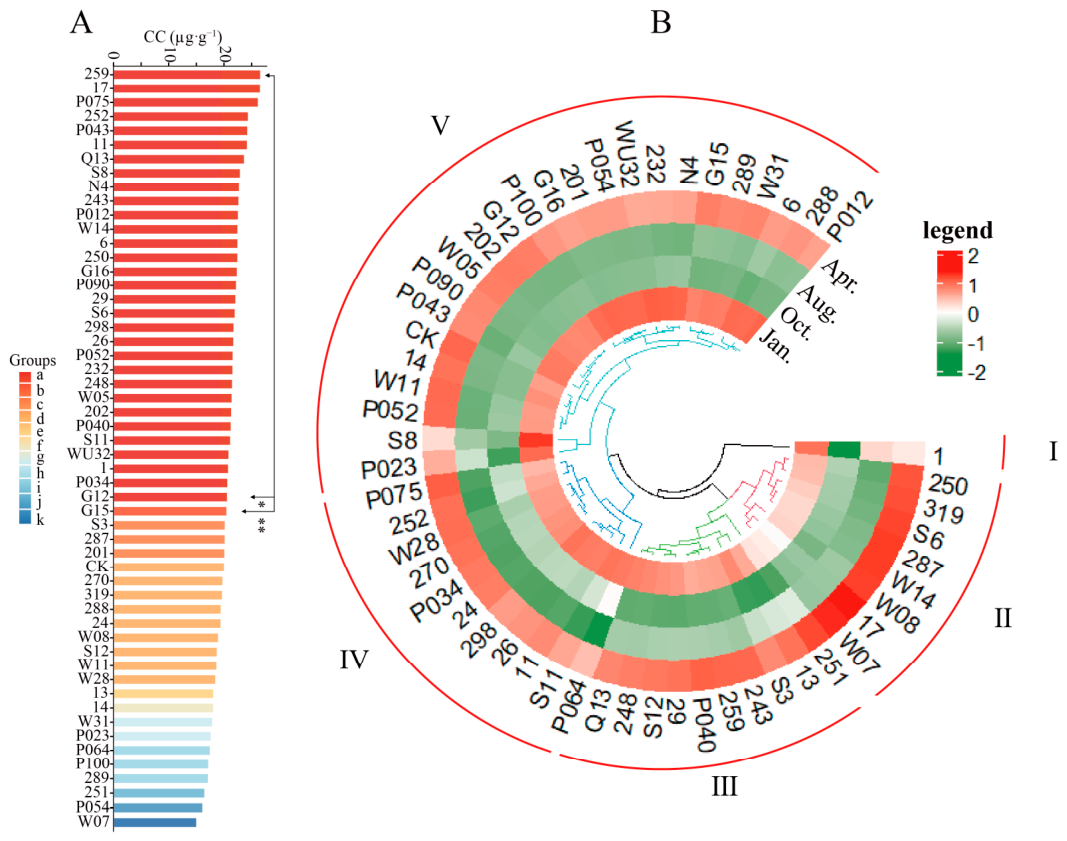
There were significant genetic differences in needle CC among P. taeda families (p < 0.05) (Figure 2). The average CC of family 259 was significantly higher than that of family G15 (p < 0.05). Ten elite families were selected at a 20% selection intensity, with an average CC of 24.23 μg·g−1—17.41% higher than the population (20.64 μg·g−1). To further analyze differences in CC seasonal accumulation characteristics among families, hierarchical cluster analysis was performed on 54 families using data from all four seasons. The results showed that all families could be divided into five clusters with significant seasonal dynamic characteristics (Figure 2). The main characteristics and breeding application directions of each cluster are as follows: Cluster I (1 family): stable content type, with consistent CC throughout the year and the smallest seasonal fluctuation range; Cluster II (8 families): April-peak type, where CC reached the annual maximum in April (29.64 μg·g−1) and declined sharply in August and October, making it suitable for harvesting and utilization in April; Cluster III (10 families): August-dominant type, with significantly higher CC than other clusters in August and the annual minimum in October; Cluster IV (11 families): October-dominant type, with the highest CC among all clusters in October and the lowest in August; Cluster V (24 families): year-round elite type, where CC peaked in January (27.66 μg·g−1), had a seasonal coefficient of variation of only 26.1%, and exhibited both high CC and excellent seasonal stability.

2.3. Seasonal Dynamics of Heritability and Screening of Elite Families Across Seasons

Genetic parameter estimation revealed seasonal variations in the family-mean heritability, individual heritability, and within-family heritability of CC (Table 2). Among these, family-mean heritability was highest in summer and lowest in winter. Across the four seasons, family-mean heritability of CC was consistently higher than both individual heritability and within-family heritability. The BLUP model was used to estimate family effect values for each season, and the top 10 superior families based on effect values were screened for each season (Table 3). To obtain family materials with stable and high CC across seasons, a screening criterion was established: families must rank among the top 10 in family effect values for at least three seasons. Finally, three superior families with excellent overall performance were identified, namely P075, Q13, and 11.

2.4. Regulation of Family Background on Estimated Breeding Values

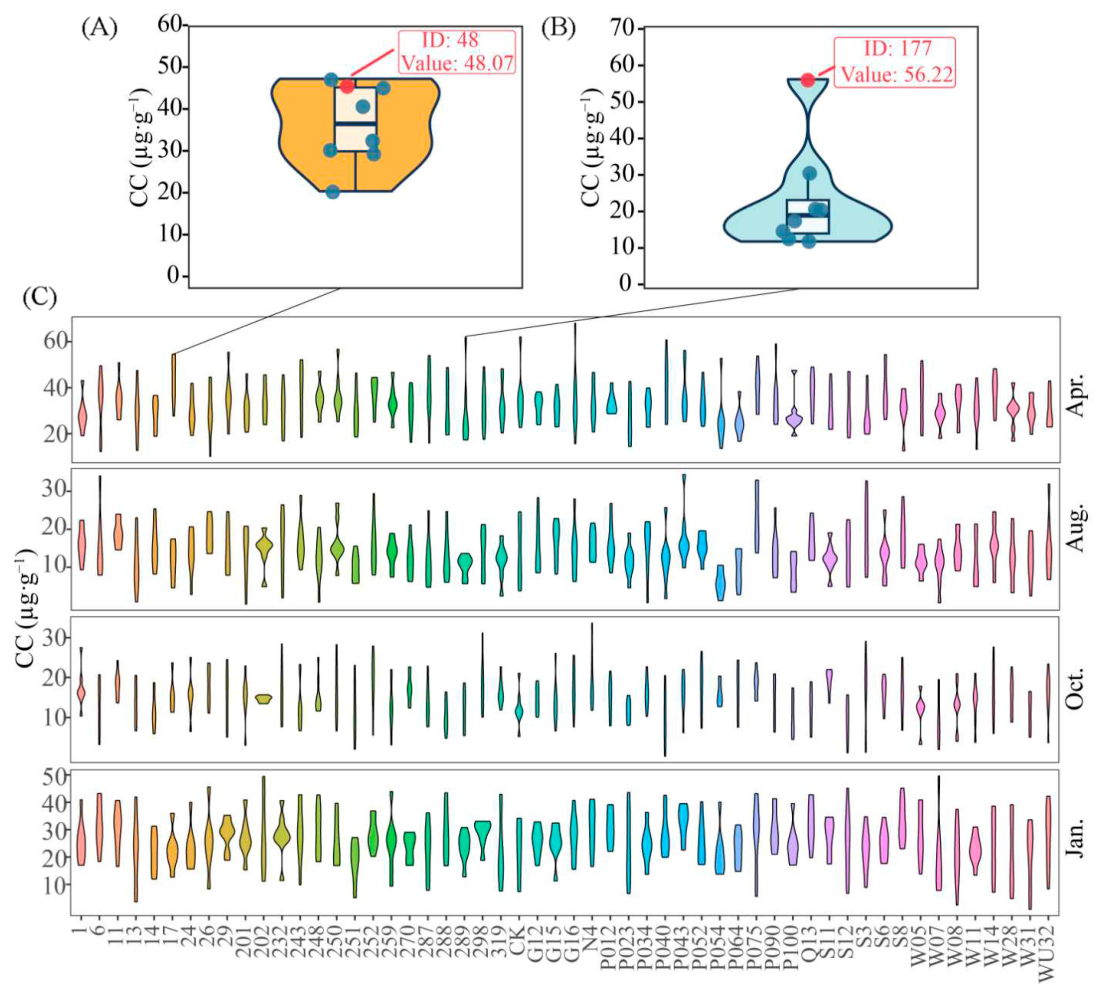
Figure 3 illustrates that the relationship between individual phenotypic values and predicted breeding values of needles CC in P. taeda is influenced by family background. For instance, individual 177 (from family 289) had the highest phenotypic value (56.22 μg·g−1), which was 1.17 times that of individual 48; however, its breeding value (2.71 μg·g−1) was substantially lower than that of individual 48 (breeding value 7.86 μg·g−1, family 17).

2.5. Screening Strategies for Optimizing Gain and Diversity

To achieve precise genetic improvement of CC in P. taeda and balance the maximization of genetic gain (GG) with the maintenance of family diversity, three elite tree selection strategies (SS) accounting for both genetic gain and family diversity were designed in this study, as follows: (1) Single-trait Breeding Value Selection (SE): Elite individuals were selected directly in descending order based solely on individual breeding values, without considering family number or selection proportion. (2) Family-Constrained Selection (FCS): Individual breeding value was still used as the selection criterion, but an upper limit of two selected individuals per family was imposed, to control the distribution of selected individuals and avoid excessive concentration of elite individuals in a few families. (3) Combined Selection Strategy (CSS): First, elite families were preliminarily selected, and 1–2 individuals with high breeding values were chosen within each selected elite family. Subsequently, 1 elite individual was supplementarily selected from each family with a family breeding value higher than the population average but not included in the elite families, ultimately forming the selected population.
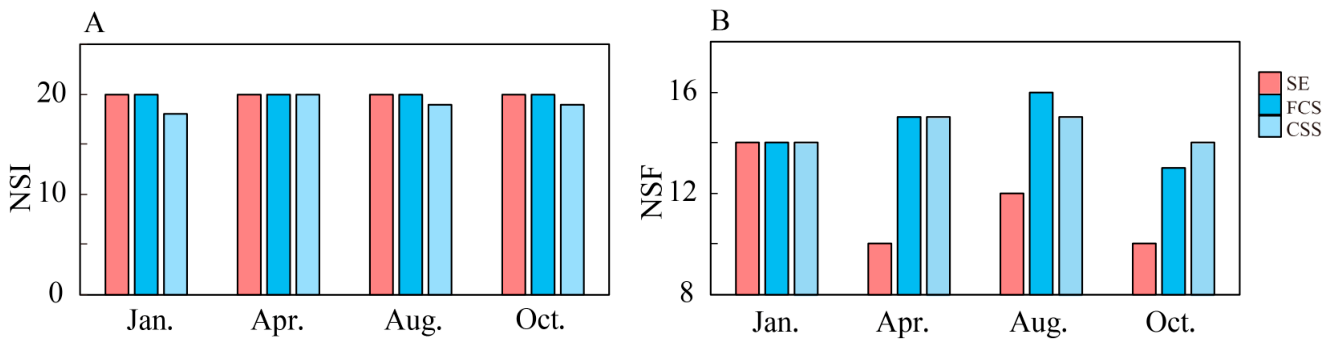
Table 4 shows the range of expected GG under different selection strategies. The maximum GG across the three strategies was 7.8557%, while the minimum values varied among strategies. Specifically, the GG range for SE was 1.9918–7.8557%, whereas the GG ranges for FCS and CSS were both 1.6013–7.8557%. The lower limit of GG for SE was slightly higher than those for FCS and CSS. In addition, the number of selected elite individuals remained stable at 18–20 plants across different sampling seasons (Figure 4A). Notably, the SE strategy resulted in the fewest family types among the selected elite individuals, with only 10 families contributing to elite selections in August and January. In contrast, the FCS and CSS strategies involved 13–16 families, with 15 families contributing to elite selections in August, representing a 50% increase compared with the SE strategy (Figure 4B).

2.6. Screening of Elite Individual Plants

Based on the results of seasonal trait dynamic monitoring and genetic parameter estimation, an elite individual screening scheme was established with summer as the core selection window. Our results showed that traits heritability in the summer was significantly higher than that in other seasons, confirming summer as the optimal selection period. For regulating family contribution, individuals selected via the balanced selection strategies (FCS and CSS) were used to control the family origin the distribution of the selected individuals. By comprehensively integrating seasonal dynamic characteristics, family seasonal response clustering, and multi-strategy comparison results, we constructed an elite individual screening process that incorporates these key elements. Ultimately, 14 elite individuals with the best and most stable performance were finally identified from 432 individuals (Table 5). Notably, all selected individuals passed the screening of three methods (SE, FCS and CSS), indicating that these 14 individuals possess advantages in both breeding value and family representativeness.

3. Discussion

To cope with seasonal environmental fluctuations, plants synthesize specialized secondary metabolites (such as phenols, terpenoids, and flavonoids) and modulate their metabolic abundance and profiles to strengthen defensive capacity [39,40]. Accumulation patterns of plant secondary metabolites are tightly coupled with ambient environmental stress conditions [41]. For instance, in winter and spring, coniferous trees often maintain high levels of phenolic compounds to resist stresses such as low temperature and strong ultraviolet radiation [42,43]. In contrast, the abundance of flavonoids (e.g., rutin and dihydroquercetin) decreases significantly during the vigorous growing seasons of summer and autumn [44]. Consistent with previous findings in P. chinensis [45], our results revealed pronounced catechin accumulation in P. taeda needles during winter (January) and spring (April). This seasonal pattern is likely attributed to the low temperatures prevailing in Guangdong during these periods, whereby plants accumulate abundant secondary metabolites to enhance antioxidant activity, photoprotection and cold tolerance [46]. During the vigorous growth stages of (August) and autumn (October), however, plants preferentially allocate limited photosynthates and carbon resources to primary metabolism processes, thereby suppressing catechin biosynthesis and reducing its accumulation [47,48]. Such seasonal rhythmicity of catechin accumulation, which is tightly synchronized with environmental stress intensity and plant growth cycles, provides robust evidence supporting the plant growth–defense trade-off theory [49].
Quantitative genetics theory indicates that specific environmental stressors (e.g., temperature [50], photoperiod [51], and precipitation [52]) serve as critical selective pressure, which amplifies the physiological differences in environmental responses among different genotypes and further increases the proportion of additive genetic variance ( σ A 2 ) in the total phenotypic variance [53]. In pine genetic assessments of growth and secondary metabolite biosynthesis, genetic parameters are strongly modulated by seasonal fluctuations in environmental factors [54]. For example, the total phenolic content of P. elliottii needles [55], the branch growth of P. pseudostrobus [56], the height growth of P. sylvestris [57], and the needle color [58] are all significantly regulated by seasonal environmental changes. In this study, the study detected distinct seasonal specificity in the genetic parameters of P. taeda needle CC, with both family-mean and individual heritability peaking in August. Combined with the highest coefficient of variation (CV = 45.09%) observed in August, these indicated that the high-temperature and strong-radiation conditions in August impose strong natural selection pressure on the experimental population. This may be attributed to August being the season of high temperatures and intense radiation in southern China, where significant environmental changes triggered differential expression of genes encoding pathways responding to abiotic stress signals and key enzymes involved in secondary metabolite synthesis in plants [59]. This pressure fully induced and amplified the physiological differences in catechin synthesis among different families, leading to the maximum release of additive genetic variance within the population.
While our study revealed pronounced seasonal variation in the genetic parameters of CC in P. taeda, genetic parameter estimation in forest trees inherently reflects the population genetic structure characterized under specific spatiotemporal conditions, with its accuracy inevitably constrained by multiple extrinsic and intrinsic factors. Key confounding variables include experimental population size [60], field experimental design [61], and individual developmental stage [62], all of which can bias the estimation of genetic variance components. Therefore, to overcome the limitations of single-time-point genetic evaluation, this study established a dynamic assessment framework based on continuous cross-seasonal monitoring. This approach enables comprehensive capture of genetically based variation in catechin accumulation in response to divergent seasonal environmental pressures, thereby providing more robust empirical evidence to support the early selection and targeted breeding of secondary metabolic traits in P. taeda.
As is well known, forest trees are inherently characterized by prolonged growth cycles, complex trait development, challenges in early-stage selection and high breeding investment costs [63,64,65,66]. Individual phenotypic performance represents the integrated outcome of intrinsic genetic potential and extrinsic microenvironmental variation [15], serving as the core evaluation index for forest tree genetic improvement. However, conventional phenotypic selection may misattribute transient environmental fluctuations or non-heritable heterosis to stable genetic effects, resulting in inaccurate breeding value estimation [67,68,69]. To precisely quantify the intrinsic genetic potential of individual trees, the BLUP model was employed in this study. By integrating pedigree and family background information, this approach corrects for stochastic environmental disturbances and eliminates estimation biases caused by phenotypic outliers [70,71,72]. The efficacy of this model has been verified in P. tabuliformis and other tree species, as it effectively balance selection intensity and prediction accuracy and enable screening and elimination of inferior individuals [73]. In the present study, comparative analysis of P. taeda families with divergent phenotypic distributions (exemplified by family 17 and family 289) revealed that extreme phenotypic values occurring in populations with low overall means and scattered distributions generally harbor lower genetic merit than average individuals from stable, high-performing populations. This discrepancy arises because the BLUP model identifies the extreme performance of family 289 as unreliable environmental noise, whereas the consistently superior phenotypic performance of family 17 is assigned higher genetic reliability.
Although the BLUP model enables high-precision breeding value estimation [29,74], selection based solely on phenotypic ranking carries a high risk of excessive concentration of selected individuals within a limited number of elite families [75]. Moreover, unconstrained intensive selection tends to cause a sharp reduction in effective population size by overrepresentation of a small set of superior families, thereby elevating inbreeding risk and weakening long-term genetic improvement potential of breeding populations [28,76,77]. In the present study, unconstrained single-strategy selection resulted in severe clustering of selected individuals within a few superior families; for instance, the superior family P075 alone accounted for nearly 30% of all selected candidates, consistent with previous observations in P. koraiensis [78] and P. sylvestris [79]. To mitigate this limitation, we implemented a balanced selection strategy by imposing a maximum family contribution. This approach expanded the number of retained families in the selected population to 13–16, while restricting the maximum contribution of any single family to 10% (a maximum of two selected individuals per family). This strategic transition gain-oriented selection to balance between genetic gain and genetic diversity is essential for maintaining the number of unrelated families and ensuring the long-term evolutionary potential of breeding populations [80]. Essentially, this strategy achieves environmental buffering by exploiting complementary seasonal responses response profiles across diverse families, offsetting productivity declines under suboptimal growing conditions at the expense of a minor reduction in short-term genetic gain [81,82]. For example, the high-yielding family P075 exhibited strong seasonal sensitivity, with substantial declines in catechin accumulation occurring in January. By limiting its selection proportion and incorporating families with stable cross-seasonal performance, balanced selection effectively mitigated overall phenotypic fluctuations in the population. This diversity-driven buffering mechanism has been verified in multi-environment stability analyses of conifers such as P. pinaster [83] and P. sylvestris [84]. Collectively, the three superior families (P075, Q13, and 11) and 14 elite individuals identified in this study integrate high catechin yield potential with strong environmental adaptability, providing valuable germplasm resources for future secondary metabolic traits and multi-generational crossbreeding programs in P. taeda.
Nevertheless, this study was performed within a single stand environment and exclusively focused on catechin as the target trait, which imposes certain limitations on the broader applicability of our conclusions. Future work will incorporate multi-site trials across distinct climatic zones and environmental conditions to validate and generalize the present findings. Furthermore, the rapid advancement of smart breeding and artificial intelligence (AI) technologies has substantially improved the precision and efficiency of plant genomic selection and phenotypic prediction [85]. Building on the BLUP-based genetic evaluation framework established in this study for P. taeda, further research will integrate genomic profiling and AI-assisted visual breeding tools to further enhance the predictive accuracy of key secondary metabolic traits. This integrated analytical pipeline will enable systematic dissection of G × E interaction effects and their underlying molecular regulatory mechanisms. Additionally, such advances will facilitate the optimization of multi-trait coordinated selection strategies, laying a robust scientific foundation for the comprehensive genetic improvement of P. taeda and other commercially and ecologically important forest tree species.

4. Materials and Methods

4.1. Test Site and Materials

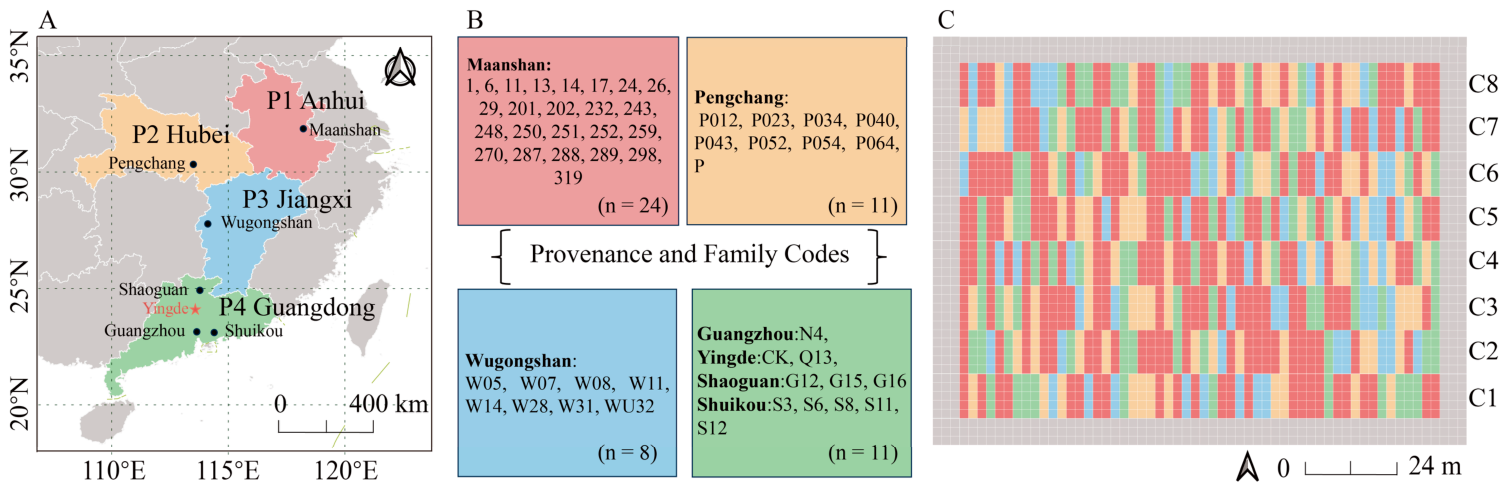
The experimental site was located at the National Improved Seed Base of P. taeda, affiliated with the Yingde Forestry Research Institute in Guangdong Province, China (24°15′ N, 113°25′ E), with detailed information on the base provided in Table 6. Plant materials comprised 54 open-pollinated half-sib families derived from the 1.5-generation P. taeda seed orchard. The parental origins included superior provenances collected from Guangdong, Hubei, Jiangxi, and Anhui provinces in China (Figure 5A,B). Afforestation was carried out in spring 2015 using 1-year-old seedlings, following a randomized complete block design consisting of 8 blocks. Each block contained all 54 families, and each family was planted in a single-row plot of five individuals with a spacing of 3 m × 3 m. Three border rows were established around the experimental stand to eliminate potential edge effects on measurement accuracy (Figure 5C).

4.2. Sample Collection and Processing

Sampling was conducted in spring (April 2022), summer (August 2022), autumn (October 2022) of 2022 and winter (January 2023) of 2023, respectively. All sampling procedures were conducted within four fixed experimental blocks (C1, C3, C5 and C7). Each block contained 54 families, and the first and second individual trees of each family were selected for sampling. Needles from newly lignified twigs were collected from three distinct orientations per tree and pooled to form a single composite sample. All collected samples were preliminarily screened to exclude individuals with damaged foliage, pest and disease infection, or abnormal moisture content. After quality filtering, a total of 1697 valid samples were obtained, including 428 spring samples, 426 summer samples, 416 autumn samples and 427 winter samples.
Following collection, needle samples were immediately cleaned to remove surface impurities and rapidly rinsed three times with deionized water. Samples were subsequently oven-dried at 65 °C until reaching a constant weight. The dried samples were ground using a high-speed grinder (25,000 r/min) (FW-100, Hebi Metallurgical Machinery Equipment Co., Ltd., Hebi, China) and passed through a 30-mesh standard sieve (pore size approximately 0.595 mm) to obtain homogeneous powder. Powder samples were stored hermetically in silica gel desiccators. Prior to spectral collection, samples were equilibrated for 24 h in a constant-temperature and constant-humidity laboratory (25 ± 2 °C, relative humidity 50% ± 5%) to minimize the influence of environmental fluctuations on spectral measurements.

4.3. Near-Infrared Spectroscopy Acquisition and Preprocessing

Diffuse reflectance spectra of samples were collected using a DA7200 near-infrared spectrometer (Perten Instruments AB, Stockholm, Sweden) over a scanning range of 950–1650 nm with a resolution of 5 nm and a spot diameter of 3.5 cm. Each sample was repacked into three independent loading replicates, with the instrument automatically performing three rotational scans per loading, yielding a total of nine spectra per sample. The average spectrum calculated from the nine replicates was used for subsequent analysis. Spectral preprocessing was implemented in the Unscrambler X 10.4 software (CAMO Software AS, Oslo, Norway). A combined pretreatment strategy of standard normal variate (SNV) transformation and the Savitzky–Golay first derivative was applied to eliminate instrumental noise, baseline drift and light scattering interference derived from heterogeneous sample particle size.

4.4. Near-Infrared Prediction Model

The NIRS prediction model was developed according to the procedure described Lu et al. [86], following three core procedures: (1) Sample preparation and division: Needle samples collected from 102 P. taeda individuals were randomly selected for model individuals. After excluding 8 outlier samples, the remaining 82 samples were used to build the prediction model, with additional 12 samples reserved for external validation. (2) CC detection: P. taeda needle catechin content was analyzed using liquid chromatography–mass spectrometry (LC-MS; API 5000, Sciex, Framingham, MA, USA), with chromatographic separation performed on an ACQUITY UPLC BEH C18 column (2.1 mm × 100 mm, 1.7 μm, Waters, Milford, MA, USA). (3) Model construction and validation: A predictive model was established using partial least squares (PLS) regression combined with the optimal spectral preprocessing method (first derivative + standard normal variate transformation, FD + SNV), incorporating 14 principal components. The model yielded a calibration coefficient (Rc) of 0.9696 and a root mean square error of calibration (RMSEC) of 1.3084 μg·g−1. The cross-validation correlation coefficient (Rv) was 0.8171, accompanied by an RMSECV of 3.1052 μg·g−1. External validation confirmed a correlation coefficient (R) of 0.8807 between predicted and measured catechin contents across the 12 validation samples.

4.5. Data Statistics and Analysis

4.5.1. Phenotypic Data Statistics

All data visualization and basic statistical analysis were performed using R software (v4.4.2). Phenotypic parameters of CC, including the mean value, standard deviation, and coefficient of variation (CV), were calculated. The formula for CV calculation is presented as follows:
C V = S D x ¯ × 100 %
where SD is the standard deviation, and x ¯ is the mean value.

4.5.2. Analysis of Variance and Variance Component Estimation

Genetic parameters were estimated independently across four seasons to avoid confounding effects between seasonal environmental variation and genetic effects. For single-season analyses, experimental blocks were treated as spatial replicates. Each family contained two individuals per block across four blocks, yielding a total of eight individuals per family per season (2 trees × 4 blocks). All genetic parameters, including heritability and breeding values, were estimated using ASReml–R V4 [87]. The BLUP model was employed to estimate family effect values and individual breeding values. Family-based and individual-based models were applied to calculate the individual narrow-sense heritability for each target trait, as described below:
Parent model:
γ i j k = μ + B i + F j + B F i j + e i j k
Single plant model:
γ i j k = μ + B i + T i j k + B P i k + e i j k
where Yijk is the measured value of the trait for the k-th tree within the j-th family in the i-th block, μ is the overall mean, Bi is the fixed effect of the i-th block, Fj is the random effect of the j-th family, BFij is the random interaction effect between the i-th block and the j-th family, assuming BFijN(0, σ2BF), Tijk is the random additive genetic effect of the k-th tree within the j-th family, BPik is the random effect of the k-th plot within the i-th block, and eijk is the random residual error, assuming eN(0, σ2e).

4.5.3. Heritability Estimation

In this study, all heritabilities refer to narrow-sense heritability (the ratio of additive genetic variance to phenotypic variance [73]), and the calculation formula is as follows:
Heritability of Single plant:
h S 2 = 4 σ F 2 σ F 2 + σ BF 2 + σ E 2
Average heritability of family lines:
h F 2 = σ F 2 σ F 2 + σ B F 2 b + σ E 2 n b
Heritability within families:
h w 2 = 3 σ F 2 σ B F 2 ( b 1 ) b + σ E 2 ( b n 1 ) n b
where n represents the number of plants per plot, b represents the number of blocks, σ2F is the variance component of family effects, σ2BF is the variance component of block × family interaction effects, and σ2E is the variance component of error effects.

4.5.4. Prediction of Genetic Effects and Estimation of Breeding Values

Genetic effects were estimated via the BLUP model, with the specific linear mixed model was constructed with reference to the method of Butler et al. [88]. In the model, trial site was specified as a fixed effect, whereas family, block, and family-by-block interaction were fitted as random effects. The family effect solutions derived from the model corresponded to the estimated breeding values (EBV) of each family.

4.5.5. Estimation of Genetic Gain

The genetic gain was calculated according to the method of Falconer and Mackay [53], with the formula as follows:
G = h W 2 [ y i j k y ¯ · j · + h F 2 ( y ¯ · j · u ^ ) ]
where h2W is the heritability within families, h2F is the family heritability, yijk is the phenotypic value of the k-th individual plant in the j-th family of the i-th block selected, ӯ·j· is the mean value of the family where the ijk-th individual plant is located, and û is the estimated value of the test site mean.

5. Conclusions

Secondary metabolites are key modulators of plant environmental adaptability, growth and development, and evolutionary fitness. Here, this study integrated NIRS and BLUP modeling to systematically characterize the temporal dynamics and genetic characteristics of needle CC in P. taeda. Our results revealed a distinct seasonal rhythmicity in catechin accumulation, with significantly higher accumulation during winter and spring and diminished levels in summer and autumn. This seasonal variation aligns well with the canonical plant growth–defense resource trade-off hypothesis. Genetic parameter analysis showed that narrow-sense heritability of CC peaked in summer, indicating that enhanced seasonal environmental stress amplifies genotypic divergence in phenotypic expression. Consequently, summer constitutes the optimal seasonal window for the efficient genetic selection of catechin-associated traits in P. taeda. Furthermore, the constrained family contribution strategy based on BLUP evaluation expanded and increased the number of selected elite families by 30%—50% while maintaining robust genetic gain, effectively broadening the genetic diversity of the breeding population. Finally, three superior families (P075, Q13, and 11) and 14 elite individuals were screened based on catechin performance, providing elite germplasm for multi-generational crossbreeding and the development of high-value P. taeda germplasm resources. To further optimize the genetic evaluation system and advance precision breeding for superior P. taeda germplasm, future work will extend experimental coverage to multiple climatic regions and conduct long-term phenotypic monitoring. Combined with genomics and molecular biological techniques, subsequent studies will dissect the genetic regulatory characteristics and molecular mechanisms underlying key target traits, thereby providing a more robust theoretical foundation for the multi-generational genetic improvement of P. taeda.

Author Contributions

Conceptualization, J.S. and C.L.; methodology, J.S., S.H. and T.L.; software, J.S., L.W. and J.L.; validation, L.W., C.G., F.L. and X.Z.; formal analysis, J.S., L.W., J.L. and Y.Z.; investigation, J.S., L.W., J.Y., L.C., J.L. and C.G.; resources, J.S., S.H., T.L. and C.L.; data curation, J.S., L.W. and T.L.; writing—original draft preparation, J.S. and L.W.; writing—review and editing, J.S., L.W., T.L. and C.L.; visualization, J.S.; supervision, C.L.; project administration, T.L.; funding acquisition, S.H., T.L. and C.L. All authors have read and agreed to the published version of the manuscript.

Funding

This study was supported by the National Key Research and Development Program of China (2017YFD0600502-3), and the Ecological Forestry Construction Project of Guangdong Provincial Forestry Bureau, China (GDLZXY20220102 and GDLZXY20230102).

Data Availability Statement

The data presented in this study are available upon request from the corresponding author. The data are not publicly available due to ethical reasons.

Conflicts of Interest

The authors declare no conflicts of interest.

References

  1. Zhao, B.; Wang, J.W. Perenniality: From model plants to applications in agriculture. Mol. Plant 2024, 17, 141–157. [Google Scholar] [CrossRef]
  2. Sun, Y.; Fernie, A.R. Plant secondary metabolism in a fluctuating world: Climate change perspectives. Trends Plant Sci. 2024, 29, 560–571. [Google Scholar] [CrossRef]
  3. Li, Y.; Kong, D.; Fu, Y.; Sussman, M.R.; Wu, H. The effect of developmental and environmental factors on secondary metabolites in medicinal plants. Plant Physiol. Biochem. 2020, 148, 80–89. [Google Scholar] [CrossRef]
  4. Rauf, A.; Imran, M.; Abu-Izneid, T.; Iahtisham-Ul-Haq; Patel, S.; Pan, X.; Naz, S.; Silva, A.S.; Saeed, F.; Suleria, H.A.R. Proanthocyanidins: A comprehensive review. Biomed. Pharmacother. 2019, 116, 108999. [Google Scholar] [CrossRef]
  5. Singh, P.; Arif, Y.; Bajguz, A.; Hayat, S. The role of quercetin in plants. Plant Physiol. Biochem. 2021, 166, 10–19. [Google Scholar] [CrossRef]
  6. Yang, J.; Zhang, Y.; Jia, J.; Wang, C.; Fu, Y. Flavonoid-lignin crosstalk: Engineering metabolic flux for optimised plant growth and stress resilience. Plant Cell Environ. 2025, 48, 8141–8160. [Google Scholar] [CrossRef] [PubMed]
  7. Alonso-Esteban, J.I.; Carocho, M.; Barros, D.; Velho, M.V.; Heleno, S.A.; Barros, L. Chemical composition and industrial applications of Maritime pine (Pinus pinaster Ait.) bark and other non-wood parts. Rev. Environ. Sci. Biotechnol. 2022, 21, 583–633. [Google Scholar] [CrossRef]
  8. Liu, Y.; Shi, A.; Chen, Y.; Xu, Z.; Liu, Y.; Yao, Y.; Wang, Y.; Jia, B. Beneficial microorganisms: Regulating growth and defense for plant welfare. Plant Biotechnol. J. 2025, 23, 986–998. [Google Scholar] [CrossRef]
  9. Huot, B.; Yao, J.; Montgomery, B.L.; He, S.Y. Growth–defense tradeoffs in plants: A balancing act to optimize fitness. Mol. Plant 2014, 7, 1267–1287. [Google Scholar] [CrossRef] [PubMed]
  10. He, Y.; Junker, R.R.; Xiao, J.; Lasky, J.R.; Cao, M.; Asefa, M.; Swenson, N.G.; Xu, G.; Yang, J.; Sedio, B.R. Genetic and environmental drivers of intraspecific variation in foliar metabolites in a tropical tree community. New Phytol. 2025, 246, 2551–2564. [Google Scholar] [CrossRef] [PubMed]
  11. De La Torre, A.R.; Puiu, D.; Crepeau, M.W.; Stevens, K.; Salzberg, S.L.; Langley, C.H.; Neale, D.B. Genomic architecture of complex traits in loblolly pine. New Phytol. 2019, 221, 1789–1801. [Google Scholar] [CrossRef] [PubMed]
  12. Hoffmann, A.A.; Willi, Y. Detecting genetic responses to environmental change. Nat. Rev. Genet. 2008, 9, 421–432. [Google Scholar] [CrossRef]
  13. Visscher, P.M.; Hill, W.G.; Wray, N.R. Heritability in the genomics era-concepts and misconceptions. Nat. Rev. Genet. 2008, 9, 255–266. [Google Scholar] [CrossRef]
  14. Wright, F.A.; Sullivan, P.F.; Brooks, A.I.; Zou, F.; Sun, W.; Xia, K.; Madar, V.; Jansen, R.; Chung, W.; Zhou, Y.H.; et al. Heritability and genomics of gene expression in peripheral blood. Nat. Genet. 2014, 46, 430–437. [Google Scholar] [CrossRef]
  15. Napier, J.D.; Heckman, R.W.; Juenger, T.E. Gene-by-environment interactions in plants: Molecular mechanisms, environmental drivers, and adaptive plasticity. Plant Cell 2023, 35, 109–124. [Google Scholar] [CrossRef]
  16. Schneider, R.; Bäurle, I.; Nikoloski, Z.; Lenhard, M. Plant phenotypic plasticity: From molecular mechanisms to breeding and climate change adaptation. Annu. Rev. Plant Biol. 2026, 77, 707–731. [Google Scholar] [CrossRef]
  17. Calleja-Rodriguez, A.; Pan, J.; Funda, T.; Chen, Z.; Baison, J.; Isik, F.; Abrahamsson, S.; Wu, H.X. Evaluation of the efficiency of genomic versus pedigree predictions for growth and wood quality traits in Scots pine. BMC Genom. 2020, 21, 796. [Google Scholar] [CrossRef]
  18. López-Álvarez, Ó.; Zas, R.; Marey-Perez, M. Resin tapping: A review of the main factors modulating pine resin yield. Ind. Crops Prod. 2023, 202, 117105. [Google Scholar] [CrossRef]
  19. Yadav, B.; Jogawat, A.; Rahman, M.S.; Narayan, O.P. Secondary metabolites in the drought stress tolerance of crop plants: A review. Gene Rep. 2021, 23, 101040. [Google Scholar] [CrossRef]
  20. Bakó, E.; Böszörményi, A.; Vargáné Szabó, B.; Engh, M.A.; Hegyi, P.; Ványolós, A.; Csupor, D. Chemometric analysis of monoterpenes and sesquiterpenes of conifers. Front. Plant Sci. 2024, 15, 1392539. [Google Scholar] [CrossRef]
  21. Zhao, T.; Li, Q.; Yan, T.; Yu, B.; Wang, Q.; Wang, D. Sugar and anthocyanins: A scientific exploration of sweet signals and natural pigments. Plant Sci. 2025, 353, 112409. [Google Scholar] [CrossRef]
  22. Shu, M.; Harfouche, A.L.; Trtílek, M.; Panzarová, K.; Alasia, O.F.; Lagergren, J.H.; Labbé, A.; Engle, N.L.; Clark, M.M.; Chen, J.G. Leveraging hyperspectral phenotyping for accurate, non-destructive prediction of metabolite profiles in poplar under drought stress. Environ. Exp. Bot. 2025, 237, 106218. [Google Scholar] [CrossRef]
  23. Fine, P.V.A.; Salazar, D.; Martin, R.E.; Metz, M.R.; Misiewicz, T.M.; Asner, G.P. Exploring the links between secondary metabolites and leaf spectral reflectance in a diverse genus of Amazonian trees. Ecosphere 2021, 12, e03362. [Google Scholar] [CrossRef]
  24. Provazník, D.; Stejskal, J.; Lhotáková, Z.; Čepl, J.; Neuwirthová, E.; Nofrizal, A.Y.; Albrechtová, J. Needle- and canopy-level genetic variation in Scots pine (Pinus sylvestris L.) revealed by hyperspectral phenotyping across sites and seasons. Evol. Appl. 2025, 18, e70176. [Google Scholar] [CrossRef]
  25. Crossa, J.; Martini, J.W.; Vitale, P.; Pérez-Rodríguez, P.; Costa-Neto, G.; Fritsche-Neto, R.; Runcie, D.; Cuevas, J.; Toledo, F.; Li, H.; et al. Expanding genomic prediction in plant breeding: Harnessing big data, machine learning, and advanced software. Trends Plant Sci. 2025, 30, 756–774. [Google Scholar] [CrossRef] [PubMed]
  26. Moreira, F.F.; Oliveira, H.R.; Volenec, J.J.; Rainey, K.M.; Brito, L.F. Integrating high-throughput phenotyping and statistical genomic methods to genetically improve longitudinal traits in crops. Front. Plant Sci. 2020, 11, 681. [Google Scholar] [CrossRef] [PubMed]
  27. Hedrick, P.W.; Garcia-Dorado, A. Understanding inbreeding depression, purging, and genetic rescue. Trends Ecol. Evol. 2016, 31, 940–952. [Google Scholar] [CrossRef]
  28. Yang, B.; Sun, H.; Qi, J.; Niu, S.; Li, W. Improved genetic distance-based spatial deployment can effectively minimize inbreeding in seed orchard. For. Ecosyst. 2020, 7, 10. [Google Scholar] [CrossRef]
  29. Vieira, R.A.; Nogueira, A.P.O.; Fritsche-Neto, R. Optimizing the selection of quantitative traits in plant breeding using simulation. Front. Plant Sci. 2025, 16, 1495662. [Google Scholar] [CrossRef]
  30. Hou, J.; Liu, M.; Yang, K.; Liu, B.; Liu, H.; Liu, J. Genetic variation for adaptive evolution in response to changed environments in plants. J. Integr. Plant Biol. 2025, 67, 2265–2293. [Google Scholar] [CrossRef]
  31. dos Santos Rodrigues, V.; Motta, A.C.V.; Gomes, J.B.V.; Bognola, I.A.; Magri, E.; Prior, S.A.; Silva, S.R.; Auer, C.G.; Maeda, S.; Junior, M.M. What is the major cause of Pinus taeda nutritional disorder in southern Brazil? J. Soil Sci. Plant Nutr. 2025, 25, 934–947. [Google Scholar] [CrossRef]
  32. Wang, L.; Jiang, K.; Cao, L.; Yu, J.; Sun, J.; Liu, C.; Huang, S.; Liu, T. Analysis of the variation and genetic stability of chloroplast genome of Pinus taeda. BMC Genom. 2026, 27, 215. [Google Scholar] [CrossRef]
  33. Koutsaviti, A.; Toutoungy, S.; Saliba, R.; Loupassaki, S.; Tzakou, O.; Roussis, V.; Ioannou, E. Antioxidant potential of pine needles: A systematic study on the essential oils and extracts of 46 species of the genus Pinus. Foods 2021, 10, 142. [Google Scholar] [CrossRef] [PubMed]
  34. Mao, J.; Huang, L.; Chen, M.; Zeng, W.; Feng, Z.; Huang, S.; Liu, T. Integrated analysis of the transcriptome and metabolome reveals genes involved in terpenoid and flavonoid biosynthesis in the loblolly pine (Pinus taeda L.). Front. Plant Sci. 2021, 12, 729161. [Google Scholar] [CrossRef]
  35. Tambarussi, E.V.; Shalizi, M.N.; Grattapaglia, D.; Hodge, G.; Isik, F.; Paludeto, J.G.Z.; Biernaski, F.A.; Acosta, J.J. Genome-wide SNP-based relationships improve genetic parameter estimates and genomic prediction of growth traits in a large operational breeding trials of Pinus taeda L. Forestry 2025, 98, 692–705. [Google Scholar] [CrossRef]
  36. Barrette, J.; Achim, A.; Auty, D. Impact of intensive forest management practices on wood quality from conifers: Literature review and reflection on future challenges. Curr. For. Rep. 2023, 9, 101–130. [Google Scholar] [CrossRef]
  37. Trachta, M.; McKeand, S.E.; Walker, T.D. A comparison of non-improved provenances and improved checklots from a Pinus taeda breeding program. Tree Genet. Genomes 2025, 21, 24. [Google Scholar] [CrossRef]
  38. Hirao, T.; Matsunaga, K.; Shirasawa, K. Quantitative trait loci analysis based on high-density mapping of single-nucleotide polymorphisms by genotyping-by-sequencing against pine wilt disease in Japanese black pine (Pinus thunbergii). Front. Plant Sci. 2022, 13, 850660. [Google Scholar] [CrossRef]
  39. Renuka Kolli, R. Seasons change and so do trees: Expression profiling of aspen reveals season-specific gene hubs. Plant Cell 2025, 37, koaf213. [Google Scholar] [CrossRef] [PubMed]
  40. Zrimec, J.; Correa, S.; Zagorščak, M.; Petek, M.; Bleker, C.; Stare, K.; Schuy, C.; Sonnewald, S.; Gruden, K.; Nikoloski, Z. Evaluating plant growth–defense trade-offs by modeling the interaction between primary and secondary metabolism. Proc. Natl. Acad. Sci. USA 2025, 122, e2502160122. [Google Scholar] [CrossRef] [PubMed]
  41. Han, M.; Lin, S.; Zhu, B.; Tong, W.; Xia, E.; Wang, Y.; Yang, T.; Zhang, S.; Wan, X.; Liu, J.; et al. Dynamic DNA methylation regulates season-dependent secondary metabolism in the new shoots of tea plants. J. Agric. Food Chem. 2024, 72, 3984–3997. [Google Scholar] [CrossRef] [PubMed]
  42. Sleptsov, I.V.; Mikhailov, V.V.; Rozhina, S.M.; Kershengolts, B.M. The year-round dynamic of metabolites accumulation in Pinus sylvestris needles in permafrost zone. Trees 2023, 37, 285–296. [Google Scholar] [CrossRef]
  43. Ilek, A.; Gąsecka, M.; Magdziak, Z.; Saitanis, C.; Siegert, C.M. Seasonality affects low-molecular-weight organic acids and phenolic compounds’ composition in Scots pine litterfall. Plants 2024, 13, 1293. [Google Scholar] [CrossRef]
  44. Kopaczyk, J.M.; Warguła, J.; Jelonek, T. The variability of terpenes in conifers under developmental and environmental stimuli. Environ. Exp. Bot. 2020, 180, 104197. [Google Scholar] [CrossRef]
  45. Zhang, L.; Yang, M.; Gao, J.; Jin, S.; Wu, Z.; Wu, L.; Zhang, X. Seasonal variation and gender pattern of phenolic and flavonoid contents in Pistacia chinensis Bunge inflorescences and leaves. J. Plant Physiol. 2016, 191, 36–44. [Google Scholar] [CrossRef]
  46. Kumari, S.; Nazir, F.; Maheshwari, C.; Kaur, H.; Gupta, R.; Siddique, K.H.M.; Khan, M.I.R. Plant hormones and secondary metabolites under environmental stresses: Enlightening defense molecules. Plant Physiol. Biochem. 2024, 206, 108238. [Google Scholar] [CrossRef] [PubMed]
  47. Ochoa-López, S.; Damián, X.; Rebollo, R.; Fornoni, J.; Domínguez, C.A.; Boege, K. Ontogenetic changes in the targets of natural selection in three plant defenses. New Phytol. 2020, 226, 1480–1491. [Google Scholar] [CrossRef]
  48. Özyazici, M.A. Effects of secondary metabolites on pollination in legume forage crops. Ege Üniv. Ziraat Fak. Derg. 2023, 60, 539–552. [Google Scholar] [CrossRef]
  49. Gao, M.; Hao, Z.; Ning, Y.; He, Z. Revisiting growth–defence trade-offs and breeding strategies in crops. Plant Biotechnol. J. 2024, 22, 1198–1205. [Google Scholar] [CrossRef]
  50. Khan, A.; Korban, S.S. Breeding and genetics of disease resistance in temperate fruit trees: Challenges and new opportunities. Theor. Appl. Genet. 2022, 135, 3961–3985. [Google Scholar] [CrossRef]
  51. Xie, D.; Chen, L.; Zhou, C.; Tarin, M.W.K.; Yang, D.; Ren, K.; He, T.; Rong, J.; Zheng, Y. Transcriptomic and metabolomic profiling reveals the effect of LED light quality on morphological traits, and phenylpropanoid-derived compounds accumulation in Sarcandra glabra seedlings. BMC Plant Biol. 2020, 20, 476. [Google Scholar] [CrossRef]
  52. Laverdière, J.-P.; Lenz, P.; Nadeau, S.; Depardieu, C.; Isabel, N.; Perron, M.; Beaulieu, J.; Bousquet, J. Breeding for adaptation to climate change: Genomic selection for drought response in a white spruce multi-site polycross test. Evol. Appl. 2022, 15, 383–402. [Google Scholar] [CrossRef]
  53. Falconer, D.S.; Mackay, T.F.C. Introduction to Quantitative Genetics, 4th ed.; Longman: Harlow, UK, 1996; pp. 1–464. [Google Scholar]
  54. Resende, R.T.; Silva, P.I.T.; Silva-Junior, O.B.; Freitas, M.L.M.; Sebbenn, A.M.; Sousa, V.A.; Aguiar, A.D.; Grattapaglia, D. Age trends in genetic parameters for growth performance across country-wide provenances of the iconic conifer tree Araucaria angustifolia show strong prospects for systematic breeding and early selection. For. Ecol. Manag. 2021, 501, 119671. [Google Scholar] [CrossRef]
  55. Song, Z.; Xu, C.; Luan, Q.; Li, Y. Multitemporal UAV study of phenolic compounds in slash pine canopies. Remote Sens. Environ. 2024, 315, 114454. [Google Scholar] [CrossRef]
  56. Escobar-Alonso, S.; Vargas-Hernández, J.J.; López-Upton, J.; García-Campusano, F.; Jiménez-Casas, M.; Cruz-Huerta, N. Genetic variation and phenotypic plasticity in the seasonal shoot growth pattern of Pinus pseudostrobus. New For. 2024, 55, 1379–1398. [Google Scholar] [CrossRef]
  57. Hejtmánek, J.; Stejskal, J.; Provazník, D.; Čepl, J. Understanding the role of ecotypic factors in the early growth of Pinus sylvestris L. J. For. Sci. 2023, 69, 539–549. [Google Scholar] [CrossRef]
  58. Chuchlík, J.; Čepl, J.; Neuwirthová, E.; Korecký, J.; Stejskal, J. Seasonal color shifts and genetic diversity in Scots pine: A generalizable RGB imaging and CNN-based framework for conifer seedlings. Ann. For. Sci. 2025, 82, 38. [Google Scholar] [CrossRef]
  59. Liu, F.; Xi, M.; Liu, T.; Wu, X.; Ju, L.; Wang, D. The central role of transcription factors in bridging biotic and abiotic stress responses for plants’ resilience. New Crops 2024, 1, 100005. [Google Scholar] [CrossRef]
  60. Hoffmann, A.A.; Sgrò, C.M.; Kristensen, T.N. Revisiting adaptive potential, population size, and conservation. Trends Ecol. Evol. 2017, 32, 506–517. [Google Scholar] [CrossRef]
  61. Avanzi, C.; Piermattei, A.; Piotti, A.; Büntgen, U.; Heer, K.; Opgenoorth, L.; Spanu, I.; Urbinati, C.; Vendramin, G.G.; Leonardi, S. Disentangling the effects of spatial proximity and genetic similarity on individual growth performances in Norway spruce natural populations. Sci. Total Environ. 2019, 650, 493–504. [Google Scholar] [CrossRef] [PubMed]
  62. Richards, T.J.; Karacic, A.; Apuli, R.P.; Weih, M.; Ingvarsson, P.K.; Rönnberg-Wästljung, A.C. Quantitative genetic architecture of adaptive phenology traits in the deciduous tree, Populus trichocarpa (Torr. and Gray). Heredity 2020, 125, 449–458. [Google Scholar] [CrossRef]
  63. Lanner, R.M. Why do trees live so long? Ageing Res. Rev. 2002, 1, 653–671. [Google Scholar] [CrossRef]
  64. Lu, Z.; Li, M.; Li, X.; Zhao, Z.; Cao, Z.; Xu, Y.; Du, G.; Wang, X. Early selection of superior germplasm for oil-producing Eucalyptus maidenii F. v. Muell Sci. Rep. 2025, 15, 25910. [Google Scholar] [CrossRef] [PubMed]
  65. Lenz, P.R.; Nadeau, S.; Azaiez, A.; Gérardi, S.; Deslauriers, M.; Perron, M.; Isabel, N.; Beaulieu, J.; Bousquet, J. Genomic prediction for hastening and improving efficiency of forward selection in conifer polycross mating designs: An example from white spruce. Heredity 2020, 124, 562–578. [Google Scholar] [CrossRef]
  66. Resende, R.T.; Piepho, H.P.; Rosa, G.J.M.; Silva-Junior, O.B.; e Silva, F.F.; de Resende, M.D.V.; Grattapaglia, D. Enviromics in breeding: Applications and perspectives on envirotypic-assisted selection. Theor. Appl. Genet. 2021, 134, 95–112. [Google Scholar] [CrossRef] [PubMed]
  67. Cao, J.; Bao, J.; Lan, S.; Qin, X.; Ma, S.; Li, S. Research progress on low-temperature stress response mechanisms and mitigation strategies in plants. Plant Growth Regul. 2024, 104, 1355–1376. [Google Scholar] [CrossRef]
  68. Hall, D.; Olsson, J.; Zhao, W.; Kroon, J.; Wennström, U.; Wang, X.R. Divergent patterns between phenotypic and genetic variation in Scots pine. Plant Commun. 2021, 2, 100139. [Google Scholar] [CrossRef]
  69. Araujo, M.J.; Bush, D.; Tambarussi, E.V. Quantifying genetic and genotypic gain gaps in Eucalyptus: The hidden cost of ignoring inbreeding and dominance. Heredity 2025, 134, 542–557. [Google Scholar] [CrossRef]
  70. Fry, J.D. The mixed-model analysis of variance applied to quantitative genetics: Biological meaning of the parameters. Evolution 1992, 46, 540–550. [Google Scholar] [CrossRef]
  71. Allier, A.; Lehermeier, C.; Charcosset, A.; Moreau, L.; Teyssèdre, S. Improving short- and long-term genetic gain by accounting for within-family variance in optimal cross-selection. Front. Genet. 2019, 10, 1006. [Google Scholar] [CrossRef]
  72. Niu, J.; Jia, D.; Zhou, Z.; Cao, M.; Liu, C.; Huang, Q.; Li, J. Selection for low-nitrogen tolerance using multi-trait genotype ideotype distance index (MGIDI) in poplar varieties. Agronomy 2025, 15, 1754. [Google Scholar] [CrossRef]
  73. Zhou, C.; Sun, F.; Jiao, Z.; El-Kassaby, Y.A.; Li, W. Design strategy of advanced generation breeding population of Pinus tabuliformis based on genetic variation and inbreeding level. For. Ecosyst. 2025, 13, 100320. [Google Scholar] [CrossRef]
  74. Massariol Suela, M.; Pires Lima, L.; Ferreira Azevedo, C.; Deon Vilela de Resende, M.; Nascimento, M.; Silva, F.F. Combined index of genomic prediction methods applied to productivity traits in rice. Ciênc. Rural 2019, 49, e20181008. [Google Scholar] [CrossRef]
  75. Li, Y.; Kaur, S.; Pembleton, L.W.; Valipour-Kahrood, H.; Rosewarne, G.M.; Daetwyler, H.D. Strategies of preserving genetic diversity while maximizing genetic response from implementing genomic selection in pulse breeding programs. Theor. Appl. Genet. 2022, 135, 1813–1828. [Google Scholar] [CrossRef]
  76. Santos-del-Blanco, L.; Olsson, S.; Budde, K.B.; Grivet, D.; González-Martínez, S.C.; Alía, R.; Robledo-Arnuncio, J.J. On the feasibility of estimating contemporary effective population size (Ne) for genetic conservation and monitoring of forest trees. Biol. Conserv. 2022, 273, 109704. [Google Scholar] [CrossRef]
  77. Kou, Y.X.; Liu, M.L.; López-Pujol, J.; Zhang, Q.J.; Zhang, Z.Y.; Li, Z.H. Contrasting demographic history and mutational load in three threatened whitebark pines (Pinus subsect. Gerardianae): Implications for conservation. Plant J. 2024, 119, 2967–2981. [Google Scholar] [CrossRef]
  78. Park, J.M.; Kwon, S.H.; Lee, H.J.; Na, S.J.; El-Kassaby, Y.A.; Kang, K.S. Integrating fecundity variation and genetic relatedness in estimating the gene diversity of seed crops: Pinus koraiensis seed orchard as an example. Can. J. For. Res. 2017, 47, 366–370. [Google Scholar] [CrossRef]
  79. Liesebach, H.; Liepe, K.; Bäucker, C. Towards new seed orchard designs in Germany—A review. Silvae Genet. 2021, 70, 84–98. [Google Scholar] [CrossRef]
  80. Hoban, S.; Bruford, M.W.; Funk, W.C.; Galbusera, P.; Griffith, M.P.; Grueber, C.E.; Heuertz, M.; Hunter, M.E.; Hvilsom, C.; Kalamujic Stroil, B.; et al. Global commitments to conserving and monitoring genetic diversity are now necessary and feasible. BioScience 2021, 71, 964–976. [Google Scholar] [CrossRef]
  81. Milesi, P.; Kastally, C.; Dauphin, B.; Cervantes, S.; Bagnoli, F.; Budde, K.B.; Cavers, S.; Fady, B.; Faivre-Rampant, P.; González-Martínez, S.C.; et al. Resilience of genetic diversity in forest trees over the Quaternary. Nat. Commun. 2024, 15, 8538. [Google Scholar] [CrossRef] [PubMed]
  82. Dering, M.; Baranowska, M.; Beridze, B.; Chybicki, I.J.; Danelia, I.; Iszkuło, G.; Kvartskhava, G.; Kosiński, P.; Rączka, G.; Thomas, P.; et al. The evolutionary heritage and ecological uniqueness of Scots pine in the Caucasus ecoregion is at risk of climate changes. Sci. Rep. 2021, 11, 22845. [Google Scholar] [CrossRef] [PubMed]
  83. Hurel, A.; de Miguel, M.; Dutech, C.; Desprez-Loustau, M.L.; Plomion, C.; Rodríguez-Quilón, I.; Cyrille, A.; Guzman, T.; Alía, R.; González-Martínez, S.C.; et al. Genetic basis of growth, spring phenology, and susceptibility to biotic stressors in maritime pine. Evol. Appl. 2021, 14, 2750–2772. [Google Scholar] [CrossRef] [PubMed]
  84. Lasek, M.; Łabiszak, B.; Wachowiak, W. Admixture-driven genetic diversity supports adaptive potential in Scots pine: Implications for climate-resilient forest management. For. Ecol. Manag. 2026, 606, 123531. [Google Scholar] [CrossRef]
  85. Feng, W.; Gao, P.; Wang, X. AI breeder: Genomic predictions for crop breeding. New Crops 2024, 1, 100010. [Google Scholar] [CrossRef]
  86. Lu, X.X.; Feng, Z.H.; Lin, X.; Li, S.; Huang, S. Establishment of near-infrared prediction model for catechin content in loblolly pine needles. J. Northwest A F Univ. (Nat. Sci. Ed.) 2022, 50, 28–34. (In Chinese) [Google Scholar]
  87. Butler, D.G.; Cullis, B.R.; Gilmour, A.R.; Gogel, B.J.; Thompson, R. ASReml-R Reference Manual Version 4; VSN International Ltd.: Hemel Hempstead, UK, 2017. [Google Scholar]
  88. Mrode, R.A. Linear Models for the Prediction of Animal Breeding Values, 4th ed.; CABI Publishing: Wallingford, UK, 2014; pp. 1–360. [Google Scholar]
Figure 1. Seasonal dynamics of catechin content (CC) in needles of P. taeda. (A): CC (mean ± standard error) in each season. (B): Coefficient of variation in CC in each season. (CF): Q–Q normal distribution plots of CC in each season. Different lowercase letters in the figure indicate significant differences in CC among seasons at the 0.05 level (p < 0.05).
Plants 15 01666 g001
Figure 2. Family differences and cluster analysis of catechin content in P. taeda. (A): Duncan’s multiple comparisons of catechin among different families; differences between groups are labeled with lowercase letters a–k (p < 0.05), * indicates p < 0.05, and ** indicates p < 0.01. (B): Circular clustering heatmap of catechin content across four seasons.
Plants 15 01666 g002
Figure 3. Seasonal distribution characteristics of CC across different family lineages. (A,B): Individual distribution characteristics of two superior families (Family 17 and Family 289) with prominent CC in P. taeda needles in spring, highlighting two individuals (ID: 48 and ID: 177) with outstanding measured CC values. (C): Intra-family distribution patterns of needle CC in P. taeda across different seasons, with each violin-box plot representing one family.
Plants 15 01666 g003
Figure 4. Selection performance of different screening strategies across different seasons. (A): Number of superior individuals and families selected by each strategy in different seasons; (B) Co-occurrence rate of selection results between each pair of the three screening strategies in different seasons. NSI: number of selected individuals; NSF: number of selected families; SE: Single Breeding Value Selection; FCS: Family-Constrained Selection; CSS: Composite Screening Strategy.
Plants 15 01666 g004
Figure 5. Provenance distribution and field planting layout of the experimental materials. (A): Geographical distribution of the seven provenances. (B): Abbreviation codes for the tested families derived from the seven provenances. (C): Block arrangement of the experimental materials in the field trial. The experimental materials consisted of families originating from four provincial provenances, including Anhui (P1, red, n = 24), Hubei (P2, yellow, n = 11), Jiangxi (P3, blue, n = 8), and Guangdong (P4, green, n = 11). The field trial was established with eight experimental blocks (C1–C8), with the longitudinal direction aligned to the north (N). The peripheral gray areas around indicate three protection rows.
Plants 15 01666 g005
Table 1. Results of the variance analysis for family and seasonal effects. SV: source of variation; SS: sum of squares; df: degrees of freedom; MS: mean square; S × F: season × family interaction.
SVSSdfMSF Valuep Value
Family10,643532012.190<0.001
Season67,293322,431244.601<0.001
S × F16,8431591061.1550.101
Table 2. Estimation of genetic force across four seasons. FMH: Family-mean heritability; IH: Individual–tree heritability; WFH: Within–family heritability.
MonthFMHIHWFH
Apr.0.576 ± 0.1370.313 ± 0.1550.272 ± 0.145
Aug.0.714 ± 0.0830.572 ± 0.1890.537 ± 0.207
Oct.0.514 ± 0.1680.262 ± 0.1590.225 ± 0.146
Jan.0.373 ± 0.2330.155 ± 0.1450.130 ± 0.126
Table 3. Top 10 families ranked by the effect value of catechin content. The symbol ★ indicates that the family has ranked among the top ten in effect value for at least three seasons. CC: catechin content; FE: family effect.
Apr.Aug.Oct.Jan.
FamilyCC (μg·g−1)FEFamilyCC (μg·g−1)FEFCC (μg·g−1)F EFamilyCC (μg·g−1)FE
1738.159.0205P075★23.2110.1596S1119.363.3334S832.913.1427
P075★34.645.71722618.715.170125219.003.0840Q13★32.472.9412
P04033.895.5774S318.595.031311★18.112.4686631.532.7877
24332.754.651024318.494.74382617.922.3313P04332.832.7777
25232.304.624611★18.024.2207P075★18.252.0418P01230.972.2581
S633.134.5252S817.714.054827017.241.8674N430.822.1918
W1432.584.5137116.133.4352P05217.241.866411★30.301.8416
Q13★32.114.1314Q13★16.953.2129117.141.7940P09029.901.7731
28731.943.8616G1516.783.0297G1616.981.686624829.241.4740
P04331.533.664025016.422.6228P06416.531.37352928.221.4477
Table 4. Selected results of superior individual plants under three screening strategies. ▲: SE; ●: FCS; ◆: CSS; F: family; ID: individual identity; CC: catechin content; GG: genetic gain; SS: selection strategy.
Apr.Aug.Oct.Jan.
IDFCC (μg·g−1)GG (%)SSIDFCC (μg·g−1)GG (%)SSIDFCC (μg·g−1)GG (%)SSIDFCC (μg·g−1)GG (%)SS
481748.077.8557▲●◆302P07532.958.815▲●◆13725227.873.0373▲●◆15643.222.9691▲●◆
471746.577.5946▲●◆301P07532.338.5658▲●◆13325224.22.8559▲●◆10641.932.7312▲●◆
263P04055.237.5471▲●◆300P07530.267.854313625224.482.7087363S838.932.6183▲●◆
10424345.026.2045▲●◆10324332.427.2618▲●◆329S1121.952.5769▲●◆365S845.172.4435▲●◆
301P07548.195.4041▲●◆299P07523.177.1757332S1121.972.4392▲●◆225N440.652.3582▲●◆
26P04042.775.3068▲●◆344S332.747.097▲●◆6127.472.4265▲●◆16638.462.3499
300P07539.565.0654▲●◆419WU3231.935.9793▲●201124.222.3914▲●◆302P09041.322.2205▲●◆
10324341.245.0642▲◆10124328.955.6566▲●◆13025221.162.353616728843.452.2126▲●◆
356S648.865.0379▲●◆642623.425.4653▲●◆401W1427.612.3406▲●◆326Q1335.742.1671▲●◆
271P04350.644.8809▲●◆345S327.655.4214▲●◆279P05226.512.3042▲●◆362S831.622.1451
15928743.854.8795▲●◆349S322.115.4166602623.152.2942▲●◆321Q1335.452.1416▲●◆
12025051.134.7627▲●◆298P07517.875.2804327S1120.692.2486271P04335.622.1415▲●◆
355S647.814.6848▲●359S828.595.1036▲●◆9723228.42.2286▲●322Q1342.762.1362
371W0546.214.6781▲●◆13325229.395.0909▲●◆11925028.222.2159▲●◆319Q1342.462.1094
16028748.414.6294▲●297P07515.734.8982328S1120.962.1456171140.712.0773▲●◆
325Q1339.124.6293▲●◆622621.164.6592▲●◆343S329.052.1402▲●10324342.762.0665▲●◆
309P09053.454.5353▲●◆206G1228.354.4197▲●331S1120.622.094231138.772.0597▲●
13625238.394.5349▲●◆11725026.94.3647▲●◆642623.62.0746▲●◆266P04333.142.0464▲●◆
732949.884.5057▲●◆602624.654.3153228N424.922.0689▲●◆269P04333.142.0457
401W1437.384.4632▲●◆232P01221.744.2792▲●◆223G1625.542.0626▲●◆234P01235.151.9918▲●◆
10524346.594.3502221G1628.014.2252289P06424.342.0385●◆227N436.251.9713
238P01226.814.2021295P07523.672.021●◆300P07543.171.9152●◆
3121.144.1759●◆15127022.611.9951●◆9723240.621.8702●◆
211123.974.0096●◆291P06424.231.9767373W0540.851.8557
216G1520.473.7943●◆351S824.991.9375426WU3242.221.6505
9023226.453.7885●◆19331922.661.7285233P01231.231.6359●◆
181123.543.6149221118.91.7231682935.261.6013
326Q1319.083.556717929822.631.7205
276P05219.573.1562
396W1424.63.1552
Table 5. Superior individuals of P. taeda screened based on multi-season dynamic evaluation and integrated strategies.
IDFamilyIDFamily
301P075363S8
302P075225N4
325Q134817
321Q13263P040
2011344S3
1711137252
271P043329S11
Table 6. Basic overview of the experimental site. CT: Climate type; ET: Extreme temperature; MAP: Mean annual precipitation; ASH: annual mean sunshine hours; FFP: frost-free period; AT10: annual accumulated temperature above 10 °C; LT: Landform type; STY: Soil type; EL: Elevation; SG: Slope gradient; ST: Soil thickness.
Climate CharacteristicsSoil CharacteristicsMain Understory Vegetation
CTSubtropical monsoon climateLTLow hilly landformImperata cylindrica,
Eriachne pallescens,
Dicranopteris linearis,
Blechnum orientale,
Lophatherum gracile,
Lygodium japonicum et al.
ET39 °C/1 °CSTYMedium–clayey lateritic red soil
MAP1699.1 mmpH5.2–6.7
ASH1631.7 hEL50 ± 3 m
FFP320 dSG15 ± 5°
AT107576 °CST>1 m
Disclaimer/Publisher’s Note: The statements, opinions and data contained in all publications are solely those of the individual author(s) and contributor(s) and not of MDPI and/or the editor(s). MDPI and/or the editor(s) disclaim responsibility for any injury to people or property resulting from any ideas, methods, instructions or products referred to in the content.