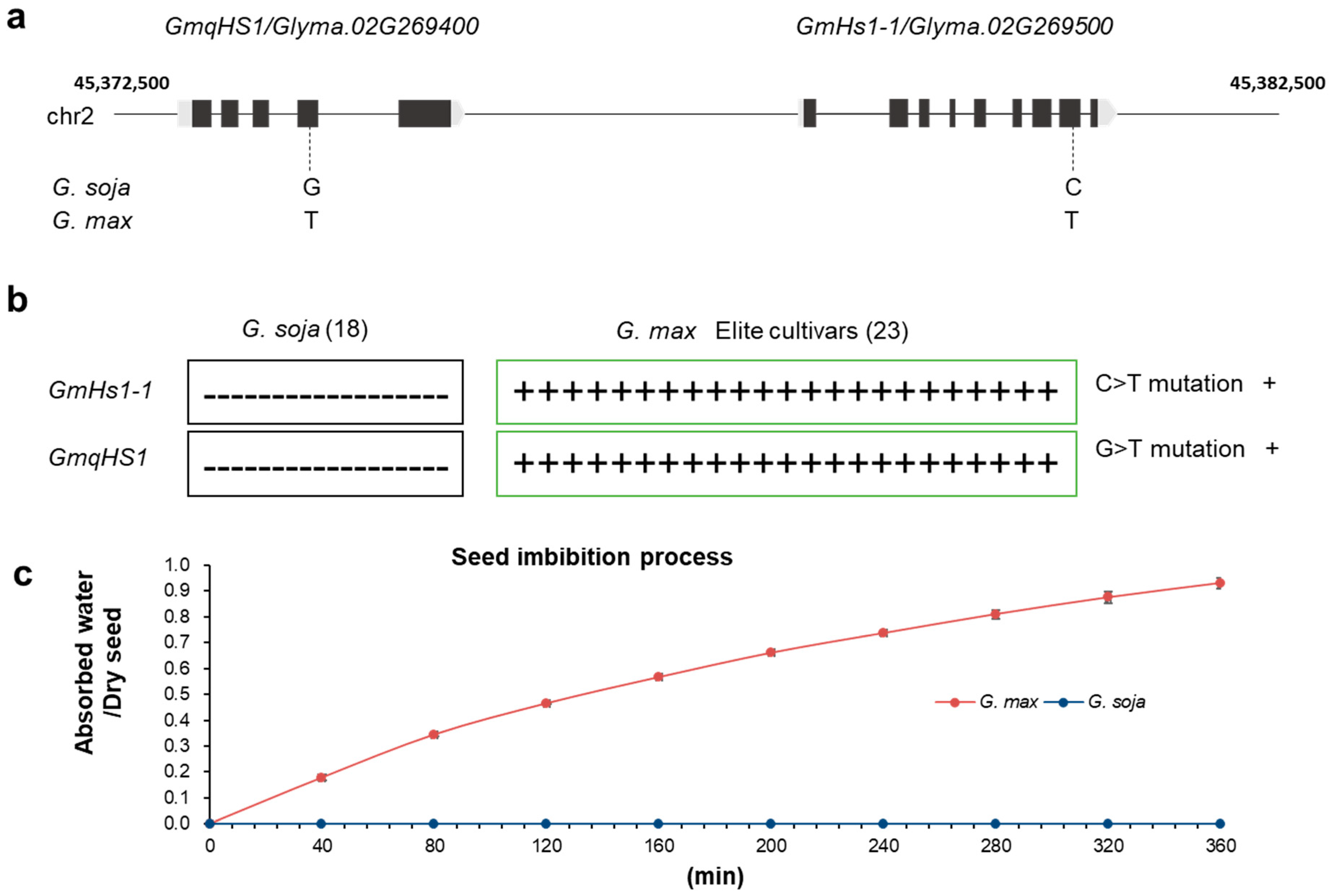
GmHs1-1 and GmqHS1 Simultaneously Contribute to the Domestication of Soybean Hard-Seededness


 ,
, Abstract
Share and Cite
Yan, H.; Tian, D.; Zhang, Q.; Wen, J.; Wang, Z.-Y.; Chai, M. GmHs1-1 and GmqHS1 Simultaneously Contribute to the Domestication of Soybean Hard-Seededness. Plants 2024, 13, 2061. https://doi.org/10.3390/plants13152061
Yan H, Tian D, Zhang Q, Wen J, Wang Z-Y, Chai M. GmHs1-1 and GmqHS1 Simultaneously Contribute to the Domestication of Soybean Hard-Seededness. Plants. 2024; 13(15):2061. https://doi.org/10.3390/plants13152061
Chicago/Turabian StyleYan, Huifang, Daicai Tian, Qian Zhang, Jiangqi Wen, Zeng-Yu Wang, and Maofeng Chai. 2024. "GmHs1-1 and GmqHS1 Simultaneously Contribute to the Domestication of Soybean Hard-Seededness" Plants 13, no. 15: 2061. https://doi.org/10.3390/plants13152061
APA StyleYan, H., Tian, D., Zhang, Q., Wen, J., Wang, Z.-Y., & Chai, M. (2024). GmHs1-1 and GmqHS1 Simultaneously Contribute to the Domestication of Soybean Hard-Seededness. Plants, 13(15), 2061. https://doi.org/10.3390/plants13152061