Ethnobotanical Insights into Medicinal and Culinary Plant Use: The Dwindling Traditional Heritage of the Dard Ethnic Group in the Gurez Region of the Kashmir Valley, India


 ,
, 
 ,
,  and
and
Abstract
1. Introduction
2. Results and Discussion
2.1. Ethnobotanical Inventory
2.2. Ethnopharmacological Profile

| Scientific Name (Family) Voucher Number | Abre | Common Name (Local Name) | Habit | Part Used | Ethno-Medicinal Uses | IUCN Status | ||||
|---|---|---|---|---|---|---|---|---|---|---|
| Preparation | Ailments | Np | FC | FL | ||||||
| Asparagus filicinus Buch.-Ham. ex D.Don (Asparagaceae) LAB.203 | Asp fil | Fern (Parglas) | Herb | Seed | Seeds are boiled in water to produce decoction, given in the last month of pregnancy. | Body pain | 3 | 11 | 27.27 | TH |
| Astragalus confertus Benth.ex Bunge. (Fabaceae) LAB.515 | Ast con | Hairy-leaved milk vetch (Vetch) | Herb | Roots | Roots are dried and powdered and consumed with mint and water. | Abdominal pain | 3 | 8 | 37.50 | DD |
| Aquilegia fragrans Benth. (Ranunculaceae) LAB.516 | Aqu fra | Fragrant columbine (Jangli kuth) | Herb | Roots | Roots are crushed to powder and given orally. | Diuretic | 2 | 6 | 33.33 | CR |
| Allium sativum L. (Amaryllidaceae) LAB.204 | All sat | Garlic (Rhoon) | Herb | Stem | Stem is consumed raw. | Menstrual issue | 15 | 24 | 62.5 | LC |
| Fertility problems | 8 | 33.32 | ||||||||
| Arnebia benthamii (Wall.ex G.Don) I.M.Johnst (Boraginaceae) LAB.205 | Arn ben | Himalayan Arnebia (Kahzabaan) | Herb | Whole plant | The roots are crushed and boiled in water. The decoction is taken orally. | Lactation problem (Hypogalactia) | 4 | 11 | 36.36 | CR |
| Alcea rosea L. (Malvaceae) LAB.206 | Alt ros | Hollyhocks (Sazeposh) | Herb | Flower | The flowers are boiled to prepare decoction taken orally. | Skin irritation | 3 | 14 | 21.42 | LC |
| Asplenium falcatum Lam. (Aspleniaceae) LAB.207 | Asp fal | Holly fern (Dade) | Herb | Whole plant | The plant is cooked and used as a vegetable. | Fertility problems | 2 | 13 | 15.38 | VU |
| Adiantum venustum D.Don. (Pteridaceae) LAB.208 | Adi ven | (Himalayan maiden fern) (Kakbai) | Herb | Whole plant | Whole plant is crushed and boiled in water. | Used for bath after delivery | 1 | 7 | 14.28 | EN |
| Artemisia absinthium L. (Asteraceae) LAB.209 | Art abs | Wormwood (Tethwan) | Herb | Leaves | Dried leaves after soaking in hot water are dried and then made into tablets, taken orally. | Prevent excessive menstrual bleeding | 6 | 14 | 42.85 | EN |
| Achillea millefolium L. (Asteraceae) LAB.501 | Ach mil | Devil’s nettle (Pahel ghass) | Herb | Whole plant | Leaves are made into decoction and consumed empty stomach. | Menopause disorders | 3 | 14 | 21.42 | LC |
| Aconitum laeve Royle. (Ranunculaceae) LAB.502 | Aco.lae | Grape-leaved monkshood (Patrees) | Herb | Roots | Roots are dried, powdered, and consumed with milk. | Sciatica | 3 | 11 | 27.27 | EN |
| Acer caesium Wall. ex. Brandis. (Sapindaceae) LAB.503 | Ace.cae | Himalayan Maple (Chhad) | Tree | Leaves | Leaves are boiled in water and taken orally. | Weakness | 2 | 6 | 33.32 | LC |
| Aesculus indica (Wall.ex Cambess) Hook (Sapindaceae) LAB.504 | Aes ind | Indian Horse-Chest nut (Handoon) | Tree | Leaves | Extract from leaves is consumed with lukewarm water. | Fever | 2 | 8 | 25 | LC |
| Ajuga intregrifolia Buch.-Ham. (Lamiaceae) LAB.505 | Aju int | Bracted Bugleweed (Jani Adam) | Herb | Whole plant | Decoction is obtained from fresh plant and consumed empty stomach to remove toxins from the body by acting as a diuretic. | Diuretic | 7 | 13 | 53.84 | ----- |
| Ajuga parviflora Benth. (Lamiaceae) LAB.506 | Aju par | Small-Flowered Bugleweed (Jangli Jani-e- Adam) | Herb | Leaves | Extract of leaves is mixed with a glass of water and sugar, taken orally early morning, which in turn causes frequent urination. | Diuretic | 2 | 6 | 33.32 | VU |
| Anthemis cotula L. (Asteraceae) LAB.511 | Ant cot | Stinking Chamomile (Fakghass) | Herb | Whole plant | Whole plant is made into a paste and applied topically. | Skin irritation | 3 | 8 | 37.5 | LC |
| Achyranthes aspera L. (Amaranthaceae) LAB.512 | Ach asp | Chaff flower (Puthkanda) | Herb | Root | Roots are crushed to powder and given orally with water in the last month of pregnancy. | Delivery issue | 5 | 13 | 38.46 | LC |
| Artemisia parviflora Roxb.ex D.Don (Asteraceae) LAB.513 | Art par | Himalayan Worm Wood (Tethwan) | Herb | Whole plant | Extract is obtained and given orally. | Abdominal pain | 5 | 9 | 55.55 | DD |
| Aucklandia costus Falc. (Asteraceae) LAB.229 | Auc cos | Costus (Kouth) | Herb | Root | Roots are crushed into a powder and drunk with water. | Menstrual issue | 3 | 7 | 42.85 | CR |
| Berberis lycium Royle (Berberidaceae) LAB.550 | Ber lyc | Indian Barberry (Kawdach) | Shrub | Whole plant | Ripened barriers are applied topically. | Skin irritation | 3 | 16 | 18.75 | TH |
| Bidens pilosa L. (Asteraceae) LAB.532 | Bid pil | Begger’stick (Kumber) | Herb | Leaves | Leaves are made into decoction and given orally. | Labor pain | 2 | 6 | 33.32 | NE |
| Cannabis sativa L. (Cannabaceae) LAB.210 | Can sat | Hemp, Gallow Grass (Bhang) | Herb | Leaves | The leaves are crushed and made into powder, mixed with cow ghee to make paste taken orally. | Menstrual pain | 1 | 7 | 14.28 | VU |
| Colchicum luteum Baker (Colchicaceae) LAB.211 | Col let | Meadow Saffron (Veir koem) | Herb | Stem | The stem is crushed to form a paste and applied to feet. | Relieve body pain in fresh mothers | 2 | 9 | 22.22 | TH |
| Centaurea iberica Trevir.ex Spreng. (Asteraceae) LAB.212 | Cen ibe | Iberian Star thistle (Kreaxeh) | Herb | Leaves | Fresh leaves after crushing are mixed with egg and then cooked to prepare an omelet. | Lactation problem (hypogalactia) | 1 | 8 | 12.5 | NT |
| Cydonia oblonga Mill. (Rosaceae) LAB.213 | Cyd obl | Quince (Bum chount) | Tree | Seeds | Seeds are made into infusion, taken orally. | Constipation | 4 | 9 | 44.43 | LC |
| Cichorium intybus L. (Asteraceae) LAB.214 | Cic iny | Chicory (Posh handh) | Herb | Leaves | Leaves are cooked. | Easy delivery | 2 | 11 | 18.18 | LC |
| Cuscuta reflexa Roxb. (Convolvulaceae) LAB.510 | Cus ref | Gaint Dodder (Kukli-Poot) | Herb | Whole plant | Decoction is prepaid by boiling the whole plant, kept overnight, and consumed orally. | Asthma | 2 | 9 | 22.22 | LC |
| Chenopodium album L. (Amaranthaceae) LAB.514 | Che alb | Bathua (Konh) | Herb | Leaves | Decoction of leaves is prepared by boiling. | Abdominal pain | 3 | 10 | 30 | LC |
| Coriandrum sativum L. (Apiaceae) LAB.517 | Cor sat | Cilantro (Daniwal) | Herb | Whole plant | Decoction. | Inflammation | 2 | 8 | 25 | ------- |
| Clinopodium umbrosum (M.Bieb) Kuntze. (Lamiaceae) LAB.525 | Cli umb | Shady calamint (Kunal) | Herb | Aerial part | Aerial parts are boiled in water for half an hour, the obtained water is cooled and used. | Post-delivery bath | 3 | 15 | 20 | NE |
| Cynodon dactylon (L.) Pers (Poaceae) LAB.529 | Cyn dac | Bermuda Grass (Dramun) | Herb | Leaves | The fresh leaves are dried, crushed into powder, and consumed in small quantity with water. | Menstrual disorders | 5 | 11 | 45.45 | NE |
| Cynoglossum wallichii G.Don. (Boraginaceae) LAB.530 | Cyn wal | Forget Me Not (Cheur) | Herb | Roots | Roots are made into a paste and applied topically. | Skin irritation | 3 | 9 | 33.33 | CR |
| Capsella bursa-pastoris Medik. LAB.533 | Cap bur | Shepherd’s purse (Kralmond) | Herb | Leaves | Leaves are made into a paste and applied topically. | Inflammation | 2 | 8 | 25 | LC |
| Dipsacus inermis Wall. (Caprifoliaceae) LAB.215 | Dip ine | Himalayan Teasel (Wopal haakh) | Herb | Leaves | Leaves are crushed and boiled. | Used for bath after delivery | 2 | 7 | 28.57 | NT |
| Dysphania botrys (L.) Mosyakin & Clemants (Amaranthaceae) LAB.519 | Dys bot | Sticky goosefoot (Kukli-hakh) | Herb | Whole plant | Decoction. | Labor pain | 5 | 13 | 38.46 | LC |
| Dioscorea deltoidea Wall. (Dioscoreaceae) LAB.216 | Dio del | Yam (Kala ganda) | Herb | Stem | Stem is crushed and tonic is prepared. | Menstrual cramps | 1 | 7 | 14.28 | EN |
| Dryopteris juxtaposita Christ (Dryopteridaceae) LAB.217 | Dry jux | Wood Ferns (Gautheer) | Herb | Leaves | Leaves are crushed and boiled. | Used for bath after delivery | 2 | 6 | 33.32 | LC |
| Dactylorhiza hatagirea (D.Don) Soó (Orchidaceae) LAB.509 | Dac hat | Himalayan Marsch Orchid (salam panj) | Herb | Tuber | Tuber is crushed to powder and given orally with lukewarm water. | Labor pain | 5 | 13 | 38.46 | EN |
| Dolomiaea macrocephala DC. ex Royle (Asteraceae) LAB.222 | Dol mac | Dhoop Lakkad (Dupha/Thandi Jaid) | Herb | Root | Roots are boiled, made into a decoction, and taken orally. | Fever | 2 | 8 | 25 | EN |
| Euphorbia wallichii Hook.f. (Euphorbiaceae) LAB.534 | Eup wal | Wallich Spurge (Guri-dud) | Herb | Leaves | Infusion is prepared and consumed orally. | Skin irritation | 6 | 14 | 42.85 | LC |
| Erigeron canadensis L. (Asteraceae) LAB.528 | Eri can | Horseweed (Shallut) | Herb | Whole plant | Decoction is prepared by boiling the whole plant for 15–20 min, cooled and taken orally. | Menstrual disorders | 2 | 14 | 14.28 | NE |
| Eryngium planum L. (Apiaceae) LAB.543 | Ery pla | Sea Holly (Dawha Mool) | Herb | Roots | Dried roots are crushed to increase urine output and thus purify the blood. | Diuretic | 2 | 10 | 20 | LC |
| Fragaria nubicola Lindl. ex Lacaita (Rosaceae) LAB.535 | Fra nub | Indian Strawberry (Ringrish) | Herb | Rhizome | Infusion is prepared and consumed orally. | Lactation problem | 2 | 11 | 18.18 | NE |
| Ficus carica L. (Moraceae) LAB.218 | Fic car | Fig (Anjeer) | Tree | Fruit | Fruits are dried crushed, made into powder, and taken orally with milk. | Lactation problem | 3 | 8 | 37.5 | LC |
| Fumaria indica (Hausskn.) Pugsley (Fumariaceae) LAB.219 | Fum ind | Fumitory (Shahtaur) | Herb | Whole plant | The whole plant is crushed and a decoction is prepared. | Menstrual issue | 2 | 9 | 22.21 | EN |
| Fritillaria cirrhosa D.Don (Liliaceae) LAB.547 | Fri cir | Himalayan Fritillary (Sheethkhaar) | Herb | Roots | Fresh roots are crushed and mixed with water and consumed orally. | Abdominal pain | 2 | 13 | 15.38 | EN |
| Geranium wallichianum D.Don (Geraniaceae) LAB.220 | Ger wal | Rattan jot (Ratanjot) | Shrub | Root | Roots are made into tea. | Premature delivery | 1 | 5 | 20 | CR |
| Glycyrrhiza glabra L. (Fabaceae) LAB.527 | Gly cyr | Black sugar/Sweet wood (Shangir) | Herb | Seeds | Seeds are crushed to form a paste which is applied topically in the lumbar region of the back. | Labor pain | 4 | 15 | 26.26 | LC |
| Hemerocallis fulva (L.) L. (Xanthorrhoeaceae) LAB.221 | Hem ful | Common-dayLily (NA) | Herb | Whole plant | The whole plant is crushed and boiled to form a tonic. | Weakness | 1 | 6 | 16.66 | LC |
| Isodon rugosus (Wall.) Codd (Lamiaceae) LAB.521 | Iso vul | Wrinkled Leaf Isodon (Sulikath) | Herb | Leaves | Raw leaves are consumed. | Fertility disorder | 2 | 7 | 28.57 | LC |
| Juglans regia L. (Juglandaceae) LAB.223 | Jug reg | Walnut (Doen Kul) | Tree | Fruit | Consumed raw. | Fertility issue | 7 | 13 | 53.84 | LC |
| Jacobaea analoga (DC.) Veldkamp (Asteraceae) LAB.556 | Jac ana | Ghopga (Boungh) | Herb | Whole plant | Decoction is prepared and consumed orally. | Urinary tract infection (UTI) | 2 | 13 | 15.38 | NE |
| Malva cachemiriana (Cambess.) Alef. (Malvaceae) LAB.551 | Mal cac | Kashmir Mallow (Sazposh) | Herb | Seed | Decoction is prepaid and consumed orally. | Skin irritation | 2 | 13 | 15.38 | EN |
| Malva sylvestris L. (Malvaceae) LAB.518 | Mal syl | Common mallow (Gur-Sochal) | Herb | Flowers | Decoction. | Weakness | 2 | 8 | 25 | LC |
| Meconopsis aculeata Royle (Papaveraceae) LAB.520 | Mec acu | Blue poppy (Gul-e-Neelam) | Herb | Whole plant | Powdered and consumed with water. | Tonic | 3 | 8 | 37.50 | NE |
| Mentha arvensis L. (Lamiaceae) LAB.541 | Men arv | Corn Mint (Chala Pudna) | Herb | Leaves | Leaves are dried and made into powder, consumed orally in small quantities. | Vomiting | 3 | 8 | 37.50 | LC |
| Mentha longifolia (L.) L. (Lamiaceae) LAB.542 | Men lon | Horse Mint (Jangli Pudina) | Herb | Leaves | Leaves are dried and made into powder, consumed orally in small quantities. | Vomiting | 2 | 6 | 33.33 | LC |
| Notholirion thomsonianum (Royle) Stapf (Liliaceae) LAB.224 | Not tho | Rosy Himalayan Lily (Sathra) | Herb | Stem | Stem is crushed and extracted. | Menstrual issue | 3 | 11 | 27.27 | LC |
| Nepeta cataria L. (Lamiaceae) LAB.522 | Nep.cat | Catnip (Brair-Ghass) | Herb | Leaves | Leaves are dried and made into powder which is given orally in small quantities. | Vomiting | 4 | 11 | 36.3 | LC |
| Origanum vulgare L. (Lamiaceae) LAB.225 | Ori vul | Oregano (Babur) | Herb | Whole plant | The whole plant is boiled in water. | Used for bath after delivery | 2 | 13 | 15.38 | LC |
| Oxalis corniculata L. (Oxalidaceae) LAB.523 | Oxa cor | Creeping wood sorrel (Chuk-chin) | Herb | Leaves | Leaves are dried and made into powder which is given orally in small quantity. | Vomiting | 3 | 11 | 27.27 | NE |
| Ocimum basilicum L. (Lamiaceae) LAB.531 | Oci bas | Basil (Baber) | Herb | Leaves | Infusion is made from fresh leaves and consumed orally. | Labor pain | 3 | 8 | 37.50 | ------ |
| Pinus roxburghii Sarg. (Pinaceae) LAB.226 | Pin rox | Chir Pine (Chad) | Tree | Seeds | Seeds are roasted. | Weakness | 5 | 12 | 41.66 | LC |
| Prunella vulgaris L. (Lamiaceae) LAB.227 | Pru vul | Self-Heal (Kalvuth) | Herb | Whole plant | The whole is boiled in water, and obtained water is used for bathing. | Fever Body pain | 6 | 9 | 66.65 | LC |
| Portulaca oleracea L. (Portulacaceae) LAB.526 | Por ole | Common Purslane (Nuner) | Herb | Leaves | Leaves are made into a decoction and consumed orally. | Diuretic | 3 | 11 | 27.27 | NE |
| Phytolacca acinosa Roxb. (Phytolaccaceae) LAB.701 | Phy aci | Indian Pokeweed (Haputbrand) | Herb | Fruit | Fruits are crushed, squeezed, and applied topically. | Inflammation | 2 | 7 | 28.57 | NE |
| Plantago major L. (Plantaginaceae) LAB.536 | Pla maj | broadleaf plantain Waybread (Bod Gull) | Herb | Leaves | Decoction is made from fresh leaves and consumed orally. | Inflammation | 1 | 7 | 14.28 | LC |
| Plantago lanceolata L. (Plantaginaceae) LAB.537 | Pla lan | Narrow Leaf Plantain (Gull) | Herb | Leaves | Leaves are cooked and consumed frequently in the last month of the pregnancy. | Delivery issue | 2 | 9 | 22.22 | VU |
| Prunus persica (L.) Batsch (Rosaceae) LAB.538 | Pru per | Peach (Chenan) | Tree | Leaves | Infusion is made and consumed orally. | Fertility disorder | 2 | 8 | 25 | NE |
| Podophyllum hexandrum Royle (Berberidaceae) LAB.539 | Pod hex | Himalayan May Apple (Banvagan) | Herb | Whole plant | Infusion is made and consumed orally. | Fertility disorder | 1 | 6 | 16.66 | EN |
| Persicaria hydropiper subsp. microcarpa (Danser) Soják (Polygonaceae) LAB.540 | Per hyd | Water Pepper (Marchuwagun Ghass) | Herb | Whole plant | Infusion is made and consumed orally. | Labor pain | 3 | 10 | 30 | LC |
| Papaver somniferum L. (Papaveraceae) LAB.552 | Pap som | Opium (khash- khaash) | Herb | Seed | The seeds are crushed into powder and consumed in small quantities with milk. | Weakness | 3 | 9 | 33.33 | NE |
| Rheum webbianum Royle (Polygonaceae) LAB.553 | Rhe web | Indian Rhubarb (Pambchalan) | Herb | Roots | Crushed roots are mixed with ash and applied topically. | Skin irritation | 3 | 15 | 20 | NE |
| Rubus niveus Thunb. (Rosaceae) LAB.548 | Rub niv | Hill Raspberry (Chhanch) | Shrub | Roots | Roots are shade dried and made into powder, consumed with milk in the last month of pregnancy. | Delivery problem | 2 | 15 | 13.33 | NE |
| Sonchus oleraceus L. (Asteraceae) LAB.228 | Son ole | Sow Thistle (Kulwauth) | Herb | Leaves | Leaves are cooked. | Weakness | 1 | 5 | 20 | LC |
| Saussurea simpsoniana (Fielding & Gardner) Lipsch. (Asteraceae) LAB.230 | Sau sim | Phen Kamal (Koth) | Herb | Whole plant | Whole plant is crushed and boiled in water taken orally. | Menstrual issue | 3 | 7 | 42.85 | CR |
| Salvia sclarea L. (Lamiaceae) LAB.507 | Sal scl | Clary sage (Buder-Tund) | Herb | Whole plant | Decoction is obtained and given orally. | Labor Pain | 3 | 8 | 37.5 | LC |
| Sisymbrium irio L. (Brassicaceae) LAB.555 | Sis iri | London Rocket (Chari lachij) | Herb | Seeds | Decoction is prepared and consumed orally. | Asthma | 4 | 11 | 36.36 | LC |
| Taraxacum officinale F.H.Wigg. (Asteraceae) LAB.231 | Tar off | Dandelion (Handd) | Herb | Leaves | Young leaves are cooked. | Easy delivery | 5 | 7 | 71.42 | LC |
| Trifolium pratense L. (Fabaceae) LAB.232 | Tri pre | Red Clover (Bee-Bred) | Herb | Leaves | Leaves are crushed, dried, made into powder, and consumed with milk. | Menstrual issue | 1 | 9 | 11.10 | LC |
| Trigonella foenum-graecum L. (Fabaceae) LAB.508 | Tri foe | Fenugreek (Meth) | Herb | Seeds | Seeds are crushed into powder and consumed with water. | Menopause disorders | 2 | 8 | 25 | ----- |
| Thymus linearis Benth. (Lamiaceae) LAB.544 | Thy lin | Himalayan Thyme (Van Jawain, Marchi) | Herb | Whole plant | Juice is extracted from the whole plant and consumed orally. | Urinary tract infection (UTI) | 3 | 12 | 25 | CR |
| Tagetes minuta L. (Asteraceae) LAB.554 | Tag min | Wild Marigold (Gutt posh) | Herb | Leaves | Juice is extracted and consumed orally. | Asthma | 2 | 15 | 13.33 | NE |
| Viola biflora L. (Violaceae) LAB.545 | Vio bif | Alpine Yellow Violet (Gulnakash) | Herb | Leaves | Decoction is prepared and consumed orally. | Fever | 2 | 14 | 14.28 | NE |
| Viola odorata L. (Violaceae) LAB.546 | Vio odo | Sweet Voilet (Nunposh/Banfsha) | Herb | Flowers | Decoction is prepared and consumed orally. | Fever | 4 | 15 | 26.26 | LC |
| Verbena officinalis L. (Verbanaceae) LAB.524 | Ver off | Common Verbena (Hatmool) | Herb | Whole plant | Whole plant is crushed to powder and given orally with water in the last month of pregnancy. | Delivery issue | 2 | 9 | 22.22 | NE |
| Viburnum grandiflorum Wall. ex DC. (Adoxaceae) LAB.549 | Vib gra | Cranberry Bush (Kilmish) | Shrub | Roots | Roots are boiled in water and consumed orally. | Abdominal pain | 2 | 11 | 18.18 | NE |
2.3. Fidelity Level (FL)
2.4. Part Used
2.5. Gastronomic Usage
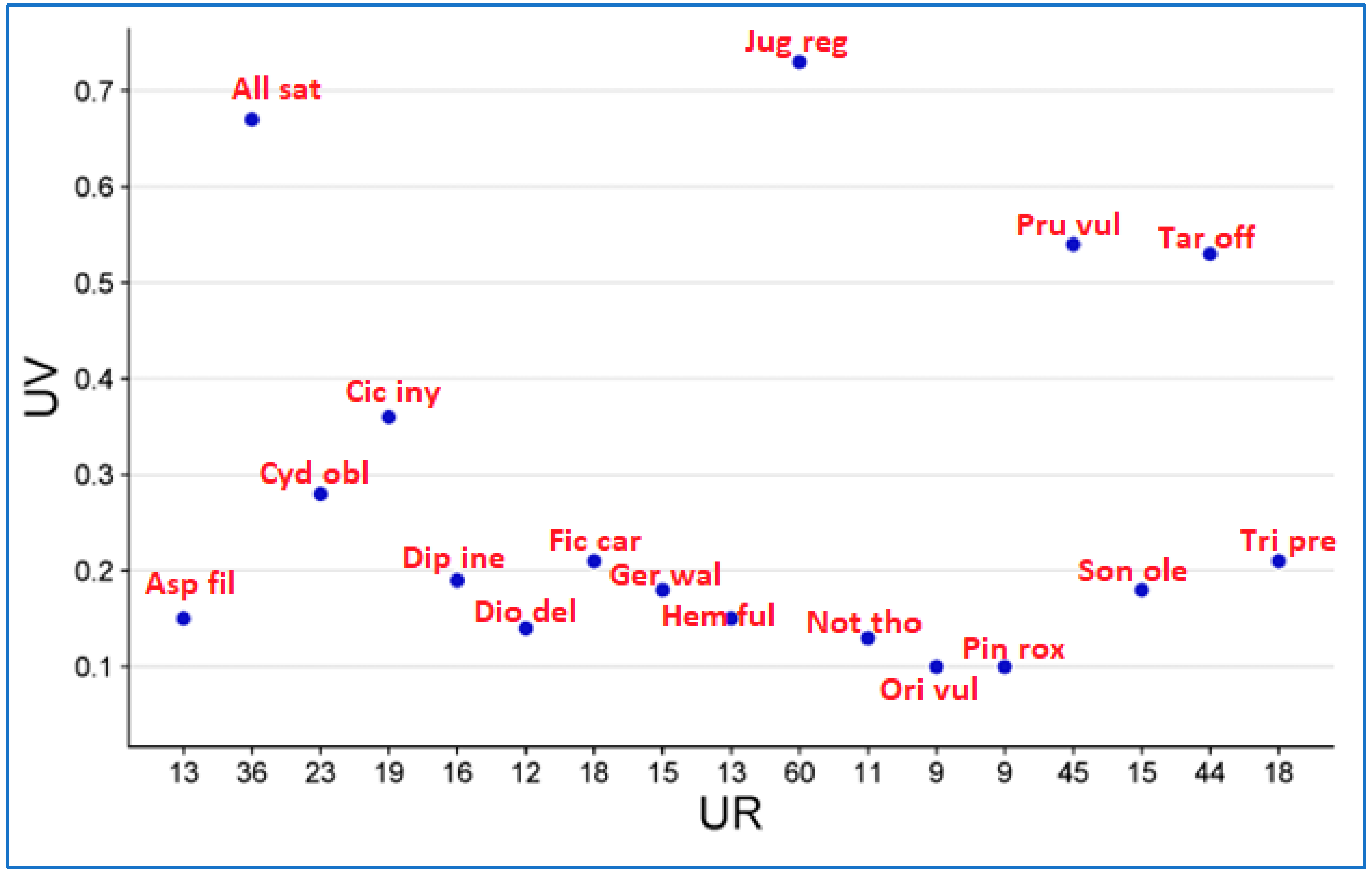
| Botanical Name (Abbreviation) | Species Consumed | Preparation | Habitat | ||
|---|---|---|---|---|---|
| Before Pregnancy | During Pregnancy | After Pregnancy | |||
| Asparagus filicinus (Asp fil) | Y | Y | Y | Young roots are selected and made into soup. | Wild |
| Allium sativum (All sat) | Y | Y | N | Bulbs are peeled, cleaned, and cooked with other vegetables. Raw bulbs are consumed as a salad. | Cultivated |
| Cydonia oblonga (Cyd obl) | Y | Y | N | The fruits are boiled in water with a little sugar added and eaten in the evening. | Cultivated |
| Cichorium intybus (Cic int) | N | Y | Y | The leaves are picked, cleaned, and cooked without species and peppers. | Wild |
| Dipsacus inermis (Dip.ine) | N | N | Y | The leaves are picked, cleaned, and cooked without species and peppers. | Wild |
| Dioscorea deltoidea (Dio del) | Y | N | N | Tubers are boiled and then cooked without species. | Wild |
| Ficus carica (Fic car) | Y | Y | Y | Fruits are consumed raw, also cooked. | Cultivated |
| Geranium wallichianum (Ger wal) | N | Y | N | The roots are cooked in desi cow ghee. | Wild |
| Hemerocallis fulva (Hem ful) | Y | Y | Y | The flowers are eaten raw, but also cooked. The petals are thick and crunchy, which makes them very pleasant to eat. | Wild |
| Juglans regia (Jug reg) | Y | Y | Y | The seeds are extracted and used to make chutney, but they are also air-dried and eaten raw. In addition, they are also used in kawa (a traditional tea) mixed with various recipes to enhance the flavor. It is also a possible source of cooking oil. | Cultivated |
| Notholirion thomsonianum (Not tho) | Y | N | N | Leaves are boiled and then cooked. | Wild |
| Origanum vulgare (Ori vul) | N | N | Y | Fresh oregano leaves are cooked. Dried leaves are used as a flavoring agent for different dishes. | Wild |
| Pinus roxburghii (Pin rox) | N | N | Y | Seeds are roasted and eaten. | Wild |
| Prunella vulgaris (Pru vul) | N | N | Y | The leaves are used for making soup, stews, salad and boiled as a pot herb. | Wild |
| Sonchus oleraceus (Son ole) | N | Y | Y | The outer shell is removed and cooked like asparagus. | Wild |
| Taraxacum officinale (Tar off) | Y | Y | Y | The leaves are cleaned and cooked. | Wild |
| Trifolium pratense (Tri pra) | Y | Y | Y | `The leaves are cooked or used as a garnishing agent in salads. | Wild |
2.6. Use Value (UV)
2.7. Novelty of the Study
2.8. Effective Use and Livelihood
2.9. Conservation Status
3. Materials and Methods
3.1. Study Area
3.2. Socio-Economic Background of Dard
3.3. Demography of Informants
| Demographic Features | Number | Percentage |
|---|---|---|
| Ethnic Group | Dard | |
| Language | (Shina) | |
| Education | ||
| Illiterate | 37 | 45.12 |
| Primary education | 19 | 23.17 |
| Secondary education | 17 | 20.73 |
| Higher education | 9 | 10.97 |
| Age range | ||
| Young (18–26) | 15 | 18.29 |
| Middle (27–55) | 26 | 31.70 |
| Old (56–75+) | 41 | 50.00 |
| Profession | ||
| Farmers | 12 | 14.63 |
| Skilled/semi-skilled workers | 15 | 18.29 |
| Grower/agricultural workers | 12 | 14.63 |
| Herders | 18 | 21.95 |
| Government employees | 5 | 6.09 |
| Housewives | 8 | 9.75 |
| Shopkeepers | 12 | 14.63 |
| Gender | ||
| Male | 63 | 76.82 |
| Female | 19 | 23.17 |
| Religion | Islam | 100 |
3.4. Data Analysis
3.4.1. Fidelity Level (FL)
3.4.2. Use Value (UV)
4. Conclusions
Author Contributions
Funding
Data Availability Statement
Acknowledgments
Conflicts of Interest
References
- Halberstein, R.A. Medicinal plants: Historical and cross-cultural usage patterns. Ann. Epidemiol. 2005, 15, 686–699. [Google Scholar] [CrossRef] [Scilit] [PubMed]
- Hardy, K. Paleomedicine and the Evolutionary Context of Medicinal Plant Use. Rev. Bras. Farmacogn. 2021, 31, 1–15. [Google Scholar] [CrossRef] [Scilit] [PubMed]
- Pirintsos, S.; Panagiotopoulos, A.; Bariotakis, M.; Daskalakis, V.; Lionis, C.; Sourvinos, G.; Karakasiliotis, I.; Kampa, M.; Castanas, E. From traditional ethnopharmacology to modern natural drug discovery: A methodology discussion and specific examples. Molecules 2022, 27, 4060. [Google Scholar] [CrossRef] [Scilit] [PubMed]
- Hayden, J. Introduction to Health Behavior Theory; Jones & Bartlett Learning: Burlington, MA, USA, 2022. [Google Scholar]
- Süntar, I. Importance of ethnopharmacological studies in drug discovery: Role of medicinal plants. Phytochem. Rev. 2020, 19, 1199–1209. [Google Scholar] [CrossRef] [Scilit]
- Mwaka, A.D.; Achan, J.; Orach, C.G. Traditional health practices: A qualitative inquiry among traditional health practitioners in northern Uganda on becoming a healer, perceived causes of illnesses, and diagnostic approaches. PLoS ONE 2023, 18, e0282491. [Google Scholar] [CrossRef] [Scilit]
- Shafiq, M.U.; Islam, Z.U.; Abida, A.W.; Bhat, M.S.; Ahmed, P. Recent trends in precipitation regime of Kashmir valley, India. Disaster Adv. 2019, 12, 1–11. [Google Scholar]
- Haq, S.M.; Waheed, M.; Khoja, A.A.; Amjad, M.S.; Bussmann, R.W.; Ali, K. A cross-cultural study of high-altitude botanical resources among diverse ethnic groups in Kashmir Himalaya, India. J. Ethnobiol. 2023, 1, 12. [Google Scholar] [CrossRef] [Scilit]
- Gilmore, M.P.; Young, J.C. The use of participatory mapping in ethnobiological research, biocultural conservation, and community empowerment: A case study from the Peruvian Amazon. J. Ethnobiol. 2012, 32, 6–29. [Google Scholar] [CrossRef] [Scilit]
- Galhena, D.H.; Freed, R.; Maredia, K.M. Home gardens: A promising approach to enhance household food security and wellbeing. Agric. Food Secur. 2013, 2, 8. [Google Scholar] [CrossRef] [Scilit]
- Larsen, C.S. Animal source foods and human health during evolution. J. Nutr. 2003, 133, 3893S–3897S. [Google Scholar] [CrossRef] [Scilit]
- Bhatt, D.; Joshi, G.C.; Tiwari, L.M. Culture, habitat and ethno-medicinal practices by Bhotia Tribe people of Dharchula Region of Pithoragarh District in Kumaun Himalaya, Uttarakhand. Ethnobot. Leafl. 2009, 2009, 2. [Google Scholar]
- Convention on Biological Diversity. Report of the conference of the parties to the Convention on Biological Diversity on its thirteenth meeting. In Proceedings of the Conference of the Parties to the Convention on Biological Diversity, Thirteenth Meeting, Cancun, Mexico, 4–17 December 2016; CBD/COP/13/25. 17 December 2016. [Google Scholar]
- Hassan, M.; Abdullah, A.; Haq, S.M.; Yaqoob, U.; Bussmann, R.W.; Waheed, M. Cross-ethnic use of ethnoveterinary medicine in the Kashmir Himalaya-A Northwestern Himalayan region. Acta Ecol. Sin. 2023, 43, 617–627. [Google Scholar] [CrossRef] [Scilit]
- Haq, S.M.; Hassan, M.; Jan, H.A.; Al-Ghamdi, A.A.; Ahmad, K.; Abbasi, A.M. Traditions for Future Cross-National Food Security—Food and Foraging Practices among Different Native Communities in the Western Himalayas. Biology 2022, 11, 455. [Google Scholar] [CrossRef] [Scilit] [PubMed]
- Akinola, R.; Pereira, L.M.; Mabhaudhi, T.; De Bruin, F.M.; Rusch, L. A review of indigenous food crops in Africa and the implications for more sustainable and healthy food systems. Sustainability 2020, 12, 3493. [Google Scholar] [CrossRef] [Scilit]
- Jiao, M.; Liu, X.; Ren, Y.; Wang, Y.; Cheng, L.; Liang, Y.; Li, Y.; Zhang, T.; Wang, W.; Mei, Z. Comparison of herbal medicines used for women’s menstruation diseases in different areas of the world. Front. Pharmacol. 2022, 2, 3945. [Google Scholar] [CrossRef] [Scilit]
- Jan, M.; Mir, T.A.; Jan, H.A.; Khare, R.K. Medicinal plants diversity and their uses for Gynecological Disorders of District Baramulla, Jammu and Kashmir, India. Vegetos 2022, 35, 438–452. [Google Scholar] [CrossRef] [Scilit]
- Dad, J.M.; Khan, A.B. Threatened medicinal plants of Gurez valley, Kashmir Himalayas: Distribution pattern and current conservation status. Int. J. Biodivers. Sci. Ecosyst. Serv. Manag. 2011, 7, 20–26. [Google Scholar] [CrossRef] [Scilit]
- Mukherjee, P.K.; Venkatesh, P.; Ponnusankar, S. Ethnopharmacology and integrative medicine—Let the history tell the future. J. Ayurveda Integr. Med. 2010, 1, 100–109. [Google Scholar] [CrossRef] [Scilit]
- Heinrich, M.; Gibbons, S. Ethnopharmacology in drug discovery: An analysis of its role and potential contribution. J. Pharm. Pharmacol. 2001, 53, 425–432. [Google Scholar] [CrossRef] [Scilit]
- Ahmet Sargin, S. Ethnobotanical survey of medicinal plants in Bozyazi district of Mersin, Turkey. J. Ethnopharmacol. 2015, 173, 105–126. [Google Scholar] [CrossRef] [Scilit]
- Haq, S.M.; Yaqoob, U.; Calixto, E.S.; Rahman, I.U.; Hashem, A.; Abd_Allah, E.F.; Alakeel, M.A.; Alqarawi, A.A.; Abdalla, M.; Hassan, M.; et al. Plant resources utilization among different ethnic groups of Ladakh in Trans-Himalayan Region. Biology 2021, 10, 827. [Google Scholar] [CrossRef] [Scilit] [PubMed]
- Hassan, M.; Haq, S.M.; Majeed, M.; Umair, M.; Sahito, H.A.; Shirani, M.; Waheed, M.; Aziz, R.; Ahmad, R.; Bussmann, R.W.; et al. Traditional food and medicine: Ethno-traditional usage of fish Fauna across the valley of Kashmir: A western Himalayan Region. Diversity 2022, 14, 455. [Google Scholar] [CrossRef] [Scilit]
- Wala, M.; Kołodziejek, J.; Mazur, J.; Cienkowska, A. Reactions of two xeric-congeneric species of Centaurea (Asteraceae) to soils with different pH values and iron availability. PeerJ 2021, 9, e12417. [Google Scholar] [CrossRef] [Scilit]
- Bhat, M.N.; Singh, B.; Surmal, O.; Singh, B.; Shivgotra, V.; Musarella, C.M. Ethnobotany of the Himalayas: Safeguarding medical practices and traditional uses of Kashmir regions. Biology 2021, 10, 851. [Google Scholar] [CrossRef] [Scilit] [PubMed]
- Uniyal, S.K.; Singh, K.N.; Jamwal, P.; Lal, B. Traditional use of medicinal plants among the tribal communities of Chhota Bhangal, Western Himalaya. J. Ethnobiol. 2006, 2, 14. [Google Scholar] [CrossRef] [Scilit]
- Khoja, A.A.; Haq, S.M.; Majeed, M.; Hassan, M.; Waheed, M.; Yaqoob, U.; Bussmann, R.W.; Alataway, A.; Dewidar, A.Z.; Al-Yafrsi, M.; et al. Diversity, Ecological and traditional knowledge of pteridophytes in the western Himalayas. Diversity 2022, 14, 628. [Google Scholar] [CrossRef] [Scilit]
- Farooq, A.; Amjad, M.S.; Ahmad, K.; Altaf, M.; Umair, M.; Abbasi, A.M. Ethnomedicinal knowledge of the rural communities of Dhirkot, Azad Jammu and Kashmir, Pakistan. J. Ethnobiol. Ethnomed. 2019, 15, 45. [Google Scholar] [CrossRef] [Scilit]
- Qadir, I.; Nazir, S.; Sheikh, M.A.; Naaz, F.; Bashir, S.; Ovais, S.; Khan, N.A.; Masoodi, M.H. Taraxacum officinale: The Esculent Dandelion as Herbal Medicine. In Edible Plants in Health and Diseases: Volume II: Phytochemical and Pharmacological Properties; Springer: Singapore, 2022. [Google Scholar]
- Rana, D.; Bhatt, A.; Lal, B.; Parkash, O.; Kumar, A.; Uniyal, S.K. Use of medicinal plants for treating different ailments by the indigenous people of Churah subdivision of district Chamba, Himachal Pradesh, India. Environ. Dev. Sustain. 2021, 23, 1162–1241. [Google Scholar] [CrossRef] [Scilit]
- Hossain, M.A.; Nagooru, M.R. Biochemical profiling and total flavonoids contents of leaves crude extract of endemic medicinal plant Corydyline terminalis L. Kunth. Pharmacogn. J. 2011, 3, 25–30. [Google Scholar] [CrossRef] [Scilit]
- Singh, B.; Sultan, P.; Hassan, Q.P.; Gairola, S.; Bedi, Y.S. Ethnobotany, traditional knowledge, and diversity of wild edible plants and fungi: A case study in the Bandipora district of Kashmir Himalaya, India. J. Herbs Spices Med. Plants 2016, 22, 247–278. [Google Scholar] [CrossRef] [Scilit]
- Azhar, M.F.; Ali, E.; Qadir, S.; Zubair, M.; Ahmad, M.Q. Medicinal Plants Traditionally Used for the Treatment of Skin Diseases in Southern Punjab, Pakistan. Asian J. Res. Agric. For. 2022, 8, 249–260. [Google Scholar] [CrossRef] [Scilit]
- Mir, T.A.; Jan, M.; Khare, R.K. Ethnomedicinal practices and conservation status of medicinal plants in the Bandipora District of Kashmir Himalaya. J. Herbs Spices Med. Plants 2022, 3, 125–142. [Google Scholar] [CrossRef] [Scilit]
- Tudu, C.K.; Dutta, T.; Ghorai, M.; Biswas, P.; Samanta, D.; Oleksak, P.; Jha, N.K.; Kumar, M.; Proćków, J.; Pérez de la Lastra, J.M.; et al. Traditional uses, phytochemistry, pharmacology and toxicology of garlic (Allium sativum), a storehouse of diverse phytochemicals: A review of research from the last decade focusing on health and nutritional implications. Front. Nutr. 2022, 9, 929554. [Google Scholar] [CrossRef] [Scilit] [PubMed]
- Anderegg, W.R.; Trugman, A.T.; Badgley, G.; Anderson, C.M.; Bartuska, A.; Ciais, P.; Cullenward, D.; Field, C.B.; Freeman, J.; Goetz, S.J.; et al. Climate-driven risks to the climate mitigation potential of forests. Science 2020, 368, eaaz7005. [Google Scholar] [CrossRef] [Scilit] [PubMed]
- Gopi, D.K.; Mattummal, R.; Narayana, S.K.; Parameswaran, S. IUCN red listed medicinal plants of siddha. J. Res. Siddha Med. 2018, 1, 15. [Google Scholar]
- Gurez Population. Available online: https://www.censusindia2011.com/jammu-kashmir/bandipore/gurez-population.html (accessed on 9 March 2022).
- Krishnamacharya, M. A History of the Classical Sanskrit Literature; Vijayanti Press: Madras, India, 1906. [Google Scholar]
- Demography/District Bandipora, Government of Jammu & Kashmir. Available online: https://bandipore.nic.in/demography/ (accessed on 9 March 2022).
- International Society of Ethnobiology, Code of Ethics, 2006. Available online: https://www.ethnobiology.net (accessed on 9 March 2022).
- Plants of the World Online. Available online: http://www.plantsoftheworldonline.org/ (accessed on 2 October 2022).



Disclaimer/Publisher’s Note: The statements, opinions and data contained in all publications are solely those of the individual author(s) and contributor(s) and not of MDPI and/or the editor(s). MDPI and/or the editor(s) disclaim responsibility for any injury to people or property resulting from any ideas, methods, instructions or products referred to in the content. |
© 2023 by the authors. Licensee MDPI, Basel, Switzerland. This article is an open access article distributed under the terms and conditions of the Creative Commons Attribution (CC BY) license (https://creativecommons.org/licenses/by/4.0/).
Share and Cite
Ahad, L.; Hassan, M.; Amjad, M.S.; Mir, R.A.; Vitasović-Kosić, I.; Bussmann, R.W.; Binish, Z. Ethnobotanical Insights into Medicinal and Culinary Plant Use: The Dwindling Traditional Heritage of the Dard Ethnic Group in the Gurez Region of the Kashmir Valley, India. Plants 2023, 12, 3599. https://doi.org/10.3390/plants12203599
Ahad L, Hassan M, Amjad MS, Mir RA, Vitasović-Kosić I, Bussmann RW, Binish Z. Ethnobotanical Insights into Medicinal and Culinary Plant Use: The Dwindling Traditional Heritage of the Dard Ethnic Group in the Gurez Region of the Kashmir Valley, India. Plants. 2023; 12(20):3599. https://doi.org/10.3390/plants12203599
Chicago/Turabian StyleAhad, Laraib, Musheerul Hassan, Muhammad Shoaib Amjad, Rayees Afzal Mir, Ivana Vitasović-Kosić, Rainer W. Bussmann, and Zakia Binish. 2023. "Ethnobotanical Insights into Medicinal and Culinary Plant Use: The Dwindling Traditional Heritage of the Dard Ethnic Group in the Gurez Region of the Kashmir Valley, India" Plants 12, no. 20: 3599. https://doi.org/10.3390/plants12203599
APA StyleAhad, L., Hassan, M., Amjad, M. S., Mir, R. A., Vitasović-Kosić, I., Bussmann, R. W., & Binish, Z. (2023). Ethnobotanical Insights into Medicinal and Culinary Plant Use: The Dwindling Traditional Heritage of the Dard Ethnic Group in the Gurez Region of the Kashmir Valley, India. Plants, 12(20), 3599. https://doi.org/10.3390/plants12203599