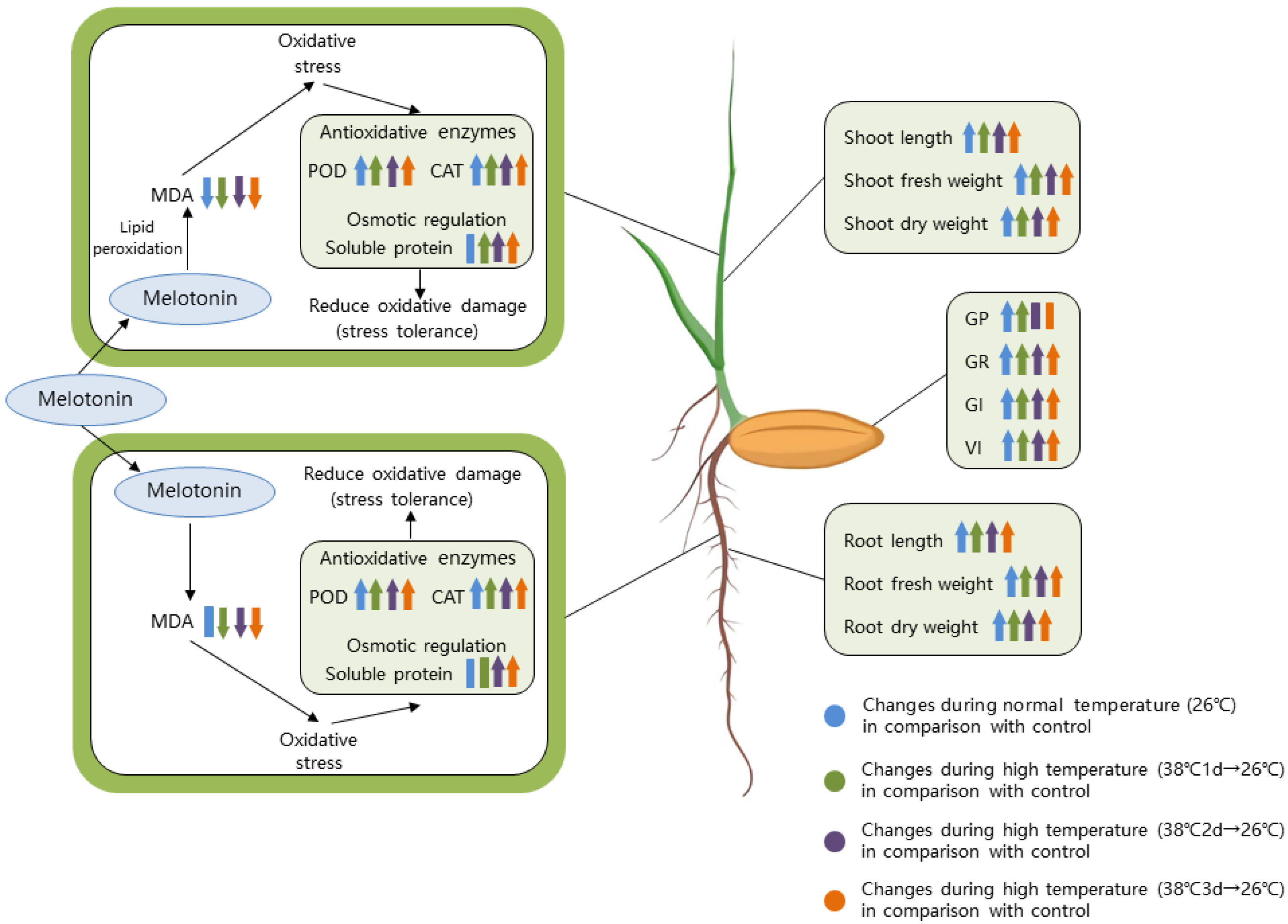
Exogenous Melatonin Activates Antioxidant Systems to Increase the Ability of Rice Seeds to Germinate under High Temperature Conditions
Abstract
Share and Cite
Yu, Y.; Deng, L.; Zhou, L.; Chen, G.; Wang, Y. Exogenous Melatonin Activates Antioxidant Systems to Increase the Ability of Rice Seeds to Germinate under High Temperature Conditions. Plants 2022, 11, 886. https://doi.org/10.3390/plants11070886
Yu Y, Deng L, Zhou L, Chen G, Wang Y. Exogenous Melatonin Activates Antioxidant Systems to Increase the Ability of Rice Seeds to Germinate under High Temperature Conditions. Plants. 2022; 11(7):886. https://doi.org/10.3390/plants11070886
Chicago/Turabian StyleYu, Yufeng, Liyuan Deng, Lu Zhou, Guanghui Chen, and Yue Wang. 2022. "Exogenous Melatonin Activates Antioxidant Systems to Increase the Ability of Rice Seeds to Germinate under High Temperature Conditions" Plants 11, no. 7: 886. https://doi.org/10.3390/plants11070886
APA StyleYu, Y., Deng, L., Zhou, L., Chen, G., & Wang, Y. (2022). Exogenous Melatonin Activates Antioxidant Systems to Increase the Ability of Rice Seeds to Germinate under High Temperature Conditions. Plants, 11(7), 886. https://doi.org/10.3390/plants11070886