Article

Deep Learning for Detecting and Classifying Ocean Objects: Application of YoloV3 for Iceberg–Ship Discrimination


by
Frederik Seerup Hass
and
Jamal Jokar Arsanjani
*
Department of Planning, Geography and Surveying, Aalborg University Copenhagen, A.C. Meyers Vænge 15, 2450 Copenhagen, Denmark
*
Author to whom correspondence should be addressed.
ISPRS Int. J. Geo-Inf. 2020, 9(12), 758; https://doi.org/10.3390/ijgi9120758
Submission received: 31 October 2020 / Revised: 15 December 2020 / Accepted: 18 December 2020 / Published: 19 December 2020

Abstract

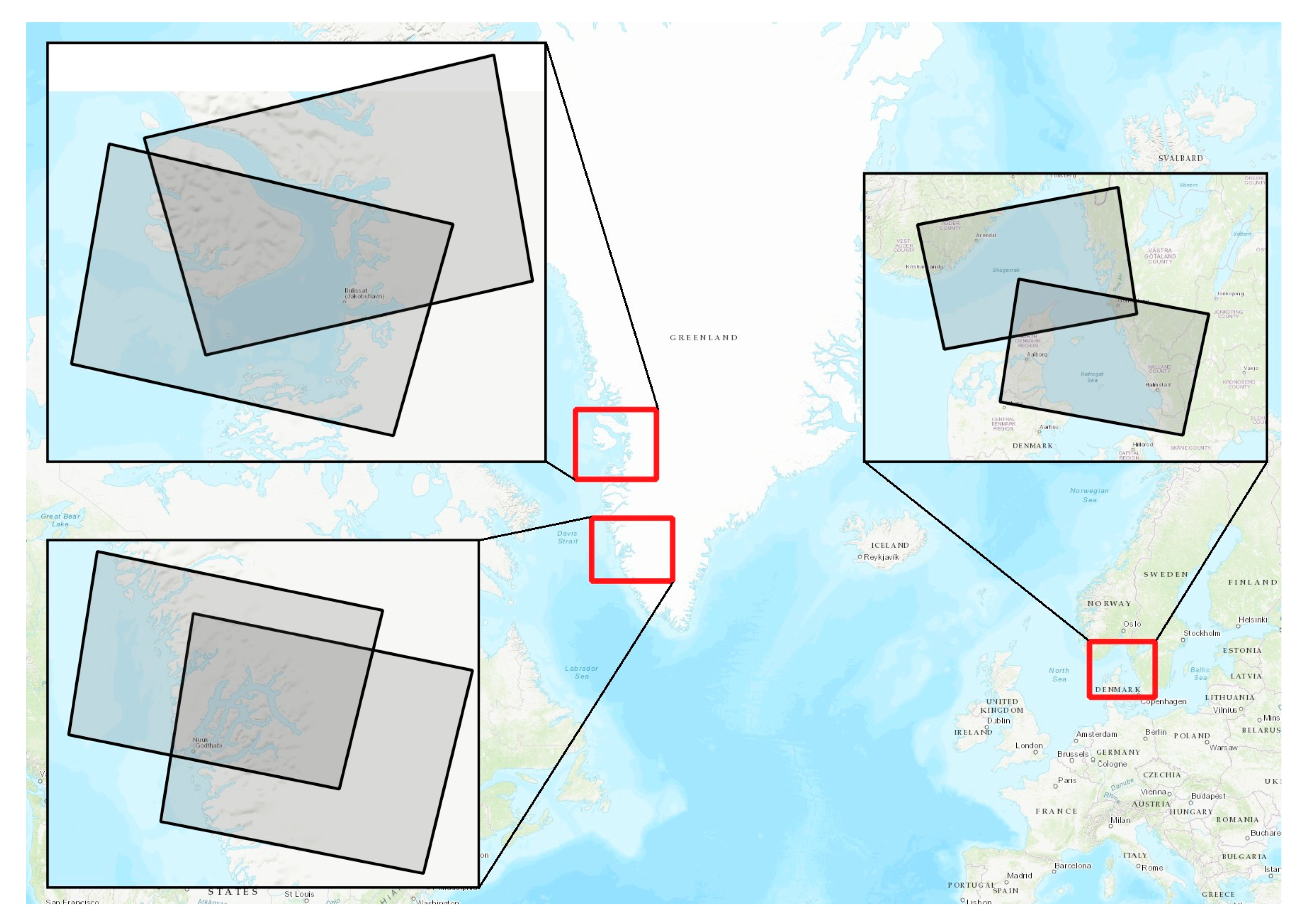
Synthetic aperture radar (SAR) plays a remarkable role in ocean surveillance, with capabilities of detecting oil spills, icebergs, and marine traffic both at daytime and at night, regardless of clouds and extreme weather conditions. The detection of ocean objects using SAR relies on well-established methods, mostly adaptive thresholding algorithms. In most waters, the dominant ocean objects are ships, whereas in arctic waters the vast majority of objects are icebergs drifting in the ocean and can be mistaken for ships in terms of navigation and ocean surveillance. Since these objects can look very much alike in SAR images, the determination of what objects actually are still relies on manual detection and human interpretation. With the increasing interest in the arctic regions for marine transportation, it is crucial to develop novel approaches for automatic monitoring of the traffic in these waters with satellite data. Hence, this study aims at proposing a deep learning model based on YoloV3 for discriminating icebergs and ships, which could be used for mapping ocean objects ahead of a journey. Using dual-polarization Sentinel-1 data, we pilot-tested our approach on a case study in Greenland. Our findings reveal that our approach is capable of training a deep learning model with reliable detection accuracy. Our methodical approach along with the choice of data and classifiers can be of great importance to climate change researchers, shipping industries and biodiversity analysts. The main difficulties were faced in the creation of training data in the Arctic waters and we concluded that future work must focus on issues regarding training data.
Keywords: deep learning; object detection; ocean objects; synthetic aperture radar; classification; YoloV3 deep learning; object detection; ocean objects; synthetic aperture radar; classification; YoloV3