Article

Tree Species Classification Using Hyperion and Sentinel-2 Data with Machine Learning in South Korea and China


1
Inter-Korean Forest Research Team, Division of Global Forestry, Department of Forest Policy and Economics, National Institute of Forest Science, Seoul 02455, Korea
2
Department of Geography, Yanbian University, Yanji 133002, China
*
Author to whom correspondence should be addressed.
ISPRS Int. J. Geo-Inf. 2019, 8(3), 150; https://doi.org/10.3390/ijgi8030150
Submission received: 29 January 2019 / Revised: 12 March 2019 / Accepted: 15 March 2019 / Published: 20 March 2019

Abstract

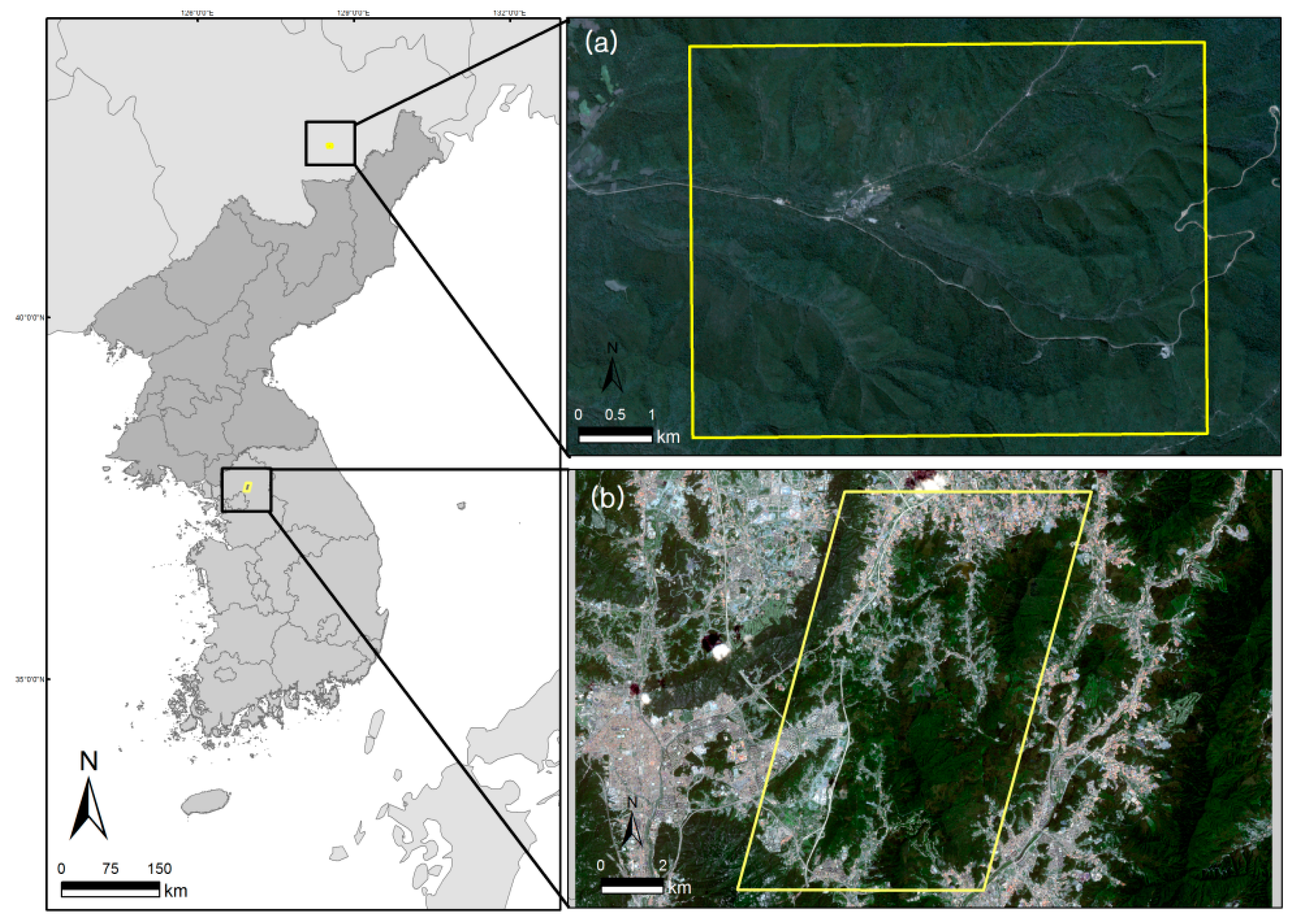
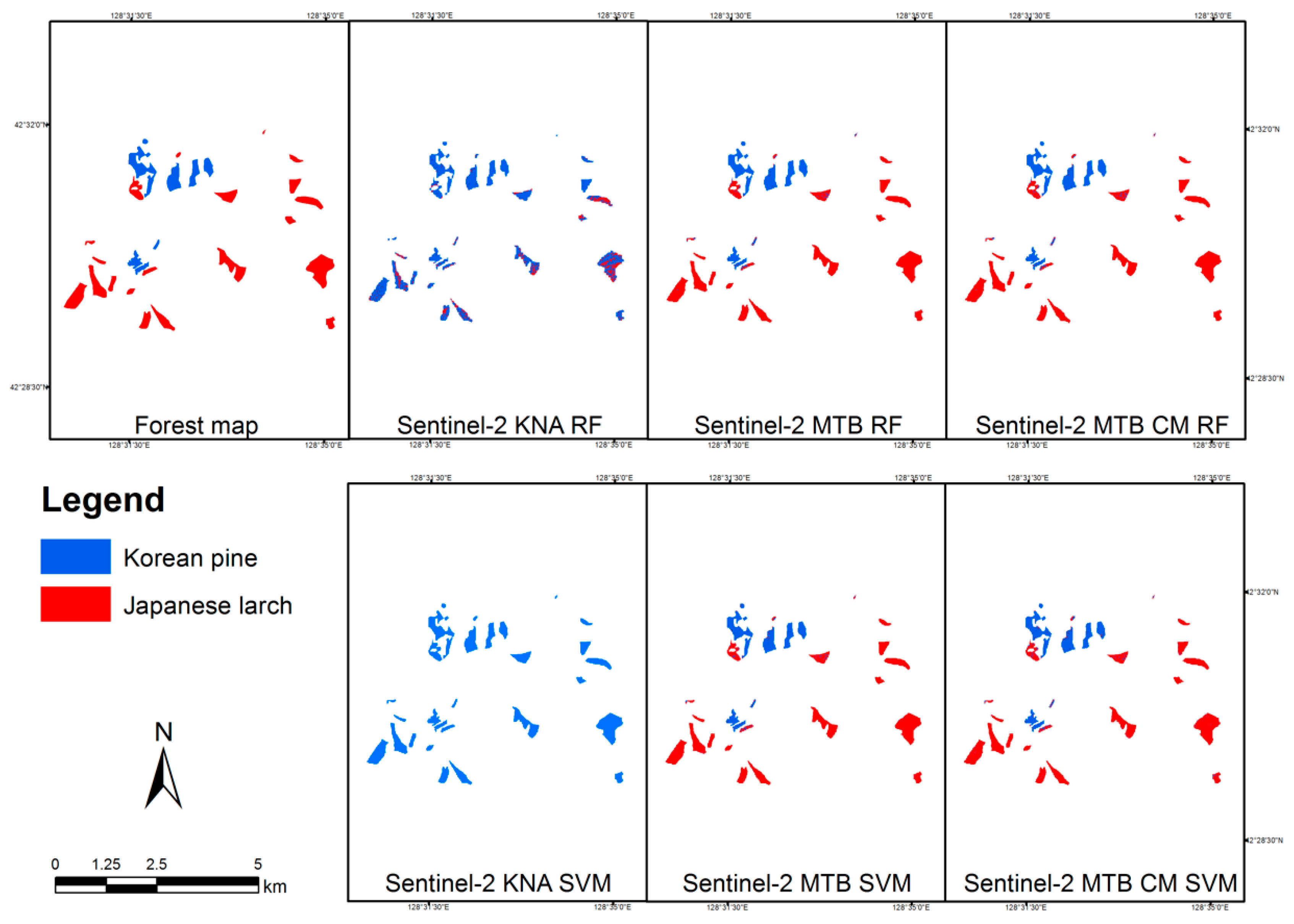
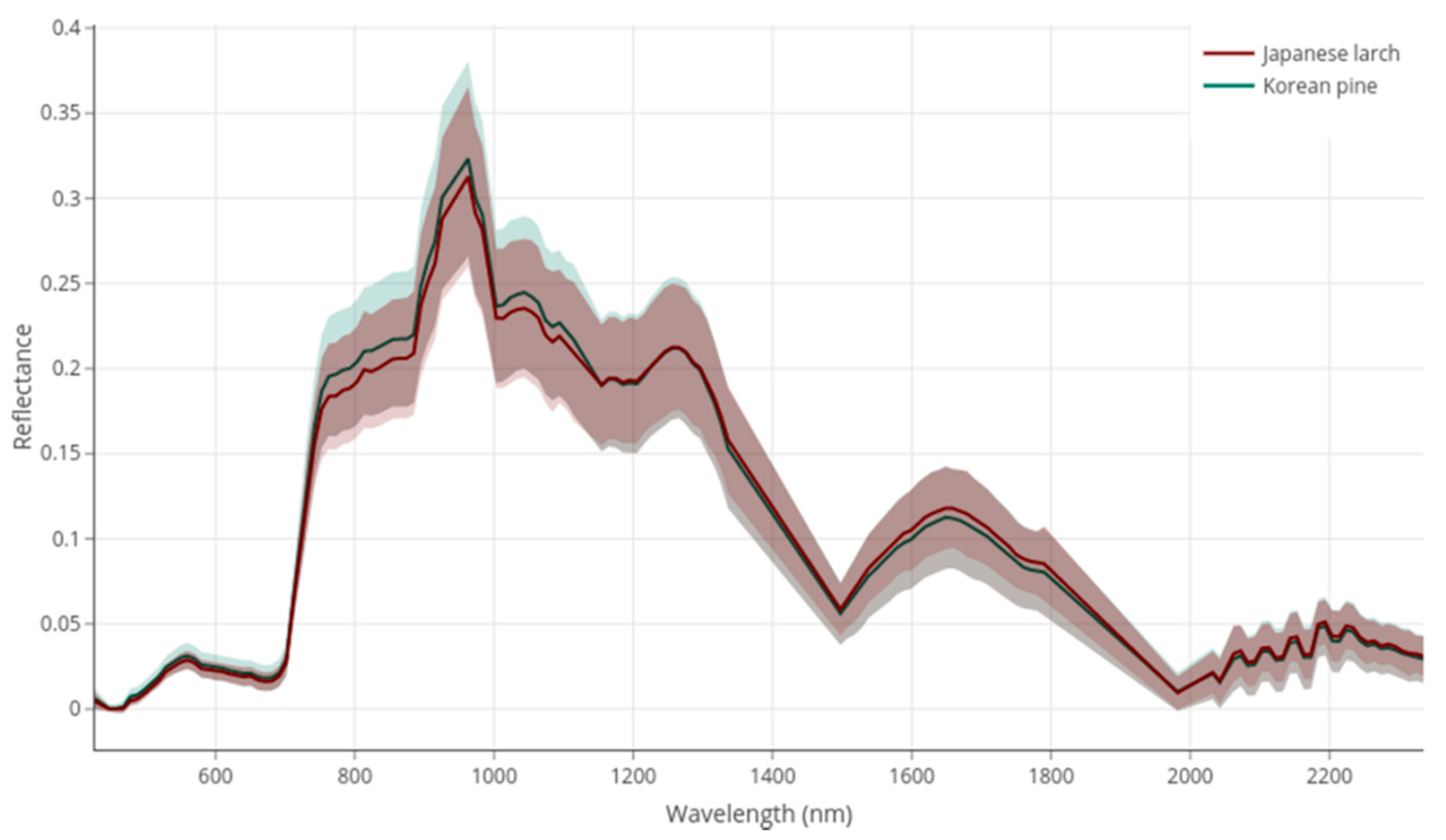
Remote sensing (RS) has been used to monitor inaccessible regions. It is considered a useful technique for deriving important environmental information from inaccessible regions, especially North Korea. In this study, we aim to develop a tree species classification model based on RS and machine learning techniques, which can be utilized for classification in North Korea. Two study sites were chosen, the Korea National Arboretum (KNA) in South Korea and Mt. Baekdu (MTB; a.k.a., Mt. Changbai in Chinese) in China, located in the border area between North Korea and China, and tree species classifications were examined in both regions. As a preliminary step in developing a classification algorithm that can be applied in North Korea, common coniferous species at both study sites, Korean pine (Pinus koraiensis) and Japanese larch (Larix kaempferi), were chosen as targets for investigation. Hyperion data have been used for tree species classification due to the abundant spectral information acquired from across more than 200 spectral bands (i.e., hyperspectral satellite data). However, it is impossible to acquire recent Hyperion data because the satellite ceased operation in 2017. Recently, Sentinel-2 satellite multispectral imagery has been used in tree species classification. Thus, it is necessary to compare these two kinds of satellite data to determine the possibility of reliably classifying species. Therefore, Hyperion and Sentinel-2 data were employed, along with machine learning techniques, such as random forests (RFs) and support vector machines (SVMs), to classify tree species. Three questions were answered, showing that: (1) RF and SVM are well established in the hyperspectral imagery for tree species classification, (2) Sentinel-2 data can be used to classify tree species with RF and SVM algorithms instead of Hyperion data, and (3) training data that were built in the KNA cannot be used for the tree classification of MTB. Random forests and SVMs showed overall accuracies of 0.60 and 0.51 and kappa values of 0.20 and 0.00, respectively. Moreover, combined training data from the KNA and MTB showed high classification accuracies in both regions; RF and SVM values exhibited accuracies of 0.99 and 0.97 and kappa values of 0.98 and 0.95, respectively.
Keywords: hyperspectral image; random forest; support vector machine; texture feature; image spectroscopy hyperspectral image; random forest; support vector machine; texture feature; image spectroscopy