Article

Heat-Transfer-Driven Voxel-Based Simulation: An Exploratory GPU-Accelerated Framework for Urban-Scale 3D Fire Spread

1
Geospatial Research Innovations and Development (GRID), School of Built Environment, UNSW Sydney, Sydney, NSW 2052, Australia
2
School of Minerals and Energy Resources Engineering, UNSW Sydney, Sydney, NSW 2052, Australia
*
Author to whom correspondence should be addressed.
ISPRS Int. J. Geo-Inf. 2026, 15(9), 423; https://doi.org/10.3390/ijgi15090423
Submission received: 24 June 2026 / Revised: 11 September 2026 / Accepted: 14 September 2026 / Published: 16 September 2026

Abstract

The rapid growth of high-resolution 3D voxel datasets derived from LiDAR, BIM, and urban digital twin platforms has created new opportunities for volumetric environmental simulation. However, existing fire-spread models are often surface-based or computationally intensive for large-scale 3D applications, motivating the investigation of efficient voxel-native alternatives. This study presents a pilot investigation of a physics-based, GPU-accelerated framework for rapid 3D fire-spread simulation in wildland–urban interface (WUI) environments. Fire propagation is represented through simplified formulations of conduction, radiation, and wind-driven convection on a structured voxel grid, with combustion behavior parameterized using fuel and material properties. The framework is not intended to replace high-fidelity computational fluid dynamics (CFD) models, but rather to provide a computationally efficient approach for rapid evaluation of fire-spread scenarios in large 3D urban environments. A voxel-native parallel memory layout and stencil-based computational scheme enable efficient neighbor access and GPU-parallel updates. The framework is demonstrated using a voxelized model of Liverpool, NSW, Australia, and its computational performance is evaluated on both local GPU and high-performance computing (HPC) platforms. The results demonstrate predictable runtime scaling and practical performance for domains exceeding one million active burnable voxels. An initial cross-model comparison with the FDS CSIRO scenario further demonstrates substantial spatial agreement while identifying remaining differences in burned area. The results demonstrate the feasibility of the framework for rapid urban-scale 3D fire-spread evaluation, with potential future applications in emergency response and time-critical decision support following further calibration and validation.

1. Introduction

In recent decades, climate change has increased the frequency, intensity, and spatial extent of wildfires worldwide, making them one of the most destructive natural hazards [1,2]. In the United States, tens of thousands of unplanned wildfires occur annually, burning millions of acres and increasingly affecting populated regions [3]. Similarly, Australia’s 2019–2020 Black Summer burned over 24 million hectares, caused an estimated one billion animal deaths, and resulted in economic losses exceeding $4.5 billion [4,5]. These large-scale events pose compound threats to urban property and critical infrastructure, while endangering human health, emergency responders, and regional economies [6]. Such escalating risks motivate the development of computational approaches capable of representing fire propagation in complex urban and wildland–urban interface (WUI) environments [7,8,9].
Accurate fire prediction in urban and WUI environments remains highly challenging due to structural and fuel complexity [10]. Fire propagation is inherently three-dimensional, requiring frameworks that capture both vertical and horizontal spread. Urban environments include multi-story buildings [11]; vertically stratified fuels, such as surface vegetation, shrubs, and tree canopies [12]; heterogeneous terrain and street networks with combustible and non-combustible materials [13,14]; and elevated critical infrastructure, such as powerlines and bridges [15,16]. Interactions among these elements create dynamic and nonlinear fire pathways, making 3D prediction substantially more challenging [14,17].
Existing fire-spread models span a broad range of physical fidelity and computational complexity. Operational landscape-scale models such as SPARK, FARSITE, and Prometheus primarily represent horizontal fire-front propagation and provide limited representation of vertical fuel connectivity [18,19,20]. At the other end of the spectrum, high-fidelity physics-based and CFD models can explicitly represent coupled combustion, heat transfer, and fluid dynamics, but their computational requirements can restrict application to large, high-resolution urban domains [21,22]. Cellular automata and related discrete approaches provide greater computational efficiency, but generally represent fire propagation through prescribed or empirical state-transition rules rather than directly resolving the underlying heat-transfer processes [23,24]. Consequently, an important computational challenge is to balance three-dimensional physical representation with scalability for urban block- and street-scale domains.
This challenge is particularly relevant at sub-meter resolution, where increasing spatial extent rapidly increases the number of computational elements and associated memory and runtime requirements. Existing approaches are therefore commonly applied either to relatively localized high-resolution simulations or to larger domains using simplified or coarser representations [21,25]. A computational framework that combines physically defined heat-transfer mechanisms with a structured and parallelizable 3D spatial representation could provide an intermediate modeling approach between highly simplified rule-based propagation and computationally intensive CFD simulation.
Despite these challenges, recent advances in geospatial data acquisition and 3D modeling provide new opportunities. The increasing availability of voxel-based representations of cities and forests enables simulation of complex urban and environmental dynamics at fine spatial resolutions [26,27,28]. Recent voxelization pipelines demonstrate how multi-source LiDAR, photogrammetric, and other geospatial data can be transformed into structured volumetric grids for analysis and simulation [29,30,31,32,33]. Standardized 3D models, such as CityGML and IFC, can further contribute geometric and semantic information to these representations [29,34,35,36]. Voxel grids provide explicit spatial connectivity and neighborhood structure, making them a natural foundation for modeling 3D processes [33,37]. As fire propagation is inherently volumetric and governed by coupled heat-transfer and combustion processes [38,39], voxel-based representations provide a suitable computational structure for representing fire spread across heterogeneous fuels and built environments.
This paper presents a physics-based, GPU-accelerated computational framework for simulating 3D fire spread in complex environments represented using sub-meter voxel grids. The framework combines conductive, radiative, and wind-driven convective heat transfer with fuel-dependent thermal and combustion properties within a structured voxel representation. Its computational architecture uses parallel stencil-based operations to support efficient simulation over large 3D domains. The present study focuses on the formulation, implementation, computational scalability, numerical assessment, and initial quantitative evaluation of this framework. Potential applications to real-time emergency-response systems and urban digital twins are regarded as future directions requiring further calibration, validation, and operational evaluation.
The remainder of this paper is organized as follows. Section 2 reviews related work on fire simulation and voxel-based urban modeling. Section 3 identifies the computational gaps in existing 3D fire-spread approaches and outlines the motivation and contributions of this exploratory study. Section 4 presents the conceptual framework, simplified physics-based formulations, and simulation inputs and outputs. Section 5 describes the voxel-centric memory layout and GPU-parallel computing strategies based on structured voxel connectivity. Section 6 demonstrates and evaluates the framework through an urban-scale case study in Liverpool, NSW, together with computational performance assessment and initial cross-model validation against FDS. Section 7 discusses the results, and Section 8 summarizes the limitations, future research directions. Section 9 concludes this study by summarizing the key findings, validation results, limitations, and directions for future development.

2. Literature Review

This literature review is organized in two parts. First, we examine the current state of 3D fire propagation simulators based on their theoretical foundations and modeling rationales, and analyze their limitations in supporting sub-meter resolution simulation at the mesoscopic urban block scale. Second, we review emerging data sources and construction pipelines for voxelized city models in order to establish the data foundation for the proposed voxel-based 3D fire propagation framework.

2.1. Current State of 3D Fire-Propagation Modeling

Existing fire-spread models span a range of spatial representations and levels of physical fidelity. Widely used landscape-scale models such as FARSITE, Prometheus, and SPARK primarily represent fire propagation over terrain surfaces, with vertical processes such as crown-fire transition incorporated through parameterized formulations [18,19,20]. In contrast, fully three-dimensional models represent fire processes within volumetric computational domains but generally involve substantially greater computational complexity [22,40]. For the purposes of this study, existing fully 3D approaches are broadly considered in two groups: continuum physics-based models and discrete 3D cellular automata (CA)-based models.

2.1.1. Continuum Physics-Based Models

Continuum physics-based wildfire models represent fire behavior using coupled conservation equations for mass, momentum, energy, and chemical species transport [22,38]. These are formulated as systems of partial differential equations (PDEs), including the Navier–Stokes equations coupled with energy and species transport equations governing combustion, heat transfer, and chemical reactions [41,42]. Such formulations can explicitly represent processes including buoyancy-driven flow, wind–flame interaction, turbulent mixing, plume dynamics, and radiative heat transfer [11,39]. These governing equations are commonly discretized using finite-volume or related numerical methods within computational fluid dynamics (CFD) solvers [43].
Representative continuum fire models are summarized in Table 1. FDS employs a low-Mach-number CFD formulation with large-eddy simulation (LES) for combustion, heat transfer, and buoyancy-driven flow, particularly in building-scale and controlled fire applications [43,44]. WFDS extends this modeling approach to vegetation and WUI fires through representations of vegetative fuels and fire–atmosphere interactions [45]. FIRETEC and FIRESTAR3D couple atmospheric flow, combustion, vegetation, and heat-transfer processes for wildland-fire simulation [21,46,47,48]. FireFoam provides an OpenFOAM-based framework for LES and reactive-flow modeling [49]. These models differ substantially in their physical formulations, numerical implementations, target applications, and computational requirements.
The detailed physical representation provided by continuum models is accompanied by substantial computational requirements because coupled PDE systems must be solved over three-dimensional computational meshes. Consequently, computational cost increases rapidly with domain extent, spatial resolution, simulated duration, and the complexity of the physical processes represented. Representative computational characteristics reported for existing models are summarized in Table 1. Direct runtime comparisons should, however, be interpreted cautiously because published studies differ in domain size, mesh resolution, physical configuration, hardware, and simulated duration.
The present study investigates a complementary modeling strategy positioned between highly detailed continuum simulation and simplified rule-based propagation. Rather than resolving the complete Navier–Stokes and reactive-flow equations, the proposed physics-based framework represents fire propagation through voxel-scale conductive, radiative, and wind-driven convective heat-transfer processes. A structured voxel representation is used for both geospatial scene representation and fire-spread computation, allowing heterogeneous terrain, vegetation, and built-environment information to be represented within the computational domain. The regular voxel structure further supports localized stencil operations and GPU-parallel computation. The objective is therefore not to replace higher-fidelity continuum models, but to investigate whether a simplified physics-based, voxel-native formulation can provide a scalable computational framework for large 3D fire-spread simulations.

2.1.2. 3D Cellular Automata (CA)-Based Models

Cellular automata (CA)-based wildfire models represent fire propagation through discrete state transitions across spatial cells governed by local rules [23,40]. Rather than solving coupled conservation equations, each cell updates its state (e.g., unburned, burning, or burned) according to the states of neighboring cells and prescribed factors such as fuel properties, wind, slope, and ignition probability [50]. This localized formulation generally provides lower computational complexity than continuum CFD approaches and is therefore well suited to simulations involving large numbers of spatial cells.
Most CA wildfire models operate on two-dimensional or quasi-3D terrain representations, with vertical effects incorporated indirectly through elevation, fuel attributes, or empirical crown-fire relationships [51]. Their transition rules are commonly derived from empirical or semi-empirical fire-spread relationships [52,53,54]. More recent studies have incorporated machine-learning and deep-learning components to estimate fire-spread behavior or adapt transition probabilities under changing conditions [50,55,56,57].
Fully 3D CA formulations have also been investigated to represent vertical fuel stratification and canopy interactions. For example, LiDAR-derived volumetric representations can describe vertically distributed fuels using stacked cells, with propagation governed by neighborhood-based ignition criteria incorporating wind and fuel characteristics [58]. Other approaches combine semi-empirical fire-spread formulations with discrete 3D grids to represent ignition and propagation across complex terrain [59]. Representative CA-based approaches are summarized in Table 2.
CA models therefore provide an efficient approach to large-scale fire-spread simulation, but their predictive behavior depends strongly on the selected transition rules and associated parameterization. Rules calibrated for particular fuel types or environmental conditions may require modification or recalibration when applied to substantially different scenarios [23,24]. The framework developed in this study adopts a different intermediate strategy: it retains the computational advantages of localized voxel-neighborhood operations while determining thermal evolution from simplified physics-based heat-transfer formulations rather than relying primarily on prescribed fire-spread transition probabilities.

2.2. Computational Challenges in 3D Fire Simulation

Three-dimensional fire simulation introduces substantial computational requirements because the spatial domain must represent heterogeneous fuels, terrain, built structures, and their interactions at sufficient resolution. For structured voxel domains, increasing spatial extent or decreasing voxel size directly increases the number of computational elements over which state variables and fire-spread processes must be evaluated. Efficient representation and processing of these volumetric domains are therefore important considerations in the design of scalable 3D fire-simulation frameworks [54].
Memory requirements represent one of the principal constraints. For a structured grid containing N x , N y , and  N z cells along the three spatial dimensions, the total number of voxels is
N = N x N y N z .
For approximately isotropic grids with N x N y N z n , the total voxel count therefore scales as O ( n 3 ) with linear grid resolution. If  n f state and parameter fields are stored for each voxel, the corresponding memory requirement scales as O ( N n f ) . Consequently, fine-resolution urban domains can contain millions of computational elements and require substantial memory when multiple thermophysical, fuel, environmental, and combustion-state variables are maintained [60,61].
A second challenge arises from neighborhood-based computation. Structured-grid heat-transfer calculations commonly employ stencil operations in which each voxel is updated using information from nearby voxels [62,63]. Such operations frequently exhibit low arithmetic intensity and can therefore become limited by memory bandwidth and data-access efficiency rather than arithmetic throughput [64]. Larger neighborhoods used to represent non-local or directional processes can further increase memory access and computational workload. Data layout and localized memory-access patterns are consequently important for efficient implementation on parallel hardware.
Large-scale parallel execution additionally requires careful management of voxel-state updates. When many voxels are processed concurrently, update dependencies must be controlled to prevent race conditions and unintended dependence on thread execution order [65]. The regular structure of voxel grids nevertheless provides an opportunity for data-parallel computation because similar local operations can be applied concurrently across large portions of the domain. These characteristics motivate the structured indexing, stencil-based computation, and GPU-parallel implementation developed in the present study, which are described in the following sections.

3. Motivation and Contribution

The preceding review identifies a computational gap between high-fidelity continuum fire models and computationally efficient surface-based or rule-based approaches. Building on the advantages of voxel-based representations discussed above, this study investigates whether a structured voxel representation, simplified physics-based heat-transfer formulation, and GPU-parallel computation can provide a scalable intermediate approach for three-dimensional fire-spread simulation. The geospatial component provides the spatial and semantic foundation for the simulation rather than introducing new LiDAR processing, point-cloud classification, or GIS methodologies. Accordingly, the primary methodological contribution lies in integrating voxelized 3D environmental representations with physics-based fire propagation and GPU-parallel computation.
In response to these identified gaps, this work makes the following contributions:
  • Physics-based 3D voxel fire modeling. We develop a voxel-based fire-propagation formulation in which thermal evolution is governed by discretized conductive, radiative, and wind-driven convective heat-transfer processes, together with fuel-dependent thermal and combustion properties. The formulation operates directly on structured volumetric grids, enabling three-dimensional representation of fire propagation through heterogeneous terrain, vegetation, and built-environment elements.
  • Structured GPU-parallel voxel computation. We develop a structured stencil-based computational architecture that combines deterministic voxel indexing, row-major data organization, localized neighbor access, and parallel voxel-level updates. The regular computational structure enables heat-transfer and combustion-state operations to be executed concurrently across large three-dimensional voxel domains using GPU-parallel computing.
  • Computational scalability and quantitative evaluation. The framework is evaluated across increasing three-dimensional domain sizes on local GPU and HPC computing environments to characterize runtime and computational scalability. The study additionally evaluates the numerical stability of the explicit conductive heat-transfer update and provides quantitative fire-progression analysis and initial cross-model validation against the FDS CSIRO Case C064 scenario. These evaluations provide a more systematic assessment of both the computational characteristics and simulated fire-spread behavior of the proposed framework.
The present study focuses on the formulation, computational implementation, scalability, numerical assessment, and initial cross-model evaluation of this framework. Potential integration with real-time environmental data, emergency-response systems, and urban digital twins represents a future application requiring further calibration, validation, and operational evaluation.
As summarized in Table 3, the present study substantially extends our previous proof-of-concept implementation rather than introducing voxel-based fire simulation as an entirely new concept. The earlier work demonstrated the feasibility of integrating LiDAR-derived voxel environments, fire-spread modeling, Taichi-based parallel computing, and 3D visualization within a lightweight Python 3.10 framework [66,67]. The present study extends this prototype through a more systematic heat-transfer formulation, structured stencil-based GPU computation, substantially larger computational domains, systematic scalability evaluation, explicit numerical stability assessment, and quantitative cross-model validation against the FDS CSIRO Case C064 scenario. Accordingly, the contribution of the present study lies in advancing the earlier prototype into a more systematically formulated, evaluated, and scalable computational framework for large-scale 3D fire-spread simulation.

4. Methodology

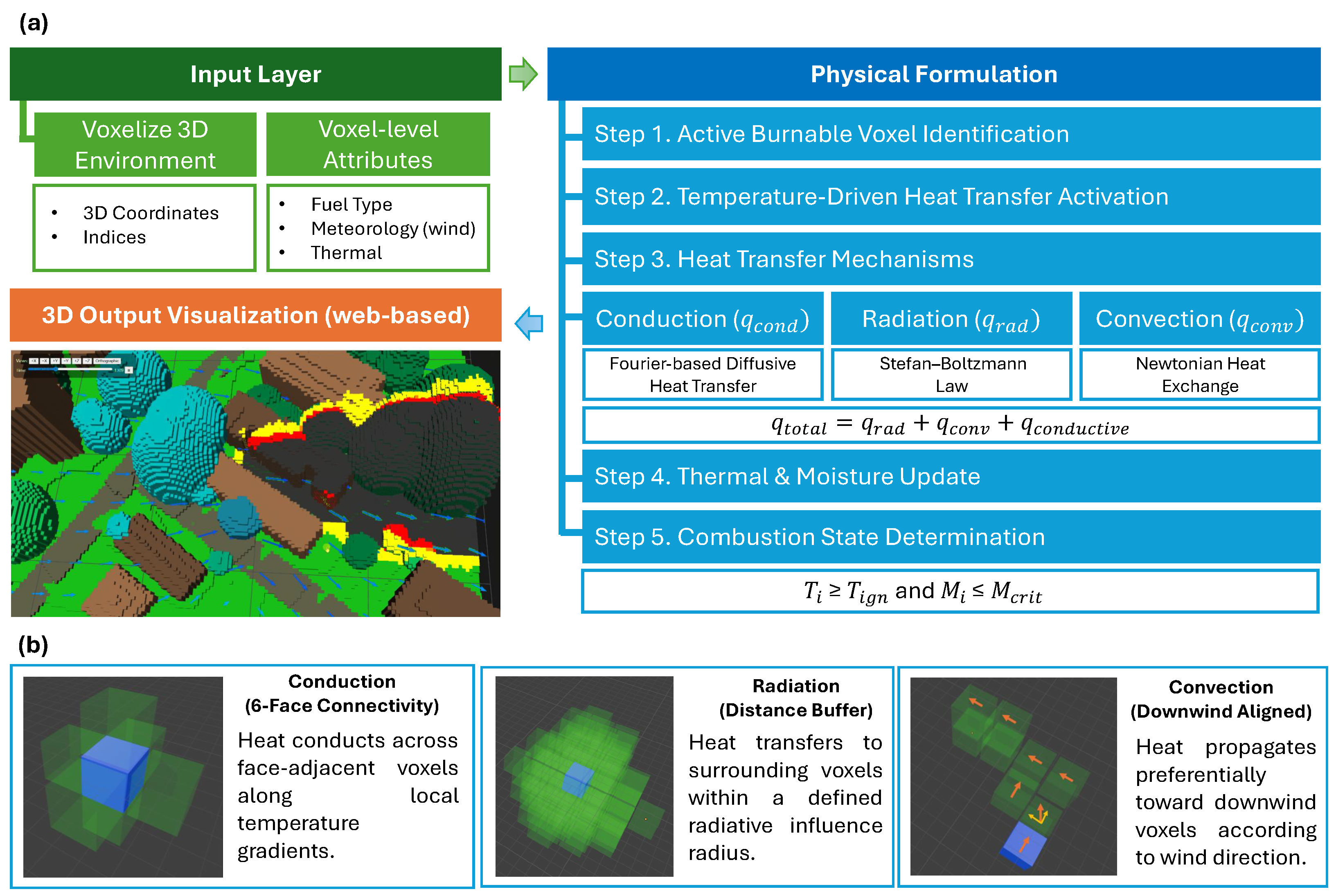
Our earlier prototype and preliminary experiments were reported in Xu et al. [67], demonstrating the feasibility of voxel-based fire simulation at community scales. Building on this foundation, the present work advances the model by incorporating more explicit physics-based representations and improving parallel computing optimization for large-scale voxel simulations (Figure 1a). This section provides a high-level overview of the conceptual formulation, including the physical processes considered, their discretization within the voxel lattice, and the structure of input and output data. Detailed implementation and optimization strategies are presented in Section 5.

4.1. Conceptual Model Framework and Physical Formulation

The proposed framework adopts a physics-based, voxel-discretized modeling strategy for three-dimensional fire propagation in heterogeneous urban environments. Rather than resolving the full governing equations of computational fluid dynamics, the framework represents fire spread through simplified heat-transfer processes operating on a structured volumetric grid [68]. Each voxel stores state variables and fuel- or material-dependent attributes required by the thermal and combustion formulations. Heat transfer between voxels is driven by local thermal conditions, such that heated or burning regions transfer energy to surrounding voxels through the mechanisms described below [39,69]. The thermal formulation incorporates conduction, radiation, and wind-driven convection. Conduction is evaluated through local exchange between face-adjacent voxels, radiation is represented through a distance-dependent influence over a prescribed neighborhood, and convection introduces directional heat transfer according to the local wind field. These mechanisms contribute to the net thermal input used to update voxel temperature at each simulation timestep. Their mathematical formulations and spatial interaction patterns are described in the following subsections.
Fuel moisture is represented as a prescribed fuel-dependent parameter rather than as a dynamically evolving moisture field. Its influence is introduced through a moisture-dependent thermal damping factor that reduces the temperature response of fuels with higher prescribed moisture content. Accordingly, explicit moisture evaporation, transport, latent-heat consumption, and time-dependent moisture depletion are not resolved in the present formulation. This simplification provides a computationally efficient representation of moisture effects while retaining moisture as an explicit input to the voxel thermal response. Fire progression is represented through discrete combustion states (unburned, heating, igniting, burning, and burned) governed by the thermal state and prescribed fuel properties of each combustible voxel. The transition toward ignition is determined using fuel-dependent ignition criteria, while the duration of active burning is controlled by the available fuel mass and prescribed fuel-dependent mass-loss rate. The detailed state-transition and combustion formulations are provided in Section 4.4.
By combining discretized heat-transfer mechanisms, fuel-dependent thermal properties, and explicit combustion-state transitions within a structured voxel representation, the framework provides a simplified physics-based formulation suitable for GPU-parallel computation. The regular voxel indexing and localized interaction neighborhoods support efficient stencil-based computation without requiring full CFD resolution. The formulation is implemented within a modular computational architecture so that additional processes, including ember generation, transport, and secondary ignition, can be incorporated in future extensions.

4.2. Active Burnable Voxel Identification

At the beginning of the simulation, voxels are classified according to their material or fuel type to distinguish burnable and non-burnable elements. Burnable voxels, including vegetation, other combustible land-cover classes, and combustible building or structural materials, are eligible to enter combustion states (e.g., heating, igniting, and burning). In contrast, non-burnable voxels, including air, roads, water, bare or non-combustible ground, and other inert materials, do not undergo combustion but may still participate in heat-transfer processes. This initial classification constitutes the first step of the simulation and reduces computational and memory requirements by restricting combustion-related updates to physically relevant voxels. The detailed implementation of this filtering and activation strategy is described in Section 5.

4.3. Temperature-Driven Heat-Transfer Activation

Following voxel classification, a further screening step identifies regions where active heat transfer occurs. Although non-burnable voxels may participate in thermal exchange, many regions exhibit negligible temperature variation and therefore do not contribute meaningfully to energy propagation. To reduce unnecessary computation, heat-transfer activation is restricted to voxel pairs exhibiting significant temperature differences across their connectivity relationships. For each active voxel, neighboring elements are identified through structured voxel connectivity. When sufficient temperature gradients exist between adjacent voxels, conductive, radiative, or convective transfer pathways are activated. This temperature-driven activation mechanism localizes thermal exchange to physically relevant regions, improving computational efficiency while preserving interpretable gradient-driven energy propagation across the volumetric grid.

4.4. Voxel Connectivity-Driven Thermal Propagation

Heat transfer within the proposed framework is implemented through a discrete thermal-transport model operating over a structured and customizable voxel adjacency graph. The voxel lattice defines explicit connectivity relationships between neighboring voxels, where adjacency templates can be configured according to directionality (e.g., axial alignment or wind-oriented bias) and neighborhood range (e.g., direct-contact conduction versus non-directional radiative transfer with distance-dependent heat decay). These connectivity patterns determine how thermal energy is exchanged locally across the grid, enabling heat propagation to emerge from structured voxel-to-voxel interactions. By adjusting the connectivity templates (as shown in Figure 1b), the model can represent different spatial influence patterns to model different heat-transfer types, as elaborated through the reminder of this subsection, while maintaining computational efficiency within the structured lattice.

4.4.1. Conduction

Heat conduction refers to the transfer of thermal energy through direct physical contact between materials and is one of the primary heat-transfer mechanisms involved in fire propagation [39]. In the present framework, conduction represents local heat transfer between face-connected voxels due to temperature differences across their shared interfaces [69,70].
Conductive heat transfer is modeled using a discrete approximation of Fourier’s law [70]. At the continuous scale, heat diffusion is governed by
T t = α 2 T ,
where T is temperature and α is thermal diffusivity. In the proposed framework, thermal diffusivity is not assumed to be spatially uniform. Instead, for voxel i, it is determined from the thermophysical properties associated with its assigned fuel or material type as
α i = k eff , i ρ i c i ,
where k eff , i , ρ i , and  c i denote the effective thermal conductivity, density, and specific heat capacity of voxel i, respectively. This formulation allows different fuel and combustible material classes within the heterogeneous voxel domain to exhibit different thermal diffusivities.
Within the voxel lattice, the diffusion equation is discretized using a 6-point finite-difference stencil corresponding to the face-adjacent neighbors (von Neumann neighborhood). For a voxel located at ( i , j , k ) , the Laplacian is approximated as
2 T i , j , k 1 Δ x 2 n N 6 ( i ) T n T i , j , k ,
where Δ x is the voxel size and N 6 ( i ) represents the six neighboring voxels along the positive and negative x, y, and z directions.
The conductive contribution to the temperature update of voxel i is therefore computed as
T i t cond = α i 1 Δ x 2 n N 6 ( i ) T n T i ,
where T i / t cond denotes the conductive contribution to the voxel temperature-change rate. Because α i has units of m 2 s 1 , this term has units of K s 1 . Voxel-level thermophysical properties are parameterized according to the fuel or material class assigned to each voxel and stored as environmental parameters. Consequently, the conductive response varies spatially across heterogeneous combustible materials rather than using a single uniform thermal diffusivity for the entire domain. Conduction is restricted to face-connected neighboring voxels, reflecting its short-range, contact-based nature while maintaining computational efficiency within the structured voxel grid.

4.4.2. Radiation

Radiative heat transfer is modeled based on the Stefan–Boltzmann law, which states that thermal radiation emitted by a hot body is proportional to the fourth power of its absolute temperature [71,72]. In the voxel framework, each burning or igniting voxel is treated as a volumetric radiative emitter whose outgoing radiative intensity depends on its local temperature field. This assumption reflects the physical principle that high-temperature-combustion zones emit significant thermal radiation independent of physical contact [73].
For a radiating source voxel j with temperature T j , the emitted radiative power density is approximated as
q e m i t , j = σ T j 4 ,
where σ denotes the Stefan–Boltzmann constant. Radiative energy received by a target voxel i is then attenuated according to geometric spreading. Assuming isotropic emission and neglecting atmospheric absorption and scattering, radiative intensity decays with the square of separation distance. The received radiative flux is therefore approximated as
q r a d , i = j N r σ T j 4 w g e o m r i j 2 ,
where N r denotes the set of source voxels within the prescribed radiative influence radius, r i j is the Euclidean distance between voxels i and j, and  w g e o m is a geometric weighting factor accounting for discretization effects and effective view interaction.
To account for wind-driven flame tilt and directional enhancement of thermal radiation, an anisotropic correction factor is introduced based on the alignment between the local wind vector R j and the source-to-target direction vector d ^ i j [74]. The directional amplification term is defined as
β i j = 1 2 + 1 2 max 0 , R j · d ^ i j R j ,
so that radiation is enhanced in the downwind direction while remaining non-negative in other directions. The final radiative heat gain formulation becomes
q r a d , i = j N r σ T j 4 w g e o m r i j 2 β i j .
This formulation captures three essential physical mechanisms: temperature-dependent emission following Stefan–Boltzmann behavior, geometric attenuation via the inverse-square law, and wind-induced anisotropy reflecting flame deformation and preferential heat transfer. While simplified relative to full radiative transfer equation (RTE) models, the proposed formulation preserves the dominant thermodynamic mechanisms governing thermal radiation while remaining fully compatible with the structured voxel-connectivity data structure. This design enables efficient stencil-based parallel computation over large voxel domains, as described in Section 5.

4.4.3. Convection

Convective heat transfer is driven by meteorological inputs such as wind speed and direction, which introduce directional bias into voxel connectivity. A wind-aligned voxel connectivity template is constructed by transforming base neighbor offsets according to the wind vector, forming an anisotropic propagation kernel. The template extent is further expanded by a distance buffer proportional to wind speed to represent downwind heat advection across heterogeneous landscapes.
At the voxel level, convective exchange is modeled using a Newtonian heat-transfer formulation, where heat flux is assumed proportional to the temperature difference between burning source voxels and neighboring recipient voxels [69,75]. Following Newton’s law of cooling, the convective heat flux is expressed as
q conv , i j = h eff ( T j T i ) ,
where h eff is an effective convective heat-transfer coefficient representing plume-driven heat exchange at the voxel scale.
To capture wind-driven flame tilt and directional plume transport, an anisotropic amplification factor is introduced based on the alignment between the local wind vector R j and the source-to-target direction d ^ i j ,
β i j = β 0 + ( 1 β 0 ) max ( 0 , R ^ j · d ^ i j ) ,
so that convective heat transfer is enhanced in the downwind direction and suppressed upwind. The final convection formulation becomes
q conv , i = j N upwind h eff ( T j T i ) β i j .
where q conv , i denotes the total convective heat gain of voxel i, and  N upwind represents the wind-aligned neighboring voxels contributing to heat transfer. T j and T i are the temperatures of the source voxel j and recipient voxel i, respectively. The parameter h eff is an effective convective heat-transfer coefficient representing plume-driven heat exchange at voxel scale. The factor β i j is a directional amplification term based on wind alignment, enhancing downwind heat transfer while reducing upwind influence.
This formulation approximates wind-driven advective heat transport without explicitly solving the Navier–Stokes equations, ensuring computational efficiency and compatibility with structured voxel-based parallel computation. Two-way fire–atmosphere coupling, such as buoyancy-induced airflow modification, is not explicitly resolved. Instead, the framework embeds physically grounded heat transfer and combustion formulations in a scalable voxel structure, providing a foundation for future integration of more advanced fire–flow interactions.

4.4.4. Moisture-Dependent Thermal Response

The thermal response of each combustible voxel is determined by the combined contributions of conductive heat transfer and externally applied radiative, convective, and cooling heat fluxes. The net external heat flux received by voxel i is defined as
q ext , i = q rad , i + q conv , i q cool , i ,
where q rad , i and q conv , i denote the radiative and convective heat fluxes received by voxel i, respectively, and q cool , i represents heat loss to the ambient environment. Conductive heat transfer is treated separately through the conductive temperature-rate term defined previously in Equation (4).
Fuel moisture is represented as a prescribed fuel-dependent parameter that reduces the thermal response of combustible voxels. Rather than explicitly resolving water evaporation and latent heat transfer, the present implementation incorporates the influence of moisture through the moisture-dependent damping factor
f m , i = 1 1 + β m M i ,
where M i is the prescribed fuel moisture content of voxel i and β m is an empirical moisture-sensitivity coefficient controlling the influence of moisture on the thermal response.
The resulting temperature-change rate is expressed as
T i t = f m , i α i 1 Δ x 2 n N 6 ( i ) T n T i + q ext , i ρ i c p , i Δ x ,
where α i is the thermal diffusivity, Δ x is the voxel size, ρ i is the fuel density, and  c p , i is the specific heat capacity. The first term represents the conductive contribution to the temperature-change rate, while the second converts the external surface heat flux into a volumetric temperature-rate contribution using the characteristic voxel length Δ x . Both terms therefore have units of K s 1 .
Using an explicit timestep Δ t , the voxel temperature is updated according to
T i t + Δ t = T i t + Δ t f m , i α i 1 Δ x 2 n N 6 ( i ) T n T i + q rad , i + q conv , i q cool , i ρ i c p , i Δ x .
Accordingly, for otherwise identical thermal conditions, a higher prescribed moisture content produces a smaller temperature increase and therefore requires more sustained heating for the voxel to reach its ignition threshold. In the current implementation, moisture content is prescribed according to fuel type and remains constant during an individual simulation. Explicit moisture evaporation, transport, latent-heat consumption, and time-dependent moisture depletion are not resolved. The moisture-dependent damping relationship is therefore treated as an empirical parameterization, with  β m serving as a tunable moisture-sensitivity coefficient. This formulation provides a computationally efficient representation of fuel moisture effects on pre-ignition heating while retaining the voxel-parallel structure of the simulator.

4.4.5. Combustion-State Determination

For result presentation and visualization purposes, five discrete combustion states are defined at the voxel level: unburned, heating, igniting, burning, and burned. These categories provide an interpretable representation of fire evolution while the underlying temperature and moisture fields remain continuous variables governed by physical heat-transfer processes.
If no temperature gradient exists between a voxel and its surroundings and no burning or igniting voxels are present in its vicinity (except for user-defined ignition points), all voxels remain in the unburned state. When q total > 0 due to the presence of nearby burning voxels and a valid heat-transfer pathway (radiation, convection, or conduction), the voxel enters the heating state.
The transition from heating to igniting is governed by fuel-specific combustion thresholds. Each fuel type is assigned an ignition temperature T ign and a critical moisture content M crit . A voxel transitions to the igniting state when
T i T ign and M i M crit ,
where T i and M i denote the voxel temperature and moisture content, respectively.
In the current implementation, ignition is represented as a threshold-based state transition. Once a combustible voxel satisfies the prescribed temperature and moisture criteria, it enters the igniting state at the corresponding simulation timestep. No additional explicit ignition-delay period is imposed after these criteria are satisfied. Consequently, ignition delay, associated with sustained thermal exposure, detailed pyrolysis kinetics, or other time-dependent combustion processes, is not explicitly resolved in the present formulation.
The burning state represents sustained combustion characterized by continuous fuel consumption and heat release. After a voxel satisfies the ignition criteria, it transitions from the igniting state to the burning state based on a prescribed fuel-type-dependent combustion formulation.
For each fuel type, a characteristic mass-loss rate m ˙ f is defined empirically. The initial fuel mass contained within voxel i is given by
m f , i , 0 = ρ f V voxel ,
where ρ f denotes the fuel density associated with the voxel’s fuel type and V voxel is the voxel volume. The characteristic burning duration is then computed as
t burn , i = m f , i , 0 m ˙ f .
During the burning phase, the remaining fuel mass decreases at the prescribed rate,
d m f , i d t = m ˙ f .
Once the available fuel mass is exhausted ( m f , i 0 or t t burn , i ), the voxel transitions to the burned state. Burned voxels no longer act as heat sources, although they may continue to participate in heat transfer as thermally inert materials.
Although combustion states are represented using discrete categories for clarity and visualization, state transitions are not governed by rule-based neighbor-state logic as in classical CA models. Instead, transitions emerge from continuous temperature, moisture, and fuel fields computed using physically motivated heat-transfer and combustion formulations. This distinction enables physically grounded fire evolution while maintaining computational efficiency at large spatial scales.

4.5. Simulation Inputs and Outputs

Both simulation inputs and outputs are structured around the voxel-based data representation. The following subsections describe the input datasets used to construct the 3D voxelized environment, including the characterization of fuel properties and meteorological conditions. We also outline the primary simulation outputs generated within this voxel framework.

Voxel Data and Environmental Parameterization

The proposed framework adopts a standard voxel data structure in which each volumetric cell is defined by its 3D spatial coordinates. When explicit voxel indices are not provided in the source dataset, grid indices are computed based on spatial resolution and coordinate alignment. These indices establish structured spatial connectivity, enabling efficient neighborhood querying and heat-transfer computation across the 3D domain. Fuel properties are parameterized at the voxel level to enable the implementation of the physically grounded heat-transfer formulations introduced in the previous subsections. The associated voxel-level parameters are summarized in Table 4. A more detailed description of the fuel and material parameterization used in the simulations is provided in Appendix A.
The proposed framework serves as a computational skeleton in which physical formulations and associated parameters can be readily modified or extended. The parameterization adopted in the present study is therefore not fixed, but can be adapted to incorporate refined thermodynamic models, alternative combustion formulations, or more advanced fire–atmosphere coupling mechanisms. This flexibility enables the modeling of customized fire-spread scenarios with increasing physical fidelity while maintaining computational scalability.

4.6. Outputs, Visualization, and Qualitative Validation

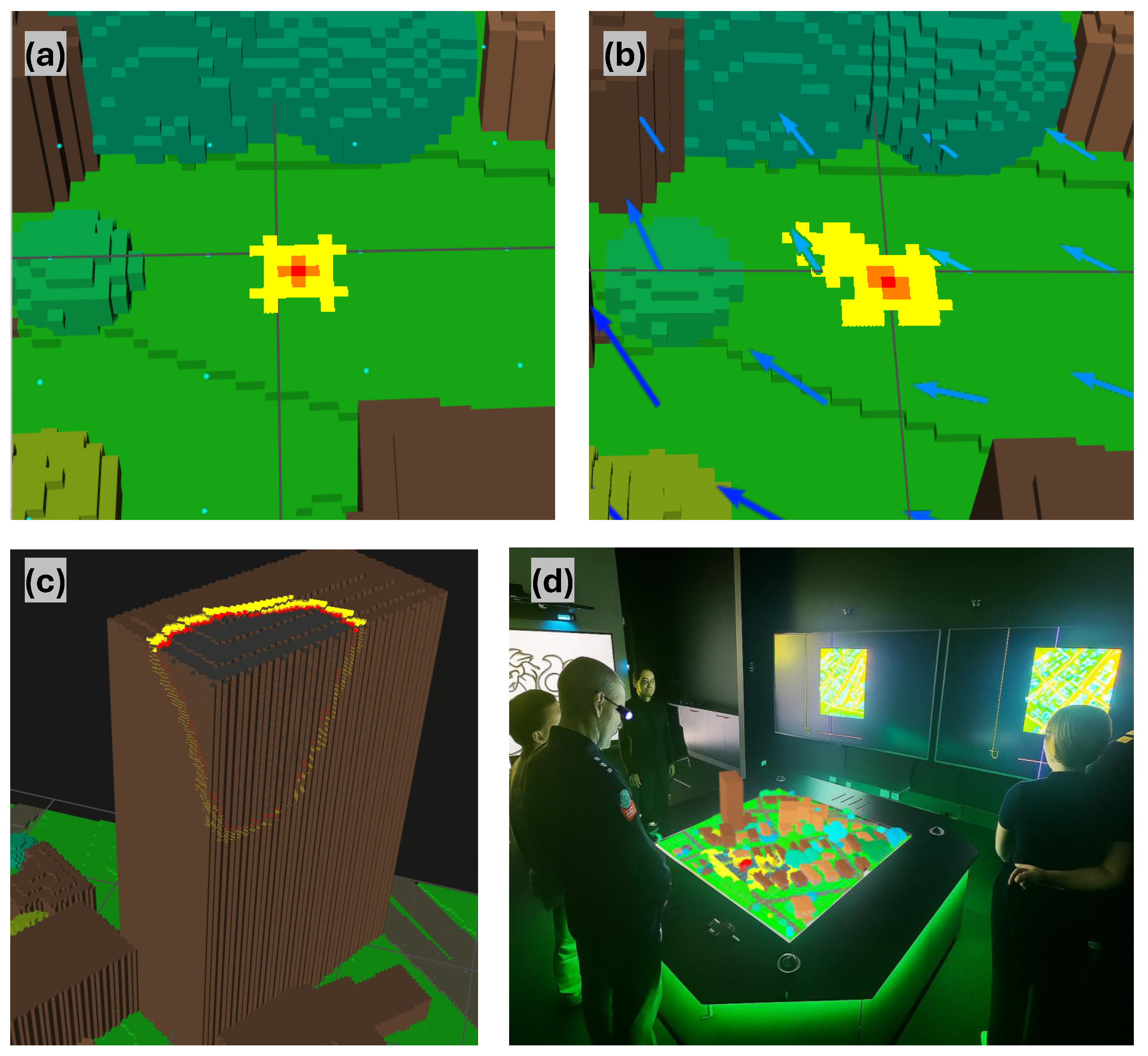
The simulator generates both abstracted and fully resolved voxel-level outputs. Combustion-state transitions at specified timestamps provide a clear representation of fire progression and can be visualized using a customized 3D viewer developed with vtk.js, enabling interactive exploration of spatial fire dynamics in web browsers (Figure 2). In addition to discrete states, the framework exports full environmental and thermal fields over time, including voxel-level temperature, moisture content, and individual heat-transfer components (radiative, convective, and conductive fluxes). These outputs support the detailed analysis of energy transfer processes and spatiotemporal fire evolution. The exported formats are interoperable and platform-agnostic, enabling integration with web-based visualization frameworks, game engines (e.g., Unity or Unreal Engine), and virtual or mixed reality environments. This supports advanced interactive visualization, immersive analysis, and integration into digital twin and decision-support systems. Beyond visualization, the outputs enable qualitative assessment of the physical plausibility of simulated fire dynamics. The controlled scenarios were designed to evaluate model behavior under varying environmental conditions. In particular, comparative experiments with and without ambient wind show that wind accelerates fire spread, drives directional propagation aligned with wind vectors, and increases the spatial extent of burned areas. These patterns are consistent with established wildfire dynamics, where wind-driven convection enhances heat transfer and promotes faster propagation.
To further assess realism, domain experts from Fire and Rescue New South Wales (FRNSW) were invited to qualitatively evaluate selected simulation outputs through visual inspection of fire progression patterns and spatial spread characteristics. Feedback from these expert reviews indicated that the simulated behaviors were consistent with practical expectations and exhibited credible fire dynamics in comparable scenarios (as shown in Figure 2d). While these assessments do not constitute formal validation against empirical datasets, they provide initial evidence supporting the interpretability and plausibility of the proposed framework.

5. Computational Approach

This section describes the computational approach used to realize the framework, including the voxel-centric GPU memory layout and structured voxel connectivity-based computation scheme, which enable efficient neighbor access and scalable parallel updates across large voxel grids, thereby addressing the computational challenges identified in Section 4.

5.1. Voxel-Centric GPU Memory Layout

Dense three-dimensional voxel grids exhibit cubic growth in the number of computational elements as the linear grid resolution increases. For a domain discretized into N x × N y × N z cells, the total number of voxels is
N = N x N y N z .
For approximately isotropic grids with N x N y N z n , the total voxel count therefore scales as O ( n 3 ) with the linear grid resolution n.
Each voxel stores multiple state variables and environmental attributes, including its grid index ( i , j , k ) , temperature T, combustion state, wind vector R , moisture content M, and fuel- or material-dependent thermophysical properties. If  n f fields are stored for each voxel, the corresponding memory requirement scales as
O N n f ,
where N is the total number of voxels and n f denotes the number of stored fields per voxel. For million- to multi-million-voxel domains, dense implementations can impose substantial memory requirements, particularly when multiple time-dependent fields and intermediate buffers, such as double-buffered state arrays and heat-transfer fields, are allocated [60,61]. Memory organization and data-access efficiency therefore become important considerations for large-scale three-dimensional voxel simulation.
The implementation combines structured indexing with activity-aware conditional execution so that combustion-related computations can be restricted to relevant portions of the voxel domain. This organization is particularly suited to the local stencil operations used by the heat-transfer formulation, where neighboring voxel attributes must be repeatedly accessed during each simulation timestep.
Specifically, the three-dimensional voxel index space ( i , j , k ) is mapped to a one-dimensional linear index using a row-major representation. For a voxel at ( i , j , k ) , the corresponding linear index I is
I = i + N x j + N y k ,
where N x and N y denote the numbers of voxels along the x- and y-directions, respectively. For a predefined stencil offset ( Δ i , Δ j , Δ k ) , the corresponding neighboring index is obtained as
I neighbor = I + Δ i + N x Δ j + N y Δ k .
This mapping enables deterministic O ( 1 ) index computation for predefined neighboring offsets without pointer-based graph traversal or spatial-search operations.
The row-major organization also provides regular memory-access patterns for structured stencil operations. In particular, voxels adjacent along the i-direction are mapped to consecutive linear indices, such that ( i , j , k ) and ( i + 1 , j , k ) occupy adjacent positions in the linearized index space. Regular access patterns of this form are favorable for cache utilization and GPU memory transactions during stencil computation [62,65,76]. Although the actual memory-access performance depends on the underlying hardware and Taichi runtime implementation, the structured representation avoids the irregular pointer traversal associated with unstructured graph-based neighborhood representations.
In the present framework, active burnable voxels are defined as voxels assigned to combustible fuel or material classes that participate in combustion-related computation. These include vegetation and other combustible land-cover classes, as well as combustible building or structural materials. Air, road surfaces, bare or non-combustible ground, and other inert materials are excluded from the active burnable voxel set. Active burnable voxels therefore represent the combustible subset of the complete three-dimensional domain.
The voxel attributes are organized using Taichi fields under a data-oriented design, supporting structured stencil-based parallel computation, as summarized in Algorithm 1. Conditional execution based on voxel type is used to restrict combustion-related updates to active burnable voxels, while non-burnable voxels may still participate in heat-transfer computations where required. Together, structured indexing, localized stencil operations, GPU-parallel execution, and activity-aware computation provide the computational foundation for scaling the proposed fire-spread formulation to large three-dimensional voxel domains.
Algorithm 1 Parallel voxel memory access and update
Require: 
Voxel fields ( T , M , R , state ) , grid dimensions ( N x , N y , N z ) , stencil offsets S
Ensure: 
Updated voxel temperature and combustion state
  1:
Launch parallel kernel over all voxels
  2:
Each thread is assigned to one voxel ( i , j , k )
  3:
Compute linear index I = i + N x ( j + N y k )
  4:
if the assigned voxel is burnable then
  5:
    Initialize heat flux accumulator q 0
  6:
    for all offset ( Δ i , Δ j , Δ k ) S  do
  7:
          Compute neighbor index:
I n = I + Δ i + N x ( Δ j + N y Δ k )
  8:
          Read neighboring voxel attributes
  9:
          Accumulate conductive, radiative, and convective contributions
10:
    end for
11:
    Update voxel temperature
12:
    Update combustion state
13:
end if

5.2. Structured Voxel Connectivity and Stencil-Based Computation

As described in Section 4.4, fire propagation processes—conduction, radiation, and wind-driven convection—are formulated as localized heat-transfer mechanisms over voxel connectivity. Conduction uses a six-neighbor Laplacian operator, radiation an extended distance-based neighborhood, and convection an anisotropic wind-aligned neighborhood. These formulations map naturally to stencil-based updates on a structured 3D lattice. In traditional CPU implementations, stencil operations are executed via nested loops over spatial dimensions and neighborhood offsets. As the stencil radius increases (e.g., for radiation or wind-driven transport), the number of neighbor evaluations grows, resulting in computational complexity of O ( N · k ) , where N is the number of voxels and k the stencil size. For million- to multi-million-voxel domains, such implementations become computationally prohibitive, limiting scalability and practical applicability.
To address these challenges, the framework adopts a voxel-centric structured memory layout with stencil operators defined as fixed-offset matrices. Instead of dynamically traversing neighbors, stencil offsets are precomputed and applied directly to voxel indices using a row-major linearized representation (Equations (22) and (23)). This deterministic index arithmetic enables constant-time neighbor access without pointer-based lookup or graph traversal. Each neighbor index is computed in O ( 1 ) time from predefined offsets, yielding a stencil update cost of O ( N a k ) per timestep (or O ( N a ) for fixed stencil size k). In contrast, pointer- or hash-based traversal introduces an additional overhead factor L, resulting in O ( N a k L ) due to pointer dereferencing, irregular memory access, and cache-miss penalties. By avoiding indirect memory access, the framework improves memory contiguity, enhances cache locality and coalesced GPU transactions, and enables scalable, bandwidth-efficient stencil updates across large voxel domains.
By leveraging Taichi fields and their data-oriented GPU execution model, voxel attributes, including heat flux components, moisture content, and temperature, are updated in parallel across the entire domain. The combination of structured connectivity, predefined stencil operators, and GPU-parallel execution enables efficient large-scale updates while maintaining the physics-based representation of heat-transfer processes, as detailed in Algorithm 2.
Algorithm 2 Parallel Stencil-Based Voxel Heat Transfer and State Update
Require: 
Active voxel set V a , conductive stencil S cond , radiative neighborhood S rad , wind-aligned convective neighborhood S conv , voxel fields ( T , M , R , state ) , grid dimensions ( N x , N y , N z )
Ensure: 
Updated voxel temperature and combustion state
  1:
Launch parallel kernel over active voxels
  2:
Each thread processes one voxel ( i , j , k )
  3:
Compute linear index
I = i + N x ( j + N y k )
  4:
if voxel i is burnable then
  5:
      Initialize heat-transfer contributions
q rad , i 0 , q conv , i 0
  6:
      Compute conductive temperature-rate contribution
T i t cond α i 1 Δ x 2 n N 6 ( i ) T n T i
  7:
      for all radiative neighbor j S rad  do
  8:
            Compute neighbor index from the predefined stencil offset
  9:
            Read neighboring voxel attributes
10:
            Accumulate radiative heat flux
q rad , i q rad , i + q rad , i j
11:
      end for
12:
      for all wind-aligned neighbor j S conv  do
13:
            Compute neighbor index from the predefined stencil offset
14:
            Read neighboring voxel attributes
15:
            Accumulate convective heat flux
q conv , i q conv , i + q conv , i j
16:
      end for
17:
      Compute net external heat flux
q ext , i q rad , i + q conv , i q cool , i
18:
      Compute moisture-dependent thermal damping factor
f m , i = 1 1 + β m M i
19:
      Compute total temperature-change rate
T i t f m , i T i t cond + q ext , i ρ i c p , i Δ x
20:
      Update voxel temperature
T i t + Δ t T i t + Δ t T i t
21:
      Update combustion state according to ignition and burning criteria
22:
end if

5.3. Numerical Stability Assessment

The conductive heat-transfer term is evaluated using an explicit six-neighbor finite-difference stencil. For a three-dimensional cubic grid, the stability of the explicit diffusion update can be assessed using the Fourier number:
F o = α Δ t Δ x 2 ,
where α is the thermal diffusivity, Δ t is the simulation timestep, and  Δ x is the voxel size. For the three-dimensional six-neighbor explicit diffusion scheme, the corresponding stability condition is
F o max = α max Δ t Δ x 2 1 6 ,
where α max represents the maximum thermal diffusivity among the material classes considered in the stability assessment. The corresponding upper timestep limit is
Δ t max = Δ x 2 6 α max .
For the thermophysical parameters considered in the present simulation, the maximum evaluated thermal diffusivity was 2.12 × 10 5 m 2 s 1 . For a voxel size of Δ x = 0.8 m , this corresponds to a conservative explicit conduction stability limit of approximately 5.03 × 10 3 s . The simulation timestep of Δ t = 1.0 s corresponds to a maximum Fourier number of 3.32 × 10 5 , which is substantially below the stability limit of 1 / 6 . Therefore, the timestep adopted in the experiments is well within the theoretical stability limit for the explicit conductive heat-transfer update.

6. Simulation Experiments

This section demonstrates the application of the proposed framework for simulating fire propagation in voxelized WUI environments, highlighting its ability to capture heat-transfer processes and wind-driven spread. It then evaluates the computational performance and scalability of the framework in larger, more complex domains.

6.1. Experimental Setup

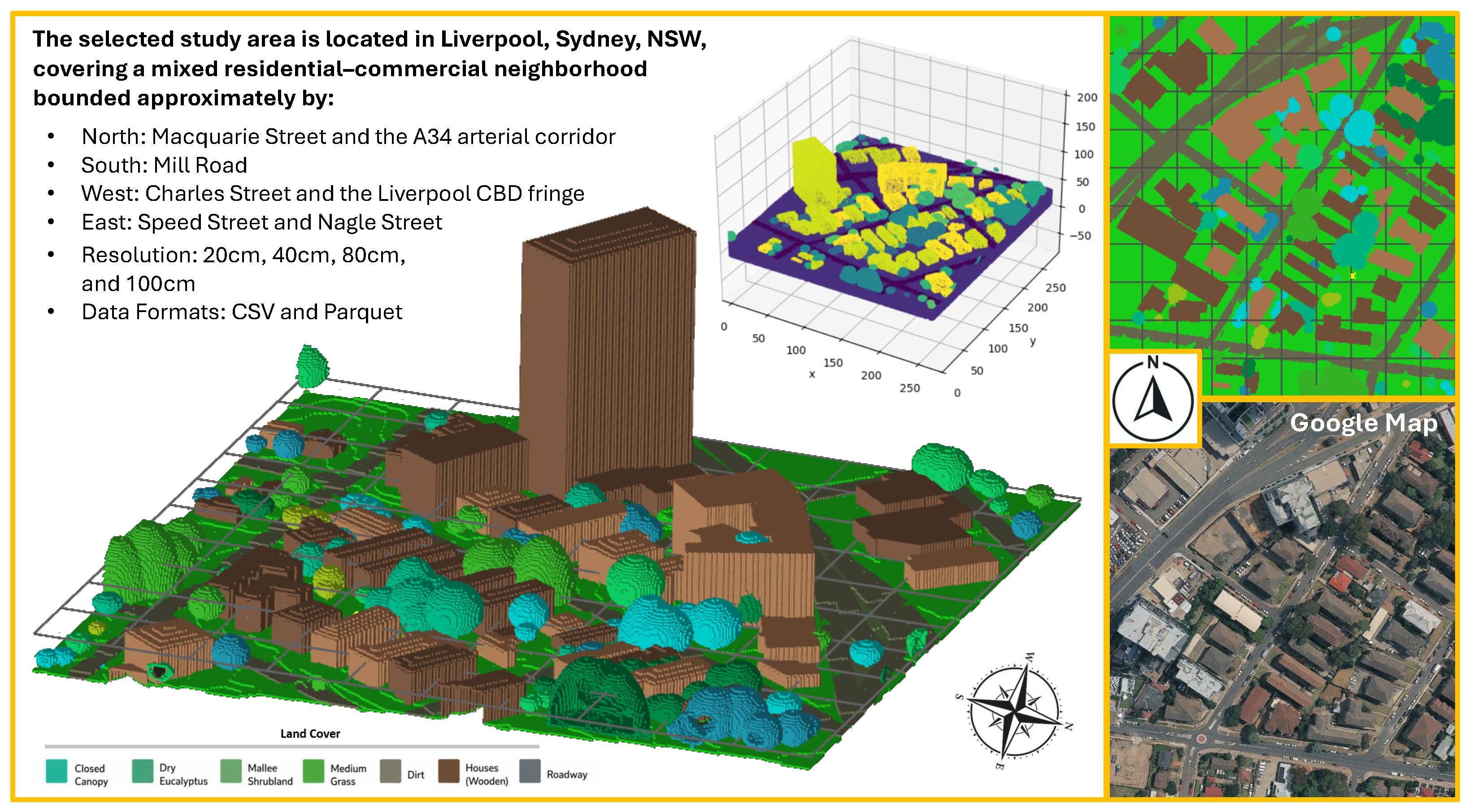
To evaluate performance and scalability, experiments were conducted using voxel datasets from two urban areas in New South Wales, Australia: Newcastle and Liverpool (Sydney). These datasets were derived from high-resolution LiDAR sources provided by NSW Government Spatial Services and processed using the VoxelMates platform to generate standardized voxel representations. An early prototype demonstrated feasibility on a Newcastle community using a 130 × 128 × 35 grid at 1 m resolution [67]. The present study extends this work to larger and more complex environments to assess scalability at higher resolutions (Figure 3). The enhanced framework is applied to a significantly larger voxel grid of approximately 336 × 368 × 153 , representing a suburban area of Liverpool, Sydney, and comprising roughly 18 million voxels. At a voxel resolution of 0.8 × 0.8 × 0.8 m, this corresponds to a physical domain of approximately 268.8 × 294.4 × 122.4 m. The standardized voxel data structure provided by VoxelMates includes basic segmentation that enables voxel-level fuel type classification, supports consistent urban-scale simulation, and facilitates future expansion to broader geographic regions.
In the present study, the LiDAR-derived voxel dataset is treated as an input to the simulation framework rather than as an output of a new point-cloud processing or classification method. Consequently, uncertainties associated with source-data acquisition, spatial registration, classification, and voxelization are not explicitly propagated through the current fire-spread simulation. Such uncertainties may affect the spatial distribution and classification of combustible voxels and are therefore acknowledged as a limitation of the present evaluation.
Atmospheric influence is modeled using synthetic wind fields generated by the Lamb–Oseen vortex model [77]. Given prescribed mean wind speed and direction, the model produces spatially varying 2D or 3D wind vectors across the voxel grid (Figure 3). These voxel-aligned wind fields are directly coupled with the convective heat-transfer formulation. While synthetic winds are used for controlled evaluation, the framework can be readily extended to incorporate real-time observations or outputs from numerical weather models.

6.2. Process Propagation Demonstration in 3D Voxel Space

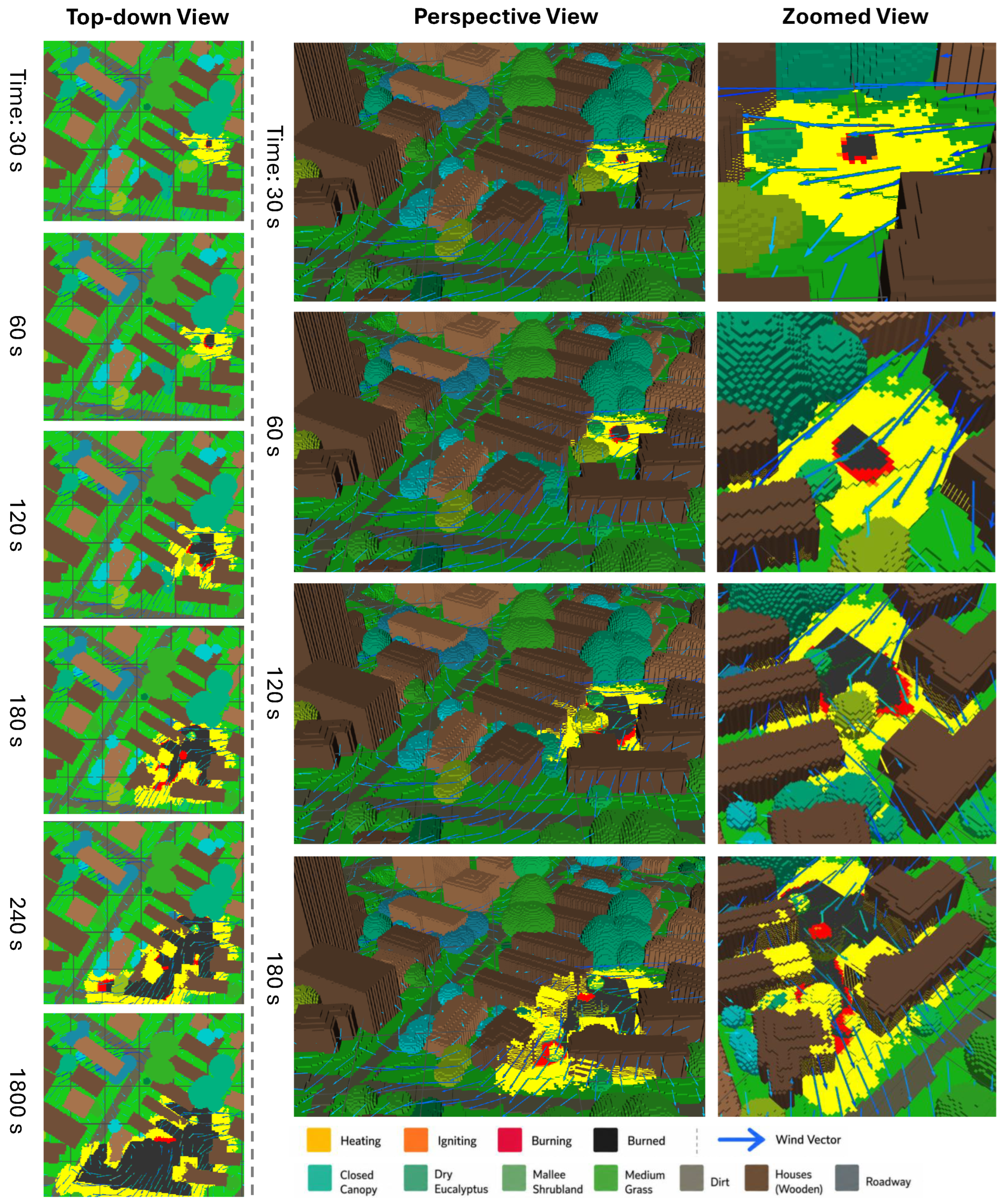
Figure 4 demonstrates the proposed voxel-based simulation framework applied to an urban environment in Liverpool. The simulation captures 3600 s of fire spread under turbulent wind conditions. Both the total simulation duration and time step are user-defined, allowing flexibility across different application scenarios. Selected time steps are presented to illustrate the temporal evolution of the fire front within a fully 3D voxelized digital Earth representation.
The top-down views show the horizontal expansion of the fire front over time, illustrating spread across terrain and vegetation and interaction with the built environment. The pattern is anisotropic, reflecting the influence of turbulent wind and urban morphology on fire direction and rate of propagation. From 30 s to 240 s, the fire front expands outward and increasingly interacts with nearby structures and vegetation, and by 1800 s the affected area has grown substantially within the urban context. The perspective views highlight the volumetric nature of the simulation. Unlike traditional 2D models, the voxel framework represents vertical structure, enabling fire propagation in 3D space around buildings and trees. This allows the model to capture occlusion, channeling between structures, and vertical interactions among terrain, vegetation, and the air layer. Together, the planar and volumetric views demonstrate how a dense voxel-based digital Earth representation supports physically plausible 3D fire propagation in heterogeneous urban environments, highlighting its value for scenario generation, training data production, and digital twin-based decision support.
The propagation dynamics are partially visualized in the outputs. In this framework, heat transfer and fire spread are modeled as wind-driven processes, where local wind speed and direction influence inter-voxel energy propagation. In Figure 4, the wind field is shown using blue arrows, while voxel colors represent thermal and combustion states: yellow indicates heat transfer, orange indicates ignition, and red indicates active burning across different fuel types. The wind field primarily affects convective heat transfer, with both the direction and spatial extent of heat propagation (i.e., the number of downwind neighboring voxels receiving heat) aligned with the local wind vector at each burning voxel. These interactions are implemented using parallel stencil-based computation, where each voxel updates its state based on neighboring voxels and local wind conditions. The corresponding temporal progression of burning, burned, and fire-affected voxels and areas at the selected simulation times is quantitatively summarized in Table 5. This stencil-based framework is generalizable and can be extended to simulate other physical processes influenced by directional environmental drivers.

6.3. Cross-Model Benchmark Validation

To provide an initial quantitative evaluation of the proposed framework, a validation experiment was conducted against a well-established 3D fire simulation generated using the Fire Dynamics Simulator (FDS). The validation assesses whether the proposed lightweight framework can reasonably reproduce the spatial pattern and extent of fire propagation under comparable environmental and fuel conditions. The objective is not to establish equivalence with FDS, but to quantify spatial agreement in the predicted burned area. Consistent with the intended application of the framework, the aim is to provide a computationally efficient, science-based approximation of fire propagation for rapid go/no-go and other time-critical decision support during emergency response, rather than to replace high-fidelity fire simulation.

6.3.1. Reference Scenario and Simulation Configuration

The publicly available CSIRO Case C064 grassland-fire scenario and its corresponding FDS simulation were selected as the reference case. Case C064 represents a controlled 100 × 100 m grassland burn conducted by CSIRO in Australia and represented at a spatial resolution of 0.5 m in the reference simulation. Documented conditions include a wind speed of 4.6 m s 1 at a height of 2 m , an ambient temperature of 32 °C, a grass height of 0.21 m , a fuel load of 0.283 kg m 2 , and a fuel moisture content of 6.3 % [78]. The publicly available FDS outputs were processed to reconstruct the spatial distribution of fire propagation [79]. A corresponding voxel scenario was then configured to reproduce, as closely as possible, the reference domain, fuel characteristics, ignition configuration, and ambient wind conditions.
Because FDS and the proposed framework employ different numerical representations and levels of physical fidelity, an exact one-to-one reproduction of all model parameters is neither possible nor intended. FDS resolves coupled fluid flow, combustion, heat and mass transfer, and fuel thermal decomposition, whereas the proposed framework represents fire propagation through simplified voxel-scale conductive, radiative, and wind-driven convective heat-transfer processes. The validation configuration therefore reproduces the principal environmental, fuel, and ignition conditions of the reference case rather than its internal numerical formulation. This provides a controlled basis for quantitatively evaluating the spatial agreement between the burned areas produced by the two modeling approaches.

6.3.2. Burned-Area Comparison Method

Validation was performed by comparing the spatial distributions and geometric extent of the burned regions produced by the FDS reference simulation and the proposed voxel simulator. To enable direct spatial comparison, both simulation outputs were mapped to a common voxel index space ( i , j , k ) . Voxels classified as burned at the selected comparison time were extracted to form two burned-voxel sets:
B FDS = ( i , j , k ) voxel classified as burned in FDS ,
and
B Voxel = ( i , j , k ) voxel classified as burned in the proposed model .
The comparison uses six complementary metrics to characterize spatial overlap, burned-area agreement, and fire-spread extent.
The intersection over union (IoU), or Jaccard index [80,81], measures the overall spatial overlap between the two burned regions and is defined as
IoU = | B Voxel B FDS | | B Voxel B FDS | .
Precision measures the proportion of voxels predicted as burned by the proposed model that are also classified as burned in the FDS reference,
Precision = | B Voxel B FDS | | B Voxel | ,
whereas recall measures the proportion of the FDS burned region reproduced by the proposed model,
Recall = | B Voxel B FDS | | B FDS | .
In addition to spatial overlap, three signed relative-error metrics were used to quantify differences in the overall size and geometric extent of the burned region. The burned-area error is defined as
E A = A Voxel A FDS A FDS × 100 % ,
where A Voxel and A FDS denote the total burned areas predicted by the proposed model and FDS, respectively.
The downwind-extent error evaluates the difference in the maximum propagation distance along the prevailing wind direction,
E D = D Voxel D FDS D FDS × 100 % ,
where D represents the downwind extent of the burned region.
Similarly, the lateral-width error quantifies the difference in the maximum burned width perpendicular to the prevailing wind direction:
E W = W Voxel W FDS W FDS × 100 % ,
where W represents the lateral width of the burned region. For these signed error metrics, a negative value indicates underprediction relative to FDS, while a positive value indicates overprediction.
Together, IoU, precision, and recall characterize the spatial correspondence of the burned regions, while burned-area, downwind-extent, and lateral-width errors quantify differences in their overall size and directional spread.

6.3.3. Validation Results

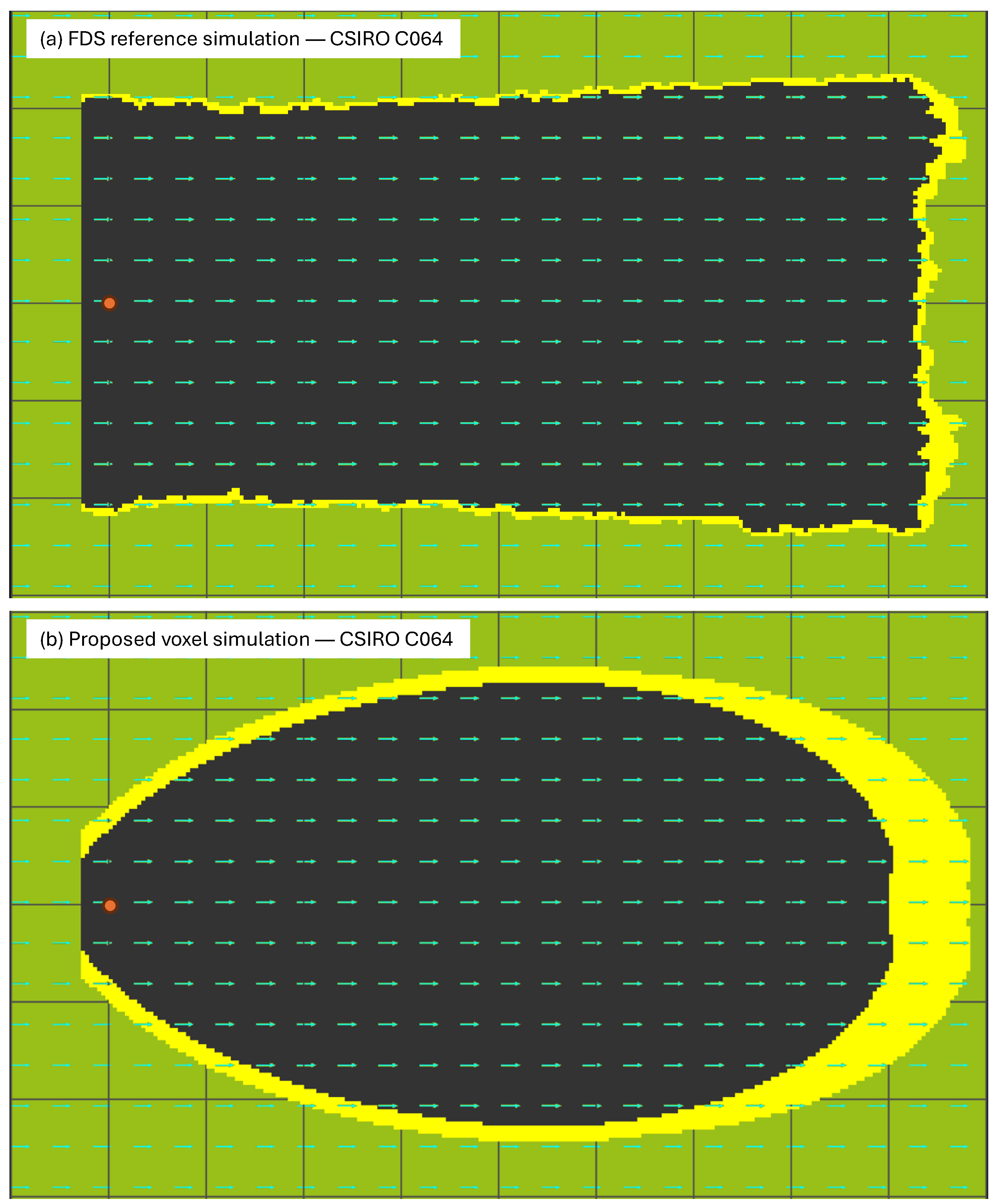
Figure 5 presents a spatial comparison between the FDS reference simulation and the proposed voxel-based simulation. Both simulations exhibit a comparable overall direction and spatial pattern of fire propagation under the prescribed wind conditions, with the proposed framework reproducing the principal downwind extent and lateral spread of the burned region observed in the FDS simulation.
The quantitative results are summarized in Table 6. The comparison achieved an IoU of 0.775, precision of 0.970, and recall of 0.794, indicating substantial spatial overlap, with 97.0% of the predicted burned voxels agreeing with FDS and 79.4% of the FDS burned region reproduced. The total burned area was underpredicted by 18.17%, consistent with the high precision and comparatively lower recall. Nevertheless, the overall fire-spread geometry was closely reproduced, with downwind-extent and lateral-width errors of only 3.29 % and 2.68 % , respectively.
For the 120 s simulated fire-propagation period, the FDS reference simulation required approximately 5 h of computation, whereas the proposed voxel-based simulation required approximately 28 s. Although these runtimes should not be interpreted as a direct solver-to-solver benchmark because the two models represent substantially different levels of physical and numerical complexity, the comparison illustrates the computational efficiency targeted by the proposed framework for rapid 3D fire-spread evaluation in digital twins and serious gaming applications [82,83].
Differences between the two simulations are expected given their substantially different levels of physical and numerical complexity. FDS resolves coupled fluid dynamics, turbulence, combustion, and heat-transfer processes, whereas the proposed framework represents fire propagation using simplified voxel-scale conductive, radiative, and wind-driven convective heat transfer without explicitly solving the Navier–Stokes equations. The results should therefore be interpreted as an initial cross-model validation of the framework’s ability to reproduce the dominant spatial characteristics of fire propagation, rather than as evidence of physical equivalence between the two models.
Overall, the results demonstrate that the proposed framework can reproduce the principal spatial pattern and directional extent of the FDS reference fire, achieving an IoU of 0.775 and errors below 3.3% in both downwind extent and lateral width. The lower recall and 18.17 % burned-area error indicate that the framework remains conservative in its prediction of the total burned region. As this evaluation considers a single controlled reference scenario, further validation against additional FDS cases, controlled fire experiments, and observational data is required to assess model performance across different fuel, wind, and environmental conditions.

7. Computational Performance Evaluation

To assess the computational approach of the proposed simulation framework, the performance evaluation is designed around the computer environments available to end-users. These include emergency management personnel who typically rely on commodity laptops for rapid decision support, as well as wildfire researchers with access to high-performance computing (HPC) resources. We therefore evaluate the computational scalability and feasibility of the framework across voxel grids of increasing size, with particular attention to runtime scaling and executability on both laptop-class GPUs and single-node HPC GPU systems.

7.1. Runtime Performance and Scalability on Commodity Laptop GPUs

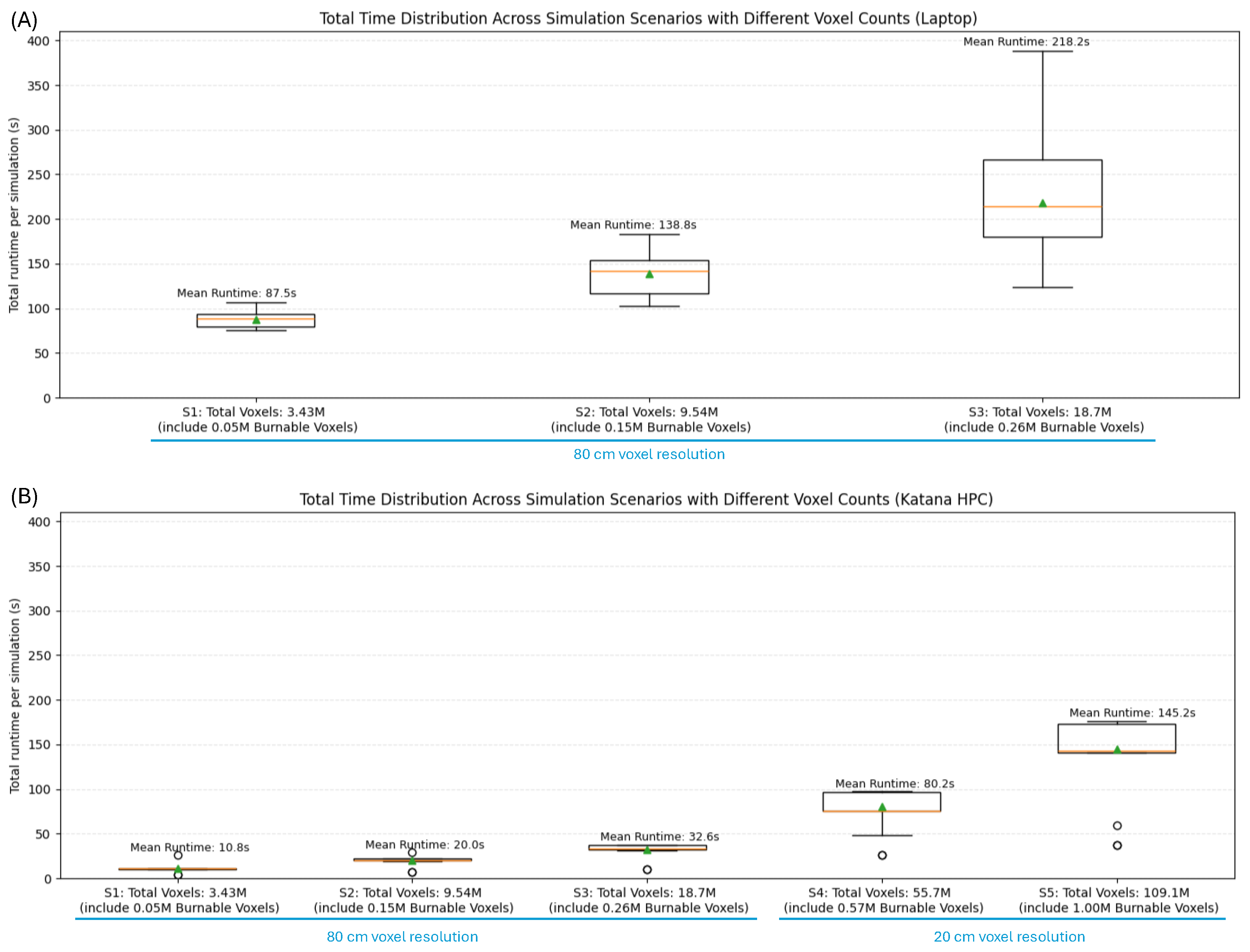
In this study, computational scalability is defined with respect to the total voxel grid size, which determines memory allocation and dominates computational workload. As defined in Section 5.1, active burnable voxels are those assigned to combustible fuel or material classes, including vegetation, combustible land-cover classes, and combustible building or structural materials. Air, roads, bare or non-combustible ground, and other inert materials are excluded from this set. Scalability is evaluated by measuring runtime as the voxel grid size increases, while the number and proportion of active burnable voxels are also reported to characterize scene composition and sparsity. Importantly, the reported burnable-voxel percentages are calculated relative to the entire dense 3D voxel domain, including air and other inactive or non-combustible voxels. Runtime is reported as total simulation time, including initialization and execution under identical settings. To assess repeatability, each scenario is run multiple times and summarized using the mean, median, and standard deviation, with the runtime distributions shown in Figure 6.
To evaluate practical deployability in time-critical operational settings, we conducted performance experiments on a commodity laptop representative of devices used by emergency response agencies for real-time or near-real-time decision support. Such environments involve constrained computational resources but require rapid simulation turnaround during active wildfire events. The test system was equipped with an NVIDIA RTX 500 Ada Generation Laptop GPU (4.29 GB VRAM, 3.40 GB available), 32 GB system RAM, and ran Windows 11 Enterprise (64-bit) on an Intel® Core™ Ultra 7 165H processor (22 logical CPUs, 1.4 GHz base frequency). Compared to the Katana HPC node, this platform has substantially lower GPU memory and computational throughput, providing a realistic approximation of resource-constrained field or office deployment environments.
Due to VRAM limitations, local simulations were restricted to a coarser voxel resolution (80 cm). Attempts to run larger voxel domains at finer resolution (20 cm) resulted in GPU out-of-memory errors. Consequently, three scenarios containing 54,706, 145,177, and 255,088 active burnable voxels were evaluated locally (Figure 6A), each repeated ( n = 36 ). Mean runtimes increased from 87.47 s to 218.21 s as voxel counts grew, with variability also increasing at larger scales (standard deviation up to 65.70 s). This variance reflects memory pressure and reduced GPU efficiency as VRAM limits are approached. Despite these constraints, results show consistent monotonic runtime scaling, consistent with trends observed on HPC platforms. Importantly, even on limited hardware, the framework achieves execution times on the order of minutes, indicating suitability for near-real-time fire-spread estimation in operational contexts. These findings confirm that the simulator can be deployed on both high-performance computing systems and widely accessible laptop-class devices used in emergency management workflows.

7.2. Runtime Performance and Scalability on HPC GPU Systems

To evaluate the capability of the proposed framework for large-scale scientific analysis, we conducted performance experiments on a HPC platform representative of resources commonly available to wildfire researchers and academic institutions. Such environments enable high-resolution simulation and exploration of complex urban and wildland–urban interface (WUI) scenarios that exceed the capacity of commodity hardware. The scalability evaluation was performed on the UNSW Katana HPC system using a single GPU-enabled node. Compute resources were allocated via PBS interactive scheduling, providing a configuration with 8 CPU cores, 1 GPU, and 96 GB RAM. This setup enables controlled and repeatable benchmarking under consistent hardware conditions while reflecting typical single-node GPU usage in research workflows.
Five voxelized environments were evaluated, with active burnable voxel counts ranging from 54,706 to 1,001,757. These active burnable voxels correspond to combustible fuel or material classes, including vegetation, other combustible land-cover classes, and combustible building or structural materials. Air, roads, bare or non-combustible ground, and other inert materials are excluded from the active burnable voxel set. The proportion of active burnable voxels remains consistently sparse across scenarios (0.918–1.596% of the entire dense voxel grid). The measured runtimes demonstrate clear and stable scaling behavior with respect to the number of active burnable voxels (Figure 6B). For the smallest environment (54,706 active burnable voxels), the mean runtime is 10.79 s ( n = 36 , median 10.65 s, std 3.52 s). Runtime increases to 20.02 s at 145,177 active burnable voxels; 32.61 s at 255,088 active burnable voxels; 80.18 s at 569,636 active burnable voxels; and 145.18 s for the largest evaluated domain, containing 1,001,757 active burnable voxels ( n = 27 , median 142.84 s, std 39.60 s). Across all scenarios, median runtimes remain close to mean values, and variability remains within expected bounds for GPU workloads, indicating stable execution and strong repeatability.
These results demonstrate that the proposed framework scales predictably and efficiently for urban-scale simulations on single-node HPC systems. Notably, domains exceeding one million active burnable voxels can be simulated within minutes without requiring distributed computing, highlighting the practicality of the approach for research applications. This level of performance supports high-resolution scenario analysis, sensitivity studies, and large-scale experimentation, making the framework well suited for fire science research, digital twin development, and advanced urban analytics workflows.

7.3. Implications for Voxel-Based Digital Earth Simulation

The evaluation demonstrates that urban-scale dense voxel process propagation is computationally feasible using single-node GPU execution. Although active voxels per timestep remain sparse (1%), a dense volumetric grid is required to maintain a consistent 3D modeling space and support generalized propagation across heterogeneous media (air, vegetation, terrain, and built structures). Feasibility at grid sizes up to 109.1 M voxels provides a practical foundation for applications such as urban-scale scenario testing, synthetic data generation for AI surrogate modeling, and digital twin decision-support pipelines. Table 7 shows that increasing voxel counts correspond to proportional growth in spatial extent while preserving a fixed aspect ratio. At a uniform resolution of 0.8 m, domain size expands from approximately 152 × 166.4 × 68.8 m (3.43 million voxels) to 481.6 × 527.2 × 219.2 m (109.1 million voxels), scaling from neighborhood- to urban block-scale environments. This consistent geometric scaling ensures that increases in computational cost are driven by domain size rather than spatial configuration, providing a controlled basis for evaluating runtime performance across simulation scales and computing platforms.
Beyond performance, these findings have broader implications for voxel-based digital Earth simulations. Digital Earth initiatives increasingly emphasize high-resolution volumetric representations of urban and environmental systems. Our results show that simulations with more than one million active voxels can be executed on a single GPU-enabled HPC node with stable, predictable runtimes, confirming the computational viability of voxel-based modeling at urban district scales. They also support the transition from static data repositories to dynamic, process-based digital twins. Efficient volumetric mass–energy simulation demonstrates that digital Earth systems can incorporate physically meaningful processes rather than relying solely on surface-based or empirical approximations. The observed monotonic scaling between voxel count and runtime further enables predictable trade-offs between model resolution and computational cost.
The contrast between laptop and HPC performance suggests a practical deployment architecture: lightweight devices for scenario setup and small-area simulation, and GPU-enabled HPC infrastructure for urban-scale modeling. Although demonstrated for urban fire spread, the voxel-based mass–energy transfer framework is domain-agnostic and applicable to other digital Earth simulations, including urban heat transport, air pollutant dispersion, flood propagation, and infrastructure risk modeling. Together, these findings support voxel-based, physics-aware modeling as a viable computational foundation for next-generation urban and environmental digital twins.

8. Discussion: Implications, Limitations, and Future Work

This work introduces a parallel voxel-based simulation framework that bridges the increasing availability of high-resolution 3D urban data and the limited scalability of existing environmental models. While most approaches remain surface-based or restricted to small domains, the proposed framework enables physics-driven process propagation directly within volumetric voxel environments. Although wildfire spread is used as a demonstration, the architecture is domain-agnostic. By modifying governing formulations and inputs (Section 4.5 and Section 4.4), it can support applications such as heat transport, pollutant dispersion, flood propagation, and multi-hazard interactions within a unified digital Earth context.

8.1. Limitations

Despite its scalability and flexibility, several limitations remain:
  • Limited real-time data integration. Although designed to support temporally evolving inputs, the current framework does not yet include an automated pipeline for real-time data integration. Preparation of voxel attributes, such as fuel type, moisture, and environmental parameters, remains partially manual. Integration of real-time or near-real-time geospatial data streams, including weather observations, remote sensing, and environmental monitoring, remains an area for future development.
  • Simplified fire behavior representation. The current framework represents fire propagation primarily through conduction, radiation, and wind-driven convection. More complex processes, including detailed combustion chemistry, fire–atmosphere coupling, fire-induced winds, and plume dynamics, are not explicitly resolved. Ember transport and spotting are also not currently represented. Consequently, discontinuous fire spread and secondary ignitions ahead of the primary fire front caused by windborne embers cannot presently be reproduced, which may lead to underestimation of fire propagation where spotting is significant. Future development will incorporate ember generation, wind-driven transport, deposition, and secondary ignition.
  • Validation and calibration limitations. The cross-model validation against the FDS CSIRO Case C064 scenario provides an initial quantitative assessment of the framework, demonstrating substantial spatial agreement in the simulated burned area. However, this comparison represents a single reference scenario and does not constitute comprehensive validation against experimental or field observations. Further evaluation across different fuel types, wind conditions, terrain configurations, and WUI environments is required to establish the generalizability and predictive accuracy of the framework. Systematic parameter calibration against experimental and field datasets also remains necessary.
  • Geospatial data and voxelization uncertainty. The present study uses LiDAR- and GIS-derived voxel data as the spatial and semantic input to the simulation framework. Uncertainties associated with source point clouds, spatial registration, classification, and voxelization are not explicitly propagated through the current model. Because the representation of fuel geometry and connectivity depends on the spatial discretization, voxel resolution may also influence simulated fire propagation. A systematic assessment of these effects is outside the scope of the present study and will be investigated in future work.
  • Geospatial interoperability. The current implementation integrates heterogeneous geospatial inputs through a common structured voxel representation, but does not introduce new GIS standards, semantic models, or spatial-topology methods. Interoperability with standardized 3D geospatial data models and richer semantic representations remains an area for future development.
Overall, this work provides a scalable computational framework based on simplified physical formulations. The initial cross-model validation demonstrates the potential of the approach, while further calibration and validation against experimental and field data remain necessary. Future work will focus on model refinement, incorporation of advanced fire-behavior processes, real-time data integration, and broader validation across representative WUI fire scenarios.

8.2. Future Work

Future work will address the limitations identified above and expand the framework’s capabilities:
  • Automated and interoperable geospatial data provisioning. Future research will develop automated pipelines for dynamic voxel attribute generation and integration at scale, supporting the discovery, retrieval, and harmonization of heterogeneous geospatial data, including LiDAR-derived terrain, building information models, land cover, and environmental monitoring data. Future development will also investigate interoperability with standardized 3D geospatial data models and richer semantic representations. Integration with real-time or near-real-time meteorological observations and remote-sensing data will support dynamic updates of fuel conditions, wind fields, and moisture attributes for time-evolving simulations.
  • Advanced fire dynamics and multi-physics coupling. Future development will incorporate more advanced fire-behavior processes, including detailed combustion, fire–atmosphere interactions, fire-induced winds, plume dynamics, and structural fire behavior in urban environments. Ember generation, wind-driven transport, deposition, and secondary ignition will also be investigated to represent spotting and discontinuous fire spread beyond the primary fire front. The modular voxel-based architecture allows these additional physical processes to be incorporated progressively without redesigning the core computational framework.
  • Numerical convergence and uncertainty analysis. Although the present study evaluates the numerical stability of the explicit conductive heat-transfer update, comprehensive numerical convergence and uncertainty analyses remain outside the scope of this work. Future studies will systematically investigate timestep and voxel-resolution convergence and quantify the sensitivity of simulated fire propagation to uncertainties in fuel, thermophysical, and empirical model parameters. The propagation of uncertainties originating from source geospatial data, classification, and voxelization will also be investigated.
  • Calibration and broader validation. The cross-model comparison with the FDS CSIRO Case C064 scenario provides an initial quantitative evaluation of the proposed framework. Future work will extend this assessment across additional benchmark scenarios, fuel types, wind conditions, terrain configurations, and WUI environments. Systematic parameter calibration and validation against controlled experiments and field observations will be conducted to further assess predictive accuracy, generalizability, and operational applicability.
  • AI-assisted simulation and surrogate modeling. The framework also provides a foundation for integration with data-driven approaches. Simulation datasets generated by the framework can support machine-learning and generative-AI surrogate models for rapid approximation of fire propagation and integration with real-time digital-twin applications for hazard assessment and resilience planning.

9. Conclusions

This study presents a scalable, GPU-accelerated voxel-based computational framework for large-scale 3D fire-spread simulation. The framework integrates voxel-scale conductive, radiative, and wind-driven convective heat transfer with fuel-dependent thermal and combustion properties within a structured stencil-based computational architecture. Its voxel-native formulation enables 3D geospatial representations of terrain, vegetation, and built environments to be directly incorporated into the simulation domain, while GPU-parallel computation supports efficient processing of large voxel datasets. Computational experiments demonstrate the scalability of the framework across increasing domain sizes, including simulations containing more than one million active burnable voxels. The initial cross-model validation against the FDS CSIRO Case C064 scenario achieved an IoU of 0.775, precision of 0.970, and recall of 0.794, while the downwind-extent and lateral-width errors were 3.29 % and 2.68 % , respectively. These results demonstrate the potential of the framework to reproduce the dominant spatial characteristics of fire propagation under the evaluated conditions.
Nevertheless, the FDS comparison represents an initial cross-model assessment rather than comprehensive validation for operational fire prediction. Broader calibration and validation against controlled experiments, field observations, different fuel types, terrain conditions, and meteorological scenarios remain necessary. The proposed framework should therefore be regarded as a scalable computational foundation for continued development of higher-fidelity fire-spread modeling capabilities rather than as an operationally validated fire prediction system. Potential integration with real-time emergency-response systems, urban digital twins, and dynamic environmental data represents a future application requiring further model development, calibration, validation, and operational evaluation.


Author Contributions

Conceptualization, Haowen Xu, Sisi Zlatanova and Ismet Canbulat; methodology, Haowen Xu; software, Haowen Xu; validation, Haowen Xu; formal analysis, Haowen Xu; investigation, Haowen Xu; data curation, Haowen Xu and Sisi Zlatanova; visualization, Haowen Xu and Ruiyu Liang; writing—original draft preparation, Haowen Xu; writing—review and editing, Haowen Xu, Ruiyu Liang, Sisi Zlatanova and Ismet Canbulat; supervision, Sisi Zlatanova and Ismet Canbulat; project administration, Sisi Zlatanova and Ismet Canbulat. All authors have read and agreed to the published version of the manuscript.

Funding

This research was supported by the UNSW Commercialisation Seed Fund (CSF) under the project “Bushfire Management through AI and Virtual Reality Visualisation (BushFireAI)”, with co-funding from the UNSW School of Built Environment and the School of Minerals and Energy Resources Engineering (MERE).

Data Availability Statement

The data supporting the findings of this study are available from the corresponding author upon reasonable request.

Acknowledgments

The authors gratefully acknowledge the support of Asia Air Survey, Fire and Rescue NSW, and the Australasian Fire and Emergency Service Authorities Council (AFAC). Their support and collaboration have contributed to the development and practical relevance of this research.

Conflicts of Interest

The authors declare no conflicts of interest.

Appendix A. Fuel and Material Parameterization

For reproducibility, Table A1 reports the principal thermophysical, ignition, fuel, and combustion parameters assigned to the fuel and material classes used in the present implementation. The parameterization was informed by representative fuel and material characteristics and parameter ranges reported in the cited literature. Parameters not explicitly reported in these sources, including model-specific combustion coefficients and voxel-scale mass-loss rates, were adopted as effective parameters for the present implementation. Accordingly, the reported values should not be interpreted as universally calibrated material properties.
Initial voxel temperature and scenario-specific fuel moisture conditions may vary according to the environmental and fuel conditions prescribed for individual simulation scenarios. Air and non-combustible classes are assigned non-ignitable states and do not participate in combustion.
Table A1. Fuel- and material-specific parameter values used in the voxel-based fire propagation framework.
Fuel/Material Class T ign ρ p f d η m ˙ f M c p k eff
(K) (kg m−3) (kg m−2) (m) (–) (kg s−1) (–) (J kg−1 K−1) (W m−1 K−1)
Air [84]1.225000010000.026
Generic non-combustible solid [85]220000008801.4
Sparse Grass (G1) [86]5002000.050.200.600.0300.3016000.25
Continuous Grass (G2) [86]4802500.100.300.750.0400.2016000.25
Tall Grass (G3) [86]4602700.350.500.850.0600.1016000.27
Dense Grassland (G4) [86]4703000.400.600.850.0700.1516000.30
Dry Sclerophyll Forest, Open Canopy [87]5004000.800.800.700.0500.1516000.20
Eucalypt Forest, Dense Understory [87]4804500.351.000.750.0600.2016000.22
Wet Sclerophyll/Rainforest Edge [88]5105000.401.200.650.0400.3516000.20
Closed-Canopy Forest, High Fuel Load [89]4805500.451.500.800.0800.2016000.25
Mallee Shrubland [90]4704000.250.700.750.0500.1816000.22
Mallee with Spinifex [90]4604200.300.800.780.0600.1516000.25
Spinifex [91]4503000.200.400.850.0600.0816000.23
Open Woodland, Moderate Grass Layer [92]4903800.400.600.700.0450.2216000.21
Plantation Forest [93]4804800.381.200.750.0700.1816000.24
Fire-Resistant Building Material [94,95]800100030.00.300.150.00010.5020000.10
Moderately Combustible Timber Building Material [96]60050030.00.300.600.0100.1017000.15
Timber Building Material [97]57050030.00.300.750.0200.1017000.15
Combustible Timber Roof [98]65065018.00.200.450.0040.0817000.12
CSIRO C064 Mixed Vegetation [11,43]372.155120.2830.210.750.0240.06215000.20
Note:  T ign = ignition temperature; ρ = fuel/material density; p f = fuel load; d = effective fuel depth or vegetation height; η = combustion efficiency factor; m ˙ f = characteristic fuel mass-loss rate; M = fuel moisture content; c p = specific heat capacity; and k eff = effective thermal conductivity. Initial voxel temperature and scenario-specific fuel moisture conditions may vary according to the prescribed environmental and fuel conditions of individual simulation scenarios. Air and non-burnable classes do not participate in ignition or combustion; therefore, ignition temperature is reported as not applicable rather than as the numerical sentinel value used internally to disable ignition.

References

  1. Jones, M.W.; Smith, A.; Betts, R.; Canadell, J.G.; Prentice, I.C.; Le Quéré, C. Climate Change Increases the Risk of Wildfires; Tyndall Centre for Climate Change Research: Norwich, UK, 2020. [Google Scholar]
  2. Xu, R.; Yu, P.; Abramson, M.J.; Johnston, F.H.; Samet, J.M.; Bell, M.L.; Haines, A.; Ebi, K.L.; Li, S.; Guo, Y. Wildfires, global climate change, and human health. N. Engl. J. Med. 2020, 383, 2173–2181. [Google Scholar] [CrossRef] [Scilit] [PubMed]
  3. McDowell, B.D. Wildfires create new intergovernmental challenges. Publius J. Fed. 2003, 33, 45–62. [Google Scholar] [CrossRef] [Scilit]
  4. Christoff, P. Fires Next Time: Understanding Australia’s Black Summer; Melbourne University Publishing: Carlton, VIC, Australia, 2023. [Google Scholar]
  5. Filkov, A.I.; Ngo, T.; Matthews, S.; Telfer, S.; Penman, T.D. Impact of australia’s catastrophic 2019/20 bushfire season on communities and environment. retrospective analysis and current trends. J. Saf. Sci. Resil. 2020, 1, 44–56. [Google Scholar] [CrossRef] [Scilit]
  6. Auer, M.R.; Hexamer, B.E. Income and insurability as factors in wildfire risk. Forests 2022, 13, 1130. [Google Scholar] [CrossRef] [Scilit]
  7. Moritz, M.A.; Batllori, E.; Bradstock, R.A.; Gill, A.M.; Handmer, J.; Hessburg, P.F.; Leonard, J.; McCaffrey, S.; Odion, D.C.; Schoennagel, T.; et al. Learning to coexist with wildfire. Nature 2014, 515, 58–66. [Google Scholar] [CrossRef] [Scilit] [PubMed]
  8. Van Oosterom, P.; Zlatanova, S.; Fendel, E. Geo-Information for Disaster Management; Springer Science & Business Media: Berlin/Heidelberg, Germany, 2006. [Google Scholar]
  9. Xu, H.; Zlatanova, S.; Liang, R.; Canbulat, I. Generative ai as a pillar for predicting 2d and 3d wildfire spread: Beyond physics-based models and traditional deep learning. Fire 2025, 8, 293. [Google Scholar] [CrossRef] [Scilit]
  10. Radeloff, V.C.; Hammer, R.B.; Stewart, S.I.; Fried, J.S.; Holcomb, S.S.; McKeefry, J.F. The wildland–urban interface in the united states. Ecol. Appl. 2005, 15, 799–805. [Google Scholar] [CrossRef] [Scilit]
  11. Mell, W.; Jenkins, M.A.; Gould, J.; Cheney, P. A physics-based approach to modelling grassland fires. Int. J. Wildland Fire 2007, 16, 1–22. [Google Scholar] [CrossRef] [Scilit]
  12. Alexander, M.E.; Cruz, M.G. Crown fire dynamics in conifer forests. Synth. Knowl. Extrem. Fire Behav. 2011, 1, 107–142. [Google Scholar]
  13. Mitchell, J.W. Power line failures and catastrophic wildfires under extreme weather conditions. Eng. Fail. Anal. 2013, 35, 726–735. [Google Scholar] [CrossRef] [Scilit]
  14. Syphard, A.D.; Keeley, J.E.; Massada, A.B.; Brennan, T.J.; Radeloff, V.C. Housing arrangement and location determine the likelihood of housing loss due to wildfire. PLoS ONE 2012, 7, e33954. [Google Scholar] [CrossRef] [Scilit] [PubMed]
  15. Khan, M.A.; Khan, A.A.; Domada, R.; Usmani, A. Fire hazard assessment, performance evaluation, and fire resistance enhancement of bridges. In Structures; Elsevier: Amsterdam, The Netherlands, 2021; pp. 4704–4714. [Google Scholar]
  16. Syphard, A.D.; Keeley, J.E. Location, timing and extent of wildfire vary by cause of ignition. Int. J. Wildland Fire 2015, 24, 37–47. [Google Scholar] [CrossRef] [Scilit]
  17. Depietri, Y.; Orenstein, D.E. Managing fire risk at the wildland-urban interface requires reconciliation of tradeoffs between regulating and cultural ecosystem services. Ecosyst. Serv. 2020, 44, 101108. [Google Scholar] [CrossRef] [Scilit]
  18. Finney, M.A. FARSITE, Fire Area Simulator–Model Development and Evaluation; The Station: Göttingen, Germany, 1998; p. 4. [Google Scholar]
  19. Miller, C.; Hilton, J.; Sullivan, A.; Prakash, M. Spark–a bushfire spread prediction tool. In Proceedings of the International Symposium on Environmental Software Systems; Springer: Berlin/Heidelberg, Germany; pp. 262–271.
  20. Tymstra, C.; Bryce, R.; Wotton, B.; Taylor, S.; Armitage, O. Development and Structure of Prometheus: The Canadian Wildland Fire Growth Simulation Model; Natural Resources Canada, Canadian Forest Service, Northern Forestry Centre: Edmonton, AB, Canada, 2010.
  21. Linn, R.; Reisner, J.; Colman, J.J.; Winterkamp, J. Studying wildfire behavior using firetec. Int. J. Wildland Fire 2002, 11, 233–246. [Google Scholar] [CrossRef] [Scilit]
  22. Pastor, E.; Zárate, L.; Planas, E.; Arnaldos, J. Mathematical models and calculation systems for the study of wildland fire behaviour. Prog. Energy Combust. Sci. 2003, 29, 139–153. [Google Scholar] [CrossRef] [Scilit]
  23. Alexandridis, A.; Vakalis, D.; Siettos, C.I.; Bafas, G.V. A cellular automata model for forest fire spread prediction: The case of the wildfire that swept through spetses island in 1990. Appl. Math. Comput. 2008, 204, 191–201. [Google Scholar] [CrossRef] [Scilit]
  24. Sullivan, A.L. Wildland surface fire spread modelling, 1990–2007. 2: Empirical and quasi-empirical models. Int. J. Wildland Fire 2009, 18, 369–386. [Google Scholar] [CrossRef] [Scilit]
  25. Xu, M.; Peng, D. Pyrosim-based numerical simulation of fire safety and evacuation behaviour of college buildings. Int. J. Saf. Secur. Eng. 2020, 10, 293–299. [Google Scholar] [CrossRef] [Scilit]
  26. Gorte, B.; Zlatanova, S.; Pilouk, M.; Diakite, A.; Barton, J. 3d data integration in the voxel domain. ISPRS Ann. Photogramm. Remote Sens. Spat. Inf. Sci. 2024, 10, 133–140. [Google Scholar] [CrossRef] [Scilit]
  27. Nebiker, S.; Bleisch, S.; Christen, M. Rich point clouds in virtual globes–a new paradigm in city modeling? Comput. Environ. Urban Syst. 2010, 34, 508–517. [Google Scholar] [CrossRef] [Scilit]
  28. Tyc, J.; Selami, T.; Hensel, D.S.; Hensel, M. A scoping review of voxel-model applications to enable multi-domain data integration in architectural design and urban planning. Architecture 2023, 3, 137–174. [Google Scholar] [CrossRef] [Scilit]
  29. Fujiwara, K.; Tsurumi, R.; Kiyono, T.; Fan, Z.; Liang, X.; Lei, B.; Yap, W.; Ito, K.; Biljecki, F. Voxcity: A seamless framework for open geospatial data integration, grid-based semantic 3d city model generation, and urban environment simulation. arXiv 2025, arXiv:2504.13934. [Google Scholar]
  30. Lewis, R.H. Voxelizing google earth: A pipeline for new virtual worlds. In Proceedings of the ACM SIGGRAPH 2024 Labs, Denver, Colorado, 28 July–1 August 2024; pp. 1–2. [Google Scholar]
  31. Vonderach, C.; Voegtle, T.; Adler, P. Voxel-based approach for estimating urban tree volume from terrestrial laser scanning data. Int. Arch. Photogramm. Remote Sens. Spat. Inf. Sci. 2012, 39, 451–456. [Google Scholar] [CrossRef] [Scilit]
  32. Xie, R.; Zlatanova, S.; Aleksandrov, M.; Lee, J.B. A voxel-based 3d indoor model to support 3d pedestrian evacuation simulations. J. Build. Eng. 2024, 98, 111183. [Google Scholar] [CrossRef] [Scilit]
  33. Xu, H.; Zlatanova, S.; Gorte, B.; Lamsal, R.; Heslop, D.; Liang, R.; Canbulat, I. A pilot study on a gpu-accelerated voxel simulation framework for 3d indoor and urban-scale gas dispersion and aerosol transport. ISPRS Int. J. Geo-Inf. 2026, 15, 405. [Google Scholar] [CrossRef] [Scilit]
  34. Aleksandrov, M.; Zlatanova, S.; Heslop, D.J.; Diakite, A. Bim-based connectivity graph and voxels classification for pedestrian-hazard interaction. J. Spat. Sci. 2024, 69, 699–719. [Google Scholar] [CrossRef] [Scilit]
  35. Gorte, B.; Pfeifer, N. Structuring laser-scanned trees using 3d mathematical morphology. Int. Arch. Photogramm. Remote Sens. 2004, 35, 929–933. [Google Scholar]
  36. Li, W.; Hu, X.; Su, Y.; Tao, S.; Ma, Q.; Guo, Q. A new method for voxel-based modelling of three-dimensional forest scenes with integration of terrestrial and airborne lidar data. Methods Ecol. Evol. 2024, 15, 569–582. [Google Scholar] [CrossRef] [Scilit]
  37. Jjumba, A.; Dragicevic, S. Integrating gis-based geo-atom theory and voxel automata to simulate the dispersal of airborne pollutants. Trans. GIS 2015, 19, 582–603. [Google Scholar] [CrossRef] [Scilit]
  38. Drysdale, D. An Introduction to Fire Dynamics; John Wiley & Sons: Hoboken, NJ, USA, 2011. [Google Scholar]
  39. Morvan, D. Physical phenomena and length scales governing the behaviour of wildfires: A case for physical modelling. Fire Technol. 2011, 47, 437–460. [Google Scholar] [CrossRef] [Scilit]
  40. Sullivan, A.L. Wildland surface fire spread modelling, 1990–2007. 3: Simulation and mathematical analogue models. Int. J. Wildland Fire 2009, 18, 387–403. [Google Scholar] [CrossRef] [Scilit]
  41. Kirkpatrick, A.T.; Kuo, K.K. Principles of Combustion; John Wiley & Sons: Hoboken, NJ, USA, 2024. [Google Scholar]
  42. Turns, S.R. An Introduction to Combustion: Concepts and Applications, 3rd ed.; McGraw-Hill: Columbus, OH, USA, 2012. [Google Scholar]
  43. McGrattan, K.; Hostikka, S.; McDermott, R.; Floyd, J.; Weinschenk, C.; Overholt, K. Fire dynamics simulator technical reference guide volume 1: Mathematical model. NIST Spec. Publ. 2013, 1018, 175. [Google Scholar]
  44. McGrattan, K.; Hostikka, S.; McDermott, R.; Floyd, J.; Weinschenk, C.; Overholt, K. Fire dynamics simulator user’s guide. NIST Spec. Publ. 2013, 1019, 1–339. [Google Scholar]
  45. Mell, W.E.; Manzello, S.L.; Maranghides, A.; Butry, D.; Rehm, R.G. The wildland–urban interface fire problem–current approaches and research needs. Int. J. Wildland Fire 2010, 19, 238–251. [Google Scholar] [CrossRef] [Scilit]
  46. Accary, G.; Sutherland, D.; Frangieh, N.; Moinuddin, K.; Shamseddine, I.; Meradji, S.; Morvan, D. Physics-based simulations of flow and fire development downstream of a canopy. Atmosphere 2020, 11, 683. [Google Scholar] [CrossRef] [Scilit]
  47. Frangieh, N.; Morvan, D.; Meradji, S.; Accary, G.; Bessonov, O. Numerical simulation of grassland fires behavior using an implicit physical multiphase model. Fire Saf. J. 2018, 102, 37–47. [Google Scholar] [CrossRef] [Scilit]
  48. Pimont, F.; Dupuy, J.L.; Linn, R. Fire effects on the physical environment in the wui using firetec. In Proceedings of the VII International Conference on Forest Fire Research, Coimbra, Portugal, 17–21 November 2014. [Google Scholar]
  49. Sedano, C.A.; López, O.D.; Ladino, A.; Muñoz, F. Prediction of a small-scale pool fire with firefoam. Int. J. Chem. Eng. 2017, 2017, 4934956. [Google Scholar] [CrossRef] [Scilit]
  50. Singh, H.; Ang, L.M.; Lewis, T.; Paudyal, D.; Acuna, M.; Srivastava, P.K.; Srivastava, S.K. Trending and emerging prospects of physics-based and ml-based wildfire spread models: A comprehensive review. J. For. Res. 2024, 35, 135. [Google Scholar] [CrossRef] [Scilit]
  51. Hua-guo, H.; Xiao-li, Z.; Lei, W. Simulation of forest fire spread based on a 3d-surface cellular automata model. J. Beijing For. Univ. 2024, 27, 94–97. [Google Scholar]
  52. Encinas, A.H.; Encinas, L.H.; White, S.H.; Del Rey, A.M.; Sánchez, G.R. Simulation of forest fire fronts using cellular automata. Adv. Eng. Softw. 2007, 38, 372–378. [Google Scholar] [CrossRef] [Scilit]
  53. Karafyllidis, I.; Thanailakis, A. A model for predicting forest fire spreading using cellular automata. Ecol. Model. 1997, 99, 87–97. [Google Scholar] [CrossRef] [Scilit]
  54. Xia, Z.; Cheng, S. Pytorchfire: A gpu-accelerated wildfire simulator with differentiable cellular automata. Environ. Model. Softw. 2025, 188, 106401. [Google Scholar] [CrossRef] [Scilit]
  55. Li, H.; Liu, Z.; Lin, X.; Qin, M.; Ye, S.; Gao, P. A novel spatiotemporal urban land change simulation model: Coupling transformer encoder, convolutional neural network, and cellular automata. J. Geogr. Sci. 2024, 34, 2263–2287. [Google Scholar] [CrossRef] [Scilit]
  56. Sun, X.; Li, N.; Chen, D.; Chen, G.; Sun, C.; Shi, M.; Gao, X.; Wang, K.; Hezam, I.M. A forest fire prediction model based on cellular automata and machine learning. IEEE Access 2024, 12, 55389–55403. [Google Scholar] [CrossRef] [Scilit]
  57. Zhou, Z.; Xu, Q.; Yi, J.; Li, Y.; Zhang, S.; Li, W. Modeling the spread of forest fires through cellular automata by leveraging deep learning to derive transition rules. Ecol. Inform. 2025, 88, 103150. [Google Scholar] [CrossRef] [Scilit]
  58. Byari, M.; Bernoussi, A.; Ouardouz, M.; Amharref, M. Protector control of 3d cellular automata via space attributes: Application to wildland fire. J. Cell. Autom. 2022, 16, 381. [Google Scholar]
  59. Li, M.; Wu, Y.; Liu, Y.; Zhang, Y.; Yu, Q. Study on the driving factors of the spatiotemporal pattern in forest lightning fires and 3d fire simulation based on cellular automata. Forests 2024, 15, 1857. [Google Scholar] [CrossRef] [Scilit]
  60. Ferziger, J.H.; Perić, M.; Street, R.L. Computational Methods for Fluid Dynamics; Springer: Berlin/Heidelberg, Germany, 2002. [Google Scholar]
  61. LeVeque, R.J. Finite Difference Methods for Ordinary and Partial Differential Equations: Steady-State and Time-Dependent Problems; SIAM: Philadelphia, PA, USA, 2007. [Google Scholar]
  62. Datta, K.; Murphy, M.; Volkov, V.; Williams, S.; Carter, J.; Oliker, L.; Patterson, D.; Shalf, J.; Yelick, K. Stencil computation optimization and auto-tuning on state-of-the-art multicore architectures. In SC’08: Proceedings of the 2008 ACM/IEEE Conference on Supercomputing; IEEE: New York, NY, USA, 2008; pp. 1–12. [Google Scholar]
  63. Henretty, T.; Veras, R.; Franchetti, F.; Pouchet, L.N.; Ramanujam, J.; Sadayappan, P. A stencil compiler for short-vector simd architectures. In Proceedings of the 27th International ACM Conference on International Conference on Supercomputing, Eugene, OR, USA, 10–14 June 2013; pp. 13–24. [Google Scholar]
  64. Williams, S.; Waterman, A.; Patterson, D. Roofline: An insightful visual performance model for multicore architectures. Commun. ACM 2009, 52, 65–76. [Google Scholar]
  65. Kirk, D.B.; Wen-Mei, W.H. Programming Massively Parallel Processors: A Hands-on Approach; Morgan Kaufmann: Burlington, MA, USA, 2016. [Google Scholar]
  66. Hu, Y.; Li, T.M.; Anderson, L.; Ragan-Kelley, J.; Durand, F. Taichi: A language for high-performance computation on spatially sparse data structures. ACM Trans. Graph. (TOG) 2019, 38, 1–16. [Google Scholar]
  67. Xu, H.; Zlatanova, S.; Liang, R.; Canbulat, I. A modular light-weight voxel-based 3d wildfire propagation simulator in python using lidar data, high-performance computing (hpc), and immersive scientific visualization. ISPRS Ann. Photogramm. Remote Sens. Spat. Inf. Sci. 2026, X-3/W3-2025, 127–134. [Google Scholar] [CrossRef] [Scilit]
  68. Chassaing, E.; Forest, F.; Fink, O.; Mielle, M. Thermoxels: A voxel-based method to generate simulation-ready 3d thermal models. J. Phys. Conf. Ser. 2025, 3140, 042003. [Google Scholar] [CrossRef] [Scilit]
  69. Bergman, T.L. Fundamentals of Heat and Mass Transfer; John Wiley & Sons: Hoboken, NJ, USA, 2011. [Google Scholar]
  70. Ezekoye, O.A. Conduction of Heat in Solids. In SFPE Handbook of Fire Protection Engineering; Springer: Berlin/Heidelberg, Germany, 2016; pp. 25–52. [Google Scholar]
  71. Montambaux, G. Generalized stefan–boltzmann law. Found. Phys. 2018, 48, 395–410. [Google Scholar] [CrossRef] [Scilit]
  72. Wellons, M. The Stefan-Boltzmann Law; Physics Department, The College of Wooster: Wooster, OH, USA, 2007; p. 25. [Google Scholar]
  73. Patankar, S. Numerical Heat Transfer and Fluid Flow; CRC Press: Boca Raton, FL, USA, 2018. [Google Scholar]
  74. Albini, F.A. A model for the wind-blown flame from a line fire. Combust. Flame 1981, 43, 155–174. [Google Scholar] [CrossRef] [Scilit]
  75. Çengel, Y.A.; Ghajar, A.J. Heat and Mass Transfer: Fundamentals & Applications; McGraw Hill LLC: Columbus, OH, USA, 2025. [Google Scholar]
  76. Guide, D. Cuda c Programming Guide; NVIDIA: Santa Clara, CA, USA, 2013; Volume 29, p. 6. [Google Scholar]
  77. Fontane, J.; Brancher, P.; Fabre, D. Stochastic forcing of the lamb–oseen vortex. J. Fluid Mech. 2008, 613, 233–254. [Google Scholar] [CrossRef] [Scilit]
  78. Leventon, I.T.; Bruns, M.C. Thermal decomposition of vegetative fuels. In Proceedings of the 15th International Conference and Exhibition on Fire Science and Engineering (Interflam), Egham, UK, 1–3 July 2019. [Google Scholar]
  79. Fire Dynamics Simulator (FDS) Development Team. CSIRO Grassland Fire Experiment, Case C064: FDS Input File. FDS Validation Repository. 2026. Available online: https://github.com/firemodels/fds/blob/master/Validation/CSIRO_Grassland_Fires/FDS_Input_Files/Case_C064.fds (accessed on 3 September 2026).
  80. Real, R.; Vargas, J.M. The probabilistic basis of jaccard’s index of similarity. Syst. Biol. 1996, 45, 380–385. [Google Scholar] [CrossRef]
  81. Rezatofighi, H.; Tsoi, N.; Gwak, J.; Sadeghian, A.; Reid, I.; Savarese, S. Generalized intersection over union: A metric and a loss for bounding box regression. arXiv 2019, arXiv:1902.09630. [Google Scholar]
  82. Xu, H.; Omitaomu, F.; Sabri, S.; Zlatanova, S.; Li, X.; Song, Y. Leveraging generative ai for urban digital twins: A scoping review on the autonomous generation of urban data, scenarios, designs, and 3d city models for smart city advancement. Urban Inform. 2024, 3, 29. [Google Scholar] [CrossRef] [Scilit]
  83. Xu, H.; Windsor, M.; Muste, M.; Demir, I. A web-based decision support system for collaborative mitigation of multiple water-related hazards using serious gaming. J. Environ. Manag. 2020, 255, 109887. [Google Scholar] [CrossRef] [Scilit] [PubMed]
  84. Incropera, F.P.; DeWitt, D.P.; Bergman, T.L.; Lavine, A.S. Fundamentals of Heat and Mass Transfer, 6th ed.; John Wiley & Sons: Hoboken, NJ, USA, 2007. [Google Scholar]
  85. Narayanan, R. En1992 eurocode 2: Design of concrete structures. In Proceedings of the Institution of Civil Engineers-Civil Engineering; Thomas Telford Ltd.: London, UK, 2001. [Google Scholar]
  86. Cheney, N.P.; Gould, J.S.; Catchpole, W.R. The influence of fuel, weather and fire shape variables on fire-spread in grasslands. Int. J. Wildland Fire 1993, 3, 31–44. [Google Scholar] [CrossRef] [Scilit]
  87. Gould, J.S.; McCaw, W.L.; Cheney, N.P.; Ellis, P.F.; Knight, I.K.; Sullivan, A.L. Project Vesta: Fire in Dry Eucalypt Forest: Fuel Structure, Fuel Dynamics and Fire Behaviour; Ensis–CSIRO and Department of Environment and Conservation, Canberra and Perth, Australia; Csiro Publishing: Clayton, VIC, Australia, 2007. [Google Scholar]
  88. Cawson, J.G.; Duff, T.J.; Swan, M.H.; Penman, T.D. Wildfire in wet sclerophyll forests: The interplay between disturbances and fuel dynamics. Ecosphere 2018, 9, e02211. [Google Scholar] [CrossRef] [Scilit]
  89. Australasian Fire and Emergency Service Authorities Council (AFAC). Australian Fire Danger Rating System: Fire Behaviour Index and Model Guides. 2026. Available online: https://www.afac.com.au/public-resources/afdrs--fire-behaviour-index-and-model-guides (accessed on 11 September 2026).
  90. Cruz, M.G.; McCaw, W.L.; Anderson, W.R.; Gould, J.S. Fire behaviour modelling in semi-arid mallee-heath shrublands of southern australia. Environ. Model. Softw. 2013, 40, 21–34. [Google Scholar] [CrossRef] [Scilit]
  91. Burrows, N.; Gill, M.; Sharples, J. Development and validation of a model for predicting fire behaviour in spinifex grasslands of arid australia. Int. J. Wildland Fire 2018, 27, 271–279. [Google Scholar] [CrossRef] [Scilit]
  92. Kenny, B.; Matthews, S.; Sauvage, S.; Grootemaat, S.; Hollis, J.; Fox-Hughes, P. Australian fire danger rating system: Implementing fire behaviour calculations to forecast fire danger in a research prototype. Int. J. Wildland Fire 2024, 33, WF23142. [Google Scholar] [CrossRef] [Scilit]
  93. Cruz, M.G.; Fernandes, P.M. Development of fuel models for fire behaviour prediction in maritime pine (pinus pinaster ait.) stands. Int. J. Wildland Fire 2008, 17, 194–204. [Google Scholar] [CrossRef] [Scilit]
  94. Manzello, S.L.; Park, S.H.; Bentz, D.P.; Mizukami, T. Measurement of Thermal Properties of Gypsum Board at Elevated Temperatures. 2005. Available online: https://tsapps.nist.gov/publication/get_pdf.cfm?pub_id=900117 (accessed on 10 August 2026).
  95. Steau, E.; Mahendran, M. Elevated temperature thermal properties of fire protective boards and insulation materials for light steel frame systems. J. Build. Eng. 2021, 43, 102571. [Google Scholar] [CrossRef] [Scilit]
  96. White, R.H.; Dietenberger, M.A. Fire Safety of Wood Construction. In Wood Handbook: Wood as an Engineering Material: Chapter 18; General Technical Report FPL; GTR-190; US Department of Agriculture, Forest Service, Forest Products Laboratory: Madison, WI, USA, 2010; Volume 190, pp. 18.1–18.22. [Google Scholar]
  97. Ross, R.J. Wood Handbook: Wood as an Engineering Material; General Technical Report FPL-GTR-190; USDA Forest Service, Forest Products Laboratory: Madison, WI, USA, 2010; Volume 190.
  98. White, R.H.; Dietenberger, M.A. Wood Handbook, Chapter 18: Fire Safety of Wood Construction; Department of Agriculture: Madison, WI, USA, 2010; Volume 98.
Figure 1. Conceptual overview of the physics-based voxel fire propagation framework. (a) Workflow illustrating voxelized 3D environmental inputs, heat-transfer-driven physical formulation (conduction, radiation, and wind-driven convection), thermal–moisture update, and combustion-state determination, followed by web-based 3D visualization. (b) Connectivity templates illustrating distinct heat-transfer mechanisms: 6-face conduction, distance-buffered radiation, and downwind-aligned convection. The blue voxel represents a heat-emitting source voxel, green voxels denote surrounding heat-recipient voxels, and orange arrows indicate wind direction.
Ijgi 15 00423 g001
Figure 2. Visualization of voxel-based simulation outputs using the VTK/vtk.js framework. The browser-based viewer enables real-time exploration of large volumetric datasets with interactive inspection of combustion states and thermal fields. (a,b) Close-up views under different wind conditions: (a) no wind; (b) 5 m/s southbound wind. (c) Large-scale volumetric rendering showing fire interaction with a high-rise building, demonstrating interoperability with web, game-engine, and immersive platforms. (d) Expert qualitative assessment using an immersive holographic visualization table, where Fire and Rescue New South Wales (FRNSW) personnel evaluated fire progression and confirmed the plausibility of simulated dynamics.
Ijgi 15 00423 g002
Figure 3. Voxelized 3D urban environment used for simulation in Liverpool, Sydney, NSW. The figure presents the integrated digital Earth dataset, where buildings, vegetation, terrain, and road networks are represented as volumetric voxels within a unified 3D grid. A synthetic wind field is generated using the Lamb–Oseen vortex model through parametric scenario design, where wind speed and direction are specified to produce a spatially varying flow field that drives the simulated fire dynamics.
Ijgi 15 00423 g003
Figure 4. Demonstration of time-evolving 3D fire-spread simulation in a voxelized urban environment in Liverpool, NSW, under synthetic turbulent wind conditions. The current wind field is generated using a parametric model and can be replaced in future work with simulated wind fields or real-time atmospheric data acquired from IoT-based sensing networks.
Ijgi 15 00423 g004
Figure 5. Cross-model validation for the CSIRO Case C064 scenario, showing the burned areas predicted by the FDS reference simulation and the proposed voxel-based framework, together with their spatial overlap after 120 s of simulated fire propagation. The orange dot indicates the initial ignition location, and the arrow indicates the wind direction.
Ijgi 15 00423 g005
Figure 6. Runtime distributions for voxel-based fire simulations across increasing voxel-domain sizes on two computing platforms. (A) Local workstation (Dell Precision 3490, NVIDIA RTX 500 Ada Laptop GPU, 4.29 GB VRAM). (B) Katana HPC system (1 GPU, 8 CPU cores, 96 GB RAM). Each boxplot summarizes repeated runs for the corresponding scenario. Runtime increases with domain size on both platforms, while the HPC system supports the larger evaluated domains that exceed the available GPU memory of the local workstation.
Ijgi 15 00423 g006
Table 1. Representative continuum physics-based wildfire and fire simulation models and their computational characteristics reported in the literature.
ModelModel TypeTypical ResolutionSpatial ExtentParallel ComputingRuntime (5M Cells)References
FDSCFD, low-Mach Navier–Stokes, LES combustion0.1–1 m10–100 mNoHours–days on clustersMcGrattan et al. [44]
WFDSCFD, vegetation porous fuel, WUI fire0.25–1 m10–200 mYesDays on clustersMell et al. [45]
FIRETECCFD, compressible flow, fire–atmosphere coupling5–50 m0.5–5 kmYesMany hours on clustersLinn et al. [21], Pimont et al. [48]
FIRESTAR3DCFD, multiphase combustion, porous vegetation1–5 m100–1000 kmYesHours–days on clustersAccary et al. [46], Frangieh et al. [47]
FireFoamCFD, LES turbulence, reactive flow0.01–1 m1–100 mYesHours on clustersSedano et al. [49]
Table 2. Representative cellular automata (CA)-based wildfire simulation models and their computational characteristics reported in the literature.
ModelDeveloperModel TypeTypical ResolutionTypical Spatial ExtentParallel ComputingReferences
Karafyllidis CAAristotle Univ., Greece2D CA, rule-based spread, empirical ignition10–100 m1–100 kmNoKarafyllidis and Thanailakis [53]
Encinas CAUniv. of Salamanca, Spain3D CA, probabilistic transition rules10–50 m1–50 kmNoEncinas et al. [52]
Protector CAUniv. of Córdoba, Spain3D CA, LiDAR fuels, rule-based ignition1–10 m0.1–1 kmNoByari et al. [58]
Zhengfei Wang–CAChinese Academy of Sciences2D CA + semi-empirical spread model30–100 m10–100 kmNoLi et al. [59]
PyTorchFireResearch prototype2D CA + deep-learning spread prediction10–100 m10–100 kmYesXia and Cheng [54]
Table 3. Comparison between the previous prototype and the framework developed in the present study.
AspectPrevious PrototypePresent Framework
Research scopeProof-of-concept lightweight 3D voxel wildfire simulator integrating LiDAR-derived voxel environments, fire-spread modeling, GPU-parallel computing, and 3D visualization.Extended physics-based computational framework emphasizing explicit heat-transfer formulation, scalable GPU-parallel computation, numerical assessment, and quantitative model evaluation.
Fire-spread formulationHybrid physical–empirical formulation combining inter-voxel convection and radiation with empirical surface- and crown-fire relationships.Extended heat-transfer formulation explicitly incorporating conduction alongside radiation and wind-driven convection, together with cooling, moisture-dependent thermal response, ignition, and fuel-consumption processes within the voxel-update scheme.
Spatial computationFire propagation based on 18-directional voxel connectivity for identifying neighboring voxels and potential spread pathways.Structured local stencil computation for repeated heat-transfer and state-update operations over regular 3D voxel grids.
Voxel parameterizationVoxel-level fuel and environmental attributes including fuel type, moisture, wind, ignition temperature, fuel load, density, specific heat, and burn rate.More systematically defined and documented thermophysical, fuel, environmental, combustion-state, and derived parameters within a unified voxel-level computational representation.
GPU computationPython implementation using Taichi to accelerate parallel voxel-level fire-spread operations.Structured Taichi GPU kernels using row-major voxel indexing and localized neighbor access for parallel stencil-based heat-transfer and state updates.
Computational scaleDemonstrated on a 130 × 128 × 35 grid containing 582,400 voxels at 1 m resolution.Evaluated across substantially larger 3D domains, including simulations with more than one million active burnable voxels.
Performance evaluationRuntime reported for a single Newcastle case study (92.4 s for 4500 s of simulated fire propagation, including compilation).Systematic runtime and scalability evaluation across increasing problem sizes on both local GPU and HPC computing environments.
Numerical assessmentNo explicit numerical stability assessment reported.Explicit stability assessment of the conductive finite-difference update using the three-dimensional Fourier-number criterion.
Fire-spread evaluationQualitative visualization and interpretation of simulated fire propagation; no quantitative cross-model validation was performed.Quantitative fire-progression analysis and initial cross-model validation against the FDS CSIRO Case C064 scenario using IoU, precision, recall, burned-area error, and fire-extent errors.
Overall contributionInitial proof of concept, demonstrating a modular, lightweight 3D voxel-based wildfire simulation workflow.Extension of the prototype into a more systematically formulated and evaluated voxel-native computational framework, with explicit conductive heat transfer, structured GPU computation, larger computational domains, numerical stability assessment, scalability evaluation, and quantitative cross-model validation.
Table 4. Principal model variables, voxel attributes, environmental inputs, thermophysical and combustion parameters, units, and parameter/source basis used in the proposed fire-spread framework. Fuel- and material-dependent parameters are assigned according to the corresponding material class, while empirical coefficients requiring further calibration are identified accordingly.
QuantityImplementationTypeUnitDescriptionParameter/Source Basis
( i , j , k ) voxel_indexSpatial attributeStructured-grid index identifying the location of each voxel and supporting neighborhood-based computation.Derived from voxelized geospatial input.
Fuel typefuel_typeMaterial attributeCategorical fuel/material identifier. 1 denotes air, 0 denotes non-burnable material, and positive values identify combustible fuel or material classes.Assigned from voxelized land-cover/material classification.
TT_voxelState variableKCurrent voxel temperature, updated according to the net heat-transfer contribution during the simulation.Model state variable; initialized from prescribed conditions.
MFuel moistureFuel parameterPrescribed fuel moisture content, expressed as a mass fraction, used in the moisture-dependent thermal damping formulation.Fuel/material-specific prescribed parameter.
R Wind vector fieldEnvironmental inputm s−1Local wind vector specifying wind magnitude and direction. In the present experiments, spatial wind fields are generated using the Oseen–Lamb formulation; externally generated or observed wind fields can also be supplied.Prescribed or externally supplied environmental input.
Combustion statestateState variableDiscrete voxel state representing progression through unburned, heating, igniting, burning, and burned states.Model state variable determined by transition criteria.
t state state_ageState variablesElapsed time associated with the current thermal or combustion state.Derived dynamically during simulation.
ρ LUT_rhoFuel/material parameterkg m−3Density assigned according to the corresponding fuel or combustible material class.Fuel/material-specific thermophysical parameter.
p f fuel_loadFuel parameterkg m−2Combustible fuel mass per unit horizontal area, prescribed according to fuel type.Fuel-specific prescribed parameter.
c p LUT_cFuel/material parameterJ kg−1 K−1Specific heat capacity assigned according to the corresponding fuel or combustible material class.Fuel/material-specific thermophysical parameter.
k eff LUT_k_effFuel/material parameterW m−1 K−1Effective thermal conductivity used in the voxel-scale conductive heat-transfer formulation.Fuel/material-specific effective parameter.
α k eff / ( ρ c p ) Derived parameterm2 s−1Thermal diffusivity derived from the thermophysical properties of each fuel or material class.Derived from k eff , ρ , and  c p .
T ign Ignition thresholdFuel parameterKFuel-type-dependent temperature threshold used to determine transition toward ignition.Fuel-specific prescribed ignition parameter.
M crit Moisture thresholdFuel parameterFuel-type-dependent critical moisture criterion used in the ignition formulation.Fuel-specific prescribed criterion.
f m 1 / ( 1 + β m M ) Empirical factorMoisture-dependent damping factor that reduces the rate of voxel temperature increase as prescribed fuel moisture increases.Derived empirical factor.
β m Moisture sensitivityEmpirical parameterConfigurable coefficient controlling the sensitivity of the thermal response to prescribed fuel moisture.Empirical/configurable coefficient; further calibration required.
m ˙ f burn_rateFuel parameterkg s−1Fuel-type-dependent characteristic mass-loss rate used to determine the duration of the burning state.Fuel-specific prescribed combustion parameter.
T ambient Ambient temperatureEnvironmental inputKPrescribed ambient temperature applied across the simulation domain.Prescribed environmental input.
Table 5. Quantitative progression of simulated fire propagation at the selected time steps. Fire-affected values represent the combined burning and burned voxels.
TimeBurningBurnedFire-AffectedBurning AreaBurned AreaFire-Affected Area
(s) Voxels Voxels Voxels (m2) (m2) (m2)
30932415.7620.4826.24
60358512022.4054.4076.80
120351639990224.64408.96633.60
18069126713362442.241709.442151.68
24037251785550238.083313.923552.00
180022111,17811,399141.447153.927295.36
Table 6. Cross-model validation results for the proposed voxel-based fire simulation against the FDS reference simulation of the CSIRO C064 scenario.
MetricResult
Intersection over union (IoU)0.775
Precision0.970
Recall0.794
Burned-area error 18.17 %
Downwind-extent error 3.29 %
Lateral-width error 2.68 %
Table 7. Voxel grid configurations and mean simulation runtimes used for computational scalability evaluation on the local-laptop and Katana HPC platforms. All scenarios use a voxel resolution of 0.8 m.
Total Voxels (Million)Resolution (m)Spatial Extent (m)Laptop Mean Runtime (s)HPC Mean Runtime (s)
3.43 0.8 × 0.8 × 0.8 152.0 × 166.4 × 68.8 8711
9.54 0.8 × 0.8 × 0.8 213.6 × 234.4 × 97.6 13920
18.7 0.8 × 0.8 × 0.8 268.8 × 294.4 × 122.4 21832
55.7 0.2 × 0.2 × 0.2 384.0 × 420.8 × 175.2 80
109.1 0.2 × 0.2 × 0.2 481.6 × 527.2 × 219.2 145
Disclaimer/Publisher’s Note: The statements, opinions and data contained in all publications are solely those of the individual author(s) and contributor(s) and not of MDPI and/or the editor(s). MDPI and/or the editor(s) disclaim responsibility for any injury to people or property resulting from any ideas, methods, instructions or products referred to in the content.