1. Introduction
Flooding poses a particularly severe threat to underground spaces, which are increasingly utilized in urban environments for transportation, commerce, and infrastructure. In recent years, the rapid development and densification of coastal cities have heightened the vulnerability of these subsurface areas to inundation from events such as storm surges and extreme rainfall, making flooding a major factor constraining urban resilience and sustainable development [
1]. Flood-related disruptions to underground systems can lead to catastrophic failures, substantial economic losses, and severe risks to human safety. Historical events underscore this specific risk. During extensive flooding in eastern China in June 2015, severe urban waterlogging affected cities like Shanghai and Nanjing, disrupting underground infrastructure and transportation networks [
2]. A more recent and dire example occurred on 20 July 2021, in Zhengzhou, where extreme precipitation rapidly inundated subway lines and underground passages, resulting in significant casualties and highlighting the acute dangers of flooding in confined subsurface environments [
3]. These incidents demonstrate that underground spaces are especially susceptible due to limited escape routes, rapid water accumulation, and complex layouts. Consequently, conducting refined emergency evacuation simulations specifically for underground flooding scenarios is critically important. Such research is essential for developing scientifically grounded evacuation plans, enhancing structural resilience, and ultimately safeguarding lives in vulnerable urban subsurface systems.
The core of pedestrian evacuation simulation in underground flooding scenarios lies in constructing microscopic models that accurately reflect individual and group behaviors under the unique conditions of water ingress. Among these, the social force model, with its clear physical-mechanical foundation for simulating interactions and typical crowd phenomena, provides a valuable foundational framework for this field [
4]. While this model has been extensively applied to evacuation studies for disasters such as fires and earthquakes, its adaptation to the dynamics of floodwater is critical for underground spaces, where flow velocity, buoyancy, and drastically reduced mobility present distinct challenges [
5,
6]. Directly relevant to the underground context, Tang et al. applied simulation methods to study escape risks in a subway station during floods, categorizing pedestrians by age and calculating the critical impact forces and flood heights for successful evacuation [
5]. Studies on pedestrian stability and speed in floodwaters have established important foundations: Lind et al. [
6] proposed hydrodynamic models of human stability in floods, Russo et al. [
7] and Xia et al. [
8] further refined flood hazard criteria through experimental approaches, and Chen et al. [
9] and Wang et al. [
10] investigated flood intrusion mechanisms specific to underground spaces. This work points to the necessity of explicitly modeling hydraulic forces and heterogeneous pedestrian capabilities. Therefore, advancing evacuation science for underground flooding demands focused refinements to microscopic models like the social force model. These refinements must explicitly incorporate the physics of water–pedestrian interaction and the constrained geometry of subterranean environments to enable realistic and life-saving simulations. However, directly applying the social force model to the specific scenario of underground flooding has significant limitations. Firstly, the physical resistance posed by floodwater substantially alters the force balance on pedestrians, a key environmental force absent from the classical model. Secondly, the impact of flooding on pedestrian mobility is highly heterogeneous, its extent closely related to pedestrian attributes such as age, height, gender, and real-time water depth [
8,
9]. Furthermore, the interplay between panic psychology and organized guidance is crucial in disaster environments, as on-site coordination by leaders can effectively enhance evacuation efficiency [
10,
11], a mechanism often overlooked in traditional social force models. For instance, modifications of the social force model have been developed for other hazards—while not directly transferable to floods, these adaptations demonstrate the model’s flexibility and inspired our approach.
While existing research has made progress in quantifying pedestrian speeds in floods [
11] or macroscopic path planning [
12], and recent studies have further explored modified social force models for subway flood evacuation [
13], studies often approach from a single perspective. Recent methodological advances in the social force model have introduced collision prediction mechanisms [
14] and rescue behavior modeling [
15], further refining the simulation of pedestrian interactions during evacuation. Recent systematic reviews have also highlighted the need for more realistic agent-based evacuation models [
16], and there is a lack of comprehensive microscopic model research that systematically integrates flood physical resistance, dynamic speeds of heterogeneous pedestrians, and leader guidance mechanisms within the unified framework of the social force model. This limitation restricts the accuracy and practicality of models in simulating real, complex underground flood evacuation scenarios. Recent years have seen exploratory research on pedestrian evacuation modeling and simulation in typical hazardous scenarios [
17], and studies focusing on the relationship between age and underground evacuation [
18], which provide valuable references for this work. Notably, Jeon et al. [
18] examined the relationship between age and evacuation behavior in underground emergencies, while Zheng [
17] investigated pedestrian evacuation modeling under typical hazardous scenarios.
Therefore, this paper focuses on the underground flood disaster scenario and aims to make targeted improvements to the social force model. The main contributions are as follows:
Introduction of a flood resistance term based on hydrodynamic formulas into the classical social force model to quantify the physical hindrance of water flow on pedestrian movement;
Establishment of dynamic lookup rules for desired speed based on individual pedestrian attributes (age, height, gender) and real-time water depth, enabling fine-grained characterization of heterogeneous pedestrian mobility;
Integration of a leader guidance mechanism by modifying followers’ desired direction synthesis and adding a guidance force, thereby simulating organized evacuation coordination behaviors.
3. Model Construction
3.1. Overall Technical Framework
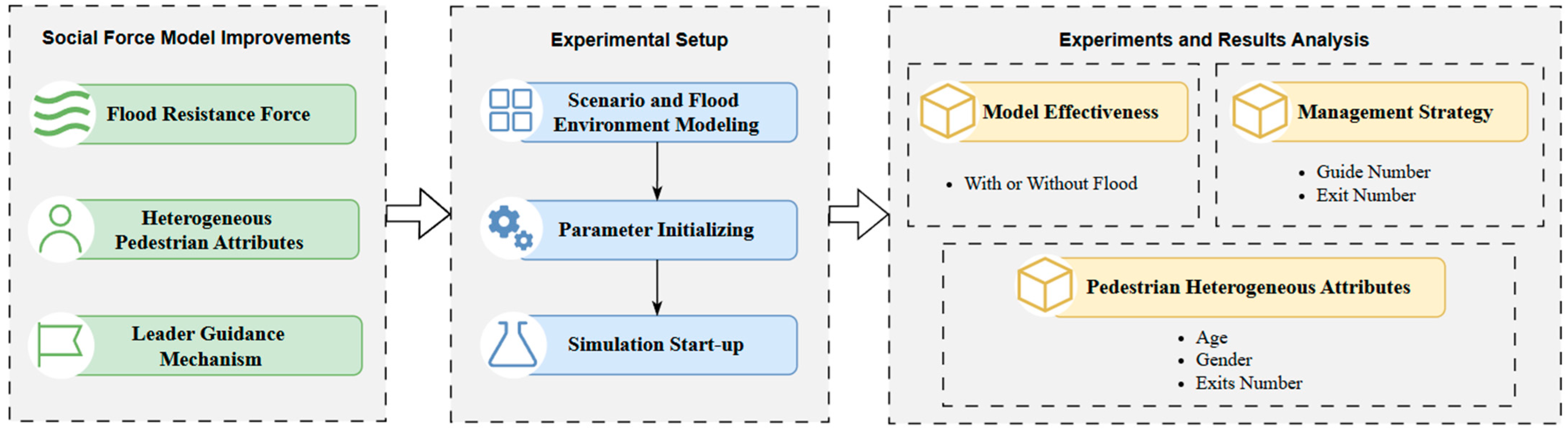
As shown in
Figure 2, aiming to accurately characterize the special forces acting on pedestrians and their behavioral decision changes in underground flood disaster scenarios, the improvements of the classical social force model are primarily developed along three dimensions: introducing flood-specific physical resistance, quantifying the dynamic mobility of heterogeneous pedestrians under varying water depths, and simulating the leader guidance mechanism in organized evacuation.
3.2. Framework of the Classical Social Force Model
The classical social force model (SFM) provides an elegant Newtonian mechanics-based framework for pedestrian movement simulation [
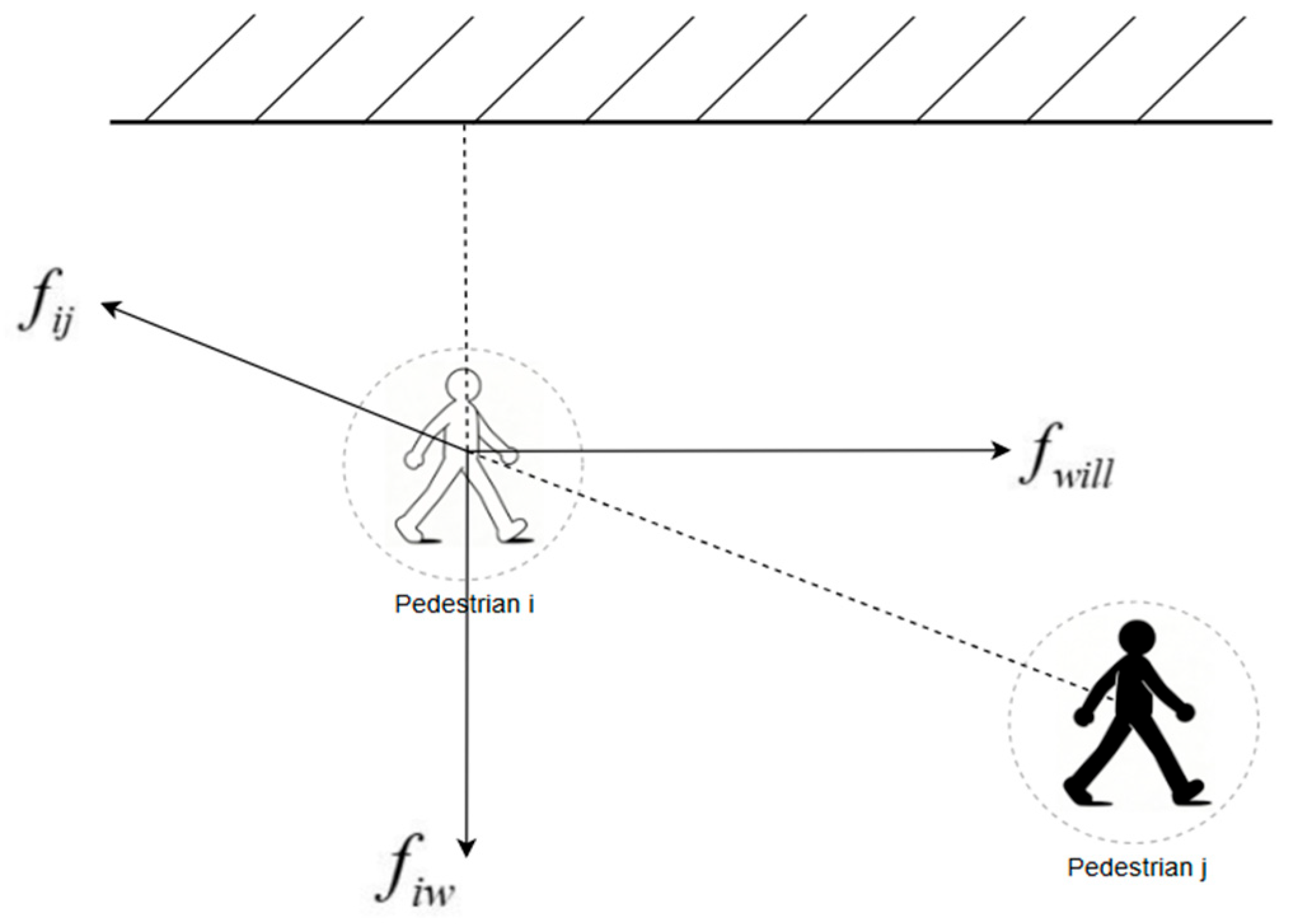
4]. Its core idea translates pedestrian decisions and behaviors into mechanical concepts, positing that a pedestrian’s acceleration is determined by the resultant of various “social forces.” A schematic of the classical social forces is shown in
Figure 3. According to Newton’s second law, the change in a pedestrian’s velocity per unit time is given by the acceleration Equation (1).
The velocity vector is not constant; both components are updated at each time step according to the acceleration obtained from the resultant force (Equation (6)). The Euler integration scheme is used: .
Figure 3.
Schematic diagram of the social force model.
Figure 3.
Schematic diagram of the social force model.
The three terms on the right side represent:
where:
—Pedestrian mass;
—Magnitude of the desired speed;
—Desired movement direction;
—Current walking speed of the individual;
—Relaxation time, characterizing the inertia of a pedestrian’s speed adjustment.
- 2.
Inter-Pedestrian Interaction Force : Models the psychological repulsion maintaining social distance between pedestrians, as well as physical pressure and friction forces occurring during extreme crowding and physical contact. Its specific composition is shown in Equation (3):
where:
—Strength of interaction between pedestrians;
—Range of influence a pedestrian exerts on others;
—Sum of the model radii of pedestrians i and j;
—Distance between the centers of the pedestrian models;
—Body force coefficient;
—Sliding friction coefficient;
—Relative tangential velocity between pedestrians.
- 3.
Pedestrian–Environment Interaction Force : Its mathematical form is like , as shown in Equation (4), ensuring pedestrians maintain a safe distance from fixed obstacles to avoid collisions.
where:
—Strength of interaction between pedestrian and wall/obstacle;
—Range of influence of obstacles or walls on the pedestrian;
—Model radius of pedestrian I;
—Distance from the pedestrian model center to the wall/obstacle;
—Body force coefficient;
—Sliding friction coefficient.
The repulsion force between pedestrian and wall is , the body force is , and the friction force is .
To enable this classical model to accurately simulate the forces and movement of pedestrians in the specific scenario of a flood disaster, this paper substantially extends it along three key dimensions.
3.3. Modeling of Flood Resistance Force
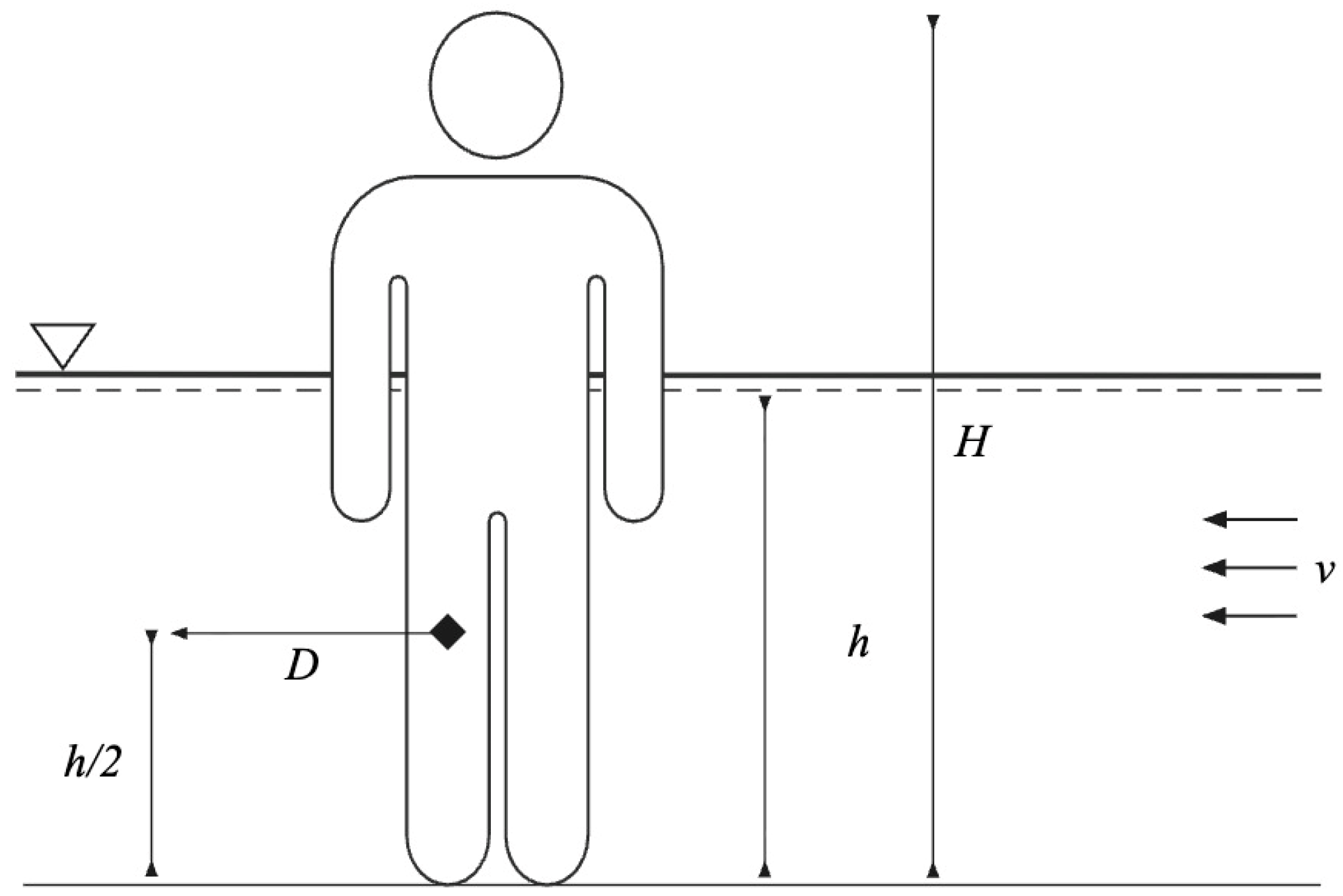
In underground flood environment, pedestrian movement differs drastically from that in air. Submerged lower limbs and torso experience significant hydrodynamic drag. This force, opposing the pedestrian’s motion relative to the water flow, is a key physical factor dissipating kinetic energy, reducing speed, and affecting stability [
6], which the classical model does not account for. Therefore, this paper simplifies the submerged pedestrian body as a vertical cylinder and quantifies this effect using the hydrodynamic drag formula, i.e., Equation (5):
A detailed explanation of Equation (5) is provided below:
Drag Coefficient
: A dimensionless parameter depending on object shape and surface roughness. For a human torso, approximated as a cylinder, referencing studies on drag of cylindrical bodies in water (Lind et al. [
6]; Xia et al. [
8]), this paper uses a value of 1.2, which is within the typical range (1.0–1.2) for a human torso approximated as a cylinder in the fluid dynamics literature.
Water Density : Takes the standard value of 1000 kg/m3.
Reference Area : This area is directly related to the pedestrian’s shoulder width (the widest part of the body). In the model, half the shoulder width is defined as the pedestrian’s “radius” . Therefore, drag magnitude is proportional to ; pedestrians with broader builds experience greater resistance.
Pedestrian Velocity : In the still or slow-flow water scenarios studied here, the pedestrian’s absolute speed relative to the ground is used. The formula indicates drag is proportional to the square of velocity, meaning a small increase in speed leads to a large rise in resistance.
The average shoulder width (radius) differs among pedestrians of different ages; related parameter settings are shown in
Table 2. This parameter also affects both inter-pedestrian physical contact force calculation and the flood resistance calculation here.
Finally, the total equation of the improved social force model adds the flood resistance term
to the right side of Equation (1):
Figure 4 visually illustrates the resultant forces on a pedestrian in a flood scenario, explicitly indicating the direction of the flood resistance
(opposite to the movement direction).
3.4. Dynamic Quantification of Desired Speed for Heterogeneous Pedestrians
In the classical model, a pedestrian’s desired speed
is typically set as a constant. However, in flood environments, the walking speed a pedestrian can maintain is a complex function of water depth, personal height, age, and gender [
8,
9], as further supported by multi-attribute evacuation models [
24]. Ignoring this variation leads to simulations severely deviating from reality. Therefore, this study establishes an empirical data-based, refined dynamic lookup model for desired speed.
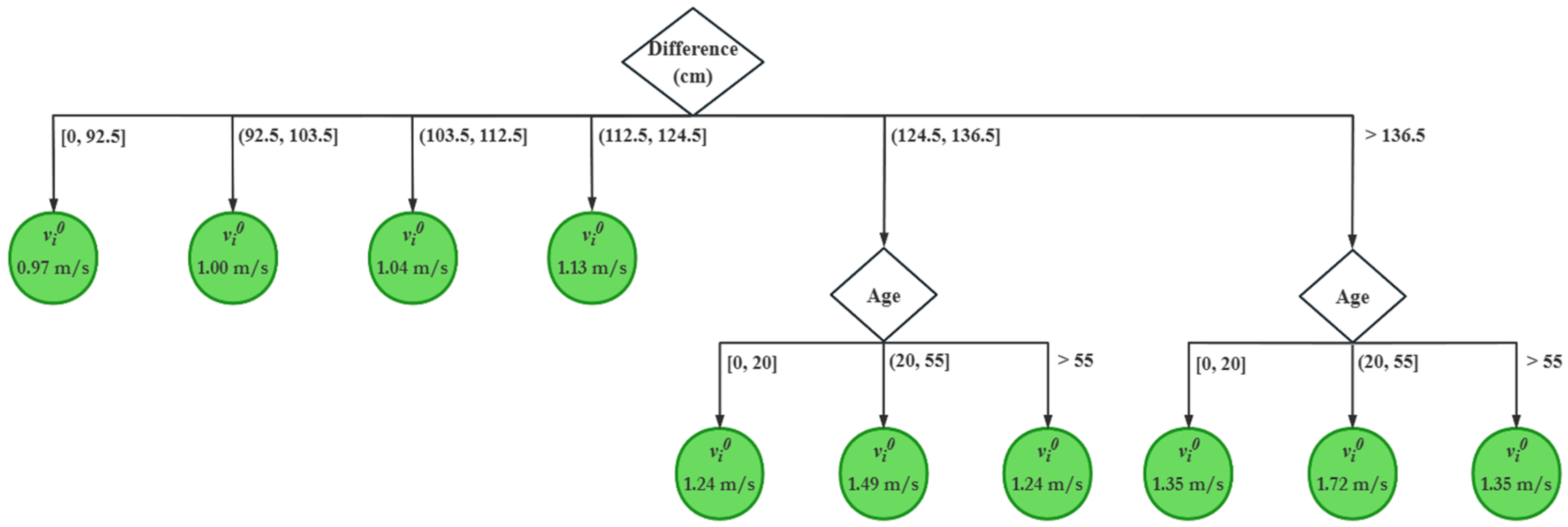
The core input variable is the difference between pedestrian height and current water depth. A larger difference implies less relative influence of water on the pedestrian’s desired velocity; i.e., taller pedestrians (or shallower water) experience a smaller reduction in their desired walking speed. Synthesizing systematic experimental data from Bernardini et al. [
11], this paper encodes a set of piecewise decision rules to calculate in real-time for each pedestrian at each simulation step. The rules for determining pedestrian speed are as follows:
First, calculate the difference between pedestrian height and current water depth. Based on this difference, a structured decision logic is applied to determine each pedestrian’s desired walking speed. The logic follows a hierarchical threshold system: the calculated value is compared against a set of predefined intervals, each corresponding to a base speed. When the water is relatively shallow (i.e., the difference exceeds 124.5 cm), the model further incorporates age as a secondary factor, assigning differentiated speeds to youth, middle-aged, and elderly pedestrians to more accurately reflect real-world mobility variations [
25]. This approach aligns with common practices in flood evacuation research that consider the impact of water depth and slope on walking speed [
26,
27,
28,
29], enabling the fine-grained simulation of how combined pedestrian attributes and dynamic flood conditions affect movement capability. The complete decision pathway and specific speed values are illustrated in
Figure 5.
The desired speed for each pedestrian is directly obtained from the empirical piecewise function in Bernardini et al. [
11] based on water depth and height. No additional gender-based multiplier is applied, as the height difference between genders already captures the primary effect on evacuation performance.
This dynamic speed model directly acts on the parameter in the self-driving force (Equation (2)), enabling pedestrians with different characteristics to exhibit differentiated mobility conforming to empirical laws in the same water depth environment. This is key to achieving high-fidelity simulation of heterogeneous pedestrians.
3.5. Integration of the Leader Guidance Mechanism
Panic is a typical group psychological response during disaster evacuation, while effective on-site guidance is crucial for coordinating direction, alleviating chaos, and improving overall efficiency [
10,
11], and recent studies have further explored dynamic leader roles [
30] and adaptive leader–follower systems [
31]. To simulate this organized evacuation behavior, the model introduces a “leader-follower” role relationship. Leaders are typically endowed with superior information perception (e.g., knowing all exit locations), and their behavioral goal is to guide group members to safety.
The influence of a leader on followers within its field of view is embedded into the model in two ways:
Dynamic Synthesis of Desired Direction: The follower’s original desired direction (e.g.,
, pointing to an exit derived from a path-finding algorithm) is attracted by the leader. The final synthesized desired direction
is a distance-dependent weighted result, calculated by Equations (7) and (8):
where
is the unit direction vector from follower
to leader
, and
is the pedestrian’s visibility range (field of view radius). The weight
decays exponentially with increasing distance
between them. This means when a follower is close to the leader, its movement direction is primarily guided by the leader; when farther away, it relies more on its own judgment of the environment.
Application of a Guidance Force: To reinforce the following behavior at the dynamics level, the model defines an additional guidance force
exerted by leader
on follower
:
where
is the current velocity vector of follower
at time
, and
is the follower’s relaxation time (a positive constant) that controls how quickly it adjusts its velocity. The term
is the follower’s desired velocity derived from the leader, with
being the leader’s desired speed magnitude and
the leader’s desired direction (a unit vector). The follower’s desired speed
is still dynamically determined by the rules in
Section 3.4 based on water depth and personal attributes; therefore, the leader influences only the follower’s movement direction and provides a speed-matching tendency, while the follower’s maximum achievable speed remains constrained by the flood environment.
Leader speed: set to 1.2× the average desired speed of followers under the current water depth, reflecting the assumption that leaders are more capable and familiar with the environment. The leader’s own desired speed is computed using the same dynamic speed lookup rules (
Section 3.4) based on the leader’s height and real-time water depth, ensuring that leaders are also affected by flood conditions.
In our implementation, the number of followers per leader is determined by dividing the total number of pedestrians equally among the leaders. Followers are assigned at the start of the simulation based on Euclidean distance to the nearest leader. Each follower maintains a preferred following distance (1–2 m) to the leader; if the distance exceeds 5 m, the follower abandons the leader and navigates independently toward the exit. Collisions between followers belonging to different leaders are resolved by the same inter-pedestrian repulsive forces (Equation (3)); no special collision avoidance rule is needed.
By introducing the above mechanisms, the model can simulate evacuation patterns where followers actively converge and orderly follow the leader, enriching the hierarchy of group behavior and enabling the simulation to assess the effectiveness of guide deployment strategies. It should be noted that the current parameter settings for the leader–follower module (e.g., following distance, abandon distance, direction weight decay rate) are empirically determined based on classical social force model benchmarks and the experimental findings of Ding and Sun [
32] on leader–follower evacuation behavior. While these values produce reasonable simulation outcomes, full-scale real-person evacuation experiments under flood conditions would provide more rigorous calibration data. This is acknowledged as a limitation in
Section 5.3.
3.6. Decision-Making Mechanism for Exit Versus Shelter
In addition to the speed rules, the model incorporates a decision mechanism that determines whether a pedestrian continues toward an exit or diverts to a shelter. At each simulation step, a pedestrian evaluates the current conditions (informed by exit selection behavior under flooding [
33]): (1) if the local water depth exceeds 0.5 m (the stability threshold from Xia et al. [
8]), and (2) the pedestrian’s current desired speed drops below 0.3 m/s (the minimum speed for meaningful forward progress, consistent with Bernardini et al. [
11]’s measurements at high water depths), the pedestrian estimates the remaining travel time to the nearest exit given the current speed. If the estimated time exceeds a safety limit of 60 s, and a shelter is within visual range (≤10 m), the pedestrian switches the target destination from the exit to the shelter. This rule is based on the concept of risk aversion under time pressure, consistent with the findings of Asai et al. [
22] on evacuation route safety for elderly persons during underground flooding. The stability threshold of 0.5 m and minimum speed threshold of 0.3 m/s are also supported by domestic research: Zhu et al. [
34] conducted walking experiments in Chinese subway stations and found that pedestrian speed decreases significantly when water depth exceeds 0.2 m, with evacuation time exceeding safety standards at depths above 0.5 m, consistent with our trigger threshold.
4. Experiments and Results
To validate the effectiveness of the improved social force model and investigate the influence mechanisms of key factors, a simulation experiment was built using Python (version 3.9.7) and Pygame (version 2.1.0). Multiple sets of controlled experiments were conducted in designed typical scenarios. The experiments in this section are designed to validate each model improvement in
Section 3 and to investigate the influence mechanisms of key factors. This section elaborates on the experimental setup, results, and findings in detail.
The proposed model was implemented in Python 3.9 using an object-oriented approach. Each pedestrian is an agent with attributes: position , velocity , desired speed , mass , radius , height , age category, and gender. The social force equations (Equation (6)) are integrated numerically using the Euler method with a time step s. At each time step, all forces are computed based on current agent states, then velocities and positions are updated. Collision detection uses the agent radii. The simulation runs until all agents have either evacuated (reached exit) or reached a shelter, or until the water depth exceeds 0.7 m (critical safety threshold).
4.1. Experimental Setup
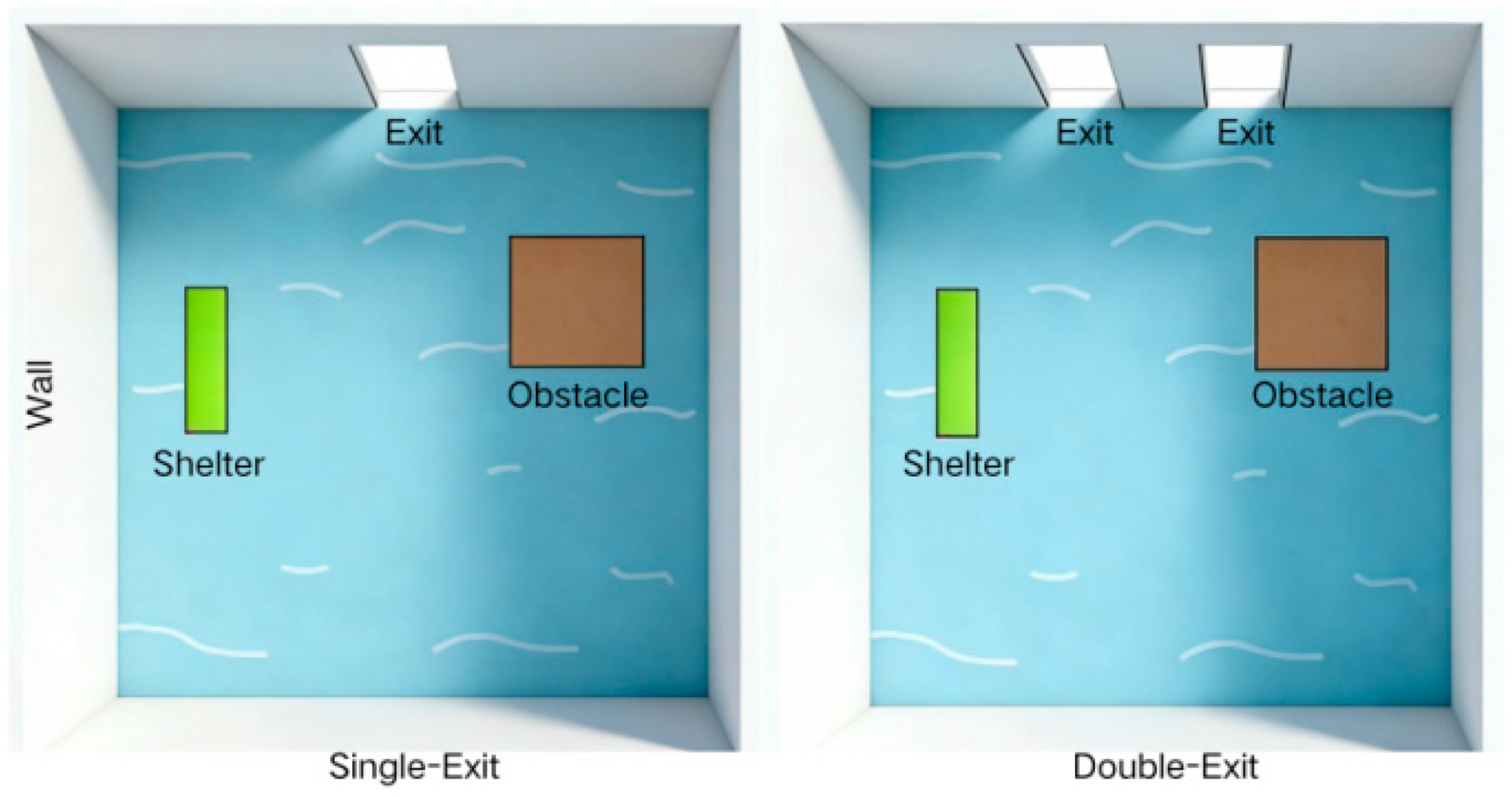
The experiment simulates a 20 m × 20 m enclosed underground space. Two typical layout scenarios are designed for comparison: Scenario 1 with a single exit, and Scenario 2 with two exits. The layouts are shown in
Figure 6. Floodwater enters at a constant speed
from an entrance, and the water level rises linearly according to Equation (10), simulating disaster situations with different levels of urgency.
(m) is the water level height at a given moment,
(m/s) is the water level rise speed, and
(s) is the time elapsed since the start of the simulation.
Pedestrians in the simulation are defined as agents with heterogeneous attributes, mainly categorized into four types: young male, young female, elderly male, and elderly female. Their core attributes, such as height and shoulder width (used to calculate model radius and flood resistance), are randomly generated within ranges referencing Chinese population physique data [
35] and flood pedestrian experimental data [
11]. A pedestrian’s desired speed is strictly calculated dynamically based on real-time water depth and personal attributes according to the rules in
Section 3.4. Parameters for pedestrian mass distribution reference relevant biomechanical studies [
23].
In our simulation, all agents have a designated destination: the single exit in Scenario 1 or one of the two exits in Scenario 2 (assigned based on initial proximity). Conflict management is handled entirely through the social force model’s built-in mechanism—the inter-pedestrian interaction forces
(Equation (3)), which include psychological repulsion, body force, and friction. These forces naturally resolve congestion and avoidance without requiring additional ad hoc rules. The desired direction vector for each agent is initially set pointing toward the nearest exit but is subsequently modified by the leader guidance mechanism (
Section 3.5) and the dynamic speed quantification (
Section 3.4).
The core evaluation metrics are the number of successfully evacuated pedestrians (i.e., those reaching an exit or shelter before the critical water depth of 0.7 m [
11]) and the total evacuation completion time. The experiment employs the control variable method. Under fixed total pedestrian numbers (N = 100 or N = 200) and baseline parameters, key variables (e.g., presence of flood, age structure, number of guides) are changed sequentially, with each set of experiments repeated multiple times to obtain statistical results.
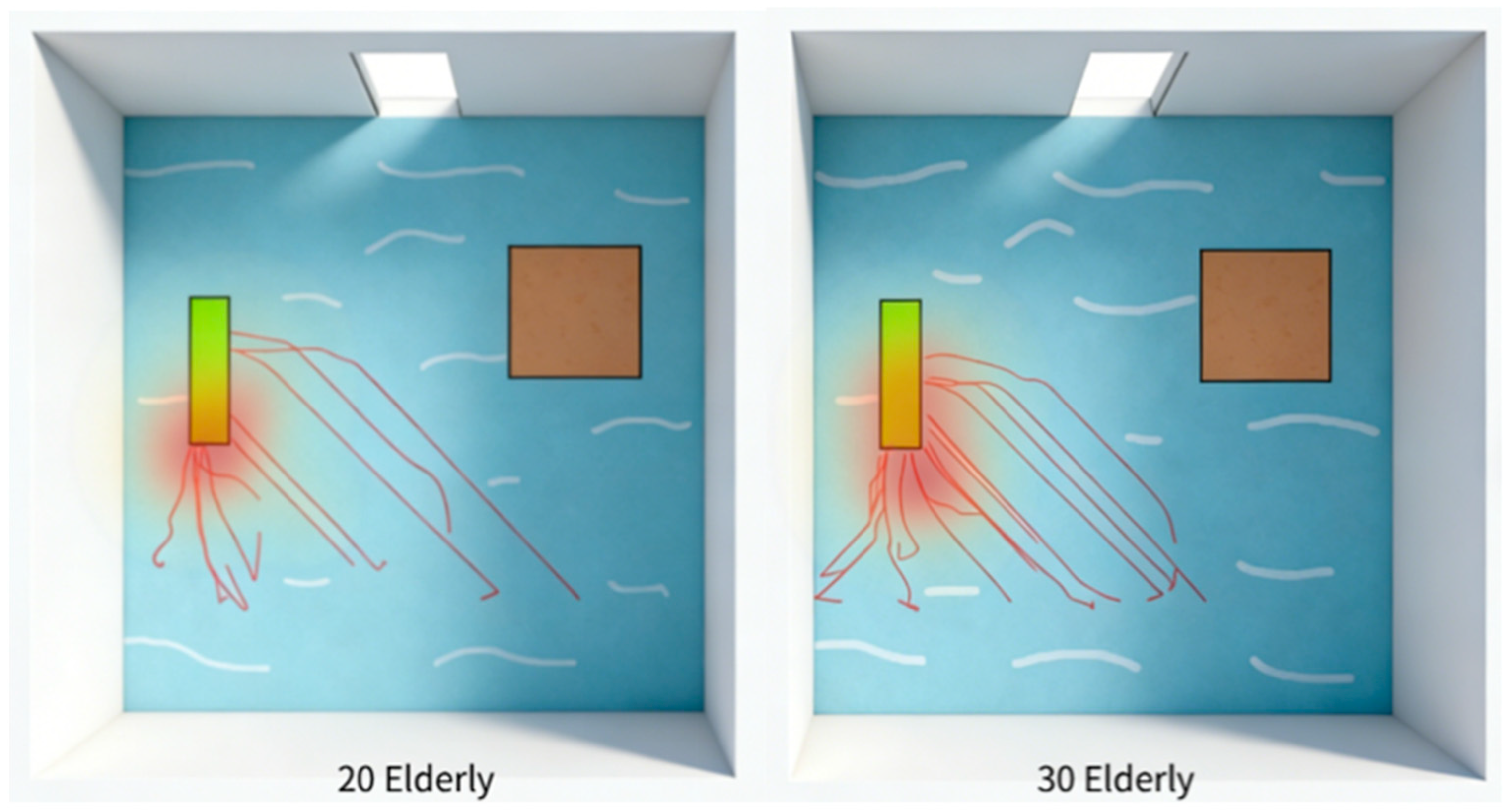
The left and right panels show scenarios with 20 and 30 elderly individuals, respectively. In each panel, the green rectangle denotes the elevated shelter (safe platform); the brown square denotes a structural pillar (obstacle); the red curves represent the movement trajectories of pedestrians heading toward the shelter; the red-to-yellow glow indicates pedestrian density (warmer colors correspond to higher congestion); and the blue background with white arcs represents the floodwater surface.
4.2. Validation of Model Effectiveness
The performance of the social force model is sensitive to the initial positions of agents and the designated exit locations. In our simulation, agents start at random positions uniformly distributed within the 20 m × 20 m area, and all share the same single exit (or one of two exits in Scenario 2). The desired velocity direction for each agent is initially set toward the nearest exit but is subsequently modified by the leader guidance force (
Section 3.5) and social interactions.
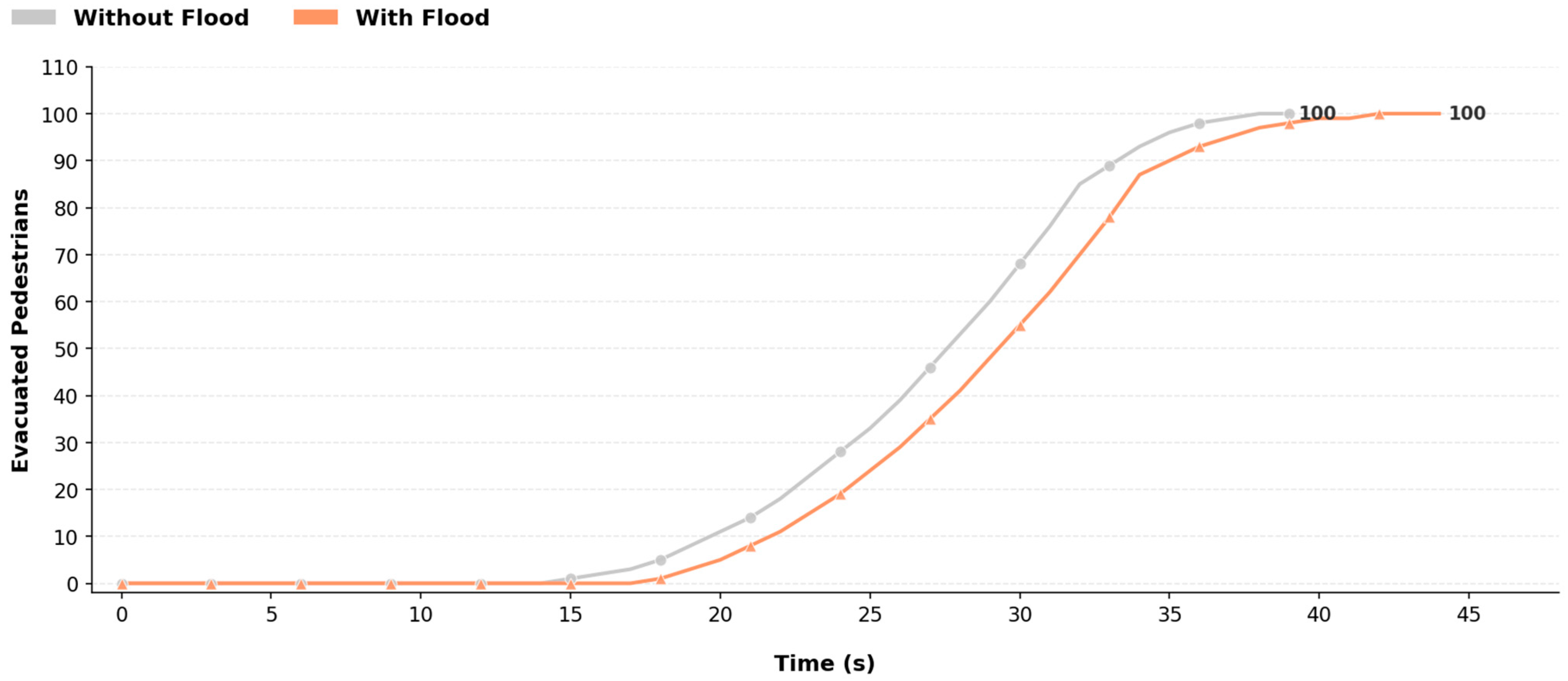
To verify the necessity of introducing flood physical resistance and the dynamic speed model, a comparative experiment was first set up. Under conditions of total number N = 100 (all young males) and water level rise speed = 0.75 cm/s, two scenarios were simulated: “No Flood” and “With Flood”.
The results are shown in
Figure 7. It can be clearly observed that at the same point in time, the number of evacuated people in the flood environment is consistently lower than under normal conditions. For instance, at around 35 s into the simulation, nearly 80 people had evacuated under normal conditions, while only about 50 had evacuated in the flood scenario. This quantitatively demonstrates that the combined effect of flood resistance and speed attenuation mechanisms significantly reduces the overall evacuation efficiency of the crowd. Ignoring these factors would severely overestimate evacuation capacity, highlighting the practical significance of the model improvements in this paper.
4.2.1. Spatiotemporal Distribution of Pedestrians
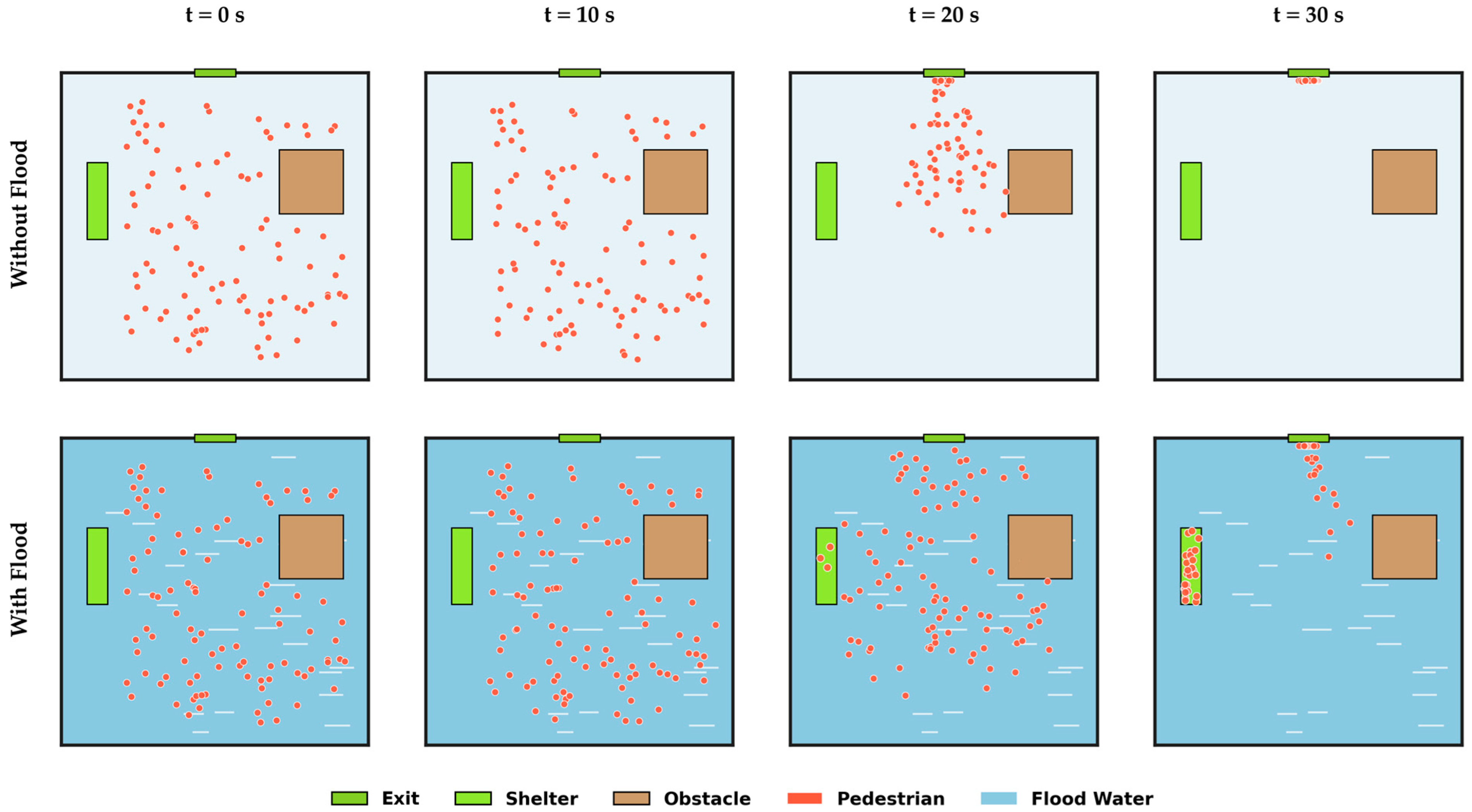
To provide a more detailed characterization of the evacuation dynamics, we analyzed the spatiotemporal distribution of pedestrians under both flood and no-flood conditions. Under normal conditions, pedestrians move steadily toward the exit with relatively uniform density throughout the space. In contrast, under flood conditions, the spatial distribution becomes increasingly heterogeneous over time: as the water level rises, pedestrians in deeper zones experience greater speed reduction, leading to clustering and localized congestion. At approximately 20 s into the simulation, the density near the exit in the flood scenario is 1.5–2.0 times higher than under normal conditions, while the central area of the space shows significantly reduced pedestrian presence due to slower movement through deeper water. This spatiotemporal analysis confirms that flood resistance not only reduces overall speed but fundamentally alters the spatial pattern of evacuation, creating critical congestion zones that prolong the total evacuation time.
Figure 8 illustrates this dynamic through evacuation process snapshots at t = 0 s, 10 s, 20 s, and 30 s, comparing the pedestrian spatial distribution under flood and no-flood conditions.
This altered spatial pattern directly reflects the drag force mechanism introduced in
Section 3.3, which reduces pedestrian speed proportionally to their submerged reference area and flow conditions.
4.2.2. Cross-Platform Validation
To verify the implementation correctness of our model, we independently replicated the same evacuation scenario in NetLogo, an agent-based simulation platform widely used in pedestrian dynamics research (referenced in Senanayake et al. [
16]’s systematic review of validation practices). Both implementations use identical pedestrian attributes, force parameters, and scenario layouts, ensuring that any differences in results stem from implementation errors rather than modeling assumptions. Across 10 paired simulation runs (N = 100, water level rise speed = 0.75 cm/s), the average evacuation counts differ by less than 3%, confirming that the model logic is correctly implemented and not platform-dependent.
4.2.3. Empirical Benchmark Validation
We further compared our simulated pedestrian speeds against real experimental measurements from two independent empirical datasets. Asai et al. [
22] conducted underground flooding experiments and reported that pedestrian walking speed decreases to approximately 0.5 m/s at a 0.5 m water depth; our model predicts 0.48 m/s under the same conditions (relative error 4%). Bernardini et al. [
11] systematically measured walking speeds of individuals of various ages and heights in water depths ranging from 20 cm to 70 cm under still-water conditions; our simulated speeds for the corresponding demographics fall within 5–10% of their reported values. These comparisons provide direct evidence that the model’s speed–depth–height mechanism produces physically realistic pedestrian behavior.
4.3. Analysis of the Influence of Pedestrian Heterogeneous Attributes
4.3.1. Influence of Age Structure
Age affects evacuation outcomes through a dual pathway: influencing pedestrian mobility (desired speed) and decision preferences (see behavior evolution rules in
Section 3.4). With the total number fixed at N = 100 and water level rise speed
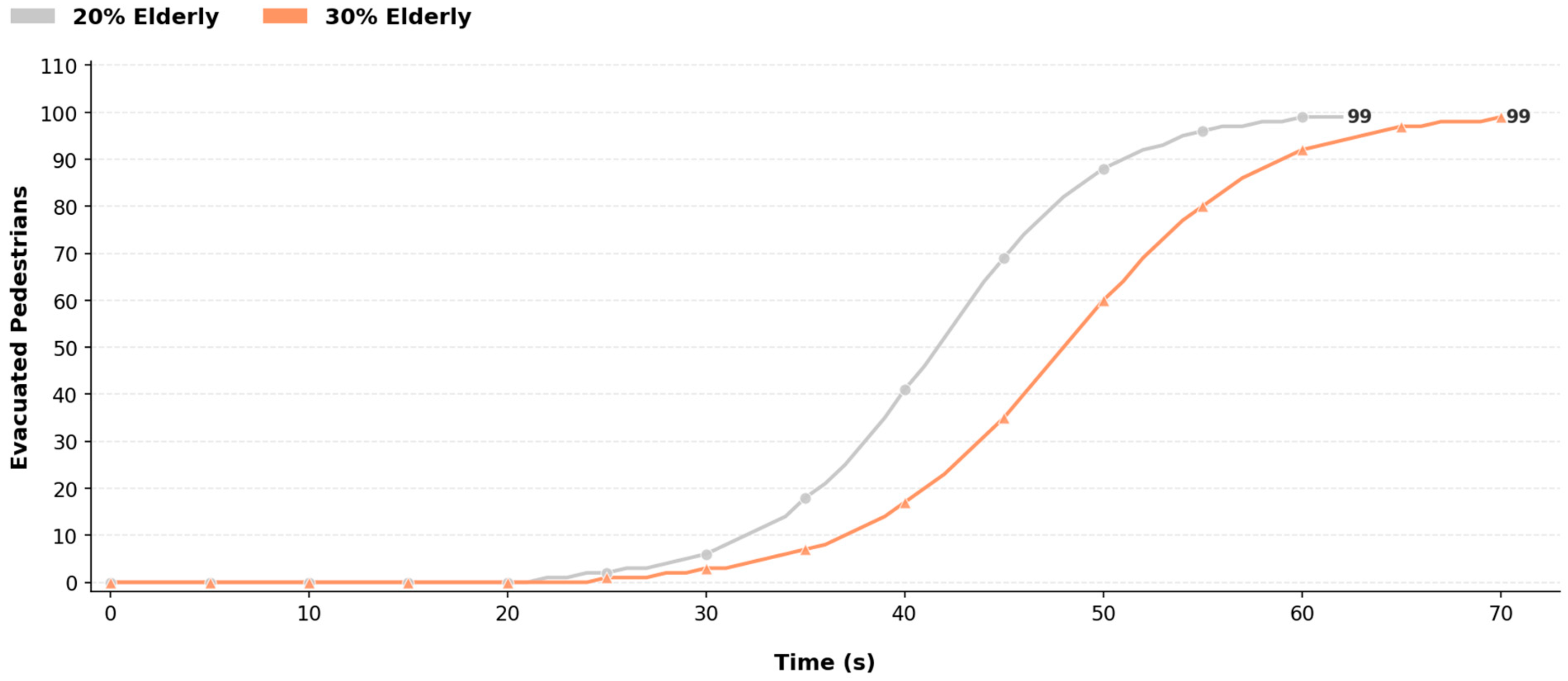
= 0.75 cm/s, scenarios with elderly proportions of 20% and 30% were simulated respectively.
The experimental results (
Figure 9) show that when the proportion of elderly individuals increased from 20% to 30%, the final number of successfully evacuated people decreased, and the number of non-evacuated people (including those going to shelters and awaiting rescue) increased.
This is primarily attributed to the model’s mechanism (
Section 3.4): elderly pedestrians have shorter heights, resulting in a smaller at the same water depth, which yields a lower desired speed per the Bernardini et al. [
11] empirical function. The lower desired speed has two consequences: on one hand, it forms and exacerbates congestion at bottlenecks like exits, slowing down the overall flow rate; on the other hand, elderly pedestrians are more likely to trigger the shelter-seeking decision thresholds (water depth > 0.5 m AND desired speed < 0.3 m/s, as defined in
Section 3.6), because their lower speed causes the speed threshold to be reached at shallower water depths. For example, at a water depth of 0.5 m, the Bernardini function assigns a desired speed of approximately 0.35 m/s to a young male (height 1.72 m) but only approximately 0.28 m/s to an elderly female (height 1.55 m)—the latter already falls below the 0.3 m/s threshold, triggering the shelter-seeking decision.
4.3.2. Influence of Gender Differences
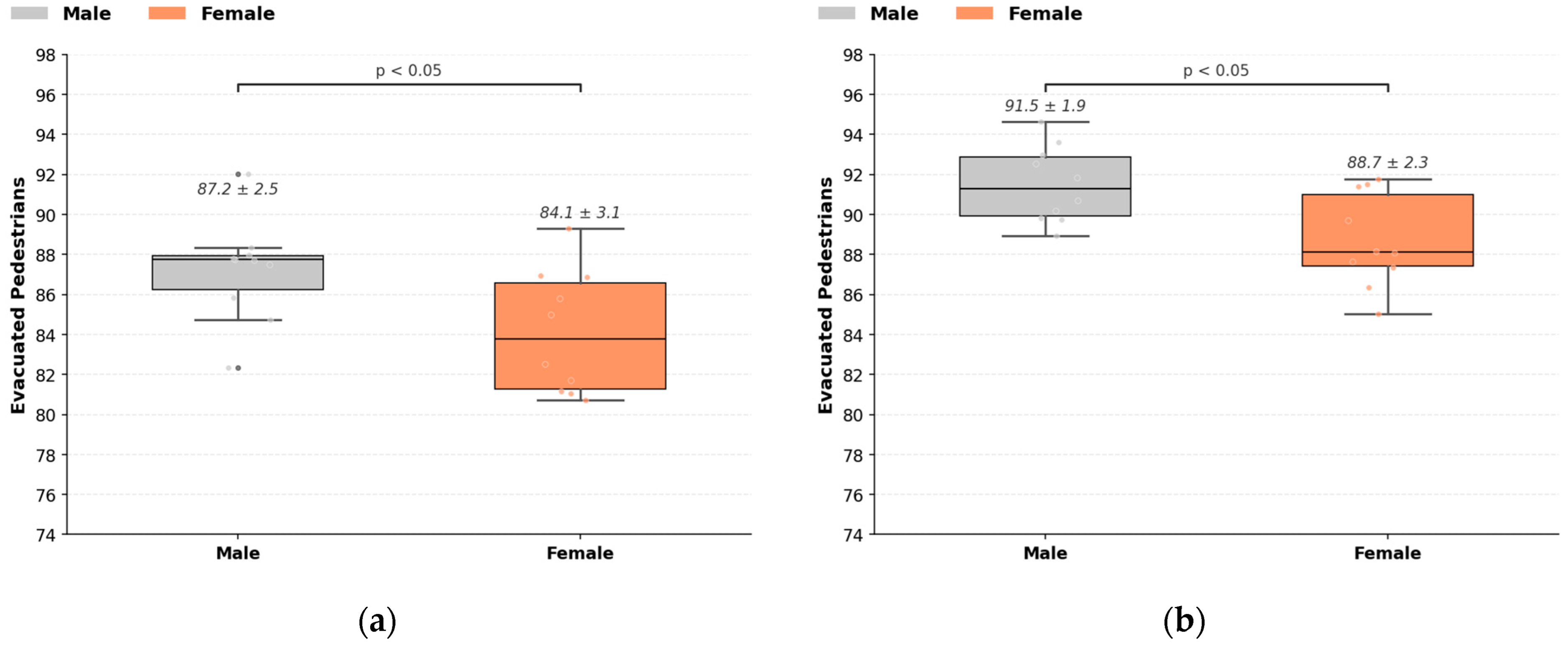
Under conditions of N = 100 and
= 1 cm/s, a group of all young males was compared with a group of all young females.
Figure 10 presents a comprehensive comparison of evacuation performance by gender in both single-exit and dual-exit scenarios.
Figure 10 presents boxplots comparing evacuation performance by gender in both single-exit and dual-exit scenarios.
Panel (a) shows the distribution of evacuated pedestrians across 10 simulation runs in the single-exit configuration, while panel (b) shows the same for the dual-exit configuration. Each boxplot displays the median, interquartile range, and individual outliers, providing a comprehensive view of the variability and consistency of evacuation performance between genders.
In each boxplot, the box represents the interquartile range (IQR, from the first to the third quartile), the horizontal line inside the box indicates the median, and the whiskers extend to 1.5×IQR. Open circles denote the individual evacuation counts from each of the 10 simulation runs, while orange dots mark outliers beyond the whisker range. The annotation above each box (e.g., 87.2 ± 2.5) reports the mean ± standard deviation across all runs.
Gender differences in evacuation performance emerge through the height pathway in the Bernardini et al. [
11] speed–depth–height function. Males are on average taller than females (Chinese national survey data: 1.72 m vs. 1.60 m, as shown in
Table 3), resulting in a larger at the same water depth, which yields a higher desired speed per the empirical function. Under this mechanism, male groups achieved a slightly higher evacuation success rate than female groups in both single-exit and dual-exit configurations. Quantitatively, in the single-exit scenario, the average number of evacuated pedestrians was 87.2 ± 2.4 for males versus 84.1 ± 2.9 for females; in the dual-exit scenario, the gap was smaller but consistent. The gender effect is indirect—it operates entirely through the height desired speed chain, not through any gender-specific parameter. This is consistent with Bernardini et al. [
11]’s finding that ‘height, not gender perse, determines speed reduction in floodwater,’ and aligns with the field observations of Asai et al. [
22], who reported that female pedestrians in underground flooding experienced greater difficulty reaching exits due to their lower walking speed.
4.3.3. Interaction Between Age and Gender
To examine whether the effect of gender on evacuation performance varies with age, we conducted additional simulations comparing elderly male and elderly female groups (N = 100, water level rise speed = 0.75 cm/s). This interaction can be traced back to the compound
mechanism in
Section 3.4: elderly females have the shortest average height among all subgroups, resulting in the smallest
and thus the lowest desired speed at any given water depth. The results show that elderly females had a lower evacuation success rate than elderly males (average of 82.3 ± 3.1 vs. 85.7 ± 2.8 evacuated over 10 runs). This difference is primarily attributed to the combined effect of shorter average height and lower body mass in elderly females, which results in both a less favorable speed category in the lookup rules and greater susceptibility to flood resistance. The interaction between age and gender thus amplifies the disadvantage: while the gender gap among young pedestrians is modest (approximately 3–4 percentage points), it widens to approximately 5–6 percentage points among the elderly, indicating that elderly females represent a particularly vulnerable subgroup in underground flood evacuation.
4.4. Exploration of Management Strategy Parameters
The role of leaders in coordinating evacuation and alleviating panic is widely recognized [
10,
11]. This study investigated its impact on evacuation effectiveness by varying the number of leaders in the scenario (1 to 5). The assignment of 100 followers to leaders was done randomly but kept consistent across different numbers of leaders for fair comparison. For example, with 2 leaders, each leader guided approximately 50 followers; with 5 leaders, each guided about 20 followers.
Leader Parameter Specification
Before presenting the results, we specify the key parameters governing the leader guidance mechanism, each with its physical rationale and literature basis: (1) Leader speed: set to 1.2× the average desired speed of followers under the current water depth, reflecting the assumption that leaders are trained emergency personnel with greater physical capability, consistent with the leader model in Hou et al. [
36]. Importantly, leaders are also subject to the same flood-induced speed degradation as ordinary pedestrians (
Section 3.4); the 1.2× multiplier applies to the flood-adjusted desired speed rather than the free-flow speed, ensuring that leader velocity decreases with rising water depth in a physically consistent manner. (2) Initial leader position: 2 m in front of the exit, ensuring leaders are visible to followers near the exit bottleneck—the most critical zone for evacuation efficiency. (3) Follower assignment: equal division among leaders, with each follower assigned to its nearest leader by Euclidean distance, following the proximity-based assignment in Hou et al. [
36]. (4) Following distance: 1–2 m, consistent with the social distance parameter in the social force model [
4], ensuring followers stay close enough for the direction synthesis (Equation (8)) to be effective. (5) Abandon distance: 5 m. When the distance between a follower and its assigned leader exceeds 5 m (approximately the visibility range in Equation (8)), the follower reverts to self-navigation toward the exit. This threshold is derived from the exponential decay of the direction weight in Equation (8), where the influence of the leader becomes negligible beyond this distance.
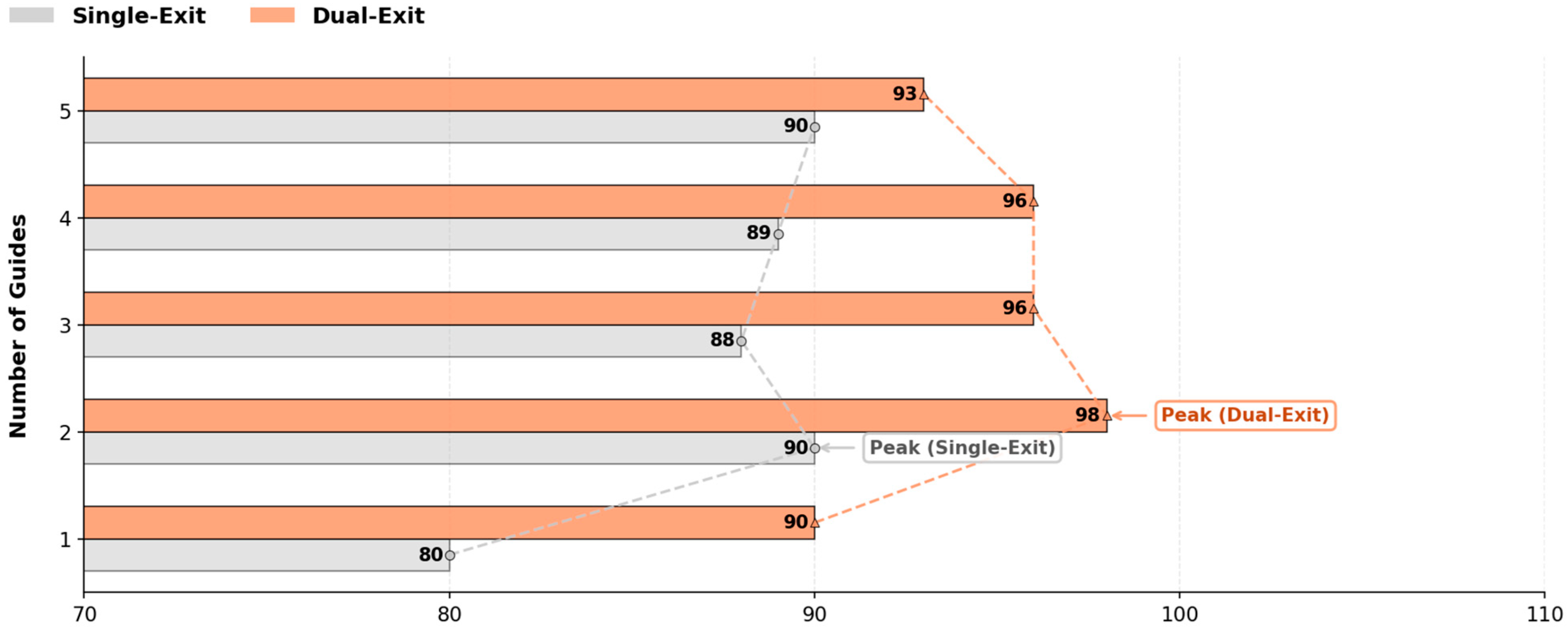
We found that evacuation efficiency does not exhibit a simple positive correlation with the number of leaders. Experimental results (
Figure 11) show distinct patterns for single-exit and dual-exit scenarios. The bar heights in
Figure 11 represent the number of evacuated pedestrians for each guide configuration, while the overlaid line plots reveal the overall trends across the tested range.
For the dual-exit scenario, the evacuation performance peaked when two guides were deployed; increasing the number beyond two reduced evacuation effectiveness. This suggests an optimal threshold exists for guide deployment in multi-exit environments. In contrast, the single-exit configuration showed more moderate variations, with evacuation numbers gradually increasing until reaching a plateau.
The analysis suggests that an appropriate number of guides can effectively split the crowd and guide direction, as demonstrated by the peak performance at two guides in the dual-exit scenario. However, having too many guides can lead to a dispersed source of directives, with different guides potentially guiding certain groups along different or even sub-optimal paths, resulting in group fragmentation and decision-making confusion, which can hinder overall coordination efficiency. This suggests that emergency management practice that guides deployment should focus on strategy and synergy, not merely quantity.
This finding traces back to the leader guidance mechanism defined in
Section 3.5, where the direction synthesis function (Equation (8)) and guidance force (Equation (9)) create a trade-off: sufficient leaders provide clear directional cues, but excessive leaders produce conflicting directional signals within the same field of view.
6. Conclusions
This study focused on the specific disaster scenario of underground flooding, systematically improved the classical social force model, and validated its effectiveness through simulation experiments. The main conclusions are as follows:
First, three core advancements were achieved at the model improvement level: (1) Successfully introducing a flood resistance term into the social force equation, quantifying the physical hindrance of water flow on pedestrian movement. (2) Establishing dynamic quantification rules for desired speed based on individual pedestrian attributes (age, height, gender) and real-time water depth, enabling fine-grained characterization of the differentiated mobility of heterogeneous pedestrians. (3) Integrating a leader guidance mechanism to simulate coordinated behavior in organized evacuations within the social force framework.
Second, the simulation experiments based on the improved model revealed key factors and patterns affecting evacuation efficiency with quantitative clarity. Specifically, the inclusion of flood resistance increased total evacuation time by 9.3% (from 37.5 to 41.0 s) and decreased the average evacuation rate by 8.6%, demonstrating that flood environments significantly reduce overall evacuation efficiency. Pedestrian age structure also exerts a substantial impact: raising the proportion of elderly pedestrians from 20% to 30% prolonged total evacuation time by 9.4% and reduced the average evacuation rate by 8.6%, indicating that elderly groups face higher vulnerability through dual pathways of reduced mobility and more conservative risk decision-making. Furthermore, effective guidance by leaders can improve evacuation efficiency, but its effectiveness follows an optimal configuration strategy—e.g., two guides outperformed both fewer and more guides in dual-exit scenarios—rather than depending merely on the number of guides.
In summary, the improved model proposed in this study can more realistically simulate the complexity of pedestrian behavior in flood scenarios. The quantitative findings provide actionable theoretical references for flood-resistant design, emergency plan formulation, and personnel safety management of underground spaces, responding to the research call for enhancing urban underground space flood resilience [
42].