

A Hybrid ARIMA-CNN-LSTM Framework Based on Serial Decomposition for Non-Stationary Water Level Forecasting in Qinghai Lake
 , ,
, ,
Abstract
1. Introduction
2. Data and Methods
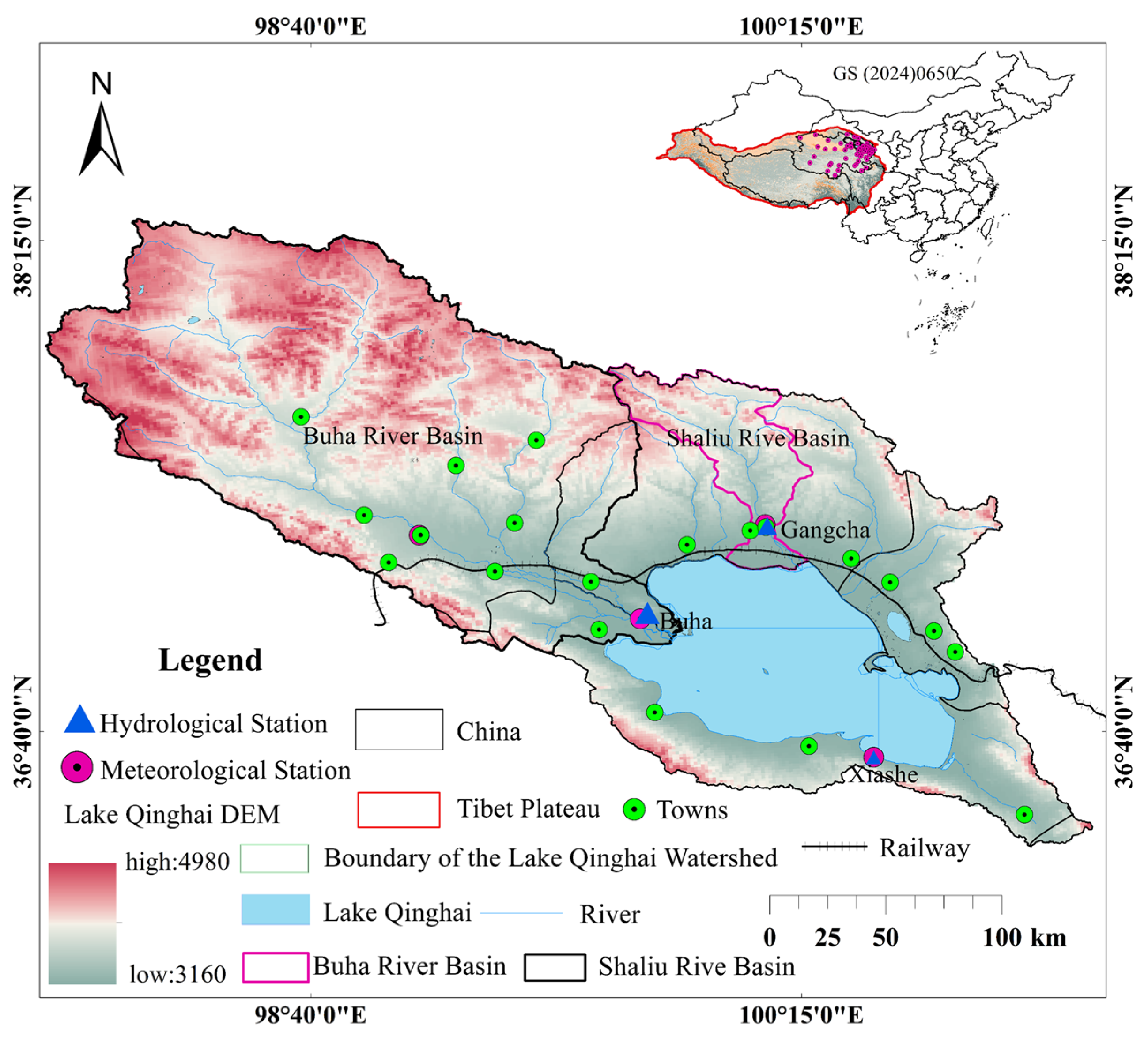
2.1. Study Area
2.2. Data Sources and Pre-Processing
2.2.1. Water Level Data
2.2.2. Data Preprocessing and Quality Control
2.3. Methodology
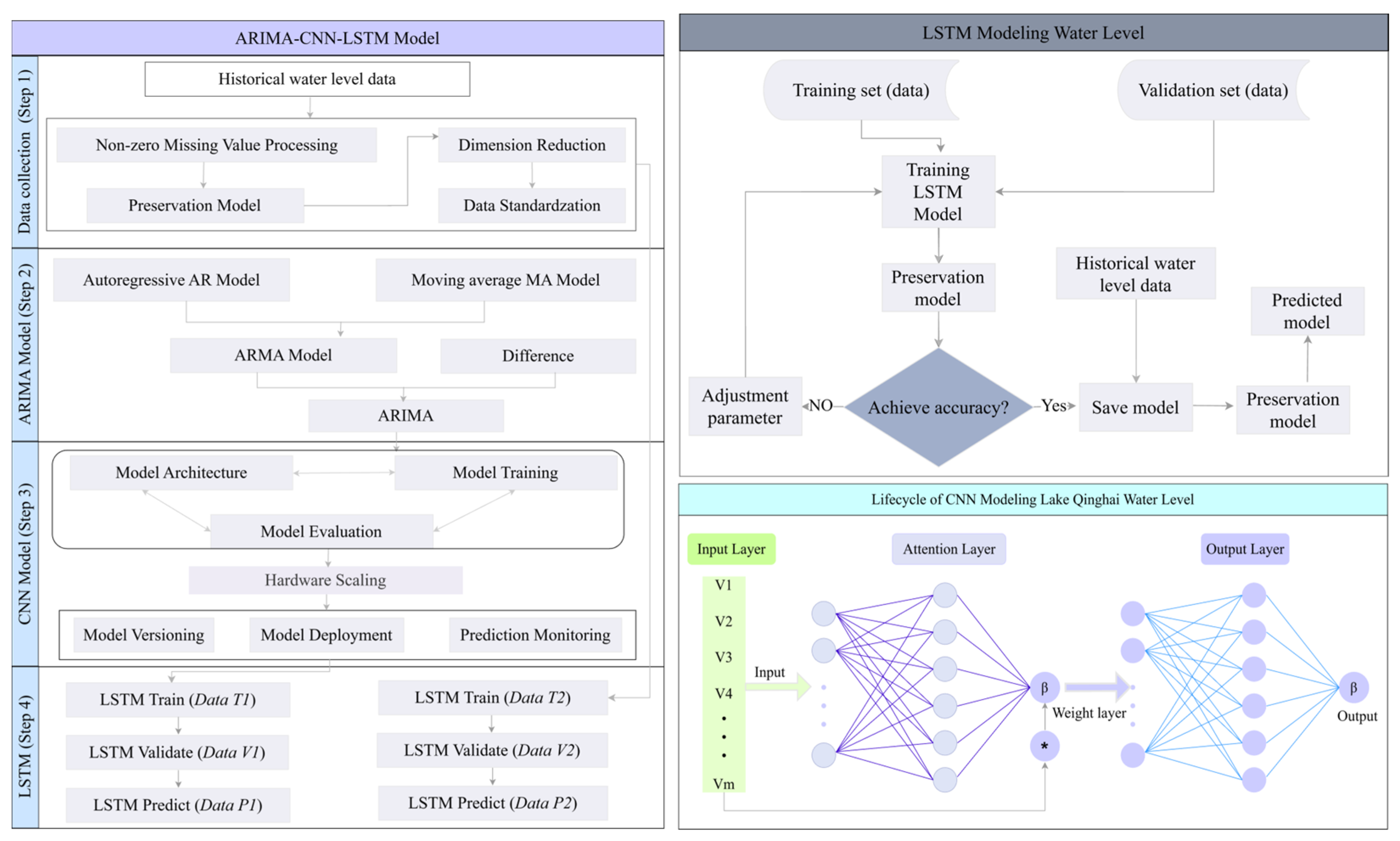
2.3.1. The Hybrid ARIMA-CNN-LSTM Framework
2.3.2. Model Implementation and Configuration
2.3.3. Model Robustness and Overfitting Control
2.3.4. Performance Metrics
3. Results
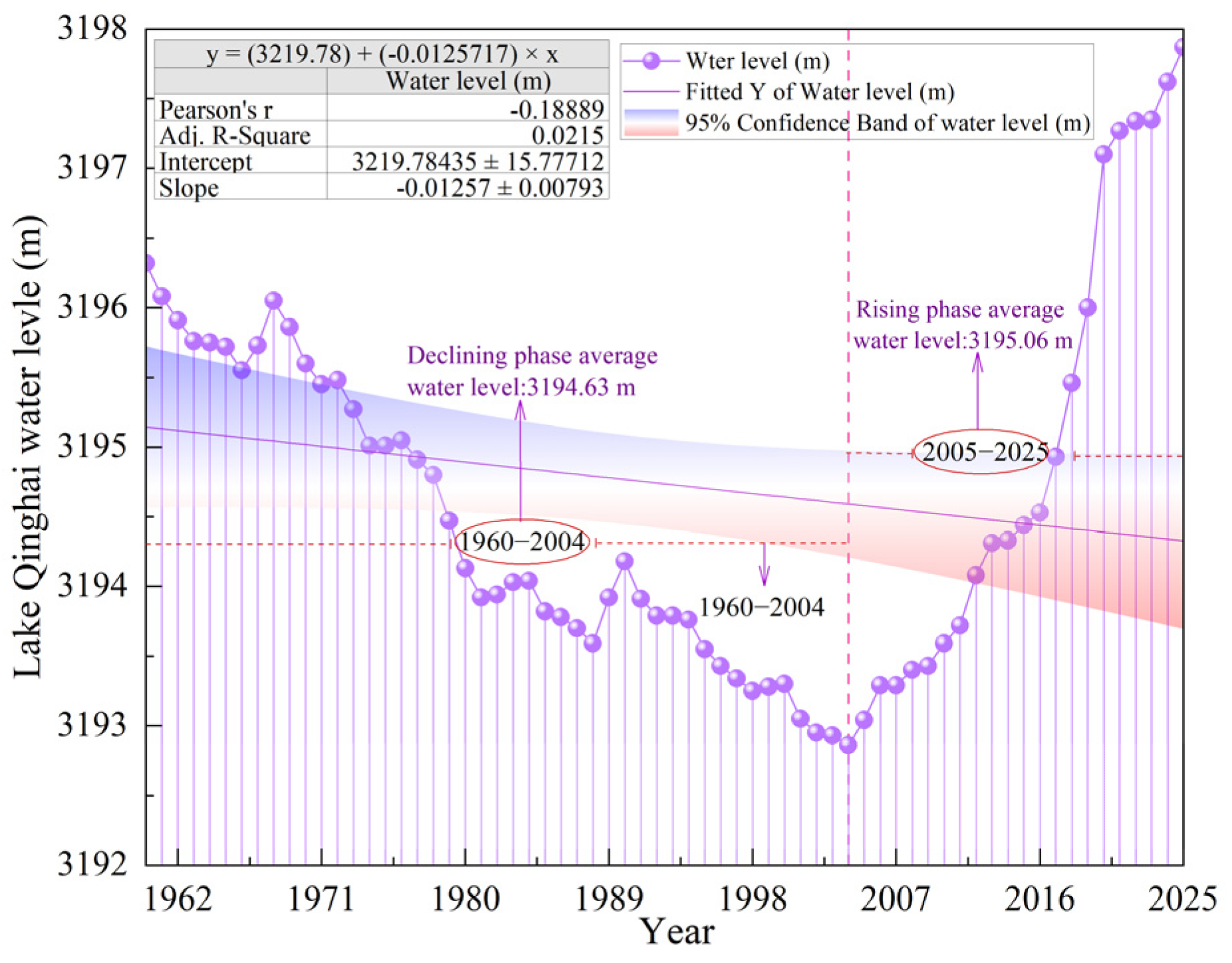
3.1. Temporal Evolution Characteristics of Water Levels
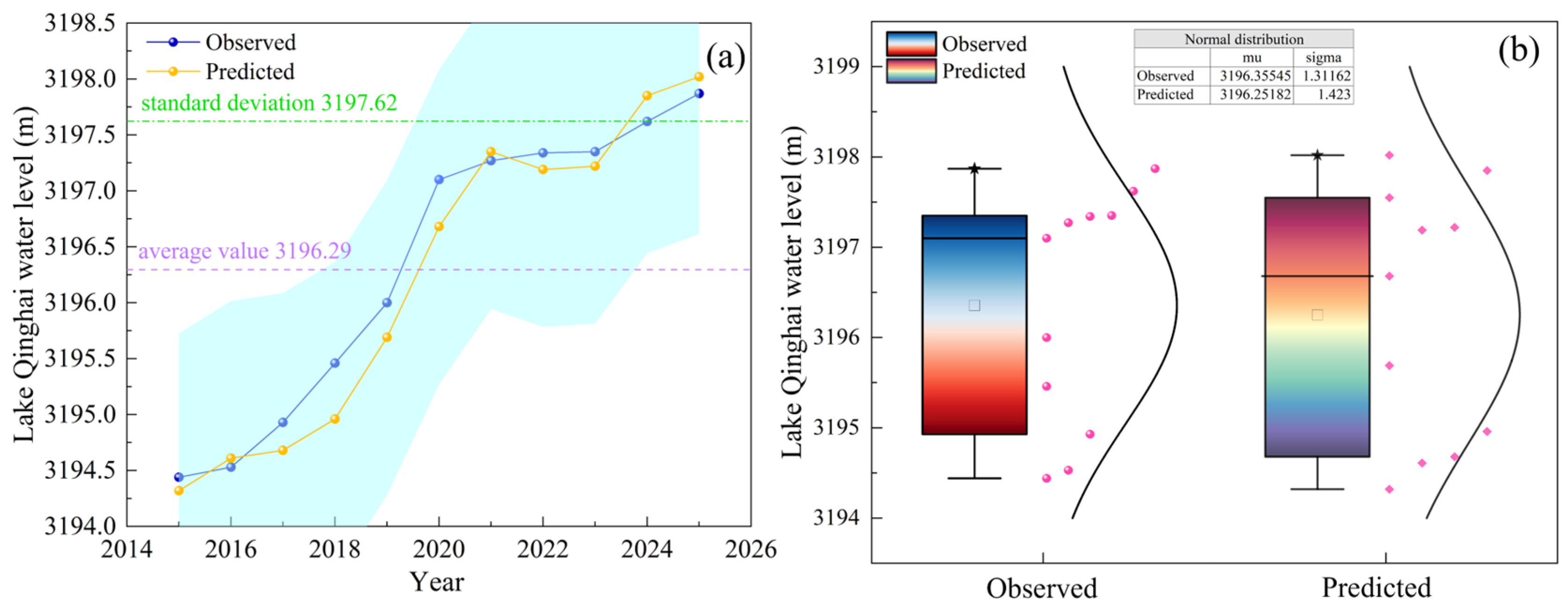
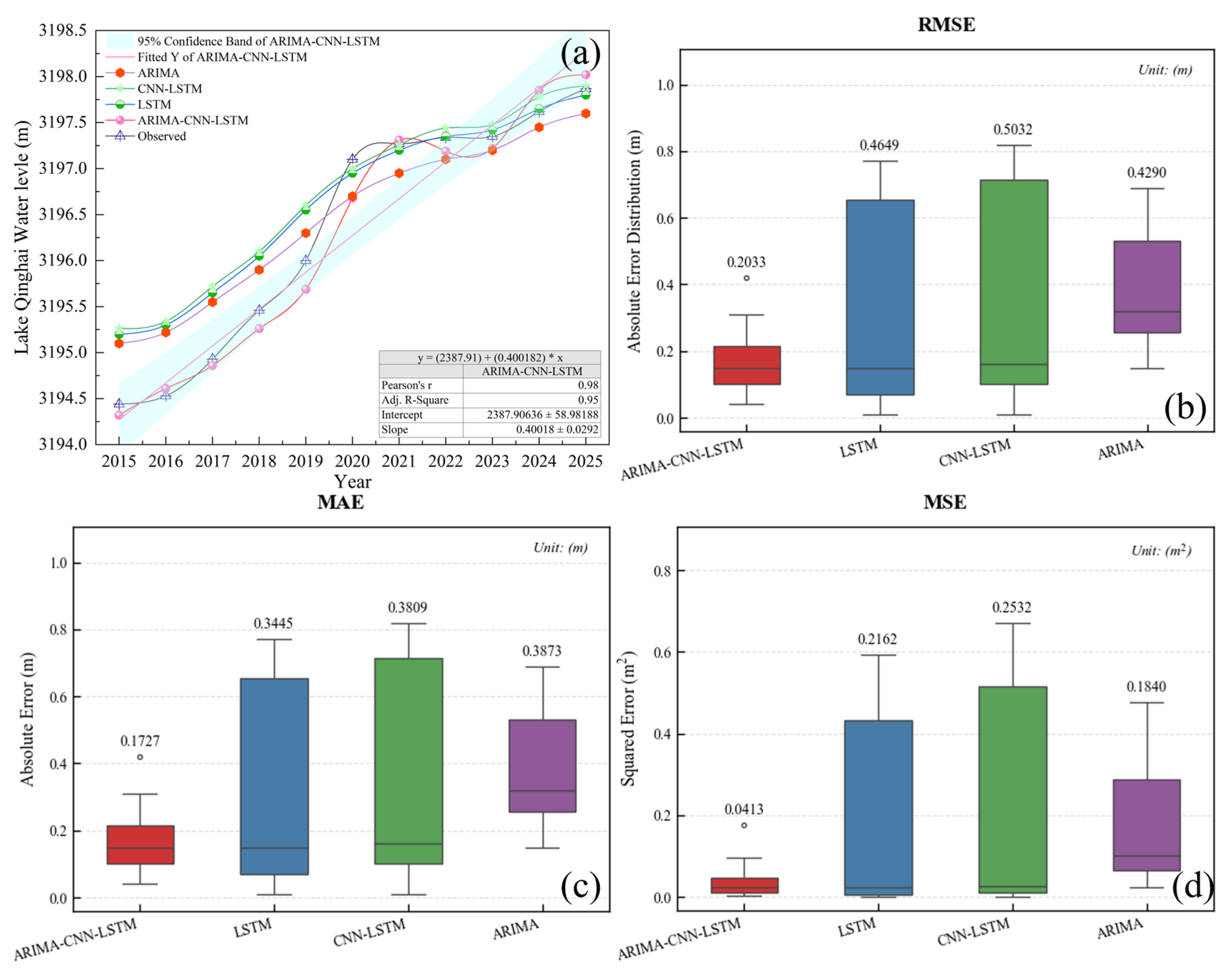
3.2. Model Validation and Comparative Analysis
3.3. Decoupling Analysis of Linear and Nonlinear Components
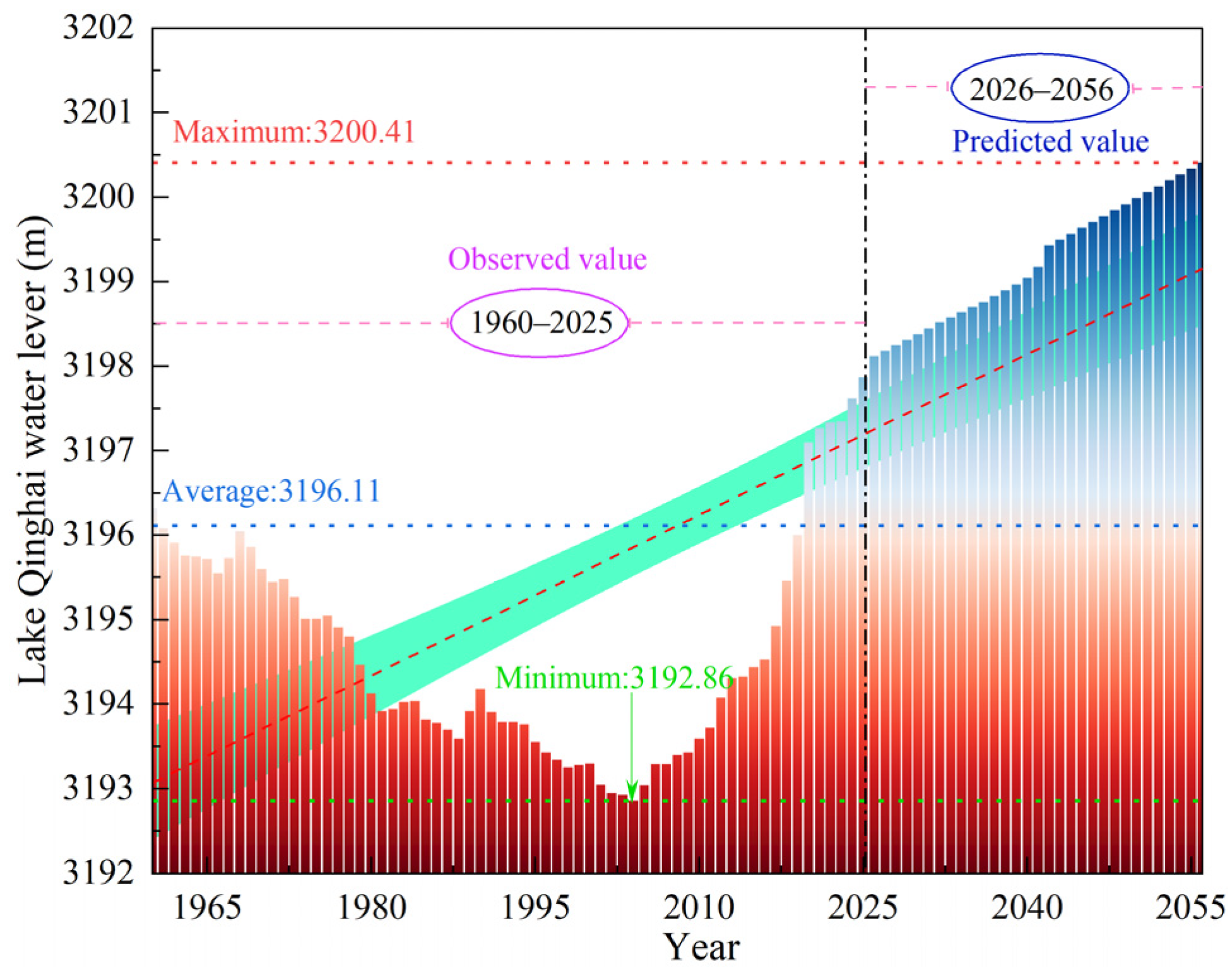
3.4. Future Trend Prediction
3.4.1. Projected Trajectory and Long-Term Magnitude
3.4.2. Deceleration of Rise Rate and Equilibrium Dynamics
3.4.3. Methodological Comparison and Ecological Implications
4. Discussion
4.1. Non-Stationarity, Regime Shifts, and Hydrological Responses
4.2. Mechanistic Advantages of the ARIMA-CNN-LSTM Decomposition Framework
4.3. Long-Term Projections and Scenario Sensitivity
4.4. Implications for Hydrological Modeling and Management
4.5. Limitations
5. Conclusions
Supplementary Materials
Author Contributions
Funding
Institutional Review Board Statement
Informed Consent Statement
Data Availability Statement
Conflicts of Interest
References
- Yao, T.; Bolch, T.; Chen, D.; Gao, J.; Immerzeel, W.; Piao, S.; Su, F.; Thompson, L.; Wada, Y.; Wang, L.; et al. The imbalance of the Asian water tower. Nat. Rev. Earth Environ. 2022, 3, 618–632. [Google Scholar] [CrossRef]
- Immerzeel, W.W.; Lutz, A.F.; Andrade, M.; Bahl, A.; Biemans, H.; Bolch, T.; Hyde, S.; Brumby, S.; Davies, B.J.; Elmore, A.C.; et al. Importance and vulnerability of the world’s water towers. Nature 2020, 577, 364–369. [Google Scholar] [CrossRef]
- You, Q.; Wu, T.; Shen, L.; Pepin, N.; Zhang, L.; Jiang, Z.; Wu, Z.; Kang, S.; AghaKouchak, A. Review of snow cover variation over the Tibetan Plateau and its influence on the broad climate system. Earth Sci. Rev. 2020, 201, 103043. [Google Scholar] [CrossRef]
- Henderson, A.C.; Holmes, J.A.; Leng, M.J. Late Holocene isotope hydrology of Lake Qinghai, NE Tibetan Plateau: Effective moisture variability and atmospheric circulation changes. Quat. Sci. Rev. 2010, 29, 2215–2223. [Google Scholar] [CrossRef]
- Fan, C.; Song, C.; Li, W.; Liu, K.; Cheng, J.; Fu, C.; Chen, T.; Ke, L.; Wang, J. What drives the rapid water-level recovery of the largest lake (Qinghai Lake) of China over the past half century? J. Hydrol. 2021, 593, 125921. [Google Scholar] [CrossRef]
- Hou, P.; Qiu, S.; Wang, J.; Zhang, H.; Du, J. Long-term water level variations in Lake Qinghai and their climatic and human activities driving mechanisms. J. Hydrol. Reg. Stud. 2025, 61, 102755. [Google Scholar] [CrossRef]
- Li, Z.; Zhang, Z.; Zhang, W.; Li, Y. Modeling the lake water balance of a closed alpine basin using a fully distributed hydrological framework: A case study of Qinghai Lake, China. J. Hydrol. 2025, 666, 134824. [Google Scholar] [CrossRef]
- Wang, H.; Liu, J.; Luo, Z.; Nazli, S.; Shi, L. Hydrologic response and prediction of future water level changes in Qinghai Lake of Tibet Plateau, China. J. Hydrol. Reg. Stud. 2025, 57, 102168. [Google Scholar] [CrossRef]
- Hou, P.; Du, J.; Wang, J.; Qiu, S.; Yin, S.; Ma, Y.; Wang, Z.; Jia, X.; Zhang, H. Climate–driven attribution of the water level reversal in Lake Qinghai: Non–linear thresholds revealed by interpretable machine learning. J. Hydrol. Reg. Stud. 2026, 64, 103244. [Google Scholar] [CrossRef]
- Zhang, G.; Yao, T.; Xie, H.; Yang, K.; Zhu, L.; Shum, C.K.; Bolch, T.; Yi, S.; Allen, S.; Jiang, L.; et al. Response of Tibetan Plateau lakes to climate change: Trends, patterns, and mechanisms. Earth Sci. Rev. 2020, 208, 103269. [Google Scholar] [CrossRef]
- Shen, Q.; Chen, Q.; Liu, X. Spatial analysis of interannual changes in thermokarst lakes across the Qinghai-Tibet Plateau with Time-Series SAR imagery. J. Hydrol. 2025, 659, 133269. [Google Scholar] [CrossRef]
- Ling, X.; Tang, Z.; Gao, J.; Li, C.; Liu, W. Changes in Qinghai Lake area and their interactions with climatic Factors. Remote Sens. 2023, 16, 129. [Google Scholar] [CrossRef]
- Hauer, M.E.; Fussell, E.; Mueller, V.; Burkett, M.; Call, M.; Abel, K.; McLeman, R.; Wrathall, D. Sea-level rise and human migration. Nat. Rev. Earth Environ. 2020, 1, 28–39. [Google Scholar] [CrossRef]
- Luo, J.; Zhu, D.; Li, D. Classification-enhanced LSTM model for predicting river water levels. J. Hydrol. 2025, 650, 132535. [Google Scholar] [CrossRef]
- Hall, D.K.; O’Leary, D.S., III; DiGirolamo, N.E.; Miller, W.; Kang, D.H. The role of declining snow cover in the desiccation of the Great Salt Lake, Utah, using MODIS data. Remote Sens. Environ. 2021, 252, 112106. [Google Scholar] [CrossRef]
- Grineski, S.E.; Mallia, D.V.; Collins, T.W.; Araos, M.; Lin, J.C.; Anderegg, W.R.; Perry, K. Harmful dust from drying lakes: Preserving Great Salt Lake (USA) water levels decreases ambient dust and racial disparities in population exposure. One Earth 2024, 7, 1056–1067. [Google Scholar] [CrossRef]
- Wang, X.; Chen, Y.; Li, Z.; Fang, G.; Wang, F.; Liu, H. The impact of climate change and human activities on the Aral Sea Basin over the past 50 years. Atmos. Res. 2020, 245, 105125. [Google Scholar] [CrossRef]
- Lemoalle, J.; Bader, J.C.; Leblanc, M.; Sedick, A. Recent changes in Lake Chad: Observations, simulations and management options (1973–2011). Glob. Planet. Change 2012, 80, 247–254. [Google Scholar] [CrossRef]
- Slater, L.J.; Arnal, L.; Boucher, M.A.; Chang, A.Y.Y.; Moulds, S.; Murphy, C.; Nearing, G.; Shalev, G.; Shen, C.; Speight, L.; et al. Hybrid forecasting: Blending climate predictions with AI models. Hydrol. Earth Syst. Sci. 2023, 27, 1865–1889. [Google Scholar] [CrossRef]
- Das, M.; Ghosh, S.K.; Chowdary, V.M.; Saikrishnaveni, A.; Sharma, R.K. A probabilistic nonlinear model for forecasting daily water level in reservoir. Water Resour. Manag. 2016, 30, 3107–3122. [Google Scholar] [CrossRef]
- Lin, Y.; Wang, D.; Wang, G.; Qiu, J.; Long, K.; Du, Y.; Xie, H.; Wei, Z.; Shangguan, W.; Dai, Y. A hybrid deep learning algorithm and its application to streamflow prediction. J. Hydrol. 2021, 601, 126636. [Google Scholar] [CrossRef]
- Barzegar, R.; Aalami, M.T.; Adamowski, J. Coupling a hybrid CNN-LSTM deep learning model with a boundary corrected maximal overlap discrete wavelet transform for multiscale lake water level forecasting. J. Hydrol. 2021, 598, 126196. [Google Scholar] [CrossRef]
- Zhao, G.; Pang, B.; Xu, Z.; Xu, L. A hybrid machine learning framework for real-time water level prediction in high sediment load reaches. J. Hydrol. 2020, 581, 124422. [Google Scholar] [CrossRef]
- Liu, H.; Tian, H.Q.; Li, Y.F. Comparison of two new ARIMA-ANN and ARIMA-Kalman hybrid methods for wind speed prediction. Appl. Energy 2012, 98, 415–424. [Google Scholar] [CrossRef]
- Wang, Y.; Goodall, J.L.; Kumar, C.; McSpadden, D.; Barbosa, S.A.; Roy, B.; Shahabi, A.; Tahvildari, N. A hybrid CNN-LSTM surrogate model for hyper-resolution spatiotemporal flood forecasting in Norfolk, Virginia. J. Hydrol. Reg. Stud. 2026, 64, 103234. [Google Scholar] [CrossRef]
- Dehghani, A.; Moazam, H.M.Z.H.; Mortazavizadeh, F.; Ranjbar, V.; Mirzaei, M.; Mortezavi, S.; Ng, J.L.; Dehghani, A. Comparative evaluation of LSTM, CNN, and ConvLSTM for hourly short-term streamflow forecasting using deep learning approaches. Ecol. Inform. 2023, 75, 102119. [Google Scholar] [CrossRef]
- Kim, T.Y.; Cho, S.B. Predicting residential energy consumption using CNN-LSTM neural networks. Energy 2019, 182, 72–81. [Google Scholar] [CrossRef]
- Liu, W.; Li, X.; An, Z.; Xu, L.; Zhang, Q. Total organic carbon isotopes: A novel proxy of lake level from Lake Qinghai in the Qinghai–Tibet Plateau, China. Chem. Geol. 2013, 347, 153–160. [Google Scholar] [CrossRef]
- Wan, W.; Xiao, P.; Feng, X.; Li, H.; Ma, R.; Duan, H.; Zhao, L. Monitoring lake changes of Qinghai-Tibetan Plateau over the past 30 years using satellite remote sensing data. Chin. Sci. Bull. 2014, 59, 1021–1035. [Google Scholar] [CrossRef]
- Ji, J.; Shen, J.; Balsam, W.; Chen, J.; Liu, L.; Liu, X. Asian monsoon oscillations in the northeastern Qinghai–Tibet Plateau since the late glacial as interpreted from visible reflectance of Qinghai Lake sediments. Earth Planet. Sci. Lett. 2005, 233, 61–70. [Google Scholar] [CrossRef]
- Fu, C.; Wu, H.; Zhu, Z.; Song, C.; Xue, B.; Wu, H.; Ji, Z.; Dong, L. Exploring the potential factors on the striking water level variation of the two largest semi-arid-region lakes in northeastern Asia. Catena 2021, 198, 105037. [Google Scholar] [CrossRef]
- Zhang, G.; Xie, H.; Yao, T.; Li, H.; Duan, S. Quantitative water resources assessment of Qinghai Lake basin using Snowmelt Runoff Model (SRM). J. Hydrol. 2014, 519, 976–987. [Google Scholar] [CrossRef]
- Hou, P.; Weidman, R.P.; Liu, Q.; Li, H.; Duan, L.; Zhang, X.; Liu, F.; Gao, Y.; Xu, J.; Li, H.; et al. Recent water-level fluctuations, future trends and their eco-environmental impacts on Lake Qinghai. J. Environ. Manag. 2023, 333, 117461. [Google Scholar] [CrossRef]
- Dong, B.; Sutton, R.T.; Chen, W.; Liu, X.; Lu, R.; Sun, Y. Abrupt summer warming and changes in temperature extremes over Northeast Asia since the mid-1990s: Drivers and physical processes. Adv. Atmos. Sci. 2016, 33, 1005–1023. [Google Scholar] [CrossRef]
- Chang, B.; He, K.N.; Li, R.J.; Sheng, Z.P.; Wang, H. Linkage of climatic factors and human activities with water level fluctuations in Qinghai Lake in the northeastern Tibetan Plateau, China. Water 2017, 9, 552. [Google Scholar] [CrossRef]
- Kuang, X.; Jiao, J.J. Review on climate change on the Tibetan Plateau during the last half century. J. Geophys. Res. Atmos. 2016, 121, 3979–4007. [Google Scholar] [CrossRef]
- Slater, L.J.; Anderson, B.; Buechel, M.; Dadson, S.; Han, S.; Harrigan, S.; Kelder, T.; Kowal, K.; Lees, T.; Matthews, T.; et al. Nonstationary weather and water extremes: A review of methods for their detection, attribution, and management. Hydrol. Earth Syst. Sci. 2021, 25, 3897–3935. [Google Scholar] [CrossRef]
- Quilty, J.; Adamowski, J.; Khalil, B.; Rathinasamy, M. Bootstrap rank-ordered conditional mutual information (broCMI): A nonlinear input variable selection method for water resources modeling. Water Resour. Res. 2016, 52, 2299–2326. [Google Scholar] [CrossRef]
- Xie, T.; Zhang, G.; Hou, J.; Xie, J.; Lv, M.; Liu, F. Hybrid forecasting model for non-stationary daily runoff series: A case study in the Han River Basin, China. J. Hydrol. 2019, 577, 123915. [Google Scholar] [CrossRef]
- Khorram, S.; Jehbez, N. A hybrid CNN-LSTM approach for monthly reservoir inflow forecasting. Water Resour. Manag. 2023, 37, 4097–4121. [Google Scholar] [CrossRef]
- Zhang, D.; Lin, J.; Peng, Q.; Wang, D.; Yang, T.; Sorooshian, S.; Liu, X.; Zhuang, J. Modeling and simulating of reservoir operation using the artificial neural network, support vector regression, deep learning algorithm. J. Hydrol. 2018, 565, 720–736. [Google Scholar] [CrossRef]
- Nearing, G.S.; Kratzert, F.; Sampson, A.K.; Pelissier, C.S.; Klotz, D.; Frame, J.M.; Prieto, C.; Gupta, H.V. What role does hydrological science play in the age of machine learning? Water Resour. Res. 2021, 57, e2020WR028091. [Google Scholar] [CrossRef]
- Shen, C. A transdisciplinary review of deep learning research and its relevance for water resources scientists. Water Resour. Res. 2018, 54, 8558–8593. [Google Scholar] [CrossRef]
- Kratzert, F.; Klotz, D.; Herrnegger, M.; Sampson, A.K.; Hochreiter, S.; Nearing, G.S. Toward improved predictions in ungauged basins: Exploiting the power of machine learning. Water Resour. Res. 2019, 55, 11344–11354. [Google Scholar] [CrossRef]
- Frame, J.M.; Kratzert, F.; Raney, A.; Rahman, M.; Salas, F.R.; Nearing, G.S. Post-processing the national water model with long short-term memory networks for streamflow predictions and model diagnostics. JAWRA J. Am. Water Resour. Assoc. 2021, 57, 885–905. [Google Scholar] [CrossRef]
- Marques, C.A.F.; Ferreira, J.A.; Rocha, A.; Castanheira, J.M.; Melo-Gonçalves, P.; Vaz, N.; Dias, J.M. Singular spectrum analysis and forecasting of hydrological time series. Phys. Chem. Earth Parts A/B/C 2006, 31, 1172–1179. [Google Scholar] [CrossRef]
- McVicar, T.R.; Roderick, M.L.; Donohue, R.J.; Li, L.T.; Van Niel, T.G.; Thomas, A.; Grieser, J.; Jhajharia, D.; Himri, Y.; Mahowald, N.M.; et al. Global review and synthesis of trends in observed terrestrial near-surface wind speeds: Implications for evaporation. J. Hydrol. 2012, 416, 182–205. [Google Scholar] [CrossRef]
- Huangfu, K.; Li, J.; Zhang, X.; Zhang, J.; Cui, H.; Sun, Q. Remote estimation of water quality parameters of medium-and small-sized inland rivers using Sentinel-2 imagery. Water 2020, 12, 3124. [Google Scholar] [CrossRef]
- Hrachowitz, M.; Savenije, H.H.G.; Blöschl, G.; McDonnell, J.J.; Sivapalan, M.; Pomeroy, J.W.; Arheimer, B.; Blume, T.; Clark, M.P.; Ehret, U.; et al. A decade of Predictions in Ungauged Basins (PUB)—A review. Hydrol. Sci. J. 2013, 58, 1198–1255. [Google Scholar] [CrossRef]
- Xu, Q.; Shi, Y.; Bamber, J.L.; Tuo, Y.; Ludwig, R.; Zhu, X.X. Physics-aware machine learning revolutionizes scientific paradigm for process-based modeling in hydrology. Earth Sci. Rev. 2025, 271, 105276. [Google Scholar] [CrossRef]



| Period | N | Mean (m) | SD (m) | Min (m) | Max (m) | p-Value | Sen’s Slope (m/a−1) |
|---|---|---|---|---|---|---|---|
| 1960–2025 | 66 | 3194.82 | 1.12 | 3193.51 | 3198.06 | <0.001 | +0.082 |
| 1960–2004 | 45 | 3194.63 | 0.85 | 3193.51 | 3196.32 | <0.01 | −0.062 |
| 2005–2025 | 21 | 3195.06 | 1.48 | 3193.62 | 3198.06 | <0.001 | +0.228 |
| Model | Key Parameters |
|---|---|
| ARIMA | Orders: (p, d, q) = (2, 1, 1); Seasonal component: None; Selection criterion: AIC (stepwise search, pmdarima library); Residual diagnostics: Ljung–Box test (lags 1–10, all p > 0.05), Shapiro–Wilk normality (p > 0.05). |
| Standalone LSTM | Input window: 10-time steps (annual); LSTM units: 50; Activation: tanh; return_sequences: False; Dropout rate: 0.2; Optimizer: Adam (η = 0.001, β1 = 0.9, β2 = 0.999); Batch size: 8; Max epochs: 200; Early stopping: patience = 20 (monitor: validation MSE); Loss function: MSE; Input: z-score normalized water levels. |
| CNN-LSTM | Input: z-score normalized water levels (no ARIMA decomposition); Architecture: Input [batch, 10, 1] → Conv1D × 2 (64 filters, kernel = 3, ReLU, causal padding) → MaxPool1D (pool size = 2) → Dropout (0.2) → LSTM (50 units, tanh) → Dense (1 unit, linear activation); Optimizer, batch size, max epochs, early stopping: identical to Standalone LSTM. |
| ARIMA-CNN-LSTM | Stage 1: ARIMA (2, 1, 1): applied to the z-score normalized series; Stage 2: CNN-LSTM: same architecture as the CNN-LSTM row, applied to the re-normalized residuals. Final prediction: combined output from both stages. |
| Model | Input Target | Main Neural Structure | Regularization Strategy |
|---|---|---|---|
| LSTM | Standardized water level | LSTM + Dense | Dropout, early stopping |
| CNN-LSTM | Standardized water level | Conv1D + LSTM + Dense | Causal convolution, dropout, early stopping |
| ARIMA-CNN-LSTM | ARIMA residuals | Conv1D + LSTM + Dense | ARIMA decomposition, dropout, early stopping |
Disclaimer/Publisher’s Note: The statements, opinions and data contained in all publications are solely those of the individual author(s) and contributor(s) and not of MDPI and/or the editor(s). MDPI and/or the editor(s) disclaim responsibility for any injury to people or property resulting from any ideas, methods, instructions or products referred to in the content. |
© 2026 by the authors. Published by MDPI on behalf of the International Society for Photogrammetry and Remote Sensing. Licensee MDPI, Basel, Switzerland. This article is an open access article distributed under the terms and conditions of the Creative Commons Attribution (CC BY) license.
Share and Cite
Hou, P.; Wang, J.; Qiu, S.; Li, S.; Jia, X.; Li, Y.; He, D.; Ma, Y.; Zhang, D.; Du, J. A Hybrid ARIMA-CNN-LSTM Framework Based on Serial Decomposition for Non-Stationary Water Level Forecasting in Qinghai Lake. ISPRS Int. J. Geo-Inf. 2026, 15, 263. https://doi.org/10.3390/ijgi15060263
Hou P, Wang J, Qiu S, Li S, Jia X, Li Y, He D, Ma Y, Zhang D, Du J. A Hybrid ARIMA-CNN-LSTM Framework Based on Serial Decomposition for Non-Stationary Water Level Forecasting in Qinghai Lake. ISPRS International Journal of Geo-Information. 2026; 15(6):263. https://doi.org/10.3390/ijgi15060263
Chicago/Turabian StyleHou, Pengfei, Jingxu Wang, Shike Qiu, Shuangquan Li, Xiang Jia, Yangguang Li, Danni He, Yufeng Ma, Di Zhang, and Jun Du. 2026. "A Hybrid ARIMA-CNN-LSTM Framework Based on Serial Decomposition for Non-Stationary Water Level Forecasting in Qinghai Lake" ISPRS International Journal of Geo-Information 15, no. 6: 263. https://doi.org/10.3390/ijgi15060263
APA StyleHou, P., Wang, J., Qiu, S., Li, S., Jia, X., Li, Y., He, D., Ma, Y., Zhang, D., & Du, J. (2026). A Hybrid ARIMA-CNN-LSTM Framework Based on Serial Decomposition for Non-Stationary Water Level Forecasting in Qinghai Lake. ISPRS International Journal of Geo-Information, 15(6), 263. https://doi.org/10.3390/ijgi15060263