
Article

Capturing Spatial Non-Stationarity in Agricultural Land Sustainability: A Geographically Weighted Logistic Regression Approach

1
Faculty of Earth Science and Technology, Institut Teknologi Bandung, Jl. Ganesha No. 10, Bandung 40132, West Java Province, Indonesia
2
Center for Remote Sensing, Institut Teknologi Bandung, Jl. Ganesha No. 10, Bandung 40132, West Java Province, Indonesia
3
Research Center for Geoinformatics, National Research and Innovation Agency, Jl. Raya Jakarta Bogor Km 47, Nanggewer, Mekar, Cibinong, Bogor 16912, West Java Province, Indonesia
*
Author to whom correspondence should be addressed.
ISPRS Int. J. Geo-Inf. 2026, 15(6), 253; https://doi.org/10.3390/ijgi15060253
Submission received: 9 April 2026 / Revised: 26 May 2026 / Accepted: 29 May 2026 / Published: 5 June 2026

Abstract

Paddy field sustainability is essential for food security in paddy-dependent countries but is shaped by complex and spatially heterogeneous interactions among environmental, social, and economic factors. Conventional land-use models often assume spatial stationarity, limiting their ability to capture localized dynamics. This study proposes a spatially explicit analytical framework by integrating Geographically Weighted Logistic Regression (GWLR) with multi-layer probabilistic surface analysis to model and classify paddy field sustainability. The framework is applied in Indramayu and Majalengka Regencies, Indonesia, using 400 stratified samples (53% paddy, 47% non-paddy) and 10,000 prediction points. Results show that GWLR outperforms global models, explaining 25.5% of deviance compared to 7.4% for logistic regression. More importantly, it reveals spatially non-stationary relationships: environmental variables exhibit relatively continuous effects, while social and economic variables show strong local heterogeneity. By transforming local coefficients into integrated probability surfaces, this study introduces a novel typology distinguishing stable paddy fields, vulnerable areas, and spatially differentiated sustainability conditions. This approach moves beyond aggregate accuracy metrics and highlights the importance of spatial context in land-use analysis. The proposed framework offers a transferable method to support place-based agricultural protection strategies in complex geographical systems.

1. Introduction

Food security remains a critical challenge for many countries that rely heavily on a single staple crop, particularly in regions experiencing rapid land-use change. This issue has become more urgent as agricultural landscapes face increasing competition from urbanization, industrial development, and demographic pressure [1]. In paddy-dependent countries such as Indonesia, the sustainability of paddy fields plays a decisive role in maintaining food availability, socio-economic stability, and regional development trajectories, consistent with broader evidence linking agricultural land protection to national food security [2]. However, the spatial distribution of paddy fields and their long-term persistence are increasingly shaped by uneven development pressures, especially in densely populated regions where agricultural land competes with urban expansion and infrastructure development.
Previous studies on paddy field sustainability have largely focused on biophysical suitability, emphasizing environmental factors such as soil characteristics, water availability, and topography [3]. These approaches have provided important insights into land capability but often overlook the socio-economic forces that drive land conversion even in physically suitable areas. Empirical evidence suggests that paddy fields with favorable environmental conditions are frequently converted due to population pressure, accessibility to infrastructure, and increasing land values near urban and industrial centers [4]. This indicates that paddy field sustainability emerges from the interaction between environmental suitability and socio-economic dynamics rather than from biophysical conditions alone.
Despite growing recognition of these interactions, most existing studies still rely on global modeling approaches that assume spatially stationary relationships between explanatory factors and land-use outcomes. Such assumptions are problematic in heterogeneous geographic systems, where the influence of environmental, social, and economic factors varies significantly across space [5,6]. Global models tend to obscure local variations, limiting their usefulness for spatially targeted land protection policies. The limitations of global logistic regression in representing spatial complexity have been widely noted in land-use and ecological modeling literature [7,8].
Recent advances in spatial analysis provide opportunities to address this limitation through local modeling approaches that explicitly account for spatial non-stationarity. Geographically Weighted Regression (GWR) and its extension, Geographically Weighted Logistic Regression (GWLR), enable location-specific parameter estimation, allowing researchers to explore how the strength and direction of relationships vary across space [9,10]. GWLR is particularly suitable for modeling binary land-use outcomes, such as the presence or absence of paddy fields, while capturing local variations in driving factors. Recent methodological developments—including multiscale GWR and enhanced kernel optimization—further strengthen the capability of local modeling frameworks to capture complex land-use processes [6]. Despite these advances, several limitations remain in the existing literature on paddy field sustainability and spatial land-use modelling. First, many studies continue to rely on global models that assume spatial stationarity, potentially obscuring localized relationships between land-use drivers and paddy field persistence. Second, previous studies often examine environmental, social, and economic factors separately rather than within an integrated spatial framework. Third, local spatial modelling outputs are rarely translated into operational sustainability typologies or spatial decision-support frameworks that can directly support geographically differentiated agricultural protection strategies.
Accordingly, the novelty of this study lies not merely in the application of Geographically Weighted Logistic Regression (GWLR), but in the integration of multidimensional environmental, social, and economic variables within a unified local spatial modelling framework, combined with GWLR-derived probability surface analysis and spatial typology classification. Unlike many previous GWLR-based land-use studies that focus primarily on coefficient interpretation or prediction accuracy, this study extends local spatial modelling toward spatially explicit sustainability classification and place-based policy interpretation for paddy field protection and development planning.
In this study, we apply GWLR to model the spatial sustainability of paddy fields by integrating environmental, social, and economic variables within a unified spatial framework. The analysis focuses on Indramayu and Majalengka Regencies in West Java, Indonesia—two strategically important paddy-producing regions that exhibit contrasting physical characteristics and development trajectories, consistent with recent spatial analyses of agricultural transformation in Java [11]. By generating spatially explicit probability surfaces and local coefficient estimates, this study proposes how multidimensional factors interact locally to shape paddy field sustainability. The results provide both methodological insights for spatial land-use modeling and empirical evidence to support geographically differentiated strategies for agricultural land protection, aligning with current policy frameworks emphasizing place-based approaches to food security [12,13].
Therefore, this study aims to:
(1)
evaluate spatial non-stationarity in the relationships between environmental, social, and economic factors and paddy field sustainability;
(2)
compare the interpretative capability of global and local spatial models; and
(3)
develop an integrated spatial typology framework based on GWLR-derived probability surfaces to support geographically differentiated paddy field protection and development strategies.
To address these objectives, the study is guided by the following research questions:
(1)
How do environmental, social, and economic variables spatially influence paddy field sustainability?
(2)
To what extent does GWLR improve the interpretation of spatially heterogeneous land-use processes compared to global models?
(3)
How can local probability structures derived from GWLR be translated into spatially explicit sustainability typologies for agricultural land-use planning?

2. Materials and Methods

2.1. Study Area

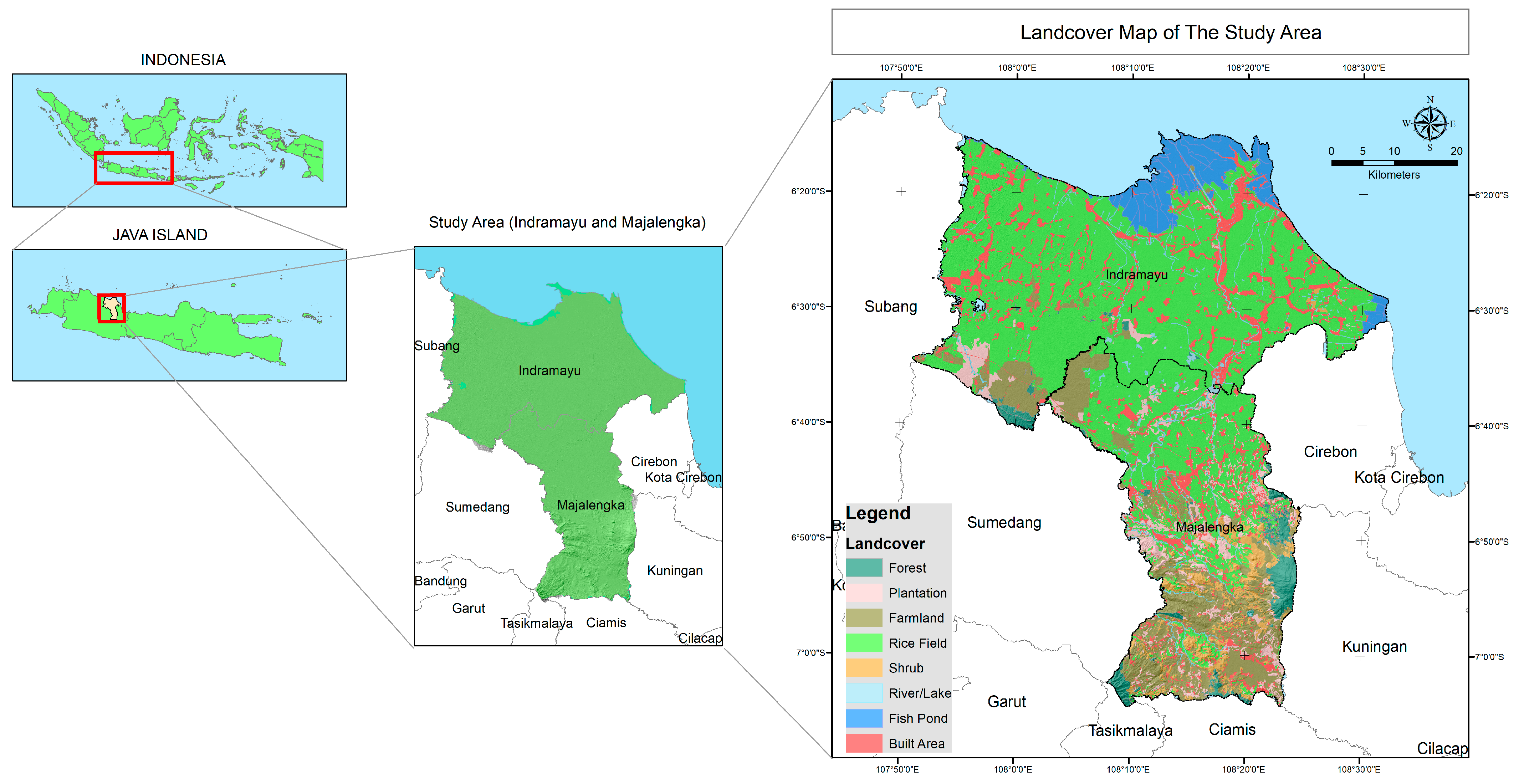
The study was conducted in Indramayu Regency and Majalengka Regency, West Java Province, Indonesia. The spatial extent and geographic context of the study area are presented in Figure 1. These two regions play a strategic role in national paddy production while exhibiting contrasting geographical and development characteristics. Indramayu represents a lowland agricultural landscape dominated by irrigated paddy fields with high production intensity, whereas Majalengka is characterized by more heterogeneous topography and increasing land-use pressure driven by infrastructure development and urban expansion. The total study area covers approximately 338,508 hectares, encompassing geographically heterogeneous landscapes ranging from lowland irrigated paddy fields and coastal aquaculture zones to upland agricultural and peri-urban areas.
The study area exhibits heterogeneous landscape characteristics, including lowland irrigated rice fields in Indramayu, upland agricultural and forested areas in Majalengka, coastal aquaculture zones, and expanding built-up areas. These contrasting land-cover conditions provide an important spatial context for understanding the variability of paddy field sustainability across the region.
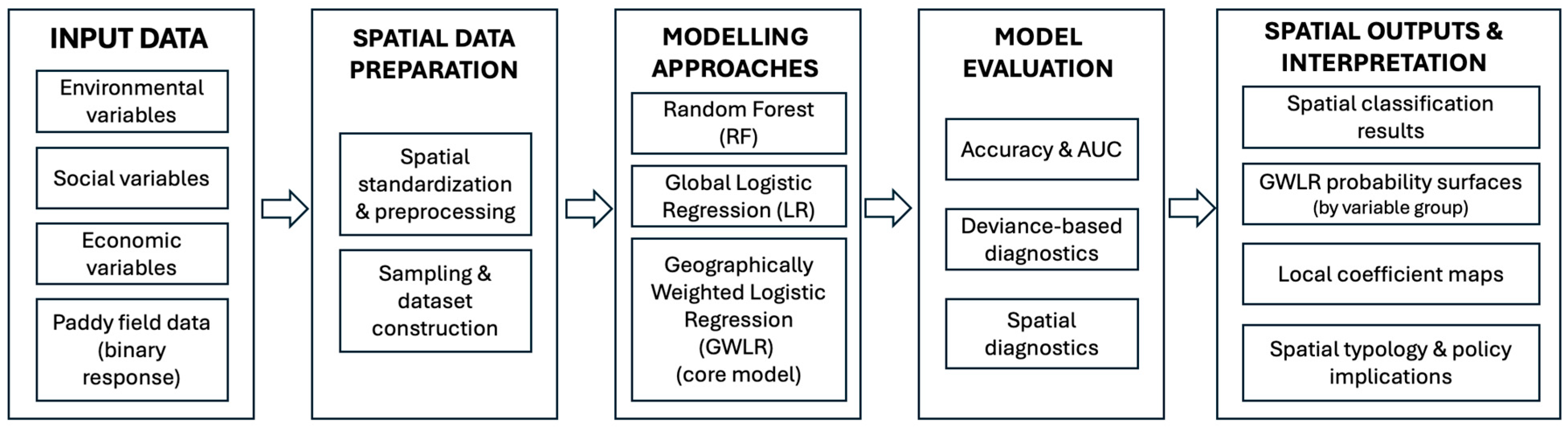
Such spatial contrasts are typical of paddy-producing landscapes undergoing differential development trajectories in Southeast Asia [14,15], making them suitable for examining spatial non-stationarity in the determinants of paddy field sustainability. An overview of the analytical workflow applied in this study, from data preparation through model evaluation and spatial interpretation, is presented in Figure 2.
Based on land use/land cover analysis of the study area, paddy fields constitute approximately 53% of the total landscape, while non-paddy areas (including built-up land, forests, dryland agriculture, and water bodies) comprise the remaining 47%. This composition reflects the agricultural dominance of both regencies while acknowledging ongoing land-use transformation pressures, particularly in peri-urban zones.

2.2. Data Sources and Variables

This study integrates environmental, social, and economic variables to capture the multidimensional drivers of paddy field sustainability. All spatial datasets were obtained from authoritative government sources and processed within a unified spatial framework, following standard GIS data integration practices [16]. A detailed list of all variables, data types, sources, and spatial resolutions is provided in Table 1 to ensure full transparency of the dataset used in this study.
The datasets used in this study were obtained from multiple reference years, including land cover (2018), roads (2018), built-up areas (2018), paddy fields (2019), rainfall (2021), and population data (2023). The primary temporal reference of the study was 2019, particularly for the paddy field dataset used as the main analytical reference.
The selected variables were determined based on their theoretical and empirical relationships with paddy field sustainability, land suitability, agricultural productivity, land conversion pressure, and long-term agricultural persistence. The variables were grouped into environmental, social, and economic dimensions to represent the multidimensional characteristics influencing the sustainability of paddy fields within heterogeneous geographical contexts.
The variables were not assigned subjective weights and were not assumed to have equal influence prior to modelling. Instead, all variables were simultaneously incorporated into the modelling framework, while their relative influence was evaluated statistically through Random Forest variable importance analysis and through the magnitude and spatial variation of coefficients in the Logistic Regression and GWLR models.

2.2.1. Environmental Variables

Environmental variables describe the biophysical suitability of land for paddy cultivation, typically grouped into soil, hydrological, and topographic factors. Soil characteristics such as soil type, texture, depth or permeability, drainage, and pH determine the land’s capacity to support paddy growth and the long-term stability of paddy systems [17]. Hydrological conditions, including rainfall patterns, surface water availability, and proximity to rivers or other water sources, regulate water supply, which is critical for sustaining paddy productivity. Topographic attributes, particularly slope and elevation, influence surface runoff, water accumulation, and erosion risk, thereby shaping the ecological suitability of land for wet paddy cultivation [15].
Taken together, these variables are widely employed in biophysical land suitability and agro-ecological evaluation models for paddy, as they capture both land capability and key ecological constraints that affect the productivity and persistence of paddy fields [18].The inclusion of hydrological and topographic indicators follows established approaches for characterizing environmental suitability in paddy ecosystems [19].
Environmental variables were primarily associated with biophysical suitability and ecological constraints affecting paddy cultivation. Variables such as rainfall, river proximity, Topographic Wetness Index (TWI), soil characteristics, elevation, slope, permeability, and geological formation were included because they influence water availability, soil fertility, infiltration capacity, drainage conditions, erosion potential, and land suitability for rice cultivation.

2.2.2. Social Variables

Social variables capture demographic pressure and socio-economic vulnerability that can accelerate the conversion of paddy fields, even where biophysical conditions remain suitable for paddy cultivation. Indicators such as high population density, a large share of poor or vulnerable households, and low levels of formal education often coincide with stronger incentives to shift land from agriculture to non-agricultural uses [20].
Empirical studies on agricultural land conversion in Java and other Asian paddy-growing regions show that rapid population growth, urban expansion, and limited livelihood options in rural areas increase land values and create pressure on farmers to sell or repurpose their paddy fields. In contexts where many households face economic insecurity and lack access to education or stable off-farm employment, paddy fields become highly vulnerable to conversion for housing, industry, and infrastructure, despite their environmental suitability for continued paddy production [21].
Social variables were selected to represent human capital, demographic pressure, and socio-economic resilience affecting agricultural sustainability and land conversion dynamics. Education level, population density, and welfare conditions were considered important because they influence environmental awareness, land-use pressure, community adaptation capacity, and the long-term persistence of agricultural activities.

2.2.3. Economic Variables

Economic variables describe accessibility and development pressure through distance-based indicators such as distance to roads, distance to built-up areas, and distance to paddy-processing facilities or markets. In the land economics literature, these measures are widely interpreted as proxies for land-value gradients and market accessibility, where locations closer to transport infrastructure and urban centers tend to experience higher land values and stronger incentives for land-use conversion away from agriculture [22].
Empirical studies of land-use and land-cover change show that improved accessibility via road networks and proximity to settlements significantly increases the likelihood that agricultural land, including paddy fields, will be transformed into non-agricultural uses such as housing, industry, and services. In paddy-growing regions, shorter distances to paddy mills and other agro-processing or marketing facilities also reshape farmers’ production and land-use decisions by altering transaction costs and expected returns, thereby reinforcing spatial patterns of land-use change along accessibility gradients [23].
Economic variables were included to represent accessibility, urban expansion pressure, and agricultural economic connectivity. Proximity to roads, built-up areas, and rice milling industries may influence market accessibility, logistics efficiency, development pressure, and the economic viability of maintaining paddy field systems.

2.3. Spatial Data Preparation

All spatial datasets were transformed to a common coordinate reference system and harmonized to a uniform grid resolution to ensure spatial consistency across layers. Vector data were converted to raster format, and continuous surfaces were resampled to match the analytical grid resolution, in line with widely adopted guidelines for preparing multi-source geospatial datasets for spatial analysis and modeling [24].
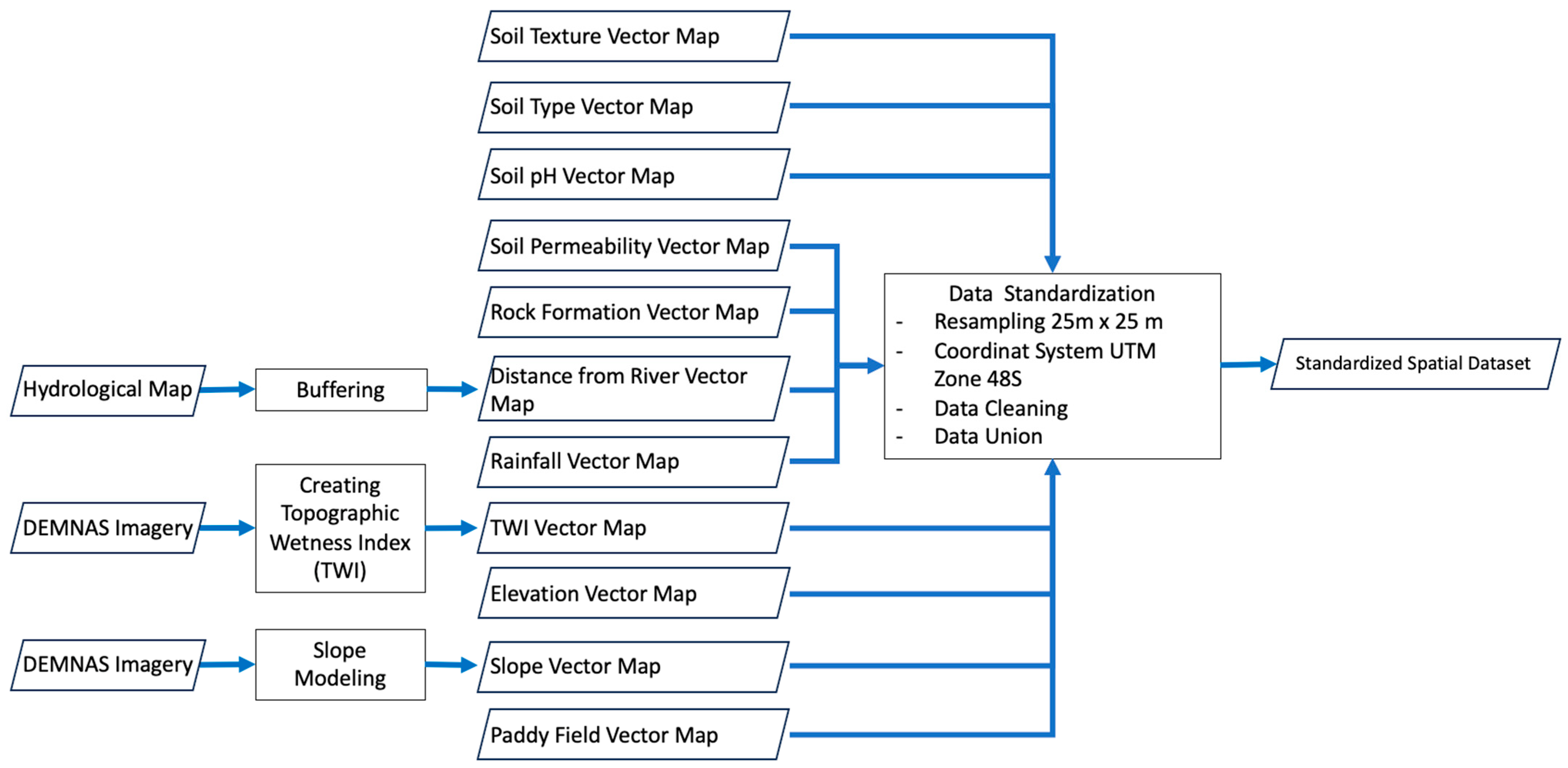
The spatial preprocessing workflow included coordinate system harmonization, data cleaning, raster harmonization, buffering analysis, slope modelling, Topographic Wetness Index (TWI) derivation, distance analysis, and spatial data integration prior to modelling (Figure 3). All environmental spatial layers were standardized into a common analytical grid to ensure spatial consistency among variables used in the GWLR analysis.
The spatial resolution used in this study was 25 m × 25 m. This grid size was selected primarily to maintain consistency with regional spatial planning map standards commonly applied at the regency level (scale 1:50,000). In addition, the selected resolution represented a compromise between preserving sufficient spatial detail and maintaining computational efficiency for local spatial modelling. The selected grid size also helped reduce excessive artificial precision that may arise when integrating datasets originating from multiple spatial resolutions.
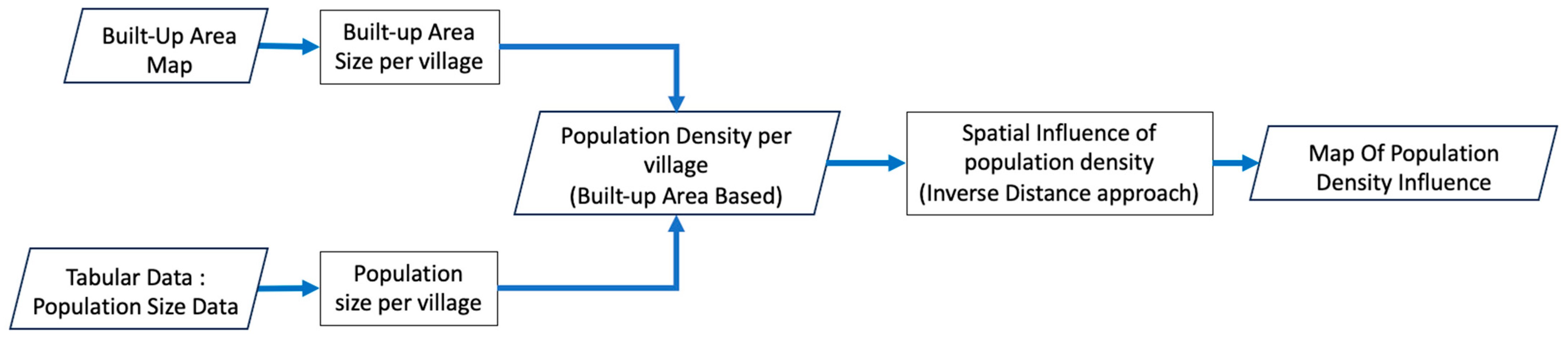
The population density variable was initially derived from village-level tabular population data representing the total population within each administrative village unit. To spatially distribute demographic influence, built-up area maps within each village were used as a proxy for population concentration under the assumption that population distribution is relatively associated with the spatial distribution of built-up areas.
Population density for each village was calculated by dividing the total village population by the total built-up area within the corresponding administrative unit. Subsequently, the spatial influence of population density on surrounding locations was modelled using an inverse-distance approach, where the influence decreases with increasing distance from built-up concentrations (Figure 4).
The resulting influence values were transformed into a continuous spatial influence surface to represent the spatial distribution of population density effects across the study area. A similar spatial transformation approach was also applied to other social variables. In contrast, economic variables were primarily represented through spatial proximity effects rather than density-based influence modelling.
Attribute values were then extracted at the sampling locations, and each variable was normalized to a comparable scale to minimize the influence of differing units and value ranges. Prior to model estimation, multicollinearity among predictor variables was assessed and controlled, following recommendations for regression-based spatial modeling workflows that emphasize the importance of diagnosing inter-variable dependence in geographically weighted or spatial regression frameworks [25].
Spatial data preprocessing, spatial analysis, and map visualization in this study were conducted using ArcGIS software version 10.8. The GWLR analysis was performed using GWR4 software, while Random Forest (RF) and Logistic Regression (LR) analyses were conducted using RapidMiner. No custom programs or scripts were developed in Python for the analyses presented in this study.

2.4. Sampling Design and Data Partitioning

2.4.1. Training and Testing Samples

A stratified random sampling strategy with proportional allocation was implemented to obtain a representative dataset for model calibration and validation. Sample size was determined using the Slovin formula [26]:
n = N/(1 + N × e2)
where n is the required sample size, N is the population size, and e is the margin of error (set at 5%). This calculation yielded an optimal sample size of 400 points. The adequacy of the sample size was also evaluated using the Isaac and Michael sample size reference, which indicates that for very large populations, the required sample size tends to converge at approximately 349 samples at the 5% significance level. Therefore, the use of 400 sample points in this study was considered statistically sufficient for representing the spatial population characteristics of the study area.
The 400 samples were stratified by land use type with proportional allocation reflecting the actual landscape composition in the study area, where paddy fields constitute approximately 53% and non-paddy areas comprise 47% of the total land cover. Sampling locations within each stratum were selected using simple random sampling to ensure spatial representativeness across both Indramayu and Majalengka regencies.
In addition to statistical adequacy, spatial representativeness was considered during the sampling process. Sample points were spatially distributed across diverse landscape characteristics, including irrigated lowland paddy fields, upland heterogeneous areas, coastal aquaculture zones, and peri-urban transition regions. This distribution was intended to support bandwidth optimization and improve the stability of local coefficient estimation in the GWLR analysis.
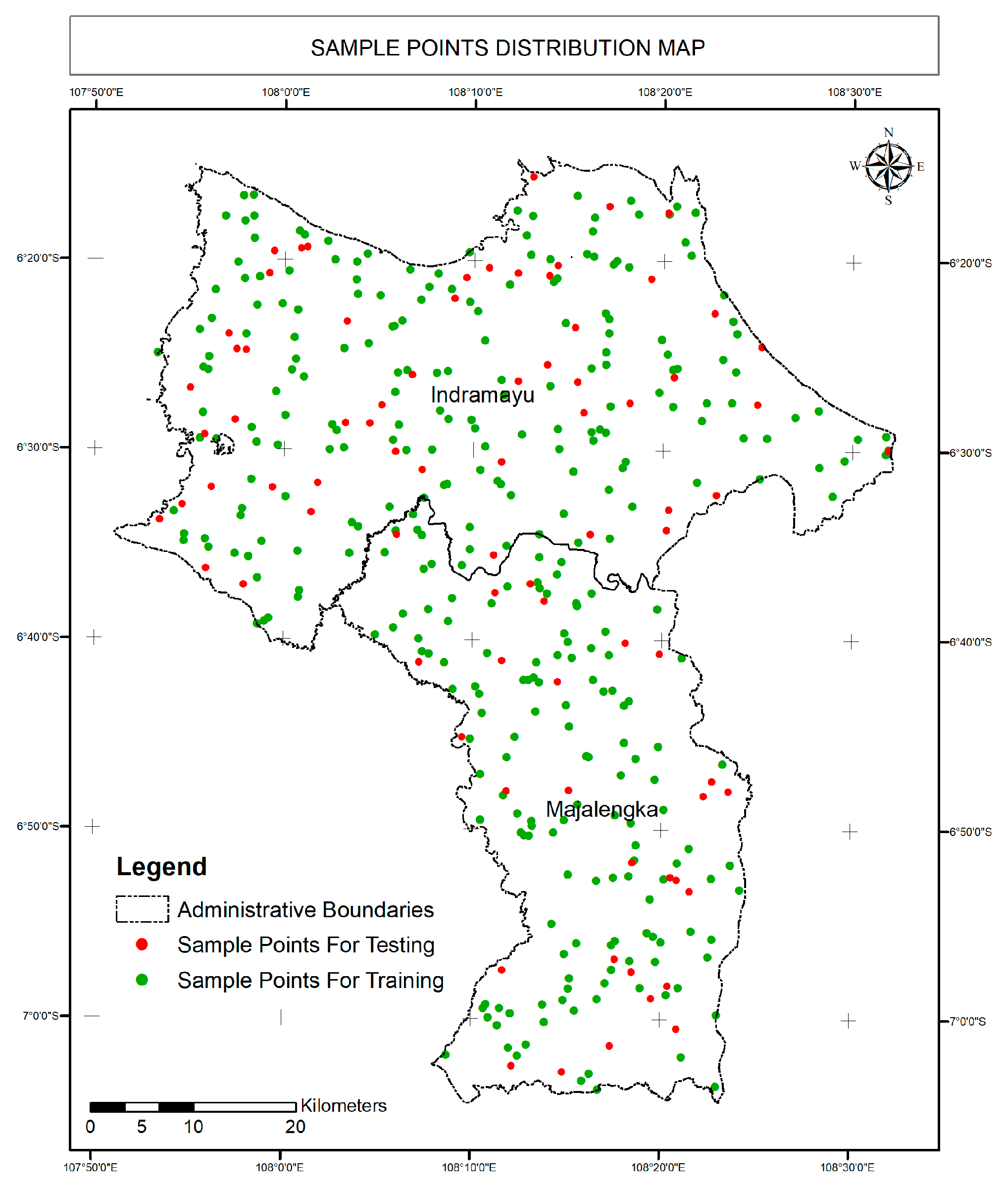
Figure 5 shows the spatial distribution of the training and testing samples that demonstrates broad spatial coverage across Indramayu and Majalengka Regencies, including irrigated lowland paddy areas, heterogeneous upland landscapes, coastal zones, and peri-urban transition regions. This spatial distribution was intended to improve the representativeness of heterogeneous landscape conditions and support the stability of local coefficient estimation in the GWLR modelling process.
The sampled observations were subsequently partitioned into training (80%, n = 320) and testing (20%, n = 80) subsets using stratified random split. The training set comprised 163 paddy field locations (50.9%) and 157 non-paddy locations (49.1%), while the testing set consisted of 50 paddy field points (62.5%) and 30 non-paddy points (37.5%). Both subsets maintained proportional representation approximating the 53:47 landscape composition, ensuring that model calibration and validation reflect actual land use patterns in the study area.

2.4.2. Spatial Prediction Grid

For generating spatially continuous probability surfaces and comprehensive spatial classifications, a systematic grid of 10,000 prediction points was created across the entire study area. These prediction points were distributed at approximately 295 m spacing to ensure adequate spatial coverage and resolution for probability mapping and typology classification.
Unlike the training and testing samples, the prediction grid was not used in model estimation or accuracy assessment. Instead, it served as the spatial framework for applying calibrated models to generate wall-to-wall predictions across the landscape, enabling the derivation of spatially explicit outputs that support place-based land-use planning and agricultural protection strategies.
The 400 sample points were used specifically for model calibration and validation, whereas the 10,000 systematically distributed prediction points were used exclusively for generating continuous spatial probability surfaces and spatial typology outputs across the study area.
This dual-component sampling design—combining stratified random samples with proportional allocation for model development and systematic prediction points for spatial inference—enhances both statistical robustness and spatial generalization, aligning with current recommendations for spatial predictive modeling workflows that emphasize representative sampling, explicit validation, and spatially explicit probability mapping [27].

2.5. Modelling Framework

To assess the spatially varying effects of environmental, social, and economic factors on paddy field sustainability, three modeling approaches were applied: global Logistic Regression, Random Forest, and Geographically Weighted Logistic Regression (GWLR). Logistic Regression and Random Forest provide global estimates of factor importance and prediction accuracy, whereas GWLR extends logistic regression by allowing regression coefficients to vary across space, thereby capturing localized relationships between predictors and paddy field outcomes [28]. The use of multiple modeling approaches for spatial prediction is consistent with previous studies that have demonstrated improved representation of land-use dynamics through the integration and comparison of different modeling techniques [29]. A concise overview of the characteristics, assumptions, and analytical roles of the three models is presented in Table 2 to clarify their comparative functions in this study.
This comparative modeling framework is in line with recent work that contrasts global statistical and machine learning models with spatially explicit or locally weighted approaches to evaluate whether accounting for spatial heterogeneity improves model performance and interpretability. Studies comparing global and local models have shown that geographically weighted and other spatially aware techniques can yield higher predictive accuracy and richer insights into spatially varying drivers than purely global implementations of regression or Random Forest, supporting their use in spatial predictive modeling of land-use processes [30].

2.5.1. Global Logistic Regression

Global logistic regression was implemented as a baseline model to estimate average relationships between the predictor variables and the binary paddy field indicator, implicitly assuming spatial stationarity in the effects of the covariates. Under this assumption, a single set of coefficients summarizes the association between environmental and socio-economic predictors and the probability of paddy field occurrence across the entire study area, providing a useful reference for evaluating the added value of spatially explicit or locally varying modeling approaches [31].
Logistic regression remains one of the most widely applied techniques for modeling binary land-use outcomes because of its clear probabilistic interpretation, the straightforward estimation of odds ratios, and the availability of well-established procedures for model diagnostics and inference. These properties make it a statistically robust and transparent benchmark against which more complex spatial or machine learning models can be compared in land-use and land-cover change studies [32].

2.5.2. Random Forest Model

Random Forest was implemented as a non-parametric benchmark model capable of capturing non-linear relationships and complex interactions among predictor variables in the paddy field dataset. Previous studies have shown that variable importance measures derived from the Random Forest model can be used to assess and compare the relative contribution of environmental, social, and economic predictors to paddy field sustainability [33].
Random Forest has become a standard tool in agricultural and land-use modeling because it delivers high predictive accuracy, handles high-dimensional and noisy data, and provides robust classifications without strong distributional assumptions. These characteristics, originally highlighted in the seminal formulation of the algorithm and reinforced by its widespread application in agricultural and land-use/land-cover studies, justify its use as a strong benchmark alongside more traditional statistical models [34].

2.5.3. Geographically Weighted Logistic Regression (GWLR)

Geographically Weighted Logistic Regression (GWLR) formed the core analytical framework of this study, enabling the modeling of spatially varying relationships between paddy field presence and its environmental, social, and economic determinants. In contrast to global regression models that impose a single set of coefficients for the entire study area, GWLR calibrates a separate local logistic model at each observation location, allowing regression parameters to vary smoothly over space. By adopting GWLR alongside global models, this study aligns with a growing body of research that uses geographically weighted approaches to reveal localized effects that would be obscured under the assumption of spatial stationarity [35].
Local parameter estimates were obtained using a spatial kernel weighting scheme, in which nearby observations exert greater influence on the local regression fit than distant ones, with the kernel bandwidth optimized to balance bias and variance. This framework has been widely recommended for detecting and visualizing spatial non-stationarity in regression relationships, and has been successfully applied in diverse socio-environmental settings, including poverty mapping, health outcomes, and environmental risk assessment [36].
Local coefficients from the GWLR model provide location-specific estimates of how the sign and strength of each predictor’s effect on paddy field presence vary across geographic space. Mapping these coefficients reveals zones where environmental, social, or economic variables exert stronger positive or negative influences, thereby making spatial heterogeneity in driving factors explicit rather than assumed uniform [37].
Recent applications of GWR-type models in land-use analysis similarly interpret spatially varying coefficients to understand how the determinants of land-use change differ across regions, and show that local parameter estimates offer richer insight than global models into place-specific land-use dynamics. These studies demonstrate that geographically weighted approaches can uncover spatial patterns in coefficient magnitude and direction that are crucial for targeted land-use planning and policy design [38].

2.6. Model Evaluation and Validation

Model performance was evaluated using standard classification metrics, with primary emphasis on overall accuracy as a key indicator of model effectiveness in classifying observations. Overall accuracy provides an intuitive measure of the proportion of correctly classified observations across the dataset, reflecting the model’s general predictive capability [39].
Comparative analysis of global versus local models was conducted to assess whether accounting for spatial non-stationarity leads to improvements in predictive performance and explanatory power, following established practices in spatial regression and geographically weighted modeling. In line with recent spatial predictive modeling studies, this comparison focuses on whether local, spatially explicit models can outperform global specifications in both accuracy metrics and the ability to reveal spatially varying relationships relevant for land-use planning [40].

2.7. Spatial Outputs and Interpretation

The final outputs of the analysis included spatially explicit probability surfaces representing the predicted likelihood of paddy field sustainability across the landscape, together with maps of local GWLR coefficients and a derived spatial typology of paddy field priority classes. These products make it possible to visualize how the strength and direction of environmental, social, and economic drivers vary spatially, and to delineate zones where different combinations of suitability, social pressure, and economic accessibility create distinct vulnerability or priority patterns [41].
Such spatially explicit outputs are consistent with land-use and agricultural planning literature that advocates place-based approaches to sustainability, in which policies and protection strategies are geographically differentiated according to local biophysical conditions and socio-economic contexts. By integrating probability mapping, local coefficient surfaces, and a priority typology, the framework supports the design of targeted land-protection and management interventions tailored to specific areas rather than applying uniform measures across the entire region [42].

3. Results

3.1. Model Performance Comparison

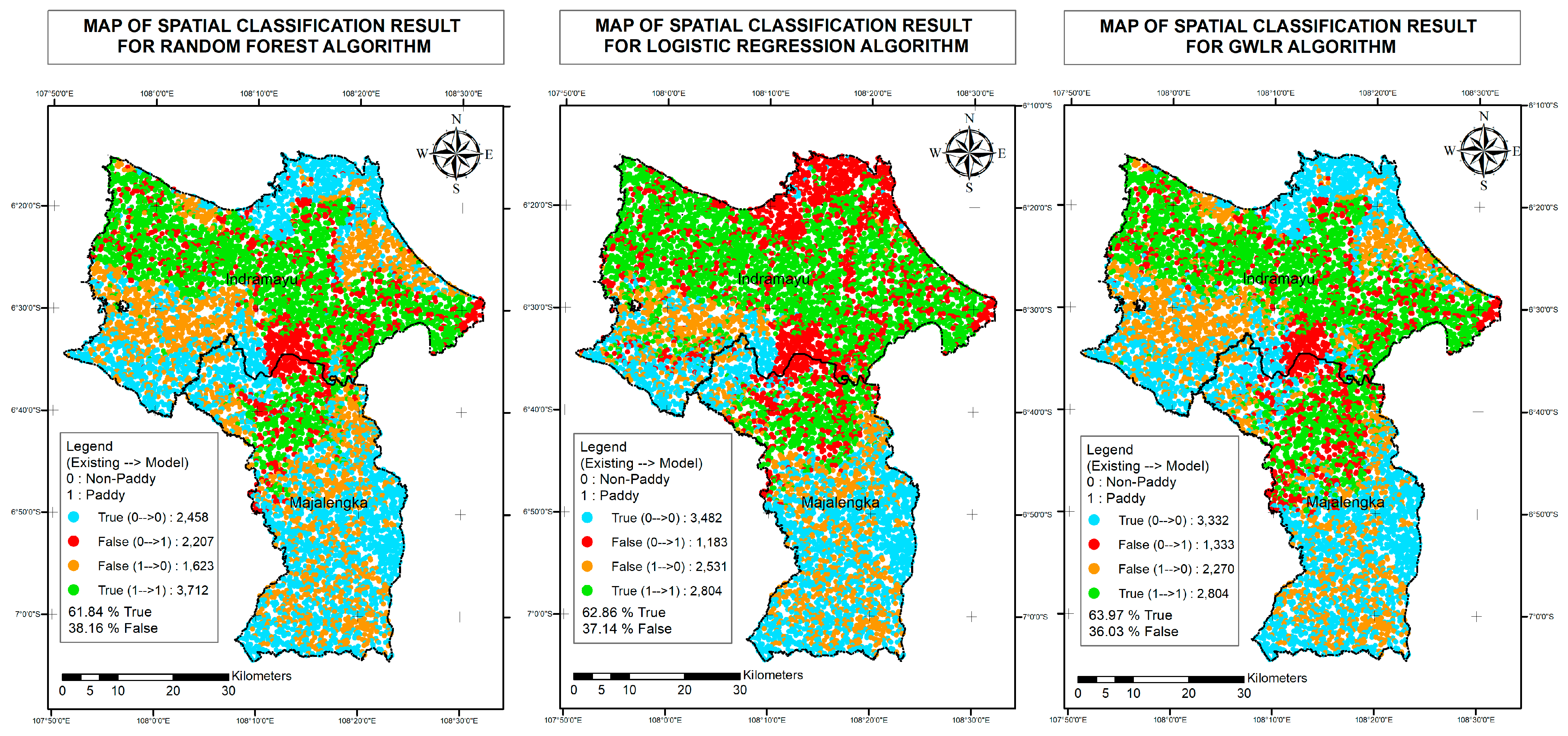
The performance of Random Forest (RF), global Logistic Regression (LR), and Geographically Weighted Logistic Regression (GWLR) was evaluated using standard classification metrics and spatial diagnostics. The RF model achieved training, testing, and prediction accuracies of 71.50%, 62.50%, and 61.84%, respectively, while the global LR model produced accuracies of 62.50%, 63.75%, and 62.86%. These performance differences are consistent with the strengths of non-parametric ensemble methods in capturing non-linearities and variable interactions, while logistic regression provides stable global estimates under linearity assumptions [43]. A complete summary of these performance metrics, including accuracy values and spatial diagnostic indicators for all three models, is presented in Table 3. RF and LR are compared using classical accuracy metrics. LR and GWLR are compared using spatial model diagnostics (AIC, deviance explained) and interpretability. GWLR is not intended to maximize classification accuracy but to reveal spatially varying relationships that global models cannot capture.

3.2. Spatial Classification Patterns

Spatial comparison of classification maps shows distinct error behaviors among the three models. The spatial distribution of correctly and incorrectly classified locations for each model is shown in Figure 6. RF tends to over-predict paddy fields in coastal aquaculture zones, likely due to its sensitivity to dominant training patterns—a phenomenon commonly documented in RF-based land classification [44]. In contrast, global LR under-predicts paddy fields in intensively cultivated areas, aligning with the model’s known conservatism under spatial heterogeneity [45].
GWLR demonstrates a more balanced spatial error distribution, especially in transition zones between agricultural and non-agricultural areas. This improved performance reflects the ability of local models to account for contextual land-use dynamics, consistent with findings from spatially explicit agricultural land studies [9].

3.3. GWLR Kernel Selection and Model Diagnostics

Four geographic kernels were evaluated: Fixed Gaussian, Fixed bi-Square, Adaptive bi-Square, and Adaptive Gaussian. A full comparison of kernel characteristics and diagnostic metrics is presented in Table 4 to summarize their weighting functions, bandwidth parameters, and model performance indicators. The Fixed Gaussian kernel produced the lowest deviance (330.461), AIC (401.272), AICc (410.363), and BIC/MDL (534.693), along with the highest deviance explained (25.5%). The superior performance of the Fixed Gaussian kernel suggests a continuous spatial decay function, aligning with theoretical expectations that gradual weighting functions perform better in homogeneous and highly connected landscapes [46].
The relative underperformance of adaptive kernels may reflect the landscape’s ecological continuity and administrative integration, which favor distance-based smoothing rather than neighborhood-based kernel adaptation, as observed in other multiscale GWR applications [47].
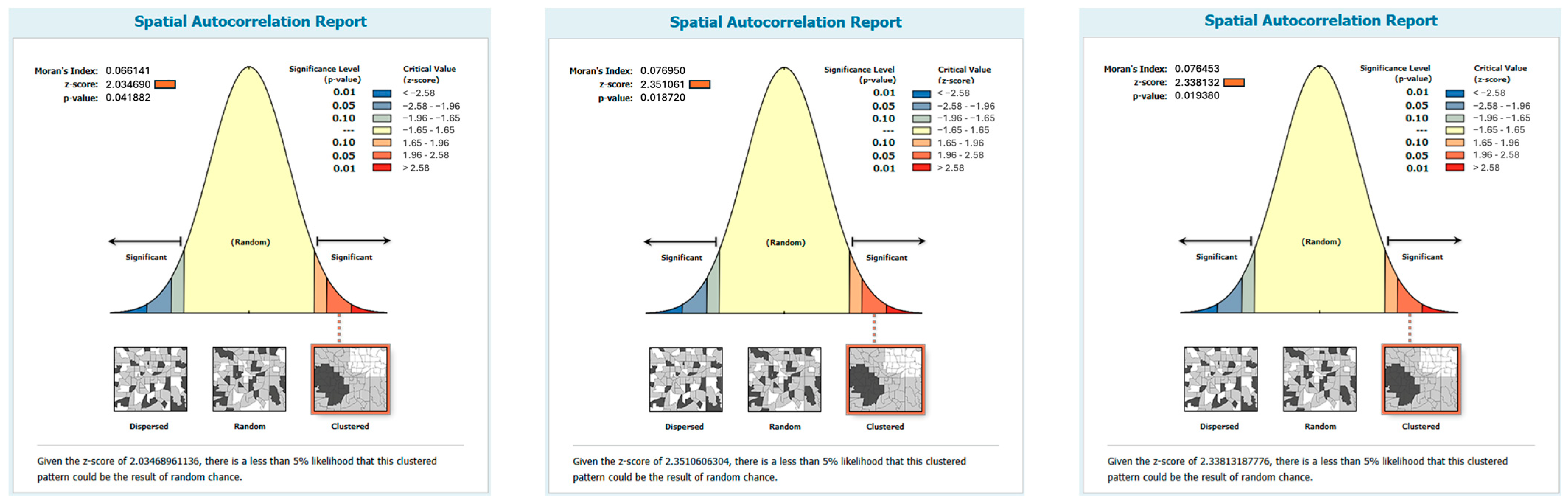
To further evaluate the spatial performance of the GWLR model, Moran’s I analysis was conducted on the residuals associated with the environmental, social, and economic variable groups. The residuals exhibited relatively weak positive spatial autocorrelation, with Moran’s I values ranging approximately from 0.05 to 0.08 and z-scores around 2.0–2.35 (Figure 7). These results indicate limited residual spatial clustering, suggesting that the GWLR model successfully captured the major spatial structure present in the data, although a relatively low level of residual spatial dependency remained. Such residual conditions are relatively common in complex land-use systems where certain localized processes and unobserved factors may not be fully represented within the modelling framework.

3.4. Spatial Probability Surfaces

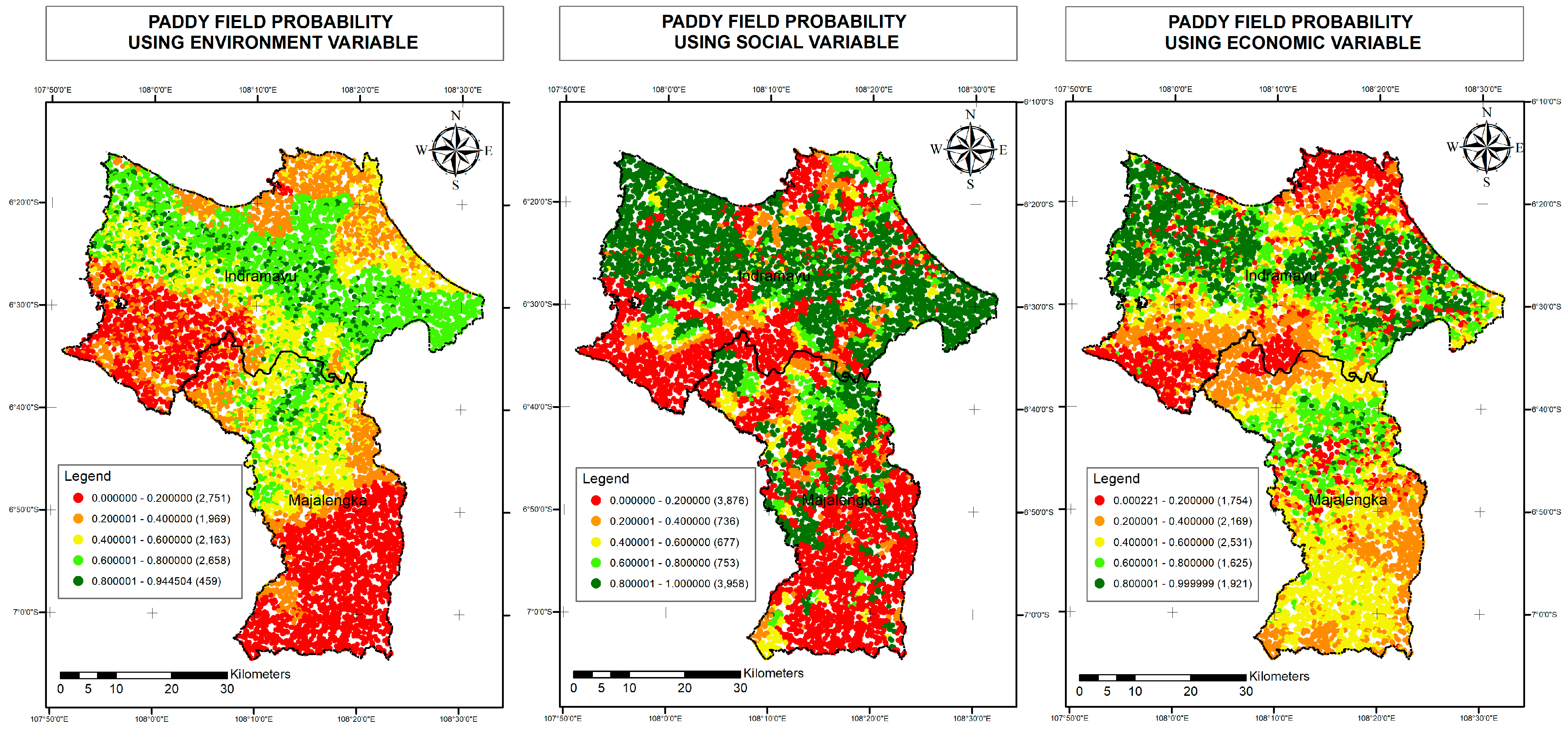
Spatial probability surfaces generated using GWLR reveal distinctive patterns for each variable group. These probability surfaces for environmental, social, and economic variable groups are illustrated in Figure 8. Environmental variables exhibit smooth and structured gradients aligned with physiographic conditions, consistent with prior observations in environmental suitability modeling. Social variables produce fragmented probability surfaces marked by sharp local contrasts, indicating strong spatial heterogeneity—a characteristic commonly identified in socio-demographic land-use drivers [48].
Economic variables display intermediate gradients, with patterns shaped by accessibility and development pressure. This reflects well-established spatial economic theories linking distance-based indicators to land conversion risks. These multi-scale probability structures confirm that environmental, social, and economic drivers operate at different spatial resolutions.

3.5. Local Coefficient Patterns

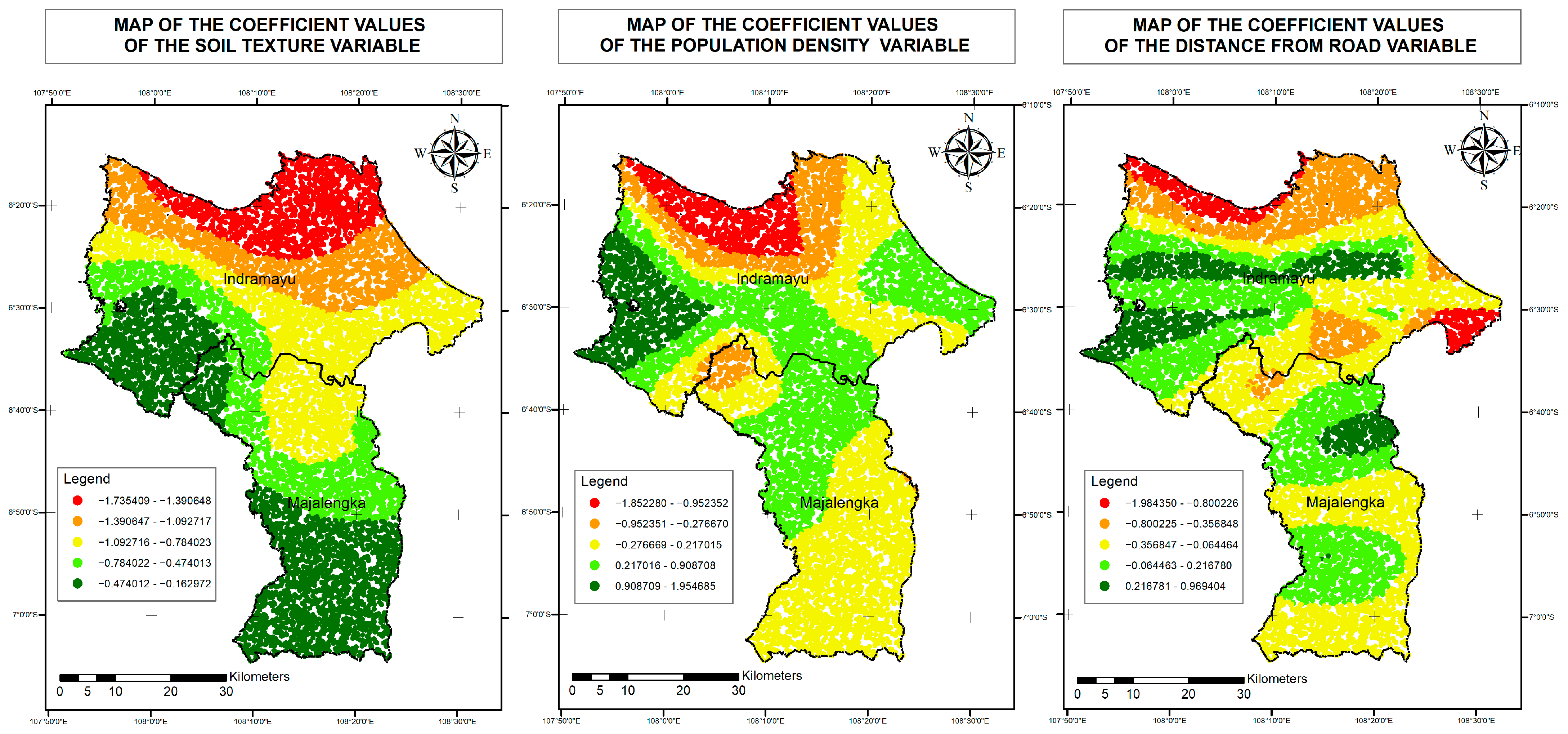
Local GWLR coefficients show strong spatial variability in both magnitude and direction across all variable groups, confirming the presence of spatial non-stationarity in the determinants of paddy field sustainability. To illustrate this spatial heterogeneity, three variables were selected for detailed visualization based on the stability, magnitude, and spatial contrast of their local coefficient surfaces (Figure 9).
Soil texture was selected to represent environmental variables because it exhibits the highest spatial smoothness and strongest biophysical gradient structure, with distinct coefficient clusters aligned with physiographic zones. Population density was chosen from the social group due to its pronounced coefficient variability, including sign reversals across rural–urban transitions that indicate high sensitivity to localized demographic pressures. Distance to roads was selected from the economic group because it generates the steepest spatial gradients in coefficient values, capturing accessibility-driven development pressure and market proximity effects with minimal noise. These three variables collectively provide the clearest technical evidence of GWLR’s ability to resolve local parameter variation across heterogeneous landscapes.
Environmental predictors—including soil texture, permeability, rainfall, slope, and elevation—exhibit geographically varying influence patterns consistent with agro-ecological zonation principles [49]. Soil texture coefficients show positive values in lowland irrigated zones but negative values in upland areas, reflecting differential soil-water-crop interactions across topographic gradients. Social variables demonstrate dual effects, with population density alternating between positive coefficients in areas with agricultural intensification and negative coefficients in peri-urban zones experiencing conversion pressure, consistent with documented spatial disparities in demographic land pressures [50].
Economic variables show the highest contextual dependency, particularly for distance-based indicators linked to roads, built-up areas, and paddy mills. Distance to roads displays positive coefficients in remote agricultural areas where isolation provides protection from development, but negative coefficients near urban centers where accessibility increases land values and conversion risk. These spatial shifts in coefficient sign and strength reflect development-driven land-value gradients, as noted in recent spatial economic modeling studies [51].
The overall distribution of local coefficients across all variable groups reinforces the presence of spatial non-stationarity and validates the necessity of local modeling frameworks for capturing heterogeneous land-use processes [40].

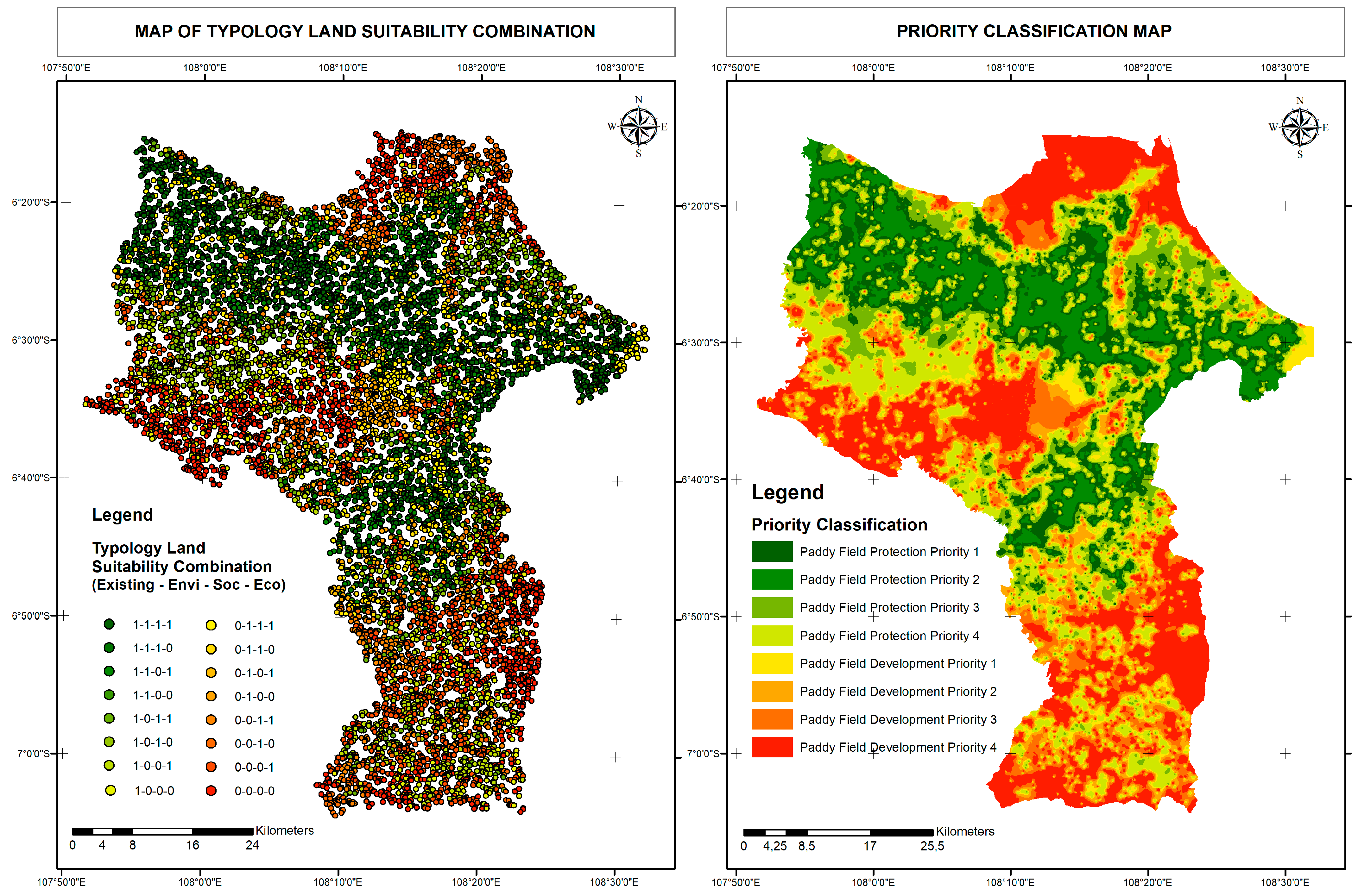
3.6. Spatial Typology of Paddy Field Sustainability

Integration of environmental, social, and economic probability outputs with existing paddy field data produced a four-dimensional typology comprising sixteen possible combinations. A detailed classification of all sixteen spatial combinations and their corresponding priority levels is presented in Table 5. These were aggregated into priority classes for paddy field protection and potential expansion. Areas with strong multi-dimensional support exhibit the highest sustainability and align with findings that multi-factor agricultural stability enhances long-term land retention [52].
Priority determination in this study follows two complementary logics: protection of existing paddy fields and expansion of new paddy areas. For existing paddy fields, protection priority is defined by the interaction between intrinsic sustainability (primarily environmental suitability) and socio-economic pressures, whereby highly suitable areas under emerging conversion pressure receive the highest priority due to their elevated risk of loss. Conversely, for non-paddy areas, expansion priority hinges on feasibility, with environmental suitability as a prerequisite and socio-economic factors indicating implementation readiness. Areas with strong multi-dimensional support are prioritized for expansion, whereas those with substantial constraints are considered unsuitable. This integrated framework enables spatially explicit decision-making that simultaneously safeguards existing paddy systems and guides sustainable agricultural expansion. The resulting spatial typology of paddy field sustainability is illustrated in Figure 10.

4. Discussion

4.1. Added Value of Local Spatial Modelling

The results demonstrate that global and non-spatial models, such as Logistic Regression and Random Forest, are limited in their ability to capture spatial heterogeneity in paddy field sustainability. While these models provide reasonable overall accuracy, their uniform parameterization assumes spatial stationarity, which is rarely satisfied in heterogeneous agricultural landscapes. Similar findings have been documented in land-use models where global estimators oversimplify spatially varying processes [7].
In contrast, GWLR explicitly accommodates spatial non-stationarity by allowing relationships between predictors and paddy field presence to vary locally. This capability proves particularly valuable in regions where environmental suitability, social pressure, and economic accessibility interact differently across space. The improvement observed in GWLR is therefore not solely reflected in accuracy metrics, but more importantly in its ability to reveal spatially differentiated processes. This reinforces earlier work highlighting the superiority of local regression approaches for uncovering fine-scale land-use dynamics in complex geographical systems [49].

4.2. Differential Spatial Roles of Environmental, Social, and Economic Factors

The spatial probability surfaces and local coefficient maps indicate that environmental, social, and economic factors exhibit distinct patterns of spatial variability. Environmental variables produce relatively continuous spatial patterns, reflecting gradual changes in biophysical conditions such as soil properties, rainfall, and topography. These findings are consistent with ecological gradient theory and previous studies on environmental suitability for paddy ecosystems [53].
In contrast, social variables exhibit highly fragmented spatial patterns, suggesting strong local dependency. Population density has been widely recognized as an important driver of land-use dynamics and spatial land-use patterns [54]. Population density and socio-economic vulnerability influence paddy field sustainability in a context-specific manner, where similar demographic pressures may result in different land-use outcomes depending on local governance, land tenure, and institutional settings—patterns widely observed in rapidly transforming agricultural regions [55].
Economic variables show intermediate spatial behavior, with distance-based indicators capturing development gradients that vary across accessibility corridors and urban influence zones. This is aligned with land economics literature emphasizing that accessibility and market proximity strongly influence land conversion incentives [56].
Taken together, these findings underscore the inadequacy of single-scale modeling approaches and highlight the importance of spatially adaptive methods for land-use analysis [57].
Several sources of uncertainty should be acknowledged in this study. These include differences in raster resolution among datasets, the use of village-level administrative social data, spatial influence variables derived from distance-based analysis, and the integration of multi-source spatial datasets with different temporal references. To reduce these uncertainties, preprocessing and harmonization procedures were applied, including coordinate system standardization, spatial grid standardization, raster harmonization, and proportional spatial sampling.
This study employed a spatial cross-sectional modelling framework and did not explicitly incorporate temporal or spatiotemporal change analysis into the calculations. Therefore, the datasets do not represent fully synchronized temporal conditions, but rather a combination of the most relevant and available datasets representing relatively comparable regional conditions. Consequently, the results should be interpreted primarily as a spatial representation of paddy field sustainability conditions rather than as a dynamic temporal change model.

4.3. Interpreting Local Coefficients and Spatial Non-Stationarity

The substantial spatial variation observed in GWLR coefficients confirms the presence of spatial non-stationarity across all variable groups. The direction and magnitude of variable effects differ markedly between locations, indicating that paddy field sustainability cannot be explained by uniform relationships—a result frequently found in non-stationary geographic processes [58]. For example, proximity to infrastructure may enhance paddy field persistence in areas with strong irrigation networks, while accelerating conversion in rapidly urbanizing zones, consistent with contrasting rural–urban interface dynamics noted in prior studies [59].
This dual behavior illustrates how identical variables can exert contrasting influences depending on local spatial context. Such insights cannot be obtained from global models and represent a key methodological contribution of this study. By mapping local coefficients, GWLR provides an interpretable framework for understanding place-specific land-use processes, consistent with the growing emphasis on spatial explainability in contemporary geographical analysis [60].

4.4. Implications for Spatial Classification and Priority Mapping

The spatial typology derived from integrating environmental, social, and economic probability outputs demonstrates the analytical advantage of combining multiple dimensions within a spatial modeling framework. Multidimensional classification approaches have been increasingly recommended for agricultural land assessment because single-variable suitability maps often mask complex spatial trade-offs [61].
Rather than classifying paddy fields based solely on physical suitability or conversion risk, the typology captures local sustainability conditions shaped by both biophysical and socio-economic drivers. This allows more nuanced spatial differentiation, distinguishing areas requiring strict protection from those where adaptive management strategies may be appropriate. Spatial multi-criteria typologies such as this one are consistent with contemporary spatial planning frameworks emphasizing place-based agricultural governance [62].
Importantly, the typology is not intended as a rigid zoning instrument, but as a spatial decision-support tool that reflects underlying geographic complexity—a principle aligned with recent recommendations in sustainable land-use planning [63].
The spatial typology results also suggest that geographically differentiated governance strategies may be more appropriate than uniform agricultural protection policies. In the study area, paddy field sustainability is shaped not only by environmental suitability, but also by varying socio-economic pressures and development trajectories across locations. Therefore, conservation and agricultural planning strategies should be adapted to the dominant local characteristics of each typology class.
This finding is particularly relevant in the context of existing agricultural land protection policies in Indonesia, including the Sustainable Agricultural Land Protection policy (LP2B), which aims to prevent uncontrolled paddy field conversion. In rapidly developing areas, especially peri-urban zones influenced by infrastructure expansion and accessibility growth, environmentally suitable paddy fields may still face high conversion pressure due to socio-economic and market factors. In such cases, protection-oriented strategies supported by spatial zoning regulations and agricultural incentives become increasingly important.
For example, the 1-1-1-1 typology represents existing paddy fields supported simultaneously by environmental suitability and favorable social and economic conditions. These areas may be interpreted as relatively stable agricultural landscapes where long-term conservation strategies should be prioritized. In contrast, the 1-1-0-0 typology represents existing paddy fields with strong environmental suitability but weak social and economic support. Although these areas remain physically suitable for paddy cultivation, they may become vulnerable to land conversion due to limited socio-economic resilience. Consequently, policy interventions such as LP2B protection, agricultural incentives, and strengthening of local agricultural economic infrastructure may help reduce conversion pressure and improve sustainability.
Meanwhile, typologies such as 1-0-1-1 indicate situations where social and economic conditions remain supportive, but environmental suitability is relatively constrained. These areas suggest the need for more detailed investigation into limiting environmental factors affecting paddy cultivation suitability, such as topography, hydrological conditions, or soil characteristics. Although environmental constraints are generally more difficult to modify directly, identifying the dominant limiting factors may support more adaptive and locally appropriate agricultural management strategies.

4.5. Methodological Limitations and Scope

While GWLR offers substantial advantages in capturing spatial heterogeneity, it also entails limitations. The explanatory power, as measured by deviance explained, remains moderate, reflecting the inherent complexity of land-use systems influenced by unobserved institutional, cultural, and policy factors. Similar levels of explanatory power have been reported in other spatial logistic models applied to heterogeneous agricultural landscapes [64].
Moreover, the selective application of RF and global LR as benchmark models for environmental variables represents a deliberate methodological choice aimed at isolating the contribution of local spatial modeling under relatively stable biophysical conditions. Alternative configurations—such as multi-scale GWLR or spatial machine learning hybrids—may further enhance explanatory performance, as suggested by recent advances in spatial modeling [65].
Future research may explore multi-scale extensions of GWLR or integrate temporal dynamics to further enhance explanatory capacity. Nevertheless, the current framework provides a robust foundation for spatially explicit analysis of paddy field sustainability.

4.6. Contributions to Geographical Systems Research

This study contributes to geographical systems research by demonstrating how local regression techniques can be applied to model agricultural land sustainability within a multidimensional spatial context. By integrating environmental, social, and economic factors and explicitly addressing spatial non-stationarity, the proposed framework advances methodological practice in spatial land-use modeling.
Beyond the specific case of paddy fields, the approach is transferable to other land-use systems characterized by heterogeneous drivers and localized interactions. Similar findings have emerged in recent geographical systems research emphasizing the need for spatially adaptive modeling in complex socio-ecological systems [66]. As such, the study reinforces the relevance of spatially adaptive techniques in understanding and managing geographically complex landscapes.

5. Conclusions

This study demonstrates that paddy field sustainability is governed by spatially heterogeneous processes that cannot be captured by global models. Environmental variables generate continuous spatial patterns aligned with physiographic conditions, social variables exhibit strong local heterogeneity reflecting demographic pressures, and economic variables display context-dependent dual behavior—supporting sustainability in some areas while inducing conversion elsewhere. This spatial variation necessitates place-based interpretation of land-use sustainability.
GWLR with a Fixed Gaussian kernel outperforms global models (Random Forest, Logistic Regression) by capturing spatial non-stationarity, improving deviance explained from 7.4% to 25.5%. Critically, aggregate accuracy metrics inadequately evaluate spatial models; local coefficient patterns and error distributions provide more substantive insight. The resulting spatial typology integrates probability surfaces across variable dimensions to distinguish stable paddy fields, vulnerable areas, and development potential zones, functioning as a decision-support framework.
For geographical systems research, this study advances local regression techniques for agricultural sustainability modeling. For policy, results emphasize the need for place-based approaches aligned with locally specific conditions rather than uniform regulations. Future research should incorporate temporal dynamics, institutional variables, and multi-scale models.

Author Contributions

Conceptualization, Budi Siswanto and Ketut Wikantika; methodology, Budi Siswanto and Albertus Deliar; software, Budi Siswanto; validation, Budi Siswanto, Ketut Wikantika, and Albertus Deliar; formal analysis, Budi Siswanto; investigation, Budi Siswanto; resources, Budi Siswanto; data curation, Budi Siswanto; writing—original draft preparation, Budi Siswanto and Tri Muji Susantoro; writing—review and editing, Budi Siswanto, Ketut Wikantika, Albertus Deliar, and Tri Muji Susantoro; visualization, Budi Siswanto; supervision, Ketut Wikantika, Albertus Deliar, and Tri Muji Susantoro; project administration, Budi Siswanto. All authors have read and agreed to the published version of the manuscript.

Funding

This research received no external funding.

Data Availability Statement

The data supporting the findings of this study are available from the corresponding author upon reasonable request.

Acknowledgments

The authors would like to thank the Department of Geomatics and Engineering of Bandung Institute of Technology (ITB). We also thank to West Java Provincial Government, the Geospatial Information Agency of Indonesia, Statistics Indonesia, the Indonesian Ministry of Home Affairs, the Ministry of Agrarian Affairs and Spatial Planning/National Land Agency, and NASA/USGS for providing the datasets used in this study.

Conflicts of Interest

The authors declare no conflicts of interest.

References

  1. FAO; IFAD; UNICEF; WFP; WHO. The State of Food Security and Nutrition in the World 2021; FAO: Rome, Italy; IFAD: Rome, Italy; WFP: Rome, Italy; UNICEF: New York, NY, USA; WHO: Geneva, Switzerland, 2021. [Google Scholar] [CrossRef]
  2. Manan, H.; Dewi, M.P. Implementation of Sustainable Food Agriculture Land Protection Policy in Supporting Food Security in Indramayu Regency, West Java Province. J. World Sci. 2025, 4, 1749–1762. Available online: https://jws.rivierapublishing.id/index.php/jws (accessed on 3 February 2026). [CrossRef]
  3. Susila, K.D.; Ginting, D.C.B.; Adnyana, I.M.; Saifulloh, M.; Arthagama, I.D.M. Enhancing soil quality for sustainable agricultural practices in Subak rice fields. J. Degrad. Min. Lands Manag. 2024, 12, 6623–6635. [Google Scholar] [CrossRef]
  4. Sukiptiyah, S.; Rustiadi, E.; Fauzi, A.; Barus, B. Spatial-Based Space Designation Factor Analysis of Rice Fields Conversion (Case Study: West Java Province). BIRCI-J. 2022, 5, 13026–13040. [Google Scholar]
  5. Wang, C.; Liu, S.; Zhou, S.; Zhou, J.; Jiang, S.; Zhang, Y.; Feng, T.; Zhang, H.; Zhao, Y.; Lai, Z.; et al. Spatial-temporal patterns of urban expansion by land use/land cover transfer in China. Ecol. Indic. 2023, 155, 111009. [Google Scholar] [CrossRef]
  6. Oshan, T.M.; Li, Z.; Kang, W.; Wolf, L.J.; Fotheringham, A.S. MGWR: A python implementation of multiscale geographically weighted regression for investigating process spatial heterogeneity and scale. ISPRS Int. J. Geoinf. 2019, 8, 269. [Google Scholar] [CrossRef]
  7. Hu, Z.; Lo, C.P. Modeling urban growth in Atlanta using logistic regression. Comput. Environ. Urban Syst. 2007, 31, 667–688. [Google Scholar] [CrossRef]
  8. Pradana, A.N.; Djuraidah, A.; Soleh, A.M. Land Use Change Modelling Using Logistic Regression, Random Forest and Additive Logistic Regression in Kubu Raya Regency, West Kalimantan. Forum Geogr. 2023, 37, 149–163. [Google Scholar] [CrossRef]
  9. Fotheringham, A.S. Geographically Weighted Regression White Paper; National Centre for Geocomputation: Maynooth, Ireland, 2009. [Google Scholar]
  10. Brunsdon, C.; Fotheringham, A.S.; Charlton, M. Geographically weighted summary statistics-a framework for localised exploratory data analysis. Comput. Environ. Urban Syst. 2002, 26, 501–524. Available online: https://www.sciencedirect.com/science/article/abs/pii/S0198971501000096 (accessed on 5 February 2026). [CrossRef]
  11. Maryati, S.; Humaira, A.N.S.; Pratiwi, F. Spatial pattern of agricultural land conversion in West Java Province. In IOP Conference Series: Earth and Environmental Science; Institute of Physics Publishing: Bristol, UK, 2018. [Google Scholar] [CrossRef]
  12. Raharja, I.F.; Hafrida, H.; Kusniati, R.; Sasmiar, S.; Ridha, A. The Legal Protection of Sustainable Agricultural Land: Why is It Urgent? Jambe Law. J. 2021, 4, 151–170. [Google Scholar] [CrossRef]
  13. Ekasari, Y.; Reflis, R.; Utama, S.P.; Maryani, D.; Asdami, E.A.; Uchera, R. Strategi Perlindungan Lahan Pertanian Pangan Berkelanjutan di Kabupaten Muko-Muko, Bengkulu. J. Agric. Plant. Stud. 2024, 1, 1–8. [Google Scholar] [CrossRef]
  14. Sun, C.; Zhang, H.; Xu, L.; Ge, J.; Jiang, J.; Zuo, L.; Wang, C. Twenty-meter annual paddy rice area map for mainland Southeast Asia using Sentinel-1 synthetic-aperture-radar data. Earth Syst. Sci. Data 2023, 15, 1501–1520. [Google Scholar] [CrossRef]
  15. Widiatmaka, A.; Munibah, K.; Firmansyah, I. Evaluate land suitability analysis for rice cultivation using a GIS-based AHP multi-criteria decision-making approach: Majalengka Regency, West Java Province. In IOP Conference Series: Earth and Environmental Science; Institute of Physics: Bristol, UK, 2022. [Google Scholar] [CrossRef]
  16. de By, R.A. Principles of Geographic Information Systems: An Introductory Textbook; International Institute for Aerospace Survey and Earth Sciences: Enschede, The Netherlands, 2001. [Google Scholar]
  17. Akpoti, K.; Higginbottom, T.P.; Foster, T.; Adhikari, R.; Zwart, S.J. Mapping land suitability for informal, small-scale irrigation development using spatial modelling and machine learning in the Upper East Region, Ghana. Sci. Total Environ. 2022, 803, 149959. [Google Scholar] [CrossRef] [PubMed]
  18. Romadhona, S.; Puryono, S.; Mussadun, M. Integration of geographical information systems in the land suitability assessment for rice crops in Sleman District, Indonesia. J. Lahan Suboptimal 2025, 14, 16–29. [Google Scholar] [CrossRef]
  19. Trinugroho, M.W.; Arif, S.S.; Susanto, S.; Nugroho, B.D.A. Assessing irrigation water demand and pumping operations for rice farming in the Bengawan Solo River, Indonesia. Sains Tanah 2024, 21, 42–54. [Google Scholar] [CrossRef]
  20. Sustyaningrum, K.; Arsanti, V.; Arfianto, S.; Meliyani, S. Analysis of The Impact of Agricultural Land Conversion Towards Food Security in The Special Region of Yogyakarta Province. BHUMI J. Agrar. Pertanah. 2024, 10, 1–16. [Google Scholar]
  21. Molotoks, A.; Smith, P.; Dawson, T.P. Impacts of land use, population, and climate change on global food security. Food Energy Secur. 2021, 10, e261. [Google Scholar] [CrossRef]
  22. Li, G.; Li, C.; Wu, Z.; Peng, X.; Lu, H.; Zhou, L. Land attraction: An essential factor in socioeconomic activities and population distribution. Land Use Policy 2025, 157, 107660. [Google Scholar] [CrossRef]
  23. Brunelle, T.; Makowski, D. Assessing whether the best land is cultivated first: A quantile analysis. PLoS ONE 2020, 15, e0242222. [Google Scholar] [CrossRef]
  24. Burley, T.E.; Peine, J.D. Prepared in cooperation with the National Biological Information Infrastructure-Southern Appalachian Information Node (NBII-SAIN). In NBII-SAIN Data Management; Toolkit: Lakewood, CO, USA, 2009. [Google Scholar]
  25. Ganasegeran, K.; Jamil, M.F.A.; Appannan, M.R.; Ch’ng, A.S.H.; Looi, I.; Peariasamy, K.M. Spatial Dynamics and Multiscale Regression Modelling of Population Level Indicators for COVID-19 Spread in Malaysia. Int. J. Environ. Res. Public Health 2022, 19, 2082. [Google Scholar] [CrossRef]
  26. Tejada, J.J.; Raymond, J.; Punzalan, B. On the Misuse of Slovin’s Formula. Philipp. Stat. 2012, 61, 129–136. [Google Scholar]
  27. Li, Y.; Liu, T.; Wang, Y.; Duan, L.; Li, M.; Zhang, J.; Zhang, G. A more effective approach for species-level classifications using multi-source remote sensing data: Validation and application to an arid and semi-arid grassland. Ecol. Indic. 2024, 160, 111853. [Google Scholar] [CrossRef]
  28. Jeong, H.; Lee, Y.; Lee, B.; Jung, E.; Lee, J.-Y.; Lee, S. Applications of geographically weighted machine learning models for predicting soil heavy metal concentrations across mining sites. Sci. Total Environ. 2024, 957, 177667. [Google Scholar] [CrossRef] [PubMed]
  29. Gharaibeh, A.; Shaamala, A.; Obeidat, R.; Al-Kofahi, S. Improving land-use change modeling by integrating ANN with Cellular Automata-Markov Chain model. Heliyon 2020, 6, e05092. [Google Scholar] [CrossRef]
  30. Santos, F.; Graw, V.; Bonilla, S. A geographically weighted random forest approach for evaluate forest change drivers in the Northern Ecuadorian Amazon. PLoS ONE 2019, 14, e0226224. [Google Scholar] [CrossRef]
  31. Estacio, I.; Sianipar, C.P.; Onitsuka, K.; Basu, M.; Hoshino, S. A statistical model of land use/cover change integrating logistic and linear models: An application to agricultural abandonment. Int. J. Appl. Earth Obs. Geoinf. 2023, 120, 103339. [Google Scholar] [CrossRef]
  32. Da Fonseca, E.L.; Da Silva Filho, E.P. Binary Logistic Regression Applied to Erosion Susceptibility Mapping in the Southern Amazon. Rev. Bras. Geomorfol. 2023, 24, e2314. [Google Scholar] [CrossRef]
  33. Faheem, Z.; Kazmi, J.H.; Shaikh, S.; Arshad, S.; Mohammed, S. Random forest-based analysis of land cover/land use LCLU dynamics associated with meteorological droughts in the desert ecosystem of Pakistan. Ecol. Indic. 2024, 159, 111670. [Google Scholar] [CrossRef]
  34. Asif, M.; Kazmi, J.H.; Tariq, A.; Zhao, N.; Guluzade, R.; Soufan, W.; Almutairi, K.F.; El Sabagh, A.; Aslam, M. Modelling of land use and land cover changes and prediction using CA-Markov and Random Forest. Geocarto Int. 2023, 38, 2210532. [Google Scholar] [CrossRef]
  35. Qu, X.; Xiao, X.; Zhu, X.; Shao, Z.; Wang, M.; Wu, H.; Zhao, H.; Gong, J.; Li, D. ST-GWLR: Combining geographically weighted logistic regression and spatiotemporal hotspot trend analysis to explore the effect of built environment on traffic crash. Geo-Spat. Inf. Sci. 2024, 27, 1017–1034. [Google Scholar] [CrossRef]
  36. Xu, Y.; Yang, Y.; Karimian, H.; Kang, X.; Wu, S.; Huang, B. High-Efficiency Geographically Weighted Regression based on CUDA: An enhanced algorithm with adaptive kernel for investigating spatial non-stationarity in large-scale observations. Int. J. Digit. Earth 2025, 18, 2587494. [Google Scholar] [CrossRef]
  37. Brunsdon, C.; Fotheringham, A.S.; Charlton, M. Spatial nonstationarity and autoregressive models. Environ. Plan. A 1998, 30, 957–973. [Google Scholar] [CrossRef]
  38. Albasri, N.A.R.H.; Mustafa, M.H.; Aliasghar, M.S. The Impact of Regional Level Land Use on the Urban Functional Changes. Int. J. Sustain. Dev. Plan. 2023, 18, 475–482. [Google Scholar] [CrossRef]
  39. Shao, G.; Tang, L.; Liao, J. Overselling overall map accuracy misinforms about research reliability. Landsc. Ecol. 2019, 34, 2487–2492. [Google Scholar] [CrossRef]
  40. Matthews, S.A.; Yang, T.C. Mapping the results of local statistics: Using geographically weighted regression. Demogr. Res. 2012, 26, 151–166. [Google Scholar] [CrossRef] [PubMed]
  41. Xu, E.; Zhang, H. Spatially-explicit sensitivity analysis for land suitability evaluation. Appl. Geogr. 2013, 45, 1–9. [Google Scholar] [CrossRef]
  42. Prestele, R.; Hirsch, A.L.; Davin, E.L.; Seneviratne, S.I.; Verburg, P.H. A spatially explicit representation of conservation agriculture for application in global change studies. Glob. Change Biol. 2018, 24, 4038–4405. [Google Scholar] [CrossRef]
  43. Della-Silva, J.L.; Pelissari, T.D.; dos Santos, D.H.; Oliveira-Júnior, J.W.; Teodoro, L.P.R.; Teodoro, P.E.; Santana, D.C.; de Oliveira, I.C.; Rossi, F.S.; Junior, C.A.d.S. Land use predicition accuracy of different supervised classifiers over agriculture and livestock economy-based municipality in Brazil. Remote Sens. Appl. 2024, 35, 101257. [Google Scholar] [CrossRef]
  44. Safaee, S.; Libohova, Z.; Kladivko, E.J.; Brown, A.; Winzeler, E.; Read, Q.; Rahmani, S.; Adhikari, K. Influence of sample size, model selection, and land use on prediction accuracy of soil properties. Geoderma Reg. 2024, 36, e00766. [Google Scholar] [CrossRef]
  45. McGarigal, K.; Plunkett, E.B.; Willey, L.L.; Compton, B.W.; DeLuca, W.V.; Grand, J. Modeling non-stationary urban growth: The SPRAWL model and the ecological impacts of development. Landsc. Urban Plan. 2018, 177, 178–190. [Google Scholar] [CrossRef]
  46. Sinha, D.D.; Singh, A.N.; Singh, U.S. Site suitability analysis for dissemination of salt-tolerant rice varieties in Southern Bangladesh. ISPRS-Int. Arch. Photogramm. Remote Sens. Spat. Inf. Sci. 2014, XL-8, 961–966. [Google Scholar] [CrossRef]
  47. Lin, Y.; Deng, X.; Li, X.; Ma, E. Comparison of multinomial logistic regression and logistic regression: Which is more efficient in allocating land use? Front. Earth Sci. 2014, 8, 512–523. [Google Scholar] [CrossRef]
  48. Wang, Z.; Zhang, J. Multiscale geographically weighted modeling of tuberculosis incidence in China: Integrating geographic perspectives into epidemiological analysis. Int. J. Health Geogr. 2025, 24, 46. [Google Scholar] [CrossRef] [PubMed]
  49. Yacim, J.A.; Boshoff, D.G.B. A comparison of bandwidth and kernel function selection in geographically weighted regression for house valuation. Int. J. Technol. 2019, 10, 58–68. [Google Scholar] [CrossRef]
  50. Zhang, T.; Cheng, C.; Wu, X. Mapping the spatial heterogeneity of global land use and land cover from 2020 to 2100 at a 1 km resolution. Sci. Data 2023, 10, 748. [Google Scholar] [CrossRef]
  51. Mutale, B.; Withanage, N.C.; Mishra, P.K.; Shen, J.; Abdelrahman, K.; Fnais, M.S. A perfor-mance evaluation of random forest, artificial neural network, and support vector machine learning algorithms to predict spatio-temporal land use-land cover dynamics: A case from lusaka and colombo. Front. Environ. Sci. 2024, 12, 1431645. [Google Scholar] [CrossRef]
  52. Nkeki, F.N.; Asikhia, M.O. Geographically weighted logistic regression approach to explore the spatial variability in travel behaviour and built environment interactions: Accounting simultaneously for demographic and socioeconomic characteristics. Appl. Geogr. 2019, 108, 47–63. [Google Scholar] [CrossRef]
  53. Hong, Y.; Du, H.; Deng, Z. A framework of Economic-Social-Natural sustainability evaluation based on multidimensional land-use ecological niche theory: Evidence in Shendong CEBs, China. Ecol. Indic. 2023, 155, 110967. [Google Scholar] [CrossRef]
  54. Putri, R.F.; Abadi, A.W.; Tastian, N.F. Impacts of Population Density for Landuse Assessment in Cengkareng, West Jakarta. J. Geosci. Eng. Environ. Technol. 2020, 5, 56–67. [Google Scholar] [CrossRef]
  55. Chofyan, I.; Dewi, D.A. The impact of land conversion on rice production vulnerability in south Bangka regency: A GIS-based analysis. Int. J. Innov. Res. Sci. Stud. 2025, 8, 1986–1997. [Google Scholar] [CrossRef]
  56. Tammi, I.; Mustajärvi, K.; Rasinmäki, J. Integrating spatial valuation of ecosystem services into regional planning and development. Ecosyst. Serv. 2017, 26, 329–344. [Google Scholar] [CrossRef]
  57. Akpoti, K.; Kabo-bah, A.T.; Dossou-Yovo, E.R.; Groen, T.A.; Zwart, S.J. Mapping suitability for rice production in inland valley landscapes in Benin and Togo using environmental niche modeling. Sci. Total Environ. 2020, 709, 136165. [Google Scholar] [CrossRef]
  58. Baldwin, R.F.; Leonard, P.B. Interacting social and environmental predictors for the spatial distribution of conservation lands. PLoS ONE 2015, 10, e0140540. [Google Scholar] [CrossRef]
  59. Piquer-Rodríguez, M.; Baumann, M.; Butsic, V.; Gasparri, H.; Gavier-Pizarro, G.; Volante, J.; Müller, D.; Kuemmerle, T. The potential impact of economic policies on future land-use conversions in Argentina. Land Use Policy 2018, 79, 57–67. [Google Scholar] [CrossRef]
  60. Liu, C.; Deng, C.; Li, Z.; Liu, Y.; Wang, S. Optimization of Spatial Pattern of Land Use: Progress, Frontiers, and Prospects. Int. J. Environ. Res. Public Health 2022, 19, 5805. [Google Scholar] [CrossRef]
  61. Mishra, V.N.; Kumar, V.; Prasad, R.; Punia, M. Geographically Weighted Method Integrated with Logistic Regression for Analyzing Spatially Varying Accuracy Measures of Remote Sensing Image Classification. J. Indian Soc. Remote Sens. 2021, 49, 1189–1199. [Google Scholar] [CrossRef]
  62. Tharik, M.; Arumugam, K.; Vijayaraghavalu, S.S. Spatiotemporal assessment and simulation of land use and land cover dynamics in coastal Tamil Nadu using CA–ANN modelling for sustainable development planning. Results Eng. 2025, 28, 107771. [Google Scholar] [CrossRef]
  63. Majid, N.A.; Zaki, N.M. Assessing Urban Land Use Change through Geographical Weighted Regression: Implications for Sustainable Environmental Planning. Int. J. Acad. Res. Bus. Soc. Sci. 2025, 15, 223–235. [Google Scholar] [CrossRef]
  64. Luo, F.; He, L.; Chen, Z.; He, Z.; Bai, W.; Zhao, Y.; Cen, Y. Optimizing arable land suitability evaluation using improved suitability functions in the Anning River Basin. Sci. Rep. 2024, 14, 28886. [Google Scholar] [CrossRef]
  65. Demetriou, D.; See, L.; Stillwell, J. A spatial multi-criteria model for the evaluation of land redistribution plans. ISPRS Int. J. Geoinf. 2012, 1, 272–293. [Google Scholar] [CrossRef]
  66. Grêt-Regamey, A.; Altwegg, J.; Sirén, E.A.; van Strien, M.J.; Weibel, B. Integrating ecosystem services into spatial planning—A spatial decision support tool. Landsc. Urban Plan. 2017, 165, 206–219. [Google Scholar] [CrossRef]
Figure 1. Study area and major land-cover distribution in Indramayu and Majalengka Regencies, including rice fields, built-up areas, forests, plantations, shrubland, fish ponds, farmland, and water bodies.
Ijgi 15 00253 g001
Figure 2. Analytical framework of the study outlining the major steps of data preparation, model implementation (RF, LR, and GWLR), model evaluation, and spatial output generation.
Ijgi 15 00253 g002
Figure 3. Spatial preprocessing and standardization workflow applied to environmental variables prior to GWLR modelling.
Ijgi 15 00253 g003
Figure 4. Spatial preprocessing workflow applied to population size data.
Ijgi 15 00253 g004
Figure 5. Spatial distribution of training and testing sample points across the study area.
Ijgi 15 00253 g005
Figure 6. Spatial classification results for Random Forest (RF), Logistic Regression (LR), and Geographically Weighted Logistic Regression (GWLR). The maps show the spatial distribution of true and false predictions relative to existing paddy field data, illustrating differences in error patterns among the three models.
Ijgi 15 00253 g006
Figure 7. Moran’s I residual analysis for environmental, social, and economic variable groups, showing residual spatial autocorrelation patterns in the GWLR model.
Ijgi 15 00253 g007
Figure 8. GWLR-derived probability surfaces for environmental, social, and economic variable groups. The maps illustrate spatial variation in the likelihood of paddy field sustainability associated with each factor group.
Ijgi 15 00253 g008
Figure 9. Spatial distribution of selected local coefficients from the GWLR model, illustrating geographic variation in the influence of environmental (soil texture), social (population density), and economic (distance to roads) predictors.
Ijgi 15 00253 g009aIjgi 15 00253 g009b
Figure 10. Spatial typology of paddy field sustainability derived from the integration of environmental, social, and economic suitability layers. The map shows priority classes for paddy field protection and potential development across the study area.
Ijgi 15 00253 g010
Table 1. Spatial datasets and variables used in the analysis, grouped into environmental, social, and economic factors. The table summarizes variable types, data sources, and spatial resolutions incorporated into the modeling framework.
NoCategoryVariableData TypeSourceSpatial Resolution/Unit
1EnvironmentalSoil textureVector (Original)
Raster (processed)
West Java Provincial Government25 m
2Soil permeabilityWest Java Provincial Government25 m
3Soil pHWest Java Provincial Government25 m
4Rock FormationWest Java Provincial Government25 m
5Soil TypeWest Java Provincial Government25 m
6RainfallVector (Original)
Raster (processed)
Geospatial Information Agency1 km
7Distance to riversRaster (derived)Geospatial Information AgencyEuclidean distance (m)
8Wetness indexRaster (derived)NASA/USGS SRTM (via USGS EarthExplorer)25 m
9SlopeRaster (derived)Geospatial Information Agency8 m
10ElevationRasterGeospatial Information Agency8 m
11SocialPopulation densityTabular → rasterStatistics IndonesiaPeople/km2
12Pre-prosperous householdsTabular → rasterIndonesian Ministry of Home AffairsPopulation
13Population without formal educationTabular → rasterIndonesian Ministry of Home AffairsPopulation
14EconomicDistance to roadsRaster (derived)Geospatial Information AgencyEuclidean distance (m)
15Distance to built-up areasRaster (derived)Geospatial Information AgencyEuclidean distance (m)
16Distance to paddy millsRaster (derived)Field SurveyEuclidean distance (m)
17ResponsePaddy field presenceVector Ministry of Agrarian Affairs and Spatial Planning/National Land AgencyBinary (0/1)
Table 2. Summary of the three modeling approaches applied in this study, outlining their model structure, analytical purpose, key assumptions, and primary outputs.
ModelModel TypePrimary PurposeKey AssumptionMain Outputs
Random Forest (RF)Non-parametric machine learningBenchmark classification and variable importance under relatively stable biophysical conditionsNo parametric form; assumes sufficient training dataClassification map; variable importance
Global Logistic Regression (LR)Parametric global regressionBaseline estimation of average relationships between predictors and paddy field presenceSpatial stationarity of coefficientsGlobal coefficients; classification map
Geographically Weighted Logistic Regression (GWLR)Local spatial regressionCapture spatial non-stationarity and local variation in predictor effectsRelationships vary continuously across spaceLocal coefficients; probability surfaces; spatial classification
Table 3. Summary of performance metrics and spatial diagnostics for the Random Forest (RF), global Logistic Regression (LR), and Geographically Weighted Logistic Regression (GWLR) models. The table reports accuracy-based measures for global models (RF and LR) and spatial diagnostic indicators for GWLR, highlighting key differences in model behavior and their ability to capture spatial non-stationarity.
AspectRFLRGWLR
Model typeGlobal, non-parametricGlobal, parametricLocal spatial model
Accuracy (train/test)71.50/62.5062.50/63.75Not applicable
Prediction accuracy (%)61.8462.86Not applicable
Spatial diagnosticsNoneDeviance explained (7.4%)Deviance explained (25.5%)
AIC: 433.360AIC: 401.272
AICc: 434.217AICc: 410.362
Captures spatial non-stationarityNoNoYes
InterpretabilityModerateHigh (global coefficients)Very high (local coefficients)
Table 4. Comparison of GWLR kernel configurations, including weighting functions, bandwidth characteristics, and model diagnostic measures (deviance, AIC, AICc, BIC/MDL, and deviance explained). The table summarizes the performance of four alternative kernels evaluated in the study.
CriterionFixed GaussianFixed bi-SquareAdaptive bi-SquareAdaptive Gaussian
BandwidthDistance basedDistance basedNearest neighbor basedNearest neighbor based
WeightingExponentially decreases with distanceQuadratically decreases and becomes zero beyond a certain distanceQuadratically decreases and reaches zero beyond a certain neighborhoodExponentially decreases without a clear cutoff
CharacteristicExponential functions characterized by rapid changes in magnitudeQuadratic functions characterized by gradual and consistent changes in valuesPlaces strong emphasis on local influence within a defined spatial rangeAllows for a broader and more gradual influence from distant data points
Bandwidth size15,008.58350,864.1696.00072.000
Deviance330.461363.677360.788355.676
Classic AIC401.272413.052411.872407.703
AICc410.363417.361416.492412.499
BIC/MDL534.693506.081508.122505.730
Percent deviance explained0.2550.1800.1870.198
Table 5. Spatial typology of paddy field sustainability based on the integration of existing paddy fields with environmental, social, and economic suitability layers. The table lists all sixteen land-suitability combinations and their corresponding protection or development priority classes.
NoLand Suitability Combination (Existing-Env-Soc-Eco)Number of PointsDescription
11-1-0-1557Paddy field protection Priority 1
21-1-1-0143Paddy field protection Priority 1
31-1-1-12259Paddy field protection Priority 2
41-0-1-1700Paddy field protection Priority 3
51-1-0-081Paddy field protection Priority 3
61-0-0-1750Paddy field protection Priority 4
71-0-1-0289Paddy field protection Priority 4
81-0-0-0503Paddy field protection Priority 4
90-1-1-1450Paddy field development Priority 1
100-1-0-1153Paddy field development Priority 2
110-1-1-0468Paddy field development Priority 2
120-1-0-0287Paddy field development Priority 3
130-0-1-1427Paddy field development Priority 3
140-0-0-1781Paddy field development Priority 4
150-0-1-0652Paddy field development Priority 4
160-0-0-01500Paddy field development Priority 4
Disclaimer/Publisher’s Note: The statements, opinions and data contained in all publications are solely those of the individual author(s) and contributor(s) and not of MDPI and/or the editor(s). MDPI and/or the editor(s) disclaim responsibility for any injury to people or property resulting from any ideas, methods, instructions or products referred to in the content.