
Article

Coupled Dynamics of Land-Use Change and Landscape-Pattern Responses Under Multiple Scenarios in the Yangtze and Yellow River Basins

1
School of Civil Engineering and Geomatics, Shandong University of Technology, Zibo 255000, China
2
State Key Laboratory of Efficient Utilization of Arid and Semi-Arid Arable Land in Northern China/Key Laboratory of Agricultural Remote Sensing, Ministry of Agriculture and Rural Affairs, Institute of Agricultural Resources and Regional Planning, Chinese Academy of Agricultural Sciences, Beijing 100081, China
3
National Center of Technology Innovationfor Comprehensive Utilization of Saline-Alkali Land, Dongying 257300, China
*
Author to whom correspondence should be addressed.
ISPRS Int. J. Geo-Inf. 2026, 15(6), 239; https://doi.org/10.3390/ijgi15060239
Submission received: 9 April 2026 / Revised: 19 May 2026 / Accepted: 26 May 2026 / Published: 30 May 2026

Abstract

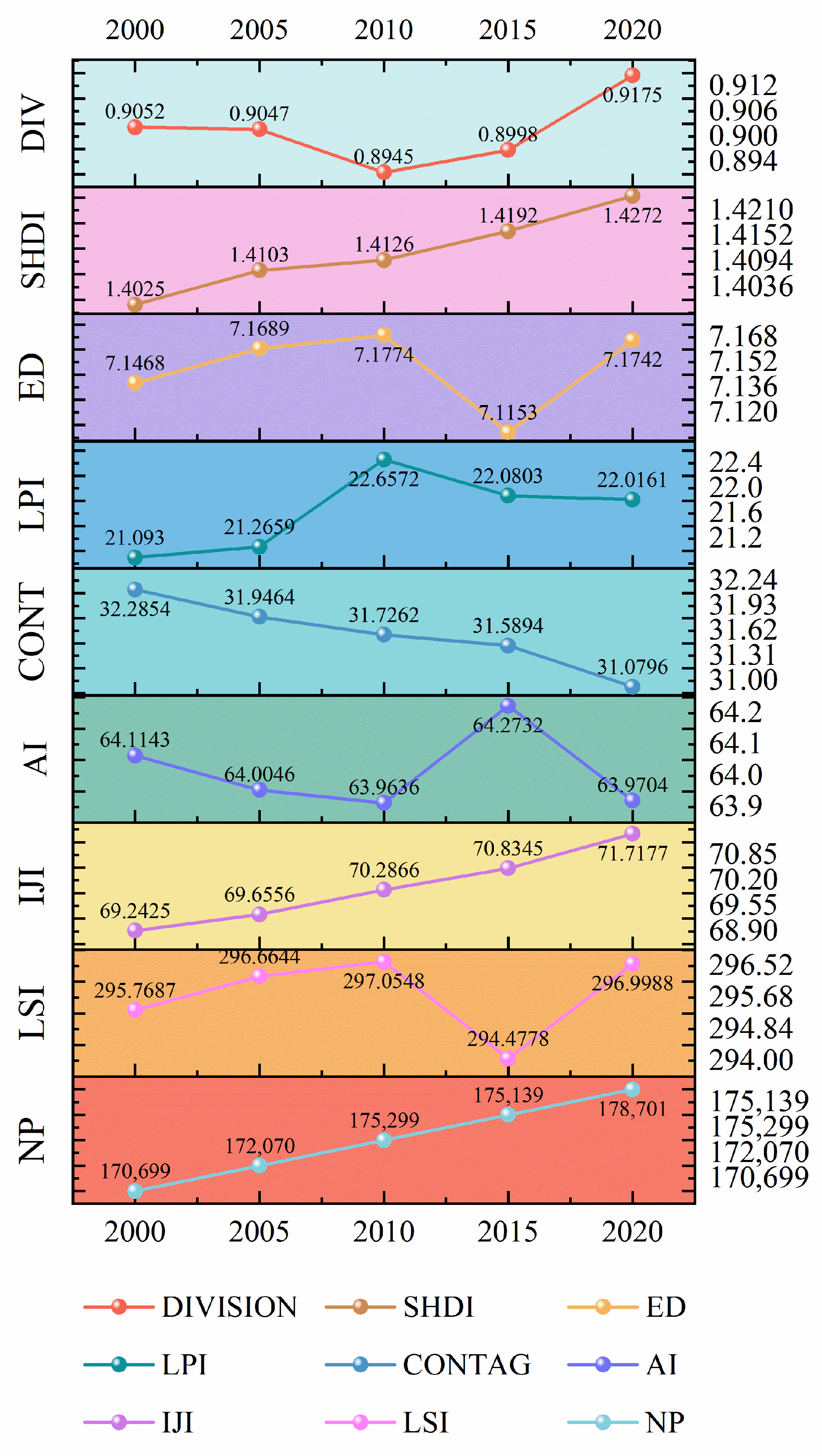
Understanding land-use change and landscape-pattern responses in large river basins is important for spatial optimization and ecological-security maintenance. Previous studies have often examined land-use dynamics or landscape-pattern change separately, leaving limited evidence on their coupled structural relationships and on how future land-use configurations may diverge under alternative policy scenarios. To address this gap, this study examines the Yangtze-Yellow River basins using multi-temporal land-use data from 2000 to 2020. By combining land-use transition analysis, dynamic-degree analysis, centroid-migration analysis, landscape metrics and the Patch-generating Land Use Simulation (PLUS) model, we construct an analytical framework that links historical land-use restructuring, landscape-pattern response and multi-scenario simulation. The results show that land-use change from 2000 to 2020 was dominated by bidirectional conversion among cropland, forest and grassland, together with continued built-up land expansion. Forest and built-up land increased by 12,886 km2 and 19,085 km2, respectively, whereas cropland and unused land decreased by 35,468 km2 and 18,145 km2, indicating clear structural adjustment and regional differentiation. Landscape metrics further indicate that land-use restructuring was accompanied by increasing fragmentation and heterogeneity: the number of patches (NP) increased from 170,699 to 178,701, Shannon’s diversity index (SHDI) rose from 1.4025 to 1.4272, and contagion (CONTAG) declined from 32.2854 to 31.0796. The 2030 simulations reveal distinct scenario trade-offs. Under the natural development scenario, cropland decreases by 9653 km2 and built-up land expands by 9778 km2, suggesting continued pressure from construction-space expansion. Under the cropland-protection scenario, cropland increases by 4063 km2, but grassland decreases by 5868 km2, indicating that cropland retention may partly transfer pressure to ecological land. Under the sustainable development scenario, cropland loss is reduced to 5244 km2, forest increases by 5547 km2, grassland shifts to a slight increase of 422 km2, and built-up expansion slows to 7731 km2, suggesting a more balanced pathway for coordinating built-up land control, ecological continuity and land-use structure optimization. Overall, these findings offer a quantitative reference for coordinating territorial spatial planning, land-resource allocation and ecological-security maintenance in the Yangtze-Yellow River basins.

1. Introduction

Land-use and land-cover change (LUCC) is a central issue in global environmental-change research because it links human land demand with resource-environment processes across regional and global scales [1,2,3,4,5]. Land-use change not only modifies surface-cover composition, but also reorganizes landscape configuration and thereby affects hydrological processes, soil erosion, biodiversity and ecosystem services [6,7,8,9,10,11]. River basins provide an appropriate spatial unit for examining these effects because they integrate natural processes and human activities within connected land-water systems. In this context, landscape metrics offer a quantitative way to describe fragmentation, connectivity and heterogeneity and to evaluate how land-use change is translated into landscape-pattern response [12,13,14,15].
A growing body of research has investigated land-use dynamics and landscape evolution in China’s major river basins. For the Yellow River Basin, previous studies have examined land-use transitions, scenario simulation, ecological risk, habitat quality, ecological vulnerability, and landscape connectivity [16,17,18,19]. For the Yangtze River Economic Belt, related work has focused on built-up expansion, landscape heterogeneity, habitat-quality change, water-resource security, and ecological risk [15,20,21]. Landscape-pattern change can be assessed using metrics related to fragmentation, connectivity, and heterogeneity [12,13]. Future land-use patterns are often simulated with models such as CLUE-S, CA-Markov, FLUS, and PLUS under alternative scenarios [22,23,24,25,26,27,28,29]. Recent studies further emphasize the need to connect transition-rule optimization, ecosystem-service response, landscape-risk coupling and spatial-coupling interpretation in scenario-based land-use research [30,31,32,33,34,35].
Despite these advances, three gaps remain for large river basins. First, many studies separately describe land-use dynamics or landscape-pattern change, but provide limited evidence on how land-use restructuring is coupled with fragmentation, connectivity and heterogeneity at the basin scale [17,18,19,21]. Second, scenario simulations often focus on future land-use quantities or spatial patterns, while giving less attention to how landscape structure and policy-oriented trade-offs diverge among alternative development pathways [32,33,34,35,36,37,38]. Third, although land-use change can influence ecosystem services and ecohydrological processes through landscape reorganization [6,7,8], the links among land-use restructuring, landscape pattern, habitat quality, ecological-security patterns and regional resilience are still insufficiently integrated in a unified basin-scale framework [39,40,41].
The Yangtze and Yellow River basins are suitable for addressing these gaps because they span contrasting climatic, geomorphic and socio-economic regions and are central to national ecological security and territorial spatial planning. Climate change, ecological restoration and rapid urbanization have jointly reshaped land-use structures in both basins, intensified competition between ecological and built-up spaces [15,16], and generated marked changes in ecological resilience and landscape risk [41,42,43]. However, because the Yangtze-Yellow River basins form a cross-climatic and cross-geomorphic system, current research still lacks an integrated analysis that connects historical land-use evolution, landscape-pattern response and future policy scenarios within one workflow [17,21,36,39]. It therefore remains necessary to clarify how land-use restructuring affects fragmentation, connectivity and heterogeneity, and how land-use and landscape structures may diverge under alternative development trajectories [18,19,38,42,44].
This work therefore regards the two river basins as an integrated study system and establishes a holistic basin-scale framework to connect historical evolution, landscape-response assessment, and multi-scenario prediction. The novelty of this study does not lie in proposing a new algorithm, but in integrating established land-use diagnosis, landscape-metric assessment and PLUS-based scenario simulation into a coherent workflow for large river basins. this study has three objectives: (i) to examine land-use evolution during 2000–2020 and identify major conversion pathways and spatial restructuring directions; (ii) to evaluate landscape-pattern responses to land-use restructuring in terms of fragmentation, connectivity, aggregation, and heterogeneity; (iii) to use the PLUS model to compare 2030 land-use outcomes under natural development, cropland-protection, and sustainable-development scenarios and discuss their implications for future land-use and landscape management.

2. Materials and Methods

2.1. Study Area

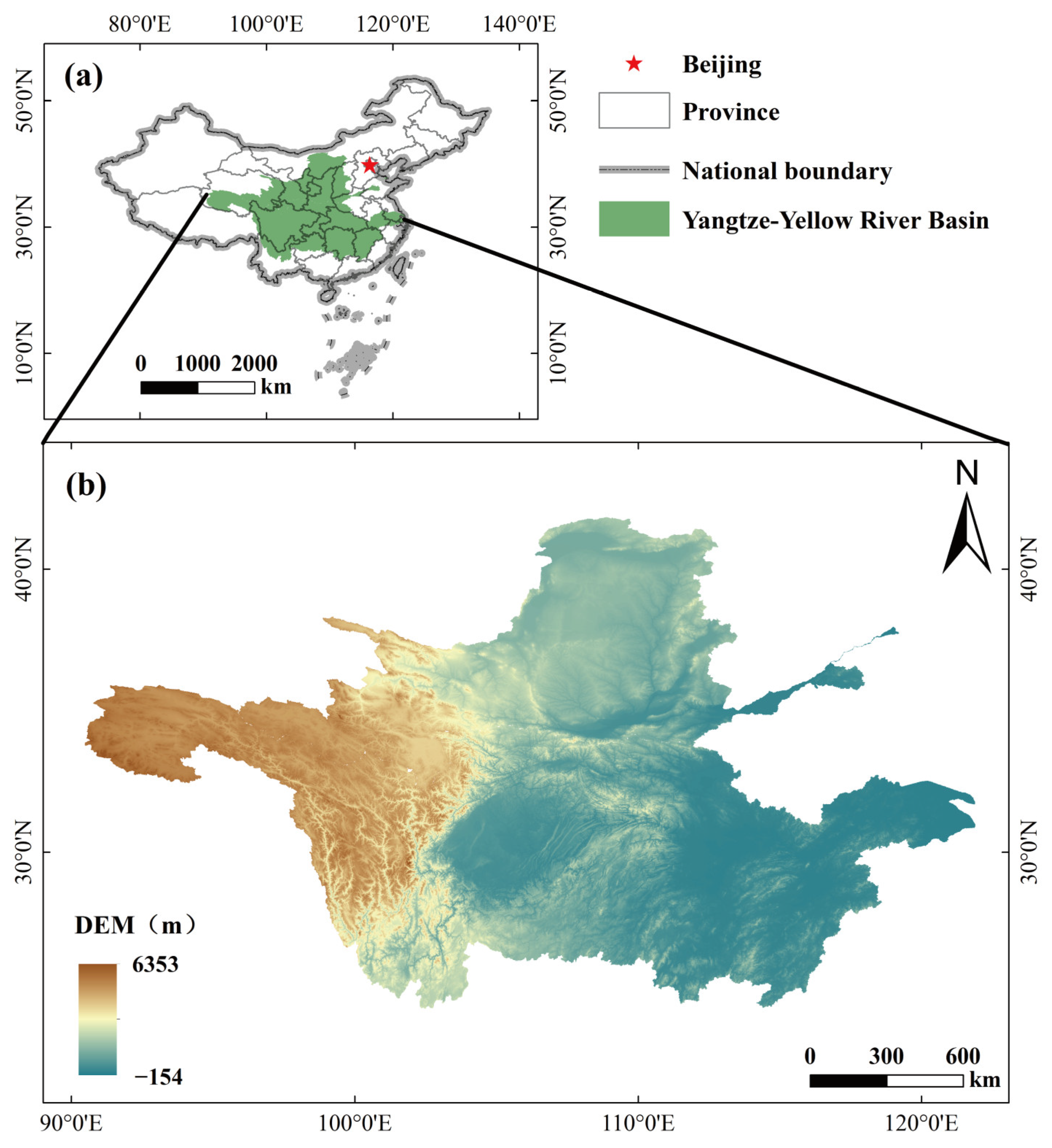
The study area consists of the Yangtze River Basin and the Yellow River Basin in China (Figure 1). The Yangtze River Basin extends from 90°33′ E to 122°25′ E and from 24°30′ N to 35°45′ N. It covers about 1.8 million km2 and crosses 19 provinces. Most of the basin is affected by a subtropical monsoon climate, with annual precipitation of about 1000–1600 mm. The Yellow River Basin extends from 95°53′ E to 119°05′ E and from 32°10′ N to 41°50′ N. It covers about 795,000 km2 and crosses nine provinces. The basin is mainly influenced by a temperate continental climate, with annual precipitation of about 400–600 mm. The two basins differ in terrain, climate, resources, and development intensity. They also have different ecological and socio-economic functions. The Yangtze River Basin is closely related to water supply and ecological regulation. The Yellow River Basin is important for soil-water conservation, desertification control, and energy security. Because of these natural and human contrasts, the two basins provide a suitable area for analyzing land-use change and landscape-pattern responses at a large basin scale.

2.2. Data Sources and Preprocessing

A multi-source dataset was constructed from land-use data, natural driving factors and socio-economic driving factors to support land-use change analysis, landscape-pattern assessment and PLUS-based scenario simulation. Because the source datasets differed in spatial resolution, coordinate system, data format and statistical scale, they were harmonized through projection transformation, clipping to the study area, spatial registration and resolution unification. Raster layers were aligned to a uniform 30 m grid, and county-level statistical data were spatialized through attribute linkage and rasterization to ensure comparability and overlay compatibility within a common spatial framework.
For methodological transparency, spatial preprocessing, raster alignment, and map preparation were conducted using ArcGIS Pro 3.0 (Esri, Redlands, CA, USA); landscape metrics were calculated using FRAGSTATS 4.2.1 (University of Massachusetts Amherst, Amherst, MA, USA); 2030 land-use simulations were implemented using PLUS model software V1.4 (High-Performance Spatial Computational Intelligence Lab, China University of Geosciences, Wuhan, China); and Pearson correlation and piecewise SEM analyses were performed in R 4.3.2 (R Core Team, Vienna, Austria) with the piecewiseSEM package.

2.2.1. Land-Use Data

Land-use data were obtained from the China Land Use/Cover Dataset provided by the Resource and Environmental Science Data Center of the Chinese Academy of Sciences (RESDC; https://www.resdc.cn). Five years were used: 2000, 2005, 2010, 2015, and 2020. These years were selected to build a consistent time series for land-use change analysis. The five datasets have the same source, classification system, spatial resolution, and preprocessing standard. This consistency helps reduce errors caused by mixed data sources. Intermediate-year products with comparable standards were not available for the whole basin. Therefore, the five benchmark years were used for the analysis and scenario simulation. The original land-use classes were reclassified into six types: cropland, forest, grassland, water, built-up land, and unused land. Finally, all land-use rasters were clipped to the basin boundary, reprojected, and spatially aligned. Subsequently, the land-use rasters for each period were clipped to the basin boundaries, reprojected, and spatially aligned to create a time-series land-use database of the study region, upon which land-use transition analysis, dynamic-degree calculation, centroid-migration analysis, landscape-metric estimation, and PLUS simulation were conducted.

2.2.2. Natural Driving Factors

Natural driving factors included topographic and climatic variables. Topographic variables included DEM, slope, and aspect. Climatic variables included annual mean temperature and annual precipitation. DEM data were obtained from the Geospatial Data Cloud platform (https://www.gscloud.cn). After mosaicking and clipping the DEM, slope and aspect were derived to describe terrain relief and topographic constraints. Station observations from the China Meteorological Data Service Centre (https://data.cma.cn) were used to construct the climate-variable layers. The station records were first converted into continuous raster surfaces through spatial interpolation and were subsequently aggregated into annual temperature and precipitation datasets over the study period. To maintain cross-variable comparability, all natural driving factors were unified in projection, grid size, and spatial coverage before spatial registration.

2.2.3. Socio-Economic Driving Factors

Socio-economic driving factors included population density and GDP. These two variables were used to represent human activity intensity and regional development level. The corresponding county-level records were compiled from the China Statistical Yearbook released by the National Bureau of Statistics. County-level statistical records were first checked for reporting consistency and linked to administrative-boundary vectors to generate county polygon attributes. The polygon attributes were then spatialized into gridded layers of population density and GDP, with projection, spatial extent and 30 m cell size aligned to the land-use and natural driving-factor datasets. Because county statistics represent areal summaries, the rasterized layers may smooth within-county heterogeneity; they were therefore used to characterize broad socio-economic gradients rather than fine-scale local variation. Before model input, all driving variables were rescaled to reduce the influence of differences in measurement units and value ranges.
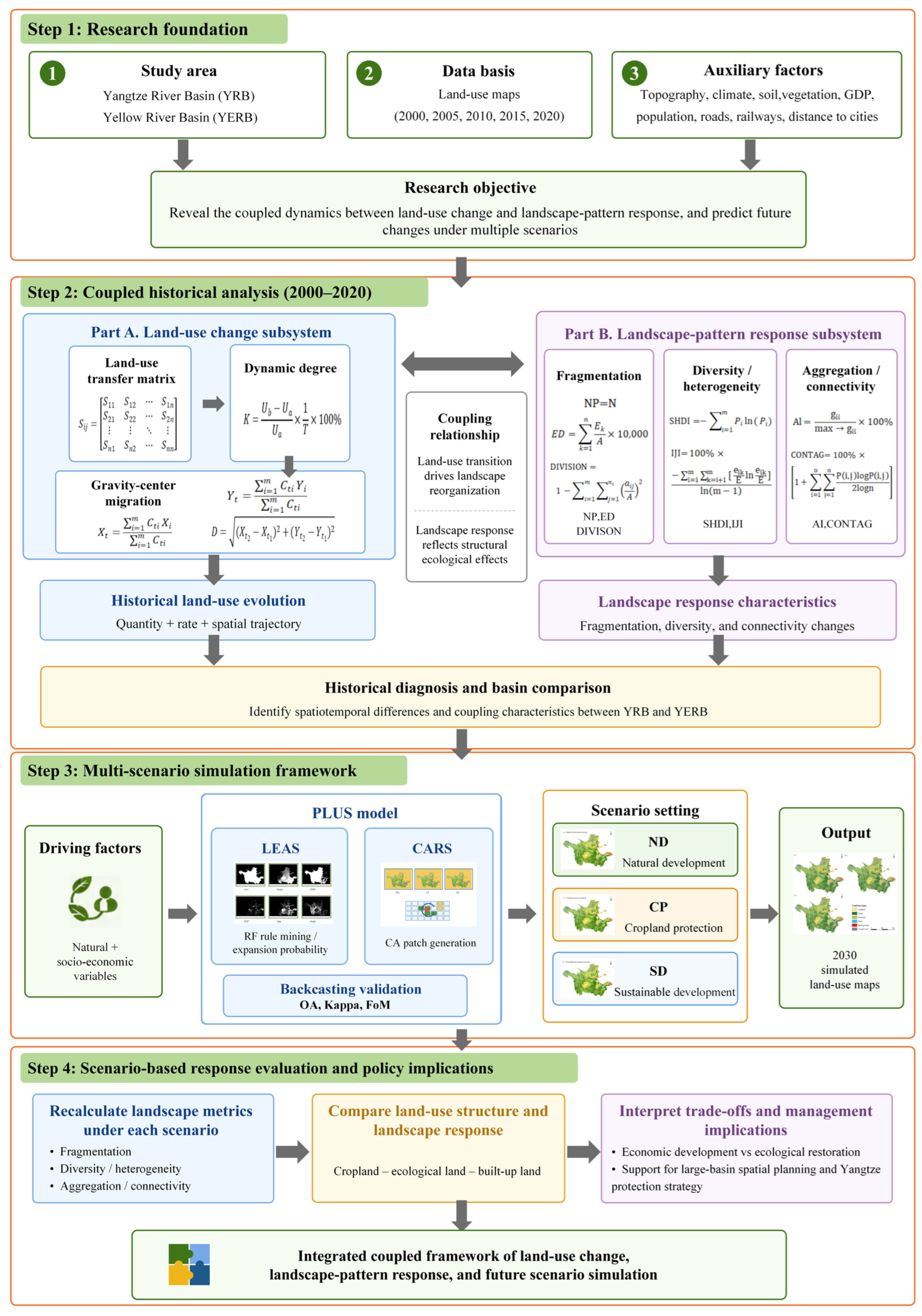
Figure 2 presents the workflow from data preparation to scenario interpretation. Historical land-use maps were used to analyze transition pathways, change intensity, and centroid shifts, and landscape metrics were calculated to evaluate structural responses. Based on driving factors and historical transitions, the PLUS model simulated 2030 scenarios for comparing land-use trade-offs and management implications.

2.3. Methods for Analysing Land-Use Change

Before landscape-response assessment and scenario simulation, land-use restructuring was examined from three aspects: conversion pathway, change intensity, and spatial shift. These aspects were quantified by the transition matrix, dynamic degree, and centroid-migration model, respectively.

2.3.1. Land-Use Transition Matrix

The land-use transition matrix was used to quantify conversions among the six land-use Rows represent source types and columns represent target types, so the matrix directly identifies the main sources of land-use gains, destinations of losses and dominant conversion pathways. In this study, it provides the quantitative basis for explaining land-structure reorganization and for constraining scenario conversion rules. The calculation formula is
S i j = S 11 S 12 S 1 n S 21 S 22 S 2 n S n 1 S n 2 S n n
where S i j is the area changing from class i to class j during the study period, and n is the number of land-use classes. Diagonal elements ( S i j ) indicate unchanged areas, whereas off-diagonal elements indicate conversions among different land-use types.

2.3.2. Land-Use Dynamic Degree

The dynamic degree was calculated to compare the annual change intensity of each land-use class [16,17,36]. The formula is
K = U b U a U a × 1 T × 100 %
where K is the dynamic degree (%); U a and U b are the initial and final areas of a land-use class, respectively; and T is the time interval length in years. Positive and negative K values indicate expansion and contraction, respectively, and a larger absolute K value indicates stronger change intensity.

2.3.3. Centroid-Migration Model of Land Use

The centroid-migration model describes the spatial shift of each land-use type at the basin scale [16,36]. Rather than describing local patch movement, this model summarizes the overall direction and distance of spatial reorganization, thereby linking quantity changes with spatial restructuring. The formulae are as follows:
X t = i = 1 m C t i X i i = 1 m C t i
Y t = i = 1 m C t i Y i i = 1 m C t i
D = ( X t 2 X t 1 ) 2 + ( Y t 2 Y t 1 ) 2
where X t and Y t denote the longitude and latitude of the centroid of a given land-use type at time; C t i is the area of that land-use type in spatial unit i at time t ; X i and Y i are the coordinates of the geometric centre of spatial unit i ; n is the number of spatial units; and D is the migration distance of the centroid between two periods. The migration direction and distance were used to identify the dominant spatial shift of each land-use type.

2.4. Landscape-Pattern Analysis

Land-use restructuring influences landscape structure through spatial reconfiguration. To quantify the landscape responses to land-use change in the Yangtze-Yellow River basins, we incorporated landscape metrics based on land-use change analysis and characterized landscape evolution in terms of fragmentation, connectivity and aggregation, compositional diversity, interspersion, and spatial complexity. Specifically, NP, ED and DIVISION were used to characterize fragmentation; CONTAG, AI, PLADJ and LPI were used to reflect connectivity, aggregation and dominance; SHDI was used as the core metric for compositional diversity; IJI was used as a supplementary metric for interspersion and adjacency relationships; and LSI was used to capture boundary morphology and spatial structural complexity [45,46,47,48,49,50,51].
To examine potential redundancy among metrics with similar ecological meanings, Pearson correlation analysis was conducted for NP-ED-DIVISION, SHDI-IJI and AI-CONTAG. The correlations among NP, ED and DIVISION were weak and not significant, and the correlation between AI and CONTAG was also weak, indicating that these metrics provide complementary information. SHDI and IJI showed a strong positive correlation (r = 0.986, p = 0.002); therefore, SHDI was used as the main metric for interpreting landscape diversity, whereas IJI was used only to support the interpretation of interspersion and adjacency among land-use types. The selected landscape metrics, including their formulas and descriptions with unit information, are summarized in Table 1.

2.5. Land-Use Simulation and Scenario Design

PLUS model was applied to simulate land-use patterns in 2030 under alternative development pathways. This model was selected because it combines land-expansion analysis with patch-level cellular automata simulation. It can also link driving factors, neighborhood effects, and land-use conversion constraints in scenario modelling [25,28,30,32,33,34,35,37].

2.5.1. Principles and Implementation of the PLUS Model

PLUS includes two major modules: the Land Expansion Analysis Strategy (LEAS) module and the Cellular Automata based on multi-type Random Seeds (CARS) module [25,28]. LEAS extracts expansion samples from historical land-use change and estimates the contribution of driving factors to the expansion of each land-use type. CARS simulates patch generation, expansion and spatial competition under neighborhood effects and scenario-specific conversion constraints. The 2030 scenario simulation was based on land-use maps from 2000, 2010, and 2020 and a set of natural and socio-economic driving factors, whereas the full five-period 2000–2020 land-use dataset supported historical transition analysis, parameter calibration and the 2015–2020 backcasting validation described below.

2.5.2. Scenario Design

Three scenarios were designed (Table 2): natural development, sustainable development and cropland protection. The natural-development scenario maintains the historical transition tendency without adding restricted-conversion zones. The sustainable-development scenario constrains the conversion of forest, grassland and water to built-up land according to ecological-redline and ecological-space protection principles. The cropland-protection scenario limits the shift from stable, highly suitable, low-slope cropland to built-up land, because such areas generally have stronger agricultural suitability and are less affected by development disturbance [52,53,54].
The conversion rules and neighborhood effects were calibrated in two steps. First, land-use transition matrices covering 2000–2005, 2005–2010, 2010–2015, and 2015–2020 were constructed to identify recurring conversion pathways; repeatedly observed transitions were permitted, whereas conversions conflicting with ecological protection or cropland protection were constrained in the corresponding scenarios. Second, neighborhood weights were adjusted according to observed expansion intensity and spatial aggregation characteristics, with 2015–2020 used for final backcasting calibration. This procedure links scenario rules to historical land-use change while avoiding arbitrary parameter settings. The five benchmark maps for 2000, 2005, 2010, 2015, and 2020 were used to maintain temporal comparability. Higher-frequency land-use products with consistent standards were not available for the whole basin during the study period. Therefore, a higher temporal resolution was not used.

2.5.3. Accuracy Assessment of the Simulation

Simulation accuracy was evaluated by backcasting 2020 land use from the 2015 map and comparing the result with the observed 2020 map. In addition to OA and Kappa, class-level user accuracy, producer accuracy, commission error, omission error, quantity disagreement and allocation disagreement were reported [55,56]. The validation produced OA = 92.84% and Kappa = 0.9014. Quantity disagreement was 0.18%, while allocation disagreement was 6.98%, indicating that the remaining error was mainly spatial allocation error rather than land-demand quantity error. These results support the use of the calibrated model for 2030 scenario simulation (Table 3).

3. Results

3.1. Spatiotemporal Evolution of Land-Use Structure

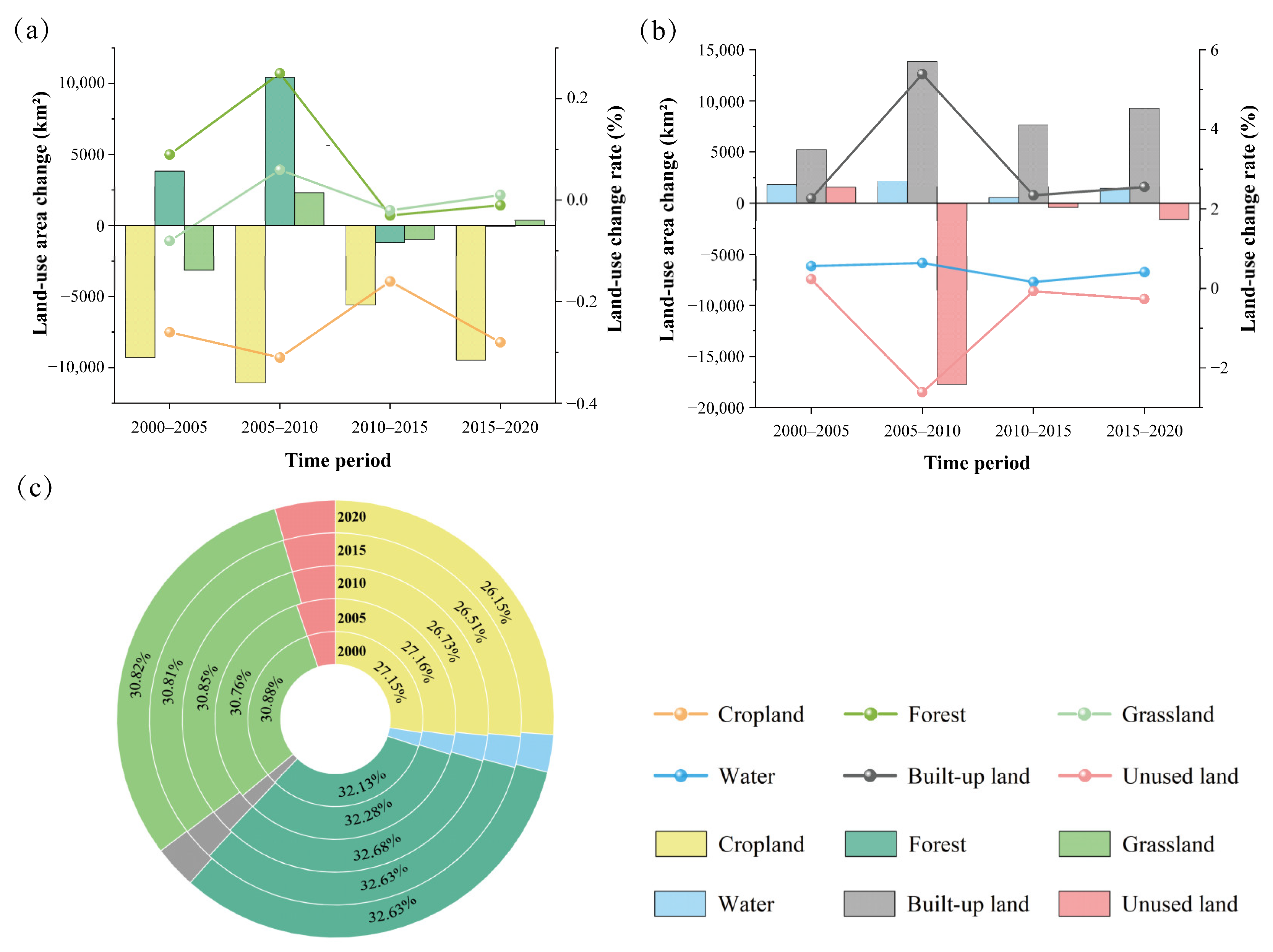
Figure 3 shows the area composition and stage changes of land use in the Yangtze-Yellow River basins from 2000 to 2020. As shown in Figure 3c, the overall land-use structure remained relatively stable during the study period, with cropland, forest and grassland consistently dominating the landscape. Nevertheless, clear directional changes occurred among land-use types. Cropland decreased from 713,170 km2 in 2000 to 677,703 km2 in 2020, a net loss of 35,468 km2; forest increased from 832,786 km2 to 845,672 km2, a net gain of 12,886 km2; built-up land expanded from 46,167 km2 to 65,252 km2, an increase of 19,085 km2; and unused land declined by 18,145 km2. By contrast, grassland and water fluctuated only slightly and remained broadly stable overall. These results indicate that although no abrupt substitution occurred among major land-use types, internal restructuring persisted throughout the two basins.
Figure 3a further reveals stage-specific differences in cropland, forest and grassland. Cropland exhibited negative growth in all four stages, with particularly large declines in 2005–2010 and 2015–2020, indicating persistent compression of cropland. Forest increased continuously from 2000 to 2010, reaching a stage-specific peak in 2005–2010, after which growth slowed markedly and a slight decline occurred in 2010–2015. Grassland alternated between gains and losses but changed little overall, suggesting a relatively stable general pattern. Figure 3b shows a slight increase in water area across all four intervals, although the magnitude of change remained limited. Built-up land showed a sustained upward trend, with the strongest growth occurring during 2005–2010, indicating that this period represented the most active stage of urban expansion. Unused land generally decreased, particularly during 2005–2010, reflecting the combined effects of land development and ecological restoration. Overall, Figure 3a–c reveal a temporal pattern in which cropland and unused land declined, forest and built-up land expanded, and grassland and water remained relatively stable.

3.2. Characteristics of Land-Use-Type Transitions

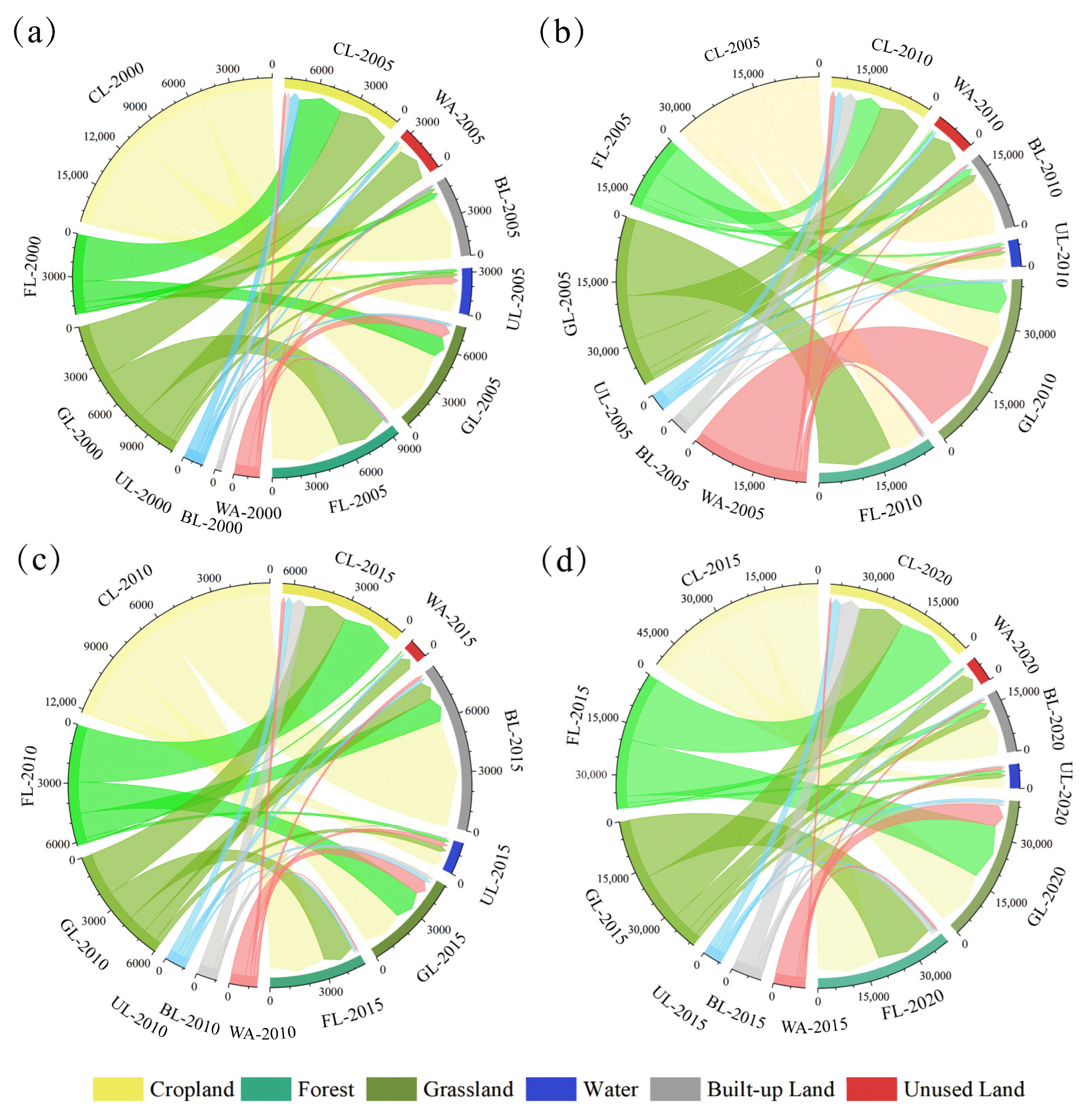
Land-use transition relationships further reveal the internal pathways of land-structure adjustment in the two basins (Figure 4). Figure 4a–d show that, in all periods from 2000 to 2020, transitions were dominated by bidirectional conversion among cropland, forest and grassland, whereas the transition volumes of water, built-up land and unused land were relatively small but strongly directional. Cropland losses were directed mainly towards forest, grassland and built-up land, indicating that ecological restoration and urban expansion constituted the two principal pathways of cropland decline. Forest gains originated mainly from cropland and grassland, reflecting the long-term effects of ecological projects such as cropland-to-forest conversion across the basin. Built-up expansion was derived primarily from cropland, with smaller contributions from forest and grassland, suggesting persistent compression of agricultural and ecological space by urbanization in the middle and lower reaches.
From a stage-specific perspective, Figure 4a shows that land-use conversion was already active in 2000–2005, when cropland began to be continuously converted to forest, grassland and built-up land. Figure 4b indicates that 2005–2010 was the most intense transition period in the entire study interval, with stronger cropland losses, forest gains and built-up expansion occurring simultaneously. Figure 4c shows that the role of built-up expansion was further strengthened in 2010–2015, whereas growth in forest and grassland slowed. Figure 4d suggests that inter-type conversions became generally more stable in 2015–2020. Overall, the stage-specific transitions shown in Figure 4 are consistent with the quantity-based trends in Figure 3, together indicating that land-use evolution in the Yangtze–Yellow River basins was not driven by isolated changes in single land types, but by the combined effects of internal ecological-space restructuring and outward built-up expansion.

3.3. Spatial Reconfiguration of Land-Use Patterns

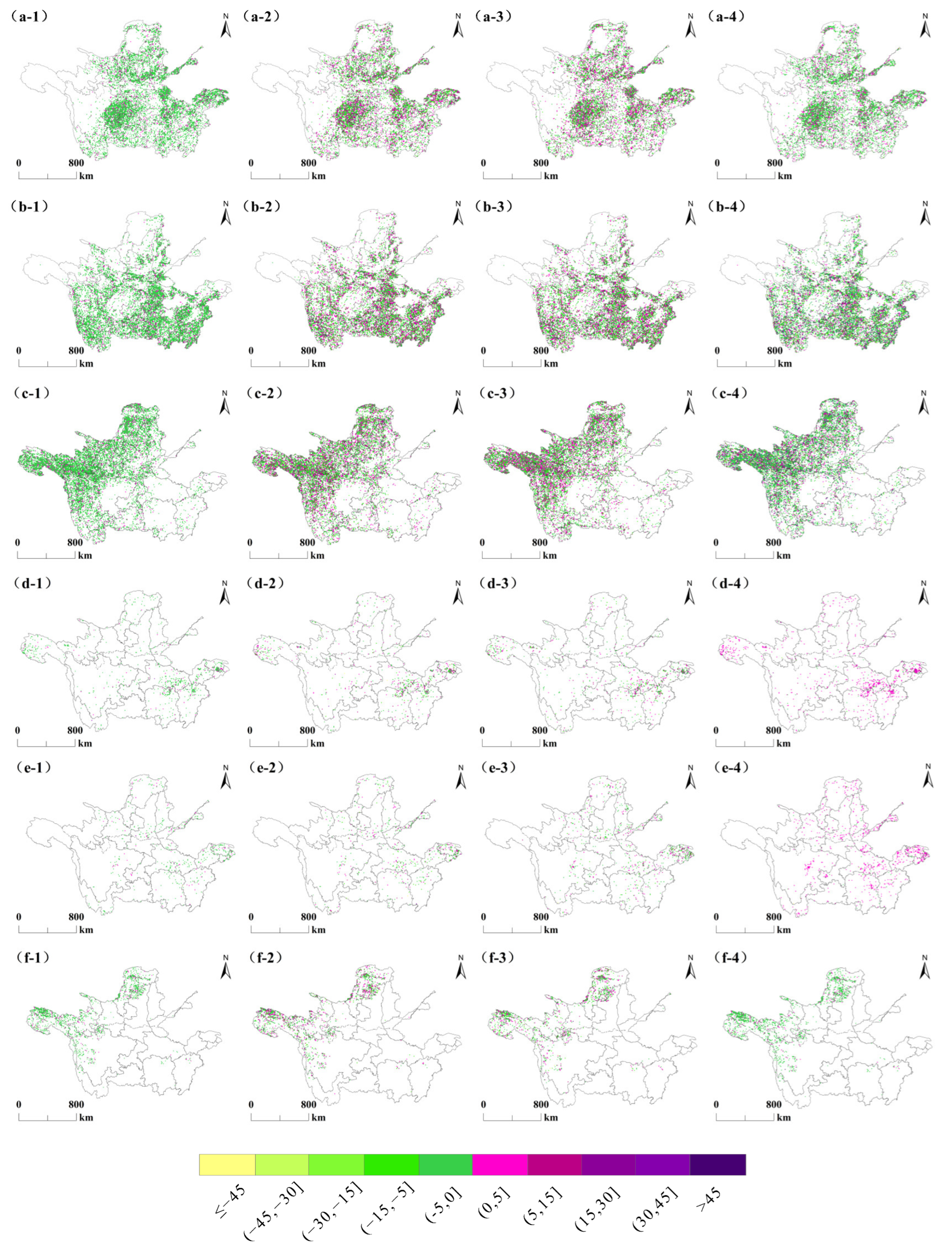
Figure 5 maps where each land-use type increased or decreased during the four intervals. (Figure 5(a-1)–(a-4)) show that cropland hotspots were concentrated mainly in the middle and lower plains and in areas with relatively dense populations and urban activity. Local expansion and contraction coexisted, but contraction hotspots were more prominent overall, indicating that cropland continued to be squeezed by built-up expansion and land-structure adjustment. (Figure 5(b-1)–(b-4)) indicate that forest-change hotspots were concentrated mainly in mountainous and hilly areas of the middle and upper reaches and were dominated by increases, reflecting the sustained effects of ecological restoration measures such as cropland-to-forest conversion. (Figure 5(c-1)–(c-4)) show that grassland change was widely distributed, mainly in western and northern areas, and displayed clear stage-specific fluctuations, with localized gains and losses alternating over time.
(Figure 5(d-1)–(d-4)) show that water-change hotspots were relatively scattered and occurred mainly along rivers, lakes and local hydraulic-engineering areas; the overall magnitude of change was small, but the spatial locations were concentrated. (Figure 5(e-1)–(e-4)) indicate that built-up hotspots were strongly clustered around urban agglomerations in the middle and lower reaches and along major transport corridors, showing highly pronounced expansion and aggregation characteristics. (Figure 5(f-1)–(f-4)) show that hotspots of unused-land change were concentrated mainly in the northwestern region and parts of ecologically fragile areas, and were dominated by decreases, indicating that unused land was continuously converted through land development and ecological restoration. Overall, Figure 5 demonstrates strong spatial heterogeneity in land-use change across the two basins, with clear differences among land-use types in direction, extent and intensity of change, reflecting regionally differentiated patterns jointly shaped by physical geography and human activities.

3.4. Spatial Reconfiguration Revealed by Centroid Migration

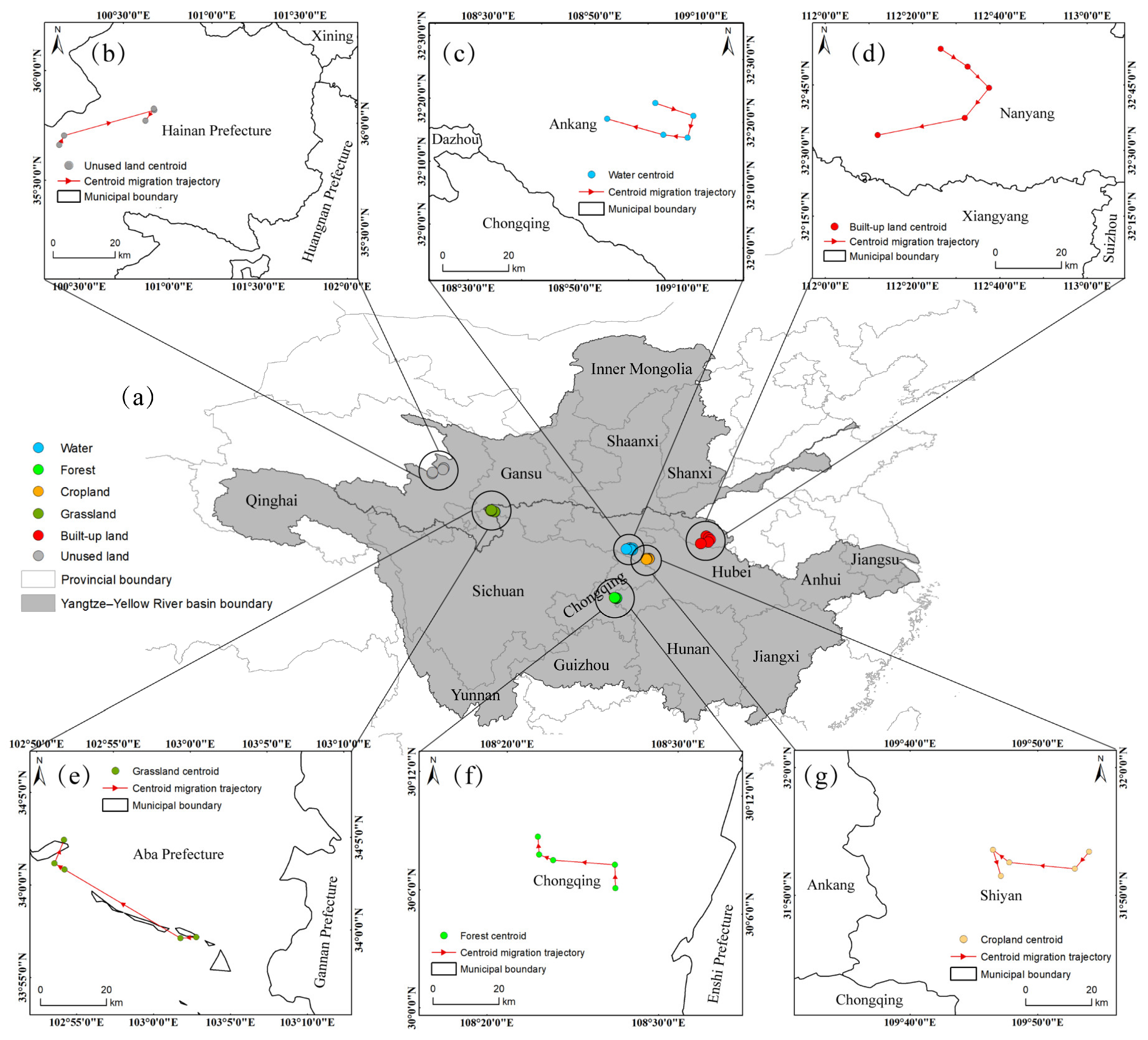
The graph in Figure 6 represents the centroid-migration characteristics of land-use types in the Yangtze–Yellow River basins during 2000–2020, viewed from both an overall-distribution and local-trajectory perspective. As shown in Figure 6a, the centroid locations were generally consistent with the main spatial distribution of each land-use type. For instance, the centroids of cropland and water were mostly found in the transitional zones between central basins and plains, while forest centroids were located in the southern mountainous areas. Meanwhile, grassland and unused-land centroids were skewed toward the northwestern plateaus and mountain regions, and the centroid of built-up land was decidedly shifted to the economically active middle and eastern region. This suggests that the long-term spatial distributions of these various land-use types are jointly constrained by the natural terrain background and the concentration of human activities.
Figure 6b–g further show that centroid migration differed clearly among land-use categories in both direction and magnitude. The cropland centroid showed an overall northwestward movement, indicating that cropland loss was more evident across the middle–eastern basin area, while changes in the central and western areas were relatively limited. In contrast, the water centroid shifted only slightly, suggesting a largely stable spatial pattern. Built-up land exhibited the largest centroid displacement, reflecting the strong role of urban expansion in reshaping built space, especially in the middle–eastern part of the study region. The unused-land centroid also migrated northwestward, suggesting that unused land continued to decline in the east-central basin area and became increasingly concentrated in the northwest. Table 4 summarizes the migration distances and dominant directions of the different land-use categories. Overall, the centroid trajectories in Figure 6 and Table 4 indicate a directional reorganization of land-use patterns across the Yangtze–Yellow River basins, with clear regional contrasts.

3.5. Landscape Responses to Land-Use Change

Figure 7 presents changes in landscape-level metrics from 2000 to 2020. NP increased continuously, while SHDI rose from 1.4025 to 1.4272, indicating increasing compositional diversity. Because SHDI and IJI were highly correlated in this study, SHDI was used as the core heterogeneity indicator, whereas IJI was used only to support interpretation of interspersion and adjacency relationships among land-use types. CONTAG declined from 32.2854 to 31.0796, suggesting weaker landscape aggregation and connectivity.
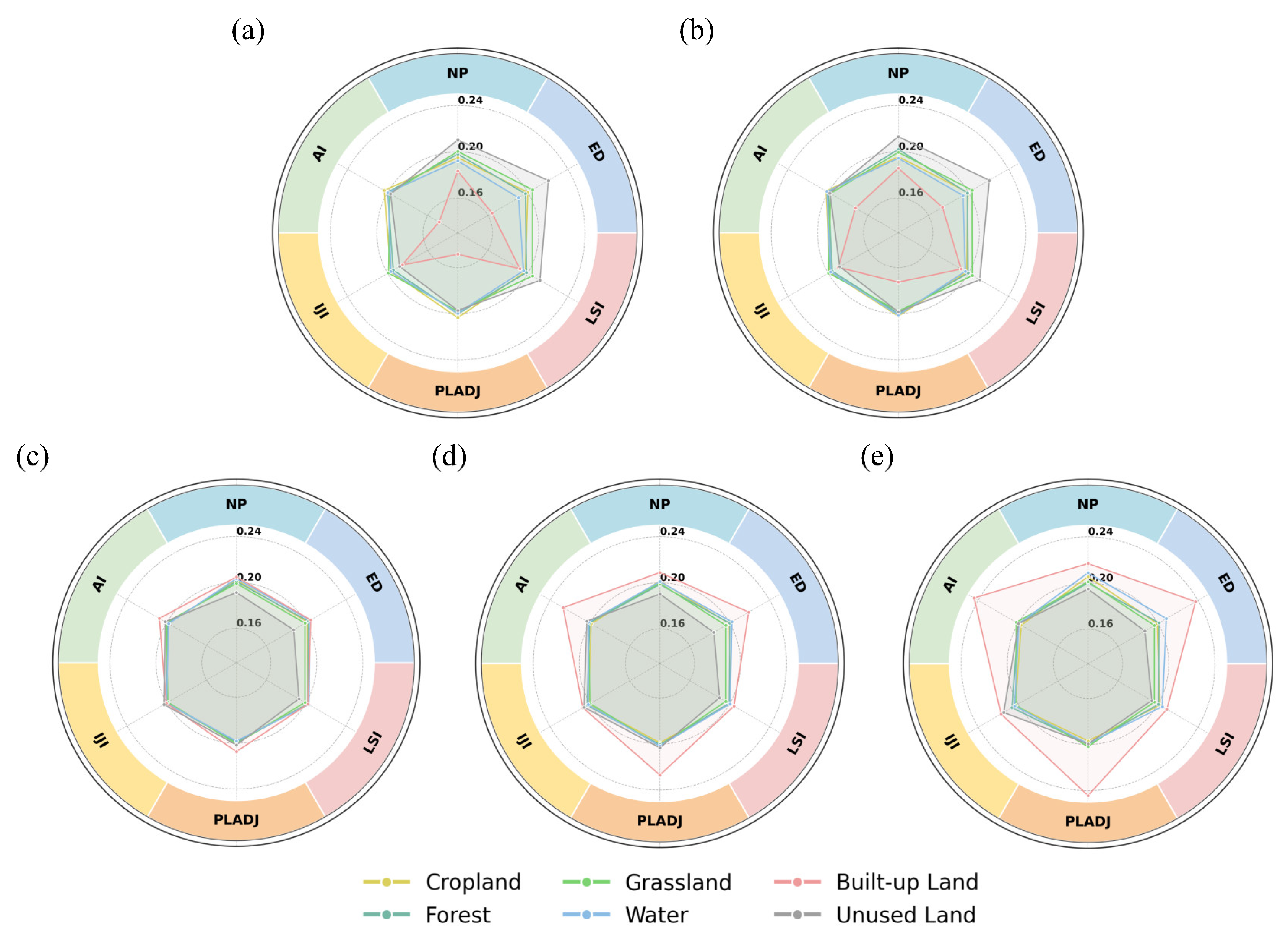
Figure 8 further shows that forest, grassland and cropland consistently formed the dominant basis affecting AI, LSI, ED and NP, whereas the contribution of built-up land to NP, LSI and ED increased progressively. These results indicate that land-use restructuring reshaped landscape ecological structure through both fragmentation of natural landscapes and aggregation of human-dominated landscapes.
Landscape metrics may be sensitive to spatial resolution and indicator selection, especially when conceptually related metrics are used together. As a diagnostic sensitivity check, IJI was not treated as an independent heterogeneity metric because it was highly correlated with SHDI, but was retained as a supplementary descriptor of interspersion and adjacency. The recalculated landscape-level pattern remained highly consistent with the baseline landscape-metric result (Pearson r = 0.9517; mean absolute difference = 0.0894). In addition, after aggregating the 30 m land-use maps to 1000 m, the recalculated SHDI differed from the 30 m results by less than 0.01% across years. These results suggest that the conclusions of increasing heterogeneity and declining aggregation/connectivity were not driven by a single highly correlated metric or by the 30 m grid resolution.

3.6. Future Evolution of Land-Use Structure and Spatial Pattern Under Different Scenarios

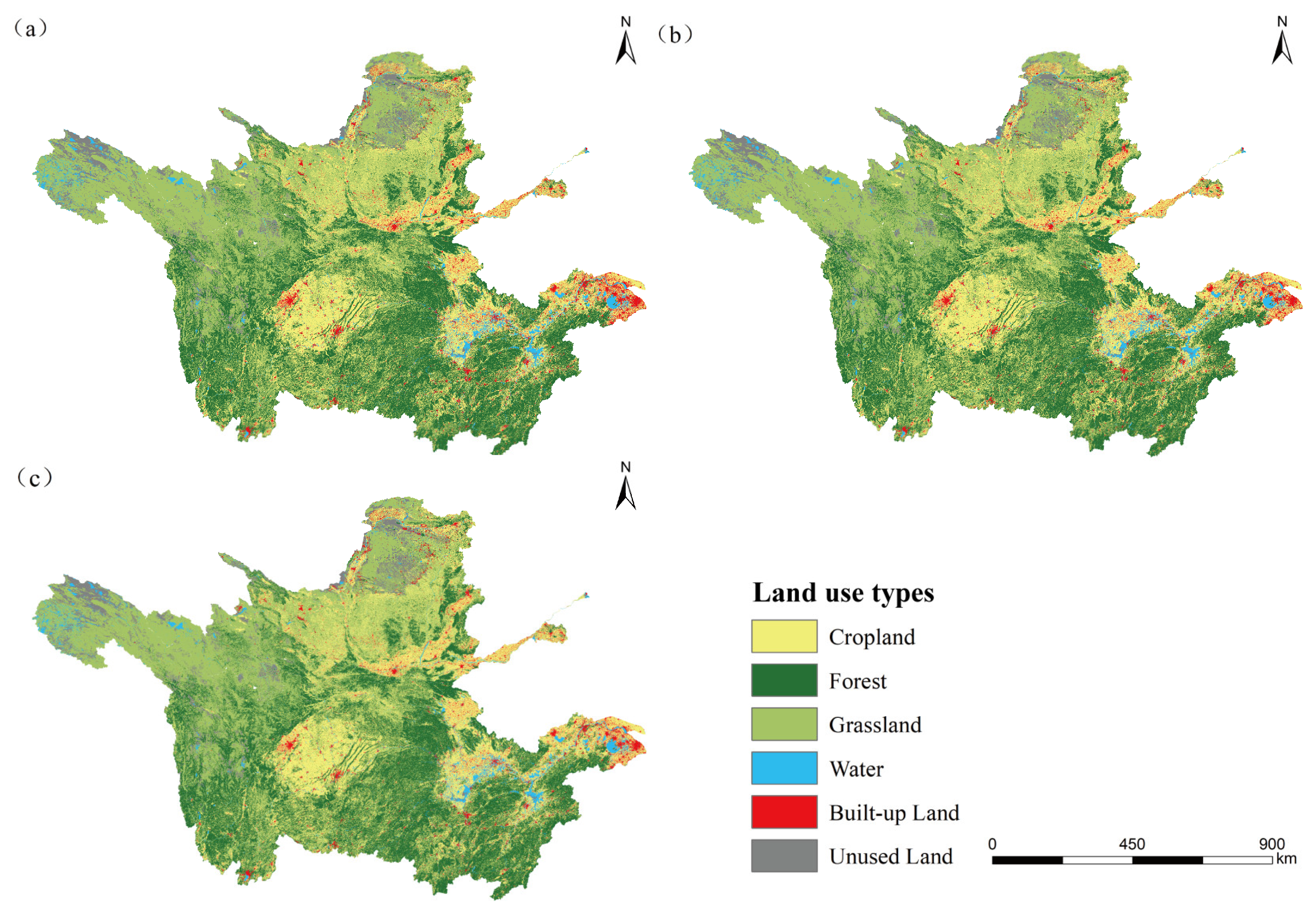
The PLUS simulation indicates clear scenario-dependent differences in land-use quantity, spatial configuration, and trade-off relationships in 2030 (Table 5 and Table 6; Figure 9). Table 5 further shows that the direction and magnitude of land-use transitions differ among the three scenarios. Under the natural development scenario, future land-use change generally follows the trajectory observed during 2000–2020. Specifically, cropland is projected to decline by 9653 km2, built-up land to expand by 9778 km2, grassland to decrease by 4842 km2, and unused land to decrease by 4535 km2, whereas forest and water are expected to increase by 3078 km2 and 2236 km2, respectively. These changes suggest a continued pattern characterized by built-up land expansion and cropland contraction. Conversely, the sustainable development scenario presents a more even structural adjustment. Cropland decline narrows to 5244 km2, and forest increases to 5547 km2. Meanwhile, grassland shifts from a reduction to a small gain of 422 km2, with built-up expansion slowing to 7731 km2. This clearly demonstrates a more harmonized land-use structure under ecological restrictions. The cropland-protection scenario displays the highest level of cropland maintenance. Here, cropland turns into positive growth (+4063 km2) and built-up land grows by only 2156 km2. However, the loss of grassland widens to 5868 km2, implying that cropland conservation is partially realized by encroaching on grassland. On the whole, these three scenarios represent distinct development paths focusing on built-up expansion, ecological coordination, and cropland protection, respectively.
Spatially, Figure 9 shows that the three 2030 scenarios generate clearly different land-use patterns. In the natural-development pathway, simulated built-up growth is concentrated around major urban clusters and transport corridors in the middle-to-lower reach areas. This pattern would further reduce cropland and ecological spaces in some locations, indicating that the historical tendency toward rapid urban expansion would continue. In the sustainable-development pathway, the spread of built-up land is more effectively contained, while forest, grassland, and water bodies retain better spatial connectivity. This suggests that ecological constraints can reduce spatial sprawl and promote a more coordinated landscape configuration. In the cropland-protection pathway, newly added cropland is mainly allocated to areas where grassland or unused land is present, extending toward basin margins and gently sloping terrain in the middle and upper reaches. Although this pathway strengthens cropland security, it may place additional pressure on grassland and other ecological spaces. Overall, Table 5 and Figure 9 indicate that future land-use evolution in the Yangtze–Yellow River basins is shaped by scenario-specific policy priorities rather than by a direct continuation of historical trends. Among the three pathways, the sustainable-development pathway achieves the most balanced outcome by controlling built-up growth, maintaining ecological connectivity, and improving landscape organization.

4. Discussion

4.1. Coupling Mechanisms Between Land-Use Reallocation and Landscape-Pattern Dynamics

Viewed together, Figure 3 and Figure 4 indicate that land-use change in the Yangtze–Yellow River basins from 2000 to 2020 was dominated by reallocation among major land categories, rather than by isolated gains or losses in individual categories. The most active transitions involved cropland, forest, and grassland, while built-up land continued to increase as urban expansion progressed. At the basin scale, cropland and unused land showed net declines, whereas forest and built-up land increased. The transition matrix further suggests that the redistribution of cropland toward ecological land and built-up land was the main pathway of structural reorganization during the study period. These results imply that land-use evolution in the two basins was jointly influenced by ecological-space restoration and outward urban expansion, rather than by net area change alone [17,18,19,44].
The selected landscape metrics were further interpreted as a structured indicator system rather than as isolated descriptive indices. In large river basins, land-use intensification usually occurs through urban expansion, cropland restructuring, transport-corridor development and ecological restoration. These processes do not only change land-use quantity, but also alter landscape connectivity, diversity and spatial complexity through spatial reorganization. Therefore, the increase in NP and SHDI, together with the decline in CONTAG and the supplementary IJI evidence, indicates that the Yangtze-Yellow River basins have become more fragmented and compositionally heterogeneous, while ecological connectivity has weakened. Figure 8 further shows that forest, grassland and cropland consistently formed the foundational land types affecting the major landscape metrics, while the relative contribution of built-up land to NP, LSI and ED increased progressively. This interpretation is consistent with recent studies linking landscape metrics with river-basin ecological responses, ecosystem services, landscape ecological risk and mixed-landscape coupling relationships [7,12,21,31,35,51].
Ecologically, the coupled relationship between land-use restructuring and landscape-pattern response indicates a transition from relatively continuous natural-agricultural matrices toward a more fragmented mixed mosaic. In cropland-dominated regions, increasing fragmentation may intensify edge effects and facilitate the diffusion of non-point-source pollution, while reduced forest connectivity may weaken water-conservation and habitat-maintenance functions [8,39,57]. Together with built-up expansion and continuous land conversion, these structural changes may increase biodiversity pressure [9,10,58,59,60,61] and reduce the stability of regional carbon sinks [38]. Therefore, future territorial-space governance should consider not only net land-use quantity changes, but also landscape-structural changes and associated ecological risks.

4.2. Differences in Driving Factors and Mechanisms of Spatial Land-Use Restructuring

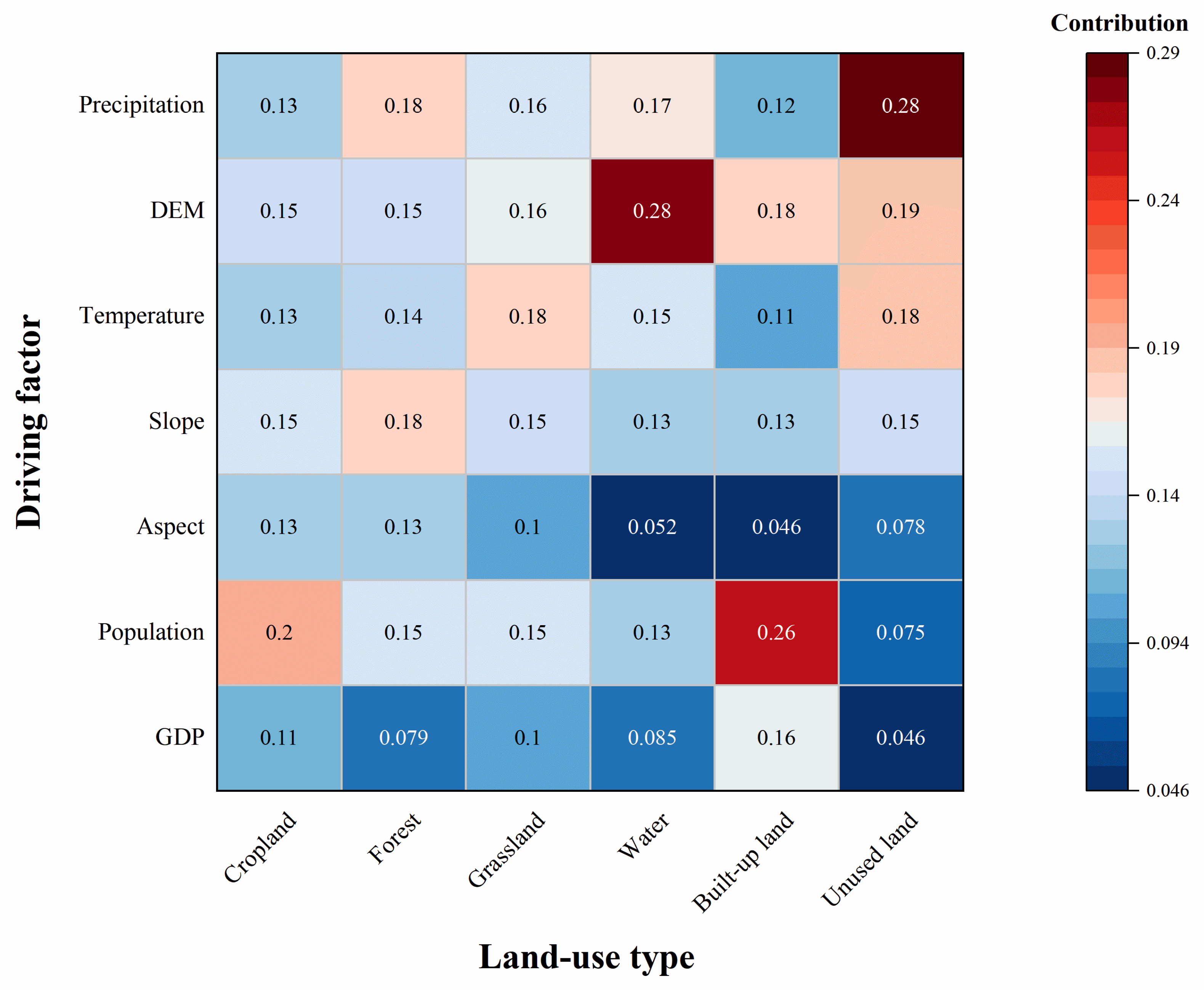
Figure 5, Figure 6 and Figure 10 jointly reveal a pronounced pattern of driver differentiation and spatial divergence in land-use change across the Yangtze–Yellow River basins. Figure 5 shows that different land-use types vary substantially in the spatial extent, direction and intensity of change across the four stages: cropland hotspots are concentrated mainly in the middle and lower plains and in densely populated and urbanized areas; forest and grassland changes are concentrated in mountainous and plateau transition zones of the middle and upper reaches; built-up hotspots are highly clustered around urban agglomerations and transport axes; and unused-land changes are concentrated mainly in the northwest and ecologically fragile areas. The centroid-migration results in Figure 6 further corroborate these regional differences at the integrated spatial scale: built-up land shows the most pronounced centroid migration, the centroid of cropland shifts westward overall, forest shifts southeastward and unused land shifts northwestward. Together, hotspot changes and overall centroid migration indicate that land-use change in the two basins was far from spatially uniform; rather, it produced a highly differentiated pattern of spatial restructuring under contrasting physical-geographical contexts and intensities of human activity.
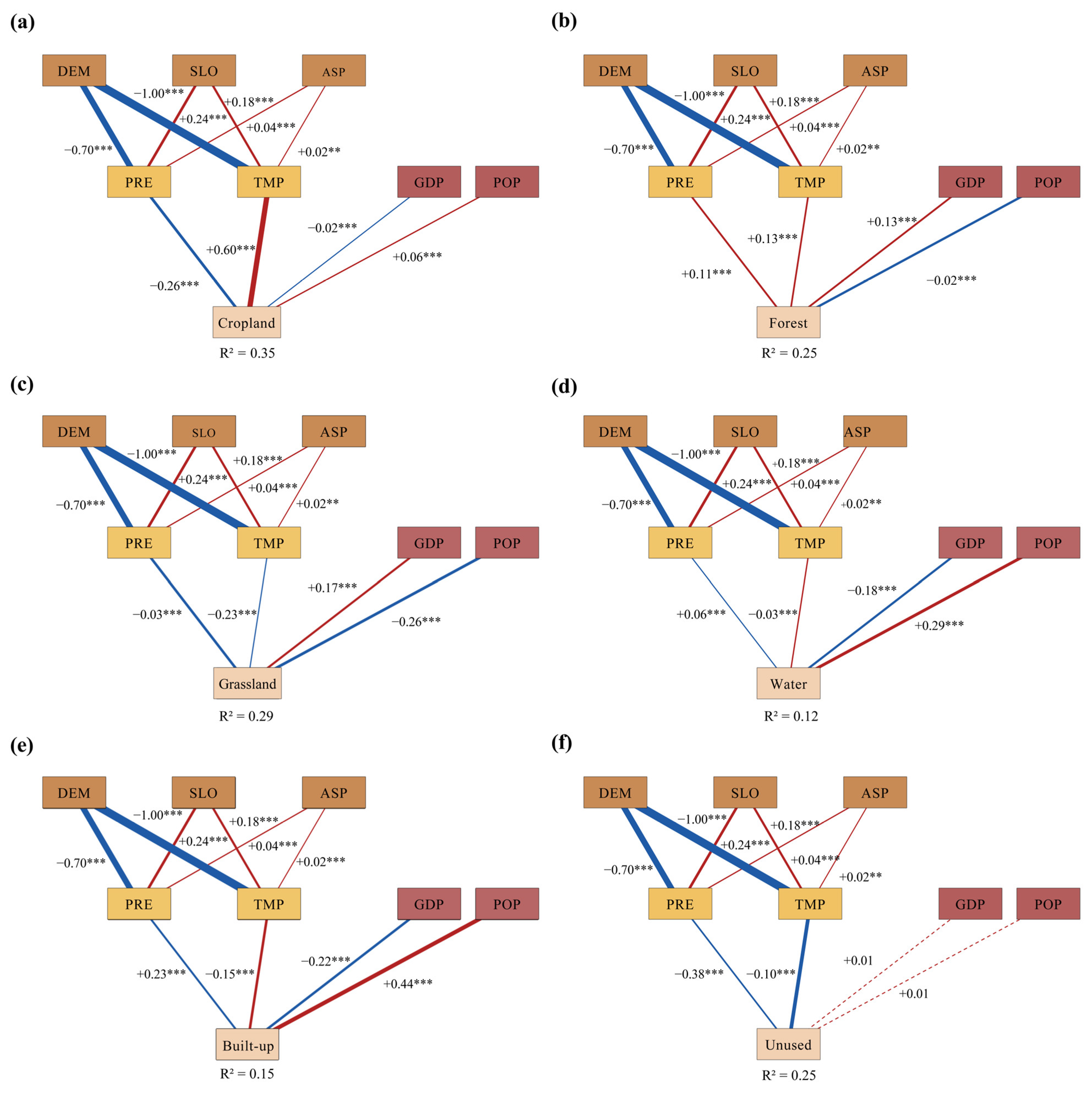
To supplement the LEAS contribution results with inferential evidence, a grid-based piecewise SEM analysis was used to examine mediated relationships among topographic, climatic, socio-economic and land-use change variables. The SEM reports standardized path coefficients, significance levels and R2 values [62,63], thereby supporting the interpretation of driving mechanisms without treating LEAS contribution values as p-value-based significance tests. The resulting path relationships are shown in Figure 11.

4.3. Scenario-Based Trade-Offs in Future Land-Use Evolution

Scenario outcomes need to be read as the combined result of historical transition tendencies and rule-based constraints, rather than as direct extrapolations of past change. Previous studies on multi-scenario simulations and ecosystem-service assessments have shown that projected land-use patterns are shaped jointly by observed transition probabilities, driving factors, and imposed ecological or cropland-protection constraints [32,37,52,53,54,64].
Figure 9 and Table 5 and Table 6 indicate that the three scenarios represent different trade-off pathways rather than simple area changes. Scenario I can be interpreted as a development-pressure pathway: built-up land increases by 9777.79 km2, while cropland and grassland decrease by 9653.23 and 4842.07 km2, respectively. This suggests that if historical expansion continues without stronger spatial constraints, construction demand will further compress agricultural and ecological spaces, particularly around urban agglomerations and transport corridors [54,64].
Scenario II represents an ecological-coordination pathway. Forest, grassland and water increase by 5547.03, 421.86 and 2194.52 km2, respectively, producing a net ecological-space gain of 8163.41 km2. Built-up expansion is also 2046.34 km2 lower than in Scenario I. This pathway is most consistent with ecological-priority governance and the Yangtze River Great Protection orientation, because it strengthens the continuity of ecological land. However, cropland still decreases by 5244.41 km2, indicating that ecological restoration should be coordinated with cropland protection [52,53,65,66,67,68].
Scenario III represents a cropland-security pathway. Cropland increases by 4062.50 km2 and built-up expansion is reduced by 7622.01 km2 relative to Scenario I, showing the strongest effect on controlling construction encroachment and maintaining cultivated land. However, grassland decreases by 5868.49 km2, and the net ecological-space gain is limited, indicating that strict cropland protection may transfer pressure to grassland and cropland-grassland transition zones. Therefore, cropland protection should prioritize stable and suitable cropland while avoiding the occupation of grassland and ecological corridors [54,66,69].
Overall, the scenario comparison shows that economic development, ecological restoration and cropland protection cannot be optimized through a single objective. Future basin-scale territorial governance should constrain built-up expansion in middle and lower urban corridors, maintain forest-grassland-water continuity in upstream and ecologically fragile zones, and coordinate cropland protection with grassland conservation. This provides a quantitative basis for translating the Yangtze River Great Protection strategy and Yellow River ecological conservation priorities into differentiated spatial regulation.

4.4. Implications for Zonal Governance

Based on the combined evidence from Figure 5, Figure 6, Figure 9 and Figure 10 and Table 5 and Table 6, future territorial-space governance in the Yangtze-Yellow River basins should adopt differentiated regulation according to development pressure, ecological function and cropland-security demand. In middle and lower plain areas and urban agglomeration zones, built-up land expansion should be constrained along transport corridors and urban fringes, because Scenario I produces the largest construction-land increase (+9777.79 km2) and is accompanied by cropland and grassland losses. In upstream mountainous and ecologically fragile zones, forest-grassland-water continuity should be maintained, because Scenario II produces the greatest ecological-space gain (+8163.41 km2) and better supports ecological-space conservation.
Cropland-security policies should also be coordinated with ecological-space conservation. Although Scenario III increases cropland by 4062.50 km2 and reduces built-up expansion by 7622.01 km2 relative to Scenario I, it also reduces grassland by 5868.49 km2. Therefore, cropland protection should prioritize stable and suitable cropland while avoiding compensatory pressure on grassland, ecological corridors and cropland-grassland transition zones. These results suggest that basin-scale planning should combine urban-growth boundary control, ecological-continuity protection and coordinated cropland-grassland management, rather than relying on a single-objective regulation strategy.

4.5. Study Limitations

This study has several limitations. First, analysing the Yangtze-Yellow River basins as an integrated system helps identify shared basin-scale structural responses, but it may mask differences between the Yangtze and Yellow River basins and among sub-basins. Second, the driving-factor set mainly includes topographic, climatic, population and GDP variables, whereas transport accessibility, policy intensity and major infrastructure projects are not fully represented. Third, the 2030 simulations depend on PLUS model parameters, scenario rules, conversion constraints and neighborhood weights; therefore, the results should be interpreted as scenario-based evidence rather than deterministic predictions. Fourth, landscape metrics may be affected by spatial resolution and indicator selection; the sensitivity check supports the main interpretation but does not eliminate scale-related uncertainty. In addition, the coupling discussed here refers mainly to structural coupling between land-use change and landscape-pattern metrics, not direct observation of ecological-process mechanisms. Future work may conduct basin-specific or sub-basin analyses, systematically test key PLUS parameters, and examine how landscape-pattern change affects ecological functions such as habitat maintenance, water-soil regulation, and carbon sequestration.

5. Conclusions

Focusing on land-use restructuring, landscape-pattern response and future scenario differences in the Yangtze-Yellow River basins, this study developed an integrated framework linking historical land-use evolution, landscape-metric assessment and PLUS-based multi-scenario simulation from a large-river-basin perspective. The results show that land-use change from 2000 to 2020 was not a linear gain or loss of individual land categories, but a restructuring process characterized by frequent conversion among cropland, forest and grassland together with continuous built-up expansion, with evident regional differentiation. Correspondingly, the basin-wide landscape tended toward greater fragmentation, weaker connectivity and aggregation, and higher heterogeneity. The driver analysis indicates that different land-use types were associated with different combinations of topographic, climatic and socio-economic factors, suggesting that the observed spatial restructuring was jointly related to natural constraints and human activities. Scenario simulations for 2030 further show that future land-use patterns represent trade-offs among development demand, ecological protection and cropland security rather than a simple continuation of historical trends. The natural development scenario produced the strongest built-up expansion and cropland loss, the cropland-protection scenario improved cropland retention but transferred pressure to grassland, and the sustainable development scenario showed a more balanced outcome for constraining construction expansion and maintaining ecological-space continuity. Therefore, future territorial-space optimization in the Yangtze-Yellow River basins should strengthen differentiated zonal governance by controlling built-up expansion in middle and lower urban agglomeration zones, maintaining forest-grassland-water continuity in upstream and ecologically fragile areas, and coordinating cropland protection with grassland and ecological-network conservation. These findings provide scenario-based evidence and a quantitative reference for basin-scale land-resource allocation, territorial spatial planning and ecological-security maintenance; however, they depend on the selected PLUS model parameters, scenario rules and driving-factor set, and should be interpreted as decision-support evidence rather than deterministic predictions.

Author Contributions

Conceptualization, supervision, project administration, and funding acquisition, Miao Lu and Yingqiang Song; methodology, software, formal analysis, data curation, visualization, and writing—original draft preparation, Qianlong Rao and Jiakai Li; validation and investigation, Qianlong Rao, Meng Zhang, Xinqi Liang and Xunyu Liu; resources and writing—review and editing, Jiakai Li. All authors have read and agreed to the published version of the manuscript.

Funding

This research was funded by the Shandong Provincial Natural Science Foundation (ZR2024MD056), the National Key Research and Development Program of China (2023YFD200140101), and the Agricultural Science and Technology Innovation Program (ASTIP No.CAAS-ZDRW202407).

Data Availability Statement

Land-use/land-cover data were obtained from the Resource and Environmental Science Data Center, Chinese Academy of Sciences (https://www.resdc.cn, accessed on 15 January 2025); DEM data were obtained from the Geospatial Data Cloud (https://www.gscloud.cn, accessed on 18 January 2025); meteorological station data were obtained from the China Meteorological Data Service Centre (https://data.cma.cn, accessed on 22 January 2025); and socio-economic statistical data, including population and GDP records, were obtained from the China Statistical Yearbook published by the National Bureau of Statistics of China (https://www.stats.gov.cn/sj/ndsj/, accessed on 10 February 2025). Derived datasets generated during the study are available from the corresponding author upon reasonable request.

Conflicts of Interest

The authors declare no conflicts of interest.

References

  1. Lambin, E.F.; Geist, H.J.; Lepers, E. Dynamics of Land-Use and Land-Cover Change in Tropical Regions. Annu. Rev. Environ. Resour. 2003, 28, 205–241. [Google Scholar] [CrossRef]
  2. Lambin, E.F.; Turner, B.L.; Geist, H.J.; Agbola, S.B.; Angelsen, A.; Bruce, J.W.; Coomes, O.T.; Dirzo, R.; Fischer, G.; Folke, C.; et al. The Causes of Land-Use and Land-Cover Change: Moving beyond the Myths. Glob. Environ. Change 2001, 11, 261–269. [Google Scholar] [CrossRef]
  3. Rindfuss, R.R.; Walsh, S.J.; Turner, B.L., II; Fox, J.; Mishra, V. Developing a Science of Land Change: Challenges and Methodological Issues. Proc. Natl. Acad. Sci. USA 2004, 101, 13976–13981. [Google Scholar] [CrossRef] [PubMed]
  4. Foley, J.A.; DeFries, R.; Asner, G.P.; Barford, C.; Bonan, G.; Carpenter, S.R.; Chapin, F.S.; Coe, M.T.; Daily, G.C.; Gibbs, H.K.; et al. Global Consequences of Land Use. Science 2005, 309, 570–574. [Google Scholar] [CrossRef]
  5. Winkler, K.; Fuchs, R.; Rounsevell, M.; Herold, M. Global Land Use Changes Are Four Times Greater Than Previously Estimated. Nat. Commun. 2021, 12, 2501. [Google Scholar] [CrossRef]
  6. Guo, W.; Yu, L.; Huang, L.; He, N.; Chen, W.; Hong, F.; Wang, B.; Wang, H. Ecohydrological Response to Multi-Model Land Use Change at Watershed Scale. J. Hydrol. Reg. Stud. 2023, 49, 101517. [Google Scholar] [CrossRef]
  7. Zhou, J.; Luo, C.; Ma, D.; Shi, W.; Wang, L.; Guo, Z.; Tang, H.; Wang, X.; Wang, J.; Liu, C.; et al. The Impact of Land Use Landscape Pattern on River Hydrochemistry at Multi-Scale in an Inland River Basin, China. Ecol. Indic. 2022, 143, 109334. [Google Scholar] [CrossRef]
  8. Qin, J.; Ye, H.; Lin, K.; Qi, S.; Hu, B.; Luo, J. Assessment of Water-Related Ecosystem Services Based on Multi-Scenario Land Use Changes: Focusing on the Poyang Lake Basin of Southern China. Ecol. Indic. 2024, 158, 111549. [Google Scholar] [CrossRef]
  9. Montràs-Janer, T.; Suggitt, A.J.; Fox, R.; Jönsson, M.; Martay, B.; Roy, D.B.; Walker, K.J.; Auffret, A.G. Anthropogenic Climate and Land-Use Change Drive Short- and Long-Term Biodiversity Shifts Across Taxa. Nat. Ecol. Evol. 2024, 8, 739–751. [Google Scholar] [CrossRef]
  10. Asamoah, E.F.; Beaumont, L.J.; Maina, J.M. Climate and Land-Use Changes Reduce the Benefits of Terrestrial Protected Areas. Nat. Clim. Change 2021, 11, 1105–1110. [Google Scholar] [CrossRef]
  11. Boakes, E.H.; Dalin, C.; Etard, A.; Newbold, T. Impacts of the Global Food System on Terrestrial Biodiversity from Land Use and Climate Change. Nat. Commun. 2024, 15, 5750. [Google Scholar] [CrossRef] [PubMed]
  12. Turner, M.G. Landscape Ecology: The Effect of Pattern on Process. Annu. Rev. Ecol. Syst. 1989, 20, 171–197. [Google Scholar] [CrossRef]
  13. Uuemaa, E.; Antrop, M.; Roosaare, J.; Marja, R.; Mander, Ü. Landscape Metrics and Indices: An Overview of Their Use in Landscape Research. Living Rev. Landsc. Res. 2009, 3, 1. [Google Scholar] [CrossRef]
  14. Wang, Q.; Zhang, P.; Chang, Y.; Li, G.; Chen, Z.; Zhang, X.; Xing, G.; Lu, R.; Li, M.; Zhou, Z. Landscape Pattern Evolution and Ecological Risk Assessment of the Yellow River Basin Based on Optimal Scale. Ecol. Indic. 2024, 158, 111381. [Google Scholar] [CrossRef]
  15. Ran, P.; Hu, S.; Frazier, A.E.; Qu, S.; Yu, D.; Tong, L. Exploring Changes in Landscape Ecological Risk in the Yangtze River Economic Belt from a Spatiotemporal Perspective. Ecol. Indic. 2022, 137, 108744. [Google Scholar] [CrossRef]
  16. Li, J.; Li, S.; Wang, X.; Xu, G.; Pang, J. Spatio-Temporal Variations and Multi-Scenario Simulation of Landscape Ecological Risk in the Drylands of the Yellow River Basin. Sci. Rep. 2024, 14, 22672. [Google Scholar] [CrossRef]
  17. Ji, X.; Sun, Y.; Guo, W.; Zhao, C.; Li, K. Land Use and Habitat Quality Change in the Yellow River Basin: A Perspective with Different CMIP6-Based Scenarios and Multiple Scales. J. Environ. Manag. 2023, 345, 118729. [Google Scholar] [CrossRef]
  18. Niu, H.; Xiu, Z.; Xiao, D. Impact of Land-Use Change on Ecological Vulnerability in the Yellow River Basin Based on a Complex Network Model. Ecol. Indic. 2024, 166, 112212. [Google Scholar] [CrossRef]
  19. Men, D.; Pan, J. Ecological Network Identification and Connectivity Robustness Evaluation in the Yellow River Basin under a Multi-Scenario Simulation. Ecol. Model. 2023, 482, 110384. [Google Scholar] [CrossRef]
  20. Zhou, J.-R.; Li, X.-Q.; Yu, X.; Zhao, T.-C.; Ruan, W.-X. Exploring the Ecological Security Evaluation of Water Resources in the Yangtze River Basin under the Background of Ecological Sustainable Development. Sci. Rep. 2024, 14, 15475. [Google Scholar] [CrossRef] [PubMed]
  21. Yang, F.; Yang, L.; Fang, Q.; Yao, X. Impact of Landscape Pattern on Habitat Quality in the Yangtze River Economic Belt from 2000 to 2030. Ecol. Indic. 2024, 166, 112480. [Google Scholar] [CrossRef]
  22. Verburg, P.H.; de Koning, G.H.J.; Kok, K.; Veldkamp, A.; Bouma, J. A Spatial Explicit Allocation Procedure for Modelling the Pattern of Land Use Change Based upon Actual Land Use. Ecol. Model. 1999, 116, 45–61. [Google Scholar] [CrossRef]
  23. Liu, X.; Liang, X.; Li, X.; Xu, X.; Ou, J.; Chen, Y.; Li, S.; Wang, S.; Pei, F. A Future Land Use Simulation Model (FLUS) for Simulating Multiple Land Use Scenarios by Coupling Human and Natural Effects. Landsc. Urban Plan. 2017, 168, 94–116. [Google Scholar] [CrossRef]
  24. Yang, X.; Zheng, X.-Q.; Chen, R. A Land Use Change Model: Integrating Landscape Pattern Indexes and Markov-CA. Ecol. Model. 2014, 283, 1–7. [Google Scholar] [CrossRef]
  25. Liang, X.; Guan, Q.; Clarke, K.C.; Liu, S.; Wang, B.; Yao, Y. Understanding the Drivers of Sustainable Land Expansion Using a Patch-Generating Land Use Simulation (PLUS) Model: A Case Study in Wuhan, China. Comput. Environ. Urban Syst. 2021, 85, 101569. [Google Scholar] [CrossRef]
  26. Liu, J.; Liu, B.; Wu, L.; Miao, H.; Liu, J.; Jiang, K.; Ding, H.; Gao, W.; Liu, T. Prediction of Land Use for the Next 30 Years Using the PLUS Model’s Multi-Scenario Simulation in Guizhou Province, China. Sci. Rep. 2024, 14, 13143. [Google Scholar] [CrossRef]
  27. Lu, C.; Qi, X.; Zheng, Z.; Jia, K. PLUS-Model Based Multi-Scenario Land Space Simulation of the Lower Yellow River Region and Its Ecological Effects. Sustainability 2022, 14, 6942. [Google Scholar] [CrossRef]
  28. Xu, X.; Kong, W.; Wang, L.; Wang, T.; Luo, P.; Cui, J. A Novel and Dynamic Land Use/Cover Change Research Framework Based on an Improved PLUS Model and a Fuzzy Multiobjective Programming Model. Ecol. Inform. 2024, 80, 102460. [Google Scholar] [CrossRef]
  29. Liu, J.; Kong, X.; Zhu, Y.; Zhang, B. A Study on Land Use Change Simulation Based on PLUS Model and the U-Net Structure: A Case Study of Jilin Province. Ecol. Indic. 2025, 176, 113619. [Google Scholar] [CrossRef]
  30. Li, Q.; Feng, Y.; Tong, X.; Zhou, Y.; Wu, P.; Xie, H.; Jin, Y.; Chen, P.; Liu, S.; Xv, X.; et al. Firefly Algorithm-Based Cellular Automata for Reproducing Urban Growth and Predicting Future Scenarios. Sustain. Cities Soc. 2022, 76, 103444. [Google Scholar] [CrossRef]
  31. Mu, T.; Zhao, R.; Li, H.; Lei, Y.; Chen, Q.; Tian, G.; Zhang, Y.; Mu, B. A Novel Indicator for Assessing Spatial Coupling Relationships within Hybrid Landscapes Comprising Diverse Land Cover Types and Its Application to Explaining Urban Thermal Environment. Sustain. Cities Soc. 2025, 130, 106595. [Google Scholar] [CrossRef]
  32. Wu, C.; Wang, Z. Multi-Scenario Simulation and Evaluation of the Impacts of Land Use Change on Ecosystem Service Values in the Chishui River Basin of Guizhou Province, China. Ecol. Indic. 2024, 163, 112078. [Google Scholar] [CrossRef]
  33. Zeng, J.; Wu, J.; Chen, W. Coupling Analysis of Land Use Change with Landscape Ecological Risk in China: A Multi-Scenario Simulation Perspective. J. Clean. Prod. 2024, 435, 140518. [Google Scholar] [CrossRef]
  34. Zeng, X.; Huang, Y.; Xie, H.; Ma, Q.; Li, J. Impacts of Land Use and Land Cover Change on the Landscape Pattern and Ecosystem Services in the Poyang Lake Basin, China. Landsc. Ecol. 2024, 39, 183. [Google Scholar] [CrossRef]
  35. Yao, Y.; Yang, Y. Spatiotemporal Effects of Landscape Structure on the Trade-Offs and Synergies among Ecosystem Service Functions in Yangtze River Economic Belt, China. Sci. Rep. 2025, 15, 15767. [Google Scholar] [CrossRef] [PubMed]
  36. Wang, Q.; Guan, Q.; Sun, Y.; Du, Q.; Xiao, X.; Luo, H.; Zhang, J.; Mi, J. Simulation of Future Land Use/Cover Change (LUCC) in Typical Watersheds of Arid Regions under Multiple Scenarios. J. Environ. Manag. 2023, 335, 117543. [Google Scholar] [CrossRef] [PubMed]
  37. Gao, L.; Tao, F.; Liu, R.; Wang, Z.; Leng, H.; Zhou, T. Multi-Scenario Simulation and Ecological Risk Analysis of Land Use Based on the PLUS Model: A Case Study of Nanjing. Sustain. Cities Soc. 2022, 85, 104055. [Google Scholar] [CrossRef]
  38. Wang, H.; Wu, L.; Yue, Y.; Jin, Y.; Zhang, B. Impacts of Climate and Land Use Change on Terrestrial Carbon Storage: A Multi-Scenario Case Study in the Yellow River Basin (1992–2050). Sci. Total Environ. 2024, 930, 172557. [Google Scholar] [CrossRef]
  39. Wu, J.; Luo, J.; Zhang, H.; Qin, S.; Yu, M. Projections of Land Use Change and Habitat Quality Assessment by Coupling Climate Change and Development Patterns. Sci. Total Environ. 2022, 847, 157491. [Google Scholar] [CrossRef]
  40. Nie, W.; Xu, B.; Yang, F.; Shi, Y.; Liu, B.; Wu, R.; Lin, W.; Pei, H.; Bao, Z. Simulating Future Land Use by Coupling Ecological Security Patterns and Multiple Scenarios. Sci. Total Environ. 2023, 859, 160262. [Google Scholar] [CrossRef]
  41. Lu, F.; Liu, Q.; Wang, P. Spatiotemporal Characteristics of Ecological Resilience and Its Influencing Factors in the Yellow River Basin of China. Sci. Rep. 2024, 14, 16988. [Google Scholar] [CrossRef]
  42. Zhang, Y.; Wu, X.; Wang, S.; Zhou, Y.; Fu, F.; Lu, N.; Kou, L. Land Use Optimization for Future Ecosystem Service Demands: A Case Study in the Yanhe Watershed. J. Clean. Prod. 2025, 520, 146121. [Google Scholar] [CrossRef]
  43. Lin, Y.; Zhou, J.; Wang, J.; Xu, H.; Li, Y.; Chen, F.; Liu, Y. Spatiotemporal Evolution and Driving Forces of Landscape Ecological Risk in the Lower Reaches of the Yellow River from 2000 to 2020. Sci. Rep. 2025, 15, 21375. [Google Scholar] [CrossRef]
  44. Zeng, Q.; Ye, X.; Cao, Y.; Chuai, X.; Xu, H. Impact of Expanded Built-Up Land on Ecosystem Service Value by Considering Regional Interactions. Ecol. Indic. 2023, 153, 110397. [Google Scholar] [CrossRef]
  45. McGarigal, K.; Marks, B.J. FRAGSTATS: Spatial Pattern Analysis Program for Quantifying Landscape Structure; General Technical Report PNW-GTR-351; U.S. Department of Agriculture, Forest Service, Pacific Northwest Research Station: Portland, OR, USA, 1995.
  46. Hesselbarth, M.H.K.; Sciaini, M.; With, K.A.; Wiegand, K.; Nowosad, J. landscapemetrics: An Open-Source R Tool to Calculate Landscape Metrics. Ecography 2019, 42, 1648–1657. [Google Scholar] [CrossRef]
  47. Shannon, C.E.; Weaver, W. The Mathematical Theory of Communication; University of Illinois Press: Urbana, IL, USA, 1949. [Google Scholar]
  48. He, H.S.; DeZonia, B.E.; Mladenoff, D.J. An Aggregation Index (AI) to Quantify Spatial Patterns of Landscapes. Landsc. Ecol. 2000, 15, 591–601. [Google Scholar] [CrossRef]
  49. Riitters, K.H.; O’Neill, R.V.; Wickham, J.D.; Jones, K.B. A Note on Contagion Indices for Landscape Analysis. Landsc. Ecol. 1996, 11, 197–202. [Google Scholar] [CrossRef]
  50. Jaeger, J.A.G. Landscape Division, Splitting Index, and Effective Mesh Size: New Measures of Landscape Fragmentation. Landsc. Ecol. 2000, 15, 115–130. [Google Scholar] [CrossRef]
  51. Uuemaa, E.; Mander, Ü.; Marja, R. Trends in the Use of Landscape Spatial Metrics as Landscape Indicators: A Review. Ecol. Indic. 2013, 28, 100–106. [Google Scholar] [CrossRef]
  52. Bai, Y.; Wong, C.P.; Jiang, B.; Hughes, A.C.; Wang, M.; Wang, Q. Developing China’s Ecological Redline Policy Using Ecosystem Services Assessments for Land Use Planning. Nat. Commun. 2018, 9, 3034. [Google Scholar] [CrossRef] [PubMed]
  53. Wang, L.; Zheng, H.; Chen, Y.; Huang, B. Ecological Redline Policy Strengthens Sustainable Development Goals through the Strict Protection of Multiple Ecosystem Services. Glob. Ecol. Conserv. 2024, 55, e03306. [Google Scholar] [CrossRef]
  54. Tang, W.; Li, J.; Yan, H.; Cha, L.; Yang, Y.; Wang, L. Multi-Scenario Simulation of Land Use Change Based on the Objectives of Cultivated Land, Ecological Protection, and Economic Development in Yunnan Province, China. Sci. Rep. 2025, 15, 21568. [Google Scholar] [CrossRef]
  55. Pontius, R.G., Jr.; Boersma, W.; Castella, J.C.; Clarke, K.; de Nijs, T.; Dietzel, C.; Duan, Z.; Fotsing, E.; Goldstein, N.; Kok, K.; et al. Comparing the Input, Output, and Validation Maps for Several Models of Land Change. Ann. Reg. Sci. 2008, 42, 11–37. [Google Scholar] [CrossRef]
  56. Pontius, R.G., Jr.; Millones, M. Death to Kappa: Birth of Quantity Disagreement and Allocation Disagreement for Accuracy Assessment. Int. J. Remote Sens. 2011, 32, 4407–4429. [Google Scholar] [CrossRef]
  57. Moghadam, N.T.; Malekmohammadi, B.; Schirmer, M. Vulnerability Assessment of Hydrological Ecosystem Services under Future Climate and Land Use Change Dynamics. Ecol. Indic. 2024, 160, 111905. [Google Scholar] [CrossRef]
  58. Newbold, T.; Hudson, L.N.; Hill, S.L.L.; Contu, S.; Lysenko, I.; Senior, R.A.; Börger, L.; Bennett, D.J.; Choimes, A.; Collen, B.; et al. Global Effects of Land Use on Local Terrestrial Biodiversity. Nature 2015, 520, 45–50. [Google Scholar] [CrossRef]
  59. Li, G.; Fang, C.; Li, Y.; Wang, Z.; Sun, S.; He, S.; Qi, W.; Bao, C.; Ma, H.; Fan, Y.; et al. Global Impacts of Future Urban Expansion on Terrestrial Vertebrate Diversity. Nat. Commun. 2022, 13, 1628. [Google Scholar] [CrossRef]
  60. Jung, M.; Rowhani, P.; Scharlemann, J.P.W. Impacts of Past Abrupt Land Change on Local Biodiversity Globally. Nat. Commun. 2019, 10, 5474. [Google Scholar] [CrossRef] [PubMed]
  61. Cabernard, L.; Pfister, S.; Hellweg, S. Biodiversity Impacts of Recent Land-Use Change Driven by Increases in Agri-Food Imports. Nat. Sustain. 2024, 7, 1512–1524. [Google Scholar] [CrossRef]
  62. Lefcheck, J.S. piecewiseSEM: Piecewise Structural Equation Modelling in R for Ecology, Evolution, and Systematics. Methods Ecol. Evol. 2016, 7, 573–579. [Google Scholar] [CrossRef]
  63. Shipley, B. Confirmatory Path Analysis in a Generalized Multilevel Context. Ecology 2009, 90, 363–368. [Google Scholar] [CrossRef] [PubMed]
  64. Zhang, C.; Jia, Q.; Liu, Y.; Zheng, Z.; Gao, Y.; Li, K. Evaluation and Multi Scenario Simulation of Ecosystem Service Value in Zhengzhou Metropolitan Area Based on PLUS Model. Meas. Sens. 2024, 32, 101079. [Google Scholar] [CrossRef]
  65. Fu, Y.; Li, Q.; Li, J.; Zeng, K.; Wang, L.; Wang, Y. Multi-Scenario Simulation of the Production-Living-Ecological Spaces in Sichuan Province Based on the PLUS Model and Assessment of Its Ecological and Environmental Effects. Sustainability 2024, 16, 10322. [Google Scholar] [CrossRef]
  66. Geng, W.; Li, Y.; Zhang, P.; Yang, D.; Jing, W.; Rong, T. Analyzing Spatio-Temporal Changes and Trade-Offs/Synergies among Ecosystem Services in the Yellow River Basin, China. Ecol. Indic. 2022, 138, 108825. [Google Scholar] [CrossRef]
  67. Xu, X.; Yang, G.; Tan, Y.; Liu, J.; Hu, H. Ecosystem Services Trade-Offs and Determinants in China’s Yangtze River Economic Belt from 2000 to 2015. Sci. Total Environ. 2018, 634, 1601–1614. [Google Scholar] [CrossRef]
  68. Chen, W.; Zhao, H.; Li, J.; Zhu, L.; Wang, Z.; Zeng, J. Land Use Transitions and the Associated Impacts on Ecosystem Services in the Middle Reaches of the Yangtze River Economic Belt in China Based on the Geo-Informatic Tupu Method. Sci. Total Environ. 2020, 701, 134690. [Google Scholar] [CrossRef]
  69. Sui, L.; Yan, Z.; Li, K.; Wang, C.; Shi, Y.; Du, Y. Prediction of Ecological Security Network in Northeast China Based on Landscape Ecological Risk. Ecol. Indic. 2024, 160, 111783. [Google Scholar] [CrossRef]
Figure 1. Location of the study area and topographic characteristics. (a) Geographic location of the two basins within China; (b) DEM distribution of the Yangtze–Yellow River basins.
Ijgi 15 00239 g001
Figure 2. Research framework linking data preparation, historical land-use diagnosis, landscape-pattern response assessment, PLUS-based scenario simulation and policy implication analysis.
Ijgi 15 00239 g002
Figure 3. Changes in land-use area structure and stage-specific variation in the Yangtze–Yellow River basins from 2000 to 2020. (a) area and rate changes of cropland, forest, and grassland; (b) area and rate changes of water, built-up land, and unused land; (c) Proportional area of six land-use types.
Ijgi 15 00239 g003
Figure 4. Chord diagrams of land-use transitions in the Yangtze-Yellow River basins. (a) 2000–2005; (b) 2005–2010; (c) 2010–2015; (d) 2015–2020. Sector colors indicate land-use types, and ribbon widths represent the transferred area between land-use types. Arc scales and ribbon widths are expressed in km2. Node labels combine land-use abbreviations and years, where CL, FL, GL, WA, BL and UL denote cropland, forest, grassland, water, built-up land and unused land, respectively.
Ijgi 15 00239 g004
Figure 5. Spatial distribution of land-use changes in the Yangtze–Yellow River basins from 2000 to 2020. (a-1)–(a-4) Cropland changes; (b-1)–(b-4) forest changes; (c-1)–(c-4) grassland changes; (d-1)–(d-4) water changes; (e-1)–(e-4) built-up land changes; (f-1)–(f-4) unused-land changes. Columns represent 2000–2005, 2005–2010, 2010–2015 and 2015–2020, respectively. Warm colors indicate decreases, cool colors indicate increases, and larger absolute values indicate stronger changes.
Ijgi 15 00239 g005
Figure 6. Distribution and migration trajectories of land-use centroids in the Yangtze–Yellow River basins from 2000 to 2020. (a) Overall centroid distribution of the six land-use types; (b) centroid trajectory of unused land; (c) centroid trajectory of water; (d) centroid trajectory of built-up land; (e) centroid trajectory of grassland; (f) centroid trajectory of forest; (g) centroid trajectory of cropland.
Ijgi 15 00239 g006
Figure 7. Temporal variation in landscape-level metrics across the Yangtze–Yellow River basins during 2000–2020.
Ijgi 15 00239 g007
Figure 8. Evolution of relationships between land-use types and major landscape metrics from 2000 to 2020. (a) 2000; (b) 2005; (c) 2010; (d) 2015; (e) 2020.
Ijgi 15 00239 g008
Figure 9. Simulated land-use maps for 2030. (a) Natural development scenario; (b) sustainable development scenario; (c) cropland-protection scenario.
Ijgi 15 00239 g009
Figure 10. Differences in the contributions of driving factors to changes in each land-use type in the Yangtze-Yellow River basins. Contribution values were calculated by the PLUS-LEAS random-forest module and indicate model-based relative importance for expansion probability rather than inferential statistical significance; statistical associations were further examined using piecewise SEM.
Ijgi 15 00239 g010
Figure 11. Piecewise SEM results for the mediated relationships among topographic, climatic, socio-economic, and land-use change variables. (a) Cropland; (b) forest; (c) grassland; (d) water; (e) built-up land; (f) unused land. Solid arrows indicate significant direct effects, dashed arrows indicate non-significant paths, and arrow width represents the relative strength of standardized path coefficients. Significance levels are denoted as ** p < 0.01 and *** p < 0.001.
Ijgi 15 00239 g011
Table 1. Landscape metrics, formulas, and ecological meanings used in this study.
Landscape MetricFormulaDescription
NP NP = N Dimensionless count; Total number of patches; higher values indicate stronger fragmentation.
ED E D = k = 1 n E k A × 10 , 000 Unit: m/ha; Edge length per unit area; higher values indicate more complex patch boundaries.
LPI L P I = m a x a i j A × 100 Unit: %; LPI describes how much of the total landscape area is accounted for by the largest patch. A higher LPI value indicates stronger landscape dominance by that patch.
DIVISION D I V I S I O N = 1 i = 1 m j = 1 n i a i j A 2 Dimensionless proportion; Degree of landscape subdivision; higher values indicate stronger separation among patches.
LSI LSI = 0.25 E A Unit: %; Boundary complexity of the landscape; higher values indicate more irregular patch shapes.
CONTAG CONTAG = 1 + i = 1 n j = 1 n P i , j l o g P i , j 2 l o g n × 100 % Unit: %; Overall clumping of patch types; higher values indicate stronger aggregation and connectivity.
AI A l = g i i m a x g i i × 100 % Unit: %; Degree of same-class aggregation; higher values indicate more compact patches. Degree of same-class aggregation; higher values indicate more compact patches.
SHDI S H D I = i = 1 m P i ln ( P i ) Dimensionless; Compositional diversity of land-use types; higher values indicate greater landscape diversity.
IJI IJI = i = 1 m k = i + 1 m [ e i k E l n e i k E ] l n m 1 × 100 % Unit: %; Evenness of adjacency among different land-use types; used here as a supplementary metric.
PLADJ P L A D J = i = 1 m g i i i = 1 m k = 1 m g i k × 100 Unit: %; Proportion of same-class adjacencies; higher values indicate stronger local aggregation.
Table 2. Scenario-setting rules for simulated land-use change in the Yangtze–Yellow River basins.
ScenarioRule BasisTransition-Probability/Conversion ConstraintPurpose
Scenario I: Natural developmentHistorical transition tendency from 2000–2020 is retained.No additional restricted conversion zone; transition probability follows historical expansion inertia.Baseline pathway without additional policy intervention.
Scenario II: Sustainable developmentEcological redline, key ecological patches, water bodies and high-ecological-value areas are constrained.Conversion from forest, grassland and water to built-up land is restricted; built-up expansion probability is reduced in ecological spaces.Supports ecological priority and structural optimization [52,53,54].
Scenario III: Cropland protectionStable cropland and high-quality cropland, especially cropland with slope < 6°, are constrained.Conversion from protected cropland to built-up land is restricted; cropland retention probability is enhanced.Supports food-security-oriented spatial regulation [52,54].
Table 3. Accuracy assessment of the PLUS backcasting simulation for 2020.
TypeUser’s Accuracy (%)Producer’s Accuracy (%)Commission Error (%)Omission Error (%)
Cropland91.2891.338.728.67
Forest95.0695.484.944.52
Grassland93.7393.796.276.21
Water88.4988.4911.5111.51
Built-up land78.8076.6121.2023.39
Unused land91.7089.848.3010.16
OverallOA = 92.84Kappa = 0.9014Quantity disagreement = 0.18Allocation disagreement = 6.98
Table 4. Centroid migration distance and dominant direction of each land-use type from 2000 to 2020. Distances were calculated from centroid-coordinate data.
Land-Use TypeMigration Distance (km)Dominant DirectionInterpretation
Cropland11.51WestwardCropland centroid shifted mainly westward, reflecting the combined effect of cropland contraction in middle/eastern areas and relative persistence toward central-western areas.
Forest8.84NorthwestwardForest centroid shifted slightly northwestward, indicating spatial adjustment of forest expansion/restoration across mountainous transition zones.
Grassland16.92NorthwestwardGrassland centroid shifted northwestward, consistent with the concentration of grassland change in western and northern parts of the basins.
Water15.09WestwardWater centroid shifted moderately westward, while the overall spatial distribution of water remained relatively stable compared with built-up and unused land.
Built-up land42.97SouthwestwardBuilt-up land showed a large centroid displacement, indicating strong spatial restructuring driven by urban expansion and regional development.
Unused land47.31EastwardUnused land showed the largest centroid displacement, reflecting continued conversion and redistribution of unused land in the northwest and surrounding transition zones.
Table 5. Area of each land-use type under different scenarios in 2030 and changes relative to 2020 in the Yangtze–Yellow River basins.
Land-Use Type20202030Change in Land-Use Type, 2020–2030Change in Land-Use Type, 2020–2030Change in Land-Use Type, 2020–2030
Scenario IScenario IIScenario IIIScenario IScenario IIScenario III
Cropland677,702.66668,049.43672,458.25681,765.16−9653.2277−5244.40774062.5023
Forest845,672.32848,750.22851,219.35849,240.273077.89565547.02563567.9456
Grassland798,874.38794,032.31799,296.24793,005.89−4842.0664421.8636−5868.4864
Water71,531.8573,767.3573,726.3774,445.532235.50482194.52482913.6848
Built-up land82,177.9091,955.6989,909.3584,333.689777.79347731.45342155.7834
Unused land115,772.13111,237.21110,182.14110,402.87−4534.9236−5589.9936−5369.2636
Table 6. Comparison of cropland retention, ecological-space conservation, and built-up land expansion across the three 2030 scenarios.
IndicatorScenario IScenario IIScenario IIIMain Implication
Cropland change (km2)−9653.23−5244.41+4062.50Scenario III best supports cropland retention; Scenario I shows the largest cropland loss.
Ecological-space change (km2)+471.33+8163.41+613.14Scenario II provides the greatest overall increase in ecological space.
Built-up land change (km2)+9777.79+7731.45+2155.78Scenario III most strongly constrains built-up expansion; Scenario I has the highest expansion pressure.
Grassland change (km2)−4842.07+421.86−5868.49Scenario III increases cropland but causes the largest grassland loss.
Net ecological gain relative to Scenario I (km2)0.00+7692.08+141.81Scenario II substantially outperforms Scenario I in ecological-space conservation.
Built-up expansion reduction relative to Scenario I (km2)0.002046.347622.01Scenario III most strongly restricts construction land, but ecological benefits are limited by grassland loss.
Disclaimer/Publisher’s Note: The statements, opinions and data contained in all publications are solely those of the individual author(s) and contributor(s) and not of MDPI and/or the editor(s). MDPI and/or the editor(s) disclaim responsibility for any injury to people or property resulting from any ideas, methods, instructions or products referred to in the content.