
Article

Integrating Geospatial Technique, Machine Learning Algorithm, and Public Perceptions for Advancing Urban Heat Island Dynamics Assessment


1
Department of Urban and Regional Planning, Chittagong University of Engineering and Technology, Chattogram 4349, Bangladesh
2
Department of Geomatics Engineering, University of Calgary, Calgary, AB T2N 1N4, Canada
*
Author to whom correspondence should be addressed.
ISPRS Int. J. Geo-Inf. 2026, 15(5), 192; https://doi.org/10.3390/ijgi15050192
Submission received: 16 February 2026 / Revised: 25 April 2026 / Accepted: 27 April 2026 / Published: 1 May 2026

Abstract

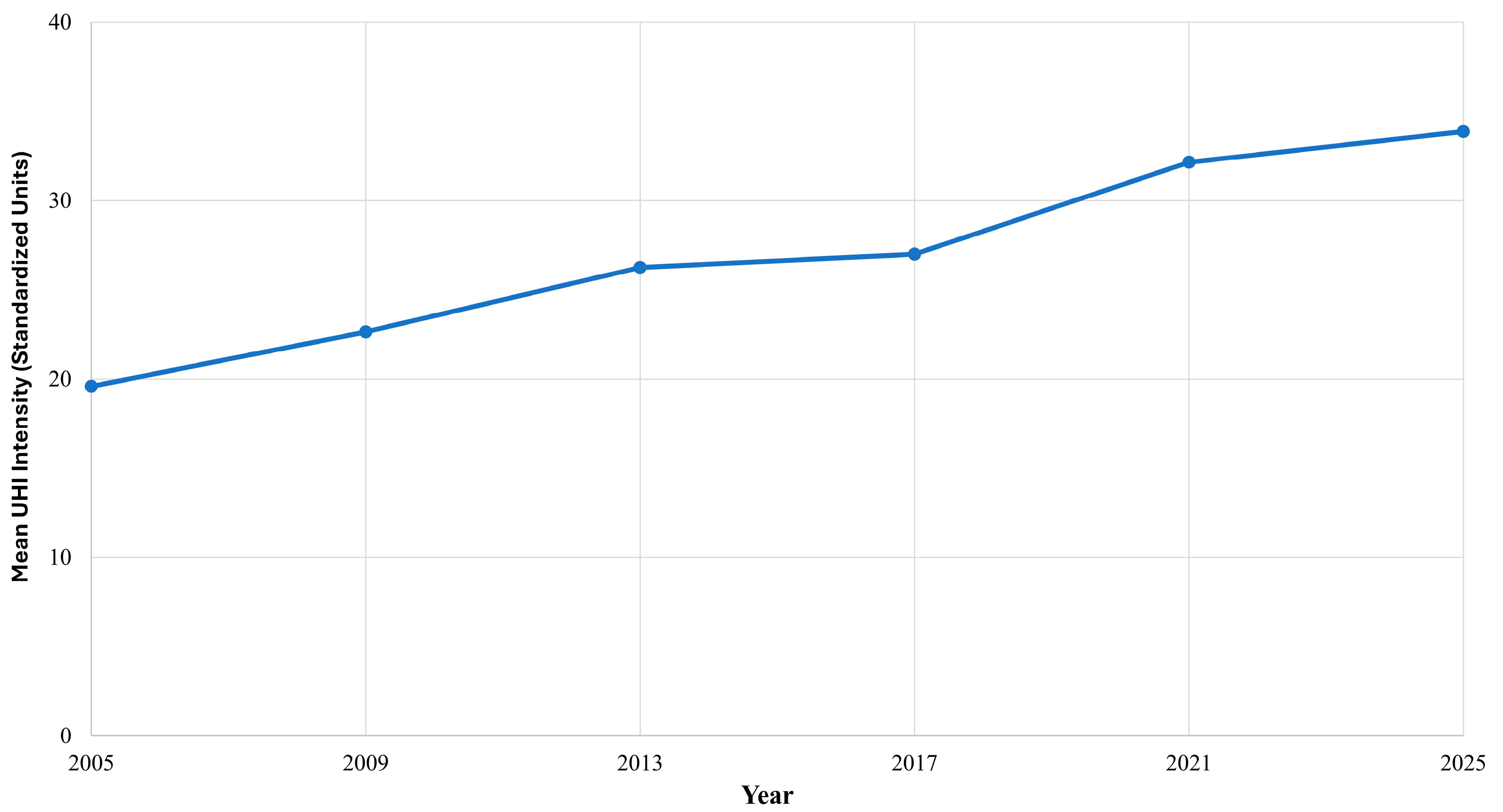
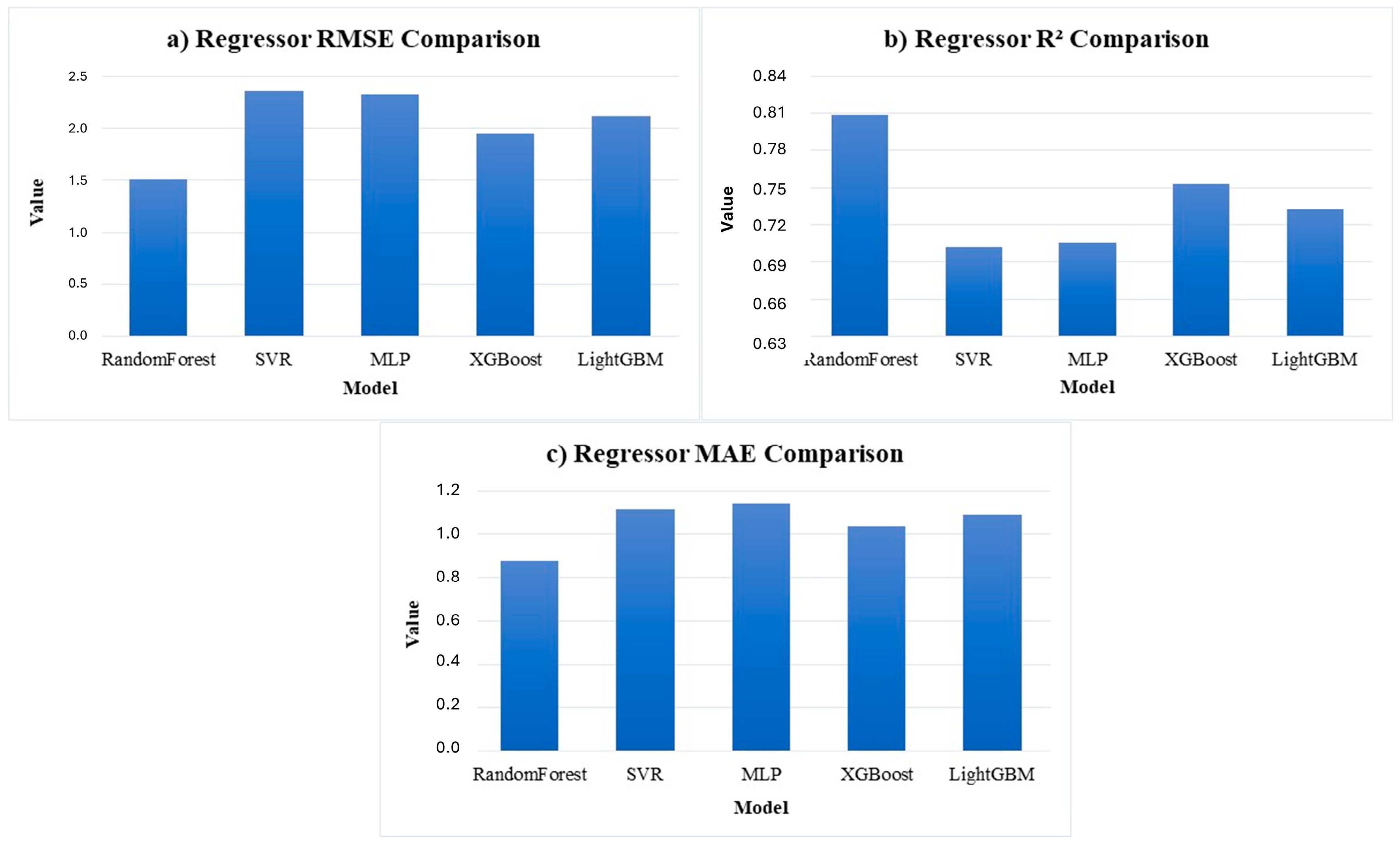
Rapid urbanization in South Asian coastal cities is systematically dismantling natural cooling infrastructure, driving unprecedented urban heat island (UHI) intensification with severe consequences for human health, energy systems, and urban livability. Despite growing research attention, comprehensive frameworks that simultaneously capture temporal UHI dynamics, machine learning-based thermal projections, and community-grounded validation remain scarce, particularly for secondary coastal cities in tropical developing regions. This study addresses these gaps by investigating UHI dynamics in Chattogram City Corporation (CCC), Bangladesh, through three integrated methodological pillars: (1) multi-temporal remote sensing analysis using Landsat 5 and 8 imagery spanning 2005–2025; (2) comparative evaluation of five machine learning algorithms (LightGBM, Random Forest, XGBoost, SVM, and MLP) for land use/land cover (LULC) classification and land surface temperature (LST) regression, with iterative scenario projections for 2029, 2033, and 2037; and (3) a structured public perception survey of 384 residents validated through participatory mapping and focus group discussions. Landsat analysis revealed dramatic LULC transformations: built-up areas expanded 88% (12,649 to 23,719 acres), while waterbodies declined 53.1% and vegetation decreased 21.9%. Mean LST increased by 9.09 °C (from 30.94 °C to 40.03 °C), with mean UHI intensity rising from 19.59 to 33.88 standardized units over two decades. LightGBM achieved optimal LULC classification (F1-weighted: 0.765) while Random Forest best predicted LST (RMSE: 1.51, R2: 0.809). Projections indicate continued thermal escalation, with mean LST reaching 43.64 °C and UHI intensity exceeding 37.41 standardized units by 2037. Persistent thermal hotspots were identified in the southwestern coastal corridor, western industrial belt, and central business district. Community survey data corroborated satellite-derived patterns, with 73.44% of respondents observing environmental degradation, yet only 22% aware of formal heat mitigation policies, and 87% supporting vegetation-based cooling interventions. This integrated framework advances urban thermal monitoring in tropical coastal cities and provides spatially targeted, community-endorsed evidence for climate-responsive urban planning.

1. Introduction

One of the most pressing challenges in the 21st century has emerged as the accelerating pace of global urbanization, with intensifying climate change [1]. It is anticipated that almost 68% world’s population will live in urban areas by 2050 [2]. These global urbanization trends are drastically transforming natural landscapes into built environments [3], causing reduced green space, increased impervious surfaces, and altered albedo and morphology relative to rural surfaces [4]. This change has a significant impact on local and regional climates, with one of the most documented phenomena being the urban heat island (UHI) effect [5]. UHI is characterized by elevated temperatures in urban areas compared to their surrounding rural counterparts [6,7].
The formation of UHI is fundamentally governed by the transformation of the land surface energy balance. When natural landscapes are converted to build environments, three interrelated biophysical mechanisms intensify surface temperatures. First, the replacement of permeable vegetated surfaces with impervious materials, such as asphalt, concrete, and roofing, substantially reduces evapotranspiration, diverting latent heat flux into sensible heat that warms the overlying air and surface [8]. Second, urban materials exhibit low albedo and high thermal mass, absorbing solar radiation during the day and re-emitting it as longwave radiation at night, thereby extending thermal stress beyond daylight hours [7,8]. Third, urban morphology—including building height, canyon aspect ratios, and street orientation—traps outgoing radiation and reduces wind ventilation, further amplifying surface and air temperature differentials [6,7]. In coastal cities, these mechanisms are compounded by the proximity of heat-absorbing waterfronts undergoing land reclamation, the loss of coastal vegetation buffers, and the concentration of industrial heat sources in port-adjacent zones. Consequently, LULC composition and spatial configuration are not merely correlates of UHI intensity; they are its primary structural drivers. Understanding how specific land cover transitions alter energy partitioning is therefore essential for both diagnosing historical thermal trends and designing targeted mitigation strategies.
South Asia is experiencing rapid population growth and intensifying climate variability, placing numerous cities at heightened risk from climate-related hazards [8]. The fastest-growing urban population in the world can be found in this region [9]. This growth tends to lead to unplanned expansion, informal settlements, and inadequate infrastructure development, intensifying UHI formation and urban climate risks [10]. Coastal megacities like Mumbai, Karachi, and Kolkata are facing intensified heat waves due to UHI effects and climate change [11]. Along with intensified urban heating, these urban centers face coastal flooding, sea-level rise, cyclonic activity, and monsoon inconsistency [12]. In densely built-up cities with insufficient green spaces, urban heat is substantially amplified; in Mumbai, for example, UHI effects reach 8–10 °C during summer [13]. Similarly, Karachi experiences a severe UHI effect, where human physiological thresholds are exceeded by extreme heat stress effects [14].
The rapid growth of cities and climate change in South Asian coastal areas are causing extreme heat, which needs urgent study on urban heat islands (UHI). Bangladesh is among the most climate-vulnerable countries globally, owing to its high population density, inadequate urban planning, and frequent exposure to natural disasters [15]. Several major cities in Bangladesh have already witnessed massive heat waves [16,17]. Within this context, Chattogram appears as a particularly significant region, being the second-largest city and a vital economic hub in Bangladesh, with a rapidly growing population of more than 5.2 million. Within this context, Chattogram emerges as a particularly significant study area, being the second-largest city and a vital economic hub in Bangladesh, with a rapidly growing population of more than 5.2 million [18,19].
A substantial body of global UHI research has established the primacy of LULC transformation as a thermal driver, yet critical comparative insights emerge when South Asian coastal contexts are examined specifically. Studies in Bangalore, India demonstrates that impervious surface expansion into vegetated and waterbody areas produces measurable LST increases [20], while research in Dhaka reveals 2 °C LST rises associated with built-up encroachment on water bodies and vegetation over 30 years [21]. In Mumbai, summer UHI effects reach 8–10 °C due to combined loss of green space and dense informal settlement expansion [13], a pattern echoed in Karachi where extreme heat stress regularly exceeds human physiological tolerance thresholds [14]. Comparative analyses of Bangkok and Colombo reveal that tropical monsoon climates amplify UHI effects beyond those observed in subtropical counterparts, as reduced wind speed during humid seasons limits convective heat dissipation [21,22]. A critical synthesis of these South Asian cases reveals a consistent trajectory: secondary cities undergoing rapid, infrastructure-deficient urbanization exhibit disproportionately severe UHI intensification relative to better-planned megacities, primarily because informal expansion occurs without mandated green space or waterbody protection provisions. Remote sensing approaches using Landsat-derived thermal imagery have been foundational in quantifying LULC–LST relationships across these contexts [22,23,24,25], with vegetation indices (NDVI) consistently showing strong negative correlations with LST and industrial/high-density zones showing positive associations [26].
Recent advances in ML-integrated UHI research have further transformed predictive capacity. Studies in Indian and African urban contexts have demonstrated that ensemble ML methods, particularly gradient boosting variants outperform traditional statistical models in forecasting non-linear LULC–LST relationships under rapid urbanization [27,28]. Importantly, recent systematic reviews have identified three persistent methodological gaps: (1) static spatial analyses that fail to capture transitional dynamics during rapid urban transformation [29]; (2) the near-absence of integrated multi-temporal ML frameworks validated against observed thermal patterns in South Asian coastal cities [30]; and (3) the systematic exclusion of community perceptions from technical UHI assessments, which limits the social legitimacy and uptake of mitigation strategies [31]. This study directly addresses all three gaps by combining a 20-year multi-temporal analysis with comparative ML evaluation and participatory validation—an integration that advances beyond existing South Asian UHI research in both methodological scope and practical applicability.
Several studies have used Landsat-derived thermal imagery to analyze UHI patterns, demonstrating strong negative correlations between vegetation cover and LST, and positive associations with industrial and high-density residential zones [22,23,24,25,26].
Recent studies also highlight the importance of forecasting future UHI scenarios through integrated machine-learning-based approaches to anticipate future thermal intensity [32,33]. Studies in India [27] and African cities [28] have employed machine learning to predict future land use and land surface temperature changes, emphasizing the need for forecasting UHI scenarios and showing improved accuracy in predicting UHI intensities compared to traditional methods.
Integrating community perception with technical analysis enhances the understanding of UHI intensity, as documented from a study in New York City and Chennai City [34,35]. However, [36] claimed that the majority of UHI studies remain biophysical, overlooking public perceptions of heat exposure, environmental change concerns, and preferences for mitigation strategies. This gap restricts the development of socially grounded and community-supported adaptation measures. Consequently, there is a growing need for interdisciplinary research that links spatial UHI assessment with projected land use trends and local perceptions to inform equitable and climate-responsive urban planning [37,38].
Despite significant advances in UHI research, four critical gaps constrain a comprehensive understanding of urban thermal dynamics in South Asian contexts: (1) inadequate temporal analysis during rapid urban transformation; (2) inconsistencies in sensor selection, spatial resolution, and atmospheric correction; (3) scarcity of ML-based predictive frameworks for forecasting future LULC and thermal implications; and (4) systematic exclusion of community perceptions from technical UHI assessments [14,15,16,17,18,19,20,21,22,23,24,25].
Current UHI assessment approaches are predominantly based on static spatial analyses that fail to capture transitional dynamics during rapid urban transformation, particularly in South Asian medium-sized coastal cities [39,40]. Dependence on single-time observations obstructs localized thermal identification and constrains understanding of non-linear LULC–LST relationships [8]. Additionally, substantial variability in sensor selection, spatial resolution, and atmospheric correction hinders neighborhood-scale thermal pattern characterization [41,42]. Advanced ML predictive frameworks remain scarce in South Asian contexts, while community involvement in documenting heat-related effects and setting mitigation priorities is rarely integrated into technical UHI assessments, creating a substantial gap in understanding urban thermal risks from vulnerable populations’ perspectives [14,43,44,45,46,47,48].
Studies rarely incorporate advanced predictive modeling techniques to forecast future LULC transitions and their thermal implications in South Asian urban contexts. Traditional statistical approaches dominate existing literature, while machine learning algorithms are capable of capturing complex nonlinear relationships [43,44]. So, the scarcity of scenario-based projections creates obstacles for evidence-based planning [45].
Limited field validation of remotely sensed data through ground-based measurements introduces uncertainty in thermal pattern identification [49]. This practice constrains the translation of thermal observations into actionable thermal comfort practices [50]. Most importantly, community involvement in documenting heat-related effects or setting priorities for mitigation measures is rarely included in technical UHI assessments [14,46,47], which causes a substantial gap in understanding urban thermal risks from vulnerable populations’ perspectives [48].
To address the identified knowledge gaps, this study pursues three interrelated objectives: (1) to systematically investigate the spatial distribution and temporal evolution of UHI intensity across Chattogram City Corporation (2005–2025); (2) to predict LULC transitions and associated thermal trends for 2029, 2033, and 2037 using a comparative machine learning framework; and (3) to incorporate structured public participation to ensure community-responsive and empirically validated mitigation strategies. To the best of the authors’ knowledge, this is the first study applied to a South Asian secondary coastal city that: (i) conducts pixel-level iterative ML projections of both LULC and LST across three future time horizons simultaneously; (ii) evaluates five ML algorithms comparatively for both classification and regression tasks within the same UHI assessment framework; and (iii) validates satellite-derived thermal patterns through georeferenced participatory mapping, achieving quantitative spatial concordance between perceived and measured thermal extremes.
This study addresses these interconnected limitations through a comprehensive analytical framework integrating advanced geospatial methodologies with standardized preprocessing protocols, comparative ML algorithms (XGBoost, LightGBM, Random Forest, SVM, MLP) for scenario-based predictions, multi-temporal remote sensing analysis (2005–2025), and structured community engagement. By combining geospatial analysis with community involvement to assess heat-related health, livelihood impacts, and mitigation preferences, this study advances the practical capacity for equitable thermal management in rapidly urbanizing South Asian communities.
This study makes four interrelated methodological and empirical contributions that collectively distinguish it from existing UHI research in South Asia. First, it applies iterative pixel-level ML projections of both LULC and LST simultaneously across three future time horizons (2029, 2033, 2037), enabling a dynamic forecast of urban thermal conditions rather than a static snapshot. Second, it conducts a rigorous comparative evaluation of five ML algorithms for two distinct tasks discrete LULC classification and continuous LST regression—within the same study, providing transferable algorithm-selection guidance for urban climate modeling. Third, it integrates participatory mapping with satellite-derived UHI hotspot analysis to quantitatively validate remote sensing products through community observations, addressing a persistent gap identified in recent systematic reviews [51,52,53]. Fourth, it develops zone-specific, community-endorsed mitigation recommendations grounded in spatially explicit hotspot evidence, moving beyond the generic green infrastructure recommendations that characterize much of the existing South Asian UHI literature. Together, these contributions advance the integration of geospatial science, predictive modeling, and social research for climate-adaptive urban planning in tropical coastal cities.

2. Materials and Methods

2.1. Study Area

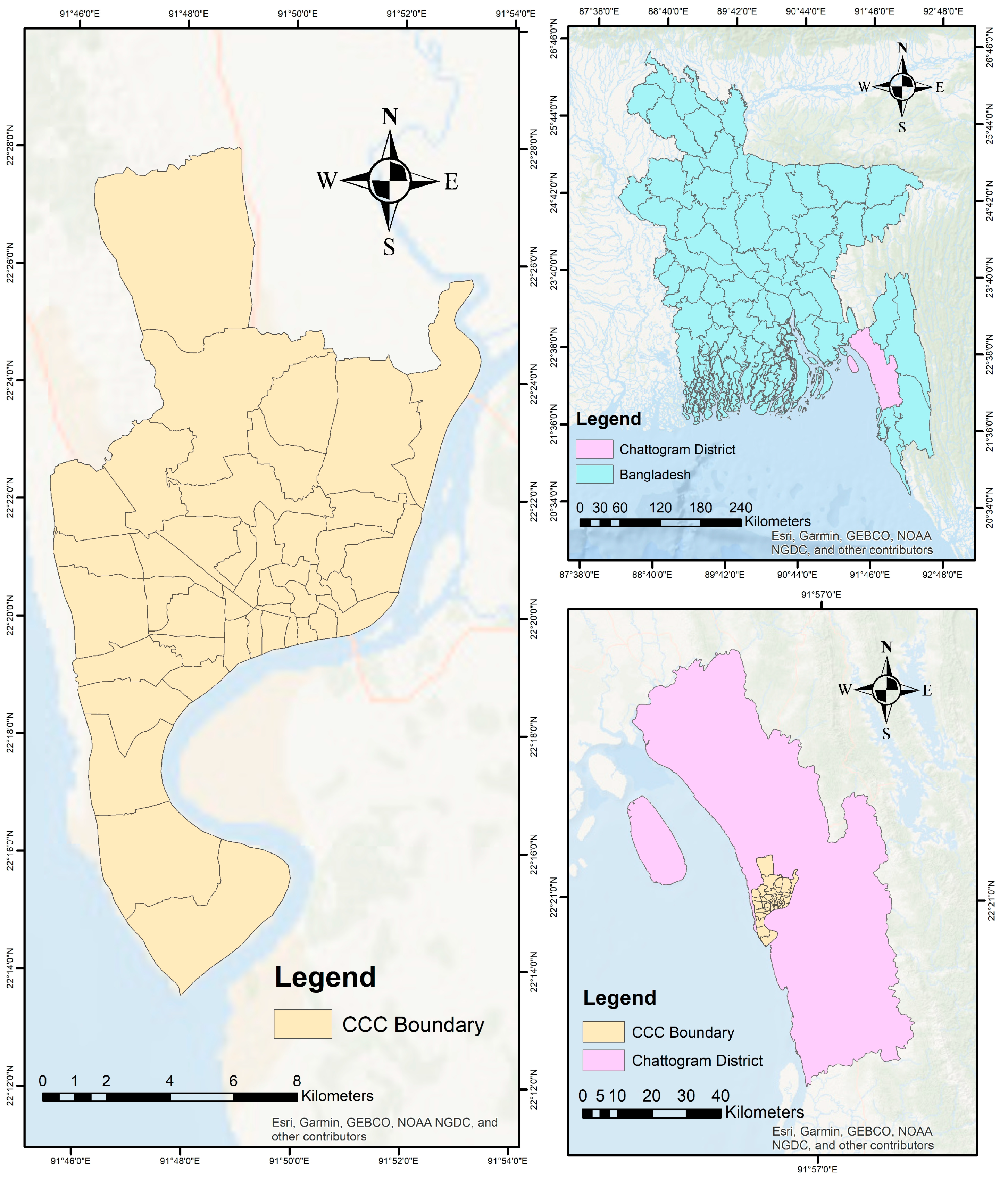
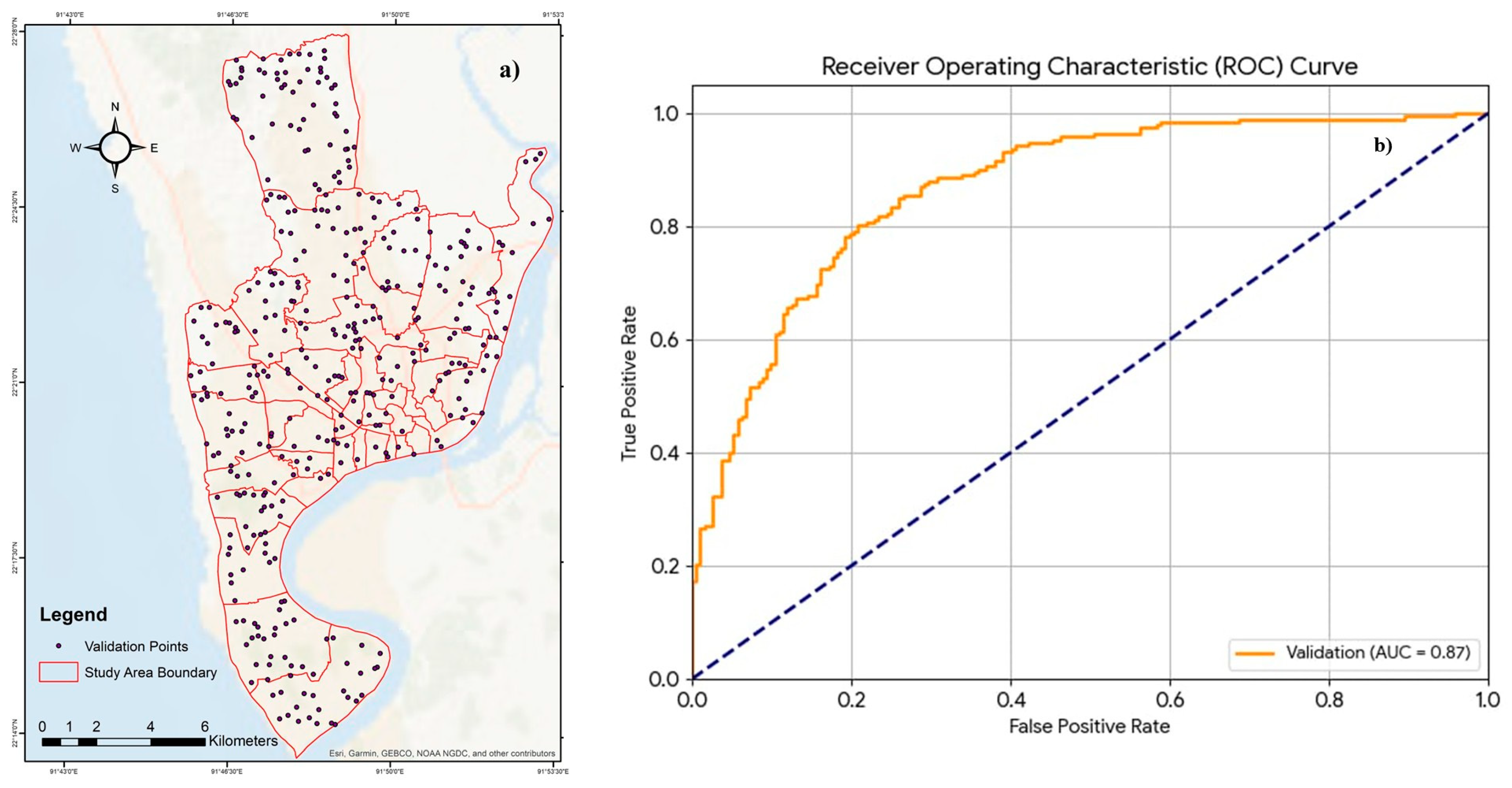
This study focuses on the Chattogram City Corporation (CCC) area, located in southeastern Bangladesh between 22°12′ N to 22°30′ N latitude and 91°44′ E to 91°55′ E longitude (Figure 1), encompassing approximately 426.95 km2 of administrative jurisdiction [54]. It serves as Bangladesh’s second-largest urban center and principal maritime gateway, positioning the city as a critical economic hub [55].
The study area experiences a tropical monsoon climate, with annual precipitation averages 2800–3200 mm, with the majority concentrated during monsoon months [56]. Moreover, the annual average temperature ranges from 15 °C during winter minimum to 35 °C during pre-monsoon maximum. Chattogram has experienced substantial demographic growth in recent decades, with the population increasing from approximately 2.8 million in 1990 to 5.6 million in 2025 [57].
Chattogram presents a scientifically significant and policy-relevant context for UHI study due to its rapid urban expansion, in the last two decades, and is expected to exceed 60% by 2040, leading to the loss of natural cooling surfaces [58]. Unlike megacities frequently studied in UHI literature, Chattogram reflects the emerging dynamics of secondary coastal cities where high population density, informal settlements, and limited cooling access heighten human heat vulnerability. Its tropical monsoon climate amplifies thermal stress, while increasing risks of cyclones, flooding, and sea-level rise intensifying UHI effects. These conditions create an opportunity for evidence-based, climate-responsive planning, ensuring Chattogram is a key reference for other rapidly urbanizing coastal cities in South Asia.
Chattogram was selected over other Bangladeshi cities, including Dhaka, Rajshahi, and Khulna, for three specific reasons. First, its unique geographical configuration spanning hill tracts, a major river estuary, and a coastal industrial belt creates a thermally heterogeneous urban landscape that is insufficiently studied despite its relevance to tropical coastal UHI dynamics. Second, as Bangladesh’s principal maritime and economic hub, Chattogram’s ongoing rapid growth without commensurate spatial planning makes it a high-stakes case for climate-responsive intervention. Third, unlike Dhaka, which has received comparatively more UHI attention, Chattogram lacks a comprehensive multi-temporal ML-integrated thermal assessment, making this study particularly timely and necessary.

2.2. Data Sources

The methodological framework employed multiple data sources to ensure a comprehensive analysis of UHI dynamics and their relationship with urban land use patterns.

2.2.1. Remote Sensing Data

Two different Landsat sensors were incorporated for a multi-decadal UHI study to ensure comprehensive temporal coverage from 2005 to 2025 (Table 1). Landsat 5 Thematic Mapper (TM) imagery was utilized for the years 2005 and 2009, providing the only primary operational moderate-resolution thermal data during this period. It facilitates 30 m spatial resolution data, crucial for maintaining long-term observation continuity [59]. Landsat 8 Operational Land Imager (OLI)/Thermal Infrared Sensor (TIRS) data were utilized for 2013, 2017, 2021, and 2025 acquisitions, leveraging improved radiometric precision and refined thermal band configuration [60].
The temporal intervals were determined by a combination of sensor availability, data quality constraints, and urban change dynamics. For the 2005 and 2009 acquisitions, Landsat 5 TM was the only operational moderate-resolution thermal sensor, and these two dates provide a pre-rapid-urbanization baseline separated by a 4-year interval consistent with medium-term urban growth cycles in South Asian cities. From 2013 onward, Landsat 8 OLI/TIRS was used at consistent 4-year intervals (2013, 2017, 2021, 2025), deliberately selected to span distinct phases of Chattogram’s documented urban expansion: the post-2010 infrastructure investment boom, the 2015–2020 port expansion corridor development, and the most recent peripheral urban densification phase. The 4-year interval also reflects the minimum temporal resolution needed to detect statistically significant LULC transitions at the 30 m pixel scale, while keeping the total observation record computationally manageable for iterative ML prediction. All acquisitions were restricted to the dry season (November–March) to ensure thermal comparability across years by minimizing the confounding effects of monsoon-related moisture, cloud cover, and evapotranspiration variability.
Cross-sensor harmonization between Landsat 5 TM and Landsat 8 OLI/TIRS required a multi-step radiometric normalization procedure to ensure temporal comparability. First, all imagery was converted from raw digital numbers (DN) to top-of-atmosphere (TOA) reflectance using sensor-specific gain and bias coefficients provided in the Landsat metadata files, following the USGS Landsat Collection 2 calibration standards [61]. Second, pseudo-invariant features (PIFs), comprising stable land surfaces such as concrete structures, rock outcrops, and dry sandy areas identified through visual interpretation and NDVI masking were used to perform relative radiometric normalization between Landsat 5 and Landsat 8 scenes, minimizing inter-sensor spectral differences [61,62]. Third, for thermal band harmonization, Landsat 5 Band 6 brightness temperatures were cross-calibrated to Landsat 8 TIRS Band 10 using published cross-sensor calibration coefficients derived from near-simultaneous overpasses, confirming a mean bias of less than 0.3 °C between sensors under equivalent surface conditions [62]. The Fmask algorithm (version 4.0) was applied uniformly across all scenes to mask clouds, cloud shadows, and snow; its threshold parameters (cloud probability threshold: 22.5%, buffer size: 3 pixels) were kept constant across all years to avoid introducing systematic biases in the masking procedure. All imagery was co-registered to a common geographic reference frame using ground control points sourced from 1:25,000 topographic maps from the Survey of Bangladesh, achieving sub-pixel geometric accuracy (RMSE < 0.5 pixels) [61]. All maps are projected in the Geographic Coordinate System UTM Zone 46N WGS 1984. All imagery was acquired during the dry season to minimize atmospheric moisture interference and maximize thermal contrast between urban and rural surfaces. Moreover, cloud coverage was restricted to less than 10% for all images to maintain data quality and spatial completeness across the study area [62].

2.2.2. Ancillary Data

Ancillary datasets were integrated to assess classification accuracy and validation procedures. High-resolution imagery from Google Earth Pro was used for visual interpretation and training data collection. In addition, Chattogram City Corporation administrative boundary data collected from the Bangladesh Bureau of Statistics (BBS) and meteorological data were utilized to interpret thermal patterns from the Bangladesh Meteorological Department.

2.2.3. Survey Data

A household survey and Focus Group Discussion (FGD) were conducted for primary data collection between July and August 2025, assessing UHI-related public perception. The survey employed a random sampling framework based on administrative wards. The questionnaire comprised five-point Likert-scale items assessing awareness, experiences of urban heat, and closed-ended questions regarding preferred mitigation strategies.
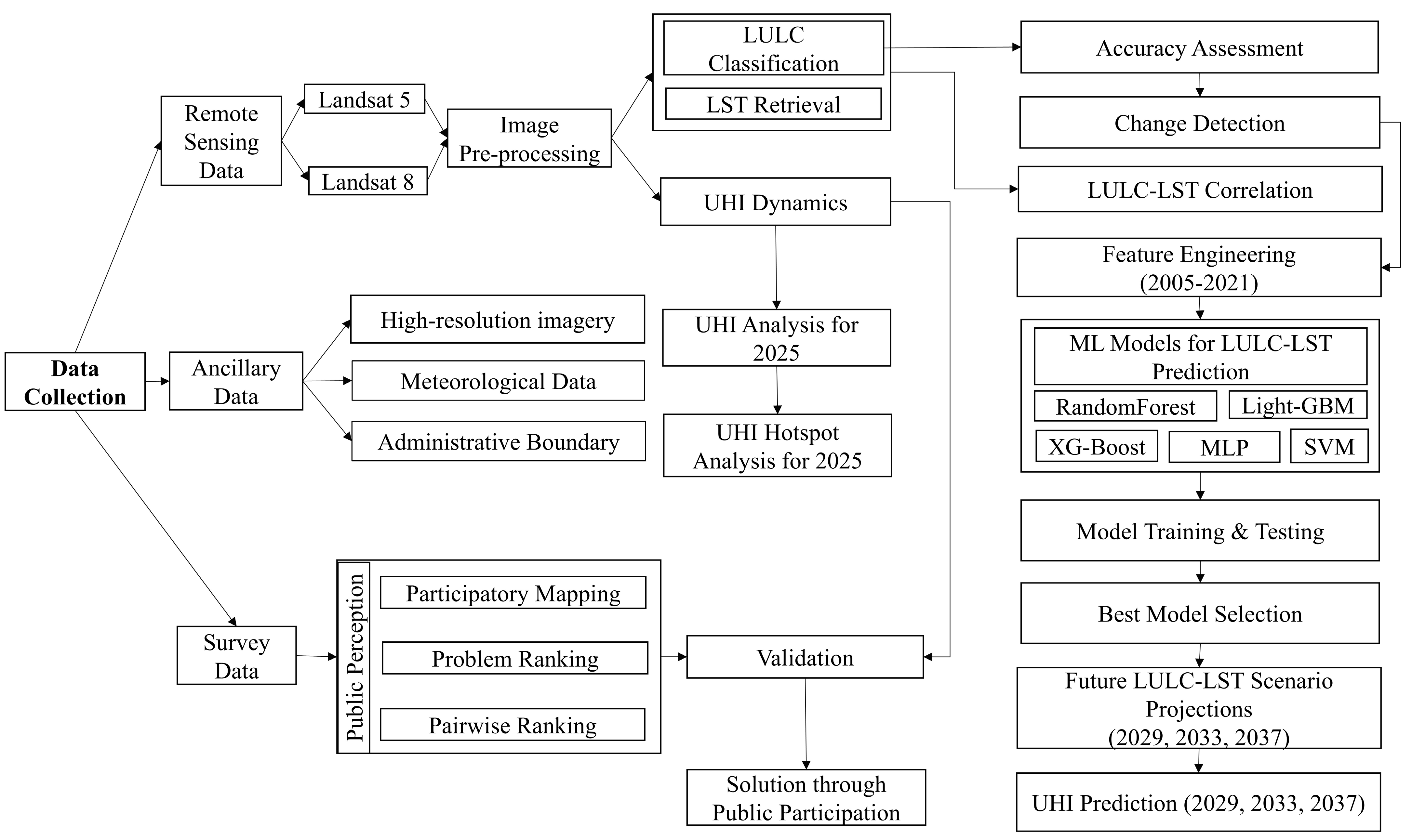
The research employs an integrated methodology to analyze UHI dynamics in Chattogram city in the context of spatiotemporal consideration (Figure 2). The study begins with multi-temporal remote sensing data acquisition for spatiotemporal analysis of historical LULC and LST patterns.

2.3. Land Cover Assessment

2.3.1. Preprocessing

The preprocessing procedure of all Landsat imagery was conducted first. Radiometric calibration converted digital numbers to top-of-atmosphere (TOA) reflectance using sensor-specific calibration coefficients [63]. The function of the Mask (Fmask) algorithm was used to perform atmospheric correction to identify and remove cloud and cloud shadow contamination [64]. Geometric correction was applied using ground control points to ensure precise spatial alignment across temporal datasets [65]. The CCC area boundary shapefile was collected from the Survey of Bangladesh, which was used to clip the study area.

2.3.2. Classification

The land cover classification of the study area was classified into four broad groups based on a literature review (Table 2). To analyze spatiotemporal distribution dynamics, a supervised Maximum Likelihood Classification (MLC) approach was employed for LULC mapping [66].
Four primary LULC classes were defined. The MLC technique is based on the similarity of the spectral signature of the targeted pixels to a specific class using probability and cost functions [71]. This technique is used because it is fast and simple to run and performs well, especially when the number of classes is few and the spectral heterogeneity is less [72]. A total of 300 training samples per land cover class per year were collected for classification, yielding 1200 samples per year across the four classes and 7200 samples across the full 2005–2021 training period. Samples were spatially distributed through a stratified random sampling approach: the study area was partitioned into a 1 km × 1 km grid, and within each grid cell, candidate sample points were randomly generated proportional to the area of each land cover class estimated from preliminary visual interpretation. This ensured that all LULC classes were represented proportionally across different geographic zones: coastal, hillside, riverine, and central urban, rather than being concentrated in easily accessible or visually salient areas. To minimize the effects of spatial autocorrelation on classification accuracy, a minimum spatial separation of 250 m was enforced between any two training points, based on Moran’s I analysis indicating significant spatial autocorrelation in spectral reflectance values at distances below this threshold [73]. Reference labels for all training points were assigned through visual interpretation of high-resolution Google Earth Pro imagery from the corresponding acquisition year, cross-checked against ancillary field records from the Survey of Bangladesh. Validation samples (n = 300 per year, independent of training data) were collected using the same stratified approach with the same minimum separation constraint, ensuring that the accuracy assessment was not inflated by spatial proximity between training and validation points. Spectral signatures were extracted from the corresponding Landsat multispectral bands, and the maximum likelihood algorithm was applied to classify all pixels based on the posterior probability distributions derived from these signatures [73].
It is important to clarify the distinct roles of the Maximum Likelihood Classification (MLC) and the machine learning algorithms within this study’s analytical framework. MLC was applied exclusively for the historical LULC mapping task (2005–2021), where its well-established performance with spectrally distinct, limited-class remote sensing data, combined with its computational efficiency over multi-decadal imagery stacks, makes it appropriate and reproducible [71,72]. This is consistent with standard practice in long-term land cover change studies, where classification consistency across sensor generations is prioritized. The machine learning algorithms (LightGBM, Random Forest, XGBoost, SVM, and MLP), by contrast, were employed for the predictive task: forecasting future LULC and LST based on temporal sequences of historical observations (a fundamentally different problem requiring models capable of learning complex nonlinear temporal dependencies). This two-stage design, using MLC for historical classification and ML for temporal prediction, avoids circularity (using ML outputs to train ML models on the same data), maintains classification consistency across the 20-year archive, and allows direct comparison of ML predictive performance against an independently verified ground truth. Future studies could evaluate deep learning-based classifiers such as U-Net or Random Forest for the historical classification task as well, which may further improve accuracy.

2.3.3. Accuracy Assessment Framework

An accuracy assessment was conducted to evaluate the performance and reliability of the land LULC classification [74]. Independent validation samples created reference points for each land cover type. These reference samples were interpreted using high-resolution imagery and ancillary data to ensure their accuracy. A confusion matrix was constructed by comparing the classified map with the reference data. From this matrix, Overall Accuracy (OA), Producer Accuracy, User’s Accuracy, and Kappa Coefficient were calculated. The proportion of the total number of correctly classified samples and the total number of validation samples is defined as overall accuracy (OA) [75]. The overall accuracy is calculated by using Equation (1).
OA = 1 N i = 1 r n i i
where N is the total number of validation samples, r is the number of land cover classes, and nii represents the number of correctly classified samples for class i (diagonal elements of the confusion matrix).
Producer’s Accuracy (PA) measures omission error by considering the proportion of reference samples of a given class that are accurately classified [76]. The producer’s Accuracy is calculated by using Equation (2).
PA = n i i n i , c o l
where ni,col represents the column total for class i in the confusion matrix (total reference samples for that class).
User’s Accuracy (UA) calculates commission error by determining the percentage of pixels classified as a given class that truly belong to that class [77,78]. The User’s Accuracy is calculated by using Equation (3).
UA = n i i n i r o w
where ni,row represents the row total for class i (total pixels classified as that class).
Additionally, a more reliable indicator of LULC classification, the Kappa Coefficient (κ), assesses the accuracy by comparing the classified map to reference data [79]. The value of the Kappa Coefficient is calculated by using Equation (4).
Κ = N i = 1 r x i i i = 1 r ( x i + ) ( x i + i ) N 2 i = 1 r ( x i + ) ( x i + i )
where N is the total number of observations, r is the number of rows (classes) in the confusion matrix, xii represents diagonal elements, and xi+ and x+i are the marginal totals of row i and column i, respectively. High values of OA and Kappa indicate a more plausible classification result [80].

2.3.4. Change Detection Approach

Change detection analysis was carried out to measure spatiotemporal LULC transformations and identify conversion patterns among land cover classes. The post-classification comparison technique was employed, involving pixel-by-pixel analysis of classified images from consecutive periods to generate change matrices [81].
Change detection matrices were generated for consecutive time periods (2005–2009, 2009–2013, 2013–2017, 2017–2021, 2021–2025) to identify conversion patterns between classes. These matrices systematically recorded all possible transitions between the four land cover classes. After that, transition probability matrices were generated to quantify the amount of change for each conversion type by calculating the area.

2.4. Land Surface Temperature (LST) Analysis

LST was derived from Landsat thermal bands using the mono-window algorithm [82], which accounts for atmospheric effects and surface emissivity variations. For Landsat 5 TM, thermal band 6 was utilized, while Landsat 8 TIRS band 10 was employed for recent acquisitions [83]. The retrieval process involved the conversion of thermal band digital numbers to at-sensor radiance. Correction for atmospheric transmission using atmospheric parameters, estimation of land surface emissivity based on NDVI thresholds. Lastly, the calculation of LST in degrees Celsius using the Planck function in Equation (5) [84].
L S T = B T 1 + λ × B T ρ × ln ε
where BT = Brightness Temperature, λ = Wave length, ρ = hc/k = 1.4388 × 10⁻² m·K, where h is Planck’s constant (6.626 × 10⁻³⁴ J·s), c is the speed of light (2.998 × 10⁸ m/s), and k is the Boltzmann constant (1.381 × 10⁻²³ J/K). Spatial patterns of temperature change were mapped, and areas exhibiting significant warming or cooling trends were identified. Seasonal variations were accounted for by restricting analysis to dry season imagery when thermal contrasts are most pronounced.

2.5. UHI Detection

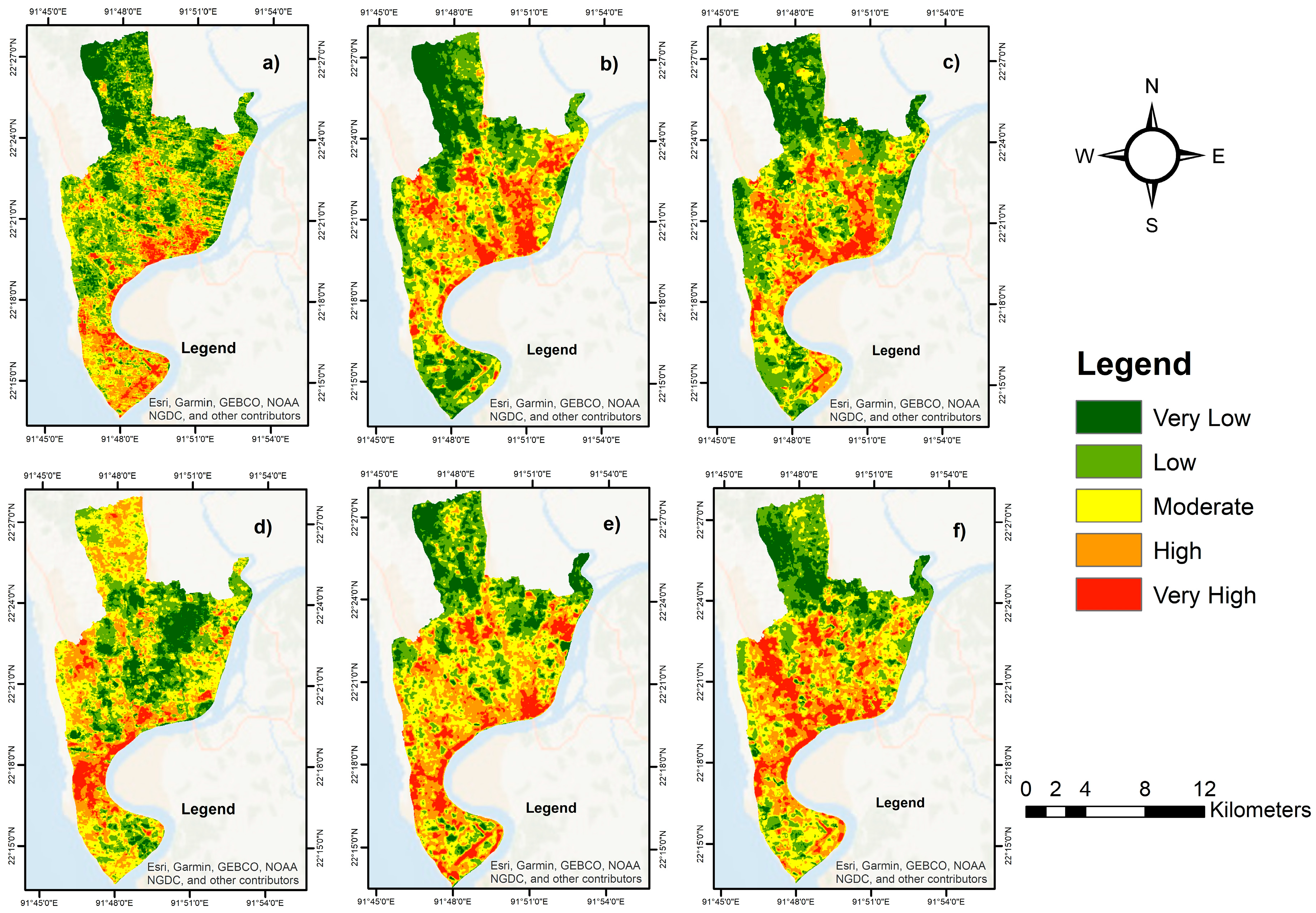
UHI intensity was quantified using a standardized anomaly formulation that normalizes pixel-level LST relative to the spatial mean and standard deviation of LST across the entire study area. For each time period, the standardized UHI index (UHII) was calculated for each pixel using Equation (6) [85].
U H I = L S T L S T m σ
where LST is the land surface temperature of an individual pixel (°C), LSTm is the mean land surface temperature across all pixels in the study area (°C), and σ is the standard deviation of LST across all pixels. The result is a dimensionless z-score indicating how many standard deviations a given pixel’s temperature deviates above or below the study area mean. This approach was selected for three reasons: (1) it avoids the methodological challenge of defining an appropriate ‘rural reference zone’ in the complex coastal-industrial-hillside landscape of Chattogram, where no unambiguous rural surroundings exist; (2) it allows direct temporal comparability of UHI intensity patterns across different years without the confounding influence of inter-annual mean temperature variation; and (3) it is consistent with established UHI standardization approaches used in comparable tropical coastal studies [85]. It is acknowledged that this formulation produces a dimensionless index rather than an absolute temperature difference in °C, which is the convention in some UHI literature. Accordingly, all UHI intensity values reported in this study are expressed as dimensionless standardized units. The absolute LST values, reported separately in degrees Celsius, convey the thermal magnitude experienced at the surface. For context, a UHII value of +2 in this study corresponds to a surface temperature approximately 2 standard deviations above the citywide mean; a threshold used in several recent studies to define severe thermal stress zones [84,85]. Thermal differences between land cover categories are expressed directly in °C using the mean LST values by class.

2.6. LULC–LST Relationship Assessment

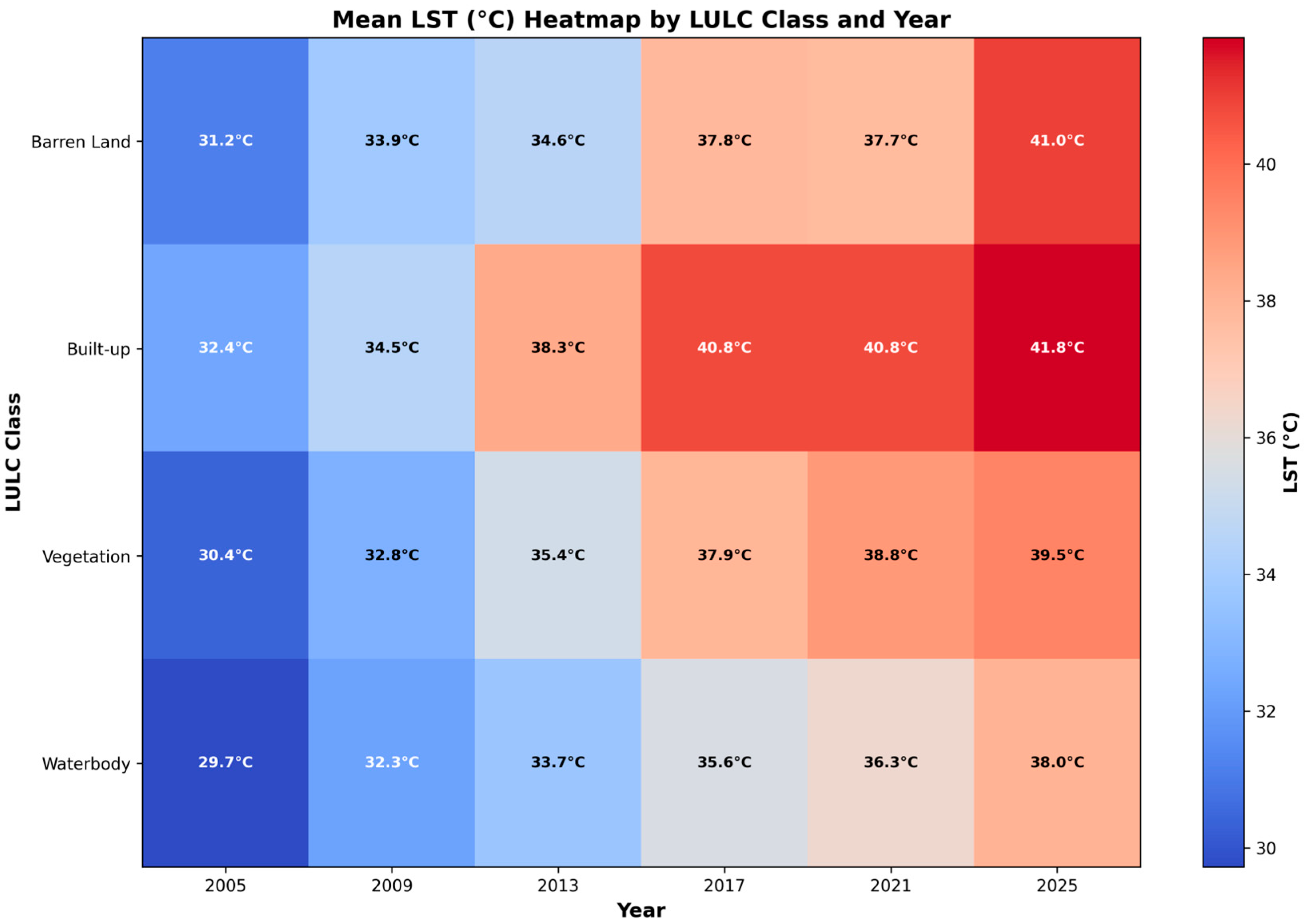
The statistical relationships between LULC categories and LST assessed in this section are grounded in well-established biophysical mechanisms governing surface energy partitioning. Built-up surfaces (concrete, asphalt, roofing materials) exhibit low albedo (0.1–0.2) and high thermal admittance, absorbing substantial solar radiation and releasing it as sensible heat, while their near-zero moisture content eliminates latent heat flux through evapotranspiration, the primary surface cooling mechanism [86]. Vegetation, by contrast, moderates LST through two complementary pathways: direct shading reduces incoming solar radiation at the surface, while active transpiration converts absorbed solar energy into latent heat rather than sensible heat, producing a cooling effect of 1–5 °C relative to adjacent built-up surfaces documented across tropical Asian cities [86]. Waterbodies exert a thermal buffering effect attributable to water’s high specific heat capacity (4186 J/kg·K compared to approximately 840 J/kg·K for concrete), which moderates both daytime heating and nighttime cooling, effectively dampening diurnal LST amplitude in surrounding areas [87]. Barren land occupies an intermediate position: its lack of vegetation eliminates evapotranspirative cooling, but its typically lower thermal mass compared to dense built-up materials results in slightly lower daytime LST. These mechanistic relationships predict the directional thermal differentials observed in this study, built-up to barren to vegetation to waterbody, and provide the theoretical basis for interpreting the Pearson correlation results presented below.
Pearson correlation analysis was conducted for each observation year to quantify the statistical relationship between LULC categories and LST [88]. The Pearson correlation coefficient was selected because it is well-suited for analyzing continuous variables, assumes linear relationships consistent with urban thermal dynamics, and provides interpretable metrics [89].
Each LULC class’s mean LST values were extracted, and correlation coefficients were calculated to assess linear relationships between land cover types and thermal intensity. The Pearson correlation coefficient (r) ranges from −1 to +1, where +1 indicates a strong positive correlation, −1 indicates a strong negative correlation, and values near 0 suggest a weak or no linear relationship [90]. This analysis enabled the identification of LULC categories that substantially contribute to surface warming or cooling effects.

2.7. Predictive Modeling

The predictive modeling framework was designed with strict attention to reproducibility and validation integrity. The dataset was organized as a temporal pixel-level feature matrix, where each observation consisted of five temporal LST or LULC values (from 2005, 2009, 2013, 2017, and 2021) as input features and the corresponding 2025 observed value as the target. The 2025 validation split was treated as a fully held-out test set with no information leakage: models were trained exclusively on 2005–2021 observations and evaluated against the independently derived 2025 classification and LST raster. It is important to clarify that what is being validated is the models’ ability to predict future remotely sensed products, specifically the MLC-derived 2025 LULC classification and the mono-window algorithm-derived 2025 LST raster, rather than directly observed ground-truth urban conditions. Therefore, classification uncertainties inherent in the 2025 MLC product (OA: 92.67%, κ = 0.9004) and LST retrieval uncertainties (cross-sensor bias < 0.3 °C) are embedded within the reported ML performance metrics and represent a performance ceiling for the models. Reported RMSE, MAE, F1-weighted, and accuracy values should therefore be interpreted as model skill relative to the best available remotely sensed reference product. To reduce the risk of inflated performance metrics due to spatial autocorrelation, a spatially stratified splitting strategy was adopted: the study area was divided into 41 administrative wards, and validation pixels were drawn exclusively from wards not represented in the training set during each fold, following block cross-validation principles [91]. This approach ensures that performance metrics reflect generalization across spatially independent areas rather than interpolation within training neighborhoods. Class imbalance in the LULC dataset (built-up: 55%, vegetation: 26%, barren land: 12%, waterbody: 7%) was addressed through class-weight balancing, where each algorithm assigned sample weights inversely proportional to class frequency during training. Hyperparameter tuning was conducted via 5-fold spatially blocked cross-validation on the training set, optimizing F1-weighted score for classifiers and RMSE for regressors. Default parameters were used as starting values (as specified in each algorithm’s subsection), with the optimal parameter set selected from a predefined grid search for each algorithm. All preprocessing steps: feature standardization for SVM, MLP, and SVR, were fitted exclusively on training data and applied to validation and prediction data, preventing data leakage.
Five models were selected based on their proven effectiveness in handling complex datasets and their distinct algorithmic approaches [92,93,94]. In thermal modeling and land cover classification, RandomForest and tree-based ensemble models (XGBoost, LightGBM) are highly effective at capturing non-linear relationships [95,96]. SVM leverages kernel-based transformations for strong performance with high-dimensional spectral data, while MLP is a deep learning technique that is capable of revealing complex feature relations [97]. These five diverse ensemble models enabled comprehensive performance comparison and identification of optimal algorithms for LULC classification and LST prediction.

2.7.1. LULC Prediction

The model training process utilized historical LULC and LST time-series data from 2005 to 2021 to develop predictive models for the 2025 observations. Multiple machine learning algorithms (XGBoost, LightGBM, Random Forest, SVM, and MLP) were trained separately for LULC classification. Each model predicted LULC for 2025, and performance was evaluated against the actual 2025 values. The best-performing classifier and regressor were then selected based on the highest accuracy and lowest error matrix values.
Extreme Gradient Boosting (XGBoost)
XGBoost is one of the five predictive models used in this study to forecast changes in LULC based on historical data from 2005 to 2021 (Figure 2). The model assessed temporal trends and transition probabilities by learning complex nonlinear correlations between historical land-use trends and future transitions [98]. To prevent overfitting, a learning rate of 0.3, a maximum tree depth of 6, and early stopping criteria were implemented. XGBoost was a suitable choice for the four LULC categories, as it supports multi-class classification using a SoftMax objective function [99]. Equation (7) is used to perform this model [100]:
o b j θ = i = 1 n L y i , ŷ i + K = 1 K Ω f k
In this context, i = 1 n L y i ,   ŷ i -represents the total empirical loss, quantifying the error between the predictions ŷi and the true labels yi across all n training samples; K = 1 K Ω f k   denotes the regularization term, which represents the sum of the complexities of all trees and is used to control model overfitting. L(yi, ŷi) represents the model parameters, Ω(fk) denotes the loss value of the i-th sample, and θ indicates the complexity of the K-th base model.
Light Gradient Boosting Machine (LightGBM)
One of the five prediction models used in this study to predict LULC changes is LightGBM (Figure 2). It was used to process temporal feature vectors that represented the land use history of each pixel. The model can process categorical data, making it ideal for LULC classifications [101]. LightGBM was configured with default parameters, including 100 boosting iterations, minimum data in leaf (20), and feature fraction (0.9). The main flow of the LightGBM algorithm was calculated by using Equation (8) [102].
F n x = α f 0 x + α f 1 x + + α f n x
where the classifier is initialized with n decision trees, and the weight of training samples is 1/n. The weak classifier f(x) is trained, and its power α is determined. The classifier updates the weights until it gets the final classifier Fn(x). The algorithm delivered high classification accuracy and computational efficiency that enabling rapid development iterations. The model’s leaf-wise growth strategy effectively captured complex spatiotemporal patterns in urban development [103].
Random Forest
Among five predictive models, Random Forest is one of the models that was applied in this study to forecast LULC changes by using temporal sequences of land use classifications as input features (Figure 2). The algorithm reduces correlation among trees and enhances generalization by introducing randomness through bootstrap sampling of training data and random selection of feature subsets at each node split [104]. The model was designed with 200 trees and unlimited depth to enable comprehensive exploration of feature space. Following standard procedure, the number of features per split was set as the square root of the total number of features. The main flow of Random Forest is calculated by using Equation (9) [105]:
C R F x = m o d e { C 1 x , C 2 x , , C B x }
where CRF(x) is the Random Forest prediction, CB(x) is the prediction of the b-th tree, and B is the total number of trees. The ensemble’s diverse trees learned varied transition patterns, and their collective voting ensured robust, noise and outlier-resistant predictions. This model can provide feature importance scores, which enable the determination of the most influential temporal periods for LULC projection [106].
Multi-Layer Perceptron (MLP)
This study employed MLP to model complex nonlinear relationships between temporal LULC patterns and future land use classes (Figure 2). In this framework, the neural network architecture included an input layer with five neurons. These inputs then processed through a single hidden layer with 100 neurons using Rectified Linear Unit (ReLU), and a softmax output layer with four neurons for probability distribution [107]. Training utilized the Adam optimizer with a maximum of 500 iterations and early stopping based on validation loss to prevent overfitting. Input features were standardized to a zero mean and unit variance to facilitate network convergence and improve training stability [108]. The MLP function has two crucial forward and backward propagation steps to complete the adjustments in neuron connection weights. The input of a single node is weighted according to the following Equation (10) [109].
n e t j = i = 1 m W i j O i
where Wij represents the weights between nodes i and j, and Oi is the output from node i. The output from node j is calculated by Equation (11):
O i = f n e t j
As the function f in our research is a sigmoidal function, the weights will be applied earlier than the signal reaches the subsequent layer. The MLP’s capacity to capture complex temporal dependencies and nonlinear transition dynamics made it effective for modeling urban development patterns.
Support Vector Machine (SVM)
For future LULC classification, this study used SVM, as one of five prediction models, to predict LULC changes with a Radial Basis Function (RBF) kernel to handle the nonlinear separability of the temporal feature vectors [110]. The model generated probability estimates to provide classification confidence scores and facilitate uncertainty assessment for predictions. Input features were standardized before training to optimize kernel performance and avoid scale-based dominance in the classification. Probability outputs were enabled for this study to assess prediction confidence, and a one-versus-one strategy was employed for multi-class classification [111]. The decision function for classification is formulated using Equation (12):
f x = s i g n i = 1 n α i y i K x i , x + b
where αi are Lagrange multipliers, yi are class labels, K(xi, x) is the kernel function computing similarity between training samples and the test sample, and b is the bias term.

2.7.2. Simulation of Land Surface Temperature

While LULC prediction employs classification algorithms that assign discrete categorical labels to spatial units, LST forecasting requires regression-based models capable of predicting continuous numerical temperature values across the thermal spectrum. Furthermore, regression captures detailed thermal gradients and nonlinear correlations [112]. It is also crucial for forecasting future thermal conditions that affect human comfort, health risks, and UHI intensity [113].
Extreme Gradient Boosting Regressor (XGBoost)
An XGBoost regressor was applied in this study to calculate nonlinear relationships between temporal LST patterns and future temperature values (Figure 2). The algorithm created complex temporal dependencies by gradually adding regression trees, which help to minimize prediction errors [114]. Five historical LST observations (2005, 2009, 2013, 2017, 2021) served as input features that enabled the model to capture warming or cooling trends. XGBoost was used with 100 estimators, a maximum tree depth of 6, a learning rate (η) of 0.1, and incorporated early stopping to prevent overfitting [115]. The objective function for regression is formulated by using Equation (13):
O b j t = i = 1 n l y i , ŷ i t + k = 1 t Ω f k
where l y i , ŷ i t represents the loss function, yi is the actual LST value, ŷ i t is the predicted LST at iteration t, and Ω(fk)= γ T + 1 2 λ j = 1 T w j 2 is the regularization term penalizing tree complexity, where T is the number of leaves and wj represents leaf weights. The model had the ability to handle nonlinear dynamics and automated feature interactions for capturing complex urban thermal responses [96].
Light Gradient Boosting Machine Regressor (LightGBM)
The LightGBM Regressor employed in this study used periodic temperature patterns as input variables to forecast future LST (Figure 2). The algorithm partitions continuous feature values into discrete bins, reducing computational complexity [116]. The regression prediction is calculated by using Equation (14):
y i ^ = t = 1 T f t x i
where y i ^ is the predicted LST for sample i, f t represents the t-th regression tree, x i is the feature vector (temporal LST sequence), and T is the total number of trees. Each tree f t is grown to minimize the loss function, using Equation (15):
L = i = 1 n l y i , ŷ i t 1 + f t x i
where l is the squared error loss function for LST regression. The model effectively processed continuous variables, temperature patterns, and enabled rapid training by using a leaf-wise growth strategy. It was configured with 100 iterations, unlimited depth, a 0.1 learning rate, and 20 samples per leaf to prevent overfitting on sparse temperature data. The algorithm’s computational efficiency enabled extensive hyperparameter tuning without compromising predictive accuracy [117].
Random Forest Regressor (RF)
A Random Forest Regressor was employed to predict LST using temporal temperature sequences as input features. The model comprises 200 regression trees, enabling it to capture diverse temperature patterns to accommodate complex, nonlinear temperature relationships. Moreover, a minimum of 2 samples per leaf ensured detailed predictions at the finest resolution. Tree diversity and prediction accuracy were balanced by allocating one-third of the total number of variables to each node split. This configuration of the model facilitates the effective representation of spatial heterogeneity in temperature dynamics across diverse land-use types and geographic locations [118]. The aggregated prediction is expressed in Equation (16):
C R F ^ x = 1 B b = 1 B T b x
where C R F ^ x represents the Random Forest prediction for feature vector x (temporal LST sequence), Tb(x) is the prediction from the bth regression tree, and B is the total number of trees in the ensemble. Furthermore, the Random Forest algorithm’s inherent capability to assess feature importance facilitated the identification of critical temporal windows in the historical record, revealing which past temperature patterns exerted the strongest influence on future thermal conditions [119].
Multi-Layer Perceptron Regressor (MLP)
The study used an MLP Regressor to predict LST based on five consecutive temperature observations (Figure 2). Overall, the MLP captured the non-linear and temporal relationships within the data more effectively than simpler models, reflecting its strength in modeling urban thermal patterns [120]. The aggregated prediction is expressed in Equation (17):
y ^ = W o f h W h x + b h + b o
where x represents the input feature vector (temporal LST sequence), Wh and Wo are weight matrices for the hidden and output layers, respectively bh and bo are bias terms, fh is the hidden layer activation function (ReLU: f h (z) = max(0,z)), and ŷ is the predicted LST value. The network included an input layer with five neurons that were equivalent to five temporal LST observations, a single hidden layer with 100 neurons using the ReLU activation function, and one output node for continuous prediction [121]. The model was trained for up to 500 iterations using the Adam optimizer with early stopping to avoid overfitting [122]. Before training, all input variables were standardized to facilitate network training and ensure stable gradient flows.
Support Vector Regressor (SVR)
In this study, SVR was applied to predict future LST (Figure 2) by mapping temporal temperature sequences using the Radial Basis Function (RBF) kernel, which effectively detected nonlinear temperature patterns [123]. The regression function is formulated by using Equation (18):
f x = i = 1 n α i α i K x i , x + b
where α i and α i are Lagrange multipliers determined through optimization K x i , x is the kernel function computing the similarity between training samples   x i and test sample x, and b is the bias term. The model was configured with an RBF kernel, a regularization parameter C = 1.0, an epsilon parameter ε = 0.1, and automatically scaled gamma based on feature variance. Input features were standardized to ensure optimal kernel performance. SVR’s theoretical robustness and high-dimensional proficiency made it ideal for modeling complex and nonlinear LST dynamics [124].

2.8. Evaluation Metrics

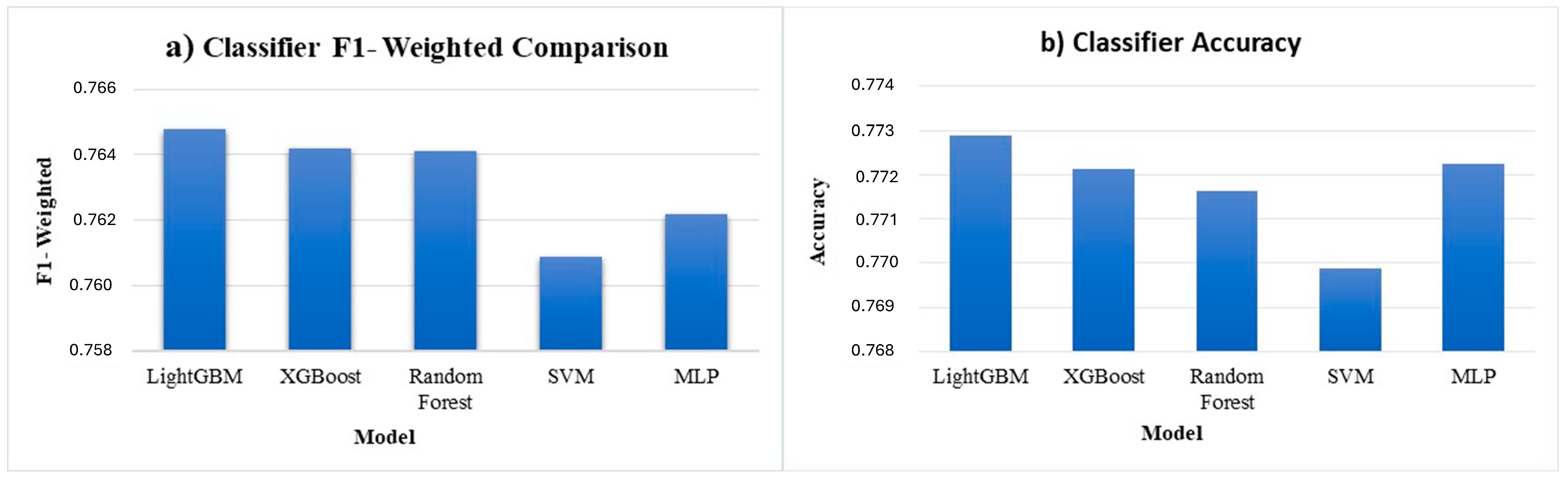
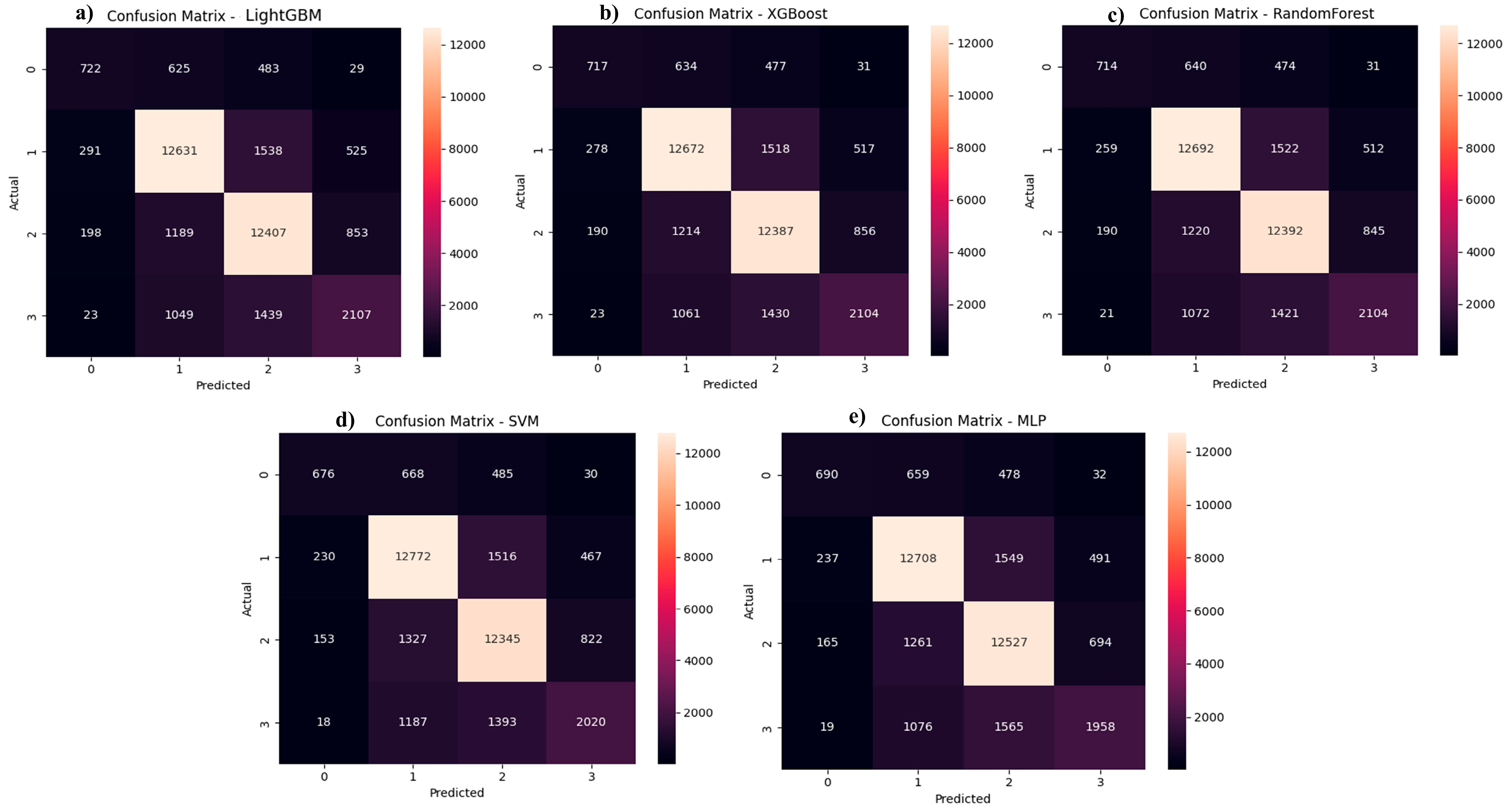
Classification performance for LULC prediction models was assessed using multiple complementary metrics to provide a comprehensive evaluation of predictive accuracy and class-specific performance. In this study, a classifier accuracy comparison [125], classifier F1-weighted comparison [126], and confusion matrices [127] were employed to evaluate the five classification algorithms (XGBoost, LightGBM, Random Forest, MLP, and SVM). On the other hand, For LST prediction, model accuracy was assessed using RMSE, MAE, and R2 [128,129,130].

2.8.1. Overall Accuracy

The percentage of accurately identified objects across all LULC classes is measured by overall accuracy [131]. The metric is calculated using Equation (19).
Overall   Accuracy = i = 1 n T P i N
where T P i represents true positive predictions for class i, n is the total number of classes (vegetation, waterbodies, built-up, and barren land), and N is the total number of test samples. In this study, overall accuracy was computed by comparing predicted LULC classes for 2025 against actual observed classifications. The values that are close to 1.0 indicate superior model performance [132].

2.8.2. Weighted F1-Score

The weighted F1-score is the harmonic average of precision and recall combined across all classes, which has weights corresponding to class frequencies. This matrix is prioritized for model selection, as it balances the precision and recall inherent in LULC class imbalances [133]. The weighted F1-score is computed using Equations (20) and (21).
F 1 S c o r e i = 2 × P r e c i s i o n i × R e c a l l i P r e c i s i o n i + R e c a l l i
Weighted   F 1 - score = i = 1 n w i × F 1 s c o r e i
where F 1 s c o r e i is the F1-score for class i that was calculated by using Equation (20). In addition, in Equation (21), w i represents the proportion of test samples belonging to the class i (weight), and n is the number of classes. In this study, the 2025 validation dataset was used to measure the weighted F1-scores for each classification algorithm. For temporal projections, the model with the highest weighted F1-score was selected to ensure an optimal balance between recall and precision across all LULC categories.

2.8.3. Confusion Matrix

Confusion matrices compared predicted classes against actual classes for each test sample to visualize classification performance [134]. Each matrix element (i, j) represents the number of instances with actual class i that were predicted as class j. In this study, confusion matrices were generated for each classification algorithm in order to identify misclassification patterns between particular LULC classes. Confusion between class pairs is identified by off-diagonal elements, whereas diagonal elements represent accurate classifications [135]. Confusion matrix analysis facilitates easier comprehension of the limitations of the model and evaluates projection findings properly [136].

2.8.4. Coefficient of Determination (R2)

The coefficient of determination quantifies the proportion of variance in observed LST that is explained by the regression model [137]. Actually, it provides a normalized measure of goodness-of-fit, ranging from 0 to 1 [138]. R2 is calculated using Equation (22):
R 2 = 1 i = 1 n y i y i ^ 2 i = 1 n y i y ¯ 2
where y i represents actual LST values, y i ^ denotes predicted LST values, y ¯ is the mean of actual LST values, and n is the number of observations. In this study, R2 values were computed for each regression algorithm (XGBoost Regressor, LightGBM Regressor, Random Forest Regressor, MLP Regressor, and SVR), with values closer to 1.0 indicating superior explanatory power. R2 provides insight into how well the model captures overall LST patterns, but it does not directly measure prediction error [139].

2.8.5. Root Mean Squared Error (RMSE)

RMSE measures the square root of the average squared differences between predicted and actual LST values. It provides an absolute error metric in the original temperature units (°C) and effectively handles problematic outlier predictions [140]. The formula is expressed in Equation (23).
R M S E = 1 n i = 1 n y i y i ^ 2
where y i represents actual LST, y i ^ is predicted LST, and n is the number of observations. In this study, RMSE was calculated for each regression model’s predictions on the 2025 validation datasets. RMSE not only served here as the primary selection criterion for measuring the optimal LST forecasting model, but also penalizes larger errors that could misinterpret thermal conditions in projected scenarios [141].

2.8.6. Mean Absolute Error (MAE)

MAE computes the average of absolute differences between predicted and actual LST values. It provides the measure of central tendency in prediction errors that is less sensitive to outliers than RMSE [142]. While RMSE emphasizes larger errors through squaring, MAE handles all errors equally. MAE is calculated by using Equation (24).
M A E = 1 n i = 1 n y i y i ^
where y i represents actual LST values, y i ^ denotes predicted LST values, and n is the number of observations. In this study, MAE was computed alongside RMSE to provide a complementary assessment of prediction accuracy.

2.9. Scenario Projections

2.9.1. Projection of LULC and LST for 2029, 2033, and 2037

The future projections presented in this study represent a business-as-usual (BAU) scenario, in which observed historical LULC and LST trends from 2005 to 2025 are assumed to continue without policy-driven alteration of land use trajectories. This framing is intentional: the BAU baseline is an essential first step in scenario planning, providing the ‘do-nothing’ thermal trajectory against which the impact of alternative planning interventions, such as green infrastructure expansion, industrial rezoning, or densification controls can subsequently be evaluated. The absence of planning-scenario projections in this study is acknowledged as a limitation (Section 4.5) and is recommended as a priority for future research.
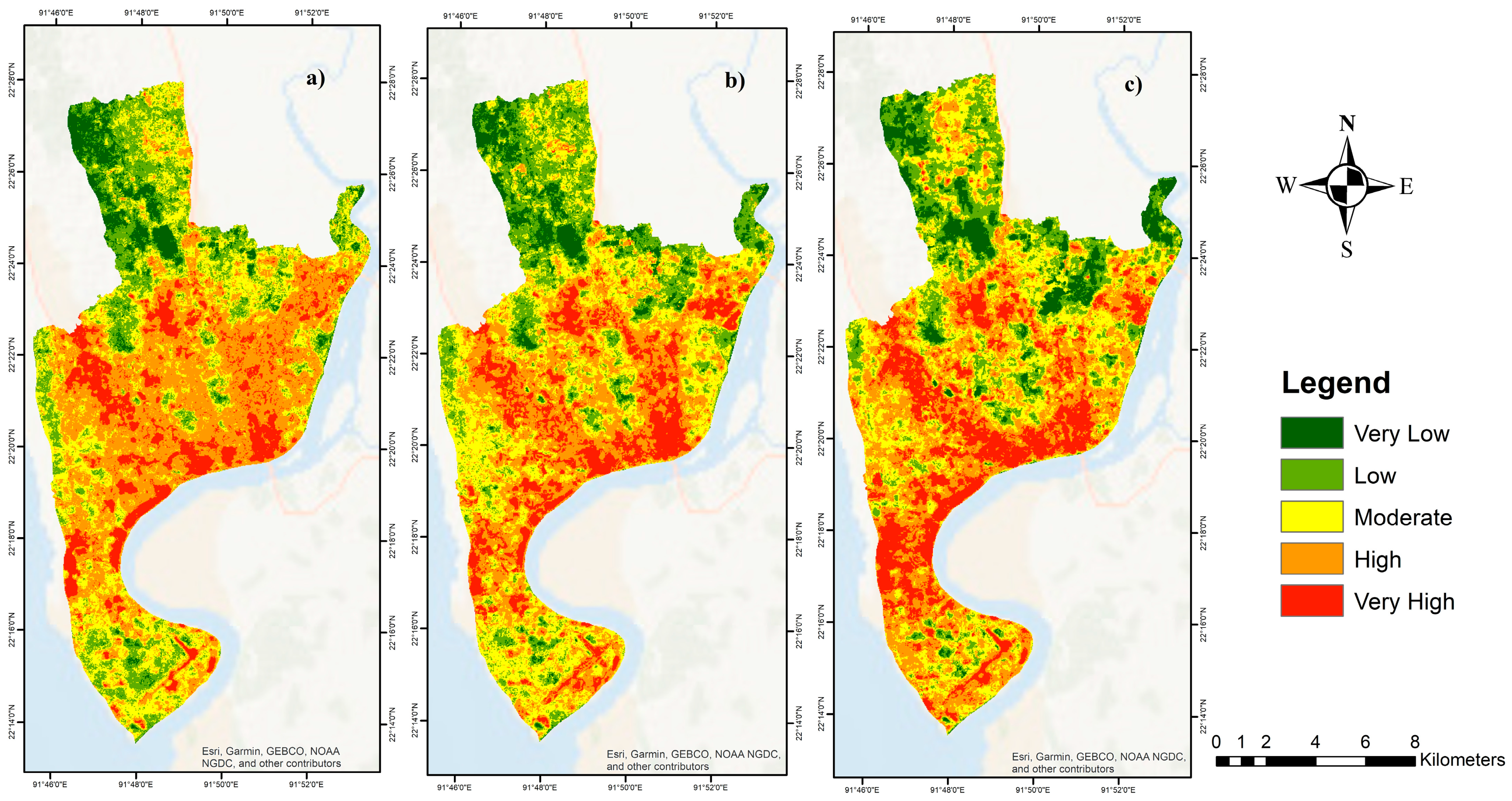
Best performing models identified through the validation phase, used for the iterative prediction stage for forecasting future scenarios of 2029, 2033, and 2037. For each spatial unit, the prediction process utilized the most recent six temporal observations as input features for forecasting the most recent year. For instance, to predict 2029 LULC and LST, the feature vectors comprised observations from 2009, 2013, 2017, 2021, and 2025 (where 2025 values were model predictions validated against actual data). The trained models processed these five-year sequences to generate 2029 predictions. Subsequently, for 2033 forecasts, the temporal window advanced to include 2013, 2017, 2021, 2025, and 2029 (predicted), maintaining the five-year feature structure. This iterative process continued for 2037 projections using the 2017–2029 sequence plus 2033 predictions.
For models requiring scaled inputs (SVM, MLP, SVR), feature standardization was applied using the scaler fitted on the training dataset, ensuring consistent preprocessing across training and prediction phases. The ensemble nature of tree-based models (RF, XGBoost, LightGBM) enabled direct processing of temporal sequences without additional scaling. Predictions were generated independently for LULC classification and LST regression, acknowledging the inherent relationship between land cover and thermal patterns.
To characterize uncertainty in the recursive prediction framework, a bootstrapped confidence interval approach was implemented. For each target year (2029, 2033, 2037), 100 bootstrap iterations were performed on the training dataset by resampling with replacement. Each bootstrap sample was used to train the best-performing model (LightGBM for LULC, Random Forest for LST), and predictions were generated for the target year using the same recursive feature window. The 2.5th and 97.5th percentiles of the 100 bootstrap predictions were used as the 95% confidence bounds for each pixel’s predicted LULC class probability and LST value. Mean confidence interval widths are reported alongside point estimates in the Results section. It is acknowledged that recursive prediction—where predicted values from one time step serve as inputs to the next—introduces compounding uncertainty: errors in the 2029 prediction propagate into the 2033 feature vector, and further into 2037. This error propagation effect was quantified by comparing the width of confidence intervals across the three projection years (2029 < 2033 < 2037), confirming the expected increase in uncertainty over longer forecast horizons. These uncertainty estimates should be interpreted as lower bounds, as they capture only sampling uncertainty within the historical training distribution and do not account for structural changes in urbanization patterns, climate forcing, or governance interventions that could alter thermal trajectories beyond the modeled range [91,143].

2.9.2. Predicted UHI Distribution and Hotspot Mapping

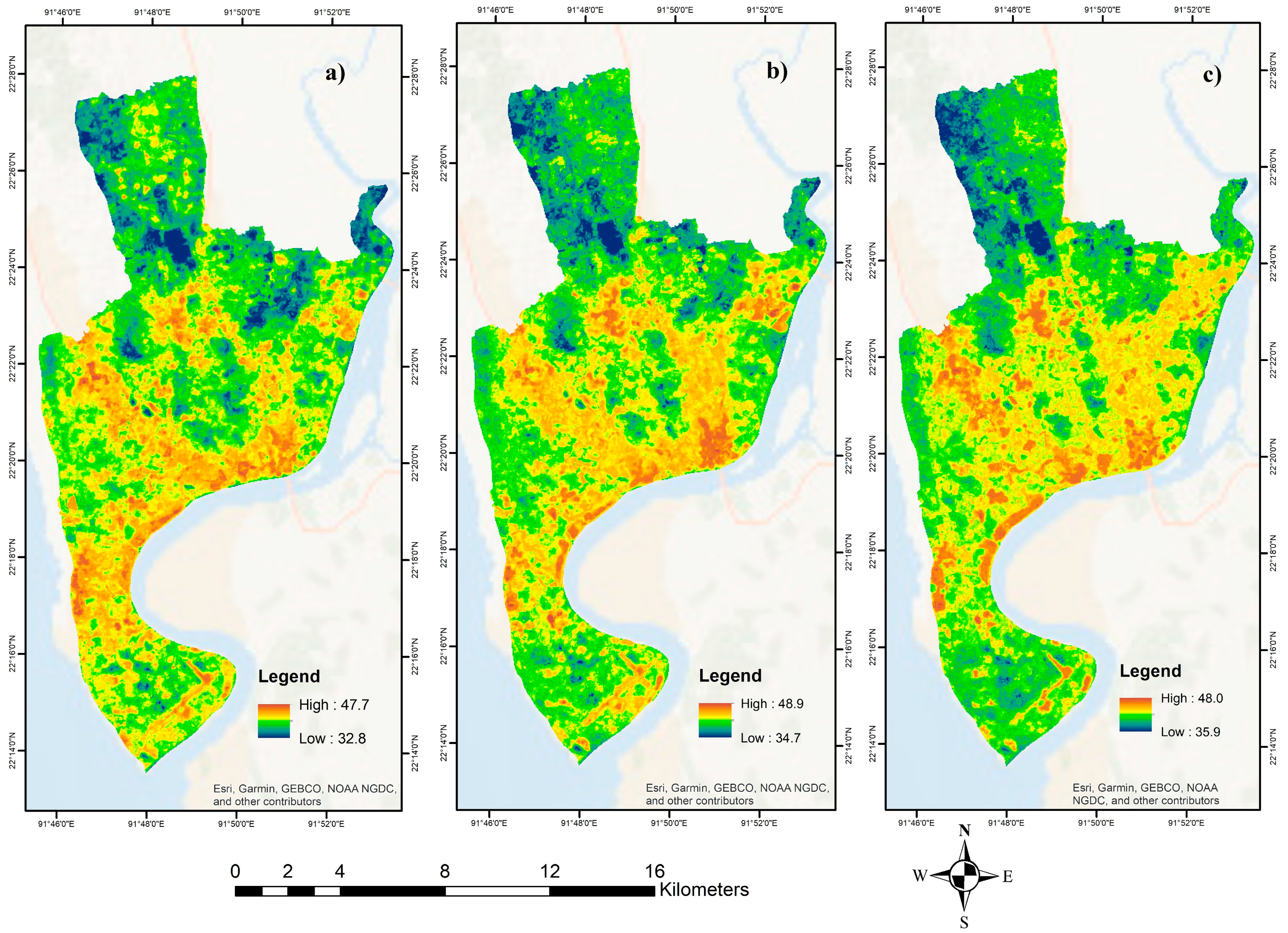
Projected LST surfaces for 2029, 2033, and 2037 were processed to calculate future UHI intensity using the urban–rural temperature difference formula. Since the Random Forest regression model generates LST predictions at the native 30 m Landsat pixel resolution (already a continuous raster surface) no spatial interpolation was required to produce projected temperature surfaces for the 2029, 2033, and 2037 scenarios. IDW interpolation was applied solely as a cartographic smoothing step for visualization purposes, reducing pixel-level granularity artifacts in map display without altering the underlying analytical values used for UHI computation. The IDW smoothing used a search radius of 90 m (three Landsat pixels) and a power parameter of 2, consistent with the thermal spatial correlation scale established by variogram analysis of the 2025 observed LST surface. All statistical analyses, including UHI intensity computation and Gi* hotspot detection, were conducted on the unsmoothed 30 m resolution raster predictions [144]. The UHI formula (Equation (6)) was used to measure the predicted years’ thermal dispersion. The pattern of thermal intensification and the spatial distribution of thermal-prone areas had been recognized by the UHI comparative analysis. Lastly, UHI hotspot analysis was conducted by the Getis-Ord Gi* statistic to identify statistically significant spatial clusters of increased temperatures [145]. For each spatial unit i, the Gi* statistic was calculated using Equation (25).
G i = j = 1 n w i j x j X ¯ j = 1 n w i j S n j = 1 n w i j 2 j = 1 n w i j 2 n 1
where X ¯ = (1/n)∑xj is the global mean LST across all n spatial units, S = √[(∑xj2/n) − X ¯ 2] is the global standard deviation of LST, and wij is the spatial weight between locations i and j (equal to 1 if within the 300 m distance band, 0 otherwise). Spatial weights were calculated using a fixed distance band of 300 m. This threshold was determined based on two considerations: (1) it represents 10 Landsat pixel widths, capturing a thermally coherent neighborhood at the scale of a typical city block (the minimum spatial unit at which UHI clustering is physically meaningful in Chattogram’s urban fabric) and (2) variogram analysis of the 2025 LST surface indicated a spatial autocorrelation range of approximately 280 m, beyond which pixel temperatures become statistically independent. The 300 m threshold aligns with distance bands used in comparable UHI hotspot studies in South Asian and tropical African cities [146], supporting methodological consistency and comparability of results. Statistical significance was assessed at a 95% confidence level (p < 0.05), with positive Gi* z-scores indicating hot spots as spatial clusters of high UHI intensity and negative z-scores indicating cold spots as clusters of low UHI intensity [147].

2.10. Public Perception Survey

A structured survey was implemented and administered to integrate public perceptions of UHI effects, awareness of land use changes, and preferences for mitigation strategies for strengthening geospatial and human perspective interactions. This approach was designed to capture both quantitative and qualitative insights into local experiences, ensuring that scientific findings are translated into socially responsive policy recommendations.

Survey Framework

The first section of the survey addressed observations of the local environment and land use changes, determining participants temporal awareness of urban transformation processes. The second component examined perceptions of heat and urban heat problems through a five-point Likert scale, assessing temperature intensification, spatial thermal disparities, and heat impacts. The third thematic component investigated health, livelihood, and daily life impacts, providing empirical evidence of UHI consequences on human well-being and economic activity. The fourth component assessed coping strategies and adaptation measures, revealing existing adaptive capacity and resource constraints within the study area. The fifth thematic component examined preferences and policy support, employing identification of community priorities, governance gaps, and recommended mitigation strategies. The final two components consisted of PRA exercises for FGDs, capturing community thermal knowledge, enabling comparison with satellite-derived LST and UHI intensity maps, and contextualizing UHI within the wide range of urban environmental impacts by problem ranking. Scoring exercises reflecting expected effectiveness and priority, facilitating quantitative comparison of community preferences (SQ1: Survey Questionnaire).
A Focus Group Discussion (FGD) was conducted for primary data collection between July and August 2025, assessing UHI-related public perception. The survey employed a random sampling framework based on administrative wards, with a sample size (n = 384) determined using Cochran’s formula [148] at a 95% confidence level and 5% margin of error, using Equation (26).
n 0 = Z 2 p q e 2
where Z represents the critical value for a 95% confidence level (1.96), p is the estimated proportion (0.5 for maximum variability), q = 1 − p, and e is the desired margin of error (0.05). This calculation yielded a required sample of 384 respondents to achieve population-level inference with 95% confidence and ±5% precision. The survey protocol follows the structure below.
  • Respondent Selection and Sample Representativeness: The 384-respondent sample was distributed across all 41 wards of Chattogram City Corporation through proportional allocation, with each ward’s sample quota determined by its share of the total CCC population as per the 2011 Bangladesh Population Census. To ensure representation across thermal exposure levels, wards were further stratified into three UHI intensity zones—high (UHII > +1.5), moderate (0 to +1.5), and low (<0), derived from the 2021 LST analysis, and sampling quotas within each ward were adjusted to proportionally represent residents from each zone. Additionally, the sample was stratified by length of residency (<5 years, 5–10 years, >10 years) to capture varying temporal awareness of environmental change. The Kish grid method was applied within each selected household to randomly designate the adult respondent (≥18 years), minimizing interviewer selection bias [149]. This multi-dimensional stratification strategy ensures that the sample represents diverse thermal exposure experiences, residential histories, and geographic locations across the CCC area, rather than concentrating responses from easily accessible or high-visibility neighborhoods. Despite this design, practical field access constraints resulted in relatively lower representation from informal settlements and peripheral zones, as acknowledged in the limitations section [149].
  • Questionnaire Design and Validity: The questionnaire instrument was developed through a four-step design process. First, items were drafted based on established UHI perception survey frameworks from comparable studies in South and Southeast Asian cities [34,35]. Second, the draft instrument was reviewed by three urban planning academics and two community leaders from Chattogram for content validity and cultural appropriateness. Third, a pilot survey was conducted with 25 residents (not included in the final sample) from two wards representative of contrasting thermal conditions; pilot results were used to refine question wording, reorder items, and add ‘don’t know’ options to reduce response acquiescence bias. Fourth, internal consistency of the five-point Likert scale items assessing heat perception and mitigation preferences was evaluated using Cronbach’s alpha (α = 0.78), confirming acceptable reliability [150]. Recall bias for trend questions was minimized by bounding the reference period to the past 10 years and anchoring questions to observable landmarks (‘since the new road/building was constructed’). The complete questionnaire instrument is provided as Supplementary Material SQ1.
  • Focus Group Discussion Protocol: Five FGDs were conducted across UHI intensity zones by incorporating 4 to 5 participants each, recruited through community leaders and ward offices. Sessions lasted 20–25 min, following a semi-structured protocol with participatory mapping (5 min), problem ranking (10 min), mitigation scoring (5 min), and open discussion (5 min).
  • Temporal Considerations: Data collection occurred with pre-monsoon peak heat when thermal discomfort was most severe. Interviews were avoided during extreme heat events (>38 °C) to ensure respondent comfort and data quality.
  • Ethical Considerations: The full survey protocol received formal institutional ethical approval as detailed in the Ethical Declaration. Before each interview and FGD, participants received verbal information about the study’s purpose and confidentiality assurances. No personal identifiers or personal information were recorded.
  • Bias Minimization Strategies: Multiple methodological safeguards were implemented to ensure data validity and reliability. Stratified random sampling with proportional allocation and systematic random walk procedures minimized sampling bias. Response biases were handled through careful question sequencing; for example, the inclusion of “don’t know” options indicate neutral question framing. Recall bias was reduced by limiting historical timeframes to 1–10 years for trend questions and focusing FGD mapping on currently observable patterns rather than historical reconstruction.

3. Results

3.1. Land Use Land Cover Dynamics

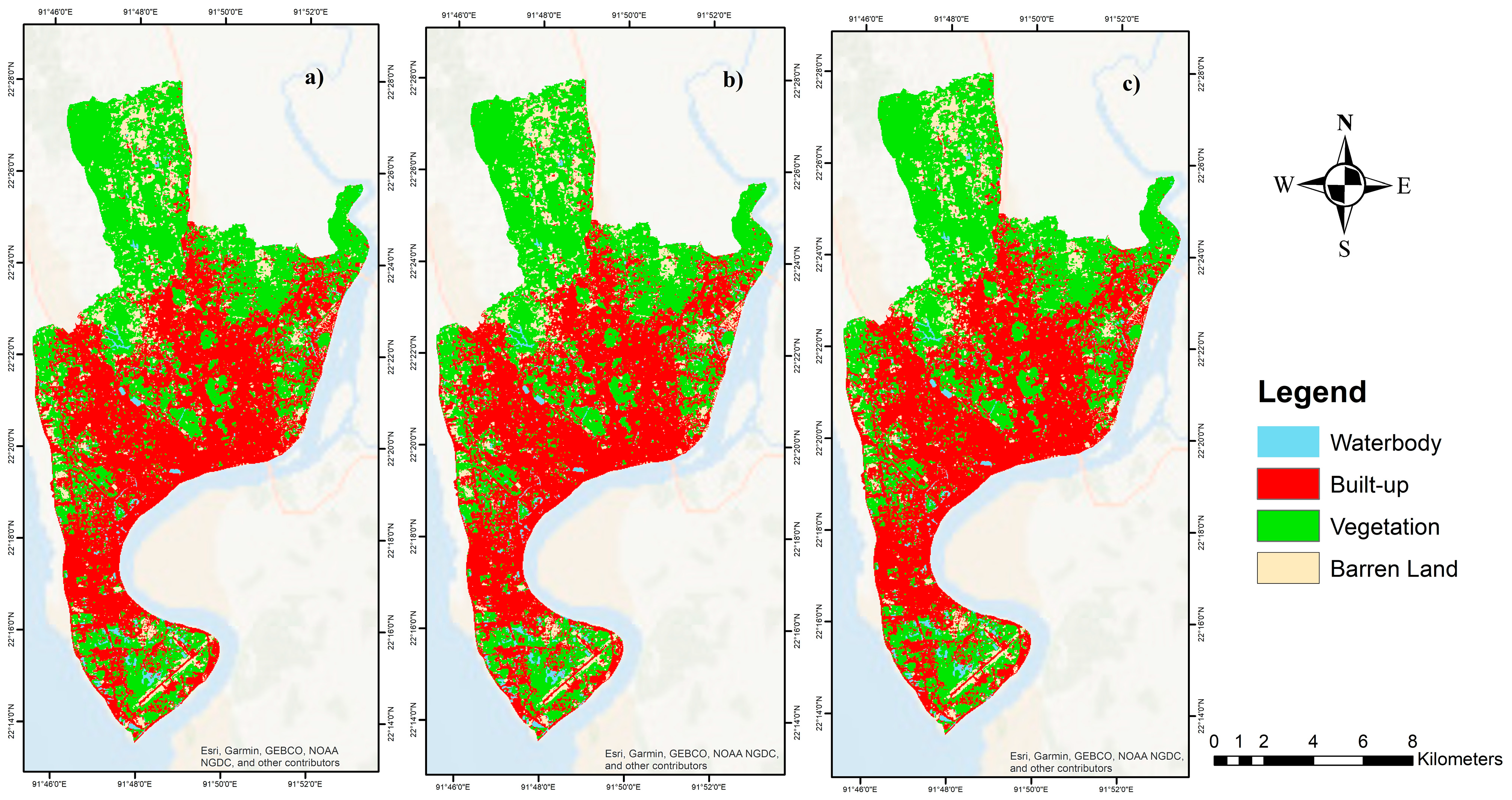
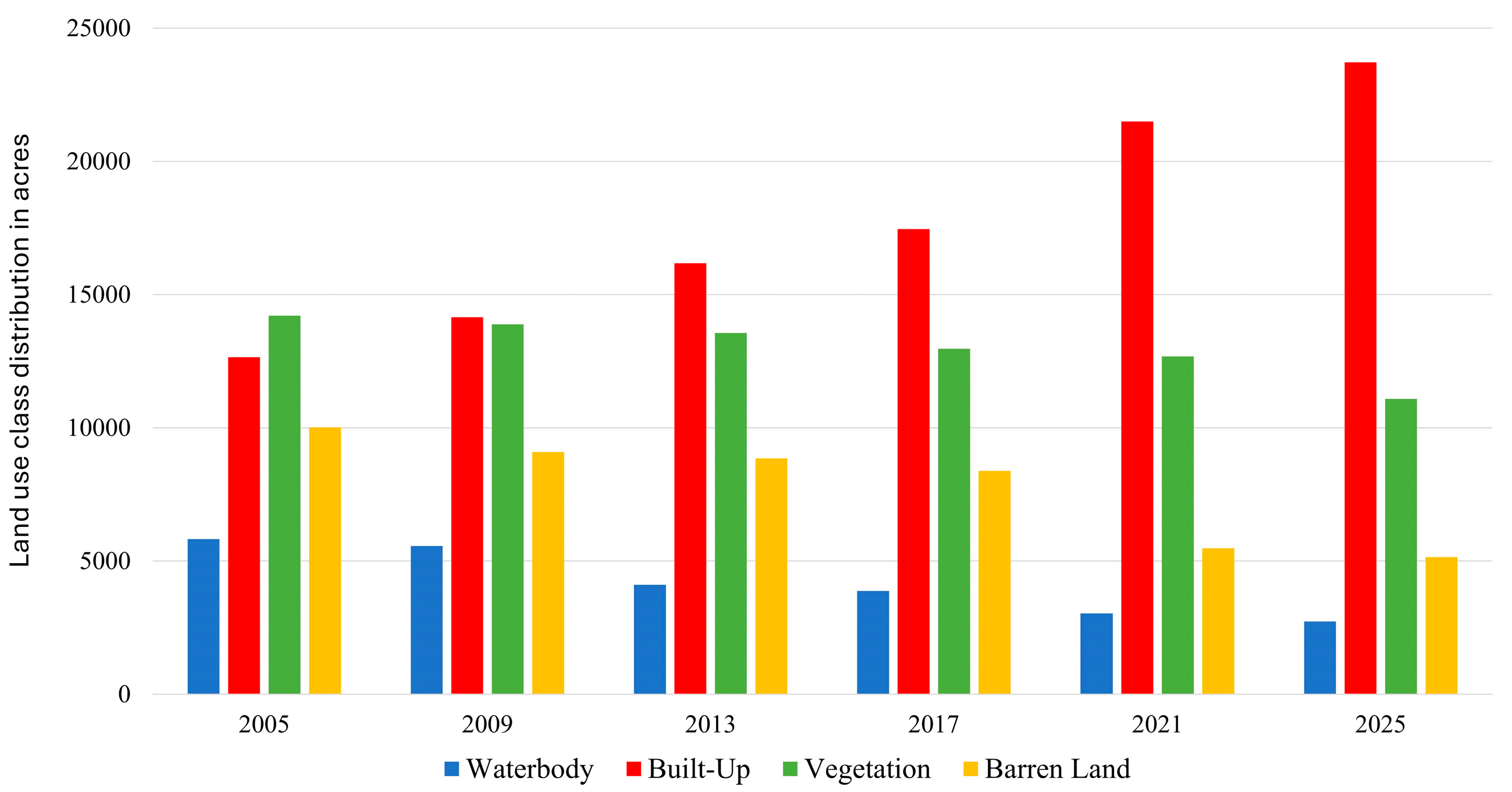
The LULC analysis reveals that the study area has experienced rapid urbanization over the past two decades (Figure 3). The built-up area increased from 12,649 acres in 2005 to 23,719 acres in 2025, representing an overall 88% urban expansion. Particularly, the built-up area increased by more than 5000 acres over the years 2013–2021, indicating accelerated infrastructure development and urbanization.
On the contrary, waterbodies declined continuously from 5828 acres (13.66%) to 2736 acres (6.40%), representing a 53.1% reduction. The most substantial loss of water bodies occurred between 2009 and 2013, accounting for almost 4000 acres at a rate of more than 1000 acres annually. Vegetation cover decreased from 14,208 acres (33.29%) to 11,091 acres (25.98%) during the period from 2005 to 2025, reflecting a 21.9% loss in green space. Similarly, Barren land also witnessed a 48.6% reduction from 10,010 acres (23.44%) to 5149 acres (12.06%).
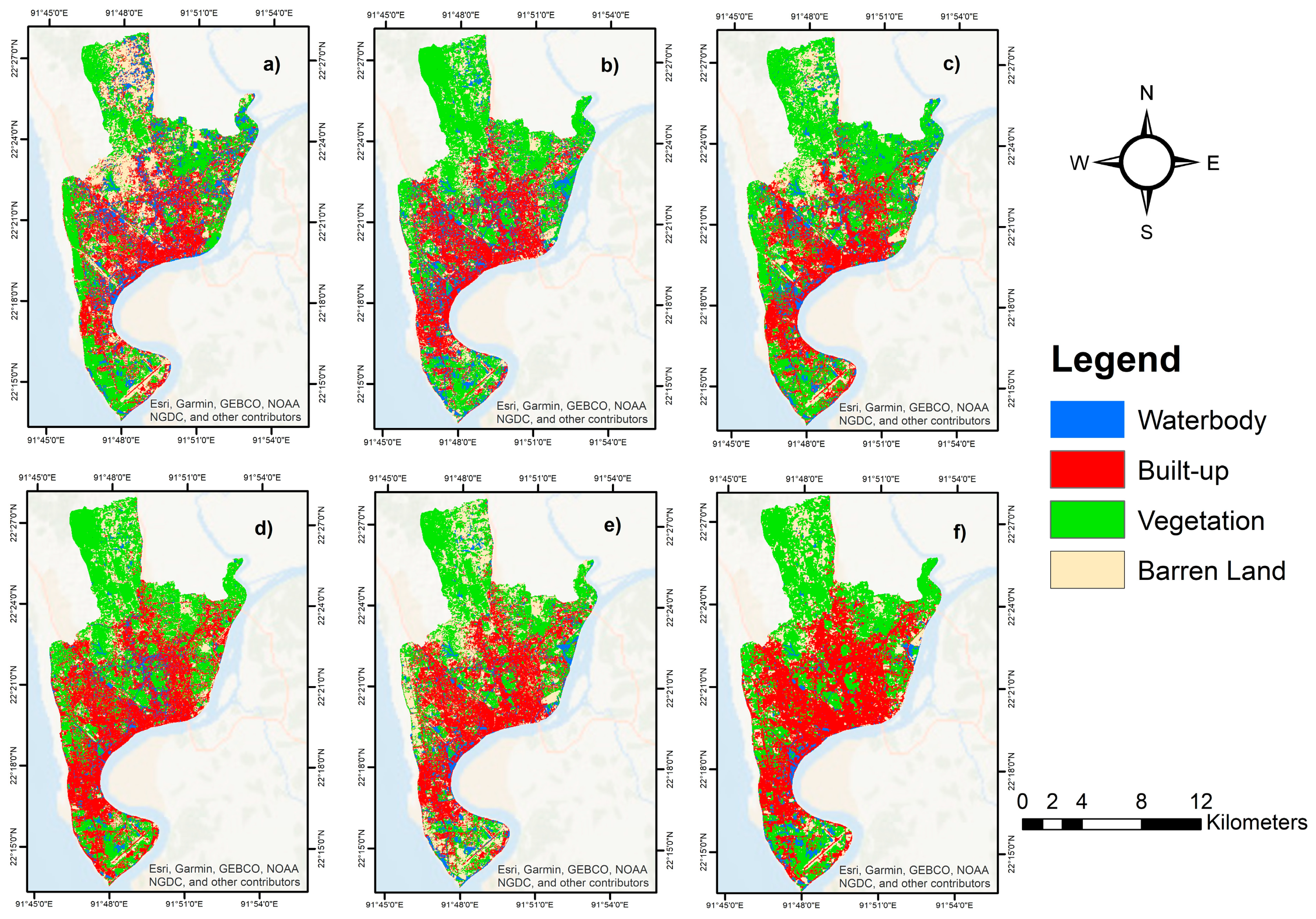
From 2005 to 2025, a gradual outward expansion of built-up area from the central core is evident, indicating a continuous escalation of urban development across the CCC area (Figure 4). Early growth (2005–2009) was dominated by a significant portion of waterbody, vegetation, and barren land. On the contrary, from 2013 onward, the city quickly expanded toward the riverbank side of western and southern areas, continuously replacing vegetation and scattered barren lands. This outward expansion fragmented the northern and southern vegetated belts and formed continuous urban corridors by 2017 and 2021. The 2025 map indicates the most extensive transformation, with peripheral vegetation and small waterbodies nearly fully converted to impervious surfaces.

3.1.1. Accuracy Assessment

Three hundred ground truth points are selected each year to assess the LULC classification’s accuracy. The estimated overall accuracy and Kappa value are higher than 0.80 each year and indicate a reliable accuracy with classified images [151]. Table 3 demonstrates that the classification accuracy remained consistently high across all years, with overall accuracies ranging from 88.33% to 93.67% and Kappa coefficients between 0.84 and 0.92. The highest accuracy was found in 2005, where the overall accuracy was 93.67% and the Kappa Coefficient was 0.9151. Accuracy declined slightly in 2013 and reached its lowest point in 2017 (88.33%, κ = 0.8426). This resulted in increased spectral confusion between vegetation and waterbodies, specifically higher misclassification of vegetation pixels within water-dominated zones.
Then, the improved overall accuracy and kappa value observed in 2021 were 92.15% and 0.8923. Similarly, another improved classification was noticed in 2025 (OA = 92.67%, κ = 0.9004), with vegetation and barren land showing the most stable classification performance. Due to seasonal variability and mixed-pixel effects in dense urban areas, waterbodies and built-up classes showed significant accuracy variations throughout the six years. Nevertheless, all classifications remained reliable, with accuracy consistently above standard multi-temporal LULC assessment thresholds.

3.1.2. Change Detection

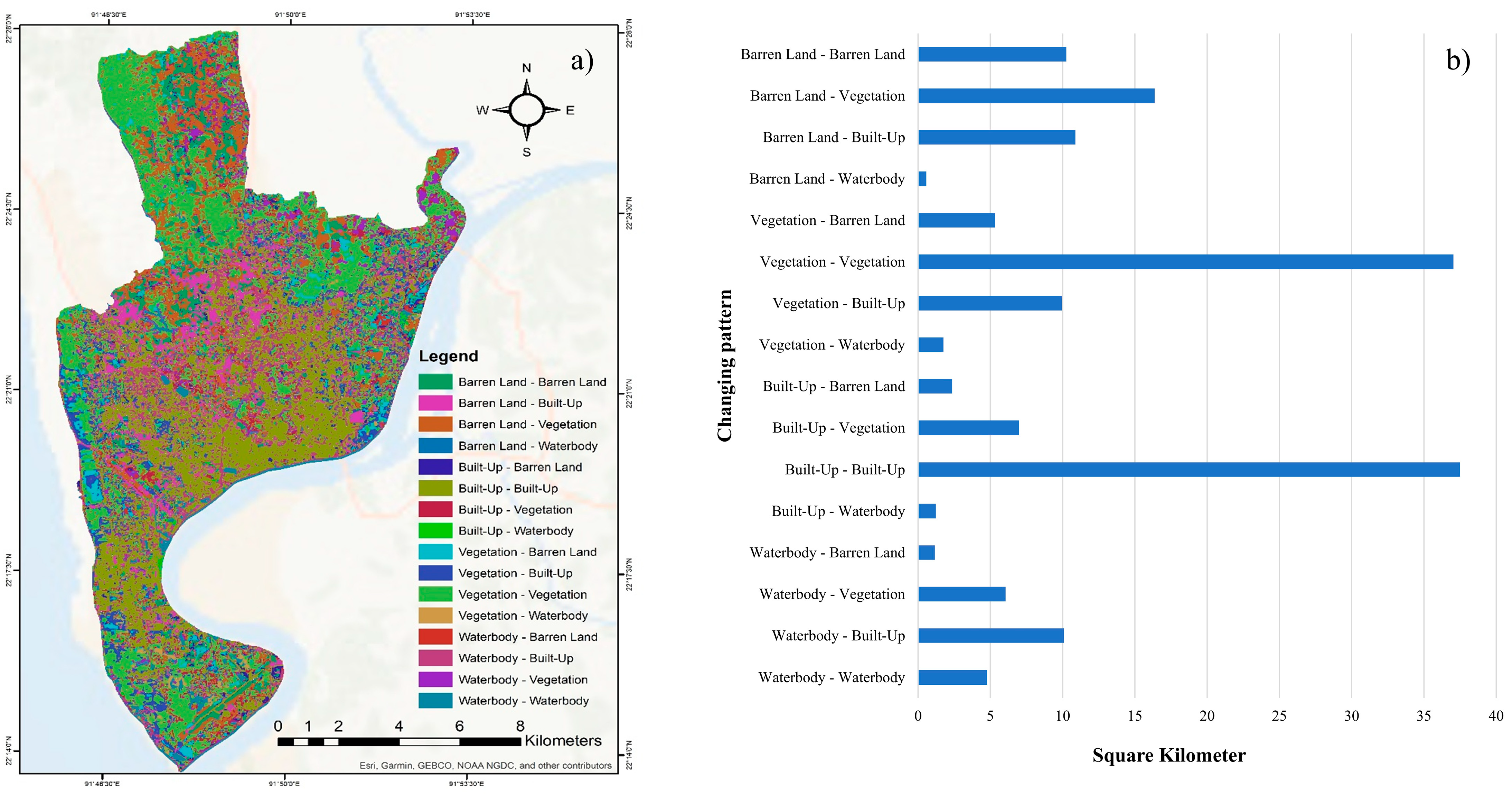
The change detection matrix depicts significant transitions in LULC over the twenty years (Figure 5a). Figure 5b indicates that the 37.50 km2 built-up and 37.04 km2 vegetation areas remained unchanged. Waterbody demonstrates considerable transition, converting 10.10 km2 and 6.06 km2 into built-up and vegetation areas, respectively.
Built-up areas also expanded into nearby vegetation (6.99 km2) and barren land (2.35 km2) categories, which reflects the upward trend of urban expansion. While 37.04 km2 remained vegetated, significant portions shifted to built-up (9.95 km2) and barren land (5.32 km2), indicating land clearing and degradation processes. Barren land showed substantial conversion into vegetation (16.37 km2) and built-up (10.89 km2) areas, exhibiting ecological recovery in some regions and development constraints.

3.2. Land Surface Temperature Dynamics

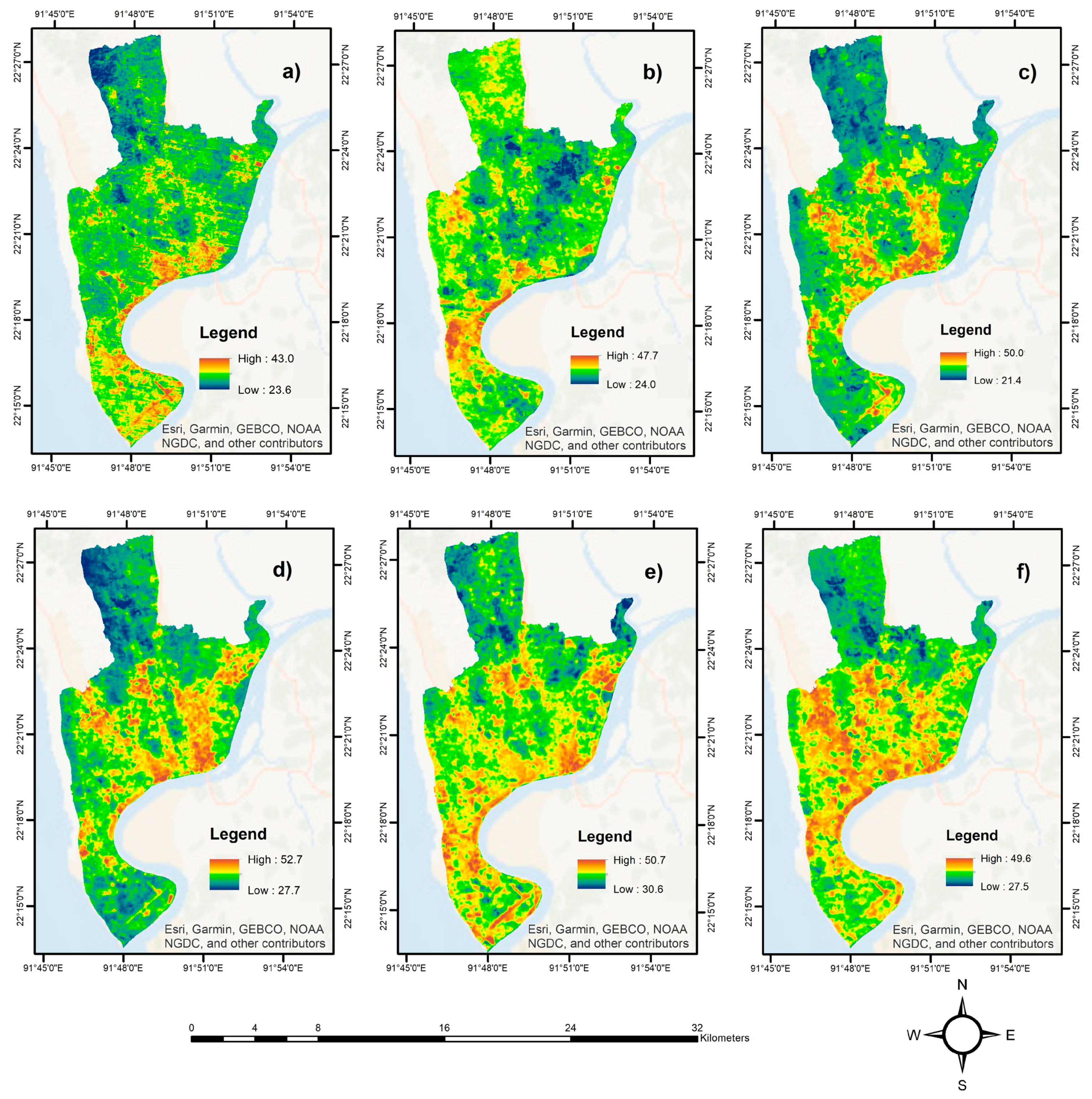
Spatial analysis of LST distribution patterns reveals pronounced heterogeneity in thermal dynamics across the study area (Figure 6). In 2005, moderate surface temperatures dominated the central urban core, which is represented by green-yellow zones. However, cooler zones (blue-green) concentrated along the northern and eastern peripheries, where vegetation and waterbodies provided thermal comfort.
By 2009, thermal intensification became evident in the southwestern and central regions, with orange zones indicating elevated LST values expanding spatially. On the contrary, the 2013 imagery shows further thermal escalation in the western and southern regions of the city, as rapid built-up expansion with vegetation loss. The 2017 thermal pattern reveals thermal hotspot formation, with high-temperature zones becoming more consolidated in the southeastern and central business districts. The northwestern region also exhibited notable warming in 2021, corresponding with industrial and residential expansion observed in LULC classifications. The most thermally stressed landscape, with extensive high-temperature zones noticed in 2025, dominates the western, southern, and central portions of the city.
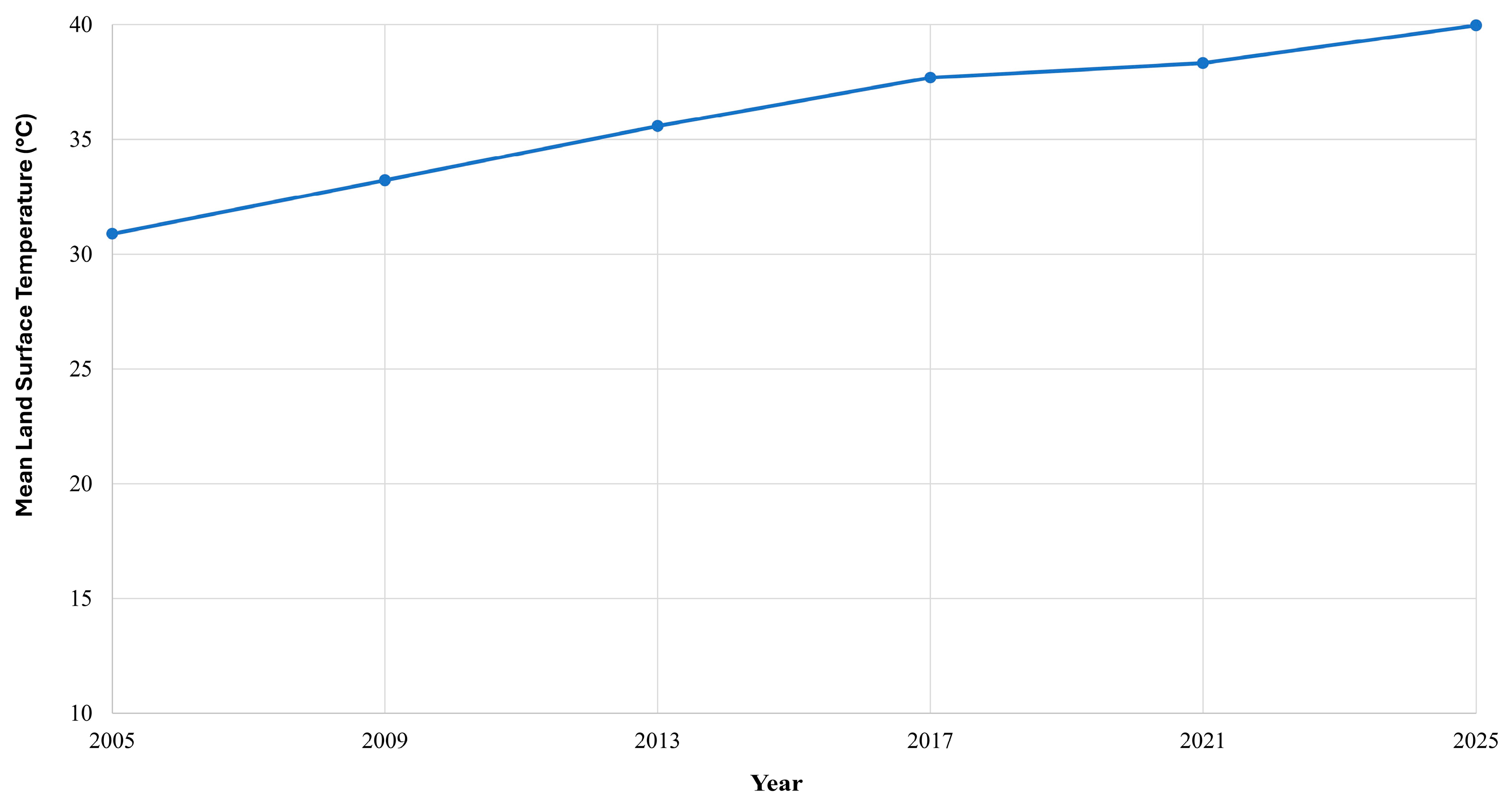
Over a two-decadal period, land surface temperature analysis reveals a consistent and gradual warming trend throughout the study area, as depicted in Figure 7. Mean LST increased from 30.94 °C in 2005 to 40.03 °C in 2025, representing a total increase of 9.09 °C. An average annually increasing rate of 0.45 °C, which indicates persistent thermal intensification. The temporal progression of LST demonstrates variable rates of warming across different periods. Between 2005 and 2009, mean LST intensified by 2.31 °C, and from 2009 to 2013, it increased by a similar 2.38 °C. The warming rate remained relatively consistent between 2013 and 2017, with a 2.12 °C rise. Notably, the warming trend slowed during the 2017–2021 period compared to the previous years, rising by just 0.56 °C. However, a 1.74 °C increase within the 2021–2025 period indicates that urban environments experience consistent thermal stress.

3.3. Urban Heat Island Dynamics

Spatial analysis of UHI distribution patterns reveals the evolution and expansion of thermal hotspots across the urban landscape (Figure 8). In 2005, UHI intensity was relatively moderate, and high-intensity zones were depicted as orange-red in the southeastern areas. The majority of the study area exhibited low to moderate UHI values, indicating that thermal disparities were still developing.
By 2009, UHI intensification had increased significantly in the southwestern region and was expanding in the central part of the city, depicted in red. Thermal intensity was more consolidated in the same region in 2013 for rapid built-up expansion. Moreover, very high UHI zones were identified in the southwestern coastal regions and expanded toward central urban areas.
By 2017, very high UHI intensity zones were noticed in the southwestern part of the study area, while the eastern and northern regions maintained relatively lower UHI values. The 2021 UHI distribution exhibits dramatic expansion of very high UHI zones marked in red across the south, east, and west directions of the city. By 2025, the city will be experiencing more extensive thermal stress across the majority of the area. Very high and high intensity zones dominate the eastern, southern, and central areas, while low UHI intensity areas remain limited in the northern and eastern belt, where waterbodies and residual vegetation provide thermal regulation.
The study area experienced a significant increase in mean UHI intensity from 19.59 standardized units in 2005 to 33.88 in 2025, representing a total increase of 14.29 standardized units. A moderate increase was noticed from 2009 to 2013 (almost 5 standardized units), while between 2013 and 2017 it increased marginally. UHI values surged by 5.15 standardized units during 2017–2021, demonstrating the steepest increase throughout the period, followed by a 1.73 standardized unit increase from 2021 to 2025 (Figure 9).

3.4. Relationship Between Heat and Land Cover Type

The relationship between LST and LULC categories demonstrates thermal disparity across different surface types throughout the study period (Figure 10). Built-up areas represent the most thermally active land cover category over the decades. This category consistently exhibited the highest mean LST values, increasing from 32.4 °C in 2005 to 41.8 °C in 2025. Barren land displayed the second-highest thermal intensity, with mean LST rising from 31.2 °C to 41.0 °C, whereas vegetation mean LST rose from 30.4 °C in 2005 to 39.5 °C in 2025, exhibiting intermediate thermal characteristics.
In contrast, waterbodies maintained the coolest thermal profile throughout the observation period, with mean LST increasing from 29.7 °C to 38.0 °C between 2005 and 2025. The thermal differential between built-up surfaces and cooling elements like waterbodies and vegetation widened over time.
The thermal progression over the 20 years reveals an imbalance in urban thermal capacity, where heat-generating impervious surfaces increasingly dominate the landscape while natural cooling infrastructure reduces. The spatial expansion of high-temperature built-up areas (32.4 °C to 41.8 °C), coupled with a 53.1% reduction in cooling water bodies, creates extreme thermal stress. As a result, the 9.4 °C difference between built-up areas and waterbodies in 2025 quantifies the substantial cooling capacity lost through land conversion. These findings demonstrate that effective UHI mitigation must prioritize preserving remaining waterbodies and vegetation, as LULC thermal behaviors directly affect heat retention and human comfort across the urban landscape.

3.5. ML Based Model Performance Evaluation

The comparative evaluation of machine learning models revealed closely comparable performance levels across all five algorithms for LULC classification, as depicted in Figure 11a, b. All five classifiers demonstrated narrow accuracy ranges for LULC classification, with F1-weighted scores spanning from 0.761 to 0.765 and overall accuracy ranging from 0.770 to 0.773, indicating that all algorithms were capable of effectively capturing land cover patterns from the temporal feature inputs.
LightGBM emerged as the best-performing classifier with the highest F1-weighted score of 0.765 and an overall accuracy of 0.773, marginally outperforming XGBoost (F1-weighted: 0.764, accuracy: 0.772) and Random Forest (F1-weighted: 0.764, accuracy: 0.771). SVM recorded the lowest performance among the five classifiers, with an F1-weighted score of 0.761 and an accuracy of 0.770, while MLP achieved an intermediate F1-weighted score of 0.762 and an accuracy of 0.772. The minimal variation in performance across all classifiers, with a maximum F1-weighted spread of just 0.004, suggests that model selection had a limited impact on LULC classification accuracy in this context, and that all five algorithms were comparably effective at learning spatiotemporal land cover transition patterns from the multi-temporal Landsat-derived feature vectors.
The five machine-learning models showed good accuracy in classifying built-up areas and vegetation, but they often confused water bodies and barren land (Figure 12). LightGBM (Figure 12a) had the best and most stable results, correctly identifying 12,631 built-up pixels and 12,407 vegetation pixels. However, it often mistook water body pixels for vegetation or built-up areas. XGBoost (Figure 12b) also performed well, correctly identifying 12,672 built-up pixels and 12,387 vegetation pixels types, but it made similar mistakes as LightGBM. RandomForest (Figure 12c) correctly identified 12,692 built-up pixels and 12,392 vegetation pixels and had notable confusion between vegetation and barren land pixels. SVM (Figure 12d) had strong results, correctly identifying 12,772 built-up pixels and 12,345 vegetation pixel types. It struggled more with barren land, which was often classified as vegetation or built-up pixels. MLP (Figure 12e) also did well with built-up areas, identifying 12,708 correctly pixels and 12,527 pixels for vegetation. Water bodies were often misclassified as vegetation, and barren land was mixed up with different categories.
In contrast, LST regression models displayed more pronounced performance differences, as illustrated in Figure 13a–c. Random Forest demonstrated superior predictive capability with the lowest RMSE of 1.51 and MAE of 0.87, and the highest R2 of 0.809, indicating strong explanatory power in capturing LST variability.
XGBoost ranked second with RMSE of 1.95, MAE of 1.04, and R2 of 0.753, while LightGBM achieved moderate performance (RMSE: 2.11, MAE of 1.09, and R2: 0.733). SVR and MLP exhibited comparatively weaker performance, with RMSE values of 2.36 and 2.33, R2 values of 0.702 and 0.706, and MAE values of 1.12 and 1.14, respectively. The substantial performance gap between tree-based ensemble methods and other algorithms underscores the effectiveness of RandomForest and XGBoost. Based on these evaluations, LightGBM was selected for LULC classification and RandomForest for LST prediction in subsequent future scenario modeling to ensure optimal accuracy for projecting urban heat dynamics.

3.6. Future Projections of Land Cover and Temperature

Future LULC and LST scenarios for 2029, 2033, and 2037 were generated using the best-performing machine learning models identified through comparative evaluation. Based on superior classification performance, LightGBM was selected for LULC projections, having the ability to accurately represent discrete land cover transitions. For LST forecasting, RandomForest was employed due to its robust explanatory power in capturing thermal variability. These model selections maintain methodological consistency with validation protocols.
Model-based projections for 2029, 2033, and 2037 demonstrated that the study area is expected to experience urban expansion and thermal intensity. Figure 14 depicts a rapid decrease in green spaces, while built-up areas increase significantly over the 12 years. According to the projected LULC distributions, built-up areas will continue to soar from 21,166 acres in 2029 to 24,726 acres by 2037, representing a 16.8% increase. This trend also impacts vegetation cover and waterbodies, which are predicted to decrease from 16,548 acres to 13,451 acres and from 1106 acres to 963 acres, respectively. Furthermore, barren land is projected to decline from 3875 acres to 3555 acres over the forecasted period. These anticipated land cover changes reveal that the urbanization trends will follow the 2005–2025 trends (ST-01).
The RandomForest regression model revealed that mean surface temperatures are expected to rise from 41.6 °C to 43.6 °C between 2029 and 2037, representing approximately 0.2 °C annually increase over eight years (Figure 15). The temporal trajectory demonstrates incremental warming of 1.2 °C between 2029 and 2033, while a moderated increase of 0.7 °C between 2033 and 2037 (ST-02). Despite this deceleration, mean LST values are expected to surpass the critical 43 °C threshold by 2037.
The projected rise in LST will directly increase the intensity of UHI, indicating ongoing thermal stress that exceeds critical thresholds for both urban habitability and human thermal comfort. Due to the remaining waterbodies and vegetation, conditions will be relatively moderate in the northeastern and eastern peripheries. However, the continued thermal trend indicates that the central business district, the western industrial belt, and the northeastern coastal corridor will experience the worst heat intensification. These areas have an extreme thermal environment due to anthropogenic heat emissions, dense built-up development, and little vegetation.

3.7. Predicted UHI Scenarios

Projected UHI intensities for 2029, 2033, and 2037 indicate continued thermal escalation compared to historical patterns. Mean UHI intensity values are expected to increase from 34.92 standardized units in 2029 to 37.41 standardized units in 2037, representing an increase of 0.31 standardized units per year over the eight-year projection period (Figure 16). The trend reveals a gradual progression of 0.93 standardized units between 2029 and 2033, followed by 1.56 standardized units between 2033 and 2037, indicating a non-linear trend (ST-03).
As UHI intensity values rise above 90% from the 2005 baseline (19.59 standardized units), this continuous upward trajectory will worsen urban thermal stress. In addition, temperatures in 2037 will be about 3 units higher than in 2025, which could lead to heat-related illness, raise energy consumption, reduce outdoor productivity, and put stress on urban infrastructure systems.
The southwestern coastal corridor, where dense built-up development, waterbody loss, and limited vegetation create persistent very high UHI intensity throughout all projection years, is one of the three most likely impactful zones identified by spatial analysis. The western industrial belt, where manufacturing facilities and anthropogenic heat emissions sustain elevated UHI values, comes in second, followed by the central business district, which has high-rise morphology and little greenery.

3.8. UHI Hotspot Analysis

The hotspot analysis of UHI intensity in the CCC area reveals a clear spatial clustering pattern (Figure 17). Statistically significant hot spots (90–99% confidence) are highly concentrated in the southern, central, and eastern parts of the city. These areas indicate persistently elevated LST areas, corresponding to densely built-up and highly urbanized areas.
In contrast, cold spots with high confidence levels (90–99%) are mainly distributed in the northern and northwestern regions. These areas are surrounded by vegetation cover, open spaces, or the presence of water bodies, suggesting lower thermal intensity. Areas classified as not significant are scattered between hot and cold clusters, which demonstrates transitional land-use patterns. Overall, the map emphasizes a strong spatial correlation, including intra-urban thermal heterogeneity between urbanization patterns and UHI intensity throughout the city.

3.9. Validation

Model validation was conducted through two complementary approaches: a statistical ROC analysis of the 2025 heat-prone zone classification and a quantitative spatial concordance analysis between community-perceived hotspots and satellite-derived thermal extremes. For the 2025 LST-derived heat-prone zone map, 384 field validation points were compared against classified very-high-intensity UHI zones, yielding an AUC of 0.87—indicating strong discriminatory performance between heat-prone and non-heat-prone areas (Figure 18b).
To quantitatively assess the agreement between participatory mapping results and satellite-derived UHI hotspots, the geographic coordinates marked by FGD participants as ‘hottest locations’ were overlaid with the top-quartile UHI intensity zones derived from the 2025 LST raster. Spatial agreement was assessed using the F1-score metric: participant-marked hotspot polygons (buffered by 100 m to account for positional uncertainty in sketch mapping) were compared against satellite-identified high-UHI pixels. This analysis yielded a spatial F1-score of 0.81 (precision: 0.84, recall: 0.78), indicating that 84% of community-identified hotspots spatially coincided with satellite-confirmed high-UHI zones, while 78% of satellite-identified hotspots were independently identified by community participants. The moderate recall gap (78%) reflects the fact that several satellite-identified thermal hotspots in peripheral industrial areas were not captured by participatory mapping, likely because FGD participants were drawn predominantly from residential wards with lower representation of industrial zone workers. This quantitative spatial concordance provides robust evidence that community thermal knowledge is both reliable and spatially specific, validating the use of participatory data as a complementary verification source for remote sensing products.

3.10. Public Perceptions Assessment

Community perception data were integrated to validate and complement satellite-derived analysis. This assessed how well aligned with the residents’ experience of the quantitative trend of LULC transformations, thermal intensification, and UHI distributions reported by remote sensing analysis. Survey results from 384 residents provided ground-level observations of land use change, spatial identification of thermal extremes, heat awareness levels, adaptation behaviors, and mitigation preferences. It enables an empirical evaluation of how well the technical findings align with the actual experiences of urban thermal dynamics across different zones of the study area.

3.10.1. Perceptions of Land-Use Change

Satellite-derived LULC transformations demonstrate a strong correlation with community-observed land use patterns over the preceding decade. When respondents were asked about their observations of land use change within the last 10 years, their responses indicated a huge transformation. For instance, among 384 respondents, 102 (26.56%) reported building increases, and 80 (20.83%) noted loss of trees. Additionally, 79 respondents (20.57%) reported increased paved surface, and 77 (20.05%) respondents identified new industrial development, while only 46 (11.98%) respondents perceived no major changes (ST-04). The widespread recognition of vegetation loss and increased impervious surfaces reflects community understanding of the fundamental drivers of the urban heat island. This shared perception of environmental degradation highly recommends urban greening policy to preserve green spaces. Moreover, these observations inform spatially targeted interventions for rapidly urbanizing areas.

3.10.2. Identification of Hottest Locations

Participatory mapping exercises revealed community thermal perceptions spatially coincide with remote sensing-derived thermal patterns. Industrial areas were identified by 46% of respondents, and 26% of respondents identified commercial areas as the hottest regions (ST-05). High-density residential areas were also frequently marked as hotspots (17%), along with major roads and highways (9%). In contrast, parks and green spaces were identified as the coolest locations by 60% of respondents. These perceptions demonstrate a detailed understanding of the relationship between land use and thermal conditions. These community-identified hotspots can help to make decisions on the placement of cooling infrastructure and guide the prioritization of green interventions in the most thermally vulnerable areas. The community perceptions of land-use thermal patterns perfectly reflect the spatial analysis that was derived from satellite.

3.10.3. Awareness of Local Heat-Related Issues

It is a concerning issue that only 22% of 384 respondents were aware of local heat-related issues (ST-06). This remarkably low level of policy awareness presents a significant challenge for participatory urban planning. Despite limited formal awareness, residents reported experiencing hotter summers (157) and warmer nights (149) who are live there more than 10 years (ST-07). The discrepancy shows a critical communication gap that undermines the effectiveness of existing interventions. This finding underscores the urgency of public engagement and integration of community knowledge with technical aspects. By ensuring this, most vulnerable populations can access available heat-relief resources and services.

3.10.4. Household Adaptation Behaviors

Reported coping strategies reflected economic constraints and limited access to cooling infrastructure, with the respondents of 26.3% and 18.5% depending on the use of fans and staying in the shade, respectively (ST-08). Other commonly employed coping measures included closing windows during the day (18%), planting shade trees (14.3%), using air conditioning (10.4%), changing work hours (7%), and seeking cool public places (4.2%). The heavy reliance on fans rather than air conditioning (10.4%) reflects economic constraints, and the relatively low utilization of public cooling centers indicate insufficient availability or lack of awareness regarding these facilities. These behavioral patterns have critical implications for public health interventions, as they reveal that current household-level adaptations may be inadequate during severe heat waves. The Government should prioritize easy access to cooling infrastructure and the implementation of cooling centers to reduce thermal stress locally.

3.10.5. Perceived Effectiveness of Mitigation Strategies

Community preferences for mitigation strategies demonstrated a strong correlation with scientific evidence from LULC-LST correlation analysis. According to the residents’ perceptions, 87% of them emphasized green spaces for heat mitigation, with 52% rating them as very effective and 35% as somewhat effective (ST-09). This positive perception converted into strong policy support, with 76% of respondents preferring cool roofs to minimize building heat absorption (ST-10). The high perceived effectiveness of nature-based solutions proves that residents have knowledge about the effectiveness of vegetated and non-vegetated areas. These findings have significant implications for urban climate resilience planning because there is a strong community preference to support green infrastructure initiatives. Policymakers can influence this positive perception to accelerate the implementation of urban greening programs through community participation.

3.10.6. Priority Ranking of Interventions

When asked to prioritize interventions, increasing urban trees and parks emerged as the predominant preference. Moreover, 45% of the respondents ranked it as their number one priority. On the contrary, Table 4 depicts that they give importance to reducing industrial heat and pollution (28%), promoting cool roofs and reflective pavements (12%), improving public cooling centers (8%), zoning regulations (5%), and public awareness programs (2%).
Residents prioritized practical and visible solutions rather than other regulatory or awareness approaches, for instance, cooling benefits from vegetation-based interventions. On the other hand, strong support for reducing industrial pollution (28%) reflects local people identifying them sources of the UHI effect. These priority rankings indicate that investments in green infrastructure may receive the strongest public support and engagement. Furthermore, the low-ranking for-awareness programs (2%) suggest residents prioritize physical features over behavioral change. This will help to make a comprehensive heat action and strategic plan.

3.10.7. Preferred Mitigation Measures

For mitigation purposes, respondents assigned the highest scores to planting vegetation and industrial controls. Cool roofs and cooling centers achieved 1st and 2nd rank, whereas zoning regulations and awareness programs earned 3rd and 4th rank, respectively (ST-11). The strong preference for industrial controls suggests that residents are more susceptible to industrial heat emissions. The relatively lower scores for regulatory and educational approaches indicate that residents favor direct physical interventions over governance mechanisms. These preferences provide an actionable roadmap for developing heat mitigation plans that align with community values, indicating the community’s recognized cooling mechanisms validated in spatial analysis and supported by nature-based solutions.

4. Discussion

The comprehensive analysis of urban heat island dynamics in Chattogram City Corporation reveals critical insights into the complex interactions between rapid urbanization, land use transformation, and thermal intensification in tropical coastal cities.

4.1. Urbanization Trajectories and Thermal Consequences

The documented 88% expansion of built-up areas in Chattogram from 2005 to 2025, accompanied by a 9.09 °C increase in mean LST, represents one of the most pronounced thermal intensification trajectories recorded among South Asian secondary cities. Direct comparison with analogous multi-temporal studies reveals the severity of Chattogram’s thermal trajectory. In Dhaka, Bangladesh, a 30-year analysis reported a mean LST increase of approximately 4–5 °C associated with built-up expansion into vegetation and waterbody areas [21], suggesting Chattogram’s rate is nearly double over a comparable timeframe. Research in Bangalore, India, documented LST increases of 3–4 °C following rapid impervious surface growth [20], while Mumbai’s urban heat excess reaches 8–10 °C during peak summer periods—a magnitude driven by decades of accumulated impervious cover rather than a 20-year change rate [13]. In Karachi, where UHI effects regularly exceed human physiological thresholds [14], the pattern reflects longer-term neglect of green infrastructure rather than the acute recent transformation observed in Chattogram. These comparisons collectively indicate that Chattogram’s rate of thermal change—averaging 0.45 °C per year—is exceptional among South Asian coastal cities, attributable to the convergence of high-speed port-driven industrialization, informal settlement densification, and inadequate urban green space regulation within a single two-decade window. The spatial analysis revealed that UHI intensification in Chattogram follows clear developmental corridors, the southwestern coastal corridor, western industrial belt, and central business district, mirroring patterns found in Chennai’s industrial zones and Colombo’s waterfront redevelopment areas [152], where port-adjacent land conversion consistently generates the most persistent thermal hotspots. This spatial consistency across South Asian port cities underscores the systemic nature of coastal economic development as a UHI risk factor, beyond what individual city studies might suggest.
The temporal analysis also revealed a notable deceleration in warming rate during 2017–2021 (only 0.56 °C rise compared to over 2 °C in preceding intervals), which may reflect increased urban vegetation planting initiatives undertaken by Chattogram City Corporation during this period, or the stabilizing effect of reduced barren land conversion as most easily developable land was already built upon. A similar non-linear thermal trajectory has been documented in rapidly urbanizing Chinese cities where initial rapid warming slows as urban morphology stabilizes [153]. However, the 1.74 °C increase in the subsequent 2021–2025 period indicates that this stabilization was temporary, likely driven by new peripheral expansion into previously vegetated hillside and wetland zones.
The spatial analysis demonstrated that urban heat island intensification follows clear developmental corridors, with the southwestern coastal region, western industrial belt, and central business district emerging as persistent thermal hotspots. These patterns reflect the combined influence of high-density development, industrial heat emissions, reduced vegetation cover, and proximity to heat-absorbing water-adjacent surfaces. The identification of these zones through hotspot analysis provides crucial spatial intelligence for targeted intervention strategies, particularly given that these areas often coincide with high population density and vulnerable communities with limited adaptive capacity.

4.2. Validation of Remote Sensing Through Community Perspectives

The integration of public perception data with satellite-derived analysis represents a significant methodological contribution, addressing a critical gap identified in recent systematic reviews of urban heat island research [49,53]. The strong concordance between community-identified thermal extremes and remotely sensed patterns validates the accuracy of land surface temperature retrievals while simultaneously demonstrating that residents possess detailed experiential knowledge of their thermal environment. This finding challenges the assumption that technical UHI assessments operate independently of lived experiences and instead reveals opportunities for participatory monitoring and community-engaged adaptation planning.
The survey results indicating that 73.44% of respondents observed environmental degradation over the past decade, specifically identifying building increases, tree loss, and expanded paved surfaces, demonstrate widespread community awareness of the fundamental drivers of urban heat island formation. This recognition provides a strong foundation for public engagement in mitigation initiatives, as residents already comprehend the relationship between land use patterns and thermal conditions. However, the remarkably low awareness of formal heat mitigation policies (22%) reveals a critical communication gap that undermines the effectiveness of existing interventions and limits community access to available cooling resources.
The strong community preference for vegetation-based cooling solutions (87% perceived effectiveness, 45% ranked as first priority) aligns closely with the statistical relationships demonstrated through correlation analysis between land use categories and land surface temperature. This convergence between scientific evidence and community preferences creates favorable conditions for implementing nature-based solutions with strong public support. The emphasis residents placed on increasing urban trees and parks, alongside reducing industrial heat emissions, provides clear guidance for resource allocation and intervention prioritization that reflects both thermal effectiveness and social acceptability.

4.3. Machine Learning Advancements in Urban Climate Modeling

The comparative evaluation of five machine learning algorithms for land use classification and temperature prediction advances methodological approaches for urban climate forecasting. The superior performance of LightGBM for land use classification (F1-weighted: 0.765, accuracy: 0.773) and Random Forest for temperature regression (RMSE: 1.51, MAE: 0.87, R2: 0.809) demonstrates the value of ensemble tree-based methods for capturing complex spatiotemporal patterns in urban thermal dynamics. These findings support recent research documenting the effectiveness of gradient boosting and random forest approaches for urban environmental modeling [95,96], while extending this work to tropical coastal contexts where high humidity and complex land-atmosphere interactions create distinctive modeling challenges.
The minimal performance variation among classifiers for land use prediction suggests that model selection has limited impact on classification accuracy when working with well-calibrated multi-temporal Landsat data, whereas the substantial performance differences observed for temperature regression underscore the importance of algorithm selection for continuous variable prediction. The notably weaker performance of support vector regression and multilayer perceptron models compared to tree-based approaches indicates that urban heat dynamics in this context may be better captured through ensemble methods that can handle non-linear relationships without extensive hyperparameter tuning.
The iterative prediction framework employed for generating 2029, 2033, and 2037 scenarios, utilizing five-year temporal windows, represents a pragmatic approach to long-term forecasting that balances data availability constraints with the need for multi-decadal projections. The projected annual warming rate of 0.25 °C from 2029 to 2037, while lower than historical rates, still indicates persistent thermal intensification that will push mean land surface temperatures beyond 43 °C by 2037. This trajectory suggests that without substantial intervention, Chattogram will experience thermal conditions increasingly incompatible with outdoor work, vulnerable population health, and energy system sustainability.
An important limitation of the ML-based projection framework is that it generates trend-based (BAU) forecasts rather than policy-oriented scenario simulations. Urban planners and policymakers require not only a forecast of where the city is heading under current trajectories, but also quantitative estimates of how alternative interventions—green infrastructure expansion, industrial rezoning, building code reforms would alter that trajectory. Future research should extend this framework by coupling the ML projection model with a scenario-based LULC transition model (FLUS or TerrSet) that can simulate policy-defined land use futures and their associated thermal outcomes, enabling direct comparison of intervention pathways. The community preference data collected in this study, where 87% of residents support vegetation-based cooling and 45% rank urban tree and park expansion as their first priority provides an empirically grounded basis for parameterizing green infrastructure expansion scenarios in such future modeling work.

4.4. Implications for Urban Planning and Climate Adaptation

The study findings generate spatially targeted and operationally specific implications for climate-responsive urban planning in Chattogram and comparable tropical coastal cities. Rather than generic green infrastructure recommendations, the three identified persistent thermal hotspots: southwestern coastal corridor, western industrial belt, and central business district, each require differentiated mitigation strategies aligned with their distinct land use characteristics, thermal drivers, and governance contexts.
Southwestern Coastal Corridor: This zone’s thermal intensity is primarily driven by waterbody loss (53.1% area reduction documented) and dense informal settlement expansion onto former coastal wetlands. Mitigation here requires mandatory coastal setback regulations that prohibit further encroachment within 50 m of remaining waterbodies, enforceable under the Bangladesh Water Act and the Chattogram Metropolitan Development Plan. Blue-green buffer corridors (strips of mangrove or riparian vegetation along the Karnaphuli riverbank and coastal margins) should be established as legally protected climate refuges, modeled on the Colombo Wetlands Buffer Zone framework. The CCC should explore payment-for-ecosystem-services mechanisms to compensate residents who voluntarily protect remaining waterbodies, drawing on Bangladesh’s existing Ecosystem Services Fund provisions.
Western Industrial Belt: Thermal stress here is sustained by manufacturing heat emissions, impervious surface dominance, and near-total absence of vegetation. Industrial operators should be required under revised Chattogram City Corporation building by-laws to maintain a minimum of 15% permeable or vegetated surface per industrial plot, with tax incentives for cool roof installation (minimum solar reflectance index of 78). The CCC Environmental Management Cell should introduce an industrial heat emission monitoring protocol, benchmarked against the 41.8 °C mean LST documented in this study for built-up zones, with progressive penalties for facilities consistently above this threshold. District-level cooling zones (publicly accessible shaded rest areas with misting systems) should be established at 500 m intervals along main arterial roads in this belt.
Central Business District: High-rise morphology, limited canopy cover, and concentrated pedestrian activity make this zone particularly vulnerable to heat stress. Revised zoning regulations should mandate a minimum green plot ratio of 20% for all new commercial developments above four stories, enforceable through the building permit process. Street tree programs targeting a 30% canopy cover along major commercial corridors (benchmarked against Dhaka’s Urban Resilience Project targets) should be prioritized in the next CCC five-year development plan. Rooftop garden incentives, including fast-track permit processing and rate rebates, can leverage private building stock for green cover without requiring land acquisition.
Across all zones, the CCC should establish a routine urban heat monitoring system integrating Landsat-derived seasonal LST updates (available free through USGS Earth Explorer) with ward-level community heat stress reporting a low-cost, scalable approach validated by this study’s participatory mapping results. Given that only 22% of surveyed residents were aware of formal heat mitigation policies, a targeted heat literacy campaign delivered through ward offices and community health workers is an essential enabler of these technical interventions.

4.5. Methodological Contributions and Limitations

This study advances urban heat island research methodology through several innovations, including standardized multi-sensor Landsat preprocessing for temporal consistency, comparative evaluation of five machine learning algorithms for both classification and regression tasks, integration of iterative prediction frameworks for multi-decadal forecasting, and systematic validation of remote sensing products through community perception surveys. The 30 m spatial resolution enabled neighborhood-scale thermal pattern identification, while the 20-year observation period captured transitional dynamics during rapid urbanization phases that shorter-duration studies might miss.
However, several limitations warrant acknowledgment. The reliance on dry season imagery, while appropriate for maximizing thermal contrast, may not fully represent year-round thermal dynamics, particularly monsoon season patterns that constitute important elements of annual heat exposure. The machine learning models, trained on historical data, assume that fundamental relationships between land use and temperature remain relatively stable, potentially underestimating the impacts of emerging factors such as increased anthropogenic heat emissions, changing atmospheric composition, or novel urban morphologies. Despite a stratified sampling design intended to ensure broad geographic coverage, practical field access constraints led to relatively lower representation of residents from informal settlements and peripheral zones undergoing the most rapid urban transformation. The stratification approach reduced but did not fully eliminate this bias, and findings for these specific areas should be interpreted with appropriate caution. Furthermore, because validation was conducted against remotely sensed 2025 products rather than directly measured ground conditions, retrieval and classification uncertainties in those reference products propagate into reported ML performance metrics, likely causing a modest underestimation of true predictive skill.
While spatially stratified block cross-validation was employed to reduce the influence of spatial autocorrelation on performance metrics, the ward-level blocking used in this study may not fully eliminate spatial dependencies at sub-ward scales, particularly in areas of heterogeneous land cover transition. Future studies should consider finer-grained spatial leave-one-out cross-validation or variogram-based autocorrelation correction to further strengthen validation integrity.
Future research should address these limitations through expanded temporal coverage including monsoon and winter seasons, incorporation of meteorological station data for validation and atmospheric correction refinement, integration of socioeconomic vulnerability assessments to identify populations at greatest risk, development of coupled land-atmosphere models that capture feedback mechanisms between urban development and local climate, and longitudinal monitoring of implemented interventions to evaluate cooling effectiveness and community satisfaction. Additionally, expanding the methodological framework to other South Asian coastal cities would enable comparative analysis and identification of generalizable versus context-specific thermal dynamics.

5. Conclusions

This study investigated UHI dynamics in Chattogram City Corporation through an integrated framework combining 20-year multi-temporal Landsat analysis (2005–2025), comparative machine learning predictions (2029–2037), and a structured public perception survey of 384 residents. The findings demonstrate that rapid urbanization has produced severe and accelerating thermal consequences in this tropical coastal city. Built-up areas expanded by 88%, while waterbodies declined by 53.1% and vegetation by 21.9%. Mean LST increased by 9.09 °C (from 30.94 °C to 40.03 °C), with UHI intensity rising from 19.59 to 33.88 standardized units (dimensionless z-scores as defined in Equation 6) between 2005 and 2025—a warming rate substantially exceeding comparable South Asian coastal cities. LightGBM achieved the best LULC classification performance (F1-weighted: 0.765) and Random Forest the best LST regression (RMSE: 1.51, R2: 0.809). Business-as-usual projections indicate continued thermal escalation, with mean LST reaching 43.64 °C and UHI intensity exceeding 37.41 standardized units by 2037”. Persistent hotspots in the southwestern coastal corridor, western industrial belt, and central business district were confirmed by both Getis-Ord Gi* analysis and participatory mapping. Community survey data validated satellite-derived patterns: 73.44% of residents observed environmental degradation, yet only 22% were aware of formal heat mitigation policies, and 87% supported vegetation-based cooling interventions. This convergence between scientific evidence and community priorities provides a strong foundation for participatory, evidence-based heat action planning. The integrated methodological framework, combining freely available satellite data, open-source ML tools, and community surveys is directly replicable in other data-limited South Asian coastal cities, advancing the empirical basis for climate-responsive urban planning in an era of intensifying environmental change.

6. Patents

Not Applicable.

Supplementary Materials

The following supporting information can be downloaded at: https://www.mdpi.com/article/10.3390/ijgi15050192/s1, ST-01: Projected LULC (acre); ST-02: Projected LST; ST-03: Projected UHI; ST-04: Land Use Change over the past 10 years; ST-05: Participatory Mapping Hotspots; ST-06: Public Awareness of heat-related issues; ST-07: Length of Residence relates to heat observation; ST-08: Heat Coping Measures Used by Households; ST-09: Perceived Effectiveness of Green Spaces; ST-10: Support for Cool Roof Regulations; ST-11: Mitigation Option Scores; SQ1: Survey Questionnaire.

Author Contributions

Conceptualization, Sajib Sarker and Md. Rakibul Hasan Kauser; Methodology, Sajib Sarker and Md. Rakibul Hasan Kauser; Field investigation, Anik Kumar Saha and Sajib Sarker; Data preparation, Sajib Sarker and Anik Kumar Saha; Formal analysis, Sajib Sarker and Anik Kumar Saha; Original draft preparation, Sajib Sarker and Anik Kumar Saha; Review and editing, Sajib Sarker, Md. Rakibul Hasan Kauser, Xin Wang and Abul Azad; Visualization, Sajib Sarker, Xin Wang and Abul Azad; Supervision, Md. Rakibul Hasan Kauser and Sajib Sarker. All authors have read and agreed to the published version of the manuscript.

Funding

This research was financially supported by the Directorate of Research and Extension (DRE), Chittagong University of Engineering & Technology (CUET), Bangladesh (Grant number: CUET/DRE/2024-2025/URP/012). The funding body had no role in the design of the study, data collection, analysis, interpretation of results, or writing of the manuscript.

Institutional Review Board Statement

This study received formal institutional ethical approval from the Directorate of Research and Extension Committee and the Department of Urban and Regional Planning at Chattogram University of Engineering and Technology (CUET), Bangladesh (Grant number: CUET/DRE/2024-2025/URP/012). All surveys, focus group discussions, and key informant interview protocols were implemented in accordance with the approved ethical standards. Verbal informed consent was obtained from all participants prior to data collection. Participation was entirely voluntary, no personal identifiers were recorded, and confidentiality was strictly maintained throughout.

Data Availability Statement

Dataset available on request from the authors. The raw data supporting the conclusions of this article will be made available by the authors on request.

Acknowledgments

All authors are grateful for the logistical support from the Department of Urban and Regional Planning, Chittagong University of Engineering and Technology (CUET). Their appreciation extends to different authorities for their kind support in providing the relevant spatial data. Special thanks go to all of the survey respondents for providing their valuable insights and information.

Conflicts of Interest

The authors declare no conflicts of interest.

Abbreviations

The following abbreviations are used in this manuscript:
UHIUrban Heat Island
LSTLand Surface Temperature
LULCLand Use Land Cover
CCCChattogram City Corporation
MLMachine Learning
TMThematic Mapper
OLIOperational Land Imager
TIRSThermal Infrared Sensor

References

  1. Das, S.; Choudhury, M.R.; Chatterjee, B.; Das, P.; Bagri, S.; Paul, D.; Bera, M.; Dutta, S. Unraveling the Urban Climate Crisis: Exploring the Nexus of Urbanization, Climate Change, and Their Impacts on the Environment and Human Well-Being—A Global Perspective. AIMS Public Health 2024, 11, 963–1001. [Google Scholar] [CrossRef]
  2. Liu, L.; Plail, M. A Sustainable and Inclusive Urban Future. Cell. Rep. Sustain. 2024, 1, 100079. [Google Scholar] [CrossRef]
  3. Younis, M.W.; Akpokodje, E.; Jilani, S.F. Urbanization and Its Environmental Impact in Ceredigion County, Wales: A 20-Year Remote Sensing and GIS-Based Assessment (2003–2023). Sensors 2025, 25, 5332. [Google Scholar] [CrossRef] [PubMed]
  4. Chapman, S.; Watson, J.E.M.; Salazar, A.; Thatcher, M.; McAlpine, C.A. The Impact of Urbanization and Climate Change on Urban Temperatures: A Systematic Review. Landsc. Ecol. 2017, 32, 1921–1935. [Google Scholar] [CrossRef]
  5. Qian, Y.; Chakraborty, T.C.; Li, J.; Li, D.; He, C.; Sarangi, C.; Chen, F.; Yang, X.; Leung, L.R. Urbanization Impact on Regional Climate and Extreme Weather: Current Understanding, Uncertainties, and Future Research Directions. Adv. Atmos. Sci. 2022, 39, 819–860. [Google Scholar] [CrossRef]
  6. Knight, S.; Smith, C.; Roberts, M. Mapping Manchester’s Urban Heat Island. Weather 2010, 65, 188–193. [Google Scholar] [CrossRef]
  7. Weng, Q.; Larson, R.C. Satellite Remote Sensing of Urban Heat Islands: Current Practice and Prospects. In Geo-Spatial Technologies in Urban Environments; Springer: Berlin/Heidelberg, Germany, 2005; pp. 91–111. [Google Scholar]
  8. Kotharkar, R.; Ramesh, A.; Bagade, A. Urban Heat Island Studies in South Asia: A Critical Review. Urban Clim. 2018, 24, 1011–1026. [Google Scholar] [CrossRef]
  9. Sarker, S.; Khan, A.; Mannan, M.M. Urban Population and Economic Growth: South Asia Perspective. Eur. J. Gov. Econ. 2016, 5, 64–75. [Google Scholar] [CrossRef]
  10. Wang, Y.P.; Kintrea, K. Urban Expansion and Land Use Changes in Asia and Africa. Environ. Urban ASIA 2021, 12, S13–S17. [Google Scholar] [CrossRef]
  11. Panda, J.; Mukherjee, A.; Choudhury, A.; Biswas, S. Urban Heat: UHI and Heat Stress Threat to Megacities. In Climate Crisis: Adaptive Approaches and Sustainability; Chatterjee, U., Shaw, R., Kumar, S., Raj, A.D., Das, S., Eds.; Sustainable Development Goals Series; Springer Nature: Cham, Switzerland, 2023; pp. 425–445. [Google Scholar]
  12. Nissanka, S.; Malalgoda, C.; Amaratunga, D.; Haigh, R. A Review of Climate Change Impact on the Built Environment in Coastal Regions. In Proceedings of the 2nd International Symposium on Disaster Resilience and Sustainable Development; Pal, I., Shaw, R., Ichinose, T., Yonariza, Oda, T., Eds.; Lecture Notes in Civil Engineering; Springer Nature: Singapore, 2023; Volume 283, pp. 147–165. [Google Scholar]
  13. Mohan, M.; Bhati, S.; Sati, A.P. Urban Heat Island Effect in India. In Global Urban Heat Island Mitigation; Elsevier: Amsterdam, The Netherlands, 2022; pp. 199–250. [Google Scholar]
  14. Ramsay, E.E.; Hamel, P.; Chown, S.L.; Duffy, G.A. Humid Heat Stress Overlooked for One Billion People in Urban Informal Settlements. One Earth 2024, 7, 2–5. [Google Scholar] [CrossRef]
  15. Islam, M.N.; Tamanna, S.; Van Amstel, A.; Noman, M.; Ali, M.S.S.; Aparajita, D.M.; Roy, P.; Tanha, S.R.; Sarkar, N.; Ashiquzzaman, M.; et al. Climate Change Impact and Comprehensive Disaster Management Approach in Bangladesh: A Review. In Bangladesh II: Climate Change Impacts, Mitigation and Adaptation in Developing Countries; Springer Climate; Springer International Publishing: Cham, Switzerland, 2021; pp. 1–39. [Google Scholar]
  16. Adnan, M.S.G.; Kabir, I.; Hossain, M.A.; Enan, M.E.; Chakma, S.; Tasneem, S.N.; Hassan, Q.K.; Dewan, A. Heatwave Vulnerability of Large Metropolitans in Bangladesh: An Evaluation. Geomatica 2023, 76, 100020. [Google Scholar] [CrossRef]
  17. Saha, A.K.; Barua, P. Explore the Climate Change Impact Scenario of Urban Cities in Bangladesh: A Qualitative Approach. Ecofeminism Clim. Change 2023, 4, 64–69. [Google Scholar] [CrossRef]
  18. Tabassum, A.; Kamal, A.S.M.M.; Rahman, M.Z.; Shahid, S. Impact of Urban Sprawl on Urban Heat Island in Chittagong: A Non-Parametric Analysis Using Satellite Nighttime Light and Land Surface Temperature Data for the Period 2000–2021. Theor. Appl. Climatol. 2025, 156, 341. [Google Scholar] [CrossRef]
  19. Mozumder, S.; Parveen, M.; Pasha, A.B.M.K. Changes in Land Use Land Cover and Its Resultant Impacts on the Urban Thermal Environment of Chattogram City: A Spatio-Temporal Analysis Based on Remote Sensing and GIS Techniques. Nat. Environ. Pollut. Technol. 2025, 24, D1714. [Google Scholar] [CrossRef]
  20. J, M.; Pradhan, A. Urban Heat Island in Bengaluru: Built-up Growth and Temperature Trends. E3S Web Conf. 2025, 648, 02019. [Google Scholar] [CrossRef]
  21. Miah, M.T.; Fariha, J.N.; Jodder, P.K.; Al Kafy, A.; Raiyan, R.; Usha, S.A.; Hossan, J.; Rahaman, K.R. Urban Heat Island and Environmental Degradation Analysis Utilizing a Remote Sensing Technique in Rapidly Urbanizing South Asian Cities. World 2024, 5, 1023–1053. [Google Scholar] [CrossRef]
  22. Derdouri, A.; Wang, R.; Murayama, Y.; Osaragi, T. Understanding the Links between LULC Changes and SUHI in Cities: Insights from Two-Decadal Studies (2001–2020). Remote Sens. 2021, 13, 3654. [Google Scholar] [CrossRef]
  23. Rawal, D.; Gupta, V. Uhi Spatio-Temporal Analysis with Geospatial Techniques: A Case of Ahmedabad City. Paripex Indian J. Res. 2021, 10, 194–200. [Google Scholar] [CrossRef]
  24. Singh, B.; Paudel, G.; Thapa, A.; Joshi, H.C.; Maharjan, M. Urban Heat Island Relation with Land Use Land Cover Change in Hetauda Sub-Metropolitan City of Nepal. Arch. Agric. Environ. Sci. 2024, 9, 691–698. [Google Scholar] [CrossRef]
  25. Thambawita, T.K.C.N.; Munasinghe, D.S.; Yapa, L.K.K. Identification of Urban Heat Island Effect on Land Use Land Cover Changes. J. Geospat. Surv. 2023, 3, 43–53. [Google Scholar] [CrossRef]
  26. Roba, Z.R.; Tabor, K.W. Geospatial Analysis of Vegetation and Land Surface Temperature for Urban Heat Island Mitigation in Hawassa City, Ethiopia. Sci. Rep. 2025, 15, 31786. [Google Scholar] [CrossRef] [PubMed]
  27. Mohammad, P.; Goswami, A.; Chauhan, S.; Nayak, S. Machine Learning Algorithm Based Prediction of Land Use Land Cover and Land Surface Temperature Changes to Characterize the Surface Urban Heat Island Phenomena over Ahmedabad City, India. Urban Clim. 2022, 42, 101116. [Google Scholar] [CrossRef]
  28. Lynda, D.; Logeswari, G.; Tamilarasi, K.; Rakesh, S. Hybrid Bayesian Deep Learning Model for Predicting Urban Heat Island Intensity in African Cities. Sci. Rep. 2025, 15, 31280. [Google Scholar] [CrossRef]
  29. Tanoori, G.; Soltani, A.; Modiri, A. Machine Learning for Urban Heat Island (UHI) Analysis: Predicting Land Surface Temperature (LST) in Urban Environments. Urban Clim. 2024, 55, 101962. [Google Scholar] [CrossRef]
  30. Shahfahad; Talukdar, S.; Naikoo, M.W.; Rihan, M.; Mohammad, P.; Rahman, A. Seasonal Dynamics of Land Surface Temperature and Urban Thermal Comfort with Land Use Land Cover Pattern in Semi-Arid Indian Cities: Insights for Sustainable Urban Management. Urban Clim. 2024, 57, 102105. [Google Scholar] [CrossRef]
  31. Kafy, A.-A.; Abdullah-Al-Faisal; Rahman, M.S.; Islam, M.; Al Rakib, A.; Islam, M.A.; Khan, M.H.H.; Sikdar, M.S.; Sarker, M.H.S.; Mawa, J.; et al. Prediction of Seasonal Urban Thermal Field Variance Index Using Machine Learning Algorithms in Cumilla, Bangladesh. Sustain. Cities Soc. 2021, 64, 102542. [Google Scholar] [CrossRef]
  32. Ghorbany, S.; Hu, M.; Yao, S.; Wang, C. Towards a Sustainable Urban Future: A Comprehensive Review of Urban Heat Island Research Technologies and Machine Learning Approaches. Sustainability 2024, 16, 4609. [Google Scholar] [CrossRef]
  33. Afolabi, O.; Adeoye, O.P.; Eberechi, D.G.; Chinonyerem, C.A. Leveraging Remote Sensing, Gis, and AI-Based Urban Climate Modelling to Mitigate Urban Heat Island Effects in Rapidly Expanding Tropical Megacities. Int. J. Nat. Sci. Adv. Res. 2025, 9. [Google Scholar] [CrossRef]
  34. Jayalakshmi, S. Development of Mobile Application for Assessing Urban Heat Island (UHI) Using Geospatial Techniques a Case Study of Chennai City. In Developments and Applications of Geomatics; Mesapam, S., Ohri, A., Sridhar, V., Tripathi, N.K., Eds.; Lecture Notes in Civil Engineering; Springer Nature: Singapore, 2024; Volume 450, pp. 95–108. [Google Scholar]
  35. Pioppi, B.; Pigliautile, I.; Pisello, A.L. Human-Centric Microclimate Analysis of Urban Heat Island: Wearable Sensing and Data-Driven Techniques for Identifying Mitigation Strategies in New York City. Urban Clim. 2020, 34, 100716. [Google Scholar] [CrossRef]
  36. Kilinc, M.; Aydin, C.; Aydin, G.E.; Balci, D. Exploring the Urban Heat Island Effect: A Bibliometric and Topic Modeling Analysis. Sustainability 2025, 17, 8072. [Google Scholar] [CrossRef]
  37. Futcher, J. The Development of an Interdisciplinary Planning Framework to Support Climate-Responsive Urbanism. In Proceedings of the 12th International Conference on Urban Climate, Rotterdam, The Netherlands, 7–11 July 2025. [Google Scholar]
  38. Mounayar, R.; Florentin, D. Enlarging the Human Climate Niche: Integrating Urban Heat Island in Urban Planning Interventions. Urban Plan. 2022, 7, 179–194. [Google Scholar] [CrossRef]
  39. Kim, S.W.; Brown, R.D. Urban Heat Island (UHI) Variations within a City Boundary: A Systematic Literature Review. Renew. Sustain. Energy Rev. 2021, 148, 111256. [Google Scholar] [CrossRef]
  40. Nayak, S.; Vinod, A.; Prasad, A.K. Spatial Characteristics and Temporal Trend of Urban Heat Island Effect over Major Cities in India Using Long-Term Space-Based MODIS Land Surface Temperature Observations (2000–2023). Appl. Sci. 2023, 13, 13323. [Google Scholar] [CrossRef]
  41. Shi, H.; Xian, G.; Auch, R.; Gallo, K.; Zhou, Q. Urban Heat Island and Its Regional Impacts Using Remotely Sensed Thermal Data—A Review of Recent Developments and Methodology. Land 2021, 10, 867. [Google Scholar] [CrossRef]
  42. Rodrigues De Almeida, C.; Goncalves, A.; Teodoro, A.C. Challenges in the Use of Satellite-Derived Thermal Data in Urban Heat Island (UHI) Studies: A Case Study of Braganca, Portugal. In Proceedings of the 12th International Conference on Urban Climate, Rotterdam, The Netherlands, 7–11 July 2025. [Google Scholar]
  43. Chouhan, R.L. Predicting Urban Expansion Using Cellular Automata and Machine Learning: A Multi-Model Evaluation Framework. J. Inf. Syst. Eng. Manag. 2024, 10, 122–128. [Google Scholar] [CrossRef]
  44. Ullah, S.; Qiao, X.; Tariq, A. Impact Assessment of Planned and Unplanned Urbanization on Land Surface Temperature in Afghanistan Using Machine Learning Algorithms: A Path toward Sustainability. Sci. Rep. 2025, 15, 3092. [Google Scholar] [CrossRef]
  45. Biswas, N.; Islam, K.S. Assessing the Impact of Land Use and Land Cover Changes on Land Surface Temperature Dynamics in the Coastal Region of Bangladesh: A Comprehensive Analysis Using Deep Learning Techniques AHP Integration 2025. Available online: https://www.researchsquare.com/article/rs-6800634/v1 (accessed on 26 April 2026).
  46. Assaf, G.; Assaad, R.H. Assessing the Vulnerability of Communities Exposed to Climate Change-Related Challenges Caused by the Urban Heat Island Effect Using Machine Learning. In Proceedings of the Computing in Civil Engineering 2023; American Society of Civil Engineers: Corvallis, OR, USA, 2024; pp. 177–184. [Google Scholar]
  47. Gangrade, S.; Dhariwal, J. Urban Heat through Local Lenses: Perception, Adaptation and Community-Driven Resilience. In Proceedings of the 12th International Conference on Urban Climate, Rotterdam, The Netherlands, 7–11 July 2025. [Google Scholar]
  48. Palanisamy, P.A.; Jain, K.; Tiwari, A.; Zawadzka, J.; Bonafoni, S. Evaluating The Persistence Urban Heat Island and Its Impact on Vulnerable Populations. In Proceedings of the IGARSS 2024—2024 IEEE International Geoscience and Remote Sensing Symposium; IEEE: Athens, Greece, 7 July 2024; pp. 4032–4035. [Google Scholar]
  49. Li, Y.; Qian, F.; Song, D.-X.; Zheng, K.-J. Research on Urban Heat-Island Effect. Procedia Eng. 2016, 169, 11–18. [Google Scholar] [CrossRef]
  50. Yang, C.; Zhan, Q.; Gao, S.; Liu, H. Characterizing the Spatial and Temporal Variation of the Land Surface Temperature Hotspots in Wuhan from a Local Scale. Geo-Spat. Inf. Sci. 2020, 23, 327–340. [Google Scholar] [CrossRef]
  51. Imran, H.M.; Hossain, A.; Shammas, M.I.; Das, M.K.; Islam, M.R.; Rahman, K.; Almazroui, M. Land Surface Temperature and Human Thermal Comfort Responses to Land Use Dynamics in Chittagong City of Bangladesh. Geomat. Nat. Hazards Risk 2022, 13, 2283–2312. [Google Scholar] [CrossRef]
  52. Ahsissene, S.; Rhziel, F.Z.; Raissouni, N. Assessment and Synergy Analysis of Outdoor Thermal Comfort and Thermal Infrared Remote Sensing for Urban Heat Island Studies. MATEC Web Conf. 2022, 371, 02004. [Google Scholar] [CrossRef]
  53. Cheval, S.; Amihăesei, V.-A.; Chitu, Z.; Dumitrescu, A.; Falcescu, V.; Irașoc, A.; Micu, D.M.; Mihulet, E.; Ontel, I.; Paraschiv, M.-G.; et al. A Systematic Review of Urban Heat Island and Heat Waves Research (1991–2022). Clim. Risk Manag. 2024, 44, 100603. [Google Scholar] [CrossRef]
  54. Rahman, M.M. Assessing the Impact of Flooding from 1994 to 2024 on Catchment Areas in South Eastern Part of Bangladesh Using Geospatial Techniques Inciting Knowledge from Recent Flood of August 2024. Res. Sq. 2025. Preprint Version 1. [Google Scholar] [CrossRef]
  55. Bajracharya, P.; Sultana, S. Examining the Use of Urban Growth Boundary for Future Urban Expansion of Chattogram, Bangladesh. Sustainability 2022, 14, 5546. [Google Scholar] [CrossRef]
  56. Pervin, L.; Khan, M.S.M. Variability and Trends of Climate Extremes Indices from the Observed and Downscaled GCMs Data over 1950–2020 Period in Chattogram City, Bangladesh. J. Water Clim. Change 2022, 13, 975–998. [Google Scholar] [CrossRef]
  57. World Population Prospects. Available online: https://population.un.org/wpp/ (accessed on 8 December 2025).
  58. Das, T.; Islam, M.I.; Raja, D.R. Predicting Future Land Use and Land Cover Changes and Their Effects on Land Surface Temperature in Chattogram City of Bangladesh. In Proceedings of the 6th International Conference on Advances in Civil Engineering; Arthur, S., Saitoh, M., Hoque, A., Eds.; Lecture Notes in Civil Engineering; Springer Nature: Singapore, 2024; Volume 368, pp. 167–176. [Google Scholar]
  59. Chen, S.; Wang, J.; Liu, Q.; Liang, X.; Liu, R.; Qin, P.; Yuan, J.; Wei, J.; Yuan, S.; Huang, H.; et al. Global 30 m Seamless Data Cube (2000–2022) of Land Surface Reflectance Generated from Landsat 5, 7, 8, and 9 and MODIS Terra Constellations. Earth Syst. Sci. Data 2024, 16, 5449–5475. [Google Scholar] [CrossRef]
  60. Micijevic, E.; Anderson, C.; Choate, M. Ten Years of Landsat 8 Product Calibration. In Proceedings of the Earth Observing Systems XXVIII; Xiong, X., Gu, X., Czapla-Myers, J.S., Eds.; SPIE: San Diego, CA, USA, 2023; p. 27. [Google Scholar]
  61. Denaro, L.G.; Lin, C.-H. Hybrid Canonical Correlation Analysis and Regression for Radiometric Normalization of Cross-Sensor Satellite Imagery. IEEE J. Sel. Top. Appl. Earth Obs. Remote Sens. 2020, 13, 976–986. [Google Scholar] [CrossRef]
  62. Bensi, L.P.; Esquivel, R.A. Assessing the Surface Urban Heat Island Effect in Nueva Ecija, Philippines: A Decadal Analysis Using Landsat 8 Satellite Imagery. Int. J. Res. Innov. Appl. Sci. 2024, IX, 427–433. [Google Scholar] [CrossRef]
  63. Teixeira Pinto, C.; Chittimalli, S.; Leigh, L.; Ruggles, T.; Helder, D.L. A Reflectance-Based Cross Calibration of the Landsat Sensors. In Proceedings of the Earth Observing Systems XXII; Butler, J.J., Xiong, X., Gu, X., Eds.; SPIE: San Diego, CA, USA, 2017; p. 21. [Google Scholar]
  64. Sun, M.; Bo, Y.; Cui, L.; Li, R.Y. An Improved Fmask Algorithm in Tropical Regions for Landsat Images. In Proceedings of the IGARSS 2019—2019 IEEE International Geoscience and Remote Sensing Symposium; IEEE: Yokohama, Japan, 2019; pp. 1562–1565. [Google Scholar]
  65. Ngoc, A.; Nakazawa, M.; Aoki, Y. Highly Accurate Geometric Correction for NOAA AVHRR Data. In Geoscience and Remote Sensing New Achievements; Imperatore, P., Riccio, D., Eds.; InTech: London, UK, 2010. [Google Scholar][Green Version]
  66. Jasim, B.; Jasim, O.; AL-Hameedawi, A. Evaluating Land Use Land Cover Classification Based on Machine Learning Algorithms. Eng. Technol. J. 2024, 42, 557–568. [Google Scholar] [CrossRef]
  67. Yaakub, N.F.; Ismail, M.H.; Zawawi, A.A. SDG 11 and NPP Thrust 2 in Focus: A Decade of LULC Change on Penang Island, Malaysia Using SPOT 6 & SPOT 7 Satellite Imagery. 2025. Available online: https://www.preprints.org/frontend/manuscript/5ff9dd95e3f61fb432d3b995c6b843a1/download_pub (accessed on 26 April 2026).
  68. Soujanya, K.L.S.; Parameswari, D.V.L.; Anasvin, B.; Arshavardhini, D.; Bhisathwika, T.; Sharani, S. Classifying Land Use and Land Cover for Sustainable Urban Planning and Ecosystem Conservation. Int. Res. J. Innov. Eng. Technol. 2025, 9, 168–171. [Google Scholar] [CrossRef]
  69. Kathar, S.P.; Nagne, A.D.; Awate, P.L.; Bhosle, S. Comparative Study of Supervised Classification for LULC Using Geospatial Technology. In Soft Computing and Its Engineering Applications; Patel, K.K., Santosh, K., Patel, A., Ghosh, A., Eds.; Communications in Computer and Information Science; Springer Nature: Cham, Switzerland, 2024; Volume 2031, pp. 79–93. [Google Scholar]
  70. Robertson, N.; Bakimchandra, O. Comparative Assessment of Land Use Land Cover at Different Temporal Scales in Imphal-Iril River Catchment, Manipur, India. Remote Sens. Lett. 2024, 15, 655–666. [Google Scholar] [CrossRef]
  71. Ediriwickrema, J.; Khorram, S. Hierarchical Maximum-Likelihood Classification for Improved Accuracies. IEEE Trans. Geosci. Remote Sens. 1997, 35, 810–816. [Google Scholar] [CrossRef]
  72. Ma, S.; Shi, X.; Andrews, D. Parallelizing Maximum Likelihood Classification (MLC) for Supervised Image Classification by Pipelined Thread Approach through High-Level Synthesis (HLS) on FPGA Cluster. Big Earth Data 2018, 2, 144–158. [Google Scholar] [CrossRef]
  73. Prayogo, L.M.; Widyantoro, B.A.; Yuliardi, A.Y.; Hanif, M.; Spanton, P.I.; Joesidawati, M.I. Land Cover Classification Assessment Using Decision Trees and Maximum Likelihood Classification Algorithms on Landsat 8 Data. DoubleClick J. Comput. Inf. Technol. 2023, 6, 69. [Google Scholar] [CrossRef]
  74. Singh, S.; Mane, A.M.; Gogoi, R.K. GIS-Based Land Use/Land Cover Accuracy Assessment to Identify Dominant Species Areas in Protected Savanna. Indian For. 2023, 149, 215. [Google Scholar] [CrossRef]
  75. Shao, G.; Tang, L.; Liao, J. Overselling Overall Map Accuracy Misinforms about Research Reliability. Landsc. Ecol. 2019, 34, 2487–2492. [Google Scholar] [CrossRef]
  76. Patel, N.; Kaushal, B. Improvement of User’s Accuracy through Classification of Principal Component Images and Stacked Temporal Images. Geo-Spat. Inf. Sci. 2010, 13, 243–248. [Google Scholar] [CrossRef]
  77. Maxwell, A.E.; Warner, T.A. Thematic Classification Accuracy Assessment with Inherently Uncertain Boundaries: An Argument for Center-Weighted Accuracy Assessment Metrics. Remote Sens. 2020, 12, 1905. [Google Scholar] [CrossRef]
  78. Wang, Z.; Xu, L.; Ji, Q.; Song, W.; Wang, L. A Multi-Level Non-Uniform Spatial Sampling Method for Accuracy Assessment of Remote Sensing Image Classification Results. Appl. Sci. 2020, 10, 5568. [Google Scholar] [CrossRef]
  79. Dong, S.; Guo, H.; Chen, Z.; Pan, Y.; Gao, B. Spatial Stratification Method for the Sampling Design of LULC Classification Accuracy Assessment: A Case Study in Beijing, China. Remote Sens. 2022, 14, 865. [Google Scholar] [CrossRef]
  80. Petrovska, I.; Dimov, L. ACCURACY ASSESSMENT OF UNSUPERVISED LAND COVER CLASSIFICATION. Sci. J. Civ. Eng. 2020, 9, 83–88. [Google Scholar] [CrossRef]
  81. Mulat, S. Remote Sensing Based Land Use/Land CoveChange Detection: A Case Study of East Twente, Netherlands. Int. J. Environ. Sci. Nat. Resour. 2020, 23, 103–105. [Google Scholar] [CrossRef]
  82. Hu, D.; Qiao, K.; Wang, X.; Zhao, L.; Ji, G.; College of Resource Environment & Tourism, Capital Normal University; National Disaster Reduction Center of China, Ministry of Civil Affairs; Institute of Remote Sensing and Digital Earth, Chinese Academy of Sciences. Land Surface Temperature Retrieval from Landsat 8 Thermal Infrared Data Using Mono-Window Algorithm. Natl. Remote Sens. Bull. 2015, 19, 964–976. [Google Scholar] [CrossRef]
  83. Wang, F.; Qin, Z.; Song, C.; Tu, L.; Karnieli, A.; Zhao, S. An Improved Mono-Window Algorithm for Land Surface Temperature Retrieval from Landsat 8 Thermal Infrared Sensor Data. Remote Sens. 2015, 7, 4268–4289. [Google Scholar] [CrossRef]
  84. Sekertekin, A.; Bonafoni, S. Land Surface Temperature Retrieval from Landsat 5, 7, and 8 over Rural Areas: Assessment of Different Retrieval Algorithms and Emissivity Models and Toolbox Implementation. Remote Sens. 2020, 12, 294. [Google Scholar] [CrossRef]
  85. Labib, M.S.; Wibowo, A.; Shidiq, I.P.A. LST-Based Threshold Method for Detecting UHI in a Complex Urban Landscape. IOP Conf. Ser. Earth Environ. Sci. 2022, 986, 012072. [Google Scholar] [CrossRef]
  86. Lindberg, F.; Olofson, K.F.G.; Sun, T.; Grimmond, C.S.B.; Feigenwinter, C. Urban Storage Heat Flux Variability Explored Using Satellite, Meteorological and Geodata. Theor. Appl. Climatol. 2020, 141, 271–284. [Google Scholar] [CrossRef]
  87. Hong, C.; Wang, Y.; Gu, Z. How to Understand the Heat Island Effects in High-Rise Compact Urban Canopy? City Built Environ. 2023, 1, 2. [Google Scholar] [CrossRef]
  88. Ambreen, H.; Rahman, A. Evaluating Spatio-Temporal Dynamics in LULC and Its Implications on Land Surface Temperature of Swat Valley, Eastern Hindukush. Int. J. Eng. Geosci. 2025, 10, 495–503. [Google Scholar] [CrossRef]
  89. Meng, Q.; Liu, W.; Zhang, L.; Allam, M.; Bi, Y.; Hu, X.; Gao, J.; Hu, D.; Jancsó, T. Relationships between Land Surface Temperatures and Neighboring Environment in Highly Urbanized Areas: Seasonal and Scale Effects Analyses of Beijing, China. Remote Sens. 2022, 14, 4340. [Google Scholar] [CrossRef]
  90. Schober, P.; Boer, C.; Schwarte, L.A. Correlation Coefficients: Appropriate Use and Interpretation. Anesth. Analg. 2018, 126, 1763–1768. [Google Scholar] [CrossRef]
  91. Sarker, S.; Chowdhury, M.A.; Wang, X.; Azad, A. Cross Evaluation of Optical versus Sentinel-1 and 2 Fusion Data for Tropical Ecosystem Mapping. Discov. Geosci. 2026, 4, 134. [Google Scholar] [CrossRef]
  92. Ileri, K. Comparative Analysis of CatBoost, LightGBM, XGBoost, RF, and DT Methods Optimised with PSO to Estimate the Number of k-Barriers for Intrusion Detection in Wireless Sensor Networks. Int. J. Mach. Learn. Cybern. 2025, 16, 6937–6956. [Google Scholar] [CrossRef]
  93. Maulita, I.; Wahid, A.M. Prediksi Magnitudo Gempa Menggunakan Random Forest, Support Vector Regression, XGBoost, LightGBM, Dan Multi-Layer Perceptron Berdasarkan Data Kedalaman Dan Geolokasi. J. Pendidik. Dan Teknol. Indones. 2024, 4, 221–232. [Google Scholar] [CrossRef]
  94. Zuo, A. Comparison and Analysis of the Accuracy of Various Machine Learning Algorithms in Bitcoin Price Prediction. Adv. Econ. Manag. Political Sci. 2024, 70, 302–308. [Google Scholar] [CrossRef]
  95. McCarty, D.A.; Kim, H.W.; Lee, H.K. Evaluation of Light Gradient Boosted Machine Learning Technique in Large Scale Land Use and Land Cover Classification. Environments 2020, 7, 84. [Google Scholar] [CrossRef]
  96. Zong, Y.; Yu, Y.; Peng, K.; Zhang, R.; Zhou, W. Quantifying Non-Linearities and Interactions in Urban Forest Cooling Using Interpretable Machine Learning. Forests 2025, 16, 1514. [Google Scholar] [CrossRef]
  97. Noguer i Alonso, M. The Mathematics of Support Vector Machines. SSRN 2025. [Google Scholar] [CrossRef]
  98. Lee, J.; Lee, J.-H.; Won, D.-I.; Gim, T.-H.T. Scenario-Based Land Use Change Prediction Using a Hybrid CA-Markov and XGBoost Model: A Case Study of Sejong City, South Korea. Res. Sq. 2025; PREPRINT (Version 1).
  99. Islam, M.D.; Islam, K.S.; Mia, M.; Haque, M.E. An XGBoost Based Approach for Urban Land Use and Land Cover Change Modelling. Authorea, 2021; Preprint. [CrossRef]
  100. Wei, J.; Li, Y.; Jia, L.; Liu, B.; Jiang, Y. The Impact of Spatiotemporal Effect and Relevant Factors on the Urban Thermal Environment Through the XGBoost-SHAP Model. Land 2025, 14, 394. [Google Scholar] [CrossRef]
  101. Bui, Q.-T.; Chou, T.-Y.; Hoang, T.-V.; Fang, Y.-M.; Mu, C.-Y.; Huang, P.-H.; Pham, V.-D.; Nguyen, Q.-H.; Anh, D.T.N.; Pham, V.-M.; et al. Gradient Boosting Machine and Object-Based CNN for Land Cover Classification. Remote Sens. 2021, 13, 2709. [Google Scholar] [CrossRef]
  102. Aydin, H.E.; Iban, M.C. Predicting and Analyzing Flood Susceptibility Using Boosting-Based Ensemble Machine Learning Algorithms with SHapley Additive exPlanations. Nat. Hazards 2023, 116, 2957–2991. [Google Scholar] [CrossRef]
  103. He, H.; Wu, X.; Wang, Q. Forecasting Urban Mobility Using Sparse Data: A Gradient Boosted Fusion Tree Approach. In Proceedings of the 1st International Workshop on the Human Mobility Prediction Challenge; ACM: Hamburg, Germany, 2023; pp. 41–46. [Google Scholar]
  104. Alshare, S.; Abdullah, M.; Quwaider, M. Increasing Accuracy of Random Forest Algorithm by Decreasing Variance. In Proceedings of the 2022 13th International Conference on Information and Communication Systems (ICICS); IEEE: Irbid, Jordan, 2022; pp. 232–238. [Google Scholar]
  105. Scornet, E.; Biau, G.; Vert, J.-P. Consistency of Random Forests. Ann. Stat. 2015, 43, 1716–1741. [Google Scholar] [CrossRef]
  106. Amini, S.; Saber, M.; Rabiei-Dastjerdi, H.; Homayouni, S. Urban Land Use and Land Cover Change Analysis Using Random Forest Classification of Landsat Time Series. Remote Sens. 2022, 14, 2654. [Google Scholar] [CrossRef]
  107. Mathewos, Y.; Abate, B.; Dadi, M.; Mathewos, M. Modeling Spatiotemporal Land Use/Land Cover Dynamics by Coupling Multilayer Perceptron Neural Network and Cellular Automata Markov Chain Algorithms in the Wabe River Catchment, Omo Gibe River Basin, Ethiopia. Environ. Res. Commun. 2024, 6, 105011. [Google Scholar] [CrossRef]
  108. Dhingra, S.; Gruosso, G.; Gajani, G.S. Short-Term Solar PV Power Forecasting: A Comparative Analysis of Neural Network Optimization Techniques. In Proceedings of the 2025 International Conference on Clean Electrical Power (ICCEP); IEEE: Villasimius, Italy, 2025; pp. 181–186. [Google Scholar]
  109. Mozaffaree Pour, N.; Oja, T. Prediction Power of Logistic Regression (LR) and Multi-Layer Perceptron (MLP) Models in Exploring Driving Forces of Urban Expansion to Be Sustainable in Estonia. Sustainability 2021, 14, 160. [Google Scholar] [CrossRef]
  110. Mansor, N.S.; Awang, H.; Malami, S.T.S.; Zolkafli, A.; Taiye, M.A.; Maulana, H. Support Vector Machine for Satellite Images Classification Using Radial Basis Function Kernel Method. In Computing and Informatics; Zakaria, N.H., Mansor, N.S., Husni, H., Mohammed, F., Eds.; Communications in Computer and Information Science; Springer Nature: Singapore, 2024; Volume 2001, pp. 301–312. [Google Scholar]
  111. Wang, X.; Zhang, H.H.; Wu, Y. Multiclass Probability Estimation With Support Vector Machines. J. Comput. Graph. Stat. 2019, 28, 586–595. [Google Scholar] [CrossRef]
  112. Pande, C.B.; Egbueri, J.C.; Costache, R.; Sidek, L.M.; Wang, Q.; Alshehri, F.; Din, N.M.; Gautam, V.K.; Chandra Pal, S. Predictive Modeling of Land Surface Temperature (LST) Based on Landsat-8 Satellite Data and Machine Learning Models for Sustainable Development. J. Clean. Prod. 2024, 444, 141035. [Google Scholar] [CrossRef]
  113. Arunab, K.S.; Mathew, A. Exploring Spatial Machine Learning Techniques for Improving Land Surface Temperature Prediction. Kuwait J. Sci. 2024, 51, 100242. [Google Scholar] [CrossRef]
  114. Bushenkova, A.; Soares, P.M.M.; Johannsen, F.; Lima, D.C.A. Towards an Improved Representation of the Urban Heat Island Effect: A Multi-Scale Application of XGBoost for Madrid. Urban Clim. 2024, 55, 101982. [Google Scholar] [CrossRef]
  115. Mukherjee, D.; Chauhan, S.; Ghosh, S.; Devi, G.U. Enhancing Temporal Analysis of Jodhpur’s Land Surface Temperature: A Comparative Study of XGBoost and Fine-Tuned XGBoost Model. In Proceedings of the 2024 12th International Conference on Internet of Everything, Microwave, Embedded, Communication and Networks (IEMECON); IEEE: Jaipur, India, 2024; pp. 1–5. [Google Scholar]
  116. Shi, Y.; Ke, G.; Chen, Z.; Zheng, S.; Liu, T.-Y. Quantized Training of Gradient Boosting Decision Trees. Adv. Neural Inf. Process. Syst. 2022, 35, 18822–18833. [Google Scholar]
  117. Cao, Q.; Wu, Y.; Yang, J.; Yin, J. Greenhouse Temperature Prediction Based on Time-Series Features and LightGBM. Appl. Sci. 2023, 13, 1610. [Google Scholar] [CrossRef]
  118. Chen, Y.; Zhang, R.; Alekouei, S.A.; Amani-Beni, M. Nonlinear Impacts of Landscape and Climatological Interactions on Urban Thermal Environment during a Hot and Rainy Summer. Ecol. Indic. 2024, 166, 112551. [Google Scholar] [CrossRef]
  119. Pappert, D.; Vrac, M.; Coumou, D.; Tuel, A.; Martius, O. Predicting Hot Spell Duration with Random Forests. In Proceedings of the EGU General Assembly Conference Abstracts, Vienna, Austria, 27 April–2 May 2025. [Google Scholar] [CrossRef]
  120. Hurduc, A.; Ermida, S.; DaCamara, C. A Multi-Layer Perceptron Approach to Downscaling Geostationary Land Surface Temperature in Urban Areas. Remote. Sens. 2025, 17, 45. [Google Scholar] [CrossRef]
  121. Mohammadi, M.; Jamshidi, S.; Rezvanian, A.; Gheisari, M.; Kumar, A. Advanced Fusion of MTM-LSTM and MLP Models for Time Series Forecasting: An Application for Forecasting the Solar Radiation. Meas. Sens. 2024, 33, 101179. [Google Scholar] [CrossRef]
  122. Jesus, G.; Mardani, Z.; Alves, E.; Oliveira, A. Deep Learning-Based River Flow Forecasting with MLPs: Comparative Exploratory Analysis Applied to the Tejo and the Mondego Rivers. Sensors 2025, 25, 2154. [Google Scholar] [CrossRef]
  123. Shamshirband, S.; Petkovic, D.; Javidnia, H.; Gani, A. Sensor Data Fusion by Support Vector Regression Methodology—A Comparative Study. IEEE Sens. J. 2015, 15, 850–854. [Google Scholar] [CrossRef]
  124. Abderrahim, B.; Zohra, G.F. Medium Term Electricity Load Forecasting Using Machine Learning Techniques. In Advances in Computing Systems and Applications; Senouci, M.R., Boudaren, M.E.Y., Sebbak, F., Mataoui, M., Eds.; Lecture Notes in Networks and Systems; Springer International Publishing: Cham, Switzerland, 2021; Volume 199, pp. 50–60. [Google Scholar]
  125. Khan, S.; Bhardwaj, A.; Sakthivel, M. Accuracy Assessment of Land Use Land Cover Classification Using Machine Learning Classifiers in Google Earth Engine; A Case Study of Jammu District. Int. Arch. Photogramm. Remote Sens. Spat. Inf. Sci. 2024, XLVIII-4–2024, 263–268. [Google Scholar] [CrossRef]
  126. Younas, F.; Usman, M.; Yan, W.Q. An Ensemble Framework of Deep Neural Networks for Colorectal Polyp Classification. Multimed. Tools Appl. 2023, 82, 18925–18946. [Google Scholar] [CrossRef]
  127. Aljanabi, F.; Dedeoğlu, M.; Şeker, C. Environmental Monitoring of Land Use/ Land Cover by Integrating Remote Sensing and Machine Learning Algorithms. J. Eng. Sustain. Dev. 2024, 28, 455–466. [Google Scholar] [CrossRef]
  128. Arwansyah; Suryani; Sy, H.; Faizal; Alam, S.; Piu, S.; Usman; Tamsir, N.; Djafar, I. Deep Sequence Models for Time Series Data: A Comparative Study and Parameter Fine-Tuning Approach. In Proceedings of the 2024 11th International Conference on Electrical Engineering, Computer Science and Informatics (EECSI); IEEE: Yogyakarta, Indonesia, 2024; pp. 703–709. [Google Scholar]
  129. Kumar, P.S.; Raju, V.A.G.; Ramesh, C.; Prasad, P.; Soniya, T.; Yaswanth, A. Enhancement of Solar Energy Forecasting with LSTM Model: A Deep Dive into Accuracy and Performance Metrics. In Proceedings of the 2024 Second International Conference on Advances in Information Technology (ICAIT); IEEE: Chikkamagaluru, India, 2024; pp. 1–6. [Google Scholar]
  130. Oetama, R.S. Preparing Better Data for Oil Price Prediction Using Long Short-Term Memory. G.-Tech. J. Teknol. Terap. 2024, 8, 2946–2955. [Google Scholar] [CrossRef]
  131. Mishra, V.N.; Rai, P.K.; Kumar, P.; Prasad, R. Evaluation of Land Use/Land Cover Classification Accuracy Using Multi-Resolution Remote Sensing Images. Forum Geogr. 2016, XV, 45–53. [Google Scholar] [CrossRef]
  132. Gangu, K.; Tayal, S.; Mishra, R.; Voola, P.K.; Kavuri, S.; Mehra, A. An Analysis on Performance Scale and Model Validation in Machine Learning. In Proceedings of the 2024 7th International Conference on Contemporary Computing and Informatics (IC3I); IEEE: Greater Noida, India, 2024; pp. 1107–1113. [Google Scholar]
  133. Elmahdy, S.I.; Mohamed, M.M. Regional Mapping and Monitoring Land Use/Land Cover Changes: A Modified Approach Using an Ensemble Machine Learning and Multitemporal Landsat Data. Geocarto Int. 2023, 38, 2184500. [Google Scholar] [CrossRef]
  134. Helmud, E.; Helmud, E.; Fitriyani, F.; Romadiana, P. Classification Comparison Performance of Supervised Machine Learning Random Forest and Decision Tree Algorithms Using Confusion Matrix. J. Sisfokom Sist. Inf. Dan Komput. 2024, 13, 92–97. [Google Scholar] [CrossRef]
  135. Zeng, G. Invariance Properties and Evaluation Metrics Derived from the Confusion Matrix in Multiclass Classification. Mathematics 2025, 13, 2609. [Google Scholar] [CrossRef]
  136. Krstinić, D.; Braović, M.; Šerić, L.; Božić-Štulić, D. Multi-Label Classifier Performance Evaluation with Confusion Matrix. In Proceedings of the Computer Science & Information Technology; AIRCC Publishing Corporation: Chennai, India, 2020; pp. 1–14. [Google Scholar]
  137. Fickel, N. Partition of the Coefficient of Determination in Multiple Regression. In Operations Research Proceedings 1999; Inderfurth, K., Schwödiauer, G., Domschke, W., Juhnke, F., Kleinschmidt, P., Wäscher, G., Eds.; Springer: Berlin/Heidelberg, Germany, 2000; pp. 154–159. [Google Scholar]
  138. Moukomla, S. Enhancing Land Surface Temperature Downscaling with Machine Learning: A Case Study in Bangkok’s Heterogeneous Urban Environment. In Proceedings of the 12th International Conference on Urban Climate, Rotterdam, The Netherlands, 7–11 July 2025. [Google Scholar]
  139. Sengupta, A.; Middya, A.I.; Mondal, S.; Roy, S. STNN-Based Weighted Regression Models for the Prediction of Urban Land Surface Temperature-A Study of Spatiotemporal Association. Theor. Appl. Clim. 2025, 157, 159. [Google Scholar] [CrossRef]
  140. Manwal, S.; Bhandari, A.S.; Narang, H.; Vats, S.; Sharma, V.; Yadav, S.P. Temperature Prediction: A Comparative Comprehensive Study Between Machine Learning Algorithms. In Proceedings of the 2024 International Conference on Electronics, Computing, Communication and Control Technology (ICECCC); IEEE: Bengaluru, India, 2024; pp. 1–6. [Google Scholar]
  141. Mansourmoghaddam, M.; Rousta, I.; Ghafarian Malamiri, H.; Sadeghnejad, M.; Krzyszczak, J.; Ferreira, C.S.S. Modeling and Estimating the Land Surface Temperature (LST) Using Remote Sensing and Machine Learning (Case Study: Yazd, Iran). Remote Sens. 2024, 16, 454. [Google Scholar] [CrossRef]
  142. Willmott, C.; Matsuura, K. Advantages of the Mean Absolute Error (MAE) over the Root Mean Square Error (RMSE) in Assessing Average Model Performance. Clim. Res. 2005, 30, 79–82. [Google Scholar] [CrossRef]
  143. Kauser, M.R.H.; Sarker, S.; Azad, A.; Chowdhury, M.A. Urban Waterlogging in Coastal Cities: A Composite Multicriteria Index Approach from Bangladesh. Nat. Hazards 2026, 122, 221. [Google Scholar] [CrossRef]
  144. Yunus, F.; Chang, N.K.; Fakaruddin, F.J.; Mat Adam, M.K.; Jaafar, J.; Mahmud, Z. Modelling of Surface Air Temperature Element in Malaysia. Dev. Earth Sci. 2015, 3, 10. [Google Scholar] [CrossRef]
  145. Grigoraș, G.; Urițescu, B. Spatial Hotspot Analysis of Bucharest’s Urban Heat Island (UHI) Using Modis Data. Ann. Valahia Univ. Targoviste Geogr. Ser. 2018, 18, 14–22. [Google Scholar] [CrossRef]
  146. Munyaneza, J.; Nkiranuye, B.; Hashimwimana, P. Urban Heat Risk in Kigali: Remote Sensing Evidence (2015–2024) for Informed Policy and Planning. J. Policy Dev. Stud. 2025, 18, 53–108. [Google Scholar] [CrossRef]
  147. Cretu, S.-C.; Sfica, L.; Amihaesei, V.-A.; Breaban, I.-G.; Ichim, P. Identification of Hot/Cold Spots inside the Surface Urban Heat Island of the Main Cities in North-Eastern Romania Using Landsat Imagery. In Proceedings of the EGU General Assembly Conference Abstracts, Vienna, Austria, 24–28 April 2023. [Google Scholar] [CrossRef]
  148. Woolson, R.F.; Bean, J.A.; Rojas, P.B. Sample Size for Case-Control Studies Using Cochran’s Statistic. Biometrics 1986, 42, 927. [Google Scholar] [CrossRef] [PubMed]
  149. Flynn, A.; Tremblay, P.F.; Rehm, J.; Wells, S. A Modified Random Walk Door-to-Door Recruitment Strategy for Collecting Social and Biological Data Relating to Mental Health, Substance Use/Addictions and Violence Problems in a Canadian Community. Int. J. Alcohol Drug. Res. 2013, 2, 7–16. [Google Scholar] [CrossRef] [PubMed]
  150. Sarker, S.; Jahan, I. Strengthening Flash Flood Resilience in Coastal Bangladesh through Vulnerability Drivers and Policy Reform. Discov. Hazards 2026, 2, 4. [Google Scholar] [CrossRef]
  151. Maxwell, A.E.; Strager, M.P.; Warner, T.A.; Ramezan, C.A.; Morgan, A.N.; Pauley, C.E. Large-Area, High Spatial Resolution Land Cover Mapping Using Random Forests, GEOBIA, and NAIP Orthophotography: Findings and Recommendations. Remote Sens. 2019, 11, 1409. [Google Scholar] [CrossRef]
  152. Veena, K.; Parammasivam, K.M.; Venkatesh, T.N. Urban Heat Island Studies: Current Status in India and a Comparison with the International Studies. J. Earth Syst. Sci. 2020, 129, 85. [Google Scholar] [CrossRef]
  153. Gladkov, S.O.; Bogdanova, S.B. On the Theory of Nonlinear Thermal Conductivity. Tech. Phys. 2016, 61, 157–164. [Google Scholar] [CrossRef]
Figure 1. Location map of Chattogram City Corporation within southeastern Bangladesh.
Ijgi 15 00192 g001
Figure 2. Comprehensive methodological framework illustrating the integrated workflow.
Ijgi 15 00192 g002
Figure 3. Temporal trends in land use class distribution measured in acres.
Ijgi 15 00192 g003
Figure 4. Spatial distribution patterns of land use land cover changes across six time periods: (a) 2005, (b) 2009, (c) 2013, (d) 2017, (e) 2021, and (f) 2025, illustrating progressive urban expansion and natural landscape conversion.
Ijgi 15 00192 g004
Figure 5. Land use change detection analysis showing (a) spatial mapping of class transitions and (b) quantitative assessment of area conversions between different land cover categories over the 20-year period.
Ijgi 15 00192 g005
Figure 6. Pattern of LST Changes between 2005 and 2025: (a) 2005, (b) 2009, (c) 2013, (d) 2017, (e) 2021, and (f) 2025.
Ijgi 15 00192 g006
Figure 7. Temporal progression of mean land surface temperature from 2005 to 2025.
Ijgi 15 00192 g007
Figure 8. Urban heat island intensity distribution patterns for six observation years: (a) 2005, (b) 2009, (c) 2013, (d) 2017, (e) 2021, and (f) 2025, revealing spatial expansion and consolidation of thermal hotspots.
Ijgi 15 00192 g008
Figure 9. Mean urban heat island intensity progression from 2005 to 2025.
Ijgi 15 00192 g009
Figure 10. Relationship between land use categories and mean land surface temperature across all observation years.
Ijgi 15 00192 g010
Figure 11. Comparative performance evaluation of five machine learning algorithms showing (a) F1-weighted scores and (b) classifier accuracy for land use land cover prediction based on 2025 validation data.
Ijgi 15 00192 g011
Figure 12. Confusion matrix Evaluation of (a) LightGBM, (b) XGBoost, (c) RandomForest, (d) SVM, and (e) MLP.
Ijgi 15 00192 g012
Figure 13. Performance comparison of five regression models for land surface temperature prediction displaying (a) Root Mean Squared Error, (b) coefficient of determination (R2), and (c) Mean Absolute Error metrics.
Ijgi 15 00192 g013
Figure 14. Predicted land use land cover distributions for future scenarios: (a) 2029, (b) 2033, and (c) 2037, generated using the best-performing LightGBM classifier.
Ijgi 15 00192 g014
Figure 15. Projected land surface temperature distributions for future time periods: (a) 2029, (b) 2033, and (c) 2037, derived from Random Forest regression modeling.
Ijgi 15 00192 g015
Figure 16. Forecasted urban heat island intensity patterns for three future scenarios: (a) 2029, (b) 2033, and (c) 2037.
Ijgi 15 00192 g016
Figure 17. Current urban heat island hotspot analysis using Getis-Ord Gi* statistic, identifying statistically significant spatial clusters of high and low thermal intensity at 90–99% confidence levels.
Ijgi 15 00192 g017
Figure 18. Validation framework showing (a) spatial distribution of 384 field survey points across the study area and (b) Receiver Operating Characteristic curve with Area Under Curve value of 0.87 for heat-prone zone classification accuracy.
Ijgi 15 00192 g018
Table 1. Landsat satellite imagery acquisition details for the study period 2005–2025.
Satellite NameAcquisition DateSensorCloud CoveragePath/Row
Landsat 510 February 2005TM<10%136/44
Landsat 55 February 2009TM<10%136/44
Landsat 87 December 2013OLI/TIRS<10%136/44
Landsat 810 January 2017OLI/TIRS<10%136/44
Landsat 85 January 2021OLI/TIRS<10%136/44
Landsat 812 March 2025OLI/TIRS<10%136/44
Table 2. Classification scheme defining four primary land use categories.
Land ClassComponentsReferences
WaterbodyRivers, ponds, canals, and coastal areas[67]
VegetationForests, agricultural lands, and green spaces[68]
Built-upResidential, commercial, industrial structures, and impervious surfaces[69]
Barren LandExposed soil and fallow lands[70]
Table 3. Accuracy assessment results showing confusion matrices, overall accuracy percentages, and Kappa coefficients for land use classifications across all six observation years (2005–2025).
Class20052009
WaterbodyBuilt-upVegetationBarren LandWaterbodyBuilt-upVegetationBarren Land
Waterbody8521166035
Built-up2591206812
Vegetation2173122863
Barren Land0516413256
Accurate point: 281, Overall Accuracy: 93.67%, Kappa
Coefficient: 0.92
Accurate point: 276, Overall Accuracy:92.00%, Kappa
Coefficient: 0.89
20132017
ClassWaterbodyBuilt-upVegetationBarren LandWaterbodyBuilt-upVegetationBarren Land
Waterbody5813182470
Built-up2692344404
Vegetation2484650661
Barren Land1235927173
Accurate point: 270, Overall Accuracy: 90.00%, Kappa
Coefficient: 0.87
Accurate point: 265, Overall Accuracy: 88.33%, Kappa
Coefficient: 0.84
20212025
ClassWaterbodyBuilt-upVegetationBarren LandWaterbodyBuilt-upVegetationBarren Land
Waterbody6314067220
Built-up2562317725
Vegetation1388341900
Barren Land0326902344
Accurate point: 276, Overall Accuracy: 92.15%, Kappa
Coefficient: 0.89
Accurate point: 278, Overall Accuracy: 92.67%, Kappa
Coefficient: 0.90
Table 4. Community-ranked priorities for urban heat island mitigation interventions.
Intervention Type% As 1st Priority
Increasing urban trees/parks45%
Reducing industrial heat/pollution28%
Promoting cool roofs/reflective pavements12%
Improving public cooling centers8%
Zoning to limit dense development5%
Public awareness programs2%
Disclaimer/Publisher’s Note: The statements, opinions and data contained in all publications are solely those of the individual author(s) and contributor(s) and not of MDPI and/or the editor(s). MDPI and/or the editor(s) disclaim responsibility for any injury to people or property resulting from any ideas, methods, instructions or products referred to in the content.