Article

Dynamic Evaluation of Ecological Security in Lithium Mining Areas by Integrating Variable Weight Theory with the DPSIRM Framework

Jiangxi Provincial Key Laboratory of Water Ecological Conservation in Headwater Regions, Jiangxi University of Science and Technology, 1958 Kejia Road, Ganzhou 341000, China
*
Author to whom correspondence should be addressed.
ISPRS Int. J. Geo-Inf. 2026, 15(5), 185; https://doi.org/10.3390/ijgi15050185
Submission received: 21 March 2026 / Revised: 20 April 2026 / Accepted: 23 April 2026 / Published: 28 April 2026

Abstract

Lepidolite deposits are rare-metal deposits in which lepidolite is the principal industrial mineral. Owing to thin overburden and widespread open-pit mining, their exploitation supports raw material supply for the new energy industry but also continuously disturbs mining ecosystems, thereby threatening regional ecological security. Under the combined effects of fragile natural conditions and human-induced mining disturbance, traditional fixed-weight evaluation methods have difficulty identifying stage-wise changes and localized high-risk characteristics of ecological security in lithium mining areas. Taking the lithium mining area of Huaqiao Township, Yichun, as a case study, this study constructed an ecological-security evaluation system based on the Driver–Pressure–State–Impact–Response–Management (DPSIRM) framework and introduced variable weight (VW) theory to develop a penalty-dominated state variable weight model. This model enabled the dynamic adjustment of indicator weights across years and evaluation units, while the geographic detector was used to identify the main driving factors. Results showed that (1) from 2010 to 2024, ecological security exhibited a stage-wise pattern of initial improvement followed by degradation, and low-security areas first contracted and then expanded outward; (2) vegetation coverage was a key driving factor, while interactions between any two factors were stronger than the effect of a single factor, indicating that cumulative multi-stressor effects strongly shaped spatial differentiation; and (3) compared with the constant weight (CW) method, the VW method produced finer stratification within the severely degraded tail at the Shixiawo mining site across the four assessment years, demonstrating applicability at a representative mining site in this Huaqiao case study. These findings provide a scientific basis for ecological assessment, restoration, and coordinated resource management in lithium mining areas.

1. Introduction

Lithium is a key strategic mineral resource in the new energy industrial chain and an essential raw material for power batteries, energy storage systems, new energy vehicles, and electronic information manufacturing. It has become increasingly important in the context of the global energy transition and green, low-carbon development [1]. In recent years, with the continuous growth in demand for lithium resources, mining activities in relevant areas have intensified significantly, and the conflict between resource exploitation and environmental protection has become increasingly acute. In lithium-rich regions represented by Yichun, Jiangxi Province, activities related to lithium mining, beneficiation, smelting, and supporting infrastructure construction have continued to expand. While these activities support regional industrial development, they have also imposed increasingly complex disturbance pressures on mining areas and surrounding ecosystems. Existing studies have shown that lithium mining and extraction processes may be accompanied by pollutant emissions and health exposure risks, thereby exerting persistent impacts on the environment of mining areas [2,3].
In lithium mining areas located in mountainous and hilly regions, such comprehensive disturbances are often even more pronounced. On one hand, ore extraction and lithium recovery processes may involve environmental risks such as waste rock and slag accumulation, as well as the discharge of wastewater containing chemical reagents. On the other hand, activities including open-pit excavation, road construction, site levelling, and infrastructure expansion can directly alter land cover and landscape patterns, inducing a series of ecological problems such as vegetation degradation, soil erosion, increased surface exposure, and landscape fragmentation [2,3]. In regions such as Yichun, where the terrain is highly undulating and the ecological background is relatively sensitive, natural constraints and human disturbances are superimposed, causing ecological risks to show clear spatial heterogeneity, stage-wise fluctuation, and long-term cumulative effects. Such complexity exceeds what single-indicator or localized analyses can capture and motivates a systematic assessment from the integrated perspective of ecological security [4,5,6].
Ecological-security assessment is an important means of identifying the health status, risk level, and sustainable development capacity of regional ecosystems. Since the Organization for Economic Co-operation and Development (OECD) proposed environmental performance-related indicator systems, ecological-security and sustainable development assessment frameworks have continuously evolved, gradually shifting from single-state descriptions to causal-chain analysis [7,8,9]. Among them, the DPSIRM model, by incorporating driving forces, pressures, state, impacts, responses, and management into a unified analytical framework, can effectively reveal the internal relationships among resource exploitation, environmental change, governance measures, and policy regulation. As a result, it has been widely applied in ecological-security studies of lakes, wetlands, cities, watersheds, grasslands, forests, and other regional systems [10,11,12,13,14,15,16]. In lithium mining areas, clear feedback relationships exist among mineral development, land-cover change, landscape structure adjustment, ecological restoration investment, and spatial regulation. Therefore, the DPSIRM model provides a systematic theoretical basis for constructing an ecological-security assessment indicator system for mining areas. Meanwhile, multisource remote sensing and GIS technologies have provided important technical support for long-term environmental monitoring and spatial differentiation analysis in mining areas, making it possible to characterize the dynamic evolution of ecological security at the regional scale.
However, accurate ecological-security identification depends critically on whether indicator weights can respond to local disturbances and stage-wise changes. Existing studies have mainly adopted constant weight methods, such as the analytic hierarchy process (AHP), entropy weighting, and principal component analysis, to determine indicator weights [14,15,16,17]. These methods are generally effective for identifying overall patterns and integrating indicators; however, their weights usually remain fixed, making it difficult to reflect differences in indicator contributions caused by changes in the state of the evaluation object. In lithium mining areas, where development disturbances are intense and local risk aggregation is pronounced, changes such as the expansion of open-pit sites, increased waste rock accumulation, intensified roadside disturbances, or significant local vegetation degradation are often first manifested as abnormal deterioration in a few key indicators. If fixed weights are still used in comprehensive evaluation, local high-risk information may easily be smoothed out by other relatively stable indicators, thereby weakening the ability to identify real ecological risk gradients and microhabitat stress conditions.
Variable weight theory provides a useful methodological basis for improving the responsiveness of evaluation results to state differences. By introducing state variables and balance functions, this theory dynamically adjusts indicator weights according to the actual state of the evaluation object, thereby strengthening the role of abnormally deteriorated indicators and key constraint indicators in comprehensive evaluation and improving the sensitivity of evaluation results to local abrupt changes, stage-wise fluctuations, and critical constraints [17]. Existing studies have shown that variable weight methods can enhance the identification of stage-wise changes in water resource carrying capacity assessment, more sensitively reveal the risk responses of key stressors in the dynamic early warning of ecological security in ion-adsorption rare earth mining areas, and also demonstrate good state adaptability in geological hazard susceptibility assessment [18,19,20].
Yichun is one of the most important lithium-rich regions in China, and lithium resource development activities there have intensified continuously in recent years. The lithium mining area in Huaqiao Township has a long mining history, relatively concentrated mining activities, and typical ecological disturbance characteristics, making it a suitable case for the dynamic assessment of ecological security in mountainous and hilly lithium mining areas. The period from 2010 to 2024 covers several key stages, including regional resource integration, intensified ecological governance, and renewed development expansion under the rapid growth of the new energy industry, and can therefore effectively reflect the long-term dynamic evolution of ecological security in the study area. Accordingly, this study focuses on the following three questions: How did the ecological-security pattern of the study area evolve across stages and space from 2010 to 2024? Which key factors dominated the spatial differentiation of ecological security at different stages, and did their effects exhibit significant interactive enhancement? Compared to the constant weight method, could the variable weight model more effectively identify local high-risk areas and their potential habitat stress conditions in lithium mining areas? To address these questions, this study takes the lithium mining area in Huaqiao Township, Yichun City, as the research object. We construct an ecological-security indicator system based on the DPSIRM framework, introduce variable weight theory to dynamically revise indicator weights, and apply the geographic detector to analyze dominant factors and their interactions [21].

2. Materials and Methods

2.1. Overview of the Study Area

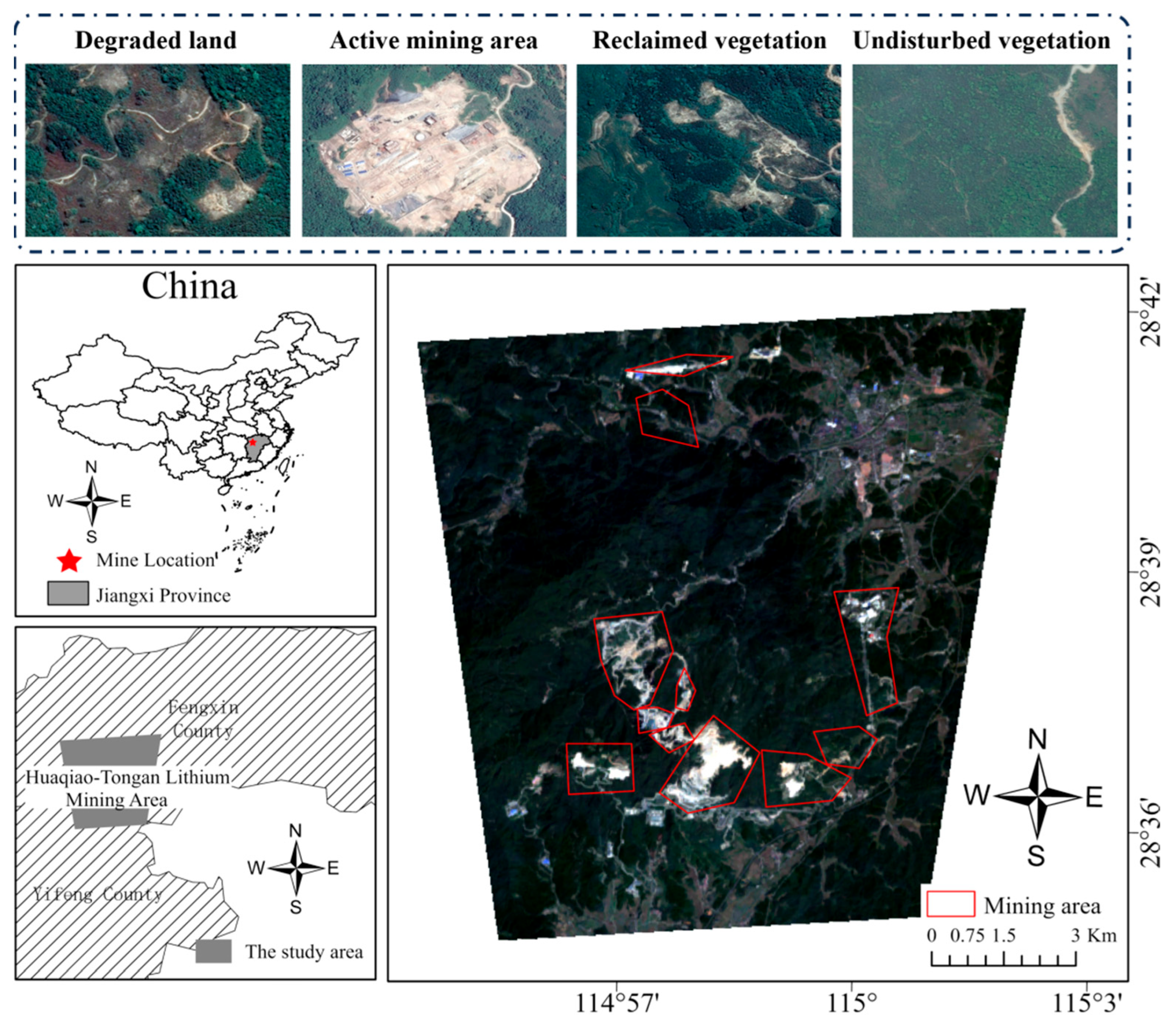
The Huaqiao Township lithium mining area (28°34′38″–28°42′02″ N, 114°54′18″–115°02′05″ E) is located in southwestern Yifeng County, Yichun City, Jiangxi Province, China, and covers an area of approximately 170 km2 (Figure 1). Situated within Huaqiao Township, the core mining cluster of Yichun—widely known as the “Lithium Capital of Asia”—the area is rich in polymetallic-associated lepidolite resources and serves as an important lithium supply base for China’s new energy industrial chain.
In recent years, driven by the rapid expansion of the global new energy industry, the region has undergone a rapid industrial transition from traditional porcelain clay mining to large-scale open-pit lithium mining and beneficiation. Although high-intensity surface stripping and frequent mining activities have contributed to regional economic growth, they have also imposed substantial stress on local ecosystems. The lithium extraction process generates large amounts of solid waste (lithium slag) and beneficiation wastewater, which significantly alters the physicochemical properties of surrounding soil and water environments, thereby causing vegetation degradation, land damage, and landscape fragmentation.
Moreover, the study area is located in a typical hilly red soil region of southern China, characterized by abundant precipitation with strong seasonal concentration. The naturally weathered red soil is relatively fragile and highly susceptible to soil erosion. Under the combined effects of a fragile natural background and high-intensity mining disturbance, ecological restoration and land reclamation in the mining area have faced considerable challenges in recent years. Therefore, conducting scientific and accurate dynamic monitoring and spatial assessment of ecological security in typical lithium mining areas such as Huaqiao Township has become a critical issue for coordinating resource development and environmental protection in this region.

2.2. Data Sources and Processing

In this study, multisource data for four periods (2010, 2015, 2019, and 2024) in the Huaqiao Township lithium mining area were collected, including remote sensing imagery, land-use data, topographic data, meteorological data, socioeconomic statistics, soil data, and other geospatial vector data. Among the input datasets, GDP (D2) and educational attainment of residents (M2) were obtained from the Yifeng County Statistical Yearbook at the county level, with Yifeng County being the county that encompasses Huaqiao Township and the study area. Because the study area is fully contained within a single county (Yifeng County), standard geostatistical interpolation (e.g., Kriging) is not applicable, as only one source value per year is available for each of D2 and M2. We therefore adopted a dasymetric downscaling approach, in which the county-level value was redistributed to the 30 m pixel grid using two ancillary covariates that carry information on the within-area spatial heterogeneity of human activity: road-network density derived from OpenStreetMap, and land-development intensity derived from remote sensing land-cover classifications. For each year, a composite weighting surface was constructed from the two covariates and normalized so that the weighted pixel-sum within Yifeng County equals the reported county-level total, thereby preserving the mass of the original statistic (pycnophylactic property). Therefore, the downscaling chain is as follows: county-level statistic → covariate-based weighting surface → mass-preserving redistribution to 30 m pixels. Because this procedure relies on the assumption that the two ancillary covariates reasonably approximate the within-county spatial distribution of GDP and educational attainment, the fine-scale pixel-level patterns of D2 and M2 should be interpreted as consistent-with-development-intensity proxies rather than as measured values; this limitation is reiterated in Section 4.4. All datasets were then projected into a unified coordinate system and resampled to a consistent spatial resolution of 30 × 30 m. Detailed information on each dataset and the corresponding indicators are provided in Table 1.

2.3. Research Methods

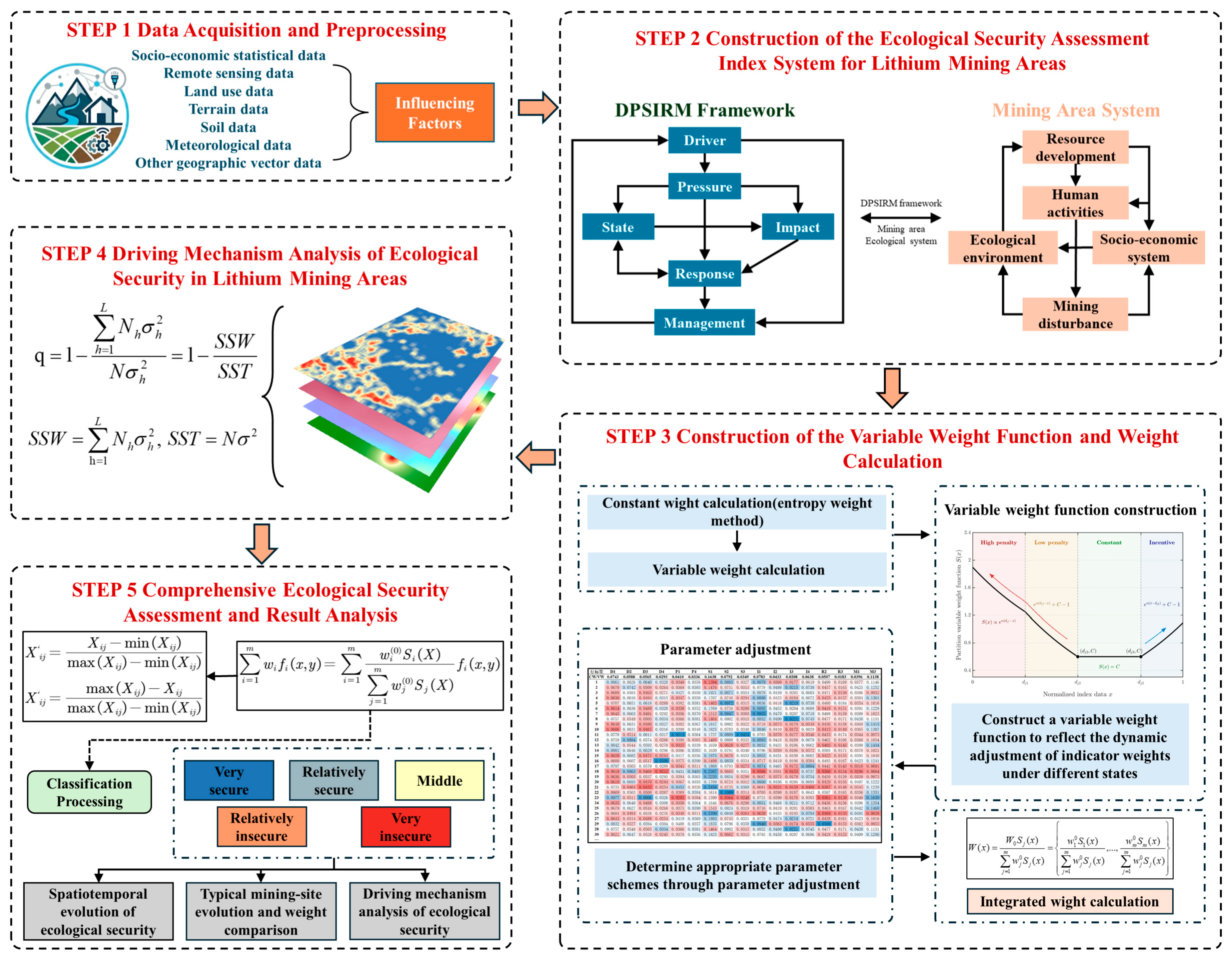
Taking the Huaqiao Township lithium mining area as the study area, this study developed a technical framework for the dynamic evaluation, as shown in Figure 2.
First, multisource data, including remote sensing imagery, topographic data, meteorological data, socioeconomic statistics, and other geospatial vector data, were integrated. Guided by the DPSIRM (Driver–Pressure–State–Impact–Response–Management) framework and considering the typical disturbance characteristics of open-pit mining and waste residue accumulation in the study area, a total of 17 ecological-security evaluation indicators were selected.
Second, based on constant weights, variable weight theory was introduced to construct a state variable weight function dominated by penalty effects. Indicator weights were dynamically adjusted to improve the model’s ability to identify ecological vulnerability and abrupt risks in mining areas.
Subsequently, the standardized indicator values were integrated with the dynamic weights to establish a comprehensive ecological-security evaluation model. This model was used to quantitatively assess the ecological-security levels of the study area in 2010, 2015, 2019, and 2024, and to reveal their spatiotemporal evolution patterns.
Finally, the geographic detector model was applied to analyze the main driving factors of spatial differentiation in ecological security and their interactions, thereby clarifying the mechanisms underlying ecological-security changes at different stages of mining development.

2.3.1. Construction of the Ecological-Security Indicator System and Evaluation Model for Lithium Mining Areas

The DPSIRM (Driver–Pressure–State–Impact–Response–Management) model is a conceptual framework that has gradually evolved from earlier models such as PSR, DSR, and PSIR. It emphasizes the causal relationships among resource development, the ecological environment, socioeconomic systems, and management policies. Owing to its broad indicator coverage, the DPSIRM model can comprehensively reflect the evolutionary process of regional ecological security.
The ecosystem of a lithium mining area is a complex system shaped by the interaction of multiple factors and indicators, and the impacts of mineral exploitation on the ecological environment have become increasingly significant and complex. On one hand, driven by the growing demand for lithium resources, human activities such as open-pit mining, road construction, and waste residue accumulation alter the surface environment of mining areas, leading to vegetation degradation, landscape fragmentation, and declines in ecological functions. On the other hand, in response to such habitat degradation, human systems implement ecological restoration measures, such as mine revegetation, and formulate spatial regulation policies to mitigate these impacts.
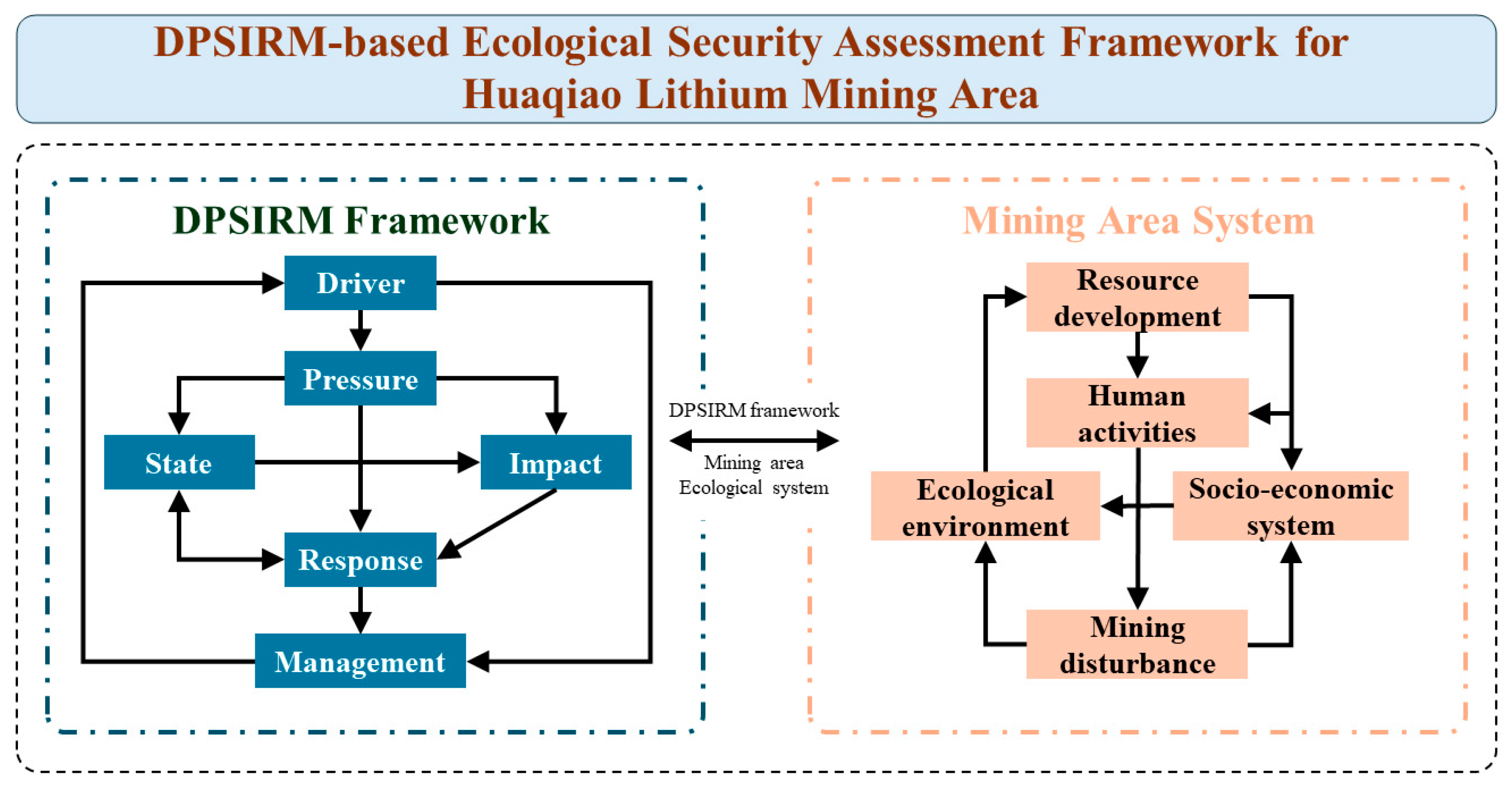
Given the bidirectional interaction of “development-induced stress–governance feedback” within mining systems, this study introduces the DPSIRM framework to construct a comprehensive ecological-security evaluation indicator system for the Huaqiao Township lithium mining area (Figure 3). The aim is to quantify the synergistic effects of multiple factors and to provide methodological support for the sustainable development and closed-loop management of the regional ecological environment.
Constructing a scientific and reasonable evaluation indicator system is a prerequisite for accurately assessing ecological security in mining areas. Considering the significant spatial heterogeneity among different regions in terms of natural endowment, ecological background, and socioeconomic characteristics, indicator selection must demonstrate strong regional specificity. Accordingly, this study focuses on the characteristics of high-intensity development and ecological disturbance in the Huaqiao Township lithium mining area and, based on a comprehensive review of previous studies, strictly follows the principles of representativeness, data availability, and dynamic comparability.
Under the DPSIRM framework, a total of 17 key indicators were selected from six system dimensions—Driver (D), Pressure (P), State (S), Impact (I), Response (R), and Management (M)—to systematically construct an ecological-security evaluation indicator system for the lithium mining area (see Table 2 for details). Specifically, the 17 indicators were chosen to satisfy three criteria simultaneously: theoretical completeness across the six DPSIRM dimensions, sensitivity to the ecological processes characteristic of subtropical mountainous lithium mining (vegetation degradation, landscape fragmentation, soil erosion, and post-mining recovery), and consistent availability across all four assessment years after harmonization to a 30 m evaluation grid. Within this framework, the Driver (D1–D4) and Pressure (P1–P2) layers represent the upstream forcing on the system; the State (S1–S3) and Impact (I1–I4) layers describe the resulting ecological conditions and consequences; and the Response (R1–R2) and Management (M1–M2) layers capture the system’s capacity to buffer and govern these effects.
Within the Driver layer, D3 (elevation) and D4 (slope) are retained as spatial conditioning factors that fix each pixel’s baseline ecological vulnerability—controlling soil thickness, erosion susceptibility, and post-disturbance recovery potential—rather than as temporal change indicators; their explanatory contribution operates primarily through interactions with dynamic indicators (S1, P1) on steep, high-elevation terrain. Within the Management layer, M2 (educational attainment of residents) is included to capture the macro-level social foundation of environmental governance—environmental awareness, regulatory compliance, and community participation in restoration—which the operational indicator M1 (land-use intensity) does not cover.
Within the specific context of this humid subtropical lithium mining area, three attribute assignments warrant brief clarification. Annual precipitation (D1) is assigned a negative direction because, under the high regional precipitation regime, its positive pathway to vegetation is effectively saturated, whereas its negative pathway through rainfall-driven erosion and slope instability on mining-disturbed surfaces remains active. GDP (D2) is treated as a negative driving factor because, within the DPSIRM framework, it serves as a proxy for economic-development intensity and the associated resource-exploitation pressure rather than for well-being per se. Educational attainment of residents (M2) is placed under Management because it operates as a macro-level proxy for environmental-governance capacity—reflecting environmental awareness, regulatory compliance, and community participation in ecological restoration—rather than as a direct management action.

2.3.2. Comprehensive Evaluation Method Based on Variable Weight Theory

a.
Determination of Constant Weights
Prior to calculating variable weights, it is necessary to determine the constant weights (CWs) of each evaluation indicator, which serve as the baseline for subsequent dynamic adjustment. In this study, the entropy weight method was adopted to determine the constant weights.
The entropy weight method is an objective weighting approach based on information entropy theory. Its core principle is that the weight of an indicator is determined by the degree of variation in its values: the greater the variation, the more information the indicator provides, and thus the higher the assigned weight. The theoretical basis of this method can be traced back to Shannon’s information entropy theory [23]. By quantifying the information entropy of each indicator, the method objectively reflects the degree of variation in indicator values and reduces, to some extent, the influence of subjective factors on the weighting results.
The specific procedure includes data standardization, proportion calculation, entropy estimation, and weight determination. The calculation results are presented in the Appendix A.
b.
Variable Weight Theory
The ecological system of lithium mining areas is influenced by multiple factors, including mineral exploitation, surface disturbance, and ecological restoration, and is therefore characterized by strong dynamics and complexity. In comprehensive ecological-security assessment, constant weight methods generally represent the importance of indicators using fixed weights. Although such methods can reflect the basic contribution of each indicator, they are insufficient to capture the dynamic effects of changes in indicator states on evaluation results. Therefore, it is necessary to introduce variable weight theory to adjust indicator weights dynamically.
Variable weight theory was first proposed by Wang in the 1980s [24] and has been further developed in subsequent studies. Later, Li systematically examined different forms of variable weighting, including penalty-based, incentive-based, and neutral (non-penalty, non-incentive) types, thereby further expanding its computational framework [25].
Unlike constant weight models, which only reflect the relative importance of indicators, variable weight theory assumes that indicator weights should also be influenced by their state values and by the combined state of multiple indicators, thereby enabling dynamic weight adjustment. Because it can better capture the influence of abnormal indicators on overall evaluation results in complex systems, this method has been widely applied in comprehensive resource and environmental assessments.
Accordingly, this study introduces variable weight theory into the ecological-security assessment of lithium mining areas, and its general form is expressed in Equation (1).
W x = W 0 S j x j = 1 m w j 0 S j x = w 1 0 S 1 x j = 1 m w j 0 S j x , , w m 0 S m x j = 1 m w j 0 S j x
c.
Determination of Variable Weight Intervals and Parameters
When applying the variable weight method, it is also necessary to determine the variable weight intervals corresponding to each indicator for different years. Because ecological security in such areas evolves with significant temporal variation and spatial heterogeneity, the distributions of indicator states differ across years. Therefore, an objective method is required to classify indicator state intervals.
The K-means clustering algorithm can automatically classify data according to the inherent characteristics of the samples. By specifying the number of clusters and the maximum number of iterations, it can also improve the stability and reliability of interval partitioning. In this study, the K-means algorithm was applied to cluster indicator data for each year, with the number of clusters set to four and the maximum number of iterations set to 20. Based on the clustering results, the threshold values of the variable weight intervals for each indicator were determined, as shown in Equation (2) [26].
d j 1 = f j 1 + f j 2 / 2 d j 2 = f j 3 + f j 4 / 2 d j 3 = f j 5 + f j 6 / 2
d.
Construction of the Variable Weight Model for Lithium Mining Areas
Under mining disturbance, the ecological system of lithium mining areas typically exhibits a long recovery cycle and relatively weak self-repair capacity. Once accumulated ecological stress exceeds the tolerance threshold of the system, persistent negative impacts may occur. Therefore, to prevent unfavourable indicators from being masked by advantageous ones in the comprehensive evaluation, this study constructs a penalty-dominated hybrid variable weight function based on these evolutionary characteristics. This function is intended to strengthen the constraining effect of deteriorated indicators on the overall evaluation results. The specific form is shown in Equation (3). We note explicitly that this asymmetric behaviour around the thresholds is a structural property of the penalty-dominated construction itself, not an empirically established advantage of VW over CW: under this formulation, sub-areas in which several indicators simultaneously fall below d1 will, by construction, see their composite scores driven further into the low-security range than the corresponding CW composite would yield.
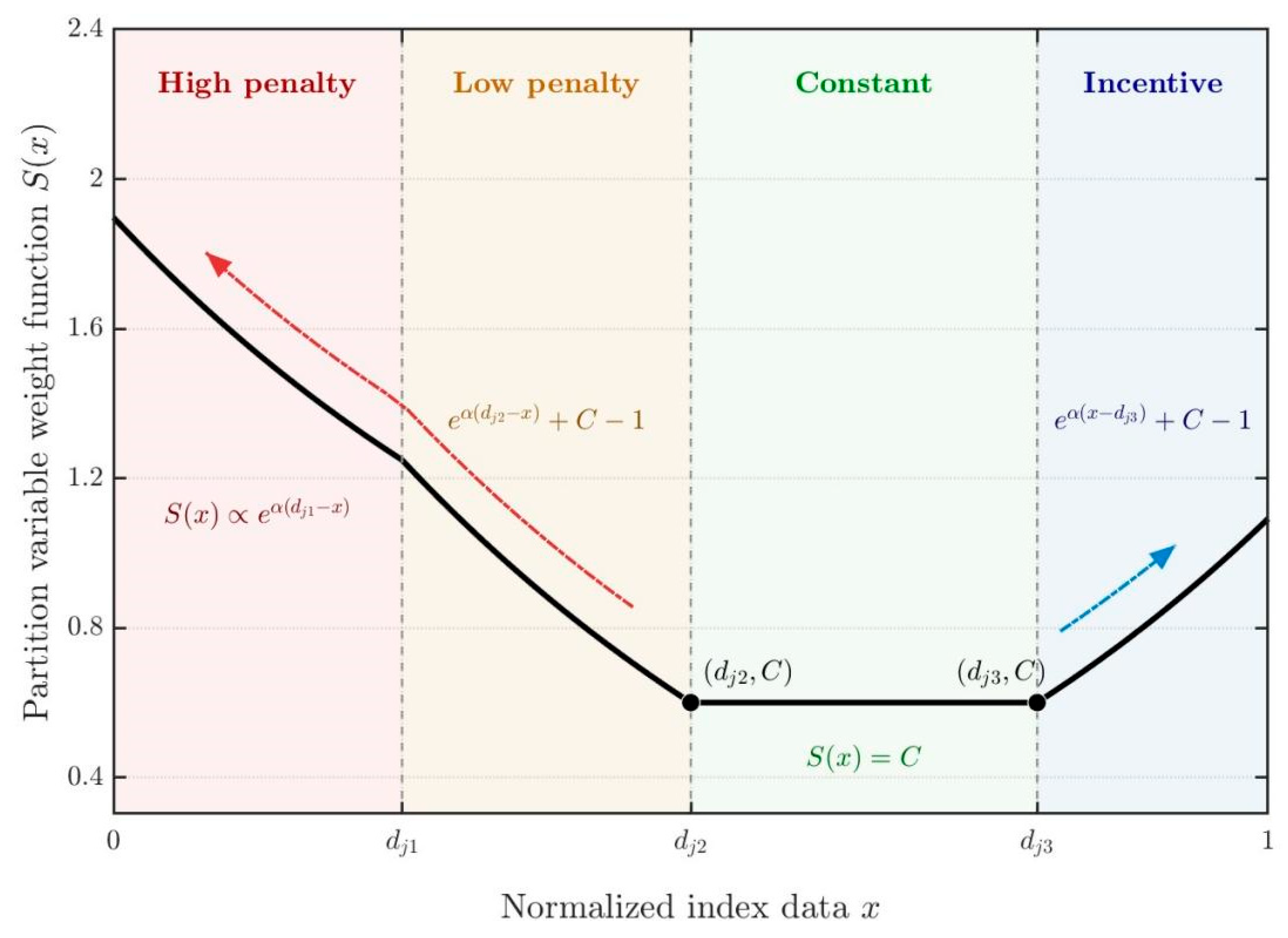
S ( x ) = e α d j 1 x j + e α d j 2 d j 1 + C 2 , 0 x j < d j 1 e α d j 2 x j + C 1 , d j 1 x j < d j 2 C , d j 2 x j < d j 3 e α x j d j 3 + C 1 , d j 3 x j < 1
In Equation (3), x j denotes the standardized value of the original data for the j -th indicator. d j 1 , d j 2 , and d j 3 represent the threshold values of the variable weight intervals for the j -th indicator. e is the natural constant, and α is the adjustment coefficient that controls the sensitivity of weight variation to changes in indicator states. A larger value of α indicates that once an indicator deviates from its corresponding threshold, the magnitude of weight adjustment becomes more pronounced. C is the global adjustment parameter, which represents the overall intensity of weight variation. When C takes a smaller value, the penalty or incentive effects imposed on the indicators become stronger.
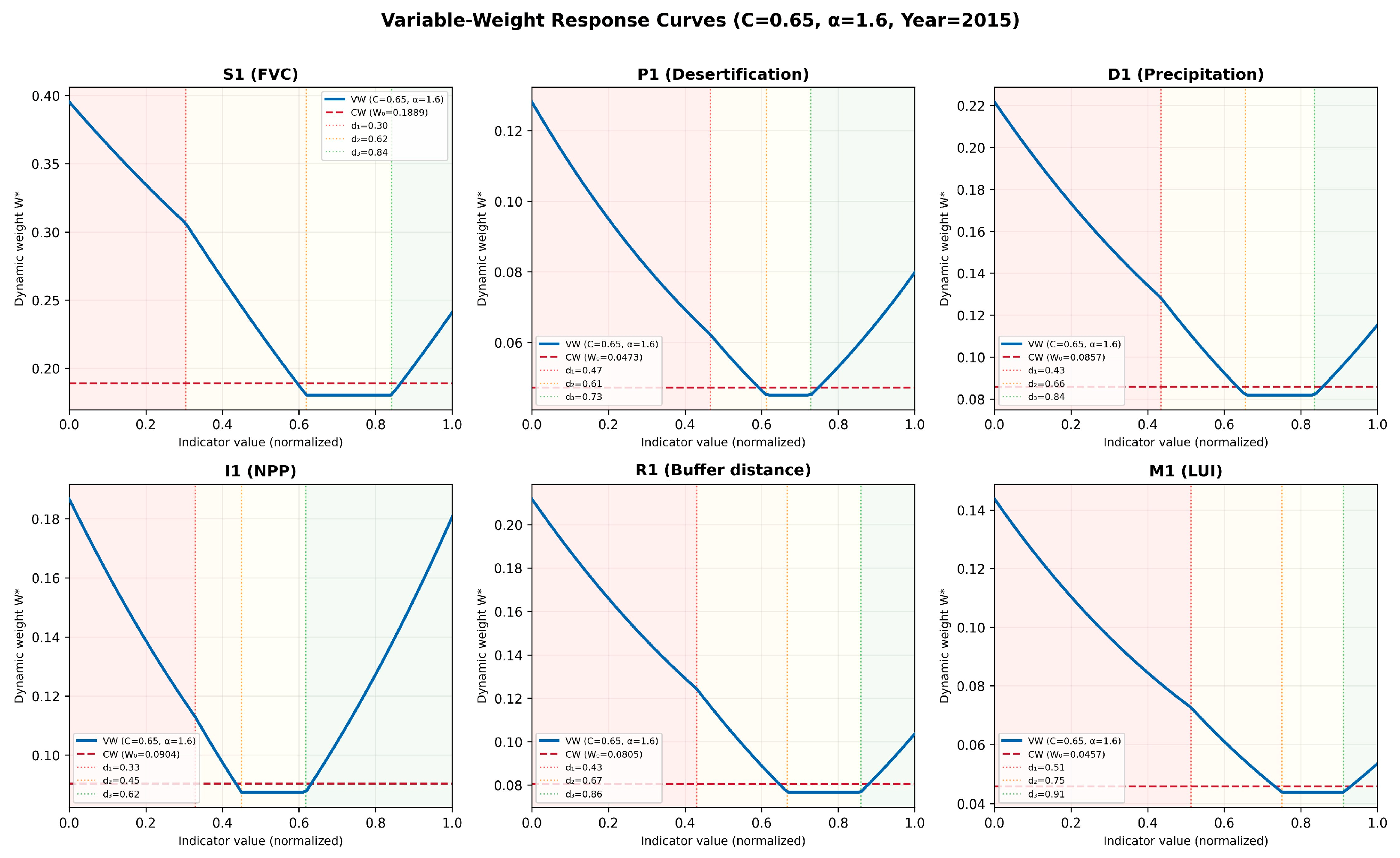
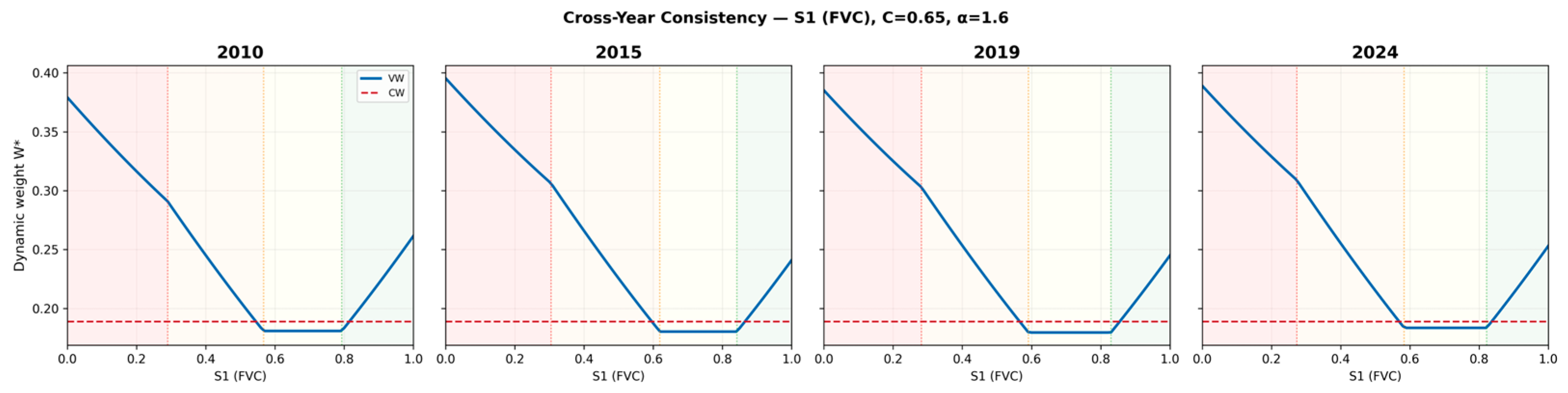
As shown in Figure 4, the exponential state variable weight vector constructed in this study can be divided into four distinct weight-adjustment intervals. Specifically, the interval d j 3 x j < 1 is defined as the incentive interval, within which the weight increases gradually as the indicator value increases. The interval d j 2 x j < d j 3 is the stable interval, where the indicator weight remains unchanged without penalty or incentive. The interval d j 1 x j < d j 2 is the penalty interval, in which the corresponding weight increases as the indicator value decreases. When the indicator value further falls into the interval 0 x j < d j 1 , the penalty effect is further intensified.
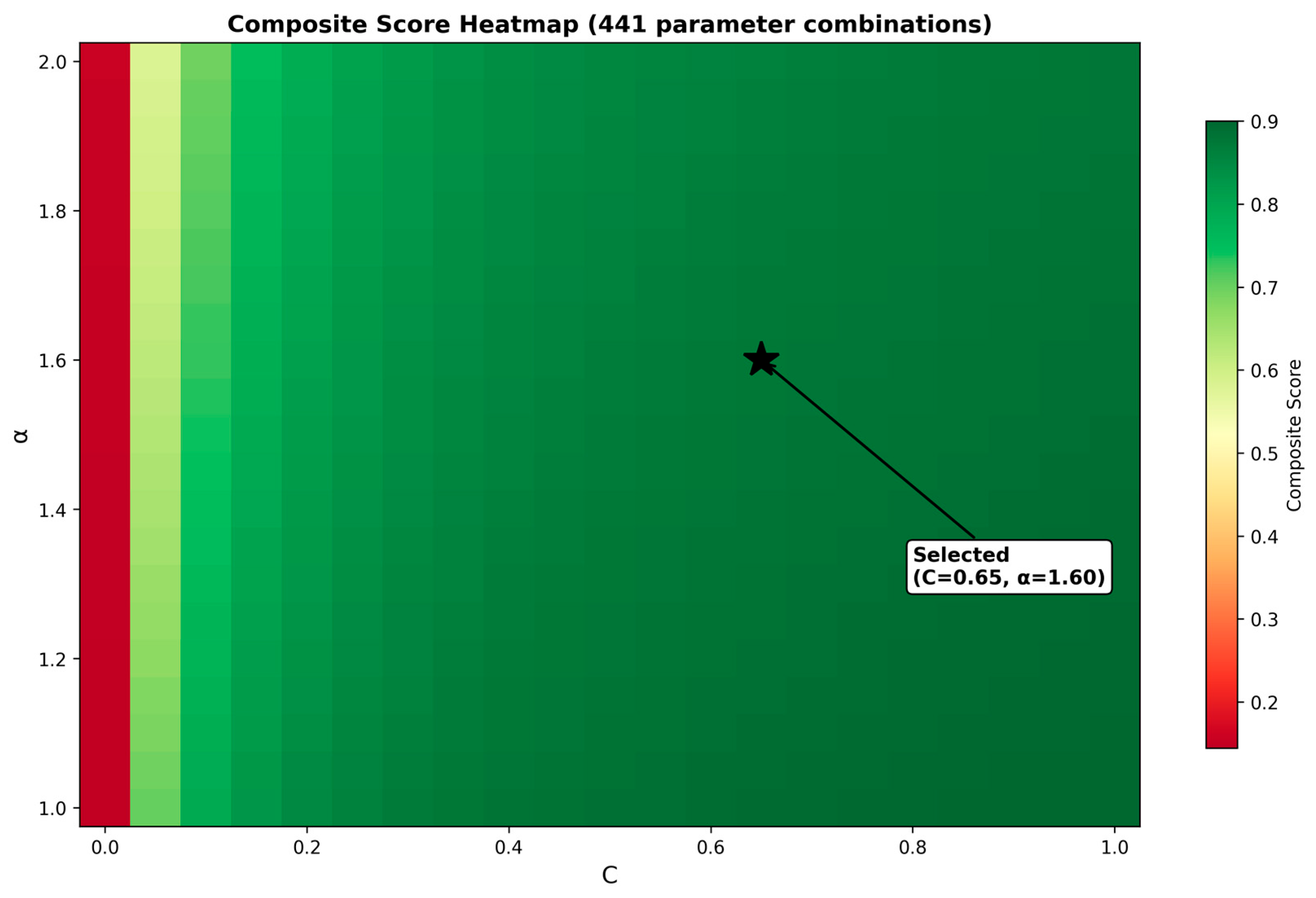
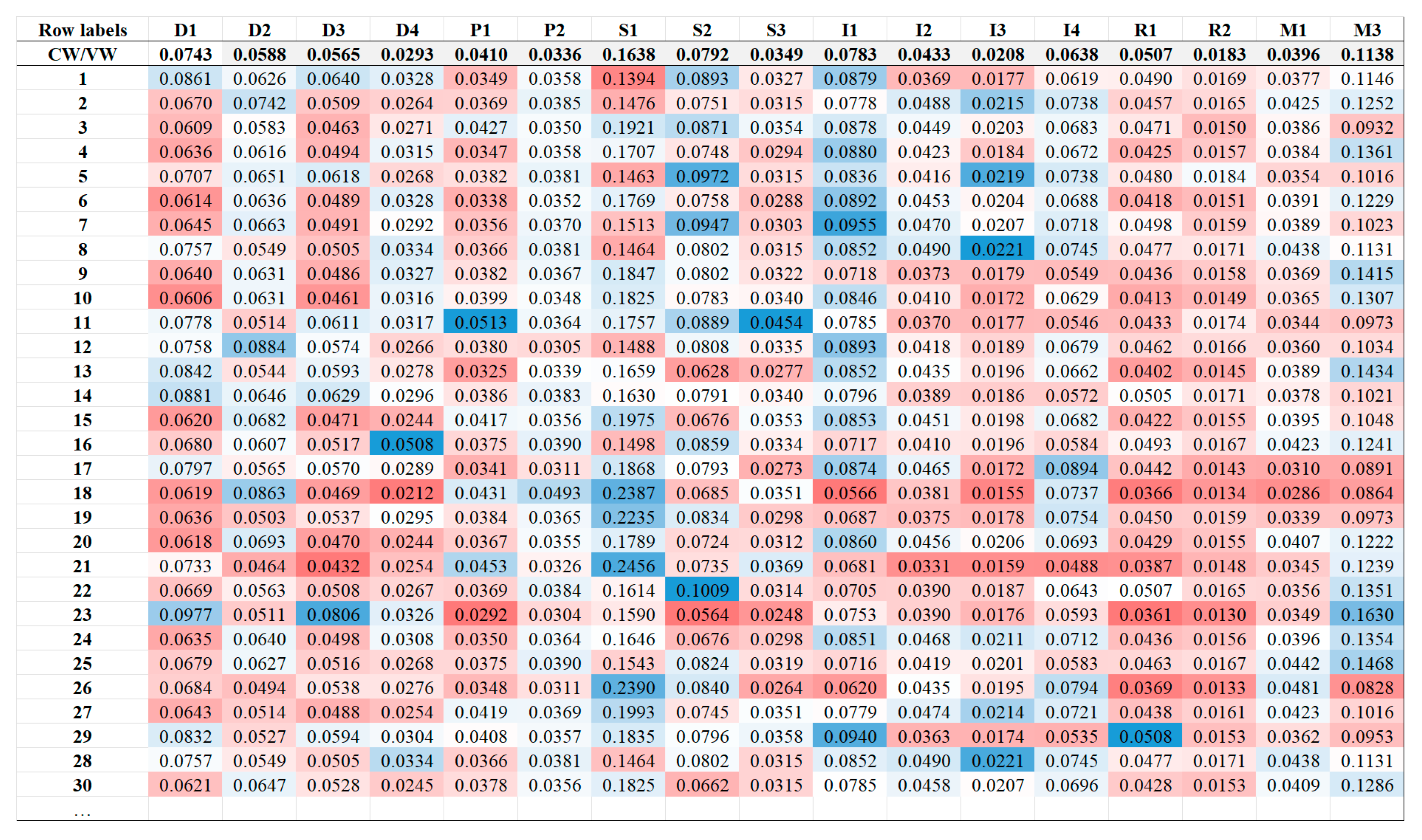
After the variable weight intervals were determined, the two adjustment parameters of the model—the balance factor C and the penalty intensity α—were selected through a systematic four-step procedure rather than by trial-and-error tuning. First, following the empirically recommended search range of C [ 0 , 1 ] and α [ 1 , 2 ] reported for DPSIRM-based variable weight models [27], a grid search was carried out at intervals of 0.05 in both directions, yielding 441 candidate combinations. Second, for each candidate, a single-indicator perturbation test was performed jointly across all four assessment years: with the remaining 16 indicators fixed at their year-specific median values, each indicator was varied from zero to one in 21 equal steps, and the resulting dynamic weight response was scored against five quantitative criteria—significance (the mean range of the perturbed indicator’s weight variation), smoothness (the mean maximum single-step weight change), absence of abrupt jumps (the worst-case maximum single-step change across all indicators and years), non-target coupling (the mean absolute weight deviation in the 16 non-perturbed indicators), and monotonic consistency (the proportion of steps showing logically consistent weight responses). Third, candidates were filtered by a significance threshold and the remaining set was ranked by a stability-weighted composite score (absence of abrupt jumps 0.40, smoothness 0.25, non-target coupling 0.20, significance 0.10, monotonic consistency 0.05). Fourth, the top-ranked candidate ( C = 0.65 ,   α = 1.60 ) was verified through weight–response curves with the K-means-derived thresholds d1, d2, d3 superimposed (Figure 5), and its robustness was confirmed by the parameter-sensitivity heatmap of all 441 candidates (Figure 6). The selected combination achieved a mean weight-variation range of 0.0958, a mean maximum single-step change of 0.0098, a worst-case single-step change of 0.0213, and a non-target coupling of 0.0046, with stable cross-year performance (Appendix Figure A2). Therefore, this parameter combination was adopted as the final setting of the variable weight model in this study, and the corresponding results are presented in Appendix A.
Based on the previously determined variable weight function, interval thresholds, and adjustment parameters, the variable weights (VWs) of each ecological-security evaluation indicator in the study area were calculated according to Equation (3). This generated weight values that dynamically adjusted with changes in indicator states. The results of both the constant weights (CWs) and variable weights (VWs) are presented in the Appendix.
The results showed that the variable weights could be adjusted effectively in response to changes in indicator states, with a generally smooth variation process and no evident abrupt changes. This provides a more sensitive weighting mechanism for identifying ecological-security conditions in lithium mining areas.

2.3.3. Comprehensive Ecological-Security Assessment of Lithium Mining Areas

Before conducting the comprehensive ecological-security assessment of the lithium mining area, the original data were standardized using the min–max normalization method to eliminate differences in dimensions, units, and value ranges among indicators and to improve comparability. According to the different directions of indicator effects on ecological security in the mining area, separate standardization formulas were applied to positive and negative indicators, as shown in Equations (4) and (5), respectively.
X i j = x i j min x i max x i min x i
X i j = max x i x i j max x i min x i
In these equations, X i j denotes the standardized value of the i -th evaluation indicator in year j , whereas x i j denotes the original value of the i -th evaluation indicator in year j . max x i and min x i represent the maximum and minimum values, respectively, of the i -th evaluation indicator during the study period.
Based on indicator standardization, a composite index model was further employed to calculate the ecological-security index (ES) of the study area, so as to quantitatively characterize the ecological-security level of the lithium mining area. The specific calculation is shown in Equation (6), where E S represents the comprehensive ecological-security index, X j denotes the standardized indicator value after normalization, and W j is the corresponding indicator weight.
E S = X j × W j
With regard to ecological-security classification, the equal-interval method commonly used in previous studies cannot adequately reflect the internal differences in ecological security in mining areas, where indicator distributions are typically skewed. This study therefore adopted the natural breaks (Jenks) method [28] to derive an initial set of class boundaries from the VW-ESI distribution. The Jenks results were then refined through three complementary sources of evidence: (i) high-resolution Google Earth imagery, used to verify whether each preliminary class boundary aligned with observable transitions in land cover, exposed mining surfaces, and vegetation recovery zones; (ii) field photographs collected at the Huaqiao Township mining area, used to calibrate the qualitative meaning of each level; and (iii) classification schemes reported in comparable mining area and DPSIRM-based ecological-security studies [11,19], referenced for the number of classes, level naming, and ecological interpretation rather than for the direct transplantation of numerical cut-offs. In practice, the final thresholds were adjusted only slightly around the initial Jenks breaks obtained from the VW-ESI distribution, with the direction of adjustment being to align class boundaries with observed transitions between exposed mining surfaces, mixed disturbed land, and recovering vegetation, as verified through the Google Earth overlays and field photographs. The final classification criteria are shown in Table 3.

2.3.4. Identification of Influencing Factors Based on the Geographic Detector

To explore the driving factors affecting ecological security (ES) in the Huaqiao Township lithium mining area of Yichun, this study employed the geographic detector model for driving-force analysis. The geographic detector is a statistical method used to identify spatial differentiation and its driving mechanisms. By comparing the spatial consistency of variables under different stratification conditions, it can quantitatively measure the explanatory power of influencing factors on the spatial distribution of the target variable.
(1) Factor detector
The factor detector is used to quantify the explanatory power of a given factor on the spatial differentiation of ecological security, as shown in Equation (7). When q = 0 , the factor has no explanatory power for the spatial differentiation of ecological security; when q = 1 , the factor completely explains the spatial differentiation of ecological security in the study area. In this study, both the factor detector and the interaction detector of the geographic detector model were used to identify and analyze the main driving factors of spatial differentiation in ecological security and their synergistic effects in the lithium mining area.
q = 1 h = 1 L N h σ h 2 N σ 2
In Equation (7), q represents the explanatory power of a given influencing factor on the spatial differentiation of ecological security in the mining area; L is the number of strata of variable X or Y ; h denotes the h -th stratum; N h and σ h 2 represent the number of samples and the variance within stratum h , respectively; and N and σ 2 denote the total number of samples and the overall variance of the study area, respectively. The value of q ranges from zero to one. A larger q value indicates the stronger explanatory power of the factor for the spatial differentiation of ecological security in the mining area.
(2) Interaction detector
The interaction detector is used to analyze the effects of interactions between two factors on ecological security. By calculating the interaction q -value of two factors, it is possible to determine whether their interaction enhances or weakens explanatory power. Specifically, interaction types can be classified as bivariate enhancement, nonlinear weakening, nonlinear enhancement, independent effect, and univariate weakening. The interaction relationships among different driving factors can thus be categorized into five types, and the specific criteria are shown in Table 4.
For implementation, all continuous indicators were discretized using an optimal-parameter strategy: for each indicator in each assessment year, three candidate methods (quantile, equal-interval, and K-means) were tested with the number of classes K varied from two to eight, and the method–K combination that maximized the factor-detector q-value was retained. The same optimization procedure was applied independently to all four years, allowing year-specific differences in indicator distributions to be accommodated; in the present study, K = 8 was the optimal choice in 59 of 68 indicator–year cases. Across the three candidate methods, K-means clustering was selected most frequently, followed by quantile classification and equal-interval classification. For the interaction detector, each pair of factors was overlaid using their respective year-specific optimal discretizations. Statistical significance of all q-values was assessed using the F-test associated with the geographic detector formulation and is reported alongside the q-values in the revised result tables and figures.
Here, q ( X 1 X 2 ) represents the explanatory power of the interaction between two factors on ecological security, whereas q ( X 1 ) and q ( X 2 ) denote the explanatory power of each individual factor. If the interaction q-value is greater than the larger of the two single-factor q-values but smaller than their sum, it indicates a bivariate enhancement effect; if it is greater than the sum of the two single-factor q-values, it indicates a nonlinear enhancement effect.


3. Results

3.1. Spatiotemporal Evolution Characteristics of Ecological Security in Lithium Mining Areas Based on Variable Weight Theory

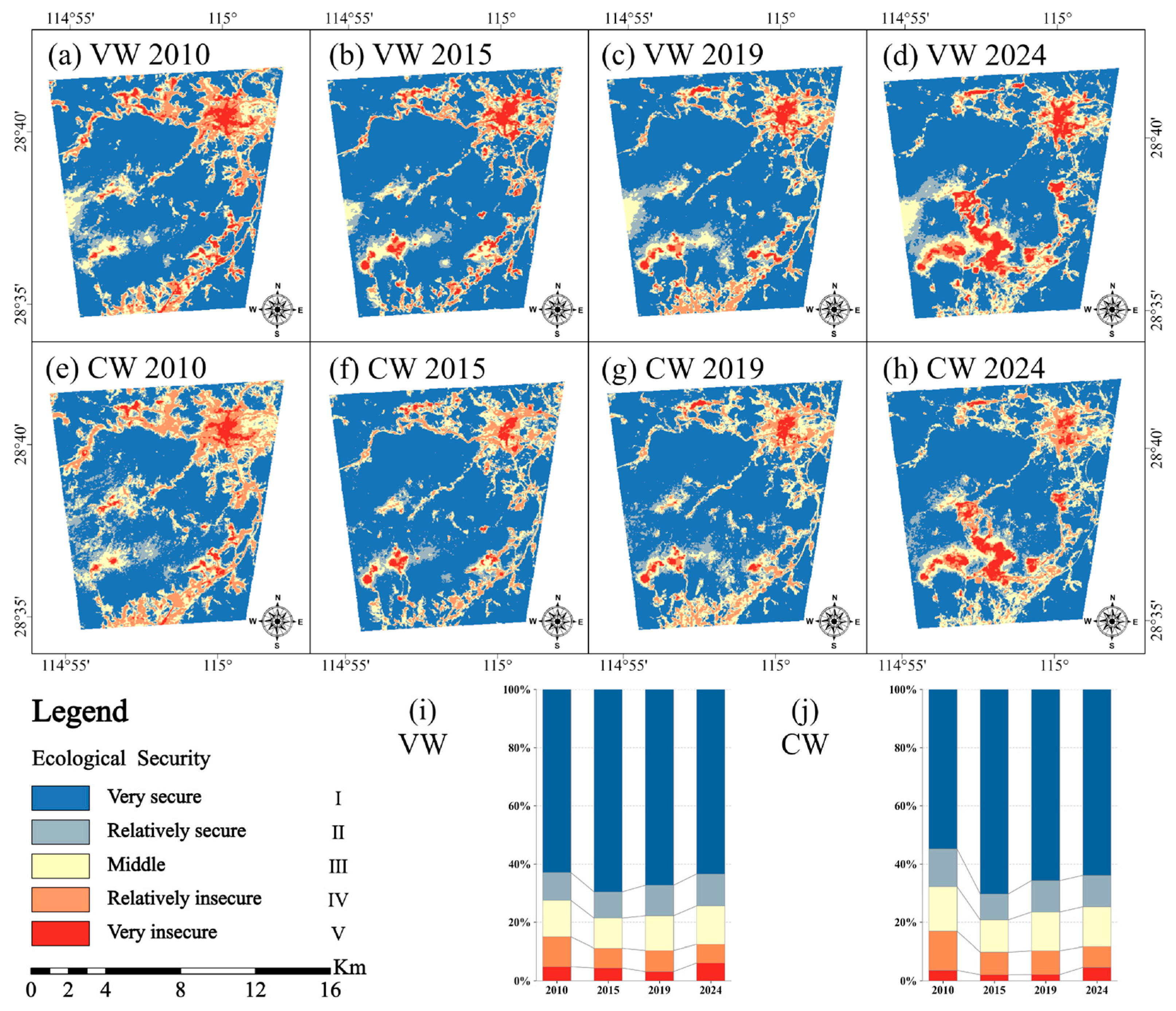
As shown in subpanels (a–d) of Figure 7, the study area was generally dominated by areas with relatively high ecological-security levels and exhibited clear spatial differentiation. Specifically, areas with high ecological security were distributed continuously over large extents, whereas areas with low ecological security were clustered locally, with relatively concentrated low-level patches in the upper-right portion and parts of the southern study area. From a temporal perspective, a clear spatial differentiation pattern had already emerged in 2010. In 2015, the extent of areas with high ecological security increased compared with that in 2010, indicating an overall improvement in regional ecological security. In 2019, the overall pattern remained similar to that in 2015, and the ecological-security level was generally stable. By 2024, low-ecological-security areas in the southern part of the study area had expanded significantly, and local clustering had become more pronounced. Subpanels (e–h) of Figure 7 show the corresponding constant weight (CW) composite for the same four years; the overall spatial pattern under CW closely follows that of VW, while the within-low-security tail is visibly less differentiated under CW than under VW—a divergence examined quantitatively in Section 3.3.
As shown in subpanels (i) and (j) of Figure 7, areas with high ecological security remained dominant throughout the four periods, although their proportional changes exhibited clear stage-wise characteristics. Under the VW composite shown in subpanel (i) of Figure 7, the combined “Very insecure” + “Relatively insecure” share fell from 14.25% in 2010 to 9.83% in 2019 and rebounded to 11.78% in 2024, while “Very secure” rose from 62.96% (2010) to 69.61% (2015) and then declined to 63.45% (2024). The CW composite shown in subpanel (j) of Figure 7 reproduced the same V-shape trajectory at the lower tail (combined low-security share: 15.90% → 9.12% → 9.47% → 10.93%) and the same inverse pattern at the upper end (Very secure: 54.85% → 70.32% → 65.74% → 63.95%). Both composites therefore identify the same overall dynamic of initial improvement followed by later-stage degradation; the systematic differences between them—concentrated in the severely degraded tail of the distribution—are analyzed in Section 3.3. Notably, the temporal swing of the “Very secure” share is wider under CW (54.85% → 70.32% across 2010–2015) than under VW (62.96% → 69.61%), reflecting that the VW penalty mechanism continuously redirects a portion of marginal pixels into the lower-security tail across all years, thereby stabilizing the upper-end share. The same penalty mechanism is what produces the consistently larger “Very insecure” share under VW (subpanel (i) versus subpanel (j) of Figure 7). These two whole-area observations are consistent with the methodological self-evidence discussion in Section 3.3.

3.2. Dynamic Evolution Analysis of Ecological Security at Typical Mining Sites

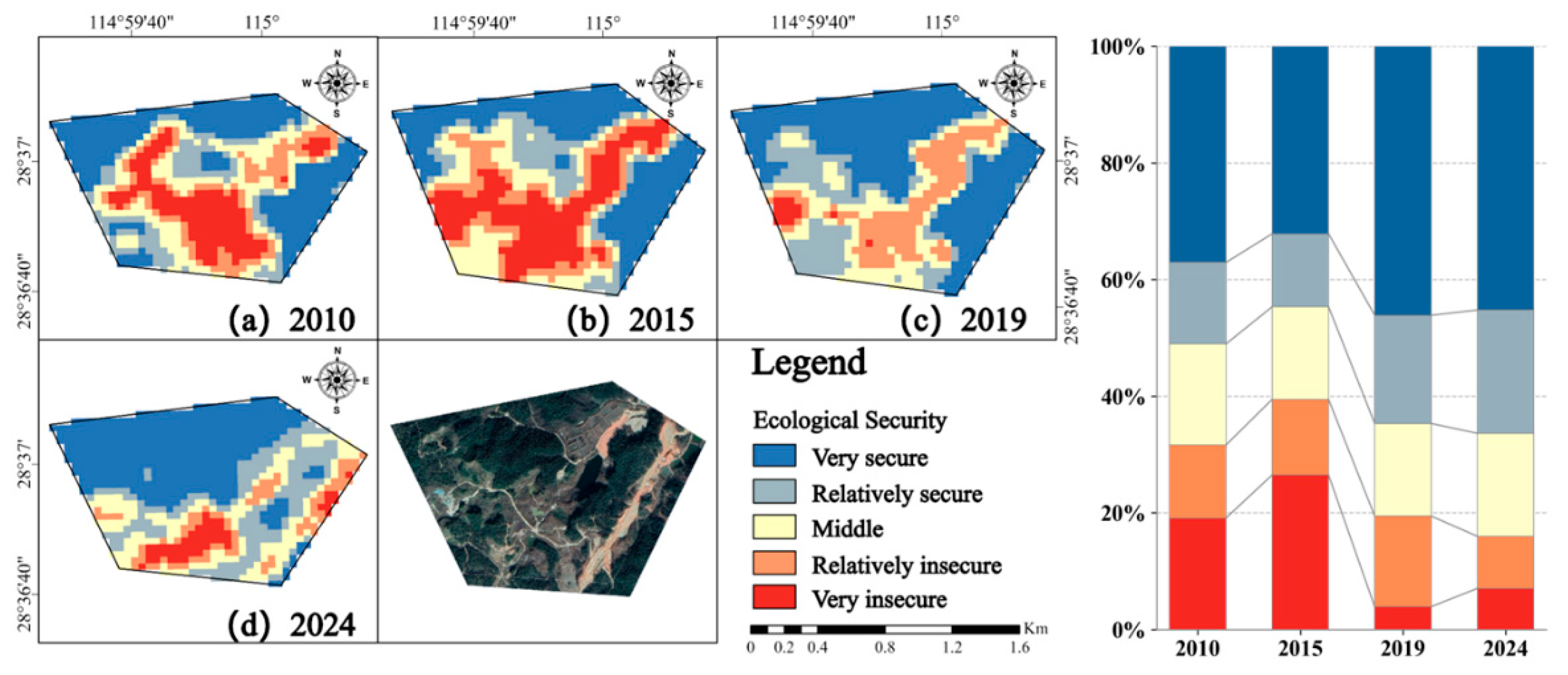
To further examine the dynamic evolution of ecological security at typical mining sites and the ecological response characteristics of lithium mining activities, this study selected two representative sites within the Huaqiao Township mining area—the southern Tong’an mining cluster and the Qiankeng mining site—for detailed analysis. Both sites experienced stage-wise processes of mining exploitation, mine closure and suspension, and subsequent reopening. Based on the ecological-security evaluation results for 2010, 2015, 2019, and 2024, together with high-resolution Google imagery from 2019 to 2023, a comparative analysis was conducted of the ecological-security conditions at these typical mining sites during key periods. The ecological-security evaluation results and high-resolution imagery of the southern Tong’an mining cluster and the Qiankeng mining site are shown in Figure 8 and Figure 9, respectively.
Southern Tong’an mining cluster
Figure 8. Google imagery and ecological-security-level distribution of the southern Tong’an mining cluster (2010–2024).
Ijgi 15 00185 g008
As shown in Figure 8, the ecological security around the southern Tong’an mining cluster exhibits an overall pattern of initial decline, subsequent improvement, and later degradation. In 2010, the combined proportion of “Very insecure” and “Relatively insecure” areas was 31.62%, which increased to 39.44% in 2015, indicating a decline in ecological security. In 2019, the proportion of “Very insecure” decreased to 3.91%, while “Very secure” increased to 46.15%, suggesting a significant improvement in ecological security around the mining site. By 2024, the proportions of “Very insecure” and “Relatively insecure” rebounded to 7.04% and 8.94%, respectively, indicating a renewed degradation trend in the later stage.
Qiankeng mining site
Figure 9. Google imagery and ecological-security level distribution of the Qiankeng mining site (2010–2024).
Ijgi 15 00185 g009
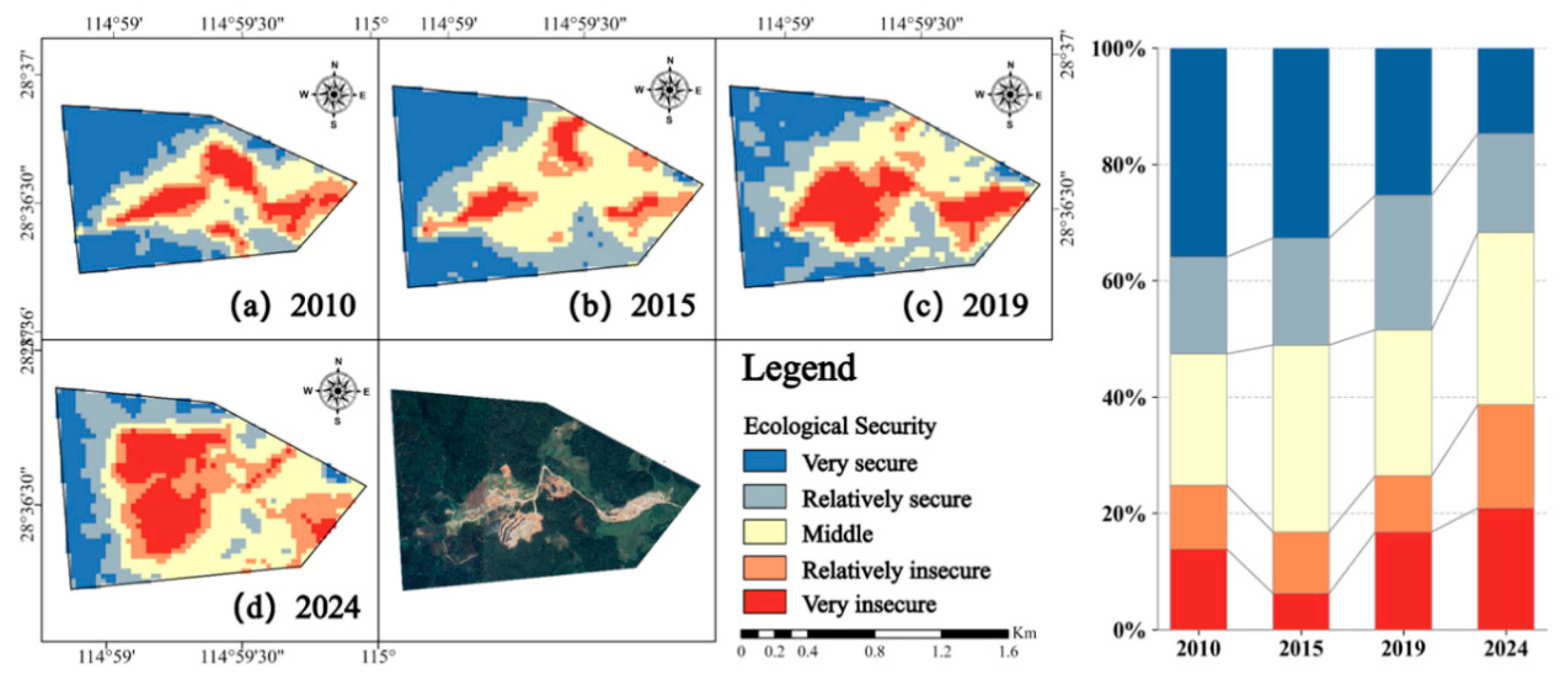
As shown in Figure 9, in 2010, the combined proportion of “Very insecure” and “Relatively insecure” areas at the Qiankeng mining site was 24.83%. In 2015, the proportion of “Very insecure” areas decreased to 6.22%, indicating an improvement in ecological security. In 2019, low-ecological-security areas expanded again, with the proportion of “Very insecure” areas increasing to 16.80%. By 2024, the proportions of “Very insecure” and “Relatively insecure” areas had risen to 20.87% and 17.82%, respectively, with a combined proportion of 38.69%. Overall, ecological degradation during the reopening stage of the Qiankeng mining site was more pronounced.
The ecological-security evolution around the two typical mining sites exhibited clear stage-wise characteristics and corresponded closely to the processes of mining exploitation, mine closure, and subsequent reopening. Overall, both mining sites experienced an initial decline, followed by stage-wise improvement and subsequent degradation. However, the timing of improvement differed between the two sites: the southern Tong’an mining cluster showed marked improvement mainly in 2019, whereas the Qiankeng mining site improved primarily in 2015. By 2024, low-ecological-security areas had expanded at both sites, with the Qiankeng mining site showing stronger redevelopment intensity.

3.3. Comparative Analysis of Constant Weight and Variable Weight Results

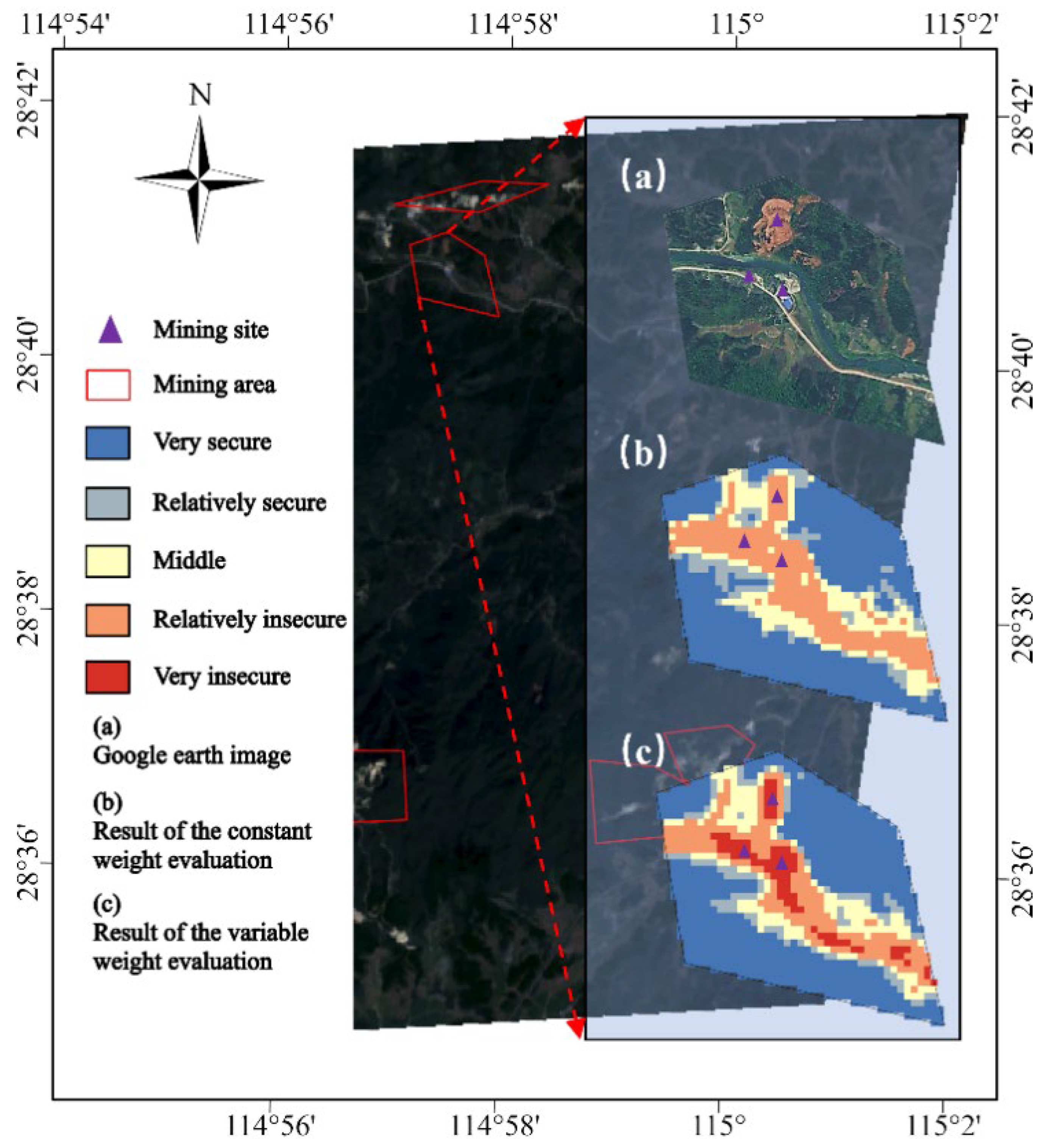
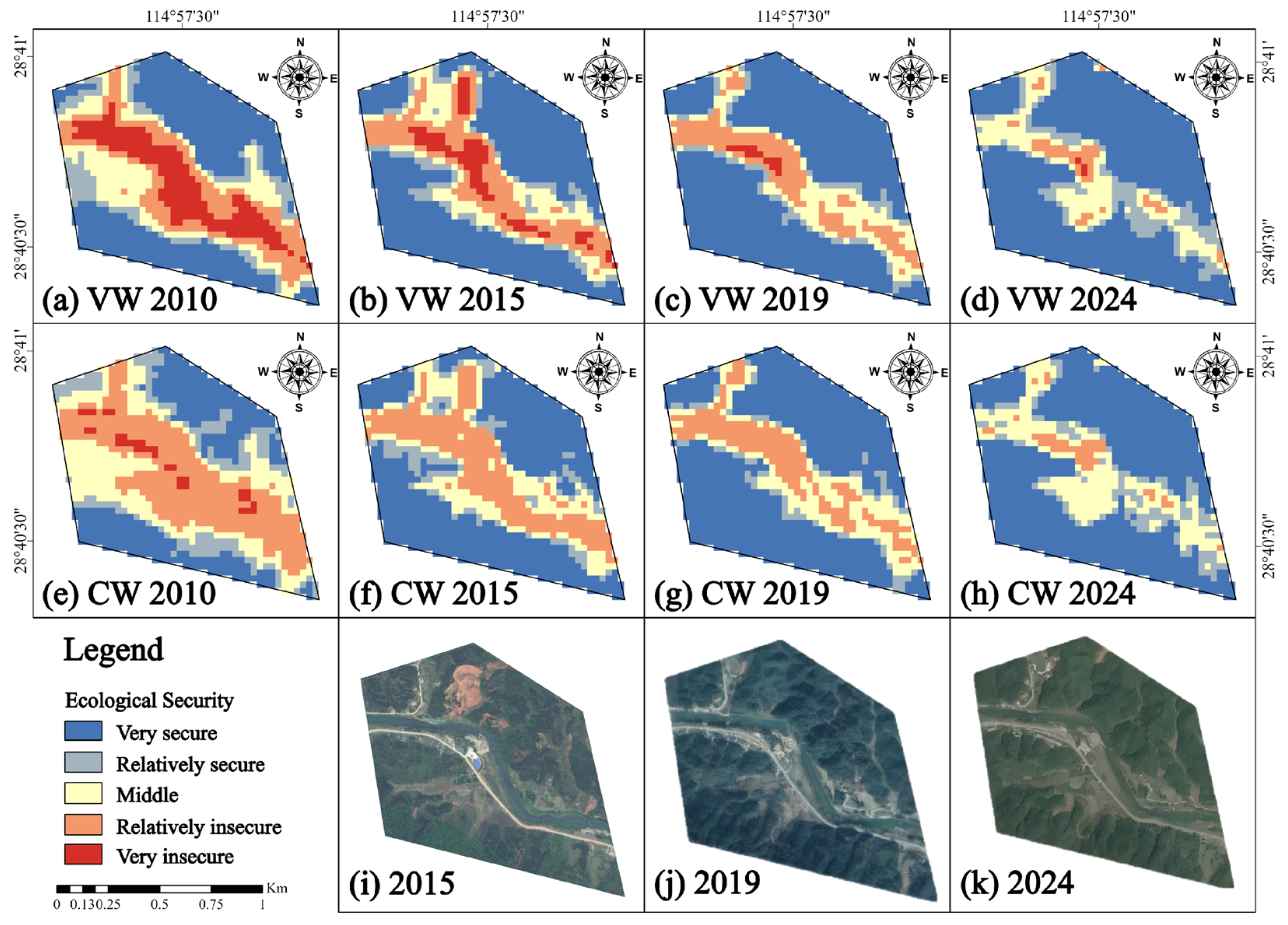
Unlike the typical mining sites selected in Section 3.2 to illustrate the overall spatiotemporal evolution of ecological security in the study area, the site examined in this section—the Shixiawo mining site—was chosen specifically for a methodological comparison between the variable weight (VW) and constant weight (CW) models, owing to its compact spatial extent and well-documented mining history. Two complementary evidence layers are presented. First, Figure 10 overlays the VW and CW results for 2015 with high-resolution Google Earth imagery from the same year, providing a visual ground-truth check of the two methods at a representative time point. Second, Figure 11 and Table 5 extend the VW–CW comparison at the same site to all four assessment years (2010, 2015, 2019, and 2024), reporting both spatial distribution and quantitative area composition of each ecological-security level.
The results show that the overall spatial distribution patterns of ecological security obtained by the two methods are generally consistent, indicating that the VW results retain the structural pattern of the CW baseline. The two methods diverge mainly within the severely degraded tail of the distribution: VW redistributes a portion of the area that the CW composite collapses into a single intermediate class, exposing an internal gradient that is otherwise not visible. We note that this redistribution is partly an expected consequence of the penalty-dominated VW formulation, which by construction amplifies the influence of severely deteriorated indicators on the composite score. The substantive contribution of the VW result therefore lies not in the larger fraction of area classified as “Very insecure” per se, but in where that fraction is located: the high-resolution Google Earth overlay in Figure 10 shows that the additional VW-flagged patches at the Shixiawo site in 2015 correspond to identifiable disturbance zones around mining sites, areas with concentrated mining activities, and zones along mining roads, rather than appearing as random noise.
The four-year quantitative comparison in Table 5 reveals a systematic divergence between the two methods at the lower tail of the ecological-security distribution. The CW composite identifies zero “Very insecure” area in 2015, 2019, and 2024 (0%, 0%, 0%), and only 2.85% in 2010, whereas the VW composite identifies 15.63%, 6.99%, 1.21%, and 0.26% in the same four years. Conversely, the CW composite over-assigns area to the “Relatively insecure” class (32.64%, 22.88%, 15.98%, 3.80%), into which the most degraded zones are collapsed. The two methods converge at higher security levels: the proportion of area classified as “Very secure” by the two methods differs by less than four percentage points in any year. This pattern indicates that the divergence is concentrated in the severely degraded tail of the distribution, where the VW mechanism preserves an internal gradient that the CW composite cannot resolve.
The underlying reason is that the CW method adopts fixed weights and therefore cannot reflect dynamic changes in indicator importance as ecological conditions vary. In contrast, by introducing a variable weight mechanism, the VW method enhances the influence of deteriorated indicators under low-ecological-security conditions, making the evaluation results more sensitive to ecological degradation in mining areas.
In summary, in this study setting (a single mining site evaluated across four years), the VW composite preserved the internal gradient of the severely degraded tail that the CW composite collapsed into a single intermediate class, while reproducing the CW pattern at higher security levels. We note that this comparison is restricted to a single mining site, and the imagery-based ground-truth cross-check was performed only for the 2015 snapshot; broader multi-site validation is left for future work and is discussed alongside other methodological limitations in Section 4.4.

3.4. Driving Mechanism Analysis of Ecological Security in Lithium Mining Areas

3.4.1. Identification of Driving Factors of Ecological Security

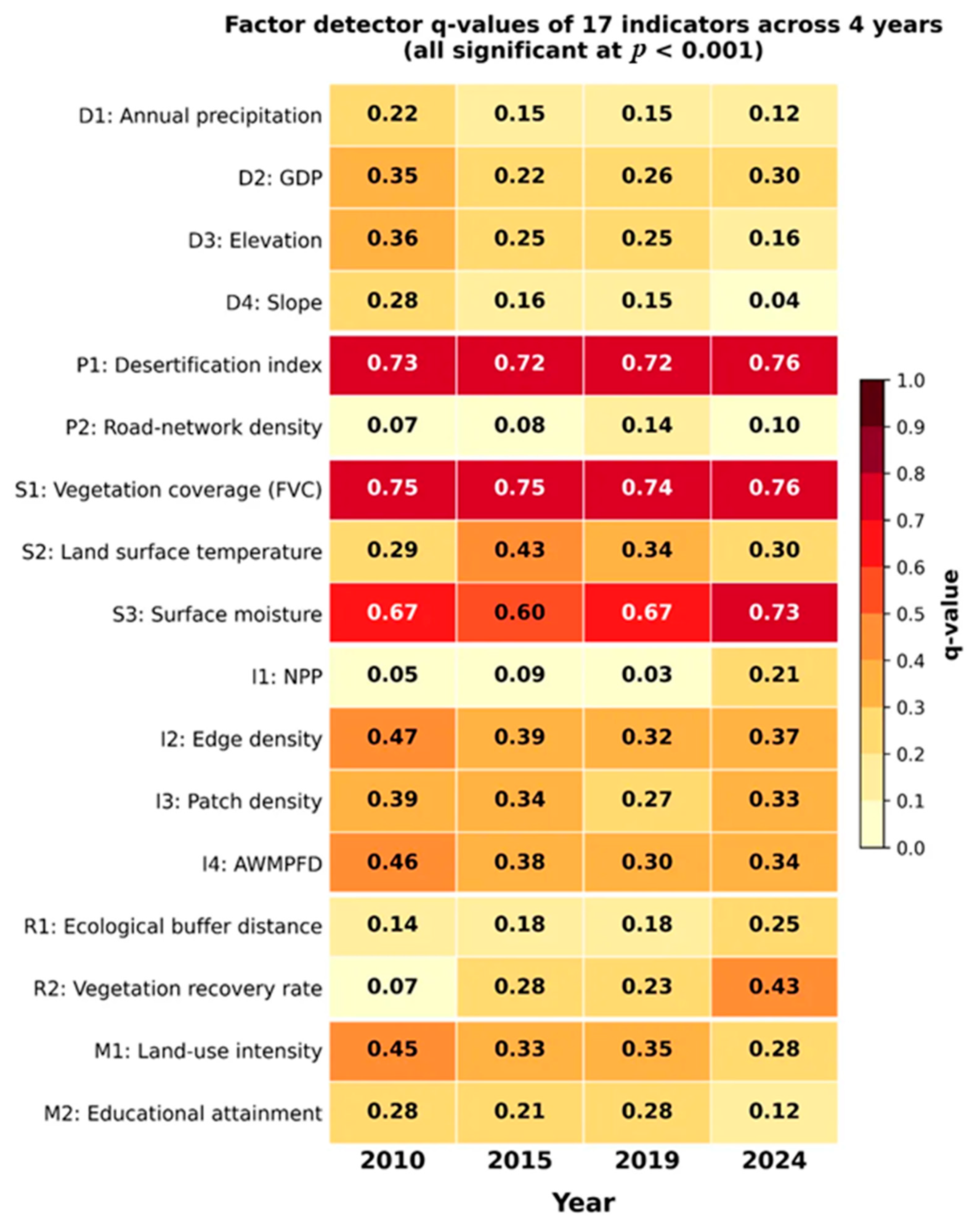
Based on the factor detector of the geographic detector model, the explanatory power of 17 indicator factors on ecological security in different years was quantified, and the top five dominant factors in each period were identified (Figure 12). The results show that the spatial differentiation of ecological security in the study area was mainly controlled by three subsystems, namely State, Pressure, and Impact. Although all indicators exhibited significant explanatory power for the ecological-security pattern of the mining area, their influence intensity varied across different periods.
The factor-detector q-values for all 17 indicators across the four assessment years are reported in Figure 12, with significance levels marked. Three indicators dominated the spatial differentiation of ecological security throughout the entire study period: vegetation coverage (S1) ranged from 0.740 to 0.761, desertification index (P1) from 0.717 to 0.757, and surface moisture (S3) from 0.598 to 0.731 (all p < 0.001). Their year-to-year ranking remained stable as S1 > P1 > S3 in every assessment year. The remaining 14 indicators all fell below q = 0.47, indicating a substantial gap between the top three factors and the secondary tier rather than a marginal ranking. Among these secondary indicators, edge density (I2), area-weighted mean patch fractal dimension (I4), land-use intensity (M1), and vegetation recovery rate (R2) reached q-values above 0.30 in at least one year and showed pronounced inter-year fluctuation; their stage-wise behaviour is described in Section 4.
Beyond the three dominant factors, the remaining 14 indicators (Figure 12) followed four distinct temporal patterns. The natural-background drivers (D1, D3, D4) and land-use intensity (M1) declined monotonically, with annual precipitation (D1) falling from 0.220 to 0.118, slope (D4) showing the steepest drop (0.284 to 0.043, a 6.6-fold decline), and M1 declining from 0.447 to 0.278; ecologically, this indicates that as mining and governance-induced disturbance accumulated, the regional ecological-security pattern progressively detached from the static topographic and climatic gradient that organized it in 2010. The Response-layer indicators (R1, R2) showed the opposite trajectory: ecological buffer distance (R1) rose 1.8-fold (0.139 to 0.252) and vegetation recovery rate (R2) rose 6.4-fold (0.067 to 0.425), which is the largest temporal reorganization in the entire dataset, reflecting the cumulative spatial signature of restoration and the contrast between restored and post-2021 newly disturbed zones. The landscape fragmentation metrics (I2, I3, I4) followed a V-shape with the lowest values in 2019 (I2: 0.473 → 0.386 → 0.320 → 0.365; I3: 0.395 → 0.342 → 0.265 → 0.327; I4: 0.455 → 0.376 → 0.303 → 0.338), tracking restoration-driven consolidation through 2019 and renewed fragmentation after re-opened mining in 2024. Land surface temperature (S2) peaked in 2015 (0.433, against 0.288, 0.338, 0.297 in the other three years), aligned with the consolidation-phase exposure of small mining pits. The remaining four indicators—GDP (D2), NPP (I1), road-network density (P2), and educational attainment (M2)—exhibited weaker or more irregular trajectories visible in Figure 12.

3.4.2. Interaction Detection of Ecological-Security Factors

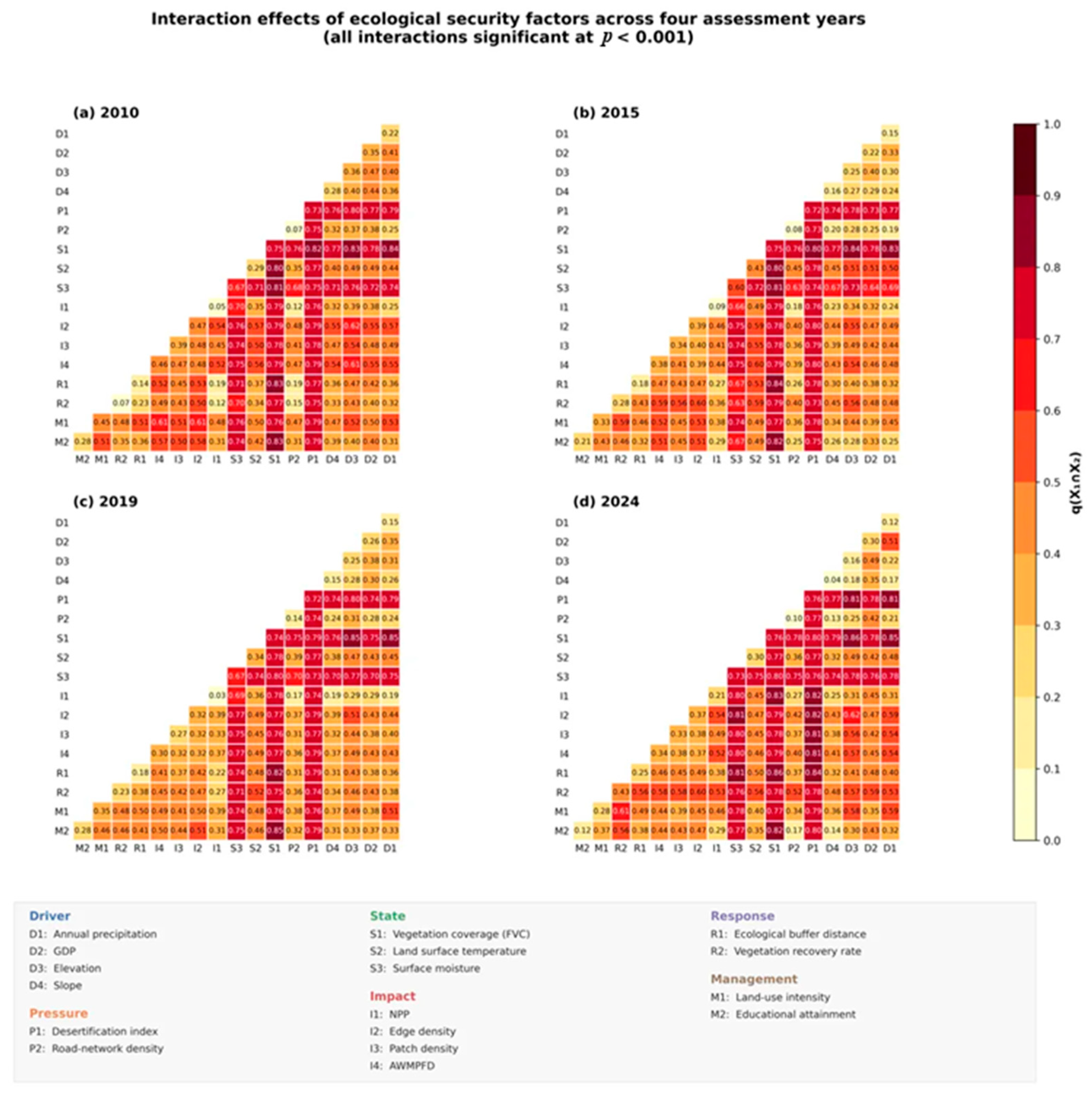
Interaction detection was conducted using 17 driving factors of ecological security for the years 2010, 2015, 2019, and 2024, and the results are shown in Figure 13. The results indicate that the interaction between any two factors was stronger than the effect of a single factor alone. All interaction results exhibited either bivariate enhancement or nonlinear enhancement, among which bivariate enhancement was the most common type. Therefore, the evolution of ecological security in mining areas was the result of the combined effects of multiple factors, with significant interactions among different factors.
The interaction structure across the four assessment years revealed two consistent hubs of strong interaction: vegetation coverage (S1) and the desertification index (P1). The single strongest pair throughout the study period was R1 ∩ S1 ( q = 0.82 0.86 ) , followed closely by S1 ∩ P1 ( q = 0.79 0.82 ) and S1 ∩ S3 ( q = 0.80 0.81 ) . Seven further pairs maintained q 0.77 in every assessment year: S1 ∩ I3 (0.76–0.78), S1 ∩ I4 (0.77–0.79), P1 ∩ I2 (0.79–0.82), P1 ∩ I3 (0.77–0.81), P1 ∩ I4 (0.79–0.81), S1 ∩ I2 (0.77–0.79), and S1 ∩ M1 (0.76–0.77) (Figure 13). The dominance of S1- and P1-based pairs—including their interactions with each other, with moisture (S3), with the three landscape metrics (I2, I3, I4), with land-use intensity (M1), and with the mining-buffer distance (R1)—is the quantitative signature of the disturbance–vegetation–moisture–desertification–fragmentation cascade discussed in Section 4.2. All 544 interaction q-values across the four years were statistically significant at p < 0.001 (Figure 13).

4. Discussion

The following sections discuss the stage-wise evolution of ecological security, its driving mechanisms, the methodological role of the variable weight model, and the limitations of this study.

4.1. Evolution Characteristics of Ecological Security in Lithium Mining Areas

The four assessment years (2010, 2015, 2019, and 2024) were not selected as evenly spaced snapshots, but to bracket the principal policy- and industry-driven turning points of lithium resource development in the Huaqiao Township area. The year 2010 represents the pre-lithium-boom baseline, predating the large-scale rise of the lithium new energy industry. The year 2015 marks an early industrial-transition phase, coinciding with the start-up of principal lepidolite operations in the township and the first electric-vehicle-driven spike in lithium carbonate prices. The year 2019 falls within the trough of the first lithium price cycle, before the post-2020 new energy surge. The year 2024 represents the renewed-development phase, reflecting the large-scale reopening and expansion of lithium operations driven by the electric-vehicle industry and the associated intensification of environmental-governance actions. The stage-wise pattern reported below should therefore be read as a sampling of these turning points rather than as a fully resolved time series.
Based on the overall evaluation results, ecological security in the study area from 2010 to 2024 exhibited clear stage-wise and spatial differentiation characteristics, with an overall trend of initial improvement followed by degradation. Spatially, areas with high ecological security were distributed relatively continuously, whereas areas with low ecological security were mainly concentrated in urban construction zones and regions with intensive mining activities. This pattern indicates that ecological security in mining areas is not only controlled by the regional ecological background, but is also closely related to land-cover change and mining intensity. Mining disturbances often affect regional ecological environmental quality through pathways such as vegetation destruction, increased surface exposure, and landscape pattern reconstruction [29,30,31].
From 2010 to 2015, ecological security in the study area showed an overall improving trend, although local spatial differentiation still occurred due to development activities. The ecological evolution during this stage was mainly influenced by regional resource integration policies and differences in mining development cycles. In 2010, local authorities introduced lithium resource management measures focusing on resource integration and beneficiation experiments. Under these policies, mining rights in the Tong’an ore belt were transferred and consolidated around 2014, and multiple mining sites maintained both open-pit and underground mining operations, resulting in sustained disturbance in certain areas. In contrast, sites such as Qiankeng were still dominated by geological exploration activities, such as trenching and drilling, around 2013 and had not yet entered the stage of large-scale mining. As a result, ecological disturbance there remained relatively limited, which is consistent with the overall improvement trend. At the policy level, this period was framed by two Yichun municipal mineral resource integration documents issued in 2006 and 2007, namely Yifubanfa No. 52 and Yifubanfa No. 56. These documents translated the national-level Guofa No. 28 issued in 2005 and Guobanfa No. 108 issued in 2006 into a municipal consolidation programme that designated the Tong’an porcelain-stone mining area as a first-batch target (Appendix Table A1).
From 2015 to 2019, the ecological-security pattern of the study area tended to stabilize, entering a period of ecological restoration. This regional improvement benefited from strengthened environmental regulation and improved governance systems at both the national and local levels. During this period, with the implementation of new environmental protection laws, stricter requirements for mine ecological restoration, and the gradual promotion of green mine construction concepts and related standards, ecological constraints on mining development were significantly strengthened [32,33,34]. Meanwhile, studies on ecological-security pattern optimization indicate that enhanced governance measures and spatial regulation contribute to improving ecological connectivity and overall ecological-security levels [35]. Under the combined effects of institutional constraints and restoration efforts, previously disturbed areas, particularly around the southern Tong’an mining cluster, showed a contraction of low-ecological-security patches, indicating that ecological governance achieved positive results during this stage. At the same time, the period 2017–2018 saw a lithium price peak followed by a sharp decline through 2019, leaving capital inflows to the Yichun lithium sector subdued at the 2019 snapshot prior to the post-2020 new energy surge (Appendix Table A1).
From 2019 to 2024, ecological security in the study area deteriorated again, with low-ecological-security areas in the southern region expanding outward. This stage of evolution was closely related to the rising demand for lithium resources and the intensification of resource exploitation under the rapid development of the global new energy industry [36]. Driven by strong industrial expansion, mining activities in the region became active again. At the same time, large-scale projects such as the Qiankeng lithium mine were approved and put into operation with substantial production capacity, marking the transition from exploration to high-intensity development. Previous studies have shown that, with the expansion of mining scale, increased infrastructure construction, and the accumulation of waste materials, ecological pressure in mining areas tends to increase in stages and expand spatially from core disturbed zones to surrounding areas [36,37]. Therefore, the decline in ecological security during the later stage of this study resulted from the combined effects of industrial expansion, mining rights renewal, engineering construction, and solid waste accumulation. The post-2021 acceleration is documented by the entry of major battery manufacturers into Yichun in sequence—Gotion High-tech (May 2021, 11.5 billion RMB), CATL (July–October 2021, 13.5 billion RMB), and BYD (August 2022, 28.5 billion RMB)—and by Yichun lithium-industry revenue expanding from less than 20 billion RMB in 2020 to 111.7 billion in 2022, with lithium carbonate output reaching 158,900 t (34.5% of the national total) in 2023 (Appendix Table A1).
4.2. Driving Mechanism Analysis of Ecological Security in Mining Areas

Based on the single-factor analysis using the geographic detector, vegetation coverage (S1), desertification index (P1), and moisture index (S3) consistently maintained high explanatory power throughout the monitoring period, indicating that surface ecological conditions constitute the fundamental basis shaping ecological-security patterns in mining areas. Among these factors, vegetation degradation, increased surface exposure, and changes in moisture conditions exerted the most direct influences. This result is consistent with previous studies, which have shown that land-cover change, vegetation degradation, and moisture variation are closely associated with declines in ecological environmental quality [29,38].
Building on this single-factor ranking, the interaction-detector results (Figure 13) indicate that the six ecological components most directly implicated in mining disturbance—mining activity, vegetation, moisture, desertification, landscape fragmentation, and restoration—are organized into a coherent five-link cascade rather than acting as independent forcings on ecological security. First, mining disturbance drives vegetation loss: excavation, waste rock deposition, and road construction modify the land surface and destroy vegetation both directly within the mining footprint and indirectly along access routes. This link is captured by land-use intensity (M1) and ecological buffer distance from mining sites (R1) interacting with vegetation coverage (S1), yielding q(M1 ∩ S1) = 0.76–0.77 and q(R1 ∩ S1) = 0.82–0.86 across the four assessment years; the consistently high q(R1 ∩ S1)—the single strongest pair throughout the study period—indicates that the spatial differentiation of vegetation coverage is tightly structured around active mining fronts, consistent with mining disturbance being the primary spatial trigger of vegetation loss in the study area.
Second, vegetation loss and moisture decline are coupled bidirectionally: reduced canopy cover lowers interception, elevates surface evaporation, and reduces root-zone water retention, while lower soil moisture in turn limits vegetation regrowth, producing a self-reinforcing feedback. The interaction detector supports this coupling throughout the study period (q(S1 ∩ S3) = 0.80–0.81), with the interaction value substantially exceeding the larger of the two individual q-values and classified as bi-factor enhancement; S1 and S3 thus jointly explain more of the spatial variation in ecological security than either would independently.
Third, the vegetation–moisture–desertification triad closes onto the Pressure layer: reduced vegetation cover and soil moisture together expose soil surfaces to solar heating, wind erosion, and drying, initiating or intensifying desertification. The interaction q-values support this convergence (q(S1 ∩ P1) = 0.79–0.82 and q(S3 ∩ P1) = 0.73–0.76 across the four years), and the desertification index (P1) itself consistently ranks second among all single factors (q = 0.717–0.757, behind only S1). This pattern is consistent with P1 functioning as the aggregated downstream manifestation of vegetation and moisture degradation rather than as an independent forcing.
Fourth, the vegetation–desertification state generates landscape fragmentation. The loss of vegetation and the spread of degraded surfaces produce patchy, irregularly bounded land-cover mosaics, reflected in elevated edge density (I2), patch density (I3), and area-weighted mean patch fractal dimension (I4). The vegetation–fragmentation interactions are strong and stable (q(S1 ∩ I2) = 0.77–0.79, q(S1 ∩ I3) = 0.76–0.78, q(S1 ∩ I4) = 0.77–0.79), and the desertification–fragmentation interactions are systematically slightly higher (q(P1 ∩ I2) = 0.79–0.82, q(P1 ∩ I3) = 0.77–0.81, q(P1 ∩ I4) = 0.79–0.81). This ordering is mechanistically informative: fragmentation arises more directly from the spread of degraded surfaces (P1) than from canopy reduction alone (S1), because desertified patches have sharper boundaries with the surrounding vegetation matrix than thinned or partially degraded vegetation patches—a causal distinction that the interaction detector exposes but that single-factor q-values cannot reveal on their own.
Fifth, vegetation recovery (R2) acts as the counter-pathway by reversing the cascade along the same axis on which disturbance propagates—re-establishing canopy cover, restoring moisture retention, and suppressing desertification through root stabilization and microclimate modification. Three interaction signatures support this role. The R2 ∩ S1 interaction rose from 0.766 in 2010 to 0.787 in 2015 and remained at 0.746–0.776 thereafter, matching the 2015–2019 restoration peak. The R2 ∩ S3 interaction rose from 0.626 in 2015 to 0.764 in 2024, indicating that as restored areas accumulated, they became increasingly effective in structuring moisture patterns. The R2 ∩ P1 interaction reached 0.782 in 2024, indicating that the spatial contrast between restored and non-restored zones has become a dominant modifier of desertification patterns. Restoration therefore operates along the same vegetation–moisture–desertification axis as disturbance, but in the opposite direction.
Taken together, these five linked patterns describe a coherent ecological pathway: mining disturbance removes vegetation, vegetation loss reduces moisture and accelerates desertification, the vegetation–moisture–desertification triad generates landscape fragmentation, and restoration reverses the chain. The dominance of S1- and P1-based interaction pairs in the geographic detector results is therefore not merely a statistical fact about which single factors matter most, but the quantitative fingerprint of a mechanistically coupled disturbance–recovery system operating across the Huaqiao Township lithium mining area [29].
The explanatory power of the driving factors exhibited clear stage-wise variation. In the early stage, edge density (I2) and patch fractal dimension (I4) showed relatively strong explanatory power, indicating that spatial differentiation was mainly dominated by landscape fragmentation and changes in patch structure caused by early mining activities. This finding is consistent with the typical pathway of “mining disturbance–landscape fragmentation–ecological degradation” [29]. In the later stage, the explanatory power of management input (M1) and response-related factors gradually increased, suggesting that the regional evolutionary mechanism shifted from early-stage physical landscape disturbance to the combined influence of resource exploitation, ecological restoration, and spatial regulation. This transition from “development-driven disturbance” to “development–governance integration” is also consistent with findings from studies on ecological-security pattern optimization and resource-based regions [30,35,37].
The interaction detection results showed that most factor interactions exhibited bivariate enhancement. In particular, the interactions between vegetation coverage and factors such as desertification, moisture, and response indicators demonstrated strong explanatory power. This further indicates that the spatial differentiation of ecological security is not governed by a single variable, but rather evolves under the combined effects of a fragile natural background, strong anthropogenic mining disturbances, and subsequent governance measures. Previous studies using the geographic detector have shown that factor interactions often significantly enhance explanatory power, and that ecological environmental patterns typically exhibit nonlinear and multi-factor coupling characteristics. Therefore, the stage-wise transition of driving mechanisms and the dominance of bivariate enhancement identified in this study contribute to a deeper understanding of the formation and evolution mechanisms of ecological-security patterns in lithium mining areas.

4.3. Application of the Variable Weight Model in Ecological-Security Assessment of Mining Areas

Based on the comparison of evaluation results for the Shixiawo mining site within the Huaqiao Township study area, the variable weight model demonstrated, in this single-site setting, a sharper resolution of localized ecological risk patches than the constant weight composite. Compared with the constant weight results, the variable weight approach more clearly delineated the spatial distribution of high-risk patches, such as development disturbance zones, areas with concentrated mining activities, and regions along mining roads. In particular, it showed higher sensitivity to areas with prominently deteriorated indicators. This indicates that ecological-security risks under lithium mining activities are not evenly distributed, but instead exhibit significant spatial heterogeneity and localized clustering. By imposing adaptive penalty effects on deteriorated indicators, the variable weight mechanism more effectively reflects the actual stress of mining activities on local habitats [18].
According to the evaluation results, the variable weight model not only refined the internal differences among ecological-security levels, but also enhanced the identification of ecological degradation around typical mining sites, allowing local high-risk areas that are easily smoothed out under constant weight evaluation to be highlighted. Previous studies have shown that variable weight models can dynamically adjust indicator contributions according to changes in the state of the evaluation object, thereby improving sensitivity to stage-wise fluctuations and abrupt risk changes [18]. Studies on ecological-security dynamics in mining areas have also shown that variable weight theory can improve the identification accuracy of key stress factors and high-risk areas [20]. Therefore, in the present study setting, the application of variable weight theory appears well-suited to capturing strong spatial heterogeneity and pronounced local abrupt changes; whether this advantage generalizes to other lithium mining areas with different geomorphological, climatic and disturbance regimes remains to be tested in future multi-site studies.
Compared with previous studies that mainly focused on single-period ecological pattern identification or the general assessments of mining areas, this study further revealed the dynamic evolution of ecological security from both regional and typical mining site perspectives, and analyzed stage-wise changes in driving mechanisms using the geographic detector. This not only improved the identification of areas where local ecological carrying capacity thresholds were exceeded, but also helped clarify the ecological-security response process under the combined effects of lithium resource development, ecological restoration, and spatial regulation from a spatiotemporal perspective. Therefore, for the type of mining setting examined here—characterized by high-intensity development, dispersed disturbance distribution, and significant localized ecological degradation—the variable weight model offers a methodologically advantageous alternative to constant weight composite indices for ecological-security assessment.

4.4. Limitations and Future Work

Several methodological limitations of this study should be acknowledged. First, although the four selected assessment years (2010, 2015, 2019, 2024) capture the principal policy- and industry-driven turning points of the Huaqiao lithium mining area, they cannot resolve ecological changes occurring at sub-annual or inter-year time scales. In particular, short-term ecological disturbances from individual mining events between sampling years may have been missed; the effect of COVID-19 on 2020–2022 mining operations is not directly captured; and the precise timing of the transition from the 2019 first-cycle trough to the 2024 redevelopment phase cannot be pinpointed with annual resolution. Future studies using annual or seasonal time series would help resolve these transitions more precisely.
Second, because the study area is fully contained within a single county, the spatialization of D2 and M2 relies on a dasymetric downscaling procedure in which the fine-scale spatial pattern is determined by the two ancillary covariates (road-network density and land-development intensity) rather than by additional statistical samples. The fine-scale pixel-level patterns of these two indicators should therefore be interpreted as consistent-with-development-intensity proxies rather than as measured values.
Third, the methodological VW–CW comparison presented in Section 3.3 is restricted to a single mining site (Shixiawo), and the imagery-based ground-truth cross-check is restricted to the 2015 snapshot; whether the VW method’s finer stratification of the severely degraded tail generalizes to other mining sites and time points remains to be tested in future multi-site studies.
Fourth, although the natural breaks (Jenks) classification boundaries used for five-level ecological-security mapping were refined through imagery, field observation, and literature cross-reference, a formal sensitivity analysis comparing the present classification to alternative schemes (equal-interval, pure quantile, Jenks without refinement) was not performed in this study; we identify this dedicated robustness test as a priority follow-up task, while noting that the dominant qualitative conclusions of the paper (stage-wise trajectory, S1/P1/S3 single-factor dominance, S1/P1 interaction hubs) are derived from the continuous VW-ESI composite or from geographic detector q-values on the original indicator values and therefore do not depend on the specific class boundaries.
In addition, due to limitations in acquiring long-term, high-precision spatial data, the current indicator system still involves certain trade-offs, and some deeper ecological processes have not been fully incorporated, such as groundwater responses, the migration and diffusion of solid waste, and lag effects in ecological restoration. Future studies could further expand multisource data acquisition channels and integrate groundwater monitoring, mining waste dynamics, and ecological restoration data to construct a more comprehensive dynamic assessment system for ecological security, thereby improving the interpretation of complex ecological processes [35,38].

5. Conclusions

From the perspective of coordinating mineral resource development and habitat protection, this study constructs a dynamic ecological-security assessment framework for lithium mining areas under high-intensity disturbance. By integrating a penalty-based variable weight mechanism with multisource ecological and environmental factors, the study quantitatively evaluates the long-term ecological-security patterns of the study area. Meanwhile, the geographic detector model is introduced to analyze the driving mechanisms and factor interactions across different stages of industrial development. The main conclusions are as follows:
(1) From 2010 to 2024, the ecological security of the study area exhibited a stage-wise evolutionary trajectory characterized by overall improvement followed by localized degradation. Spatially, areas with high ecological security remained relatively continuous, whereas low-level risk patches showed a dynamic pattern of initial contraction followed by outward expansion under the combined effects of stricter policy constraints and later-stage production expansion. This indicates that regional ecological security is highly sensitive to the dynamic interplay between ecological governance policies and high-intensity mining activities.
(2) Quantitative analysis of the driving mechanisms showed that the desertification index, vegetation coverage, and moisture conditions were key factors maintaining the regional ecological baseline. Over time, the dominant mechanism shifted from early-stage physical landscape fragmentation to the combined effects of spatial regulation and resource exploitation in the later stage. Moreover, most interactions among evaluation factors exhibited bivariate enhancement, indicating that a fragile natural background, when subjected to high-intensity anthropogenic disturbance, further amplified its influence on the spatial differentiation of ecological security.
(3) The introduction of the variable weight mechanism effectively addressed the methodological limitation of constant weight evaluation, in which fixed weights tend to obscure local extreme variations. By applying adaptive penalty weighting to deteriorated indicators, the model more finely characterizes the internal heterogeneity of ecological-security gradients and more effectively identifies potential high-risk patches, such as development disturbance zones, concentrated mining areas, and regions along mining roads. The evaluation system demonstrates strong spatial discrimination at the scale of the Huaqiao Township lithium mining area; further multi-site validation will be needed to establish whether the same advantages persist across other lithium mining settings.
In summary, this study enriches the dynamic monitoring framework for ecological security in mining areas based on multisource spatial data. The findings provide methodological support and decision-making references for ecological baseline control, differentiated restoration governance, and sustainable spatial planning in lithium mining areas under the expansion of the new energy industry.

Author Contributions

Conceptualization, Xunyu Yin, Shengdong Nie and Hengkai Li; methodology, Xunyu Yin and Wenxiang Shu; formal analysis, Xunyu Yin, Wenxiang Shu, Shengdong Nie and Hongtao Liu; investigation, Xunyu Yin and Wenxiang Shu; data curation, Xunyu Yin, Wenxiang Shu and Hongtao Liu; visualization, Xunyu Yin and Wenxiang Shu; writing—original draft preparation, Xunyu Yin; writing—review and editing, Shengdong Nie and Hengkai Li; supervision, Shengdong Nie and Hengkai Li; funding acquisition, Hengkai Li. All authors have read and agreed to the published version of the manuscript.

Funding

This study was supported by the Jiangxi Province University Humanities and Social Sciences Research Project, grant number GL25117.

Data Availability Statement

The data presented in this study are openly available in Figshare at https://figshare.com/s/e3578126f0584ec6beb3 (accessed on 20 March 2026). These data were derived from publicly available resources cited in the manuscript, and the processed datasets generated during the current study have been deposited in the stated repository.

Acknowledgments

Not applicable.

Conflicts of Interest

The authors declare no conflicts of interest.

Abbreviations

The following abbreviations are used in this manuscript:
DPSIRMDriver–Pressure–State–Impact–Response–Management
VWVariable Weight
CWConstant Weight
ESEcological Security
GISGeographic Information System
AHPAnalytic Hierarchy Process

Appendix A

Appendix A.1

Figure A1. Constant weights (CW) and variable weights (VW) of different indicators. Different colors represent different assessment years.
Ijgi 15 00185 g0a1

Appendix A.2

Figure A2. Cross-year consistency of the variable weight response curve for S1 (FVC). The blue solid line represents the VW response curve, the red dashed line represents the CW baseline, and the colored background bands indicate the variable-weight intervals.
Ijgi 15 00185 g0a2

Appendix A.3

Table A1. Policy, industry, and enforcement events relevant to the four assessment years in the Huaqiao Township lithium mining area.
Year (Anchor)CategoryEvent/Document/Statistic
2010 (pre-boom baseline)PolicyState Council document Guofa [2005] No. 28 and General Office of the State Council document Guobanfa [2006] No. 108 set the national framework for the integration of mineral resource development orders.
PolicyYichun Municipal Government Office document Yifubanfa [2006] No. 52 (Implementation Plan for the Integration of Mineral Resources in Yichun, July 2006) and Yifubanfa [2007] No. 56 (Master Plan for Mineral Resource Development and Integration in Yichun, May 2007) implemented the national framework at the municipal level, designating the Tong’an porcelain-stone mining area in Yifeng County as a first-batch consolidation target.
IndustryYichun adopted the “Asian Lithium Capital” development goal around 2008–2009. Citywide lithium-industry revenue remained below 20 billion RMB through 2020.
2015 (early industrial transition)IndustryFirst electric-vehicle-driven spike in lithium carbonate prices (late 2015).
Mining contextLepidolite-bearing porcelain-stone mining in the Huaqiao–Ganfang area continued to be operated primarily under the porcelain-stone or kaolin licence category (rather than as lithium mines), reflecting the pre-2021 industry structure.
2019 (first-cycle trough)IndustryTrough between the 2017–2018 lithium price peak and the post-2020 new energy surge; subdued production intensity and capital inflows in the Yichun lithium sector.
2024 (renewed-development phase)InvestmentGotion High-tech: lithium new energy project announced for Yichun Economic and Technological Development Zone in May 2021 (11.5 billion RMB total investment), commencing operations approximately two months earlier than CATL.
InvestmentContemporary Amperex Technology Co. Ltd. (CATL)—Jiangxi Provincial Government strategic framework agreement signed in Nanchang on 30 July 2021; CATL Yichun-Times Project announced 13.5 billion RMB investment (1300 mu plant footprint, 30-month construction window, 50 GWh planned capacity) on 13 September 2021; ground-breaking on 28 October 2021.
InvestmentBYD—Yichun Municipal Government strategic framework agreement signed on 15 August 2022 (28.5 billion RMB total investment, 30 GWh battery capacity plus 100,000 t/yr battery-grade lithium carbonate).
IndustryYichun lithium-industry revenue expanded from < 20 billion RMB (2020) to 111.7 billion RMB (2022, +149.8% YoY) and 104.5 billion RMB (2023). Yichun lithium carbonate output reached 158,900 t in 2023, equivalent to 34.5% of the national total.
EnforcementJinjiang River thallium-pollution incident, 24 November 2022. The principal source was identified as a recycled-lead enterprise (Jiangxi Qijin Materials Co.) discharging into the Yifeng Industrial Park wastewater plant, but the incident triggered the temporary production halt of multiple lithium carbonate plants in the Yichun area (including Yongxing New Energy) for environmental investigation.
PolicyYichun Master Plan for Mineral Resources (2021–2025) designates the Huaqiao–Ganfang area of the Yifeng–Fengxin Key Prospecting Zone as a priority target for porcelain-stone (lithium-bearing) prospecting, with planned addition of ≥ 250 Mt of porcelain-stone reserves containing ≥ 1.0 Mt of comprehensively recoverable Li2O.

References

  1. Zanoletti, A.; Bresolin, B.M.; Bontempi, E. Building a circular economy for lithium: Addressing global challenges. Glob. Chall. 2024, 8, 2400250. [Google Scholar] [CrossRef] [PubMed]
  2. Yang, X.; Wen, H.; Liu, Y.; Huang, Y.; Zhang, Q.; Wang, W.; Zhang, H.; Fu, J.; Li, G.; Liu, Q.; et al. Lithium pollution and its associated health risks in the largest lithium extraction industrial area in China. Environ. Sci. Technol. 2024, 58, 11637–11648. [Google Scholar] [CrossRef] [PubMed]
  3. Qian, L.; Shi, Y.; Xu, Q.; Zhou, X.; Li, X.; Shao, X.; Xu, C.; Liang, R. A prospective ecological risk assessment method based on exposure and ecological scenarios (ERA-EES) to determine soil ecological risks around metal mining areas. Sci. Total Environ. 2023, 901, 166371. [Google Scholar] [CrossRef]
  4. Zhu, B.; Hashimoto, S.; Cushman, S.A. A two concentric circles model incorporating availability of ecosystem services and affordability of humans to clarify the ecological security concept. Ecol. Model. 2023, 481, 110343. [Google Scholar] [CrossRef]
  5. Wang, D.; Huang, Z.; Wang, Y.; Mao, J. Ecological security of mineral resource-based cities in China: Multidimensional measurements, spatiotemporal evolution, and comparisons of classifications. Ecol. Indic. 2021, 132, 108269. [Google Scholar] [CrossRef]
  6. Wen, J.; Hou, K. Research on the progress of regional ecological security evaluation and optimization of its common limitations. Ecol. Indic. 2021, 127, 107797. [Google Scholar] [CrossRef]
  7. OECD. OECD Core Set of Indicators for Environmental Performance Reviews: A Synthesis Report by the Group on the State of the Environment; Organisation for Economic Co-operation and Development: Paris, France, 1993. [Google Scholar]
  8. United Nations. Indicators of Sustainable Development: Framework and Methodologies; United Nations: New York, NY, USA, 1996. [Google Scholar]
  9. Rotmans, J. Indicators for sustainable development. In Perspectives on Global Change: The TARGETS Approach; Rotmans, J., de Vries, B.J.M., Eds.; Cambridge University Press: Cambridge, UK, 1997; pp. 187–204. [Google Scholar]
  10. Zhang, F.; Zhang, J.; Wu, R.; Ma, Q.; Yang, J. Ecosystem health assessment based on DPSIRM framework and health distance model in Nansi Lake, China. Stoch. Environ. Res. Risk Assess. 2016, 30, 1235–1247. [Google Scholar] [CrossRef]
  11. Hou, M.; Li, L.; Yu, H.; Jin, R.; Zhu, W. Ecological security evaluation of wetlands in Changbai Mountain area based on DPSIRM model. Ecol. Indic. 2024, 160, 111773. [Google Scholar] [CrossRef]
  12. Zhu, L.; He, G. Mining ecological environment impact assessment based on DPSIR model. In Proceedings of the 2010 2nd Conference on Environmental Science and Information Application Technology (ESIAT 2010), Wuhan, China, 17–18 July 2010; pp. 144–149. [Google Scholar]
  13. Sun, C.; Wang, X.; Zhang, Y. Ecological health assessment of an arid basin using the DPSIRM model and TOPSIS: A case study of the Shiyang River Basin. Ecol. Indic. 2024, 161, 111973. [Google Scholar] [CrossRef]
  14. Sun, M.; Zhang, L.; Yang, R.; Li, X.; Zhang, Y.; Lu, Y. Construction of an integrated framework for assessing ecological security and its application in Southwest China. Ecol. Indic. 2023, 148, 110074. [Google Scholar] [CrossRef]
  15. Dong, Z.; Zhang, J.; Tong, Z.; Han, A.; Zhi, F. Ecological security assessment of Xilingol grassland in China using DPSIRM model. Ecol. Indic. 2022, 143, 109336. [Google Scholar] [CrossRef]
  16. Guo, Y.; Ma, X.; Zhu, Y.; Chen, D.; Zhang, H. Assessment of forest ecological security in China based on DPSIRM model: Taking 11 provincial administrative regions along the Yangtze River Basin as examples. ISPRS Int. J. Geo-Inf. 2023, 12, 272. [Google Scholar] [CrossRef]
  17. Li, C.; Sun, Y.; Jia, Y.; Du, Y. Analytic hierarchy process based on variable weights. Syst. Eng. Theory Pract. 2010, 30, 723–731. (In Chinese) [Google Scholar] [CrossRef]
  18. Lyu, Y.; Jiao, D.; Zhan, Y. Evaluation of regional water resources carrying capacity in China based on variable weight model and grey-Markov model: A case study of Anhui Province. Sci. Rep. 2023, 13, 13490. [Google Scholar] [CrossRef]
  19. Zhang, J.; Li, H.; Ren, G.; Zhang, Z.; Nie, S. Advancing sustainable mining practices: A dynamic ecological security and risk warning framework for ion-absorbed rare earth mine. J. Clean. Prod. 2025, 511, 145630. [Google Scholar] [CrossRef]
  20. Li, M.; Guo, Y.; Luo, D.; Ma, C. Landslide susceptibility assessment based on variable weight theory: A case study in Luanchuan County, China. Sustainability 2023, 15, 1908. [Google Scholar] [CrossRef]
  21. Wang, J.; Xu, C. Geographic detector: Principles and prospects. Acta Geogr. Sin. 2017, 72, 116–134. (In Chinese) [Google Scholar]
  22. McGarigal, K.; Cushman, S.A.; Ene, E. FRAGSTATS v4: Spatial Pattern Analysis Program for Categorical and Continuous Maps; Computer software program produced by the authors at the University of Massachusetts, Amherst, 2012. Available online: https://www.umass.edu/landeco/research/fragstats/fragstats.html (accessed on 20 March 2026).
  23. Shannon, C.E. A mathematical theory of communication. Bell Syst. Tech. J. 1948, 27, 379–423, 623–656. [Google Scholar] [CrossRef]
  24. Wang, P. Fuzzy Sets and Random Clusters; Beijing Normal University Press: Beijing, China, 1985. (In Chinese) [Google Scholar]
  25. Li, H. Mathematical framework of factor-space theory and knowledge representation (VIII): Principle of variable weight synthesis. Fuzzy Syst. Math. 1995, 9, 1–9. (In Chinese) [Google Scholar]
  26. Wu, Q.; Li, B. Determination method of variable weight intervals and adjustment parameters in variable weight evaluation of water inrush from coal seam floor. J. China Coal Soc. 2016, 41, 2143–2149. (In Chinese) [Google Scholar] [CrossRef]
  27. Li, T.; Chen, T.Y.; Mi, F.; Ma, L.B. Evaluation of China’s forest ecological security based on variable weight theory and DPSIRM. China Environ. Sci. 2021, 41, 2411–2422. (In Chinese) [Google Scholar]
  28. Jenks, G.F. The data model concept in statistical mapping. Int. Yearb. Cartogr. 1967, 7, 186–190. [Google Scholar]
  29. Tang, H.; Fang, J.; Xie, R.; Ji, X.; Li, D.; Yuan, J. Impact of land cover change on a typical mining region and its ecological environment quality evaluation using remote sensing-based ecological index (RSEI). Sustainability 2022, 14, 12694. [Google Scholar] [CrossRef]
  30. Li, X.D.; Liu, Z.; Li, J.L.; Tao, H.Y.; Li, J.; Liu, Z.P.; Wang, Y.Y.; Guo, Y.C. Ecological security as the key to sustainable development in mining resource-based cities: A case study from China on evolutionary pattern, influencing factors, and future trends. Habitat Int. 2025, 166, 103609. [Google Scholar] [CrossRef]
  31. Domingo, J.P.T.; Jenkin, G.R.; Quick, L.; Williams, R.D.; Hudson-Edwards, K.A.; Tortajada, C.; Byrne, P.; Coulthard, T.J.; Padrones, J.T.; Crane, R.; et al. Sustainable mining in tropical, biodiverse landscapes: Environmental challenges and opportunities in the archipelagic Philippines. J. Clean. Prod. 2024, 468, 143114. [Google Scholar] [CrossRef]
  32. Standing Committee of the National People’s Congress. Environmental Protection Law of the People’s Republic of China; Standing Committee of the National People’s Congress: Beijing, China, 2014. (In Chinese) [Google Scholar]
  33. Ministry of Land and Resources of the People’s Republic of China; Ministry of Finance of the People’s Republic of China; Ministry of Environmental Protection of the People’s Republic of China; General Administration of Quality Supervision, Inspection and Quarantine of the People’s Republic of China; China Banking Regulatory Commission; China Securities Regulatory Commission. Opinions on Accelerating the Construction of Green Mines; Ministry of Land and Resources of the People’s Republic of China: Beijing, China, 2017. (In Chinese)
  34. DZ/T 0320-2018; Green Mine Construction Specification of Non-Ferrous Metal Industry. Ministry of Land and Resources of the People’s Republic of China: Beijing, China, 2018. (In Chinese)
  35. Lai, J.; Li, J.; Liu, L. Optimization strategies for ecological security pattern based on the remote sensing ecological index in Yunnan Province, China. Land Degrad. Dev. 2024, 36, 1326–1342. [Google Scholar] [CrossRef]
  36. Souza, R.G.; Domingues, A.M.; Spindlegger, A.; Mair-Bauernfeind, C.; Part, F. Review of the current knowledge and identified gaps in assessing the social and environmental impacts of mining processes in the Lithium Triangle. Sustain. Prod. Consum. 2025, 53, 40–63. [Google Scholar] [CrossRef]
  37. Wu, F.; Shivakumar, K.R.; Konhauser, K.O.; Alessi, D.S. Lithium resources and novel strategies for their extraction and purification. Npj Mater. Sustain. 2025, 3, 30. [Google Scholar] [CrossRef]
  38. Ren, H.; Zhao, Y.; He, T. Remote sensing in mining-related eco-environmental monitoring and assessment: Progress, challenges, and prospects. Remote Sens. 2026, 18, 103. [Google Scholar] [CrossRef]
Figure 1. Location of the study area.
Ijgi 15 00185 g001
Figure 2. Research framework.
Ijgi 15 00185 g002
Figure 3. DPSIRM framework.
Ijgi 15 00185 g003
Figure 4. Penalty and incentive variable weight function S(x).
Ijgi 15 00185 g004
Figure 5. Variable weight response curves for six representative indicators at C = 0.65 and α = 1.60.
Ijgi 15 00185 g005
Figure 6. Composite score heatmap of 441 candidate parameter combinations.
Ijgi 15 00185 g006
Figure 7. Spatial distribution and area composition of ecological security in the Huaqiao Township lithium mining area, 2010–2024. (ad) Spatial distributions under the variable weight (VW) composite for 2010, 2015, 2019, and 2024, respectively; (eh) spatial distributions under the constant weight (CW) composite for 2010, 2015, 2019, and 2024, respectively; (i,j) area compositions of the five ecological-security levels under VW and CW, respectively. All panels share the legend shown at the bottom left.
Ijgi 15 00185 g007
Figure 10. VW and CW ecological-security results at the Shixiawo mining site in 2015, overlaid with high-resolution Google Earth imagery. Red outlines indicate visually identifiable mining-disturbed areas, and red dashed arrows indicate the enlarged comparison between Google Earth imagery, CW results, and VW results.
Ijgi 15 00185 g010
Figure 11. Spatiotemporal comparison of VW and CW ecological-security results at the Shixiawo mining site. (ad) VW results for 2010, 2015, 2019, and 2024, respectively; (eh) CW results for 2010, 2015, 2019, and 2024, respectively; (ik) high-resolution Google Earth imagery for 2015, 2019, and 2024, respectively.
Ijgi 15 00185 g011
Figure 12. Factor-detector q-values of 17 indicators across the four assessment years (all significant at p < 0.001).
Ijgi 15 00185 g012
Figure 13. Interaction-detector q-values for all factor pairs across the four assessment years (all interactions significant at p < 0.001).
Ijgi 15 00185 g013
Table 1. Data types and sources.
Data TypeData ContentsEvolutionary IndicatorsResolutionData Sources
Remote Sensing DataLandsat dataset (TM/OLI)P1, S1, S2, S3, R230 mGeospatial Data Cloud (https://www.gscloud.cn/, accessed on 20 March 2026)
Land-use dataI2, I3, I4, M130 mZenodo (https://www.zenodo.org/, accessed on 20 March 2026), China’s Land-Use/Cover Datasets (CLCDs)
NPP dataI1500 mMODIS MOD17A3HGF Products
Topographic dataDigital Elevation Model (DEM)D3, D430 mGeospatial Data Cloud (https://www.gscloud.cn/, accessed on 20 March 2026)
Meteorological dataAnnual precipitation dataD11 kmWorldClim dataset
Socioeconomic DataNumber of students in school, GDPD2, M2DistrictsYifeng County Statistical Yearbook
Other geographic vector dataVector boundary of the study area and mine sitesR1-Obtained from field exploration
Road vector dataP2-OpenStreetMap (OSM)
Table 2. Ecological-security evaluation indicator system for the lithium mining area.
Criteria LayerIndex LayerCalculation MethodAttribute
DriverD1: Annual precipitationDirect access(-)
D2: GDPStatistical data(-)
D3: ElevationDirectly extracted from DEM data(-)
D4: SlopeDerived from DEM data(-)
PressureP1: Desertification difference indexAlbedo-NDVI algorithm calculation obtained(-)
P2: Road densityObtained by ArcGIS (ArcGIS Desktop 10.8 and ArcGIS Pro 3.0.2) density analysis(-)
StateS1: Vegetation coverage (FVC) FVC = NDVI NDVI soil NDVI veg NDVI soil (+)
S2: Land Surface Temperature (LST)Obtained based on Landsat thermal infrared band retrieval(-)
S3: Surface moisture (NDMI) NDMI = NIR SWIR NIR + SWIR (+)
ImpactI1: Net Primary Productivity (NPP)Direct access(+)
I2: Edge densityObtained using the Fragstats moving window method [22](-)
I3: Patch density (PD)Obtained using the Fragstats moving window method [22](-)
I4: Area-Weighted Mean Patch Fractal DimensionObtained using the Fragstats moving window method [22](-)
ResponseR1: Ecological buffer distanceObtained by ArcGIS Euclidean distance analysis(+)
R2: Vegetation recovery rateObtained from multi-temporal NDVI trend analysis(+)
ManagementM1: Land-use intensityObtained by weighted assignment based on land-use types(-)
M2: Educational attainment of residentsStatistical data(+)
Note: SWIR denotes the reflectance of the shortwave infrared band, and NIR denotes the reflectance of the near-infrared band. NDVI soil represents the NDVI value of bare soil (without vegetation cover), and NDVI veg represents the NDVI value under full vegetation coverage.
Table 3. Classification criteria for ecological-security assessment values in the lithium mining area.
LevelComprehensive Assessment ValueES Level
I0.00 < X ≤ 0.26Very insecure
II0.26 < X ≤ 0.45Relatively insecure
III0.45 < X ≤ 0.59Middle
IV0.59 < X ≤ 0.65Relatively secure
V0.65< X ≤ 1Very secure
Table 4. Criteria for interaction types of driving factors.
TypeCriterionInteraction Effect
Ijgi 15 00185 i001 q X 1 X 2 < min q X 1 , q X 2 Nonlinear-weaken
min q ( X 1 ) , q ( X 2 ) < q ( X 1 X 2 ) < max q ( X 1 ) , q ( X 2 ) Uni-weaken
q ( X 1 X 2 ) > max q ( X 1 ) , q ( X 2 ) Bivariate-enhance
q ( X 1 X 2 ) = q ( X 1 ) + q ( X 2 ) Independent
q ( X 1 X 2 ) > q ( X 1 ) + q ( X 2 ) Nonlinear-enhance
Table 5. Area and changes in different ecological-security levels at the Shixiawo mining site.
VWArea (m2) and Area Ratio (%)
YearVery insecureRelatively insecureMiddleRelatively secureVery secure
2010162,900 (15.63)175,500 (16.84)176,400 (16.93)114,300 (10.97)413,100 (39.64)
201572,900 (6.99)182,700 (17.53)137,700 (13.21)90,000 (8.64)558,900 (53.63)
201912,600 (1.21)45,000 (4.32)126,000 (12.09)68,400 (6.56)688,500 (66.06)
20242,700 (0.26)45,000 (4.32)152,100 (14.59)117,900 (11.31)711,900 (68.31)
CWArea (m2) and Area Ratio (%)
YearVery insecureRelatively insecureMiddleRelatively secureVery secure
201029,700 (2.85)340,200 (32.64)243,000 (23.32)147,600 (14.16)281,700 (27.03)
20150 (0)238,500 (22.88)171,900 (16.49)101,700 (9.76)530,100 (50.86)
20190 (0)166,500 (15.98)154,800 (14.85)130,500 (12.52)652,500 (62.61)
20240 (0)39,600 (3.8)203,400 (19.52)117,900 (11.31)681,300 (65.37)
Disclaimer/Publisher’s Note: The statements, opinions and data contained in all publications are solely those of the individual author(s) and contributor(s) and not of MDPI and/or the editor(s). MDPI and/or the editor(s) disclaim responsibility for any injury to people or property resulting from any ideas, methods, instructions or products referred to in the content.