
Article

Jewelry Store Cluster Forms and Characteristics of Urban Commercial Spaces in Macau

by
Jingwei Liang
1,
Liang Zheng
1,
Qingnian Deng
1,
Yufei Zhu
1,
Jiahai Liang
2 and
Yile Chen
1,*
1
Faculty of Humanities and Arts, Macau University of Science and Technology, Avenida Wai Long N°S 100-460, Taipa, Macau 999078, China
2
Eastern Michigan Joint College of Engineering, Beibu Gulf University, 12 Binhai Avenue, Binhai New City, Qinzhou 535011, China
*
Author to whom correspondence should be addressed.
ISPRS Int. J. Geo-Inf. 2026, 15(4), 143; https://doi.org/10.3390/ijgi15040143
Submission received: 5 February 2026 / Revised: 23 March 2026 / Accepted: 24 March 2026 / Published: 25 March 2026

Abstract

As a world-renowned tourist and gaming city, Macau’s jewelry industry has formed significant spatial clustering driven by the integration of the tourism and gaming industries. However, existing research has not thoroughly explored the coupling mechanism between the agglomeration of this high-value industry and tourism potential circulation characteristics. Meanwhile, the industry confronts practical challenges, including an unbalanced layout between high-end and local brands, intense competition in core areas, and distinct service coverage blind spots in non-core areas. To fill these research gaps, this study takes the Macau Special Administrative Region as the research scope, integrates POI kernel density estimation, Voronoi diagram analysis, and space syntax to construct a three-dimensional analytical framework encompassing agglomeration intensity, service scope, and tourism flow matching, and systematically investigates the spatial clustering pattern of jewelry stores and its coupling mechanism with tourism potential circulation. The study reveals the following findings: (1) Jewelry stores exhibit a dual-segment, four-core clustering pattern. Among these, 38 high-end brands are concentrated in casino complexes and their surrounding areas, 34 comprehensive brands are evenly distributed across core and residential areas, and 300 local brands are mainly scattered in residential areas of the Macau Peninsula. (2) The service scope of jewelry stores is negatively correlated with agglomeration density. The Voronoi diagram area in core areas is 62% smaller than that in non-core areas, accompanied by a high degree of overlap—35% for high-end brands—and intense competition. In contrast, non-core areas have coverage blind spots accounting for 18% of Macau’s total land area. (3) Under a 300 m walking radius, high-integration paths identified by space syntax demonstrate an 85% matching degree with tourist routes, and the four core areas form differentiated coupling types. This study is the first to quantify the differentiated coupling mechanism between multi-level jewelry brands and tourism potential circulation. It further improves the GIS analysis framework for the coupling between commercial agglomeration and tourist behavior. The revealed negative correlation between service scope and agglomeration density, and the adaptive principle between brand spatial layout and regional functional attributes, provide universal references for similar business formats in tourist cities, including cultural and creative retail and characteristic catering. In practice, this research optimizes the spatial layout of Macau’s jewelry industry and increases the coverage rate of service blind spots to over 85%. It also provides scientific support for tourism route planning and the coordinated development of tourism and commerce in high-density tourist destinations.

1. Introduction

1.1. Research Background

With the growth of global tourism consumption and the diversified development of urban commerce, Macau, as a world-class tourism and gaming city, has formed an industrial pattern of deep integration of “tourism + gaming + specialty commerce” [1,2,3,4]. As the core business of Macau’s specialty commerce, the jewelry industry has a significant spatial-agglomeration characteristic due to the large flow of tourists [5,6]. Tourism potential circulation characteristics refer to the spatial–temporal distribution rules, dynamic evolution patterns, and spatial coupling relationships of the theoretical tourist mobility potential derived from space syntax indices. Unlike observed tourist flow, which is obtained through field monitoring and records of actual visitor volume, tourism potential circulation characteristics reflect the inherent spatial carrying capacity and potential flow-generating capacity of the built environment and spatial structure. This concept focuses on revealing the potential coupling mechanism between “spatial structure, potential generation, and tourist flow formation”, serving as the theoretical basis for analyzing the spatial logic of tourist flow development. As the core format of Macau’s characteristic commerce, the interaction between the jewelry industry and tourism potential circulation characteristics is not only the core driving force for the spatial agglomeration of the industry, but also plays a pivotal supporting role in Macau’s economic growth and tourism development. This premise needs to be further clarified from two dimensions: economic value and format synergy.
From the perspective of economic contribution, Macau’s jewelry industry has become an important pillar supporting the local characteristic economy. In 2022, the import and export volume of its diamond-, gemstone- and gold-related products reached 15.8 billion Macanese patacas. The industrial chain covers multiple links such as trading, design, processing, auction, exhibition, and sales, directly driving employment in trade, manufacturing, and service industries, and serving as a key starting point for Macau’s moderately diversified economic development [7]. The development of this high-value-added industry is highly dependent on tourism potential circulation characteristics. In 2025, the new cross-border policies, such as the “once-a-week travel” scheme for Zhuhai residents to Macau and the “multiple-entry permit with one application” policy for residents of the Guangdong–Macau In-Depth Cooperation Zone in Hengqin, have further expanded the tourist base, continuously enhancing the linkage effect between jewelry consumption and tourism potential circulation characteristics [8]. Data in 2024 shows that the import value of gold jewelry in Macau reached 10.26 billion Macanese patacas, which indirectly reflects the strong correlation between the jewelry industry and tourism consumption [9].
From the dimension of tourism development, jewelry shopping is an important supplement to Macau’s “tourism + ” ecosystem, effectively making up for the deficiency of the single traditional tourism format. Although Macau is a world tourism and leisure center, its previous tourism formats were mostly concentrated in gaming, sightseeing and catering, resulting in short tourist stay time and incomplete consumption chains. In contrast, the high-density agglomeration of jewelry stores not only provides tourists with high-value-added consumption options, but also extends tourist stay time and improves consumption conversion rate through the spatial linkage of scenic spots, business districts and jewelry stores [10]. For instance, high-end jewelry stores around the casino complexes in Cotai are deeply integrated into tourist travel routes, becoming core consumption nodes in tourists’ itineraries; the clusters of jewelry stores in business districts such as Avenida de Almeida Ribeiro and Avenida do Infante D. Henrique have strengthened Macau’s attribute as a tourist shopping destination, promoting the development of tourism from a sightseeing-oriented model to a consumption-oriented one. In addition, since the implementation of the Kimberley Process Certification Scheme (KPCS) in Macau in October 2019, rough diamonds can be legally imported and traded, providing raw-material support for the intermediate processing link of the jewelry industry and forming a complete industrial chain of design, processing and sales [7]. This industrial-chain development has endowed Macau’s jewelry products with more distinctive local characteristics, further enhanced the coupling stickiness between tourism potential circulation characteristics and jewelry consumption, and facilitated the deepening of the integrated development pattern of “tourism + gaming + characteristic commerce” [11,12].
The matching degree between its layout and tourism potential circulation characteristics not only directly affects the industry’s commercial vitality but also relates to the improvement of tourism consumption experience and urban consumption suitability [13,14]. Macau’s high-density urban fabric and the spatial form of historical blocks and modern business districts make the coupling relationship between the distribution of specialty commercial facilities and tourist behavior paths a key issue in urban spatial optimization [15,16]. From a theoretical perspective, existing studies mostly focus on the coupling of Macau’s land use and industrial structure [17,18] and the spatial layout of facilities [19,20,21,22]. However, there is still a lack of research on the agglomeration patterns of high-value industries, such as jewelry, and the deep coupling mechanisms between them and tourism potential circulation characteristics. From a practical perspective, the Macau jewelry industry suffers from problems such as an imbalance between high-end brands and local brands and insufficient service coverage in some areas [5,23]. As a spatial carrier of consumption behavior, the tourism potential circulation characteristics and their degree of matching with commercial agglomeration directly affect the rate of tourism consumption conversion [24,25]. Therefore, systematically exploring the spatial-agglomeration characteristics of Macau jewelry stores and their relationship with tourism potential circulation characteristics can improve the theoretical analysis framework of “commerce–tourism” coupling in high-density tourist cities and provide scientific support for optimizing jewelry industry space, planning tourism flow, and coordinating the development of “tourism–commerce” [26,27].

1.2. Literature Review

1.2.1. Commercial Agglomeration and Tourism Potential Circulation Characteristics

The formation of urban commercial agglomeration is jointly driven by population density, industrial base, transportation accessibility and other multi-dimensional factors, which have been widely verified in existing urban geography studies [28,29,30]. For Macau, a world-class tourism and gaming city, relevant studies have initially revealed the basic laws of its commercial space development: Chen et al. [31] analyzed the internal spatial structure of Macau’s commercial buildings based on space syntax, and confirmed that high-integration space has a significant positive correlation with commercial vitality; Wang et al. [32] used space syntax and axis analysis methods to verify the spatial pattern of the commercial district around the St. Paul’s Ruins in Macau; Lin Jie [30] also pointed out that Macau’s urban land use structure and industrial structure have a multi-core spatial spillover effect, which provides basic conditions for the formation of commercial agglomeration. However, these studies mostly focus on the overall law of Macau’s commercial space and lack in-depth analysis on the spatial-agglomeration mechanism of specific high-value business formats represented by jewelry retail.
Tourism potential circulation is the core link connecting tourist attractions and commercial facilities, and its spatial characteristics directly determine the occurrence of tourist consumption behavior [33]. For Macau’s tourism market, Li et al. [4] found that the spatial equilibrium center of mainland Chinese tourists to Macau is gradually shifting northward, and the tourism potential of the central and western markets is becoming increasingly prominent, which will inevitably affect the layout demand of commercial facilities. Yang Shuang [33] also confirmed in the study of Macau’s historic city narrative space that the synergy between tourist route design and commercial facility distribution is conducive to improving the tourist experience. However, existing studies have not yet quantified the coupling relationship between tourism potential circulation characteristics and jewelry store agglomeration, making it difficult to provide theoretical support for the precise layout of jewelry retail and other characteristic businesses in Macau.
In terms of research methods, existing studies on tourism, retail and commercial agglomeration mostly adopt a single method or a simple combination of methods, and there are obvious limitations in the integrity of the research dimension. Kernel density estimation can accurately capture the agglomeration intensity of retail facilities through distance decay functions and intuitively present the spatial hotspot differences driven by tourism flow, which is an irreplaceable advantage for identifying the multi-center agglomeration characteristics of the retail industry [34]. However, the application of this method alone can only determine the agglomeration area of retail facilities, and it is difficult to explain the differences in service scope and accessibility of different agglomeration areas. The Voronoi diagram defines the theoretical service scope of a single facility based on the nearest-neighbor principle and can quantify the spatial balance of the service radius, which makes up for the shortcomings of kernel density estimation in lacking boundary definition and space syntax in ignoring coverage evaluation [35]. However, this method is based on the assumption of spatial homogeneity and cannot reflect the actual situation that core business districts attract cross-regional tourists due to the brand synergy effect [36], and its limitations need to be compensated for by other research methods. Space syntax focuses on the guiding effect of road network structure on pedestrian flow and quantifies spatial accessibility through indicators such as connectivity and integration, which is highly consistent with the high sensitivity of tourists to traffic convenience in tourism scenarios. Xu et al. [37] found that the global integration index of space syntax has the highest correlation with the overall layout of the retail industry, which can explain the problem of insufficient passenger flow in some agglomeration hotspots caused by poor road network conditions, a research dimension that kernel density estimation and Voronoi diagrams have difficulty covering.
Different from mass consumer formats, jewelry retail has unique industry attributes, which determine that its spatial distribution rules cannot be fully explained by existing commercial-space theories. The uniqueness of jewelry retail is reflected in four core dimensions: first, its consumption has the dual attributes of high value and low frequency, with a single transaction value usually in the range of tens of thousands to millions of yuan, and a consumer decision-making cycle of 1 to 3 months, so consumers pay more attention to quality assurance and trust endorsement; second, jewelry retail has both luxury signaling and status symbol functions, undertaking symbolic values such as identity recognition and emotional expression, and its agglomeration relies on the luxury atmosphere premium formed by brand clusters; third, jewelry retail has a strong dependence on brands and trust endorsement, and the weight of brand synergy and supporting grade in site selection is much higher than that of ordinary formats; fourth, its target customer groups are highly concentrated, mainly including high-net-worth groups and wedding groups, and the spatial layout needs to accurately match the gathering areas of target customer groups. These essential differences mean that directly applying existing theories and methods to jewelry retail research will lead to analytical deviations, and there is an urgent need to construct a customized analytical framework for this special format.

1.2.2. Application of GIS or Space Syntax in Macau Urban Space

GIS spatial analysis, Voronoi diagrams and space syntax have been widely applied in the research on Macau’s urban commercial space and public facility layout [21,22,38,39,40]. In terms of practical application, Li Yan et al. [21] used space syntax to analyze the layout of electric vehicle charging facilities in Macau, and confirmed the effectiveness of this method in revealing the matching degree between spatial accessibility and facility distribution; Li Xueyuan [22] used POI kernel density analysis, average nearest-neighbor analysis and other methods to evaluate the fairness of the spatial distribution of Macau’s medical institutions, which provides a reference for the research on the service scope of characteristic commercial facilities; Li Jiong [41] combined space syntax with field research to analyze the accessibility of public spaces in Macau’s public housing, and its research approach of quantitative analysis combined with empirical verification can provide methodological reference for the study of commerce–tourism circulation coupling.
Although multi-source methods have been applied in Macau’s urban space research, there are still obvious limitations in the research on the characteristics of the commercial agglomeration represented by jewelry retail. First, there is a lack of research that integrates POI kernel density analysis, Voronoi diagrams and space syntax to explore the coupling between characteristic commercial agglomeration and tourism potential circulation characteristics. As mentioned above, using a single method has inevitable dimensional limitations: kernel density estimation can clearly reflect the density gradient of different retail formats, but cannot judge the service overlap or blind areas in agglomeration hotspots [34,42]; Voronoi diagrams can identify coverage blind areas and excessive overlapping areas of retail facilities, but cannot reflect the cross-regional attraction of brand clusters [35,36]; space syntax can explain the accessibility difference of commercial facilities caused by road network conditions, but cannot connect the actual agglomeration status of commercial facilities with their service scope [37,42]. The integration of the three methods can form a closed-loop response to the core research issues of commercial agglomeration and is more adapted to the unique attributes of tourism-driven retail formats.
Second, for tourism consumption-driven formats such as jewelry retail, the issues of service radius balance and the matching degree with tourism potential circulation characteristics have not been systematically answered. In terms of service radius balance, most existing studies only use kernel density estimation or space syntax alone, and fail to conduct correlation analysis between agglomeration intensity and service scope [34,42]. In terms of research perspective, most existing studies focus on residents’ daily consumption, follow the distance decay law to divide service scope, but ignore the special logic that the service scope of tourism-driven retail is more affected by tourist movement routes, such as scenic-spot-visiting paths and transportation hub distribution [36]. Existing studies have not established a correlation mechanism between the spatial characteristics of commercial facilities and tourism potential circulation characteristics, which is exactly the core scientific issue that this study focuses on (see Table 1).

1.2.3. Research Gaps and the Necessity of This Study

Despite the mature analytical framework for urban commercial spatial structure based on kernel density analysis and space syntax, existing studies on high-density tourism destinations still exhibit evident limitations, which highlight the necessity of this study.
From the perspective of research objects, existing studies on urban facility space based on POI data are mostly concentrated on general facilities such as commercial leisure and entertainment facilities [43], outdoor leisure and fitness spaces [44], and urban multi-center functional elements [45], or on the overall spatial organization of historical blocks [46] and modern commercial pedestrian blocks [47]. However, there is a lack of specialized research on the high-value-added specialty business of jewelry stores that relies heavily on the tourism and gaming industry, which limits the comprehensive understanding of the spatial distribution logic of characteristic commerce in tourism-dominated cities.
In terms of research methodologies, existing studies mostly employ one or two spatial analysis methods, which often struggle to cover agglomeration intensity, service scope, and accessibility simultaneously. In contrast, this study integrates three technical means: POI kernel density, Voronoi diagrams, and spatial syntax, to form a more complete GIS analysis framework, thereby addressing the dimensional limitations of traditional research.
From the perspective of research focus, existing movement-related studies mostly focus on the matching of residents’ daily travel with facilities [44,47] or the internal movement organization of historical blocks and commercial blocks [46,47]. This study shifts the focus to tourists as a specific group, exploring the coupling relationship between tourism-oriented commerce and tourist paths. This perspective aligns perfectly with the industrial integration pattern of “tourism + gaming + specialty commerce” in Macau, filling the gap in collaborative research of commercial tourism in tourist cities.
Collectively, it is essential to construct a multi-dimensional analytical framework to systematically reveal the spatial distribution and coupling mechanism of jewelry retail in Macau, which is the core goal of this study.

1.3. Research Objectives and Questions

Existing research has revealed the agglomeration characteristics of commercial space and the spatial patterns of tourism potential circulation characteristics in Macau. However, for the jewelry store industry, core issues such as spatial-agglomeration intensity, core-area distribution, service radius balance, and the coupling mechanism with tourism potential circulation characteristics remain unclear [31]. Meanwhile, the Macau jewelry industry faces real problems, such as an unbalanced layout and service blind spots, requiring solutions based on scientific spatial analysis [48].
Against this backdrop, the core objective of this study is to reveal the spatial agglomeration patterns of Macau jewelry stores, quantify their service radius and spatial-coverage characteristics, analyze their spatial coupling mechanism with tourism potential circulation characteristics, and provide a scientific basis for spatial optimization of the Macau jewelry industry, tourism flow planning, and the coordinated development of “tourism–commerce”.
To achieve the above objectives, this study focuses on answering the following four key research questions:
(1)
What is the spatial-agglomeration intensity and core-area distribution of Macau jewelry stores?
(2)
Are the service radii of jewelry stores balanced, and are there any spatial-coverage blind spots?
(3)
What is the coupling relationship between tourism potential circulation characteristics and jewelry store agglomeration areas?
(4)
What are the types of agglomeration–movement line coupling in different regions, and what are the underlying formation mechanisms?

1.4. Research Innovations

Compared with existing studies, this study makes distinct contributions from multiple perspectives. Firstly, it breaks through the limitation of focusing on general commercial formats by taking jewelry retail as a typical high-value characteristic format in Macau. This research accurately captures the spatial evolution laws of characteristic commerce in high-density tourism destinations, thereby enriching the sub-field content of urban commercial geography. Secondly, it constructs an integrated analytical framework by collaboratively applying POI kernel density estimation, Voronoi diagrams, and space syntax. This framework comprehensively covers agglomeration intensity, service scope, accessibility, and agglomeration scale, effectively avoiding the one-sidedness and loose logic of traditional single-method or simple-combination methods. Thirdly, it introduces a brand stratification perspective, systematically analyzing the spatial distribution differences of high-end, comprehensive, and local brands, as well as their adaptation logic with tourism potential circulation characteristics. This deepens the understanding of the agglomeration mechanism of characteristic commerce and provides new insights for differentiated format layout research. Finally, it quantitatively identifies the coupling relationship between jewelry retail agglomeration and tourism potential circulation characteristics in Macau, clarifying the coupling types and formation mechanisms in different regions. This not only provides scientific support for the spatial optimization of the local jewelry industry but also offers a referenceable technical path and methodological framework for tourism–commerce collaborative research in similar high-density tourist destinations.

2. Study Area and Methodology

2.1. Study Area

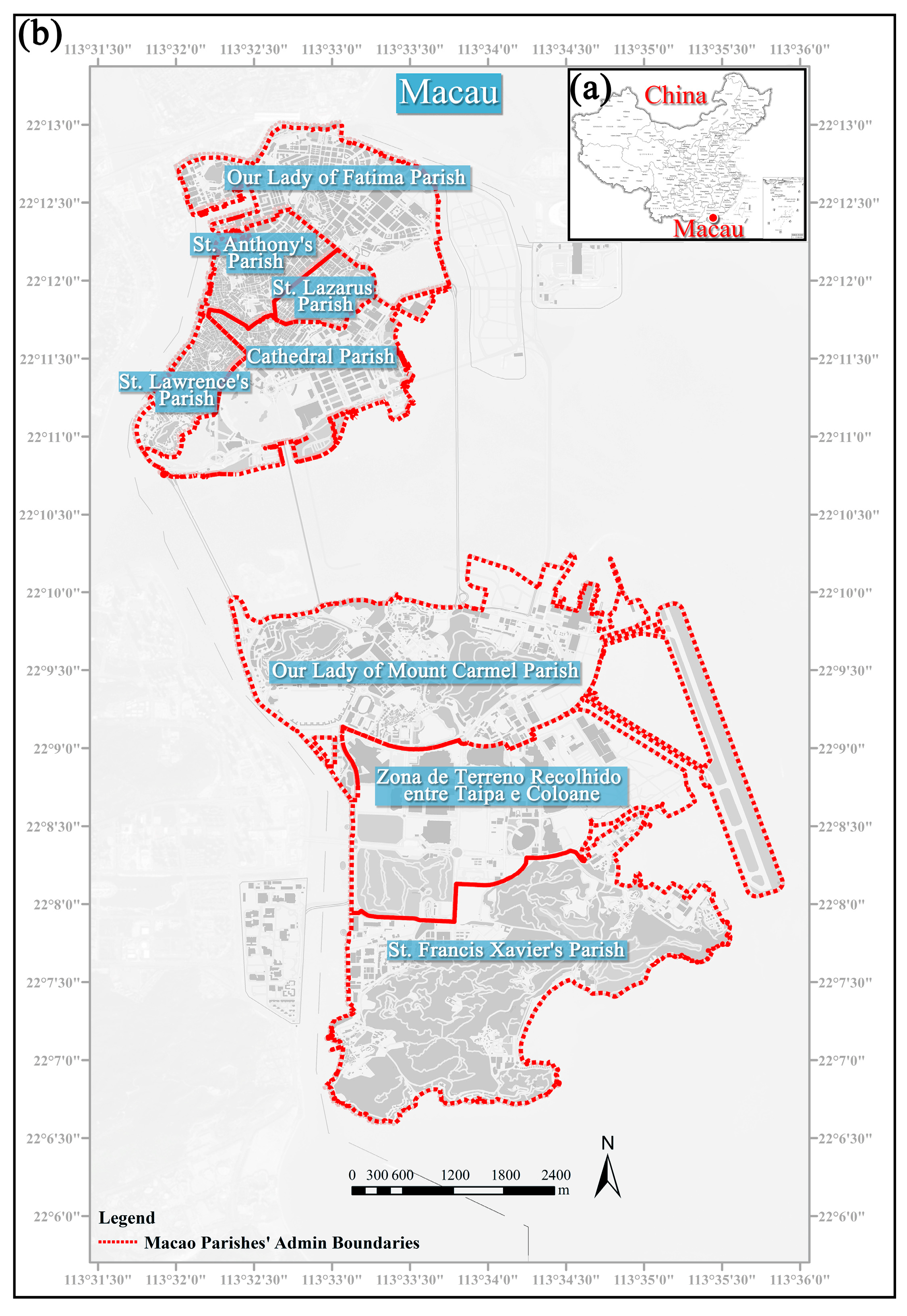
The Macau Special Administrative Region (SAR) is located on the west side of the Pearl River Estuary in southern China, at the confluence of land and sea routes between the Chinese Mainland and the South China Sea [49,50]. The Macau SAR consists of the Macau Peninsula, the islands of Taipa and Coloane, and the Cotai (Zona do Aterro de Cotai, a reclaimed area), comprising seven parishes (Freguesia) (Figure 1). The red dashed lines in the figure represent the administrative boundaries of the Macau parishes. Figure 1 also shows some gray areas on the east side of Macau without buildings. These are recently reclaimed areas that lack large-scale development and commercial shops. Therefore, they are not within the scope of this study. Located in the subtropical region, it has a maritime monsoon climate. The terrain of Macau is low-lying, sloping from south to north, with mountains and hills in the north and plains and plateaus in the south. The four pillars of Macau’s economy are export processing, gaming and tourism, financial services, and construction and real estate [51].

2.2. Research Method

This study focuses on the high-value-added specialty business of jewelry stores in Macau, integrating three techniques—POI kernel density analysis, Voronoi diagram decomposition, and space syntax—to construct a multi-dimensional spatial-analysis system. POI kernel density accurately captures the spatial-clustering intensity and core-area distribution characteristics of jewelry stores. Voronoi diagram decomposition quantifies the balance of service range and potential coverage blind spots for individual stores. Furthermore, space syntax analyzes the accessibility of tourism potential circulation characteristics and core-path characteristics, forming a mutually corroborating and progressively deepening analytical logic. This provides technical support for in-depth exploration of the coupling relationship between jewelry stores’ spatial clustering and tourism potential circulation characteristics.

2.2.1. POI Kernel Density Analysis

Points of interest (POIs) are geographic entity data carriers that can be abstracted into points in a geographic information system. They contain core information such as name, spatial coordinates, and type attributes, and can accurately represent the location and functional characteristics of real geographic elements such as jewelry stores [52,53]. Kernel density analysis is a spatial quantification method based on the first law of geography, which states that geographic entities that are closer together have a stronger correlation. Kernel density analysis calculates the weighted density value of point elements within a specific search range using kernel functions and constructs a continuous density surface to intuitively reveal the spatial clustering intensity and density pattern of elements [54,55]. The combination of these two methods has become a core technical path for identifying the clustering of urban commercial facilities and can provide key support for analyzing the spatial distribution patterns of jewelry stores in Macau and their coupling relationship with tourism potential circulation characteristics.
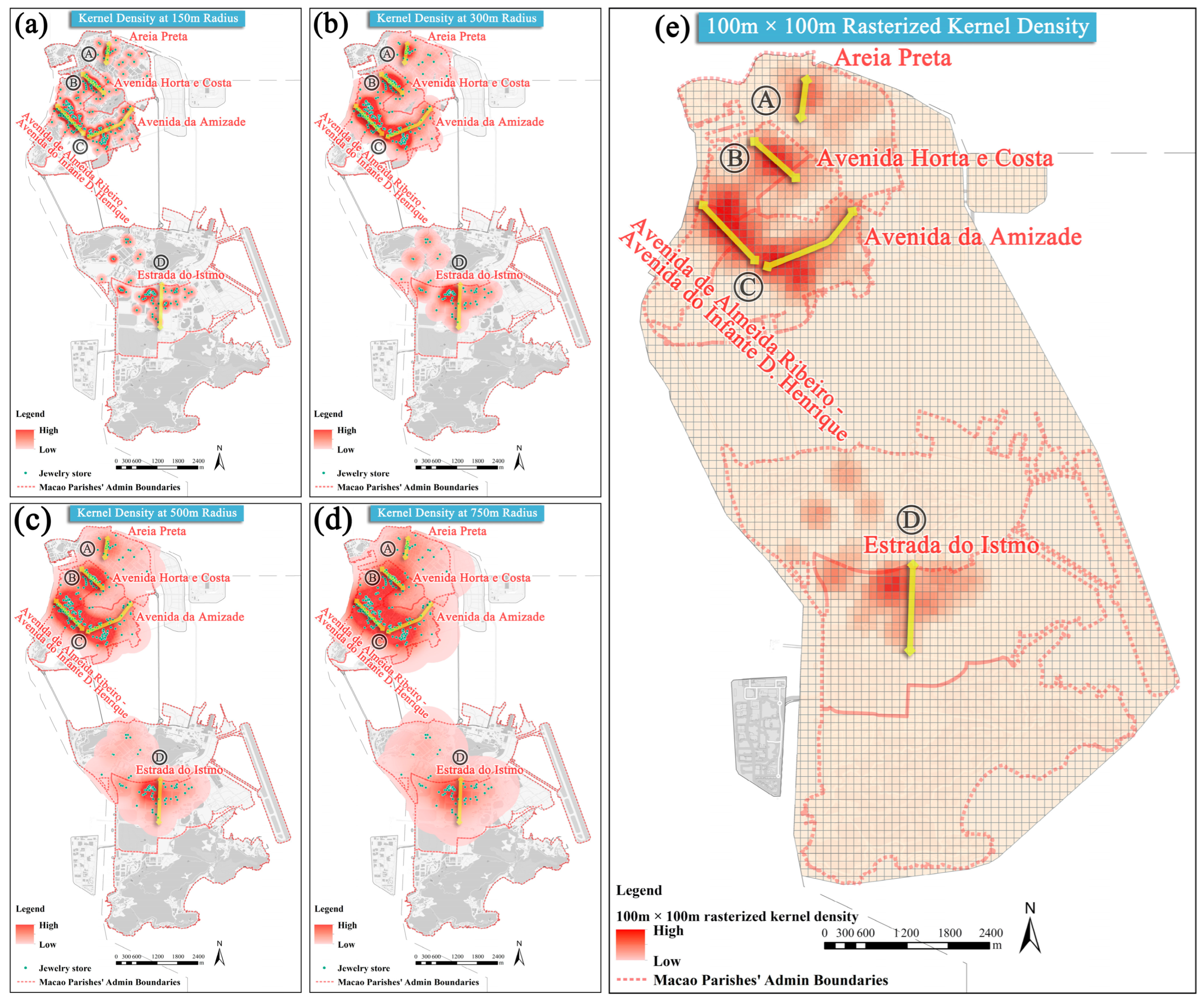
In this study, the kernel density analysis was performed using the kernel density analysis tool in the density toolset of the Spatial Analyst extension module of ArcMap 10.8. The parameter settings were combined with the optimization of the ultra-high-density urban fabric of Macau [51]: First, the input element was the jewelry store POI dataset, the population field was set to NONE, and the weight of a single POI point was 1 by default. Second, the output raster cell size was set to 10 m × 10 m. This size was based on the parameter selection experience of Wang Junjue et al. in the study of urban functional zoning. It can capture the clustering differences at the block scale and avoid data redundancy caused by too-small cells. Third, the search radius was set to 300 m. The parameter determination considered three factors, including the spatial scale of 9.3 km2 of the Macau Peninsula [56] and the 300 m normal walking range of tourists. The setting references the normal walking distance of people in the city (about 300–800 m in 5–10 min) considered by Huang, Y. et al. [51]. At the same time, referring to the optimization idea of the study area characteristics plus the multi-radius experiment proposed by Xue Bing et al., after comparing the analysis results of three radii of 300 m, 500 m, and 750 m, it was determined that 300 m can optimally capture the cluster core and avoid the ambiguity of the cluster signal or the fragmentation of the results [57]. Fourth, the output range is restricted by the Macau Special Administrative Region to define the calculation boundary and eliminate external regional interference.
The search radius is a core parameter for accurately characterizing the spatial-agglomeration characteristics of jewelry store points of interest (POIs) in kernel density estimation. In this study, multiple search radii of different scales (150 m, 300 m, 500 m, and 750 m) were tested (Section 3.1), and the discrepancies in density distribution results were systematically compared to determine the optimal analytical scale.

2.2.2. Voronoi Diagram

The spatial distribution of jewelry stores in Macau was divided using the Voronoi diagram method, and a spatial-segmentation system with each store as a control point was constructed. This clarified the service range and spatial influence domain of each store, providing a basic framework for quantitatively evaluating the spatial balance and clustering characteristics of store distribution. The core advantage of this method is that by ensuring that the distance from any point within the polygon to the corresponding control point is less than the distance to other control points, it can objectively reflect the radiation range of the store’s spatial influence, and the difference in polygon area can directly characterize the dispersion of store distribution [58].
The results of the Voronoi diagram subdivision also provide a key basis for identifying spatial optimization nodes [59]. For polygon areas with excessively large areas, the accessibility of tourists is poor due to the excessive service radius. It is necessary to improve the service coverage efficiency by adding small stores or optimizing the existing store layout. For dense areas with excessively small areas, there is a risk of excessive competition due to the large number of stores. Functional differentiation can achieve the rational allocation of spatial resources [60,61]. The application of this analysis method not only provides quantitative support for analyzing the coupling mechanism between the spatial agglomeration of jewelry stores and tourism potential circulation characteristics, but its results can also be corroborated by analysis methods such as space syntax, further enhancing the reliability and persuasiveness of the research conclusions.

2.2.3. Space Syntax

Space syntax is a theoretical and methodological system for quantitatively studying the relationship between spatial form and human activities. Its core lies in revealing the intrinsic relationship between spatial accessibility, mobility, and use vitality by analyzing the topological structure of spatial networks [62]. Since its inception, researchers have widely used this method to analyze urban street networks, building interior spaces, and commercial facility layouts. By transforming space into a system with topological relationships, it quantitatively calculates key indicators such as integration, choice, and depth, providing scientific support for interpreting the laws of spatial structure and human behavior [63,64].
In response to the spatial characteristics of Macau’s high-density urban fabric and the deep integration of “tourism and commerce”, this study uses the line segment model in space syntax for analysis; road network data provided by the Cartography and Cadastre Bureau of Macau was adopted for this study, which includes major streets and bridges but excludes indoor corridors. The road networks of the Macau Peninsula, Taipa and Cotai were modeled in a unified manner, with the administrative boundaries of the study area defined as the research boundary. This model takes the actual road distance and turning angle as the core calculation factors and has higher credibility and fits in the analysis of road networks in high-density urban areas [54]. During the analysis, space syntax models of the Macau Peninsula and Taipa Island were constructed using DepthmapX software (version 0.8.0), and three core indicators were extracted: integration degree, choice, and global depth. All calculations were implemented on the basis of a unified network, without the separation of individual subgraphs. Integration degree is used to measure the degree of aggregation or dispersion of space with other areas, reflecting the accessibility and centrality of tourist routes [54]. Choice characterizes a road’s potential to be chosen by pedestrians and can reveal the main paths of tourism potential circulation characteristics [65]. The global depth measures the minimum total distance between spatial nodes and other nodes, indicating the ease with which tourists can reach the target area [54]. Combining the spatial distribution of jewelry stores in Macau with the characteristics of tourist routes, the space syntax analysis focuses on the matching relationship between high-integration paths and jewelry store cluster areas. Referring to the research approach of Zhang Dayu et al. [66], the core path of tourist movement is identified by the integration index to verify whether there is spatial compatibility between high-integration areas and high-density clustering areas of jewelry stores. At the same time, drawing on the analytical logic of Lin Kefeng et al. [67] on the coupling of spatial cognition and movement, the degree of synergy between jewelry store layout and tourist behavior path is explored to provide a quantitative basis for analyzing the coupling mechanism between the two. In addition, considering the spatial differences in different areas of Macau (such as historical districts, modern business districts, and casino complexes), the coupling characteristics of jewelry store clustering and tourist movement under different spatial scales are analyzed by setting multi-scale search radii to adapt to the diverse commercial and tourism spatial forms of Macau [54].

2.3. Research Processing

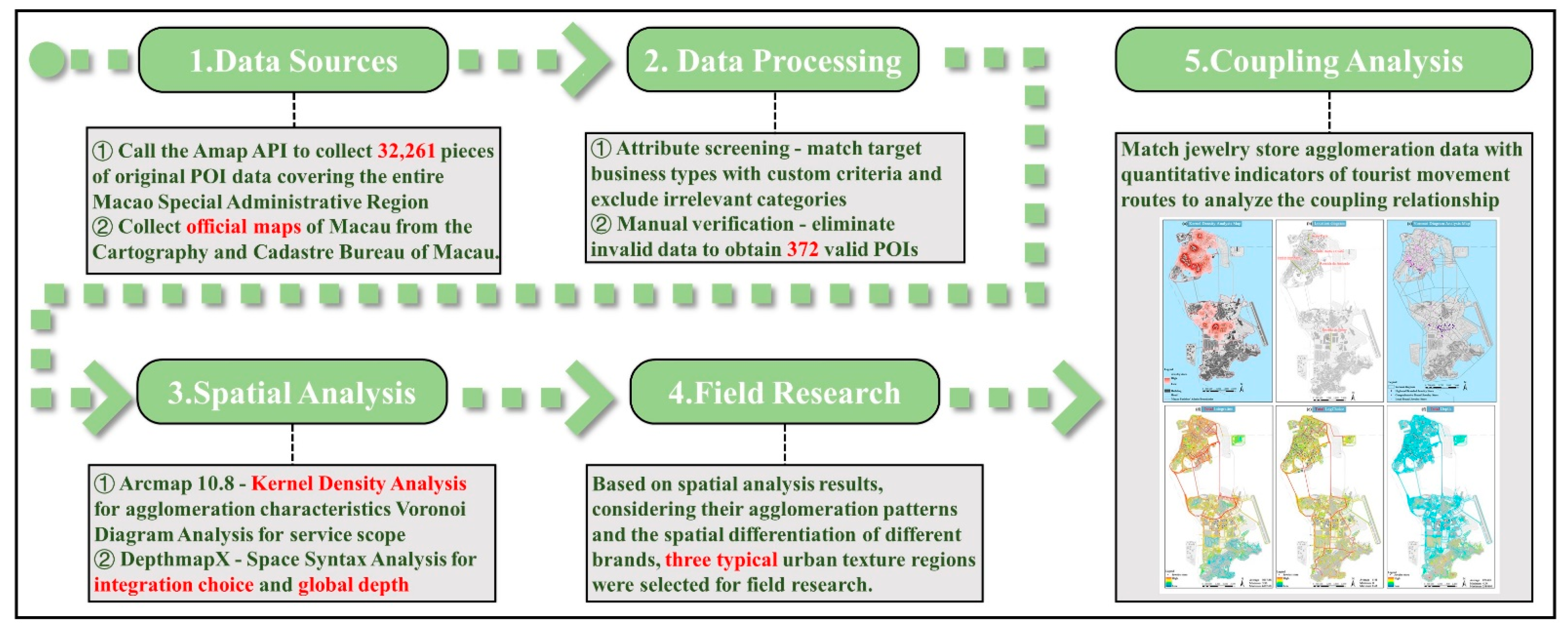
The research process of this study is shown in Figure 2. We constructed a dataset and analysis system through multi-channel data acquisition, multi-dimensional screening and verification, and professional software analysis, providing reliable data support for answering the core research questions. Specifically, the following methods were used to address the four questions raised in this study: First, POI kernel density analysis revealed the spatial-clustering intensity and core-area distribution of jewelry stores in Macau. Second, Voronoi diagram analysis quantified the balance of the service radius of jewelry stores and identified spatial-coverage blind spots. Third, space syntax analysis, using indicators such as integration and choice, analyzed the coupling relationship between potential tourist movement and jewelry store clustering areas. Fourth, field surveys explored the relationship between urban fabric, clustering patterns, and brand differentiation characteristics. Fifth, based on the analysis results, the clustering–movement coupling types in different areas were categorized, and their formation reasons were explored.

2.3.1. Data Sources

The core data for this study consists of POI data for jewelry stores in the Macau SAR in July 2025 and publicly available maps of Macau from the Macau Cartography and Cadastre Bureau. The jewelry store POI data was obtained using Python (version 3.13.0) to access the Amap (AutoNavi Software Co., Ltd., Beijing, China) Open Platform API (https://mobile.amap.com/cn/, accessed on 31 October 2025). This platform features short update cycles and high timeliness, covering core information such as the name, coordinates, and type attributes of geographic entities. It accurately represents the spatial location and functional characteristics of jewelry stores, providing high-quality basic data support for the research. A total of 32,261 original POI data points were obtained, covering the entire Macau area. All collected POI data were reprojected to the WGS84 coordinate system.

2.3.2. Data Processing

To accurately extract the target research objects, this study adopted a two-stage screening strategy of “attribute filtering + manual verification” for the POI data of jewelry stores in Macau. First, custom filtering conditions were entered into the data processing software. Jewelry-related locations were identified through the dual matching of name and type, while irrelevant types such as hardware, catering, companies, and residences were excluded, effectively eliminating interference from non-target data. After the attribute filtering initially narrowed the data range, manual screening was conducted to verify the location accuracy and business type authenticity of each location, eliminating invalid entries with location deviations, information errors, and those not belonging to jewelry stores. One record was retained if the coordinates were duplicates (with an error of ≤10 m) and the names were consistent. Ultimately, 372 valid jewelry store POI data were obtained, ensuring the accuracy and representativeness of the data.
To further improve the study’s empirical value and consider clustering differences from brand differentiation, this study classified the jewelry store POI data by brand type. The specific classification criteria are:
(1)
High-end brands: Luxury brands targeting high-net-worth individuals, including Cartier and Tiffany.
(2)
Comprehensive brands: Mainstream chain brands, including Chow Tai Fook and Chow Sang Sang.
(3)
Local brands: Macau-based brands that are neither mainstream chains nor high-end luxury brands.
For cross-boundary brands with mixed attributes, manual judgment was made based on store positioning. The final count of POI data was 38 for high-end brands, 34 for comprehensive brands, and 300 for local brands. Details of the screening rules and the complete brand list are provided in Appendix A.
For the Macau map collected from the Macau Cartography and Cadastre Bureau, including major streets and bridges, with indoor corridors excluded, to further refine the space syntax study, and considering that most tourists in Macau mainly travel on foot, this study selected 250 m, 500 m, 750 m, and 1500 m as the travel range for the spatial syntax part, which correspond to 5 min, 10 min, 15 min, and 30 min of walking time, respectively (Table 2).

2.3.3. Spatial Analysis

After the valid data was organized and standardized, spatial analysis and visualization were carried out using professional software. ArcMap 10.8 software was used for kernel density analysis and Voronoi diagram analysis. Kernel density analysis was used to reveal the spatial-clustering intensity and core-area distribution of jewelry stores, while Voronoi diagram analysis was used to clarify the service range of individual stores and the balance of spatial coverage.
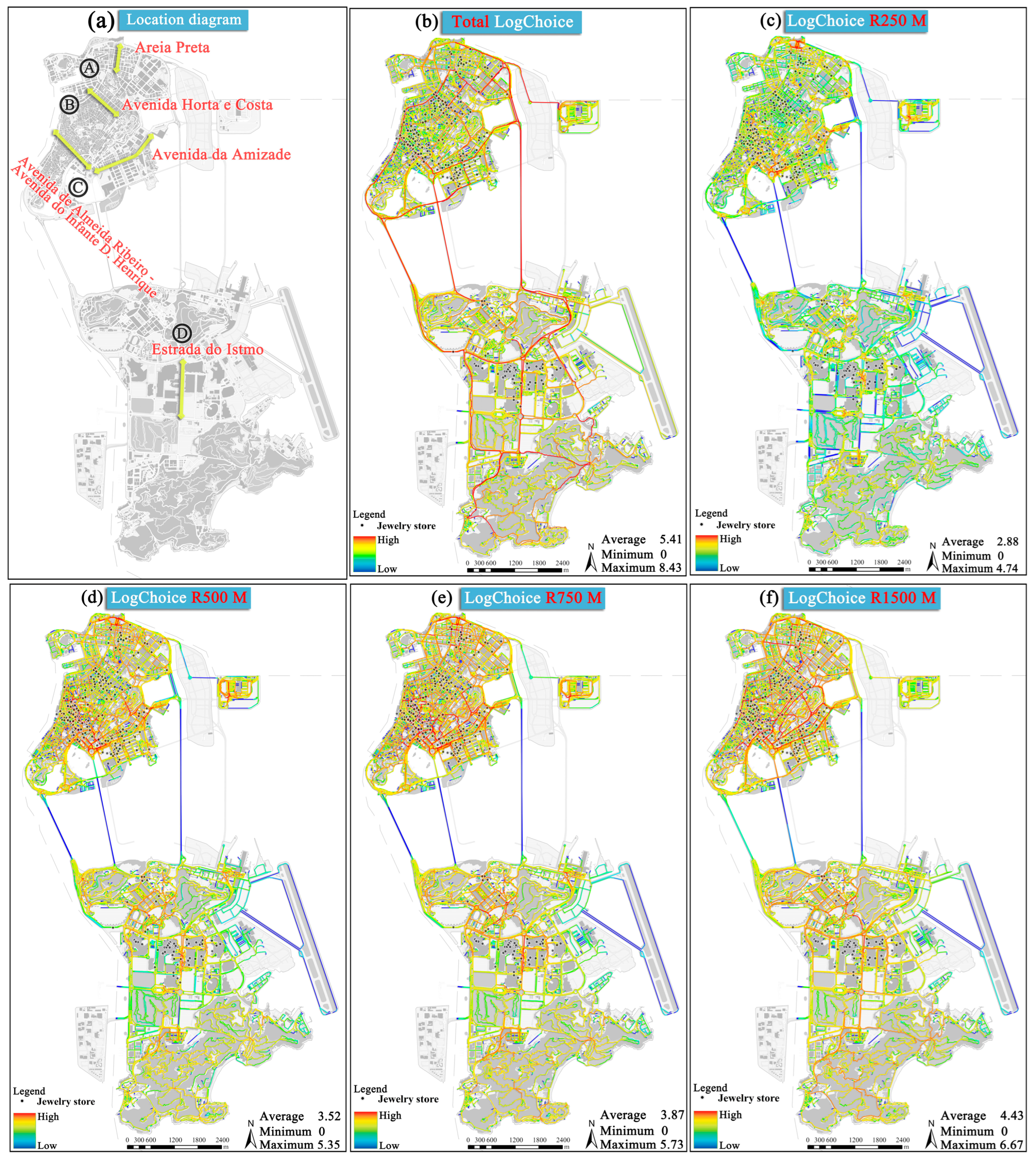
DepthmapX software was used to construct a spatial syntactic model, calculate core indicators such as integration, choice, and global depth, and quantitatively analyze the spatial characteristics of potential tourist movement routes, providing a quantitative basis for subsequent coupling analysis of clustering and movement. Furthermore, considering the actual urban spatial situation in Macau, this study employs log choice in the choice analysis to reduce the impact of excessively large differences between the maximum and minimum values, making the experimental data closer to a normal distribution. The formula is as follows:
f ( L o g C h o i c e ) = l o g ( n + 1 )
where f ( L o g C h o i c e ) is the log choice value after logarithmic calculation, n is the depth map value of the choice, and ( n + 1 ) is used to avoid the meaninglessness of l o g 0 when n is 0, and the deviation of the actual result can be ignored.

2.3.4. Field Research

Based on the spatial analysis results and combined with the analysis of its agglomeration pattern and the spatial differentiation characteristics of different brands, three types of areas with typical urban fabrics were selected for field research. The research focused on the spatial layout characteristics, store display styles, and brand type distribution of each area. Through on-site observation and recording, the accuracy of the spatial analysis results was verified, providing empirical support for subsequent coupling relationship analysis.

2.3.5. Coupling Analysis

The coupling analysis focuses on jewelry store clustering data and quantitative indicators of tourist movement. Clustering data for jewelry stores includes clustering intensity and core-area distribution derived from kernel density analysis, as well as information on service coverage balance, spatial-coverage blind spots, and brand distribution differences obtained from Voronoi diagram analysis. Tourist movement quantitative indicators include core parameters such as integration degree, choice, and global depth calculated from space syntax analysis. By systematically matching the two types of data, a correspondence between clustering characteristics and movement indicators is established. From dimensions such as spatial fit, service accessibility, and competitive matching degree, the coupling relationship between the spatial clustering of jewelry stores and tourist movement in Macau is comprehensively analyzed, clarifying the coupling types and formation mechanisms in different areas.
In summary, this study employs a synergistic analysis of various techniques, including POI kernel density, Voronoi diagram analysis, and space syntax, to hierarchically examine the spatial distribution patterns, service coverage disparities, and interaction characteristics related to tourism potential circulation characteristics in Macau’s jewelry stores. From identifying the core areas of the clustering pattern to assessing the balance of service radius and verifying the matching degree between tourism potential circulation characteristics and high-density jewelry store areas, the system systematically presents the key characteristics and regional differences of their coupling, laying an empirical foundation for subsequent exploration of the coupling mechanism and the proposal of spatial optimization strategies.

3. Results

3.1. Spatial Clustering Characteristics of Jewelry Stores

Overall Kernel Density Analysis

To determine the optimal search radius for kernel density estimation, sensitivity analysis was conducted for four radii, namely 150 m, 300 m, 500 m and 750 m. The 150 m radius resulted in a fragmented pattern that failed to capture the overall agglomeration along tourist routes, while the 500 m and 750 m radii caused over-smoothing and blurred the boundaries of agglomeration areas. The 300 m radius was selected as the optimal scale, which aligns with the 5 min walking range of tourists and balances the detail of local agglomeration and the integrity of the overall spatial pattern (Figure 3).
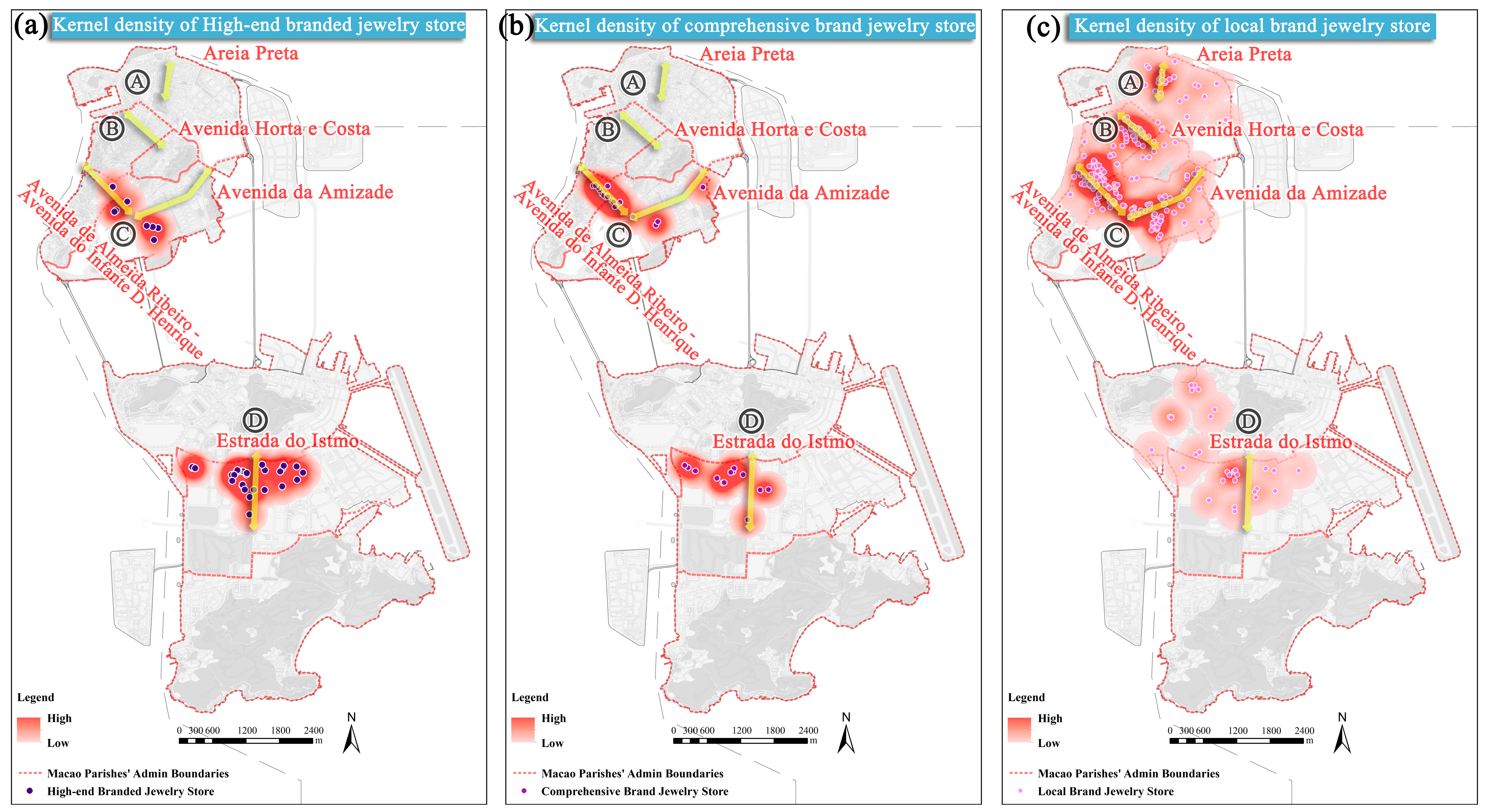
Based on the optimal kernel density results, jewelry stores in Macau present a significant dual-segment, four-core clustering pattern: the Macau Peninsula and Taipa Island form two major agglomeration blocks, which are further divided into four core areas, marked as A to D. In terms of brand stratification, high-end brands are highly concentrated in casino complexes in Estrada do Istmo Area D and a small area near casinos in Area C; comprehensive brands are evenly distributed in core tourist areas and residential districts; local brands are mainly scattered in the residential areas of the Macau Peninsula covering Area A and Area B (Figure 4).

3.2. Field Survey Based on Kernel Density Results

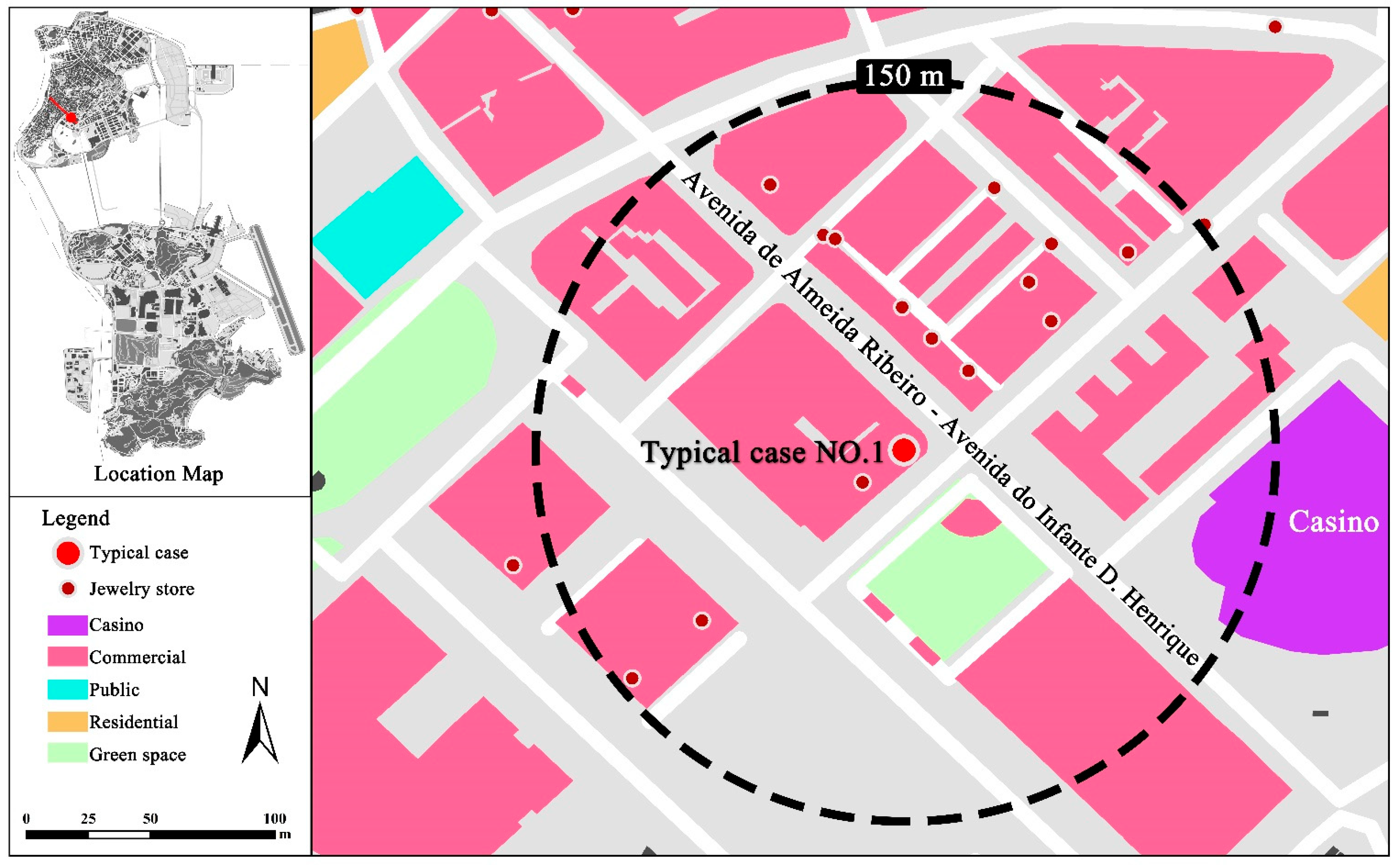
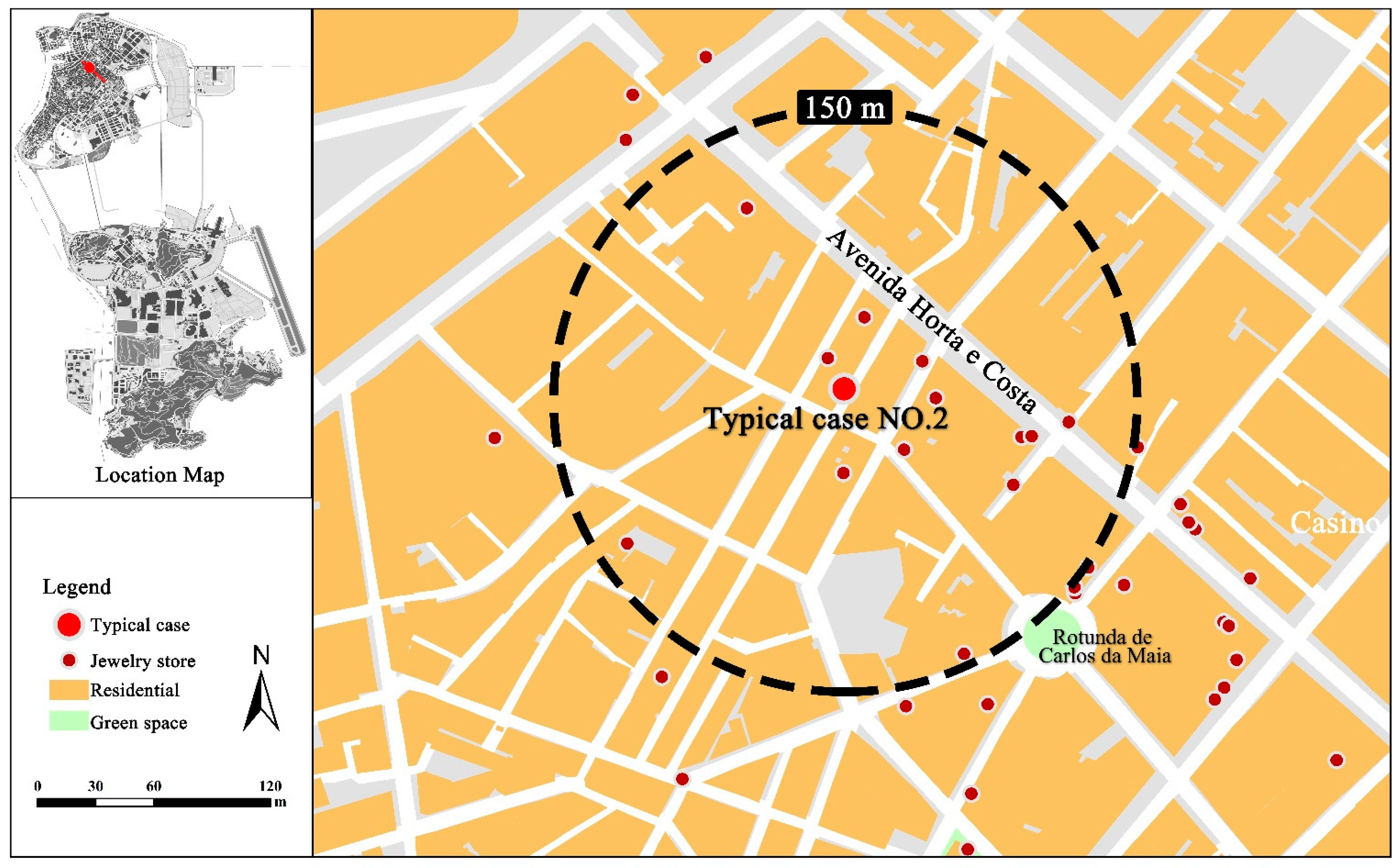
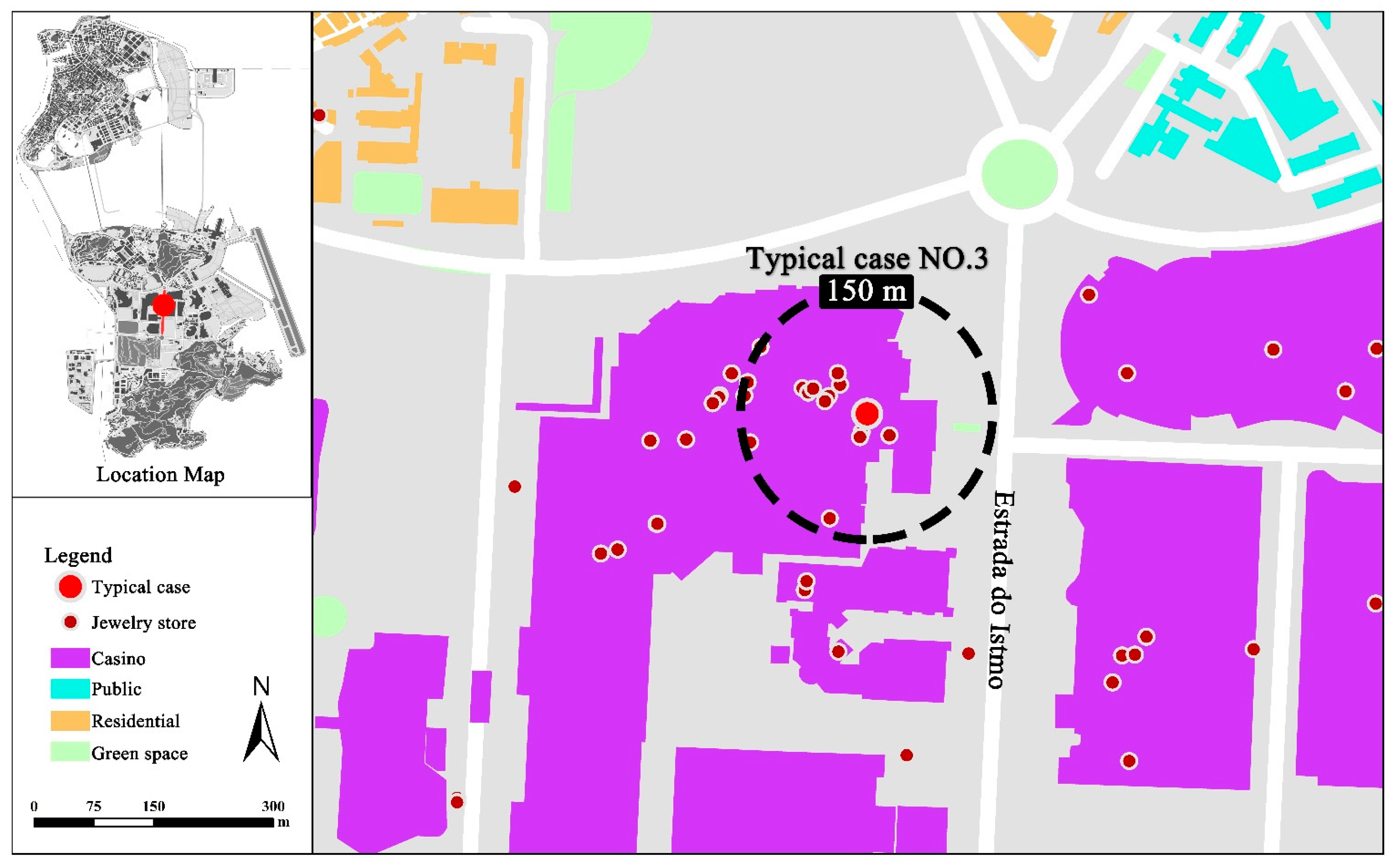
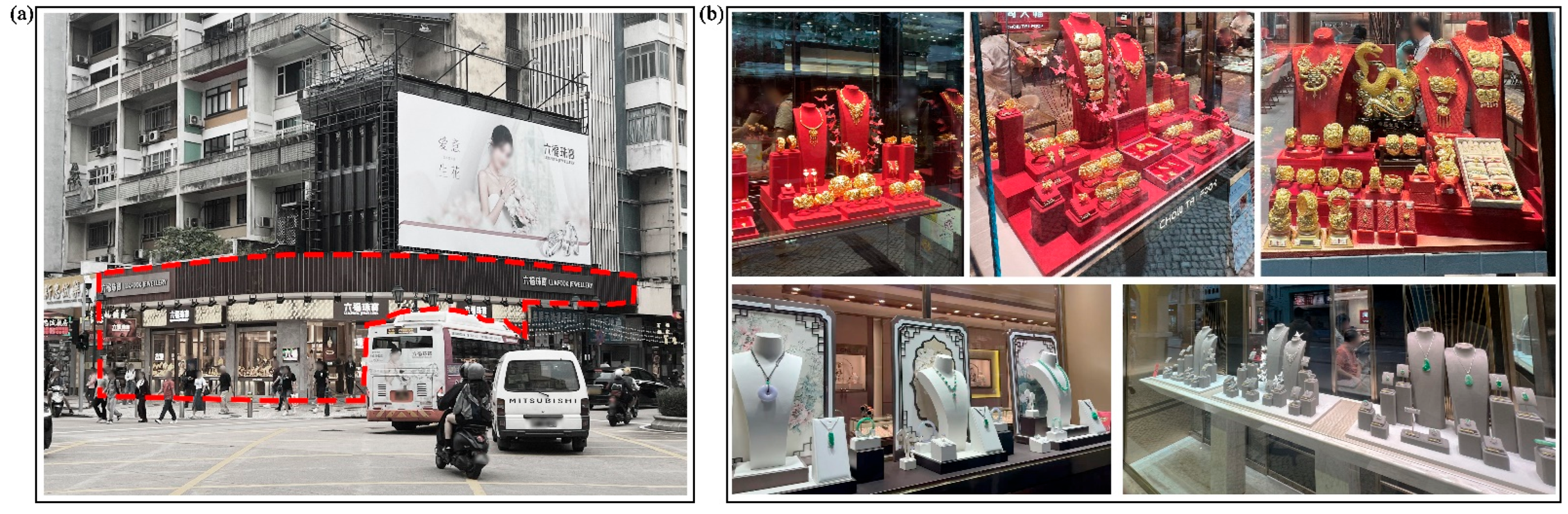
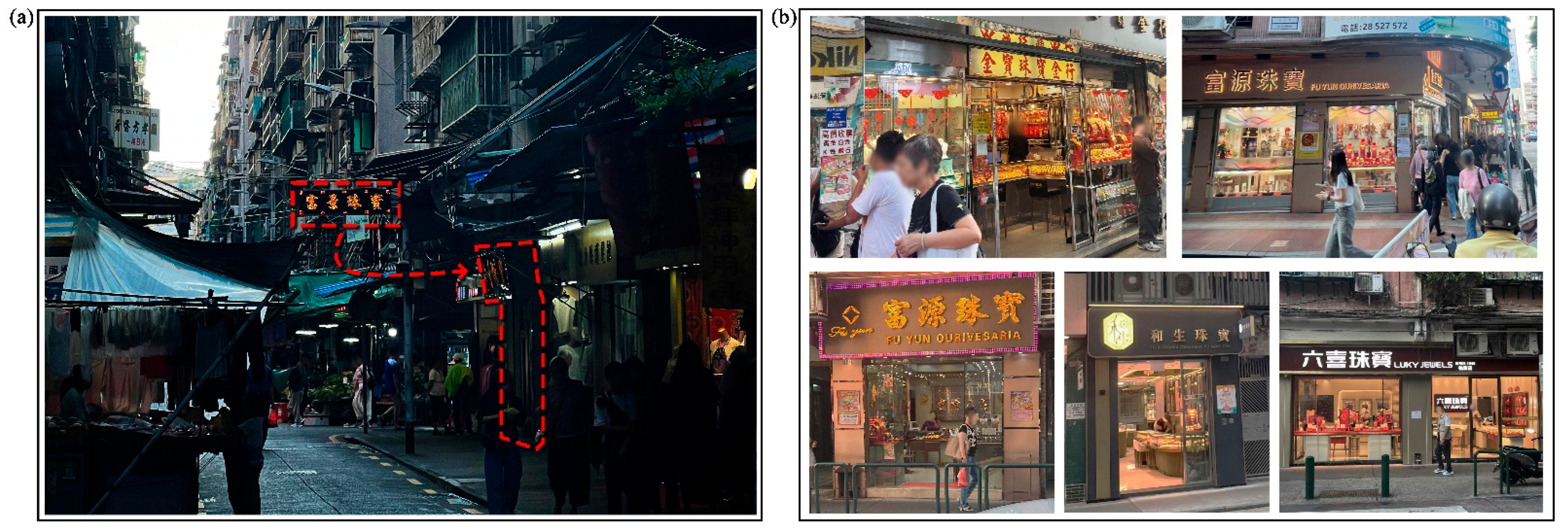
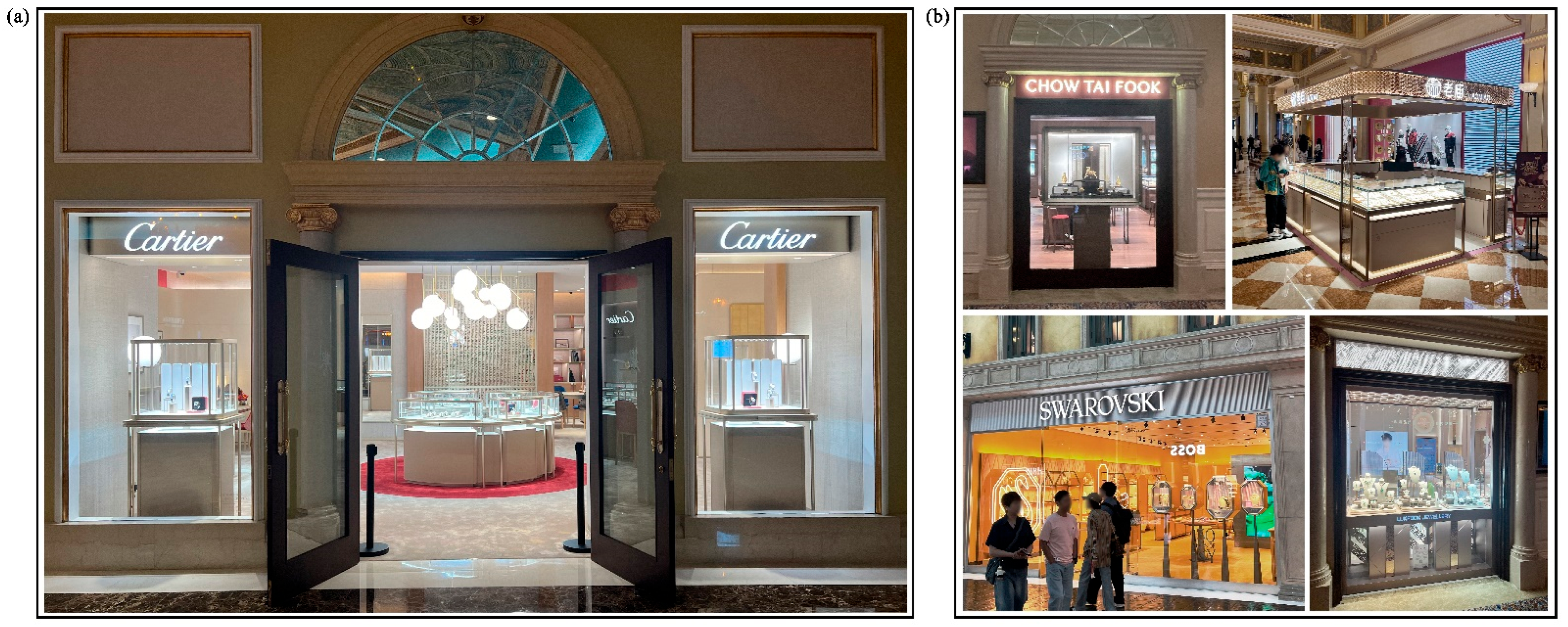
Field surveys were conducted for three typical areas corresponding to the kernel density clustering pattern, to verify the accuracy of spatial analysis results and supplement the scenario characteristics of different brand types. First is the outdoor pedestrian street in Area C covering Avenida de Almeida Ribeiro. This area serves as the core zone for comprehensive and local brands, with intensive store layout and fierce competition, mainly serving transit tourists (Figure 5). Second is the residential mixed area in Areas A and B covering Avenida de Horta e Costa. This area is dominated by local brands, with stores divided into tourist-oriented street shops and resident-oriented alley shops (Figure 6). Third is the casino complex in Area D covering Estrada do Istmo. This area is the core agglomeration zone of high-end brands, with luxurious spatial design to match the consumption scenarios of high-net-worth tourists (Figure 7). Field photos and detailed case information are shown in Appendix B.

3.3. Service Radius and Spatial Coverage

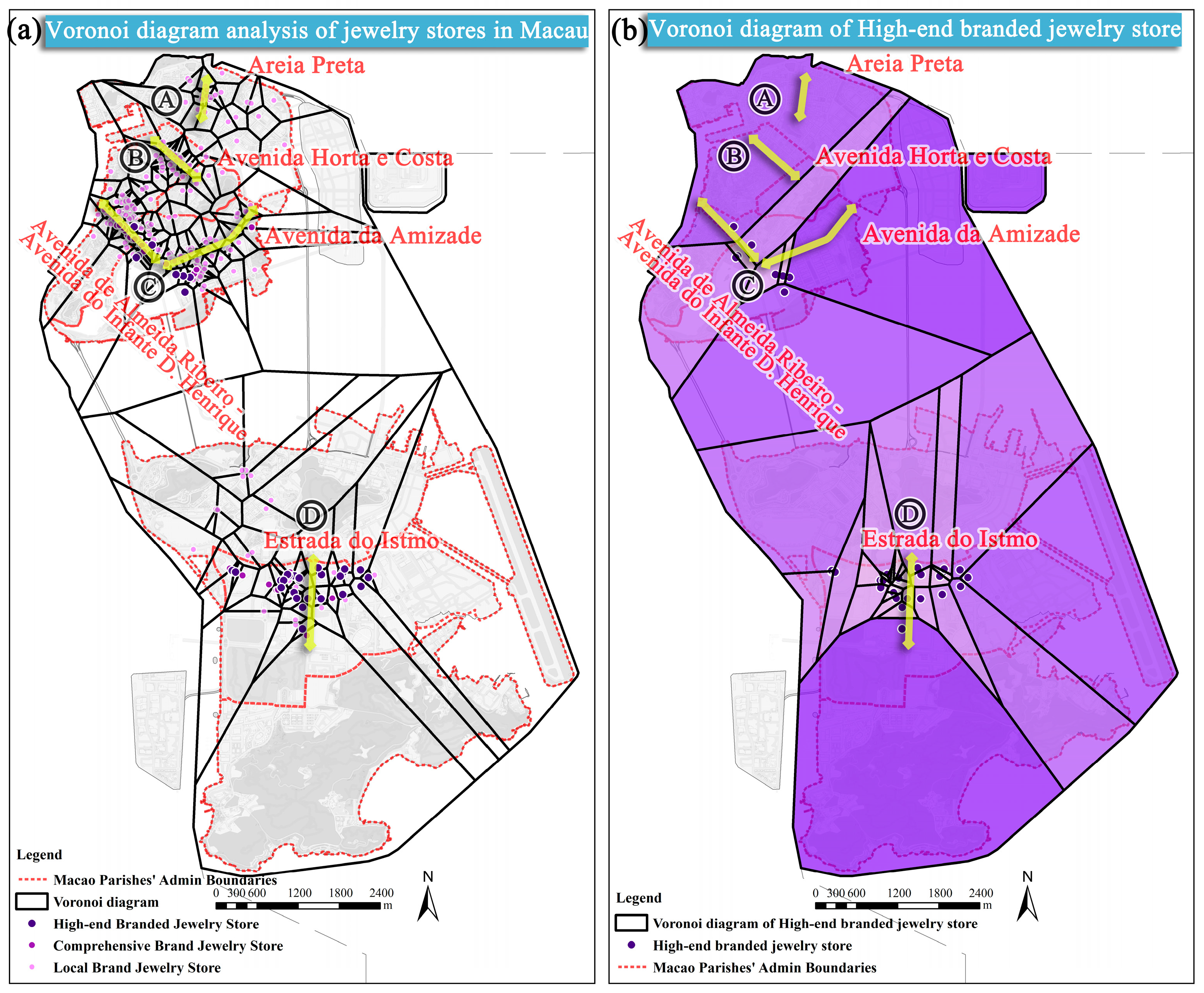
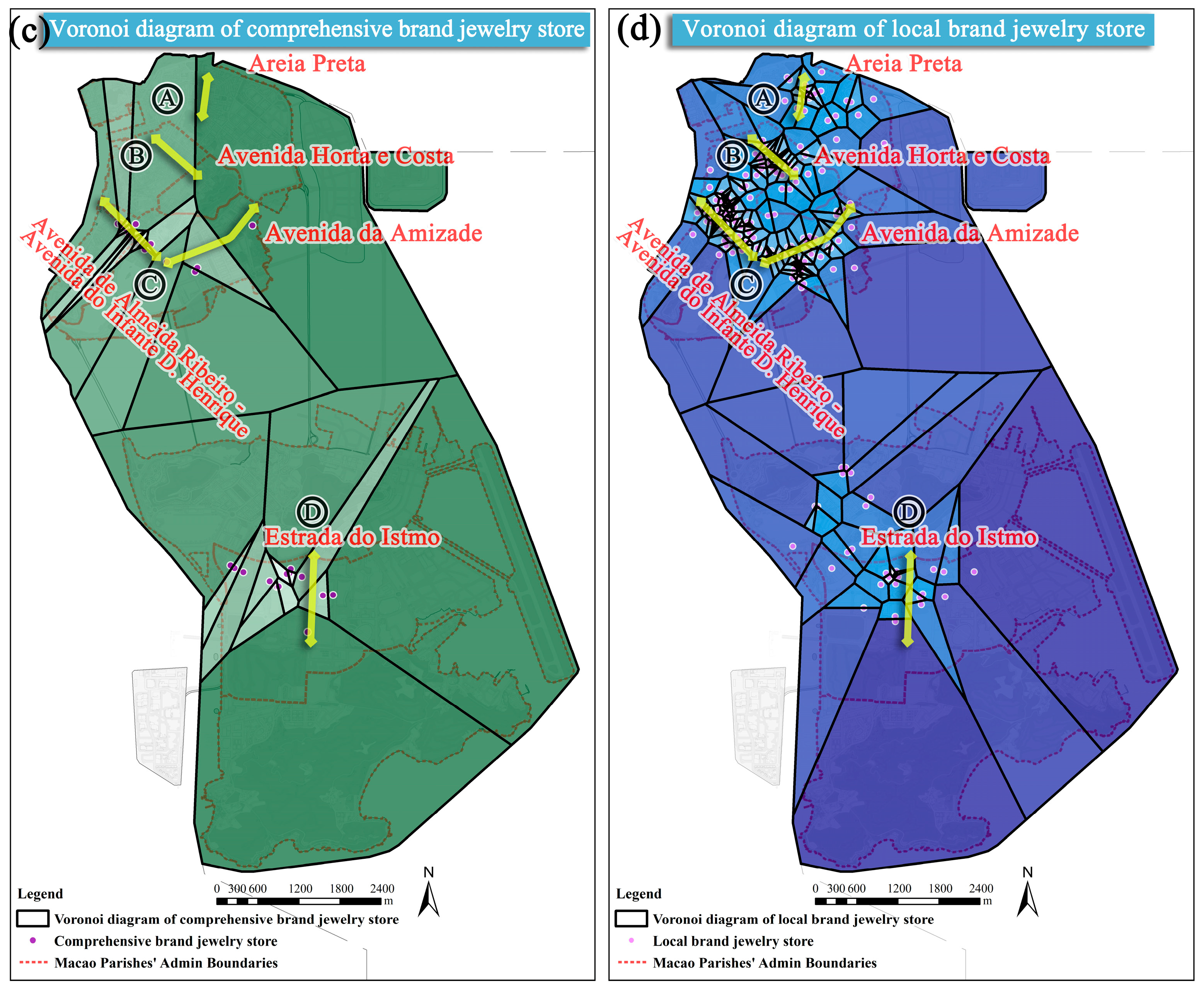
Voronoi diagram analysis shows that the theoretical service scope of jewelry stores is significantly negatively correlated with agglomeration density. The Voronoi polygon area in the four core agglomeration areas is smaller than that in non-core areas, with severe service overlap and intense market competition. In contrast, non-core areas have service coverage blind spots (Figure 8).
Significant differences exist between the three brand types. High-end brands have the highest service overlap rate in casino complexes, with almost no coverage in non-core areas, resulting in the largest service blind spots. Comprehensive brands have moderate service overlap and better spatial continuity between core areas and residential districts. Local brands have the widest coverage and the smallest service blind spots and are mainly concentrated in the residential areas of the Macau Peninsula.

3.4. Space Syntax Analysis of Tourist Circulation

3.4.1. Integration Analysis

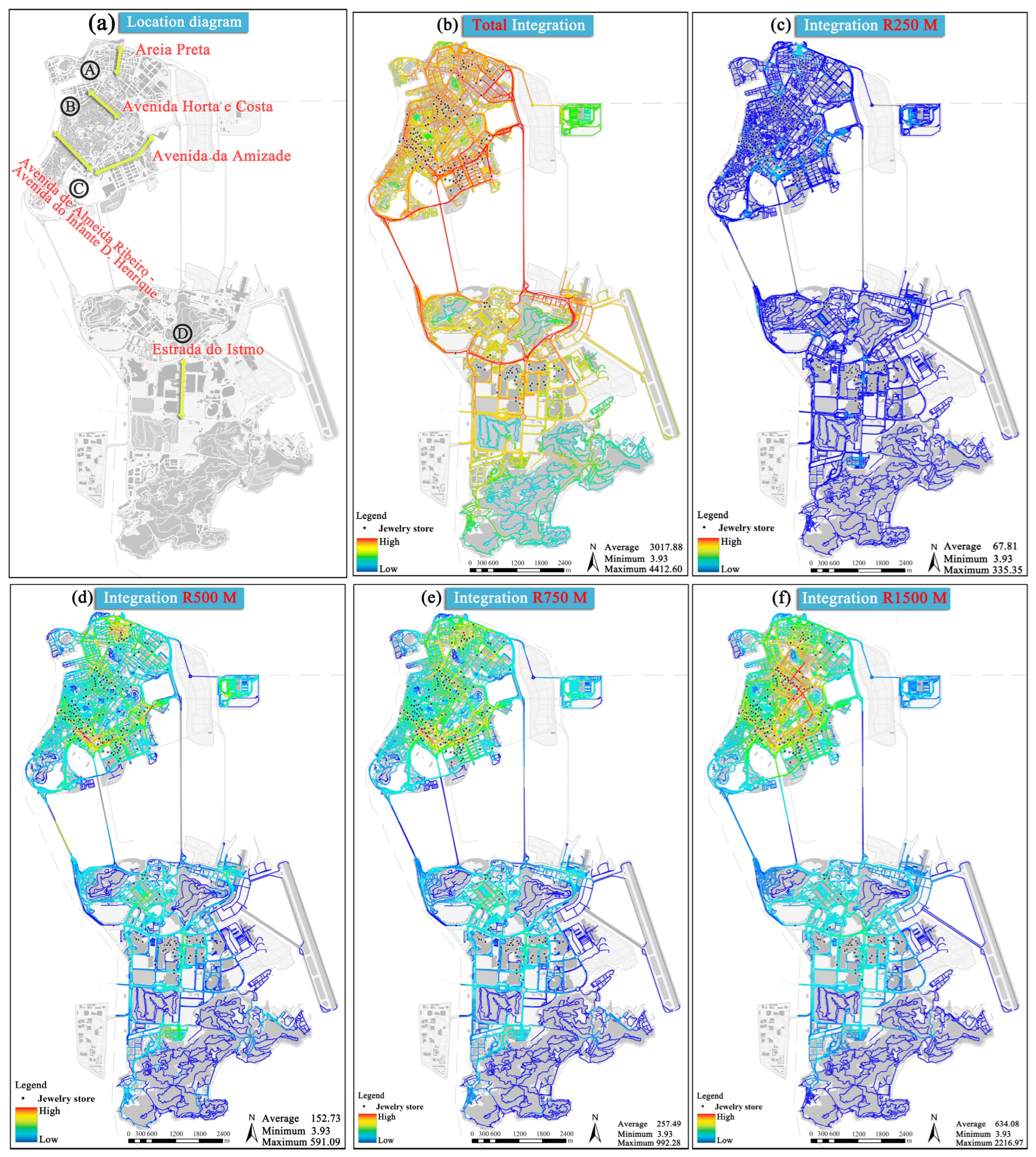
Macau’s overall spatial integration presents a dual-core secondary-zone pattern, highly consistent with the clustering pattern of jewelry stores (Figure 9). The integration level shows dynamic changes along with the expansion of the walking radius. Within the short-to-medium distance of 250 to 750 m, Areas C and D maintain high integration as hubs for immediate tourist spending. At the 1500 m long distance, Areas A and B achieve the highest integration. This dynamic differentiation precisely caters to the customer positioning of different jewelry brands.

3.4.2. Choice Analysis

The high-value areas of log choice across Macau are highly consistent with the two-sector four-node clustering pattern of jewelry stores (Figure 10). The log choice shows a trend of core extension and balanced improvement as the walking radius expands. Within a short radius, Areas C and D are the core high-value zones. As the radius increases, the log choice values of Areas A and B rise significantly. This dynamic change precisely caters to the customer positioning of different jewelry brands.

3.4.3. Global Depth Analysis

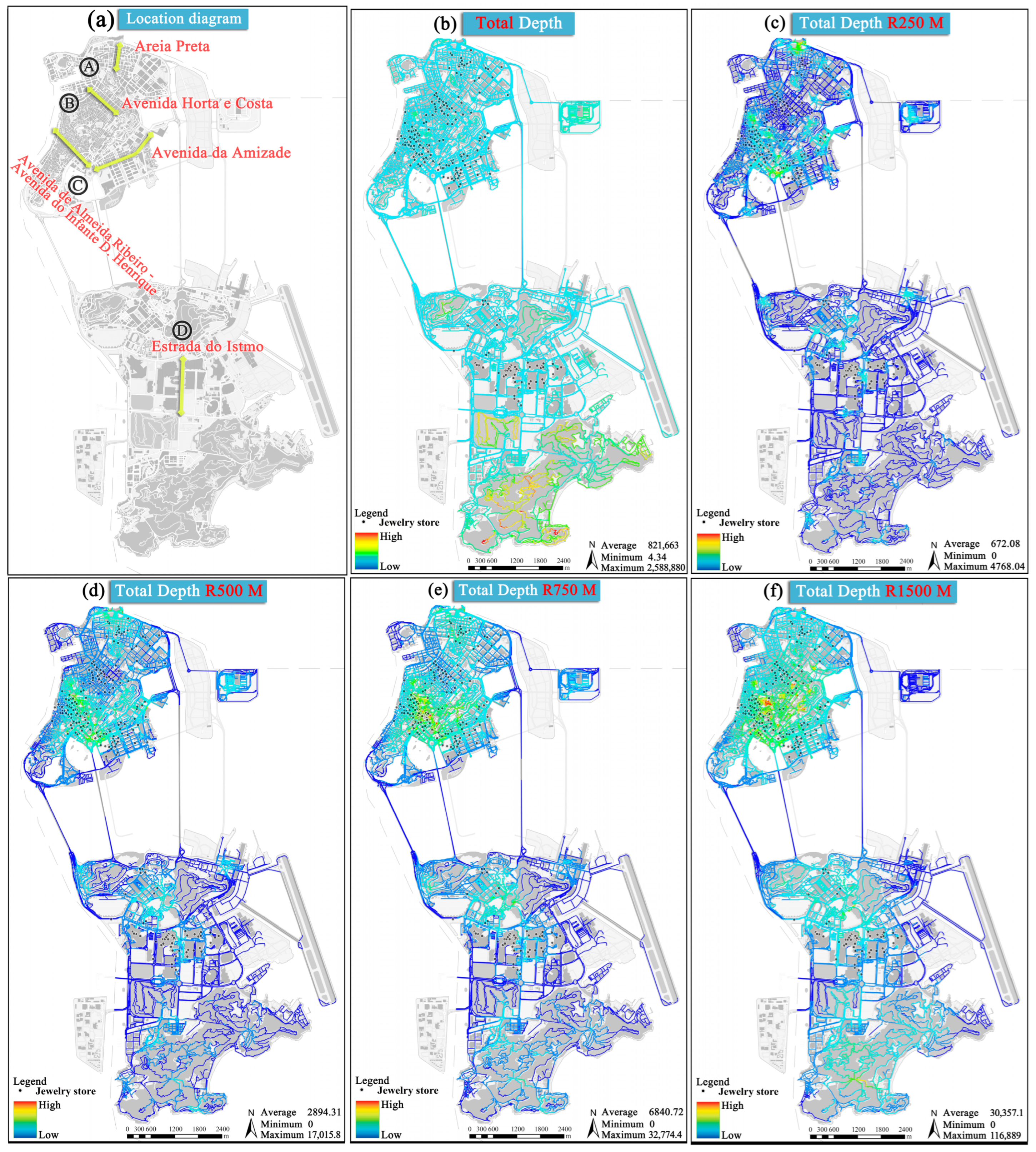
Macau’s overall global depth is relatively low. The four core areas, A, B, C and D, with concentrated jewelry stores have low depth values and favorable accessibility, while only the southern part of Taipa Island has high depth and poor accessibility (Figure 11). The depth value and accessibility of the four core areas adjust dynamically with the expansion of the walking radius. Areas A and B show better accessibility than C and D at short distances, and their accessibility surpasses C and D at the 1500 m radius.

3.5. Coupling Between Jewelry Store Spatial Clustering and Tourist Flow

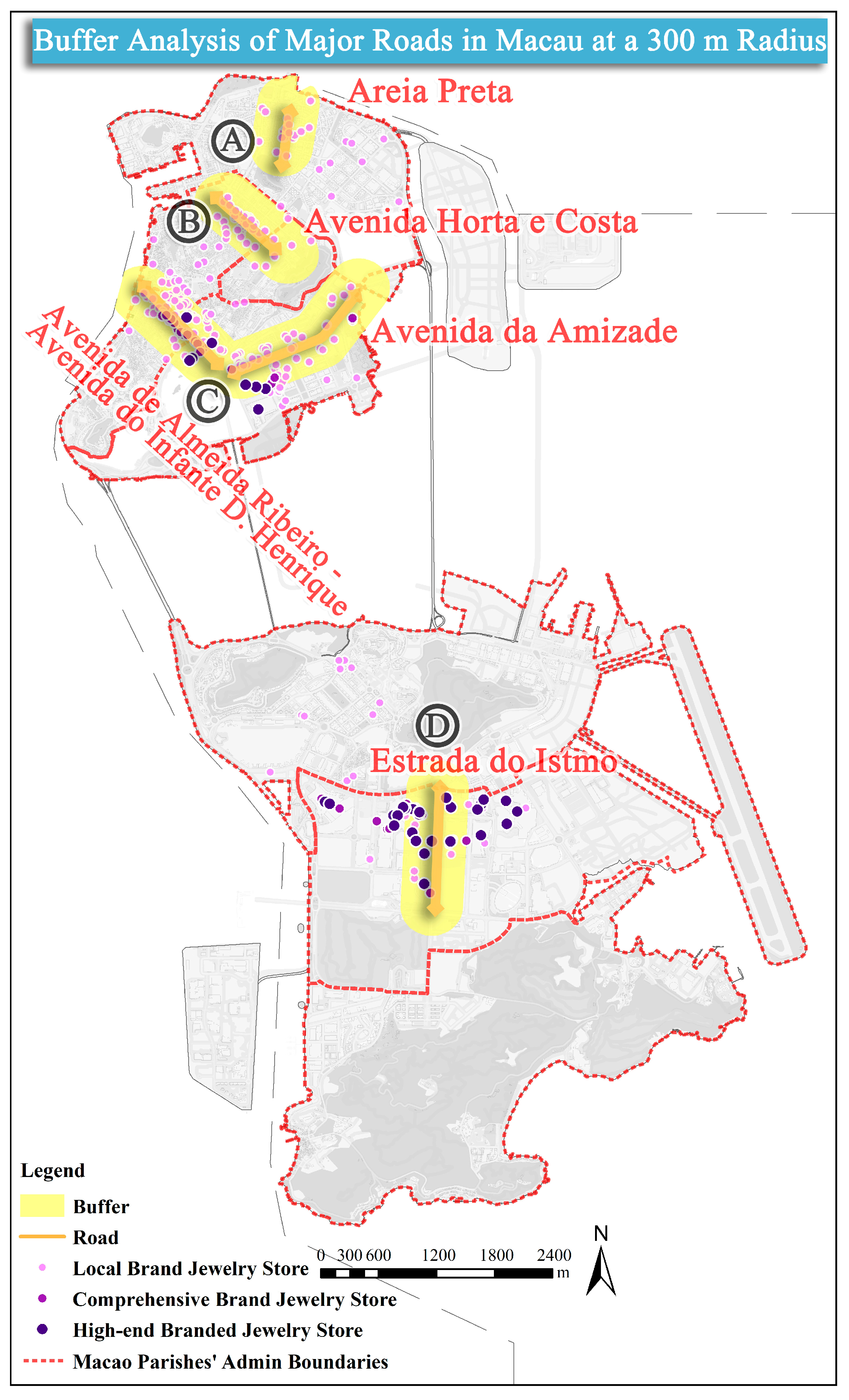
To quantify the coupling relationship between jewelry store agglomeration and tourism potential circulation, this study conducted a 300 m buffer analysis on the core tourist paths with high integration. The results show that 72.19% of jewelry stores, 270 out of the total 372 samples, are distributed within the buffer zone, and there are significant distribution differences among different brands. High-end brands are concentrated in the buffer zone of Estrada do Istmo in Area D, comprehensive brands are mainly distributed in the buffer zone of Avenida de Almeida Ribeiro in Area C, and local brands are concentrated in the buffer zones of main roads in residential areas of Area A and Area B (Table 3, Figure 12).
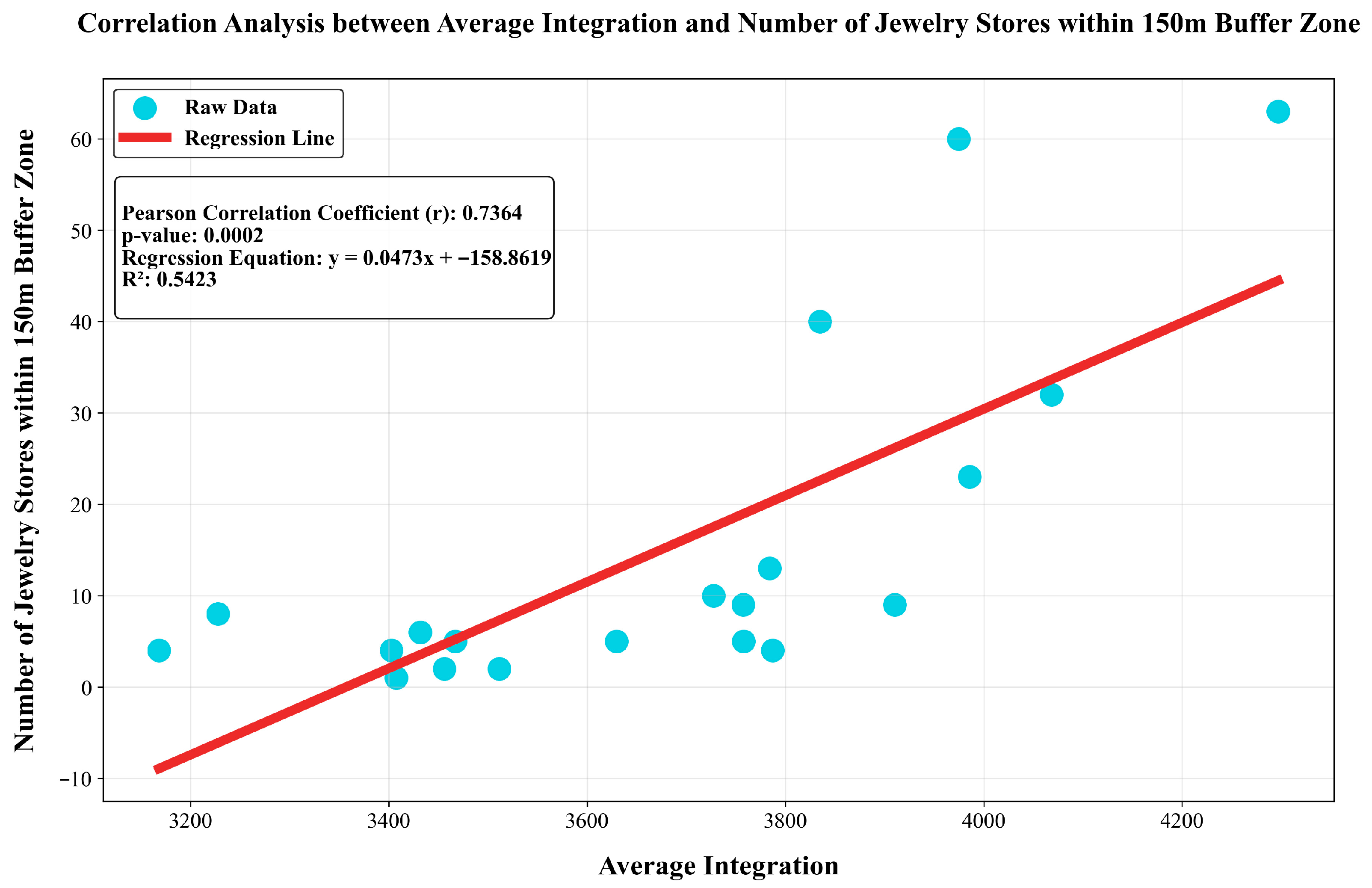
The results of Pearson correlation analysis show that there is a significant strong positive linear correlation between the average integration of roads and the density of jewelry stores, with a correlation coefficient of 0.7364 and a p-value less than 0.001. The detailed information of each selected road can be found in Appendix C and Appendix D. This result quantitatively verifies that tourism potential circulation has an extremely strong driving effect on the spatial layout of jewelry stores (Figure 13). Combined with the characteristics of agglomeration, service scope and accessibility, the four core areas have formed the following four types of differentiated coupling modes:
The first type is Area A, which presents the characteristics of low agglomeration, medium integration and low competition, and is suitable for the community service-oriented layout of local brands.
The second type is Area B, which presents the characteristics of medium agglomeration, medium integration and medium competition, and serves both local residents and overflow tourists.
The third type is Area C, which presents the characteristics of high agglomeration, high integration and strong competition, and belongs to a multi-brand mixed tourist business district.
The fourth type is Area D, which presents the characteristics of medium agglomeration, high choice and high competition, and forms high-end brand agglomeration relying on casino complexes.

4. Discussion

4.1. Theoretical Dialogue with Existing Research

This study breaks through three key limitations of existing research. First, most studies focus on general laws of urban commercial agglomeration [28,29,30], and Macau-related research is limited to traditional commercial district patterns [31,32]. This study takes high-value jewelry retail as the research object, reveals the agglomeration and hierarchical differentiation laws of tourism-oriented characteristic commerce, and fills the research gap on the coupling between high-value specialty business and tourism potential circulation. Second, existing studies mostly use single or simple combined methods with dimensional limitations [34,35,37]: kernel density captures agglomeration intensity but not service blind areas [34,42], Voronoi diagram identifies coverage gaps but not cross-regional brand attraction [35,36], and space syntax explains accessibility but not the link between agglomeration and service scope [37,42]. This study constructs an integrated three-method framework to form a closed-loop response to core scientific questions, improving the GIS analysis system for tourism–commerce coupling. Third, existing studies focus on residents’ travel matching [44,47] or block internal movement organization [46,47], rarely focusing on tourists and tourism-oriented commerce. This study shifts the focus to tourists, explores the adaptation logic between different brand levels of jewelry stores and tourism potential circulation, and provides a new perspective for commercial hierarchical layout in tourism cities. The negative correlation between service scope and agglomeration density revealed is consistent with central place theory, with more significant performance in tourism-driven high-value commerce [35].

4.2. Coupling Mechanism Interpretation

The differentiated coupling types in Macau are driven by the synergistic effect of spatial structure, industrial attributes and tourist behavior. For strong-coupling regions, the high consistency between jewelry store layout and high-integration paths is the core basis [37]. Macau’s gaming–tourism dual-core model endows these regions with continuous high-end consumption flow, and brand agglomeration forms a scale effect, while Macau’s compact urban texture further strengthens the positive cycle between brand and passenger flow agglomeration [51]. For weak-coupling regions, unbalanced spatial layout, insufficient passenger flow connection and superficial industrial integration jointly lead to low coupling strength.

4.3. Universal Applicability and Optimization Strategies

The analytical framework and findings have strong universal applicability for characteristic commerce planning in high-density tourist cities, and can be directly applied to other tourism-driven formats. For Macau’s practical optimization, three targeted strategies are proposed: first, spatial layout optimization, drawing on core–subordinate agglomeration experience [43], guiding over-concentrated high-end brands to extend to secondary tourism areas, and adding local-brand stores in service blind spots to increase coverage to over 85%; second, traffic connection strengthening, drawing on commercial pedestrian street design logic [47], taking high-integration paths as the core to build a continuous tourism circulation network and improve store accessibility; third, industrial synergy deepening, drawing on the production–living–ecological space development concept [68], and integrating jewelry consumption scenarios into tourism route planning to improve consumption conversion rate.

4.4. Limitations and Future Research

This study has three main limitations: static analysis based on cross-sectional POI data, with a lack of dynamic store operation and tourism flow data; a Voronoi diagram constructed by Euclidean distance, without fully considering actual obstacles of Macau’s pedestrian network; and insufficient consideration of tourist individual characteristics and external industrial policies. Future research will supplement dynamic data to explore the dynamic evolution of the coupling relationship, optimize service scope measurement methods, combine operation and survey data to propose precise optimization strategies, and extend the analytical framework to other commercial formats in different tourist cities.

5. Conclusions

This study integrates POI kernel density analysis, Voronoi diagram analysis and space syntax analysis to construct a three-dimensional analytical framework, and systematically reveals the spatial agglomeration pattern of Macau jewelry stores and its coupling mechanism with tourism potential circulation.

5.1. Core Research Findings

First, jewelry stores in Macau present a significant dual-segment, four-core clustering pattern, with obvious hierarchical differentiation among high-end, comprehensive and local brands. Second, the theoretical service scope of jewelry stores is significantly negatively correlated with agglomeration density, with severe service overlapping in core areas and obvious coverage blind spots in non-core areas, and significant differences among different brands. Third, there is a strong positive linear correlation between road average integration and jewelry store density, verifying the strong driving effect of tourism potential circulation on store layout, and the four core areas form four differentiated coupling types based on dynamic accessibility differences under different walking radii.

5.2. Research Contributions

Methodologically, this study integrates three quantitative approaches to break through the limitations of single methods, providing a referenceable technical path for tourism–commerce collaborative research in high-density tourist destinations. Analytically, it introduces a brand stratification perspective, breaking the limitation of neglecting brand heterogeneity in previous studies, and deepening the understanding of the characteristic commerce agglomeration mechanism in tourism cities. Theoretically, it enriches the urban commercial spatial-structure theory and expands the commerce–tourism synergy theory in tourist cities.

5.3. Future Research Outlook

Future research will introduce time-series data to explore the dynamic evolution of the coupling relationship, optimize the service scope measurement method based on Macau’s actual pedestrian network, combine store operation and tourist survey data to propose precise industry optimization strategies, and extend the analytical framework to other tourism-driven commercial formats to test the universality of the research conclusions.

Author Contributions

Conceptualization, Jingwei Liang, Liang Zheng and Yile Chen; methodology, Jingwei Liang; software, Jingwei Liang; validation, Jingwei Liang, Qingnian Deng and Yufei Zhu; formal analysis, Jingwei Liang, Qingnian Deng and Yufei Zhu; investigation, Jingwei Liang, Qingnian Deng, Yufei Zhu and Jiahai Liang; resources, Jiahai Liang; data curation, Jingwei Liang and Jiahai Liang; writing—original draft preparation, Jingwei Liang, Qingnian Deng and Yufei Zhu; writing—review and editing, Jingwei Liang, Qingnian Deng, Yufei Zhu, Jiahai Liang, Liang Zheng and Yile Chen; visualization, Jiahai Liang; supervision, Yile Chen; project administration, Jiahai Liang; funding acquisition, Yile Chen All authors have read and agreed to the published version of the manuscript.

Funding

This research was funded by the (1) Faculty Research Grants funded by Macau University of Science and Technology (FRG-MUST) (grant number: FRG-25-041-FA; FRG-25-067-FA); (2) Guangdong Provincial Department of Education’s key scientific research platforms and projects for general universities in 2023: Guangdong, Hong Kong, and Macau Cultural Heritage Protection and Innovation Design Team (grant number: 2023WCXTD042); (3) Guangdong Provincial Philosophy and Social Sciences Planning 2025 Lingnan Cultural Project (grant number: GD25LN30). The funders had no role in study conceptualization, data curation, formal analysis, methodology, software, decision to publish, or preparation of the manuscript. There was no additional external funding received for this study.

Data Availability Statement

The original contributions presented in this study are included in the article. Further inquiries can be directed to the corresponding author(s).

Conflicts of Interest

The authors declare no conflicts of interest.

Appendix A. Specific Screening Rules and the Complete Lists of Each Brand After Screening

This SQL Statement was used to screen out jewelry stores from the POI data in ArcMap:
  • (
  • “name” LIKE ‘%珠宝%’ OR
  • “name” LIKE ‘%金行%’ OR
  • “name” LIKE ‘%首饰%’ OR
  • “name” LIKE ‘%黄金%’ OR
  • “type” LIKE ‘%珠宝%’ OR
  • “type” LIKE ‘%首饰%’ OR
  • “name” LIKE ‘%钻饰%’ OR
  • “name” LIKE ‘%金铺%’
  • )
  • AND NOT “type” LIKE ‘%五金%’
  • AND NOT “type” LIKE ‘%餐饮%’
  • AND NOT “type” LIKE ‘%公司%’
  • AND NOT “type” LIKE ‘%住宅%’
  • AND NOT “type” LIKE ‘%中介%’
  • AND NOT “type” LIKE ‘%社会团体%’
  • AND NOT “type” LIKE ‘%生活服务%’
  • AND NOT “type” LIKE ‘%数码%’
  • AND NOT “type” LIKE ‘%儿童用品%’
  • AND NOT “type” LIKE ‘%超市%’
  • AND NOT “type” LIKE ‘%停车%’
This SQL statement was used to screen out high-end-brand jewelry stores from the POI data in ArcMap:
  • name LIKE ‘%apm MONACO%’
  • OR name LIKE ‘%SWAROVSKI%’
  • OR name LIKE ‘%潘多拉%’
  • OR name LIKE ‘%夏利豪%’
  • OR name LIKE ‘%HOUSE OF AMBER%’
  • OR name LIKE ‘%Just Gold%’
  • OR name LIKE ‘%老铺黄金%’
  • OR name LIKE ‘%Blessing Watch and Jewellery%’
  • OR name LIKE ‘%TIFFANY%’
  • OR name LIKE ‘%Thomas Sabo%’
  • OR name LIKE ‘%格拉夫%’
  • OR name LIKE ‘%Damiani%’
  • OR name LIKE ‘%CHAUMET%’
  • OR name LIKE ‘%御木本珠宝%’
  • OR name LIKE ‘%Messika%’
  • OR name LIKE ‘%Bell&Ross%’
  • OR name LIKE ‘%英皇珠宝%’
  • OR name LIKE ‘%雅兰蒂斯水晶%’
  • OR name LIKE ‘%emperor watch and jewellery%’
  • OR name LIKE ‘%Harry Winston%’
  • OR name LIKE ‘%Qeelin%’
  • OR name LIKE ‘%BULGARI%’
  • OR name LIKE ‘%卡地亚%’
  • OR name LIKE ‘%施华洛世奇%’;
This SQL statement was used to screen out comprehensive-brand jewelry stores from the POI data in ArcMap:
  • name LIKE ‘%周大福%’
  • OR name LIKE ‘%六福珠宝%’
  • OR name LIKE ‘%谢瑞麟%’
  • OR name LIKE ‘%周生生%’
  • OR name LIKE ‘%六福%’
  • OR name LIKE ‘%CHOW TAI FOOK%’;
This SQL statement is used to screen out local-brand jewelry stores from the POI data in ArcMap:
  • name NOT LIKE ‘%apm MONACO%’
  • AND name NOT LIKE ‘%SWAROVSKI%’
  • AND name NOT LIKE ‘%潘多拉%’
  • AND name NOT LIKE ‘%夏利豪%’
  • AND name NOT LIKE ‘%HOUSE OF AMBER%’
  • AND name NOT LIKE ‘%Just Gold%’
  • AND name NOT LIKE ‘%老铺黄金%’
  • AND name NOT LIKE ‘%Blessing Watch and Jewellery%’
  • AND name NOT LIKE ‘%TIFFANY%’
  • AND name NOT LIKE ‘%Thomas Sabo%’
  • AND name NOT LIKE ‘%格拉夫%’
  • AND name NOT LIKE ‘%Damiani%’
  • AND name NOT LIKE ‘%CHAUMET%’
  • AND name NOT LIKE ‘%御木本珠宝%’
  • AND name NOT LIKE ‘%Messika%’
  • AND name NOT LIKE ‘%Bell&Ross%’
  • AND name NOT LIKE ‘%英皇珠宝%’
  • AND name NOT LIKE ‘%雅兰蒂斯水晶%’
  • AND name NOT LIKE ‘%emperor watch and jewellery%’
  • AND name NOT LIKE ‘%Harry Winston%’
  • AND name NOT LIKE ‘%Qeelin%’
  • AND name NOT LIKE ‘%BULGARI%’
  • AND name NOT LIKE ‘%卡地亚%’
  • AND name NOT LIKE ‘%施华洛世奇%’
  • AND name NOT LIKE ‘%周大福%’
  • AND name NOT LIKE ‘%六福珠宝%’
  • AND name NOT LIKE ‘%谢瑞麟%’
  • AND name NOT LIKE ‘%周生生%’
  • AND name NOT LIKE ‘%六福%’
  • AND name NOT LIKE ‘%CHOW TAI FOOK%’;

Appendix B. Field Survey

Figure A1. Field research photos of Case Study 1: (a) Actual photo of Case Study 1; (b) actual photo of the layout and furnishings of surrounding jewelry stores in Case Study 1. The few traditional Chinese characters in the picture are the name of the jewelry store’s sign or advertisement. (Image source: Photographed by the author).
Ijgi 15 00143 g0a1
Figure A2. Field research photos of Case Study 2: (a) Actual photo of Case Study 2; (b) actual photo of the layout and furnishings of surrounding jewelry stores in Case Study 2. The few traditional Chinese characters in the picture are the name of the jewelry store’s sign or advertisement. (Image source: Photographed by the author).
Ijgi 15 00143 g0a2
Figure A3. Field research photos of Case Study 3: (a) Actual photo of Case Study 3; (b) actual photo of the layout and furnishings of surrounding jewelry stores in Case Study 3. The few traditional Chinese characters in the picture are the name of the jewelry store’s sign or advertisement. (Image source: Photographed by the author).
Ijgi 15 00143 g0a3

Appendix C. Chinese Translation of Macau’s Place Names and Architectural Names

  • Avenida de Almeida Ribeiro (亞美打利庇盧大馬路)
  • Avenida do Infante D. Henrique (殷皇子大馬路)
  • Avenida de Almeida Ribeiro—Avenida do Infante D. Henrique (新馬路-殷皇子大馬路)
  • Avenida da Praia Grande (南灣大馬路)
  • Rua das Lorchas (火船頭街)
  • Rua do Visconde Paco de Arcos (巴素打爾古街)
  • Avenida de D. João IV (約翰四世大馬路)
  • Avenida de Horta e Costa (高士德大馬路)
  • Avenida de Sidónio Pais (士多鳥拜斯大馬路)
  • Avenida do Almirante Lacerda (罅些喇提督大馬路)
  • Estrada de Coelho do Amaral (連勝馬路)
  • Rotunda de Carlos da Maia (嘉路米耶圓形地)

Appendix D. Table of Correlation Analysis Between Integration and Jewelry Store Density of Typical Roads in Macau

Table A1. Table of correlation analysis between integration and jewelry store density of typical roads in Macau.
TypeNumber of SegmentsAverage IntegrationTotal Length
(Meter)
Number of Jewelry Stores Within 150 m Buffer ZoneJewelry Store Density (Quantity Divided by Length)
Road
R. Um do Bairro lao Hon-R. da Serenidade113784.122 446130.029
Avenida Horta e Costa163834.783 544400.074
Avenida de Almeida Ribeiro-Avenida do Infante D. Henrique433974.908 1023600.059
Avenida da Amizade504296.915 1672630.038
Estrada do Istmo243910.425 122890.007
Avenida de Guimaraes153407.457 50610.002
Avenida 24 de Junho154068.434 508320.063
Estrada do Cemiterio73456.125 25520.008
Alameda Dr. Carlos D’Assumpcao213985.870 475230.048
Avenida de Kwong Tung383402.824 85440.005
Rua Norte do Canal Das Hortas73511.488 33420.006
Avenida Xian Xing Hai163758.050 46150.011
Avenida do Governador Jaime Silverio Marques173757.688 46190.020
Avenida Doutor Henry Fok343467.181 78050.006
Rua 1 de Maio113787.083 29040.014
Estrada do Repouso173727.658 646100.015
Avenida Cidade Nova63629.924 75750.007
Estrada Governador Albano de Oliveira533168.285 102840.004
Avenida Dr. Sun Yat Sen253431.991 75860.008
Avenida da Nave Desportiva413227.992 126280.006
Source: Author’s statistics.

References

  1. Greenwood, V.A.; Dwyer, L. Reinventing Macau tourism: Gambling on creativity? Curr. Issues Tour. 2017, 20, 580–602. [Google Scholar] [CrossRef]
  2. Sheng, M.; Gu, C. Economic growth and development in Macau (1999–2016): The role of the booming gaming industry. Cities 2018, 75, 72–80. [Google Scholar] [CrossRef]
  3. Sheng, E.L.; Zhang, A.; Yin, Y. A city profile of Macau—The rise and fall of a casino city. Cities 2023, 140, 104431. [Google Scholar] [CrossRef]
  4. Li, Z.H.; Feng, X.G.; Wang, Y.L. Spatial differences and influencing factors of Chinese mainland tourists visiting Macau. Yunnan Geogr. Environ. Res. 2020, 32, 24–31+40. (In Chinese) [Google Scholar]
  5. Tong, K. Transition by Taking Luxury Goods Industry as a Break. In Proceedings of the 2025 5th International Conference on Public Management and Intelligent Society (PMIS 2025); Springer Nature: Berlin/Heidelberg, Germany, 2025; Volume 13, p. 45. [Google Scholar] [CrossRef]
  6. Wong, I.K.A. Mainland Chinese shopping preferences and service perceptions in the Asian gaming destination of Macau. J. Vacat. Mark. 2013, 19, 239–251. [Google Scholar] [CrossRef]
  7. Fu, Z.M. Aomen Qunian Huangjin Zhubao Chanye Jinchukou 158 Yi Aomen Yuan [Macau’s Gold and Jewelry Industry Imports and Exports Reached 15.8 Billion Macau Patacas Last Year]. People’s Daily Overseas Edition. 2023. Available online: http://paper.people.com.cn/rmrbhwb/html/2023-02/14/content_25964838.htm (accessed on 31 January 2026). (In Chinese)
  8. Central Government Liaison Office in Macau. Yuegang’ao Dawanqu Kuajing Xiaofei “Relata Gangtang” [The “Booming” Cross-border Consumption in the Guangdong-Hong Kong-Macau Greater Bay Area]. Central Government Liaison Office in Macau Official Website. 2025. Available online: http://www.zlb.gov.cn/20250122/57a00c8f90cb4b70bbb8a870a3645624/c.html (accessed on 31 January 2026). (In Chinese)
  9. Central Government Liaison Office in Macau. Aomen 2024 Nian Quannian Ji 12 Yue Duiwai Shangpin Maoyi Tongji [Macau’s Foreign Merchandise Trade Statistics for the Whole Year of 2024 and December]. Central Government Liaison Office in Macau Economic Department Trade Office. 2025. Available online: http://mo.mofcom.gov.cn/tjsj/ammysj/art/2025/art_8b00e9ba342c4515b80506fe73cd993f.html (accessed on 31 January 2026). (In Chinese)
  10. Wang, J.H.; Li, X.T. Fali Sida Xin Chanye Cujin Aomen Jingji Shidu Duoyuan [Developing Four New Industries to Promote Appropriate Economic Diversification in Macau]. Southern Metropolis Daily (Digital Edition). 2021. Available online: https://ipaper.oeeee.com/ipaper/A/html/2021-09/06/content_18493.htm (accessed on 31 January 2026). (In Chinese)
  11. Ding, L.; Lin, X.T. Zhou Dafu Jituan Fuzhuxi Zheng Zhiwen de San Fen Tian’an: Shiguan Huangjin Zhubao, Lüyou Jiaoyu [Three Proposals by Zheng Zhiwen, Vice Chairman of Chow Tai Fook Group: Related to Gold Jewelry and Tourism Education]. Southern Metropolis Daily. 2025. Available online: http://m.toutiao.com/group/7459692201845457417/?upstream_biz=doubao (accessed on 31 January 2026). (In Chinese)
  12. Zheng, Z.W. Xietong Fali Jiang Yuegang’ao Dawanqu Dazao Chengwei Shijijide Xiandai Huangjin Zhubao Shoushi Chuangyi Chuangzuo Zhongxin [Joint Efforts to Build the Guangdong-Hong Kong-Macau Greater Bay Area into a World-Class Modern Gold and Jewelry Creative Center]. CCTV Local Channel. 2025. Available online: https://local.cctv.com/2025/01/16/ARTI8ocGPU3aABFc4cT2VuYR250116.shtml (accessed on 31 January 2026). (In Chinese)
  13. Miles, S. Spaces for Consumption. 2010. Available online: http://digital.casalini.it/9780857029379 (accessed on 31 January 2026).
  14. Pinedo, J.C. Spaces of Consumption in the Mobile Metropolis: Symbolic Capital, Multi-Accessibility and Spatial Conditions for Social Interaction. Doctoral Dissertation, E.T.S. Arquitectura (UPM), Madrid, Spain, 2020. [Google Scholar] [CrossRef]
  15. Pan, C.; Guo, J.; Li, H.; Wu, J.; Qiu, N.; Wu, S. Study on the Influence Mechanism of Machine-Learning-Based Built Environment on Urban Vitality in Macau Peninsula. Buildings 2025, 15, 1557. [Google Scholar] [CrossRef]
  16. Bruyns, G.; Nel, D.; Peng, Y.; Higgins, C.D. Mega morphologies of 21st century landscapes; the characteristics of an inverted-exterior city form. In Cities in the Twenty-First Century: Proceedings of the XXVII International Seminar on Urban Form; McClure, W., Scheer, B.C., Eds.; University of Utah College of Architecture + Planning: Salt Lake City, UT, USA; University of Utah Salt Lake City: Salt Lake City, UT, USA, 2020; Volume 1. [Google Scholar] [CrossRef]
  17. Li, X.; Lam, J.F.I.; Lin, Z.; Li, C. Development Path of Macau Tourism Symbiosis Integration from the Configuration Perspective. Sustainability 2024, 16, 8505. [Google Scholar] [CrossRef]
  18. Xiao, K.; Wong, C.U.I.; Chen, X.; Zhang, H.; Li, F. Dynamic Coupling Coordination Between the Cultural Industry and Tourism Industry and Factor Analysis: A Case Study of Macau. J. Qual. Assur. Hosp. Tour. 2025, 1–28. [Google Scholar] [CrossRef]
  19. Zhao, S.; Cai, R.; Wang, X.; Liu, X. Study on the spatial equilibrium of cultural and tourism resources in Macau, China. Open Geosci. 2025, 17, 20250874. [Google Scholar] [CrossRef]
  20. Wang, Z.; Wang, Z.; Yeung, O.K.; Zheng, M.; Zhong, Y.; He, S. Dynamic Optimization of Emergency Infrastructure Layouts Based on Population Influx: A Macau Case Study. ISPRS Int. J. Geo-Inf. 2025, 14, 322. [Google Scholar] [CrossRef]
  21. Yan, L.; Xing, Z. A Study on the Layout Planning of Electric Vehicle Charging Facilities in Macau Based on Spatial Syntax Analysis. In Proceedings of the 2025 Guangdong-Hong Kong-Macau Greater Bay Area Urban Destiny and Development Forum (CDD2025), Macau, China, 18 May 2025; pp. 324–336. (In Chinese) [Google Scholar]
  22. Li, X. Spatial Distribution Characteristics and Service Equity Analysis of Medical Institutions in Macau. In Proceedings of the 2023 China Urban Planning Annual Conference (01 Urban Safety and Disaster Prevention Planning), Wuhan, China, 23–25 September 2023; pp. 28–40. (In Chinese) [Google Scholar]
  23. Armano, G. Luxury Jewellery in the Chinese Digital Age. Online Strategies for Selling High-End Jewellery in the Chinese Market. 2020. Available online: https://unitesi.unive.it/handle/20.500.14247/2352 (accessed on 31 January 2026).
  24. Li, Z.; Liu, H. How tourism industry agglomeration improves tourism economic efficiency? Tour. Econ. 2022, 28, 1724–1748. [Google Scholar] [CrossRef]
  25. Yang, Y. Agglomeration density and tourism development in China: An empirical research based on dynamic panel data model. Tour. Manag. 2012, 33, 1347–1359. [Google Scholar] [CrossRef]
  26. Lee, Y.; Peng, C.; Lee, T.; Zhao, Z. Sustainable Development Assessment of Cultural and Creative Industries in Casino Cities: A Case Study of Macau. Sustainability 2022, 14, 4749. [Google Scholar] [CrossRef]
  27. Lee, K.W. Transforming Macau: Planning as institutionalized informality and the spatial dynamics of hypercompetition. Environ. Plan. A 2014, 46, 2622–2637. [Google Scholar] [CrossRef]
  28. De Bok, M.; Van Oort, F. Agglomeration economies, accessibility, and the spatial choice behavior of relocating fırms. J. Transp. Land Use 2011, 4, 5–24. Available online: https://www.jstor.org/stable/26201659 (accessed on 31 January 2026). [CrossRef]
  29. McCann, P.; Shefer, D. Location, agglomeration and infrastructure. Pap. Reg. Sci. 2004, 83, 177–196. [Google Scholar] [CrossRef]
  30. Jie, L. A Study on the Relationship Between Urban Land Use Structure and Industrial Structure; Jinan University: Guangzhou, China, 2018. (In Chinese) [Google Scholar]
  31. Chen, J.; Chen, Y.; Zheng, L. Analysis and Research of Space Syntax in Urban Commercial Space: Taking the Bank of China Tower and Edificio Comercial Si Toi in Macau as Examples. J. Mech. Civ. Ind. Eng. 2022, 3, 28–39. [Google Scholar] [CrossRef]
  32. Wang, P.H.; Li, W.C. A study of the commercial district in the ruins of St. Paul’s. In 2016 International Conference on Advanced Materials for Science and Engineering (ICAMSE); IEEE: Taiwan, China, 2016; pp. 31–34. [Google Scholar] [CrossRef]
  33. Shuang, Y. Research on the Construction and Application of Urban Narrative Space GIS Database; Guangdong University of Technology: Guangzhou, China, 2016. (In Chinese) [Google Scholar]
  34. Li, Y.J.; Li, W.T. Analysis of the spatial pattern and influencing factors of retail industry in Wuhan based on POI data. In Beautiful China, Co-Construction, Co-Governance and Shared Benefits: Proceedings of the 2024 China Urban Planning Annual Conference; Regional Planning and Urban Economy; School of Architecture and Urban Planning, Huazhong University of Science and Technology: Wuhan, China, 2024; Volume 18, pp. 385–392. [Google Scholar] [CrossRef]
  35. Liu, S. Research on Spatial Accessibility and Layout Optimization of Retail Pharmacies. Master’s Thesis, Inner Mongolia University of Finance and Economics, Hohhot, Chian, 2025. [Google Scholar] [CrossRef]
  36. Xia, Q.; Tan, Y.W. Research on the spatial relationship between road network form and retail business in Changsha. Urban Archit. 2024, 21, 66–70. [Google Scholar] [CrossRef]
  37. Xu, Z.T.; Liang, J.Z.; Xu, W.X. Research on the correlation between Fuzhou’s road network form and retail commercial spatial layout based on space syntax. J. Geomat. 2021, 46, 5–10. [Google Scholar] [CrossRef]
  38. Pan, C.; Wu, S.; Li, E.; Li, H.; Liu, X. Identification of urban functional zones in Macau Peninsula based on POI data and remote information sensors technology for sustainable development. Phys. Chem. Earth Parts A/B/C 2023, 131, 103447. [Google Scholar] [CrossRef]
  39. Lao, X.; Guo, Y.; Jiang, H. GIS-Based Mapping of Diversified Economic Spatial Patterns in Macau, China. In 2025 6th International Conference on Urban Construction and Management Engineering (ICUCME 2025); Atlantis Press: Paris, France, 2025; pp. 244–252. [Google Scholar] [CrossRef]
  40. Teng, Y.; Yang, S.; Huang, Y. Structural features of the streetscape of Macau across four different spatial scales based on historical maps. PLoS ONE 2021, 16, e0258086. [Google Scholar] [CrossRef]
  41. Li, J. A Study on the Analysis and Evaluation of Centralized Public Spaces in Public Housing Complexes in Macau; Huaqiao University: Quanzhou, China, 2019. (In Chinese) [Google Scholar]
  42. Wu, S.J. Research on the Spatial Pattern of Retail Industry in the Main Urban Area of Guangzhou Based on Population and Road Traffic Network. Master’s Thesis, Guangdong University of Technology, Guangzhou, China, 2022. [Google Scholar] [CrossRef]
  43. Gong, X. Spatial Distribution and Agglomeration Characteristics Analysis of Commercial Leisure and Entertainment Facilities Based on POI—Taking Yangpu District, Shanghai as an Example. Urban Archit. 2021, 18, 55–60. (In Chinese) [Google Scholar]
  44. Hu, M.; Jiang, F.; Chen, Q.; Deng, Y.J. Exploration of Outdoor Leisure and Fitness Space in Chengdu Based on POI Distribution Characteristics. J. Sichuan Norm. Univ. (Nat. Sci. Ed.) 2024, 47, 213–220. (In Chinese) [Google Scholar]
  45. Zhao, Q.; Liu, G.; Fu, R.; Li, Z. A Method for Identifying Urban Multicenter Structure Based on Spatial Agglomeration Analysis of POI Data. J. Guilin Univ. Technol. 2022, 42, 830–837. (In Chinese) [Google Scholar]
  46. Hong, X.; Zhang, M. Coupling Relationship between Circulation System and Spatial System of Five Avenues Historical District. J. Tianjin Univ. Urban Constr. 2017, 23, 235–239. (In Chinese) [Google Scholar]
  47. Wang, P. Research on the Circulation Design and Spatial Organization of Modern Commercial Pedestrian Streets; Harbin Institute of Technology: Harbin, China, 2010. (In Chinese) [Google Scholar]
  48. Pang, X. A Study on the Renovation of the Largo Space of Historic Centre of Macau Based on Place Making. Doctoral Dissertation, Politecnico di Torino, Torino, Italy, 2025. Available online: https://webthesis.biblio.polito.it/36967/ (accessed on 31 January 2026).
  49. Zhou, M.; Wu, C.; Li, S.; Wang, X.; Liu, Q. Geographical and economical setting of the Pearl River estuary. In The Environment in Asia Pacific Harbours; Springer Nature: Durham, NC, USA, 2006; pp. 113–125. [Google Scholar] [CrossRef]
  50. Croddy, E. Macau Special Administrative Region (SAR). In China’s Provinces and Populations: A Chronological and Geographical Survey; Springer International Publishing: Cham, Switzerland, 2022; pp. 513–525. [Google Scholar] [CrossRef]
  51. Huang, Y.; Chen, Y.; Song, J.; Zheng, L.; Yang, S.; Gao, Y.; Li, R.; Huang, L. Explore the Ultra-High Density Urban Waterfront Space Form: An Investigation of Macau Peninsula Pier District via Point of Interest (POI) and Space Syntax. Buildings 2025, 15, 1735. [Google Scholar] [CrossRef]
  52. Milias, V.; Psyllidis, A. Assessing the influence of point-of-interest features on the classification of place categories. Comput. Environ. Urban Syst. 2021, 86, 101597. [Google Scholar] [CrossRef]
  53. Zhao, Y.; Zhang, L.; Zhang, X. The spatial distribution of retail outlets in Urumqi: The application of points of interest. Open Geosci. 2020, 12, 1541–1556. [Google Scholar] [CrossRef]
  54. Zheng, L.; Chen, Y. Research on the Spatial Characteristics of High-Density Urban Road Network and Functional Agglomeration Taking the Northern Part of Macau as an Example. In International Conference on Spatial Data and Intelligence; Springer Nature: Cham, Switzerland, 2022; pp. 189–206. [Google Scholar] [CrossRef]
  55. Li, J.; Fan, J. SPATIAL PATTERN ANALYSIS OF ATTRACTIONS BASED ON POI DATA FOR EXAMPLE: MACAU, CHINA. In Proceedings of the DARCH 2022 2nd International Conference on Architecture & Design, İstanbul, Turkey, 21–22 March 2022. [Google Scholar]
  56. Yang, C.; Yang, H.; Han, H.; Yang, G. A Study on Spatial Layout Characteristics and Influencing Factors of Knowledge Innovation Service Industry Based on POI Data—Taking Hefei City as an Example. Geogr. Res. 2023, 42, 682–698. (In Chinese) [Google Scholar]
  57. Zheng, G.; Qiao, Y.; Sun, S. Research on Urban Functional Zone Identification Based on POI Data. Geospat. Inf. 2023, 21, 58–61. (In Chinese) [Google Scholar]
  58. Zhang, Y. Research on Spatial Layout Optimization of Rural Basic Public Service Facilities Based on Voronoi Diagram—A Case Study of Fenghuang Town, Zibo City; Shandong Jianzhu University: Jinan, China, 2021. [Google Scholar]
  59. Sharifzadeh, M.; Shahabi, C. Approximate voronoi cell computation on spatial data streams. VLDB J. 2009, 18, 57–75. [Google Scholar] [CrossRef]
  60. Feng, X.; Murray, A.T. Allocation using a heterogeneous space Voronoi diagram. J. Geogr. Syst. 2018, 20, 207–226. [Google Scholar] [CrossRef]
  61. Miao, Z.; Chen, Y.; Zeng, X.; Li, J. Integrating Spatial and Attribute Characteristics of Extended Voronoi Diagrams in Spatial Patterning Research: A Case Study of Wuhan City in China. ISPRS Int. J. Geo-Inf. 2016, 5, 120. [Google Scholar] [CrossRef]
  62. Rashid, M. Space syntax: A network-based configurational approach to studying urban morphology. In The Mathematics of Urban Morphology; Springer International Publishing: Cham, Switzerland, 2019; pp. 199–251. [Google Scholar] [CrossRef]
  63. Guo, P.; Sang, Y.; Li, F.; Lyu, T.; Liu, T. Harmony Between Ritual and Residential Spaces in Traditional Chinese Courtyards: A Space Syntax Analysis of Prince Kung’s Mansion in Beijing. Buildings 2025, 15, 3815. [Google Scholar] [CrossRef]
  64. Chen, X.; Wang, N.; Tang, H. Influence of High-Density Community Spaces on the Walking Activity of Older Adults: A Case Study of Macau Peninsula. Buildings 2025, 15, 1505. [Google Scholar] [CrossRef]
  65. Turner, A. From axial to road-centre lines: A new representation for space syntax and a new model of route choice for transport network analysis. Environ. Plan. B Plan. Des. 2007, 34, 539–555. [Google Scholar] [CrossRef]
  66. Zhang, D.; Fan, L.; Liu, Y. A Study on the Evaluation and Improvement Strategies of Public Space Use in Zhanlan Road Subdistrict, Beijing Based on Space Syntax. Urban Dev. Res. 2021, 28, 38–44. (In Chinese) [Google Scholar]
  67. Lin, K.; Tao, W.; Gu, H. A syntactic study on the spatial morphology and spatial cognition of traditional villages: A case study of Jiache Village, Guizhou. Geogr. Sci. 2023, 43, 1608–1618. (In Chinese) [Google Scholar]
  68. Tu, Z.; Zhang, P.; Zhang, Z. Complex Coupling Relationship and Spatiotemporal Flow Analysis of “Three-Life Space” in Rural Areas of Urban Agglomerations—A Case Study of Rural Areas in the Yinchuan Urban Agglomeration. Geogr. Sci. 2025, 45, 2215–2227. (In Chinese) [Google Scholar]
Figure 1. Location analysis map of the Macau Special Administrative Region. (a) Location of the Macau Special Administrative Region in China; (b) geographical extent of the Macau Special Administrative Region. Coordinates: Longitude 113°31′30″–113°36′0″, latitude 22°6′0″–22°13′0″; scale 0–2400 m. (Image source: Drawn by the author).
Ijgi 15 00143 g001
Figure 2. Research technology roadmap. (Image source: Drawn by the author).
Ijgi 15 00143 g002
Figure 3. (ad) Sensitivity analysis of search radii: Kernel density comparison of jewelry store POIs in Macau (2025); (e) 100 m × 100 m rasterized kernel density map plotted with a 300 m search radius. (Image source: Drawn by the author).
Ijgi 15 00143 g003
Figure 4. Kernel density analysis results for three brand categories in Macau (2025). (a) Kernel density analysis of high-end brands; (b) kernel density analysis of comprehensive brands; (c) kernel density analysis of local brands. (Image source: Drawn by the author).
Ijgi 15 00143 g004
Figure 5. Spatial form of Case Study 1, with a scale of 0–100 m. (Image source: Drawn by the author).
Ijgi 15 00143 g005
Figure 6. Spatial form of Case Study 2, with a scale of 0–100 m. (Image source: Drawn by the author).
Ijgi 15 00143 g006
Figure 7. Spatial form of Case Study 3, with a scale of 0–100 m. (Image source: Drawn by the author).
Ijgi 15 00143 g007
Figure 8. Spatial subdivision results of jewelry stores in Macau. (a) Voronoi diagram analysis of jewelry stores in Macau (2025); (b) Voronoi diagram analysis of high-end brands; (c) Voronoi diagram analysis of comprehensive brands; (d) Voronoi diagram analysis of local brands. (Image source: Drawn by the author).
Ijgi 15 00143 g008aIjgi 15 00143 g008b
Figure 9. Integration analysis results of Macau (2025). (a) Regional location; (b) total integration analysis of Macau; (c) integration analysis within a 250 m radius; (d) integration analysis within a 500 m radius; (e) integration analysis within a 750 m radius; (f) integration analysis within a 1500 m radius. (Image source: Drawn by the author).
Ijgi 15 00143 g009
Figure 10. Choice analysis results of Macau (2025). (a) Regional location; (b) total choice analysis of Macau; (c) choice analysis within a 250 m radius; (d) choice analysis within a 500 m radius; (e) choice analysis within a 750 m radius; (f) choice analysis within a 1500 m radius. (Image source: Drawn by the author).
Ijgi 15 00143 g010
Figure 11. Global depth analysis results of Macau (2025). (a) Regional location; (b) global depth analysis of Macau; (c) global depth analysis within a 250 m radius; (d) global depth analysis within a 500 m radius; (e) global depth analysis within a 750 m radius; (f) global depth analysis within a 1500 m radius. (Image source: Drawn by the author).
Ijgi 15 00143 g011
Figure 12. Buffer analysis of major roads in Macau at a 300 m radius (2025). (Image source: Drawn by the author).
Ijgi 15 00143 g012
Figure 13. Correlation analysis and regression fitting plot between integration and jewelry store density of typical roads in Macau. (Image source: Drawn by the author).
Ijgi 15 00143 g013
Table 1. Methodological comparison between this study and existing approaches.
Authors and Publication YearsLi et al. (2022) [24]Xu et al. (2021) [37]Wu (2022) [42]Liu (2025) [35]Xia et al. (2024) [36]Our Study
Combination of Research MethodsKernel density estimation, multi-layer buffer analysis, standard deviation ellipse, and spatial correlation analysisKernel density estimation and space syntax (axial model)Kernel density estimation, standard deviation ellipse, spatial autocorrelation, and sDNA road network analysisKernel density estimation, Gaussian two-step floating catchment area method, and spatial autocorrelationSpace syntax and kernel density estimationKernel density estimation, Voronoi diagram, and space syntax
Core Research FocusesSpatial pattern of the retail industry, including agglomeration and distribution form, as well as influencing factors of population and transportationCorrelation between road network form and retail layout, focusing on indicators such as global integrationSpatial correlation between road structure, including closeness and through-movement degree, and retail agglomerationAccessibility of retail pharmacies, service circle division, and layout optimizationCorrelation between road network form and convenience stores, supermarkets, and shopping centersAgglomeration intensity, service scope, accessibility, and potential matching degree of tourism potential circulation
Applicable ScenariosSpatial research on urban-wide retail industryCorrelation research on urban road network and retail layoutMatching research on retail industry and road network in main urban areaSpatial research on retail pharmacies that belong to public-service-oriented retailCorrelation research on retail industry and road network in urban core areaSpatial research on tourism-driven retail, including jewelry retail
Source: Author’s statistics.
Table 2. Correspondence between travel range and walking time.
Radius250 M500 M750 M1500 M
Walking time5 min10 min15 min30 min
Source: Author’s statistics.
Table 3. Quantity distribution and proportion of three brand categories in typical road buffers.
RoadR. Um do Bairro lao Hon-R. da SerenidadeAvenida Horta e CostaAvenida de Almeida Ribeiro-Avenida do Infante D. HenriqueAvenida da AmizadeEstrada do IstmoData Outside Buffer ZonesTotal
Type
The number of high-end branded jewelry stores--43141738
(10.53%)(7.89%)(36.84%)(44.74%)
The number of comprehensive-brand jewelry stores--1834934
(52.95%)(8.82%)(11.76%)(26.47%)
The number of local-brand jewelry stores195278621376300
(6.33%)(17.33%)(26.01%)(20.67%)(4.33%)(25.33%)
Source: Author’s statistics.
Disclaimer/Publisher’s Note: The statements, opinions and data contained in all publications are solely those of the individual author(s) and contributor(s) and not of MDPI and/or the editor(s). MDPI and/or the editor(s) disclaim responsibility for any injury to people or property resulting from any ideas, methods, instructions or products referred to in the content.