
Article

Annual 10 m Mapping of Winter Fallow Fields in the Wanjiang Plain Using Sentinel-1/2 and a Random Forest–FR-Net Framework: Dynamics and Environmental Associations

1
School of Geography and Planning, Chizhou University, Chizhou 247000, China
2
Key Laboratory of JiangHuai Arable Land Resources Protection and Eco-Restoration, No. 302 Fanhua Avenue, Hefei 230601, China
3
Research Center for Agricultural Ecological Resources and Environment, Chizhou University, Chizhou 247000, China
*
Author to whom correspondence should be addressed.
ISPRS Int. J. Geo-Inf. 2026, 15(3), 123; https://doi.org/10.3390/ijgi15030123
Submission received: 9 February 2026 / Revised: 11 March 2026 / Accepted: 12 March 2026 / Published: 13 March 2026

Abstract

Winter fallow fields (WFF) are widespread across humid subtropical croplands in the Yangtze River Economic Belt, exerting direct implications for annual land-use efficiency and winter production potential. However, acquiring fine-scale, year-to-year WFF information remains challenging due to frequent cloud contamination and the high fragmentation of agricultural parcels. Here, we mapped the annual 10 m WFF distribution in the Wanjiang Plain for six winter seasons (2019–2024). We employed a hierarchical mapping framework that integrates winter-stage Sentinel-1/2 composites with a Random Forest (RF) pre-classifier and a Fine Resolution Network (FR-Net) refinement module. Parcel-wise validation demonstrated robust and consistent performance across years (pooled OA = 0.969, F1-score = 0.969, MCC = 0.938). Spatiotemporal analyses revealed that WFF persistently occupied 52.3–65.6% of the regional cropland (7.59 × 10³–9.52 × 10³ km2), exhibiting a pronounced “hot-north, cold-south” spatial clustering. Approximately 52% of the cropland experienced high fallow recurrence (>67% frequency), forming stable high-recurrence cores. Furthermore, our MaxEnt association model (AUC = 0.739) identified relief amplitude, slope, and silt content as the most influential biophysical constraints. While these correlational variables act as proxies for underlying drainage and workability constraints rather than deterministic drivers, our high-fidelity 10-m WFF layers provide a consistent, policy-relevant baseline for hotspot-oriented screening and targeted winter-cropping optimization.

1. Introduction

Cropland underuse within multiple-cropping systems has become increasingly visible as labor costs rise and rural livelihoods diversify, resulting not only in long-term abandonment but also in within-year underuse states such as seasonal fallowing. Such seasonal underuse reduces annual land-use efficiency and interacts with food-security and ecosystem-service objectives [1,2,3,4,5,6,7,8,9]. Unlike permanent abandonment, seasonal fallow is a management-driven and reversible state embedded in annual cropping calendars; it is therefore better characterized through seasonal land-use dynamics rather than one-time land-cover transitions. Recent large-area mapping efforts have begun to distinguish “actively cropped” fields from fallow/abandoned states at fine spatial resolution, enabling direct quantification of cropland-use intensity and short-term underuse dynamics in smallholder regions [10].
Remote sensing offers an effective pathway for large-area monitoring of cropland extent, crop types, and seasonal land-use dynamics, particularly with dense Sentinel time series and cloud-computing platforms such as Google Earth Engine (GEE) [11,12,13]. Approaches most relevant to seasonal fallow monitoring can be grouped into three methodological strands. First, time-series phenology methods for cropping–fallow discrimination: multi-temporal vegetation-index trajectories and turning-point diagnostics have been widely used to extract fallow timing and duration across multiple seasons, moving beyond simple annual summaries [14]. Second, multi-sensor strategies for cloudy winters: Sentinel-1 provides all-weather continuity, but SAR backscatter responds to both canopy structure and soil moisture/surface roughness, meaning that rainfall-driven wetness pulses, residues, and winter surface states may confound crop–fallow separation when SAR is used alone [15,16,17,18,19]. Consequently, recent studies on seasonal fallow (e.g., rice-fallow systems) increasingly combine optical and SAR time series to stabilize seasonal inference and reduce moisture-driven ambiguity, particularly in humid subtropical settings [20,21]. Third, fine-resolution cropland-use intensity products and seasonal underuse datasets: national-scale 10 m mapping has started to provide annual layers that explicitly report actively cropped fields, fallow/abandoned states, and cropping intensity, creating a new evidence base for diagnosing seasonal underuse and guiding targeted interventions [10,19,22,23].
Despite these advances, explicit WFF mapping in humid subtropical plains remains constrained by several practical limitations. Persistent winter cloud cover reduces effective optical sampling and increases omission/commission uncertainty; SAR observations can be ambiguous under transient wetness, residues, and variability in surface roughness [17,18,19]. In addition, highly fragmented and narrow-field geometries can lead pixel-wise classifiers to produce boundary ambiguity and to miss small or strip-like parcels. Meanwhile, winter fallow/idle cropland in China has often been extracted using coarse-support NDVI threshold logic (e.g., SPOT-VGT 1 km) or related threshold-calibration variants; these methods are useful for broad screening but cannot provide parcel-consistent boundaries or robust recurrence diagnosis in fragmented smallholder landscapes [24]. Moreover, winter fallow is frequently treated as a residual category, leaving gaps in consistent definition, explicit cross-year comparability design, and parcel-level validation—limitations that reduce interpretability and operational value of WFF products.
WFF refers to arable land that remains unused or without winter crops during the winter off-season while still being cultivated in other seasons [25]. This phenomenon is particularly relevant in regions with mild winters and suitable conditions for winter cropping, such as the middle and lower reaches of the Yangtze River where rice–rapeseed and rice–wheat rotations have historically been practiced [26]. In recent years, rising labor costs, declining profitability of winter crops, market volatility, and shifts toward off-farm employment have contributed to contraction of winter cropping and expansion of winter idle cropland in parts of southern China [27]. While moderate winter fallow may reduce input costs and alleviate soil problems, persistent or large-scale WFF can reduce annual grain and oil output, lower multiple-cropping indices, and potentially increase the risk of winter soil erosion and nutrient loss [28,29]. Quantitative identification and multi-year monitoring of WFF are crucial for diagnosing seasonal land-use transitions and evaluating winter land-use utilization potential in major grain–oil production regions [10,30].
Against this backdrop, three critical knowledge gaps motivate this study: (i) the lack of a robust coarse-to-fine integration approach that explicitly mitigates parcel fragmentation and preserves boundaries in smallholder-dominated WFF mapping; (ii) the insufficient characterization of long-term spatiotemporal dynamics, including recurrence frequencies and intensity transitions; and (iii) the absence of quantitative assessments linking environmental gradients to WFF distributions while rigorously accounting for mapping uncertainties and scale dependencies. Addressing these gaps is critical for the Wanjiang Plain, a key grain-producing region where maximizing winter land-use efficiency is a priority [31]. In this low-lying, paddy-dominated landscape, winter hydro-meteorological constraints can make WFF both prevalent and policy-relevant.
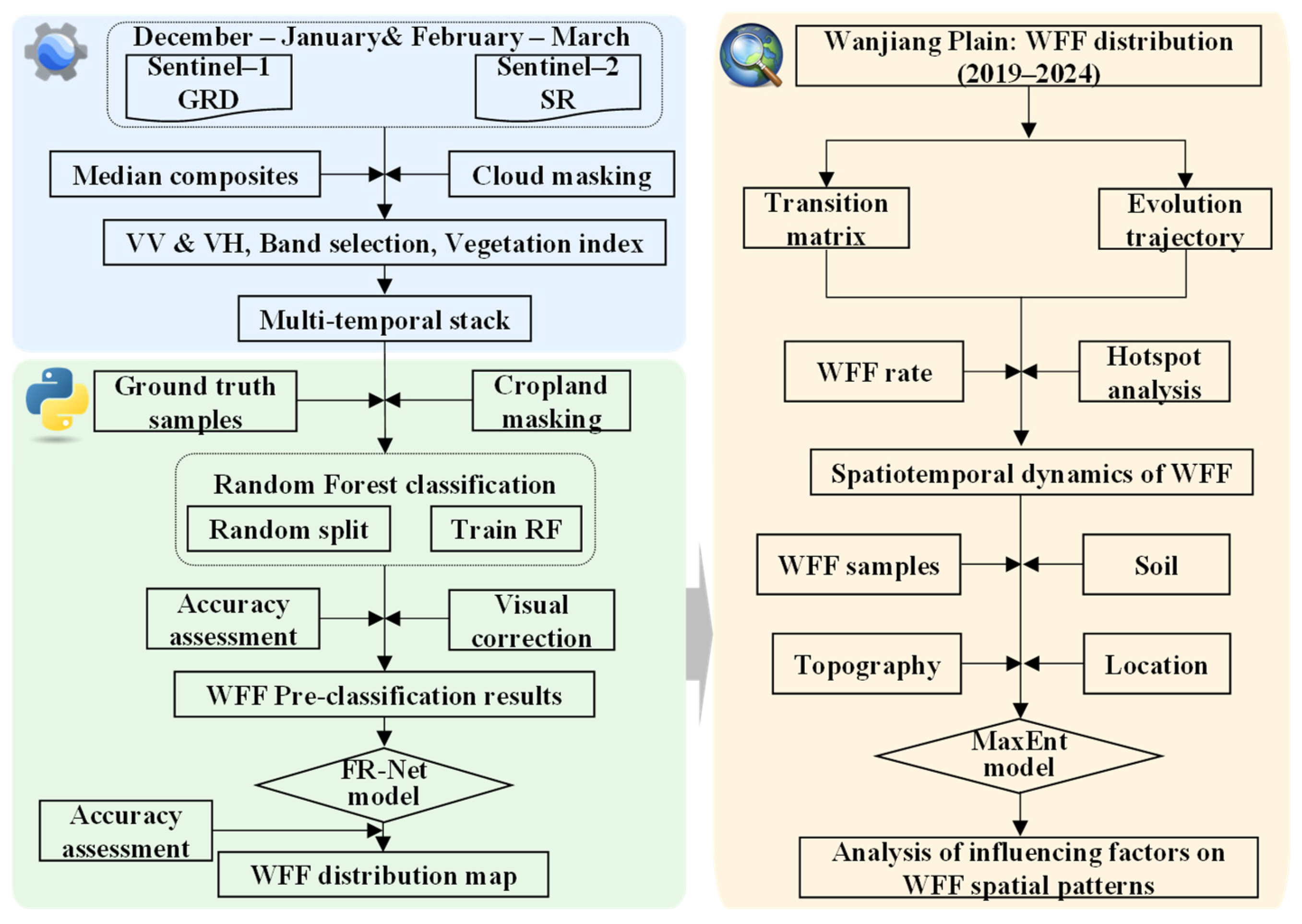
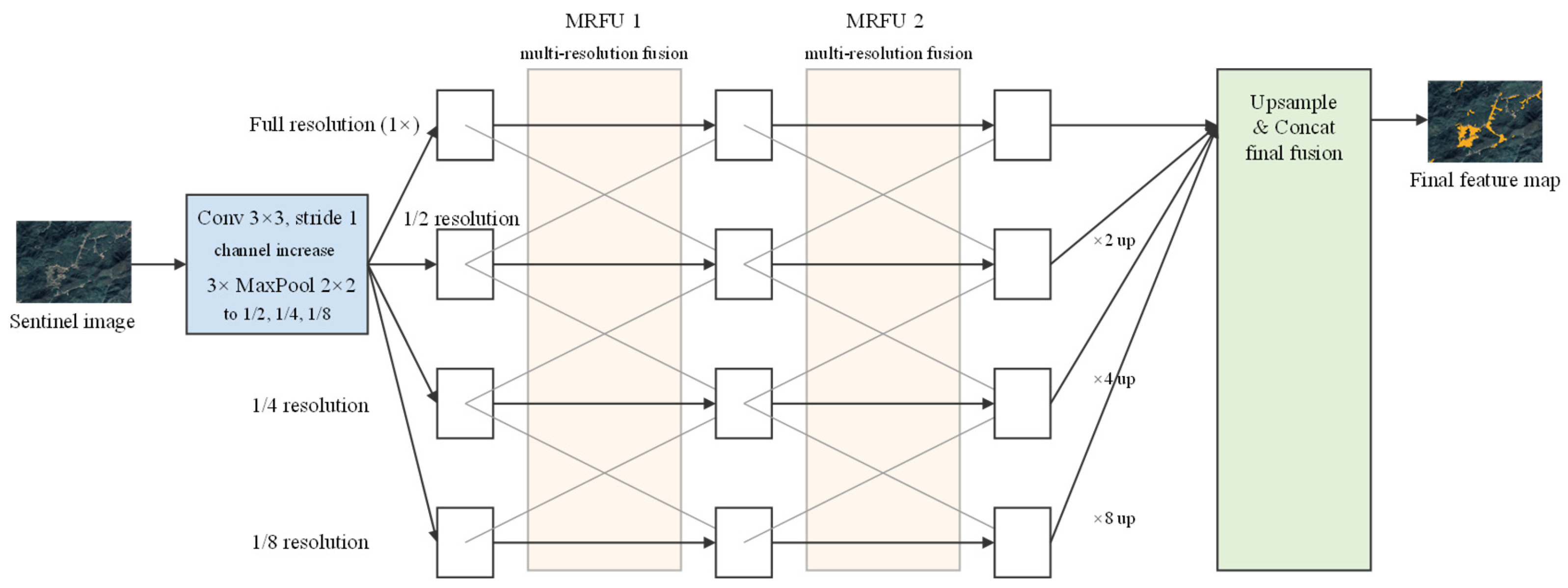
To address these challenges, we developed a comprehensive framework for WFF monitoring and analysis in the Wanjiang Plain (Figure 1). Specifically, we: (1) evaluated a hierarchical mapping workflow that integrates multi-temporal Sentinel-1/2 imagery with an RF pre-classifier and FR-Net refinement to enhance semantic discrimination and preserve parcel geometry; (2) quantified spatiotemporal dynamics of WFF from 2019 to 2024, focusing on interannual area variation, intensity transitions, and occurrence frequency; and (3) conducted correlation-aware association analysis using MaxEnt to identify environmental gradients most strongly associated with WFF occurrence and persistence and their response characteristics. To improve interpretability and temporal consistency, we report cross-year accuracy under a harmonized evaluation design and interpret the association results as correlational rather than causal. This study aims to provide accurate, parcel-level geoinformation to support hotspot-first, zone-specific winter land-use optimization.

2. Materials and Methods

2.1. Study Area

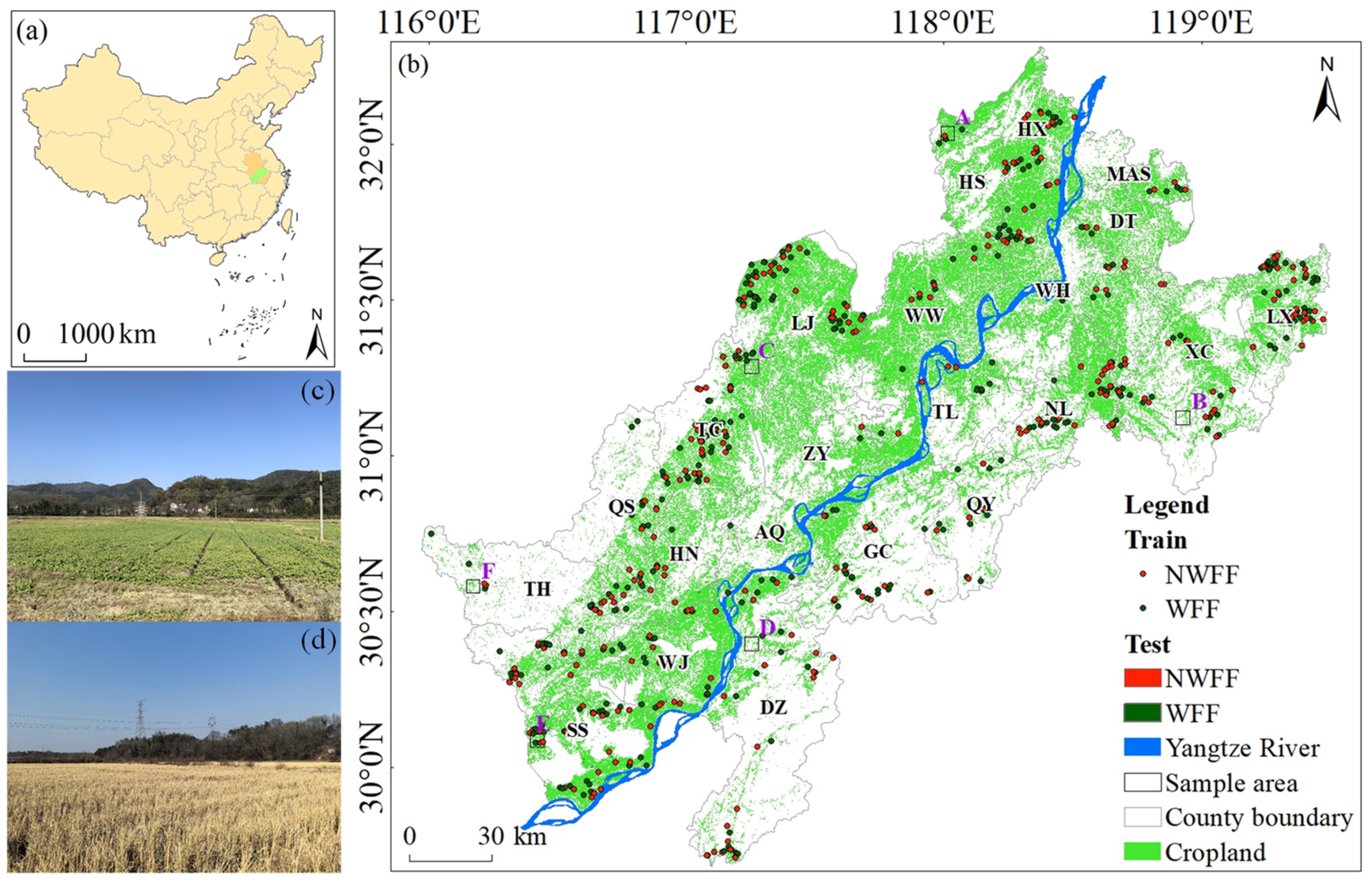
The Wanjiang Plain is located in the middle and lower reaches of the Yangtze River, primarily between the Yangtze River and the Huai River basins in Anhui Province, China [32]. Covering approximately 37,200 km2, it is an important core area of the Yangtze River Economic Belt and a major grain-producing region with extensive cropland and high agricultural intensity. Administratively, it includes prefecture-level cities such as Anqing, Chizhou, Tongling, Wuhu, Ma’anshan, and parts of Hefei (Lujiang County) and Xuancheng (Figure 2). This “core grain base + dense cropland” setting makes the region an operationally relevant testbed for producing policy-ready winter land-use products at fine resolution.
The region lies in a subtropical monsoon climate zone with mild winters, sufficient heat resources, and synchronized heat–water conditions. Mean annual temperature is approximately 14.7 °C, and mean annual precipitation ranges from 800 to 1500 mm. Topography is predominantly flat but geomorphologically diverse, consisting of alluvial plains, low hills, and a dense network of rivers and lakes. Such hydrological connectivity supports high productivity but also increases susceptibility to winter waterlogging, which can reduce field workability and constrain establishment of winter crops. Cropland accounts for ~53% of the total area, and the traditional production system is characterized by intensive rotations (e.g., rice–wheat and rice–rapeseed). Despite high winter production potential, winter land use has become increasingly heterogeneous due to rapid urbanization/industrialization, rising opportunity costs of labor, and evolving farm management decisions. As a result, winter fallowing has become a practically urgent issue for both grain–oil supply stability and rotation-system optimization in this core grain-producing plain.

2.2. Data Sources and Preprocessing

To support WFF mapping, spatiotemporal analysis, and association analysis, we compiled multi-source remote sensing imagery, environmental covariates, and ground reference data.

2.2.1. Remote Sensing Data

Remote sensing data were used for WFF mapping and spatiotemporal analysis. We acquired Sentinel-1 Ground Range Detected Interferometric Wide (IW) swath mode images. These C-band SAR data provide all-weather, day-and-night observations, which are critical for monitoring winter cropland in the Wanjiang Plain where cloud cover is frequent [33,34]. We also used Sentinel-2 MultiSpectral Instrument (MSI) Level-2A surface reflectance products, which provide rich spectral information for characterizing vegetation phenology and crop conditions [35]. For each agricultural year from 2019 to 2024, we selected images covering two winter sub-periods: (i) December–January and (ii) February–March [36], to capture phenological contrasts between WFF and winter crops. All imagery was accessed and processed via GEE.
To improve reproducibility and cross-year comparability, we applied a unified screening protocol across all six annual cycles. For Sentinel-2, scenes were filtered using (i) metadata-based cloudiness and (ii) pixel-level cloud/cirrus masking based on the QA60 band. For Sentinel-1, VV and VH backscatter in IW mode were consistently used across years and sub-periods.
To document effective observation density and spatial completeness under winter cloud conditions, we summarized by year (2019–2024) and sub-period (Dec–Jan; Feb–Mar): (i) the number of retained Sentinel-1/2 acquisitions after screening and (ii) the spatial coverage ratio of the study area (Table 1). We denote each winter season by its starting year; for example, “2019” refers to Dec 2019–Mar 2020. Here, “coverage (%)” is defined as the fraction of the Wanjiang Plain footprint with at least one valid observation within each compositing window. This metric reflects spatial completeness of the footprint rather than the density of cloud-free sampling. As shown in Table 1, the number of acquisitions varied among years and sub-periods, while both Sentinel-1 and the screened Sentinel-2 collections achieved full spatial coverage (100%) over the study region.
Operationally, the distinction between active winter crops and “unused” WFF is determined by their temporal phenological trajectories over the December–March observation window. Active winter crops (e.g., winter wheat, rapeseed) exhibit a distinct green-up phase characterized by rising NDVI and increasing volumetric scattering (higher VH backscatter) as the canopy develops. Conversely, “unused” arable land is operationally identified by the persistent absence of these growth signatures—maintaining relatively flat, low NDVI profiles and stable, surface-dominated SAR backscatter throughout the winter season.

2.2.2. Environmental Data

To examine spatial associations of WFF, we assembled covariates describing topographic constraints, soil conditions, and accessibility proxies (Table 2). The selection follows a “constraints–returns–accessibility” logic widely used in land-use underuse/abandonment studies: (i) terrain affects cultivation and mechanization costs and operational feasibility; (ii) soil texture/structure and fertility proxies shape crop establishment, yield potential, and marginal returns; and (iii) proximity to infrastructure and settlements captures accessibility to services, markets, and water-management facilities, which can influence transaction and management costs [37]. When detailed socioeconomic variables are unavailable, plot characteristics, accessibility proxies, and soil quality can still provide useful explanatory signals for regional screening [38].
Topography (elevation, slope, and relief amplitude) was derived from NASADEM (30 m), a reprocessed SRTM-based DEM with improved void reduction and vertical accuracy (https://lpdaac.usgs.gov/products/nasadem_hgtv001/, accessed on 26 November 2025). Because terrain is effectively time-invariant over the study horizon, these covariates were treated as static baseline constraints (Table 2). They are included because low-relief plains in humid settings may experience poor winter field workability (e.g., drainage limitations), whereas increasing slope/relief generally raises cultivation costs and can reduce intensive use.
Soil physicochemical properties for the 0–5 cm layer were obtained from CSDLv2 (https://essd.copernicus.org/articles/17/517/2025/, accessed on 27 November 2025), which provides national gridded maps of multiple soil properties at 90 m resolution. CSDLv2 is a baseline compilation from multi-source observations and covariates; it does not represent a single survey year but approximates a long-term soil background suitable for regional analysis (Table 2). We therefore treated these soil layers as time-invariant covariates for 2019–2024. We included texture (sand/silt/clay), rock fragment content (gravel), and structure-related variables (bulk density and porosity) to represent infiltration/drainage capacity and susceptibility to compaction and waterlogging—constraints that are especially relevant for winter crop establishment in rice-based double-cropping systems. In addition, organic carbon (OC/SOCD), pH, CEC, and nutrient indicators (TN/TP/TK and available N/P/K) were used as fertility and buffering proxies that can influence attainable yields and the profitability of winter cropping.
Accessibility variables were constructed as Euclidean distances to water bodies, roads, and settlements based on OpenStreetMap and national authoritative vector layers. These measures serve as pragmatic spatial proxies for irrigation/drainage accessibility, mechanized service availability, and transport/market access. Vector layers were accessed in November 2025 (Table 2) and treated as time-invariant infrastructure proxies for the 2019–2024 analysis period.
All predictor rasters were harmonized to a 90 m grid and projected to WGS 1984 UTM Zone 50N to match the support of the soil product and avoid pseudo-precision in the association step. The 90 m resolution is used only for the MaxEnt-based association analysis, not for the 10 m WFF mapping. This harmonization is needed because (i) several predictors are natively coarser than 10 m, and resampling to 10 m would not add information but could inflate apparent spatial detail; (ii) MaxEnt inference is sensitive to modeling support, and a common 90 m grid reduces support-mismatch artifacts when linking 10 m WFF maps to coarser controls; and (iii) a consistent, coarser support can help mitigate spatial autocorrelation and sampling bias in occurrence/background representations.
For attribution, we aligned 10 m WFF maps to the 90 m predictor grid by summarizing WFF within each 90 m cell inside the cropland mask (i.e., using an area-fraction summary and a consistent presence definition at 90 m), so predictors and response are interpreted on the same support. To reduce redundancy among predictors, we screened collinearity using pairwise correlations and variance inflation diagnostics.

2.2.3. Reference Data

Ground reference data were collected for training and validation. We combined field surveys with visual interpretation of very high-resolution (VHR) historical imagery to label sample parcels/plots as WFF or NWFF. In total, 479 WFF plots and 424 NWFF plots were identified (Figure 2), yielding a near-balanced reference sample. A cropland mask was generated using land-use status data (https://www.resdc.cn/, accessed on 10 November 2025) to restrict mapping outputs to agricultural areas [39]. The cropland mask was derived from the Chinese National Land Use and Cover Change (CNLUCC) 2020 dataset provided by the Resource and Environment Science and Data Center (RESDC). This dataset has an officially reported classification accuracy of over 90% for arable land, making it sufficiently robust for regional constraints. The rationale for applying this specific mask is to strictly limit our analysis to established agricultural spaces, thereby minimizing commission errors caused by spectrally similar non-agricultural surfaces (such as bare construction land, riverbanks, or sparse winter forests).
Because the cropland mask constrains outputs, we explicitly evaluated potential mask-related errors in two directions: (i) non-cropland leakage (spurious WFF predicted over non-cropland surfaces) and (ii) cropland-mask omission (true WFF parcels excluded because they fall outside the cropland mask). Specifically, we intersected annual WFF predictions with an independent land-cover baseline (e.g., ESA WorldCover 10 m) to quantify the fraction of predicted WFF overlapping non-cropland classes. With a reported global overall accuracy of >74% and a spatial resolution that perfectly matches our target WFF maps, it is highly suitable for this cross-checking purpose. It is important to note that this dataset was not used for the primary WFF classification, but strictly as an independent validation source to estimate the upper bound of spurious WFF predictions (leakage) over permanent non-cropland categories. In parallel, we checked whether parcel-level reference units used for validation were fully contained within the cropland mask; parcels falling outside the mask were flagged and reported as potential omission risk. This bidirectional diagnostic helps ensure that “WFF vs. NWFF” accuracy is not confounded by unreported mask artifacts and provides overlap-based quality control for non-cropland errors.
To ensure temporal alignment with satellite observations, reference labels were assigned for the corresponding winter seasons (2019–2024). For each sample, we recorded the acquisition time of the field observation and/or the timestamp of VHR imagery used for labeling, and linked each sample to its corresponding agricultural year and winter sub-period (Dec–Jan or Feb–Mar) used for Sentinel-1/2 compositing. This time-stamping supports label–imagery consistency and prevents mixing samples across winter seasons. A summary of sample temporal coverage is reported in Table 3.
Samples were collected using a stratified design to improve spatial representativeness across counties and major landscape settings. We applied a minimum spacing of 1000 m between samples of the same class to reduce local clustering.
For the RF stage, samples were randomly split to provide an internal separability check on GEE. For accuracy reporting, we used a parcel-wise split and within-parcel majority voting: all pixels belonging to the same sample plot were assigned to the same subset to avoid within-plot leakage, and parcel-level predictions were derived via majority voting to yield application-relevant performance estimates under fragmented smallholder geometry.
Although reference samples are near-balanced (479 vs. 424), mapped prevalence of WFF/NWFF varies by year and subregion, which can induce pixel-level imbalance during training. We therefore report imbalance-robust metrics (F1 and MCC) alongside OA. For FR-Net, the Dice-based loss is less sensitive to prevalence than plain cross-entropy.
Because WFF mapping was conducted year-by-year (2019–2024), we promoted cross-year comparability by using an identical feature set, consistent winter observation windows, a harmonized sample-collection protocol, and a fixed model-configuration template across years. Year-specific training was used to accommodate interannual phenological variability while maintaining consistent quality-control rules. Samples were assigned to the same agricultural year as the satellite composites used for model training and evaluation to ensure that reference labels reflect the correct winter-season state.

2.2.4. Data Preprocessing

Preprocessing on GEE produced a consistent analysis-ready dataset. Sentinel-1 data underwent thermal noise removal, radiometric calibration, and terrain correction to generate sigma naught (σ0) backscatter bands (VV and VH). A median composite was applied to reduce speckle effects. Sentinel-2 data were filtered using the QA60 band; cloud and cirrus contamination were masked using QA60 bit flags, and only clear-sky pixels were retained. Where applicable, an additional scene-level filter based on CLOUDY_PIXEL_PERCENTAGE was used to exclude severely cloudy acquisitions before pixel-level masking. We calculated the Normalized Difference Vegetation Index (NDVI) to enhance vegetation signal discrimination. Preprocessed SAR backscatter and optical spectral/index bands were co-registered and stacked to form a multi-temporal winter feature cube [40], which served as input to the RF classification and FR-Net refinement [41]. For each year and sub-period, we generated temporally consistent composites and recorded the number of valid acquisitions contributing to each composite to document effective observation density under winter cloud conditions.

2.3. Methods

2.3.1. FR-Net Refinement for High-Resolution WFF Mapping

To address limitations of pixel-based classifiers in fragmented landscapes, we adopted a hierarchical mapping strategy (Figure 1). First, an RF classifier was applied to the multi-temporal Sentinel-1/2 feature stack to produce a preliminary semantic map, efficiently separating broad classes and providing a coarse WFF baseline [42]. Second, RF-derived probability maps were used as semantic priors and fed into FR-Net. FR-Net, with a recursive residual design, refines object boundaries and recovers small or isolated WFF patches that are often missed by standard post-processing (Figure 3). This coarse-to-fine workflow balances computational efficiency and spatial precision [43].
RF configuration and training. The RF pre-classifier was implemented in GEE using ee.Classifier.smileRandomForest with 100 trees and bagFraction = 0.8. Training samples were randomly partitioned using randomColumn with a split ratio of 0.7 to provide an internal separability check. The RF model was trained with classProperty = ‘class’ and the predictor set defined as multispectral.addBands (ndvi). The RF output served as a semantic prior (RF prior) to suppress non-cropland confusion and to provide a coarse WFF baseline for refinement. The RF result was masked by the cropland mask to remove residual spurious detections outside cropland.
FR-Net training setup and architecture details. To ensure rigorous reproducibility, the exact architecture of the FR-Net refinement module features a dual-stream design: a standard pooling/unpooling stream for robust semantic context, and a full-resolution stream to preserve fine geometric boundaries. The network comprises 18 convolutional layers, universally employing 3 × 3 filter sizes with zero-padding to maintain spatial dimensions. The skip connection design relies on Full-Resolution Residual Units (FRRU), which fuse multi-scale features by upsampling the contextual stream and adding it element-wise to the full-resolution stream.
Importantly, to preserve temporal comparability, this exact architecture and all hyperparameter templates were kept strictly identical across all six years (2019–2024) without any annual tuning. This ensures that any interannual fluctuations in the WFF maps are driven solely by the input Sentinel-1/2 observations. Training utilized fixed-size image patches of 256 × 256 pixels.
Regarding hyperparameter selection, the batch size was empirically set to 8, which was the maximum capacity allowed by our hardware memory constraints (a single NVIDIA RTX 3090 GPU) given the multi-temporal, multi-sensor feature stack. The model was trained using the Adam optimizer with a Dice-based loss. While the maximum number of epochs was set to 120, the actual convergence criterion was governed by an Early Stopping mechanism. Specifically, the training was monitored via the validation set, and the best model weights were saved using checkpointing based on the minimum validation loss. Training was automatically halted if the validation loss failed to improve for 15 consecutive epochs, ensuring that the network converged optimally without overfitting.
We selected FR-Net because WFF parcels in the Wanjiang Plain are typically narrow and highly fragmented; boundary displacement and small-patch omission are common when pixel-wise classifiers are combined with generic smoothing or morphological post-processing. FR-Net maintains a full-resolution stream during forward propagation and fuses multi-resolution features without repeatedly compressing and re-expanding the spatial grid, which is advantageous for preserving thin/strip-like parcels and sharpening parcel edges in fragmented agricultural mosaics.
Compared with encoder–decoder architectures (e.g., U-Net variants), repeated downsampling/upsampling can blur or shift thin boundaries unless boundary-specific supervision and/or heavier decoders are introduced. DeepLab-family models improve multi-scale context through atrous convolution, but output-stride/decoder settings still require careful tuning to maintain crisp parcel borders in smallholder landscapes. Instance-based approaches (e.g., Mask R-CNN) can delineate object instances but typically require instance-level annotations and incur substantially higher labeling and computation costs for multi-year, large-area production mapping at 10 m resolution.
Here, FR-Net acts as a refinement module rather than a stand-alone semantic classifier: the RF stage provides an efficient semantic prior, and FR-Net focuses capacity on geometry correction and recovery of small/isolated patches under noisy winter observations. We evaluate this design choice using parcel-level validation (OA, F1, MCC, TPR, TNR) and a pooled confusion matrix.
Using an independent test subset with a parcel-wise split, we computed parcel-level metrics:
OA   = TP + TN TP + FN + FP + TN
TPR = TP TP + FN
TNR = T N T N + F P
P recision = TP TP + F P
F 1   score   = 2 × Precision   ×   TPR   Precision + TPR
MCC   = ( TP × TN FP × FN ) ( T P + F P ) × ( T P + F N ) × ( T N + F P ) × ( T N + F N )
where TP and TN denote correctly classified WFF and NWFF parcels, and FP and FN denote commission and omission errors.
To keep the Methods focused, we summarize FR-Net’s behavior using a residual refinement view. Let p R F ( x ) denote the RF-derived WFF prior probability and FS1/S2(x) the stacked winter-stage Sentinel-1/2 feature cube. FR-Net learns a corrective mapping conditioned on both the features and the RF prior:
p r e f ( x )   =   p R F ( x )   +   g ( F S 1 / S 2 ( x ) ,   p R F ( x ) ;   θ )
where g (   ) is parameterized by θ . This residual refinement encourages the network to allocate capacity to “hard” structures—parcel edges, narrow strips, and small/isolated WFF patches—because coarse semantics are already encoded in p R F ( x ) [44,45].

2.3.2. Spatiotemporal Analysis of WFF Intensity and Frequency

For spatial-statistical analysis, we aggregated WFF to a 1 km grid containing cropland. For each year, WFF intensity in a grid cell was computed as the ratio of WFF area to total cropland area in that cell.
Justification of the 1 km analytical support. We used a 1 km grid because (i) intensity is an area-fraction index and becomes more stable when summarized over a support large enough to reduce parcel-edge noise and isolated artifacts common in fragmented mosaics; and (ii) local spatial statistics such as Getis–Ord G i * require neighborhood inference on areal units. A 1 km grid provides a transparent compromise between spatial detail and statistical stability for a ~37,200 km2 plain-scale analysis. This aggregation is used only for intensity/hotspot screening and does not alter the underlying 10 m products.
Based on annual WFF rate, grid cells were classified into five intensity levels: Low (L ≤ 20%), Medium-Low (20% < ML ≤ 40%), Medium (40% < M ≤ 60%), Medium-High (60% < MH ≤ 80%), and High (H > 80%). These cutoffs implement an equal-interval (20%-step) grading of a percentage-type intensity index, which is widely used to communicate spatial heterogeneity in coverage variables [46]. To reduce dependence on a single binning scheme, we repeated the grading and subsequent analyses using quantile-based and Jenks natural-break thresholds; major hotspot/coldspot structures and interannual rankings were consistent, indicating robustness to reasonable threshold choices.
Using annual 10 m WFF maps for 2019–2024, we computed pixel-level WFF occurrence probability (frequency) across the six-year period. For each 10 m pixel, the number of years classified as WFF was divided by six, yielding probabilities of 0%, 17%, 33%, 50%, 67%, 83%, and 100% corresponding to 0–6 occurrences:
W F F P = t = 1 6 W F F t 6
where W F F P is the WFF probability and t = 1 6 W F F t is the number of years (out of six) classified as WFF.

2.3.3. Hotspot Analysis of Spatial Clustering

To characterize spatial clustering of WFF intensity, we performed hotspot analysis using the Getis–Ord G i * statistic at the 1 km grid scale [47]. A spatial weights matrix was constructed using queen contiguity, where grid cells sharing an edge or vertex were treated as neighbors. Because G i * identifies local concentration relative to global moments and may be sensitive to neighborhood definitions, we use it as an exploratory screening tool to delineate statistically significant clusters rather than evidence of a spatially invariant generative process. To reduce dependence on a single neighborhood setting, we repeated G i * under alternative weights, including (i) queen contiguity, (ii) fixed-distance bands (r = 3 km), and (iii) k-nearest neighbors (k = 4). We consider hotspots/coldspots “stable” when significance persists under the majority of tested settings. G i * was computed separately for each year, using year-specific x ¯ and s , to avoid conflating interannual mean shifts with spatial clustering. The statistic is:
G i * = j = 1 m   w i j x j x ¯ j = 1 m w i j s [ m j = 1 m w i j 2 ( j = 1 m w i j ) 2 ] m 1 , with   x ¯ = j = 1 m x j m , s = j = 1 m x j 2 m ( x ¯ ) 2
where x j is the WFF rate in grid cell j ; w i j is the spatial weight between cells i and j ; m is the number of grid cells (here m = 35,156 ). The resulting G i * values are Z-scores: G i * > 0 indicates hotspots and G i * < 0 indicates coldspots.

2.3.4. MaxEnt Model

We used MaxEnt to quantify variable contributions and generate response curves, treating it strictly as a correlational/association tool rather than a causal mechanism model [48]. We used MaxEnt v3.4.4.
Occurrence data and analysis support. Occurrence records were derived from the annual 10 m WFF maps and aggregated to the 90 m predictor grid to ensure alignment with covariates. Records with missing predictor values were excluded during preprocessing, resulting in 2349 valid occurrence samples.
Background domain. Background sampling was restricted to the cropland analysis extent to avoid confounding from non-agricultural areas.
Model configuration. We enabled response curves and jackknife diagnostics and used logistic output. The model used random seed = true, replicates = 10 with bootstrap replication, and random test points = 25%. Feature classes followed the default auto-feature setting for the given sample size (linear, quadratic, product, threshold, hinge). Regularization followed the default schedule in the run log: linear/quadratic/product = 0.050, categorical = 0.250, threshold = 1.000, hinge = 0.500.
Predictors. Predictors included terrain (dem, slope, re), soil properties (ak, an, ap, bd, cec, clay, gravel, oc, ph, porosity, sand, silt, socd, tk, tn, tp), and accessibility proxies (dwb, dr, dra) (Table 2). Because predictors can be correlated, variable importance and response curves are interpreted cautiously.
Outputs and interpretation. We report permutation importance and jackknife results to identify strongest associations under the modeled scale/covariate set and present response curves to summarize how modeled association varies along each gradient. These results indicate statistical association rather than causal “driving effects” and are used to support screening and hypothesis generation.
For completeness, MaxEnt can be expressed in its standard exponential form:
Q λ ( x ) = 1 Z λ e x p ( j λ j f j ( x ) )
where f j ( x ) are feature functions of predictors, λ j are fitted weights, and Z λ normalizes Q λ over the background domain.

3. Results

3.1. Performance of the FR-Net Refinement Framework

To ensure application-relevant accuracy assessment, we performed parcel-scale validation for 2019–2024 using a strict parcel-wise split and within-parcel majority voting. This design reduces inflation of effective sample size caused by pixel-level spatial autocorrelation and yields a conservative estimate of operational reliability at the parcel/management-unit level.
Beyond WFF/NWFF agreement, we quantified non-cropland leakage and cropland-mask omission. We intersected annual WFF maps with an independent land-cover baseline and calculated the areal share of predicted WFF overlapping non-cropland classes, providing an overlap-based upper bound for spurious detections on permanent water, built-up surfaces, wetlands, or woody cover. We also explicitly quantified potential cropland-mask omission errors by checking whether the parcel-wise reference units (N = 903 total plots) were fully contained within the applied mask. Specifically, only 12 parcels were found to be partially or entirely excluded by the mask. The total areal omission amounted to 5.4 hectares, representing merely 1.3% of the total reference area. These hard diagnostics quantitatively confirm that mask omission errors are extremely minimal. The excluded pixels overwhelmingly correspond to localized boundary cases—such as field edges immediately adjacent to rural roads, ditches, or newly built structures—rather than core agricultural production parcels. Consequently, the application of the cropland mask securely suppresses non-agricultural commission noise without systematically biasing the regional hotspot and frequency structures used in subsequent analyses.
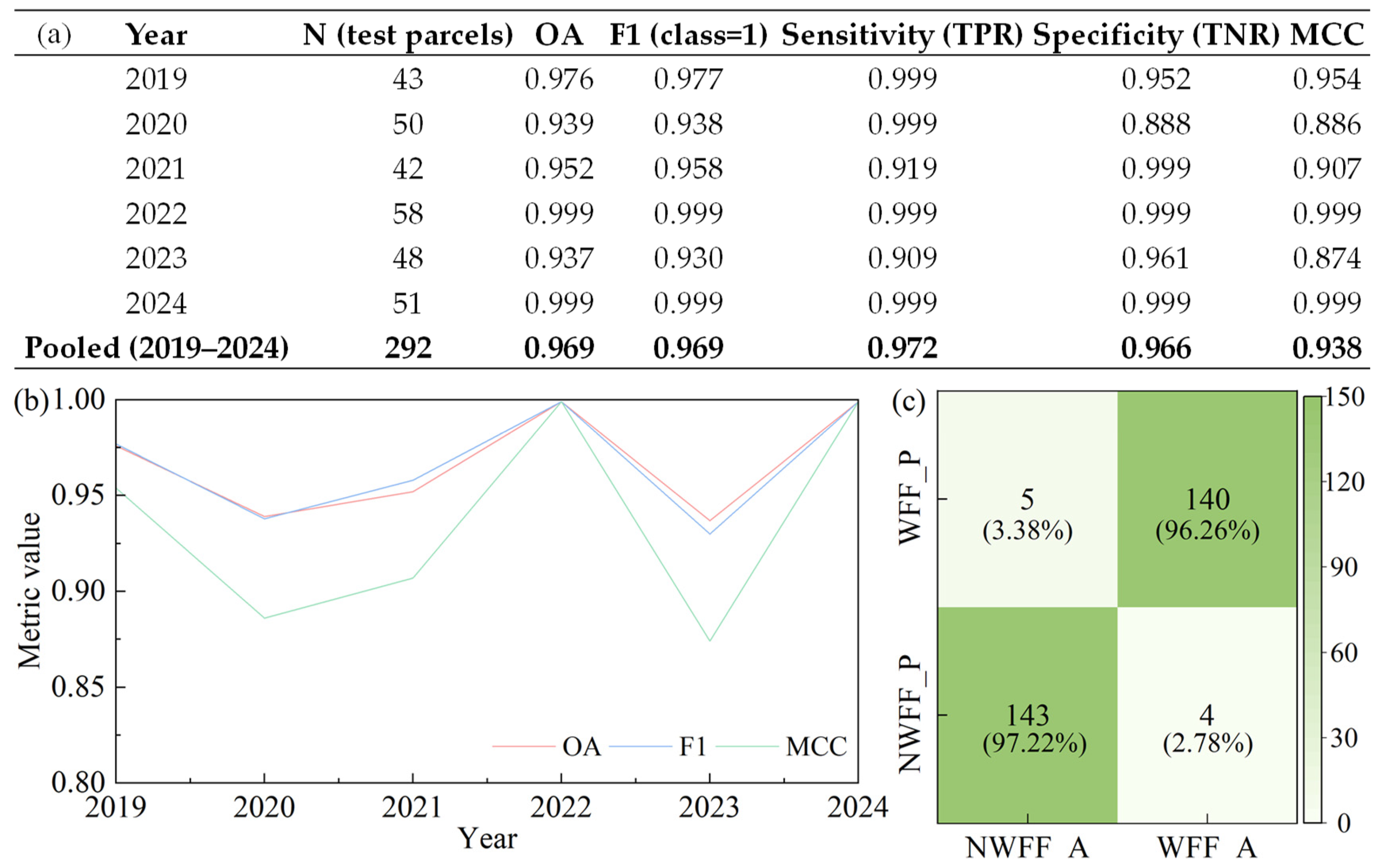
Parcel-level metrics (OA, F1, MCC, TPR, TNR) remained consistently high across years (Figure 4a,b). Reporting annual test-parcel counts clarifies that small fluctuations partly reflect interannual differences in sample size. The synchronized trajectories of OA, F1, and MCC suggest stable correctness as well as balanced positive-class detection.
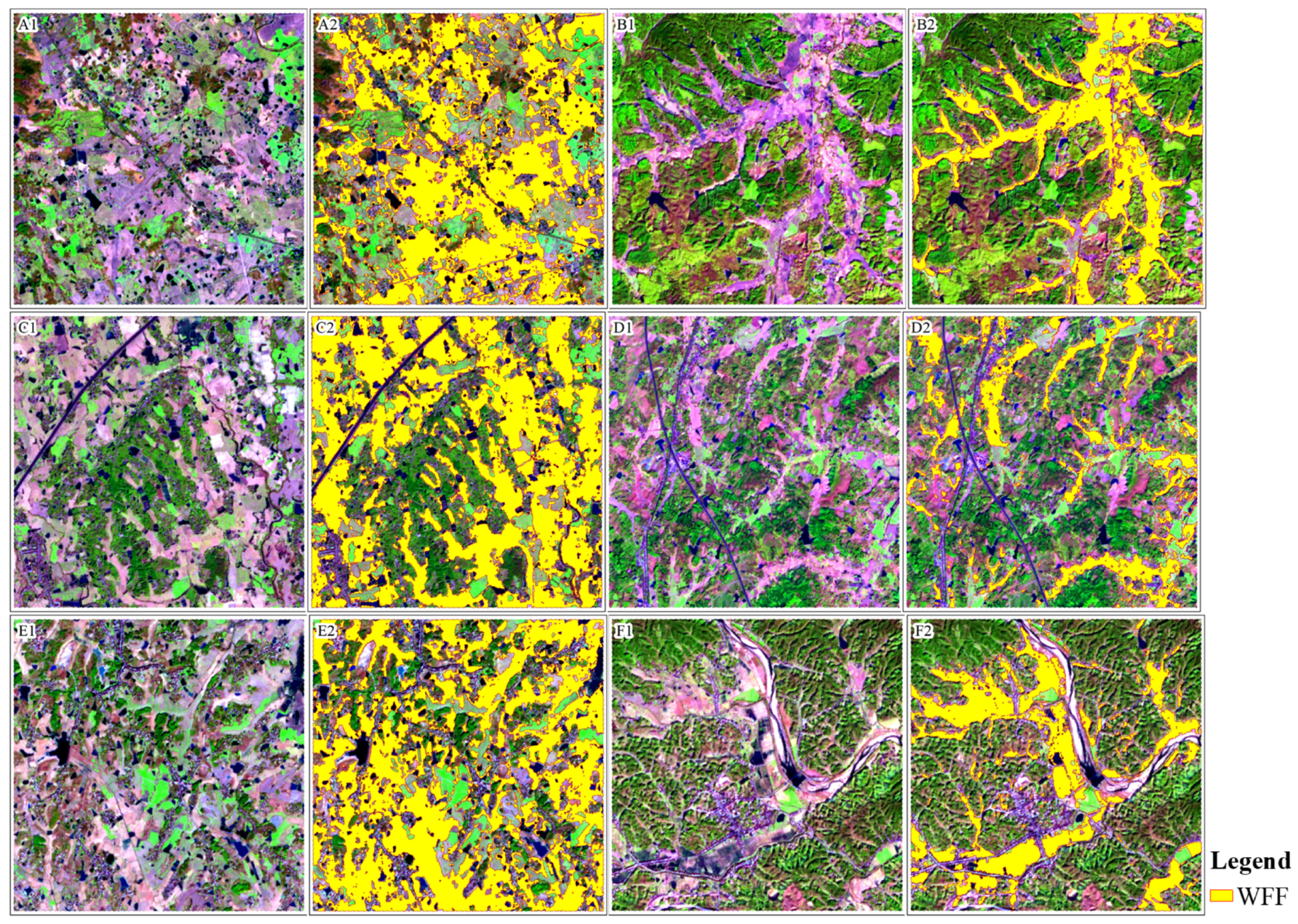
The pooled confusion matrix (Figure 4c) shows that only nine parcels were misclassified across 2019–2024 (FP = 5; FN = 4; N = 292), corresponding to pooled OA = 0.969, F1(WFF) = 0.969, MCC = 0.938, TPR = 0.972, and TNR = 0.966. FP and FN are similar in magnitude, indicating no strong skew toward over-detection or under-detection. To quantitatively justify the necessity of the FR-Net refinement over pixel-wise classification, an ablation analysis was conducted. The baseline Random Forest (RF-only) pre-classifier achieved an overall accuracy (OA) of 0.893 on the validation set. By integrating the FR-Net refinement, the pooled OA significantly increased from 0.893 to 0.969, and the F1-score reached 0.969. This substantial quantitative improvement empirically demonstrates that while the RF model provides a reliable semantic prior, the FR-Net module is highly effective and strictly necessary for recovering small, isolated patches and sharpening parcel boundaries in fragmented agricultural landscapes. Representative zoom-ins (Figure 5A–F) overlay predicted WFF on Sentinel-2 false-color composites and visually confirm coherent, field-consistent geometry in both plain and more complex terrain settings.

3.2. Spatiotemporal Dynamics of WFF in the Wanjiang Plain

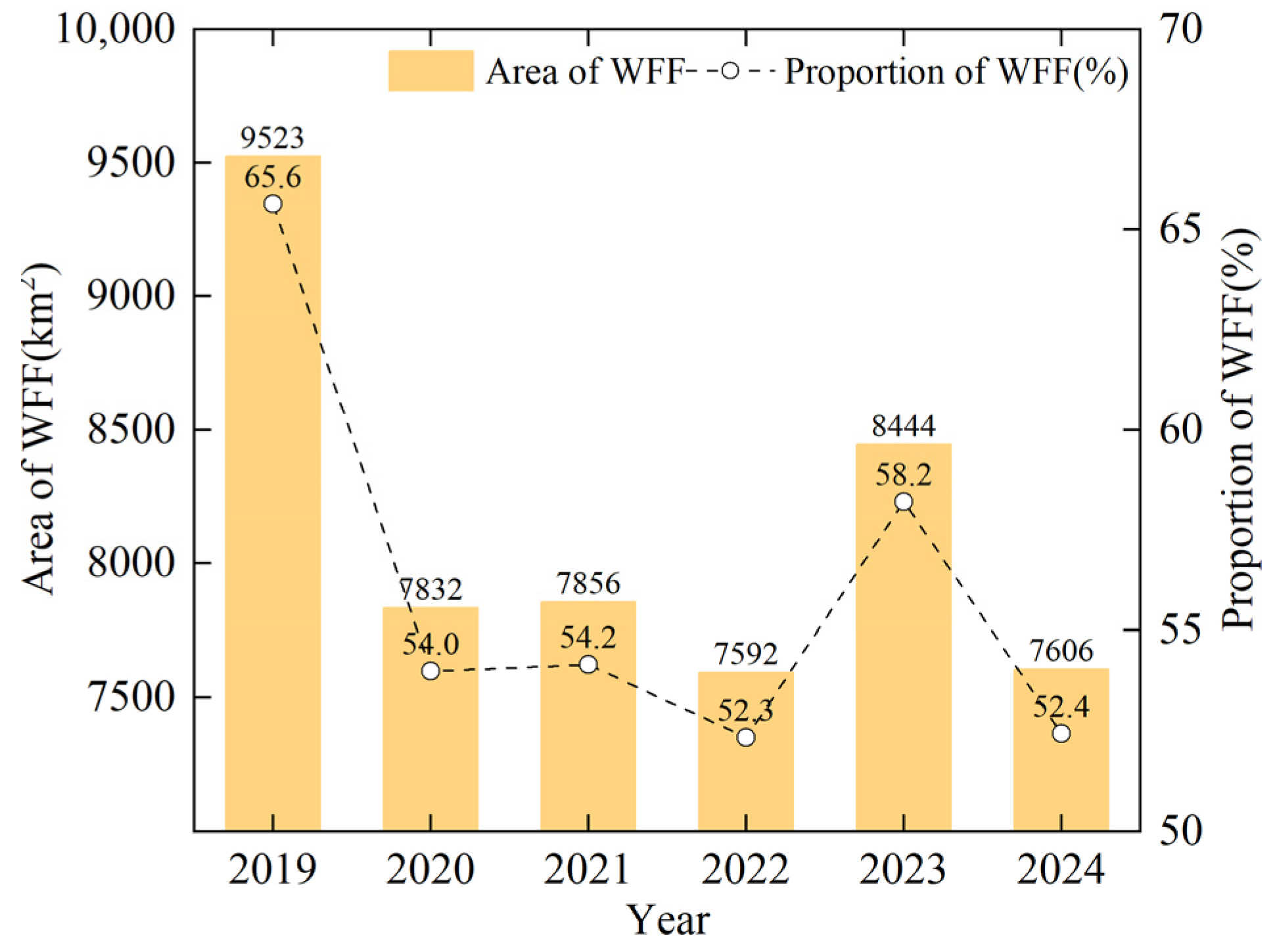
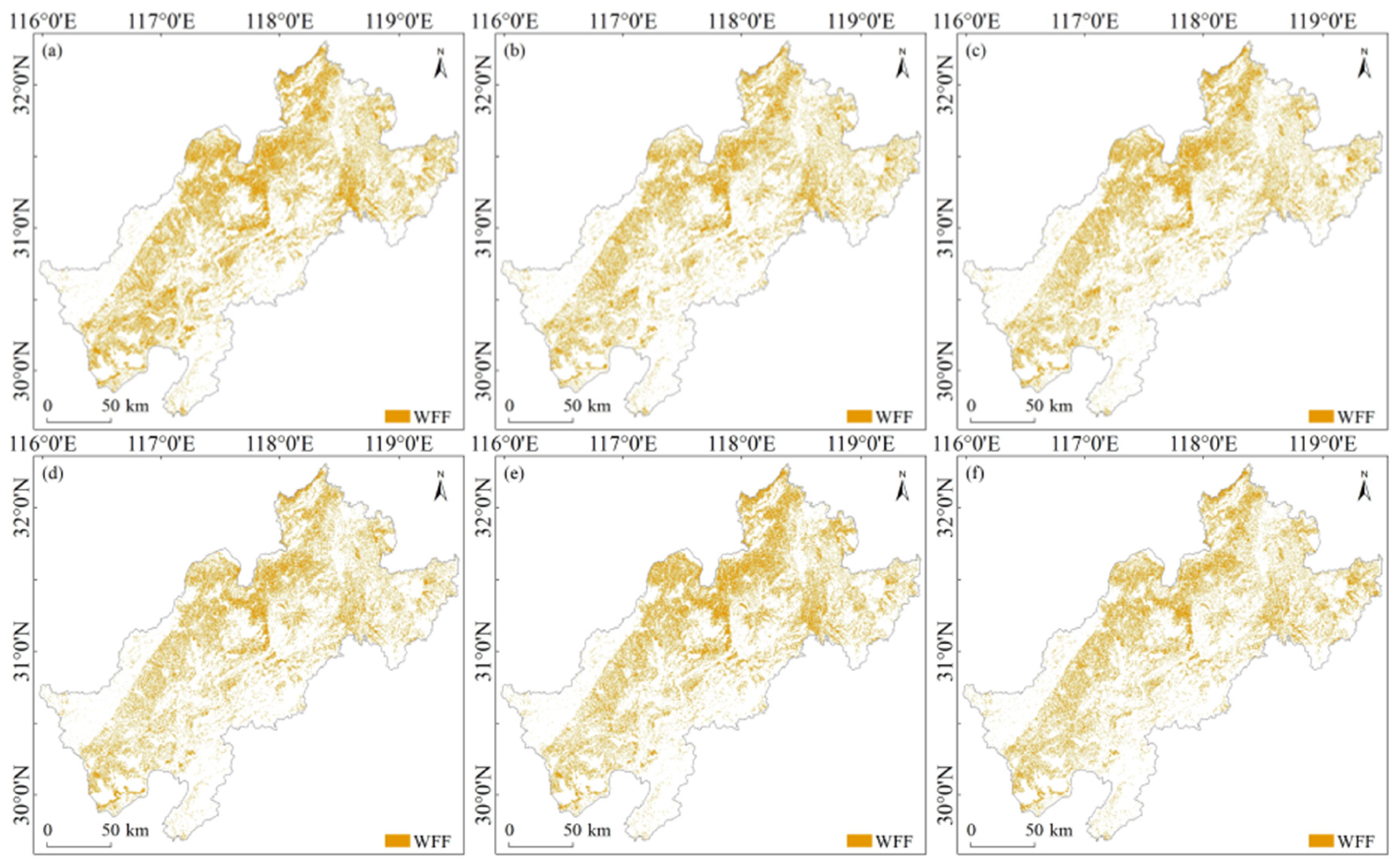
WFF remained extensive throughout 2019–2024 but exhibited pronounced interannual fluctuations (Figure 6). In 2019, WFF reached 9523 km2 (65.6% of cropland). In 2020, it declined to 7832 km2 (54.0%), a decrease of ~1.69 × 10³ km2 and 11.6 percentage points. From 2020 to 2022, WFF continued to decrease modestly to 7592 km2 (52.3%), indicating partial mitigation. This decline was interrupted in 2023, when WFF increased to 8444 km2 (58.2%), followed by a decrease in 2024 to 7606 km2 (52.4%). Overall, WFF fluctuated between 7.59 × 10³ and 9.52 × 10³ km2 and consistently exceeded half of cropland area (52.3–65.6%), indicating that winter fallow is widespread and persistent in the Wanjiang Plain.
We describe these changes empirically and treat the 2023 increase as a fluctuation rather than evidence of a specific external driver, because we do not incorporate time-resolved socioeconomic series or year-specific hydro-meteorological anomalies. Accordingly, we avoid attributing the 2023 rebound to price or labor shocks without supporting data. Instead, the pattern motivates analyses focused on (i) spatial clustering, (ii) recurrence frequency, and (iii) intensity transitions, which better capture persistent structures than single-year perturbations. Classical time-series decomposition is not well-posed here because only one winter observation is available per year (n = 6) and “seasonality” is already constrained by a fixed winter window (Dec–Mar). Uncertainty bands for annual WFF area are therefore addressed via accuracy-adjusted area estimation rather than decomposition on a short series.
Spatially, annual WFF maps show a stable yet heterogeneous pattern (Figure 7). WFF is widely distributed but clustered rather than uniform. Higher concentrations recur in low-lying paddy belts and embanked lowlands, while relatively lower proportions persist in cropland zones with more favorable conditions. The persistence of these structures is quantified by frequency and hotspot analyses.
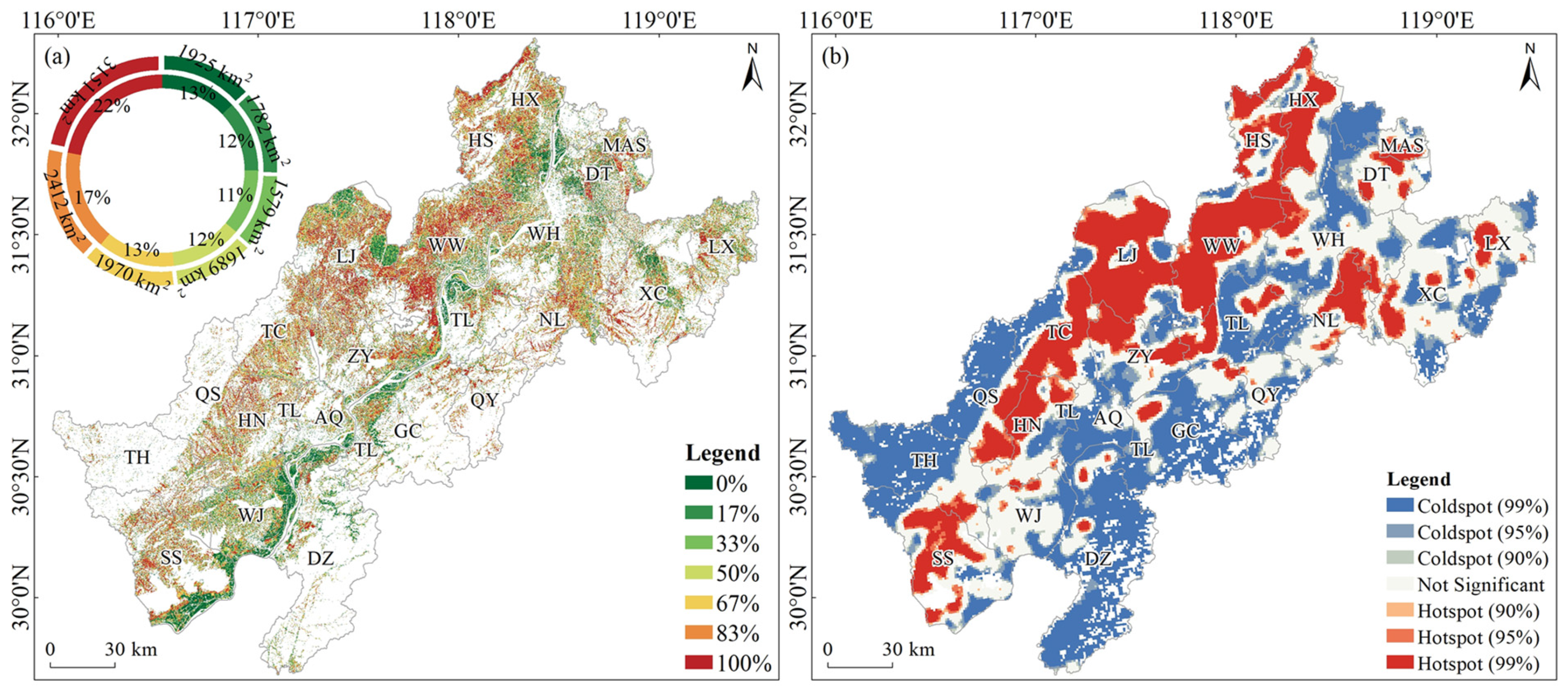
Based on the gridded spatial distribution of WFF in the Wanjiang Plain from 2019 to 2024, the WFF occurrence frequency was calculated by pixel-wise summation, resulting in probabilities of 0%, 17%, 33%, 50%, 67%, 83%, and 100% (Figure 8a), corresponding to 0 to 6 occurrences over the six-year period. Results indicate that approximately 52% of cropland (7533 km2) had a WFF probability exceeding 67%, with 38% exceeding 83%, mainly concentrated in Wuwei, Lujiang, and Tongcheng. In contrast, the area with low WFF probability (≤17%) was 3707 km2, primarily distributed along the Yangtze River. The strong contrast between high-frequency cores and low-frequency belts indicates that WFF recurrence is spatially structured rather than randomly distributed.
Furthermore, hotspot analysis (Figure 8b) revealed a “hot-north, cold-south” spatial pattern of WFF in the Wanjiang Plain. Hotspots were mainly concentrated in Hexian, Hanshan, Wuwei, Lujiang, Tongcheng, Qianshan, Taihu, and Susong. Coldspots were largely distributed in mountainous and hilly areas, such as Guichi District, Dongzhi County, and the Dabie Mountains. In other words, areas with persistently high WFF intensity form statistically significant high-value clusters, whereas low-intensity areas cluster in the southern mountainous/hilly zones.
At the 1 km grid scale, we classified annual WFF intensity into five levels (L, ML, M, MH, H) as defined in Section 2.3.2. This stratification supports transition analysis summarizing how intensity classes shift over time.
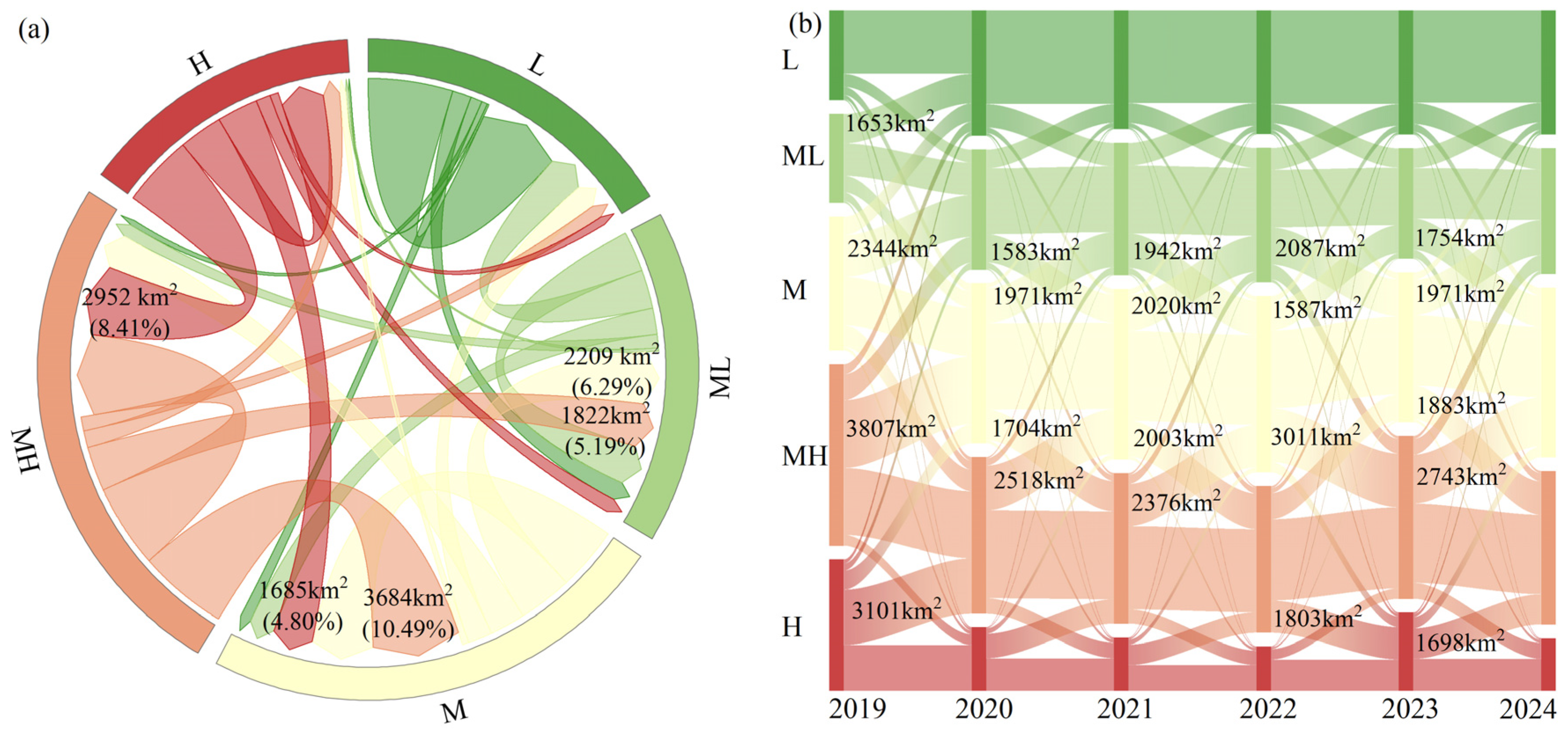
From 2019 to 2024, overall WFF intensity exhibited a downward trend, characterized by gradual shifts from higher to lower intensity classes (Figure 9a). Specifically, 4637 km2 (13.21%) of High (H) intensity transitioned to Medium-High (MH) and Medium (M): 2952 km2 (8.41%) from H to MH and 1685 km2 (4.80%) from H to M. In addition, 5506 km2 (15.68%) of MH transitioned to M and ML: 3674 km2 (10.49%) to M and 1822 km2 (5.19%) to ML. The Medium (M) class saw 2209 km2 (6.29%) transition to ML. Overall, these transfers indicate that high and medium-high intensity areas more often relaxed into moderate or lower-intensity states over the six-year period.
Interannual timing (Figure 9b) shows that the most substantial downshifts occurred from 2019 to 2020: 3101 km2 moved from H to MH, 3807 km2 from MH to M, 2344 km2 from M to ML, and 1653 km2 from ML to L. From 2021 to 2024, the downshift generally continued, except for a reversal between 2022 and 2023, when 3011 km2 shifted from M to MH and 1803 km2 from MH to H. From 2023 to 2024, ~98% of the area in these two categories shifted back to lower levels, indicating that the system-level tendency over the study period was toward mitigation despite a transient upshift.

3.3. Analysis of Associated Factors of WFF Spatial Patterns

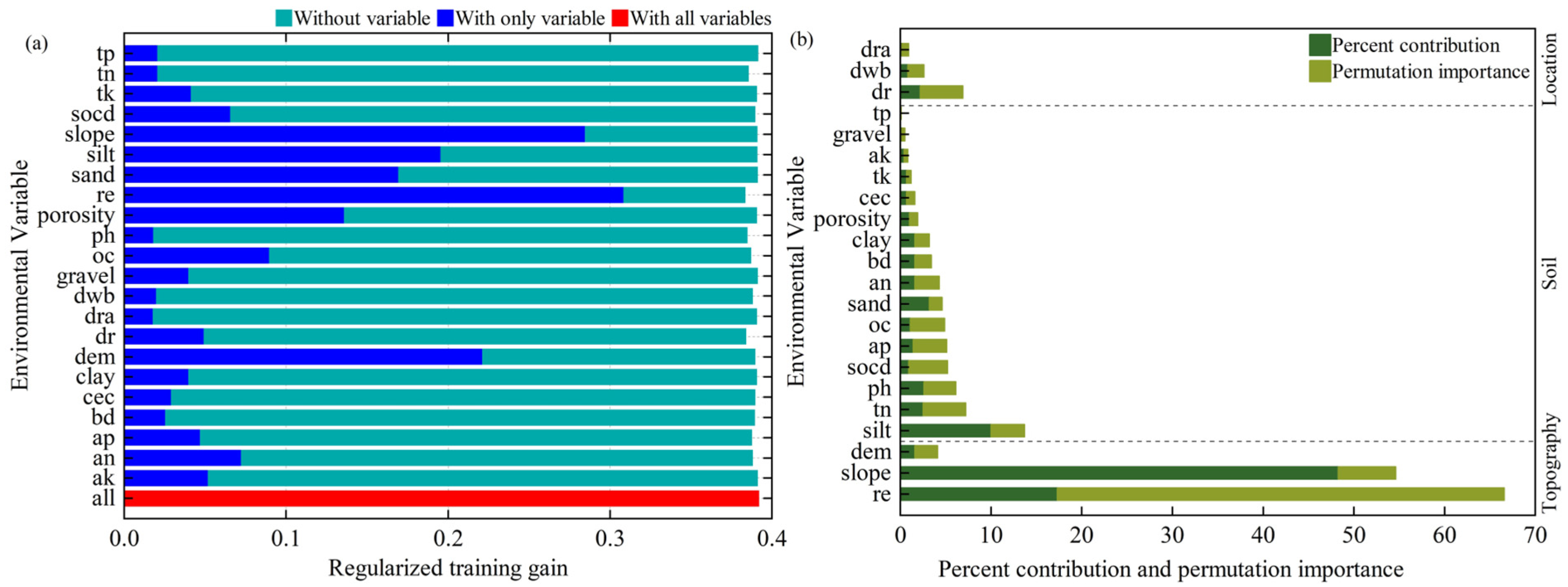
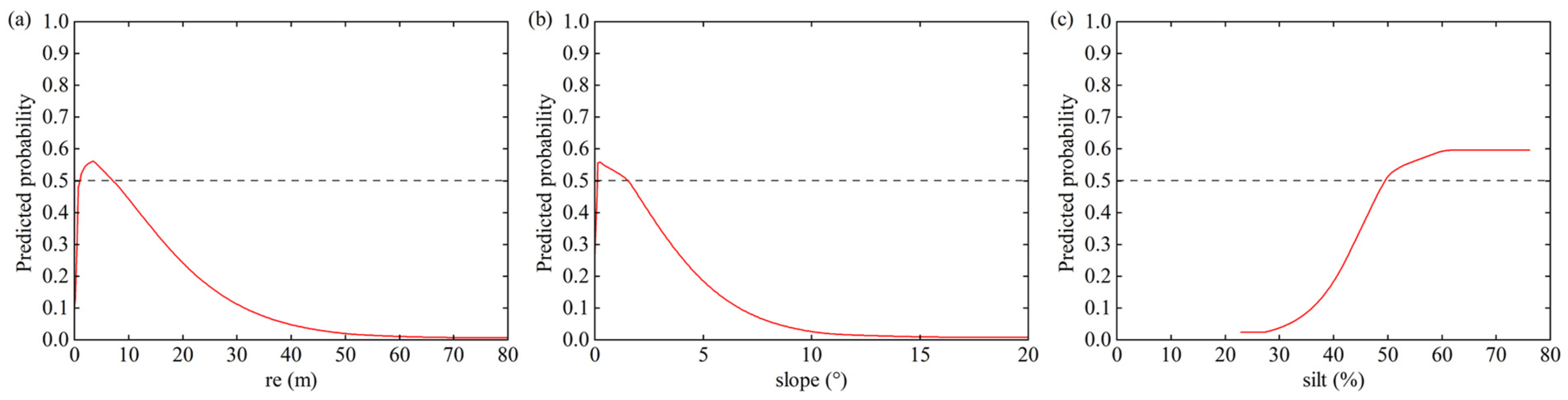
MaxEnt produced an AUC of 0.739. To further evaluate the model’s calibration and presence-only discrimination at the decision boundary, we applied the standard “maximum training sensitivity plus specificity” logistic threshold (0.410). At this optimal cutoff, the model achieved a sensitivity of 0.850, a specificity of 0.525, and a True Skill Statistic (TSS) of 0.375. While the AUC is at the lower end of the conventional >0.75 threshold for natural species distribution, these supplementary metrics confirm that the model possesses meaningful discriminatory skill beyond random expectation, indicating that while it captures broad environmental associations, its predictive skill remains limited (TSS < 0.4) for strict policy delineation. In the fitted model, topographic factors had the largest relative contribution (67.2%), followed by soil factors (29.5%), while location factors contributed less (3.3%). Permutation importance showed a similar pattern (topography 58.1%, soil 34.3%, location 7.6%). Jackknife results (Figure 10a) indicate that relief amplitude (re), slope, and elevation (dem) were dominant individual variables; soil silt, sand, and porosity also showed notable associations. Considering contribution rate and permutation importance together, relief amplitude, slope, and soil silt ranked highest (each >13%), with a cumulative contribution of 75.6% (Figure 10b). Under the modeled covariate set and support, these variables represent the strongest correlates of WFF occurrence.
Response curves (Figure 11) suggest higher modeled association with WFF when relief amplitude is <7 m, slope is <1.5°, and soil silt content is >49.5%. These patterns are interpreted as proxies for drainage/permeability and winter workability constraints rather than direct causal drivers.

4. Discussion

4.1. Methodological Advantages and Accuracy Improvements

This study integrated Sentinel-1/2 winter-stage time series with FR-Net refinement to generate annual 10 m WFF maps for the Wanjiang Plain [49,50,51]. Relative to earlier approaches that relied on NDVI-based dynamic thresholds and coarse-resolution SPOT-VEGETATION NDVI data (1 km) for extracting winter idle fields in 2007–2008 [52], the proposed framework provides substantially finer spatial detail and enables parcel-consistent delineation of winter fallow patterns in fragmented cropland landscapes. This improvement is particularly relevant for WFF, which often occurs as narrow strips and small parcels in rice-based production regions [53,54].
Machine-learning approaches such as Random Forest (RF) applied to Landsat 8 imagery (30 m) have achieved satisfactory accuracy for mapping winter idle field in some settings [55,56]. However, where plots are small, management is heterogeneous, and land-cover mosaics are complex, RF-only products often show boundary ambiguity and systematic omission of small parcels—effects that can propagate into downstream analyses as aggregation bias or distorted hotspot boundaries [57]. The RF + FR-Net coupling adopted here is designed to address this failure mode: the RF stage provides robust semantic separation under cloudy winter conditions by exploiting multi-sensor complementarity, while FR-Net focuses on correcting geometry and recovering small/isolated patches that are easily lost under generic smoothing or morphological post-processing.
Conceptually, the workflow follows a “semantics first, geometry second” division of labor. The RF probability output supplies a stable semantic prior that suppresses obvious non-cropland confusion and reduces the search space for the refinement module. FR-Net then allocates capacity to spatial detail, improving edge fidelity and continuity in thin or fragmented field units. This design aligns with recent boundary-aware segmentation advances in agricultural mapping [58]. Empirically, the parcel-wise evaluation and within-parcel majority voting provide application-relevant evidence that the mapped parcels are coherent at the management-unit scale, rather than being an artifact of pixel-level spatial autocorrelation.
As a result, the mapped WFF parcels exhibit improved geometric realism and spatial continuity, which strengthens the interpretability of (i) pixel-level recurrence analysis, (ii) grid-based intensity aggregation, and (iii) hotspot screening. In other words, the proposed framework not only improves classification accuracy but also increases the reliability of the spatial structures that are subsequently used for zoning and intervention prioritization.

4.2. Spatial Patterns and Strongest Associations

The spatiotemporal analysis revealed that WFF distribution is not random but structured by specific environmental constraints. The transition analysis indicated that changes in winter fallow intensity are dominated by gradual shifts between adjacent categories, suggesting pronounced inertia and path dependence in winter land-use decisions [59]. Once winter fallowing becomes established, reversing it may require coordinated changes in feasibility (biophysical) and capacity (economic/social), rather than a marginal adjustment in a single season.
From a coupled human–environment perspective, this inertia can be interpreted through a “cost–risk–capacity” decision logic: (i) biophysical constraints (e.g., drainage and winter workability) elevate the expected failure risk of winter crops; (ii) socio-economic conditions (e.g., opportunity cost of labor and access to mechanized services) determine whether winter operations remain profitable and executable within short windows; and (iii) reductions in winter cropping may weaken local service chains (machinery, inputs, and extension), reinforcing persistence through feedbacks [60,61]. This framing is consistent with empirical evidence from China indicating that labor out-migration and non-farm employment can increase cropland underuse/abandonment by reducing effective on-farm labor and raising opportunity costs for time-sensitive field operations [62,63]. National-scale household survey evidence similarly highlights labor shortages and low comparative income as key constraints [62]. Cropping-system adjustment studies in the Middle Yangtze region also report contraction of winter rapeseed and link it to profitability and labor-cost pressures, implying sensitivity to the interaction between expected returns and labor/service constraints [63]. Collectively, these studies support interpreting the observed adjacent-class transitions as an inertia outcome shaped by multiple interacting constraints rather than any single dominant factor.
Regarding the temporal dynamics, the overall declining trajectory of the WFF area from 2019 to 2022, and again in 2024, aligns strongly with the implementation of strict national policies aimed at curbing cropland abandonment and non-grain conversion. However, a pronounced anomaly occurred in 2023, where the WFF area exhibited a sudden, sharp increase. Rather than an empirical mapping fluctuation or an artifact of cloud cover (which is mitigated by our SAR composites) and sample composition, this anomaly was triggered by a severe external meteorological shock. In the summer and autumn of 2022, the Yangtze River basin experienced a historic, extreme drought [64,65]. The severe precipitation deficit extended deep into the critical autumn sowing window (October–November 2022). The resulting depletion of soil moisture severely delayed or entirely prevented the sowing of winter wheat and rapeseed, forcing vast tracts of regional arable land to remain temporarily fallow through the 2022–2023 winter season. Once meteorological conditions normalized the following year, the WFF area in 2024 resumed its policy-driven decline. This specific temporal pattern highlights the vulnerability of regional agricultural systems: while rigid top-down policies dictate the long-term trajectory of winter land use, short-term extreme climatic shocks can temporarily override these structural trends, necessitating climate-resilient agricultural infrastructure (e.g., enhanced irrigation for autumn sowing) to ensure stable winter crop utilization.
The MaxEnt association analysis highlights a seemingly counter-intuitive pattern at the modeled support: flatter terrain is positively associated with WFF occurrence. While low relief often facilitates mechanization, in the hydrological context of the middle and lower Yangtze plains it can also imply weak natural drainage. When coupled with higher silt content—which is more prone to compaction and reduced permeability—low-relief zones may exhibit higher susceptibility to winter waterlogging and poor field workability [59,66]. Under such conditions, the establishment risk of winter rapeseed or wheat may be elevated, and risk-averse management may favor winter fallow, particularly where drainage investment and service-chain support are limited. Importantly, relief and silt should be interpreted as proxy gradients for unmeasured constraints (e.g., waterlogging/workability and drainage engineering level) rather than as direct causal mechanisms implied by MaxEnt.
Accordingly, we avoid mechanistic language when interpreting MaxEnt outputs. Unmeasured factors—drainage infrastructure, field consolidation, availability of mechanized sowing/residue management services, and farm household capacity—may mediate or confound the observed associations. Under an incomplete covariate set, MaxEnt provides a robust screening signal that can guide hypothesis generation and prioritization, rather than deterministic attribution. This context also explains the moderate AUC (0.739) and TSS values observed in the model. WFF is an anthropogenically managed state, not a purely ecological phenomenon. By exclusively utilizing biophysical covariates (topography and soil) without dynamic socio-economic inputs, the MaxEnt model is designed strictly as an exploratory diagnostic tool rather than a predictive one. Given the moderate TSS value, its ability to delineate precise biophysical risk envelopes for direct policy use is inherently limited. For a human-driven process, extracting a pure environmental signal with an AUC near 0.74 suggests that the underlying biophysical constraints are robustly captured without artificially overfitting to unmeasured anthropogenic noise. Therefore, our policy-relevant spatial targeting relies primarily on the high-fidelity 10-m occurrence frequency maps, while the MaxEnt associations serve strictly as a diagnostic layer to explain the baseline environmental vulnerabilities of those hotspots.
From an operational perspective, the identification of persistent hotspots and high-recurrence cores has direct value for intervention targeting. The results point to a layered interpretation: baseline biophysical feasibility (drainage/workability proxies) defines the risk envelope for winter cropping, while socio-economic capacity (labor availability, mechanization/service access, and investment ability) governs whether farmers can repeatedly carry out winter operations at acceptable cost and risk. This layered view helps reconcile why low-relief, paddy-dominated plains can exhibit persistent WFF despite theoretical mechanization potential, especially when drainage upgrades and winter service chains are insufficient under rising opportunity costs [64,65,66,67].

4.3. Limitations and Future Research

Several limitations in this study point toward directions for future research. First, although the framework performs well overall, the collection of in situ field survey samples is relatively concentrated in recent years (2023–2024), whereas earlier years (2019–2021) rely more heavily on visual interpretation of historical VHR imagery. Although Table 3 and Figure 4b demonstrate that sample sizes and resulting accuracy metrics (e.g., OA and F1-score) remain stable across all years, the reliance on different labeling sources may introduce subtle, uneven year-specific uncertainty [67]. Furthermore, formally correcting for potential biases using confusion-matrix-based area estimation requires a strict probability sampling design [68]. Because our sampling strategy involved a 1000-m minimum spatial spacing constraint to reduce autocorrelation, direct application of standard area-adjustment formulas was not performed to avoid violating statistical assumptions. Future studies aiming for rigorous statistical area reporting should adopt purely probabilistic sampling to fully quantify and correct these temporal uncertainties. This temporal concentration can lead to uneven year-specific uncertainty: accuracy may appear stronger in years better represented by samples and potentially weaker in earlier years if phenology, management, or effective observation density differs. As a result, interannual comparisons of WFF magnitude should be interpreted with awareness that classification uncertainty may not be temporally uniform.
A practical remedy is to expand temporally balanced reference samples and report year-specific uncertainty. In particular, annual WFF areas can be accompanied by bias-adjusted area estimates and confidence intervals derived from reference samples using confusion-matrix-based area estimation for land-change products [68]. This would allow interannual differences to be interpreted with explicit uncertainty bands and would flag years where sampling scarcity may inflate or attenuate apparent changes. If future products provide denser within-winter WFF probability time series (e.g., monthly/biweekly), then formal anomaly detection and trend analysis could be conducted on a more statistically supported temporal basis; such analyses are beyond the scope of the current annual winter-state series.
Second, the current workflow is semi-automated (“RF pre-classification + FR-Net refinement”). While this design improves efficiency and geometric fidelity, upstream semantic errors in RF priors may propagate into refinement outputs locally. While transient wetness from winter precipitation is largely mitigated by our multi-month median compositing (which filters temporary anomalies) and FR-Net’s geometric constraints (which reject irregular wet puddles)—as evidenced by the high True Negative Rate (TNR = 0.966) that confirms minimal commission errors—persistent, season-long waterlogging in deep low-lying depressions remains a residual source of ambiguity. Such continuous waterlogged surfaces can occasionally bypass these temporal filters and bias FR-Net predictions locally in hydrologically complex zones. A systematic error-budget analysis that separates cropland-mask errors, RF semantic confusion, and FR-Net boundary correction would clarify how each component contributes to the final uncertainty.
Furthermore, the semantic ambiguity of specific land-cover states introduces inherent uncertainty into the temporal consistency of labeling across 2019–2024. For instance, fields covered with thick dry straw mulch lack active photosynthetic green-up and are thus operationally classified as WFF, which aligns with the absence of winter cropping but masks specific management practices. Conversely, dense volunteer vegetation (weeds) can mimic the green-up curve of economic crops, occasionally leading to false-negative WFF predictions. Finally, winter crops with extremely delayed sowing or sparse emergence may generate phenological signals that are too weak to be captured by the 10-m Sentinel sensors, resulting in their operational misclassification as fallow. Disentangling these fuzzy boundaries—such as distinguishing managed sparse crops from natural dense weeds—remains a fundamental challenge in optical-SAR fusion mapping that requires future integration of very-high-resolution or hyperspectral data.
Methodologically, distinguishing winter surface states—waterlogging, straw mulching, sparse volunteer vegetation—remains challenging. Future improvements may incorporate polarimetric SAR decomposition features or interferometric coherence to better characterize surface texture and moisture dynamics [69]. These confusions are not merely technical: they are most likely in low-lying, hydrologically connected zones that overlap with identified hotspot belts, and thus could inflate local WFF intensity if not adequately controlled. Incorporating multi-temporal wetness indicators, SAR coherence, or additional ancillary masks (e.g., persistent water/wetland layers) would improve robustness in these high-risk landscapes.
Third, the cross-scale operations employed in our spatial analyses inherently introduce the Modifiable Areal Unit Problem (MAUP). While the 1-km grid for hotspot analysis was selected to align with practical township-level agricultural management, and the 90-m grid for MaxEnt was chosen to preserve the native resolution of critical biophysical covariates (e.g., DEM and soil grids), we acknowledge that these are specific operational choices. Consequently, the exact delineations of local hotspot boundaries and the specific hierarchical rankings of secondary environmental correlates in the MaxEnt model are scale-conditional. We caution that these spatial structures and rankings might shift if aggregated to different supports (e.g., 500 m or 2 km). Future methodological studies should conduct systematic, quantitative multi-scale sensitivity analyses to fully disentangle the scale-dependent effects of environmental constraints on winter fallow distributions.
Fourth, our reference sampling strategy involved a trade-off regarding spatial representativeness. To mitigate spatial autocorrelation and prevent the artificial inflation of accuracy metrics, we enforced a strict 1000-m minimum spacing between samples. While this constraint supported a more conservative and statistically independent error estimation, it inherently limited our ability to capture WFF patches that are naturally clustered at finer, localized scales. In particular, this spacing constraint may have led to the undersampling of highly concentrated fallow clusters in lowland waterlogged areas, where WFF is both prevalent and highly policy-relevant. Although our samples spanned the macroscopic topographic and county-level variations in the Wanjiang Plain, future studies focusing on local clustering mechanisms could employ nested or cluster-based sampling designs to better represent these fine-scale spatial variations.
Finally, although socio-economic drivers were discussed, they were not spatially integrated into the MaxEnt model due to data availability constraints. Future studies should aim to couple remote-sensing-derived WFF products with spatially explicit socio-economic variables using econometric or causal-inference models. This would enable a more holistic understanding of the “human-environment” interactions associated with winter fallow and support more targeted policy interventions [70]. Integrating time-varying socio-economic and hydro-meteorological series would also allow the 2023 rebound to be evaluated with evidence rather than speculation.
In summary, robust conclusions include: (1) WFF is widespread and spatially clustered during 2019–2024; (2) hotspot persistence and high-recurrence cores provide stable targets for screening and prioritization; and (3) MaxEnt identifies the strongest environmental associations with topographic/soil gradients at the modeled support. Conditional conclusions include: (i) the exact magnitude of interannual fluctuations (sensitive to year-specific uncertainty), and (ii) explanatory narratives for specific years such as 2023 (requiring external evidence).

5. Conclusions

This study developed a hierarchical framework that integrates winter-stage Sentinel-1/2 imagery with a Random Forest (RF) pre-classifier and Fine Resolution Network (FR-Net) refinement to produce annual 10 m winter fallow field (WFF) maps for the Wanjiang Plain from 2019 to 2024. The resulting products provide a consistent spatial basis for diagnosing seasonal cropland underuse and informing winter land-use optimization. The main conclusions are as follows:
(1)
Mapping performance and product utility. The proposed RF–FR-Net workflow generated spatially detailed 10 m WFF maps suitable for parcel-scale interpretation in fragmented smallholder landscapes and for year-by-year regional monitoring across 2019–2024. By exploiting the complementarity of Sentinel-1 and Sentinel-2, the framework supports consistent winter mapping under persistent cloud cover and reduces boundary ambiguity relative to pixel-wise classification alone.
(2)
Extent and interannual variability of WFF. WFF remained widespread throughout 2019–2024, consistently exceeding half of the cropland area (52.3–65.6%), with annual WFF area ranging from 7.59 × 10³ to 9.52 × 10³ km2. Interannual fluctuations were evident, including a temporary increase in 2023, but—because temporally resolved socio-economic and hydro-meteorological covariates were not incorporated—these year-to-year changes are reported descriptively. However, the pronounced WFF spike in 2023 underscores the vulnerability of winter land use to short-term extreme meteorological shocks (e.g., the 2022 historic autumn drought), demonstrating how climatic extremes can temporarily override long-term, policy-driven declining trends.
(3)
Persistent spatial structure: clustering and recurrence. WFF exhibited pronounced and persistent spatial clustering, forming a robust “hot-north, cold-south” pattern. Recurrence analysis (0–6 occurrences over six winters) further showed that high-recurrence cores are concentrated in counties such as Wuwei, Lujiang, and Tongcheng, while low-recurrence belts occur mainly along the Yangtze River corridor. Approximately 52% of cropland experienced high recurrence (>67% over six winters), indicating that WFF persistence is spatially structured rather than randomly distributed.
(4)
Environmental associations under a correlation-aware interpretation. At the modeled 90 m support, WFF occurrence is most strongly associated with topographic gradients and soil texture conditions, with relief amplitude, slope, and soil silt emerging as the leading associations. These signals should be interpreted as scale-conditional correlations rather than mechanistic drivers. In particular, low relief and higher silt content likely act as proxies for unmeasured constraints—most plausibly winter field workability and waterlogging susceptibility (biophysical), as well as drainage investment and mechanization/service feasibility (economic), and household capacity (social).
(5)
Implications for targeted winter land-use optimization and monitoring. Combining the 10 m WFF maps with (i) hotspot persistence, (ii) recurrence frequency (0–6 over 2019–2024), and (iii) the strongest association signals identified at the modeled support, the results enable hotspot-oriented screening and spatial prioritization for winter land-use optimization. From an operational perspective, tracking the temporal contraction or expansion of these statistically significant hotspot clusters over time will provide policymakers with a transparent, spatially explicit tool. This approach enables the adaptive targeting of agricultural interventions, such as prioritizing drainage infrastructure upgrades and mechanized service expansions in high-risk, low-relief paddy zones.

Author Contributions

Conceptualization, Shasha Hu and Shi Chen; methodology, Yinlan Huang; software, Shasha Hu; validation, Shasha Hu; formal analysis, Yinlan Huang; investigation, Yinlan Huang; resources, Yinlan Huang; data curation, Shi Chen; writing—original draft preparation, Shi Chen; writing—review and editing, Yinlan Huang and Shi Chen; visualization, Yinlan Huang; supervision, Shasha Hu; project administration, Yinlan Huang; funding acquisition, Shi Chen. All authors have read and agreed to the published version of the manuscript.

Funding

This work was supported by the Open Fund of the Key Laboratory of JiangHuai Arable Land Resources Protection and Eco-restoration (Grant No. ARPE-2023-KF01), the Major (Key) Natural Science Research Project of the Department of Education, Anhui Province (Grant No. 2024AH040199, 2025AHGXZK31019), and the Philosophy and Social Science Planning Project of Anhui Province, China (Grant No. AHSKQ2021D172, AHSKQ2022D024).

Data Availability Statement

The raw data supporting the conclusions of this article will be made available by the authors on request.

Conflicts of Interest

The authors declare no conflicts of interest.

References

  1. Smith, N.W.; Fletcher, A.J.; Millard, P.; Hill, J.P.; McNabb, W.C. Estimating Cropland Requirements for Global Food System Scenario Modeling. Front. Sustain. Food Syst. 2022, 6, 1063419. [Google Scholar] [CrossRef]
  2. Wu, X.; Zhao, N.; Wang, Y.; Ye, Y.; Wang, W.; Yue, T.; Zhang, L.; Liu, Y. The Potential Role of Abandoned Cropland for Food Security in China. Resour. Conserv. Recycl. 2025, 212, 108004. [Google Scholar] [CrossRef]
  3. Liu, B.; Song, W.; Sun, Q. Status, Trend, and Prospect of Global Farmland Abandonment Research: A Bibliometric Analysis. Int. J. Environ. Res. Public Health 2022, 19, 16007. [Google Scholar] [CrossRef] [PubMed]
  4. Liu, T.; Yu, L.; Liu, X.; Peng, D.; Chen, X.; Du, Z.; Tu, Y.; Wu, H.; Zhao, Q. A Global Review of Monitoring Cropland Abandonment Using Remote Sensing: Temporal–Spatial Patterns, Causes, Ecological Effects, and Future Prospects. J. Remote Sens. 2025, 5, 0584. [Google Scholar] [CrossRef]
  5. Ye, J.; Hu, Y.; Feng, Z.; Zhen, L.; Shi, Y.; Tian, Q.; Zhang, Y. Monitoring of Cropland Abandonment and Land Reclamation in the Farming–Pastoral Zone of Northern China. Remote Sens. 2024, 16, 1089. [Google Scholar] [CrossRef]
  6. Han, Z.; Song, W.; Shen, C. Spatiotemporal Dynamics and Food Security Implications of Cropland Abandonment in China. J. Integr. Agric. 2025, 9. [Google Scholar] [CrossRef]
  7. Yin, H.; Brandão, A.; Buchner, J.; Helmers, D.; Iuliano, B.G.; Kimambo, N.E.; Lewińska, K.E.; Razenkova, E.; Rizayeva, A.; Rogova, N.; et al. Monitoring Cropland Abandonment with Landsat Time Series. Remote Sens. Environ. 2020, 246, 111873. [Google Scholar] [CrossRef]
  8. Zhu, L.; Liu, X.; Wu, L.; Tang, Y.; Meng, Y. Long-Term Monitoring of Cropland Change near Dongting Lake, China, Using the Landtrendr Algorithm with Landsat Imagery. Remote Sens. 2019, 11, 1234. [Google Scholar] [CrossRef]
  9. Chen, S.; Olofsson, P.; Saphangthong, T.; Woodcock, C.E. Monitoring Shifting Cultivation in Laos with Landsat Time Series. Remote Sens. Environ. 2023, 288, 113507. [Google Scholar] [CrossRef]
  10. Qiu, B.; Liu, B.; Tang, Z.; Dong, J.; Xu, W.; Liang, J.; Chen, N.; Chen, J.; Wang, L.; Zhang, C.; et al. National-Scale 10-m Maps of Cropland Use Intensity in China during 2018–2023. Sci. Data 2024, 11, 691. [Google Scholar] [CrossRef]
  11. Jiang, Y.; Guo, Z. Monitoring of Cropland Abandonment Integrating Machine Learning and Google Earth Engine—Taking Hengyang City as an Example. Land 2025, 14, 1984. [Google Scholar] [CrossRef]
  12. Oliphant, A.J.; Thenkabail, P.S.; Teluguntla, P.G.; Aneece, I.P.; Foley, D.J.; McCormick, R.L. Automated Cropland Fallow Algorithm (ACFA) for the Northern Great Plains of USA. Int. J. Digit. Earth 2024, 17, 1–23. [Google Scholar] [CrossRef]
  13. Pan, L.; Xia, H.; Zhao, X.; Guo, Y.; Qin, Y. Mapping Winter Crops Using a Phenology Algorithm, Time-Series Sentinel-2 and Landsat-7/8 Images, and Google Earth Engine. Remote Sens. 2021, 13, 2510. [Google Scholar] [CrossRef]
  14. Xie, Z.; Zhao, Y.; Jiang, R.; Zhang, M.; Hammer, G.; Chapman, S.; Brider, J.; Potgieter, A.B. Seasonal Dynamics of Fallow and Cropping Lands in the Broadacre Cropping Region of Australia. Remote Sens. Environ. 2024, 305, 114070. [Google Scholar] [CrossRef]
  15. Fu, Y.; Chen, X.; Song, C.; Huang, X.; Dong, J.; Peng, Q.; Yuan, W. High-Resolution Mapping of Global Winter-Triticeae Crops Using a Sample-Free Identification Method. Earth Syst. Sci. Data 2025, 17, 95–115. [Google Scholar] [CrossRef]
  16. Vreugdenhil, M.; Wagner, W.; Bauer-Marschallinger, B.; Pfeil, I.; Teubner, I.; Rüdiger, C.; Strauss, P. Sensitivity of Sentinel-1 Backscatter to Vegetation Dynamics: An Austrian Case Study. Remote Sens. 2018, 10, 1396. [Google Scholar] [CrossRef]
  17. Wang, X.; He, Y.; Zha, Y.; Chen, H.; Wang, Y.; Wu, X.; Ning, J.; Feng, A.; Han, S.; Luo, S. Mapping Winter Fallow Arable Lands in Southern China by Using a Multi-Temporal Overlapped Area Minimization Threshold Method. GISci. Remote Sens. 2024, 61, 2333587. [Google Scholar] [CrossRef]
  18. Song, Y.; Wang, J. Mapping Winter Wheat Planting Area and Monitoring Its Phenology Using Sentinel-1 Backscatter Time Series. Remote Sens. 2019, 11, 449. [Google Scholar] [CrossRef]
  19. Denize, J.; Hubert-Moy, L.; Betbeder, J.; Corgne, S.; Baudry, J.; Pottier, E. Evaluation of Using Sentinel-1 and -2 Time-Series to Identify Winter Land Use in Agricultural Landscapes. Remote Sens. 2018, 11, 37. [Google Scholar] [CrossRef]
  20. Gumma, M.K.; Thenkabail, P.S.; Teluguntla, P.; Rao, M.N.; Mohammed, I.A.; Whitbread, A.M. Mapping Rice-Fallow Cropland Areas for Short-Season Grain Legumes Intensification in South Asia Using MODIS 250 m Time-Series Data. Int. J. Digit. Earth 2016, 9, 981–1003. [Google Scholar] [CrossRef]
  21. Chandna, P.K.; Mondal, S. Analyzing Multi-Year Rice-Fallow Dynamics in Odisha Using Multi-Temporal Landsat-8 OLI and Sentinel-1 Data. GISci. Remote Sens. 2020, 57, 431–449. [Google Scholar] [CrossRef]
  22. Wang, L.; Jin, G.; Xiong, X.; Zhang, H.; Wu, K. Object-Based Automatic Mapping of Winter Wheat Based on Temporal Phenology Patterns Derived from Multitemporal Sentinel-1 and Sentinel-2 Imagery. ISPRS Int. J. Geo-Inf. 2022, 11, 424. [Google Scholar] [CrossRef]
  23. d’Andrimont, R.; Taymans, M.; Lemoine, G.; Ceglar, A.; Yordanov, M.; van der Velde, M. Detecting Flowering Phenology in Oil Seed Rape Parcels with Sentinel-1 and -2 Time Series. Remote Sens. Environ. 2020, 239, 111660. [Google Scholar] [CrossRef] [PubMed]
  24. Bai, Y.; Yang, Y.; Jiang, H. Intercomparison of AVHRR GIMMS3g, Terra MODIS, and SPOT-VGT NDVI Products over the Mongolian Plateau. Remote Sens. 2019, 11, 2030. [Google Scholar] [CrossRef]
  25. Song, W.; Prishchepov, A.V.; Song, W. Mapping the Spatial and Temporal Patterns of Fallow Land in Mountainous Regions of China. Int. J. Digit. Earth 2022, 15, 2148–2167. [Google Scholar] [CrossRef]
  26. Hong, C.; Prishchepov, A.V.; Jin, X.; Zhou, Y. Mapping Cropland Abandonment and Distinguishing from Intentional Afforestation with Landsat Time Series. Int. J. Appl. Earth Obs. Geoinf. 2024, 127, 103693. [Google Scholar] [CrossRef]
  27. Lin, Q.; Sammonds, P.; Xu, M.; Zhu, Z.; Cao, Y. The Current Scenario of Farmland Abandonment in China: A Systematic Review. Land 2024, 13, 1790. [Google Scholar] [CrossRef]
  28. Zeng, S.; Chen, F.; Liu, G.J.; Raveloaritiana, E.; Wanger, T.C. Fallow Priority Areas for Spatial Trade-Offs between Cost and Efficiency in China. Commun. Earth Environ. 2023, 4, 183. [Google Scholar] [CrossRef]
  29. Liu, L.; Xiao, X.; Qin, Y.; Wang, J.; Xu, X.; Hu, Y.; Qiao, Z. Mapping Cropping Intensity in China Using Time Series Landsat and Sentinel-2 Images and Google Earth Engine. Remote Sens. Environ. 2020, 239, 111624. [Google Scholar] [CrossRef]
  30. Zhang, M.; Wu, B.; Zeng, H.; He, G.; Liu, C.; Tao, S.; Zhang, Q.; Nabil, M.; Tian, F.; Bofana, J.; et al. GCI30: A Global Dataset of 30m Cropping Intensity Using Multisource Remote Sensing Imagery. Earth Syst. Sci. Data 2021, 13, 4799–4817. [Google Scholar] [CrossRef]
  31. Wang, Y.; Ang, Y.; Zhang, Y.; Ruan, Y.; Wang, B. Identification of Ecological Functional Areas and Scenario Simulation Analysis of the Wanjiang Urban Belt from a Trade-Off/Synergy Perspective. Land 2025, 14, 444. [Google Scholar] [CrossRef]
  32. Dong, L.; Wan, R.; Li, B.; Tan, Z.; Yang, S.; Zhang, T. Spatiotemporal Dynamics of Lake Wetland in the Wanjiang Plain of the Yangtze River Basin, China during the Recent Century. Ecol. Indic. 2022, 142, 109295. [Google Scholar] [CrossRef]
  33. Tsutsumida, N.; Tanaka, T.; Sultana, N. Automated Flood Detection From Sentinel-1 GRD Time Series Using Bayesian Analysis for Change Point Problems. IEEE Trans. Geosci. Remote Sens. 2025, 63, 1–13. [Google Scholar] [CrossRef]
  34. Peng, S.; He, Z.; Bai, J.; Liu, Y.; Shao, G.; Li, S. Automatic Rice Cropping Intensity Mapping in Cloudy and Foggy Areas Leveraging Simplified Harmonic Analysis Based on Sentinel-1 Imagery. GISci. Remote Sens. 2025, 62, 2571255. [Google Scholar] [CrossRef]
  35. Choi, W.; Ryu, Y.; Kong, J.; Jeong, S.; Lee, K. Evaluation of Spatial and Temporal Variability in Sentinel-2 Surface Reflectance on a Rice Paddy Landscape. Agric. For. Meteorol. 2025, 363, 110401. [Google Scholar] [CrossRef]
  36. Vizzari, M.; Lesti, G.; Acharki, S. Crop Classification in Google Earth Engine: Leveraging Sentinel-1, Sentinel-2, European CAP Data, and Object-Based Machine-Learning Approaches. Geo-Spat. Inf. Sci. 2025, 28, 815–830. [Google Scholar] [CrossRef]
  37. Wei, Y.; Wen, J.; Zhou, Q.; Zhang, Y.; Dong, G. Mapping Cropland Abandonment in the Cloudy Hilly Regions Surrounding the Southwest Basin of China. Land 2024, 13, 586. [Google Scholar] [CrossRef]
  38. Li, L.; Zhang, L.; Tang, J.; Xing, H.; Zhao, L.; Jie, H. Waterlogging Increases Greenhouse Gas Release and Decreases Yield in Winter Rapeseed (Brassica napus L.) Seedlings. Sci. Rep. 2023, 13, 18673. [Google Scholar] [CrossRef]
  39. Fang, G.; Wang, C.; Dong, T.; Wang, Z.; Cai, C.; Chen, J.; Liu, M.; Zhang, H. A Landscape-Clustering Zoning Strategy to Map Multi-Crops in Fragmented Cropland Regions Using Sentinel-2 and Sentinel-1 Imagery with Feature Selection. Agriculture 2025, 15, 186. [Google Scholar] [CrossRef]
  40. Zurqani, H.A. A Multi-Source Approach Combining GEDI LiDAR, Satellite Data, and Machine Learning Algorithms for Estimating Forest Aboveground Biomass on Google Earth Engine Platform. Ecol. Inform. 2025, 86, 103052. [Google Scholar] [CrossRef]
  41. Lu, W.; Hu, Y.; Batunacun; Liu, J.; Li, H. Mapping of Hay-Harvesting Grasslands Using Harmonized Landsat Sentinel-2 Time Series and Deep Learning in Temperate Steppe. IEEE Trans. Geosci. Remote Sens. 2025, 63, 1–16. [Google Scholar] [CrossRef]
  42. Wu, C.; Liu, Y.; Yang, J.; Dai, A.; Zhou, H.; Tang, K.; Zhang, Y.; Wang, R.; Wei, B.; Wang, Y. Large-Scale Apple Orchard Identification from Multi-Temporal Sentinel-2 Imagery. Agronomy 2025, 15, 1487. [Google Scholar] [CrossRef]
  43. Xia, L.; Zhao, F.; Chen, J.; Yu, L.; Lu, M.; Yu, Q.; Liang, S.; Fan, L.; Sun, X.; Wu, S.; et al. A Full Resolution Deep Learning Network for Paddy Rice Mapping Using Landsat Data. ISPRS J. Photogramm. Remote Sens. 2022, 194, 91–107. [Google Scholar] [CrossRef]
  44. Pohlen, T.; Hermans, A.; Mathias, M.; Leibe, B. Full-Resolution Residual Networks for Semantic Segmentation in Street Scenes. In Proceedings of the 2017 IEEE Conference on Computer Vision and Pattern Recognition (CVPR), Honolulu, HI, USA, 21–26 July 2017; pp. 3309–3318. [Google Scholar]
  45. Zhang, Z.; Xia, L.; Zhao, F.; Gu, Y.; Yang, J.; Zha, Y.; Wu, S.; Yang, P. Long History Paddy Rice Mapping across Northeast China with Deep Learning and Annual Result Enhancement Method. Earth Syst. Sci. Data 2025, 17, 6851–6869. [Google Scholar] [CrossRef]
  46. Wang, C.; Wang, J.; Dong, Z.; Wang, S.; Jiao, X. Vegetation Changes and Its Driving Factors in the Three-River Headwaters Region from 1990 to 2022. Remote Sens. 2025, 17, 3947. [Google Scholar] [CrossRef]
  47. Li, Q.; Huang, Y.; Sun, J.; Chen, S.; Zou, J. Balancing Urban Expansion and Food Security: A Spatiotemporal Assessment of Cropland Loss and Productivity Compensation in the Yangtze River Delta, China. Land 2025, 14, 1476. [Google Scholar] [CrossRef]
  48. Aguilar, G.D.; Tirol, Y.P.; Basina, R.M.; Alcedo, J. Spatial Analysis of Maritime Disasters in the Philippines: Distribution Patterns and Identification of High-Risk Areas. ISPRS Int. J. Geo-Inf. 2025, 14, 31. [Google Scholar] [CrossRef]
  49. Chang, M.; Li, S.; Peng, S.; He, Z.; Anders, K. Cropland Segmentation Leveraging a Synergistic Edge Enhancement and Temporal Difference-Aware Network with Sentinel-2 Time-Series Imagery. Int. J. Digit. Earth 2025, 18, 2554350. [Google Scholar] [CrossRef]
  50. Guo, H.; Du, B.; Zhang, L.; Su, X. A Coarse-to-Fine Boundary Refinement Network for Building Footprint Extraction from Remote Sensing Imagery. ISPRS J. Photogramm. Remote Sens. 2022, 183, 240–252. [Google Scholar] [CrossRef]
  51. Ienco, D.; Interdonato, R.; Gaetano, R.; Ho Tong Minh, D. Combining Sentinel-1 and Sentinel-2 Satellite Image Time Series for Land Cover Mapping via a Multi-Source Deep Learning Architecture. ISPRS J. Photogramm. Remote Sens. 2019, 158, 11–22. [Google Scholar] [CrossRef]
  52. Tian, Z.; Ji, Y.; Xu, H.; Qiu, H.; Sun, L.; Zhong, H.; Liu, J. The Potential Contribution of Growing Rapeseed in Winter Fallow Fields across Yangtze River Basin to Energy and Food Security in China. Resour. Conserv. Recycl. 2021, 164, 105159. [Google Scholar] [CrossRef]
  53. Tong, X.; Brandt, M.; Hiernaux, P.; Herrmann, S.; Rasmussen, L.V.; Rasmussen, K.; Tian, F.; Tagesson, T.; Zhang, W.; Fensholt, R. The Forgotten Land Use Class: Mapping of Fallow Fields across the Sahel Using Sentinel-2. Remote Sens. Environ. 2020, 239, 111598. [Google Scholar] [CrossRef]
  54. Liu, T.; Li, P.; Zhao, F.; Liu, J.; Meng, R. Early-Stage Mapping of Winter Canola by Combining Sentinel-1 and Sentinel-2 Data in Jianghan Plain China. Remote Sens. 2024, 16, 3197. [Google Scholar] [CrossRef]
  55. Momm, H.G.; ElKadiri, R.; Porter, W. Crop-Type Classification for Long-Term Modeling: An Integrated Remote Sensing and Machine Learning Approach. Remote Sens. 2020, 12, 449. [Google Scholar] [CrossRef]
  56. Melichar, M.; Didan, K.; Barreto-Muñoz, A.; Duberstein, J.N.; Jiménez Hernández, E.; Crimmins, T.; Li, H.; Traphagen, M.; Thomas, K.A.; Nagler, P.L. Random Forest Classification of Multitemporal Landsat 8 Spectral Data and Phenology Metrics for Land Cover Mapping in the Sonoran and Mojave Deserts. Remote Sens. 2023, 15, 1266. [Google Scholar] [CrossRef]
  57. Guo, A.; Yue, W.; Yang, J.; Xue, B.; Xiao, W.; Li, M.; He, T.; Zhang, M.; Jin, X.; Zhou, Q. Cropland Abandonment in China: Patterns, Drivers, and Implications for Food Security. J. Clean. Prod. 2023, 418, 138154. [Google Scholar] [CrossRef]
  58. Zheng, J.; Ye, Z.; Wen, Y.; Huang, J.; Zhang, Z.; Li, Q.; Hu, Q.; Xu, B.; Zhao, L.; Fu, H. A Comprehensive Review of Agricultural Parcel and Boundary Delineation from Remote Sensing Images: Recent Progress and Future Perspectives. IEEE Geosci. Remote. Sens. Mag. 2025, 1–25. [Google Scholar] [CrossRef]
  59. Chen, S.; Song, W.; Liu, Y.; Li, H. Patterns and Driving Forces of Cropland Abandonment in Mountainous Areas. J. Resour. Ecol. 2022, 13, 394–406. [Google Scholar] [CrossRef]
  60. Yan, R.; Li, L.; Gao, J.; Huang, J. Exploring the Influence of Seasonal Cropland Abandonment on Evapotranspiration and Water Resources in the Humid Lowland Region, Southern China. Water Resour. Res. 2022, 58, e2021WR031888. [Google Scholar] [CrossRef]
  61. Ti, J.; Yang, Y.; Pu, L.; Wen, X.; Yin, X.; Chen, F. Ecological Compensation for Winter Wheat Fallow and Impact Assessment of Winter Fallow on Water Sustainability and Food Security on the North China Plain. J. Clean. Prod. 2021, 328, 129431. [Google Scholar] [CrossRef]
  62. Wang, Y.; Yang, A.; Yang, Q. The Extent, Drivers and Production Loss of Farmland Abandonment in China: Evidence from a Spatiotemporal Analysis of Farm Households Survey. J. Clean. Prod. 2023, 414, 137772. [Google Scholar] [CrossRef]
  63. Tao, J.; Wu, W.; Liu, W.; Xu, M. Exploring the Spatio-Temporal Dynamics of Winter Rape on the Middle Reaches of Yangtze River Valley Using Time-Series MODIS Data. Sustainability 2020, 12, 466. [Google Scholar] [CrossRef]
  64. Liu, Y.; Yuan, S.; Zhu, Y.; Ren, L.; Chen, R.; Zhu, X.; Xia, R. The Patterns, Magnitude, and Drivers of Unprecedented 2022 Mega-Drought in the Yangtze River Basin, China. Environ. Res. Lett. 2023, 18, 114006. [Google Scholar] [CrossRef]
  65. Ma, M.; Qu, Y.; Lyu, J.; Zhang, X.; Su, Z.; Gao, H.; Yang, X.; Chen, X.; Jiang, T.; Zhang, J.; et al. The 2022 Extreme Drought in the Yangtze River Basin: Characteristics, Causes and Response Strategies. River 2022, 1, 162–171. [Google Scholar] [CrossRef]
  66. Zhang, S.; Zhu, W.; Li, X. Spatial and Temporal Characteristics of Vegetation Phenology in the Middle and Lower Reaches of the Yangtze River and Its Response to Climate. Front. Plant Sci. 2025, 16, 1589908. [Google Scholar] [CrossRef]
  67. Cheng, K.S.; Ling, J.Y.; Lin, T.W.; Liu, Y.T.; Shen, Y.C.; Kono, Y. Quantifying Uncertainty in Land-Use/Land-Cover Classification Accuracy: A Stochastic Simulation Approach. Front. Environ. Sci. 2021, 9, 628214. [Google Scholar] [CrossRef]
  68. Olofsson, P.; Foody, G.M.; Herold, M.; Stehman, S.V.; Woodcock, C.E.; Wulder, M.A. Remote Sensing of Environment Good Practices for Estimating Area and Assessing Accuracy of Land Change. Remote Sens. Environ. 2014, 148, 42–57. [Google Scholar] [CrossRef]
  69. Harfenmeister, K.; Itzerott, S.; Weltzien, C.; Spengler, D. Agricultural Monitoring Using Polarimetric Decomposition Parameters of Sentinel-1 Data. Remote Sens. 2021, 13, 575. [Google Scholar] [CrossRef]
  70. Lu, C. Does Household Laborer Migration Promote Farmland Abandonment in China? Growth Change 2020, 51, 1804–1836. [Google Scholar] [CrossRef]
Figure 1. Comprehensive monitoring of WFF.
Ijgi 15 00123 g001
Figure 2. (a) Location of the Wanjiang Plain in China. (b) Overview of the study area. Green points/parcels denote sample sites for non-winter fallow cropland (NWFF), red points/parcels denote sample sites for winter fallow cropland (WFF), blue indicates the Yangtze River, black squares mark sample subregions, grey polygons represent county boundaries, and green represents cropland. Abbreviations: LJ: Lujiang County; WH: Wuhu Municipal Districts; NL: Nanling County; WW: Wuwei City; MAS: Ma’anshan Municipal Districts; DT: Dangtu County; HS: Hanshan County; HX: Hexian County; TL: Tongling Municipal Districts; ZY: Zongyang County; AQ: Anqing Municipal Districts; HN: Huaining County; TH: Taihu County; SS: Susong County; WJ: Wangjiang County; TC: Tongcheng City; QS: Qianshan City; GC: Guichi District; DZ: Dongzhi County; QY: Qingyang County; XC: Xuanzhou District; LX: Langxi County. (c) Field photograph of NWFF with winter rapeseed. (d) Field photograph of WFF.
Ijgi 15 00123 g002
Figure 3. Architecture of the FR-Net model.
Ijgi 15 00123 g003
Figure 4. Parcel-level validation of WFF mapping in the Wanjiang Plain from 2019 to 2024. (a) Compact summary of parcel-level accuracy metrics derived from within-parcel majority voting for independent test parcels (WFF = 1; NWFF = 0). The bold numbers in subfigure (a) highlight the pooled accuracy metrics across the entire 2019–2024 study period. (b) Annual trajectories of OA, F1-score (positive class: WFF), and MCC, illustrating inter-annual variability and overall robustness. (c) Pooled confusion matrix across 2019–2024 (rows: prediction, P; columns: reference/actual, A) reporting both counts and column-normalized percentages, highlighting parcel-level commission (FP) and omission (FN) under the parcel-wise evaluation design. The pooled metrics are computed from this aggregated confusion matrix (N = 292), rather than a simple arithmetic mean across years.
Ijgi 15 00123 g004
Figure 5. Representative parcel-scale visual examples of mapped WFF geometry. For each site (AF), panel 1 (e.g., A1) shows the false-color Sentinel-2 composite (R: B11, G: B8, B: B4), and panel 2 (e.g., A2) shows the predicted WFF patches (yellow areas with red outlines). These examples complement the parcel-level metrics (Figure 4) by illustrating field-consistent geometry in fragmented cropland landscapes.
Ijgi 15 00123 g005
Figure 6. Interannual changes in the area and proportion of WFF in the Wanjiang Plain from 2019 to 2024.
Ijgi 15 00123 g006
Figure 7. Spatial distribution of WFF in the Wanjiang Plain in 2019 (a), 2020 (b), 2021 (c), 2022 (d), 2023 (e), and 2024 (f).
Ijgi 15 00123 g007
Figure 8. Spatial differentiation of WFF in the Wanjiang Plain from 2019 to 2024. (a) Frequency of WFF occurrence. (b) Hotspot and coldspot patterns.
Ijgi 15 00123 g008
Figure 9. Transitions of winter fallow intensity in the Wanjiang Plain. (a) Area and proportion of WFF intensity-class transitions between 2019 and 2024. (b) Interannual variation in the area of WFF intensity-class transfers from 2019 to 2024. The different colors represent the five WFF intensity classes (H, MH, M, ML, and L) and track their respective transition pathways.
Ijgi 15 00123 g009
Figure 10. Evaluation of the importance of environmental variables in the model. (a) Results of the Jackknife test of variable importance evaluated by regularized training gain; (b) Percent contribution and permutation importance of individual environmental variables grouped by category (Location, Soil, and Topography).
Ijgi 15 00123 g010
Figure 11. Response curves of the key environmental variables in the model. (a) Response curve for re (m); (b) Response curve for slope (°); (c) Response curve for silt (%).
Ijgi 15 00123 g011
Table 1. Effective sampling density and spatial coverage of Sentinel-1/2 within each winter sub-period (2019–2024).
YearSub-PeriodN (Sentinel-1)S1 Coverage (%)N (Sentinel-2)S2 Coverage (%)
2019Dec–Jan5210070100
Feb–Mar4110052100
2020Dec–Jan4610076100
Feb–Mar4510057100
2021Dec–Jan3610096100
Feb–Mar3110051100
2022Dec–Jan35100118100
Feb–Mar3510049100
2023Dec–Jan3310081100
Feb–Mar3510035100
2024Dec–Jan37100144100
Feb–Mar3110079100
Table note. Sentinel-2 scenes were filtered by CLOUDY_PIXEL_PERCENTAGE < 10% and then masked using QA60 cloud/cirrus bits. Coverage (%) denotes the fraction of the Wanjiang Plain footprint with ≥1 valid observation within each compositing window (after QA60 masking for Sentinel-2), and therefore reflects spatial completeness rather than cloud-free sampling density.
Table 2. Spatially explicit covariates used for association analysis of WFF distribution.
TypeFactorUnitNative ResolutionPeriodSource
TopographyElevation (dem)m30 mStatic baseline (terrain; time-invariant over 2019–2024)NASADEM_HGT v001
Slope (slope)°
Relief amplitude (re)m
SoilAvailable K (ak)mg/kg90 mBaseline topsoil background (0–5 cm; multi-source compilation; treated as time-invariant for 2019–2024)CSDLv2 (0–5 cm)
Alkali-hydrolyzable N (an)mg/kg
Available P (ap)mg/kg
Bulk density (bd)g/cm3
Cation Exchange Capacity (cec)me/100 g
Clay (clay)%
Gravel content (gravel)% by vol
Organic Carbon (oc)g/100 g
pH value (ph)
Porosity (porosity)% by vol
Sand (sand)%
Silt (silt)%
Soil Organic Carbon Density (socd)kg C m−2
Total K (tk)g/100 g
Total N (tn)g/100 g
Total P (tp)g/100 g
LocationDistance to water bodies (dwb)mcomputed on 90 m analysis gridVector layers accessed Nov 2025; treated as time-invariant for 2019–2024Water/Roads: Open Street Map; Settlements: National Geomatics Center of China
Distance to roads (dr)m
Distance to settlements (dra)m
Table note. Soil layers are provided as gridded baseline products for the topsoil (0–5 cm) and are treated as time-invariant covariates for the 2019–2024 association analysis. Distance variables were computed as Euclidean distances and rasterized on the 90 m analysis grid.
Table 3. Temporal coverage of reference samples for WFF mapping (2019–2024).
YearWinter Window Used for LabelingWFF Samples (n)NWFF Samples (n)Label Time Source
2019Dec 2019–Mar 20207265Field survey and/or VHR imagery timestamped within the window
2020Dec 2020–Mar 20217871
2021Dec 2021–Mar 20228169
2022Dec 2022–Mar 20238975
2023Dec 2023–Mar 20247768
2024Dec 2024–Mar 20258276
Total479424
Table note. For each sample, the acquisition date of field observation and/or the timestamp of the VHR imagery used for interpretation was recorded and used to assign the sample to the corresponding agricultural year and winter sub-period (Dec–Jan; Feb–Mar) consistent with Sentinel-1/2 compositing.
Disclaimer/Publisher’s Note: The statements, opinions and data contained in all publications are solely those of the individual author(s) and contributor(s) and not of MDPI and/or the editor(s). MDPI and/or the editor(s) disclaim responsibility for any injury to people or property resulting from any ideas, methods, instructions or products referred to in the content.