
Article

Spatio-Temporal Analysis of Regional Fire Service Accessibility for Underground Parking Garages

1
School of Transportation Engineering, Changsha University of Science & Technology, Changsha 410114, China
2
Shenzhen Institutes of Advanced Technology, Chinese Academy of Sciences, Shenzhen 518055, China
*
Author to whom correspondence should be addressed.
ISPRS Int. J. Geo-Inf. 2026, 15(3), 115; https://doi.org/10.3390/ijgi15030115
Submission received: 27 December 2025 / Revised: 12 February 2026 / Accepted: 5 March 2026 / Published: 9 March 2026

Abstract

Underground parking garages in high-density megacities are high-risk environments where strong confinement and large fire loads pose severe safety threats. In this study, an evaluation model is proposed based on the entropy weight method combined with dynamic traffic conditions to determine the regional fire service accessibility index C j . Taking Shenzhen, a megacity in China, as the study area, POI data were used to identify 510 fire stations as supply points and 3378 underground parking garages as demand points, yielding 165,522 samples across 49 evaluation scenarios. The results show that the overall average travel time, distance, and velocity are 388.17 s, 2217.95 m, and 5.84 m/s. C j fluctuates between 0.572 and 0.813, demonstrating clear time-of-day differences. The overall average C j for all 49 scenarios is 0.697, corresponding to Grade “C”, representing the general level of regional fire service accessibility. It is recommended that additional fire resources be deployed during peak hours and that fire station layouts in peripheral areas be optimized to improve fire safety in underground parking garages.

1. Introduction

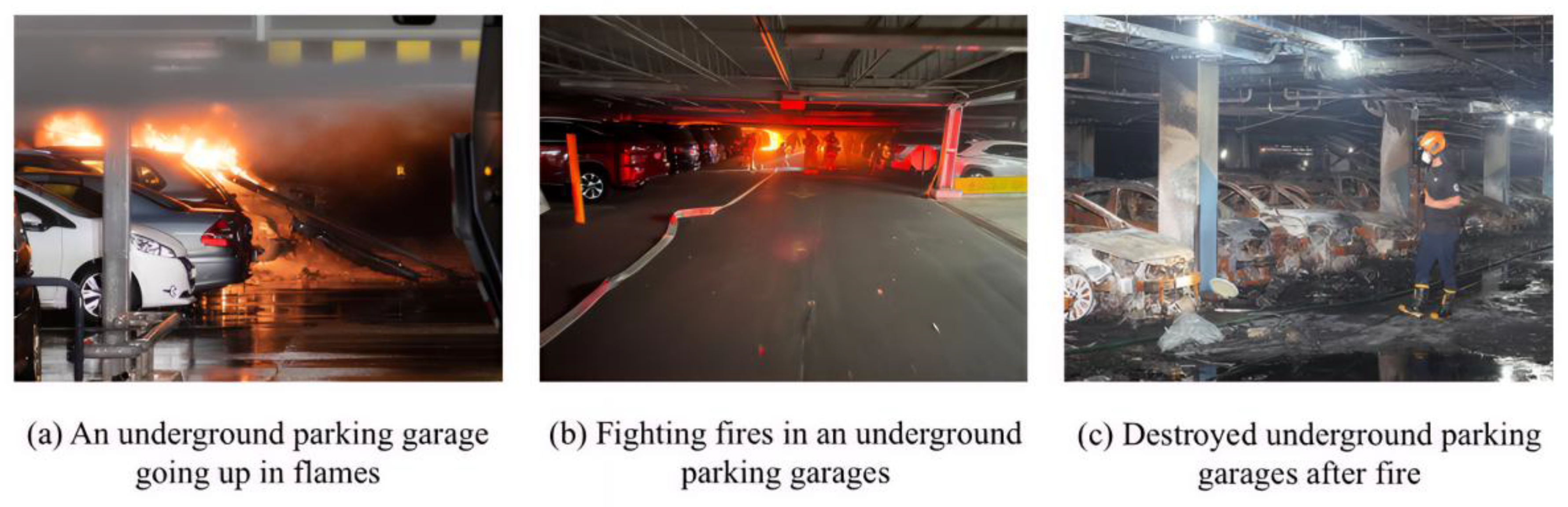
With the acceleration of urbanization, parking areas are commonly incorporated into modern buildings on ground or lower levels, such as basements, to optimize space utilization [1]. However, underground parking garages typically possess a high fire load and complex smoke flow characteristics. This is primarily due to their confined geometry, limited ventilation, and high density of vehicle storage, which exacerbate fire hazards. The occurrence of a fire poses a severe and highly time-sensitive challenge to fire safety protocols. Figure 1 shows typical fire incidents in underground parking garages. Frequent fire incidents have been reported in underground parking garages globally in recent years. These incidents have resulted in significant casualties and economic losses, as shown in Table 1. Consequently, as the scale of urban underground space development expands, an urgent need for in-depth study has arisen. Research is required to enhance the fire emergency response capability and fire suppression efficiency of underground parking garages.
Underground parking garages are typical subterranean spaces, frequently found in large-scale public and commercial buildings [8]. Previous studies focusing on these areas primarily revolved around key issues. These issues included fire load, smoke characteristics, and evacuation safety. Building upon these foundations, extensive experiments and simulations have shown that the combustion process inside parking garages has several characteristics. These include rapid fire source power growth and swift smoke spread. A notable deterioration of the thermal environment is also observed. These characteristics lead to greater uncertainty and high risk in fire development [9]. Concurrently, potential fire safety hazards related to building decorative materials are receiving increasing attention. For instance, epoxy resin floor coatings are widely used in underground garages due to their excellent wear resistance and aesthetic qualities [10]. However, their combustion performance generally only reaches Class B2. This fails to meet the Class B1 fire resistance requirement for underground garages specified in Chinese design codes [11]. During a fire, these materials may release large amounts of smoke and toxic gases. This exacerbates the complexity of both personnel evacuation and fire service operations [12].
Against this background, scholars globally have confirmed the crucial role of rationally designed mechanical smoke exhaust systems and sprinkler devices. These systems control smoke temperature and concentration. They secure valuable time for personnel evacuation and fire intervention [13,14]. Meanwhile, studies concerning underground evacuation strategies have intensified in recent years. Numerical simulations and human experiments have shown that parking density, aisle width, and signage systems all significantly affect crowd evacuation paths and efficiency [15,16]. In addition to the above, research related to new energy vehicle fires has matured recently. Technical challenges are being posed to traditional firefighting and smoke exhaust methods. These challenges stem particularly from secondary explosions and toxic gas release caused by power battery thermal runaway [17,18]. Although these studies offer multi-dimensional support for underground parking garage fire safety, their perspective is mostly limited to the internal environment of the facility. The configuration of external fire service resources remains to be fully explored.
In the field of public safety, the optimization of fire station locations, fire service accessibility assessment, and fire rescue coverage has provided important methodological support [19,20,21,22,23]. Methods such as geographic information systems-based accessibility models, multi-objective optimization, and the establishment of generalized linear models have been applied to address issues related to fire station location optimization and fire resource deployment [24,25,26,27]. Other studies have incorporated real-time traffic data to construct spatiotemporal accessibility models, revealing the dynamic evolution of fire service responses influenced by road congestion. These models provide a basis for decision-making in fire resource scheduling and distribution [21,28]. However, previous studies focusing on the quantitative evaluation of fire service accessibility for underground parking garages remain scarce. To address this deficiency, it is essential to establish a specialized evaluation model capable of scientifically quantifying fire service accessibility in these high-risk environments.
Therefore, a method was constructed to quantify the regional fire service accessibility of underground parking garages using dynamic travel time and entropy weight method weighting. To validate this model, the Chinese megacity of Shenzhen was selected as the study area. The fire service supply points were identified as 510 fire stations in Shenzhen. The fire service demand points were 3378 underground parking garages. Real-time traffic data was acquired using the Baidu Maps API v2.0. Finally, 165,522 result samples were obtained across 49 evaluation scenarios. This data was used to assess the regional fire service accessibility of underground parking garages in Shenzhen. The study results provide a scientific basis for the optimal allocation of urban fire service resources. These results aim to offer a new theoretical perspective for preventing severe fire accidents in urban underground parking garages.

2. Problem Context and Theoretical Framework

2.1. Fire Safety Challenges

Underground parking garages currently face three major fire safety challenges: (1) the deterioration of the fire environment due to smoke and heat accumulation, (2) difficulties in fire truck access, and (3) the fire risks posed by new energy vehicles.
(1)
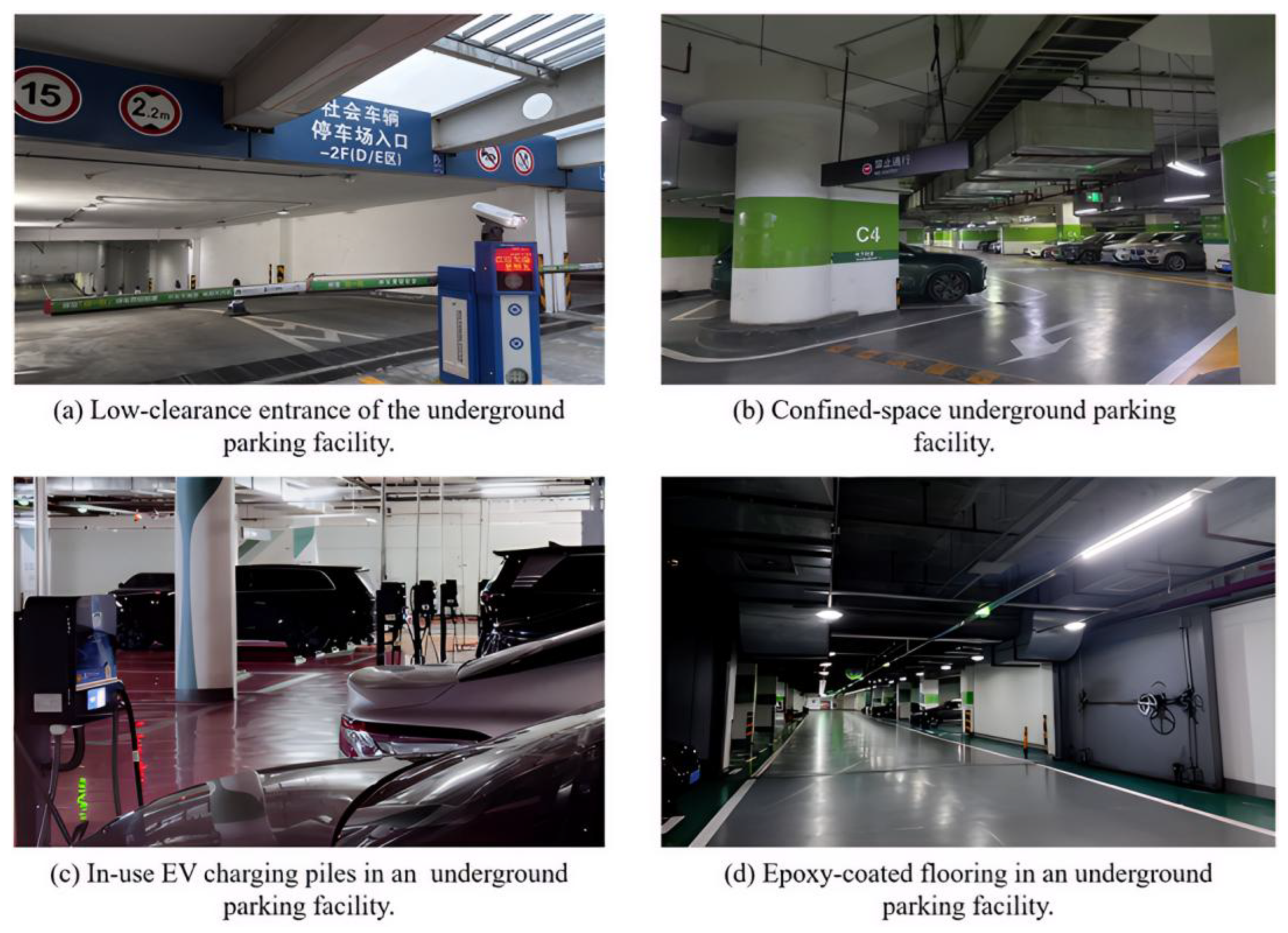
The first challenge is the deterioration of the fire environment caused by heat and smoke accumulation. As shown in Figure 2a, the space of underground parking garages is relatively enclosed and ventilation is restricted. Compared with open spaces, the heat and smoke released by combustion are easily accumulated within this limited space. This accumulation further exacerbates the fire environment [29]. Furthermore, mechanical smoke exhaust systems are often difficult to activate promptly or are limited by the fire source location. This leads to prolonged smoke retention time. Visibility rapidly drops and the concentration of toxic gases increases. Personnel evacuation and rescue operations face immense challenges [30]. Consequently, the cumulative effect of heat and smoke is one of the most destructive and crucial characteristics of fires in underground parking garages.
(2)
The second challenge involves the difficulty of fire truck access into underground parking garages. These facilities typically have complex structures and narrow passages. The clear height and turning radius of the lanes often fail to meet the requirements for fire truck passage. According to China’s Code for Fire Protection Design of Buildings (GB50016-2014), the clear width and clear height of fire access roads should be at least 4.0 m. The turning radius for ordinary fire vehicles is specified as 9 m [31]. However, on-site studies have revealed that the clear height of most underground parking garage entrances is only between 2.2 m and 4.0 m (Figure 2b). This severely restricts the potential access of large fire service vehicles. Additionally, the minimum turning radius of internal roads should be designed according to the minimum turning radius of the vehicles using them. Most underground garages only permit micro, small, and light vehicles, where the minimum turning radius is only 6.0 m. In summary, fire trucks are limited to relying on external hoses for fire suppression and service in most cases. This significantly prolongs the response time and increases the difficulty of firefighting operations.
(3)
The third challenge arises from the fire risks associated with the increasing number of new energy vehicles. In response to the global energy crisis and environmental pollution, many countries have placed greater emphasis on the development of new energy vehicles. In 2024, global electric vehicle production reached 17.3 million units, a 25% increase from the previous year. In China, electric vehicle sales accounted for nearly half of the total car sales in 2024 [32]. As a result, underground parking garages are increasingly being used to park and charge new energy vehicles [28]. Figure 2c,d show charging station scenarios in underground parking garages. However, compared with traditional fuel vehicles, new energy vehicles present higher fire risks [33]. This is because lithium-ion batteries, commonly used in new energy vehicles, are highly prone to fires under conditions such as compression, internal short circuits, or overheating [34]. Particularly in underground, confined spaces, fire spreads quickly, and smoke accumulates severely, making firefighting operations more challenging than those for above-ground fires. Furthermore, many underground parking garages are equipped with charging stations for new energy vehicles. Improper wiring, poor connections, or overload during charging can easily lead to fire accidents [35].

2.2. Research Progress in Fire Service Accessibility

Accessibility refers to the quantitative expression of the ease or expectation with which people can overcome resistance such as distance or time to reach service facilities or activity venues [36]. In the context of urban emergency management, fire service accessibility is derived from this theoretical framework [37]. It quantifies the ease with which fire apparatus reaches fire demand points via the key indicator of response time. The shorter the response time, the easier it is for fire apparatus to reach fire service demand points, and correspondingly, the higher the fire service accessibility [28].
In early studies, buffer analysis and Voronoi polygons were the most prevalent methods for calculating accessibility, with their underlying principles defined by Euclidean distance to delineate fire protection coverage [38,39]. However, these methods often overestimate service capacity by neglecting actual road network constraints. To address this, many scholars have introduced network analysis and the kernel density method to simulate travel time more realistically [40,41]. In recent years, the two-step floating catchment area (2SFCA) method has gained traction in emergency rescue research. By incorporating the supply-demand relationship between facilities and individuals, it more accurately identifies areas with genuine service shortages [42,43]. However, conventional 2SFCA assumes uniform access probability within thresholds, which oversimplifies real-world conditions [27]. In contrast, Geographic Information Systems (GIS) have compensated for previous limitations by considering geographical factors [44,45]. Nonetheless, since GIS road network data are often lagged, it remains difficult to precisely capture fluctuations in the fire rescue range [46].
With the rapid development of online maps, API services can obtain real-time traffic data and calculate the driving distance between any two points, thereby enabling more precise quantification of the dynamic fluctuations in fire service accessibility during different time periods [21]. Therefore, research on fire service accessibility and related directions such as fire station location selection based on real-time traffic conditions has become a current research hotspot [21,23,25,47]. Current accessibility research primarily focuses on macro-scale urban areas, with limited attention paid to high-risk underground garages. Furthermore, existing methods often overlook objective weight calibration. This study addresses these limitations by combining dynamic travel time with the entropy weight method.

3. Methodology

3.1. Fire Rescue Apparatus Demand and Travel Time

Firefighting apparatus considered for use must be more complex due to the increasingly complicated and variable fire risk characteristics in underground parking garages. On one hand, smoke and heat are difficult to dissipate promptly during a fire because of the enclosed space. This easily leads to a widespread reduction in visibility and a high-temperature environment within a short period. On the other hand, fire loads in underground parking garages primarily originate from whole-vehicle combustion, as they are concentrated parking areas for motorized vehicles. Combustion involves various combustibles, including vehicle body plastics, rubber, fuel, lubricants, and interior decoration materials. High heat release rates and dense smoke concentrations are produced by this combustion. The generation of toxic and harmful gases is also frequent. This poses a serious threat to personnel evacuation and rescue efforts. Specifically, the extinguishing of a fire originating from an internal lithium-ion battery in an NEV requires more complex firefighting apparatus.
Taking into account that there are a large number of fuel risk sources stored in the underground parking garage, foam extinguishing agents offer excellent fire suppression efficacy due to their high viscosity and low density. They are suitable for Class A and Class B fires. They also show great promise for extinguishing electric vehicle fires [48,49]. Sustained and copious amounts of fire water are recommended as the extinguishing agent by the U.S. NFPA Electric Vehicle Emergency Field Guide. This recommendation is also supported by the U.S. National Highway Traffic Safety Administration’s Interim Guidance for Electric Vehicle and Hybrid-Electric Vehicles Equipped With High Voltage Batteries [50,51]. Consequently, the minimum apparatus required on-site is set in this paper as one water tender or one foam fire truck. These vehicles must also be equipped with an accompanying mobile smoke extraction fan. According to China’s ‘Urban Fire Station Construction Standard’ (JGJ 152-2017) [52], all types of fire stations are equipped with at least one water tank fire truck or foam fire truck, along with an accompanying mobile smoke extraction fan. Moreover, water tenders and foam trucks are treated as functionally equivalent in this study. Therefore, the specific type of fire truck dispatched does not influence the accessibility evaluation, and fire apparatus capacity is regarded as a standardized constant. This allows the subsequent analysis to focus precisely on the spatiotemporal variables of accessibility.
To evaluate fire service accessibility, the travel time of fire trucks must first be obtained. In this study, the Baidu Map Web API is used as the primary data interface for simulating calculations based on dynamic traffic conditions. According to Article 14 of the Fire Protection Law of the People’s Republic of China, fire trucks have priority when responding to rescue missions, allowing them to bypass regular speed limits and traffic signals, as long as safety is ensured. Therefore, fire trucks typically have shorter travel times than regular vehicles on the same road. It is assumed that the travel time for fire trucks is 10% shorter than that of civilian traffic, meaning 90% of the travel time calculated by Baidu Map is used as the actual fire truck travel time [21,47].
Previous research has shown that within a 3–13 min response time, average monetary losses increase by approximately 3000 USD per minute, whereas uncertainty increases significantly beyond 13 min [53]. Therefore, the travel time of the first fire truck is crucial for determining whether the fire can be effectively controlled. The Chinese Urban Fire Planning Code (GB 51080-2015) specifies that fire stations should be located so that they can reach the district boundary within 5 min of receiving an alarm, including 1 min of preparation time and 4 min of travel time [54]. The UK Home Office’s official statistics show that the average travel time for a fire truck responding to an urban fire is 6 min [55]. The Washington D.C. Fire and Emergency Medical Services Department mandates that the first fire truck should arrive within 320 s for structural fires, with this response time serving as a key evaluation metric [56]. Real-life firefighting cases also reflect this. In the 2017 Liverpool car park fire in the UK, the first fire truck arrived approximately 9 min after the alarm [57]. In the 2023 wildfire in Lahaina, Hawaii, the first fire trucks arrived 5 min after the alarm [58]. In the 2024 “1.24” major fire in Xinyu, Jiangxi Province, China, the fire team arrived approximately 7 min after the alarm [59].
It is thus evident that travel time is a decisive factor influencing service efficiency. Minimized response intervals are fundamental to achieving early-stage fire suppression and preventing catastrophic escalations. Combining the above-mentioned standards and case studies, travel time is established as the core evaluation dimension in this study. Four service accessibility intervals are delimited: 0–240 s, 240–420 s, 420–600 s, and >600 s. These intervals are used to reflect differences in service capability under various response timeliness levels. In summary, when the fire service accessibility evaluation model for underground parking garages is constructed in this paper, it is required that at least one water tender or one foam fire truck, equipped with an accompanying mobile smoke extraction fan, should arrive within the stipulated travel time of 240 s.

3.2. Evaluation Model

Analyze the fire service accessibility of an underground parking garage in a certain region during r evaluation moments within a specific time period. Denote the moment corresponding to the j-th evaluation scenario as T j . Assume that the total number of underground parking garages in the region is m, with the i-th parking garage denoted as P i . At time T j , the travel time and travel distance from P i to the nearest fire station, which has the shortest travel time, are denoted as t i , j and d i , j . The average travel time, average travel distance, and average travel speed for all underground parking garages in the region at time T j are then calculated using Equations (1)–(3).
Average travel time T ¯ ( T j ) :
T ¯ ( T j ) = 1 m i = 1 m t i , j
Average travel distance D ¯ ( T j ) :
D ¯ ( T j ) = 1 m i = 1 m d i , j
Average travel velocity V ¯ ( T j ) :
V ¯ ( T j ) = D ¯ ( T j ) T ¯ ( T j )
To provide a more accurate representation of the overall evaluation across all scenarios, the weighted sums of the T ¯ ( T j ) , D ¯ ( T j ) , and V ¯ ( T j ) for the underground parking garages in different evaluation scenarios are calculated. The overall average travel time T ¯ T , overall average travel distance D ¯ T , and overall average travel velocity V ¯ T for all evaluation scenarios are then obtained, with the corresponding formulas shown in Equations (4)–(6).
T ¯ T = 1 2 1 T r T 1 j = 1 r 1 ( T j + 1 T j ) ( T ¯ ( T j ) + T ¯ ( T j + 1 ) )
D ¯ T = 1 2 1 T r T 1 j = 1 r 1 ( T j + 1 T j ) ( D ¯ ( T j ) + D ¯ ( T j + 1 ) )
V ¯ T = 1 2 1 T r T 1 j = 1 r 1 ( T j + 1 T j ) ( V ¯ ( T j ) + V ¯ ( T j + 1 ) )
For the qualitative analysis of fire service accessibility in the region, the fire service accessibility levels are classified into four categories: Excellent, Good, Moderate, and Poor, based on the travel time intervals defined earlier. Each level represents a different ability to respond to fire risks, as shown in Table 2.

3.3. Regional Fire Service Accessibility Index

Based on the regional fire service accessibility classification, the proportion of parking garages at each rating level (Excellent, Good, Moderate, Poor) within the total sample at a specific evaluation moment is further examined in this study. Dynamic weighting is then performed using the entropy weight method. This process is used to construct the fire service accessibility index for each time period of the underground parking garages. This index assists in characterizing the coupled relationship between accessibility and the distribution of rating levels across different periods. It thus quantifies the regional fire service level. It is assumed that the number of underground parking garages at the Excellent, Good, Moderate, and Poor levels in the j-th evaluation scenario are m j , I , m j , II , m j , III , m j , IV , respectively. The proportion x j , k of each level’s structure at that moment is then calculated. These proportions form the original structural proportion matrix X, as shown in Equations (7) and (8).
x j , k = m j , k m , k I , II , III , IV
X = x j , k R r × 4
To unify the measurement scale and ensure directional consistency, range normalization is used to standardize the original matrix X. This approach is adopted to preserve the absolute boundaries and physical interpretability of the fire service indicators while maintaining a strictly non-negative data distribution. The “Excellent” and “Good” levels are classified as positive indicators. They are normalized positively based on the minimum reference value. The “Moderate” and “Poor” levels are classified as negative indicators. They are normalized inversely based on the maximum reference value. The standardized proportion z j , k for the k-th rating level in the j-th evaluation scenario is finally obtained. The specific process for this calculation is presented in Equation (9).
z j , k = x j , k min ( x k ) max ( x k ) min ( x k ) , k I ,   II max ( x k ) x j , k max ( x k ) min ( x k ) , k III ,   IV
To objectively reflect the discriminatory power of each level indicator along the time dimension, the entropy weight method is further employed to calculate the entropy weight for each level. A more significant fluctuation of a certain level during the evaluation period represents a greater amount of information. Consequently, a higher weight should be assigned, and vice versa. When the proportional matrix p j , k for the entropy weight method is constructed, a minute positive number ε = 10 12 is introduced in this paper. This prevents the logarithmic term from becoming zero. Subsequently, based on the principle of the entropy weight method, the information entropy e k and the corresponding redundancy d k for each level indicator in the time dimension are calculated. Higher values of d k reflect more pronounced spatial-temporal fluctuations in accessibility for a given level. Normalization is then applied to obtain the weight w k for each level indicator. The calculation processes for p j , k , e k , d k and w k are detailed in Equations (10)–(13).
p j , k = z j , k j = 1 r z j , k + ε
e k = 1 ln ( r ) j = 1 r p j , k ln ( p j , k )
d k = 1 e k
ω k = d k k { I ,   II ,   III ,   IV } d k
By combining the standardized proportion z j , k of each level and the corresponding entropy weight ω k , the raw linear composite value C j r a w for the underground parking garages at the j-th moment is derived. This is shown in Equation (14).
C j r a w = k { I ,   II ,   III ,   IV } ω k z j , k
The efficacy of initial fire suppression is extremely high but diminishes significantly as the fire spreads [53]. Given that fire forces are permanently deployed urban assets, they maintain a baseline response capability even under extreme conditions. Simultaneously, the limited clearance of entrances and complex layouts of underground spaces imply that ‘perfect’ accessibility is practically unattainable. To accurately reflect this nonlinear attenuation of rescue effectiveness and the performance characteristics under extreme conditions, a natural exponential function is employed to map C j r a w into the final regional fire service accessibility index C j , with 0.5 utilized as a scaling factor in Equation (15).
C j = 1 1 2 e C j r a w
C j is used to characterize the overall level of regional fire service response capability at a given evaluation moment. A higher value indicates a greater number of underground parking garages concentrated in the “Excellent” and “Good” levels. This represents a higher level of fire service at that time. Conversely, a lower value suggests a higher proportion of underground parking garages classified as “Moderate” or “Poor” in the area. This reflects an inadequate regional fire service response capability. For a qualitative analysis of the regional fire service accessibility, Table 3 maps the numerical results to four grades (A through D), representing a descending order of fire service capability.

3.4. Evaluation Scenario Settings

To accurately assess the fire service accessibility level of underground parking garages in Shenzhen, a 24 h period was set as the evaluation cycle in this paper. The evaluation period was selected to be from 00:00 on Friday, 22 November 2024, to 00:00 on Saturday, 23 November 2024. Based on this, 49 evaluation scenarios were delineated with a 30 min time interval. A total of 165,522 result samples were ultimately obtained. This scheme covers three typical traffic conditions: morning and evening peak hours, daytime off-peak hours, and night-time free flow. The dynamic evolution pattern of traffic flow within a single day is also effectively reflected. Sample data were acquired in real-time by calling the Baidu Maps Web API via JavaScript. The real-time travel distance and time from the fire service supply points to the demand points were calculated for each evaluation moment. Based on this, the fire service accessibility and fire service accessibility index for all underground parking garages in Shenzhen were computed.

4. Data Description

4.1. Overview of the Study Area

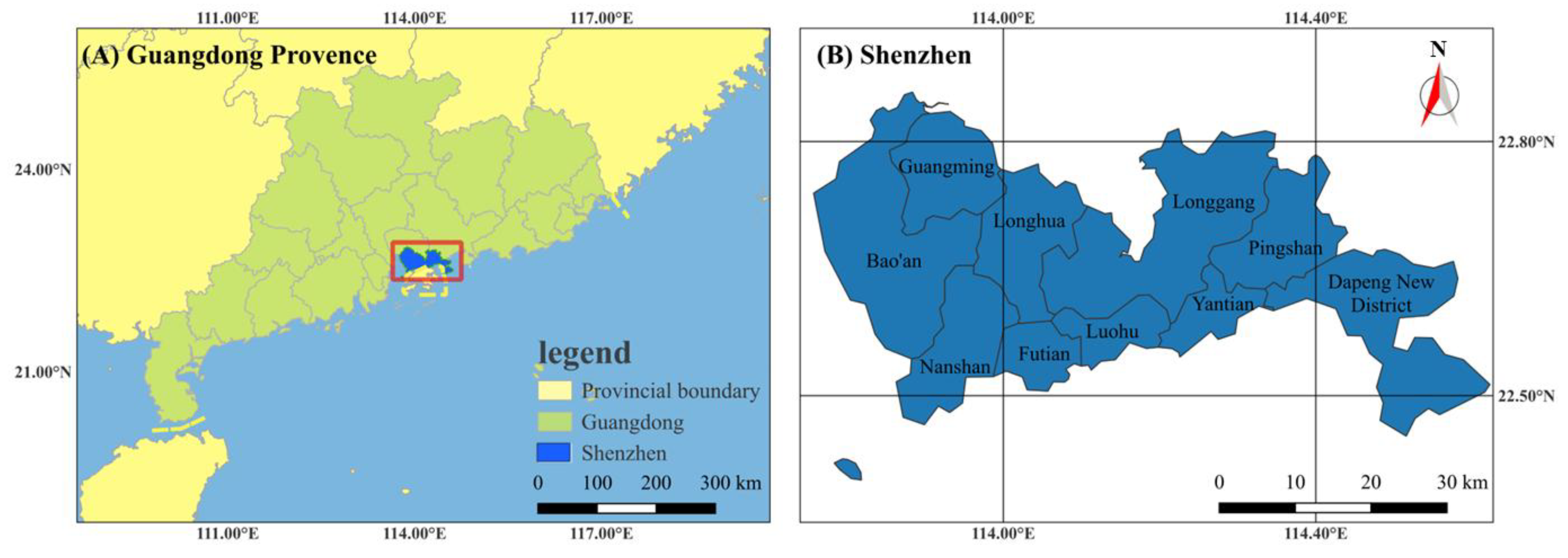
Shenzhen (113°43′ E~114°38′ E,22°24′ N~22°52′ N) is a megacity in southern China. Figure 3 shows the location map of Shenzhen. The city covers an area of 1997.47 km2. It administers nine administrative districts and one new district. The socio-economic characteristics and the number of fire stations for each administrative district are shown in Table 4. By the end of 2024, the permanent resident population of Shenzhen was 17.9895 million. The city’s Gross Regional Product was 3680.187 billion Chinese Yuan. Shenzhen’s topography is characterized as a comprehensive geomorphological area. It is dominated by hills and features a combination of low mountains, hills, platforms, terraces, and plains. Significant challenges are posed to Shenzhen’s fire service resource configuration and emergency response due to its high population density and complex terrain conditions.

4.2. Fire Station Data

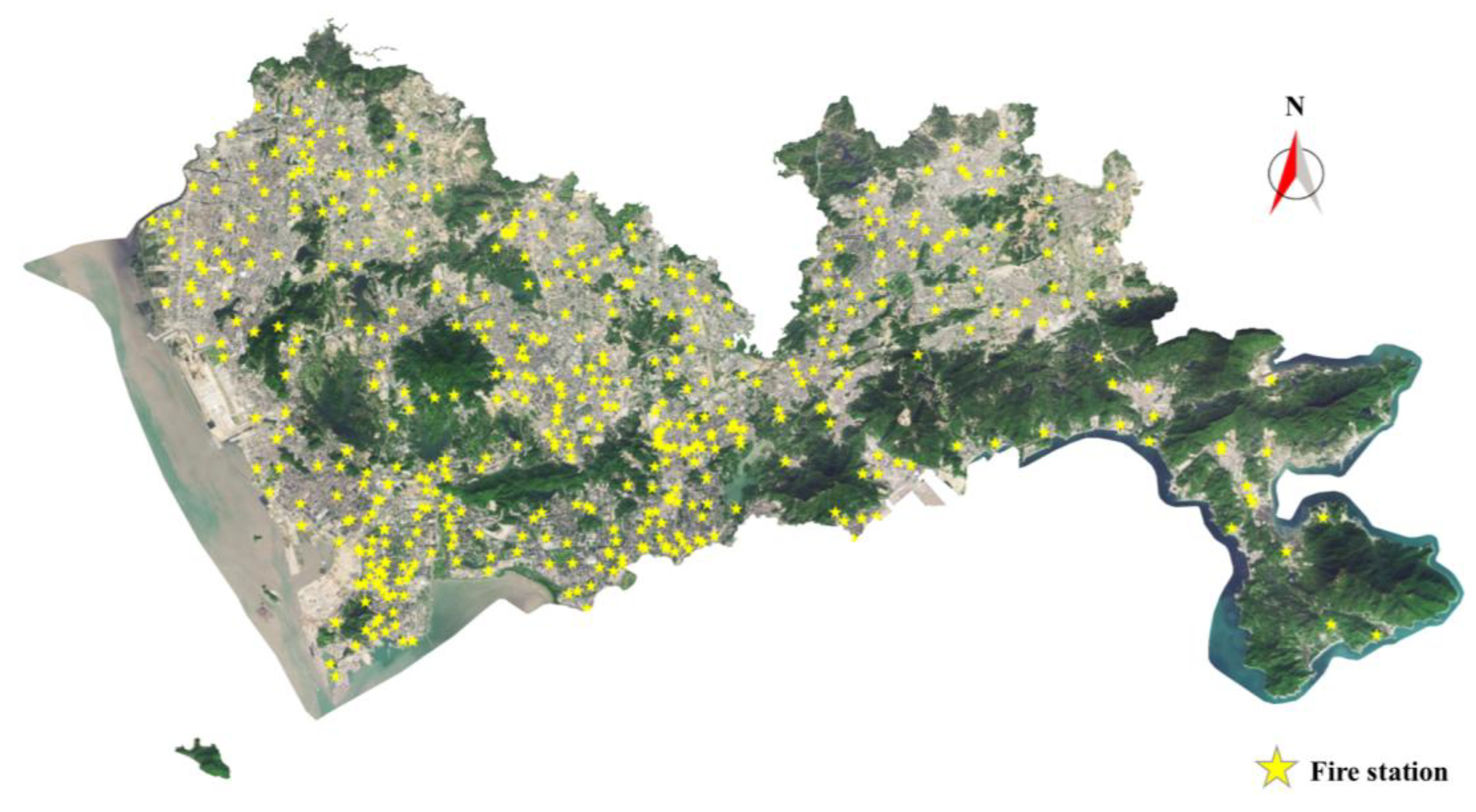
As of the end of 2024, there were 510 fire stations in Shenzhen. This total includes 6 special service stations, 69 primary stations, 422 small stations, and 13 township primary stations. The precise locations of all fire stations were acquired through online maps. Each fire station’s structured address was converted into latitude and longitude coordinates using an online map geocoding service. This facilitated the subsequent calculation of fire truck travel time. The spatial distribution of fire stations in Shenzhen is shown in Figure 4, where each yellow five-pointed star represents one fire station. It can be observed from the figure that fire stations in Shenzhen are mainly concentrated in the central-western core urban areas. These areas specifically include Nanshan District and Futian District. The eastern part of Shenzhen is predominantly mountainous. Consequently, the distribution density in areas like Pingshan District and Dapeng New District is slightly lower compared with the core areas.

4.3. Underground Parking Garage Data

A total of 3378 underground parking garages in Shenzhen were captured as fire service demand points by calling the Baidu Maps Web API in this paper. Due to factors such as insufficient public data coverage and the lag in map data updates, some parking garage information was not included in the map database. Therefore, a confidence check on the sampled quantity was conducted using statistical methods. This was done to verify whether the acquired sample size of underground parking garages met the quantitative requirements. As shown in Equation (16), the total population N = 8921 is derived from official municipal statistics [60], a confidence level of 95% (Z = 1.96) and a margin of error E of 5% were adopted. The calculated required sample size was 368.30. Since the number of captured underground parking garages, 3378, is significantly higher than the required sample size, the quantity of the underground parking garage sample is deemed to satisfy the confidence requirement.
n = N Z 2 P ( 1 P ) N E 2 + Z 2 P ( 1 P )
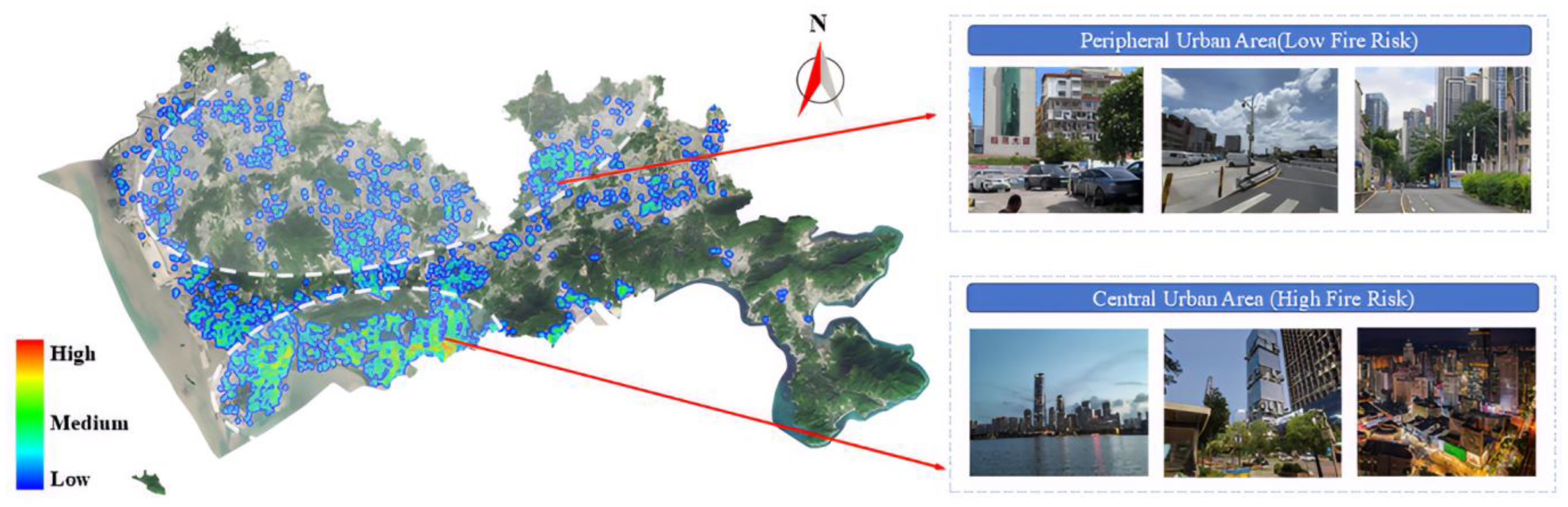
Fire service demand points are closely related to fire risk points. In this study, underground parking POI data crawled from online maps are used as input variables for the risk evaluation. The corresponding fire service demand points are visualized through kernel density clustering [61], resulting in a distribution fire risk cloud map, as shown in Figure 5. Different colors represent varying degrees of fire risk. Colors closer to red indicate a higher density of fire service demand points and, consequently, a greater fire risk. Significant spatial distribution differences in fire risk are observed for underground parking garages in Shenzhen from the figure. High-risk areas are primarily concentrated in the core urban districts, such as Nanshan, Futian, and Luohu. These regions serve as the political, economic, and commercial centers of Shenzhen. They feature dense layouts of underground parking garages because they gather high-density office buildings, commercial complexes, large transportation hubs, and high-rise residential communities. This results in high-intensity underground space development and strong parking demand. In contrast, peripheral urban areas, including Longhua, Longgang, and Pingshan Districts, are primarily dominated by outdoor parking areas. Influenced by a slower pace of urban renewal and relatively lower development density, the number and scale of underground parking garages in these areas are lower than in the core regions.

5. Results and Discussion

5.1. Fire Service Accessibility Analysis

After processing and analyzing the 165,522 data samples across 49 evaluation scenarios, the results for T ¯ ( T j ) , D ¯ ( T j ) and V ¯ ( T j ) for each scenario are detailed in Appendix A Table A1. Table 5 presents the T ¯ T , D ¯ T and V ¯ T for all average scenarios of underground parking garages in Shenzhen. According to the preceding accessibility classification standard based on travel time, the T ¯ T for underground parking garages in Shenzhen is 388.17 s. This value falls within the (240, 420) “Good” level accessibility interval. This demonstrates that the overall accessibility performance of Shenzhen’s underground parking garages is stable in most emergency scenarios. The capacity to respond to regional fire risks is thus relatively strong.
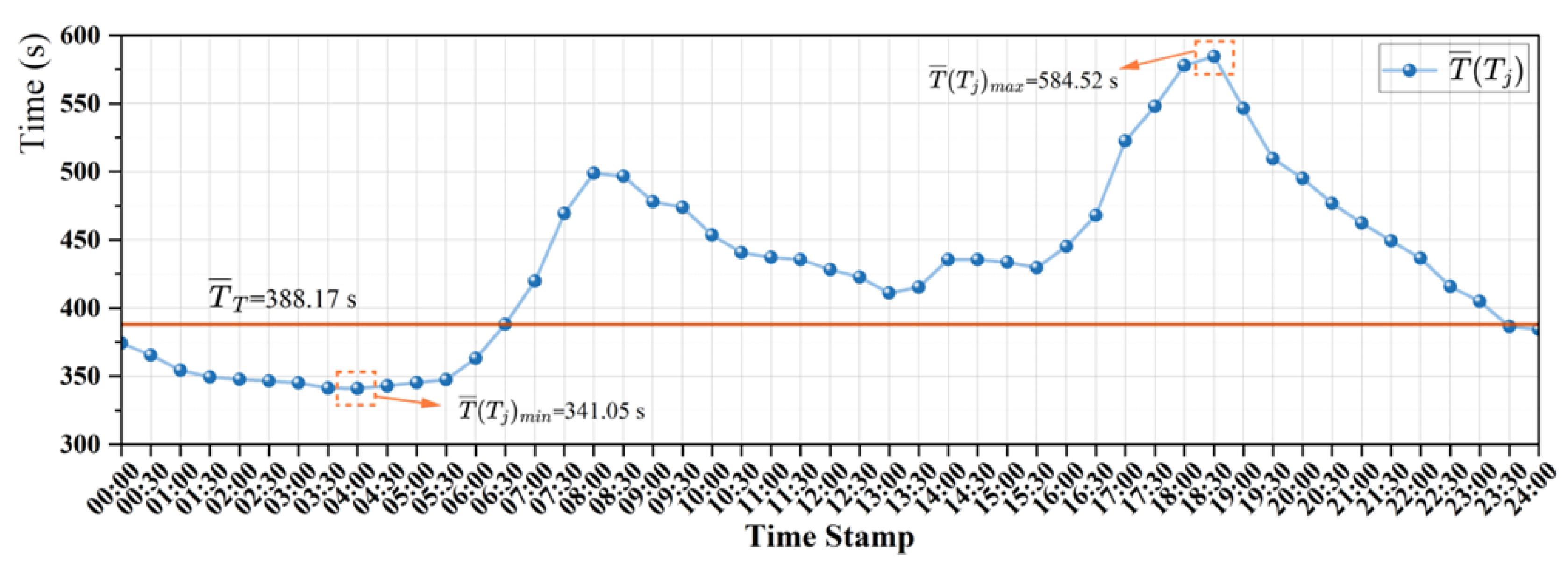
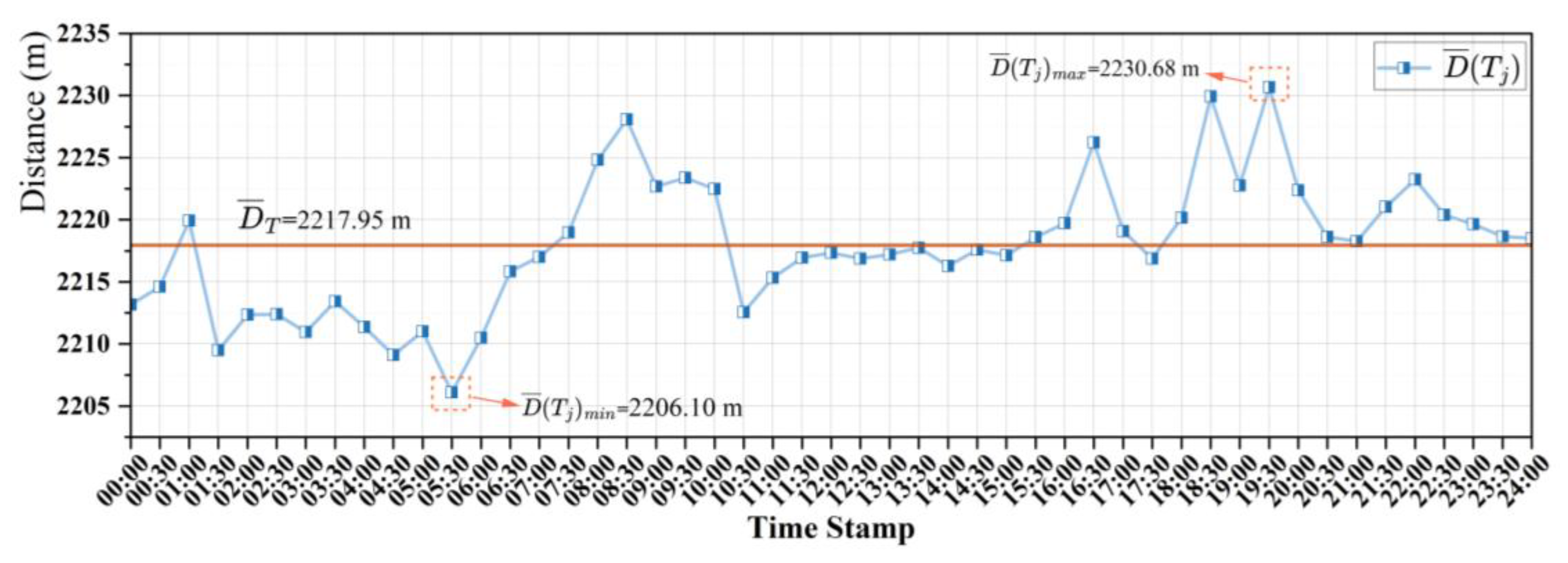
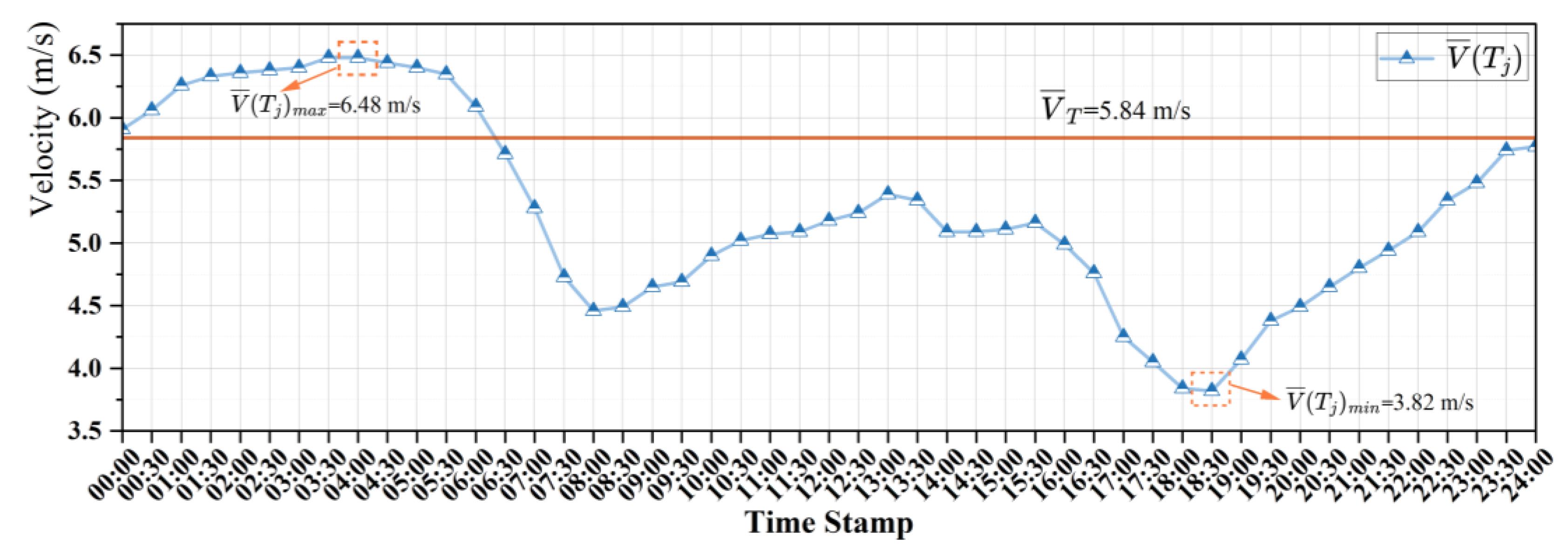
It can be seen from Figure 6, Figure 7 and Figure 8 that T ¯ ( T j ) and V ¯ ( T j ) exhibit regular changes, influenced by the circadian rhythm. During the early morning period (0:00–05:00), vehicular activity frequency on the roads is extremely low, reflecting free-flow traffic conditions. Specifically, the T ¯ ( T j ) at 04:00 reached its daily minimum of 341.05 s. During the morning peak hours (6:00–9:00), the travel time gradually lengthens due to increased traffic flow. Concurrently, the fire truck travel speed decreases significantly. Traffic remains relatively stable during the daytime working hours (9:00–16:00). Both T ¯ ( T j ) and V ¯ ( T j ) generally maintain a stable level during this period. T ¯ ( T j ) is observed to significantly extend again during the evening peak hours (16:00–19:00). The maximum travel time for the entire day, 584.52 s, is reached at 18:30. Finally, traffic pressure is gradually alleviated during the night (19:00–24:00). T ¯ ( T j ) gradually decreases, and V ¯ ( T j ) gradually increases. However, the overall level remains lower than the early morning state, showing a “Good” level of accessibility. Simultaneously, it can be observed from Figure 7 that D ¯ ( T j ) fluctuates slightly around approximately 2.22 km throughout the day. The fluctuation range of travel distance is between 2206.10 m and 2230.68 m. This indicates that the travel distance remains essentially stable throughout the day. Comparing Figure 6 and Figure 7, it is observed that the timestamps for the extrema of T ¯ ( T j ) and D ¯ ( T j ) are not synchronized. This is because the routing follows the ‘time-optimal’ principle, where the system dynamically selects faster but longer paths based on traffic, causing minor fluctuations in travel distance with the optimal route choice. In summary, the fire service accessibility level of underground parking garages in Shenzhen is generally controllable. However, the response capability exhibits alternating high and low characteristics throughout the day. The response capability during peak hours is relatively vulnerable. It is recommended that the deployment of mobile fire forces be augmented during morning and evening peak hours. This measure is intended to mitigate the negative impact of traffic congestion on fire service accessibility.

5.2. Regional Fire Service Accessibility Index Analysis

The entropy weight method was employed to objectively determine the weights for the raw linear composite value C j r a w , which serves as the basis for the final regional fire service accessibility Index ( C j ). The corresponding values of e k , d k , and ω k for each fire service accessibility evaluation level are presented in Table 6. Among these, the information entropy e k for the “Good” level is the highest at 0.9774. This indicates that its spatial and temporal distribution is the most uniform. Its discriminatory power is relatively limited, resulting in the lowest corresponding weight. Conversely, the redundancy d k for “Excellent” and “Moderate” is relatively high. This suggests stronger sensitivity to changes in the fire service response level. Their corresponding weights ω k are consequently at a higher level.
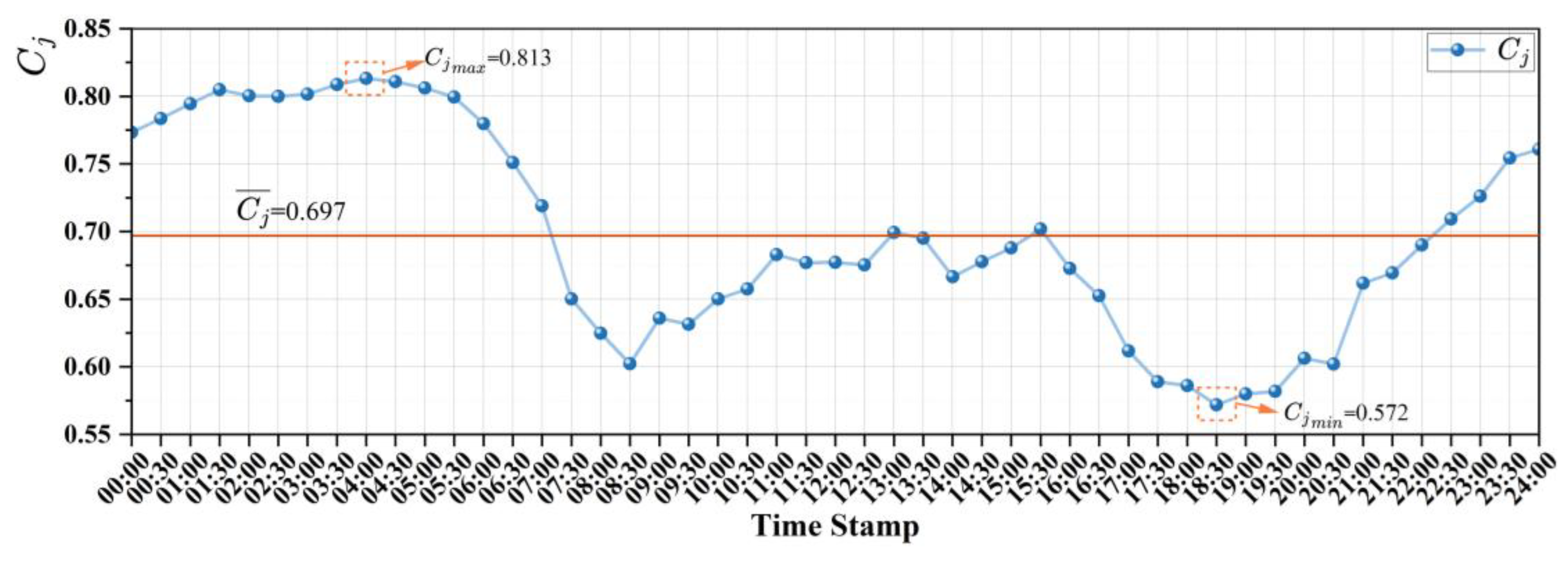
To reflect the physical reality that fire service accessibility is partially preserved even under extreme congestion, a natural exponential function is employed to map the standardized score C j to the final index. This correction yields the final C j , which ranges from 0.572 to 0.813. The results for C j r a w and C j for each scenario are detailed in Appendix A Table A1.
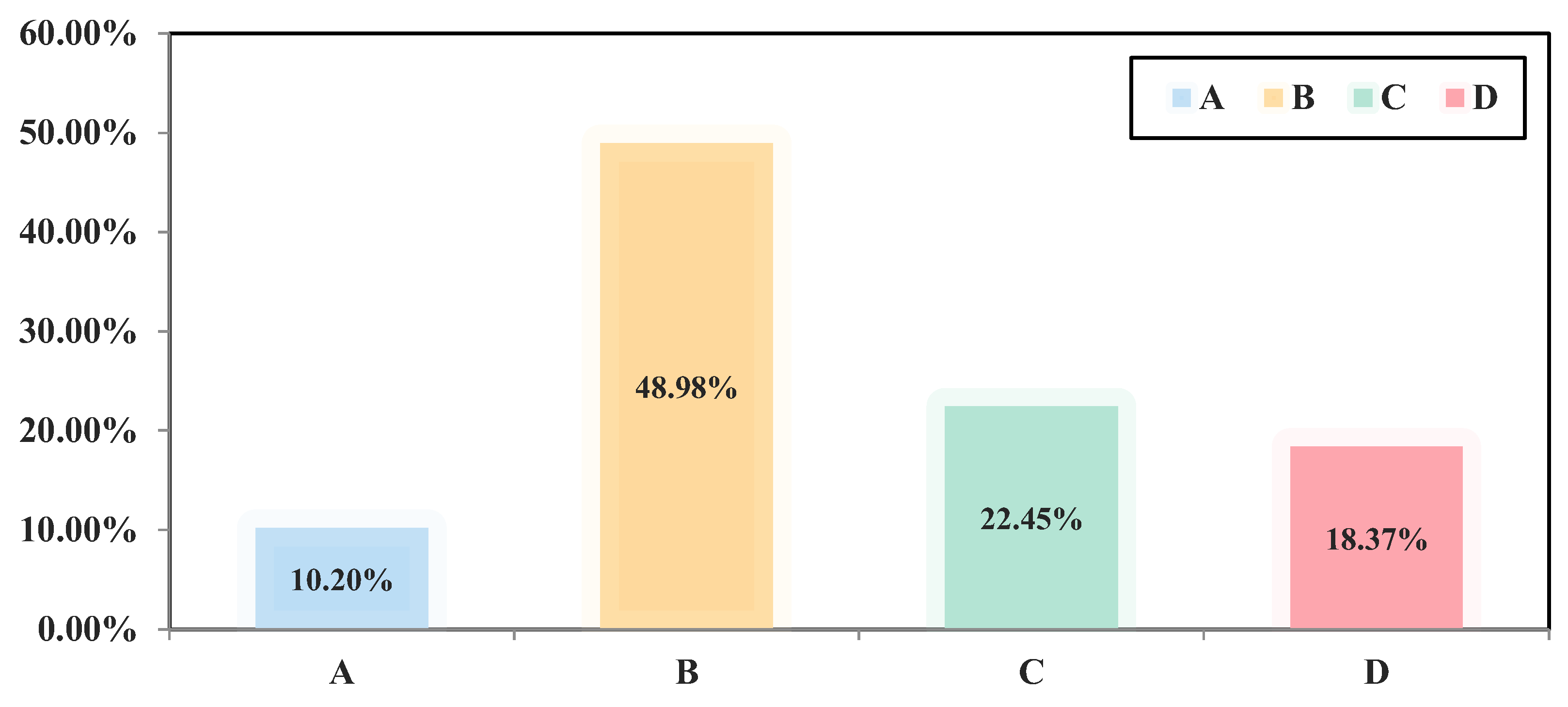
Analyzing the fire service accessibility index, a higher C j value signifies broader coverage of underground parking garages rated at the “Excellent/Good” levels and a relatively higher fire service response capability. Conversely, a lower value indicates restricted fire service response capability. As shown in Figure 9, the grade distribution of this index is primarily at the ‘B’ level, accounting for 48.98% of all evaluated scenarios, with the “A” level comprising 10.20%. This suggests that the fire service accessibility of underground parking garages in Shenzhen generally meets demand for most periods. However, during the study period, 22.45% of scenarios were at the “C” level and 18.37% at the “D” level, indicating that specific spatiotemporal bottlenecks still exist, and there remains significant room for optimization in regional fire service response levels.
Further analysis of the variation trend of C j values at different times in Figure 10 reveals that C j values exhibit characteristics of maintaining high levels during nighttime and early morning, followed by a sharp decline during peak hours. The peak C j value occurs at 04:00, reaching 0.813. Subsequently, during peak hours, due to traffic congestion leading to prolonged response times, C j values drop sharply, with a large number of parking garages rapidly descending from the ‘A’ level to the “C” or “D” level, resulting in a significant reduction in fire service response capabilities. This is particularly evident during the evening peak at 18:30, when the minimum C j value of 0.572 is reached. Additionally, the overall average index of 49 scenarios is 0.697, which corresponds to the “C” level, indicating that there is an insufficient response situation in the overall regional fire rescue capacity. It is recommended to optimize the layout of fire stations and increase fire resources in areas with weaker fire resource levels, in order to enhance the overall fire service capacity within the region.

5.3. Data Visualization

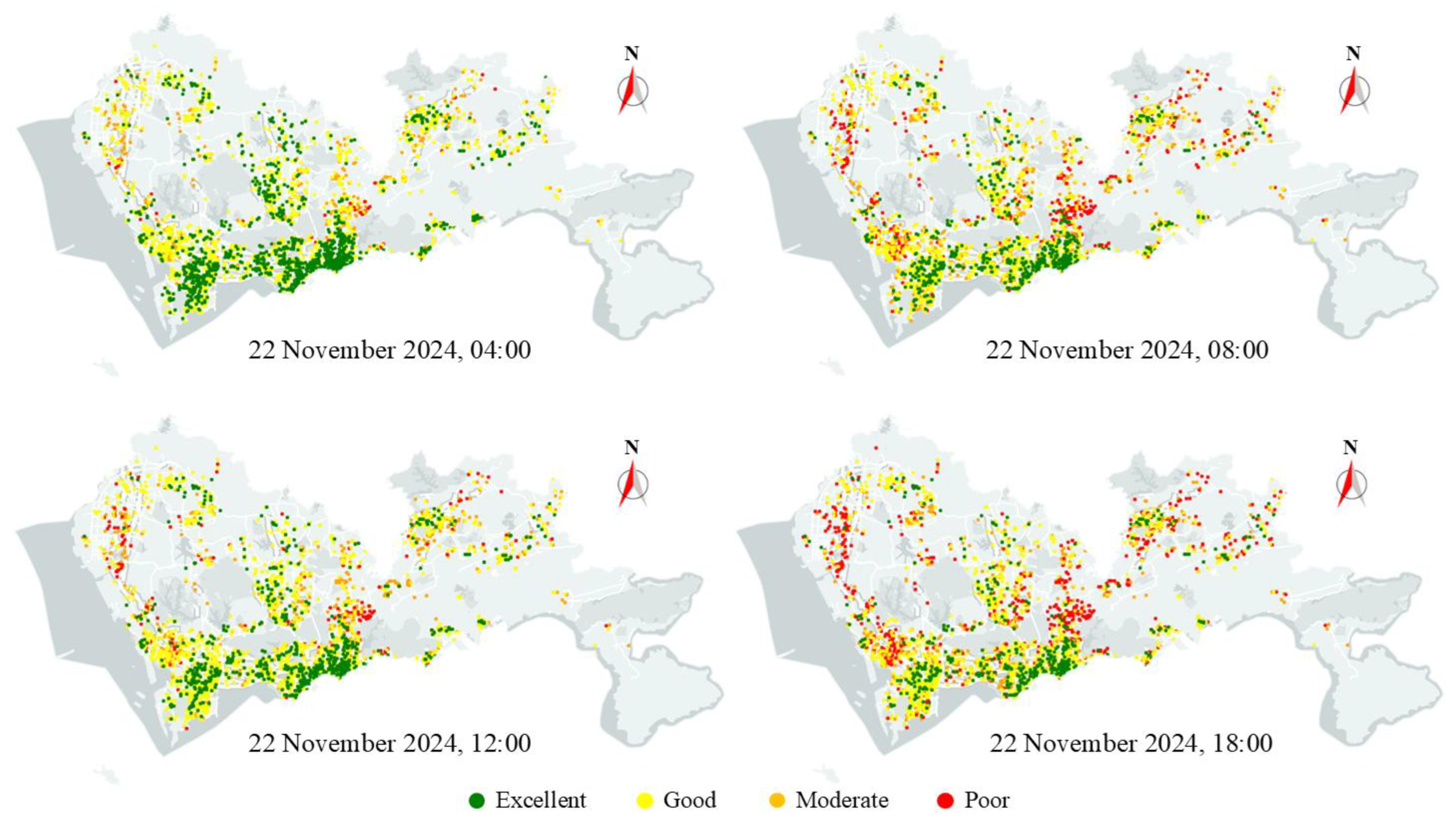
Based on the travel time from the fire stations to the fire service demand points, the demand points are categorized into four levels: “Excellent,” “Good,” “Moderate,” and “Poor.” These levels are visualized using green, yellow, orange, and red colors, respectively. Figure 11. illustrates four typical evaluation scenarios (04:00, 08:00, 12:00, 18:00) throughout 22 November 2024. A comprehensive analysis is therefore conducted on the evolution of urban fire service response levels over time across the night-time free flow, peak congestion, and daytime off-peak periods.
Observing the overall trend throughout the day, significant spatiotemporal variations in the fire response level of underground parking garages are evident across different time periods. The 04:00 scenario corresponds to the night-time free-flow period. Traffic flow is extremely low at this time. Nearly all areas show high accessibility. Most underground parking garages are at the “Excellent” or “Good” level. Green points are widely distributed, indicating that rapid coverage by fire resources can be achieved. At 08:00, the morning peak hour, commuting traffic pressure sharply increases. Accessibility around core urban areas and main traffic arteries significantly decreases. A large number of “Moderate” and “Poor” level points appear in areas such as Nanshan, Futian, and Luohu. The number of red points increases notably. At 12:00, the daytime off-peak period, traffic pressure is somewhat alleviated. The overall response level of parking garages rebounds. However, a higher number of “Moderate” level points are still distributed in commercial and high-density areas. The 18:00 evening peak again causes traffic obstruction. “Poor” level points diffuse in both core and peripheral areas. Fire response capability faces significant challenges during this time. It is recommended that fire resources be flexibly allocated in conjunction with traffic flow changes in each time period and area. The mobile rescue capability during peak hours should be improved. Furthermore, scientific traffic management measures should be implemented to ensure smooth passage for fire vehicles.
Regarding the spatial distribution characteristics of the fire service response level, a certain number of demand points rated as “Moderate” and “Poor” are found in the relatively peripheral areas of Shenzhen (Bao’an, Longgang, and Pingshan Districts). This is observed across all four typical evaluation scenarios. This indicates that while C j values may fluctuate with traffic flow, the overall accessibility level of a region still reliably reflects its fire service capacity, as fire rescue facilities and apparatus levels generally remain static in the short term. By cross-referencing the socio-economic characteristics of Shenzhen’s administrative districts in Table 4, it can be found that the peripheral areas such as Bao’an and Longgang Districts possess massive resident populations, but compared with core areas like Luohu and Nanshan Districts, their population scales are not well-matched with the regional economic development levels. This further reflects that urban development in the peripheral areas is relatively lagging and the fire infrastructure level is weak, thus leading to the situation where a certain number of demand points in these regions suffer from insufficient fire rescue accessibility most of the time. This suggests that the fire service level in these areas is not only affected by traffic conditions. It also reflects deeper issues, such as a potentially low density of fire resource allocation or insufficient road capacity. Therefore, measures such as adding fire stations and improving infrastructure construction should be considered in the city’s peripheral areas. This is to enhance overall fire response capability and reduce service disparities between regions.

6. Conclusions

A target time value of 4 min for the first arriving fire truck under the scenario of an underground parking garage fire was established in this study. Based on the fire characteristics of underground parking garages, the minimum requirement for arrival at the fire scene within 4 min was determined. This requirement is one water tender or one foam fire truck, accompanied by a mobile smoke extraction fan. Subsequently, a two-tier evaluation model was proposed based on real-time traffic data and POI. This model combines dynamic fire service accessibility with entropy weight method weighting. Shenzhen’s 510 fire stations were used as fire service supply points. The 3378 underground parking garages were taken as fire service demand points. Real-time traffic data was acquired using the Baidu Maps API. The 165,522 result samples obtained across 49 evaluation scenarios lead to the following main conclusions:
(1)
The average travel time T ¯ T was calculated to be 388.17 s during the study period. The average travel distance D ¯ T was 2217.95 m, and the average speed V ¯ T was 5.84 m/s. The overall fire service accessibility is classified as the “Good” level. The shortest fire response travel time, 341.05 s, occurs at 04:00 in the morning. Most parking garages are at the “Excellent” or “Good” level at this time. The longest travel time, 584.52 s, is observed at 18:30 during the evening peak. This reflects the significant constraint of traffic congestion on service timeliness. It is advised that mobile fire forces be increased during morning and evening peak hours to mitigate the adverse effects of road congestion on rescue efficiency.
(2)
The regional fire service accessibility index C j exhibits a large fluctuation range, and its distribution is predominantly in the “C” grade. The C j values at different moments range between 0.572 and 0.813. A high level of fire service assurance is presented only during the early morning period; fire service capability is generally insufficient during most other time periods. Notably, during the evening peak hour of 18:30, the index is only 0.572. The overall average C j for all 49 scenarios is 0.697, corresponding to Grade “C”, representing the general level of regional fire service accessibility. This reflects a prominent structural issue with the level of fire resources in Shenzhen’s underground parking garages. Optimizing the layout of fire stations and increasing fire forces in areas with weaker fire resource structures are recommended. This will enhance the overall fire service capability within the region.
(3)
Significant spatial disparities exist in fire resource configuration. Core urban areas exhibit excellent performance during night-time free-flow periods, but their response capability markedly declines during peak hours. Peripheral areas, such as Bao’an, Longgang, and Pingshan, contain a large number of “Moderate” and “Poor” level points during most time periods. This indicates insufficiencies in resource allocation density and road conditions. It is suggested that additional fire stations be established in peripheral areas, and road traffic conditions be improved. This will compensate for the shortcomings in fire resource configuration in the outer areas of Shenzhen.
This study provides a practical framework for evaluating the fire service accessibility of urban underground garages. Currently, a single-day temporal cycle is used to evaluate the accessibility in Shenzhen; future research could extend this to multi-cycle assessments to further improve precision. Additionally, while this study focuses on external road network accessibility, future work could incorporate internal garage traversal conditions to enhance the granularity of the assessment.

Author Contributions

Conceptualization, Dingli Liu and Leng Liang; methodology, Leng Liang, Dingli Liu and Diping Yuan; software, Leng Liang; validation, Weijun Liu and Lei Zou; formal analysis, Leng Liang and Dingli Liu; investigation, Weijun Liu; resources, Dingli Liu and Diping Yuan; data curation, Leng Liang and Lei Zou; writing—original draft preparation, Leng Liang; writing—review and editing, Dingli Liu and Diping Yuan; visualization, Lei Zou; supervision, Guohua Wu; project administration, Weijun Liu; funding acquisition, Dingli Liu and Diping Yuan. All authors have read and agreed to the published version of the manuscript.

Funding

This paper was funded by the Shenzhen Science and Technology Program (No. KCXFZ20230731093902005), and the National Natural Science Foundation of China (No. 52204202).

Data Availability Statement

The data presented in this study are available upon request from the corresponding author.

Conflicts of Interest

The authors declare no conflicts of interest.

Appendix A

Table A1. Detailed information of fire stations.
NumberTime Stamp T ¯ T D ¯ T V ¯ T C j r a w C j Count
IIIIIIIV
12024/11/22 00:00374.172213.185.910.7910.7739641303663448
22024/11/22 00:30365.392214.606.060.8370.78410111305649413
32024/11/22 01:00354.342219.946.260.8890.79510791291637371
42024/11/22 01:30349.272209.506.330.9410.80511331267610368
52024/11/22 02:00347.752212.366.360.9180.80011141302637325
62024/11/22 02:30346.612212.406.380.9160.80011371276642323
72024/11/22 03:00345.212210.976.400.9250.80211451265633335
82024/11/22 03:30341.412213.426.480.9610.80911581282614324
92024/11/22 04:00341.052211.376.480.9850.81311701283598327
102024/11/22 04:30342.862209.116.440.9720.81111851246604343
112024/11/22 05:00345.322211.016.400.9480.80611431277614344
122024/11/22 05:30347.362206.106.350.9140.80011421253637346
132024/11/22 06:00363.162210.506.090.8200.78010401272671395
142024/11/22 06:30388.082215.845.710.6970.7519101260700508
152024/11/22 07:00419.862217.015.280.5760.7198061210728634
162024/11/22 07:30469.582218.984.730.3570.6506511087785855
172024/11/22 08:00498.992224.834.460.2870.6255821022778996
182024/11/22 08:30496.732228.084.490.2290.602600972826980
192024/11/22 09:00478.082222.684.650.3170.6366561018797907
202024/11/22 09:30473.952223.394.690.3050.6316421025802909
212024/11/22 10:00453.562222.474.900.3570.6506841092810792
222024/11/22 10:30440.752212.565.020.3780.6576911147820720
232024/11/22 11:00437.192215.345.070.4550.6837281149768733
242024/11/22 11:30435.522216.955.090.4370.6777421121783732
252024/11/22 12:00428.192217.335.180.4380.6777251186801666
262024/11/22 12:30422.702216.885.240.4320.6757551166818639
272024/11/22 13:00411.182217.205.390.5080.6998101188789591
282024/11/22 13:30415.452217.745.340.4940.6957781207791602
292024/11/22 14:00435.562216.285.090.4050.6677131158813694
302024/11/22 14:30435.582217.605.090.4390.6787201172790696
312024/11/22 15:00433.712217.145.110.4710.6887721148782676
322024/11/22 15:30429.692218.605.160.5170.7027721167744695
332024/11/22 16:00445.172219.734.990.4240.6737571098796727
342024/11/22 16:30468.042226.244.760.3640.6536711075786846
352024/11/22 17:00522.632219.084.250.2530.6125589797751066
362024/11/22 17:30548.022216.884.050.1960.5895238967701189
372024/11/22 18:00578.012220.163.840.1890.5864708687271313
382024/11/22 18:30584.522229.943.820.1550.5724867907361366
392024/11/22 19:00546.312222.774.070.1740.5805258647781211
402024/11/22 19:30509.582230.684.380.1790.5825659248301059
412024/11/22 20:00495.022222.384.490.2390.6065821010821965
422024/11/22 20:30476.792218.634.650.2280.6026141028863873
432024/11/22 21:00462.232218.264.800.3910.6626451126765842
442024/11/22 21:30449.342221.034.940.4140.6706611173775769
452024/11/22 22:00436.382223.265.090.4780.6907271178758715
462024/11/22 22:30415.812220.405.340.5420.7097961207754621
472024/11/22 23:00404.942219.645.480.6020.7268391238738563
482024/11/22 23:30386.452218.645.740.7110.7549221264696496
492024/11/23 00:00384.322218.515.770.7370.7619171290679492

References

  1. Wallace, M.I.; Ng, K.C. Development and application of underground space use in Hong Kong. Tunn. Undergr. Space Technol. 2016, 55, 257–279. [Google Scholar] [CrossRef]
  2. Lim, J.-W. Fire Kills Seven Workers in Daejeon Outlet Mall Basement. Available online: https://koreajoongangdaily.joins.com/2022/09/26/national/socialAffairs/Korea-Daejeon-Hyundai-Premium-Outlet/20220926140345977.html (accessed on 11 September 2025).
  3. Brinson, A. Fire Causes Collapse of a Car Park in Paris. Available online: https://www.eurosprinkler.org/fire-causes-collapse-of-a-car-park-in-paris/ (accessed on 11 September 2025).
  4. Kim, J.; Yang, H.; Park, J.-M. South Korea Holds Emergency Meeting as EV Fires Stir Consumer Fear. Available online: https://www.reuters.com/business/autos-transportation/south-korea-holds-emergency-meeting-ev-fires-stir-consumer-fear-2024-08-12/ (accessed on 11 September 2025).
  5. Keystone-SDA. Fireworks Accident Caused Fatal Explosion in Swiss Car Park. Available online: https://www.swissinfo.ch/eng/various/accident-with-fireworks-as-the-cause-of-the-explosion-in-nussbaumen-ag/80747438 (accessed on 11 September 2025).
  6. Huizhou Fire and Rescue. Cause of the Huizhou Xiangxieyuan Underground Car-Park Fire Determined. Available online: https://static.nfnews.com/content/202408/19/c9668583.html?enterColumnId=0%29 (accessed on 11 September 2025).
  7. CTIF—International Association of Fire and Rescue Services. Two Spanish Firefighters Died in a Parking Garage Fire—Explosion and Smoke Inhalation Reported to Be Cause of Death. Available online: https://ctif.org/news/two-spanish-firefighters-died-parking-garage-fire-explosion-and-smoke-inhalation-reported-be (accessed on 11 September 2025).
  8. Barsim, M.M.; Bassily, M.A.; El-Batsh, H.M.; Rihan, Y.A.; Sherif, M.M. Performance of impulse ventilation system in an underground car park fire: Case study. J. Build. Eng. 2020, 29, 101162. [Google Scholar] [CrossRef]
  9. Chiu, Y.-M.; Weng, C.-Y.; Chen, Y.-J. Study of indoor parking lot planning for electric vehicles through fire dynamics simulation. Sci. Prog. 2025, 108, 00368504251331877. [Google Scholar] [CrossRef] [PubMed]
  10. Yang, Z.; Xiao, G.; Chen, C.; Chen, C.; Zhong, F.; Cao, M.; Wang, M.; Zou, R.; Li, R.; Shang, S. A novel P, N doped organic-inorganic hierarchical core-shell nanostructures: Reducing the fire risk of epoxy resin. Prog. Org. Coat. 2023, 183, 107776. [Google Scholar] [CrossRef]
  11. GB 50067-2014; Code for Fire Protection Design of Garage, Motor Vehicle Repair Shop and Parking Area. Ministry of Housing and Urban-Rural Development of China: Beijing, China, 2014. Available online: https://gf.cabr-fire.com/article-4466.htm (accessed on 11 September 2025).
  12. Wang, J.; Zhang, D.; Zhang, Y.; Cai, W.; Yao, C.; Hu, Y.; Hu, W. Construction of multifunctional boron nitride nanosheet towards reducing toxic volatiles (CO and HCN) generation and fire hazard of thermoplastic polyurethane. J. Hazard. Mater. 2018, 362, 482–494. [Google Scholar] [CrossRef]
  13. Zandie, M.; Nicusan, A.L.; Sharifi, S.; Marriot, R.; Jaffar, M.; Windows-Yule, K.; Jangi, M. Data-driven optimisation of the ventilation systems in underground car parks: A CFD-DNN study. J. Build. Eng. 2024, 98, 111181. [Google Scholar] [CrossRef]
  14. Cho, J.; Kim, J.; Park, W.; Kim, Y. A step-by-step numerical method for optimization of mechanical ventilation in deep underground enclosed parking lots: A case-design study. J. Build. Eng. 2021, 42, 102799. [Google Scholar] [CrossRef]
  15. Cui, C.; Shao, Q.; Liu, Y.; Han, G.; Liu, F.; Han, X. A Review of the Evolution and Trends in Research on the Emergency Evacuation of Urban Underground Spaces. Buildings 2023, 13, 1325. [Google Scholar] [CrossRef]
  16. Bae, Y.-S.; Choi, M. Optimizing Key Evacuation Features for Safer Egress in Complex Buildings with Underground Connections: A Simulation-Based Approach to Resilient and Sustainable Design. Sustainability 2025, 17, 3731. [Google Scholar] [CrossRef]
  17. Zhao, C.; Hu, W.; Meng, D.; Mi, W.; Wang, X.; Wang, J. Full-scale experimental study of the characteristics of electric vehicle fires process and response measures. Case Stud. Therm. Eng. 2024, 53, 103889. [Google Scholar] [CrossRef]
  18. Jang, J.; Jeon, J.; Oh, C.B. Risk Assessment of Toxic Gas Dispersion from Electric Vehicle Fires in Underground Apartment Parking Garages Using Numerical Analysis. Fire 2025, 8, 96. [Google Scholar] [CrossRef]
  19. Chen, M.; Wang, K.; Yuan, Y.; Yang, C. A POIs based method for location optimization of urban fire station: A case study in Zhengzhou City. Fire 2023, 6, 58. [Google Scholar] [CrossRef]
  20. Liu, D.; Xu, Z.; F, W. Subway cluster fire risk assessment based on consequence probability estimation. J. Railw. Sci. Eng. 2021, 18, 813–820. [Google Scholar] [CrossRef]
  21. Zhou, T.; Liu, D.; Liu, W.; Li, Y.; Zhu, S.; Wang, J.; Shi, L. Hierarchical dynamic estimation of fire service accessibility based on POI big data. Case Stud. Therm. Eng. 2024, 59, 104503. [Google Scholar] [CrossRef]
  22. Xiong, Y.; Li, G. Correlation Characteristics Between Urban Fires and Urban Functional Spaces: A Study Based on Point of Interest Data and Ripley’s K-Function. ISPRS Int. J. Geo-Inf. 2025, 14, 45. [Google Scholar] [CrossRef]
  23. Lei, X.; Liu, D.; Yuan, D.; Liu, W.; Zeng, Y. Evaluation model for rural–urban fire service resource imbalance: A county-level perspective. Ain Shams Eng. J. 2025, 16, 103695. [Google Scholar] [CrossRef]
  24. Wells, E.M.; Beval, E.; Kay, S.; Small, M.J.; Wong-Parodi, G. Quantifying wildland fire resources deployed during the compound threat of COVID-19. Sci. Rep. 2024, 14, 20039. [Google Scholar] [CrossRef]
  25. Zhu, J.; Xu, X.; Yang, X. Spatial accessibility measurement of urban fire stations considering multi-path characteristic of road networks. J. Transp. Geogr. 2025, 126, 104248. [Google Scholar] [CrossRef]
  26. Jiang, Y.; Lv, A.; Yan, Z.; Yang, Z. A GIS-based multi-criterion decision-making method to select city fire brigade: A case study of Wuhan, China. ISPRS Int. J. Geo-Inf. 2021, 10, 777. [Google Scholar] [CrossRef]
  27. He, X.; Wu, B.; Shen, G.; Lyu, Q.; Ofori, G. Assessing Fire Station Accessibility in Guiyang, a Mountainous City, with Nighttime Light and POI Data: An Application of the Enhanced 2SFCA Approach. ISPRS Int. J. Geo-Inf. 2025, 14, 393. [Google Scholar] [CrossRef]
  28. Huang, Y.; Liu, D.; Tang, J.; Niu, S.; Bell, F.M.; Pena-Mora, F. Dynamic estimation of the fire service spatial accessibility for EV charging stations: Towards preventing severe fires and explosions. Process Saf. Environ. Prot. 2024, 195, 106734. [Google Scholar] [CrossRef]
  29. Zhai, X.; Kong, W.; Hu, Z.; Zhang, C.; Ma, H.; Zhao, J. Prediction method and application of temperature distribution in typical confined space spill fires based on deep learning. Process Saf. Environ. Prot. 2025, 198, 107127. [Google Scholar] [CrossRef]
  30. Li, Y.; Huang, F.; Ma, C.; Tang, K. A simulation study on the smoke control effect with different smoke exhaust patterns and longitudinal air supply for ultra-wide tunnels. Fire 2022, 5, 72. [Google Scholar] [CrossRef]
  31. GB 50016-2014, 2018 Edition; Code for Fire Protection Design of Buildings. Ministry of Housing and Urban–Rural Development of the People’s Republic of China: Beijing, China, 2018.
  32. International Energy Agency (IEA). Global EV Outlook 2025. Available online: https://www.iea.org/reports/global-ev-outlook-2025 (accessed on 20 September 2025).
  33. Mohd Tohir, M.Z.; Martín-Gómez, C. Evaluating Fire Severity in Electric Vehicles and Internal Combustion Engine Vehicles: A Statistical Approach to Heat Release Rates. Fire Technol. 2025, 61, 2957–2998. [Google Scholar] [CrossRef]
  34. Bai, Z.P.; Yu, Y.Y.; Zhang, J.Y.; Hu, H.M.; Xing, M.Y.; Yao, H.W. Study on fire characteristics of lithium battery of new energy vehicles in a tunnel. Process Saf. Environ. Prot. 2024, 186, 728–737. [Google Scholar] [CrossRef]
  35. Zhang, S.; Yang, Q.; Gao, Y.; Gao, D. Real-Time Fire Detection Method for Electric Vehicle Charging Stations Based on Machine Vision. World Electr. Veh. J. 2022, 13, 23. [Google Scholar] [CrossRef]
  36. Chen, Y.; Jin, F.; Lu, Y.; Chen, Z.; Yang, Y. Development history and accessibility evolution of land transportation network in Beijing-Tianjin-Hebei region over the past century. J. Geogr. Sci. 2018, 28, 1500–1518. [Google Scholar] [CrossRef]
  37. Shahparvari, S.; Fadaki, M.; Chhetri, P. Spatial accessibility of fire stations for enhancing operational response in Melbourne. Fire Saf. J. 2020, 117, 103149. [Google Scholar] [CrossRef]
  38. Banach, M.; Długosz, R. Solutions for planning smart hybrid public transportation system based on Google Maps and Voronoi diagrams. J. Comput. Appl. Math. 2026, 472, 116775. [Google Scholar] [CrossRef]
  39. Ramezani, S.; Laatikainen, T.; Hasanzadeh, K.; Kyttä, M. Shopping trip mode choice of older adults: An application of activity space and hybrid choice models in understanding the effects of built environment and personal goals. Transportation 2021, 48, 505–536. [Google Scholar] [CrossRef]
  40. Falchetta, G.; Noussan, M.; Hammad, A.T. Comparing paratransit in seven major African cities: An accessibility and network analysis. J. Transp. Geogr. 2021, 94, 103131. [Google Scholar] [CrossRef]
  41. Mao, K.; Chen, Y.; Wu, G.; Huang, J.; Yang, W.; Xia, Z. Measuring spatial accessibility of urban fire services using historical fire incidents in Nanjing, China. ISPRS Int. J. Geo-Inf. 2020, 9, 585. [Google Scholar] [CrossRef]
  42. Setola, N.; Marzi, L.; Torricelli, M.C. Accessibility indicator for a trails network in a Nature Park as part of the environmental assessment framework. Environ. Impact Assess. Rev. 2018, 69, 1–15. [Google Scholar] [CrossRef]
  43. Geng, J.; Zeng, P.; Li, J.; Ren, X.; Cai, L. Spatial Equity of Children’s Extracurricular Activity Facilities Under Government–Market Dual Provision Systems: Evidence from Tianjin. ISPRS Int. J. Geo-Inf. 2026, 15, 63. [Google Scholar] [CrossRef]
  44. D’Auria, A.; Di Ruocco, I.; Gioia, A. An Integrated Isochrone-Based Geospatial Analysis of Mobility Policies and Vulnerability Hotspots in the Lazio Region, Italy. ISPRS Int. J. Geo-Inf. 2025, 14, 395. [Google Scholar] [CrossRef]
  45. Bi, H.; Gu, Y.; Lu, F.; Mahreen, S. Site selection of electric vehicle charging station expansion based on GIS-FAHP-MABAC. J. Clean. Prod. 2025, 507, 145557. [Google Scholar] [CrossRef]
  46. Ma, C.; Song, M.; Zeng, W.; Wang, X.; Chen, T.; Wu, S. Enhancing urban emergency response: A Euclidean distance-based framework for optimizing rescue facility layouts. Sustain. Cities Soc. 2025, 118, 106006. [Google Scholar] [CrossRef]
  47. Zhu, S.; Liu, W.; Liu, D.; Li, Y. The impact of dynamic traffic conditions on the sustainability of urban fire service. Sustain. Cities Soc. 2023, 96, 104667. [Google Scholar] [CrossRef]
  48. Junjunan, S.F.; Chetehouna, K.; Cablé, A.; Oger, A.; Gascoin, N.; Bura, R.O. A review on fire protection systems in military and civilian vehicles. Fire Technol. 2022, 58, 1097–1136. [Google Scholar] [CrossRef]
  49. Zhang, L.; Jin, K.; Sun, J.; Wang, Q. A Review of Fire-Extinguishing Agents and Fire Suppression Strategies for Lithium-Ion Batteries Fire. Fire Technol. 2024, 60, 817–858. [Google Scholar] [CrossRef]
  50. National Highway Traffic Safety Administration. Interim Guidance for Electric Vehicle and Hybrid-Electric Vehicles Equipped with High Voltage Batteries; National Highway Traffic Safety Administration: Washington, DC, USA, 2012.
  51. National Fire Protection Association. Electric Vehicle Emergency Field Guide; National Fire Protection Association: Quincy, MA, USA, 2014. [Google Scholar]
  52. JGJ 152-2017; Construction Standards for Urban Fire Stations. Ministry of Construction of the People’s Republic of China: Beijing, China, 2017. Available online: https://doc.saehs.com.cn:8010/2024/02/13/MjQwMjEzMzk3NDQzOTg0.html (accessed on 12 September 2025).
  53. Buffington, T.; Ezekoye, O.A. Statistical analysis of fire department response times and effects on fire outcomes in the United States. Fire Technol. 2019, 55, 2369–2393. [Google Scholar] [CrossRef]
  54. GB 51080-2015; Code for Planning of Urban Fire Control. Ministry of Housing and Urban-Rural Development of the People’s Republic of China: Beijing, China, 2015. Available online: https://gf.cabr-fire.com/article-6184.htm (accessed on 12 September 2025).
  55. Home Office. Detailed Analysis of Fires and Response Times to Fires Attended by Fire and Rescue Services England: April 2024 to March 2025. Available online: https://www.gov.uk/government/statistics/detailed-analysis-of-fires-england-april-2024-to-march-2025 (accessed on 11 September 2025).
  56. DC Fire and Emergency Medical Services Department. Fire Response Time. Available online: https://fems.dc.gov/page/fire-response-time (accessed on 12 September 2025).
  57. Merseyside Fire and Rescue Service. Kings Dock Car Park Fire—Independent Review. Available online: https://www.merseyfire.gov.uk/media/1592/kings-dock-car-park-fire-sir.pdf (accessed on 12 September 2025).
  58. State of Hawaii. Timeline of Maui Fires, Lahaina Wildfire Disaster Report. Available online: https://hawaiienergy.com/ (accessed on 11 September 2025).
  59. Ministry of Emergency Management of the People’s Republic of China. Investigation Report on the “1·24” Particularly Serious Fire Accident in Xinyu, Jiangxi Province. Available online: https://www.mem.gov.cn/gk/zfxxgkpt/fdzdgknr/202409/W020240921581426179695.pdf (accessed on 11 September 2025).
  60. EyeShenzhen. This Year, Shenzhen Will Add More Than 150,000 New Parking Spaces. Available online: https://mp.weixin.qq.com/s/a1fOviCRU7jxU-bfLGDsWQ (accessed on 11 September 2025).
  61. Liu, D.; Xu, Z.; Zhou, Y.; Fan, C. Heat map visualisation of fire incidents based on transformed sigmoid risk model. Fire Saf. J. 2019, 109, 102863. [Google Scholar] [CrossRef]
Figure 1. Fire incidents in underground parking garages.
Ijgi 15 00115 g001
Figure 2. Fire incidents in underground parking garages. (the Chinese label “社会车辆停车场入口-2F(D/E区)” in (a) indicates the entrance to the public parking garage on Level 2F, (Zones D/E)).
Ijgi 15 00115 g002
Figure 3. Location map of Shenzhen.
Ijgi 15 00115 g003
Figure 4. Spatial distribution of fire stations in Shenzhen.
Ijgi 15 00115 g004
Figure 5. Fire risk cloud map for underground parking garages in Shenzhen.
Ijgi 15 00115 g005
Figure 6. Trend of T ¯ ( T j ) change over time.
Ijgi 15 00115 g006
Figure 7. Trend of D ¯ ( T j ) change over time.
Ijgi 15 00115 g007
Figure 8. Trend of V ¯ ( T j ) change over time.
Ijgi 15 00115 g008
Figure 9. Proportional distribution of C j grades.
Ijgi 15 00115 g009
Figure 10. Trend of C j change over time.
Ijgi 15 00115 g010
Figure 11. Visualization of fire service accessibility levels for underground parking garages in typical scenarios.
Ijgi 15 00115 g011
Table 1. Recent major underground parking garage fire incidents.
DateAddressDescription
26 September 2022Daejeon, Republic of KoreaUnderground parking garage fire resulting in 7 fatalities and 1 critical injury [2].
28 April 2023Aubervilliers, FranceUnderground parking garage fire with partial structural collapse, resulting in 2 injuries [3].
1 August 2024Incheon, Republic of KoreaUnderground parking garage fire involving an electric vehicle (EV), resulting in at least 21 injuries; approximately 140 vehicles damaged [4].
13 June 2024Aargau, SwitzerlandUnderground parking garage explosion and fire resulting in 2 fatalities and 11 injuries [5].
19 August 2024Huizhou, ChinaUnderground parking garage fire attributed to traction-battery thermal runaway; damage to vehicles reported [6].
2 April 2025Alcorcón, SpainUnderground parking garage fire resulting in 2 firefighter fatalities and 15 injuries [7].
Table 2. Classification of individual parking garage fire service accessibility levels.
LevelResponse Time (s)Travel Time (s)
Excellent(0, 300](0, 240]
Good(300, 480](240, 420]
Moderate(480, 660](420, 600]
Poor>660>600
Table 3. Regional fire service accessibility index level classification.
Hierarchy C j Description
A[0.800, 1.000]The optimal level of regional fire service accessibility.
B[0.700, 0.800)The high level of regional fire service accessibility.
C[0.600, 0.700)The general level of regional fire service accessibility.
D[0.000, 0.600)The restricted level of regional fire service accessibility.
Table 4. Socio-economic characteristics and fire station distribution by administrative district in Shenzhen.
Administrative DistrictsResident Population (10k)Area (km2)GDP (Billion RMB)
Bao’an460.33382.04530.04
Longgang416.39388.22590.13
Nanshan184.44175.60950.01
Futian153.63187.53594.89
Longhua254.4678.65315.45
Luohu104.50155.44247.86
Guangming117.4178.75172.13
Pingshan62.39166.00114.38
Yantian21.6974.9164.36
Dapeng New District17.10295.3146.66
Table 5. T ¯ T , D ¯ T and V ¯ T for underground parking garages in Shenzhen.
Type T ¯ T (s) D ¯ T (m) V ¯ T (m/s)
Underground Parking Garages388.172217.955.84
Table 6. e k , d k and ω k corresponding to fire service accessibility evaluation levels.
Level e k d k ω k
Excellent0.94590.05410.3641
Good0.97740.02260.1519
Moderate0.95460.04540.3056
Poor0.97350.02650.1784
Disclaimer/Publisher’s Note: The statements, opinions and data contained in all publications are solely those of the individual author(s) and contributor(s) and not of MDPI and/or the editor(s). MDPI and/or the editor(s) disclaim responsibility for any injury to people or property resulting from any ideas, methods, instructions or products referred to in the content.