


Abstract
This study constructs a global transportation carbon emission spatial correlation network via a modified gravity model and explores its evolutionary characteristics and dynamic mechanisms by integrating three-dimensional evolutionary analysis (node, overall, structural) and temporal exponential random graph model (TERGM). The main findings are as follows: (1) Global transportation carbon emission spatial correlation intensity keeps rising, with improved connectivity and integration, forming three regionally agglomerated correlation poles centered on the United States (America), China (Asia) and major European countries (Europe). (2) Network centrality distributes asymmetrically: Switzerland, Norway and the United States remain core nodes, while China, Japan and other Asian economies with strong direct correlation radiation are not in the core tier. (3) Third, evolutionary dynamics stem from the synergistic interaction of multidimensional attributes. ① Economic level positively drives bidirectional connection emission and attraction; economic scale and openness curb emission but boost attraction, while tertiary industry structure inhibits both. ② Only economic level and government efficiency exert significant positive effects on absdiff, fostering network heterophilic attraction. ③ Spatial and institutional proximity in edgecov effectively facilitate connection formation. ④ Endogenous network variables present a collaborative mechanism of reciprocity and transmission, constrained by network density. ⑤ Temporal effects show early connection structure forms path dependence, resulting in low dynamic variability and overall network stability.
1. Introduction
1.1. Research Background
Global climate governance has now entered a critical phase of collaborative action. As a major sector contributing to energy consumption and carbon emissions, transportation emission abatement progress directly impacts the realization of the temperature control targets of the Paris Agreement [1] and the United Nations Sustainable Development Goals. Data from the International Energy Agency (IEA) [2] for 2023 reveal that global transportation carbon emissions represent 24% of total energy-related carbon emissions. However, their cross-regional, networked, and spatially transmissible characteristics render emission abatement initiatives by individual economies fundamentally inadequate.
In this context, collaborative governance has become the core orientation of national policy practices: the European Union has incorporated air transportation into the regulatory scope of the Carbon Border Adjustment Mechanism (CBAM) [3]; China has promoted cross-regional transportation emission abatement by linking the “Transportation Powerhouse” strategy with the “dual carbon” goals [4,5]. These practices collectively demonstrate that transportation carbon emissions constitute a cross-economy spatial interdependency system driven by factor mobility. The traditional governance paradigm, which relies on administrative divisions, is no longer compatible with its spatial spillover effects. Nevertheless, the current international climate cooperation mechanism still formulates transportation carbon emission control targets based on individual nations as independent units, failing to fully account for carbon emission interconnections among economies—thus underscoring the pressing dilemma of “inefficient partial emission abatement”.
Therefore, systematically uncovering the spatial correlation laws of global transportation carbon emissions and analyzing the functional roles of various countries within the network has become a key prerequisite for optimizing the collaborative governance paradigm.
1.2. Literature Review
Academic research on the spatial correlation characteristics of transportation carbon emissions has produced significant findings, with its evolution marked by progressively deeper research perspectives and methodologies. Early studies primarily followed two approaches: one employing spatial statistical methods to identify spatial clustering patterns and regional heterogeneity [6,7,8], and the other utilizing spatial econometric models to examine spatial spillover effects and analyze how factors such as energy intensity and economic development drive spatiotemporal differentiation [9,10]. Although these studies revealed spatially varying driving mechanisms, they remained constrained by a geographic adjacency perspective, thus failing to fully capture the multidimensional and complex spatial dependence structures between transportation carbon emissions and their influencing factors.
With the trend of interdisciplinary convergence, complex network methodologies have been introduced into this field, offering a new framework for analyzing the spatial correlation mechanisms of cross-regional transportation carbon emissions. Regarding network construction, previous studies have employed input–output models to characterize carbon emission transfer relationships [11,12,13,14,15]. However, this approach is constrained by outdated data, lacks dynamic timeliness, and fails to capture the real-time flow of people and goods inherent in transportation systems. Moreover, lacking the static industrial supply–demand relationships required by such models, it cannot effectively decompose embedded carbon emissions along product circulation chains. Consequently, it aligns poorly with the models’ static accounting logic. In response, some scholars have turned to gravity models to construct spatial correlation networks for transportation carbon emissions and have subsequently conducted multidimensional structural analyses. These analyses encompass characterization of the overall network, profiling of node features, and investigation of core influencing factors from both dependency and relational perspectives.
However, studies on the driving mechanisms of these networks have predominantly relied on methodologies that can identify only a single type of influencing factor: panel models are limited to testing the effects of nodal attribute variables [16], whereas the Quadratic Assignment Procedure (QAP) examines only the influence of relational variables [17]. Consequently, neither approach can adequately account for the synergistic effects of both attribute and relational variables on network formation. The recent application of exponential random graph models (ERGMs) has addressed this gap by enabling the simultaneous estimation of effects from both endogenous network structures and exogenous variables [18], thereby providing a more comprehensive framework for uncovering the formation mechanisms of spatial networks in transportation carbon emissions. However, as traditional ERGMs are essentially static models, they are limited in explaining the intrinsic drivers behind network dynamics, highlighting a key area for future research.
1.3. Research Gap and Goals
Existing research has extensively investigated the spatial heterogeneity, agglomeration patterns, and convergence mechanisms of transportation carbon emissions using traditional statistical and econometric models. Some studies have further employed complex network analysis to deconstruct their spatial correlation structures. However, several key limitations persist in the current literature.
First, traditional spatial analysis methods are limited in capturing spatial correlations. Conventional spatial econometric models heavily rely on geographic adjacency matrices, which may induce spatial bias and hinder a global perspective on interregional correlation patterns. Moreover, they capture correlations through a relatively singular dimension, unable to construct multidimensional networks. This impedes a full revelation of hierarchical and clustering structures.
Second, existing network research suffers from narrow scale coverage and analytical perspectives. While most studies focus on regional or local scales, the transboundary nature of transportation carbon emissions necessitates globally coordinated reduction efforts—a challenge that exceeds the purview of any single nation. Systematic exploration at the global scale remains underdeveloped. More critically, the predominance of static analytical paradigms has left the formation mechanisms and evolutionary patterns of these networks underexplored.
Third, methodological selection lacks specificity and complementarity, failing to yield a systematic integrated framework. Current studies are characterized by methodological homogeneity: either relying exclusively on complex network approaches, which are limited in their ability to identify the driving factors underlying carbon emission correlations, or employing static analytical tools such as QAP models and panel regression to explore influencing factors. The absence of a comprehensive methodological framework that integrates a dynamic perspective ultimately limits the comprehensiveness and depth of research conclusions.
To bridge these gaps, this study is designed to address three core research questions: (1) What are the overall structural characteristics and evolutionary patterns of the global transportation carbon emissions network? (2) What functional roles do core countries play, and what clustering features exist among nodes? (3) What key factors dynamically drive the formation and evolution of this spatial linkage network?
This study precisely addresses the aforementioned issues, with its marginal contributions primarily manifesting in the following three aspects: First, by integrating the overall spatial configuration of transportation carbon emission networks with their dynamic evolution characteristics, it overcomes the limitations of traditional spatial econometric methods, which often fail to comprehensively characterize spatial interdependencies and capture only a single dimension. Second, unlike most studies that focus on examining the role characteristics of spatial correlation networks at regional or local scales, this paper adopts a global-scale perspective to systematically analyze the formation mechanisms and evolutionary patterns of correlation networks, establishing a systematic methodological combination that fills the gap in global-scale research. Third, while the existing literature predominantly employs QAP and ERGM models to examine the influence of relational variables on network formation, this study introduces the TERGM [19,20]. This model comprehensively incorporates endogenous network structural variables alongside attribute variables, providing a more systematic and dynamic perspective on the key drivers shaping the formation and evolution of spatial carbon emission correlation networks.
2. Materials and Methods
2.1. Study Area and Data Sources
Based on research requirements and practical considerations, the study period is scientifically defined as 2000–2023. On one hand, the accelerated pace of global economic integration after 2000 facilitated the gradual formation of a globalized transportation sector, rendering the spatial correlation characteristics of carbon emissions worthy of investigation. On the other hand, the statistical systems of authoritative international databases matured, providing consistent and reliable data support for this research. Data integrity was prioritized as the core principle for regional selection to rigorously ensure sample representativeness and analytical reliability. Baseline data on global transportation carbon emissions were obtained from the International Energy Agency (IEA) and World Bank databases. After excluding countries with significant gaps in carbon emissions data, 188 nodes with complete foundational data were initially retained. Further, in accordance with the analytical requirements of the TERGM model, a secondary exclusion was conducted for countries with substantial gaps in the model’s core explanatory variables. This process ultimately yielded 159 nodes as the study sample. Through the progressive exclusion of observations with significant data deficiencies, the final sample maintained an extremely low rate of missing data, thereby establishing a robust data foundation to guarantee the scientific validity and reliability of the research conclusions.
Data sources and processing methods are as follows: ES is measured by national GDP, EL by per capita GDP, DE by the share of households with computers, PS by total population, and TIS by the ratio of service industry added value to national GDP, all sourced from the World Bank. GE data are retrieved from the Worldwide Governance Indicators (WGI) database, while EO—measured by international trade volume—is obtained from UNCTADstat (United Nations Conference on Trade and Development Database). Geographical and social correlation data, including regional affiliation, official language sharing, colonial ties, geographical distance, and adjacency, are extracted from the geographic subdatabase of the CEPII database. Regarding the characteristics of variable missing data, the majority of variables in the study exhibited missing data rates below 1%, with only a small number of variables showing rates under 5%. The DE variable alone exhibited an 8% missing data rate. In accordance with the specific patterns of missing data across variables, missing values were imputed using moving average and linear interpolation methods. The DE variable was classified as a high-interpolation series, which prompted the implementation of targeted robustness tests for the TERGM.
2.2. Research Steps and Methods
2.2.1. Research Steps
This study systematically investigates the network characteristics and driving mechanisms of carbon emission linkages in transportation across economies, following these steps: First, a modified gravity model is employed to quantify the strength of carbon emission linkages in transportation between global economies. The mean value is set as a threshold to construct a network adjacency matrix reflecting the existence of carbon emission linkages among economies. Second, based on the constructed network adjacency matrix, complex network analysis methods are applied to systematically analyze network structural attributes across three dimensions: node characteristics to identify positional differences and core roles of economies within the network; overall network characteristics to reveal the network’s connectivity and integration levels; and organizational characteristics to clarify structural differentiation and aggregation patterns within the network. Finally, a binary network is constructed. Based on the TERGM model, the study empirically examines the influence mechanisms of various factors on the formation of transportation carbon emission network correlations. Ultimately, this study provides a solid theoretical foundation and scientific empirical basis for establishing a global-scale cross-regional collaborative emission reduction system.
2.2.2. Modified Gravity Model
In the analysis of transportation carbon emission linkage networks, countries are treated as nodes, and carbon emission linkages between nations are abstracted as edges. It should be clarified that the term “linkage” in this paper refers to the theoretical relationship between the transportation carbon emissions of one region and those of another, which arises from cross-regional transportation services that facilitate the movement of goods and people. Existing research has primarily employed VAR models and gravity models to measure spatial correlation. Given that gravity models are better suited than VAR models for handling aggregate data and exploring network dynamics, this study modifies the gravity model based on relevant literature [21,22]. This modification alleviates the limitations of relying solely on geographic distance or economic indicators, yielding the following gravity model that is capable of capturing the spatial correlation effects of global-scale transportation carbon emissions.
Here, denotes the gravity coefficient, which is the adjustment factor based on the proportion of a country’s carbon emissions relative to the total emissions of the two countries. denotes the economic geographical distance, adjusted using the square of the difference between the straight-line distance between the capitals of the countries and their actual per capita GDP. denotes the spatial correlation intensity of transportation carbon emissions, represents the population size, stands for carbon emissions, denotes the real GDP.
2.2.3. Complex Network Construction
Based on the modified gravity model, a 159 × 159 gravity matrix was calculated to characterize the spatial correlation effects of global transportation carbon emissions. Matrix elements reflect the strength of carbon emission correlations between any two regions. To comprehensively examine the overall, individual, and organizational characteristics of the network while avoiding the exclusion of numerous peripheral countries through methods such as the median approach, this paper adopts a threshold-setting methodology inspired by Huo et al. [23,24], using the row mean of the matrix as the baseline threshold. To preserve data heterogeneity, elements greater than or equal to the threshold retain their original values, indicating spatial carbon emission correlations between regions. Elements below the threshold are assigned a value of 0, signifying no correlation. This approach constructs a directed, asymmetric binary adjacency matrix depicting global transportation carbon emissions. Row elements represent carbon emission source relationships, while column elements denote carbon emission sink relationships. Additionally, sensitivity tests were conducted on the threshold. Networks were reconstructed using row means ±10% and ±15% as thresholds, and results demonstrate that the core structural characteristics of each network and the empirical conclusions are robust. The following are the primary indicators of carbon emission spatial correlation network characteristics and their meanings.
(1) Network node metrics. Four metrics for extracting network node characteristics: degree centrality, closeness centrality, betweenness centrality, and eigenvector centrality.
Degree Centrality:
denotes the number of other nodes directly connected to a specific node within the network.
Closeness Centrality:
denotes the shortest path distance between nodes and .
Betweenness Centrality:
represents the number of shortest paths between nodes and . denotes the number of intermediate nodes traversed by the shortest path between and . Thus, is the probability that node lies on the shortest path between and . Both and .
Eigenvector Centrality:
denotes the eigenvector centrality of node , represents the network matrix, corresponds to the eigenvector associated with ’s largest eigenvalue , and denotes the -th element of eigenvector .
(2) Network topological characteristics, indicators such as the graph density, average clustering coefficient, network diameter, and average path length are extracted.
Graph Density:
denotes the number of edges in the network, and denotes the total number of nodes in the network.
Average Clustering Coefficient:
is the local clustering coefficient of node , is the actual number of edges among the neighbors of , and is the degree of node .
Network Diameter:
The shortest path length between node and node .
Average Path Length:
represents the shortest path length between node and node .
(3) Network Organizational Characteristics. Research on network organizational characteristics is divided into two aspects: core–periphery structure classification and community structure classification.
Core–Periphery Structure Identification: To accurately characterize the hierarchical differences and structural differentiation among nodes in a network, a comprehensive centrality evaluation system is established. Four key metrics—degree centrality, closeness centrality, betweenness centrality, and eigenvector centrality—are selected. The entropy weighting method is adopted to objectively assign weights to each metric for measuring the comprehensive centrality of nodes, thereby avoiding the limitations of relying on a single metric. Building upon this foundation, the Head/tail breaks method is applied to classify the comprehensive centrality results, which clearly identifies core and peripheral nodes within the network and vividly reveals its core–periphery structural characteristics. The specific formulas for each model are as follows:
Entropy Rights Method:
The four indicators used in the study are all positive indicators. Standardized processing. Where denotes the th centrality measure for country (region) in year .
Calculate the entropy value. , where represents the proportion of centrality in item for country (region) in year , denotes the number of countries (regions), and indicates the study year.
Determine the weighting.
Calculate the composite score.
Head/tail breaks method [25]:
- (1)
- Identify the long-tailed dataset .
- (2)
- Calculate the mean value of all to obtain the initial mean ; subsequently, the tail data in with values less than form a new subset .
- (3)
- Compute the mean value of the remaining head data; the data in this subset with values less than then form a new tail subset .
- (4)
- Repeat the classification iteratively until the number of head data points at the current mean no longer satisfies the threshold condition (i.e., the head number is much smaller than the tail number), at which point the recursion converges and the classification terminates. The recommended threshold condition for recursive convergence is set to .
Community Segmentation and Evolutionary Analysis: To uncover the aggregation patterns and dynamic evolution trends within networks, community segmentation is conducted using the community detection feature in Gephi(0.10.1) software. This methodology precisely identifies clusters of closely connected nodes within the network and further tracks structural changes across different stages, enabling a systematic analysis of community evolution. This lays a foundation for exploring collaborative patterns and differentiation mechanisms within the network.
2.2.4. Temporal Exponential Random Graph Models (TERGM)
- (1)
- Model Construction
Taking the global transportation carbon emission network from 2000 to 2023 as the explained variable, a TERGM is employed to analyze the factors influencing network formation. The statistical model constructed in this study is as follows [26,27,28,29,30]:
Here, denotes the probability that the observed network sample appears among all potential networks ; is a normalization constant to ensure that the probability falls within the range of 0–1; represents the coefficient vector; is the set of variables for network formation and variation, including structural variables, node attribute variables, temporal variables, and edge attribute variables in this study; and corresponds to the network statistics of .
- (2)
- Variable Measurement
Detailed variable indicators are presented in Table 1.
Table 1.
TERGM model variables and their meanings.
3. Results
3.1. Measurement of the Spatial Correlation Intensity of Global Transportation Carbon Emissions
3.1.1. Evolutionary Characteristics of Global Transportation Carbon Emissions
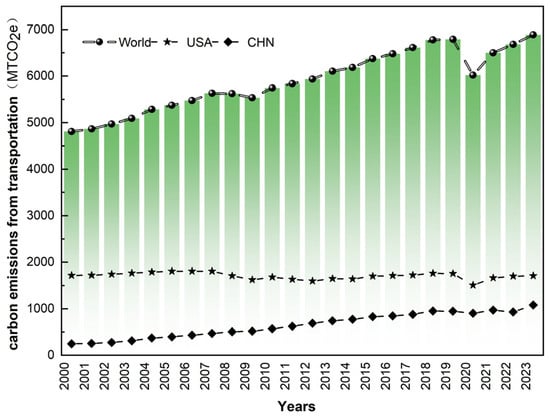
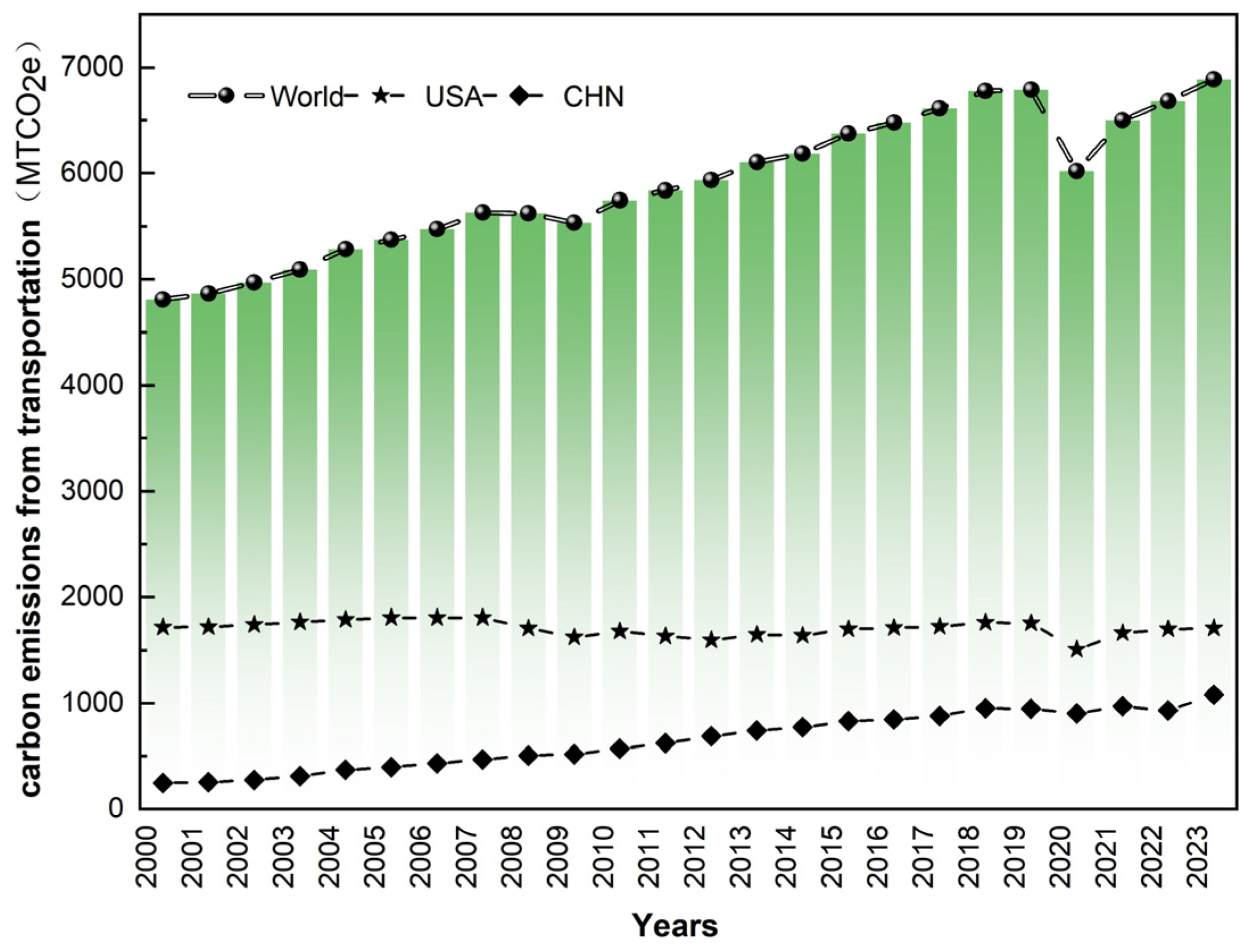
As shown in Figure 1, global transportation carbon emissions exhibited a long-term fluctuating growth trend from 2000 to 2023, with little change in the pattern formed by global carbon emissions. Among them, the United States and China, as the two core contributing entities, accounted for a stable proportion of approximately 40% of the total. Their emission evolution paths showed a distinct reverse divergence, making them key variables shaping the global transportation carbon emission pattern.
Figure 1.
Global transportation carbon emissions from 2000 to 2023.
Further horizontal comparative analysis reveals that the evolution of global transportation carbon emissions presents significant “differentiation characteristics based on economic development stages”: economically developed economies such as Japan, Germany, the United Kingdom, Italy, France, Sweden, the United States, the Netherlands, and Hong Kong, China, have become the group with the leading decline in global transportation carbon emissions. In contrast, the transportation carbon emissions of developing economies in Asia, including China, India, and Indonesia, have long been among the world’s highest in terms of the growth rate, reflecting the realistic trade-off dilemma faced by developing economies between “economic growth demands” and “carbon emission reduction responsibilities”.
3.1.2. Evolutionary Characteristics of the Spatial Correlation Intensity in Global Transportation Carbon Emission Networks
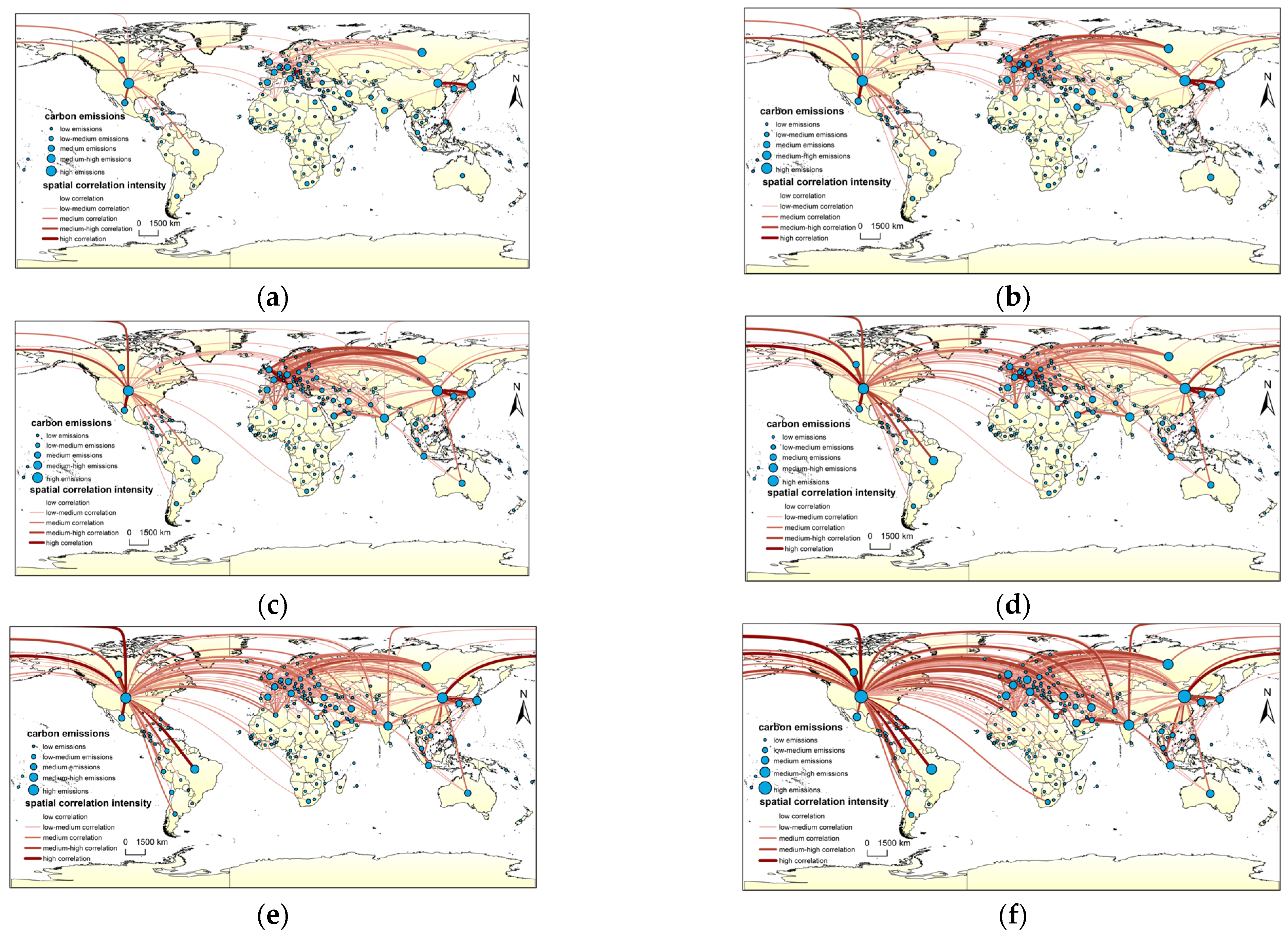
On the basis of panel data from 2000 to 2023 with a 3-year interval, the correlation intensity of the geographical network (Figure 2) was uniformly set using the results of the natural breaks classification method for 2023. Both the spatial correlation intensity and carbon emissions were divided into five levels, with specific classification criteria as follows:
Figure 2.
Geographic network map of the global transportation carbon emission space. Note: Panels (a–f) illustrate the geographic network map data for the years 2003, 2007, 2011, 2015, 2019 and 2023, respectively.
Spatial correlation intensity: low correlation (minimum value, 213,326,287.5); low–medium correlation (213,326,287.5, 803,755,353.1]; medium correlation (803,755,353.1, 1,968,865,469); medium–high correlation (1,968,865,469, 4,455,345,848); high correlation (4,455,345,848; maximum value); and carbon emissions: low emission (minimum value, 25.4901), low–medium emission (25.4901, 79.7893), medium emission (79.7893, 179.6330], medium–high emission (179.6330, 339.7606], and high emission (339.7606; maximum value).
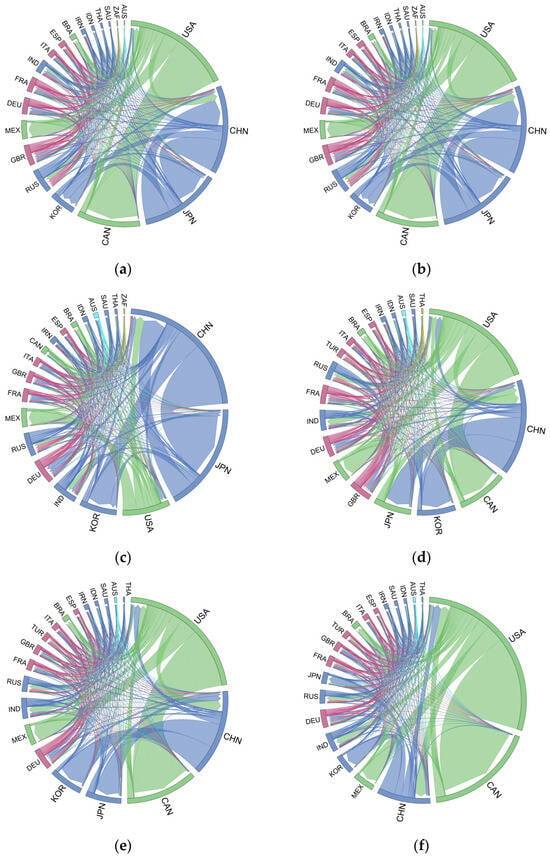
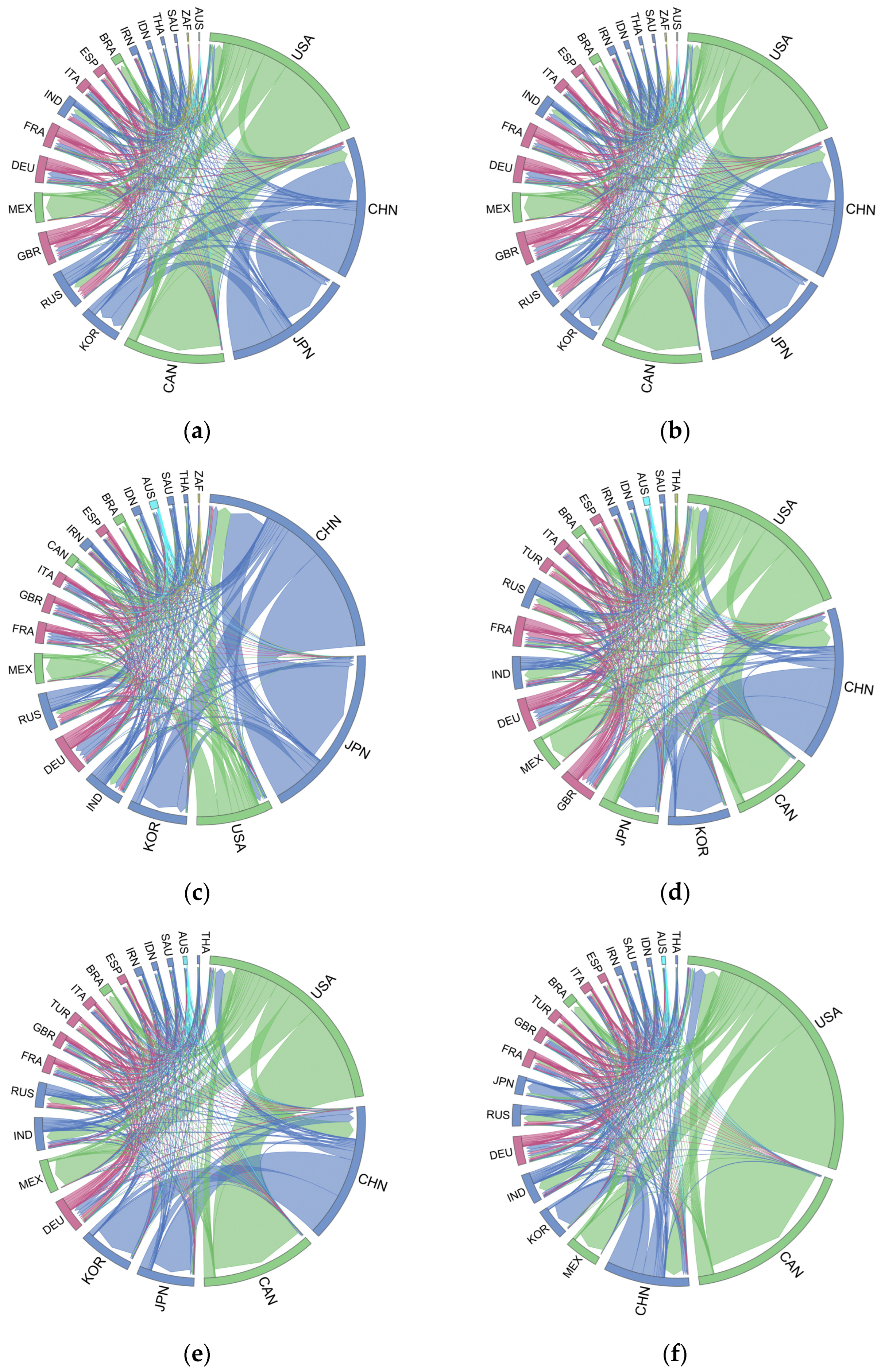
Combined with the topological network of the top 20 carbon-emitting countries/regions (Figure 3), the analysis is as follows:
Figure 3.
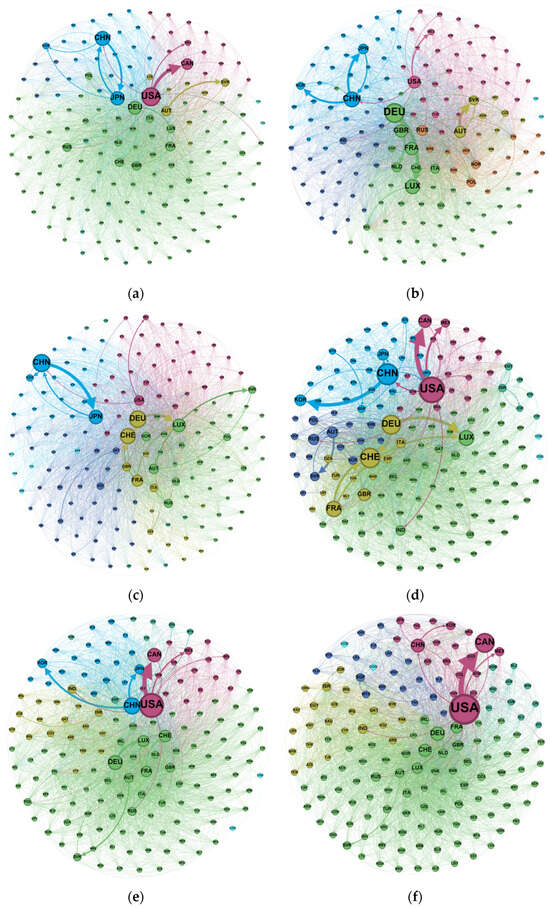
Topological structure of the global transportation carbon emission space network. Note: Panels (a–f) illustrate the topological structure network data for the years 2003, 2007, 2011, 2015, 2019 and 2023, respectively; the chord diagram is constructed based on the top 20 countries (regions) in terms of transportation carbon emissions, with the outer arcs representing the associated intensity values of transportation carbon emissions for each country (region).
(1) Continuous Increase in the Global Transportation Correlation Intensity, Gradually Forming Three Core Clusters: the United States, China, and European Countries
The global transportation carbon emission correlation intensity showed an overall continuous upward trend, with the core status of the three major clusters (the United States, China, and Europe) gradually becoming prominent. From 2003 to 2007, the United States became the core with the peak global correlation intensity, exhibiting multidirectional radiation characteristics in cross-regional correlations with Europe and Asia. Core clusters in Asia (mainly Russia and China) and Europe initially emerged. In 2011, the pattern changed: China’s correlation intensity scale and density surged significantly, forming a two-way correlation with Japan in the same year, surpassing the cross-regional correlation dominated by the United States to become the core of correlation intensity that year. From 2015 to 2019, the United States gradually regained its core position in terms of correlation intensity, and the intensity of its cross-regional connections with Europe and Asia once again dominated the network; by 2023, the connection density and coverage of the United States’ green area peaked during the research period, and the unipolar dominance pattern further strengthened. In contrast, China’s correlation radiation focused more on the East Asian region, and the global bipolar pattern evolved toward “U.S. dominance and China’s regional strengthening”. Moreover, the correlation intensity within European economies and between Europe, the Americas, and Asia gradually increased, and the intensity distribution of the three major clusters (the United States, China, and Europe) became increasingly prominent over time.
(2) Spatial Differentiation of the Global Transportation Correlation Intensity: Coexistence of Bipolar Driving and Regional Agglomeration
From the radiation dimension, the United States exhibited a “global network-type” radiation characteristic, forming “multicenter, high-density” correlations with Europe, Asia, and Oceania; China showed a “regional circle-type” radiation characteristic, with blue-area connection lines concentrated within East Asia (Japan, South Korea) and some countries along the “Belt and Road”, reflecting a “circle-style” radiation structure centered on the East Asian production network and gradient diffusion to Southeast Asia and Central Asia. From the absorption dimension, the absorption correlation centered on Canada in the Americas almost entirely pointed to the United States, forming a one-way absorption path of the “United States to Canada”. Within East Asia, the blue-area connection lines of Japan and South Korea centered on China, and the one-way links of “China to Japan” and “China to South Korea” showed high-frequency and strong annual correlations, which essentially reflected the carbon emission correlation absorption effect jointly driven by the East Asian industrial division of labor and cross-border transportation corridors.
3.2. Topological Structure of the Global Transportation Carbon Emission Spatial Correlation Network
3.2.1. Network Node Characteristics
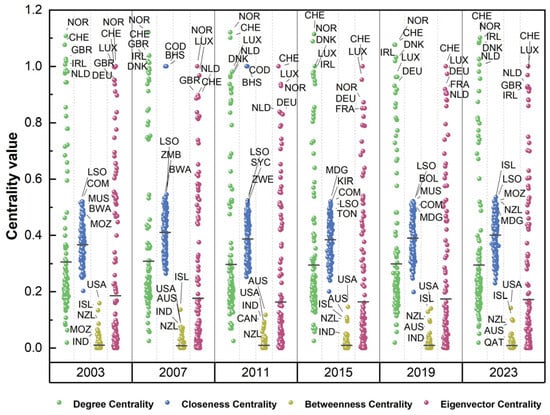
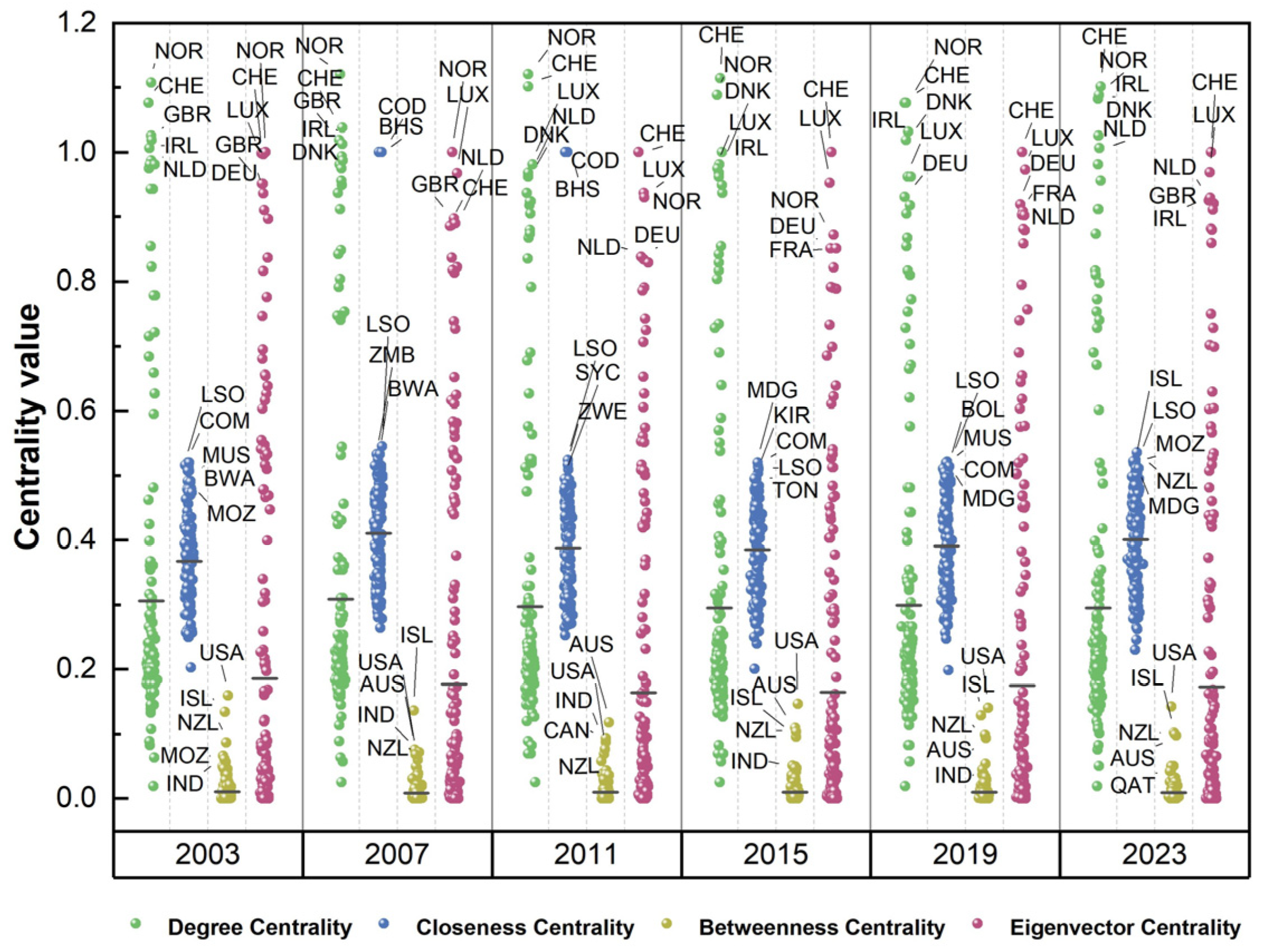
As shown in Figure 4, network nodes are analyzed on the basis of four centrality indicators, with consistent terminology aligned with the research context: degree centrality reflects the number of direct connections between a node and other nodes, corresponding to the “connection activity” in the transportation carbon emission network. Norway, Switzerland, Denmark, Ireland, and the Netherlands perform prominently as the most active nodes with the densest direct carbon emission correlations. Among them, Switzerland, which relies on its developed international logistics network, has become among the core countries forming high-frequency and effective direct carbon emission correlations with multiple global economies. Closeness centrality measures the shortest path length from a node to other nodes, embodying the independence of direct connections. The ranking of this centrality fluctuates significantly, with Lesotho maintaining a leading position for a long time. As a landlocked country of South Africa, Lesotho focuses on regional land transportation, demonstrating remarkable “path independence of direct connections” and functioning as a “direct correlation-type” node within the region. Betweenness centrality indicates the “intermediary degree” of a node in correlations between other nodes, reflecting its “control power” over carbon emission connections. The United States, Australia, Iceland, New Zealand, and India rank among the top; notably, the United States holds an absolute control hub position, serving as the “intermediary bridge” for transportation carbon emission correlations across multiple global regions and exerting strong control over the transmission paths of carbon emission resources. Eigenvector centrality evaluates the connection quality of a node. Switzerland, Luxembourg, Norway, Germany, and France perform outstandingly—these countries/regions not only have dense carbon emission correlations themselves but also engage in in-depth cooperation with high-centrality nodes such as the Netherlands and the United States, forming a “strong radiation” correlation network and acting as “value-amplifying” nodes for carbon emission correlations.
Figure 4.
Global transportation carbon emissions network centrality map (2000–2023).
3.2.2. Overall Network Characteristics
(1) Transformation from “Decentralized Weak Connections” to “Concentrated Strong Connections and Strong Regional Collaboration” Second item:
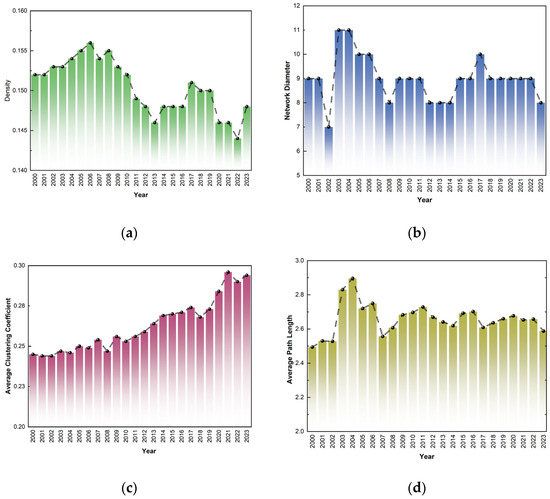
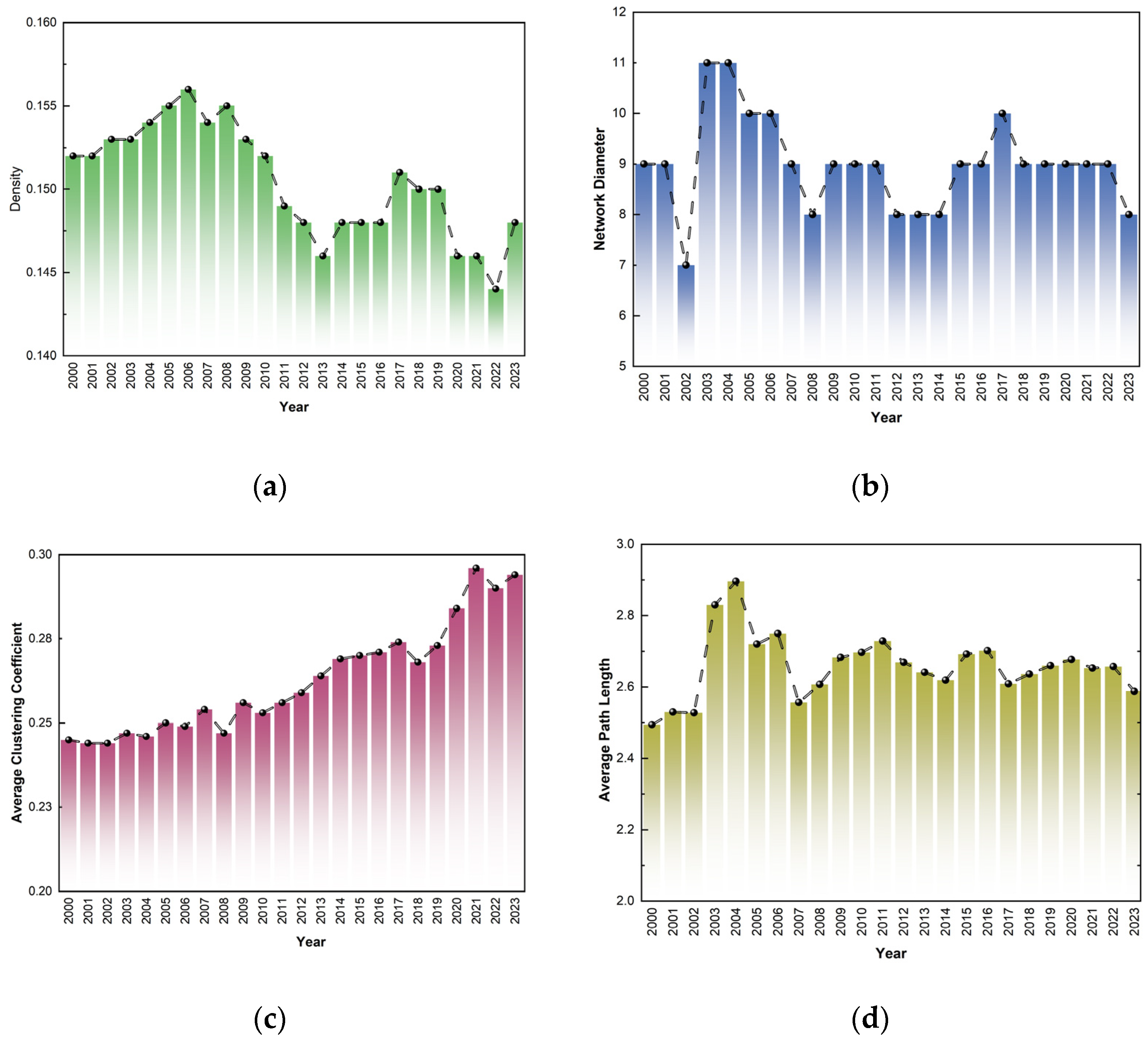
As can be seen in Figure 5. The strong connection structure has been continuously optimized. From 2000 to 2023, the graph density fluctuated slightly between 0.144 and 0.156 without significant volatility, confirming that the scale of strong connections exceeding the node mean threshold in global carbon correlations remained stable in the long term and that the “threshold effect” persisted. Temporally, it showed a characteristic of “an initial slight increase followed by a gradual decrease”: it increased slightly to 0.156 from 2000 to 2006, reflecting the slight expansion of cross-regional strong connections driven by the increase in early carbon correlations; it decreased gradually to 0.144 from 2007 to 2023 and slightly increased to 0.148 in 2023. In fact, the threshold increased because of the increase in the average correlation of core nodes such as the United States and China, promoting the network to “eliminate weak connections and retain strong ones”. Strong connections are more focused on high-value correlations, which is mutually confirmed by the pattern of “U.S. dominance and China’s regional strengthening”.
Figure 5.
Overall carbon emission network indicators for transportation from 2000–2023. (a) Trend of graph density; (b) Trend of network diameter; (c) Trend of average clustering coefficient; (d) Trend of average path length.
The rigidity of regional clustering has increased. The average clustering coefficient steadily increased from 0.245 to 0.294, with a significant acceleration after 2015, increasing from 0.270 in 2015 to 0.294 in 2023 without reverse fluctuations. This highlights the rigid enhancement of local aggregation in the network and the continuous deepening of the collaborative effect of regional nodes, which exactly corresponds to the evolution of the three major clusters (“the United States–China–Europe”). The internal correlations within the Americas, East Asia, and Europe have been continuously strengthened, and the local aggregation of the three major clusters is far greater than the network average, ultimately driving the overall clustering coefficient to increase, confirming the spatial differentiation essence of “regional agglomeration” in global carbon correlations.
Network accessibility has significantly improved. The network diameter and average path length together reflect network accessibility and resilience. The diameter showed a fluctuating narrowing trend: it reached a peak of 11 from 2003 to 2004 and narrowed to the range of 8–9 in the later period, indicating improved accessibility between edge nodes and core clusters and the enhanced radiation-driven role of core nodes. The average path length remained stable between 2.494 and 2.896, decreasing to 2.588 in 2023, which is close to the early level. This finding shows that the slight decrease in graph density did not affect transmission efficiency—the efficient “core–periphery” paths and dense regional connections have constructed clear core links, realizing a trend of stable efficiency despite decreasing density. The network structure has been optimized and upgraded, and the overall resilience has been significantly enhanced.
(2) The Global Carbon Emission Spatial Correlation Network Tends to Follow a Power-Law Distribution and Exhibits Small-World Characteristics
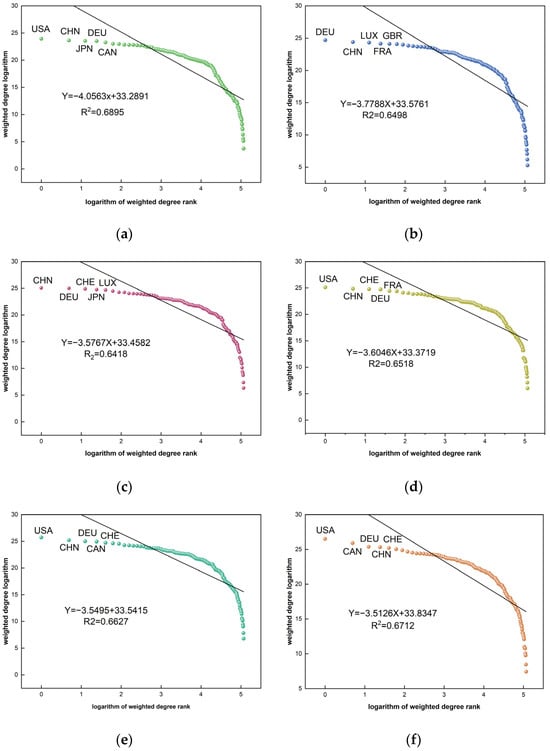
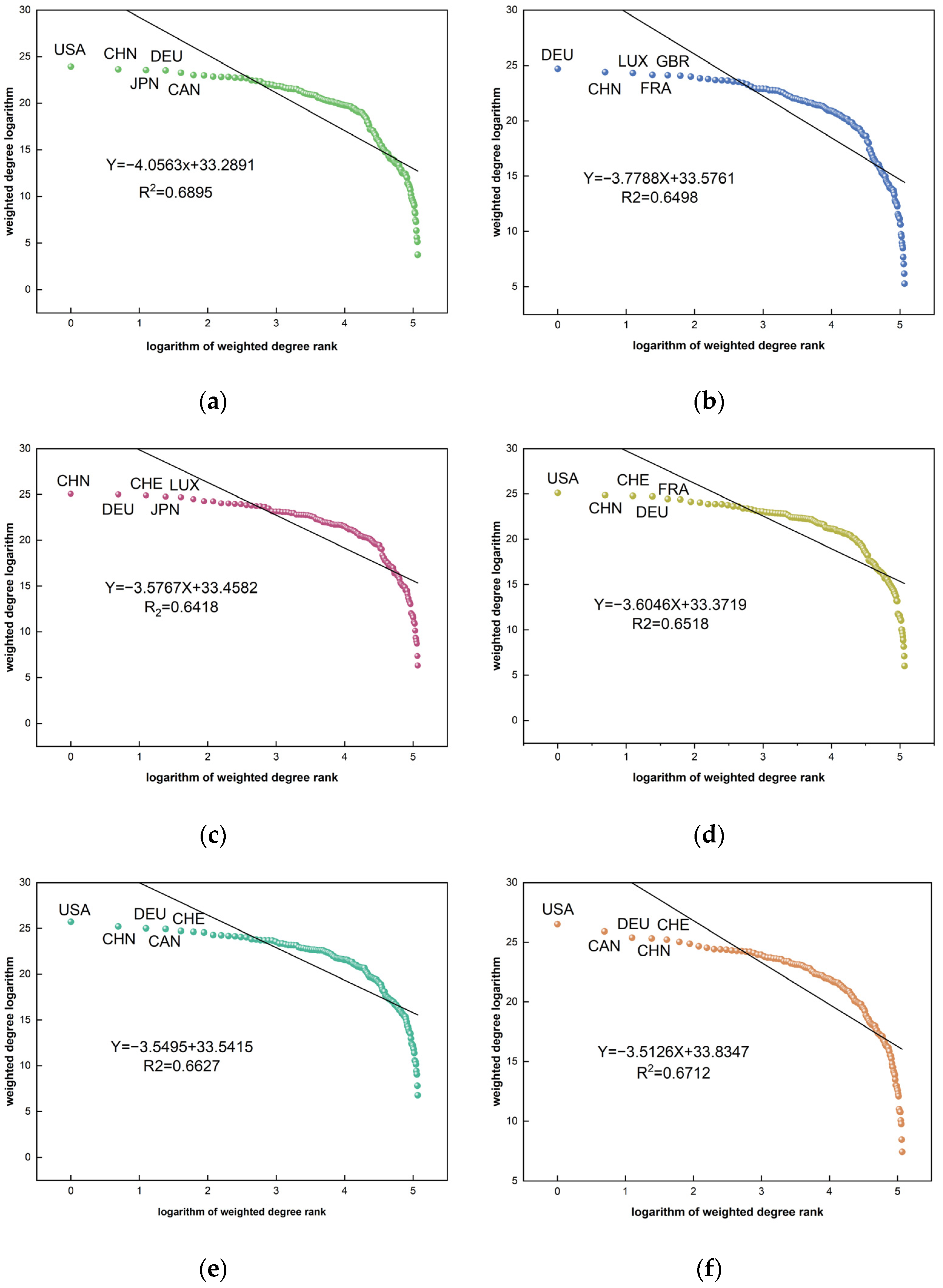
As can be seen in Figure 6. From 2000 to 2023, the weighted degree rank-size distribution of network nodes showed distinct features: scattered points throughout the period exhibited an obvious “long-tail effect”—a few nodes with high weighted degrees monopolized core connection resources, while many nodes with low weighted degrees formed the long tail. Moreover, the scattered points were approximately distributed along a straight line with a negative slope, and the goodness of fit R2 remained stable between 0.64 and 0.69. This confirms that the network’s weighted degree has a clear power-law distribution, which not only reveals the essence of the “core–periphery” structure but also reflects the small-world characteristics.
Figure 6.
Weighted degree ranking and size distribution of network nodes. Note: Panels (a–f) illustrate the weighted degree ranking and size distribution for the years 2003, 2007, 2011, 2015, 2019 and 2023, respectively.
With respect to key nodes in 2003 and 2023, the absolute value of the slope (k value) of the weighted degree distribution fitting curve decreased from 4.0563 to 3.5126. This change directly indicates that with the improvement of the global transportation system, the hierarchical differentiation of the network’s weighted degree has slowed down, the monopoly of core nodes on connection resources has weakened, the hierarchical gap between nodes with high and low weighted degrees has narrowed, and the overall network connection balance has been significantly enhanced.
3.2.3. Network Organizational Characteristics
(1) Obvious “Core–Periphery” Structure Exists in the Global Transportation Carbon Emission Correlation Network
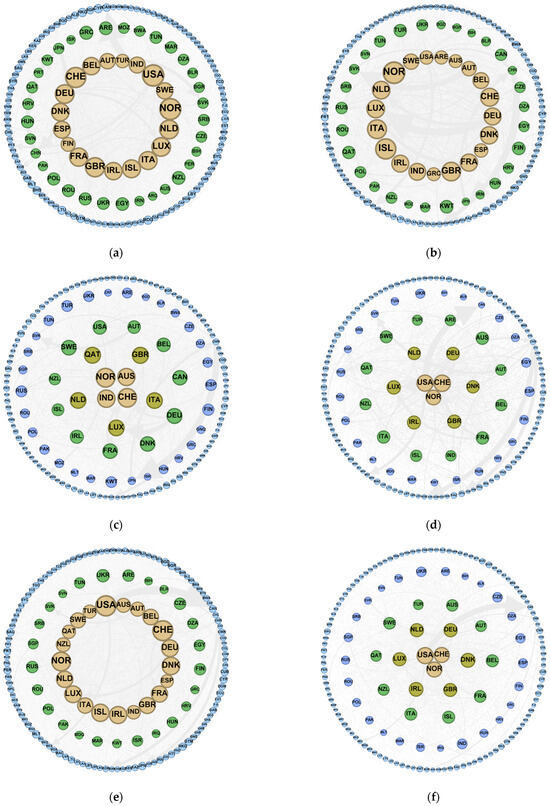
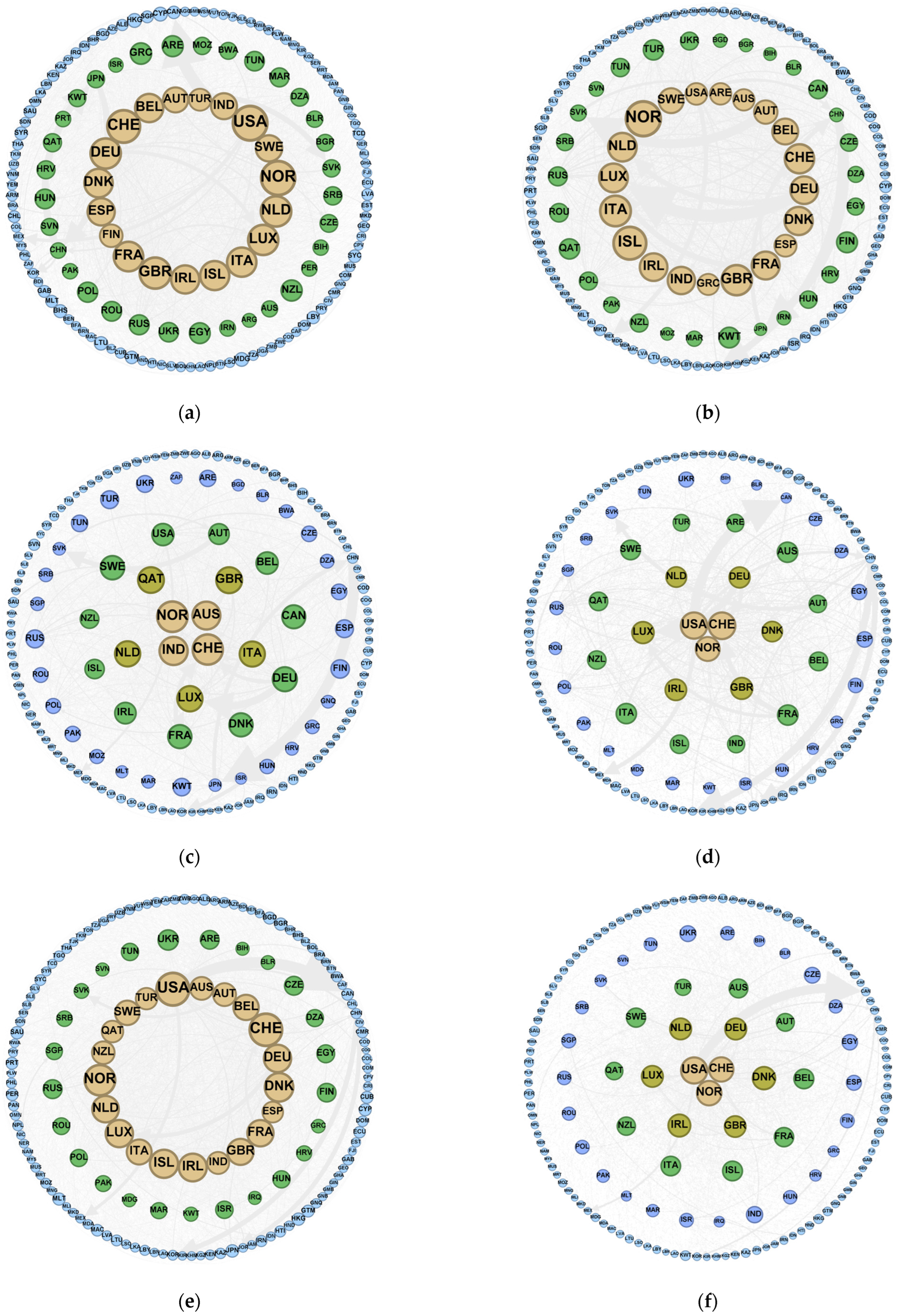
The hierarchical structure of the network exhibits distinct dynamic evolution characteristics, as shown in Figure 7. Between 2003 and 2023, the network underwent two key structural changes: in 2011, it evolved from a three-layer structure of “core, transition, and periphery” to a five-level architecture of “core, semicore, transition, semiperiphery, and periphery”; after a brief return to the three-element structure in 2019, it stabilized again as a five-level hierarchical system in 2023. The repeated changes in the hierarchical structure indicate that the “core–periphery” system of global transportation carbon emissions is unstable and that nodes in the core layer and transition layer are prone to hierarchical differentiation affected by changes in transportation resource allocation and regional correlation intensity.
Figure 7.
Core–edge structure diagram from 2000 to 2023. Note: Panels (a–f) illustrate the core–edge structure for the years 2003, 2007, 2011, 2015, 2019 and 2023, respectively. The core layer is divided into core, semicore, transition, semiperiphery, and periphery. The arrows represent the weighted degree.
Despite the continuous structural evolution, Switzerland, Norway, and the United States have always occupied the core position in the network organizational structure. Relying on their first-mover advantages and continuous investment in relevant fields, they have formed a strong absorption capacity for network correlation resources, thereby maintaining structural stability dynamically and becoming “anchor nodes” in the network. Hierarchical changes are concentrated mainly in the differentiation of a semicore layer from the core layer, which mostly includes developed European countries such as Luxembourg, Germany, and Ireland; at the same time, a semiperipheral layer has also differentiated between the transition layer and the periphery layer. Notably, although previous studies have shown that countries such as China and Japan are in the core position in terms of correlation intensity, they do not have advantages in the dimension of comprehensive node centrality. The reason may be that although they have strong direct correlation capabilities, they are insufficient in centrality dimensions such as network control power, intermediary functions, and structural influence, reflecting the asymmetric characteristics between node attributes and network positions.
(2) The Global Transportation Carbon Emission Correlation Network Features “Bipolar Dominance by the Americas and East Asia, with Europe Following Through Integration”
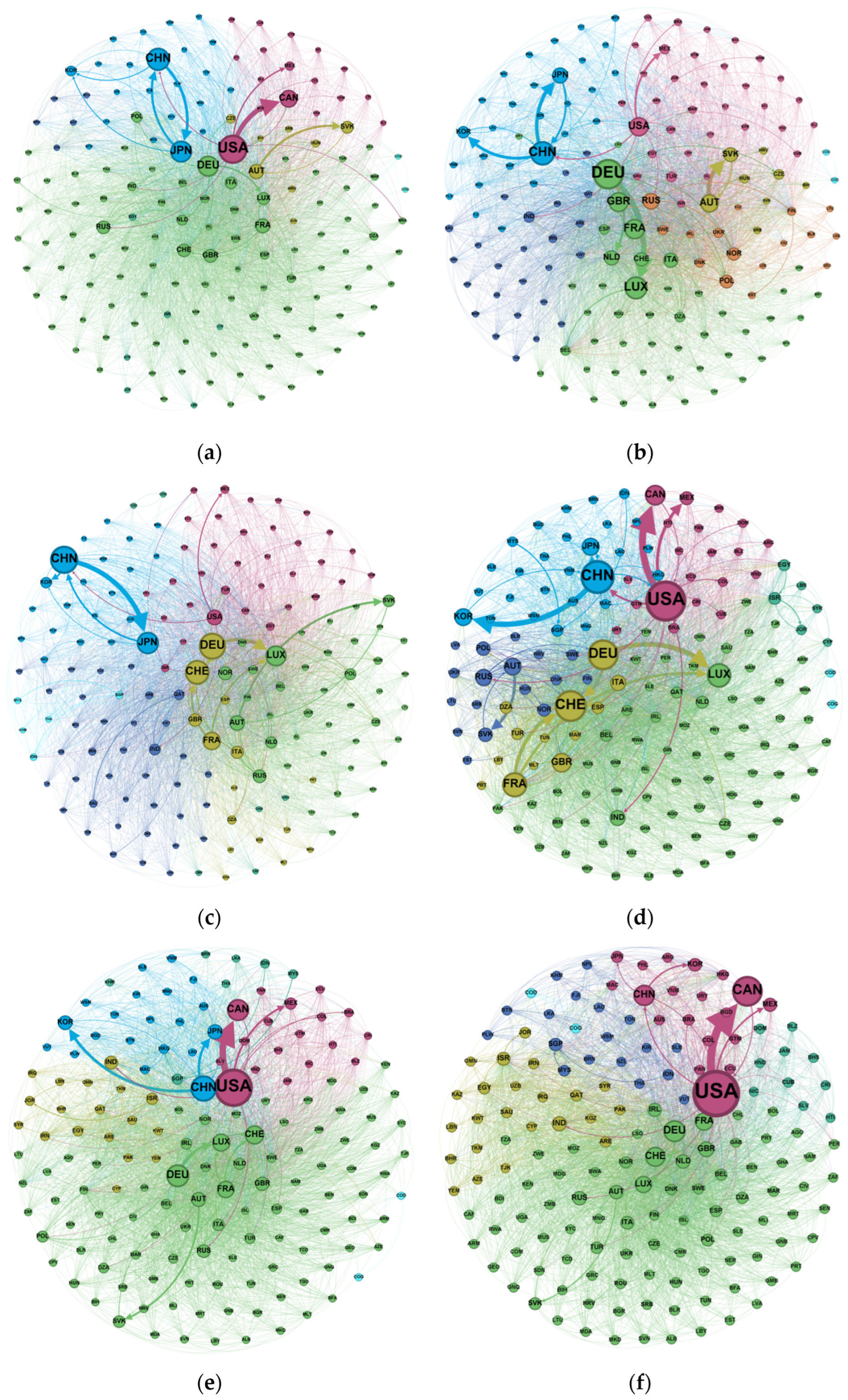
On the basis of the data in Table 2 and Figure 8, the organizational structure mechanism and phased characteristics of the global transportation carbon emission spatial correlation network are analyzed.
Table 2.
Community discovery coefficient.
Figure 8.
Community discovery evolution diagram. Note: Panels (a–f) illustrate the community discovery evolution for the years 2003, 2007, 2011, 2015, 2019 and 2023, respectively; node size represents the weighted degree, edge thickness denotes the weight, and different node colors indicate different communities. The arrows represent the weighted degree.
The 2003 network structure shows that the American community was highly aggregated, with the United States as the core, while the Asian community formed partial aggregation with China and Japan. In contrast, the internal structure of the European community was fragmented: Germany, as the core, failed to integrate into a unified block and further differentiated into other subgroups represented by Austria, reflecting the sparseness and fragmentation of interregional transportation carbon correlations. By 2007, although the radiation scope of core nodes such as the United States and China expanded, major European nodes, including Germany, the United Kingdom, and France, remained scattered, which further confirmed the basic pattern of the continuous decline in the modularity coefficient and fragmentation of community structure during this period. In 2011, the Asian community centered on China gradually absorbed surrounding nodes, the American community expanded outward under the leadership of the United States, and local aggregation represented by Germany and Switzerland emerged within Europe. By 2015, the United States and China formed a visually prominent bipolar structure, with significantly increased connection density between nodes; the fragmentation of the European community converged to some extent, showing an overall structural restructuring feature of “cross-regional aggregation and intraregional adaptation”, indicating the enhancement of interregional transportation carbon flow correlations and the initial construction of network integrity. In 2019, the Americas formed a dual-core community of the United States and Canada, East Asia established a compact cluster with China as the sole core, and Europe formed a highly integrated regional block after structural restructuring. In 2023, the aggregation degree of the Americas reached its peak, and cross-regional connections between Asian and American communities appeared for the first time, forming an initial integration trend; within Europe, nodes such as Germany and France constructed high-density correlation blocks, ultimately forming a hierarchical geographical structure characterized by “bipolar dominance by the Americas and East Asia, Europe following through integration, and weak attachment of peripheral communities”.
3.3. Influencing Factors and Dynamic Mechanism of the Global Transportation Carbon Emission Spatial Correlation Network
3.3.1. Influencing Factors of the Global Transportation Carbon Emission Spatial Correlation Network
To avoid model estimation convergence issues caused by large-sample fitting, this study incorporates the phased evolutionary characteristics of the global transportation carbon emission spatial correlation network. Six key time points were selected from 2000 to 2023: starting in 2003, with intervals of four years (2003, 2007, 2011, 2015, 2019, 2023). Model estimation was conducted using the tergm package in R, adopting Markov Chain Monte Carlo (MCMC) maximum likelihood estimation. Key iterative parameter settings were specified as MCMC.burnin = 1000 and MCMC.interval = 500 to mitigate autocorrelation and computational bias. The specific results are shown in Table 3.
Table 3.
TERGM benchmark regression results.
In nodeocov, the estimated coefficients of economic scale, economic openness, the digital economy level, and government effectiveness are significantly negative and can be multidimensionally echoed by theories such as the “pollution halo hypothesis” [31], “global value chain division of labor” [32], and “large-country economy driven by domestic demand” [33]. The negative impact of economic scale is twofold: on the one hand, large economies transfer high-carbon transportation demand to peripheral countries via global value chain offshore outsourcing, reducing domestic active correlation supply; on the other hand, the maturity of domestic circulation strengthens this trend, as they absorb most transportation needs through local “interregional production-consumption” networks—for example, China’s “eastern manufacturing-central and western consumption” logistics loop and the endogenous linkage between U.S. domestic energy production and manufacturing significantly reduce its dependence on cross-border correlations, weakening its motivation for active carbon emission connections. Countries with high economic openness show low correlation willingness when trade structures are optimized to reduce cross-border transportation demand; the digital economy compresses transportation frequency through intelligent logistics path optimization, and efficient government effectiveness directly inhibits active high-carbon transportation correlations via carbon regulations, with multiple mechanisms supporting the negative coefficients. In contrast, economic level, population size, and tertiary industry proportion have significantly positive coefficients: improved economic level stimulates demands such as cross-border tourism and high-end cold chain logistics to promote active connections; population expansion drives transnational transportation network extension; and tertiary industry growth strengthens active carbon emission correlations through service trade spatial linkages.
In nodeicov, the population size and government effectiveness coefficients are insignificant, indicating that they are not core variables for attracting external correlations; the digital economy and tertiary industry proportion are significantly negative, reflecting that digital economy development reduces external dependence by improving local transportation efficiency, whereas countries with advanced tertiary industries prefer endogenous transportation networks to reduce external absorption. Economic scale, openness, and level have significantly positive coefficients (with the largest absolute value for economic level), which is consistent with sender effects—high-income countries (e.g., Switzerland, Norway, the United States) have dual “correlation supply and absorption” attributes, acting as both active connection initiators (driven by high-end demands) and core absorbers (supported by market potential and infrastructure), aligning with core hub characteristics in the “core–periphery” model. In contrast, large economies with high openness but low active correlation willingness (e.g., China) reduce cross-border “active supply” via domestic logistics loops, yet their large export demands absorb peripheral transportation carbon emissions through “export-induced correlations,” resulting in a “high absorption, low active supply” pattern.
For absdiff, economic level and government effectiveness have significantly positive coefficients (largest absolute value for economic level), indicating that assortative connections in the network are driven mainly by economic disparities—higher-income countries/regions tend to form correlations with lower-income countries/regions; the positive government effectiveness effect further suggests correlation tendencies between entities with different governance levels. In contrast, economic openness, population size, the digital economy, and the tertiary industry proportion have significantly negative coefficients, reflecting that “homogeneous agglomeration”—countries/regions with similar openness, population, digital economy development, or tertiary industry proportion are more likely to form correlations.
In edgecov, the results align with “spatial proximity” and “institutional proximity” theories: common region, common language, and geographical adjacency have significantly positive coefficients, as the policy coordination of regional integration organizations, reduced communication costs from language interoperability, and transportation cost savings from geographical adjacency promote correlations; spatial distance has a significantly negative coefficient (absolute value = 0.002), confirming that longer distances hinder correlation formation; and colonial relationships become insignificant, indicating that historical dependence is diluted by institutional convergence with improved global governance.
The endogenous network variables show that the edge attribute coefficient is significantly negative (stable between −25.065 and −17.521), indicating that “density constraints” prevent infinite correlation expansion (consistent with the “network congestion effect” in social network theory); that the reciprocity and transitive triples are significantly positive, confirming collaborative evolution mechanisms-reciprocal correlations reduce default risks, and transitive triples improve efficiency via “structural hole filling”; that connectivity and geometrically weighted edge-shared partners are significantly negative, as the network avoids resource waste from excessive connectivity and rejects inefficient circular correlations; and that an insignificant closure trend reflects no strongly closed “clique” structure, maintaining open evolution.
The temporal effects reveal a significantly positive stability coefficient, indicating the “path dependence” of previous structures on subsequent evolution (formed transportation networks are difficult to restructure quickly because of sunk costs); a significantly negative variability coefficient (per the TERGM definition) indicates that network dynamic changes are significantly lower than random levels, with no drastic adjustments (e.g., sudden edge changes or connection replacement), tending toward overall stability.
3.3.2. Dynamic Mechanism of the Global Transportation Carbon Emission Spatial Correlation Network
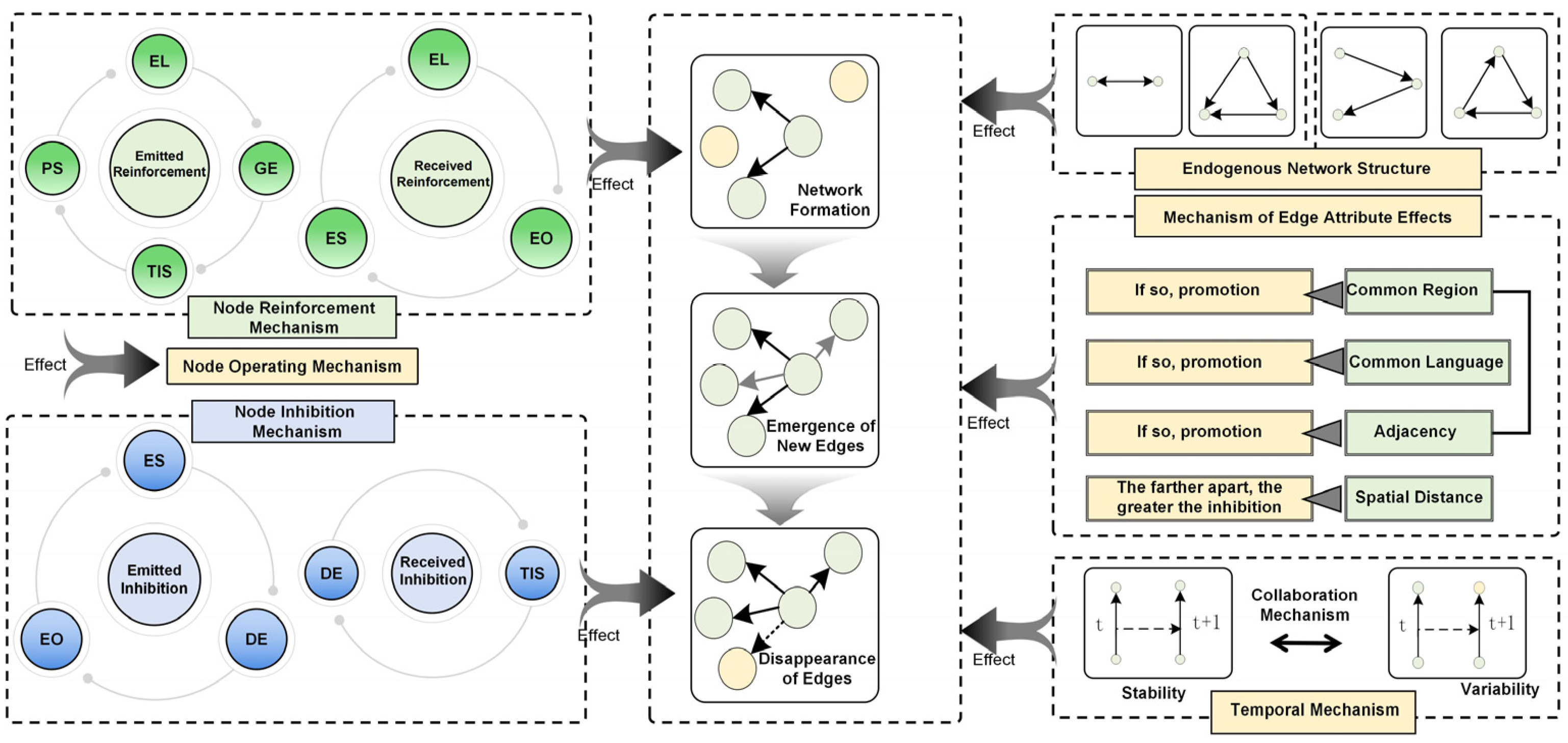
The driving mechanism diagram is drawn as follows, as shown in detail in Figure 9. From the micro node perspective, node heterogeneity constitutes the dynamic core of the evolution of the global transportation carbon emission spatial correlation network, with its behavioral differentiation presenting four functional attributes: “sending enhancement, receiving enhancement, sending inhibition, and receiving inhibition”. In the enhancement mechanism, network evolution is driven by the differentiation of traditional factors: the driving factors of sender nodes focus on the economic development level, population agglomeration scale, tertiary industry proportion, and government governance efficiency, which strengthen nodes’ carbon emission correlation output capacity by improving the transportation demand scale and resource allocation efficiency; the driving factors of receiver nodes concentrate on economic aggregation and economic openness, which increase nodes’ absorption capacity of external carbon emission correlations by expanding the factor inflow scale and trade frequency. In the inhibition mechanism, the development level of the digital economy forms a global constraint on node carbon emission correlations through green technology penetration and transportation path optimization; the economic scale and openness of sender nodes are prone to triggering a “scale lock-in effect” in specific stages, inhibiting the optimization of correlation structures; if the tertiary industry structure of receiver nodes leans toward high-value-added services, it will reduce their dependence on high-carbon transportation, thereby restricting the receiving intensity of carbon emission correlations. The functional differentiation of different nodes based on resource endowments and development stages results in spatial potential energy differences between regions, which not only aggravate the status differentiation of nodes in the network but also directly lay the basic topological structure of the global transportation carbon emission spatial correlation network. From a macro perspective, the synergistic coupling of spatial interaction and temporal evolution mechanisms jointly shapes the macro characteristics and dynamic trajectory of the network. In the temporal dimension, there is always a dynamic game between “stability” and “variability” in network evolution, which reveals the “path dependence–path breakthrough” law of the network in the time series from the perspective of evolutionary economics: “path dependence” originates from network inertia formed by historical cooperation mechanisms, solidifying the existing correlation structure; “path breakthrough” is driven by changes in the external environment, breaking inertia and promoting correlation restructuring. In the spatial dimension, socioeconomic and geographical homogeneity factors such as “common region, common language, and geographical adjacency” promote the formation and enhancement of carbon emission correlations between nodes by reducing transaction costs and information barriers; “spatial distance”, as a typical heterogeneity factor, significantly inhibits correlations by increasing factor flow costs. Moreover, the self-organizing collaboration mechanism of the network’s endogenous structure further affects spatial correlations: reciprocity indicates that bidirectional correlations dominate carbon emission correlations in the transportation industry, and an increase in “transitive triples” can strengthen the correlation transmission efficiency between nodes, promoting the network to evolve toward integration.
Figure 9.
Mechanism diagram of the global transportation carbon emission space correlation network. The arrows represent the driving direction.
In summary, node attributes, spatial relationships, temporal relationships, and network endogenous structure jointly enable key nodes and core edges in the network to have higher anti-interference capabilities, ultimately driving the global transportation carbon emission spatial correlation network to form a macro evolutionary characteristic of “stability-dominated and variability-adjusted”.
3.3.3. Robustness Check
The following methods are adopted for robustness checks: (1) adjust the time interval to 6 years, and select 2005, 2011, 2017, and 2023 for model testing (Model 5); (2) set the time interval as the initial and final years (2000 and 2023) for model testing (Model 6); and (3) modify the estimation method by replacing the dynamic Markov chain Monte Carlo maximum likelihood estimation (MCMCMLE) with the pseudomaximum likelihood estimation (MPLE) for testing (Model 7). The results show that the signs, significance of the network structure variables, and baseline regression results are highly consistent, verifying the robustness of the baseline regression conclusions. The specific results are shown in Table 4.
Table 4.
TERGM robustness test results.
3.3.4. Goodness-of-Fit Test
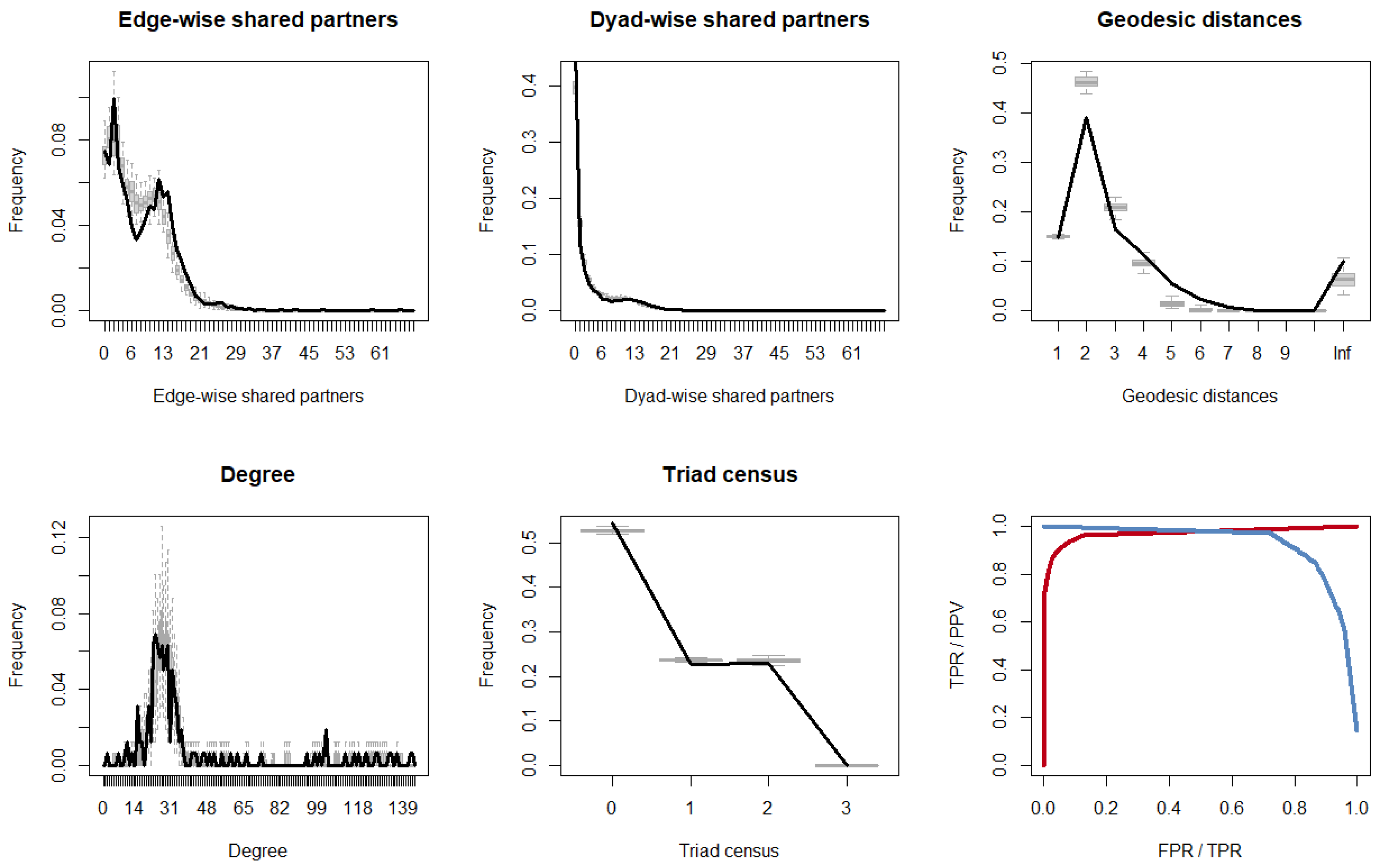
On the basis of the parameter estimation results of Model 4, 100 simulation runs were conducted. This study selected the geometrically weighted edge-shared partner distribution, geometrically weighted dyad-shared partner distribution, node geodesic distance, degree distribution, and triads to examine the consistency between the simulated network and the actual network, and plotted goodness-of-fit test graphs, as shown in detail in Figure 10. The estimation parameters are set as follows: burnin = 10,000, interval = 10,000. The results show that the core characteristics of the observed network are essentially within the 95% confidence interval of the simulated network, which confirms the excellent ability of the simulated network to replicate the actual characteristics of the global transportation carbon emission correlation network.
Figure 10.
Agreement and goodness-of-fit test results. The red line represents the True Positive Rate (TPR), and the blue line represents the Positive Predictive Value (PPV), plotted against the False Positive Rate (FPR)/True Positive Rate (TPR) on the x-axis.
In addition, this study further verified the model fitting effect by plotting the ROC curves and PR curves—generally, the larger the area under the ROC curve and PR curve was, the better the model simulation performance. From the curve shapes, both curves show an upward-leftward tilting characteristic, which indicates that the structural characteristics of the simulated network are highly consistent with those of the observed network, fully demonstrating the excellent fitting performance of the model.
4. Discussion
This study constructs a global spatial correlation network for transportation carbon emissions using a modified gravity model and analyzes its evolutionary mechanisms through the TERGM. The global network exhibits significant “regional clustering” and a dual “core–periphery” structure, with core nodes concentrated in two major clusters: the European cluster, represented by Norway, Switzerland, and Germany, forms a high-density network; the American cluster, with the United States as the hub, establishes a radiating correlation system. Countries in both clusters demonstrate high levels of participation and high comprehensive centrality. In contrast, East Asia presents a special pattern of “strong correlations but weak centrality”. Although China and Japan exhibit strong connectivity within the network, their overall centrality has not reached the core tier. There are two interpretations for this phenomenon. First, network construction eliminates weak ties—constrained by geographical distance, weaker connections with European and American clusters are more prevalent, resulting in fewer retained effective links. This precisely reflects that, from a global perspective of spatial correlation networks for transportation carbon emissions, East Asian countries are not yet positioned within the core network layers. Second, empirical results from the TERGM model indicate that economic heterogeneity drives network structural differentiation: ES exerts an inhibitory effect on link initiation. Economically large nations like China and Japan, with well-developed domestic cycles, exhibit reduced motivation to initiate external connections. This leads to a mismatch between their comprehensive centrality and their economic scale or link strength. Meanwhile, another phenomenon indicates that the comprehensive centrality of Norway and Switzerland surpasses that of traditional European powers such as the United Kingdom and France to become core nodes. This is consistent with the empirical results of the TERGM model, which shows that EL positively drives both the “sending” and “receiving” of network correlations. Countries with extremely high economic levels, such as Norway and Switzerland, form correlation advantages through high-end trade and cross-border logistic demands, thereby becoming cores of the global network.
However, this study has several limitations that need optimization in future research. First, it fails to distinguish carbon flow differences across transport modes such as road, air, and sea freight, and does not account for sudden shocks like COVID-19 pandemics and energy crises, nor the dynamic impacts of carbon neutrality policies. Second, global-scale studies overlook regional carbon linkage variations within countries. The multi-level nested network can be constructed, integrating controllability theory to propose differentiated emission reduction strategies. Third, this study constructs the network using row mean values as the threshold, which preserves the overall structure and relative connection strength of the network. However, it does not fully exploit the weight information. In future research, weighted TERGM models can be adopted to retain continuous weights more comprehensively. Meanwhile, temporal slicing may smooth out some short-term fluctuations; future work can improve the temporal resolution of the model to address this limitation [34]. Fourth, future research may deepen the analysis of driving mechanisms by integrating machine learning and spatial econometric models [35,36].
5. Conclusions
This study constructs a global transportation carbon emission spatial correlation network using a modified gravity model, and combines three-dimensional evolutionary analysis (node–overall–structure) with a TERGM model to reveal the network’s evolutionary characteristics and dynamic mechanisms. The core conclusions are as follows:
First, network evolution and spatial patterns undergo synergistic upgrading. The spatial correlation intensity, connectivity, and integration of global carbon emissions continue to strengthen, forming a positive synergy between the overall correlation characteristics and spatial patterns.
Second, network centrality exhibits an asymmetric distribution. Switzerland, Norway, the United States, and Germany have long occupied core positions, while major Asian countries such as China and Japan have yet to enter the core tier.
Third, evolutionary dynamics are driven by the synergistic interaction of multidimensional attributes. ① In nodeocov and nodeicov, economic level exerts a positive effect on the bidirectional “emitting–attracting” of connections; economic scale and openness suppress the emission of connections while promoting attraction, jointly underpinning the high comprehensive centrality of countries such as Switzerland and Norway; the tertiary industry structure exerts a bidirectional inhibitory effect on connection flows. ② For absdiff, only economic level and government efficiency show significant positive effects, driving the heterophily attraction of the network. ③ In edgecov, spatial and institutional proximity significantly facilitate connection formation. ④ Endogenous network variables exhibit a reciprocal and transmissive collaboration mechanism constrained by network density. ⑤ In terms of temporal effects, the early connection structure has formed path dependence, leading to low dynamic variability and an overall stable state.
On the basis of the above conclusions, in combination with global carbon governance needs and Asia’s development reality, three targeted policy implications are proposed:
First, promote the synergistic upgrading of network and spatial configurations. Focus on regions with high carbon emission correlations to build cross-border collaborative networks, establish cross-border carbon reduction alliances, unify technical standards for new energy sources such as photovoltaic and wind power, mutually recognize carbon trading quota accounting rules, conduct regular policy coordination consultations, resolve conflicts in regional emission reduction measures, and improve the efficiency of interconnections.
Second, to address the asymmetric distribution of network centrality, Asian nations like China and Japan can deepen technological R&D cooperation with core countries—such as accelerating the low-carbon transformation of China–Europe Railway Express—while establishing specialized carbon reduction collaboration platforms. These platforms should prioritize overcoming bottlenecks in low-carbon technology transfer. Concurrently, regional countries should jointly build secondary linkage networks to gradually enhance their node influence in the global carbon emissions network.
Third, for transportation carbon emission reduction, optimize the allocation of node attributes, balance economic development with carbon linkage quality, and moderately regulate the proportion of high-carbon segments in the tertiary industry. The focus should be on leveraging geographical and institutional proximity advantages, unifying regional carbon accounting standards, establishing dynamic linkage monitoring mechanisms, breaking path dependencies, and enhancing the flexibility of network evolution.
Author Contributions
Conceptualization, Yi Liang; methodology, Han Liu; software, Han Liu; validation, Yi Liang; formal analysis, Han Liu; investigation, Han Liu; resources, Yi Liang; data curation, Zhaoge Wu; writing—original draft preparation, Han Liu; writing—review and editing, Xiaoduo Wang and Zhaoxu Yuan; visualization, Zhaoge Wu; supervision, Yi Liang; project administration, Yi Liang. All authors have read and agreed to the published version of the manuscript.
Funding
This research was supported by the Science Foundation of the Ministry of Education of China (No. 21YJC630072) and the Key Talent Project of the Yan Zhao Golden Platform for Talent Attraction in Hebei Province, China (No. HJYB202528).
Data Availability Statement
All data generated or analyzed during this study are included in this published article.
Conflicts of Interest
The authors declare no conflicts of interest.
Correction Statement
This article has been republished with a minor correction to the correspondence contact information. This change does not affect the scientific content of the article.
References
- Huang, M.-T.; Zhai, P.-M. Achieving Paris Agreement temperature goals requires carbon neutrality by middle century with far-reaching transitions in the whole society. Adv. Clim. Change Res. 2021, 12, 281–286. [Google Scholar] [CrossRef] [Scilit]
- iea. Available online: https://www.iea.org/world/emissions (accessed on 17 February 2026).
- Bellora, C.; Fontagné, L. EU in search of a Carbon Border Adjustment Mechanism. Energy Econ. 2023, 123, 106673. [Google Scholar] [CrossRef] [Scilit]
- Jia, X.; Zhang, Y.; Tan, R.R.; Li, Z.; Wang, S.; Wang, F.; Fang, K. Multi-objective energy planning for China’s dual carbon goals. Sustain. Prod. Consum. 2022, 34, 552–564. [Google Scholar] [CrossRef] [Scilit]
- Fang, X.; Yang, L. Medium and long-term energy demand forecasting in the Yangtze River Delta based on the LEAP-SJZA model under the” dual carbon” goals. Energy 2025, 335, 138270. [Google Scholar] [CrossRef] [Scilit]
- Gui, D.; He, H.; Liu, C.; Han, S. Spatio-temporal dynamic evolution of carbon emissions from land use change in Guangdong Province, China, 2000–2020. Ecol. Indic. 2023, 156, 111131. [Google Scholar] [CrossRef] [Scilit]
- Zhang, L.; Weng, D.; Xu, Y.; Hong, B.; Wang, S.; Hu, X.; Zhang, Y.; Wang, Z. Spatio-temporal evolution characteristics of carbon emissions from road transportation in the mainland of China from 2006 to 2021. Sci. Total Environ. 2024, 917, 170430. [Google Scholar] [CrossRef] [Scilit] [PubMed]
- Wang, M.; Wang, Y.; Teng, F.; Ji, Y. The spatiotemporal evolution and impact mechanism of energy consumption carbon emissions in China from 2010 to 2020 by integrating multisource remote sensing data. J. Environ. Manag. 2023, 346, 119054. [Google Scholar] [CrossRef] [Scilit]
- Zhou, K.; Yang, J.; Yang, T.; Ding, T. Spatial and temporal evolution characteristics and spillover effects of China’s regional carbon emissions. J. Environ. Manag. 2023, 325, 116423. [Google Scholar] [CrossRef] [Scilit]
- Du, Q.; Deng, Y.; Zhou, J.; Wu, J.; Pang, Q. Spatial spillover effect of carbon emission efficiency in the construction industry of China. Environ. Sci. Pollut. Res. 2022, 29, 2466–2479. [Google Scholar] [CrossRef] [Scilit]
- Fang, G.; Huang, M.; Zhang, W.; Tian, L. Exploring global embodied carbon emissions transfer network—An analysis based on national responsibility. Technol. Forecast. Soc. Change 2024, 202, 123284. [Google Scholar] [CrossRef] [Scilit]
- Wang, M.; Guo, Y.; Hu, H.; Ding, S. Embodied carbon emission flow network analysis of the global nickel industry chain based on complex network. Sustain. Prod. Consum. 2023, 42, 380–391. [Google Scholar] [CrossRef] [Scilit]
- Xu, H.; Li, Y.; Zheng, Y.; Xu, X. Analysis of spatial associations in the energy–carbon emission efficiency of the transportation industry and its influencing factors: Evidence from China. Environ. Impact Assess. Rev. 2022, 97, 106905. [Google Scholar] [CrossRef] [Scilit]
- Wang, Y.; Wang, Z.; Zameer, H. Structural characteristics and evolution of the “international trade-carbon emissions” network in equipment manufacturing industry: International evidence in the perspective of global value chains. Environ. Sci. Pollut. Res. 2021, 28, 25886–25905. [Google Scholar] [CrossRef] [Scilit] [PubMed]
- Du, R.; Zhang, M.; Zhang, N.; Liu, Y.; Dong, G.; Tian, L.; Kong, Z.; Ahsan, M. Evaluation of key node groups of embodied carbon emission transfer network in China based on complex network control theory. J. Clean. Prod. 2024, 448, 141605. [Google Scholar] [CrossRef] [Scilit]
- Baziyad, H.; Kayvanfar, V.; Toloo, M. A data envelopment analysis model for opinion leaders’ identification in social networks. Comput. Ind. Eng. 2024, 190, 110010. [Google Scholar] [CrossRef] [Scilit]
- Ma, N.; Sun, W.; Wang, Z.; Li, H.; Ma, X.; Sun, H. The effects of different forms of FDI on the carbon emissions of multinational enterprises: A complex network approach. Energy Policy 2023, 181, 113731. [Google Scholar] [CrossRef] [Scilit]
- Gong, Y.; Sun, H.; Wang, Z.; Ding, C. Spatial correlation network pattern and evolution mechanism of natural gas consumption in China—Complex network-based ERGM model. Energy 2023, 285, 129400. [Google Scholar] [CrossRef] [Scilit]
- Hu, S.; Chen, G.; Miao, C. Understanding the structural evolution and driving mechanisms of urban network using firm-level big data and TERGM modeling. Cities 2025, 161, 105869. [Google Scholar] [CrossRef] [Scilit]
- Huang, X.; Zhang, W.; Li, Z. Examining the characteristics and influencing factors of China’s carbon emission spatial correlation network structure. Ecol. Indic. 2024, 159, 111726. [Google Scholar]
- Wang, Q.Q.; Huang, X.J.; Chen, Z.G. Movement of the gravity of carbon emissions per capita and analysis of causes. J. Nat. Resour. 2009, 24, 833–841. [Google Scholar]
- Song, J.; Feng, Q.; Wang, X.; Fu, H.; Jiang, W.; Chen, B. Spatial association and effect evaluation of CO2 emission in the Chengdu-Chongqing urban agglomeration: Quantitative evidence from social network analysis. Sustainability 2018, 11, 1. [Google Scholar] [CrossRef] [Scilit]
- Huang, H.; Jia, J.; Chen, D.; Liu, S. Evolution of spatial network structure for land-use carbon emissions and carbon balance zoning in Jiangxi Province: A social network analysis perspective. Ecol. Indic. 2024, 158, 111508. [Google Scholar] [CrossRef] [Scilit]
- Huo, T.; Cao, R.; Xia, N.; Hu, X.; Cai, W.; Liu, B. Spatial correlation network structure of China’s building carbon emissions and its driving factors: A social network analysis method. J. Environ. Manag. 2022, 320, 115808. [Google Scholar] [CrossRef] [Scilit]
- Jiang, B. Head/tail breaks: A new classification scheme for data with a heavy-tailed distribution. Prof. Geogr. 2013, 65, 482–494. [Google Scholar] [CrossRef] [Scilit]
- Wu, G.; Feng, L.; Peres, M.; Dan, J. Do self-organization and relational embeddedness influence free trade agreements network formation? Evidence from an exponential random graph model. J. Int. Trade Econ. Dev. 2020, 29, 995–1017. [Google Scholar] [CrossRef] [Scilit]
- Smith, M.; Gorgoni, S.; Cronin, B. International production and trade in a high-tech industry: A multilevel network analysis. Soc. Netw. 2019, 59, 50–60. [Google Scholar] [CrossRef] [Scilit]
- Smith, M.; Sarabi, Y. How does the behaviour of the core differ from the periphery?–An international trade network analysis. Soc. Netw. 2022, 70, 1–15. [Google Scholar] [CrossRef] [Scilit]
- Song, J.; Xiao, H.; Liu, Z. Analysis of the driving mechanism of urban carbon emission correlation network in Shandong Province based on TERGM. Sustainability 2024, 16, 4233. [Google Scholar] [CrossRef] [Scilit]
- Fu, J.; Zhang, H.; Li, L. Driving Mechanism of Tourism Green Innovation Efficiency Network Evolution: A TERGM Analysis. Systems 2025, 13, 760. [Google Scholar] [CrossRef] [Scilit]
- Ahmad, M.; Jabeen, G.; Wu, Y. Heterogeneity of pollution haven/halo hypothesis and environmental Kuznets curve hypothesis across development levels of Chinese provinces. J. Clean. Prod. 2021, 285, 124898. [Google Scholar] [CrossRef] [Scilit]
- Yang, W.; Wang, X. The impact of patent protection on technological innovation: A global value chain division of labor perspective. Technol. Forecast. Soc. Change 2024, 203, 123370. [Google Scholar] [CrossRef] [Scilit]
- Zhou, X.; Zhou, D.; Zhao, Z.; Wang, Q. A framework to analyze carbon impacts of digital economy: The case of China. Sustain. Prod. Consum. 2022, 31, 357–369. [Google Scholar] [CrossRef] [Scilit]
- Feng, L.; Wu, J.; Liu, X.; Wu, G.; Pu, Y. The Dynamic Evolution Mechanism of Global Fossil Energy Trade Network: An Empirical Analysis with TERGM and STERGM. Energy 2026, 344, 140069. [Google Scholar] [CrossRef] [Scilit]
- Wang, Z.; Mae, M.; Yamane, T.; Ajisaka, M.; Nakata, T.; Matsuhashi, R. Novel Custom Loss Functions and Metrics for Reinforced Forecasting of High and Low Day-Ahead Electricity Prices Using Convolutional Neural Network–Long Short-Term Memory (CNN-LSTM) and Ensemble Learning. Energies 2024, 17, 4885. [Google Scholar] [CrossRef] [Scilit]
- Lin, H.-J.; Chen, P.-C.; Lin, H.-P.; Hsieh, I.-Y.L. Quantifying carbon emissions in cold chain transport: A real-world data-driven approach. Transp. Res. Part D Transp. Environ. 2025, 142, 104679. [Google Scholar] [CrossRef] [Scilit]




Disclaimer/Publisher’s Note: The statements, opinions and data contained in all publications are solely those of the individual author(s) and contributor(s) and not of MDPI and/or the editor(s). MDPI and/or the editor(s) disclaim responsibility for any injury to people or property resulting from any ideas, methods, instructions or products referred to in the content. |
© 2026 by the authors. Published by MDPI on behalf of the International Society for Photogrammetry and Remote Sensing. Licensee MDPI, Basel, Switzerland. This article is an open access article distributed under the terms and conditions of the Creative Commons Attribution (CC BY) license.