
Article

Spatiotemporal Particle Swarm Optimization for Future Cost Allocation in Large-Scale Transportation Infrastructure Maintenance

1
Department of Building and Real Estate, The Hong Kong Polytechnic University, Hong Kong SAR 518057, China
2
School of Design and the Built Environment, Faculty of Humanities, Curtin University, Bentley 6102, Australia
3
Department of Management, Shanghai University, Shanghai 200444, China
*
Author to whom correspondence should be addressed.
ISPRS Int. J. Geo-Inf. 2026, 15(2), 70; https://doi.org/10.3390/ijgi15020070
Submission received: 9 November 2025 / Revised: 10 January 2026 / Accepted: 3 February 2026 / Published: 9 February 2026
(This article belongs to the Special Issue Spatial Information for Improved Living Spaces)

Abstract

Transportation infrastructure is vital for sustaining communities and fostering economic development. Urbanization and climate change have led to the rapid deterioration of road transport systems, posing significant challenges for future sustainability. Current transportation infrastructure maintenance planning often prioritizes immediate needs and short-term deterioration indicators, which can overlook long-term changes and future funding constraints. Long-term road maintenance planning is challenged by the large number of decision variables and the complex temporal and spatial dependencies that govern pavement deterioration. Most existing optimization models overlook spatial relationships among road segments, resulting in low computational efficiency, especially for large-scale networks. To address this gap, this study proposes a Spatiotemporal Particle Swarm Optimization for Cost Allocation (SPOCA) model that integrates spatial clustering and heuristic optimization for large-scale decision-making. An age-filtered spatial clustering process first groups roads with similar ages and proximity to preserve spatial structure and reduce problem dimensionality, while a spatial relationship term embedded in the optimization captures correlations among neighboring clusters to improve coordinated decision-making. A case study of Western Australia demonstrates that the SPOCA model reduces computational time by 38% compared with the non-spatial model, while maintaining comparable accuracy and significantly improving network-level pavement quality. The SPOCA model provides a scalable and practical tool to support policymakers in developing efficient and sustainable infrastructure maintenance strategies.

1. Introduction

Transportation infrastructure drives economic growth, enhances social mobility, and improves quality of life across most countries and regions [1,2]. It supports the movement of goods and people, enabling trade, tourism, and access to essential services [3]. Well-maintained roads reduce congestion and travel times in urban areas while providing critical market connectivity in rural regions [4]. In Australia, public infrastructure investment is widely recognized as a key economic lever: according to Infrastructure Australia [5], every dollar invested in public infrastructure can generate GDP increases of up to $4 over the life of an asset. Consistent with this emphasis, the 2024–25 Australian Federal Budget allocates a substantial portion to road projects, yet the long-term burden lies not only in building new assets but also in maintaining existing ones—maintenance expenditure is estimated to account for 20% to 40% of total road expenditure [6].
Effective maintenance planning becomes particularly challenging in large-scale road systems spanning broad geographic areas, where heterogeneous traffic demands and physical constraints must be accommodated [7,8]. Many regions face accelerating deterioration manifested as cracking, potholes, and increasing roughness, which undermine safety, driving comfort, and network reliability [9,10]. Aging assets and deferred interventions can further amplify long-term costs, travel delays, vehicle operating expenses, and accident risks, ultimately affecting productivity and quality of life [11,12]. Governments therefore invest heavily in condition monitoring and maintenance decision-making, using roughness measurements, rut depth inspection, and visual surveys to support annual maintenance actions and resource allocation [13,14,15]. Yet these practices often emphasize current-condition responses, while long-horizon planning must also anticipate how pavement condition evolves under repeated deterioration and constrained budgets [16,17].
From an optimization perspective, cost-oriented maintenance planning has been studied using a range of approaches, including deterministic models and heuristic procedures [18,19]. Many existing studies focus on individual roads or relatively small systems, often involving a limited number of road sections, and primarily emphasize direct maintenance costs [20,21,22,23]. To address uncertainty and complex constraints, later work has introduced advanced optimization algorithms that better handle budget limits and deterioration dynamics across broader networks [24,25]. Nevertheless, a large portion of the literature still concentrates on small-scale settings and does not fully reflect the operational complexity of extensive road networks [26]. Moreover, data availability frequently constrains large-scale modeling, leading many methods to rely on simulated or stylized inputs when scaling to larger numbers of segments [27,28,29,30], which may not capture realistic network heterogeneity and implementation constraints.
A further limitation is that widely used cost-optimization frameworks do not consistently represent the temporal and spatial relationships that govern pavement deterioration and network-level performance. Temporal dependency arises because a strategy chosen in one year directly changes future road conditions and thus alters subsequent feasible decisions. Spatial dependency arises because maintenance outcomes and condition states are correlated across nearby segments [31,32,33], and network performance targets are evaluated collectively rather than segment-by-segment. When these interdependencies are ignored, large-scale planning is often reduced to near-independent segment decisions, which can produce overly simplified schedules and make computation inefficient when long planning horizons and large decision spaces are considered.
To address these gaps, this study proposes a Spatiotemporal Particle Swarm Optimization for Cost Allocation (SPOCA) model for long-horizon maintenance planning in large-scale road networks. First, we introduce an age-filtered spatial clustering procedure that reduces problem dimensionality while preserving essential spatial structure needed for network-consistent planning. Second, we embed a spatial relationship term into the particle swarm optimization updates to incorporate proximity-based correlations during the search process, enabling more coordinated decisions across adjacent areas without redefining the original cost-minimization objective. Third, using a 25-year case study of the Western Australia road network (2026–2050), we demonstrate that SPOCA improves computational efficiency by 38% compared with a non-spatial counterpart while maintaining comparable solution quality and producing smoother network-level pavement condition trajectories, offering actionable support for agencies and industry practitioners tasked with allocating budgets and scheduling interventions at scale.
The main structure of this study is as follows: Section 1 is the Introduction, while Section 2 discusses methodology and framework. Section 3 presents the results, followed by Section 4, which contains the discussion. Finally, Section 5 concludes the study.

2. Methodology and Framework

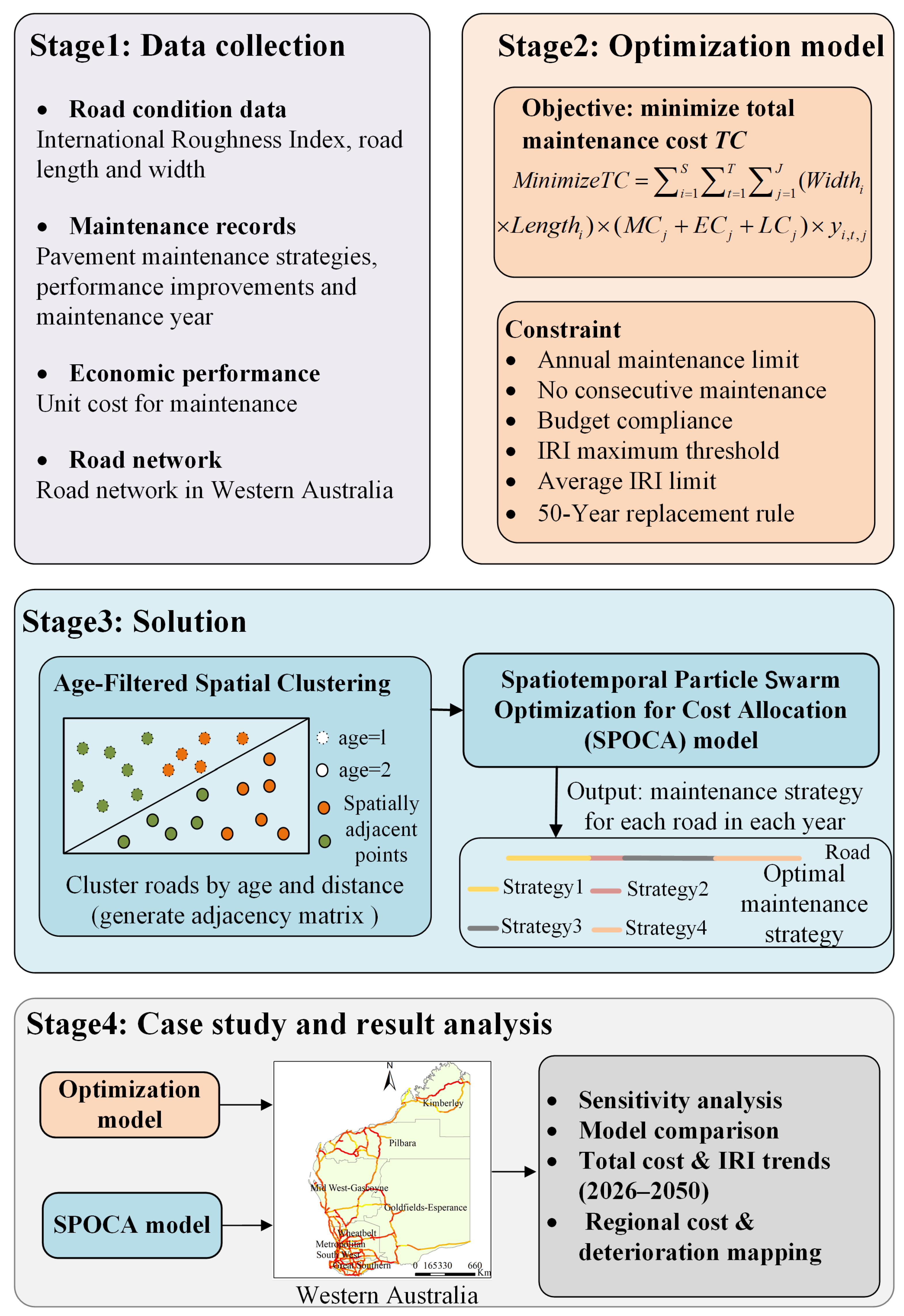
Figure 1 presents the overall framework of the proposed SPOCA model in four stages. Stage 1 compiles the key inputs, including road condition data (International Roughness Index and segment geometry such as length and width), historical maintenance records (strategy types, performance improvements, and maintenance year), economic information (unit maintenance costs), and the road-network dataset for Western Australia. Stage 2 formulates the optimization model by minimizing the total maintenance cost subject to operational and performance constraints, including annual maintenance limits, the no-consecutive-maintenance rule, budget compliance, IRI threshold requirements, a network-level average IRI limit, and the 50-year replacement rule. Stage 3 solves the large-scale problem through a two-step solution design: an age-filtered spatial clustering module groups roads by age and distance to generate cluster-based decision units and an adjacency matrix, after which the SPOCA model produces the year-by-year maintenance strategy for each road segment across the planning horizon. Stage 4 evaluates the resulting plans in the Western Australia case study, reporting sensitivity analysis, baseline model comparison, long-term total cost and IRI trends (2026–2050), and regional patterns of cost and deterioration to support policy-relevant interpretation.

2.1. Problem Description and Data Representation

In regions characterized by vast and diverse road networks, the condition of roads significantly deteriorates due to environmental factors and annual wear from vehicle traffic. Effective road maintenance is crucial given the expansive geography, which includes urban centers, rural areas, and remote regions. Regular maintenance activities ensure safety and functionality across this large-scale road system, allowing vehicles to travel safely and efficiently.
However, governments face substantial challenges due to limited budgets allocated for road maintenance each year. As a result, it is essential to adopt a strategic approach to select maintenance methods that improve road performance and minimize overall costs while adhering to annual budget constraints. This is particularly important given the vast number of roads and the varying conditions they endure across different regions.
Assuming there are S distinct road segments within these regions, each segment exhibits unique deterioration patterns and maintenance needs, influenced by local environmental conditions. The International Roughness Index (IRI) is utilized to assess the smoothness of each road surface, where a higher IRI indicates a rougher and less safe driving experience. Research indicates that the IRI of roads in Western Australia tends to increase by approximately 2% annually due to the combined impacts of heavy traffic and environmental conditions [12].
At the beginning of each year, road agencies can choose from different maintenance strategies, denoted as j = 1 ,   2 ,   ,   J . Each strategy has specific associated costs, including material cost (MC), environmental cost (EC), and labor cost (LC), which vary depending on the method and the area of the road being treated. The total cost of maintenance (TC) for each segment can be calculated based on the road dimensions (width and length) and the unit costs associated with the selected maintenance strategy.
Moreover, each maintenance activity leads not only to costs but also to improvements in road condition. For a given maintenance strategy j , if the pre-maintenance IRI is z , the post-maintenance IRI z ^ is computed as follows:
z ^ = { γ i × z ,       i f   t h e   s t r a t e g y   p r o d u c e s   p r o p o r t i o n a l   i m p r o v e m e n t min ( z ,   β j ) ,         i f   t h e   s t r a t e g y   y i e l d s   a   f i x e d     i m p r o v e m e n t   t h r e s h o l d
where γ j is the proportional reduction coefficient for light maintenance methods, β j is the post-maintenance IRI cap for heavy or structural rehabilitation methods. Both parameters are derived from empirical observations in the Main Roads Western Australia database and calibrated using the dTIMS V9 pavement management system [14].
All the notation used throughout this section is listed in Table 1 and Table 2.
Considering a planning horizon of T years, several constraints must guide the maintenance decisions across this large-scale network: (1) Each road segment can undergo maintenance only once per year. (2) No road segment may be maintained in two consecutive years, allowing for recovery and performance assessment. (3) The total maintenance costs each year t = 1 , , T of all road segments must remain within the government’s budget B t . (4) The IRI of each road segment must not exceed a defined maximum threshold I R I m a x   at any time (including at the beginning of the year, end of the year, before maintenance, and after maintenance). (5) At any time, the weighted average IRI of the entire road network must stay within a specified threshold to ensure overall road quality. (6) It is mandated that every road must undergo a full-depth replacement every 50 years to maintain structural integrity.
The ultimate goal of this model is to systematically plan which roads i requires maintenance each year t and which maintenance strategies to employ, with the objective of minimizing total maintenance costs (TC) during the study period. This planning is essential for effectively managing the extensive road network, ensuring safe and reliable transport infrastructure for all users.

2.2. Model Formulation

The model to minimize total maintenance costs is represented as:
[ M ] M i n i m i z e   T C = i = 1 S t = 1 T j = 1 J ( W i d t h i × L e n g t h i ) × ( M C j + E C j + L C j ) × y i , t , j
subject to
  x i , t + x i , t + 1 1 , i = 1 , , S , t = 1 , , T 1
x i , t = j = 1 J y i , t , j , i = 1 , , S , t = 1 , , T
i = 1 S j = 1 J ( W i d t h i × L e n g t h i ) × ( M C j + E C j + L C j ) × y i , t , j B t , t = 1 , , T
z ^ i , t = j = 1 J max ( min ( α j z i , t , β j ) , I R I m i n ) y i , t , j + z i , t ( 1 x i , t ) , i = 1 , , S , t = 1 , , T
z i , t + 1 = 1.02 z ^ i , t , i = 1 , , S , t = 1 , , T 1
i = 1 S ( W i d t h i × L e n g t h i ) i = 1 S ( W i d t h i × L e n g t h i ) × ( 1.02 z ^ i , t ) θ , t = 1 , , T
y i , t , p = 1   i f   A g e i t   m o d   50 = 0 , i = 1 , , S , t = 1 , , T
x i , t { 0,1 } , i = 1 , , S , t = 1 , , T
y i , t , j { 0,1 } , i = 1 , , S , t = 1 , , T , j = 1 , , J
z i , 1 = I R I i 0 , i = 1 , , S
I R I m i n z i , t I R I m a x , i = 1 , , S , t = 2 , , T
I R I m i n z ^ i , t I R I m a x , i = 1 , , S , t = 1 , , T
The model is designed to minimize total maintenance costs while effectively managing extensive road network. Constraint (3) ensures that a road segment will not be maintained in two consecutive years. Constraint (4) enforces that at most one maintenance strategy can be applied to each road segment each year. Constraint (5) enforces the budget constraint, requiring that the total maintenance costs in each year do not exceed the allocated budget. Constraint (6) calculates the post-maintenance IRI. Constraint (7) models the deterioration of roads in a year. Constraint (8) mandates that the weighted average IRI for the road network at the end of each year remains below a specified threshold, ensuring overall road quality. Constraint (9) requires a full-depth replacement on each road every 50 years to maintain structural integrity, and p is the kind of strategy for conducting a full-depth replacement. Constraints (10) and (11) define the binary decision variables for whether maintenance is performed and which maintenance strategy is chosen, Constraints (12) define the initial IRI of each road at the beginning of the first year, and Constraints (13) and (14) ensure that both pre- and post-maintenance IRI values remain within defined minimum and maximum limits. Together, these constraints guide the selection of maintenance strategies, ensuring the sustainability and safety of the road network while adhering to budgetary limitations.

2.3. Spatiotemporal Particle Swarm Optimization for Cost Allocation (SPOCA) Model

Model [M] aims to minimize the total maintenance cost of the road network throughout the planning horizon, while maintaining road performance and adhering to annual budget limits. However, directly solving the model is computationally demanding due to the large number of road segments and the temporal and spatial interdependencies among them. Temporally, the decision made for a road in one year affects its future condition and, consequently, its maintenance requirements. Spatially, maintenance actions on one road may influence nearby segments, affecting the overall network condition and determining whether the weighted average International Roughness Index (IRI) remains within the acceptable range.
To reduce the computational complexity while preserving the essential spatial patterns, we design a particle swarm optimization (PSO) method to obtain a high-quality solution within reasonable time. PSO is a heuristic method that iteratively improves the quality of solutions obtained [34]. In PSO, a group of particles (i.e., candidate solutions) are initialized. The “position” of a particle is the vector representing the corresponding solution. In each iteration, every particle moves in the search space based on its current position, its best position in all iterations, and the best position of all particles in all iterations, and, therefore, has a new position in the next iteration. The best position of all particles in all iterations is the output of the PSO method. PSO is renowned for its high convergence rate, ease of implementation, and superior parallel processing capabilities and has been applied to many engineering problems such as construction site layout [35], construction project scheduling and construction logistics management [36].
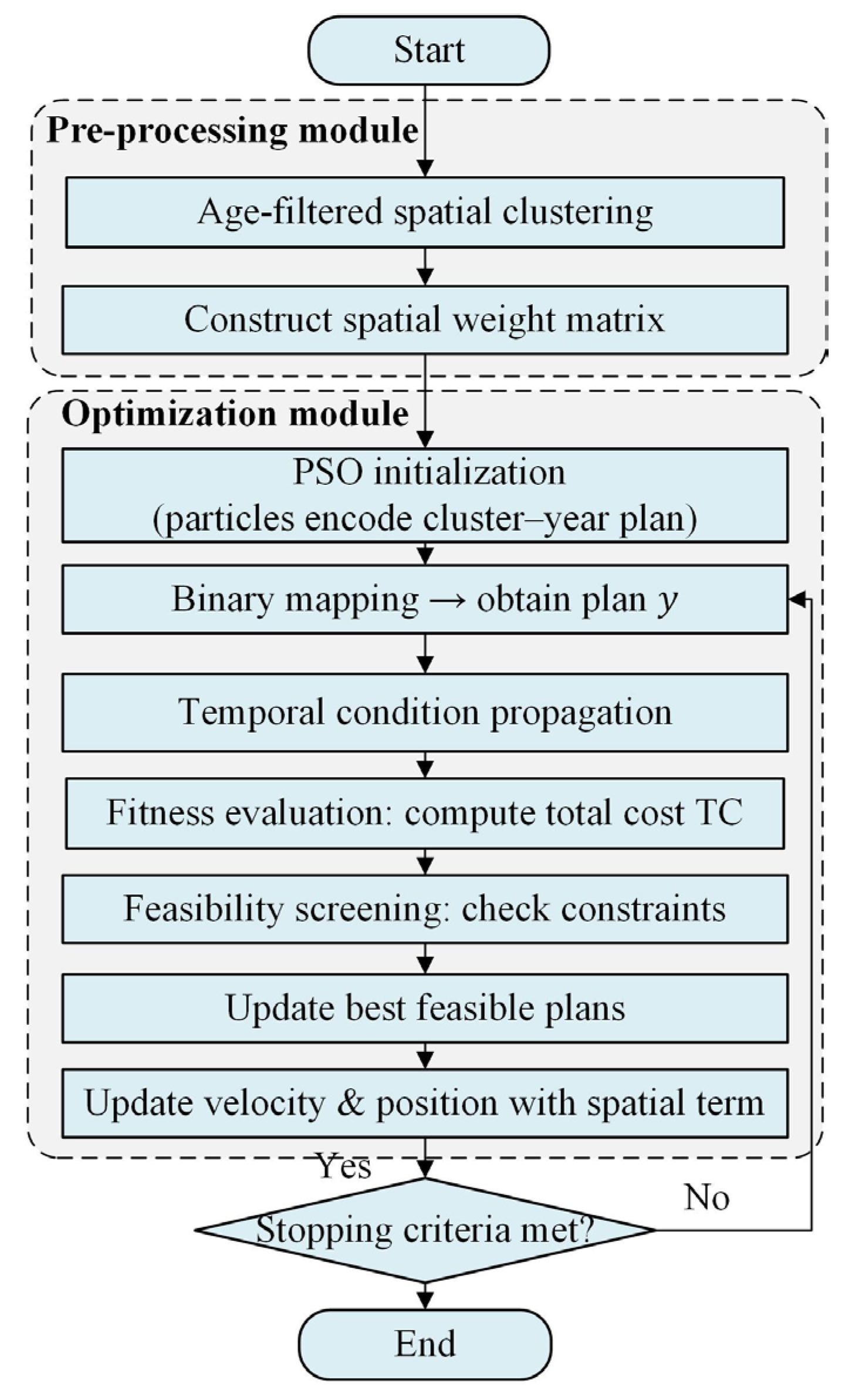
Building upon these advantages, the proposed framework extends the conventional PSO into a Spatiotemporal Particle Swarm Optimization for Cost Allocation (SPOCA) model. The SPOCA model adopts a modular integration mechanism in which pre-processing, temporal condition propagation, and PSO-based search operate as one coordinated workflow (Figure 2). Road segments are first age-filtered and spatially clustered to form geographically coherent decision units with aggregated attributes, and the spatial weight matrix w i j is constructed from centroid distances to encode proximity-based relationships among decision units. Given a candidate cluster–year plan, the temporal condition propagation module deterministically updates year-by-year pavement conditions and costs under Model [M], after which fitness is evaluated by the original total-cost objective without changing the objective definition. Constraint feasibility is enforced through screening before updating the best feasible plan found so far for each particle and the overall best feasible plan, ensuring that only feasible candidates can guide the search. Collaboration across space is realized in the velocity/position update via the spatial term derived from w i j , which encourages neighbouring clusters to move toward mutually consistent strategies; collaboration across time is ensured because decisions in earlier years propagate through the temporal updating rules and directly shape future conditions, feasibility, and costs. The detailed steps are provided in Section 2.3.1, Section 2.3.2, Section 2.3.3, Section 2.3.4 and Section 2.3.5.

2.3.1. Fitness Evaluation

Fitness evaluation is required for all metaheuristic algorithms used in this study. To ensure a fair and consistent comparison across algorithms, we evaluate every candidate maintenance plan using the same fitness definition, which is the objective value of Model [M]. Specifically, the fitness of a plan is computed as the total maintenance cost TC defined in Equation (2). The optimization therefore minimizes this fitness over the feasible set defined by Model [M], and feasibility is enforced through the constraint screening described in Section 2.3.4.

2.3.2. Age-Filtered Spatial Clustering

All road segments are first grouped according to their construction age and then clustered spatially within each age layer to preserve both lifecycle consistency and geographic continuity. Each segment i is represented by its centroid coordinates ( x i , y i ) and pavement age A g e i . Segments with the same age a form a subset S a = { i | A g e i = a } . Within each subset, spatial clustering minimizes the within-group variance based on geographic distance so that segments within a cluster are both age-homogeneous and spatially contiguous. The spatial correlation between two segments i and j is expressed as
w i j = { exp ( d i j τ ) ,       d i j D 0 0 ,         d i j > D 0
where w i j denotes the spatial weight between decision units i and j , reflecting their geographic proximity and thus the potential strength of spatial dependence. w i j 0 and typically satisfies w i j = 0 , and larger values indicate stronger neighborhood influence. The set of weights w i j forms a spatial weight matrix that encodes the local adjacency structure used in the SPOCA search process. In particular, w i j is used in the spatial relationship term of the PSO velocity update to bias particle movements toward solutions that are spatially coherent across neighboring units, improving regional consistency of maintenance decisions while keeping the fitness evaluation based on the original cost objective of Model [M].
To assess whether the proposed age-filtered spatial clustering overly homogenizes heterogeneous road segments, we quantify within-cluster heterogeneity using the coefficient of variation (CV). Where C V = σ / μ , σ is the standard deviation and μ is the mean of a given attribute across road segments within the same cluster. In this study, we report CV for (i) road age and (ii) baseline roughness IRI, as these two variables directly affect lifecycle consistency and deterioration-related decision making in the subsequent optimization. Lower CV indicates more homogeneous clusters, whereas higher CV implies greater within-cluster diversity.

2.3.3. Spatiotemporal Optimization Procedure

After clustering, each cluster becomes a decision unit within the optimization process. The SPOCA algorithm iteratively searches for the cost-minimizing maintenance schedule across all clusters and years while satisfying the defined operational and performance constraints. Each particle in the swarm encodes a complete maintenance plan Y = [ y i , t , j ] , and its velocity and position are updated dynamically according to both temporal and spatial information.
The velocity update is expressed as:
v i t + 1 = ω v i t + c 1 r 1 ( p i b e s t x i ) + c 2 r 2 ( g b e s t x i t ) + c 3 r 3 j N i w i j ( x j t x i t )
where v i t is the velocity vector of particle i at iteration t , and x i t is its position vector representing a candidate maintenance plan in the search space. ω is the inertia weight (linearly decreased from 0.9 to 0.4) controlling how much the particle preserves its previous moving direction. p i b e s t denotes the best position found by particle i in all previous iterations and g b e s t denotes the best position found among all particles up to iteration t . c 1 and c 2 are the cognitive and social learning coefficients (both set to 2.0), and r 1 , r 2 ∈ [0, 1] are random variables. The final term c 3 r 3 j N i w i j ( x j t x i t ) is the spatial relationship component, where w i j is the spatial weight between neighboring decision units i and j (defined in Equation (15)), N i is the neighbor set of unit i , c 3 controls the strength of spatial influence, and r 3 ∈ [0, 1] is a random variable. This spatial relationship component injects proximity-based information into the velocity update so that the particle movement is biased toward locally consistent decisions across adjacent areas, while the fitness evaluation remains based on the original cost objective of Model [M] under feasibility screening.
The position update follows:
x i t + 1 = x i t + v i t + 1
where x i t + 1 is the updated particle position after iteration t , obtained by adding the new velocity v i t + 1 to the current position x i t . The position vector x i t is a continuous representation used to enable smooth search dynamics during metaheuristic optimization; it will be transformed into discrete maintenance decisions in the subsequent binarization step so that it is compatible with the binary decision structure of Model [M]. The binary decisions are generated through a logistic function:
y i , t , j = { 1 ,       i f   s i g m o i d ( x i , t , j ) > 0.5 0 ,                                             o t h e r w i s e
where y i , t , j { 0,1 } is the binary decision indicating whether maintenance strategy j is selected for decision unit i in year t . s i g m o i d ( x i , t , j ) maps the continuous coordinate x i , t , j to a value in (0,1), interpreted as a probability-like score, and the threshold 0.5 converts it into a binary outcome. The resulting binary plan is then checked against the constraint set of Model [M] (e.g., annual budget, IRI bounds, network-level IRI threshold and the mandatory renewal rule) so that only feasible candidates are used to update p i b e s t and g b e s t .

2.3.4. Constraint Feasibility

During each iteration, SPOCA applies feasibility screening to every candidate maintenance plan generated by the swarm with respect to the full constraint set of Model [M], including annual maintenance frequency, non-consecutive-year maintenance, annual budget limits, segment-level IRI bounds, the network-level weighted average IRI threshold, and the mandatory lifecycle renewal requirement. Candidate plans that violate any constraint are marked infeasible and are not allowed to update either the personal-best or the global-best solution. This screening-based feasibility control guarantees that the best solution reported by the algorithm is feasible under the original constrained formulation and preserves the cost-minimization objective, thereby keeping the comparison with baseline metaheuristics consistent and reproducible.
At the same time, we recognize that feasibility screening alone can be inefficient when the feasible region is narrow. As a future enhancement, feasibility screening can be extended with feasibility-rule-based constraint handling and violation-guided ranking, where infeasible candidates are compared by their degree of constraint violation to guide the search toward feasibility even when feasible solutions are sparse [37]. Moreover, for stochastic optimization in discrete/binary decision spaces, robustness-oriented strategies have been shown to improve stability and performance in evolutionary search [38]. Integrating these methods is a promising direction to further reduce constraint violations and improve computational efficiency while keeping the original objective and constraints of Model [M] unchanged.

2.3.5. Algorithm Execution and Convergence

The algorithm starts by initializing particles with random feasible maintenance plans and updating them iteratively according to Equations (16)–(18). Feasible solutions are retained, and infeasible ones are discarded in each iteration. The process continues until the total network maintenance cost stabilizes or no further improvement is observed.
The SPOCA algorithm was executed with 50 particles for 100 iterations under a 1% convergence tolerance; the corresponding parameter settings are summarized in Table 3. The global best feasible particle at termination represents the optimal maintenance plan that minimizes total cost while maintaining compliance with all lifecycle and performance constraints.
By combining the clustering-based dimensionality reduction and the spatiotemporal cooperation mechanism, SPOCA provides an efficient and physically consistent optimization procedure. The resulting maintenance schedules are cost-effective, temporally consistent, and spatially coherent, ensuring that the entire network remains in serviceable condition throughout the planning horizon.

2.4. Model Sensitivity Analysis and Comparison

To evaluate the robustness and computational performance of the proposed spatiotemporal optimization framework, model sensitivity and comparison were conducted.

2.4.1. Sensitivity Analysis

Sensitivity experiments were performed to test the stability of the optimization framework under different operational and environmental conditions. The parameters examined include the annual deterioration rate ( r i ), annual budget ( B t ), performance threshold ( I R I m a x ), and algorithmic settings such as particle number ( N p ) and maximum iterations ( T i t e r ). In particular, a dedicated PSO hyperparameter sensitivity analysis was conducted to assess the robustness of SPOCA to different swarm configurations, including particle number N p , maximum iterations T i t e r , and other key PSO control parameters. For each scenario, the model was re-optimized, and changes in total cost and average network IRI were compared to the baseline.

2.4.2. Model Comparison

To address the concern that age-filtered spatial clustering may oversimplify heterogeneous road segments by grouping them mainly by age and proximity, we compare it with three commonly used alternatives that form decision units from different information sources: (i) attribute-only clustering using K-means based on baseline IRI, (ii) age-only clustering, and (iii) proximity-only clustering. For each clustering strategy, the resulting clusters are used as the decision units in the downstream maintenance optimization under the same datasets, deterioration settings, and budget constraints. We evaluate clustering behavior using within-cluster heterogeneity measured by the coefficient of variation (CV) for road age and baseline IRI, and we further report downstream maintenance outcomes (total cost, average IRI, and runtime) to quantify the practical trade-offs between preserving lifecycle consistency, maintaining spatial coherence, and avoiding excessive within-cluster averaging.
To compare the proposed SPOCA method, four widely used metaheuristic algorithms were selected for comparison: the non-spatial PSO, Genetic Algorithm (GA), Simulated Annealing (SA), and Differential Evolution (DE). These baseline algorithms are widely adopted in pavement maintenance and rehabilitation (M&R) planning and related infrastructure scheduling problems because they can efficiently search large, constrained, and often mixed (discrete–continuous) decision spaces where exact optimization is difficult. GA has been frequently used to address the combinatorial nature of multi-year pavement maintenance programming [39], while PSO and DE are commonly employed evolutionary/swarm approaches for large-scale network-level M&R scheduling and pavement maintenance optimization [40,41]. SA (and related evolutionary search schemes) has also been used to explore maintenance scheduling solutions, and prior studies note that such metaheuristics typically require many candidate evaluations to reach high-quality plans—making them representative and informative baselines for assessing efficiency improvements [42].
All algorithms were executed using identical datasets, deterioration rates, and budget constraints for 100 iterations with a 1% convergence tolerance. Each algorithm was independently executed 10 times and reports the mean total cost, average IRI, and runtime across the 10 runs. The execution settings and hyperparameters for SPOCA/PSO/GA/SA/DE are summarized in Table 3. The comparison focused on total cost, average IRI, and runtime efficiency.

2.5. Study Area and Data

In this study, we chose Western Australia as our study area due to its extensive road maintenance records and substantial investment in transportation infrastructure. The region’s total road network spans over 18,000 km, comprising 18,305 maintained road segments. The dataset consists of four categories of information, including (1) road condition data, (2) road maintenance records, (3) economic performance data, and (4) the regional road network, as summarized in Table 4. First, road condition data is included, which encompasses the International Roughness Index, as well as the length and width of roads, sourced from Main Roads and predicted using dTIMS V9 of Deighton [14]. Second, road maintenance records provide details on various pavement maintenance strategies, performance improvements, and the years in which maintenance occurred, all obtained from Main Roads. Third, economic performance data is incorporated, detailing unit costs associated with each maintenance strategy. Lastly, information on the road network in Western Australia is also included. This dataset supports the analysis and optimization efforts in the region.
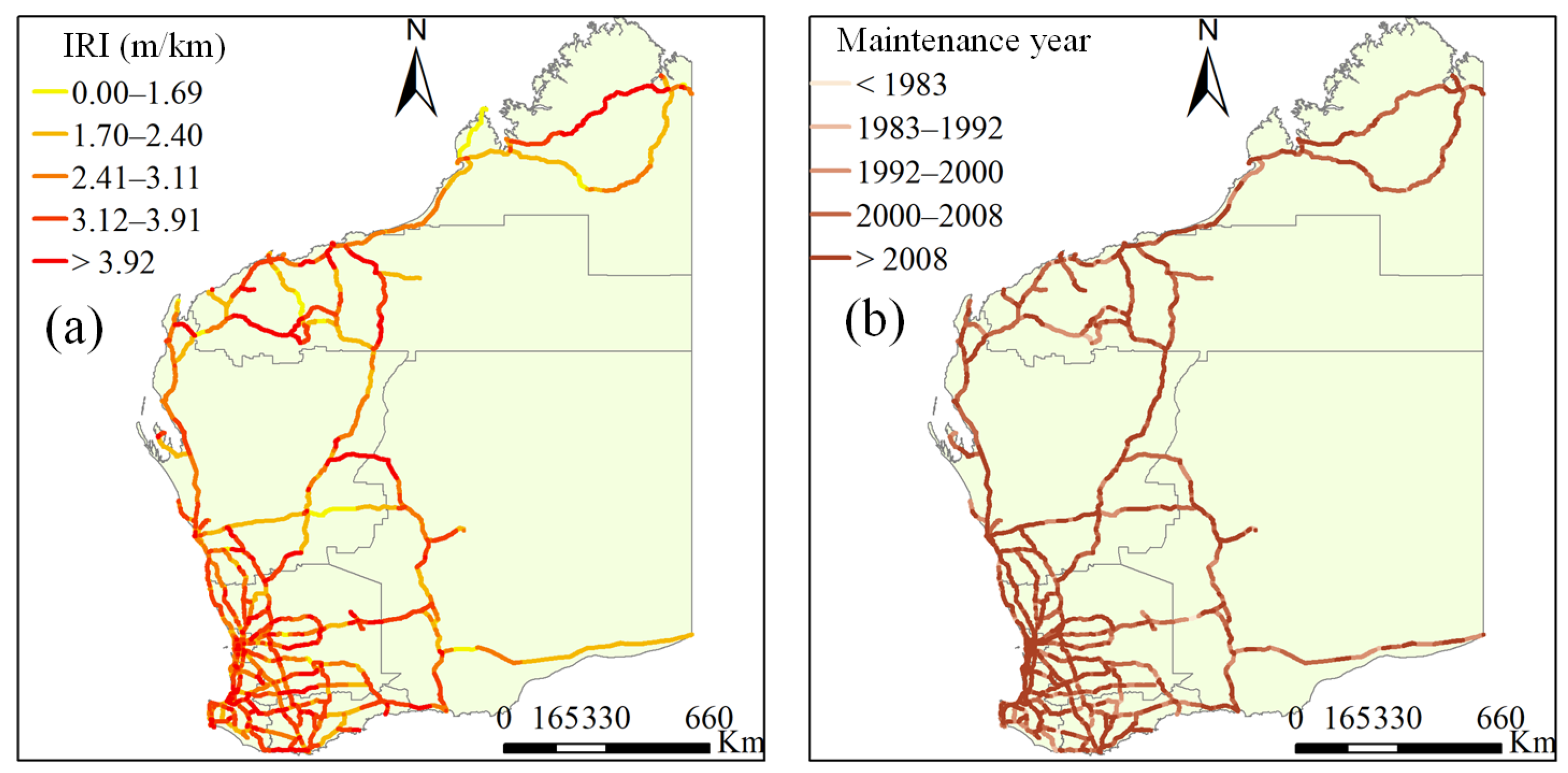
Figure 3a illustrates the spatial distribution of the IRI (International Roughness Index) for these segments in 2024 while Figure 3b shows the maintenance year of these roads. Our study focuses on the period from 2026 to 2050.
Regarding maintenance strategies, there are eight different approaches, as detailed in Table 5. The definitions of these strategies were sourced from Main Roads Western Australia, the leading road agency in the area. Among these strategies, the structural rehabilitation strategy for asphalt pavements (ASRS) and the granular overlay (GrOL) are more expensive rehabilitation methods that yield significant improvements in pavement IRI. The other strategies mainly involve routine maintenance, resulting in more limited enhancements to road conditions. Table 5 presents the performance improvements associated with each maintenance strategy, while Table 6 outlines the material and environmental costs for each strategy, measured in AUD $/m2. According to BITRE, labor cost is approximately 2/3 of the sum of maintenance cost and environment cost [6].

3. Results

3.1. Model Settings

We apply our model and solution method to the maintenance planning of roads in Western Australia over a planning period of 25 years from 2026 to 2050. The road network in Western Australia consists of a total of 18,305 road segments. The length, width, age, and the expected IRI at the beginning of year 2026 before maintenance are provided to us by Main Roads Western Australia [14]. According to Main Roads Western Australia, I R I m i n = 0.6 , I R I m a x = 3.6 , θ = 2.7 , and the annual budget B t = 3.3 billion AUD.
The main parameters of the spatiotemporal SPOCA algorithm are configured as follows: the number of particles N p = 50 , the maximum iteration count T i t e r = 100 , social coefficients c 1 = c 2 = 2.0 , and the spatial influence radius D 0 = 5   km .

3.2. Sensitivity Analysis Results

Table 7 reports the sensitivity of SPOCA to PSO hyperparameters. Overall, solution quality is stable within a reasonable parameter range: total cost remains close to the baseline (13.28 billion AUD) and the average IRI stays around 2.53 m/km, indicating that the proposed search is not overly dependent on a single tuning choice. Runtime is more sensitive to the swarm size and iteration number, as expected. Reducing the swarm size or iterations accelerates computation but yields slightly higher costs or rougher network conditions, suggesting weaker exploration. The inertia schedule and learning coefficients cause only minor variations, and the spatial relationship strength shows a mild benefit in maintaining smoother network-level pavement condition without materially increasing total cost.
We further test robustness to operational scenario inputs by perturbing deterioration rates, annual budgets, and IRI thresholds while holding the optimization algorithm settings constant; the resulting impacts on total cost and average network IRI are summarized in Table 8.
The results indicate that the model behaves consistently and robustly under parameter variations. A higher deterioration rate or a tighter IRI threshold slightly increases total cost and worsens pavement conditions, while an increased budget significantly improves network performance but yields diminishing returns. Even under ±20% changes, total cost varies by less than 4%, and the network IRI remains within a narrow range (2.46–2.83 m/km), confirming that the optimization framework is both stable and economically sound.

3.3. Model Comparison Results

3.3.1. Clustering Strategy Comparison

We compared the proposed age-filtered spatial clustering with three common alternatives: (i) attribute-only clustering using K-means (based on IRI), (ii) age-only clustering, and (iii) proximity-only clustering (Table 9). The proposed method achieves a balanced reduction in within-cluster heterogeneity (Age CV = 0.06; IRI CV = 0.12), avoiding the high age-mixing observed in attribute-only and proximity-only clustering (Age CV = 0.19 and 0.22) while maintaining acceptable IRI consistency. Importantly, this clustering choice translates into comparable or better downstream outcomes: the proposed method yields the lowest total cost (13.28 billion AUD), matches the best average IRI (2.67 m/km), and achieves the shortest runtime (9.8 min). These results indicate that, although clustering inevitably abstracts segment-level variability, the proposed design preserves the key lifecycle and condition structure needed for long-horizon optimization and does not degrade network-level maintenance outcomes.

3.3.2. Optimization Algorithms Comparison

To assess the advantages of spatial cooperation, the proposed SPOCA was compared with four benchmark algorithms (non-spatial PSO, Genetic Algorithm (GA), Simulated Annealing (SA), and Differential Evolution (DE)) under identical data and constraints. All methods were applied to the same Western Australia road network (2026–2050) with equal budgets, deterioration rates, and model settings. Table 10 summarizes their performance in terms of total cost, network condition, variability of pavement quality, and computational efficiency.
All algorithms achieve comparable total costs (13.26–13.40 billion AUD), yet their resulting network conditions differ significantly. The proposed SPOCA delivers the lowest average IRI (2.53 m/km) and the smallest variation (0.59 m/km) across road segments, suggesting smoother and more uniform pavement conditions. This improvement indicates that spatial coordination improves maintenance efficiency rather than relying on higher investment.
The superior performance of SPOCA arises from its explicit incorporation of spatial interaction. By introducing a spatial weight matrix w i j , the algorithm allows information sharing among geographically proximate road clusters. When one segment undergoes maintenance, its neighboring segments are more likely to coordinate their actions in subsequent iterations, avoiding abrupt transitions between well-maintained and poorly maintained areas. This cooperation ensures more coherent regional decisions and reduces the fragmentation typical of conventional, independent optimization approaches such as PSO or GA. As a result, the final maintenance plan achieves better overall service quality with the same financial resources.
In terms of computational efficiency, SPOCA completes the optimization in 9.8 min, which is 38% faster than PSO and more than 50% faster than GA or SA. The inclusion of spatial information effectively guides the swarm toward high-quality regions of the search space, reduces redundant local exploration, and accelerates convergence.
Therefore, SPOCA achieves a balanced combination of cost control, improved road quality, and reduced computation time, demonstrating the practical benefit of integrating spatial cooperation into long-term maintenance planning for large-scale infrastructure networks.

3.4. Total Maintenance Costs and Road Deterioration Analysis

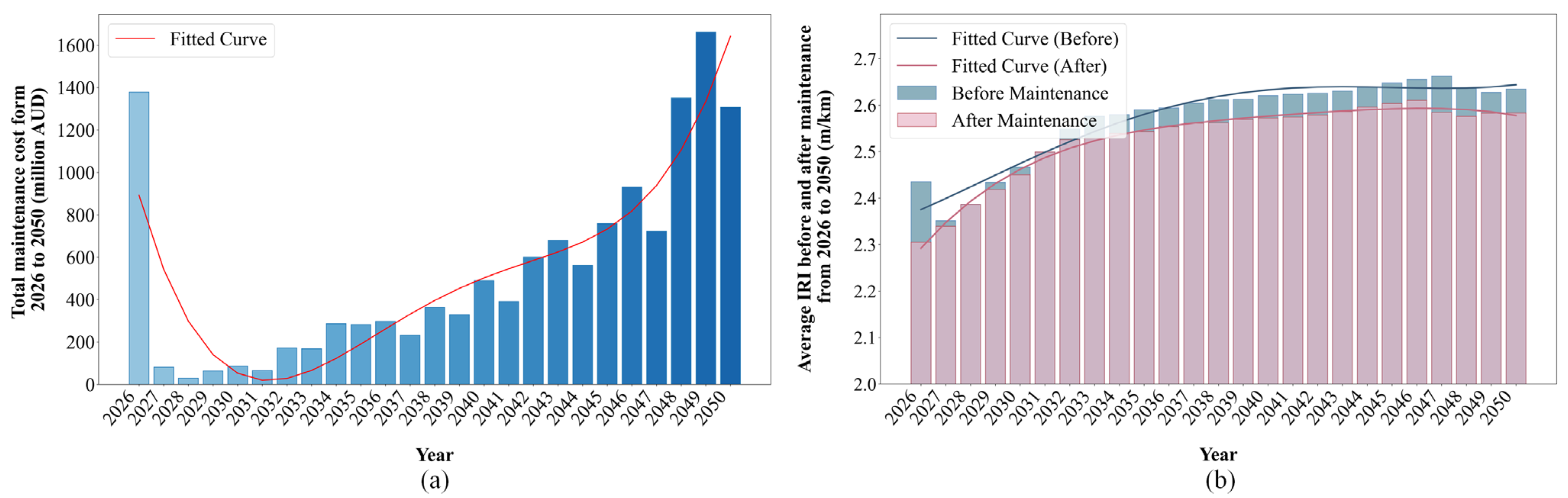
Our model indicates that the minimum total maintenance cost required in Western Australia from 2026 to 2050 will be approximately 13.28 billion AUD. Figure 4a illustrates the variation in annual maintenance costs, revealing that 2026 will require substantial funding for road maintenance, with expenditures approaching 1.4 billion AUD. The significant increase in costs stems from the current poor condition of the roads, as many have an International Roughness Index (IRI) exceeding 7, and numerous roads surpass a roughness level of 3.6. These conditions highlight that existing maintenance practices are far from meeting expectations, necessitating urgent and concentrated efforts on these deteriorating roads.
Starting in 2027, annual maintenance costs begin to decline due to the significant refurbishment of numerous roads in 2026, which improved the overall road conditions. However, from that point onward, there is a general upward trend in maintenance costs, peaking in 2049 at over 1.6 billion AUD. This trend suggests that the government of Western Australia should gradually increase its annual maintenance budget to manage road conditions effectively.
Regarding road deterioration, Figure 4b displays the annual changes in the International Roughness Index (IRI) before and after maintenance activities. Notably, due to extensive maintenance efforts in 2026, the improvement in road conditions was most pronounced, with the IRI increasing by 5.1%. From 2035 to 2050, the IRI stabilizes, showing about a 2% improvement from maintenance activities during this period. This finding indicates that the government should consider implementing more proactive maintenance strategies to sustain and enhance road quality over the long term.

3.5. Maintenance Strategies Analysis

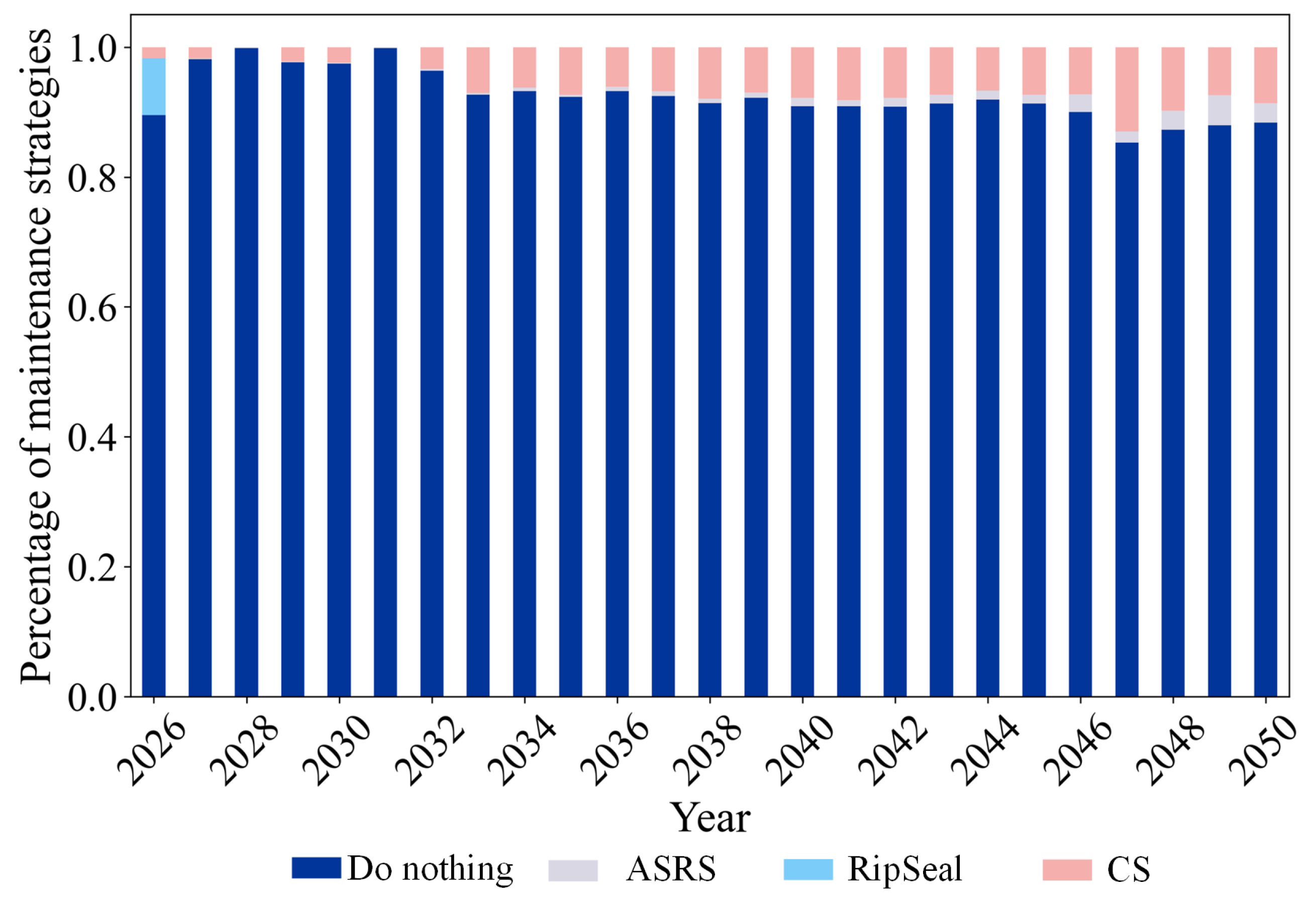
Furthermore, we analysed the annual trends in maintenance strategies. Figure 5 illustrates the yearly variations in different maintenance strategies. It is evident that in 2026, a significant number of roads—approximately 10.5% of the total—required maintenance. Starting in 2028, the overall number of roads needing maintenance shows a consistent upward trend, peaking in 2047 when 14.7% of all roads will require attention.
Regarding the specific maintenance strategies employed for these roads, there was a notable reliance on RipSeal strategy in 2026. This preference can be attributed to the deteriorating condition of many roads that year, necessitating immediate and effective interventions. In addition, the use of the CS strategy gradually increased each year. This approach is favored due to its cost-effectiveness and its ability to enhance road performance.
In the final years of the study, the ASRS strategy began to gain traction. This shift is primarily due to the aging infrastructure, which necessitates adherence to a policy of full-depth replacement every 50 years for older roads. The findings allow the government to make precise recommendations each year, selecting appropriate strategies that effectively address road deterioration while minimizing overall costs.

3.6. Regional Maintenance Cost and Road Deterioration Analysis

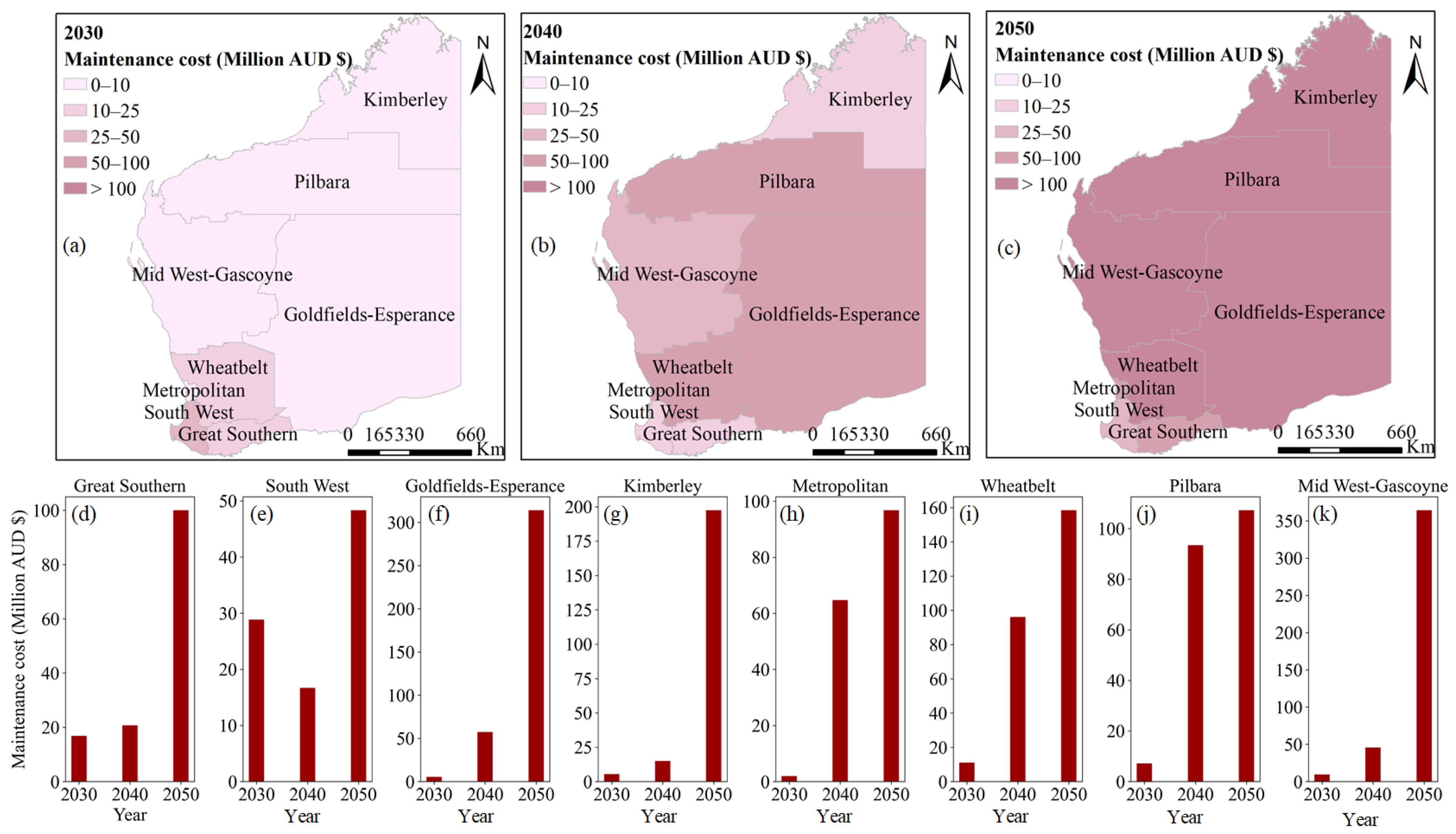
This study also analyzed regional maintenance costs and road deterioration. Notably, the Wheatbelt region has the highest total maintenance cost from 2026 to 2050, amounting to 2.714 billion AUD, which represents 20.4% of the total maintenance expenditure. However, this region only accounts for approximately 10% of the land area of Western Australia.
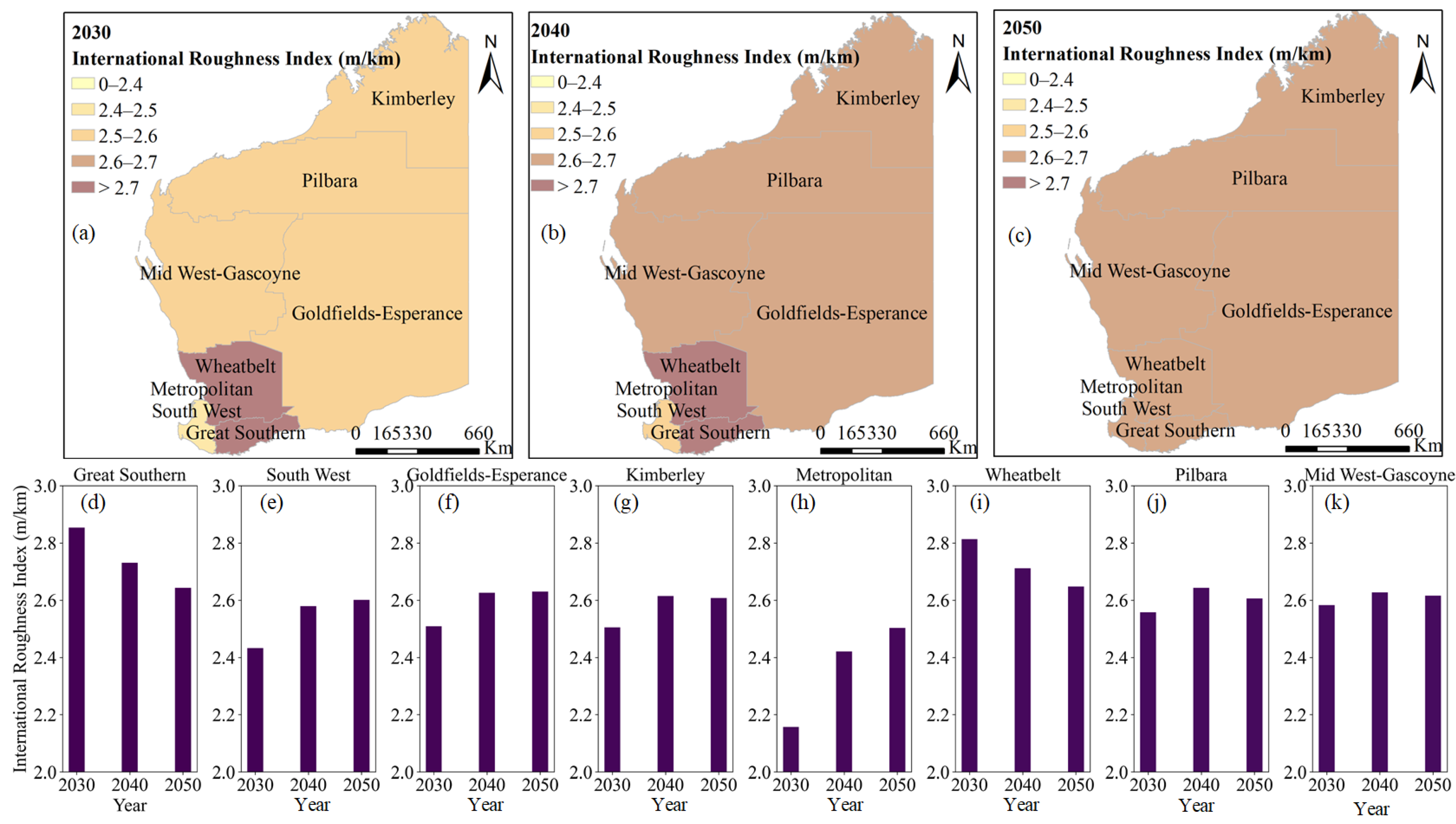
We examined the IRI across different regions at three key time points (2030, 2040, and 2050) to illustrate how network condition evolves under the optimized maintenance plans. Figure 6 maps the spatial distribution of IRI for these years and highlights two clear patterns. First, regional dispersion in road roughness is more pronounced in the early stage (2030), when rural and remote areas tend to show higher IRI values, reflecting both longer travel distances and comparatively less frequent intervention. Second, the spatial contrast gradually weakens toward 2050, as the planned interventions reduce extreme roughness and compress the regional IRI distribution into a narrower band, indicating convergence toward a more uniform network-level service condition rather than isolated hotspots of poor pavement. This convergence suggests that the maintenance allocation not only improves overall condition but also moderates regional inequality in pavement quality. Notably, the Metropolitan region exhibits the fastest IRI increase over time, which is consistent with its role as Western Australia’s most intensively used network: high traffic demand and dense connectivity accelerate deterioration and create persistent pressure even when maintenance is applied, underscoring the need for sustained attention to this area as urban growth continues.
Figure 7 presents the spatial distribution of maintenance costs for 2030, 2040, and 2050, revealing an overall upward trend in expenditures across regions by 2050. Importantly, the increase is not spatially uniform: high-demand or heavy-load regions experience a steeper cost trajectory, reflecting both the accumulated effects of deterioration and the timing of major treatments along the planning horizon. In the Metropolitan region, this surge is associated with increased traffic volumes driven by concentrated economic activity and population density, which raises both deterioration intensity and the frequency of effective treatments. In Goldfields–Esperance, higher costs are closely linked to mining and resource-extraction logistics that rely on robust long-distance freight corridors, requiring more intensive and costly interventions. Together, Figure 6 and Figure 7 indicate a consistent planning message: regions with sustained demand growth or heavy freight dependence not only deteriorate faster but also require disproportionately larger budget allocations over time, suggesting that long-term maintenance programs should anticipate these structural drivers rather than reacting to short-term condition snapshots.
In conclusion, our analysis emphasizes the need for targeted maintenance strategies, especially in regions like Wheatbelt and Metropolitan, where costs and deterioration rates are high. By focusing on efficient resource allocation and prioritizing areas with the greatest need, the government can improve the overall quality and sustainability of the road network in Western Australia. Implementing regular assessments and using advanced technologies for predictive maintenance could further optimize expenditures and enhance road conditions in the long term.

4. Discussion

This study presents the spatiotemporal particle swarm optimization for cost allocation model, specifically designed to address two critical challenges in transportation infrastructure: the maintenance of large-scale networks and the optimization of spatial and temporal correlations. The model enhances resource allocation efficiency and provides a framework for improving maintenance strategies.
Our findings highlight the urgent need for effective management strategies in large-scale road networks, where optimization should account for extensive spatial relationships and long-term deterioration dynamics. The proposed SPOCA model, built on large-scale real data, provides a comprehensive approach that jointly addresses temporal and spatial correlations in maintenance planning. A key innovation is the introduction of a spatial relationship term within the particle swarm optimization process, which enables interactions among spatially adjacent road clusters. This mechanism guides the optimization search toward coherent regional solutions, reducing redundant exploration and accelerating convergence. As a result, the SPOCA model improves computational efficiency by 38% compared with non-spatial approaches, while maintaining comparable solution accuracy and producing smoother network-level pavement quality. Unlike previous studies that focus on individual segments [22,23] or maintenance uncertainty [25,44], this research demonstrates that incorporating spatial relationships directly into the optimization process enhances both the efficiency and the practicality of long-term maintenance planning for large-scale infrastructure systems.
The broader implications of our findings are significant. This research not only advances our understanding of road maintenance dynamics but also indicates that similar optimization methods could be applied in other regions facing related challenges. Policymakers and transportation agencies can leverage these insights to develop more efficient maintenance strategies that save costs while ensuring safer and more sustainable road networks. The SPOCA model can serve as a blueprint for integrating advanced data-driven decision-making processes into transportation infrastructure management, ultimately contributing to improved service delivery and economic development.
However, it is essential to acknowledge the limitations of our study. Constraint feasibility can be a computational bottleneck in large-scale maintenance planning because the feasible region may be narrow under strict annual budgets and network-level performance requirements. Our current implementation adopts conservative feasibility screening to ensure that the reported best solution always satisfies Model [M]’s constraints and to preserve a fair comparison across metaheuristic baselines under an unchanged cost objective; nevertheless, screening alone may still spend a non-trivial portion of evaluations on infeasible candidates when constraints are tight. In addition, the optimization model is based on specific assumptions regarding growth rates and environmental factors, which may not fully capture the dynamic nature of road conditions over time. While our findings are robust within the context of this research, their generalizability to other regions with different environmental, traffic-loading, or subgrade conditions may be limited, and caution is warranted when applying this model universally because unique geographical contexts must be considered.
Future research will investigate more efficient constraint-handling mechanisms that guide the search toward feasibility by explicitly prioritizing feasibility and minimizing constraint violation, following feasibility-rule-based principles in constrained evolutionary optimization [37] and robustness-oriented strategies that are effective for stochastic evolutionary optimization in discrete/binary decision spaces [38]. We will also explore incorporating uncertainties related to climate change into the assessment of road deterioration, particularly in areas facing aging infrastructure and budget constraints, and examine how SPOCA adapts under varying economic conditions and alternative budget regimes. Evaluating the long-term effects of different maintenance strategies on road safety and performance is another important direction. Finally, extending the framework to other types of infrastructure offers a promising avenue for broader infrastructure asset management.

5. Conclusions

This study proposes the spatiotemporal particle swarm optimization for cost allocation (SPOCA) model to support long-horizon maintenance planning for large-scale road networks under temporal and spatial dependencies. By integrating age-filtered spatial clustering with a spatial relationship term embedded in PSO, SPOCA enables coordinated decisions across neighboring road segments and across years while improving computational efficiency. The Western Australia case study (2026–2050) demonstrates that SPOCA can produce feasible maintenance plans that satisfy budget and pavement-performance requirements, providing practical decision support for agencies to prioritize interventions, allocate funding, and maintain network-level serviceability in a transparent and scalable manner.
Several limitations motivate future work. First, constraint feasibility can become a computational bottleneck in large-scale planning when annual budgets and network-level performance requirements make the feasible region narrow; future work will investigate more efficient constraint-handling mechanisms that guide the search toward feasibility by prioritizing feasible candidates and minimizing violation, building on feasibility-rule-based principles and robustness-oriented strategies for stochastic optimization in discrete/binary spaces. Second, deterioration and cost are evaluated under fixed scenario assumptions; future research will incorporate uncertainty from climate, traffic, and economic conditions through robust or multi-scenario planning to improve long-horizon reliability. Third, the current spatial dependence is encoded by a proximity-based weight matrix and associated parameters; future studies will test alternative spatial structures and data-driven calibration to better reflect heterogeneous network interactions, and will further validate transferability beyond Western Australia with practical guidance for re-parameterization in diverse contexts.

Author Contributions

Methodology, Pengcheng Zhang, Wen Yi and Yali Gao; Validation, Pengcheng Zhang and Wen Yi; Formal analysis, Pengcheng Zhang and Yongze Song; Resources, Yongze Song and Peng Wu; Writing—original draft, Pengcheng Zhang; Writing—review and editing, Wen Yi and Yongze Song; Supervision, Peng Wu and Albert P. C. Chan. All authors have read and agreed to the published version of the manuscript.

Funding

This research work was supported by the National Natural Science Foundation of China [Grant Nos. 72201229, 72361137006] and Centre for Infrastructure Delivery Research Funding P0055981. The APC was funded by Yongze Song.

Data Availability Statement

Data available in a publicly accessible repository. The original data presented in the study are openly available in https://doi.org/10.6084/m9.figshare.30577253.v1.

Conflicts of Interest

The authors declare no conflicts of interest.

References

  1. Cho, S.; Choi, K. Transport accessibility and economic growth: Implications for sustainable transport infrastructure investments. Int. J. Sustain. Transp. 2021, 15, 641–652. [Google Scholar]
  2. Allen, T.; Arkolakis, C. The welfare effects of transportation infrastructure improvements. Rev. Econ. Stud. 2022, 89, 2911–2957. [Google Scholar] [CrossRef]
  3. Wang, L.; Xue, X.; Zhao, Z.; Wang, Z. The impacts of transportation infrastructure on sustainable development: Emerging trends and challenges. Int. J. Environ. Res. Public Health 2018, 15, 1172. [Google Scholar]
  4. Frangopol, D.M.; Liu, M. Maintenance and management of civil infrastructure based on condition, safety, optimization, and life-cycle cost. In Structures and Infrastructure Systems; Routledge: Oxfordshire, UK, 2019; pp. 96–108. [Google Scholar]
  5. Roads Australia. Boosting Productivity in Construction. Available online: https://roads.org.au/boosting-productivity-in-construction/ (accessed on 22 November 2024).
  6. Bureau of Infrastructure and Transport Research Economics. Australian Infrastructure and Transport Statistics Yearbook 2024; Department of Infrastructure, Transport, Regional Development, Communications and the Arts: Canberra, ATC, Australia, 2025. [Google Scholar]
  7. Thacker, S.; Adshead, D.; Fay, M.; Hallegatte, S.; Harvey, M.; Meller, H.; Hall, J.W. Infrastructure for sustainable development. Nat. Sustain. 2019, 2, 324–331. [Google Scholar] [CrossRef]
  8. Persyn, D.; Barbero, J.; Díaz-Lanchas, J.; Lecca, P.; Mandras, G.; Salotti, S. The ripple effects of large-scale transport infrastructure investment. J. Reg. Sci. 2023, 63, 755–792. [Google Scholar]
  9. Song, Y.; Wu, P.; Hampson, K.; Anumba, C. Assessing block-level sustainable transport infrastructure development using a spatial trade-off relation model. Int. J. Appl. Earth Obs. Geoinf. 2021, 105, 102585. [Google Scholar]
  10. Adlinge, S.S.; Gupta, A.K. Pavement deterioration and its causes. Int. J. Innov. Res. Dev. 2013, 2, 437–450. [Google Scholar]
  11. Underwood, B.S.; Guido, Z.; Gudipudi, P.; Feinberg, Y. Increased costs to US pavement infrastructure from future temperature rise. Nat. Clim. Change 2017, 7, 704–707. [Google Scholar]
  12. Jiang, R.; Wu, P.; Wu, C. Selecting the optimal network-level pavement maintenance budget scenario based on sustainable considerations. Transp. Res. Part D Transp. Environ. 2021, 97, 102919. [Google Scholar] [CrossRef]
  13. Main Roads Western Australia. Road Maintenance. Available online: https://annualreports.mainroads.wa.gov.au/AR-2024/operations/road-maintenance.html (accessed on 1 June 2024).
  14. Li, Q. State of practice: Pavement modelling in Main Roads Western Australia. In Proceedings of the 28th ARRB International Conference, Brisbane, QLD, Australia, 29 April–2 May 2018. [Google Scholar]
  15. Zhang, P.; Yi, W.; Song, Y.; Thomson, G.; Wu, P.; Aghamohammadi, N. Geospatial learning for large-scale transport infrastructure depth prediction. Int. J. Appl. Earth Obs. Geoinf. 2024, 132, 103986. [Google Scholar]
  16. Song, Y.; Wang, X.; Wright, G.; Thatcher, D.; Wu, P.; Felix, P. Traffic volume prediction with segment-based regression kriging and its implementation in assessing the impact of heavy vehicles. IEEE Trans. Intell. Transp. Syst. 2018, 20, 232–243. [Google Scholar] [CrossRef]
  17. Liu, K.; Wang, Q.; Wang, M.; Koks, E.E. Global transportation infrastructure exposure to the change of precipitation in a warmer world. Nat. Commun. 2023, 14, 2541. [Google Scholar] [CrossRef] [PubMed]
  18. Chen, W.; Zheng, M. Multi-objective optimization for pavement maintenance and rehabilitation decision-making: A critical review and future directions. Autom. Constr. 2021, 130, 103840. [Google Scholar] [CrossRef]
  19. Yoo, J.; Garcia-Diaz, A. Cost-effective selection and multi-period scheduling of pavement maintenance and rehabilitation strategies. Eng. Optim. 2008, 40, 205–222. [Google Scholar] [CrossRef]
  20. Chan, W.T.; Fwa, T.F.; Tan, C.Y. Road-maintenance planning using genetic algorithms. J. Transp. Eng. 1994, 120, 693–709. [Google Scholar] [CrossRef]
  21. Chen, L.; Hà, M.H.; Langevin, A.; Gendreau, M. Optimizing road network daily maintenance operations with stochastic service and travel times. Transp. Res. Part E Logist. Transp. Rev. 2014, 64, 88–102. [Google Scholar] [CrossRef]
  22. Tayebi, N.R.; Nejad, F.M.; Mola, M. Comparison between GA and PSO in analyzing pavement management activities. J. Transp. Eng. 2014, 140, 99–104. [Google Scholar] [CrossRef]
  23. Moreira, A.V.; Fwa, T.F.; Oliveira, J.R.; Costa, L. Coordination of user and agency costs using two-level approach for pavement management optimization. Transp. Res. Rec. 2017, 2639, 110–118. [Google Scholar] [CrossRef]
  24. Naseri, H.; Fani, A.; Golroo, A. Toward equity in large-scale network-level pavement maintenance and rehabilitation scheduling using water cycle and genetic algorithms. Int. J. Pavement Eng. 2022, 23, 1095–1107. [Google Scholar] [CrossRef]
  25. Fani, A.; Golroo, A.; Ali Mirhassani, S.; Gandomi, A.H. Pavement maintenance and rehabilitation planning optimisation under budget and pavement deterioration uncertainty. Int. J. Pavement Eng. 2022, 23, 414–424. [Google Scholar] [CrossRef]
  26. Seraj, F.; Meratnia, N.; Havinga, P.J. RoVi: Continuous transport infrastructure monitoring framework for preventive maintenance. In Proceedings of the 2017 IEEE International Conference on Pervasive Computing and Communications (PerCom), Kona, HI, USA, 13–17 March 2017; pp. 217–226. [Google Scholar]
  27. Mathew, B.S.; Isaac, K.P. Optimisation of maintenance strategy for rural road network using genetic algorithm. Int. J. Pavement Eng. 2014, 15, 352–360. [Google Scholar] [CrossRef]
  28. Elhadidy, A.A.; Elbeltagi, E.E.; Ammar, M.A. Optimum analysis of pavement maintenance using multi-objective genetic algorithms. HBRC J. 2015, 11, 107–113. [Google Scholar] [CrossRef]
  29. Khavandi Khiavi, A.; Mohammadi, H. Multiobjective optimization in pavement management system using NSGA-II method. J. Transp. Eng. Part B Pavements 2018, 144, 04018016. [Google Scholar]
  30. Santos, J.; Ferreira, A.; Flintsch, G. An adaptive hybrid genetic algorithm for pavement management. Int. J. Pavement Eng. 2019, 20, 266–286. [Google Scholar] [CrossRef]
  31. Chen, C.; Song, Y.; Lv, W.; Shemery, A.; Hampson, K.; Yi, W.; Wu, P. Predicting pavement cracking performance using laser scanning and geocomplexity-enhanced machine learning. Comput. Aided Civ. Infrastruct. Eng. 2025, 40, 1093–9687. [Google Scholar]
  32. Zhang, P.; Yi, W.; Song, Y.; Wu, P.; Hampson, K.; Shemery, A. Gaussian mixture segmentation for managing deterioration of large-scale road networks. IEEE Trans. Intell. Transp. Syst. 2025, 26, 12461–12473. [Google Scholar] [CrossRef]
  33. Chen, C.; Song, Y.; Shemery, A.; Hampson, K.; Dewan, A.; Zhong, Y.; Wu, P. Large scale pavement crack evaluation through a novel spatial machine learning approach considering geocomplexity. IEEE Trans. Intell. Transp. Syst. 2024, 25, 21429–21441. [Google Scholar] [CrossRef]
  34. Kennedy, J.; Eberhart, R. Particle swarm optimization. In Proceedings of the ICNN’95-International Conference on Neural Networks, Perth, WA, Australia, 27 November–1 December 1995; IEEE: New York, NY, USA; Volume 4, pp. 1942–1948.
  35. Adrian, A.M.; Utamima, A.; Wang, K.J. A comparative study of GA, PSO and ACO for solving construction site layout optimization. KSCE J. Civ. Eng. 2015, 19, 520–527. [Google Scholar] [CrossRef]
  36. Wang, H.; Ling, F.Y.; Yi, W.; Chan, A.P. Integrated operation centers for storage and repair of imported precast modules. Autom. Constr. 2024, 168, 105815. [Google Scholar] [CrossRef]
  37. Deb, K. An efficient constraint handling method for genetic algorithms. Comput. Methods Appl. Mech. Eng. 2000, 186, 311–338. [Google Scholar] [CrossRef]
  38. Hsieh, F.S. Improving performance and robustness with two strategies in self-adaptive differential evolution algorithms for planning sustainable multi-agent cyber–physical production systems. Appl. Sci. 2025, 15, 10266. [Google Scholar] [CrossRef]
  39. Chootinan, P.; Chen, A.; Horrocks, M.R.; Bolling, D. A multi-year pavement maintenance program using a stochastic simulation-based genetic algorithm approach. Transp. Res. Part A Policy Pract. 2006, 40, 725–743. [Google Scholar] [CrossRef]
  40. Li, J.; Pitt, M.; Ma, L.; Jia, J.; Jiang, F. A multi-objective differential evolutionary algorithm for optimal sustainable pavement maintenance plan at the network level. J. Clean. Prod. 2022, 381, 135212. [Google Scholar] [CrossRef]
  41. Naseri, H.; Shokoohi, M.; Jahanbakhsh, H.; Golroo, A.; Gandomi, A.H. Evolutionary and swarm intelligence algorithms on pavement maintenance and rehabilitation planning. Int. J. Pavement Eng. 2022, 23, 4649–4663. [Google Scholar] [CrossRef]
  42. Prajapati, A.K.; Guler, I. Surrogate-modeling for pavement maintenance scheduling. Data Sci. Transp. 2025, 7, 23. [Google Scholar] [CrossRef]
  43. Wu, P.; Paik, S.; Li, Q.; Wang, X. Evaluating the environmental impacts of pavement maintenance strategies based on life cycle assessment. In Proceedings of the International Workshop on Materials, Chemistry and Engineering (IWMCE 2018), Xi’an, China, 18–20 May 2018; pp. 38–45. [Google Scholar]
  44. Gao, L.; Zhang, Z. Robust optimization for managing pavement maintenance and rehabilitation. Transp. Res. Rec. 2008, 2084, 55–61. [Google Scholar] [CrossRef]
Figure 1. Framework of the spatiotemporal particle swarm optimization for cost allocation (SPOCA) model.
Ijgi 15 00070 g001
Figure 2. Flowchart of the spatiotemporal particle swarm optimization for cost allocation (SPOCA) solution procedure.
Ijgi 15 00070 g002
Figure 3. Spatial distribution of IRI and maintenance year in West Australia: (a) International Roughness Index, (b) maintenance year.
Ijgi 15 00070 g003
Figure 4. (a) Total maintenance cost from 2026 to 2050; (b) average IRI before and after maintenance from 2026 to 2050.
Ijgi 15 00070 g004
Figure 5. Percentage of maintenance strategies from 2025 to 2050.
Ijgi 15 00070 g005
Figure 6. Spatial distribution of International Roughness Index (IRI) for different regions in (a) 2030, (b) 2040, (c) 2050 and regional IRI: (d) Great Southern, (e) South West, (f) Goldfields-Esperance, (g) Kimberley, (h) Metropolitan, (i) Wheatbelt, (j) Pilbara, (k) Mid West-Gascoyne.
Ijgi 15 00070 g006
Figure 7. Spatial distribution of maintenance cost for different regions in (a) 2030, (b) 2040, (c) 2050 and regional maintenance costs: (d) Great Southern, (e) South West, (f) Goldfields-Esperance, (g) Kimberley, (h) Metropolitan, (i) Wheatbelt, (j) Pilbara, (k) Mid West-Gascoyne.
Ijgi 15 00070 g007
Table 1. Decision variables.
VariablesDescription
x i , t a binary variable indicating whether maintenance is performed on road i in year t (1 if yes, 0 if no), i = 1 , , S , t = 1 , , T
y i , t , j a binary variable representing the choice of maintenance strategy j for road i in year t (1 if chosen, 0 otherwise), i = 1 , , S , t = 1 , , T , j = 1 , , J
z i , t the IRI of road i at the beginning of year i , prior to maintenance (unit: m/km), i = 1 , , S , t = 1 , , T
z ^ i , t the IRI of road i at the beginning of year t , after maintenance. If no maintenance is performed, z ^ i , t = z i , t (unit: m/km), i = 1 , , S , t = 1 , , T
Table 2. Parameters.
VariablesDescription
I R I i 0 the initial IRI of road i at the beginning of the first year (unit: m/km)
S Number of road segments
J Number of maintenance strategies
T the planning horizon (unit: year)
M C j the material cost per square meter associated with maintenance strategy j (unit: $ / m 2 )
E C j the environmental cost per square meter associated with maintenance strategy j (unit: $ / m 2 )
L C j the labor cost per square meter associated with maintenance strategy j   (unit: $ / m 2 )
B t the upper limit of the budget for year t (unit: $)
W i d t h i the width of road i   (unit: m)
L e n g t h i the length of road i (unit: m)
I R I m i n the minimum allowable IRI values for the roads (unit: m/km)
I R I m a x the maximum allowable IRI values for the roads (unit: m/km)
θ the threshold for the overall weighted average IRI of the entire road network (unit: m/km)
P i the year of construction for road i (assuming all roads were built within the last 50 years)
A g e i t the age of road i at the beginning of year t (i.e.,   t + 2025 P i )
Table 3. Summary of algorithm execution settings and hyperparameters used in model comparison.
AlgorithmMain Purpose in This StudyIteration Budget/StoppingPopulation/Swarm SizeKey Hyperparameters
SPOCA (spatial PSO)Proposed method100 iterations; 1% convergence tolerance50 particlesinertia weight schedule ω: 0.9 → 0.4; c1 = c2 = 2.0; spatial strength c3 = 0.6
PSO (non-spatial)Baseline (no spatial term)100 iterations; 1% convergence tolerance50 particlesω: 0.9 → 0.4; c1 = c2 = 2.0;
GABaseline metaheuristic100 iterations; 1% convergence tolerance50 populationcrossover = 0.8; mutation = 0.1
SABaseline metaheuristic100 iterations; 1% convergence tolerance-initial temperature = 100; cooling rate = 0.95
DEBaseline metaheuristic100 iterations; 1% convergence tolerance50 populationmutation = 0.6; crossover = 0.8
Note: Explanation of the “-” signifies no parameters or hyperparameters specified.
Table 4. Data description and data source for our study.
DataDescriptionData Source
Road condition dataInternational Roughness Index, road length and width in Western AustraliaMain roads, predicted by dTIMS V9 of Deighton [14]
Road maintenance recordsPavement maintenance strategies, performance improvements and maintenance yearMain roads
Economic performanceUnit cost for maintenance strategy[43]
Road networkRoad network in Western AustraliaMain roads
Table 5. Overview of pavement maintenance strategies and performance improvements [14].
Maintenance MethodDescriptionPerformance Improvement (IRI Value)
ASDGDense Graded Asphalt Overlay/ReplacementMin (Pre-value, 2.88)
ASIMIntersection Mix Asphalt Overlay/ReplacementMin (Pre-value, 2.5)
ASOGOpen Graded Asphalt ReplacementMin (Pre-value, 2.8)
ASRSStructural Asphalt WorkMin (Pre-value, 2.88)
GrOLHeavy Rehabilitation—Gravel Overlay/StabilisationMin (Pre-value, 2.5)
RipSealLight rehabilitation treatment for strong pavement, mainly for roughness reductionMin (Pre-value, 2.69)
SlurrySlurry/micro surfacing0.8 × Pre-value
CSSurface dressing0.8 × Pre-value
Table 6. Unit cost for eight maintenance method [43].
Maintenance MethodMaterial Cost (AUD $/m2)Environmental Cost (AUD $/m2)
ASDG52.070.08
ASIM60.000.11
ASOG48.000.08
ASRS138.000.26
GrOL70.000.16
RipSeal47.000.14
Slurry12.000.11
CS5.990.06
Table 7. PSO hyperparameter sensitivity of SPOCA (2026–2050).
ScenarioParameter Change (Relative to Baseline)Total Cost (Billion AUD)Avg. IRI (m/km)Runtime (min)
BaselineN = 50, Iter = 100, ω:0.9 → 0.4, c1 = c2 = 2.0, c3 = 0.613.282.539.8
N-30Swarm size N = 3013.342.558.1
N-80Swarm size N = 8013.282.5310.9
I-60Iterations = 6013.362.567.4
I-150Iterations = 15013.282.5311.9
W-(0.95 → 0.60)Inertia schedule ω:0.95 → 0.60 (more exploration)13.302.549.9
W-(0.70 → 0.30)Inertia schedule ω:0.70 → 0.30 (more exploitation)13.312.549.6
C-1.5c1 = c2 = 1.5 (weaker pull to bests)13.332.559.7
C-2.5c1 = c2 = 2.5 (stronger pull to bests)13.292.5310.0
S-0.3Spatial relationship strength c3 = 0.3 (weaker spatial guidance)13.302.549.8
S-0.9Spatial relationship strength c3 = 0.9 (stronger spatial guidance)13.282.5310.2
Table 8. Sensitivity of deterioration, budget, and performance-threshold settings (2026–2050).
ScenarioParameter ChangeTotal Cost (Billion AUD)Avg. IRI (m/km)
Baseline13.282.53
r i + 10%Faster deterioration13.842.61
r i − 10%Slower deterioration12.732.46
B t + 20%Higher budget13.422.32
B t − 20%Lower budget12.782.83
I R I m a x + 0.5 Relaxed threshold13.172.56
I R I m a x 0.5 Tight threshold13.482.47
Note: “—” indicates that the data is not available or not applicable.
Table 9. Comparison of clustering strategies and downstream maintenance outcomes (2026–2050).
Clustering MethodFeatures Used for ClusteringWithin-Cluster Age Heterogeneity (CV)Within-Cluster IRI Heterogeneity (CV)Total Cost (Billion AUD)Avg. IRI (m/km)Runtime
Age-filtered spatial clustering (Proposed)Age and within-age proximity0.060.1213.282.679.8
K-means (attribute-only)IRI0.190.1013.332.6810.8
Age-only clusteringAge0.040.1513.372.6911.1
Spatial-only clusteringProximity0.220.1613.312.6711.7
Table 10. Comparative results of different optimization algorithms (2050).
AlgorithmSpatial TermTotal Cost (Billion AUD)Avg. IRI (m/km)IRI Std. Dev. (m/km)Runtime (min)
SPOCA (Proposed)13.282.530.599.8
PSO (Non-Spatial)×13.262.640.7115.9
GA×13.402.660.7122.6
SA×13.382.730.7620.2
DE×13.352.610.6717.0
Note: Each algorithm was executed 10 independent times; reported values are means over 10 runs. “√” indicates that the algorithm meets the criteria, while “×” indicates that it does not.
Disclaimer/Publisher’s Note: The statements, opinions and data contained in all publications are solely those of the individual author(s) and contributor(s) and not of MDPI and/or the editor(s). MDPI and/or the editor(s) disclaim responsibility for any injury to people or property resulting from any ideas, methods, instructions or products referred to in the content.