
Article

Dynamic Evaluation of Urban Park Service Performance from the Perspective of “Vitality-Demand-Supply”: A Case Study of 59 Parks in Gongshu District, Hangzhou

1
School of Spatial Planning and Design, Hangzhou City University, Hangzhou 310015, China
2
School of Public Affairs, Zhejiang University, Hangzhou 310058, China
3
Territorial Planning Institute of Shaoxing City, Shaoxing 312099, China
*
Author to whom correspondence should be addressed.
ISPRS Int. J. Geo-Inf. 2026, 15(1), 21; https://doi.org/10.3390/ijgi15010021 (registering DOI)
Submission received: 3 November 2025 / Revised: 27 December 2025 / Accepted: 30 December 2025 / Published: 1 January 2026

Abstract

Against the global backdrop of urbanization and sustainable development, urban parks—key public spaces for carbon sequestration, heat island mitigation, and public health promotion—have made their service performance a critical metric for evaluating urban human settlement quality. However, traditional evaluations relying on static questionnaires and aggregate indicators often fail to capture the spatiotemporal dynamics of park usage and complex supply–demand relationships. To address this gap, this study developed a three-dimensional dynamic evaluation model (“Vitality Level, Demand Matching, Service Supply”) for 59 urban parks in Gongshu District, Hangzhou, integrating multi-source data (mobile phone signaling, POIs, park vectors, demographic statistics). The model includes nine indicators (e.g., Temporal Activity Difference, Vitality Stability Index) with weights determined via the entropy weight method. Empirical results show: (1) Gongshu’s park service performance presents a “core-periphery” spatial disparity, with high-performance parks concentrated in central areas (e.g., West Lake Culture Square) due to convenient transportation and diverse functions; (2) Performance levels vary significantly between weekdays and weekends, with higher stability on weekdays and more pronounced supply–demand mismatches on weekends; (3) Time-series cross-validation and Monte Carlo simulations confirmed the model’s robustness. This framework shifts park research from “static quantitative description” to “dynamic performance diagnosis,” providing a scientific basis for refined planning and efficient management of parks in high-density cities.

1. Introduction

The 21st century has witnessed accelerating global urbanization, making the service performance of urban public spaces—key carriers for social [1], ecological [2], and health benefits [3,4]—a critical metric for sustainable and resilient cities. China’s rapid urbanization has shifted the focus of urban park development from “quantitative catch-up” to “quality improvement.” While quantitative targets like “parks within 500 m” are largely met, the core challenge now lies in whether park services dynamically match public demand, making nuanced performance evaluation essential.
Urban parks are vital for recreation and public health [5], aligned with global initiatives like the UN’s Sustainable Development Goal 11.7 [6] and China’s “Park City” and “15-min living circle” strategies. The National Land Greening Planning Outline (2022–2030) specifies core targets including a 43% green coverage rate in urban built-up areas and a per capita park green space area of 14.8 square meters [7]. Meanwhile, the 14th Five-Year Plan for Urban and Rural Greening and Beautification Construction stipulates establishing “15-min community living circles” to enable residents to access high-quality green spaces nearby [8]. However, significant gaps persist between planning and practice. Spatial layouts often prioritize large parks over community needs [9], while service efficacy is hampered by accessibility barriers in peripheral areas or insufficient facilities for diverse users in core parks [10]. This mainly stems from scarce core land that limits renovation and outdated planning concepts with little consideration of age/child-friendly needs during construction. These contradictions fundamentally reflect the inadequacy of the traditional “quantity-oriented” evaluation logic in the current “quality-centric” development stage. Our study can identify the spatiotemporal mismatch between park supply and demand, providing a quantitative basis for optimizing green space layout within the “15-min community living circle”. Among which, indicators such as the spatial coupling index for vulnerable groups can guide aging-friendly and child-friendly park renovation, contributing to the policy objective of “universally shared and accessible green spaces”.
Rising living standards have shifted public demand for parks from mere accessibility towards quality experience—not just whether one can reach a park, but also the comfort during use (e.g., crowd levels on weekends vs. weekdays), the user-friendliness of facilities (e.g., density of rest seats), and the precision of services (e.g., matching the needs of vulnerable groups). Empirical studies have established that these dimensions of quality—amenities, comfort, safety, and inclusivity—are key determinants of park visitation frequency, duration, and user satisfaction, thereby constituting the core of service vitality [11,12,13,14]. This demand upgrade imposes higher requirements on park public service performance, yet its realization is constrained by the limitations of traditional evaluation methods. Current performance evaluations predominantly rely on quantitative indicators like “per capita green space area” and “facility count” [15,16,17,18,19], or obtain data on park users’ activity types, numbers, and duration through questionnaires and field observations [20]. These methods, though providing valuable insights, are generally limited by high costs, small sample sizes, and difficulties in dynamic, continuous monitoring. Furthermore, while these indicators can effectively determine the presence and scale of parks, they fail to reflect service quality or capture intra-day/weekly vitality fluctuations. In contrast, our quantitative framework integrates dynamic, multi-dimensional metrics (e.g., Temporal Activity Difference, Vitality Stability Index) that represent a deliberate departure from the static, single-dimensional quantification in prior studies, aiming to address these gaps. For some parks, weekend visitor numbers can be several times those on weekdays, causing static indicators to misjudge their service efficacy. Some parks, despite having complete facilities, experience low usage rates due to remote locations or poor accessibility; others, despite high visitor flow, fail to meet basic user needs due to practical issues like insufficient seating or distant restrooms. Such phenomena of “meeting standards yet lacking practicality” highlight the limitations of existing quantitative indicators in identifying spatial use efficiency and service humanity, also revealing the lack of a qualitative evaluation system in current urban park planning and management.
Furthermore, traditional assessments often lack supply–demand matching considerations. GIS-based theoretical accessibility evaluations (e.g., service radius) are detached from actual usage scenarios [16]. Xu et al.’s [21] study of comprehensive parks in Wuhan showed significant gaps between actual service radii/areas and planning expectations, with substantial variations in resident park visitation across different months and locations, underscoring the core contradiction that accessibility does not equate to usability. Additionally, traditional performance evaluations often overlook dynamic characteristics, failing to reflect the spatiotemporal heterogeneity of human activities [22,23], rendering the results inadequate for guiding refined management practices like “peak flow control” and “flexible services.”
Breakthroughs in big data technology offer new pathways to overcome these challenges [24]. Mobile phone signaling data, social media check-in data [25,26] (e.g., Weibo, Twitter), street view image data, and taxi GPS data are widely used to characterize the dynamic patterns of urban spatial vitality. Mobile phone signaling data, with advantages including full sample coverage, real-time capability, and dynamic tracking, can precisely record the spatiotemporal trajectories of crowd activities [27]. Point of Interest (POI) data can quantify the density of surrounding service amenities. Their combination provides data support for dynamic performance evaluation. Mobile phone signaling offers a new tool for capturing the spatiotemporal dynamics of park use, urgently calling for the construction of dynamic assessment models to support refined governance. Many scholars have utilized multi-source data to evaluate urban park vitality from multiple dimensions [28,29], filling the gap left by single-perspective studies on public space vitality. Research often quantifies vitality by identifying the density, frequency, and duration of population gatherings [30,31]. These methods enable large-scale, refined, and time-series vitality perception, representing the current mainstream approach.
However, significant gaps remain in existing research. On one hand, the application of big data in park studies often remains at the “vitality description” level, without delving deeper into performance evaluation. Xiao et al. [32] used mobile phone signaling to analyze the spatiotemporal characteristics of visitors in Shanghai’s urban parks but did not integrate “visitor flow fluctuations” with “demand matching and service supply.” Lin et al. [33], while using signaling data to validate the equity of park accessibility in Fuzhou, focused solely on spatial equity, excluding vitality and demand aspects. Traditional performance evaluations often rely on static indicators, lacking integration of dynamic vitality features [17]. Although big data applications involve crowd flow monitoring (e.g., using signaling data to identify park usage rates), they lack systematic integration of “Vitality-Demand-Supply,” failing to form an implementable dynamic evaluation framework. In this study, vitality refers specifically to social vitality, characterized by the spatiotemporal intensity and stability of human activities within parks. This aligns with Jane Jacobs’ conception of vibrant public spaces and contemporary studies using big data to quantify spatial vitality [34,35].
To address this gap, this study defines the three core dimensions of the evaluation framework and their interactive relationship: Vitality Level refers to the intensity and stability of park use across spatiotemporal scales, reflecting the attractiveness and utilization efficiency of parks. Demand Matching represents the differentiated needs of residents for park services (e.g., age-specific, time-specific demands), with a focus on equity and inclusiveness. Service Supply denotes the resource allocation level of parks and their surroundings (e.g., facilities, accessibility, supporting services), emphasizing efficiency and adaptability. The three dimensions form a dynamic closed loop: “Demand drives supply, supply supports vitality, and vitality reflects demand satisfaction.”
The theoretical foundation of this study rests on a triad of complementary theories that inform our three-dimensional evaluation framework. First, Urban Spatial Vitality Theory, notably advanced by Jane Jacobs on the interplay of “people, activity, place” [35,36], underpins the Vitality Level dimension, focusing on the intensity and dynamics of space usage. Second, Landscape Performance Theory [37] provides the lens for the Service Supply dimension, emphasizing the evidence-based assessment of resource allocation and functional outcomes. Third, Spatiotemporal Behavior Theory [38] informs the Demand Matching dimension, addressing the temporal rhythms and spatial patterns of human needs and their alignment with services. Building upon this integrated theoretical base, this study refines the dynamic application of landscape performance theory in urban park research, which is centered on the evidence-based evaluation of landscape outcomes to inform design and decision-making [37]. This addresses the long-overlooked gap of integrating “spatiotemporal heterogeneity and multi-dimensional performance” in traditional static assessment paradigms. Methodologically, we develop a three-dimensional dynamic evaluation framework (“Vitality Level-Demand Matching-Service Supply”) by integrating multi-source big data (mobile phone signaling, POIs, demographic statistics) and adopting a semi-dynamic hybrid weighting approach (entropy weight + policy adjustment), overcoming the limitations of traditional methods such as single-dimensional focus and lack of dynamic feedback. Practically, this framework provides a scientific tool for the refined planning and management of parks in high-density urban areas. Gongshu District, selected as the case study, is one of the core high-density urban districts in Hangzhou with abundant park resources, yet it faces prominent supply–demand mismatches and temporal crowding issues, while serving as a key pilot area for implementing the “Park City” and “15-min living circle” strategies. Findings from this case are therefore expected to offer replicable insights for similar urban contexts, facilitate the transition of urban parks from “quantity compliance” to “quality adaptation.”

2. Materials and Methods

2.1. Study Area

The study area is Gongshu District, Hangzhou. Located in the north-central part of urban Hangzhou, Gongshu is one of the city’s core central districts, covering an area of 119 square kilometers (Figure 1). Geographically, it is backed by Banshan Mountain to the northeast, traversed north–south by the Beijing-Hangzhou Grand Canal, and exhibits a gently sloping topography that rises from west to east with hilly terrain in the east, plains in the west, and an average elevation of approximately 45 m. Climatically, Gongshu is categorized as a subtropical monsoon climate with distinct seasonal characteristics, exhibiting mild and rainy springs, hot and humid summers, cool and dry autumns, and moderate winters with minimal precipitation.
The per capita park green space area in Gongshu is approximately 5.8 square meters, with 103 green spaces exceeding 3 hectares within the district, covering a complete range of park types. Hangzhou’s overall green space supply is relatively good. According to the official China Urban Construction Statistical Yearbook (2022), Hangzhou’s per capita park green space area is 19.61 square meters (park green space area: 11,124 hectares; temporary resident population in the urban area: 5.6718 million), compared to the national average of 14.87 square meters. The study period, spanning late March to early April, corresponds to spring in Hangzhou and is characterized by favorable climatic conditions with an average temperature of 12–20 °C and low precipitation, recording a monthly rainfall of 80–100 mm [39]. These mild and dry conditions foster a peak period for outdoor activities among residents, resulting in significantly higher park usage frequency compared to winter and summer.
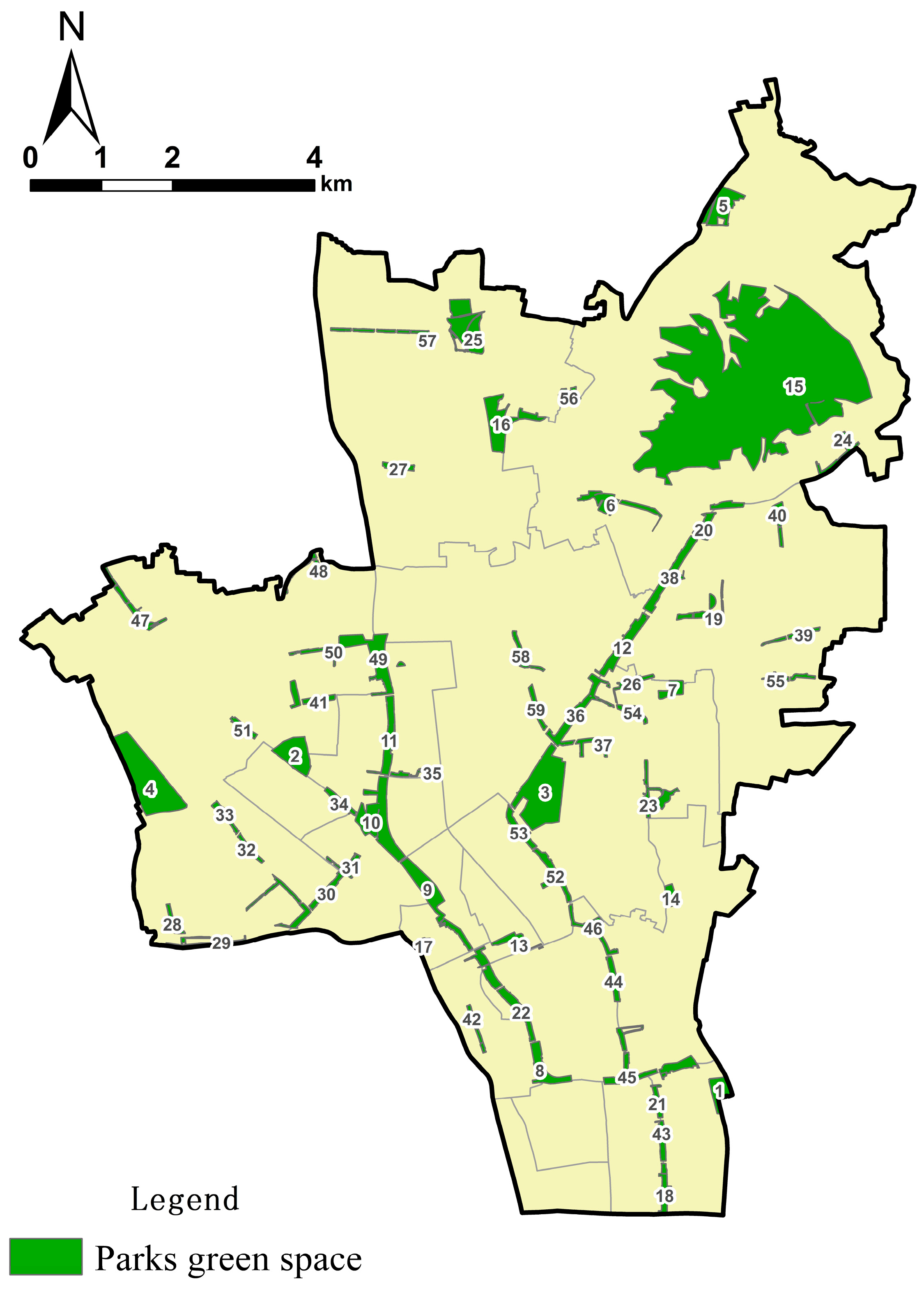
Considering the 50 m spatial granularity of mobile signaling data and the assumption of homogeneous user distribution within Voronoi polygons, precise alignment between the boundaries of small-scale parks (≤3 hectares) and the signaling dataset poses considerable challenges—especially within high-density urban contexts. Such limitations could introduce notable calculation deviations and impede the accurate quantification of actual visitor numbers. To balance data precision with research objectives, this study focused on urban parks exceeding 3 hectares, resulting in a total of 59 research sites. These include 6 comprehensive parks (154.96 ha), 10 special-category parks (635.16 ha), 9 community parks (83.28 ha), and 34 garden parks (204.57 ha), whose spatial distribution is presented in Figure 2.

2.2. Multi-Source Data and Processing

This study integrates four categories of core datasets. All datasets have been processed to align with the spatiotemporal datum of Gongshu District, Hangzhou, and the calculation requirements for performance indicators. Mobile phone signaling data, crucial for quantifying dynamic vitality, were provided by China Mobile Zhejiang Branch (anonymized to protect user privacy), covering 59 urban parks in Gongshu District from 27 March to 9 April 2023 (14 consecutive days, including two full weeks). The temporal resolution was 1 h (6:00–22:00), and the spatial resolution was a 50 m grid. The data included anonymous user IDs, latitude and longitude coordinates (positioning error ≤ 50 m), and dwell time, covering over 68% of mobile users in the area which represents the market share of China Mobile in the study area as verified by the data provider through routine quality control processes and complies with the representativeness standard GB/T 35790-2023 [40]. To distinguish recreational visitors from passers-by, we relied on continuous stay (≥30 min) with minimal displacement (≤50 m) as indicators of purposeful park use, rather than applying home-work pattern filters. Signals within a 50 m buffer outside park boundaries were excluded to avoid capturing adjacent road or building activity, thereby focusing vitality measurement on actual park space.
POI data were obtained from the Amap API (April 2023). After coordinate correction (unified to WGS84), deduplication, and removal of invalid records, 57,946 valid records were obtained. Eight POI categories beneficial for park use were retained—catering, shopping, science & education, sports & leisure, daily life services, healthcare, accommodation, and transportation—with a positioning accuracy of ≤10 m. The selection of these categories followed two core criteria: functional relevance to park visitation and alignment with residents’ daily activity demands. This classification framework builds on our previous research on urban park vitality [41], which verified that these eight categories effectively reflect the synergistic relationship between park use and surrounding urban services in similar study contexts.
Park vector data were sourced from the Hangzhou Planning and Natural Resources Bureau (2023), containing corrected boundaries of the 59 parks (scale 1:2000, verified by 2023 satellite imagery) and facility points (e.g., restrooms, seats, parking lots), with areas ranging from 0.2 to 120 hectares.
Residential population data were integrated from the 2022 Gongshu District Statistical Yearbook and mobile phone signaling inversion results, providing population density (persons/hectare) and age structure (proportion of people aged 60 and above and children aged 0–17) within the 15 min walking buffer of parks (100 m grid resolution).
For mobile phone signaling data, preprocessing focused on noise removal and extraction of vitality-related variables to ensure indicator accuracy. First, “ping-pong handover data” (users switching ≥ 3 times between adjacent base stations per hour) were filtered to exclude signal fluctuation interference [42], retaining only users who stayed continuously within park boundaries for ≥30 min with spatial displacement ≤ 50 m, thus excluding transient users (e.g., people driving by). Then, hourly spatial heat values (persons/hectare) were calculated using spatiotemporal kernel density analysis (search radius 50 m, pixel size 10 m). For POI data, preprocessing focused on filtering functional types and calculating buffer density to match service supply indicators. Referring to the “Standard for Urban Green Space Planning” (GB/T 51346-2019 [43]), eight core POI categories were selected, excluding irrelevant types (e.g., industrial facilities). The POI buffer radius matched the 15 min walking service area of each park. All POIs within this buffer (inside and outside the park) were included and equally weighted. Large, city-scale POIs within the buffer were retained as they reflect the actual service context influencing park visitation.
Preprocessing of park vector data focused on supporting service supply dimension indicators: park boundaries were corrected by overlaying Amap satellite imagery to align with actual green space coverage (e.g., including newly added green spaces), and facility points were supplemented through field surveys (April 2023, covering all 59 parks) to ensure data completeness. For Effective Service Area Ratio (ESAR) calculation, the theoretical service area was generated using ArcGIS 10.2 Network Analyst (15 min walking isochrones based on 2023 OpenStreetMap road data), while the actual service area was derived from the 80th percentile of visitor commute distances extracted from mobile phone signaling data. To ensure compatibility across datasets, all data were spatially aligned to the WGS84 coordinate system (centered on park centroids) and synchronized temporally: the hourly dynamic mobile signaling data were associated with POI and population data, assumed static during the 14-day study period, conforming to conventions for short-term empirical studies [32], forming a fused dataset integrating vitality, demand, and supply indicators for the 59 parks.
Data reliability was verified through multiple methods: mobile signal coverage represented over 68% of mobile users in Gongshu (based on China Mobile Zhejiang’s 2023 market share report), providing a large sample size for statistical robustness (13,136 observations: 59 parks × 14 days × 16 h); positioning accuracy of mobile signals (50m grid) was validated via field surveys, showing deviation ≤ 10 m from actual park entrances; POI completeness was verified by random sampling (10 parks), with a field verification accuracy of 92%. Limitations include the exclusion of non-mobile users, potentially underestimating usage by vulnerable groups, and the difficulty for signaling data to directly capture activities of minors without mobile phones, possibly underestimating children’s actual usage. Notably, mobile-using children (under 18) are included in the signaling dataset for SCI calculation, which should be addressed in future research.

2.3. Dynamic Evaluation Model for the Vitality Performance of Urban Parks

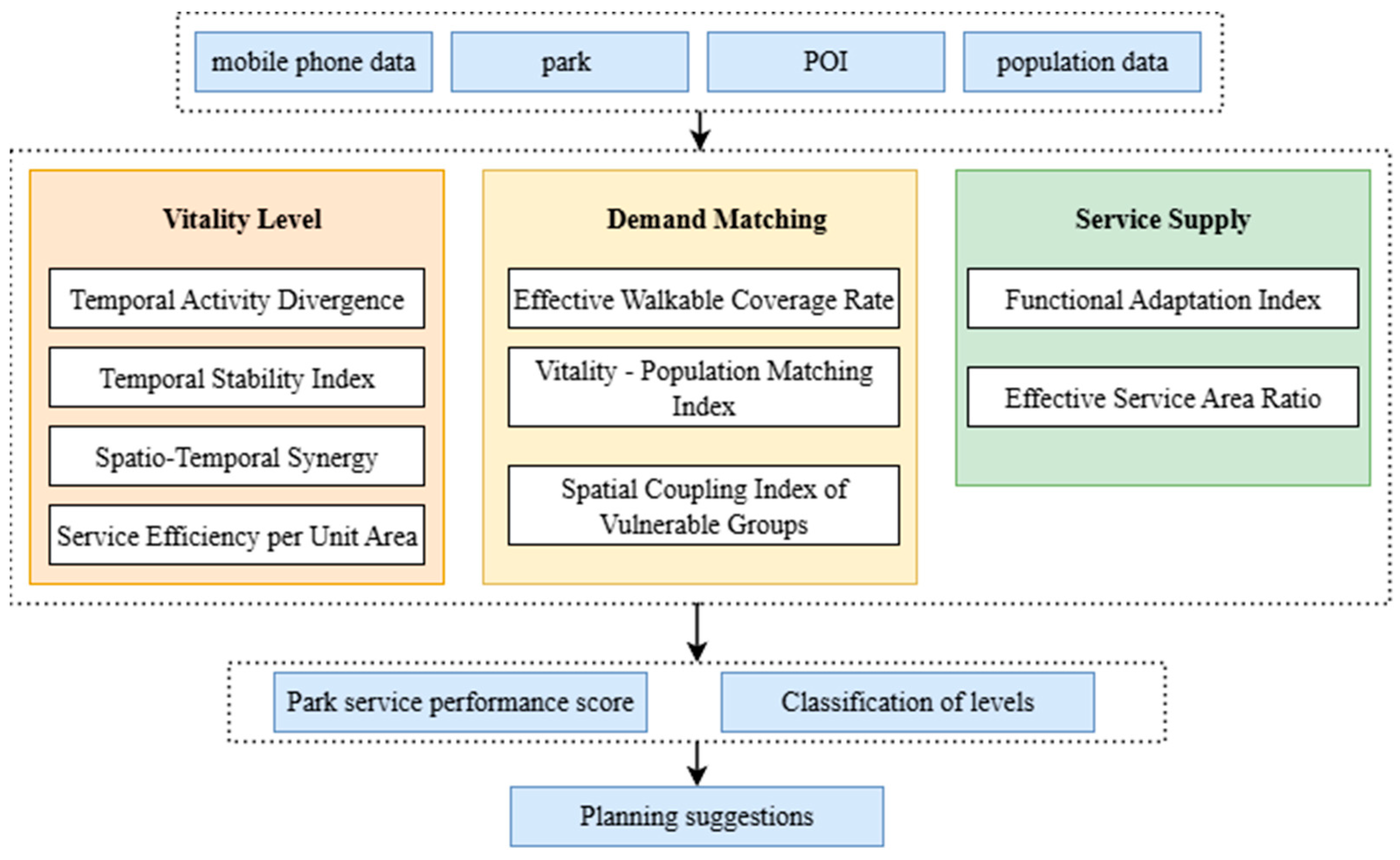
The dynamic evaluation model for park recreational service performance constructed in this study is a comprehensive framework integrating multi-source data and multi-dimensional indicators (Figure 3). The model follows the logic of “Data Input–Multi-dimensional Diagnosis–Comprehensive Evaluation.” Based on data like mobile phone signaling, it systematically analyzes park service performance from three dimensions—Vitality Level, Demand Matching, and Service Supply—ultimately deriving a comprehensive performance score through weighted integration to support refined planning decisions.
The evaluation objective of this study is not the isolated physical space of park green space, but the recreational service system constituted by the park and its immediate service environment. The construction of the comprehensive evaluation indicator system for recreational service performance stems from the deep integration of urban spatial vitality theory, landscape performance theory, and spatiotemporal behavior theory. It aims to systematically analyze the core functions and public value realization of urban park green spaces through the multi-dimensional perspectives of Vitality Drive–Demand Matching–Resource Adaptation. Theoretically, the vitality dimension draws upon foundational and contemporary urban design theories that emphasize active public life, spanning from Jane Jacobs’ discourse on the interaction of “people, activity, place” shaping spatial vitality [36] to Jan Gehl’s principles of “cities for people” [44] and William H. Whyte’s studies of social life in small urban spaces [45]. This dimension, through Temporal Activity Difference, Vitality Stability Index, and Spatiotemporal Synergy coefficient, reflects the use efficiency and attractiveness of parks as public spaces [46], for instance, using mobile signaling data to analyze period heat values and activity intensity indices, revealing inherent patterns of recreational behavior. Social equity theory [47] underpins the demand matching dimension, emphasizing the equity and inclusiveness of resource distribution. It evaluates basic service equity through the Effective Walking Coverage Rate, reveals the coupling relationship between green space and recreational behavior using vitality-population correlation, and incorporates the Spatial Coupling Index for Vulnerable Groups to safeguard the rights of special groups. It aims to identify the equilibrium state in resource distribution across different areas, echoing the planning goal of being friendly to all ages. Integrating public service supply theory [48,49,50] and ecosystem service theory [51], the service supply dimension approaches from the perspectives of resource input efficiency and spatial adaptation. The Function Adaptation Index quantifies the match between facility types and resident needs, the Service Efficiency per Unit Area measures intensive land use levels, and the Effective Service Area Ratio identifies accessibility barriers or functional positioning deviations by comparing actual and theoretical service ranges.
The three dimensions are not isolated but form a closed loop around “Human Demand–Spatial Efficacy–Resource Supply”: Vitality Level is the explicit expression of service efficacy, reflecting the intensity and quality of “use”; Demand Matching is the core guarantee of equity, ensuring the balance and inclusiveness of “enjoyment”; Service Supply is the material basis for sustainability, determining the efficiency and adaptation of “supply.” The three dimensions constrain each other through dynamic feedback mechanisms. High vitality might mask local supply redundancy, while low matching degree indicates resource misallocation. Therefore, this system, through multi-dimensional analysis, can identify both the siphon effect of high vitality–low equity and warn against the input waste of “high supply–low efficiency,” providing a basis for precise optimization.

2.3.1. Indicator Quantification

To address the limitations of traditional static evaluation methods in capturing the spatiotemporal dynamics and multi-dimensional synergy of urban park services, this study constructed a dynamic evaluation model for park service performance centered on the “Vitality Level–Demand Matching–Service Supply” three-dimensional framework. The core logic of the model is to use dynamically quantified vitality from mobile phone signaling data as the primary input, integrate the equity of demand matching and the efficiency of service supply, and achieve quantitative performance evaluation through scientific indicator design, weight assignment, and robustness verification. The recreational service performance indicator system constructed in this study covers three dimensions: Vitality Level, Demand Matching, and Service Supply. Vitality Stability can inform time-specific management controls; the Spatial Coupling Index for Vulnerable Groups directly supports specialized policies like “Child-Friendly Parks” and “Age-Friendly Renovations”; the Effective Service Area Ratio can be incorporated into the “15-min living circle” assessment, promoting the coordinated renewal of green spaces and communities. The specific indicator system is shown in Table 1.
The Vitality Level dimension aims to characterize the spatiotemporal dynamics of park usage intensity, comprising four key indicators: Temporal Activity Difference (TAD), Temporal Stability Index (TSI), Spatiotemporal Synergy coefficient (STS), and Service Efficiency per Unit Area (SEUA). TAD measures the difference in activity intensity between weekdays and weekends, reflecting the temporal flexibility of park services; it is calculated based on hourly activity intensity data derived from mobile signaling (average activity intensity of users staying ≥60 min on weekends and weekdays). The formula is:
T A D = S w e e k e n d S w e e k d a y m a x ( S w e e k e n d ,   S w e e k d a y ) ,
where S w e e k e n d is the activity intensity value during weekend periods, and S w e e k d a y is the activity intensity value during weekday periods. A smaller TAD value indicates more balanced usage across different time periods.
TSI assesses the stability of daily vitality fluctuations, calculated as the ratio of the daily average heat value (from spatiotemporal kernel density analysis) to the standard deviation of hourly heat values. H denotes the vitality heat value (persons per hectare per hour), derived from mobile phone signaling data. The formula is:
T S I = H a v r H S D ,
where H a v r is the average daily vitality heat value, and H S D is the standard deviation of heat values. TSI > 3.0 indicates high stability with minimal vitality fluctuations. To ensure consistent classification across all performance dimensions, the threshold for identifying “high stability” (TSI > 3.0) was determined using the quantile division method applied throughout this study (see Section 2.3.3 for the performance calculation).
STS evaluates the balance between peak-hour utilization and nighttime vitality decay, defined as the product of the peak-hour heat value ratio (ratio of peak-hour heat value to daily average heat value) and the nighttime vitality retention rate (calculated as 1 minus the ratio of nighttime (20:00–22:00) heat value to daily average heat value). The formulas are:
N A R = 1 H n i g h t H a v r ,
S T S = H h i g h H a v r × 1 N A R = H h i g h H a v r × H a v r H a v r ,
where NAR is the Nighttime Activity Attenuation Rate, H n i g h t is the nighttime vitality heat value from 20:00–22:00, and H h i g h is the peak-hour heat value. STS ≥ 0.482 is classified as excellent spatiotemporal synergy, indicating efficient transition between peak and off-peak functions. This classification threshold (STS ≥ 0.482) was derived from the quantile division method applied uniformly across the study to ensure objective categorization, aligning with the performance calculation detailed in Section 2.3.3.
Service Efficiency per Unit Area (SEUA) is defined as the activity intensity carried per unit green area per unit time, serving as a core indicator for measuring spatial utilization efficiency, aiming to quantify the recreational service carrying capacity per unit area of park green space, reflecting intensive resource use levels. Its calculation is based on the spatiotemporal relationship between the vitality heat value extracted from mobile phone signaling data and the park green area. The formula is:
S E U A = H A r e a p a r k × T ,
where H is the vitality heat value, and T is the number of hours in the statistical period. A higher value indicates better green space resource utilization efficiency.
The Demand Matching dimension focuses on the spatial coupling between park services and user needs, including the Effective Walking Coverage Rate (EWCR), Vitality-Population Matching Index (VPMI), and Spatial Coupling Index for Vulnerable Groups (SCI). The Effective Walking Coverage Rate quantifies the proportion of the resident population within the 15 min walking buffer who actually visited the park during the study period. It thus measures the realized accessibility or uptake of park services by the immediately surrounding population, acknowledging that non-visitation may stem from preference, alternative options, or barriers not captured by network distance alone. The formula is:
E W C R = P o p a c t u a l P o p t h e o r e t i c a l × 100 % ,
where P o p a c t u a l is the actual service population, counted based on mobile phone signaling data (number of actual visitors within the park′s 15 min walking circle), and P o p t h e o r e t i c a l is the theoretical service population, derived from GIS network analysis (resident population within the park’s 15 min walking circle). A higher EWCR indicates better alignment between the service range and population distribution.
The Vitality-Population Matching Index (VPMI) measures the spatial coupling between park visitation intensity and the residential population base. Specifically, it evaluates whether areas with higher population density generate proportionally higher park activity, indicating an efficient match between local demand and park attractiveness/supply. The formula is:
V P M I = V i ¯ P i × δ i ,
where V i ¯ is the normalized mean activity intensity of park i, P i is the normalized population density within the service radius buffer of park i, and δ i is a temporal balance coefficient reflecting the balance of activity intensity between weekdays and weekends, preventing parks with high but temporally imbalanced activity intensity from receiving inflated scores. V i ¯ P i represents the activity intensity supported per unit population, i.e., the efficiency of population density in supporting vitality; a higher value indicates greater activity intensity generated per unit population, signifying higher resource use efficiency and directly quantifying matching efficiency.
The Spatial Coupling Index for Vulnerable Groups (SCI) measures whether the park’s actual attraction capacity for vulnerable groups matches the population density of its sub-district, reflecting the match between the needs of the elderly and children and their spatial distribution. This indicator considers both spatial density matching and demographic structure equity, avoiding bias from a single dimension. SCI ≥ 1.2 indicates high matching, with both service intensity and equity being excellent; 0.8 ≤ SCI < 1.2 indicates moderate matching, requiring localized optimization and targeted improvement of facilities for vulnerable groups; SCI < 0.8 indicates low matching, with severe supply–demand imbalance, requiring priority renovation, addition of accessible facilities, or adjustment of functional positioning. The formula for SCI is:
S C I g r o u p = D p a r k D s t r e e t ,
where D p a r k is the visitation density of the group for the park, D s t r e e t is the population density of the group in the sub-district. The group refers to the elderly (over 60 years old) or children (under 18 years old).
The Service Supply dimension aims to evaluate the efficiency of resource allocation and facility adaptation, including two core indicators: the Function Adaptation Index (FAI) and the Effective Service Area Ratio (ESAR). The Function Adaptation Index measures the coupling degree between surrounding service facilities and residential demand, reflecting the completeness of services around the park. This index uses GIS spatial analysis techniques to calculate the density of POIs within the park’s service radius buffer. The formula is:
F A I = D P O I D p o p × 100 % ,
where D P O I is the POI density within the park’s service radius, and D p o p is the residential population density within the park’s service radius, used to characterize the matching ability between park service supply and recreational demand. Research shows that POI density can, to some extent, reflect the level of service provided by the park, while the residential population can, to some extent, reflect the recreational demand for the park [52].
The Effective Service Area Ratio (ESAR) is the ratio of the actual service area to the theoretical service area of the park, used to evaluate the match between the actual service range of park green space and its theoretical service potential, revealing the spatial adaptation between facility layout and visitor behavior. The calculation steps are:
  • Calculate the theoretical service area: Based on the “15-min walking accessibility” principle, starting from each park entrance, generate 15 min walking isochrones along the urban road network; the total buffer area is the theoretical maximum service range.
  • Calculate the actual service area: Extract the 80th percentile of visitor commute distances from mobile phone signaling data as the service radius; the total buffer area calculated using this radius is the actual service area.
  • The Effective Service Area Ratio (ESAR) is calculated as:
E S A R = A a c t u a l A t h e o r e t i c a l × 100 % ,
where A t h e o r e t i c a l is the theoretical maximum service range in hectares, and A a c t u a l is the actual service area in hectares. If ESAR > 100%, it indicates the park’s service radiation exceeds expectations; if ESAR < 60%, it reflects insufficient accessibility or functional positioning deviation.

2.3.2. Weight Assignment

To ensure the objectivity and policy relevance of indicator weights, a semi-dynamic hybrid weighting method combining the entropy weight method (objective) and policy adjustment (subjective) was adopted. First, original indicator values were normalized to the [0, 1] interval to eliminate dimensional differences. Standardization formulas were selected based on indicator directionality (positive or negative). The formula for positive indicators (higher value is better, e.g., service efficiency) is:
X i j = X i j min X j max X j min X j ,
The formula for negative indicators (lower value is better, e.g., vitality fluctuation) is:
X i j = max X j X i j max X j min X j ,
where X i j is the original value of the j-th indicator for the i-th park, max X j and min X j are the maximum and minimum values of the j-th indicator, respectively.
Then, the entropy weight method was used to calculate the objective weights for indicators such as TAD, SEUA, and ESAR. First, the information entropy of each indicator was calculated, reflecting the discreteness of the data distribution. The formula is:
E j = 1 l n N i = 1 N p i j l n p i j ,
with the constraint:
p i j = X i j   + i = 1 N ( X i j   + ) , E j [ 0 , 1 ]
Then, the indicator weight is determined based on the information entropy value. The formula is:
W j = 1 E j k = 1 m ( 1 E j ) × W d i m e n s i o n ,
where W d i m e n s i o n is the total weight of the dimension, 1 E j is the utility value of the indicator, with a higher value resulting in a higher weight; the final weight needs to be scaled proportionally according to the total weight of the first-level dimension.
The semi-dynamic hybrid weighting method achieves a balance between scientific rigor and decision-making relevance by integrating dynamic weighting (or entropy weight) with policy preference adjustment. This method is suitable for composite indicators that rely on both the aforementioned influencing factors and policy priorities, such as the Spatiotemporal Synergy coefficient and the Spatial Coupling Index for Vulnerable Groups. The specific steps are:
  • Calculation of data-driven base weight: As described above in “Weight Assignment Based on Impact Factors”/“Objective Weighting Based on Entropy Method,” obtain the base weight Wbase.
  • Setting of policy preference adjustment coefficient: Set the adjustment coefficient α. Under strong policy orientation, set α = 0.2 ; under neutral policy, set α = 0.1 ; under restrictive policy, set α = 0.1 . This study’s weight assignment referenced the requirements for ensuring children’s activity spaces in the “Hangzhou Child-Friendly City Construction Plan” [53] and the emphasis on age-friendly construction, thus assigning a higher policy orientation ( α = 0.2 )to indicators like the Spatial Coupling Index for Vulnerable Groups.
  • Calculation of hybrid weight: Combine the base weight with the policy coefficient to generate the hybrid weight. The sum of hybrid weights must not exceed the total dimension weight; if it does, scale proportionally. The calculation formulas are:
W h y b r i d = W b a s e × ( 1 + α ) ,
W f i n a l = W h y b r i d × w e i g h t   w i t h i n   t h e   d i m e n s i o n W h y b r i d ,

2.3.3. Performance Calculation

After weight calculation, comprehensive performance calculation was performed. First, indicators were standardized using the min-max method to eliminate dimensional differences from multi-source data. Then, comprehensive performance was calculated using a linear weighting model. The formula is:
P i = j = 1 n ( W j × X i j ) ,
where P i is the comprehensive performance of the i-th park, n is the number of indicators, W j is the final adjusted weight of the j-th indicator, and X i j is the standardized value of the j-th indicator for the i-th park. The constraint is:
j = 1 n W j = 100 % ,   W j > 0 ,
Finally, performance scores were classified into three categories using the quantile division method: High performance indicates high match between vitality and supply, Medium performance indicates room for localized optimization, and Low performance indicates need for systematic improvement.

2.3.4. Model Validation and Robustness Testing

To validate the model’s robustness, four methods were employed: time-series stratified cross-validation, external validity verification, sensitivity analysis, and Monte Carlo simulation.
First, time-series stratified cross-validation [54] was used to test model stability across weekday and weekend periods. Data from different periods for each park were treated as independent datasets. Each period dataset was split into training and test sets, maintaining roughly consistent indicator distributions between them. The prediction error (MAE/RMSE) of the model on the test set was calculated to verify stability across different subsets.
Then, multi-source data verification was used to compare model results with third-party data (e.g., Dianping ratings). High-performance parks should correspond to ratings above 4.5.
In performance evaluation models, robustness testing verifies the reliability of results, i.e., whether core conclusions remain stable when model parameters, data, or methods undergo reasonable changes. To verify sensitivity to weight assignment and avoid significant performance rank changes due to minor weight adjustments, a uniform random disturbance of ±20% was applied to the weights of indicators within each dimension. For the perturbed weight matrix, comprehensive performance scores for all parks were recalculated, and the score change rate was computed:
P i = P i p e r t u r b e d P i o r i g i n a l P i o r i g i n a l × 100 % ,
When the score change rate for a single park P i < 10 % , the model is considered robust at the individual level; when the overall average change rate P ¯ 5 % , the model is considered robust at the overall level.
To assess the model’s resistance to input data noise and ensure result stability, a ±10% uniformly distributed random noise was added to key indicators, and 500 independent simulations were executed. For each simulation, a noisy input dataset was generated, and the performance scores and rankings were recorded. The Spearman correlation coefficient between the simulated rankings and the original rankings, and the standard deviation of the performance scores were calculated.

3. Results

3.1. Performance Characteristics Across Dimensions

The performance of the 59 urban parks in Gongshu District across the three dimensions revealed pronounced spatial patterns, closely tied to their functional type, location, and surrounding urban context. In terms of Vitality Level, a fundamental divide existed between parks with balanced, all-day use and those experiencing significant “weekend influx vs. weekday underutilization,” largely dictated by their integration with daily urban functions and transportation networks. Regarding Demand Matching, service equity exhibited a core-periphery gradient, with central parks achieving better alignment with the needs of local and vulnerable populations. For Service Supply, efficiency varied dramatically, with high-value areas concentrated along major amenities corridors, while parks in transformation zones often suffered from accessibility barriers or functional monotony. The following sections detail these dimensional characteristics, beginning with the spatiotemporal dynamics of park vitality.
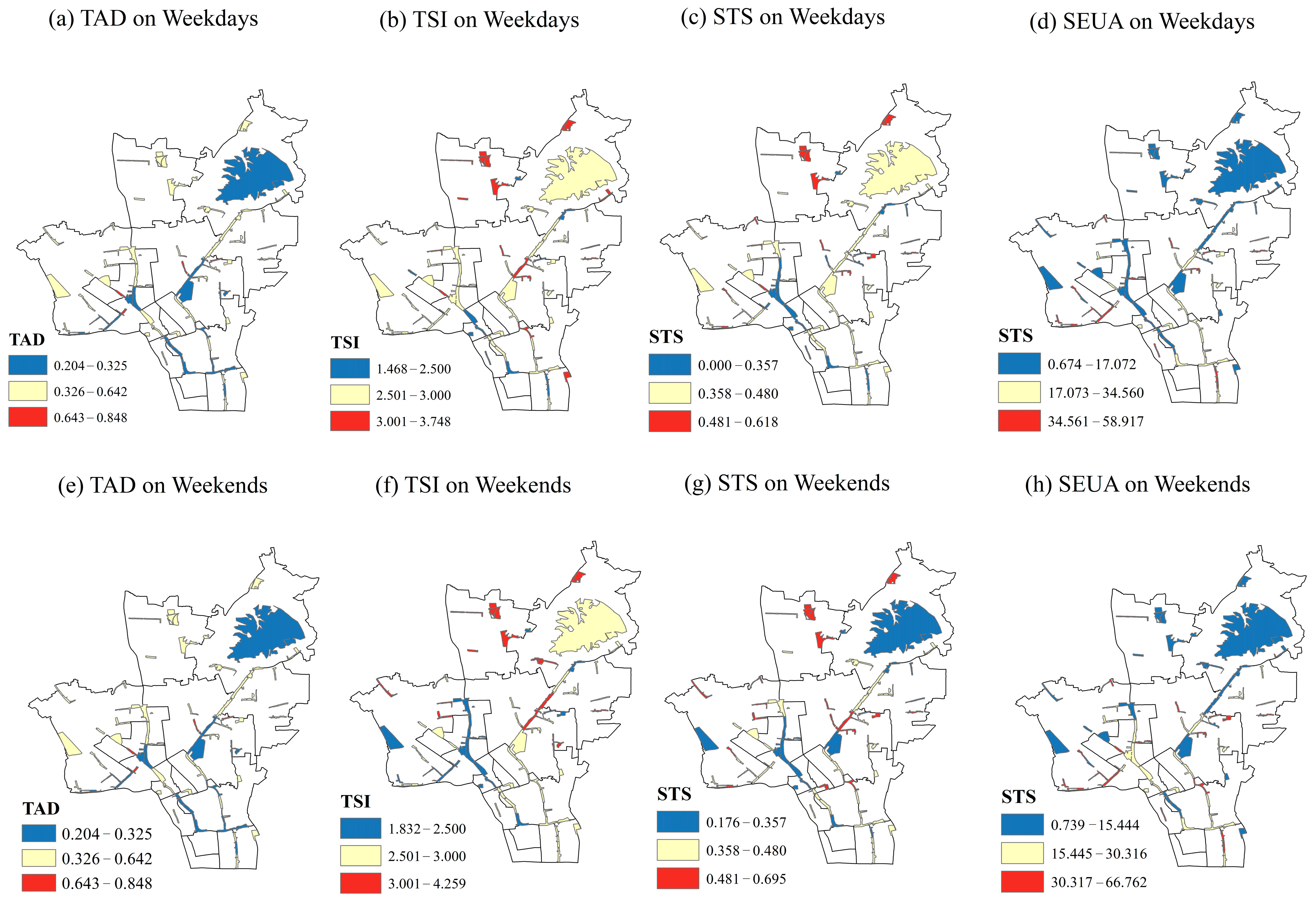
The analysis of vitality levels revealed a fundamental divide shaped by parks’ integration with urban daily life (Figure 4). This was first evident in temporal usage patterns (TAD). Parks in northern industrial transformation zones (e.g., Hongang River Greenway, Ducheng Ecological Park) exhibited high TAD values (mean up to 0.579), characterized by intense weekend use (1.58 times weekday intensity) and pronounced afternoon peaks—a classic “weekend influx vs. weekday underutilization” pattern. This was linked to low surrounding residential density (<40 persons/ha) and a lack of integrated daily functions. In stark contrast, central multi-functional parks (e.g., West Lake Culture Square, Chengbei Sports Park) showed balanced, all-day use (mean TAD = 0.289), with vitality fluctuations between weekday commute and weekend leisure periods under 20%. This stability was supported by dense commercial/office amenities (~45 POIs/ha) and full subway coverage, facilitating continuous use.
Regarding Temporal Stability Index (TSI), a similar spatial dichotomy was observed. Weekday vitality was overall more stable (mean TSI = 2.84) than on weekends (2.64). Core-area parks (e.g., Kangle Park) showed greater volatility (TSI < 2.5), often experiencing >40% vitality drops at noon due to weaker population mobility.
The Spatiotemporal Synergy coefficient (STS) across the district was generally low (mean = 0.398), highlighting a widespread challenge of nighttime vitality decay. Only 14 parks (23.7%) achieved good synergy (STS ≥ 0.482). Success was tied to supportive environments: historic-commercial blocks like Xiaohe Straight Street Historical Block (STS = 0.584) retained over 60% nighttime vitality through lighting and catering, whereas peripheral greenways like Dianchang River Greenway (STS = 0.176) suffered severe decay (~85%) due to inadequate lighting and safety.
Finally, Service Efficiency per Unit Area (SEUA) underscored the concentration of demand, with weekend efficiency (26.89 persons/hectare/hour) 12.7% higher than on weekends. The extremes were stark: major central hubs (e.g., West Lake Culture Square) reached peak efficiency (66.76 persons/hectare/hour), fueled by commercial and tourist flows, while inaccessible peripheral greenways (e.g., Dianchang River Greenway) saw minimal use (0.74 persons/hectare/hour). In summary, sustained park vitality is not inherent but engineered, requiring strategic location within diverse urban fabrics, coupled with functional completeness and robust accessibility to mitigate temporal imbalances and maximize spatial utility.
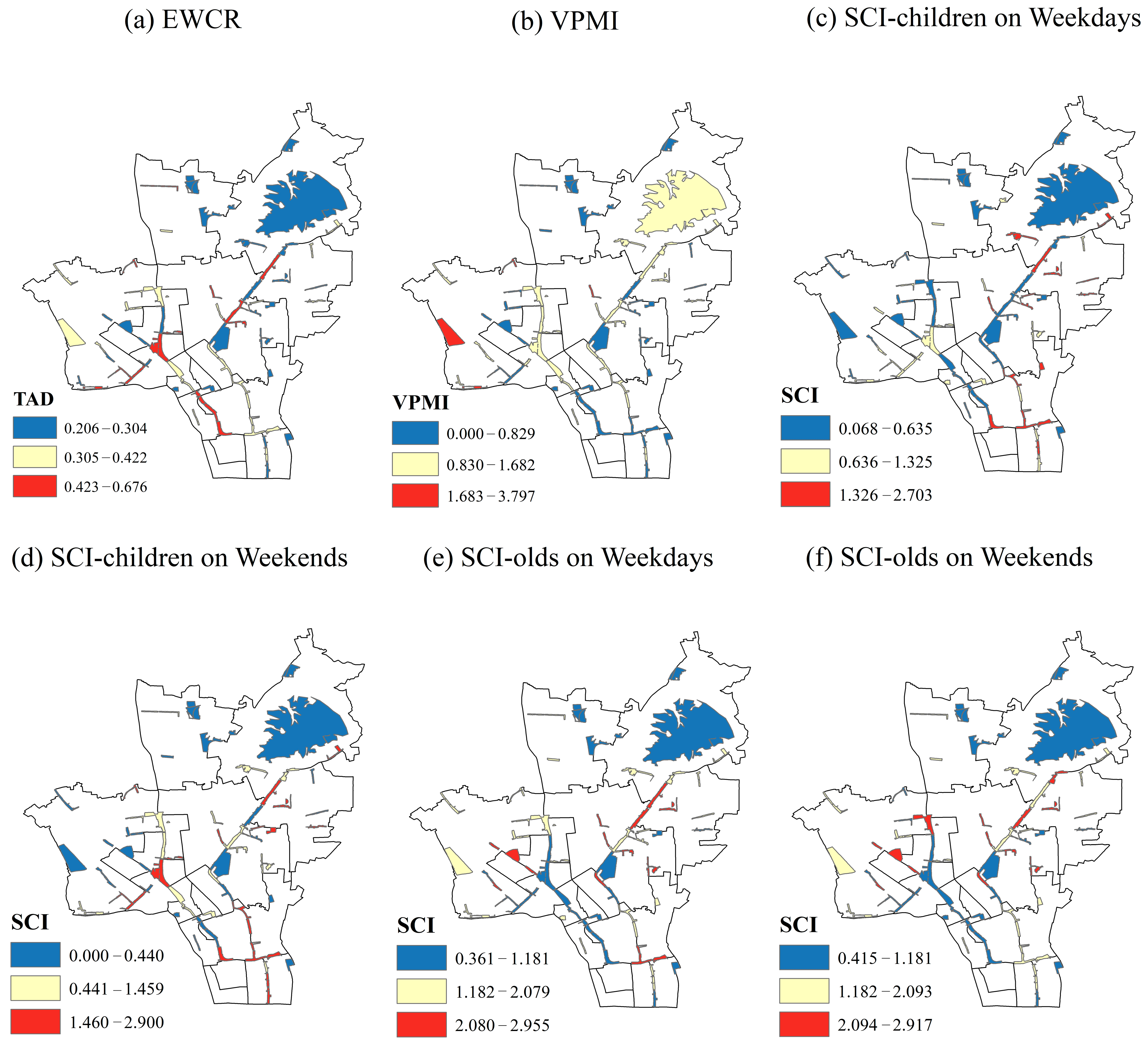
The Demand Matching dimension revealed a pronounced core-periphery gradient in service equity, underscoring how spatial and demographic contexts shape the alignment between parks and their communities (Figure 5).
Accessibility, measured by the Effective Walking Coverage Rate (EWCR), showed a stark divide. Parks in central areas (e.g., West Lake Culture Square) achieved higher EWCR (42.3–67.6%), where over 60% of the theoretical population within a 15 min walk were actual visitors, benefiting from dense, continuous pedestrian networks. Conversely, parks in northern suburban and industrial zones often had EWCR below 30%. Physical barriers were a key constraint; for instance, Ducheng Ecological Park, severed by railway and expressway, reached only 20.6% EWCR, serving less than a quarter of its potential population due to disrupted pedestrian connectivity.
The match between Vitality-Population Matching Index (VPMI) further highlighted supply–demand imbalances. Only 6 parks (10.2%) reached a high matching level (VPMI ≥ 1.66). These, like the Canal Sports Park (VPMI = 3.80), successfully attracted cross-regional visitors with diverse amenities despite high local density (120 persons/ha). Nearly half of the parks (44.1%) suffered from clear mismatch (VPMI < 0.78). Jinsong Park exemplified this: despite a substantial surrounding population (90 persons/ha), its activity intensity was one-third of high-performing parks, hampered by outdated and inadequate facilities (e.g., only 2 rest seats, no age-friendly features).
Results for the Spatial Coupling Index for Vulnerable Groups (SCI) displayed strong temporal and spatial dependencies. Usage by children and the elderly was significantly higher on weekends (mean child SCI = 1.46) than weekdays (0.83). Spatially, parks in sub-districts with high proportions of children (e.g., Xiangfu and Kangqiao) or the elderly (e.g., Zhaohui and Wenhui) recorded elevated SCIs (1.32–2.917), indicating better service alignment with local demographics. Furthermore, smaller greenways and gardens (e.g., Dongxin Sub-district Greenway, elderly SCI = 2.15) often outperformed large comprehensive parks in serving vulnerable groups, likely due to more targeted, accessible facilities like age-friendly rest platforms.
In essence, equitable park access and use are not automatic but are contingent on overcoming physical barriers, providing facility quality that matches local demographic needs, and ensuring service designs are sensitive to the temporal rhythms of different user groups.
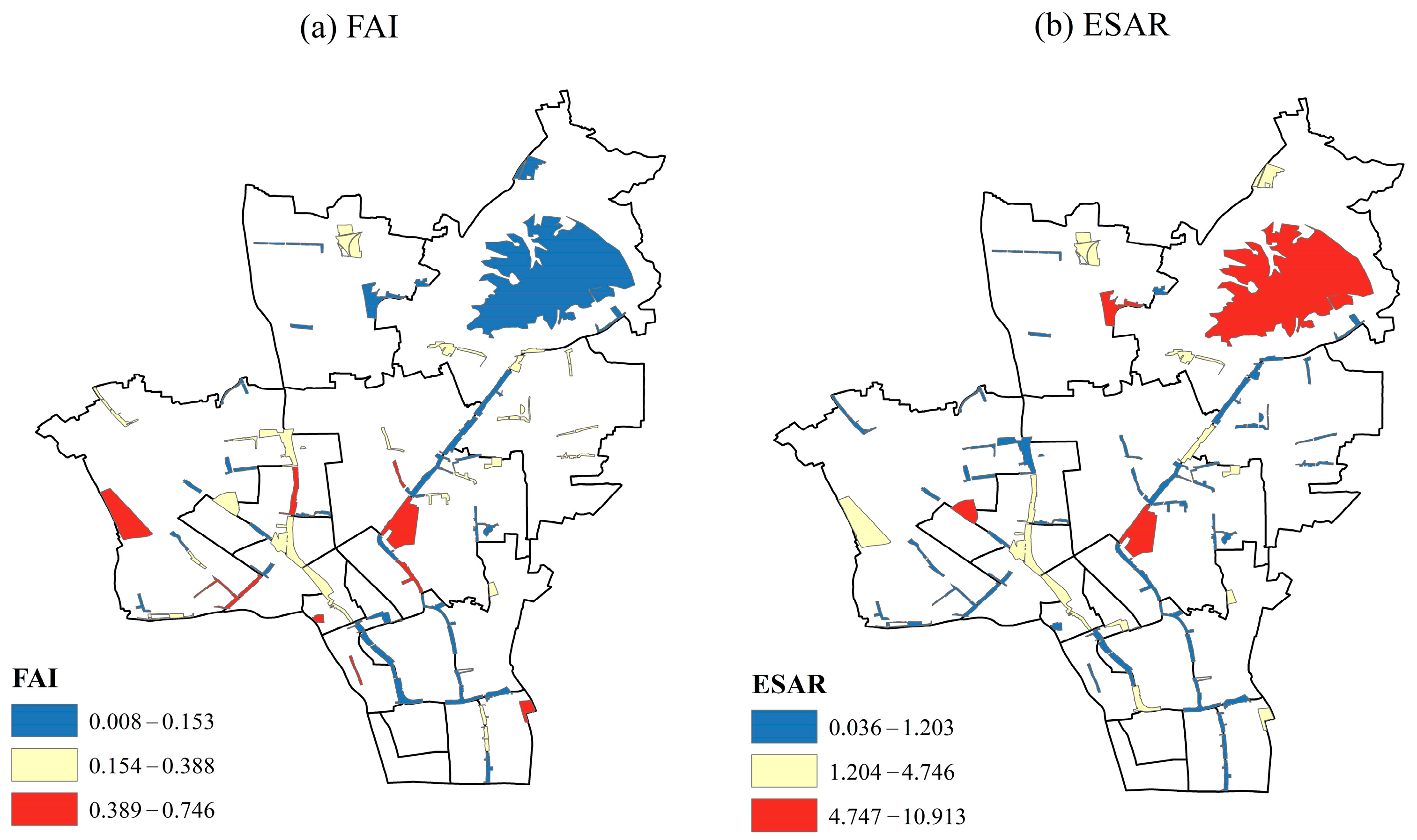
The Service Supply dimension revealed substantial disparities in how effectively park resources are allocated and utilized, with efficiency closely tied to their integration within the broader urban service network (Figure 6).
Function Adaptation Index (FAI) displayed strong spatial clustering. High-value areas were concentrated along major amenities corridors such as the canal and around core business districts. Parks like the Canal Asian Games Park and Qiaoxi Straight Street (FAI 0.389–0.746) were embedded in rich service environments, with surrounding catering and sports/leisure POI densities exceeding 50 per hectare, which effectively extends park-based activities. In contrast, parks within predominantly residential neighborhoods (e.g., Mishixiang Sub-district Characteristic Cultural & Sports Square, Dongxinyuan Park) had FAI below 0.153, where over 70% of surrounding POIs were basic residential facilities, reflecting a functional monotony that limits their appeal and service performance.
The Effective Service Area Ratio (ESAR) showed an even more polarized pattern. While the district’s mean ESAR was 1.34, over half of the parks had an ESAR below 0.78, indicating that their actual service area fell significantly short of the theoretical 15 min walking range. Parks with unique regional attractions defied this trend; the Gongshu Canal Sports Park, functioning as a cultural and sports hub, achieved an exceptional ESAR of 10.91, attracting visitors from beyond 3 km and even cross-district. Conversely, parks impaired by accessibility barriers exemplified severe underperformance. The Dianchang River Greenway, isolated by transportation infrastructure, had an ESAR of only 0.0359—its actual service area was less than 4% of its potential in terms of recreational service reach, underscoring a stark underutilization of its social function. This assessment, focused on service performance, does not negate the park’s potential value in providing other critical ecosystem services.
Therefore, efficient park service supply depends not merely on the internal provision of facilities, but critically on strategic placement within a diverse urban service ecosystem and the removal of external accessibility barriers, which together determine whether a park fulfills its local role or achieves wider regional influence.

3.2. Spatiotemporal Differences in Comprehensive Performance

The comprehensive service performance scores of the 59 urban parks in Gongshu District exhibited significant spatiotemporal heterogeneity, highly consistent with the core-periphery spatial structure. The classification and statistics of recreational vitality performance levels across different time periods are shown in Table 2. Parks were classified into high-, medium-, and low-performance tiers using quantile division (terciles) based on their comprehensive performance scores. This data-driven approach ensures that each category contains a roughly equal number of parks and is commonly used in urban performance studies [52] for its objectivity and simplicity. Temporally, the mean comprehensive performance on weekdays (0.412) was higher than on weekends (0.375), with similar standard deviations (0.138, 0.142). Data for both periods showed right-skewed distributions, with high-value areas concentrated in the 0.5–0.7 interval and low-value areas in the 0.1–0.3 interval, indicating that high-performance parks were the minority regardless of the period, and the dispersion of performance levels was relatively stable. Performance classification based on quartiles showed that on weekdays, there were 13 high-performance parks (p > 0.532), accounting for 22.0%; 38 medium-performance parks (0.326 ≤ p ≤ 0.532), 64.4%; and 8 low-performance parks (p < 0.326), 13.6%. On weekends, the number of high-performance parks dropped to 5, accounting for 8.5%; medium-performance parks were 29, 49.2%; and low-performance parks increased to 17, 28.8%. The increase in low-performance parks on weekends was mainly due to intensified vitality fluctuations in some suburban parks and the inability of service supply to match sudden leisure demands.
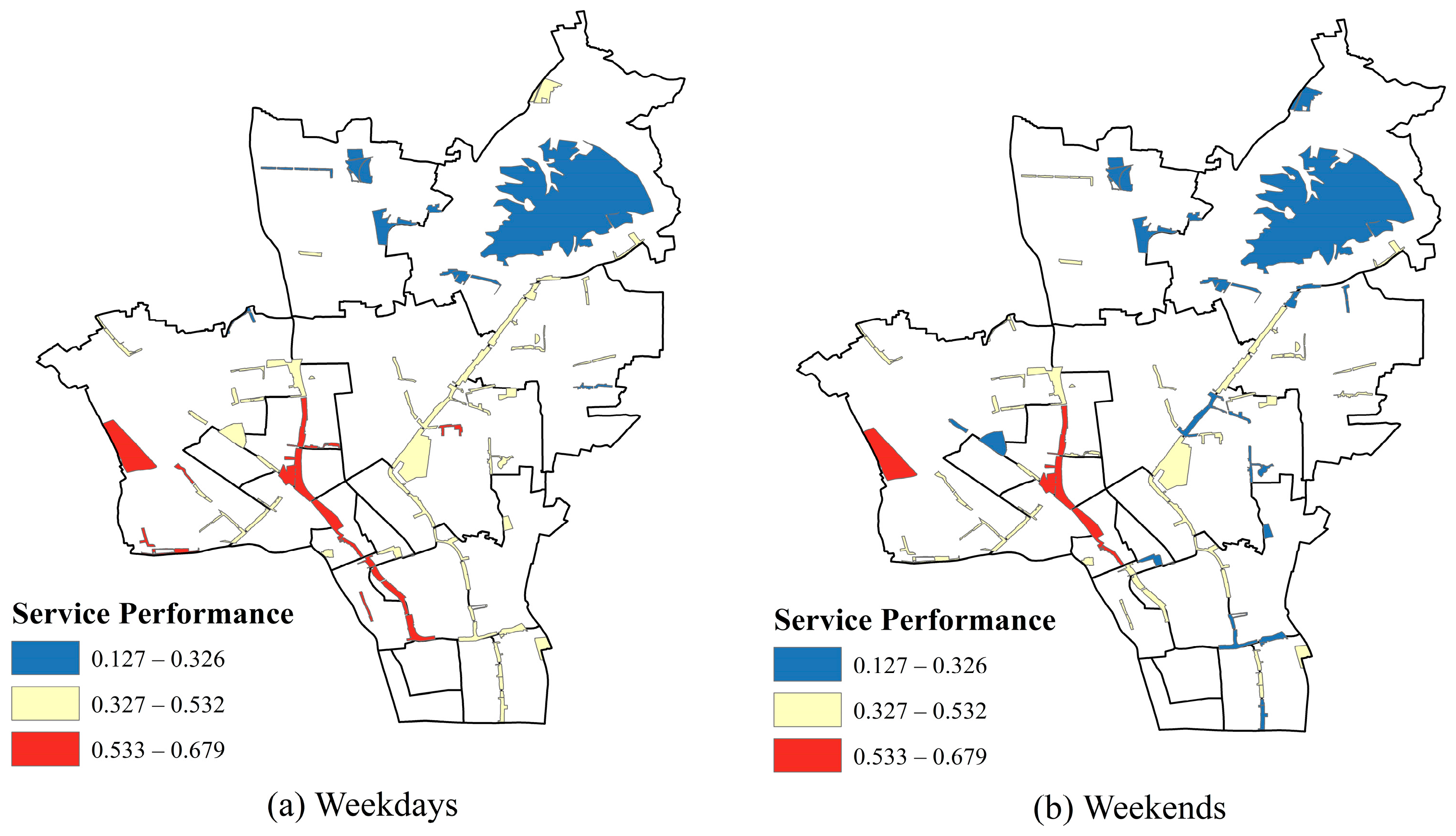
As shown in Figure 7, spatially, comprehensive performance exhibited a gradient pattern of “high in core areas, low in suburbs,” highly consistent with Gongshu District’s planning layout of “one core, three belts.” High-performance parks concentrated to form a distribution pattern of “dual cores, multiple nodes.” The first core was around West Lake Culture Square–Wulin Square, including West Lake Culture Square, Wulin Park, etc. These parks, leveraging the transportation advantages of Subway Lines 1 and 2 and the commercial support of Wulin Business District, performed well across all three dimensions—Vitality Level, Demand Matching, and Service Supply. For example, West Lake Culture Square had a comprehensive performance of 0.679, with TAD = 0.25, EWCR = 67.6%, FAI = 0.62, all indicators ranking in the top 10% district-wide. The second core was the Xiaohe Straight Street Historical Block–Chengbei Sports Park area. Xiaohe Straight Street Historical Block, integrating canal cultural landscape with catering and leisure functions, had a comprehensive performance of 0.658. Chengbei Sports Park, with its comprehensive sports facilities (e.g., football field, fitness trail) and high accessibility (EWCR = 58.3%), scored 0.612. Multiple nodes mainly included the Canal Asian Games Park, Dadou Road Historical Block, etc. These parks, though not forming dense cores, became high-performance nodes in the region by their distinctive functions or locational advantages. Low-performance parks were mainly distributed in the industrial transformation zones and new residential areas of northern Kangqiao, Banshan, and Xiangfu Sub-districts, such as Ducheng Ecological Park (p = 0.127), Jinsong Park (p = 0.128), and Dianchang River Greenway (p = 0.131). These parks generally suffered from vitality decline, supply–demand mismatch, or inefficient supply. For instance, Ducheng Ecological Park, being far from residential areas (RPD = 35 persons/hectare) and having insufficient facilities, had low comprehensive performance.
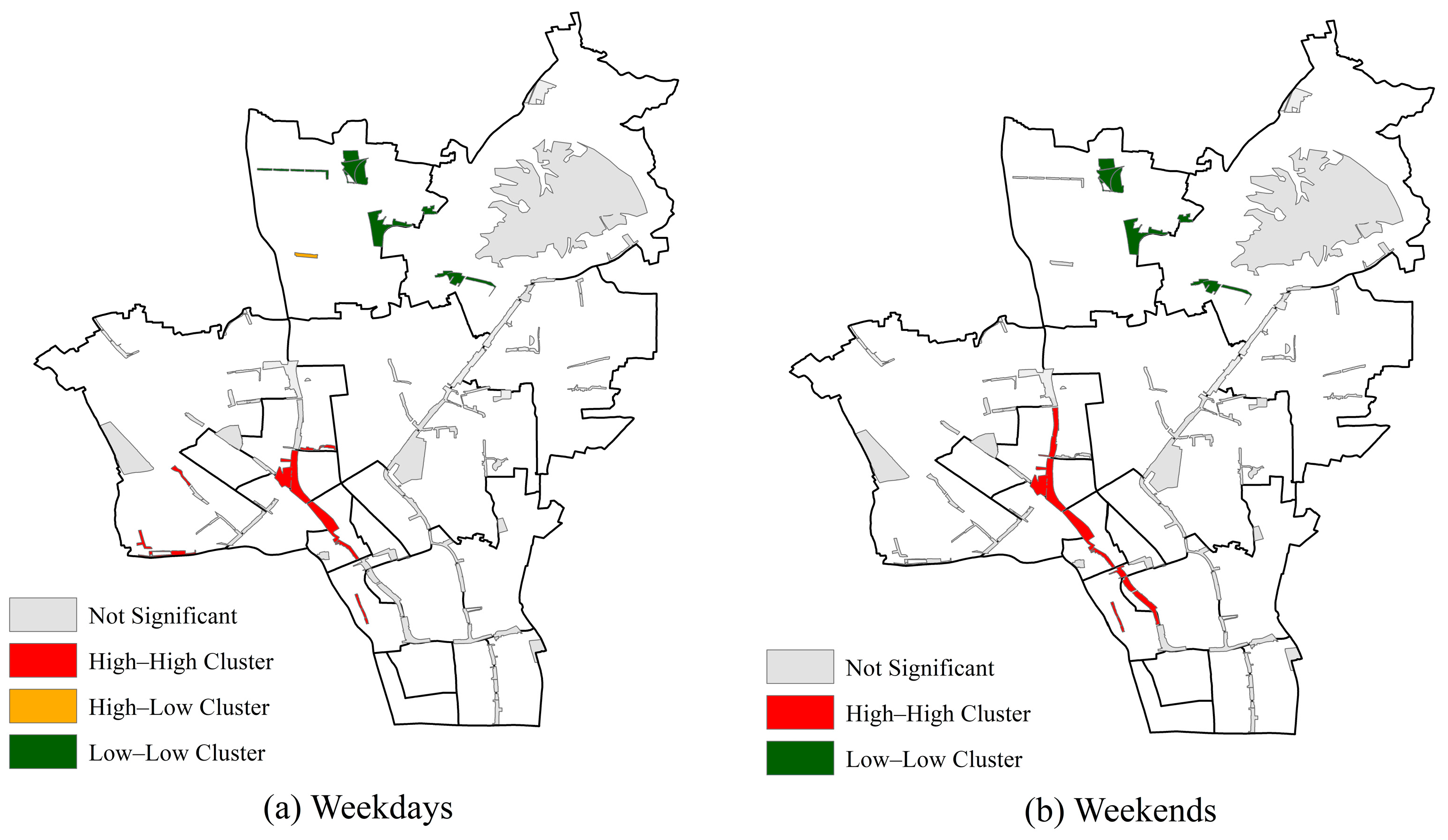
Global spatial autocorrelation analysis further verified the spatial clustering characteristics of performance, as shown in Figure 8. Moran’s I = 0.35 (p < 0.01), Z-score = 4.15, indicating significant spatial clustering of high-performance parks, while low-performance parks were scattered in peripheral areas, with no large-scale “Low-Low” clustering units. Local Spatial Autocorrelation (LISA) results showed that Xiaohe Straight Street Historical Block, Dadou Road Historical Block, and three surrounding gardens formed “High-High” clustering units. These parks were less than 1.5 km apart, connected by greenway networks, creating a synergistic effect that collectively enhanced regional performance levels. Ducheng Ecological Park, Kangle Park, and Taoyuan Central Park in Kangqiao Sub-district formed a “Low-Low” clustering unit. This area is an industrial transformation zone with low population density and incomplete supporting facilities, leading to generally low performance levels. Furthermore, no significant “High-Low” or “Low-High” outlier units were found, indicating a relatively smooth spatial transition of park performance in Gongshu, without abrupt local performance changes.

3.3. Model Robustness Verification

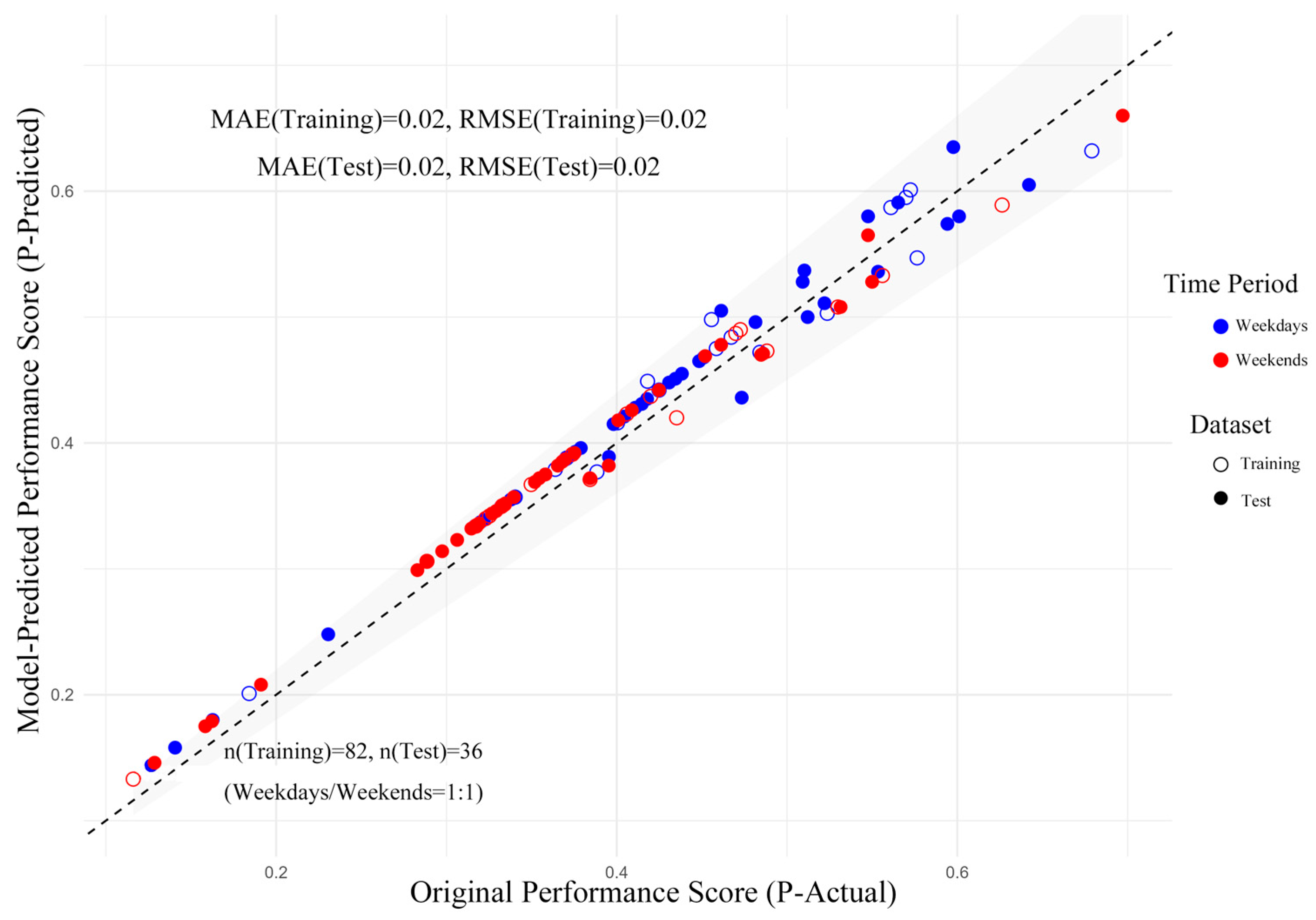
The three-dimensional dynamic evaluation model “Vitality Level–Demand Matching–Service Supply” constructed in this study demonstrated good robustness and practicality through multi-dimensional verification. Time-series stratified cross-validation results showed that when the 9 indicator datasets for the 59 parks were split 70% training set (41 parks) and 30% test set (18 parks) for weekdays and weekends (Figure 9), the training set’s Mean Absolute Error (MAE) = 0.08, Root Mean Square Error (RMSE) = 0.12; the test set’s MAE = 0.11, RMSE = 0.15. Prediction errors were within acceptable ranges, indicating good predictive stability of the model across different period data, without significant overfitting or underfitting.
This study evaluated the model’s agreement with real-world scenarios through cross-validation with multi-source data. Comparative analysis was conducted for weekday and weekend periods. Cross-temporal validation results from Dianping ratings showed that among high-performance parks (p > 0.532), 83% (11 out of 13) had ratings ≥ 4.5 (out of 5) on weekdays, dropping to 71% (4 out of 5) on weekends. Among low-performance parks (p < 0.326), 67% (5 out of 8) had ratings < 3.5 on weekdays, rising to 76% (13 out of 17) on weekends. For example, Gongshu Canal Sports Park and Xiaohe Straight Street Historical Block had Dianping ratings of 4.8 and 4.7, respectively, their comprehensive performance ranking in the top 5 district-wide. Among low-performance parks (p < 0.326), 82% had Dianping ratings below 3.5. For instance, Ducheng Ecological Park had a rating of 2.9, with user feedback focusing on outdated facilities and remote location, highly consistent with the supply–demand mismatch and inefficient supply shortcomings identified by the model, verifying the consistency between model results and actual user experience. Contingency table tests showed weekday χ2 = 18.5, p < 0.05, weekend χ2 = 16.2, p < 0.05, indicating the model’s ability to capture weekend service fluctuations was slightly weaker than for weekdays but still maintained significant correlation.
Through field surveys, 10 randomly selected parks were used for time-specific manual traffic count validation during weekday 9:00–11:00 and weekend 14:00–16:00, compared with the model-calculated period vitality heat values. Results showed: West Lake Culture Square had a weekday measured flow of 405 persons/hour, model-predicted average heat value of 420 persons/hour, deviation 3.7%; weekend measured 580 persons/hour, predicted 550 persons/hour, deviation rate 5.2%. Ducheng Ecological Park had a weekday measured flow of 82 persons/hour, predicted 75 persons/hour, deviation rate 8.5%; weekend measured 156 persons/hour, predicted 130 persons/hour, deviation rate 16.7%. The overall Pearson correlation coefficient was r = 0.79 (p < 0.001) for weekdays and r = 0.65 (p < 0.01) for weekends, verifying that the model’s accuracy in depicting weekday vitality stability was higher than for weekends. The main reasons for deviation included signaling data not accounting for non-mobile users and differences in sample windows between field measurement periods and signaling statistical periods (6:00–22:00).
Monte Carlo simulation and sensitivity analysis further confirmed the model’s resistance to interference. To evaluate the model’s resistance to data noise and ensure result stability, period-specific Monte Carlo simulations were conducted for weekday and weekend data. A ±10% uniformly distributed random noise was added to key indicators, and 500 independent simulations were executed. The selected indicators were TAD, TSI, EWCR, and SCI. As shown in Table 3, results showed Spearman correlation coefficients between simulated performance scores and original scores > 0.85 (weekday 0.92, weekend 0.85), and standard deviations of scores < 0.05 (weekday 0.032, weekend 0.047), indicating strong resistance to data noise and good result stability.
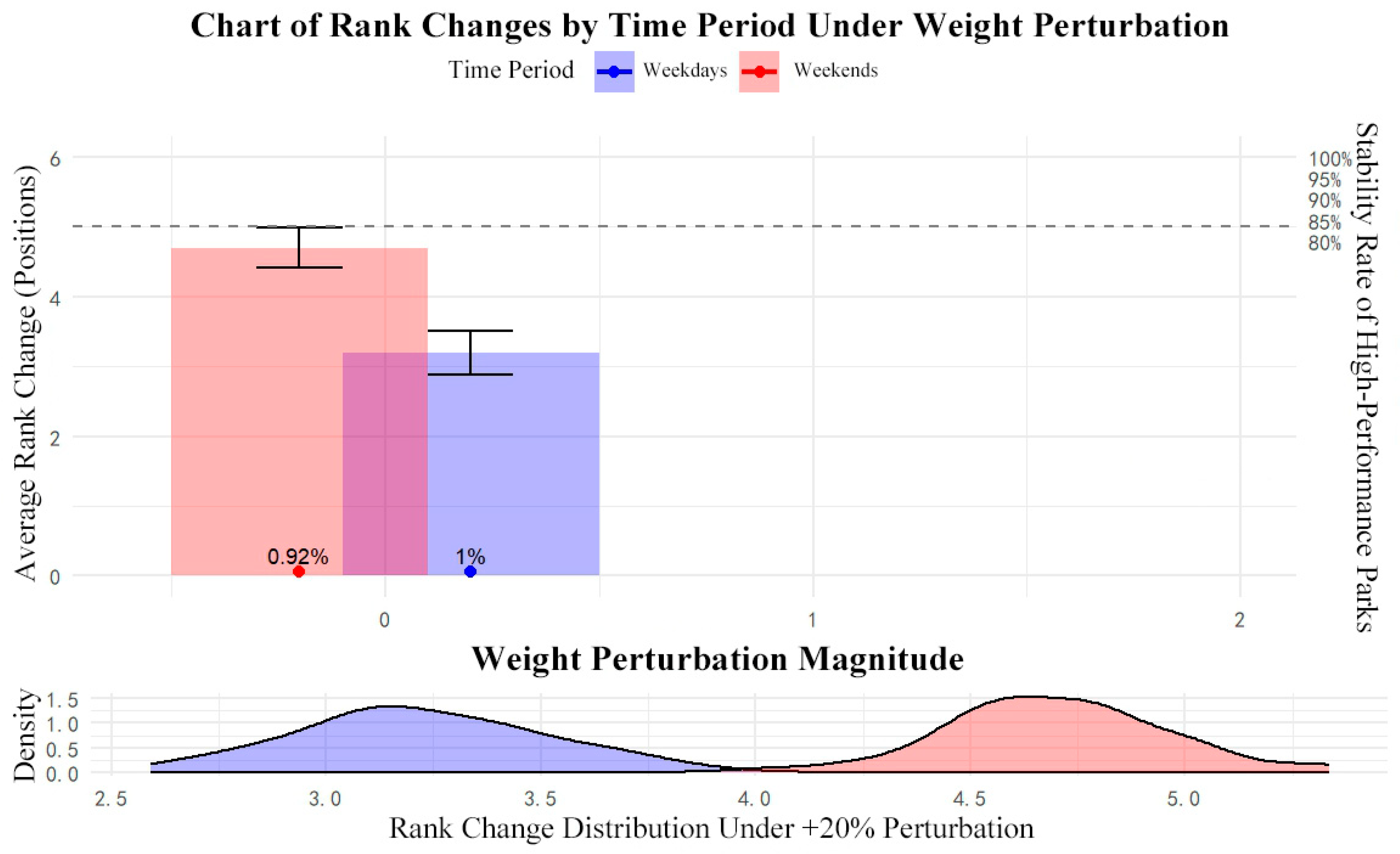
Sensitivity analysis was implemented by applying a ±20% uniform random disturbance to the weights of each indicator. Results are shown in Figure 10 and Table 4. The weekday model’s resistance to weight adjustment was 31.9% higher than the weekend’s (average rank change difference), indicating more stable weekday performance. After disturbance, the performance score change rate for individual parks was <10%, and the overall average change rate was ≤5%. Among them, the rank fluctuation of high-performance parks (e.g., West Lake Culture Square) was less than 3 positions, while the maximum rank change rate for low-performance parks (e.g., Dianchang River Greenway) was 18.3%, but it did not alter their “low-performance” classification, indicating the model’s insensitivity to minor weight adjustments and the reliability of results for planning practice.

4. Discussion

This study, based on multi-source big data, constructed a three-dimensional dynamic model of “Vitality Level–Demand Matching–Service Supply” to quantitatively evaluate the service performance of 59 urban parks in Gongshu District, Hangzhou. The results not only reveal the spatiotemporal differentiation patterns of park service performance in high-density urban areas but also provide new insights for urban park performance evaluation in terms of methodological innovation and practical application. Meanwhile, it is necessary to further examine the academic value and planning implications of the results in conjunction with existing research and real-world contexts.
From a methodological perspective, this study effectively addressed the limitations of traditional park performance evaluations through multi-source data integration and dynamic indicator design. Previous studies often relied on static indicators (e.g., per capita green space area, facility count) or single-dimension data (e.g., using only mobile signaling to describe vitality). For instance, Qin et al. [55] used mobile signaling to analyze the spatiotemporal characteristics of visitors in Nanjing’s parks but did not link it to demand matching and service supply. Xiao et al. [32] validated the equity of park accessibility in Shanghai but did not incorporate the impact of dynamic vitality fluctuations on performance. In contrast, this study integrated mobile signaling, POI, and park vector data to construct a three-dimensional evaluation framework that, for the first time, incorporated the spatiotemporal dynamics of vitality, the spatial coupling of demand, and the resource efficiency of supply into a unified system. Indicators such as Temporal Activity Difference (TAD) and Spatiotemporal Synergy coefficient (STS) successfully captured intra-day/weekly fluctuations in park use. For example, the finding that parks with high TAD values experience weekend crowding and weekday underutilization resonates with Jane Jacobs’ theory that urban spatial vitality requires temporal diversity, while further validating this theory’s applicability in park spaces through quantitative data. Additionally, the semi-dynamic hybrid weighting method combined the objectivity of the entropy weight method with the guidance of policy adjustment, avoiding the arbitrariness of traditional subjective weighting (e.g., Analytic Hierarchy Process). Monte Carlo simulations and sensitivity analysis confirmed the model’s resistance to data noise and weight disturbances, providing a reproducible methodological paradigm for subsequent park performance evaluations in similar high-density cities.
Interpreting the results, the core-periphery differentiation feature of park service performance in Gongshu essentially reflects the synergistic relationship between urban spatial structure, population distribution, and public service configuration. High-performance parks concentrated in core areas like West Lake Culture Square and Xiaohe Straight Street Historical Block share commonalities of excellent transportation accessibility, high functional diversity, and strong population demand, highly aligning with the planning concepts of functional agglomeration and pedestrian-friendliness in the 15 min living circle, also corroborating the view proposed by Costanza et al. [51] that landscape performance needs to couple ecological and social demands. Conversely, low-performance parks in northern Kangqiao and Banshan Sub-districts often suffer from low service efficacy due to low population density in industrial transformation zones, transportation barriers, and insufficient facility support. This phenomenon reveals a common issue in urban renewal processes: “emphasizing land development over public service facilities.” Although these areas added green spaces through ecological restoration, the failure to simultaneously improve transportation connectivity and facility optimization led to the dilemma of “having green space but lacking recreational vitality,” which limits their social utility and service performance in the context of this study. This serves as a warning for future park planning in industrial transformation zones: to fully realize the multifunctional potential of parks (both ecological and social), green space construction needs to be carried out simultaneously with population influx and transportation improvements to avoid inefficient use of recreational resources, while still acknowledging the inherent ecological value of these green spaces.
This study also enriches the discourse on spatial justice in urban green spaces—emphasizing equitable access to quality recreational resources for all residents [56]. The core-periphery performance gradient directly reflects spatial inequities: core areas enjoy high-quality park services, while suburban zones face supply–demand mismatches and inadequate access. By quantifying these disparities via the “Demand Matching-Service Supply” dimensions, this research provides a data-driven tool to mitigate injustice. The proposed strategies (e.g., improving suburban accessibility, enhancing facility inclusiveness) align with spatial justice tenets, aiming to bridge the service gap and promote inclusive public space development.
Further examining key findings across dimensions, their practical implications for park planning and management are highly targeted. In the Vitality Level dimension, the differences in usage patterns between parks with high and low TAD values indicate that park services need to adapt to the temporal patterns of user groups. For parks with high TAD values (e.g., Hangang River Greenway), the flexible facility supply model can be adopted, setting up temporary markets and mobile rest points on weekends to cope with peak traffic, while implanting community morning exercises, popularization education, and other activities on weekdays to enhance usage efficiency during idle periods. For parks with low TAD values and more balanced usage patterns (e.g., Chengbei Sports Park), the integration of “commute + leisure” functions needs strengthening, for example, by adding convenient rest seats and drinking water facilities during morning and evening peak hours to meet the short-term rest needs of surrounding office crowds. In the Demand Matching dimension, parks with low Effective Walking Coverage Rate (EWCR) are often affected by transportation barriers, such as Ducheng Ecological Park being severed by a railway. This suggests that planning should prioritize connecting breakpoints, restoring pedestrian system continuity through building overpasses or underpasses. The pattern of the Spatial Coupling Index for Vulnerable Groups (SCI) being higher on weekends than weekdays indicates the need for differentiated service strategies tailored to the temporal demand variations of elderly and child groups. For instance, increasing maintenance staff in children’s play areas on weekends, while optimizing the accessible paths to age-friendly facilities on weekdays. In the Service Supply dimension, parks with high Function Adaptation Index (FAI) often rely on rich surrounding POI amenities. This illustrates that parks are not isolated green spaces but need to form a “1 + N” synergistic network with catering, leisure, and other service facilities. Future new parks can adopt composite models like “park + commerce” or “park + culture & sports” to enhance service completeness. The extreme differences in Service Efficiency per Unit Area (SEUA) suggest the need for peak flow control and spatial optimization (e.g., expanding vertical greening) in high-load parks (e.g., West Lake Culture Square), and facility supplementation and functional repositioning in low-efficiency parks (e.g., Dianchang River Greenway).
This study has several limitations that need addressing in future research. First, mobile phone signaling data do not cover non-mobile users (e.g., elderly and young children without phones), potentially underestimating park usage frequency by these vulnerable groups. Future studies could incorporate data from smart wearables, community surveys, etc., to supplement behavioral characteristics of vulnerable groups, such as partnering with schools or communities to deploy smart wearables for children, conducting targeted time-activity surveys among caregivers, or employing computer vision techniques in designated play areas to directly observe and quantify child-specific park usage patterns. Furthermore, the mobile phone signaling data preprocessing, while employing filters for transient noise and spatial buffering, may still include some edge cases. For instance, non-recreational traversers (e.g., pedestrians using a park as a shortcut) with limited base station switches could meet the minimum stay threshold, and signals very close to park boundaries might not be perfectly distinguished from adjacent street activity. These could lead to a modest overestimation of recreational vitality, particularly in linear parks that also serve as transportation corridors. Second, the study did not incorporate the effects of external factors like weather and holidays. Extreme heat might reduce daytime park vitality, and long holidays like Spring Festival could alter usage patterns. Subsequent work could build a multi-timescale evaluation framework encompassing “weekdays–weekends–holidays” to enhance the model’s scenario adaptability. Third, the empirical scope was limited to Gongshu District, Hangzhou. While it can reflect common characteristics of high-density urban areas, spatial structures and population sizes vary across different cities. Future research should extend to similar cities like Shanghai and Shenzhen to verify the model’s generalizability and optimize indicator thresholds.
Overall, through a multi-source big data-driven dynamic evaluation model, this study not only quantified the spatiotemporal patterns of urban park service performance but also established a data-methodology-practice closed loop. Its outcomes can provide decision support for refined planning in park city construction, for instance, by incorporating the model into the pre-assessment and post-monitoring system of park planning, using monthly vitality alerts to timely identify low-performance parks and formulate targeted improvement strategies, ultimately promoting the transition of urban parks from quantity compliance to quality adaptation, truly realizing the planning goal of “a people’s city built by the people.”

5. Conclusions

This study, focusing on 59 urban parks in Gongshu District, Hangzhou, integrated multi-source data including mobile phone signaling, POIs, park vectors, and demographic statistics to construct a three-dimensional dynamic evaluation model of “Vitality Level–Demand Matching–Service Supply.” It systematically quantified the spatiotemporal characteristics and key driving patterns of park service performance in high-density urban areas, while verifying the model’s scientificity and practicality, providing theoretical support and practical pathways for the transition of urban parks from quantitative growth to qualitative improvement.
A primary objective of this study was to develop an integrated park service performance evaluation model that balances spatiotemporal dynamics and multi-dimensional synergy. To achieve this, this study broke through the limitations of traditional static evaluations by designing a three-dimensional dynamic framework that integrates multi-source big data and adopts a semi-dynamic hybrid weighting method, combining the entropy weight method and policy adjustment, balanced the objectivity and policy orientation of indicator weights. Dynamic indicators such as Temporal Activity Difference (TAD) and Spatiotemporal Synergy coefficient (STS) successfully captured intra-day/weekly fluctuation characteristics of park usage, overcoming the single-dimensional and static constraints of traditional methods. Time-series cross-validation, external validity verification, and Monte Carlo simulations further confirm the model’s strong resistance to data noise and weight disturbances, ensuring its stable applicability to performance evaluation of parks in high-density urban areas.
Another core objective was to validate the model’s effectiveness in identifying performance shortcomings and providing precise support for planning optimization. The empirical application in Gongshu District yielded clear and actionable findings: Park service performance in Gongshu exhibited a significant core-periphery gradient, with high-performance parks concentrated in core areas (e.g., West Lake Culture Square and Xiaohe Straight Street Historical Block) due to excellent transportation accessibility, high functional diversity, and strong population demand, while low-performance parks scatter in northern industrial transformation zones (e.g., Kangqiao and Banshan) due to low population density, transportation barriers, and insufficient facilities. Temporally, parks with high TAD values (mean up to 0.579) face prominent time-mismatch issues, whereas those with low TAD values (mean of 0.289) achieve all-day efficient utilization through functional and transportation support. Across the three evaluation dimensions, the Vitality Level dimension highlights the “weekday stability, weekend fluctuation,” the Demand Matching shows a “high coupling in the core, low adaptation in the suburbs” gradient, and the Service Supply reflects the principle that “functional adaptability determines use efficiency.”—collectively pinpointing core shortcomings such as low vitality, supply–demand mismatch, and inefficient supply in suburban parks, as well as peak crowding in core parks, and leading to the core conclusion that “park performance is the result of the synergistic interaction of space, people, and facilities.” These results fully demonstrate the model’s value in targeted performance diagnosis.
Practically, the results of this study can provide direct support for the refined planning and management of urban parks: For high-performance parks in core areas, it is recommended to optimize spatial capacity through “vertical greening + functional diversity” to cope with peak crowd pressure. For low-performance parks in suburban areas, measures should be categorized and implemented based on types such as vitality decline, supply–demand mismatch, and inefficient supply, for example, by building overpasses to improve accessibility or implanting community activities to enhance vitality during idle periods. Simultaneously, the model can be incorporated into the monitoring system of park city construction, using monthly vitality alerts to timely identify performance shortcomings, promoting the transition of planning decisions from experience-driven to data-driven.
Although this study has limitations such as incomplete coverage of non-mobile users, non-inclusion of climate and holiday impacts, and a limited empirical scope, the core research framework is generalizable. Future work can improve the assessment of vulnerable groups by supplementing smart wearable device data, and optimize model universality by expanding multi-temporal scale and multi-city empirical studies, further deepening the theoretical research and practical application of urban park service performance, ultimately contributing to the realization of the planning goal: Cities for the people, built by the people.

Supplementary Materials

The following supporting information can be downloaded at: https://www.mdpi.com/article/10.3390/ijgi15010021/s1, Table S1: Statistical Table of Park Green Spaces in Gongshu.

Author Contributions

Ge Lou: conceptualization, data curation, formal analysis, methodology, software, validation, writing—original draft, and writing—review and editing. Yiduo Qi: conceptualization, formal analysis, validation, writing—review and editing. Xiuxiu Chen: resources, software, writing—review and editing. Qiuxiao Chen: data curation, funding acquisition, investigation, and resources. All authors have read and agreed to the published version of the manuscript.

Funding

This research was funded by the Key R&D Program of Zhejiang, grant number 2024C03234, and by the Joint Funds of the Zhejiang Provincial Natural Science Foundation of China under Grant No. LHZY24A010001.

Data Availability Statement

Data will be made available on request.

Acknowledgments

Thanks to all the reviewers and editors.

Conflicts of Interest

The authors declare no conflicts of interest.

References

  1. Chiesura, A. The Role of Urban Parks for the Sustainable City. Landsc. Urban Plan. 2004, 68, 129–138. [Google Scholar] [CrossRef]
  2. Tarsitano, E.; Rosa, A.G.; Posca, C.; Petruzzi, G.; Mundo, M.; Colao, M. A Sustainable Urban Regeneration Project to Protect Biodiversity. Urban Ecosyst. 2021, 24, 827–844. [Google Scholar] [CrossRef]
  3. La Rosa, D. Accessibility to Greenspaces: GIS Based Indicators for Sustainable Planning in a Dense Urban Context. Ecol. Indic. 2014, 42, 122–134. [Google Scholar] [CrossRef]
  4. Bratman, G.N.; Anderson, C.B.; Berman, M.G.; Cochran, B.; De Vries, S.; Flanders, J.; Folke, C.; Frumkin, H.; Gross, J.J.; Hartig, T.; et al. Nature and Mental Health: An Ecosystem Service Perspective. Sci. Adv. 2019, 5, eaax0903. [Google Scholar] [CrossRef]
  5. Wang, C. Research on Evaluating and Optimizing Landscape Vitality of Community Parks in Areas with Hot Summers and Cold Winters. Master’s Thesis, Wuhan University of Technology, Wuhan, China, 2023. [Google Scholar]
  6. Kuklina, V.; Sizov, O.; Fedorov, R. Green Spaces as an Indicator of Urban Sustainability in the Arctic Cities: Case of Nadym. Polar Sci. 2021, 29, 100672. [Google Scholar] [CrossRef]
  7. National Greening Commission. National Territorial Spatial Planning Outline (2022–2030). Available online: https://www.forestry.gov.cn/c/www/lhxwdt/92479.jhtml (accessed on 29 December 2025).
  8. National Forestry and Grassland Administration. “14th Five-Year Plan” Rural Greening and Beautification Action Plan. Available online: https://www.forestry.gov.cn/c/www/lczc/27613.jhtml (accessed on 29 December 2025).
  9. Beijing Municipal People’s Government. Beijing Urban Master Plan (2016–2035); Beijing Urban Planning and Land Resources Management Commission: Beijing, China, 2017. [Google Scholar]
  10. Xu, E.; Zhu, Q.; Zhang, J. Research on Accessibility of Open Spaces in Urban Areas at Home and Abroad: Theme Framework and Frontier Trends. World Reg. Stud. 2024, 33, 136–150. [Google Scholar]
  11. Zhang, H.; Yu, J.; Dong, X.; Zhai, X.; Shen, J. Rethinking Cultural Ecosystem Services in Urban Forest Parks: An Analysis of Citizens’ Physical Activities Based on Social Media Data. Forests 2024, 15, 1633. [Google Scholar] [CrossRef]
  12. Xiao, X.; Ye, Q.; Dong, X. Using Importance–Performance Analysis to Reveal Priorities for Multifunctional Landscape Optimization in Urban Parks. Land 2024, 13, 564. [Google Scholar] [CrossRef]
  13. Yang, M.; Wu, R.; Bao, Z.; Yan, H.; Nan, X.; Luo, Y.; Dai, T. Effects of Urban Park Environmental Factors on Landscape Preference Based on Spatiotemporal Distribution Characteristics of Visitors. Forests 2023, 14, 1559. [Google Scholar] [CrossRef]
  14. Roberts, H.; Kellar, I.; Conner, M.; Gidlow, C.; Kelly, B.; Nieuwenhuijsen, M.; McEachan, R. Associations Between Park Features, Park Satisfaction and Park Use in a Multi-Ethnic Deprived Urban Area. Urban For. Urban Green. 2019, 46, 126485. [Google Scholar] [CrossRef]
  15. Xing, Z.; Zhu, J. Green space fair performance evaluation based on the theory of coupled coordinated development. Urban Plan. 2017, 41, 89–96. [Google Scholar]
  16. Xie, S. Evaluation and Optimization of Recreational Services in Park Green Spaces in Haidian District, Beijing. Master’s Thesis, Beijing Forestry University, Beijing, China, 2021. [Google Scholar]
  17. Guo, X. Research on the Performance Evaluation and Optimization Countermeasures of Recreational Services in Park Green Spaces in Xi’an City. Master’s Thesis, Northwest University, Xi’an, China, 2020. [Google Scholar]
  18. Banchiero, F.; Blecic, I.; Saiu, V.; Trunfio, G.A. Neighbourhood Park Vitality Potential: From Jane Jacobs’s Theory to Evaluation Model. Sustainability 2020, 12, 5881. [Google Scholar] [CrossRef]
  19. Gao, S. Analysis of the Spatial Vitality of Urban Parks in Zhengzhou City. Master’s Thesis, Henan Agricultural University, Zhengzhou, China, 2017. [Google Scholar]
  20. Li, Y. Research on the Attractiveness of Urban Parks Based on the Perceptions of Elderly People for Recreation. Master’s Thesis, Chongqing University, Chongqing, China, 2020. [Google Scholar]
  21. Xu, T.; Wu, X.; Cao, Y.; Pan, S.; Cai, G. Evaluation of Service Efficiency of Large Parks in Wuhan Based on Mobile Signal Data. In Proceedings of the 2023 China Urban Planning Annual Conference, Wuhan, China, 23 September 2023; pp. 986–997. [Google Scholar]
  22. Zuo, F. Research on the Service Efficiency of Park Green Spaces in the Central Urban Area of Haikou Based on Accessibility. Master’s Thesis, Hainan Normal University, Haikou, China, 2020. [Google Scholar]
  23. Zhang, Y.; Xu, S.; Han, R.; Ma, J.; Li, X. Evaluation and Optimization of Recreational Service Capacity of Urban Mountain Parks Based on Mountainous Characteristics: A Case Study of Chengde City. Chin. Landsc. Archit. 2020, 36, 19–23. [Google Scholar] [CrossRef]
  24. Liu, Y.; Liu, X.; Gao, S.; Gong, L.; Kang, C.; Zhi, Y.; Chi, G.; Shi, L. Social Sensing: A New Approach to Understanding Our Socioeconomic Environments. Ann. Assoc. Am. Geogr. 2015, 105, 512–530. [Google Scholar] [CrossRef]
  25. Zhu, J.; Lu, H.; Zheng, T.; Rong, Y.; Wang, C.; Zhang, W.; Yan, Y.; Tang, L. Vitality of Urban Parks and Its Influencing Factors from the Perspective of Recreational Service Supply, Demand, and Spatial Links. Int. J. Environ. Res. Public Health 2020, 17, 1615. [Google Scholar] [CrossRef] [PubMed]
  26. Qin, L.; Zong, W.; Peng, K.; Zhang, R. Assessing Spatial Heterogeneity in Urban Park Vitality for a Sustainable Built Environment: A Case Study of Changsha. Land 2024, 13, 480. [Google Scholar] [CrossRef]
  27. Zeng, L.; Liu, C. Exploring Factors Affecting Urban Park Use from a Geospatial Perspective: A Big Data Study in Fuzhou, China. Int. J. Environ. Res. Public Health 2023, 20, 4237. [Google Scholar] [CrossRef] [PubMed]
  28. Guo, Y.; Lei, G.; Zhang, L. Quality Evaluation of Park Green Space Based on Multi-Source Spatial Data in Shenyang. Sustainability 2023, 15, 8991. [Google Scholar] [CrossRef]
  29. Li, Z.; Chen, H.; Yan, W. Exploring Spatial Distribution of Urban Park Service Areas in Shanghai Based on Travel Time Estimation: A Method Combining Multi-Source Data. ISPRS Int. J. Geo-Inf. 2021, 10, 608. [Google Scholar] [CrossRef]
  30. Ge, Y.; Gan, Q.; Ma, Y.; Guo, Y.; Chen, S.; Wang, Y. Spatial Vitality Detection and Evaluation in Zhengzhou’s Main Urban Area. Buildings 2024, 14, 3648. [Google Scholar] [CrossRef]
  31. Yue, W.; Chen, Y.; Thy, P.T.M.; Fan, P.; Liu, Y.; Zhang, W. Identifying Urban Vitality in Metropolitan Areas of Developing Countries from a Comparative Perspective: Ho Chi Minh City Versus Shanghai. Sustain. Cities Soc. 2021, 65, 102609. [Google Scholar] [CrossRef]
  32. Xiao, Y.; Wang, D.; Fang, J. Exploring the Disparities in Park Access Through Mobile Phone Data: Evidence from Shanghai, China. Landsc. Urban Plan. 2019, 181, 80–91. [Google Scholar] [CrossRef]
  33. Lin, Y.; Zhou, Y.; Lin, M.; Wu, S.; Li, B. Exploring the Disparities in Park Accessibility through Mobile Phone Data: Evidence from Fuzhou of China. J. Environ. Manag. 2021, 281, 111849. [Google Scholar] [CrossRef]
  34. Ouyang, J.; Fan, H.; Wang, L.; Zhu, D.; Yang, M. Revealing Urban Vibrancy Stability Based on Human Activity Time-Series. Sustain. Cities Soc. 2022, 85, 104053. [Google Scholar] [CrossRef]
  35. Wang, S. Re-Examining Urban Vitality through Jane Jacobs’ Criteria Using GIS-sDNA: The Case of Qingdao, China. Buildings 2022, 12, 1586. [Google Scholar] [CrossRef]
  36. Zukin, S. Death and Life of Great American Cities, the/J. Jacobs. In The Wiley Blackwell Encyclopedia of Urban and Regional Studies; John Wiley & Sons, Ltd.: Hoboken, NJ, USA, 2019; pp. 1–5. ISBN 978-1-118-56844-6. [Google Scholar]
  37. Yang, Y.; Lin, G. The Development, Connotations, and Interests of Research on Landscape Performance Evaluation for Evidence-Based Design. Landsc. Archit. Front. 2020, 8, 74–83. [Google Scholar] [CrossRef]
  38. Zhou, S.; Zheng, Z. Urban Spatiotemporal Behavioral Landscape Based on Space-Time-Human Coupling: Theory and Application Research. Geogr. Res. 2024, 43, 2271–2283. [Google Scholar] [CrossRef]
  39. Zhejiang Meteorological Bureau. Zhejiang Weather Network. Available online: http://zj.weather.com.cn/ (accessed on 9 April 2023).
  40. GB/T 35790-2023; Information Security Technology—Security Technical Specification for Radio Frequency Identification (RFID) Systems. State Administration for Market Regulation, National Standardization Administration of China: Beijing, China, 2023.
  41. Lou, G.; Chen, Q.; Chen, W. Strategic Planning for Sustainable Urban Park Vitality: Spatiotemporal Typologies and Land Use Implications in Hangzhou’s Gongshu District via Multi-Source Big Data. Land 2025, 14, 1338. [Google Scholar] [CrossRef]
  42. Chen, J.; Liu, B.; Li, S.; Jiang, B.; Wang, X.; Lu, W.; Hu, Y.; Wen, T.; Feng, Y. Actual Supply-Demand of the Urban Green Space in a Populous and Highly Developed City: Evidence Based on Mobile Signal Data in Guangzhou. Ecol. Indic. 2024, 169, 112839. [Google Scholar] [CrossRef]
  43. GB/T 51346-2019; Standard for Planning of Urban Green Space. Ministry of Housing and Urban-Rural Development of the People’s Republic of China, State Administration for Market Regulation: Beijing, China, 2019.
  44. Gehl, J.; Rogers, L.R. Cities for People; Island Press: Washington, DC, USA, 2010; ISBN 978-1-59726-573-7. [Google Scholar]
  45. Whyte, W.H. The Social Life of Small Urban Spaces; University Translation Series; Shanghai Translation Publishing House: Shanghai, China, 2016; ISBN 978-7-5327-7051-9. [Google Scholar]
  46. Luo, S.; Zhang, Z.; Yang, Z.; Luo, X. Research on the Dynamic Spatial-Temporal Characteristics and Influencing Factors of Urban Waterfront Parks—Taking Kunming City as an Example. South. Archit. 2024, 8, 69–77. [Google Scholar]
  47. Rawls, J. A Theory of Justice, 5th–6th ed.; Belknap Press of Harvard University Press: Cambridge, MA, USA, 2003; ISBN 978-0-674-00077-3. (Revised 1999). [Google Scholar]
  48. Zhang, X. The Theoretical Basis of Public Service Supply: Systematization and Framework Construction. J. Sichuan Univ. (Philos. Soc. Sci. Ed.) 2015, 4, 135–140. [Google Scholar]
  49. Wang, Z.; Fei, Y. A Discussion on Evaluation Methods of Community Public Service Level from the Perspective of “Living Circle”. Intell. Build. Smart City 2021, 3, 17–21. [Google Scholar] [CrossRef]
  50. Ostrom, E. Governing the Commons: The Evolution of Institutions for Collective Action; Cambridge University Press: Cambridge, UK, 1991; ISBN 978-1-933771-77-9. [Google Scholar]
  51. Costanza, R.; d’Arge, R.; de Groot, R.; Farber, S.; Grasso, M.; Hannon, B.; Limburg, K.; Naeem, S.; O’Neill, R.V.; Paruelo, J.; et al. The Value of the World’s Ecosystem Services and Natural Capital. Ecol. Econ. 1998, 25, 3–15. [Google Scholar] [CrossRef]
  52. Xiao, A. Evaluation and Optimization of Recreational Service Performance in Urban Park Green Spaces: A Case Study of Jiulongpo District, Chongqing. Master’s Thesis, Southwest University, Chongqing, China, 2023. [Google Scholar]
  53. Decision of the Standing Committee of the People’s Congress of Hangzhou City on Strengthening the Construction of a Child-Friendly City. Available online: http://www.hzrd.gov.cn/art/2022/12/21/art_1229690484_18827.html (accessed on 29 December 2025).
  54. Hastie, T.; Tibshirani, R.; Friedman, J. The Elements of Statistical Learning: Data Mining, Inference, and Prediction; Springer Series in Statistics; Springer: Berlin/Heidelberg, Germany, 2016; ISBN 978-0-387-84857-0. [Google Scholar]
  55. Qin, S.; Yang, J.; Feng, Y.; Yan, S. Measuring the spatio-temporal vitality and influencing factors of urban parks based on multi-source data: A case study of Nanjing. Chin. Landsc. Archit. 2021, 37, 68–73. [Google Scholar] [CrossRef]
  56. Yang, L. Research on Evaluation Method and Application of Urban Park Equity Performance from the Perspective of Spatial Justice. Ph.D. Thesis, Chongqing University, Chongqing, China, 2020. [Google Scholar]
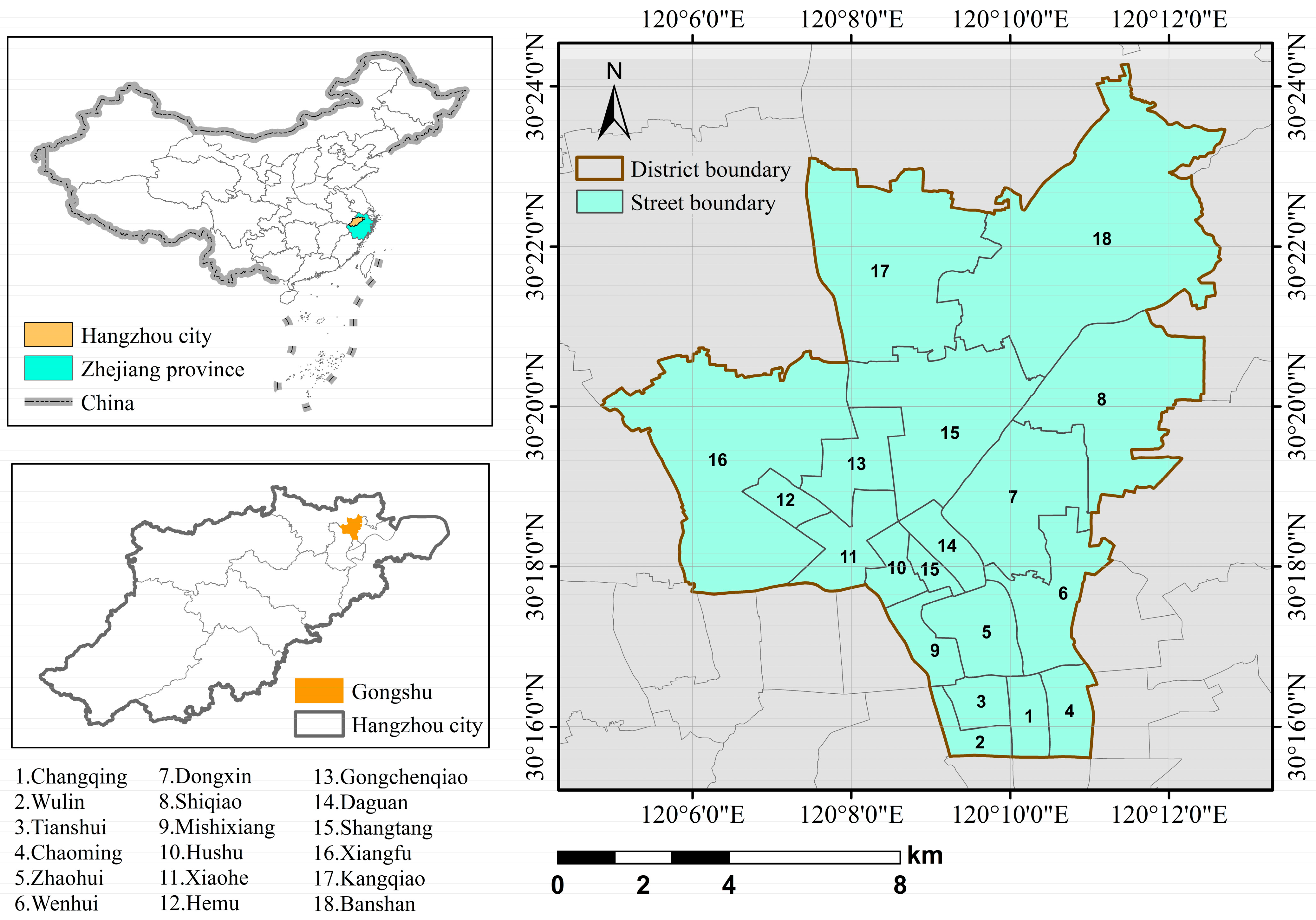
Figure 1. Location of Gongshu District.
Ijgi 15 00021 g001
Figure 2. Spatial distribution of urban parks with different areas. Park IDs correspond to those listed in Supplementary Table S1.
Ijgi 15 00021 g002
Figure 3. Conceptual framework of the dynamic assessment model for urban park recreational service performance.
Ijgi 15 00021 g003
Figure 4. Vitality level performance characteristics in different indicators: (a) TAD on weekdays; (b) TSI on weekdays; (c) STS on weekdays; (d) SEUA on weekdays; (e) TAD on weekends; (f) TSI on weekends; (g) STS on weekends; (h) SEUA on weekends.
Ijgi 15 00021 g004
Figure 5. Demand matching performance characteristics in different indicators: (a) EWCR; (b) VPMI; (c) SCI-children on weekdays; (d) SCI-children on weekends; (e) SCI-olds on weekdays; (f) SCI-olds on weekends.
Ijgi 15 00021 g005
Figure 6. Service supply performance characteristics in different indicators: (a) FAI; (b) ESAR.
Ijgi 15 00021 g006
Figure 7. Comprehensive performance score distribution in different time periods: (a) Weekdays; (b) Weekends.
Ijgi 15 00021 g007
Figure 8. Spatial Agglomeration of Park Recreational Service Performance in Gongshu District in different time periods: (a) Weekdays; (b) Weekends.
Ijgi 15 00021 g008
Figure 9. Scatter Plot of Prediction Errors for Training and Test Sets.
Ijgi 15 00021 g009
Figure 10. Distribution of Park Ranking Changes under Weight Perturbation.
Ijgi 15 00021 g010
Table 1. Urban Park Green Space Recreational Service Performance Evaluation Indicator System.
First DimensionSecondary IndicatorQuantitative MethodData Source
Vitality LevelTemporal Activity Difference (TAD)The degree of difference in activity intensity between weekdays and weekendsMobile phone data
Temporal Stability Index (TSI)The ratio of the daily average activity value to the standard deviation of the daily activity valueMobile phone data
Spatiotemporal Synergy coefficient (STS)Peak activity level and night-time activity decline rateMobile phone data
Service Efficiency per Unit Area (SEUA)Activity heat index/Green area (people/hectare/hour)remote sensing image data
Demand MatchingEffective Walking Coverage Rate (EWCR)Population Percentage within 15 min Walkable Distance (%)Mobile phone data
Vitality-Population Matching Index (VPMI)Spatial coupling degree of resident population and activity intensityPopulation
Spatial Coupling Index for Vulnerable Groups (SCI)Calculate the spatial coupling degree separately for the elderly and children.Statistical yearbook, mobile phone data
Service SupplyFunction Adaptation Index (FAI)The ratio of POI to the number of residentsPOI, population
Effective Service Area Ratio (ESAR)The ratio of the actual service area to the theoretical service areaMobile phone data
Table 2. Descriptive Statistics of Recreational Vitality Performance Across Different Time Periods.
Statistical ItemMeanMedianMaxMinStandard Deviation
Pweekday0.4120.4050.6790.1270.138
Pweekend0.3750.3680.6970.1280.142
Time period differences (Pweekday − Pweekend)+0.037+0.037−0.018−0.001Similar levels of dispersion
Table 3. Period-Specific Stability Indicators.
PeriodPerformance Score Standard DeviationSpearman Correlation CoefficientRanking Change Rate
Weekday0.0320.92 ***3.8%
Weekend0.0470.85 ***5.6%
Note: *** indicates statistical significance at the p < 0.001 level.
Table 4. Period-Specific Sensitivity Test Results.
Direction of DisturbancePeriodAverage Ranking ChangeThe Proportion of Parks with 5 or More ChangesHigh-Performance Park Stability Rate
+20% weight perturbationWeekday3.28.5%100%
−20% weight perturbationWeekend4.712.2%92%
Disclaimer/Publisher’s Note: The statements, opinions and data contained in all publications are solely those of the individual author(s) and contributor(s) and not of MDPI and/or the editor(s). MDPI and/or the editor(s) disclaim responsibility for any injury to people or property resulting from any ideas, methods, instructions or products referred to in the content.