
GeoSpatial Analysis of Health-Oriented Justice in Tartu, Estonia

Abstract
1. Introduction
2. Literature Review
2.1. Spatial Justice and Health in Urban Theory
2.2. Planning for Health in Small Cities
2.3. The 15-Minute City and Distributional Justice
3. Materials and Methods
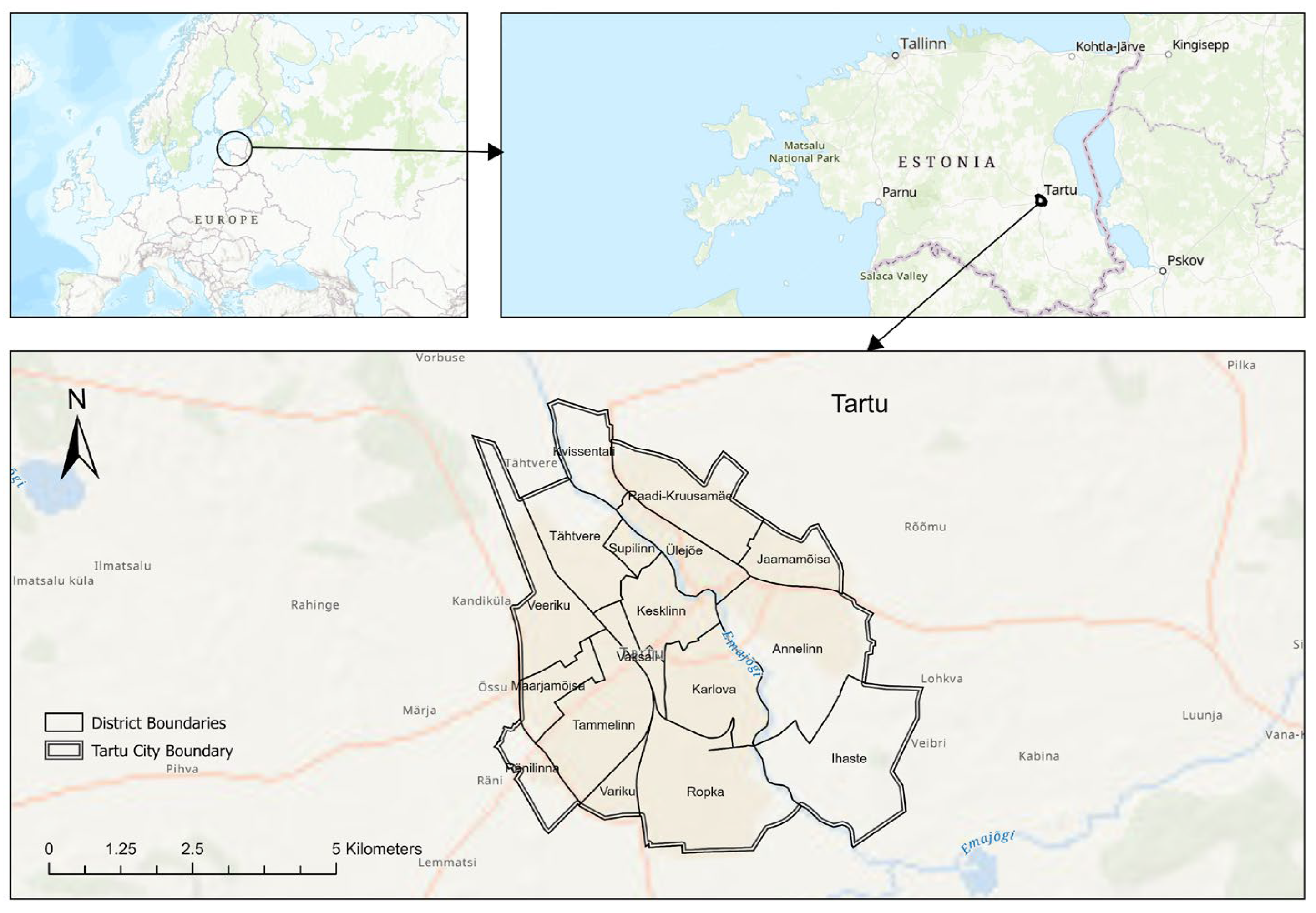
3.1. Study Area: Tartu, Estonia
3.2. Data Layers
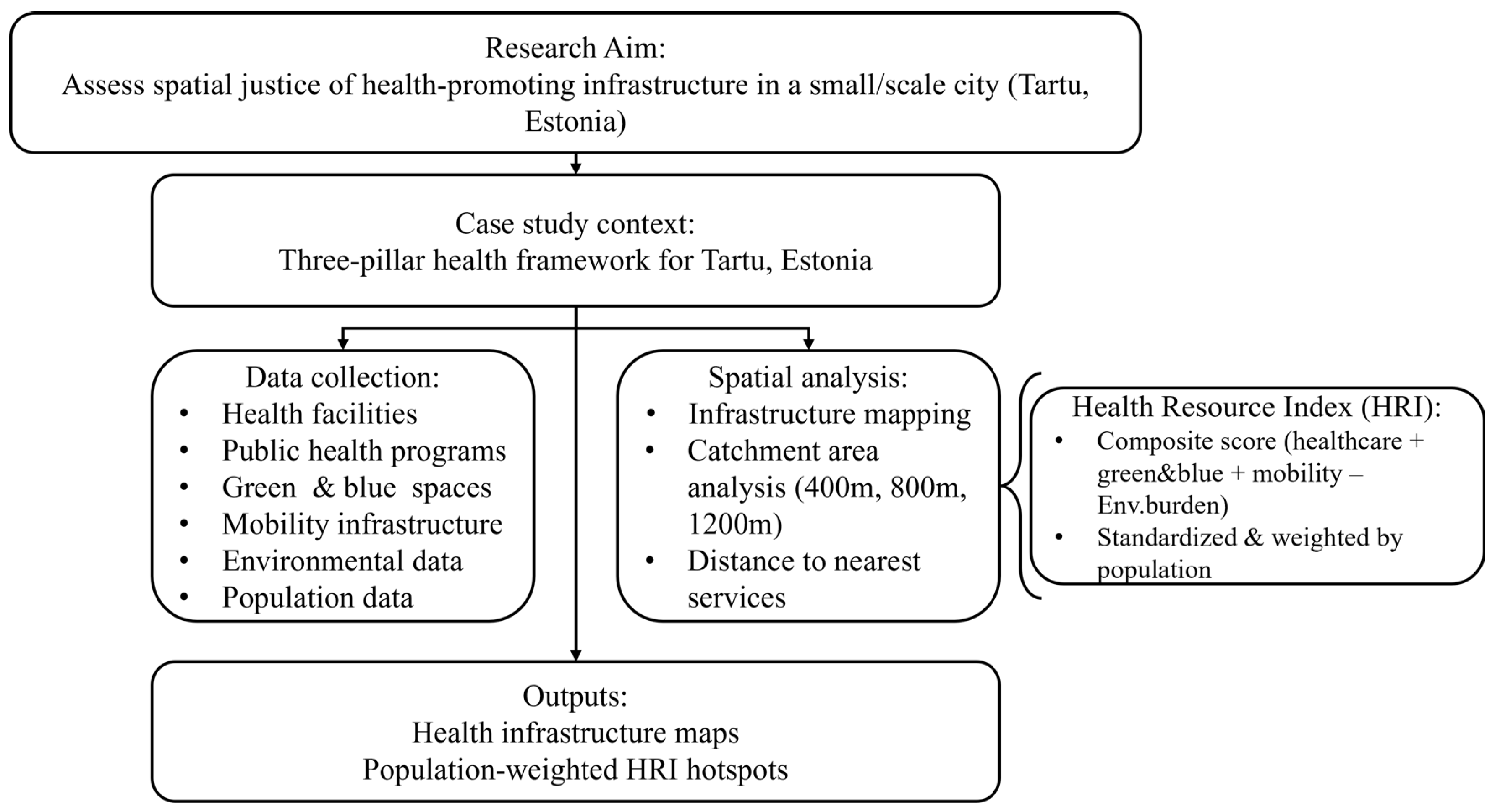
3.3. Spatial Analysis Techniques
- (a)
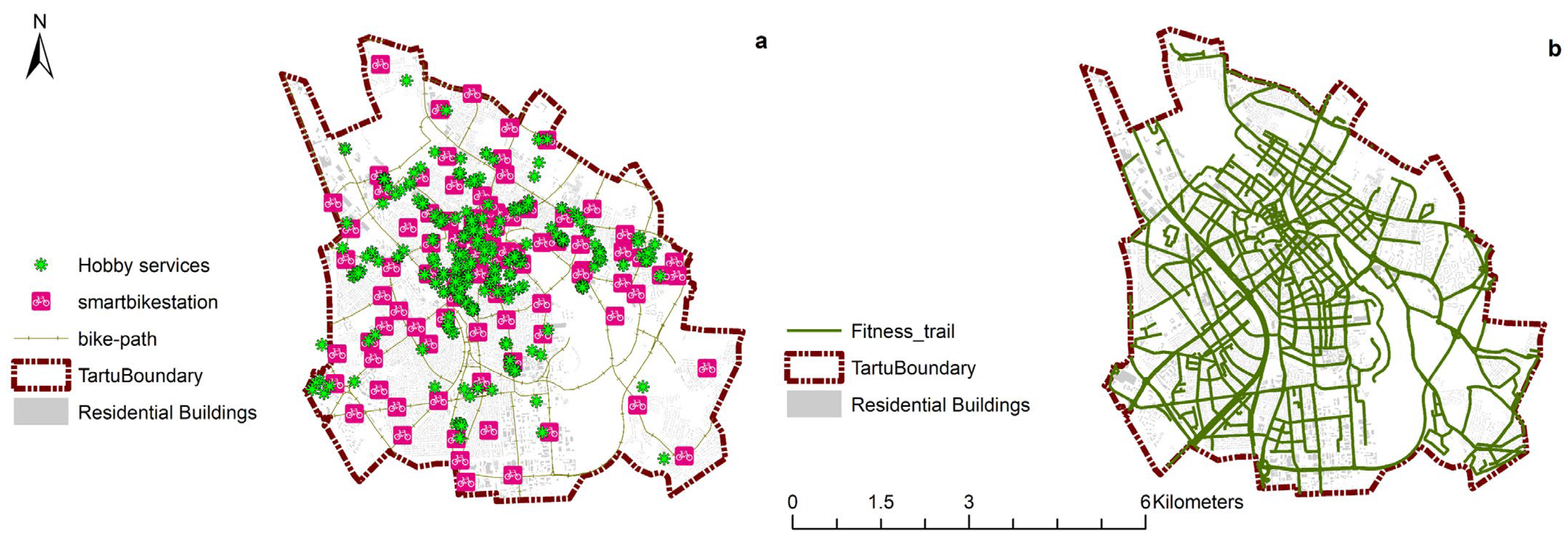
- Infrastructure Mapping and Environmental Profiling
- (b)
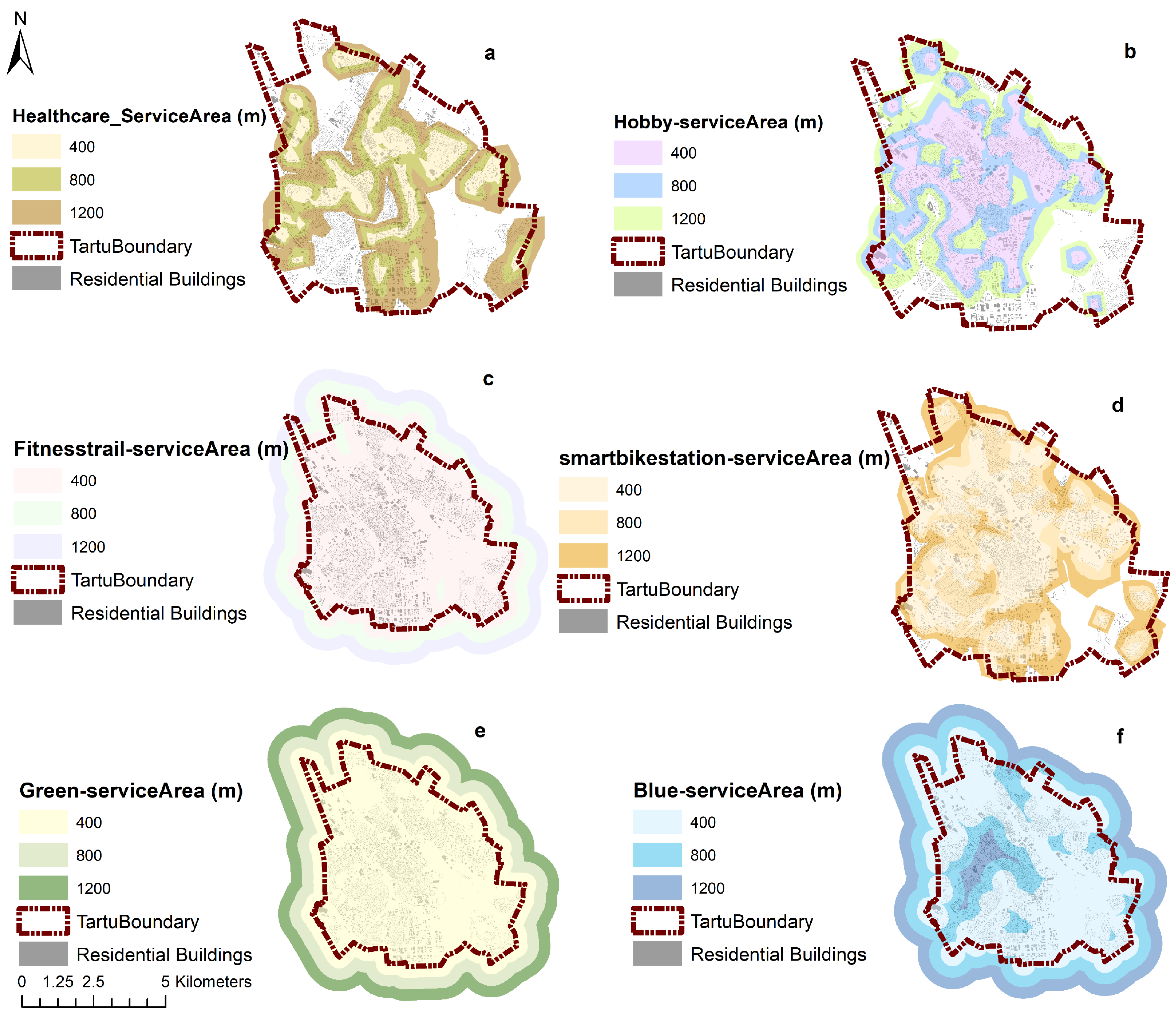
- Catchment Area and Proximity Analysis
- (c)
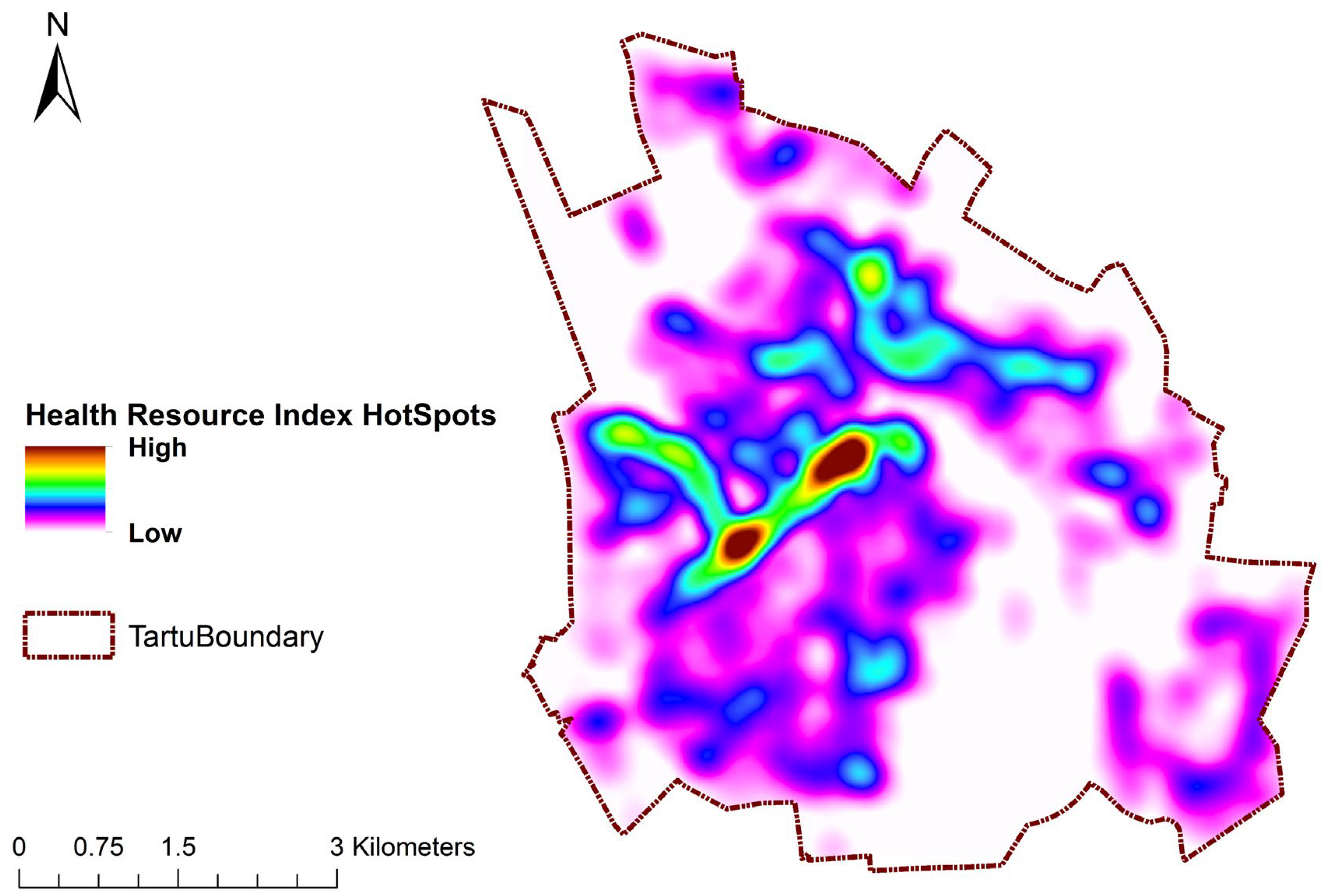
- Composite Health Resource Hotspot Mapping
- (d)
- Health Resource Index (HRI)
- 1.
- Healthcare Access (): Measured as the network distance from the cell centroid to the nearest healthcare facility (hospital, clinic, or mental health center). Shorter distances received higher scores.
- 2.
- Green and Blue Space Access (): Measured as the total area (m2) of green and blue spaces within an 800 m network buffer from the cell centroid. Larger areas received higher scores.
- 3.
- Mobility Service Availability (): A composite score based on (a) network distance to the nearest bike-share station and (b) the total length (m) of dedicated pedestrian and bicycle paths within an 800 m network buffer.
- 4.
- Environmental Burden (: A composite score based on standardized values of PM2.5 concentration and noise pollution levels assigned to each cell. Higher pollution levels received higher negative scores. The inclusion of environmental burden indicators as inverse weights is grounded in the concept of distributional environmental justice, which posits that exposure to pollution and noise constitutes negative health determinants that can offset the benefits of access to infrastructure.
- (e)
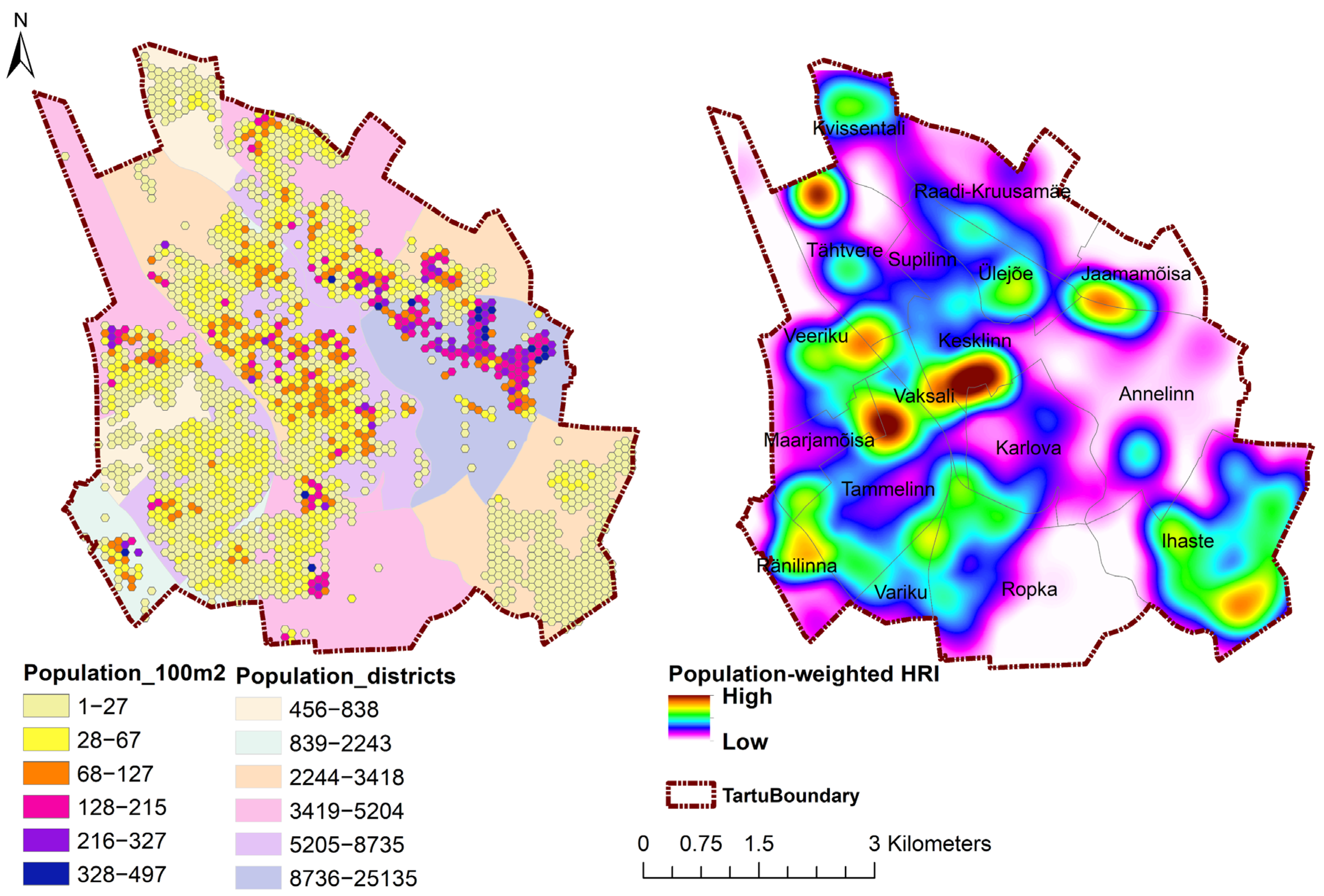
- Population-Weighted Equity Analysis
4. Results
4.1. Three-Pillar Health Infrastructure Distribution
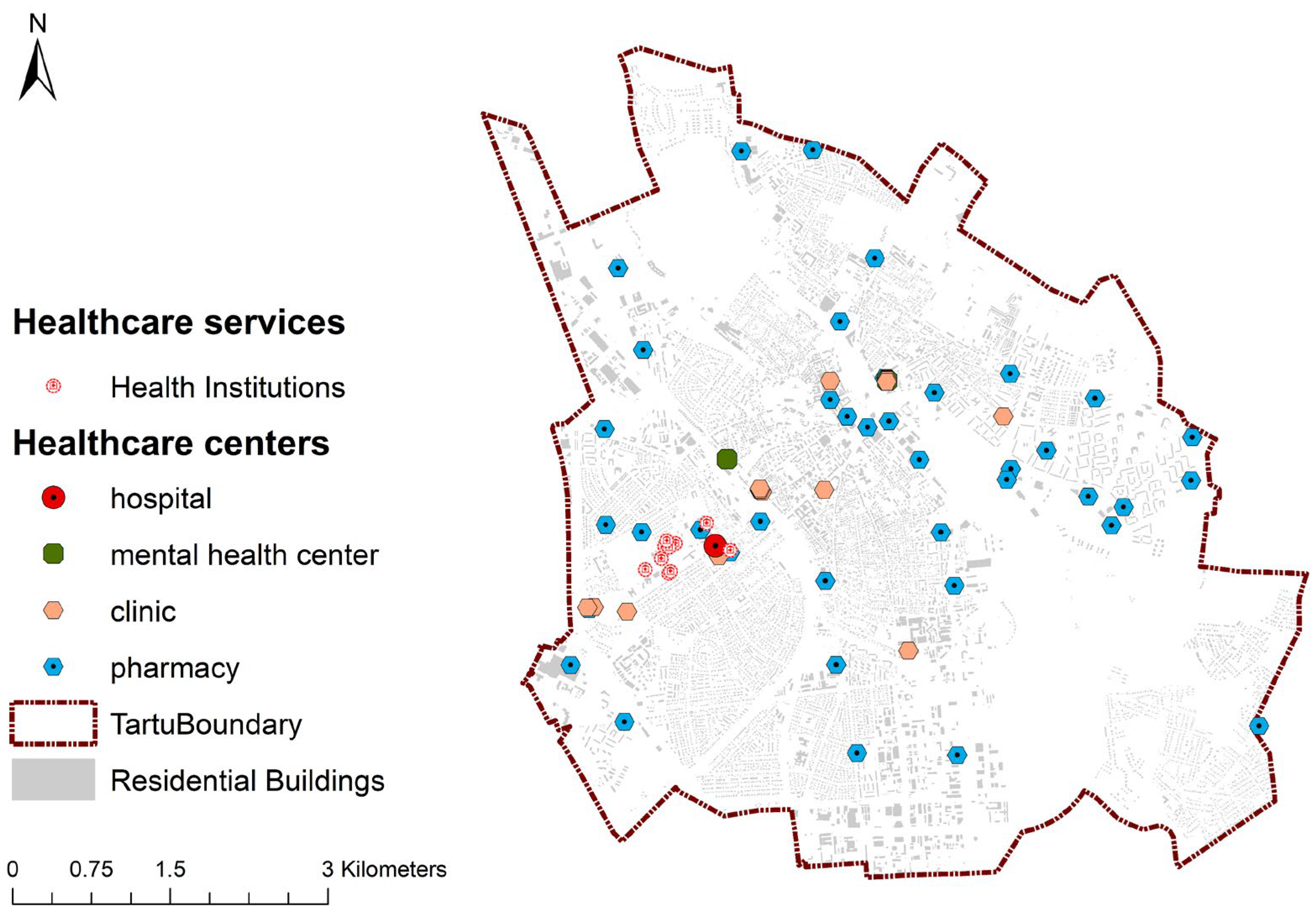
4.1.1. Health Services and Institutions
4.1.2. Public Health and Community Programs
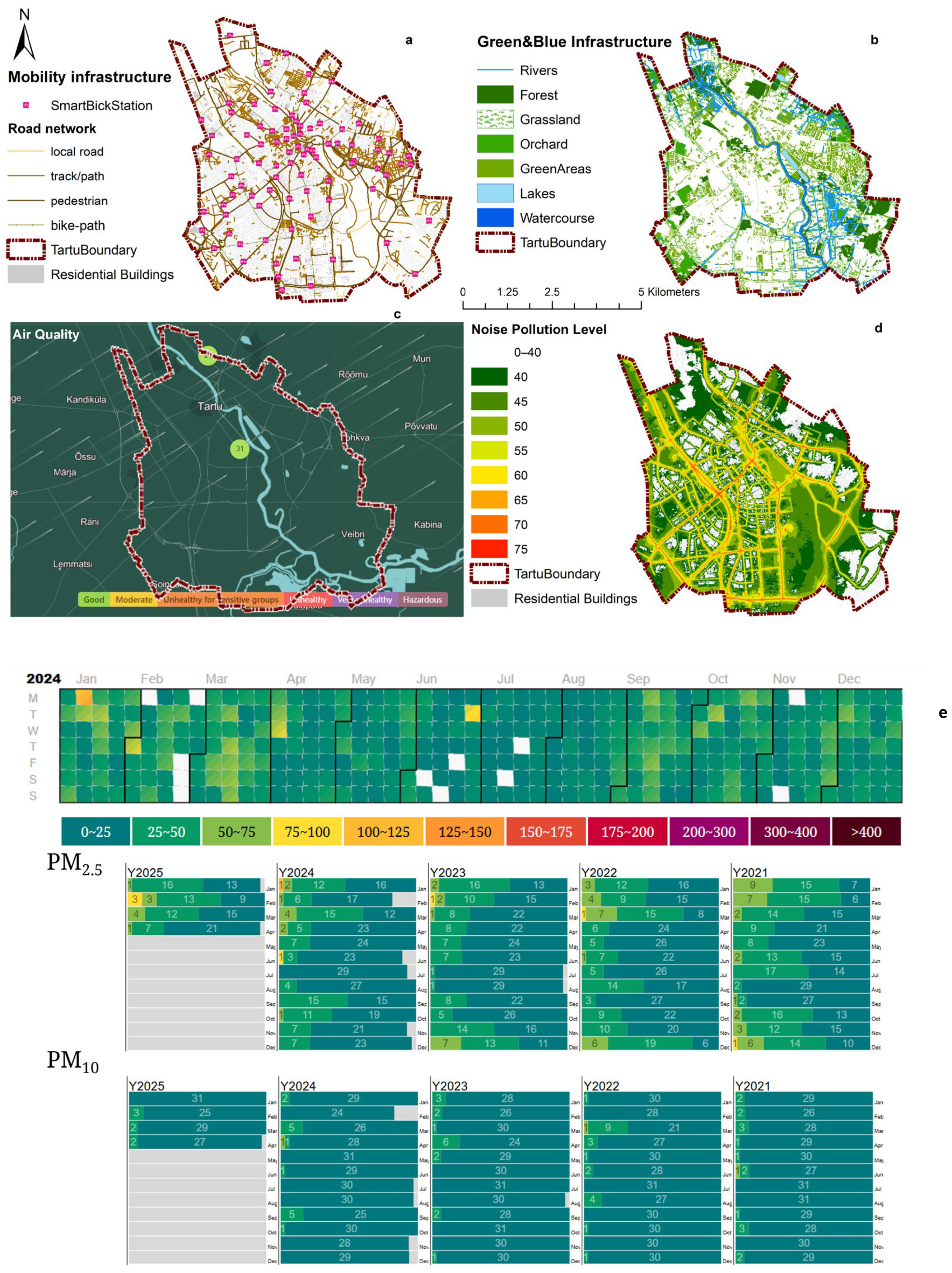
4.1.3. Environmental and Urban Health Factors
4.2. Catchment Area and Accessibility Analysis Results
4.3. Health Resource Index (HRI) Assessment
5. Discussion
5.1. Spatial Distribution and Health Justice in a Small-Scale Urban Context
5.2. Integrating the 15-Minute City and GIS-Based Accessibility Planning
5.3. Policy Implications and Pathways for Small-Scale Cities
5.4. Limitations and Future Research
6. Conclusions
Funding
Data Availability Statement
Conflicts of Interest
References
- Commission on the Social Determinants of Health. Closing the Gap in a Generation: Health Equity Through Action on the Social Determinants of Health; World Health Organization: Geneva, Switzerland, 2008. [Google Scholar]
- Marmot, M.; Bell, R. Fair society, healthy lives. Public Health 2012, 126 (Suppl. 1), S4–S10. [Google Scholar] [CrossRef]
- Soja, E.W. The city and spatial justice. Spat. Justice 2009, 1, 1–5. [Google Scholar]
- Fainstein, S.S. The just city. Int. J. Urban Sci. 2014, 18, 1–18. [Google Scholar] [CrossRef]
- Braveman, P.; Gruskin, S. Defining equity in health. J. Epidemiol. Community Health 2003, 57, 254–258. [Google Scholar] [CrossRef] [PubMed]
- Barton, H. A health map for urban planners: Towards a conceptual model for healthy, sustainable settlements. Built Environ. 2005, 31, 339–355. [Google Scholar] [CrossRef]
- Giles-Corti, B.; Vernez-Moudon, A.; Reis, R.; Turrell, G.; Dannenberg, A.L.; Badland, H.; Foster, S.; Lowe, M.; Sallis, J.F.; Stevenson, M.; et al. City planning and population health: A global challenge. Lancet 2016, 388, 2912–2924. [Google Scholar] [CrossRef]
- Higgs, G. A literature review of the use of GIS-based measures of access to health care services. Health Serv. Outcomes Res. Methodol. 2004, 5, 119–139. [Google Scholar] [CrossRef]
- Cromley, E.K.; McLafferty, S.L. GIS and Public Health, 2nd ed.; Guilford Press: New York, NY, USA, 2012. [Google Scholar]
- Apparicio, P.; Abdelmajid, M.; Riva, M.; Shearmur, R. Comparing alternative approaches to measuring the geographical accessibility of urban health services: Distance types and aggregation-error issues. Int. J. Health Geogr. 2008, 7, 7. [Google Scholar] [CrossRef]
- Tiwari, C.; Rushton, G. A Spatial analysis system for integrating data, methods and models on environmental risks and Health outcomes. Trans. GIS 2010, 14 (Suppl. 1), 177–195. [Google Scholar] [CrossRef]
- Hashtarkhani, S.; Schwartz, D.L.; Shaban-Nejad, A. Enhancing Health Care Accessibility and Equity Through a Geoprocessing Toolbox for Spatial Accessibility Analysis: Development and Case Study. JMIR Form. Res. 2024, 8, e51727. [Google Scholar] [CrossRef]
- Ding, C.; He, X.; Zhu, Y. Megacity Growth, City System and Urban Strategy. Chin. J. Urban Environ. Stud. 2022, 10, 2250005. [Google Scholar] [CrossRef]
- Yang, H.; Chen, T.; Zeng, Z.; Mi, F. Does urban green space justly improve public health and well-being? A case study of Tianjin, a megacity in China. J. Clean. Prod. 2022, 380, 134920. [Google Scholar] [CrossRef]
- ESPON. Small and Medium-Sized Towns and Cities; Policies Strengthening Their Role in Achieving Active, Inclusive, and Functional Territories; ESPON EGTC: Kirchberg, Luxembourg, 2023. [Google Scholar]
- OECD; European Commission. Cities in the World: A New Perspective on Urbanisation; OECD Publishing: Paris, France, 2020. [Google Scholar] [CrossRef]
- Boelaert, M.; Arbyn, M.; der Stuyft, V. Editorial: Geographical information systems (GIS), gimmick or tool for health district management? Trop. Med. Int. Health 1998, 3, 163–165. [Google Scholar] [CrossRef] [PubMed]
- Allam, Z.; Bibri, S.E.; Chabaud, D.; Moreno, C. The Theoretical, Practical, and Technological Foundations of the 15-Minute City Model: Proximity and Its Environmental, Social and Economic Benefits for Sustainability. Energies 2022, 15, 6042. [Google Scholar] [CrossRef]
- Moreno, C.; Allam, Z.; Chabaud, D.; Gall, C.; Pratlong, F. Introducing the “15-minute city”: Sustainability, resilience and place identity in future post-pandemic cities. Smart Cities 2021, 4, 93–111. [Google Scholar] [CrossRef]
- Tartu City Government. Tartu 2030. 2006. Available online: https://www.riigiteataja.ee/akt/1034548.pdf (accessed on 22 January 2025).
- King, L. Henri Lefebvre and the right to the city. In The Routledge Handbook of Philosophy of the City; Routledge: Abingdon, UK, 2019; pp. 76–86. [Google Scholar] [CrossRef]
- Lefebvre, H.; Kofman, E.; Lebas, E. Writings on Cities; Wiley: Hoboken, NJ, USA, 1996; Available online: https://books.google.ee/books?id=RmiKMy3ICaYC (accessed on 13 March 2025).
- Jafri, S.H.; Gandhi, S.; Osei, E. Physician Deserts: Navigating the Texas Terrain of Provider Supply and Demand with GIS Mapping. Healthcare 2024, 12, 2397. [Google Scholar] [CrossRef]
- Takano, T.; Nakamura, K.; Watanabe, M. Urban residential environments and senior citizens’ longevity in megacity areas: The importance of walkable green spaces. J. Epidemiol. Community Health 2002, 56, 913–918. [Google Scholar] [CrossRef]
- Corburn, J. Healthy City Planning: From Neighbourhood to National Health Equity; Routledge: Abingdon, UK, 2013; pp. 1–182. [Google Scholar] [CrossRef]
- Luo, J.; Chan, E.H.W.; Du, J.; Feng, L.; Jiang, P.; Xu, Y. Developing a Health-Spatial Indicator System for a Healthy City in Small and Midsized Cities. Int. J. Environ. Res. Public Health 2022, 19, 3294. [Google Scholar] [CrossRef]
- Leão, A.L.F.; Banda, B.; Xing, E.; Gudapati, S.; Ahmad, A.; Lin, J.; Sastry, S.; Jacobs, N.; Reis, R.S. Applications of artificial intelligence in public health: Analyzing the built environment and addressing spatial inequities. J. Public Health 2025, 1–11. [Google Scholar] [CrossRef]
- Sunding, A.; Randrup, T.B.; Nordh, H.; Sang, Å.O.; Nilsson, K. Descriptions of the relationship between human health and green infrastructure in six Nordic comprehensive plans. Cities 2024, 146, 104746. [Google Scholar] [CrossRef]
- Obeidat, B.; Alourd, S. Healthcare equity in focus: Bridging gaps through a spatial analysis of healthcare facilities in Irbid, Jordan. Int. J. Equity Health 2024, 23, 52. [Google Scholar] [CrossRef] [PubMed]
- Servillo, L.; Atkinson, R.; Hamdouch, A. Small and Medium-Sized Towns in Europe: Conceptual, Methodological and Policy Issues. Tijdschr. Voor Econ. Soc. Geogr. 2017, 108, 365–379. [Google Scholar] [CrossRef]
- Rojas-Rueda, D.; Norberciak, M.; Morales-Zamora, E. Advancing Health Equity through 15-min Cities and Chrono-urbanism. J. Urban Health 2024, 101, 483–496. [Google Scholar] [CrossRef] [PubMed]
- Song, G.; He, X.; Kong, Y.; Li, K.; Song, H.; Zhai, S.; Luo, J. Improving the Spatial Accessibility of Community-Level Healthcare Service toward the ‘15-Minute City’ Goal in China. ISPRS Int. J. Geo-Inf. 2022, 11, 436. [Google Scholar] [CrossRef]
- Zhao, J.; Yang, Y.; Ogasawara, K. Measuring the Inequalities in the Distribution of Public Healthcare Resources by the HRDI (Health Resources Density Index): Data Analysis from 2010 to 2019. Healthcare 2022, 10, 1401. [Google Scholar] [CrossRef]
- Wang, T.; Zhou, T.; Zhou, L.; He, Y.; Wang, J.; Wang, Y.; Huang, L. Equity and efficiency of health resource allocation in the Chengdu–Chongqing Economic Circle of China. Front. Public Health 2024, 12, 1369568. [Google Scholar] [CrossRef] [PubMed]
- Statistical Database, Statistics Estonia. Available online: https://andmed.stat.ee/en/stat/rahvastik__rahvastikunaitajad-ja-koosseis__demograafilised-pehinaitajad/RV032 (accessed on 18 October 2024).
- de Sousa Silva, C.; Viegas, I.; Panagopoulos, T.; Bell, S. Environmental justice in accessibility to green infrastructure in two European Cities. Land 2018, 7, 134. [Google Scholar] [CrossRef]
- Mozaffaree Pour, N.; Partanen, J. Planning for the urban future: Two-level spatial analysis to discover 15-Minute City potential in urban area and expansion in Tallinn, Estonia. J. Comput. Soc. Sci. 2024, 7, 777–807. [Google Scholar] [CrossRef]
- Kizielewicz, B.; Tomczyk, T.; Gandor, M.; Sałabun, W. Subjective weight determination methods in multi-criteria decision-making: A systematic review. Procedia Comput. Sci. 2024, 246, 5396–5407. [Google Scholar] [CrossRef]
- Mozaffaree Pour, N. Urban Expansion in Estonia: Monitoring, Analysis, and Modeling; University of Tartu Press: Tartu, Estonia, 2022; Available online: http://dspace.ut.ee/handle/10062/83106 (accessed on 16 November 2024).
- Zhang, R.; Peng, S.; Sun, F.; Deng, L.; Che, Y. Assessing the social equity of urban parks: An improved index integrating multiple quality dimensions and service accessibility. Cities 2021, 129, 103839. [Google Scholar] [CrossRef]
- Pearce, J.; Witten, K.; Bartie, P. Neighbourhoods and health: A GIS approach to measuring community resource accessibility. J. Epidemiol. Community Health 2006, 60, 389–395. [Google Scholar] [CrossRef]
- Soja, E.W. Seeking spatial justice. Contemp. Polit. Theory 2013, 12, e16–e18. [Google Scholar] [CrossRef][Green Version]
- Feitosa, F.O.; Wolf, J.H.; Marques, J.L. Operationalizing spatial justice in urban planning: Bridging theory with practice. Urban Res. Pract. 2024, 17, 720–736. [Google Scholar] [CrossRef]
- Lowe, M.; Adlakha, D.; Sallis, J.F.; Salvo, D.; Cerin, E.; Moudon, A.V.; Higgs, C.; Hinckson, E.; Arundel, J.; Boeing, G.; et al. City planning policies to support health and sustainability: An international comparison of policy indicators for 25 cities. Lancet Glob. Health 2022, 10, e882–e894. [Google Scholar] [CrossRef]
- Chen, Y.; Jia, S.; Xu, Q.; Xiao, Z.; Zhang, S. Measuring the dynamic accessibility to COVID-19 testing sites in the 15-min city: A focus on service congestion and mobility difference. J. Transp. Geogr. 2023, 111, 103670. [Google Scholar] [CrossRef]
- Haque, N.; Sharifi, A. Justice in access to urban ecosystem services: A critical review of the literature. Ecosyst. Serv. 2023, 67, 101617. [Google Scholar] [CrossRef]
- Moreno-Jiménez, A.; Cañada-Torrecilla, R.; Vidal-Domínguez, M.J.; Palacios-García, A.; Martínez-Suárez, P. Assessing environmental justice through potential exposure to air pollution: A socio-spatial analysis in Madrid and Barcelona, Spain. Geoforum 2016, 69, 117–131. [Google Scholar] [CrossRef]
- McLafferty, S.L. GIS and Health Care. Annu. Rev. Public Health 2003, 24, 25–42. [Google Scholar] [CrossRef]
- Glazener, A.; Sanchez, K.; Ramani, T.; Zietsman, J.; Nieuwenhuijsen, M.J.; Mindell, J.S.; Fox, M.; Khreis, H. Fourteen pathways between urban transportation and health: A conceptual model and literature review. J. Transp. Health 2021, 21, 101070. [Google Scholar] [CrossRef]
- Zhang, F.; Song, T.; Cheng, X.; Li, T.; Yang, Z. Transportation Infrastructure, Population Mobility, and Public Health. Int. J. Environ. Res. Public Health 2022, 20, 751. [Google Scholar] [CrossRef]
- Michel, S.; Banwell, N.; Senn, N. Mobility Infrastructures and Health: Scoping Review of studies in Europe. Public Health Rev. 2024, 45, 1606862. [Google Scholar] [CrossRef] [PubMed]
- Choperena-Aguilar, D.; Ramirez-Santiago, A.; Díaz, M.C.A. Measuring geospatial healthcare access to primary level facilities in Mexico: A gis-based diagnosis analysis. Cienc. Saude Coletiva 2021, 26, 2471–2482. [Google Scholar] [CrossRef] [PubMed]
- Gligorić, K.; Kamath, C.; Weiss, D.J.; Bavadekar, S.; Liu, Y.; Shekel, T.; Schulman, K.; Gabrilovich, E. Revealed versus potential spatial accessibility of healthcare and changing patterns during the COVID-19 pandemic. Commun. Med. 2023, 3, 157. [Google Scholar] [CrossRef] [PubMed]
- Brousmiche, D.; Occelli, F.; Genin, M.; Cuny, D.; Deram, A.; Lanier, C. Spatialized composite indices to evaluate environmental health inequalities: Meeting the challenge of selecting relevant variables. Ecol. Indic. 2020, 111, 106023. [Google Scholar] [CrossRef]
- Hyder, A.A.; Puvanachandra, P.; Morrow, R.H. Measuring the health of populations: Explaining composite indicators. J. Public Health Res. 2012, 1, 222–228. [Google Scholar] [CrossRef]
- Saib, M.-S.; Caudeville, J.; Beauchamp, M.; Carré, F.; Ganry, O.; Trugeon, A.; Cicolella, A. Building spatial composite indicators to analyze environmental health inequalities on a regional scale. Environ. Health 2015, 14, 68. [Google Scholar] [CrossRef]
- Mitropoulos, L.; Karolemeas, C.; Tsigdinos, S.; Vassi, A.; Bakogiannis, E. A composite index for assessing accessibility in urban areas: A case study in Central Athens, Greece. J. Transp. Geogr. 2023, 108, 103566. [Google Scholar] [CrossRef]





| Data Layer | Description | Sources |
|---|---|---|
| Health Infrastructure | Geolocated point data for hospitals, polyclinics, and mental health centers. | OpenStreetMap |
| Public Health Amenities & Mobility Infrastructure | Digitized locations of the Tartu Health Trail & walkable pathway networks, bike-share stations & roots, bicycle lanes, pedestrian paths, and hobby centers (e.g., sports or fitness venues). | Tartu city government geoportal, OpenStreetMap |
| Green & Blue Spaces | Digitized polygons representing parks, natural green areas, the Emajõgi River, and smaller lakes & water bodies. | Estonian land board geoportal (Estonian Topographic Database (ETAK)) |
| Environmental Health Factors | Air Quality: Data on PM2.5 and PM10 concentrations (0–75 µg/m3), averaged over the past four years. Noise Pollution: Sound levels in dB, classified from quiet residential zones to moderate urban traffic areas. | Tartu city government geoportal, World Air Quality Historical Database, Estonian Environmental Agency |
| Population Data | Residential population density, spatialized at hexagonal grids (100 m2), allowing for population-weighted calculations of access and infrastructure equity. | Tartu city government geoportal |
| Districts | Population | Population-Weighted HRI | Rank (Citywide) | Priority Level (Equity Gap) |
|---|---|---|---|---|
| Annelinn | 25,135 | 0.351 | 7 | Medium |
| Ihaste | 2974 | 0.097 | 15 | High |
| Jaamamõisa | 3418 | 0.177 | 12 | High |
| Karlova | 8735 | 0.347 | 8 | Medium |
| Kesklinn | 6948 | 0.972 | 1 | Low |
| Kvissentali | 838 | 0.037 | 17 | High |
| Maarjamõisa | 456 | 0.591 | 3 | Low |
| Raadi-Kruusamäe | 4789 | 0.317 | 9 | Medium |
| Ränilinn | 2118 | 0.097 | 14 | High |
| Ropka | 4732 | 0.377 | 6 | Medium |
| Supilinn | 2243 | 0.169 | 13 | High |
| Tähtvere | 3218 | 0.243 | 11 | Medium |
| Tammelinn | 8135 | 0.396 | 4 | Medium |
| Ülejõe | 7749 | 0.694 | 2 | Low |
| Vaksali | 3119 | 0.260 | 10 | Medium |
| Variku | 1749 | 0.054 | 16 | High |
| Veeriku | 5204 | 0.385 | 5 | Medium |
Disclaimer/Publisher’s Note: The statements, opinions and data contained in all publications are solely those of the individual author(s) and contributor(s) and not of MDPI and/or the editor(s). MDPI and/or the editor(s) disclaim responsibility for any injury to people or property resulting from any ideas, methods, instructions or products referred to in the content. |
© 2025 by the author. Published by MDPI on behalf of the International Society for Photogrammetry and Remote Sensing. Licensee MDPI, Basel, Switzerland. This article is an open access article distributed under the terms and conditions of the Creative Commons Attribution (CC BY) license (https://creativecommons.org/licenses/by/4.0/).
Share and Cite
Mozaffaree Pour, N. GeoSpatial Analysis of Health-Oriented Justice in Tartu, Estonia. ISPRS Int. J. Geo-Inf. 2025, 14, 467. https://doi.org/10.3390/ijgi14120467
Mozaffaree Pour N. GeoSpatial Analysis of Health-Oriented Justice in Tartu, Estonia. ISPRS International Journal of Geo-Information. 2025; 14(12):467. https://doi.org/10.3390/ijgi14120467
Chicago/Turabian StyleMozaffaree Pour, Najmeh. 2025. "GeoSpatial Analysis of Health-Oriented Justice in Tartu, Estonia" ISPRS International Journal of Geo-Information 14, no. 12: 467. https://doi.org/10.3390/ijgi14120467
APA StyleMozaffaree Pour, N. (2025). GeoSpatial Analysis of Health-Oriented Justice in Tartu, Estonia. ISPRS International Journal of Geo-Information, 14(12), 467. https://doi.org/10.3390/ijgi14120467