
Article

Novel MLR-RF-Based Geospatial Techniques: A Comparison with OK
1
Intelligent Information Processing Lab, National Centre of Artificial Intelligence, University of Engineering and Technology, Peshawar 25000, Pakhtunkhwa, Pakistan
2
Department of Mining Engineering, University of Engineering and Technology, Peshawar 25000, Pakhtunkhwa, Pakistan
3
Minerals Engineering Research Group, Camborne School of Mines, University of Exeter, Penryn, Cornwall TR10 9FE, UK
4
Department of Geological and Mining Engineering and Sciences, Michigan Technological University, Houghton, MI 49931, USA
5
Department of Mineral Resource Engineering, Pak-Austria Fachhochschule: Institute of Applied Sciences and Technology, Mang, Haripur 22621, Pakhtunkhwa, Pakistan
*
Author to whom correspondence should be addressed.
ISPRS Int. J. Geo-Inf. 2022, 11(7), 371; https://doi.org/10.3390/ijgi11070371
Submission received: 19 May 2022 / Revised: 24 June 2022 / Accepted: 26 June 2022 / Published: 1 July 2022

Abstract

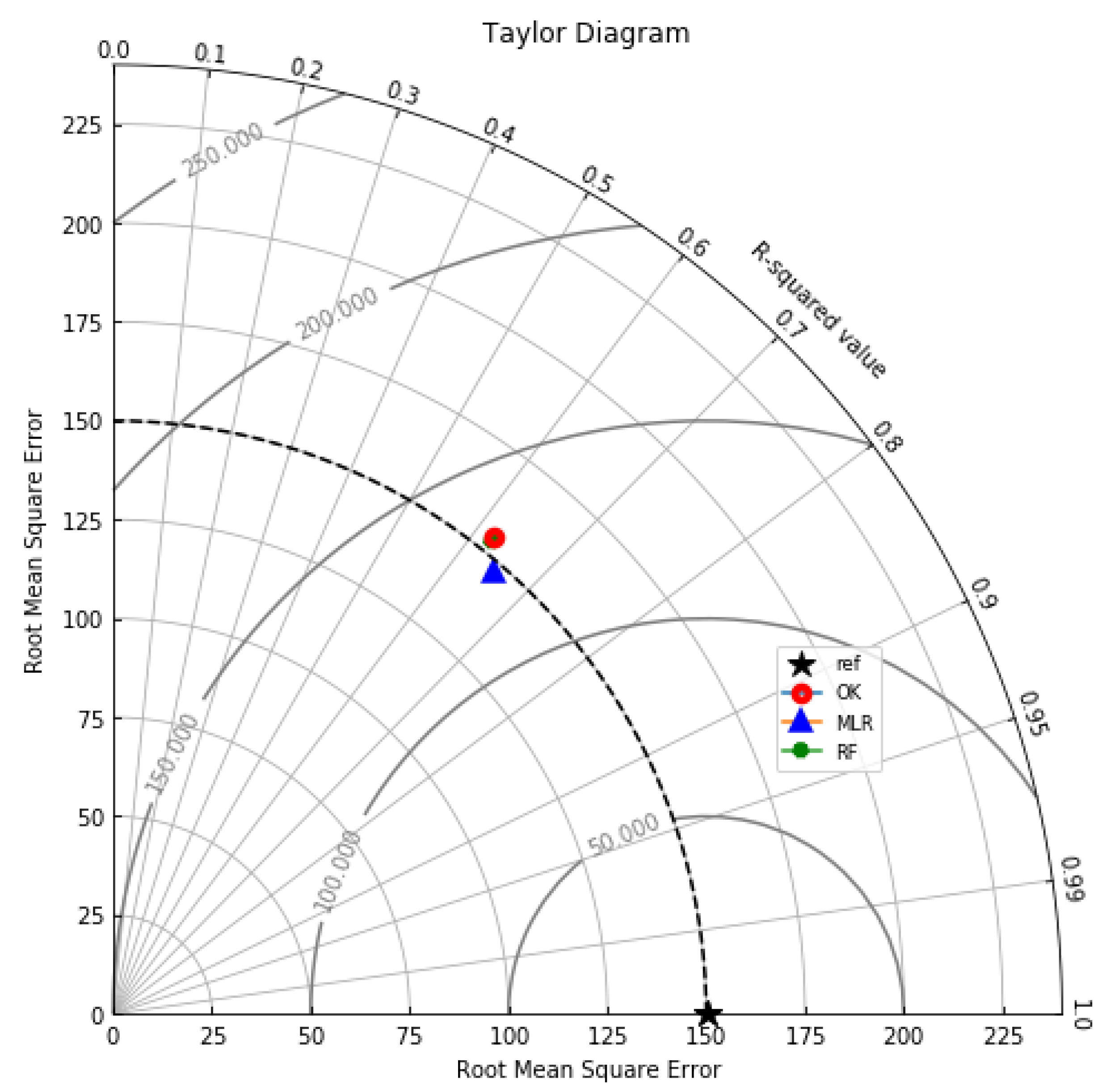
Geostatistical estimation methods rely on experimental variograms that are mostly erratic, leading to subjective model fitting and assuming normal distribution during conditional simulations. In contrast, Machine Learning Algorithms (MLA) are (1) free of such limitations, (2) can incorporate information from multiple sources and therefore emerge with increasing interest in real-time resource estimation and automation. However, MLAs need to be explored for robust learning of phenomena, better accuracy, and computational efficiency. This paper compares MLAs, i.e., Multiple Linear Regression (MLR) and Random Forest (RF), with Ordinary Kriging (OK). The techniques were applied to the publicly available Walkerlake dataset, while the exhaustive Walker Lake dataset was validated. The results of MLR were significant (p < 10 × 10−5), with correlation coefficients of 0.81 (R-square = 0.65) compared to 0.79 (R-square = 0.62) from the RF and OK methods. Additionally, MLR was automated (free from an intermediary step of variogram modelling as in OK), produced unbiased estimates, identified key samples representing different zones, and had higher computational efficiency.
Keywords: Ordinary Kriging (OK); random forest (RF); Machine Learning Algorithms (MLA); geostatistics; spatial estimation; SHAP; interpretable machine learning Ordinary Kriging (OK); random forest (RF); Machine Learning Algorithms (MLA); geostatistics; spatial estimation; SHAP; interpretable machine learning