Review

Bibliometric Analysis on Control Architectures for Robotics in Agriculture

1
Consiglio per la Ricerca in Agricoltura e l’Analisi dell’Economia Agraria (CREA), Centro di Ricerca Ingegneria e Trasformazioni Agroalimentari, Via Della Pascolare 16, 00015 Monterotondo, Italy
2
Dipartimento di Ingegneria Civile e Ingegneria Informatica, Università di Roma Tor Vergata, Via del Politecnico 1, 00133 Rome, Italy
*
Author to whom correspondence should be addressed.
Robotics 2026, 15(4), 75; https://doi.org/10.3390/robotics15040075
Submission received: 26 February 2026 / Revised: 31 March 2026 / Accepted: 2 April 2026 / Published: 3 April 2026
(This article belongs to the Section Agricultural and Field Robotics)

Abstract

(1) Background: Robotics and advanced control architectures are increasingly central to the development of precision agriculture (PA), supporting automated, efficient, and data-driven farm management. This review offers a comprehensive analysis of scientific literature on robotic control systems applied to PA, focusing on technological progress, methodological approaches, and emerging research trends. (2) Methods: A systematic review was conducted according to PRISMA guidelines, combined with a bibliometric analysis using VOSviewer to examine term co-occurrences, thematic clusters, and topic evolution over time. Publications indexed in Scopus between 1976 and 2025 were analyzed. (3) Results: Results reveal a sharp growth in publications after 2010, with a strong acceleration from 2015 onward, reflecting advances in autonomous systems and the integration of artificial intelligence, sensor technologies, and distributed software frameworks. Three principal clusters emerged: algorithmic and control methods (e.g., neural networks, path tracking, simulation); sensing and infrastructure technologies (e.g., LiDAR, SLAM, IMU, ROS, deep learning-based perception); and agronomic applications, including crop monitoring, irrigation, yield estimation, and farm management. Citation trends indicate a shift from foundational control theory to AI-driven solutions. (4) Conclusions: Overall, control architectures are evolving toward modular, scalable, and interoperable systems enabling autonomous decision-making in complex agricultural environments.

1. Introduction

Precision agriculture (PA) allows agricultural operations to be managed through automated systems, saving the cost of manual activities and preventing the risks associated with them. PA involves crop monitoring, and field measurement through automated sensors, technologies, and robotic systems [1].
Generally, robotics not only reduces labour costs, but also helps increase agricultural productivity because the required labour force, including skilled machine operators, generally decreases enough to offset the higher initial cost [2].
Robots used in PA fall into two categories based on their operation and method of control: individual robotic systems and multi-robot systems. The former consists of sensors that allow specific tasks (such as planting or harvesting) to be performed autonomously, while the latter consist of a set of several robots that perform many different operations within the same agricultural area, covering large areas efficiently [3].
The control architectures underlying these robotic systems can be classified into centralized, hierarchical, distributed and hybrid configurations. These categories differ in terms of how decision-making, communication and task coordination are structured within the system, and their suitability depends on the complexity and scale of the agricultural application. Supporting these control architectures requires robust data management infrastructures, as the increasing use of robotic platforms in agriculture is generating large volumes of diverse data from various sources. These include soil sensors measuring parameters such as moisture and pH, drones capturing aerial images of crops, satellite systems monitoring weather conditions and agricultural machinery with GPS technology. Such large-scale data streams require advanced software infrastructures capable of supporting real-time data ingestion, communication and analysis. Open-source technologies such as Apache Kafka and Apache Spark are therefore increasingly being adopted to build scalable data pipelines and support real-time decision-making systems in agricultural contexts [4]. In addition, Kafka is excellent for creating real-time data pipelines because of its ability to process more than 2 million writes per second without any data loss [4]. Some works have examined the potential of big data architectures for managing and processing the substantial volumes of data produced in smart agricultural environments. For example, distributed frameworks based on Apache Kafka and Apache Spark have been suggested as a means of supporting the real-time ingestion and analysis of data from a variety of agricultural sources, including sensor networks and environmental monitoring systems. These architectures facilitate the creation of scalable processing pipelines that can analyze parameters such as weather conditions, soil characteristics and crop monitoring data in real time, thereby improving the timeliness and effectiveness of agronomic decision-making [5]. Whilst data management infrastructures handle the flow of information, the implementation of control architectures also makes use of dedicated middleware, such as the Robot Operating System (ROS). It consists of a set of libraries and software tools that include advanced drivers and algorithms to help developers create robotic applications [6]. Several studies have proposed practical implementations based on ROS, addressing different aspects of control architecture design in agricultural robotics. In the work of Liu et al. [7], an innovative solution for creating digital maps of agricultural areas and remote control of robots using virtual reality is presented. The system integrates VR technology on Android devices with ROS-controlled robots, surpassing traditional screen-based methods. This approach allows operators to better perceive the three-dimensional environment, providing a more immersive and detailed control experience. Using machine-mounted cameras, it is possible to precisely observe what is happening in the immediate vicinity of the robot, while the 3-D view provides a broader overview of the entire cultivated area. Another relevant aspect is that the system is not tied to a specific type of hardware, making it easily adaptable to different types of farm machinery. This feature makes remote control more efficient and safer, especially for operations that are potentially dangerous to humans, thus contributing to smarter and more sustainable management of agricultural activities. Arlotta et al. [8] presents a modular ROS-based architecture to enable a mobile robot for object detection and relative localization in a precision agriculture context. The system integrates visual sensors and computer vision algorithms to identify relevant features in the field and estimate their position relative to the robot, thus improving the machine’s spatial awareness. Due to the flexible structure of ROS, the different components are efficiently integrated. Results demonstrated the system’s reliability in identifying objects and following them correctly during navigation, making a concrete contribution to autonomous agricultural robotics. A complete control architecture based on the recent version ROS2 has been proposed for UAV (UxV) showing increasing capability of dealing with distributed nodes (sensor/actuators/agents) hinging upon messaging protocol such as Data Distribution System (DDS) and standard Quality of Service (QoS) to enhance intra-nodes communication reliability and robustness, which are extremely appealing features for PA [9].
The studies discussed above address a range of applications, including autonomous navigation systems, object detection, remote control and digital mapping of agricultural environments. Despite the variety of solutions described, the current literature does not yet provide a comprehensive overview of the control architectures used in PA robotic systems. The various proposals often based on middleware (ROS/ROS2), publish-subscribe mechanisms, heterogeneous abstraction levels, and non-uniform sensory models. These solutions appear as isolated contributions, lacking a comparative framework that highlights their coherences, differences, and limitations. This fragmentation makes it difficult to understand which architectures are actually more robust, scalable, or suited to different agronomic scenarios, especially given the growing demands for interoperability, computational load distribution, and integration between predictive models, simulation, and operational deployment. This highlights the need to outline the main technologies driving the development of autonomous systems in precision agriculture. Research in this field span multiple disciplines, including robotics, agricultural engineering, computer science and data science. Consequently, there is still a lack of a comprehensive overview of the evolution, structure, and emerging trends of robotic control architectures in precision agriculture. To address this gap, the present study uses a bibliometric analysis to examine the scientific literature on robotic control architectures in precision agriculture. Publications indexed in Scopus between 1976 and 2025 were analyzed using a mapping and visualization process conducted with VOSviewer software. Through the analysis of publication trends, research clusters, and thematic relationships, the study provides a structured and comprehensive overview of the evolution of control architectures in agricultural robotics. The results help to identify the main technological trajectories, key research topics and emerging directions in the field, thereby supporting future scientific research and the development of increasingly autonomous, scalable and data-driven robotic solutions for precision agriculture.

2. Materials and Methods

The present study addresses the following research question: what are the main control architectures adopted in robotic systems for precision agriculture, and how have they evolved over time?
Studies were included if they focused on robotics, control systems, or software architectures applied to precision agriculture, were published in peer-reviewed journals or conference proceedings, and were written in English for the period 1976–2025. Publications not related to agricultural applications, lacking relevance to control architectures, or classified as non-scientific documents were excluded.
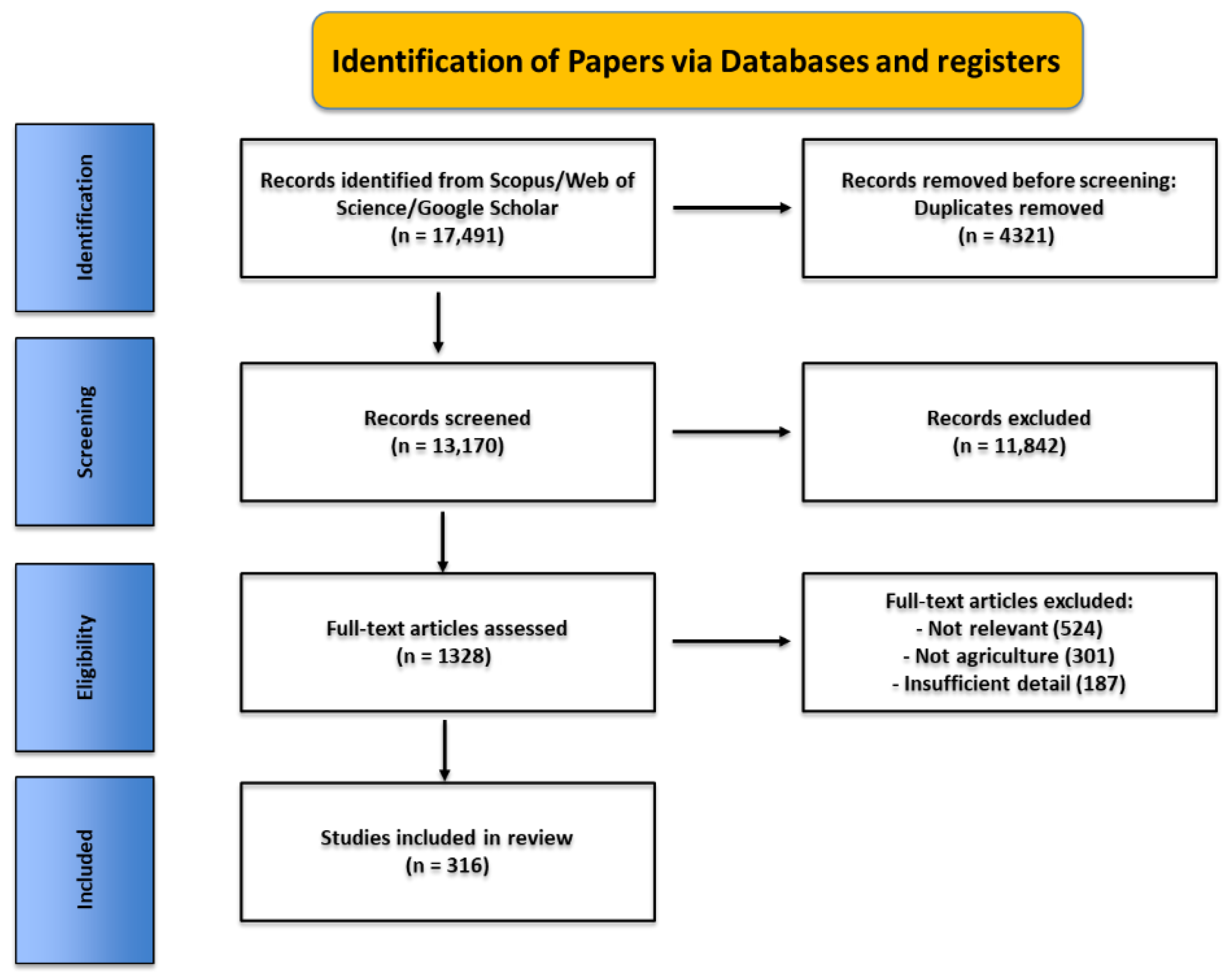
The study selection followed a multi-stage screening process in accordance with PRISMA guidelines, comprising identification, deduplication, screening, eligibility assessment, and final inclusion, as detailed in the Supplementary Material S4 [10].

2.1. Research Methodology

The approach taken in this study is based on systematic literature review (SLR), which is a structured methodology for managing and analyzing information sources from research related to specific predefined topics [11]. Specifically, SLR was used to assess the feasibility and analyze robotic control architectures applied to precision agriculture (PA).
The search was initially conducted using the term ‘robot*,’ then expanded with the generic keyword ‘agricult*’ in order to include all its variants in the titles, abstracts and keywords of the articles. The selection covered studies that included approaches related to ‘system,’ ‘control,’ ‘kafka,’ and ‘ros’ in PA.
To ensure the quality and reliability of the review, the Preferred Reporting Items for Systematic Reviews and Meta-Analyses (PRISMA) protocol, one of the most recognized standards for SLRs, was adopted. PRISMA [10] provides a detailed checklist useful for assessing the methodological validity of articles included in the systematic review or meta-analysis [11].
The main steps involved in PRISMA include the following.
  • Title: must clearly indicate that it is a systematic review or meta-analysis.
  • Abstract: must be structured and include context, methods, results and conclusions.
  • Introduction: must highlight the relevance of the review and specify its objectives.
  • Methodology: must detail the process of searching for sources in scientific databases, specifying the inclusion and exclusion criteria adopted.
  • Results describe with a diagram the selection process of the article.
  • Discussion section on the relevance and plausibility of the findings. The limitations they face start from the study selection process to the limitations in the process.
  • Conclusions from findings from systematic reviews and/or meta-analyses are brief, concise, and clear.
PRISMA explanation flow can be seen in Figure 1.

2.2. Database Search

The Scopus database was accessed on 26 April 2025 and used to retrieve bibliographic records related to research on robotic control architectures in PA for the period 1976–2025; 12,066 publications were identified in the initial stages. To identify relevant publications on the topic of interest, the following keywords were used in the combined fields of title, abstract, and keyword (for each publication): TITLE-ABS-KEY (robot*) AND TITLE-ABS-KEY (agricult*) AND (TITLE-ABS-KEY (system AND control) OR (kafka) OR (ros)). Because the Scopus search was conducted in April 2025, publications from 2024 to 2025 had not yet been fully entered into the Scopus database by Scopus staff and may be underestimated. Only terms that recurred at least 10 times were extracted. The SCOPUS database was chosen because it contains a wide selection of scientific literature in this field, equivalent to the ISI Web of Science.
At this stage, we created a thesaurus file of the terms where consistency in their spelling was ensured and where only one term was selected among synonyms (Supplementary Material S1). The terms that were too general were eliminated by manual screening (based on the consensus by all the authors of the study) and replaced with AAAA in the thesaurus file. This thesaurus was then used for subsequent analysis.

2.3. Analysis of Term Co-Occurrence with VOSviewer

Visualization of Similarities (VOS) viewer software was used (Centre for Science and Technology Studies, Leiden University, the Netherlands—hereinafter VOSviewer, version 1.6.16; www.vosviewer.com; accessed on 26 April 2025) to create a bibliometric map of terms, where they appear classified according to their importance (number of times they have been found) and interrelated according to their co-affiliation in the publications.
The software used VOS mapping technique to display terms. This technique is closely related to the multidimensional scaling method [12] and involves the use of an intelligent local displacement algorithm [13] to identify relationships within a network of voices. The map is based on the co-occurrence of two terms within an article (in the title, abstract or keywords); each of these co-occurring terms is displayed on the map and connected by a line. The terms that co-occur frequently are found next to each other on this map, while for those that are weakly related (never or only a few times co-occur; rarely co-occur separately with a third term, etc.), each term is identified by a sphere whose size indicates the number of publications in which the term appears [12,13]. The lines between the terms are generated according to the level of interconnection, and for clarity only the most obvious ones are displayed. Within the map, some terms become ‘nodes’, that is, terms that are at the centre of multiple connections. At the next level of interrelation, the map is divided into ‘clusters’ of terms, where some of these terms are nodes. A cluster represents a set of closely related terms. Each term or node appears in a single cluster. The total number of clusters is defined by a ‘resolution parameter’, which is a parameter that determines the resolution of the analysis (low resolution generates fewer clusters; high resolution generates more clusters). This parameter is set manually. The resolution parameter was set to 0.95, which proved to be the most appropriate level of detail in the cluster structure (considering the ratio between mean inter- and intra-cluster distances) for subsequent analysis and discussion. The map can be viewed in its entirety or parts of it can be selected, allowing you to investigate particular areas, particular connections, etc. During these surveys, lines may appear that link terms not observed in the general map because they are of greater relative importance at that scale. The VOSviewer network files for navigating maps are available in the Supplementary Materials S2 and S3. The VOSviewer software allows you to highlight the network of nearest terms by clicking on one of them. We used this feature to highlight the networks of the most closely related terms around some relevant nodes [14].

3. Results and Discussions

3.1. Number of Publications

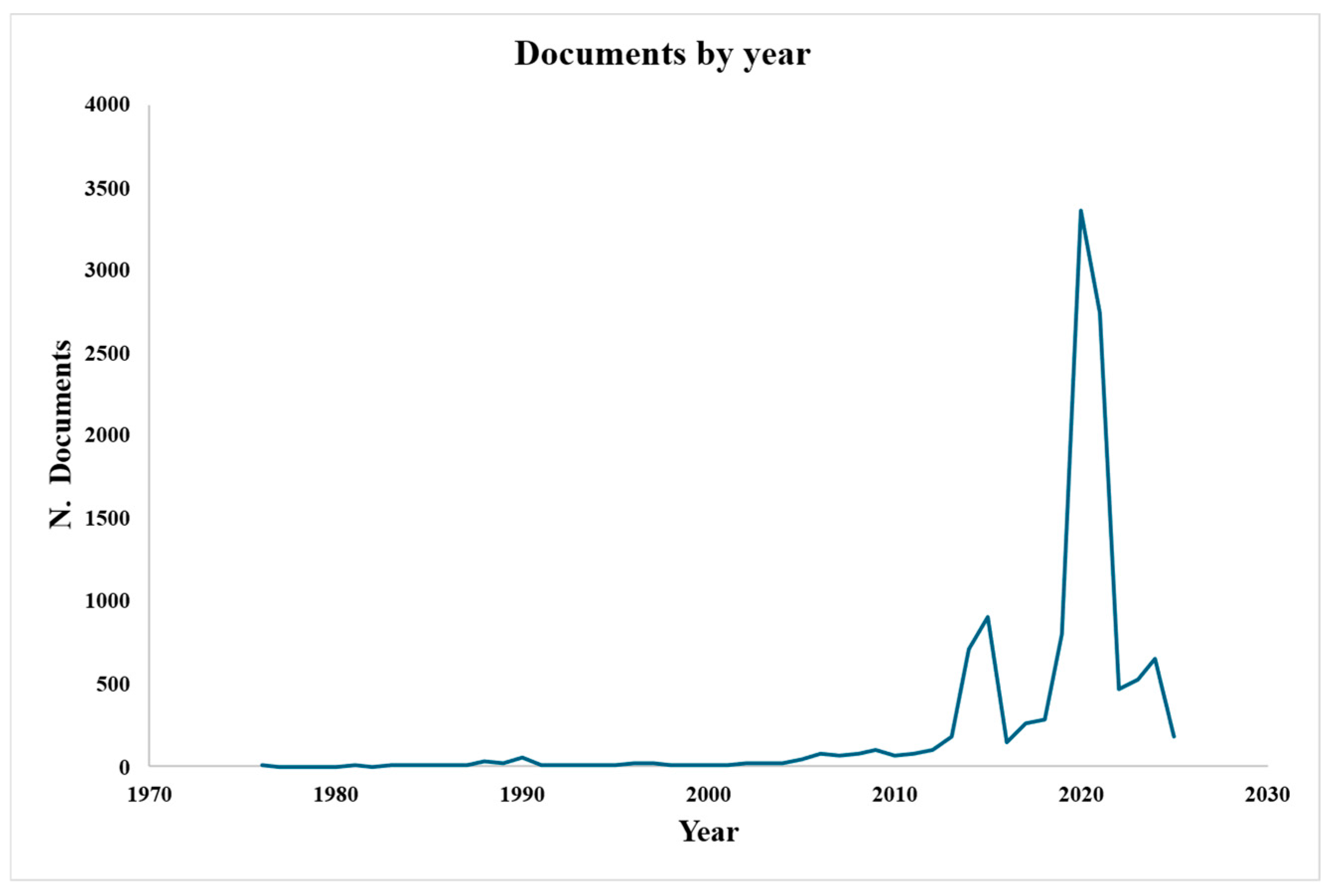
Figure 2 shows the trend over time in the number of publications related to research on robotic control architectures in PA. From the graph, it can be seen that from 1976, publications appeared in almost no quantity until 2010. A gradual increase can be observed after 2010, followed by a more pronounced growth starting around 2015. The highest number of publications is recorded in 2020, with 3357 documents, indicating a strong research peak activity during the last decade.
Bibliometric studies have highlighted a significant increase in scientific output on artificial intelligence and robotics in agriculture, with growth observed since 2015 and a sharp rise since 2019. Whilst existing reviews and bibliometric studies have analyzed this trend from a high-level technological perspective—such as physical hardware, the sensors used in robotics [15] and the role of artificial intelligence in agri-robotics [16]—the software infrastructure, which enables communication between these systems, has received less attention [17]. The architectures, which include distributed communication frameworks, modular systems and real-time data streaming pipelines, serve as an essential operational bridge between perceptual hardware and AI-based cognitive layers.
The publication pattern observed in Figure 2 is consistent with these broader developments reported in previous studies.
The low number of publications in 2025 is due to the fact that the research considered only includes the first few months of the year. Therefore, the number is underestimated and will probably grow over time following the same pattern.

3.2. Term Analysis on VOSviewer Software

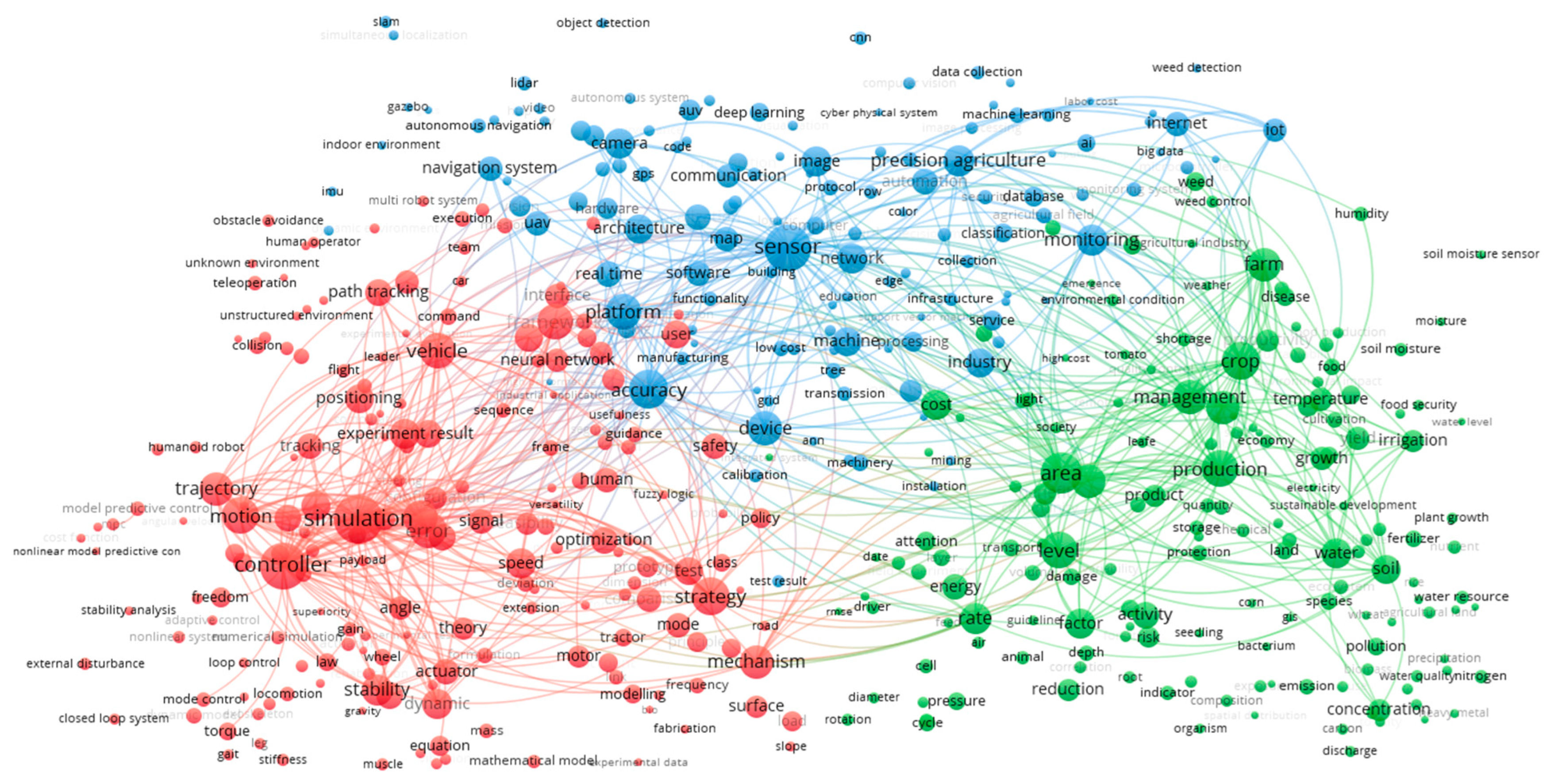
In the term map (Figure 3), the 489 terms displayed on the map are grouped into three clusters, which partially overlap and whose colours were chosen arbitrarily for visual purposes. The red cluster (189 terms) associates terms related to artificial intelligence and algorithms such as: neural network, vehicle, framework, path tracking, humanoid robot etc. These terms are part of autonomous agricultural systems, as they are the foundation of the criteria that ensure stability, robustness and operational precision in unstructured environments. Indeed, path tracking and autonomous vehicle control are among the most studied topics for agricultural automation, with approaches ranging from classical control to hybrid and learning-based methods. Moreover, the strong presence of terms related to simulation and control frameworks indicates the widespread use of virtual prototyping and digital simulation environments for the design, validation, and optimization of autonomous agricultural robotic systems before field deployment [18,19]. What becomes clear is that until control system become truly adaptable to a wide range of agricultural conditions, robotics for PA will remain confined to a ‘simulated’ context without any real-world feedback.
The blue cluster (162 terms) includes terms related to PA-related sensing represented by terms such as: sensor, device, platform, precision agriculture, deep learning, lidar, ros, slam, imu, cnn, etc. These technologies provide the data acquisition and perception capabilities required for navigation, localisation, crop monitoring, and environment mapping. Deep learning and CNN-based perception methods are increasingly adopted for crop and weed detection, phenotyping, and yield estimation, while SLAM and LiDAR-based localisation are critical for autonomous navigation in outdoor agricultural environments. This cluster therefore represents the interface between the physical environment and the algorithmic control layer, enabling data-driven autonomy in PA systems. Moreover, the existence of middleware platforms such as ROS highlights the importance of modular and interoperable software frameworks for integrating heterogeneous sensors and robotic subsystems [20,21]. The blue cluster includes the means by which data is acquired from the physical world. The distinction of this cluster makes sense because it isolates the hardware (and related low-level software) that serves as a bridge between the algorithms and the application context. This highlights the structural need for robust, standardized, and scalable platforms capable of managing the entire sensing ecosystem in a consistent manner and ensuring operational reliability under real-world agricultural conditions.
The green cluster (138 terms) has associated terms related to the application fields of sensoristics and AI such as: crop, farm, irrigation, yield, farm, food security, etc. It can be said that the red cluster captures the ‘foundational’ level of technology. It is a useful distinction because these terms are not application-specific but cut across many contexts. These terms reflect the deployment of robotic and AI technologies to support crop monitoring, irrigation management, yield prediction, and farm-level decision-making. This cluster captures the domain-specific objectives that drive the development of sensing and control technologies in PA systems, linking technological advances to productivity and sustainability goals. Overall, this cluster represents the final deployment context in which robotic and AI-based architectures are applied to real-world agricultural challenges. The presence of food security-related terms highlights the increasing role of PA technologies in addressing global sustainability and resource-efficiency challenges [1,2,3,4,5,6,7,8,9,10,11,12,13,14,15,16,17,18,19,20,21,22].
Specifically, different agronomic conditions impose specific constraints that directly influence the design of robotic control architectures. There are various requirements that must be considered when designing a control architecture, such as field topology, crop geometry, canopy density, soil variability, and operational timing, which influence sensing configurations (e.g., sensor height and baseline, LiDAR resolution, camera spectral range), and navigation strategies (path curvature, obstacle prediction, slip compensation).
So, the green cluster clearly delineates the application domain, in this case agriculture. This cluster represents the final level, i.e., the target or context in which the technologies are deployed.
There is a clear evolutionary trajectory for robotics within the field of precision agriculture, characterized by technological progress that builds on previous achievements, moving from the fundamentals of control and modelling, through sensor integration and artificial intelligence, to ultimately reach field operations. This trajectory highlights the scientific value arising from the convergence of technical innovation and practical application, as demonstrated by the strong focus on topics that combine advanced technologies (SLAM, LiDAR, deep learning) with real-world agronomic challenges (weed control, disease detection, food safety).
The importance of data: sensors, databases, perception models, and simulation environments constitute the information infrastructure that enables technological progress in PA, where the quality and management of information determine the maturity and scalability of solutions.
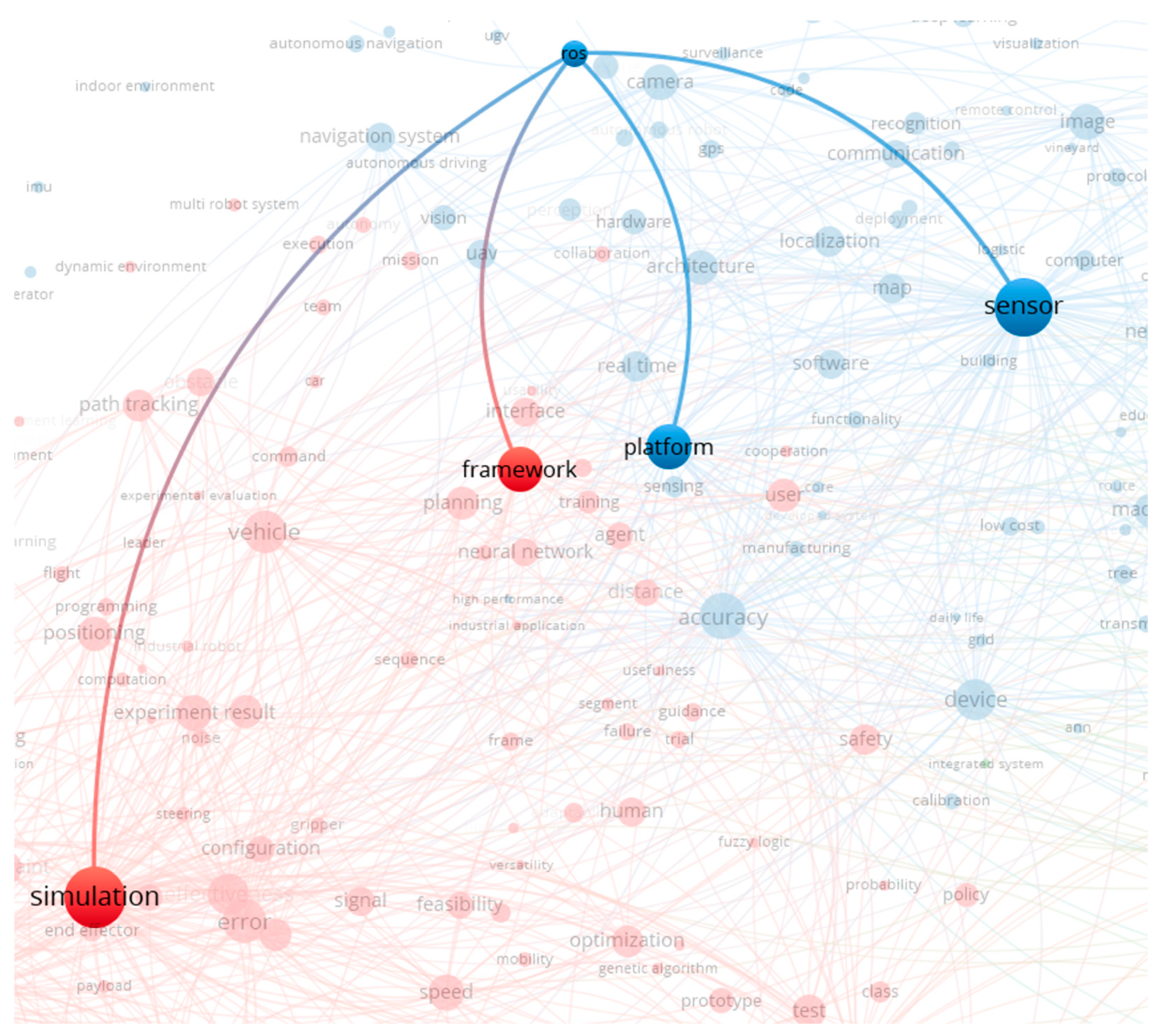
Figure 4 shows a close correlation between the terms ROS, sensor, simulation, framework and platform. Indeed, within advanced robotic systems, particularly in agriculture and industry, terms such as ROS (Robot Operating System), simulation, framework, platform and sensor appear to be closely interlinked. The connections with ‘platform’ and ‘sensor’ reflect the use of ROS as a modular, open-source software framework that enables the development and integration of heterogeneous robotic components, facilitating the management of data from multiple sensors (such as lidar, IMU or cameras). ROS has established itself for the development of complex robotic systems, thanks to its ability to support modular design, distributed communication, and the integration of heterogeneous hardware and software components [23]. Its open-source nature and extensive ecosystem of libraries and packages have significantly accelerated research and development of autonomous systems, particularly in the field of PA [24].
As a platform, ROS provides a unified environment for communication between hardware and software modules, enabling scalable and interoperable development of complex applications. Its association with ‘simulation’ is consistent with the use of tools such as Gazebo or RViz, which are fully integrated with ROS, allowing testing and validation of navigation algorithms, sensory models and control strategies in realistic virtual environments before their application in the real world [25]. Overall, frameworks and platforms emerge as elements that enable interoperability and scalability in the development of complex applications, in line with the requirements of advanced robotic systems.
From a quantitative perspective, the frequency of the ROS node is lower than that of more established terms such as ‘simulation’ or ‘sensor’, indicating less frequent use in the literature. This is consistent with the relative ‘youth’ of the framework. Although its presence is more limited, ROS’s position and links with other terms highlight its role as a bridge in the interconnection between heterogeneous hardware and software components and in linking virtual experimentation with real-world implementation.
In summary, Figure 4 outlines an architecture in which simulation, platforms/frameworks and sensors are closely interconnected; within this, ROS acts as a coordinating infrastructure whose importance is set to grow, particularly in PA applications.
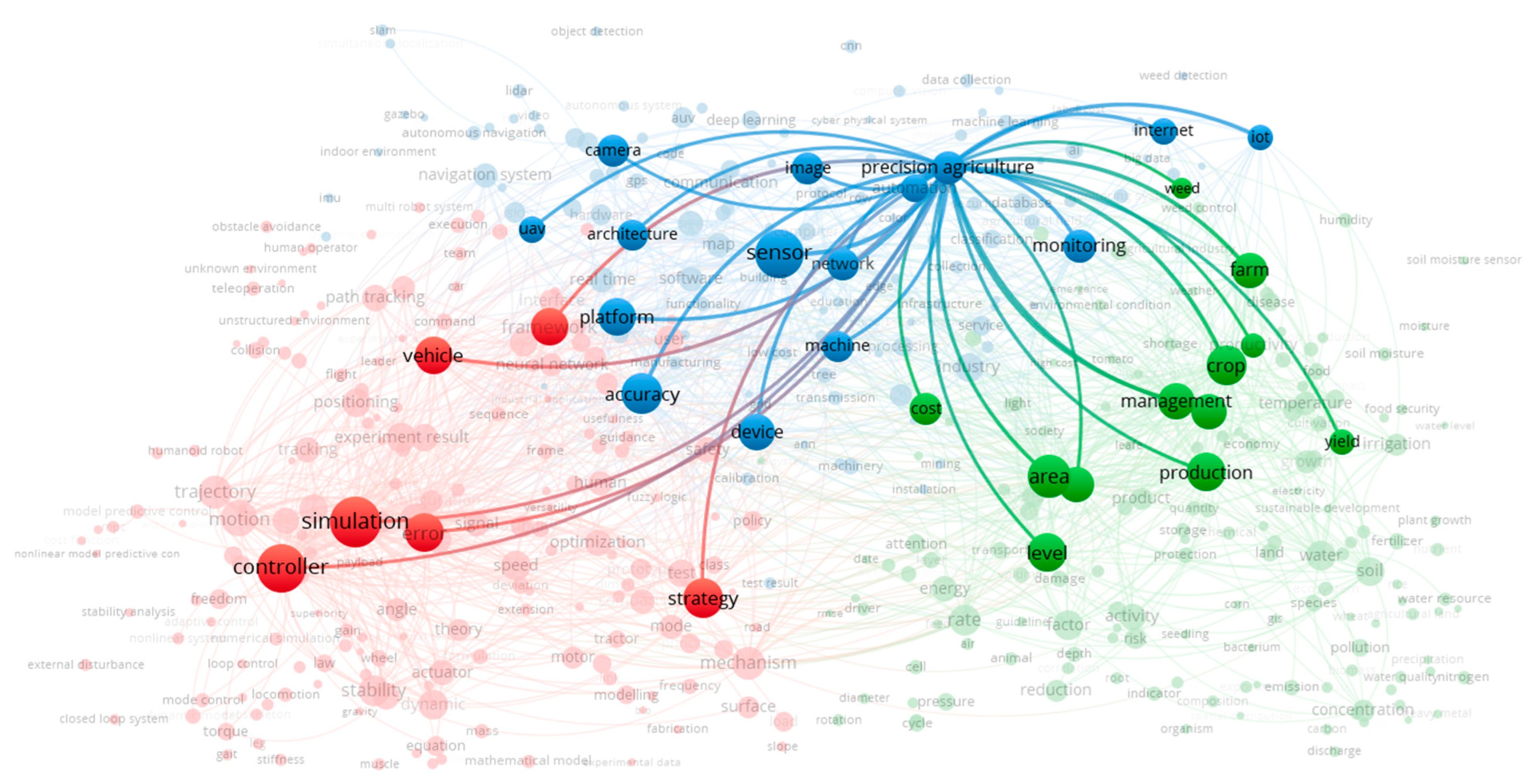
Figure 5 illustrates a framework in which ‘precision agriculture’ occupies a central position, with extensive links to operational and managerial terms such as ‘sensor’, ‘monitoring’, ‘management’, ‘crop’, ‘production’ and ‘area’. It emerges that PA is the connecting point between the three clusters and currently represents an innovative approach to agricultural management that exploits advanced technologies to optimize cropping practices, improve yields and reduce environmental impact, strengthening the systematic integration between data acquisition, continuous observation and the planning of activities at field and farm level [26]. From a methodological perspective, ‘simulation’ is linked to ‘controller’ and ‘strategy’, playing a key role in the development and validation of decision-making and operational models, allowing different agronomic strategies to be tested in virtual environments prior to their real-world application. These strategies guide the behaviour of controllers, i.e., automated systems that regulate the actions of autonomous vehicles such as drones or robotic tractors, tasked with targeted operations in the field [2]. Interventions are often aimed at crop (crop) management and weed (pest) containment, through decisions based on data from ‘sensors’ collected in real time [27]. The links to ‘management’, ‘production’ and ‘area’ demonstrate the integration of these practices into a broader farm management system, which coordinates resources, timing and actions at the farm level to maximize efficiency [22,23,24,25,26,27,28].
From a quantitative perspective, the size of the nodes highlights a higher frequency of use for ‘precision agriculture’, ‘monitoring’, ‘management’ and ‘sensor’, confirming the centrality of data collection and use in recent literature; ‘simulation’, ‘controller’ and ‘strategy’ are relatively less frequent, but characterized by selective and consistent connections with operational and management terms, consistent with their role in methodological and decision-making support.
Overall, Figure 5 suggests an orderly flow from data acquisition to validation via simulation, through to automated control and farm management, highlighting how the integration of sensors, models/algorithms and management processes enables more sustainable, precise and efficient practices at the level of the individual farm.
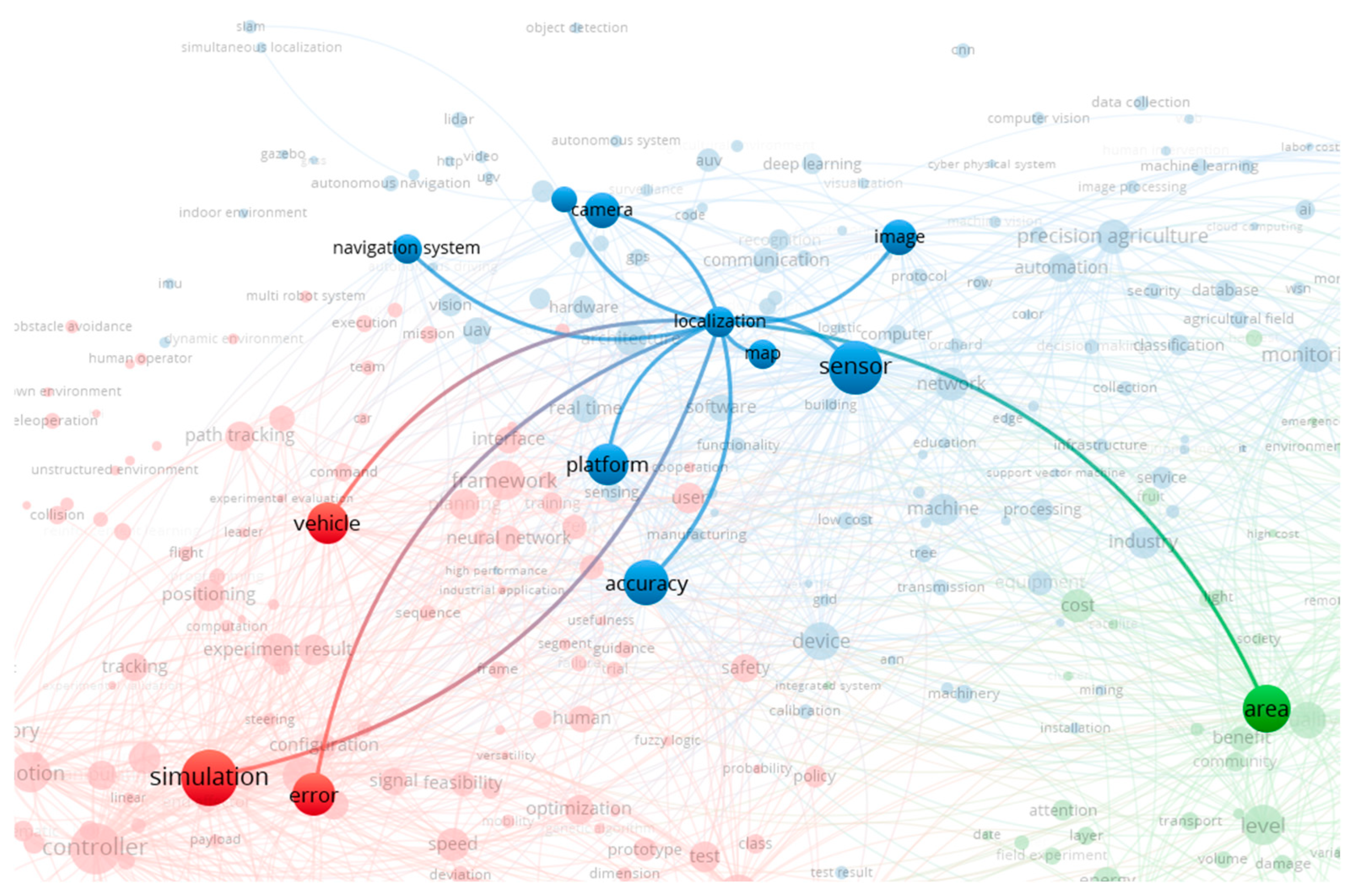
Figure 6 illustrates a structure in which ‘localization’ occupies a central position, with extensive links to ‘sensor’, ‘navigation’, ‘system’, ‘camera/image’, ‘platform’ and ‘accuracy’. Localization and navigation systems are key components in autonomous vehicles, especially in areas such as PA, mobile robotics and logistics [26]. The connections to ‘simulation’ and ‘vehicle’, together with the link to ‘error’, highlight the development approach involving a process where localization is designed and validated in virtual environments prior to operational deployment, with a focus on performance and error handling.
Localization is primarily based on the use of data from sensors such as (RTK) GPS, LiDAR, IMU and UWB (Ultra Wide Band), specific to various indoor and outdoor environments [27], as clearly shown by the connection to the term ‘sensor’. This information is essential for navigation systems, which process optimal routes and plan vehicle’s movements efficiently and safely within the operational space [2]. The link to ‘area’ in the application cluster also shows that navigation strategies are explicitly contextualized within the agricultural operational area (parcels, boundaries, environmental constraints, woods), highlighting the importance of the application context (green cluster). From a quantitative perspective, the size of the nodes highlights ‘simulation’ and ‘sensor’ as the most frequent terms, confirming the well-established process of virtual experimentation and the importance of data acquisition in recent literature; ‘localization’ appears less frequently, yet plays a central role, justified by its growing importance in agricultural robotics, and is directly linked to terms such as ‘camera’ and ‘image’, which are useful for localization algorithms such as VSLAM. The term ‘area’ occupies an intermediate position, consistent with its fundamental role in the agricultural application context.
Overall, the map indicates an ordered flow proceeding from data acquisition to localization, then to motion planning and navigation, with the contribution of simulation enabling the design of robust and reliable autonomous solutions capable of moving intelligently in complex and dynamic environments.
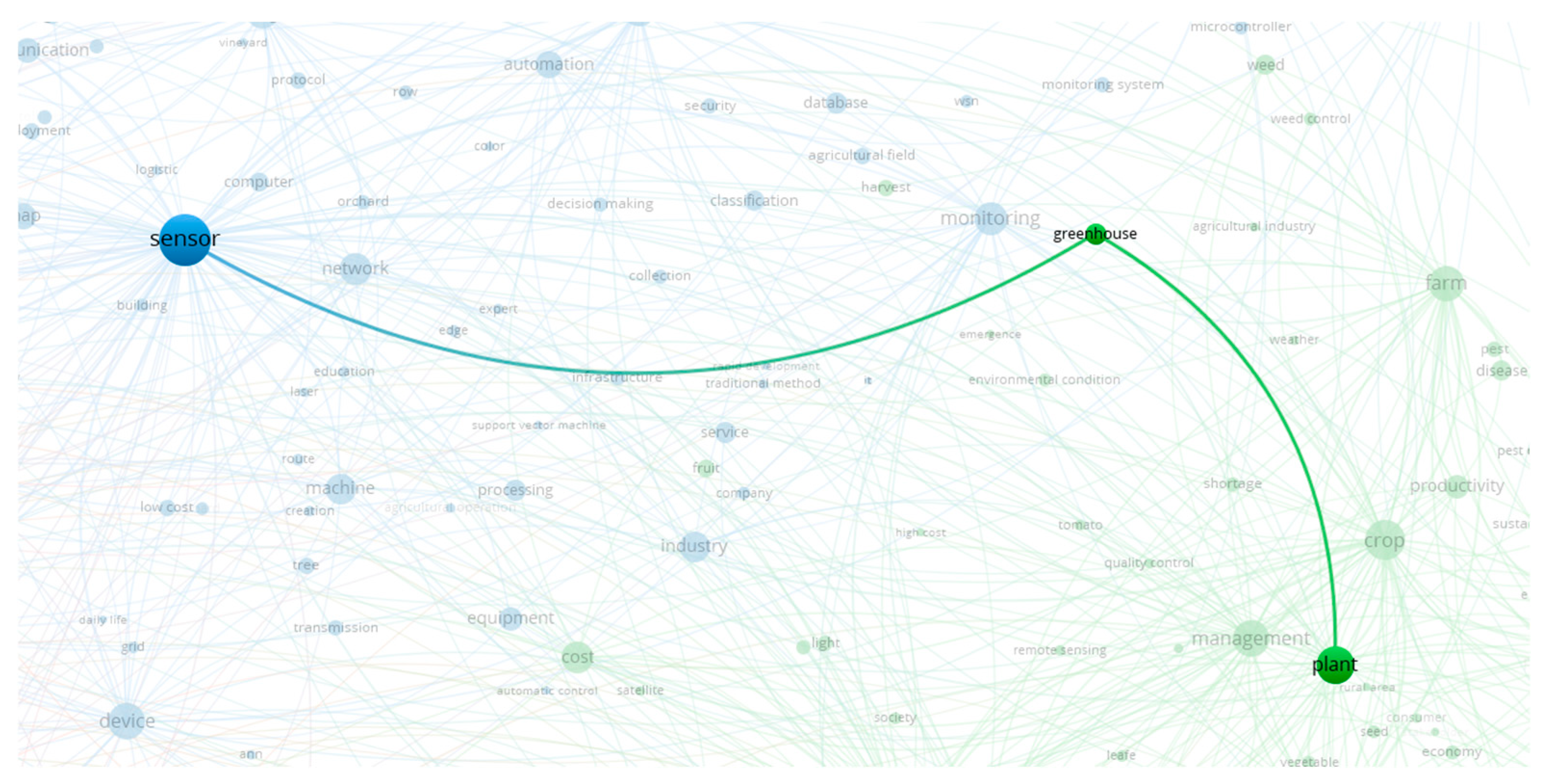
Figure 7 highlights a direct link between the ‘sensor’ (hardware cluster) and the application terms (green cluster) ‘greenhouse’ and ‘plant’, with a clear arrow illustrating the flow from monitoring → environmental control → crop response. In a greenhouse environment, sensors play an essential role in monitoring and managing the optimal environmental conditions for plant (plant) growth. Sensors for temperature, humidity, light, CO2 and soil moisture collect data in real time, providing vital information about the microclimate inside the greenhouse [29]. The structure of the connections suggests that monitoring translates into specific actions on the greenhouse system, with effects directly observable at the ‘plant’ level. These data enable automatic adjustment of ventilation, irrigation and lighting systems, adapting the environment to the physiological needs of plants at each stage of their development. Considering the size of the nodes, ‘sensor’ stands out, whilst ‘greenhouse’ and ‘plant’ show a strong degree of connection within the application cluster, indicating an established trend where sensor technology is firmly integrated into management practices in controlled environments. In this context, the relationship between sensor, greenhouse, and plant is highly interdependent: the continuous availability of data enables PA strategies in greenhouses, with benefits in terms of productivity, product quality and efficient use of resources [1,2,3,4,5,6,7,8,9,10,11,12,13,14,15,16,17,18,19,20,21,22,23,24,25,26,27,28,29,30].
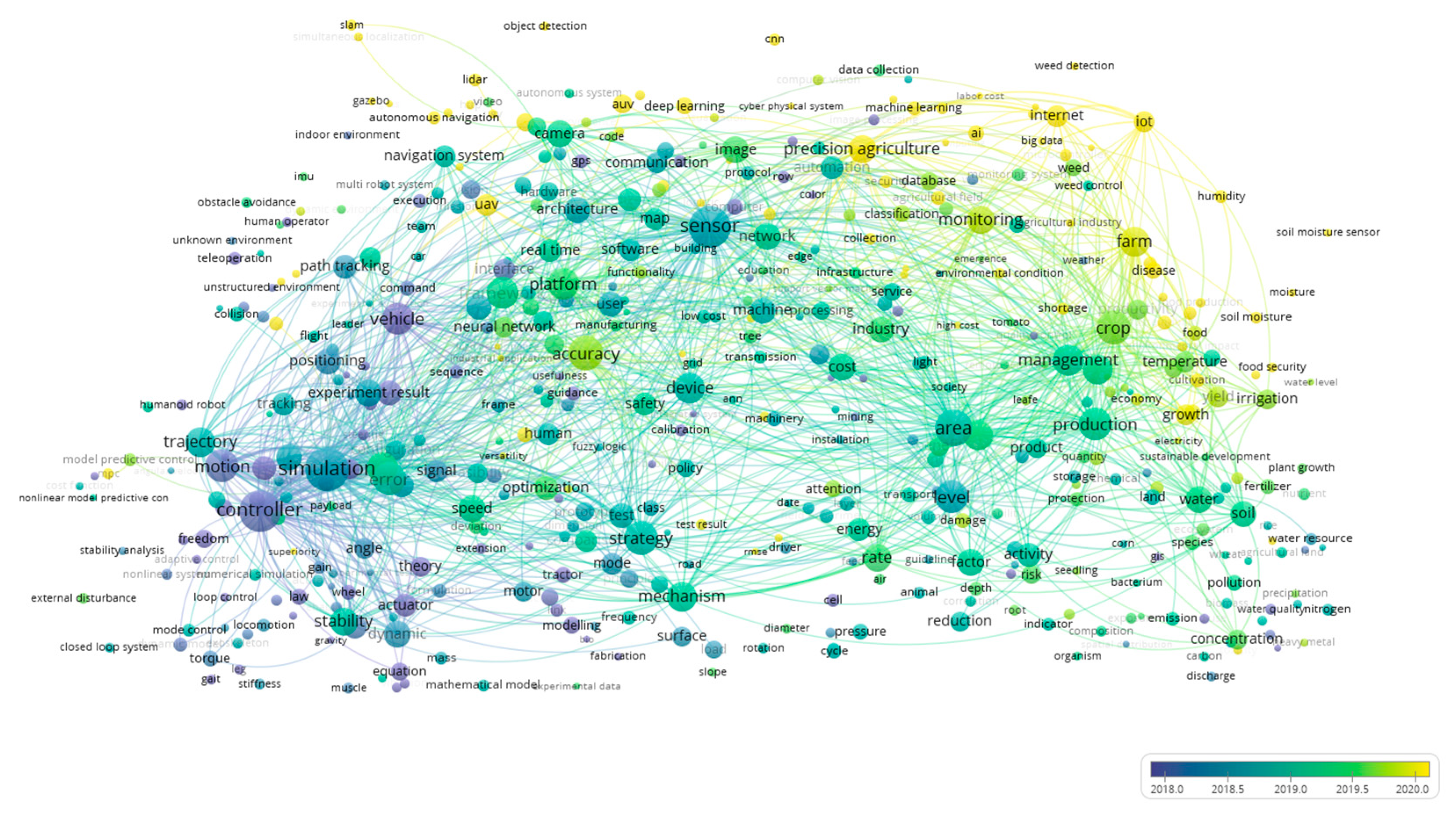
The term year map shown in Figure 8 illustrates the temporal evolution of key technological concepts related to robotic control architectures in PA between 2018 and 2020, with colours ranging from purple (earlier) to yellow (more recent). Beyond the simple appearance of individual keywords, the map highlights a progressive sequence of technological developments that can be interpreted as distinct but interconnected stages. In the earliest phase (around 2018), the most prominent terms include vehicle, controller, motion, interface, and modelling. These terms reflect an initial focus on the development of the fundamental infrastructure of robotic systems, particularly in terms of vehicle dynamics, modelling, and control strategies required to ensure reliable operation of autonomous platforms [31]. A second stage emerges between mid-2018 and mid-2019, characterized by the growing presence of terms such as sensor, device, camera, image, low cost, strategy, platform, neural network, and automation. This phase represents the progressive integration of perception technologies and intelligent components into existing control architectures. The introduction of sensing systems and artificial intelligence techniques allowed robotic systems not only to execute predefined control actions but also to perceive and interpret their operating environment more effectively [32]. From 2020 onward, the map highlights the emergence of terms such as IoT, PA, deep learning, LiDAR, SLAM, AUV, and CNN. These terms represent a more mature stage of technological development in which sensing, artificial intelligence, and communication technologies converge to enable advanced autonomous systems operating in real agricultural environments. The appearance of vocabulary related to PA and IoT indicates the transition from experimental technological development to large-scale deployment and practical applications in complex farming scenarios [33]. Overall, the temporal evolution of terms reveals a clear technological trajectory consisting of three interconnected stages: an initial phase focused on robotic control and system modelling, followed by the integration of sensing technologies and artificial intelligence, and finally the deployment of advanced autonomous systems in PA applications. This progression highlights how later technological developments build upon earlier advances in control infrastructure and perception capabilities, illustrating the cumulative nature of innovation in agricultural robotics.
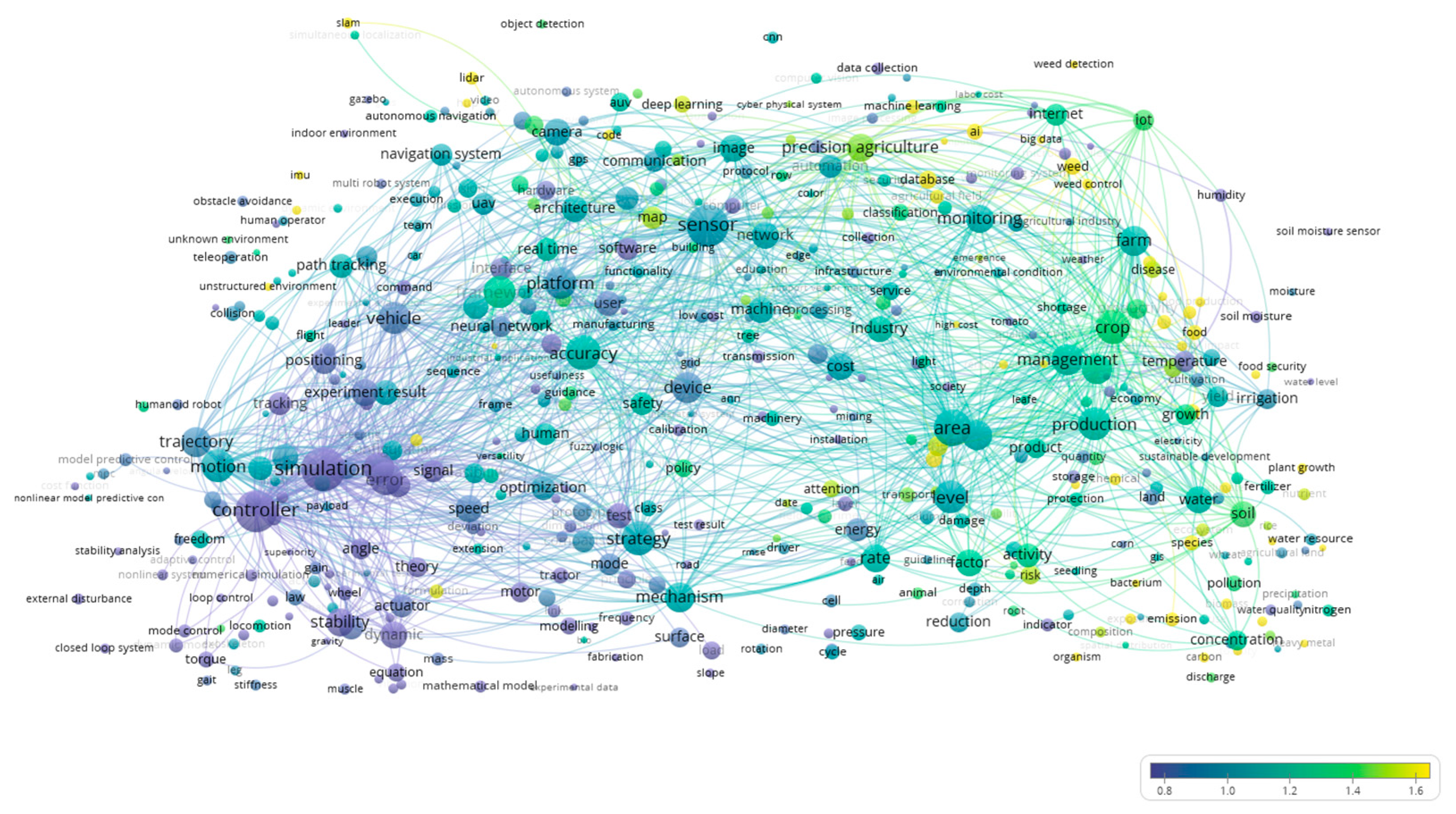
The term citation map (Figure 9) revealed that the terms with a higher normalized citation rate (yellow colours) are: slam, lidar, imu, machine learning, database, weed, weed control, disease, ai, food, species, bacterium, plant growth, big data, etc. The map can show the technological innovativeness and application relevance of these terms.
Perhaps, terms such as SLAM, lidar, IMU, machine learning, AI, and big data are related to emerging and highly innovative technologies that have catalyzed the interest of the scientific community for their transformative potential in autonomous systems, robotics, and PA. SLAM and sensor technologies like LiDAR and IMU are critical for autonomous navigation and environmental perception in agricultural robotics, enabling robust operation in complex and dynamic field conditions [34,35]. Likewise, machine learning and AI are increasingly applied to crop monitoring, disease detection, and resource management, emphasizing their role not only as analytical tools but also as drivers of technological innovation in agriculture [36]. Their increasing use in interdisciplinary fields contributes to a high number of citations. On the other hand, terms such as weed, weed control, disease, plant growth, bacterium, species, and food indicate the concrete application of these technologies in real problems related to food security, agricultural sustainability, and plant biology, which are issues of great urgency and global relevance. The high citation rates of these terms reflect the scientific community’s interest in applying advanced technologies to real-world agricultural challenges, such as automated weed management and crop disease identification [36]. Database also plays a key role, as it is the infrastructure that enables large-scale data management and analysis, which is essential for the operation of intelligent systems. Database highlights the importance of data infrastructure, enabling large-scale data management and analysis that are essential for operating intelligent systems and supporting machine learning models. Effective data management underpins the scalability and performance of these technologies across interdisciplinary applications [37].

4. Conclusions

This work has highlighted how control architectures for PA robotics are converging towards modular, distributed and data-driven ecosystems. The term maps and temporal overlay indicate a prevalence of work in simulated environments and the beginning of a shift towards field applications: a step that now requires concrete measures to bridge the ‘sim-to-real’ gap.
As analyzed, the blue cluster describes the perceptual backbone and its metric validation: the network of connections that starts with ‘sensor’ and passes through ‘accuracy’ and ‘platform’ makes it clear that the quality of measurements depends not only on hardware, but also on the way in which data is processed and made interoperable, serving mapping, localization and navigation systems. The low presence of terms such as ‘IoT’ and ‘edge’, specific sensors and accuracy benchmarks that are not yet standardized, confirms what has emerged in the other figures: much attention has historically been paid to simulation, whilst scalability in the field now requires robust data architectures (e.g., streaming and schema registry), shared synchronization/calibration procedures and multimodal datasets with error traceability, so as to reduce the simulation-to-reality gap and support integration with the algorithmic (red cluster) and management (green cluster) layers. As regards the red cluster, it represents a well-established methodological framework in simulation, which processes and interprets strategic choices regarding vehicle behaviour through controllers and tracking strategies. The central role of ‘simulation’ confirms what has emerged in the other figures: much innovation is still validated virtually, whilst a greater degree of real-world application would be required to achieve a significant advance. The connection with the blue cluster and the green cluster therefore becomes crucial: integrating positioning uncertainty, terrain variability and safety constraints into the control synthesis, whilst transferring metrics and experimental results from simulation to operational reality, is also the key step towards reducing the sim-to-real gap and enabling reliable adoption in PA. The green cluster is strongly focused on agricultural applications, with a particular emphasis on specific areas and crops, and provides a managerial and production-oriented framework; indeed, technologies are assessed for their impact on production, costs, and water/energy use. In line with findings from the other clusters, the challenge now is to bring what has been explored in simulation into practical application, thereby closing the data → prescription → execution → evaluation cycle and filling the gaps in these areas, i.e., addressing the lack of integration regarding weather, carbon, energy, traceability, and the effects of decisions at different operational ‘level’ and ‘area’.
In conclusion, the bibliometric analysis highlights a lack of research on the adoption of data streaming platforms (e.g., Kafka) for the management of high-frequency data streams, scalability and redundancy: this is a crucial area for the integration of robotics and sensor technology. The ever-increasing technological advancement in PA results in a heterogeneous environment, highlighting the need for a universal architecture with connectors such as (DDS/ROS 2 ↔ Kafka, MQTT ↔ Kafka, ISOBUS). Furthermore, it is recommended to establish an interoperability profile for agricultural robotics.
In summary, the results indicate that the next step is to bring what has been proven in simulation to the field, supported by scalable data pipelines and an open-source paradigm. These actions can accelerate the transition from prototypes to reliable, measurable and sustainable implementations in PA.

Supplementary Materials

The following supporting information can be downloaded at: https://www.mdpi.com/article/10.3390/robotics15040075/s1, Supplementary Material S1 (Thesaurus file), Supplementary Material S2 (VOSviewer map file) and Supplementary Material S3 (VOSviewer network file) and Supplementary Material S4 (PRISMA statement).

Author Contributions

Conceptualization, S.F. and C.C.; methodology, S.F.; software, S.V. (Simona Violino) and S.F.; validation, S.F., S.V. (Simona Violino), F.P. and C.C.; formal analysis, S.F. and S.V. (Simona Violino); investigation, S.F. and S.V. (Simona Violino); resources, S.F. and S.V. (Simona Violino); data curation, S.F. and S.V. (Simona Violino); writing—original draft preparation, S.F. and S.V. (Simona Violino); writing—review and editing, S.F., S.V. (Simona Violino), F.P., C.C., G.M., S.V. (Simone Vasta) and L.B.; visualization, S.F., S.V. (Simona Violino), F.P., C.C., G.M. and L.B.; supervision, C.C.; project administration, C.C.; funding acquisition, C.C. All authors have read and agreed to the published version of the manuscript.

Funding

This research was funded by the Italian Ministry of Agriculture, Ministry of Agriculture, Food Sovereignty and Forestry (MASAF), national program sub-project ‘Tecnologie digitali integrate per il rafforzamento sostenibile di produzioni e trasformazioni agroalimentari (AgroFiliere)’ (AgriDigit program) (DM 36503.7305.2018 of 20 December 2018) and MEDEA Project Meccatronica ed Ecosistemi Digitali per l’Evoluzione dell’Agricoltura; Fondo a sostegno delle attività di ricerca per il contenimento della diffusione dell’organismo nocivo «Phoma tracheiphila» (n. 0223928 del 20 maggio 2025).

Data Availability Statement

No new data were created or analyzed in this study. Data sharing is not applicable to this article.

Conflicts of Interest

The authors declare no conflicts of interest.

References

  1. Pallottino, F.; Antonucci, F.; Costa, C.; Bisaglia, C.; Figorilli, S.; Menesatti, P. Optoelectronic proximal sensing vehicle-mounted technologies in precision agriculture: A review. Comput. Electron. Agric. 2019, 162, 859–873. [Google Scholar] [CrossRef]
  2. Bechar, A.; Vigneault, C. Agricultural robots for field operations: Concepts and components. Biosyst. Eng. 2016, 149, 94–111. [Google Scholar] [CrossRef]
  3. Hernández, H.A.; Mondragón, I.F.; González, S.R.; Pedraza, L.F. Reconfigurable agricultural robotics: Control strategies, communication, and applications. Comput. Electron. Agric. 2025, 234, 110161. [Google Scholar] [CrossRef]
  4. El Aissi, M.E.M.; Benjelloun, S.; Lakhrissi, Y.; Ali, S.E.H.B. A Scalable Smart Farming Big Data Platform for Real-Time and Batch Processing Based on Lambda Architecture. J. Syst. Manag. Sci. 2023, 13, 17–30. [Google Scholar] [CrossRef]
  5. Theofilou, A.; Nastis, S.A.; Tsagris, M.; Rodriguez-Perez, S.; Mattas, K. Design and implementation of a scalable data warehouse for agricultural big data. Sustainability 2025, 17, 3727. [Google Scholar] [CrossRef]
  6. Emmi, L.; Fernández, R.; Gonzalez-de-Santos, P.; Francia, M.; Golfarelli, M.; Vitali, G.; Sandmann, H.; Hustedt, M.; Wollweber, M. Exploiting the internet resources for autonomous robots in agriculture. Agriculture 2023, 13, 1005. [Google Scholar] [CrossRef]
  7. Liu, T.; Zhang, B.; Tan, Q.; Zhou, J.; Yu, S.; Zhu, Q.; Bian, Y. Immersive human-machine teleoperation framework for precision agriculture: Integrating UAV-based digital mapping and virtual reality control. Comput. Electron. Agric. 2024, 226, 109444. [Google Scholar] [CrossRef]
  8. Arlotta, A.; Lippi, M.; Gasparri, A. A ros-based architecture for object detection and relative localization for a mobile robot with an application to a precision farming scenario. In Proceedings of the 2023 31st Mediterranean Conference on Control and Automation (MED), Limassol, Cyprus, 26–29 June 2023; IEEE: Piscataway, NJ, USA, 2023; pp. 131–136. [Google Scholar] [CrossRef]
  9. Bianchi, L.; Carnevale, D.; Del Frate, F.; Masocco, R.; Mattogno, S.; Romanelli, F.; Tenaglia, A. A novel distributed architecture for unmanned aircraft systems based on Robot Operating System 2. IET Cyber-Syst. Robot. 2023, 1, e12083. [Google Scholar] [CrossRef]
  10. Figorilli, S.; Violino, S.; Simone, V.; Pallottino, F.; Manca, G.; Bianchi, L.; Costa, C. PRISMA 2020 Statement for Review on Control Architectures for Robotics in Agriculture. 2026. Available online: https://osf.io/2x8sa/overview (accessed on 30 March 2026).
  11. Page, M.J.; McKenzie, J.E.; Bossuyt, P.M.; Boutron, I.; Hoffmann, T.C.; Mulrow, C.D.; Shamseer, L.; Tetzlaff, J.M.; Akl, E.A.; Brennan, S.E.; et al. A declaração PRISMA 2020: Diretriz atualizada para relatar revisões sistemáticas. Rev. Panam. Salud Pública 2023, 46, e112. [Google Scholar] [CrossRef]
  12. Waltman, L.; Van Eck, N.J. A smart local moving algorithm for large-scale modularity-based community detection. Eur. Phys. J. B 2013, 86, 471. [Google Scholar] [CrossRef]
  13. Waltman, L.; Van Eck, N.J.; Noyons, E.C. A unified approach to mapping and clustering of bibliometric networks. J. Informetr. 2010, 4, 629–635. [Google Scholar] [CrossRef]
  14. Effendi, D.N.; Irwandani Anggraini, W.; Jatmiko, A.; Rahmayanti, H.; Ichsan, I.Z.; Mehadi Rahman, M. Bibliometric analysis of scientific literacy using VOS viewer: Analysis of science education. J. Phys. Conf. Ser. 2021, 1796, 012096. [Google Scholar] [CrossRef]
  15. Botta, A.; Cavallone, P.; Baglieri, L.; Colucci, G.; Tagliavini, L.; Quaglia, G. A review of robots, perception, and tasks in precision agriculture. Appl. Mech. 2022, 3, 830–854. [Google Scholar] [CrossRef]
  16. Casini, S.; Ducange, P.; Marcelloni, F.; Pollini, L. Artificial Intelligence in Agri-Robotics: A Systematic Review of Trends and Emerging Directions Leveraging Bibliometric Tools. Robotics 2026, 15, 24. [Google Scholar] [CrossRef]
  17. Bertoglio, R.; Corbo, C.; Renga, F.M.; Matteucci, M. The digital agricultural revolution: A bibliometric analysis literature review. IEEE Access 2021, 9, 134762–134782. [Google Scholar] [CrossRef]
  18. Wang, Q.; He, J.; Lu, C.; Wang, C.; Lin, H.; Yang, H.; Li, H.; Wu, Z. Modelling and control methods in path tracking control for autonomous agricultural vehicles: A review of state of the art and challenges. Appl. Sci. 2023, 13, 7155. [Google Scholar] [CrossRef]
  19. Zhang, Y.; Liu, H.; Shen, Y.; He, S.; Wang, H.; Shen, Y. A systematic review of modeling and control approaches for path tracking in unmanned agricultural ground vehicles. Agronomy 2025, 15, 2274. [Google Scholar] [CrossRef]
  20. Kamilaris, A.; Prenafeta-Boldú, F.X. Deep learning in agriculture: A survey. Comput. Electron. Agric. 2018, 147, 70–90. [Google Scholar] [CrossRef]
  21. Zhang, J.; Singh, S. Visual-lidar odometry and mapping: Low-drift, robust, and fast. In Proceedings of the 2015 IEEE International Conference on Robotics and Automation (ICRA), Seattle, WA, USA, 26–30 May 2015; IEEE: Piscataway, NJ, USA, 2015; pp. 2174–2181. [Google Scholar] [CrossRef]
  22. Wolfert, S.; Ge, L.; Verdouw, C.; Bogaardt, M.J. Big data in smart farming–a review. Agric. Syst. 2017, 153, 69–80. [Google Scholar] [CrossRef]
  23. Quigley, M.; Conley, K.; Gerkey, B.; Faust, J.; Foote, T.; Leibs, J.; Berger, E.; Wheeler, E.; Ng, A.Y. ROS: An open-source Robot Operating System. ICRA Workshop Open Source Softw. 2009, 3, 5. [Google Scholar]
  24. Koubaa, A. Robot Operating System (ROS); Springer: Cham, Switzerland, 2017; Volume 1, pp. 112–156. [Google Scholar]
  25. Koenig, N.; Howard, A. Design and use paradigms for gazebo, an open-source multi-robot simulator. In Proceedings of the 2004 IEEE/RSJ International Conference on Intelligent Robots and Systems (IROS) (IEEE Cat. No. 04CH37566), Sendai, Japan, 28 September–2 October 2004; IEEE: Piscataway, NJ, USA, 2004; Volume 3, pp. 2149–2154. [Google Scholar] [CrossRef]
  26. Thakur, A.; Venu, S.; Gurusamy, M. An extensive review on agricultural robots with a focus on their perception systems. Comput. Electron. Agric. 2023, 212, 108146. [Google Scholar] [CrossRef]
  27. Shamshiri, R.R.; Weltzien, C.; Hameed, I.A.; Yule, I.J.; Grift, T.E.; Balasundram, S.K.; Pitonakova, L.; Ahmad, D.; Chowdhary, G. Research and development in agricultural robotics: A perspective of digital farming. Int. J. Agric. Biol. Eng. 2018, 11, 1–14. [Google Scholar] [CrossRef]
  28. Klerkx, L.; Jakku, E.; Labarthe, P. A review of social science on digital agriculture, smart farming and agriculture 4.0: New contributions and a future research agenda. NJAS—Wagening. J. Life Sci. 2019, 90, 1–16. [Google Scholar] [CrossRef]
  29. Gurban, E.H.; Andreescu, G.D. Greenhouse environment monitoring and control: State of the art and current trends. Environ. Eng. Manag. J. 2018, 17, 399–416. [Google Scholar] [CrossRef]
  30. Gao, Z.; Luo, Z.; Zhang, W.; Lv, Z.; Xu, Y. Deep learning application in plant stress imaging: A review. AgriEngineering 2020, 2, 29. [Google Scholar] [CrossRef]
  31. Cobo, M.J.; López-Herrera, A.G.; Herrera-Viedma, E.; Herrera, F. Science mapping software tools: Review, analysis, and cooperative study among tools. J. Am. Soc. Inf. Sci. Technol. 2011, 62, 1382–1402. [Google Scholar] [CrossRef]
  32. Börner, K.; Chen, C.; Boyack, K.W. Visualizing knowledge domains. Annu. Rev. Inf. Sci. Technol. 2003, 37, 179–255. [Google Scholar] [CrossRef]
  33. Small, H. Tracking and predicting growth areas in science. Scientometrics 2006, 68, 595–610. [Google Scholar] [CrossRef] [PubMed]
  34. Yan, Y.; Zhang, B.; Zhou, J.; Zhang, Y.; Liu, X.A. Real-time localization and mapping utilizing multi-sensor fusion and visual–IMU–wheel odometry for agricultural robots in unstructured, dynamic and GPS-denied greenhouse environments. Agronomy 2022, 12, 1740. [Google Scholar] [CrossRef]
  35. Ding, H.; Zhang, B.; Zhou, J.; Yan, Y.; Tian, G.; Gu, B. Recent developments and applications of simultaneous localization and mapping in agriculture. J. Field Robot. 2022, 39, 956–983. [Google Scholar] [CrossRef]
  36. Pallottino, F.; Violino, S.; Figorilli, S.; Pane, C.; Aguzzi, J.; Colle, G.; Nemmi, E.N.; Montaghi, A.; Chatzievangelou, D.; Antonucci, F.; et al. Applications and perspectives of Generative Artificial Intelligence in agriculture. Comput. Electron. Agric. 2025, 230, 109919. [Google Scholar] [CrossRef]
  37. Vijaya, J.; Paul, S.; Sharma, R. Impact of artificial intelligence and machine learning techniques in database management system components. In Navigating the Intersection of AI Policy, Technology, and Governance; IGI Global Scientific Publishing: Hershey, PA, USA, 2025; pp. 43–82. [Google Scholar] [CrossRef]
Figure 1. Literature review with four stages of PRISMA evaluation.
Robotics 15 00075 g001
Figure 2. Number of publications per year on robotic control architectures in PA.
Robotics 15 00075 g002
Figure 3. Term map analysis on robotic control architectures in PA publications. Different colours represent the terms belonging to different clusters. The connecting lines indicate the 500 strongest co-occurrence links between terms.
Robotics 15 00075 g003
Figure 4. Zoom of term map on the ROS term.
Robotics 15 00075 g004
Figure 5. Zoom on term map on the precision agriculture term.
Robotics 15 00075 g005
Figure 6. Zoom on term map on the navigation system.
Robotics 15 00075 g006
Figure 7. Zoom on term map on the greenhouse.
Robotics 15 00075 g007
Figure 8. Term year map based on robotic control architectures in PA publications. The connecting lines indicate the 500 strongest co-occurrence links between terms. The scale represented the earlier (violet) or more recent (yellow) years when the term appeared.
Robotics 15 00075 g008
Figure 9. Term average normalized citation map based on robotic control architectures in PA publications. The connecting lines indicate the 100 strongest co-occurrence links between terms. The scale represented the average normalized citation rate, lower (violet) or higher (yellow).
Robotics 15 00075 g009
Disclaimer/Publisher’s Note: The statements, opinions and data contained in all publications are solely those of the individual author(s) and contributor(s) and not of MDPI and/or the editor(s). MDPI and/or the editor(s) disclaim responsibility for any injury to people or property resulting from any ideas, methods, instructions or products referred to in the content.