Acquired Resistance to the PRMT5 Inhibitor Confers Collateral Sensitivity to MEK Inhibition in MTAP-Null Non-Small Cell Lung Cancer

 , , , , , ,
  , ,
, ,  , add
Show full author list
, add
Show full author list
Abstract
1. Introduction
2. Materials and Methods
2.1. Cell Culture
2.2. Drug Treatment
2.3. Generation of MTAP-Isogenic Cell Lines
2.4. Generation of MRTX1719-Resistant Cell Lines
2.5. Cell Viability Assay and Synergy Scoring
2.6. Western Blot
2.7. Measurement of MTA Levels by LC-MS
2.8. High-Throughput Drug Screening
2.9. RNA Sequencing and Data Analysis
2.10. Statistical Analysis
3. Results
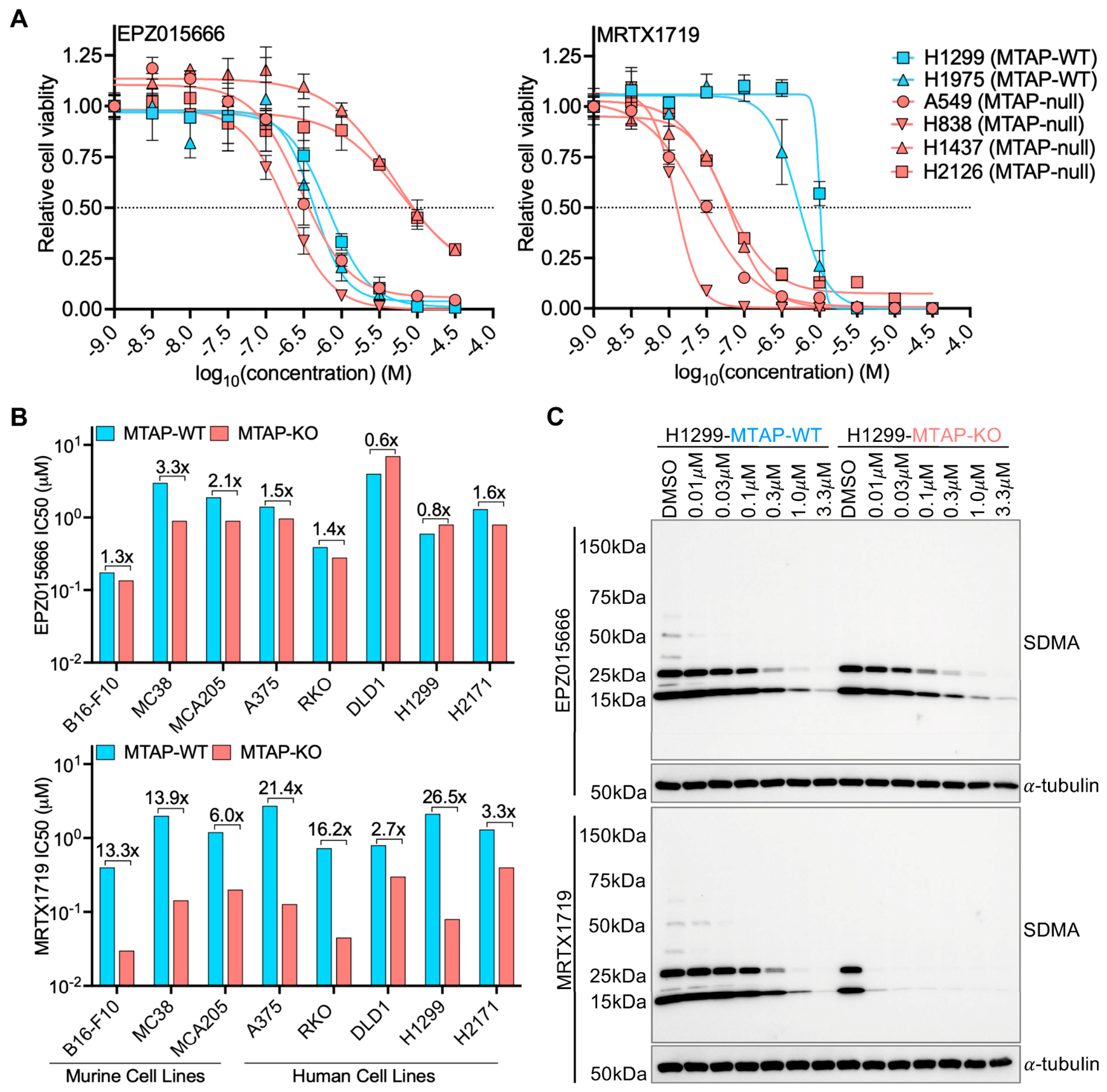
3.1. MRTX1719 Selectively Inhibits MTAP-Null Cells with Variable Responses
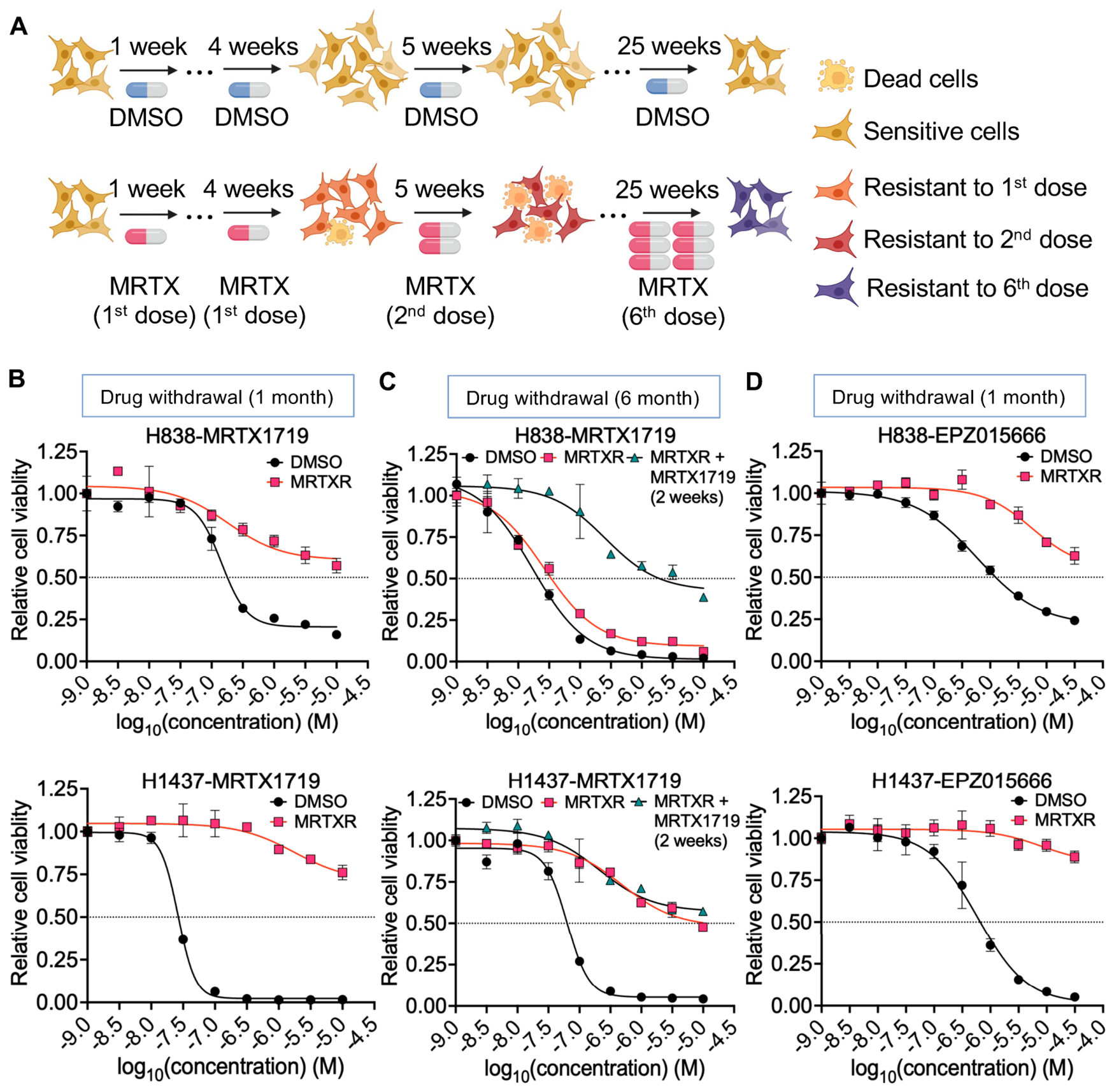
3.2. Prolonged MRTX1719 Treatment Induces Acquired Resistance in Sensitive NSCLC Cells
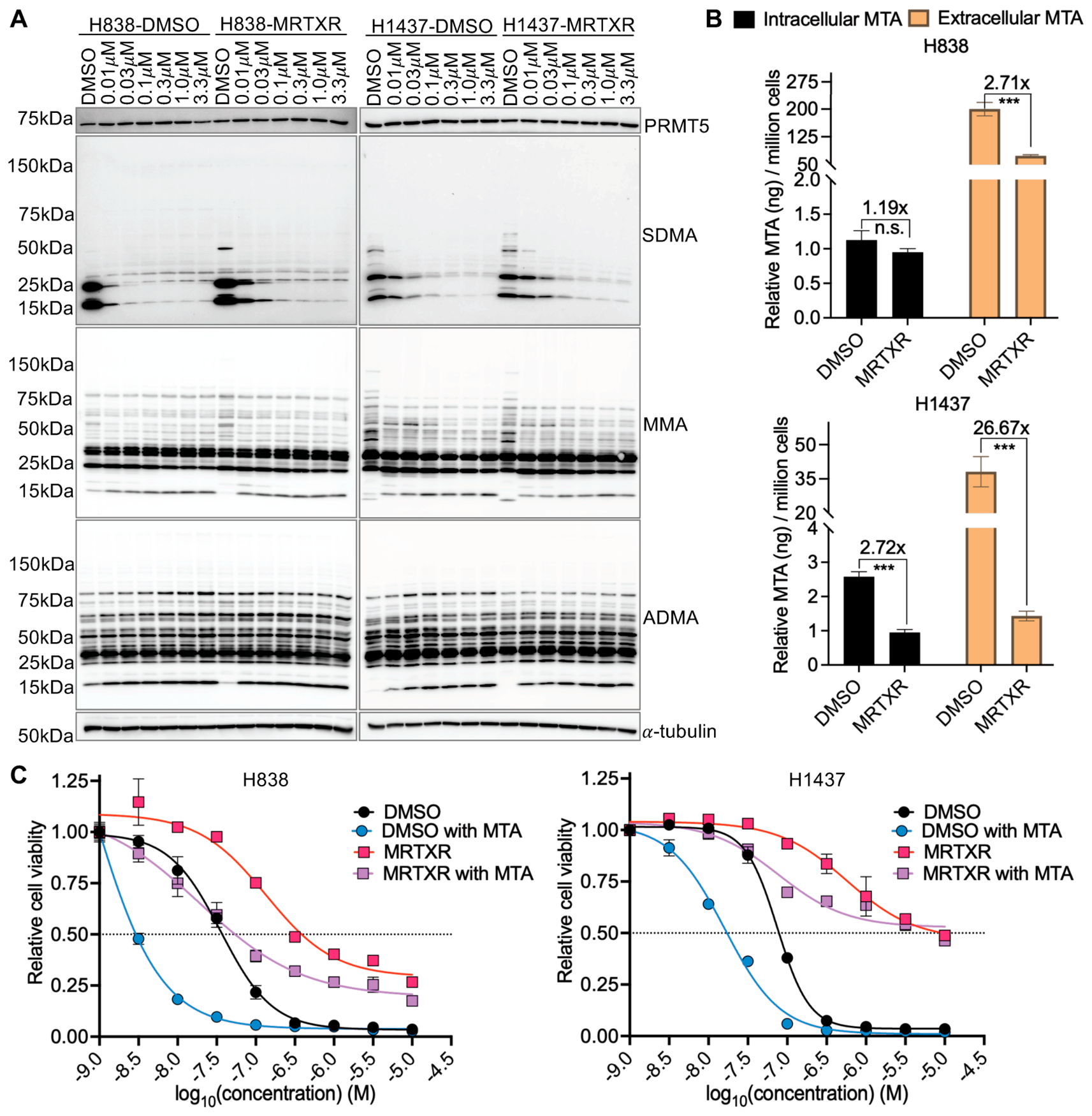
3.3. MRTX1719 Resistance Is Not Fully Explained by Altered PRMT5 Activity or Changes in MTA Levels
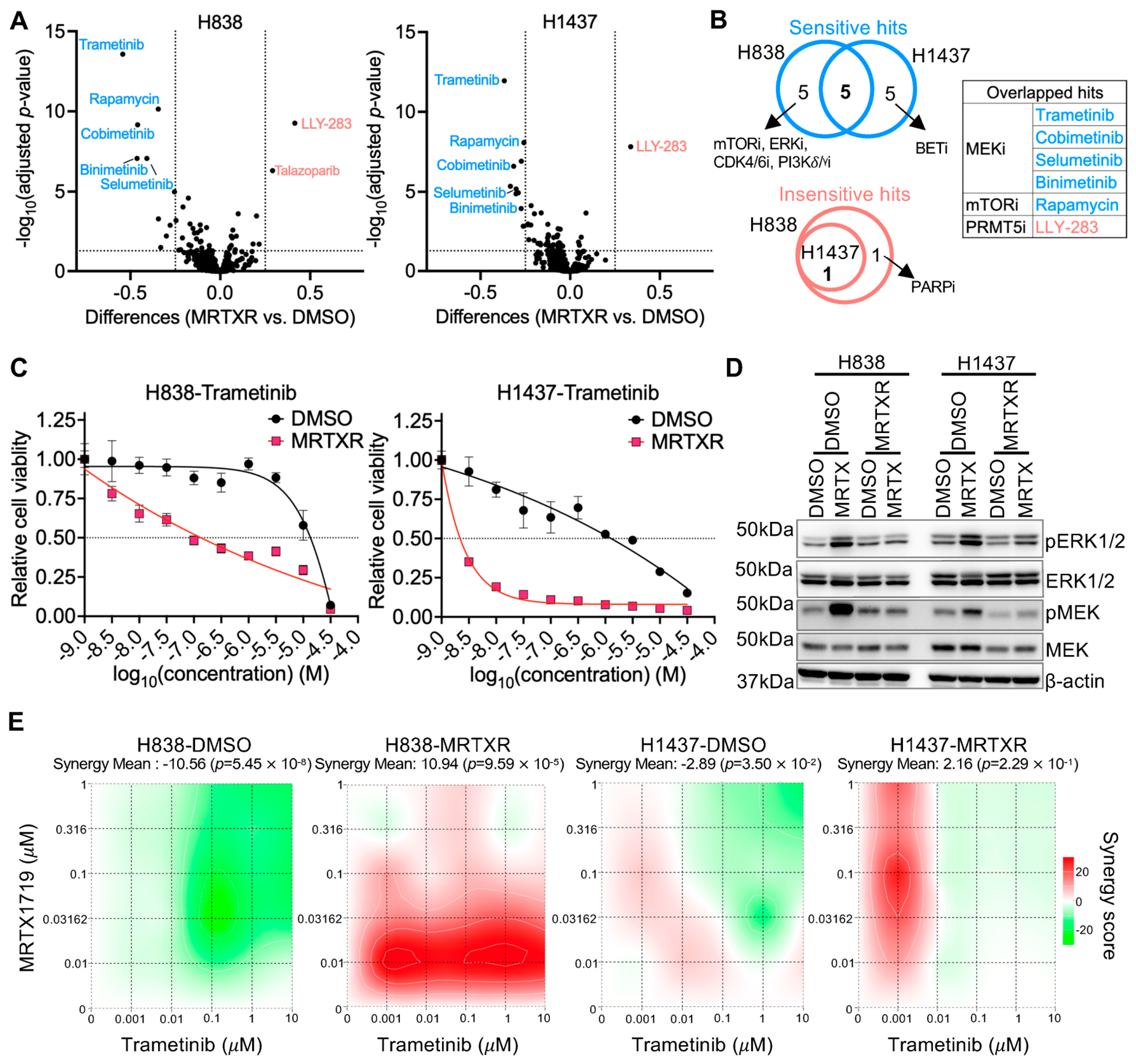
3.4. Acquired MRTX1719 Resistance Confers Collateral Sensitivity to MEK Inhibitors
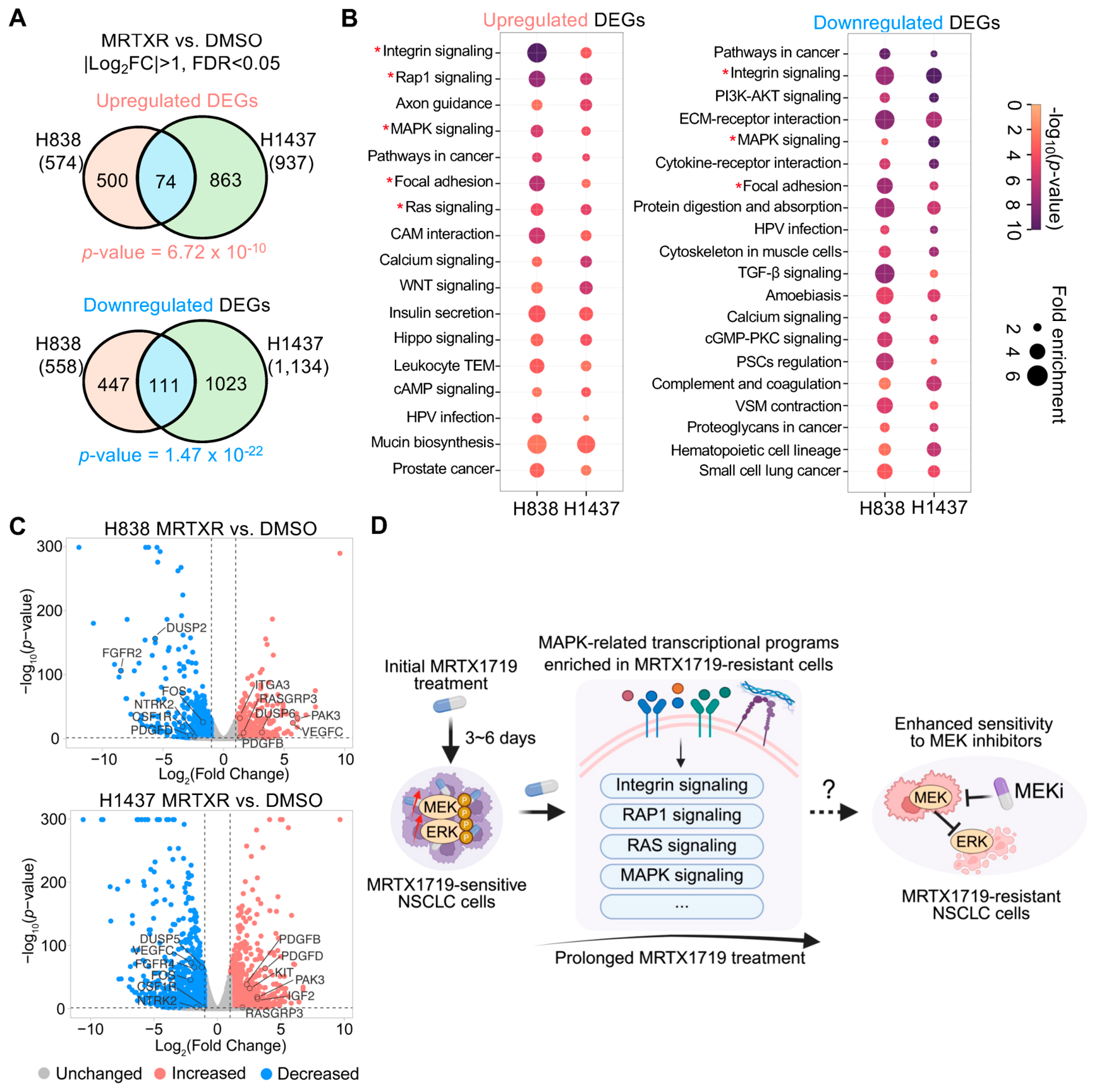
3.5. MAPK-Related Transcriptional Programs Are Enriched in MRTX1719-Resistant Cells
4. Discussion
5. Conclusions
Supplementary Materials
Author Contributions
Funding
Institutional Review Board Statement
Informed Consent Statement
Data Availability Statement
Acknowledgments
Conflicts of Interest
References
- Han, G.C.; Yang, G.L.; Hao, D.P.; Lu, Y.; Thein, K.; Simpson, B.S.; Chen, J.F.; Sun, R.; Alhalabi, O.; Wang, R.P.; et al. 9p21 loss confers a cold tumor immune microenvironment and primary resistance to immune checkpoint therapy. Nat. Commun. 2021, 12, 5606. [Google Scholar] [CrossRef] [Scilit] [PubMed]
- Marjon, K.; Kalev, P.; Marks, K. Cancer Dependencies: PRMT5 and MAT2A in MTAP/p16-Deleted Cancers. Annu. Rev. Cancer Biol. 2021, 5, 371–390. [Google Scholar] [CrossRef] [Scilit]
- Kryukov, G.V.; Wilson, F.H.; Ruth, J.R.; Paulk, J.; Tsherniak, A.; Marlow, S.E.; Vazquez, F.; Weir, B.A.; Fitzgerald, M.E.; Tanaka, M.; et al. MTAP deletion confers enhanced dependency on the PRMT5 arginine methyltransferase in cancer cells. Science 2016, 351, 1214–1218. [Google Scholar] [CrossRef] [Scilit] [PubMed]
- Marjon, K.; Cameron, M.J.; Quang, P.; Clasquin, M.F.; Mandley, E.; Kunii, K.; McVay, M.; Choe, S.; Kernytsky, A.; Gross, S.; et al. MTAP Deletions in Cancer Create Vulnerability to Targeting of the MAT2A/PRMT5/RIOK1 Axis. Cell Rep. 2016, 15, 574–587. [Google Scholar] [CrossRef] [Scilit] [PubMed]
- Mavrakis, K.J.; McDonald, E.R.; Schlabach, M.R.; Billy, E.; Hoffman, G.R.; deWeck, A.; Ruddy, D.A.; Venkatesan, K.; Yu, J.J.; McAllister, G.; et al. Disordered methionine metabolism in MTAP/CDKN2A-deleted cancers leads to dependence on PRMT5. Science 2016, 351, 1208–1213. [Google Scholar] [CrossRef] [Scilit] [PubMed]
- McDonald, E.I.I.I.; de Weck, A.; Schlabach, M.R.; Billy, E.; Mavrakis, K.J.; Hoffman, G.R.; Belur, D.; Castelletti, D.; Frias, E.; Gampa, K.; et al. Project DRIVE: A Compendium of Cancer Dependencies and Synthetic Lethal Relationships Uncovered by Large-Scale, Deep RNAi Screening. Cell 2017, 170, 577–592.e10. [Google Scholar] [CrossRef] [Scilit] [PubMed]
- Tsherniak, A.; Vazquez, F.; Montgomery, P.G.; Weir, B.A.; Kryukov, G.; Cowley, G.S.; Gill, S.; Harrington, W.F.; Pantel, S.; Krill-Burger, J.M.; et al. Defining a Cancer Dependency Map. Cell 2017, 170, 564–576.e16. [Google Scholar] [CrossRef] [Scilit] [PubMed]
- Krawczyk, P.; Wojas-Krawczyk, K. MTAP Deletion as a Therapeutic Vulnerability in Cancer: From Molecular Mechanism to Clinical Targeting. Int. J. Mol. Sci. 2025, 26, 11956. [Google Scholar] [CrossRef] [Scilit] [PubMed]
- Yang, Y.Z.; Bedford, M.T. Protein arginine methyltransferases and cancer. Nat. Rev. Cancer 2013, 13, 37–50. [Google Scholar] [CrossRef] [Scilit] [PubMed]
- Blanc, R.S.; Richard, S. Arginine Methylation: The Coming of Age. Mol. Cell 2017, 65, 8–24. [Google Scholar] [CrossRef] [Scilit] [PubMed]
- Hwang, J.W.; Cho, Y.; Bae, G.U.; Kim, S.N.; Kim, Y.K. Protein arginine methyltransferases: Promising targets for cancer therapy. Exp. Mol. Med. 2021, 53, 788–808. [Google Scholar] [CrossRef] [Scilit] [PubMed]
- Liu, F.; Xu, Y.; Lu, X.Q.; Hamard, P.J.; Karl, D.L.; Man, N.; Mookhtiar, A.K.; Martinez, C.; Lossos, I.S.; Sun, J.; et al. PRMT5-mediated histone arginine methylation antagonizes transcriptional repression by polycomb complex PRC2. Nucleic Acids Res. 2020, 48, 2956–2968. [Google Scholar] [CrossRef] [Scilit] [PubMed]
- DeAngelo, J.D.; Maron, M.I.; Roth, J.S.; Hegde, S.; Silverstein, A.M.; Gupta, V.; Stransky, S.; Basken, J.; Azofeifa, J.; Query, C.C.; et al. Productive mRNA chromatin escape is promoted by PRMT5 activity. Mol. Cell 2025, 85, 4016–4031. [Google Scholar] [CrossRef] [Scilit] [PubMed]
- Wang, X.Y.; Qiu, T.; Wu, Y.Y.; Yang, C.Y.; Li, Y.; Du, G.S.; He, Y.H.; Liu, W.; Liu, R.; Chen, C.H.Z.; et al. Arginine methyltransferase PRMT5 methylates and stabilizes KLF5 via decreasing its phosphorylation and ubiquitination to promote basal-like breast cancer. Cell Death Differ. 2021, 28, 2931–2945. [Google Scholar] [CrossRef] [Scilit] [PubMed]
- Carter, J.; Hulse, M.; Sivakumar, M.; Burtell, J.; Thodima, V.; Wang, M.; Agarwal, A.; Vykuntam, K.; Spruance, J.; Bhagwat, N.; et al. PRMT5 Inhibitors Regulate DNA Damage Repair Pathways in Cancer Cells and Improve Response to PARP Inhibition and Chemotherapies. Cancer Res. Commun. 2023, 3, 2233–2243. [Google Scholar] [CrossRef] [Scilit] [PubMed]
- Kim, H.; Ronai, Z.A. PRMT5 function and targeting in cancer. Cell Stress 2020, 4, 199–215. [Google Scholar] [CrossRef] [Scilit] [PubMed]
- Lee, J.; Kim, J.; Hwang, I. Targeting PRMT5 in cancer: Mechanistic insights and clinical progress. Biomed. Pharmacother. 2025, 193, 118754. [Google Scholar] [CrossRef] [Scilit] [PubMed]
- Chan-Penebre, E.; Kuplast, K.G.; Majer, C.R.; Boriack-Sjodin, P.A.; Wigle, T.J.; Johnston, L.D.; Rioux, N.; Munchhof, M.J.; Jin, L.; Jacques, S.L.; et al. A selective inhibitor of PRMT5 with in vivo and in vitro potency in MCL models. Nat. Chem. Biol. 2015, 11, 432–437. [Google Scholar] [CrossRef] [Scilit] [PubMed]
- Brehmer, D.; Beke, L.; Wu, T.; Millar, H.J.; Moy, C.; Sun, W.; Mannens, G.; Pande, V.; Boeckx, A.; van Heerde, E.; et al. Discovery and Pharmacological Characterization of JNJ-64619178, a Novel Small-Molecule Inhibitor of PRMT5 with Potent Antitumor Activity. Mol. Cancer Ther. 2021, 20, 2317–2328. [Google Scholar] [CrossRef] [Scilit] [PubMed]
- Smith, C.R.; Aranda, R.; Bobinski, T.P.; Briere, D.M.; Burns, A.C.; Christensen, J.G.; Clarine, J.; Engstrom, L.D.; Gunn, R.J.; Ivetac, A.; et al. Fragment-Based Discovery of MRTX1719, a Synthetic Lethal Inhibitor of the PRMT5•MTA Complex for the Treatment of MTAP-Deleted Cancers. J. Med. Chem. 2022, 65, 1749–1766. [Google Scholar] [CrossRef] [Scilit] [PubMed]
- Engstrom, L.D.; Aranda, R.; Waters, L.; Moya, K.; Bowcut, V.; Vegar, L.; Trinh, D.; Hebbert, A.; Smith, C.R.; Kulyk, S.; et al. MRTX1719 Is an MTA-Cooperative PRMT5 Inhibitor That Exhibits Synthetic Lethality in Preclinical Models and Patients with MTAP-Deleted Cancer. Cancer Discov. 2023, 13, 2412–2431. [Google Scholar] [CrossRef] [Scilit] [PubMed]
- Mulvaney, K.M. Early Clinical Success of MTA-Cooperative PRMT5 Inhibitors for the Treatment of MTAP-Deleted Cancers. Cancer Discov. 2023, 13, 2310–2312. [Google Scholar] [CrossRef] [Scilit] [PubMed]
- Pettus, L.H.; Bourbeau, M.; Tamayo, N.A.; Amegadzie, A.; Beylkin, D.; Booker, S.K.; Butler, J.; Frohn, M.J.; Kaller, M.R.; Kohn, T.; et al. Discovery of AMG 193, an MTA-Cooperative PRMT5 Inhibitor for the Treatment of MTAP-Deleted Cancers. J. Med. Chem. 2025, 68, 6932–6954. [Google Scholar] [CrossRef] [Scilit] [PubMed]
- Belmontes, B.; Slemmons, K.K.; Su, C.; Liu, S.Y.; Policheni, A.N.; Moriguchi, J.; Tan, H.; Xie, F.; Aiello, D.A.; Yang, Y.J.; et al. AMG 193, a Clinical Stage MTA-Cooperative PRMT5 Inhibitor, Drives Antitumor Activity Preclinically and in Patients with MTAP-Deleted Cancers. Cancer Discov. 2025, 15, 139–161. [Google Scholar] [CrossRef] [Scilit] [PubMed]
- Rodon, J.; Prenen, H.; Sacher, A.; Villalona-Calero, M.; Penel, N.; El Helali, A.; Rottey, S.; Yamamoto, N.; Ghiringhelli, F.; Goebeler, M.E.; et al. First-in-human study of AMG 193, an MTA-cooperative PRMT5 inhibitor, in patients with MTAP-deleted solid tumors: Results from phase I dose exploration. Ann. Oncol. 2024, 35, 1138–1147. [Google Scholar] [CrossRef] [Scilit] [PubMed]
- Cottrell, K.M.; Briggs, K.J.; Whittington, D.A.; Jahic, H.; Ali, J.A.; Davis, C.B.; Gong, S.Z.; Gotur, D.; Gu, L.N.; McCarren, P.; et al. Discovery of TNG908: A Selective, Brain Penetrant, MTA-Cooperative PRMT5 Inhibitor That Is Synthetically Lethal with MTAP-Deleted Cancers. J. Med. Chem. 2024, 67, 6064–6080. [Google Scholar] [CrossRef] [Scilit] [PubMed]
- Briggs, K.J.; Cottrell, K.M.; Tonini, M.R.; Tsai, A.; Zhang, M.; Whittington, D.A.; Zhang, W.; Lombardo, S.A.; Yoda, S.; Wilker, E.W.; et al. TNG908 is a brain-penetrant, MTA-cooperative PRMT5 inhibitor developed for the treatment of MTAP-deleted cancers. Transl. Oncol. 2025, 52, 102264. [Google Scholar] [CrossRef] [Scilit] [PubMed]
- Arbour, K.C.; George, B.; Henry, J.T.; Leventakos, K.; Rodon Ahnert, J.; Johnson, M.L.; Papadopoulos, K.P.; Spira, A.I.; Perez, C.A.; Zuniga, R.; et al. BMS-986504 in patients (pts) with advanced solid tumors with homozygous MTAPdeletion (MTAP-del): Clinical update and first report of pharmacokinetics (PK) and pharmacodynamic (PD) analyses from CA240-0007. In Proceedings of the 2025 ASCO Annual Meeting I; ASCO Publication: Alexandria, VA, USA, 2025. [Google Scholar]
- Mueller, H.S.; Fowler, C.E.; Dalin, S.; Moiso, E.; Udomlumleart, T.; Garg, S.; Hemann, M.T.; Lees, J.A. Acquired resistance to PRMT5 inhibition induces concomitant collateral sensitivity to paclitaxel. Proc. Natl. Acad. Sci. USA 2021, 118, e2024055118. [Google Scholar] [CrossRef] [Scilit] [PubMed]
- Jensen-Pergakes, K.; Tatlock, J.; Maegley, K.A.; McAlpine, I.J.; McTigue, M.; Xie, T.; Dillon, C.P.; Wang, Y.; Yamazaki, S.; Spiegel, N.; et al. SAM-Competitive PRMT5 Inhibitor PF-06939999 Demonstrates Antitumor Activity in Splicing Dysregulated NSCLC with Decreased Liability of Drug Resistance. Mol. Cancer Ther. 2022, 21, 3–15. [Google Scholar] [CrossRef] [Scilit] [PubMed]
- Long, M.E.; Koirala, S.; Sloan, S.; Brown-Burke, F.; Weigel, C.; Villagomez, L.; Corps, K.; Sharma, A.; Hout, I.; Harper, M.; et al. Resistance to PRMT5-targeted therapy in mantle cell lymphoma. Blood Adv. 2023, 8, 150–163. [Google Scholar] [CrossRef] [Scilit] [PubMed]
- He, W.; Wang, H.; Wei, Y.; Jiang, Z.; Tang, Y.; Chen, Y.; Xu, H. GuidePro: A multi-source ensemble predictor for prioritizing sgRNAs in CRISPR/Cas9 protein knockouts. Bioinformatics 2021, 37, 134–136. [Google Scholar] [CrossRef] [Scilit] [PubMed]
- Zheng, S.; Wang, W.; Aldahdooh, J.; Malyutina, A.; Shadbahr, T.; Tanoli, Z.; Pessia, A.; Tang, J. SynergyFinder Plus: Toward Better Interpretation and Annotation of Drug Combination Screening Datasets. Genom. Proteom. Bioinform. 2022, 20, 587–596. [Google Scholar] [CrossRef] [Scilit] [PubMed]
- Wang, Y.; Person, M.D.; Bedford, M.T. Pan-methylarginine antibody generation using PEG linked GAR motifs as antigens. Methods 2022, 200, 80–86. [Google Scholar] [CrossRef] [Scilit] [PubMed]
- Chen, S.; Hou, J.K.; Jaffery, R.; Guerrero, A.; Fu, R.J.; Shi, L.L.; Zheng, N.B.; Bohat, R.; Egan, N.A.; Yu, C.T.; et al. MTA-cooperative PRMT5 inhibitors enhance T cell-mediated antitumor activity in MTAP-loss tumors. J. Immunother. Cancer 2024, 12, e009600. [Google Scholar] [CrossRef] [Scilit] [PubMed]
- Hafner, M.; Niepel, M.; Chung, M.; Sorger, P.K. Growth rate inhibition metrics correct for confounders in measuring sensitivity to cancer drugs. Nat. Methods 2016, 13, 521–527. [Google Scholar] [CrossRef] [Scilit] [PubMed]
- Zhou, Y.; Zhou, B.; Pache, L.; Chang, M.; Khodabakhshi, A.H.; Tanaseichuk, O.; Benner, C.; Chanda, S.K. Metascape provides a biologist-oriented resource for the analysis of systems-level datasets. Nat. Commun. 2019, 10, 1523. [Google Scholar] [CrossRef] [Scilit] [PubMed]
- McDermott, M.; Eustace, A.J.; Busschots, S.; Breen, L.; Crown, J.; Clynes, M.; O’Donovan, N.; Stordal, B. In vitro Development of chemotherapy and targeted therapy drug-resistant cancer cell lines: A practical guide with case studies. Front. Oncol. 2014, 4, 79768. [Google Scholar] [CrossRef] [Scilit] [PubMed]
- Amaral, M.V.S.; Portilho, A.J.D.; Da Silva, E.L.; Sales, L.D.; Maués, J.H.D.; De Moraes, M.E.A.; Moreira-Nunes, C.A. Establishment of Drug-resistant Cell Lines as a Model in Experimental Oncology: A Review. Anticancer Res. 2019, 39, 6443–6455. [Google Scholar] [CrossRef] [Scilit] [PubMed]
- Gao, G.Z.; Zhang, L.; Villarreal, O.D.; He, W.; Su, D.; Bedford, E.; Moh, P.; Shen, J.J.; Shi, X.B.; Bedford, M.T.; et al. PRMT1 loss sensitizes cells to PRMT5 inhibition. Nucleic Acids Res. 2019, 47, 5038–5048. [Google Scholar] [CrossRef] [Scilit] [PubMed]
- Fedoriw, A.; Rajapurkar, S.R.; O’Brien, S.; Gerhart, S.V.; Mitchell, L.H.; Adams, N.D.; Rioux, N.; Lingaraj, T.; Ribich, S.A.; Pappalardi, M.B.; et al. Anti-tumor Activity of the Type I PRMT Inhibitor, GSK3368715, Synergizes with PRMT5 Inhibition through MTAP Loss. Cancer Cell 2019, 36, 100–114.e25. [Google Scholar] [CrossRef] [Scilit] [PubMed]
- Nguyen, H.P.; Liu, E.Z.; Walker, B.A.; Tran, N.T. Synergistic Effects of Type I PRMT1 and Type II PRMT5 Inhibitors Against Multiple Myeloma. Blood 2023, 142, 6593. [Google Scholar] [CrossRef] [Scilit]
- Rodon, J.; Johnson, M.L.; George, B.; Shah, P.A.; Arbour, K.C. MTAP Deletion in Oncogenesis: A Synthetic Lethality Scenario. Cancer Res. 2026, 86, 1558–1569. [Google Scholar] [CrossRef] [Scilit] [PubMed]
- Russo, M. Genetic and non-genetic drug resistance: Darwin or Lamarck? Mol. Oncol. 2024, 18, 241–244. [Google Scholar] [CrossRef] [Scilit] [PubMed]
- Vasan, N.; Baselga, J.; Hyman, D.M. A view on drug resistance in cancer. Nature 2019, 575, 299–309. [Google Scholar] [CrossRef] [Scilit] [PubMed]
- Li, J.X.; Hu, J.T.; Yang, Y.R.; Zhang, H.Z.; Liu, Y.; Fang, Y.; Qu, L.; Lin, A.Q.; Luo, P.; Jiang, A.M.; et al. Drug resistance in cancer: Molecular mechanisms and emerging treatment strategies. Mol. Biomed. 2025, 6, 111. [Google Scholar] [CrossRef] [Scilit] [PubMed]
- Sharma, S.V.; Lee, D.Y.; Li, B.; Quinlan, M.P.; Takahashi, F.; Maheswaran, S.; McDermott, U.; Azizian, N.; Zou, L.; Fischbach, M.A.; et al. A chromatin-mediated reversible drug-tolerant state in cancer cell subpopulations. Cell 2010, 141, 69–80. [Google Scholar] [CrossRef] [Scilit] [PubMed]
- Hangauer, M.J.; Viswanathan, V.S.; Ryan, M.J.; Bole, D.; Eaton, J.K.; Matov, A.; Galeas, J.; Dhruv, H.D.; Berens, M.E.; Schreiber, S.L.; et al. Drug-tolerant persister cancer cells are vulnerable to GPX4 inhibition. Nature 2017, 551, 247–250. [Google Scholar] [CrossRef] [Scilit] [PubMed]
- Coelho, M.A.; Strauss, M.E.; Watterson, A.; Cooper, S.; Bhosle, S.; Illuzzi, G.; Karakoc, E.; Dinçer, C.; Vieira, S.F.; Sharma, M.; et al. Base editing screens define the genetic landscape of cancer drug resistance mechanisms. Nat. Genet. 2024, 56, 2479–2492. [Google Scholar] [CrossRef] [Scilit] [PubMed]
- Xue, Y.H.; Martelotto, L.; Baslan, T.; Vides, A.; Solomon, M.; Mai, T.T.; Chaudhary, N.; Riely, G.J.; Li, B.T.; Scott, K.; et al. An approach to suppress the evolution of resistance in BRAFV600E-mutant cancer. Nat. Med. 2017, 23, 929–937. [Google Scholar] [CrossRef] [Scilit] [PubMed]
- Drizyte-Miller, K.; Engstrom, L.D.; Klomp, J.A.; Stalnecker, C.A.; Stamey, A.G.; Taylor, K.E.; Roach, M.K.; Robb, R.; Waters, L.M.; Calinisan, A.; et al. Combination of the MTA-Cooperative PRMT5 Inhibitor BMS-986504 and KRAS Inhibitors Is an Effective Treatment Strategy for MTAP-Deleted KRAS-Mutant Pancreatic Cancer. Cancer Res. 2025, 85, 3540–3557. [Google Scholar] [CrossRef] [Scilit] [PubMed]
- Knoll, N.; Masser, S.; Bordas, B.; Ebright, R.Y.; Li, G.; Kesar, D.; Destefanis, E.; Kania, N.; Rodriguez, D.J.; Jen, J.; et al. CRISPR-Drug Combinatorial Screening Identifies Effective Combination Treatments for MTAP-Deleted Cancer. Cancer Res. 2025, 85, 3518–3539. [Google Scholar] [CrossRef] [Scilit] [PubMed]


Disclaimer/Publisher’s Note: The statements, opinions and data contained in all publications are solely those of the individual author(s) and contributor(s) and not of MDPI and/or the editor(s). MDPI and/or the editor(s) disclaim responsibility for any injury to people or property resulting from any ideas, methods, instructions or products referred to in the content. |
© 2026 by the authors. Licensee MDPI, Basel, Switzerland. This article is an open access article distributed under the terms and conditions of the Creative Commons Attribution (CC BY) license.
Share and Cite
Fu, R.; Wang, Y.; Rehman, I.; Bedford, E.; Sharif, S.; Nguyen, N.D.; Powell, R.T.; Adams, A.; Liu, W.; Wang, S.; et al. Acquired Resistance to the PRMT5 Inhibitor Confers Collateral Sensitivity to MEK Inhibition in MTAP-Null Non-Small Cell Lung Cancer. Biomolecules 2026, 16, 1198. https://doi.org/10.3390/biom16081198
Fu R, Wang Y, Rehman I, Bedford E, Sharif S, Nguyen ND, Powell RT, Adams A, Liu W, Wang S, et al. Acquired Resistance to the PRMT5 Inhibitor Confers Collateral Sensitivity to MEK Inhibition in MTAP-Null Non-Small Cell Lung Cancer. Biomolecules. 2026; 16(8):1198. https://doi.org/10.3390/biom16081198
Chicago/Turabian StyleFu, Rongjie, Yalong Wang, Ishita Rehman, Ella Bedford, Sana Sharif, Nghi D. Nguyen, Reid T. Powell, Andrew Adams, Weijun Liu, Shuyue Wang, and et al. 2026. "Acquired Resistance to the PRMT5 Inhibitor Confers Collateral Sensitivity to MEK Inhibition in MTAP-Null Non-Small Cell Lung Cancer" Biomolecules 16, no. 8: 1198. https://doi.org/10.3390/biom16081198
APA StyleFu, R., Wang, Y., Rehman, I., Bedford, E., Sharif, S., Nguyen, N. D., Powell, R. T., Adams, A., Liu, W., Wang, S., He, W., Lu, Y., Liu, B., Shah, P. A., Ahnert, J. R., Chen, T., Peng, W., Stephan, C. C., Liu, X., ... Xu, H. (2026). Acquired Resistance to the PRMT5 Inhibitor Confers Collateral Sensitivity to MEK Inhibition in MTAP-Null Non-Small Cell Lung Cancer. Biomolecules, 16(8), 1198. https://doi.org/10.3390/biom16081198