Review

Hepcidin as a Molecular Hub of Iron Homeostasis: From BMP–SMAD Signaling to Therapeutic Modulation


1
Department of Medical, Surgical Sciences and Advanced Technologies “G.F. Ingrassia”, University of Catania, 95123 Catania, Italy
2
Hematology Unit with BMT, A.O.U. Policlinico “G.Rodolico-San Marco”, 95123 Catania, Italy
3
Hematology and BMT Unit, “A. Businco” Hospital, ARNAS Brotzu, 09121 Cagliari, Italy
4
Department of Infectious, Tropical Diseases and Microbiology, IRCCS Sacro Cuore Don Calabria Hospital, Negrar di Valpolicella, 37024 Verona, Italy
5
Department of Biomedical and Biotechnological Sciences, University of Catania, 95123 Catania, Italy
6
Department of Medicine and Surgery, University of Enna “Kore”, 94100 Enna, Italy
*
Author to whom correspondence should be addressed.
Biomolecules 2026, 16(7), 947; https://doi.org/10.3390/biom16070947
Submission received: 29 May 2026 / Revised: 23 June 2026 / Accepted: 24 June 2026 / Published: 25 June 2026
(This article belongs to the Special Issue Iron Metabolism in Cells)

Abstract

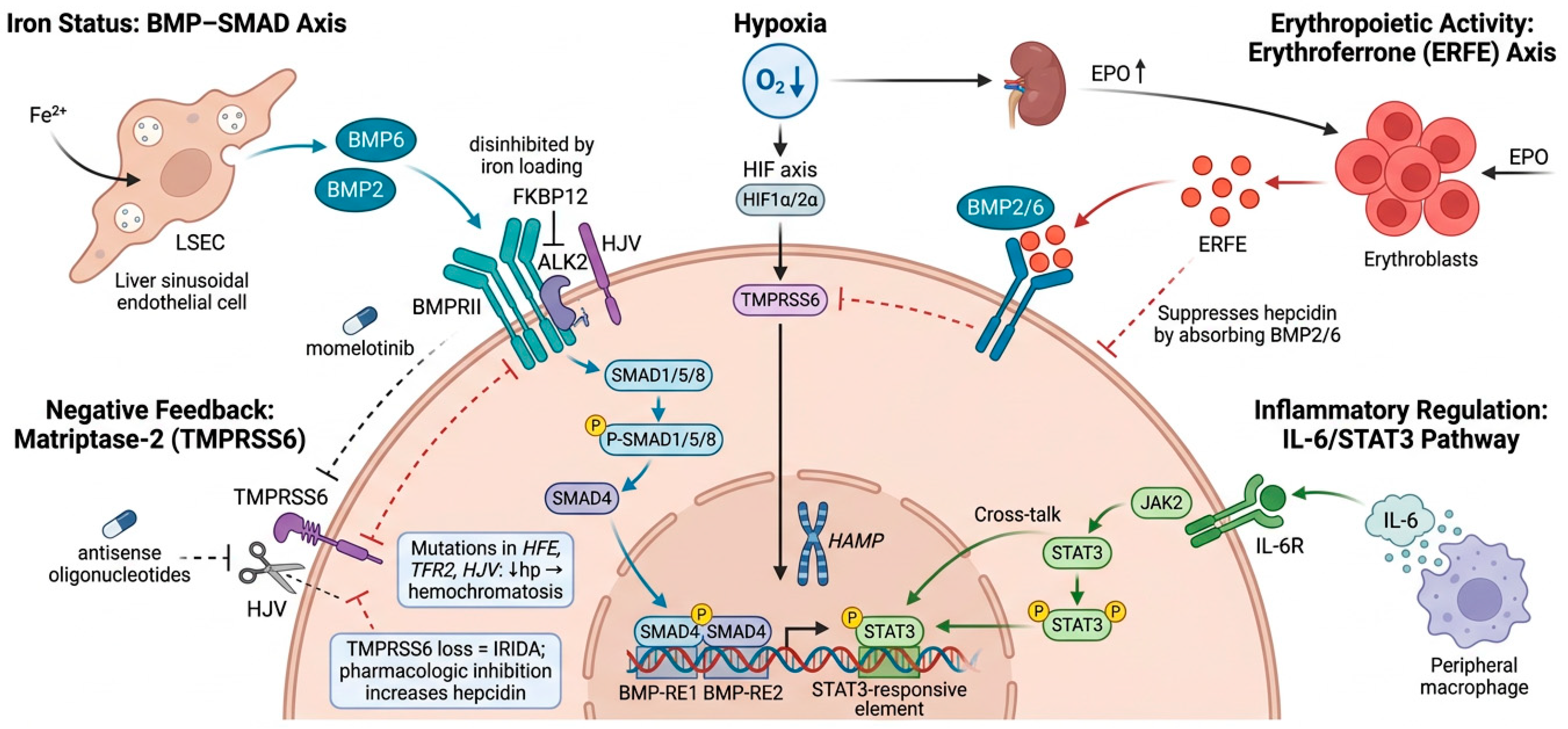
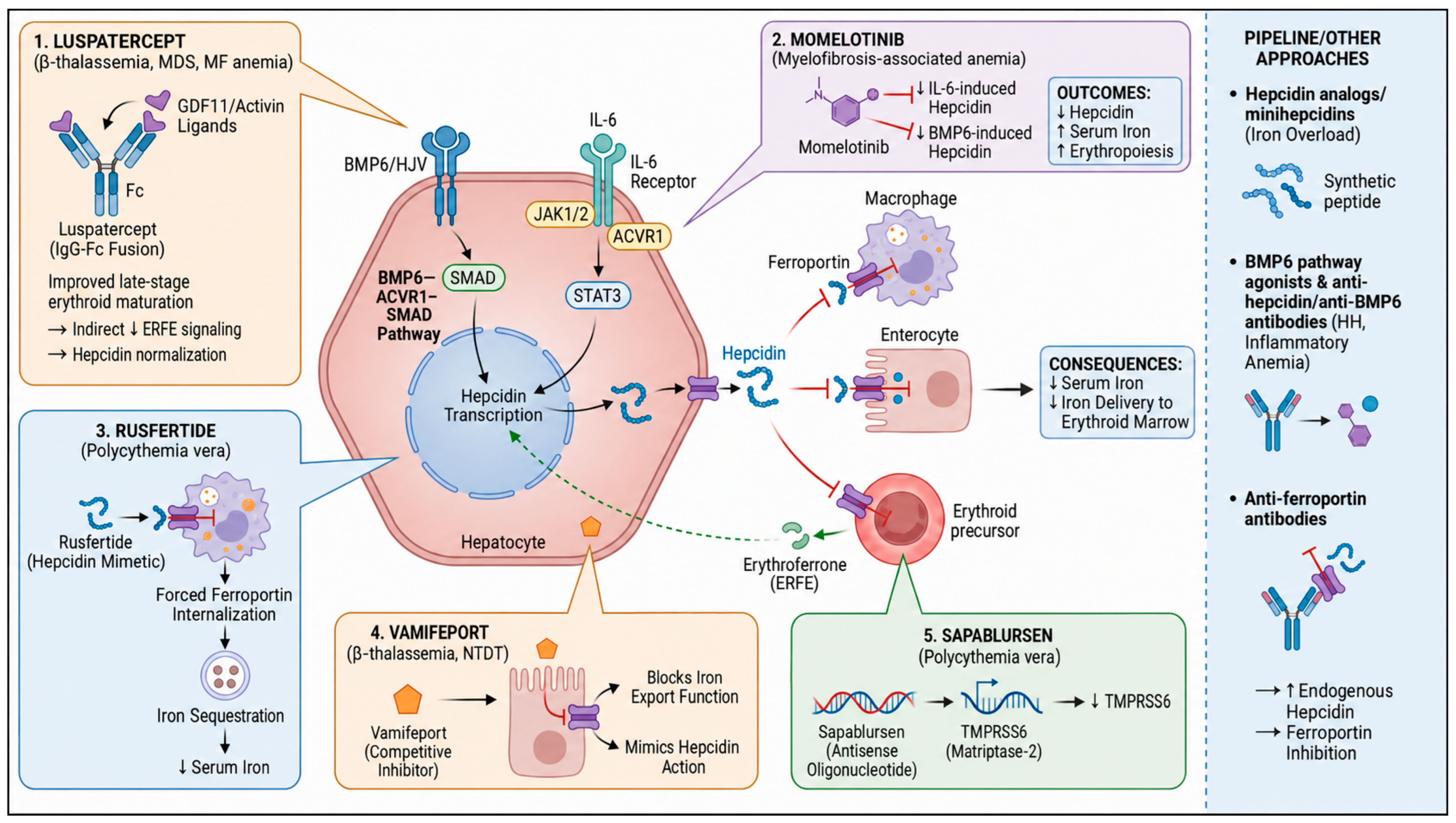
Hepcidin, a 25-amino-acid peptide hormone produced primarily by hepatocytes, is the master regulator of systemic iron homeostasis. By binding the cellular iron exporter ferroportin and inducing its internalization and lysosomal degradation, hepcidin restricts iron entry into plasma from enterocytes, macrophages, and hepatocytes. Its transcription is governed by an intricate molecular network that integrates iron status, erythropoietic demand, oxygen tension, and inflammation, with the BMP–HJV–ALK2/SMAD axis acting as the canonical activating pathway and erythroferrone (ERFE) and matriptase-2 (TMPRSS6) as physiological suppressors. Dysregulation of hepcidin underpins a wide spectrum of human diseases: insufficient hepcidin drives hereditary hemochromatosis and the iron overload of congenital and acquired ineffective erythropoiesis diseases and other ineffective erythropoiesis syndromes, whereas excessive or inappropriate hepcidin contributes to anemia of inflammation, anemia of chronic kidney disease, iron-restricted erythropoiesis in cancer, the iron-restrictive anemia of myelofibrosis, and pathogen-restrictive nutritional immunity. Within the myeloproliferative neoplasm spectrum, the divergent hepcidin patterns observed in polycythemia vera (suppressed) and myelofibrosis (inappropriately elevated through dual BMP/ACVR1/SMAD and IL-6/STAT3 hyperactivation) exemplify the clinical relevance of this axis and underpin two opposite pharmacologic strategies. Over the past decade, hepcidin pathway pharmacology has matured from proof-of-concept to regulatory milestones, shifting perspectives on several diseases and markedly improving clinical approaches.
Keywords: hepcidin; iron homeostasis; BMP–SMAD signaling; ACVR1/ALK2; β-thalassemia; inflammation; chronic kidney disease; myeloproliferative neoplasms hepcidin; iron homeostasis; BMP–SMAD signaling; ACVR1/ALK2; β-thalassemia; inflammation; chronic kidney disease; myeloproliferative neoplasms