Epigenetic Evidence Implies Disturbed Proteostasis and Potentially Protein Aggregation in Suicidality
 , , ,
, , ,  , and
, and 
Abstract
1. Introduction—The Pathophysiology of Suicide
2. Current State of Biological Research into Suicidality
2.1. Epigenetic Studies
2.2. Proteomics Studies
3. Protein Aggregation
3.1. Types of Protein Aggregation
3.2. Protein Aggregation in Neurodegenerative Disease
3.3. Protein Aggregation of DISC1 and CRMP1 in Mental Illness
4. Epigenetic Overlap Between Suicide and Genes Involved in Protein Aggregation
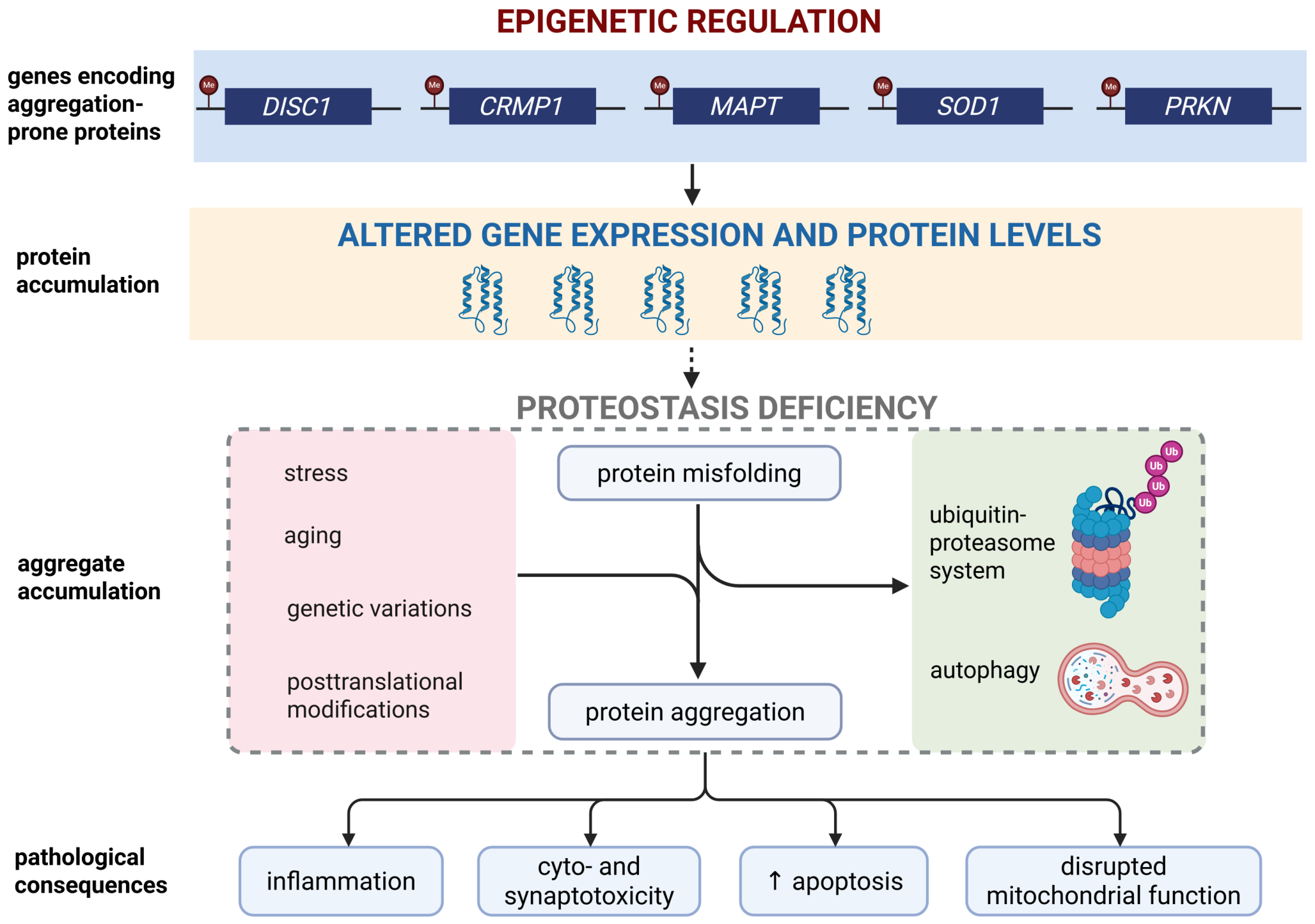
4.1. Altered Methylation of Genes Encoding Proteins Known to Form Aggregates, in Individuals Who Died by Suicide

| Gene | Location of CpGs | Status in Individuals Who Died by Suicide [14] | Protein | Associated with Disturbed Proteostasis in |
|---|---|---|---|---|
| DISC1 | Gene intron | Hypomethylation of four CpGs | DISC1 | Schizophrenia, bipolar disorder, major depressive disorder [75], Huntington’s disease [108], frontotemporal lobe dementia [109] |
| CRMP1 (DPYSL1) | Gene intron Gene promoter 1 to 5 kb upstream of the TSS | Hypomethylation of six CpGs Hypermethylation of two CpGs | CRMP1 | Schizophrenia, bipolar disorder, major depressive disorder [76], Huntington’s disease [107] |
| MAPT | Gene intron Gene exon | Hypomethylation of six CpGs | Tau | Alzheimer’s disease, Pick’s disease, progressive supranuclear palsy, corticobasal degeneration, and others [117] |
| PRKN (PARK2) | Gene intron | Hypomethylation of one CpG | Parkin | Juvenile Parkinson’s disease [118] |
| SOD1 | Gene promoter | Hypomethylation of two CpGs | SOD1 | Amyotrophic lateral sclerosis [119] |
4.2. Epigenetic Regulation of DISC1
4.3. Epigenetic Regulation of CRMP1
4.4. Epigenetic Regulation of MAPT
4.5. Epigenetic Regulation of PRKN
4.6. Epigenetic Regulation of SOD1
5. Disrupted Proteostasis and a Possible Role of Proteinopathy in Suicide
5.1. Hypothesis: The Potential for Disturbed Proteostasis, Potentially Including Protein Aggregation, in the Pathophysiology of Suicidality
5.2. Supporting Evidence for Disturbed Proteostasis in Suicide
5.3. Supporting Evidence Due to Cognitive Decline in Comorbidities
5.4. Potential Consequences of Proteostasis Disruption for Treatment in Suicidality
6. Conclusions
Author Contributions
Funding
Institutional Review Board Statement
Informed Consent Statement
Data Availability Statement
Acknowledgments
Conflicts of Interest
Abbreviations
| 5mC | 5-methylcytosine |
| 5hmC | 5-hydroxymethylcytosine |
| Aβ | amyloid-β peptide |
| ACE | angiotensin-converting enzyme |
| AD | Alzheimer’s disease |
| ALS | amyotrophic lateral sclerosis |
| APP | amyloid precursor protein |
| Bax | Bcl-2-associated X protein |
| Bcl-2 | B-cell lymphoma 2 |
| BDGF | brain-derived growth factor |
| BDNF | brain-derived neurotrophic factor |
| BPD | bipolar disorder |
| C9ORF72 | chromosome 9 open reading frame 72 |
| CAPNS1 | calpain small subunit 1 |
| CASK/Lin2 | calcium/calmodulin-dependent serine protein kinase/liprin-2 |
| CDK5 | cyclin-dependent kinase 5 |
| COX-2 | cyclooxygenase-2 |
| CRMP1 | collapsin response mediator protein 1 |
| CSNK2B | casein kinase 2β |
| CSF | cerebrospinal fluid |
| DISC1 | disrupted in schizophrenia 1 |
| DTNBP1 | dystrobrevin binding protein 1 |
| ECT | electroconvulsive therapy |
| FABP3 | fatty acid binding proteins 3 |
| FABP7 | fatty acid binding proteins 7 |
| FADD | FAS-associated death domain protein |
| FUS | fused in sarcoma |
| GEO | Gene Expression Omnibus |
| GFAP | glial fibrillary acidic protein |
| HPA | hypothalamic–pituitary–adrenal axis |
| HTT | huntingtin |
| MAM | methyl-azoxy-methanol |
| MAOA | monoamine oxidase A |
| MAPT | microtubule-associated protein tau |
| MDD | major depressive disorder |
| NfL | neurofilament light chain |
| NF-κB | nuclear factor κB |
| NGF | nerve growth factor |
| miRNA | micro-RNA |
| mTOR | mechanistic target of rapamycin |
| NMDA | N-methyl-D-aspartate |
| NO | nitrous oxide |
| NPAS3 | neuronal PAS domain protein 3 |
| NR3C1 | nuclear receptor subfamily 3 group C member 1 |
| Nrf2 | nuclear factor erythroid 2-related factor 2 |
| PARK2 | Parkin (alternative name for PRKN1) |
| PD | Parkinson’s disease |
| PDZ | PSD95, Dlg1 and zo-1 (domain) |
| PDE3A | phosphodiesterase 3A |
| PINK1 | PTEN-induced kinase 1 |
| PPAR | peroxisome proliferator-activated receptor |
| PRKN | Parkin |
| PSEN1 | presenilin 1 |
| PTP4A2 | protein tyrosine phosphatase 4A2 |
| RARRES3 | retinoic acid receptor responder 3 |
| REST | repressor element 1 silencing transcription factor |
| SCZ | schizophrenia |
| SLC4A2 | solute carrier family 4 member 2 |
| SLC6A4 | solute carrier family 6 member 4 |
| SOD1 | superoxide dismutase 1 |
| TDP-43 | TAR DNA-binding protein 43 |
| TMS | transcranial magnetic stimulation |
| TNF-α | tumour necrosis factor α |
| TRIOBP | TRIO and F-actin binding protein |
| TrkA | tyrosine kinase receptor A |
| TrkB | tyrosine kinase receptor B |
References
- WHO. Suicide Worldwide in 2019: Global Health Estimates; WHO: Geneva, Switzerland, 2021.
- Abou Chahla, M.N.; Khalil, M.I.; Comai, S.; Brundin, L.; Erhardt, S.; Guillemin, G.J. Biological Factors Underpinning Suicidal Behaviour: An Update. Brain Sci. 2023, 13, 505. [Google Scholar] [CrossRef]
- Turecki, G.; Brent, D.A.; Gunnell, D.; O’Connor, R.C.; Oquendo, M.A.; Pirkis, J.; Stanley, B.H. Suicide and suicide risk. Nat. Rev. Dis. Primers 2019, 5, 74. [Google Scholar] [CrossRef] [PubMed]
- Fleischmann, A.; Arensman, E.; Berman, A.; Carli, V.; De Leo, D.; Hadlaczky, G.; Howlader, S.; Vijayakumar, L.; Wasserman, D.; Saxena, S. Overview evidence on interventions for population suicide with an eye to identifying best-supported strategies for LMICs. Glob. Ment. Health 2016, 3, e5. [Google Scholar] [CrossRef]
- Oquendo, M.A.; Porras-Segovia, A. Barriers for the Research, Prevention, and Treatment of Suicidal Behavior. Curr. Top. Behav. Neurosci. 2020, 46, 25–40. [Google Scholar] [CrossRef]
- Lutz, P.E.; Mechawar, N.; Turecki, G. Neuropathology of suicide: Recent findings and future directions. Mol. Psychiatry 2017, 22, 1395–1412. [Google Scholar] [CrossRef]
- Costanza, A.; D’Orta, I.; Perroud, N.; Burkhardt, S.; Malafosse, A.; Mangin, P.; La Harpe, R. Neurobiology of suicide: Do biomarkers exist? Int. J. Leg. Med. 2014, 128, 73–82. [Google Scholar] [CrossRef]
- Henry, M. Suicide prevention: A multisectorial public health concern. Prev. Med. 2021, 152, 106772. [Google Scholar] [CrossRef]
- Gould, T.D.; Georgiou, P.; Brenner, L.A.; Brundin, L.; Can, A.; Courtet, P.; Donaldson, Z.R.; Dwivedi, Y.; Guillaume, S.; Gottesman, I.I.; et al. Animal models to improve our understanding and treatment of suicidal behavior. Transl. Psychiatry 2017, 7, e1092. [Google Scholar] [CrossRef]
- Kouter, K.; Videtic Paska, A. ‘Omics’ of suicidal behaviour: A path to personalised psychiatry. World J. Psychiatry 2021, 11, 774–790. [Google Scholar] [CrossRef] [PubMed]
- Bradshaw, N.J.; Korth, C. Protein misassembly and aggregation as potential convergence points for non-genetic causes of chronic mental illness. Mol. Psychiatry 2019, 24, 936–951. [Google Scholar] [CrossRef] [PubMed]
- Hui, K.K.; Endo, R.; Sawa, A.; Tanaka, M. A perspective on the potential involvement of impaired proteostasis in neuropsychiatric disorders. Biol. Psychiatry 2022, 91, 335–345. [Google Scholar] [CrossRef] [PubMed]
- Ochneva, A.; Zorkina, Y.; Abramova, O.; Pavlova, O.; Ushakova, V.; Morozova, A.; Zubkov, E.; Pavlov, K.; Gurina, O.; Chekhonin, V. Protein Misfolding and Aggregation in the Brain: Common Pathogenetic Pathways in Neurodegenerative and Mental Disorders. Int. J. Mol. Sci. 2022, 23, 14498. [Google Scholar] [CrossRef]
- Kouter, K.; Zupanc, T.; Videtič Paska, A. Genome-wide DNA methylation in suicide victims revealing impact on gene expression. J. Affect. Disord. 2019, 253, 419–425. [Google Scholar] [CrossRef]
- Bedene, T.; Šmon, J.; Videtič Paska, A.; Zupanc, T.; Kouter, K. Epigenetic and Transcriptomic Alterations of Protein Aggregation-Linked Genes in Suicide: A Pilot Study. Genes 2025, 16, 1467. [Google Scholar] [CrossRef]
- van Heeringen, K.; Mann, J.J. The neurobiology of suicide. Lancet Psychiatry 2014, 1, 63–72. [Google Scholar] [CrossRef]
- Mann, J.J. Neurobiology of suicidal behaviour. Nat. Rev. Neurosci. 2003, 4, 819–828. [Google Scholar] [CrossRef] [PubMed]
- Lewis, C.P.; Port, J.D.; Blacker, C.J.; Sonmez, A.I.; Seewoo, B.J.; Leffler, J.M.; Frye, M.A.; Croarkin, P.E. Altered anterior cingulate glutamatergic metabolism in depressed adolescents with current suicidal ideation. Transl. Psychiatry 2020, 10, 119. [Google Scholar] [CrossRef]
- Brundin, L.; Bryleva, E.Y.; Thirtamara Rajamani, K. Role of Inflammation in Suicide: From Mechanisms to Treatment. Neuropsychopharmacology 2017, 42, 271–283. [Google Scholar] [CrossRef]
- Sun, S.; Liu, Q.; Wang, Z.; Huang, Y.; Sublette, M.E.; Dwork, A.J.; Rosoklija, G.; Ge, Y.; Galfalvy, H.; Mann, J.J.; et al. Brain and blood transcriptome profiles delineate common genetic pathways across suicidal ideation and suicide. Mol. Psychiatry 2024, 29, 1417–1426. [Google Scholar] [CrossRef]
- Wagner, G.; Schultz, C.C.; Koch, K.; Schachtzabel, C.; Sauer, H.; Schlösser, R.G. Prefrontal cortical thickness in depressed patients with high-risk for suicidal behavior. J. Psychiatr. Res. 2012, 46, 1449–1455. [Google Scholar] [CrossRef]
- Stanley, B.; Itzhaky, L.; Oquendo, M.A. Identifying Neurobiological Underpinnings of Two Suicidal Subtypes. J. Psychiatry Brain Sci. 2021, 6, e210016. [Google Scholar] [CrossRef] [PubMed]
- Roy, B.; Dwivedi, Y. Understanding epigenetic architecture of suicide neurobiology: A critical perspective. Neurosci. Biobehav. Rev. 2017, 72, 10–27. [Google Scholar] [CrossRef]
- Brivio, P.; Sbrini, G.; Tarantini, L.; Parravicini, C.; Gruca, P.; Lason, M.; Litwa, E.; Favero, C.; Riva, M.A.; Eberini, I.; et al. Stress Modifies the Expression of Glucocorticoid-Responsive Genes by Acting at Epigenetic Levels in the Rat Prefrontal Cortex: Modulatory Activity of Lurasidone. Int. J. Mol. Sci. 2021, 22, 6197. [Google Scholar] [CrossRef] [PubMed]
- Grieco, F.; van Gelderen, P.; Ali, M.; Larrieu, T.; Toni, N. Natural variations in maternal behavior shape anxiety and hippocampal neurogenesis in offspring. Life Sci. Alliance 2026, 9, e202503419. [Google Scholar] [CrossRef]
- Turecki, G.; Ernst, C.; Jollant, F.; Labonté, B.; Mechawar, N. The neurodevelopmental origins of suicidal behavior. Trends Neurosci. 2012, 35, 14–23. [Google Scholar] [CrossRef]
- Cheung, S.; Woo, J.; Maes, M.S.; Zai, C.C. Suicide epigenetics, a review of recent progress. J. Affect. Disord. 2020, 265, 423–438. [Google Scholar] [CrossRef]
- Policicchio, S.; Washer, S.; Viana, J.; Iatrou, A.; Burrage, J.; Hannon, E.; Turecki, G.; Kaminsky, Z.; Mill, J.; Dempster, E.L.; et al. Genome-wide DNA methylation meta-analysis in the brains of suicide completers. Transl. Psychiatry 2020, 10, 69. [Google Scholar] [CrossRef]
- Kimbrel, N.A.; Garrett, M.E.; Evans, M.K.; Mellows, C.; Dennis, M.F.; Hair, L.P.; Hauser, M.A.; Ashley-Koch, A.E.; Beckham, J.C. Large epigenome-wide association study identifies multiple novel differentially methylated CpG sites associated with suicidal thoughts and behaviors in veterans. Front. Psychiatry 2023, 14, 1145375. [Google Scholar] [CrossRef]
- Kouter, K.; Šalamon Arčan, I.; Videtič Paska, A. Epigenetics in psychiatry: Beyond DNA methylation. World J. Psychiatry 2023, 13, 319–330. [Google Scholar] [CrossRef] [PubMed]
- Serafini, G.; Pompili, M.; Hansen, K.F.; Obrietan, K.; Dwivedi, Y.; Shomron, N.; Girardi, P. The involvement of microRNAs in major depression, suicidal behavior, and related disorders: A focus on miR-185 and miR-491-3p. Cell. Mol. Neurobiol. 2014, 34, 17–30. [Google Scholar] [CrossRef]
- Dwivedi, Y. MicroRNAs in depression and suicide: Recent insights and future perspectives. J. Affect. Disord. 2018, 240, 146–154. [Google Scholar] [CrossRef]
- Kim, M.J.; Do, M.; Han, D.; Son, M.; Shin, D.; Yeo, I.; Yun, Y.H.; Yoo, S.H.; Choi, H.J.; Shin, D.; et al. Proteomic profiling of postmortem prefrontal cortex tissue of suicide completers. Transl. Psychiatry 2022, 12, 142. [Google Scholar] [CrossRef]
- Cabello-Arreola, A.; Ho, A.M.-C.; Ozerdem, A.; Cuellar-Barboza, A.B.; Kucuker, M.U.; Heppelmann, C.J.; Charlesworth, C.; Ceylan, D.; Stockmeier, C.A.; Rajkowska, G.; et al. Differential Dorsolateral Prefrontal Cortex Proteomic Profiles of Suicide Victims with Mood Disorders. Genes 2020, 11, 256. [Google Scholar] [CrossRef]
- Monsalve, E.M.; García-Gutiérrez, M.S.; Navarrete, F.; Giner, S.; Laborda, J.; Manzanares, J. Abnormal Expression Pattern of Notch Receptors, Ligands, and Downstream Effectors in the Dorsolateral Prefrontal Cortex and Amygdala of Suicidal Victims. Mol. Neurobiol. 2014, 49, 957–965. [Google Scholar] [CrossRef]
- Erbay, L.G.; Karlıdağ, R.; Oruç, M.; Çiğremiş, Y.; Celbiş, O. Association of BDNF/TrkB and NGF/TrkA Levels in Postmortem Brain with Major Depression and Suicide. Pychiatria Danub. 2021, 33, 491–498. [Google Scholar] [CrossRef] [PubMed]
- Banerjee, R.; Ghosh, A.K.; Ghosh, B.; Bhattacharyya, S.; Mondal, A.C. Decreased mRNA and Protein Expression of BDNF, NGF, and their Receptors in the Hippocampus from Suicide: An Analysis in Human Postmortem Brain. Clin. Med. Insights Pathol. 2013, 6, 1–11. [Google Scholar] [CrossRef]
- De Simone, S.; Bosco, M.A.; La Russa, R.; Vittorio, S.; Di Fazio, N.; Neri, M.; Cipolloni, L.; Baldari, B. Suicide and Neurotrophin Factors: A Systematic Review of the Correlation between BDNF and GDNF and Self-Killing. Healthcare 2023, 11, 78. [Google Scholar] [CrossRef]
- Dwivedi, Y.; Rizavi, H.S.; Conley, R.R.; Roberts, R.C.; Tamminga, C.A.; Pandey, G.N. Altered Gene Expression of Brain-Derived Neurotrophic Factor and Receptor Tyrosine Kinase B in Postmortem Brain of Suicide Subjects. Arch. Gen. Psychiatry 2003, 60, 804–815. [Google Scholar] [CrossRef] [PubMed]
- Eisen, R.B.; Perera, S.; Banfield, L.; Anglin, R.; Minuzzi, L.; Samaan, Z. Association between BDNF levels and suicidal behaviour: A systematic review and meta-analysis. Syst. Rev. 2015, 4, 187. [Google Scholar] [CrossRef] [PubMed]
- Vendruscolo, M.; Fuxreiter, M. Protein condensation diseases: Therapeutic opportunities. Nat. Commun. 2022, 13, 5550. [Google Scholar] [CrossRef]
- Juković, M.; Ratkaj, I.; Kalafatovic, D.; Bradshaw, N.J. Amyloids, amorphous aggregates and assemblies of peptides—Assessing aggregation. Biophys. Chem. 2024, 308, 107202. [Google Scholar] [CrossRef]
- Chiti, F.; Dobson, C.M. Protein Misfolding, Functional Amyloid, and Human Disease. Annu. Rev. Biochem. 2006, 75, 333–366. [Google Scholar] [CrossRef] [PubMed]
- Lashuel, H.A.; Hartley, D.; Petre, B.M.; Walz, T.; Lansbury, P.T., Jr. Neurodegenerative disease: Amyloid pores from pathogenic mutations. Nature 2002, 418, 291. [Google Scholar] [CrossRef]
- Lashuel, H.A.; Lansbury, P.T., Jr. Are amyloid diseases caused by protein aggregates that mimic bacterial pore-forming toxins? Q. Rev. Biophys. 2006, 39, 167–201. [Google Scholar] [CrossRef]
- Di Scala, C.; Yahi, N.; Boutemeur, S.; Flores, A.; Rodriguez, L.; Chahinian, H.; Fantini, J. Common molecular mechanism of amyloid pore formation by Alzheimer’s β-amyloid peptide and α-synuclein. Sci. Rep. 2016, 6, 28781. [Google Scholar] [CrossRef]
- Majumdar, A.; Cesario, W.C.; White-Grindley, E.; Jiang, H.; Ren, F.; Khan, M.R.; Li, L.; Choi, E.M.-L.; Kannan, K.; Guo, F.; et al. Critical Role of Amyloid-like Oligomers of Drosophila Orb2 in the Persistence of Memory. Cell 2012, 148, 515–529. [Google Scholar] [CrossRef]
- Khan, M.R.; Li, L.; Pérez-Sánchez, C.; Saraf, A.; Florens, L.; Slaughter, B.D.; Unruh, J.R.; Si, K. Amyloidogenic Oligomerization Transforms Drosophila Orb2 from a Translation Repressor to an Activator. Cell 2015, 163, 1468–1483. [Google Scholar] [CrossRef] [PubMed]
- Lee, D.S.W.; Choi, C.-H.; Sanders, D.W.; Beckers, L.; Riback, J.A.; Brangwynne, C.P.; Wingreen, N.S. Size distributions of intracellular condensates reflect competition between coalescence and nucleation. Nat. Phys. 2023, 19, 586–596. [Google Scholar] [CrossRef]
- Alberti, S.; Hyman, A.A. Biomolecular condensates at the nexus of cellular stress, protein aggregation disease and ageing. Nat. Rev. Mol. Cell Biol. 2021, 22, 196–213. [Google Scholar] [CrossRef] [PubMed]
- Antifeeva, I.A.; Fonin, A.V.; Fefilova, A.S.; Stepanenko, O.V.; Povarova, O.I.; Silonov, S.A.; Kuznetsova, I.M.; Uversky, V.N.; Turoverov, K.K. Liquid-liquid phase separation as an organizing principle of intracellular space: Overview of the evolution of the cell compartmentalization concept. Cell. Mol. Life Sci. CMLS 2022, 79, 251. [Google Scholar] [CrossRef]
- Roden, C.; Gladfelter, A.S. RNA contributions to the form and function of biomolecular condensates. Nat. Rev. Mol. Cell Biol. 2021, 22, 183–195. [Google Scholar] [CrossRef]
- Hartl, F.U.; Bracher, A.; Hayer-Hartl, M. Molecular chaperones in protein folding and proteostasis. Nature 2011, 475, 324–332. [Google Scholar] [CrossRef]
- Hipp, M.S.; Park, S.H.; Hartl, F.U. Proteostasis impairment in protein-misfolding and aggregation diseases. Trends Cell Biol. 2014, 24, 506–514. [Google Scholar] [CrossRef]
- Westerheide, S.D.; Anckar, J.; Stevens, S.M., Jr.; Sistonen, L.; Morimoto, R.I. Stress-inducible regulation of heat shock factor 1 by the deacetylase SIRT1. Science 2009, 323, 1063–1066. [Google Scholar] [CrossRef]
- Khan, S.; Barve, K.H.; Kumar, M.S. Recent Advancements in Pathogenesis, Diagnostics and Treatment of Alzheimer’s Disease. Curr. Neuropharmacol. 2020, 18, 1106–1125. [Google Scholar] [CrossRef]
- Zhang, Y.; Chen, H.; Li, R.; Sterling, K.; Song, W. Amyloid β-based therapy for Alzheimer’s disease: Challenges, successes and future. Signal Transduct. Target. Ther. 2023, 8, 248. [Google Scholar] [CrossRef]
- Koudinov, A.R.; Koudinova, N.V. Cholesterol homeostasis failure as a unifying cause of synaptic degeneration. J. Neurol. Sci. 2005, 229–230, 233–240. [Google Scholar] [CrossRef]
- Hardy, J.A.; Higgins, G.A. Alzheimer’s disease: The amyloid cascade hypothesis. Science 1992, 256, 184–185. [Google Scholar] [CrossRef]
- Ferreira, S.T.; Lourenco, M.V.; Oliveira, M.M.; De Felice, F.G. Soluble amyloid-β oligomers as synaptotoxins leading to cognitive impairment in Alzheimer’s disease. Front. Cell. Neurosci. 2015, 9, 191. [Google Scholar] [CrossRef]
- Goedert, M.; Spillantini, M.G.; Jakes, R.; Rutherford, D.; Crowther, R.A. Multiple isoforms of human microtubule-associated protein tau: Sequences and localization in neurofibrillary tangles of Alzheimer’s disease. Neuron 1989, 3, 519–526. [Google Scholar] [CrossRef]
- Barbier, P.; Zejneli, O.; Martinho, M.; Lasorsa, A.; Belle, V.; Smet-Nocca, C.; Tsvetkov, P.O.; Devred, F.; Landrieu, I. Role of Tau as a Microtubule-Associated Protein: Structural and Functional Aspects. Front. Aging Neurosci. 2019, 11, 204. [Google Scholar] [CrossRef]
- Devous, M.D., Sr.; Fleisher, A.S.; Pontecorvo, M.J.; Lu, M.; Siderowf, A.; Navitsky, M.; Kennedy, I.; Southekal, S.; Harris, T.S.; Mintun, M.A. Relationships Between Cognition and Neuropathological Tau in Alzheimer’s Disease Assessed by 18F Flortaucipir PET. J. Alzheimer’s Dis. JAD 2021, 80, 1091–1104. [Google Scholar] [CrossRef]
- Lee, H.-J.; Zheng, J.J. PDZ domains and their binding partners: Structure, specificity, and modification. Cell Commun. Signal. 2010, 8, 8. [Google Scholar] [CrossRef]
- Brooks, J.; Ding, J.; Simon-Sanchez, J.; Paisan-Ruiz, C.; Singleton, A.B.; Scholz, S.W. Parkin and PINK1 mutations in early-onset Parkinson’s disease: Comprehensive screening in publicly available cases and control. J. Med. Genet. 2009, 46, 375–381. [Google Scholar] [CrossRef]
- Malik, R.; Wiedau, M. Therapeutic Approaches Targeting Protein Aggregation in Amyotrophic Lateral Sclerosis. Front. Mol. Neurosci. 2020, 13, 98. [Google Scholar] [CrossRef]
- Hart, P.J. Pathogenic superoxide dismutase structure, folding, aggregation and turnover. Curr. Opin. Chem. Biol. 2006, 10, 131–138. [Google Scholar] [CrossRef]
- Shi, P.; Wei, Y.; Zhang, J.; Gal, J.; Zhu, H. Mitochondrial dysfunction is a converging point of multiple pathological pathways in amyotrophic lateral sclerosis. J. Alzheimer’s Dis. 2010, 20, S11–S24. [Google Scholar] [CrossRef]
- Banks, C.J.; Andersen, J.L. Mechanisms of SOD1 regulation by post-translational modifications. Redox Biol. 2019, 26, 101270. [Google Scholar] [CrossRef]
- Nucifora, L.G.; MacDonald, M.L.; Lee, B.J.; Peters, M.E.; Norris, A.L.; Orsburn, B.C.; Yang, K.; Gleason, K.; Margolis, R.L.; Pevsner, J.; et al. Increased protein insolubility in brains from a subset of patients with schizophrenia. Am. J. Psychiat. 2019, 176, 730–743. [Google Scholar] [CrossRef]
- Nucifora, L.G.; Ishizuka, K.; El Demerdash, N.; Lee, B.J.; Imai, M.T.; Ayala-Grosso, C.; Yenokyan, G.; Cascella, N.G.; Lin, S.; Schretlen, D.J.; et al. Protein aggregation identified in olfactory neuronal cells is associated with cognitive impairments in a subset of living schizophrenia patients. Mol. Psychiatry 2025, 30, 3673–3685. [Google Scholar] [CrossRef]
- Scott, M.R.; Meador-Woodruff, J.H. Intracellular compartment-specific proteasome dysfunction in postmortem cortex in schizophrenia patients. Mol. Psychiatry 2020, 25, 776–790. [Google Scholar] [CrossRef]
- Bousman, C.A.; Luza, S.; Mancuso, S.G.; Kang, D.; Opazo, C.M.; Mostaid, M.S.; Cropley, V.; McGorry, P.; Weickert, C.S.; Pantelis, C.; et al. Elevated ubiquitinated proteins in brain and blood of individuals with schizophrenia. Sci. Rep. 2019, 9, 2307. [Google Scholar] [CrossRef]
- Aryal, S.; Bonanno, K.; Song, B.; Mani, D.R.; Keshishian, H.; Carr, S.A.; Sheng, M.; Dejanovic, B. Deep proteomics identifies shared molecular pathway alterations in synapses of patients with schizophrenia and bipolar disorder and mouse model. Cell Rep. 2023, 42, 112497. [Google Scholar] [CrossRef]
- Leliveld, S.R.; Bader, V.; Hendriks, P.; Prikulis, I.; Sajnani, G.; Requena, J.R.; Korth, C. Insolubility of Disrupted-in-Schizophrenia 1 disrupts oligomer-dependent interactions with Nuclear Distribution Element 1 and is associated with sporadic mental disease. J. Neurosci. 2008, 28, 3839–3845. [Google Scholar] [CrossRef] [PubMed]
- Ottis, P.; Bader, V.; Trossbach, S.V.; Kretzschmar, H.; Michel, M.; Leliveld, S.R.; Korth, C. Convergence of two independent mental disease genes on the protein level: Recruitment of dysbindin to cell-invasive Disrupted-in-Schizophrenia 1 aggresomes. Biol. Psychiatry 2011, 70, 604–610. [Google Scholar] [CrossRef]
- Bader, V.; Tomppo, L.; Trossbach, S.V.; Bradshaw, N.J.; Prikulis, I.; Leliveld, S.R.; Lin, C.-Y.; Ishizuka, K.; Sawa, A.; Ramos, A.; et al. Proteomic, genomic and translational approaches identify CRMP1 for a role in schizophrenia and its underlying traits. Hum. Mol. Genet. 2012, 21, 4406–4418. [Google Scholar] [CrossRef]
- Bradshaw, N.J.; Bader, V.; Prikulis, I.; Lueking, A.; Müllner, S.; Korth, C. Aggregation of the protein TRIOBP-1 and its potential relevance to schizophrenia. PLoS ONE 2014, 9, e111196. [Google Scholar] [CrossRef]
- Zaharija, B.; Odorčić, M.; Hart, A.; Samardžija, B.; Marreiros, R.; Prikulis, I.; Juković, M.; Hyde, T.M.; Kleinman, J.E.; Korth, C.; et al. TRIOBP-1 protein aggregation exists in both major depressive disorder and schizophrenia, and can occur through two distinct regions of the protein. Int. J. Mol. Sci. 2022, 23, 11048. [Google Scholar] [CrossRef]
- Yu, L.; Arbez, N.; Nucifora, L.G.; Sell, G.L.; DeLisi, L.E.; Ross, C.A.; Margolis, R.L.; Nucifora, F.C. A mutation in NPAS3 segregates with mental illness in a small family. Mol. Psychiatry 2014, 19, 7–8. [Google Scholar] [CrossRef]
- Nucifora, L.G.; Wu, Y.C.; Lee, B.J.; Sha, L.; Margolis, R.L.; Ross, C.A.; Sawa, A.; Nucifora, F.C., Jr. A mutation in NPAS3 that segregates with schizophrenia in a small family leads to protein aggregation. Mol. Neuropsychiatry 2016, 2, 133–144. [Google Scholar] [CrossRef]
- Shimamoto, C.; Ohnishi, T.; Maekawa, M.; Watanabe, A.; Ohba, H.; Arai, R.; Iwayama, Y.; Hisano, Y.; Toyota, T.; Toyoshima, M.; et al. Functional characterization of FABP3, 5 and 7 gene variants identified in schizophrenia and autism spectrum disorder and mouse behavioral studies. Hum. Mol. Genet. 2014, 23, 6495–6511. [Google Scholar] [CrossRef]
- Millar, J.K.; Wilson-Annan, J.C.; Anderson, S.; Christie, S.; Taylor, M.S.; Semple, C.A.M.; Devon, R.S.; St Clair, D.M.; Muir, W.J.; Blackwood, D.H.R.; et al. Disruption of two novel genes by a translocation co-segregating with schizophrenia. Hum. Mol. Genet. 2000, 9, 1415–1423. [Google Scholar] [CrossRef]
- Blackwood, D.H.R.; Fordyce, A.; Walker, M.T.; St Clair, D.M.; Porteous, D.J.; Muir, W.J. Schizophrenia and affective disorders—Cosegregation with a translocation at chromosome 1q42 that directly disrupts brain-expressed genes: Clinical and P300 findings in a family. Am. J. Hum. Genet. 2001, 69, 428–433. [Google Scholar] [CrossRef]
- Chubb, J.E.; Bradshaw, N.J.; Soares, D.C.; Porteous, D.J.; Millar, J.K. The DISC locus in psychiatric illness. Mol. Psychiatry 2008, 13, 36–64. [Google Scholar] [CrossRef] [PubMed]
- Yerabham, A.S.K.; Weiergräber, O.H.; Bradshaw, N.J.; Korth, C. Revisiting Disrupted in Schizophrenia 1 as a scaffold protein. Biol. Chem. 2013, 394, 1425–1437. [Google Scholar] [CrossRef]
- Lipina, T.V.; Roder, J.C. Disrupted-In-Schizophrenia-1 (DISC1) interactome and mental disorders: Impact of mouse models. Neurosc. Biobehav. Rev. 2014, 45, 271–294. [Google Scholar] [CrossRef]
- Dahoun, T.; Trossbach, S.V.; Brandon, N.J.; Korth, C.; Howes, O.D. The impact of Disrupted-in-Schizophrenia 1 (DISC1) on the dopaminergic system: A systematic review. Transl. Psychiatry 2017, 7, e1015. [Google Scholar] [CrossRef]
- Tropea, D.; Hardingham, N.; Millar, K.; Fox, K. Mechanisms underlying the role of DISC1 in synaptic plasticity. J. Physiol. 2018, 596, 2747–2771. [Google Scholar] [CrossRef]
- Pils, M.; Rutsch, J.; Eren, F.; Engberg, G.; Piehl, F.; Cervenka, S.; Sellgren, C.; Troßbach, S.; Willbold, D.; Erhardt, S.; et al. Disrupted-in-schizophrenia 1 protein aggregates in cerebrospinal fluid are elevated in patients with first-episode psychosis. Psychiatry Clin. Neurosci. 2023, 77, 665–671. [Google Scholar] [CrossRef] [PubMed]
- Trossbach, S.V.; Bader, V.; Hecher, L.; Pum, M.E.; Masoud, S.T.; Prikulis, I.; Schäble, S.; de Souza Silva, M.A.; Su, P.; Boulat, B.; et al. Misassembly of full-length Disrupted-in-Schizophrenia 1 protein is linked to altered dopamine homeostasis and behavioral deficits. Mol. Psychiatry 2016, 21, 1561–1572. [Google Scholar] [CrossRef] [PubMed]
- Uzuneser, T.C.; Speidel, J.; Kogias, G.; Wang, A.-L.; de Souza Silva, M.A.; Huston, J.P.; Zoicas, I.; von Hörsten, S.; Kornhuber, J.; Korth, C.; et al. Disrupted-in-Schizophrenia 1 (DISC1) Overexpression and Juvenile Immune Activation Cause Sex- Specific Schizophrenia-Related Psychopathology in Rats. Front. Psychiatry 2019, 10, 222. [Google Scholar] [CrossRef] [PubMed]
- Nani, J.V.; Fonseca, M.C.; Engi, S.A.; Perillo, M.G.; Dias, C.S.; Gazarini, M.L.; Korth, C.; Cruz, F.C.; Hayashi, M.A. Decreased nuclear distribution nudE-like 1 enzyme activity in an animal model with dysfunctional disrupted-in-schizophrenia 1 signaling featuring aberrant neurodevelopment and amphetamine-supersensitivity. J. Pschopharm 2020, 34, 467–477. [Google Scholar] [CrossRef]
- Wang, A.-L.; Chao, O.Y.; Nikolaus, S.; Lamounier-Zepter, V.; Hollenberg, C.P.; Lubec, G.; Trossbach, S.V.; Korth, C.; Huston, J.P. Disrupted-in-schizophrenia 1 protein misassembly impairs cognitive flexibility andsocial behaviors in a transgenic rat model. Neuroscience 2022, 493, 41–51. [Google Scholar] [CrossRef]
- Seidisarouei, M.; Schäble, S.; van Wingerden, M.; Trossbach, S.V.; Korth, C.; Kalenscher, T. Social anhedonia as a Disrupted-in-Schizophrenia 1-dependent phenotype. Sci. Rep. 2022, 12, 10182. [Google Scholar] [CrossRef]
- Hamburg, H.; Trossbach, S.V.; Bader, V.; Chwiesko, C.; Kipar, A.; Sauvage, M.; Crum, W.R.; Vernon, A.C.; Bidmon, H.J.; Korth, C. Simultaneous effects on parvalbumin-positive interneuron and dopaminergic system development in a transgenic rat model for sporadic schizophrenia. Sci. Rep. 2016, 6, 34946. [Google Scholar] [CrossRef]
- Kaefer, K.; Malagon-Vina, H.; Dickerson, D.D.; O’Neill, J.; Trossbach, S.V.; Korth, C.; Csicsvari, J. Disrupted-in-schizophrenia 1 overexpression disrupts hippocampal coding and oscillatory synchronization. Hippocampus 2019, 29, 802–816. [Google Scholar] [CrossRef]
- Samardžija, B.; Petrović, M.; Zaharija, B.; Medija, M.; Meštrović, A.; Bradshaw, N.J.; Filošević Vujnović, A.; Andretić Waldowski, R. Transgenic Drosophila melanogaster Carrying a Human Full-Length DISC1 Construct (UAS-hflDISC1) Showing Effects on Social Interaction Networks. Curr. Issues Mol. Biol. 2024, 46, 8526–8549. [Google Scholar] [CrossRef]
- Cukkemane, A.; Becker, N.; Zielinski, M.; Frieg, B.; Lakomek, N.-A.; Heise, H.; Schröder, G.F.; Willbold, D.; Weiergräber, O.H. Conformational heterogeneity coupled with β-fibril formation of a scaffold protein involved in chronic mental illnesses. Transl. Psyschiatry 2021, 11, 639. [Google Scholar] [CrossRef] [PubMed]
- Zaharija, B.; Bradshaw, N.J. Aggregation of Disrupted in Schizophrenia 1 arises from a central region of the protein. Prog. Neuropsychopharmacol. Biol. Psychiatry 2024, 130, 110923. [Google Scholar] [CrossRef]
- Cukkemane, A.; Becker, N.; Kupreichyk, T.; Heise, H.; Willbold, D.; Weiergräber, O.H. Tracing the aggregation pathway of the scaffold protein DISC1: Structural implications for chronic mental illnesses. J. Struct. Biol. X 2025, 11, 100128. [Google Scholar] [CrossRef] [PubMed]
- Atkin, T.A.; Brandon, N.J.; Kittler, J.T. Disrupted in Schizophrenia 1 forms pathological aggresomes that disrupt its function in intracellular transport. Hum. Mol. Genet. 2012, 21, 2017–2028. [Google Scholar] [CrossRef]
- Zhu, S.; Abounit, S.; Korth, C.; Zurzolo, C. Transfer of disrupted-in-schizophrenia 1 aggregates between neuronal-like cells occurs in tunnelling nanotubes and is promoted by dopamine. Open Biol. 2017, 7, 160328. [Google Scholar] [CrossRef]
- Goshima, Y.; Nakamura, F.; Strittmatter, P.; Strittmatter, S.M. Collapsin-induced growth cone collapse mediated by an intracellular protein related to UNC-33. Nature 1995, 376, 509–514. [Google Scholar] [CrossRef] [PubMed]
- Su, K.-Y.; Chien, W.-L.; Fu, W.-M.; Yu, I.S.; Huang, H.-P.; Huang, P.-H.; Lin, S.-R.; Shih, J.-Y.; Lin, Y.-L.; Hsueh, Y.-P.; et al. Mice Deficient in Collapsin Response Mediator Protein-1 Exhibit Impaired Long-Term Potentiation and Impaired Spatial Learning and Memory. J. Neurosci. 2007, 27, 2513. [Google Scholar] [CrossRef]
- Samardžija, B.; Juković, M.; Zaharija, B.; Renner, É.; Palkovits, M.; Bradshaw, N.J. Co-aggregation and parallel aggregation of specific proteins in major mental illness. Cells 2023, 12, 1848. [Google Scholar] [CrossRef] [PubMed]
- Stroedicke, M.; Bounab, Y.; Strempel, N.; Klockmeier, K.; Yigit, S.; Friedrich, R.P.; Chaurasia, G.; Li, S.; Hesse, F.; Riechers, S.-P.; et al. Systematic interaction network filtering identifies CRMP1 as a novel suppressor of huntingtin misfolding and neurotoxicity. Genome Res. 2015, 25, 701–713. [Google Scholar] [CrossRef] [PubMed]
- Tanaka, M.; Ishizuka, K.; Nekooki-Machida, Y.; Endo, R.; Takashima, N.; Sasaki, H.; Komi, Y.; Gathercole, A.; Huston, E.; Ishii, K.; et al. Aggregation of scaffolding protein DISC1 dysregulates phosphodiesterase 4 in Huntington’s disease. J. Clin. Investig. 2017, 127, 1438–1450. [Google Scholar] [CrossRef]
- Endo, R.; Takashima, N.; Nekooki-Machida, Y.; Komi, Y.; Hui, K.K.-W.; Takao, M.; Akatsu, H.; Murayama, S.; Sawa, A.; Tanaka, M. TDP-43 and DISC1 co-aggregation disrupts dendritic local translation and mental function in FTLD. Biol. Psychiatry 2018, 84, 509–521. [Google Scholar] [CrossRef]
- Samardžija, B.; Pavešić Radonja, A.; Zaharija, B.; Bergman, M.; Renner, É.; Palkovits, M.; Rubeša, G.; Bradshaw, N.J. Protein aggregation of NPAS3, implicated in mental illness, is not limited to the V304I mutation. J. Pers. Med. 2021, 11, 1070. [Google Scholar] [CrossRef]
- Pavešić Radonja, A.; Blazević Zelić, S.; Rubeša, G.; Bradshaw, N.J. Symptom severity in schizophrenia patients with NPAS3, dysbindin-1 and/or TRIOBP protein pathology in their blood serum: A PANSS-based follow up study. Psychiatr. Danub. 2023, 35, 180–186. [Google Scholar] [CrossRef]
- Arsenault-Lapierre, G.; Kim, C.; Turecki, G. Psychiatric diagnoses in 3275 suicides: A meta-analysis. BMC Psychiatry 2004, 4, 37. [Google Scholar] [CrossRef]
- Knipe, D.; Williams, A.J.; Hannam-Swain, S.; Upton, S.; Brown, K.; Bandara, P.; Chang, S.-S.; Kapur, N. Psychiatric morbidity and suicidal behaviour in low- and middle-income countries: A systematic review and meta-analysis. PLoS Med. 2019, 16, e1002905. [Google Scholar] [CrossRef]
- Erlangsen, A.; Stenager, E.; Conwell, Y.; Andersen, P.K.; Hawton, K.; Benros, M.E.; Nordentoft, M.; Stenager, E. Association Between Neurological Disorders and Death by Suicide in Denmark. JAMA 2020, 323, 444–454. [Google Scholar] [CrossRef]
- Chen, Y.-Y.; Yu, S.; Hu, Y.-H.; Li, C.-Y.; Artaud, F.; Carcaillon-Bentata, L.; Elbaz, A.; Lee, P.-C. Risk of Suicide Among Patients with Parkinson Disease. JAMA Psychiatry 2020, 78, 293–301. [Google Scholar] [CrossRef] [PubMed]
- Huang, Y.; Pastor, W.A.; Shen, Y.; Tahiliani, M.; Liu, D.R.; Rao, A. The behaviour of 5-hydroxymethylcytosine in bisulfite sequencing. PLoS ONE 2010, 5, e8888. [Google Scholar] [CrossRef]
- Zhang, Y.; Wu, K.-M.; Yang, L.; Dong, Q.; Yu, J.-T. Tauopathies: New perspectives and challenges. Mol. Neurodegener. 2022, 17, 28. [Google Scholar] [CrossRef]
- Kitada, T.; Asakawa, S.; Hattori, N.; Matsumine, H.; Yamamura, Y.; Minoshima, S.; Yokochi, M.; Mizuno, Y.; Shimizu, N. Mutations in the parkin gene cause autosomal recessive juvenile parkinsonism. Nature 1998, 392, 605–608. [Google Scholar] [CrossRef]
- Tsekrekou, M.; Giannakou, M.; Papanikolopoulou, K.; Skretas, G. Protein aggregation and therapeutic strategies in SOD1- and TDP-43- linked ALS. Front. Mol. Biosci. 2024, 11, 1383453. [Google Scholar] [CrossRef] [PubMed]
- Khan, A.Q.; Thielen, L.; Le Pen, G.; Krebs, M.-O.; Kebir, O.; Groh, A.; Deest, M.; Bleich, S.; Frieling, H.; Jahn, K. Methylation pattern and mRNA expression of synapse-relevant genes in the MAM model of schizophrenia in the time-course of adolescence. Schizophrenia 2022, 8, 110. [Google Scholar] [CrossRef] [PubMed]
- Zou, D.; Qiu, Y.; Li, R.; Meng, Y.; Wu, Y. A Novel Schizophrenia Diagnostic Model Based on Statistically Significant Changes in Gene Methylation in Specific Brain Regions. BioMed Res. Int. 2020, 2020, 8047146. [Google Scholar] [CrossRef]
- McCartney, D.L.; Walker, R.M.; Morris, S.W.; Anderson, S.M.; Duff, B.J.; Marioni, R.E.; Millar, J.K.; McCarthy, S.E.; Ryan, N.M.; Lawrie, S.M.; et al. Altered DNA methylation associated with a translocation linked to major mental illness. npj Schizophr. 2018, 4, 5. [Google Scholar] [CrossRef]
- Luo, J.; Chen, S.; Chen, J.; Zhou, Y.; He, F.; Wang, E. Identification and validation of DNA methylation markers to predict axillary lymph node metastasis of breast cancer. PLoS ONE 2022, 17, e0278270. [Google Scholar] [CrossRef]
- Ammerpohl, O.; Pratschke, J.; Schafmayer, C.; Haake, A.; Faber, W.; von Kampen, O.; Brosch, M.; Sipos, B.; von Schönfels, W.; Balschun, K.; et al. Distinct DNA methylation patterns in cirrhotic liver and hepatocellular carcinoma. Int. J. Cancer 2012, 130, 1319–1328. [Google Scholar] [CrossRef]
- Allen, M.; Burgess, J.D.; Ballard, T.; Serie, D.; Wang, X.; Younkin, C.S.; Sun, Z.; Kouri, N.; Baheti, S.; Wang, C.; et al. Gene expression, methylation and neuropathology correlations at progressive supranuclear palsy risk loci. Acta Neuropathol. 2016, 132, 197–211. [Google Scholar] [CrossRef] [PubMed]
- Li, Y.; Chen, J.A.; Sears, R.L.; Gao, F.; Klein, E.D.; Karydas, A.; Geschwind, M.D.; Rosen, H.J.; Boxer, A.L.; Guo, W.; et al. An Epigenetic Signature in Peripheral Blood Associated with the Haplotype on 17q21.31, a Risk Factor for Neurodegenerative Tauopathy. PLoS Genet. 2014, 10, e1004211. [Google Scholar] [CrossRef]
- Koopman-Verhoeff, M.E.; Mulder, R.H.; Saletin, J.M.; Reiss, I.; van der Horst, G.T.J.; Felix, J.F.; Carskadon, M.A.; Tiemeier, H.; Cecil, C.A.M. Genome-wide DNA methylation patterns associated with sleep and mental health in children: A population-based study. J. Child Psychol. Psychiatry 2020, 61, 1061–1069. [Google Scholar] [CrossRef]
- Iwata, A.; Nagata, K.; Hatsuta, H.; Takuma, H.; Bundo, M.; Iwamoto, K.; Tamaoka, A.; Murayama, S.; Saido, T.; Tsuji, S. Altered CpG methylation in sporadic Alzheimer’s disease is associated with APP and MAPT dysregulation. Hum. Mol. Genet. 2014, 23, 648–656. [Google Scholar] [CrossRef]
- Shen, Y.; Li, M.; Liu, K.; Xu, X.; Zhu, S.; Wang, N.; Guo, W.; Zhao, Q.; Lu, P.; Yu, F.; et al. Integrated bioinformatics analysis of aberrantly-methylated differentially-expressed genes and pathways in age-related macular degeneration. BMC Ophthalmol. 2020, 20, 119. [Google Scholar] [CrossRef] [PubMed]
- Roberts, A.L.; Gladish, N.; Gatev, E.; Jones, M.J.; Chen, Y.; MacIsaac, J.L.; Tworoger, S.S.; Austin, S.B.; Tanrikut, C.; Chavarro, J.E.; et al. Exposure to childhood abuse is associated with human sperm DNA methylation. Transl. Psychiatry 2018, 8, 194. [Google Scholar] [CrossRef]
- Weaver, I.C.; Cervoni, N.; Champagne, F.A.; D’Alessio, A.C.; Sharma, S.; Seckl, J.R.; Dymov, S.; Szyf, M.; Meaney, M.J. Epigenetic programming by maternal behavior. Nat. Neurosci. 2004, 7, 847–854. [Google Scholar] [CrossRef] [PubMed]
- Navarro-Sánchez, L.; Águeda-Gómez, B.; Aparicio, S.; Pérez-Tur, J. Epigenetic Study in Parkinson’s Disease: A Pilot Analysis of DNA Methylation in Candidate Genes in Brain. Cells 2018, 7, 150. [Google Scholar] [CrossRef]
- Eryilmaz, I.E.; Cecener, G.; Erer, S.; Egeli, U.; Tunca, B.; Zarifoglu, M.; Elibol, B.; Bora Tokcaer, A.; Saka, E.; Demirkiran, M.; et al. Epigenetic approach to early-onset Parkinson’s disease: Low methylation status of SNCA and PARK2 promoter regions. Neurol. Res. 2017, 39, 965–972. [Google Scholar] [CrossRef]
- Baltazar-Gaytan, E.; Aguilar-Alonso, P.; Brambila, E.; Tendilla-Beltran, H.; Vázquez-Roque, R.A.; Morales-Medina, J.C.; Maceda-Mártinez, N.; Castro-Flores, C.; Susano-Pompeyo, M.; Garcés-Ramírez, L.; et al. Increased cell number with reduced nitric oxide level and augmented superoxide dismutase activity in the anterior-pituitary region of young suicide completers. J. Chem. Neuroanat. 2019, 96, 7–15. [Google Scholar] [CrossRef]
- Djordjevic, V. Superoxide Dismutase in Psychiatric Diseases. In Reactive Oxygen Species; Ahmad, R., Ed.; IntechOpen: London, UK, 2022. [Google Scholar]
- Delvecchio, G.; Altamura, A.C.; Soares, J.C.; Brambilla, P. Pituitary gland in Bipolar Disorder and Major Depression: Evidence from structural MRI studies. J. Affect. Disord. 2017, 218, 446–450. [Google Scholar] [CrossRef]
- Lech, M.; Ostrowska, L.; Waszkiewicz, N.; Kułak-Bejda, A.; Maciejczyk, M.; Witczak-Sawczuk, K.; Zalewska, A.; Dańkowska, K.; Żendzian-Piotrowska, M. Oxidative stress parameters in women and men with suicidal thoughts and following a suicide attempt. Front. Psychiatry 2024, 15, 1382303. [Google Scholar] [CrossRef]
- Chandley, M.J.; Szebeni, A.; Szebeni, K.; Wang-Heaton, H.; Garst, J.; Stockmeier, C.A.; Lewis, N.H.; Ordway, G.A. Markers of elevated oxidative stress in oligodendrocytes captured from the brainstem and occipital cortex in major depressive disorder and suicide. Prog. Neuropsychopharmacol. Biol. Psychiatry 2022, 117, 110559. [Google Scholar] [CrossRef]
- Yang, M.; Wang, C.; Zhao, G.; Kong, D.; Liu, L.; Yuan, S.; Chen, W.; Feng, C.; Li, Z. Comparative Analysis of the Pre- and Post-Medication Effects of Antipsychotic Agents on the Blood-Based Oxidative Stress Biomarkers in Patients with Schizophrenia: A Meta-Analysis. Curr. Neuropharmacol. 2023, 21, 340–352. [Google Scholar] [CrossRef]
- González-Mundo, I.; Pérez-Vielma, N.M.; Gómez-López, M.; Fleury, A.; Correa-Basurto, J.; Rosales-Hernández, M.C.; Sixto-López, Y.; Martínez-Godinez, M.; Domínguez-López, A.; Miliar-García, A. DNA methylation of the RE-1 silencing transcription factor in peripheral blood mononuclear cells and gene expression of antioxidant enzyme in patients with late-onset Alzheimer disease. Exp. Gerontol. 2020, 136, 110951. [Google Scholar] [CrossRef]
- Coppedè, F.; Stoccoro, A.; Mosca, L.; Gallo, R.; Tarlarini, C.; Lunetta, C.; Marocchi, A.; Migliore, L.; Penco, S. Increase in DNA methylation in patients with amyotrophic lateral sclerosis carriers of not fully penetrant SOD1 mutations. Amyotroph. Lateral Scler. Front. Degener. 2018, 19, 93–101. [Google Scholar] [CrossRef]
- Kang, J.-Q. Epileptic Mechanisms Shared by Alzheimer’s Disease: Viewed via the Unique Lens of Genetic Epilepsy. Int. J. Mol. Sci. 2021, 22, 7133. [Google Scholar] [CrossRef]
- Samardžija, B.; Renner, É.; Palkovits, M.; Bradshaw, N.J. Levels of aggregation of proteins related to mental illness, assayed by insolubility, vary across the brains of individuals. Sci. Rep. 2026, 16, 8240. [Google Scholar] [CrossRef]
- Pan, T.; Kondo, S.; Le, W.; Jankovic, J. The role of autophagy-lysosome pathway in neurodegeneration associated with Parkinson’s disease. Brain 2008, 131, 1969–1978. [Google Scholar] [CrossRef] [PubMed]
- Jarskog, L.F.; Selinger, E.S.; Lieberman, J.A.; Gilmore, J.H. Apoptotic proteins in the temporal cortex in schizophrenia: High Bax/Bcl-2 ratio without caspase-3 activation. Am. J. Psychiatry 2004, 191, 109–115. [Google Scholar] [CrossRef]
- Jarskog, L.F.; Gilmore, J.H.; Selinger, E.S.; Lieberman, J.A. Cortical Bcl-2 protein expression and apoptotic regulation in schizophrenia. Biol. Psychiatry 2000, 48, 641–650. [Google Scholar] [CrossRef]
- García-Fuster, M.J.; Díez-Alarcia, R.; Ferrer-Alcón, M.; La Harpe, R.; Meana, J.J.; García-Sevilla, J.A. FADD adaptor and PEA-15/ERK1/2 partners in major depression and schizophrenia postmortem brains: Basal contents and effects of psychotropic treatments. Neuroscience 2014, 277, 541–551. [Google Scholar] [CrossRef]
- Eilat, E.; Mendlovic, S.; Doron, A.; Zakuth, V.; Spirer, Z. Increased Apoptosis in Patients with Major Depression: A Preliminary Study. J. Immunol. 1999, 163, 533–534. [Google Scholar] [CrossRef]
- Szuster-Ciesielska, A.; Słotwińska, M.; Stachura, A.; Marmurowska-Michałowska, H.; Dubas-Ślemp, H.; Bojarska-Junak, A.; Kandefer-Szerszeń, M. Accelerated apoptosis of blood leukocytes and oxidative stress in blood of patients with major depression. Progress. Neuro-Psychopharmacol. Biol. Psychiatry 2008, 32, 686–694. [Google Scholar] [CrossRef]
- Amidfar, M.; Kim, Y.-K.; Scaini, G.; Quevedo, J. Evidence for additionally increased apoptosis in the peripheral blood mononuclear cells of major depressive patients with a high risk for suicide. Am. J. Med. Genet 2018, 177B, 388–398. [Google Scholar] [CrossRef]
- Panczyszyn-Trzewik, P.; Misztak, P.; Opoka, W.; Nowak, G.; Sowa-Kucma, M. Oxidative stress responses and their alterations in the Nrf2-NMDA receptor pathway in the brain of suicide victims. J. Physiol. Pharmacol. 2023, 74, 335–346. [Google Scholar] [CrossRef]
- Pierson, S.R.; Kolling, L.J.; James, T.D.; Pushpavathi, S.G.; Marcinkiewcz, C.A. Serotonergic dysfunction may mediate the relationship between alcohol consumption and Alzheimer’s disease. Pharmacol. Res. 2024, 203, 107171. [Google Scholar] [CrossRef]
- Meltzer, C.C.; Smith, G.; DeKosky, S.T.; Pollock, B.G.; Mathis, C.A.; Moore, R.Y.; Kupfer, D.J.; Reynolds, C.F. Serotonin in Aging, Late-Life Depression, and Alzheimer’s Disease: The Emerging Role of Functional Imaging. Neuropsychopharmacology 1998, 18, 407–430. [Google Scholar] [CrossRef] [PubMed]
- Kimbrel, N.A.; Ashley-Koch, A.E.; Qin, X.J.; Lindquist, J.H.; Garrett, M.E.; Dennis, M.F.; Hair, L.P.; Huffman, J.E.; Jacobson, D.A.; Madduri, R.K.; et al. Identification of Novel, Replicable Genetic Risk Loci for Suicidal Thoughts and Behaviors Among US Military Veterans. JAMA Psychiatry 2023, 80, 135–145. [Google Scholar] [CrossRef] [PubMed]
- Nock, M.K.; Hwang, I.; Sampson, N.A.; Kessler, R.C. Mental disorders, comorbidity and suicidal behavior: Results from the National Comorbidity Survey Replication. Mol. Psychiatry 2010, 15, 868–876. [Google Scholar] [CrossRef] [PubMed]
- de Avila Quevedo, L.; Loret de Mola, C.; Pearson, R.; Murray, J.; Pires Hartwig, F.; Gonçalves, H.; Tavares Pinheiro, R.; Petrucci Gigante, D.; Vieira dos Santos Motta, J.; de Castro Muniz de Quadros, L.; et al. Mental disorders, comorbidities, and suicidality at 30 years of age in a Brazilian birth cohort. Compr. Psychiatry 2020, 102, 152194. [Google Scholar] [CrossRef]
- Song, A.; Koh, E.J.; Lee, W.-Y.; Chang, S.; Lim, J.; Choi, M.; Ki, M. Suicide risk of chronic diseases and comorbidities: A Korean case-control study. J. Affect. Disord. 2024, 349, 431–437. [Google Scholar] [CrossRef]
- Athey, A.; Shaff, J.; Kahn, G.; Brodie, K.; Ryan, T.C.; Sawyer, H.; DeVinney, A.; Nestadt, P.S.; Wilcox, H.C. Association of substance use with suicide mortality: An updated systematic review and meta-analysis. Drug Alcohol Depend. Rep. 2025, 14, 100310. [Google Scholar] [CrossRef]
- Albano, G.D.; Malta, G.; La Spina, C.; Rifiorito, A.; Provenzano, V.; Triolo, V.; Vaiano, F.; Bertol, E.; Zerbo, S.; Argo, A. Toxicological Findings of Self-Poisoning Suicidal Deaths: A Systematic Review by Countries. Toxics 2022, 10, 654. [Google Scholar] [CrossRef]
- Chitty, K.M.; Buckley, N.A.; Lim, J.; Ali, Z.; Schumann, J.L.; Cairns, R.; Daniels, B.; Pearson, S.A.; Preen, D.B.; Schaffer, A.L. Psychotropic and other medicine use at time of death by suicide: A population-level analysis of linked dispensing and forensic toxicology data. Med. J. Aust. 2023, 219, 63–69. [Google Scholar] [CrossRef]
- Ashrafioun, L.; Zerbo, K.R.A.; Bishop, T.M.; Britton, P.C. Opioid use disorders, psychiatric comorbidities, and risk for suicide attempts among veterans seeking pain care. Psychol. Med. 2020, 50, 2107–2112. [Google Scholar] [CrossRef]
- Lee, K.; Kim, H.; Kim, Y. Gambling Disorder Symptoms, Suicidal Ideation, and Suicide Attempts. Psychiatry Investig. 2021, 18, 88–93. [Google Scholar] [CrossRef]
- Kristensen, J.H.; Baravelli, C.M.; Leino, T.; Pallesen, S.; Griffiths, M.D.; Erevik, E.K. Association between gambling disorder and suicide mortality: A comparative cohort study using Norwegian health registry data. Lancet Reg. Health-Eur. 2025, 48, 101127. [Google Scholar] [CrossRef]
- Bergmans, R.S.; Jannausch, M.; Ilgen, M.A. Prevalence of suicide ideation, planning and attempts among Supplemental Nutrition Assistance Program participants in the United States. J. Affect. Disord. 2020, 277, 99–103. [Google Scholar] [CrossRef]
- Brown, A.D.; Seligman, H.; Sliwa, S.; Barnidge, E.; Krupsky, K.L.; Demissie, Z.; Liese, A.D. Food Insecurity and Suicidal Behaviors Among US High School Students. J. Sch. Health 2022, 92, 898–906. [Google Scholar] [CrossRef] [PubMed]
- Elbogen, E.B.; Graziano, R.C.; LaRue, G.; Cohen, A.J.; Hooshyar, D.; Wagner, H.R.; Tsai, J. Food Insecurity and Suicidal Ideation: Results from a National Longitudinal Study of Military Veterans. Arch. Suicide Res. 2024, 28, 644–659. [Google Scholar] [CrossRef]
- Mamdani, F.; Weber, M.D.; Bunney, B.; Burke, K.; Cartagena, P.; Walsh, D.; Lee, F.S.; Barchas, J.; Schatzberg, A.F.; Myers, R.M.; et al. Identification of potential blood biomarkers associated with suicide in major depressive disorder. Transl. Psychiatry 2022, 12, 159. [Google Scholar] [CrossRef]
- Firdaus, Z.; Li, X. Epigenetic Explorations of Neurological Disorders, the Identification Methods, and Therapeutic Avenues. Int. J. Mol. Sci. 2024, 25, 11658. [Google Scholar] [CrossRef] [PubMed]
- Turecki, G. Epigenetics and suicidal behavior research pathways. Am. J. Prev. Med. 2014, 47, S144–S151. [Google Scholar] [CrossRef]
- Bertram, L.; Tanzi, R.E. The genetic epidemiology of neurodegenerative disease. J. Clin. Investig. 2005, 115, 1449–1457. [Google Scholar] [CrossRef] [PubMed]
- Raguseo, F.; Wang, Y.; Li, J.; Petrić Howe, M.; Balendra, R.; Huyghebaert, A.; Vadukul, D.M.; Tanase, D.A.; Maher, T.E.; Malouf, L.; et al. The ALS/FTD-related C9orf72 hexanucleotide repeat expansion forms RNA condensates through multimolecular G-quadruplexes. Nat. Commun. 2023, 14, 8272. [Google Scholar] [CrossRef]
- Campbell, J.M.; Stephenson, M.D.; de Courten, B.; Chapman, I.; Bellman, S.M.; Aromataris, E. Metformin Use Associated with Reduced Risk of Dementia in Patients with Diabetes: A Systematic Review and Meta-Analysis. J. Alzheimer’s Dis. 2018, 65, 1225–1236. [Google Scholar] [CrossRef]
- Lee, D.-H.; Lee, J.-Y.; Hong, D.-Y.; Lee, E.-C.; Park, S.-W.; Lee, Y.-K.; Oh, J.-S. Pharmacological Treatment for Neuroinflammation in Stress-Related Disorder. Biomedicines 2022, 10, 2518. [Google Scholar] [CrossRef] [PubMed]
- Hasbi, A.; George, S.R. Multilayered neuroprotection by cannabinoids in neurodegenerative diseases. Explor. Neuroprotective Ther. 2025, 5, 100498. [Google Scholar] [CrossRef]
- Song, Q.; Feng, Y.; Wang, L.; Shen, J.; Li, Y.; Fan, C.; Wang, P.; Yu, S.Y. COX-2 inhibition rescues depression-like behaviors via suppressing glial activation, oxidative stress and neuronal apoptosis in rats. Neuropharmacology 2019, 160, 107779. [Google Scholar] [CrossRef] [PubMed]


| Biomarkers in Blood | Biomarkers in Saliva |
|---|---|
| Glial fibrillary acidic protein (GFAP) (164) | Lactoferrin (165) |
| Neurofilament light chain (NfL) (164) | Melatonin (165) |
| Phosphorylated tau (pTau) (in particular P-tau217) (166) | Cortisol (165) |
| Brain-derived growth factor (BDGF) (167) | Cystatin B (168) |
| Cytokines: IL-2, IL-5, IL-6, IL-8, IL-12, IL-13, IL-16, CCL3, CCL4, CCL17, CXCL10, TNFα, TNF-β, VEGF-C (169) | |
| Aβ (164) |
Disclaimer/Publisher’s Note: The statements, opinions and data contained in all publications are solely those of the individual author(s) and contributor(s) and not of MDPI and/or the editor(s). MDPI and/or the editor(s) disclaim responsibility for any injury to people or property resulting from any ideas, methods, instructions or products referred to in the content. |
© 2026 by the authors. Licensee MDPI, Basel, Switzerland. This article is an open access article distributed under the terms and conditions of the Creative Commons Attribution (CC BY) license.
Share and Cite
Šmon, J.; Juković, M.; Kršanac, M.; Samardžija, B.; Videtič Paska, A.; Žerovnik, E.; Kouter, K.; Bradshaw, N.J. Epigenetic Evidence Implies Disturbed Proteostasis and Potentially Protein Aggregation in Suicidality. Biomolecules 2026, 16, 733. https://doi.org/10.3390/biom16050733
Šmon J, Juković M, Kršanac M, Samardžija B, Videtič Paska A, Žerovnik E, Kouter K, Bradshaw NJ. Epigenetic Evidence Implies Disturbed Proteostasis and Potentially Protein Aggregation in Suicidality. Biomolecules. 2026; 16(5):733. https://doi.org/10.3390/biom16050733
Chicago/Turabian StyleŠmon, Julija, Maja Juković, Matea Kršanac, Bobana Samardžija, Alja Videtič Paska, Eva Žerovnik, Katarina Kouter, and Nicholas J. Bradshaw. 2026. "Epigenetic Evidence Implies Disturbed Proteostasis and Potentially Protein Aggregation in Suicidality" Biomolecules 16, no. 5: 733. https://doi.org/10.3390/biom16050733
APA StyleŠmon, J., Juković, M., Kršanac, M., Samardžija, B., Videtič Paska, A., Žerovnik, E., Kouter, K., & Bradshaw, N. J. (2026). Epigenetic Evidence Implies Disturbed Proteostasis and Potentially Protein Aggregation in Suicidality. Biomolecules, 16(5), 733. https://doi.org/10.3390/biom16050733