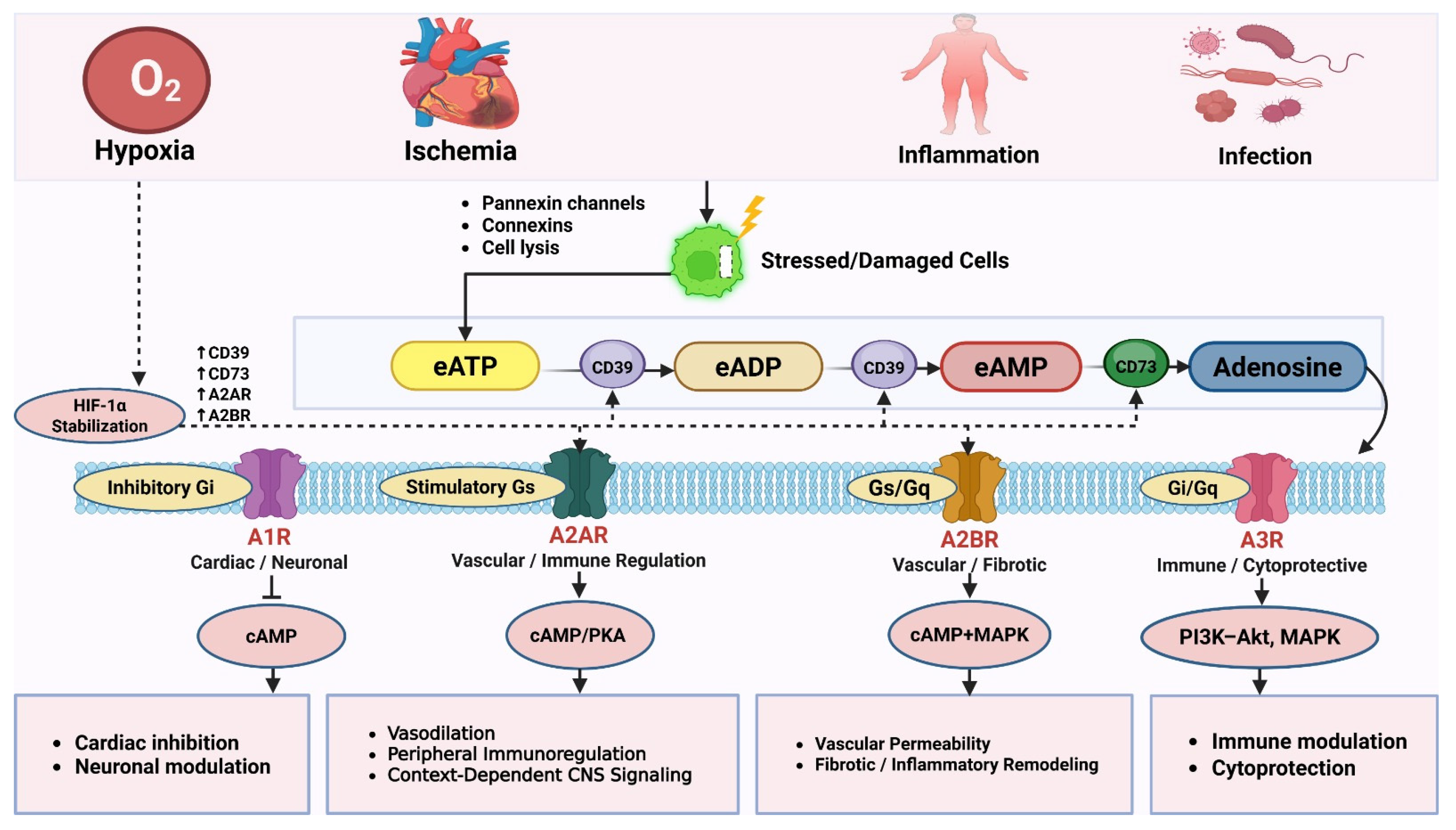
Adenosine Signaling as a Central Integrative Network in Cellular Stress Responses and a Therapeutically Actionable Target in Human Disease
 , , , ,
Abstract
1. Introduction
2. Literature Review Search Strategy
3. Molecular Architecture of the Adenosine Signaling System
4. Integration of Adenosine Signaling with Major Intracellular Pathways
5. Adenosine Signaling in Cardiovascular Protection and Ischemic Adaptation
6. Adenosine Signaling in Pulmonary Inflammation and Fibrotic Remodeling
7. Neuromodulatory Functions of Adenosine in the Central Nervous System
8. Adenosine Metabolism and Immune Suppression in the Tumor Microenvironment
9. Strengths and Limitations
10. Conclusions
Author Contributions
Funding
Institutional Review Board Statement
Informed Consent Statement
Data Availability Statement
Acknowledgments
Conflicts of Interest
Abbreviations
| ATP | Adenosine Triphosphate |
| ADP | Adenosine Diphosphate |
| AMP | Adenosine Monophosphate |
| ADA | Adenosine Deaminase |
| ADK | Adenosine Kinase |
| AMPK | AMP-Activated Protein Kinase |
| A1 | Adenosine A1 Receptor |
| A2A | Adenosine A2A Receptor |
| A2B | Adenosine A2B Receptor |
| A3 | Adenosine A3 Receptor |
| GPCR | G Protein-Coupled Receptor |
| MAPK | Mitogen-Activated Protein Kinase |
| PI3K–Akt | Phosphoinositide 3-Kinase–Protein Kinase B Pathway |
| cAMP | Cyclic Adenosine Monophosphate |
| PKA | Protein Kinase A |
| CREB | cAMP Response Element-Binding Protein |
| HIF-1α | Hypoxia-Inducible Factor-1 Alpha |
| CD39 | Cluster of Differentiation 39 (ENTPD1; Ectonucleoside Triphosphate Diphosphohydrolase-1) |
| CD73 | Cluster of Differentiation 73 (NT5E; Ecto-5′-Nucleotidase) |
| ENT | Equilibrative Nucleoside Transporter |
| CNT | Concentrative Nucleoside Transporter |
| NK | Natural Killer Cells |
| TME | Tumor Microenvironment |
| TCR | T Cell Receptor |
| CTL | Cytotoxic T Lymphocyte |
| NF-κB | Nuclear Factor Kappa B |
| ERK | Extracellular Signal-Regulated Kinase |
| CNS | Central Nervous System |
| COPD | Chronic Obstructive Pulmonary Disease |
| MI | Myocardial Infarction |
| AV node | Atrioventricular Node |
| NSCLC | Non-Small Cell Lung Cancer |
| ECM | Extracellular Matrix |
| Tregs | Regulatory T cells |
References
- Pallio, G.; Mannino, F. Non-Canonical Functions of Adenosine Receptors: Emerging Roles in Metabolism, Immunometabolism, and Epigenetic Regulation. Int. J. Mol. Sci. 2025, 26, 7241. [Google Scholar] [CrossRef] [PubMed]
- Fontecilla-Camps, J.C. The complex roles of adenosine triphosphate in bioenergetics. ChemBioChem 2022, 23, e202200064. [Google Scholar] [CrossRef]
- Pinna, S.; Kunz, C.; Halpern, A.; Harrison, S.A.; Jordan, S.F.; Ward, J.; Werner, F.; Lane, N. A prebiotic basis for ATP as the universal energy currency. PLoS Biol. 2022, 20, e3001437. [Google Scholar] [CrossRef]
- Zimmermann, H. Extracellular ATP and other nucleotides—Ubiquitous triggers of intercellular messenger release. Purinergic Signal. 2016, 12, 25–57. [Google Scholar] [CrossRef] [PubMed]
- Xiao, J.; Zhou, Y.; Xie, Y.; Li, T.; Su, X.; He, J.; Jiang, Y.; Zhu, H.; Qu, H. ATP homeostasis and signaling in plants. Plant Commun. 2024, 5, 100834. [Google Scholar] [CrossRef]
- Fredholm, B. Adenosine, an endogenous distress signal, modulates tissue damage and repair. Cell Death Differ. 2007, 14, 1315–1323. [Google Scholar] [CrossRef] [PubMed]
- Camici, M.; Garcia-Gil, M.; Tozzi, M.G. The inside story of adenosine. Int. J. Mol. Sci. 2018, 19, 784. [Google Scholar] [CrossRef] [PubMed]
- Iser, I.C.; Bertoni, A.P.S.; Beckenkamp, L.R.; Consolaro, M.E.L.; Maria-Engler, S.S.; Wink, M.R. Adenosinergic Signalling in Cervical Cancer Microenvironment. Expert Rev. Mol. Med. 2025, 27, e5. [Google Scholar] [CrossRef]
- Nedbalova, P.; Dolezal, T. Adenosine signals an imbalance between activity and supply in privileged cells. Trends Biochem. Sci. 2026, 51, 427–438. [Google Scholar] [CrossRef]
- Sastre, J.; Pérez, S.; Sabater, L.; Rius-Pérez, S. Redox signaling in the pancreas in health and disease. Physiol. Rev. 2025, 105, 593–650. [Google Scholar] [CrossRef]
- Suwara, J.; Radzikowska-Cieciura, E.; Chworos, A.; Pawlowska, R. The ATP-dependent pathways and human diseases. Curr. Med. Chem. 2023, 30, 1232–1255. [Google Scholar] [CrossRef]
- Zimmermann, H. Extracellular metabolism of ATP and other nucleotides. Naunyn-Schmiedeberg’s Arch. Pharmacol. 2000, 362, 299–309. [Google Scholar] [CrossRef]
- Matsuoka, I.; Ohkubo, S. ATP-and adenosine-mediated signaling in the central nervous system: Adenosine receptor activation by ATP through rapid and localized generation of adenosine by ecto-nucleotidases. J. Pharmacol. Sci. 2004, 94, 95–99. [Google Scholar] [CrossRef]
- Shen, J.; Liao, B.; Gong, L.; Li, S.; Zhao, J.; Yang, H.; Gong, Y.; Li, Y. CD39 and CD73: Biological functions, diseases and therapy. Mol. Biomed. 2025, 6, 97. [Google Scholar] [CrossRef] [PubMed]
- Goueli, S.A.; Hsiao, K. Monitoring and characterizing soluble and membrane-bound ectonucleotidases CD73 and CD39. PLoS ONE 2019, 14, e0220094. [Google Scholar] [CrossRef] [PubMed]
- Ferretti, E.; Horenstein, A.; Canzonetta, C.; Costa, F.; Morandi, F. Canonical and non-canonical adenosinergic pathways. Immunol. Lett. 2019, 205, 25–30. [Google Scholar] [CrossRef]
- Liu, H.; Xia, Y. Beneficial and detrimental role of adenosine signaling in diseases and therapy. J. Appl. Physiol. 2015, 119, 1173–1182. [Google Scholar] [CrossRef] [PubMed]
- Bairy, K.; Abhinav, R.; Satyam, S.M. Evaluation of burn wound healing activity of topical regular insulin in non-diabetic and streptozocin-induced diabetic rats. Int. J. Pharm. Sci. 2014, 6, 127–130. [Google Scholar]
- Sainath, P.; Satyam, S.M.; Bharati, S.; Shetty, P.; Rehman, A.; El-Tanani, M.; Bairy, L.K.; Ahmed, A.Z.; Densil, T.; Fathima, S. Development and validation of an integrated preclinical model mimicking cardiometabolic risk in postmenopausal female rats. Sci. Rep. 2025, 15, 42395. [Google Scholar] [CrossRef]
- Satyam, S.M.; Bairy, L.K.; Pirasanthan, R. Influence of grape seed extract and zinc containing multivitamin-mineral nutritional food supplement on lipid profile in normal and diet-induced hypercholesterolemic rats. J. Clin. Diagn. Res. 2014, 8, HC12. [Google Scholar] [CrossRef]
- Satyam, S.M.; Bairy, L.K.; Pirasanthan, R.; Vaihnav, R. Grape seed extract and zinc containing nutritional food supplement decreases the oxidative stress induced by carbon tetrachloride in rats. Int. J. Pharm. Pharm. Sci. 2013, 5, 626–631. [Google Scholar]
- Satyam, S.M.; Bairy, L.K.; Pirasanthan, R.; Vaishnav, R.L. Grape seed extract and zinc containing nutritional food supplement prevents onset and progression of age-related cataract in Wistar rats. J. Nutr. Health Aging 2014, 18, 524–530. [Google Scholar] [CrossRef]
- Satyam, S.M.; Bairy, L.K.; Pirasanthan, R.; Vaishnav, R.L. Grape seed extract and Zinc containing nutritional food supplement delays onset and progression of Streptozocin-induced diabetic cataract in Wistar rats. J. Food Sci. Technol. 2015, 52, 2824–2832. [Google Scholar] [CrossRef]
- Satyam, S.M.; Bairy, L.K.; Rehman, A.; Farook, M.; Khan, S.; Nair, A.A.; Binu, N.N.; Yehya, M.; Khan, M.M. Dapagliflozin: A Promising Strategy to Combat Cisplatin-Induced Hepatotoxicity in Wistar Rats. Biology 2024, 13, 672. [Google Scholar] [CrossRef] [PubMed]
- Satyam, S.M.; El-Tanani, M.; Patni, M.A.; Rehman, A.; Irshad, S.M.; Raheem, R.; Junais, E.; John, A.A.; Rassal, R.Y.; Kumari, R. Inclisiran SiRNA therapy for durable LDL-C reduction: A systematic review and meta-analysis highlighting a breakthrough in long-term cardiovascular risk management. BMC Cardiovasc. Disord. 2026, 26, 94. [Google Scholar] [CrossRef]
- Merighi, S.; Gessi, S.; Borea, P.A. Adenosine receptors: Structure, distribution, and signal transduction. In The Adenosine Receptors; Springer: Berlin/Heidelberg, Germany, 2018; pp. 33–57. [Google Scholar]
- Aldossary, H.S.; Alzahrani, A.A.; Nathanael, D.; Alhuthail, E.A.; Ray, C.J.; Batis, N.; Kumar, P.; Coney, A.M.; Holmes, A.P. G-protein-coupled receptor (GPCR) signaling in the carotid body: Roles in hypoxia and cardiovascular and respiratory disease. Int. J. Mol. Sci. 2020, 21, 6012. [Google Scholar] [CrossRef]
- Choudhury, H.; Chellappan, D.K.; Sengupta, P.; Pandey, M.; Gorain, B. Adenosine receptors in modulation of central nervous system disorders. Curr. Pharm. Des. 2019, 25, 2808–2827. [Google Scholar] [CrossRef]
- Vincenzi, F.; Pasquini, S.; Contri, C.; Cappello, M.; Nigro, M.; Travagli, A.; Merighi, S.; Gessi, S.; Borea, P.A.; Varani, K. Pharmacology of adenosine receptors: Recent advancements. Biomolecules 2023, 13, 1387. [Google Scholar] [CrossRef]
- Guieu, R.; Deharo, J.-C.; Maille, B.; Crotti, L.; Torresani, E.; Brignole, M.; Parati, G. Adenosine and the cardiovascular system: The good and the bad. J. Clin. Med. 2020, 9, 1366. [Google Scholar] [CrossRef] [PubMed]
- Mustafa, S.J.; Morrison, R.R.; Teng, B.; Pelleg, A. Adenosine receptors and the heart: Role in regulation of coronary blood flow and cardiac electrophysiology. Adenosine Recept. Health Dis. 2009, 161–188. [Google Scholar] [CrossRef]
- Qian, Y.; Zheng, Y.; Leng, L.; Liu, Q.; Tian, X.; Chen, S.; Zhang, S.; Xie, J. Adenosine and adenosine receptors: A “double-edged sword” in cardiovascular system. Front. Pharmacol. 2025, 16, 1538680. [Google Scholar] [CrossRef]
- Rong, Z.; Meng, C.; Li, X.; Gu, Y.; Li, Y.; Mao, W. A novel approach to the prevention and management of cardiovascular diseases: Targeting brain–heart axis. Eur. J. Med. Res. 2025, 30, 1108. [Google Scholar] [CrossRef]
- Solanki, N.; Dodiya, R.; Vejpara, D.; Azad, S.; Patel, M.; Patel, S.; Shah, U.; Soni, A.; Maheshwari, R.; Navale, A. Adenosine receptor subtype modulators: Insight into molecular mechanisms and their therapeutic application. Am. J. Transl. Res. 2025, 17, 2376. [Google Scholar] [CrossRef] [PubMed]
- Mannino, F. Special Issue “Molecular Research on Adenosine Receptors: From Cell Biology to Human Diseases”. Int. J. Mol. Sci. 2025, 26, 11298. [Google Scholar] [CrossRef]
- Maity, P.; Ganguly, S.; Deb, P.K. Therapeutic potential of adenosine receptor modulators in cancer treatment. RSC Adv. 2025, 15, 20418–20445. [Google Scholar] [CrossRef] [PubMed]
- Yang, X.; Che, X.; Li, Y.; Chen, W.; Chen, Y.; Liu, Y. Research Progress on the Role of Natural Active Substances in Regulating Adenosine Pathway in Tumor Therapy. Phytother. Res. 2026, 40, 1862–1885. [Google Scholar] [CrossRef]
- Yang, Y.; Zhu, L.; Xu, Y.; Liang, L.; Liu, L.; Chen, X.; Li, H.; Liu, H. The progress and prospects of targeting the adenosine pathway in cancer immunotherapy. Biomark. Res. 2025, 13, 75. [Google Scholar] [CrossRef]
- El-Tanani, M.; Satyam, S.M.; Rabbani, S.A.; El-Tanani, Y.; Sutherland, M.; Muhana, F. Disruption of epidermal growth factor receptor signaling and cytoskeletal dynamics by mebendazole and gefitinib synergistically impairs paracrine cytokine signaling in non-small cell lung cancer and triple-negative breast cancer Cell lines. PLoS ONE 2025, 20, e0338027. [Google Scholar] [CrossRef]
- Rabbani, S.A.; Patni, M.A.; El-Tanani, M.; Rangraze, I.R.; Wali, A.F.; Babiker, R.; Satyam, S.M.; El-Tanani, Y.; Almetwally, A.A.M.S. Impact of lifestyle modifications on cancer mortality: A systematic review and meta-analysis. Medicina 2025, 61, 307. [Google Scholar] [CrossRef] [PubMed]
- Satyam, S.M.; Prabhakar, S.; El-Tanani, M.; Bhongade, B.; Wali, A.F.; Rangraze, I.R.; Matalka, I.I.A.; El-Tanani, Y.; Rizzo, M.; Ispas, S. Chronopharmacology-Driven Precision Therapies for Time-Optimized Cardiometabolic Disease Management. Biology 2026, 15, 241. [Google Scholar] [CrossRef]
- Low, J.T.; Kim, Y.; Matsushita, M.; Ho, P.-C. Role of oxygen sensing and hypoxia-inducible factors in orchestrating innate immune responses. Nat. Immunol. 2025, 26, 2138–2147. [Google Scholar] [CrossRef] [PubMed]
- Stogsdill, J.A.; Harwell, C.C.; Goldman, S.A. Astrocytes as master modulators of neural networks: Synaptic functions and disease-associated dysfunction of astrocytes. Ann. N. Y. Acad. Sci. 2023, 1525, 41–60. [Google Scholar] [CrossRef]
- Kim, J.; Kaang, B.-K. Cyclic AMP response element-binding protein (CREB) transcription factor in astrocytic synaptic communication. Front. Synaptic Neurosci. 2023, 14, 1059918. [Google Scholar] [CrossRef]
- Gupta, A.K.; Gupta, S.; Mehan, S.; Khan, Z.; Das Gupta, G.; Narula, A.S. Exploring the connection between BDNF/TrkB and AC/cAMP/PKA/CREB signaling pathways: Potential for neuroprotection and therapeutic targets for neurological disorders. Mol. Neurobiol. 2025, 62, 14627–14659. [Google Scholar] [CrossRef]
- Chen, L.; Lei, X.; Mahnke, K. Adenosine and its receptors in the pathogenesis and treatment of inflammatory skin diseases. Int. J. Mol. Sci. 2024, 25, 5810. [Google Scholar] [CrossRef]
- Wang, W.; Wang, X.-M.; Zhang, H.-L.; Zhao, R.; Wang, Y.; Zhang, H.-L.; Song, Z.-J. Molecular and metabolic landscape of adenosine triphosphate-induced cell death in cardiovascular disease. World J. Cardiol. 2024, 16, 689. [Google Scholar] [CrossRef]
- Samakova, A.; Gazova, A.; Sabova, N.; Valaskova, S.; Jurikova, M.; Kyselovic, J. The PI3k/Akt pathway is associated with angiogenesis, oxidative stress and survival of mesenchymal stem cells in pathophysiologic condition in ischemia. Physiol. Res. 2019, 68, S131–S138. [Google Scholar] [CrossRef]
- Li, J.; Sun, M.; Tang, M.; Song, X.; Zheng, K.; Meng, T.; Li, C.; Du, L. Mechanism of PI3K/Akt-mediated mitochondrial pathway in obesity-induced apoptosis. Biomed. Rep. 2024, 22, 40. [Google Scholar] [CrossRef]
- Alvarado-Ortiz, E.; Sarabia-Sánchez, M.A. Hypoxic link between cancer cells and the immune system: The role of adenosine and lactate. Oncol. Res. 2025, 33, 1803. [Google Scholar] [CrossRef] [PubMed]
- Manian, M.; Taherian, M.; Nickho, H.; Nejad, A.E. Hypoxia, Stem Cells and Cancer Stem. Cancer Stem Cells Cancer Ther. 2025. Available online: https://link.springer.com/chapter/10.1007/978-3-031-74842-4_3 (accessed on 13 March 2026).
- Cheng, X.; Wang, P.; Lyu, H.; Lee, Y.; Yoon, J.; Dong, H. Targeting the hypoxia signaling pathway with nanomedicine to reverse immunotherapy resistance. Cancer Drug Resist. 2025, 8, 46. [Google Scholar] [CrossRef]
- Reiss, A.B.; Grossfeld, D.; Kasselman, L.J.; Renna, H.A.; Vernice, N.A.; Drewes, W.; Konig, J.; Carsons, S.E.; DeLeon, J. Adenosine and the cardiovascular system. Am. J. Cardiovasc. Drugs 2019, 19, 449–464. [Google Scholar] [CrossRef]
- Le, T.-T.T.; Berg, N.K.; Harting, M.T.; Li, X.; Eltzschig, H.K.; Yuan, X. Purinergic signaling in pulmonary inflammation. Front. Immunol. 2019, 10, 1633. [Google Scholar] [CrossRef] [PubMed]
- Pacini, E.S.A.; Satori, N.A.; Jackson, E.K.; Godinho, R.O. Extracellular cAMP-adenosine pathway signaling: A potential therapeutic target in chronic inflammatory airway diseases. Front. Immunol. 2022, 13, 866097. [Google Scholar] [CrossRef]
- Forde, L.; Gogoi, D.; Baird, R.; McCarthy, C.; Keane, M.P.; Reeves, E.P.; McGrath, E.E. Does adenosine triphosphate via purinergic receptor signalling fuel pulmonary fibrosis? J. Innate Immun. 2025, 17, 44–55. [Google Scholar] [CrossRef]
- Mehta, M.; Dhanjal, D.S.; Paudel, K.R.; Singh, B.; Gupta, G.; Rajeshkumar, S.; Thangavelu, L.; Tambuwala, M.M.; Bakshi, H.A.; Chellappan, D.K. Cellular signalling pathways mediating the pathogenesis of chronic inflammatory respiratory diseases: An update. Inflammopharmacology 2020, 28, 795–817. [Google Scholar] [CrossRef]
- Li, X.; Berg, N.K.; Mills, T.; Zhang, K.; Eltzschig, H.K.; Yuan, X. Adenosine at the interphase of hypoxia and inflammation in lung injury. Front. Immunol. 2021, 11, 604944. [Google Scholar] [CrossRef]
- Savin, I.A.; Zenkova, M.A.; Sen’kova, A.V. Bronchial asthma, airway remodeling and lung fibrosis as successive steps of one process. Int. J. Mol. Sci. 2023, 24, 16042. [Google Scholar] [CrossRef] [PubMed]
- Huang, L.; Zhu, W.; Li, N.; Zhang, B.; Dai, W.; Li, S.; Xu, H. Functions and mechanisms of adenosine and its receptors in sleep regulation. Sleep Med. 2024, 115, 210–217. [Google Scholar] [CrossRef] [PubMed]
- Cunha, R.A. How does adenosine control neuronal dysfunction and neurodegeneration? J. Neurochem. 2016, 139, 1019–1055. [Google Scholar] [CrossRef]
- Zhang, Y.; Guo, F.; Wang, Y. Hypoxic tumor microenvironment: Destroyer of natural killer cell function. Chin. J. Cancer Res. 2024, 36, 138. [Google Scholar] [CrossRef]
- Retamal, M.A.; Salazar-Onfray, F.; González, F.E.; Tittarelli, A. Tumor hypoxia shapes natural killer cell anticancer activities. J. Mol. Med. 2025, 103, 755–777. [Google Scholar] [CrossRef]
- Miao, L.; Lu, C.; Zhang, B.; Li, H.; Zhao, X.; Chen, H.; Liu, Y.; Cui, X. Advances in metabolic reprogramming of NK cells in the tumor microenvironment on the impact of NK therapy. J. Transl. Med. 2024, 22, 229. [Google Scholar] [CrossRef]
- Rehman, A.; Satyam, S.M.; El-Tanani, M.; Prabhakar, S.; Kumari, R.; Shetty, P.; Mohammed, S.S.; Nafees, Z.; Alomar, B. Metformin Beyond Diabetes: A Precision Gerotherapeutic and Immunometabolic Adjuvant for Aging and Cancer. Cancers 2025, 17, 2466. [Google Scholar] [CrossRef]
- Dulla, C.G.; Masino, S.A. Physiologic and metabolic regulation of adenosine: Mechanisms. In Adenosine: A Key Link Between Metabolism and Brain Activity; Springer: Berlin/Heidelberg, Germany, 2012; pp. 87–107. [Google Scholar]
- Ahmad, S.; Ahmad, A.; Ghosh, M.; Leslie, C.C.; White, C.W. Extracellular ATP-mediated signaling for survival in hyperoxia-induced oxidative stress. J. Biol. Chem. 2004, 279, 16317–16325. [Google Scholar] [CrossRef] [PubMed]
- Dosch, M.; Gerber, J.; Jebbawi, F.; Beldi, G. Mechanisms of ATP release by inflammatory cells. Int. J. Mol. Sci. 2018, 19, 1222. [Google Scholar] [CrossRef]
- Dwyer, K.M.; Kishore, B.K.; Robson, S.C. Conversion of extracellular ATP into adenosine: A master switch in renal health and disease. Nat. Rev. Nephrol. 2020, 16, 509–524. [Google Scholar] [CrossRef] [PubMed]
- Patrakeeva, V. The role of extracellular ATP in the regulation of functional cell activity. Cell Tissue Biol. 2025, 19, 206–213. [Google Scholar] [CrossRef]
- Govindarajan, R.; Quiñones, A.L.; Wang, J. The Nucleoside Transporters CNTs and ENTs. In Drug Transporters: Molecular Characterization and Role in Drug Disposition; John Wiley & Sons: Hoboken, NJ, USA, 2022; pp. 165–187. [Google Scholar]
- Mirchandani-Duque, M.; Choucri, M.; Hernández-Mondragón, J.C.; Crespo-Ramírez, M.; Pérez-Olives, C.; Ferraro, L.; Franco, R.; Pérez De La Mora, M.; Fuxe, K.; Borroto-Escuela, D.O. Membrane heteroreceptor complexes as second-order protein modulators: A novel integrative mechanism through allosteric receptor–receptor interactions. Membranes 2024, 14, 96. [Google Scholar] [CrossRef]
- Green, R.D. Adenosine receptors, adenylate cyclase; relationships to pharmacological actions of adenosine. In Adenosine and Adenine Nucleotides as Regulators of Cellular function; CRC Press: Boca Raton, FL, USA, 2024; pp. 45–54. [Google Scholar]
- Faraco, G.; Gaspar, J.M. The Role of Adenosine Signaling in Obesity-Driven Type 2 Diabetes: Revisiting Mechanisms and Implications for Metabolic Regulation. Diabetology 2025, 6, 43. [Google Scholar] [CrossRef]
- Draper-Joyce, C.J.; Khoshouei, M.; Thal, D.M.; Liang, Y.-L.; Nguyen, A.T.; Furness, S.G.; Venugopal, H.; Baltos, J.-A.; Plitzko, J.M.; Danev, R. Structure of the adenosine-bound human adenosine A1 receptor–Gi complex. Nature 2018, 558, 559–563. [Google Scholar] [CrossRef] [PubMed]
- Albrecht-Küpper, B.E.; Leineweber, K.; Nell, P.G. Partial adenosine A1 receptor agonists for cardiovascular therapies. Purinergic Signal. 2012, 8, 91–99. [Google Scholar] [CrossRef] [PubMed]
- Orr, A.G.; Hsiao, E.C.; Wang, M.M.; Ho, K.; Kim, D.H.; Wang, X.; Guo, W.; Kang, J.; Yu, G.-Q.; Adame, A. Astrocytic adenosine receptor A2A and Gs-coupled signaling regulate memory. Nat. Neurosci. 2015, 18, 423–434. [Google Scholar] [CrossRef]
- Duarte-Araújo, M.; Timóteo, M.A.; Correia-de-Sá, P. Adenosine activating A2A-receptors coupled to adenylate cyclase/cyclic AMP pathway downregulates nicotinic autoreceptor function at the rat myenteric nerve terminals. Neurochem. Int. 2004, 45, 641–651. [Google Scholar] [CrossRef] [PubMed]
- Milne, G.R.; Palmer, T.M. Anti-inflammatory and immunosuppressive effects of the A2A adenosine receptor. Sci. World J. 2011, 11, 320–339. [Google Scholar] [CrossRef]
- Sun, Y.; Huang, P. Adenosine A2B receptor: From cell biology to human diseases. Front. Chem. 2016, 4, 37. [Google Scholar] [CrossRef]
- Borea, P.A.; Gessi, S.; Merighi, S.; Vincenzi, F.; Varani, K. Pharmacology of adenosine receptors: The state of the art. Physiol. Rev. 2018, 98, 1591–1625. [Google Scholar] [CrossRef]
- Chandrasekaran, B.; Samarneh, S.; Jaber, A.M.; Kassab, G.; Agrawal, N. Therapeutic potentials of A2B adenosine receptor ligands: Current status and perspectives. Curr. Pharm. Des. 2019, 25, 2741–2771. [Google Scholar] [CrossRef]
- Haskó, G.; Csóka, B.; Németh, Z.H.; Vizi, E.S.; Pacher, P. A2B adenosine receptors in immunity and inflammation. Trends Immunol. 2009, 30, 263–270. [Google Scholar] [CrossRef]
- Coppi, E.; Cherchi, F.; Venturini, M.; Lucarini, E.; Corradetti, R.; Di Cesare Mannelli, L.; Ghelardini, C.; Pedata, F.; Pugliese, A.M. Therapeutic potential of highly selective A3 adenosine receptor ligands in the central and peripheral nervous system. Molecules 2022, 27, 1890. [Google Scholar] [CrossRef]
- Rudich, N.; Ravid, K.; Sagi-Eisenberg, R. Mast cell adenosine receptors function: A focus on the a3 adenosine receptor and inflammation. Front. Immunol. 2012, 3, 134. [Google Scholar] [CrossRef]
- Jamwal, S.; Mittal, A.; Kumar, P.; Alhayani, D.M.; Al-Aboudi, A. Therapeutic potential of agonists and antagonists of A1, A2a, A2b and A3 adenosine receptors. Curr. Pharm. Des. 2019, 25, 2892–2905. [Google Scholar] [CrossRef] [PubMed]
- Cohen, S.; Fishman, P. Targeting the A3 adenosine receptor to treat cytokine release syndrome in cancer immunotherapy. Drug Des. Dev. Ther. 2019, 13, 491–497. [Google Scholar] [CrossRef] [PubMed]
- Zhulai, G.; Oleinik, E.; Shibaev, M.; Ignatev, K. Adenosine-metabolizing enzymes, adenosine kinase and adenosine deaminase, in cancer. Biomolecules 2022, 12, 418. [Google Scholar] [CrossRef]
- Lopez-Schenk, R.; Collins, N.L.; Schenk, N.A.; Beard, D.A. Integrated functions of cardiac energetics, mechanics, and purine nucleotide metabolism. Compr. Physiol. 2024, 14, 5345–5369. [Google Scholar] [CrossRef]
- Flori, L.; Veneziano, S.; Martelli, A.; Piragine, E.; Calderone, V. Transsulfuration Pathway Products and H2S-Donors in Hyperhomocysteinemia: Potential Strategies Beyond Folic Acid. Int. J. Mol. Sci. 2025, 26, 6430. [Google Scholar] [CrossRef]
- Nedbalova, P.; Kaislerova, N.; Chodakova, L.; Moos, M.; Doležal, T. SAM transmethylation pathway and adenosine recycling to ATP are essential for systemic regulation and immune response. eLife 2025, 13, RP105039. [Google Scholar] [CrossRef] [PubMed]
- Bjørgo, E.; Solheim, S.A.; Abrahamsen, H.; Baillie, G.S.; Brown, K.M.; Berge, T.; Okkenhaug, K.; Houslay, M.D.; Taskén, K. Cross talk between phosphatidylinositol 3-kinase and cyclic AMP (cAMP)-protein kinase A signaling pathways at the level of a protein kinase B/β-arrestin/cAMP phosphodiesterase 4 complex. Mol. Cell. Biol. 2010, 30, 1660–1672. [Google Scholar] [CrossRef]
- Xia, Y.; He, F.; Moukeila Yacouba, M.B.; Zhou, H.; Li, J.; Xiong, Y.; Zhang, J.; Li, H.; Wang, Y.; Ke, J. Adenosine A2a receptor regulates autophagy flux and apoptosis to alleviate ischemia-reperfusion injury via the cAMP/PKA signaling pathway. Front. Cardiovasc. Med. 2022, 9, 755619. [Google Scholar] [CrossRef]
- Mal’tseva, V.N.; Gaidin, S.G.; Kosenkov, A.M. Adenosine receptors as emerging therapeutic targets in epilepsy. Rev. Neurosci. 2026; Epub ahead of print. [CrossRef]
- Chen, Y.-C.; Huang, S.-H.; Wang, S.-M. Adenosine-stimulated adrenal steroidogenesis involves the adenosine A2A and A2B receptors and the Janus kinase 2–mitogen-activated protein kinase kinase–extracellular signal-regulated kinase signaling pathway. Int. J. Biochem. Cell Biol. 2008, 40, 2815–2825. [Google Scholar] [CrossRef]
- Yang, L.; Zhang, Y.; Yang, L. Adenosine signaling in tumor-associated macrophages and targeting adenosine signaling for cancer therapy. Cancer Biol. Med. 2024, 21, 995–1011. [Google Scholar] [CrossRef]
- Shen, Y.; Tang, G.; Gao, P.; Zhang, B.; Xiao, H.; Si, L.-Y. Activation of adenosine A2b receptor attenuates high glucose-induced apoptosis in H9C2 cells via PI3K/Akt signaling. Vitr. Cell. Dev. Biol.—Anim. 2018, 54, 384–391. [Google Scholar] [CrossRef]
- Zhao, Y.; Hu, X.; Liu, Y.; Dong, S.; Wen, Z.; He, W.; Zhang, S.; Huang, Q.; Shi, M. ROS signaling under metabolic stress: Cross-talk between AMPK and AKT pathway. Mol. Cancer 2017, 16, 79. [Google Scholar] [CrossRef]
- Hoxhaj, G.; Manning, B.D. The PI3K–AKT network at the interface of oncogenic signalling and cancer metabolism. Nat. Rev. Cancer 2020, 20, 74–88. [Google Scholar] [CrossRef]
- Eckle, T.; Kewley, E.M.; Brodsky, K.S.; Tak, E.; Bonney, S.; Gobel, M.; Anderson, D.; Glover, L.E.; Riegel, A.K.; Colgan, S.P. Identification of hypoxia-inducible factor HIF-1A as transcriptional regulator of the A2B adenosine receptor during acute lung injury. J. Immunol. 2014, 192, 1249–1256. [Google Scholar] [CrossRef] [PubMed]
- de Oliveira, P.H.S.; Silva-Freitas, B.B.; Meyer-Fernandes, J.R.; Lacerda-Abreu, M.A. Hypoxia as a Central Regulator of Plasma Membrane Phosphohydrolase Enzymes: Possible Roles in Extracellular Phosphate Generation and Adenosine Metabolism. Membranes 2025, 15, 381. [Google Scholar] [CrossRef]
- Pinto-Cardoso, R.; Bessa-Andrês, C.; Pereira-Costa, F.; Neiva, R.; Martins-Ferreira, R.; Guerra-Leal, B.; Nóbrega Catelas, D.; Vilaça, A.; Oliveira, A.; Pelletier, J. HIF-1α Stabilization Hampers the Chondrogenic Differentiation of Aged Bone Marrow Mesenchymal Stem Cells by Adenosine A2A/A2B Receptors Imbalance. ACS Pharmacol. Transl. Sci. 2025, 8, 2075–2092. [Google Scholar] [CrossRef] [PubMed]
- Đambić, V.; Mihaljević, Z.; Drenjančević, I.; Jukić, I.; Šušnjara, P.; Kibel, A. The Role of Adenosine A1 and A2a Receptors in Cerebral Blood Vessel Reactivity of Sprague Dawley Rats Exposed to Hyperbaric Oxygenation. Molecules 2025, 30, 2918. [Google Scholar] [CrossRef]
- Guieu, R.; Brignole, M.; Deharo, J.C.; Deharo, P.; Mottola, G.; Groppelli, A.; Paganelli, F.; Ruf, J. Adenosine receptor reserve and long-term potentiation: Unconventional adaptive mechanisms in cardiovascular diseases? Int. J. Mol. Sci. 2021, 22, 7584. [Google Scholar] [CrossRef] [PubMed]
- Boknik, P.; Eskandar, J.; Hofmann, B.; Zimmermann, N.; Neumann, J.; Gergs, U. Role of cardiac A2A receptors under normal and pathophysiological conditions. Front. Pharmacol. 2021, 11, 627838. [Google Scholar] [CrossRef]
- Boros, D.; Thompson, J.; Larson, D. Adenosine regulation of the immune response initiated by ischemia reperfusion injury. Perfusion 2016, 31, 103–110. [Google Scholar] [CrossRef]
- Procopio, M.C.; Lauro, R.; Nasso, C.; Carerj, S.; Squadrito, F.; Bitto, A.; Di Bella, G.; Micari, A.; Irrera, N.; Costa, F. Role of adenosine and purinergic receptors in myocardial infarction: Focus on different signal transduction pathways. Biomedicines 2021, 9, 204. [Google Scholar] [CrossRef]
- da Rocha Lapa, F.; de Oliveira, A.P.L.; Accetturi, B.G.; de Oliveira Martins, I.; Domingos, H.V.; de Almeida Cabrini, D.; de Lima, W.T.; Santos, A.R.S. Anti-inflammatory effects of inosine in allergic lung inflammation in mice: Evidence for the participation of adenosine A2A and A3 receptors. Purinergic Signal. 2013, 9, 325–336. [Google Scholar] [CrossRef]
- Caruso, M.; Alamo, A.; Crisafulli, E.; Raciti, C.; Fisichella, A.; Polosa, R. Adenosine signaling pathways as potential therapeutic targets in respiratory disease. Expert Opin. Ther. Targets 2013, 17, 761–772. [Google Scholar] [CrossRef]
- Huerter, M.E.; Sharma, A.K.; Zhao, Y.; Charles, E.J.; Kron, I.L.; Laubach, V.E. Attenuation of pulmonary ischemia-reperfusion injury by adenosine A2B receptor antagonism. Ann. Thorac. Surg. 2016, 102, 385–393. [Google Scholar] [CrossRef]
- Lin, X.; ZhuGe, W.; Zheng, W.; Liu, X.; Shang, H.; Zhou, J.; Jia, M.; Ge, Y.; Qian, W.; Gu, L. Adenosine A2A Receptor in the Choroid Plexus Modulates Ischemia–Reperfusion Injury in the Cortex. J. Am. Heart Assoc. 2025, 14, eJAHA/2025/042242-T. [Google Scholar] [CrossRef]
- Salmaso, V.; Menin, S.; Moro, S.; Spalluto, G.; Federico, S. Adenosine Receptors in Neuroinflammation and Neurodegeneration. Cells 2025, 14, 1585. [Google Scholar] [CrossRef]
- Cunha, R. 11 Adenosine Neuromodulation and Neuroprotection. In Handbook of Neurochemistry and Molecular Neurobiology: Neurotransmitter Systems; Springer: Boston, MA, USA, 2008; p. 14257. [Google Scholar]
- Pedata, F.; Pugliese, A.; Coppi, E.; Popoli, P.; Morelli, M.; Schwarzschild, M.; Melani, A. Adenosine in the central nervous system: Effects on neurotransmission and neuroprotection. Immunol. Endocr. Metab. Agents—Med. Chem. 2007, 7, 304–321. [Google Scholar] [CrossRef]
- Zhao, Y.; Zhou, Y.-G.; Chen, J.-F. Targeting the adenosine A2A receptor for neuroprotection and cognitive improvement in traumatic brain injury and Parkinson’s disease. Chin. J. Traumatol. 2024, 27, 125–133. [Google Scholar] [CrossRef]
- Shan, L.; Gong, M.; Zhai, D.; Meng, X.; Liu, J.; Lv, X. Research progress of CD73-adenosine signaling regulating hepatocellular carcinoma through tumor microenvironment. J. Exp. Clin. Cancer Res. 2025, 44, 161. [Google Scholar] [CrossRef]
- Ohta, A.; Sitkovsky, M. Extracellular adenosine-mediated modulation of regulatory T cells. Front. Immunol. 2014, 5, 304. [Google Scholar] [CrossRef]
- Xing, J.; Zhang, J.; Wang, J. The immune regulatory role of adenosine in the tumor microenvironment. Int. J. Mol. Sci. 2023, 24, 14928. [Google Scholar] [CrossRef]
- Liu, X.; Ding, Q.; Zhang, H.; Zhang, X.; Chen, Q.; Weng, S. The CD39-CD73-adenosine axis: Master regulator of immune evasion and therapeutic target in pancreatic ductal adenocarcinoma. Biochim. Biophys. Acta (BBA)-Rev. Cancer 2025, 1880, 189443. [Google Scholar] [CrossRef]
- Cheng, H.; Gao, Y.; Shang, H.; Han, W.; Zhang, X.; Gao, R.; Dang, W.; Ma, Z.; Liu, X.; Gao, Y. Selective antagonism of adenosine A2A receptor reduces hypobaric hypoxia-induced neuroinflammation by inhibiting cGAS-STING pathway. Sci. Rep. 2026, 16, 1091. [Google Scholar] [CrossRef]
- Zadhoush, F. Physiological role of adenosine and its receptors in tissue hypoxia-induced. Physiol. Pharmacol. 2012, 16, 209–221. [Google Scholar]
- Vásquez Vélez, I.C.; Charris Domínguez, C.M.; Fernández Sánchez, M.J.; Garavito-Aguilar, Z.V. Hypoxia and tissue regeneration: Adaptive mechanisms and therapeutic opportunities. Int. J. Mol. Sci. 2025, 26, 9272. [Google Scholar] [CrossRef]
- Li, H.; Xiao, F.; Zhou, C.; Zhu, T.; Wang, S. Metabolic adaptations and therapies in cardiac hypoxia: Mechanisms and clinical implications/potential strategies. Basic Transl. Sci. 2025, 10, 862–878. [Google Scholar]
- Fu, J.; Antonioli, L.; Zheng, X.; El-Far, A.H. Community series in adenosine pathways in cancer immunity and immunotherapy, volume II. Front. Immunol. 2025, 16, 1538930. [Google Scholar] [CrossRef]
- Pasquini, S.; Contri, C.; Borea, P.A.; Vincenzi, F.; Varani, K. Adenosine and inflammation: Here, there and everywhere. Int. J. Mol. Sci. 2021, 22, 7685. [Google Scholar] [CrossRef]
- D’Antongiovanni, V.; Fornai, M.; Pellegrini, C.; Benvenuti, L.; Blandizzi, C.; Antonioli, L. The adenosine system at the crossroads of intestinal inflammation and neoplasia. Int. J. Mol. Sci. 2020, 21, 5089. [Google Scholar] [CrossRef] [PubMed]
- Chen, Y.; Tang, D. From neuro-immune command circuits to microbiota-mediated regulation in the gastrointestinal tumor microenvironment. Front. Immunol. 2026, 17, 1739357. [Google Scholar] [CrossRef]
- Cui, W.-Q.; Wang, S.-T.; Pan, D.; Chang, B.; Sang, L.-X. Caffeine and its main targets of colorectal cancer. World J. Gastrointest. Oncol. 2020, 12, 149. [Google Scholar] [CrossRef]
- Stepanova, M.; Aherne, C.M. Adenosine in intestinal epithelial barrier function. Cells 2024, 13, 381. [Google Scholar] [CrossRef]
- Antonioli, L.; Fornai, M.; Pellegrini, C.; Bertani, L.; Nemeth, Z.H.; Blandizzi, C. Inflammatory bowel diseases: It’s time for the adenosine system. Front. Immunol. 2020, 11, 1310. [Google Scholar] [CrossRef]
- Bahreyni, A.; Samani, S.S.; Khazaei, M.; Ryzhikov, M.; Avan, A.; Hassanian, S.M. Therapeutic potentials of adenosine receptors agonists and antagonists in colitis; Current status and perspectives. J. Cell. Physiol. 2018, 233, 2733–2740. [Google Scholar] [CrossRef]
- Belardin, L.B.; Brochu, K.; Légaré, C.; Battistone, M.A.; Breton, S. Purinergic signaling in the male reproductive tract. Front. Endocrinol. 2022, 13, 1049511. [Google Scholar] [CrossRef]
- Twambaze, M.F.; Adebayo, I.A.; Odoma, S.; Alagbonsi, A.I. Calcium Channels and Modulators as Potential Therapeutic Targets for Contraceptives and Male Fertility: A Scoping Review. Open Access J. Contracept. 2025, 16, 199–228. [Google Scholar] [CrossRef]
- Al-Suhaimi, E.A.; Khan, F.A.; Homeida, A. Regulation of male and female reproductive functions. In Emerging Concepts in Endocrine Structure and Functions; Springer: Berlin/Heidelberg, Germany, 2022; pp. 287–347. [Google Scholar]
- Bellezza, I.; Minelli, A. Adenosine in sperm physiology. Mol. Asp. Med. 2017, 55, 102–109. [Google Scholar] [CrossRef] [PubMed]
- Chen, H.; Xing, G.; Xu, W.; Chen, Y.; Xia, L.; Huang, H.; Huang, J.; Hong, Q.; Luo, T.; Wang, H. The adenosine A2A receptor in human sperm: Its role in sperm motility and association with in vitro fertilization outcomes. Front. Endocrinol. 2024, 15, 1410370. [Google Scholar] [CrossRef] [PubMed]
- Sholokh, A.; Klussmann, E. Local cyclic adenosine monophosphate signalling cascades—Roles and targets in chronic kidney disease. Acta Physiol. 2021, 232, e13641. [Google Scholar] [CrossRef]
- Delrue, C.; Speeckaert, R.; Moresco, R.N.; Speeckaert, M.M. Cyclic adenosine monophosphate signaling in chronic kidney disease: Molecular targets and therapeutic potentials. Int. J. Mol. Sci. 2024, 25, 9441. [Google Scholar] [CrossRef]
- Wissmann, I.B.; Coelho, R.C.D.; Baseggio, L.; Cardoso, A.M. Adenosine receptors and acute kidney injury: Perspectives for future therapy. Purinergic Signal. 2025, 21, 1115–1133. [Google Scholar] [CrossRef]
- Vallon, V.; Miracle, C.; Thomson, S. Adenosine and kidney function: Potential implications in patients with heart failure. Eur. J. Heart Fail. 2008, 10, 176–187. [Google Scholar] [CrossRef]
- Dittrich, H.C.; Gupta, D.K.; Hack, T.C.; Dowling, T.; Callahan, J.; Thomson, S. The effect of KW-3902, an adenosine A1 receptor antagonist, on renal function and renal plasma flow in ambulatory patients with heart failure and renal impairment. J. Card. Fail. 2007, 13, 609–617. [Google Scholar] [CrossRef]
- McRae, C. The Role of Adenosine Receptors and AMPK in Mouse FDB Muscles During Fatigue. Master’s Thesis, University of Ottawa, Ottawa, ON, Canada, 2023. [Google Scholar]
- Cui, K. Human Skeletal Muscle Transcriptomic Analysis of Pathways Associated with Autophagy and Mitophagy in Response to a Single Session of High-Intensity Interval Exercise in Hypoxia. Master’s Thesis, Victoria University, Melbourne, Australia, 2024. [Google Scholar]
- Eslami, Z.; Ghafi, A.G.; Wong, A.; Asghari, S.H.; Asadi, N.; Mirghani, S.J. Additive effects of high intensity interval training and therapeutic adenosine on gene and protein expression in lipid metabolism and weight loss in high fat diet-induced obese rats. Sci. Rep. 2026, 16, 6695. [Google Scholar] [CrossRef] [PubMed]
- Mirghani, S.J.; Peeri, M.; Yekani, O.Y.; Zamani, M.; Feizolahi, F.; Nikbin, S.; Derakhshideh, A.; Mousavi, N.; Khojasteh, Z.; Nasrollahi, Z. Role or synergistic interaction of adenosine and vitamin D3 alongside high-intensity interval training and isocaloric moderate intensity training on metabolic parameters: Protocol for an Experimental Study. JMIR Res. Protoc. 2019, 8, e10753. [Google Scholar] [CrossRef] [PubMed]
- Lazović, D.M.; Karadžić Kočica, M.; Ivanišević, D.; Aleksić, V.; Kočica, M.J.; Grujić, D.; Mihajlović, J.M.; Cvetković, D.; Juričić, S.A. Molecular and Cellular Mechanisms of Cardioplegic Protection in Surgical Myocardial Revascularization. Cells 2026, 15, 173. [Google Scholar] [CrossRef] [PubMed]
- Fede, M.S.; Daziani, G.; Tavoletta, F.; Montana, A.; Compagnucci, P.; Goteri, G.; Neri, M.; Busardò, F.P. Myocardial ischemia/reperfusion injury: Molecular insights, forensic perspectives, and therapeutic horizons. Cells 2025, 14, 1509. [Google Scholar] [CrossRef]
- Zhang, X.; Dou, S.; Zhang, F.; Lou, P.; Jin, J.; Zhao, Y.; Zhao, X.; Li, F.; Li, Y. Adenosine stress myocardial perfusion imaging and myocardial work in evaluating INOCA. Sci. Rep. 2025, 15, 26129. [Google Scholar] [CrossRef]
- Feng, X.-M.; Zhang, W.-H.; Liu, J. Adenosine as an adjunctive therapy for acute myocardial infarction undergoing primary percutaneous coronary intervention: A systematic review and meta-analysis of randomized controlled trials. Rev. Cardiovasc. Med. 2025, 26, 24065. [Google Scholar] [CrossRef]
- Arsyad, A.; Dobson, G.P. Adenosine relaxation in isolated rat aortic rings and possible roles of smooth muscle Kv channels, KATP channels and A2a receptors. BMC Pharmacol. Toxicol. 2016, 17, 23. [Google Scholar] [CrossRef]
- Cohen, M.V.; Baines, C.P.; Downey, J.M. Ischemic preconditioning: From adenosine receptor to KATP channel. Annu. Rev. Physiol. 2000, 62, 79–109. [Google Scholar] [CrossRef]
- Murphy, E.; Steenbergen, C. Mechanisms underlying acute protection from cardiac ischemia-reperfusion injury. Physiol. Rev. 2008, 88, 581–609. [Google Scholar] [CrossRef]
- Jovanović, A. Cardioprotective Signaling: Outline and Future Directions. Biomedicines 2025, 13, 2973. [Google Scholar] [CrossRef] [PubMed]
- Gao, Z.-G.; Haddad, M.; Jacobson, K.A. A2B adenosine receptor signaling and regulation. Purinergic Signal. 2025, 21, 201–220. [Google Scholar] [CrossRef]
- Musial, P.T.; Badtke, P.A.; Zabielska-Kaczorowska, M.A. Purine Nucleotide Precursors in Preventing Myocardial Ischemia–Reperfusion Injury. Int. J. Mol. Sci. 2025, 26, 10455. [Google Scholar] [CrossRef] [PubMed]
- Zhu, M.; Li, Y.; Xu, Q.; Wang, W.; Liu, Y.; Liu, Y. Acute Myocardial Infarction: Molecular Pathogenesis, Diagnosis, and Clinical Management. MedComm 2025, 6, e70418. [Google Scholar] [CrossRef]
- Phurpa, P.; Apolinario, M.E.C.; Umeda, R.; Kume, S.; Teranishi, H.; Shimizu, N.; Shan, M.; Shikano, K.; Kurokawa, T.; Hikida, T. In vivo visualization of cardiac extracellular adenosine dynamics and its pharmacological modulation in zebrafish heart failure models. Sci. Rep. 2026, 16, 8220. [Google Scholar] [CrossRef] [PubMed]
- Das, J.; Sah, A.K.; Choudhary, R.K.; Elshaikh, R.H.; Bhui, U.; Chowdhury, S.; Abbas, A.M.; Shalabi, M.G.; Siddique, N.A.; Alshammari, R.R. Network pharmacology approaches to myocardial infarction reperfusion injury: Exploring mechanisms, pathophysiology, and novel therapies. Biomedicines 2025, 13, 1532. [Google Scholar] [CrossRef]
- Jia, J.; Zhang, Y.; Lu, Q.; Tian, S.; Zhao, Y.; Fan, H. Dual Roles of Hypoxia-Inducible Factor 1 in Acute Lung Injury: Tissue-Specific Mechanisms and Therapeutic Modulation. Cells 2025, 14, 1089. [Google Scholar] [CrossRef] [PubMed]
- Bhalla, M.; Simmons, S.R.; Lenhard, A.; Betadpur, A.; Battaglia, M.C.; Bou Ghanem, E.N. Damage response signaling by the extracellular adenosine pathway: Control of infection outcome during host aging. Msphere 2025, 10, e00640-23. [Google Scholar] [CrossRef] [PubMed]
- Lunderberg, J.M.; Spicer, A.J.; Cassavaugh, J.; Jalkanen, J.; Haskó, G.; Robson, S.C. Targeting CD73 and correcting adenosinergic signaling in critically ill patients. Front. Pharmacol. 2025, 16, 1601481. [Google Scholar] [CrossRef] [PubMed]
- Gonzales, J.N.; Gorshkov, B.; Varn, M.N.; Zemskova, M.A.; Zemskov, E.A.; Sridhar, S.; Lucas, R.; Verin, A.D. Protective effect of adenosine receptors against lipopolysaccharide-induced acute lung injury. Am. J. Physiol.—Lung Cell. Mol. Physiol. 2014, 306, L497–L507. [Google Scholar] [CrossRef]
- Zhou, Y.; Schneider, D.J.; Blackburn, M.R. Adenosine signaling and the regulation of chronic lung disease. Pharmacol. Ther. 2009, 123, 105–116. [Google Scholar] [CrossRef]
- Luo, F.; Le, N.-B.; Mills, T.; Chen, N.-Y.; Karmouty-Quintana, H.; Molina, J.G.; Davies, J.; Philip, K.; Volcik, K.A.; Liu, H. Extracellular adenosine levels are associated with the progression and exacerbation of pulmonary fibrosis. FASEB J. 2015, 30, 874. [Google Scholar] [CrossRef]
- Fujimoto, H.; Gabazza, E.C. The role of the coagulation-fibrinolysis system in airway and lung remodeling. Respir. Investig. 2025, 63, 1050–1059. [Google Scholar] [CrossRef]
- Zhang, X.; Sun, J.; Guo, J.; Hu, X.; Zhou, J.; Xie, X.; Chen, X.; Luo, H.; Liu, H.; Tian, Y. Inhibition of adenosine/A2A receptor signaling suppresses dermal fibrosis by enhancing fatty acid oxidation. Cell Commun. Signal. 2025, 23, 206. [Google Scholar] [CrossRef]
- Gill, S.K.; Gomer, R.H. Translational regulators in pulmonary fibrosis: MicroRNAs, long non-coding RNAs, and transcript modifications. Cells 2025, 14, 536. [Google Scholar] [CrossRef]
- Chen, X.; Zhang, J.; Guo, L.; Wu, C.; Zhou, J.; Xu, M.; Mo, L.; Li, Y.; He, J. Decoding organ fibrosis: Mechanistic insights and emerging therapeutic strategies. Signal Transduct. Target. Ther. 2026, 11, 82. [Google Scholar] [CrossRef]
- Shen, J.; Jiang, Y.; Bu, W.; Yu, M.; Huang, R.; Tang, C.; Yang, Z.; Gao, H.; Su, L.; Cheng, D. Protein ubiquitination modification in pulmonary fibrosis. Compr. Physiol. 2025, 15, e70013. [Google Scholar] [CrossRef]
- Cooper, S.L.; Wragg, E.S.; Pannucci, P.; Soave, M.; Hill, S.J.; Woolard, J. Regionally selective cardiovascular responses to adenosine A2A and A2B receptor activation. FASEB J. 2022, 36, e22214. [Google Scholar] [CrossRef]
- Zhou, R.; Wang, H.; Zhang, Y.; Mai, J.; Yang, L. Small airway disease as a key factor in COPD: New perspectives and insights. Front. Med. 2025, 12, 1648612. [Google Scholar] [CrossRef]
- Joskova, M.; Sadlonova, V.; Mokra, D.; Kocan, I.; Sutovska, M.; Kackova, K.; Franova, S. Respiratory Ciliary Beat Frequency in COPD: Balancing Oxidative Stress and Pharmacological Treatment. Antioxidants 2025, 14, 1340. [Google Scholar] [CrossRef]
- Malerba, M.; Purghè, B.; Ragnoli, B.; Manfredi, M.; Baldanzi, G. Molecular profiling of exhaled breath condensate in respiratory diseases. Ann. Med. 2025, 57, 2537910. [Google Scholar] [CrossRef]
- Hvidtfeldt, M.; Brannan, J.D.; Porsbjerg, C. Airway hyperresponsiveness. In Asthma; European Respiratory Society: Lausanne, Switzerland, 2025; pp. 17–28. [Google Scholar]
- Tymińska, P.; Kawka, N.; Frączek, J.; Borówka, K.; Domagała, S.; Machnik, G. Environmental stressors and airway health: Understanding exercise-induced bronchoconstriction in athletes. Sport Sci. Health 2026, 22, 61. [Google Scholar] [CrossRef]
- Dabravolski, S.A.; Kashtalap, V.V.; Utkina, A.S.; Babayeva, G.A.; Maksaeva, A.O.; Sukhorukov, V.N.; Orekhov, A.N. Purinergic receptors in atherosclerosis: Implications for pathophysiology and therapeutic strategies. J. Physiol. Biochem. 2025, 81, 847–865. [Google Scholar] [CrossRef] [PubMed]
- Riemma, M.A.; Madonna, G.; Mele, E.; Conte, E.; Telesca, M.; De Palma, G.; Kutryb-Zając, B.; Cicala, C.; Imbrici, P.; Liantonio, A. Impaired adenosine pathways in HFpEF: Insights into cardiorenal alterations and endothelial responses. Front. Pharmacol. 2026, 17, 1720123. [Google Scholar] [CrossRef] [PubMed]
- Howard, A.; Di Napoli, M.; Raihane, A.S.; Ortiz, M.; Bacchin, G.; Maez, S.; Jaiswal, N.; Cáceres, E.; Jafarli, A.; Divani, A.A. The Effects of Adenosine A1/A3 Receptors Agonist on Improving the Outcomes of TBI and Stroke: Focus on AST-004. Curr. Neurol. Neurosci. Rep. 2026, 26, 23. [Google Scholar] [CrossRef]
- Dienel, G.A.; Lauritzen, M. A budget for brain metabolic water production by glucose catabolism during rest, rises in activity and sleep. Fluids Barriers CNS 2025, 22, 44. [Google Scholar] [CrossRef]
- Garcia-Gil, M.; Camici, M.; Allegrini, S.; Pesi, R.; Tozzi, M.G. Metabolic aspects of adenosine functions in the brain. Front. Pharmacol. 2021, 12, 672182. [Google Scholar] [CrossRef]
- Madrer, N.; Perera, N.D.; Uccelli, N.A.; Abbondanza, A.; Andersen, J.V.; Carsana, E.V.; Demmings, M.D.; Fernandez, R.F.; de Fragas, M.G.; Gbadamosi, I. Neural metabolic networks: Key elements of healthy brain function. J. Neurochem. 2025, 169, e70084. [Google Scholar] [CrossRef]
- Mancuso, M.; Mezzalira, F.; Vignoli, B.; Greotti, E. Mitochondrial Ca2+ Signaling at the Tripartite Synapse: A Unifying Framework for Glutamate Homeostasis, Metabolic Coupling, and Network Vulnerability. Biomolecules 2026, 16, 171. [Google Scholar] [CrossRef]
- Jia, Q.; Tan, H.; Li, T.; Duan, X. Role of adenosine in the pathophysiology and treatment of attention deficit hyperactivity disorder. Purinergic Signal. 2025, 21, 841–849. [Google Scholar] [CrossRef]
- Haas, H.L.; Selbach, O. Functions of neuronal adenosine receptors. Naunyn-Schmiedeberg’s Arch. Pharmacol. 2000, 362, 375–381. [Google Scholar] [CrossRef]
- Mehta, T.R.; Murala, S.; Thakkar, M.M. Adenosine. In Neurochemistry in Clinical Practice; Springer: Berlin/Heidelberg, Germany, 2022; pp. 45–71. [Google Scholar]
- Schwarz, R.; Hofmann, B.; Gergs, U.; Neumann, J. Inhibition of protein phosphatases attenuates A1-adenosine receptor-stimulation induced negative inotropic effects of cAMP-increasing agents in the isolated human atrium. Naunyn-Schmiedeberg’s Arch. Pharmacol. 2025, 398, 9125–9138. [Google Scholar] [CrossRef]
- Barraco, R.A. Behavioral actions of adenosine and related substances. In Adenosine and Adenine Nucleotides as Regulators of Cellular Function; CRC Press: Boca Raton, FL, USA, 2024; pp. 339–366. [Google Scholar]
- Gao, Z.; Guan, J.; Yin, S.; Liu, F. The role of ATP in sleep-wake regulation: In adenosine-dependent and-independent manner. Sleep Med. 2024, 119, 147–154. [Google Scholar] [CrossRef]
- Lange, D.; Hennecke, E.; Thiel, K.; Neumaier, B.; Beer, S.; Bauer, A.; Aeschbach, D.; Elmenhorst, D.; Elmenhorst, E.-M. Chronic sleep loss and A1 adenosine receptors in the human brain. SLEEPJ 2026, zsag012. [Google Scholar] [CrossRef]
- Anih, D.C.; Yakubu, O.E.; Arowora, A.K.; Abah, M.A.; Chinekwu, U.K. Biochemical mechanisms of sleep regulation. Sci. Int. 2025, 13, 35–45. [Google Scholar] [CrossRef]
- Sharma, V.K.; Sharma, A.; Verma, K.K.; Gaur, P.K.; Kaushik, R.; Abdali, B. A comprehensive review on pharmacological potentials of caffeine. J. Appl. Pharm. Sci. Res. 2023, 6, 16–26. [Google Scholar] [CrossRef]
- Lazarus, M.; Chen, J.-F.; Huang, Z.-L.; Urade, Y.; Fredholm, B.B. Adenosine and sleep. In Sleep-Wake Neurobiology and Pharmacology; Springer: Cham, Switzerland, 2017; pp. 359–381. [Google Scholar]
- Reichert, C.F.; Deboer, T.; Landolt, H.P. Adenosine, caffeine, and sleep–wake regulation: State of the science and perspectives. J. Sleep Res. 2022, 31, e13597. [Google Scholar] [CrossRef]
- Khan, H.; Kaur, P.; Singh, T.G.; Grewal, A.K.; Sood, S. Adenosine as a key mediator of neuronal survival in cerebral ischemic injury. Neurochem. Res. 2022, 47, 3543–3555. [Google Scholar] [CrossRef]
- Hoffe, B.; Holahan, M.R. Hyperacute excitotoxic mechanisms and synaptic dysfunction involved in traumatic brain injury. Front. Mol. Neurosci. 2022, 15, 831825. [Google Scholar] [CrossRef]
- Wang, F.; Xie, X.; Xing, X.; Sun, X. Excitatory synaptic transmission in ischemic stroke: A new outlet for classical neuroprotective strategies. Int. J. Mol. Sci. 2022, 23, 9381. [Google Scholar] [CrossRef]
- Bagri, K.; Mehta, V.; Singla, A.; Deshmukh, R.; Singh, T.G. Neurotransmission Imbalance: A Major Factor in the Worsening of Ischemic Injury. In Ischemic Injury; Apple Academic Press: Palm Bay, FL, USA, 2024; pp. 199–215. [Google Scholar]
- Magdaleno Roman, J.Y.; González, C.C. Glutamate and excitotoxicity in central nervous system disorders: Ionotropic glutamate receptors as a target for neuroprotection. Neuroprotection 2024, 2, 137–150. [Google Scholar] [CrossRef]
- Guo, Q.; Seth, R.; Huang, W. Adenosine: A key player in neuroinflammation. Neural Regen. Res. 2026, 21, 1556–1557. [Google Scholar] [CrossRef]
- Gao, Z. Adenosine A2A receptor and glia. Int. Rev. Neurobiol. 2023, 170, 29–48. [Google Scholar]
- Yang, G.; Zhu, D.; Zhang, K. Nose–brain axis: A bridge from the nasal cavity to the central nervous system. Neural Regen. Res. 2025, 10.4103. [Google Scholar] [CrossRef]
- Merighi, S.; Nigro, M.; Travagli, A.; Pasquini, S.; Borea, P.A.; Varani, K.; Vincenzi, F.; Gessi, S. A2A Adenosine Receptor: A Possible Therapeutic Target for Alzheimer’s Disease by Regulating NLRP3 Inflammasome Activity? Int. J. Mol. Sci. 2022, 23, 5056. [Google Scholar] [CrossRef]
- Thapliyal, A.; Shweta; Maurya, S.K. Novel Metabolic Biomarkers and Therapeutic Strategies in Neurodegenerative Diseases. In Altered Metabolism: A Major Contributor of Comorbidities in Neurodegenerative Diseases; Springer: Berlin/Heidelberg, Germany, 2024; pp. 365–416. [Google Scholar]
- Puranik, N.; Song, M. Therapeutic role of heterocyclic compounds in neurodegenerative diseases: Insights from Alzheimer’s and Parkinson’s diseases. Neurol. Int. 2025, 17, 26. [Google Scholar] [CrossRef]
- Bhushan, R.; Goel, F.; Singh, S. Beyond dopamine: Novel therapeutic pathways for Parkinson’s disease through receptor signaling. CNS Neurol. Disord.—Drug Targets 2025, 24, 434–451. [Google Scholar] [CrossRef]
- Martínez-Gallego, I.; Rodríguez-Moreno, A. Adenosine and cortical plasticity. Neurosci. 2025, 31, 47–64. [Google Scholar] [CrossRef] [PubMed]
- Illanes-González, J.; Flores-Muñoz, C.; Vitureira, N.; Ardiles, Á.O. Pannexin 1 channels: A bridge between synaptic plasticity and learning and memory processes. Neurosci. Biobehav. Rev. 2025, 174, 106173. [Google Scholar] [CrossRef]
- Illes, P.; Rubini, P.; Ulrich, H.; Yin, H.Y.; Tang, Y. Dysregulation of astrocytic ATP/adenosine release in the hippocampus cause cognitive and affective disorders: Molecular mechanisms, diagnosis, and therapy. MedComm 2025, 6, e70177. [Google Scholar] [CrossRef]
- Basheeruddin, M.; Qausain, S. Hypoxia-inducible factor 1-alpha (HIF-1α) and cancer: Mechanisms of tumor hypoxia and therapeutic targeting. Cureus 2024, 16, e70700. [Google Scholar] [CrossRef]
- Zheng, X.-D.; Li, H.-Y.; Gao, S.-Y.; Wang, Q.; Liu, J.-B. High hypoxia inducible factor-1α expression is associated with reduced survival in patients with breast cancer: A meta-analysis. World J. Clin. Oncol. 2025, 16, 105691. [Google Scholar] [CrossRef]
- Chen, X.; Liu, H.-Y.; Zhou, W.-B.; Zhang, L.-L.; Huang, J.; Bao, D.-W. Hypoxia-inducible factor 1-alpha and lactate dehydrogenase-A axis in metabolic changes and aggression in esophageal squamous-cell carcinoma. World J. Gastrointest. Oncol. 2025, 17, 103450. [Google Scholar] [CrossRef] [PubMed]
- Li, C.; Chen, L.; Li, Z.; Liang, L.; Lou, B. Enzymatic and microenvironmental regulation in adenosine metabolism-mediated immunosuppression. Front. Immunol. 2025, 16, 1739983. [Google Scholar] [CrossRef]
- Li, S.; Zhang, Y.; Tong, H.; Sun, H.; Liao, H.; Li, Q.; Ma, X. Metabolic regulation of immunity in the tumor microenvironment. Cell Rep. 2025, 44, 116463. [Google Scholar] [CrossRef] [PubMed]
- Majumder, B.; Datta, S. Adenosine receptors on the immuno-oncology expressway: TIME, perspectives, and translation. Front. Immunol. 2025, 16, 1676702. [Google Scholar] [CrossRef]
- Wik, J.A.; Berge, E.R.; Stromsnes, K.; Skålhegg, B.S. Metabolism in the tumor microenvironment: Implications for pathogenesis and therapeutics. Front. Immunol. 2025, 16, 1610255. [Google Scholar] [CrossRef]
- Wang, J.; Wang, J.; Yu, Z.; Wen, H.; Zhao, C.; Zhong, J.; Xiao, C.; Li, Y.; Xu, J.; Wang, J. Targeting the Adenosine-Mediated Metabolic Immune Checkpoint with Engineered Probiotic for Enhanced Chemo-Immunotherapy. Adv. Sci. 2025, 12, 2411813. [Google Scholar] [CrossRef]
- Goldmann, O.; Nwofor, O.V.; Chen, Q.; Medina, E. Mechanisms underlying immunosuppression by regulatory cells. Front. Immunol. 2024, 15, 1328193. [Google Scholar] [CrossRef]
- Sarkar, O.S.; Donninger, H.; Chew, L.C.; Eaton, J.; Yaddanapudi, K. Enzymatic depletion of adenosine to overcome resistance to immune checkpoint inhibitors in non-small cell lung cancer. J. Immunol. 2023, 210, 230.214. [Google Scholar] [CrossRef]
- Mailloux, A.W.; Young, M.R.I. Myeloid-derived suppressor cells (MDSCs) and tumor-associated macrophages (TAMs) produce CCL22 which selectively recruits regulatory T-cells (Tregs) to the tumor microenvironment. FASEB J. 2008, 22, 1078.9. [Google Scholar] [CrossRef]
- Haist, M.; Stege, H.; Grabbe, S.; Bros, M. The functional crosstalk between myeloid-derived suppressor cells and regulatory T cells within the immunosuppressive tumor microenvironment. Cancers 2021, 13, 210. [Google Scholar] [CrossRef]
- Li, C.; Jiang, P.; Wei, S.; Xu, X.; Wang, J. Regulatory T cells in tumor microenvironment: New mechanisms, potential therapeutic strategies and future prospects. Mol. Cancer 2020, 19, 116. [Google Scholar] [CrossRef]
- Mortezaee, K. Regulatory T cells in cancer anti-PD-(L) 1 therapy. Hum. Cell 2025, 38, 150. [Google Scholar] [CrossRef] [PubMed]
- Lara-Vega, I. Upgrading Melanoma Treatment: Promising Immunotherapies Combinations in the Preclinical Mouse Model. Curr. Cancer Ther. Rev. 2024, 20, 489–509. [Google Scholar] [CrossRef]
- Young, K.H.; Newell, P.; Cottam, B.; Friedman, D.; Savage, T.; Baird, J.R.; Akporiaye, E.; Gough, M.J.; Crittenden, M. TGFβ inhibition prior to hypofractionated radiation enhances efficacy in preclinical models. Cancer Immunol. Res. 2014, 2, 1011–1022. [Google Scholar] [CrossRef]
- Fong, L.; Forde, P.M.; Powderly, J.D.; Goldman, J.W.; Nemunaitis, J.J.; Luke, J.J.; Hellmann, M.D.; Kummar, S.; Doebele, R.C.; Mahadevan, D. Safety and clinical activity of adenosine A2a receptor (A2aR) antagonist, CPI-444, in anti-PD1/PDL1 treatment-refractory renal cell (RCC) and non-small cell lung cancer (NSCLC) patients. J. Clin. Oncol. 2017, 35, 3004. [Google Scholar] [CrossRef]
- Willingham, S.B.; Ho, P.Y.; Hotson, A.; Hill, C.; Piccione, E.C.; Hsieh, J.; Liu, L.; Buggy, J.J.; McCaffery, I.; Miller, R.A. A2AR antagonism with CPI-444 induces antitumor responses and augments efficacy to anti–PD-(L) 1 and anti–CTLA-4 in preclinical models. Cancer Immunol. Res. 2018, 6, 1136–1149. [Google Scholar] [CrossRef]
- McCaffery, I.; Laport, G.; Hotson, A.; Willingham, S.; Patnaik, A.; Beeram, M.; Miller, R. Biomarker and clinical activity of CPI-444, a novel small molecule inhibitor of A2A receptor (A2AR), in a Ph1b study in advanced cancers. Ann. Oncol. 2016, 27, vi124. [Google Scholar] [CrossRef]
- Deb, P.K.; Maity, P.; Sarkar, B.; Venugopala, K.N.; Tekade, R.K.; Batra, S. Insights from clinical trials on A2A adenosine receptor antagonists for cancer treatment. ACS Pharmacol. Transl. Sci. 2025, 8, 1498–1512. [Google Scholar] [CrossRef] [PubMed]
- Chen, J.-F.; Cunha, R.A. The belated US FDA approval of the adenosine A2A receptor antagonist istradefylline for treatment of Parkinson’s disease. Purinergic Signal. 2020, 16, 167–174. [Google Scholar] [CrossRef]
- Pinna, A. Adenosine A2A receptor antagonists in Parkinson’s disease: Progress in clinical trials from the newly approved istradefylline to drugs in early development and those already discontinued. CNS Drugs 2014, 28, 455–474. [Google Scholar] [CrossRef]
- LeWitt, P.A.; Guttman, M.; Tetrud, J.W.; Tuite, P.J.; Mori, A.; Chaikin, P.; Sussman, N.M.; Group, U.S. Adenosine A2A receptor antagonist istradefylline (KW-6002) reduces “off” time in Parkinson’s disease: A double-blind, randomized, multicenter clinical trial (6002-US-005). Ann. Neurol. 2008, 63, 295–302. [Google Scholar] [CrossRef]
- Gao, Z.-G.; Jacobson, K.A. Emerging adenosine receptor agonists. Expert Opin. Emerg. Drugs 2007, 12, 479–492. [Google Scholar] [CrossRef]
- Dinh, W.; Albrecht-Küpper, B.; Gheorghiade, M.; Voors, A.A.; van der Laan, M.; Sabbah, H.N. Partial adenosine A1 agonist in heart failure. In Heart Failure; Springer: Cham, Switzerland, 2016; pp. 177–203. [Google Scholar]
- Kiesman, W.F.; Elzein, E.; Zablocki, J. A1 adenosine receptor antagonists, agonists, and allosteric enhancers. In Adenosine Receptors in Health and Disease; Springer: Berlin/Heidelberg, Germany, 2009; pp. 25–58. [Google Scholar]
- Bendell, J.; LoRusso, P.; Overman, M.; Noonan, A.M.; Kim, D.-W.; Strickler, J.H.; Kim, S.-W.; Clarke, S.; George, T.J.; Grimison, P.S. First-in-human study of oleclumab, a potent, selective anti-CD73 monoclonal antibody, alone or in combination with durvalumab in patients with advanced solid tumors. Cancer Immunol. Immunother. 2023, 72, 2443–2458. [Google Scholar] [CrossRef] [PubMed]
- Kaistha, B.P.; Kar, G.; Dannhorn, A.; Watkins, A.; Opoku-Ansah, G.; Ilieva, K.; Mullins, S.; Anderton, J.; Galvani, E.; Garcon, F. Efficacy and pharmacodynamic effect of anti-CD73 and anti-PD-L1 monoclonal antibodies in combination with cytotoxic therapy: Observations from mouse tumor models. Cancer Biol. Ther. 2024, 25, 2296048. [Google Scholar] [CrossRef] [PubMed]
- Mirza, M.R.; Tandaric, L.; Henriksen, J.; Mäenpää, J.; Christensen, R.; Waldstrøm, M.; Lindemann, K.; Roed, H.; Auranen, A.; Akslen, L. NSGO-OV-UMB1/ENGOT-OV30: A phase II study of durvalumab in combination with the anti-CD73 monoclonal antibody Oleclumab in patients with relapsed ovarian cancer. Gynecol. Oncol. 2024, 188, 103–110. [Google Scholar] [CrossRef]
- Shin, K.; Park, M.; Kim, S.; Lee, H.; Lee, Y.; Kim, J.; Park, S.; Kim, J.; Lee, K.; Park, C.W. Novel anti-CD73-IL-2v bispecific fusion protein augments antitumor immunity by alleviating immunosuppressive adenosine pathways in CD8+ T cells. J. Immunother. Cancer 2025, 13, e008594. [Google Scholar] [CrossRef]
- Li, Z.; Xu, W.; Kwok, H.F. Targeting CD39 as a Therapeutic for Cancer Immunotherapy. Expert Rev. Mol. Med. 2026, 28, e5. [Google Scholar] [CrossRef] [PubMed]
- Powderly, J.; Imbimbo, M.; Italiano, A.; Martin-Romano, P.; McKean, M.; Macarulla, T.; Castañón Alvarez, E.; Carneiro, B.A.; Mager, R.; Barnhart, V. IPH5201, an Anti-CD39 mAb, as Monotherapy or in Combination with Durvalumab in Advanced Solid Tumors. Cancer Res. Commun. 2025, 5, 1690–1700. [Google Scholar] [CrossRef]
- Effendi, W.I.; Nagano, T. A2B adenosine receptor in idiopathic pulmonary fibrosis: Pursuing proper pit stop to interfere with disease progression. Int. J. Mol. Sci. 2023, 24, 4428. [Google Scholar] [CrossRef]
- Karnik, S.; Kim, Y.O.; Nash, M.; Sulfab, M.; Zeng, D.; Zhong, H.; Robson, S.C.; Schuppan, D.; Tumas, D. Anti-fibrotic and anti-inflammatory activity of the adenosine receptor 2b antagonist, GS-6201, in a murine model of PSC: 779. Hepatology 2014, 60, 576A–577A. [Google Scholar]
- Karmouty-Quintana, H.; Molina, J.G.; Philip, K.; Bellocchi, C.; Gudenkauf, B.; Wu, M.; Chen, N.Y.; Collum, S.D.; Ko, J.; Agarwal, S.K. The antifibrotic effect of A2B adenosine receptor antagonism in a mouse model of dermal fibrosis. Arthritis Rheumatol. 2018, 70, 1673–1684. [Google Scholar] [CrossRef]
- Ruan, W.; Li, J.; Choi, S.; Ma, X.; Liang, Y.; Nair, R.; Yuan, X.; Mills, T.W.; Eltzschig, H.K. Targeting myocardial equilibrative nucleoside transporter ENT1 provides cardioprotection by enhancing myeloid Adora2b signaling. JCI Insight 2023, 8, e166011. [Google Scholar] [CrossRef]
- Chiang, H.-L.; Wu, K.-C.; Chen, Y.-Y.; Ho, C.-J.; Wang, H.-L.; Fu, Y.-H.; Chen, W.-Y.; Lin, C.-J. The Critical Role of Equilibrative Nucleoside Transporter-2 in Modulating Cerebral Damage and Vascular Dysfunction in Mice with Brain Ischemia-Reperfusion. Pharm. Res. 2023, 40, 2541–2554. [Google Scholar] [CrossRef] [PubMed]


| Domain/Tissue | Primary Receptor(s) | Intracellular Pathways Activated | Physiological/Protective Effects | Pathological Effects | Translational Insights |
|---|---|---|---|---|---|
| Cardiovascular System [32,34] | A1, A2A | cAMP–PKA, MAPK, PI3K–Akt | Coronary vasodilation, reduced heart rate, ischemic preconditioning, myocardial protection [104,105] | Impaired oxygen delivery during chronic ischemia may lead to maladaptive remodeling [106] | Adenosine infusion during acute MI, A1 receptor agonists, preconditioning mimetics [107] |
| Pulmonary Tissues [34,56] | A2A, A2B, A3 | cAMP–PKA, MAPK, PI3K–Akt, HIF-1α | Anti-inflammatory effects, epithelial repair, modulation of neutrophils and macrophages [108] | Chronic A2B activation → fibroblast proliferation, airway remodeling, pulmonary fibrosis, asthma exacerbation [109] | A2B receptor antagonists, adenosine analogs for acute lung injury [110] |
| Central Nervous System [111,112] | A1, A2A | cAMP–PKA, MAPK, PI3K–Akt | Neuromodulation, sleep–wake regulation, neuroprotection, inhibition of excitotoxicity [113,114] | Dysregulated signaling may contribute to neurodegenerative disease, impaired cognition [115] | A2A receptor antagonists in Parkinson’s disease, neuroprotective strategies in stroke [115] |
| Tumor Microenvironment [36,116] | A2A, A2B, A3 | cAMP–PKA, PI3K–Akt, HIF-1α | Immune suppression of T cells and NK cells, promotion of Treg expansion [117] | Facilitate tumor immune escape, angiogenesis, metabolic adaptation [118] | CD39/CD73 inhibitors, receptor-specific antagonists, combination with checkpoint inhibitors [119] |
| Metabolic/Hypoxic Tissues [34,120] | A2B, A3 | HIF-1α, MAPK, PI3K–Akt | Adaptive responses to hypoxia, ATP conservation, angiogenesis [121] | Chronic hypoxia → tissue fibrosis, metabolic dysregulation [122] | Modulation of HIF-1α–adenosine axis to prevent fibrosis and ischemic injury [123] |
| Immune Cells [36,37,124] | A2A, A2B, A3 | cAMP–PKA, PI3K–Akt | Anti-inflammatory cytokine regulation, inhibition of overactive immune responses [96] | Immunosuppression during chronic inflammation or tumor progression [125] | Adenosine receptor antagonists to enhance immune responses in cancer [36] |
| Digestive System [126,127,128] | A2A, A2B | cAMP–PKA, MAPK, epithelial barrier signaling pathways | Maintenance of intestinal barrier integrity, regulation of motility, anti-inflammatory effects [129] | Inflammatory bowel disease, colorectal carcinogenesis, epithelial dysfunction [130] | A2A agonists for mucosal protection, A2B antagonists for inflammation control [131] |
| Reproductive System [132,133,134] | A1, A2A, A2B | cAMP–PKA, Ca2+ signaling, steroidogenic pathways | Regulation of spermatogenesis, ovarian function, uterine contractility [135] | Infertility, impaired gametogenesis, inflammatory reproductive disorders [135] | Emerging targets in fertility modulation and reproductive inflammatory diseases [136] |
| Renal System [137,138,139] | A1, A2A | cAMP–PKA, tubuloglomerular feedback signaling | Regulation of glomerular filtration rate, sodium reabsorption, renal protection [140] | Chronic kidney disease progression, fibrosis, altered hemodynamics [139] | A1 receptor antagonists in renal dysfunction and diuretic resistance [141] |
| Skeletal Muscle [142,143] | A1, A2A | AMPK activation, mitochondrial signaling pathways | Energy metabolism regulation, fatigue resistance, improved perfusion [142] | Muscle wasting, metabolic dysfunction [144] | Potential targets for metabolic and exercise-related disorders [145] |
| Target | Disease Context | Therapeutic Strategy | Representative Drug | Mechanism | Key Limitations |
|---|---|---|---|---|---|
| A2A receptor [225,226,227,228] | Cancer (NSCLC, melanoma) | Antagonist | CPI-444 (Ciforadenant) | Enhances anti-tumor T cell response | Tumor heterogeneity, resistance mechanisms |
| A2A receptor [229,230,231] | Parkinson disease | Antagonist | Istradefylline | Modulates dopaminergic signaling | Limited efficacy in advanced stages |
| A1 receptor [76,232,233,234] | Cardiac arrhythmias, heart failure | Agonist | Adenosine | AV nodal conduction inhibition, inhibition of adenylate cyclase activity, modulation of protein kinase C, and opening of ATP-sensitive potassium channels | Short half-life, transient effects |
| CD73 (NT5E) [235,236,237,238] | Cancer immunotherapy | Inhibitor (mAb) | Oleclumab | Reduces adenosine-mediated immunosuppression | Compensatory pathways |
| CD39 (ENTPD1) [239,240] | Tumor microenvironment | Inhibitor | IPH5201 | Blocks ATP degradation to adenosine | Incomplete pathway inhibition |
| A2B receptor [241,242,243] | Pulmonary fibrosis | Antagonist | GS-6201 | Reduces fibroblast activation | Limited human data |
| ENT1 transporter [244,245] | Ischemia–reperfusion injury | Inhibitor | Dipyridamole | Increases extracellular adenosine levels | Non-specific effects |
Disclaimer/Publisher’s Note: The statements, opinions and data contained in all publications are solely those of the individual author(s) and contributor(s) and not of MDPI and/or the editor(s). MDPI and/or the editor(s) disclaim responsibility for any injury to people or property resulting from any ideas, methods, instructions or products referred to in the content. |
© 2026 by the authors. Licensee MDPI, Basel, Switzerland. This article is an open access article distributed under the terms and conditions of the Creative Commons Attribution (CC BY) license.
Share and Cite
Satyam, S.M.; El-Tanani, M.; Alghoul, W.I.; Abedi, M.M.; Farook, S.F.; Alabid, I.K.; Dalbah, M.; Nasser, N.; Fazal, S.; Al-Talqani, M.R.; et al. Adenosine Signaling as a Central Integrative Network in Cellular Stress Responses and a Therapeutically Actionable Target in Human Disease. Biomolecules 2026, 16, 732. https://doi.org/10.3390/biom16050732
Satyam SM, El-Tanani M, Alghoul WI, Abedi MM, Farook SF, Alabid IK, Dalbah M, Nasser N, Fazal S, Al-Talqani MR, et al. Adenosine Signaling as a Central Integrative Network in Cellular Stress Responses and a Therapeutically Actionable Target in Human Disease. Biomolecules. 2026; 16(5):732. https://doi.org/10.3390/biom16050732
Chicago/Turabian StyleSatyam, Shakta Mani, Mohamed El-Tanani, Wasim Iyad Alghoul, Malak Moones Abedi, Shabil Fathah Farook, Ibrahim Khalil Alabid, Mohammed Dalbah, Natasha Nasser, Samreen Fazal, Mariam Radhi Al-Talqani, and et al. 2026. "Adenosine Signaling as a Central Integrative Network in Cellular Stress Responses and a Therapeutically Actionable Target in Human Disease" Biomolecules 16, no. 5: 732. https://doi.org/10.3390/biom16050732
APA StyleSatyam, S. M., El-Tanani, M., Alghoul, W. I., Abedi, M. M., Farook, S. F., Alabid, I. K., Dalbah, M., Nasser, N., Fazal, S., Al-Talqani, M. R., Ali, M. M., Safaii, E., Al-Shammari, W. B. J., & Patanwala, B. M. (2026). Adenosine Signaling as a Central Integrative Network in Cellular Stress Responses and a Therapeutically Actionable Target in Human Disease. Biomolecules, 16(5), 732. https://doi.org/10.3390/biom16050732