Review

Mechanisms of Metabolic Reprogramming Regulating Immunosuppression in the Gastric Cancer Tumor Microenvironment


Institute of Chinese Materia Medica, Heilongjiang Academy of Chinese Medicine Science, Harbin 150036, China
*
Authors to whom correspondence should be addressed.
These authors contributed equally to this work.
These authors also contributed equally to this work.
Biomolecules 2026, 16(1), 160; https://doi.org/10.3390/biom16010160
Submission received: 19 December 2025 / Revised: 10 January 2026 / Accepted: 14 January 2026 / Published: 16 January 2026
(This article belongs to the Collection Recent Advances in Cancer Immunotherapy)

Abstract

Immunotherapy, especially immune checkpoint inhibitors (ICIs), has become one of the core therapeutic approaches in cancer in recent years. It demonstrates remarkable efficacy in the treatment of melanoma and lung cancer. Conversely, its use in treating gastric cancer (GC) is not associated with considerable benefits. The high heterogeneity of GC and the tumor microenvironment (TME) may directly influence this phenomenon. This review focuses on the correlation between Helicobacter pylori (H. pylori) infection, gastric physiology, and molecular subtype-specific induction pathways, with emphasis on the unique metabolic features of GC. It explores the connection of H. pylori infection, gastric physiologic functions, and molecular subtype-specific induction mechanism of GC with the special metabolism of GC. It also explains the relationship between immune metabolic reprogramming and the suppressive TME in GC. Crucially, we summarize emerging therapeutic strategies targeting metabolic vulnerabilities. Furthermore, we explore the potential of subtype-guided metabolic therapies to overcome the challenges of the immunosuppressive tumor microenvironment in GC.

1. Introduction

Internationally, gastric cancer (GC) is one of the most frequent malignancies of the digestive system [1]. Data from the latest GLOBOCAN statistics show that about 1.089 million new cases of GC occur annually, with 769,000 deaths annually. It places GC in the fifth position for new cases and the fourth position for mortality rates globally. The 5-year survival rate of patients with metastatic GC is still below 20%, despite great accomplishments in diagnosis and therapy technology [2]. Additionally, the rates of both recurrence and metastasis lie between 60–70% [3,4]. Modern therapy approaches, such as immunotherapy, targeted therapy, or neoadjuvant chemotherapy, face obstacles related to resistance to drugs and poor immune response. One critical element is the immunosuppressive status of the tumor microenvironment (TME) [5,6]. GC cells make use of metabolic reprogramming to dynamically remodel the TME. It makes immunotherapy ineffective by impairing immune cell function directly. Besides cancer cells, the TME is composed of numerous stromal cells (such as fibroblasts or endothelial cells), infiltrating immune cells, extracellular matrix and several signaling chemicals [7]. TME eventually shifts towards an immunosuppressive phenotype when the tumor undergoes adaptive remodeling which supports malignant growth [8].
Metabolic reprogramming refers to the process by which cells adapt to specific environmental demands by altering their metabolic pathways [9]. This metabolic reprogramming can be traced back to Warburg’s observations in the 1920s [10]. He discovered that cancer cells were characterized by their robust glycolytic metabolic activities despite sufficient oxygen availability [11]. This hypothesis was initially termed as metabolic reprogramming of energy metabolism but is actually more far-reaching in that it alters the TME. Metabolic reprogramming alters the processing of nutrients in such a way that the flux of metabolites translates into tumor cell proliferation, tumor cell migration, and immune evasion [12]. Moreover, metabolic reprogramming involves the secretion of growth factors, cytokines, or metabolites by tumor-associated stromal cells, which alters the local microenvironmental and physicochemical properties. Metabolic wastes, ROS, or local hypoxia contribute to the impaired effector functions of immune effector cells while conferring a growth advantage to immunosuppressive cells [13].
Recently, immune checkpoint inhibitor-based immunotherapies have emerged as a key approach for reigniting the body’s own antitumor immune responses, with great success achieved in lung cancer, skin cancer [14,15], or other solid tumors by promoting immune cell reconstitution and harnessing the immune system to effectively combat tumors [16]. However, GC remains one of the many malignancies that have failed to achieve similar therapeutic progress with immune checkpoint inhibitors (ICIs) [17]. This difference clearly indicates that the unique biologic properties of GC hinder effective therapeutic targeting of immunotherapy interventions, as well as the complexity of the immunosuppressive tumor microenvironment present in GC [18]. Indeed, the GC tumor microenvironment is characterized by a high degree of heterogeneity driven by malignancy-specific factors, including Helicobacter pylori (H. pylori) infection, the variability of gastric pH levels, or the nutrient fluctuation, with the combined influence of such factors collectively promoting the development of a tumor microenvironment driven by metabolic properties [19,20]. These properties include substantially aberrantly activated glycolysis, upregulated glutamine metabolism, and reprogrammed lipid synthesis. These metabolic properties drive cancer cell growth and survival even in host-unfavorable conditions, further contributing to compromised effector immune cell potency or reduced immune cell accumulation by promoting the accumulation of immunosuppressive cell levels driven by factors such as nutrient scarcity, accumulation of immunosuppressive metabolites, or oxidative stress [21,22]. This clearly hinders the therapeutic potency of ICIs.
In conclusion, it is important to better appreciate the metabolic rewiring also present in GC, which is overcoming the limitations of current immunotherapeutic strategies. This review extensively explores the process of immune evasion through metabolic crosstalk between tumor cells of GC and immune cells. Special emphasis is placed on three distinctive components of GC: H. pylori infection, gastric acidity, and availability of nutrients. Furthermore, we analyze metabolic heterogeneity in cells of the four subtypes of GC. Crucially, we evaluate recent approaches to exploit metabolic weaknesses in GC, and discuss the potential of subtype-guided interventions to overcome the challenges of the immunosuppressive tumor microenvironment.

2. Metabolic Reprogramming in the Gastric Cancer Tumor Microenvironment

2.1. Metabolic Characteristics of Gastric Cancer Cells

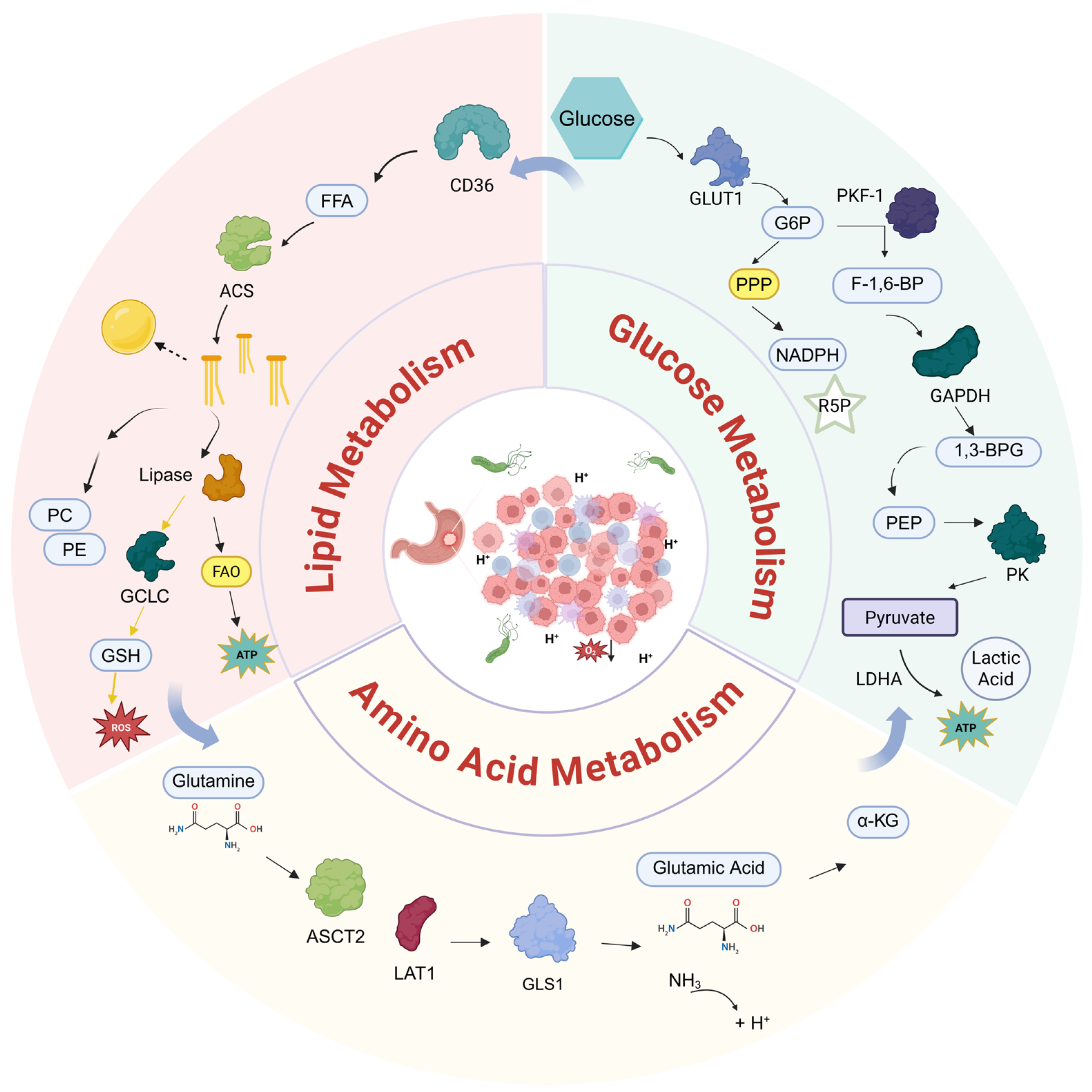
The cancer cells in the stomach undergo robust rewiring of metabolism in order to satisfy their bioenergetic and biosynthetic requirements. This chapter highlights three primary pillars of this rewiring, which include glucose metabolism, lipid metabolism, and amino acid metabolism, and which altogether serve as promoters of tumorigenesis and immune evasion. The metabolism profile is schematically represented in Figure 1.

2.1.1. Glucose Metabolic Reprogramming in Gastric Cancer Cells

Cancer cells frequently exhibit glycolytic reprogramming, a crucial component of tumor metabolic reprogramming [23]. Tumor cells alter glucose metabolism to satisfy high proliferation and energy needs in hypoxic and nutrient-deficient TME conditions, which speeds up the synthesis of ATP, albeit with efficiency significantly lower than oxidative phosphorylation (OXPHOS) [24]. Aerobic glycolysis is quite active in solid gastric malignancies, such as primary gastric lymphomas and benign gastric schwannomas [25].
By upregulating glucose transporters, GC cells improve extracellular glucose uptake by upregulating glucose transporter 1 (GLUT1), the primary transmembrane protein facilitating basal glucose transport [26]. Hexokinase 2 (HK2), the rate-limiting enzyme that catalyzes the first step of glycolysis, converts glucose to glucose-6-phosphate (G6P) [27]. Glycolysis is started by this process, which also provides metabolic intermediates for further metabolic branching. GC cells preferentially break down G6P by glycolysis, even in the presence of oxygen-sufficient TME circumstances. Pyruvate is then produced by pyruvate kinase M2 (PKM2), a critical enzyme governing the final step of glycolysis to generate ATP [28]. In contrast to normal cells, this pyruvate rarely enters mitochondria for OXPHOS. Recent evidence highlights that this restriction is mechanistically dictated by defects in the mitochondrial pyruvate carrier complex, specifically the downregulation of MPC1 and MPC2 subunits, which serve as the major gatekeepers for mitochondrial pyruvate entry [29,30]. Furthermore, loss of ALDH4A1, an important modifier that maintains the integrity of the MPC complex, has been documented in several malignancies to destabilize the complex and further promote this glycolytic phenotype [31]. As a result of this functional loss of the ALDH4A1-MPC axis, pyruvate flux is shunted toward Lactate dehydrogenase A (LDHA), leading to significant lactate accumulation and TME acidification [32]. This process not only rapidly produces ATP to meet immediate energy demands but also maintains NAD+ regeneration required for glycolysis by consuming NADH, ensuring its sustained operation. Moreover, G6P has been shown to enter the pentose phosphate pathway (PPP), thereby generating ribose-5-phosphate (R5P) and NADPH, which are indispensable for the synthesis of nucleic acids and lipids [33]. By controlling pyruvate production rates and balancing energy and anabolic synthesis to sustain proliferation, PKM2 indirectly affects the diversion of G6P to the PPP [34]. In order to speed up glucose metabolism, tumor growth causes local hypoxia, which further upregulates important glycolytic enzymes such as GLUT1 and HK2 [34,35]. At the same time, metabolic enzymes have the ability to directly affect mitochondria, increasing their reliance on glycolysis [36]. By binding to voltage-dependent anion channel (VDAC), a key gatekeeper controlling the passage of metabolites across the outer mitochondrial membrane, HK2 suppresses signals of mitochondrial apoptosis and directs pyruvate toward glycolysis. OXPHOS efficiency is decreased by PKM2’s direct inhibition of the mitochondrial electron transport chain [37,38,39].

2.1.2. Lipid Metabolic Reprogramming in Gastric Cancer Cells

De novo lipid synthesis (DNL), exogenous absorption, and fatty acid oxidation (FAO) are coordinated by lipid metabolic reprogramming to satisfy cellular needs for signaling, energy supply, and biomembrane formation [40]. One essential lipid metabolic process that sets GC cells apart from other cancer types is CD36-mediated exogenous lipid uptake.
GC is highly dependent on the chronic inflammatory microenvironment induced by H. pylori infection [41]. H. pylori increases the expression of the fatty acid transporter CD36 (a fatty acid translocase that facilitates the uptake of exogenous lipids), which improves the efficiency of GC cells’ uptake of lipoproteins and free fatty acids (FFAs) [42]. In particular, the phosphorylation of NF-κB in gastric mucosal cells is triggered by the H. pylori virulence factor CagA, a major oncoprotein injected into host cells [43]. NF-κB moves into the nucleus, attaches itself to the CD36 promoter, and immediately increases the expression of CD36 [44]. Ingested FFAs are activated by acyl-CoA synthase (ACS) and converted into triglycerides (TG). These are stored in lipid droplets as an energy reserve during hypoxia [45]. When hypoxia in the tumor center reduces glycolytic efficiency and glucose becomes scarce, TG is broken down by lipase into FFAs. These FFAs then generate substantial ATP through β-oxidation (FAO). GC cells that divide quickly also require substantial phospholipid synthesis to make new cell membranes [46]. FFA absorption mediated by CD36 supplies essential building blocks for the production of phospholipids [47]. Key constituents of novel membrane architectures are phosphatidylcholine (PC) and phosphatidylethanolamine (PE), which are produced by phosphatidylcholine synthase and phosphatidylethanolamine synthase, respectively [48].

2.1.3. Amino Acid Metabolic Reprogramming in Gastric Cancer Cells

Tumor cells alter nutrition use patterns by amino acid metabolic reprogramming to boost proliferation, counter oxidative damage, and improve malignant characteristics [49,50]. The distinct glutamine metabolic reprogramming that GC cells display in response to the combined impacts of H. pylori infection, mucosal hyperacidity, and dietary variations works in concert with exogenous lipid uptake.
Through virulence factors, H. pylori infection directly controls important glutamine metabolism molecules to improve the efficacy of extracellular glutamine uptake [51]. It works in concert with glutaminase 1 (GLS1), the mitochondrial enzyme responsible for converting glutamine into glutamate, to boost the generation efficiency of α-ketoglutarate (α-KG) [52]. The adaptive functional adaptation of glutamine metabolism in GC cells is driven concurrently by the physiological milieu of fasting glucose deprivation and the high acidity of the gastric mucosa [53,54]. GLS1 expression is upregulated in GC cells when intracellular lactate builds up in an acidic environment, which catalyzes glutamine breakdown [55]. In order to compensate for the energy deficit induced by decreased glycolytic efficiency in acidic conditions, the produced α-KG enters the tricarboxylic acid (TCA) cycle and OXPHOS pathways to produce ATP [55,56,57]. The NH3 produced by glutamate deamination can neutralize intracellular H+, maintaining pH homeostasis. This prevents acidity-induced apoptosis [58].
GC cells tightly couple glutamine metabolism with CD36-mediated exogenous lipid uptake. Glutamine-derived α-KG is converted into citrate via the TCA cycle. Upon cytoplasmic transport, ATP citrate lyase (ACLY) catalyzes its conversion to acetyl-CoA, providing key precursors for the synthesis of PC, PE and TG [32,59,60,61]. Conversely, Glutamate-cysteine ligase catalytic subunit (GCLC) activity is increased by exogenous fatty acids that CD36 uptakes, which encourages the synthesis of glutathione (GSH). In order to prevent ROS-mediated GLS1 inactivation and preserve glutamine metabolic equilibrium, GSH scavenges ROS produced during glutamine breakdown [62,63].

2.2. Metabolic Reprogramming of Immune Cells

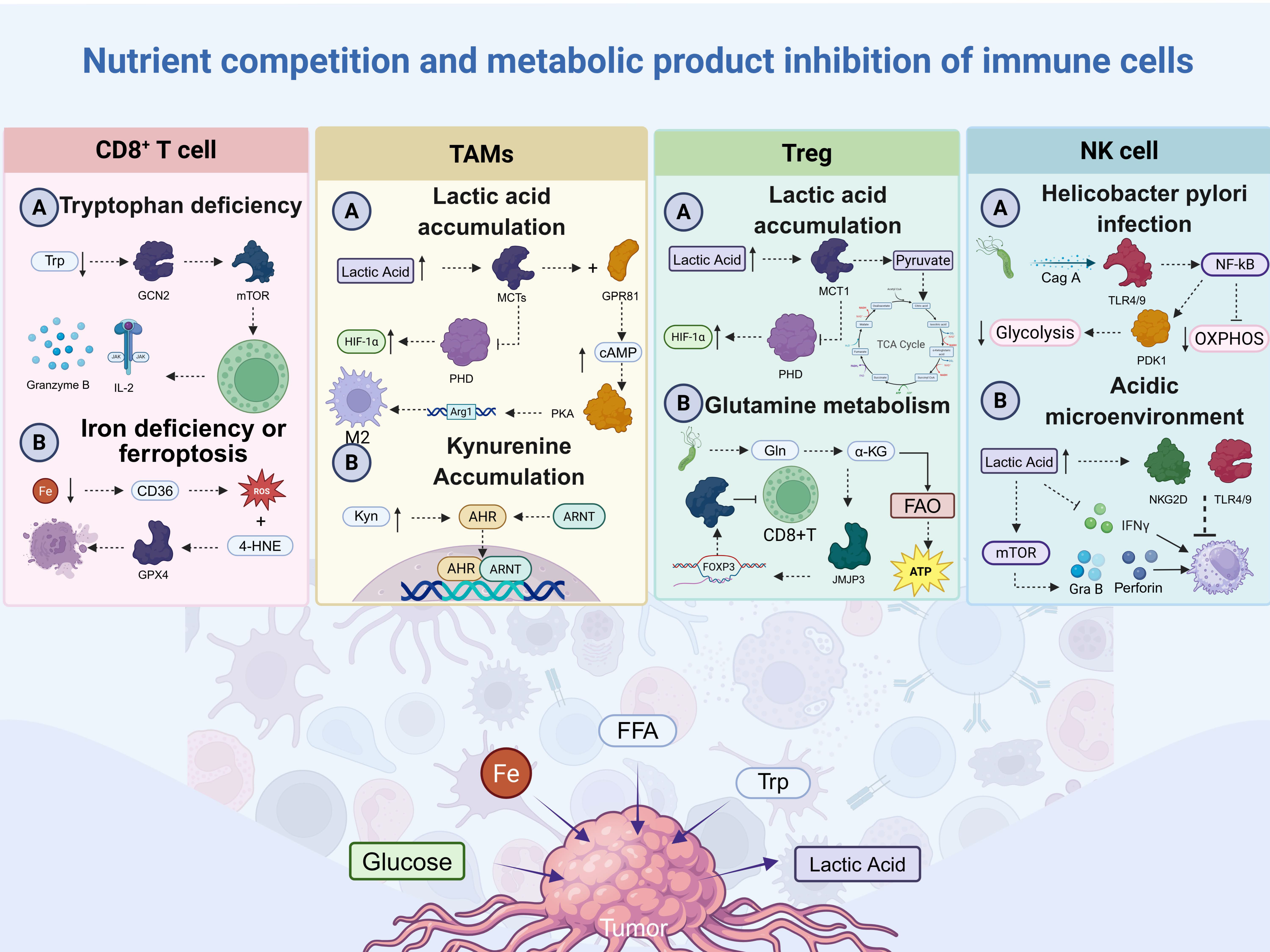
In the GC TME, metabolic stress is caused by the competing nutrition consumption of cancer cells as well as adaptive changes in invading immune cells [64]. Even though these modifications help immune cells survive, they frequently result in diminished anticancer activity, which eventually creates an immunosuppressive milieu (Table 1).

2.2.1. CD8+ T Cells

Ferroptosis and tryptophan deficiency are two important processes that inhibit CD8+ T cell activity [65,66,67]. The overexpression of indoleamine 2,3-dioxygenase 1 (IDO1), a rate-limiting enzyme that degrades the essential amino acid tryptophan, by tumor cells in the TME accelerates the breakdown of tryptophan, resulting in local depletion [68]. A lack of tryptophan activates general control nonderepressible 2 (GCN2) kinase, a cellular sensor of amino acid starvation, which inhibits mTOR translational activity, lowers IL-2 and granzyme B (GZMB) secretion, halts CD8+ T cell proliferation and differentiation, and reduces their cytotoxic potential [69,70]. Moreover, GC’s low-glucose, high-lactate TME suppresses mTOR signaling, which compels CD8+ T cells to upregulate CD36 and carnitine palmitoyltransferase 1A (CPT1A), the rate-limiting enzyme for fatty acid oxidation (FAO), in order to transition to FAO as an energy source [71,72]. This adaptive response results in iron-dependent lipid peroxidation-mediated cell death when the iron levels in the GC TME are elevated.
After being absorbed through CD36, polyunsaturated fatty acids (PUFAs) are esterified by acyl-CoA synthetase long-chain family member 4 (ACSL4), an enzyme essential for lipid metabolism and sensitivity to ferroptosis, and integrated into the cell membrane. Through the Fenton reaction, these esters stimulate the generation of excessive ROS under Fe2+ enrichment, leading to severe membrane phospholipid peroxidation and the production of cytotoxic 4-hydroxy-2-nonenal (4-HNE). Low expression of the lipid repair enzyme glutathione peroxidase 4 (GPX4) in dysfunctional CD8+ T cells prevents them from repairing lipid peroxidation damage, which eventually causes cell membrane rupture and death [73,74,75].

2.2.2. Tumor-Associated Macrophages

The main metabolic mediators driving tumor-associated macrophages (TAMs) towards an immunosuppressive M2 phenotypic transition are lactic acid and tryptophan depletion. Lactic acid is taken up by target cells by monocarboxylate transporters (MCTs). It decreases prolyl hydroxylase (PHD), thereby stabilizing hypoxia-inducible factor-1α (HIF-1α), a master transcriptional regulator of cellular adaptation to hypoxic stress. This factor triggers the expression of immunosuppressive genes, including vascular endothelial growth factor (VEGF), and arginase-1 (Arg1) [76,77,78]. This factor also binds to the G-protein-coupled receptor GPR81, thereby increasing levels of intracellular cAMP. This factor triggers M2 gene expression, including Arg1, by protein kinase A (PKA). These pathways induce an M2 phenotypic transition in TAMs. These pathways result in angiogenesis in the tumor and an inhibition of T cell activation [79,80].
The level of IDO1 expression is constantly enhanced in both TAMs and GC cells [81]. IDO1 has the ability to metabolize tryptophan, an activator of T cells. Its metabolite, Kynurenine (Kyn), also serves as an endogenous ligand of the Aryl Hydrocarbon Receptor (AhR), a ligand-activated transcription factor involved in immune modulation, hence activating it [82]. The activated AhR enhances the immunosuppressive properties of TAMs. When it translocates into the nucleus, it binds to Aryl hydrocarbon receptor nuclear translocator (ARNT), forming dimers. Then, it binds to the promoter regions of target genes, hence triggering the transcription of immunosuppressive genes [83].

2.2.3. Regulatory T Cells

Regulatory T cells (Tregs) depend on OXPHOS to preserve functional homeostasis. This contrasts with effector T cells, which prefer glycolysis [84]. Treg cells actively uptake lactate through high expression of monocarboxylate transporter 1 (MCT1). Lactate is converted into pyruvate, which then enters the TCA cycle for efficient energy production [85].
Lactate also suppresses PHD activity, which stops HIF-1α from being ubiquitinated and degraded [86]. As a result, it accumulates in the nucleus, increasing forkhead box P3 (FOXP3), the master transcription factor determining Treg development and function, to maintain the suppressive effect of Tregs [87,88]. Furthermore, Kyn buildup in the TME triggers AhR activation, which causes CD4+ T cells to differentiate into Tregs and futher increases FOXP3 expression [89].
Additionally, H. pylori infection promotes Tregs’ glutamine metabolism. Tregs absorb more extracellular glutamine and convert it to α-KG, which replenishes the TCA cycle to support ATP generation via OXPHOS [90,91]. This constantly activates glutamine metabolism while maintaining Tregs’ survival and immunosuppressive cytokine release in the low-glucose microenvironment [90,92]. Concurrently, Jumonji domain-containing protein 3 (JMJD3) activity is maintained by α-KG, via histone demethylation at the FOXP3 promoter. This procedure stabilizes the expression of FOXP3 by releasing transcriptional repression on it [93]. As a result, Tregs facilitate tumor immune evasion by continuously inhibiting CD8+ T cell activation in the inflammatory milieu of GC [94,95].

2.2.4. Natural Killer Cells

Toll-like receptor 4 and 9 (TLR4/9) on the surface of natural killer (NK) cells recognize H. pylori virulence factors and activate the NF-κB pathway [96]. In NK cells, NF-κB inhibits important OXPHOS enzymes and increases pyruvate dehydrogenase kinase 1 (PDK1), which lowers glycolytic rates and OXPHOS efficiency. This considerably impairs their capacity to identify and eliminate GC cells [97,98].
Moreover, lactate can hinder NK cell activity in a number of ways, and NK cells are susceptible to extremely acidic extracellular conditions [99]. It hinders efficient tumor cell identification by downregulating the expression of NKG2D and DNAM-1 on NK cell surfaces [100]. It inhibits intracellular signaling by lowering intracellular pH, which decreases the synthesis of the important effector cytokine interferon-γ (IFN-γ) [101,102]. Lactate abrogates NK cell cytotoxicity by suppressing the mTOR pathway. This suppression reduces the production of perforin and granzymes and finally hinders the polarization of cytotoxic granules and the formation of synapses [101,103].

3. Metabolic Crosstalk in the TME

The metabolic conflict between tumor cells and immune cells is the cause of the immunosuppressive characteristics of the GC TME [104]. Important substrates including glucose, glutamine, and iron are competitively used by tumor cells, depriving immune cells of nutrients [105]. They simultaneously release lipids, lactic acid, and metabolites produced from amino acids, all of which directly impair the activity of effector immune cells [106]. Ultimately, immune cells create a metabolic milieu that promotes tumor growth by adapting to metabolic stress at the price of anticancer function [92] (Figure 2).

3.1. Glucose

GLUT1 is extensively expressed by GC cells, which have a much greater capacity to glucose uptake than immune cells. It is important to clarify that this increased uptake targets glucose from the systemic circulation and interstitial fluid within the TME, rather than direct absorption of dietary glucose from the gastric lumen. As a result, the TME’s glucose concentrations are significantly lower [107]. Concomitantly, they use glycolysis to generate excessive lactate, which is then exported into the TME through monocarboxylate transporter 4 (MCT4) [108]. Lactate further inhibits CD8+ T cell glycolysis in the acidic environment, causing them to convert to ineffective fatty acid oxidation (FAO) [108]. However, Tregs restrict glycolysis through PDK1 to sustain metabolic demands via OXPHOS, giving them a survival advantage in low-glucose environments [109].

3.2. Glutamine

Glutamine, a critical source of nitrogen and carbon for protein synthesis and TCA cycle anaplerosis, is a core nutrient contested by tumors and immune cells [110]. Glutamate transporters such as alanine–serine–cysteine transporter 2 (ASCT2) and L-type amino acid transporter 1 (LAT1) are upregulated in GC cells, giving them a complete uptake advantage [111]. T cell function is significantly suppressed by glutamine deficiency. It concurrently forces T cells to transition to OXPHOS metabolism and initiates T cell death caused by endoplasmic reticulum stress. The ability of IL-2 and GZMB is diminished [90,112].

3.3. Iron Competition

By upregulating iron absorption proteins such as transferrin receptor (TfR1), GC cells actively collect iron resources from the TME and store them as ferritin to support their growth [113]. At the same time, they release ferritin to inhibit the expression of the macrophage iron export protein ferroportin (FPN), which results in the retention of iron within macrophages and increases the expression of heme oxygenase-1 (HO-1) [114,115]. This dual action causes M2 polarization and decreases phagocytic capability.
Iron competition is exacerbated by H. pylori infection. In the stomach mucosa and the TME, H. pylori directly competes with immune cells for iron by expressing iron acquisition proteins such as H. pylori DppA (HpDppA) and ferric citrate transporter A (FecA) [116]. Its virulence factor CagA also triggers the stomach mucosa’s NF-κB–HIF-1α pathway, which causes GC cells to overexpress TfR1 and prevents immune cells from releasing iron, resulting in a serious iron distribution imbalance [117,118].

3.4. Lipid Competition

By suppressing adipocyte lipolysis, GC cells release angiopoietin-like 4 (ANGPTL4), which drastically lowers the amount of FFAs available in the TME [119]. Concurrently, H. pylori infection increases the efficiency of tumor cell FFAs absorption by activating CD36 signaling [120]. In contrast, low or suppressed CD36 expression makes it difficult for T cells and macrophages to efficiently acquire lipids [44,121]. Tregs can survive on a small amount of lipids, but CD8+ T cells are more vulnerable to ferroptosis because they do not produce enough GPX4, which makes them unable to withstand the damage caused by 4-HNE-mediated lipid peroxidation [122,123].

4. Unique Metabolic Characteristics of Gastric Cancer

Tumor cells and immune cells engage in metabolic competition, which gives the GC TME its immunosuppressive characteristics. Important substrates including glucose, glutamine, and iron are competitively used by tumor cells, depriving immune cells of nutrients. They simultaneously produce metabolites generated from amino acids, lipids, and lactic acid, all of which directly impair the activity of effector immune cells [124,125,126]. Immune cells adapt to metabolic stress at the expense of their antitumor function. This ultimately creates a metabolic environment conducive to tumor progression.

4.1. Helicobacter Pylori Infection

Roughly 80% of GC is associated with chronic infection by H. pylori [127]. It is a distinguishing pathogenic factor for GC. It is involved in metabolic reprogramming through its virulence factors. The metabolic interaction of H. pylori with host cells is a distinguishing characteristic of GC over other cancers [128].
H. pylori changes the metabolism of cancer cells through specific virulence factors. It activates the NF-κB pathway, increasing the expression of crucial glycolytic genes and glycolytic activity. An active H. pylori infection also demonstrates regulatory effects on the tricarboxylic acid cycle dynamics. It starts by inhibiting the activity of the tricarboxylic acid cycle to induce glycolysis [33,129]. As the infection progresses, the TCA cycle is repurposed to supply biosynthetic precursors that the tumor needs to keep growing [130,131]. In lipid metabolism, H. pylori upregulates CD36 expression, promoting FFA uptake. In contrast, vacuolating cytotoxin A (VacA) has been shown to augment lipid influx through the activation of membrane channels. Consequently, these processes result in the accumulation of intracellular lipids and the activation of oncogenic pathways [132]. In relation to amino acid metabolism, H. pylori upregulates ASCT2 and GLS1, thereby enhancing glutamine catabolism and supplying tumor cells with energy and biosynthetic precursors. At the same time, it increases IDO1 activity to change the metabolism of tryptophan, which in turn triggers AhR signaling to cause Tregs differentiation [89].
H. pylori affects both innate and adaptive immunity through particular metabolic manipulations at the immunoregulatory level [133]. The H. pylori virulence factor lipopolysaccharide (LPS) triggers innate immunity by upregulating PDK1 to prevent glycolysis, activating NK cell NF-κB signaling through TLR4, and inducing macrophage Arg1 expression to encourage M2 polarization [79,97,98]. By stabilizing Tregs’ immunosuppressive functions through the Trp–Kyn–AhR axis and depleting iron resources in the TME through iron transporters such as FecA, H. pylori contributes to adaptive immunity by creating an immunosuppressive TME [113].

4.2. Anatomy and Physiological Microenvironment of Stomach

The stomach’s physiological environment and anatomical structure produce a unique microenvironment that is favorable to GC. Strong acidity and sporadic changes in nutrient availability are characteristics of the GC tumor microenvironment [134]. By altering the physicochemical characteristics and substrate availability in the microenvironment, the characteristics listed have a substantial impact on cellular metabolic states and act as basic background conditions for the development of GC.
The highly acidic gastric lumen exerts specific regulatory effects on metabolism [135]. By increasing glutamine metabolism and upregulating pH-regulating proteins such as carbonic anhydrase IX (CAIX), GC cells preserve intracellular homeostasis [136]. They provide growth advantages in acidic environments by using GLS to catalyze the generation of ammonia for intracellular H+ neutralization and α-KG to replenish the TCA cycle for energy supply [137]. Conversely, by suppressing phosphofructokinase-1 (PFK1) activity to prevent effector T cell glycolysis and lowering NKG2D receptor expression on NK cells, the acidic environment progressively reduces antitumor immunity [108,138].
Nutrient concentrations in the TME fluctuate significantly due to periodic gastric emptying [139]. High metabolic flexibility has evolved in GC cells, allowing them to change their main metabolic pathways in response to different dietary circumstances [140]. They enhance glycolysis by upregulating GLUT1 and HK2 during postprandial hyperglycemia [141,142]. CPT1-regulated β-oxidation and CD36-mediated FFAs uptake sustain the energy supply during fasting [143]. By changing the local metabolite composition, this metabolic flexibility affects other cell survival in addition to maintaining tumor cell growth in the face of nutritional variations. For example, glutamine depletion in the TME is caused by fasting tumor cells upregulating ASCT2. T cells undergo apoptosis as a result of an endoplasmic reticulum unfolded protein response (UPR) [18,89].

4.3. Metabolic Heterogeneity in Gastric Cancer Molecular Subtypes

Depending on the molecular basis of the tumor, these key drivers have variable effects on different types of GC. Highly diverse molecular subtypes have evolved as a result of this targeted selection by etiology and microenvironment. These subtypes each employ distinct metabolic or phenotypic reprogramming strategies to respond to environmental stress. Gastric tumors were divided into four molecular subgroups by The Cancer Genome Atlas (TCGA) in 2014: chromosomal instability (CIN), microsatellite instability (MSI), genomic stability (GS), and Epstein–Barr virus (EBV)-positive [144]. These four molecular subtypes show very different metabolic and phenotypic reprogramming patterns in addition to having different genetic bases and signaling pathways.

5. Metabolic and Phenotypic Reprogramming in Gastric Cancer Subtypes

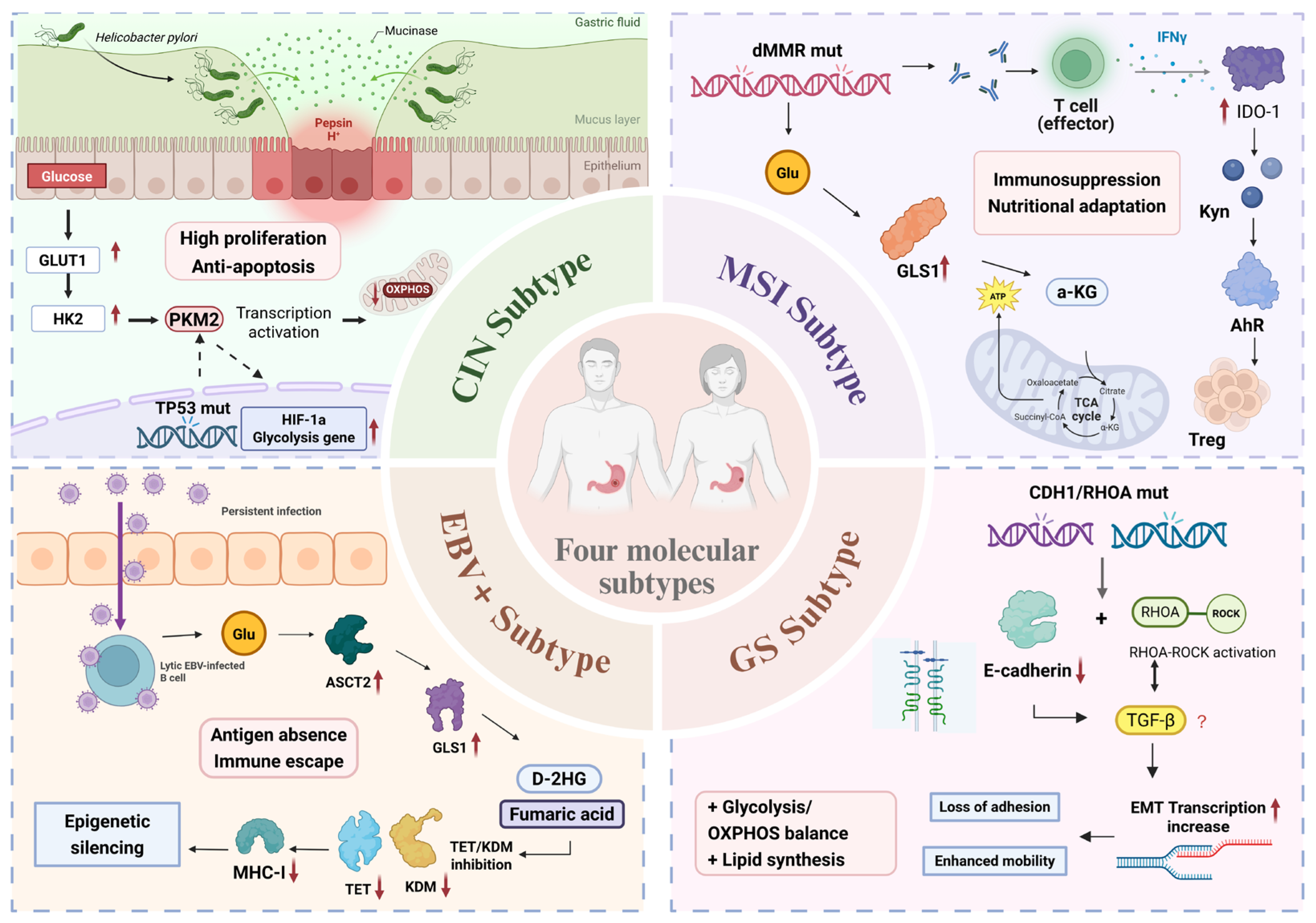
GC has been shown to display considerable heterogeneity, and this is particularly observed when compared with the main molecular subtypes. The main molecular subtypes are generated based on completely different biological backgrounds, including specific pathogenic factors and genetic mechanisms (Table 2). GC cells with various characteristics display completely different trends in interaction with the tumor microenvironment, thus demonstrating specific regulation mechanisms (Figure 3).

5.1. CIN Subtype

The chromosomal instability (CIN) subtype is the most common form of GC, accounting for approximately 50% of all cases. Tumors of this subtype tend to arise at the gastroesophageal junction or in the cardia [144]. The rate of H. pylori infection is often above 85%. The patients usually present with chronic inflammation of the gastric mucosa and abnormal acid secretion [145]. Metabolic reprogramming in the CIN subtype is characterized by highly active glycolysis. Its development is closely associated with TP53 mutations and is further influenced by the background of H. pylori infection.
In the CIN subtype, the TP53 mutation rate exceeds 70%. It increased glycolysis dependence in concert with H. pylori. CagA activates NF-κB signaling [146]. Mutated p53 loses transcriptional repression of GLUT1 and HK2. This results in significantly higher expression of glucose transporters and hexokinase compared to other subtypes. This facilitates highly efficient glucose uptake by tumor cells within the gastric tissue [147,148]. Concurrently, mutant p53 cannot properly activate peroxisome proliferator-activated receptor gamma coactivator 1-alpha (PGC1α) [149]. OXPHOS and mitochondrial biogenesis are disrupted. The inhibition of the mitochondrial electron transport chain by H. pylori CagA blocks the oxidative energy supply, forcing cells to switch to glycolytic dependence [150]. In addition, enhanced glycolysis interacts with the mitochondrial ROS leakage induced by the acidic gastric environment. Mutated p53 forms a complex with nuclear factor erythroid 2-related factor 2 (Nrf2), upregulating antioxidant genes (such as GCLC and superoxide dismutase 2 [SOD2]) to counteract ROS accumulation [151]. This creates a vicious cycle that not only keeps metabolic homeostasis in the acidic microenvironment, but also supports cell proliferation.
Beyond TP53 mutations, EGFR/MET amplification rates are 40–50%, further enhancing the positive feedback of glycolysis through the PI3K–AKT–mTORC1 axis [152]. AKT phosphorylation inhibits prolyl hydroxylase domain protein 2 (PHD2), stabilizes HIF-1α, and activates glycolytic genes like GLUT1/3, HK2, and LDHA [153]. Simultaneously, AKT phosphorylates HK2’s Ser473, improving its ability to bind to VDAC. By preventing cytochrome c release and increasing glycolytic start efficiency, this prevents acidity-induced mitochondrial apoptosis and achieves metabolic reprogramming in addition to anti-apoptosis. Additionally, ribosomal protein S6 kinase beta-1 (S6K1) is activated by mTORC1 to support nuclear localization and c-Myc translation [154,155]. By binding to the E-box element on the LDHA promoter, c-Myc increases the efficiency of lactate synthesis and strengthens the “Warburg effect” [156,157].
Building on these regulatory mechanisms, chromosomal instability causes CIN subtypes to proliferate, which further solidifies the glycolytic phenotype through epigenetic control and PKM2-mediated metabolic diversion [158]. H. pylori CagA can activate Src kinase and promote PKM2 serine phosphorylation because of its continuously high PKM2 expression [159]. Glycolytic intermediates build up and the pentose phosphate pathway is diverted by low PKM2 activity, which produces NADPH to scavenge ROS and R5P for nucleic acid synthesis [160]. More importantly, phosphorylated PKM2 forms a PKM2–HIF-1α–JMJD3 complex by entering the nucleus through importin α5 [161]. This complex lifts the transcriptional inhibition of glycolytic genes by mediating H3K27me3 demethylation through JMJD3. This mechanism identifies PKM2 as a crucial node that connects epigenetic control with metabolic reprogramming [162,163].

5.2. MSI Subtype

The MSI-type results from changes in DNA mismatch repair (MMR) genes, accounting for 22% of all GC cases [164]. It mostly happens in the distal stomach and has a lower H. pylori infection rate (40–50%) [165]. Its core regulation involves immune suppression mediated by tryptophan metabolism and nutritional adaptation driven by glutamine metabolism.
The activation mechanism of the MSI subtype’s tryptophan metabolism differs from that of the CIN subtype. Given its lower H. pylori infection rate, the high expression of IDO1 is not directly induced by H. pylori [166,167]. Instead, it is associated with an immune-active tumor microenvironment shaped by a high mutation burden. Specifically, DNA mismatch repair defects enhance neoantigen presentation, thereby activating adaptive immune responses and elevating IFN-γ levels [168]. Through the JAK–STAT1 pathway, IFN-γ induces STAT1 nuclear translocation and binding to the IDO1 promoter, sustaining continuous activation of the Trp–Kyn axis [169]. Consequently, local tryptophan supply becomes progressively limited due to sustained IDO1 activation, impairing effector T cell function [133]. Simultaneously, accumulated metabolites promote Tregs activation and TAMs polarization toward the M2 phenotype, collectively reinforcing immune evasion [170].
Moreover, in this subtype, there is flexible glutamine metabolism to compensate for nutritional variations in the gastric body [171]. Owing to the lack of H. pylori-CagA-mediated ASCT2/LAT1 expression, its efficiency in transporting exogenous glutamine is decreased, thus improving endogenous glutamine synthesis [172]. When fasting, under nutrient-deprived conditions, AMPK/STAT3 signaling pathways increase glutamine synthetase gene expression. GC cells preferentially metabolize glutamates derived from TCA cycle activity to provide endogenous glutamine synthesis to satisfy cellular demands [173,174]. This endogenously generated glutamine serves to maintain TCA cycle activity and regulation of pH balance [175]. ASCT2 levels increase postprandially; hence, its utilization efficiency for exogenous glutamine increases [176]. At the same time, glucose-derived NADPH influences glutamine catabolism to provide carbon source components for biosynthesis [177,178].

5.3. EBV-Positive Subtype

The EBV-positive subtype accounts for approximately 9% of all GC cases, which mostly affect younger men and develop in the stomach’s fundus or body [179]. EBV-positive infection raises the risk of GC by almost ten times, according to studies [180]. This subtype’s main characteristic is that the virus actively manipulates the metabolism of the host cell, employing certain metabolites to promote widespread epigenetic silencing and eventually creating an immune-evading milieu [181]. The virus’s predominant role in carcinogenesis is shown by the fact that this mechanism is distinct from the tryptophan metabolism-mediated immunosuppression of the MSI subtype and the glycolysis-dependent immunosuppression of the CIN subtype.
In metabolic reprogramming, viral components generated during latent EBV-positive infection serve as key upstream factors [182]. EBV-encoded small RNAs (EBERs) upregulate ASCT2 expression to improve glutamine absorption by activating the NF-κB and PI3K–AKT signaling pathways [183]. By triggering downstream kinase signaling, the latent membrane protein 2A (LMP2A) increases GLS1 activity, but it also encourages glutamine breakdown [184]. By greatly increasing cellular glutamine metabolism, this synergistic improvement creates a large supply of substrates for the subsequent aberrant buildup of metabolites such as fumarate and D-2-hydroxyglutarate (D-2HG) [185]. Particularly in EBV-positive GC cells, fumarate and D-2HG build up under long-term viral control [186]. These metabolites function as competitive inhibitors of α-KG, suppressing the activity of DNA demethylase ten–eleven translocation (TET) and histone demethylase lysine demethylase (KDM). This results in genome-wide epigenetic reprogramming: Inhibitory histone marks accumulate extensively, causing chromatin compaction [144,187]. A distinctive CpG island methylator phenotype (CIMP) is formed when CpG islands in gene promoter regions experience hypermethylation at the same time. When combined, these mechanisms inhibit the expression of many genes that are involved in function [188].
Antigen presentation is one of the main targets of this epigenetic silencing. The genes encoding MHC class I molecules exhibit severe expression loss due to promoter hypermethylation. This renders them incapable of effectively presenting viral antigens to CD8+ T cells [189,190,191]. As a result, immunological escape occurs because the immune system is unable to identify GC cells. This represents a fundamental difference from the pathways that suppress T cell function in the MSI subtype.

5.4. GS Subtype

The genomic-stable (GS) subtype accounts for approximately 20% of all GC cases [192]. It is characterized by mutations in genes like CDH1, ARID1A, and RhoA. Histologically, it primarily presents as diffuse-type Lauren GC, with around 25% of cases developing at the cardia or gastroesophageal junction [193,194]. This subtype’s primary characteristic is morphogenetic reprogramming, which is triggered by alterations in cell adhesion and signaling pathways rather than usual metabolic reprogramming. Its ability to disrupt cell connections and modify the cytoskeleton allows cancer cells to diffusely infiltrate, which sets it apart from other subtypes.
The GS subtype’s widespread phenotype is mostly caused by synergistic mutations in the RHOA and CDH1 genes [195]. About 40–60% of patients have inactivating CDH1 mutations, which cause E-cadherin function to be lost, intercellular junctions to be disrupted, and nuclear translocation of β-catenin to activate genes related to the epithelial-mesenchymal transition (EMT) [196,197]. At the same time, RHOA hotspot mutations are present in 20% to 30% of cases. Cell motility is improved by the prolonged activation of RHOA, which causes actin cytoskeletal contraction and reconfiguration by downstream Rho-associated protein kinase (ROCK) [192,198]. These mutations work together to greatly reduce cell adhesion and encourage migration. At the regulatory level, the RHOA–ROCK axis and TGF-β signaling pathways work in concert to promote morphologic remodeling in GS GC. The RHOA–ROCK axis directly drives motility by targeting the phospho-myosin light chain, which improves cell contraction and stress fiber production [199,200]. A mesenchymal undifferentiated state that resembles embryonic migratory characteristics is maintained by abnormal TGF-β signaling, which also upregulates EMT)transcription factors and creates a positive feedback loop with the RHOA–ROCK axis [201]. There is no distinct metabolic reprogramming in GS GC. Its metabolic changes mainly include moderately increased lipid synthesis and balanced use of oxidative phosphorylation and glycolysis [127,144]. As an adaptive reaction to high invasiveness, these alterations mainly supply energy and raw materials for membrane biogenesis and cytoskeletal remodeling.
Its distinct biological behavior and therapeutic obstacles are highlighted by the process centered on morphologic remodeling, which causes clinical hurdles in GS GC, such as ambiguous borders, early peritoneal metastasis, and poor prognosis [202,203].

6. Therapeutic Strategies Targeting Metabolic Reprogramming

Considering the key role of metabolic reprogramming in the shaping of the immunosuppressive TME and driving drug resistance, there is a change in the therapeutic approach from broad-spectrum cytotoxicity to precise metabolic intervention. These metabolic vulnerabilities are targeted to starve tumor cells of their much-needed nutrients, which also acts to restore a favorable metabolic landscape for antitumor immunity.

6.1. Targeting Glycolytic and Mitochondrial Interaction

The “Warburg effect” driven by HK2, PKM2, and LDHA acts as the primary energetic engine for gastric cancer progression. Since H. pylori infection initiates aerobic glycolysis via CagA and Lonp1, eradication of H. pylori remains the fundamental metabolic intervention to halt early-stage metabolic rewiring [204,205]. Among the enzymatic targets, HK2 serves as a critical gatekeeper. Small molecule inhibitors such as 3-Bromopyruvate (3-BrPA) and 2-Deoxy-D-glucose (2-DG) have shown efficacy in preclinical models by competitively blocking glucose flux or dissociating HK2 from mitochondrial VDACs, thereby triggering mitochondria-associated apoptosis [206,207]. In the context of drug resistance, Metformin has garnered attention for its ability to promote the degradation of the circadian regulator PER1. Disruption of this PER1-HK2 axis suppresses HK2-mediated glycolysis and has been shown to restore sensitivity to Trastuzumab in HER2-positive GC [208]. Additionally, the PPARα agonist Fenofibrate offers another strategy by activating the PPARα pathway to promote fatty acid oxidation, effectively shifting the metabolic preference away from glycolysis [209].
Downstream of HK2, PKM2 regulates the final rate-limiting step of glycolysis. Beyond its metabolic function, PKM2 translocates into the nucleus to promote HIF-1α transcription. The small molecule activator TEPP-46 can tetramerize PKM2, thus blocking its nuclear translocation and forcing a metabolic shift back to oxidative phosphorylation, thereby dampening HIF-1α-driven immunosuppression [210]. Furthermore, the proton pump inhibitor Pantoprazole (PPZ) has been repurposed as a PKM2 inhibitor; it reverses multidrug resistance by inhibiting the Akt/GSK-3β/β-catenin signaling pathway [211]. Finally, targeting LDHA is essential for neutralizing the acidic TME. Inhibitors such as Oxamate can suppress mTOR activity and induce protective autophagy [212]. Most importantly, lactate accumulation promotes the dysfunction of tumor-infiltrating lymphocytes. Tregs in the high-glycolytic TME actively take up lactate through MCT1, which induces the nuclear translocation of NFAT1 and thereby directly upregulates PD-1 expression. This high PD-1 expression leads to enhanced suppressive activity of Tregs and resistance against PD-1 blockade [85]. Targeting the LDHA-lactate axis, therefore, stands as a strategic avenue to avoid Treg hyper-activation and sensitize tumors against immune checkpoint inhibitors.

6.2. Lipid Metabolism and Fatty Acid Uptake as Targets

Aberrant lipid metabolism, characterized by enhanced uptake, de novo synthesis, and oxidation, supports GC metastasis and fosters an immunosuppressive TME. The fatty acid translocase CD36 is identified as a critical dependency for metastasis-initiating GC cells, wherein it activates the AKT/GSK-3β/β-catenin pathway to drive epithelial–mesenchymal transition [213]. Crucially, CD36 is also a metabolic checkpoint for MDSCs. Tumor-infiltrating MDSCs actively absorb fatty acids through CD36, resulting in lipid accumulation and enhanced capacity for immunosuppression against CD8+ T cells. Anti-CD36 mAb may thus have a two-way impact on tumors and MDSC: blocking tumor metastasis while preventing MDSC dysfunction and thereby maintaining antitumor immunity [214,215].
Aside from uptake inhibition, the interference with lipid biosynthesis and modifications offers other therapeutic targets. Avasimibe, an inhibitory agent of sterol O-acyltransferase 1 (SOAT1), inhibits cholesterol esterification and thus interferes with lymphangiogenesis and the growth of tumor cells due to VEGF-C downregulation [216]. Of greater importance is Avasimibe’s role in promoting cytotoxicity of CD8+ T cells through an enhancement of plasma membrane cholesterol concentrations. This increases TCR signaling and the formation of the immune synapse. The combination of Avasimibe and anti-PD-1 therapy was shown to be synergistically effective in models of human cancers [217]. Moreover, inhibition of the HDAC class can lead to the recalcitrant issue of lipid metabolism through the enhancement of ACSL4 and the activation of lipid peroxidation-induced ferroptosis of GC cells due to VEGF-C downregulation and VHL gene silencing [218]. To overcome the adaptive resistance based on the ability of cells to resort to FAO when under starvation conditions, the CPT1A inhibitor Etomoxir has been proven to inhibit the immunosuppressive function of T-MDSCs and Tregs, which depend largely on FAO for their viability [219,220].

6.3. Targeting Amino Acid Metabolism and Immune Tolerance

Amino acid deprivation is also an effective immune evasion strategy for GC, and modulation of these metabolic checkpoints is an approach to reverse tolerance to the immune system. IDO1 catalyzes the rate-limiting step of tryptophan conversion to KYN; this process is often upregulated due to infection with H. pylori via the cGAS-IRF3 pathway [221]. IDO1 has an intimate link with the immunologic checkpoints; for example, CTLA-4-positive Tregs can upregulate IDO1 proteins on dendritic cells, making IDO1 an immunosuppressive feedback loop [222,223]. The selective IDO1 inhibitor Epacadostat inhibits this process by reducing the production of KYN. Clinical trials demonstrated that administration of Epacadostat with Pembrolizumab can lead to long-lasting responses, especially when there are high tumor infiltrates [223]. Again, IDO1 inhibition also led to an improvement when targeting Claudin18.2 CAR-T as an approach to restore T cell metabolic competency within an immunosuppressive host [224].
Parallel approaches are also focused on glutamine and arginine metabolism. For glutamine, the glutaminase inhibitors, CB-839, also known as Telaglenastat, inhibit glutaminolysis, thereby triggering metabolic crisis in GCs, but overcome competition for nutrients to enable effector T cells to reestablish their use of oxidative metabolism [225]. For arginine, the new arginase dual inhibitor, OATD-02, reestablishes the concentration of L-arginine in the tumor microenvironment by simultaneously inhibiting both ARG1 and ARG2 enzymes, resulting in a reduction in polyamine production, ultimately potentiating antitumor immune responses by potently increasing T-cell infiltration in the core areas of the tumors [226]. The different strategies collectively target amino acids with the purpose of utilizing the desert of the tumor microenvironment to support an immune reaction against the cancer.

7. Conclusions

GC has persisted as a lethal malignancy with high diversity and a strongly immunosuppressive TME. Although significant success has been seen with the development of immunotherapy, its clinical benefits in GC are often compromised by limited T-cell infiltration and acquired resistance. As discussed in this review, the association between metabolism and the development of an immunosuppressive TME has shown that increased nutrient uptake by tumor cells leads to a nutrient-deprived microenvironment. The nutrient-deprived microenvironment fails to support effector T cells but instead favors the development of suppressive T cells.
One of the major differences between GC metabolism and other solid cancers is that GC metabolism is highly affected by the H. pylori infectious gastric physiological microenvironment. H. pylori acts as one of the major modulators of metabolism, triggering glycolysis transitions and tryptophan depletion prior to maximal carcinogenesis. This suggests that targeted therapy for GC metabolism should incorporate H. pylori status, where treatment to eradicate H. pylori serves as one of the primary metabolism-regulating interventions. In addition, the variation in nutrient levels based on gastric physiology creates a constantly changing selective pressure that mandates strong metabolic plasticity in GC cells, which can change from glycolytic to FAO, among others. This is why single-target metabolic inhibitors tend to develop adaptive resistance.
Despite the limited success of unstratified metabolic therapy approaches in trials, one main contributing factor to this would be the metabolic variability that exists between GC molecular subtypes. As discussed, the CIN subtype is addicted to glycolysis and lipogenesis, whereas the GS subtype relies heavily on stromal-driven FAO. This dichotomy indicates that a metabolic inhibitor effective in one subtype, such as FASN inhibitors for CIN, might be futile in another, such as GS. Therefore, the subtype-guided therapeutic framework proposed in this review offers a rational approach to precision medicine. Future trials should hence target specific subtypes based on metabolic patterns, such as using IDO1 inhibitors in MSI-H.
Despite such advancements, major gaps persist between harnessing concepts of metabolism to enhance survival rates. One major limitation is that current understanding relies heavily on static models, which fail to capture the dynamic metabolic alterations accompanying H. pylori colonization, carcinogenesis, and metastasis. Furthermore, although mechanisms within CIN/MSI subtypes have been carefully established, the metabolic interactions within GS or EBV-positive subtypes, especially those involving interactions between metabolites in regulating antigen presentation, remain relatively uninvestigated. Beyond mechanistic gaps, the systemic toxicity of metabolic inhibitors constitutes a significant hurdle, as targeting tumor-specific metabolic vulnerabilities without impairing normal tissue homeostasis requires more precise delivery systems.
To bridge these translational gaps, the future research direction should be the application of patient-derived organoids and multi-omics analyses, such as single-cell metabolomics and spatial transcriptomics, for the dynamic profiling of the TME metabolic phenotypes. Additionally, comprehensive clinical trials are crucial for the verification of distinct metabolic biomarkers in the context of the currently used subtypes. Notably, the interaction between neo-adjuvant therapy and host metabolism warrants deeper investigation; therapy-induced systemic metabolic impairments, such as glucose/lipid disorders or amino acid imbalances, may fundamentally alter nutrient availability and tumor metabolic plasticity, thereby influencing the efficacy of subsequent metabolic interventions. Ultimately, these insights should drive the design of rational combination therapies, rather than empiricism. For example, the use of lipid metabolic modifiers and anti-PD-1 therapy for the treatment of lipid-rich tumors for the purpose of reversing immune resistance.
In conclusion, the immune microenvironment in GC is influenced by metabolic reprogramming, distinct from the infectious and physiological contexts. By leveraging the power of the non-Warburg metabolic perspective and its applicability to the specific type of GC, we unlock novel therapeutic targets. Pursuing the metabolic weakness provides an actionable solution to the bottleneck issue of immune infiltration in non-immunogenic tumors and possibly the immunotherapy in patients with GC.

Author Contributions

Conceptualization, X.Q. and W.D.; software, H.L.; writing—original draft preparation, X.Q., W.D. and H.L.; writing—review and editing, J.H. and W.W.; supervision, J.H.; project administration, J.H.; funding acquisition, W.W. All authors have read and agreed to the published version of the manuscript.

Funding

This research was funded by the 2025 Provincial Natural Science Foundation Joint Fund Key Project, Heilongjiang Province, China (grant number ZL2025H018).

Institutional Review Board Statement

Not applicable.

Informed Consent Statement

Not applicable.

Data Availability Statement

No new data were created or analyzed in this study. Data sharing is not applicable to this article.

Acknowledgments

Thanks to the Institute of Chinese Materia Medica, Heilongjiang Academy of Chinese Medicine Science.

Conflicts of Interest

The authors declare no conflicts of interest.

Abbreviations

The following abbreviations are used in this manuscript:
ICIsImmune checkpoint inhibitors
GCGastric cancer
TMETumor microenvironment
H. pyloriHelicobacter pylori
OXPHOSOxidative phosphorylation
GLUT1Glucose transporter 1
HK2Hexokinase 2
G6PGlucose-6-phosphate
PKM2Pyruvate kinase M2
LDHALactate dehydrogenase A
PPPPentose phosphate pathway
R5PRibose-5-phosphate
VDACVoltage-dependent anion channel
DNLDe novo lipid synthesis
FAOFatty acid oxidation
FFAsFree fatty acids
ACSAcyl-CoA synthase
TGTriglycerides
PCPhosphatidylcholine
PEPhosphatidylethanolamine
α-KGα-Ketoglutarate
GLS1Glutaminase 1
TCATricarboxylic acid
ACLYATP-citrate lyase
P-ChoPhosphocholine
GCLCGlutamate-cysteine ligase catalytic subunit
GSHGlutathione
IDO1Indoleamine 2,3-dioxygenase 1
GCN2General control nonderepressible 2
GZMBGranzyme B
CPT1ACarnitine palmitoyltransferase 1A
PUFAsPolyunsaturated fatty acids
ACSL4Acyl-CoA synthetase long-chain family member 4
4-HNE4-Hydroxy-2-nonenal
GPX4Glutathione peroxidase 4
TAMsTumor-associated macrophages
MCTsMonocarboxylate transporters
PHDProlyl hydroxylase
HIF-1αHypoxia-inducible factor-1α
VEGFVascular endothelial growth factor
Arg1Arginase-1
PKAProtein kinase A
KynKynurenine
AhRAryl hydrocarbon receptor
ARNTAryl hydrocarbon receptor nuclear translocator
TregsRegulatory T cells
MCT1Monocarboxylate transporter 1
FOXP3Forkhead box P3
JMJD3Jumonji domain-containing protein 3
TLR4/9Toll-like receptor 4 and 9
NKNatural killer
PDK1Pyruvate dehydrogenase kinase 1
IFN-γInterferon-γ
MCT4Monocarboxylate transporter 4
ASCT2Alanine–serine–cysteine transporter 2
LAT1L-type amino acid transporter 1
TfR1Transferrin receptor
FPNFerroportin
HO-1Heme oxygenase-1
HpDppAH. pylori DppA
FecAFerric citrate transporter A
ANGPTL4Angiopoietin-like 4
VacAVacuolating cytotoxin A
LPSLipopolysaccharide
CAIXCarbonic anhydrase IX
PFK1Phosphofructokinase-1
UPRUnfolded protein response
TCGAThe Cancer Genome Atlas
CINChromosomal instability
MSIMicrosatellite instability
GSGenomic stability
EBVEpstein–Barr virus
Nrf2Nuclear factor erythroid 2-related factor 2
SOD2Superoxide dismutase 2
PHD2Prolyl hydroxylase domain protein 2
S6K1S6 kinase beta-1
MMRMismatch repair
EBERsEBV-encoded small RNAs
LMP2ALatent membrane protein 2A
D-2HGD-2-hydroxyglutarate
TETTen–eleven translocation
CIMPCpG island methylator phenotype
EMTEpithelial–mesenchymal transition

References

  1. Loe, A.K.H.; Francis, R.; Seo, J.; Du, L.; Wang, Y.; Kim, J.-E.; Hakim, S.W.; Kim, J.-E.; He, H.H.; Guo, H.; et al. Uncovering the Dosage-Dependent Roles of Arid1a in Gastric Tumorigenesis for Combinatorial Drug Therapy. J. Exp. Med. 2021, 218, e20200219. [Google Scholar] [CrossRef]
  2. Wang, J.; Xi, Y.; Zhao, J.; Rong, X.; Lu, W.; Wang, Y. The Clinicopathological Characteristics and Prognoses of dMMR Gastric Adenocarcinoma Patients. Gastroenterol. Res. Pract. 2021, 2021, 4269781. [Google Scholar] [CrossRef]
  3. Son, M.Y.; Cho, D.H.; Kim, S.E.; Park, S.J.; Park, M.I.; Moon, W.; Kim, J.H.; Lee, J.W.; Jung, K. Long-Term Outcomes and Risk Factors for Lymph Node Metastasis in Siewert Type II/III Early Gastric Cancer. Korean J. Helicobacter Up. Gastrointest. Res. 2024, 24, 252–258. [Google Scholar] [CrossRef]
  4. Yıldız, Y.; Sokmensuer, C.; Yalcin, S. Evaluation of C-Met, HGF, and HER-2 Expressions in Gastric Carcinoma and Their Association with Other Clinicopathological Factors. Onco Targets Ther. 2016, 9, 5809–5817. [Google Scholar] [CrossRef] [PubMed]
  5. Barnestein, R.; Galland, L.; Kalfeist, L.; Ghiringhelli, F.; Ladoire, S.; Limagne, E. Immunosuppressive Tumor Microenvironment Modulation by Chemotherapies and Targeted Therapies to Enhance Immunotherapy Effectiveness. Oncoimmunology 2022, 11, 2120676. [Google Scholar] [CrossRef] [PubMed]
  6. Ma, X.; Liu, Y.; Chen, Y.; Wang, J.; Zhang, F.; Liang, W.; Zhang, P.; Zhou, Y.; Miao, B.; Fei, S.; et al. BFAR Promotes Neutrophil Infiltration and Immunosuppressive Reprogramming through the PRP19-YBX1 Axis to Induce Immune Evasion in Gastric Cancer. Cancer Immunol. Res. 2025, 13, 2037–2083. [Google Scholar] [CrossRef]
  7. Nema, R. An Omics-Based Tumor Microenvironment Approach and Its Prospects. Rep. Pract. Oncol. Radiother. 2024, 29, 649–650. [Google Scholar] [CrossRef]
  8. Verma, N.K.; Wong, B.H.S.; Poh, Z.S.; Udayakumar, A.; Verma, R.; Goh, R.K.J.; Duggan, S.P.; Shelat, V.G.; Chandy, K.G.; Grigoropoulos, N.F. Obstacles for T-Lymphocytes in the Tumour Microenvironment: Therapeutic Challenges, Advances and Opportunities beyond Immune Checkpoint. EBioMedicine 2022, 83, 104216. [Google Scholar] [CrossRef] [PubMed]
  9. Yoshida, G.J. Metabolic Reprogramming: The Emerging Concept and Associated Therapeutic Strategies. J. Exp. Clin. Cancer Res. 2015, 34, 111. [Google Scholar] [CrossRef]
  10. Warburg, O. On the Origin of Cancer Cells. Science 1956, 123, 309–314. [Google Scholar] [CrossRef]
  11. Lan, T.; Gao, F.; Cai, Y.; Lv, Y.; Zhu, J.; Liu, H.; Xie, S.; Wan, H.; He, H.; Xie, K.; et al. The Protein circPETH-147aa Regulates Metabolic Reprogramming in Hepatocellular Carcinoma Cells to Remodel Immunosuppressive Microenvironment. Nat. Commun. 2025, 16, 333. [Google Scholar] [CrossRef]
  12. Nagy, J.A.; Chang, S.-H.; Shih, S.-C.; Dvorak, A.M.; Dvorak, H.F. Heterogeneity of the Tumor Vasculature. Semin. Thromb. Hemost. 2010, 36, 321–331. [Google Scholar] [CrossRef] [PubMed]
  13. Cui, X.; Liu, X.; Feng, R.; Wang, X.; Wei, Y.; Zhu, H.; Raza, A.; Zhu, X.; Chen, H.; Chong, W. Editorial: Tumor Microenvironment and Metabolic Reprogramming in Cancer. Front. Immunol. 2024, 15, 1497966. [Google Scholar] [CrossRef] [PubMed]
  14. Almawash, S. Revolutionary Cancer Therapy for Personalization and Improved Efficacy: Strategies to Overcome Resistance to Immune Checkpoint Inhibitor Therapy. Cancers 2025, 17, 880. [Google Scholar] [CrossRef]
  15. Menon, S.; Shin, S.; Dy, G. Advances in Cancer Immunotherapy in Solid Tumors. Cancers 2016, 8, 106. [Google Scholar] [CrossRef]
  16. Joshi, S.S.; Badgwell, B.D. Current Treatment and Recent Progress in Gastric Cancer. CA Cancer J. Clin. 2021, 71, 264–279. [Google Scholar] [CrossRef]
  17. Yasuda, T.; Wang, Y.A. Gastric Cancer Immunosuppressive Microenvironment Heterogeneity: Implications for Therapy Development. Trends Cancer 2024, 10, 627–642. [Google Scholar] [CrossRef] [PubMed]
  18. Yun, H.; Dong, F.; Wei, X.; Yan, X.; Zhang, R.; Zhang, X.; Wang, Y. Role and Value of the Tumor Microenvironment in the Progression and Treatment Resistance of Gastric Cancer (Review). Oncol. Rep. 2025, 53, 14. [Google Scholar] [CrossRef]
  19. Arner, E.N.; Rathmell, J.C. Metabolic Programming and Immune Suppression in the Tumor Microenvironment. Cancer Cell 2023, 41, 421–433. [Google Scholar] [CrossRef]
  20. Zhu, L.; Zhu, X.; Wu, Y. Effects of Glucose Metabolism, Lipid Metabolism, and Glutamine Metabolism on Tumor Microenvironment and Clinical Implications. Biomolecules 2022, 12, 580. [Google Scholar] [CrossRef]
  21. He, X.; Guan, X.-Y.; Li, Y. Clinical Significance of the Tumor Microenvironment on Immune Tolerance in Gastric Cancer. Front. Immunol. 2025, 16, 1532605. [Google Scholar] [CrossRef] [PubMed]
  22. Liu, Y.; Li, C.; Lu, Y.; Liu, C.; Yang, W. Tumor Microenvironment-Mediated Immune Tolerance in Development and Treatment of Gastric Cancer. Front. Immunol. 2022, 13, 1016817. [Google Scholar] [CrossRef]
  23. Kumar, R.; Mishra, A.; Gautam, P.; Feroz, Z.; Vijayaraghavalu, S.; Likos, E.M.; Shukla, G.C.; Kumar, M. Metabolic Pathways, Enzymes, and Metabolites: Opportunities in Cancer Therapy. Cancers 2022, 14, 5268. [Google Scholar] [CrossRef]
  24. Palsson-McDermott, E.M.; Curtis, A.M.; Goel, G.; Lauterbach, M.A.R.; Sheedy, F.J.; Gleeson, L.E.; van den Bosch, M.W.M.; Quinn, S.R.; Domingo-Fernandez, R.; Johnston, D.G.W.; et al. Pyruvate Kinase M2 Regulates Hif-1α Activity and IL-1β Induction and Is a Critical Determinant of the Warburg Effect in LPS-Activated Macrophages. Cell Metab. 2015, 21, 65–80. [Google Scholar] [CrossRef]
  25. Domenico, A.; Anna, C.; Francesco, D.; Samuele, B.; Alessandra, T.; Francesco, B. The role of baseline 2-[18F]-FDG-PET/CT metrics and radiomics features in predicting primary gastric lymphoma diagnosis. Hematol Oncol. 2024, 42, e3266. [Google Scholar] [CrossRef]
  26. Li, H.; Xu, H.; Xing, R.; Pan, Y.; Li, W.; Cui, J.; Lu, Y. Pyruvate Kinase M2 Contributes to Cell Growth in Gastric Cancer via Aerobic Glycolysis. Pathol. Res. Pract. 2019, 215, 152409. [Google Scholar] [CrossRef] [PubMed]
  27. Xu, W.; Zhou, B.; Wang, P.; Ma, Y.; Jiang, Y.; Mo, D.; Wu, J.; Ma, J.; Wang, X.; Miao, Y.; et al. N6-Methyladenosine Modification of 3′tRF-AlaAGC Impairs PD-1 Blockade Efficacy by Promoting Lactic Acid Accumulation in the Tumor Microenvironment of Gastric Carcinoma. Drug Resist. Updat. 2025, 79, 101197. [Google Scholar] [CrossRef]
  28. Zong, Y.; Li, H.; Liao, P.; Chen, L.; Pan, Y.; Zheng, Y.; Zhang, C.; Liu, D.; Zheng, M.; Gao, J. Mitochondrial Dysfunction: Mechanisms and Advances in Therapy. Signal Transduct. Target. Ther. 2024, 9, 124. [Google Scholar] [CrossRef]
  29. Hsu, C.-C.; Wang, C.-Y.; Manne, R.K.; Cai, Z.; Penugurti, V.; Kant, R.; Bai, L.; Pan, B.-S.; Chen, T.; Chen, Y.-R.; et al. ALDH4A1 Functions as an Active Component of the MPC Complex Maintaining Mitochondrial Pyruvate Import for TCA Cycle Entry and Tumour Suppression. Nat. Cell Biol. 2025, 27, 847–862. [Google Scholar] [CrossRef]
  30. Yang, C.; Ko, B.; Hensley, C.T.; Jiang, L.; Wasti, A.T.; Kim, J.; Sudderth, J.; Calvaruso, M.A.; Lumata, L.; Mitsche, M.; et al. Glutamine Oxidation Maintains the TCA Cycle and Cell Survival during Impaired Mitochondrial Pyruvate Transport. Mol. Cell 2014, 56, 414–424. [Google Scholar] [CrossRef] [PubMed]
  31. Bender, T.; Pena, G.; Martinou, J.-C. Regulation of Mitochondrial Pyruvate Uptake by Alternative Pyruvate Carrier Complexes. EMBO J. 2015, 34, 911–924. [Google Scholar] [CrossRef] [PubMed]
  32. Park, J.H.; Pyun, W.Y.; Park, H.W. Cancer Metabolism: Phenotype, Signaling and Therapeutic Targets. Cells 2020, 9, 2308. [Google Scholar] [CrossRef] [PubMed]
  33. Liu, L.; Pang, W.; Liu, J.; Xu, S.; Zhang, Z.; Hao, R.; Wan, J.; Xie, W.; Tao, X.; Yang, P.; et al. Inhibition of Heterogeneous Nuclear Ribonucleoproteins A1 and Oxidative Stress Reduces Glycolysis via Pyruvate Kinase M2 in Chronic Thromboembolic Pulmonary Hypertension. J. Transl. Int. Med. 2024, 12, 437–451. [Google Scholar] [CrossRef] [PubMed]
  34. Puleston, D.J.; Villa, M.; Pearce, E.L. Ancillary Activity: Beyond Core Metabolism in Immune Cells. Cell Metab. 2017, 26, 131–141. [Google Scholar] [CrossRef]
  35. Said, S.S.; Ibrahim, W.N. Gut Microbiota-Tumor Microenvironment Interactions: Mechanisms and Clinical Implications for Immune Checkpoint Inhibitor Efficacy in Cancer. Cancer Manag. Res. 2025, 17, 171–192. [Google Scholar] [CrossRef]
  36. Guo, D.; Meng, Y.; Jiang, X.; Lu, Z. Hexokinases in Cancer and Other Pathologies. Cell Insight 2023, 2, 100077. [Google Scholar] [CrossRef]
  37. Wu, Y.; Wang, Z.; Du, Q.; Zhu, Z.; Chen, T.; Xue, Y.; Wang, Y.; Zeng, Q.; Shen, C.; Jiang, C.; et al. Pharmacological Effects and Underlying Mechanisms of Licorice-Derived Flavonoids. Evid. Based Complement. Altern. Med. 2022, 2022, 9523071. [Google Scholar] [CrossRef]
  38. Rao, G.; Peng, X.; Li, X.; An, K.; He, H.; Fu, X.; Li, S.; An, Z. Unmasking the Enigma of Lipid Metabolism in Metabolic Dysfunction-Associated Steatotic Liver Disease: From Mechanism to the Clinic. Front. Med. 2023, 10, 1294267. [Google Scholar] [CrossRef]
  39. Zhong, W.-J.; Liu, T.; Yang, H.-H.; Duan, J.-X.; Yang, J.-T.; Guan, X.-X.; Xiong, J.-B.; Zhang, Y.-F.; Zhang, C.-Y.; Zhou, Y.; et al. TREM-1 Governs NLRP3 Inflammasome Activation of Macrophages by Firing up Glycolysis in Acute Lung Injury. Int. J. Biol. Sci. 2023, 19, 242–257. [Google Scholar] [CrossRef]
  40. Seeger, A.Y.; Zaidi, F.; Alhayek, S.; Jones, R.M.; Zohair, H.; Holland, R.L.; Kim, I.-J.; Blanke, S.R. Host Cell Sensing and Restoration of Mitochondrial Function and Metabolism within Helicobacter Pylori VacA Intoxicated Cells. mBio 2023, 14, e0211723. [Google Scholar] [CrossRef]
  41. An, Y.; Song, H.; Qiu, H.; Jiang, J.; Shi, J. Lipid Metabolism in Gastrointestinal Malignancies: Exploring Dysregulation, Biomarkers, and Treatment Strategies. Cancer Med. 2025, 14, e70975. [Google Scholar] [CrossRef]
  42. Gu, Y.; Xu, Y.; Wang, P.; Zhao, Y.; Wan, C. Research Progress on Molecular Mechanism of Pyroptosis Caused by Helicobacter Pylori in Gastric Cancer. Ann. Med. Surg. 2024, 86, 2016–2022. [Google Scholar] [CrossRef]
  43. Zhou, X.; Su, M.; Lu, J.; Li, D.; Niu, X.; Wang, Y. CD36: The Bridge between Lipids and Tumors. Molecules 2024, 29, 531. [Google Scholar] [CrossRef]
  44. Yang, R.; Yi, M.; Xiang, B. Novel Insights on Lipid Metabolism Alterations in Drug Resistance in Cancer. Front. Cell Dev. Biol. 2022, 10, 875318. [Google Scholar] [CrossRef] [PubMed]
  45. Yang, J.; Shay, C.; Saba, N.F.; Teng, Y. Cancer Metabolism and Carcinogenesis. Exp. Hematol. Oncol. 2024, 13, 10. [Google Scholar] [CrossRef] [PubMed]
  46. Li, X.; Sun, K. Regulation of Lipolysis in Adipose Tissue and Clinical Significance. Adv. Exp. Med. Biol. 2018, 1090, 199–210. [Google Scholar] [CrossRef] [PubMed]
  47. Li, J.; Liu, H.; Yang, P.; Zhu, F.; Shen, F.; Liang, G. Identifying Aberrant 1CM-Related Pathways by Multi-Omics Analysis and Validating Tumor Inhibitory Effect of One-Carbon Donor Betaine in Gastric Cancer. Int. J. Mol. Sci. 2025, 26, 3841. [Google Scholar] [CrossRef]
  48. Sun, C.; Wang, A.; Zhou, Y.; Chen, P.; Wang, X.; Huang, J.; Guo, J.; Wang, X.; Shu, L.; Dai, W.; et al. Spatially resolved multi-omics highlights cell-specific metabolic remodeling and interactions in gastric cancer. Nat Commun. 2023, 14, 2692. [Google Scholar] [CrossRef]
  49. Finlay, D.; Cantrell, D.A. Metabolism, Migration and Memory in Cytotoxic T Cells. Nat. Rev. Immunol. 2011, 11, 109–117. [Google Scholar] [CrossRef]
  50. Liu, X.; Ren, B.; Ren, J.; Gu, M.; You, L.; Zhao, Y. The Significant Role of Amino Acid Metabolic Reprogramming in Cancer. Cell Commun. Signal 2024, 22, 380. [Google Scholar] [CrossRef]
  51. Yu, W.; Yang, X.; Zhang, Q.; Sun, L.; Yuan, S.; Xin, Y. Targeting GLS1 to Cancer Therapy through Glutamine Metabolism. Clin. Transl. Oncol. 2021, 23, 2253–2268. [Google Scholar] [CrossRef]
  52. Yoo, H.C.; Yu, Y.C.; Sung, Y.; Han, J.M. Glutamine Reliance in Cell Metabolism. Exp. Mol. Med. 2020, 52, 1496–1516. [Google Scholar] [CrossRef] [PubMed]
  53. Wang, Q.; Li, K.; Li, L.; Li, Q.; Qi, Y.; Liu, K.; Yuan, H.; Lin, P. The Role and Therapeutic Potential of Glucose Metabolism in Multidrug Resistance of Cancer. Front. Cell Dev. Biol. 2025, 13, 1584630. [Google Scholar] [CrossRef] [PubMed]
  54. Kumar, M.A.; Baba, S.K.; Khan, I.R.; Khan, M.S.; Husain, F.M.; Ahmad, S.; Haris, M.; Singh, M.; Akil, A.S.A.-S.; Macha, M.A.; et al. Glutamine Metabolism: Molecular Regulation, Biological Functions, and Diseases. MedComm 2025, 6, e70120. [Google Scholar] [CrossRef]
  55. Daverio, Z.; Balcerczyk, A.; Rautureau, G.J.P.; Panthu, B. How Warburg-Associated Lactic Acidosis Rewires Cancer Cell Energy Metabolism to Resist Glucose Deprivation. Cancers 2023, 15, 1417. [Google Scholar] [CrossRef] [PubMed]
  56. Plaitakis, A.; Sidiropoulou, K.; Kotzamani, D.; Litso, I.; Zaganas, I.; Spanaki, C. Evolution of Glutamate Metabolism via GLUD2 Enhances Lactate-Dependent Synaptic Plasticity and Complex Cognition. Int. J. Mol. Sci. 2024, 25, 5297. [Google Scholar] [CrossRef]
  57. Boedtkjer, E.; Pedersen, S.F. The Acidic Tumor Microenvironment as a Driver of Cancer. Annu. Rev. Physiol. 2020, 82, 103–126. [Google Scholar] [CrossRef]
  58. DeBerardinis, R.J.; Mancuso, A.; Daikhin, E.; Nissim, I.; Yudkoff, M.; Wehrli, S.; Thompson, C.B. Beyond Aerobic Glycolysis: Transformed Cells Can Engage in Glutamine Metabolism That Exceeds the Requirement for Protein and Nucleotide Synthesis. Proc. Natl. Acad. Sci. USA 2007, 104, 19345–19350. [Google Scholar] [CrossRef]
  59. Cui, M.-Y.; Yi, X.; Zhu, D.-X.; Wu, J. The Role of Lipid Metabolism in Gastric Cancer. Front. Oncol. 2022, 12, 916661. [Google Scholar] [CrossRef]
  60. Stine, Z.E.; Walton, Z.E.; Altman, B.J.; Hsieh, A.L.; Dang, C.V. MYC, Metabolism, and Cancer. Cancer Discov. 2015, 5, 1024–1039. [Google Scholar] [CrossRef]
  61. Liang, W.; Cai, A.; Chen, G.; Xi, H.; Wu, X.; Cui, J.; Zhang, K.; Zhao, X.; Yu, J.; Wei, B.; et al. Shikonin Induces Mitochondria-Mediated Apoptosis and Enhances Chemotherapeutic Sensitivity of Gastric Cancer through Reactive Oxygen Species. Sci. Rep. 2016, 6, 38267. [Google Scholar] [CrossRef]
  62. Leone, R.D.; Zhao, L.; Englert, J.M.; Sun, I.-M.; Oh, M.-H.; Sun, I.-H.; Arwood, M.L.; Bettencourt, I.A.; Patel, C.H.; Wen, J.; et al. Glutamine Blockade Induces Divergent Metabolic Programs to Overcome Tumor Immune Evasion. Science 2019, 366, 1013–1021. [Google Scholar] [CrossRef]
  63. Shang, Z.; Ma, Z.; Wu, E.; Chen, X.; Tuo, B.; Li, T.; Liu, X. Effect of Metabolic Reprogramming on the Immune Microenvironment in Gastric Cancer. Biomed. Pharmacother. 2024, 170, 116030. [Google Scholar] [CrossRef] [PubMed]
  64. Zhang, S.; Li, Z.; Hu, G.; Chen, H. Integrative Single-Cell and Multi-Omics Analyses Reveal Ferroptosis-Associated Gene Expression and Immune Microenvironment Heterogeneity in Gastric Cancer. Discov. Oncol. 2025, 16, 57. [Google Scholar] [CrossRef]
  65. Qin, R.; Zhao, C.; Wang, C.-J.; Xu, W.; Zhao, J.-Y.; Lin, Y.; Yuan, Y.-Y.; Lin, P.-C.; Li, Y.; Zhao, S.; et al. Tryptophan Potentiates CD8+ T Cells against Cancer Cells by TRIP12 Tryptophanylation and Surface PD-1 Downregulation. J. Immunother. Cancer 2021, 9, e002840. [Google Scholar] [CrossRef] [PubMed]
  66. Chang, L.-C.; Chen, T.-P.; Kuo, W.-K.; Hua, C.-C. The Protein Expression of PDL1 Is Highly Correlated with Those of eIF2α and ATF4 in Lung Cancer. Dis. Markers 2018, 2018, 5068701. [Google Scholar] [CrossRef]
  67. Horozoglu, C.; Hakan, M.T.; Sonmez, D.; Yildiz, A.; Demirkol, S.; Aktas, F.; Bagbudar, S.; Kucukhuseyin, O.; Arikan, S.; Akyuz, F.; et al. IDO1-Mediated Catabolism of Tryptophan in Gastric Tumors: Its Potential Role in the Axis of Histopathology, Differentiation and Metastasis. Pathol. Res. Pract. 2024, 263, 155655. [Google Scholar] [CrossRef]
  68. Opitz, C.A.; Somarribas Patterson, L.F.; Mohapatra, S.R.; Dewi, D.L.; Sadik, A.; Platten, M.; Trump, S. The Therapeutic Potential of Targeting Tryptophan Catabolism in Cancer. Br. J. Cancer 2020, 122, 30–44. [Google Scholar] [CrossRef] [PubMed]
  69. Metz, R.; Rust, S.; Duhadaway, J.B.; Mautino, M.R.; Munn, D.H.; Vahanian, N.N.; Link, C.J.; Prendergast, G.C. IDO Inhibits a Tryptophan Sufficiency Signal That Stimulates mTOR: A Novel IDO Effector Pathway Targeted by D-1-Methyl-Tryptophan. Oncoimmunology 2012, 1, 1460–1468. [Google Scholar] [CrossRef]
  70. Cai, F.; Jin, S.; Chen, G. The Effect of Lipid Metabolism on CD4+ T Cells. Mediat. Inflamm. 2021, 2021, 6634532. [Google Scholar] [CrossRef]
  71. Rai, A.B.; Codi, J.A.K.; Suchitha, G.P.; Hemavathi, K.N.; Dagamajalu, S.; Abhinand, C.S.; Raju, R.; Prasad, T.S.K. Mapping Growth Differentiation Factor-15 (GDF15)-Mediated Signaling Pathways in Cancer: Insights into Its Role across Different Cancer Types. Discov. Oncol. 2025, 16, 386. [Google Scholar] [CrossRef]
  72. Jiang, M.; Wu, N.; Xu, B.; Chu, Y.; Li, X.; Su, S.; Chen, D.; Li, W.; Shi, Y.; Gao, X.; et al. Fatty Acid-Induced CD36 Expression via O-GlcNAcylation Drives Gastric Cancer Metastasis. Theranostics 2019, 9, 5359–5373. [Google Scholar] [CrossRef]
  73. Dixon, S.J.; Lemberg, K.M.; Lamprecht, M.R.; Skouta, R.; Zaitsev, E.M.; Gleason, C.E.; Patel, D.N.; Bauer, A.J.; Cantley, A.M.; Yang, W.S.; et al. Ferroptosis: An Iron-Dependent Form of Nonapoptotic Cell Death. Cell 2012, 149, 1060–1072. [Google Scholar] [CrossRef]
  74. Gan, B. ACSL4, PUFA, and Ferroptosis: New Arsenal in Anti-Tumor Immunity. Signal Transduct. Target. Ther. 2022, 7, 128. [Google Scholar] [CrossRef]
  75. de la Cruz-López, K.G.; Castro-Muñoz, L.J.; Reyes-Hernández, D.O.; García-Carrancá, A.; Manzo-Merino, J. Lactate in the Regulation of Tumor Microenvironment and Therapeutic Approaches. Front. Oncol. 2019, 9, 1143. [Google Scholar] [CrossRef] [PubMed]
  76. De Saedeleer, C.J.; Copetti, T.; Porporato, P.E.; Verrax, J.; Feron, O.; Sonveaux, P. Lactate Activates HIF-1 in Oxidative but Not in Warburg-Phenotype Human Tumor Cells. PLoS ONE 2012, 7, e46571. [Google Scholar] [CrossRef] [PubMed]
  77. Zhang, J.; Xu, J.; Dong, Y.; Huang, B. Down-Regulation of HIF-1α Inhibits the Proliferation, Migration, and Invasion of Gastric Cancer by Inhibiting PI3K/AKT Pathway and VEGF Expression. Biosci. Rep. 2018, 38, BSR20180741. [Google Scholar] [CrossRef]
  78. Wang, L.; He, H.-W.; Xing, Z.-Q.; Tang, B.; Zhou, X. Lactate Induces Alternative Polarization (M2) of Macrophages under Lipopolysaccharide Stimulation in Vitro through G-Protein Coupled Receptor 81. Chin. Med. J. 2020, 133, 1761–1763. [Google Scholar] [CrossRef] [PubMed]
  79. Pérez-Tomás, R.; Pérez-Guillén, I. Lactate in the Tumor Microenvironment: An Essential Molecule in Cancer Progression and Treatment. Cancers 2020, 12, 3244. [Google Scholar] [CrossRef]
  80. Zou, Y.; Li, D.; Yu, X.; Zhou, C.; Zhu, C.; Yuan, Y. Correlation of Neuroendocrine Differentiation with a Distinctively Suppressive Immune Microenvironment in Gastric Cancer. Neuroendocrinology 2024, 114, 192–206. [Google Scholar] [CrossRef]
  81. Nguyen, N.T.; Kimura, A.; Nakahama, T.; Chinen, I.; Masuda, K.; Nohara, K.; Fujii-Kuriyama, Y.; Kishimoto, T. Aryl Hydrocarbon Receptor Negatively Regulates Dendritic Cell Immunogenicity via a Kynurenine-Dependent Mechanism. Proc. Natl. Acad. Sci. USA 2010, 107, 19961–19966. [Google Scholar] [CrossRef]
  82. Wang, H.; Franco, F.; Tsui, Y.-C.; Xie, X.; Trefny, M.P.; Zappasodi, R.; Mohmood, S.R.; Fernández-García, J.; Tsai, C.-H.; Schulze, I.; et al. CD36-Mediated Metabolic Adaptation Supports Regulatory T Cell Survival and Function in Tumors. Nat. Immunol. 2020, 21, 298–308. [Google Scholar] [CrossRef] [PubMed]
  83. Wang, B.; Zhang, Z.; Liu, W.; Tan, B. Targeting Regulatory T Cells in Gastric Cancer: Pathogenesis, Immunotherapy, and Prognosis. Biomed. Pharmacother. 2023, 158, 114180. [Google Scholar] [CrossRef]
  84. Liu, J.; Wang, T.; Zhang, W.; Huang, Y.; Wang, X.; Li, Q. Association between Metabolic Reprogramming and Immune Regulation in Digestive Tract Tumors. Oncol. Res. Treat. 2024, 47, 273–286. [Google Scholar] [CrossRef]
  85. Kumagai, S.; Koyama, S.; Itahashi, K.; Tanegashima, T.; Lin, Y.-T.; Togashi, Y.; Kamada, T.; Irie, T.; Okumura, G.; Kono, H.; et al. Lactic Acid Promotes PD-1 Expression in Regulatory T Cells in Highly Glycolytic Tumor Microenvironments. Cancer Cell 2022, 40, 201.e9–218.e9. [Google Scholar] [CrossRef] [PubMed]
  86. Liu, Y.; Liang, X.; Dong, W.; Fang, Y.; Lv, J.; Zhang, T.; Fiskesund, R.; Xie, J.; Liu, J.; Yin, X.; et al. Tumor-Repopulating Cells Induce PD-1 Expression in CD8+ T Cells by Transferring Kynurenine and AhR Activation. Cancer Cell 2018, 33, 480.e7–494.e7. [Google Scholar] [CrossRef]
  87. Lu, Z.; Zhang, C.; Zhang, J.; Su, W.; Wang, G.; Wang, Z. The Kynurenine Pathway and Indole Pathway in Tryptophan Metabolism Influence Tumor Progression. Cancer Med. 2025, 14, e70703. [Google Scholar] [CrossRef] [PubMed]
  88. Pirzadeh, M.; Khalili, N.; Rezaei, N. The Interplay between Aryl Hydrocarbon Receptor, H. Pylori, Tryptophan, and Arginine in the Pathogenesis of Gastric Cancer. Int. Rev. Immunol. 2022, 41, 299–312. [Google Scholar] [CrossRef]
  89. Jiang, Y.; Tao, Q.; Qiao, X.; Yang, Y.; Peng, C.; Han, M.; Dong, K.; Zhang, W.; Xu, M.; Wang, D.; et al. Targeting Amino Acid Metabolism to Inhibit Gastric Cancer Progression and Promote Anti-Tumor Immunity: A Review. Front. Immunol. 2025, 16, 1508730. [Google Scholar] [CrossRef]
  90. Kim, J.; Li, J.; Wei, J.; Lim, S.A. Regulatory T Cell Metabolism: A Promising Therapeutic Target for Cancer Treatment? Immune Netw. 2025, 25, e13. [Google Scholar] [CrossRef]
  91. Zhao, L.; Liu, Y.; Zhang, S.; Wei, L.; Cheng, H.; Wang, J.; Wang, J. Impacts and Mechanisms of Metabolic Reprogramming of Tumor Microenvironment for Immunotherapy in Gastric Cancer. Cell Death Dis. 2022, 13, 378. [Google Scholar] [CrossRef]
  92. Zheng, X.; Mansouri, S.; Krager, A.; Grimminger, F.; Seeger, W.; Pullamsetti, S.S.; Wheelock, C.E.; Savai, R. Metabolism in Tumour-Associated Macrophages: A Quid pro Quo with the Tumour Microenvironment. Eur. Respir. Rev. 2020, 29, 200134. [Google Scholar] [CrossRef]
  93. Zhang, Y.; Chen, J.; Liu, H.; Mi, R.; Huang, R.; Li, X.; Fan, F.; Xie, X.; Ding, J. The Role of Histone Methylase and Demethylase in Antitumor Immunity: A New Direction for Immunotherapy. Front. Immunol. 2022, 13, 1099892. [Google Scholar] [CrossRef] [PubMed]
  94. Long, X.; Zhang, S.; Wang, Y.; Chen, J.; Lu, Y.; Hou, H.; Lin, B.; Li, X.; Shen, C.; Yang, R.; et al. Targeting JMJD1C to Selectively Disrupt Tumor Treg Cell Fitness Enhances Antitumor Immunity. Nat. Immunol. 2024, 25, 525–536. [Google Scholar] [CrossRef]
  95. Gomariz, R.P.; Gutiérrez-Cañas, I.; Arranz, A.; Carrión, M.; Juarranz, Y.; Leceta, J.; Martínez, C. Peptides Targeting Toll-like Receptor Signalling Pathways for Novel Immune Therapeutics. Curr. Pharm. Des. 2010, 16, 1063–1080. [Google Scholar] [CrossRef] [PubMed]
  96. Zhao, M.; Wei, F.; Sun, G.; Wen, Y.; Xiang, J.; Su, F.; Zhan, L.; Nian, Q.; Chen, Y.; Zeng, J. Natural Compounds Targeting Glycolysis as Promising Therapeutics for Gastric Cancer: A Review. Front. Pharmacol. 2022, 13, 1004383. [Google Scholar] [CrossRef]
  97. Pelletier, A.; Nelius, E.; Fan, Z.; Khatchatourova, E.; Alvarado-Diaz, A.; He, J.; Krzywinska, E.; Sobecki, M.; Nagarajan, S.; Kerdiles, Y.; et al. Resting Natural Killer Cell Homeostasis Relies on Tryptophan/NAD+ Metabolism and HIF-1α. EMBO Rep. 2023, 24, e56156. [Google Scholar] [CrossRef]
  98. Lee, K.; Hwang, H.; Nam, K.T. Immune Response and the Tumor Microenvironment: How They Communicate to Regulate Gastric Cancer. Gut Liver 2014, 8, 131–139. [Google Scholar] [CrossRef]
  99. Han, B.; Mao, F.-Y.; Zhao, Y.-L.; Lv, Y.-P.; Teng, Y.-S.; Duan, M.; Chen, W.; Cheng, P.; Wang, T.-T.; Liang, Z.-Y.; et al. Altered NKp30, NKp46, NKG2D, and DNAM-1 Expression on Circulating NK Cells Is Associated with Tumor Progression in Human Gastric Cancer. J. Immunol. Res. 2018, 2018, 6248590. [Google Scholar] [CrossRef] [PubMed]
  100. Wang, J.X.; Choi, S.Y.C.; Niu, X.; Kang, N.; Xue, H.; Killam, J.; Wang, Y. Lactic Acid and an Acidic Tumor Microenvironment Suppress Anticancer Immunity. Int. J. Mol. Sci. 2020, 21, 8363. [Google Scholar] [CrossRef]
  101. Lindgren, Å.; Yun, C.-H.; Sjöling, Å.; Berggren, C.; Sun, J.-B.; Jonsson, E.; Holmgren, J.; Svennerholm, A.-M.; Lundin, S.B. Impaired IFN-γ Production after Stimulation with Bacterial Components by Natural Killer Cells from Gastric Cancer Patients. Exp. Cell Res. 2011, 317, 849–858. [Google Scholar] [CrossRef]
  102. Chang, C.-H.; Qiu, J.; O’Sullivan, D.; Buck, M.D.; Noguchi, T.; Curtis, J.D.; Chen, Q.; Gindin, M.; Gubin, M.M.; van der Windt, G.J.W.; et al. Metabolic Competition in the Tumor Microenvironment Is a Driver of Cancer Progression. Cell 2015, 162, 1229–1241. [Google Scholar] [CrossRef]
  103. Leone, R.D.; Powell, J.D. Metabolism of Immune Cells in Cancer. Nat. Rev. Cancer 2020, 20, 516–531. [Google Scholar] [CrossRef]
  104. Lettieri-Barbato, D.; Aquilano, K. Pushing the Limits of Cancer Therapy: The Nutrient Game. Front. Oncol. 2018, 8, 148. [Google Scholar] [CrossRef]
  105. Kawamura, T.; Kusakabe, T.; Sugino, T.; Watanabe, K.; Fukuda, T.; Nashimoto, A.; Honma, K.; Suzuki, T. Expression of Glucose Transporter-1 in Human Gastric Carcinoma: Association with Tumor Aggressiveness, Metastasis, and Patient Survival. Cancer 2001, 92, 634–641. [Google Scholar] [CrossRef]
  106. Xia, L.; Oyang, L.; Lin, J.; Tan, S.; Han, Y.; Wu, N.; Yi, P.; Tang, L.; Pan, Q.; Rao, S.; et al. The Cancer Metabolic Reprogramming and Immune Response. Mol. Cancer 2021, 20, 28. [Google Scholar] [CrossRef]
  107. Zheng, S.; Li, H.; Li, Y.; Chen, X.; Shen, J.; Chen, M.; Zhang, C.; Wu, J.; Sun, Q. The Emerging Role of Glycolysis and Immune Evasion in Gastric Cancer. Cancer Cell Int. 2023, 23, 317. [Google Scholar] [CrossRef]
  108. Zhao, J.; Jin, D.; Huang, M.; Ji, J.; Xu, X.; Wang, F.; Zhou, L.; Bao, B.; Jiang, F.; Xu, W.; et al. Glycolysis in the Tumor Microenvironment: A Driver of Cancer Progression and a Promising Therapeutic Target. Front. Cell Dev. Biol. 2024, 12, 1416472. [Google Scholar] [CrossRef] [PubMed]
  109. Kurmi, K.; Haigis, M.C. Nitrogen Metabolism in Cancer and Immunity. Trends Cell Biol. 2020, 30, 408–424. [Google Scholar] [CrossRef] [PubMed]
  110. Lopes, C.; Pereira, C.; Medeiros, R. ASCT2 and LAT1 Contribution to the Hallmarks of Cancer: From a Molecular Perspective to Clinical Translation. Cancers 2021, 13, 203. [Google Scholar] [CrossRef] [PubMed]
  111. Scalise, M.; Console, L.; Rovella, F.; Galluccio, M.; Pochini, L.; Indiveri, C. Membrane Transporters for Amino Acids as Players of Cancer Metabolic Rewiring. Cells 2020, 9, 2028. [Google Scholar] [CrossRef]
  112. Zhang, Z.; Wang, B.; Liu, W.; Tan, B. The Regulatory Mechanism and Research Progress of Ferroptosis in Gastric Cancer. Technol. Cancer Res. Treat. 2023, 22, 15330338231168498. [Google Scholar] [CrossRef]
  113. Zhao, Y.; Zhao, J.; Ma, H.; Han, Y.; Xu, W.; Wang, J.; Cai, Y.; Jia, X.; Jia, Q.; Yang, Q. High Hepcidin Levels Promote Abnormal Iron Metabolism and Ferroptosis in Chronic Atrophic Gastritis. Biomedicines 2023, 11, 2338. [Google Scholar] [CrossRef] [PubMed]
  114. Yin, Y.; Liu, Q.; Wang, B.; Chen, G.; Xu, L.; Zhou, H. Expression and Function of Heme Oxygenase-1 in Human Gastric Cancer. Exp. Biol. Med. 2012, 237, 362–371. [Google Scholar] [CrossRef] [PubMed]
  115. Pich, O.Q.; Merrell, D.S. The Ferric Uptake Regulator of Helicobacter Pylori: A Critical Player in the Battle for Iron and Colonization of the Stomach. Future Microbiol. 2013, 8, 725–738. [Google Scholar] [CrossRef]
  116. Kato, S.; Gold, B.D.; Kato, A. Helicobacter Pylori-Associated Iron Deficiency Anemia in Childhood and Adolescence-Pathogenesis and Clinical Management Strategy. J. Clin. Med. 2022, 11, 7351. [Google Scholar] [CrossRef] [PubMed]
  117. La Paglia, L.; Listì, A.; Caruso, S.; Amodeo, V.; Passiglia, F.; Bazan, V.; Fanale, D. Potential Role of ANGPTL4 in the Cross Talk between Metabolism and Cancer through PPAR Signaling Pathway. PPAR Res. 2017, 2017, 8187235. [Google Scholar] [CrossRef]
  118. Morales, M.; Xue, X. Targeting Iron Metabolism in Cancer Therapy. Theranostics 2021, 11, 8412–8429. [Google Scholar] [CrossRef]
  119. Cui, M.-Y.; Yi, X.; Zhu, D.-X.; Wu, J. Aberrant Lipid Metabolism Reprogramming and Immune Microenvironment for Gastric Cancer: A Literature Review. Transl. Cancer Res. 2021, 10, 3829–3842. [Google Scholar] [CrossRef]
  120. Aoki, T.; Kinoshita, J.; Munesue, S.; Hamabe-Horiike, T.; Yamaguchi, T.; Nakamura, Y.; Okamoto, K.; Moriyama, H.; Nakamura, K.; Harada, S.; et al. Hypoxia-Induced CD36 Expression in Gastric Cancer Cells Promotes Peritoneal Metastasis via Fatty Acid Uptake. Ann. Surg. Oncol. 2023, 30, 3125–3136. [Google Scholar] [CrossRef]
  121. Friedmann Angeli, J.P.; Krysko, D.V.; Conrad, M. Ferroptosis at the Crossroads of Cancer-Acquired Drug Resistance and Immune Evasion. Nat. Rev. Cancer 2019, 19, 405–414. [Google Scholar] [CrossRef]
  122. Colegio, O.R.; Chu, N.-Q.; Szabo, A.L.; Chu, T.; Rhebergen, A.M.; Jairam, V.; Cyrus, N.; Brokowski, C.E.; Eisenbarth, S.C.; Phillips, G.M.; et al. Functional Polarization of Tumour-Associated Macrophages by Tumour-Derived Lactic Acid. Nature 2014, 513, 559–563. [Google Scholar] [CrossRef]
  123. Zeng, R.; Lin, Z.; Feng, F.; Li, Y.; Liu, W.; He, W.; Huang, Y.; Lin, X.; Mei, Y.; Wu, H.; et al. Metabolic Alterations and Immune Heterogeneity in Gastric Cancer Metastasis. iScience 2025, 28, 112296. [Google Scholar] [CrossRef]
  124. Chen, H.; Jing, C.; Shang, L.; Zhu, X.; Zhang, R.; Liu, Y.; Wang, M.; Xu, K.; Ma, T.; Jing, H.; et al. Molecular Characterization and Clinical Relevance of Metabolic Signature Subtypes in Gastric Cancer. Cell Rep. 2024, 43, 114424. [Google Scholar] [CrossRef]
  125. Shi, J.; Qu, Y.-P.; Hou, P. Pathogenetic Mechanisms in Gastric Cancer. World J. Gastroenterol. 2014, 20, 13804–13819. [Google Scholar] [CrossRef] [PubMed]
  126. Duan, Y.; Xu, Y.; Dou, Y.; Xu, D. Helicobacter Pylori and Gastric Cancer: Mechanisms and New Perspectives. J. Hematol. Oncol. 2025, 18, 10. [Google Scholar] [CrossRef] [PubMed]
  127. Rong, Y.; Teng, Y.; Zhou, X. Advances in the Study of Metabolic Reprogramming in Gastric Cancer. Cancer Med. 2025, 14, e70948. [Google Scholar] [CrossRef] [PubMed]
  128. Liu, T.; Zhao, X.; Cai, T.; Li, W.; Zhang, M. Liu T, Zhao X, Cai T, Li W, Zhang M. Metabolic reprogramming in Helicobacter pylori infection: From mechanisms to therapeutics. Front. Cell. Infect. Microbiol. 2025, 15, 1678044. [Google Scholar] [CrossRef]
  129. Qin, W.; Li, C.; Zheng, W.; Guo, Q.; Zhang, Y.; Kang, M.; Zhang, B.; Yang, B.; Li, B.; Yang, H.; et al. Inhibition of Autophagy Promotes Metastasis and Glycolysis by Inducing ROS in Gastric Cancer Cells. Oncotarget 2015, 6, 39839–39854. [Google Scholar] [CrossRef]
  130. Eniafe, J.; Jiang, S. The Functional Roles of TCA Cycle Metabolites in Cancer. Oncogene 2021, 40, 3351–3363. [Google Scholar] [CrossRef]
  131. Tombola, F.; Carlesso, C.; Szabò, I.; de Bernard, M.; Reyrat, J.M.; Telford, J.L.; Rappuoli, R.; Montecucco, C.; Papini, E.; Zoratti, M. Helicobacter Pylori Vacuolating Toxin Forms Anion-Selective Channels in Planar Lipid Bilayers: Possible Implications for the Mechanism of Cellular Vacuolation. Biophys. J. 1999, 76, 1401–1409. [Google Scholar] [CrossRef] [PubMed]
  132. Vasseur, S.; Guillaumond, F. Lipids in Cancer: A Global View of the Contribution of Lipid Pathways to Metastatic Formation and Treatment Resistance. Oncogenesis 2022, 11, 46. [Google Scholar] [CrossRef]
  133. Yu, L.; Lu, J.; Du, W. Tryptophan Metabolism in Digestive System Tumors: Unraveling the Pathways and Implications. Cell Commun. Signal 2024, 22, 174. [Google Scholar] [CrossRef]
  134. Sáenz, J.B.; Mills, J.C. Acid and the Basis for Cellular Plasticity and Reprogramming in Gastric Repair and Cancer. Nat. Rev. Gastroenterol. Hepatol. 2018, 15, 257–273. [Google Scholar] [CrossRef]
  135. Lee, S.-H.; Griffiths, J.R. How and Why Are Cancers Acidic? Carbonic Anhydrase IX and the Homeostatic Control of Tumour Extracellular pH. Cancers 2020, 12, 1616. [Google Scholar] [CrossRef]
  136. Buczkowska, J.; Szeliga, M. Two Faces of Glutaminase GLS2 in Carcinogenesis. Cancers 2023, 15, 5566. [Google Scholar] [CrossRef]
  137. Saito, H.; Osaki, T.; Ikeguchi, M. Decreased NKG2D Expression on NK Cells Correlates with Impaired NK Cell Function in Patients with Gastric Cancer. Gastric Cancer 2012, 15, 27–33. [Google Scholar] [CrossRef]
  138. Liu, W.; Jin, Y.; Wilde, P.J.; Hou, Y.; Wang, Y.; Han, J. Mechanisms, Physiology, and Recent Research Progress of Gastric Emptying. Crit. Rev. Food Sci. Nutr. 2021, 61, 2742–2755. [Google Scholar] [CrossRef] [PubMed]
  139. Altea-Manzano, P.; Cuadros, A.M.; Broadfield, L.A.; Fendt, S.-M. Nutrient Metabolism and Cancer in the in Vivo Context: A Metabolic Game of Give and Take. EMBO Rep. 2020, 21, e50635. [Google Scholar] [CrossRef]
  140. Liu, Y.; Zhang, Z.; Wang, J.; Chen, C.; Tang, X.; Zhu, J.; Liu, J. Metabolic Reprogramming Results in Abnormal Glycolysis in Gastric Cancer: A Review. Onco Targets Ther. 2019, 12, 1195–1204. [Google Scholar] [CrossRef] [PubMed]
  141. Jacome-Sosa, M.; Miao, Z.-F.; Peche, V.S.; Morris, E.F.; Narendran, R.; Pietka, K.M.; Samovski, D.; Lo, H.-Y.G.; Pietka, T.; Varro, A.; et al. CD36 Maintains the Gastric Mucosa and Associates with Gastric Disease. Commun. Biol. 2021, 4, 1247. [Google Scholar] [CrossRef] [PubMed]
  142. Liu, H.-X.; Zhao, H.; Xi, C.; Li, S.; Ma, L.-P.; Lu, X.; Yan, J.; Tian, X.-L.; Gao, L.; Tian, M.; et al. CPT1 Mediated Ionizing Radiation-Induced Intestinal Injury Proliferation via Shifting FAO Metabolism Pathway and Activating the ERK1/2 and JNK Pathway. Radiat. Res. 2022, 198, 488–507. [Google Scholar] [CrossRef] [PubMed]
  143. Mandula, J.K.; Chang, S.; Mohamed, E.; Jimenez, R.; Sierra-Mondragon, R.A.; Chang, D.C.; Obermayer, A.N.; Moran-Segura, C.M.; Das, S.; Vazquez-Martinez, J.A.; et al. Ablation of the Endoplasmic Reticulum Stress Kinase PERK Induces Paraptosis and Type I Interferon to Promote Anti-Tumor T Cell Responses. Cancer Cell 2022, 40, 1145.e9–1160.e9. [Google Scholar] [CrossRef] [PubMed]
  144. Cancer Genome Atlas Research Network. Comprehensive Molecular Characterization of Gastric Adenocarcinoma. Nature 2014, 513, 202–209. [Google Scholar] [CrossRef]
  145. Nemtsova, M.V.; Kuznetsova, E.B.; Bure, I.V. Chromosomal Instability in Gastric Cancer: Role in Tumor Development, Progression, and Therapy. Int. J. Mol. Sci. 2023, 24, 16961. [Google Scholar] [CrossRef]
  146. Graziano, F.; Fischer, N.W.; Bagaloni, I.; Di Bartolomeo, M.; Lonardi, S.; Vincenzi, B.; Perrone, G.; Fornaro, L.; Ongaro, E.; Aprile, G.; et al. TP53 Mutation Analysis in Gastric Cancer and Clinical Outcomes of Patients with Metastatic Disease Treated with Ramucirumab/Paclitaxel or Standard Chemotherapy. Cancers 2020, 12, 2049. [Google Scholar] [CrossRef]
  147. Yuan, L.-W.; Yamashita, H.; Seto, Y. Glucose Metabolism in Gastric Cancer: The Cutting-Edge. World J. Gastroenterol. 2016, 22, 2046–2059. [Google Scholar] [CrossRef]
  148. Itahana, Y.; Itahana, K. Emerging Roles of P53 Family Members in Glucose Metabolism. Int. J. Mol. Sci. 2018, 19, 776. [Google Scholar] [CrossRef]
  149. Wang, Y.; Peng, J.; Yang, D.; Xing, Z.; Jiang, B.; Ding, X.; Jiang, C.; Ouyang, B.; Su, L. From Metabolism to Malignancy: The Multifaceted Role of PGC1α in Cancer. Front. Oncol. 2024, 14, 1383809. [Google Scholar] [CrossRef]
  150. Lisek, K.; Walerych, D.; Del Sal, G. Mutant P53-Nrf2 Axis Regulates the Proteasome Machinery in Cancer. Mol. Cell Oncol. 2017, 4, e1217967. [Google Scholar] [CrossRef]
  151. Lee, D.Y.; Jung, D.E.; Yu, S.S.; Lee, Y.S.; Choi, B.K.; Lee, Y.C. Regulation of SIRT3 Signal Related Metabolic Reprogramming in Gastric Cancer by Helicobacter Pylori Oncoprotein CagA. Oncotarget 2017, 8, 78365–78378. [Google Scholar] [CrossRef]
  152. Zhang, W. TCGA Divides Gastric Cancer into Four Molecular Subtypes: Implications for Individualized Therapeutics. Chin. J. Cancer 2014, 33, 469–470. [Google Scholar] [CrossRef]
  153. Guan, D.; Li, C.; Li, Y.; Li, Y.; Wang, G.; Gao, F.; Li, C. The DpdtbA Induced EMT Inhibition in Gastric Cancer Cell Lines Was through Ferritinophagy-Mediated Activation of P53 and PHD2/Hif-1α Pathway. J. Inorg. Biochem. 2021, 218, 111413. [Google Scholar] [CrossRef]
  154. Gottlob, K.; Majewski, N.; Kennedy, S.; Kandel, E.; Robey, R.B.; Hay, N. Inhibition of Early Apoptotic Events by Akt/PKB Is Dependent on the First Committed Step of Glycolysis and Mitochondrial Hexokinase. Genes Dev. 2001, 15, 1406–1418. [Google Scholar] [CrossRef]
  155. Majewski, N.; Nogueira, V.; Bhaskar, P.; Coy, P.E.; Skeen, J.E.; Gottlob, K.; Chandel, N.S.; Thompson, C.B.; Robey, R.B.; Hay, N. Hexokinase-Mitochondria Interaction Mediated by Akt Is Required to Inhibit Apoptosis in the Presence or Absence of Bax and Bak. Mol. Cell 2004, 16, 819–830. [Google Scholar] [CrossRef] [PubMed]
  156. Jiao, D.; Sun, H.; Zhao, X.; Chen, Y.; Lv, Z.; Shi, Q.; Li, Y.; Wang, C.; Gao, K. mTORC1/S6K1 Signaling Promotes Sustained Oncogenic Translation through Modulating CRL3IBTK-Mediated Ubiquitination of eIF4A1 in Cancer Cells. eLife 2024, 12, RP92236. [Google Scholar] [CrossRef] [PubMed]
  157. Shen, C.; He, Y.; Chen, Q.; Feng, H.; Williams, T.M.; Lu, Y.; He, Z. Narrative Review of Emerging Roles for AKT-mTOR Signaling in Cancer Radioimmunotherapy. Ann. Transl. Med. 2021, 9, 1596. [Google Scholar] [CrossRef]
  158. Chen, L.; Shi, Y.; Liu, S.; Cao, Y.; Wang, X.; Tao, Y. PKM2: The Thread Linking Energy Metabolism Reprogramming with Epigenetics in Cancer. Int. J. Mol. Sci. 2014, 15, 11435–11445. [Google Scholar] [CrossRef]
  159. Shiroki, T.; Yokoyama, M.; Tanuma, N.; Maejima, R.; Tamai, K.; Yamaguchi, K.; Oikawa, T.; Noguchi, T.; Miura, K.; Fujiya, T.; et al. Enhanced Expression of the M2 Isoform of Pyruvate Kinase Is Involved in Gastric Cancer Development by Regulating Cancer-Specific Metabolism. Cancer Sci. 2017, 108, 931–940. [Google Scholar] [CrossRef] [PubMed]
  160. Wang, P.; Han, Y.; Pan, W.; Du, J.; Zuo, D.; Ba, Y.; Zhang, H. Tyrosine Phosphatase SHP2 Aggravates Tumor Progression and Glycolysis by Dephosphorylating PKM2 in Gastric Cancer. MedComm 2024, 5, e527. [Google Scholar] [CrossRef] [PubMed]
  161. Tapia, O.; Riquelme, I.; Leal, P.; Sandoval, A.; Aedo, S.; Weber, H.; Letelier, P.; Bellolio, E.; Villaseca, M.; Garcia, P.; et al. The PI3K/AKT/mTOR Pathway Is Activated in Gastric Cancer with Potential Prognostic and Predictive Significance. Virchows Arch. 2014, 465, 25–33. [Google Scholar] [CrossRef]
  162. Du, C.; Guan, X.; Liu, Y.; Xu, Z.; Du, X.; Li, B.; Wang, M.; Zheng, Z. Disulfiram/Copper Induces Antitumor Activity against Gastric Cancer Cells in Vitro and in Vivo by Inhibiting S6K1 and c-Myc. Cancer Chemother. Pharmacol. 2022, 89, 451–458. [Google Scholar] [CrossRef]
  163. Ping, M.; Li, G.; Li, Q.; Fang, Y.; Fan, T.; Wu, J.; Zhang, R.; Zhang, L.; Shen, B.; Guo, J. The NRF2-CARM1 Axis Links Glucose Sensing to Transcriptional and Epigenetic Regulation of the Pentose Phosphate Pathway in Gastric Cancer. Cell Death Dis. 2024, 15, 670. [Google Scholar] [CrossRef]
  164. Stroobant, E.E.; Strong, V.E. Advances in Gastric Cancer Surgical Management. Hematol. Oncol. Clin. N. Am. 2024, 38, 547–557. [Google Scholar] [CrossRef]
  165. Puliga, E.; Corso, S.; Pietrantonio, F.; Giordano, S. Microsatellite Instability in Gastric Cancer: Between Lights and Shadows. Cancer Treat. Rev. 2021, 95, 102175. [Google Scholar] [CrossRef]
  166. Liu, Y.; Huang, Y.; He, Q.; Shen, Y.; Wang, Y. Dual Regulation of Gastrointestinal Tumor Progression by the IFN-γ/STAT1 Pathway and Prospects for Targeted Therapy. Front. Oncol. 2025, 15, 1598170. [Google Scholar] [CrossRef] [PubMed]
  167. Zhai, L.; Ladomersky, E.; Lenzen, A.; Nguyen, B.; Patel, R.; Lauing, K.L.; Wu, M.; Wainwright, D.A. IDO1 in Cancer: A Gemini of Immune Checkpoints. Cell Mol. Immunol. 2018, 15, 447–457. [Google Scholar] [CrossRef]
  168. Kwak, Y.; Seo, A.N.; Lee, H.E.; Lee, H.S. Tumor Immune Response and Immunotherapy in Gastric Cancer. J. Pathol. Transl. Med. 2020, 54, 20–33. [Google Scholar] [CrossRef]
  169. Pallotta, M.T.; Rossini, S.; Suvieri, C.; Coletti, A.; Orabona, C.; Macchiarulo, A.; Volpi, C.; Grohmann, U. Indoleamine 2,3-Dioxygenase 1 (IDO1): An up-to-Date Overview of an Eclectic Immunoregulatory Enzyme. FEBS J. 2022, 289, 6099–6118. [Google Scholar] [CrossRef] [PubMed]
  170. Sun, L. Recent Advances in the Development of AHR Antagonists in Immuno-Oncology. RSC Med. Chem. 2021, 12, 902–914. [Google Scholar] [CrossRef]
  171. Li, S.; Zeng, H.; Fan, J.; Wang, F.; Xu, C.; Li, Y.; Tu, J.; Nephew, K.P.; Long, X. Glutamine Metabolism in Breast Cancer and Possible Therapeutic Targets. Biochem. Pharmacol. 2023, 210, 115464. [Google Scholar] [CrossRef]
  172. Petrelli, F.; Antista, M.; Marra, F.; Cribiu’, F.M.; Rampulla, V.; Pietrantonio, F.; Dottorini, L.; Ghidini, M.; Luciani, A.; Zaniboni, A.; et al. Adjuvant and Neoadjuvant Chemotherapy for MSI Early Gastric Cancer: A Systematic Review and Meta-Analysis. Ther. Adv. Med. Oncol. 2024, 16, 17588359241231259. [Google Scholar] [CrossRef]
  173. Ye, J.; Huang, Q.; Xu, J.; Huang, J.; Wang, J.; Zhong, W.; Chen, W.; Lin, X.; Lin, X. Targeting of Glutamine Transporter ASCT2 and Glutamine Synthetase Suppresses Gastric Cancer Cell Growth. J. Cancer Res. Clin. Oncol. 2018, 144, 821–833. [Google Scholar] [CrossRef]
  174. Kim, G.W.; Lee, D.H.; Jeon, Y.H.; Yoo, J.; Kim, S.Y.; Lee, S.W.; Cho, H.Y.; Kwon, S.H. Glutamine Synthetase as a Therapeutic Target for Cancer Treatment. Int. J. Mol. Sci. 2021, 22, 1701. [Google Scholar] [CrossRef] [PubMed]
  175. Cluntun, A.A.; Lukey, M.J.; Cerione, R.A.; Locasale, J.W. Glutamine Metabolism in Cancer: Understanding the Heterogeneity. Trends Cancer 2017, 3, 169–180. [Google Scholar] [CrossRef] [PubMed]
  176. Wang, J.; Zhang, Q.; Fu, H.; Han, Y.; Li, X.; Zou, Q.; Yuan, S.; Sun, L. ASCT2 Regulates Fatty Acid Metabolism to Trigger Glutamine Addiction in Basal-like Breast Cancer. Cancers 2024, 16, 3028. [Google Scholar] [CrossRef] [PubMed]
  177. Jiang, P.; Du, W.; Wu, M. Regulation of the Pentose Phosphate Pathway in Cancer. Protein Cell 2014, 5, 592–602. [Google Scholar] [CrossRef]
  178. Garcia-Bermudez, J.; Williams, R.T.; Guarecuco, R.; Birsoy, K. Targeting Extracellular Nutrient Dependencies of Cancer Cells. Mol. Metab. 2020, 33, 67–82. [Google Scholar] [CrossRef]
  179. Yang, J.; Liu, Z.; Zeng, B.; Hu, G.; Gan, R. Epstein-Barr Virus-Associated Gastric Cancer: A Distinct Subtype. Cancer Lett. 2020, 495, 191–199. [Google Scholar] [CrossRef]
  180. van Beek, J.; zur Hausen, A.; Klein Kranenbarg, E.; van de Velde, C.J.H.; Middeldorp, J.M.; van den Brule, A.J.C.; Meijer, C.J.L.M.; Bloemena, E. EBV-Positive Gastric Adenocarcinomas: A Distinct Clinicopathologic Entity with a Low Frequency of Lymph Node Involvement. J. Clin. Oncol. 2004, 22, 664–670. [Google Scholar] [CrossRef]
  181. Bae, J.-M.; Kim, E.H. Epstein-Barr Virus and Gastric Cancer Risk: A Meta-Analysis with Meta-Regression of Case-Control Studies. J. Prev. Med. Public Health 2016, 49, 97–107. [Google Scholar] [CrossRef]
  182. Yee, T.M.; Wang, L.W. Metabolic Reprogramming in Epstein-Barr Virus Associated Diseases. J. Med. Virol. 2025, 97, e70197. [Google Scholar] [CrossRef]
  183. Lavorgna, A.; Harhaj, E.W. EBV LMP1: New and Shared Pathways to NF-κB Activation. Proc. Natl. Acad. Sci. USA 2012, 109, 2188–2189. [Google Scholar] [CrossRef]
  184. Incrocci, R.; Monroy Del Toro, R.; Devitt, G.; Salimian, M.; Braich, K.; Swanson-Mungerson, M. Epstein-Barr Virus Latent Membrane Protein 2A (LMP2A) Enhances ATP Production in B Cell Tumors through mTOR and HIF-1α. Int. J. Mol. Sci. 2024, 25, 3944. [Google Scholar] [CrossRef] [PubMed]
  185. Jin, L.; Alesi, G.N.; Kang, S. Glutaminolysis as a Target for Cancer Therapy. Oncogene 2016, 35, 3619–3625. [Google Scholar] [CrossRef]
  186. Mondesir, J.; Willekens, C.; Touat, M.; de Botton, S. IDH1 and IDH2 Mutations as Novel Therapeutic Targets: Current Perspectives. J. Blood Med. 2016, 7, 171–180. [Google Scholar] [CrossRef]
  187. Lanzetti, L. Oncometabolites at the Crossroads of Genetic, Epigenetic and Ecological Alterations in Cancer. Cell Death Differ. 2024, 31, 1582–1594. [Google Scholar] [CrossRef] [PubMed]
  188. Stanland, L.J.; Luftig, M.A. Molecular Features and Translational Outlook for Epstein-Barr Virus-Associated Gastric Cancer. Future Virol. 2018, 13, 803–818. [Google Scholar] [CrossRef]
  189. Tudor, C.S.; Dawson, C.W.; Eckhardt, J.; Niedobitek, G.; Büttner, A.C.; Seliger, B.; Hartmann, A.; Buettner, M. C-Myc and EBV-LMP1: Two Opposing Regulators of the HLA Class I Antigen Presentation Machinery in Epithelial Cells. Br. J. Cancer 2012, 106, 1980–1988. [Google Scholar] [CrossRef][Green Version]
  190. Dutta, N.; Gupta, A.; Mazumder, D.N.G.; Banerjee, S. Down-Regulation of Locus-Specific Human Lymphocyte Antigen Class I Expression in Epstein-Barr Virus-Associated Gastric Cancer: Implication for Viral-Induced Immune Evasion. Cancer 2006, 106, 1685–1693. [Google Scholar] [CrossRef] [PubMed]
  191. Strong, M.J.; Laskow, T.; Nakhoul, H.; Blanchard, E.; Liu, Y.; Wang, X.; Baddoo, M.; Lin, Z.; Yin, Q.; Flemington, E.K. Latent Expression of the Epstein-Barr Virus (EBV)-Encoded Major Histocompatibility Complex Class I TAP Inhibitor, BNLF2a, in EBV-Positive Gastric Carcinomas. J. Virol. 2015, 89, 10110–10114. [Google Scholar] [CrossRef]
  192. Ignatova, E.O.; Kozlov, E.; Ivanov, M.; Mileyko, V.; Menshikova, S.; Sun, H.; Fedyanin, M.; Tryakin, A.; Stilidi, I. Clinical Significance of Molecular Subtypes of Gastrointestinal Tract Adenocarcinoma. World J. Gastrointest. Oncol. 2022, 14, 628–645. [Google Scholar] [CrossRef]
  193. Alessandrini, L.; Manchi, M.; De Re, V.; Dolcetti, R.; Canzonieri, V. Proposed Molecular and miRNA Classification of Gastric Cancer. Int. J. Mol. Sci. 2018, 19, 1683. [Google Scholar] [CrossRef]
  194. Onoyama, T.; Ishikawa, S.; Isomoto, H. Gastric Cancer and Genomics: Review of Literature. J. Gastroenterol. 2022, 57, 505–516. [Google Scholar] [CrossRef] [PubMed]
  195. Chen, T.; Xu, X.-Y.; Zhou, P.-H. Emerging Molecular Classifications and Therapeutic Implications for Gastric Cancer. Chin. J. Cancer 2016, 35, 49. [Google Scholar] [CrossRef]
  196. Carrizo, M. Loss of E-Cadherin Expression and Epithelial Mesenchymal Transition (EMT) as Key Steps in Tumor Progression. J. Cancer Prev. Curr. Res. 2017, 7, 00235. [Google Scholar] [CrossRef]
  197. Shenoy, S. CDH1 (E-Cadherin) Mutation and Gastric Cancer: Genetics, Molecular Mechanisms and Guidelines for Management. Cancer Manag. Res. 2019, 11, 10477–10486. [Google Scholar] [CrossRef]
  198. Nishizawa, T.; Nakano, K.; Harada, A.; Kakiuchi, M.; Funahashi, S.-I.; Suzuki, M.; Ishikawa, S.; Aburatani, H. DGC-Specific RHOA Mutations Maintained Cancer Cell Survival and Promoted Cell Migration via ROCK Inactivation. Oncotarget 2018, 9, 23198–23207. [Google Scholar] [CrossRef]
  199. Shinto, O.; Yashiro, M.; Kawajiri, H.; Shimizu, K.; Shimizu, T.; Miwa, A.; Hirakawa, K. Inhibitory Effect of a TGFbeta Receptor Type-I Inhibitor, Ki26894, on Invasiveness of Scirrhous Gastric Cancer Cells. Br. J. Cancer 2010, 102, 844–851. [Google Scholar] [CrossRef]
  200. Matsuoka, T.; Yashiro, M. Rho/ROCK Signaling in Motility and Metastasis of Gastric Cancer. World J. Gastroenterol. 2014, 20, 13756–13766. [Google Scholar] [CrossRef]
  201. Zhang, Y.E. Non-Smad Signaling Pathways of the TGF-β Family. Cold Spring Harb. Perspect. Biol. 2017, 9, a022129. [Google Scholar] [CrossRef]
  202. Ooki, A.; Yamaguchi, K. The Dawn of Precision Medicine in Diffuse-Type Gastric Cancer. Ther. Adv. Med. Oncol. 2022, 14, 17588359221083049. [Google Scholar] [CrossRef] [PubMed]
  203. Wu, L.W.; Jang, S.J.; Shapiro, C.; Fazlollahi, L.; Wang, T.C.; Ryeom, S.W.; Moy, R.H. Diffuse Gastric Cancer: A Comprehensive Review of Molecular Features and Emerging Therapeutics. Target. Oncol. 2024, 19, 845–865. [Google Scholar] [CrossRef] [PubMed]
  204. Pedersen, P.L. Voltage Dependent Anion Channels (VDACs): A Brief Introduction with a Focus on the Outer Mitochondrial Compartment’s Roles Together with Hexokinase-2 in the “Warburg Effect” in Cancer. J. Bioenerg. Biomembr. 2008, 40, 123–126. [Google Scholar] [CrossRef]
  205. Rho, M.; Kim, J.; Jee, C.D.; Lee, Y.M.; Lee, H.E.; Kim, M.A.; Lee, H.S.; Kim, W.H. Expression of Type 2 Hexokinase and Mitochondria-Related Genes in Gastric Carcinoma Tissues and Cell Lines. Anticancer. Res. 2007, 27, 251–258. [Google Scholar] [PubMed]
  206. Guo, X.; Zhang, X.; Wang, T.; Xian, S.; Lu, Y. 3-Bromopyruvate and Sodium Citrate Induce Apoptosis in Human Gastric Cancer Cell Line MGC-803 by Inhibiting Glycolysis and Promoting Mitochondria-Regulated Apoptosis Pathway. Biochem. Biophys. Res. Commun. 2016, 475, 37–43. [Google Scholar] [CrossRef] [PubMed]
  207. Wang, T.-A.; Zhang, X.-D.; Guo, X.-Y.; Xian, S.-L.; Lu, Y.-F. 3-Bromopyruvate and Sodium Citrate Target Glycolysis, Suppress Survivin, and Induce Mitochondrial-Mediated Apoptosis in Gastric Cancer Cells and Inhibit Gastric Orthotopic Transplantation Tumor Growth. Oncol. Rep. 2016, 35, 1287–1296. [Google Scholar] [CrossRef]
  208. Wang, J.; Huang, Q.; Hu, X.; Zhang, S.; Jiang, Y.; Yao, G.; Hu, K.; Xu, X.; Liang, B.; Wu, Q.; et al. Disrupting Circadian Rhythm via the PER1-HK2 Axis Reverses Trastuzumab Resistance in Gastric Cancer. Cancer Res. 2022, 82, 1503–1517. [Google Scholar] [CrossRef]
  209. Chen, L.; Peng, J.; Wang, Y.; Jiang, H.; Wang, W.; Dai, J.; Tang, M.; Wei, Y.; Kuang, H.; Xu, G.; et al. Fenofibrate-Induced Mitochondrial Dysfunction and Metabolic Reprogramming Reversal: The Anti-Tumor Effects in Gastric Carcinoma Cells Mediated by the PPAR Pathway. Am. J. Transl. Res. 2020, 12, 428–446. [Google Scholar]
  210. Hamanaka, R.B.; Chandel, N.S. Cell Biology. Warburg Effect and Redox Balance. Science 2011, 334, 1219–1220. [Google Scholar] [CrossRef]
  211. Chen, M.; Huang, S.-L.; Zhang, X.-Q.; Zhang, B.; Zhu, H.; Yang, V.W.; Zou, X.-P. Reversal Effects of Pantoprazole on Multidrug Resistance in Human Gastric Adenocarcinoma Cells by Down-Regulating the V-ATPases/mTOR/HIF-1α/P-Gp and MRP1 Signaling Pathway In Vitro and In Vivo. J. Cell Biochem. 2012, 113, 2474–2487. [Google Scholar] [CrossRef]
  212. Zhao, Z.; Han, F.; Yang, S.; Wu, J.; Zhan, W. Oxamate-Mediated Inhibition of Lactate Dehydrogenase Induces Protective Autophagy in Gastric Cancer Cells: Involvement of the Akt–mTOR Signaling Pathway. Cancer Lett. 2015, 358, 17–26. [Google Scholar] [CrossRef]
  213. Pan, J.; Fan, Z.; Wang, Z.; Dai, Q.; Xiang, Z.; Yuan, F.; Yan, M.; Zhu, Z.; Liu, B.; Li, C. CD36 Mediates Palmitate Acid-Induced Metastasis of Gastric Cancer via AKT/GSK-3β/β-Catenin Pathway. J. Exp. Clin. Cancer Res. 2019, 38, 52. [Google Scholar] [CrossRef] [PubMed]
  214. Al-Khami, A.A.; Zheng, L.; Del Valle, L.; Hossain, F.; Wyczechowska, D.; Zabaleta, J.; Sanchez, M.D.; Dean, M.J.; Rodriguez, P.C.; Ochoa, A.C. Exogenous Lipid Uptake Induces Metabolic and Functional Reprogramming of Tumor-Associated Myeloid-Derived Suppressor Cells. Oncoimmunology 2017, 6, e1344804. [Google Scholar] [CrossRef]
  215. Wang, J.; Wen, T.; Li, Z.; Che, X.; Gong, L.; Jiao, Z.; Qu, X.; Liu, Y. CD36 Upregulates DEK Transcription and Promotes Cell Migration and Invasion via GSK-3β/β-Catenin-Mediated Epithelial-to-Mesenchymal Transition in Gastric Cancer. Aging 2020, 13, 1883–1897. [Google Scholar] [CrossRef] [PubMed]
  216. Zhu, T.; Wang, Z.; Zou, T.; Xu, L.; Zhang, S.; Chen, Y.; Chen, C.; Zhang, W.; Wang, S.; Ding, Q.; et al. SOAT1 Promotes Gastric Cancer Lymph Node Metastasis Through Lipid Synthesis. Front. Pharmacol. 2021, 12, 769647. [Google Scholar] [CrossRef] [PubMed]
  217. Jenke, R.; Oliinyk, D.; Zenz, T.; Körfer, J.; Schäker-Hübner, L.; Hansen, F.K.; Lordick, F.; Meier-Rosar, F.; Aigner, A.; Büch, T. HDAC Inhibitors Activate Lipid Peroxidation and Ferroptosis in Gastric Cancer. Biochem. Pharmacol. 2024, 225, 116257. [Google Scholar] [CrossRef]
  218. Yang, W.; Bai, Y.; Xiong, Y.; Zhang, J.; Chen, S.; Zheng, X.; Meng, X.; Li, L.; Wang, J.; Xu, C.; et al. Potentiating the Antitumour Response of CD8+ T Cells by Modulating Cholesterol Metabolism. Nature 2016, 531, 651–655. [Google Scholar] [CrossRef]
  219. Schlaepfer, I.R.; Joshi, M. CPT1A-Mediated Fat Oxidation, Mechanisms, and Therapeutic Potential. Endocrinology 2020, 161, bqz046. [Google Scholar] [CrossRef]
  220. Yin, Z.; Bai, L.; Li, W.; Zeng, T.; Tian, H.; Cui, J. Targeting T Cell Metabolism in the Tumor Microenvironment: An Anti-Cancer Therapeutic Strategy. J. Exp. Clin. Cancer Res. 2019, 38, 403. [Google Scholar] [CrossRef]
  221. Wu, D.; Wang, Z. Gastric Cancer Cell-Derived Kynurenines Hyperactive Regulatory T Cells to Promote Chemoresistance via the IL-10/STAT3/BCL2 Signaling Pathway. DNA Cell Biol. 2022, 41, 447–455. [Google Scholar] [CrossRef] [PubMed]
  222. Zhang, M.L.; Kem, M.; Mooradian, M.J.; Eliane, J.-P.; Huynh, T.G.; Iafrate, A.J.; Gainor, J.F.; Mino-Kenudson, M. Differential Expression of PD-L1 and IDO1 in Association with the Immune Microenvironment in Resected Lung Adenocarcinomas. Mod. Pathol. 2019, 32, 511–523. [Google Scholar] [CrossRef] [PubMed]
  223. Cheong, J.E.; Sun, L. Targeting the IDO1/TDO2–KYN–AhR Pathway for Cancer Immunotherapy—Challenges and Opportunities. Trends Pharmacol. Sci. 2018, 39, 307–325. [Google Scholar] [CrossRef]
  224. Wu, Z.; Wang, H.; Zheng, Z.; Lin, Y.; Bian, L.; Geng, H.; Huang, X.; Zhu, J.; Jing, H.; Zhang, Y.; et al. IDO1 Inhibition Enhances CLDN18.2-CAR-T Cell Therapy in Gastrointestinal Cancers by Overcoming Kynurenine-Mediated Metabolic Suppression in the Tumor Microenvironment. J. Transl. Med. 2025, 23, 275. [Google Scholar] [CrossRef]
  225. Anthony, J.; Varalakshmi, S.; Sekar, A.K.; Devarajan, N.; Janakiraman, B.; Peramaiyan, R. Glutaminase—A Potential Target for Cancer Treatment. Biomedicine 2024, 14, 29–37. [Google Scholar] [CrossRef] [PubMed]
  226. Grzybowski, M.M.; Uçal, Y.; Muchowicz, A.; Rejczak, T.; Kikulska, A.; Głuchowska, K.M.; Szostakowska-Rodzoś, M.; Zagożdżon, A.; Bausbacher, T.; Tkaczyk, A.; et al. Metabolomic Reprogramming of the Tumor Microenvironment by Dual Arginase Inhibitor OATD-02 Boosts Anticancer Immunity. Sci. Rep. 2025, 15, 18741. [Google Scholar] [CrossRef]
Figure 1. The three metabolic reprogramming pathways in gastric cancer cells. This schematic illustrates how gastric cancer cells rewire glucose, lipid, and amino acid metabolism to support malignant growth and adapt to the tumor microenvironment (TME). Glycolytic reprogramming: Driven by hypoxia and H. pylori, upregulation of GLUT1 and HK2 accelerates glycolysis. The Warburg effect diverts pyruvate to lactate via PKM2 and LDHA, acidifying the TME and suppressing OXPHOS, while the PPP branch supports biosynthesis and antioxidant defense. Lipid metabolic reprogramming: The H. pylori virulence factor CagA upregulates CD36 to enhance fatty acid uptake. These lipids fuel β-oxidation (FAO) for energy or support membrane synthesis via phospholipid production. Amino acid metabolic reprogramming: Glutamine metabolism is upregulated via GLS1 to replenish the TCA cycle (anaplerosis) and neutralize intracellular acidity through ammonia production. Crucially, glutamine metabolism is tightly coupled with CD36-mediated lipid uptake to maintain metabolic homeostasis. FFA, free fatty acid; CD36, fatty acid translocase; GLUT1, glucose transporter 1; PKF-1, phosphofructokinase-1; G6P, glucose-6-phosphate; PPP, pentose phosphate pathway; F-1,6-BP, fructose-1,6-bisphosphate; NADPH, nicotinamide adenine dinucleotide phosphate; R5P, ribose-5-phosphate; GAPDH, glyceraldehyde 3-phosphate dehydrogenase; 1,3-BPG, 1,3-bisphosphoglycerate; PEP, phosphoenolpyruvate; PK, pyruvate kinase; LDHA, lactate dehydrogenase A; ATP, adenosine triphosphate; ACS, acyl-CoA synthetase; PC, phosphatidylcholine; PE, phosphatidylethanolamine; GCLC, glutamate–cysteine ligase catalytic subunit; GSH, glutathione; FAO, fatty acid oxidation; ROS, reactive oxygen species; ASCT2, alanine–serine–cysteine transporter 2; LAT1, L-type amino acid transporter 1; GLS1, glutaminase 1; α-KG, α-ketoglutarate; NH3, ammonia.
Biomolecules 16 00160 g001
Figure 2. Nutrient competition and metabolic interactions between gastric cancer cells and immune populations. The nutrient-deficient (glucose, tryptophan, iron, and FFAs) and metabolite-rich (lactate and kynurenine) context favors the expansion of gastric cancer cells. CD8+ T cells: An impaired function phenotype results from the depletion of tryptophan through IDO1, glucose deprivation, and ferroptosis mediated by lipid peroxidation. TAMs: The accumulation of lactate and kynurenine stimulates the macrophage transition to an immunosuppressive M2 phenotype through the HIF-1α and AhR pathways. Tregs: The uptake of lactate and kynurenine stabilizes the FOXP3 transcription factor and supports the differentiation of suppressive Tregs. NK cells: The impaired cytotoxic functions of NK cells are mediated by. FFA, free fatty acid; Trp, tryptophan; GCN2, general control nonderepressible 2; mTOR, mammalian target of rapamycin; IL-2, interleukin-2; Fe, iron; CD36, fatty acid translocase; ROS, reactive oxygen species; 4-HNE, 4-hydroxy-2-nonenal; GPX4, glutathione peroxidase 4; TAMs, tumor-associated macrophages; MCTs, monocarboxylate transporters; HIF-1α, hypoxia-inducible factor-1α; PHD, prolyl hydroxylase; GPR81, G-protein-coupled receptor 81; cAMP, cyclic adenosine monophosphate; Arg1, arginase-1; PKA, protein kinase A; Kyn, kynurenine; AhR, aryl hydrocarbon receptor; ARNT, aryl hydrocarbon receptor nuclear translocator; MCT1, monocarboxylate transporter 1; TCA, tricarboxylic acid; Gln, glutamine; α-KG, α-ketoglutarate; FAO, fatty acid oxidation; ATP, adenosine triphosphate; FOXP3, forkhead box P3; JMJD3, Jumonji domain-containing protein 3; CagA, cytotoxin-associated gene A; NF-κB, nuclear factor-kappa B; TLR4/9, Toll-like receptor 4/9; OXPHOS, oxidative phosphorylation; PDK1, pyruvate dehydrogenase kinase 1; NKG2D, natural killer group 2 member D; IFNγ, interferon-gamma; Gra B, granzyme B.
Biomolecules 16 00160 g002
Figure 3. Subtype-specific mechanisms of metabolic reprogramming and immune evasion in gastric cancer. This schematic illustrates the distinct drivers, core pathways, and functional outcomes of the four primary molecular subtypes in gastric cancer. CIN Subtype: H. pylori infection and TP53 mutation are the primary drivers. They activate the PI3K–AKT–mTOR axis and PKM2, enhancing aerobic glycolysis. This metabolic shift promotes rapid tumor proliferation and resistance to apoptosis; MSI Subtype: Mismatch repair deficiency causes a high mutational burden. This triggers an IFN-γ-dependent immune response that upregulates IDO1. IDO1 activation depletes tryptophan and produces kynurenine, suppressing effector T cells and promoting Treg activity. This subtype also adapts to nutrient fluctuations via flexible glutamine metabolism; EBV-positive subtype: Epstein–Barr virus latent infection hijacks glutamine metabolism. This leads to the accumulation of oncometabolites (D-2HG, fumarate). These metabolites inhibit epigenetic enzymes, causing widespread gene silencing. A key silenced target is the MHC class I antigen presentation machinery, enabling immune evasion; GS subtype: This subtype is defined by morphological reprogramming, not canonical metabolic changes. Mutations in CDH1 and RHOA disrupt cell adhesion and activate the RHOA–ROCK axis. This drives an epithelial–mesenchymal transition (EMT), resulting in diffuse infiltration, early peritoneal metastasis, and poor prognosis. CIN, chromosomal instability; H. pylori, Helicobacter pylori; TP53, tumor protein p53; GLUT1, glucose transporter 1; HK2, hexokinase 2; PKM2, pyruvate kinase M2; OXPHOS, oxidative phosphorylation; HIF-1α, hypoxia-inducible factor-1α; MSI, microsatellite instability; dMMR, deficient mismatch repair; Glu, glutamine; GLS1, glutaminase 1; ATP, adenosine triphosphate; α-KG, α-ketoglutarate; TCA, tricarboxylic acid; IFN-γ, interferon-gamma; IDO1, indoleamine 2,3-dioxygenase 1; Kyn, kynurenine; AhR, aryl hydrocarbon receptor; Treg, regulatory T cell; EBV, Epstein–Barr virus; ASCT2, alanine–serine–cysteine transporter 2; D-2HG, D-2-hydroxyglutarate; TET, ten–eleven translocation; KDM, lysine demethylase; MHC-I, major histocompatibility complex class I; GS, genomically stable; CDH1, cadherin 1; RHOA, ras homolog family member A; ROCK, Rho-associated protein kinase; TGF-β, transforming growth factor-beta; EMT, epithelial–mesenchymal transition.
Biomolecules 16 00160 g003
Table 1. Summary of metabolic reprogramming characteristics and functional consequences in gastric cancer immune cells.
Cell TypePrimary Metabolic DependencyKey Metabolic AlterationsKey Molecular RegulatorsFunctional Consequence
Effector T Cells (CD8+)Glycolysis (Compromised) → FAO (Forced)1. Glucose uptake ↓ (due to competition)
2. Tryptophan availability ↓
3. Lipid peroxidation ↑
IDO1, CPT1A, CD36, ACSL4, GPX4 ↓Impaired cytotoxicity;
Ferroptosis induction;
Decreased IFN-γ/GZMB production.
Regulatory T Cells (Tregs)OXPHOS1. Lactate uptake ↑(fuels OXPHOS)
2. Glutamine catabolism ↑
MCT1, FoxP3, AhREnhanced suppressive function;
Stabilization of FoxP3;
Increased survival in acidic/hypoxic TME.
TAMs (M2-like)OXPHOS1. Lactate uptake ↑
2. Kynurenine accumulation ↑
HIF-1α, Arg1, AhRPolarization toward immunosuppressive M2 phenotype;
Promotion of angiogenesis.
NK CellsGlycolysis/OXPHOS (Both inhibited)1. Glycolysis ↓
2. Mitochondrial function ↓
mTOR ↓, NF-κB (activated by H. pylori)Downregulation of NKG2D;
Impaired granule secretion and tumor killing.
Note: Arrows (↑/↓) indicate upregulation or downregulation of metabolic pathways/molecules in the gastric cancer TME compared to normal physiological conditions or effector phenotypes.
Table 2. Biological characteristics, metabolic features, and immune regulatory mechanisms of the four primary molecular subtypes of gastric cancer.
SubtypeProportionPrimary LocationPrognosisKey DriversMetabolic FeaturesImmune & Microenvironment Characteristics
CIN~50%Gastroesophageal junction/cardiaMediumH. pylori (>85%), TP53 mut,
EGFR/MET amplification
Hyperactive Glycolysis (GLUT1/HK2 ↑); Lipid Synthesis ↑Lactate accumulation; T cell exhaustion; Hypoxic TME
MSI~22%Distal stomachBetterdMMR, High mutational burdenAmino Acid Dependency (Trp depletion via IDO1; Gln addiction)High T cell infiltration (Hot tumor); IDO1-mediated immune tolerance; IFN-γ signaling
EBV~9%Fundus/BodyMediumLatent EBV infectionEpigenetic Rewiring (D-2HG/Fumarate accumulation); Glutaminolysis ↑Impaired antigen presentation (MHC-I ↓); “Immune-hot” but sup-pressed phenotype; PD-L1 ↑
GS~20%Diffuse typePoorCDH1/RHOA mut, CLDN18-ARHGAP fusionFatty Acid Oxidation (FAO); Balanced bioenergeticsFibrotic/Stromal-rich TME (CAF interaction); EMT-driven invasiveness; “Immune-cold”
Note: Arrows (↑/↓) indicate the upregulation or downregulation of metabolic pathways, gene expression, or protein levels characteristic of each subtype. Abbreviations: CIN, chromosomal instability; MSI, microsatellite instability; EBV, Epstein-Barr virus; GS, genomic stability; TME, tumor microenvironment; dMMR, deficient mismatch repair; FAO, fatty acid oxidation.
Disclaimer/Publisher’s Note: The statements, opinions and data contained in all publications are solely those of the individual author(s) and contributor(s) and not of MDPI and/or the editor(s). MDPI and/or the editor(s) disclaim responsibility for any injury to people or property resulting from any ideas, methods, instructions or products referred to in the content.