Discovery of Novel Minor Steviol Glycoside from the Stevia rebaudiana: Structural Characterization and Proposed Biosynthetic Pathway of Rebaudioside D17

Abstract
1. Introduction
2. Materials and Methods
2.1. General Experimental Procedures for Rebaudioside D17 (1)
2.1.1. Isolation and Purification
2.1.2. Mass Spectroscopy
2.1.3. Nuclear Magnetic Resonance
2.2. Material Sources
3. Results
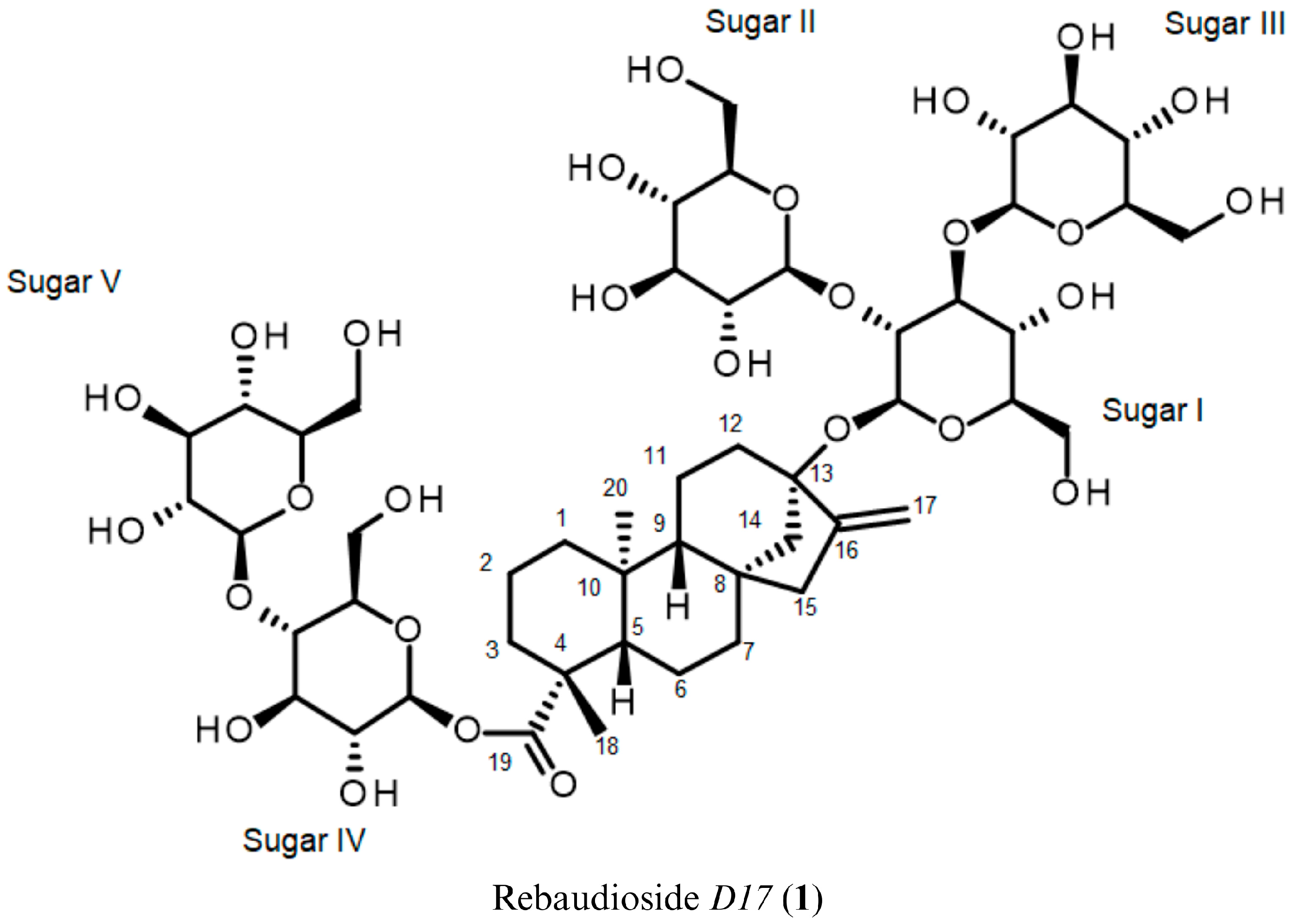
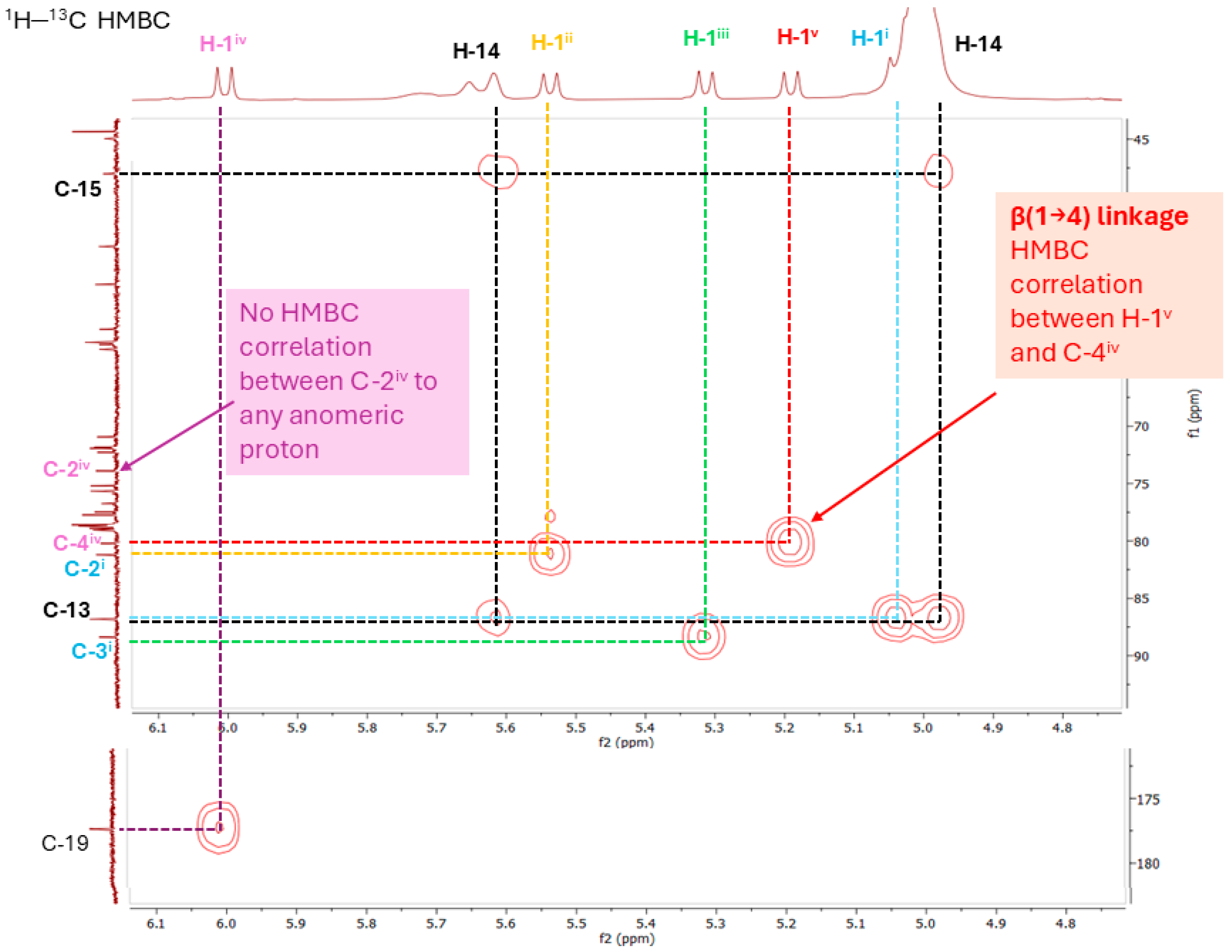
Rebaudioside D17
4. Discussion
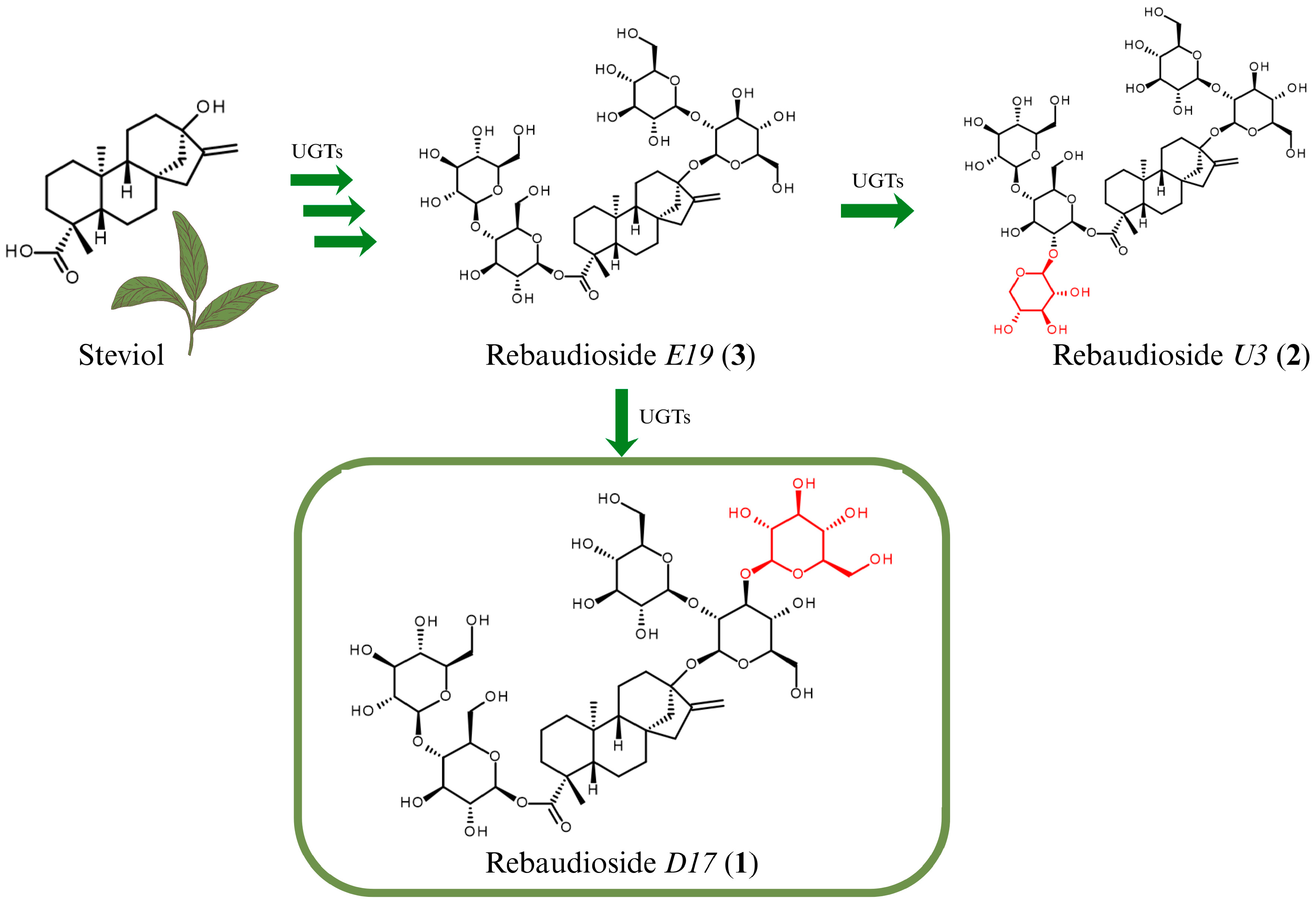
4.1. Proposed Biosynthetic Pathway of Rebaudioside D17 (1)
4.2. Potential Influence of Glycosidic Linkage on Sensory and Physicochemical Properties
5. Conclusions
Supplementary Materials
Author Contributions
Funding
Institutional Review Board Statement
Informed Consent Statement
Data Availability Statement
Acknowledgments
Conflicts of Interest
References
- Kinghorn, A.D.; Soejarto, D.D. Current status of stevioside as a sweetening agent for human use. In Economic and Medicinal Plant Research, 1st ed.; Wagner, H., Hikino, H., Farnsworth, N.R., Eds.; Academic Press: London, UK, 1985; Volume 1, pp. 1–52. [Google Scholar]
- Ceunen, S.; Geuns, J.M.C. Steviol Glycosides: Chemical Diversity, Metabolism, and Function. J. Nat. Prod. 2013, 76, 1201–1228. [Google Scholar] [CrossRef] [Scilit]
- Brandle, J.E.; Starratt, A.N.; Gijzen, M. Stevia rebaudiana: Its agricultural, biological, and chemical properties. Can. J. Plant Sci. 1998, 78, 527–536. [Google Scholar] [CrossRef] [Scilit]
- Lewis, W.H. Early uses of Stevia rebaudiana (Asteraceae) leaves as a sweetener in Paraguay. Econ. Bot. 1992, 46, 336–337. [Google Scholar] [CrossRef] [Scilit]
- Prakash, I.; Bunders, C.; Devkota, K.P.; Charan, R.D.; Ramirez, C.; Priedemann, C.; Markosyan, A. Isolation and Characterization of a Novel Rebaudioside M Isomer from a Bioconversion Reaction of Rebaudioside A and NMR Comparison Studies of Rebaudioside M Isolated from Stevia rebaudiana Bertoni and Stevia rebaudiana Morita. Biomolecules 2014, 4, 374–389. [Google Scholar] [CrossRef] [Scilit]
- Brandle, J.; Telmer, P. Steviol glycoside biosynthesis. Phytochemistry 2007, 68, 1855–1863. [Google Scholar] [CrossRef] [Scilit]
- Wölwer-Rieck, U.; May, B.; Lankes, C.; Wüst, M. Methylerythritol and Mevalonate Pathway Contributions to Biosynthesis of Mono, Sesqui, and Diterpenes in Glandular Trichomes and Leaves of Stevia rebaudiana Bertoni. J. Agric. Food Chem. 2014, 62, 2428–2435. [Google Scholar] [CrossRef] [Scilit]
- Bridel, M.; Lavielle, R. The Sweet Principle of Kaahe-e (Stevia rebaudiana). Pharm. Chem. J. 1931, 14, 99–154. [Google Scholar]
- Prakash, I.; DuBois, G.E.; Clos, J.F.; Wilkens, K.L.; Fosdick, L.E. Development of rebiana, a natural, non-caloric sweetener. Food Chem. Toxicol. 2008, 46, S75–S82. [Google Scholar] [CrossRef] [Scilit]
- Chaturvedula, V.S.P.; Prakash, I. A new diterpene glycoside from Stevia rebaudiana. Molecules 2011, 15, 2937–2943. [Google Scholar] [CrossRef] [Scilit] [PubMed]
- Chaturvedula, V.S.P.; Prakash, I. Structures of the novel diterpene glycosides from Stevia rebaudiana. Carbohydr. Res. 2011, 34, 1057–1060. [Google Scholar] [CrossRef] [Scilit] [PubMed]
- Chaturvedula, V.S.P.; Rhea, J.; Milanowski, D.; Mocek, U.; Prakash, I. Two minor diterpene glycosides from the leaves of Stevia rebaudiana. Nat. Prod. Commun. 2011, 6, 175–178. [Google Scholar] [CrossRef] [Scilit]
- Chaturvedula, V.S.P.; Clos, J.F.; Rhea, J.; Milanowski, D.; Mocek, U.; DuBois, G.E.; Prakash, I. Minor diterpenoid glycosides from the leaves of Stevia rebaudiana. Phytochem. Lett. 2011, 4, 209–212. [Google Scholar] [CrossRef] [Scilit]
- Chaturvedula, V.S.P.; Mani, U.; Prakash, I. Structures of the novel α-glucosyl linked diterpene glycosides from Stevia rebaudiana. Carbohydr. Res. 2011, 346, 2034–2038. [Google Scholar] [CrossRef] [Scilit]
- Prakash, I.; Campbell, M.; San Miguel, R.I.; Chaturvedula, V.S.P. Synthesis and sensory evaluation of ent-Kaurane diterpene glycosides. Molecules 2012, 17, 8908–8916. [Google Scholar] [CrossRef] [Scilit]
- Prakash, I.; Campbell, M.; San Miguel, R.I.; Chaturvedula, V.S.P. Catalytic hydrogenation of the sweet principles of Stevia rebaudiana, rebaudiosde B, rebaudioside C and rebaudioside D and sensory evaluation of their reduced derivatives. Int. J. Mol. Sci. 2013, 13, 15126–15136. [Google Scholar] [CrossRef] [Scilit] [PubMed]
- FAO/WHO. Framework for steviol glycosides. In Compendium of Food Additive Specifications; FAO JECFA Monographs No. 31; Joint FAO/WHO Expert Committee on Food Additives, 96th Meeting; FAO/WHO: Geneva, Switzerland, 2023. [Google Scholar]
- Xiao, M.; Xu, L.; Zhu, L.; Wang, W.; Peng, P.; Du, G.; Yue, W. Stevioside Derivative Rebaudioside A1G, Preparation, Purification and Application Thereof. WIPO Patent Application No. WO2020/001516 A1, 27 June 2019. [Google Scholar]
- Olsson, K.; Carlsen, S.; Semmler, A.; Simón, E.; Mikkelsen, M.D.; Møller, B.L. Microbial production of next-generation stevia sweeteners. Microb. Cell Fact. 2016, 15, 207. [Google Scholar] [CrossRef] [Scilit]
- Purkayastha, S.; Markosyan, A.; Chow, S.Y.; Prakash, I.; Clos, J.; Peng, I.X.; Kagan, M.Z.; Sukits, S.F.; Somayajula, K.V.; Nizam bin Nawi, K. Stevia-Derived Molecules, Methods of Obtaining such Molecules, and Uses of the Same. WIPO Patent Application No. WO2019/099118 A1, 23 May 2019. [Google Scholar]
- Kishore, G.; Motion, M.; Hicks, P.M.; Hansen, J.; Houghton-Larsen, J.; Hansen, E.H.; Mikkelsen, M.D.; Tavares, S.; Blom, C. Recombinant Production of Steviol Glycosides. PCT International Publication Number WO 2011/153378 A1, 8 December 2011. [Google Scholar]
- Biswas, P.; Kumari, A.; Modi, A.; Kumar, N. Improvement and Regulation of Steviol Glycoside Biosynthesis in Stevia rebaudiana Bertoni. Gene 2024, 891, 147809. [Google Scholar] [CrossRef] [Scilit]
- Markosyan, A.; Ramandach, S.; Afzaal Bin Hasim, M.; Nizam Bin Nawi, K.; Chow, S.Y.; Purkayastha, S.; Petit, M. High-Purity Steviol Glycosides. WIPO Patent Application No. WO2019/178541 A1, 15 March 2019. [Google Scholar]
- Zheng, S.; Chang, W.; Xu, W.; Xu, Y.; Lin, F. e-Sweet: A machine-learning based platform for the prediction of sweetener and its relative sweetness. Front. Chem. 2019, 7, 35. [Google Scholar] [CrossRef] [Scilit] [PubMed]
- Lin, F.; Ji, Y.; Xu, S. Sweetener identification using transfer learning and attention mechanism. CyTA-J. Food 2024, 22, 2341812. [Google Scholar] [CrossRef] [Scilit]
- Tuwani, R.; Wadhwa, S.; Bagler, G. BitterSweet: Building machine learning models for predicting all bitter and sweet taste of small molecules. Sci. Rep. 2019, 9, 7155. [Google Scholar] [CrossRef] [Scilit] [PubMed]
- Tang, N. Insights into chemical structure-based modeling for new sweetener discovery. Foods 2023, 12, 2563. [Google Scholar] [CrossRef] [Scilit] [PubMed]
- Capela, J.; Correia, J.; Pereira, V.; Rocha, M. Development of deep learning approaches to predict relationships between chemical structures and sweetness. In Proceedings of the 2022 International Joint Conference on Neural Networks (IJCNN), Padua, Italy, 18–23 July 2022; IEEE: Piscataway, NJ, USA, 2022; pp. 1–8. [Google Scholar] [CrossRef] [Scilit]
- Hao, S.; Guthrie, B.; Kim, S.; Balanda, S.; Kubicek, J.; Murtaza, B.; Khan, N.A.; Khakbaz, P.; Su, J.; Goddard III, W.A. Steviol rebaudiosides bind to four different sites of the human sweet taste receptor (T1R2/T1R3) complex explaining confusing experiments. Commun. Chem. 2024, 7, 236. [Google Scholar] [CrossRef] [Scilit] [PubMed]
- Shi, Z.; Xu, W.; Wu, L.; Yue, X.; Liu, S.; Ding, W.; Zhang, J.; Meng, B.; Zhao, L.; Liu, X.; et al. Structural and functional characterization of human sweet taste receptor. Nature 2025, 645, 801–808. [Google Scholar] [CrossRef] [Scilit] [PubMed]



 | |||
|---|---|---|---|
| Steviol Glycoside | Total Glucose Moieties | Sweetness Perception Threshold Concentration (ppm) * | Maximum Soluble Concentration (%) ** |
| Rebaudioside A | 4 | 30.0 | NA |
| Rebaudioside D | 5 | 32.5 | 0.1% |
| Rebaudioside AM | 5 | 50.0 | 5% |
| Rebaudioside M | 6 | 24.0 | 0.1% |
Disclaimer/Publisher’s Note: The statements, opinions and data contained in all publications are solely those of the individual author(s) and contributor(s) and not of MDPI and/or the editor(s). MDPI and/or the editor(s) disclaim responsibility for any injury to people or property resulting from any ideas, methods, instructions or products referred to in the content. |
© 2025 by the authors. Licensee MDPI, Basel, Switzerland. This article is an open access article distributed under the terms and conditions of the Creative Commons Attribution (CC BY) license (https://creativecommons.org/licenses/by/4.0/).
Share and Cite
Wong, X.J.; Nawi, K.N.B.; Wong, Y.Y.; Mohamat, I.A.B.; Ramandach, S.; Bin Hasim, M.A.; Markosyan, A. Discovery of Novel Minor Steviol Glycoside from the Stevia rebaudiana: Structural Characterization and Proposed Biosynthetic Pathway of Rebaudioside D17. Biomolecules 2026, 16, 146. https://doi.org/10.3390/biom16010146
Wong XJ, Nawi KNB, Wong YY, Mohamat IAB, Ramandach S, Bin Hasim MA, Markosyan A. Discovery of Novel Minor Steviol Glycoside from the Stevia rebaudiana: Structural Characterization and Proposed Biosynthetic Pathway of Rebaudioside D17. Biomolecules. 2026; 16(1):146. https://doi.org/10.3390/biom16010146
Chicago/Turabian StyleWong, Xiao Juie, Khairul Nizam Bin Nawi, Yeen Yee Wong, Ismail Ammar Bin Mohamat, Saravanan Ramandach, Mohamad Afzaal Bin Hasim, and Avetik Markosyan. 2026. "Discovery of Novel Minor Steviol Glycoside from the Stevia rebaudiana: Structural Characterization and Proposed Biosynthetic Pathway of Rebaudioside D17" Biomolecules 16, no. 1: 146. https://doi.org/10.3390/biom16010146
APA StyleWong, X. J., Nawi, K. N. B., Wong, Y. Y., Mohamat, I. A. B., Ramandach, S., Bin Hasim, M. A., & Markosyan, A. (2026). Discovery of Novel Minor Steviol Glycoside from the Stevia rebaudiana: Structural Characterization and Proposed Biosynthetic Pathway of Rebaudioside D17. Biomolecules, 16(1), 146. https://doi.org/10.3390/biom16010146