Halophila stipulacea: A Comprehensive Review of Its Phytochemical Composition and Pharmacological Activities

 , ,
, ,  and
and
Abstract
1. Introduction
2. Methods
3. Taxonomic Classification of Halophila stipulacea
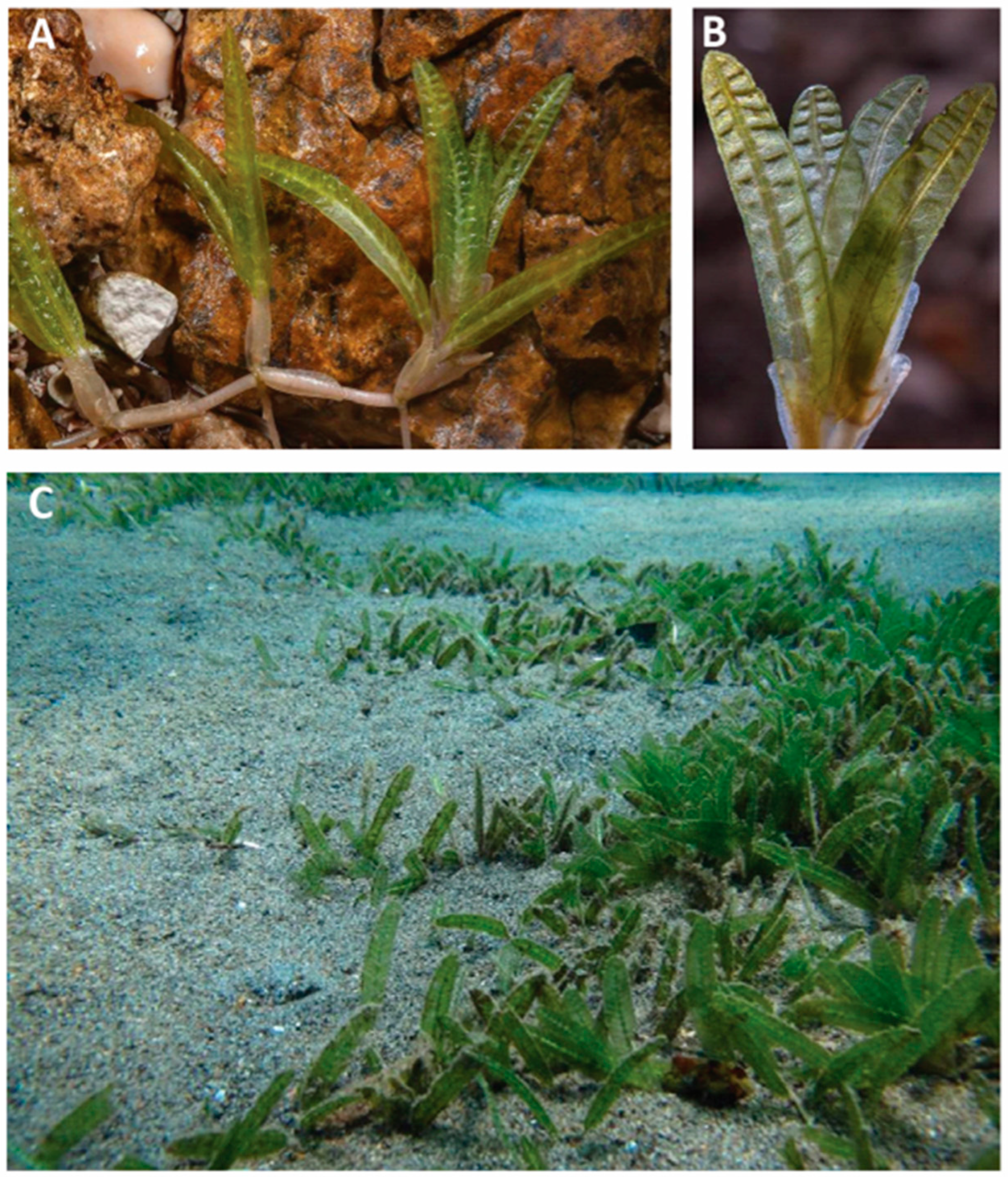
4. Ecological Characteristics of Halophila stipulacea
5. Phytochemical Characteristics of Halophila stipulacea
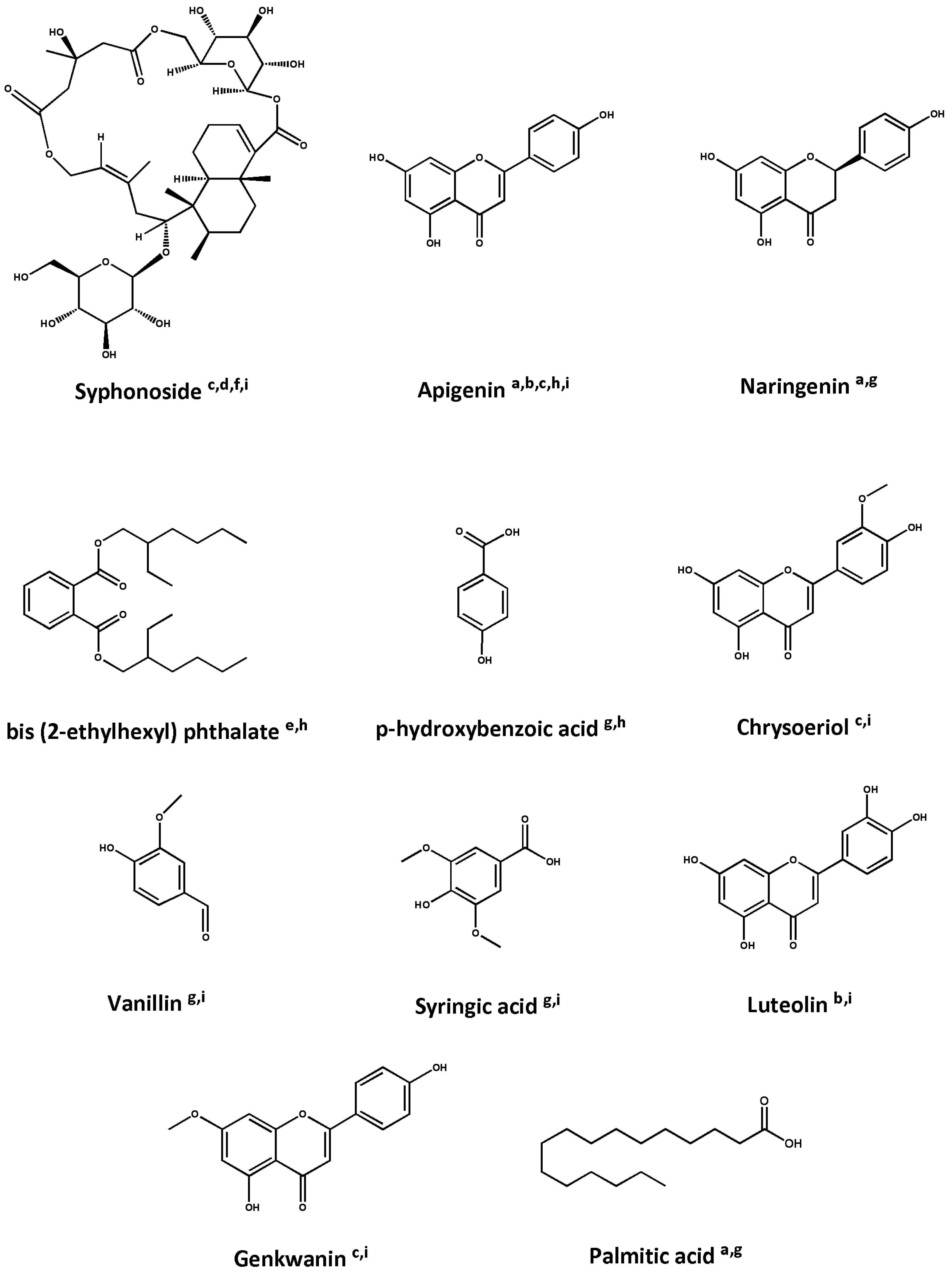
5.1. Phytochemical Composition

| Extract Type | Analytical Methods | Main Results | Major Compounds | References |
|---|---|---|---|---|
| Ethyl acetate fraction of the methanolic crude extract | TLC, UV, HR-MALDI-MS, HPLC | Identification and isolation of 2 phenolic compounds and 2 aromatic organic compounds with potential anticancer effect |
| [55] |
| Aqueous fraction of the methanolic crude extract | TLC, UV, HR-MALDI-MS, HPLC | Identification and isolation of a nucleotide with potential anticancer effect |
| [55] |
| Diethyl ether fraction of the acetone crude extract | TLC, UV, HR-MALDI-MS, HPLC | Identification and isolation of a flavonoid, a sterol, and 3 fattyacids with potential anticancer effect |
| [55] |
| Aqueous crude extract | HPGC | Identification of 7 monosaccharides |
| [60] |
| Methanolic crude extract | RP-HPLC | Identification of 11 Phenolic compounds |
| [60] |
| Unsaponifiable matter (from the CHCl3 fraction of the MeOH/CHCl3 crude extract) | GC-MS | Identification of 2 non-oxygenated compounds, 6 oxygenated compounds, and 7 sterol compounds |
| [60] |
| Saponifiable matter (from the CHCl3 fraction of the MeOH/CHCl3 crude extract) | GC-MS | Identification of 8 saturated fatty acids and 5 unsaturated fatty acids |
| [60] |
| Ethanolic extract | GC-MS | Identification of 36 phytochemicals |
| [61] |
| Ethanolic extract of shoots and roots | RP-HPLC | Identification of 14 phenolic compounds and 10 flavonoids |
| [57] |
| Ethanolic extract | GC/MS | Identification of 15 compounds |
| [62] |
| Ethanolic extract | UPLC-HRMS/MS | Identification of 80 secondary metabolites |
| [56] |
| Hexane extract of leaves | UPLC-HRMS/MS | Identification of 41 phytoconstituents |
| [54] |
| Ethyl acetate extract of leaves | UPLC-HRMS/MS | Identification of 47 phytoconstituents |
| [54] |
| Methanol extract of leaves | UPLC-HRMS/MS | Identification of 47 phytoconstituents |
| [54] |
| Hexane extract of stems | UPLC-HRMS/MS | Identification of 36 phytoconstituents |
| [54] |
| Ethyl acetate extract of stems | UPLC-HRMS/MS | Identification of 48 phytoconstituents |
| [54] |
| Methanol extract of stems | UPLC-HRMS/MS | Identification of 52 phytoconstituents |
| [54] |
| Acetone extract | 1H NMR, 13C NMR, and LC-ESIMS | Identification and isolation of a terpenoid |
| [58] |
| Diethyl ether fraction of the acetoneExtract | 1H NMR, 13C NMR, TLC, and HRESI-MS | Identification and isolation of 2 compounds |
| [59] |
| Butanol fraction of the acetone extract | TLC, RP-HPLC, and NMR | Identification and isolation of 9 compounds |
| [53] |
5.2. Nutritional Composition
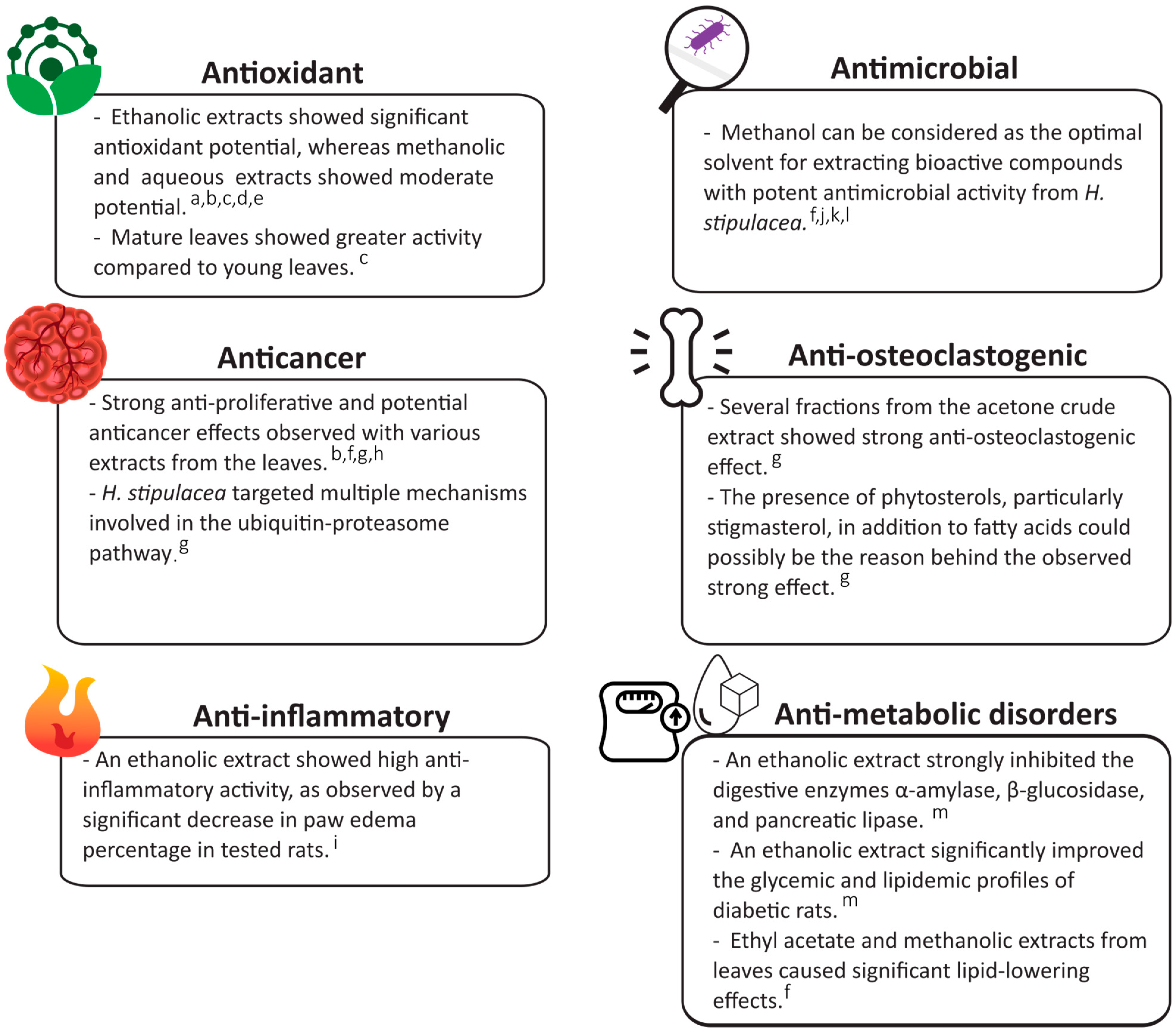
6. Biological Activities of Halophila stipulacea
6.1. Antimicrobial Activities
6.2. Antioxidant Activities
6.3. Anticancer Activities
6.4. Anti-Inflammatory Activity
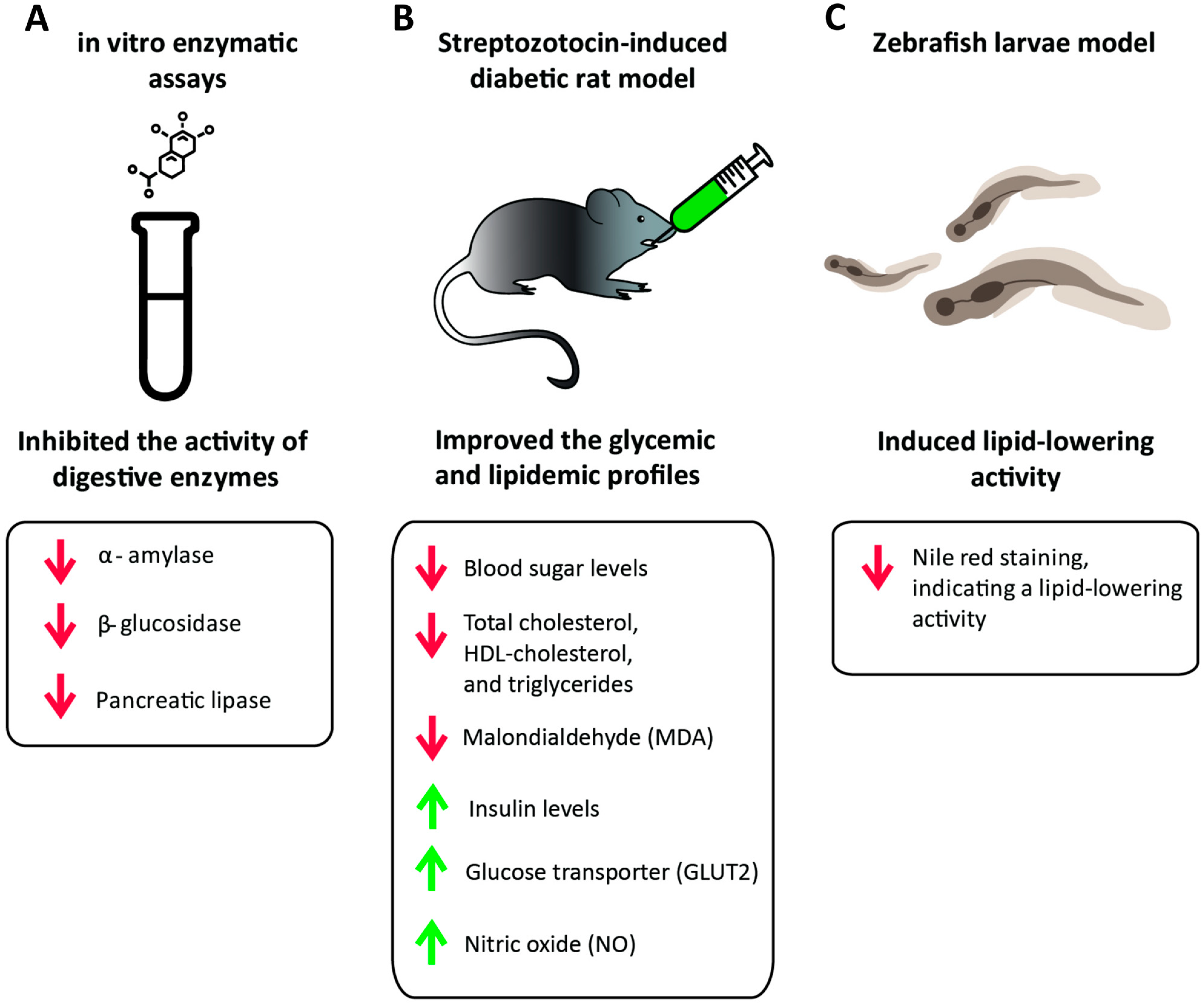
6.5. Anti-Metabolic Disorders Activities
6.6. Anti-Osteoclastogenic Activity
6.7. Other Activities
7. Safety of Halophila stipulacea
8. Conclusions and Future Perspectives
Author Contributions
Funding
Acknowledgments
Conflicts of Interest
References
- Kong, D.-X.; Jiang, Y.-Y.; Zhang, H.-Y. Marine Natural Products as Sources of Novel Scaffolds: Achievement and Concern. Drug Discov. Today 2010, 15, 884–886. [Google Scholar] [CrossRef] [Scilit] [PubMed]
- Gono, C.M.P.; Ahmadi, P.; Hertiani, T.; Septiana, E.; Putra, M.Y.; Chianese, G. A Comprehensive Update on the Bioactive Compounds from Seagrasses. Mar. Drugs 2022, 20, 406. [Google Scholar] [CrossRef] [Scilit] [PubMed]
- Nguyen, X.-V.; Phan, T.T.H.; Cao, V.-L.; Nguyen Nhat, N.-T.; Nguyen, T.-H.; Nguyen, X.-T.; Lau, V.-K.; Hoang, C.-T.; Nguyen-Thi, M.-N.; Nguyen, H.M.; et al. Current Advances in Seagrass Research: A Review from Viet Nam. Front. Plant Sci. 2022, 13, 991865. [Google Scholar] [CrossRef] [Scilit] [PubMed]
- Duarte, C.M.; Marbà, N.; Gacia, E.; Fourqurean, J.W.; Beggins, J.; Barrón, C.; Apostolaki, E.T. Seagrass Community Metabolism: Assessing the Carbon Sink Capacity of Seagrass Meadows. Glob. Biogeochem. Cycles 2010, 24, 1–8. [Google Scholar] [CrossRef] [Scilit]
- Orth, R.J.; Carruthers, T.J.B.; Dennison, W.C.; Duarte, C.M.; Fourqurean, J.W.; Heck, K.L.; Hughes, A.R.; Kendrick, G.A.; Kenworthy, W.J.; Olyarnik, S.; et al. A Global Crisis for Seagrass Ecosystems. BioScience 2006, 56, 987. [Google Scholar] [CrossRef] [Scilit]
- Fourqurean, J.W.; Duarte, C.M.; Kennedy, H.; Marbà, N.; Holmer, M.; Mateo, M.A.; Apostolaki, E.T.; Kendrick, G.A.; Krause-Jensen, D.; McGlathery, K.J.; et al. Seagrass Ecosystems as a Globally Significant Carbon Stock. Nat. Geosci. 2012, 5, 505–509. [Google Scholar] [CrossRef] [Scilit]
- Cullen-Unsworth, L.; Unsworth, R. Seagrass Meadows, Ecosystem Services, and Sustainability. Environ. Sci. Policy Sustain. Dev. 2013, 55, 14–28. [Google Scholar] [CrossRef] [Scilit]
- Lamb, J.B.; van de Water, J.A.J.M.; Bourne, D.G.; Altier, C.; Hein, M.Y.; Fiorenza, E.A.; Abu, N.; Jompa, J.; Harvell, C.D. Seagrass Ecosystems Reduce Exposure to Bacterial Pathogens of Humans, Fishes, and Invertebrates. Science 2017, 355, 731–733. [Google Scholar] [CrossRef] [Scilit]
- Short, F.; Carruthers, T.; Dennison, W.; Waycott, M. Global Seagrass Distribution and Diversity: A Bioregional Model. J. Exp. Mar. Biol. Ecol. 2007, 350, 3–20. [Google Scholar] [CrossRef] [Scilit]
- Short, F.T.; Polidoro, B.; Livingstone, S.R.; Carpenter, K.E.; Bandeira, S.; Bujang, J.S.; Calumpong, H.P.; Carruthers, T.J.B.; Coles, R.G.; Dennison, W.C.; et al. Extinction Risk Assessment of the World’s Seagrass Species. Biol. Conserv. 2011, 144, 1961–1971. [Google Scholar] [CrossRef] [Scilit]
- den Hartog, C.; Kuo, J. Taxonomy and Biogeography of Seagrasses. In Seagrasses: Biology, Ecologyand Conservation; Larkum, A.W.D., Orth, R.J., Duarte, C.M., Eds.; Springer: Dordrecht, The Netherlands, 2006; pp. 1–23. ISBN 978-1-4020-2983-7. [Google Scholar]
- Kuo, J. Taxonomy of the Genus Halophila Thouars (Hydocharitaceae): A Review. Plants 2020, 9, 1732. [Google Scholar] [CrossRef] [Scilit]
- Liu, S.Y.V.; Kumara, T.P.; Hsu, C.-H. Genetic Identification and Hybridization in the Seagrass Genus Halophila (Hydrocharitaceae) in Sri Lankan Waters. PeerJ 2020, 8, e10027. [Google Scholar] [CrossRef] [Scilit] [PubMed]
- Mejia, A.Y.; Rotini, A.; Lacasella, F.; Bookman, R.; Thaller, M.C.; Shem-Tov, R.; Winters, G.; Migliore, L. Assessing the Ecological Status of Seagrasses Using Morphology, Biochemical Descriptors and Microbial Community Analyses. A Study in Halophila stipulacea (Forsk.) Aschers Meadows in the Northern Red Sea. Ecol. Indic. 2016, 60, 1150–1163. [Google Scholar] [CrossRef] [Scilit]
- Den Hartog, C. The Sea-Grasses of the World; North-Holland: Amsterdam, The Netherlands, 1970. [Google Scholar]
- Spalding, M.; Taylor, M.; Ravilious, C.; Short, F.; Green, E. Global Overview: The Distribution and Status of Seagrasses. In World Atlas of Seagrasses; University of California Press: Berkeley, CA, USA, 2003. [Google Scholar]
- Sghaier, Y.R.; Zakhama-Sraieb, R.; Benamer, I.; Charfi-Cheikhrouha, F. Occurrence of the Seagrass Halophila stipulacea (Hydrocharitaceae) in the Southern Mediterranean Sea. Bot. Mar. 2011, 54, 575–582. [Google Scholar] [CrossRef] [Scilit]
- Vera, B.; Collado-Vides, L.; Moreno, C.; Tussenbroek, B.I. van Halophila stipulacea (Hydrocharitaceae): A Recent Introduction to the Continental Waters of Venezuela. Caribb. J. Sci. 2014, 48, 66–70. [Google Scholar] [CrossRef] [Scilit]
- Scheibling, R.E.; Patriquin, D.G.; Filbee-Dexter, K. Distribution and Abundance of the Invasive Seagrass Halophila stipulacea and Associated Benthic Macrofauna in Carriacou, Grenadines, Eastern Caribbean. Aquat. Bot. 2018, 144, 1–8. [Google Scholar] [CrossRef] [Scilit]
- Willette, D.A.; Ambrose, R.F. The Distribution and Expansion of the Invasive Seagrass Halophila stipulacea in Dominica, West Indies, with a Preliminary Report from St. Lucia. Aquat. Bot. 2009, 91, 137–142. [Google Scholar] [CrossRef] [Scilit]
- Willette, D.A. Halophila stipulacea (Halophila seagrass); CABI Compendium: Wallingford, UK, 2015. [Google Scholar] [CrossRef] [Scilit]
- de Poorter, M.; Browne, M. The Global Invasive Species Database (GISD) and International Information Exchange: Using Global Expertise to Help in the Fight against Invasive Alien Species. In Proceedings of the Plant Protection and Plant Health in Europe: Introduction and Spread of Invasive Species, Berlin, Germany, 9–11 June 2005; pp. 49–54. [Google Scholar]
- Winters, G.; Beer, S.; Willette, D.A.; Viana, I.G.; Chiquillo, K.L.; Beca-Carretero, P.; Villamayor, B.; Azcárate-García, T.; Shem-Tov, R.; Mwabvu, B.; et al. The Tropical Seagrass Halophila stipulacea: Reviewing What We Know from Its Native and Invasive Habitats, Alongside Identifying Knowledge Gaps. Front. Mar. Sci. 2020, 7, 300. [Google Scholar] [CrossRef] [Scilit]
- Lipkin, Y. Halophila stipulacea, a Review of a Successful Immigration. Aquat. Bot. 1975, 1, 203–215. [Google Scholar] [CrossRef] [Scilit]
- Alpinar, K. A New Record for Turkish Flora Halophila stipulacea. Istanb. Univ. Eczacilik Fak. Mecmuasi 1987, 23, 83–84. [Google Scholar]
- Biliotti, M.; Abdelahad, N. Halophila stipulacea (Forssk.) Aschers. Hydrocharitaceae Espèce Nouv. Pour L’Italie Posidonia Newsl. 1990, 3, 23–26. [Google Scholar]
- van der Velde, G.; den Hartog, C. Continuing Range Extension of Halophila stipulacea (Forssk.) Aschers. (Hydrocharitaceae) in the Mediterranean—Now Found at Kefallinia and Ithaki (Ionian Sea). Acta Bot. Neerl. 1992, 41, 345–348. [Google Scholar] [CrossRef] [Scilit]
- Kashta, L.; Pizzuto, F. Sulla Presenza Di Halophila stipulacea (Forsskal) Ascherson (Hydrocharitales, Hydrocharitaceae) Nelle Coste Dell’Albania. Boll. Accad. Gioenia Sci. Nat. Catania 1995, 28, 161–166. [Google Scholar]
- Gambi, M.C.; Barbieri, F.; Bianchi, C.N. New Record of the Alien Seagrass Halophila stipulacea (Hydrocharitaceae) in the Western Mediterranean: A Further Clue to Changing Mediterranean Sea Biogeography. Mar. Biodivers. Rec. 2009, 2, e84. [Google Scholar] [CrossRef] [Scilit]
- Al-Rousan, S.; Al-Horani, F.; Eid, E.; Khalaf, M. Assessment of Seagrass Communities along the Jordanian Coast of the Gulf of Aqaba, Red Sea. Mar. Biol. Res. 2011, 7, 93–99. [Google Scholar] [CrossRef] [Scilit]
- Sghaier, Y.R.; Zakhama-Sraieb, R.; Charfi-Cheikhrouha, F. Effects of the Invasive Seagrass Halophila stipulacea on the Native Seagrass Cymodocea Nodosa. In Proceedings of the 5th Mediterranean Symposium on Marine Vegetation, Portoroz, Slovenia, 27–28 October 2014; pp. 167–171. [Google Scholar]
- Kannan Rengasamy, R.R.; Rajasekaran, A.; Micheline, G.-D.; Perumal, A. Antioxidant Activity of Seagrasses of the Mandapam Coast, India. Pharm. Biol. 2012, 50, 182–187. [Google Scholar] [CrossRef] [Scilit] [PubMed]
- Nguyen, H.M.; Kleitou, P.; Kletou, D.; Sapir, Y.; Winters, G. Differences in Flowering Sex Ratios between Native and Invasive Populations of the Seagrass Halophila stipulacea. Bot. Mar. 2018, 61, 337–342. [Google Scholar] [CrossRef] [Scilit]
- Qurban, M.A.B.; Karuppasamy, M.; Krishnakumar, P.K.; Garcias-Bonet, N.; Duarte, C.M. Seagrass Distribution, Composition and Abundance along the Saudi Arabian Coast of Red Sea. In Oceanographic and Biological Aspects of the Red Sea; Rasul, N.M.A., Stewart, I.C.F., Eds.; Springer International Publishing: Cham, Switzerland, 2019; pp. 367–385. ISBN 978-3-319-99417-8. [Google Scholar]
- Angel, D.L.; Eden, N.; Susel, L. The Influence of Environmental Variables on Halophila stipulacea Growth. In Improving the Knowledge Base in Modern Aquaculture; Rosenthal, H., Moav, B., Gordin, H., Eds.; European Aquaculture Society: Oostende, Belgium, 1995; pp. 103–128. [Google Scholar]
- Sharon, Y.; Silva, J.; Santos, R.; Runcie, J.W.; Chernihovsky, M.; Beer, S. Photosynthetic Responses of Halophila stipulacea to a Light Gradient. II. Acclimations Following Transplantation. Aquat. Biol. 2009, 7, 153–157. [Google Scholar] [CrossRef] [Scilit]
- Sharon, Y.; Dishon, G.; Beer, S. The Effects of UV Radiation on Chloroplast Clumping and Photosynthesis in the Seagrass Halophila stipulacea Grown under High-PAR Conditions. J. Mar. Sci. 2011, 2011, e483428. [Google Scholar] [CrossRef] [Scilit]
- Georgiou, D.; Alexandre, A.; Luis, J.; Santos, R. Temperature Is Not a Limiting Factor for the Expansion of Halophila stipulacea throughout the Mediterranean Sea. Mar. Ecol. Prog. Ser. 2016, 544, 159–167. [Google Scholar] [CrossRef] [Scilit]
- Oscar, M.A.; Barak, S.; Winters, G. The Tropical Invasive Seagrass, Halophila stipulacea, Has a Superior Ability to Tolerate Dynamic Changes in Salinity Levels Compared to Its Freshwater Relative, Vallisneria Americana. Front. Plant Sci. 2018, 9, 950. [Google Scholar] [CrossRef] [Scilit] [PubMed]
- Por, F.D. One Hundred Years of Suez Canal—A Century of Lessepsian Migration: Retrospect and Viewpoints. Syst. Zool. 1971, 20, 138–159. [Google Scholar] [CrossRef] [Scilit]
- Casazza, G.; Mazzella, L. Photosynthetic Pigment Composition of Marine Angiosperms: Preliminary Characterization of Mediterranean Seagrasses. Bull. Mar. Sci. 2002, 71, 1171–1181. [Google Scholar]
- Roy, D.; Alderman, D.; Anastasiu, P.; Arianoutsou, M.; Augustin, S.; Bacher, S.; Başnou, C.; Beisel, J.-N.; Bertolino, S.; Bonesi, L.; et al. DAISIE—Inventory of Alien Invasive Species in Europe; Research Institute for Nature and Forest (INBO): Brussels, Belgium, 2020. [Google Scholar] [CrossRef]
- Cardini, U.; Van Hoytema, N.; Bednarz, V.N.; Al-Rshaidat, M.M.D.; Wild, C. N2 Fixation and Primary Productivity in a Red Sea Halophila stipulacea Meadow Exposed to Seasonality. Limnol. Oceanogr. 2018, 63, 786–798. [Google Scholar] [CrossRef] [Scilit]
- Procaccini, G.; Acunto, S.; Famà, P.; Maltagliati, F. Structural, Morphological and Genetic Variability in Halophila stipulacea (Hydrocharitaceae) Populations in the Western Mediterranean. Mar. Biol. 1999, 135, 181–189. [Google Scholar] [CrossRef] [Scilit]
- Ruiz, H.; Ballantine, D.L. Occurrence of the seagrass Halophila stipulacea in the tropical west atlantic. Bull. Mar. Sci. 2004, 75, 131–135. [Google Scholar]
- Beca-Carretero, P.; Rotini, A.; Mejia, A.; Migliore, L.; Vizzini, S.; Winters, G. Halophila stipulacea Descriptors in the Native Area (Red Sea): A Baseline for Future Comparisons with Native and Non-Native Populations. Mar. Environ. Res. 2020, 153, 104828. [Google Scholar] [CrossRef] [Scilit] [PubMed]
- Lipkin, Y. Quantitative Aspects of Seagrass Communities, Particularly of Those Dominated by Halophila stipulacea, in Sinai (Northern Red Sea). Aquat. Bot. 1979, 7, 119–128. [Google Scholar] [CrossRef] [Scilit]
- Rotini, A.; Mejia, A.Y.; Costa, R.; Migliore, L.; Winters, G. Ecophysiological Plasticity and Bacteriome Shift in the Seagrass Halophila stipulacea along a Depth Gradient in the Northern Red Sea. Front. Plant Sci. 2017, 7, 2015. [Google Scholar] [CrossRef] [Scilit] [PubMed]
- Lee, K.-S.; Park, S.R.; Kim, Y.K. Effects of Irradiance, Temperature, and Nutrients on Growth Dynamics of Seagrasses: A Review. J. Exp. Mar. Biol. Ecol. 2007, 350, 144–175. [Google Scholar] [CrossRef] [Scilit]
- Beca-Carretero, P.; Guihéneuf, F.; Winters, G.; Stengel, D.B. Depth-Induced Adjustment of Fatty Acid and Pigment Composition Suggests High Biochemical Plasticity in the Tropical Seagrass Halophila stipulacea. Mar. Ecol. Prog. Ser. 2019, 608, 105–117. [Google Scholar] [CrossRef] [Scilit]
- McMillan, C.; Zapata, O.; Escobar, L. Sulphated Phenolic Compounds in Seagrasses. Aquat. Bot. 1980, 8, 267–278. [Google Scholar] [CrossRef] [Scilit]
- Mollo, E.; Gavagnin, M.; Carbone, M.; Castelluccio, F.; Pozone, F.; Roussis, V.; Templado, J.; Ghiselin, M.T.; Cimino, G. Factors Promoting Marine Invasions: A Chemoecological Approach. Proc. Natl. Acad. Sci. USA 2008, 105, 4582–4586. [Google Scholar] [CrossRef] [Scilit]
- Bitam, F.; Ciavatta, M.L.; Carbone, M.; Manzo, E.; Mollo, E.; Gavagnin, M. Chemical Analysis of Flavonoid Constituents of the Seagrass Halophila stipulacea: First Finding of Malonylated Derivatives in Marine Phanerogams. Biochem. Syst. Ecol. 2010, 38, 686–690. [Google Scholar] [CrossRef] [Scilit]
- Bel Mabrouk, S.; Reis, M.; Sousa, M.L.; Ribeiro, T.; Almeida, J.R.; Pereira, S.; Antunes, J.; Rosa, F.; Vasconcelos, V.; Achour, L.; et al. The Marine Seagrass Halophila stipulacea as a Source of Bioactive Metabolites against Obesity and Biofouling. Mar. Drugs 2020, 18, 88. [Google Scholar] [CrossRef] [Scilit]
- Hamdy, A.-H.; El-Fiky, N.; El-Beih, A.; Mohammed, M.M.D.; Mettwally, W.S.A. Egyptian Red Sea Seagrass as a Source of Biologically Active Secondary Metabolites. Egypt. Pharm. J. 2020, 19, 224. [Google Scholar] [CrossRef] [Scilit]
- Hegazi, N.M.; Saad, H.H.; Marzouk, M.M.; Abdel Rahman, M.F.; El Bishbishy, M.H.; Zayed, A.; Ulber, R.; Ezzat, S.M. Molecular Networking Leveraging the Secondary Metabolomes Space of Halophila stipulaceae (Forsk.) Aschers. and Thalassia Hemprichii (Ehrenb. Ex Solms) Asch. in Tandem with Their Chemosystematics and Antidiabetic Potentials. Mar. Drugs 2021, 19, 279. [Google Scholar] [CrossRef] [Scilit]
- Ahmed, F.S.; El-Saied, A.-B.S.E.-D.; Salah El Din, R.A.; El swaify, Z.A. Phytochemical Screening and Anticancer Activities of Some Terrestrial and Aquatic Plants Growing in Saline Habitat. Al-Azhar J. Agric. Res. 2023, 48, 89–106. [Google Scholar] [CrossRef] [Scilit]
- Gavagnin, M.; Carbone, M.; Amodeo, P.; Mollo, E.; Vitale, R.M.; Roussis, V.; Cimino, G. Structure and Absolute Stereochemistry of Syphonoside, a Unique Macrocyclic Glycoterpenoid from Marine Organisms. J. Org. Chem. 2007, 72, 5625–5630. [Google Scholar] [CrossRef] [Scilit]
- Carbone, M.; Gavagnin, M.; Mollo, E.; Bidello, M.; Roussis, V.; Cimino, G. Further Syphonosides from the Sea Hare Syphonota geographica and the Sea-Grass Halophila stipulacea. Tetrahedron 2008, 64, 191–196. [Google Scholar] [CrossRef] [Scilit]
- Ghandourah, M.; Hawas, U.W.; Abou El-Kassem, L.T.; Shaher, F.M. Fatty Acids and Other Chemical Compositions of Some Seagrasses Collected from the Saudi Red Sea with Potential of Antioxidant and Anticancer Agents. Thalass. Int. J. Mar. Sci. 2021, 37, 13–22. [Google Scholar] [CrossRef] [Scilit]
- Ahmed, F.; Mahmoud, A.-B.; EL-Swaify, Z.; Salah El-Din, R. A Comparative Evaluation of Phytochemical and Antimicrobial Properties of Selected Aquatic and Terrestrial Halophyte Plants Growing in Egypt. Int. J. Theor. Appl. Res. 2023, 2, 16–29. [Google Scholar] [CrossRef] [Scilit]
- El-Rafie, H.M.; El-Rafie, M.H.; AbdElsalam, H.M.; El-Sayed, W.A. Antibacterial and Anti-Inflammatory Finishing of Cotton by Microencapsulation Using Three Marine Organisms. Int. J. Biol. Macromol. 2016, 86, 59–64. [Google Scholar] [CrossRef] [Scilit]
- Naz, M.; Sayın, S.; Çetin, Z.; Saygılı, E.İ.; Taşkın, E.; Söyler, O. The Changes in Biochemical Compositions of Five Different Macroalgae and Seagrass (Halophila stipulacea (Forsskal) Ascherson 1867) Collected from Iskenderun Bay. J. Adv. Res. Nat. Appl. Sci. 2022, 8, 796–804. [Google Scholar] [CrossRef] [Scilit]
- Sansone, C.; Galasso, C.; Lo Martire, M.; Fernández, T.V.; Musco, L.; Dell’Anno, A.; Bruno, A.; Noonan, D.M.; Albini, A.; Brunet, C. In Vitro Evaluation of Antioxidant Potential of the Invasive Seagrass Halophila stipulacea. Mar. Drugs 2021, 19, 37. [Google Scholar] [CrossRef] [Scilit]
- Malea, P. Seasonal Variation and Local Distribution of Metals in the Seagrass Halophila stipulacea (Forsk.) Aschers. In the Antikyra Gulf, Greece. Environ. Pollut. 1994, 85, 77–85. [Google Scholar] [CrossRef] [Scilit]
- Gumgumjee, N.M.; Duaa, A.; Bukhari, A.S. Hajar Evaluation of Antioxidant and Antibacterial Properties of Halophila stipulacea Leaves Extracts Obtained from (Alwajh) North of Yanbu City. Aust. J. Basic Appl. Sci. 2018, 12, 8–11. [Google Scholar] [CrossRef] [Scilit]
- El-Hady, H.A.; Hamed, R.; Shehata, N. Molecular Identification, Antimicrobial and Antioxidant Activities of the Tropical Seagrass Halophila stipulacea Grown in El-Bardawil Lake, Egypt. Aust. J. Basic Appl. Sci. 2012, 6, 474–481. [Google Scholar]
- Kannan, R.R.R.; Arumugam, R.; Anantharaman, P. Antibacterial Potential of Three Seagrasses against Human Pathogens. Asian Pac. J. Trop. Med. 2010, 3, 890–893. [Google Scholar] [CrossRef] [Scilit]
- Kolsi, R.B.A.; Frikha, D.; Imed, J.; Hamza, A.; Feki, L.; Karima, B. Screening of Antibacterial and Antifongical Activity in Marine Macroalgae and Magnoliophytea from the Coast of Tunisia. Int. J. Pharm. Pharm. Sci. 2015, 7, 47–51. [Google Scholar]
- Arumugam, R.; Kannan, R.R.R.; Arivuselvan, N.; Anantharaman, P. Antimicrobial Potential of Some Seagrasses against Phytopathogens. Seaweed Res. Util. 2010, 32, 177–183. [Google Scholar]
- Rahal, A.; Kumar, A.; Singh, V.; Yadav, B.; Tiwari, R.; Chakraborty, S.; Dhama, K. Oxidative Stress, Prooxidants, and Antioxidants: The Interplay. BioMed Res. Int. 2014, 2014, 761264. [Google Scholar] [CrossRef] [Scilit]
- Halliwell, B.; Gutteridge, J.M.C. Free Radicals in Biology and Medicine; Oxford University Press: Oxford, UK, 2015; ISBN 978-0-19-871748-5. [Google Scholar]
- Schieber, M.; Chandel, N.S. ROS Function in Redox Signaling and Oxidative Stress. Curr. Biol. CB 2014, 24, R453–R462. [Google Scholar] [CrossRef] [Scilit]
- Ciechanover, A.; Schwartz, A.L. The Ubiquitin-Proteasome Pathway: The Complexity and Myriad Functions of Proteins Death. Proc. Natl. Acad. Sci. USA 1998, 95, 2727–2730. [Google Scholar] [CrossRef] [Scilit]
- Park, J.; Cho, J.; Song, E.J. Ubiquitin–Proteasome System (UPS) as a Target for Anticancer Treatment. Arch. Pharm. Res. 2020, 43, 1144. [Google Scholar] [CrossRef] [Scilit]
- Kooti, W.; Farokhipour, M.; Asadzadeh, Z.; Ashtary-Larky, D.; Asadi-Samani, M. The Role of Medicinal Plants in the Treatment of Diabetes: A Systematic Review. Electron. Physician 2016, 8, 1832–1842. [Google Scholar] [CrossRef] [Scilit]
- Klein, S.; Gastaldelli, A.; Yki-Järvinen, H.; Scherer, P.E. Why Does Obesity Cause Diabetes? Cell Metab. 2022, 34, 11–20. [Google Scholar] [CrossRef] [Scilit]
- Hadjidakis, D.J.; Androulakis, I.I. Bone Remodeling. Ann. N. Y. Acad. Sci. 2006, 1092, 385–396. [Google Scholar] [CrossRef] [Scilit]
- Bi, H.; Chen, X.; Gao, S.; Yu, X.; Xiao, J.; Zhang, B.; Liu, X.; Dai, M. Key Triggers of Osteoclast-Related Diseases and Available Strategies for Targeted Therapies: A Review. Front. Med. 2017, 4, 234. [Google Scholar] [CrossRef] [Scilit]
- Wang, X.; Yamauchi, K.; Mitsunaga, T. A Review on Osteoclast Diseases and Osteoclastogenesis Inhibitors Recently Developed from Natural Resources. Fitoterapia 2020, 142, 104482. [Google Scholar] [CrossRef] [Scilit]
- Jadoun, S.; Arif, R.; Jangid, N.K.; Meena, R.K. Green Synthesis of Nanoparticles Using Plant Extracts: A Review. Environ. Chem. Lett. 2021, 19, 355–374. [Google Scholar] [CrossRef] [Scilit]
- Khan, A.K.; Renouard, S.; Drouet, S.; Blondeau, J.-P.; Anjum, I.; Hano, C.; Abbasi, B.H.; Anjum, S. Effect of UV Irradiation (A and C) on Casuarina Equisetifolia-Mediated Biosynthesis and Characterization of Antimicrobial and Anticancer Activity of Biocompatible Zinc Oxide Nanoparticles. Pharmaceutics 2021, 13, 1977. [Google Scholar] [CrossRef] [Scilit]
- Nadeem, M.; Tungmunnithum, D.; Hano, C.; Abbasi, B.H.; Hashmi, S.S.; Ahmad, W.; Zahir, A. The Current Trends in the Green Syntheses of Titanium Oxide Nanoparticles and Their Applications. Green Chem. Lett. Rev. 2018, 11, 492–502. [Google Scholar] [CrossRef] [Scilit]
- Hano, C.; Abbasi, B.H. Plant-Based Green Synthesis of Nanoparticles: Production, Characterization and Applications. Biomolecules 2021, 12, 31. [Google Scholar] [CrossRef] [Scilit]
- El-Kassas, H.Y.; Ghobrial, M.G. Biosynthesis of Metal Nanoparticles Using Three Marine Plant Species: Anti-Algal Efficiencies against “Oscillatoria Simplicissima”. Environ. Sci. Pollut. Res. 2017, 24, 7837–7849. [Google Scholar] [CrossRef] [Scilit]
- Roe, A.L.; McMillan, D.A.; Mahony, C. A Tiered Approach for the Evaluation of the Safety of Botanicals Used as Dietary Supplements: An Industry Strategy. Clin. Pharmacol. Ther. 2018, 104, 446–457. [Google Scholar] [CrossRef] [Scilit]
- Mssusa, A.K.; Holst, L.; Kagashe, G.; Maregesi, S. Safety Profile of Herbal Medicines Submitted for Marketing Authorization in Tanzania: A Cross-Sectional Retrospective Study. J. Pharm. Policy Pract. 2023, 16, 149. [Google Scholar] [CrossRef] [Scilit]

| Phylum | Tracheophyta |
| Class | Magnoliopsida |
| Order | Alismatales |
| Family | Hydrocharitaceae |
| Genus | Halophila |
| Species | Halophila stipulacea |
| Binomial name | Halophila stipulacea (Forsskål and Niebuhr) Ascherson |
| Extract Type | Methods | Main Results | References |
|---|---|---|---|
| Dried H. stipulacea leaves powder | Biochemical analyses of ash, lipid, and protein |
| [63] |
| Aqueous crude extract | HPGC |
| [60] |
| Dried H. stipulacea leaves powder | HPLC Pico-Tag |
| [60] |
| Saponifiable matter (from the CHCl3 fraction of the MeOH/CHCl3 crude extract) | GC-MS |
| [60] |
| Dried H. stipulacea young leaves powder | Biochemical analyses of proteins, carbohydrates, and lipids |
| [64] |
| Dried H. stipulacea old leaves powder | Biochemical analyses of proteins, carbohydrates, and lipids |
| [64] |
| Dried H. stipulacea leaves powder | Wet digestion using nitric and perchloric acid |
| [65] |
| Dried H. stipulacea stems, roots, and rhizoids powder | Wet digestion using nitric and perchloric acid |
| [65] |
| Extract | Dose | Experimental Model | Organisms | Main Results | References |
|---|---|---|---|---|---|
| Anti-bacterial | |||||
| Ethanolic extract of leaves | 200 mg/mL |
| Bacillus subtilis, Methicillin-Resistant Staphylococcus aureus, Micrococcus luteus, Staphylococcus aureus, Escherichia coli, Klebsiella pneumonia, Pseudomonas aeruginosa |
| [66] |
| Chloroform extract of leaves | 200 mg/mL |
| Bacillus subtilis, Methicillin-Resistant Staphylococcus aureus, Micrococcus luteus, Staphylococcus aureus, Escherichia coli, Klebsiella pneumonia, Pseudomonas aeruginosa |
| [66] |
| Ethyl acetate extract of leaves | 200 mg/mL |
| Bacillus subtilis, Methicillin-Resistant Staphylococcus aureus, Micrococcus luteus, Staphylococcus aureus, Escherichia coli, Klebsiella pneumonia, Pseudomonas aeruginosa |
| [66] |
| Aqueous extract of leaves | 200 mg/mL |
| Bacillus subtilis, Methicillin-Resistant Staphylococcus aureus, Micrococcus luteus, Staphylococcus aureus, Escherichia coli, Klebsiella pneumonia, Pseudomonas aeruginosa |
| [66] |
| Ethanolic extract of leaves + Antibiotic | 200 mg/mL |
| Pseudomonas aeruginosa |
| [66] |
| Aqueous extract of the seagrass |
| Escherichia coli, Pseudomonas aeruginosa, Bacillus subtilis |
| [67] | |
| Methanolic extract of leaves | 100 mg/mL |
| Staphylococcus aureus, Vibrio cholera, Shigella dysentriae, Shigella bodii, Salmonella paratyphi, Pseudomonas aeruginosa, Klebsiella pneumonia, |
| [68] |
| Chloroform extract of leaves | 100 mg/mL |
| Staphylococcus aureus, Vibrio cholera, Shigella dysentriae, Shigella bodii, Salmonella paratyphi, Pseudomonas aeruginosa, Klebsiella pneumonia, |
| [68] |
| Hexane extract of leaves | 100 mg/mL |
| Staphylococcus aureus, Vibrio cholera, Shigella dysentriae, Shigella bodii, Salmonella paratyphi, Pseudomonas aeruginosa, Klebsiella pneumonia, |
| [68] |
| Ethanolic extract | 1 mg/mL |
| Micrococcus sp., Bacillus cereus, Enterococcus faecalis, Proteus vulgaris, Pseudomonasaeruginosa, Enterobacter cloacae |
| [61] |
| Hexane extract |
| Escherichia coli, Escherichia coli DH5 (alpha), listeria monocytogenes, Salmonella enterica, Agrobacterium tumefaciens, Pseudomonas aerigunosa, Staphylococus aureus, Micrococcus luteus |
| [69] | |
| Ethyl acetate extract |
| Escherichia coli, Escherichia coli DH5 (alpha), listeria monocytogenes, Salmonella enterica, Agrobacterium tumefaciens, Pseudomonas aerigunosa, Staphylococus aureus, Micrococcus luteus |
| [69] | |
| Methanolic extract |
| Escherichia coli, Escherichia coli DH5 (alpha), listeria monocytogenes, Salmonella enterica, Agrobacterium tumefaciens, Pseudomonas aerigunosa, Staphylococus aureus, Micrococcus luteus |
| [69] | |
| Hexane extract | 5 mg/mL |
| Pseudomonas aeruginosa |
| [70] |
| Chloroform extract | 5 mg/mL |
| Pseudomonas aeruginosa |
| [70] |
| Methanolic extract | 5 mg/mL |
| Pseudomonas aeruginosa |
| [70] |
| Fabric treated with H. stipulacea ethanolic extract |
| Staphylococcus aureus, Escherichia coli |
| [62] | |
| Anti-fungal | |||||
| Aqueous extract of the seagrass |
| Aspergillus niger, Candida albicans |
| [67] | |
| Ethanolic extract | 1 mg/mL |
| Grotricumcandidum, Syncephalastrum racemosum, Penicillium marneffeii, Cryptococcus neoformas |
| [61] |
| Hexane extract | 10 mg/disk |
| Aspergilus niger, saccharomyces cerevisiae, Candida tropicalis |
| [69] |
| Ethyl acetate extract | 10 mg/disk |
| Aspergilus niger, saccharomyces cerevisiae, Candida tropicalis |
| [69] |
| Methanolic extract | 10 mg/disk |
| Aspergilus niger, saccharomyces cerevisiae, Candida tropicalis |
| [69] |
| Hexane extract | 5 mg/mL |
| Macrophomina phaseolina, Colletotrichum capsici, Fusarium sp., Aspergillus flavus |
| [70] |
| Chloroform extract | 5 mg/mL |
| Macrophomina phaseolina, Colletotrichum capsici, Fusarium sp., Aspergillus flavus |
| [70] |
| Methanolic extract | 5 mg/mL |
| Macrophomina phaseolina, Colletotrichum capsici, Fusarium sp., Aspergillus flavus |
| [70] |
| Anti-biofouling | |||||
| Hexane extract of leaves | 3 and 30 µg/mL |
| Cobetia marina, Vibrio harveyi, Roseobacter litoralis, Halomonas aquamarina, Pseudoalteromonas atlantica, |
| [54] |
| Hexane extract of leaves | 60 to 3.75 µg/mL |
| Mussel larvae (Mytilus galloprovincialis) |
| [54] |
| Ethyl acetate extract of leaves | 3 and 30 µg/mL |
| Cobetia marina, Vibrio harveyi, Roseobacter litoralis, Halomonas aquamarina, Pseudoalteromonas atlantica, |
| [54] |
| Ethyl acetate extract of leaves | 60 to 3.75 µg/mL |
| Mussel larvae (Mytilus galloprovincialis) |
| [54] |
| Methanol extract of leaves | 3 and 30 µg/mL |
| Cobetia marina, Vibrio harveyi, Roseobacter litoralis, Halomonas aquamarina, Pseudoalteromonas atlantica, |
| [54] |
| Methanol extract of leaves | 60 to 3.75 µg/mL |
| Mussel larvae (Mytilus galloprovincialis) |
| [54] |
| Hexane extract of stems | 3 and 30 µg/mL |
| Cobetia marina, Vibrio harveyi, Roseobacter litoralis, Halomonas aquamarina, Pseudoalteromonas atlantica, |
| [54] |
| Hexane extract of stems | 60 to 3.75 µg/mL |
| Mussel larvae (Mytilus galloprovincialis) |
| [54] |
| Ethyl acetate extract of stems | 3 and 30 µg/mL |
| Cobetia marina, Vibrio harveyi, Roseobacter litoralis, Halomonas aquamarina, Pseudoalteromonas atlantica, |
| [54] |
| Ethyl acetate extract of stems | 60 to 3.75 µg/mL |
| Mussel larvae (Mytilus galloprovincialis) |
| [54] |
| Methanol extract of stems | 3 and 30 µg/mL |
| Cobetia marina, Vibrio harveyi, Roseobacter litoralis, Halomonas aquamarina, Pseudoalteromonas atlantica, |
| [54] |
| Methanol extract of stems | 60 to 3.75 µg/mL |
| Mussel larvae (Mytilus galloprovincialis) |
| [54] |
| Extract | Dose | Methods | Observations | References |
|---|---|---|---|---|
| Ethanolic extract of leaves | 0.1 mg/mL |
|
| [32] |
| Ethanolic extract of leaves | Not specified |
|
| [32] |
| Ethanolic extract of leaves | Not specified |
|
| [32] |
| Methanolic extract of H. stipulacea | Not specified |
|
| [67] |
| Aqueous crude extract | Not specified |
|
| [60] |
| Phenolic fraction of the methanolic crude extract | Not specified |
|
| [60] |
| Ethanolic extract of leaves | 20, 40, 60, 80, and 100 µg/mL |
|
| [66] |
| Ethanolic extract of old leaves | 1, 10, and 100 µg/mL |
|
| [64] |
| Ethanolic extract of young leaves | 1, 10, and 100 µg/mL |
|
| [64] |
| Ethanolic extract of old leaves | 1, 10, and 100 µg/mL |
|
| [64] |
| Ethanolic extract of young leaves | 1, 10, and 100 µg/mL |
|
| [64] |
| Ethanolic extract of old leaves | 1, 10, and 100 µg/mL |
|
| [64] |
| Ethanolic extract of young leaves | 1, 10, and 100 µg/mL |
|
| [64] |
| Ethanolic extract of old leaves | 10 μg/mL |
|
| [64] |
| Extract | Dose | Methods | Observations | References |
|---|---|---|---|---|
| Hexane extract of leaves |
10 or 30 µg/mL EC50 (µg/mL):
|
|
| [54] |
| Ethyl acetate extract of leaves |
10 or 30 µg/mL EC50 (µg/mL):
|
|
| [54] |
| Methanol extract of leaves | 10 or 30 µg/mL |
|
| [54] |
| Hexane extract of stems |
10 or 30 µg/mL EC50 (µg/mL):
|
|
| [54] |
| Ethyl acetate extract of stems |
10 or 30 µg/mL >EC50 (µg/mL):
|
|
| [54] |
| Methanol extract of stems | 10 or 30 µg/mL |
|
| [54] |
| Aqueous crude extract |
100 and 1000 µg/mL IC50 (µg/mL):
|
|
| [60] |
| CHCl3 fraction of the MeOH/CHCl3 crude extract |
100 and 1000 µg/mL IC50 (µg/mL):
|
|
| [60] |
| Unsaponifiable matter (from the CHCl3 fraction of the MeOH/CHCl3 crude extract) |
100 and 1000 µg/mL IC50 (µg/mL):
|
|
| [60] |
| Phenolic fraction of the methanolic crude extract | 100 and 1000 µg/mL |
| [60] | |
| Ethyl acetate fraction of the methanolic crude extract |
5, 12.5, 25, and 50 μg/well IC50 (μg/mL):
|
|
| [55] |
| 20 μg/mL |
|
| ||
| 10 μg/mL |
|
| ||
| 20 μg/mL |
|
| ||
| Aqueous fraction of the methanolic crude extract | 5, 12.5, 25, and 50 μg/well |
| [55] | |
| 20 μg/mL |
|
| ||
| 10 μg/mL |
|
| ||
| 20 μg/mL |
|
| ||
| Diethyl ether fraction of the acetone crude extract |
5, 12.5, 25, and 50 μg/well IC50 (μg/mL):
|
|
| [55] |
| 20 μg/mL |
|
| ||
| 10 μg/mL |
|
| ||
| 20 μg/mL |
|
| ||
| Butanol fraction of the acetone crude extract |
5, 12.5, 25, and 50 μg/well IC50 (μg/mL):
|
|
| [55] |
| 20 μg/mL |
|
| ||
| 10 μg/mL |
|
| ||
| 20 μg/mL |
|
| ||
| Ethanolic extract of roots and shoots | 156.25, 312.5, 625, 1250, 2500, 5000, and 10,000 µg/mL |
|
| [57] |
| Extract | Dose | Methods | Observations | References |
|---|---|---|---|---|
| Ethanolic extract |
|
|
| [56] |
| Ethanolic extract |
|
|
| [56] |
| Ethanolic extract |
|
|
| [56] |
| Ethanolic extract | 100 and 200 mg/kg |
|
| [56] |
| Hexane extract of leaves | 10 and 30 µg/mL |
|
| [54] |
| Ethyl acetate extract of leaves | 10 and 30 µg/mL |
|
| [54] |
| Methanol extract of leaves | 10 and 30 µg/mL |
|
| [54] |
| Hexane extract of stems | 10 and 30 µg/mL |
|
| [54] |
| Ethyl acetate extract of stems | 10 and 30 µg/mL |
|
| [54] |
| Methanol extract of stems | 10 and 30 µg/mL |
|
| [54] |
| Hexane extract of leaves | 2 and 6 µg/mL |
|
| [54] |
| Ethyl acetate extract of leaves |
|
|
| [54] |
| Methanol extract of leaves |
|
|
| [54] |
| Hexane extract of stems | 2 and 6 µg/mL |
|
| [54] |
| Ethyl acetate extract of stems | 2 and 6 µg/mL |
|
| [54] |
| Methanol extract of stems | 2 and 6 µg/mL |
|
| [54] |
| Extract | Dose | Methods | Observations | References |
|---|---|---|---|---|
| Ethyl acetate fraction of the methanolic crude extract | 100 μg/mL |
|
| [55] |
| Aqueous fraction of the methanolic crude extract | 100 μg/mL |
|
| [55] |
| Diethyl ether fraction of the acetone crude extract | 100 μg/mL |
|
| [55] |
| Butanol fraction of the acetone crude extract | 100 μg/mL |
|
| [55] |
Disclaimer/Publisher’s Note: The statements, opinions and data contained in all publications are solely those of the individual author(s) and contributor(s) and not of MDPI and/or the editor(s). MDPI and/or the editor(s) disclaim responsibility for any injury to people or property resulting from any ideas, methods, instructions or products referred to in the content. |
© 2024 by the authors. Licensee MDPI, Basel, Switzerland. This article is an open access article distributed under the terms and conditions of the Creative Commons Attribution (CC BY) license (https://creativecommons.org/licenses/by/4.0/).
Share and Cite
Chebaro, Z.; Mesmar, J.E.; Badran, A.; Al-Sawalmih, A.; Maresca, M.; Baydoun, E. Halophila stipulacea: A Comprehensive Review of Its Phytochemical Composition and Pharmacological Activities. Biomolecules 2024, 14, 991. https://doi.org/10.3390/biom14080991
Chebaro Z, Mesmar JE, Badran A, Al-Sawalmih A, Maresca M, Baydoun E. Halophila stipulacea: A Comprehensive Review of Its Phytochemical Composition and Pharmacological Activities. Biomolecules. 2024; 14(8):991. https://doi.org/10.3390/biom14080991
Chicago/Turabian StyleChebaro, Ziad, Joelle Edward Mesmar, Adnan Badran, Ali Al-Sawalmih, Marc Maresca, and Elias Baydoun. 2024. "Halophila stipulacea: A Comprehensive Review of Its Phytochemical Composition and Pharmacological Activities" Biomolecules 14, no. 8: 991. https://doi.org/10.3390/biom14080991
APA StyleChebaro, Z., Mesmar, J. E., Badran, A., Al-Sawalmih, A., Maresca, M., & Baydoun, E. (2024). Halophila stipulacea: A Comprehensive Review of Its Phytochemical Composition and Pharmacological Activities. Biomolecules, 14(8), 991. https://doi.org/10.3390/biom14080991