Review

The Role of Hsp90-R2TP in Macromolecular Complex Assembly and Stabilization
1
Department of Biochemistry, University of Toronto, Toronto, ON M5G 1M1, Canada
2
Department of Chemistry, University of Toronto, Toronto, ON M5S 3H6, Canada
*
Author to whom correspondence should be addressed.
Biomolecules 2022, 12(8), 1045; https://doi.org/10.3390/biom12081045
Submission received: 20 June 2022 / Revised: 19 July 2022 / Accepted: 25 July 2022 / Published: 28 July 2022
(This article belongs to the Special Issue Hsp90 Structure, Mechanism and Disease)

Abstract

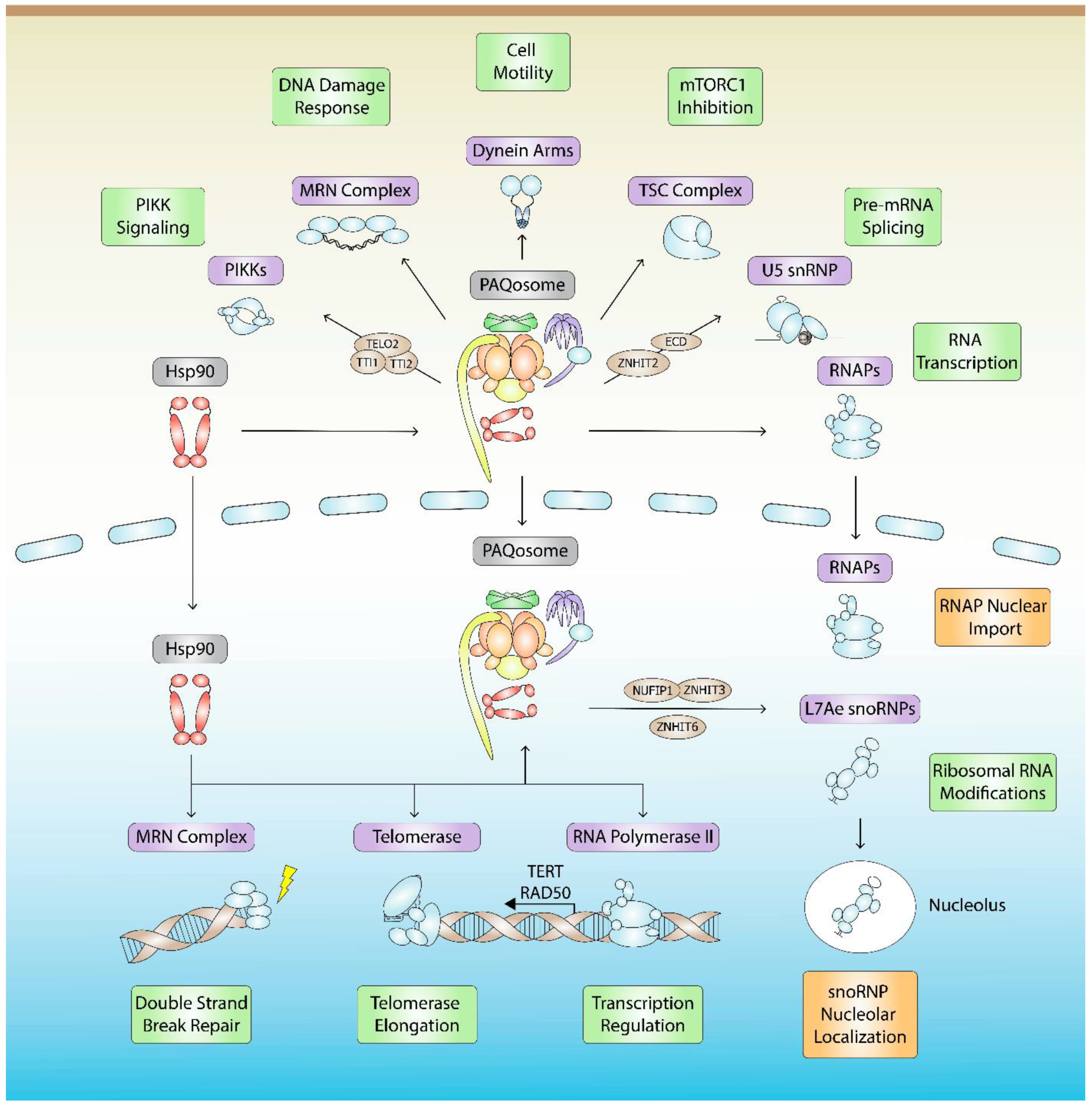
Hsp90 is a ubiquitous molecular chaperone involved in many cell signaling pathways, and its interactions with specific chaperones and cochaperones determines which client proteins to fold. Hsp90 has been shown to be involved in the promotion and maintenance of proper protein complex assembly either alone or in association with other chaperones such as the R2TP chaperone complex. Hsp90-R2TP acts through several mechanisms, such as by controlling the transcription of protein complex subunits, stabilizing protein subcomplexes before their incorporation into the entire complex, and by recruiting adaptors that facilitate complex assembly. Despite its many roles in protein complex assembly, detailed mechanisms of how Hsp90-R2TP assembles protein complexes have yet to be determined, with most findings restricted to proteomic analyses and in vitro interactions. This review will discuss our current understanding of the function of Hsp90-R2TP in the assembly, stabilization, and activity of the following seven classes of protein complexes: L7Ae snoRNPs, spliceosome snRNPs, RNA polymerases, PIKKs, MRN, TSC, and axonemal dynein arms.
Keywords: molecular chaperones; Hsp90; R2TP; PAQosome; TTT; snoRNP; snRNP; RNA polymerase; PIKK; TSC; dynein arm molecular chaperones; Hsp90; R2TP; PAQosome; TTT; snoRNP; snRNP; RNA polymerase; PIKK; TSC; dynein arm