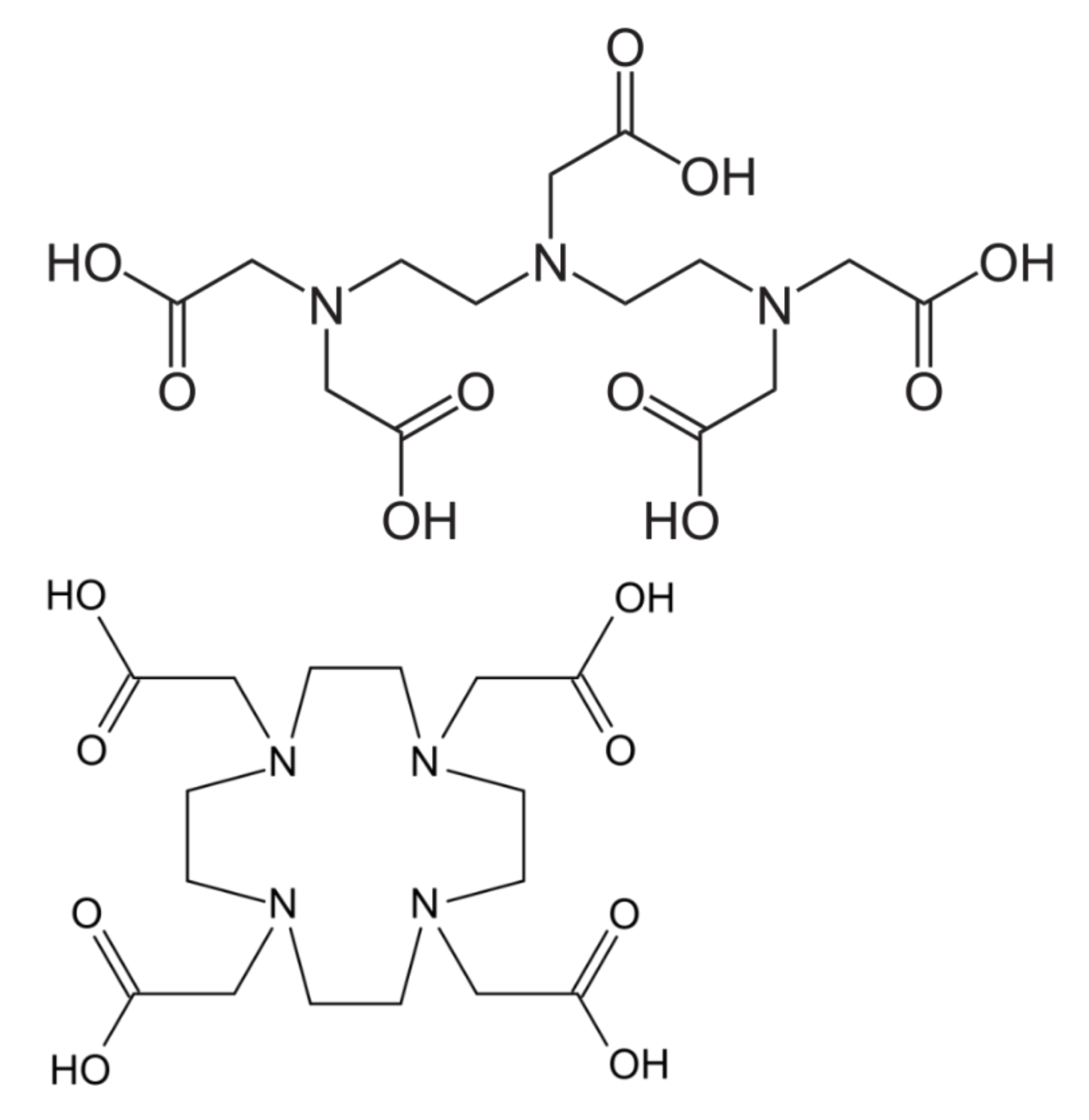
Gadolinium in Medical Imaging—Usefulness, Toxic Reactions and Possible Countermeasures—A Review



Abstract
1. Introduction
2. Gadolinium in Medical Imaging
3. Pharmacokinetics and Toxicokinetics of Gd and Its Chelates
4. Toxic Effects of Gd-Compounds
4.1. Acute Reactions to GBCAs
4.2. Contrast Induced Nephropathy
4.3. Nephrogenic Systemic Fibrosis (NSF)
4.4. Gadolinium Retention/Deposition
4.5. Fetal Toxicity and the Use of GBCAs in Pregnancy
5. Biological Monitoring
6. Prevention and Treatment of Gd-Related Side Effects
7. Conclusions
Author Contributions
Funding
Acknowledgments
Conflicts of Interest
References
- Tang, J.; Sheng, Y.; Hu, H.; Shen, Y. Macromolecular MRI contrast agents: Structures, properties and applications. Prog. Polym. Sci. 2012, 38, 462–502. [Google Scholar] [CrossRef] [Scilit]
- Caravan, P.; Ellison, J.J.; McMurry, T.J.; Lauffer, R.B. Gadolinium(III) chelates as MRI contrast agents: Structure, dynamics and applications. Chem. Rev. 1999, 99, 2293–2352. [Google Scholar] [CrossRef] [Scilit] [PubMed]
- Wahsner, J.; Gale, E.M.; Rodriguez-Rodriguez, A.; Caravan, P. Chemistry of MRI Contrast Agensts: Current Challenges and New frontiers. Chem. Rev. 2019, 119, 957–1057. [Google Scholar] [CrossRef] [Scilit]
- Do, C.; DeAguero, J.; Brearley, A.; Trejo, X.; Howard, T.; Escobar, G.P.; Wagner, B. Gadolinium-Based Contrast Agent Use, Their Safety, and Practice Evolution. Kidney360 2020, 1, 561–568. [Google Scholar] [CrossRef] [Scilit] [PubMed]
- Rogosnitzky, M.; Branch, S.M. Gadolinium-based contrast agent toxicity: A review of known and proposed mechanisms. BioMetals 2016, 29, 365–376. [Google Scholar] [CrossRef] [Scilit] [PubMed]
- Cowling, T.; Frey, N. Macrocyclic and linear gadolinium based contrast agents for adults undergoing magnetic resonance imaging: A review of safety. In CADTH Rapid Response Reports; Canadian Agency for Drugs and Technologies in Health: Ottawa, ON, Canada, 2019. [Google Scholar]
- Lux, J.; Sherry, A.D. Advances in gadolinium-based MRI contrast agent designs for monitoring biological processes in vivo. Curr. Opin. Chem. Biol. 2018, 45, 121–130. [Google Scholar] [CrossRef] [Scilit]
- Van der Molen, A.J.; Bellin, M.F. Extracellular gadolinium-based contrast media: Differences in diagnostic efficacy. Eur. J. Radiol. 2008, 66, 168–174. [Google Scholar] [CrossRef] [Scilit]
- Frenzel, T.; Apte, C.; Jost, G.; Schöckel, L.; Lohrke, J.; Pietsch, H. Quantification and assessment of the chemical form of residual gadolinium in the brain after repeated administration of gadolinium-based contrast agents: Comparative study in rats. Investig. Radiol. 2017, 52, 396–404. [Google Scholar] [CrossRef] [Scilit]
- Schieda, N.; Van Der Pol, C.B.; Walker, D.; Tsampalieros, A.K.; Maralani, P.J.; Woo, S.; Davenport, M.S. Adverse Events to the Gadolinium-based Contrast Agent Gadoxetic Acid: Systematic Review and Meta-Analysis. Radiology 2020, 297, 565–572. [Google Scholar] [CrossRef] [Scilit]
- Wikström, J.; Wasser, M.N.; Pattynama, P.M.; Bonomo, L.; Hamm, B.; Del Maschio, A.; Knopp, M.V.; Marchal, G.; Barentsz, J.O.; Oudkerk, M.; et al. Gadobenate Dimeglumine-Enhanced Magnetic Resonance Angiography of the Pelvic Arteries. Investig. Radiol. 2003, 38, 504–515. [Google Scholar] [CrossRef] [Scilit]
- Jbara, M.; Chen, Q.; Marten, P.; Morcos, M.; Beltran, J. Shoulder MR Arthrography: How, Why, When. Radiol. Clin. North. Am. 2005, 43, 683–692. [Google Scholar] [CrossRef] [Scilit] [PubMed]
- Wedeking, P.; Tweedle, M. Comparison of the biodistribution of 153Gd-labeled Gd(DTPA)2−, Gd(DOTA)−, and Gd(acetate) in in mice. Nucl. Med. Biol. 1988, 15, 395–402. [Google Scholar] [CrossRef] [Scilit]
- Barnhart, J.L.; Kuhnert, N.; Bakan, D.A.; Berk, R.N. Biodistribution of GdCl3 and Gd-DTPA and their influence on proton magnetic relaxation in rat tissues. Magn. Reson. Imaging 1987, 5, 221–231. [Google Scholar] [CrossRef] [Scilit]
- Laurent, S.; Vander Elst, L.; Muller, R.N. Comparative study of the physicochemical properties of six clinical low molecular weight gadolinium contrast agents. Contrast Media Mol. Imaging 2006, 1, 128–137. [Google Scholar] [CrossRef] [Scilit] [PubMed]
- Layne, K.A.; Dargan, P.I.; Archer, J.R.H.; Wood, D.M. Gadolinium deposition and the potential for toxicological sequelae—A literature review of issues surrounding gadolinium-based contrast agents. Br. J. Clin. Pharmacol. 2018, 84, 2522–2534. [Google Scholar] [CrossRef] [Scilit] [PubMed]
- Kanda, T.; Ishii, K.; Kawaguchi, H.; Kitajima, K.; Takenaka, D. High Signal Intensity in the Dentate Nucleus and Globus Pallidus on Unenhanced T1-weighted MR Images: Relationship with Increasing Cumulative Dose of a Gadolinium-based Contrast Material. Radiology 2014, 270, 834–841. [Google Scholar] [CrossRef] [Scilit] [PubMed]
- Neburkova, J.; Rulseh, A.M.; Chang, S.L.Y.; Raabova, H.; Vejpravova, J.; Dracinsky, M.; Tarabek, J.; Kotek, J.; Pingle, M.; Majer, P.; et al. Formation of gadolinium–ferritin from clinical magnetic resonance contrast agents. Nanoscale Adv. 2020, 2, 5567–5571. [Google Scholar] [CrossRef] [Scilit]
- Xia, D.; Davis, R.L.; Crawford, J.A.; Abraham, J.L. Gadolinium released from MR contrast agents is deposited in brain tumors: In situ demonstration using scanning electron microscopy with energy dispersive X-ray spectroscopy. Acta Radiol. 2010, 51, 1126–1136. [Google Scholar] [CrossRef] [Scilit]
- Radbruch, A.; Weberling, L.D.; Kieslich, P.J.; Eidel, O.; Burth, S.; Kickingereder, P.V.; Heiland, S.; Wick, W.; Schlemmer, H.-P.; Bendszus, M. Gadolinium Retention in the Dentate Nucleus and Globus Pallidus Is Dependent on the Class of Contrast Agent. Radiology 2015, 275, 783–791. [Google Scholar] [CrossRef] [Scilit]
- Frenzel, T.; Lengsfeld, P.; Schirmer, H.; Hütter, J.; Weinmann, H.-J. Stability of Gadolinium-Based Magnetic Resonance Imaging Contrast Agents in Human Serum at 37 °C. Investig. Radiol. 2008, 43, 817–828. [Google Scholar] [CrossRef] [Scilit]
- Laurent, S.; Vander Elst, L.; Coprox, F.; Muller, R.N. Stability of MRI Paramagnetic Contrast Media A Proton Relaxometric Protocol for Transmetallation Assessment. Investig. Radiol. 2001, 36, 115–122. [Google Scholar] [CrossRef] [Scilit] [PubMed]
- Tweedle, M.; Hagan, J.; Kumar, K.; Mantha, S.; Chang, C. Reaction of gadolinium chelates with endogenously available ions. Magn. Reson. Imaging 1991, 9, 409–415. [Google Scholar] [CrossRef] [Scilit]
- Sherry, A.D.; Caravan, P.; Lenkinski, R.E. Primer on gadolinium chemistry. J. Magn. Reson. Imaging 2009, 30, 1240–1248. [Google Scholar] [CrossRef] [Scilit] [PubMed]
- Spencer, A.J.; Wilson, S.A.; Batchelor, J.; Reid, A.; Pees, J.; Harpur, E. Gadolinium Chloride Toxicity in the Rat. Toxicol. Pathol. 1997, 25, 245–255. [Google Scholar] [CrossRef] [Scilit] [PubMed]
- Le Mignon, M.M.; Chambon, C.; Warrington, S.; Davies, R.; Bonnemain, B. Gd-DOTA. Pharmacokinetics and tolerability after intravenous injection into healthy volunteers. Investig. Radiol. 1990, 25, 933–937. [Google Scholar] [CrossRef] [Scilit]
- Robert, P.; Frenzel, T.; Factor, C.; Jost, G.; Rasschaert, M.; Schuetz, G.; Fretellier, N.; Boyken, J.; Idée, J.M.; Pietsch, H. Methodological Aspects for Preclinical Evaluation of Gadolinium Presence in Brain Tissue Critical Appraisal and Suggestions for Harmonization-A Joint Initiative. Investig. Radiol. 2018, 53, 499–517. [Google Scholar] [CrossRef] [Scilit]
- McDonald, R.J.; Weinreb, J.C.; Davenport, M.S. Symptoms Associated with Gadolinium Exposure (SAGE): A Suggested Term. Radiology 2022, 302, 270–273. [Google Scholar] [CrossRef] [Scilit]
- Fok, J.S.; Smith, W.B. Hypersensitivity reactions to gadolinium-based contrast agents. Curr. Opin. Allergy Clin. Immunol. 2017, 17, 241–246. [Google Scholar] [CrossRef] [Scilit]
- Kato, K.; Fujimoto, S.; Inukai, S.; Takatsu, H.; Kono, Y.; Kasai, K. Late-onset acute respiratory distress syndrome induced by a gadolinium-based contrast agent. Respir. Med. Case Rep. 2019, 29, 100990. [Google Scholar] [CrossRef] [Scilit]
- Thomsen, H.S.; Almèn, T.; Morcos, S.K. Members of the Contrast Media Safety Committee of the European Society of Urogenital Radiology (ESUR)). Gadolinium-containing contrast media for radiographic examinations: A position paper. Eur. Radiol. 2002, 12, 2600–2605. [Google Scholar] [CrossRef] [Scilit]
- Stacul, F.; van der Molen, A.J.; Reimer, P.; Webb, J.A.W.; Thomsen, H.S.; Morcos, S.K.; Almén, T.; Aspelin, P.; Bellin, M.-F.; Clement, O.; et al. Contrast induced nephropathy: Updated ESUR Contrast Media Safety Committee guidelines. Eur. Radiol. 2011, 21, 2527–2541. [Google Scholar] [CrossRef] [Scilit] [PubMed]
- George, S.; Webb, S.M.; Abraham, J.L.; Cramer, S.P. Synchrotron X-ray analyses demonstrate phosphate-bound gadolinium in skin in nephrogenic systemic fibrosis. Br. J. Dermatol. 2010, 163, 1077–1081. [Google Scholar] [CrossRef] [Scilit] [PubMed]
- Le Fur, M.; Caravan, P. The biological fate of gadolinium-based MRI contrast agents: A call to action for bioinorganic chemists. Metallomics 2019, 11, 240–254. [Google Scholar] [CrossRef] [Scilit] [PubMed]
- Weinreb, J.C.; Rodby, R.A.; Yee, J.; Wang, C.L.; Fine, D.; McDonald, R.J.; Perazella, M.A.; Dillman, J.R.; Davenport, M.S. Use of Intravenous Gadolinium-based Contrast Media in Patients with Kidney Disease: Consensus Statements from the American College of Radiology and the National Kidney Foundation. Radiology 2021, 298, 28–35. [Google Scholar] [CrossRef] [Scilit]
- Mathur, M.; Jones, J.R.; Weinreb, J.C. Gadolinium Deposition and Nephrogenic Systemic Fibrosis: A Radiologist’s Primer. RadioGraphics 2020, 40, 153–162. [Google Scholar] [CrossRef] [Scilit]
- EMA. EMA’s Final Opinion Confirms Restrictions on Use of Linear Gadolinium Agents in Body Scans EMA/457616/2017; European Medicines Agency: London, UK; Amsterdam, The Netherlands, 2017. [Google Scholar]
- McDonald, R.J.; Levine, D.; Weinreb, J.; Kanal, E.; Davenport, M.S.; Ellis, J.H.; Jacobs, P.; Lenkinski, R.E.; Maravilla, K.R.; Prince, M.R.; et al. Gadolinium Retention: A Research Roadmap from the 2018 NIH/ACR/RSNA Workshop on Gadolinium Chelates. Radiology 2018, 289, 517–534. [Google Scholar] [CrossRef] [Scilit]
- Gulani, V.; Calamante, F.; Shellock, F.G.; Kanal, E.; Reeder, S.B. Gadolinium deposition in the brain: Summary of evidence and recommendations. Lancet Neurol. 2017, 16, 564–570. [Google Scholar] [CrossRef] [Scilit]
- Guo, B.J.; Yang, Z.L.; Zhang, L.J. Gadolinium Deposition in Brain: Current Scientific Evidence and Future Perspectives. Front. Mol. Neurosci. 2018, 11, 335. [Google Scholar] [CrossRef] [Scilit]
- Khairinisa, M.A.; Takatsuru, Y.; Amano, I.; Erdene, K.; Nakajima, T.; Kameo, S.; Koyama, H.; Tsushima, Y.; Koibuchi, N. The Effect of Perinatal Gadolinium-Based Contrast Agents on Adult Mice Behavior. Investig. Radiol. 2018, 53, 110–118. [Google Scholar] [CrossRef] [Scilit]
- Mervak, B.M.; Altun, E.; McGinty, K.A.; Hyslop, W.B.; Semelka, R.C.; Burke, L.M. MRI in pregnancy: Indications and practical considerations. J. Magn. Reson. Imaging 2019, 49, 621–631. [Google Scholar] [CrossRef] [Scilit]
- Oh, K.Y.; Roberts, V.H.J.; Schabel, M.C.; Grove, K.L.; Woods, M.; Frias, A.E. Gadolinium Chelate Contrast Material in Pregnancy: Fetal Biodistribution in the Nonhuman Primate. Radiology 2015, 276, 110–118. [Google Scholar] [CrossRef] [Scilit] [PubMed]
- Ray, J.G.; Vermeulen, M.J.; Bharatha, A.; Montanera, W.J.; Park, A.L. Association Between MRI Exposure During Pregnancy and Fetal and Childhood Outcomes. JAMA 2016, 316, 952–961. [Google Scholar] [CrossRef] [Scilit] [PubMed]
- Gatta, G.; Di Grezia, G.; Cuccurullo, V.; Sardu, C.; Iovino, F.; Comune, R.; Ruggiero, A.; Chirico, M.; La Forgia, D.; Fanizzi, A.; et al. MRI in Pregnancy and Precision Medicine: A Review from Literature. J. Pers. Med. 2021, 12, 9. [Google Scholar] [CrossRef] [Scilit]
- US FDA. Requirement for Pregnancy and Lactation Labeling. Fed. Regist. 2008, 73, 104. [Google Scholar]
- Hasegawa, M.; Duncan, B.R.; Marshall, D.A.; Gonzalez-Cuyar, L.F.; Paulsen, M.; Kobayashi, M.; Maravilla, K.R. Human hair as a possible surrogate marker of retained tissue gadolinium: A pilot autopsy study correlating gadolinium concentrations in hair with brain and other tissues among decedents who received gadolinium-based contrast agents. Investig. Radiol. 2020, 55, 636–642. [Google Scholar] [CrossRef] [Scilit] [PubMed]
- Telgmann, L.; Holtkamp, M.; Künnemeyer, J.; Gelhard, C.; Hartmann, M.; Klose, A.; Sperling, M.; Karst, U. Simple and rapid quantification of gadolinium in urine and blood plasma samples by means of total reflection X-ray fluorescence (TXRF). Metallomics 2011, 3, 1035–1040. [Google Scholar] [CrossRef] [Scilit]
- Tweedle, M.F. Gadolinium deposition: Is it chelated or dissociated gadolinium? How can we tell? Magn. Reson. Imaging 2016, 34, 1377–1382. [Google Scholar] [CrossRef] [Scilit]
- Christensen, K.N.; Lee, C.U.; Hanley, M.M.; Leung, N.; Moyer, T.P.; Pittelkow, M.R. Quantification of gadolinium in fresh skin and serum samples from patients with nephrogenic systemic fibrosis. J. Am. Acad. Dermatol. 2011, 64, 91–96. [Google Scholar] [CrossRef] [Scilit]
- Rees, J.A.; Deblonde, G.J.-P.; An, D.D.; Ansoborlo, C.; Gauny, S.S.; Abergel, R.J. Evaluating the potential of chelation therapy to prevent and treat gadolinium deposition from MRI contrast agents. Sci. Rep. 2018, 8, 4419. [Google Scholar] [CrossRef] [Scilit]
- Layne, K.A.; Wood, D.M.; Dargan, P.I. Gadolinium-based contrast agents–what is the evidence for ‘gadolinium deposition disease’and the use of chelation therapy? Clin. Toxicol. 2020, 58, 151–160. [Google Scholar] [CrossRef] [Scilit]
- Bose, C.; Megyesi, J.K.; Shah, S.V.; Hiatt, K.M.; Hall, K.A.; Karaduta, O.; Swaminathan, S. Evidence Suggesting a Role of Iron in a Mouse Model of Nephrogenic Systemic Fibrosis. PLoS ONE 2015, 10, e0136563. [Google Scholar] [CrossRef] [Scilit] [PubMed]
- Leung, N.; Pittelkow, M.R.; Lee, C.U.; Good, J.A.; Hanley, M.M.; Moyer, T.P. Chelation of gadolinium with deferoxamine in a patient with nephrogenic systemic fibrosis. Clin. Kidney J. 2009, 2, 309–311. [Google Scholar] [CrossRef] [Scilit] [PubMed]
- Ngamcherdtrakul, W.; Morry, J.; Sangvanich, T.; Reda, M.; Bejan, D.S.; Fryxell, G.E.; Yantasee, W. Removal of a gadolinium based contrast agent by a novel sorbent hemoperfusion in a chronic kidney disease (CKD) rodent model. Sci. Rep. 2019, 9, 709. [Google Scholar] [CrossRef] [Scilit] [PubMed]
- Aaseth, J.; Crisponi, G.; Anderson, O. Chelation Therapy in the Treatment of Metal Intoxication; Academic Press: London, UK, 2016. [Google Scholar]

Publisher’s Note: MDPI stays neutral with regard to jurisdictional claims in published maps and institutional affiliations. |
© 2022 by the authors. Licensee MDPI, Basel, Switzerland. This article is an open access article distributed under the terms and conditions of the Creative Commons Attribution (CC BY) license (https://creativecommons.org/licenses/by/4.0/).
Share and Cite
Blomqvist, L.; Nordberg, G.F.; Nurchi, V.M.; Aaseth, J.O. Gadolinium in Medical Imaging—Usefulness, Toxic Reactions and Possible Countermeasures—A Review. Biomolecules 2022, 12, 742. https://doi.org/10.3390/biom12060742
Blomqvist L, Nordberg GF, Nurchi VM, Aaseth JO. Gadolinium in Medical Imaging—Usefulness, Toxic Reactions and Possible Countermeasures—A Review. Biomolecules. 2022; 12(6):742. https://doi.org/10.3390/biom12060742
Chicago/Turabian StyleBlomqvist, Lennart, Gunnar F. Nordberg, Valeria M. Nurchi, and Jan O. Aaseth. 2022. "Gadolinium in Medical Imaging—Usefulness, Toxic Reactions and Possible Countermeasures—A Review" Biomolecules 12, no. 6: 742. https://doi.org/10.3390/biom12060742
APA StyleBlomqvist, L., Nordberg, G. F., Nurchi, V. M., & Aaseth, J. O. (2022). Gadolinium in Medical Imaging—Usefulness, Toxic Reactions and Possible Countermeasures—A Review. Biomolecules, 12(6), 742. https://doi.org/10.3390/biom12060742