Review

Minimal Residual Disease, Metastasis and Immunity

by
Jordi Badia-Ramentol
,
Jenniffer Linares
,
Andrea Gómez-Llonin
and
Alexandre Calon
*
Cancer Research Program, Hospital del Mar Medical Research Institute (IMIM), 08003 Barcelona, Spain
*
Author to whom correspondence should be addressed.
Biomolecules 2021, 11(2), 130; https://doi.org/10.3390/biom11020130
Submission received: 18 December 2020 / Revised: 12 January 2021 / Accepted: 13 January 2021 / Published: 20 January 2021
(This article belongs to the Special Issue The Biology of Cell Metastasis)

Abstract

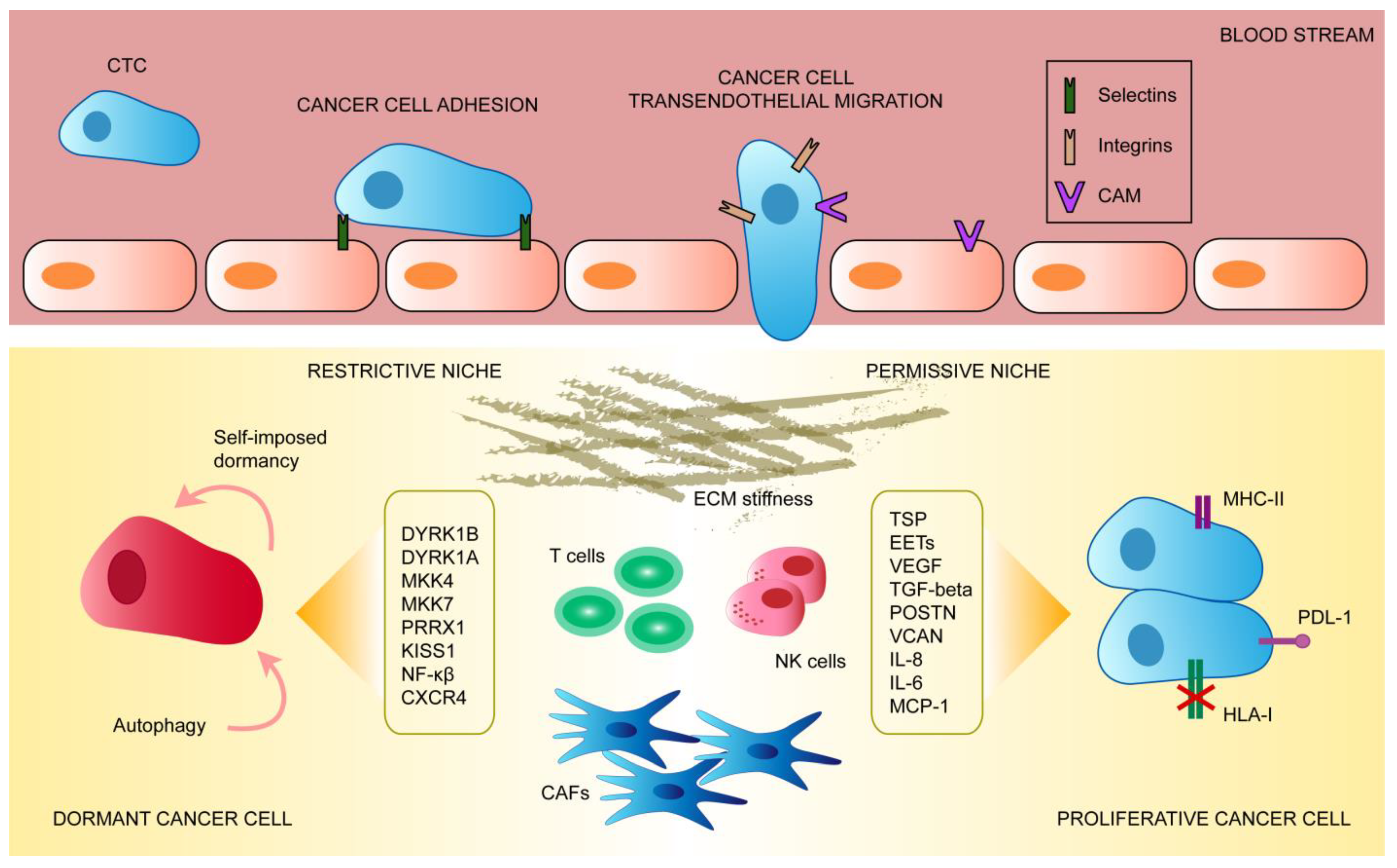
Progression from localized to metastatic disease requires cancer cells spreading to distant organs through the bloodstream. Only a small proportion of these circulating tumor cells (CTCs) survives dissemination due to anoikis, shear forces and elimination by the immune system. However, all metastases originate from CTCs capable of surviving and extravasating into distant tissue to re-initiate a tumor. Metastasis initiation is not always immediate as disseminated tumor cells (DTCs) may enter a non-dividing state of cell dormancy. Cancer dormancy is a reversible condition that can be maintained for many years without being clinically detectable. Subsequently, late disease relapses are thought to be due to cancer cells ultimately escaping from dormant state. Cancer dormancy is usually associated with minimal residual disease (MRD), where DTCs persist after intended curative therapy. Thus, MRD is commonly regarded as an indicator of poor prognosis in all cancers. In this review, we examine the current understanding of MRD and immunity during cancer progression to metastasis and discuss clinical perspectives for oncology.
Keywords: CTC; DTC; MRD; dormancy; immunity; metastasis; therapy CTC; DTC; MRD; dormancy; immunity; metastasis; therapy