Article

Charge Exchange Studies with n-, l-, and spin-Quantum State Population in Ar7+-He Collisions

Key Laboratory of Nuclear Physics and Ion-Beam Application (MOE), Institute of Modern Physics, Fudan University, Shanghai 200433, China
*
Authors to whom correspondence should be addressed.
Atoms 2026, 14(4), 30; https://doi.org/10.3390/atoms14040030
Submission received: 12 February 2026 / Revised: 2 April 2026 / Accepted: 7 April 2026 / Published: 8 April 2026
(This article belongs to the Special Issue Electronic Dynamics in Atomic and Molecular Collisions)

Abstract

The energy-dependent population of fine quantum states in single electron capture (SEC) reflects the intrinsic collision dynamics. Here we report experimental studies of Ar7+ ions colliding with He in the energy range of 1.05–17.5 keV/u. Owing to the high resolution of a recoil-ion momentum spectrometer, the n-, l-, and spin-state electron capture populations are well resolved, and a strong energy dependence of the SEC cross sections is observed. Most importantly, a clear inversion of the cross-section ratio between the spin-resolved triplet and singlet 3s3d configurations is found, demonstrating a breakdown of spin statistics. Together with recent spin-resolved studies of C3+-He collisions (PRL 133, 173002 (2024)), these results suggest that the breakdown of spin statistics is likely a general feature of charge exchange in open-shell highly charged ion systems.

1. Introduction

Charge exchange (CX), in collisions between multiply charged ions and neutral atoms, is a fundamental process in atomic collision physics with broad applications, ranging from plasma diagnostics to the modeling of X-ray emissions in astrophysical systems [1,2,3], as their dynamics illustrate the effects of static and dynamical electronic correlations [4], strong Coulombic interactions [5], and many-channel close-coupling schemes related to the charge asymmetry between the target and projectile [6]. A critical probe for understanding CX dynamics is the cross section, which quantitatively links the electron transition probability to measurable collision observables.
Extensive experimental and theoretical efforts have been devoted to total [7,8,9], state-selective [10,11,12], and differential capture cross sections [13,14,15], establishing the gross features of single- and many-electron capture. These studies consistently reveal a pronounced velocity dependence in the cross sections, particularly for nl-resolved capture, indicating that simple scaling laws or classical models are insufficient. At intermediate and higher collision energies, four-body scattering frameworks [16,17], such as the continuum distorted-wave approach (CDW-4B), provide a dynamically consistent description and demonstrate that dynamic interelectron correlations remain important for capture into excited states, often in good agreement with experiments. In slow collisions, the different dynamical coupling effects on the state-selective process manifest the quasi-molecular effects [18,19,20]. By comparing the measured projectile scattering angle distributions to the theoretical calculations, Zhang et al. [19] and Siddiki et al. [21] attributed state-selective capture primarily to radial and rotational couplings. Through a two-active-electron semiclassical asymptotic-state close-coupling (SCASCC) approach [12,15,22], quantitative agreement with various CX cross sections has been achieved, underscoring the critical role of electron correlation and revealing that impact-parameter-sensitive transition probabilities can strongly mediate state-selective capture. More recently, nonperturbative close-coupling approaches such as the semiclassical two-center basis generator method (TC-BGM) [23] and the wave-packet convergent close-coupling (WP-CCC) [24] method enable converged calculations of electron capture, excitation, and ionization with explicit treatment of two-center and continuum couplings, and have been successfully applied to collisions involving H, He, and H2 targets.
Continual advances in experimental techniques—especially in spectral resolution—have pushed state selectivity beyond nl distributions to resolve even finer quantum branching. Importantly, both the nl populations and the branching among spin multiplets can depart markedly from the statistical prescriptions often assumed in CX modeling, and the magnitude—and even the sign—of these departures may change with collision velocity. This sensitivity indicates that state-selective cross sections encode detailed dynamical information rather than simple degeneracy factors, motivating systematic measurements over broader energy ranges and across distinct projectiles. In particular, recent state-resolved studies have reported a pronounced breakdown of spin-statistical weighting for Li-like C3+ ions [25], raising the question of whether such a breakdown of spin statistics also exists in more complex multielectron systems beyond Li-like ions, for which theoretical calculations are extremely challenging and corresponding theoretical data are still missing.
By extending these investigations to the next alkali sequence, the Na-like Ar7+ offers an ideal testbed for examining the generality of this phenomenon and for gaining insight into the underlying dynamical mechanisms. Moreover, Ar7+ is not only of intrinsic atomic-physics interest but is also routinely detected in diverse astrophysical sources, where it serves as a sensitive probe of plasma conditions [26]. For the Ar7+-He collision system, Marseille et al. [27] and Bliman et al. [28] provided the first systematic analysis of the energy levels and population distributions in Ar6+ resulting from Ar7+ collisions, enabling measurements of excitation cross sections and state-resolved population distributions. Bouchama et al. [29] employed high-resolution spectroscopy to measure emission lines from excited states, yielding detailed information on fine structure and partial cross sections, demonstrating good agreement with the Extended Classical Over-Barrier (ECB) model in predicting angular momentum. While prior experimental studies on Ar7+-He collisions exist [27,28,29], they are largely restricted to a limited low-energy range and do not provide a systematic picture over a broad collision energy range.
In this work, we determine absolute n- and l-resolved SEC cross sections in Ar7+-He collisions over 1.05–17.5 keV/u, and compare the l-distributions in n = 4 against commonly used model prescriptions and reference Ar8+ data. Crucially, we further extract s-resolved SEC cross sections for the 3s3d 3D and 1D channels to directly probe the spin-dependent dynamics and find the violation of statistical weighting in a Na-like open-shell system.

2. Materials and Methods

Measurements were carried out on the 150 kV highly charged-ion collision platform equipped with cold target recoil ion momentum spectroscopy (COLTRIMS) at Fudan University (Shanghai, China) [30]. Here we give a brief summary of the essential features. Ar7+ beams were produced by a 14.5-GHz ECR ion source from PANTECHNIK S.A. (Caen, France) and accelerated to the desired energies. Before entering the collision chamber, the Ar7+ ion beam was adjusted to approximately 100 pA, with a beam diameter of less than 1 mm. High-purity helium gas was fed through a 20 μm nozzle at a pressure of 2 bar, where it underwent adiabatic expansion into the vacuum chamber. The gas was then selected and confined by a three-stage skimmer, forming a localized, high-density supersonic gas jet. The ion beam intersected the supersonic He target in the reaction region, where the target chamber pressure was maintained at about 1 × 10⁻⁷ Pa.
The time-of-flight (TOF) spectrometer consisted of a uniform-field acceleration region and a field-free drift region. In our setup, the lengths of the acceleration and drift regions were approximately 100 mm and 300 mm, respectively [31]. Recoil ions produced in the collisions were extracted along the TOF axis by a focused electric field of approximately 3 V/cm and detected by an 80 mm diameter position-sensitive detector (PSD). Charge-changed projectiles were separated from the primary beam by an electrostatic deflector and recorded by a second PSD, while the unreacted primary beam was collected by a Faraday cup.
The positions of the scattered ions detected by the first PSD and the flight times of the recoil ions detected by the second PSD form a two-dimensional position–time spectrum, from which single- and double-electron capture channels, as well as transfer ionization channels, can be identified in the reaction. SEC events were identified by the coincident detection of Ar6+ projectiles and He+ recoils.
The longitudinal momentum P z of the recoil ion refers to its momentum transfer along the axial direction of the projectile ion. According to the principle of the conservation of energy and momentum, P z can be derived from the following relationship [32]:
Q = 1 2 v p 2 v p · P z
P z = Q v p v p 2
where v p is the velocity of the projectile ion, and Q represents the difference between the binding energy of the initial and final states. The longitudinal momentum of the recoil ion can be reconstructed according to its position and time-of-flight information on the PSD. The Q-value spectra were fitted using multiple Gaussian functions. The peak positions were fixed to the calculated Q values based on the first ionization energy of He, together with the energies of the relevant Ar6+ states taken from the NIST Atomic Spectra Database. The energy resolution of the Q-value spectra is approximately 3–5 eV (FWHM), mainly limited by the thermal spread of the target jet and the finite size of the interaction volume. The state-selective contributions were extracted by multi-peak Gaussian fitting, with the peak centers constrained by the theoretical Q values of the corresponding final states. In this way, the relative yields of different capture channels were obtained from the fitted peak areas.
The uncertainty of the absolute state-selective cross sections consists of two parts: the uncertainty of the absolute total cross sections and that of the relative state-selective fractions. The uncertainty of the absolute cross sections has been determined to be 8.2% [9,33], mainly arising from the fluctuations in temperature (1%) and gas pressure (3%), detector efficiency (5.8%), counting statistics (1%), and beam instability (4%). The uncertainty of the relative state-selective fractions is dominated by the Gaussian fitting error (4%) and the statistical uncertainty (1%). By the error transfer formula, the overall uncertainty of the absolute state-selective cross sections is estimated to be 9.1%.

3. Results and Discussion

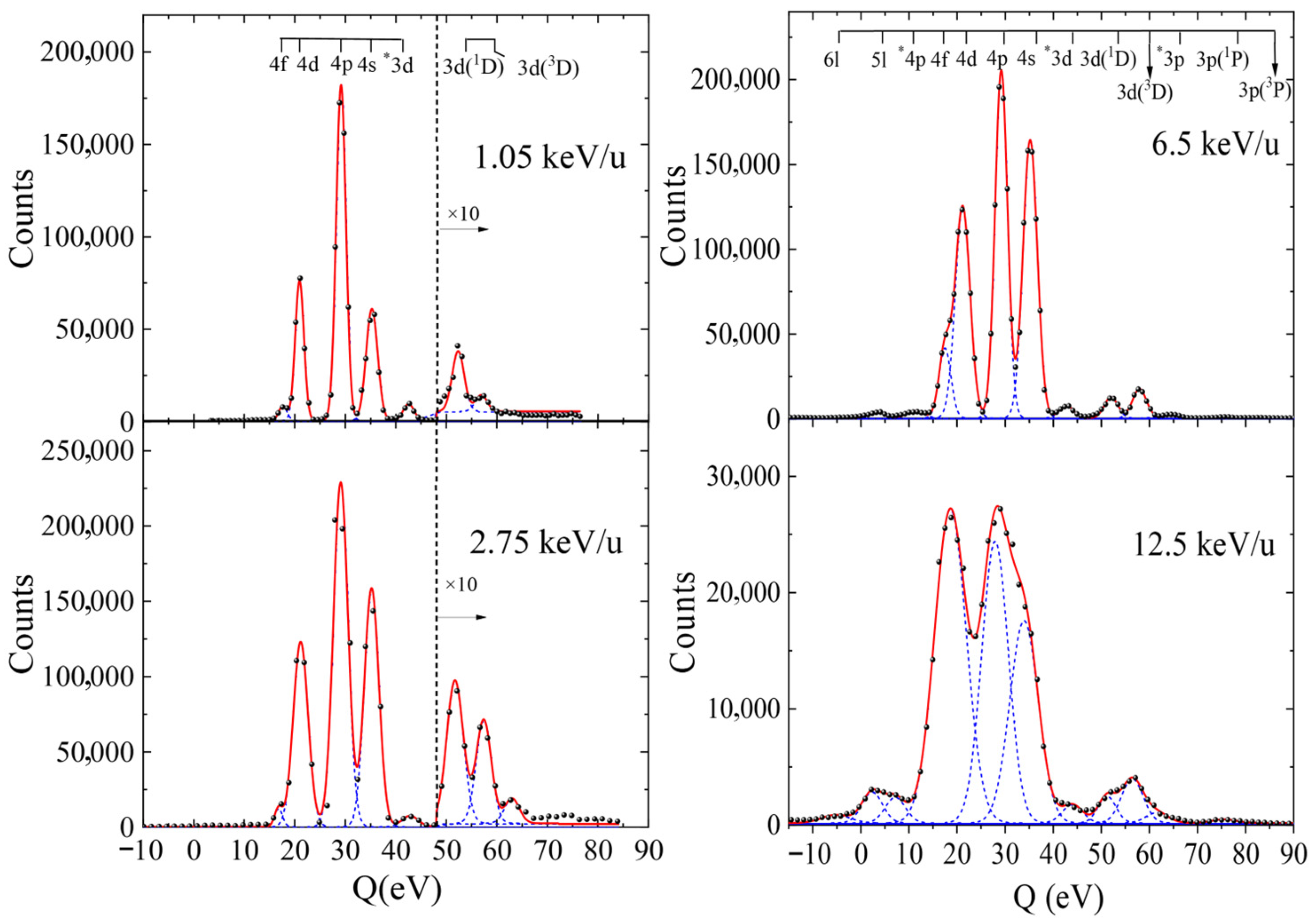
Figure 1 displays representative Q-value spectra for SEC in Ar7+-He collisions at four selected energies between 1.05 and 17.5 keV/u. Each peak in the Q spectrum corresponds to capture into a specific final quantum state. As the collision energy increases, additional reaction channels become more prominent and can be clearly resolved in the spectra, including capture into the 3p and 3d manifolds. Channels involving single-electron capture accompanied by excitation of the projectile valence electron are also observed and are assigned to the final Ar6+ configurations 3p3p, 3p3d, and 3p4d, assuming that the residual target ion remains in the ground state He+ (1s). The observation of these channels is consistent with the interpretation of Bouchama et al. [29], in which the population of the 3pnl states was attributed predominantly to capture accompanied by projectile-electron excitation.
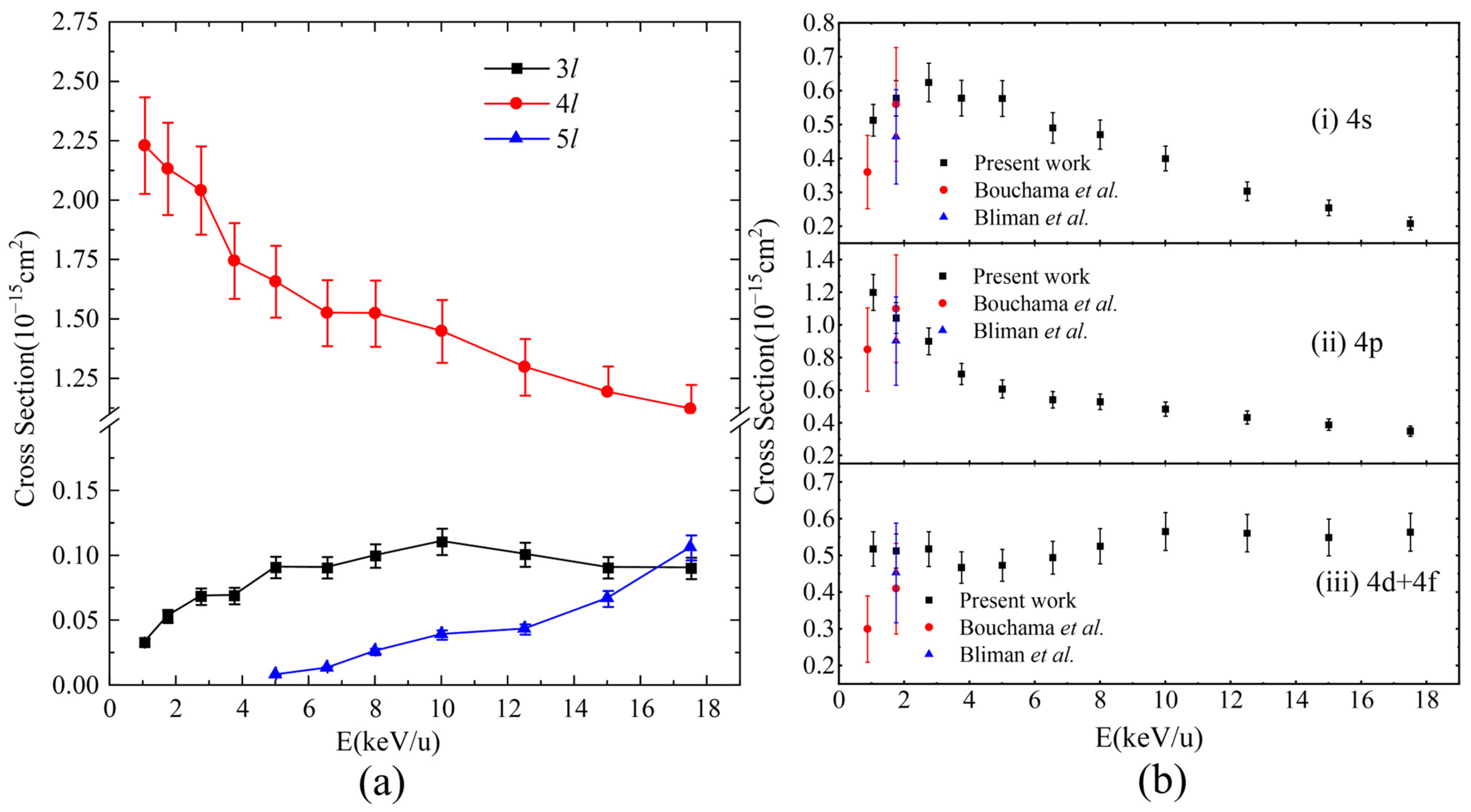
The dependence of principal n-state capture on collision energy is shown in Figure 2a, spanning the collision energy range of 1.05 to 17.5 keV/u. In this energy interval, the absolute total SEC cross section decreases from about 2.36 × 10⁻¹⁵ cm2 to 1.55 × 10⁻¹⁵ cm2, as reported in prior work [9]. The state-selective cross sections presented here are obtained by normalizing the relative branching ratios measured to these total SEC values, with contributions from transfer ionization (TI) and autoionizing double capture (ADC) removed during the normalization to ensure that they correspond to pure SEC processes [33]. For Ar7+ colliding with He, the coincidence events of Ar6+ ions and recoiling He2+ ions arise from the TI and ADC channels, resulting in a contribution of 2–8% within the experimental energy range. The data clearly show that SEC is strongly selective into the n = 4 level, consistent with the trends predicted by Bouchama et al. [29] and Bliman et al. [28]. As the collision energy increases, the absolute cross section for n = 4 declines significantly, whereas the contributions for n = 3 and 5 increase.
Owing to the high resolution, the l-resolved SEC processes are obtained. The absolute cross sections for 4s, 4p, and 4d + 4f captures are shown in Figure 2b. It should be noted that, at high impact energies, the 4d and 4f peaks become partially unresolved; accordingly, the present work reports their summed cross section (4d + 4f) for comparison with the literature value. Our results agree well with the existing data at 1.75 keV/u, while deviations arise in the comparison with Bouchama et al. [29] at 0.875 keV/u. The discrepancy at 0.875 keV/u may be attributed to differences in the experimental methods: the COLTRIMS approach directly resolves final l states without cascade corrections, while the optical method in Ref. [29] relies on cascade analysis, which may be more challenging at lower collision energies.
Within a given principal capture level, the population distribution among substates varies with collision energy. Specifically, the 4p channel dominates at low collision energies. The 4s contribution exhibits a non-monotonic energy dependence, increasing at first and then decreasing as the collision energy increases. In contrast, 4d and 4f become increasingly important toward higher energies.
To predict the quantum state population during electron capture processes, Janev and Winter [34] describe several methods for estimating the l distribution, including statistical models, the Landau–Zener model, and low-energy models which are widely used in astrophysical CX spectral modeling [35]. The l-state populations calculated from these models are only an approximation, determined solely by the m-distribution and Clebsch–Gordan “geometrical” factors [34], without accounting for electron–electron interactions at different impact energies, particularly at the low energies where the quasi-molecular orbital coupling is strong.
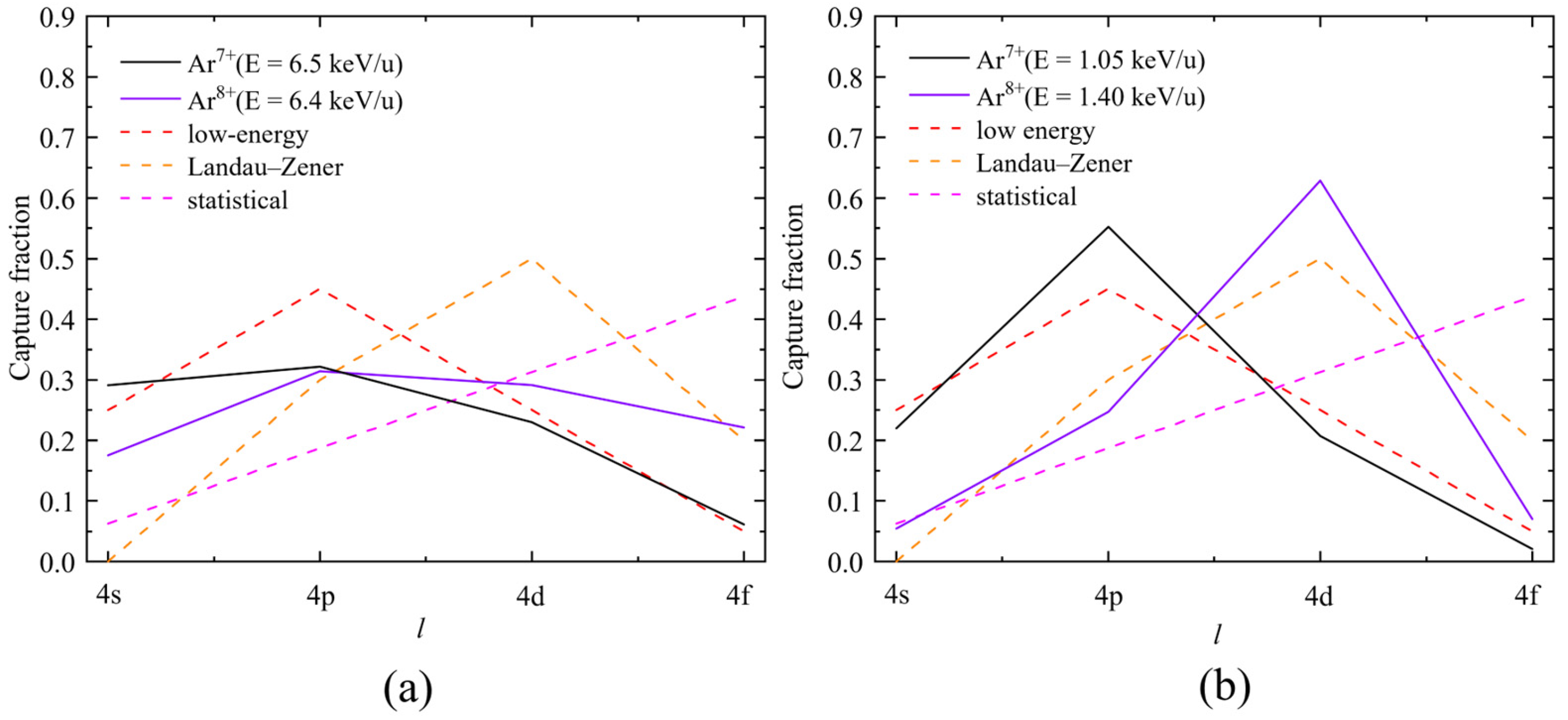
A comparison of the measured l-resolved population fractions with the models’ predictions is shown in Figure 3, for the n = 4 manifold in Ar7+-He collisions at 1.05 and 6.5 keV/u, together with the reference Ar8+ data [31]. At low collision energies, the Ar7+ n = 4 L-distribution resembles the low-energy model, while Ar8+ exhibits a distribution closer to the Landau–Zener model. The difference in the captured electron’s final l-distribution between Ar7+ and Ar8+ may be attributed to the correlation effects of remaining electrons at low energy. Near 6.5 keV/u, both systems exhibit a broader l distribution with a strengthened high-l component (notably 4f), deviating further from the low-energy and Landau–Zener models. Moreover, the statistical l-distribution is in clear disagreement with both Ar7+ and Ar8+ at these energies. According to the explanation put forward by Gu et al. [35] and Abramov et al. [36], at low velocities, the captured electron possesses insufficient angular momentum to populate high-l orbitals, leading to a pronounced peak in the population of l = 1 or 2 states. As the velocity increases, rotational coupling between molecular orbitals becomes significant and redistributes the population into higher angular momentum orbitals.
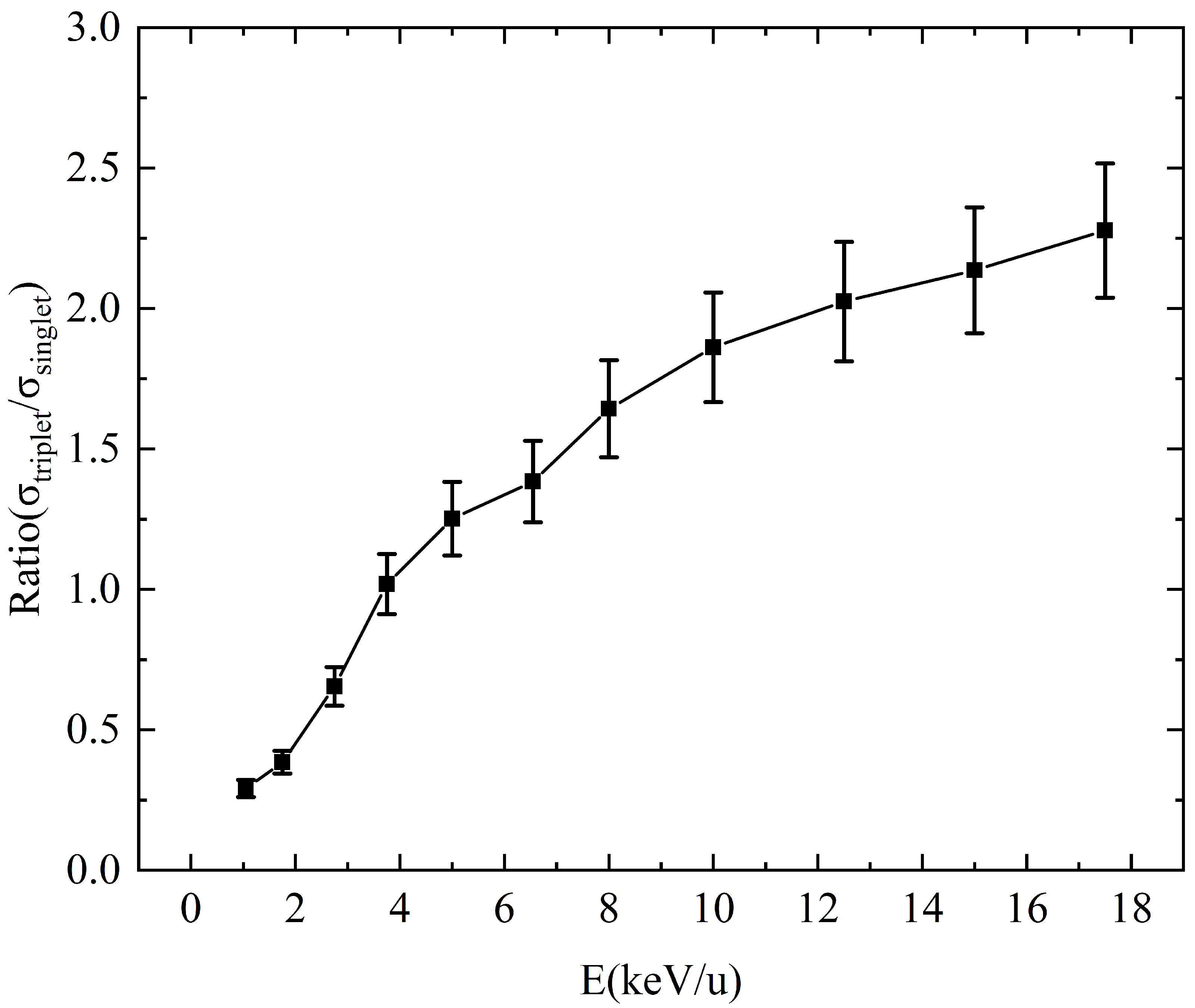
Beyond nl selectivity, the present data also determine spin-resolved cross sections in the 3s3d capture channels. The cross-sections for electron capture populating the triplet (3s3d 3D) and singlet (3s3d 1D) states were determined through Gaussian fitting of their corresponding peaks in the Q-value spectra. The energy gap between these two states is approximately 5.72 eV. The experimental resolution allowed us to partially resolve the contributions from the singlet and triplet states, and the fitting process reliably extracted their relative intensities. The ratio of these cross sections, denoted as R   =   ( σ ( 3 s 3 d   D 3 ) ) / ( σ ( 3 s 3 d   D 1 ) ) , serves as a key indicator of the spin-dependent electron capture dynamics.
Figure 4 summarizes the collision energy dependence of the triplet-to-singlet capture ratio R. Within the present measured range, R increases monotonically from 0.29 ± 0.03 at 1.05 keV/u to 2.28 ± 0.24 at 17.5 keV/u, revealing a clear spin-statistical inversion: singlet capture dominates at low energies (R < 1), while triplet capture becomes predominant once the collision energy exceeds 3.75 keV/u. Similar departures from the naive statistical expectation (R = 3) have also been predicted in theoretical studies of other collision systems (e.g., N6+-H [37] and C5+-H [38]), and have been discussed as strong influencers of the electron–electron interaction during the collision.
An analogous but more pronounced evolution was reported for Li-like C3+-He collisions over 0.25–70 keV/u by Zhu et al. [25] and Lennon et al. [39]. A notable difference lies in the energy scale of the effect: in C3+-He, R < 1 below ~1 keV/u and R > 3 around 10 keV/u, whereas in Ar7+-He, R = 1 appears at 3.75 keV/u and R remains below 3 up to 17.5 keV/u. This indicates that the detailed energy dependence of spin-resolved populations is sensitive to the projectile’s specific electronic configuration. In the present Ar7+-He measurements, R does not exceed 3 within the accessible energy range, primarily due to technical limitations that constrained our measurements to the present energy window. Extending the measurements to higher collision energies would therefore be important to test whether an R > 3 regime can also emerge in the Na-like system.
As discussed by Zhu et al. [25], the strong energy dependence of R likely reflects a molecular representation of the collision system, relevant in the energy domain. At lower energies, the dominance of the capture to singlet states is related to the different evolution of the molecular curves. With increasing energies, the molecular mechanisms get weaker, and the ratio increases. The present Na-like results support the view of spin-statistics breaking in electron capture involving an open-shell system, suggesting that the violations of spin statistics may be a general feature of CX processes. Further theoretical investigation is needed to explain the observed differences in the energy dependence, which are probably raised from underlying electron correlations in different systems.

4. Conclusions

In summary, we have performed high-resolution COLTRIMS measurements of state-selective SEC in Ar7+-He collisions from 1.05 to 17.5 keV/u, resolving capture channels in the n-, l-, and spin-quantum states. First, the measured l-resolved populations within the dominant n = 4 manifold evolve strongly with energy and deviate clearly from statistical expectations: capture into low-l states dominates at low energies but decreases markedly as energy increases, accompanied by an enhanced population of high-l states. Second, we observe a clear inversion in the spin population for the 3s3d configuration, with the triplet-to-singlet ratio R increasing from 0.29 ± 0.03 at 1.05 keV/u to 2.28 ± 0.24 at 17.5 keV/u. This experiment provides clear evidence of the breakdown of spin statistics in open-shell highly charged ion systems, thereby offering insights into the underlying collision mechanisms.

Author Contributions

Conceptualization, B.T. and B.W.; Investigation (experiments), Y.W., H.Y., T.M., P.M. and X.T.; Formal Analysis, Y.W. and H.Y.; Data Curation, Y.W.; Writing—Original Draft Preparation, Y.W.; Writing—Review and Editing, B.T. and B.W.; Supervision, B.T. and B.W.; Resources, B.W.; Funding Acquisition, B.W.; Discussion and Insights, K.Y., J.X. and Y.Z. All authors have read and agreed to the published version of the manuscript.

Funding

This research was funded by the National Key R&D Program of China (Grants No. 2022YFA1602504 and 2023YFA1606501) and the National Natural Science Foundation of China (Grants No. 12374227, 12474251, and U1832201).

Data Availability Statement

The data presented in this study are available from the corresponding authors upon reasonable request.

Conflicts of Interest

The authors declare no conflicts of interest.

References

  1. Schulz, M. (Ed.) Ion-Atom Collisions: The Few-Body Problem in Dynamic Systems; De Gruyter: Berlin, Germany, 2019. [Google Scholar]
  2. Belkić, D.; Mančev, I.; Hanssen, J. Four-body methods for high-energy ion-atom collisions. Rev. Mod. Phys. 2008, 80, 249–314. [Google Scholar] [CrossRef]
  3. Ma, X.; Zhang, S.; Wen, W.; Huang, Z.; Hu, Z.; Guo, D.; Gao, J.; Najjari, B.; Xu, S.; Yan, S.; et al. Atomic structure and collision dynamics with highly charged ions. Chin. Phys. B 2022, 31, 093401. [Google Scholar] [CrossRef]
  4. Mančev, I. Electron correlations in single-electron capture from heliumlike atomic systems. Phys. Rev. A 1999, 60, 351–358. [Google Scholar] [CrossRef]
  5. Hu, X.; Jia, C.; Xu, T.; Wu, Y.; Wang, J. Full quantum time-dependent simulations for the two-body breakups of H2Ar2+ and N2Ar2+. Phys. Rev. A 2022, 106, 012814. [Google Scholar] [CrossRef]
  6. Zygelman, B.; Cooper, D.L.; Ford, M.J.; Dalgarno, A.; Gerratt, J.; Raimondi, M. Charge transfer of N4+with atomic hydrogen. Phys. Rev. A 1992, 46, 3846–3854. [Google Scholar] [CrossRef] [PubMed]
  7. Can, C.; Gray, T.J.; Varghese, S.L.; Hall, J.M.; Tunnell, L.N. Electron-capture cross sections for low-energy highly charged neon and argon ions from molecular and atomic hydrogen. Phys. Rev. A 1985, 31, 72–83. [Google Scholar] [CrossRef]
  8. Druetta, M.; Martin, S.; Bouchama, T.; Harel, C.; Jouin, H. Spectroscopic study of the charge-exchange collision between Ar8+ and He or H2 at beam energies of 80, 40, and 8 keV. Phys. Rev. A 1987, 36, 3071–3076. [Google Scholar] [CrossRef]
  9. Wu, Y.; Yin, H.; Tan, X.; Ma, P.; Meng, T.; Xiao, J.; Yao, K.; Zou, Y.; Tu, B.; Wei, B. Total cross sections for electron capture in Arq+ (q = 7,8) with He and H2 collisions. Phys. Rev. A 2025, 112, 022805. [Google Scholar] [CrossRef]
  10. Cui, S.; Xing, D.; Zhu, X.; Su, M.; Gao, Y.; Guo, D.; Zhao, D.; Zhang, S.; Fu, Y.; Ma, X. The n-resolved single-electron capture in slow O6+–Ne collisions. Chin. Phys. B 2024, 33, 073401. [Google Scholar] [CrossRef]
  11. Akgüngör, K.; Kamber, E.Y.; Ferguson, S.M. State-selective single-electron capture in very slow collisions of Arq+ (q = 4–8) ions with neon. Rapid Commun. Mass Spectrom. 1999, 13, 412–421. [Google Scholar] [CrossRef]
  12. Zhang, Y.W.; Gao, J.W.; Wu, Y.; Wang, J.G.; Sisourat, N.; Dubois, A. Single- and double-electron capture in intermediate-energy Ar8+ +He collisions. Phys. Rev. A 2022, 106, 042809. [Google Scholar] [CrossRef]
  13. Abdallah, M.A.; Wolff, W.; Wolf, H.E.; Sidky, E.; Kamber, E.Y.; Stöckli, M.; Lin, C.D.; Cocke, C.L. Cold-target recoil-ion-momentum spectroscopy study of single electron capture from He by slow Ar8+ ions. Phys. Rev. A 1998, 57, 4373–4378. [Google Scholar] [CrossRef]
  14. Abdallah, M.A.; Wolff, W.; Wolf, H.E.; Kamber, E.Y.; Stöckli, M.; Cocke, C.L. Single and double electron capture from He by Ar16+ studied using cold-target recoil-ion momentum spectroscopy. Phys. Rev. A 1998, 58, 2911–2919. [Google Scholar] [CrossRef]
  15. Zhang, R.T.; Gao, J.W.; Zhang, Y.W.; Guo, D.L.; Gao, Y.; Zhu, X.L.; Xu, J.W.; Zhao, D.M.; Yan, S.; Xu, S.; et al. Strongly perturbed state-selective charge exchange between slow Ar8+ and He. Phys. Rev. Res. 2023, 5, 023123. [Google Scholar] [CrossRef]
  16. Belkić, D.; Gayet, R.; Hanssen, J.; Mančev, I.; Nuñez, A. Dynamic electron correlations in single capture from helium by fast protons. Phys. Rev. A 1997, 56, 3675–3681. [Google Scholar] [CrossRef]
  17. Belkić, D. Vector spherical harmonics and scattering integrals. Phys. Scr. 1992, 45, 9–17. [Google Scholar] [CrossRef]
  18. Winter, T.G.; Hatton, G.J.; Lane, N.F. Molecular-state treatment of collisions between protons and He+ions. Phys. Rev. A 1980, 22, 930–936. [Google Scholar] [CrossRef]
  19. Zhang, R.T.; Zhu, X.L.; Li, X.Y.; Liu, L.; Zhang, S.F.; Fen, W.T.; Guo, D.L.; Gao, Y.; Zhao, D.M.; Wang, J.G.; et al. Single electron capture in 3 keV/u Ar8++He collisions. Phys. Rev. A 2017, 95, 042702. [Google Scholar] [CrossRef]
  20. Fritsch, W. Theoretical study of electron processes in slow He2+-He collisions. J. Phys. B At. Mol. Opt. Phys. 1994, 27, 3461–3474. [Google Scholar] [CrossRef]
  21. Siddiki, M.A.K.A.; Zhao, G.P.; Liu, L.; Misra, D. Highly excited quantum state-selective capture dynamics in slow Ar8+−H2 collisions. Phys. Rev. A 2024, 109, 032819. [Google Scholar] [CrossRef]
  22. Zhang, Y.W.; Gao, J.W.; Wu, Y.; Zhou, F.Y.; Wang, J.G.; Sisourat, N.; Dubois, A. Single- and double-electron capture in intermediate-energy N5++H2 collisions. Phys. Rev. A 2020, 102, 022814. [Google Scholar] [CrossRef]
  23. Leung, A.C.K.; Kirchner, T. Two-Center Basis Generator Method Calculations for Li3+, C3+ and O3+ Ion Impact on Ground State Hydrogen. Atoms 2022, 10, 11. [Google Scholar] [CrossRef]
  24. Abdurakhmanov, I.B.; Kadyrov, A.S.; Bray, I. Wave-packet continuum-discretization approach to ion-atom collisions: Nonrearrangement scattering. Phys. Rev. A 2016, 94, 022703. [Google Scholar] [CrossRef]
  25. Zhu, X.; Zhang, S.; Gao, Y.; Guo, D.; Xu, J.; Zhang, R.; Zhao, D.; Lin, K.; Zhu, X.; Xing, D.; et al. Direct Evidence of Breakdown of Spin Statistics in Ion-Atom Charge Exchange Collisions. Phys. Rev. Lett. 2024, 133, 173002. [Google Scholar] [CrossRef]
  26. Biswas, S.; Bhowmik, A.; Das, A.; Pal, R.R.; Majumder, S. Transitional Strength Under Plasma: Precise Estimations of Astrophysically Relevant Electromagnetic Transitions of Ar7+, Kr7+, Xe7+, and Rn7+ Under Plasma Atmosphere. Atoms 2023, 11, 87. [Google Scholar] [CrossRef]
  27. Marseille, P.; Bliman, S.; Indelicato, P.; Hitz, D. Single-electron capture into Ar6+ (nl) subshells in Ar7++He collisions. J. Phys. B Atom. Mol. Phys. 1987, 20, L423–L426. [Google Scholar] [CrossRef]
  28. Bliman, S.; Desclaux, J.P.; Hitz, D.; Indelicato, P.; Marseille, P. Collision aspects and spectroscopy of higher excited states in magnesium-like argon. Nucl. Instrum. Methods Phys. Res. Sect. B 1988, 31, 330–335. [Google Scholar] [CrossRef]
  29. Bouchama, T.; Motassadeq, A.E.; Salmoun, A.; Druetta, M.; Church, D.A. Electron capture study of Ar7+ + He(H2) by UV spectroscopy. Phys. Scr. 1993, 48, 527–532. [Google Scholar] [CrossRef]
  30. Meng, T.; Ma, M.X.; Tu, B.; Ma, P.; Zhang, Y.W.; Liu, L.; Xiao, J.; Yao, K.; Zou, Y.; Wu, Y.; et al. Study of single electron capture in O6+ + He collisions. New J. Phys. 2023, 25, 093026. [Google Scholar] [CrossRef]
  31. Xia, Z.H.; Ren, B.; Zhang, R.T.; Wei, L.; Han, J.; Meng, T.; Wang, J.; Ma, P.; Zhang, Y.; Tu, B.; et al. Measurement of n- and l-resolved State-selective Charge Exchange in Ar8+ Collision with He. Astrophys. J. 2022, 933, 207. [Google Scholar] [CrossRef]
  32. Cassimi, A.; Duponchel, S.; Flechard, X.; Jardin, P.; Sortais, P.; Hennecart, D.; Olson, R.E. State-Selective Electron Capture in Low Velocity Multiply Charged Ion-Helium Collisions. Phys. Rev. Lett. 1996, 76, 3679–3682. [Google Scholar] [CrossRef]
  33. Ma, P.F.; Yin, H.; Ren, B.; Meng, T.; Wang, J.; Wu, Y.; Tan, X.; Zhang, Y.; Qi, Y.; Yao, K.; et al. Laboratory Studies on Absolute n-resolved Charge-exchange Cross Sections and Modeling X-Ray Emissions for Ne8+ Colliding with H2 and He. Astrophys. J. 2025, 978, 6. [Google Scholar] [CrossRef]
  34. Janev, R.K.; Winter, H. State-selective electron capture in collisions of highly charged atoms. Phys. Rep. (Rev. Sect. Phys. Lett.) 1985, 117, 265–387. [Google Scholar] [CrossRef]
  35. Gu, L.; Kaastra, J.; Raassen, A.J.J. Plasma code for astrophysical charge exchange emission at X-ray wavelengths. Astron. Astrophys. 2016, 588, A52. [Google Scholar] [CrossRef]
  36. Abramov, V.A.; Baryshnikov, F.F.; Lisitsa, V.S. Change of density of spectral lines of multiply charged ions as a result of charge exchange with atomic hydrogen. Sov. J. Exp. Theor. Phys. Lett. 1978, 27, 464. [Google Scholar]
  37. Wu, Y.; Stancil, P.C.; Liebermann, H.P.; Funke, P.; Rai, S.N.; Buenker, R.J.; Schultz, D.R.; Hui, Y.; Draganic, I.N.; Havener, C.C. Theoretical investigation of charge transfer between N6+ and atomic hydrogen. Phys. Rev. A 2011, 84, 022711. [Google Scholar] [CrossRef]
  38. Nolte, J.L.; Stancil, P.C.; Liebermann, H.P.; Buenker, R.J.; Hui, Y.; Schultz, D.R. Final-state-resolved charge exchange in C5 + collisions with H. J. Phys. B At. Mol. Opt. Phys. 2012, 45, 245202. [Google Scholar] [CrossRef]
  39. Lennon, M.; McCullough, R.W.; Gilbody, H.B. State-selective electron capture by C2+, C3+, N2+ and Ar2+ ions in rare gases. J. Phys. B At. Mol. Phys. 1983, 16, 2191–2204. [Google Scholar] [CrossRef]
Figure 1. Measured Q-value spectra for SEC in Ar7+-He collisions at four selected energies. The identified channels are indicated with nl for SEC. The black points represent experimental data, and the blue lines represent the fitted peaks. (Those marked with an asterisk (*) in the upper left corner are 3pnl, while those without an asterisk are 3snl.) The vertical dashed line marks the threshold above which the spectrum (Q > 48 eV) is shown with a 10× magnified y-axis scale, as indicated by the “×10” labels.
Atoms 14 00030 g001
Figure 2. Absolute cross sections of the (a) n-resolved and (b) l-resolved state-selective SEC process for Ar7+ colliding with He. (a) Experimental data for the dominant shells n = 3, 4, and 5 are represented by red circles, black squares, and blue triangles, respectively. Solid curves are drawn to guide the eye. (b) The present l-resolved measurements (black squares) are compared with prior data from Bouchama et al. [29] (red circles) and Bliman et al. [28] (blue triangles).
Atoms 14 00030 g002
Figure 3. Population fractions of l-substates for capture into n = 4 in Ar7+-He collisions. The present Ar7+ data are shown by the solid black line, and Ar8+ reference [31] data are shown by the solid purple line. Dashed curves indicate model predictions [34]: low-energy model (red), Landau–Zener (orange), and statistical distribution (magenta). (a) E = 1.05 keV/u for Ar7+, compared with Ar8+ at E = 1.40 keV/u. (b) E = 6.5 keV/u for Ar7+, compared with Ar8+ at E = 6.4 keV/u.
Atoms 14 00030 g003
Figure 4. The ratio R of triplet to singlet states for SEC into 3s3d 3D/1D as a function of collision energy. The black squares are the experimentally measured results (the solid lines are used to guide the eyes).
Atoms 14 00030 g004
Disclaimer/Publisher’s Note: The statements, opinions and data contained in all publications are solely those of the individual author(s) and contributor(s) and not of MDPI and/or the editor(s). MDPI and/or the editor(s) disclaim responsibility for any injury to people or property resulting from any ideas, methods, instructions or products referred to in the content.