1. Introduction
As we know, approximately two-thirds of the stars are part of the multistellar system in our galaxy. Due to their diversity and the unpredictable characteristics of planets in our solar system, exploring the planets in the multistellar system is of great interest for many scientists. The planets in a multiplanetary system and celestial bodies constitute N-body problems.
Among the
N-body problems, the three-body problem has been a hot research field because of its obvious practical value, and the most widely used model is the classical restricted three-body problem (RTBP). There are two important solutions in RTBP: Equilibrium points and periodic solutions. Several analytical and numerical methods for searching periodic solutions of restricted three-body problems can be found in the review article Musielak and Quarles [
1]. Regarding the existence of periodic solutions of a circular RTBP, Gao and Zhang [
2] gave a rigorous proof and found that the periodic solutions were mainly affected by factors such as the initial values and the masses of the two primaries.
When the restricted three-body problem is perturbed by some other factors (such as light pressure, oblate spheroidal primaries, radiation, and albedo, etc.), it will become the restricted three-body problem, which is closer to the natural system. Singh and his collaborators have done a lot of excellent research in this field. For example, Singh et al. [
3,
4] studied the existence of equilibrium points and the periodic orbits around the triangular equilibrium points of the perturbed RTBP, where the larger primary and smaller primary are considered triaxial and oblate spheroidal bodies, respectively. Moreover, Tsirogiannis et al. [
5] and Singh et al. [
6] considered a modification of the RTBP with radiation and oblateness and studied the periodic motions around the collinear equilibrium points. Furthermore, semi-analytical solutions around these points for both planar and spatial cases were obtained using the Lindstedt–Poincaré method by Singh et al. [
6]. Kalantonis et al. [
7] considered the asymptotic motion to collinear equilibrium points of the RTBP with the oblateness and they computed an asymptotic orbit by using a fourth-order local analysis, numerical integration, and standard differential corrections.
For the case of a planar circular RTBP, where the first primary is an oblate spheroid, and the oblateness coefficients affect the character of the orbits, Zotos [
8] reported three types of orbits: Bounded, escaping, and collisional orbits. When the primaries are triaxial rigid bodies, Elshaboury et al. [
9] investigated the basic dynamical characteristics of the RTBP and obtained the equilibrium points as well as some simple symmetric periodic orbits. For the RTBP with radiation and triaxiality, Jain et al. [
10] analyzed the effects of these perturbations on periodic orbits under different energy constants. Furthermore, Idridi and Ullah [
11] discussed the effects of the radiation and albedo on the existence of the noncollinear libration points in the elliptic RTBP, in which the oblateness of the second primary was considered.
In the past few decades, researchers have observed multiplanetary systems using space telescopes, observational data, and statistics tools (see Chen [
12] for details). The binary system consisting of two stars moving around their common barycenter is particularly worth our attention. The periodic orbits are important keys to understand the motion of the third particle in the binary system. When two asteroids were approximated as triaxial ellipsoids, Hou et al. [
13] studied the forced periodic orbits around the triangular libration points in a binary asteroid system influenced by the solar radiation pressure. Recently, a numerical method was proposed to search for three-dimensional periodic orbits by Shi et al. [
14]. After applying this method to binary asteroid 1999 KW4, they found five kinds of periodic orbits of the binary system. By quantifying the detected set of planet masses and orbits, Howard and Fulton [
15] efficiently made planet discovery and characterization. Berardo et al. [
16] presented new observations of HIP 41378, and its possible orbital periods were obtained through observation. Singh et al. [
17] studied the collinear equilibrium points and periodic motion around them in the RTBP for the binary HD 191408 system, where the two primaries are triaxial rigid bodies and emit radiation. Moreover, the effects of different parameters on the collinear equilibrium points were discussed. Das et al. [
18] investigated the field of the radiating binary stellar system in the circular RTBP. Singh et al. [
19] found three-dimensional periodic orbits around the collinear equilibrium points of the RTBP with oblate and radiating primaries. Singh and Umar [
20] found that the positions of the third particle depended on the oblateness, radiation coefficients of the primaries, and the eccentricity of their orbits in the elliptic RTBP. They provided the numerical application of this problem in the stellar-oblate binary system.
HD 191408 is a high-velocity star that belongs to the southern hemisphere main-sequence stars with debris disks, and García and Gómez [
21] studied their optical aperture polarimetry. The study of high-resolution, high-signal-to-noise spectra of field stars of different metallicities becomes an effective technique to tackle various problems related to the chemical evolution of the galaxy, and Abia et al. [
22] provided the atmospheric parameters, elemental abundance ratio, and signal-to-noise ratios for some stars, including the parameters of HD 191408. Karaali et al. [
23] investigated the metallicity calibration of several dwarfs and metal-poor stars at different distances from the galactic plane, which contribute to the implications for the galactic formation and evolution. In addition, Perrin [
24] analyzed the chemical composition for twelve K dwarfs, whose masses were estimated. However, few researchers have studied the periodic solutions of this system.
Bifurcation refers to the motion of a system with suddenly changing parameters, e.g., the equilibrium state or the number and stability of the periodic motion, when the parameters change and become a certain value. Yumagulov et al. [
25] studied the bifurcation in the planar elliptical RTBP, where the parameters of the system around the triangular equilibrium points were discussed. Perdomo [
26] observed the reduced periodic solutions of the spatial isosceles three-body problem, which contained a bifurcation point and provided an explanation for the existence of this point. Maciejewski and Rybicki [
27] studied global bifurcation from the equilibrium points of the nonstationary periodic solutions in the RTBP. There are also some other excellent related literatures [
28,
29,
30,
31], mainly including the reports of a binary system with short-orbital-period, the spatial periodic orbits in various resonances, and the periodic motions near a high mass ratio binary star system.
In this paper, we inherit the model of the perturbed restricted three-body problem of Singh et al. [
17] and Jain et al. [
10] and continue to study the binary HD 191408 system. In
Section 2, the dynamical equations that involve the parameters of the third particle in the binary system are obtained. In
Section 3, the bifurcation diagrams of the system’s state variables in terms of different parameters are illustrated and explained. In
Section 4, the equilibrium points of the system are introduced by discussing the geometric configurations. In
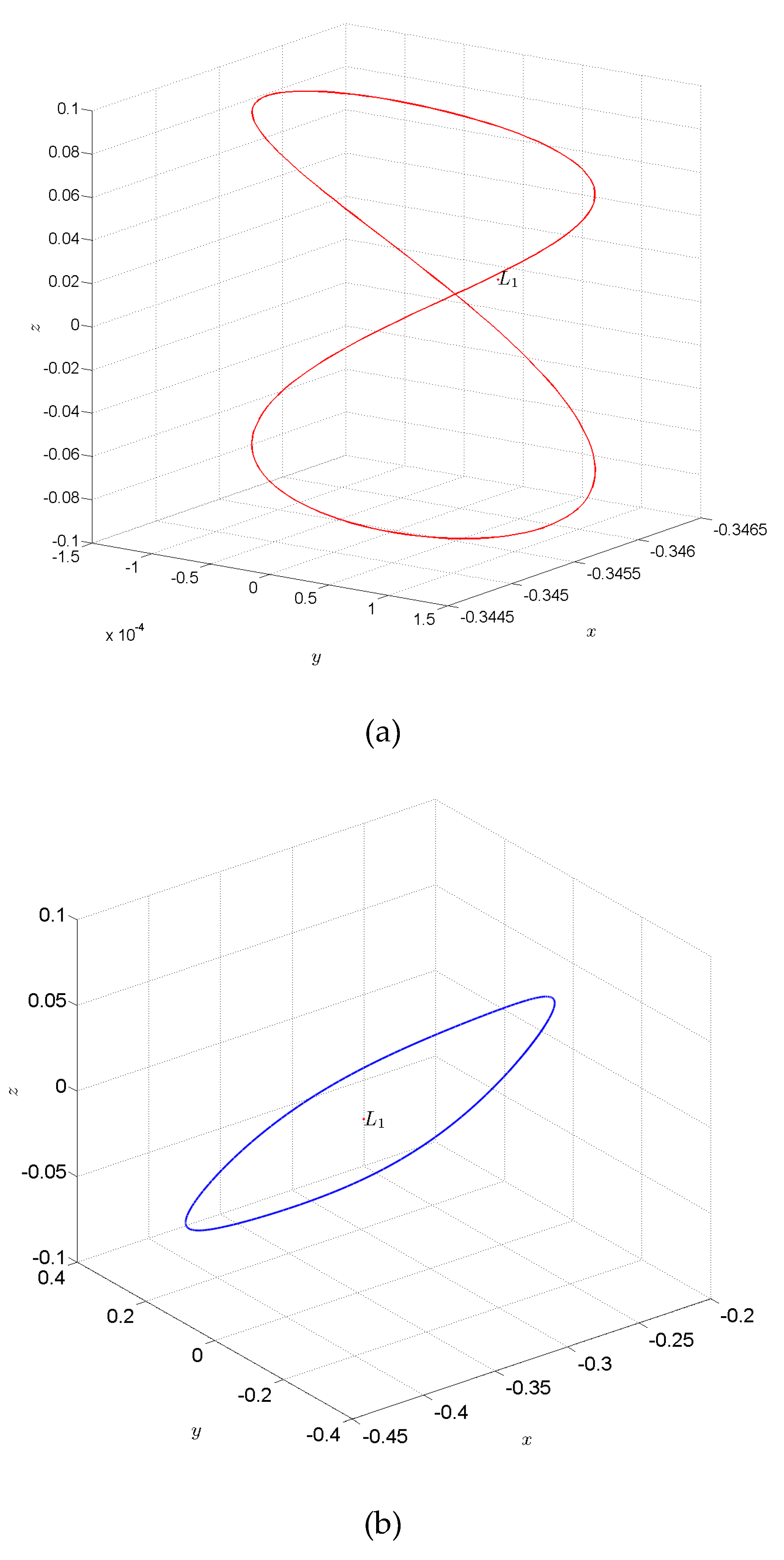
Section 5, the 2- and 3-dimensional periodic orbits around the collinear equilibrium points are computed using the Lindstedt–Poincaré method.
Section 6 summarizes the study.
2. Dynamical Equations
For the sake of convenience, we first introduce the normal rotating dimensionless coordinate system
, of which the origin is located in the centroid of two primary bodies with masses
and
, where
. Assuming that the coordinate of the third particle is
, the two primaries are located at
and
, respectively. According to Singh et al. [
17] and Jain et al. [
10], the equations of motion of the third particle are
where α represents the modification of perturbation on the Coriolis force and the potential function
admits the following form
denotes the modification of perturbation on the centrifugal force and
and
are the radiation factors of the primaries. In addition,
and
denote the distances between the third particle and the first and second primaries, respectively. On account of the triaxiality of the primaries, the mean perturbed motion
is defined by
where
is the semi-axis of the first primary,
is the semi-axis of the second primary, and
is the dimensional distance between the two primaries. The physical parameters of the binary HD 191408 system are shown in
Table 1.
The first Jacobi-type function of the system (1) is
where
is the motion velocity of the third particle and
C is the Jacobi constant.
3. Analysis of the Bifurcation and Chaos
In this section, the bifurcation diagrams of the state variables in terms of different parameters in the binary HD 191408 system are illustrated, and the effects of each parameter on the system are analyzed.
For the given values of
Table 1, we selected the iterative initial value
and limit parameter
in the interval
. By applying the ode45 numerical integration algorithm [
32], we obtain the results in
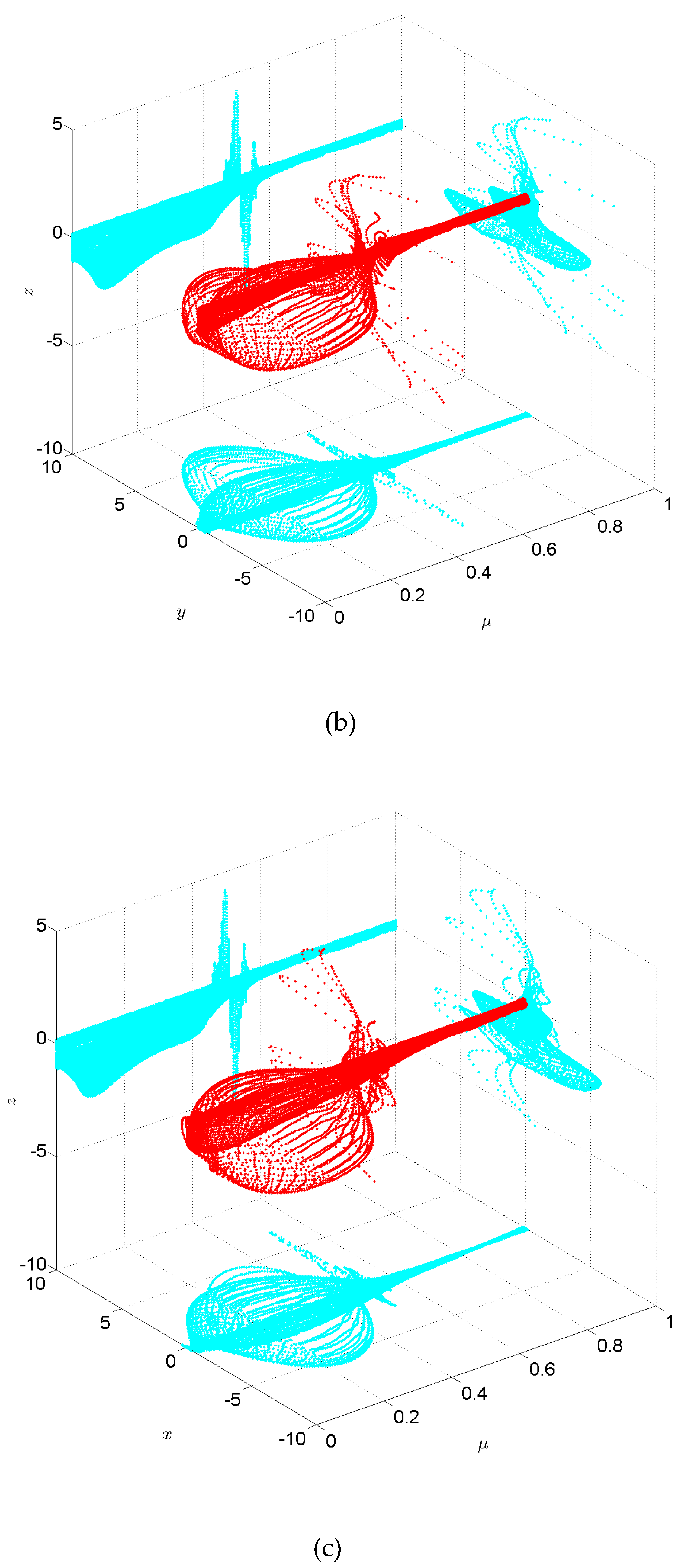
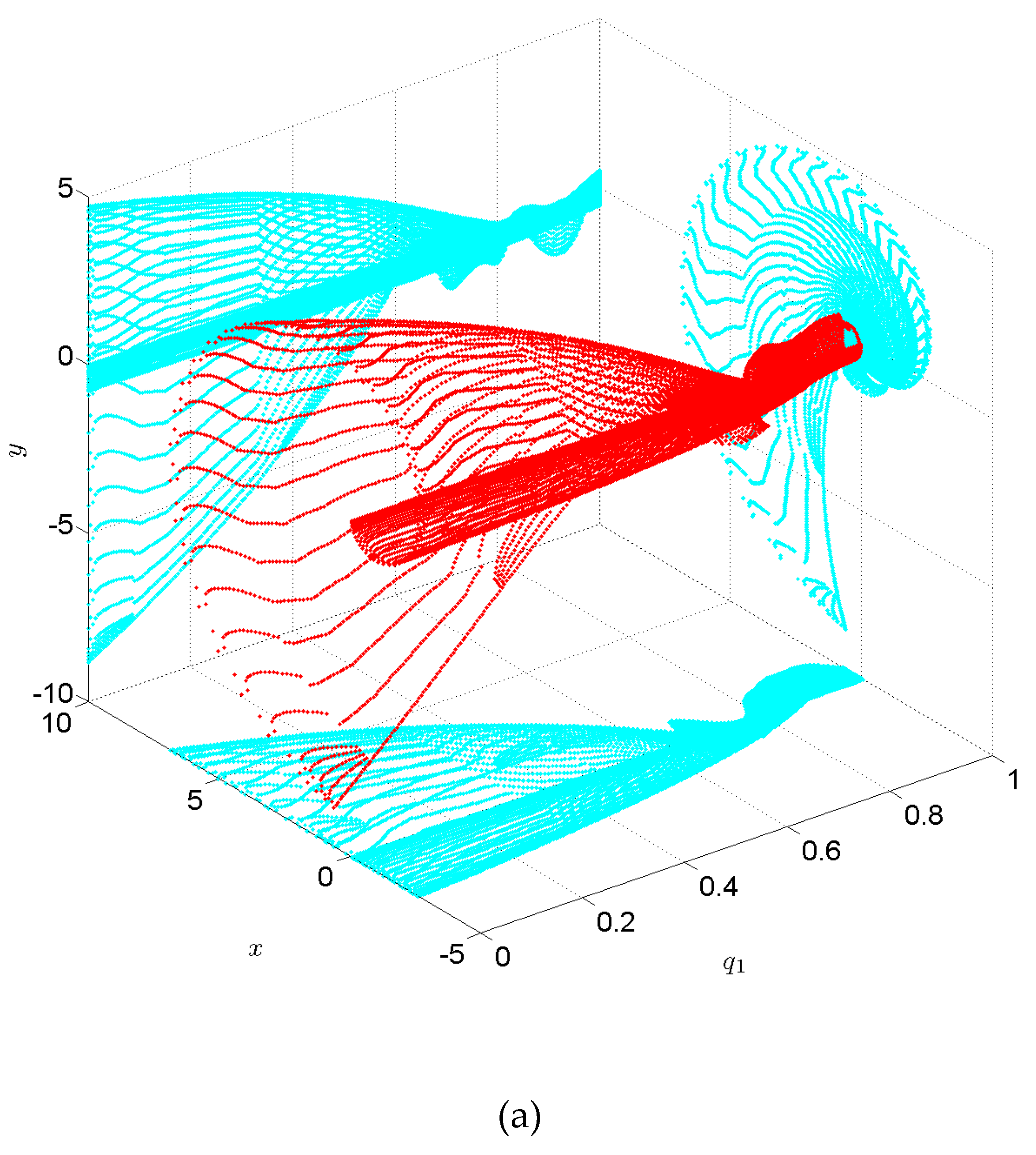
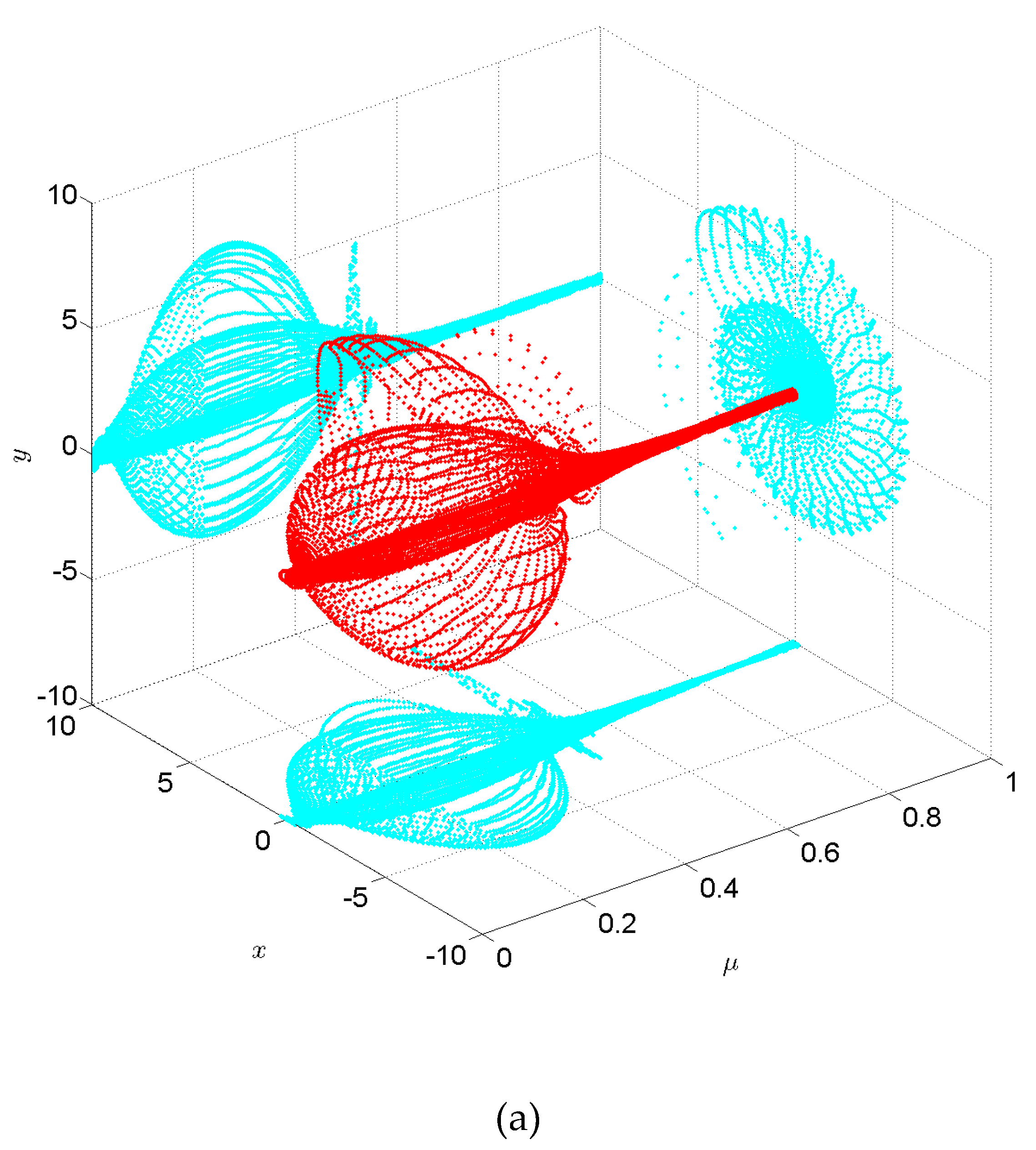
Figure 1; namely, the bifurcation diagrams of three state variables, frames of
,
, and
, in terms of mass parameter
in the binary HD 191408 system.
Figure 1a shows the effect of
in the
frame; for a given value of
, the bifurcation diagram in the
frame in terms of
is obtained.
Figure 1a also shows the bifurcation diagrams of variables
and
in terms of
, i.e., the projection from the three-dimensional diagram to the two-dimensional plane. The projections have similar structure, which is inevitable in qualitative analysis by comparing the projections. Similarly, the bifurcation diagrams in the
and
frames in terms of
are shown in
Figure 1b,c.
For each different initial value, system (1) will admit different bifurcation diagrams, but for a given initial value, we can analyze the influence of the change of perturbation parameters on the dynamic behavior of the third particle by displaying a set of bifurcation diagrams. For example, we can find clearly from
Figure 1 that chaotic motion exists in the three directions of space for the third particle when the mass parameter
. Especially when
or so, that is to say, when the masses of two primaries are approximately equal, the dynamic behavior of the third particle changes greatly. However, its dynamic behavior decreases significantly when
.
Similarly, we select
and restrict the triaxial coefficient
to the interval
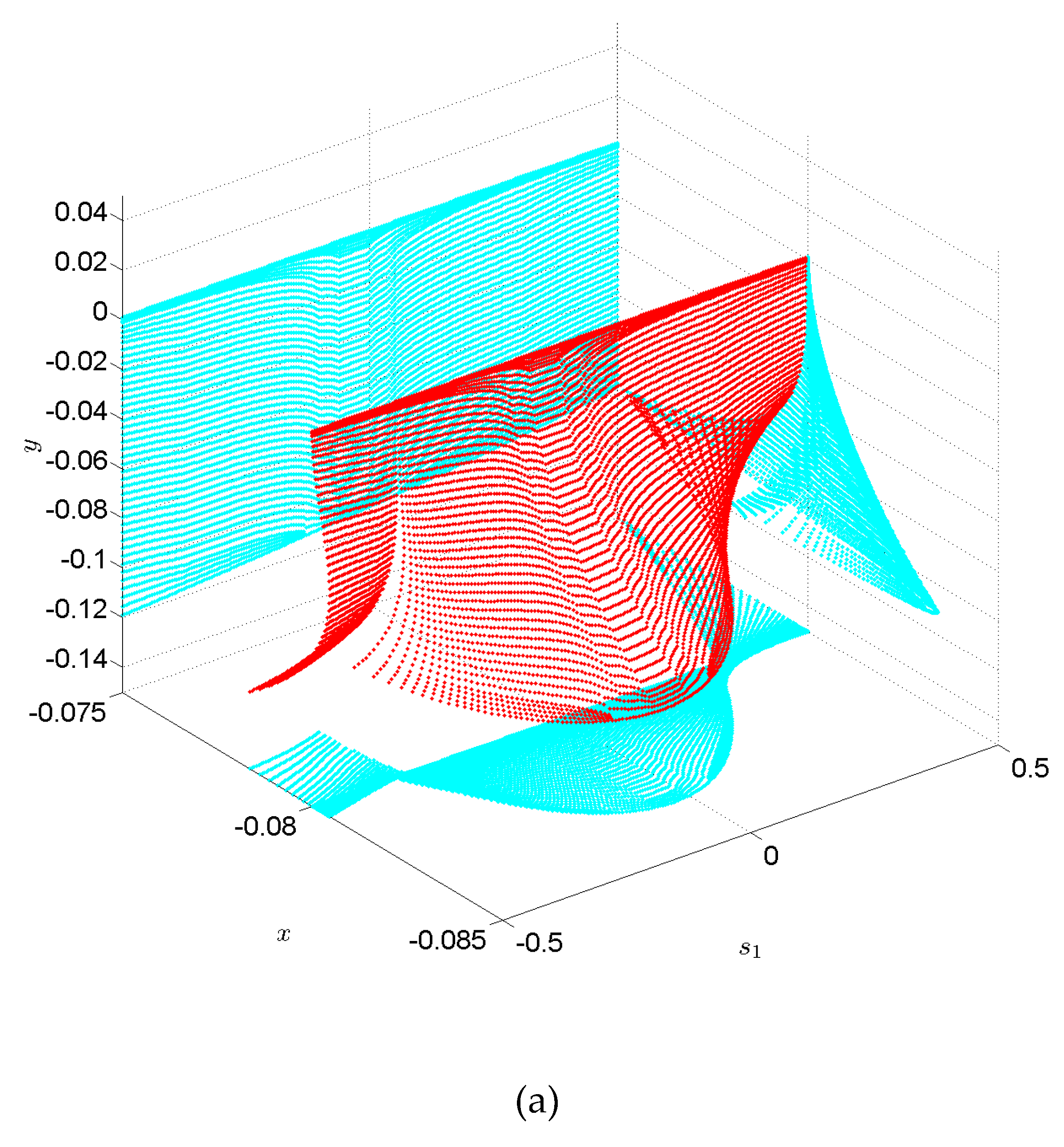
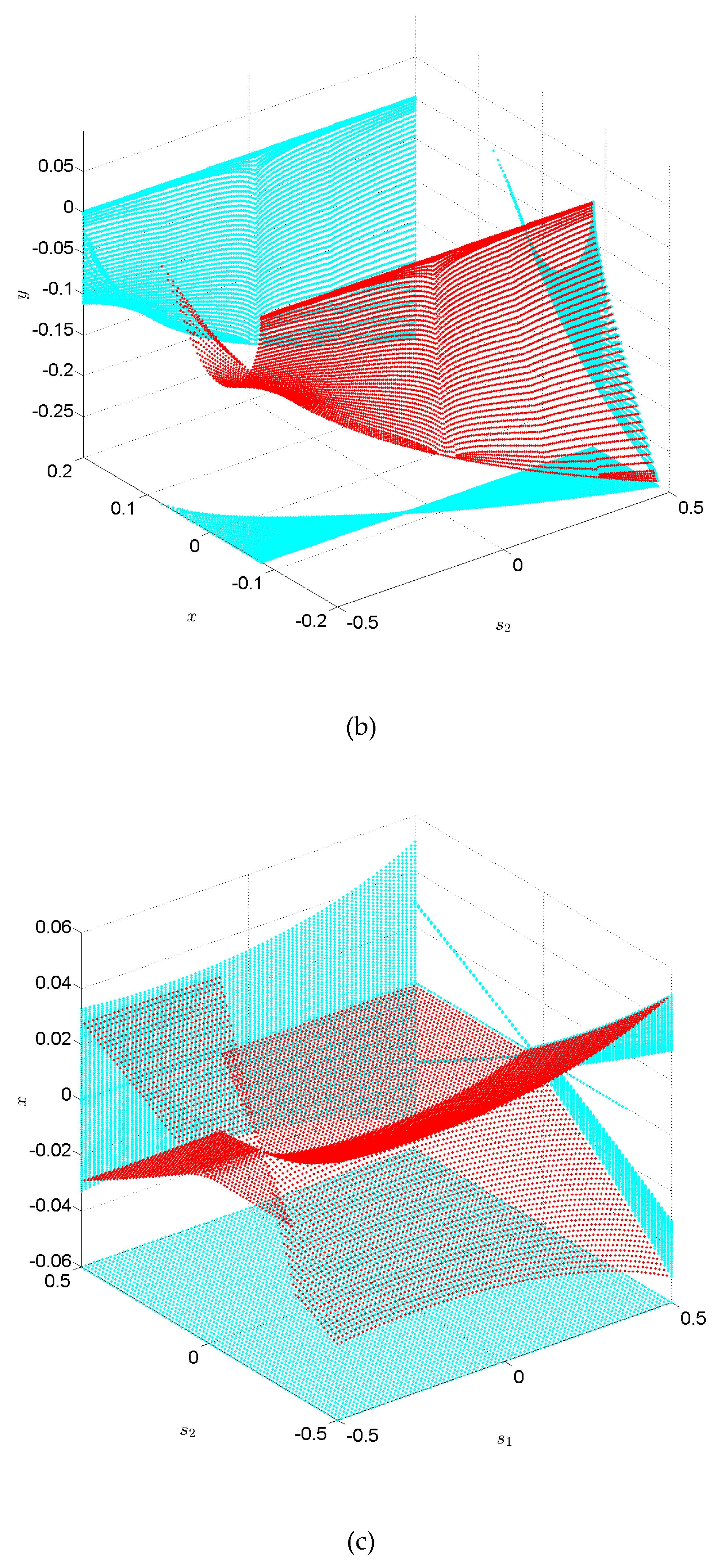
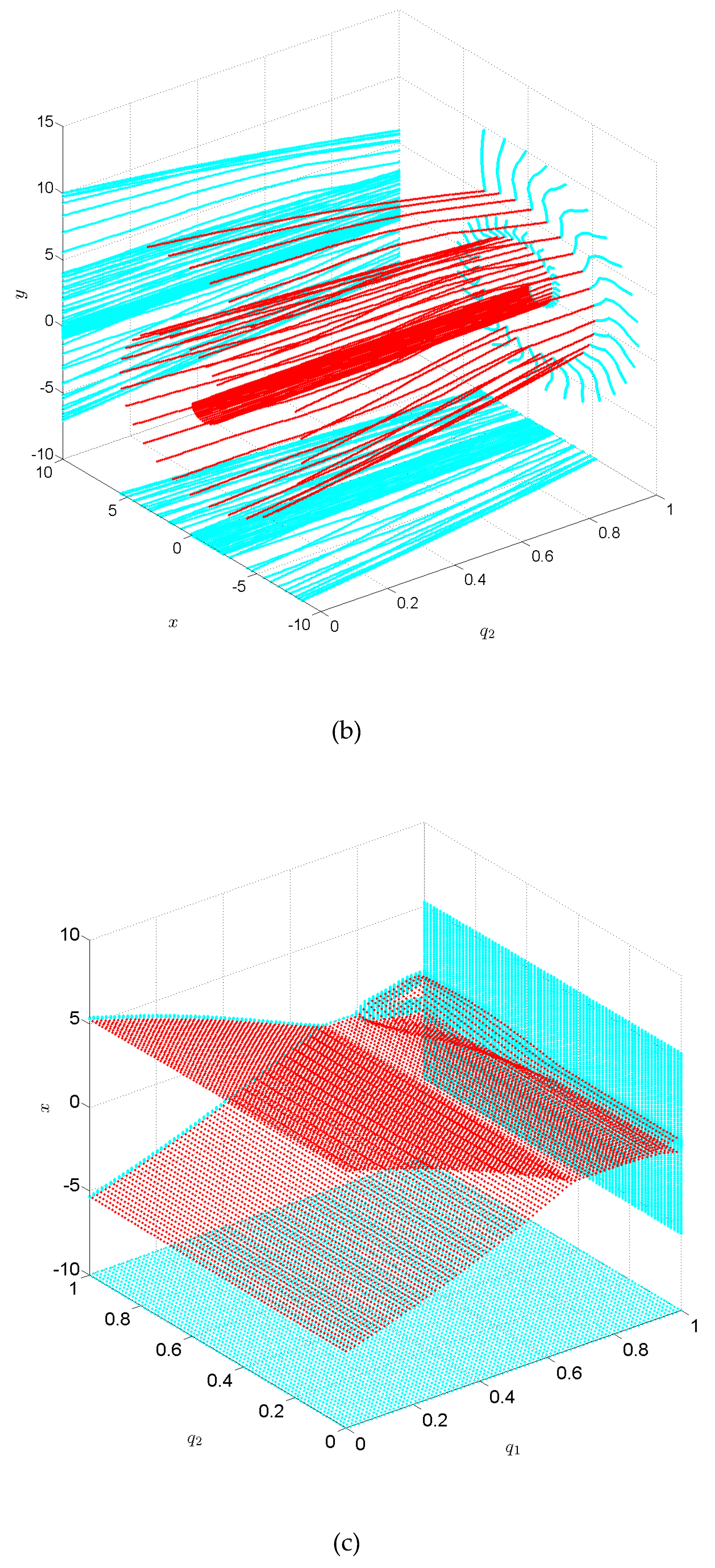
. The bifurcation diagrams of the state variables with respect to the triaxial coefficient
are shown in
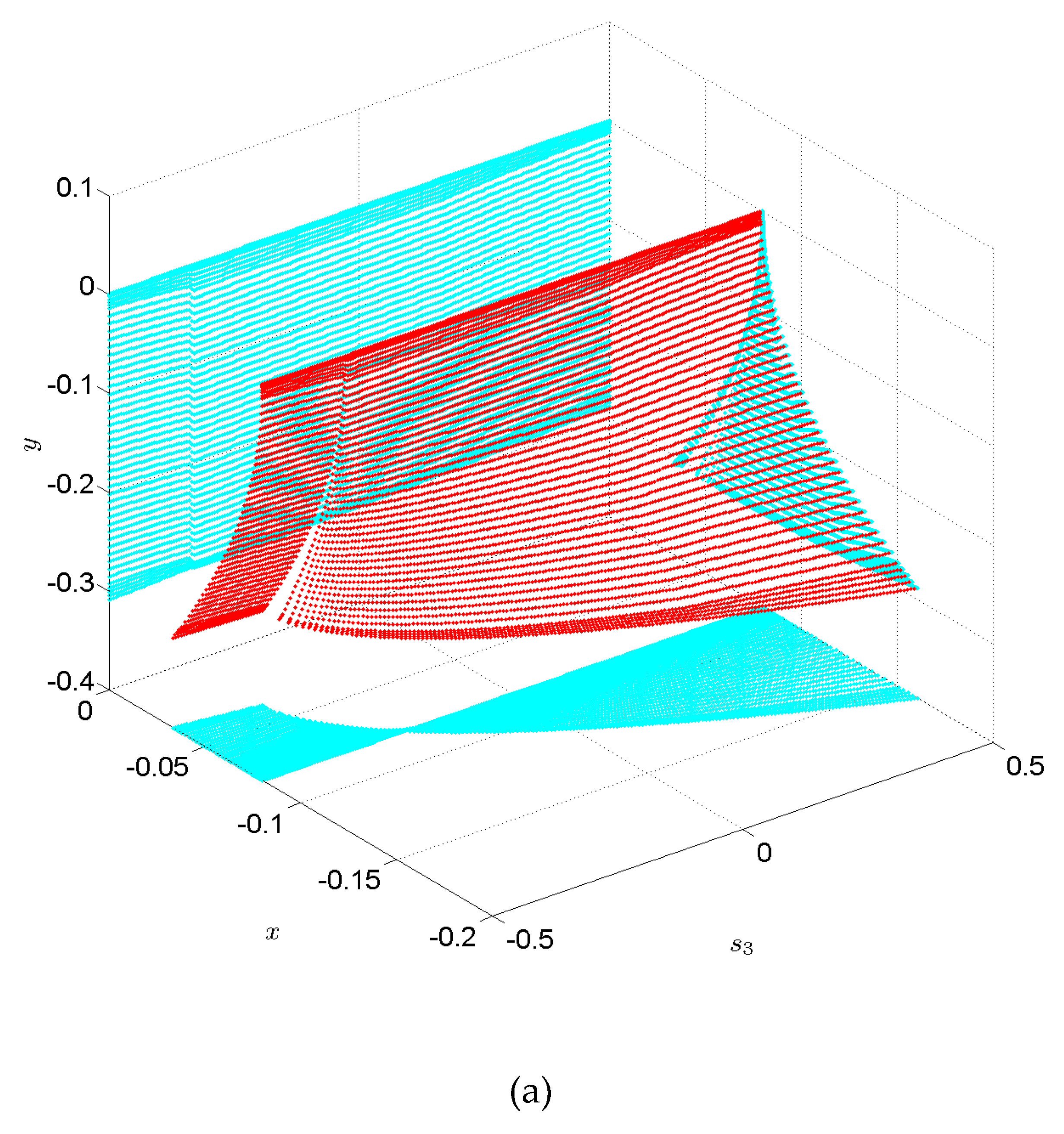
Figure 2 and
Figure 3.
Figure 2a shows that the triaxial coefficient
of the first primary has little effect on the motion amplitude of the third particle in the
direction, although it will cause the overall displacement of the third particle in this direction. It has a great influence on the movement of the third particle in the
direction, especially when
takes the threshold value around ±0.32, the movement of the third particle in the
direction will be the opposite.
Figure 2b shows that the triaxial coefficient
of the first primary will cause the motion amplitude of the third particle to expand gradually in the
direction, and when
takes the threshold value of
0.07 in the
direction, the movement of the third particle in this direction will also be in the opposite direction.
Figure 2c shows that the combination of the triaxial coefficients
and
acts on the third particle in the
direction. The result shows that the effect on the dynamic behavior of the third particle is greater when their values pass the threshold
and
.
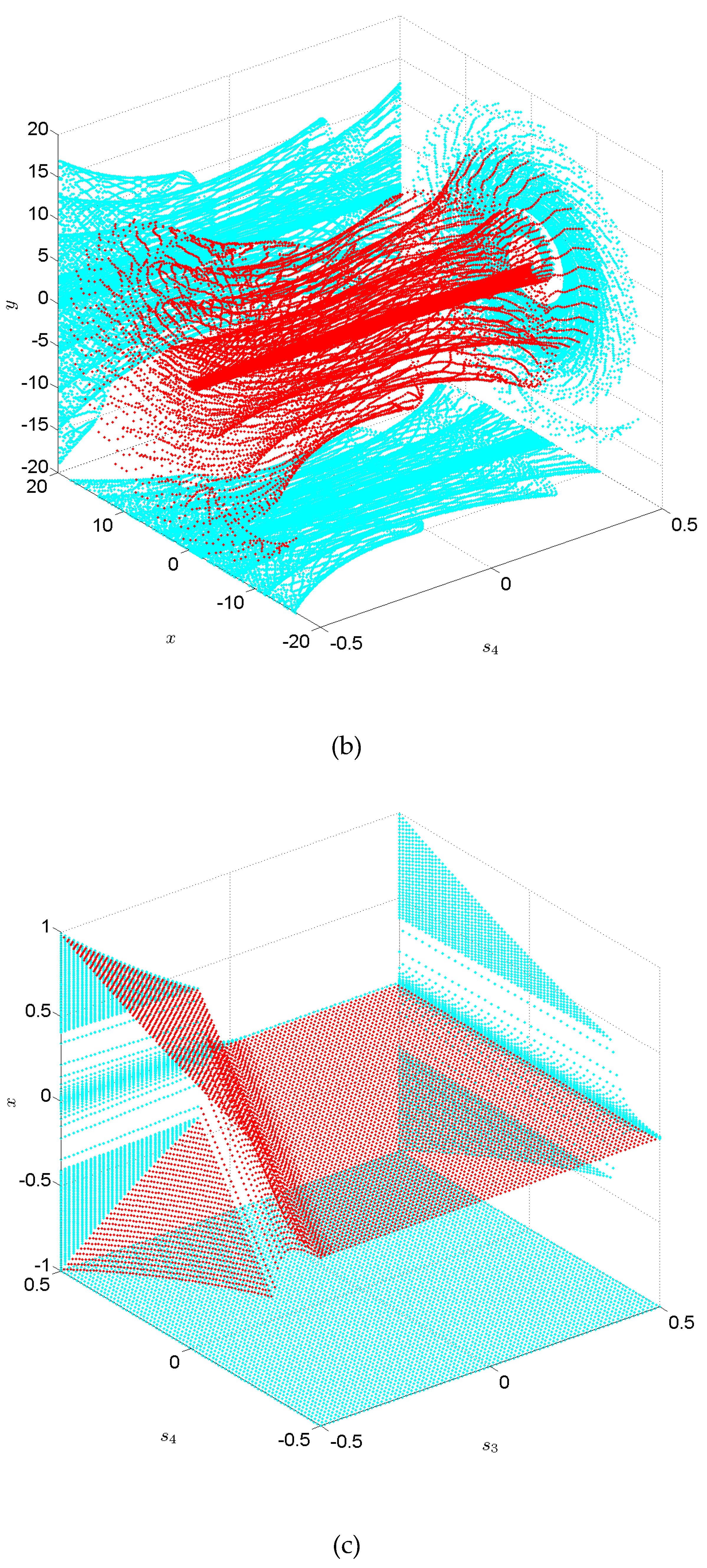
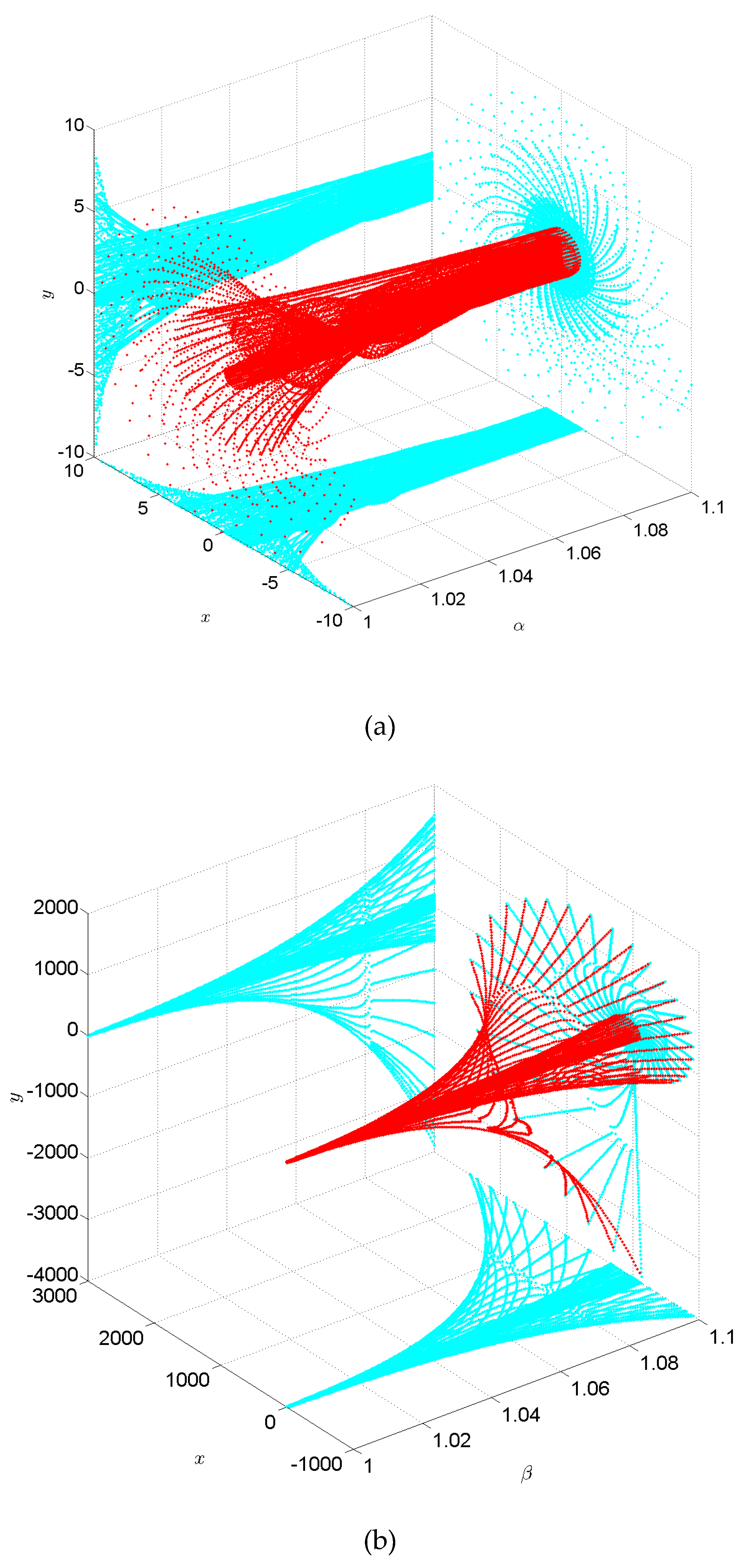
Figure 3 reflects the effect of the three semi-axes perturbations of the second primary on the dynamics of the third particle.
Figure 3a shows that
has little effect on the movement amplitude of the third particle in the
direction, except that the third particle will have an overall shift in this direction. In the
direction, when the value of
passes the threshold value of −0.2, the movement of the third particle will change greatly.
Figure 3b shows that the effect of
on the movement of the third particle in
and
directions is extremely complex, and obvious chaos has appeared.
Figure 3c shows that under the joint action of
and
, with the increase of
and the decrease of
, the dynamic behavior of the third particle in the
direction tends to be stable.
Next we select
and restrict the radiation coefficient
to the interval
.
Figure 4 reflects the influence of the radiation factors
of the primaries on the dynamic behavior of the third particle.
Figure 4a shows that the effect on the third particle in the
and
directions is the same basically, both of which are gradually reduced from large-scale movements as the radiation factor
increases. It can be found from
Figure 4b that the change of radiation factor
has little effect on the dynamic behavior of the third particle, but under the combined effect of radiation factors
and
(see
Figure 4c), the third particle exhibits periodic motion in the
direction when
.
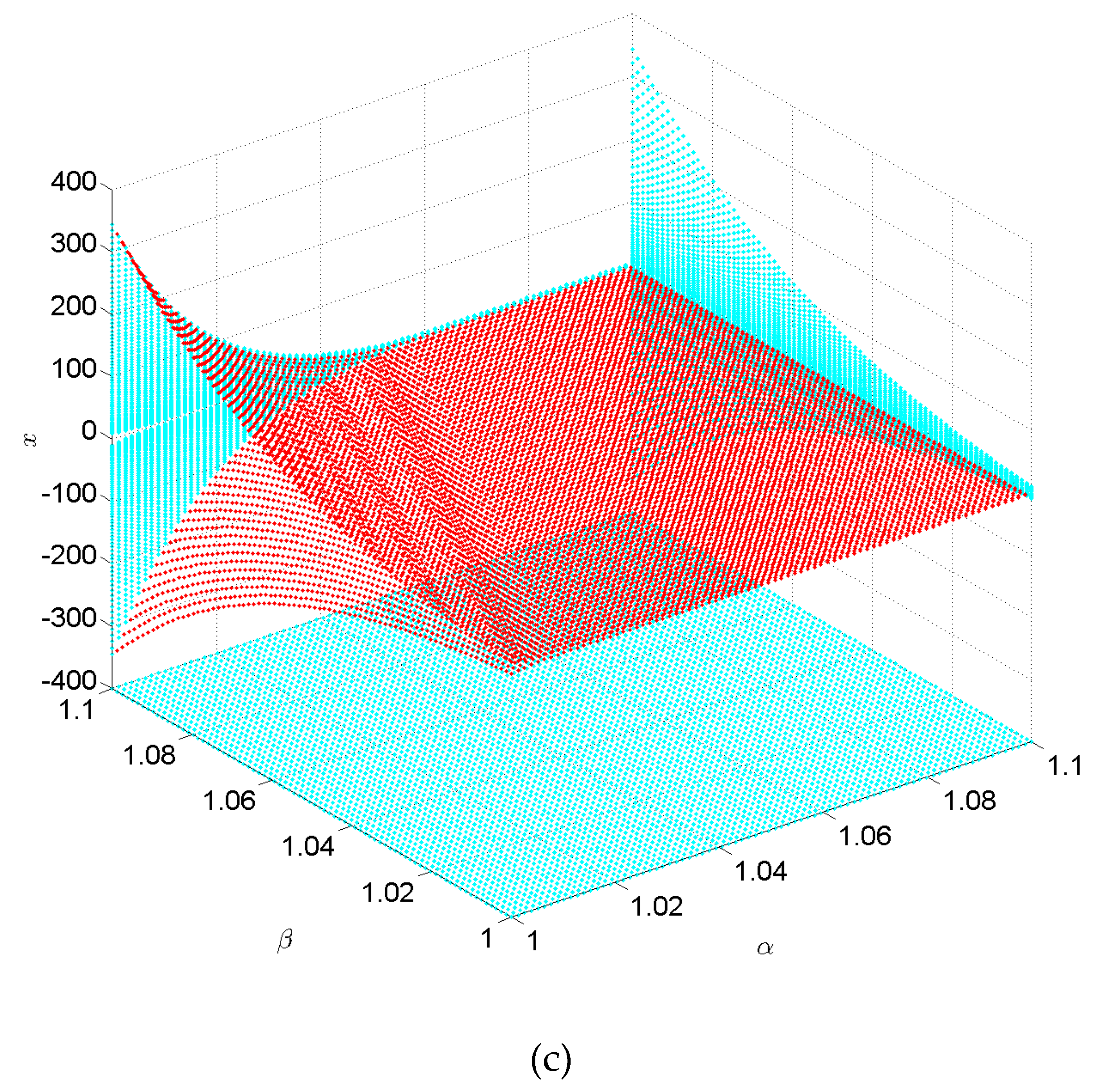
For the values of the Coriolis and centrifugal forces, which are restricted in the interval
. The bifurcation diagram in
Figure 5a shows that the modification in the Coriolis force
has a similar effect on the third particle in the
and
directions, both of which tend to a certain range gradually with the increase of
from large-scale motion. From
Figure 5b, we find that the movement of the third particle in the
and
directions appears divergent as the modification in the centrifugal force
increases; that is, the movement amplitude in both directions increases. However, the third particle shows periodic motion in the
direction with the increase of
and
.
4. Equilibrium Points
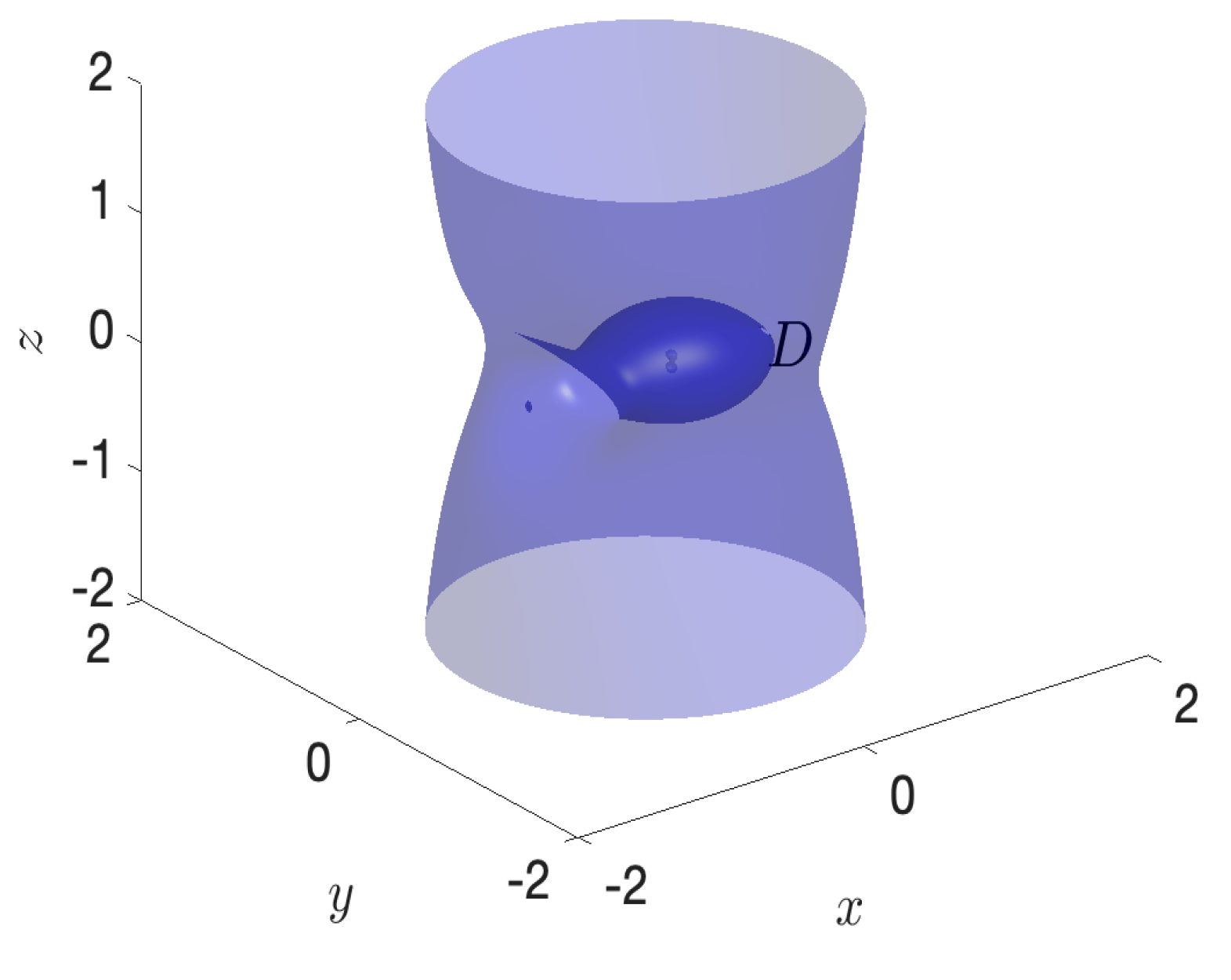
For the Jacobi-type function (4) of the system, when the motion velocity of the third particle is zero, the three-dimensional space of the system with the change of Jacobi constant
C is shown in
Figure 6,
Figure 7,
Figure 8,
Figure 9 and
Figure 10. When
C decreases from
C = 3, five equilibrium points
A,
B,
D,
E, and
F can be obtained. A smaller
C value corresponds to the larger permissible regions of motion of the third particle. The specific analysis is as follows:
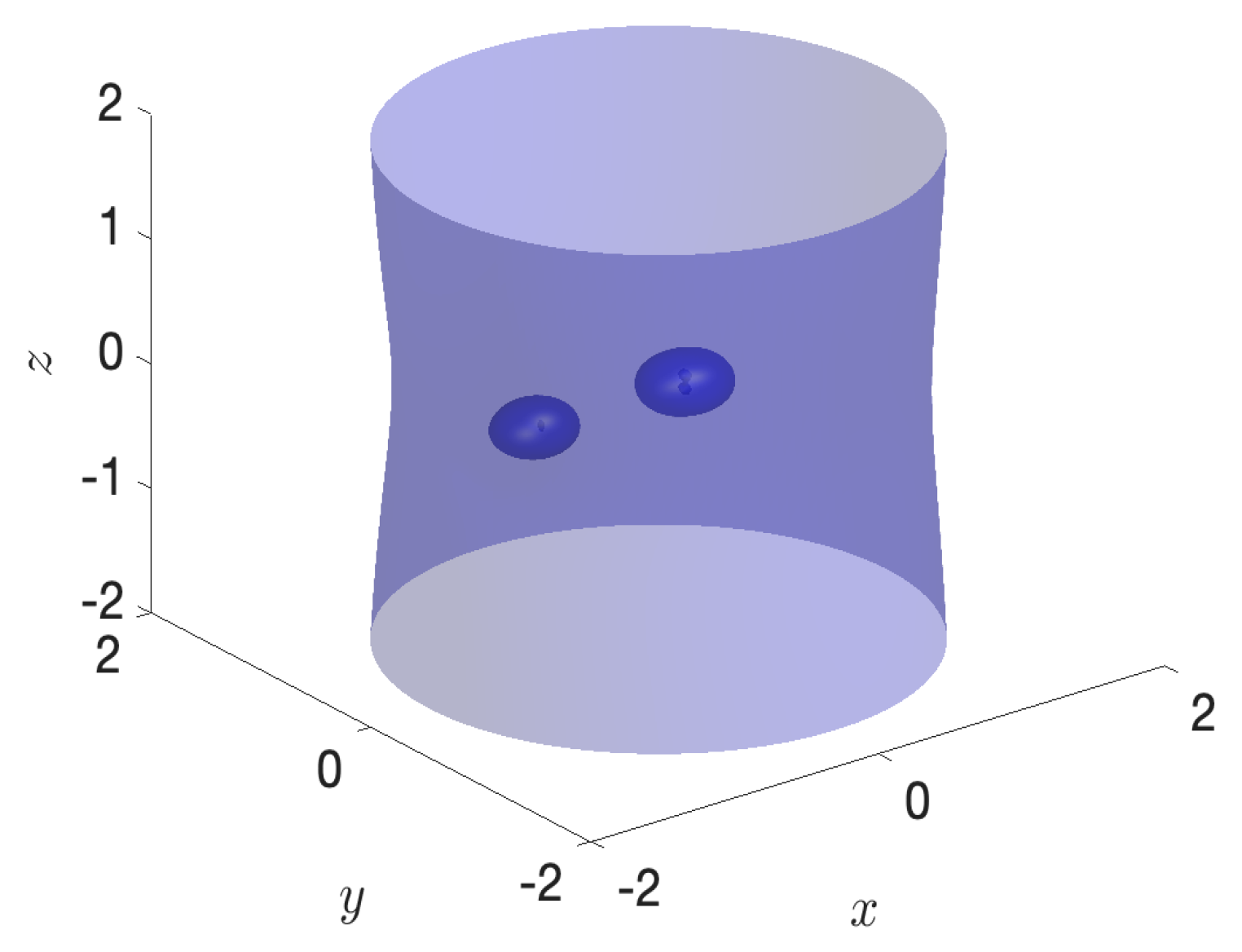
When
C = 3, the zero-velocity surface of the third particle is shown in
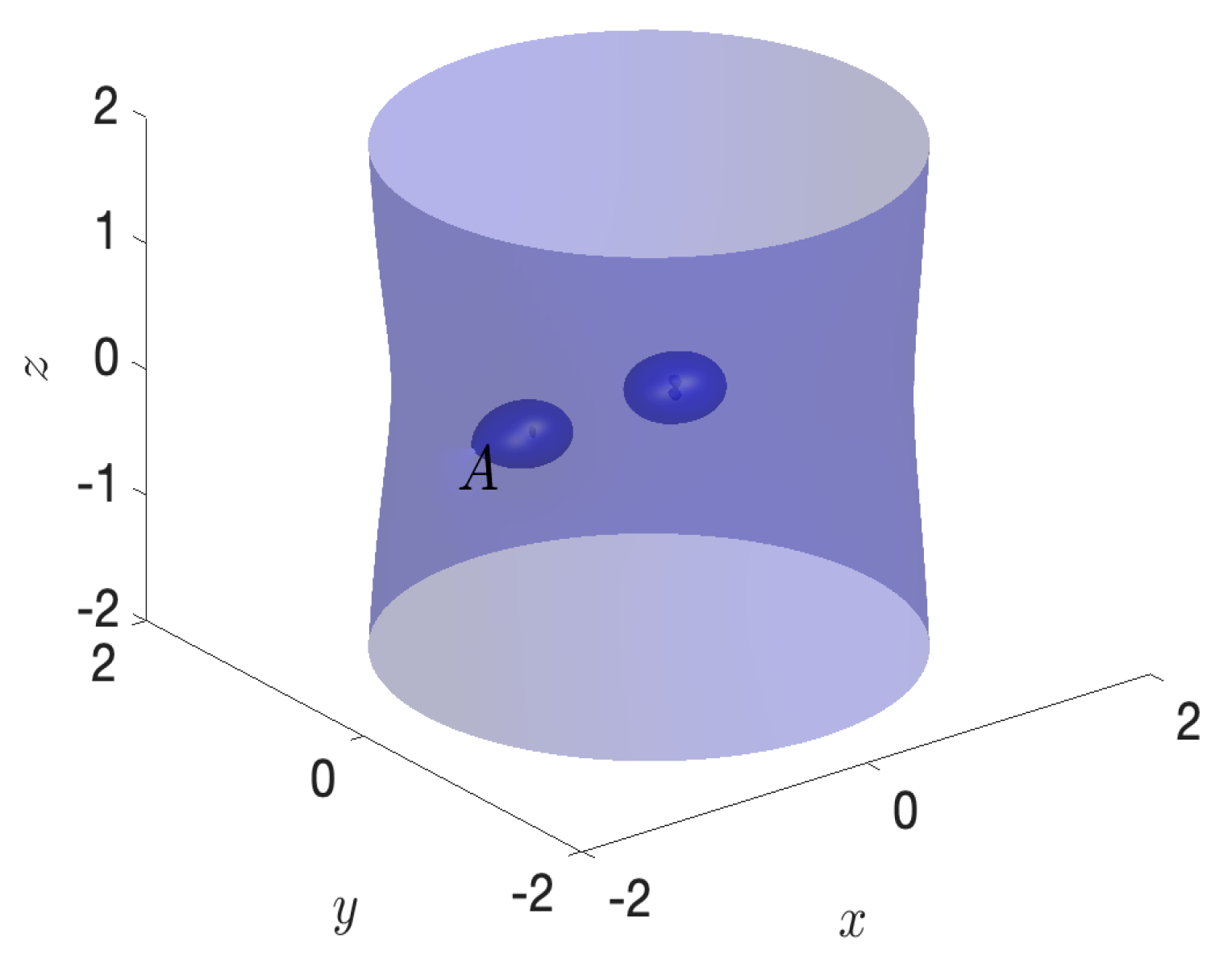
Figure 6. The third particle can only skim over two primaries under the action of gravity but cannot pass through the forbidden area around them. When
C = 2.914, the forbidden area of one of the primaries and the outer forbidden one will intersect at point
A (see
Figure 7). The third particle can fly to the outer space through the channel
A. In fact, this point
A is the first equilibrium point.
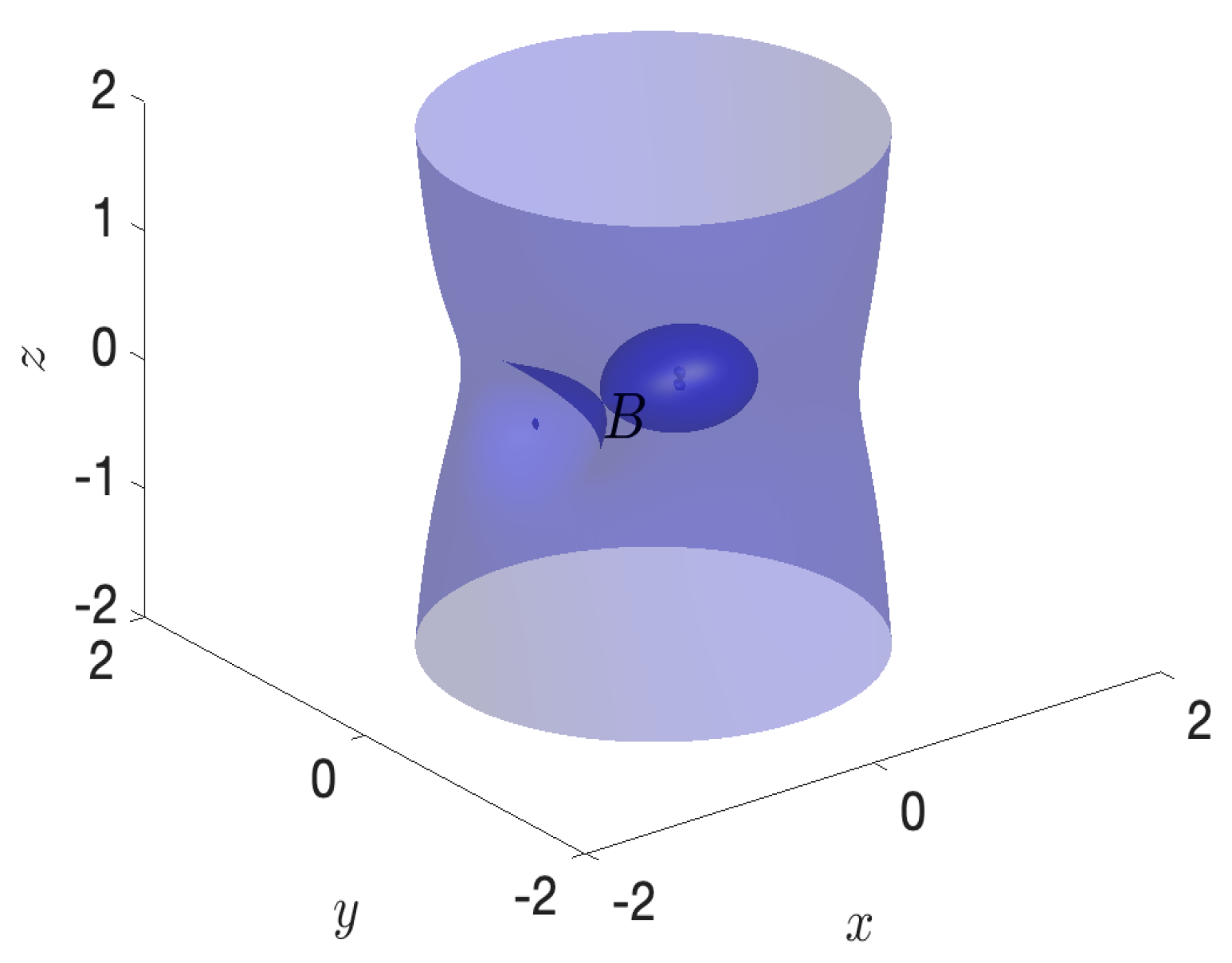
When
C is 2.1943, as shown in
Figure 8, the prohibited region of the third particle decreases. The “Channel
B” appears, through which the third particle can fly from the permissible regions of one primary to another. Meanwhile, the second equilibrium point can be obtained. When
C drops to 1.9777 (see
Figure 9), “Channel
D” appears, where the third particle can fly into another outer space. Thus, the third equilibrium point appears.
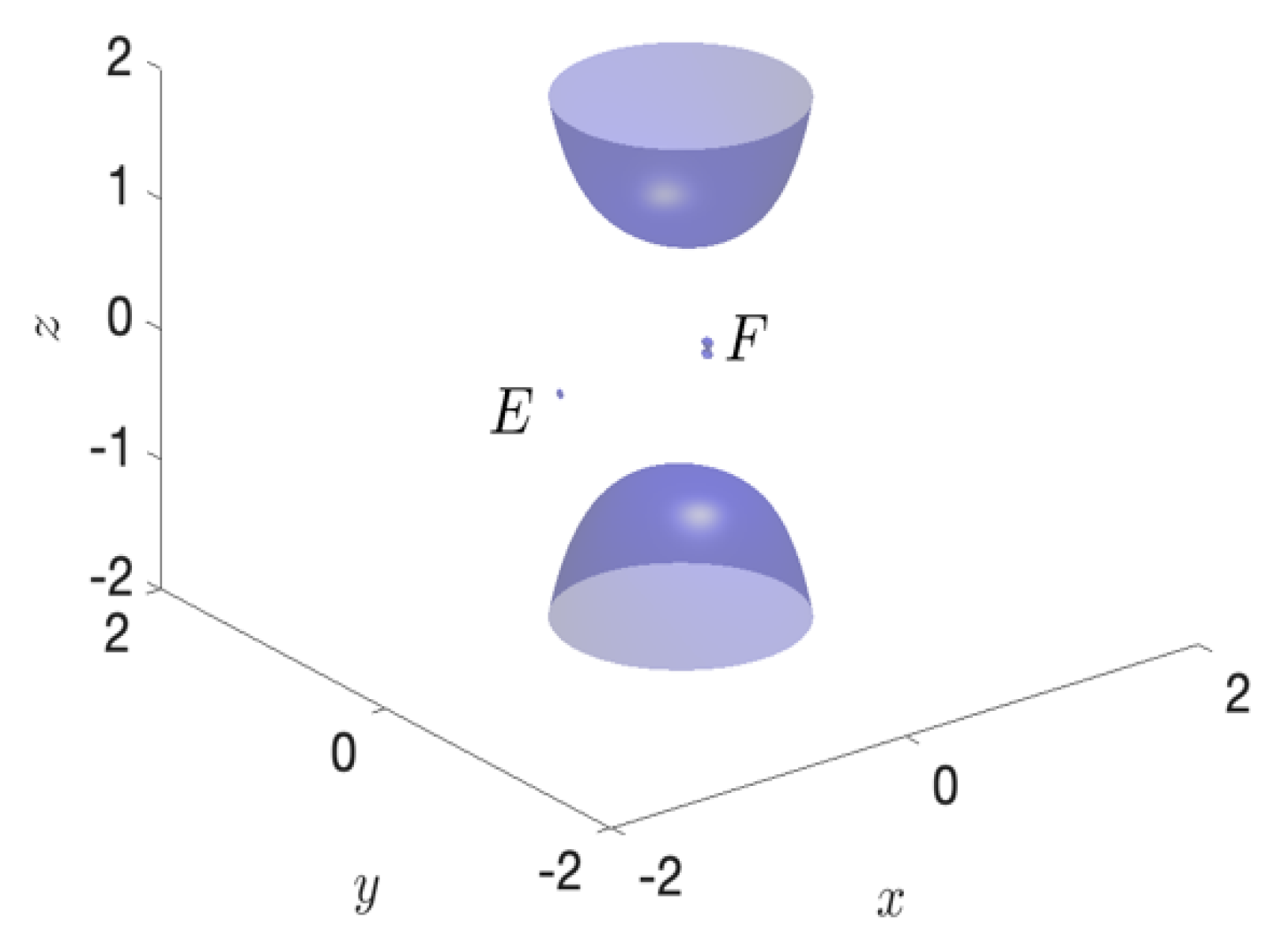
When
C = 1 (see
Figure 10), the last two equilibrium points
E and
F appear. With the decrease of
C, the third particle can remove the primaries to fly into outer space.
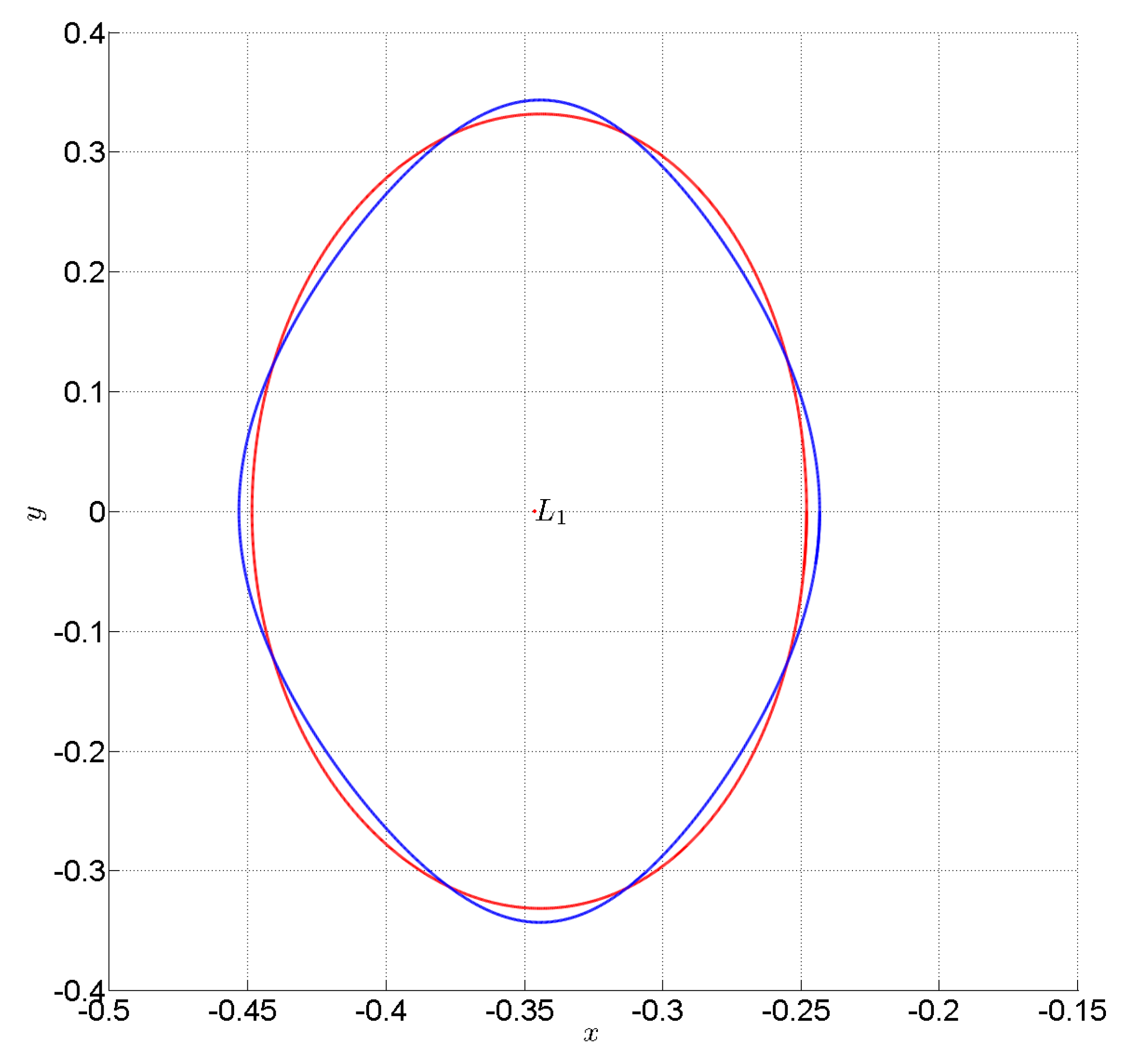
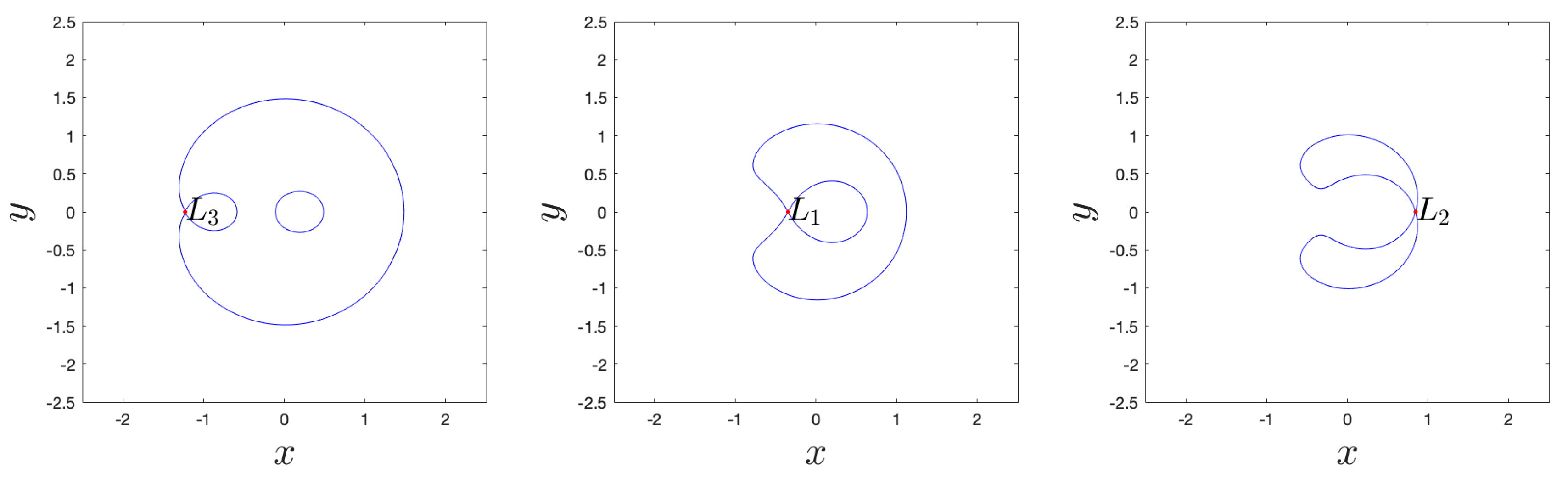
According to the discussion of zero velocity surface, when
C takes 2.914, 2.1943, and 1.9777, the related zero velocity curves are shown in
Figure 11. Therefore, three collinear equilibrium points are
,
, and
, respectively.
6. Conclusions
In this paper, we focus on constructing the approximate analytical periodic solutions of the binary HD 191408 system by using Lindstedt-Poincaré method. The obtained second- and third-order periodic solutions in the plane and three-dimensional space generalized the corresponding ones in [
17].
In addition, we perform extensive numerical research on the bifurcation of the system to discuss the effects of nine perturbations on the third particle’s dynamic behavior. These nine parameters include mass ratio , triaxial coefficients , radiation factors and , the modification in the Coriolis force , as well as the modification in the centrifugal force . The results show that when the mass ratio parameter , it has a greater effect on the third particle’s dynamic behavior than when , and it has the strongest effect on the dynamic behavior of the third particle when . Furthermore, the triaxial coefficients and have a more significant impact on the system than and . This mainly reflects that the dynamic behavior of the third particle changes greatly when the system is under the joint action of and , but it gradually stabilizes under the combined action of and .
Furthermore, compared with the corresponding radiation factor and the modification in the Coriolis force , we also find that radiation factor and the modification in the centrifugal force have a greater impact on the dynamic behavior of the third particle, but with the increase of and , the dynamic behavior of the third particle stabilizes gradually, and the same happens when and increase together. It is hoped that the above results will help us to understand the dynamic evolution of binary system.