Article

Modified Teleparallel f(T) Gravity, DESI BAO and the H0 Tension

by
Mariam Bouhmadi-López
1,2,3,*,
Carlos G. Boiza
2,3,
Maria Petronikolou
4,5 and
Emmanuel N. Saridakis
5,6,7
1
IKERBASQUE, Basque Foundation for Science, 48011 Bilbao, Spain
2
Department of Physics, University of the Basque Country UPV/EHU, P.O. Box 644, 48080 Bilbao, Spain
3
EHU Quantum Center, University of the Basque Country UPV/EHU, P.O. Box 644, 48080 Bilbao, Spain
4
Department of Physics, National Technical University of Athens, Zografou Campus, GR 157 73 Athens, Greece
5
Institute for Astronomy, Astrophysics, Space Applications and Remote Sensing, National Observatory of Athens, 15236 Penteli, Greece
6
Departamento de Matemáticas, Universidad Católica del Norte, Avda. Angamos 0610, Casilla 1280, Antofagasta 1270398, Chile
7
CAS Key Laboratory for Researches in Galaxies and Cosmology, Department of Astronomy, University of Science and Technology of China, Hefei 230026, China
*
Author to whom correspondence should be addressed.
Universe 2026, 12(3), 81; https://doi.org/10.3390/universe12030081
Submission received: 2 February 2026 / Revised: 3 March 2026 / Accepted: 11 March 2026 / Published: 14 March 2026
(This article belongs to the Special Issue Exploring and Constraining Alternative Theories of Gravity)

Abstract

We investigate whether late-time modifications of gravity in the teleparallel framework can impact the current tension in the Hubble constant H 0 , focusing on f ( T ) cosmology as a minimal and well-controlled extension of General Relativity. We consider three representative f ( T ) parametrisations that recover the teleparallel equivalent of General Relativity at early times and deviate from it only in late epochs. The models are confronted with unanchored Pantheon+ Type Ia supernovae, DESI DR2 baryon acoustic oscillations, compressed Planck cosmic microwave background distance priors, and redshift-space distortion data, allowing us to jointly probe the background expansion and the growth of cosmic structures. Two of the three models partially shift the inferred value of H 0 towards local measurements, while the third worsens the discrepancy. This behaviour is directly linked to the effective torsional dynamics, with phantom-like regimes favouring higher H 0 values and quintessence-like regimes producing the opposite effect. A global statistical comparison shows that the minimal f ( T ) extensions considered here are not favoured over ΛCDM by the combined data. Nevertheless, our results demonstrate that late-time torsional modifications can non-trivially redistribute current cosmological tensions among the background and growth sectors.

1. Introduction

A wide range of cosmological observations indicate that the present Universe is undergoing an accelerated phase of expansion, characterised by the dominance of an effective component with negative pressure in the late-time energy budget. This conclusion is primarily supported by luminosity distance measurements of Type Ia supernovae [1,2,3], which provide direct evidence of a transition from decelerated to accelerated expansion, and is further reinforced by observations of the cosmic microwave background through distance priors and the angular scale of the acoustic peaks [4,5,6,7], as well as by baryon acoustic oscillation measurements in the large-scale distribution of galaxies [8,9,10,11,12]. Additional support is provided by independent determinations of the expansion history from cosmic chronometers [13,14] and local measurements of the Hubble parameter [15], which together place stringent constraints on the late-time dynamics of the Universe.
In order to account for this observationally established accelerated expansion, the standard cosmological framework models the large-scale dynamics of the Universe within the Friedmann–Lemaître–Robertson–Walker (FLRW) spacetime by introducing a dark energy component with an equation of state parameter close to w = 1 . In the concordance Λ CDM paradigm [16], this role is played by a cosmological constant, which successfully reproduces the observed expansion history across a wide range of redshifts. Despite its phenomenological success, however, the cosmological constant suffers from well-known theoretical difficulties, including the fine-tuning and coincidence problems [17,18]. Moreover, the increasing precision of cosmological observations has revealed persistent tensions within the standard model, most notably the discrepancy between early- and late-Universe determinations of the Hubble constant [19]. These challenges have motivated the exploration of alternative scenarios, such as dynamical dark energy models [20] and modified theories of gravity [21], in which additional degrees of freedom or deviations from General Relativity can give rise to late-time cosmic acceleration.
Modified theories of gravity provide a compelling and well-motivated framework to describe the late-time accelerated expansion of the Universe without resorting to a cosmological constant or an exotic dark energy component [21]. In these scenarios, cosmic acceleration emerges from deviations from General Relativity at large scales or low curvatures, leading to modified gravitational dynamics that can effectively generate a negative pressure component at late times [22,23]. Such theories allow for departures from the standard expansion history while remaining compatible with local gravity tests through suitable screening mechanisms [24,25]. Moreover, they offer new perspectives on outstanding theoretical and observational challenges, including the fine-tuning and coincidence problems associated with the cosmological constant, as well as current tensions between early- and late-Universe determinations of cosmological parameters [19]. As a result, modified gravity constitutes a versatile approach for extending the standard cosmological model and interpreting late-time observations in a unified manner [21].
From a theoretical standpoint, such extensions can be systematically constructed by generalising the gravitational action beyond its linear dependence on the Ricci scalar. In curvature-based formulations, this leads to f ( R ) gravity [26,27,28,29], where the action is promoted to an arbitrary function of the Ricci scalar, giving rise to modified field equations and rich cosmological dynamics [30]. Equivalent but conceptually distinct formulations can also be developed within teleparallel and symmetric teleparallel geometries, where gravitation is described by torsion or non-metricity instead of the curvature. In this context, f ( T ) gravity generalises the teleparallel equivalent of General Relativity by replacing the torsion scalar with an arbitrary function [31,32], while f ( Q ) gravity extends the symmetric teleparallel formulation through a general function of the non-metricity scalar [33,34]. In recent years, their cosmological applications have been explored in detail for both f ( T )  [35,36,37,38,39,40,41,42,43,44,45] and f ( Q ) gravity [46,47,48,49,50,51,52,53,54,55,56,57,58,59,60,61,62,63].
Even broader classes of models can be constructed by incorporating boundary terms that establish explicit connections between torsion- and non-metricity-based formulations of gravity, leading to generalised theories such as F ( Q , B )  [55,64] and f ( T , B )  [65,66]. These constructions provide a unified geometric description within the teleparallel and symmetric teleparallel frameworks, enlarging the space of viable cosmological models and offering a flexible setting for phenomenological studies of late-time cosmic acceleration.
In this work, we focus on f ( T ) gravity and investigate three distinct models aimed at describing the late-time accelerated expansion of the Universe. We perform a comprehensive observational analysis by confronting their predictions with current cosmological datasets, including Type Ia supernovae, baryon acoustic oscillations, the cosmic microwave background, and redshift-space distortions, allowing us to jointly probe the background expansion and the growth of cosmic structures. The models are constrained using a Bayesian Markov chain Monte Carlo analysis, and their statistical performance is assessed relative to Λ CDM through information criteria.
This paper is organised as follows. Section 2 reviews f ( T ) gravity and its formulation in a cosmological context within an FLRW universe containing radiation and baryonic and dark matter. In Section 3, we introduce the specific f ( T ) models analysed in this work. Section 4 presents the cosmological datasets employed and the statistical methodology used to constrain the model parameters. Finally, the main results and conclusions are summarised in Section 5.

2. f ( T ) Gravity and Cosmology

This section is devoted to a brief review of f ( T ) gravity and its implementation within a cosmological framework.

2.1. f ( T ) Modified Gravity

Teleparallel gravity provides an equivalent formulation of General Relativity in which gravitation is described by spacetime torsion rather than the curvature. The fundamental dynamical variables are the tetrad fields e A μ , which define the spacetime metric through
g μ ν = η A B e A μ e B ν ,
where η A B = diag ( 1 , 1 , 1 , 1 ) is the Minkowski metric. In this framework, gravitational interactions are encoded in the torsion tensor constructed from the Weitzenboeck connection1
T ρ μ ν = e A ρ μ e A ν ν e A μ ,
which is curvature-free but exhibits non-vanishing torsion.
From the torsion tensor, one defines the torsion scalar as follows:
T = S ρ μ ν T ρ μ ν ,
where S ρ μ ν is the superpotential constructed from the torsion tensor and its contractions. The teleparallel equivalent of General Relativity (TEGR) is obtained from an action linear in T and leads to field equations that are dynamically equivalent to those of General Relativity. In particular, variation in the TEGR action with respect to the tetrad fields yields equations that can be written in the standard Einstein form:
G μ ν = 8 π G T μ ν ,
where G μ ν denotes the Einstein tensor associated with the Levi–Civita connection and T μ ν is the energy–momentum tensor of matter.
As in General Relativity, diffeomorphism invariance and minimal coupling imply the covariant conservation of the energy–momentum tensor
μ T μ ν = 0 ,
ensuring local conservation of energy and momentum.
Extensions of this framework are obtained by promoting the torsion scalar in the gravitational action to an arbitrary function, giving rise to f ( T ) gravity. The action of f ( T ) gravity minimally coupled to matter is given by [31]
S = 1 16 π G d 4 x e f ( T ) + d 4 x e L m ,
where e = det ( e A μ ) = g and L m denotes the matter Lagrangian.
Varying this action with respect to the tetrad fields yields the f ( T ) field equations
e 1 μ e e A ρ S ρ μ ν f T + e A ρ S ρ μ ν ( μ T ) f T T f T e A λ T ρ μ λ S ρ ν μ + 1 4 e A ν f = 4 π G e A ρ T ρ ν ,
where f T d f / d T and f T T d 2 f / d T 2 . Despite the nonlinear dependence on the torsion scalar, the resulting field equations remain of the second order in derivatives of the tetrad fields. The matter sector continues to satisfy the standard conservation equation
μ T μ ν = 0 ,
as a consequence of diffeomorphism invariance and minimal coupling.

2.2. f ( T ) Cosmology

We next introduce the cosmological framework of f ( T ) gravity at the level of the background evolution first and then within a linear perturbation analysis, which allows for a direct comparison with cosmological observations.

2.2.1. f ( T ) Cosmology in an FLRW Universe

In a cosmological context, we consider a spatially flat FLRW spacetime described by the line element
d s 2 = d t 2 + a 2 ( t ) d x 2 + d y 2 + d z 2 ,
where a ( t ) is the scale factor and H = a ˙ / a denotes the Hubble parameter. For this background geometry, the torsion scalar reduces to
T = 6 H 2 .
Assuming a universe filled with pressureless baryonic matter, cold dark matter, and radiation, the cosmological field equations of f ( T ) gravity lead to a modified Friedmann equation and a Raychaudhuri equation governing the background expansion. These equations can be written as follows [68,69]:
H 2 = 8 π G 3 ρ b + ρ cdm + ρ r + 1 6 2 T f T f T ,
H ˙ = 4 π G 2 T f T T + f T ρ b + ρ cdm + ρ r + p r ,
where ρ r and p r = ρ r / 3 denote the energy density and pressure of radiation, respectively; ρ b and ρ cdm stand for the energy densities of baryonic matter and cold dark matter, respectively; f T d f / d T ; and f T T d 2 f / d T 2 . These expressions make explicit how deviations from the teleparallel equivalent of General Relativity modify the cosmic expansion through the torsional sector.
It is often convenient to recast the modified Friedmann equations into a form analogous to the standard cosmological equations by introducing an effective fluid description for the torsional contributions. In this representation, the Friedmann equations take the familiar form
H 2 = 8 π G 3 ρ b + ρ cdm + ρ r + ρ T ,
H ˙ = 4 π G ρ b + ρ cdm + ρ r + p r + ρ T + p T ,
where ρ T and p T represent the effective energy density and pressure associated with the torsional modifications introduced by f ( T ) gravity.
The effective torsional energy density and pressure are defined as follows [70,71]:
ρ T = 1 16 π G 2 T f T f T ,
p T = 1 16 π G 4 H ˙ 2 T f T T + f T 1 + 2 T f T f T ,
which allow the torsional sector to be interpreted as an effective dark energy component.
It is then convenient to characterise the dynamical properties of this effective fluid through an equation of state parameter
w T p T ρ T ,
which is, in general, time-dependent and determined by the specific functional form of f ( T ) . For suitable choices of f ( T ) , the effective equation of state can drive late-time accelerated expansion, providing a geometrical explanation of cosmic acceleration without the need for an explicit dark energy component.
For the observational analysis presented in the next section, it is convenient to introduce the dimensionless Hubble rate
E ( z ) H ( z ) H 0 ,
and the present-day density parameters:
Ω i 0 8 π G 3 H 0 2 ρ i 0 ,
where the subscript i 0 labels the present-day values of the energy densities of the various cosmological components. The modified Friedmann equation in f ( T ) gravity can be written as follows:
E 2 ( z ) = Ω b 0 ( 1 + z ) 3 + Ω cdm 0 ( 1 + z ) 3 + Ω r 0 ( 1 + z ) 4 + Ω T ( z ) ,
where the effective torsional density parameter is defined by
Ω T ( z ) 1 6 H 0 2 2 T f T f T , T = 6 H 0 2 E 2 ( z ) .

2.2.2. Linear Cosmological Perturbations in f ( T ) Cosmology

We now briefly discuss scalar cosmological perturbations in f ( T ) gravity [36,72,73] and derive the linear growth equation for matter density fluctuations [74,75]. This allows for a direct comparison between the perturbative behaviour of torsional and non-metricity-based modified gravity theories.
We consider scalar perturbations around a spatially flat FLRW background in the Newtonian gauge:
d s 2 = ( 1 + 2 Ψ ) d t 2 + a 2 ( t ) ( 1 2 Φ ) δ i j d x i d x j ,
where Ψ and Φ are the gauge-invariant Bardeen potentials. In general modified gravity theories, these two potentials need not coincide, leading to the presence of gravitational slip.
On subhorizon scales, a H k , and within the quasi-static approximation, the linearised field equations of f ( T ) gravity lead to modified Poisson equations of the forms
k 2 Ψ = 4 π G eff ( a ) a 2 ρ m δ m ,
k 2 Φ = 4 π G eff ( a ) η ( a ) a 2 ρ m δ m ,
where ρ m and δ m denote the background matter density and its density contrast, respectively. The quantity G eff is the effective gravitational coupling, while
η ( a ) Φ Ψ
is the gravitational slip parameter.
For f ( T ) gravity, the effective gravitational coupling and slip parameter are given by2
G eff ( a ) = G f T , η ( a ) = 1 ,
where f T d f / d T is evaluated on the homogeneous background. Therefore, although gravity is effectively modified relative to General Relativity, the absence of additional anisotropic stress of a linear order implies that the two metric potentials remain equal, provided one works on subhorizon scales within the quasi-static approximation.
By combining the modified Poisson equation with the conservation equations for pressureless matter
δ ˙ m + θ m a = 0 , θ ˙ m + H θ m k 2 a Ψ = 0 ,
where θ m is the divergence of the matter velocity field, one obtains the evolution equation for the matter density contrast [72,73]:
δ ¨ m + 2 H δ ˙ m 4 π G eff ( a ) ρ m δ m = 0 .
By introducing derivatives with respect to ln a and defining primes as d / d ln a , this equation can be written as follows:
δ m + 2 + H H δ m 3 2 Ω m ( a ) G eff ( a ) G δ m = 0 .
This expression makes it explicit that deviations from General Relativity enter the growth of cosmic structures exclusively through the effective gravitational coupling G eff , while the gravitational slip remains trivial.

3. Specific f(T) Models and Effective Torsional Fluid

Having established the general framework of f ( T ) gravity and its cosmological background equations, we now introduce the specific functional forms of f ( T ) that will be analysed in this work.
Let us start by defining the present value of the torsion scalar as follows:
T 0 6 H 0 2 ,
where H 0 is the Hubble constant today. By construction, all models reduce to the teleparallel equivalent of General Relativity (TEGR) in the early Universe and introduce deviations relevant only at late times.
We next present the models we will be considering:
  • First model: The first model is given by
    f 1 ( T ) = T e λ 1 T 0 / T ,
    with λ 1 being a dimensionless parameter. This model was originally proposed in [76] and subsequently analysed in detail in [77]. The corresponding torsional energy density can be written as
    ρ T ( 1 ) = T 16 π G e λ 1 T 0 / T 1 2 λ 1 T 0 T 1 ,
    while the pressure follows directly from Equation (16).
    The effective gravitational coupling in Equation (26) reads as follows:
    G eff ( 1 ) G = 1 e λ 1 T 0 / T 1 λ 1 T 0 T .
    Imposing the modified Friedmann equation (Equation (11)) at z = 0 ( T = T 0 and E ( 0 ) = 1 ) fixes λ 1 through
    λ 1 = 1 2 + W 0 Ω b 0 + Ω cdm 0 + Ω r 0 2 e ,
    where W 0 is the Lambert function (principal branch for the cosmological solution).
  • Second model: The second model reads as follows [71]:
    f 2 ( T ) = T + T 0 e λ 2 T 0 / T ,
    where λ 2 is a dimensionless constant. The effective torsional energy density becomes
    ρ T ( 2 ) = T 0 16 π G e λ 2 T 0 / T 1 + 2 λ 2 T 0 T ,
    while the corresponding pressure is obtained directly from Equation (16).
    The effective gravitational coupling (Equation (26)) reads as follows:
    G eff ( 2 ) G = 1 1 + λ 2 T 0 T 2 e λ 2 T 0 / T .
    Imposing the modified Friedmann equation (Equation (11)) at z = 0 yields
    λ 2 = 1 2 W 0 e 2 1 Ω b 0 Ω cdm 0 Ω r 0 .
  • Third model: Finally, we consider a novel model characterised by
    f 3 ( T ) = T + λ 3 T 0 1 e T 0 / T ,
    with λ 3 being a dimensionless parameter. The effective energy density of the torsional sector is
    ρ T ( 3 ) = λ 3 T 0 16 π G 1 e T 0 / T 1 + 2 T 0 T ,
    while the associated pressure follows directly from Equation (16).
    The effective gravitational coupling (Equation (26)) reads as follows:
    G eff ( 3 ) G = 1 1 λ 3 T 0 T 2 e T 0 / T .
    At z = 0 , the Friedmann equation (Equation (11)) gives the closed form
    λ 3 = e 1 + e 1 Ω b 0 Ω cdm 0 Ω r 0 .
For all three models, the background evolution is fully determined once the modified Friedmann equations are solved for H ( z ) . The redshift dependence of the effective equation of state w T ( z ) provides a convenient diagnostic to assess whether the torsional sector can drive late-time cosmic acceleration.
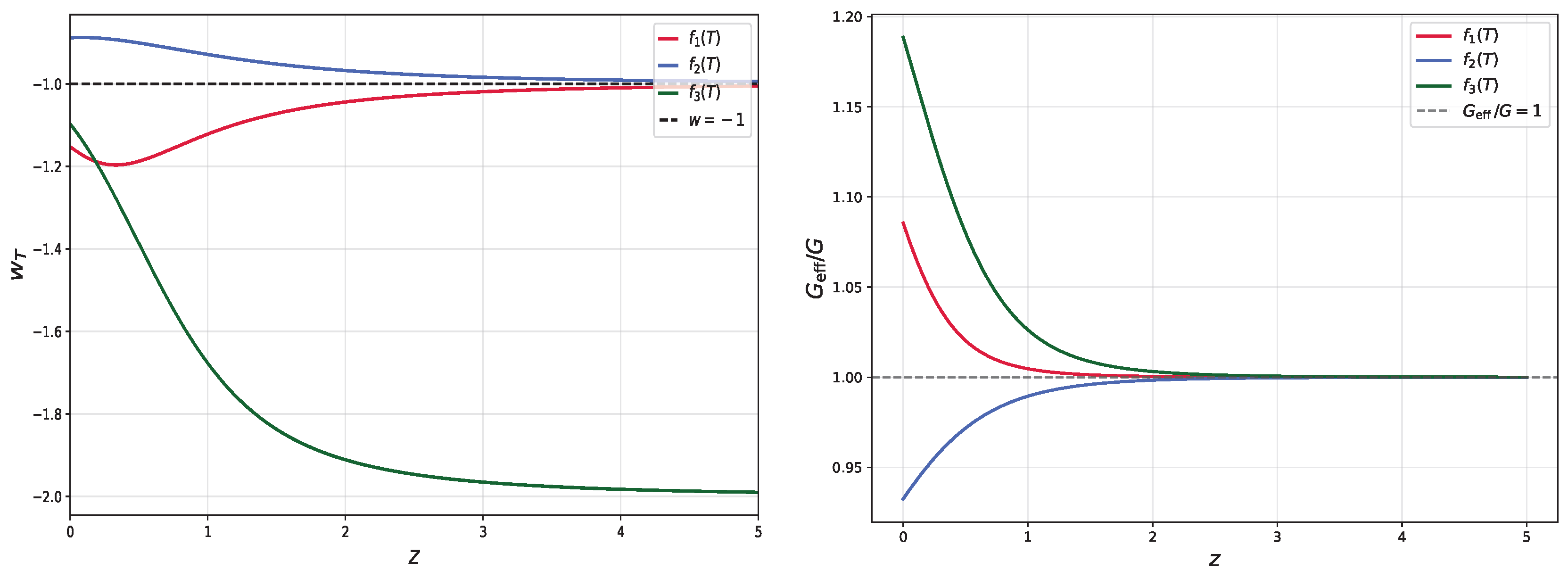
In Figure 1, we illustrate the redshift evolution of the effective dark energy equation-of-state parameter w T ( z ) obtained from Equation (17) using Equations (16) and (15) and the effective gravitational coupling G eff / G for the three f ( T ) models. Equations (33), (37) and (41) introduced in this section. For this purpose, we numerically solve the modified Friedmann equations derived from the f ( T ) field equations, assuming a spatially flat FLRW background containing standard radiation and pressureless matter components.
The initial conditions are chosen such that all models recover the teleparallel equivalent of General Relativity at early times, ensuring consistency with the standard cosmological evolution during radiation and matter domination. As a result, deviations from Λ CDM arise only at late times, when torsional effects become dynamically relevant. The figure therefore serves as a qualitative diagnostic of the intrinsic late-time behaviour associated with each parametrisation, rather than as a fit to observational data.
As shown in the left panel of Figure 1, Models 1 and 3 enter a phantom-like regime characterised by w T < 1 over the relevant redshift range, whereas Model 2 exhibits an effective quintessence-like behaviour, with w T > 1 . These distinct behaviours reflect the different functional forms of f ( T ) and determine the way in which torsional contributions modify the cosmic expansion rate at late times. The corresponding impact on the gravitational sector is displayed in the right panel, where Models 1 and 3 satisfy G eff > G , indicating an enhancement of the effective gravitational interaction, while Model 2 realises G eff < G , corresponding to a weakening of gravity.
These qualitative differences play a central role in shaping both the background expansion history and the growth of cosmic structures, and they provide clear physical intuition for the trends that will be identified in the subsequent observational analysis. In particular, the sign and magnitude of the torsional contributions anticipate whether a given model tends to shift cosmological parameter constraints, such as the inferred value of the Hubble constant, towards or away from their standard Λ CDM values. A quantitative analysis of these effects will be presented in the following sections through a full comparison with current cosmological data.

4. Cosmological Data and Parameter Estimation

In this section, we compare the f ( T ) models introduced above with current cosmological observations in order to constrain their parameter spaces and assess their phenomenological viability relative to the standard Λ CDM scenario. The analysis was designed to quantify both the degree to which the models can accommodate late-time observational constraints and the impact of torsional modifications on key cosmological parameters.

4.1. Data and Methodology

We performed a Bayesian analysis to constrain the cosmological parameters of the f ( T ) models introduced in Section 3. Posterior distributions were obtained using the Monte Carlo Markov chain (MCMC) sampler implemented in the Cobaya framework [78]. For each data combination, we carried out two independent MCMC runs using identical numerical settings and convergence criteria. The convergence of each run was assessed using the Gelman-Rubin R 1 statistic [79], after which the two converged chains were combined to construct the final posterior distributions.
The statistical analysis was based on a Gaussian likelihood constructed from the combined contribution of the cosmological probes considered in this work. Depending on the data combination, this included Type Ia supernovae, baryon acoustic oscillations, cosmic microwave background distance priors, and redshift-space distortion measurements. The precise definition of each likelihood component is described in the corresponding data subsection below.
The set of sampled cosmological parameters was chosen to reflect the quantities most directly constrained by the data. We sampled the present-day Hubble constant H 0 , the physical cold dark matter density Ω cdm 0 h 2 , and the physical baryon density Ω b 0 h 2 , where h H 0 / ( 100 km s 1 Mpc 1 ) . When redshift-space distortion data were included, we additionally sampled the present-day amplitude of matter fluctuations σ 8 . The parameter vector is therefore given by
θ = { H 0 , Ω cdm 0 h 2 , Ω b 0 h 2 } , without RSD , { H 0 , Ω cdm 0 h 2 , Ω b 0 h 2 , σ 8 } , with RSD .
We adopted conservative priors on all sampled parameters. Flat (uniform) priors were assumed for the Hubble constant H 0 , the physical cold dark matter density Ω cdm 0 h 2 , and when included, the amplitude of matter fluctuations σ 8 . For the physical baryon density Ω b 0 h 2 , we adopted a Gaussian prior motivated by Big Bang nucleosynthesis (BBN) constraints. The adopted priors and their numerical values are summarised in Table 1.
While the MCMC sampling was performed in terms of the above parameters, the results are reported in terms of the present-day Hubble constant H 0 , the baryon density parameter Ω b 0 , the total matter density parameter
Ω m 0 Ω cdm 0 + Ω b 0 ,
and the derived clustering amplitude
S 8 σ 8 Ω m 0 0.3 .
These quanities provide a more transparent physical interpretation of the results and allow for a direct comparison with constraints from other cosmological analyses.
The radiation density parameter was fixed by standard early-Universe physics and not treated as a free parameter. It was determined through the redshift of the matter–radiation equality [80]
z eq = 2.5 × 10 4 Ω m 0 h 2 T CMB 2.7 4 , Ω r 0 = Ω m 0 1 + z eq ,
with the CMB temperature fixed to T CMB = 2.7255 K [81].

4.1.1. Type-Ia Supernovae

We used the Pantheon+ compilation of Type-Ia supernovae [82], consisting of 1701 spectroscopically confirmed events spanning the redshift range 0.001 z 2.3 . Type-Ia supernovae act as standardisable candles and provide precise measurements of the luminosity–distance relation, thereby constraining the late-time expansion history of the Universe.
In this work, the Pantheon+ sample was treated as an unanchored supernova dataset. This means that supernovae constrained only the redshift dependence of the luminosity distance and did not fix the absolute distance scale. Accordingly, we analytically marginalised over the nuisance parameter M , corresponding to the absolute magnitude of Type-Ia supernovae, following the procedure in [83]. The full covariance matrix provided with the Pantheon+ sample was used, accounting for both statistical and systematic uncertainties.
In order to anchor the distance scale whenever supernova data were included in the analysis, we imposed a Gaussian prior on the Hubble constant based on local distance-ladder measurements. We adopted the determination by Riess et al. [15]:
H 0 = 73.2 ± 1.3 km s 1 Mpc 1 .
This prior effectively calibrated the supernova absolute magnitude while preserving the unanchored nature of the Pantheon+ dataset.

4.1.2. Baryon Acoustic Oscillations

Baryon acoustic oscillations (BAOs) provide a robust geometrical probe of the cosmic expansion history through a standard ruler set by the sound horizon. BAO measurements constrain combinations of cosmological distance measures, relative to the sound horizon scale at the drag epoch r s ( z d ) .
In this work, we employ the most recent BAO measurements from the DESI Data Release 2 (DR2) [84], which cover a wide redshift range and multiple tracers, including bright galaxies, luminous red galaxies, emission line galaxies, quasars, and the Lyman- α forest. These data provide high-precision constraints on the late-time expansion history and are particularly powerful when combined with supernovae and CMB distance priors.
The sound horizon at the drag epoch r s ( z d ) was computed using the same fitting formula adopted in the DESI analyses [84,85], ensuring full consistency with the treatment of early-Universe physics in the BAO likelihood. The full covariance matrix provided by the DESI collaboration was used, accounting for correlations among different redshift bins and tracers.

4.1.3. Cosmic Microwave Background

The cosmic microwave background (CMB) provides a precise probe of the early Universe and plays a key role in anchoring the cosmic distance scale. Rather than using the full CMB temperature and polarisation power spectra, we adopted compressed CMB distance priors derived from Planck observations [86].
These priors are expressed in terms of the shift parameters R and l a , together with the physical baryon density Ω b 0 h 2 , and efficiently capture the geometrical information relevant for late-time cosmology. The CMB likelihood was constructed using the covariance matrix provided in [86]. Since the f ( T ) models considered here reduce to a standard cosmology at early times, the use of distance priors is well justified.

4.1.4. Redshift-Space Distortions

Redshift-space distortions (RSDs) arise from the peculiar velocities of galaxies and introduce anisotropies in the observed clustering pattern in redshift space. RSD measurements constrain the growth of cosmic structures through the quantity f σ 8 ( z ) , defined as the product of the linear growth rate f and the amplitude of matter fluctuations σ 8 .
The growth rate is defined as follows:
f ( a ) = d ln δ m d ln a ,
where δ m is the matter density contrast, whose evolution is obtained by numerically solving the linear growth equation derived in Section 2. The redshift evolution of σ 8 is given by [87]
σ 8 ( a ) = σ 8 δ m ( a ) δ m ( a = 1 ) ,
with σ 8 σ 8 ( a = 1 ) treated as a free parameter.
We used a compilation of 22 f σ 8 ( z ) measurements spanning a wide redshift range, as presented in [88]. In this work, the RSD likelihood was constructed while assuming uncorrelated errors and combined consistently with the background probes described above.

4.2. Information Criteria

To assess the relative performance of the f ( T ) models with respect to the standard Λ CDM scenario, we employed information-theoretic model selection criteria that balanced goodness of fit against model complexity.
In particular, we used the corrected Akaike information criterion AIC C [89,90,91] is defined by
AIC C = 2 ln L max + 2 κ + 2 κ ( κ + 1 ) N κ 1 ,
where L max is the maximum likelihood achieved by the model, κ denotes the number of free parameters, and N is the total number of data points. In the limit of a large N, the correction term becomes negligible, and AIC C reduces to the standard Akaike information criterion AIC [92].
Since all models considered in this work (including Λ CDM and the f ( T ) models) were constrained using the same datasets and had the same number of free parameters, both κ and N were identical across the models. As a result, the difference in AIC C simplifies to
Δ AIC C AIC C f ( T ) AIC C Λ CDM = 2 ln L max f ( T ) ln L max Λ CDM .
Negative values of Δ AIC C indicate a preference for the f ( T ) model, while positive values favour Λ CDM. The interpretation of Δ AIC C followed the Jeffreys’ scale [93], summarised in Table 2.
For completeness, we note that the Bayesian information criterion (BIC) [94] led to identical conclusions in this analysis, since all models shared the same number of parameters and were fitted to the same data.

4.3. Results

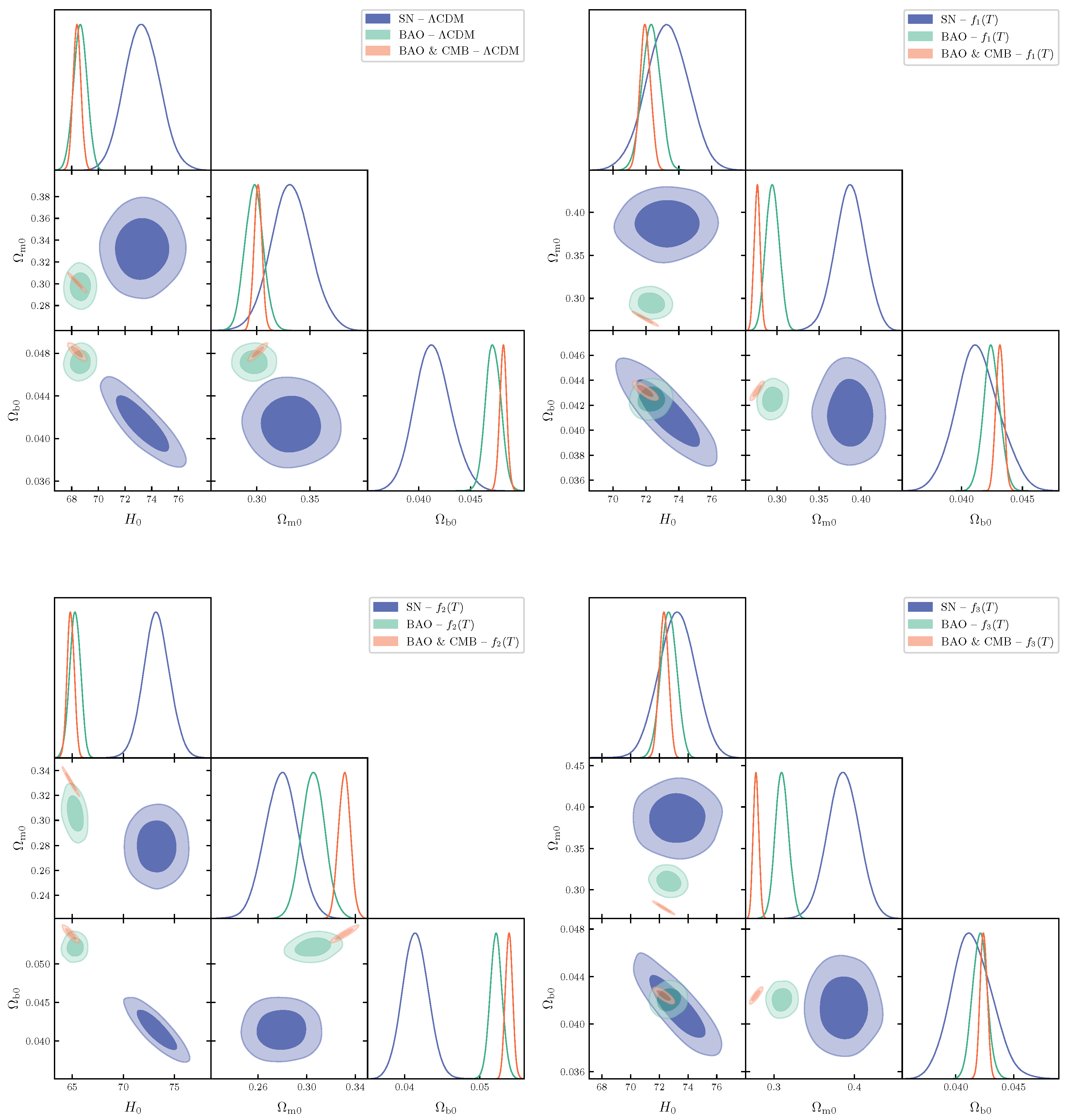
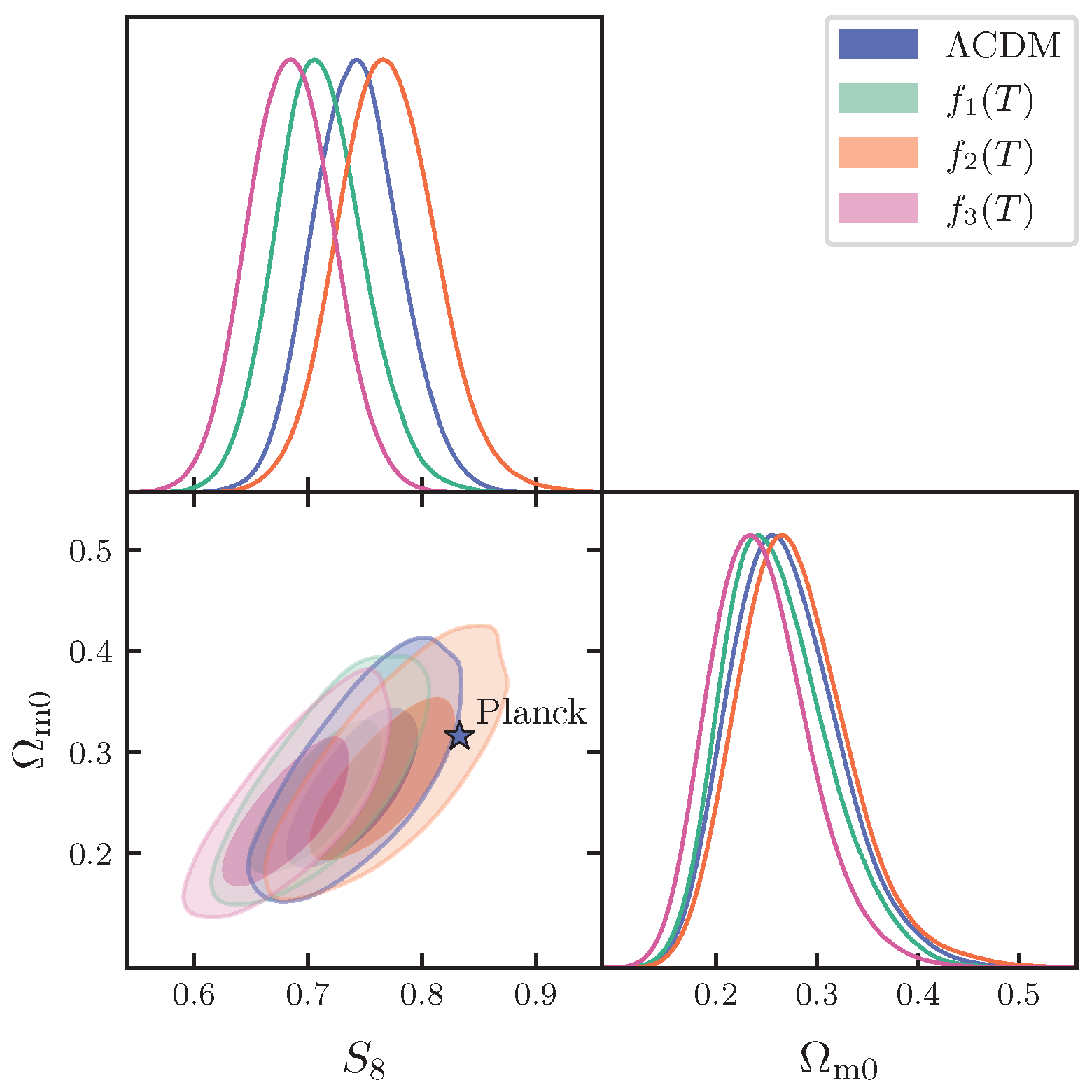
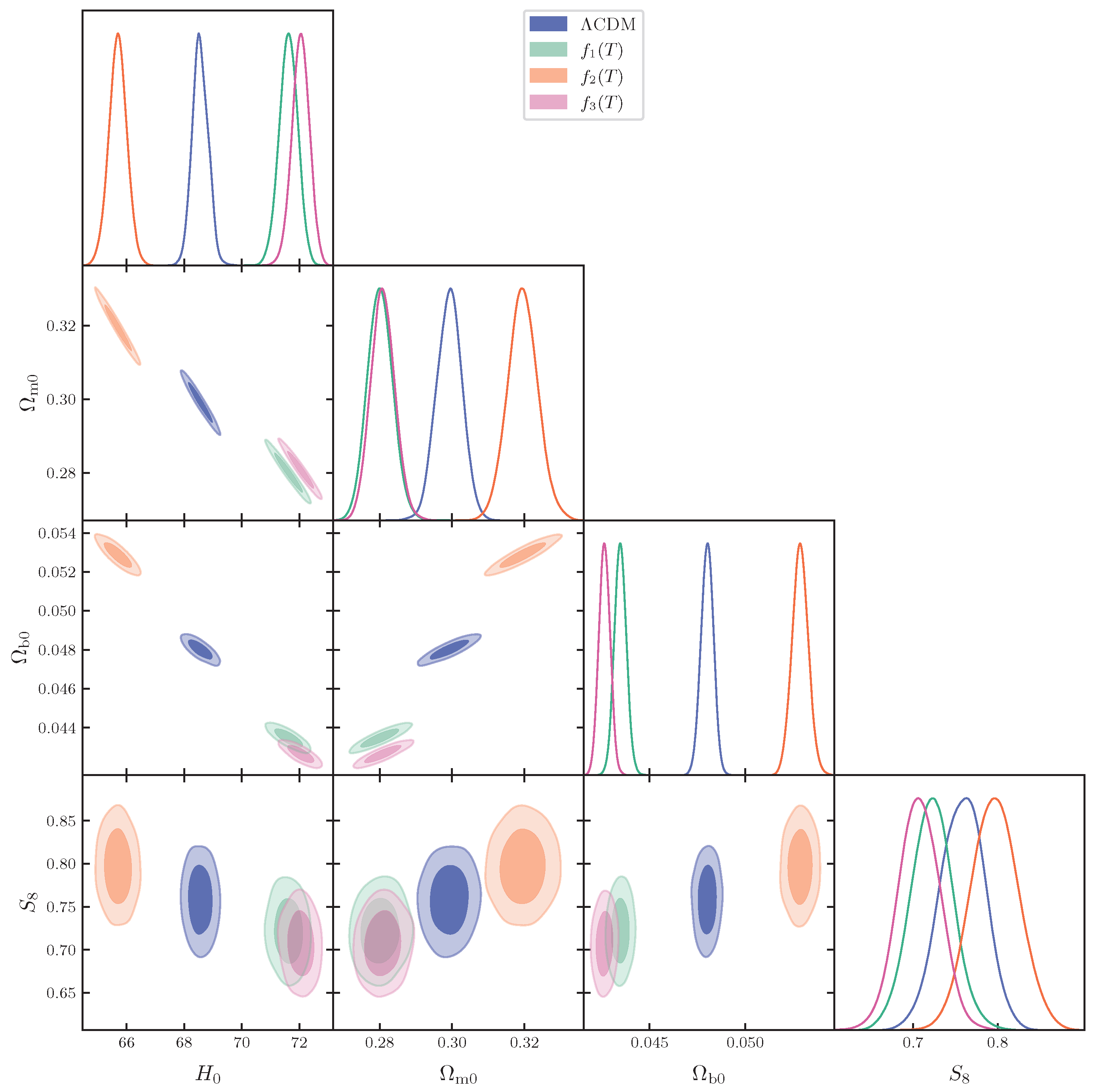
In this subsection we present the constraints on the cosmological parameters of the three f ( T ) models introduced in Section 3, and we compare them with the reference Λ CDM scenario. We report the mean values and 1 σ uncertainties obtained from the MCMC analysis for each dataset separately and for the full combination, together with the statistical performance quantified through Δ AIC C (see Section 4.2). The numerical results are summarised in Table 3. In addition, the relative consistency of different datasets within each model is illustrated in Figure 2. For the RSD data analysed alone, the constraints in the ( Ω m 0 , S 8 ) plane are displayed in Figure 3, while the full joint constraints from the combined dataset are shown in Figure 4.
  • Supernovae (SN)
For the SN-only analysis, we employed Pantheon+ as an unanchored dataset, and we calibrated the absolute magnitude through the Gaussian H 0 prior described in Section 4.1.1. Due to the imposed local calibration, the inferred values of the Hubble constant were nearly identical across all models, with H 0 73 km s 1 Mpc 1 . The main model-dependent impact appeared in the inferred matter density; while Λ CDM preferred Ω m 0 = 0.3321 ± 0.0186 , the f 2 ( T ) model favoured a lower value of Ω m 0 = 0.2792 ± 0.0136 , whereas f 1 ( T ) and f 3 ( T ) pushed towards a higher matter density of Ω m 0 0.386 . Since supernovae constrain only the redshift dependence of the luminosity distance, they do not provide direct information on the baryon density. Therefore, in this case, the constraints on Ω b 0 were entirely driven by the Gaussian BBN prior adopted on Ω b 0 h 2 , which explains why all models yielded incredibly similar values for this parameter in Table 3. From a statistical point of view, all f ( T ) models remained compatible with Λ CDM for the SN data alone, with no statistically significant preference for any specific parametrisation.
  • Baryon Acoustic Oscillations (BAOs)
Using DESI DR2 BAO measurements (Section 4.1.2), we obtained strong constraints on the matter density and on the BAO distance scale. In practice, BAOs primarily constrain Ω m 0 and the degenerate combination H 0 r d , rather than H 0 and the sound horizon r d separately. The BBN-motivated Gaussian prior on Ω b 0 h 2 fixed the early-Universe physics entering r d and therefore broke this degeneracy, allowing us to infer H 0 and Ω b 0 individually. In Λ CDM, we found H 0 = 68.645 ± 0.505 and Ω m 0 = 0.29747 ± 0.00861 . The f ( T ) models exhibited a markedly different behaviour in the inferred Hubble constant; f 1 ( T ) and f 3 ( T ) shifted H 0 upwards to H 0 72 –73, while f 2 ( T ) shifted it downwards to H 0 = 65.278 ± 0.529 (Table 3). The matter density remained similar among all models, with Ω m 0 0.30 . Since BAOs do not directly constrain the baryon density, the imposed BBN prior implies an anticorrelation between Ω b 0 and H 0 , with larger H 0 values favouring smaller Ω b 0 values. From a statistical perspective, BAO data alone did not show a significant preference for a specific f ( T ) parametrisation; f 2 ( T ) remained compatible with Λ CDM ( Δ AIC C = 1.2 ), while f 1 ( T ) and f 3 ( T ) were not favoured, with Δ AIC C 9.8 and 10.1 , respectively (Table 2).
  • Baryon Acoustic Oscillations and Cosmic Microwave Background (BAO+CMB)
By combining BAO measurements with CMB distance priors (Section 4.1.3), we obtained extremely tight constraints on the physical matter and baryon densities. In contrast to the SN- and BAO-only cases, CMB data directly constrained both Ω m 0 h 2 and Ω b 0 h 2 , with the latter being significantly tighter than the BBN prior adopted in this work. This reduced the parameter uncertainties and induced an anticorrelation between H 0 and both Ω b 0 and Ω m 0 such that the models with larger H 0 values favoured smaller matter and baryon density parameters. In the Λ CDM scenario, we found H 0 = 68.401 ± 0.292 and Ω m 0 = 0.30111 ± 0.00374 , while the f ( T ) models separated into two behaviours; f 1 ( T ) and f 3 ( T ) favoured larger values for the Hubble constant H 0 72 with smaller matter densities, whereas f 2 ( T ) yielded a lower value of H 0 = 64.850 ± 0.348 with a larger Ω m 0 (Table 3). From a statistical perspective, BAO+CMB data strongly disfavoured all three f ( T ) models relative to Λ CDM, with Δ AIC C = 11.6 , 13.6 , and 27.3 for f 1 ( T ) , f 2 ( T ) , and f 3 ( T ) , respectively (Table 3).
  • Redshift-Space Distortions (RSDs)
Redshift-space distortion (RSD) measurements constrain the growth of cosmic structures through f σ 8 ( z ) (Section 4.1.4) and are therefore primarily sensitive to the matter density and clustering amplitude rather than the background expansion history. As a consequence, RSD data alone did not break the degeneracy imposed by the Gaussian BBN prior on Ω b 0 h 2 and did not provide direct constraints on H 0 or Ω b 0 , which are therefore not reported in Table 3. We found Ω m 0 = 0.2695 ± 0.0540 and S 8 = 0.7423 ± 0.0378 in Λ CDM, while the f ( T ) models yielded broadly consistent matter densities but systematic shifts in the clustering amplitude: f 1 ( T ) and f 3 ( T ) favoured lower values, S 8 = 0.7104 ± 0.0385 and 0.6848 ± 0.0371 , respectively, whereas f 2 ( T ) yielded a slightly larger value of S 8 = 0.7695 ± 0.0430 . These differences reflect the distinct growth histories induced by the effective gravitational coupling in each model. From a statistical point of view, all f ( T ) models remained compatible with Λ CDM for the RSD data alone, with Δ AIC C < 0.2 , indicating that the RSD measurements by themselves could not distinguish between the models.
When comparing the constraints obtained from the different datasets, it is important to emphasise that the presence of cosmological tensions is not a peculiarity of f ( T ) gravity, since the Λ CDM model itself exhibits well-known inconsistencies, most notably in the determination of the Hubble constant. What changes in the f ( T ) scenarios is the way in which these tensions are redistributed among cosmological parameters. In particular, for those models that shift the inferred value of H 0 towards local measurements, the residual mismatch does not disappear but is instead transferred to the matter sector. This behaviour is clearly illustrated in Figure 2, where models that alleviated the H 0 tension exhibited a noticeable discrepancy in the inferred values of Ω m 0 between the early- and late-time probes, even when the corresponding H 0 constraints became more compatible.
Focusing on the implications for the H 0 tension, two qualitatively distinct classes of behaviour emerged within the f ( T ) framework. The f 1 ( T ) and f 3 ( T ) models consistently shifted the BAO- and CMB-inferred values of the Hubble constant towards larger values compared with Λ CDM, bringing them closer to local distance-ladder determinations. In contrast, the f 2 ( T ) model pushed H 0 to smaller values, thereby exacerbating the discrepancy. This dichotomy can be traced back to the effective torsional equation of state; models exhibiting a phantom-like regime ( w T < 1 ) over the relevant redshift range enhanced the late-time expansion rate and therefore favoured larger inferred values of H 0 , whereas models with a quintessence-like behaviour ( w T > 1 ) had the opposite effect (see Figure 1 and Figure 5). As a result, in the models that partially alleviated the H 0 tension, the remaining inconsistency manifested primarily in the matter density inferred from different datasets.
Before addressing the implications for the S 8 sector, it is worth noting that recent weak-lensing analyses, such as the latest KiDS results [95], reported no statistically significant tension with Λ CDM. Nevertheless, this issue must still be carefully examined in the context of modified gravity models, since departures from General Relativity typically alter the effective gravitational coupling and may reintroduce a mismatch between early- and late-time probes even when none is present in the standard scenario. This point is particularly relevant in theories such as f ( T ) gravity, where the growth of structures is modified through an effective gravitational coupling, G eff = G / f T .
Within this framework, the f 2 ( T ) model, characterised by G eff < G , yielded a larger value of S 8 when inferred from RSD data, while at the same time, one would expect a smaller value of S 8 inferred from CMB observations, potentially improving the consistency between early- and late-time estimates. In contrast, the f 1 ( T ) and f 3 ( T ) models corresponded to G eff > G , leading to an enhancement in structure growth and therefore to a situation in which discrepancies in the S 8 sector can arise, even if none is present in Λ CDM. This behaviour is reflected in the RSD constraints shown in Figure 3, where the different models populated distinct regions in the ( Ω m 0 , S 8 ) plane (see also Figure 1).
Taken together, these results reveal a clear complementarity between the H 0 and S 8 sectors within the minimal f ( T ) framework. Models that were more successful in shifting H 0 towards locally measured values tended to transfer the residual tension to the matter density and to the growth of structures, while the model that exhibited a potentially more favourable behaviour in the S 8 sector aggravated the H 0 discrepancy. This trade-off illustrates the difficulty of simultaneously addressing both tensions within simple f ( T ) extensions of the standard cosmological model and suggests that more general formulations or additional degrees of freedom may be required to achieve a fully consistent resolution.
  • Full Dataset Combination
Finally, we consider the full dataset combination SN+BAO+CMB+RSD, for which the joint constraints are shown in Figure 4 and the numerical results are summarised in Table 3. In this case, the behaviours identified in the separate analyses were combined and clearly reflected in the multidimensional parameter space. In Λ CDM, we obtained H 0 = 68.559 ± 0.278 , Ω m 0 = 0.29923 ± 0.00354 , Ω b 0 = 0.048014 ± 0.000326 , and S 8 = 0.7582 ± 0.0263 , while the f ( T ) models followed the trends discussed above. The f 1 ( T ) and f 3 ( T ) models shifted the inferred Hubble constant to larger values, H 0 71.6 and 72.0 , while favouring lower Ω m 0 , Ω b 0 , and S 8 values, whereas the f 2 ( T ) model yielded a lower H 0 65.7 and higher values for Ω m 0 , Ω b 0 , and S 8 . The interplay between background and growth constraints tightened the posterior distributions and revealed the redistribution of tensions discussed above, with partial alleviation of the H 0 tension accompanied by increased discrepancies in the matter and clustering sectors. These combined effects are clearly visible in Figure 4. From a statistical perspective, the full dataset combination disfavoured all three f ( T ) parametrisations relative to Λ CDM, yielding Δ AIC C = 39.0 , 44.6 , and 46.3 for f 1 ( T ) , f 2 ( T ) , and f 3 ( T ) , respectively (Table 3).
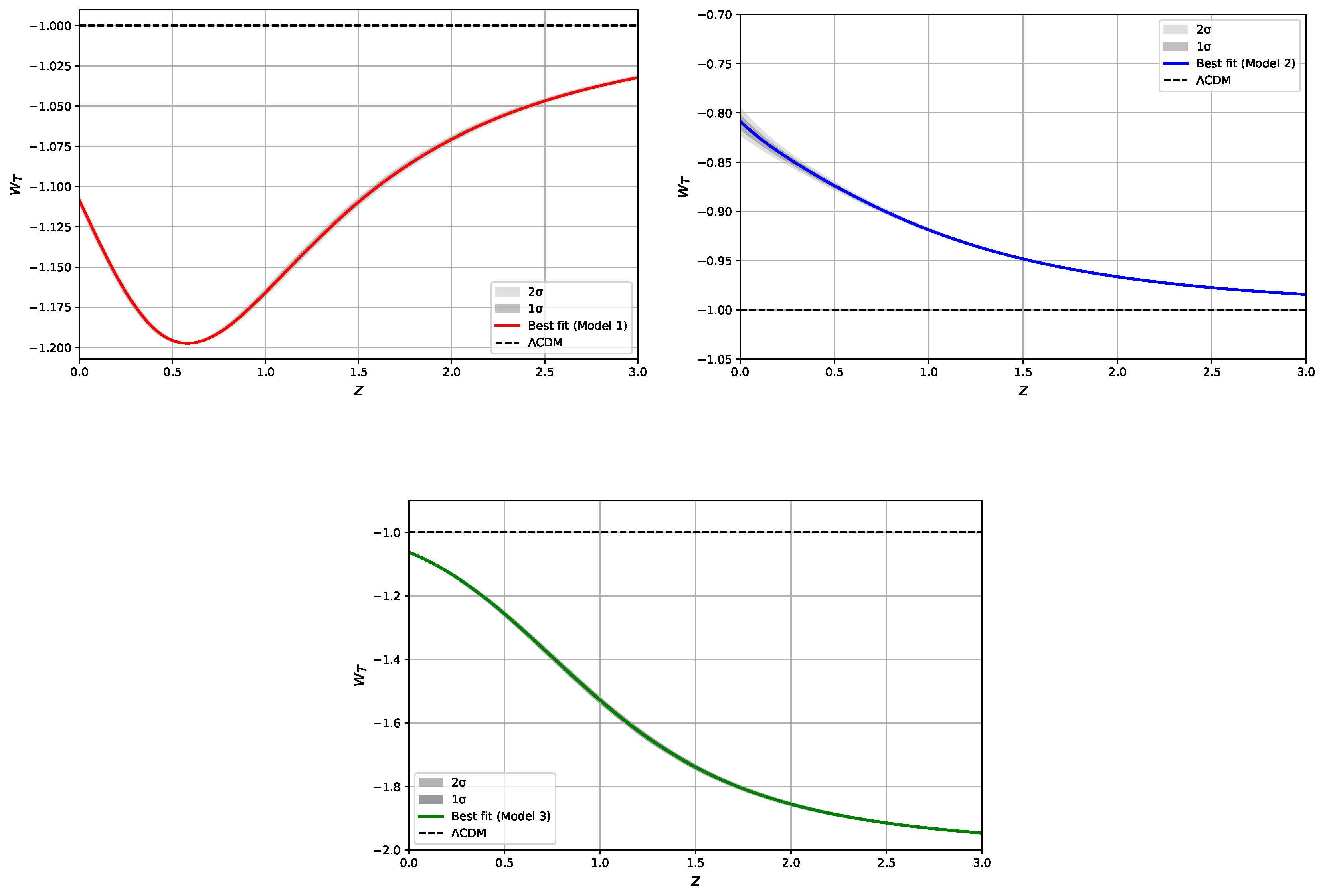
We close this section by presenting in Figure 5 the full statistical reconstruction of w T ( z ) for the three f(T) models, obtained from the MCMCs using our last combined datasets. These plots extend the illustrative best fit curves by explicitly including the 1 σ (dark gray band) and 2 σ (light gray band) confidence regions. The narrow width of the reconstructed bands over 0 z 3 indicates that the effective dark energy equation of state parameter was strongly constrained by the data, permitting only small deviations from the best fit curves.
In particular, the reconstruction for Model 2 (blue curve) reinforced its characterisation as a quintessence-like model ( w T > 1 ), as the entire 2 σ confidence interval remained above the Λ CDM limit ( w = 1 ) throughout the late-time evolution. Conversely, Models 1 and 3 (red and green curves, respectively) were statistically confirmed to reside in the phantom-like regime ( w T < 1 ). This consistency between the best fit behaviours and the full statistical error bands revealed the limited freedom available to these f ( T ) modifications and solidified the distinct cosmological signatures identified for each model.
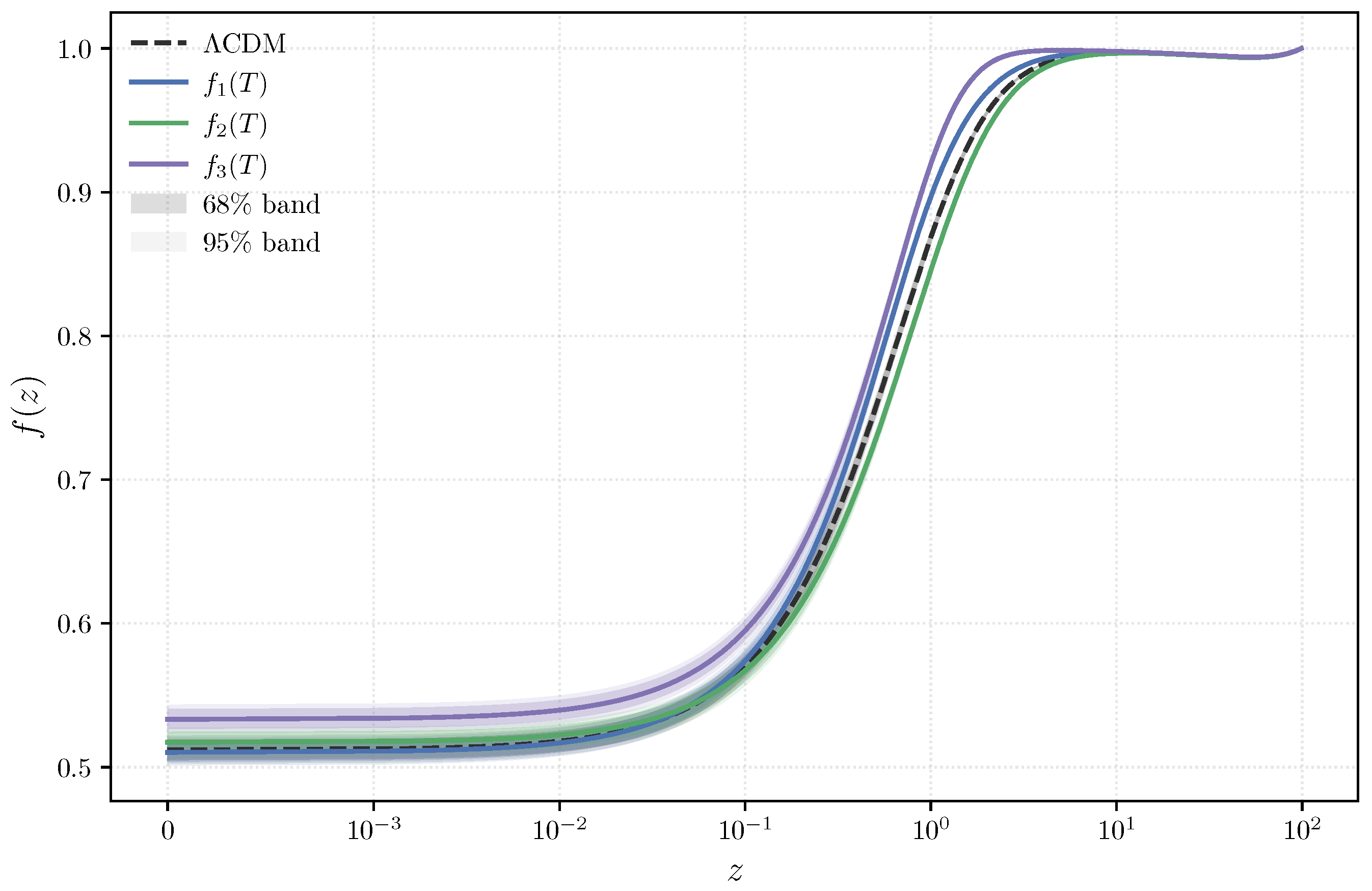
We also reconstructed the linear growth rate f ( z ) defined in (48) for the three f ( T ) models. We numerically solved the linear growth equation derived in Section 2 in the subhorizon (quasi-static) regime. The integration started at a ini = 0.01 , deep in the matter-dominated era, and the growing-mode solution for δ m propagated up to a = 1 . From this evolution, we obtained f ( z ) and constructed the best fit curve together with the 68% and 95% C.L. bands, shown in Figure 6. This reconstruction corresponds to the same growth evolution entering the RSD observable f σ 8 ( z ) .
The parameters entering this reconstruction were those preferred by the full MCMC inference. For these statistically favoured regions of parameter space, the resulting evolution of f ( z ) remained broadly consistent with the Λ CDM prediction over the redshift interval probed by current data. This occurred even though the effective torsional equation of state w T ( z ) could depart from 1 at late times, and the effective gravitational coupling G eff = G / f T could differ from G. Hence, the allowed modifications in both the background and perturbation sectors combined in such a way that the overall linear growth history remained compatible with current large-scale-structure observations.

5. Conclusions

In this work, we investigated whether late-time modifications of gravity in the teleparallel framework can contribute to resolution of the current H 0 tension. Focusing on f ( T ) cosmology, we considered three representative parametrisations (Equations (31), (35) and (39)), which reduced to the teleparallel equivalent of General Relativity at early times and deviated from it only in late epochs. The first two models have been previously discussed in the literature, while the third model, f 3 ( T ) , represents a novel f ( T ) parametrisation inspired by a similar functional form previously studied in the context of f ( Q ) gravity [60]. For each model, we derived the background cosmological equations and adopted an effective torsional fluid description, allowing us to characterise the torsional sector through an evolving equation-of-state parameter w T ( z ) . Whenever redshift-space distortion information was included, we additionally accounted for the modified linear growth of matter perturbations, which in f ( T ) gravity is governed by an effective gravitational coupling G eff = G / f T and a vanishing gravitational slip of the linear order within the quasi-static subhorizon approximation.
We confronted the three models with a set of late- and early-time cosmological probes, including Pantheon+ Type-Ia supernovae treated as unanchored (calibrated through a local H 0 prior), DESI DR2 BAO measurements, Planck-based compressed CMB distance priors, and a compilation of f σ 8 measurements. The resulting constraints are summarised in Table 3, and the dataset consistency and combined posteriors are shown in Figure 2, Figure 3 and Figure 4.
Our analysis revealed two qualitatively distinct behaviours within the considered f ( T ) scenarios. The f 1 ( T ) and f 3 ( T ) models systematically shifted the BAO- and BAO+CMB-inferred value of the Hubble constant to larger values than in Λ CDM, bringing the inferred H 0 value closer to local distance-ladder measurements. In contrast, the f 2 ( T ) model shifted H 0 downwards and therefore worsened the discrepancy. This dichotomy is naturally understood in terms of the effective torsional dynamics; parametrisations that realise a phantom-like behaviour of the torsional fluid over the relevant redshift range tend to enhance the late-time expansion rate and hence favour a larger inferred H 0 value, whereas a quintessence-like effective regime produces the opposite effect. However, even in the cases where the H 0 discrepancy is partially alleviated, the improvement is not achieved for free; the residual inconsistency is largely transferred to other sectors, most notably to the matter density inferred from early- and late-time probes, as illustrated in Figure 2.
Concerning the growth of structures, the three f ( T ) models modified the effective gravitational coupling G eff = G / f T , leading to systematic shifts in the inferred clustering amplitude. The f 1 ( T ) and f 3 ( T ) models, which partially alleviated the H 0 tension, predicted lower values of S 8 from RSD data, while the f 2 ( T ) model favoured a higher S 8 value. This behaviour is directly related to G eff ; f 1 ( T ) and f 3 ( T ) correspond to G eff > G , enhancing structure growth and thus requiring a smaller late-time normalisation of fluctuations but implying larger CMB-inferred values of S 8 and hence an increased early and late discrepancy. Conversely, f 2 ( T ) features G eff < G , suppressing growth and potentially reducing the S 8 tension while worsening the H 0 tension. This complementarity illustrates the difficulty of simultaneously addressing both tensions within minimal f ( T ) scenarios.
Finally, we assessed the global statistical performance of the models relative to Λ CDM using the corrected Akaike information criterion. Although some parametrisations were able to shift the inferred value of H 0 towards local measurements, the combined dataset yielded positive values for Δ AIC C for the full SN+BAO+CMB+RSD combination (Table 3), indicating that the minimal f ( T ) extensions considered here are not statistically favoured over the reference scenario. Nevertheless, these models provide a concrete demonstration that late-time torsional modifications of gravity can non-trivially impact both the background expansion and the growth of cosmic structures, and they can partially redistribute the current cosmological tensions among different sectors.
In addition to cosmological constraints, viable modified gravity scenarios must also satisfy local and strong-field tests, such as those arising from Solar System experiments and observations of binary systems. In the present work, however, we examined the considered f ( T ) models exclusively at cosmological scales. The distinct behaviours identified for the effective gravitational coupling, G eff = G / f T , provide a first qualitative indication of how these parametrisations may depart from General Relativity. A dedicated analysis of their implications for parametrised post-Newtonian constraints or binary dynamics lies beyond the scope of the present study and will be explored in future work.
In summary, our results reveal teleparallel gravity as a promising and well-controlled framework for exploring extensions of the standard cosmological model in light of present observational tensions. While the simple one-parameter f ( T ) parametrisations studied in this work do not simultaneously resolve the H 0 and S 8 tensions, they clearly illustrate the rich phenomenology offered by torsional modifications of gravity. This motivates the investigation of more general teleparallel scenarios, including extended torsional Lagrangians, non-minimal couplings, or additional degrees of freedom, as well as a refined treatment of observational systematics. Such directions offer promising avenues for future research.

Author Contributions

The authors (M.B.-L., C.G.B., M.P. and E.N.S.) have equally contributed to the paper. All authors have read and agreed to the published version of the manuscript.

Funding

This research was funded by FPI fellowship PRE2021-100340 of the Spanish Ministry of Science, Innovation and Universities, the Spanish grant PID2023-149016NB-I00 (funded by MCIN/AEI/10.13039/501100011033 and by “ERDF A way of making Europe”), the Basque government Grant No. IT1628-22 (Spain) and the COST Action CA21136 “Addressing observational tensions in cosmology with systematics and fundamental physics (CosmoVerse)”.

Data Availability Statement

All the Data used are public and have been properly cited on the paper.

Acknowledgments

M.B.-L. is supported by the Basque Foundation of Science Ikerbasque. C.G.B. acknowledges financial support from the FPI fellowship PRE2021-100340 of the Spanish Ministry of Science, Innovation and Universities. This work was supported by Spanish grant PID2023-149016NB-I00 (funded by MCIN/AEI/10.13039/501100011033 and by “ERDF A way of making Europe”). This research was also supported by the Basque government, Grant No. IT1628-22 (Spain). The authors acknowledge the contribution of the COST Action CA21136 “Addressing observational tensions in cosmology with systematics and fundamental physics (CosmoVerse)”.

Conflicts of Interest

The authors declare no conflicts of interest.

Notes

1
It is possible to formulate teleparallel gravity using a general affine connection defined in terms of both the tetrad field and a spin connection [67]. This covariant approach avoids the issue of local Lorentz violation that can arise in the standard f ( T ) formulation. However, since the background and linear perturbation equations relevant to our analysis coincide in both approaches, we adopted the standard formulation for simplicity.
2
We are assuming a vanishing scalar anisotropic stress of a linear order [69,72].

References

  1. Riess, A.G.; Filippenko, A.V.; Challis, P.; Clocchiatti, A.; Diercks, A.; Garnavich, P.M.; Gilliland, R.L.; Hogan, C.J.; Jha, S.; Kirshner, R.P.; et al. Observational evidence from supernovae for an accelerating universe and a cosmological constant. Astron. J. 1998, 116, 1009–1038. [Google Scholar] [CrossRef]
  2. Perlmutter, S.; Aldering, G.; Goldhaber, G.; Knop, R.A.; Nugent, P.; Castro, P.G.; Deustua, S.; Fabbro, S.; Goobar, A.; Groom, D.E.; et al. Measurements of Ω and Λ from 42 High Redshift Supernovae. Astrophys. J. 1999, 517, 565–586. [Google Scholar] [CrossRef]
  3. Bahcall, N.A.; Ostriker, J.P.; Perlmutter, S.; Steinhardt, P.J. The Cosmic triangle: Assessing the state of the universe. Science 1999, 284, 1481–1488. [Google Scholar] [CrossRef]
  4. Bennett, C.L.; Hill, R.S.; Hinshaw, G.; Nolta, M.R.; Odegard, N.; Page, L.; Spergel, D.N.; Weil, J.L.; Wright, E.L.; Halpern, M.; et al. First-Year Wilkinson Microwave Anisotropy Probe (WMAP) Observations: Preliminary Maps and Basic Results. Astrophys. J. Suppl. Ser. 2003, 148, 1. [Google Scholar] [CrossRef]
  5. Komatsu, E.; Smith, K.M.; Dunkley, J.; Bennett, C.L.; Gold, B.; Hinshaw, G.; Jarosik, N.; Larson, D.; Nolta, M.R.; Page, L.; et al. Seven-Year Wilkinson Microwave Anisotropy Probe (WMAP) Observations: Cosmological Interpretation. Astrophys. J. Suppl. Ser. 2011, 192, 18. [Google Scholar] [CrossRef]
  6. Ade, P.A.R.; Aghanim, N.; Armitage-Caplan, C.; Arnaud, M.; Ashdown, M.; Atrio-Barandela, F.; Aumont, J.; Baccigalupi, C.; Banday, A.J.; Barreiro, R.B.; et al. Planck 2013 Results. XVI. Cosmological Parameters. Astron. Astrophys. 2014, 571, A16. [Google Scholar] [CrossRef]
  7. Aghanim, N.; Akrami, Y.; Ashdown, M.; Aumont, J.; Baccigalupi, C.; Ballardini, M.; Banday, A.J.; Barreiro, R.B.; Bartolo, N.; Basak, S.; et al. Planck 2018 results. VI. Cosmological parameters. Astron. Astrophys. 2020, 641, A6, Erratum in Astron. Astrophys. 2021, 652, C4. https://doi.org/10.1051/0004-6361/201833910. [Google Scholar]
  8. Eisenstein, D.J.; Zehavi, I.; Hogg, D.W.; Scoccimarro, R.; Blanton, M.R.; Nichol, R.C.; Scranton, R.; Seo, H.J.; Tegmark, M.; Zheng, Z.; et al. Detection of the Baryon Acoustic Peak in the Large-Scale Correlation Function of SDSS Luminous Red Galaxies. Astrophys. J. 2005, 633, 560. [Google Scholar] [CrossRef]
  9. Cole, S.; Percival, W.J.; Peacock, J.A.; Norberg, P.; Baugh, C.M.; Frenk, C.S.; Baldry, I.; Bl-Hawthorn, J.; Bridges, T.; Cannon, R.; et al. The 2dF Galaxy Redshift Survey: Power-Spectrum Analysis of the Final Data Set and Cosmological Implications. Mon. Not. R. Astron. Soc. 2005, 362, 505. [Google Scholar] [CrossRef]
  10. Percival, W.J.; Reid, B.A.; Eisenstein, D.J.; Bahcall, N.A.; Budavari, T.; Frieman, J.A.; Fukugita, M.; Gunn, J.E.; Ivezić, Ž; Knapp, G.R.; et al. Baryon Acoustic Oscillations in the Sloan Digital Sky Survey Data Release 7 Galaxy Sample. Mon. Not. R. Astron. Soc. 2010, 401, 2148. [Google Scholar] [CrossRef]
  11. Tegmark, M.; Blanton, M.R.; Strauss, M.A.; Hoyle, F.; Schlegel, D.; Scoccimarro, R.; Vogeley, M.S.; Weinberg, D.H.; Zehavi, I.; Berlind, A.; et al. The Three-Dimensional Power Spectrum of Galaxies from the Sloan Digital Sky Survey. Astrophys. J. 2004, 606, 702. [Google Scholar] [CrossRef]
  12. Reid, B.A.; Percival, W.J.; Eisenstein, D.J.; Verde, L.; Spergel, D.N.; Skibba, R.A.; Bahcall, N.A.; Budavari, T.; Frieman, J.A.; Fukugita, M.; et al. Cosmological Constraints from the Clustering of the Sloan Digital Sky Survey DR7 Luminous Red Galaxies. Mon. Not. R. Astron. Soc. 2010, 404, 60. [Google Scholar] [CrossRef]
  13. Jimenez, R.; Loeb, A. Constraining cosmological parameters based on relative galaxy ages. Astrophys. J. 2002, 573, 37–42. [Google Scholar] [CrossRef]
  14. Moresco, M. Measuring the expansion history of the Universe with cosmic chronometers. arXiv 2024, arXiv:2412.01994. [Google Scholar] [CrossRef]
  15. Riess, A.G.; Casertano, S.; Yuan, W.; Bowers, J.B.; Macri, L.; Zinn, J.C.; Scolnic, D. Cosmic Distances Calibrated to 1% Precision with Gaia EDR3 Parallaxes and Hubble Space Telescope Photometry of 75 Milky Way Cepheids Confirm Tension with ΛCDM. Astrophys. J. Lett. 2021, 908, L6. [Google Scholar] [CrossRef]
  16. Peebles, P.J.E.; Ratra, B. The Cosmological Constant and Dark Energy. Rev. Mod. Phys. 2003, 75, 559–606. [Google Scholar] [CrossRef]
  17. Weinberg, S. The Cosmological Constant Problem. Rev. Mod. Phys. 1989, 61, 1–23. [Google Scholar] [CrossRef]
  18. Copeland, E.J.; Sami, M.; Tsujikawa, S. Dynamics of dark energy. Int. J. Mod. Phys. D 2006, 15, 1753–1936. [Google Scholar] [CrossRef]
  19. Di Valentino, E.; Said, J.L.; Riess, A.; Pollo, A.; Poulin, V.; Gómez-Valent, A.; Weltman, A.; Palmese, A.; Huang, C.D.; van de Bruck, C.; et al. The CosmoVerse White Paper: Addressing observational tensions in cosmology with systematics and fundamental physics. Phys. Dark Universe 2025, 49, 101965. [Google Scholar] [CrossRef]
  20. Amendola, L.; Tsujikawa, S. Dark Energy: Theory and Observations; Cambridge University Press: Cambridge, UK, 2015. [Google Scholar]
  21. Saridakis, E.N.; Lazkoz, R.; Salzano, V.; Moniz, P.V.; Capozziello, S.; Jiménez, J.B.; De Laurentis, M.; Olmo, G.J. Modified Gravity and Cosmology. An Update by the CANTATA Network; Springer: Berlin/Heidelberg, Germany, 2021. [Google Scholar] [CrossRef]
  22. Carroll, S.M. The Cosmological constant. Living Rev. Relativ. 2001, 4, 1. [Google Scholar] [CrossRef] [PubMed]
  23. Nojiri, S.; Odintsov, S.D. Modified gravity with negative and positive powers of the curvature: Unification of the inflation and of the cosmic acceleration. Phys. Rev. D 2003, 68, 123512. [Google Scholar] [CrossRef]
  24. Clifton, T.; Ferreira, P.G.; Padilla, A.; Skordis, C. Modified Gravity and Cosmology. Phys. Rep. 2012, 513, 1–189. [Google Scholar] [CrossRef]
  25. De Felice, A.; Tsujikawa, S. f(R) theories. Living Rev. Relativ. 2010, 13, 3. [Google Scholar] [CrossRef]
  26. Capozziello, S.; De Laurentis, M. Extended Theories of Gravity. Phys. Rep. 2011, 509, 167–321. [Google Scholar] [CrossRef]
  27. Nojiri, S.; Odintsov, S.D. Unified cosmic history in modified gravity: From F(R) theory to Lorentz non-invariant models. Phys. Rep. 2011, 505, 59–144. [Google Scholar] [CrossRef]
  28. Capozziello, S.; Francaviglia, M. Extended Theories of Gravity and their Cosmological and Astrophysical Applications. Gen. Relativ. Gravity 2008, 40, 357–420. [Google Scholar] [CrossRef]
  29. Zhang, Y.; Niu, X.; Su, X.; He, D.Z. The Standard siren tests of viable f(R) cosmologies. arXiv 2026, arXiv:2602.04559. [Google Scholar]
  30. Morais, J.; Bouhmadi-López, M.; Capozziello, S. Can f(R) gravity contribute to (dark) radiation? J. Cosmol. Astropart. Phys. 2015, 2015, 041. [Google Scholar] [CrossRef]
  31. Cai, Y.F.; Capozziello, S.; De Laurentis, M.; Saridakis, E.N. f(T) teleparallel gravity and cosmology. Rep. Prog. Phys. 2016, 79, 106901. [Google Scholar] [CrossRef] [PubMed]
  32. Bahamonde, S.; Dialektopoulos, K.F.; Escamilla-Rivera, C.; Farrugia, G.; Gakis, V.; Hendry, M.; Hohmann, M.; Levi Said, J.; Mifsud, J.; Di Valentino, E. Teleparallel gravity: From theory to cosmology. Rep. Prog. Phys. 2023, 86, 026901. [Google Scholar] [CrossRef]
  33. Beltrán Jiménez, J.; Heisenberg, L.; Koivisto, T. Coincident General Relativity. Phys. Rev. D 2018, 98, 044048. [Google Scholar] [CrossRef]
  34. Beltrán Jiménez, J.; Heisenberg, L.; Koivisto, T.S.; Pekar, S. Cosmology in f(Q) geometry. Phys. Rev. D 2020, 101, 103507. [Google Scholar] [CrossRef]
  35. Nesseris, S.; Basilakos, S.; Saridakis, E.N.; Perivolaropoulos, L. Viable f(T) models are practically indistinguishable from ΛCDM. Phys. Rev. D 2013, 88, 103010. [Google Scholar] [CrossRef]
  36. Izumi, K.; Ong, Y.C. Cosmological Perturbation in f(T) Gravity Revisited. J. Cosmol. Astropart. Phys. 2013, 2013, 029. [Google Scholar] [CrossRef]
  37. Nunes, R.C.; Pan, S.; Saridakis, E.N. New observational constraints on f(T) gravity from cosmic chronometers. J. Cosmol. Astropart. Phys. 2016, 2016, 011. [Google Scholar] [CrossRef]
  38. Golovnev, A.; Guzmán, M.J. Bianchi identities in f(T) gravity: Paving the way to confrontation with astrophysics. Phys. Lett. B 2020, 810, 135806. [Google Scholar] [CrossRef]
  39. Mirza, B.; Oboudiat, F. Constraining f(T) gravity by dynamical system analysis. J. Cosmol. Astropart. Phys. 2017, 11, 011. [Google Scholar] [CrossRef]
  40. Deng, X.M. Probing f(T) gravity with gravitational time advancement. Class. Quantum Gravity 2018, 35, 175013. [Google Scholar] [CrossRef]
  41. Darabi, F.; Atazadeh, K. f(T) quantum cosmology. Phys. Rev. D 2019, 100, 023546. [Google Scholar] [CrossRef]
  42. Zhao, J.Y.; Liu, M.J.; Yang, K. Linear perturbations and stability analysis in f(T) Braneworld scenario. Phys. Lett. B 2025, 860, 139161. [Google Scholar] [CrossRef]
  43. Aquino, A.O.; Silva, E.G. A cosmological model with logarithmic f(T) gravity and H(z) quadratic expansion. arXiv 2025, arXiv:2510.21466. [Google Scholar]
  44. Tzerefos, C.; Papanikolaou, T.; Saridakis, E.N.; Basilakos, S. Scalar induced gravitational waves in modified teleparallel gravity theories. Phys. Rev. D 2023, 107, 124019. [Google Scholar] [CrossRef]
  45. Zhang, Y.; Zhang, H. Distinguish the f(T) model from ΛCDM model with Gravitational Wave observations. Eur. Phys. J. C 2021, 81, 706. [Google Scholar] [CrossRef]
  46. Anagnostopoulos, F.K.; Basilakos, S.; Saridakis, E.N. First evidence that non-metricity f(Q) gravity could challenge ΛCDM. Phys. Lett. B 2021, 822, 136634. [Google Scholar] [CrossRef]
  47. Lazkoz, R.; Lobo, F.S.N.; Ortiz-Baños, M.; Salzano, V. Observational constraints of f(Q) gravity. Phys. Rev. D 2019, 100, 104027. [Google Scholar] [CrossRef]
  48. Lu, J.; Zhao, X.; Chee, G. Cosmology in symmetric teleparallel gravity and its dynamical system. Eur. Phys. J. C 2019, 79, 530. [Google Scholar] [CrossRef]
  49. Mandal, S.; Wang, D.; Sahoo, P.K. Cosmography in f(Q) gravity. Phys. Rev. D 2020, 102, 124029. [Google Scholar] [CrossRef]
  50. Ayuso, I.; Lazkoz, R.; Salzano, V. Observational constraints on cosmological solutions of f(Q) theories. Phys. Rev. D 2021, 103, 063505. [Google Scholar] [CrossRef]
  51. Frusciante, N. Signatures of f(Q)-gravity in cosmology. Phys. Rev. D 2021, 103, 044021. [Google Scholar] [CrossRef]
  52. Gadbail, G.N.; Mandal, S.; Sahoo, P.K. Reconstruction of ΛCDM universe in f(Q) gravity. Phys. Lett. B 2022, 835, 137509. [Google Scholar] [CrossRef]
  53. Barros, B.J.; Barreiro, T.; Koivisto, T.; Nunes, N.J. Testing F(Q) gravity with redshift space distortions. Phys. Dark Univ. 2020, 30, 100616. [Google Scholar] [CrossRef]
  54. Shabani, H.; De, A.; Loo, T.H.; Saridakis, E.N. Cosmology of f(Q) gravity in non-flat Universe. Eur. Phys. J. C 2024, 84, 285. [Google Scholar] [CrossRef]
  55. De, A.; Loo, T.H.; Saridakis, E.N. Non-metricity with boundary terms: f(Q,C) gravity and cosmology. J. Cosmol. Astropart. Phys. 2024, 2024, 050. [Google Scholar] [CrossRef]
  56. Dimakis, N.; Paliathanasis, A.; Christodoulakis, T. Quantum cosmology in f(Q) theory. Class. Quantum Gravity 2021, 38, 225003. [Google Scholar] [CrossRef]
  57. Anagnostopoulos, F.K.; Gakis, V.; Saridakis, E.N.; Basilakos, S. New models and big bang nucleosynthesis constraints in f(Q) gravity. Eur. Phys. J. C 2023, 83, 58. [Google Scholar] [CrossRef]
  58. Guzmán, M.J.; Järv, L.; Pati, L. Exploring the stability of f(Q) cosmology near general relativity limit with different connections. Phys. Rev. D 2024, 110, 124013. [Google Scholar] [CrossRef]
  59. Heisenberg, L. Review on f(Q) gravity. Phys. Rep. 2024, 1066, 1–78. [Google Scholar] [CrossRef]
  60. Boiza, C.G.; Petronikolou, M.; Bouhmadi-López, M.; Saridakis, E.N. Addressing H 0 and S 8 tensions within f(Q) cosmology. J. Cosmol. Astropart. Phys. 2025, 12, 011. [Google Scholar] [CrossRef]
  61. Ayuso, I.; Bouhmadi-López, M.; Chen, C.Y.; Chew, X.Y.; Dialektopoulos, K.; Ong, Y.C. Insights in f(Q) cosmology: The relevance of the connection. J. Cosmol. Astropart. Phys. 2025, 11, 068. [Google Scholar] [CrossRef]
  62. Ferreira, J.; Barreiro, T.; Mimoso, J.P.; Nunes, N.J. Testing Λ-free f(Q) cosmology. Phys. Rev. D 2023, 108, 063521. [Google Scholar] [CrossRef]
  63. Su, X.; He, D.; Zhang, Y. The Einstein Telescope standard siren simulations for f(Q) cosmologies. Eur. Phys. J. C 2025, 85, 358. [Google Scholar] [CrossRef]
  64. Capozziello, S.; De Falco, V.; Ferrara, C. The role of the boundary term in f(Q, B) symmetric teleparallel gravity. Eur. Phys. J. C 2023, 83, 915. [Google Scholar] [CrossRef]
  65. Bahamonde, S.; Böhmer, C.G.; Wright, M. Modified teleparallel theories of gravity. Phys. Rev. D 2015, 92, 104042. [Google Scholar] [CrossRef]
  66. Bahamonde, S.; Dialektopoulos, K.F.; Levi Said, J. Can Horndeski Theory be recast using Teleparallel Gravity? Phys. Rev. D 2019, 100, 064018. [Google Scholar] [CrossRef]
  67. Golovnev, A.; Koivisto, T.; Sandstad, M. On the covariance of teleparallel gravity theories. Class. Quantum Gravity 2017, 34, 145013. [Google Scholar] [CrossRef]
  68. Bengochea, G.R.; Ferraro, R. Dark torsion as the cosmic speed-up. Phys. Rev. D 2009, 79, 124019. [Google Scholar] [CrossRef]
  69. Wu, P.; Yu, H.W. The dynamical behavior of f(T) theory. Phys. Lett. B 2010, 692, 176–179. [Google Scholar] [CrossRef]
  70. Linder, E.V. Einstein’s Other Gravity and the Acceleration of the Universe. Phys. Rev. D 2010, 81, 127301, Erratum in Phys. Rev. D 2010, 82, 109902. https://doi.org/10.1103/PhysRevD.81.127301. [Google Scholar] [CrossRef]
  71. Bamba, K.; Geng, C.Q.; Lee, C.C.; Luo, L.W. Equation of state for dark energy in f(T) gravity. J. Cosmol. Astropart. Phys. 2011, 2011, 021. [Google Scholar] [CrossRef]
  72. Chen, S.H.; Dent, J.B.; Dutta, S.; Saridakis, E.N. Cosmological perturbations in f(T) gravity. Phys. Rev. D 2011, 83, 023508. [Google Scholar] [CrossRef]
  73. Golovnev, A.; Koivisto, T. Cosmological perturbations in modified teleparallel gravity models. J. Cosmol. Astropart. Phys. 2018, 11, 012. [Google Scholar] [CrossRef]
  74. Zheng, R.; Huang, Q.G. Growth factor in f(T) gravity. J. Cosmol. Astropart. Phys. 2011, 2011, 002. [Google Scholar] [CrossRef]
  75. Souza, M.S.; Barcelos, A.M.; Nunes, R.C.; Akarsu, Ö.; Kumar, S. Mapping the ΛsCDM Scenario to f(T) Modified Gravity: Effects on Structure Growth Rate. Universe 2025, 11, 2. [Google Scholar] [CrossRef]
  76. Awad, A.; El Hanafy, W.; Nashed, G.G.L.; Saridakis, E.N. Phase Portraits of general f(T) Cosmology. J. Cosmol. Astropart. Phys. 2018, 2018, 052. [Google Scholar] [CrossRef]
  77. Akarsu, O.; Bulduk, B.; De Felice, A.; Katırcı, N.; Uzun, N.M. Unexplored regions in teleparallel f(T) gravity: Sign-changing dark energy density. Phys. Rev. D 2025, 112, 083532. [Google Scholar] [CrossRef]
  78. Torrado, J.; Lewis, A. Cobaya: Code for Bayesian Analysis of hierarchical physical models. J. Cosmol. Astropart. Phys. 2021, 2021, 057. [Google Scholar] [CrossRef]
  79. Lewis, A. Efficient sampling of fast and slow cosmological parameters. Phys. Rev. D 2013, 87, 103529. [Google Scholar] [CrossRef]
  80. Eisenstein, D.J.; Hu, W. Baryonic features in the matter transfer function. Astrophys. J. 1998, 496, 605. [Google Scholar] [CrossRef]
  81. Fixsen, D.J. The Temperature of the Cosmic Microwave Background. Astrophys. J. 2009, 707, 916–920. [Google Scholar] [CrossRef]
  82. Brout, D.; Scolnic, D.; Popovic, B.; Riess, A.G.; Carr, A.; Zuntz, J.; Kessler, R.; Davis, T.M.; Hinton, S.; Jones, D.; et al. The Pantheon+ Analysis: Cosmological Constraints. Astrophys. J. 2022, 938, 110. [Google Scholar] [CrossRef]
  83. Conley, A.; Guy, J.; Sullivan, M.; Regnault, N.; Astier, P.; Balland, C.; Basa, S.; Carlberg, R.G.; Fouchez, D.; Hardin, D.; et al. Supernova Constraints and Systematic Uncertainties from the First 3 Years of the Supernova Legacy Survey. Astrophys. J. Suppl. 2011, 192, 1. [Google Scholar] [CrossRef]
  84. Abdul Karim, M.; Aguilar, J.; Ahlen, S.; Alam, S.; Allen, L.; Prieto, C.A.; Alves, O.; Anand, A.; Andrade, U.; Armengaud, E.; et al. DESI DR2 results. II. Measurements of baryon acoustic oscillations and cosmological constraints. Phys. Rev. D 2025, 112, 083515. [Google Scholar] [CrossRef]
  85. Adame, A.G.; Aguilar, J.; Ahlen, S.; Alam, S.; Alexander, D.M.; Alvarez, M.; Alves, O.; Anand, A.; Andrade, U.; Armengaud, E.; et al. DESI 2024 VI: Cosmological constraints from the measurements of baryon acoustic oscillations. J. Cosmol. Astropart. Phys. 2025, 2025, 021. [Google Scholar] [CrossRef]
  86. Zhai, Z.; Wang, Y. Robust and model-independent cosmological constraints from distance measurements. J. Cosmol. Astropart. Phys. 2019, 2019, 005. [Google Scholar] [CrossRef]
  87. Wang, Y.; Percival, W.; Cimatti, A.; Mukherjee, P.; Guzzo, L.; Baugh, C.M.; Carbone, C.; Franzetti, P.; Garilli, B.; Geach, J.E.; et al. Designing a space-based galaxy redshift survey to probe dark energy. Mon. Not. R. Astron. Soc. 2010, 409, 737. [Google Scholar] [CrossRef]
  88. Sagredo, B.; Nesseris, S.; Sapone, D. Internal Robustness of Growth Rate data. Phys. Rev. D 2018, 98, 083543. [Google Scholar] [CrossRef]
  89. Akaike, H. A new look at the statistical model identification. IEEE Trans. Autom. Control 1974, 19, 716–723. [Google Scholar] [CrossRef]
  90. Burnham, K.; Anderson, D. Model Selection and Multimodel Inference: A Practical Information-Theoretic Approach, 2nd ed.; Springer: New York, NY, USA, 2002. [Google Scholar]
  91. Burnham, K.P.; Anderson, D.R. Multimodel Inference: Understanding AIC and BIC in Model Selection. Sociol. Methods Res. 2004, 33, 261–304. [Google Scholar] [CrossRef]
  92. Liddle, A.R. Information criteria for astrophysical model selection. Mon. Not. R. Astron. Soc. 2007, 377, L74–L78. [Google Scholar] [CrossRef]
  93. Jeffreys, H. The Theory of Probability, 3rd ed.; Oxford University Press: Oxford, UK, 1961. [Google Scholar]
  94. Schwarz, G. Estimating the Dimension of a Model. Ann. Statist. 1978, 6, 461–464. [Google Scholar] [CrossRef]
  95. Wright, A.H.; Stölzner, B.; Asgari, M.; Bilicki, M.; Giblin, B.; Heymans, C.; Hildebr, T.H.; Hoekstra, H.; Joachimi, B.; Kuijken, K.; et al. KiDS-Legacy: Cosmological constraints from cosmic shear with the complete Kilo-Degree Survey. Astron. Astrophys. 2025, 703, A158. [Google Scholar] [CrossRef]
Figure 1. Cosmological background and effective sector of the f ( T ) scenarios in comparison with Λ CDM. (left panel) Effective dark energy equation of state parameter w T ( z ) of the f ( T ) models compared to Λ CDM ( w = 1 ). Models 1 (crimson line) and 3 (green line) with λ 1 = 0.36 and λ 3 = 0.42 , respectively, show phantom-like behaviour ( w T < 1 ), whereas Model 2 with λ 2 = 0.09 (blue line) lies in the quintessence regime ( w T > 1 ). (right panel) Effective Newton’s constant G eff / G as a function of the redshift z. Models 1 (crimson line) and 3 (green line) with λ 1 = 0.36 , λ 3 = 0.42 , respectively, show G eff > G , whereas Model 2 with λ 2 = 0.09 (blue line) exhibits G eff < G , with distinct implications for structure formation. The black dashed line G eff / G = 1 corresponds to the GR limit.
Universe 12 00081 g001
Figure 2. Comparison of the two-dimensional posterior distributions in the ( H 0 , Ω m 0 ) , ( H 0 , Ω b 0 ) , and ( Ω m 0 , Ω b 0 ) planes obtained from the individual SN, BAO, and BAO+CMB datasets. The contours correspond to the 68% and 95% confidence levels (C.L.). The top left panel shows the results for the Λ CDM model, while the remaining panels correspond to the f 1 ( T ) (top right), f 2 ( T ) (bottom left), and f 3 ( T ) (bottom right) models. The relative displacement and overlap of the contours reveal the presence of internal tensions among the datasets for each model.
Universe 12 00081 g002
Figure 3. Two-dimensional posterior distributions in the ( Ω m 0 , S 8 ) plane obtained from the RSD dataset. The contours correspond to the 68% and 95% confidence levels (C.L.) for the Λ CDM and f ( T ) gravity models. For reference, the Planck 2018 best fit constraint [7] is also shown.
Universe 12 00081 g003
Figure 4. Two-dimensional posterior distributions for the Λ CDM and f ( T ) gravity models obtained from the full dataset combination (SN+BAO+CMB+RSD). The contours correspond to the 68% and 95% confidence levels (C.L.). The figure displays all one- and two-dimensional marginalised constraints among the parameters H 0 , Ω m 0 , Ω b 0 , and S 8 . Differences in the location of the contours illustrate how the various f ( T ) parametrisations modified the joint parameter constraints relative to the Λ CDM scenario.
Universe 12 00081 g004
Figure 5. Reconstruction of the effective dark energy equation of state parameter w T ( z ) for the three f ( T ) models using the full dataset combination SN+BAO+CMB+RSD. Solid curves correspond to the best fit reconstruction, while shaded regions represent the 68% (dark gray) and 95% (light gray) CLs obtained from the MCMC analysis. The three panels correspond to Model 1 (top left), Model 2 (top right), and Model 3 (bottom). Compared with Figure 1, which displays the representative w T evolutions for each λ parametrisation, the results presented here incorporate the full statistical confidence intervals, demonstrating that the constraints on w T were consistently tight across all three models.
Universe 12 00081 g005
Figure 6. Reconstruction of the linear growth rate f ( z ) = d ln δ m / d ln a obtained from the full dataset combination SN+BAO+CMB+RSD. Solid curves correspond to the best fit evolution for the three f ( T ) models, while the shaded regions represent the 68% (darker) and 95% (lighter) confidence levels derived from the MCMC analysis. The dashed black curve shows the Λ CDM prediction for comparison. Although the effective torsional equation of state w T ( z ) and the effective gravitational coupling G eff ( z ) can differ from their standard values at late times, the parameter values preferred by the data led to growth histories that remained compatible with the Λ CDM evolution over the redshift range probed by current observations.
Universe 12 00081 g006
Table 1. Priors adopted for the sampled cosmological parameters. Flat (uniform) priors were used for H 0 , Ω cdm 0 h 2 , and σ 8 , while a Gaussian prior motivated by Big Bang nucleosynthesis constraints was imposed on Ω b 0 h 2 . The parameter σ 8 was included only when redshift-space distortion data were used.
ParameterPrior
H 0 U   ( 20 , 100 )
Ω cdm 0 h 2 U   ( 0.001 , 0.99 )
Ω b 0 h 2 N   ( 0.0222 , 0.0005 )
σ 8 U   ( 0 , 2 )
Table 2. Jeffreys’ scale for the interpretation of the absolute difference Δ AIC C . The sign of Δ AIC C determines the preferred model; negative values favour the f ( T ) model, while positive values favour the reference Λ CDM scenario.
Δ AIC C Interpretation
<2Compatible
2–5Moderate evidence
5–10Strong evidence
>10Decisive evidence
Table 3. Mean values and 1 σ uncertainties of the cosmological parameters for the Λ CDM and f ( T ) gravity models, obtained from individual datasets (SN, BAO, and RSD) and from the combined BAO+CMB dataset, as well as from their full combination. For the RSD-only dataset, no constraints on H 0 and Ω b 0 are reported, because these parameters were not directly constrained by RSD measurements alone. The column χ min 2 reports the minimum chi-square value at the best fit point. The last column reports the Akaike information criterion difference Δ AIC C AIC C f ( T ) AIC C Λ CDM .
Model H 0 Ω m 0 Ω b 0 S 8 χ min 2 Δ AIC C
SN
Λ CDM 73.28 ± 1.30 0.3321 ± 0.0186 0.04138 ± 0.00172 1402.9
f 1 ( T ) 73.29 ± 1.26 0.3870 ± 0.0177 0.04136 ± 0.00175 1405.0 2.1
f 2 ( T ) 73.24 ± 1.28 0.2792 ± 0.0136 0.04144 ± 0.00172 1402.5 0.4
f 3 ( T ) 73.24 ± 1.28 0.3862 ± 0.0197 0.04141 ± 0.00174 1403.5 0.6
BAO
Λ CDM 68.645 ± 0.505 0.29747 ± 0.00861 0.047173 ± 0.000728 10.3
f 1 ( T ) 72.318 ± 0.542 0.29458 ± 0.00785 0.042475 ± 0.000673 20.1 9.8
f 2 ( T ) 65.278 ± 0.529 0.30541 ± 0.00956 0.052180 ± 0.000812 9.1 1.2
f 3 ( T ) 72.654 ± 0.553 0.31003 ± 0.00819 0.042070 ± 0.000645 20.4 10.1
BAO+CMB
Λ CDM 68.401 ± 0.292 0.30111 ± 0.00374 0.048133 ± 0.000343 16.2
f 1 ( T ) 71.963 ± 0.326 0.27621 ± 0.00350 0.043151 ± 0.000321 27.8 11.6
f 2 ( T ) 64.850 ± 0.348 0.33107 ± 0.00483 0.053884 ± 0.000476 29.8 13.6
f 3 ( T ) 72.317 ± 0.320 0.27778 ± 0.00345 0.042406 ± 0.000300 43.5 27.3
RSD
Λ CDM 0.2695 ± 0.0540 0.7423 ± 0.0378 11.94
f 1 ( T ) 0.2604 ± 0.0521 0.7104 ± 0.0385 12.06 0.12
f 2 ( T ) 0.2781 ± 0.0559 0.7695 ± 0.0430 11.96 0.02
f 3 ( T ) 0.2444 ± 0.0499 0.6848 ± 0.0371 12.02 0.08
SN+BAO+CMB+RSD
Λ CDM 68.559 ± 0.278 0.29923 ± 0.00354 0.048014 ± 0.000326 0.7582 ± 0.0263 1447.8
f 1 ( T ) 71.620 ± 0.322 0.28013 ± 0.00352 0.043475 ± 0.000315 0.7222 ± 0.0253 1486.8 39.0
f 2 ( T ) 65.699 ± 0.316 0.31955 ± 0.00420 0.052873 ± 0.000426 0.7966 ± 0.0283 1492.4 44.6
f 3 ( T ) 72.043 ± 0.305 0.28088 ± 0.00335 0.042649 ± 0.000293 0.7071 ± 0.0249 1494.1 46.3
Disclaimer/Publisher’s Note: The statements, opinions and data contained in all publications are solely those of the individual author(s) and contributor(s) and not of MDPI and/or the editor(s). MDPI and/or the editor(s) disclaim responsibility for any injury to people or property resulting from any ideas, methods, instructions or products referred to in the content.