1. Introduction
The quest for a complete and consistent description of gravitational and quantum phenomena is one of the greatest challenges for Physics at the 21st century. In that quest, Black Holes (BHs) have become a standard theoretical tool for testing the limits of known and new gravitational and quantum theories [
1]. In particular, BH thermodynamics has become one of the main pathways to bridge the gap between classical and quantum phenomena, and the derivation of their entropy in the context of AdS/CFT remains one of the most successful results coming from quantum gravity theories [
2,
3,
4,
5,
6]. Beyond its theoretical potential, several direct and indirect observational windows into BH physics are now being studied through gamma and x-ray analysis [
7], gravitational waves [
8,
9], and their shadow properties [
10]. A remarkable result from gravitational wave observation has recently shown the validity of Hawking’s area law [
11], providing an explicit example of how observational results can constrain BH thermodynamics. BH shadow size has also become a common way to put constraints on different quantum and modified gravitational theories by comparing theoretical results with observations of M87 or Sagitarius A* [
12,
13,
14,
15,
16,
17,
18].
One of the approaches to Quantum Gravity that has shown promise in the past decade is the Asymptotic Safety program originally proposed by Steven Weinberg (see [
19] for original references on the first stages of the program), which relies only on advanced Quantum Field Theory methods and relies on the assumption that the UV behavior of gravitation is controlled by an interacting fixed point of the gravitational renormalization group (RG) flow [
20,
21]. In this approach, all running couplings of matter fields approach a non-zero, finite value, meaning that the couplings depend on energy up to this point. Standard Effective Field Theory applied to General Relativity also suggests that, whatever the UV behavior of gravity is, there should be a running of the Newton constant that translates to small corrections in the infrared limit [
22]. Finding the exact UV fixed point depends on non-perturbative renormalization techniques that have provided strong support for the Asymptotic Safe Gravity (ASG) program, but a complete phenomenological validation of the assumption might require directly observing the running of the gravitational constant, which might leave distinct signatures only at very high energies. That is where black holes and cosmological scenarios come in to serve as test grounds for different theoretical results from the ASG program [
19,
23,
24]. In order to do this, one has to obtain the specific running of the couplings from the RG flow equations and insert this into the action, equations of motion, or solutions of the system under consideration. The couplings will now depend on the energy (or momentum
k) scale of the fields, and one still needs to find the correct infrared (IR) cutoff identification between momentum and the physical scale of the system [
25]. These solutions are sometimes called ASG or RG-improved BH solutions and have been subject to several analyses in recent years [
19], showing their potential to provide indirect signatures of Quantum Gravity through corrections to Newton’s constant [
18,
26].
In the ASG approach, the specific form of the running coupling will depend on the methods and parameters used to solve the RG flow equations. In a recent publication, Bonanno and collaborators showed that different parametrizations and gauge choices lead to distinct running couplings when applied to the proper-time flow RG equation [
27]. The result most commonly found in the literature was dubbed by the authors as “scheme-C”, while a new running coupling was found according to a new “scheme-B” approach, which was subsequently applied to the dust ball case analyzed in [
18]. RG improvement will depend crucially on the IR cutoff scale; mapping that cutoff to a physical inverse length ∼
yields coordinate-space effective couplings
and RG-improved metrics [
20,
24]. In [
18] they chose to model an interior geometry with a standard FRW solution—as in the classical Oppenheimer-Snyder model for a dust collapse—and assumed a scaling of energy of the form
, inputting the running of the coupling constant into the dynamical equations for the scale factor and then using matching conditions to a Schwarzschild-like exterior. Here we work with the exact scheme-B form of the dimension-full running Newton coupling in the IR limit, where we adopt the approximation for the proper-distance function
(valid for large
r) and implement the standard IR cutoff in momentum as
. This allows us to study the horizon physics of the BH, taking into account a correction coming from ASG that will leave signatures at lower energies, without assuming an exact form for its UV behavior and without assumptions about the scale of the gravitational collapse that generated this black hole. In some sense, our approach is more conservative than the one presented in [
18] and highlights that different ways of choosing an IR cutoff can lead to distinct physical features in general.
With the objective of studying this new solution from different perspectives, we will employ different thermodynamical analysis in our work. The standard Hawking entropy and Gibbs’s free energy are calculated for our modified solution, displaying interesting features that indicate the presence of a remnant after evaporation. We also present a geometrothermodynamical analysis that discusses the geometry of the phase space of thermodynamic variables, which can be used to study phase transitions from a semiclassical perspective. Our approach will be based on a recent work by S. H. Hendi and collaborators who introduced a new thermodynamical metric that correctly finds divergencies—phase transitions—from the corresponding gravitational system through the metric in phase space [
28]. This method has gained interest in recent years and has been applied to multiple BH solutions [
29,
30]. We will also employ a topological analysis of the thermodynamics of our system, using the generalized off-shell free energy proposed by R. Mann and collaborators [
31]. The triple analysis of thermodynamics confirms the robustness of the results found in the IR limit and provides a complete picture of the possible phase transitions of our solution.
Beyond the thermodynamical analysis, another valuable tool to study observational signatures of modified BH solutions is the grey-body factors, which describe the partial transmission of quantum fields through curved spacetime and can be used to determine the intensity and spectrum of Hawking radiation [
18,
26,
32,
33,
34,
35]. These factors might also be useful for studying ring-down features of gravitational waves that cannot be accurately modeled with quasinormal modes [
36]. Finally, a key feature of any BH solution is its shadow size, determined by the radius of the photon sphere around the horizon [
10]. We provide further analysis of the shadow using its intensity profile, which can gauge how light piles up around the horizon and can be affected by the modified metric structure [
15,
16].
The presented combined thermodynamical and optical analysis provides a complete picture of how a simple infrared modification can impact the structure and behavior of our BH solution. The ASG approach provides a clear and consistent path to find corrections from quantum effects in the UV regime that translate into some form of modification of the physics in the IR. The challenge remains to find the complete connection between the two regimes. Our analysis highlights how IR effects can carry signatures of quantum gravity into known BH observables and serve to further phenomenologically test this approach.
The paper is organized as follows. In
Section 2, we briefly present the running gravitational coupling obtained using scheme-B of Bonanno and collaborators [
18,
27], and present the basic geometrical properties of our solution, also calculating the Kretschmann scalar. In
Section 3 we start our thermodynamical analysis by calculating the Hawking temperature, entropy and heat capacity. In
Section 4, we study the geometrothermodynamical behavior of our solution, according to the proposed methods of [
28]. In
Section 5, we present the topological analysis using stram plots of the vector fields constructed from the generalized Gibbs free energy proposed by [
31]. In
Section 6, we calculate and analyze the grey-body factors, showing how quantum corrections modified its behavior. In
Section 7, we present the shadow radius and its corresponding intensity profiles. In the last section, we discuss our conclusions.
2. The New Improved Black Hole Solution and Its Geometric Properties
Initially, according to [
18,
27], we take the scheme-B of improvement expression for the Newton coupling in the limit
. Denoting the IR Newton constant by
and the dimensionless fixed-point value by
, the running coupling reads
Following the interpolating prescription of Bonanno & Reuter [
24], we identify the RG cutoff with an inverse proper-like distance:
where
is a cutoff distance scale. In the IR approximation, where
, the scheme-B yields
Consequently, in the scheme-C presented in [
18], it follows that
Replacing the classical Newtonian constant
in the Schwarzschild solution by the running coupling (
3), we obtain the black hole metric, written as
with the lapse function in the scheme-B
And the lapse function in the scheme-C takes the form
These expressions reproduce the standard Schwarzschild form in the limit or , while for finite it regularizes the metric function near . In the following sections we analyze its curvature invariants, horizons, and thermodynamic properties.
An analysis of Equation (
6) allows us to identify the horizons through the real and positive roots of
f. By varying the parameters
M and
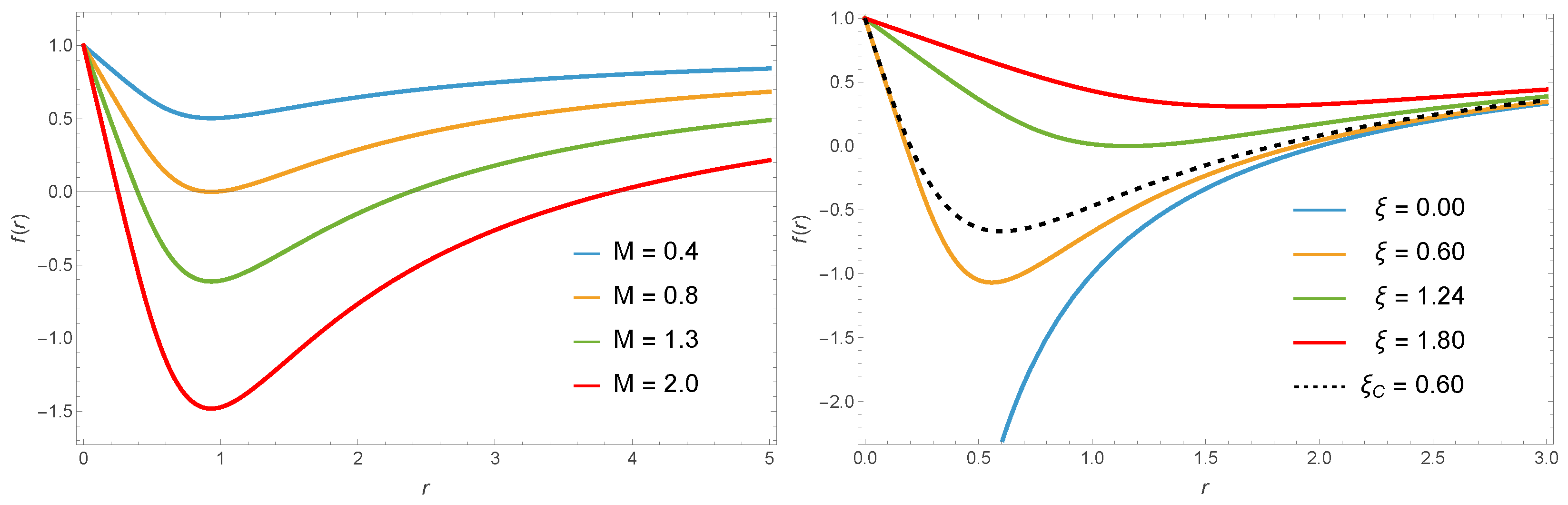
, we observe the formation of at most two event horizons, as shown in
Figure 1. In the left panel, when varying the mass
M while keeping the cutoff scale parameter fixed at
, the horizons begin to exist for
. In the right panel, with
fixed, the event horizons for schemes B and C are shown. Scheme-C is represented by the dashed curve for
, while the remaining curves correspond to Scheme-B, for which the horizons appear for
.
We now proceed with the analysis of the curvature properties of the spacetime under consideration, focusing on the Kretschmann scalar
. This invariant, which measures the magnitude of the Riemann tensor, is given by
From the asymptotic expansion of (
8), the dominant infrared contribution to the Kretschmann scalar
K, takes the form
with the leading term of
K being identical to the Schwarzschild behavior, consistent with
as
. On the other hand, the expansion in the limit
yields
which indicates that the solution is singular. Since our analysis is restricted to the IR regime, the presence of such a singularity at the center is a natural feature of this improved Schwarzschild solution. In practice, however, this region is excluded from our analysis because quantum effects at the Planck scale are expected to dominate there and can only be consistently described within the fully improved solution. Nevertheless, in our approach, quantum effects may still be relevant at the scale of the event horizon and can therefore manifest themselves through modifications of its thermodynamic properties, which will be the subject of the next section.
Regarding the causal structure of the Scheme-B metric, it is important to note that for the region outside the event horizon (), the lapse function remains strictly positive. Since the metric components and are also positive and depend only on the radial coordinate, the spacetime does not exhibit closed timelike curves (CTCs) in the exterior domain. Furthermore, the analysis of curvature invariants confirms that the exterior region is regular, ensuring that geodesics outside the horizon are complete and that the standard causal structure of a Schwarzschild-like black hole is preserved.
3. Thermodynamics
We proceed with the study of the new, improved Schwarzschild black hole by analyzing its thermodynamic properties, which are derived from the metric function (
6). Initially, considering the condition
, the mass
M as a function of the horizon radius
is
where the standard Schwarzschild mass is recovered in the appropriate limit
.
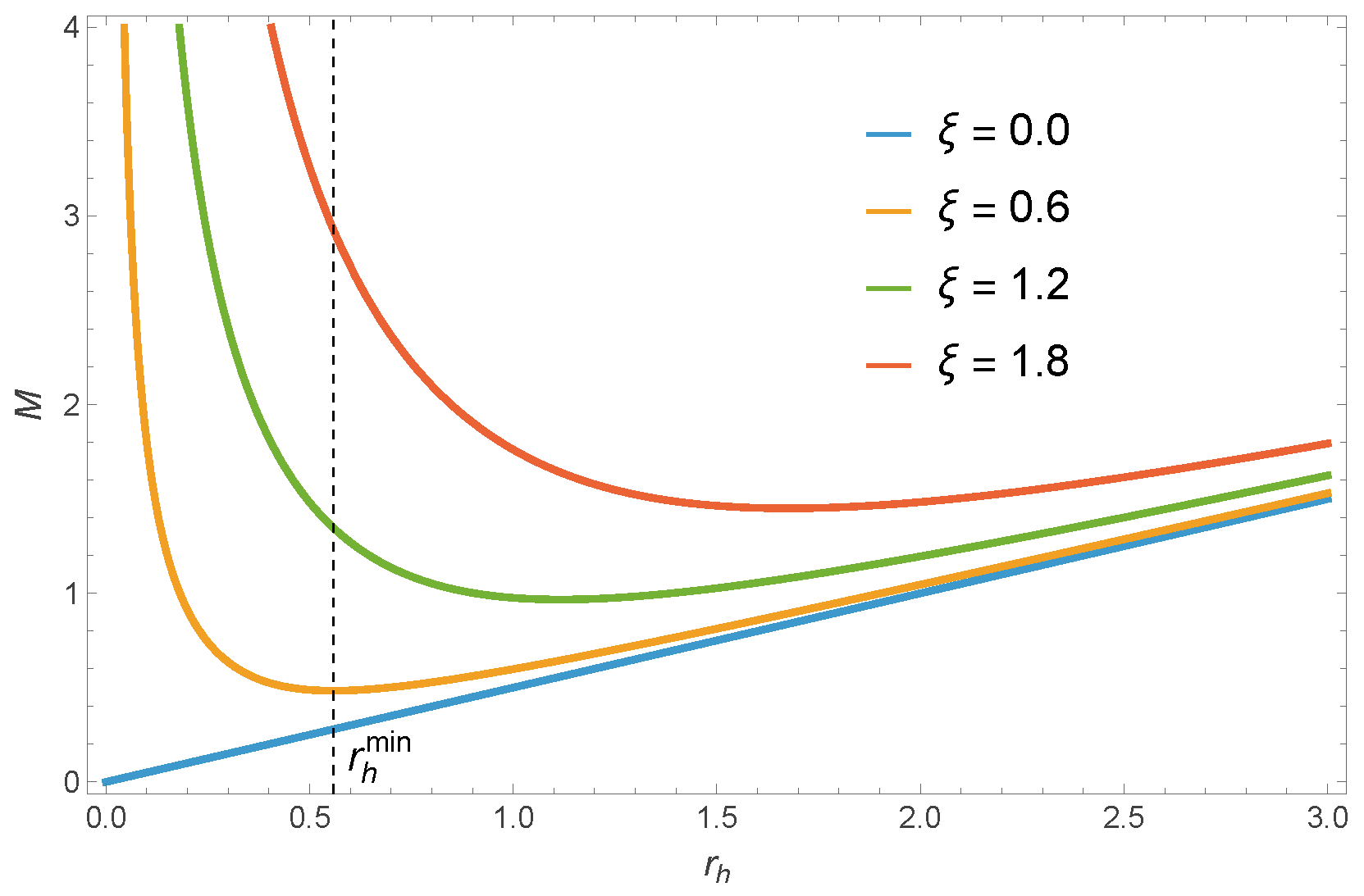
To advance the thermodynamic analysis, it is necessary to distinguish between the internal and external horizons, which is determined by examining how the mass depends on the horizon radius. The mass function exhibits a minimum at , corresponding to the extremal configuration where the inner and outer horizons coincide (). Consequently, the thermodynamic analysis must be restricted to the parameter ranges that yield a real outer horizon, i.e., (or equivalently ).
In
Figure 2, we present the relation between the black hole mass and the radius
for different values of the parameter
. Since only the branch of the curve with
corresponds to a physical event horizon, for
this limit occurs at
.
For the Hawking temperature [
18], obtained from the surface gravity at the event horizon, i.e.,
, it follows in this model that
Furthermore, in the regularization scheme-C, the Hawking temperature takes the form
where, in the limit
, both expressions reduce to the temperature of a Schwarzschild black hole, namely,
.
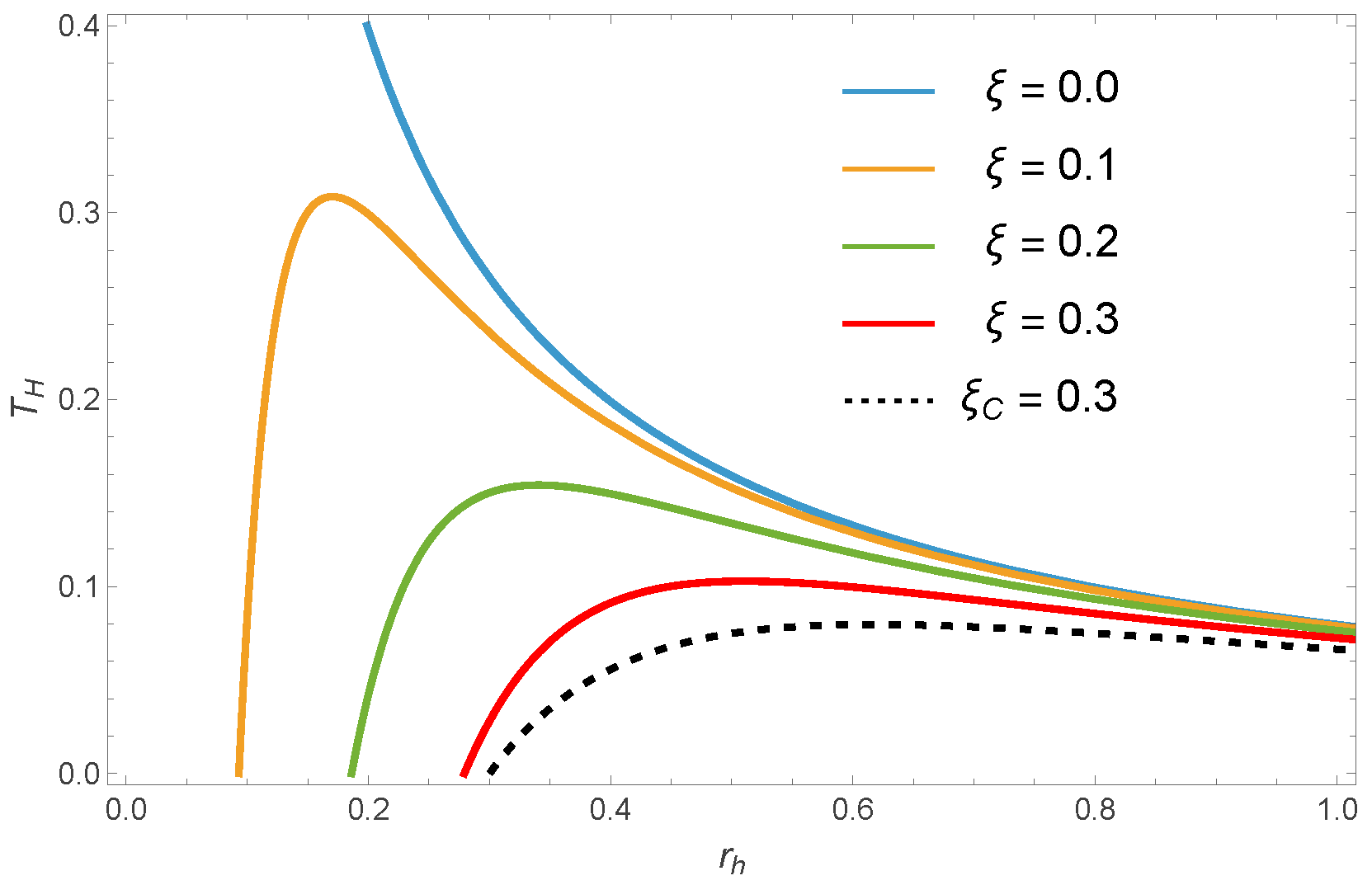
Figure 3 shows the Hawking temperature as a function of the event horizon radius, for different values of the parameter
(Scheme-B) and a dashed curve representing the regularization scheme-C. The temperature increases as
decreases, reaches a maximum, and then drops to zero, indicating a phase transition and the formation of a remnant when
. These remnant radii, for schemes B and C, are given by
and
, respectively.
The thermodynamic properties of our black hole solution are further explored by examining the entropy
S. Here, we work in the fixed-
ensemble, treating the parameter
as an external scale of the geometry. Therefore, along variations with
, the first law reduces to
, or equivalently
. Using
from Equation (
11) and
from Equation (
12), we then obtain the entropy in analytic form:
This result reveals that the entropy is composed of the classical area law,
[
37], supplemented by a non-trivial logarithmic correction term regulated by the scale
. Such logarithmic dependencies are a universal hallmark of quantum-corrected geometries, often arising from microstate counting as a consequence of the renormalization group improvement in the ASG framework. In the limit
, the classical Schwarzschild area relation is exactly recovered. The presence of this quantum-inspired term is crucial for the thermodynamic stability of the system, particularly in the final stages of evaporation, where it supports the existence of a cold remnant.
In order to emphasize the robustness of the black hole in the Scheme-B, it is instructive to compare its entropy with that obtained from a simpler renormalization group improvement, namely, Scheme-C. For the latter, the first law leads to a simpler logarithmic correction of the form
. While both models incorporate quantum-inspired corrections, the logarithmic term in the black hole metric exhibits a more intricate dependence on the non-local scale
, as seen in the argument of the logarithm in Equation (
14). This structural difference ensures a smoother thermodynamic transition as the black hole approaches the higher energy scales. Furthermore, as previously discussed, the black hole metric provides a more stable framework for the cold remnant phase, consistent with the tighter constraints imposed by recent shadow observations from M87* and Sgr A*, as we will see, where the Scheme-B shows superior phenomenological agreement compared to the more abrupt corrections of Scheme-C.
Regarding the heat capacity,
, of the new improved Schwarzschild black hole, it follows from [
38]
For the heat capacity given by Scheme-C, it follows that
where the heat capacity of the Schwarzschild black hole,
, is recovered when
. The
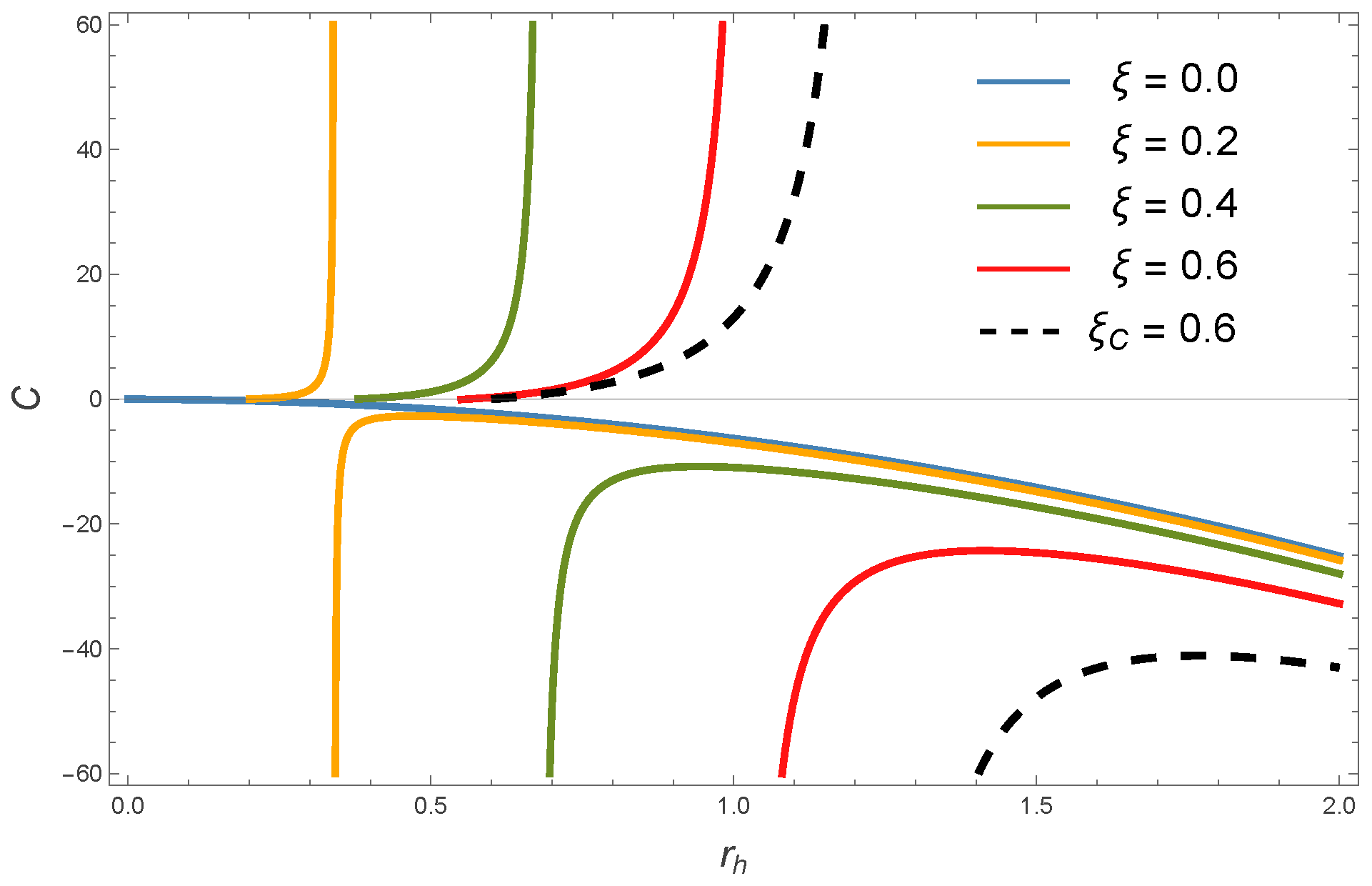
Figure 4 shows the behavior of the heat capacity as a function of the event horizon radius for different values of the cutoff scale parameter
, with the dashed curve representing the heat capacity in Scheme-C for
.
The behavior shown in
Figure 4 reveals a clear thermodynamic phase structure for the improved black hole. The physical branch starts at the remnant radius
, where the Hawking temperature vanishes and the evaporation process stops. In the neighborhood of this point, the heat capacity is positive, indicating a locally stable branch. As
increases,
C diverges at a critical radius, which signals a second-order phase transition between two thermodynamic regimes. Beyond this point, the heat capacity becomes negative, showing that the large-black-hole branch is thermally unstable. In the asymptotic regime of large
, the solution approaches the Schwarzschild limit, for which
, as expected.
To complete the usual thermodynamic characterization of the enhanced Schwarzschild black hole in the IR limit, we analyze the Gibbs Free Energy, henceforth (
G). In the canonical ensemble, this potential determines the global stability of the system. The Gibbs free energy is defined by the Legendre transformation of mass with respect to entropy, given by [
4]
To obtain the expression for Scheme-B (our proposed solution), it is necessary to combine the thermodynamic functions derived previously. We use the mass
defined by Equation (
11), which represents the total energy of the system corrected by the scale
. We incorporate the Hawking temperature
from Equation (
12), obtained via surface gravity, and the entropy
from Equation (
14), which includes the logarithmic correction. To simplify the representation, we define the auxiliary function
. Thus, the corrected entropy Equation (
14) can be written compactly in terms of the inverse hyperbolic sine:
Substituting the mass
and the temperature
into the definition of the potential, the Gibbs free energy for Scheme-B takes the following form:
For comparative purposes, we analyze Scheme-C, using the lapse function from Equation (
7). With the mass
, the temperature from Equation (
13), and the simplified entropy, the potential for the reference model is given by:
In the classical limit , both schemes recover the Schwarzschild behavior, , where the black hole is thermodynamically unstable in vacuum.
The analysis reveals that, for our model, G remains positive and reaches a finite value at the radius of the stable remnant, . Since the temperature vanishes at this point, the thermal interaction term disappears, and the value of G converges exactly to the mass of the remnant: . This behavior confirms that the remnant is a stable final state that halts evaporation.
The comparison between the two models for
shows that our proposal provides a smoother thermodynamic transition. While Scheme-C exhibits more abrupt variations due to the logarithmic correction. Thus, the non-linear structure of our solution ensures a continuous regularization of the thermal phases. This stability is consistent with observations of black hole shadows and reinforces the phenomenological viability of the model within the framework of ASG. To illustrate that behavior, we have shown in
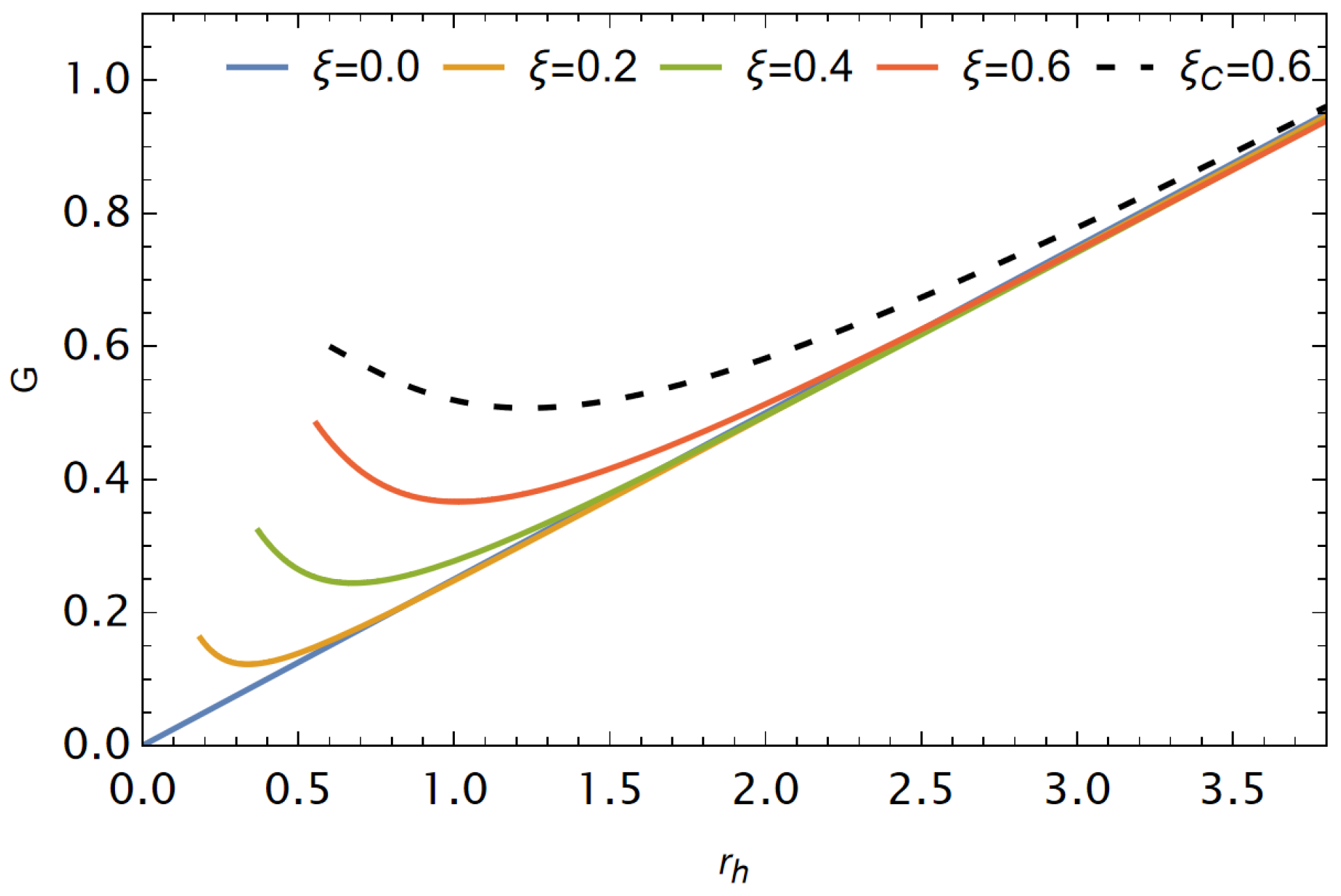
Figure 5 that the Gibbs free energy remains finite throughout the physical domain. Each curve starts at a different lower bound because the allowed range is
, so increasing
shifts the onset of the plot to larger radii. As
increases, all Scheme-B curves approach the same asymptotic trend and progressively converge toward the
(Schwarzschild) behavior, indicating that the quantum-inspired corrections become subleading at large radii. For comparison, the dashed curve (Scheme-C) exhibits a systematically higher Gibbs free energy and a milder variation over the plotted range, reflecting the different functional dependence of the running coupling in that prescription. In the limit
, the curve becomes linear, consistently reproducing the Schwarzschild result discussed above.
To ensure a more general and self-consistent thermodynamic description, we promote the scale parameter
to the status of an independent thermodynamic variable. In this framework, the ADM mass
acts as the system’s enthalpy, and the first law of black hole thermodynamics is generalized to include a work term associated with the infrared cutoff scale of Asymptotic Safety,
, where
is the potential conjugate to
, representing the energetic response of the horizon to the quantum gravity corrections. We have analytically verified that the ADM mass is a homogeneous function of degree 1 with respect to the length scales
and
. Consequently, if the entropy were purely proportional to the horizon area (
), the generalized Smarr relation
would be rigorously satisfied. However, since
is determined by the surface gravity according to Equation (
12)—the law “zero”—the consistency of the first law requires an entropy definition that incorporates logarithmic corrections, as shown in Equation (
14). This introduces a break in the standard scaling of the thermodynamic variables, reflecting a scale anomaly intrinsic to the renormalization-group improved geometry. The formulation based on the extended phase space ensures, therefore, that the thermodynamic robustness of the model is maintained by the exactness of the first law, providing the necessary theoretical bridge to the study of the phase space geometry and phase transitions in the following section.
4. Thermodynamic Geometry
In this section, we investigate the thermodynamic phase structure of the black hole using the Hendi–Panahiyan–Eslam Panah–Momennia (HPEM) thermodynamic geometry formalism [
28]. Our analysis is performed in the extended phase space, as previously discussed, ensuring internal consistency between the quantum corrections in the metric and the laws of thermodynamics, allowing the stability of the system to be analyzed within a two-dimensional phase space. In this extended phase space, the mass is regarded as a function of the entropy and the charge
, namely
, implicitly defined through the relation between
S and the horizon radius
. Following the HPEM prescription [
28], the thermodynamic metric on the space of extensive variables
is defined as
which is constructed to ensure that curvature singularities arise exclusively from genuine thermodynamic instabilities, avoiding unphysical divergences. Thus, for a two-dimensional diagonal metric of the form
with
and
, the Ricci scalar can be computed analytically. After substituting the HPEM metric components and simplifying, the curvature scalar assumes the generic structure
In terms of the thermodynamic variables (
S,
), the scalar is
where
is a regular function of the thermodynamic variables. Crucially, the numerator does not introduce additional singularities. In principle, divergences of the HPEM Ricci scalar may arise either from the condition
or from a possible zero of
. However, for the mass function of Scheme-B adopted here,
one obtains
which is strictly positive for
and
. Therefore, in the physical domain considered in this work,
never vanishes, and the divergences of the HPEM Ricci scalar are associated only with
which coincides with the divergence points of the heat capacity. This confirms that the thermodynamic geometry consistently captures the phase transition structure of the black hole when the corrected entropy is employed.
The thermodynamic curvature scalar
, as shown in
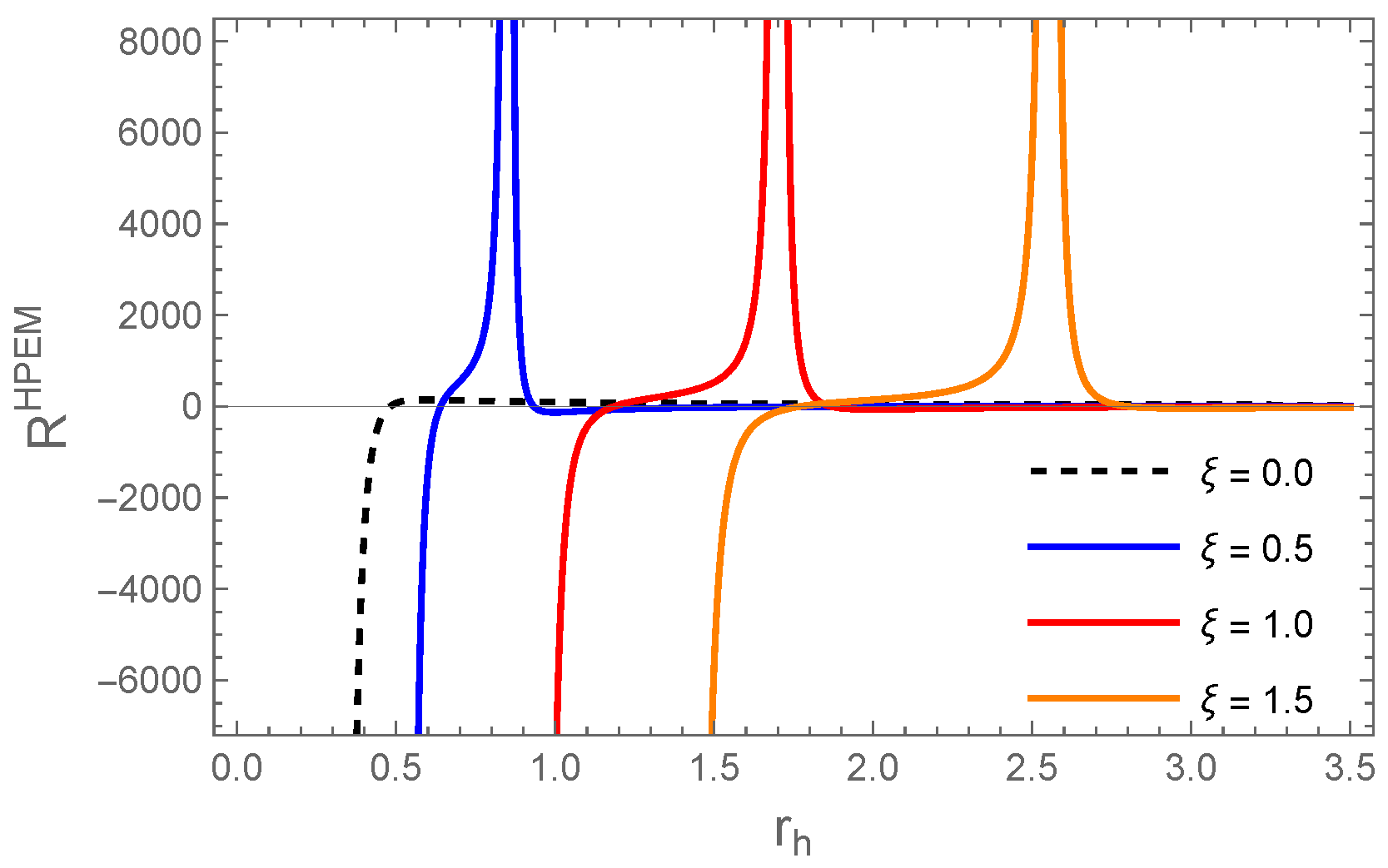
Figure 6, exhibits divergences that precisely map the critical points of the improved Schwarzschild black hole. The latter is incidentally depicted by the dashed curve. The first singularity occurs at the remnant radius
, where the Hawking temperature vanishes, indicating the limit of validity for the classical thermodynamic description and the stabilization of the system into a final quantum-gravity state. A second divergence emerges for larger values of
, coinciding with the point where the heat capacity becomes infinite, signaling a second-order phase transition between thermodynamically stable and unstable configurations. This geometric representation in phase space confirms that the cutoff parameter
acts as a regulator that introduces new correlation scales and equilibrium points absent in the classical Schwarzschild solution.
5. Thermodynamic Topology
Motivated by the topological interpretation proposed in [
31], we analyze the present RG-improved Schwarzschild model by treating its thermodynamic states as defect structures in an off-shell free-energy landscape. The starting point is the off-shell generalized Gibbs free energy
where
is an external control parameter and
labels the regularization prescription (we adopted the B label here for pedagogical distinction). In our case, the thermodynamic functions are those derived in
Section 3: for Scheme-B,
and
are given by Equations (
11) and (
14), while for Scheme-C we use
and
. The physically relevant domain is restricted by the remnant radii, namely
and
.
To construct the phase-space flow, we introduce an auxiliary angle
and define the two-dimensional vector field [
31]
The zeros of
are determined by the simultaneous conditions
and
where the last equality follows from the first law
already employed to obtain
in
Section 3. Therefore, the defect points in the
plane are in one-to-one correspondence with the on-shell relation
, with
and
given by Equations (
12) and (
13).
Following [
31], we associate to
the topological current
where
and
. The unit vector
is defined as
The current (
30) is identically conserved and is non-vanishing only at the zeros of
[
31]. In particular,
where we identify
. In regions where
and
are smooth, one may rewrite
Hence, for a domain
D free of zeros of
, Green’s theorem yields
For a closed contour
C enclosing all zeros of
, the total topological number is defined by
where each
is a small loop surrounding a single defect.
In the present model, the remnant condition
implies
at the beginning of the physical domain, so the topological analysis is restricted to
. This behavior is explicitly illustrated in
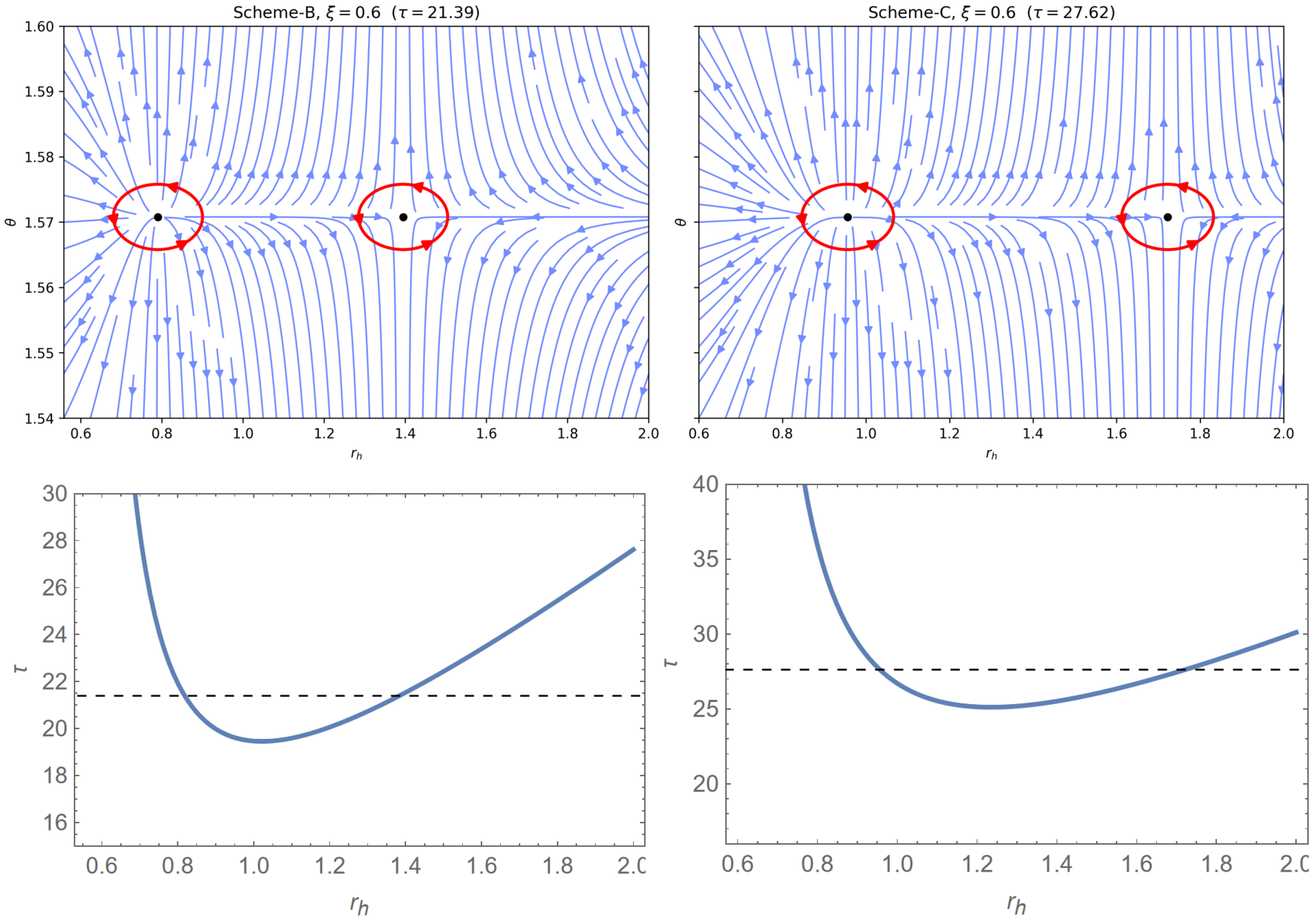
Figure 7: in the bottom panels,
starts at infinity, decreases until reaching a local minimum
, and then increases again. Hence, for any fixed
(dashed lines in the bottom panels), the equation
admits two solutions, which appear as two zero points of the vector field
at
in the corresponding stream plots (top panels). These two defects represent the two thermodynamic branches separated by the critical point already signaled by the divergence of the heat capacity in
Figure 4. Comparing Scheme-B and Scheme-C at the same
, the same defect pattern is preserved, but the positions of the zeros and the width of the stable window shift because
modifies
and
S differently in each prescription; in particular, Scheme-B yields a smoother deformation of the Schwarzschild thermodynamic landscape, whereas Scheme-C produces a more displaced defect structure for the same cutoff scale.
6. Grey-Body Factors
The radial propagation of a massless scalar perturbation can be written, in terms of the tortoise coordinate
, in the Schrödinger-like form
where
is the frequency of the scattered massless scalar mode and the tortoise coordinate is defined by
.
For the metric under consideration, the effective potential for a massless scalar field, as discussed in [
33,
34,
35], is given by
where
l is the angular quantum number.
From the effective potential, we determine the grey-body factors, which measure the deviation of the radiation spectrum emitted by a black hole from that of a perfect black body [
35]. Thus, according to [
34,
35,
39], a lower bound for the quantum transmission coefficients through the potential barrier, in other words, the grey-body factors, is given in the form
Using Equation (
36) in expression (
37), and considering that, in our case, there is no cosmological horizon, the lower bound for the grey-body factor becomes
where
and
denotes the event horizon (outer horizon).
The numerical results for the lower bound of the grey-body factor
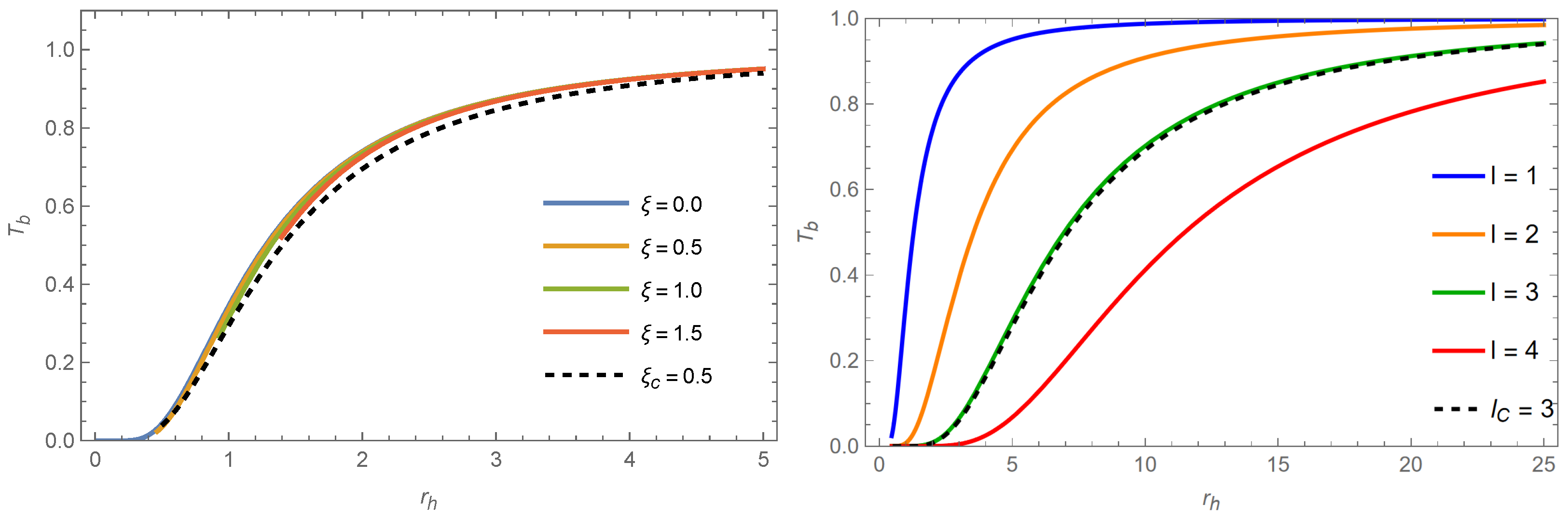
, shown in
Figure 8, indicate that quantum corrections induce moderate but systematic changes in the emission transparency of the black hole. For the numerical illustration in the left panel of
Figure 8, we fix
as a representative reference value for the scattered scalar mode. This choice is adopted only to provide a clear comparison of how the transmission bound depends on the horizon radius
and on the parameter
, without introducing an additional frequency scan in the figure. The right panel complements this analysis by displaying the dependence of
on the multipole number
l, with
and
fixed. For all cases,
increases with the horizon radius
, starting from a non-zero value at the remnant radius and asymptotically reaching the Schwarzschild limit (
) for large
. From the right panel, we also observe that higher values of
l reduce the transmission bound, indicating that higher multipoles experience a more suppressive potential barrier. Comparing the two regularization schemes, Scheme-C consistently yields lower grey-body factors than Scheme-B for a fixed
. This indicates that the geometry in Scheme-C produces a more reflective potential barrier, resulting in a larger opacity
as defined in Equation (
39), which suppresses the transmission probability. Regarding the influence of the cutoff scale on the black hole metric (Scheme-B), we observe that higher values of
lead to a decrease in
. Physically, an increase in the parameter
enhances the quantum gravity effects near the origin, which effectively increases the spacetime opacity. Consequently, the potential barrier becomes more efficient at filtering outgoing radiation, reducing the grey-body factor across the physical range of
.
The fact that does not vanish at the remnant radius, despite the Hawking temperature being zero, indicates that the quantum-corrected geometry remains partially transparent to radiation even in the cold remnant limit, a feature that distinguishes these RG-improved models from the classical case.
7. Shadow Analysis and Observational Constraints
The shadow of a black hole is a critical observable that provides a direct signature of the underlying spacetime geometry near the event horizon. For the static and spherically symmetric line element in Equation (
5), the shadow boundary is determined by unstable circular null geodesics. Using the conserved energy
and angular momentum
, the radial null geodesic equation can be written as
, with effective potential
. The photon sphere radius
is then obtained from the circular-orbit condition
, which yields
This is the standard condition for null circular orbits in spherically symmetric black-hole spacetimes [
13]. Where the lapse function
is defined according to the specific regularization scheme under consideration. For Scheme-B, we employ Equation (
6), while for the reference Scheme-C, we use Equation (
7). An observer at an asymptotic distance from the black hole perceives a shadow with a radius
that is geometrically magnified by gravitational lensing. This observed radius is defined by the critical impact parameter given by
which depends on the specific value of the scale parameter
. In the classical limit where
, both regularization schemes recover the standard Schwarzschild result
. As
increases, the gravitational coupling
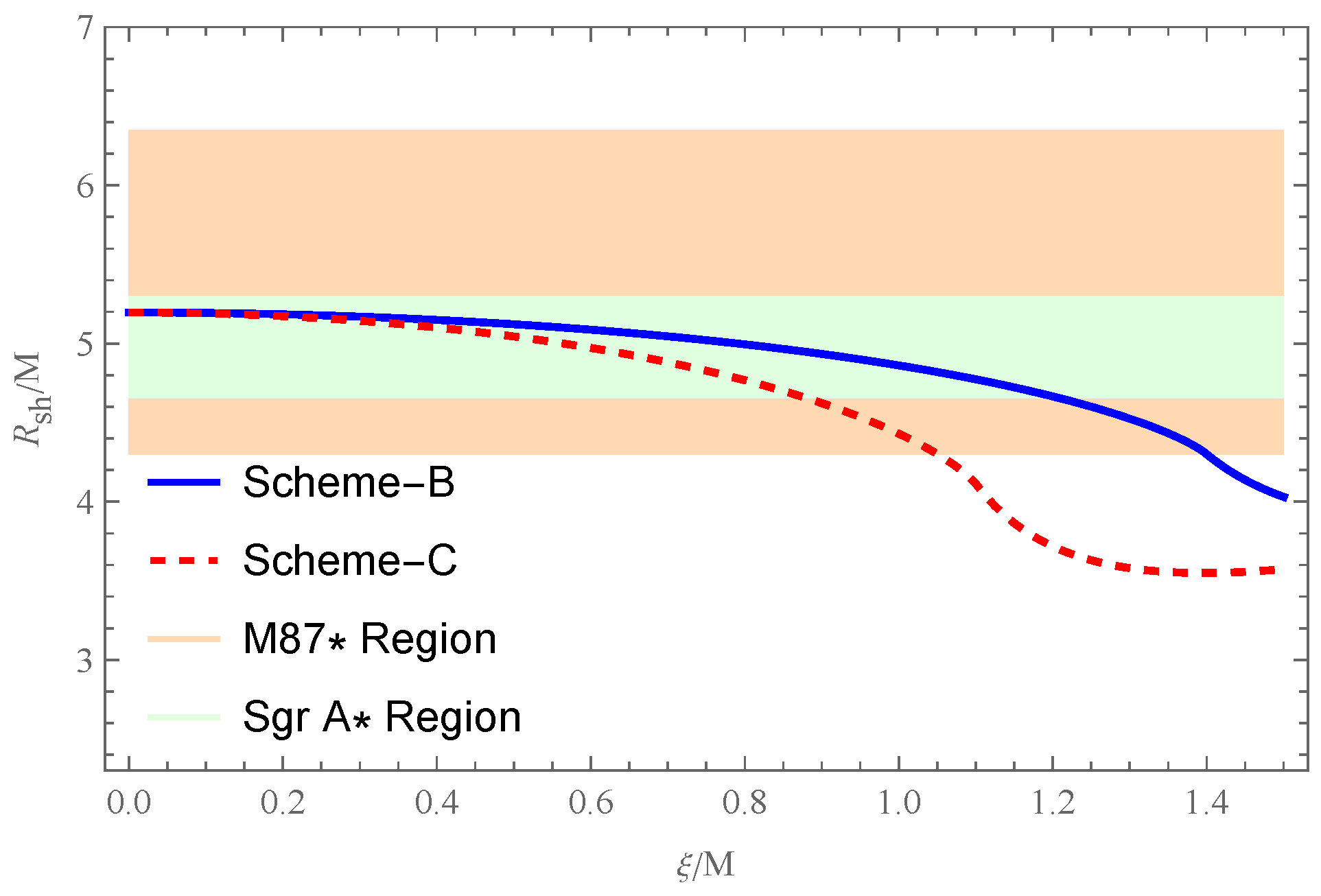
decreases due to the asymptotic safety corrections, leading to a weaker effective gravitational attraction. Consequently, the photon sphere and the resulting shadow radius exhibit a monotonic decrease as the quantum scale becomes more prominent.
Figure 9 displays the evolution of the shadow radius ratio
compared against the
observational bounds from the Event Horizon Telescope (EHT) for M87* (
) and Sgr A* (
). The horizontal bands illustrate the regions of observational consistency, with the central light-green region highlighting the overlapping confidence intervals between both sources. Our results show that Scheme-B (solid blue line) is phenomenologically more robust than Scheme-C (dashed red line), as it predicts a more gradual decrease in the shadow size. While Scheme-C quickly reaches the lower bounds of the Sgr A* observations for small values of
, Scheme-B remains well within the overlapping experimental region for a significantly broader range of the regularization parameter. This suggests that the proposed black hole metric in Scheme-B provides a more stable description of astrophysical black holes under quantum gravity corrections.
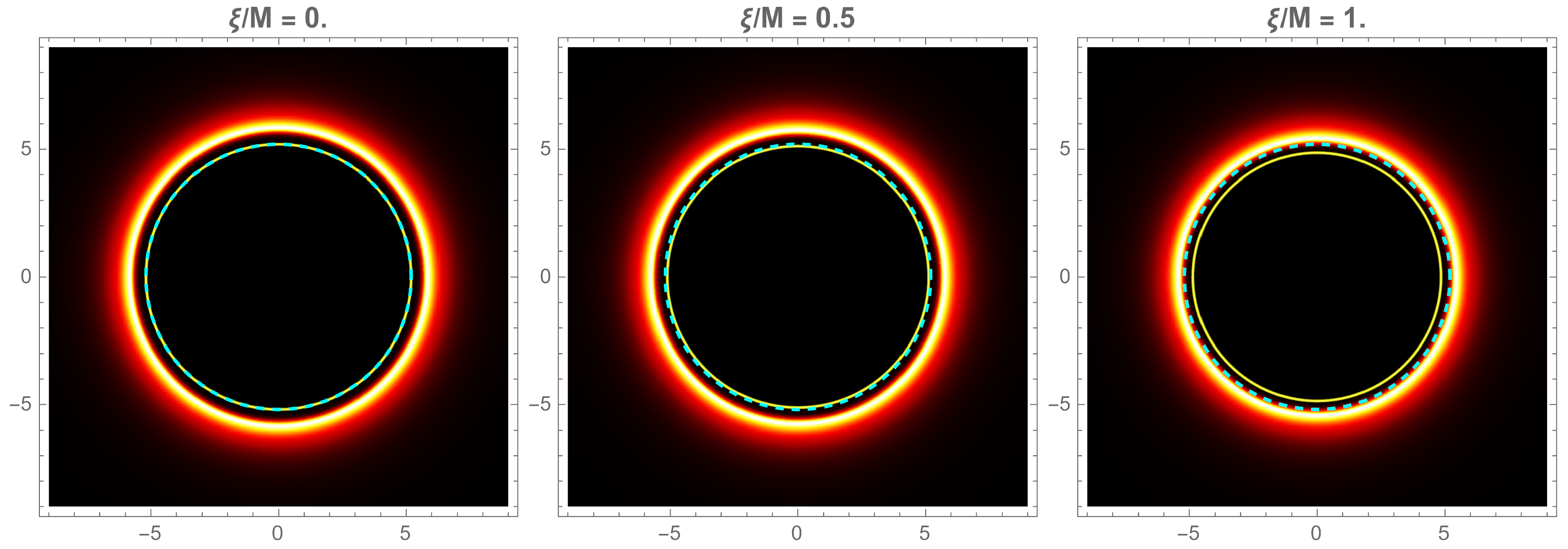
In
Figure 10, we present the visual rendering of the black hole shadows. To simulate the appearance of the accretion flow around the black hole, we implemented the Gralla–Lupsasca–Marrone (GLM) model described by the intensity profile given by
The parameters
,
, and
correspond to three distinct properties of the emission profile: The location of the central peak, its width, and its asymmetry, respectively [
15,
16]. In the resulting two-dimensional images, the peak emission parameter is set to
, effectively anchoring the maximum brightness near the photon ring to account for strong gravitational lensing and light pile-up at the critical curve. The width and asymmetry are controlled by
and
, respectively, providing a finite thickness and a smooth outward decay of the intensity. The dark circle corresponds to the central region where the impact parameter
b is smaller than the critical value
. Thus, the bright rings surrounding the shadows illustrate the emission from the accretion disk, where we intentionally emphasized the photon ring contribution to highlight the impact of the
parameter on the shadow’s size and edge sharpness. As observed in the shadow plots, increasing the value of
leads to a progressive shrinkage of the shadow radius compared to the classical Schwarzschild limit, which is denoted by the dashed blue reference circles. Thus, while
Figure 9 accounts for the broad observational uncertainties of the current EHT data (represented by the shaded bands), within which the black hole shadows lie, including the Schwarzschild one (
),
Figure 10 presents a theoretical rendering in the high-resolution limit designed to highlight the intrinsic impact of the quantum-gravity corrections on the shadow geometry and on the accretion disk. Then, the first panel of
Figure 10 demonstrates that for
, the dashed circle perfectly coincides with the faint yet distinct photon ring, which marks the shadow’s physical boundary. As the parameter
increases, the subsequent panels reveal that the shadow is pushed deeper within this reference circle, a behavior that directly reflects the evolution presented in
Figure 9.
8. Conclusions
In this study, we investigated a new, improved Schwarzschild black hole geometry arising from the Asymptotic Safety program, specifically focusing on the infrared (IR) limit of the renormalization-group improvement. Employing Scheme-B to run Newtonian coupling as in [
18], we analyzed a metric where the non-local scale
significantly modifies the horizon structure and the late-stage evaporation process. It is important to emphasize that, as an IR-limit model, this solution focuses on the macroscopic and intermediate-scale corrections; thus, it preserves the singular nature at the origin while introducing a fundamental departure from the classical Schwarzschild evolution.
A primary result of our analysis is the deviation from the usual black hole thermodynamics. In the classical scenario, a Schwarzschild black hole has a temperature that diverges as its mass vanishes, leading to complete, unstable evaporation. In contrast, the Scheme-B geometry introduces a critical change: the Hawking temperature reaches a maximum and then drops to zero at a finite remnant radius . This behavior indicates that the quantum-corrected black hole does not completely evaporate but instead stabilizes into a cold remnant after undergoing a phase transition, as confirmed by the behavior of the heat capacity and the Gibbs free energy.
The internal consistency of this extended thermodynamic picture was validated through the HPEM geometric formalism. The thermodynamic curvature scalar successfully mapped the phase space of the model, exhibiting a divergence at the remnant radius, which marks the breakdown of the classical thermodynamic description. Furthermore, a second divergence in at larger radii identifies a second-order phase transition associated with the heat capacity’s instability. These geometric features are perfectly aligned with the corrected entropy law, which incorporates universal logarithmic terms.
The thermodynamic consistency of the model was further reinforced by the topological analysis. By interpreting the on-shell states of the RG-improved Schwarzschild black hole as defect structures in an off-shell free-energy landscape, we constructed the phase-space vector field . We found that the physical domain is naturally bounded from below by the cold-remnant condition, since implies at the remnant radius. For any fixed , the equation admits two solutions appearing as isolated zeros of (typically carrying opposite winding numbers), encoding the two thermodynamic branches separated by the critical point, in agreement with the divergence observed in the heat capacity. Notably, although the defect pattern is topologically equivalent between Scheme-B and Scheme-C, the former yields a smoother deformation of the Schwarzschild landscape, reinforcing the scenario of a regulated evaporation process that culminates in a stable remnant.
Complementing the equilibrium analysis, we investigated the propagation properties of massless scalar perturbations through the effective potential barrier via the grey-body factors. By deriving a lower bound for the transmission probability, , our numerical results showed that quantum corrections systematically modify the spacetime opacity. Specifically, the transmission probability increases with the horizon radius, asymptotically recovering the Schwarzschild limit , whereas increasing the non-local scale suppresses across the physical domain, indicating that ASG corrections enhance the effective barrier felt by outgoing modes. A comparison between the regularization prescriptions further reveals that Scheme-C produces a more reflective barrier than our proposed Scheme-B. Finally, we found that remains non-zero at ; this does not imply a non-vanishing Hawking flux, since , but rather indicates that the remnant spacetime retains partial transparency to external scalar perturbations, a distinctive imprint of asymptotic-safety corrections in the infrared regime.
Finally, the agreement between our predicted shadow radii and the EHT observations for and Sgr confirms that these IR modifications are not only theoretically consistent but also phenomenologically viable, providing a robust bridge between quantum gravity effects and observational astrophysics.





 ,
,