
Study of 27 Polluted White Dwarfs Observed by LAMOST: Spectral Features, Ages, and Kinematics


Abstract
1. Introduction
2. Data and Sample Selection
2.1. Data
2.2. Sample Selection
- Spectral screening. Each spectrum was visually inspected to assess the continuum shape and the presence of diagnostic absorption lines. Only spectra showing clear hydrogen (Balmer) or helium features were retained, because our spectral fitting used the DA and DB atmospheric model grids of Koester [23]. White dwarfs of the DZ type—dominated by metal lines and incompatible with the adopted grids—were excluded (29 objects). In addition, six misclassified sources whose spectral morphologies were inconsistent with those of typical white dwarfs were rejected.
- Assessment of metal-line quality. During the same inspection, particular attention was given to the Ca II K line at and other metallic absorption features. Only spectra with sufficiently high signal-to-noise ratios (S/N ) and well-defined line profiles were retained, ensuring reliable determinations of radial velocity and equivalent width () in the subsequent analysis.
3. Sample Analysis
3.1. Atmospheric Parameter and Radial Velocity Determination
3.2. Measurement of Ca II K Line Velocity and Equivalent Width
3.3. Calculation of White Dwarf Cooling Age
3.4. Calculation of Galactic Space Velocities and Orbital Parameters
4. Results and Discussion
4.1. Origin of the Ca II K Line
4.2. Characteristics of the Ca II K Line
4.3. Kinematic Characteristics of the Milky Way
5. Conclusions
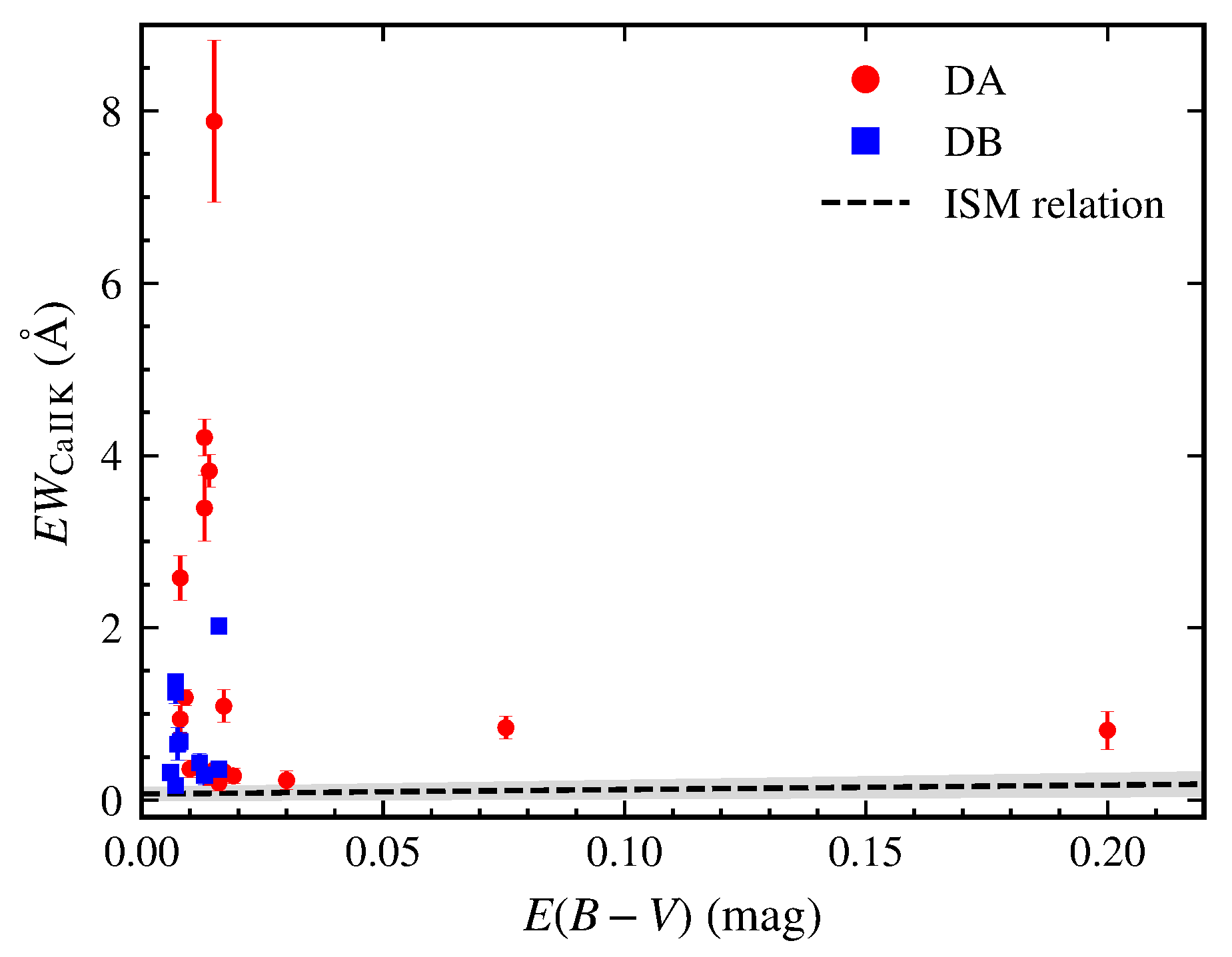
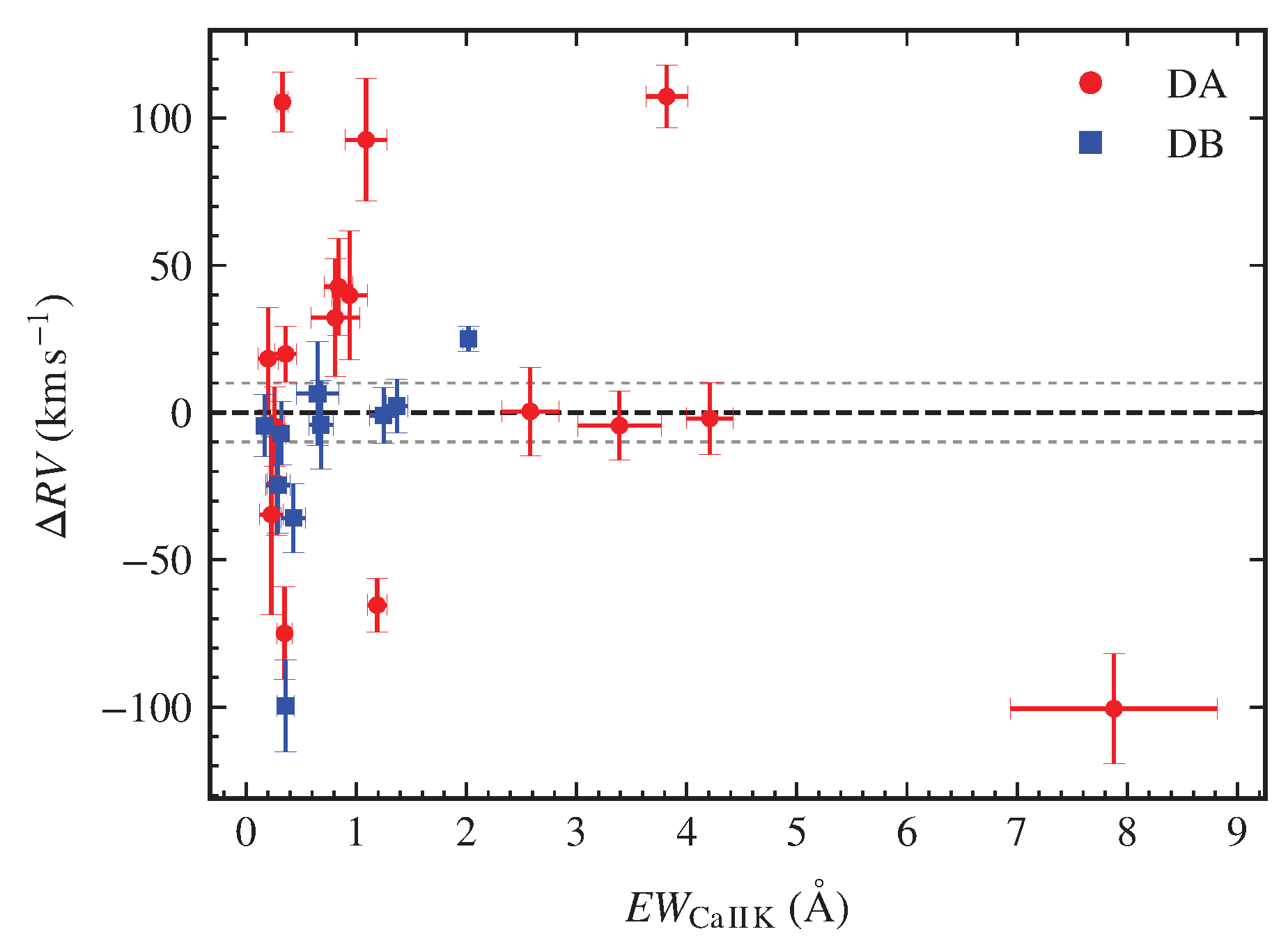
- We utilize the relationship between and derived from the sdB sample by Li et al. [27]. Our analysis shows that most of the targets lie above the pure-ISM expectation, indicating that for the majority of these objects, the Ca II K line does not originate from the ISM, which does not play a dominant role in the observed metal pollution of white dwarfs. By comparing the radial velocities (RVs) of the white dwarf photospheric lines (H Balmer for DA-type and He I for DB-type) with the RVs of the Ca II K line, we find that the Ca II K line is photospheric for 10 objects, while for 17 objects, it originates externally, likely from circumstellar material (CSM).
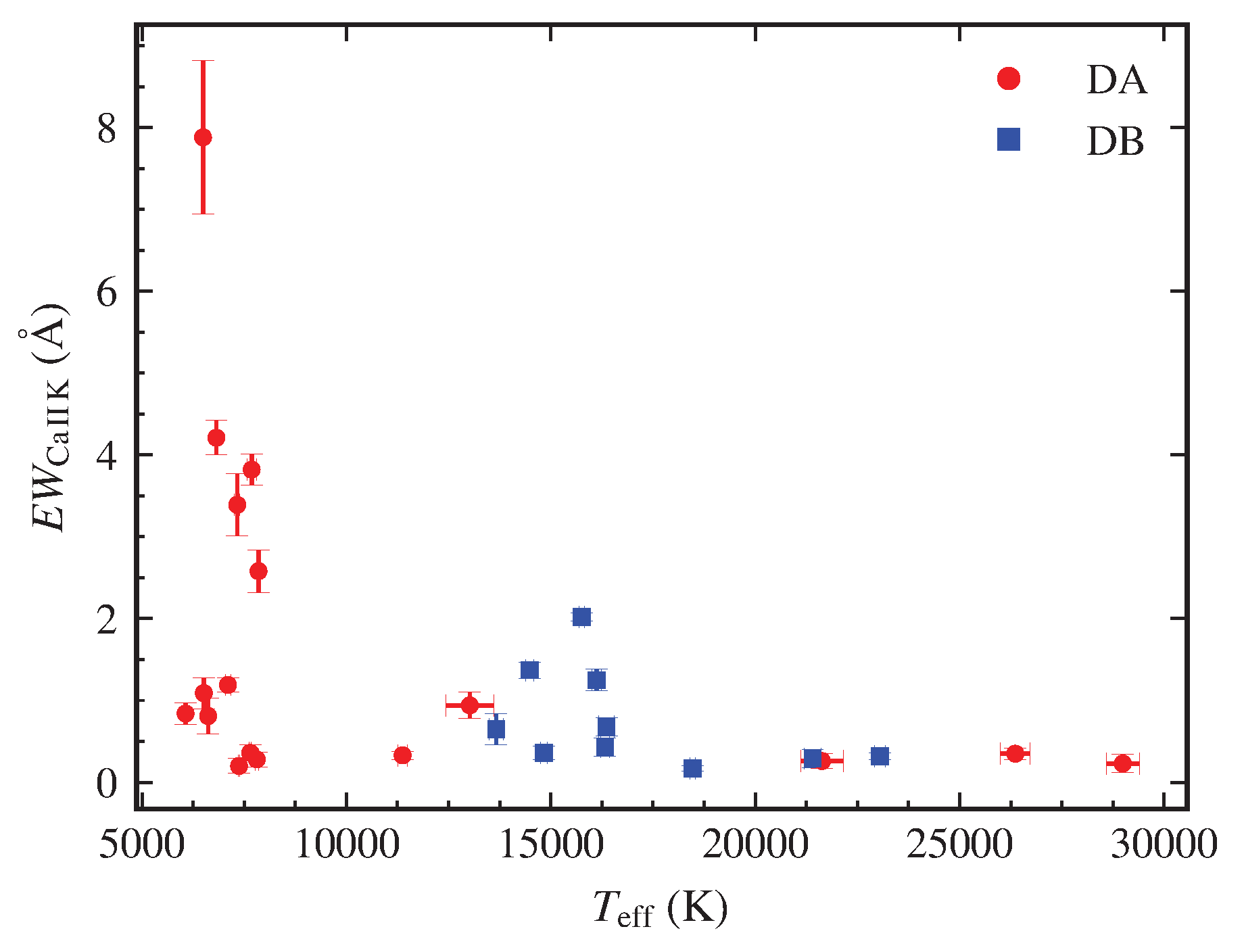
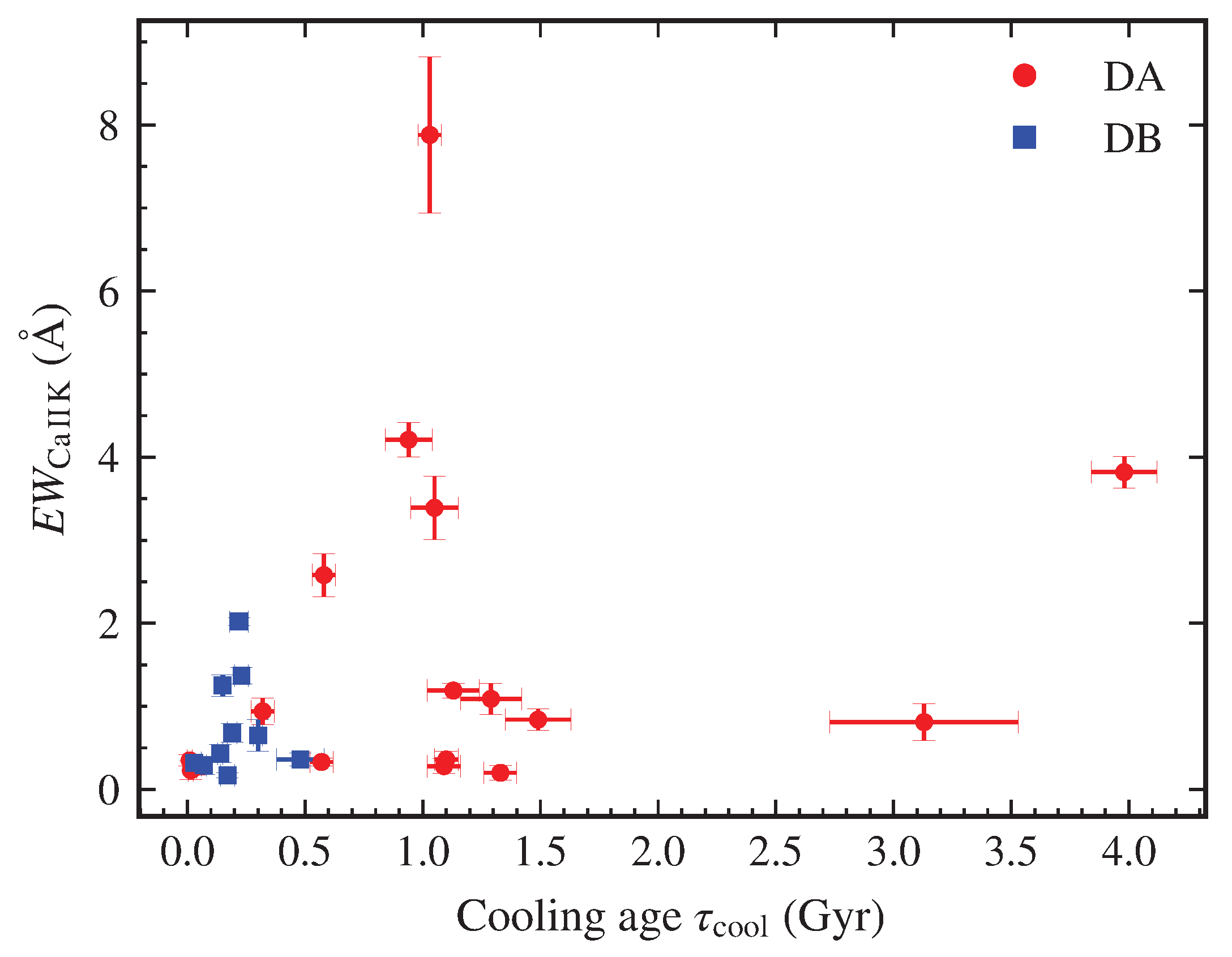
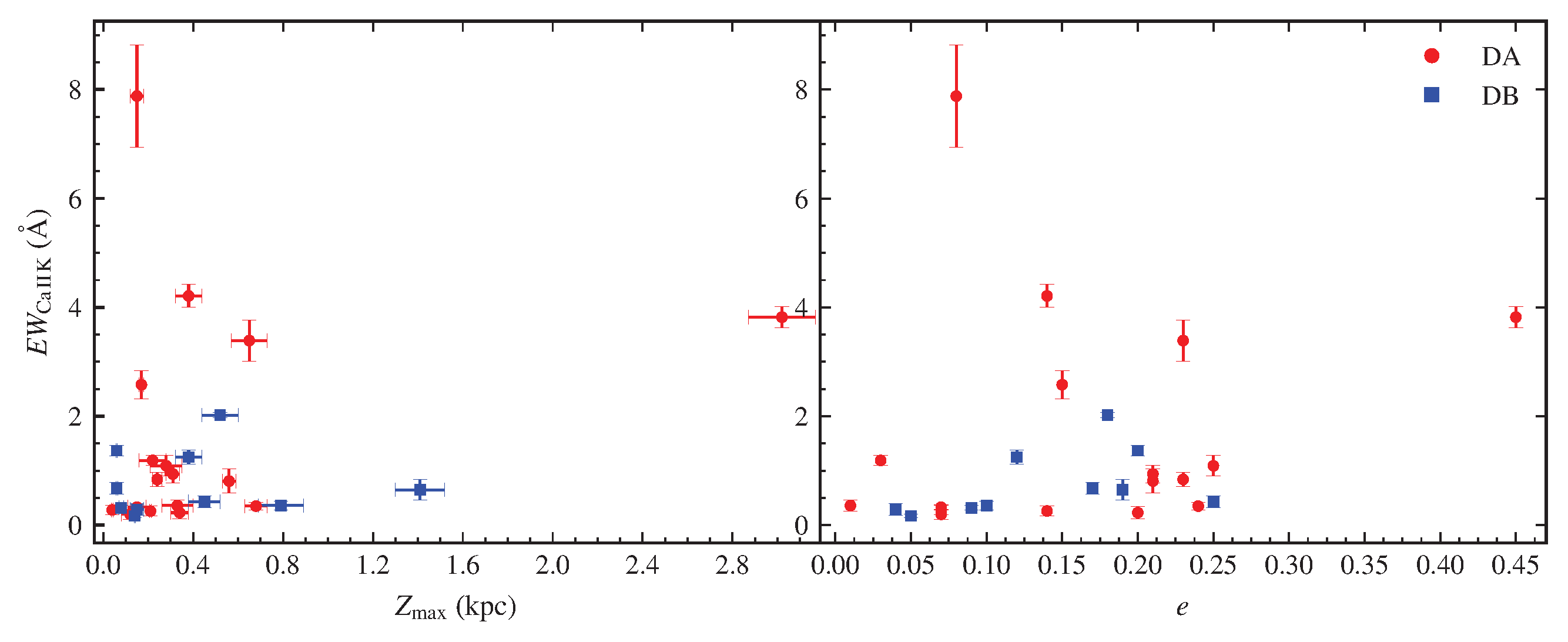
- In our sample of 27 metal-polluted white dwarfs, the versus effective temperature () diagram shows that DA-type white dwarfs exhibit relatively larger values in the temperature range –, while the line strength decreases markedly with increasing effective temperature, particularly for . This result is consistent with previous studies. The DB-type white dwarfs are mainly distributed in the region . At , helium lines disappear; therefore, a comprehensive investigation of the evolution of metal abundances in helium-dominated atmospheres requires the inclusion of DZ white dwarfs and larger samples. In the versus cooling age () diagram, DA white dwarfs span a wide range of cooling ages, from nearly zero up to about 4.0 Gyr. Relatively large values are mainly found in the cooling-age interval –1.4 Gyr, whereas fewer objects are present at other cooling ages. This distribution is likely influenced by sample selection effects. The DB white dwarfs in our sample are concentrated at Gyr, and their values show a trend of first increasing and then decreasing with cooling age. Notably, no statistically significant difference in the distributions between DA and DB white dwarfs is found in the overlapping cooling-age range of 0.0–0.5 Gyr. These behaviors can be explained by the interplay of convection zone evolution, metal settling (diffusion), and ongoing accretion of planetary debris [6,39,40].
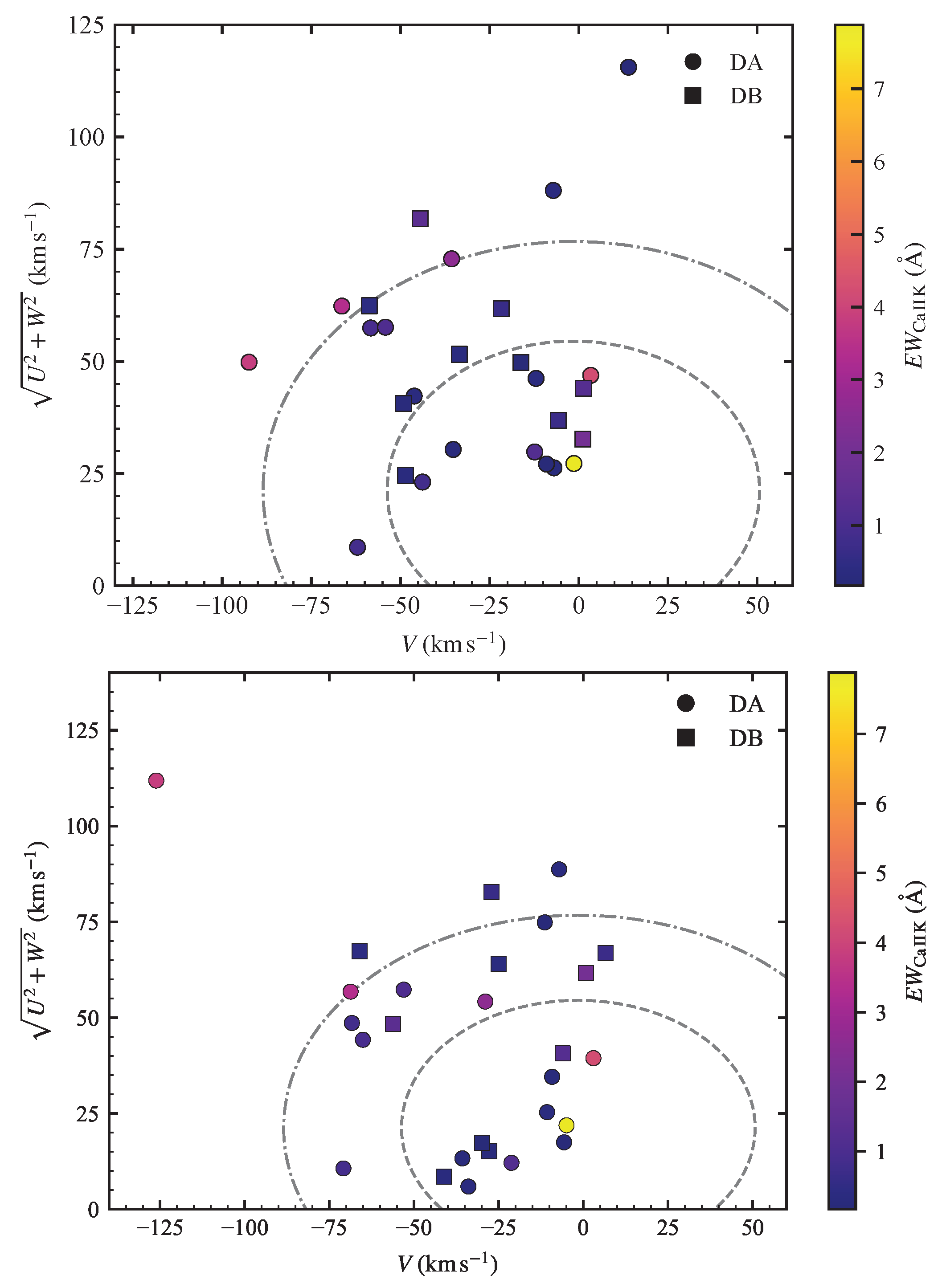
- Kinematic analysis of the distribution shows no significant differences between the Galactic populations of DA and DB white dwarfs. This suggests that the strength of surface metal pollution in white dwarfs is primarily determined by the accretion history of their local planetary or minor-body systems, with only a weak connection to the large-scale Galactic dynamical environment. Consequently, metal pollution is found to be common across different disk components of the Galaxy, indicating ongoing or recurrent evolution of white dwarf planetary systems within various Galactic structures.
Author Contributions
Funding
Data Availability Statement
Acknowledgments
Conflicts of Interest
Appendix A. Parameter Measurement Results

| No. | Gaia EDR3 ID | LAMOST obsID | Cooling | Total | |||||
|---|---|---|---|---|---|---|---|---|---|
| (K) | (cgs) | (km/s) | (km/s) | (Å) | (Gyr) | (Gyr) | |||
| Hydrogen-rich white dwarfs | |||||||||
| 1 | 1565012935076040832 | 564901178 | 7103 ± 63 | 7.74 ± 0.09 | 20.33 ± 4.66 | – | |||
| 2 | 200924312484080256 | 302715031 | 21,631 ± 525 | 7.69 ± 0.05 | – | ||||
| 3 | 2564020159166337024 | 472002174 | 6493 ± 35 | 7.41 ± 0.03 | – | ||||
| 4 | 2564945432560219008 | 354812027 | 7329 ± 64 | 7.75 ± 0.11 | – | ||||
| 5 | 2759588063311504768 | 355001148 | 6512 ± 42 | 7.64 ± 0.09 | – | ||||
| 6 | 333392060349558784 | 778504097 | 28,989 ± 405 | 8.20 ± 0.07 | |||||
| 7 | 3360183783038606336 | 422409198 | 7850 ± 44 | 7.31 ± 0.07 | – | ||||
| 8 | 340886198462842112 | 854612056 | 6066 ± 33 | 7.58 ± 0.03 | – | ||||
| 9 | 3440707857129932672 | 185908034 | 7808 ± 38 | 7.89 ± 0.06 | |||||
| 10 | 3669065354086975872 | 812815099 | 7648 ± 23 | 7.81 ± 0.04 | |||||
| 11 | 480570075502703488 | 613507047 | 6617 ± 42 | 8.27 ± 0.08 | |||||
| 12 | 642549544391197440 | 713109166 | 11,374 ± 115 | 8.19 ± 0.05 | |||||
| 13 | 716504796716020352 | 483112174 | 7374 ± 20 | 7.96 ± 0.03 | |||||
| 14 | 762684864901596928 | 620008163 | 26,361 ± 364 | 7.51 ± 0.06 | – | ||||
| 15 | 917141857485288704 | 793608149 | 6820 ± 23 | 7.43 ± 0.07 | – | ||||
| 16 | 95297185335797120 | 378505204 | 7683 ± 114 | 8.71 ± 0.09 | |||||
| 17 | 994846611963848704 | 853011165 | 13,018 ± 582 | 7.99 ± 0.12 | |||||
| Helium-rich white dwarfs | |||||||||
| 1 | 1032748903780398592 | 604516136 | 13,662 ± 171 | 8.06 ± 0.11 | |||||
| 2 | 1196531988354226560 | 558410149 | 16,121 ± 120 | 7.95 ± 0.06 | |||||
| 3 | 1527809271227078272 | 342506137 | 16,323 ± 110 | 7.90 ± 0.06 | |||||
| 4 | 203931163247581184 | 295304028 | 18,468 ± 63 | 8.29 ± 0.02 | |||||
| 5 | 3351139990665573120 | 387301118 | 16,362 ± 193 | 8.13 ± 0.09 | |||||
| 6 | 3878793490528218752 | 868302211 | 21,404 ± 201 | 8.15 ± 0.03 | |||||
| 7 | 4002914643768684288 | 629804063 | 14,832 ± 81 | 8.49 ± 0.04 | |||||
| 8 | 5187830356195791488 | 837313013 | 15,759 ± 67 | 8.14 ± 0.03 | |||||
| 9 | 689352219629097856 | 601709080 | 23,046 ± 134 | 7.87 ± 0.02 | |||||
| 10 | 972551088836290816 | 632707021 | 14,481 ± 102 | 7.98 ± 0.07 | |||||
| No. | Gaia EDR3 ID | LAMOST obsID | U | V | W | e | ||||
|---|---|---|---|---|---|---|---|---|---|---|
| (km/s) | (km/s) | (km/s) | kpc | kpc | kpc | km/s kpc | ||||
| Hydrogen-rich white dwarfs | ||||||||||
| 1 | 1565012935076040832 | 564901178 | −0.01 | −21.25 | 12.09 | 8.60 | 8.11 | 0.03 | 0.22 | 1.80 |
| 2 | 200924312484080256 | 302715031 | 33.91 | −9.24 | 6.55 | 10.67 | 8.06 | 0.14 | 0.21 | 1.22 |
| 3 | 2564020159166337024 | 472002174 | −21.68 | −4.98 | −3.05 | 9.81 | 8.37 | 0.08 | 0.15 | 0.66 |
| 4 | 2564945432560219008 | 354812027 | 0.18 | −68.74 | −56.77 | 8.48 | 5.35 | 0.23 | 0.65 | 13.21 |
| 5 | 2759588063311504768 | 355001148 | 56.72 | −53.07 | 7.97 | 9.39 | 5.64 | 0.25 | 0.28 | 2.37 |
| 6 | 333392060349558784 | 778504097 | −70.12 | −11.40 | −26.16 | 11.20 | 7.45 | 0.20 | 0.34 | 2.65 |
| 7 | 3360183783038606336 | 422409198 | −53.97 | −28.97 | 4.58 | 9.57 | 7.00 | 0.15 | 0.17 | 1.01 |
| 8 | 340886198462842112 | 854612056 | 5.04 | −70.87 | 9.36 | 8.67 | 5.39 | 0.23 | 0.24 | 2.11 |
| 9 | 3440707857129932672 | 185908034 | −12.57 | −35.75 | −4.23 | 8.48 | 7.38 | 0.07 | 0.04 | 0.05 |
| 10 | 3669065354086975872 | 812815099 | 19.90 | −10.72 | 15.64 | 9.76 | 8.04 | 0.01 | 0.33 | 3.15 |
| 11 | 480570075502703488 | 613507047 | 31.49 | −68.36 | −37.00 | 9.14 | 5.92 | 0.21 | 0.56 | 8.50 |
| 12 | 642549544391197440 | 713109166 | 5.09 | −33.96 | 2.98 | 8.60 | 7.40 | 0.07 | 0.15 | 0.84 |
| 13 | 716504796716020352 | 483112174 | −6.02 | −5.72 | −16.38 | 9.68 | 8.42 | 0.07 | 0.12 | 0.49 |
| 14 | 762684864901596928 | 620008163 | −86.49 | −7.18 | 19.56 | 12.08 | 7.48 | 0.24 | 0.68 | 8.59 |
| 15 | 917141857485288704 | 793608149 | −36.13 | 2.96 | 15.75 | 11.03 | 8.34 | 0.14 | 0.38 | 3.55 |
| 16 | 95297185335797120 | 378505204 | 59.76 | −126.12 | 94.56 | 9.25 | 3.55 | 0.45 | 3.02 | 163.06 |
| 17 | 994846611963848704 | 853011165 | −35.43 | −65.12 | −26.45 | 8.70 | 5.64 | 0.21 | 0.31 | 3.21 |
| Helium-rich white dwarfs | ||||||||||
| 1 | 1032748903780398592 | 604516136 | 49.09 | −27.13 | −66.61 | 10.47 | 7.16 | 0.19 | 1.41 | 34.40 |
| 2 | 1196531988354226560 | 558410149 | 29.09 | −6.13 | −28.37 | 10.28 | 8.06 | 0.12 | 0.38 | 3.74 |
| 3 | 1527809271227078272 | 342506137 | −58.32 | −66.08 | −33.68 | 8.93 | 5.40 | 0.25 | 0.45 | 6.40 |
| 4 | 203931163247581184 | 295304028 | −3.20 | −29.93 | −17.06 | 8.50 | 7.71 | 0.05 | 0.14 | 0.69 |
| 5 | 3351139990665573120 | 387301118 | 66.69 | 6.60 | −4.91 | 12.15 | 8.57 | 0.17 | 0.06 | 0.10 |
| 6 | 3878793490528218752 | 868302211 | −13.98 | −27.75 | −5.64 | 8.49 | 7.77 | 0.04 | 0.15 | 0.88 |
| 7 | 4002914643768684288 | 629804063 | −40.98 | −25.06 | −49.20 | 9.26 | 7.65 | 0.10 | 0.79 | 15.59 |
| 8 | 5187830356195791488 | 837313013 | 57.47 | 0.73 | 22.23 | 12.08 | 8.44 | 0.18 | 0.52 | 5.65 |
| 9 | 689352219629097856 | 601709080 | −5.97 | −41.20 | −6.03 | 8.51 | 7.12 | 0.09 | 0.08 | 0.27 |
| 10 | 972551088836290816 | 632707021 | −47.83 | −56.27 | −6.75 | 8.93 | 5.96 | 0.20 | 0.06 | 0.13 |
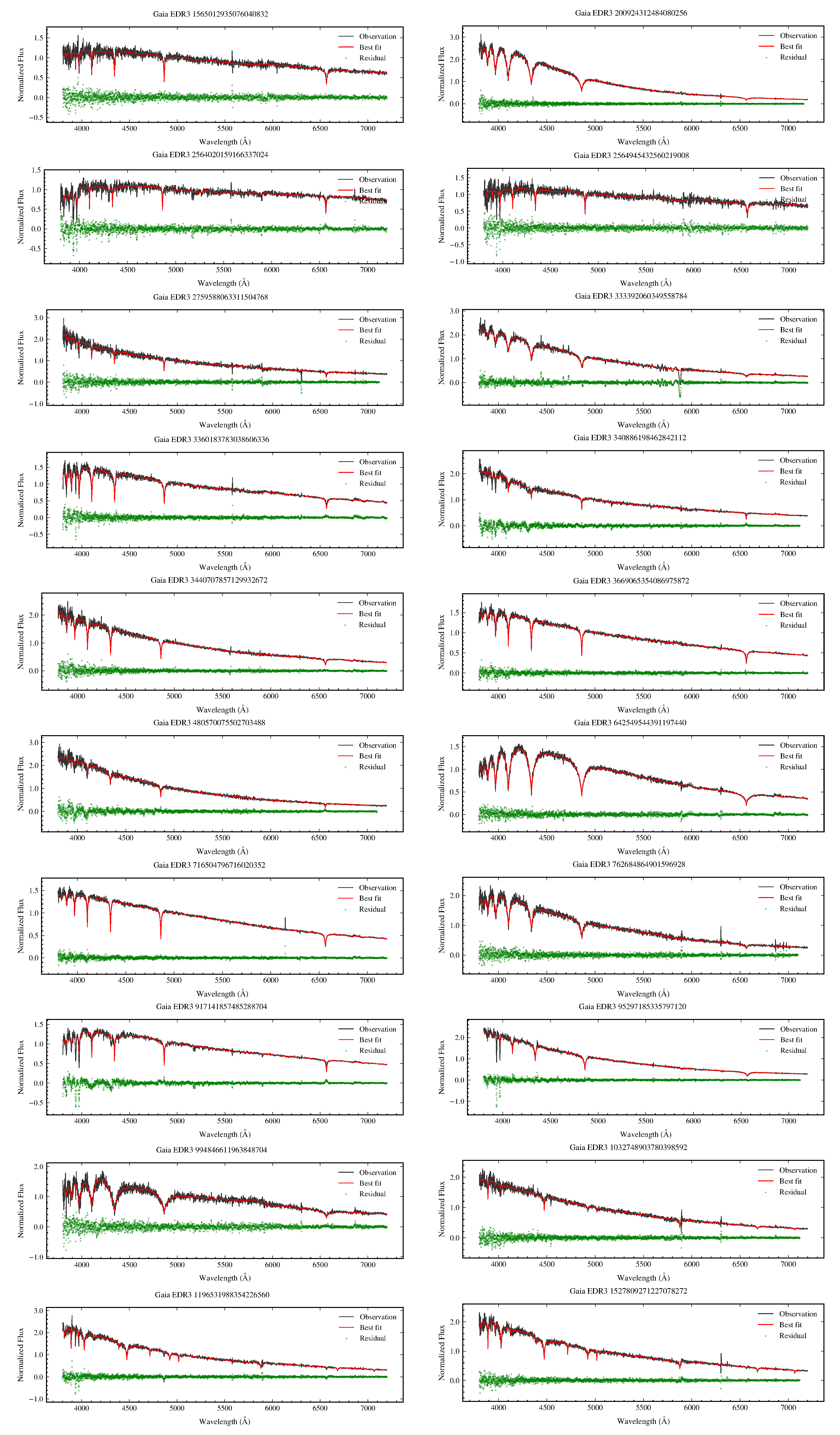
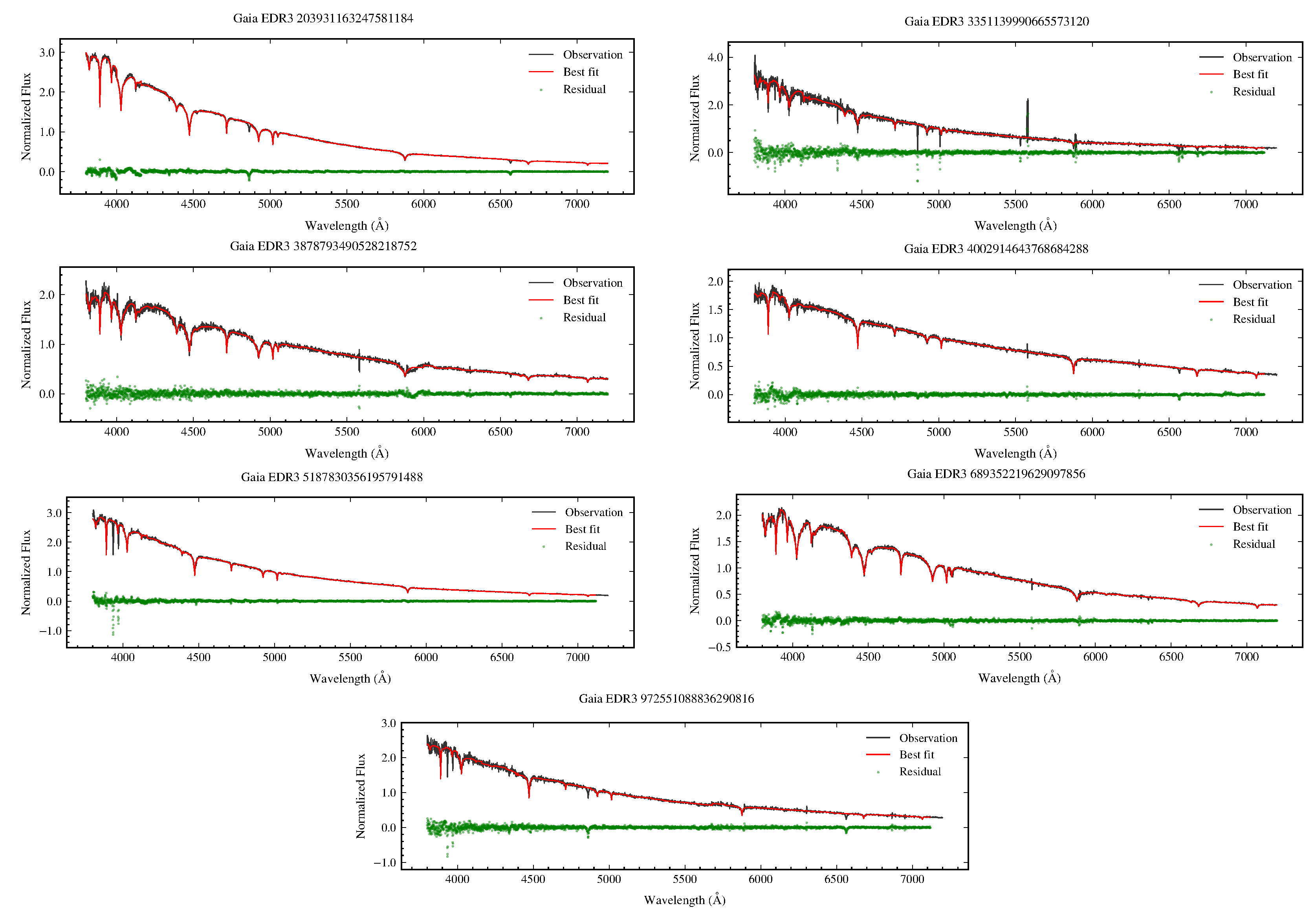
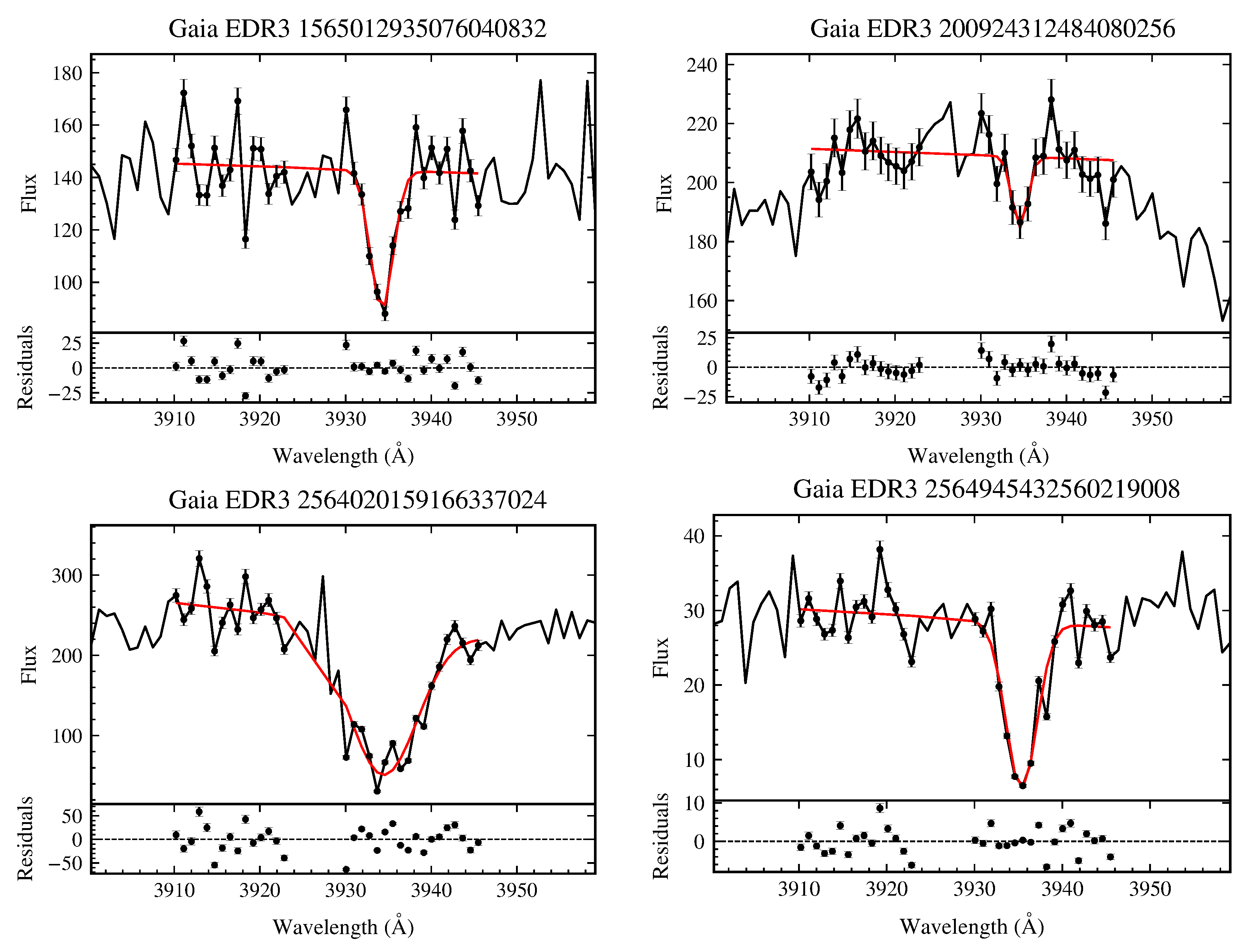
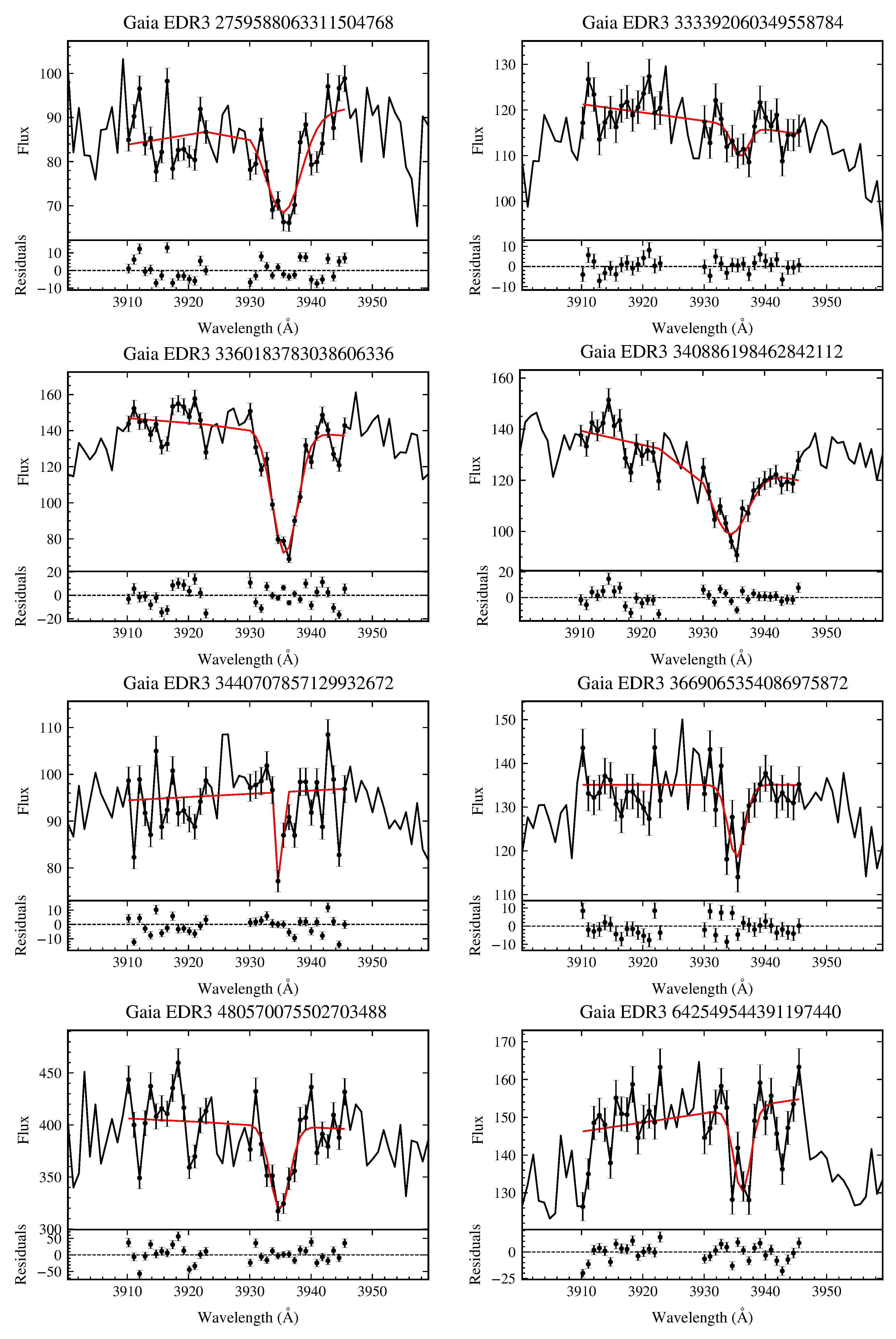
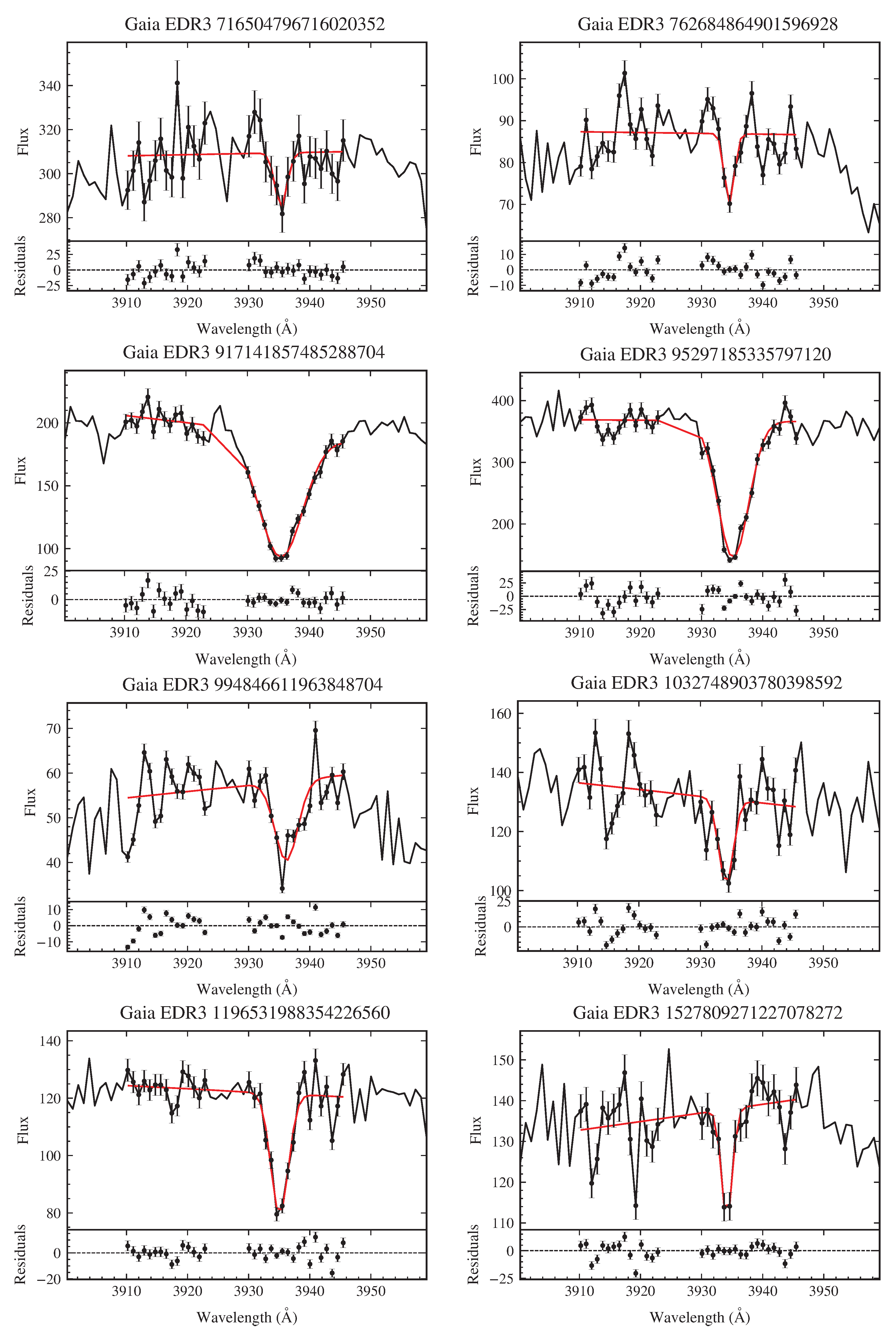
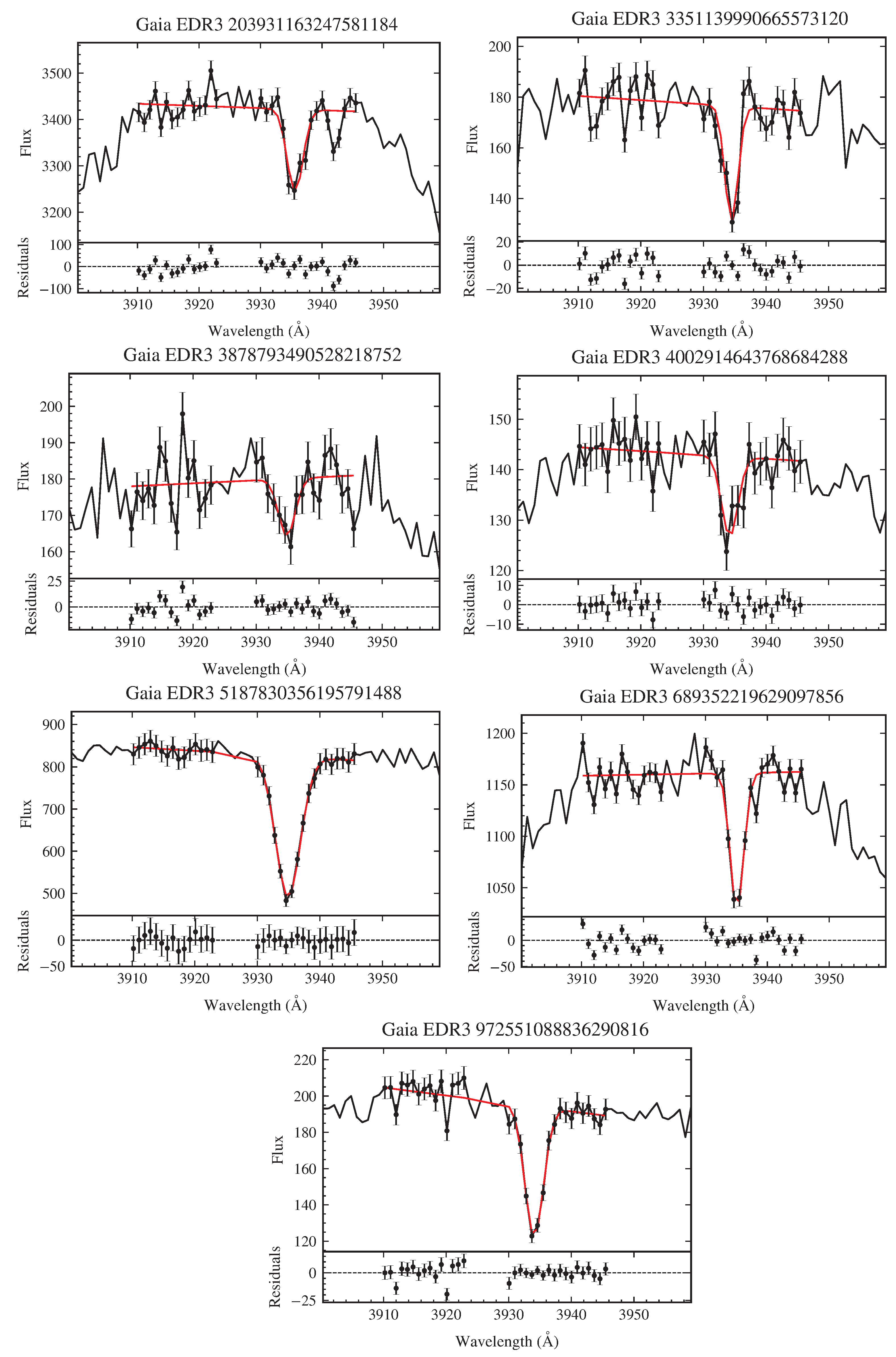
Appendix B. Fitting Diagram


References
- Koester, D. White dwarfs: Recent developments. Astron. Astrophys. Rev. 2002, 11, 33–66. [Google Scholar] [CrossRef] [Scilit]
- Fontaine, G.; Brassard, P.; Bergeron, P. The Potential of White Dwarf Cosmochronology. Publ. Astron. Soc. Pac. 2001, 113, 409–435. [Google Scholar] [CrossRef] [Scilit]
- Althaus, L.G.; Córsico, A.H.; Isern, J.; García-Berro, E. Evolutionary and pulsational properties of white dwarf stars. Astron. Astrophys. Rev. 2010, 18, 471–566. [Google Scholar] [CrossRef] [Scilit]
- Zuckerman, B.; Koester, D.; Reid, I.N.; Hünsch, M. Metal Lines in DA White Dwarfs. Astrophys. J. 2003, 596, 477–495. [Google Scholar] [CrossRef] [Scilit]
- Zuckerman, B.; Koester, D.; Melis, C.; Hansen, B.M.; Jura, M. The Chemical Composition of an Extrasolar Minor Planet. Astrophys. J. 2007, 671, 872–877. [Google Scholar] [CrossRef] [Scilit]
- Koester, D.; Gänsicke, B.T.; Farihi, J. The frequency of planetary debris around young white dwarfs. Astron. Astrophys. 2014, 566, A34. [Google Scholar] [CrossRef] [Scilit]
- Paquette, C.; Pelletier, C.; Fontaine, G.; Michaud, G. Diffusion in White Dwarfs: New Results and Comparative Study. Astrophys. J. Suppl. Ser. 1986, 61, 197. [Google Scholar] [CrossRef] [Scilit]
- Koester, D. Accretion and diffusion in white dwarfs. New diffusion timescales and applications to GD 362 and G 29–38. Astron. Astrophys. 2009, 498, 517–525. [Google Scholar] [CrossRef] [Scilit]
- Aannestad, P.A.; Sion, E.M. The kinematics of cool metal-line white dwarfs and accretion in the local interstellar medium. Astron. J. 1985, 90, 1832–1836. [Google Scholar] [CrossRef] [Scilit]
- Alcock, C.; Illarionov, A. The surface chemistry of stars. I—Diffusion of heavy ions in white dwarf envelopes. Astron. J. 1980, 235, 534–540. [Google Scholar] [CrossRef] [Scilit]
- Jura, M.; Young, E.D. Extrasolar Cosmochemistry. Annu. Rev. Earth Planet. Sci. 2014, 42, 45–67. [Google Scholar] [CrossRef] [Scilit]
- Zuckerman, B.; Becklin, E.E. Excess infrared radiation from a white dwarf—An orbiting brown dwarf? Nature 1987, 330, 138–140. [Google Scholar] [CrossRef] [Scilit]
- Jura, M. A Tidally Disrupted Asteroid around the White Dwarf G29-38. Astrophys. J. 2003, 584, L91–L94. [Google Scholar] [CrossRef] [Scilit]
- Gänsicke, B.T.; Marsh, T.R.; Southworth, J.; Rebassa-Mansergas, A. A Gaseous Metal Disk Around a White Dwarf. Science 2006, 314, 1908. [Google Scholar] [CrossRef] [Scilit] [PubMed]
- Cunningham, T.; Wheatley, P.J.; Tremblay, P.E.; Gänsicke, B.T.; King, G.W.; Toloza, O.; Veras, D. A white dwarf accreting planetary material determined from X-ray observations. Nature 2022, 602, 219–222. [Google Scholar] [CrossRef] [Scilit] [PubMed]
- Mullally, S.E.; Debes, J.; Cracraft, M.; Mullally, F.; Poulsen, S.; Albert, L.; Thibault, K.; Reach, W.T.; Hermes, J.J.; Barclay, T.; et al. JWST Directly Images Giant Planet Candidates Around Two Metal-polluted White Dwarf Stars. Astrophys. J. Lett. 2024, 962, L32. [Google Scholar] [CrossRef] [Scilit]
- Malamud, U. White dwarf systems: Exoplanets and debris disks. Encycl. Astrophys. 2026, 1, 553–563. [Google Scholar] [CrossRef] [Scilit]
- Badenas-Agusti, M.; Vanderburg, A.; Blouin, S.; Dufour, P.; Viaña, J.; Seager, S.; Wang, S.X. Detection and preliminary characterization of polluted white dwarfs from Gaia EDR3 and LAMOST. Mon. Not. R. Astron. Soc. 2024, 527, 4515–4544. [Google Scholar] [CrossRef] [Scilit]
- Dufour, P.; Blouin, S.; Coutu, S.; Fortin-Archambault, M.; Thibeault, C.; Bergeron, P.; Fontaine, G. The Montreal White Dwarf Database: A Tool for the Community. In Proceedings of the 20th European White DwarfWorkshop, Warwick, UK, 25–29 July 2016; Tremblay, P.E., Gaensicke, B., Marsh, T., Eds.; Astronomical Society of the Pacific Conference Series; ASP: San Francisco, CA, USA, 2017; Volume 509, p. 3. [Google Scholar] [CrossRef] [Scilit]
- Yan, H.; Li, H.; Wang, S.; Zong, W.; Yuan, H.; Xiang, M.; Huang, Y.; Xie, J.; Dong, S.; Yuan, H.; et al. Overview of the LAMOST survey in the first decade. Innovation 2022, 3, 100224. [Google Scholar] [CrossRef] [Scilit]
- Gaia Collaboration; Prusti, T.; de Bruijne, J.H.J.; Brown, A.G.A.; Vallenari, A.; Babusiaux, C.; Bailer-Jones, C.A.L.; Bastian, U.; Biermann, M.; Evans, D.W.; et al. The Gaia mission. Astron. Astrophys. 2016, 595, A1. [Google Scholar] [CrossRef] [Scilit]
- Gaia Collaboration; Brown, A.G.A.; Vallenari, A.; Prusti, T.; de Bruijne, J.H.J.; Babusiaux, C.; Biermann, M.; Creevey, O.L.; Evans, D.W.; Eyer, L.; et al. Gaia Early Data Release 3. Summary of the contents and survey properties. Astron. Astrophys. 2021, 649, A1. [Google Scholar] [CrossRef] [Scilit]
- Koester, D. White dwarf spectra and atmosphere models. Mem. Soc. Astron. Ital. 2010, 81, 921–931. [Google Scholar]
- Tremblay, P.E.; Ludwig, H.G.; Steffen, M.; Freytag, B. Pure-hydrogen 3D model atmospheres of cool white dwarfs. Astron. Astrophys. 2013, 552, A13. [Google Scholar] [CrossRef] [Scilit]
- Cukanovaite, E.; Tremblay, P.E.; Bergeron, P.; Freytag, B.; Ludwig, H.G.; Steffen, M. 3D spectroscopic analysis of helium-line white dwarfs. Mon. Not. R. Astron. Soc. 2021, 501, 5274–5293. [Google Scholar] [CrossRef] [Scilit]
- Cui, X.Q.; Zhao, Y.H.; Chu, Y.Q.; Li, G.P.; Li, Q.; Zhang, L.P.; Su, H.J.; Yao, Z.Q.; Wang, Y.N.; Xing, X.Z.; et al. The Large Sky Area Multi-Object Fiber Spectroscopic Telescope (LAMOST). Res. Astron. Astrophys. 2012, 12, 1197–1242. [Google Scholar] [CrossRef] [Scilit]
- Li, J.; Wolf, C.; Li, J.; Luo, Y.; Zhao, J.; Chen, B.; Zhang, L.; Jia, S.; Chen, X.; Han, Z. Detection of ubiquitous circumbinary matter in hot subdwarfs formed from common-envelope ejections. Mon. Not. R. Astron. Soc. 2025, 537, 1950–1962. [Google Scholar] [CrossRef] [Scilit]
- Liu, C.; Cui, W.Y.; Zhang, B.; Wan, J.C.; Deng, L.C.; Hou, Y.H.; Wang, Y.F.; Yang, M.; Zhang, Y. Spectral classification of stars based on LAMOST spectra. Res. Astron. Astrophys. 2015, 15, 1137. [Google Scholar] [CrossRef] [Scilit]
- Kiman, R.; Xu, S.; Faherty, J.K.; Gagné, J.; Angus, R.; Brandt, T.D.; Casewell, S.L.; Cruz, K.L. wdwarfdate: A Python Package to Derive Bayesian Ages of White Dwarfs. Astron. J. 2022, 164, 62. [Google Scholar] [CrossRef] [Scilit]
- Bédard, A.; Bergeron, P.; Brassard, P.; Fontaine, G. On the Spectral Evolution of Hot White Dwarf Stars. I. A Detailed Model Atmosphere Analysis of Hot White Dwarfs from SDSS DR12. Astrophys. J. 2020, 901, 93. [Google Scholar] [CrossRef] [Scilit]
- Lallement, R.; Vergely, J.L.; Valette, B.; Puspitarini, L.; Eyer, L.; Casagrande, L. 3D maps of the local ISM from inversion of individual color excess measurements. Astron. Astrophys. 2014, 561, A91. [Google Scholar] [CrossRef] [Scilit]
- Schönrich, R.; Binney, J.; Dehnen, W. Local kinematics and the local standard of rest. Mon. Not. R. Astron. Soc. 2010, 403, 1829–1833. [Google Scholar] [CrossRef] [Scilit]
- Bovy, J. galpy: A python Library for Galactic Dynamics. Astrophys. J. Suppl. Ser. 2015, 216, 29. [Google Scholar] [CrossRef] [Scilit]
- Green, G.M.; Schlafly, E.; Zucker, C.; Speagle, J.S.; Finkbeiner, D. A 3D Dust Map Based on Gaia, Pan-STARRS 1, and 2MASS. Astrophys. J. 2019, 887, 93. [Google Scholar] [CrossRef] [Scilit]
- Schlafly, E.F.; Finkbeiner, D.P. Measuring Reddening with Sloan Digital Sky Survey Stellar Spectra and Recalibrating SFD. Astrophys. J. 2011, 737, 103. [Google Scholar] [CrossRef] [Scilit]
- Megier, A.; Strobel, A.; Galazutdinov, G.A.; Krełowski, J. The interstellar Ca II distance scale. Astron. Astrophys. 2009, 507, 833–840. [Google Scholar] [CrossRef] [Scilit]
- Zuckerman, B.; Melis, C.; Klein, B.; Koester, D.; Jura, M. Ancient Planetary Systems are Orbiting a Large Fraction of White Dwarf Stars. Astrophys. J. 2010, 722, 725–736. [Google Scholar] [CrossRef] [Scilit]
- Coutu, S.; Dufour, P.; Bergeron, P.; Blouin, S.; Loranger, E.; Allard, N.F.; Dunlap, B.H. Analysis of Helium-rich White Dwarfs Polluted by Heavy Elements in the Gaia Era. Astrophys. J. 2019, 885, 74. [Google Scholar] [CrossRef] [Scilit]
- Dupuis, J.; Fontaine, G.; Wesemael, F. A Study of Metal Abundance Patterns in Cool White Dwarfs. III. Comparison of the Predictions of the Two-Phase Accretion Model with the Observations. Astrophys. J. Suppl. 1993, 87, 345. [Google Scholar] [CrossRef] [Scilit]
- Zhu, C.; Liu, H.; Wang, Z.; Lü, G. Formation, diffusion, and accreting pollution of DB white dwarfs. Astron. Astrophys. 2021, 654, A57. [Google Scholar] [CrossRef] [Scilit]
- Blouin, S.; Xu, S. No evidence for a strong decrease of planetesimal accretion in old white dwarfs. Mon. Not. R. Astron. Soc. 2022, 510, 1059–1067. [Google Scholar] [CrossRef] [Scilit]
- Farihi, J. Circumstellar debris and pollution at white dwarf stars. New Astron. Rev. 2016, 71, 9–34. [Google Scholar] [CrossRef] [Scilit]
- Bonsor, A.; Mustill, A.J.; Wyatt, M.C. Dynamical effects of stellar mass-loss on a Kuiper-like belt. Mon. Not. R. Astron. Soc. 2011, 414, 930–939. [Google Scholar] [CrossRef] [Scilit]
- Bédard, A. The spectral evolution of white dwarfs: Where do we stand? Astrophys. Space Sci. 2024, 369, 43. [Google Scholar] [CrossRef] [Scilit] [PubMed]
- Williams, J.T.; Gänsicke, B.T.; Swan, A.; O’Brien, M.W.; Izquierdo, P.; Cutolo, A.M.; Cunningham, T. PEWDD: A database of white dwarfs enriched by exo-planetary material. Astron. Astrophys. 2024, 691, A352. [Google Scholar] [CrossRef] [Scilit]
- Koester, D.; Kepler, S.O. DB white dwarfs in the Sloan Digital Sky Survey data release 10 and 12. Astron. Astrophys. 2015, 583, A86. [Google Scholar] [CrossRef] [Scilit]
- Cunningham, T.; Tremblay, P.E.; O’Brien, M.; Bauer, E.B.; Hollands, M.A.; Koester, D.; Kenyon, S.J.; Charbonneau, D.; Veras, D.; Yusaf, M.F. The dearth of high-mass hydrogen-atmosphere metal-polluted white dwarfs within 40 pc. Mon. Not. R. Astron. Soc. 2025, 539, 2021–2038. [Google Scholar] [CrossRef] [Scilit]
- Torres, S.; Cantero, C.; Rebassa-Mansergas, A.; Skorobogatov, G.; Jiménez-Esteban, F.M.; Solano, E. Random Forest identification of the thin disc, thick disc, and halo Gaia-DR2 white dwarf population. Mon. Not. R. Astron. Soc. 2019, 485, 5573–5589. [Google Scholar] [CrossRef] [Scilit]
- Astropy Collaboration; Robitaille, T.P.; Tollerud, E.J.; Greenfield, P.; Droettboom, M.; Bray, E.; Aldcroft, T.; Davis, M.; Ginsburg, A.; Price-Whelan, A.M.; et al. Astropy: A community Python package for astronomy. Astron. Astrophys. 2013, 558, A33. [Google Scholar] [CrossRef] [Scilit]
- Astropy Collaboration; Price-Whelan, A.M.; Sipőcz, B.M.; Günther, H.M.; Lim, P.L.; Crawford, S.M.; Conseil, S.; Shupe, D.L.; Craig, M.W.; Dencheva, N.; et al. The Astropy Project: Building an Open-science Project and Status of the v2.0 Core Package. Astron. J. 2018, 156, 123. [Google Scholar] [CrossRef] [Scilit]
- Astropy Collaboration; Price-Whelan, A.M.; Lim, P.L.; Earl, N.; Starkman, N.; Bradley, L.; Shupe, D.L.; Patil, A.A.; Corrales, L.; Brasseur, C.E.; et al. The Astropy Project: Sustaining and Growing a Community-oriented Open-source Project and the Latest Major Release (v5.0) of the Core Package. Astrophys. J. 2022, 935, 167. [Google Scholar] [CrossRef] [Scilit]


| No. | Gaia EDR3 ID | This Work | Badenas-Agusti et al. [18] | ||||||
|---|---|---|---|---|---|---|---|---|---|
| Teff (K) | log g (cgs) | RV (km s−1) | Teff (K) | log g (cgs) | log(H/He) | log(Ca/H) | log(Ca/He) | ||
| 1 | 1032748903780398592 | 13,662 ± 171 | – | – | – | – | – | ||
| 2 | 1196531988354226560 | 16,121 ± 120 | – | – | – | – | – | ||
| 3 | 1527809271227078272 | 16,323 ± 110 | – | – | – | – | – | ||
| 4 | 1565012935076040832 | – | – | ||||||
| 5 | 200924312484080256 | 21,631 ± 525 | 12,665 ± 215 | – | – | ||||
| 6 | 203931163247581184 | 18,468 ± 63 | – | – | – | – | – | ||
| 7 | 2564020159166337024 | 13,050 ± 1346 | – | ||||||
| 8 | 2564945432560219008 | – | – | – | – | – | |||
| 9 | 2759588063311504768 | – | – | ||||||
| 10 | 333392060349558784 | 28,989 ± 405 | – | – | – | – | – | ||
| 11 | 3351139990665573120 | 16,362 ± 193 | 12,806 ± 2617 | – | |||||
| 12 | 3360183783038606336 | – | – | ||||||
| 13 | 340886198462842112 | – | – | – | – | – | |||
| 14 | 3440707857129932672 | – | – | ||||||
| 15 | 3669065354086975872 | – | – | ||||||
| 16 | 3878793490528218752 | 21,404 ± 201 | – | – | – | – | – | ||
| 17 | 4002914643768684288 | 14,832 ± 81 | – | – | – | – | – | ||
| 18 | 480570075502703488 | – | – | – | – | – | |||
| 19 | 5187830356195791488 | 15,759 ± 67 | – | – | – | – | – | ||
| 20 | 642549544391197440 | 11,374 ± 115 | 10,875 ± 114 | – | – | ||||
| 21 | 689352219629097856 | 23,046 ± 134 | – | – | – | – | – | ||
| 22 | 716504796716020352 | – | – | – | – | – | |||
| 23 | 762684864901596928 | 26,361 ± 364 | – | – | – | – | – | ||
| 24 | 917141857485288704 | – | – | – | – | – | |||
| 25 | 95297185335797120 | – | – | – | – | – | |||
| 26 | 972551088836290816 | 14,481 ± 102 | 12,723 ± 1179 | – | |||||
| 27 | 994846611963848704 | 13,018 ± 582 | 12,450 ± 169 | – | – | ||||
Disclaimer/Publisher’s Note: The statements, opinions and data contained in all publications are solely those of the individual author(s) and contributor(s) and not of MDPI and/or the editor(s). MDPI and/or the editor(s) disclaim responsibility for any injury to people or property resulting from any ideas, methods, instructions or products referred to in the content. |
© 2026 by the authors. Licensee MDPI, Basel, Switzerland. This article is an open access article distributed under the terms and conditions of the Creative Commons Attribution (CC BY) license.
Share and Cite
Deng, Y.; Luo, Y. Study of 27 Polluted White Dwarfs Observed by LAMOST: Spectral Features, Ages, and Kinematics. Universe 2026, 12, 80. https://doi.org/10.3390/universe12030080
Deng Y, Luo Y. Study of 27 Polluted White Dwarfs Observed by LAMOST: Spectral Features, Ages, and Kinematics. Universe. 2026; 12(3):80. https://doi.org/10.3390/universe12030080
Chicago/Turabian StyleDeng, Yuhong, and Yangping Luo. 2026. "Study of 27 Polluted White Dwarfs Observed by LAMOST: Spectral Features, Ages, and Kinematics" Universe 12, no. 3: 80. https://doi.org/10.3390/universe12030080
APA StyleDeng, Y., & Luo, Y. (2026). Study of 27 Polluted White Dwarfs Observed by LAMOST: Spectral Features, Ages, and Kinematics. Universe, 12(3), 80. https://doi.org/10.3390/universe12030080