Abstract
We propose a mechanism for symmetry breaking or restoration that can occur in the middle of inflation, due to the coupling of the Gauss–Bonnet term to a charged scalar. The Gauss–Bonnet coupling results in an inflaton-dependent effective squared mass of the charged scalar, which can change its sign (around the symmetric point) during inflation. This can lead to spontaneous breaking of the symmetry, or to its restoration, if it is initially broken. We show the conditions under which the backreaction of the Gauss–Bonnet coupling on the inflationary background is negligible, such that the predictions of a given inflationary model are unaffected by the symmetry breaking/restoration process.
1. Introduction
When it comes to higher curvature corrections to general relativity, the Gauss–Bonnet (GB) quadratic invariant,
stands out because it can avoid the Ostrogradsky ghost and other instabilities, while allowing for new cosmological dynamics compared to general relativity (see [1] for a review). On its own, it is a topological term, but when coupled to a scalar field, for example, it modifies the equations of motion of both the background (homogeneous) fields and the scalar and tensor perturbations [2,3,4,5,6] (unlike the other well-known topological quantity—the gravitational Chern–Simons term, which does not affect background dynamics and linearized scalar perturbations when coupled to a scalar field). The inflationary effects of GB-inflaton coupling on CMB have been extensively studied in the literature: see, e.g., [7,8,9,10,11,12,13], in addition to the references above.
From a top-down approach, the GB term is known to appear in string theory effective actions, where it couples to the dilation and moduli fields [14,15,16]. From a bottom-up point of view, it is predicted by the effective field theory of inflation [17]. Most interesting cosmological scenarios can arise if the GB-scalar term is allowed to be comparable or larger than the Einstein–Hilbert term: for example, during inflation1. In this case, the Gauss–Bonnet coupling can lead to new de Sitter (dS) stationary points [18,19,20,21,22,23,24,25,26,27,28,29,30], which can be relevant for inflation and dark energy, and which will be the main focus of this work.
As we are going to show, these GB-induced stationary points can break or restore symmetries. This mechanism provides an alternative way to realize phase transitions during (and after) inflation, in addition to those triggered by direct inflaton–scalar couplings (as in hybrid inflation [31,32,33]), non-minimal couplings to the scalar curvature [34,35,36,37,38,39,40,41,42,43,44], and thermal effects (e.g., during warm inflation [45,46] or after inflation). These phase transitions can produce and destroy cosmic defects and generate gravitational waves (GWs)—see, for example, [47,48].
Since physics beyond the Standard Model, such as superstrings, supergravity, and various Grand Unified Theories, often involves additional “hidden” symmetries, it is a reasonable expectation that phase transitions can take place around the inflationary scale, leaving imprints on a CMB or GW background [36,40,44,49,50,51,52]. Furthermore, even Standard Model symmetries can be affected during inflation or the reheating stage: for example, if the Higgs field gains a dynamical VEV of Hubble scale [53,54,55,56,57,58,59,60,61]. Such models can generate lepton number during reheating, once the Higgs field relaxes from its Hubble-scale VEV, and they can explain matter–antimatter asymmetry. Therefore, it is important to study the possible mechanisms that can trigger these phase transitions.
The structure of the paper is as follows. In Section 2, we consider a case of a dS background, where the “stationary points” are truly stationary. In Section 3, we consider an inflationary background, where the “stationary points” are slowly evolving due to the slow-roll. This evolution can lead to a transition from symmetric to broken phase and vice versa. We derive analytical slow-roll solutions and compare them with numerical results. Section 4 is reserved for our final comments and conclusion.
2. De Sitter Background
Let us start with a Lagrangian for a scalar field , which is invariant under some symmetry. For simplicity, we take this symmetry to be , such that the model is invariant under (and is real). Adding the gravitational sector and the GB coupling, the Lagrangian reads
where is the GB coupling function. We choose the metric signature, and we set , unless otherwise stated.
The corresponding background equations of motion (EOM) in the FLRW metric are
The stationary points of Equation (3) are found from
where . In a Minkowski vacuum (), the GB contribution vanishes because . Therefore, the existence of Gauss–Bonnet-induced stationary points requires a de Sitter vacuum. From (6), the effective potential can be introduced as
where we use . Once and V are given, one can integrate the second term in (7) and obtain the explicit form of the effective potential.
The simplest case is that of a constant (positive) potential , where the effective potential (7) becomes
When the potential is independent of the model has a continuous shift symmetry, (with ), in the absence of the GB coupling, or if the GB coupling is linear in . As takes an arbitrary vacuum expectation value (VEV), the shift symmetry is spontaneously broken. In this work, we consider a symmetry, so the GB coupling is assumed to be a function of .
Our goal here is to derive the conditions under which a symmetric (symmetry-breaking) vacuum of the general potential can be overcome by the GB contribution to the effective potential (7), such that the effective vacuum becomes symmetry-breaking (symmetric).
The first condition is related to the effective mass squared around 2,
Namely, we require that the GB contribution overcomes the potential contribution in magnitude,
while having the opposite sign. The second condition is the existence of a stable de Sitter minimum of .
For concreteness, we will consider the scalar potential and the GB function having up to terms,
where are real constants ( with mass dimension , and with mass dimension ), and we assume . The constant term in is irrelevant, as it corresponds to the topological term in the action.
Next, we will derive stable dS stationary points of that spontaneously break or restore the symmetry.
2.1. GB-Induced SSB
For GB-induced spontaneous symmetry breaking (SSB), we start from the potential (11) with , such that the symmetry is unbroken in the absence of the GB coupling. We first destabilize the symmetric point by imposing (from (10))
as well as , to counteract the positive from the potential.
The next step is to find a stable symmetry-breaking minimum. By using (11) and (12), we can obtain an explicit form of the effective potential (7), and we can study its stationary points satisfying
It is necessary to have non-zero quartic (or higher-order) terms in and/or V for the existence of non-zero stationary points. If the quartic terms are absent—that is, —then Equation (14) can be written as (using )
By using Equation (13), the right side of (15) becomes negative, i.e., no stationary points with exist.
In the presence of the quartic terms, Equation (14) is a fifth-order polynomial in . In certain situations, we can solve (14) perturbatively, such as when is much larger than and . In this case, the solution to (14) is
This approximation can be applied, for example, to a scalar field in the inflationary background, , if m and are not too large compared to the Hubble function (by order of magnitude).
GB-induced SSB was proposed in [62] as a novel baryogenesis mechanism, where the symmetry breaking was studied in a cosmological background with the equation of state, (see also [63] for GB-induced symmetry restoration in the context of quintessence dark energy). In contrast, here we consider an inflationary background, and we study the general conditions for GB-induced symmetry breaking and restoration.
2.2. GB-Induced Symmetry Restoration
Next, we discuss the opposite situation, where the mass term of the scalar potential is tachyonic at the symmetric point, , and the GB coupling is used to stabilize the scalar at this point and restore the symmetry. For this, it suffices to consider quadratic GB coupling, and we parametrize V and as
where we replace (such that is the VEV of in the absence of the GB coupling) and , where is a real constant with mass dimension one.
First, let us look into how the GB coupling affects the VEV of the scalar. The stationary points of the effective potential are found from
where we use the shorthand notation
Both and Y are positive-definite (Y is positive-definite because, otherwise, the symmetry-breaking vacuum becomes AdS or Minkowski, contradicting our initial assumption of a dS vacuum). This implies that out of the four terms in the square brackets of (18), only the second term can be negative. Therefore, if there is a non-zero stationary point of the effective potential, it is necessarily smaller than in magnitude.
We can again search for a perturbative solution to (18). By comparing the first, third, and fourth terms (all of which are positive), it is clear that if or larger then the first term is dominant, and we can approximate the stationary point as
by ignoring the third and fourth terms. In the limit , we recover the original VEV, .
As for the effective mass of , we have
Using the definitions (19) of and Y, we find that the effective mass (21) is positive, zero, or negative, if, respectively,
The first case describes GB-induced symmetry restoration, while the third case is the symmetry-breaking scenario modified by the GB-scalar coupling, where the scalar (effective) VEV is given by (20) for . In the second case, the scalar is effectively massless.
3. Application to Inflation
During inflation, we have a quasi-dS background with a Hubble function 3 slowly changing (decreasing) over time. That is, we can introduce slow-roll parameters,
such that during inflation. We assume that inflation is driven, as usual, by a real scalar field (inflaton) with a suitable potential . The results of the previous section can be applied by replacing .
For simplicity, we ignore the GB coupling of the inflaton, and we extend the EOM (3)–(5) as
where V is the total scalar potential, which we parametrize as
For the inflaton potential, we will use a simple Starobinsky/-attractor potential,
although one can consider any single-field inflationary model of choice that satisfies CMB data [64].
3.1. Symmetry-Restoration Scenario
Consider a theory with symmetry-preserving scalar potential: for instance, as given by (28), with . We now spontaneously break the symmetry by turning on the GB-coupling (12) with large enough negative , such that the effective mass-squared of becomes negative (as described in Section 2.1). However, since decreases over time during inflation, the symmetry can eventually be restored, even before the end of inflation. This can be seen from the effective VEV (from (16)),
where we assume that and/or subdominant to the term, such that the existence of this VEV requires .
Suppose that at some point in time, (e.g., when CMB scales exit the horizon), the condition holds. Eventually, we reach the equality at some later time, (critical time), signaling the restoration of the symmetry, since becomes zero at this point and afterwards. If , where denotes the end of inflation, this scenario results in symmetry restoration in the middle of observable inflation. Alternatively, the symmetry can be restored (with the help of the Gauss–Bonnet coupling) after inflation, as was considered in [62], where is initially broken by GB-coupling, and is restored after inflation (and after Affleck–Dine baryogenesis).
Slow-roll solution: Under certain assumptions, we can obtain an analytical slow-roll solution. It is convenient to change the time variable from t to the number of efolds N growing with time in our convention (). The scalar equations read
where . Although the constraint Equation (27) is cubic in H, when expressed in terms of the efold time it becomes a quadratic equation for ,
whose solution can be written as
This form of the solution (as opposed to the standard quadratic formula) avoids catastrophic cancellation in the limit .
In order to realize slow-roll inflation, in addition to the usual slow-roll conditions, , we also introduce the GB slow-roll conditions , where . Furthermore, if we want to minimize the backreaction of the GB coupling on the -driven slow-roll, we can demand
The first inequality is not a necessary condition for our mechanism to work, but it will help to keep the predictions of the Starobinsky model intact, and it will allow us to obtain analytical results.
Under the conditions of (35), we can expect the usual slow-roll approximation to hold for the inflaton . We set (as will be justified below), and we derive the slow-roll solution for the inflaton. By introducing , the slow-roll solution to (31) can be written as
where C is the integration constant, and we use , and ignore . We can eliminate C by introducing as the value of y at the horizon exit and by setting . Then, , and the solution takes the form
where we invert the solution to obtain . This can be used to obtain the number of efolds from the horizon exit until the end of inflation, . In the Starobinsky model, the inflaton value at the horizon exit satisfies , as well as . Therefore, we can write .
The scalar spectral tilt and the tensor-to-scalar ratio r can be written with the help of the potential slow-roll parameters and as
At the leading order in , and after substituting , we obtain the well-known result
which is in good agreement with CMB data [64] for around 55 efolds of inflation. Lastly, the parameter M is fixed by matching the CMB amplitude of the scalar perturbations,
with the observed value . For , we find .
Having obtained the analytical slow-roll solution, it is straightforward to introduce initial symmetry breaking in the -direction, which is then restored during inflation. This can be achieved without affecting the predictions of the Starobinsky model, if the quadratic and quartic -terms in Equation (28) are much smaller than during inflation. In particular, we assume that around the horizon exit the symmetry is broken, , and the effective VEV of is given by (30) (this also requires the slow-roll conditions to hold, since (30) was obtained for a quasi-dS background).
For simplicity, we set , while can be fixed by our choice of the critical time , or , when the symmetry is restored. From (38), we then find , and we insert it into the condition for vanishing effective -mass (see the equality in Equation (22)),
to find . Since has dimensions of , we can write and work with the mass parameter .
To be more specific with the parameters, let us choose : that is, the symmetry is restored around 30 efolds after the horizon exit of the CMB scale. If the observable inflation lasts for (i.e., ) then this leads to , and from (42) we have
Other possible values of are for symmetry restoration during observable inflation. In our conventions, would mean symmetry restoration before observable inflation, while after inflation.
In our examples, we fix (for perturbativity in the scalar potential we need ), so that the only free parameter left is m. Since the GB parameter depends on m through (43), by demanding (to avoid the GB backreaction) the parameter m will be bounded from above, as follows:
Since is proportional to , will vanish automatically after the symmetry restoration, so we only have to consider the behavior of at the start of the observable inflation, when is at its effective VEV,
which is obtained from (30) by using , and (29). We now write as
by using . After substituting the effective VEV (44) for in (45), and by using the inflationary slow-roll parameters , we obtain
where, at the last step, we use (43) and . Therefore, we impose
to suppress the GB slow-roll parameter according to (35), which, in turn, will negate the backreaction of the GB coupling and allow us to derive analytical slow-roll solutions while keeping standard predictions of single-field models (in our example, the Starobinsky model). One can also verify that the and terms (when ) are suppressed compared to under condition (47).
Another important consideration is the effective mass of around the VEV . Repeating the above approximation and parameter choices, we obtain
when m satisfies (47), the second term is unimportant, and the effective -mass at its VEV is close to the mass parameter m. This means that for small values of m, the kinetic energy of can become large enough to prevent or delay the relaxation of around its effective VEV. This can significantly affect the symmetry restoration time as well, forcing us to use numerical solutions. Furthermore, m cannot be arbitrarily smaller than the inflaton mass, due to the isocurvature constraints at the CMB scale. We find that the values of m around allow us to derive a more-or-less accurate analytical solution while adhering to the upper limit (47) needed to suppress the GB backreaction. If we only require the latter condition and do not care about analytical results then m can be smaller, but the lower bound will be imposed by the isocurvature constraints. Essentially, with the values , where in the Starobinsky model, there is a danger of overproduction of isocurvature modes [65] (although it will also depend on possible couplings). As for more precise isocurvature constraints on the parameters, this requires a separate analysis of the multi-field perturbations in the presence of the GB term, which is beyond the scope of this work.
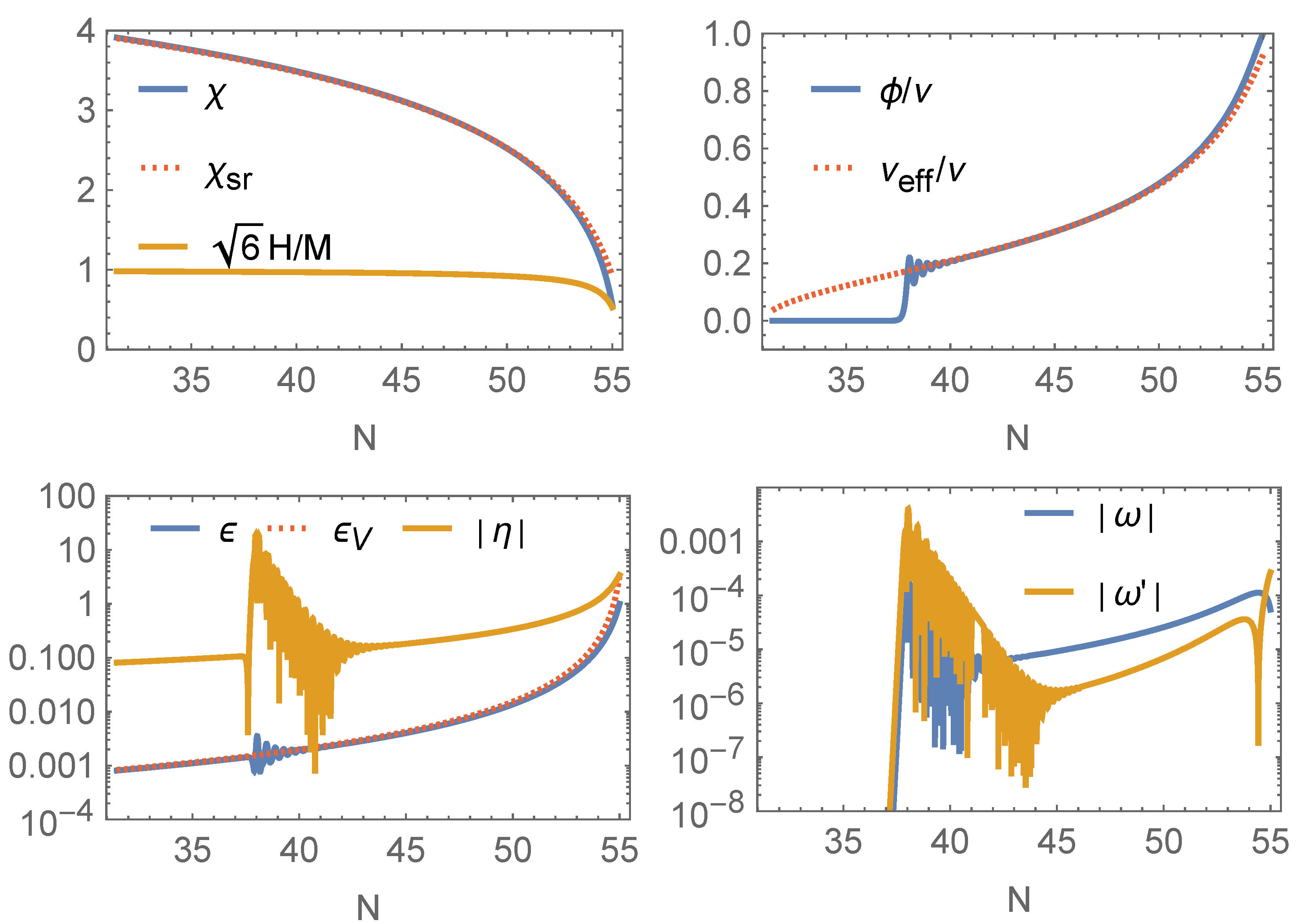
Finally, let us show the full numerical solution for and , and how it compares to our analytical result. Figure 1 shows the numerical solution of the system (24)–(27) with negligible GB backreaction. The parameters used are , , and , and is given by (43) (this leads to an effective VEV close to the inflationary scale, ). The initial conditions for the inflaton are and , while the initial conditions for the symmetry breaking field are taken as , as can be expected from quantum fluctuations around the symmetric point in the de Sitter background [66]. We choose positive values for the and initial conditions, but their sign is randomly fixed among different Hubble patches, resulting in domain wall formation (or cosmic strings for a spontaneously broken symmetry). The point corresponds to the horizon exit of the CMB reference scale, and the numerical integration starts ten efolds earlier. The plot in the top-left of Figure 1 shows the numerical evolution of compared to its analytical solution (38), as well as the rescaled Hubble function. The plot in the top-right shows the numerical evolution of versus the effective VEV given by (44) (both rescaled by the VEV value at the initial time ). In the bottom-left of Figure 1, we can see the numerical evolution of the SR parameters , (for the inflaton potential), and , where, to a good approximation, we have . In comparison to , the GB slow-roll parameter and its derivative are suppressed, as can be seen in the bottom-right plot. These plots show that under appropriate parameter choice, we can effectively reproduce single-field inflation and, at the same time, introduce an initially broken symmetry of the -field, which can then be restored during (or after) inflation. Here, for example, we choose the restoration time , such that onward. As is shown in Figure 1 (top-right), the actual restoration time can be delayed by a few efolds, since the trajectory needs some time to stabilize:
Figure 1.
Numerical inflationary solution for the potential (28) and (29), and GB function (36) (see main text for the parameter choice). Top-left: evolution of and its slow-roll approximation ; orange curve shows the numerical Hubble function. Top-right: evolution of and its effective VEV ( is the value of at the initial time). Bottom-left: slow-roll parameters , , and . Bottom-right: GB slow-roll parameter and its velocity.
3.2. Symmetry-Breaking Scenario
Here, we will consider the opposite situation: suppose that on top of the symmetry-breaking potential V we have a GB contribution that restores the symmetry at the beginning of inflation. The GB-induced effective mass decreases over time, and it turns tachyonic at some point during inflation, leading to spontaneous breaking of the symmetry.
We take the scalar potential and GB coupling from (17), and we replace with
The reason for adding the constant term is to uplift the vacuum at and from AdS to Minkowski.
The GB parameter can be fixed from Equation (22) as
which leads to the vanishing effective mass of at some critical point of choice, . We again set , such that in the convention where is the horizon exit time of the CMB scale. For the numerical solution, we again choose , and for we choose the value , which leads to negligible GB backreaction according to (35) (we will comment on other possible values of below). In this case, as before, the single-field solution (38) can be used to describe the inflationary background on which the symmetry breaking happens, while the scalar potential is dominated by the Starobinsky potential during inflation.
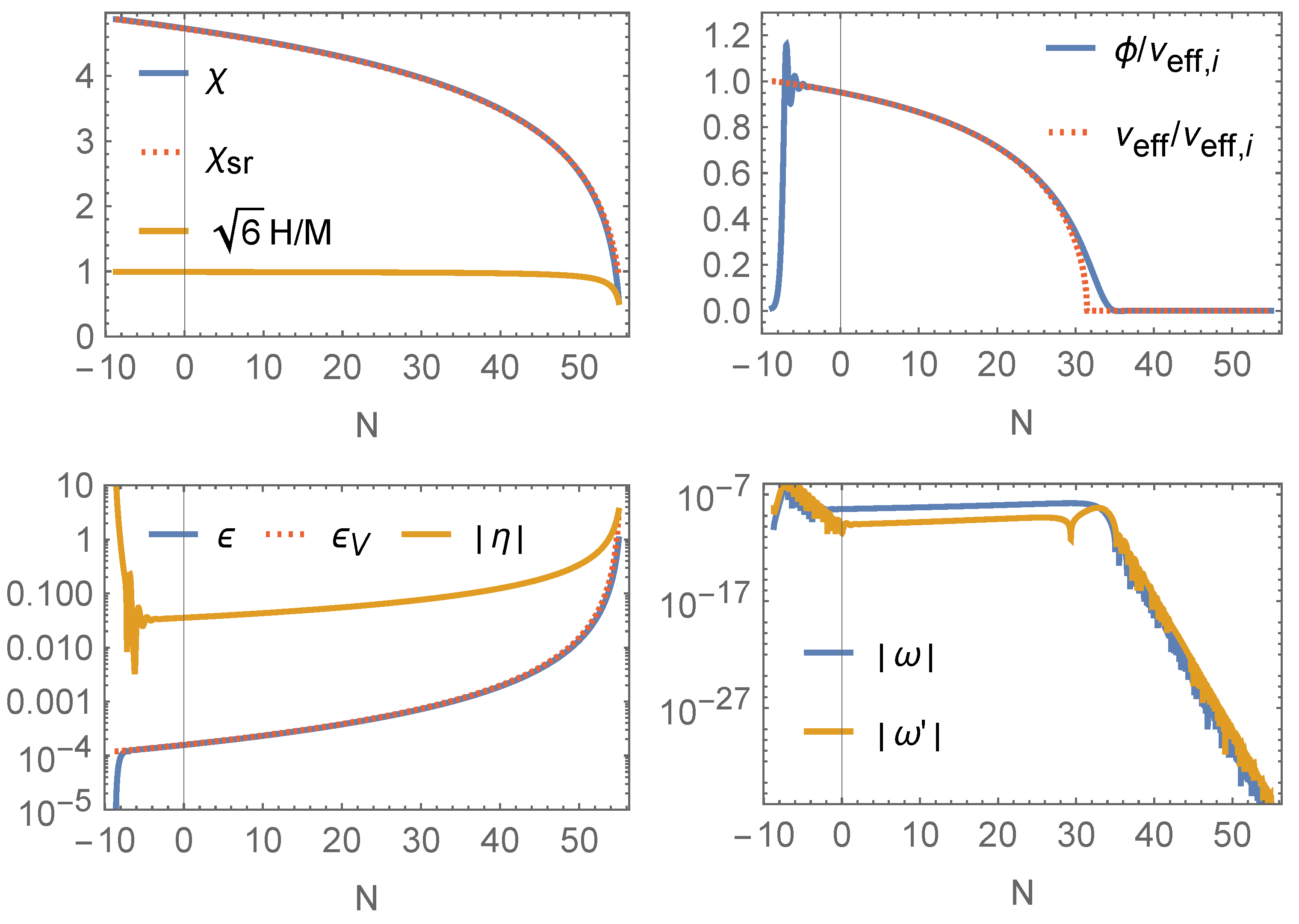
From the horizon exit to , the scalar is stabilized around the symmetric point by the GB-induced mass. After , the mass squared becomes negative, and quantum fluctuations destabilize from zero. We take as the initial condition for the numerical solution after the critical time . The solution is shown in Figure 2, where in the top-left plot we compare the numerical trajectory of with its slow-roll approximation (38) during the last ∼25 efolds, corresponding to the symmetry-breaking phase of inflation. The top-right plot shows the trajectory of (in blue), following the effective VEV (20) (with replaced by the inflaton potential (49)). As can be seen from this plot, the -field initially spends some time around the origin, before falling into the GB-induced vacuum , where it quickly stabilizes after several oscillations. These damped oscillations induce transient oscillations of the slow-roll parameters (, , and ), as shown in the bottom row of Figure 2.
Let us comment on other possible values of . For the values , the backreaction of the GB coupling becomes large (which can impact the inflationary observables), and the approximation (20) of the effective VEV of breaks down. On the opposite side, , the GB backreaction is small, but, due to the larger suppression of the -potential against the inflaton potential, spends much more time around its origin, and the symmetry-breaking time is considerably delayed compared to the analytical prediction.
4. Conclusions
In this work, we demonstrated how Gauss–Bonnet-scalar coupling can lead to a transition from a symmetric to a broken phase (and vice versa) during inflation, due to the appearance of the GB-induced inflaton-dependent effective mass of the symmetry-breaking scalar. By Taylor-expanding the scalar potential and the GB coupling function up to quartic terms4, we considered a simple inflationary scenario where the GB-induced effects and the dynamics of the charged scalar did not backreact on the inflationary slow-roll solutions (driven by a separate inflaton field) and the predictions of a given single-field inflationary model were unaffected. Therefore, our mechanism can apply to any viable inflationary model, and we introduced a new way to trigger phase transitions in the middle of inflation (or during reheating, as was already discussed in [62]). One can envision the application of GB-induced symmetry breaking to the Standard Model Higgs field as well. For example, in [53,54,55,60,61] it was shown that nontrivial evolution of the Higgs field during inflation and reheating can lead to successful leptogenesis. On the other hand, for a “hidden” scalar with GB coupling the implications for reheating also deserve a separate study, due to the complications and uncertainties related to the presence of two scalar fields (the inflaton and the symmetry-breaking scalar). For example, the inflaton can also couple to the GB term, and both scalars can interact with the Standard Model fields, depending on the symmetries of a given model and the charge assignment of the fields.
The “no-backreaction” scenario, which we focused on in this paper, allowed us to analytically study the inflationary solution, as well as the symmetry-breaking solution for . A comparison with numerical results was also made, as shown in Figure 1 and Figure 2. The absence of the GB backreaction was guaranteed by Equation (35), which also meant that the scalar and tensor power spectra (unsurprisingly) received negligible GB corrections. More specifically, the oscillations of the slow-roll parameters, which can be seen in Figure 1 and Figure 2, did not lead to significant deviations from the usual (single-field) inflationary power spectrum, thanks to the suppression condition (35). However, one can consider more general models with larger GB coupling—for instance, with comparable to or larger than —that can lead to full multi-field inflation. With the inclusion of the possible GB coupling of both scalars, this warrants a more thorough investigation of multi-field GB-coupled inflation, particularly in order to analyze the evolution of multi-scalar perturbations in GB-coupled models. This could be interesting from the point of view of small-scale inflationary phenomenology, such as the enhancement of scalar and tensor perturbations at sub-CMB scales.
Some examples of the non-trivial effects of large GB couplings on inflationary perturbations were discussed in [67,68,69,70], in relation to primordial black holes. In [71], it was shown that a two-field inflation, where one of the fields is coupled to the GB term, can produce sound speed resonance of GW, which can potentially be probed by future observations5. The resonance is triggered by oscillations of the scalar field with large GB coupling (and backreaction). Although such oscillations also occur in our SSB scenario (for the charged scalar ), we have confirmed that the GB suppression (35) rules out the resonance effect. In summary, models that violate (35) (this includes possible transient slow-roll violations during inflation) and include multi-scalar GB coupling can lead to highly non-trivial inflationary trajectories, and they should be studied in more detail by numerical analysis.
Author Contributions
Conceptualization, Y.A.; Methodology, Y.A.; Software, D.B.; Validation, D.B.; Formal analysis, D.B.; Investigation, Y.A. and D.B.; Writing—original draft, Y.A.; Writing—review & editing, Y.A.; Supervision, Y.A. All authors have read and agreed to the published version of the manuscript.
Funding
This research received no external funding.
Data Availability Statement
Data are contained within the article.
Conflicts of Interest
The authors declare no conflicts of interest.
Notes
| 1 | It should be mentioned that in such a scenario the suppression of cubic and higher-order curvature terms is not automatic, and it should be explained by the underlying UV physics or by symmetry arguments. |
| 2 | |
| 3 | In the previous section, the dS expansion was driven by a cosmological constant, which we denoted as . In this section, we consider an inflationary quasi-dS background, and, therefore, we replace by an inflationary potential . A small, positive cosmological constant (dark energy) can be included as well, but it is insignificant during inflation, so we ignore it here. |
| 4 | In principle, one can consider different functions for and under suitable conditions for GB-induced symmetry breaking. The condition for the absence of GB backreaction from inflation would be unchanged, and it is given by (35), in terms of the slow-roll parameters. |
| 5 | Alternatively, GW can be generated due to the GB-induced dip in the sound speed, as found in [72]. |
References
- Fernandes, P.G.S.; Carrilho, P.; Clifton, T.; Mulryne, D.J. The 4D Einstein–Gauss–Bonnet theory of gravity: A review. Class. Quant. Grav. 2022, 39, 063001. [Google Scholar] [CrossRef]
- Cartier, C.; Hwang, J.-C.; Copeland, E.J. Evolution of cosmological perturbations in nonsingular string cosmologies. Phys. Rev. D 2001, 64, 103504. [Google Scholar] [CrossRef]
- Guo, Z.-K.; Ohta, N.; Tsujikawa, S. Realizing scale-invariant density perturbations in low-energy effective string theory. Phys. Rev. D 2007, 75, 023520. [Google Scholar] [CrossRef]
- Satoh, M.; Soda, J. Higher Curvature Corrections to Primordial Fluctuations in Slow-roll Inflation. J. Cosmol. Astropart. Phys. 2008, 9, 19. [Google Scholar] [CrossRef]
- Guo, Z.-K.; Schwarz, D.J. Power spectra from an inflaton coupled to the Gauss-Bonnet term. Phys. Rev. D 2009, 80, 063523. [Google Scholar] [CrossRef]
- Guo, Z.-K.; Schwarz, D.J. Slow-roll inflation with a Gauss-Bonnet correction. Phys. Rev. D 2010, 81, 123520. [Google Scholar] [CrossRef]
- Jiang, P.-X.; Hu, J.-W.; Guo, Z.-K. Inflation coupled to a Gauss-Bonnet term. Phys. Rev. D 2013, 88, 123508. [Google Scholar] [CrossRef]
- Koh, S.; Lee, B.-H.; Lee, W.; Tumurtushaa, G. Observational constraints on slow-roll inflation coupled to a Gauss-Bonnet term. Phys. Rev. D 2014, 90, 063527. [Google Scholar] [CrossRef]
- Yi, Z.; Gong, Y.; Sabir, M. Inflation with Gauss-Bonnet coupling. Phys. Rev. D 2018, 98, 083521. [Google Scholar] [CrossRef]
- Odintsov, S.D.; Oikonomou, V.K. Viable Inflation in Scalar-Gauss-Bonnet Gravity and Reconstruction from Observational Indices. Phys. Rev. D 2018, 98, 044039. [Google Scholar] [CrossRef]
- Odintsov, S.D.; Oikonomou, V.K. Inflationary Phenomenology of Einstein Gauss-Bonnet Gravity Compatible with GW170817. Phys. Lett. B 2019, 797, 134874. [Google Scholar] [CrossRef]
- Pozdeeva, E.O.; Gangopadhyay, M.R.; Sami, M.; Toporensky, A.V.; Vernov, S.Y. Inflation with a quartic potential in the framework of Einstein-Gauss-Bonnet gravity. Phys. Rev. D 2020, 102, 043525. [Google Scholar] [CrossRef]
- Pozdeeva, E.O.; Skugoreva, M.A.; Toporensky, A.V.; Vernov, S.Y. New slow-roll approximations for inflation in Einstein-Gauss-Bonnet gravity. J. Cosmol. Astropart. Phys. 2024, 9, 50. [Google Scholar] [CrossRef]
- Antoniadis, I.; Rizos, J.; Tamvakis, K. Singularity—Free cosmological solutions of the superstring effective action. Nucl. Phys. B 1994, 415, 497–514. [Google Scholar] [CrossRef]
- Kawai, S.; Sakagami, M.-A.; Soda, J. Instability of one loop superstring cosmology. Phys. Lett. B 1998, 437, 284–290. [Google Scholar] [CrossRef]
- Kawai, S.; Soda, J. Evolution of fluctuations during graceful exit in string cosmology. Phys. Lett. B 1999, 460, 41–46. [Google Scholar] [CrossRef]
- Weinberg, S. Effective Field Theory for Inflation. Phys. Rev. D 2008, 77, 123541. [Google Scholar] [CrossRef]
- Nojiri, S.; Odintsov, S.D.; Sasaki, M. Gauss-Bonnet dark energy. Phys. Rev. D 2005, 71, 123509. [Google Scholar] [CrossRef]
- Calcagni, G.; Tsujikawa, S.; Sami, M. Dark energy and cosmological solutions in second-order string gravity. Class. Quant. Grav. 2005, 22, 3977–4006. [Google Scholar] [CrossRef]
- Nojiri, S.; Odintsov, S.D.; Sami, M. Dark energy cosmology from higher-order, string-inspired gravity and its reconstruction. Phys. Rev. D 2006, 74, 046004. [Google Scholar] [CrossRef]
- Tsujikawa, S.; Sami, M. String-inspired cosmology: Late time transition from scaling matter era to dark energy universe caused by a Gauss-Bonnet coupling. J. Cosmol. Astropart. Phys. 2007, 1, 6. [Google Scholar] [CrossRef]
- Koivisto, T.; Mota, D.F. Gauss-Bonnet Quintessence: Background Evolution, Large Scale Structure and Cosmological Constraints. Phys. Rev. D 2007, 75, 023518. [Google Scholar] [CrossRef]
- Neupane, I.P. On compatibility of string effective action with an accelerating universe. Class. Quant. Grav. 2006, 23, 7493–7520. [Google Scholar] [CrossRef]
- Granda, L.N.; Jimenez, D.F. Dynamical analysis for a scalar–tensor model with Gauss–Bonnet and non-minimal couplings. Eur. Phys. J. C 2017, 77, 679. [Google Scholar] [CrossRef]
- Chatzarakis, N.; Oikonomou, V.K. Autonomous dynamical system of Einstein–Gauss–Bonnet cosmologies. Ann. Phys. 2020, 419, 168216. [Google Scholar] [CrossRef]
- Pozdeeva, E.O.; Sami, M.; Toporensky, A.V.; Vernov, S.Y. Stability analysis of de Sitter solutions in models with the Gauss-Bonnet term. Phys. Rev. D 2019, 100, 083527. [Google Scholar] [CrossRef]
- Vernov, S.; Pozdeeva, E. De Sitter Solutions in Einstein–Gauss–Bonnet Gravity. Universe 2021, 7, 149. [Google Scholar] [CrossRef]
- Kawai, S.; Kim, J. CMB from a Gauss-Bonnet-induced de Sitter fixed point. Phys. Rev. D 2021, 104, 043525. [Google Scholar] [CrossRef]
- Sadjadi, H.M. Scalar-Gauss-Bonnet model, the coincidence problem and the gravitational wave speed. Phys. Lett. B 2024, 850, 138508. [Google Scholar] [CrossRef]
- Pinto, M.A.S.; Rosa, J.A.L. ΛCDM-like evolution in Einstein-scalar-Gauss-Bonnet gravity. arXiv 2024, arXiv:2411.04066. [Google Scholar]
- Linde, A.D. Hybrid inflation. Phys. Rev. D 1994, 49, 748–754. [Google Scholar] [CrossRef] [PubMed]
- Garcia-Bellido, J.; Linde, A.D.; Wands, D. Density perturbations and black hole formation in hybrid inflation. Phys. Rev. D 1996, 54, 6040–6058. [Google Scholar] [CrossRef] [PubMed]
- Garcia-Bellido, J.; Wands, D. The Spectrum of curvature perturbations from hybrid inflation. Phys. Rev. D 1996, 54, 7181–7185. [Google Scholar] [CrossRef] [PubMed]
- Koh, S.; Minamitsuji, M. Non-minimally coupled hybrid inflation. Phys. Rev. D 2011, 83, 046009. [Google Scholar] [CrossRef]
- Bettoni, D.; Rubio, J. Quintessential Affleck-Dine baryogenesis with non-minimal couplings. Phys. Lett. B 2018, 784, 122–129. [Google Scholar] [CrossRef]
- Bettoni, D.; Domènech, G.; Rubio, J. Gravitational waves from global cosmic strings in quintessential inflation. J. Cosmol. Astropart. Phys. 2019, 2, 34. [Google Scholar] [CrossRef]
- Bettoni, D.; Rubio, J. Hubble-induced phase transitions: Walls are not forever. J. Cosmol. Astropart. Phys. 2020, 1, 2. [Google Scholar] [CrossRef]
- Bettoni, D.; Lopez-Eiguren, A.; Rubio, J. Hubble-induced phase transitions on the lattice with applications to Ricci reheating. J. Cosmol. Astropart. Phys. 2022, 1, 2. [Google Scholar] [CrossRef]
- Arapoğlu, A.S.; Yükselci, A.E. The effect of non-minimally coupled scalar field on gravitational waves from first-order vacuum phase transitions. Phys. Dark Univ. 2023, 40, 101176. [Google Scholar] [CrossRef]
- Kierkla, M.; Laverda, G.; Lewicki, M.; Mantziris, A.; Piani, M.; Rubio, J.; Zych, M. From Hubble to Bubble. J. High Energy Phys. 2023, 11, 77. [Google Scholar] [CrossRef]
- Laverda, G.; Rubio, J. Ricci reheating reloaded. J. Cosmol. Astropart. Phys. 2024, 3, 33. [Google Scholar] [CrossRef]
- Sadjadi, H.M. Non-minimally coupled quintessence in the Gauss-Bonnet model, symmetry breaking, and cosmic acceleration. arXiv 2023, arXiv:2310.03697. [Google Scholar]
- Aldabergenov, Y.; Ding, D.; Lin, W.; Wan, Y. Meso-inflationary Peccei–Quinn Symmetry Breaking with Nonminimal Coupling. Astrophys. J. Suppl. 2024, 275, 14. [Google Scholar] [CrossRef]
- Bettoni, D.; Laverda, G.; Eiguren, A.L.; Rubio, J. Hubble-Induced Phase Transitions: Gravitational-Wave Imprint of Ricci Reheating from Lattice Simulations. arXiv 2024, arXiv:2409.15450. [Google Scholar] [CrossRef]
- Berera, A. Warm inflation. Phys. Rev. Lett. 1995, 75, 3218–3221. [Google Scholar] [CrossRef]
- Rosa, J.A.G.; Ventura, L.B. Spontaneous breaking of the Peccei-Quinn symmetry during warm inflation. arXiv 2021, arXiv:2105.05771. [Google Scholar]
- An, H.; Tong, X.; Zhou, S. Superheavy dark matter production from a symmetry-restoring first-order phase transition during inflation. Phys. Rev. D 2023, 107, 023522. [Google Scholar] [CrossRef]
- Goolsby-Cole, C.; Sorbo, L. Nonperturbative production of massless scalars during inflation and generation of gravitational waves. J. Cosmol. Astropart. Phys. 2017, 8, 5. [Google Scholar] [CrossRef]
- An, H.; Lyu, K.-F.; Wang, L.-T.; Zhou, S. Gravitational waves from an inflation triggered first-order phase transition. J. High Energy Phys. 2022, 6, 50. [Google Scholar] [CrossRef]
- Barir, J.; Geller, M.; Sun, C.; Volansky, T. Gravitational waves from incomplete inflationary phase transitions. Phys. Rev. D 2023, 108, 115016. [Google Scholar] [CrossRef]
- An, H.; Su, B.; Tai, H.; Wang, L.-T.; Yang, C. Phase transition during inflation and the gravitational wave signal at pulsar timing arrays. Phys. Rev. D 2024, 109, L121304. [Google Scholar] [CrossRef]
- An, H.; Chen, Q.; Li, Y.; Yin, Y. Large non-Gaussianities corresponding to first-order phase transitions during inflation. arXiv 2024, arXiv:2411.12699. [Google Scholar]
- Garcia-Bellido, J.; Morales, E.R. Particle production from symmetry breaking after inflation. Phys. Lett. B 2002, 536, 193–202. [Google Scholar] [CrossRef]
- Pearce, L.; Yang, L.; Kusenko, A.; Peloso, M. Leptogenesis via neutrino production during Higgs condensate relaxation. Phys. Rev. D 2015, 92, 023509. [Google Scholar] [CrossRef]
- Yang, L.; Pearce, L.; Kusenko, A. Leptogenesis via Higgs Condensate Relaxation. Phys. Rev. D 2015, 92, 043506. [Google Scholar] [CrossRef]
- Graham, P.W.; Kaplan, D.E.; Rajendran, S. Cosmological Relaxation of the Electroweak Scale. Phys. Rev. Lett. 2015, 115, 221801. [Google Scholar] [CrossRef]
- He, M.; Jinno, R.; Kamada, K.; Park, S.C.; Starobinsky, A.A.; Yokoyama, J. On the violent preheating in the mixed Higgs-R2 inflationary model. Phys. Lett. B 2019, 791, 36–42. [Google Scholar] [CrossRef]
- Kumar, S.; Sundrum, R. Heavy-Lifting of Gauge Theories By Cosmic Inflation. J. High Energy Phys. 2018, 5, 11. [Google Scholar] [CrossRef]
- Wu, Y.-P. Higgs as heavy-lifted physics during inflation. J. High Energy Phys. 2019, 4, 125. [Google Scholar] [CrossRef]
- Opferkuch, T.; Schwaller, P.; Stefanek, B.A. Ricci Reheating. J. Cosmol. Astropart. Phys. 2019, 7, 16. [Google Scholar] [CrossRef]
- Wu, Y.-P.; Yang, L.; Kusenko, A. Leptogenesis from spontaneous symmetry breaking during inflation. J. High Energy Phys. 2019, 12, 88. [Google Scholar] [CrossRef]
- Liang, Q.; Sakstein, J.; Trodden, M. Baryogenesis via gravitational spontaneous symmetry breaking. Phys. Rev. D 2019, 100, 063518. [Google Scholar] [CrossRef]
- Sadjadi, H.M. Early dark energy and scalarization in a scalar-tensor model. Phys. Lett. B 2024, 857, 138967. [Google Scholar] [CrossRef]
- Akrami, Y. et al. [Planck Collaboration]. Planck 2018 results. X. Constraints on inflation. Astron. Astrophys. 2020, 641, A10. [Google Scholar] [CrossRef]
- Linde, A.D. Generation of Isothermal Density Perturbations in the Inflationary Universe. Phys. Lett. B 1985, 158, 375–380. [Google Scholar] [CrossRef]
- Starobinsky, A.A.; Yokoyama, J. Equilibrium state of a selfinteracting scalar field in the De Sitter background. Phys. Rev. D 1994, 50, 6357–6368. [Google Scholar] [CrossRef]
- Kawai, S.; Kim, J. Primordial black holes from Gauss-Bonnet-corrected single field inflation. Phys. Rev. D 2021, 104, 083545. [Google Scholar] [CrossRef]
- Kawaguchi, R.; Tsujikawa, S. Primordial black holes from Higgs inflation with a Gauss-Bonnet coupling. Phys. Rev. D 2023, 107, 063508. [Google Scholar] [CrossRef]
- Ashrafzadeh, A.; Karami, K. Primordial Black Holes in Scalar Field Inflation Coupled to the Gauss–Bonnet Term with Fractional Power-law Potentials. Astrophys. J. 2024, 965, 11. [Google Scholar] [CrossRef]
- Solbi, M.; Karami, K. Primordial black holes in non-minimal Gauss–Bonnet inflation in light of the PTA data. Eur. Phys. J. C 2024, 84, 918. [Google Scholar] [CrossRef]
- Addazi, A.; Aldabergenov, Y.; Cai, Y. Sound speed resonance of gravitational waves in Gauss-Bonnet-coupled inflation. Phys. Rev. D 2024, 110, 123530. [Google Scholar] [CrossRef]
- Kawai, S.; Kim, J. Probing the inflationary moduli space with gravitational waves. Phys. Rev. D 2023, 108, 103537. [Google Scholar] [CrossRef]
Disclaimer/Publisher’s Note: The statements, opinions and data contained in all publications are solely those of the individual author(s) and contributor(s) and not of MDPI and/or the editor(s). MDPI and/or the editor(s) disclaim responsibility for any injury to people or property resulting from any ideas, methods, instructions or products referred to in the content. |
© 2025 by the authors. Licensee MDPI, Basel, Switzerland. This article is an open access article distributed under the terms and conditions of the Creative Commons Attribution (CC BY) license (https://creativecommons.org/licenses/by/4.0/).