Review

Multiwavelength View of Circumstellar Interaction in Supernovae

National Radio Astronomy Observatory, 520 Edgemont Rd., Charlottesville, VA 22903, USA
Universe 2025, 11(11), 363; https://doi.org/10.3390/universe11110363
Submission received: 10 July 2025 / Revised: 14 October 2025 / Accepted: 23 October 2025 / Published: 3 November 2025
(This article belongs to the Special Issue A Multiwavelength View of Supernovae)

Abstract

The interaction of post-explosion supernova ejecta with the surrounding circumstellar medium creates emissions across the electromagnetic spectrum. Since the circumstellar medium is created by the mass lost from the progenitor star, it carries tell-tale signatures of the progenitor. Consequently, observations and modeling of radiation produced by the interaction in various types of supernovae have provided valuable insights into their progenitors. Detailed studies have shown that the interaction in supernovae begins and sustains over various timescales and lengthscales, with differing mass-loss rates in distinct sub-classes. This reveals diverse progenitor histories for these stellar explosions. This review paper summarizes various supernova subtypes, linking them to stellar death pathways, and presents an updated supernova classification diagram. We then present a multi-wavelength study of circumstellar interaction in different supernova classes. We also present unpublished X-ray as well as radio observations of a type IIn supernova, SN 2010jl, which allow us to extend its circumstellar interaction studies to about 7 years post-explosion. The new data indicates that the extreme mass-loss rate (∼0.1 M yr−1) in SN 2010jl, reported by Chandra et al. commenced within the last 300 years before the explosion. We summarize the current status of the field and argue that via detailed studies of the circumstellar interaction, a.k.a. “Time Machine” technique, one of the big mysteries of stellar evolution, i.e., mapping supernovae progenitors to their explosive outcomes can be solved.

1. Supernovae and Their Classification

Supernovae (SNe) are among the most energetic phenomena in the universe, marking the explosive demise of massive stars [1]. Stars with initial masses ∼3–8 M end their lives as sufficiently massive ( 0.9 1.1 M ) carbon–oxygen (C–O) white dwarfs (WDs) [2,3], which when in a close binary system, may accrete mass from a companion star until approaching the Chandrasekhar mass limit (∼1.4 M ), thus leading to ignition of runaway carbon fusion in its degenerate core resulting in thermonuclear SNe [4,5,6,7,8]. These SNe are also termed as Type Ia SNe (SNe Ia). Stars with initial masses ≳8 M continue nuclear burning through successive stages beyond helium, ultimately reaching silicon burning and forming an iron core [9,10,11]. Since iron-group nuclei cannot release energy through fusion, the core becomes gravitationally unstable and undergoes catastrophic collapse, resulting in the formation of a neutron star or black hole. The ensuing rebound and neutrino-driven processes launch a core-collapse supernova (CCSN) explosion [12,13,14].
SN classification is purely observational, primarily based on optical spectra and light curves. SNe Ia spectra are devoid of hydrogen and show the presence of strong Si II λ 6355 Å lines, e.g., SN 1994D, SN 2011fe [15,16,17]. While SNe Ia are expected to be standardizable candles, observations have revealed significant diversity based on spectral features, light curves, and luminosity [18,19], such as subtypes overluminous SN 1991T-like SNe Ia [20,21], and subluminous SN 1991bg-like SNe Ia [22]. In addition, a peculiar kind of SNe Ia, SNe Iax, are marked by luminosities fainter by a factor 10–100 than normal SNe Ia, slower ejecta speeds, and weaker Si II lines [23]. Examples of this subtype are SN 2002cx [24] and 2005hk [25], and they are considered to arise from partial deflagration of a WD [26,27]. Another category, usually named as SN 2003fg-like SNe Ia, are extremely bright with absolute peak magnitude M V 20 and reveal broad line profiles in their spectra [28,29].
Though SNe Ia usually do not show hydrogen, some SNe Ia, such as SN 2002ic, have revealed narrow H α lines, likely arising from unshocked dense surrounding circumstellar medium (CSM) [30]. They are considered to be interacting with H-rich CSM and are termed as SNe Ia-CSM. SNe Ia-CSM provide the strongest support for single-degenerate progenitor models [31]. Though SNe Ia-CSM are considered to be thermonuclear explosions, there have been suggestions that some of them may be core collapse events [32]. Systematic searches, such as using Palomar Transient Factory (PTF) and Bright Transient Survey of Zwicky Transient Facility (ZTF) have revealed a population of more than two dozen known SNe Ia-CSM [33,34].
CCSNe are generally classified based on the presence of hydrogen (Type II) or the absence of hydrogen (Type I) in their spectra [15,35]. Amongst type II SNe (SNe II) class, optical lightcurves further subclassify them into Type IIP (SNe IIP) and IIL (SNe IIL) [15]. SNe IIP show a plateau in the light curve lasting ∼100 days due to hydrogen recombination, and their progenitors are expected to be red supergiant (RSG) stars with a hydrogen envelope intact, e.g., SN 1999em [36]. SNe IIL have linearly declining light curves and are expected to come from RSGs with comparatively thinner hydrogen envelopes. A prototypical example of this class is SN 1979C [37]. Modern untargeted surveys reveal a continuum of decline rates between the two traditional subclasses, suggesting the IIP/IIL division is phenomenological rather than being physically discrete [38,39]. Type I subclasses of CCSNe (SNe I) are further divided into Types Ib and Ic (SNe Ib and SNe Ic, respectively). SNe Ib show strong He-I lines and are expected to come from helium stars or Wolf–Rayet (WR) stars, likely in a binary system [40,41]. An archetype example of the SNe Ib subclass is SN 2008D [42]. Lack of hydrogen as well as helium is a trademark of SNe Ic, revealing that their progenitors are stripped off of both hydrogen and helium layers at the time of explosion (e.g., SN 1994I, [43]). In addition, a transitional category between SNe IIL and SNe Ib has been defined as Type IIb SNe (SNe IIb), which are thought to come from progenitors with partially stripped hydrogen envelopes [44,45]. SNe IIb, along with SNe Ib and Ic, are collectively called stripped envelope SNe (SESNe). SNe IIP, IIL, IIb, Ib, and Ic are considered to have progressively increasing stripping of the progenitor off its layers [15,46].
Some CCSNe are surrounded by dense CSM and show narrow emission lines in the optical spectra, considered to be arising from the dense unshocked CSM [47]. They are marked with a suffix “n”. Amongst SNe II, these are SNe IIn [47], and amongst H-poor CCSNe, these are SNe Ibn [48] and SNe Icn [49]. They are collectively called interacting SNe. In SNe Ibn, narrow He I emission lines (≤1000 km s−1) are superimposed on a blue continuum [50]. Some examples of this class are the first known SNe Ibn SN 1999cq [50] and a classic well-studied SN 2006jc [51,52]. The first example of SNe Icn was SN 2019hgp, which showed narrow C III/IV, O III/IV lines in the spectra and a complete lack of H/He [49]. Since interacting SNe are marked by the dominance of the surrounding CSM, their progenitors remain misleading.
An extreme case of SNe Ic is SNe Ic-bl. They show broad absorption lines revealing high ejecta velocities. While most SNe Ic-bl have high but non-relativistic speeds, some have shown relativistic expansion. Some of these are linked with gamma-ray bursts (GRBs), e.g., SN 1998bw associated with GRB 980425 [53], whereas some relativistic SNe Ic-bl show no GRB association, e.g., SN 2009bb [54]. SNe Ic-bl challenge the standard picture of CCSNe due to their large energy requirements. A hypothesized scenario includes additional energy being provided by a central engine, such as a relativistic jet driven from the core of the progenitor or magnetar [55]. However, it is clear that the majority of SNe Ic-bl do not have GRB counterparts [56].
Electron-capture supernovae (ECSNe) are a theoretical class of faint SNe that come from the core collapse of intermediate-mass super asymptotic giant branch (super-AGB or SAGB) stars [57]. These stars, unlike their more massive counterparts, are unable to fuse up to iron in their cores [58,59]. Instead, they finish nuclear fusion with a degenerate O-Ne-Mg core. Electron capture onto the Ne and Mg nuclei removes the degenerate electrons, causing a decrease in degeneracy pressure and resulting in a core collapse. ECSNe are predicted to have lower energies and luminosities than their typical, higher-mass, iron CCSNe counterparts. SN 2018zd is by far the best candidate for an ECSNe [60].
As mentioned above, the broader SN classification, SNe Ia and CCSNe, is based on optical spectra. However, as per stellar death pathways, these two classes mainly arise from the explosive death of a WD in a binary system and the gravitational collapse of a massive star, respectively. Another channel of stellar death pathways, for stars in the ZAMS range of 140–260 M , is the pair-instability mechanism [61,62]. This refers to a physical mechanism where a massive star’s instability is caused by high temperatures and pressures in the star’s core, leading to the creation of electron–positron pairs. The creation of these pairs reduces the internal radiation pressure, triggering a runaway thermonuclear explosion [62]. The resulting SNe are called pair-instability SNe (PISNe). Stars in the mass range 70–140 M undergo pulsational pair-instability, a mechanism where, instead of a single catastrophic explosion, a series of violent pulsations eject large amounts of the star’s outer layers. These are termed as pulsational PISNe (PPISNe) [63]. SN 2018ibb is considered to be the best candidate of PISNe [64], whereas the best candidate for PPISNe class is SN iPTF14hls [65].
Some rare and peculiar subtypes, such as Ca-rich transients, are typically associated with thermonuclear explosions, such as prototypical SN 2005E, considered to be a helium-shell detonation on a low-mass C–O white dwarf [66,67]. However, in the case of another Ca-rich transient, SN 2005cz, Kawabata et al. [68] argued that it originated from the core-collapse of a low-mass star. Kasliwal et al. [69] carried out a population study showing that Ca-rich transients are faint, Ca-dominated, occur in galaxy halos, and likely come from thermonuclear WD systems.
A relatively recent class of SNe, superluminous SNe (SLSNe), is purely an observational category of SNe whose peak luminosities are much larger than those of canonical SNe [70,71,72]. They are sub-categorized into Type I and Type II SLSNe, depending upon the absence or presence of hydrogen, respectively. Traditionally, the absolute magnitude cut-off for SLSNe has been M V < 21 mag [70]; however, some SLSNe I could be as faint as M V < 20 mag and yet have SLSNe spectroscopic features. On the other hand, some fast blue optical transients (FBOTs) may reach M V < 21 mag but do not match with SLSNe spectroscopically, blurring the magnitude boundary between SNe and SLSNe [71,72]. SLSNe can come from any stellar death pathways, but three major power sources of extreme luminosities are radiation from CS interaction, contribution from a central engine (e.g., magnetar spin-down, or fall-back accretion) or radioactive decay in the pair-instability mechanism [71,72]. Some SNe IIn have exceptionally high luminosities due to contributions from their dense CSM. These SLSNe IIn are a subset of both SNe IIn and SLSNe, characterized by their narrow hydrogen emission lines and extremely bright light curves, resulting from the efficient conversion of the supernova’s kinetic energy into radiation, e.g., SN 2017hcc, SN 2010jl, SN2006gy, and SN 2014C [71]. We discuss them in the SNe IIn category. Among Ic-bl SNe, SN 2011kl associated with GRB 111209A is the only known example of a stellar explosion that satisfies the superluminous criterion, though with faster evolution than usual SLSNe [73].
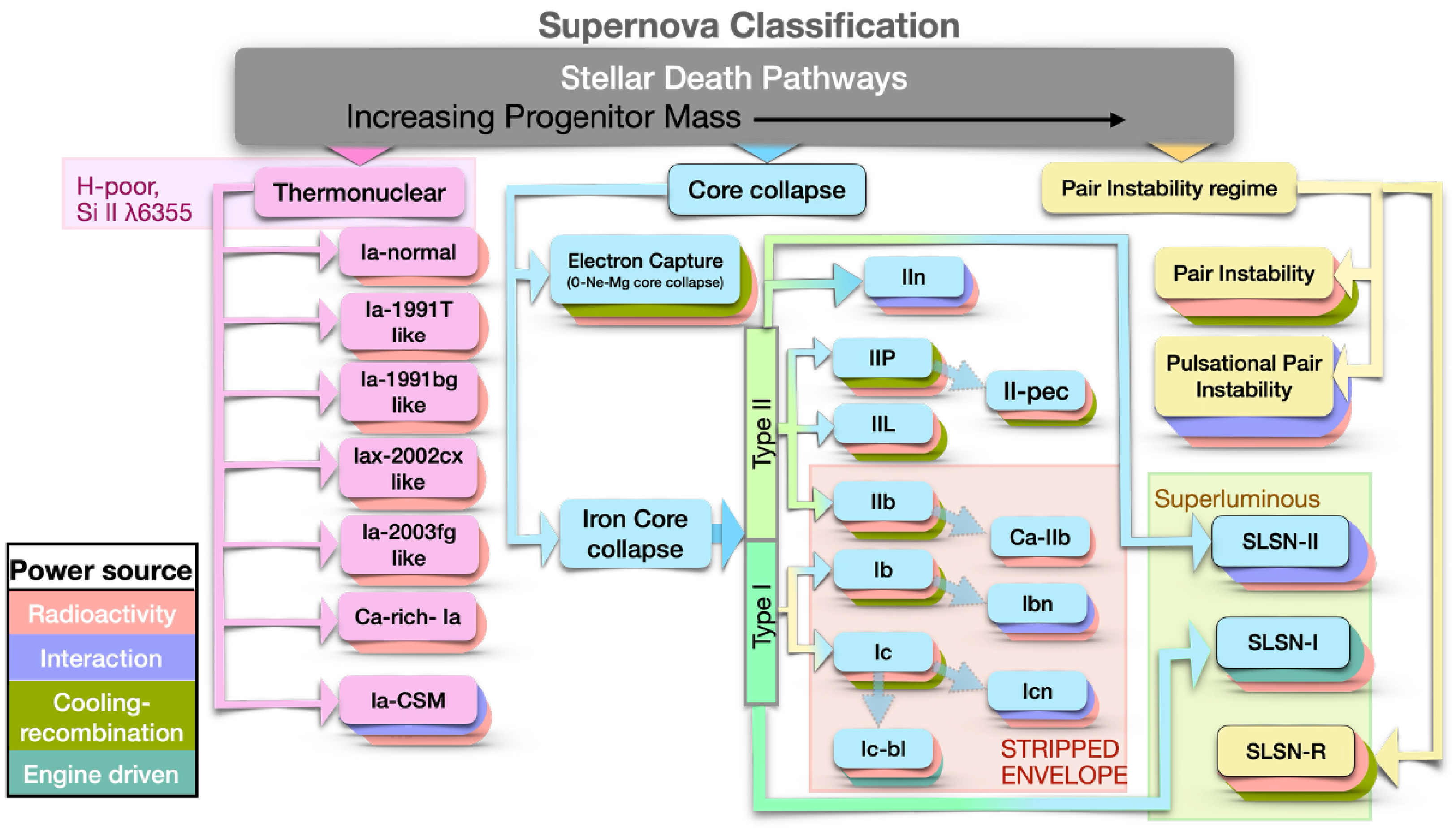
While SN classification typically does not take into account the stellar death pathways, based on the existing understanding, we provide a detailed SNe classification placing the traditional classification along with the stellar death pathways in Figure 1. We emphasize that despite various subclasses of SNe, our understanding of their progenitors is quite limited. As discussed in the next section, the SN ejecta–CSM interaction study can help fill this gap in, at least, a subset of SNe.

2. Circumstellar Interaction

Stars lose mass from their outermost layers into the surrounding medium, blowing stellar winds and creating a CSM. Observations have shown that mass-loss rates in massive stars can be several orders of magnitude higher than those in average mass stars like our Sun [74,75]. If v is the terminal velocity for a star at a distance of r and ρ ( r ) is the average mass density at a distance r , the mass-loss rate can be expressed as M ˙ = 4 π r 2 ρ ( r ) v . The wind speeds vary for different progenitors and are usually related to their escape velocities [76,77,78]. However, the high radiation from SN can accelerate stellar winds to much higher speeds [75]. The red super giants (RSGs) normally have slower winds (∼10 km s 1 ) as compared to luminous blue variable (LBV) and blue supergiants (BSGs) with faster winds (∼100–1000 km s 1 ). P-Cygni profiles are the best diagnostics of wind speeds [78].
There can be multiple channels of mass loss in massive stars. The major mass-loss mechanisms are radiation-driven mass loss, binary interaction-driven mass loss, and wave-driven mass loss [74,75]. The radiation-driven winds, such as line-driven, continuum-driven, and dust-driven winds lead to significant mass loss, especially during evolved stages of massive stars [74,79]. Evolved stars like LBVs are known to be highly unstable and can undergo dramatic, violent outbursts resulting in huge amounts of mass loss [75]. In the second category, massive stars in binary systems may interact and drive enhanced mass loss via Roche-lobe overflow, wind mass transfer, common-envelope ejection, and mergers, etc. [80]. Wave-driven mass loss may be important in advanced nuclear burning stages when wave energy generated by deep-seated nuclear burning shells propagates outward and contributes to further enhancement of ongoing mass loss by depositing heat and momentum into the outer envelopes [81,82]. Flash spectra seen in several SNe point towards the prevalence of wave-driven mass loss very close to explosion [81,83]. In very massive stars ( 70 < M < 140 M ), pulsational pair instability-driven mass loss can be enormous via multiple ejections of massive shells before the SN collapse [63]. As mass loss from stars forms the CSM, various progenitors can have very different CSM properties. The study of CSM at various time scales carries tell-tale signatures of the SN progenitor stars and their evolution.

2.1. CSM in Massive Stars in Milky Way

The best observational evidence of CSM and its complexity is revealed through observations of CSM in massive stars and their evolved counterparts in our Milky Way. Observations of O, early B, and WR stars show CSM created by powerful radiatively driven winds, whereas LBVs, as well as some RSGs, show episodic mass ejections [84]. Massive stars residing in binary systems usually lead to non-spherical CSM [84]. Several evolved stars in the Milky Way also show CSM ejected via violent outbursts [85].
In Galactic OB stars, the mass-loss rates are found to be around 10 7 10 6 M yr−1 along with wind speeds of 1000–3000 km s 1 [74,75]. Puls’ [74] work has shown the formation of infrared (IR) bow shocks at the junction of CSM and interstellar medium (ISM) in some of these stars. These bow shocks are created as the star is ejected from its birth cluster at high speeds and plows through the ISM, such as ζ Ophiuchi [86]. Thermal radio emission has been observed from OB stars due to the presence of dense CSM [87,88,89], though a binary companion can lead to non-thermal radio emission via wind collisions [90]. In a subset of massive OB stars hosting kG dipolar magnetic fields [91], evidence of gyrosynchrotron radio emission is also observed, showing variability of radio emission w.r.t. rotational phase due to misalignment of magnetic and rotational axes [92]. A small fraction of these magnetic OB stars have also revealed exotic and rare electron cyclotron maser emission and are named as main-sequence radio-pulse emitters (MRPs) [93].
WR stars in Milky Way show very dense, optically thick radiatively driven winds with M ˙ 10 5 10 4 M yr 1 along with wind speeds of 1000–3000 km s 1 [79,94]. In some cases, bubble nebulae are seen at a few pcs, indicators of WR winds sweeping the prior RSG winds. A classic example is WR 136, along with its complex nebula, NGC 6888, which was created as the star’s faster wind slammed into material ejected during an earlier RSG phase [95].
Milky Way RSGs show slow (∼10 km s 1 ) dusty winds with arcs and bows [96]. Famous examples of Mily Way RSGs are Betelgeuse and VY CMa. Betelgeuse is a prime candidate for a CCSN and shows multiple arcs and a bow shock at ∼ 6 in the IR bands, revealing a complex system of ISM gas and dust shaped by the star’s powerful stellar wind colliding with the surrounding medium [97]. Betelgeuse experienced a “Great Dimming” between 2019 and 2020, likely caused by a massive ejection of gas that condensed into a temporary dust cloud, further obscuring the star [98]. The RSG VY CMa shows clumpy, dusty ejecta and asymmetric outflows revealing a complex CS environment and pointing towards erratic mass-loss history as revealed via Atacama Large Millimeter Array (ALMA) mm studies [99,100].
LBVs are extremely rare, with only a few dozen known examples in the Milky Way [101]. They show shells, eruptions, and bipolar outflows. η -Carinae is the most well-known example in the Milky Way LBVs. During its “Great Eruption” in the 1840s, η -Carinae expelled at least 10 M of gas and dust, which formed a distinctive, heavily obscured, bipolar Homunculus Nebula [102]. Other well-known LBVs are P-Cygni, AG Carinae, Pistol star, etc. [103,104,105]. Most of the LBVs in the Milky Way seem to reside in multiplicity [106].
BSGs are the evolved phase of massive stars, often after the RSG phase [107]. Arguably the most famous SN of the current time, SN 1987A, had a BSG progenitor [108]. In the Milky Way, Sher 25, with its equatorial ring and bipolar outflows, is a well-known example of a BSG, often cited as an SN 1987A progenitor analog [109]. A significant number of BSGs are argued to have formed via stellar merger [110].
While the YSG phase is typically before the RSG phase and single stars are not expected to explode in this phase, some SNe, such as SN 2011dh, have been identified to have a YSG progenitor [111]. However, it has been argued that enhanced mass-loss rate, possibly via binary interaction, can result in explosions [112]. The CSM of YSGs contains significant amounts of dust and often exhibits episodic or variable mass-loss history, leading to the formation of clumpy, structured CSM [84]. A famous example of this class is IRC+10420, which shows helium and nitrogen-enriched CSM along with massive dust shells [113].
In Table 1, we list some well-known massive and evolved stars in the Milky Way and their CSM properties. As is evident, the mass-loss histories of Galactic massive stars are quite complex. The resulting CSM has a non-reversible, significant impact on their post-death SN outcome [114].

2.2. Self-Similar Solutions for CS Interaction

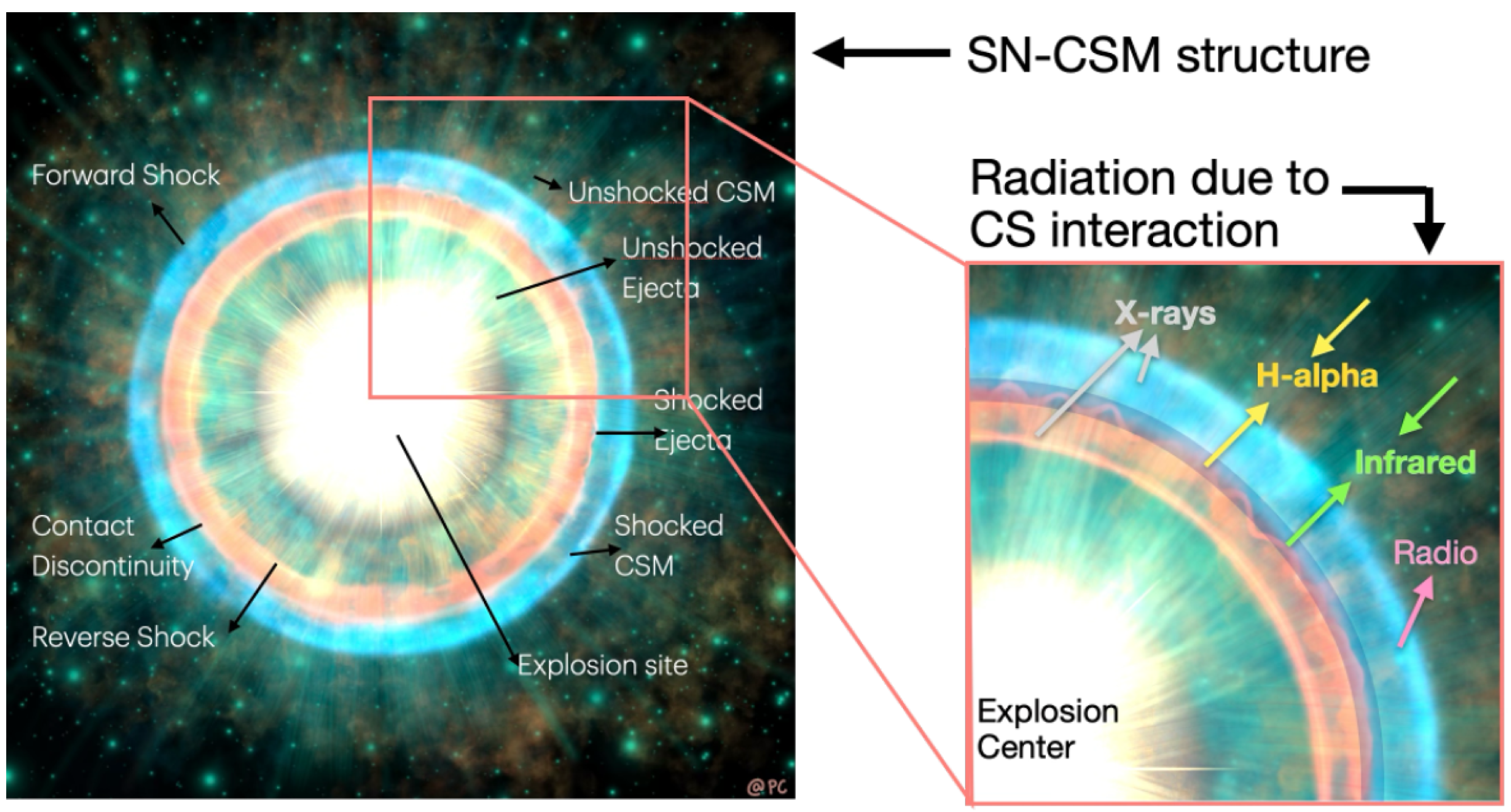
In the CS interaction picture, the rapidly expanding SN ejecta with velocities ∼10,000– 50 , 000   km s 1 collide with the surrounding material, a.k.a. comparatively slower moving CSM (∼10–1000 km s 1 ). This generates a forward shock (FS) moving into the CSM and a reverse shock (RS) moving back into the ejecta, separated by a contact discontinuity (CD) where Rayleigh–Taylor instabilities may dominate [118] (see Figure 2). The shocks convert the kinetic energy of the ejecta into thermal and non-thermal energy, producing radiation observable in different wavelengths [119]. Hot shocks produce emission in X-ray bands, while electrons accelerated in the shock, in the presence of magnetic fields (enhanced at the CD), produce non-thermal synchrotron radio emission. In optical bands, the CS interaction manifests as narrow lines due to recombination in photoionized unshocked CSM and as intermediate lines if a cool dense shell (CDS) is formed at the CD between the shocks. Infrared (IR) emission may arise as a result of CS Interaction from either the heated dust in the CSM or newly formed dust in the post-shocked regions [120,121] (Figure 2).
The fact that the shock velocities are typically 100–1000 times faster than CSM winds [120] involves the shock wave sampling the wind lost from the SN progenitor many hundreds to thousands of years ago. It probes the past evolution and mass-loss history of the star during the less advanced nuclear burning stages leading up to the explosion. This property allows CS interaction to be an important tool to probe the SN progenitor evolution before the explosion and serves as a time machine to study various SN progenitors.
The concept of CS interaction was theoretically predicted even before the observational confirmation came [118]. The CS interaction model gained acceptance when it successfully explained radio observations in SN 1979C and SN 1980K [122]. More SNe, including SN 1986J and SN 1988Z, provided strong evidence for CS interaction, revealing bright X-rays from hot shocked regions, radio synchrotron emission indicative of electron acceleration, narrow optical lines suggesting ionized CSM, and slowly declining optical light curves that implied an additional energy source beyond the radioactive decay [47,123]. By the 2000s, CS interaction had become the standard framework for explaining radio and X-ray emission from SNe [121,124,125,126].
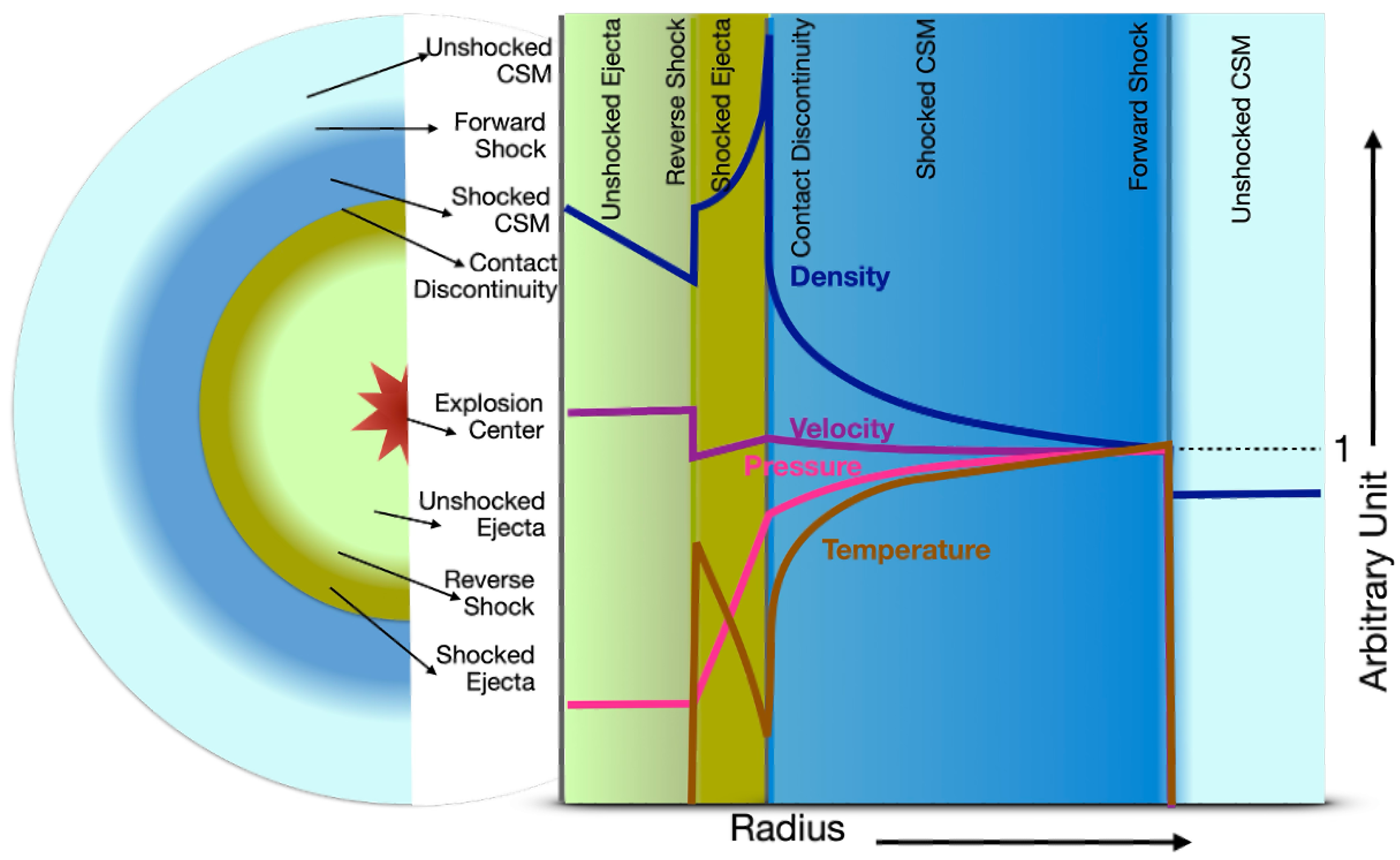
Chevalier [118] first proposed self-similar solutions to model the CS interaction, and it is considered the cornerstone work in the field. In this work, the ejecta–CSM interaction producing FS and RS shocks is governed by the hydrodynamic equations of mass, momentum, and energy conservation (Figure 3). Both ejecta and CSM are assumed to follow power-law density profiles; SN ejecta are defined by ρ ej r n , with a sharp cutoff at an inner core, interacting with wind like CSM ρ CSM r 2 . The ratio of RS and radii and the pressure profiles remain fixed in this model. The self-similar solutions provide scaling relations for shock radius, R s , evolution with time, t, such that R s t n 3 n 2 . This analytic model provides a framework to calculate shock velocities, temperatures, and densities analytically, rather than numerically (Figure 3). In [119], Chevalier applied the self-similar hydrodynamical models to the observed radio and X-ray emission seen in some CCSNe and found the models to be largely successful. Soon after Chevalier’s [118] analytical self-similar solutions, Nadyozhin [127] independently provided numerical evaluation of self-similar solutions. In his models, the self-similarity ceased to exist at the CD. This work explored a broad range of density profiles, allowing for the applicability of the model in a wide variety of astrophysical scenarios.
Hamilton and Sarazin [128] also proposed a self-similarity solution, focusing on supernova remnants (SNRs), unlike Chevalier’s [118] model, which was applicable to CS interaction at early times in young SNe. Their model, which treated the RS as an infinitely thin and freely expanding shell, was tested with a uniform ISM and successfully explained X-ray emission from SNRs. It is important to note that while both Chevalier and Nadyozhin’s solutions were valid for n > 5 , Hamilton and Sarazin [128] derived solutions for flat ejecta n = 0 .
Truelove and McKee [129] also developed analytical and numerical solutions for CS interaction, detailing the complete evolutionary sequence of non-radiative SNRs from the ejecta-dominated (free-expansion) to the late time Sedov–Taylor phase (accumulation of significant CSM). Their model offered diagnostic tools for determining explosion energy, ejecta mass, and age but did not account for Rayleigh–Taylor instabilities at the CD, thermal conduction, or convection.
In 1994, Chevalier and Fransson [130] built upon Chevalier’s [118] framework, incorporating radiative cooling in the RS during early phases. They also introduced the concept of CDS, formed at the CD in case of radiative RS, which could lead to mixing of ejecta and the CSM. While Chevalier’s earlier work briefly touched upon radio absorption, a more systematic treatment for absorption of radio emission was presented in his 1998 work [131]. This laid the groundwork for understanding the synchrotron self-absorption (SSA) caused by synchrotron radiation-emitting electrons and the free-free absorption (FFA) by the external medium. They further proposed that SSA would be dominant in SNe Ib/c with high ejecta velocities [132], while FFA would be more significant in SNe II [133].
Recently, in 2024, Coughlin [134] expanded upon previous self-similar models, offering solutions that differ from Chevalier’s model by allowing the FS, RS, and CD to expand at varying rates rather than having the same time evolution as in previous models. Coughlin’s models are applicable to an earlier phase than Chevalier’s energy-conserving phase, specifically during the initial coasting phase where the ejecta density is considerably higher than the ambient CSM density. These models can also be extended to include relativistic speeds with arbitrary Lorentz factors, making them suitable for phenomena such as GRBs and relativistic SNe.

2.3. CS Interaction Formulation

Chevalier’s model is widely favored for its straightforward application to observations (Figure 3). Their work, detailed in Chevalier & Fransson [120,121], offers a comprehensive synthesis of over thirty years of research in this area. Here, we reproduce relevant equations while encouraging the reader to consult the original references for a complete formulation. In the following, ‘CS’ denotes shocked CSM and ‘rev’ refers to shocked ejecta.
The ratio of swept up masses behind the FS ( M CS ) and the RS ( M rev ), as well as the ratios of their respective densities, can be written as
M rev M CS = ( n 4 ) 2 and ρ rev ρ CS = ( n 4 ) ( n 3 ) 2
The maximum ejecta velocity V ej , FS velocity V CS , and RS velocity V rev can be written in terms of shock radius R s ,
V ej = R s / t t 1 / ( n 2 ) V CS = d R s / d t = ( n 3 ) / ( n 2 ) V ej V rev = V ej V CS = V ej / ( n 2 )
Temperatures of the shocks T CS , T rev (assuming cosmic abundances and electron–ion equipartition (neglecting radiative cooling), respectively, are
k T CS = 117 n 3 n 2 2 V ej 10 4 km s 1 2 keV k T rev = T CS ( n 3 ) 2 = 1.2 10 n 2 2 V ej 10 4 km s 1 2 keV
The hot RS and FS shocks may produce soft and hard X-rays by free-free bremsstrahlung radiation. The total X-ray luminosity is
L i 3.0 × 10 39 g ¯ ff C n M ˙ 5 v wind , 1 2 t 10 1 erg s 1
Here, C n is 1 for the FS and is ( n 3 ) ( n 4 ) 2 / 4 ( n 2 ) for the RS. Here, M ˙ 5 is the mass-loss rate in units 10 5 M yr 1 , v wind , 1 is wind speed in 10 km s 1 and g ¯ ff is the free-free Gaunt factor. This formulation is valid for adiabatic shocks. In the case of radiative RS, a CDS will form at the CD and will absorb soft X-rays coming from the RS and re-radiate into UV and optical emission.
SNe usually remain bright in radio bands for a long time due to their low energy. Chevalier [131] derived detailed models of synchrotron radio emission incorporating SSA and FFA. In their model, SSA and FFA flux densities are, respectively:
F ν ( t ) = K 1 ν 5 / 2 t a 1 exp τ ν SSA , τ ν SSA = K 2 ν ( p + 4 ) / 2 t ( a + b ) ,
and
F ν ( t ) = K 1 ν α t β exp τ ν FFA ( t ) , τ ν FFA ( t ) = K 2 ν 2.1 t δ ,
Here, K 1 and K 2 are the flux density and absorption normalization parameters, respectively; and τ ν SSA and τ ν SSA are SSA and FFA optical depths, respectively. Parameters a, b, α , β , δ are power law indices. Here, p is the electron energy index, which is related to α as α = ( p 1 ) / 2 , and δ depends upon ejecta density structure as δ = ( n 3 ) / ( n 2 ) .
Meanwhile, FFA provides direct mass-loss rate estimation (for fully ionized CSM with solar abundance), which is
M ˙ 5 v wind , 1 = 4.76 τ ν FFA 0.5 V ej 10 4 km s 1 1.5 t 100 d 1.5 T e 10 5 K 0.675 M yr 1 / km s 1 .
In the case of SSA, one can obtain the mass-loss rate by relating the post-shock magnetic energy density to the shock ram pressure, which is
M ˙ 5 v wind , 1 = 0.06 m H 2 B 1 G 2 t 100 d 2 M yr 1 / km s 1 ,
Observationally, X-ray telescopes usually provide flux within a certain energy range, whereas radio telescopes typically measure monochromatic radio flux, a.k.a. flux density F ν . The observed flux density is expressed in units of erg s−1 cm−2 Hz−1. However, due to their often low values, radio flux densities are commonly measured in Jansky (Jy), where 1 Jy is equivalent to 10−23 erg s−1 cm−2 Hz−1.

3. Circumstellar Interaction in Various Supernovae Types

In this section, we summarize observational properties of CS interaction and their interpretation in various SN types.

3.1. Type Ia Supernovae

SNe Ia typically lack evidence of CS interaction; however, there have been cases indicating indirect presence of CSM. For instance, SN 2006X showed variable Na ID absorption lines, indicative of time-variable ionization of CSM gas close to the progenitor [135]. A high-resolution survey of about three dozen SNe Ia by Sternberg et al. [136] revealed that 20–25% of SNe Ia in spiral galaxies exhibit time-variable or blueshifted Na ID lines. This indicates the presence of CSM, as absorption due to progenitor winds is expected to be blueshifted relative to the SN.
Mo et al. [137] conducted a comprehensive study of SNe Ia using mid-IR data from the NEOWISE space telescope to search for late time mid-IR rebrightening and found 5 out of 8500 SNe Ia showed this signature, suggesting the presence of multiple or extended detached CSM shells located at 10 16 10 17 cm from the progenitor. These shells contained dust masses 10 6 10 4 M . Their findings indicated that at least 0.05% of SNe Ia exhibit a mid-IR signature of delayed CS interaction, making them more common than previously thought. No radio emission was seen in any SN in their sample in the follow-up observations. However, this study underscores the importance of mid-IR observations in unraveling complex SNe Ia environments. Terwel et al. [138] also used ≈3600 ZTF SNe Ia to search for late-time CSM interaction signatures and identified three such cases, which were SNe 2018grt, 2019dlf, and 2020tfc.
SNe Ia have historically eluded detection in radio and X-ray wavelengths. A notable case is SN 2014J in M82, the closest SN Ia in centuries, which was discovered within hours of its explosion, enabling extensive multi-wavelength follow-up observations at both early and late times, including deep radio and X-ray searches [139]. SN 2014J remained undetected in these bands [139].
Towards statistically significant searches, Chomiuk et al. [140] carried out a Karl G. Jansky Very Large Array (VLA) survey of 85 young (≤1 yr old) SNe Ia and constrained the mass-loss rate to M ˙ / v wind 5 × 10 9 M yr 1 (for a wind speed of 100 km s 1 ). Even though their sample had six SNe Ia-CSM (nearest in the sample being SN 2008J at 65 Mpc), none showed detectable radio emission, which they attributed to the rarity of this class. Lundqvist et al. [141] also carried out a deep radio survey of five nearby SNe Ia with the Multi-Element Radio Linked Interferometer Network (MERLIN) and the Australia Telescope Compact Array (ATCA) and constrained mass-loss rate limits ranging M ˙ / v wind 10 8 10 7 M yr 1 (for 100 km s 1 wind speed). Most recently, Griffith et al. [142] carried out a radio study of 29 archival Ia-CSM SNe, which resulted in no detection, constraining M ˙ / v wind 10 4 10 2 M yr 1 .
SN 2005ke was the first normal SNe Ia from which tentative X-ray emission was reported, though no radio emission was seen [143]. Its X-ray detection remains unconfirmed. SN 2012ca, which was initially classified as SNe IIn and then reclassified as Ia-CSM, remains the only Ia-CSM with detected X-ray emission, which was seen with Chandra during 500–800 days post discovery [144]. The radio detection from the SN has not been reported so far. The Ia-CSM SN 2020eyj is the first and the only SN Ia of any subtype to have shown radio emission [145]. The radio emission was detected on 605 and 741 days with 5 GHz radio spectral luminosity in the range ( 1.2 1.6 ) × 10 27 erg s−1 Hz−1. The SN was not detected in X-ray bands, though tC ( L 0.3 10 keV < 2.4 × 10 41 erg s−1). In Table 2, we tabulate the properties of radio and/or X-ray-detected SNe Ia. We also include the tentative X-ray bright SN 2005ke.
Owing to high densities, SNe Ia-CSM are candidates for efficient dust production [146]. A rise in the mid-IR accompanied by an accelerated decline in the optical radiation of the SN 2018evt has provided clear signatures of dust formation in this SN, most likely due to ejecta–CSM interaction, three years post explosion [147].
It is interesting to note that very few SNe Ia-CSM have shown radio emission, despite indicating the presence of dense CSM. One reason could be excessive absorption, which can lead to non-detectable radio emission due to progressively decreasing synchrotron strength with time [142]. Another possibility is different microphysics of shocks in thermonuclear SNe than that in CCSNe, which may alter the efficiency of synchrotron production. Finally, due to binarity playing a decisive role in SNe Ia, in Ia-CSM, the CSM may be quite complex, and geometric effects could be a major cause for non-detection. A larger sample spanning wider radio frequencies is required to increase the chances of detection in SNe Ia-CSM [142].

3.2. H-Rich (Type IIP/IIL/II) Supernovae

H-rich SNe IIP, IIL, and II typically originate from RSGs [148] and show CS interaction in various ways. Early observations of many H-rich SNe reveal flash spectra consisting of narrow emission lines, such as H II, He II, C III/N III, etc., within hours to days [149]. These lines are signatures of ionized CSM, which disappear within 2–10 days, indicating the presence of confined CSM in the vicinity of the star. Flash spectra are observed in approximately 15% of H-rich SNe, indicating they are more ubiquitous than previously thought [149,150,151].
Amongst recent examples, flash ionization has been studied extensively in SNe IIP SN 2023ixf and SN 2024ggi. These are the closest SNe of the decade. SN 2023ixf was initially classified as type II [152]. Li et al. [153] presented multi-band photometry and spectroscopy out to 600 d after explosion and concluded that SN 2023ixf was a transitional SN that bridges the gap between SNe IIP and SNe IIL, owing to its comparatively short (∼70 d) plateau and faster spectroscopic evolution. However, Kozyreva et al. [154] modeled the light-curve and CSM interaction and referred to SN 2023ixf as a normal Type IIP SN. SN 2024ggi was initially classified as a Type II SN [155,156]. Multi-band light-curve observations at a later epoch led to its reclassification as a standard IIP SN with a prolonged recombination plateau [157,158,159]. First flash signatures in SN 2023ixf were seen during 0.4–0.9 d arising from the ionization of dense, confined CSM within < 10 15 cm, which completely disappeared by day 8, unraveling the dominance of classical Type IIP P-Cygni features [160,161]. The flash spectra indicated a mass-loss rate in the range of 10 3 10 2 M yr 1 in the final moments of the exploding star. The high-resolution data showed velocity shifts and unequal line widths, indicative of an aspherical CSM [162]. SN 2024ggi also revealed flash ionization features, with a compact confined CSM within < 5 × 10 14 cm [159,163]. Modeling of flash spectra implied a mass-loss episode of the order of 10 2 M yr 1 within ∼3 years before the core collapse [157,159]. The flash phase of SN 2023ixf was twice as long as that of SN 2024ggi, indicating a more confined CSM in SN 2024ggi. The estimated mass-loss rates in both SNe indicated an eruptive mass-loss rate for a few years leading to the explosion, which was above a steady RSG wind. While SNe 2023ixf and 2024ggi are the two recent well-studied cases of flash spectra, such studies have been carried out for a significant sample. In Table 3, we show a subset of well-studied H-rich SNe showing flash-ionization signatures.
Another optical signature of CS interaction in SNe IIP is optical high-velocity absorption features, such as H α and He i λ 10830 Å, during the photospheric phase. Chugai [171] indicated that these lines arise from the X-ray-excited unshocked ejecta or the CD. Detection of these features in SN 1999em and SN 2004dj allowed estimation of the mass-loss rate to be 10 6 M yr 1 for wind velocity of 10 km s 1 [171,172].
Radio and X-ray emission have been seen in a handful of SNe IIP. For example, SN 2016X was detected with the VLA during 21–75 days, leading to a mass-loss rate estimation of ∼ 4.4 × 10 7 M yr 1 [173]. In type IIP SN 2011ja, the ATCA radio modeling revealed non-steady CSM with variable mass-loss rate in the range ∼ ( 10 7 10 5 M yr 1 [174]. Chandra observations in SN 1999em revealed mass-loss rate of ∼ 10 6 M yr 1 [175]. In Type IIP SN 2004dj, Nayana et al. [176] reported a mass-loss rate of 10 6 M yr 1 , which was 3 times higher than the estimate obtained by Chakraborti et al. [177] using the X-ray data. This suggested a possible asymmetry, although uncertainties in various parameters and certain assumptions can easily account for this kind of discrepancy. Strong CS interaction signatures have also been seen in the X-ray and radio bands in SNe IIL. SNe IIL seem to show a higher mass-loss rate than SNe IIP. SN 1979C and SN 1980K were the earliest examples of the best-studied SNe in this category. SN 1979C had a mass-loss rate of ∼ 10 4 M yr 1 derived from radio and X-ray measurements [122,178].
H-rich SNe typically exhibit adiabatic, or energy-conserving, interaction. X-ray emission is usually dominated by RS; however, inverse Compton (IC) scattering of optical photons by relativistic electrons can also contribute to X-rays at early times (and lead to steepening in radio spectrum due to loss of energy from the synchrotron emitting electrons), particularly during the optical plateau phase when there is an abundance of photons. If detected, IC, in conjunction with radio measurements, can provide insights into the distribution of energy between the magnetic field and relativistic electrons [133]. In a typical energy range of X-ray telescopes, the IC luminosity can be measured as [133]
L IC 0.3 10 keV 3.09 × 10 38 ϵ r γ min M ˙ 5 v wind , 1 V s 4 L bol ( t ) 10 42 erg s 1 t 10 days 1 erg s 1 .
Signatures of cooling, when cooling timescales are shorter than the dynamic/expansion timescale, have also been seen in radio observations of SNe II/IIP/IIL. The ratio of the Compton cooling timescale and expansion timescale is [133]
t Comp t 0.1 L bol 2 × 10 42 erg s 1 1 × ϵ B 0.1 1 / 4 M ˙ 5 v wind , 1 1 / 4 V sh 10 4 km s 1 2 ν 10 GHz 1 / 2 t 10 days 1 / 2
Here, L bol is the bolometric luminosity and ϵ B is the fraction of magnetic field energy density of the thermal energy.
Synchrotron cooling can also be important in some cases, which can be determined from the ratio of the synchrotron timescale to the expansion timescale, given by [133]
t synch t 11.3 ϵ B 0.1 3 / 4 M ˙ 5 v wind , 1 3 / 4 ν 10 GHz 1 / 2 t 10 days 1 / 2 .
Since t Comp ϵ B 1 / 4 and t synch ϵ B 3 / 4 , higher energy in the magnetic field will lead to dominant synchrotron cooling and higher energy in relativistic electrons to Compton cooling. Cooling steepens the particle energy index p by 1. This is observable in radio spectra via steepening of the optically thin spectral index α ( α = ( p 1 ) / 2 ) by 0.5, a phenomenon observed in several SNe II/IIP/IIL. Nayana et al. [176] presented long-term radio light curves of SN 2004dj and found signatures of cooling due to IC in the early time of radio data. Chakraborti et al. [177] analyzed the archival X-ray data of a Type IIP SN 2004dj and found that the X-ray emission originated from a combination of IC and thermal emission from the RS. They found a progressively decreasing contribution of the IC component with time. By modeling IC X-ray along with radio measurements, they were able to determine the fractions of energy into relativistic electrons ϵ e and the magnetic field ϵ B to be 0.082 and 0.39, respectively. However, cooling signatures seen in SN 1979C for over 10 years were synchrotron in nature, probably indicating different microphysics than that of SN 2004dj, with a larger fraction of energy in ϵ B than in ϵ e [122]. In SN 1979C, the X-ray emission was primarily thermal, with a less significant hard X-ray component, and no strong IC component was indicated [178]. While in SN 1999em, SN 2013ej, and 2020fqv, X-ray measurements also revealed a soft thermal bremsstrahlung along with a harder IC tail dominating during optical luminosity peak [151,175,179], in SN 2004et, X-ray emission could be modeled with purely thermal plasma [180].
In H-rich SNe, absorption of radio emission has revealed FFA to be a dominant mechanism, though observable signatures of SSA have been in some cases. In SN 1979C, radio observations indicated external FFA from a dense ρ r 2 [181]. In SN 1980K, radio data also favored FFA with a wind density comparable to SN 1979C [122]. In another well-sampled H-rich SN 2004et, radio data favored a combined FFA+SSA model, along with the onset of synchrotron cooling at ≥10 days [182]. In SN 2020fqv, the radio peak (on day 35) was found to be dominated by FFA from a confined CSM shell [151].
SN 2023ixf and SN 2024ggi are two H-rich SNe that have provided valuable insights into the nature of the progenitor via high cadence multiwavelength observations. In SN 2023ixf, NuSTAR detected hard X-rays on days 4 and 11, the earliest such detection for an SN of any type [183]. The X-ray emission suggested a shock temperature ≳ 25 keV and a column density N H = ( 2 3 ) × 10 23 cm−2, consistent with high-density CSM and FS dominating early emission. Further observations with Chandra on days 13 and 86 showed a decrease in column density following t 1 , resulting in a constant, albeit smaller, mass-loss rate ( M ˙ = 6.5 × 10 4 M yr 1 ) [184]. Fe K α 6.4 keV line was observed during both NuSTAR epochs and the first Chandra epoch, which was interpreted as the CSM not being fully ionized within the first 13 days. This phenomenon was also seen in SN 2010jl, a type IIn SN, though at a much later stage [185]. Nayana et al. [186] presented comprehensive X-ray data between day 4 and 165 using NuSTAR, Chandra, XMM-Newton, and Swift-XRT. The analysis showed that the broadband X-ray spectra remained thermal throughout and both column density and temperature declined with time. The peak X-ray luminosity was measured to be 3 × 10 40 erg s−1, making it the most luminous H-rich SN ever recorded. Nayana et al. [186] also compiled radio data covering the frequency range 0.6 –84 GHz. The SN became radio detectable around day 15–20, and it revealed synchrotron emission with a time-dependent FFA. The data were consistent with the multi-zone CSM and/or inhomogeneous ejecta.
In SN 2024ggi, the first X-ray emission was reported by the Astronomical Roentgen Telescope—X-ray Concentrator in 4–12 keV range during 1.5 2.5 days [187]. The and the NuSTAR revealed bright X-ray emission along with Fe K α 6.4 keV line [156]. In radio bands, after initial non-detection from mm to cm bands [184,188], Ryder et al. [189] reported the first detection with the ATCA around day 25. Both SNe exhibited early, highly absorbed hard X-ray emission originating from the FS. Notably, SN 2023ixf was almost an order of magnitude brighter than SN 2024ggi in both radio and X-ray wavelengths [184,186,187,190].
In Table 4, we list some well-studied hydrogen-rich SNe and their radio and X-ray properties. We also indicate the cases where X-ray emission showed an IC component and/or radio observations revealed cooling.

SN 1987A

While not a typical IIP, IIL, or II type, with a classification of IIP-pec, SN 1987A deserves special mention, being the “celebrity” SN in the Large Magellanic Cloud due to its proximity, timing, multi-messenger signals, and astrophysical surprises. It is the closest CCSN since Kepler, which allowed high-S/N spectroscopy and imaging from γ -rays to radio bands. Hours before optical discovery, a burst of a couple of dozen neutrinos was detected [198], confirming the most basic paradigm of the core-collapse mechanism. A BSG, Sk-69o 202, was identified as the SN progenitor [199]. Due to unprecedented multiwavelength coverage, several signatures of CS interaction were seen, including UV flash, early SSA radio burst, decades-long radio/X-ray rise, and dust IR echo [200,201,202]. The SN shows a remarkable triple-ring nebula, featuring an equatorial ring and two polar rings. Observations in multiple wavelengths revealed that the expanding FS is interacting with the equatorial ring, creating the famous hotspots and strong X-ray/optical emission from shock-heated gas [203]. Recently, “direct” evidence for a neutron star in SN 1987A was seen using the James Webb Space Telescope, which detected a compact source at the center via highly ionized argon and sulfur lines, formed due to high-energy radiation from a newborn neutron star [204].

3.3. Stripped Envelope (IIb/Ib/Ic) Supernovae

In SESNe (SNe IIb/Ib/Ic), SSA is usually the dominant absorption mechanism of the radio emission. In SNe IIb, FFA can have an additional contribution [205]. When SSA is dominant, electrons producing synchrotron emission also participate in the absorption, thus one can obtain the size and the magnetic flux by measuring SSA peak density when the optical depth is 1. The peak radius R p and peak magnetic field, B p , based on measured peak flux density, F p , at a frequency ν , assuming f as the filling-factor (the fraction of a given volume occupied by the plasma), can be defined as [132].
R p = 4.0 × 10 14 ϵ e ϵ B 1 / 19 f 0.5 1 / 19 F p mJy 9 / 19 D Mpc 18 / 19 ν 5 GHz 1 cm
and
B p = 1.1 ϵ e ϵ B 4 / 19 f 0.5 4 / 19 F p mJy 2 / 19 D Mpc 4 / 19 ν 5 GHz G
X-ray observations of SESNe usually require a non-thermal mechanism. IC can be a strong candidate for non-thermal emission at early times, though the synchrotron mechanism may dominate at late epochs [206,207,208]. Björnsson et al. [208,209] have argued that radio emission in SESNe may suffer from inhomogeneities in the synchrotron emitting shocked zone and may alter important inferences like size of the emitting region, magnetic field, etc. Inhomogeneities will result in a range of optical depths broadening the observed radio spectrum and also boost IC emission in X-rays, which, combined with radio observations, can be used to quantify the inhomogeneities. Chandra et al. [210] found observational evidence of inhomogeneities in Type Ib SN Master OT J120451.50+265946.6 and adapted the model of Björnsson & Keshavarzi [209] to interpret their radio observations. This model assumes that the inhomogeneities can be due to variations in the distribution of magnetic fields and/or relativistic electrons and can be quantified with a parameter δ representing the correlation between the distribution of relativistic electrons and the distribution of magnetic field strengths. This parameter is such that for δ = 0 the inhomogeneities between the two distributions are not correlated, whereas for δ = 1 the inhomogeneities between the magnetic field and the relativistic electron distributions are correlated. In the range of magnetic fields, when inhomogeneities affect the radio spectrum, the radio flux density takes the form F ν ν 3 p + 7 + 5 δ a ( p + 4 ) p + 2 ( 1 + δ ) [209,210]. The inhomogeneous model was later applied to other transients, such as FBOT AT 2018cow [211] and SN 2023ixf [186].
Amongst SESNe, SNe IIb contain only trace amounts of hydrogen in their spectra. They serve as an important link between H-rich SNe and other SESNe. Chevalier & Soderberg [212] proposed two types of progenitors for SNe IIb, categorized by optical properties and CS interaction: compact progenitors (cIIb SNe) and extended progenitors (eIIb SNe). SNe cIIb, e.g., SN 2008ax, SN 2001ig, SN 2003bg, and SN 2011dh, behave more like SNe Ib/c, and their progenitors are likely either a single WR star or a stripped star in an interacting binary [212]. SNe eIIb resemble SNe II and arise from supergiants. SNe in this class are SNe 1993J and 2001gd. They emphasized that radio properties can distinguish between the two types; however, subsequent works, such as Ouchi et al. [213] etc., have suggested that the strict cIIb and eIIb distinction is overly simplistic. The studies argue that IIb progenitors occupy a continuum in terms of radius and mass-loss properties.
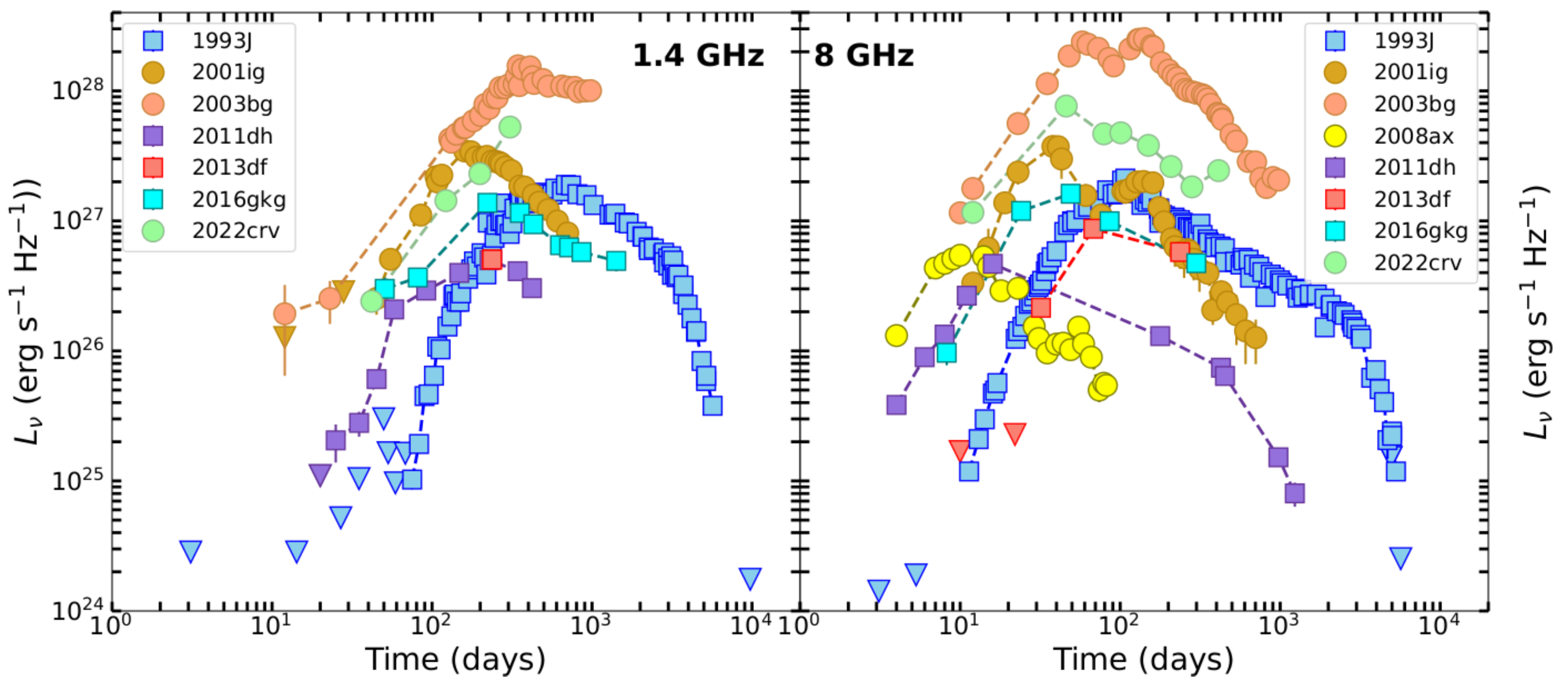
Observationally, SNe cIIb show rapid evolution of CS interaction, resembling SNe Ib/c and have FS speeds ≳ 30 , 000   km s 1 . Meanwhile, SNe eIIb show speeds consistent with ∼ 10 , 000   km s 1 [212]. SNe cIIb also show a more dominant non-thermal component in X-ray emission, unlike SNe eIIb, which mainly emit thermal X-rays. A classic example of SNe eIIb is SN 1993J, which was very well observed due to its proximity. The X-ray emission from the SN was mostly thermal [214,215]. The RS stayed radiative for a few years before turning adiabatic, whereas FS remained adiabatic throughout the evolution [215]. The SN remained bright in radio bands for a very long time [216,217], and the radio emission was absorbed with a combination of FFA and SSA [205]. The late-time radio emission revealed synchrotron cooling, indicating ϵ B dominated over ϵ e by at least a factor of 10 [216]. The milliarcsec very long baseline interferometry (VLBI) measurements showed FS moving with ≲ 10 , 000   km s 1 and a rather symmetric radio emitting shell [218]. On the contrary, the classic cIIb SN 2008ax evolved very fast with shock speeds 50 , 000   km s 1 [219]. In SN 2008ax, the X-ray luminosity also declined by a factor of 4 within a month [219], revealing either a smaller extent of CSM or much faster winds consistent with those of WR stars. Other well-studied examples of SNe IIb are SN 2016gkg [220], where radio evolution and high shock speeds indicated a compact progenitor, while a detailed study of another well-studied SN 2013df suggested an extended progenitor [221]. A very well-observed SN 2011dh proved to be a link between SNe cIIb and eIIb [222,223]. SN 2001ig deserves special mention among SNe IIb, as it showed modulations with a period of 150 days [224]. Soria et al. [225] found radio rebrightening >20 yrs post explosion. This behavior has been best explained in a binary scenario in which the SN ejecta hit a denser CSM shell, perhaps compressed by the fast wind of the WR progenitor or expelled centuries before the SN. In Figure 4, we compile the radio light curves of various SNe IIb from the literature and plot their 1.4 GHz and 8 GHz radio luminosities. While there is no clear differentiation between the two classes, there is a hint that SNe cIIb have faster evolution with radio peaks reaching earlier times.
Compared to SNe IIb, SNe Ib/c show relatively faster, low-density winds. Their radio emission usually peaks earlier than SNe IIb, and the absorption is dominated by the SSA. SNe Ib/c gained significant attention after the association of GRB 980425 with SN 1998bw [53] and GRB 030329 with SN 2003dh [227,228]. Berger et al. [229] and Soderberg et al. [230] carried out late-time radio observations of several dozen SNe Ib/c in order to search for off-axis GRBs whose jets were spreading into the line of sight. Based on their non-detections in the majority of the cases, they concluded that ≲10% of these SNe Ib/c are associated with off-axis GRBs.
Individual SNe Ib/c with detailed radio follow-up have shown SSA dominance, and the derived shock speeds are close to ∼ 0.1 0.3 c, though the mass-loss rates and luminosities are not very different than H-rich SNe. SN 2012au is a well-studied example of this class, in which Kamble et al. [231] presented analysis and the SN revealed X-ray luminosity 10 39 erg s−1 and a bright radio emission. They found that the energy of the radio-emitting material (moving with 0.2 c) is intermediate between normal CCSNe and SNe, which are associated with GRBs (GRB-SNe).
Amongst SNe Ic, SN 1994I is one of the oldest examples. The SN distance ranges between 7.8 and 8.4 Mpc, based on its host galaxy M51 and the Expanding Photospheres Method [232], making it one of the nearby SN of this class. SN 1994I X-ray studies were presented by Schlegel et al. [233] and Immler et al. [234]. Weiler et al. [235] presented the radio studies covering 3000 days of observations. The SN peaked within a couple of weeks of discovery itself, and it remained bright for a long time. Other older SESNe worth mentioning, for which well-sampled radio light curves exist, are SN 1983N [122], SN 1984L [236], SN 1990B [237], etc.
Among more recent ones, Berger et al. [206] investigated the radio observations of SN 2002ap, a Type Ic SN, and found the shock speed to be 0.3 c on day 2. Sutaria et al. [207] discovered the SN with the XMM-Newton on day 4 with a luminosity of 6.4 × 10 37 erg s−1 and found the X-ray spectrum had a significant contribution from a non-thermal IC component. In Ic SN 2020oi, while no X-ray emission was seen, a bright radio emission emerged from the SN [238]. From the measurement of IC cooling, they showed a deviation from equipartition in the microscopic parameters. In this SN, the early time ALMA observations revealed confined CSM within 10 15 cm [239]. As the progenitors of SNe Ic are bare C+O stars, this translates into the enhanced mass-loss activity in the last year. Such studies have important implications for understanding SNe and their associations with the central progenitor engines.
As mentioned above, multiple surveys were carried out for SESNe to look for an off-axis GRB jet. However, it has become clear that GRB-SN are mostly Ic-bl type, though there are exceptions like GRB 970514 associated with Type IIn SN 1997cy [240,241], GRB 980910 associated with peculiar Type II SN 1999E [242], and GRB 111209A associated with SLSN I SN 2011kl (which was likely powered by magnetar) [243]. Consequently, the focus has been mostly narrowed down to SNe Ib-bl to search for the off-axis GRBs. Soderberg et al.’s [230] sample had a handful of SNe-bl, but that search resulted in a null result, and they ruled out the scenario in which every SNe Ic-bl harbored a GRB at the 84% confidence level. Corsi [244] carried out radio observations of 15 SNe Ic-bl discovered by PTF and detected only 3. The derived shock speeds revealed that while GRB-SNe are usually relativistic, this is not common for SNe Ic-bl without GRBs. Later, Corsi et al. [56] carried out a radio and X-ray follow-up campaign of 16 SNe Ic-bl detected by the ZTF and detected four SNe, though none of them revealed relativistic explosions like SN 1998bw. Based on their results, they concluded that SNe Ic-bl, which are similar to GRB-associated SNe or relativistic SNe without GRB association, are rare. Srinivasaragavan et al. [245] carried out the largest systematic study of 36 SNe Ic-bl with the ZTF. Thirteen SNe Ic-bl in their sample had radio observations with eight detections and five non-detections. They found that the optical properties of radio-detected vs. non-detected SNe Ic-bl are indistinguishable and that only the radio data can reveal significant differences, likely connected with a central engine. It has been suggested by these studies that the viewing angle effects alone cannot account for GRBs associated with SNe Ic-bl and there are likely intrinsic differences between the explosion mechanisms of GRB-associated SNe Ic-bl and non-GRB SNe Ic-bl.
Individual studies of some SNe Ic-bl have helped us delve into their CS interaction. Salas et al. [246] presented radio light-curve and X-ray observations of SN Ic-bl and SN 2007bg and found two distinct mass-loss episodes, with mass-loss rates ranging from 10 4 M yr 1 to 10 6 M yr 1 for 1000 km s 1 wind speed. However, unlike other SNe of this class, it peaked very late on day 567 with bright radio luminosity 10 29 erg s−1 Hz−1, possibly due to additional CS interaction from a dense shell due to binarity. Nayana et al. [247] presented GMRT and VLA observations of Ic-bl SN ASASSN-16fp (SN 2016coi) and carried out a GHz to sub-GHz study of the SN and presented radio light curves extending to late time. Detailed modeling of the data revealed varying shock velocities, which deviate from simplistic models. Corsi et al. [248] carried out detailed radio and X-ray studies of unique Ic-bl SN PTF11qcj. They found that the SN reached radio luminosity comparable to that of SN 1998bw and was detected with the Chandra telescope in X-ray bands [249], which is compatible with extrapolation of radio synchrotron emission. The ejecta was moving with 0.3–0.5 c. This combined with high inferred mass-loss rate of 10 4 M yr−1 makes it a very unique SN. Another SN Ic-bl worth mentioning is SN 2020bvc at a distance of 114 Mpc [250]. It was detected in radio as well as X-ray bands. Ho et al. [250] presented 13–43 day light curves of the SN and found mildly relativistic ejecta speeds. The peak radio luminosity at 10 GHz was ∼ 10 27 erg s−1 Hz−1, much less than interaction-powered SNe. In contrast, X-ray luminosity was quite large ∼ 10 41 erg s−1. They suggested that non-thermal IC or synchrotron can explain only a fraction of this high luminosity, and the lion’s share of radiation arises from thermal hot shocked plasma. Due to their fast evolution, only a handful of non-GRB SNe Ic-bl have been observed in X-ray bands. Only a handful of SNe Ic-bl have shown X-ray emission, e.g., SN 1998bw [249] (GRB-SN), SN 2020bvc [250]. The recent discovery of EP250108a/SN 2025kg has opened a new and very efficient channel to discover more SNe of this class [251].
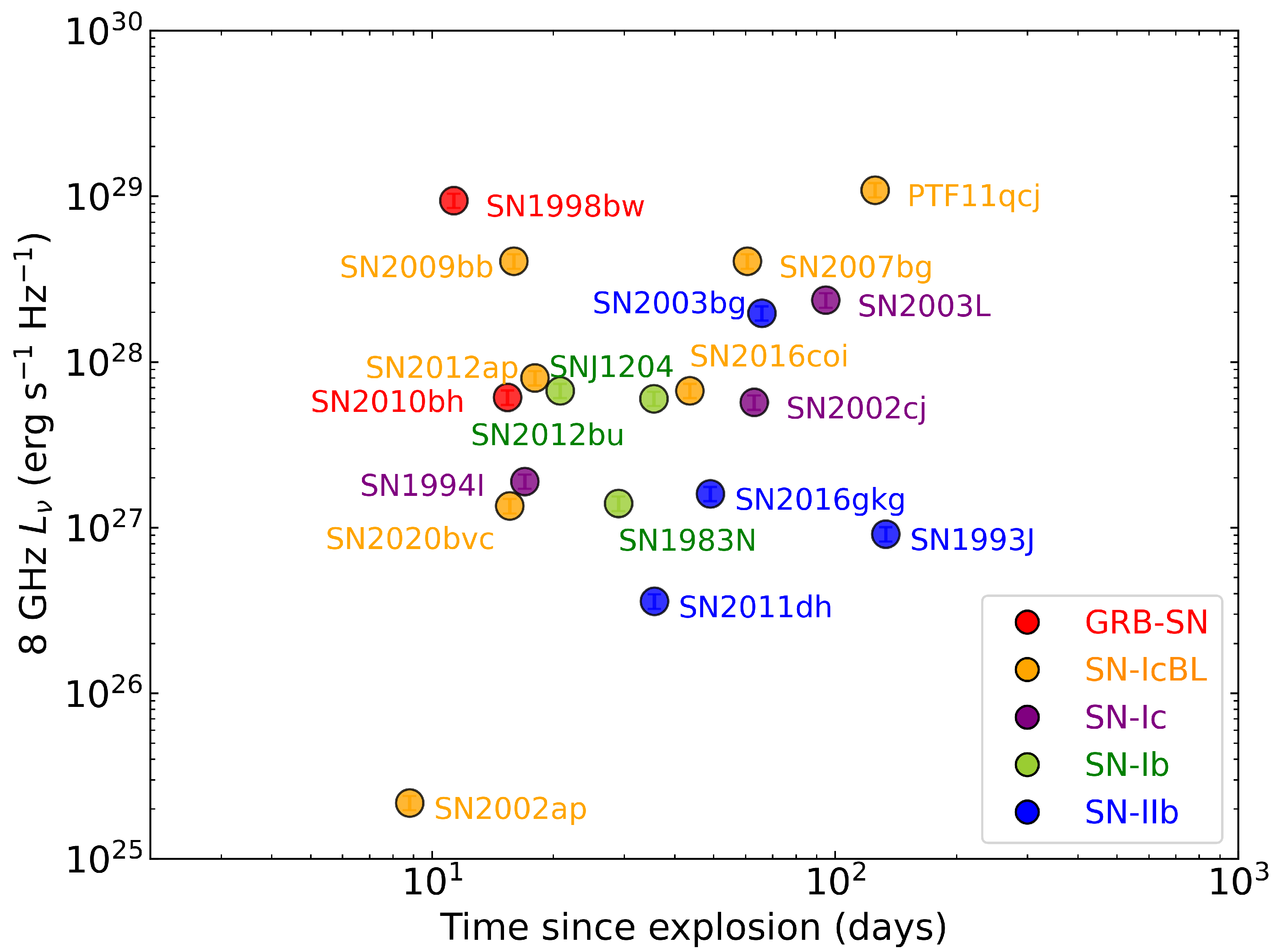
In Figure 5, we plot peak radio luminosity and the peak time for SESNe for a small sample of well-observed cases. While SNe IIb/Ib/Ic do not show a major difference from SNe Ic-bl, SNe associated with GRBs seem to be intrinsically different from the rest of the SESNe population, reaching peak luminosities faster. Radio observations combined with X-ray measurements should be able to break the degeneracy in SNe Ic-bl.
Flash spectra have been seen in H-rich SNe, and SESNe generally have not been observed to reveal it. There are exceptions, such as SN 2013cu, which showed signatures of flash spectra, though it was a IIb SN, a bridge between H-poor and H-rich SN [252]. However, ALMA mm observations of an Ic-bl SN 2020oi have revealed its confined CSM within 10 15 cm [239], which translates into the enhanced mass-loss activity in the last year. The GHz–sub GHz observations later revealed standard 10 5 M yr 1 mass-loss rate between 10 15 to 10 16 cm before seeing another enhanced mass-loss episode [247]. It is likely that the enhanced mass-loss activity may be driven by the accelerated nuclear burning in the last moments of the star [253], though later enhancement may be related to clumpy CSM or binarity.

3.4. Interacting Supernovae

We categorize interacting SNe as a class of SNe surrounded by dense CSM. While SNe Ia-CSM are also interacting SNe, we discuss them along with other thermonuclear SNe based on the stellar death pathway. Here, we focus on interacting SNe within the CCSNe category. These are H-rich interacting SNe, SNe IIn, and H-poor interacting SNe, SNe Ibn and SNe Icn. In addition, we also include SNe that undergo metamorphosis and turn into interacting SNe. We first discuss some common properties of interacting SNe and then discuss individual subclasses.
In interacting SNe, a CDS usually forms at the CD, a hallmark of radiative ejecta–CSM interaction. The CDS formation occurs when the post-shock cooling time t cool is shorter than the expansion time t. The time scale for RS cooling depends heavily on density gradient, mass-loss rate, and ejecta speed and can be expressed as [120]:
t cool ( RS ) = 605 ( n 3 ) ( n 4 ) ( n 2 ) 3.34 V ej 10 4 km s 1 5.34 M ˙ 5 v wind , 1 1 t days 2 days
The column density of the CDS is [120]
N CDS 10 21 ( n 4 ) M ˙ 5 v wind , 1 V ej 10 4 km s 1 1 t 100 days 1 cm 2
In regular CCSNe, X-ray emission is typically seen in ∼ keV range, dominated by radiation coming from the RS owing to their higher densities. In interacting SNe, X-ray emission is usually seen to be dominated by the FS. This is because in these SNe t cool / t < 1 , RS becomes radiative, the CDS absorbs most of the radiation coming out of RS, and FS comes to dominate. Another factor of FS domination is the density dependence of adiabatic and radiative luminosity. While the radiative RS luminosity scales with density, the luminosity from the adiabatic FS continues to grow as density squared, leading to observable emission predominantly from the FS [121]. However, in some extreme cases, e.g., SN 2010jl [185], the FS can also become radiative. The kinetic luminosity of the radiative shocks can be described by the following equation [120]:
L i = π R s 2 ( 1 / 2 ρ i V i 3 ) = c i ( n 3 ) ( n 2 ) × 1 2 M ˙ V ej 3 v wind
Here, c i is ( n 4 ) / 2 ( n 2 ) 2 and ( n 3 ) 2 / ( n 2 ) 2 for the RS and the FS, respectively. Thus radiative luminosity goes as L i t 3 / ( n 2 ) for steady wind. However, for more general case, L i t ( 15 6 s + n s 2 n ) / ( n s ) .
Formation of CDS in interacting SNe may lead to mixing of absorbing thermal electrons in synchrotron-emitting region, which can lead to internal FFA. This configuration modifies the observed radio flux’s frequency and time dependence, which takes the form:
F ν ( t ) = K 1 ν α t β 1 exp ( τ ν intFFA ) τ ν intFFA
τ ν intFFA = K 2 ν 2.1 t δ
Here, δ indicates the index of internal FFA time evolution. Internal FFA results in a less severe reduction in radio flux density compared to external FFA, as a portion of the emitting region still remains visible.
Interacting SNe are efficient dust producers, CDS being the major dust-producing site as a result of ejecta–CSM interaction, though dust production in other H-rich SNe happens mainly in the ejecta [254,255].

3.4.1. Type IIn Supernovae

SNe IIn show a common observational feature—narrow H α emission atop of broad emission, without broad absorption [47]. Powered by ongoing interaction, SNe IIn usually stay optically bright for months to years. SNe IIn show evidence of pre-existing dust as well as formation of new dust [256,257,258,259,260,261]. Some examples of new dust formation are SN 1998S [262], SN 2005ip [263], SN 2010jl [256], SN 2017hcc [257], and SN 2020ywx [261].
In optical bands, evidence of interaction manifests as narrow (∼100 km s 1 ) and intermediate width (∼1000 km s 1 ) emission lines. The former originates from the unshocked CSM photoionized by SN radiation, and the latter from the CDS and/or shocked clumpy wind [264]. Additionally, broader components (thousands of km s 1 ) are observed, indicative of shocked ejecta and/or broader wings due to electron scattering [47,265].
While high CSM densities often lead to strong radio and X-ray emissions, only a subset of SNe IIn have been detected in these bands [126]. Some SNe IIn exhibit bright emission in both radio and X-ray emission, while others show faint radio emission despite bright X-ray emission (e.g., SN 2010jl, SN 2017hcc, also see Figure 6) [185,258]. This may indicate two possible subtypes of SNe IIn.
SN 1986J [122], SN 2006jd [125], and SN 2020ywx [261] have shown internal FFA to be a dominant absorption mechanism of their radio emission. Chandra et al. [125] have shown that a modest amount of cool gas (∼ 10 4 K), i.e., ∼ 10 8 M , mixing in the synchrotron emitting region can explain the observed internal absorption.
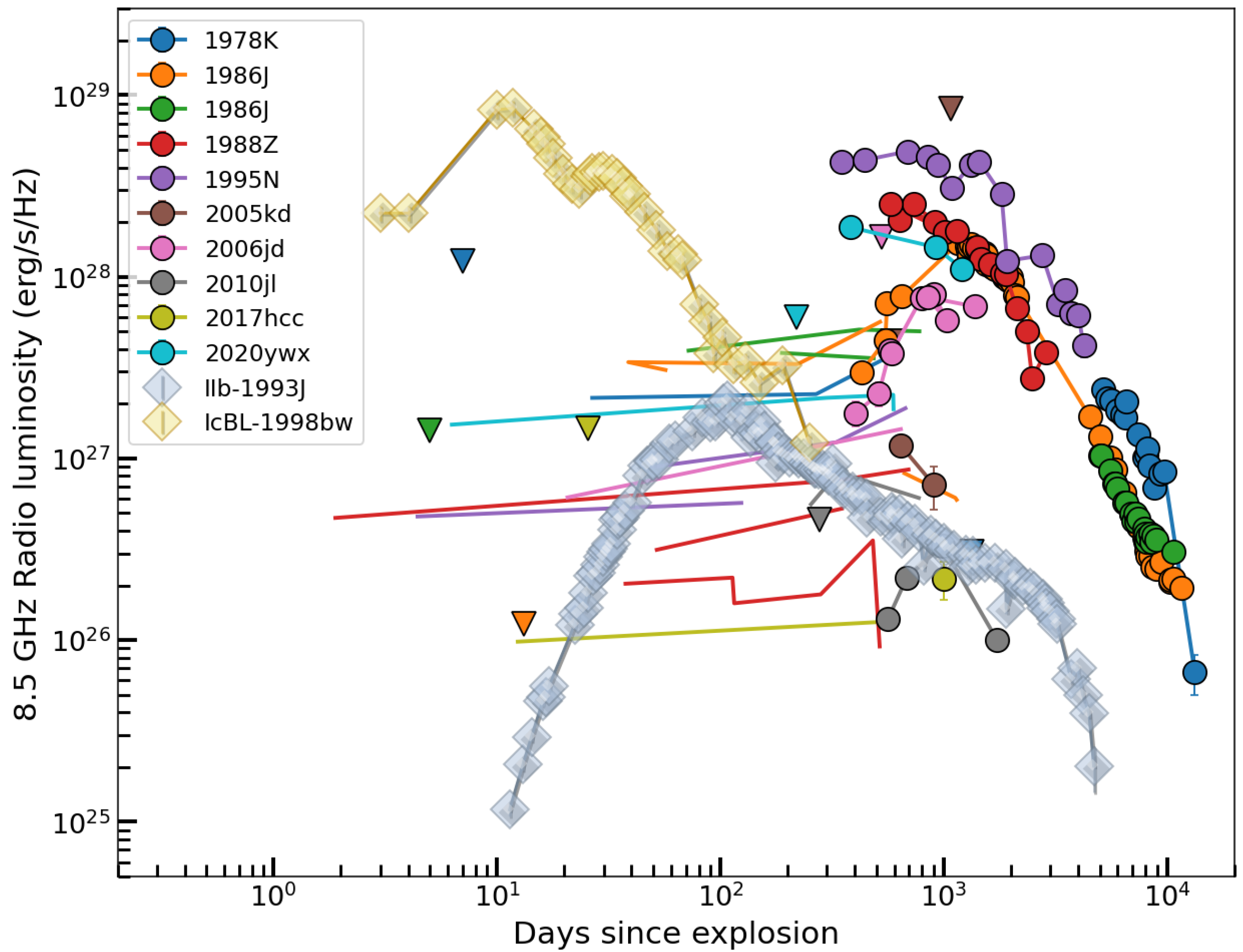
SNe IIn are late radio emitters (Figure 7). A significant contributing factor could be extremely high densities, leading to prolonged heavy absorption until the synchrotron emission strength has substantially decreased. However, some observational biases cannot be ruled out. Some SNe IIn were classified late and hence were not observed early enough, e.g., SN 1995N [266], SN 2006jd [125], SN 1986J [122]. Some SNe IIn truly are late emitters, such as SN 2010jl and SN 2017hcc [185,258]. SN 2010jl deserves special attention. Even though the radio observations commenced within a month, the first detection occurred on day 566 at 22 GHz [185] (Figure 8). By this time, the strength of the synchrotron emission had decreased significantly so that SN 2010jl remained a weak radio emitter despite being one of the brightest X-ray SN of this class. In SN 2006gy, the radio non-detection is attributed to absorption of radiation by an extremely dense medium rather than to the lack of emission [267,268,269]. SN 2009ip stands out as an exception, though its radio emission faded below detection within a few tens of days [270]. However, SN 2009ip was a peculiar SN characterized by pre-explosion outbursts and an explosion mechanism that is not yet fully understood.
Radio observations have revealed variable mass-loss rates in most SNe IIn [261,271]. In SN 2005kd, radio data indicated rapid variability in the wind mass-loss parameters in the last 5000 years prior to core collapse [271]. SN 2005kd was unique in other aspects as well, e.g., the optical lightcurve of SN 2005kd showed an unusually long plateau lasting ∼200 days [272]. Various pieces of evidence, such as spectropolarimetry [273], as well as radio and X-ray data [125,126], point towards asymmetry and/or complex geometry in SNe IIn. Variable mass-loss rates suggest complex mass-loss histories. Multi-wavelength observations (X-ray, optical, infrared, and radio) in SN 2020ywx revealed inconsistencies in mass-loss rates calculated from different wavelengths, which were best explained by asymmetric CSM created due to binary interaction as the primary mechanism for the overall mass-loss evolution [261].
In X-ray bands, evidence of hotter FS dominance via inference of high plasma temperature has been seen in several SNe IIn, e.g., in SNe 2005ip, 2006jd, and 2020ywx [125,261,274]. However, most of these observations were made with telescopes like Chandra, XMM-Newton, Swift-XRT, which are sensitive within 0.2–10 keV range, thus the plasma temperature could not be well constrained even though the best fit models of these SNe showed X-ray emitting plasma to be hotter than 10 keV. SN2010jl was the first Type IIn SN for which the exact shock temperature was determined, owing to the hard X-ray sensitivity of NuSTAR. In this case, the shock temperature was determined to be 19 keV, confirming the FS origin of X-rays [185,275] (Figure 9).
Another property of X-ray evolution in SNe IIn is that their X-ray light curves seem to deviate from the expected power law index of 1 (Figure 10). This could either be due to non-smooth CSM [261,264] or due to observation biases, as decreasing shock temperature at later times shifts the X-ray emission to progressively lower temperatures measured with the fixed energy range of X-ray telescopes. Most likely, the observed deviation is a consequence of both effects [125,261].
The direct evidence of CSM has been seen in some SNe IIn via the evolution of column density observed in X-ray observations, e.g., SN 2020ywx [261], SN 2005ip [274]. SN 2010jl deserves special mention due to its excellent coverage from soft to hard X-rays using Chandra, XMM-Newton, Swift-XRT, and NuSTAR, which allowed Chandra et al. [185] to witness three orders of magnitude evolution in column density between day 40 and day 2600 (Figure 10).
In Table 5, we tabulate well-studied SNe IIn and their properties. We list their peak X-ray and 8 GHz spectral radio luminosities and the time to reach the peak in both wavebands. We also compile the column density and plasma temperature from the literature, along with the epoch of first radio detection.
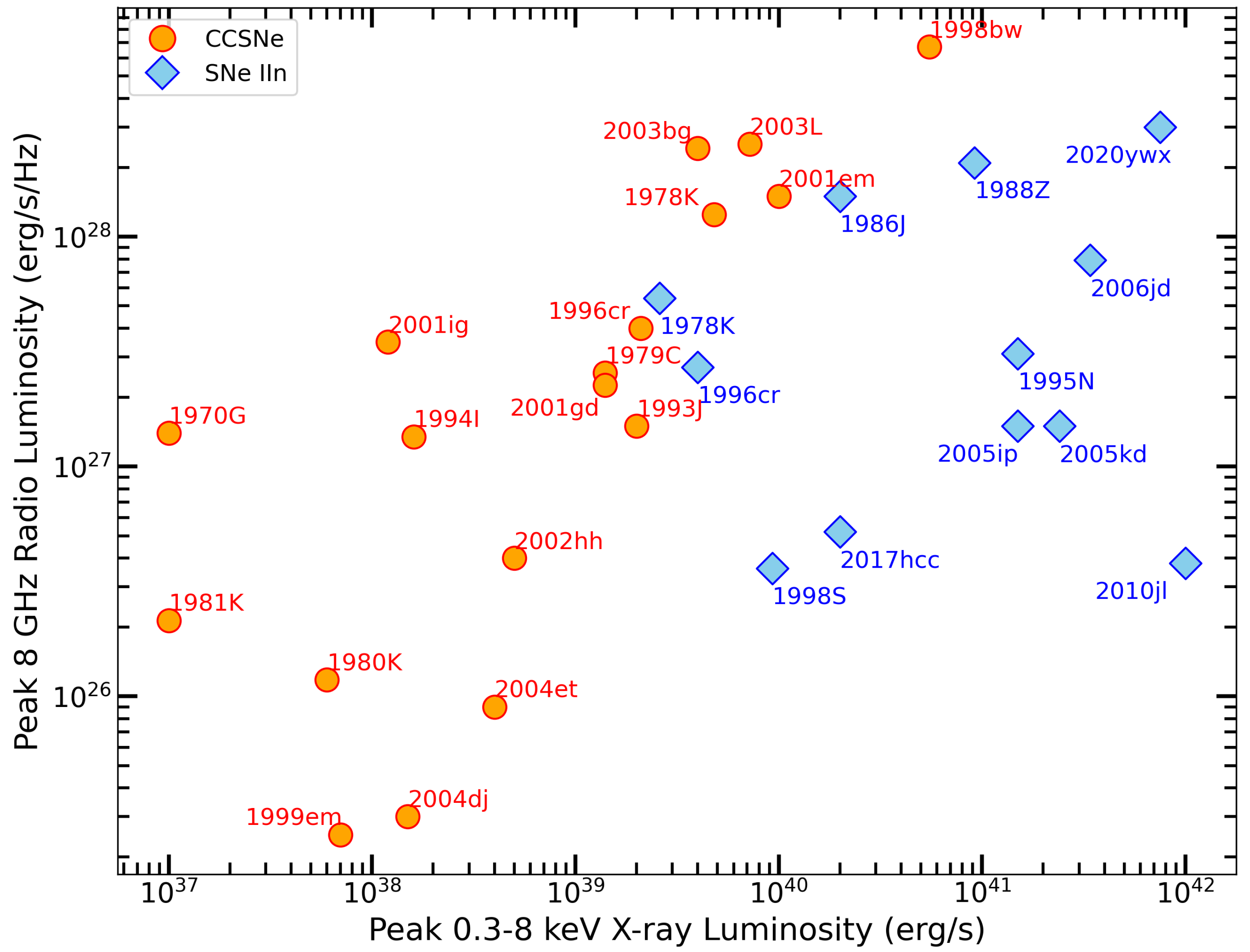
Even though SNe IIn are H-rich SNe, they seem to possess significantly different properties than their non-interacting counterparts. In Figure 11, we plot peak radio and X-ray luminosities of H-rich (IIP, IIL, and II SNe) along with IIn SNe. While both are H-rich SNe, SNe IIn are systematically brighter and peak later, whereas SNe IIP peak earlier and are fainter. This most likely indicates two very distinct populations giving rise to SNe II/IIP/IIL and SNe IIn.
SN 2010jl at ∼7 Years Post Explosion
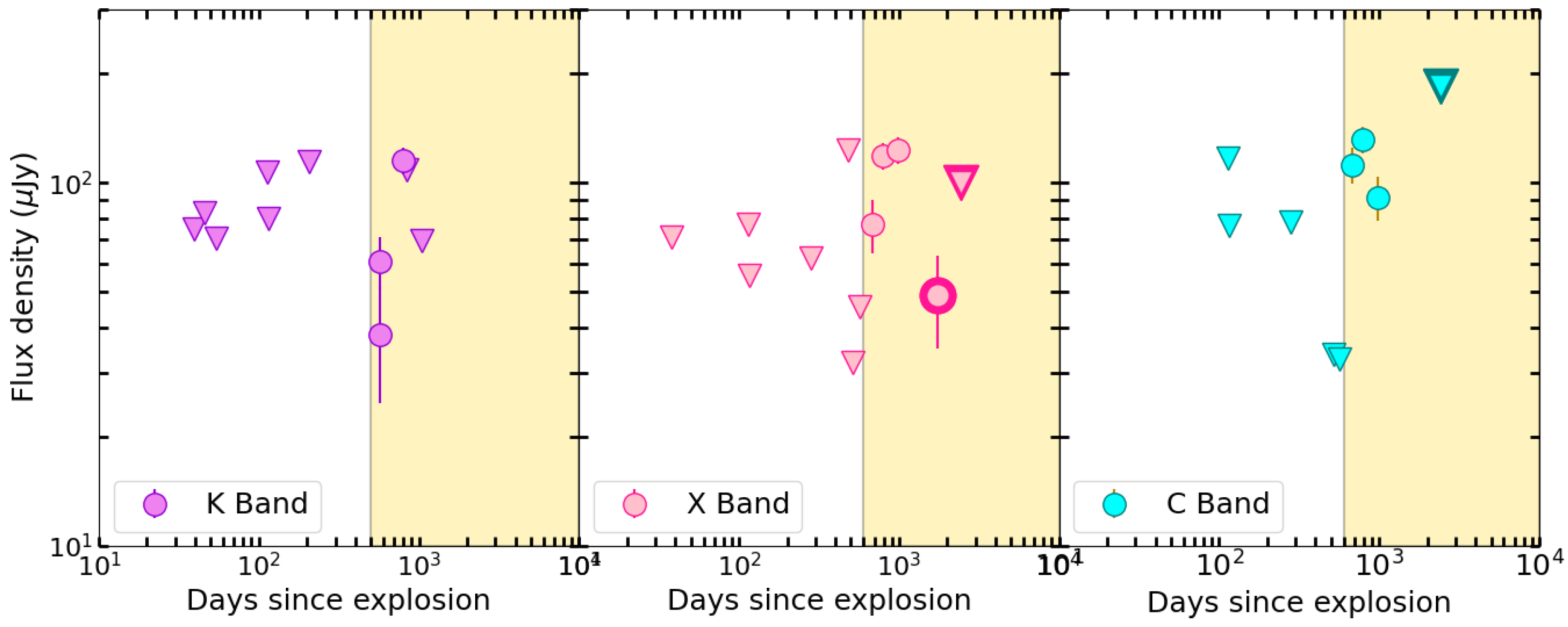
SN 2010jl is one of the best-studied SNe IIn. Ofek et al. [275] presented early optical and X-ray data, whereas Chandra et al. [185] carried out comprehensive radio and X-ray analysis up to day 1500. Here, we extend the observation baseline to ∼2500 d by adding the unpublished X-ray data taken on 3 January 2018 and radio data (with the VLA) from 23 June 2015 to 23 May 2017. This X-ray observation was conducted using Chandra (Proposal #18500302, PI: Chandra) with a 46 ks exposure with ACIS-S, yielding 35 counts. We analyzed the spectrum using the C-statistic and fit an absorbed thermal plasma model with metallicity of 0.3, as obtained from Chandra et al. [185]. Due to the low number of counts, fitting for all three parameters (column density, temperature, and normalization) did not produce a meaningful fit. Therefore, we initially fixed the column density to 10 21 cm−2 (last measured value from [185]) and varied the plasma temperature to determine if the X-ray emission was dominated by the RS at late epochs. Our best fit temperature, 16 ± 70 keV, is not well constrained but suggests a continuing possible FS origin. Consequently, we froze the temperature at 19 keV (as reported by Chandra et al. [185]) and fit the column density. The best fit column density is N H = ( 0.6 ± 1.6 ) × 10 21 cm−2. The absorbed (unabsorbed) flux in 0.3–10 keV is ( 1.31 ± 0.36 ) × 10 14 erg cm−2 s−1 ( ( 1.41 ± 0.39 ) × 10 14 erg cm−2 s−1). This translates to 0.3–10 keV unabsorbed luminosity of ∼ 4 × 10 39 erg s−1 on day 2651. Chandra et al. [185] reported a luminosity of ∼ 2 × 10 40 erg s−1 on day 1530, indicating a luminosity decline proportional to t 2 between the two epochs. The column density has now reached that of the Galactic column density (Figure 10). These findings are consistent with SN 2010jl having emerged from its CSM by this epoch. Given shock and wind speeds of 4000 km s−1 and 100 km s−1, respectively [185], this implies a pre-explosion interaction period of approximately 300 years. This suggests that the enhanced mass-loss rate of 0.1 M yr−1, as reported by Chandra et al. [185], commenced after this epoch in the SN 2010jl progenitor.
The radio observations were conducted in VLA S (2–4 GHz), C (4–8 GHz), X (8–12 GHz), and Ku (12–18 GHz) bands in 2015, Ku band in 2016, and S, C, and X bands in 2017 (Table 6). The 2015 and 2016 observations were in the highest A configuration of the VLA and resulted in detections at all frequencies, albeit with lower flux densities than the value reported by Chandra et al. [185] (see Figure 10), ruling out any dense shell. The 2017 observations were at a lower-resolution C configuration and were contaminated by nearby radio bright sources, resulting in upper limits.

3.4.2. Type Ibn/Icn Supernovae

SNe Ibn/Icn generally show a rapid decay in their light curves after the peak, unlike slowly evolving SNe IIn. This suggests that in SNe Ibn/Icn, the denser CSM extends to smaller radii. Due to high-density CSM, the spectra taken within 1–3 days usually show the flash-ionization signatures, e.g., SN 2019uo [285], SN 2023emg [286] among SNe Ibn and SN 2023xgo [287] among SNe Icn. Dust formation signatures due to high density have been seen in some SNe, e.g., SN 2006jc [288,289].
The signatures of CS interaction in radio and X-ray bands are rare in SNe Ibn/Icn due to the rarity of these events and rapid evolution. The only reported X-ray detection from SNe Ibn are SN 2006jc [290] and SN 2022ablq [291]. The Swift-XRT observations of SN 2006jc during 19–183 days revealed X-ray emission with luminosity 1039 erg s−1 [290]. SN 2022ablq was found to be more than an order of magnitude brighter than SN 2006jc [291]. In addition, SN 2010al, which was initially classified as IIn but later proposed to be a Ibn SN, has shown detectable X-ray emission [292]. No SNe Icn has been detected in X-ray bands so far. SN 2019hgp was observed with the Swift-XRT during the first two months, but no detection was reported [49]. Inoue et al. [293] indicated that important progenitor properties can be derived based on X-ray modeling of these SNe. By analyzing X-ray data of the above three SNe, they concluded SN 2022ablq was more stripped than SN 2006jc and that the prior SN contained a smaller fraction of C and O.
SN 2023fyq is the first Ibn SN from which radio emission has been seen, and it is consistent with a merger scenario leading to a short-term mass loss before the explosion [294].

3.4.3. Supernovae Undergoing Metamorphosis

Some SNe, which are initially classified differently, metamorphose into interacting SNe. Observations of these SNe usually reveal key aspects about their progenitor stars. The most notable SN undergoing metamorphosis is SN 2014C. Initially, it was classified as a Type Ib SN, which later showed interaction signatures via strong H- α emission, leading to IIn classification [295]. AMI-LA high cadence observations at 15 GHz revealed a rise in two stages, with the first peak of 0.5 mJy occurring at around 80 days and then a second peak of 2 mJy at around 250–300 days [296]. AMI-LA light curve, therefore, provided the clearest evidence that SN 2014C exploded in a low-density bubble and then “metamorphosed” into a IIn SN when it struck a massive, H-rich shell ejected decades earlier. Margutti et al. [297] presented Swift-XRT, Chandra, and NuSTAR data up to around 1000 days. They found the shock temperature to be evolving from 18–20 keV to 7–8 keV and column density evolving from 3 × 10 22 cm−2 to 5 × 10 21 cm−2. Later, Thomas et al. [298] and Brethauer et al. [299] presented 7 years of Chandra and NuSTAR datasets. Their work confirmed the FS origin of the X-ray emission, later revealing smaller temperatures, possibly from the RS. Both works remain the only ones to present a 7-year hard X-ray dataset for an SN, in addition to the type IIn SN 2010jl presented here. The radio and X-ray observations were best explained in a scenario in which the SN 2014C progenitor had lost its hydrogen envelope close to the explosion, and then in about 100 days the shock encountered the lost hydrogen envelope of around 1 M at 5 × 10 16 cm away.
SN 2001em was another SN undergoing metamorphosis. Initially, it was classified as type Ib/c SN and later reclassified as type IIn when Stockdale et al. [300] detected radio emission with the VLA two years after the explosion. Pooley et al. [175] also detected X-ray emission with Chandra with X-ray luminosity reaching ∼ 10 41 erg s−1. While initially the radio and X-ray detection was identified as possibly coming from an off-axis GRB associated with the SN [301], the VLBI observations found the expansion speed to be non-relativistic [302], and it was reclassified as SN IIn with delayed CSM interaction. Chugai & Chevalier [303] modeled the emission coming from a dense CSM ring and indicated that the radio and X-ray emission could be attributed to interaction of the SN ejecta with a 3 M CS shell at a distance of 7 × 10 16 cm. They interpreted that the hydrogen CS shell was formed as a result of enhanced mass-loss rate ( M ˙ = ( 2 10 ) × 10 3 M yr 1 ) around 1000 yrs prior to the SN explosion. Their observations covered 1000 days, and the modeling indicated that the ejecta had not reached the edge of the shell by the end of the observed duration. Later, Chandra et al. [304] presented a 19-year timeline of SN 2001em. From X-ray temporal behavior, they found that the shock exited the shell at the latest by 1750 days and entered a faster, lower-density wind. However, late time (∼6000 days) spectral inversion was seen in radio data analogous to SN 1986J [305]. Chandra et al. [304] interpreted that the spectral inversion was due to a slower shock inside the faster shock, possibly formed in the equatorial regions created due to binary interaction. These observations were best explained by a massive binary system with a common-envelope phase [304]. If this interpretation is correct, SN 2001em is the only SN in which an outer CS shell (duration 1000–1750 days) and an inner slower shock (at ≥6000 days) have been revealed. This gives a unique perspective on the binary evolution of the SN progenitor star.
Other examples in this SNe undergoing metamorphosis into interacting class are SN 2018ijp, SN 2017dio, SN 2004dk, SN 2019oys (see Table 7 for list and references). SN 2018ijp and SN 2017dio were initially classified as Ic SN but showed emergence of narrow H lines. The strong CSM interaction was revealed months after the explosion in SN 2018ijp [167] but almost immediately in the latter [306]. SNe 2004dk and 2019oys were initially classified as SNe Ib, which metamorphosed into SNe IIn. While this happened within months in SN 2019oys [307], this metamorphosis was seen 13 years later in SN 2004dk [308]. No detectable radio or X-ray emissions were seen from SN 2017dio and SN 2018ijp; however, SN 2004dk and SN 2019oys were seen to be bright in both radio and X-ray emissions. These cases reveal delayed CSM interaction, pointing to non-steady and complex mass-loss histories of massive stars shortly before explosion. Table 7 provides a summary of these SNe.
There are also SNe that were never reclassified as SNe IIn, but they have shown late-time rebrightening due to interaction. A SN which deserves a special mention in this category is SN 2018ivc. It was classified as a IIb/IIL [311], but around ∼1000 days, it revealed dramatic rebrightening with the VLA, e-MERLIN, and the ALMA [312,313]. Maeda et al. [313] interpreted a high mass-loss phase ( 10 4 M yr 1 ) 1500 yr prior to explosion, followed by an order of magnitude lower mass-loss phase until the explosion. Some other examples in this category are SNe 2004gq [314], SN 2001ig [225], and the oldest example SN 1970G [315]. In data consisting of 2 decades post-explosion, SN 2001ig has shown two orders of magnitude larger rebrightening than expected in the standard CS interaction model [225]. This suggests that the SN ejecta have reached a denser shell, perhaps compressed by the fast wind of a WR progenitor or expelled centuries before the final stellar collapse or due to binary interaction.


3.5. Superluminous Supernovae

SLSNe classification is purely an observational one. The majority of them are expected to reach their high luminosities via mechanisms involving the central engine, CS interaction, or radioactive decay. SLSNe have mostly eluded radio and X-ray emission. Surveys to search for radio emission have mostly obtained null results [316]. So far, only two SLSNe (both SLSNe I) have shown radio emission, PTF10hgi [317,318,319] and SN 2017ens [320]. There was a claim for the third SLSN SN 2020tcw to be radio bright; however, follow-up observations revealed the radio emission to be arising from an unrelated source [320]. In PTF10hgi, radio emission was discovered 7 years after the explosion, and radio modeling revealed that the SN was powered by a magnetar and radio emission was arising from the pulsar wind nebula surrounded by CSM. SN 2017ens initially showed Balmer series H-lines emission in their spectra after 100 days [321] and radio detection (at 3 years post explosion) revealed CS interaction to be the main power source. Margutti et al. [320] inferred a mass-loss rate of M ˙ 10 4 10 3 M yr 1 for a wind of 1000 km s 1 .
Amongst CS interaction-powered SLSNe, SN 2006gy deserves special mention. While it eluded radio emission due to absorption of radio emission via high density CSM and resulted in weak X-ray emission [278] due to X-ray suppression via multiple effects caused by optically thick CSM [268], the bright optical emission was a result of the shock propagating into optically thick CSM and converting kinetic energy of the shock into radiation [322].
While no radio or X-ray emission has been claimed from SLSNe I with the PPISNe pathway, Lunnan et al. [323] found the first clear UV resonance-line light echo (in Mg II) from a CS shell around the type I SLSN iPTF16eh. They modeled the time-variable absorption and emission with a shell at ∼ 0.1 pc expanding at 3300 km s 1 , which was ejected 30 years before the explosion. They claimed that these properties were consistent with a PPISNe ejection from a progenitor with a ∼50 M He-core (ZAMS mass ∼ 115 M ). In another PPISNe candidate, iPTF14hls, late time (>1000 d) spectrum revealed a double-peaked intermediate-width H α line corresponding to expansion speed around 100 km s 1 , which was a clear signature of CS interaction with a possible disc-like CSM [324].

3.6. Electron Capture Supernovae and Calcium-Rich Supernovae

The primary example of an ECSNe candidate is SN 1054, also known as the Crab [325], which is an SNR. While no SN has been unequivocally identified as ECSNe, SN 2008S was argued to have an electron-capture origin and also an object falling under Intermediate-Luminosity Red Transient (ILRT)—purely an observational class with cool, dusty, intermediate-luminosity eruptions/explosions [326]. More recently, SN 2018zd in the galaxy NGC 2146 has been argued to be the best-observed candidate for an ECSNe [60]. Flash signatures were seen in SN 2008zd extending beyond 9 days, indicating CS Interaction [60].
Among Ca-rich SNe, so far only two SNe have been reported to show X-ray emission. These are SN 2019ehk [327] and SN 2021gno [328]. The X-ray emission from SN 2019ehk was seen only in the first 4 days, with peak 0.3–10 keV luminosity L x 10 41 erg s−1. The X-ray luminosity declined fast L x ( t ) t 3 and was predicted to arise from CS interaction, which was also confirmed with flash ionization features seen in the first 1.5 days [327]. The SN was not detected in X-ray bands. SN 2021gno reached peak 0.3–10 keV luminosity L x 5 × 10 41 erg s−1 within a day [328]. Combined with radio non-detections, Jacobson-Galán [328] inferred the extent of CSM to be < 3 × 10 14 cm. Both SNe were consistent with mass-loss rate of M ˙ 10 3 10 2 M yr 1 . In both SNe, the derived progenitor CSM density was found to be consistent with the merger of low-mass, hybrid WDs [328].

4. Discussion and Conclusions

This work is focused on reviewing the CS interaction in various kinds of SNe. We provide an updated diagram for SNe classification, incorporating stellar death pathways along with the traditional classification (Figure 1).
We argue that CS interaction is the best indicator of the diversity of progenitor channels of various types of SNe. X-ray observations provide insights into shock temperature and density and measure important parameters like column density, mass-loss rate, etc. Radio measurements provide information on shock velocity, size, magnetic field, and CSM density. We note that both methods provide a ratio of mass-loss rate to wind speed; thus, obtaining wind speed is important for accurate mass-loss rate values. Optical observations are the best indicators of wind speeds. However, it is possible that the SN is asymmetric and wind speeds are different in different directions (like SESNe). In addition, in some cases, wind speeds may vary, similar to WR progenitors with fast winds followed by slow winds. Non-spherical CSM may lead to different wind speeds at different lines of sight. Some information about the CSM winds and their complexities can also be obtained from massive and evolved stars in the Milky Way. For example, RSGs and YSGs with larger radii usually show slower winds (∼10–20 km s 1 ), whereas LBVs and BSGs with smaller radii have faster winds (∼100 km s 1 ). In reality though, high radiation from the SN can potentially accelerate the CSM winds to much higher speeds than their pre-explosion progenitors [75]. It is important to keep caveats in mind while interpreting the data and gathering information on the progenitors of different kinds of SNe.
We discuss various classes of SNe in the context of CS interaction. Among the thermonuclear class, we focus on SNe Ia (of any subtype) and SNe Ia-CSM. The rarity of SNe Ia-CSM makes it difficult to understand the nature of their CS interaction. Amongst CCSNe, we divide the discussion into hydrogen-rich SNe (SNe IIP, IIL, II), SESNe (IIb, Ib, Ic), and interacting SNe (IIn, Ibn, Icn, “metamorphosis” interacting SNe). We also briefly discuss observed signatures of CS interaction in SLSNe, ECSNe, and Ca-rich SNe.
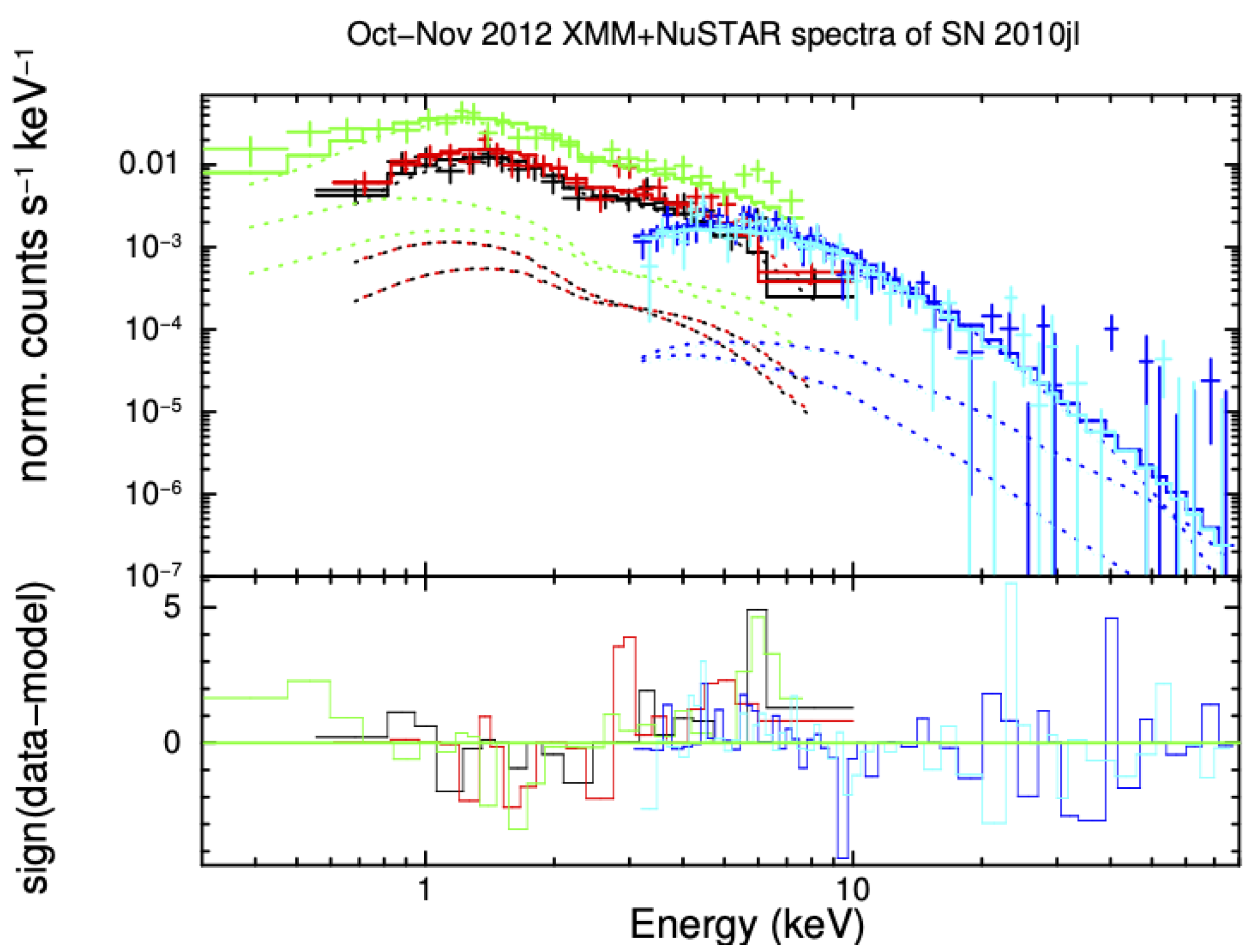
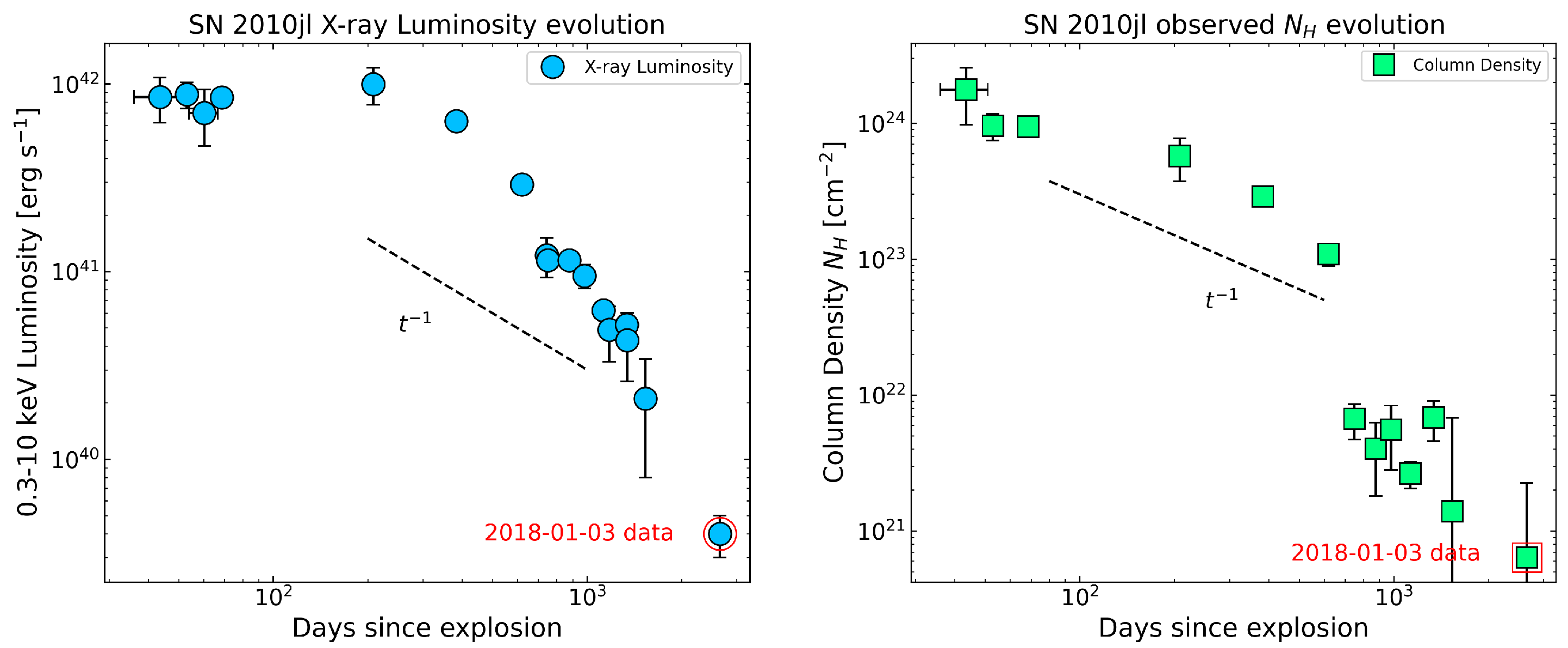
Below, we summarize the main takeaways of this review.
1.
The earliest signatures of CS interaction appear as flash ionization signatures, which typically start within hours to days and last for a few days. Several H-rich SNe show flash ionization features within 10 15 cm with mass-loss rates ranging ∼ 10 4 10 2 M yr 1 , indicating presence of confined CSM. This implies enhanced mass-loss activity in RSG progenitors of these SNe.
2.
While flash spectroscopy has been majorly seen in H-rich SNe, SESNe generally have not been observed to reveal it, except SN 2013cu, which was a IIb SN, a bridge between H-poor and H-rich SN [252]. A reason for the lack of flash spectra in SESNe is a smaller ratio of ejecta to wind speeds. This can be explained via the example of Ic-bl SN 2020oi with an ejecta to wind speed ratio of ∼10. Confined CSM revealed with ALMA within 10 15 translated into the enhanced mass-loss activity in the last year, which is easy to miss in observations. More studies are needed in this direction.
3.
Radio studies of H-rich SNe usually show FFA or a combination of FFA and SSA to be the dominant absorption mechanism. The X-ray emission is dominated by the RS. Due to the additional supply of photons during the photospheric phase, signatures of cooling and IC emission have been seen in radio and X-ray bands, respectively.
4.
SESNe show comparatively faster evolution than their H-rich counterparts, pointing to relatively compact progenitors. SESNe CS interaction signatures challenge the view that they explode into clean environments and suggest a clumpy or asymmetric CSM, possibly associated with binary evolution or eruptive mass loss. SSA is the dominant absorption mechanism of the observed radio emission. X-ray spectra usually show contributions from non-thermal emission.
5.
Radio observations are not very discriminating between cIIb and eIIb subclasses in SNe IIb. This likely indicates a lack of a clear boundary between the two kinds of progenitors, suggesting a continuum in their progenitor sizes.
6.
Among SESNe, GRB-SNe evolve faster than the rest of the population. SNe Ic-bl show diversity, and the CS interaction is poorly understood; the contribution of the central engine is not well constrained, though efforts are underway. Radio observations combined with X-ray measurements are likely to be instrumental in understanding them.
7.
Late time rebrightening has been seen in several SESNe or SESNe with `metamorphosis’. Binarity is the most plausible explanation. A detailed and high cadence wide band study of SESNe in radio bands is crucial to pinpoint the nature of their progenitor systems.
8.
It would be worthwhile to mention that some of the non-IIn interacting subtypes (delayed interaction/some SESNe) lack optical signatures and/or show discrepancies with radio/X-ray results. This could be due to different geometries. However, it is worth mentioning that optical observations are a unique probe of CSM speeds, which is a major diagnostic for estimating accurate mass-loss rates, which makes interpreting the SESNe with no optical signatures more difficult.
9.
Amongst interacting SNe, SNe IIn show strong and persistent interaction with their dense CSM. Their likely progenitors, based on mass-loss rates, are compatible with LBVs or RSGs with extreme mass-loss rates. However, it is very difficult to understand the true nature of their progenitors, which are usually hidden inside the optically thick dense winds.
10.
SNe IIn are late radio emitters and the slowest evolving SNe. While some of it may be attributed to observational biases, this points towards the fact that the dense CSM is absorbing the majority of the emission and is a major factor determining the SN dynamics and evolution in this class.
11.
H-poor interacting SNe, SNe Ibn and Icn, are also surrounded by dense CSM; however, only a handful have been detected. More efforts are needed to increase their sample size and understand this class.
12.
Comparing the peak radio luminosities and the X-ray light curves of SNe II, we find that SNe IIn usually have the most luminous and long-lived X-ray and radio signatures. They also represent a distinct progenitor class from the rest of the H-rich SNe. Amongst H-rich SNe, type IIL evolve faster than type IIP, consistent with a smaller H-envelope seen in optical bands.
13.
SNe that metamorphose into interacting SNe reveal similar properties as SNe IIn. Both show short cooling time scales, formation of CDS, dominance of hard X-rays from the FS, and evolution of column density.
14.
PISNe, PPISNe, SLSNe, ECSNe, Ca-rich SNe, etc., are very poorly understood classes, and with only a handful of observationally confirmed CS interaction examples, it is very difficult to understand their environments.
Finally, we emphasize that the observational diversity among various classes of SNe exhibiting CS interaction reflects the complex mass-loss histories of their progenitors and implies that multiple mass-loss channels are at play: steady winds, binary stripping, and pre-SN eruptions. CS interaction remains the primary mechanism to constrain mass-loss histories of the progenitor in the final year to centuries. Our findings underscore the importance of coordinated multi-wavelength observations to constrain mass-loss rates, CSM densities, and their connection to progenitor systems.
Below, we lay out an ideal roadmap to take CS interaction studies forward in various SNe. Towards observational efforts, early coverage (hrs–days) in ultraviolet and blue spectroscopy is required to observe shock breakout and flash ionization features, which will constrain the confined CSM size and properties. ULTRASAT [329] will be crucial for this study. Radio and mm follow-up from day 1, with daily cadence for 1–2 weeks and weekly cadence spanning months to years with ALMA, VLA, GMRT, MeerKAT etc., telescopes is crucial. This will help break the SSA vs. FFA degeneracy, provide evolution of mass-loss rate, CSM density profile, and shock speeds. The upcoming ngVLA and SKA are likely to revolutionize this field. In X-ray bands, soft to hard X-ray follow-up from early to late time is important. is already changing this field by detecting early soft X-ray emission in fast-evolving SNe [251]. Swift-XRT can provide the required cadence in bright enough SNe to enable light curve evolution studies. Chandra, XMM-Newton, and NuSTAR or similar telescopes are needed for X-ray spectroscopy to separate thermal and non-thermal components and constrain the column density and the shock temperatures. The unprecedented sensitivity and resolution of upcoming missions like NewAthena will be instrumental. Mid-IR spectroscopy/photometry with JWST/MIRI, along with ground-based NIR observations, are instrumental in catching CDS dust formation and separating them out from different components, such as ejecta dust, dust echoes, as well as measuring their dust properties [259]. Optical spectropolarimetry will constrain the geometry of the CSM, such as equatorial rings, clumps, bipolar CSM shells, etc. High-resolution radio imaging (VLBI) of nearby SNe will directly measure the expansion speeds, asymmetry, and equipartition parameters. Continued monitoring and modeling—particularly of late-time radio and X-ray emission—are crucial for unveiling the final evolutionary stages of massive stars and for linking transient properties to pre-explosion environments. Multiwaveband modeling is of crucial importance, and models should include clumping, inhomogeneities, asymmetries, dust radiative transfer, and electron scatterings.

Funding

This work is supported by Chandra grants GO3-24056X, DD3-24141X, and GO4-25044X.

Data Availability Statement

All the data are either published or available in archives. We encourage readers to reach out to us for any specific request which they cannot find online.

Acknowledgments

The author thanks referees for very useful comments, which improved the manuscript tremendously. The author also thanks Sahana Kumar, Raphael Baer-Way, Maryam Modjaz, and Roger Chevalier for useful discussions. The author acknowledges useful discussions over the years with NCRA-TIFR, Stockholm University, NRAO, and University of Virginia colleagues. The National Radio Astronomy Observatory is a facility of the National Science Foundation operated under cooperative agreement by Associated Universities, Inc. This research has made use of data obtained from the Chandra Data Archive provided by the Chandra X-ray Center (CXC). We thank the staff of the GMRT that made these observations possible. GMRT is run by the National Centre for Radio Astrophysics of the Tata Institute of Fundamental Research.

Conflicts of Interest

The author declares no conflicts of interest.

Abbreviations

The following abbreviations are used in this manuscript:
ATCAAustralia Telescope Compact Array
BSGBlue super giant
CCSNCore collapse supernova
CDContact discontinuity
CDSCold-dense shell
CSCircumstellar
CSMCircumstellar medium
ECSNElectron-capture supernova
FSForward shock
GMRTGiant Metrewave Radio Telescope
GRBGamma-ray burst
ICinverse Compton
IRInfrared
ISMInterstellar medium
LBVLuminous blue variable
MERLINMulti-Element Radio Linked Interferometer Network
MRPMain-sequence radio-pulse emitter
PISNPair-instability supernova
PPISNPulsational pair-instability supernova
PTFPalomer Transient Factory
RSReverse shock
RSGRed super giant
SESNStripped envelope supernova
SLSNSuperluminous supernova
SNSupernova
SNRSupernova remnant
SNe IIType II supernovae
SNe IType I supernovae
SNe IaType Ia supernovae
SNe Ia-CSMType Ia-CSM supernovae
SNe IIPType IIP supernovae
SNe IILType IIL supernovae
SNe IIbType IIb supernovae
SNe IInType IIn supernovae
SNe IbType Ib supernovae
SNe IbnType Ibn supernovae
SNe IcType Ic supernovae
SNe IcnType Icn supernovae
SNe Ic-BLType Ic-BL supernovae
UVUltraviolet
WDWhile dwarf
WRWolf–Rayet
VLAKarl G. Jansky Very Large Array
YSGYellow super giant
ZTFZwicky Transient Facility

References

  1. Arnett, D. Supernovae and Nucleosynthesis: An Investigation of the History of Matter from the Big Bang to the Present; Princeton University Press: Princeton, NJ, USA, 1996. [Google Scholar]
  2. Iben, I., Jr.; Renzini, A. Asymptotic giant branch evolution and beyond. Annu. Rev. Astron. Astrophys. 1983, 21, 271–342. [Google Scholar] [CrossRef]
  3. Weidemann, V. Revision of the initial-to-final mass relation. Astron. Astrophys. 2000, 363, 647–656. [Google Scholar]
  4. Whelan, J.; Iben, I., Jr. Binaries and Supernovae of Type I. Astrophys. J. 1973, 186, 1007–1014. [Google Scholar] [CrossRef]
  5. Nomoto, K. Accreting white dwarf models for type I supernovae. I—Presupernova evolution and triggering mechanisms. Astrophys. J. 1982, 253, 798–810. [Google Scholar] [CrossRef]
  6. Iben, I., Jr.; Tutukov, A.V. Supernovae of type I as end products of the evolution of binaries with components of moderate initial mass. Astrophys. J. Suppl. Ser. 1984, 54, 335–372. [Google Scholar] [CrossRef]
  7. Webbink, R.F. Double white dwarfs as progenitors of R Coronae Borealis stars and type I supernovae. Astrophys. J. 1984, 277, 355–360. [Google Scholar] [CrossRef]
  8. Nomoto, K.; Kobayashi, C.; Tominaga, N. Nucleosynthesis in Stars and the Chemical Enrichment of Galaxies. Annu. Rev. Astron. Astrophys. 2013, 51, 457–509. [Google Scholar] [CrossRef]
  9. Burbidge, E.M.; Burbidge, G.R.; Fowler, W.A.; Hoyle, F. Synthesis of the Elements in Stars. Rev. Mod. Phys. 1957, 29, 547–650. [Google Scholar] [CrossRef]
  10. Arnett, W.D.; Truran, J.W.; Woosley, S.E. Nucleosynthesis in Supernova Models. II. The 12C Detonation Model. Astrophys. J. 1971, 165, 87. [Google Scholar] [CrossRef]
  11. Woosley, S.E.; Weaver, T.A. The Evolution and Explosion of Massive Stars. II. Explosive Hydrodynamics and Nucleosynthesis. Astrophys. J. Suppl. Ser. 1995, 101, 181. [Google Scholar] [CrossRef]
  12. Colgate, S.A.; White, R.H. The Hydrodynamic Behavior of Supernovae Explosions. Astrophys. J. 1966, 143, 626. [Google Scholar] [CrossRef]
  13. Bethe, H.A.; Wilson, J.R. Revival of a stalled supernova shock by neutrino heating. Astrophys. J. 1985, 295, 14–23. [Google Scholar] [CrossRef]
  14. Woosley, S.E.; Heger, A.; Weaver, T.A. The evolution and explosion of massive stars. Rev. Mod. Phys. 2002, 74, 1015–1071. [Google Scholar] [CrossRef]
  15. Filippenko, A.V. Optical Spectra of Supernovae. Annu. Rev. Astron. Astrophys. 1997, 35, 309–355. [Google Scholar] [CrossRef]
  16. Patat, F.; Benetti, S.; Cappellaro, E.; Danziger, I.J.; della Valle, M.; Mazzali, P.A.; Turatto, M. The type IA supernova 1994D in NGC 4526: The early phases. Mon. Not. R. Astron. Soc. 1996, 278, 111–124. [Google Scholar] [CrossRef][Green Version]
  17. Nugent, P.E.; Sullivan, M.; Cenko, S.B.; Thomas, R.C.; Kasen, D.; Howell, D.A.; Bersier, D.; Bloom, J.S.; Kulkarni, S.R.; Kandrashoff, M.T.; et al. Supernova SN 2011fe from an exploding carbon-oxygen white dwarf star. Nature 2011, 480, 344–347. [Google Scholar] [CrossRef] [PubMed]
  18. Maoz, D.; Mannucci, F.; Nelemans, G. Observational Clues to the Progenitors of Type Ia Supernovae. Annu. Rev. Astron. Astrophys. 2014, 52, 107–170. [Google Scholar] [CrossRef]
  19. Taubenberger, S. The Extremes of Thermonuclear Supernovae. In Handbook of Supernovae; Springer: Cham, Switzerland, 2017; p. 317. [Google Scholar] [CrossRef]
  20. Filippenko, A.V.; Richmond, M.W.; Matheson, T.; Shields, J.C.; Burbidge, E.M.; Cohen, R.D.; Dickinson, M.; Malkan, M.A.; Nelson, B.; Pietz, J.; et al. The Peculiar Type IA SN 1991T: Detonation of a White Dwarf? Astrophys. J. Lett. 1992, 384, L15. [Google Scholar] [CrossRef]
  21. Phillips, M.M.; Ashall, C.; Brown, P.J.; Galbany, L.; Tucker, M.A.; Burns, C.R.; Contreras, C.; Hoeflich, P.; Hsiao, E.Y.; Kumar, S.; et al. 1991T-like Supernovae. Astrophys. J. Suppl. Ser. 2024, 273, 16. [Google Scholar] [CrossRef]
  22. Filippenko, A.V.; Richmond, M.W.; Branch, D.; Gaskell, M.; Herbst, W.; Ford, C.H.; Treffers, R.R.; Matheson, T.; Ho, L.C.; Dey, A.; et al. The Subluminous, Spectroscopically Peculiar Type 1a Supernova 1991bg in the Elliptical Galaxy NGC 4374. Astron. J. 1992, 104, 1543. [Google Scholar] [CrossRef]
  23. Foley, R.J.; Challis, P.J.; Chornock, R.; Ganeshalingam, M.; Li, W.; Marion, G.H.; Morrell, N.I.; Pignata, G.; Stritzinger, M.D.; Silverman, J.M.; et al. Type Iax Supernovae: A New Class of Stellar Explosion. Astrophys. J. 2013, 767, 57. [Google Scholar] [CrossRef]
  24. Li, W.; Filippenko, A.V.; Chornock, R.; Berger, E.; Berlind, P.; Calkins, M.L.; Challis, P.; Fassnacht, C.; Jha, S.; Kirshner, R.P.; et al. SN 2002cx: The Most Peculiar Known Type Ia Supernova. Publ. Astron. Soc. Pac. 2003, 115, 453–473. [Google Scholar] [CrossRef]
  25. Chornock, R.; Filippenko, A.V.; Branch, D.; Foley, R.J.; Jha, S.; Li, W. Spectropolarimetry of the Peculiar Type Ia Supernova 2005hk. Publ. Astron. Soc. Pac. 2006, 118, 722–732. [Google Scholar] [CrossRef][Green Version]
  26. Jordan, G.C., IV; Perets, H.B.; Fisher, R.T.; van Rossum, D.R. Failed-detonation Supernovae: Subluminous Low-velocity Ia Supernovae and their Kicked Remnant White Dwarfs with Iron-rich Cores. Astrophys. J. Lett. 2012, 761, L23. [Google Scholar] [CrossRef]
  27. Kromer, M.; Fink, M.; Stanishev, V.; Taubenberger, S.; Ciaraldi-Schoolman, F.; Pakmor, R.; Röpke, F.K.; Ruiter, A.J.; Seitenzahl, I.R.; Sim, S.A.; et al. 3D deflagration simulations leaving bound remnants: A model for 2002cx-like Type Ia supernovae. Mon. Not. R. Astron. Soc. 2013, 429, 2287–2297. [Google Scholar] [CrossRef]
  28. Howell, D.A.; Sullivan, M.; Nugent, P.E.; Ellis, R.S.; Conley, A.J.; Le Borgne, D.; Carlberg, R.G.; Guy, J.; Balam, D.; Basa, S.; et al. The type Ia supernova SNLS-03D3bb from a super-Chandrasekhar-mass white dwarf star. Nature 2006, 443, 308–311. [Google Scholar] [CrossRef]
  29. Taubenberger, S.; Benetti, S.; Childress, M.; Pakmor, R.; Hachinger, S.; Mazzali, P.A.; Stanishev, V.; Elias-Rosa, N.; Agnoletto, I.; Bufano, F.; et al. High luminosity, slow ejecta and persistent carbon lines: SN 2009dc challenges thermonuclear explosion scenarios. Mon. Not. R. Astron. Soc. 2011, 412, 2735–2762. [Google Scholar] [CrossRef]
  30. Hamuy, M.; Phillips, M.M.; Suntzeff, N.B.; Maza, J.; González, L.E.; Roth, M.; Krisciunas, K.; Morrell, N.; Green, E.M.; Persson, S.E.; et al. An asymptotic-giant-branch star in the progenitor system of a type Ia supernova. Nature 2003, 424, 651–654. [Google Scholar] [CrossRef]
  31. Dilday, B.; Howell, D.A.; Cenko, S.B.; Silverman, J.M.; Nugent, P.E.; Sullivan, M.; Ben-Ami, S.; Bildsten, L.; Bolte, M.; Endl, M.; et al. PTF 11kx: A Type Ia Supernova with a Symbiotic Nova Progenitor. Science 2012, 337, 942. [Google Scholar] [CrossRef]
  32. Leloudas, G.; Hsiao, E.Y.; Johansson, J.; Maeda, K.; Moriya, T.J.; Nordin, J.; Petrushevska, T.; Silverman, J.M.; Sollerman, J.; Stritzinger, M.D.; et al. Supernova spectra below strong circumstellar interaction. Astron. Astrophys. 2015, 574, A61. [Google Scholar] [CrossRef]
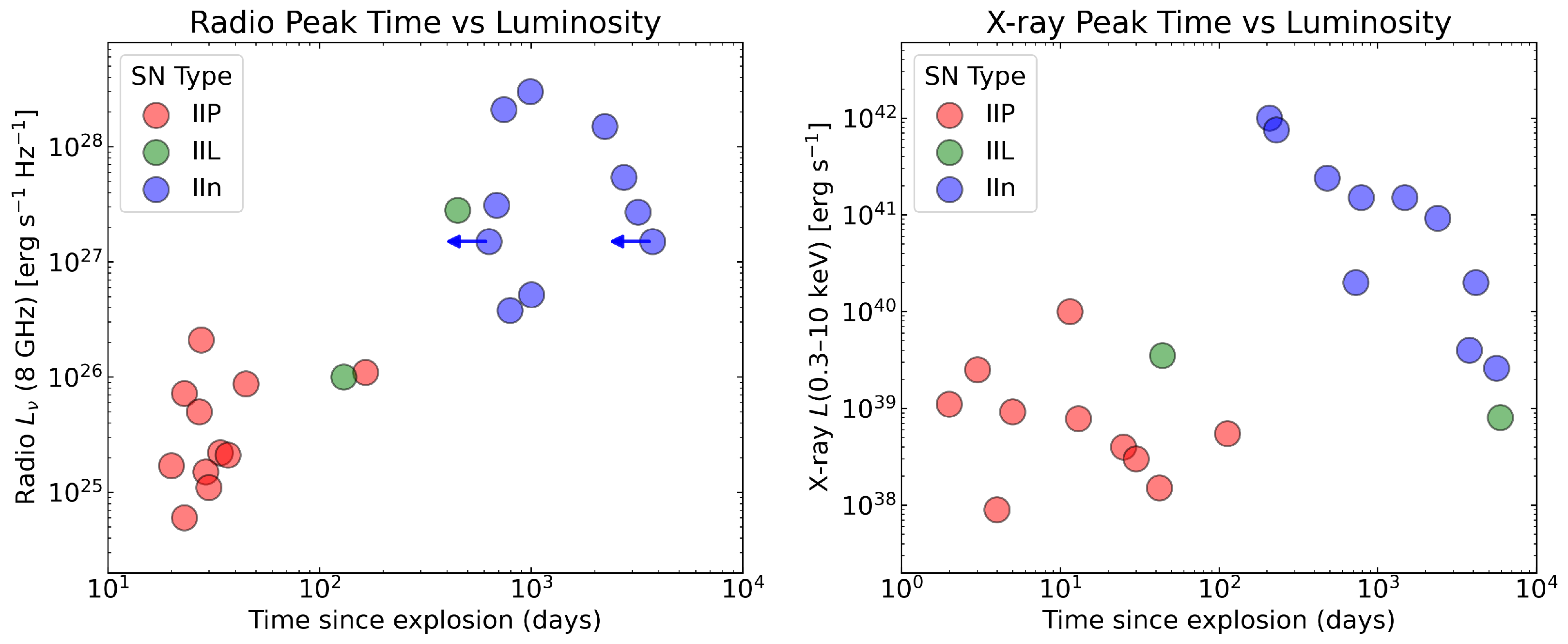
  33. Silverman, J.M.; Nugent, P.E.; Gal-Yam, A.; Sullivan, M.; Howell, D.A.; Filippenko, A.V.; Arcavi, I.; Ben-Ami, S.; Bloom, J.S.; Cenko, S.B.; et al. Type Ia Supernovae Strongly Interacting with Their Circumstellar Medium. Astrophys. J. Suppl. Ser. 2013, 207, 3. [Google Scholar] [CrossRef]
  34. Sharma, Y.; Sollerman, J.; Fremling, C.; Kulkarni, S.R.; De, K.; Irani, I.; Schulze, S.; Strotjohann, N.L.; Gal-Yam, A.; Maguire, K.; et al. A Systematic Study of Ia-CSM Supernovae from the ZTF Bright Transient Survey. Astrophys. J. 2023, 948, 52. [Google Scholar] [CrossRef]
  35. Modjaz, M.; Blondin, S.; Kirshner, R.P.; Matheson, T.; Berlind, P.; Bianco, F.B.; Calkins, M.L.; Challis, P.; Garnavich, P.; Hicken, M.; et al. Optical Spectra of 73 Stripped-envelope Core-collapse Supernovae. Astron. J. 2014, 147, 99. [Google Scholar] [CrossRef]
  36. Leonard, D.C.; Filippenko, A.V.; Ardila, D.R.; Brotherton, M.S. Is It Round? Spectropolarimetry of the Type II-p Supernova 1999EM. Astrophys. J. 2001, 553, 861–885. [Google Scholar] [CrossRef]
  37. Branch, D.; Falk, S.W.; McCall, M.L.; Rybski, P.; Uomoto, A.K.; Wills, B.J. The type II SN 1979c in M 100 and the distance to the Virgo cluster. Astrophys. J. 1981, 244, 780–804. [Google Scholar] [CrossRef]
  38. Anderson, J.P.; González-Gaitán, S.; Hamuy, M.; Gutiérrez, C.P.; Stritzinger, M.D.; Olivares E., F.; Phillips, M.M.; Schulze, S.; Antezana, R.; Bolt, L.; et al. Characterizing the V-band Light-curves of Hydrogen-rich Type II Supernovae. Astrophys. J. 2014, 786, 67. [Google Scholar] [CrossRef]
  39. Sanders, N.E.; Soderberg, A.M.; Gezari, S.; Betancourt, M.; Chornock, R.; Berger, E.; Foley, R.J.; Challis, P.; Drout, M.; Kirshner, R.P.; et al. Toward Characterization of the Type IIP Supernova Progenitor Population: A Statistical Sample of Light Curves from Pan-STARRS1. Astrophys. J. 2015, 799, 208. [Google Scholar] [CrossRef]
  40. Dessart, L.; Hillier, D.J.; Livne, E.; Yoon, S.C.; Woosley, S.; Waldman, R.; Langer, N. Core-collapse explosions of Wolf-Rayet stars and the connection to Type IIb/Ib/Ic supernovae. Mon. Not. R. Astron. Soc. 2011, 414, 2985–3005. [Google Scholar] [CrossRef]
  41. Dessart, L.; Yoon, S.C.; Aguilera-Dena, D.R.; Langer, N. Supernovae Ib and Ic from the explosion of helium stars. Astron. Astrophys. 2020, 642, A106. [Google Scholar] [CrossRef]
  42. Modjaz, M.; Li, W.; Butler, N.; Chornock, R.; Perley, D.; Blondin, S.; Bloom, J.S.; Filippenko, A.V.; Kirshner, R.P.; Kocevski, D.; et al. From Shock Breakout to Peak and Beyond: Extensive Panchromatic Observations of the Type Ib Supernova 2008D Associated with Swift X-ray Transient 080109. Astrophys. J. 2009, 702, 226–248. [Google Scholar] [CrossRef]
  43. Richmond, M.W.; van Dyk, S.D.; Ho, W.; Peng, C.Y.; Paik, Y.; Treffers, R.R.; Filippenko, A.V.; Bustamante-Donas, J.; Moeller, M.; Pawellek, C.; et al. UBVRI Photometry of the Type IC SN 1994I in M51. Astron. J. 1996, 111, 327. [Google Scholar] [CrossRef]
  44. Nomoto, K.; Suzuki, T.; Shigeyama, T.; Kumagai, S.; Yamaoka, H.; Saio, H. A type IIb model for supernova 1993J. Nature 1993, 364, 507–509. [Google Scholar] [CrossRef]
  45. Filippenko, A.V.; Matheson, T.; Ho, L.C. The “Type IIb” Supernova 1993J in M81: A Close Relative of Type Ib Supernovae. Astrophys. J. Lett. 1993, 415, L103. [Google Scholar] [CrossRef]
  46. Gal-Yam, A. Observational and Physical Classification of Supernovae. In Handbook of Supernovae; Alsabti, A.W., Murdin, P., Eds.; Springer: Cham, Switzerland, 2017; p. 195. [Google Scholar] [CrossRef]
  47. Schlegel, E.M. A new subclass of type II supernovae ? Mon. Not. R. Astron. Soc. 1990, 244, 269–271. [Google Scholar]
  48. Pastorello, A.; Hadjiyska, E.; Rabinowitz, D.; Valenti, S.; Turatto, M.; Fasano, G.; Benitez-Herrera, S.; Baltay, C.; Benetti, S.; Botticella, M.T.; et al. Massive stars exploding in a He-rich circumstellar medium—VI. Observations of two distant Type Ibn supernova candidates discovered by La Silla-QUEST. Mon. Not. R. Astron. Soc. 2015, 449, 1954–1966. [Google Scholar] [CrossRef]
  49. Gal-Yam, A.; Bruch, R.; Schulze, S.; Yang, Y.; Perley, D.A.; Irani, I.; Sollerman, J.; Kool, E.C.; Soumagnac, M.T.; Yaron, O.; et al. A WC/WO star exploding within an expanding carbon-oxygen-neon nebula. Nature 2022, 601, 201–204. [Google Scholar] [CrossRef] [PubMed]
  50. Matheson, T.; Filippenko, A.V.; Chornock, R.; Leonard, D.C.; Li, W. Helium Emission Lines in the Type IC Supernova 1999CQ. Astron. J. 2000, 119, 2303–2310. [Google Scholar] [CrossRef]
  51. Pastorello, A.; Smartt, S.J.; Mattila, S.; Eldridge, J.J.; Young, D.; Itagaki, K.; Yamaoka, H.; Navasardyan, H.; Valenti, S.; Patat, F.; et al. A giant outburst two years before the core-collapse of a massive star. Nature 2007, 447, 829–832. [Google Scholar] [CrossRef]
  52. Foley, R.J.; Smith, N.; Ganeshalingam, M.; Li, W.; Chornock, R.; Filippenko, A.V. SN 2006jc: A Wolf-Rayet Star Exploding in a Dense He-rich Circumstellar Medium. Astrophys. J. Lett. 2007, 657, L105–L108. [Google Scholar] [CrossRef]
  53. Galama, T.J.; Vreeswijk, P.M.; van Paradijs, J.; Kouveliotou, C.; Augusteijn, T.; Böhnhardt, H.; Brewer, J.P.; Doublier, V.; Gonzalez, J.F.; Leibundgut, B.; et al. An unusual supernova in the error box of the γ-ray burst of 25 April 1998. Nature 1998, 395, 670–672. [Google Scholar] [CrossRef]
  54. Soderberg, A.M.; Chakraborti, S.; Pignata, G.; Chevalier, R.A.; Chandra, P.; Ray, A.; Wieringa, M.H.; Copete, A.; Chaplin, V.; Connaughton, V.; et al. A relativistic type Ibc supernova without a detected γ-ray burst. Nature 2010, 463, 513–515. [Google Scholar] [CrossRef]
  55. Woosley, S.E.; Zhang, W.; Heger, A. The Central Engines of Gamma-Ray Bursts. In Proceedings of the Gamma-Ray Burst and Afterglow Astronomy 2001: A Workshop Celebrating the First Year of the HETE Mission, Woods Hole, MA, USA, 5–9 November 2001; AIP: Clermont-Ferrand, France, 2003; Volume 662, pp. 185–192. [Google Scholar] [CrossRef]
  56. Corsi, A.; Ho, A.Y.Q.; Cenko, S.B.; Kulkarni, S.R.; Anand, S.; Yang, S.; Sollerman, J.; Srinivasaragavan, G.P.; Omand, C.M.B.; Balasubramanian, A.; et al. A Search for Relativistic Ejecta in a Sample of ZTF Broad-lined Type Ic Supernovae. Astrophys. J. 2023, 953, 179. [Google Scholar] [CrossRef]
  57. Poelarends, A.J.T.; Herwig, F.; Langer, N.; Heger, A. The Supernova Channel of Super-AGB Stars. Astrophys. J. 2008, 675, 614–625. [Google Scholar] [CrossRef]
  58. Nomoto, K. Evolution of 8–10 solar mass stars toward electron capture supernovae. I—Formation of electron-degenerate O + NE + MG cores. Astrophys. J. 1984, 277, 791–805. [Google Scholar] [CrossRef]
  59. Ritossa, C.; García-Berro, E.; Iben, I., Jr. On the Evolution of Stars that Form Electron-degenerate Cores Processed by Carbon Burning. V. Shell Convection Sustained by Helium Burning, Transient Neon Burning, Dredge-out, Urca Cooling, and Other Properties of an 11 Msolar Population I Model Star. Astrophys. J. 1999, 515, 381–397. [Google Scholar] [CrossRef]
  60. Hiramatsu, D.; Howell, D.A.; Van Dyk, S.D.; Goldberg, J.A.; Maeda, K.; Moriya, T.J.; Tominaga, N.; Nomoto, K.; Hosseinzadeh, G.; Arcavi, I.; et al. The electron-capture origin of supernova 2018zd. Nat. Astron. 2021, 5, 903–910. [Google Scholar] [CrossRef]
  61. Barkat, Z.; Rakavy, G.; Sack, N. Dynamics of Supernova Explosion Resulting from Pair Formation. Phys. Rev. Lett. 1967, 18, 379–381. [Google Scholar] [CrossRef]
  62. Heger, A.; Woosley, S.E. The Nucleosynthetic Signature of Population III. Astrophys. J. 2002, 567, 532–543. [Google Scholar] [CrossRef]
  63. Woosley, S.E. Pulsational Pair-instability Supernovae. Astrophys. J. 2017, 836, 244. [Google Scholar] [CrossRef]
  64. Schulze, S.; Fransson, C.; Kozyreva, A.; Chen, T.W.; Yaron, O.; Jerkstrand, A.; Gal-Yam, A.; Sollerman, J.; Yan, L.; Kangas, T.; et al. 1100 days in the life of the supernova 2018ibb. The best pair-instability supernova candidate, to date. Astron. Astrophys. 2024, 683, A223. [Google Scholar] [CrossRef]
  65. Arcavi, I.; Howell, D.A.; Kasen, D.; Bildsten, L.; Hosseinzadeh, G.; McCully, C.; Wong, Z.C.; Katz, S.R.; Gal-Yam, A.; Sollerman, J.; et al. Energetic eruptions leading to a peculiar hydrogen-rich explosion of a massive star. Nature 2017, 551, 210–213. [Google Scholar] [CrossRef]
  66. Perets, H.B.; Gal-Yam, A.; Mazzali, P.A.; Arnett, D.; Kagan, D.; Filippenko, A.V.; Li, W.; Arcavi, I.; Cenko, S.B.; Fox, D.B.; et al. A faint type of supernova from a white dwarf with a helium-rich companion. Nature 2010, 465, 322–325. [Google Scholar] [CrossRef] [PubMed]
  67. Waldman, R.; Sauer, D.; Livne, E.; Perets, H.; Glasner, A.; Mazzali, P.; Truran, J.W.; Gal-Yam, A. Helium Shell Detonations on Low-mass White Dwarfs as a Possible Explanation for SN 2005E. Astrophys. J. 2011, 738, 21. [Google Scholar] [CrossRef]
  68. Kawabata, K.S.; Maeda, K.; Nomoto, K.; Taubenberger, S.; Tanaka, M.; Deng, J.; Pian, E.; Hattori, T.; Itagaki, K. A massive star origin for an unusual helium-rich supernova in an elliptical galaxy. Nature 2010, 465, 326–328. [Google Scholar] [CrossRef]
  69. Kasliwal, M.M.; Kulkarni, S.R.; Gal-Yam, A.; Nugent, P.E.; Sullivan, M.; Bildsten, L.; Yaron, O.; Perets, H.B.; Arcavi, I.; Ben-Ami, S.; et al. Calcium-rich Gap Transients in the Remote Outskirts of Galaxies. Astrophys. J. 2012, 755, 161. [Google Scholar] [CrossRef]
  70. Gal-Yam, A. Luminous Supernovae. Science 2012, 337, 927. [Google Scholar] [CrossRef] [PubMed]
  71. Gal-Yam, A. The Most Luminous Supernovae. Annu. Rev. Astron. Astrophys. 2019, 57, 305–333. [Google Scholar] [CrossRef]
  72. Moriya, T.J. Superluminous supernovae. arXiv 2024, arXiv:2407.12302. [Google Scholar] [CrossRef]
  73. Greiner, J.; Mazzali, P.A.; Kann, D.A.; Krühler, T.; Pian, E.; Prentice, S.; Olivares E., F.; Rossi, A.; Klose, S.; Taubenberger, S.; et al. A very luminous magnetar-powered supernova associated with an ultra-long γ-ray burst. Nature 2015, 523, 189–192. [Google Scholar] [CrossRef]
  74. Puls, J.; Vink, J.S.; Najarro, F. Mass loss from hot massive stars. Astron. Astrophys. Rev. 2008, 16, 209–325. [Google Scholar] [CrossRef]
  75. Smith, N. Mass Loss: Its Effect on the Evolution and Fate of High-Mass Stars. Annu. Rev. Astron. Astrophys. 2014, 52, 487–528. [Google Scholar] [CrossRef]
  76. Cassinelli, J.P. Stellar winds. Annu. Rev. Astron. Astrophys. 1979, 17, 275–308. [Google Scholar] [CrossRef]
  77. Prinja, R.K.; Barlow, M.J.; Howarth, I.D. Terminal Velocities for a Large Sample of O Stars, B Supergiants, and Wolf-Rayet Stars. Astrophys. J. 1990, 361, 607. [Google Scholar] [CrossRef]
  78. Kudritzki, R.P.; Puls, J. Winds from Hot Stars. Annu. Rev. Astron. Astrophys. 2000, 38, 613–666. [Google Scholar] [CrossRef]
  79. Crowther, P.A. Physical Properties of Wolf-Rayet Stars. Annu. Rev. Astron. Astrophys. 2007, 45, 177–219. [Google Scholar] [CrossRef]
  80. Sana, H.; de Mink, S.E.; de Koter, A.; Langer, N.; Evans, C.J.; Gieles, M.; Gosset, E.; Izzard, R.G.; Le Bouquin, J.B.; Schneider, F.R.N. Binary Interaction Dominates the Evolution of Massive Stars. Science 2012, 337, 444. [Google Scholar] [CrossRef]
  81. Quataert, E.; Shiode, J. Wave-driven mass loss in the last year of stellar evolution: Setting the stage for the most luminous core-collapse supernovae. Mon. Not. R. Astron. Soc. 2012, 423, L92–L96. [Google Scholar] [CrossRef]
  82. Wu, S.C.; Fuller, J. Wave-driven Outbursts and Variability of Low-mass Supernova Progenitors. Astrophys. J. 2022, 930, 119. [Google Scholar] [CrossRef]
  83. Wu, S.; Fuller, J. A Diversity of Wave-driven Presupernova Outbursts. Astrophys. J. 2021, 906, 3. [Google Scholar] [CrossRef]
  84. Smith, N. Circumstellar Material Around Evolved Massive Stars. Bull. Soc. R. Sci. Liege 2011, 80, 322–334. [Google Scholar]
  85. Meynet, G.; Georgy, C.; Hirschi, R.; Maeder, A.; Massey, P.; Przybilla, N.; Nieva, M.F. Red Supergiants, Luminous Blue Variables and Wolf-Rayet stars: The single massive star perspective. Bull. Soc. R. Sci. Liege 2011, 80, 266–278. [Google Scholar]
  86. Gull, T.R.; Sofia, S. Discovery of two distorted interstellar bubbles. Astrophys. J. 1979, 230, 782–785. [Google Scholar] [CrossRef][Green Version]
  87. Wright, A.E.; Barlow, M.J. The radio and infrared spectrum of early type stars undergoing mass loss. Mon. Not. R. Astron. Soc. 1975, 170, 41–51. [Google Scholar] [CrossRef]
  88. Kurapati, S.; Chandra, P.; Wade, G.; Cohen, D.H.; David-Uraz, A.; Gagne, M.; Grunhut, J.; Oksala, M.E.; Petit, V.; Shultz, M.; et al. A JVLA survey of the high-frequency radio emission of the massive magnetic B- and O-type stars. Mon. Not. R. Astron. Soc. 2017, 465, 2160–2169. [Google Scholar] [CrossRef]
  89. Yiu, T.W.H.; Vedantham, H.K.; Callingham, J.R.; Günther, M.N. Radio emission as a stellar activity indicator. Astron. Astrophys. 2024, 684, A3. [Google Scholar] [CrossRef]
  90. De Becker, M. Non-thermal emission processes in massive binaries. Astron. Astrophys. Rev. 2007, 14, 171–216. [Google Scholar] [CrossRef]
  91. Wade, G.A.; Neiner, C.; Alecian, E.; Grunhut, J.H.; Petit, V.; Batz, B.d.; Bohlender, D.A.; Cohen, D.H.; Henrichs, H.F.; Kochukhov, O.; et al. The MiMeS survey of magnetism in massive stars: Introduction and overview. Mon. Not. R. Astron. Soc. 2016, 456, 2–22. [Google Scholar] [CrossRef]
  92. Linsky, J.L.; Drake, S.A.; Bastian, T.S. Radio Emission from Chemically Peculiar Stars. Astrophys. J. 1992, 393, 341. [Google Scholar] [CrossRef]
  93. Das, B.; Chandra, P.; Shultz, M.E.; Wade, G.A.; Sikora, J.; Kochukhov, O.; Neiner, C.; Oksala, M.E.; Alecian, E. Discovery of Eight “Main-sequence Radio Pulse Emitters” Using the GMRT: Clues to the Onset of Coherent Radio Emission in Hot Magnetic Stars. Astrophys. J. 2022, 925, 125. [Google Scholar] [CrossRef]
  94. Nugis, T.; Lamers, H.J.G.L.M. Mass-loss rates of Wolf-Rayet stars as a function of stellar parameters. Astron. Astrophys. 2000, 360, 227–244. [Google Scholar]
  95. Marston, A.P. A Large Bubble External to the Wolf-Rayet Ring Nebula NGC 6888. Astron. J. 1995, 109, 2257. [Google Scholar] [CrossRef]
  96. Georgy, C.; Walder, R.; Folini, D.; Bykov, A.; Marcowith, A.; Favre, J.M. Circumstellar medium around rotating massive stars at solar metallicity. Astron. Astrophys. 2013, 559, A69. [Google Scholar] [CrossRef]
  97. Mohamed, S.; Mackey, J.; Langer, N. 3D simulations of Betelgeuse’s bow shock. Astron. Astrophys. 2012, 541, A1. [Google Scholar] [CrossRef]
  98. Jadlovský, D.; Granzer, T.; Weber, M.; Kravchenko, K.; Krtička, J.; Dupree, A.K.; Chiavassa, A.; Strassmeier, K.G.; Poppenhäger, K. The Great Dimming of Betelgeuse: The photosphere as revealed by tomography over the past 15 yr. Astron. Astrophys. 2024, 685, A124. [Google Scholar] [CrossRef]
  99. Kamiński, T. Massive dust clumps in the envelope of the red supergiant VY Canis Majoris. Astron. Astrophys. 2019, 627, A114. [Google Scholar] [CrossRef]
  100. Singh, A.P.; Richards, A.M.S.; Humphreys, R.M.; Decin, L.; Ziurys, L.M. ALMA Reveals Hidden Morphologies in the Molecular Envelope of VY Canis Majoris. Astrophys. J. Lett. 2023, 954, L1. [Google Scholar] [CrossRef]
  101. Mehner, A. Luminous blue variables and B[e] supergiants. In Proceedings of the International Astronomical Union, Volume 18, Symposium S361: Massive Stars Near and Far; Mackey, J., Vink, J.S., St-Louis, N., Eds.; Cambridge University Press: Cambridge, UK, 2024; Volume 361, pp. 437–446. [Google Scholar] [CrossRef]
  102. Smith, N.; Gehrz, R.D.; Hinz, P.M.; Hoffmann, W.F.; Hora, J.L.; Mamajek, E.E.; Meyer, M.R. Mass and Kinetic Energy of the Homunculus Nebula around η Carinae. Astron. J. 2003, 125, 1458–1466. [Google Scholar] [CrossRef]
  103. Groh, J.H.; Hillier, D.J.; Damineli, A. AG Carinae: A Luminous Blue Variable with a High Rotational Velocity. Astrophys. J. Lett. 2006, 638, L33–L36. [Google Scholar] [CrossRef]
  104. Figer, D.F.; Najarro, F.; Morris, M.; McLean, I.S.; Geballe, T.R.; Ghez, A.M.; Langer, N. The Pistol Star. Astrophys. J. 1998, 506, 384–404. [Google Scholar] [CrossRef]
  105. Gootkin, K.; Dorn-Wallenstein, T.; Lomax, J.R.; Eadie, G.; Levesque, E.M.; Babler, B.; Hoffman, J.L.; Meade, M.R.; Nordsieck, K.; Wisniewski, J.P. 13 yr of P Cygni Spectropolarimetry: Investigating Mass Loss through Hα, Periodicity, and Ellipticity. Astrophys. J. 2020, 900, 162. [Google Scholar] [CrossRef]
  106. Mahy, L.; Lanthermann, C.; Hutsemékers, D.; Kluska, J.; Lobel, A.; Manick, R.; Miszalski, B.; Reggiani, M.; Sana, H.; Gosset, E. Multiplicity of Galactic luminous blue variable stars. Astron. Astrophys. 2022, 657, A4. [Google Scholar] [CrossRef]
  107. Saio, H.; Georgy, C.; Meynet, G. Evolution of blue supergiants and α Cygni variables: Puzzling CNO surface abundances. Mon. Not. R. Astron. Soc. 2013, 433, 1246–1257. [Google Scholar] [CrossRef]
  108. Podsiadlowski, P. The Progenitor of SN 1987A. In Handbook of Supernovae; Alsabti, A.W., Murdin, P., Eds.; Springer: Cham, Switzerland, 2017; p. 635. [Google Scholar] [CrossRef]
  109. Smartt, S.J.; Lennon, D.J.; Kudritzki, R.P.; Rosales, F.; Ryans, R.S.I.; Wright, N. The evolutionary status of Sher 25—Implications for blue supergiants and the progenitor of SN 1987A. Astron. Astrophys. 2002, 391, 979–991. [Google Scholar] [CrossRef]
  110. Menon, A.; Ercolino, A.; Urbaneja, M.A.; Lennon, D.J.; Herrero, A.; Hirai, R.; Langer, N.; Schootemeijer, A.; Chatzopoulos, E.; Frank, J.; et al. Evidence for Evolved Stellar Binary Mergers in Observed B-type Blue Supergiants. Astrophys. J. Lett. 2024, 963, L42. [Google Scholar] [CrossRef]
  111. Maund, J.R.; Fraser, M.; Ergon, M.; Pastorello, A.; Smartt, S.J.; Sollerman, J.; Benetti, S.; Botticella, M.T.; Bufano, F.; Danziger, I.J.; et al. The Yellow Supergiant Progenitor of the Type II Supernova 2011dh in M51. Astrophys. J. Lett. 2011, 739, L37. [Google Scholar] [CrossRef]
  112. Georgy, C. Yellow supergiants as supernova progenitors: An indication of strong mass loss for red supergiants? Astron. Astrophys. 2012, 538, L8. [Google Scholar] [CrossRef]
  113. Humphreys, R.M.; Davidson, K.; Smith, N. Crossing the Yellow Void: Spatially Resolved Spectroscopy of the Post-Red Supergiant IRC +10420 and Its Circumstellar Ejecta. Astron. J. 2002, 124, 1026–1044. [Google Scholar] [CrossRef]
  114. Chiosi, C.; Maeder, A. The evolution of massive stars with mass loss. Annu. Rev. Astron. Astrophys. 1986, 24, 329–375. [Google Scholar] [CrossRef]
  115. Decin, L.; Cox, N.L.J.; Royer, P.; Van Marle, A.J.; Vandenbussche, B.; Ladjal, D.; Kerschbaum, F.; Ottensamer, R.; Barlow, M.J.; Blommaert, J.A.D.L.; et al. The enigmatic nature of the circumstellar envelope and bow shock surrounding Betelgeuse as revealed by Herschel. I. Evidence of clumps, multiple arcs, and a linear bar-like structure. Astron. Astrophys. 2012, 548, A113. [Google Scholar] [CrossRef]
  116. Smith, N.; Arnett, W.D.; Bally, J.; Ginsburg, A.; Filippenko, A.V. The ring nebula around the blue supergiant SBW1: Pre-explosion snapshot of an SN 1987A twin. Mon. Not. R. Astron. Soc. 2013, 429, 1324–1341. [Google Scholar] [CrossRef][Green Version]
  117. Lobel, A.; Dupree, A.K.; Stefanik, R.P.; Torres, G.; Israelian, G.; Morrison, N.; de Jager, C.; Nieuwenhuijzen, H.; Ilyin, I.; Musaev, F. The Millennium Outburst of the Cool Hypergiant rho Cassiopeiae: Spectroscopy and Modeling. In Modelling of Stellar Atmospheres, Poster Contributions, Proceedings of the 210th Symposium of the International Astronomical Union Held at Uppsala University, Uppsala, Sweden, 17–21 June 2002; Piskunov, N., Weiss, W.W., Gray, D.F., Eds.; IAU: Paris, France, 2003; Volume 210, p. F10. [Google Scholar]
  118. Chevalier, R.A. Self-similar solutions for the interaction of stellar ejecta with an external medium. Astrophys. J. 1982, 258, 790–797. [Google Scholar] [CrossRef]
  119. Chevalier, R.A. The radio and X-ray emission from type II supernovae. Astrophys. J. 1982, 259, 302–310. [Google Scholar] [CrossRef]
  120. Chevalier, R.A.; Fransson, C. Supernova Interaction with a Circumstellar Medium. In Supernovae and Gamma-Ray Bursters; Lecture Notes in Physics; Weiler, K.W., Ed.; Springer: Berlin/Heidelberg, Germany, 2003; Volume 598, pp. 171–194. [Google Scholar] [CrossRef]
  121. Chevalier, R.A.; Fransson, C. Thermal and Non-thermal Emission from Circumstellar Interaction. In Handbook of Supernovae; Alsabti, A.W., Murdin, P., Eds.; Springer: Cham, Switzerland, 2017; p. 875. [Google Scholar] [CrossRef]
  122. Weiler, K.W.; Sramek, R.A.; Panagia, N.; van der Hulst, J.M.; Salvati, M. Radio Supernovae. Astrophys. J. 1986, 301, 790. [Google Scholar] [CrossRef]
  123. Weiler, K.W.; Panagia, N.; Sramek, R.A. Radio Emission from Supernovae. II. SN 1986J: A Different Kind of Type II. Astrophys. J. 1990, 364, 611. [Google Scholar] [CrossRef]
  124. Smith, N.; Li, W.; Foley, R.J.; Wheeler, J.C.; Pooley, D.; Chornock, R.; Filippenko, A.V.; Silverman, J.M.; Quimby, R.; Bloom, J.S.; et al. SN 2006gy: Discovery of the Most Luminous Supernova Ever Recorded, Powered by the Death of an Extremely Massive Star like η Carinae. Astrophys. J. 2007, 666, 1116–1128. [Google Scholar] [CrossRef]
  125. Chandra, P.; Chevalier, R.A.; Chugai, N.; Fransson, C.; Irwin, C.M.; Soderberg, A.M.; Chakraborti, S.; Immler, S. Radio and X-ray observations of SN 2006jd: Another strongly interacting Type IIn supernova. Astrophys. J. 2012, 755, 110. [Google Scholar] [CrossRef]
  126. Chandra, P. Circumstellar Interaction in Supernovae in Dense Environments—An Observational Perspective. Space Sci. Rev. 2018, 214, 27. [Google Scholar] [CrossRef]
  127. Nadezhin, D.K. On the Initial Phase of Interaction Between Expanding Stellar Envelopes and Surrounding Medium. Astrophys. Space Sci. 1985, 112, 225–249. [Google Scholar] [CrossRef]
  128. Hamilton, A.J.S.; Sarazin, C.L. A new similarity solution for reverse shocks in supernova remnants. Astrophys. J. 1984, 281, 682–689. [Google Scholar] [CrossRef]
  129. Truelove, J.K.; McKee, C.F. Evolution of Nonradiative Supernova Remnants. Astrophys. J. Suppl. Ser. 1999, 120, 299–326. [Google Scholar] [CrossRef]
  130. Chevalier, R.A.; Fransson, C. Emission from Circumstellar Interaction in Normal Type II Supernovae. Astrophys. J. 1994, 420, 268. [Google Scholar] [CrossRef]
  131. Chevalier, R.A. Synchrotron Self-Absorption in Radio Supernovae. Astrophys. J. 1998, 499, 810–819. [Google Scholar] [CrossRef]
  132. Chevalier, R.A.; Fransson, C. Circumstellar Emission from Type Ib and Ic Supernovae. Astrophys. J. 2006, 651, 381–391. [Google Scholar] [CrossRef]
  133. Chevalier, R.A.; Fransson, C.; Nymark, T.K. Radio and X-Ray Emission as Probes of Type IIP Supernovae and Red Supergiant Mass Loss. Astrophys. J. 2006, 641, 1029–1038. [Google Scholar] [CrossRef]
  134. Coughlin, E.R. From Coasting to Energy-conserving: New Self-similar Solutions to the Interaction Phase of Strong Explosions. Astrophys. J. Lett. 2024, 975, L14. [Google Scholar] [CrossRef]
  135. Patat, F.; Chandra, P.; Chevalier, R.; Justham, S.; Podsiadlowski, P.; Wolf, C.; Gal-Yam, A.; Pasquini, L.; Crawford, I.A.; Mazzali, P.A.; et al. Detection of Circumstellar Material in a Normal Type Ia Supernova. Science 2007, 317, 924. [Google Scholar] [CrossRef] [PubMed]
  136. Sternberg, A.; Gal-Yam, A.; Simon, J.D.; Leonard, D.C.; Quimby, R.M.; Phillips, M.M.; Morrell, N.; Thompson, I.B.; Ivans, I.; Marshall, J.L.; et al. Circumstellar Material in Type Ia Supernovae via Sodium Absorption Features. Science 2011, 333, 856. [Google Scholar] [CrossRef] [PubMed]
  137. Mo, G.; De, K.; Wiston, E.; Nayana, A.J.; Margutti, R.; Frostig, D.; Sollerman, J.; Sharma, Y.; Moriya, T.J.; Burdge, K.B.; et al. A Diverse, Overlooked Population of Type Ia Supernovae Exhibiting Mid-infrared Signatures of Delayed Circumstellar Interaction. Astrophys. J. Lett. 2025, 980, L33. [Google Scholar] [CrossRef]
  138. Terwel, J.H.; Maguire, K.; Dimitriadis, G.; Smith, M.; Reusch, S.; Lacroix, L.; Galbany, L.; Burgaz, U.; Harvey, L.; Schulze, S.; et al. ZTF SN Ia DR2: Searching for late-time interaction signatures in Type Ia supernovae from the Zwicky Transient Facility. Astron. Astrophys. 2025, 694, A11. [Google Scholar] [CrossRef]
  139. Margutti, R.; Parrent, J.; Kamble, A.; Soderberg, A.M.; Foley, R.J.; Milisavljevic, D.; Drout, M.R.; Kirshner, R. No X-Rays from the Very Nearby Type Ia SN 2014J: Constraints on Its Environment. Astrophys. J. 2014, 790, 52. [Google Scholar] [CrossRef]
  140. Chomiuk, L.; Soderberg, A.M.; Chevalier, R.A.; Bruzewski, S.; Foley, R.J.; Parrent, J.; Strader, J.; Badenes, C.; Fransson, C.; Kamble, A.; et al. A Deep Search for Prompt Radio Emission from Thermonuclear Supernovae with the Very Large Array. Astrophys. J. 2016, 821, 119. [Google Scholar] [CrossRef]
  141. Lundqvist, P.; Kundu, E.; Pérez-Torres, M.A.; Ryder, S.D.; Björnsson, C.I.; Moldon, J.; Argo, M.K.; Beswick, R.J.; Alberdi, A.; Kool, E.C. The Deepest Radio Observations of Nearby SNe Ia: Constraining Progenitor Types and Optimizing Future Surveys. Astrophys. J. 2020, 890, 159. [Google Scholar] [CrossRef]
  142. Griffith, O.; Showerman, G.; Sarbadhicary, S.K.; Harris, C.E.; Chomiuk, L.; Sollerman, J.; Lundqvist, P.; Moldon, J.; Perez-Torres, M.; Kool, E.C.; et al. A Late-time Radio Survey of Type Ia-CSM Supernovae with the Very Large Array. arXiv 2025, arXiv:2506.19071. [Google Scholar]
  143. Immler, S.; Brown, P.J.; Milne, P.; The, L.S.; Petre, R.; Gehrels, N.; Burrows, D.N.; Nousek, J.A.; Williams, C.L.; Pian, E.; et al. X-Ray Observations of Type Ia Supernovae with Swift: Evidence of Circumstellar Interaction for SN 2005ke. Astrophys. J. Lett. 2006, 648, L119–L122. [Google Scholar] [CrossRef][Green Version]
  144. Bochenek, C.D.; Dwarkadas, V.V.; Silverman, J.M.; Fox, O.D.; Chevalier, R.A.; Smith, N.; Filippenko, A.V. X-ray emission from SN 2012ca: A Type Ia-CSM supernova explosion in a dense surrounding medium. Mon. Not. R. Astron. Soc. 2018, 473, 336–344. [Google Scholar] [CrossRef]
  145. Kool, E.C.; Johansson, J.; Sollerman, J.; Moldón, J.; Moriya, T.J.; Mattila, S.; Schulze, S.; Chomiuk, L.; Pérez-Torres, M.; Harris, C.; et al. A radio-detected type Ia supernova with helium-rich circumstellar material. Nature 2023, 617, 477–482. [Google Scholar] [CrossRef] [PubMed]
  146. Fox, O.D.; Silverman, J.M.; Filippenko, A.V.; Mauerhan, J.; Becker, J.; Borish, H.J.; Cenko, S.B.; Clubb, K.I.; Graham, M.; Hsiao, E.; et al. On the nature of Type IIn/Ia-CSM supernovae: Optical and near-infrared spectra of SN 2012ca and SN 2013dn. Mon. Not. R. Astron. Soc. 2015, 447, 772–785. [Google Scholar] [CrossRef]
  147. Wang, L.; Hu, M.; Wang, L.; Yang, Y.; Yang, J.; Gomez, H.; Chen, S.; Hu, L.; Chen, T.W.; Mo, J.; et al. Newly formed dust within the circumstellar environment of SN Ia-CSM 2018evt. Nat. Astron. 2024, 8, 504–519. [Google Scholar] [CrossRef]
  148. Smartt, S.J. Progenitors of Core-Collapse Supernovae. Annu. Rev. Astron. Astrophys. 2009, 47, 63–106. [Google Scholar] [CrossRef]
  149. Khazov, D.; Yaron, O.; Gal-Yam, A.; Manulis, I.; Rubin, A.; Kulkarni, S.R.; Arcavi, I.; Kasliwal, M.M.; Ofek, E.O.; Cao, Y.; et al. Flash Spectroscopy: Emission Lines from the Ionized Circumstellar Material around <10-day-old Type II Supernovae. Astrophys. J. 2016, 818, 3. [Google Scholar] [CrossRef]
  150. Yaron, O.; Perley, D.A.; Gal-Yam, A.; Groh, J.H.; Horesh, A.; Ofek, E.O.; Kulkarni, S.R.; Sollerman, J.; Fransson, C.; Rubin, A.; et al. Confined dense circumstellar material surrounding a regular type II supernova. Nat. Phys. 2017, 13, 510–517. [Google Scholar] [CrossRef]
  151. Jacobson-Galán, W.V.; Dessart, L.; Jones, D.O.; Margutti, R.; Coppejans, D.L.; Dimitriadis, G.; Foley, R.J.; Kilpatrick, C.D.; Matthews, D.J.; Rest, S.; et al. Final Moments. I. Precursor Emission, Envelope Inflation, and Enhanced Mass Loss Preceding the Luminous Type II Supernova 2020tlf. Astrophys. J. 2022, 924, 15. [Google Scholar] [CrossRef]
  152. Perley, D.A.; Gal-Yam, A.; Irani, I.; Zimmerman, E. LT Classification of SN 2023ixf as a Type II Supernova in M101. Transient Name Server AstroNote 2023-119. 2023. Available online: https://www.wis-tns.org/astronotes/astronote/2023-119 (accessed on 9 July 2025).
  153. Li, G.; Wang, X.; Yang, Y.; Pastorello, A.; Reguitti, A.; Valerin, G.; Ochner, P.; Cai, Y.; Iijima, T.; Munari, U.; et al. Optical and Near-infrared Observations of SN 2023ixf for over 600 days after the Explosion. arXiv 2025, arXiv:2504.03856. [Google Scholar] [CrossRef]
  154. Kozyreva, A.; Caputo, A.; Baklanov, P.; Mironov, A.; Janka, H.T. SN 2023ixf: An average-energy explosion with circumstellar medium and a precursor. Astron. Astrophys. 2025, 694, A319. [Google Scholar] [CrossRef]
  155. Tonry, J.L.; Collaboration, A. ATLAS24fsk (AT 2024ggi): Discovery of a Nearby Candidate Supernova in NGC 3621. Transient Name Server AstroNote 2024-100. 2024. Available online: https://www.wis-tns.org/astronotes/astronote/2024-100 (accessed on 9 July 2025).
  156. Zhai, Q.; Li, L.; Wang, Z.; Zhang, J.; Wang, X. LJT spectroscopic classification of AT 2024ggi as a young Type II supernova with flash features. Transient Name Server AstroNote 2024-104. 2024. Available online: https://www.wis-tns.org/astronotes/astronote/2024-104 (accessed on 9 July 2025).
  157. Pessi, T.; Cartier, R.; Hueichapan, E.; de Brito Silva, D.; Prieto, J.L.; Muñoz, R.R.; Medina, G.E.; Diaz, P.; Li, T.S. Early emission lines in SN 2024ggi revealed by high-resolution spectroscopy. Astron. Astrophys. 2024, 688, L28. [Google Scholar] [CrossRef]
  158. Chen, X.; Kumar, B.; Er, X.; Guo, H.; Yang, Y.P.; Lin, W.; Fang, Y.; Du, G.; Liu, C.; Zhao, J.; et al. Early-phase Simultaneous Multiband Observations of the Type II Supernova SN 2024ggi with Mephisto. Astrophys. J. Lett. 2024, 971, L2. [Google Scholar] [CrossRef]
  159. Jacobson-Galán, W.V.; Davis, K.W.; Kilpatrick, C.D.; Dessart, L.; Margutti, R.; Chornock, R.; Foley, R.J.; Arunachalam, P.; Auchettl, K.; Bom, C.R.; et al. SN 2024ggi in NGC 3621: Rising Ionization in a Nearby, Circumstellar-material-interacting Type II Supernova. Astrophys. J. 2024, 972, 177. [Google Scholar] [CrossRef]
  160. Jacobson-Galán, W.V.; Dessart, L.; Margutti, R.; Chornock, R.; Foley, R.J.; Kilpatrick, C.D.; Jones, D.O.; Taggart, K.; Angus, C.R.; Bhattacharjee, S.; et al. SN 2023ixf in Messier 101: Photo-ionization of Dense, Close-in Circumstellar Material in a Nearby Type II Supernova. Astrophys. J. Lett. 2023, 954, L42. [Google Scholar] [CrossRef]
  161. Bostroem, K.A.; Pearson, J.; Shrestha, M.; Sand, D.J.; Valenti, S.; Jha, S.W.; Andrews, J.E.; Smith, N.; Terreran, G.; Green, E.; et al. Early Spectroscopy and Dense Circumstellar Medium Interaction in SN 2023ixf. Astrophys. J. Lett. 2023, 956, L5. [Google Scholar] [CrossRef]
  162. Smith, N.; Pearson, J.; Sand, D.J.; Ilyin, I.; Bostroem, K.A.; Hosseinzadeh, G.; Shrestha, M. High-resolution Spectroscopy of SN 2023ixf’s First Week: Engulfing the Asymmetric Circumstellar Material. Astrophys. J. 2023, 956, 46. [Google Scholar] [CrossRef]
  163. Shrestha, M.; Bostroem, K.A.; Sand, D.J.; Hosseinzadeh, G.; Andrews, J.E.; Dong, Y.; Hoang, E.; Janzen, D.; Pearson, J.; Jencson, J.E.; et al. Extended Shock Breakout and Early Circumstellar Interaction in SN 2024ggi. Astrophys. J. Lett. 2024, 972, L15. [Google Scholar] [CrossRef]
  164. Quimby, R.M.; Wheeler, J.C.; Höflich, P.; Akerlof, C.W.; Brown, P.J.; Rykoff, E.S. SN 2006bp: Probing the Shock Breakout of a Type II-P Supernova. Astrophys. J. 2007, 666, 1093–1107. [Google Scholar] [CrossRef]
  165. Terreran, G.; Jerkstrand, A.; Benetti, S.; Smartt, S.J.; Ochner, P.; Tomasella, L.; Howell, D.A.; Morales-Garoffolo, A.; Harutyunyan, A.; Kankare, E.; et al. The multifaceted Type II-L supernova 2014G from pre-maximum to nebular phase. Mon. Not. R. Astron. Soc. 2016, 462, 137–157. [Google Scholar] [CrossRef]
  166. Hosseinzadeh, G.; Valenti, S.; McCully, C.; Howell, D.A.; Arcavi, I.; Jerkstrand, A.; Guevel, D.; Tartaglia, L.; Rui, L.; Mo, J.; et al. Short-lived Circumstellar Interaction in the Low-luminosity Type IIP SN 2016bkv. Astrophys. J. 2018, 861, 63. [Google Scholar] [CrossRef]
  167. Tartaglia, L.; Sand, D.J.; Groh, J.H.; Valenti, S.; Wyatt, S.D.; Bostroem, K.A.; Brown, P.J.; Yang, S.; Burke, J.; Chen, T.W.; et al. The Early Discovery of SN 2017ahn: Signatures of Persistent Interaction in a Fast-declining Type II Supernova. Astrophys. J. 2021, 907, 52. [Google Scholar] [CrossRef]
  168. Terreran, G.; Jacobson-Galán, W.V.; Groh, J.H.; Margutti, R.; Coppejans, D.L.; Dimitriadis, G.; Kilpatrick, C.D.; Matthews, D.J.; Siebert, M.R.; Angus, C.R.; et al. The Early Phases of Supernova 2020pni: Shock Ionization of the Nitrogen-enriched Circumstellar Material. Astrophys. J. 2022, 926, 20. [Google Scholar] [CrossRef]
  169. Lin, H.; Zhang, J.; Wang, X.; Hu, M.; Zha, S.; Xiang, D.; Li, L.; Reguitti, A.; Zhang, X.; Cai, Y.; et al. SN 2022acko: A low-luminosity SNe IIP with signs of early circumstellar interaction. Mon. Not. R. Astron. Soc. 2025, 540, 2591–2611. [Google Scholar] [CrossRef]
  170. Andrews, J.E.; Pearson, J.; Hosseinzadeh, G.; Bostroem, K.A.; Dong, Y.; Shrestha, M.; Jencson, J.E.; Sand, D.J.; Valenti, S.; Hoang, E.; et al. SN 2022jox: An Extraordinarily Ordinary Type II SN with Flash Spectroscopy. Astrophys. J. 2024, 965, 85. [Google Scholar] [CrossRef]
  171. Chugai, N.N.; Chevalier, R.A.; Utrobin, V.P. Optical Signatures of Circumstellar Interaction in Type IIP Supernovae. Astrophys. J. 2007, 662, 1136–1147. [Google Scholar] [CrossRef]
  172. Chugai, N.N.; Fabrika, S.N.; Sholukhova, O.N.; Goranskij, V.P.; Abolmasov, P.K.; Vlasyuk, V.V. Optical Observations of Type-IIP Supernova 2004dj: Evidence for Asymmetry of the 56Ni Ejecta. Astron. Lett. 2005, 31, 792–805. [Google Scholar] [CrossRef]
  173. Ruiz-Carmona, R.; Sfaradi, I.; Horesh, A. Type IIP supernova SN2016X in radio frequencies. Astron. Astrophys. 2022, 666, A82. [Google Scholar] [CrossRef]
  174. Chakraborti, S.; Ray, A.; Smith, R.; Ryder, S.; Yadav, N.; Sutaria, F.; Dwarkadas, V.V.; Chandra, P.; Pooley, D.; Roy, R. The Progenitor of SN 2011ja: Clues from Circumstellar Interaction. Astrophys. J. 2013, 774, 30. [Google Scholar] [CrossRef][Green Version]
  175. Pooley, D.; Lewin, W.H.G.; Fox, D.W.; Miller, J.M.; Lacey, C.K.; Van Dyk, S.D.; Weiler, K.W.; Sramek, R.A.; Filippenko, A.V.; Leonard, D.C.; et al. X-Ray, Optical, and Radio Observations of the Type II Supernovae 1999em and 1998S. Astrophys. J. 2002, 572, 932–943. [Google Scholar] [CrossRef]
  176. Nayana, A.J.; Chandra, P.; Ray, A.K. Long-term Behavior of a Type IIP Supernova SN 2004dj in the Radio Bands. Astrophys. J. 2018, 863, 163. [Google Scholar] [CrossRef]
  177. Chakraborti, S.; Yadav, N.; Ray, A.; Smith, R.; Chandra, P.; Pooley, D. X-Ray Emission from SN 2004dj: A Tale of Two Shocks. Astrophys. J. 2012, 761, 100. [Google Scholar] [CrossRef]
  178. Immler, S.; Fesen, R.A.; Van Dyk, S.D.; Weiler, K.W.; Petre, R.; Lewin, W.H.G.; Pooley, D.; Pietsch, W.; Aschenbach, B.; Hammell, M.C.; et al. Late-Time X-Ray, UV, and Optical Monitoring of Supernova 1979C. Astrophys. J. 2005, 632, 283–293. [Google Scholar] [CrossRef]
  179. Chakraborti, S.; Ray, A.; Smith, R.; Margutti, R.; Pooley, D.; Bose, S.; Sutaria, F.; Chandra, P.; Dwarkadas, V.V.; Ryder, S.; et al. Probing Final Stages of Stellar Evolution with X-Ray Observations of SN 2013ej. Astrophys. J. 2016, 817, 22. [Google Scholar] [CrossRef]
  180. Misra, K.; Pooley, D.; Chandra, P.; Bhattacharya, D.; Ray, A.K.; Sagar, R.; Lewin, W.H.G. Type IIP supernova SN 2004et: A multiwavelength study in X-ray, optical and radio. Mon. Not. R. Astron. Soc. 2007, 381, 280–292. [Google Scholar] [CrossRef][Green Version]
  181. Weiler, K.W.; van der Hulst, J.M.; Sramek, R.A.; Panagia, N. SN 1979 (c) a radio SN. Astrophys. J. Lett. 1981, 243, L151–L156. [Google Scholar] [CrossRef]
  182. Martí-Vidal, I.; Marcaide, J.M.; Alberdi, A.; Guirado, J.C.; Lara, L.; Pérez-Torres, M.A.; Ros, E.; Argo, M.K.; Beswick, R.J.; Muxlow, T.W.B.; et al. 8.4 GHz VLBI observations of SN 2004et in NGC 6946. Astron. Astrophys. 2007, 470, 1071–1077. [Google Scholar] [CrossRef]
  183. Grefenstette, B.W.; Brightman, M.; Earnshaw, H.P.; Harrison, F.A.; Margutti, R. Early Hard X-Rays from the Nearby Core-collapse Supernova SN 2023ixf. Astrophys. J. Lett. 2023, 952, L3. [Google Scholar] [CrossRef]
  184. Chandra, P.; Chevalier, R.A.; Maeda, K.; Ray, A.K.; Nayana, A.J. Chandra’s Insights into SN 2023ixf. Astrophys. J. Lett. 2024, 963, L4. [Google Scholar] [CrossRef]
  185. Chandra, P.; Chevalier, R.A.; Chugai, N.; Fransson, C.; Soderberg, A.M. X-Ray and Radio Emission from Type IIn Supernova SN 2010jl. Astrophys. J. 2015, 810, 32. [Google Scholar] [CrossRef]
  186. Nayana, A.J.; Margutti, R.; Wiston, E.; Chornock, R.; Campana, S.; Laskar, T.; Murase, K.; Krips, M.; Migliori, G.; Tsuna, D.; et al. Dinosaur in a Haystack: X-Ray View of the Entrails of SN 2023ixf and the Radio Afterglow of Its Interaction with the Medium Spawned by the Progenitor Star (Paper I). Astrophys. J. 2025, 985, 51. [Google Scholar]
  187. Lutovinov, A.A.; Semena, A.N.; Mereminskiy, I.A.; Sazonov, S.Y.; Molkov, S.V.; Tkachenko, A.Y.; Arefiev, V.A. SRG/ART-XC detects SN2024ggi in X-rays. Astron. Telegr. 2024, 16586, 1. [Google Scholar]
  188. Hu, M.; Ao, Y.; Yang, Y.; Hu, L.; Li, F.; Wang, L.; Wang, X. Early-time Millimeter Observations of the Nearby Type II SN 2024ggi. Astrophys. J. Lett. 2025, 978, L27. [Google Scholar] [CrossRef]
  189. Ryder, S.D.; Maeda, K.; Chandra, P.; Kotak, R. Radio Detection of SN 2024ggi. The Astronomer’s Telegram, No. 16616. 2024. Available online: https://www.astronomerstelegram.org/?read=16616 (accessed on 9 July 2025).
  190. Zhang, J.; Li, C.K.; Cheng, H.Q.; Wu, Q.Y.; Jia, S.M.; Chen, Y.; Cui, W.W.; Feng, H.; Guan, J.; Han, D.W.; et al. SN 2024ggi: Detection of X-ray emission by EP-FXT. Astron. Telegr. 2024, 16588, 1. [Google Scholar]
  191. Montes, M.J.; Weiler, K.W.; Van Dyk, S.D.; Panagia, N.; Lacey, C.K.; Sramek, R.A.; Park, R. Radio Observations of SN 1979C: Evidence for Rapid Presupernova Evolution. Astrophys. J. 2000, 532, 1124–1131. [Google Scholar] [CrossRef][Green Version]
  192. Schlegel, E.M. X-ray emission from supernovae: A review of the observations. Rep. Prog. Phys. 1995, 58, 1375–1413. [Google Scholar] [CrossRef]
  193. Weiler, K.W.; van Dyk, S.D.; Panagia, N.; Sramek, R.A. Full Evolution of the 6 and 20 Centimeter Radio Emission from SN 1980K. Astrophys. J. 1992, 398, 248. [Google Scholar] [CrossRef]
  194. Bietenholz, M.F.; Bartel, N.; Argo, M.; Dua, R.; Ryder, S.; Soderberg, A. The Radio Luminosity-risetime Function of Core-collapse Supernovae. Astrophys. J. 2021, 908, 75. [Google Scholar] [CrossRef]
  195. Yadav, N.; Ray, A.; Chakraborti, S.; Stockdale, C.; Chandra, P.; Smith, R.; Roy, R.; Bose, S.; Dwarkadas, V.; Sutaria, F.; et al. Electron Cooling in a Young Radio Supernova: SN 2012aw. Astrophys. J. 2014, 782, 30. [Google Scholar] [CrossRef]
  196. Immler, S.; Brown, P.J. Swift XRT Detection of Supernova 2012aw in X-Rays. Astron. Telegr. 2012, 3995, 1. [Google Scholar]
  197. Szalai, T.; Vinkó, J.; Könyves-Tóth, R.; Nagy, A.P.; Bostroem, K.A.; Sárneczky, K.; Brown, P.J.; Pejcha, O.; Bódi, A.; Cseh, B.; et al. The Type II-P Supernova 2017eaw: From Explosion to the Nebular Phase. Astrophys. J. 2019, 876, 19. [Google Scholar] [CrossRef]
  198. Hirata, K.; Kajita, T.; Koshiba, M.; Nakahata, M.; Oyama, Y.; Sato, N.; Suzuki, A.; Takita, M.; Totsuka, Y.; Kifune, T.; et al. Observation of a neutrino burst from the supernova SN1987A. Phys. Rev. Lett. 1987, 58, 1490–1493. [Google Scholar] [CrossRef]
  199. Walborn, N.R.; Lasker, B.M.; Laidler, V.G.; Chu, Y.H. The Composite Image of Sanduleak-69 degrees 202, Candidate Precursor to Supernova 1978A in the Large Magellanic Cloud. Astrophys. J. Lett. 1987, 321, L41. [Google Scholar] [CrossRef]
  200. McCray, R.; Fransson, C. Review: Supernova 1987A at 30 Years. Annu. Rev. Astron. Astrophys. 2016, 54, 19–52. [Google Scholar] [CrossRef]
  201. Turtle, A.J.; Campbell-Wilson, D.; Bunton, J.D.; Jauncey, D.L.; Kesteven, M.J.; Manchester, R.N.; Norris, R.P.; Storey, M.C.; Reynolds, J.E. A prompt radio burst from supernova 1987A in the Large Magellanic Cloud. Nature 1987, 327, 38–40. [Google Scholar] [CrossRef]
  202. Park, S.; Zhekov, S.A.; Burrows, D.N.; McCray, R. SNR 1987A: Opening the Future by Reaching the Past. Astrophys. J. Lett. 2005, 634, L73–L76. [Google Scholar] [CrossRef]
  203. Fransson, C.; Larsson, J.; Spyromilio, J.; Leibundgut, B.; McCray, R.; Jerkstrand, A. Discovery of Molecular Hydrogen in SN 1987A. Astrophys. J. Lett. 2016, 821, L5. [Google Scholar] [CrossRef]
  204. Fransson, C.; Barlow, M.J.; Kavanagh, P.J.; Larsson, J.; Jones, O.C.; Sargent, B.; Meixner, M.; Bouchet, P.; Temim, T.; Wright, G.S. et al. Emission lines due to ionizing radiation from a compact object in the remnant of Supernova 1987A. Science 2024, 383, 898–903. [Google Scholar] [CrossRef]
  205. Fransson, C.; Björnsson, C.I. Radio Emission and Particle Acceleration in SN 1993J. Astrophys. J. 1998, 509, 861–878. [Google Scholar] [CrossRef]
  206. Berger, E.; Kulkarni, S.R.; Chevalier, R.A. The Radio Evolution of the Ordinary Type Ic Supernova SN 2002ap. Astrophys. J. Lett. 2002, 577, L5–L8. [Google Scholar] [CrossRef]
  207. Sutaria, F.K.; Chandra, P.; Bhatnagar, S.; Ray, A. The nature of the prompt X-ray and radio emission from SN 2002ap. Astron. Astrophys. 2003, 397, 1011–1018. [Google Scholar] [CrossRef]
  208. Björnsson, C.I. Inhomogeneities in Type Ib/c Supernovae: An Inverse Compton Scattering Origin of the X-Ray Emission. Astrophys. J. 2013, 769, 65. [Google Scholar] [CrossRef]
  209. Björnsson, C.I.; Keshavarzi, S.T. Inhomogeneities and the Modeling of Radio Supernovae. Astrophys. J. 2017, 841, 12. [Google Scholar] [CrossRef]
  210. Chandra, P.; Nayana, A.J.; Björnsson, C.I.; Taddia, F.; Lundqvist, P.; Ray, A.K.; Shappee, B.J. Type Ib Supernova Master OT J120451.50+265946.6: Radio-emitting Shock with Inhomogeneities Crossing through a Dense Shell. Astrophys. J. 2019, 877, 79. [Google Scholar] [CrossRef]
  211. Nayana, A.J.; Chandra, P. uGMRT Observations of a Fast and Blue Optical Transient—AT 2018cow. Astrophys. J. Lett. 2021, 912, L9. [Google Scholar] [CrossRef]
  212. Chevalier, R.A.; Soderberg, A.M. Type IIb Supernovae with Compact and Extended Progenitors. Astrophys. J. Lett. 2010, 711, L40–L43. [Google Scholar] [CrossRef]
  213. Ouchi, R.; Maeda, K. Radii and Mass-loss Rates of Type IIb Supernova Progenitors. Astrophys. J. 2017, 840, 90. [Google Scholar] [CrossRef]
  214. Fransson, C.; Lundqvist, P.; Chevalier, R.A. Circumstellar Interaction in SN 1993J. Astrophys. J. 1996, 461, 993. [Google Scholar] [CrossRef]
  215. Chandra, P.; Dwarkadas, V.V.; Ray, A.; Immler, S.; Pooley, D. X-rays from the Explosion Site: 15 Years of Light Curves of SN 1993J. Astrophys. J. 2009, 699, 388–399. [Google Scholar] [CrossRef]
  216. Chandra, P.; Ray, A.; Bhatnagar, S. The Late-Time Radio Emission from SN 1993J at Meter Wavelengths. Astrophys. J. 2004, 612, 974–987. [Google Scholar] [CrossRef]
  217. Weiler, K.W.; Williams, C.L.; Panagia, N.; Stockdale, C.J.; Kelley, M.T.; Sramek, R.A.; Van Dyk, S.D.; Marcaide, J.M. Long-Term Radio Monitoring of SN 1993J. Astrophys. J. 2007, 671, 1959–1980. [Google Scholar] [CrossRef]
  218. Bietenholz, M.F.; Bartel, N.; Rupen, M.P. SN 1993J VLBI. III. The Evolution of the Radio Shell. Astrophys. J. 2003, 597, 374–398. [Google Scholar] [CrossRef]
  219. Roming, P.W.A.; Pritchard, T.A.; Brown, P.J.; Holland, S.T.; Immler, S.; Stockdale, C.J.; Weiler, K.W.; Panagia, N.; Van Dyk, S.D.; Hoversten, E.A.; et al. Multi-Wavelength Properties of the Type IIb SN 2008ax. Astrophys. J. Lett. 2009, 704, L118–L123. [Google Scholar] [CrossRef]
  220. Nayana, A.J.; Chandra, P.; Krishna, A.; Anupama, G.C. Radio Evolution of a Type IIb Supernova SN 2016gkg. Astrophys. J. 2022, 934, 186. [Google Scholar] [CrossRef]
  221. Kamble, A.; Margutti, R.; Soderberg, A.M.; Chakraborti, S.; Fransson, C.; Chevalier, R.; Powell, D.; Milisavljevic, D.; Parrent, J.; Bietenholz, M. Progenitors of Type IIB Supernovae in the Light of Radio and X-Rays from SN 2013DF. Astrophys. J. 2016, 818, 111. [Google Scholar] [CrossRef]
  222. Horesh, A.; Stockdale, C.; Fox, D.B.; Frail, D.A.; Carpenter, J.; Kulkarni, S.R.; Ofek, E.O.; Gal-Yam, A.; Kasliwal, M.M.; Arcavi, I.; et al. An early and comprehensive millimetre and centimetre wave and X-ray study of SN 2011dh: A non-equipartition blast wave expanding into a massive stellar wind. Mon. Not. R. Astron. Soc. 2013, 436, 1258–1267. [Google Scholar] [CrossRef]
  223. Soderberg, A.M.; Margutti, R.; Zauderer, B.A.; Krauss, M.; Katz, B.; Chomiuk, L.; Dittmann, J.A.; Nakar, E.; Sakamoto, T.; Kawai, N.; et al. Panchromatic Observations of SN 2011dh Point to a Compact Progenitor Star. Astrophys. J. 2012, 752, 78. [Google Scholar] [CrossRef]
  224. Ryder, S.D.; Sadler, E.M.; Subrahmanyan, R.; Weiler, K.W.; Panagia, N.; Stockdale, C. Modulations in the radio light curve of the Type IIb supernova 2001ig: Evidence for a Wolf-Rayet binary progenitor? Mon. Not. R. Astron. Soc. 2004, 349, 1093–1100. [Google Scholar] [CrossRef]
  225. Soria, R.; Russell, T.D.; Wiston, E.; Cheng, S.; Margutti, R.; Rose, K.; Ryder, S.; Terreran, G. The radio re-brightening of the Type IIb SN 2001ig. Publ. Astron. Soc. Aust. 2025, 42, e050. [Google Scholar] [CrossRef]
  226. Gangopadhyay, A.; Maeda, K.; Singh, A.; Nayana, A.J.; Nakaoka, T.; Kawabata, K.S.; Taguchi, K.; Singh, M.; Chandra, P.; Ryder, S.D.; et al. Bridging between Type IIb and Ib Supernovae: SN IIb 2022crv with a Very Thin Hydrogen Envelope. Astrophys. J. 2023, 957, 100. [Google Scholar] [CrossRef]
  227. Stanek, K.Z.; Matheson, T.; Garnavich, P.M.; Martini, P.; Berlind, P.; Caldwell, N.; Challis, P.; Brown, W.R.; Schild, R.; Krisciunas, K.; et al. Spectroscopic Discovery of the Supernova 2003dh Associated with GRB 030329. Astrophys. J. Lett. 2003, 591, L17–L20. [Google Scholar] [CrossRef]
  228. Hjorth, J.; Sollerman, J.; Møller, P.; Fynbo, J.P.U.; Woosley, S.E.; Kouveliotou, C.; Tanvir, N.R.; Greiner, J.; Andersen, M.I.; Castro-Tirado, A.J.; et al. A very energetic supernova associated with the γ-ray burst of 29 March 2003. Nature 2003, 423, 847–850. [Google Scholar] [CrossRef]
  229. Berger, E.; Kulkarni, S.R.; Frail, D.A.; Soderberg, A.M. A Radio Survey of Type Ib and Ic Supernovae: Searching for Engine-driven Supernovae. Astrophys. J. 2003, 599, 408–418. [Google Scholar] [CrossRef]
  230. Soderberg, A.M.; Nakar, E.; Berger, E.; Kulkarni, S.R. Late-Time Radio Observations of 68 Type Ibc Supernovae: Strong Constraints on Off-Axis Gamma-Ray Bursts. Astrophys. J. 2006, 638, 930–937. [Google Scholar] [CrossRef]
  231. Kamble, A.; Soderberg, A.M.; Chomiuk, L.; Margutti, R.; Medvedev, M.; Milisavljevic, D.; Chakraborti, S.; Chevalier, R.; Chugai, N.; Dittmann, J.; et al. Radio Observations Reveal a Smooth Circumstellar Environment Around the Extraordinary Type Ib Supernova 2012au. Astrophys. J. 2014, 797, 2. [Google Scholar] [CrossRef]
  232. Van Dyk, S.D.; de Mink, S.E.; Zapartas, E. Constraints on the Binary Companion to the SN Ic 1994I Progenitor. Astrophys. J. 2016, 818, 75. [Google Scholar] [CrossRef]
  233. Schlegel, E.M.; Ryder, S.; Staveley-Smith, L.; Petre, R.; Colbert, E.; Dopita, M.; Campbell-Wilson, D. Physical Properties of the X-Ray-Luminous SN 1978K in NGC 1313 from Multiwavelength Observations. Astron. J. 1999, 118, 2689–2704. [Google Scholar] [CrossRef]
  234. Immler, S.; Wilson, A.S.; Terashima, Y. X-Ray Emission from the Type Ic Supernova 1994I Observed with Chandra. Astrophys. J. Lett. 2002, 573, L27–L30. [Google Scholar] [CrossRef]
  235. Weiler, K.W.; Panagia, N.; Stockdale, C.; Rupen, M.; Sramek, R.A.; Williams, C.L. Radio Emission from SN 1994I in NGC 5194 (M 51): The Best-studied Type Ib/c Radio Supernova. Astrophys. J. 2011, 740, 79. [Google Scholar] [CrossRef]
  236. Panagia, N.; Sramek, R.A.; Weiler, K.W. Subluminous, Radio Emitting Type I Supernovae. Astrophys. J. Lett. 1986, 300, L55. [Google Scholar] [CrossRef]
  237. van Dyk, S.D.; Sramek, R.A.; Weiler, K.W.; Panagia, N. The Radio Emission from the Type IC Supernova SN 1990B. Astrophys. J. 1993, 409, 162. [Google Scholar] [CrossRef]
  238. Horesh, A.; Sfaradi, I.; Ergon, M.; Barbarino, C.; Sollerman, J.; Moldon, J.; Dobie, D.; Schulze, S.; Pérez-Torres, M.; Williams, D.R.A.; et al. A Non-equipartition Shock Wave Traveling in a Dense Circumstellar Environment around SN 2020oi. Astrophys. J. 2020, 903, 132. [Google Scholar] [CrossRef]
  239. Maeda, K.; Chandra, P.; Matsuoka, T.; Ryder, S.; Moriya, T.J.; Kuncarayakti, H.; Lee, S.H.; Kundu, E.; Patnaude, D.; Saito, T.; et al. The Final Months of Massive Star Evolution from the Circumstellar Environment around SN Ic 2020oi. Astrophys. J. 2021, 918, 34. [Google Scholar] [CrossRef]
  240. Germany, L.M.; Reiss, D.J.; Sadler, E.M.; Schmidt, B.P.; Stubbs, C.W. SN 1997CY/GRB 970514: A New Piece in the Gamma-Ray Burst Puzzle? Astrophys. J. 2000, 533, 320–328. [Google Scholar] [CrossRef]
  241. Turatto, M.; Suzuki, T.; Mazzali, P.A.; Benetti, S.; Cappellaro, E.; Danziger, I.J.; Nomoto, K.; Nakamura, T.; Young, T.R.; Patat, F. The Properties of Supernova 1997CY Associated with GRB 970514. Astrophys. J. Lett. 2000, 534, L57–L61. [Google Scholar] [CrossRef]
  242. Rigon, L.; Turatto, M.; Benetti, S.; Pastorello, A.; Cappellaro, E.; Aretxaga, I.; Vega, O.; Chavushyan, V.; Patat, F.; Danziger, I.J.; et al. SN 1999E: Another piece in the supernova-gamma-ray burst connection puzzle. Mon. Not. R. Astron. Soc. 2003, 340, 191–196. [Google Scholar] [CrossRef][Green Version]
  243. Wang, S.Q.; Cano, Z.; Wang, L.J.; Zheng, W.; Dai, Z.G.; Filippenko, A.V.; Liu, L.D. Modeling The Most Luminous Supernova Associated with a Gamma-Ray Burst, SN 2011kl. Astrophys. J. 2017, 850, 148. [Google Scholar] [CrossRef]
  244. Corsi, A.; Gal-Yam, A.; Kulkarni, S.R.; Frail, D.A.; Mazzali, P.A.; Cenko, S.B.; Kasliwal, M.M.; Cao, Y.; Horesh, A.; Palliyaguru, N.; et al. Radio Observations of a Sample of Broad-line Type IC Supernovae Discovered by PTF/IPTF: A Search for Relativistic Explosions. Astrophys. J. 2016, 830, 42. [Google Scholar] [CrossRef]
  245. Srinivasaragavan, G.P.; Yang, S.; Anand, S.; Sollerman, J.; Ho, A.Y.Q.; Corsi, A.; Cenko, S.B.; Perley, D.; Schulze, S.; Sanchez-Fleming, M.; et al. Optical and Radio Analysis of Systematically Classified Broad-lined Type Ic Supernovae from the Zwicky Transient Facility. Astrophys. J. 2024, 976, 71. [Google Scholar] [CrossRef]
  246. Salas, P.; Bauer, F.E.; Stockdale, C.; Prieto, J.L. SN 2007bg: The complex circumstellar medium around one of the most radio-luminous broad-lined Type Ic supernovae. Mon. Not. R. Astron. Soc. 2013, 428, 1207–1217. [Google Scholar] [CrossRef]
  247. Nayana, A.J.; Chandra, P. Radio view of a broad-line Type Ic supernova ASASSN-16fp. Mon. Not. R. Astron. Soc. 2020, 494, 84–96. [Google Scholar] [CrossRef]
  248. Corsi, A.; Ofek, E.O.; Gal-Yam, A.; Frail, D.A.; Kulkarni, S.R.; Fox, D.B.; Kasliwal, M.M.; Sullivan, M.; Horesh, A.; Carpenter, J.; et al. A Multi-wavelength Investigation of the Radio-loud Supernova PTF11qcj and its Circumstellar Environment. Astrophys. J. 2014, 782, 42. [Google Scholar] [CrossRef]
  249. Kouveliotou, C.; Woosley, S.E.; Patel, S.K.; Levan, A.; Blandford, R.; Ramirez-Ruiz, E.; Wijers, R.A.M.J.; Weisskopf, M.C.; Tennant, A.; Pian, E.; et al. Chandra Observations of the X-Ray Environs of SN 1998bw/GRB 980425. Astrophys. J. 2004, 608, 872–882. [Google Scholar] [CrossRef]
  250. Ho, A.Y.Q.; Kulkarni, S.R.; Perley, D.A.; Cenko, S.B.; Corsi, A.; Schulze, S.; Lunnan, R.; Sollerman, J.; Gal-Yam, A.; Anand, S.; et al. SN 2020bvc: A Broad-line Type Ic Supernova with a Double-peaked Optical Light Curve and a Luminous X-Ray and Radio Counterpart. Astrophys. J. 2020, 902, 86. [Google Scholar] [CrossRef]
  251. Srinivasaragavan, G.P.; Hamidani, H.; Schroeder, G.; Sarin, N.; Ho, A.Y.Q.; Piro, A.L.; Cenko, S.B.; Anand, S.; Sollerman, J.; Perley, D.A.; et al. EP250108a/SN 2025kg: A Broad-Line Type Ic Supernova Associated with a Fast X-ray Transient Showing Evidence of Extended CSM Interaction. arXiv 2025, arXiv:2504.17516. [Google Scholar] [CrossRef]
  252. Gal-Yam, A.; Arcavi, I.; Ofek, E.O.; Ben-Ami, S.; Cenko, S.B.; Kasliwal, M.M.; Cao, Y.; Yaron, O.; Tal, D.; Silverman, J.M.; et al. A Wolf-Rayet-like progenitor of SN 2013cu from spectral observations of a stellar wind. Nature 2014, 509, 471–474. [Google Scholar] [CrossRef]
  253. Ouchi, R.; Maeda, K. Constraining Massive Star Activities in the Final Years through Properties of Supernovae and Their Progenitors. Astrophys. J. 2019, 877, 92. [Google Scholar] [CrossRef]
  254. Fox, O.D.; Chevalier, R.A.; Skrutskie, M.F.; Soderberg, A.M.; Filippenko, A.V.; Ganeshalingam, M.; Silverman, J.M.; Smith, N.; Steele, T.N. A Spitzer Survey for Dust in Type IIn Supernovae. Astrophys. J. 2011, 741, 7. [Google Scholar] [CrossRef]
  255. Fox, O.D.; Filippenko, A.V.; Skrutskie, M.F.; Silverman, J.M.; Ganeshalingam, M.; Cenko, S.B.; Clubb, K.I. Late-time Circumstellar Interaction in a Spitzer Selected Sample of Type IIn Supernovae. Astron. J. 2013, 146, 2. [Google Scholar] [CrossRef]
  256. Gall, C.; Hjorth, J.; Watson, D.; Dwek, E.; Maund, J.R.; Fox, O.; Leloudas, G.; Malesani, D.; Day-Jones, A.C. Rapid formation of large dust grains in the luminous supernova 2010jl. Nature 2014, 511, 326–329. [Google Scholar] [CrossRef] [PubMed]
  257. Smith, N.; Andrews, J.E. High-resolution spectroscopy of SN 2017hcc and its blueshifted line profiles from post-shock dust formation. Mon. Not. R. Astron. Soc. 2020, 499, 3544–3562. [Google Scholar] [CrossRef]
  258. Chandra, P.; Chevalier, R.A.; James, N.J.H.; Fox, O.D. The luminous type IIn supernova SN 2017hcc: Infrared bright, X-ray, and radio faint. Mon. Not. R. Astron. Soc. 2022, 517, 4151–4161. [Google Scholar] [CrossRef]
  259. Shahbandeh, M.; Fox, O.D.; Temim, T.; Dwek, E.; Sarangi, A.; Smith, N.; Dessart, L.; Nickson, B.; Engesser, M.; Filippenko, A.V.; et al. JWST/MIRI Observations of Newly Formed Dust in the Cold, Dense Shell of the Type IIn SN 2005ip. Astrophys. J. 2025, 985, 262. [Google Scholar] [CrossRef]
  260. Clayton, G.C.; Wesson, R.; Fox, O.D.; Shahbandeh, M.; Filippenko, A.V.; Nickson, B.; Engesser, M.; Van Dyk, S.D.; Zheng, W.; Brink, T.G.; et al. Very Late-Time JWST and Keck Spectra of the Oxygen-Rich Supernova 1995N. arXiv 2025, arXiv:2505.01574. [Google Scholar] [CrossRef]
  261. Baer-Way, R.; Chandra, P.; Modjaz, M.; Kumar, S.; Pellegrino, C.; Chevalier, R.; Crawford, A.; Sarangi, A.; Smith, N.; Maeda, K.; et al. A Multiwavelength Autopsy of the Interacting Type IIn Supernova 2020ywx: Tracing Its Progenitor Mass-loss History for 100 Yr Before Death. Astrophys. J. 2025, 983, 101. [Google Scholar] [CrossRef]
  262. Mauerhan, J.; Smith, N. Supernova 1998S at 14 years postmortem: Continuing circumstellar interaction and dust formation. Mon. Not. R. Astron. Soc. 2012, 424, 2659–2666. [Google Scholar] [CrossRef][Green Version]
  263. Smith, N.; Kilpatrick, C.D.; Mauerhan, J.C.; Andrews, J.E.; Margutti, R.; Fong, W.F.; Graham, M.L.; Zheng, W.; Kelly, P.L.; Filippenko, A.V.; et al. Endurance of SN 2005ip after a decade: X-rays, radio and Hα like SN 1988Z require long-lived pre-supernova mass-loss. Mon. Not. R. Astron. Soc. 2017, 466, 3021–3034. [Google Scholar] [CrossRef]
  264. Chugai, N.N.; Danziger, I.J. SN 1988Z: Low-mass ejecta colliding with the clumpy wind? Mon. Not. R. Astron. Soc. 1994, 268, 173–180. [Google Scholar] [CrossRef]
  265. Huang, C.; Chevalier, R.A. Electron scattering wings on lines in interacting supernovae. Mon. Not. R. Astron. Soc. 2018, 475, 1261–1273. [Google Scholar] [CrossRef]
  266. Chandra, P.; Stockdale, C.J.; Chevalier, R.A.; Van Dyk, S.D.; Ray, A.; Kelley, M.T.; Weiler, K.W.; Panagia, N.; Sramek, R.A. Eleven Years of Radio Monitoring of the type IIn Supernova SN 1995N. Astrophys. J. 2009, 690, 1839–1846. [Google Scholar] [CrossRef]
  267. Ofek, E.O.; Cameron, P.B.; Kasliwal, M.M.; Gal-Yam, A.; Rau, A.; Kulkarni, S.R.; Frail, D.A.; Chandra, P.; Cenko, S.B.; Soderberg, A.M.; et al. SN 2006gy: An Extremely Luminous Supernova in the Galaxy NGC 1260. Astrophys. J. Lett. 2007, 659, L13–L16. [Google Scholar] [CrossRef]
  268. Chevalier, R.A.; Irwin, C.M. X-Rays from Supernova Shocks in Dense Mass Loss. Astrophys. J. Lett. 2012, 747, L17. [Google Scholar] [CrossRef]
  269. Svirski, G.; Nakar, E.; Sari, R. Optical to X-Ray Supernova Light Curves Following Shock Breakout through a Thick Wind. Astrophys. J. 2012, 759, 108. [Google Scholar] [CrossRef]
  270. Margutti, R.; Milisavljevic, D.; Soderberg, A.M.; Chornock, R.; Zauderer, B.A.; Murase, K.; Guidorzi, C.; Sanders, N.E.; Kuin, P.; Fransson, C.; et al. A Panchromatic View of the Restless SN 2009ip Reveals the Explosive Ejection of a Massive Star Envelope. Astrophys. J. 2014, 780, 21. [Google Scholar] [CrossRef]
  271. Dwarkadas, V.V.; Romero-Cañizales, C.; Reddy, R.; Bauer, F.E. X-ray and radio emission from the luminous supernova 2005kd. Mon. Not. R. Astron. Soc. 2016, 462, 1101–1110. [Google Scholar] [CrossRef]
  272. Tsvetkov, D.Y. SN 2005kd: Another Very Luminous, Slowly Declining Type IIn Supernova. Perem. Zvezdy 2008, 28, 6. [Google Scholar]
  273. Patat, F.; Taubenberger, S.; Benetti, S.; Pastorello, A.; Harutyunyan, A. Asymmetries in the type IIn SN 2010jl. Astron. Astrophys. 2011, 527, L6. [Google Scholar] [CrossRef]
  274. Katsuda, S.; Maeda, K.; Nozawa, T.; Pooley, D.; Immler, S. SN 2005ip: A Luminous Type IIn Supernova Emerging from a Dense Circumstellar Medium as Revealed by X-Ray Observations. Astrophys. J. 2014, 780, 184. [Google Scholar] [CrossRef]
  275. Ofek, E.O.; Zoglauer, A.; Boggs, S.E.; Barriére, N.M.; Reynolds, S.P.; Fryer, C.L.; Harrison, F.A.; Cenko, S.B.; Kulkarni, S.R.; Gal-Yam, A.; et al. SN 2010jl: Optical to Hard X-Ray Observations Reveal an Explosion Embedded in a Ten Solar Mass Cocoon. Astrophys. J. 2014, 781, 42. [Google Scholar] [CrossRef]
  276. Ryder, S.; Staveley-Smith, L.; Dopita, M.; Petre, R.; Colbert, E.; Malin, D.; Schlegel, E. SN 1978K: An Extraordinary Supernova in the Nearby Galaxy NGC 1313. Astrophys. J. 1993, 416, 167. [Google Scholar] [CrossRef]
  277. Chiba, Y.; Katsuda, S.; Yoshida, T.; Takahashi, K.; Umeda, H. First detection of X-ray line emission from Type IIn supernova 1978K with XMM-Newton’s RGS. Publ. Astron. Soc. Jpn. 2020, 72, 25. [Google Scholar] [CrossRef]
  278. Smith, I.A.; Ryder, S.D.; Böttcher, M.; Tingay, S.J.; Stacy, A.; Pakull, M.; Liang, E.P. Multiwavelength Monitoring of the Unusual Ultraluminous Supernova SN 1978K in NGC 1313 and the Search for an Associated Gamma-Ray Burst. Astrophys. J. 2007, 669, 1130–1137. [Google Scholar] [CrossRef]
  279. Williams, C.L.; Panagia, N.; Van Dyk, S.D.; Lacey, C.K.; Weiler, K.W.; Sramek, R.A. Radio Emission from SN 1988Z and Very Massive Star Evolution. Astrophys. J. 2002, 581, 396–403. [Google Scholar] [CrossRef]
  280. Schlegel, E.M.; Petre, R. A Chandra ACIS Observation of the X-Ray-luminous SN 1988Z. Astrophys. J. 2006, 646, 378–384. [Google Scholar] [CrossRef]
  281. Chandra, P.; Ray, A.; Schlegel, E.M.; Sutaria, F.K.; Pietsch, W. Chandra’s Tryst with SN 1995N. Astrophys. J. 2005, 629, 933–943. [Google Scholar] [CrossRef][Green Version]
  282. Bauer, F.E.; Dwarkadas, V.V.; Brandt, W.N.; Immler, S.; Smartt, S.; Bartel, N.; Bietenholz, M.F. Supernova 1996cr: SN 1987A’s Wild Cousin? Astrophys. J. 2008, 688, 1210–1234. [Google Scholar] [CrossRef]
  283. Patnaude, D.; Weil, K.E.; Fesen, R.A.; Milisavljevic, D.; Kraft, R.P. Late-time Optical and X-Ray Emission Evolution of the Oxygen-rich SN 1996cr. Astrophys. J. 2025, 980, 82. [Google Scholar] [CrossRef]
  284. Meunier, C.; Bauer, F.E.; Dwarkadas, V.V.; Koribalski, B.; Emonts, B.; Hunstead, R.W.; Campbell-Wilson, D.; Stockdale, C.; Tingay, S.J. Performing a stellar autopsy using the radio-bright remnant of SN 1996cr. Mon. Not. R. Astron. Soc. 2013, 431, 2453–2463. [Google Scholar] [CrossRef][Green Version]
  285. Gangopadhyay, A.; Misra, K.; Hiramatsu, D.; Wang, S.Q.; Hosseinzadeh, G.; Wang, X.; Valenti, S.; Zhang, J.; Howell, D.A.; Arcavi, I.; et al. Flash Ionization Signatures in the Type Ibn Supernova SN 2019uo. Astrophys. J. 2020, 889, 170. [Google Scholar] [CrossRef]
  286. Pursiainen, M.; Leloudas, G.; Schulze, S.; Charalampopoulos, P.; Angus, C.R.; Anderson, J.P.; Bauer, F.; Chen, T.W.; Galbany, L.; Gromadzki, M.; et al. SN 2023emq: A Flash-ionized Ibn Supernova with Possible C III Emission. Astrophys. J. Lett. 2023, 959, L10. [Google Scholar] [CrossRef]
  287. Gangopadhyay, A.; Sollerman, J.; Tsalapatas, K.; Maeda, K.; Dukiya, N.; Schulze, S.; Fransson, C.; Sarin, N.; Pessi, P.J.; Singh, M.; et al. SN 2023xgo: Helium-rich Type Icn or Carbon-Flash Type Ibn supernova? Mon. Not. R. Astron. Soc. 2025. [Google Scholar] [CrossRef]
  288. Mattila, S.; Meikle, W.P.S.; Lundqvist, P.; Pastorello, A.; Kotak, R.; Eldridge, J.; Smartt, S.; Adamson, A.; Gerardy, C.L.; Rizzi, L.; et al. Massive stars exploding in a He-rich circumstellar medium—III. SN 2006jc: Infrared echoes from new and old dust in the progenitor CSM. Mon. Not. R. Astron. Soc. 2008, 389, 141–155. [Google Scholar] [CrossRef]
  289. Smith, N.; Foley, R.J.; Filippenko, A.V. Dust Formation and He II λ4686 Emission in the Dense Shell of the Peculiar Type Ib Supernova 2006jc. Astrophys. J. 2008, 680, 568–579. [Google Scholar] [CrossRef]
  290. Immler, S.; Modjaz, M.; Landsman, W.; Bufano, F.; Brown, P.J.; Milne, P.; Dessart, L.; Holland, S.T.; Koss, M.; Pooley, D.; et al. Swift and Chandra Detections of Supernova 2006jc: Evidence for Interaction of the Supernova Shock with a Circumstellar Shell. Astrophys. J. Lett. 2008, 674, L85. [Google Scholar] [CrossRef]
  291. Pellegrino, C.; Modjaz, M.; Takei, Y.; Tsuna, D.; Newsome, M.; Pritchard, T.; Baer-Way, R.; Bostroem, K.A.; Chandra, P.; Charalampopoulos, P.; et al. The X-Ray Luminous Type Ibn SN 2022ablq: Estimates of Preexplosion Mass Loss and Constraints on Precursor Emission. Astrophys. J. 2024, 977, 2. [Google Scholar] [CrossRef]
  292. Ofek, E.O.; Fox, D.; Cenko, S.B.; Sullivan, M.; Gnat, O.; Frail, D.A.; Horesh, A.; Corsi, A.; Quimby, R.M.; Gehrels, N.; et al. X-Ray Emission from Supernovae in Dense Circumstellar Matter Environments: A Search for Collisionless Shocks. Astrophys. J. 2013, 763, 42. [Google Scholar] [CrossRef][Green Version]
  293. Inoue, Y.; Maeda, K. Insights into the Properties of Type Ibn/Icn Supernovae and Their Progenitor Channels through X-Ray Emission. Astrophys. J. 2025, 980, 86. [Google Scholar] [CrossRef]
  294. Baer-Way, R.; Nayana, A.J.; Jacobson-Galan, W.; Chandra, P.; Modjaz, M.; Wu, S.C.; Tsuna, D.; Margutti, R.; Chornock, R.; Pellegrino, C.; et al. The first radio view of a type Ibn supernova in SN 2023fyq: Understanding the mass-loss history in the last decade before the explosion. arXiv 2025, arXiv:2509.07080. [Google Scholar] [CrossRef]
  295. Milisavljevic, D.; Margutti, R.; Kamble, A.; Patnaude, D.J.; Raymond, J.C.; Eldridge, J.J.; Fong, W.; Bietenholz, M.; Challis, P.; Chornock, R.; et al. Metamorphosis of SN 2014C: Delayed Interaction between a Hydrogen Poor Core-collapse Supernova and a Nearby Circumstellar Shell. Astrophys. J. 2015, 815, 120. [Google Scholar] [CrossRef]
  296. Anderson, G.E.; Horesh, A.; Mooley, K.P.; Rushton, A.P.; Fender, R.P.; Staley, T.D.; Argo, M.K.; Beswick, R.J.; Hancock, P.J.; Pérez-Torres, M.A.; et al. The peculiar mass-loss history of SN 2014C as revealed through AMI radio observations. Mon. Not. R. Astron. Soc. 2017, 466, 3648–3662. [Google Scholar] [CrossRef]
  297. Margutti, R.; Kamble, A.; Milisavljevic, D.; Zapartas, E.; de Mink, S.E.; Drout, M.; Chornock, R.; Risaliti, G.; Zauderer, B.A.; Bietenholz, M.; et al. Ejection of the Massive Hydrogen-rich Envelope Timed with the Collapse of the Stripped SN 2014C. Astrophys. J. 2017, 835, 140. [Google Scholar] [CrossRef]
  298. Thomas, B.P.; Wheeler, J.C.; Dwarkadas, V.V.; Stockdale, C.; Vinkó, J.; Pooley, D.; Xu, Y.; Zeimann, G.; MacQueen, P. Seven Years of SN 2014C: A Multiwavelength Synthesis of an Extraordinary Supernova. Astrophys. J. 2022, 930, 57. [Google Scholar] [CrossRef]
  299. Brethauer, D.; Margutti, R.; Milisavljevic, D.; Bietenholz, M.F.; Chornock, R.; Coppejans, D.L.; De Colle, F.; Hajela, A.; Terreran, G.; Vargas, F.; et al. Seven Years of Coordinated Chandra-NuSTAR Observations of SN 2014C Unfold the Extreme Mass-loss History of Its Stellar Progenitor. Astrophys. J. 2022, 939, 105. [Google Scholar] [CrossRef]
  300. Stockdale, C.J.; Van Dyk, S.D.; Sramek, R.A.; Weiler, K.W.; Panagia, N.; Rupen, M.P.; Paczynski, B. Supernova 2001em in UGC 11794. IAU Circ. 2004, 8282, 2. [Google Scholar]
  301. Granot, J.; Ramirez-Ruiz, E. The Case for a Misaligned Relativistic Jet from SN 2001em. Astrophys. J. Lett. 2004, 609, L9–L12. [Google Scholar] [CrossRef][Green Version]
  302. Bietenholz, M.F.; Bartel, N. An Upper Limit on the Expansion Velocity of Gamma-Ray Burst Candidate SN 2001em. Astrophys. J. Lett. 2005, 625, L99–L102. [Google Scholar] [CrossRef][Green Version]
  303. Chugai, N.N.; Chevalier, R.A. Late Emission from the Type Ib/c SN 2001em: Overtaking the Hydrogen Envelope. Astrophys. J. 2006, 641, 1051–1059. [Google Scholar] [CrossRef]
  304. Chandra, P.; Chevalier, R.A.; Chugai, N.; Milisavljevic, D.; Fransson, C. Supernova Interaction with a Dense Detached Shell in SN 2001em. Astrophys. J. 2020, 902, 55. [Google Scholar] [CrossRef]
  305. Bietenholz, M.F.; Bartel, N. SN 1986J VLBI. IV. The Nature of the Central Component. Astrophys. J. 2017, 851, 7. [Google Scholar] [CrossRef]
  306. Kuncarayakti, H.; Maeda, K.; Ashall, C.J.; Prentice, S.J.; Mattila, S.; Kankare, E.; Fransson, C.; Lundqvist, P.; Pastorello, A.; Leloudas, G.; et al. SN 2017dio: A Type-Ic Supernova Exploding in a Hydrogen-rich Circumstellar Medium. Astrophys. J. Lett. 2018, 854, L14. [Google Scholar] [CrossRef]
  307. Sollerman, J.; Fransson, C.; Barbarino, C.; Fremling, C.; Horesh, A.; Kool, E.; Schulze, S.; Sfaradi, I.; Yang, S.; Bellm, E.C.; et al. Two stripped envelope supernovae with circumstellar interaction. But only one really shows it. Astron. Astrophys. 2020, 643, A79. [Google Scholar] [CrossRef]
  308. Mauerhan, J.C.; Filippenko, A.V.; Zheng, W.; Brink, T.G.; Graham, M.L.; Shivvers, I.; Clubb, K.I. Stripped-envelope supernova SN 2004dk is now interacting with hydrogen-rich circumstellar material. Mon. Not. R. Astron. Soc. 2018, 478, 5050–5055. [Google Scholar] [CrossRef]
  309. Aldering, G.; Antilogus, P.; Bailey, S.; Baltay, C.; Bauer, A.; Blanc, N.; Bongard, S.; Copin, Y.; Gangler, E.; Gilles, S.; et al. Nearby Supernova Factory Observations of SN 2005gj: Another Type Ia Supernova in a Massive Circumstellar Envelope. Astrophys. J. 2006, 650, 510–527. [Google Scholar] [CrossRef]
  310. Pooley, D.; Wheeler, J.C.; Vinkó, J.; Dwarkadas, V.V.; Szalai, T.; Silverman, J.M.; Griesel, M.; McCullough, M.; Marion, G.H.; MacQueen, P. Interaction of SN Ib 2004dk with a Previously Expelled Envelope. Astrophys. J. 2019, 883, 120. [Google Scholar] [CrossRef]
  311. Bostroem, K.A.; Valenti, S.; Sand, D.J.; Andrews, J.E.; Van Dyk, S.D.; Galbany, L.; Pooley, D.; Amaro, R.C.; Smith, N.; Yang, S.; et al. Discovery and Rapid Follow-up Observations of the Unusual Type II SN 2018ivc in NGC 1068. Astrophys. J. 2020, 895, 31. [Google Scholar] [CrossRef]
  312. Mutie, I.; Williams, D.; Beswick, R.; Baki, P. Radio detection of SN2018ivc with VLA and e-MERLIN. Astron. Telegr. 2022, 15521, 1. [Google Scholar]
  313. Maeda, K.; Michiyama, T.; Chandra, P.; Ryder, S.; Kuncarayakti, H.; Hiramatsu, D.; Imanishi, M. Resurrection of Type IIL Supernova 2018ivc: Implications for a Binary Evolution Sequence Connecting Hydrogen-rich and Hydrogen-poor Progenitors. Astrophys. J. Lett. 2023, 945, L3. [Google Scholar] [CrossRef]
  314. Nagy, A.P.; Pál, B.H.; Szalai, T. Modeling the circumstellar interaction around SN 2004gq. Astron. Astrophys. 2025, 697, A77. [Google Scholar] [CrossRef]
  315. Dittmann, J.A.; Soderberg, A.M.; Chomiuk, L.; Margutti, R.; Goss, W.M.; Milisavljevic, D.; Chevalier, R.A. A Mid-life Crisis? Sudden Changes in Radio and X-Ray Emission from Supernova 1970G. Astrophys. J. 2014, 788, 38. [Google Scholar] [CrossRef]
  316. Hatsukade, B.; Tominaga, N.; Morokuma, T.; Morokuma-Matsui, K.; Matsuda, Y.; Tamura, Y.; Niinuma, K.; Motogi, K. A VLA Survey of Late-time Radio Emission from Superluminous Supernovae and the Host Galaxies. Astrophys. J. 2021, 922, 17. [Google Scholar] [CrossRef]
  317. Eftekhari, T.; Berger, E.; Margalit, B.; Blanchard, P.K.; Patton, L.; Demorest, P.; Williams, P.K.G.; Chatterjee, S.; Cordes, J.M.; Lunnan, R.; et al. A Radio Source Coincident with the Superluminous Supernova PTF10hgi: Evidence for a Central Engine and an Analog of the Repeating FRB 121102? Astrophys. J. Lett. 2019, 876, L10. [Google Scholar] [CrossRef]
  318. Eftekhari, T.; Margalit, B.; Omand, C.M.B.; Berger, E.; Blanchard, P.K.; Demorest, P.; Metzger, B.D.; Murase, K.; Nicholl, M.; Villar, V.A.; et al. Late-time Radio and Millimeter Observations of Superluminous Supernovae and Long Gamma-Ray Bursts: Implications for Central Engines, Fast Radio Bursts, and Obscured Star Formation. Astrophys. J. 2021, 912, 21. [Google Scholar] [CrossRef]
  319. Mondal, S.; Bera, A.; Chandra, P.; Das, B. Radio emission from a decade old Type I superluminous supernova, PTF10hgi: Comparison with FRB121102. Mon. Not. R. Astron. Soc. 2020, 498, 3863–3869. [Google Scholar] [CrossRef]
  320. Margutti, R.; Bright, J.S.; Matthews, D.J.; Coppejans, D.L.; Alexander, K.D.; Berger, E.; Bietenholz, M.; Chornock, R.; DeMarchi, L.; Drout, M.R.; et al. Luminous Radio Emission from the Superluminous Supernova 2017ens at 3.3 yr after Explosion. Astrophys. J. Lett. 2023, 954, L45. [Google Scholar] [CrossRef]
  321. Chen, T.W.; Inserra, C.; Fraser, M.; Moriya, T.J.; Schady, P.; Schweyer, T.; Filippenko, A.V.; Perley, D.A.; Ruiter, A.J.; Seitenzahl, I.; et al. SN 2017ens: The Metamorphosis of a Luminous Broadlined Type Ic Supernova into an SN IIn. Astrophys. J. Lett. 2018, 867, L31. [Google Scholar] [CrossRef]
  322. Chevalier, R.A.; Irwin, C.M. Shock Breakout in Dense Mass Loss: Luminous Supernovae. Astrophys. J. Lett. 2011, 729, L6. [Google Scholar] [CrossRef]
  323. Lunnan, R.; Fransson, C.; Vreeswijk, P.M.; Woosley, S.E.; Leloudas, G.; Perley, D.A.; Quimby, R.M.; Yan, L.; Blagorodnova, N.; Bue, B.D.; et al. A UV resonance line echo from a shell around a hydrogen-poor superluminous supernova. Nat. Astron. 2018, 2, 887–895. [Google Scholar] [CrossRef]
  324. Andrews, J.E.; Smith, N. Strong late-time circumstellar interaction in the peculiar supernova iPTF14hls. Mon. Not. R. Astron. Soc. 2018, 477, 74–79. [Google Scholar] [CrossRef]
  325. Nomoto, K.; Sparks, W.M.; Fesen, R.A.; Gull, T.R.; Miyaji, S.; Sugimoto, D. The Crab Nebula’s progenitor. Nature 1982, 299, 803–805. [Google Scholar] [CrossRef]
  326. Botticella, M.T.; Pastorello, A.; Smartt, S.J.; Meikle, W.P.S.; Benetti, S.; Kotak, R.; Cappellaro, E.; Crockett, R.M.; Mattila, S.; Sereno, M.; et al. SN 2008S: An electron-capture SN from a super-AGB progenitor? Mon. Not. R. Astron. Soc. 2009, 398, 1041–1068. [Google Scholar] [CrossRef][Green Version]
  327. Jacobson-Galán, W.V.; Margutti, R.; Kilpatrick, C.D.; Hiramatsu, D.; Perets, H.; Khatami, D.; Foley, R.J.; Raymond, J.; Yoon, S.C.; Bobrick, A.; et al. SN 2019ehk: A Double-peaked Ca-rich Transient with Luminous X-Ray Emission and Shock-ionized Spectral Features. Astrophys. J. 2020, 898, 166. [Google Scholar] [CrossRef]
  328. Jacobson-Galán, W.V.; Venkatraman, P.; Margutti, R.; Khatami, D.; Terreran, G.; Foley, R.J.; Angulo, R.; Angus, C.R.; Auchettl, K.; Blanchard, P.K.; et al. The Circumstellar Environments of Double-peaked, Calcium-strong Transients 2021gno and 2021inl. Astrophys. J. 2022, 932, 58. [Google Scholar] [CrossRef]
  329. Ben-Ami, S.; Shvartzvald, Y.; Waxman, E.; Netzer, U.; Yaniv, Y.; Algranatti, V.M.; Gal-Yam, A.; Lapid, O.; Ofek, E.; Topaz, J.; et al. The scientific payload of the Ultraviolet Transient Astronomy Satellite (ULTRASAT). In Proceedings of the Space Telescopes and Instrumentation 2022: Ultraviolet to Gamma Ray, Montreal, QC, Canada, 17–22 July 2022; Volume 12181, p. 1218105. [Google Scholar] [CrossRef]
Figure 1. Supernova classification scheme that combined traditional classification with stellar death pathways. The two most significant luminosity power sources are mentioned for each subtype. The color scheme representing the power sources is explained in the box on the left.
Universe 11 00363 g001
Figure 2. CS interaction picture in a typical SN. The left image shows ejecta–CSM interaction and the formation of various shocked and unshocked regions. The right side image shows the radiation produced as a result of ejecta–CS interaction.
Universe 11 00363 g002
Figure 3. A cartoon diagram of variation of density, pressure, and velocity and temperature in the ejecta–CSM interaction region for ρ ej r n , n 5 and ρ CSM r 2 . The figure is inspired by the Chevalier model [118]. The variables have been normalized to their values at the forward shock front. The quantities are not to be scaled.
Universe 11 00363 g003
Figure 4. 1.4 GHz (left) and 8 GHz (right) radio spectral luminosity of published SNe IIb. SNe eIIb are plotted with squares, and SNe cIIb are plotted with circles. There is no clear differentiation between compact and extended progenitors. However, there may be a hint of faster evolution of SNe cIIb. SN 2008ax, with the highest ejecta velocity, clearly peaks at much earlier times than other SNe IIb. The data are taken from [220,226].
Universe 11 00363 g004
Figure 5. Peak 8 GHz radio spectral luminosity and the peak time for SESNe for a small sample of well-observed cases. While SNe IIb/Ib/Ic do not show a major difference from SNe Ic-bl, SNe associated with GRBs seem to be intrinsically different from the rest of the sample. Most of the data are taken from [211,220,250].
Universe 11 00363 g005
Figure 6. Radio and X-ray peak luminosities of SNe IIn compared with some well-observed CCSNe. While SNe IIn do not stand out in radio bands, they occupy higher values in the X-ray luminosity space. The figure is modified from Chandra [126].
Universe 11 00363 g006
Figure 7. 8 GHz radio spectral luminosity of well-observed SNe IIn (adapted from [126]). Here, circles indicate detections. In case of non-detection, when there is only one data point, it is marked with a downward arrow. In case of multiple non-detections, only line segments have been drawn. The upper limits are 3 σ values of the map noise near the SN. We also compare the SNe IIn light curves with those of SN 1993J (IIb SN) and SN 1998bw (Ic-bl SN) to show the slower evolution of SNe IIn.
Universe 11 00363 g007
Figure 8. Radio lightcurves of SN 2010jl in VLA K (22 GHz), X (10 GHz), and C (6 GHz) bands. The yellow shaded box represents the epochs starting detections. The first radio detection started after day 500. The figure is modified from Chandra et al. [185]. The data with bold edges are previously unpublished data points in 2015, 2016, and 2017.
Universe 11 00363 g008
Figure 9. Joint NuSTAR and XMM-Newton spectrum of the SN 2010jl covering energy range 0.3–80 keV (reproduced from [185]). A normalization discrepancy, attributed to the lack of sensitivity towards higher energies in XMM-Newton, is evident when comparing the high-energy end of the XMM-Newton spectrum with the same energy range of the NuSTAR spectrum.
Universe 11 00363 g009
Figure 10. Left panel: Evolution of X-ray luminosity for SN 2010jl. A deviation from t 1 is evident. Right panel: Evolution of column density from day 40 to day 2650. The figure is modified from Chandra et al. [185], where we have added an unpublished 46ks Chandra data on 3 Jan 2018.
Universe 11 00363 g010
Figure 11. Left: Comparison of peak radio luminosity and time to peak for SNe IIn vs SNe IIP/IIL/II. Right: Comparison of peak X-ray luminosity and time to peak for SNeIIn vs. IIP/IIL/II. The plots indicate a distinct population of these two classes of SNe, despite both classes being H-rich. See Table 5 for references.
Universe 11 00363 g011
Table 1. CSM properties of Milky Way Massive stars.
Progenitor ClassMass-Loss MechanismTypical M ˙ M yr−1Wind km s−1CSM MorphologyMilky WayRefs.
O & BRadiation, line-driven 10 8 10 6 1000–3000Low-density stellar wind, IR bow shocks if runaway ζ Oph; E-BOSS[74]
WRRadiatively driven, optically thick 10 5 10 4 1000–3000WR bubbles/rings on pc scalesWR 136, WR 124, NGC 2359[79,94]
RSGsRadiation pressure, pulsation/convection 10 6 10 4 10–30Dusty arcs/bow shocks, clumpy, asymmetric outflowsBetelgeuse, VY CMa[39,115]
LBVsQuiescent winds, eruptions, outbursts 10 5 10 1 50–200Massive dusty shells, bipolar lobes η Car, AG Car; Pistal star[84,102]
BSGsRSG winds, binary driven 10 7 10 4 100–2000Equatorial ring, bipolar lobesSBW1, Sher 25[109,116]
YSGsPulsation, outbursts 10 5 10 3 35–100Multiple shells/arcs; cool dusty CSM ρ Cas; IRC+10420[113,117]
Table 2. Radio and/or X-ray detections of SNe Ia/Ia-CSM.
SNDetection StatusEpoch DaysLuminosity cgs Units M ˙   M yr−1Ref.
2005keX-rays with Swift-XRT (tentative)8–120 L 0.3 2 keV 2 × 10 38 3 × 10 6 [143]
2012caX-rays with  Chandra554 & 745 L 0.3 10 keV = ( 15 2 ) × 10 39 2.7 × 10 4 [144]
2020eyjRadio detected, with e-MERLIN605 & 741 L 5 GHz 1.5 × 10 27 10 3 10 2 [145]
Notes: X-ray luminosity is in the units of erg s−1 and the radio spectral luminosity is in the unit of erg s−1 cm−2 Hz−1. Mass-loss rate is listed for 10 km s 1 wind speed.
Table 3. A subset of hydrogen–rich CCSNe ‘flash-ionization’ (FI) signatures.
SNSub-TypeFirst FIRepresentative FI LinesRef.
SN 2006bpIIP + 2 dHe ii ( λ 4200 , λ 4686  Å), C iv ( λ 5805 Å)[164]
SN 2013fsIIP + 0.3 dHe ii ( λ 4686  Å), N v ( λ λ 4604 , 4620  Å), N iii & C iii ( λ λ 4634 , 4640  Å/ λ λ 4647 , 4650  Å), O iv/v/vi[150]
SN 2014GIIL2–3 dHe ii ( λ 4686 ) Å, C iv  λ 5803 , N iii, iv ( λ λ 4640  Å, λ λ 4057 , 5201 , 7113  Å)[165]
SN 2016bkvlow-lum. IIP≤5 dH ( λ 4101, λ 4340 , λ 4861, λ 6563 Å), He ii ( λ 4686 , λ 5411  Å), C iii/N iii blend[166]
SN 2017ahnfast-decl. II + 1 dNarrow Balmer series, He ii  λ 4686 [167]
SN 2020pniII + 1 dH α , He ii, C iii/N iii blend[168]
SN 2020tlfII-P/L + 0.7 dNarrow symmetric H i and He ii lines[151]
SN 2022ackolow-lum. IIP + 2 dHe ii  λ 4686 , C iii[169]
SN 2022joxII + 0.8 di, He ii, C iv, N iv[170]
SN 2023ixfIIP + 0.4 dHe ii  λ 4686 , C iv  λ λ 5801 , 5812 , N v  λ λ 4603 , 4619 [160]
SN 2024ggiIIP + 0.8 dHe ii  λ 4686 , C iv  λ λ 5801 , 5812 , N iv  λ λ 7109 , 7123 , O v  λ 5590 [159]
Table 4. List of well-studied H-rich SNe with radio and X-ray emission.
SNTypeDistance
Mpc
RadioX-RayRefs.
L ν , p R  erg s−1 Hz−1 Δ t p , R  DaysCooling L p X  erg s−1 Δ t p , X  Days IC
1979CIIL17.1 2.8 × 10 27 450 0.8 × 10 39 5900[178,191]
1980KIIL5.1 1.0 × 10 26 130 3.5 × 10 39 44[122,192,193]
1999emIIP11.7 2.2 × 10 25 34Yes 9 × 10 37 4Yes[175]
2002hhIIP5.5 1.5 × 10 25 29 4 × 10 38 25[133,194]
2004djIIP3.1 2.1 × 10 25 37Yes 1.5 × 10 38 42Yes[176,177]
2004etIIP5.5 8.7 × 10 25 45 3 × 10 38 30[180]
2011jaIIP3.4 1.1 × 10 25 30Yes 5.5 × 10 38 113Yes[174]
2012awIIP10 7.2 × 10 25 23Yes 9.2 × 10 38 5Yes[195,196]
2013ejIIP/IIL9.6 5 × 10 25 27 7.8 × 10 38 13Yes[179,194]
2016XIIP15.2 2.1 × 10 26 27.6Yes 2.5 × 10 39 2–5Yes[173]
2017eawIIP5.9 1.7 × 10 25 20 1.1 × 10 39 2[197]
2023ixfIIP6.9 1.1 × 10 26 165Yes 1 × 10 40 11.5[184,186]
2024ggiIIP7 6 × 10 24 23-4-[189,190]
Notes. Radio peak spectral luminosity is mentioned for 8 GHz frequency and X-ray peak luminosity is in 0–0.3–8 keV range.
Table 5. X-ray and radio properties of type IIn supernovae.
SNX-RayRadioRefs.
L p X  erg s−1 Δ t peak , X  Days N H  cm−2 kT  keV Δ t det , R  Days ν det  GHz L ν , p R  erg s−1 Hz−1 Δ t p , R  Days
1978K 2.6 × 10 39 5600 2.1 × 10 21 3.313000.84 5.4 × 10 27 ∼2740[233,276,277,278]
1986J 2 × 10 40 4150 10 22 614904.86 1.5 × 10 28 2225[123]
1988Z 9.2 × 10 40 2376 5 × 10 21 2–33854.86 2.1 × 10 28 743[279,280]
1995N 1.5 × 10 41 1477 1.1 × 10 21 9.1 3508.46 3.1 × 10 27 688[266,281]
1996cr 4 × 10 39 3770 7.7 × 10 21 253978.46 2.7 × 10 27 3198[282,283,284]
1998S 9.3 × 10 39 678 1.4 × 10 21 9.83108.46 3.6 × 10 26 ∼1000[175]
2005ip 1.5 × 10 41 7841∼ 10 22 20<37438.46 1.5 × 10 27 <3743[263,274]
2005kd 2.4 × 10 41 479 10 22 10 <6328.5 1.5 × 10 27 <632[271]
2006jd 3.4 × 10 41 403 1.8 × 10 21 20 4058.46 7.9 × 10 27 902[125]
2010jl 1 × 10 42 208 10 24 10 21 1856621 3.8 × 10 26 793[185]
2017hcc 2 × 10 40 727 10 22 3–20100210 5.2 × 10 26 1003[258]
2020ywx 7.5 × 10 41 230 4 × 10 22 ∼202561.4 3 × 10 28 990[261]
Notes. Δ t dec , R is days since explosion to first radio detection. Peak radio spectral luminosity is at 8 GHz. Luminosity measurements have at least 10% errors.
Table 6. SN 2010jl late time VLA radio observations.
Date of Obs.Days Since Expl.Freq GHzVLA Config.Flux Density μJy
23 June 2015172610A48.9 ± 14.1
28 June 201517316A37.2 ±  9.9
17 July 2015175015A35.0 ± 11.5
15 August 201517793A59.5 ± 23.2
17 November 2016223915A32.5 ± 11.7
21 May 201724243C< 298.7
21 May 2017242410C< 99.8
23 May 201724266C< 185.6
Notes. Upper limits are 3- σ . Date of explosion is assumed to be 1 October 2010 [185]. The low-resolution data in VLA C configuration is contaminated by nearby radio sources resulting in a higher upper limit.
Table 7. List of supernovae undergoing metamorphosis to SNe IIn.
SNInitial TypeInteraction SignaturesInteraction SignaturesRefs.
Δ t  Days BandsRadioX-Ray
2001emIb/c∼2 yrsradioyesyes[303,304]
2004dkIc13 yrsopticalyesyes[308,309,310]
2014CIb∼100 dR, O, Xyesyes[295]
2017dioIcalmost immediatelyopticalnono[306]
2018ijpIcmonthsopticalnono[167]
2019oysIbmonthsopticalyesyes[307]
Disclaimer/Publisher’s Note: The statements, opinions and data contained in all publications are solely those of the individual author(s) and contributor(s) and not of MDPI and/or the editor(s). MDPI and/or the editor(s) disclaim responsibility for any injury to people or property resulting from any ideas, methods, instructions or products referred to in the content.