Article

Comparing Numerical Relativity and Perturbation Theory Waveforms for a Non-Spinning Equal-Mass Binary


1
Department of Mathematics, University of Massachusetts, Dartmouth, MA 02747, USA
2
Department of Physics, University of Massachusetts, Dartmouth, MA 02747, USA
3
Center for Scientific Computing and Data Science Research, University of Massachusetts, Dartmouth, MA 02747, USA
4
Department of Physics and Center for Computational Research, University of Rhode Island, Kingston, RI 02881, USA
*
Author to whom correspondence should be addressed.
Universe 2024, 10(1), 25; https://doi.org/10.3390/universe10010025

Submission received: 23 November 2023 / Revised: 15 December 2023 / Accepted: 20 December 2023 / Published: 9 January 2024

Abstract

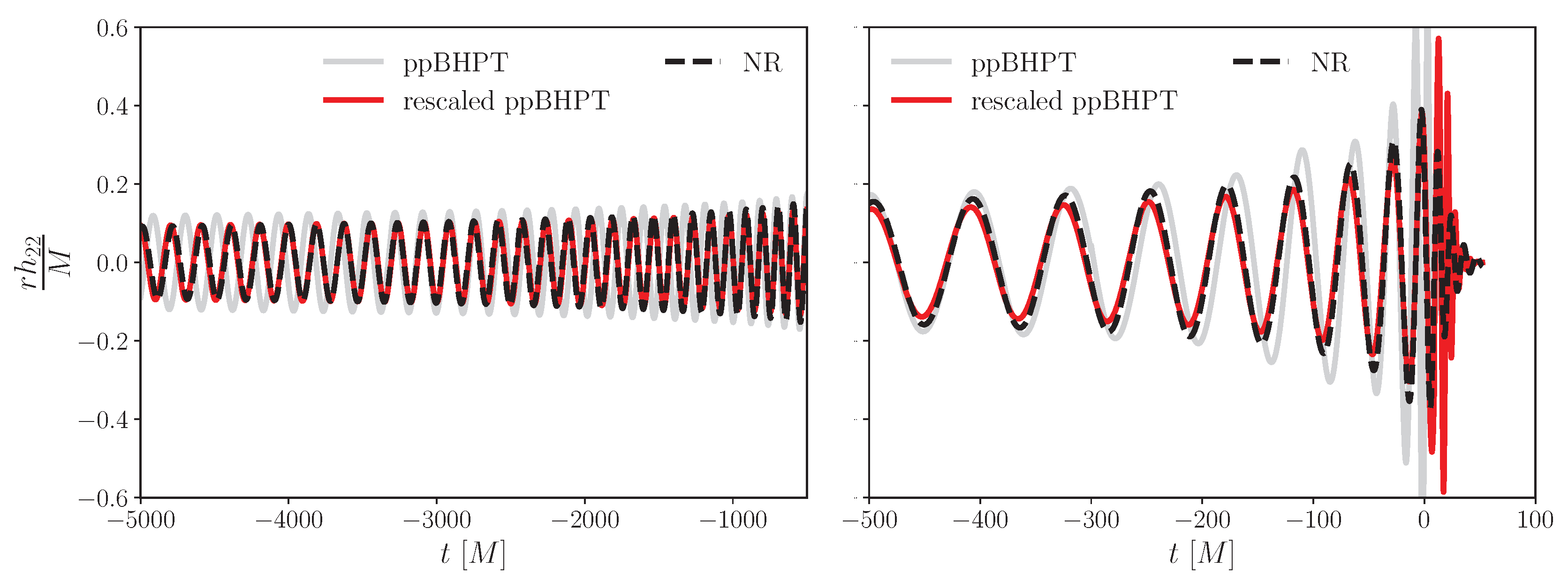
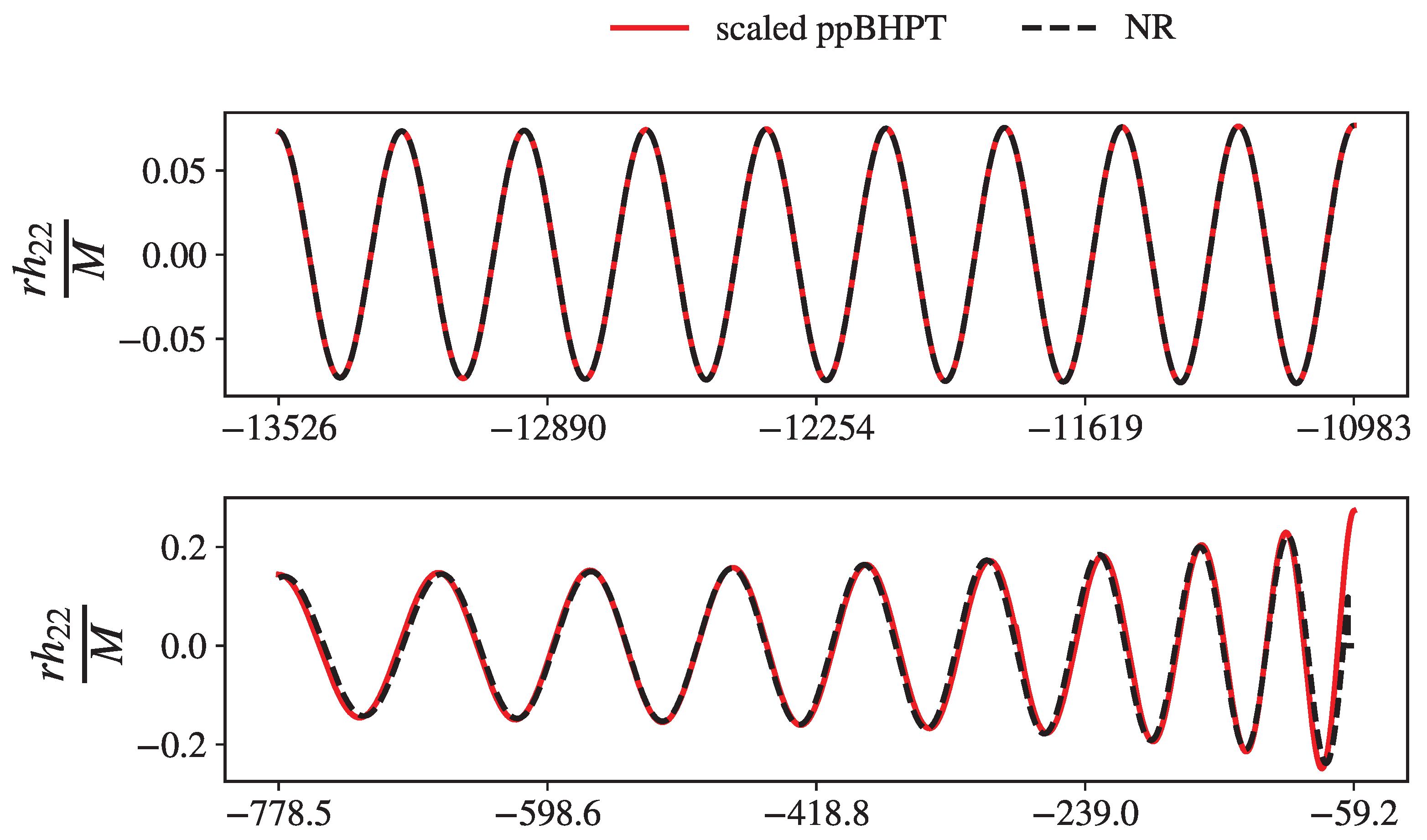
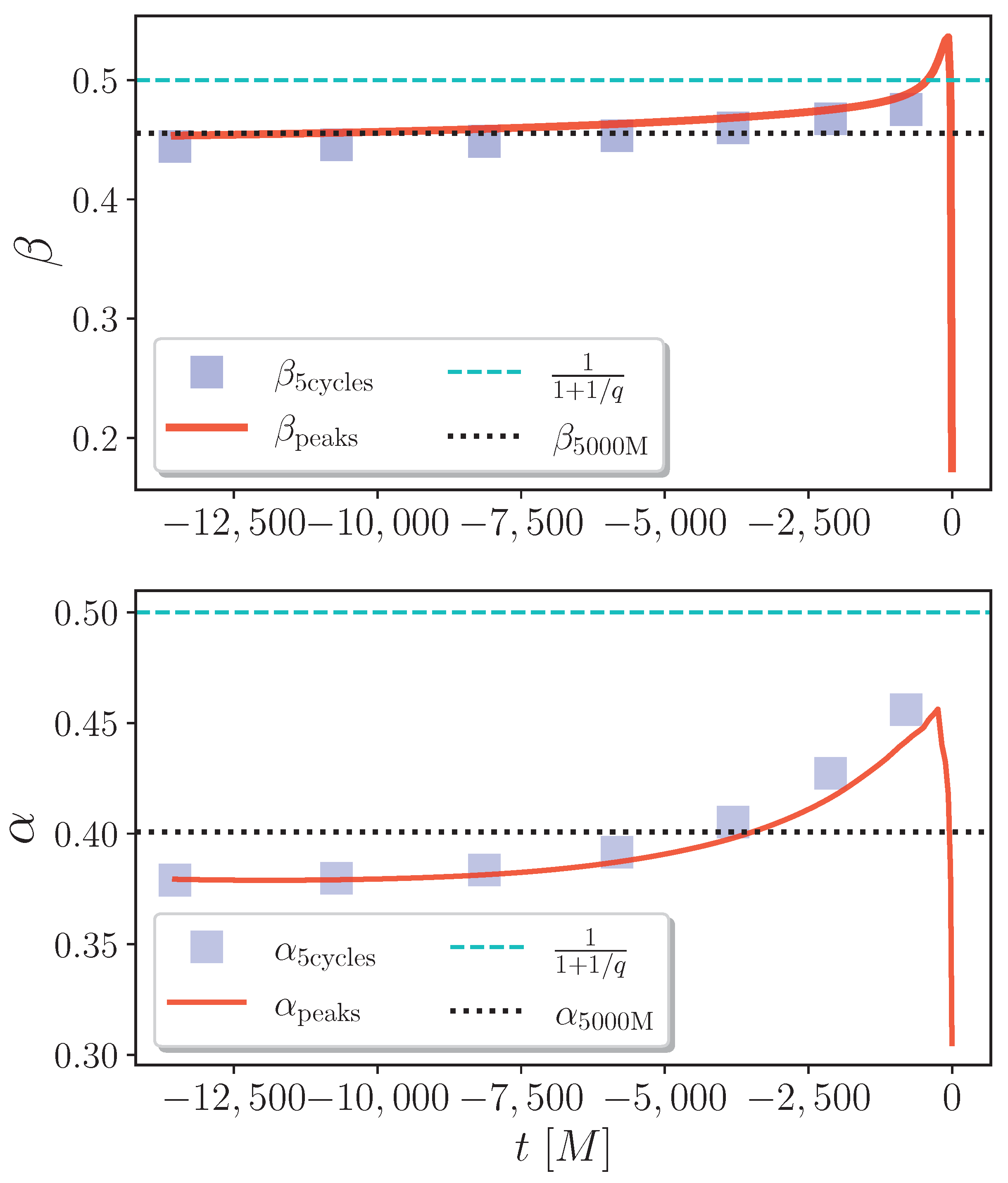
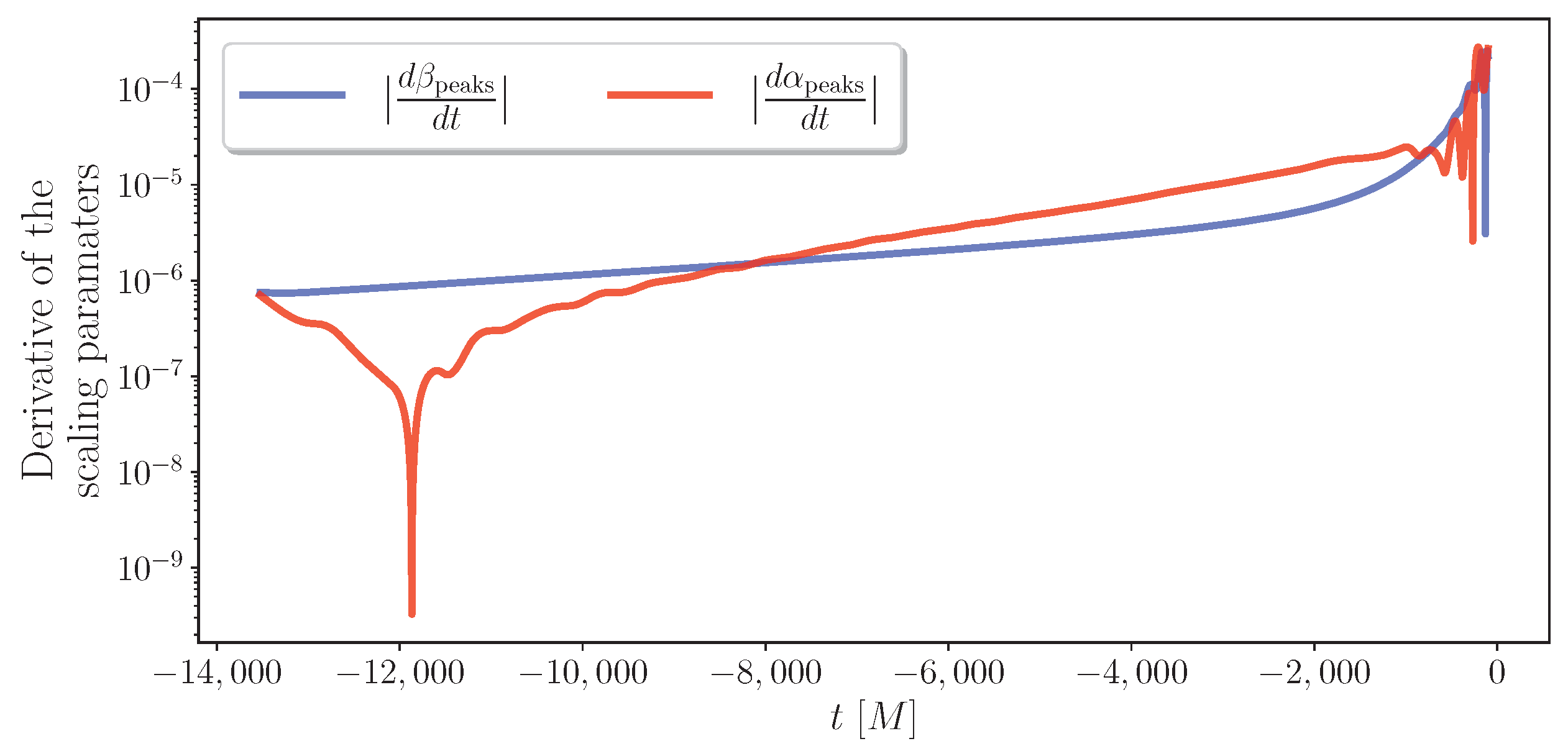
Past studies have empirically demonstrated a surprising agreement between gravitational waveforms computed using adiabatic–driven–inspiral point–particle black hole perturbation theory (ppBHPT) and numerical relativity (NR) following a straightforward calibration step, sometimes referred to as α-β scaling. Specifically focusing on the quadrupole mode, this calibration technique necessitates only two time-independent parameters to scale the overall amplitude and time coordinate. In this article, part of a Special Issue, we investigate this scaling for non-spinning binaries at the equal-mass limit. Even without calibration, NR and ppBHPT waveforms exhibit an unexpected degree of similarity after accounting for different mass scale definitions. Post-calibration, good agreement between ppBHPT and NR waveforms extends nearly up to the point of the merger. We also assess the breakdown of the time-independent assumption of the scaling parameters, shedding light on current limitations and suggesting potential generalizations for the α-β scaling technique.
Keywords: numerical relativity; black hole perturbation theory; gravitational waves; binary black holes numerical relativity; black hole perturbation theory; gravitational waves; binary black holes