

Adipose Tissue–Central Nervous System Axis in Obesity: Molecular Mechanisms, Inflammation, and Nutritional and Technological Implications

 ,
,  ,
,  ,
,  ,
,  ,
,  ,
,  and
and
Highlights
- The adipose tissue–CNS axis is a complex bidirectional network where adipokines, lipid mediators, metabolites, and neural circuits regulate energy balance, metabolism, and inflammation.
- Obesity disrupts this axis through chronic inflammation, neuroinflammation, oxidative stress, and altered lipid signaling, leading to central insulin/leptin resistance and metabolic dysfunction.
- Targeting nutrient-derived signals (e.g., fatty acids, SCFAs, polyphenols) and adipose–brain communication pathways offers promising strategies for preventing and treating obesity-related metabolic and neurological disorders.
- Innovative nutritional approaches and food technologies (e.g., functional foods, microbiota modulation, encapsulation systems) may improve metabolic resilience by restoring adipose–CNS axis homeostasis.
Abstract
1. Introduction
2. Methods
3. Neural and Endocrine Architecture of Adipose Tissue–CNS Communication
Role of Adipokines in the Adipose–Brain Axis
4. Neural Metabolic Alterations in Obesity
4.1. Oxidative Stress and Neuroinflammation in Obesity
4.2. Cellular Metabolic Alterations Induced by Nutritional Excess in the CNS
4.3. Trans-BBB Transport Dynamics, Spatial Heterogeneity, and Temporal Sequencing of Lipid Signaling
5. Nutrient-Derived and Bioactive Mediators of Adipose Tissue–Brain Communication
5.1. Lipid-Derived Mediators in Adipose–Brain Signaling
5.1.1. Fatty Acids and Lipid Sensing
5.1.2. Ceramides and Lipotoxic Signaling
5.1.3. DAGs, Oxylipins and S1
5.2. Nutrient-Sensing Receptors and Intracellular Signaling Pathways
5.3. Gut Microbiota-Derived Metabolites and Polyphenols as Modulators of the Adipose Tissue–CNS Axis
6. Metabolic Integration and Signaling Functions of White Adipose Tissue
6.1. Lipid and Carbohydrate Metabolism in Adipose Tissue
6.2. Role of Mitochondria and Cellular Bioenergetics
6.3. White Adipose Tissue as a Signaling Hub
6.4. Temporal Sequence and Spatial Heterogeneity in Adipose–CNS Crosstalk
7. Impact of Dietary Patterns on the CNS–Adipose Tissue Axis
7.1. Diet, Inflammation and Appetite Regulation
7.2. Nutritional Strategies for Improving Metabolic Health
7.3. Methodological Limitations of Experimental Models and Barriers to Clinical Translation
8. Food Matrix, Nutrient Bioavailability and Food Processing in the Obesity Context
8.1. The Food Matrix: Structure, Digestion, and Metabolic Signaling
8.2. Food Processing Effects on Food Properties in the Obesity Context
8.2.1. Thermal Processing
8.2.2. Mechanical Processing and Particle Size Reduction
8.2.3. Fermentation
8.3. Technological Innovations for Anti-Obesity Functional Foods
8.3.1. Nanoencapsulation and Microencapsulation Technologies
8.3.2. Precision Fermentation
8.3.3. Three-Dimensional Food Printing
9. Conclusions
Author Contributions
Funding
Institutional Review Board Statement
Informed Consent Statement
Data Availability Statement
Conflicts of Interest
Abbreviations
| ACC1 | Acetyl-CoA carboxylase 1 |
| ACLY | ATP citrate lyase |
| Acrp30 | Adipocyte complement-related protein of 30 kDa |
| AD | Alzheimer’s disease |
| AdipoQ | Adiponectin |
| AdipoR1 | Adiponectin receptor 1 |
| AdipoR2 | Adiponectin receptor 2 |
| ADSCs | Adipose-derived stem cells |
| AGEs | Advanced glycation end products |
| AGPAT | 1-Acylglycerol-3-phosphate O-acyltransferase |
| AgRP | Agouti-related peptide |
| Akt | Protein kinase B |
| AMPK | AMP-activated protein kinase |
| APCs | Adipose progenitor cells |
| APJ | Apelin receptor |
| ARC | Arcuate nucleus |
| ATGL | Adipose triglyceride lipase |
| ATMs | Adipose tissue macrophages |
| BAMs | Border-associated macrophages |
| BAT | Brown adipose tissue |
| BBB | Blood–brain barrier |
| BCAAs | Branched-chain amino acids |
| BDNF | Brain-derived neurotrophic factor |
| cAMP | Cyclic adenosine monophosphate |
| CAT | Catalase |
| CD36 | Cluster of differentiation 36 |
| CerS6 | Ceramide synthase 6 |
| CHO | Carbohydrate |
| ChREBP | Carbohydrate-responsive element-binding protein |
| CNS | Central nervous system |
| CoA | Coenzyme A |
| COX | Cyclooxygenase |
| COX-2 | Cyclooxygenase-2 |
| CRP | C-reactive protein |
| CSF | Cerebrospinal fluid |
| DAGs | Diacylglycerols |
| DGAT | Diacylglycerol acyltransferase |
| DHA | Docosahexaenoic acid |
| DNA | Deoxyribonucleic acid |
| DNL | De novo lipogenesis |
| DPP-4 | Dipeptidyl peptidase-4 |
| DRG | Dorsal root ganglia |
| DRP1 | Dynamin-related protein 1 |
| ECM | Extracellular matrix |
| EPA | Eicosapentaenoic acid |
| ER | Endoplasmic reticulum |
| EVs | Extracellular vesicles |
| FABP4 | Fatty acid-binding protein 4 |
| FASN | Fatty acid synthase |
| FATP1 | Fatty acid transport protein 1 |
| FFAR1/GPR40 | Free fatty acid receptor 1/G protein-coupled receptor 40 |
| FFAR2/GPR43 | Free fatty acid receptor 2/G protein-coupled receptor 43 |
| FFAR3/GPR41 | Free fatty acid receptor 3/G protein-coupled receptor 41 |
| FFAR4/GPR120 | Free fatty acid receptor 4/G protein-coupled receptor 120 |
| FFARs | Free fatty acid receptors |
| FFAs | Free fatty acids |
| FIS1 | Mitochondrial fission 1 protein |
| FUNDC1 | FUN14 domain-containing protein 1 |
| FXR | Farnesoid X receptor |
| GIP | Glucose-dependent insulinotropic polypeptide |
| GLP-1 | Glucagon-like peptide-1 |
| GLUT1 | Glucose transporter 1 |
| GLUT4 | Glucose transporter 4 |
| GPAT | Glycerol-3-phosphate acyltransferase |
| GPCRs | G protein-coupled receptors |
| GPx | Glutathione peroxidase |
| Gsα | Stimulatory G protein alpha subunit |
| HFD | High-fat diet |
| HIFs | Hypoxia-inducible factors |
| HOMA-IR | Homeostatic model assessment of insulin resistance |
| HPA | Hypothalamic–pituitary–adrenal axis |
| HPP | High-pressure processing |
| hs-CRP | High-sensitivity C-reactive protein |
| HSL | Hormone-sensitive lipase |
| IFN-γ | Interferon gamma |
| IL-1β | Interleukin-1 beta |
| IL-6 | Interleukin-6 |
| ILC2s | Group 2 innate lymphoid cells |
| JNK | c-Jun N-terminal kinase |
| LDL | Low-density lipoprotein |
| lnc-BATE1 | Brown adipose tissue-enriched long non-coding RNA 1 |
| lnc-MALAT1 | Metastasis-associated lung adenocarcinoma transcript 1 |
| lncRNAs | Long non-coding RNAs |
| LOX | Lipoxygenase |
| LPA | Lysophosphatidic acid |
| LPAR1–6 | Lysophosphatidic acid receptors 1–6 |
| LXRs | Liver X receptors |
| M1 | Classically activated macrophage phenotype |
| M2 | Alternatively activated macrophage phenotype |
| MBH | Mediobasal hypothalamus |
| MCH | Melanin-concentrating hormone |
| mDIC | Mitochondrial dicarboxylate carrier |
| MetS | Metabolic syndrome |
| MFF | Mitochondrial fission factor |
| MFN1 | Mitofusin 1 |
| MFN2 | Mitofusin 2 |
| MiD49 | Mitochondrial dynamics protein of 49 kDa |
| MiD51 | Mitochondrial dynamics protein of 51 kDa |
| MIND | Mediterranean–Dietary Approaches to Stop Hypertension Intervention for Neurodegenerative Delay |
| miR-155 | MicroRNA-155 |
| miR-27a | MicroRNA-27a |
| miR-34a | MicroRNA-34a |
| miR-9-3p | MicroRNA-9-3p |
| miRNAs | MicroRNAs |
| MRI | Magnetic resonance imaging |
| mRNAs | Messenger RNAs |
| MRP4 | Multidrug resistance-associated protein 4 |
| mtDNA | Mitochondrial DNA |
| mTOR | Mechanistic target of rapamycin |
| mTORC1 | Mechanistic target of rapamycin complex 1 |
| MUFA | Monounsaturated fatty acid |
| NADPH | Nicotinamide adenine dinucleotide phosphate |
| NAD+ | Nicotinamide adenine dinucleotide |
| NE | Norepinephrine |
| NEIL1 | Nei-like DNA glycosylase 1 |
| NF-κB | Nuclear factor kappa B |
| NLCs | Nanostructured lipid carriers |
| NOTCH2 | Notch receptor 2 |
| NPY | Neuropeptide Y |
| Nrf2 | Nuclear factor erythroid 2-related factor 2 |
| Nscl-2 | Neuronal stem cell leukemia 2 |
| OAT3 | Organic anion transporter 3 |
| OGG1 | 8-Oxoguanine DNA glycosylase 1 |
| OMA1 | OMA1 zinc metallopeptidase |
| OPA1 | Optic atrophy protein 1 |
| P450 | Cytochrome P450 |
| PAI-1 | Plasminogen activator inhibitor-1 |
| PARPs | Poly(ADP-ribose) polymerases |
| PD | Parkinson’s disease |
| PET | Positron emission tomography |
| PGC-1α | Peroxisome proliferator-activated receptor gamma coactivator 1-alpha |
| PGE2 | Prostaglandin E2 |
| PKA | Protein kinase A |
| PKC | Protein kinase C |
| PKCζ | Protein kinase C zeta |
| PLIN1 | Perilipin 1 |
| PNPLA2 | Patatin-like phospholipase domain-containing protein 2 |
| POMC | Pro-opiomelanocortin |
| PON2 | Paraoxonase 2 |
| PP2A | Protein phosphatase 2A |
| PPARs | Peroxisome proliferator-activated receptors |
| PPARγ | Peroxisome proliferator-activated receptor gamma |
| PRDM16 | PR/SET domain 16 |
| Prx3 | Peroxiredoxin 3 |
| PUFAs | Polyunsaturated fatty acids |
| PVH | Paraventricular nucleus of the hypothalamus |
| PYY | Peptide YY |
| RAGE | Receptor for advanced glycation end products |
| RBP4 | Retinol-binding protein 4 |
| RCTs | Randomized controlled trials |
| RELA | RELA proto-oncogene, NF-κB subunit |
| RELM | Resistin-like molecule |
| Rho | Ras homolog family GTPase |
| RNA | Ribonucleic acid |
| ROCK | Rho-associated coiled-coil-containing protein kinase |
| ROS | Reactive oxygen species |
| S1P | Sphingosine-1-phosphate |
| S1PR1–S1PR5 | Sphingosine-1-phosphate receptors 1–5 |
| SAM | S-adenosylmethionine |
| SAT | Subcutaneous adipose tissue |
| SCFAs | Short-chain fatty acids |
| SCN | Suprachiasmatic nucleus |
| SFAs | Saturated fatty acids |
| SIRT1 | Sirtuin 1 |
| SIRT6 | Sirtuin 6 |
| SLNs | Solid lipid nanoparticles |
| SNS | Sympathetic nervous system |
| SOD | Superoxide dismutase |
| SPT | Serine palmitoyltransferase |
| STAT3 | Signal transducer and activator of transcription 3 |
| TAGs | Triacylglycerols |
| TCA | Tricarboxylic acid cycle |
| TGR5 | Takeda G protein-coupled receptor 5 |
| TH | Tyrosine hydroxylase |
| TLR4 | Toll-like receptor 4 |
| TNF-α | Tumor necrosis factor alpha |
| TNFRSF1A | Tumor necrosis factor receptor superfamily member 1A |
| UCP1 | Uncoupling protein 1 |
| VAT | Visceral adipose tissue |
| VLDL | Very-low-density lipoprotein |
| WAT | White adipose tissue |
| WNT | Wingless-related integration site |
| αMSH | Alpha-melanocyte-stimulating hormone |
| βARs | Beta-adrenergic receptors |
References
- Hahm, J.R.; Jo, M.H.; Ullah, R.; Kim, M.W.; Kim, M.O. Metabolic Stress Alters Antioxidant Systems, Suppresses the Adiponectin Receptor 1 and Induces Alzheimer’s Like Pathology in Mice Brain. Cells 2020, 9, 249. [Google Scholar] [CrossRef] [Scilit] [PubMed]
- Vuković, M.; Nosek, I.; Medić Stojanoska, M.; Kozić, D. Neurometabolic and Neuroinflammatory Consequences of Obesity: Insights into Brain Vulnerability and Imaging-Based Biomarkers. Int. J. Mol. Sci. 2026, 27, 958. [Google Scholar] [CrossRef] [Scilit] [PubMed]
- Friedman, J.M. Leptin, Leptin Receptors, and the Control of Body Weight. Nutr. Rev. 2009, 56, S38–S46. [Google Scholar] [CrossRef] [Scilit] [PubMed]
- Scherer, P.E. Adipose Tissue. Diabetes 2006, 55, 1537–1545. [Google Scholar] [CrossRef] [Scilit] [PubMed]
- Münzberg, H.; Qualls-Creekmore, E.; Berthoud, H.-R.; Morrison, C.D.; Yu, S. Neural Control of Energy Expenditure. In Metabolic Control; Herzig, S., Ed.; Handbook of Experimental Pharmacology; Springer International Publishing: Cham, Switzerland, 2015; Volume 233, pp. 173–194. [Google Scholar]
- Montégut, L.; Lopez-Otin, C.; Magnan, C.; Kroemer, G. Old Paradoxes and New Opportunities for Appetite Control in Obesity. Trends Endocrinol. Metab. 2021, 32, 264–294. [Google Scholar] [CrossRef] [Scilit] [PubMed]
- Jais, A.; Brüning, J.C. Hypothalamic Inflammation in Obesity and Metabolic Disease. J. Clin. Investig. 2017, 127, 24–32. [Google Scholar] [CrossRef] [Scilit] [PubMed]
- Fang, Z.; Pyne, S.; Pyne, N.J. Ceramide and Sphingosine 1-Phosphate in Adipose Dysfunction. Prog. Lipid Res. 2019, 74, 145–159. [Google Scholar] [CrossRef] [Scilit] [PubMed]
- DiPatrizio, N.V.; Piomelli, D. Intestinal Lipid–Derived Signals That Sense Dietary Fat. J. Clin. Investig. 2015, 125, 891–898. [Google Scholar] [CrossRef] [Scilit] [PubMed]
- Wang, Y.; Ye, L. Somatosensory innervation of adipose tissues. Physiol. Behav. 2023, 265, 114174. [Google Scholar] [CrossRef] [Scilit] [PubMed] [PubMed Central]
- Nguyen, N.L.T.; Randall, J.; Banfield, B.W.; Bartness, T.J. Central Sympathetic Innervations to Visceral and Subcutaneous White Adipose Tissue. Am. J. Physiol.-Regul. Integr. Comp. Physiol. 2014, 306, R375–R386. [Google Scholar] [CrossRef] [Scilit] [PubMed]
- Bamshad, M.; Aoki, V.T.; Adkison, M.G.; Warren, W.S.; Bartness, T.J. Central Nervous System Origins of the Sympathetic Nervous System Outflow to White Adipose Tissue. Am. J. Physiol.-Regul. Integr. Comp. Physiol. 1998, 275, R291–R299. [Google Scholar] [CrossRef] [Scilit] [PubMed]
- Adler, E.S.; Hollis, J.H.; Clarke, I.J.; Grattan, D.R.; Oldfield, B.J. Neurochemical Characterization and Sexual Dimorphism of Projections from the Brain to Abdominal and Subcutaneous White Adipose Tissue in the Rat. J. Neurosci. 2012, 32, 15913–15921. [Google Scholar] [CrossRef] [Scilit] [PubMed]
- Willows, J.W.; Blaszkiewicz, M.; Townsend, K.L. The Sympathetic Innervation of Adipose Tissues: Regulation, Functions, and Plasticity. In Comprehensive Physiology; Prakash, Y.S., Ed.; Wiley: Hoboken, NJ, USA, 2023; pp. 4985–5021. [Google Scholar]
- Vaughan, C.H.; Zarebidaki, E.; Ehlen, J.C.; Bartness, T.J. Analysis and Measurement of the Sympathetic and Sensory Innervation of White and Brown Adipose Tissue. In Methods in Enzymology; Elsevier: Amsterdam, The Netherlands, 2014; Volume 537, pp. 199–225. [Google Scholar]
- Jiang, H.; Ding, X.; Cao, Y.; Wang, H.; Zeng, W. Dense Intra-Adipose Sympathetic Arborizations Are Essential for Cold-Induced Beiging of Mouse White Adipose Tissue. Cell Metab. 2017, 26, 686–692.e3. [Google Scholar] [CrossRef] [Scilit] [PubMed]
- Cousin, B.; Casteilla, L.; Lafontan, M.; Ambid, L.; Langin, D.; Berthault, M.F.; Pénicaud, L. Local Sympathetic Denervation of White Adipose Tissue in Rats Induces Preadipocyte Proliferation without Noticeable Changes in Metabolism. Endocrinology 1993, 133, 2255–2262. [Google Scholar] [CrossRef] [Scilit] [PubMed]
- Bowers, R.R.; Festuccia, W.T.L.; Song, C.K.; Shi, H.; Migliorini, R.H.; Bartness, T.J. Sympathetic Innervation of White Adipose Tissue and Its Regulation of Fat Cell Number. Am. J. Physiol.-Regul. Integr. Comp. Physiol. 2004, 286, R1167–R1175. [Google Scholar] [CrossRef] [Scilit] [PubMed]
- Ruschke, K.; Ebelt, H.; Klöting, N.; Boettger, T.; Raum, K.; Blüher, M.; Braun, T. Defective Peripheral Nerve Development Is Linked to Abnormal Architecture and Metabolic Activity of Adipose Tissue in Nscl-2 Mutant Mice. PLoS ONE 2009, 4, e5516. [Google Scholar] [CrossRef] [Scilit] [PubMed]
- Correll, J.W. Adipose Tissue: Ability to Respond to Nerve Stimulation in Vitro. Science 1963, 140, 387–388. [Google Scholar] [CrossRef] [Scilit] [PubMed]
- Harris, R.B.S. Denervation as a Tool for Testing Sympathetic Control of White Adipose Tissue. Physiol. Behav. 2018, 190, 3–10. [Google Scholar] [CrossRef] [Scilit] [PubMed]
- Himms-Hagen, J.; Cui, J.; Lynn Sigurdson, S. Sympathetic and Sensory Nerves in Control of Growth of Brown Adipose Tissue: Effects of Denervation and of Capsaicin. Neurochem. Int. 1990, 17, 271–279. [Google Scholar] [CrossRef] [Scilit] [PubMed]
- Andrews, P.L.; Rothwell, N.J.; Stock, M.J. Influence of Subdiaphragmatic Vagotomy and Brown Fat Sympathectomy on Thermogenesis in Rats. Am. J. Physiol.-Endocrinol. Metab. 1985, 249, E239–E243. [Google Scholar] [CrossRef] [Scilit] [PubMed]
- Iwami, M.; Alkayed, F.; Shiina, T.; Taira, K.; Shimizu, Y. Activation of Brown Adipose Tissue Thermogenesis by Electrical Stimulation to the Dorsal Surface of the Tissue in Rats. Biomed. Res. 2013, 34, 173–178. [Google Scholar] [CrossRef] [Scilit] [PubMed]
- Martinez-Sanchez, N.; Sweeney, O.; Sidarta-Oliveira, D.; Caron, A.; Stanley, S.A.; Domingos, A.I. The Sympathetic Nervous System in the 21st Century: Neuroimmune Interactions in Metabolic Homeostasis and Obesity. Neuron 2022, 110, 3597–3626. [Google Scholar] [CrossRef] [Scilit] [PubMed]
- Sun, M.; Wan, Y.; Shi, M.; Meng, Z.-X.; Zeng, W. Neural innervation in adipose tissue, gut, pancreas, and liver. Life Metab. 2023, 2, load022. [Google Scholar] [CrossRef] [Scilit] [PubMed]
- Zhu, Y.; Gao, Y.; Tao, C.; Shao, M.; Zhao, S.; Huang, W.; Yao, T.; Johnson, J.A.; Liu, T.; Cypess, A.M.; et al. Connexin 43 Mediates White Adipose Tissue Beiging by Facilitating the Propagation of Sympathetic Neuronal Signals. Cell Metab. 2016, 24, 420–433. [Google Scholar] [CrossRef] [Scilit] [PubMed]
- Schulz, T.J.; Huang, P.; Huang, T.L.; Xue, R.; McDougall, L.E.; Townsend, K.L.; Cypess, A.M.; Mishina, Y.; Gussoni, E.; Tseng, Y.-H. Brown-Fat Paucity Due to Impaired BMP Signalling Induces Compensatory Browning of White Fat. Nature 2013, 495, 379–383. [Google Scholar] [CrossRef] [Scilit] [PubMed]
- Lass, A.; Zimmermann, R.; Oberer, M.; Zechner, R. Lipolysis—A Highly Regulated Multi-Enzyme Complex Mediates the Catabolism of Cellular Fat Stores. Prog. Lipid Res. 2011, 50, 14–27. [Google Scholar] [CrossRef] [Scilit] [PubMed]
- Santos, G.S.P.; Costa, A.C.; Picoli, C.C.; Rocha, B.G.S.; Sulaiman, S.O.; Radicchi, D.C.; Pinto, M.C.X.; Batista, M.L.; Amorim, J.H.; Azevedo, V.A.C.; et al. Sympathetic Nerve-Adipocyte Interactions in Response to Acute Stress. J. Mol. Med. 2022, 100, 151–165. [Google Scholar] [CrossRef] [Scilit] [PubMed]
- Imbernon, M.; Beiroa, D.; Vázquez, M.J.; Morgan, D.A.; Veyrat–Durebex, C.; Porteiro, B.; Díaz–Arteaga, A.; Senra, A.; Busquets, S.; Velásquez, D.A.; et al. Central Melanin-Concentrating Hormone Influences Liver and Adipose Metabolism via Specific Hypothalamic Nuclei and Efferent Autonomic/JNK1 Pathways. Gastroenterology 2013, 144, 636–649.e6. [Google Scholar] [CrossRef] [Scilit] [PubMed]
- Cavalcanti-de-Albuquerque, J.P.; Bober, J.; Zimmer, M.R.; Dietrich, M.O. Regulation of Substrate Utilization and Adiposity by Agrp Neurons. Nat. Commun. 2019, 10, 311. [Google Scholar] [CrossRef] [Scilit] [PubMed]
- Gómez-Valadés, A.G.; Pozo, M.; Varela, L.; Boudjadja, M.B.; Ramírez, S.; Chivite, I.; Eyre, E.; Haddad-Tóvolli, R.; Obri, A.; Milà-Guasch, M.; et al. Mitochondrial Cristae-Remodeling Protein OPA1 in POMC Neurons Couples Ca2+ Homeostasis with Adipose Tissue Lipolysis. Cell Metab. 2021, 33, 1820–1835.e9. [Google Scholar] [CrossRef] [Scilit] [PubMed]
- Zeng, W.; Pirzgalska, R.M.; Pereira, M.M.A.; Kubasova, N.; Barateiro, A.; Seixas, E.; Lu, Y.-H.; Kozlova, A.; Voss, H.; Martins, G.G.; et al. Sympathetic Neuro-Adipose Connections Mediate Leptin-Driven Lipolysis. Cell 2015, 163, 84–94. [Google Scholar] [CrossRef] [Scilit] [PubMed]
- Wang, P.; Loh, K.H.; Wu, M.; Morgan, D.A.; Schneeberger, M.; Yu, X.; Chi, J.; Kosse, C.; Kim, D.; Rahmouni, K.; et al. A Leptin–BDNF Pathway Regulating Sympathetic Innervation of Adipose Tissue. Nature 2020, 583, 839–844. [Google Scholar] [CrossRef] [Scilit] [PubMed]
- Buettner, C.; Muse, E.D.; Cheng, A.; Chen, L.; Scherer, T.; Pocai, A.; Su, K.; Cheng, B.; Li, X.; Harvey-White, J.; et al. Leptin Controls Adipose Tissue Lipogenesis via Central, STAT3–Independent Mechanisms. Nat. Med. 2008, 14, 667–675. [Google Scholar] [CrossRef] [Scilit] [PubMed]
- Scherer, T.; O’Hare, J.; Diggs-Andrews, K.; Schweiger, M.; Cheng, B.; Lindtner, C.; Zielinski, E.; Vempati, P.; Su, K.; Dighe, S.; et al. Brain Insulin Controls Adipose Tissue Lipolysis and Lipogenesis. Cell Metab. 2011, 13, 183–194. [Google Scholar] [CrossRef] [Scilit] [PubMed]
- Kalsbeek, A.; Fliers, E.; Romijn, J.A.; La Fleur, S.E.; Wortel, J.; Bakker, O.; Endert, E.; Buijs, R.M. The Suprachiasmatic Nucleus Generates the Diurnal Changes in Plasma Leptin Levels. Endocrinology 2001, 142, 2677–2685. [Google Scholar] [CrossRef] [PubMed]
- Schirinzi, V.; Poli, C.; Berteotti, C.; Leone, A. Browning of Adipocytes: A Potential Therapeutic Approach to Obesity. Nutrients 2023, 15, 2229. [Google Scholar] [CrossRef] [Scilit] [PubMed]
- Seale, P.; Kajimura, S.; Yang, W.; Chin, S.; Rohas, L.M.; Uldry, M.; Tavernier, G.; Langin, D.; Spiegelman, B.M. Transcriptional Control of Brown Fat Determination by PRDM16. Cell Metab. 2007, 6, 38–54. [Google Scholar] [CrossRef] [Scilit] [PubMed]
- Qiang, L.; Wang, L.; Kon, N.; Zhao, W.; Lee, S.; Zhang, Y.; Rosenbaum, M.; Zhao, Y.; Gu, W.; Farmer, S.R.; et al. Brown Remodeling of White Adipose Tissue by SirT1-Dependent Deacetylation of Pparγ. Cell 2012, 150, 620–632. [Google Scholar] [CrossRef] [Scilit] [PubMed]
- Seale, P.; Conroe, H.M.; Estall, J.; Kajimura, S.; Frontini, A.; Ishibashi, J.; Cohen, P.; Cinti, S.; Spiegelman, B.M. Prdm16 Determines the Thermogenic Program of Subcutaneous White Adipose Tissue in Mice. J. Clin. Investig. 2011, 121, 96–105. [Google Scholar] [CrossRef] [Scilit] [PubMed]
- Johann, K.; Cremer, A.L.; Fischer, A.W.; Heine, M.; Pensado, E.R.; Resch, J.; Nock, S.; Virtue, S.; Harder, L.; Oelkrug, R.; et al. Thyroid-Hormone-Induced Browning of White Adipose Tissue Does Not Contribute to Thermogenesis and Glucose Consumption. Cell Rep. 2019, 27, 3385–3400.e3. [Google Scholar] [CrossRef] [Scilit] [PubMed]
- Levin, B.E.; Magnan, C.; Dunn-Meynell, A.; Le Foll, C. Metabolic Sensing and the Brain: Who, What, Where, and How? Endocrinology 2011, 152, 2552–2557. [Google Scholar] [CrossRef] [Scilit] [PubMed]
- Magnan, C. The Central Nervous System at the Core of the Regulation of Energy Homeostasis. Front. Biosci. 2009, S1, 448–465. [Google Scholar] [CrossRef] [PubMed]
- La Fleur, S.E.; Fliers, E.; Kalsbeek, A. Neuroscience of Glucose Homeostasis. In Handbook of Clinical Neurology; Elsevier: Amsterdam, The Netherlands, 2014; Volume 126, pp. 341–351. [Google Scholar]
- Berthoud, H. Mind versus Metabolism in the Control of Food Intake and Energy Balance. Physiol. Behav. 2004, 81, 781–793. [Google Scholar] [CrossRef] [Scilit] [PubMed]
- Halberg, N.; Wernstedt-Asterholm, I.; Scherer, P.E. The Adipocyte as an Endocrine Cell. Endocrinol. Metab. Clin. N. Am. 2008, 37, 753–768. [Google Scholar] [CrossRef] [Scilit] [PubMed]
- Shetty, S.; Kusminski, C.M.; Scherer, P.E. Adiponectin in Health and Disease: Evaluation of Adiponectin-Targeted Drug Development Strategies. Trends Pharmacol. Sci. 2009, 30, 234–239. [Google Scholar] [CrossRef] [Scilit] [PubMed]
- Yamauchi, T.; Iwabu, M.; Okada-Iwabu, M.; Kadowaki, T. Adiponectin Receptors: A Review of Their Structure, Function and How They Work. Best Pract. Res. Clin. Endocrinol. Metab. 2014, 28, 15–23. [Google Scholar] [CrossRef] [Scilit] [PubMed]
- Almabouada, F.; Diaz-Ruiz, A.; Rabanal-Ruiz, Y.; Peinado, J.R.; Vazquez-Martinez, R.; Malagon, M.M. Adiponectin Receptors Form Homomers and Heteromers Exhibiting Distinct Ligand Binding and Intracellular Signaling Properties. J. Biol. Chem. 2013, 288, 3112–3125. [Google Scholar] [CrossRef] [Scilit] [PubMed]
- Clain, J.; Couret, D.; Planesse, C.; Krejbich-Trotot, P.; Meilhac, O.; Lefebvre d’Hellencourt, C.; Viranaicken, W.; Diotel, N. Distribution of Adiponectin Receptors in the Brain of Adult Mouse: Effect of a Single Dose of the Adiponectin Receptor Agonist, AdipoRON, on Ischemic Stroke. Brain Sci. 2022, 12, 680. [Google Scholar] [CrossRef] [Scilit] [PubMed]
- Samad, M.; Ek, J.; Börchers, S.; Krieger, J.-P.; Stener-Victorin, E.; Skibicka, K.P.; Asterholm, I.W.; Benrick, A. Elevated Circulating Adiponectin Levels Do Not Prevent Anxiety-like Behavior in a PCOS-like Mouse Model. Sci. Rep. 2024, 14, 563. [Google Scholar] [CrossRef] [Scilit] [PubMed]
- Han, Y.; Sun, Q.; Chen, W.; Gao, Y.; Ye, J.; Chen, Y.; Wang, T.; Gao, L.; Liu, Y.; Yang, Y. New Advances of Adiponectin in Regulating Obesity and Related Metabolic Syndromes. J. Pharm. Anal. 2024, 14, 100913. [Google Scholar] [CrossRef] [Scilit] [PubMed]
- Kubota, N.; Yano, W.; Kubota, T.; Yamauchi, T.; Itoh, S.; Kumagai, H.; Kozono, H.; Takamoto, I.; Okamoto, S.; Shiuchi, T.; et al. Adiponectin Stimulates AMP-Activated Protein Kinase in the Hypothalamus and Increases Food Intake. Cell Metab. 2007, 6, 55–68. [Google Scholar] [CrossRef] [Scilit] [PubMed]
- Koch, C.E.; Lowe, C.; Legler, K.; Benzler, J.; Boucsein, A.; Böttiger, G.; Grattan, D.R.; Williams, L.M.; Tups, A. Central Adiponectin Acutely Improves Glucose Tolerance in Male Mice. Endocrinology 2014, 155, 1806–1816. [Google Scholar] [CrossRef] [Scilit] [PubMed]
- Guo, H.-H.; Ou, H.-N.; Yu, J.-S.; Rosa, J.M.; Formolo, D.A.; Cheng, T.; Yau, S.-Y.; Tsang, H.W.H. Adiponectin as a Potential Mediator of the Pro-Cognitive Effects of Physical Exercise on Alzheimer’s Disease. Neural Regen. Res. 2026, 21, 96–106. [Google Scholar] [CrossRef] [Scilit] [PubMed]
- Lee, H.; Tu, T.; Park, B.; Yang, S.; Kim, J. Adiponectin Reverses the Hypothalamic Microglial Inflammation during Short-Term Exposure to Fat-Rich Diet. Int. J. Mol. Sci. 2019, 20, 5738. [Google Scholar] [CrossRef] [Scilit] [PubMed]
- Novinbahador, T.; Abbasi, A.; Molani-Gol, R.; Aghebati-Maleki, L.; Pouraghaei, A.; Soleimanpour, H. Neuroprotection through Adiponectin Receptor Agonist: An Updated Meta-Analysis of Preclinical Alzheimer’s Disease Studies. BMC Neurol. 2025, 25, 320. [Google Scholar] [CrossRef] [Scilit] [PubMed]
- Hu, G.; Wang, Z.; Zhang, R.; Sun, W.; Chen, X. The Role of Apelin/Apelin Receptor in Energy Metabolism and Water Homeostasis: A Comprehensive Narrative Review. Front. Physiol. 2021, 12, 632886. [Google Scholar] [CrossRef] [Scilit] [PubMed]
- Murali, S.; Aradhyam, G.K. Structure–Function Relationship and Physiological Role of Apelin and Its G Protein Coupled Receptor. Biophys. Rev. 2023, 15, 127–143. [Google Scholar] [CrossRef] [Scilit] [PubMed]
- Huang, Z.; Liu, Q.; Guo, Q.; Gao, J.; Zhang, L.; Li, L. Effects and Mechanisms of Apelin in Treating Central Nervous System Diseases. Neuroscience 2025, 566, 177–189. [Google Scholar] [CrossRef] [Scilit] [PubMed]
- Ferrante, C.; Orlando, G.; Recinella, L.; Leone, S.; Chiavaroli, A.; Di Nisio, C.; Shohreh, R.; Manippa, F.; Ricciuti, A.; Vacca, M.; et al. Central Apelin-13 Administration Modulates Hypothalamic Control of Feeding. J. Biol. Regul. Homeost. Agents 2016, 30, 883–888. [Google Scholar] [CrossRef] [Scilit] [PubMed]
- Drougard, A.; Fournel, A.; Marlin, A.; Meunier, E.; Abot, A.; Bautzova, T.; Duparc, T.; Louche, K.; Batut, A.; Lucas, A.; et al. Central Chronic Apelin Infusion Decreases Energy Expenditure and Thermogenesis in Mice. Sci. Rep. 2016, 6, 31849. [Google Scholar] [CrossRef] [Scilit] [PubMed]
- Taouis, M.; Benomar, Y. Is Resistin the Master Link between Inflammation and Inflammation-Related Chronic Diseases? Mol. Cell. Endocrinol. 2021, 533, 111341. [Google Scholar] [CrossRef] [Scilit] [PubMed]
- Shi, Y.; Zhu, N.; Qiu, Y.; Tan, J.; Wang, F.; Qin, L.; Dai, A. Resistin-like Molecules: A Marker, Mediator and Therapeutic Target for Multiple Diseases. Cell Commun. Signal. 2023, 21, 18. [Google Scholar] [CrossRef] [Scilit] [PubMed]
- Fedoce, A.G.; Veras, F.P.; Rosa, M.H.; Schneider, A.H.; Paiva, I.M.; Machado, M.R.; Freitas-Filho, E.G.; Silva, J.F.; Machado, C.C.; Alves-Filho, J.C.; et al. Macrophage-Derived Human Resistin Promotes Perivascular Adipose Tissue Dysfunction in Experimental Inflammatory Arthritis. Biochem. Pharmacol. 2024, 224, 116245. [Google Scholar] [CrossRef] [Scilit] [PubMed]
- Benomar, Y.; Gertler, A.; De Lacy, P.; Crépin, D.; Ould Hamouda, H.; Riffault, L.; Taouis, M. Central Resistin Overexposure Induces Insulin Resistance Through Toll-Like Receptor 4. Diabetes 2013, 62, 102–114. [Google Scholar] [CrossRef] [Scilit] [PubMed]
- Prévost, M.; Crépin, D.; Rifai, S.A.; Poizat, G.; Gonçalves, M.; Van Barneveld, F.; Shadpay, R.; Taouis, K.; Riffault, L.; Benomar, Y.; et al. The Resistin/TLR4/miR-155-5p Axis: A Novel Signaling Pathway in the Onset of Hypothalamic Neuroinflammation. J. Neuroinflamm. 2025, 22, 198. [Google Scholar] [CrossRef] [Scilit] [PubMed]
- Ling, Y.; Han, B.; Gu, T.; Jiang, X. Resistin in Cardiac Diseases: From Molecular Mechanisms to Clinical Implications. Front. Endocrinol. 2025, 16, 1708332. [Google Scholar] [CrossRef] [Scilit] [PubMed]
- Benomar, Y.; Taouis, M. Molecular Mechanisms Underlying Obesity-Induced Hypothalamic Inflammation and Insulin Resistance: Pivotal Role of Resistin/TLR4 Pathways. Front. Endocrinol. 2019, 10, 140. [Google Scholar] [CrossRef] [Scilit] [PubMed]
- Abazid, L.F.; Kotkowski, E.; Franklin, C.G.; Woosley, M.D.; Garrett, A.S.; Fox, P.T. 354 Brain Structural Alterations in Metabolically Healthy and Unhealthy Obesity: A Quantitative Comparison Using Coordinate-Based Meta-Analysis. J. Clin. Trans. Sci. 2024, 8, 107–108. [Google Scholar] [CrossRef] [Scilit]
- Waise, T.M.Z.; Toshinai, K.; Naznin, F.; NamKoong, C.; Md Moin, A.S.; Sakoda, H.; Nakazato, M. One-Day High-Fat Diet Induces Inflammation in the Nodose Ganglion and Hypothalamus of Mice. Biochem. Biophys. Res. Commun. 2015, 464, 1157–1162. [Google Scholar] [CrossRef] [Scilit] [PubMed]
- Stathori, G.; Vlahos, N.F.; Charmandari, E.; Valsamakis, G. Obesity- and High-Fat-Diet-Induced Neuroinflammation: Implications for Autonomic Nervous System Dysfunction and Endothelial Disorders. Int. J. Mol. Sci. 2025, 26, 4047. [Google Scholar] [CrossRef] [Scilit] [PubMed]
- Stratoulias, V.; Venero, J.L.; Tremblay, M.; Joseph, B. Microglial Subtypes: Diversity within the Microglial Community. EMBO J. 2019, 38, EMBJ2019101997. [Google Scholar] [CrossRef] [Scilit] [PubMed]
- Taketomi, T.; Tsuruta, F. Towards an Understanding of Microglia and Border-Associated Macrophages. Biology 2023, 12, 1091. [Google Scholar] [CrossRef] [Scilit] [PubMed]
- Lucassen, E.A.; Cizza, G. The Hypothalamic-Pituitary-Adrenal Axis, Obesity, and Chronic Stress Exposure: Sleep and the HPA Axis in Obesity. Curr. Obes. Rep. 2012, 1, 208–215. [Google Scholar] [CrossRef] [Scilit] [PubMed]
- Dionysopoulou, S.; Charmandari, E.; Bargiota, A.; Vlahos, N.F.; Mastorakos, G.; Valsamakis, G. The Role of Hypothalamic Inflammation in Diet-Induced Obesity and Its Association with Cognitive and Mood Disorders. Nutrients 2021, 13, 498. [Google Scholar] [CrossRef] [Scilit] [PubMed]
- Werdermann, M.; Berger, I.; Scriba, L.D.; Santambrogio, A.; Schlinkert, P.; Brendel, H.; Morawietz, H.; Schedl, A.; Peitzsch, M.; King, A.J.F.; et al. Insulin and Obesity Transform Hypothalamic-Pituitary-Adrenal Axis Stemness and Function in a Hyperactive State. Mol. Metab. 2021, 43, 101112. [Google Scholar] [CrossRef] [Scilit] [PubMed]
- Cojocaru, K.-A.; Luchian, I.; Goriuc, A.; Antoci, L.-M.; Ciobanu, C.-G.; Popescu, R.; Vlad, C.-E.; Blaj, M.; Foia, L.G. Mitochondrial Dysfunction, Oxidative Stress, and Therapeutic Strategies in Diabetes, Obesity, and Cardiovascular Disease. Antioxidants 2023, 12, 658. [Google Scholar] [CrossRef] [Scilit] [PubMed]
- De Mello, A.H.; Costa, A.B.; Engel, J.D.G.; Rezin, G.T. Mitochondrial Dysfunction in Obesity. Life Sci. 2018, 192, 26–32. [Google Scholar] [CrossRef] [Scilit] [PubMed]
- Naomi, R.; Teoh, S.H.; Embong, H.; Balan, S.S.; Othman, F.; Bahari, H.; Yazid, M.D. The Role of Oxidative Stress and Inflammation in Obesity and Its Impact on Cognitive Impairments—A Narrative Review. Antioxidants 2023, 12, 1071. [Google Scholar] [CrossRef] [Scilit] [PubMed]
- Mirabelli, M.; Misiti, R.; Sicilia, L.; Brunetti, F.S.; Chiefari, E.; Brunetti, A.; Foti, D.P. Hypoxia in Human Obesity: New Insights from Inflammation towards Insulin Resistance—A Narrative Review. Int. J. Mol. Sci. 2024, 25, 9802. [Google Scholar] [CrossRef] [Scilit] [PubMed]
- Gómez-Apo, E.; Mondragón-Maya, A.; Ferrari-Díaz, M.; Silva-Pereyra, J. Structural Brain Changes Associated with Overweight and Obesity. J. Obes. 2021, 2021, 6613385. [Google Scholar] [CrossRef] [Scilit] [PubMed]
- Taki, Y.; Kinomura, S.; Sato, K.; Inoue, K.; Goto, R.; Okada, K.; Uchida, S.; Kawashima, R.; Fukuda, H. Relationship Between Body Mass Index and Gray Matter Volume in 1428 Healthy Individuals. Obesity 2008, 16, 119–124. [Google Scholar] [CrossRef] [Scilit] [PubMed]
- Majumder, S.; Menon, K.; Borotikar, B. Impact of Obesity on Brain Structure: A Critical Review of the Evidence from Magnetic Resonance Imaging Studies. Brain Res. 2025, 1865, 149823. [Google Scholar] [CrossRef] [Scilit] [PubMed]
- Okabe, K.; Yaku, K.; Tobe, K.; Nakagawa, T. Implications of Altered NAD Metabolism in Metabolic Disorders. J. Biomed. Sci. 2019, 26, 34. [Google Scholar] [CrossRef] [Scilit] [PubMed]
- Norman, J.E.; Milenkovic, D.; Nuthikattu, S.; Villablanca, A.C. The Brain Metabolome Is Modified by Obesity in a Sex-Dependent Manner. Int. J. Mol. Sci. 2024, 25, 3475. [Google Scholar] [CrossRef] [Scilit] [PubMed]
- Xie, N.; Zhang, L.; Gao, W.; Huang, C.; Huber, P.E.; Zhou, X.; Li, C.; Shen, G.; Zou, B. NAD+ Metabolism: Pathophysiologic Mechanisms and Therapeutic Potential. Signal Transduct. Target. Ther. 2020, 5, 227. [Google Scholar] [CrossRef] [Scilit] [PubMed]
- Mahajan, A.; Sapehia, D.; Thakur, S.; Mohanraj, P.S.; Bagga, R.; Kaur, J. Effect of Imbalance in Folate and Vitamin B12 in Maternal/Parental Diet on Global Methylation and Regulatory miRNAs. Sci. Rep. 2019, 9, 17602. [Google Scholar] [CrossRef] [Scilit] [PubMed]
- Arnoriaga-Rodríguez, M.; Mayneris-Perxachs, J.; Burokas, A.; Contreras-Rodríguez, O.; Blasco, G.; Coll, C.; Biarnés, C.; Miranda-Olivos, R.; Latorre, J.; Moreno-Navarrete, J.-M.; et al. Obesity Impairs Short-Term and Working Memory through Gut Microbial Metabolism of Aromatic Amino Acids. Cell Metab. 2020, 32, 548–560.e7. [Google Scholar] [CrossRef] [Scilit] [PubMed]
- Rigamonti, A.E.; Frigerio, G.; Caroli, D.; De Col, A.; Cella, S.G.; Sartorio, A.; Fustinoni, S. A Metabolomics-Based Investigation of the Effects of a Short-Term Body Weight Reduction Program in a Cohort of Adolescents with Obesity: A Prospective Interventional Clinical Study. Nutrients 2023, 15, 529. [Google Scholar] [CrossRef] [Scilit] [PubMed]
- Arias-Marroquín, A.T.; Torre-Villalvazo, I.; Granados Portillo, O.; Villegas-Romero, M.; Camacho-Morales, A.; Tovar, A.R.; Aguilar Salinas, C.A.; Illescas-Zárate, D.; Vázquez-Manjarrez, N. Modulation of Ceramides through Nutrition: A New Target in Obesity and Insulin Resistance (Narrative Review). Clin. Nutr. ESPEN 2026, 71, 102836. [Google Scholar] [CrossRef] [Scilit] [PubMed]
- Valdés-Rives, S.A.; González-Arenas, A. Autotaxin-Lysophosphatidic Acid: From Inflammation to Cancer Development. Mediat. Inflamm. 2017, 2017, 9173090. [Google Scholar] [CrossRef] [Scilit] [PubMed]
- Xiang, H.; Lu, Y.; Shao, M.; Wu, T. Lysophosphatidic Acid Receptors: Biochemical and Clinical Implications in Different Diseases. J. Cancer 2020, 11, 3519–3535. [Google Scholar] [CrossRef] [Scilit] [PubMed]
- Nadhan, R.; Nath, K.; Basu, S.; Isidoro, C.; Song, Y.S.; Dhanasekaran, D.N. Decoding Lysophosphatidic Acid Signaling in Physiology and Disease: Mapping the Multimodal and Multinodal Signaling Networks. Signal Transduct. Target. Ther. 2025, 10, 337. [Google Scholar] [CrossRef] [Scilit] [PubMed]
- Feng, Z.; Fang, C.; Ma, Y.; Chang, J. Obesity-Induced Blood-Brain Barrier Dysfunction: Phenotypes and Mechanisms. J. Neuroinflamm. 2024, 21, 110. [Google Scholar] [CrossRef] [Scilit] [PubMed]
- Salas-Venegas, V.; Flores-Torres, R.P.; Rodríguez-Cortés, Y.M.; Rodríguez-Retana, D.; Ramírez-Carreto, R.J.; Concepción-Carrillo, L.E.; Pérez-Flores, L.J.; Alarcón-Aguilar, A.; López-Díazguerrero, N.E.; Gómez-González, B.; et al. The Obese Brain: Mechanisms of Systemic and Local Inflammation, and Interventions to Reverse the Cognitive Deficit. Front. Integr. Neurosci. 2022, 16, 798995. [Google Scholar] [CrossRef] [Scilit] [PubMed]
- Mamun, A.A.; Shao, C.; Geng, P.; Wang, S.; Xiao, J. Polyphenols Targeting NF-κB Pathway in Neurological Disorders: What We Know So Far? Int. J. Biol. Sci. 2024, 20, 1332–1355. [Google Scholar] [CrossRef] [Scilit] [PubMed]
- Hussain, T.; Tan, B.; Liu, G.; Murtaza, G.; Rahu, N.; Saleem, M.; Yin, Y. Modulatory Mechanism of Polyphenols and Nrf2 Signaling Pathway in LPS Challenged Pregnancy Disorders. Oxidative Med. Cell. Longev. 2017, 2017, 8254289. [Google Scholar] [CrossRef] [Scilit] [PubMed]
- Byrne, C.S.; Chambers, E.S.; Morrison, D.J.; Frost, G. The Role of Short Chain Fatty Acids in Appetite Regulation and Energy Homeostasis. Int. J. Obes. 2015, 39, 1331–1338. [Google Scholar] [CrossRef] [Scilit] [PubMed]
- Ochiai, Y.; Uchida, Y.; Ohtsuki, S.; Tachikawa, M.; Aizawa, S.; Terasaki, T. The Blood-brain Barrier Fatty Acid Transport Protein 1 (FATP 1/SLC 27A1) Supplies Docosahexaenoic Acid to the Brain, and Insulin Facilitates Transport. J. Neurochem. 2017, 141, 400–412. [Google Scholar] [CrossRef] [Scilit] [PubMed]
- Milanski, M.; Degasperi, G.; Coope, A.; Morari, J.; Denis, R.; Cintra, D.E.; Tsukumo, D.M.L.; Anhe, G.; Amaral, M.E.; Takahashi, H.K.; et al. Saturated Fatty Acids Produce an Inflammatory Response Predominantly through the Activation of TLR4 Signaling in Hypothalamus: Implications for the Pathogenesis of Obesity. J. Neurosci. 2009, 29, 359–370. [Google Scholar] [CrossRef] [Scilit] [PubMed]
- Wellhauser, L.; Belsham, D.D. Activation of the Omega-3 Fatty Acid Receptor GPR120 Mediates Anti-Inflammatory Actions in Immortalized Hypothalamic Neurons. J. Neuroinflamm. 2014, 11, 60. [Google Scholar] [CrossRef] [Scilit] [PubMed]
- Talukdar, S.; Olefsky, J.M.; Osborn, O. Targeting GPR120 and Other Fatty Acid-Sensing GPCRs Ameliorates Insulin Resistance and Inflammatory Diseases. Trends Pharmacol. Sci. 2011, 32, 543–550. [Google Scholar] [CrossRef] [Scilit] [PubMed]
- Engel, D.F.; Bobbo, V.C.D.; Solon, C.S.; Nogueira, G.A.; Moura-Assis, A.; Mendes, N.F.; Zanesco, A.M.; Papangelis, A.; Ulven, T.; Velloso, L.A. Activation of GPR40 Induces Hypothalamic Neurogenesis through P38- and BDNF-Dependent Mechanisms. Sci. Rep. 2020, 10, 11047. [Google Scholar] [CrossRef] [Scilit] [PubMed]
- Dragano, N.R.V.; Milbank, E.; Haddad-Tóvolli, R.; Garrido-Gil, P.; Nóvoa, E.; Fondevilla, M.F.; Capelli, V.; Zanesco, A.M.; Solon, C.; Morari, J.; et al. Hypothalamic Free Fatty Acid Receptor-1 Regulates Whole-Body Energy Balance. Mol. Metab. 2024, 79, 101840. [Google Scholar] [CrossRef] [Scilit] [PubMed]
- Magnan, C.; Le Stunff, H. Role of Hypothalamic de Novo Ceramides Synthesis in Obesity and Associated Metabolic Disorders. Mol. Metab. 2021, 53, 101298. [Google Scholar] [CrossRef] [Scilit] [PubMed]
- Campana, M.; Bellini, L.; Rouch, C.; Rachdi, L.; Coant, N.; Butin, N.; Bandet, C.L.; Philippe, E.; Meneyrol, K.; Kassis, N.; et al. Inhibition of Central de Novo Ceramide Synthesis Restores Insulin Signaling in Hypothalamus and Enhances β-Cell Function of Obese Zucker Rats. Mol. Metab. 2018, 8, 23–36. [Google Scholar] [CrossRef] [Scilit] [PubMed]
- Holland, W.L.; Bikman, B.T.; Wang, L.-P.; Yuguang, G.; Sargent, K.M.; Bulchand, S.; Knotts, T.A.; Shui, G.; Clegg, D.J.; Wenk, M.R.; et al. Lipid-Induced Insulin Resistance Mediated by the Proinflammatory Receptor TLR4 Requires Saturated Fatty Acid–Induced Ceramide Biosynthesis in Mice. J. Clin. Investig. 2011, 121, 1858–1870. [Google Scholar] [CrossRef] [Scilit] [PubMed]
- Sokolowska, E.; Blachnio-Zabielska, A. The Role of Ceramides in Insulin Resistance. Front. Endocrinol. 2019, 10, 577. [Google Scholar] [CrossRef] [Scilit] [PubMed]
- Li, Y.; Talbot, C.L.; Chaurasia, B. Ceramides in Adipose Tissue. Front. Endocrinol. 2020, 11, 407. [Google Scholar] [CrossRef] [Scilit] [PubMed]
- Chaurasia, B.; Ying, L.; Talbot, C.L.; Maschek, J.A.; Cox, J.; Schuchman, E.H.; Hirabayashi, Y.; Holland, W.L.; Summers, S.A. Ceramides Are Necessary and Sufficient for Diet-Induced Impairment of Thermogenic Adipocytes. Mol. Metab. 2021, 45, 101145. [Google Scholar] [CrossRef] [Scilit] [PubMed]
- De La Monte, S.M. Triangulated Mal-Signaling in Alzheimer’s Disease: Roles of Neurotoxic Ceramides, ER Stress, and Insulin Resistance Reviewed. J. Alzheimer’s Dis. 2012, 30, S231–S249. [Google Scholar] [CrossRef] [Scilit] [PubMed]
- Hammerschmidt, P.; Steculorum, S.M.; Bandet, C.L.; Del Río-Martín, A.; Steuernagel, L.; Kohlhaas, V.; Feldmann, M.; Varela, L.; Majcher, A.; Quatorze Correia, M.; et al. CerS6-Dependent Ceramide Synthesis in Hypothalamic Neurons Promotes ER/Mitochondrial Stress and Impairs Glucose Homeostasis in Obese Mice. Nat. Commun. 2023, 14, 7824. [Google Scholar] [CrossRef] [Scilit] [PubMed]
- Saadati, S.; Godini, R.; Reddy, A.; Teede, H.; Mousa, A. Metabolic Crossroads in Insulin Resistance: Exploring Lipid Dysregulation and Inflammation. Front. Immunol. 2025, 16, 1692742. [Google Scholar] [CrossRef] [Scilit] [PubMed]
- Delarue, J.; Magnan, C. Free Fatty Acids and Insulin Resistance. Curr. Opin. Clin. Nutr. Metab. Care 2007, 10, 142–148. [Google Scholar] [CrossRef] [Scilit] [PubMed]
- Pan, Y.; Li, J.; Lin, P.; Wan, L.; Qu, Y.; Cao, L.; Wang, L. A Review of the Mechanisms of Abnormal Ceramide Metabolism in Type 2 Diabetes Mellitus, Alzheimer’s Disease, and Their Co-Morbidities. Front. Pharmacol. 2024, 15, 1348410. [Google Scholar] [CrossRef] [Scilit] [PubMed]
- Kajita, K.; Ishii, I.; Mori, I.; Asano, M.; Fuwa, M.; Morita, H. Sphingosine 1-Phosphate Regulates Obesity and Glucose Homeostasis. Int. J. Mol. Sci. 2024, 25, 932. [Google Scholar] [CrossRef] [Scilit] [PubMed]
- Ichimura, A.; Hirasawa, A.; Poulain-Godefroy, O.; Bonnefond, A.; Hara, T.; Yengo, L.; Kimura, I.; Leloire, A.; Liu, N.; Iida, K.; et al. Dysfunction of Lipid Sensor GPR120 Leads to Obesity in Both Mouse and Human. Nature 2012, 483, 350–354. [Google Scholar] [CrossRef] [Scilit] [PubMed]
- Hirasawa, A.; Tsumaya, K.; Awaji, T.; Katsuma, S.; Adachi, T.; Yamada, M.; Sugimoto, Y.; Miyazaki, S.; Tsujimoto, G. Free Fatty Acids Regulate Gut Incretin Glucagon-like Peptide-1 Secretion through GPR120. Nat. Med. 2005, 11, 90–94. [Google Scholar] [CrossRef] [Scilit] [PubMed]
- Brown, A.J.; Goldsworthy, S.M.; Barnes, A.A.; Eilert, M.M.; Tcheang, L.; Daniels, D.; Muir, A.I.; Wigglesworth, M.J.; Kinghorn, I.; Fraser, N.J.; et al. The Orphan G Protein-Coupled Receptors GPR41 and GPR43 Are Activated by Propionate and Other Short Chain Carboxylic Acids. J. Biol. Chem. 2003, 278, 11312–11319. [Google Scholar] [CrossRef] [Scilit] [PubMed]
- Tolhurst, G.; Heffron, H.; Lam, Y.S.; Parker, H.E.; Habib, A.M.; Diakogiannaki, E.; Cameron, J.; Grosse, J.; Reimann, F.; Gribble, F.M. Short-Chain Fatty Acids Stimulate Glucagon-Like Peptide-1 Secretion via the G-Protein–Coupled Receptor FFAR2. Diabetes 2012, 61, 364–371. [Google Scholar] [CrossRef] [Scilit] [PubMed]
- Kimura, I.; Ozawa, K.; Inoue, D.; Imamura, T.; Kimura, K.; Maeda, T.; Terasawa, K.; Kashihara, D.; Hirano, K.; Tani, T.; et al. The Gut Microbiota Suppresses Insulin-Mediated Fat Accumulation via the Short-Chain Fatty Acid Receptor GPR43. Nat. Commun. 2013, 4, 1829. [Google Scholar] [CrossRef] [Scilit] [PubMed]
- Valdearcos, M.; Douglass, J.D.; Robblee, M.M.; Dorfman, M.D.; Stifler, D.R.; Bennett, M.L.; Gerritse, I.; Fasnacht, R.; Barres, B.A.; Thaler, J.P.; et al. Microglial Inflammatory Signaling Orchestrates the Hypothalamic Immune Response to Dietary Excess and Mediates Obesity Susceptibility. Cell Metab. 2017, 26, 185–197.e3. [Google Scholar] [CrossRef] [Scilit] [PubMed]
- Tontonoz, P.; Spiegelman, B.M. Fat and Beyond: The Diverse Biology of PPARγ. Annu. Rev. Biochem. 2008, 77, 289–312. [Google Scholar] [CrossRef] [Scilit] [PubMed]
- Lee, D.; Tomita, Y.; Allen, W.; Tsubota, K.; Negishi, K.; Kurihara, T. PPARα Modulation-Based Therapy in Central Nervous System Diseases. Life 2021, 11, 1168. [Google Scholar] [CrossRef] [Scilit] [PubMed]
- Wang, B.; Tontonoz, P. Liver X Receptors in Lipid Signalling and Membrane Homeostasis. Nat. Rev. Endocrinol. 2018, 14, 452–463. [Google Scholar] [CrossRef] [Scilit] [PubMed]
- Cota, D.; Proulx, K.; Smith, K.A.B.; Kozma, S.C.; Thomas, G.; Woods, S.C.; Seeley, R.J. Hypothalamic mTOR Signaling Regulates Food Intake. Science 2006, 312, 927–930. [Google Scholar] [CrossRef] [Scilit] [PubMed]
- Minokoshi, Y.; Alquier, T.; Furukawa, N.; Kim, Y.-B.; Lee, A.; Xue, B.; Mu, J.; Foufelle, F.; Ferré, P.; Birnbaum, M.J.; et al. AMP-Kinase Regulates Food Intake by Responding to Hormonal and Nutrient Signals in the Hypothalamus. Nature 2004, 428, 569–574. [Google Scholar] [CrossRef] [Scilit] [PubMed]
- Saxton, R.A.; Sabatini, D.M. mTOR Signaling in Growth, Metabolism, and Disease. Cell 2017, 168, 960–976. [Google Scholar] [CrossRef] [Scilit] [PubMed]
- Hardie, D.G. AMPK: A Key Regulator of Energy Balance in the Single Cell and the Whole Organism. Int. J. Obes. 2008, 32, S7–S12. [Google Scholar] [CrossRef] [Scilit] [PubMed]
- Mansuy-Aubert, V.; Ravussin, Y. Short Chain Fatty Acids: The Messengers from down Below. Front. Neurosci. 2023, 17, 1197759. [Google Scholar] [CrossRef] [Scilit] [PubMed]
- Silva, Y.P.; Bernardi, A.; Frozza, R.L. The Role of Short-Chain Fatty Acids from Gut Microbiota in Gut-Brain Communication. Front. Endocrinol. 2020, 11, 25. [Google Scholar] [CrossRef] [Scilit] [PubMed]
- Lun, W.; Yan, Q.; Guo, X.; Zhou, M.; Bai, Y.; He, J.; Cao, H.; Che, Q.; Guo, J.; Su, Z. Mechanism of Action of the Bile Acid Receptor TGR5 in Obesity. Acta Pharm. Sin. B 2024, 14, 468–491. [Google Scholar] [CrossRef] [Scilit] [PubMed]
- He, L.; Su, Z.; Wang, S. The Anti-Obesity Effects of Polyphenols: A Comprehensive Review of Molecular Mechanisms and Signal Pathways in Regulating Adipocytes. Front. Nutr. 2024, 11, 1393575. [Google Scholar] [CrossRef] [Scilit] [PubMed]
- Benbaibeche, H.; Boumehira, A.Z.; Khan, N.A. Natural Bioactive Compounds and Their Mechanisms of Action in the Management of Obesity: A Narrative Review. Front. Nutr. 2025, 12, 1614947. [Google Scholar] [CrossRef] [Scilit] [PubMed]
- Morigny, P.; Boucher, J.; Arner, P.; Langin, D. Lipid and Glucose Metabolism in White Adipocytes: Pathways, Dysfunction and Therapeutics. Nat. Rev. Endocrinol. 2021, 17, 276–295. [Google Scholar] [CrossRef] [Scilit] [PubMed]
- Kersten, S. Physiological Regulation of Lipoprotein Lipase. Biochim. Biophys. Acta (BBA)—Mol. Cell Biol. Lipids 2014, 1841, 919–933. [Google Scholar] [CrossRef] [Scilit] [PubMed]
- Thompson, B.R.; Lobo, S.; Bernlohr, D.A. Fatty Acid Flux in Adipocytes: The in’s and out’s of Fat Cell Lipid Trafficking. Mol. Cell. Endocrinol. 2010, 318, 24–33. [Google Scholar] [CrossRef] [Scilit] [PubMed]
- Coleman, R.A. It Takes a Village: Channeling Fatty Acid Metabolism and Triacylglycerol Formation via Protein Interactomes. J. Lipid Res. 2019, 60, 490–497. [Google Scholar] [CrossRef] [Scilit] [PubMed]
- Chitraju, C.; Walther, T.C.; Farese, R.V. The Triglyceride Synthesis Enzymes DGAT1 and DGAT2 Have Distinct and Overlapping Functions in Adipocytes. J. Lipid Res. 2019, 60, 1112–1120. [Google Scholar] [CrossRef] [Scilit] [PubMed]
- Schoiswohl, G.; Stefanovic-Racic, M.; Menke, M.N.; Wills, R.C.; Surlow, B.A.; Basantani, M.K.; Sitnick, M.T.; Cai, L.; Yazbeck, C.F.; Stolz, D.B.; et al. Impact of Reduced ATGL-Mediated Adipocyte Lipolysis on Obesity-Associated Insulin Resistance and Inflammation in Male Mice. Endocrinology 2015, 156, 3610–3624. [Google Scholar] [CrossRef] [Scilit] [PubMed]
- Bezaire, V.; Mairal, A.; Ribet, C.; Lefort, C.; Girousse, A.; Jocken, J.; Laurencikiene, J.; Anesia, R.; Rodriguez, A.-M.; Ryden, M.; et al. Contribution of Adipose Triglyceride Lipase and Hormone-Sensitive Lipase to Lipolysis in hMADS Adipocytes. J. Biol. Chem. 2009, 284, 18282–18291. [Google Scholar] [CrossRef] [Scilit] [PubMed]
- Taschler, U.; Radner, F.P.W.; Heier, C.; Schreiber, R.; Schweiger, M.; Schoiswohl, G.; Preiss-Landl, K.; Jaeger, D.; Reiter, B.; Koefeler, H.C.; et al. Monoglyceride Lipase Deficiency in Mice Impairs Lipolysis and Attenuates Diet-Induced Insulin Resistance. J. Biol. Chem. 2011, 286, 17467–17477. [Google Scholar] [CrossRef] [Scilit] [PubMed]
- Granneman, J.G.; Moore, H.-P.H.; Krishnamoorthy, R.; Rathod, M. Perilipin Controls Lipolysis by Regulating the Interactions of AB-Hydrolase Containing 5 (Abhd5) and Adipose Triglyceride Lipase (Atgl). J. Biol. Chem. 2009, 284, 34538–34544. [Google Scholar] [CrossRef] [Scilit] [PubMed]
- Lizaso, A.; Tan, K.-T.; Lee, Y.-H. β-Adrenergic Receptor-Stimulated Lipolysis Requires the RAB7-Mediated Autolysosomal Lipid Degradation. Autophagy 2013, 9, 1228–1243. [Google Scholar] [CrossRef] [Scilit] [PubMed]
- Santoro, A.; McGraw, T.E.; Kahn, B.B. Insulin Action in Adipocytes, Adipose Remodeling, and Systemic Effects. Cell Metab. 2021, 33, 748–757. [Google Scholar] [CrossRef] [Scilit] [PubMed]
- Eissing, L.; Scherer, T.; Tödter, K.; Knippschild, U.; Greve, J.W.; Buurman, W.A.; Pinnschmidt, H.O.; Rensen, S.S.; Wolf, A.M.; Bartelt, A.; et al. De Novo Lipogenesis in Human Fat and Liver Is Linked to ChREBP-β and Metabolic Health. Nat. Commun. 2013, 4, 1528. [Google Scholar] [CrossRef] [Scilit] [PubMed]
- Morigny, P.; Houssier, M.; Mairal, A.; Ghilain, C.; Mouisel, E.; Benhamed, F.; Masri, B.; Recazens, E.; Denechaud, P.-D.; Tavernier, G.; et al. Interaction between Hormone-Sensitive Lipase and ChREBP in Fat Cells Controls Insulin Sensitivity. Nat. Metab. 2018, 1, 133–146. [Google Scholar] [CrossRef] [Scilit] [PubMed]
- Zhao, S.; Torres, A.; Henry, R.A.; Trefely, S.; Wallace, M.; Lee, J.V.; Carrer, A.; Sengupta, A.; Campbell, S.L.; Kuo, Y.-M.; et al. ATP-Citrate Lyase Controls a Glucose-to-Acetate Metabolic Switch. Cell Rep. 2016, 17, 1037–1052. [Google Scholar] [CrossRef] [Scilit] [PubMed]
- Lee, K.Y.; Luong, Q.; Sharma, R.; Dreyfuss, J.M.; Ussar, S.; Kahn, C.R. Developmental and Functional Heterogeneity of White Adipocytes within a Single Fat Depot. EMBO J. 2019, 38, EMBJ201899291. [Google Scholar] [CrossRef] [Scilit] [PubMed]
- Lee, K.Y.; Sharma, R.; Gase, G.; Ussar, S.; Li, Y.; Welch, L.; Berryman, D.E.; Kispert, A.; Bluher, M.; Kahn, C.R. Tbx15 Defines a Glycolytic Subpopulation and White Adipocyte Heterogeneity. Diabetes 2017, 66, 2822–2829. [Google Scholar] [CrossRef] [Scilit] [PubMed]
- White, P.J.; Newgard, C.B. Branched-Chain Amino Acids in Disease. Science 2019, 363, 582–583. [Google Scholar] [CrossRef] [Scilit] [PubMed]
- Newgard, C.B.; An, J.; Bain, J.R.; Muehlbauer, M.J.; Stevens, R.D.; Lien, L.F.; Haqq, A.M.; Shah, S.H.; Arlotto, M.; Slentz, C.A.; et al. A Branched-Chain Amino Acid-Related Metabolic Signature That Differentiates Obese and Lean Humans and Contributes to Insulin Resistance. Cell Metab. 2009, 9, 311–326. [Google Scholar] [CrossRef] [Scilit] [PubMed]
- Klimčáková, E.; Roussel, B.; Márquez-Quiñones, A.; Kováčová, Z.; Kováčiková, M.; Combes, M.; Šiklová-Vítková, M.; Hejnová, J.; Šrámková, P.; Bouloumié, A.; et al. Worsening of Obesity and Metabolic Status Yields Similar Molecular Adaptations in Human Subcutaneous and Visceral Adipose Tissue: Decreased Metabolism and Increased Immune Response. J. Clin. Endocrinol. Metab. 2011, 96, E73–E82. [Google Scholar] [CrossRef] [Scilit] [PubMed]
- Pietiläinen, K.H.; Naukkarinen, J.; Rissanen, A.; Saharinen, J.; Ellonen, P.; Keränen, H.; Suomalainen, A.; Götz, A.; Suortti, T.; Yki-Järvinen, H.; et al. Global Transcript Profiles of Fat in Monozygotic Twins Discordant for BMI: Pathways behind Acquired Obesity. PLoS Med. 2008, 5, e51. [Google Scholar] [CrossRef] [Scilit] [PubMed]
- Christodoulides, C.; Lagathu, C.; Sethi, J.K.; Vidal-Puig, A. Adipogenesis and WNT Signalling. Trends Endocrinol. Metab. 2009, 20, 16–24. [Google Scholar] [CrossRef] [Scilit] [PubMed]
- Ma, X.; Wang, D.; Zhao, W.; Xu, L. Deciphering the Roles of PPARγ in Adipocytes via Dynamic Change of Transcription Complex. Front. Endocrinol. 2018, 9, 473. [Google Scholar] [CrossRef] [Scilit] [PubMed]
- Shan, T.; Liu, J.; Wu, W.; Xu, Z.; Wang, Y. Roles of Notch Signaling in Adipocyte Progenitor Cells and Mature Adipocytes. J. Cell. Physiol. 2017, 232, 1258–1261. [Google Scholar] [CrossRef] [Scilit] [PubMed]
- Fernando, R.; Wardelmann, K.; Deubel, S.; Kehm, R.; Jung, T.; Mariotti, M.; Vasilaki, A.; Gladyshev, V.N.; Kleinridders, A.; Grune, T.; et al. Low Steady-State Oxidative Stress Inhibits Adipogenesis by Altering Mitochondrial Dynamics and Decreasing Cellular Respiration. Redox Biol. 2020, 32, 101507. [Google Scholar] [CrossRef] [Scilit] [PubMed]
- Zhu, Q.; An, Y.A.; Scherer, P.E. Mitochondrial Regulation and White Adipose Tissue Homeostasis. Trends Cell Biol. 2022, 32, 351–364. [Google Scholar] [CrossRef] [Scilit] [PubMed]
- Joffin, N.; Paschoal, V.A.; Gliniak, C.M.; Crewe, C.; Elnwasany, A.; Szweda, L.I.; Zhang, Q.; Hepler, C.; Kusminski, C.M.; Gordillo, R.; et al. Mitochondrial Metabolism Is a Key Regulator of the Fibro-Inflammatory and Adipogenic Stromal Subpopulations in White Adipose Tissue. Cell Stem Cell 2021, 28, 702–717.e8. [Google Scholar] [CrossRef] [Scilit] [PubMed]
- Huh, J.Y.; Kim, Y.; Jeong, J.; Park, J.; Kim, I.; Huh, K.H.; Kim, Y.S.; Woo, H.A.; Rhee, S.G.; Lee, K.-J.; et al. Peroxiredoxin 3 Is a Key Molecule Regulating Adipocyte Oxidative Stress, Mitochondrial Biogenesis, and Adipokine Expression. Antioxid. Redox Signal. 2012, 16, 229–243. [Google Scholar] [CrossRef] [Scilit] [PubMed]
- Shih, D.M.; Meng, Y.; Sallam, T.; Vergnes, L.; Shu, M.L.; Reue, K.; Tontonoz, P.; Fogelman, A.M.; Lusis, A.J.; Reddy, S.T. PON2 Deficiency Leads to Increased Susceptibility to Diet-Induced Obesity. Antioxidants 2019, 8, 19. [Google Scholar] [CrossRef] [Scilit] [PubMed]
- An, Y.A.; Chen, S.; Deng, Y.; Wang, Z.V.; Funcke, J.-B.; Shah, M.; Shan, B.; Gordillo, R.; Yoshino, J.; Klein, S.; et al. The Mitochondrial Dicarboxylate Carrier Prevents Hepatic Lipotoxicity by Inhibiting White Adipocyte Lipolysis. J. Hepatol. 2021, 75, 387–399. [Google Scholar] [CrossRef] [Scilit] [PubMed]
- Taanman, J.-W. The Mitochondrial Genome: Structure, Transcription, Translation and Replication. Biochim. Biophys. Acta (BBA)—Bioenerg. 1999, 1410, 103–123. [Google Scholar] [CrossRef] [Scilit] [PubMed]
- Sampath, H.; Batra, A.K.; Vartanian, V.; Carmical, J.R.; Prusak, D.; King, I.B.; Lowell, B.; Earley, L.F.; Wood, T.G.; Marks, D.L.; et al. Variable Penetrance of Metabolic Phenotypes and Development of High-Fat Diet-Induced Adiposity in NEIL1-Deficient Mice. Am. J. Physiol.-Endocrinol. Metab. 2011, 300, E724–E734. [Google Scholar] [CrossRef] [Scilit] [PubMed]
- Komakula, S.S.B.; Tumova, J.; Kumaraswamy, D.; Burchat, N.; Vartanian, V.; Ye, H.; Dobrzyn, A.; Lloyd, R.S.; Sampath, H. The DNA Repair Protein OGG1 Protects Against Obesity by Altering Mitochondrial Energetics in White Adipose Tissue. Sci. Rep. 2018, 8, 14886. [Google Scholar] [CrossRef] [Scilit] [PubMed]
- Wahl, S.; Drong, A.; Lehne, B.; Loh, M.; Scott, W.R.; Kunze, S.; Tsai, P.-C.; Ried, J.S.; Zhang, W.; Yang, Y.; et al. Epigenome-Wide Association Study of Body Mass Index, and the Adverse Outcomes of Adiposity. Nature 2017, 541, 81–86. [Google Scholar] [CrossRef] [Scilit] [PubMed]
- Santel, A.; Fuller, M.T. Control of Mitochondrial Morphology by a Human Mitofusin. J. Cell Sci. 2001, 114, 867–874. [Google Scholar] [CrossRef] [Scilit] [PubMed]
- Detmer, S.A.; Chan, D.C. Complementation between Mouse Mfn1 and Mfn2 Protects Mitochondrial Fusion Defects Caused by CMT2A Disease Mutations. J. Cell Biol. 2007, 176, 405–414. [Google Scholar] [CrossRef] [Scilit] [PubMed]
- De Brito, O.M.; Scorrano, L. Mitofusin 2 Tethers Endoplasmic Reticulum to Mitochondria. Nature 2008, 456, 605–610. [Google Scholar] [CrossRef] [Scilit] [PubMed]
- Otera, H.; Mihara, K. Molecular Mechanisms and Physiologic Functions of Mitochondrial Dynamics. J. Biochem. 2011, 149, 241–251. [Google Scholar] [CrossRef] [Scilit] [PubMed]
- Head, B.; Griparic, L.; Amiri, M.; Gandre-Babbe, S.; Van Der Bliek, A.M. Inducible Proteolytic Inactivation of OPA1 Mediated by the OMA1 Protease in Mammalian Cells. J. Cell Biol. 2009, 187, 959–966. [Google Scholar] [CrossRef] [Scilit] [PubMed]
- Quirós, P.M.; Ramsay, A.J.; López-Otín, C. New Roles for OMA1 Metalloprotease: From Mitochondrial Proteostasis to Metabolic Homeostasis. Adipocyte 2013, 2, 7–11. [Google Scholar] [CrossRef] [Scilit] [PubMed]
- Losón, O.C.; Song, Z.; Chen, H.; Chan, D.C. Fis1, Mff, MiD49, and MiD51 Mediate Drp1 Recruitment in Mitochondrial Fission. Mol. Biol. Cell 2013, 24, 659–667. [Google Scholar] [CrossRef] [Scilit] [PubMed]
- Rovira-Llopis, S.; Bañuls, C.; Diaz-Morales, N.; Hernandez-Mijares, A.; Rocha, M.; Victor, V.M. Mitochondrial Dynamics in Type 2 Diabetes: Pathophysiological Implications. Redox Biol. 2017, 11, 637–645. [Google Scholar] [CrossRef] [Scilit] [PubMed]
- Pich, S.; Bach, D.; Briones, P.; Liesa, M.; Camps, M.; Testar, X.; Palacín, M.; Zorzano, A. The Charcot–Marie–Tooth Type 2A Gene Product, Mfn2, up-Regulates Fuel Oxidation through Expression of OXPHOS System. Hum. Mol. Genet. 2005, 14, 1405–1415. [Google Scholar] [CrossRef] [Scilit] [PubMed]
- Kita, T.; Nishida, H.; Shibata, H.; Niimi, S.; Higuti, T.; Arakaki, N. Possible Role of Mitochondrial Remodelling on Cellular Triacylglycerol Accumulation. J. Biochem. 2009, 146, 787–796. [Google Scholar] [CrossRef] [Scilit] [PubMed]
- Wu, H.; Wang, Y.; Li, W.; Chen, H.; Du, L.; Liu, D.; Wang, X.; Xu, T.; Liu, L.; Chen, Q. Deficiency of Mitophagy Receptor FUNDC1 Impairs Mitochondrial Quality and Aggravates Dietary-Induced Obesity and Metabolic Syndrome. Autophagy 2019, 15, 1882–1898. [Google Scholar] [CrossRef] [Scilit] [PubMed]
- Liu, D.; Gao, Y.; Liu, J.; Huang, Y.; Yin, J.; Feng, Y.; Shi, L.; Meloni, B.P.; Zhang, C.; Zheng, M.; et al. Intercellular Mitochondrial Transfer as a Means of Tissue Revitalization. Signal Transduct. Target. Ther. 2021, 6, 65. [Google Scholar] [CrossRef] [Scilit] [PubMed]
- Brestoff, J.R.; Wilen, C.B.; Moley, J.R.; Li, Y.; Zou, W.; Malvin, N.P.; Rowen, M.N.; Saunders, B.T.; Ma, H.; Mack, M.R.; et al. Intercellular Mitochondria Transfer to Macrophages Regulates White Adipose Tissue Homeostasis and Is Impaired in Obesity. Cell Metab. 2021, 33, 270–282.e8. [Google Scholar] [CrossRef] [Scilit] [PubMed]
- Crewe, C.; Joffin, N.; Rutkowski, J.M.; Kim, M.; Zhang, F.; Towler, D.A.; Gordillo, R.; Scherer, P.E. An Endothelial-to-Adipocyte Extracellular Vesicle Axis Governed by Metabolic State. Cell 2018, 175, 695–708.e13. [Google Scholar] [CrossRef] [Scilit] [PubMed]
- Islam, M.N.; Das, S.R.; Emin, M.T.; Wei, M.; Sun, L.; Westphalen, K.; Rowlands, D.J.; Quadri, S.K.; Bhattacharya, S.; Bhattacharya, J. Mitochondrial Transfer from Bone-Marrow–Derived Stromal Cells to Pulmonary Alveoli Protects against Acute Lung Injury. Nat. Med. 2012, 18, 759–765. [Google Scholar] [CrossRef] [Scilit] [PubMed]
- Tripathi, D.; Biswas, B.; Manhas, A.; Singh, A.; Goyal, D.; Gaestel, M.; Jagavelu, K. Proinflammatory Effect of Endothelial Microparticles Is Mitochondria Mediated and Modulated Through MAPKAPK2 (MAPK-Activated Protein Kinase 2) Leading to Attenuation of Cardiac Hypertrophy. Arterioscler. Thromb. Vasc. Biol. 2019, 39, 1100–1112. [Google Scholar] [CrossRef] [Scilit] [PubMed]
- Clement, E.; Lazar, I.; Attané, C.; Carrié, L.; Dauvillier, S.; Ducoux-Petit, M.; Esteve, D.; Menneteau, T.; Moutahir, M.; Le Gonidec, S.; et al. Adipocyte Extracellular Vesicles Carry Enzymes and Fatty Acids That Stimulate Mitochondrial Metabolism and Remodeling in Tumor Cells. EMBO J. 2020, 39, EMBJ2019102525. [Google Scholar] [CrossRef] [Scilit] [PubMed]
- Crewe, C.; Funcke, J.-B.; Li, S.; Joffin, N.; Gliniak, C.M.; Ghaben, A.L.; An, Y.A.; Sadek, H.A.; Gordillo, R.; Akgul, Y.; et al. Extracellular Vesicle-Based Interorgan Transport of Mitochondria from Energetically Stressed Adipocytes. Cell Metab. 2021, 33, 1853–1868.e11. [Google Scholar] [CrossRef] [Scilit] [PubMed]
- Huang, Z.; Xu, A. Adipose Extracellular Vesicles in Intercellular and Inter-Organ Crosstalk in Metabolic Health and Diseases. Front. Immunol. 2021, 12, 608680. [Google Scholar] [CrossRef] [Scilit] [PubMed]
- Eguchi, A.; Lazic, M.; Armando, A.M.; Phillips, S.A.; Katebian, R.; Maraka, S.; Quehenberger, O.; Sears, D.D.; Feldstein, A.E. Circulating Adipocyte-Derived Extracellular Vesicles Are Novel Markers of Metabolic Stress. J. Mol. Med. 2016, 94, 1241–1253. [Google Scholar] [CrossRef] [Scilit] [PubMed]
- Hubal, M.J.; Nadler, E.P.; Ferrante, S.C.; Barberio, M.D.; Suh, J.; Wang, J.; Dohm, G.L.; Pories, W.J.; Mietus-Snyder, M.; Freishtat, R.J. Circulating Adipocyte-derived Exosomal MicroRNAs Associated with Decreased Insulin Resistance after Gastric Bypass. Obesity 2017, 25, 102–110. [Google Scholar] [CrossRef] [Scilit] [PubMed]
- Kranendonk, M.E.G.; Visseren, F.L.J.; Van Balkom, B.W.M.; Nolte-’t Hoen, E.N.M.; Van Herwaarden, J.A.; De Jager, W.; Schipper, H.S.; Brenkman, A.B.; Verhaar, M.C.; Wauben, M.H.M.; et al. Human Adipocyte Extracellular Vesicles in Reciprocal Signaling between Adipocytes and Macrophages. Obesity 2014, 22, 1296–1308. [Google Scholar] [CrossRef] [Scilit] [PubMed]
- Chen, Y.; Buyel, J.J.; Hanssen, M.J.W.; Siegel, F.; Pan, R.; Naumann, J.; Schell, M.; Van Der Lans, A.; Schlein, C.; Froehlich, H.; et al. Exosomal microRNA miR-92a Concentration in Serum Reflects Human Brown Fat Activity. Nat. Commun. 2016, 7, 11420. [Google Scholar] [CrossRef] [Scilit] [PubMed]
- Flaherty, S.E.; Grijalva, A.; Xu, X.; Ables, E.; Nomani, A.; Ferrante, A.W. A Lipase-Independent Pathway of Lipid Release and Immune Modulation by Adipocytes. Science 2019, 363, 989–993. [Google Scholar] [CrossRef] [Scilit] [PubMed]
- Zhang, Y.; Shi, L.; Mei, H.; Zhang, J.; Zhu, Y.; Han, X.; Zhu, D. Inflamed Macrophage Microvesicles Induce Insulin Resistance in Human Adipocytes. Nutr. Metab. 2015, 12, 21. [Google Scholar] [CrossRef] [Scilit] [PubMed]
- Ying, W.; Riopel, M.; Bandyopadhyay, G.; Dong, Y.; Birmingham, A.; Seo, J.B.; Ofrecio, J.M.; Wollam, J.; Hernandez-Carretero, A.; Fu, W.; et al. Adipose Tissue Macrophage-Derived Exosomal miRNAs Can Modulate In Vivo and In Vitro Insulin Sensitivity. Cell 2017, 171, 372–384.e12. [Google Scholar] [CrossRef] [Scilit] [PubMed]
- Zhao, H.; Shang, Q.; Pan, Z.; Bai, Y.; Li, Z.; Zhang, H.; Zhang, Q.; Guo, C.; Zhang, L.; Wang, Q. Exosomes From Adipose-Derived Stem Cells Attenuate Adipose Inflammation and Obesity Through Polarizing M2 Macrophages and Beiging in White Adipose Tissue. Diabetes 2018, 67, 235–247. [Google Scholar] [CrossRef] [Scilit] [PubMed]
- Pan, Y.; Hui, X.; Hoo, R.L.C.; Ye, D.; Chan, C.Y.C.; Feng, T.; Wang, Y.; Lam, K.S.L.; Xu, A. Adipocyte-Secreted Exosomal microRNA-34a Inhibits M2 Macrophage Polarization to Promote Obesity-Induced Adipose Inflammation. J. Clin. Investig. 2019, 129, 834–849. [Google Scholar] [CrossRef] [Scilit] [PubMed]
- Wang, Y.; Li, Y.; Wang, X.; Zhang, D.; Zhang, H.; Wu, Q.; He, Y.; Wang, J.; Zhang, L.; Xia, H.; et al. Circulating miR-130b Mediates Metabolic Crosstalk between Fat and Muscle in Overweight/Obesity. Diabetologia 2013, 56, 2275–2285. [Google Scholar] [CrossRef] [Scilit] [PubMed]
- Yu, Y.; Du, H.; Wei, S.; Feng, L.; Li, J.; Yao, F.; Zhang, M.; Hatch, G.M.; Chen, L. Adipocyte-Derived Exosomal MiR-27a Induces Insulin Resistance in Skeletal Muscle Through Repression of PPARγ. Theranostics 2018, 8, 2171–2188. [Google Scholar] [CrossRef] [Scilit] [PubMed]
- Gao, H.; Luo, Z.; Jin, Z.; Ji, Y.; Ying, W. Adipose Tissue Macrophages Orchestrate β Cell Adaptation in Obesity through Secreting miRNA-Containing Extracellular Vesicles 2020. bioRXiv 2020. [Google Scholar] [CrossRef] [Scilit]
- Thomou, T.; Mori, M.A.; Dreyfuss, J.M.; Konishi, M.; Sakaguchi, M.; Wolfrum, C.; Rao, T.N.; Winnay, J.N.; Garcia-Martin, R.; Grinspoon, S.K.; et al. Adipose-Derived Circulating miRNAs Regulate Gene Expression in Other Tissues. Nature 2017, 542, 450–455. [Google Scholar] [CrossRef] [Scilit] [PubMed]
- Alvarez-Dominguez, J.R.; Bai, Z.; Xu, D.; Yuan, B.; Lo, K.A.; Yoon, M.J.; Lim, Y.C.; Knoll, M.; Slavov, N.; Chen, S.; et al. De Novo Reconstruction of Adipose Tissue Transcriptomes Reveals Long Non-Coding RNA Regulators of Brown Adipocyte Development. Cell Metab. 2015, 21, 764–776. [Google Scholar] [CrossRef] [Scilit] [PubMed]
- Li, P.; Ruan, X.; Yang, L.; Kiesewetter, K.; Zhao, Y.; Luo, H.; Chen, Y.; Gucek, M.; Zhu, J.; Cao, H. A Liver-Enriched Long Non-Coding RNA, lncLSTR, Regulates Systemic Lipid Metabolism in Mice. Cell Metab. 2015, 21, 455–467. [Google Scholar] [CrossRef] [Scilit] [PubMed]
- Gao, J.; Li, X.; Wang, Y.; Cao, Y.; Yao, D.; Sun, L.; Qin, L.; Qiu, H.; Zhan, X. Adipocyte-derived Extracellular Vesicles Modulate Appetite and Weight through mTOR Signalling in the Hypothalamus. Acta Physiol. 2020, 228, e13339. [Google Scholar] [CrossRef] [Scilit] [PubMed]
- Liu, Z.; Gan, L.; Zhang, T.; Ren, Q.; Sun, C. Melatonin Alleviates Adipose Inflammation through Elevating A-ketoglutarate and Diverting Adipose-derived Exosomes to Macrophages in Mice. J. Pineal Res. 2018, 64, e12455. [Google Scholar] [CrossRef] [Scilit] [PubMed]
- Wang, J.; Li, L.; Zhang, Z.; Zhang, X.; Zhu, Y.; Zhang, C.; Bi, Y. Extracellular Vesicles Mediate the Communication of Adipose Tissue with Brain and Promote Cognitive Impairment Associated with Insulin Resistance. Cell Metab. 2022, 34, 1264–1279.e8. [Google Scholar] [CrossRef] [Scilit] [PubMed]
- Juźwik, C.A.; Drake, S.S.; Zhang, Y.; Paradis-Isler, N.; Sylvester, A.; Amar-Zifkin, A.; Douglas, C.; Morquette, B.; Moore, C.S.; Fournier, A.E. microRNA Dysregulation in Neurodegenerative Diseases: A Systematic Review. Prog. Neurobiol. 2019, 182, 101664. [Google Scholar] [CrossRef] [Scilit] [PubMed]
- Xie, H.; Zhao, Y.; Zhou, Y.; Liu, L.; Liu, Y.; Wang, D.; Zhang, S.; Yang, M. MiR-9 Regulates the Expression of BACE1 in Dementia Induced by Chronic Brain Hypoperfusion in Rats. Cell. Physiol. Biochem. 2017, 42, 1213–1226. [Google Scholar] [CrossRef] [Scilit] [PubMed]
- Vaughan, C.H.; Bartness, T.J. Anterograde Transneuronal Viral Tract Tracing Reveals Central Sensory Circuits from Brown Fat and Sensory Denervation Alters Its Thermogenic Responses. Am. J. Physiol.-Regul. Integr. Comp. Physiol. 2012, 302, R1049–R1058. [Google Scholar] [CrossRef] [Scilit] [PubMed]
- Kreier, F.; Fliers, E.; Voshol, P.J.; Van Eden, C.G.; Havekes, L.M.; Kalsbeek, A.; Van Heijningen, C.L.; Sluiter, A.A.; Mettenleiter, T.C.; Romijn, J.A.; et al. Selective Parasympathetic Innervation of Subcutaneous and Intra-Abdominal Fat—Functional Implications. J. Clin. Investig. 2002, 110, 1243–1250. [Google Scholar] [CrossRef]
- Wang, J.; Sun, L.; You, J.; Peng, H.; Yan, H.; Wang, J.; Sun, F.; Cui, M.; Wang, S.; Zhang, Z.; et al. Role and Mechanism of PVN–Sympathetic–Adipose Circuit in Depression and Insulin Resistance Induced by Chronic Stress. EMBO Rep. 2023, 24, EMBR202357176. [Google Scholar] [CrossRef] [Scilit] [PubMed]
- Scherer, P.E.; Williams, S.; Fogliano, M.; Baldini, G.; Lodish, H.F. A Novel Serum Protein Similar to C1q, Produced Exclusively in Adipocytes. J. Biol. Chem. 1995, 270, 26746–26749. [Google Scholar] [CrossRef] [Scilit] [PubMed]
- Valencia-Montoya, W.A.; Pierce, N.E.; Bellono, N.W. Evolution of Sensory Receptors. Annu. Rev. Cell Dev. Biol. 2024, 40, 353–379. [Google Scholar] [CrossRef] [Scilit] [PubMed]
- Willows, J.W.; Blaszkiewicz, M.; Lamore, A.; Borer, S.; Dubois, A.L.; Garner, E.; Breeding, W.P.; Tilbury, K.B.; Khalil, A.; Townsend, K.L. Visualization and Analysis of Whole Depot Adipose Tissue Neural Innervation. iScience 2021, 24, 103127. [Google Scholar] [CrossRef] [Scilit] [PubMed]
- Cowley, M.A.; Smart, J.L.; Rubinstein, M.; Cerdán, M.G.; Diano, S.; Horvath, T.L.; Cone, R.D.; Low, M.J. Leptin Activates Anorexigenic POMC Neurons through a Neural Network in the Arcuate Nucleus. Nature 2001, 411, 480–484. [Google Scholar] [CrossRef] [Scilit] [PubMed]
- Van Den Top, M.; Lee, K.; Whyment, A.D.; Blanks, A.M.; Spanswick, D. Orexigen-Sensitive NPY/AgRP Pacemaker Neurons in the Hypothalamic Arcuate Nucleus. Nat. Neurosci. 2004, 7, 493–494. [Google Scholar] [CrossRef] [Scilit] [PubMed]
- German, J.; Kim, F.; Schwartz, G.J.; Havel, P.J.; Rhodes, C.J.; Schwartz, M.W.; Morton, G.J. Hypothalamic Leptin Signaling Regulates Hepatic Insulin Sensitivity via a Neurocircuit Involving the Vagus Nerve. Endocrinology 2009, 150, 4502–4511. [Google Scholar] [CrossRef] [Scilit] [PubMed]
- Suyama, S.; Maekawa, F.; Maejima, Y.; Kubota, N.; Kadowaki, T.; Yada, T. Glucose Level Determines Excitatory or Inhibitory Effects of Adiponectin on Arcuate POMC Neuron Activity and Feeding. Sci. Rep. 2016, 6, 30796. [Google Scholar] [CrossRef] [Scilit] [PubMed]
- Song, N.; Jeong, D.Y.; Tu, T.H.; Park, B.S.; Yang, H.R.; Kim, Y.J.; Kim, J.K.; Park, J.T.; Yeh, J.-Y.; Yang, S.; et al. Adiponectin Controls Nutrient Availability in Hypothalamic Astrocytes. Int. J. Mol. Sci. 2021, 22, 1587. [Google Scholar] [CrossRef] [Scilit] [PubMed]
- Hoyda, T.D.; Smith, P.M.; Ferguson, A.V. Adiponectin Acts in the Nucleus of the Solitary Tract to Decrease Blood Pressure by Modulating the Excitability of Neuropeptide Y Neurons. Brain Res. 2009, 1256, 76–84. [Google Scholar] [CrossRef] [Scilit] [PubMed]
- Hoyda, T.D.; Fry, M.; Ahima, R.S.; Ferguson, A.V. Adiponectin Selectively Inhibits Oxytocin Neurons of the Paraventricular Nucleus of the Hypothalamus. J. Physiol. 2007, 585, 805–816. [Google Scholar] [CrossRef] [Scilit] [PubMed]
- Steppan, C.M.; Bailey, S.T.; Bhat, S.; Brown, E.J.; Banerjee, R.R.; Wright, C.M.; Patel, H.R.; Ahima, R.S.; Lazar, M.A. The Hormone Resistin Links Obesity to Diabetes. Nature 2001, 409, 307–312. [Google Scholar] [CrossRef] [Scilit] [PubMed]
- Díaz-Castro, F.; Morselli, E.; Claret, M. Interplay between the Brain and Adipose Tissue: A Metabolic Conversation. EMBO Rep. 2024, 25, 5277–5293. [Google Scholar] [CrossRef] [Scilit] [PubMed]
- Pifferi, F.; Laurent, B.; Plourde, M. Lipid Transport and Metabolism at the Blood-Brain Interface: Implications in Health and Disease. Front. Physiol. 2021, 12, 645646. [Google Scholar] [CrossRef] [Scilit] [PubMed]
- Cruciani-Guglielmacci, C.; Le Stunff, H.; Magnan, C. Brain Lipid Sensing and the Neural Control of Energy Balance. Biochimie 2024, 223, 159–165. [Google Scholar] [CrossRef] [Scilit] [PubMed]
- Chua, G.-L.; Tan, B.C.; Loke, R.Y.J.; He, M.; Chin, C.-F.; Wong, B.H.; Kuk, A.C.Y.; Ding, M.; Wenk, M.R.; Guan, L.; et al. Mfsd2a Utilizes a Flippase Mechanism to Mediate Omega-3 Fatty Acid Lysolipid Transport. Proc. Natl. Acad. Sci. USA 2023, 120, e2215290120. [Google Scholar] [CrossRef] [Scilit] [PubMed]
- Obici, S.; Feng, Z.; Arduini, A.; Conti, R.; Rossetti, L. Inhibition of Hypothalamic Carnitine Palmitoyltransferase-1 Decreases Food Intake and Glucose Production. Nat. Med. 2003, 9, 756–761. [Google Scholar] [CrossRef] [Scilit] [PubMed]
- Le Foll, C.; Dunn-Meynell, A.; Musatov, S.; Magnan, C.; Levin, B.E. FAT/CD36: A Major Regulator of Neuronal Fatty Acid Sensing and Energy Homeostasis in Rats and Mice. Diabetes 2013, 62, 2709–2716. [Google Scholar] [CrossRef] [Scilit] [PubMed]
- Moullé, V.S.; Le Foll, C.; Philippe, E.; Kassis, N.; Rouch, C.; Marsollier, N.; Bui, L.-C.; Guissard, C.; Dairou, J.; Lorsignol, A.; et al. Fatty Acid Transporter CD36 Mediates Hypothalamic Effect of Fatty Acids on Food Intake in Rats. PLoS ONE 2013, 8, e74021. [Google Scholar] [CrossRef] [Scilit] [PubMed]
- Hernández-Cáceres, M.P.; Toledo-Valenzuela, L.; Díaz-Castro, F.; Ávalos, Y.; Burgos, P.; Narro, C.; Peña-Oyarzun, D.; Espinoza-Caicedo, J.; Cifuentes-Araneda, F.; Navarro-Aguad, F.; et al. Palmitic Acid Reduces the Autophagic Flux and Insulin Sensitivity Through the Activation of the Free Fatty Acid Receptor 1 (FFAR1) in the Hypothalamic Neuronal Cell Line N43/5. Front. Endocrinol. 2019, 10, 176. [Google Scholar] [CrossRef] [Scilit] [PubMed]
- Quan, W.; Kim, H.-K.; Moon, E.-Y.; Kim, S.S.; Choi, C.S.; Komatsu, M.; Jeong, Y.T.; Lee, M.-K.; Kim, K.-W.; Kim, M.-S.; et al. Role of Hypothalamic Proopiomelanocortin Neuron Autophagy in the Control of Appetite and Leptin Response. Endocrinology 2012, 153, 1817–1826. [Google Scholar] [CrossRef] [Scilit] [PubMed]
- López, M.; Lage, R.; Saha, A.K.; Pérez-Tilve, D.; Vázquez, M.J.; Varela, L.; Sangiao-Alvarellos, S.; Tovar, S.; Raghay, K.; Rodríguez-Cuenca, S.; et al. Hypothalamic Fatty Acid Metabolism Mediates the Orexigenic Action of Ghrelin. Cell Metab. 2008, 7, 389–399. [Google Scholar] [CrossRef] [Scilit] [PubMed]
- Cardoso, F.; Klein Wolterink, R.G.J.; Godinho-Silva, C.; Domingues, R.G.; Ribeiro, H.; Da Silva, J.A.; Mahú, I.; Domingos, A.I.; Veiga-Fernandes, H. Neuro-Mesenchymal Units Control ILC2 and Obesity via a Brain–Adipose Circuit. Nature 2021, 597, 410–414. [Google Scholar] [CrossRef] [Scilit] [PubMed]
- Puente-Ruiz, S.C.; Jais, A. Reciprocal Signaling between Adipose Tissue Depots and the Central Nervous System. Front. Cell Dev. Biol. 2022, 10, 979251. [Google Scholar] [CrossRef] [Scilit] [PubMed]
- Estrada, J.A.; Contreras, I. Nutritional Modulation of Immune and Central Nervous System Homeostasis: The Role of Diet in Development of Neuroinflammation and Neurological Disease. Nutrients 2019, 11, 1076. [Google Scholar] [CrossRef] [Scilit] [PubMed]
- Bruce-Keller, A.J.; Keller, J.N.; Morrison, C.D. Obesity and Vulnerability of the CNS. Biochim. Biophys. Acta (BBA)—Mol. Basis Dis. 2009, 1792, 395–400. [Google Scholar] [CrossRef] [Scilit] [PubMed]
- Léon, S.; Nadjar, A.; Quarta, C. Microglia–Neuron Crosstalk in Obesity: Melodious Interaction or Kiss of Death? Int. J. Mol. Sci. 2021, 22, 5243. [Google Scholar] [CrossRef] [Scilit] [PubMed]
- Jamar, G.; Ribeiro, D.A.; Pisani, L.P. High-Fat or High-Sugar Diets as Trigger Inflammation in the Microbiota-Gut-Brain Axis. Crit. Rev. Food Sci. Nutr. 2021, 61, 836–854. [Google Scholar] [CrossRef] [Scilit] [PubMed]
- Solas, M.; Milagro, F.I.; Ramírez, M.J.; Martínez, J.A. Inflammation and Gut-Brain Axis Link Obesity to Cognitive Dysfunction: Plausible Pharmacological Interventions. Curr. Opin. Pharmacol. 2017, 37, 87–92. [Google Scholar] [CrossRef] [Scilit] [PubMed]
- Ryan, K.K.; Woods, S.C.; Seeley, R.J. Central Nervous System Mechanisms Linking the Consumption of Palatable High-Fat Diets to the Defense of Greater Adiposity. Cell Metab. 2012, 15, 137–149. [Google Scholar] [CrossRef] [Scilit] [PubMed]
- Kaiyala, K.J.; Prigeon, R.L.; Kahn, S.E.; Woods, S.C.; Schwartz, M.W. Obesity Induced by a High-Fat Diet Is Associated with Reduced Brain Insulin Transport in Dogs. Diabetes 2000, 49, 1525–1533. [Google Scholar] [CrossRef] [Scilit] [PubMed]
- Custers, A.; Emma, E.M.; Kiliaan, F.; Amanda, J. Dietary Lipids from Body to Brain. Prog. Lipid Res. 2022, 85, 101144. [Google Scholar] [CrossRef] [Scilit] [PubMed]
- Yu, Z.; Wang, Y.; Yu, Z.; Lu, M.; Xu, B. Crosstalk between Adipose Tissue and the Microbiota-Gut-Brain Axis in Metabolic Diseases. Int. J. Biol. Sci. 2022, 18, 1706–1723. [Google Scholar] [CrossRef] [Scilit] [PubMed]
- Frausto, D.M.; Forsyth, C.B.; Keshavarzian, A.; Voigt, R.M. Dietary Regulation of Gut-Brain Axis in Alzheimer’s Disease: Importance of Microbiota Metabolites. Front. Neurosci. 2021, 15, 736814. [Google Scholar] [CrossRef] [Scilit] [PubMed]
- Granero, R.; Guillazo-Blanch, G. Nutrition and Dietary Patterns: Effects on Brain Function. Nutrients 2025, 17, 1169. [Google Scholar] [CrossRef] [Scilit] [PubMed]
- Godos, J.; Currenti, W.; Angelino, D.; Mena, P.; Castellano, S.; Caraci, F.; Galvano, F.; Del Rio, D.; Ferri, R.; Grosso, G. Diet and Mental Health: Review of the Recent Updates on Molecular Mechanisms. Antioxidants 2020, 9, 346. [Google Scholar] [CrossRef] [Scilit] [PubMed]
- Adepoju, A.; Rabbani, E.; Brickey, P.; Vieira-Potter, V.; Dhillon, J. Almond Consumption Improves Inflammatory Profiles Independent of Weight Change: A 6-Week Randomized Controlled Trial in Adults with Obesity. Nutrients 2026, 18, 875. [Google Scholar] [CrossRef] [Scilit] [PubMed]
- Sofer, S.; Eliraz, A.; Kaplan, S.; Voet, H.; Fink, G.; Kima, T.; Madar, Z. Greater Weight Loss and Hormonal Changes After 6 Months Diet with Carbohydrates Eaten Mostly at Dinner. Obesity 2011, 19, 2006–2014. [Google Scholar] [CrossRef] [Scilit] [PubMed]
- Zhang, X.; Schenk, J.M.; Perrigue, M.; Drewnowski, A.; Wang, C.-Y.; Beatty, S.J.; Neuhouser, M.L. No Effect of High Eating Frequency Compared with Low Eating Frequency on Appetite and Inflammation Biomarkers: Results from a Randomized Crossover Clinical Trial. J. Nutr. 2024, 154, 2422–2430. [Google Scholar] [CrossRef] [Scilit] [PubMed]
- Åberg, S.; Webb, D.-L.; Nordin, E.; Hellström, P.M.; Landberg, R. Postprandial Effects of Four Test Meals Containing Wholegrain Rye or Refined Wheat Foods on Circulating Incretins, Ghrelin, Glucose, and Inflammatory Markers. J. Nutr. 2025, 155, 185–196. [Google Scholar] [CrossRef] [Scilit] [PubMed]
- Vujović, N.; Piron, M.J.; Qian, J.; Chellappa, S.L.; Nedeltcheva, A.; Barr, D.; Heng, S.W.; Kerlin, K.; Srivastav, S.; Wang, W.; et al. Late Isocaloric Eating Increases Hunger, Decreases Energy Expenditure, and Modifies Metabolic Pathways in Adults with Overweight and Obesity. Cell Metab. 2022, 34, 1486–1498.e7. [Google Scholar] [CrossRef] [Scilit] [PubMed]
- Juanola-Falgarona, M.; Salas-Salvadó, J.; Ibarrola-Jurado, N.; Rabassa-Soler, A.; Díaz-López, A.; Guasch-Ferré, M.; Hernández-Alonso, P.; Balanza, R.; Bulló, M. Effect of the Glycemic Index of the Diet on Weight Loss, Modulation of Satiety, Inflammation, and Other Metabolic Risk Factors: A Randomized Controlled Trial. Am. J. Clin. Nutr. 2014, 100, 27–35. [Google Scholar] [CrossRef] [Scilit] [PubMed]
- Reimer, R.A.; Willis, H.J.; Tunnicliffe, J.M.; Park, H.; Madsen, K.L.; Soto-Vaca, A. Inulin-type Fructans and Whey Protein Both Modulate Appetite but Only Fructans Alter Gut Microbiota in Adults with Overweight/Obesity: A Randomized Controlled Trial. Mol. Nutr. Food Res. 2017, 61, 1700484. [Google Scholar] [CrossRef] [Scilit] [PubMed]
- Nilsson, A.; Johansson, E.; Ekström, L.; Björck, I. Effects of a Brown Beans Evening Meal on Metabolic Risk Markers and Appetite Regulating Hormones at a Subsequent Standardized Breakfast: A Randomized Cross-Over Study. PLoS ONE 2013, 8, e59985. [Google Scholar] [CrossRef] [Scilit] [PubMed]
- Poulsen, M.W.; Bak, M.J.; Andersen, J.M.; Monošík, R.; Giraudi-Futin, A.C.; Holst, J.J.; Nielsen, J.; Lauritzen, L.; Larsen, L.H.; Bügel, S.; et al. Effect of Dietary Advanced Glycation End Products on Postprandial Appetite, Inflammation, and Endothelial Activation in Healthy Overweight Individuals. Eur. J. Nutr. 2014, 53, 661–672. [Google Scholar] [CrossRef] [Scilit] [PubMed]
- Reginato, A.; Veras, A.C.C.; Baqueiro, M.D.N.; Panzarin, C.; Siqueira, B.P.; Milanski, M.; Lisboa, P.C.; Torsoni, A.S. The Role of Fatty Acids in Ceramide Pathways and Their Influence on Hypothalamic Regulation of Energy Balance: A Systematic Review. Int. J. Mol. Sci. 2021, 22, 5357. [Google Scholar] [CrossRef] [Scilit] [PubMed]
- Sanchez, C.; Colson, C.; Gautier, N.; Noser, P.; Salvi, J.; Villet, M.; Fleuriot, L.; Peltier, C.; Schlich, P.; Brau, F.; et al. Dietary Fatty Acid Composition Drives Neuroinflammation and Impaired Behavior in Obesity. Brain Behav. Immun. 2024, 117, 330–346. [Google Scholar] [CrossRef] [Scilit] [PubMed]
- Asoudeh, F.; Fallah, M.; Aminianfar, A.; Djafarian, K.; Shirzad, N.; Clark, C.C.T.; Larijani, B.; Esmaillzadeh, A. The Effect of Mediterranean Diet on Inflammatory Biomarkers and Components of Metabolic Syndrome in Adolescent Girls. J. Endocrinol. Investig. 2023, 46, 1995–2004. [Google Scholar] [CrossRef] [Scilit] [PubMed]
- Vitale, M.; Giacco, R.; Laiola, M.; Della Pepa, G.; Luongo, D.; Mangione, A.; Salamone, D.; Vitaglione, P.; Ercolini, D.; Rivellese, A.A. Acute and Chronic Improvement in Postprandial Glucose Metabolism by a Diet Resembling the Traditional Mediterranean Dietary Pattern: Can SCFAs Play a Role? Clin. Nutr. 2021, 40, 428–437. [Google Scholar] [CrossRef] [Scilit] [PubMed]
- Ulven, S.M.; Holven, K.B.; Rundblad, A.; Myhrstad, M.C.W.; Leder, L.; Dahlman, I.; Mello, V.D.D.; Schwab, U.; Carlberg, C.; Pihlajamäki, J.; et al. An Isocaloric Nordic Diet Modulates RELA and TNFRSF1A Gene Expression in Peripheral Blood Mononuclear Cells in Individuals with Metabolic Syndrome—A SYSDIET Sub-Study. Nutrients 2019, 11, 2932. [Google Scholar] [CrossRef] [Scilit] [PubMed]
- Calvo-Malvar, M.; Benítez-Estévez, A.J.; Sánchez-Castro, J.; Leis, R.; Gude, F. Effects of a Community-Based Behavioral Intervention with a Traditional Atlantic Diet on Cardiometabolic Risk Markers: A Cluster Randomized Controlled Trial (“The GALIAT Study”). Nutrients 2021, 13, 1211. [Google Scholar] [CrossRef] [Scilit] [PubMed]
- Vetrani, C.; Costabile, G.; Luongo, D.; Naviglio, D.; Rivellese, A.A.; Riccardi, G.; Giacco, R. Effects of Whole-Grain Cereal Foods on Plasma Short Chain Fatty Acid Concentrations in Individuals with the Metabolic Syndrome. Nutrition 2016, 32, 217–221. [Google Scholar] [CrossRef] [Scilit] [PubMed]
- Zhang, X.; Xiao, D.; Guzman, G.; Edirisinghe, I.; Burton-Freeman, B. Avocado Consumption for 12 Weeks and Cardiometabolic Risk Factors: A Randomized Controlled Trial in Adults with Overweight or Obesity and Insulin Resistance. J. Nutr. 2022, 152, 1851–1861. [Google Scholar] [CrossRef] [Scilit] [PubMed]
- Pett, K.D.; Alex, P.G.; Weisfuss, C.; Sandhu, A.; Burton-Freeman, B.; Edirisinghe, I. Mango Consumption Is Associated with Increased Insulin Sensitivity in Participants with Overweight/Obesity and Chronic Low-Grade Inflammation. Nutrients 2025, 17, 490. [Google Scholar] [CrossRef] [Scilit] [PubMed]
- Palacios, O.M.; Maki, K.C.; Xiao, D.; Wilcox, M.L.; Dicklin, M.R.; Kramer, M.; Trivedi, R.; Burton-Freeman, B.; Edirisinghe, I. Effects of Consuming Almonds on Insulin Sensitivity and Other Cardiometabolic Health Markers in Adults with Prediabetes. J. Am. Coll. Nutr. 2020, 39, 397–406. [Google Scholar] [CrossRef] [Scilit] [PubMed]
- Aguilera, J.M. The Food Matrix: Implications in Processing, Nutrition and Health. Crit. Rev. Food Sci. Nutr. 2019, 59, 3612–3629. [Google Scholar] [CrossRef] [Scilit] [PubMed]
- Capuano, E.; Oliviero, T.; Fogliano, V.; Pellegrini, N. Role of the Food Matrix and Digestion on Calculation of the Actual Energy Content of Food. Nutr. Rev. 2018, 76, 274–289. [Google Scholar] [CrossRef] [Scilit] [PubMed]
- Grundy, M.M.-L.; Edwards, C.H.; Mackie, A.R.; Gidley, M.J.; Butterworth, P.J.; Ellis, P.R. Re-Evaluation of the Mechanisms of Dietary Fibre and Implications for Macronutrient Bioaccessibility, Digestion and Postprandial Metabolism. Br. J. Nutr. 2016, 116, 816–833. [Google Scholar] [CrossRef] [Scilit] [PubMed]
- Deehan, E.C.; Mocanu, V.; Madsen, K.L. Effects of Dietary Fibre on Metabolic Health and Obesity. Nat. Rev. Gastroenterol. Hepatol. 2024, 21, 301–318. [Google Scholar] [CrossRef] [Scilit] [PubMed]
- Pizarroso, N.; Fuciños, P.; Gonçalves, C.; Pastrana, L.; Amado, I. A Review on the Role of Food-Derived Bioactive Molecules and the Microbiota–Gut–Brain Axis in Satiety Regulation. Nutrients 2021, 13, 632. [Google Scholar] [CrossRef] [Scilit] [PubMed]
- Pak, J.-H.; Song, Y.-B.; Kang, Y.-R.; Lee, B.-H. Carbohydrate-Mediated Appetite Regulation: Physiological Mechanisms, Gut Hormone-Based Therapies, and Nutritional Interventions. Food Sci. Biotechnol. 2026. [Google Scholar] [CrossRef] [Scilit] [PubMed]
- Roy, D.; Ye, A.; Moughan, P.J.; Singh, H. Composition, Structure, and Digestive Dynamics of Milk from Different Species—A Review. Front. Nutr. 2020, 7, 577759. [Google Scholar] [CrossRef] [Scilit] [PubMed]
- Zhang, C.; Wilde, P.J.; McClements, D.J.; Han, J.; Liu, W. Gastric Emptying of Proteins: Influence of Structure, Food Matrix, and Processing Effects. Compr. Rev. Food Sci. Food Saf. 2026, 25, e70405. [Google Scholar] [CrossRef] [Scilit] [PubMed]
- McClements, D.J. Enhanced Delivery of Lipophilic Bioactives Using Emulsions: A Review of Major Factors Affecting Vitamin, Nutraceutical, and Lipid Bioaccessibility. Food Funct. 2018, 9, 22–41. [Google Scholar] [CrossRef] [Scilit] [PubMed]
- Dima, C.; Assadpour, E.; Dima, S.; Jafari, S.M. Bioavailability of Nutraceuticals: Role of the Food Matrix, Processing Conditions, the Gastrointestinal Tract, and Nanodelivery Systems. Compr. Rev. Food Sci. Food Saf. 2020, 19, 954–994. [Google Scholar] [CrossRef] [Scilit] [PubMed]
- Asif, Z.; Prestidge, C.A.; Joyce, P. Exploring the Impact of Lipid Structure and Composition on the Digestion of Next-Generation Meat and Dairy Analogues. Foods 2026, 15, 772. [Google Scholar] [CrossRef] [Scilit] [PubMed]
- Siqueira, J.S.; Castelli, S.; Palacio, T.L.N.; Aiello, G.; Baldelli, S.; D’Amato, A.; De Bruno, A.; Lombardo, M.; Tripodi, G. Nutraceutical Potential of Astaxanthin in Muscle Metabolism, Exercise Adaptation, and Obesity. Nutrients 2025, 18, 80. [Google Scholar] [CrossRef] [Scilit] [PubMed]
- Liang, J.; Li, H.; Han, M.; Gao, Z. Polysaccharide-Polyphenol Interactions: A Comprehensive Review from Food Processing to Digestion and Metabolism. Crit. Rev. Food Sci. Nutr. 2025, 65, 3459–3475. [Google Scholar] [CrossRef] [Scilit] [PubMed]
- Amna, D.; Islam, M.R.; Farooq, A.; Munawar, I. Unveiling the Functional Implications and Complex Interplay Between Bound Phenolic Compounds and Phenolics in Food: A Comprehensive Review. Agrobiol. Rec. 2023, 13, 70–81. [Google Scholar] [CrossRef] [Scilit] [PubMed]
- Chutkan, R.; Fahey, G.; Wright, W.L.; McRorie, J. Viscous versus Nonviscous Soluble Fiber Supplements: Mechanisms and Evidence for Fiber-specific Health Benefits. J. Am. Acad. Nurse Pract. 2012, 24, 476–487. [Google Scholar] [CrossRef] [Scilit] [PubMed]
- Giuntini, E.B.; Sardá, F.A.H.; De Menezes, E.W. The Effects of Soluble Dietary Fibers on Glycemic Response: An Overview and Futures Perspectives. Foods 2022, 11, 3934. [Google Scholar] [CrossRef] [Scilit] [PubMed]
- Islam, M.A.; Kulathunga, J.; Ray, A.; Ohm, J.-B.; Islam, S. Particle Size Reduction Influences Starch and Protein Functionality, and Nutritional Quality of Stone Milled Whole Wheat Flour from Hard Red Spring Wheat. Food Biosci. 2024, 61, 104612. [Google Scholar] [CrossRef] [Scilit]
- Nguyễn, T. Food Processing Technology; Elsevier: Amsterdam, The Netherlands, 2022. [Google Scholar]
- Loveday, S.M. Protein Digestion and Absorption: The Influence of Food Processing. Nutr. Res. Rev. 2023, 36, 544–559. [Google Scholar] [CrossRef] [Scilit] [PubMed]
- Svihus, B.; Uhlen, A.K.; Harstad, O.M. Effect of Starch Granule Structure, Associated Components and Processing on Nutritive Value of Cereal Starch: A Review. Anim. Feed. Sci. Technol. 2005, 122, 303–320. [Google Scholar] [CrossRef] [Scilit]
- Sharma, A.; Yadav, B.S.; Ritika, W. Resistant Starch: Physiological Roles and Food Applications. Food Rev. Int. 2008, 24, 193–234. [Google Scholar] [CrossRef] [Scilit]
- Unlu, N.Z.; Bohn, T.; Francis, D.M.; Nagaraja, H.N.; Clinton, S.K.; Schwartz, S.J. Lycopene from Heat-Induced Cis-Isomer-Rich Tomato Sauce Is More Bioavailable than from All-Trans-Rich Tomato Sauce in Human Subjects. Br. J. Nutr. 2007, 98, 140–146. [Google Scholar] [CrossRef] [Scilit] [PubMed]
- Anjum, S. Frontiers in Clinical Drug Research-Diabetes and Obesity; Atta-ur-Rahman, Ed.; Bentham Science Publishers: Singapore, 2014. [Google Scholar]
- Kopanska, M.; Muchacka, R.; Czech, J.; Batoryna, M.; Formicki, G. Acrylamide Toxicity and Cholinergic Nervous System. J. Physiol. Pharmacol. 2018, 69, 847–858. [Google Scholar] [CrossRef] [Scilit] [PubMed]
- Mulargia, L.I.; Lemmens, E.; Gebruers, K.; D’udekem D’acoz, P.; Wouters, A.G.B.; Delcour, J.A. The Particle Sizes of Milled Wheat Fractions Affect the in Vitro Starch Digestibility and Quality Parameters of Wire-Cut Cookies Made Thereof. Food Funct. 2024, 15, 7974–7987. [Google Scholar] [CrossRef] [Scilit] [PubMed]
- Musa-Veloso, K.; Poon, T.; Harkness, L.S.; O’Shea, M.; Chu, Y. The Effects of Whole-Grain Compared with Refined Wheat, Rice, and Rye on the Postprandial Blood Glucose Response: A Systematic Review and Meta-Analysis of Randomized Controlled Trials. Am. J. Clin. Nutr. 2018, 108, 759–774. [Google Scholar] [CrossRef] [Scilit] [PubMed]
- Balakrishna, A.K.; Wazed, M.A.; Farid, M. A Review on the Effect of High Pressure Processing (HPP) on Gelatinization and Infusion of Nutrients. Molecules 2020, 25, 2369. [Google Scholar] [CrossRef] [Scilit] [PubMed]
- Navarro-Baez, J.E.; Martínez, L.M.; Welti-Chanes, J.; Buitimea-Cantúa, G.V.; Escobedo-Avellaneda, Z. High Hydrostatic Pressure to Increase the Biosynthesis and Extraction of Phenolic Compounds in Food: A Review. Molecules 2022, 27, 1502. [Google Scholar] [CrossRef] [Scilit] [PubMed]
- Mehta, N.; S, J.; Kumar, P.; Verma, A.K.; Umaraw, P.; Khatkar, S.K.; Khatkar, A.B.; Pathak, D.; Kaka, U.; Sazili, A.Q. Ultrasound-Assisted Extraction and the Encapsulation of Bioactive Components for Food Applications. Foods 2022, 11, 2973. [Google Scholar] [CrossRef] [Scilit] [PubMed]
- Sawant, S.S.; Park, H.-Y.; Sim, E.-Y.; Kim, H.-S.; Choi, H.-S. Microbial Fermentation in Food: Impact on Functional Properties and Nutritional Enhancement—A Review of Recent Developments. Fermentation 2025, 11, 15. [Google Scholar] [CrossRef] [Scilit]
- Samtiya, M.; Aluko, R.E.; Puniya, A.K.; Dhewa, T. Enhancing Micronutrients Bioavailability through Fermentation of Plant-Based Foods: A Concise Review. Fermentation 2021, 7, 63. [Google Scholar] [CrossRef] [Scilit]
- Ul Haq, M.R.; Kapila, R.; Shandilya, U.K.; Kapila, S. Impact of Milk Derived β-Casomorphins on Physiological Functions and Trends in Research: A Review. Int. J. Food Prop. 2014, 17, 1726–1741. [Google Scholar] [CrossRef] [Scilit]
- Nong, N.T.P.; Hsu, J.-L. Characteristics of Food Protein-Derived Antidiabetic Bioactive Peptides: A Literature Update. Int. J. Mol. Sci. 2021, 22, 9508. [Google Scholar] [CrossRef] [Scilit] [PubMed]
- Yang, F.; Chen, C.; Ni, D.; Yang, Y.; Tian, J.; Li, Y.; Chen, S.; Ye, X.; Wang, L. Effects of Fermentation on Bioactivity and the Composition of Polyphenols Contained in Polyphenol-Rich Foods: A Review. Foods 2023, 12, 3315. [Google Scholar] [CrossRef] [Scilit] [PubMed]
- Hara, T.; Kimura, I.; Inoue, D.; Ichimura, A.; Hirasawa, A. Free Fatty Acid Receptors and Their Role in Regulation of Energy Metabolism. In Reviews of Physiology, Biochemistry and Pharmacology; Nilius, B., Amara, S.G., Lill, R., Offermanns, S., Gudermann, T., Petersen, O.H., Jahn, R., Eds.; Springer International Publishing: Cham, Switzerland, 2013; Volume 164, pp. 77–116. [Google Scholar]
- Zabot, G.L.; Schaefer Rodrigues, F.; Polano Ody, L.; Vinícius Tres, M.; Herrera, E.; Palacin, H.; Córdova-Ramos, J.S.; Best, I.; Olivera-Montenegro, L. Encapsulation of Bioactive Compounds for Food and Agricultural Applications. Polymers 2022, 14, 4194. [Google Scholar] [CrossRef] [Scilit] [PubMed]
- McClements, D.J.; Rao, J. Food-Grade Nanoemulsions: Formulation, Fabrication, Properties, Performance, Biological Fate, and Potential Toxicity. Crit. Rev. Food Sci. Nutr. 2011, 51, 285–330. [Google Scholar] [CrossRef] [Scilit] [PubMed]
- Homroy, S.; Chopra, R.; Singh, P.K.; Dhiman, A.; Chand, M.; Talwar, B. Role of Encapsulation on the Bioavailability of Omega-3 Fatty Acids. Compr. Rev. Food Sci. Food Saf. 2024, 23, e13272. [Google Scholar] [CrossRef] [Scilit] [PubMed]
- Moldoveanu, C.-A.; Tomoaia-Cotisel, M.; Sevastre-Berghian, A.; Tomoaia, G.; Mocanu, A.; Pal-Racz, C.; Toma, V.-A.; Roman, I.; Ujica, M.-A.; Pop, L.-C. A Review on Current Aspects of Curcumin-Based Effects in Relation to Neurodegenerative, Neuroinflammatory and Cerebrovascular Diseases. Molecules 2024, 30, 43. [Google Scholar] [CrossRef] [Scilit] [PubMed]
- Ajeeshkumar, K.K.; Aneesh, P.A.; Raju, N.; Suseela, M.; Ravishankar, C.N.; Benjakul, S. Advancements in Liposome Technology: Preparation Techniques and Applications in Food, Functional Foods, and Bioactive Delivery: A Review. Compr. Rev. Food Sci. Food Saf. 2021, 20, 1280–1306. [Google Scholar] [CrossRef] [Scilit] [PubMed]
- Salla, M.; Karaki, N.; El Kaderi, B.; Ayoub, A.J.; Younes, S.; Abou Chahla, M.N.; Baksh, S.; El Khatib, S. Enhancing the Bioavailability of Resveratrol: Combine It, Derivatize It, or Encapsulate It? Pharmaceutics 2024, 16, 569. [Google Scholar] [CrossRef] [Scilit] [PubMed]
- Xiao, D.; Chang, W. Phosphatidylserine in Diabetes Research. Mol. Pharm. 2023, 20, 82–89. [Google Scholar] [CrossRef] [Scilit] [PubMed]
- Tang, C.-H.; Chen, H.-L.; Dong, J.-R. Solid Lipid Nanoparticles (SLNs) and Nanostructured Lipid Carriers (NLCs) as Food-Grade Nanovehicles for Hydrophobic Nutraceuticals or Bioactives. Appl. Sci. 2023, 13, 1726. [Google Scholar] [CrossRef] [Scilit]
- Luo, Y.; Wang, Q.; Zhang, Y. Biopolymer-Based Nanotechnology Approaches to Deliver Bioactive Compounds for Food Applications: A Perspective on the Past, Present, and Future. J. Agric. Food Chem. 2020, 68, 12993–13000. [Google Scholar] [CrossRef] [Scilit] [PubMed]
- Korin, A.; Youssef, M.; Albahi, A.; Li, Y.; El-Sharnouby, G.; Wang, Z.; Salah, M.; Maqsood, S.; Khalifa, I.; Li, B. Whey Protein Microcapsules Coated with Anionic Polysaccharides Enhance EGCG Bio-Accessibility Through Protein–Ligand Interactions. J. Food Process Eng. 2025, 48, e70213. [Google Scholar] [CrossRef] [Scilit]
- Pathomthongtaweechai, N.; Muanprasat, C. Potential Applications of Chitosan-Based Nanomaterials to Surpass the Gastrointestinal Physiological Obstacles and Enhance the Intestinal Drug Absorption. Pharmaceutics 2021, 13, 887. [Google Scholar] [CrossRef] [Scilit] [PubMed]
- Getachew, M.; Atnaf, A.; Kiflu, M.; Tizie, S.B.; Nibret, G.; Belay, W.Y. Inulin-Based Colon Targeted Drug Delivery Systems: Advancing Site-Specific Therapeutics. Discov. Mater. 2025, 5, 114. [Google Scholar] [CrossRef] [Scilit]
- Sasina Sai, O.K.; Aravind, U.K.; Aravindakumar, C.T. Pectin-Based Encapsulation Systems for Bioactive Components. In Biomaterials in Microencapsulation; Sharma, A., Ed.; IntechOpen: London, UK, 2024. [Google Scholar]
- Adeyeye, S.A.O.; Babu, A.S.; Subudhi, A.; Adeyeye, B.R. Precision Fermentation Processes for Producing Novel Foods and Its Sustainable Applications. J. Basic Microbiol. 2026, 66, e70160. [Google Scholar] [CrossRef] [Scilit] [PubMed]
- Augustin, M.A.; Hartley, C.J.; Maloney, G.; Tyndall, S. Innovation in Precision Fermentation for Food Ingredients. Crit. Rev. Food Sci. Nutr. 2024, 64, 6218–6238. [Google Scholar] [CrossRef] [Scilit] [PubMed]
- Luo, Z.; Qi, Z.; Luo, J.; Chen, T. Potential Applications of Engineered Bacteria in Disease Diagnosis and Treatment. Microbiome Res. Rep. 2024, 4, 10. [Google Scholar] [CrossRef] [Scilit] [PubMed]
- Dosoky, N.S.; Guo, L.; Chen, Z.; Feigley, A.V.; Davies, S.S. Dietary Fatty Acids Control the Species of N-Acyl-Phosphatidylethanolamines Synthesized by Therapeutically Modified Bacteria in the Intestinal Tract. ACS Infect. Dis. 2018, 4, 3–13. [Google Scholar] [CrossRef] [Scilit] [PubMed]
- Bober, J.R.; Beisel, C.L.; Nair, N.U. Synthetic Biology Approaches to Engineer Probiotics and Members of the Human Microbiota for Biomedical Applications. Annu. Rev. Biomed. Eng. 2018, 20, 277–300. [Google Scholar] [CrossRef] [Scilit] [PubMed]
- Dankar, I.; Haddarah, A.; Omar, F.E.L.; Sepulcre, F.; Pujolà, M. 3D Printing Technology: The New Era for Food Customization and Elaboration. Trends Food Sci. Technol. 2018, 75, 231–242. [Google Scholar] [CrossRef] [Scilit]
- Sohel, A.; Sahu, S.; Mitchell, G.R.; Patel, M.K. 3D Food Printing: A Comprehensive Review and Critical Analysis On Technologies, Food Materials, Applications, Challenges, And Future Prospects. Food Eng. Rev. 2025, 17, 220–248. [Google Scholar] [CrossRef] [Scilit]
- Zhao, L.; Zhang, M.; Chitrakar, B.; Adhikari, B. Recent Advances in Functional 3D Printing of Foods: A Review of Functions of Ingredients and Internal Structures. Crit. Rev. Food Sci. Nutr. 2021, 61, 3489–3503. [Google Scholar] [CrossRef] [Scilit] [PubMed]
- Bürck, M.; Nakamoto, M.M.; Ramos, S.D.P.; Assis, M.; Braga, A.R.C. Print, Eat, Heal: Unravelling the Potential of Bioactives in 3D Food Technology. Foods 2026, 15, 260. [Google Scholar] [CrossRef] [Scilit] [PubMed]
- Escalante-Aburto, A.; Trujillo-de Santiago, G.; Álvarez, M.M.; Chuck-Hernández, C. Advances and Prospective Applications of 3D Food Printing for Health Improvement and Personalized Nutrition. Compr. Rev. Food Sci. Food Saf. 2021, 20, 5722–5741. [Google Scholar] [CrossRef] [Scilit] [PubMed]

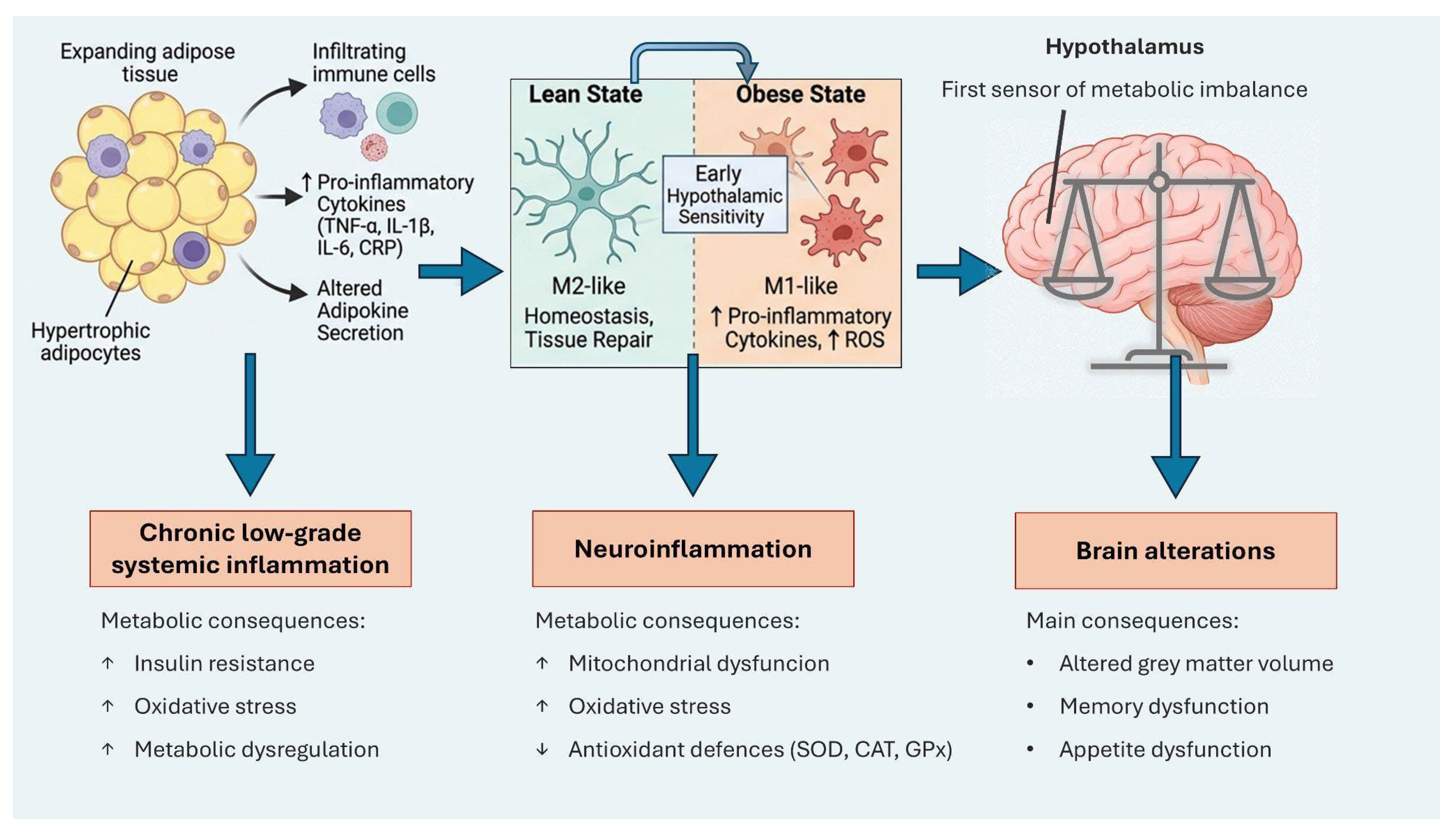

| Authors (Year) | Study Type/Model | Dietary Exposure | Main Mechanism on the CNS–Adipose Tissue Axis | Main Outcomes | References |
|---|---|---|---|---|---|
| Estrada & Contreras (2019) | Review (mechanistic) | High SFA/sugars; Western-type diets | Systemic low-grade inflammation → microglial activation; disruption of immune–CNS homeostasis | ↑ Risk of neurological disorders in obesogenic contexts | [236] |
| Puente-Ruiz & Jais (2022) | Review | — | Bidirectional adipokine/cytokine signaling adipose ↔ CNS; sympathetic regulation of depots | Links obesity to metabolic dysfunction and neurodegeneration | [235] |
| Bruce-Keller et al. (2009) | Review (human + animal) | Diet-induced obesity | Oxidative stress & inflammation; impaired neuronal plasticity | ↑ CNS vulnerability, cognitive decline | [237] |
| Ryan, Woods & Seeley (2012) | Physiological review | Palatable high-fat diets | Elevation of “defended adiposity” via hypothalamic circuits (homeostatic set-point) | Greater difficulty maintaining weight loss | [241] |
| Kaiyala et al. (2000) | Experimental (dog model) | High-fat diet | ↓ Insulin transport into CSF/CNS → weaker negative feedback on adiposity | Increased adiposity and weight gain with reduced CNS insulin delivery | [242] |
| Jamar, Ribeiro & Pisani (2021) | Review | High-fat/high-sugar diets | Microbiota–gut–brain axis dysbiosis; microglial activation; hypothalamic inflammation | Obesity, metabolic syndrome, neuroinflammation | [239] |
| Yu et al. (2022) | Review | Diet-related dysbiosis | Crosstalk adipose tissue ↔ microbiota–gut–brain via microbial metabolites & immune cells | Systemic dysmetabolism impacting CNS signaling | [244] |
| Custers & Kiliaan (2022) | Review | Dietary lipids | BBB transport & brain lipid remodeling; altered lipid metabolism in neural tissue | Contribution to AD, PD, stroke mechanisms | [243] |
| Solas et al. (2017) | Review | Obesity/dietary patterns | Peripheral cytokines & vagal signaling; gut–brain–inflammation triad | Cognitive decline pathways and potential pharmacological targets | [240] |
| Frausto et al. (2021) | Review | Microbiota modulation | SCFAs, bile acids, Trp-derivatives → microglia/astroglia and amyloid pathways | Mechanistic links to Alzheimer’s disease | [245] |
| Godos et al. (2020) | Review | Antioxidant/omega-3-rich diets | ↓ Oxidative stress & neuroinflammation; neurotransmission & neurogenesis modulation | ↓ Depression/anxiety risk; mental health support | [247] |
| Granero & Guillazo-Blanch (2025) | Editorial (Special Issue) | Mediterranean/MIND dietary patterns | ↓ Inflammation; ↑ neuroplasticity and cognitive resilience | Association with ↓ risk of cognitive decline | [246] |
| Léon, Nadjar & Quarta (2021) | Perspective/Mechanistic review | Hypercaloric/high-fat diets | Maladaptive microglia–neuron crosstalk in hypothalamus; cytokines & fuel-sensing | Hypothalamic dysfunction → energy imbalance & obesity progression | [238] |
| Authors (Year) | Study Type/Model | Dietary Exposure | Main Mechanism on the CNS–Adipose Tissue Axis | Main Outcomes | References |
|---|---|---|---|---|---|
| Adepoju et al. (2026) | RCT (humans, obesity) | Almond consumption | ↓ systemic inflammation (cytokines) → indirect CNS signaling | ↓ IL-6, TNF-α; no effect on appetite | [248] |
| Åberg et al. (2025) | RCT (humans) | Wholegrain rye vs. refined wheat | Modulation of gut hormones (ghrelin, incretins) | ↓ ghrelin (postprandial), improved glycemia | [251] |
| Zhang et al. (2024) | RCT crossover (humans) | Eating frequency | No significant modulation of appetite/inflammation axis | No changes in ghrelin, leptin, CRP | [250] |
| Sanchez et al. (2024) | Animal study (mice) | High-fat diet (ω6/ω3 ratio) | Neuroinflammation (hypothalamus, hippocampus) | ↑ neuroinflammation, behavioral changes | [258] |
| Vujović et al. (2022) | RCT crossover (humans) | Meal timing (late vs. early eating) | Hormonal dysregulation (ghrelin/leptin) + adipose gene expression | ↑ hunger, ↓ energy expenditure | [252] |
| Reginato et al. (2021) | Systematic review | High-fat diet/fatty acids | Ceramide accumulation → hypothalamic inflammation → leptin resistance | Impaired energy balance regulation | [257] |
| Reimer et al. (2017) | RCT (humans) | Prebiotics + whey protein | Gut microbiota modulation → appetite signaling | ↓ hunger, altered microbiota | [254] |
| Juanola-Falgarona et al. (2014) | RCT (humans) | Low vs. high glycemic index diets | Metabolic signaling (insulin sensitivity) | ↓ weight, no strong effect on appetite/inflammation | [253] |
| Poulsen et al. (2014) | RCT crossover (humans) | Advanced glycation end products (AGEs) | Acute hormonal modulation (ghrelin) | ↑ ghrelin response; limited inflammation effects | [256] |
| Nilsson et al. (2013) | RCT crossover (humans) | Brown beans (fiber-rich meal) | SCFA production → gut–brain signaling | ↑ satiety hormones, ↓ IL-6 | [255] |
| Sofer et al. (2011) | RCT (humans) | Carbohydrate timing (evening intake) | Hormonal modulation (leptin, adiponectin) | ↓ hunger, ↓ inflammatory markers | [249] |
| Authors (Year) | Study Type/Model | Dietary Exposure | Proposed Mechanisms on the CNS–Adipose Tissue Axis | Main Outcomes | References |
|---|---|---|---|---|---|
| Asoudeh et al. (2023) | RCT, adolescents with MetS | Mediterranean diet | ↓ systemic inflammation may influence adipose–CNS signaling | ↓ IL-6, hs-CRP, improved HOMA-IR and lipid profile | [259] |
| Vitale et al. (2020) | RCT, overweight/obese adults | Mediterranean-like diet | ↑ SCFAs may contribute to gut–brain signaling and metabolic regulation | ↑ insulin sensitivity, ↓ postprandial glucose, microbiota shifts | [260] |
| Ulven et al. (2019) | RCT, MetS subjects | Nordic diet | Modulation of inflammatory gene expression may affect systemic–central signaling pathways | ↓ TNFRSF1A, ↑ RELA expression | [261] |
| Calvo-Malvar et al. (2021) | Cluster RCT, families | Atlantic diet | Improved dietary pattern may indirectly influence adiposity-related signaling to CNS | ↓ body weight, ↓ total cholesterol | [262] |
| Vetrani et al. (2016) | RCT, MetS subjects | Whole-grain diet | ↑ SCFAs (propionate) may modulate gut–brain axis and insulin signaling | ↑ propionate, ↓ postprandial insulin | [263] |
| Zhang et al. (2022) | RCT, overweight/obese adults | Avocado (MUFA + fiber) | Changes in lipid profile and inflammation may influence central metabolic regulation | ↓ CRP; modest effects on glycemic control | [264] |
| Pett et al. (2025) | RCT, overweight/obese adults | Mango intake | Antioxidant pathways (e.g., Nrf2) may indirectly affect metabolic and central signaling | ↑ insulin sensitivity (HOMA-IR), no significant change in inflammation | [265] |
| Palacios et al. (2019) | RCT, prediabetes adults | Almonds vs. CHO foods | Improved nutrient composition may have limited impact on CNS–adipose signaling | No significant effects on insulin sensitivity; improved nutrient profile | [266] |
| Technology | Main Application | Strengths | Limitations | Translational Potential |
|---|---|---|---|---|
| Single-cell RNA sequencing | Identification of adipocyte, immune and hypothalamic cell populations | High cellular resolution; identifies rare cell populations | Tissue dissociation, loss of spatial information, expensive | Biomarker discovery; precision medicine |
| Spatial transcriptomics | Maps gene expression within adipose tissue and hypothalamus | Preserves tissue architecture; identifies cell–cell interactions | High cost; limited availability | Identification of disease-specific niches |
| Single-cell multiomics | Integrates transcriptome, chromatin accessibility and epigenetics | Comprehensive molecular characterization | Computational complexity | Patient stratification |
| Extracellular vesicle profiling | Characterization of adipose-derived EVs reaching the CNS | Minimally invasive biomarkers | Isolation and standardization remain challenging | Early diagnosis; therapeutic monitoring |
| Advanced neuroimaging (MRI, PET) | Assessment of hypothalamic inflammation and brain connectivity | Applicable in humans; longitudinal studies | Indirect markers; expensive | High |
| Metabolomics/Lipidomics | Identification of circulating metabolic mediators | High-throughput; identifies metabolic signatures | Biological variability | Biomarker discovery |
| Chemogenetics | Functional manipulation of neuronal circuits | Demonstrates causality | Animal models only | Low (preclinical) |
| Optogenetics | Precise temporal control of neural circuits | Excellent mechanistic tool | Animal models only | Low |
| Organoids/Organ-on-chip | Human tissue modeling | Human-derived models; personalized approaches | Limited physiological complexity | Medium |
| Artificial intelligence integration | Integration of multiomics and imaging | Predictive models; precision nutrition | Requires large datasets | Very high |
Disclaimer/Publisher’s Note: The statements, opinions and data contained in all publications are solely those of the individual author(s) and contributor(s) and not of MDPI and/or the editor(s). MDPI and/or the editor(s) disclaim responsibility for any injury to people or property resulting from any ideas, methods, instructions or products referred to in the content. |
© 2026 by the authors. Licensee MDPI, Basel, Switzerland. This article is an open access article distributed under the terms and conditions of the Creative Commons Attribution (CC BY) license.
Share and Cite
Castelli, S.; Aiello, G.; De Bruno, A.; Fratantonio, D.; Tripodi, G.; Aiello, V.; Lombardo, M.; Baldelli, S. Adipose Tissue–Central Nervous System Axis in Obesity: Molecular Mechanisms, Inflammation, and Nutritional and Technological Implications. Metabolites 2026, 16, 533. https://doi.org/10.3390/metabo16080533
Castelli S, Aiello G, De Bruno A, Fratantonio D, Tripodi G, Aiello V, Lombardo M, Baldelli S. Adipose Tissue–Central Nervous System Axis in Obesity: Molecular Mechanisms, Inflammation, and Nutritional and Technological Implications. Metabolites. 2026; 16(8):533. https://doi.org/10.3390/metabo16080533
Chicago/Turabian StyleCastelli, Serena, Gilda Aiello, Alessandra De Bruno, Deborah Fratantonio, Gianluca Tripodi, Vincenzo Aiello, Mauro Lombardo, and Sara Baldelli. 2026. "Adipose Tissue–Central Nervous System Axis in Obesity: Molecular Mechanisms, Inflammation, and Nutritional and Technological Implications" Metabolites 16, no. 8: 533. https://doi.org/10.3390/metabo16080533
APA StyleCastelli, S., Aiello, G., De Bruno, A., Fratantonio, D., Tripodi, G., Aiello, V., Lombardo, M., & Baldelli, S. (2026). Adipose Tissue–Central Nervous System Axis in Obesity: Molecular Mechanisms, Inflammation, and Nutritional and Technological Implications. Metabolites, 16(8), 533. https://doi.org/10.3390/metabo16080533