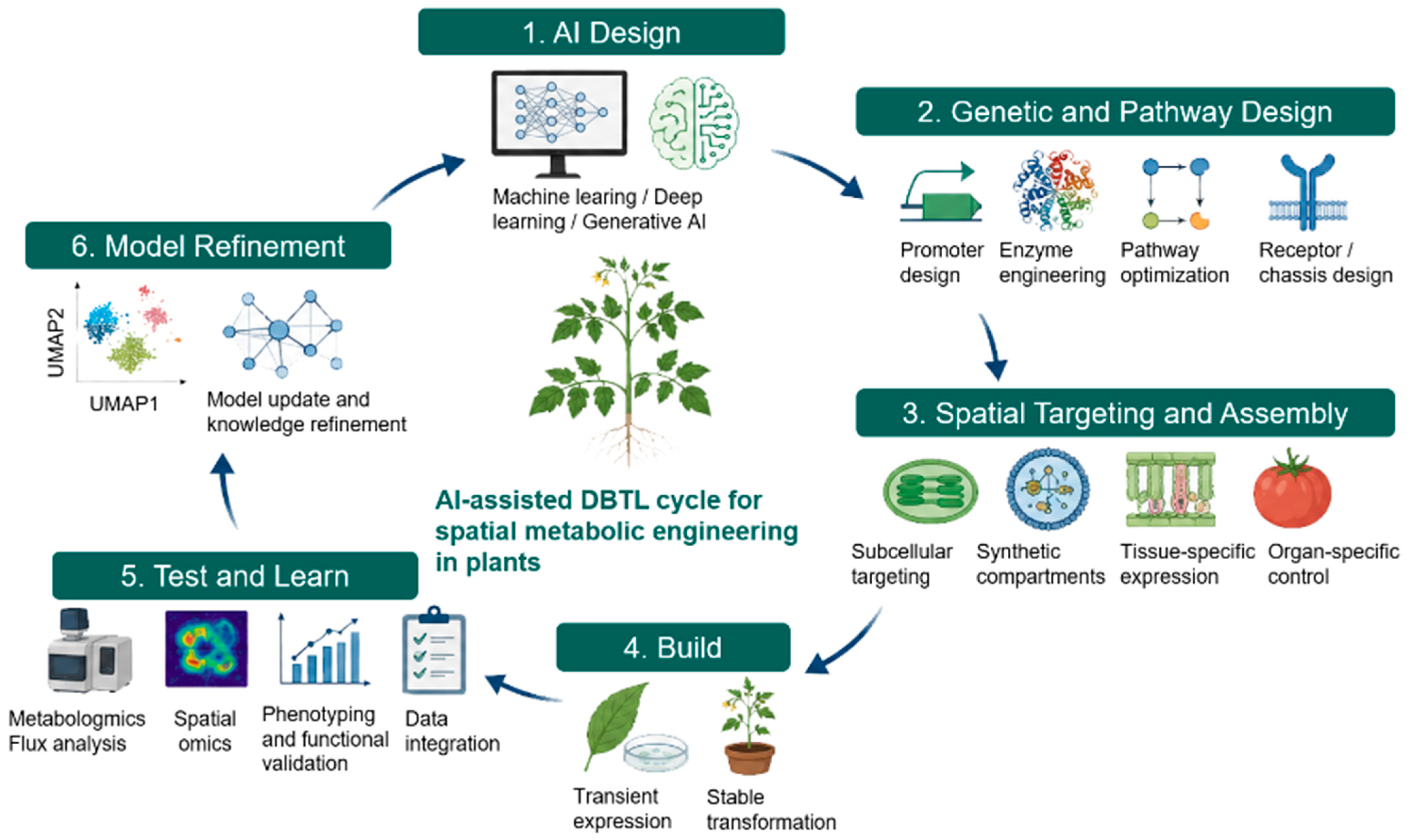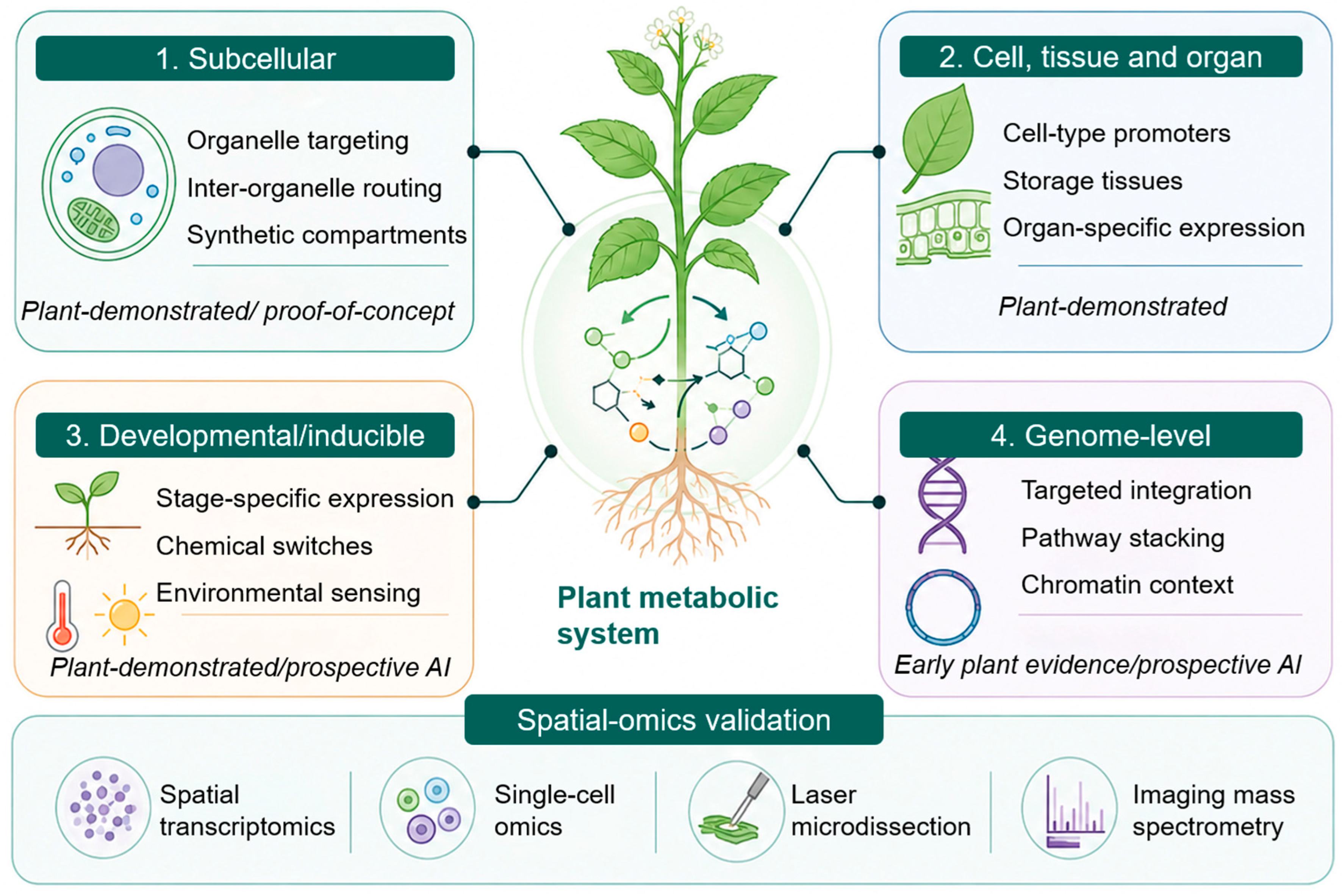

AI-Assisted Spatial Metabolic Engineering in Plants: Integrating Flux Design, Spatial Omics, and Synthetic Biology


Abstract
1. Introduction: Plant Synthetic Biology in the Algorithmic Era
2. Predictive Flux Optimization: From Metabolic Network Modelling to Pathway Balancing
3. Architecting Subcellular Space: From Transit Peptides to Synthetic Organelles
3.1. Organelle-Targeting Peptides and Short Spatial Tags
3.2. Inter-Organelle Routing of Plant Metabolic Pathways
3.3. Synthetic Compartments and Encapsulation Peptides
3.4. Spatial-Omics-Guided Mapping and Validation
4. Secretory Pathway Trafficking and Glycoengineering
5. Cellular and Tissue-Level Spatial Dynamics: AI-Guided Receptor Design
6. Genomic Circuitry: Artificial Chromosomes and Chromatin Topology
7. Generative AI: From Structural Prediction to De Novo Protein Design
8. Conclusions and Future Perspectives
Supplementary Materials
Author Contributions
Funding
Institutional Review Board Statement
Informed Consent Statement
Data Availability Statement
Conflicts of Interest
References
- Wagh, S.G.; Patil, A.M.; Patil, G.B.; Bhor, S.A.; Pawar, K.R.; Shinde, H. Programmable Plant Immunity: Synthetic Biology for Climate-Resilient Agriculture. SynBio 2026, 4, 1. [Google Scholar] [CrossRef] [Scilit]
- Nagegowda, D.A.; Gupta, P. Plant terpenoids for growth, defense and environmental adaptation. Annu. Rev. Plant Biol. 2020, 71, 123–148. [Google Scholar]
- Engler, C.; Kandzia, R.; Marillonnet, S. A one pot, one step, precision cloning method with high throughput capability. PLoS ONE 2008, 3, e3647. [Google Scholar] [CrossRef] [Scilit] [PubMed]
- Taylor, G.M.; Mordaka, P.M.; Heap, J.T. Start-Stop Assembly: A functionally scarless DNA assembly system optimized for metabolic engineering. Nucleic Acids Res. 2019, 47, e17. [Google Scholar] [CrossRef] [Scilit] [PubMed]
- Najafabadi, M.Y.; Jackson, S.A. Hybrid AI in synthetic biology: Next era in agriculture. Trends Plant Sci. 2025, 31, 555–565. [Google Scholar] [CrossRef] [Scilit] [PubMed]
- Ballard, J.L.; Wang, Z.; Li, W.; Shen, L.; Long, Q. Deep learning-based approaches for multi-omics data integration and analysis. BioData Min. 2024, 17, 38. [Google Scholar] [CrossRef] [Scilit] [PubMed]
- Brixi, G.; Durrant, M.G.; Ku, J.; Naghipourfar, M.; Poli, M.; Sun, G.; Brockman, G.; Chang, D.; Fanton, A.; Gonzalez, G.A.; et al. Genome modelling and design across all domains of life with Evo 2. Nature 2026, 652, 1349–1361. [Google Scholar] [CrossRef] [Scilit] [PubMed]
- Li, C.; Zhang, Q.; Chen, H.; Lin, K.; Luo, C.; Yang, M.; Xu, W.; Yao, F.; Yan, J.; Yang, Q.; et al. PlantGFM: A Genomic Foundation Model for Discovery and Creation of Plant Genes. Adv. Sci. 2026, 13, e75772. [Google Scholar] [CrossRef] [Scilit] [PubMed]
- Nielsen, J.; Keasling, J.D. Engineering cellular metabolism. Cell 2016, 164, 1185–1197. [Google Scholar] [CrossRef] [Scilit] [PubMed]
- Gonçalves, D.M.; Henriques, R.; Costa, R.S. Predicting metabolic fluxes from omics data via machine learning: Moving from knowledge-driven towards data-driven approaches. Comput. Struct. Biotechnol. J. 2023, 21, 4960–4973. [Google Scholar] [CrossRef] [Scilit] [PubMed]
- Zampieri, G.; Angione, C.; Coggins, M.; Valle, G. A poly-omics machine-learning method to predict metabolite production in CHO cells. In Proceedings of the 2nd International Electronic Conference of Metabolomics, Online, 20 November–1 December 2017. [Google Scholar]
- Lee, H.; Park, S.; Lee, S.B.; Song, J.; Kim, T.-H.; Kim, B.-G. Tailored biosynthesis of diosmin through reconstitution of the flavonoid pathway in Nicotiana benthamiana. Front. Plant Sci. 2024, 15, 1464877. [Google Scholar] [CrossRef] [Scilit] [PubMed]
- Wu, Q.-W.; Wei, M.; Feng, L.-F.; Ding, L.; Wei, W.-K.; Yang, J.-F.; Lin, X.-J.; Liang, H.-L.; Zhan, R.-T.; Ma, D.-M. Rhamnosyltransferases involved in the biosynthesis of flavone rutinosides in Chrysanthemum species. Plant Physiol. 2022, 190, 2122–2136. [Google Scholar] [CrossRef] [Scilit] [PubMed]
- Kong, Q.; Zheng, L. Implementing OR gates in Arabidopsis protoplasts for dynamic regulation. Nat. Commun. 2025, 16, 1120–1132. [Google Scholar]
- Li, J.; Mutanda, I.; Wang, K.; Yang, L.; Wang, J.; Wang, Y. Chloroplastic metabolic engineering coupled with isoprenoid pool enhancement for committed taxanes biosynthesis in Nicotiana benthamiana. Nat. Commun. 2019, 10, 4850. [Google Scholar] [CrossRef] [Scilit] [PubMed]
- Park, S.; Mani, V.; Ha, K.; Kim, J.A.; Lee, S. Plant synthetic biology: From knowledge to biomolecules. Front. Plant Sci. 2025, 16, 1562216. [Google Scholar] [CrossRef] [Scilit] [PubMed]
- Xiang, X.; Yao, Q.; Deng, K.; Ge, Y.; Xiong, Q.; Lu, Y.; Hu, X. TargetGAN: A generative AI framework for the design of plant core promoters with targeted activity. Plant Commun. 2026, 7, 101851. [Google Scholar] [CrossRef] [Scilit] [PubMed]
- Hernandez-Garcia, C.M.; Finer, J.J. Identification and validation of promoters and cis-acting regulatory elements. Plant Sci. 2014, 217–218, 109–119. [Google Scholar] [CrossRef] [Scilit] [PubMed]
- Ding, J.; Wu, J.-H.; Liu, J.-F.; Yuan, B.-F.; Feng, Y.-Q. Improved methodology for assaying brassinosteroids in plant tissues using magnetic hydrophilic material for both extraction and derivatization. Plant Methods 2014, 10, 39. [Google Scholar] [CrossRef] [Scilit] [PubMed]
- Schad, M.; Mungur, R.; Fiehn, O.; Kehr, J. Metabolic profiling of laser microdissected vascular bundles of Arabidopsis thaliana. Plant Methods 2005, 1, 2. [Google Scholar] [CrossRef] [Scilit] [PubMed]
- Giacomello, S.; Salmén, F.; Terebieniec, B.K.; Vickovic, S.; Navarro, J.F.; Alexeyenko, A.; Reimegård, J.; McKee, L.S.; Mannapperuma, C.; Bulone, V.; et al. Spatially resolved transcriptome profiling in model plant species. Nat. Plants 2017, 3, 17061. [Google Scholar] [CrossRef] [Scilit] [PubMed]
- Denyer, T.; Ma, X.; Klesen, S.; Scacchi, E.; Nieselt, K.; Timmermans, M.C. Spatiotemporal developmental trajectories in the Arabidopsis root revealed using high-throughput single-cell RNA sequencing. Dev. Cell 2019, 48, 840–852.e5. [Google Scholar] [CrossRef] [Scilit] [PubMed]
- Thumuluri, V.; Armenteros, J.J.A.; Johansen, A.R.; Nielsen, H.; Winther, O. DeepLoc 2.0: Multi-label subcellular localization prediction using protein language models. Nucleic Acids Res. 2022, 50, W228–W234. [Google Scholar] [CrossRef] [Scilit] [PubMed]
- Choi, H.I.; Lee, S.H.; Lee, I.H.; Lee, Y.J.; Yun, J.-H.; Choi, D.-Y.; Cho, D.-H.; Shin, B.-S.; Chun, J.; Lee, D.W.; et al. Chlamy_ChloroPred: A deep learning-based, highly accurate binary classifier for chloroplast protein prediction in the model microalga, Chlamydomonas reinhardtii, with potential cross-proteome versatility. Front. Microbiol. 2026, 17, 1744805. [Google Scholar] [CrossRef] [Scilit] [PubMed]
- Almagro Armenteros, J.J.; Salvatore, M.; Emanuelsson, O.; Winther, O.; von Heijne, G.; Elofsson, A.; Nielsen, H. Detecting sequence signals in targeting peptides using deep learning. Life Sci. Alliance 2019, 2, e201900429. [Google Scholar] [CrossRef] [Scilit] [PubMed]
- Muzaffar, A.; Kiani, S.; Khan, M.A.U.; Rao, A.Q.; Ali, A.; Awan, M.F.; Iqbal, A.; Nasir, I.A.; Shahid, A.A.; Husnain, T. Chloroplast localization of Cry1Ac and Cry2A protein-an alternative way of insect control in cotton. Biol. Res. 2015, 48, 14. [Google Scholar] [CrossRef] [Scilit] [PubMed]
- Edgar, S.; Li, F.-S.; Qiao, K.; Weng, J.-K.; Stephanopoulos, G. Engineering of taxadiene synthase for improved selectivity and yield of a key taxol biosynthetic intermediate. ACS Synth. Biol. 2017, 6, 201–205. [Google Scholar] [CrossRef] [Scilit] [PubMed]
- Kerfeld, C.A.; Aussignargues, C.; Zarzycki, J.; Cai, F.; Sutter, M. Bacterial microcompartments. Nat. Rev. Microbiol. 2018, 16, 277–290. [Google Scholar] [CrossRef] [Scilit] [PubMed]
- Long, B.M.; Hee, W.Y.; Sharwood, R.E.; Rae, B.D.; Kaines, S.; Lim, Y.-L.; Nguyen, N.D.; Massey, B.; Bala, S.; von Caemmerer, S.; et al. Carboxysome encapsulation of the CO2-fixing enzyme Rubisco in tobacco chloroplasts. Nat. Commun. 2018, 9, 3570. [Google Scholar] [CrossRef] [Scilit] [PubMed]
- Nicolia, A.; Scotti, N.; D’aGostino, N.; Festa, G.; Sannino, L.; Aufiero, G.; Arimura, S.-I.; Cardi, T. Mitochondrial DNA editing in potato through mitoTALEN and mitoTALECD: Molecular characterization and stability of editing events. Plant Methods 2024, 20, 4. [Google Scholar] [CrossRef] [Scilit] [PubMed]
- Yadav, N.S.; Raza, S.; Wang, Y.; Landa, J.F.; Hegg, E.L.; Hausinger, R.P.; Vermaas, J.V. Quantifying selective metabolite transport for the bacterial microcompartment from Haliangium ochraceum with molecular dynamics simulations. Nanoscale 2026, 18, 6092–6104. [Google Scholar] [CrossRef] [Scilit] [PubMed]
- Young, E.J.; Kirst, H.; Dwyer, M.E.; Vermaas, J.V.; Kerfeld, C.A. Quantitative measurement of molecular permeability to a synthetic bacterial microcompartment shell system. ACS Synth. Biol. 2025, 14, 1405–1413. [Google Scholar] [CrossRef] [Scilit] [PubMed]
- Myers, R.J., Jr.; Tretter, Z.M.; Daffron, A.G.; Fritschi, E.X.; Santos, W.T.; Foster, M.L.; Klotz, M.; Stafford, K.M.; Kasch, C.; Taylor, T.J.; et al. Spatially Resolved Plant Metabolomics. Metabolites 2025, 15, 539. [Google Scholar] [CrossRef] [Scilit] [PubMed]
- Fuentes, P.; Zhou, F.; Erban, A.; Karcher, D.; Kopka, J.; Bock, R. A new synthetic biology approach allows transfer of an entire metabolic pathway from a medicinal plant to a biomass crop. eLife 2016, 5, e13664. [Google Scholar] [CrossRef] [Scilit] [PubMed]
- Butelli, E.; Titta, L.; Giorgio, M.; Mock, H.-P.; Matros, A.; Peterek, S.; Schijlen, E.G.W.M.; Hall, R.D.; Bovy, A.G.; Luo, J.; et al. Enrichment of tomato fruit with health-promoting anthocyanins by expression of select transcription factors. Nat. Biotechnol. 2008, 26, 1301–1308. [Google Scholar] [CrossRef] [Scilit] [PubMed]
- Margolin, E.A.; Strasser, R.; Chapman, R.; Williamson, A.-L.; Rybicki, E.P.; Meyers, A.E. Engineering the plant secretory pathway for the production of next-generation pharmaceuticals. Trends Biotechnol. 2020, 38, 1034–1044. [Google Scholar] [CrossRef] [Scilit] [PubMed]
- Sainsbury, F.; Thuenemann, E.C.; Lomonossoff, G.P. Lomonossoff, pEAQ: Versatile expression vectors for easy and quick transient expression of heterologous proteins in plants. Plant Biotechnol. J. 2009, 7, 682–693. [Google Scholar] [CrossRef] [Scilit] [PubMed]
- Mardanova, E.S.; Vasyagin, E.A.; Ravin, N.V. Virus-like Particles Produced in Plants: A Promising Platform for Recombinant Vaccine Development. Plants 2024, 13, 3564. [Google Scholar] [CrossRef] [Scilit] [PubMed]
- Vo, D.-K.; Trinh, K.T.L. Molecular Farming for Immunization: Current Advances and Future Prospects in Plant-Produced Vaccines. Vaccines 2025, 13, 191. [Google Scholar] [CrossRef] [Scilit] [PubMed]
- Montero-Morales, L.; Steinkellner, H. Advanced plant-based glycan engineering. Front. Bioeng. Biotechnol. 2018, 6, 81. [Google Scholar] [CrossRef] [Scilit] [PubMed]
- Kaur, C.; Song, H.; Lee, M.; Kim, S.-Y.; Seo, D.-H.; Kang, H.; Sohn, E.-J.; Ran, Y.; Koo, O.; Lee, G.-J. Multiplex CRISPR/Cas9-mediated editing of seven glycosyltransferase homologs in Nicotiana benthamiana to produce stable, Cas9-free, glycoengineered plants. Front. Plant Sci. 2025, 16, 1701668. [Google Scholar] [CrossRef] [Scilit] [PubMed]
- Wang, K.Y.; Guo, Y. Editorial: Plant molecular farming for biopharmaceutical production and beyond. Front. Plant Sci. 2026, 16, 1765245. [Google Scholar] [CrossRef] [Scilit] [PubMed]
- Bombarely, A.; Rosli, H.G.; Vrebalov, J.; Moffett, P.; Mueller, L.A.; Martin, G.B. A draft genome sequence of Nicotiana benthamiana to enhance molecular plant-microbe biology research. Mol. Plant-Microbe Interact. 2012, 25, 1523–1530. [Google Scholar] [CrossRef] [Scilit] [PubMed]
- Zeng, H.; Yang, A. Modelling overflow metabolism in Escherichia coli with flux balance analysis incorporating differential proteomic efficiencies of energy pathways. BMC Syst. Biol. 2019, 13, 3. [Google Scholar] [CrossRef] [Scilit] [PubMed]
- Park, S.-Y.; Peterson, F.C.; Mosquna, A.; Yao, J.; Volkman, B.F.; Cutler, S.R. Agrochemical control of plant water use using engineered abscisic acid receptors. Nature 2015, 520, 545–548. [Google Scholar] [CrossRef] [Scilit] [PubMed]
- Ruiz-Partida, R.; Rosario, S.M.; Lozano-Juste, J. An update on crop ABA receptors. Plants 2021, 10, 1087. [Google Scholar] [CrossRef] [Scilit] [PubMed]
- Tian, H.; Beltrán, J.; George, W.; Lenert-Mondou, C.; Seder, N.; Davis, Z.I.; Swift, S.D.; Girke, T.; Whitehead, T.A.; Wheeldon, I.; et al. Unusually Broad-spectrum small-molecule sensing using a single protein scaffold. Proc. Natl. Acad. Sci. USA 2025, 122, e2519924122. [Google Scholar] [CrossRef] [Scilit] [PubMed]
- Snoeck, S.; Lee, H.K.; Schmid, M.W.; Bender, K.W.; Neeracher, M.J.; Fernández-Fernández, A.D.; Santiago, J.; Zipfel, C. Leveraging coevolutionary insights and AI-based structural modeling to unravel receptor–peptide ligand-binding mechanisms. Proc. Natl. Acad. Sci. USA 2024, 121, e2400862121. [Google Scholar] [CrossRef] [Scilit] [PubMed]
- Crossa, J.; Pérez-Rodríguez, P.; Cuevas, J.; Montesinos-López, O.; Jarquín, D.; de los Campos, G.; Burgueño, J.; González-Camacho, J.M.; Pérez-Elizalde, S.; Beyene, Y.; et al. Genomic selection in plant breeding: Methods, models, and perspectives. Trends Plant Sci. 2017, 22, 961–975. [Google Scholar] [CrossRef] [Scilit] [PubMed]
- Birchler, J.A.; Swyers, N.C. Engineered minichromosomes in plants. Exp. Cell Res. 2020, 388, 111852. [Google Scholar] [CrossRef] [Scilit] [PubMed]
- Yu, W.; Han, F.; Gao, Z.; Vega, J.M.; Birchler, J.A. Construction and behavior of engineered minichromosomes in maize. Proc. Natl. Acad. Sci. USA 2007, 104, 8924–8929. [Google Scholar] [CrossRef] [Scilit] [PubMed]
- Carlson, S.R.; Rudgers, G.W.; Zieler, H.; Mach, J.M.; Luo, S.; Grunden, E.; Krol, C.; Copenhaver, G.P.; Preuss, D. Meiotic transmission of an in vitro-assembled autonomous maize minichromosome. PLoS Genet. 2007, 3, e179. [Google Scholar] [CrossRef] [Scilit] [PubMed]
- Zhou, J. Sequence-based modeling of three-dimensional genome architecture from kilobase to chromosome scale. Nat. Genet. 2022, 54, 725–734. [Google Scholar] [CrossRef] [Scilit] [PubMed]
- Fudenberg, G.; Kelley, D.R.; Pollard, K.S. Predicting 3D genome folding from DNA sequence with Akita. Nat. Methods 2020, 17, 1111–1117. [Google Scholar] [CrossRef] [Scilit] [PubMed]
- Krokidis, M.G.; Koumadorakis, D.E.; Lazaros, K.; Ivantsik, O.; Exarchos, T.P.; Vrahatis, A.G.; Kotsiantis, S.; Vlamos, P. AlphaFold3: An Overview of Applications and Performance Insights. Int. J. Mol. Sci. 2025, 26, 3671. [Google Scholar] [CrossRef] [Scilit] [PubMed]
- Abramson, J.; Adler, J.; Dunger, J.; Evans, R.; Green, T.; Pritzel, A.; Ronneberger, O.; Willmore, L.; Ballard, A.J.; Bambrick, J.; et al. Accurate structure prediction of biomolecular interactions with AlphaFold 3. Nature 2024, 630, 493–500. [Google Scholar] [CrossRef] [Scilit] [PubMed]
- Watson, J.L.; Juergens, D.; Bennett, N.R.; Trippe, B.L.; Yim, J.; Eisenach, H.E.; Ahern, W.; Borst, A.J.; Ragotte, R.J.; Milles, L.F.; et al. De novo design of protein structure and function with RFdiffusion. Nature 2023, 620, 1089–1100. [Google Scholar] [CrossRef] [Scilit] [PubMed]
- Dauparas, J.; Anishchenko, I.; Bennett, N.; Bai, H.; Ragotte, R.J.; Milles, L.F.; Wicky, B.I.M.; Courbet, A.; de Haas, R.J.; Bethel, N.; et al. Robust deep learning–based protein sequence design using ProteinMPNN. Science 2022, 378, 49–56. [Google Scholar] [CrossRef] [Scilit] [PubMed]
- Kuang, J.; Liu, N.; Wang, J.; Sun, C.; Ji, T.; Wu, Y. PDFBench: A Benchmark for De novo Protein Design from Function. arXiv 2025, arXiv:2505.20346. [Google Scholar]
- Tran, V.Q.; Nemeth, M.; Bartie, L.J.; Chandrasekaran, S.S.; Fanton, A.; Moon, H.C.; Hie, B.L.; Konermann, S.; Hsu, P.D. Rapid directed evolution guided by protein language models and epistatic interactions. Science 2026, 392, eaea1820. [Google Scholar] [CrossRef] [Scilit] [PubMed]
- Lin, Y.; Li, S.; Zhang, Y. Convergence rate analysis of accelerated forward-backward algorithm with generalized Nesterov momentum scheme. arXiv 2021, arXiv:2112.05873. [Google Scholar]
- Qi, X.; Wang, D.; Shi, Z.; Liao, X.; Ma, H. Generative Artificial Intelligence for Function-Driven De Novo Enzyme Design. Synth. Biol. Eng. 2025, 3, 10015. [Google Scholar] [CrossRef] [Scilit]
- Savinov, A.; Sadasivan, J.; White, K.J.; Rubien, J.D.; Li, G.-W.; Case, L.B. AI-discovered protein fragments as generalizable regulators of biomolecular condensates. bioRxiv 2026. bioRxiv:2026.05.08.723928. [Google Scholar]
- Emenecker, R.J.; Holehouse, A.S.; Strader, L.C. Biological phase separation and biomolecular condensates in plants. Annu. Rev. Plant Biol. 2021, 72, 17–46. [Google Scholar] [CrossRef] [Scilit] [PubMed]



| Plant Chassis | Target Pathway/Product | Spatial Strategy | Reported Outcome | Remaining Bottleneck |
|---|---|---|---|---|
| N. benthamiana | Diosmin/flavonoid pathway | Transient reconstitution of ten diosmin-biosynthetic genes organized into three multigene modules in leaves | 37.7 μg/g FW diosmin [12] | Transient output does not establish stable inheritance, tissue portability, or field performance |
| N. benthamiana | Taxadiene and taxadien-5α-ol | Chloroplast targeting of TS and a transit-peptide-directed truncated T5αH–CPR fusion, combined with DXS/GGPPS-mediated precursor enhancement | 56.6 ± 3.2 μg/g FW taxadiene and 1.3 ± 0.5 μg/g FW taxadien-5α-ol [15] | Inter-organelle transfer, P450 redox coupling, and downstream oxidation remain limiting |
| N. tabacum | Artemisinic-acid pathway | Combinatorial nuclear supertransformation of a transplastomic recipient line (COSTREL) | 120.4 ± 42 mg/kg FW artemisinic acid in the highest-performing T1 line, representing an increase of up to 77-fold relative to the recipient line [34] | Large genotype-to-genotype variation and the need to balance plastid and nuclear expression |
| S. lycopersicum | Anthocyanin biosynthesis | Fruit-specific expression of the snapdragon transcription factors Del and Ros1 | Anthocyanin concentrations comparable to those of blackberries and blueberries, accompanied by an approximately threefold increase in hydrophilic antioxidant capacity [35] | Developmental promoter dependence, metabolic burden, and stability across cultivars and environments |
| Technology Layer | Representative Tools or Strategies | Main Applications in Plant Synthetic Biology | Current Bottlenecks and Unresolved Issues | Evidence Status |
|---|---|---|---|---|
| Sequence-level AI design | Genomic foundation models, promoter design models, regulatory sequence predictors | Gene discovery, synthetic promoter design, regulatory element optimization, variant-effect prediction | Limited plant-specific training datasets, weak interpretability, insufficient validation across species, tissues, developmental stages, and environmental conditions | Early plant proof-of-concept for plant-specific genomic models; most generative applications remain prospective |
| Flux and pathway optimization | FBA, pFBA, machine learning-based flux prediction, multi-omics-constrained metabolic models | Identification of rate-limiting reactions, pathway balancing, precursor supply optimization, reduction in competing metabolic sinks | Incomplete plant metabolic models, poorly annotated specialized metabolism, uncertain transport reactions, and limited compartment-specific flux data | Plant-demonstrated for metabolic modelling and pathway optimization, although many AI models are trained or benchmarked mainly in microbial and mammalian systems |
| Subcellular targeting and compartmentalization | Transit peptide design, protein localization predictors, chloroplast targeting, ER–plastid pathway partitioning | Organelle-specific pathway construction, improved precursor utilization, reduction in intermediate toxicity, cofactor-aware pathway design | Predicted localization does not guarantee import efficiency, correct processing, protein folding, catalytic activity, or compatibility with local redox and cofactor environments | Plant-demonstrated for chloroplast, mitochondrial, ER, Golgi, vacuolar, and tissue-specific targeting; AI-guided de novo targeting-sequence design remains early-stage |
| Synthetic organelles and spatial scaffolds | Bacterial microcompartments, encapsulation peptides, synthetic chloroplastic scaffolds, proteinaceous nanoreactors | Enzyme clustering, metabolite sequestration, pathway insulation, prevention of volatile or toxic intermediate loss | Cargo loading efficiency, shell permeability, developmental stability, energetic burden, organelle compatibility, and scalability remain poorly resolved | Early plant proof-of-concept for carboxysome-related and shell-protein components; broadly functional BMC nanoreactors remain prospective |
| Secretory pathway and glycoengineering | Viral expression vectors, ER/Golgi targeting, multiplex CRISPR/Cas9-mediated glycan remodeling | Recombinant protein production, vaccine manufacturing, therapeutic protein expression, humanized glycosylation | Product quality consistency, protein-specific glycoform variation, downstream purification, regulatory approval, and large-scale manufacturing remain major challenges | Plant-demonstrated and commercially relevant for transient expression and glycoengineering |
| Cellular, tissue, and organ-level control | Synthetic receptors, chemically inducible dimerization systems, tissue-specific promoters, AI-assisted receptor design | Environmental sensing, inducible pathway activation, stomatal regulation, stress-responsive metabolic or signalling control | Field-level ligand persistence, unintended receptor activation, ecological safety, specificity, reversibility, and regulatory acceptance require further evaluation | Plant-demonstrated for tissue-specific expression and PYR1-MANDI; broad AI-guided receptor redesign remains prospective |
| Genome-level pathway stacking | CRISPR-based targeted integration, landing-pad prediction, artificial chromosomes, chromatin-aware transgene design | Stable multigene pathway assembly, reduced positional effects, long-term inheritance of complex synthetic traits | Plant artificial chromosome systems remain immature; epigenetic silencing, meiotic stability, transformation efficiency, and reliable landing-pad prediction remain limiting | Early plant evidence for engineered minichromosomes and targeted integration; routine artificial-chromosome deployment remains prospective |
| Generative protein and spatial validation platforms | AlphaFold 3, RFdiffusion, ProteinMPNN, condensate engineering, spatial omics, automated DBTL platforms | Enzyme redesign, catalytic optimization, membrane-free compartmentalization, spatial validation, iterative model refinement | Most designs require extensive experimental validation; plant-specific folding environments, subcellular physiology, data standardization, and biofoundry infrastructure remain insufficient | Predominantly non-plant proof-of-concept; plant metabolic applications remain largely prospective |
| Biomolecular condensate engineering | FragFold-like peptide design, phase-separation modulators, synthetic interaction fragments | Membrane-free enzyme organization, dynamic pathway clustering, and potential sequestration of selected enzymes or intermediates | Limited peer-reviewed validation, uncertain condensate stability in plant cells, possible interference with endogenous phase-separated systems, uncontrolled material properties, off-target interactions, and unknown physiological burden | Non-plant proof-of-concept, including preprint-level evidence; plant applications are prospective |
| Spatial-omics-guided validation | Spatial transcriptomics, single-cell or single-nucleus RNA sequencing, laser-capture microdissection, imaging mass spectrometry, spatial metabolomics | Identification of biosynthetic cell types, mapping of pathway expression, metabolite localization, transport-route inference, storage-site identification, and toxicity assessment | High cost, limited throughput, tissue-sectioning artefacts, cell-wall constraints, metabolite instability, autofluorescence, incomplete cross-platform standardization, and difficulties linking spatial abundance to actual metabolic flux | Plant-demonstrated for spatial mapping and cell-type resolution; integration with AI-guided metabolic engineering remains emerging |
| Integrated AI–DBTL workflow | High-throughput screening, robotics, microfluidics, multi-omics feedback, spatial metabolomics | Closed-loop design-build-test-learn optimization for predictable plant biomanufacturing | Infrastructure-intensive; plant systems remain slower and less standardized than microbial chassis; stable in planta validation is still a major bottleneck | Early-stage in plants; more mature in microbial systems |
Disclaimer/Publisher’s Note: The statements, opinions and data contained in all publications are solely those of the individual author(s) and contributor(s) and not of MDPI and/or the editor(s). MDPI and/or the editor(s) disclaim responsibility for any injury to people or property resulting from any ideas, methods, instructions or products referred to in the content. |
© 2026 by the authors. Licensee MDPI, Basel, Switzerland. This article is an open access article distributed under the terms and conditions of the Creative Commons Attribution (CC BY) license.
Share and Cite
Chen, H.; Yang, J.; Du, M. AI-Assisted Spatial Metabolic Engineering in Plants: Integrating Flux Design, Spatial Omics, and Synthetic Biology. Metabolites 2026, 16, 519. https://doi.org/10.3390/metabo16080519
Chen H, Yang J, Du M. AI-Assisted Spatial Metabolic Engineering in Plants: Integrating Flux Design, Spatial Omics, and Synthetic Biology. Metabolites. 2026; 16(8):519. https://doi.org/10.3390/metabo16080519
Chicago/Turabian StyleChen, Huize, Jia Yang, and Meiting Du. 2026. "AI-Assisted Spatial Metabolic Engineering in Plants: Integrating Flux Design, Spatial Omics, and Synthetic Biology" Metabolites 16, no. 8: 519. https://doi.org/10.3390/metabo16080519
APA StyleChen, H., Yang, J., & Du, M. (2026). AI-Assisted Spatial Metabolic Engineering in Plants: Integrating Flux Design, Spatial Omics, and Synthetic Biology. Metabolites, 16(8), 519. https://doi.org/10.3390/metabo16080519