
Gut Microbiota–Bile Acid Axis in Type 2 Diabetes–Associated Gallbladder Diseases: Mechanisms and Therapeutic Potential

Abstract
1. Introduction
2. Physiological Regulatory Network of the Gut Microbiota–Bile Acid Axis
2.1. Bile Acid Synthesis and Enterohepatic Circulation
2.2. Microbial Transformation of Bile Acids and Regulatory Pathways
2.3. Regulation of Gut Microbial Composition by Bile Acids
3. Diabetes-Associated Remodeling: Pathological Specificity of the Gut Microbiota–Bile Acid Axis
3.1. Diabetes-Associated Dysbiosis and Microbial Functional Modules for Bile Acid Metabolism
3.2. Diabetes-Associated Bile Acid Profiles and Metabolic Coupling via FXR–FGF15/19 and TGR5–GLP-1
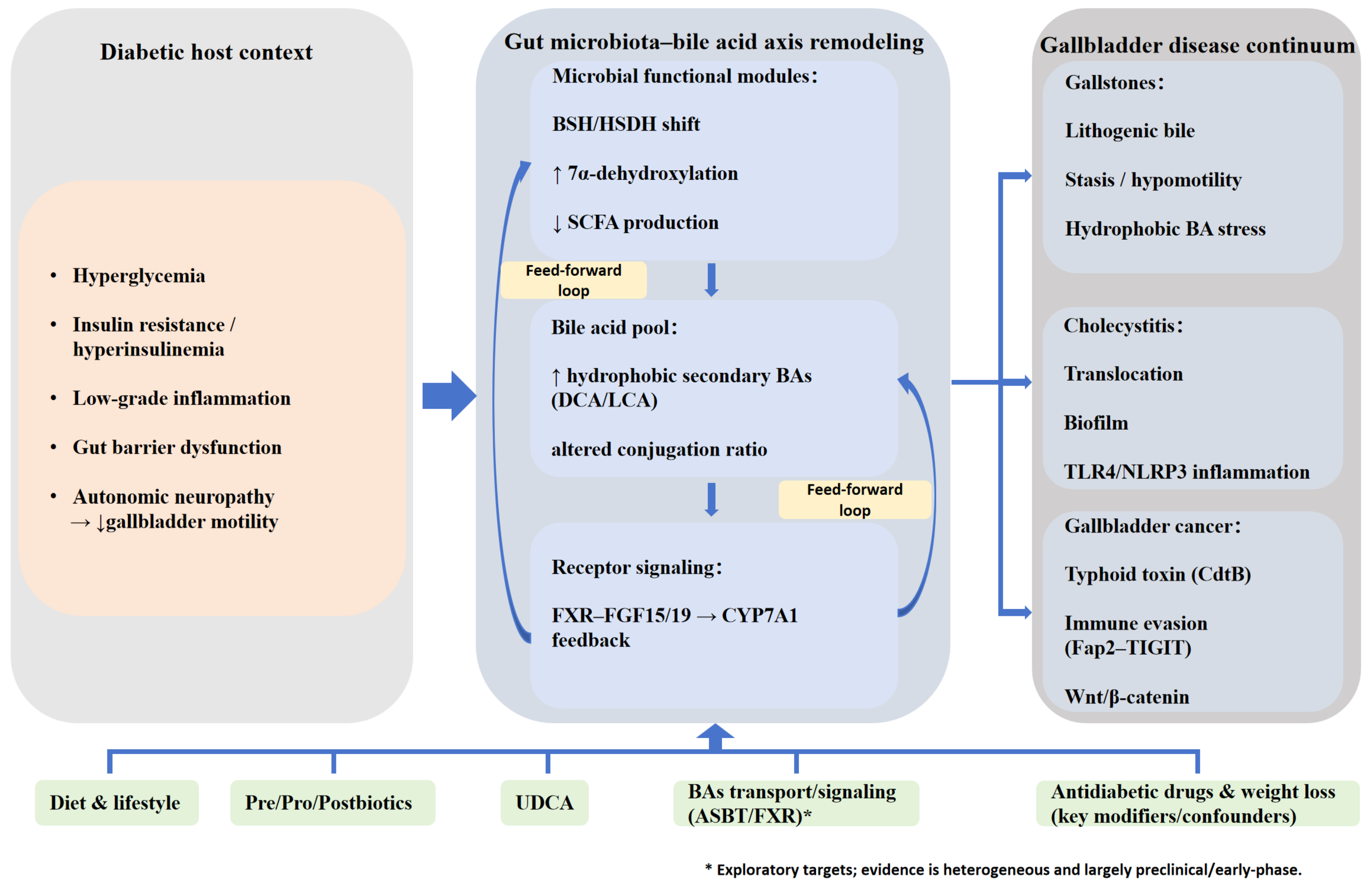
3.3. Diabetes-Related Host Factors Drive Axis Dysfunction Toward the Gallbladder Disease Continuum
4. Gallbladder Disease Continuum in the Diabetic Host
4.1. Cholelithiasis
4.1.1. Dysbiosis-Related Signatures and Pathogenic Mechanisms
4.1.2. Targeted Therapeutic Strategies
4.2. Cholecystitis
4.2.1. Dysbiosis-Related Signatures and Pathogenic Mechanisms
4.2.2. Targeted Therapeutic Strategies
4.3. Gallbladder Cancer
4.3.1. Dysbiosis-Related Signatures and Pathogenic Mechanisms
4.3.2. Targeted Therapeutic Strategies
5. Conclusions and Perspectives
Author Contributions
Funding
Institutional Review Board Statement
Informed Consent Statement
Data Availability Statement
Conflicts of Interest
Abbreviations
| ASBT | Apical sodium-dependent bile acid transporter |
| BA | Bile acid |
| BAAT | Bile acid–CoA:amino acid N-acyltransferase |
| BACS | Bile acid–CoA synthetase |
| BSEP | Bile salt export pump |
| BSH | Bile salt hydrolase |
| CA | Cholic acid |
| CCK | Cholecystokinin |
| CDCA | Chenodeoxycholic acid |
| CoA | Coenzyme A |
| CdtB | Cytolethal distending toxin subunit B (typhoid toxin component) |
| CYP7A1 | Cholesterol 7α-hydroxylase |
| CYP8B1 | Cholesterol 12α-hydroxylase |
| CYP27A1 | Sterol 27-hydroxylase |
| DCA | Deoxycholic acid |
| DPP-4 | Dipeptidyl peptidase-4 |
| DPP-4i | Dipeptidyl peptidase-4 inhibitor |
| FGF15/19 | Fibroblast growth factor 15/19 (FGF15 in mice; FGF19 in humans) |
| FMT | Fecal microbiota transplantation |
| FXR | Farnesoid X receptor |
| GBC | Gallbladder cancer |
| GLP-1 | Glucagon-like peptide-1 |
| GLP-1RA | Glucagon-like peptide-1 receptor agonist |
| HbA1c | Glycated hemoglobin A1c |
| H2S | Hydrogen sulfide |
| HSDH | Hydroxysteroid dehydrogenase |
| IGF-1 | Insulin-like growth factor 1 |
| LCA | Lithocholic acid |
| LPS | Lipopolysaccharide |
| NF-κB | Nuclear factor kappa B |
| NK cell | Natural killer cell |
| NLRP3 | NOD-like receptor family pyrin domain-containing 3 |
| NTCP | Na+-taurocholate cotransporting polypeptide |
| OSTα/OSTβ | Organic solute transporter alpha/beta |
| RYGB | Roux-en-Y gastric bypass |
| SCFA | Short-chain fatty acid |
| SG | Sleeve gastrectomy |
| SGLT2 | Sodium–glucose cotransporter 2 |
| SGLT2i | Sodium–glucose cotransporter 2 inhibitor |
| T2DM | Type 2 diabetes mellitus |
| T-βMCA | Tauro-β-muricholic acid |
| TGR5 | Takeda G protein–coupled receptor 5 (also known as GPBAR1) |
| TIGIT | T cell immunoreceptor with Ig and ITIM domains |
| TLR4 | Toll-like receptor 4 |
| TUDCA | Tauroursodeoxycholic acid |
| UDCA | Ursodeoxycholic acid |
| Wnt | Wingless-related integration site signaling pathway |
References
- Konyn, P.; Alshuwaykh, O.; Dennis, B.B.; Cholankeril, G.; Ahmed, A.; Kim, D. Gallstone Disease and Its Association with Nonalcoholic Fatty Liver Disease, All-Cause and Cause-Specific Mortality. Clin. Gastroenterol. Hepatol. Off. Clin. Pract. J. Am. Gastroenterol. Assoc. 2023, 21, 940–948.e2. [Google Scholar] [CrossRef]
- Velamazán, R.; López-Guillén, P.; Martínez-Domínguez, S.J.; Abad Baroja, D.; Oyón, D.; Arnau, A.; Ruiz-Belmonte, L.M.; Tejedor-Tejada, J.; Zapater, R.; Martín-Vicente, N.; et al. Symptomatic Gallstone Disease: Recurrence Patterns and Risk Factors for Relapse after First Admission, the RELAPSTONE Study. United Eur. Gastroenterol. J. 2024, 12, 286–298. [Google Scholar] [CrossRef]
- Koshiol, J.; Yu, B.; Kabadi, S.M.; Baria, K.; Shroff, R.T. Epidemiologic Patterns of Biliary Tract Cancer in the United States: 2001–2015. BMC Cancer 2022, 22, 1178. [Google Scholar] [CrossRef] [PubMed]
- Bray, F.; Laversanne, M.; Sung, H.; Ferlay, J.; Siegel, R.L.; Soerjomataram, I.; Jemal, A. Global Cancer Statistics 2022: GLOBOCAN Estimates of Incidence and Mortality Worldwide for 36 Cancers in 185 Countries. CA. Cancer J. Clin. 2024, 74, 229–263. [Google Scholar] [CrossRef] [PubMed]
- Toussi, N.; Daida, K.; Moser, M.; Le, D.; Hagel, K.; Kanthan, R.; Shaw, J.; Zaidi, A.; Chalchal, H.; Ahmed, S. Prognostic Factors in Patients Diagnosed with Gallbladder Cancer over a Period of 20 Years: A Cohort Study. Cancers 2024, 16, 2932. [Google Scholar] [CrossRef] [PubMed]
- Yuan, S.; Gill, D.; Giovannucci, E.L.; Larsson, S.C. Obesity, Type 2 Diabetes, Lifestyle Factors, and Risk of Gallstone Disease: A Mendelian Randomization Investigation. Clin. Gastroenterol. Hepatol. Off. Clin. Pract. J. Am. Gastroenterol. Assoc. 2022, 20, e529–e537. [Google Scholar] [CrossRef]
- Yan, P.; Zhang, L.; Yang, C.; Zhang, W.; Wang, Y.; Zhang, M.; Cui, H.; Tang, M.; Chen, L.; Wu, X.; et al. Observational and Genetic Analyses Clarify the Relationship between Type 2 Diabetes Mellitus and Gallstone Disease. Front. Endocrinol. 2024, 14, 1337071. [Google Scholar] [CrossRef]
- Ramírez-Mejía, M.M.; Ponciano-Rodriguez, G.; Eslam, M.; Méndez-Sánchez, N. GLP-1 Receptor Agonists and Gallbladder Disease Risk: Insights into Molecular Mechanisms and Clinical Implications. Ther. Adv. Endocrinol. Metab. 2025, 16, 20420188251406456. [Google Scholar] [CrossRef]
- Fu, T.; Sun, Y.; Lu, S.; Zhao, J.; Dan, L.; Shi, W.; Chen, J.; Chen, Y.; Li, X. Risk Assessment for Gastrointestinal Diseases via Clinical Dimension and Genome-Wide Polygenic Risk Scores of Type 2 Diabetes: A Population-Based Cohort Study. Diabetes Care 2024, 47, 418–426. [Google Scholar] [CrossRef]
- Nikolaidis, C.G.; Gyriki, D.; Stavropoulou, E.; Karlafti, E.; Didangelos, T.; Tsigalou, C.; Thanopoulou, A. Modulating the Gut Microbiome in Type 2 Diabetes: Nutritional and Therapeutic Strategies. Nutrients 2025, 18, 89. [Google Scholar] [CrossRef]
- Yuan, J.-H.; Xie, Q.-S.; Chen, G.-C.; Huang, C.-L.; Yu, T.; Chen, Q.-K.; Li, J.-Y. Impaired Intestinal Barrier Function in Type 2 Diabetic Patients Measured by Serum LPS, Zonulin, and IFABP. J. Diabetes Complicat. 2021, 35, 107766. [Google Scholar] [CrossRef]
- Portincasa, P.; Di Ciaula, A.; Bonfrate, L.; Stella, A.; Garruti, G.; Lamont, J.T. Metabolic Dysfunction-Associated Gallstone Disease: Expecting More from Critical Care Manifestations. Intern. Emerg. Med. 2023, 18, 1897–1918. [Google Scholar] [CrossRef]
- Li, H.; Li, W.; Liu, X.; Zhang, J.; Lin, C.; Ji, S.; Jiang, H.; Wang, T.; Su, Z. The Gut Microbiota Features and the Application Value in Predicting Recurrent Risks for Gallstone Patients Who Underwent Laparoscopic Cholecystectomy. Msystems 2025, 10, e01760-24. [Google Scholar] [CrossRef]
- Yang, R.; Yang, L.; Long, M.; Wu, F.; Shi, Y.; Xia, R.; Lv, J.; Zhang, Y.; Lei, Y.; Jiao, Y.; et al. Taurodeoxycholic Acid-YAP1 Upregulates OTX1 in Promoting Gallbladder Cancer Malignancy through IFITM3-Dependent AKT Activation. Oncogene 2023, 42, 1466–1477. [Google Scholar] [CrossRef]
- Hu, X.; Binxu, Q.; Shao, G.; Huang, Y.; Qiu, W. Gut Microbiota, Circulating Metabolites, and Gallstone Disease: A Mendelian Randomization Study. Front. Microbiol. 2024, 15, 1336673. [Google Scholar] [CrossRef] [PubMed]
- Zhang, X.; Hu, J.; Li, Y.; Tang, J.; Yang, K.; Zhong, A.; Liu, Y.; Zhang, T. Gallbladder Microbial Species and Host Bile Acids Biosynthesis Linked to Cholesterol Gallstone Comparing to Pigment Individuals. Front. Cell. Infect. Microbiol. 2024, 14, 1283737. [Google Scholar] [CrossRef] [PubMed]
- Wang, K.; Fan, J.; Chen, H.; Huang, B.; Chi, C.; Yan, R.; Wu, D.; Zhou, F.; Zhang, W.; Jiang, J.; et al. Structure and Mechanism of the Human Bile Acid Transporter OSTα-OSTβ. Nature 2026, 651, 251–259. [Google Scholar] [CrossRef] [PubMed]
- Chiang, J.Y.L.; Ferrell, J.M. Up to Date on Cholesterol 7 Alpha-Hydroxylase (CYP7A1) in Bile Acid Synthesis. Liver Res. 2020, 4, 47–63. [Google Scholar] [CrossRef]
- Differences in the Regulation of the Classical and the Alternative Pathway for Bile Acid Synthesis in Human Liver: NO COORDINATE REGULATION OF CYP7A1 AND CYP27A1. J. Biol. Chem. 2002, 277, 26804–26807. [CrossRef]
- Taylor, R.; Yang, Z.; Henry, Z.; Capece, G.; Meadows, V.; Otersen, K.; Basaly, V.; Bhattacharya, A.; Mera, S.; Zhou, P.; et al. Characterization of Individual Bile Acids in Vivo Utilizing a Novel Low Bile Acid Mouse Model. Toxicol. Sci. 2024, 199, 316–331. [Google Scholar] [CrossRef]
- Zhong, S.; Chèvre, R.; Castaño Mayan, D.; Corlianò, M.; Cochran, B.J.; Sem, K.P.; van Dijk, T.H.; Peng, J.; Tan, L.J.; Hartimath, S.V.; et al. Haploinsufficiency of CYP8B1 Associates with Increased Insulin Sensitivity in Humans. J. Clin. Investig. 2022, 132, e152961. [Google Scholar] [CrossRef] [PubMed]
- Wu, K.; Liu, Y.; Xia, J.; Liu, J.; Wang, K.; Liang, H.; Xu, F.; Liu, D.; Nie, D.; Tang, X.; et al. Loss of SLC27A5 Activates Hepatic Stellate Cells and Promotes Liver Fibrosis via Unconjugated Cholic Acid. Adv. Sci. 2023, 11, 2304408. [Google Scholar] [CrossRef] [PubMed]
- Gruget, C.; Reddy, B.G.; Moore, J.M. A Structural and Mechanistic Model for BSEP Dysfunction in PFIC2 Cholestatic Disease. Commun. Biol. 2025, 8, 531. [Google Scholar] [CrossRef] [PubMed]
- Detwiler, Z.; Chaudhari, S.N. BAAT Away Liver Cancer: Conjugated Bile Acids Impair T Cell Function in Hepatocellular Carcinoma Immunotherapy. Immunometabolism 2025, 7, e00062. [Google Scholar] [CrossRef]
- Miyazaki, T.; Ueda, H.; Ikegami, T.; Honda, A. Upregulation of Taurine Biosynthesis and Bile Acid Conjugation with Taurine through FXR in a Mouse Model with Human-like Bile Acid Composition. Metabolites 2023, 13, 824. [Google Scholar] [CrossRef]
- Huo, X.; Yu, Z.; Zhao, F.; Chen, Y.; Chen, P.; Xing, L.; Qiao, Y.; Peng, Y.; Tian, M.; Zhou, M.; et al. Hepatocyte Aquaporin 8-Mediated Water Transport Facilitates Bile Dilution and Prevents Gallstone Formation in Mice. J. Hepatol. 2025, 82, 464–479. [Google Scholar] [CrossRef]
- Xu, H.; Fang, F.; Wu, K.; Song, J.; Li, Y.; Lu, X.; Liu, J.; Zhou, L.; Yu, W.; Yu, F.; et al. Gut Microbiota-Bile Acid Crosstalk Regulates Murine Lipid Metabolism via the Intestinal FXR-FGF19 Axis in Diet-Induced Humanized Dyslipidemia. Microbiome 2023, 11, 262. [Google Scholar] [CrossRef]
- Wu, X.; Li, J.-Y.; Lee, A.; Lu, Y.-X.; Zhou, S.-Y.; Owyang, C. Satiety Induced by Bile Acids Is Mediated via Vagal Afferent Pathways. JCI Insight 2020, 5, e132400. [Google Scholar] [CrossRef]
- Sultan, M.; Rao, A.; Elpeleg, O.; Vaz, F.M.; Abu Libdeh, B.Y.; Karpen, S.J.; Dawson, P.A. Organic Solute Transporter-Beta (SLC51B) Deficiency in Two Brothers with Congenital Diarrhea and Features of Cholestasis. Hepatology 2018, 68, 590–598. [Google Scholar] [CrossRef]
- Roscam Abbing, R.L.P.; Slijepcevic, D.; Donkers, J.M.; Havinga, R.; Duijst, S.; Paulusma, C.C.; Kuiper, J.; Kuipers, F.; Groen, A.K.; Oude Elferink, R.P.J.; et al. Blocking Sodium-Taurocholate Cotransporting Polypeptide Stimulates Biliary Cholesterol and Phospholipid Secretion in Mice. Hepatology 2020, 71, 247–258. [Google Scholar] [CrossRef]
- Chiang, J.Y.L. Bile Acid Metabolism and Signaling. Compr. Physiol. 2013, 3, 1191–1212. [Google Scholar] [CrossRef] [PubMed]
- Shulpekova, Y.; Shirokova, E.; Zharkova, M.; Tkachenko, P.; Tikhonov, I.; Stepanov, A.; Sinitsyna, A.; Izotov, A.; Butkova, T.; Shulpekova, N.; et al. A Recent Ten-Year Perspective: Bile Acid Metabolism and Signaling. Molecules 2022, 27, 1983. [Google Scholar] [CrossRef] [PubMed]
- Fleishman, J.S.; Kumar, S. Bile Acid Metabolism and Signaling in Health and Disease: Molecular Mechanisms and Therapeutic Targets. Signal Transduct. Targeted Ther. 2024, 9, 97. [Google Scholar] [CrossRef] [PubMed]
- Meibom, K.L.; Marion, S.; Volet, C.; Nass, T.; Vico-Oton, E.; Menin, L.; Bernier-Latmani, R. BaiJ and BaiB Are Key Enzymes in the Chenodeoxycholic Acid 7α-Dehydroxylation Pathway in the Gut Microbe Clostridium Scindens ATCC 35704. Gut Microbes 2024, 16, 2323233. [Google Scholar] [CrossRef]
- Wise, J.L.; Cummings, B.P. The 7-α-Dehydroxylation Pathway: An Integral Component of Gut Bacterial Bile Acid Metabolism and Potential Therapeutic Target. Front. Microbiol. 2023, 13, 1093420. [Google Scholar] [CrossRef]
- Gonzalez, F.J.; Jiang, C.; Patterson, A.D. An Intestinal Microbiota-Farnesoid X Receptor Axis Modulates Metabolic Disease. Gastroenterology 2016, 151, 845–859. [Google Scholar] [CrossRef]
- Liu, Y.; Chen, K.; Li, F.; Gu, Z.; Liu, Q.; He, L.; Shao, T.; Song, Q.; Zhu, F.; Zhang, L.; et al. Probiotic Lactobacillus Rhamnosus GG Prevents Liver Fibrosis through Inhibiting Hepatic Bile Acid Synthesis and Enhancing Bile Acid Excretion in Mice. Hepatology 2020, 71, 2050–2066. [Google Scholar] [CrossRef]
- Ye, X.; Shen, S.; Xu, Z.; Zhuang, Q.; Xu, J.; Wang, J.; Dong, Z.; Wan, X. Sodium Butyrate Alleviates Cholesterol Gallstones by Regulating Bile Acid Metabolism. Eur. J. Pharmacol. 2021, 908, 174341. [Google Scholar] [CrossRef]
- Wu, L.; Zhou, J.; Zhou, A.; Lei, Y.; Tang, L.; Hu, S.; Wang, S.; Xiao, X.; Chen, Q.; Tu, D.; et al. Lactobacillus Acidophilus Ameliorates Cholestatic Liver Injury through Inhibiting Bile Acid Synthesis and Promoting Bile Acid Excretion. Gut Microbes 2024, 16, 2390176. [Google Scholar] [CrossRef]
- Biagioli, M.; Di Giorgio, C.; Massa, C.; Marchianò, S.; Bellini, R.; Bordoni, M.; Urbani, G.; Roselli, R.; Lachi, G.; Morretta, E.; et al. Microbial-Derived Bile Acid Reverses Inflammation in IBD via GPBAR1 Agonism and RORγt Inverse Agonism. Biomed. Pharmacother. 2024, 181, 117731. [Google Scholar] [CrossRef]
- Chai, L.-N.; Wu, H.; Wang, X.-J.; He, L.-J.; Guo, C.-F. The Mechanism of Antimicrobial Activity of Conjugated Bile Acids against Lactic Acid Bacilli. Microorganisms 2023, 11, 1823. [Google Scholar] [CrossRef]
- Wang, Y.; Yu, Y.; Li, L.; Zheng, M.; Zhou, J.; Gong, H.; Feng, B.; Wang, X.; Meng, X.; Cui, Y.; et al. Bile Acid-Dependent Transcription Factors and Chromatin Accessibility Determine Regional Heterogeneity of Intestinal Antimicrobial Peptides. Nat. Commun. 2023, 14, 5093. [Google Scholar] [CrossRef] [PubMed]
- Peng, Y.-L.; Wang, S.-H.; Zhang, Y.-L.; Chen, M.-Y.; He, K.; Li, Q.; Huang, W.-H.; Zhang, W. Effects of Bile Acids on the Growth, Composition and Metabolism of Gut Bacteria. npj Biofilms Microbiomes 2024, 10, 112. [Google Scholar] [CrossRef] [PubMed]
- Wahlström, A.; Brumbaugh, A.; Sjöland, W.; Olsson, L.; Wu, H.; Henricsson, M.; Lundqvist, A.; Makki, K.; Hazen, S.L.; Bergström, G.; et al. Production of Deoxycholic Acid by Low-Abundant Microbial Species Is Associated with Impaired Glucose Metabolism. Nat. Commun. 2024, 15, 4276. [Google Scholar] [CrossRef] [PubMed]
- Marion, S.; Studer, N.; Desharnais, L.; Menin, L.; Escrig, S.; Meibom, A.; Hapfelmeier, S.; Bernier-Latmani, R. In Vitro and in Vivo Characterization of Clostridium Scindens Bile Acid Transformations. Gut Microbes 2018, 10, 481–503. [Google Scholar] [CrossRef]
- Wang, W.; Zhao, J.; Gui, W.; Sun, D.; Dai, H.; Xiao, L.; Chu, H.; Du, F.; Zhu, Q.; Schnabl, B.; et al. Tauroursodeoxycholic Acid Inhibits Intestinal Inflammation and Barrier Disruption in Mice with Non-alcoholic Fatty Liver Disease. Br. J. Pharmacol. 2018, 175, 469–484. [Google Scholar] [CrossRef]
- Zhang, Y.; Cheng, Y.; Liu, J.; Zuo, J.; Yan, L.; Thring, R.W.; Ba, X.; Qi, D.; Wu, M.; Gao, Y.; et al. Tauroursodeoxycholic Acid Functions as a Critical Effector Mediating Insulin Sensitization of Metformin in Obese Mice. Redox Biol. 2022, 57, 102481. [Google Scholar] [CrossRef]
- Jena, P.K.; Sheng, L.; Liu, H.-X.; Kalanetra, K.M.; Mirsoian, A.; Murphy, W.J.; French, S.W.; Krishnan, V.V.; Mills, D.A.; Wan, Y.-J.Y. Western Diet–Induced Dysbiosis in Farnesoid X Receptor Knockout Mice Causes Persistent Hepatic Inflammation after Antibiotic Treatment. Am. J. Pathol. 2017, 187, 1800–1813. [Google Scholar] [CrossRef]
- Zhang, L.; Xie, C.; Nichols, R.G.; Chan, S.H.J.; Jiang, C.; Hao, R.; Smith, P.B.; Cai, J.; Simons, M.N.; Hatzakis, E.; et al. Farnesoid X Receptor Signaling Shapes the Gut Microbiota and Controls Hepatic Lipid Metabolism. Msystems 2016, 1, e00070-16. [Google Scholar] [CrossRef]
- Friedman, E.S.; Li, Y.; Shen, T.-C.D.; Jiang, J.; Chau, L.; Adorini, L.; Babakhani, F.; Edwards, J.; Shapiro, D.; Zhao, C.; et al. FXR-Dependent Modulation of the Human Small Intestinal Microbiome by the Bile Acid Derivative Obeticholic Acid. Gastroenterology 2018, 155, 1741–1752.e5. [Google Scholar] [CrossRef]
- Zhao, M.; Zhao, J.; Yang, H.; Ouyang, Z.; Lv, C.; Geng, Z.; Zhao, J. The Bile Acid-Gut Microbiota Axis: A Central Hub for Physiological Regulation and a Novel Therapeutic Target for Metabolic Diseases. Biomed. Pharmacother. 2025, 188, 118182. [Google Scholar] [CrossRef] [PubMed]
- Qin, J.; Li, Y.; Cai, Z.; Li, S.; Zhu, J.; Zhang, F.; Liang, S.; Zhang, W.; Guan, Y.; Shen, D.; et al. A Metagenome-Wide Association Study of Gut Microbiota in Type 2 Diabetes. Nature 2012, 490, 55–60. [Google Scholar] [CrossRef] [PubMed]
- Letchumanan, G.; Abdullah, N.; Marlini, M.; Baharom, N.; Lawley, B.; Omar, M.R.; Mohideen, F.B.S.; Addnan, F.H.; Nur Fariha, M.M.; Ismail, Z.; et al. Gut Microbiota Composition in Prediabetes and Newly Diagnosed Type 2 Diabetes: A Systematic Review of Observational Studies. Front. Cell. Infect. Microbiol. 2022, 12, 943427. [Google Scholar] [CrossRef] [PubMed]
- Fu, Y.; Guzior, D.V.; Okros, M.; Bridges, C.; Rosset, S.L.; González, C.T.; Martin, C.; Karunarathne, H.; Watson, V.E.; Quinn, R.A. Balance between Bile Acid Conjugation and Hydrolysis Activity Can Alter Outcomes of Gut Inflammation. Nat. Commun. 2025, 16, 3434. [Google Scholar] [CrossRef]
- Sandoval, M.C.; Haeusler, R.A. Bile Acid Metabolism in Type 2 Diabetes Mellitus. Nat. Rev. Endocrinol. 2025, 21, 203–213. [Google Scholar] [CrossRef]
- Kang, S.; Jeong, D.-Y.; Seo, J.; Daily, J.W.; Park, S. Microbiota-Mediated Bile Acid Metabolism as a Mechanistic Framework for Precision Nutrition in Gastrointestinal and Metabolic Diseases. Cells 2025, 15, 23. [Google Scholar] [CrossRef]
- Gu, Y.; Wang, X.; Li, J.; Zhang, Y.; Zhong, H.; Liu, R.; Zhang, D.; Feng, Q.; Xie, X.; Hong, J.; et al. Analyses of Gut Microbiota and Plasma Bile Acids Enable Stratification of Patients for Antidiabetic Treatment. Nat. Commun. 2017, 8, 1785. [Google Scholar] [CrossRef]
- Li, Y.; Wang, L.; Yi, Q.; Luo, L.; Xiong, Y. Regulation of Bile Acids and Their Receptor FXR in Metabolic Diseases. Front. Nutr. 2024, 11, 1447878. [Google Scholar] [CrossRef]
- Zhang, Q.; Lu, L.; Wang, J.; Lu, M.; Liu, D.; Zhou, C.; Liu, Z. Metabolomic Profiling Reveals the Step-Wise Alteration of Bile Acid Metabolism in Patients with Diabetic Kidney Disease. Nutr. Diabetes 2024, 14, 85. [Google Scholar] [CrossRef]
- Katafuchi, T.; Makishima, M. Molecular Basis of Bile Acid-FXR-FGF15/19 Signaling Axis. Int. J. Mol. Sci. 2022, 23, 6046. [Google Scholar] [CrossRef]
- Bozadjieva-Kramer, N.; Shin, J.H.; Shao, Y.; Gutierrez-Aguilar, R.; Li, Z.; Heppner, K.M.; Chiang, S.; Vargo, S.G.; Granger, K.; Sandoval, D.A.; et al. Intestinal-Derived FGF15 Protects against Deleterious Effects of Vertical Sleeve Gastrectomy in Mice. Nat. Commun. 2021, 12, 4768. [Google Scholar] [CrossRef]
- Bozadjieva-Kramer, N.; Shin, J.H.; Li, Z.; Rupp, A.C.; Miller, N.; Kernodle, S.; Lanthier, N.; Henry, P.; Seshadri, N.; Myronovych, A.; et al. Intestinal FGF15 Regulates Bile Acid and Cholesterol Metabolism but Not Glucose and Energy Balance. JCI Insight 2024, 9, e174164. [Google Scholar] [CrossRef] [PubMed]
- Thomas, C.; Gioiello, A.; Noriega, L.; Strehle, A.; Oury, J.; Rizzo, G.; Macchiarulo, A.; Yamamoto, H.; Mataki, C.; Pruzanski, M.; et al. TGR5-Mediated Bile Acid Sensing Controls Glucose Homeostasis. Cell Metab. 2009, 10, 167–177. [Google Scholar] [CrossRef] [PubMed]
- Zhang, Y.; Huang, H.; Wang, Y.; Li, X.; Hou, P.; Yu, M.; Zhang, Z.; Guo, S.; Liu, C.; Zhang, Z.; et al. Intestinal TGR5-Targeted Carrier-Drug Conjugate Improves Glycemic Control in Mice and Pigs. Sci. Transl. Med. 2025, 17, eado5177. [Google Scholar] [CrossRef] [PubMed]
- Dong, H.; Liu, X.; Song, G.; Peng, W.; Sun, X.; Fang, W.; Qi, W. Imbalance of Bile Acids Metabolism Mediated by Gut Microbiota Contributed to Metabolic Disorders in Diabetic Model Mice. Biology 2025, 14, 291. [Google Scholar] [CrossRef]
- Biddinger, S.B.; Haas, J.T.; Yu, B.B.; Bezy, O.; Jing, E.; Zhang, W.; Unterman, T.G.; Carey, M.C.; Kahn, C.R. Hepatic Insulin Resistance Directly Promotes Formation of Cholesterol Gallstones. Nat. Med. 2008, 14, 778–782. [Google Scholar] [CrossRef]
- Holtmann, T.M.; Inzaugarat, M.E.; Knorr, J.; Geisler, L.; Schulz, M.; Bieghs, V.; Frissen, M.; Feldstein, A.E.; Tacke, F.; Trautwein, C.; et al. Bile Acids Activate NLRP3 Inflammasome, Promoting Murine Liver Inflammation or Fibrosis in a Cell Type-Specific Manner. Cells 2021, 10, 2618. [Google Scholar] [CrossRef]
- An, Z.; Hu, H.; Wang, Q.; Qiu, Y.; Chu, J.; Xia, Y.; Li, S. Dietary Selenium Deficiency Activates the NLRP3 Inflammasome to Induce Gallbladder Pyroptosis by Regulating Glycolysis and Histone Lactylation through ROS/HIF-1α Pathway. J. Nutr. Biochem. 2026, 147, 110118. [Google Scholar] [CrossRef]
- Yu, J.; Meng, Z.; Liu, X.; Zheng, Y.; Xue, D.; Hao, C.; Wang, L. Lipopolysaccharide in Bile Promotes the Neutrophil Extracellular Traps-Induced Gallstone Formation by Activating the Gallbladder Immune Barrier. ImmunoTargets Ther. 2024, 13, 789–803. [Google Scholar] [CrossRef]
- Jang, J.Y.; Im, E.; Choi, Y.H.; Kim, N.D. Mechanism of Bile Acid-Induced Programmed Cell Death and Drug Discovery against Cancer: A Review. Int. J. Mol. Sci. 2022, 23, 7184. [Google Scholar] [CrossRef]
- Al-Rajhi, A.M.H.; Alsalamah, S.A.; Almotayri, A.M.; Almimoni, N.M.; Hegazy, R.A.; Qanash, H.; Abdelghany, T.M. Antimicrobial and Healing Efficacy of Bile Salts with Insights into Cytotoxic Activity. Sci. Rep. 2025, 15, 43466. [Google Scholar] [CrossRef] [PubMed]
- Punzo, A.; Silla, A.; Fogacci, F.; Perillo, M.; Cicero, A.F.G.; Caliceti, C. Bile Acids and Bilirubin Role in Oxidative Stress and Inflammation in Cardiovascular Diseases. Diseases 2024, 12, 103. [Google Scholar] [CrossRef] [PubMed]
- Sun, H.; Warren, J.; Yip, J.; Ji, Y.; Hao, S.; Han, W.; Ding, Y. Factors Influencing Gallstone Formation: A Review of the Literature. Biomolecules 2022, 12, 550. [Google Scholar] [CrossRef] [PubMed]
- Dan, W.-Y.; Yang, Y.-S.; Peng, L.-H.; Sun, G.; Wang, Z.-K. Gastrointestinal Microbiome and Cholelithiasis: Current Status and Perspectives. World J. Gastroenterol. 2023, 29, 1589–1601. [Google Scholar] [CrossRef]
- Mauricio, D.; Gratacòs, M.; Franch-Nadal, J. Diabetic Microvascular Disease in Non-Classical Beds: The Hidden Impact beyond the Retina, the Kidney, and the Peripheral Nerves. Cardiovasc. Diabetol. 2023, 22, 314. [Google Scholar] [CrossRef]
- Cai, X.; Peng, Y.; Gong, Y.; Huang, X.; Liu, L.; Chen, Y.; Du, J.; Dai, Z.; Qian, Y.; Xu, L. Variations of Bile Bacterial Community alongside Gallstone Disease Progression and Key Taxa Involved in Poor Outcomes after Endoscopic Surgery. Eur. J. Med. Res. 2023, 28, 313. [Google Scholar] [CrossRef]
- Wu, T.; Zhang, Z.; Liu, B.; Hou, D.; Liang, Y.; Zhang, J.; Shi, P. Gut Microbiota Dysbiosis and Bacterial Community Assembly Associated with Cholesterol Gallstones in Large-Scale Study. BMC Genom. 2013, 14, 669. [Google Scholar] [CrossRef]
- Wang, Q.; Hao, C.; Yao, W.; Zhu, D.; Lu, H.; Li, L.; Ma, B.; Sun, B.; Xue, D.; Zhang, W. Intestinal Flora Imbalance Affects Bile Acid Metabolism and Is Associated with Gallstone Formation. BMC Gastroenterol. 2020, 20, 59. [Google Scholar] [CrossRef]
- Saltykova, I.V.; Petrov, V.A.; Logacheva, M.D.; Ivanova, P.G.; Merzlikin, N.V.; Sazonov, A.E.; Ogorodova, L.M.; Brindley, P.J. Biliary Microbiota, Gallstone Disease and Infection with Opisthorchis Felineus. PLoS Negl. Trop. Dis. 2016, 10, e0004809. [Google Scholar] [CrossRef]
- Hu, H.; Shao, W.; Liu, Q.; Liu, N.; Wang, Q.; Xu, J.; Zhang, X.; Weng, Z.; Lu, Q.; Jiao, L.; et al. Gut Microbiota Promotes Cholesterol Gallstone Formation by Modulating Bile Acid Composition and Biliary Cholesterol Secretion. Nat. Commun. 2022, 13, 252. [Google Scholar] [CrossRef]
- Zhang, R.; Chen, C.; Zheng, S.; Zhang, J.; Chen, W.; Chen, Z. Preliminary Study of Biliary Microbiota and Identification of Bacterial Species Associated with Pigmented Gallstone Formation. Front. Cell. Infect. Microbiol. 2025, 15, 1532512. [Google Scholar] [CrossRef]
- Binda, C.; Gibiino, G.; Coluccio, C.; Sbrancia, M.; Dajti, E.; Sinagra, E.; Capurso, G.; Sambri, V.; Cucchetti, A.; Ercolani, G.; et al. Biliary Diseases from the Microbiome Perspective: How Microorganisms Could Change the Approach to Benign and Malignant Diseases. Microorganisms 2022, 10, 312. [Google Scholar] [CrossRef]
- Berr, F.; Kullak-Ublick, G.A.; Paumgartner, G.; Münzing, W.; Hylemon, P.B. 7 Alpha-Dehydroxylating Bacteria Enhance Deoxycholic Acid Input and Cholesterol Saturation of Bile in Patients with Gallstones. Gastroenterology 1996, 111, 1611–1620. [Google Scholar] [CrossRef]
- Dubois, N.; Muñoz-Garcia, J.; Heymann, D.; Renodon-Cornière, A. High Glucose Exposure Drives Intestinal Barrier Dysfunction by Altering Its Morphological, Structural and Functional Properties. Biochem. Pharmacol. 2023, 216, 115765. [Google Scholar] [CrossRef]
- Lee, J.; Lee, S.; Kim, H.; Bae, J.; Park, J.-S. Gut Microbial Profile Changes in Patients with Gallbladder Stones after UDCA/CDCA Treatment. Biomedicines 2023, 11, 777. [Google Scholar] [CrossRef] [PubMed]
- Lee, J.; Park, J.-S. The Gut Microbiome Predicts Response to UDCA/CDCA Treatment in Gallstone Patients: Comparison of Responders and Non-Responders. Sci. Rep. 2024, 14, 2534. [Google Scholar] [CrossRef] [PubMed]
- Perrone, P.; D’Angelo, S. Gut Microbiota Modulation through Mediterranean Diet Foods: Implications for Human Health. Nutrients 2025, 17, 948. [Google Scholar] [CrossRef] [PubMed]
- Liu, T.; Lv, H.; Li, J.; Chen, Y.; Chen, M. Association between Dietary Fiber Intake and Gallstone Disease in US Adults: Data from NHANES 2017-2020. SLAS Technol. 2025, 31, 100259. [Google Scholar] [CrossRef]
- Zhang, J.-W.; Xiong, J.-P.; Xu, W.-Y.; Sang, X.-T.; Huang, H.-C.; Bian, J.; Xu, Y.-Y.; Lu, X.; Zhao, H. Fruits and Vegetables Consumption and the Risk of Gallstone Diasease. Medicine 2019, 98, e16404. [Google Scholar] [CrossRef]
- Huang, D.; Shen, S.; Zhuang, Q.; Ye, X.; Qian, Y.; Dong, Z.; Wan, X. Ganoderma Lucidum Polysaccharide Ameliorates Cholesterol Gallstone Formation by Modulating Cholesterol and Bile Acid Metabolism in an FXR-Dependent Manner. Chin. Med. 2024, 19, 16. [Google Scholar] [CrossRef]
- Zhuang, Q.; Ye, X.; Shen, S.; Cheng, J.; Shi, Y.; Wu, S.; Xia, J.; Ning, M.; Dong, Z.; Wan, X. Astragalus Polysaccharides Ameliorate Diet-Induced Gallstone Formation by Modulating Synthesis of Bile Acids and the Gut Microbiota. Front. Pharmacol. 2021, 12, 701003. [Google Scholar] [CrossRef] [PubMed]
- He, L.; Wang, J.; Ping, F.; Yang, N.; Huang, J.; Li, Y.; Xu, L.; Li, W.; Zhang, H. Association of Glucagon-like Peptide-1 Receptor Agonist Use with Risk of Gallbladder and Biliary Diseases. JAMA Intern. Med. 2022, 182, 513–519. [Google Scholar] [CrossRef] [PubMed]
- He, L.; Wang, J.; Ping, F.; Yang, N.; Huang, J.; Li, W.; Xu, L.; Zhang, H.; Li, Y. Dipeptidyl Peptidase-4 Inhibitors and Gallbladder or Biliary Disease in Type 2 Diabetes: Systematic Review and Pairwise and Network Meta-Analysis of Randomised Controlled Trials. Bmj 2022, 377, e068882. [Google Scholar] [CrossRef] [PubMed]
- Gao, M.; Lin, Q.; Hu, K.; Zhong, B.; Zhu, T.; Gong, Z.; Zhang, K.; Chen, X.; Chen, X.; Zhang, Y.; et al. Association of SGLT2 Inhibitors Use with a Lower Risk of Biliary Diseases in Patients with Type 2 Diabetes Mellitus: A Retrospective Cohort Study. Ann. Med. 2026, 58, 2619263. [Google Scholar] [CrossRef]
- Godet, M.; Meugnier, E.; Vitalis, O.; Bendridi, N.; Vieille-Marchiset, A.; Vega, N.; Benoit, B.; Pinteur, C.; Rainteau, D.; Cheillan, D.; et al. Evaluation of the Effects of Metformin on Gut Functions and Microbiota and Their Contribution to Improving Glucose Tolerance in Diabetic Mice. Mol. Metab. 2025, 102, 102263. [Google Scholar] [CrossRef]
- Liao, K.-F.; Chuang, H.-Y.; Lai, S.-W. Metformin Use Correlates with Reduced Risk of Gallstones in Diabetic Patients: A 12-Year Follow-up Study. Front. Pharmacol. 2017, 8, 765. [Google Scholar] [CrossRef]
- Chen, S.; Zheng, Y.; Cai, J.; Wu, Y.; Chen, X. Gallstones after Bariatric Surgery: Mechanisms and Prophylaxis. Front. Surg. 2025, 12, 1506780. [Google Scholar] [CrossRef]
- Stenberg, E.; dos Reis Falcão, L.F.; O’Kane, M.; Liem, R.; Pournaras, D.J.; Salminen, P.; Urman, R.D.; Wadhwa, A.; Gustafsson, U.O.; Thorell, A. Guidelines for Perioperative Care in Bariatric Surgery: Enhanced Recovery after Surgery (ERAS) Society Recommendations: A 2021 Update. World J. Surg. 2022, 46, 1. [Google Scholar] [CrossRef]
- Fearon, N.M.; Kearns, E.C.; Kennedy, C.A.; Conneely, J.B.; Heneghan, H.M. The Impact of Ursodeoxycholic Acid on Gallstone Disease after Bariatric Surgery: A Meta-Analysis of Randomized Control Trials. Surg. Obes. Relat. Dis. 2022, 18, 77–84. [Google Scholar] [CrossRef]
- Haal, S.; Guman, M.S.S.; Boerlage, T.C.C.; Acherman, Y.I.Z.; de Brauw, L.M.; Bruin, S.; de Castro, S.M.M.; van Hooft, J.E.; van de Laar, A.W.J.M.; Moes, D.E.; et al. Ursodeoxycholic Acid for the Prevention of Symptomatic Gallstone Disease after Bariatric Surgery (UPGRADE): A Multicentre, Double-Blind, Randomised, Placebo-Controlled Superiority Trial. Lancet Gastroenterol. Hepatol. 2021, 6, 993–1001. [Google Scholar] [CrossRef]
- Maurer, K.J.; Carey, M.C.; Fox, J.G. Roles of Infection, Inflammation, and the Immune System in Cholesterol Gallstone Formation. Gastroenterology 2009, 136, 425–440. [Google Scholar] [CrossRef]
- Abril, A.G.; Villa, T.G.; Sánchez-Pérez, Á.; Notario, V.; Carrera, M. The Role of the Gallbladder, the Intestinal Barrier and the Gut Microbiota in the Development of Food Allergies and Other Disorders. Int. J. Mol. Sci. 2022, 23, 14333. [Google Scholar] [CrossRef] [PubMed]
- Frost, F.; Kacprowski, T.; Rühlemann, M.; Weiss, S.; Bang, C.; Franke, A.; Pietzner, M.; Aghdassi, A.A.; Sendler, M.; Völker, U.; et al. Carrying Asymptomatic Gallstones Is Not Associated with Changes in Intestinal Microbiota Composition and Diversity but Cholecystectomy with Significant Dysbiosis. Sci. Rep. 2021, 11, 6677. [Google Scholar] [CrossRef] [PubMed]
- Wang, H.; Gong, J.; Chen, J.; Zhang, W.; Sun, Y.; Sun, D. Intestinal Microbiota and Biliary System Diseases. Front. Cell. Infect. Microbiol. 2024, 14, 1362933. [Google Scholar] [CrossRef] [PubMed]
- Andreu-Sánchez, S.; Blanco-Míguez, A.; Wang, D.; Golzato, D.; Manghi, P.; Heidrich, V.; Fackelmann, G.; Zhernakova, D.V.; Kurilshikov, A.; Valles-Colomer, M.; et al. Global Genetic Diversity of Human Gut Microbiome Species Is Related to Geographic Location and Host Health. Cell 2025, 188, 3942–3959.e9. [Google Scholar] [CrossRef]
- Limberg, J.; Egan, C.E.; Mora, H.A.; Putzel, G.; Stamatiou, A.T.; Ullmann, T.M.; Moore, M.D.; Stefanova, D.; Thiesmeyer, J.W.; Finnerty, B.M.; et al. Metagenomic Sequencing of the Gallbladder Microbiome: Bacterial Diversity Does Not Vary by Surgical Pathology. J. Gastrointest. Surg. Off. J. Soc. Surg. Aliment. Tract. 2022, 26, 2282–2291. [Google Scholar] [CrossRef]
- Molinero, N.; Ruiz, L.; Milani, C.; Gutiérrez-Díaz, I.; Sánchez, B.; Mangifesta, M.; Segura, J.; Cambero, I.; Campelo, A.B.; García-Bernardo, C.M.; et al. The Human Gallbladder Microbiome Is Related to the Physiological State and the Biliary Metabolic Profile. Microbiome 2019, 7, 100. [Google Scholar] [CrossRef]
- Lee, J.M.; Kang, J.S.; Choi, Y.J.; Byun, Y.; Jin, S.H.; Yoon, K.C.; Lee, H.W.; Jang, J.-Y.; Lim, C.-S. Suggested Use of Empirical Antibiotics in Acute Cholecystitis Based on Bile Microbiology and Antibiotic Susceptibility. HPB 2023, 25, 568–576. [Google Scholar] [CrossRef]
- Makki, K.; Brolin, H.; Petersen, N.; Henricsson, M.; Christensen, D.P.; Khan, M.T.; Wahlström, A.; Bergh, P.-O.; Tremaroli, V.; Schoonjans, K.; et al. 6α-Hydroxylated Bile Acids Mediate TGR5 Signalling to Improve Glucose Metabolism upon Dietary Fiber Supplementation in Mice. Gut 2023, 72, 314–324. [Google Scholar] [CrossRef]
- Horton, W.B.; Barrett, E.J. Microvascular Dysfunction in Diabetes Mellitus and Cardiometabolic Disease. Endocr. Rev. 2020, 42, 29–55. [Google Scholar] [CrossRef]
- Łącka, M.; Obłój, P.; Spychalski, P.; Łaski, D.; Rostkowska, O.; Wieszczy, P.; Kobiela, J. Clinical Presentation and Outcomes of Cholecystectomy for Acute Cholecystitis in Patients with Diabetes—A Matched Pair Analysis. A Pilot Study. Adv. Med. Sci. 2020, 65, 409–414. [Google Scholar] [CrossRef] [PubMed]
- Okamoto, K.; Suzuki, K.; Takada, T.; Strasberg, S.M.; Asbun, H.J.; Endo, I.; Iwashita, Y.; Hibi, T.; Pitt, H.A.; Umezawa, A.; et al. Tokyo Guidelines 2018: Flowchart for the Management of Acute Cholecystitis. J. Hepato-Biliary-Pancreat. Sci. 2018, 25, 55–72. [Google Scholar] [CrossRef] [PubMed]
- Pesce, A.; Ramírez-Giraldo, C.; Arkoudis, N.-A.; Ramsay, G.; Popivanov, G.; Gurusamy, K.; Bejarano, N.; Bellini, M.I.; Allegritti, M.; Tesei, J.; et al. Management of High-Surgical-Risk Patients with Acute Cholecystitis Following Percutaneous Cholecystostomy: Results of an International Delphi Consensus Study. Int. J. Surg. 2025, 111, 3185. [Google Scholar] [CrossRef] [PubMed]
- Wang, R.X.; Lee, J.S.; Campbell, E.L.; Colgan, S.P. Microbiota-Derived Butyrate Dynamically Regulates Intestinal Homeostasis through Regulation of Actin-Associated Protein Synaptopodin. Proc. Natl. Acad. Sci. USA 2020, 117, 11648–11657. [Google Scholar] [CrossRef]
- Roa, J.C.; García, P.; Kapoor, V.K.; Maithel, S.K.; Javle, M.; Koshiol, J. Gallbladder Cancer. Nat. Rev. Dis. Primers 2022, 8, 69. [Google Scholar] [CrossRef]
- Wang, X.; Yu, W.; Jiang, G.; Li, H.; Li, S.; Xie, L.; Bai, X.; Cui, P.; Chen, Q.; Lou, Y.; et al. Global Epidemiology of Gallstones in the 21st Century: A Systematic Review and Meta-Analysis. Clin. Gastroenterol. Hepatol. Off. Clin. Pract. J. Am. Gastroenterol. Assoc. 2024, 22, 1586–1595. [Google Scholar] [CrossRef]
- Tsuchiya, Y.; Loza, E.; Villa-Gomez, G.; Trujillo, C.C.; Baez, S.; Asai, T.; Ikoma, T.; Endoh, K.; Nakamura, K. Metagenomics of Microbial Communities in Gallbladder Bile from Patients with Gallbladder Cancer or Cholelithiasis. Asian Pac. J. Cancer Prev. APJCP 2018, 19, 961–967. [Google Scholar] [CrossRef]
- Koshiol, J.; Wozniak, A.; Cook, P.; Adaniel, C.; Acevedo, J.; Azócar, L.; Hsing, A.W.; Roa, J.C.; Pasetti, M.F.; Miquel, J.F.; et al. Salmonella Enterica Serovar Typhi and Gallbladder Cancer: A Case–Control Study and Meta-analysis. Cancer Med. 2016, 5, 3310–3325. [Google Scholar] [CrossRef]
- Gros, B.; Gómez Pérez, A.; Pleguezuelo, M.; Serrano Ruiz, F.J.; de la Mata, M.; Rodríguez-Perálvarez, M. Helicobacter Species and Hepato-Biliary Tract Malignancies: A Systematic Review and Meta-Analysis. Cancers 2023, 15, 595. [Google Scholar] [CrossRef]
- Fox, J.G.; Dewhirst, F.E.; Shen, Z.; Feng, Y.; Taylor, N.S.; Paster, B.J.; Ericson, R.L.; Lau, C.N.; Correa, P.; Araya, J.C.; et al. Hepatic Helicobacter Species Identified in Bile and Gallbladder Tissue from Chileans with Chronic Cholecystitis. Gastroenterology 1998, 114, 755–763. [Google Scholar] [CrossRef]
- Liu, Y.; Zhang, S.; Zhou, W.; Hu, D.; Xu, H.; Ji, G. Secondary Bile Acids and Tumorigenesis in Colorectal Cancer. Front. Oncol. 2022, 12, 813745. [Google Scholar] [CrossRef]
- Vella, V.; Lappano, R.; Bonavita, E.; Maggiolini, M.; Clarke, R.B.; Belfiore, A.; De Francesco, E.M. Insulin/IGF Axis and the Receptor for Advanced Glycation End Products: Role in Meta-Inflammation and Potential in Cancer Therapy. Endocr. Rev. 2023, 44, 693–723. [Google Scholar] [CrossRef]
- Lam, H.Y.P.; Lai, M.-J.; Wang, P.-C.; Wu, W.-J.; Chen, L.-K.; Fan, H.-W.; Tseng, C.-C.; Peng, S.-Y.; Chang, K.-C. A Novel Bacteriophage with the Potential to Inhibit Fusobacterium Nucleatum-Induced Proliferation of Colorectal Cancer Cells. Antibiotics 2025, 14, 45. [Google Scholar] [CrossRef]
- Lin, S.; Xie, G.; He, J.; Meng, L.; Pang, Y.; Liu, J. Enhancing Phage Therapy by Coating Single Bacteriophage-Infected Bacteria with Polymer to Preserve Phage Vitality. Nat. Biomed. Eng. 2025, 9, 1155–1171. [Google Scholar] [CrossRef]
- Davar, D.; Dzutsev, A.K.; McCulloch, J.A.; Rodrigues, R.R.; Chauvin, J.-M.; Morrison, R.M.; Deblasio, R.N.; Menna, C.; Ding, Q.; Pagliano, O.; et al. Fecal Microbiota Transplant Overcomes Resistance to Anti–PD-1 Therapy in Melanoma Patients. Science 2021, 371, 595–602. [Google Scholar] [CrossRef]
- Chen, J.; Jin, H.; Zhou, H.; Liu, K. Effects of Metformin on Risk and Prognosis of Biliary Tract Cancer: A Systematic Review and Meta-Analysis. Medicina 2023, 59, 298. [Google Scholar] [CrossRef]
- Jing, C.; Wang, Z.; Fu, X. Effect of Diabetes Mellitus on Survival in Patients with Gallbladder Cancer: A Systematic Review and Meta-Analysis. BMC Cancer 2020, 20, 689. [Google Scholar] [CrossRef]


| Intervention | Clinical Impact on Gallbladder/Biliary Risk | Proposed Mechanisms (Predominantly Preclinical Evidence) | References |
|---|---|---|---|
| GLP-1 receptor agonists (e.g., semaglutide, liraglutide) | Increased (risk positively associated with dose and treatment duration) |
| [92,93,94] |
| Biguanides (metformin) | Potentially protective (long-term use may reduce gallstone risk) |
| [95,96] |
| DPP-4 inhibitors (e.g., sitagliptin) | Moderately increased or neutral (overall risk lower than GLP-1RAs) |
| [92,93,94] |
| SGLT2 inhibitors (e.g., empagliflozin) | Neutral (no consistent signal of increased risk) |
| [92,93,94] |
| Metabolic/bariatric surgery (e.g., RYGB, SG) | Very high risk (especially in the early postoperative period) |
| [97,98,99,100] |
| Prophylactic UDCA therapy (with weight-loss interventions) | Reduced risk (significantly lowers gallstone formation) |
| [97,98,99,100] |
| Disease Stage | Key Microbial Signatures | Core Mechanisms via Gut-Biliary Axis | Diabetes-Specific Amplifying Factors |
|---|---|---|---|
| Cholelithiasis | ↓ Beneficial commensals: Faecalibacterium, Roseburia ↑ Opportunistic pathogens: Escherichia-Shigella, Desulfovibrio |
|
|
| Cholecystitis | ↑ Gram-negative bacteria (Dominance): Enterobacteriaceae (e.g., E. coli, Klebsiella), Pseudomonas ↑ Others: Enterococcus |
|
|
| GBC | ↑ Pro-carcinogenic microbiota (Specific): Salmonella Typhi (carrier state), Helicobacter spp. (e.g., H. bilis), Fusobacterium nucleatum |
|
|
Disclaimer/Publisher’s Note: The statements, opinions and data contained in all publications are solely those of the individual author(s) and contributor(s) and not of MDPI and/or the editor(s). MDPI and/or the editor(s) disclaim responsibility for any injury to people or property resulting from any ideas, methods, instructions or products referred to in the content. |
© 2026 by the authors. Licensee MDPI, Basel, Switzerland. This article is an open access article distributed under the terms and conditions of the Creative Commons Attribution (CC BY) license.
Share and Cite
Zhang, Q.; Jin, Z. Gut Microbiota–Bile Acid Axis in Type 2 Diabetes–Associated Gallbladder Diseases: Mechanisms and Therapeutic Potential. Metabolites 2026, 16, 212. https://doi.org/10.3390/metabo16030212
Zhang Q, Jin Z. Gut Microbiota–Bile Acid Axis in Type 2 Diabetes–Associated Gallbladder Diseases: Mechanisms and Therapeutic Potential. Metabolites. 2026; 16(3):212. https://doi.org/10.3390/metabo16030212
Chicago/Turabian StyleZhang, Qian, and Zhesi Jin. 2026. "Gut Microbiota–Bile Acid Axis in Type 2 Diabetes–Associated Gallbladder Diseases: Mechanisms and Therapeutic Potential" Metabolites 16, no. 3: 212. https://doi.org/10.3390/metabo16030212
APA StyleZhang, Q., & Jin, Z. (2026). Gut Microbiota–Bile Acid Axis in Type 2 Diabetes–Associated Gallbladder Diseases: Mechanisms and Therapeutic Potential. Metabolites, 16(3), 212. https://doi.org/10.3390/metabo16030212