
Review

The Potential Role of Metabolomics in Drug-Induced Liver Injury (DILI) Assessment

by
Marta Moreno-Torres
1,2,*,
Guillermo Quintás
3,4 and
José V. Castell
1,2,5,*
1
Unidad de Hepatología Experimental, Instituto de Investigación Sanitaria Hospital La Fe, 46026 Valencia, Spain
2
CIBEREHD, Instituto de Salud Carlos III, 28029 Madrid, Spain
3
Unidad Analítica, Instituto de Investigación Sanitaria Hospital La Fe, 46026 Valencia, Spain
4
Health and Biomedicine, LEITAT Technological Center, 46026 Valencia, Spain
5
Departamento de Bioquímica y Biología Molecular, Facultad de Medicina, Universidad de Valencia, 46010 Valencia, Spain
*
Authors to whom correspondence should be addressed.
Metabolites 2022, 12(6), 564; https://doi.org/10.3390/metabo12060564

Submission received: 29 April 2022 / Revised: 31 May 2022 / Accepted: 13 June 2022 / Published: 19 June 2022
(This article belongs to the Special Issue Advances in Gastroenterology and Metabolism)

Abstract

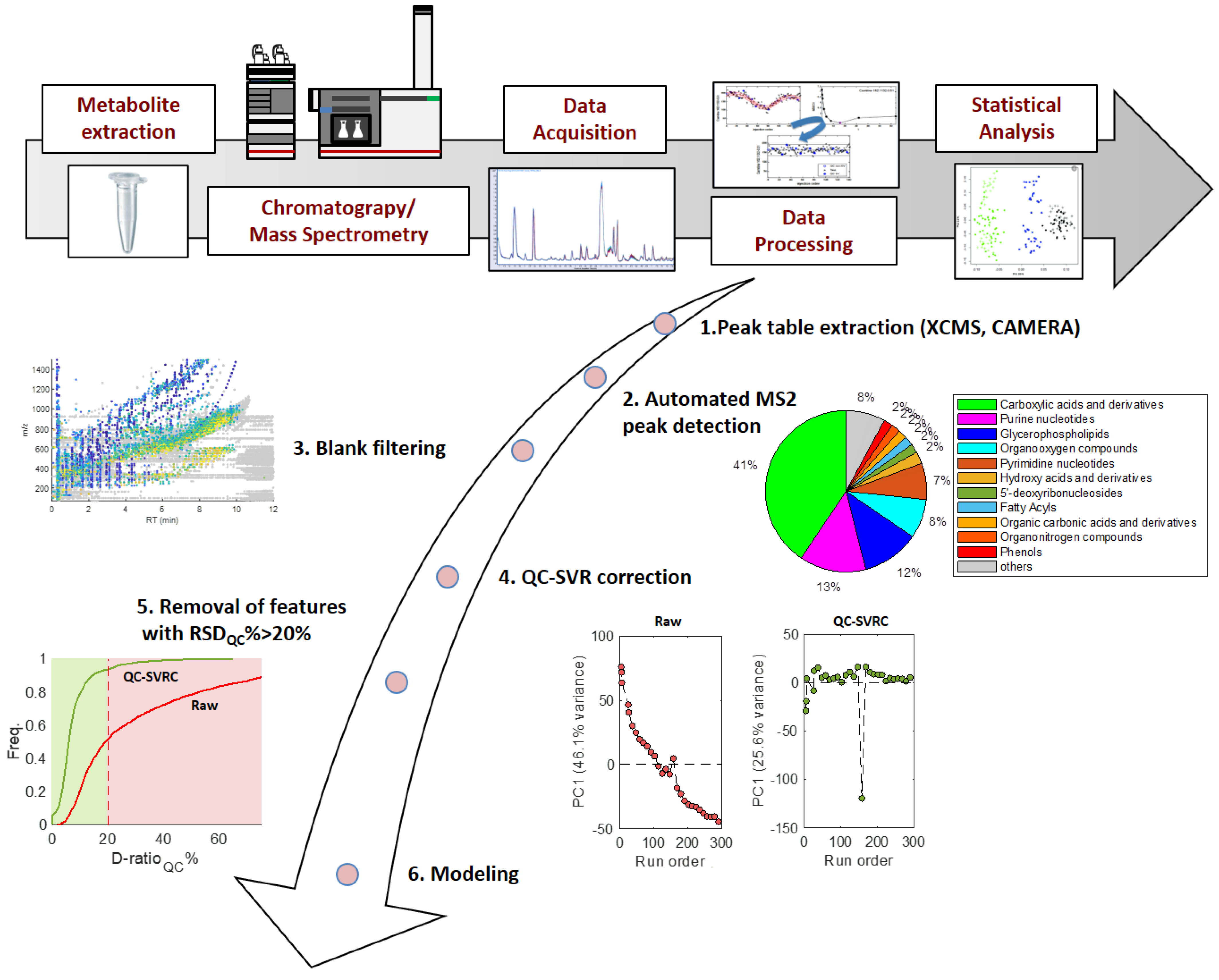
Drug-induced liver injury (DILI) is one of the most frequent adverse clinical reactions and a relevant cause of morbidity and mortality. Hepatotoxicity is among the major reasons for drug withdrawal during post-market and late development stages, representing a major concern to the pharmaceutical industry. The current biochemical parameters for the detection of DILI are based on enzymes (alanine aminotransferase (ALT), aspartate aminotransferase (AST), gamma-glutamyl transpeptidase (GGT), alkaline phosphatase (ALP)) and bilirubin serum levels that are not specific of DILI and therefore there is an increasing interest on novel, specific, DILI biomarkers discovery. Metabolomics has emerged as a tool with a great potential for biomarker discovery, especially in disease diagnosis, and assessment of drug toxicity or efficacy. This review summarizes the multistep approaches in DILI biomarker research and discovery based on metabolomics and the principal outcomes from the research performed in this field. For that purpose, we have reviewed the recent scientific literature from PubMed, Web of Science, EMBASE, and PubTator using the terms “metabolomics”, “DILI”, and “humans”. Despite the undoubted contribution of metabolomics to our understanding of the underlying mechanisms of DILI and the identification of promising novel metabolite biomarkers, there are still some inconsistencies and limitations that hinder the translation of these research findings into general clinical practice, probably due to the variability of the methods used as well to the different mechanisms elicited by the DILI causing agent.
Keywords: DILI; metabolomics; hepatotoxicity; biomarkers; diagnostic DILI; metabolomics; hepatotoxicity; biomarkers; diagnostic