Abstract
Pharmacological modulators of CFTR have significantly changed the cystic fibrosis (CF) phenotype of subjects affected by this multi-organ disease. Here, we evaluated the CFTR function analysis (short-circuit chamber in colonoids) in response to Elexacaftor/Tezacaftor/Ivacaftor (ETI) with the clinical benefits of in vivo treatment with ETI in ten CF subjects. We found that the functional response of ETI-corrected PDROS significantly correlated with the absolute change in the sweat chloride test. Thus, our work reinforces the use of organoid-derived human intestinal monolayers to guide clinicians in selecting CFTR-targeted therapies.
1. Introduction
Cystic fibrosis transmembrane conductance regulator (CFTR) modulators have been used in the later decade to improve the clinical condition of people with CF (pwCF) who carry CFTR variants that meet eligibility criteria based on their responsiveness to these drugs. These target mutation-specific CFTR medicines act as potentiators or correctors, increasing CFTR channel activity and rescuing CFTR protein structure, respectively [1,2]. The most recent modulator combination, Elexacaftor/Tezacaftor/Ivacaftor (ETI), initially approved in Europe for patients with at least one F508del allele [3], has been shown to be highly effective clinically, improving nutritional status, lung function, exacerbation frequency, and respiratory symptoms [4,5]. Since its initial EMA approval in 2020 for patients ≥ 12 years with at least one F508del mutation, the indication for ETI has progressively expanded in the EU to include younger children and, more recently, patients ≥ 2 years with additional rare CFTR mutations. Based on the impressive recovery of the health condition of pwCF under these modulator therapies, the United States Food and Drug Administration (FDA) decided to rely on in vitro cell models to generate CFTR variant-specific drug responsiveness data for FDA label expansion [6]. These are especially relevant when in vivo data are absent due to the impracticability of performing conventional clinical trials. To date, 178 variants are approved for ETI in pwCF, and additional rare CF-causing variants can access these treatments according to specific programs [2,7].
Preclinical in vitro models started with the use of simple and easy-to-cultivate immortalized epithelial cells derived from various tissues and species, such as the human embryonic kidney (HEK) [8], Fischer rat thyroid (FRT) [9], and CF bronchial epithelial (CFBE41o−) [10]. For decades, these cells have been valuable resources for high-throughput screening strategies and for developing pharmacological therapies for pathogenic CFTR variants [11]. Nonetheless, recombinant cell systems have limitations in recapitulating all CF patients’ epithelium. For instance, most of these cells express the CFTR protein based on a cDNA construct; they lack the presence of the nonsense-mediated decay (NMD) mechanism for premature termination codons (PTCs) and are unable to reproduce the cryptic splicing events that may occur in the native tissue [11]. Moreover, these cell types are more karyotypically unstable, risk losing their original phenotypic characteristic, and fail to predict treatment effects for pwCF in a personalized manner [12]. It is known that the CFTR genotype is not the only factor responsible for the CF phenotype; the presence of modifier genes and environmental as well as epigenetic factors influence CF disease diagnosis and drug response [13,14,15].
Primary organoids are physiologically relevant cell systems that have been used to overcome most limitations of in vitro models based on recombinant cell lines. As a promising research model, organoids can be established from either adult stem cells or pluripotent stem cells, becoming very similar to their original organs. Cultured in two or three dimensions, organoids preserve the donor tissue’s genetic, physiological, architectural traits, and functional properties even after many passages [11,16,17,18]. These features make 3D organoids an ideal in vitro system for drug screening, disease modeling, and predictive drug response necessary for personalized medicine approaches [19]. In CF, intestinal organoids and primary human nasal epithelial (pHNE) cells have been demonstrated to be reliable systems for assessing the effect of modulators on pathogenic CFTR variants [18,20]. Moreover, intestinal organoids can aid in CF diagnosis by measuring CFTR function in challenging cases [21,22,23]. Studies comparing in vitro results from patient-derived cells with individual clinical characteristics are crucial for validating the robustness of in vitro system predictions [24]. Hence, this work was designed to reinforce the predictive power of PDROs cultured as monolayers, a model already validated by other researchers [25,26], by comparing in vitro data with the clinical response of pwCF carrying rare CFTR variants who receive ETI treatment. Our results show that patient-derived 2D organoids’ in vitro drug response significantly correlates with in vivo responses to CFTR modulator drugs.
2. Materials and Methods
2.1. Cohort and Ethical Approval
All specimens were obtained from nine individuals with CF (carrying W57G/A234D, R74W+V201M+D1270N/CFTRdele22-24, F508del/711+5A, A559T/A559T, R347P/R347P, L227R/L227R, F508del/dup.exon1-3, R1162X/3849+10kBC>T, 2183AA>G/N1303K, and R553X/2789+5G>A CFTR genotypes) after receiving written patient consent. Organoids derived from non-CF (“wild type”) individuals (n = 4) and from F580del/F508del (n = 2) were used as reference values. This study was conducted in accordance with the local ethical committee’s rules (CF Center of Verona CRCFC-CFTR050). F580del/F508del organoids were kindly provided by Dr. M.J.C. Bijvelds, Department of Gastroenterology and Hepatology, Erasmus University Medical Center, Rotterdam, The Netherlands.
2.2. In Vivo Clinical Parameters
Relevant clinical parameters: sweat chloride by Gibson and Cooke method (GCST), and percentage-predicted FEV1 (ppFEV1) were measured during the study visit on all participants. The sweat was collected, and the chloride concentration was determined according to GCST, following the procedure utilized routinely at the CF Center of Verona following the recommendations from the SIFC working group, September 2017 [27]. Lung function was assessed by the percentage-predicted FEV1 (ppFEV1) as described [28,29]. All CF subjects were evaluated before and under CFTR modulator therapies.
2.3. CFTR Modulators
The CFTR modulators VX-770, VX-661, and VX-445 were purchased from Selleckchem (Houston, TX, USA).
2.4. Rectal Organoids Development, 2D and 3D Cultures
Crypts isolation, rectal organoids cultures, and 3D and 2D cultures were performed as previously described [30].
2.5. Transepithelial Electrical Resistance (TEER)
Before refreshing the medium, TEER was measured using an EVOM2 epithelial voltohmmeter (World Precision Instruments, Sarasota, FL, USA). The readings of the voltohmmeter can be multiplied by the surface area of the Transwell inserts (0.33 cm2) to calculate the unit area of resistance (Ω.cm2). A TEER value of 400 Ω.cm2 was considered an index of complete monolayer formation.
2.6. Measurements of CFTR-Mediated Anion Secretory Currents Across Intestinal Organoid-Derived Monolayers
Electrophysiological measurements were performed directly on the filter using specific Ussing chambers (P2300) and sliders (P2302T) (Physiologic Instruments, San Diego, CA, USA) and a voltage clamp EVC4000 (World Precision Instruments, Sarasota, FL, USA). For transepithelial current measurement, the colonocyte monolayers were incubated with Elexacaftor, ELEXA (VX-445, 3 μM), TEZA (VX-661, 3 μM), or vehicle (dimethyl sulfoxide, DMSO, 0.1%) for 20–24 h. Monolayers were bathed in symmetrical Meyler saline solution (pH 7.4) [10 mM Hepes; 0.3 mM Na2HPO4; 0.4 mM NaH2PO4; 1.0 mM MgCl2; 1.3 mM CaCl2; 4.7 mM KCl; 128 mM NaCl; 20.2 mM NaHCO3; 10 mM D-glucose] for the measurement of chloride secretion mediated by CFTR. Solutions were maintained at 37 °C, and gassed with 95% O2, 5% CO2. The transepithelial potential difference was clamped at 0 mV with a VVC-MC8 module (Physiologic Instruments), and the resulting short-circuit current (Isc) was recorded using a PowerLab 8/35 AD-converter (AD Instruments, Bella Vista, Australia) and associated software (LabChart v8; AD Instruments, Bella Vista, Australia). First, short-circuit current reduction was blocked by 100 μM Amiloride (M) stimulus that inhibits the sodium channel EnaC; then filters were tested with components that act positively on CFTR activity: 10 μM forskolin (Sigma-Aldrich, Milan, Italy) was applied to both apical (ap) and basolateral (bl) surfaces along with 0.3 μM VX-770 (Selleckchem, Houston, USA. Capsid Biotechnology Europe d.o.o.) (ap + bl). The experiment was concluded with the addition of the CFTR inhibitor, 20μM PPQ-102 (Tocris, Bristol, UK), from the apical and basolateral sides. In the end, 20 μM ATP (ap + bl) was used to assess filter viability.
2.7. Statistics
The statistical analysis was performed using a non-parametric test using GraphPad Prism (Prism v9.5.0, San Diego, CA, USA); p < 0.05 was considered to be statistically significant. We also directly compared the results of ETI-rescued PDROs’ short-circuit currents with the sweat test and pulmonary function results from the CF do-nors on ETI treatment using scatterplots, estimated the Pearson correlation coefficient, and performed linear regression analysis. The prerequisites for using linear regression analy-sis were carefully evaluated: Residuals vs. Fitted was used to check the linearity between dependent variable and the candidate predictors. Random scatter around a horizontal zero line indicates a good linear fit, while patterns like curves suggest non-linearity. Normal Q-Q is used to examine whether the residuals are normally distributed, i.e., if re-sidual points follow the straight dashed line on the quantile–quantile plot (crucial for valid p-values, especially with small samples), confirmed also by the Shapiro–Wilk test with a p-value of 0.6428. Scale-Location (or Spread-Location) is used to check the homo-geneity of variance of the residuals (homoscedasticity), which ensures that the mod-el’s standard errors, p-values, and confidence intervals are reliable, making the statistical inferences trustworthy. Without heteroscedasticity, the estimated uncertainty (such as confidence intervals) can become distorted, resulting in possibly erroneous conclusions regarding which variables are genuinely significant. Horizontal line with equally spread points is a good indication of homoscedasticity. Residuals vs. Leverage is used to identify influential cases, that is, extreme values that might influence the regression results when included or excluded from the analysis.
3. Results
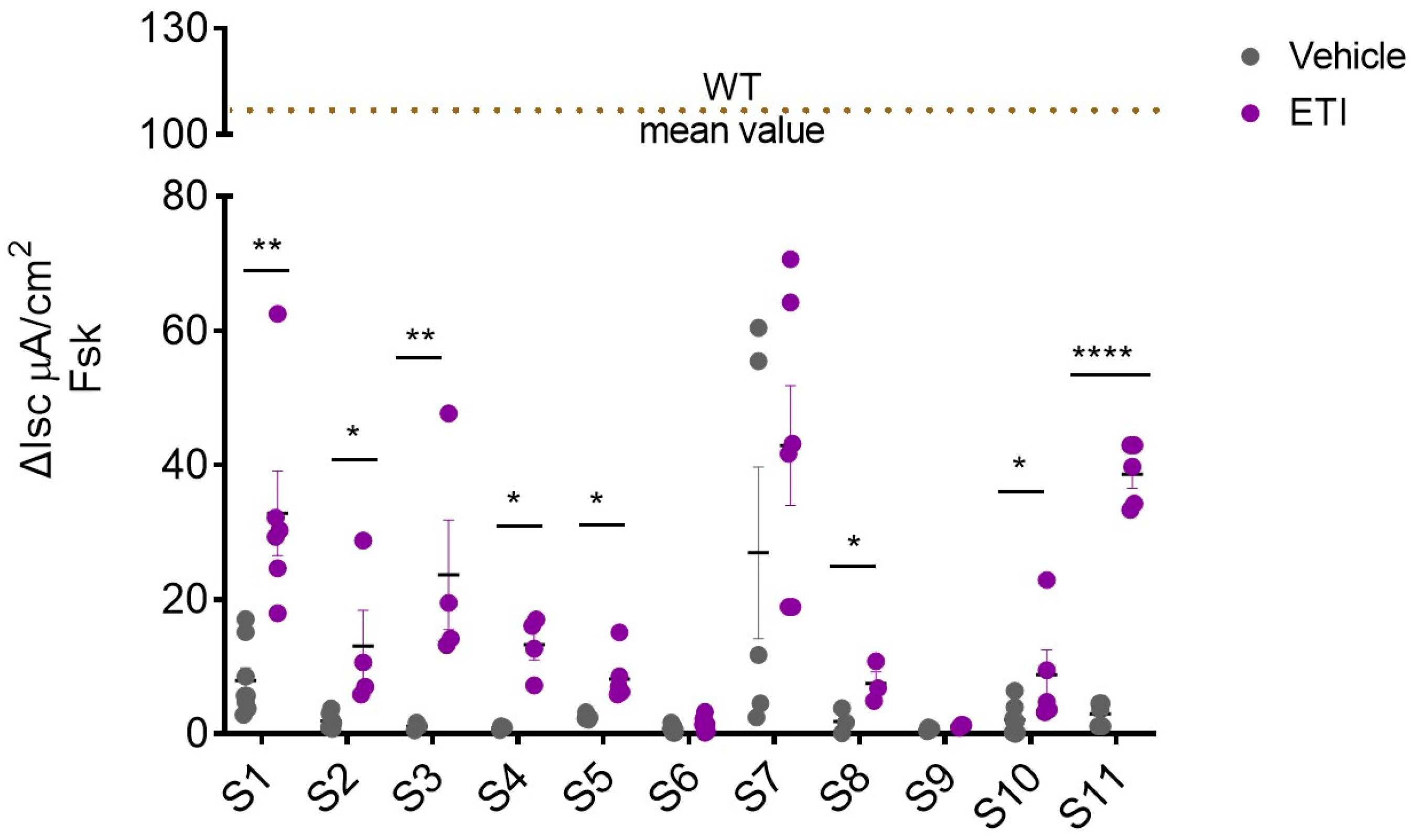
CFTR functional data, for the genotypes W57G/A234D, R74W+V201M+D1270N/ CFTRdele22-24, A559T/A5559T, R347P/R347P, L227R/L227R, and F508del/dup.exon1-3, were collected either from published works [31,32,33,34,35,36] or experimentally in this study (genotypes F508del/711+5A, R1162X/3849+10kBC>T, 2183AA>G/N1303K, and R553X/ 2789+5G>A) and summarized in Table S1. At baseline, only F508del/dup.exon1-3 (S7) presented a good residual CFTR activity with 24% of WT function. ETI treatment failed to substantially increase CFTR activity in only two genotypes: S6: L227R/L227R and S9: 2183AA>G/N1303K. For the others, ETI-corrected organoids recovered up to 39% WT function. For instance, with homozygous F508del organoids, the triple therapy augmented the channel function 12-fold, which corresponds to approximately 35% of WT activity (Figure 1, Figure 2C and Figure S1). ETI treatment, although modest, increased the CFTR activity, approaching the level registered for homozygous F508del organoids treated with Lumacaftor/Ivacaftor (LI) in five genotypes: S2: R74W+V201M+D1270N/CFTRdele22-24, S4: A559T/A559T, S5: R347P/R347P, S8: R1162X/3849+10kBC>T, and S10: R553X/2789+5G>A.
Figure 1.
Ex vivo drug response by short-circuit current (Isc) measurements of indicated colonoids under CFTR therapy and vehicle (DMSO; dimethyl sulfoxide). Values are means ± SE * p-value ≤ 0.05, ** p-value ≤ 0.005, **** p-value < 0.0001. Unpaired Student’s t-test. The genotype of each CF subject reported here is as follows: S1: W57G/A234D; S2: R74W+V201M+D1270N/CFTRdele22-24; S3: F508del/711+5A; S4: A559T/A559T; S5: R347P/R347P; S6: L227R/L227R; S7: F508del/dup.exon1-3; S8: R1162X/3849+10kBC>T; S9: 2183AA>G/N1303K; S10: R553X/2789+5G>A; and S11: CF patients harboring F508del/F508del (used here as reference). Each dot represents a single electrophysiological measurement. A minimum of three measurements were performed for each condition and genotype.
Figure 2.
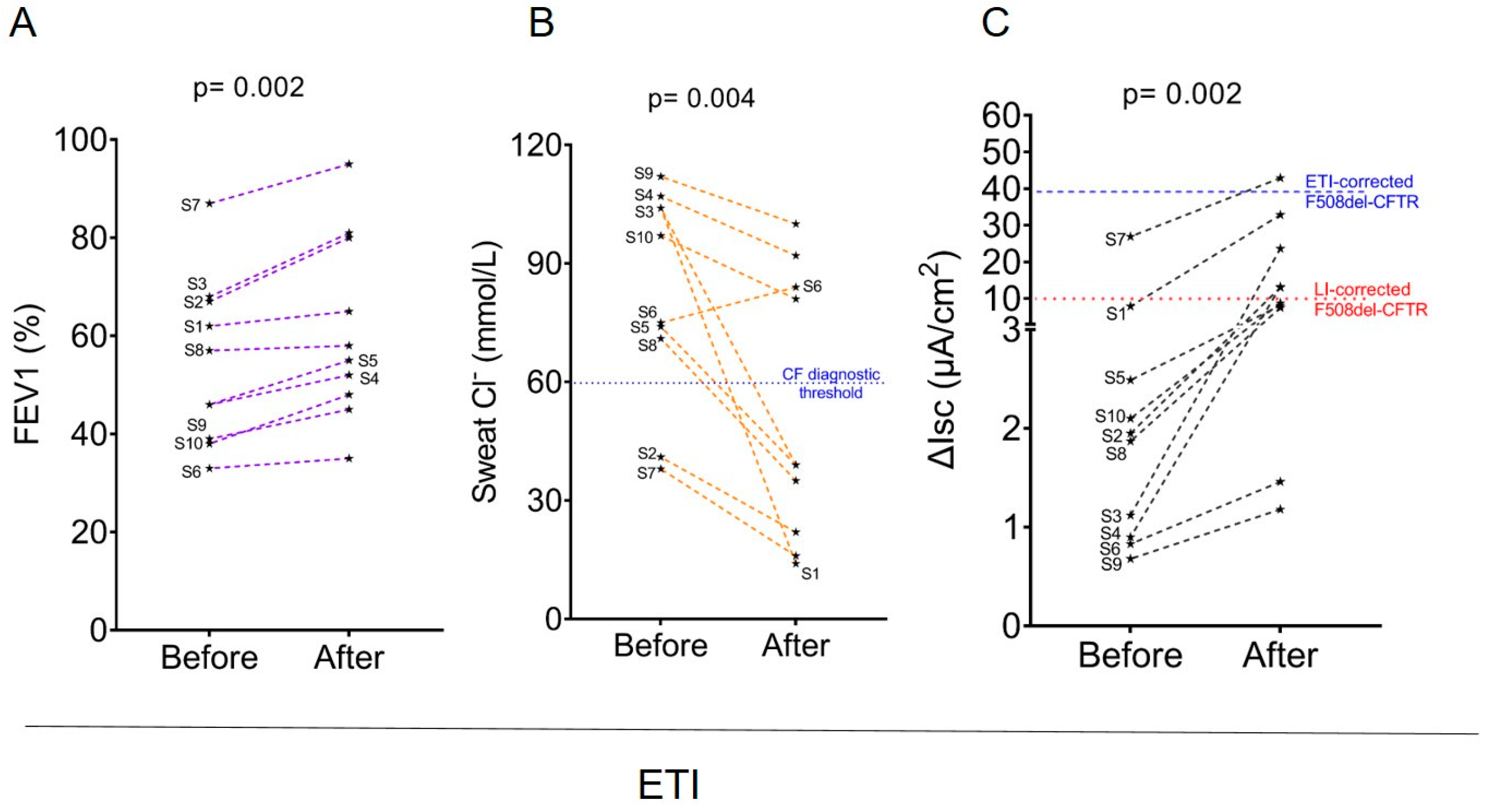
Clinical and in vitro parameters of CF patients under modulator therapy (ETI): (A) lung function parameter (FEV1); (B) sweat chloride levels before and after ETI treatment; (C) ex vivo drug response by short-circuit current (Isc) measurements of corresponding PDROs before and after treatment with ETI shown in Figure 1, and added here to facilitate comparison (mean values). Wilcoxon matched-pairs signed rank test. Each CF subject is discriminated as follows: S1: W57G/A234D; S2: R74W+V201M+D1270N/CFTRdele22-24; S3: F508del/711+5A; S4: A559T/A559T; S5: R347P/R347P; S6: L227R/L227R; S7: F508del/dup.exon1-3; S8: R1162X/3849+10kBC>T; S9: 2183AA>G/N1303K; and S10: R553X/2789+5G>A.
After an average of 7 (±3) months of ETI treatment, pwCF whose organoids responded positively to ETI treatment presented an improved clinical status based on two different clinical parameters: sweat chloride test and lung function as forced expiratory volume in one second (FEV1%). The mean change in the percentage of predicted FEV1 from baseline to the last visit of all pwCF in treatment with modulators was +7 (±4) percentage points. We registered a slight increase in FEV1% predicted values (from +3 to up to +6 percentage points) in three CF patients (W57G/A234D, A559T/A559T, and R553X/2789+5G>A: S1, S4 and S10). An increment of FEV1% from +8 to up to +13 percentage points was found for five CF patients, R74W+V201M+D1270N/CFTRdele22-24 (S2), F508del/711+5A (S3), F508del/dup.exon1-3 (S7), 2183AA>G/N1303K (S9), and R347P/R347P (S5), compared to their respective baseline values. The change of predictive FEV1 from baseline for the subject S6 (L227R/L227R), which features negligible Isc values by Ussing chamber assay, was +2 percentage points. For the subject S8 (R1162X/ 3849+10kBC>T) classified as responder in vitro, the change in FEV1 was minimal: +1 (Figure 2A).
For the sweat test, the mean change in sweat chloride concentration from baseline in vivo treatment was −30,1 (±29) mmol/L, with the recovery in ST being more evident than with FEV1. Four subjects, A559T/A559T (S4), L227R/L227R (S6), 2183AA>G/N1303K (S9), and R553X/2789+5G>A (S10), still presented a pathological sweat test in ETI therapy, with two of them, S9 and S10, having a reduction of −12 and −16 mmol/L of chloride concentration, respectively. The drop in sweat test values for other CF patients was significant, making three of them fall into borderline values (F508del/711+5A, R347P/R347P, and R1162X/3849+10kBC>T: S3, S5 and S8), while the other patients fit in a non-pathological range (W57G/A234D, R74W+V201M+D1270N/CFTRdele22-24, and F508del/dup.exon1-3: S1, S2, and S7). The individual changes in sweat chloride concentration are summarized in Figure 2B.
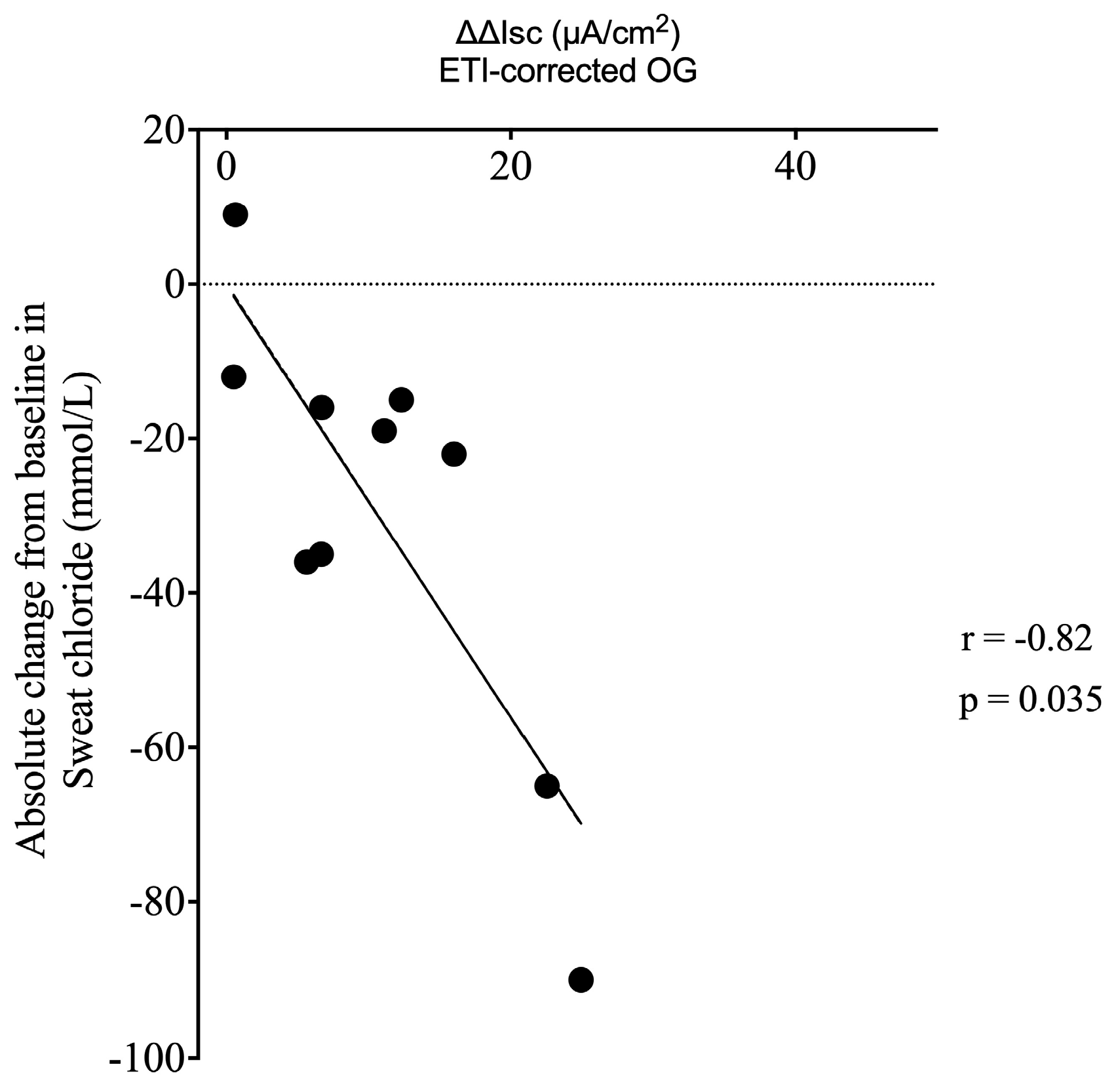
As with patient S4 (A559T/A559T), the treatment with ETI was not followed by a decrease below 60 mM in sweat chloride, actually remaining over 90 mmol/L, despite a mild increase in FEV1; we wondered whether the drug was present in circulation. We evaluated the plasma drug levels and compared them with those of patient S8 (R1162X/3849+10kBC>T), who exhibited a clear sweat chloride response, with values decreasing well below 60 mmol/L. In both cases, ETI was clearly detectable at similar levels (see Supplementary Data: Tables S2 and S3), suggesting that the differing clinical responses were not due to inadequate drug intake or distribution but were more likely attributable to differences in ETI efficacy toward the respective CFTR variants. Finally, we compared the clinical parameters, ST, and FEV1 of each CF subject with the values of Isc upon ETI treatment. We detected a significant correlation between differences in Isc with ST values after therapy (Figure 3). The increment in FEV1 for the majority of these patients was modest, as expected in comparison with ST changes, but significant if we consider the whole population (Figure 2A). However, these last data do not satisfy three of the principal assumptions which justify the use of linear regression models, such as linearity and additivity of the relationship between dependent and independent variables, the homoscedasticity (constant variance) of the errors, and the normality of error distribution. Given the premises, the forecasts, confidence intervals, and scientific insights yielded by a regression model may be (at best) inefficient or (at worst) seriously biased or misleading. Consequently, with this dataset, it was inappropriate to follow the same procedure used for the data presented in Figure 3.
Figure 3.
Correlation between in vitro CFTR functional response to ETI treatment (analyzed by short-circuit current measurements) and in vivo clinical parameters. Pearson correlation between ΔIsc after ETI treatment (minus ΔIsc of fsk of vehicle condition) and absolute changes in sweat chloride (mmol/L). Each data point (black dots) represents a single CF subject.
4. Discussion
This study provides real-life data on the analysis of CFTR activity in PDROs as a preclinical model for checking drug efficacy [26]. We demonstrated that the response to CFTR modulators measured in the Ussing chamber shows a linear correlation with ST, a parameter commonly utilized to measure the in vivo outcome of the respective donors in response to ETI treatment. It is known that the Ussing chamber assay has the advantage of characterizing any CFTR variants, including those with significant residual function, as it does not suffer from the ceiling effect typical of FIS analysis [37]. Moreover, 2D organoids grown in Transwell represent an appropriate system for studying ion transport in Ussing chambers [25]. Our findings provide further support for considering this platform as a robust system for testing CFTR modulator drugs.
Interestingly, ETI permitted a minimal recovery of CFTR function for 2183AA>G/N1303K in vitro, with Isc levels remaining well below 10% of the reference values (non-CF). In this case, we observed an improvement in the clinical outcome of the donor (based on the improvement of 10% of FEV1 value) with no improvement in ST. These features align with published data. Indeed, N1303K is one of the most common among the rare CFTR variants in pwCF, although it presents similar defects to those of F508del. However, its gating defect was characterized as more critical, and in vitro responses to CFTR modulators were found to be variable [38,39]. However, several studies reported that some pwCF carrying the N1303K CFTR variant, while showing a modest response in vitro and no improvement in ST, still show improved FEV1 and overall clinical condition [40]. Other studies indicated a significant improvement in certain clinical endpoints for some pwCF in the presence of at least one N1303K variant following treatment with ETI in the absence of a drop of ST below 60 mmol/L [41,42,43]. These data suggest that genetic background, along with environmental factors and the impact of inflammatory conditions, may influence treatment outcomes, highlighting the importance of a personalized medicine approach. In our case, N1303K is found in trans with a frameshift mutation 2183AA>G, classified in class I, that affects protein synthesis, resulting in a truncated non-functional form of protein not amenable to clinically approved CFTR modulators.
For the variants 2789+5G>A and 3849+10kBC>T, the second alleles are represented by a nonsense variant, R553X and R1162X, respectively, which are expected to produce a truncated and non-functional protein that is not rescuable with ETI. 2789+5G>A and 3849+10kBC>T are splicing mutations associated with a mild form of CF. This type of mutation reduces the amount of correctly spliced CFTR mRNA, which in turn leads to a decrease in the amount of normal and functional CFTR protein [44,45]. Both splicing variants became eligible for ETI treatment on year 2024 [46,47]. The evaluation of their currents in Ussing chambers after ETI treatment indicated a recovery of CFTR activity, corresponding with the reduction in sweat chloride content and a slight improvement in pulmonary function in both donors during ETI treatment. Other therapeutic agents that could be more efficient in recovering splicing variants are under investigation [48,49].
The F508del/711+5A genotype was considered a responder in our in vitro analysis. The donor responds well to ETI therapy, as shown by the clinical outcome markers: a gain of +13 points in FEV1 and a clear improvement in chloride content in sweat (−65 mmol/L). This result was expected given the presence of a responsive variant (F508del). The second allele, which includes a splicing mutation at 711+5A, classified as pathogenic, is not eligible for modulators. The molecular characterization of the other six genotypes (W57G/A234D, R74W+V201M+D1270N/CFTRdele22-24, A559T/A559T, R347P/R347P, L227R/L227R, and F508del/dup.exon1-3) was already reported, and additional information about them can be found in previous studies [31,32,33,34,36]. We will then limit our discussion to their in vitro and in vivo correlation.
In this small cohort of ten pwCF, the electrophysiological measurement of their PDROs indicated that only two of them would likely be non-responsive to ETI, L227R/L227R and 2183AA>G/N1303K, based on their low level of residual currents compared to the reference genotypes. These subjects presented a small change in only one of the two in vivo biomarkers evaluated. For instance, L227R/L227R gained -9 points in the ST, while FEV1 of 2183AA>G/N1303K increased by +10 points during therapy. Both patients presented with pulmonary function below 41% and persistent pathological values for ST. The other eight pwCF predicted as responders to ETI in vitro demonstrated an improvement in clinical parameters, showing changes in both ST and FEV1. However, the ST of A559T/A559T and R553X/2789+5G>A still fall in the pathological range. Interestingly, for the A559T/A559T case, the clinical criteria for lung transplant were no longer met after therapy with ETI, whereas the FEV1 value of the patient carrying R553X/2789+5G>A increased from 39% to 45%. Although published data suggest that the L227R and A559T may be non-responsive to ETI, supported by the in vitro correction data in FRT cell monolayers [50], the patient-derived rectal organoids revealed a different pattern for A559T [32], considered here as a potential responder to ETI, while L227R remained a non-responder, emphasizing the value of using primary cells for functional testing to guide variant-specific treatment decisions. We then wondered whether there was a correlation between in vitro and in vivo data in our series. We observed that the delta-Isc of ETI-corrected organoids correlated well with the reduction in sweat chloride content, consistent with previously reported data [26].
Our cohort illustrates the multifaceted nature of clinical response in cystic fibrosis, as lung function integrates additional determinants, including airway inflammation, infection status, and the degree of irreversible structural damage. Importantly, these improvements occur consistently at the population level. Fidler et al. report that reductions in sweat chloride levels and improvements in absolute ppFEV1 were not correlated for individual patients and only appeared when the data from all studies were combined [51]. Lung function is the result of a complex relationship between different components of the lung tissue, which is not directly comparable with the sweat glands, as they are not typically affected by histologic alterations associated with chronic fibrosis, a common feature of pwCF. In particular, FEV1 changes also depend on age and the level of lung function impairment, which was not homogeneous in our group of pwCF. As shown by Burgel et al., even when ETI produces greater CFTR correction—evidenced by larger reductions in sweat chloride in individuals with two responsive variants—this does not translate into proportionally greater improvements in lung function, suggesting that a ceiling effect is reached due to irreversible structural lung damage and the limited capacity for functional recovery in advanced CF airway disease [52]. The conditions potentially affecting CFTR function are surely more complex and difficult to assess directly in lung tissue. Indeed, we do not know whether in vivo CFTR can be subject to a partial correction, being exposed to specific environmental conditions that are unknown and, therefore, cannot be properly reproduced in vitro. This hypothesis can be supported by recent studies that show a positive influence of inflammatory cytokines such as TNF-α+IL-17, which were shown to enhance CFTR modulator-evoked anion secretion through mechanisms that raise intracellular Cl− (Na+/K+/2Cl− cotransport) and HCO3− (carbonic anhydrases and Na+/HCO3− cotransport) [53,54] that might act on the residual CFTR function that is still present in the pwCF analyzed.
This issue is avoided when measuring CFTR activity in sweat glands. The eccrine sweat glands are the most accessible and stable organs in CF patients because they are unaffected by infection or inflammation, making them a reliable in vivo readout of CFTR function [55], with notable exceptions, such as those reported for the N1303K variant.
Lastly, we have had the opportunity to evaluate the distribution of ETI in vivo in two of our subjects, as this variable is only rarely assessed. We have confirmed the presence of similar levels of all the drug components (ETI) in the plasma samples of pwCF S4 (A559T/A559T) and S8 (R1162X/3849+10kBC>T), thus ruling out that this parameter could be associated with the different extent of ST response in these subjects.
Treating all pwCF to the level of benefit achieved by ETI remains a significant challenge, particularly for rare genotypes. Despite a relatively low number of subjects involved in this “real-life” analysis, the results indicate that the theranostic approach is robust enough to warrant its application. Importantly, the recent expansion of the indication for ETI and Ivacaftor by the European Medicines Agency (EMA) to include children as young as two years with at least one non-class I CFTR mutation was supported not only by clinical trial results, but also by in vitro and real-life evidence. As new combination therapies, such as the vanzacaftor/tezacaftor/deutivacaftor combination, enter the clinic, robust preclinical models may prove essential for accelerating the evaluation and approval of treatments, as they are indicated for responsive variants. Considering a variant responsive to treatment represents a particularly sensitive issue for individuals with rare genotypes, where large-scale clinical trials are not feasible. This is especially true when required to direct the clinician to a choice or to evaluate new treatments in a context closer to real life than those utilizing cell line models. Personalizing treatments is important, and a careful cost–benefit analysis must be performed only once studies like the one described here have thoroughly validated the procedure. It is crucial to provide regulatory entities with the proper information to facilitate access to the drug for patients who have no access to standard clinical trials. The possibility of delivering biopsies within 48 h or, possibly, to cryopreserve them to optimize the logistics, permits the evaluation of samples from different regions/countries and the optimization of human and material resources in selected centers to reduce costs associated with the procedure, which remains a main limitation of the approach that can be well justified by the lack of viable alternatives.
5. Limitation Statement
The main limitations of this study include a relatively small cohort and the heterogeneity of the subjects we have had access to; however, we have applied rigorous statistical procedures and believe that it is important to provide the CF community with real-life data that can be combined with additional cases and provides key information regarding their response to treatment and the correlation with theranostic applications.
Supplementary Materials
The following supporting information can be downloaded at https://www.mdpi.com/article/10.3390/scipharm94010013/s1: Table S1: summary of the features of the subjects analyzed; Table S2: Mass spectrometry conditions (parent and product ions, declustering potential, DP, and collision energy, CE) used for elexacaftor/ivacaftor/tezacaftor analysis; Table S3: Ivacaftor, Elexacaftor, and Tezacaftor quantitation (ng/mL) in n = 2 plasma patients.
Author Contributions
Conceptualization, P.M. and C.S.; methodology, K.K., S.C. and S.V.; formal analysis, K.K. and C.S.; statistical data analysis, P.L.; investigation, K.K., S.C. and S.V.; resources, C.S. and P.M.; data curation, K.K., C.S. and P.M.; writing—original draft preparation, K.K.; writing—review and editing, K.K., C.S. and P.M.; visualization, K.K., C.M. and R.V.L.; supervision, C.S.; project administration, C.S. and P.M.; funding acquisition, C.S. and P.M. All authors have read and agreed to the published version of the manuscript.
Funding
This research was funded by the Italian Cystic Fibrosis Research Foundation (FFC), grant numbers FFC #13/2018 (Delegazione FFC di Tradate Gallarate) to C.S. and #9/2020 (Delegazione FFC di Pesaro, Rivarolo Canavese e Gruppo sostegno FFC di Fidenza) to P.M.; Fondo per il Programma Nazionale di Ricerca e Progetti di Rilevante Interesse Nazionale (PRIN) n.2022FRSS2H “Theratyping of Cystic Fibrosis” (C.S.); Lega Italiana Fibrosi Cistica onlus (C.S. and P.M.); and American CFF, grant number Assael08A0 (P.M.).
Institutional Review Board Statement
This study was conducted according to the guidelines of the Declaration of Helsinki and approved by the Institutional Review Board CRCFC-CFTR050 (Comprehensive multiorgan functional analysis of the CFTR channel in cystic fibrosis) on 24 November 2021.
Informed Consent Statement
Informed consent was obtained from the subjects involved in this study.
Data Availability Statement
Data can be requested from the corresponding author.
Acknowledgments
We recognize the contribution of Antonella Casiraghi (Department of Pharmaceutical Sciences, Università degli Studi di Milano, via G. Colombo 71, 20133 Milan, Italy) and Michele Dei Cas (Department of Health Sciences, Biochemistry Laboratory, University of Milan, Via A. di Rudinì 8, Milan, Italy) who contributed to the setup of the methodology. We also thank Shima Radmehr and Alessia Carpene, MSc students who contributed to cell culture and data analysis during their training.
Conflicts of Interest
P.M. acted as a paid expert witness for Vertex Pharmaceuticals and declares no conflicts of interest. The other authors declare no conflicts of interest.
Abbreviations
The following abbreviations are used in this manuscript:
| CF | Cystic fibrosis |
| CFTR | Cystic fibrosis transmembrane conductance regulator |
| ETI | Elexacaftor/tezacaftor/ivacaftor |
| ST | Sweat chloride test |
| TEER | Transepithelial electrical resistance |
| FEV1 | Forced Expiratory Volume in one second |
| HEMT | Highly efficient CFTR modulator therapies |
| GCST | Gibson and Cooke method |
| EMA | European Medicines Agency |
| pwCF | people with cystic fibrosis |
| Isc | Short-circuit current |
| EnaC | Epithelial sodium channel |
| Fsk | Forskolin |
| Iva | Ivacaftor |
| Elexa | Elexacaftor |
| Teza | Tezacaftor |
| HEK | Human embryonic kidney |
| FRT | Fischer rat thyroid |
| CFBE41o− | Cystic fibrosis bronchial epithelial |
| NMD | Nonsense-mediated decay |
| PTCs | Premature termination codons |
| pHNE | Primary human nasal epithelial cells |
| 2D | Two-dimensional culture |
| 3D | Three-dimensional culture |
| LI | Lumacaftor/ivacaftor |
References
- Amaral, M.D. How to determine the mechanism of action of CFTR modulator compounds: A gateway to theranostics. Eur. J. Med. Chem. 2021, 210, 112989. [Google Scholar] [CrossRef]
- Burgel, P.R.; Sermet-Gaudelus, I.; Durieu, I.; Kanaan, R.; Macey, J.; Grenet, D.; Porzio, M.; Coolen-Allou, N.; Chiron, R.; Marguet, C.; et al. The French compassionate programme of elexacaftor/tezacaftor/ivacaftor in people with cystic fibrosis with advanced lung disease and no F508del CFTR variant. Eur. Respir. J. 2023, 61, 2202437. [Google Scholar] [CrossRef]
- Kaftrio | European Medicines Agency. Available online: https://www.ema.europa.eu/en/medicines/human/EPAR/kaftrio (accessed on 1 September 2025).
- Middleton, P.G.; Mall, M.A.; Drevinek, P.; Lands, L.C.; McKone, E.F.; Polineni, D.; Ramsey, B.W.; Taylor-Cousar, J.L.; Tullis, E.; Vermeulen, F.; et al. Elexacaftor-Tezacaftor-Ivacaftor for Cystic Fibrosis with a Single Phe508del Allele. N. Engl. J. Med. 2019, 381, 1809–1819. [Google Scholar] [CrossRef]
- Heijerman, H.G.M.; McKone, E.F.; Downey, D.G.; Van Braeckel, E.; Rowe, S.M.; Tullis, E.; Mall, M.A.; Welter, J.J.; Ramsey, B.W.; McKee, C.M.; et al. Efficacy and safety of the elexacaftor plus tezacaftor plus ivacaftor combination regimen in people with cystic fibrosis homozygous for the F508del mutation: A double-blind, randomised, phase 3 trial. Lancet 2019, 394, 1940–1948. [Google Scholar] [CrossRef] [PubMed]
- Durmowicz, A.G.; Lim, R.; Rogers, H.; Rosebraugh, C.J.; Chowdhury, B.A. The U.S. Food and Drug Administration’s Experience with Ivacaftor in Cystic Fibrosis. Establishing Efficacy Using In Vitro Data in Lieu of a Clinical Trial. Ann. Am. Thorac. Soc. 2018, 15, 1–2. [Google Scholar] [CrossRef] [PubMed]
- Highlights of Prescribing Information. Available online: https://www.accessdata.fda.gov/drugsatfda_docs/label/2023/217660s000lbl.pdf (accessed on 1 September 2025).
- Sharma, N.; Evans, T.A.; Pellicore, M.J.; Davis, E.; Aksit, M.A.; McCague, A.F.; Joynt, A.T.; Lu, Z.; Han, S.T.; Anzmann, A.F.; et al. Capitalizing on the heterogeneous effects of CFTR nonsense and frameshift variants to inform therapeutic strategy for cystic fibrosis. PLoS Genet. 2018, 14, e1007723. [Google Scholar] [CrossRef] [PubMed]
- Van Goor, F.; Yu, H.; Burton, B.; Hoffman, B.J. Effect of ivacaftor on CFTR forms with missense mutations associated with defects in protein processing or function. J. Cyst. Fibros. 2014, 13, 29–36. [Google Scholar] [CrossRef]
- Gruenert, D.C.; Willems, M.; Cassiman, J.J.; Frizzell, R.A. Established cell lines used in cystic fibrosis research. J. Cyst. Fibros. 2004, 3, 191–196. [Google Scholar] [CrossRef]
- Silva, I.A.L.; Laselva, O.; Lopes-Pacheco, M. Advances in Preclinical In Vitro Models for the Translation of Precision Medicine for Cystic Fibrosis. J. Pers. Med. 2022, 12, 1321. [Google Scholar] [CrossRef]
- Fidler, M.C.; Buckley, A.; Sullivan, J.C.; Statia, M.; Boj, S.F.; Vries, R.G.J.; Munck, A.; Higgins, M.; Moretto Zita, M.; Negulescu, P.; et al. G970R-CFTR Mutation (c.2908G>C) Results Predominantly in a Splicing Defect. Clin. Transl. Sci. 2021, 14, 656–663. [Google Scholar] [CrossRef]
- Vallières, E.; Elborn, J.S. Cystic fibrosis gene mutations: Evaluation and assessment of disease severity. Adv. Genom. Genet. 2014, 4, 161–172. [Google Scholar] [CrossRef]
- Marson, F.A.L.; Bertuzzo, C.S.; Ribeiro, J.D. Personalized or Precision Medicine? The Example of Cystic Fibrosis. Front. Pharmacol. 2017, 8, 390. [Google Scholar] [CrossRef] [PubMed]
- Mou, H.; Brazauskas, K.; Rajagopal, J. Personalized medicine for cystic fibrosis: Establishing human model systems. Pediatr. Pulmonol. 2015, 50, S14–S23. [Google Scholar] [CrossRef] [PubMed]
- Li, Y.; Tang, P.; Cai, S.; Peng, J.; Hua, G. Organoid based personalized medicine: From bench to bedside. Cell Regen. 2020, 9, 21. [Google Scholar] [CrossRef]
- Takahashi, T. Organoids for Drug Discovery and Personalized Medicine. Annu. Rev. Pharmacol. Toxicol. 2019, 59, 447–462. [Google Scholar] [CrossRef]
- Silva, I.A.L.; Railean, V.; Duarte, A.; Amaral, M.D. Personalized Medicine Based on Nasal Epithelial Cells: Comparative Studies with Rectal Biopsies and Intestinal Organoids. J. Pers. Med. 2021, 11, 421. [Google Scholar] [CrossRef]
- Clevers, H. Modeling Development and Disease with Organoids. Cell 2016, 165, 1586–1597. [Google Scholar] [CrossRef]
- Pion, A.; Kavanagh, E.; Joynt, A.T.; Raraigh, K.S.; Vanscoy, L.; Langfelder-Schwind, E.; McNamara, J.; Moore, B.; Patel, S.; Merlo, K.; et al. Investigation of CFTR Function in Human Nasal Epithelial Cells Informs Personalized Medicine. Am. J. Respir. Cell Mol. Biol. 2024, 71, 577–588. [Google Scholar] [CrossRef]
- Cuyx, S.; Ramalho, A.S.; Corthout, N.; Fieuws, S.; Furstova, E.; Arnauts, K.; Ferrante, M.; Verfaillie, C.; Munck, S.; Boon, M.; et al. Rectal organoid morphology analysis (ROMA) as a promising diagnostic tool in cystic fibrosis. Thorax 2021, 76, 1146–1149. [Google Scholar] [CrossRef]
- Van Mourik, P.; Beekman, J.M.; van der Ent, C.K. Intestinal organoids to model cystic fibrosis. Eur. Respir. J. 2019, 54, 1802379. [Google Scholar] [CrossRef]
- Berkers, G.; van Mourik, P.; Vonk, A.M.; Kruisselbrink, E.; Dekkers, J.F.; de Winter-de Groot, K.M.; Arets, H.G.M.; Marck-van der Wilt, R.E.P.; Dijkema, J.S.; Vanderschuren, M.M.; et al. Rectal Organoids Enable Personalized Treatment of Cystic Fibrosis. Cell Rep. 2019, 26, 1701–1708.e3. [Google Scholar] [CrossRef]
- De Winter-de Groot, K.M.; Janssens, H.M.; van Uum, R.T.; Dekkers, J.F.; Berkers, G.; Vonk, A.; Kruisselbrink, E.; Oppelaar, H.; Vries, R.; Clevers, H.; et al. Stratifying infants with cystic fibrosis for disease severity using intestinal organoid swelling as a biomarker of CFTR function. Eur. Respir. J. 2018, 52, 1702529. [Google Scholar] [CrossRef] [PubMed]
- Ciciriello, F.; Bijvelds, M.J.C.; Alghisi, F.; Meijsen, K.F.; Cristiani, L.; Sorio, C.; Melotti, P.; Fiocchi, A.G.; Lucidi, V.; De Jonge, H.R. Theratyping of the Rare CFTR Variants E193K and R334W in Rectal Organoid-Derived Epithelial Monolayers. J. Pers. Med. 2022, 12, 632. [Google Scholar] [CrossRef] [PubMed]
- Birimberg-Schwartz, L.; Ip, W.; Bartlett, C.; Avolio, J.; Vonk, A.M.; Gunawardena, T.; Du, K.; Esmaeili, M.; Beekman, J.M.; Rommens, J.; et al. Validating organoid-derived human intestinal monolayers for personalized therapy in cystic fibrosis. Life Sci. Alliance 2023, 6, e202201857. [Google Scholar] [CrossRef] [PubMed]
- Società Italiana per lo Studio della Fibrosi Cistica. Available online: www.sifc.it (accessed on 10 September 2025).
- Quanjer, P.H.; Stanojevic, S.; Cole, T.J.; Baur, X.; Hall, G.L.; Culver, B.H.; Enright, P.L.; Hankinson, J.L.; Ip, M.S.; Zheng, J.; et al. Multi-ethnic reference values for spirometry for the 3-95-yr age range: The global lung function 2012 equations. Eur. Respir. J. 2012, 40, 1324–1343. [Google Scholar] [CrossRef]
- Miller, M.R.; Hankinson, J.; Brusasco, V.; Burgos, F.; Casaburi, R.; Coates, A.; Crapo, R.; Enright, P.; van der Grinten, C.P.; Gustafsson, P.; et al. Standardisation of spirometry. Eur. Respir. J. 2005, 26, 319–338. [Google Scholar] [CrossRef]
- Kleinfelder, K.; Melotti, P.; Hristodor, A.M.; Fevola, C.; Taccetti, G.; Terlizzi, V.; Sorio, C. CFTR modulators response of S737F and T465N CFTR variants on patient-derived rectal organoids. Orphanet J. Rare Dis. 2024, 19, 343. [Google Scholar] [CrossRef]
- Kleinfelder, K.; Lotti, V.; Eramo, A.; Amato, F.; Lo Cicero, S.; Castelli, G.; Spadaro, F.; Farinazzo, A.; Dell'Orco, D.; Preato, S.; et al. In silico analysis and theratyping of an ultra-rare CFTR genotype (W57G/A234D) in primary human rectal and nasal epithelial cells. iScience 2023, 26, 108180. [Google Scholar] [CrossRef]
- Kleinfelder, K.; Villella, V.R.; Hristodor, A.M.; Laudanna, C.; Castaldo, G.; Amato, F.; Melotti, P.; Sorio, C. Theratyping of the Rare CFTR Genotype A559T in Rectal Organoids and Nasal Cells Reveals a Relevant Response to Elexacaftor (VX-445) and Tezacaftor (VX-661) Combination. Int. J. Mol. Sci. 2023, 24, 10358. [Google Scholar] [CrossRef]
- Kleinfelder, K.; Somenza, E.; Farinazzo, A.; Conti, J.; Lotti, V.; Latorre, R.V.; Rodella, L.; Massella, A.; Tomba, F.; Bertini, M.; et al. CFTR Modulators Rescue the Activity of CFTR in Colonoids Expressing the Complex Allele p.[R74W;V201M;D1270N]/dele22_24. Int. J. Mol. Sci. 2023, 24, 5199. [Google Scholar] [CrossRef]
- Fainardi, V.; Cresta, F.; Sorio, C.; Melotti, P.; Pesce, E.; Deolmi, M.; Longo, F.; Karina, K.; Esposito, S.; Pisi, G. Elexacaftor/tezacaftor/ivacaftor in people with cystic fibrosis and rare mutations. Pediatr. Pulmonol. 2024, 59, 3383–3390. [Google Scholar] [CrossRef] [PubMed]
- Lucca, F.; Volpi, S.; Ros, M.; Fabrizzi, B.; Meneghelli, I.; Bordicchia, M.; Buniotto, F.; Lancini, A.; Brignole, C.; Pauro, F.; et al. Elexacaftor/ Tezacaftor/Ivacaftor Efficacy in a Cohort of Italian Patients with CFTR Rare Mutation. Int. J. Transl. Med. 2025, 5, 11. [Google Scholar] [CrossRef]
- Terlizzi, V.; Fevola, C.; Castaldo, A.; Vespa, S.D.; Dolce, D.; Scarallo, L.; Kleinfelder, K.; Melotti, P.; Sorio, C.; Taccetti, G.; et al. Non pathological sweat test, pancreatic insufficiency and Cystic Fibrosis: An unusual case in a child with F508del-duplication of exons 1-3 CFTR genotype. BMC Pediatr. 2024, 24, 752. [Google Scholar] [CrossRef] [PubMed]
- Dekkers, J.F.; Berkers, G.; Kruisselbrink, E.; Vonk, A.; de Jonge, H.R.; Janssens, H.M.; Bronsveld, I.; van de Graaf, E.A.; Nieuwenhuis, E.E.; Houwen, R.H.; et al. Characterizing responses to CFTR-modulating drugs using rectal organoids derived from subjects with cystic fibrosis. Sci. Transl. Med. 2016, 8, 344ra384. [Google Scholar] [CrossRef]
- Noel, S.; Sermet-Gaudelus, I.; Sheppard, D.N. N1303K: Leaving no stone unturned in the search for transformational therapeutics. J. Cyst. Fibros. 2018, 17, 555–557. [Google Scholar] [CrossRef]
- Burgel, P.R. Expanding the indication of CFTR modulator combinations for people with cystic fibrosis with non-F508del variants. Lancet Respir. Med. 2024, 12, 934–935. [Google Scholar] [CrossRef]
- Tupayachi Ortiz, M.G.; Baumlin, N.; Yoshida, M.; Salathe, M. Response to Elexacaftor/Tezacaftor/Ivacaftor in people with cystic fibrosis with the N1303K mutation: Case report and review of the literature. Heliyon 2024, 10, e26955. [Google Scholar] [CrossRef]
- Burgel, P.R.; Sermet-Gaudelus, I.; Girodon, E.; Kanaan, R.; Le Bihan, J.; Remus, N.; Ravoninjatovo, B.; Grenet, D.; Porzio, M.; Houdouin, V.; et al. Gathering real-world compassionate data to expand eligibility for elexacaftor/tezacaftor/ivacaftor in people with cystic fibrosis with N1303K or other rare CFTR variants: A viewpoint. Eur. Respir. J. 2024, 63, 2301959. [Google Scholar] [CrossRef]
- Gentzsch, M.; Baker, B.; Cholon, D.M.; Kam, C.W.; McKinzie, C.J.; Despotes, K.A.; Boyles, S.E.; Quinney, N.L.; Esther, C.R., Jr.; Ribeiro, C.M.P. Cystic fibrosis airway inflammation enables elexacaftor/tezacaftor/ivacaftor-mediated rescue of N1303K CFTR mutation. ERJ Open Res. 2024, 10, 00746-2023. [Google Scholar] [CrossRef]
- Solomon, G.M.; Linnemann, R.W.; Rich, R.; Streby, A.; Buehler, B.; Hunter, E.; Vijaykumar, K.; Hunt, W.R.; Brewington, J.J.; Rab, A.; et al. Evaluation of elexacaftor-tezacaftor-ivacaftor treatment in individuals with cystic fibrosis and CFTR(N1303K) in the USA: A prospective, multicentre, open-label, single-arm trial. Lancet Respir. Med. 2024, 12, 947–957. [Google Scholar] [CrossRef]
- Stern, R.C.; Doershuk, C.F.; Drumm, M.L. 3849+10 kb C-->T mutation and disease severity in cystic fibrosis. Lancet 1995, 346, 274–276. [Google Scholar] [CrossRef] [PubMed]
- Dugueperoux, I.; De Braekeleer, M. The CFTR 3849+10kbC->T and 2789+5G->A alleles are associated with a mild CF phenotype. Eur. Respir. J. 2005, 25, 468–473. [Google Scholar] [CrossRef] [PubMed]
- List of CFTR Gene Mutations Approved for Trikafta (Elexacaftor/Tezacaftor/Ivacaftor) on December 20, 2024. Available online: https://www.cff.org/sites/default/files/2022-02/Trikafta-Approved-Mutations.pdf (accessed on 1 September 2025).
- Vertex Treatment Finder. Available online: https://www.vertextreatments.com (accessed on 30 June 2025).
- Deletang, K.; Taulan-Cadars, M. Splicing mutations in the CFTR gene as therapeutic targets. Gene Ther. 2022, 29, 399–406. [Google Scholar] [CrossRef] [PubMed]
- Amistadi, S.; Maule, G.; Ciciani, M.; Ensinck, M.M.; De Keersmaecker, L.; Ramalho, A.S.; Guidone, D.; Buccirossi, M.; Galietta, L.J.V.; Carlon, M.S.; et al. Functional restoration of a CFTR splicing mutation through RNA delivery of CRISPR adenine base editor. Mol. Ther. 2023, 31, 1647–1660. [Google Scholar] [CrossRef]
- Bihler, H.; Sivachenko, A.; Millen, L.; Bhatt, P.; Patel, A.T.; Chin, J.; Bailey, V.; Musisi, I.; LaPan, A.; Allaire, N.E.; et al. In vitro modulator responsiveness of 655 CFTR variants found in people with cystic fibrosis. J. Cyst. Fibros. 2024, 23, 664–675. [Google Scholar] [CrossRef]
- Fidler, M.C.; Beusmans, J.; Panorchan, P.; Van Goor, F. Correlation of sweat chloride and percent predicted FEV(1) in cystic fibrosis patients treated with ivacaftor. J. Cyst. Fibros. 2017, 16, 41–44. [Google Scholar] [CrossRef]
- Burgel, P.R.; Da Silva, J.; Girodon, E.; Durieu, I.; Reynaud-Gaubert, M.; Murris-Espin, M.; Chiron, R.; Grenet, D.; Ramel, S.; Mely, L.; et al. Sweat chloride and lung function responses to elexacaftor-tezacaftor-ivacaftor in people with cystic fibrosis with two versus one responsive CFTR variants: An analysis of two real-world observational studies. Lancet Respir. Med. 2025, 13, 978–989. [Google Scholar] [CrossRef]
- Rehman, T.; Pezzulo, A.A.; Thurman, A.L.; Zemans, R.L.; Welsh, M.J. Epithelial responses to CFTR modulators are improved by inflammatory cytokines and impaired by antiinflammatory drugs. JCI Insight 2024, 9, e181836. [Google Scholar] [CrossRef]
- Angyal, D.; Groeneweg, T.A.; Leung, A.; Desain, M.; Dulla, K.; de Jonge, H.R.; Bijvelds, M.J.C. Pro-inflammatory cytokines stimulate CFTR-dependent anion secretion in pancreatic ductal epithelium. Cell Mol. Biol. Lett. 2024, 29, 18. [Google Scholar] [CrossRef]
- Wine, J.J. Calibrating sweat chloride levels to CFTR activity via ETI effects on CF subjects with one or two F508DEL mutations. J. Cyst. Fibros. 2024, 23, 1180–1184. [Google Scholar] [CrossRef]
Disclaimer/Publisher’s Note: The statements, opinions and data contained in all publications are solely those of the individual author(s) and contributor(s) and not of MDPI and/or the editor(s). MDPI and/or the editor(s) disclaim responsibility for any injury to people or property resulting from any ideas, methods, instructions or products referred to in the content. |
© 2026 by the authors. Published by MDPI on behalf of the Österreichische Pharmazeutische Gesellschaft. Licensee MDPI, Basel, Switzerland. This article is an open access article distributed under the terms and conditions of the Creative Commons Attribution (CC BY) license.