1. Introduction
Infections caused by
Pseudomonas aeruginosa represent a major therapeutic challenge due to the bacterium’s remarkable capacity to develop resistance to multiple antibiotics through intrinsic, acquired, and adaptive mechanisms [
1,
2]. This challenge is compounded by the global decline in the development of new antibacterial agents [
3], rendering treatment particularly difficult in immunocompromised patients and individuals with chronic conditions. Consequently,
P. aeruginosa infections are associated with increased morbidity and mortality in critical clinical settings [
4,
5,
6]. According to the World Health Organization (WHO),
P. aeruginosa ranks among the top three bacterial pathogens posing a serious threat to human health [
7]. Its highly variable genome confers exceptional adaptability and genetic diversity [
8,
9], facilitating the acquisition of resistance determinants, the emergence of multidrug-resistant (MDR) and extensively drug-resistant (XDR) phenotypes, and the dissemination of high-risk clones with significant public health implications [
10]. Without effective strategies to counteract antimicrobial resistance (AMR), projections estimate that this global crisis could result in up to 10 million deaths annually by 2050 [
11].
Beyond classical resistance mechanisms, AMR is closely linked to bacterial virulence traits such as biofilm formation, in which quorum sensing systems play a central regulatory role [
12].
P. aeruginosa is one of the most prolific biofilm-producing pathogens, and bacterial biofilms are estimated to be involved in approximately 65% of microbial infections and more than 80% of chronic infections in humans, severely limiting the efficacy of conventional antimicrobial therapies [
13].
Among quorum sensing-regulated virulence factors, the transcriptional regulator LasR and the extracellular metalloprotease elastase (LasB) play pivotal roles in
P. aeruginosa pathogenicity [
14]. LasR controls the expression of genes involved in biofilm formation, virulence factor production, and antimicrobial tolerance, while elastase contributes directly to tissue damage and immune evasion by degrading host proteins such as immunoglobulins, coagulation factors, and complement components [
15,
16]. Targeting quorum sensing-regulated pathways, rather than essential bacterial survival processes, has therefore emerged as a promising antivirulence strategy aimed at attenuating pathogenicity and limiting selective pressure for resistance development [
14,
17]. In this context, LasR and elastase represent attractive molecular targets for the discovery of novel therapeutic compounds.
Despite advances in antimicrobial research, the development of new drugs against
P. aeruginosa remains slow and insufficient to meet clinical needs [
18]. The complexity of resistance mechanisms and the genetic plasticity of this pathogen continue to hinder antibiotic discovery efforts [
3]. Consequently, innovative and cost-effective approaches are urgently required. The integration of in silico methodologies with experimental validation has gained increasing attention as a rational strategy for accelerating the identification of new antimicrobial candidates while reducing time and resource consumption.
Recent studies have demonstrated the effectiveness of combining virtual screening, molecular modeling, and experimental assays to identify compounds capable of modulating key resistance and virulence mechanisms in
P. aeruginosa. Notably, targets such as efflux systems (e.g., MexAB-OprM), quorum sensing regulators (e.g., LasR), and virulence factors (e.g., elastase LasB) have been successfully explored using integrated computational–experimental pipelines [
19,
20,
21]. Raghoonanadan et al. [
22] identified metabolites derived from
Helianthus annuus as potential LasR modulators through bioprospecting and in silico validation, while Mourabiti et al. [
23] reported essential oil components with predicted binding affinity toward the LasR quorum-sensing domain and associated antimicrobial activity. These studies highlight the potential of computational approaches to guide the discovery of compounds with favorable pharmacological and antimicrobial profiles.
In this study, we present an integrated ligand- and structure-based virtual screening strategy combined with in vitro antibacterial evaluation to identify potential antimicrobial candidates against P. aeruginosa. We hypothesized that commercially available small molecules possessing suitable pharmacophoric features and structural complementarity to LasR and elastase binding sites could interfere with quorum sensing-regulated virulence pathways, resulting in measurable antibacterial activity. To test this hypothesis, a comprehensive in silico screening pipeline was employed, followed by experimental validation using cytotoxicity assays and minimum inhibitory concentration (MIC) determination against reference and clinical P. aeruginosa strains.
2. Materials and Methods
In this study, key molecular targets of
Pseudomonas aeruginosa were identified through systematic searches of public databases. We selected the transcriptional activator protein LasR (PDB ID: 2UV0) [
24] and
P. aeruginosa elastase (PDB ID: 1U4G) [
25] due to their established roles in pathogenicity and the availability of more than 100 associated bioactive compounds in the ChEMBL database (European Bioinformatics Institute, Hinxton, Cambridge, UK). The reported bioactive molecules (according to the pChEMBL value, 4–8.15) were filtered according to Lipinski’s rules [
26] to ensure their suitability as drug candidates.
Subsequently, a pipeline developed in KNIME (KNIME AG, Zurich, Switzerland) and using bash scripts was employed to classify these molecules through molecular fingerprints and Tanimoto similarity coefficients. This approach enabled hierarchical clustering of compounds into distinct groups for each molecular target, following the protocol described at URL
https://github.com/ramirezlab/WIKI/tree/master/Docking_and_Virtual_Screening/Getting-Pharmacohpores-KNIME (accessed on 15 July 2025). Based on the identified groups, pharmacophore hypotheses were generated using the Phase software (Schrödinger, LLC, New York, NY, USA; Release 2021-2)
, selecting the best ones based on the HyphoScore.
The LasR inhibitors and elastase inhibitors were processed using tools such as LigPrep (Schrödinger, LLC, New York, NY, USA) to optimize their protonation and tautomeric states under physiological pH conditions (7.4 ± 0.2), with a maximum of one conformer generated per compound. The resulting pharmacophore models included key structural features such as aromatic rings, ionizable groups, hydrogen bond donors and acceptors, and hydrophobic regions, whose performance was assessed using active and inactive survival scores.
In silico protein preparation: The crystalline structures of the transcriptional activator LasR binding domain bound to its autoinducer (PDB ID: 2UV0) [
24] and elastase with an inhibitor (PDB ID: 1U4G) [
25], available in the Protein Data Bank (PDB) database (Research Collaboratory for Structural Bioinformatics, Rutgers University, New Brunswick, NJ, USA) were downloaded with resolutions of 1.4 Å and 1.8 Å, respectively. Protein structures were prepared using the Protein Preparation Wizard implemented in Schrödinger [
27], following a standard protocol to ensure structural integrity and optimal geometry.
This preparation process included the removal of non-essential water molecules, correction of protonation states at physiological pH, charge assignment, and energy minimization of the structures.
Receptor Grid Generation: To accurately define the receptor’s binding site, we utilized the Glide module within Schrödinger for grid generation (Schrödinger, LLC, New York, NY, USA; Release 2021-2). This process involved carefully crafting a 3D grid around the co-crystallized ligand present in each receptor protein. This approach ensured precise delineation of the active site, which is crucial for evaluating molecular interactions. For both the LasR and elastase proteins, cubic grid of 10 × 10 × 10 Å were employed. The van der Waals radius scaling factor was set to 1.0 Å, and partial atomic charges were capped at 0.25 to balance docking accuracy and computational efficiency.
Molecule selection and preparation: For molecule selection, a database containing 13,972,571 chemical compounds from various suppliers (MolPort, Enamine, E-molecules, and Vitas-M) was loaded into the Schrödinger suite. We initially compiled a larger dataset of 64,945,489 molecules from the same commercial sources. After removing duplicates, 45,271,237 unique compounds remained. Subsequently, a filter based on the quantitative estimate of drug-likeness (QED) was applied. The provider-specific breakdown was as follows: E-molecules contributed 16,994,729 molecules initially (10,619,041 after deduplication), Enamine NV had 538,160 (103,302 after deduplication), Vitas-M provided 1,412,804 molecules (with only 316 remaining after deduplication), and MolPort included 45,999,796 molecules (45,168,619 unique). This multistage workflow ensured the selection of high-quality compounds with enhanced drug-like potential.
All molecules were prepared using LigPrep, optimizing protonation and tautomeric states at pH 7.4 ± 0.2 and applying the OPLS4 force field.
Ligand-based virtual screening: A Rapid Screening of Chemical Libraries with GPU Shape [
28] was conducted using the Schrödinger platform. Initially, molecules were prepared with LigPrep/Epik, followed by a molecular fingerprint similarity analysis (dendritic fingerprints, Tanimoto metric) and hierarchical centroid clustering to select representative compounds (probes). These probes were subsequently employed as queries in a three-dimensional shape-based screening (untyped atom overlap) executed on GPU, generating rapid conformations of the molecular library and evaluating volumetric similarity (Shape Sim). The performance of the screening protocol was validated through enrichment analysis and ROC curve assessment against a reference set of known actives and decoys. This procedure identified 3 million molecules with 3D shape characteristics similar to known active molecules for each target protein (elastase and LasR), this bioactive molecules associated with them in the ChEMBL database as described in the Protein Selection and Pharmacophore Generation section.
Pharmacophore-Based Virtual Screening: Pharmacophore-Based Virtual Screening (PBVS) with Phase protocol was performed in the Maestro v14.2 module of Schrödinger [
25], with the default parameters. This method compared the previously selected molecules with pharmacophores generated from known active ligands to identify compounds that match the pharmacophore features of known active ligands.
Structure-Based Virtual Screening (SBVS) was carried out as a structural approach to identifying lead molecules with therapeutic potential against
Pseudomonas aeruginosa. Using the small molecule database of the Maestro v14.2 module of Schrödinger [
25], compounds were evaluated in three stages: initial VS, standard precision docking (SP), and extra precision docking (XP). Docking was performed using the Glide module [
29], which employs a grid-based algorithm to sample multiple ligand conformations within the receptor active site. Ligand–receptor interactions were evaluated through hierarchical filters, starting with an empirical function, ChemScore, which analyzes complementarity between molecules and allows selecting the best conformations for advanced stages. In the initial stage, SP docking identified the best candidates from a broad set, selecting the top 10% of compounds for further analysis through XP docking. This final stage prioritized ligands with the best fit to the active site. Ligand poses were optimized through energy minimization, selecting the compounds with the most negative scores for additional studies.
Molecular Docking Validation: Molecular docking validation was conducted by calculating the Root Mean Square Deviation (RMSD) to assess the accuracy of the applied protocol. To confirm docking validity, extra precision (XP) docking of crystallized ligands in the binding sites of LasR and elastase proteins was performed. The co-crystallized ligands, N-3-oxo-dodecanoyl-L-homoserine lactone and N-(1-carboxy-3-phenylpropyl)phenylalanyl-alpha-asparagine, respectively, were repositioned in their original binding sites using the docking protocol. The RMSD was calculated by comparing the docked ligand positions with those observed in the original crystal structures. A low RMSD indicated that the protocol accurately replicated the location and orientation of the co-crystallized ligands, validating its use for studying molecular interactions and selecting new inhibitor candidates.
MM-GBSA Binding Free Energy Calculation: To validate the binding free energy of the generated complexes, post-docking binding affinity was calculated using the Prime Molecular Mechanics/Generalized Born and Surface Area (MM-GBSA) method in the Maestro v14.2 module of Schrödinger [
25]. This analysis was performed on the top 500 selected molecules using the OPLS_2005 force field, the VSGB 2.0 polar solvation model, and a non-polar solvation term based on solvent-accessible surface area (SASA) and van der Waals interactions. Distance from ligand 5 Å. Structures showing favorable binding free energies were selected for in vitro experimental studies and acquired through MolPort for evaluation. The solvent effect on binding free energies was specifically estimated for the selected compounds after extra precision (XP) docking. The Prime MM-GBSA method employed implicit solvation and molecular mechanics force fields, generating binding energy calculations from the pose viewer file. Local optimization of docked conformations was performed with the Prime minimization function, while the MM-GBSA continuous solvent model integrated the VSGB solvation model, OPLS3 force field, and rotamer search algorithms to refine calculations. This approach identified molecules with a high probability of forming stable interactions with target proteins, supporting their potential as candidates for further testing. Finally, ligand-receptor interactions of the docked complexes were analyzed using Discovery Studio [
30], identifying key features such as hydrogen bonds and hydrophobic interactions, essential for evaluating their stability and efficacy.
Cell culture: Human hepatocarcinoma HepG2 cells (ATCC HB-8065) were maintained in DMEM supplemented with 10% newborn calf serum and 1% penicillin/streptomycin (Sigma-Aldrich, St. Louis, MI, USA). Cells were cultured at 37 °C in a humidified atmosphere containing 5% CO
2, following previously reported methodologies [
31,
32,
33]. HepG2 cells were selected due to their preserved metabolic capacity and widespread use in preliminary hepatotoxicity assessments.
MTT (3-(4,5-dimethylthiazol-2-yl)-2,5-diphenyltetrazolium bromide) assay: The methodology followed to evaluate the cytotoxicity is published in [
31]. The cells were seeded into 96-well plates (2 × 10⁴ cells/well) and incubated at 5% CO
2, 37 °C for 24 h. HepG2 cells were treated with the test compounds at concentrations ranging from 500 to 3.9 μg/mL using two-fold serial dilutions. All compound solutions were prepared in culture medium, with the final concentration of dimethyl sulfoxide (DMSO) not exceeding 0.5% (
v/
v) in any well. Untreated cells were used as the negative control, and a solvent control containing 0.5% DMSO was included to confirm the absence of solvent-related cytotoxic effects. Cell viability was calculated as a percentage relative to untreated control cells. IC
50 values were determined by nonlinear regression analysis using GraphPad Prism 6. After passing 24 h, the medium containing the molecules was removed and 200 μL of fresh medium containing 50 μL of MTT solution was added (5 mg/mL). Plates were kept for 4 h at 5% CO
2, 37 °C and afterwards the MTT was removed and 200 μL of DMSO was added to each well, and the absorbance was measured at 620 nm using a spectrophotometric microplate reader (Varioskan
TM LUX, Thermo Fisher Scientific, Inc., Waltham, MA, USA). Cell viability was determined by comparing the absorbance of treated cells to that of untreated cells. Three independent experiments were performed with four replicates each [
31].
Identification and Susceptibility of Bacterial Strains: To evaluate the in vitro antimicrobial activity of the molecules, three bacterial strains were used: Pseudomonas aeruginosa ATCC 27853 (licensed derivative supplied by Microbiologics®, St. Cloud, MN, USA; original ATCC strain: American Type Culture Collection, Manassas, VA, USA) and two clinical strains of P. aeruginosa isolated from urinary tract infections. The strains were frozen in Skim Milk medium at the strain collection of Clínica Salud Social, subjected to a thawing process, plated on blood agar and chocolate agar, and incubated at 35 ± 2 °C for 24 h to obtain fresh bacterial cultures.
To verify the antimicrobial susceptibility profile of the strains, we conducted an assay following the protocols of the Clinical and Laboratory Standards Institute (CLSI) [
34]. The strains were processed by adjusting the inoculum turbidity to McFarland scales between 0.5 and 0.64 using the VITEK DensiCHECK instrument (BioMérieux Inc., Durham, NC, USA). Subsequently, AST-93 and AST-403 cards were used in the VITEK
® 2 system (bioMérieux, Durham, NC, USA; headquarters: Marcy l’Étoile, France) to assess the antimicrobial susceptibility of the selected strains. The antibiotics used in this study included the following: β-lactam/β-lactamase inhibitors (piperacillin/tazobactam, ceftazidime/avibactam), Cephalosporins (cefazolin, ceftazidime, cefepime), Monobactams (aztreonam), Carbapenems (meropenem), Aminoglycosides (amikacin) and Fluoroquinolones (ciprofloxacin).
The results were analyzed using the breakpoints described in the CLSI M100 manual recommendations [
34]. Based on the MIC values (µg/mL) obtained for each antibiotic, the results were classified as susceptible (S), intermediate (I), or resistant (R). For the XDR strain, the Rapidec Carba NP test was performed for qualitative detection of carbapenemases. The test cards were validated using the ATCC
Pseudomonas aeruginosa 27853 control strain.
Minimum Inhibitory Concentration (MIC) of New Molecules: The MIC of an antimicrobial agent is the lowest concentration that inhibits bacterial growth and prevents visible bacterial proliferation in a given test system. The MIC was determined in the laboratory by incubating a known quantity of bacteria with defined dilutions of the antimicrobial agent [
35]. The MIC assessment of new antimicrobial molecules was performed following a standardized protocol in accordance with CLSI guidelines using a broth microdilution assay [
35]. The process begins by preparing solutions of the molecules in dimethyl sulfoxide (DMSO) to obtain a stock solution of 500 µg/mL and 3500 µg/mL. Two concentration ranges (62.5–0.49 μg/mL and 500–0.49 μg/mL) were selected based on cytotoxicity data and compound availability. Compounds with lower cytotoxicity profiles were evaluated at higher maximum concentrations (up to 500 μg/mL), whereas compounds exhibiting higher cytotoxicity were tested at lower maximum concentrations (62.5 μg/mL) to avoid nonspecific toxic effects. The final DMSO concentration in all wells did not exceed 0.5% (
v/
v). Solvent control wells containing DMSO without compounds were included to confirm that DMSO did not affect bacterial growth. When no inhibition of bacterial growth was observed at the highest tested concentration, the MIC was reported as greater than the maximum concentration evaluated. Simultaneously, a bacterial inoculum was prepared using
P. aeruginosa ATCC 27853 and two clinical strains, which were suspended in sterile saline solution until a turbidity equivalent to the 0.5 McFarland standard was reached. The inoculum was then diluted in Mueller–Hinton agar to obtain a final concentration of 5 × 10
5 CFU/mL. Once the dilutions and inoculum were prepared, microplates were loaded with the respective solutions, adding 10 µL of inoculum to each well. All tests were performed in Mueller–Hinton broth, with negative controls of the broth and DMSO to ensure sterility. The plates were sealed and incubated at 35 ± 2 °C for 24 h. After incubation, the MIC was determined by visually inspecting bacterial growth in the wells; the lowest concentration that completely inhibits growth was recorded as the MIC.
Statistical Analysis: Cytotoxicity experiments were performed in two independent experiments, each conducted with three technical replicates per condition (n = 6 per concentration). Quantitative cytotoxicity data were analyzed using one-way ANOVA followed by Dunnett’s multiple comparison test. MIC values were determined from independent experiments and reported as discrete values or ranges in accordance with CLSI recommendations; no parametric statistical analysis was applied to MIC data. The results were evaluated using analysis of variance (ANOVA) and Dunnett’s multiple comparison test, conducted with GraphPad Prism 6.07 software (GraphPad Software, San Diego, CA, USA). In all analyses, p-values ≤ 0.05 were considered statistically significant.
3. Results
In this study, pharmacophore models were generated using the Phase scoring procedure based on a curated dataset of 163 LasR inhibitors and 232 elastase inhibitors. The PhaseHypoScore was used to rank the generated hypotheses, taking into account their performance in virtual screening (VS) and the accuracy of ligand alignment. This approach allowed the identification of multiple binding modes by recognizing shared pharmacophoric features among known active compounds.
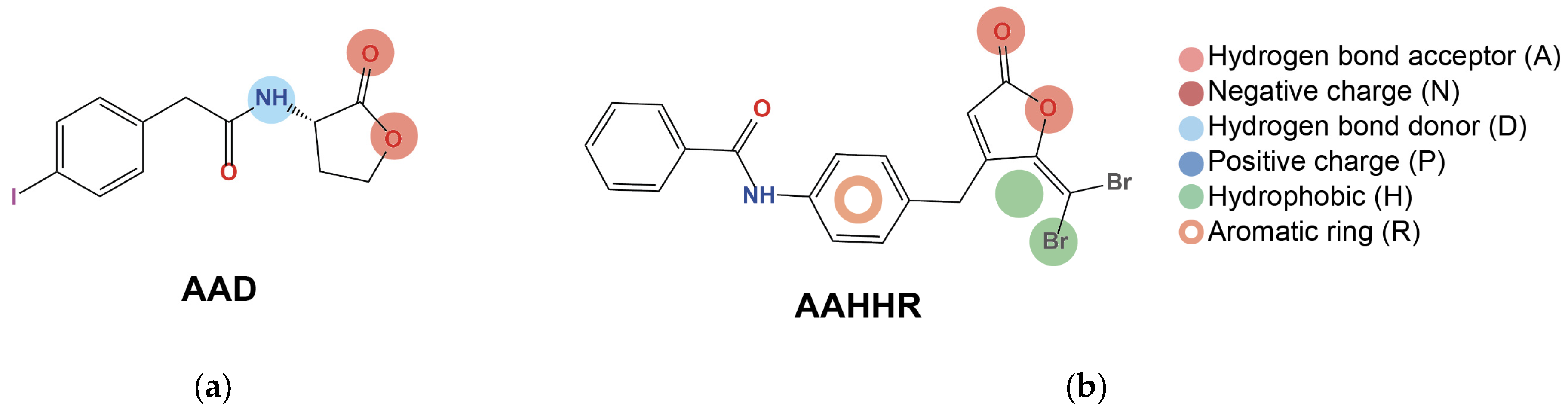
Among the evaluated hypotheses, an AAD model (A: hydrogen bond acceptor; D: hydrogen bond donor) was selected for the LasR protein, as it exhibited the highest PhaseHypoScore (1.27). For the elastase protein, an AAHHR model (A: hydrogen bond acceptor; H: hydrophobic; R: aromatic ring) was selected, showing a PhaseHypoScore of 1.34 (
Figure 1).
Pharmacophore modeling using Phase has been reported to identify key chemical features—such as hydrogen bond donors and acceptors, hydrophobic regions, aromatic rings, and charged groups—and their three-dimensional spatial arrangement that are essential for biological activity. These models are widely used to explain structure–activity relationships and to predict potential bioactive compounds from large chemical libraries.
Ligand-based virtual screening yielded approximately 3 million molecules with Shape Similarity values ≥ 0.70, exhibiting three-dimensional characteristics comparable to known LasR and elastase inhibitors. Enrichment analysis demonstrated robust discriminatory power of the screening protocol, with ROC curves indicating early recovery of active compounds relative to the included decoys.
Following pharmacophore-based virtual screening, 637,117 molecules were obtained for molecular docking against LasR and 134,822 molecules for docking against elastase. From these sets, the top 100,000 molecules with the highest scores were selected for subsequent detailed virtual screening.
The structure-based virtual screening (SBVS) results are presented in
Table 1 and
Table 2, which summarize affinity values obtained at each docking stage, including initial screening, HTVS (High-throughput virtual screening), SP, XP docking, and MM-GBSA binding free energy calculations. To provide a reference for comparison, the same docking protocol was applied to the co-crystallized ligands and known inhibitors of both proteins.
The evaluated molecules exhibited higher docking affinities toward the LasR protein than both the co-crystallized autoinducer and the reference inhibitor. In contrast, for the elastase protein, the reference inhibitor showed higher docking affinity than the evaluated compounds. Nevertheless, the calculated MM-GBSA binding free energies of the studied molecules were more favorable than those of the inhibitors in most cases.
Docking validation was performed by redocking the co-crystallized ligands into their respective binding sites. For the LasR protein, redocking of the autoinducer N-3-oxo-dodecanoyl-L-homoserine lactone resulted in an RMSD value of 1.0211 Å, whereas for the elastase protein, redocking of the inhibitor N-(1-carboxy-3-phenylpropyl)phenylalanyl-α-asparagine yielded an RMSD of 1.2721 Å (
Figure S1).
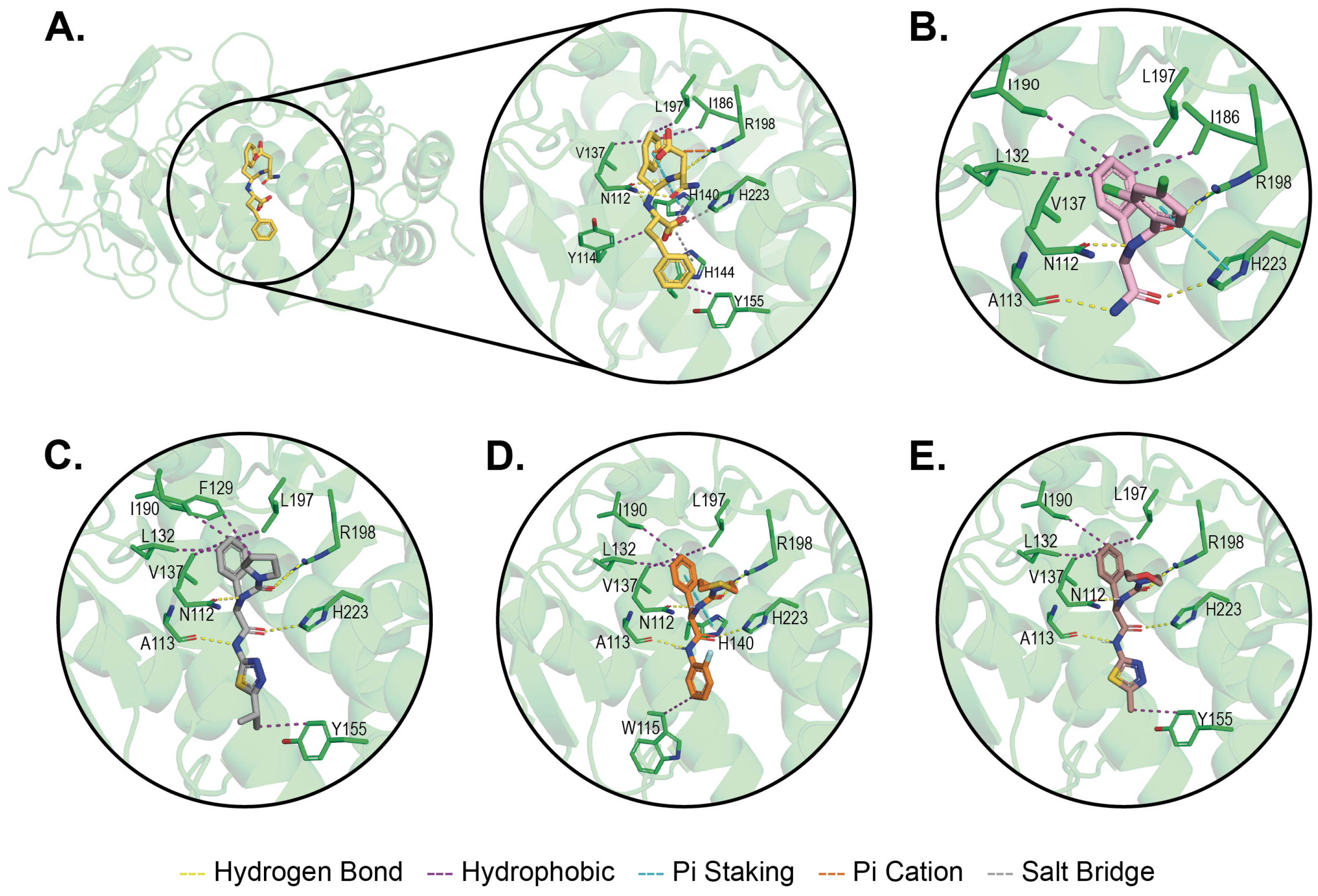
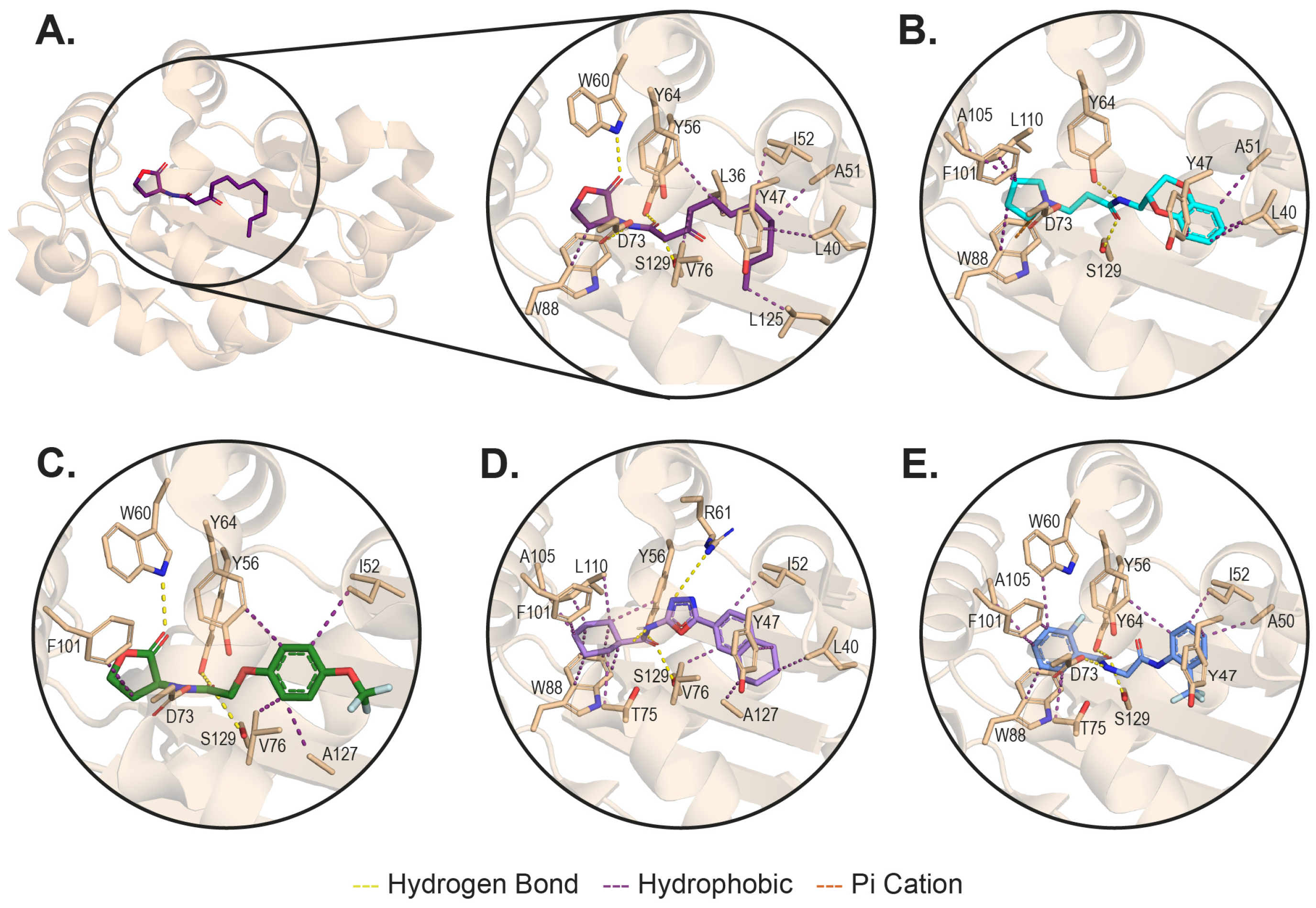
Figure 2 and
Figure 3 illustrate the three-dimensional structures of the protein–ligand complexes formed between the transcriptional activator LasR (PDB ID: 2UV0) and
Pseudomonas aeruginosa elastase (PDB ID: 1U4G) with the selected compounds, as well as with their respective inhibitors. In all cases, the evaluated molecules bound to the same binding site as the reference inhibitors.
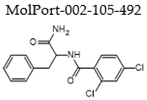
For the elastase protein, interactions with the reference inhibitor involved residues Glu164, Val222, His223, Glu141, Ala113, Arg198, Asn112, His146, Leu132, Leu197, and Val137. Six of these residues (His223, Ala113, Arg198, Asn112, Leu197, and Val137) were conserved in complexes formed with the studied molecules. Interactions with Glu141 and Leu132 were observed only in the protein–MolPort-002-105-492 and protein–MolPort-009-649-796 complexes. Hydrogen bonding, aromatic, and van der Waals interactions were identified for the studied molecules, whereas halogen interactions were observed only with the reference inhibitor.
For the LasR protein, van der Waals interactions, hydrogen bonding, halogen interactions, and aromatic interactions were identified with the inhibitor. The evaluated molecules exhibited similar interaction profiles, except that halogen interactions were detected only for MolPort-002-099-073, and a salt bridge interaction was observed exclusively in the MolPort-001-974-907 complex. All evaluated compounds bound to the same site as the inhibitor and the autoinducer.
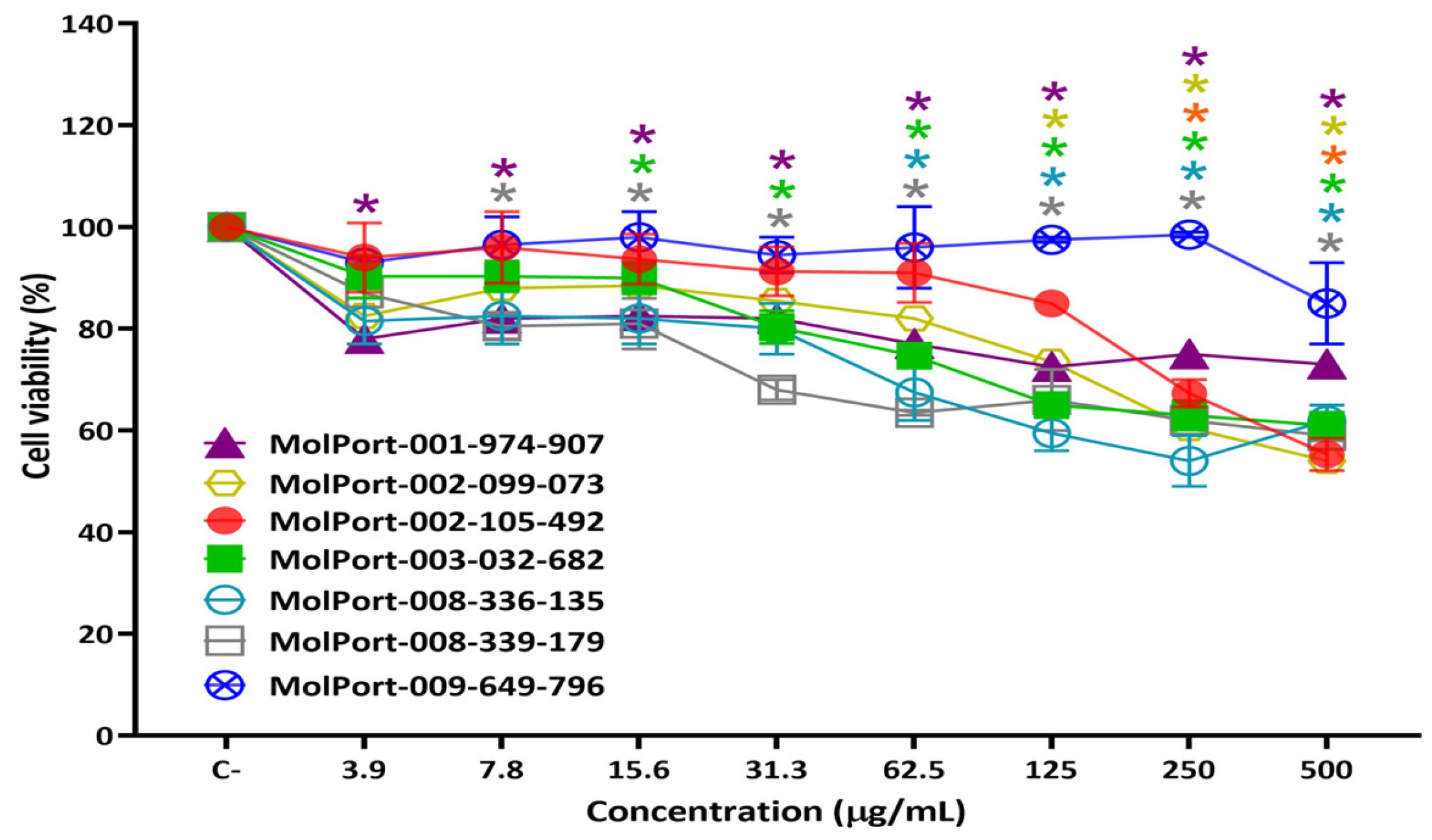
Experimental evaluation of cytotoxicity was conducted using a human cell line. As shown in
Figure 4, cell viability decreased as compound concentration increased; however, viability remained above 50% at the highest concentration tested. IC
50 values were greater than 500 μg/mL for all evaluated molecules.
The compounds MolPort-003-032-682, MolPort-001-974-907, MolPort-002-099-073, MolPort-008-336-135, and MolPort-008-339-179 induced significant cytotoxic effects at concentrations above 125 μg/mL (p ≤ 0.05). Among these, MolPort-008-339-179 showed a more pronounced concentration-dependent reduction in cell viability. Despite these effects, all compounds exhibited low overall cytotoxicity within the tested concentration range.
MIC values for both clinical isolates and the ATCC reference strain are presented in
Table 3 and
Table 4. The ATCC strain and clinical strain 1 remained susceptible to most tested antibiotics, whereas clinical strain 2 exhibited an extensively drug-resistant (XDR) phenotype, showing resistance to all evaluated antimicrobial agents.
For the newly tested compounds, MIC values ranged from 62.5 μg/mL to >500 μg/mL, indicating variable antibacterial activity. For several compounds, bacterial growth inhibition was not achieved at the highest concentration tested. In these cases, MIC values were reported as >62.5 μg/mL or >500 μg/mL, corresponding to the maximum concentration evaluated for each compound, as determined by cytotoxicity constraints and compound availability.
4. Discussion
Pseudomonas aeruginosa, a Gram-negative opportunistic pathogen, represents a critical threat to immunocompromised individuals and patients with cystic fibrosis, being responsible for approximately 1000 deaths annually [
13]. Its increasing capacity to develop multidrug resistance constitutes a major global health concern, underscoring the urgent need for innovative strategies to attenuate its virulence and pathogenicity rather than relying exclusively on bactericidal approaches [
36]. Among the most extensively studied molecular targets, the quorum-sensing transcriptional regulator LasR has emerged as a central node in virulence control, coordinating the expression of proteases, biofilm formation, pyocyanin production, and rhamnolipid synthesis [
37].
Recent studies have successfully identified LasR inhibitors through virtual screening approaches. For instance, one investigation employed pharmacophore-based screening of 2373 Food and Drug Administration (FDA)-approved compounds, identifying six candidates with binding affinities comparable to known LasR antagonists; notably, sulfamerazine exhibited particularly strong affinity, suggesting its potential as a LasR inhibitor [
36]. Similarly, another study identified three compounds (C1, C2, and C3) with docking scores below −11.0 kcal/mol, subsequently confirming their antagonistic activity through functional assays [
13]. These reports support the suitability of LasR as a druggable target and validate in silico screening strategies for the identification of early-stage quorum-sensing inhibitors.
In parallel, elastase (LasB), a multifunctional zinc-dependent metalloprotease, has been recognized as a relevant therapeutic target due to its pivotal role in host tissue degradation and immune evasion. Previous studies combining in silico and experimental approaches demonstrated that compounds such as Cu-fendione efficiently interact with the LasB active site, exhibiting potent inhibitory activity (Ki = 90 nM). Furthermore, Cu-fendione significantly reduced LasB expression and secretion, protected pulmonary epithelial monolayers by 42%, and increased survival in
Galleria mellonella infection models [
38]. Collectively, these findings reinforce LasR and LasB as complementary antivirulence targets, offering an alternative strategy for mitigating
P. aeruginosa pathogenicity, particularly in the context of multidrug resistance.
In the present study, a dual-target virtual screening workflow was implemented, focusing on LasR and elastase to generate a curated database of bioactive molecules from which pharmacophore models were derived (
Figure 1). The LasR pharmacophore model (PDB ID: 2UV0) required two hydrogen bond acceptors and one hydrogen bond donor, while the elastase pharmacophore (PDB ID: 1U4G) comprised one hydrogen bond acceptor, two hydrophobic features, and two aromatic ring features. All selected compounds satisfied these pharmacophoric constraints, supporting their predicted capacity to establish favorable interactions within the active sites of both targets.
HTVS results (
Table 1 and
Table 2) indicated that MolPort-001-974-907 exhibited the highest predicted affinity toward LasR (−12.256 kcal/mol), whereas MolPort-008-336-135 showed the strongest affinity for elastase (−9.8 kcal/mol). Overall, docking scores ranged from −7.98 to −12.256 kcal/mol, values that are consistent with previously reported virtual screening studies. Vetrivel et al. [
13] reported docking scores between −11.0 and −6.0 kcal/mol for LasR inhibitors, while another study described values ranging from −9.28 to −10.24 kcal/mol [
36]. In comparison, the evaluated compounds in this study displayed affinities equal to or exceeding those of the native autoinducer and reference inhibitor, which yielded docking scores of −8.3184 and −8.854 kcal/mol, respectively [
39,
40]. For elastase, previously reported affinities for essential oil components ranged from −4.16 to −6.03 kcal/mol [
41], whereas the compounds evaluated herein achieved higher values (−6.96 to −9.8 kcal/mol), albeit slightly lower than the reference inhibitor (−10.218 kcal/mol).
MM-GBSA binding free energy (ΔG_bind) calculations further supported these observations. For LasR, ΔG_bind values ranged from −83.937 to −88.000 kcal/mol, while for elastase, they ranged from −18.554 to −20.150 kcal/mol. These values were comparable to or exceeded those of the reference inhibitors, namely (S)-N-(2-oxotetrahydrofuran-3-yl)-2-(4-(trifluoromethoxy)phenoxy)acetamide and N-(1-carboxy-3-phenylpropyl)phenylalanyl-α-asparagine (−81.62 and −20.863 kcal/mol, respectively), suggesting stable protein–ligand complexes. Comparable MM-GBSA values have been reported by Vetrivel et al. [
13] (−92.2 to −112.2 kcal/mol) and other studies evaluating known LasR inhibitors (−74.45 to −80.50 kcal/mol), whereas sulfamerazine exhibited a notably weaker ΔG_bind of −52.74 kcal/mol [
36].
Docking protocol validation was performed using crystallographic ligands for both targets: the autoinducer N-3-oxo-dodecanoyl-L-homoserine lactone for LasR and N-(1-carboxy-3-phenylpropyl)phenylalanyl-α-asparagine for elastase (
Figure S1). The docked conformations closely overlapped with the crystallographic binding poses, and RMSD values below 2.0 Å confirmed the reliability of the docking methodology [
42].
Detailed interaction analysis (
Figure 2 and
Figure 3) revealed that the evaluated compounds engaged key residues previously reported as critical for ligand recognition. For LasR, native ligands and antagonists typically form hydrogen bonds with Tyr56, Trp60, Asp73, and Ser129 [
13]. In the present study, consistent interactions with Ser129 and Asp73 were observed, while MolPort-002-099-073 and MolPort-003-032-682 additionally interacted with Tyr56, enhancing complex stabilization. Hydrophobic contacts, π–π stacking, and polar interactions further contributed to binding affinity, in agreement with prior reports [
36,
43].
For elastase, the catalytic site is characterized by the zinc-coordinating residues His140, His144, and Glu164 [
44]. Interaction with Glu164 was confirmed for the reference inhibitor, although not all screened compounds exhibited direct contact with this residue. Instead, MolPort-009-649-796 and MolPort-008-339-179 interacted with Leu132, a residue located within the S1′ subpocket that favors lipophilic interactions with Ile186 and Ile190 [
44]. Metal–acceptor interactions consistent with zinc coordination were also observed, supporting the plausibility of enzyme inhibition through a tetrahedral binding geometry [
44].
Cytotoxicity evaluation in HepG2 cells demonstrated a favorable safety profile, with IC
50 values exceeding 500 µg/mL for all compounds (
Figure 4). The HepG2 cell line was selected as a human hepatic model commonly employed for preliminary toxicity assessment in early-stage drug discovery, allowing estimation of systemic cytotoxic risk. Comparable thresholds have been reported for dry rose extract (>650 µg/mL) [
45], whereas lavender essential oil exhibited cytotoxicity at much lower concentrations (0.22 μL/mL) [
23]. Everett et al. [
46] similarly reported no cytotoxic effects at 100 μM despite measurable LasB inhibition. In the present study, cell viability remained above 70% at 62.5 µg/mL, which was therefore selected as the maximum concentration for antimicrobial screening, in line with standard practices for hit identification.
MIC assays revealed that several compounds exhibited MIC values of 62.5 µg/mL against the ATCC strain, consistent with weak to moderate antibacterial activity characteristic of early-stage hit compounds. While these concentrations are higher than those of clinically used antibiotics, they are comparable to values reported for other novel scaffolds, including MICs > 20 µg/mL [
47], 40 µg/mL [
48], and up to 1000 µg/mL for natural or formulation-based antimicrobials [
49,
50,
51]. Importantly, the evaluated compounds lack a β-lactam core, which may reduce susceptibility to β-lactamase-mediated degradation and supports their consideration as non-classical antimicrobial scaffolds requiring further structure–activity relationship optimization.



 ,
,