An Energy Culture Maturity Conceptual Framework on Adopting Energy-Efficient Technology Innovations in Buildings

 ,
, 
Abstract
1. Introduction
2. Background Literature
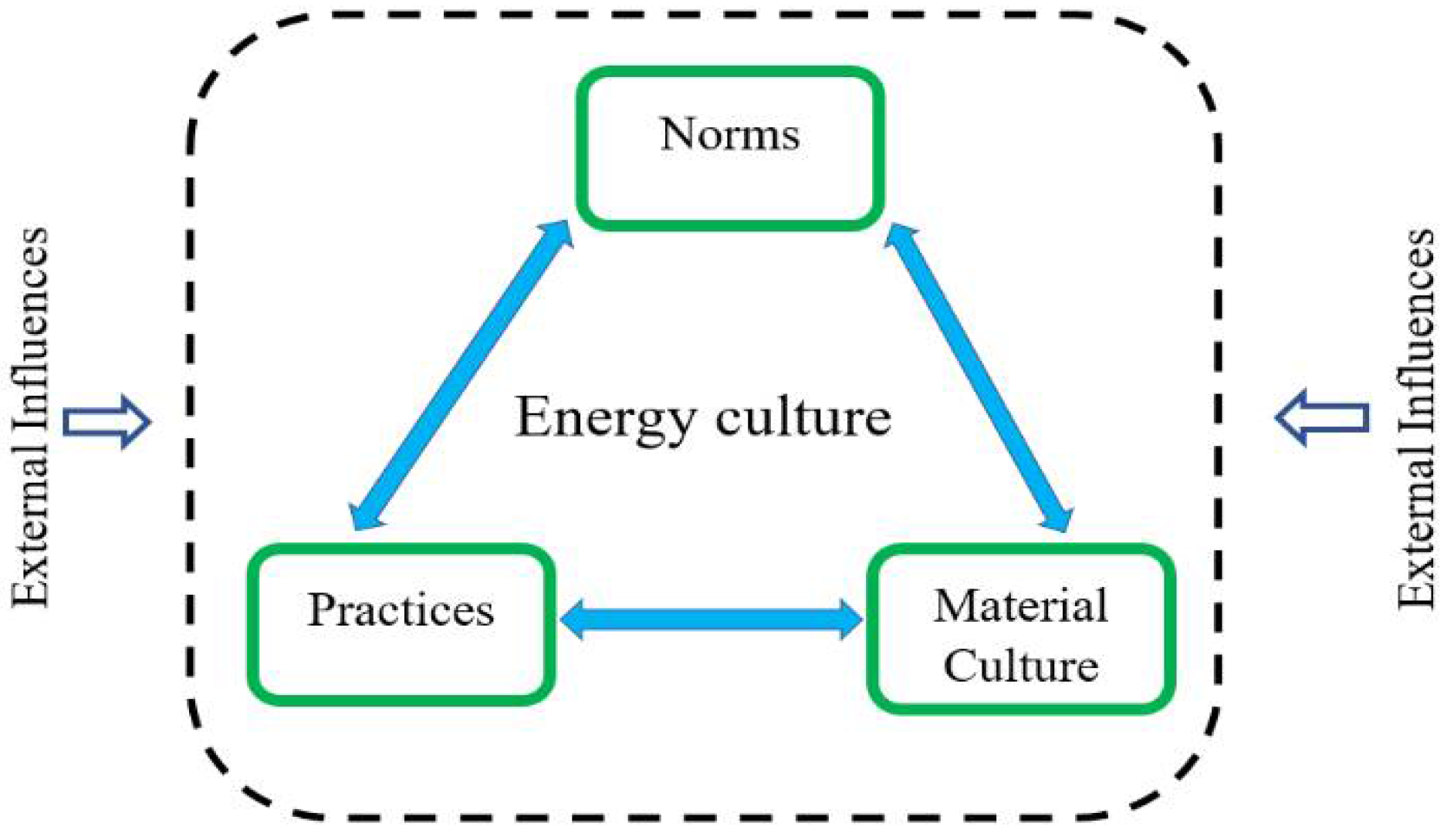
2.1. Energy Culture
2.2. Energy Culture Maturity Models
3. Materials and Methods
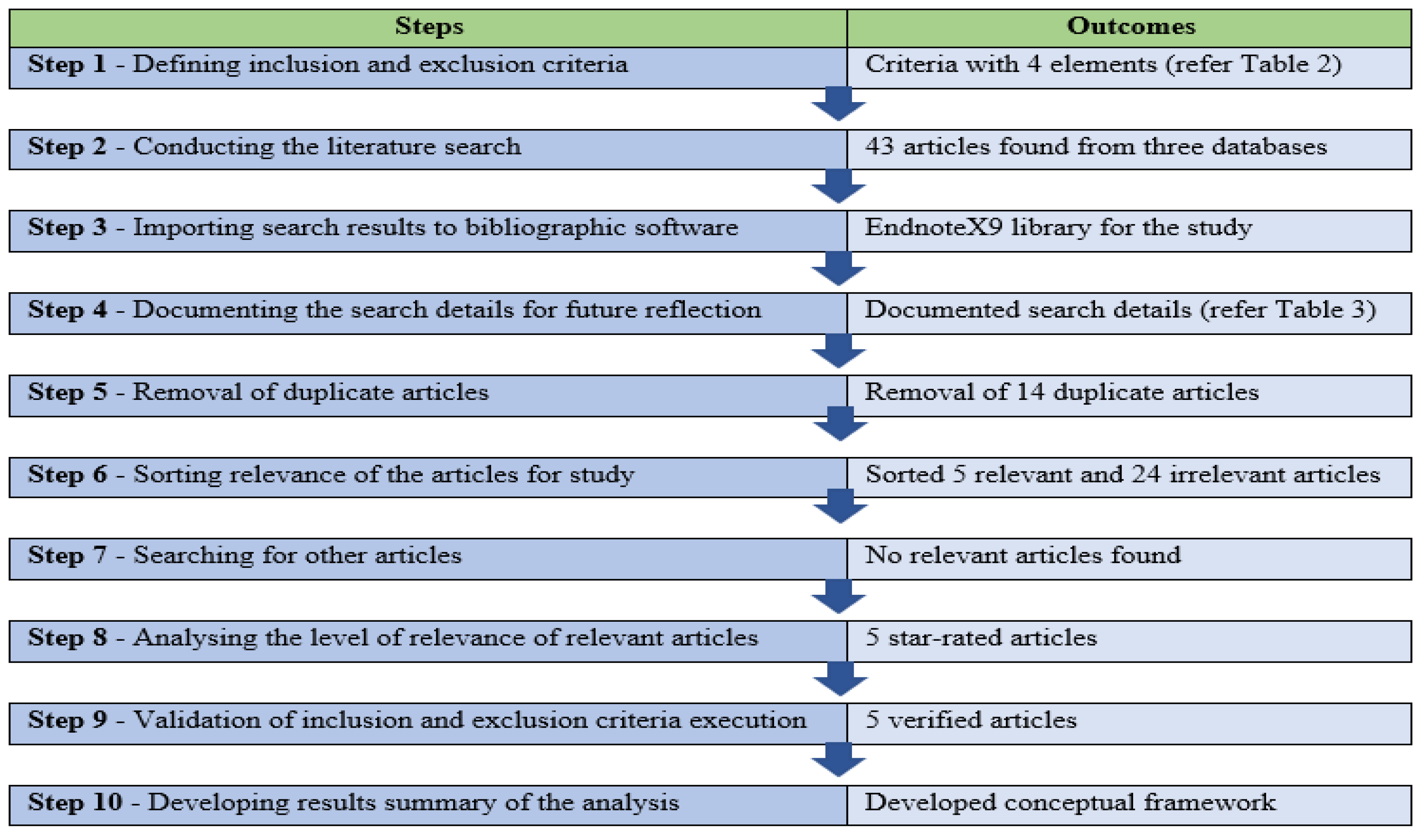
3.1. Implementation of Scoping Literature Review Procedure
3.2. Validation Procedure for the Framework
4. Results
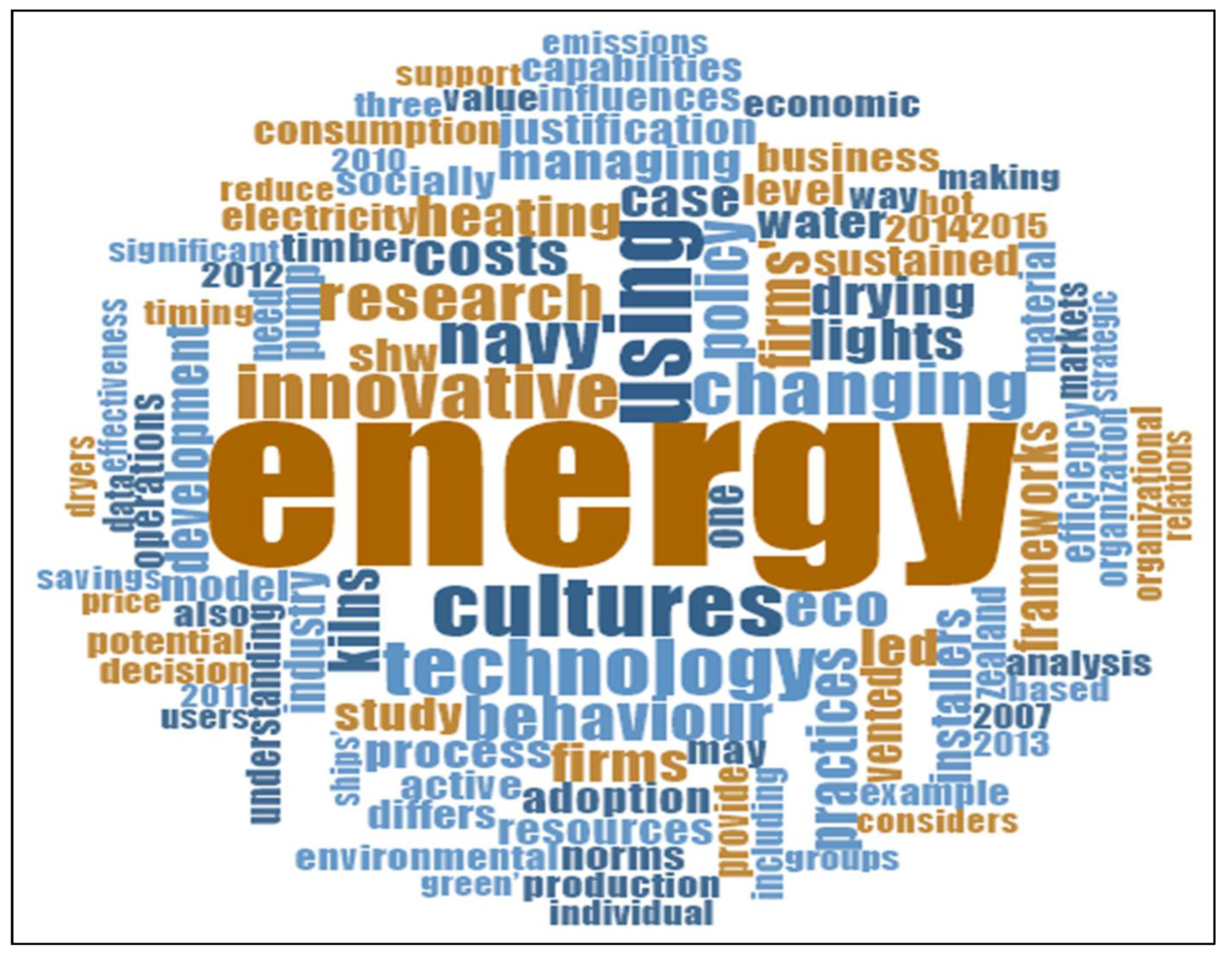
4.1. Word Cloud Analysis of Scoping Review Results
4.2. Energy Culture Maturity Conceptual Framework
4.2.1. Factors and Factor Categorisation of Energy Culture
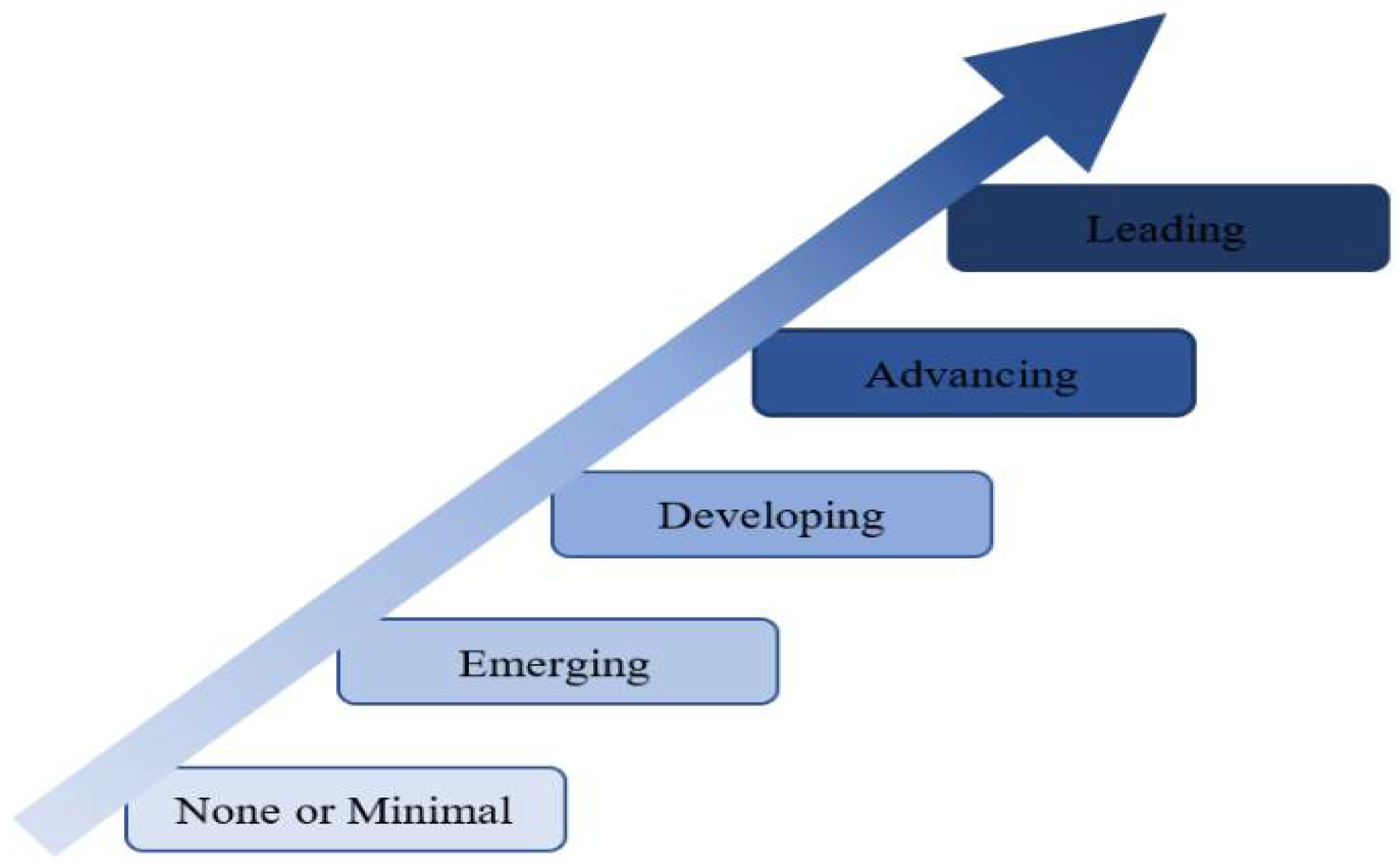
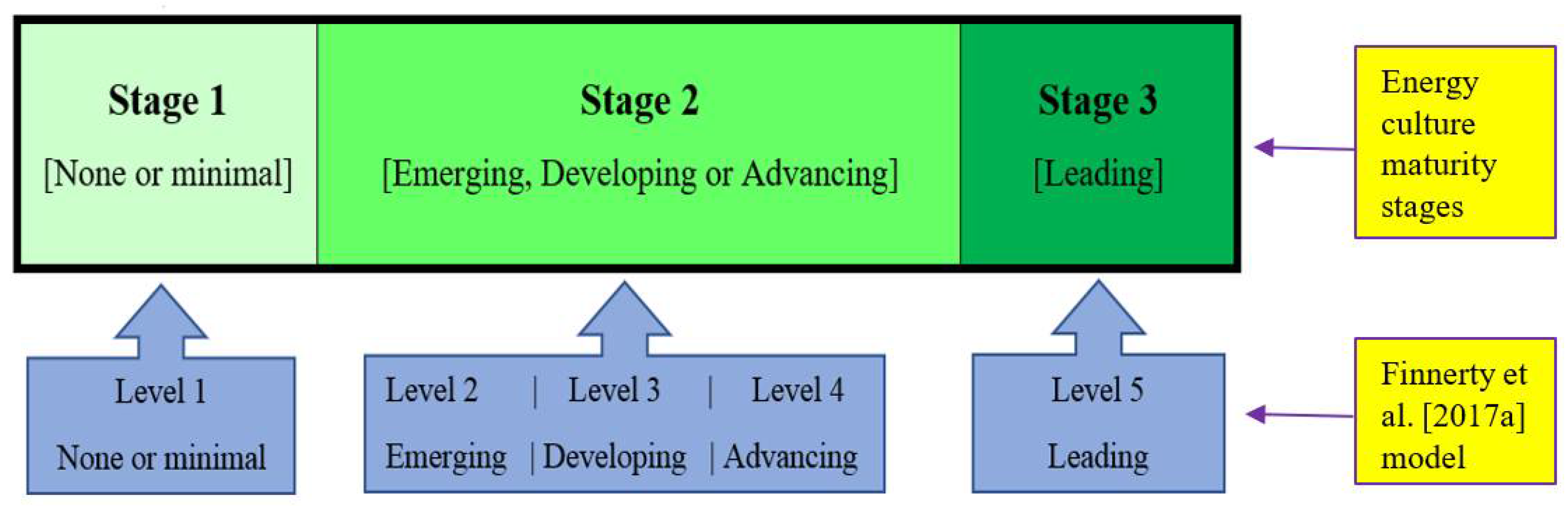
4.2.2. Energy Culture Maturity Stages
4.2.3. Energy Culture Maturity Stage Descriptors
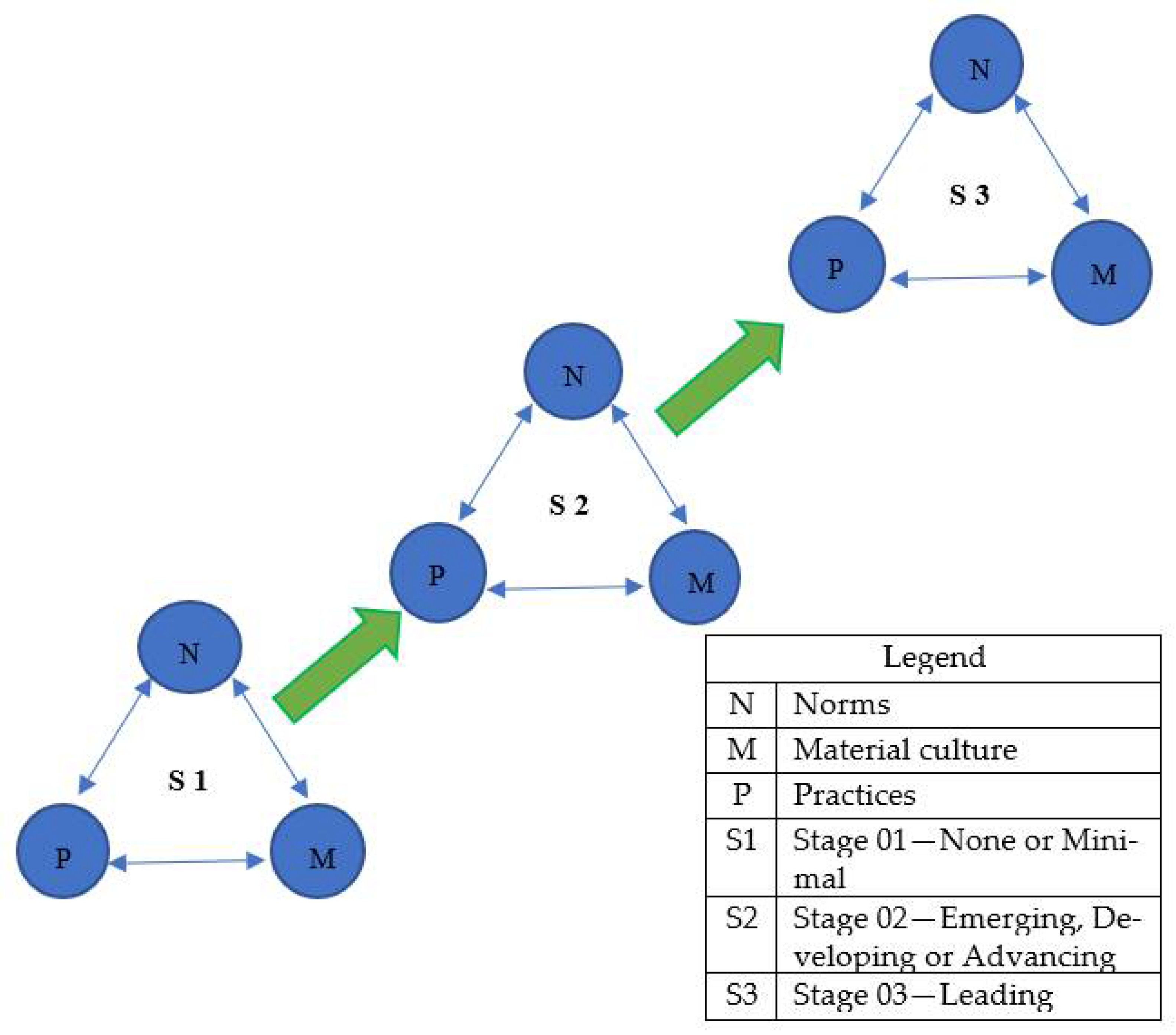
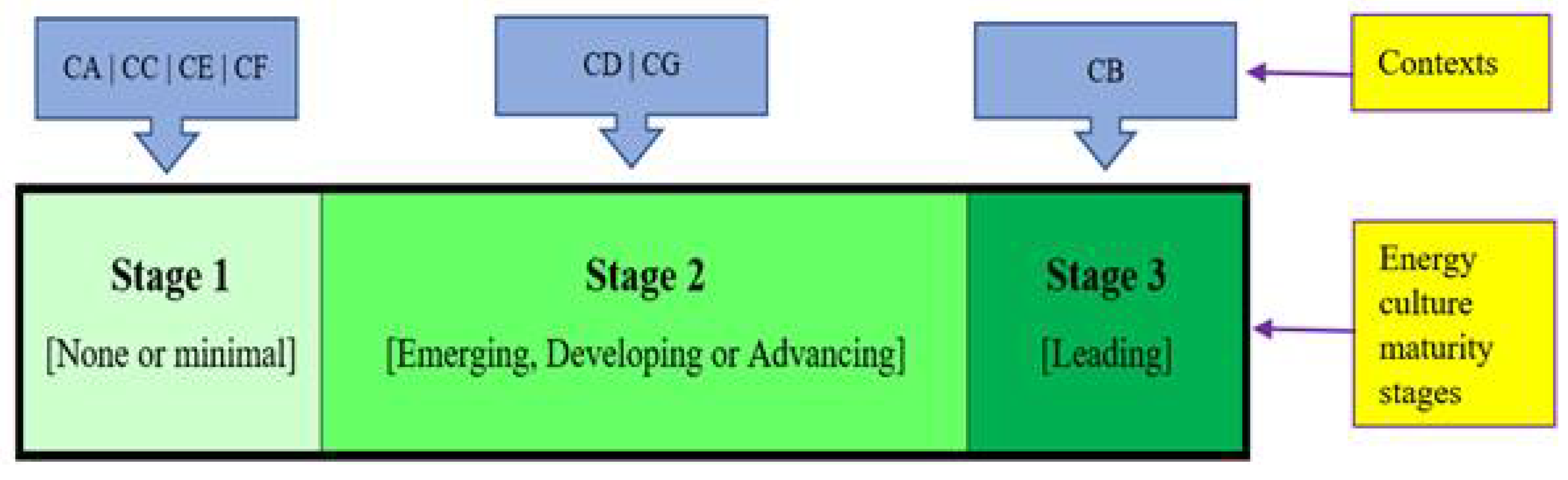
4.2.4. Development of the Energy Culture Maturity Conceptual Framework
- Stage 1 (S1): Energy cultures that obstruct the adoption of energy-efficient technologies.
- Stage 2 (S2): Energy cultures that support the adoption of energy-efficient technologies to some extent. There is still room for improvement in terms of reaching energy culture excellence.
- Stage 3 (S3): Energy cultures that support at the best level for adopting energy-efficient technologies.
5. Conclusions
Author Contributions
Funding
Institutional Review Board Statement
Informed Consent Statement
Data Availability Statement
Acknowledgments
Conflicts of Interest
References
- International Energy Agency. World Energy Outlook. 2018. Available online: https://webstore.iea.org/download/summary/190?fileName=English-WEO-2018-ES.pdf (accessed on 1 August 2019).
- Qerimi, D.; Dimitrieska, C.; Vasilevska, S.; Rrecaj, A.A. Modeling of the solar thermal energy use in urban areas. Civ. Eng. J. 2020, 6, 1349–1367. [Google Scholar] [CrossRef]
- Mariano-Hernández, D.; Hernández-Callejo, L.; Zorita-Lamadrid, A.; Duque-Pérez, O.; García, F.S. A review of strategies for building energy management system: Model predictive control, demand side management, optimization, and fault detect & diagnosis. J. Build. Eng. 2020, 33, 101692. [Google Scholar] [CrossRef]
- Gerarden, T.D.; Newell, R.G.; Stavins, R.N. Assessing the energy-efficiency gap. J. Econ. Lit. 2017, 55, 1486–1525. [Google Scholar] [CrossRef]
- Wagiman, K.R.; Abdullah, M.N.; Hassan, M.Y.; Radzi, N.H.M. A new metric for optimal visual comfort and energy efficiency of building lighting system considering daylight using multi-objective particle swarm optimisation. J. Build. Eng. 2021, 43, 102525. [Google Scholar] [CrossRef]
- Ghaderian, M.; Veysi, F. Multi-objective optimisation of energy efficiency and thermal comfort in an existing office building using NSGA-II with fitness approximation: A case study. J. Build. Eng. 2021, 41, 102440. [Google Scholar] [CrossRef]
- Dervishi, S.; Pashako, F.; Dushaj, X.; Dervishi, I.O. Energy performance optimisation of traditional housing in Mediterranean climate. J. Build. Eng. 2022, 45, 103423. [Google Scholar] [CrossRef]
- Al-Homoud, M.S.; Krarti, M. Energy efficiency of residential buildings in the kingdom of Saudi Arabia: Review of status and future roadmap. J. Build. Eng. 2021, 36, 102143. [Google Scholar] [CrossRef]
- Duan, J.; Li, N.; Peng, J.; Wang, C.; Liu, Q. Full-response model of transient heat transfer of building walls using thermoelectric analogy method. J. Build. Eng. 2021, 46, 103717. [Google Scholar] [CrossRef]
- Nazeriye, M.; Haeri, A.; Haghighat, F.; Panchabikesan, K. Understanding the influence of building characteristics on enhancing energy efficiency in residential buildings: A data mining-based study. J. Build. Eng. 2021, 43, 103069. [Google Scholar] [CrossRef]
- Kalhor, K.; Ememinejad, N. Qualitative and quantitative optimisation of thermal insulation materials: Insights from the market and energy codes. J. Build. Eng. 2020, 30, 101275. [Google Scholar] [CrossRef]
- Raza, R.; Hassan, N.U.; Yuen, C. Determination of consumer behavior-based energy wastage using IoT and machine learning. Energy Build. 2020, 220, 110060. [Google Scholar] [CrossRef]
- Wagner, A.; O’Brien, W.; Dong, B. Exploring Occupant Behavior in Buildings, 1st ed.; Springer International Publishing: Berlin/Heidelberg, Germany, 2018. [Google Scholar]
- Duarte, J.G.C.D.L.M.; Zemero, B.R.; de Souza, A.C.D.B.; de Lima Tostes, M.E.; Bezerra, U.H. Building Information Modeling approach to optimise energy efficiency in educational buildings. J. Build. Eng. 2021, 43, 102587. [Google Scholar] [CrossRef]
- Song, I.H.; Lhee, J.H.; Jeong, J.W. Energy efficiency and economic analysis of variable frequency drive and variable pitch system: A case study of axial fan in hospital. J. Build. Eng. 2021, 43, 103213. [Google Scholar] [CrossRef]
- Tavakolan, M.; Mostafazadeh, F.; Jalilzadeh, S.; Safari, A.; Mirzaei, K. A simulation-based multi-objective optimisation framework for economic analysis of building energy retrofit: A case study in Iran. J. Build. Eng. 2021, 43, 103485. [Google Scholar] [CrossRef]
- Costa, J.F.W.; Amorim, C.N.D.; Silva, J.C.R. Retrofit guidelines towards the achievement of net zero energy buildings for office buildings in Brasilia. J. Build. Eng. 2020, 32, 101680. [Google Scholar] [CrossRef]
- González-Zamar, M.D.; Abad-Segura, E.; Vázquez-Cano, E.; López-Meneses, E. IoT technology applications-based smart cities: Research analysis. Electronics 2020, 9, 1246. [Google Scholar] [CrossRef]
- Braungardt, S.; Elsland, R.; Eichhammer, W. The environmental impact of eco-innovations: The case of EU residential electricity use. Environ. Econ. Policy Stud. 2016, 18, 213–228. [Google Scholar] [CrossRef]
- Civelek, F.; Kulkarni, R.; Fritz, K.P.; Meyer, T.; Troulos, C.; Guenther, T.; Zimmermann, A. Open-Eco-Innovation for SMEs with Pan-European Key Enabling Technology Centres. Clean Technol. 2020, 2, 26. [Google Scholar] [CrossRef]
- Arnold, M.; Barth, V. Open innovation in urban energy systems. Energy Effic. 2012, 5, 351–364. [Google Scholar] [CrossRef]
- Cagno, E.; Ramirez-Portilla, A.; Trianni, A. Linking energy efficiency and innovation practices: Empirical evidence from the foundry sector. Energy Policy 2015, 83, 240–256. [Google Scholar] [CrossRef]
- Urbaniec, M. Towards sustainable development through eco-innovations: Drivers and barriers in Poland. Econ. Sociol. 2015, 8, 179. [Google Scholar] [CrossRef] [PubMed]
- Garcia, R.; Wigger, K.; Hermann, R.R. Challenges of creating and capturing value in open eco-innovation: Evidence from the maritime industry in Denmark. J. Clean. Prod. 2019, 220, 642–654. [Google Scholar] [CrossRef]
- Sanchez-Henriquez, F.; Pavez, I. The Effect of Open Innovation on Eco-Innovation Performance: The Role of Market Knowledge Sources. Sustainability 2021, 13, 3890. [Google Scholar] [CrossRef]
- Ruby, T.M. Innovation-enabling policy and regime transformation towards increased energy efficiency: The case of the circulator pump industry in Europe. J. Clean. Prod. 2015, 103, 574–585. [Google Scholar] [CrossRef]
- Schubert, R.; Stadelmann, M. Energy-using durables—Why consumers refrain from economically optimal choices. Front. Energy Res. 2015, 3, 1–13. [Google Scholar] [CrossRef]
- Trotta, G. Factors affecting energy-saving behaviours and energy efficiency investments in British households. Energy Policy 2018, 114, 529–539. [Google Scholar] [CrossRef]
- Šūmakaris, P.; Korsakienė, R.; Ščeulovs, D. Determinants of Energy Efficient Innovation: A Systematic Literature Review. Energies 2021, 14, 7777. [Google Scholar] [CrossRef]
- Noailly, J.; Batrakova, S. Stimulating energy-efficient innovations in the Dutch building sector: Empirical evidence from patent counts and policy lessons. Energy Policy 2010, 38, 7803–7817. [Google Scholar] [CrossRef]
- Altwies, J.E.; Nemet, G.F. Innovation in the US building sector: An assessment of patent citations in building energy control technology. Energy Policy 2013, 52, 819–831. [Google Scholar] [CrossRef]
- International Energy Agency. World Energy Outlook. 2012. Available online: https://webstore.iea.org/world-energy-outlook-2012-2 (accessed on 1 August 2019).
- Friedman, C.; Becker, N.; Erell, E. Retrofitting residential building envelopes for energy efficiency: Motivations of individual homeowners in Israel. J. Environ. Plan. Manag. 2018, 61, 1805–1827. [Google Scholar] [CrossRef]
- Davis, A.; Wong-Parodi, G.; Krishnamurti, T. Neither a borrower nor a lender be: Beyond cost in energy efficiency decision-making among office buildings in the United States. Energy Res. Soc. Sci. 2019, 47, 37–45. [Google Scholar] [CrossRef]
- Wong-Parodi, G.; Krishnamurti, T.; Davis, A.; Schwartz, D.; Fischhoff, B. A decision science approach for integrating social science in climate and energy solutions. Nat. Clim. Change 2016, 6, 563. [Google Scholar] [CrossRef]
- Capozza, C.; Divella, M.; Rubino, A. Exploring energy transition in European firms: The role of policy instruments, demand-pull factors and cost-saving needs in driving energy-efficient and renewable energy innovations. Energy Sources Part B Econ. Plan. Policy 2021, 16, 1094–1109. [Google Scholar] [CrossRef]
- Diaz-Rainey, I.; Ashton, J.K. Investment inefficiency and the adoption of eco-innovations: The case of household energy efficiency technologies. Energy Policy 2015, 82, 105–117. [Google Scholar] [CrossRef]
- United Nations. 2019. SDG 7 Policy Briefs in Support of the High-Level Political Forum 2019. Available online: https://sustainabledevelopment.un.org/content/documents/22877UN_FINAL_ONLINE_20190523.pdf (accessed on 5 October 2019).
- Sovacool, B.K. What are we doing here? Analysing fifteen years of energy scholarship and proposing a social science research agenda. Energy Res. Soc. Sci. 2014, 1, 1–29. [Google Scholar] [CrossRef]
- Dunlop, T. Mind the gap: A social sciences review of energy efficiency. Energy Res. Soc. Sci. 2019, 56, 101216. [Google Scholar] [CrossRef]
- Lutzenhiser, L. A cultural model of household energy consumption. Energy 1992, 17, 47–60. [Google Scholar] [CrossRef]
- Stephenson, J.; Barton, B.; Carrington, G.; Gnoth, D.; Lawson, R.; Thorsnes, P. Energy cultures: A framework for understanding energy behaviours. Energy Policy 2010, 38, 6120–6129. [Google Scholar] [CrossRef]
- Stephenson, J.; Barton, B.; Carrington, G.; Doering, A.; Ford, R.; Hopkins, D.; Lawson, R.; McCarthy, A.; Rees, D.; Scott, M.; et al. The energy cultures framework: Exploring the role of norms, practices and material culture in shaping energy behaviour in New Zealand. Energy Res. Soc. Sci. 2015, 7, 117–123. [Google Scholar] [CrossRef]
- Fowler, L.; Neaves, T.T.; Terman, J.N.; Cosby, A.G. Cultural penetration and punctuated policy change: Explaining the evolution of US Energy Policy. Rev Policy Res. 2017, 34, 559–577. [Google Scholar] [CrossRef]
- Dew, N.; Aten, K.; Ferrer, G. How many admirals does it take to change a light bulb? Organisational innovation, energy efficiency, and the United States Navy’s battle over LED lighting. Energy Res. Soc. Sci. 2017, 27, 57–67. [Google Scholar] [CrossRef]
- Stephenson, J. Sustainability cultures and energy research: An actor-centred interpretation of cultural theory. Energy Res. Soc. Sci. 2018, 44, 242–249. [Google Scholar] [CrossRef]
- Rotzek, J.N.; Scope, C.; Günther, E. What energy management practice can learn from research on energy culture? Sustain. Account. Manag. Policy J. 2018, 9, 515–551. [Google Scholar] [CrossRef]
- Bell, M.; Carrington, G.; Lawson, R.; Stephenson, J. Socio-technical barriers to the use of energy-efficient timber drying technology in New Zealand. Energy Policy 2014, 67, 747–755. [Google Scholar] [CrossRef]
- Gill, N.; Osman, P.; Head, L.; Voyer, M.; Harada, T.; Waitt, G.; Gibson, C. Looking beyond installation: Why households struggle to make the most of solar hot water systems. Energy Policy 2015, 87, 83–94. [Google Scholar] [CrossRef]
- Walton, S.; Zhang, A.; O’Kane, C. Energy eco-innovations for sustainable development: Exploring organisational strategic capabilities through an energy cultures framework. Bus. Strategy Environ. 2020, 29, 812–826. [Google Scholar] [CrossRef]
- Zwetsloot, G.I.; van Middelaar, J.; Van der Beek, D. Repeated assessment of process safety culture in major hazard industries in the Rotterdam region (The Netherlands). J. Clean. Prod. 2020, 257, 120540. [Google Scholar] [CrossRef]
- Lee, J. Safety culture evaluation model at construction site. Int. J. Eng. Res. Technol. 2019, 12, 1972–1977. [Google Scholar]
- Jean, M.S.; Zaleschuk, L.P. Safety Culture Assessment and Continuous Monitoring Approach. In Proceedings of the 12th International Pipeline Conference, Calgary, AB, Canada, 24–28 September 2018; Volume 2, pp. 1–7. [Google Scholar] [CrossRef]
- Musonda, L.; Lusenga, E.; Okoro, C. Rating and characterisation of an organisation’s safety culture to improve performance. Int. J. Constr. Manag. 2018, 21, 181–193. [Google Scholar] [CrossRef]
- Stiles, S.; Ryan, B.; Golightly, D. Readiness to Change: Perceptions of Safety Culture up and down the Supply Chain. In Congress of the International Ergonomics Association; Springer: Cham, Switzerland, 2018; pp. 213–223. [Google Scholar] [CrossRef]
- Finnerty, N.; Sterling, R.; Coakley, D.; Contreras, S.; Coffey, R.; Keane, M.M. Development of a Global Energy Management System for non-energy intensive multi-site industrial organisations: A methodology. Energy 2017, 136, 16–31. [Google Scholar] [CrossRef]
- Finnerty, N.; Sterling, R.; Coakley, D.; Keane, M.M. An energy management maturity model for multi-site industrial organisations with a global presence. J. Clean. Prod. 2017, 167, 1232–1250. [Google Scholar] [CrossRef]
- Prashar, A. Energy efficiency maturity (EEM) assessment framework for energy-intensive SMEs: Proposal and evaluation. J. Clean. Prod. 2017, 166, 1187–1201. [Google Scholar] [CrossRef]
- Introna, V.; Cesarotti, V.; Benedetti, M.; Biagiotti, S.; Rotunno, R. Energy Management Maturity Model: An organisational tool to foster the continuous reduction of energy consumption in companies. J. Clean. Prod. 2014, 83, 108–117. [Google Scholar] [CrossRef]
- Ngai, E.W.T.; Chau, D.C.K.; Poon, J.K.L.; To, C.K.M. Energy and utility management maturity model for sustainable manufacturing process. Int. J. Prod. Econ. 2013, 146, 453–464. [Google Scholar] [CrossRef]
- Jin, Y.; Long, Y.; Jin, S.; Yang, Q.; Chen, B.; Li, Y.; Xu, L. An energy management maturity model for China: Linking ISO 50001: 2018 and domestic practices. J. Clean. Prod. 2021, 290, 125168. [Google Scholar] [CrossRef]
- Jovanović, B.; Filipović, J. ISO 50001 standard-based energy management maturity model—Proposal and validation in industry. J. Clean. Prod. 2016, 112, 2744–2755. [Google Scholar] [CrossRef]
- Antunes, P.; Carreira, P.; da Silva, M.M. Towards an energy management maturity model. Energy Policy 2014, 73, 803–814. [Google Scholar] [CrossRef]
- Ishak, M.H. Modelling energy consumption behaviour using “energy culture” concept for student accommodations in Malaysian public universities. Facilities 2017, 35, 658–683. [Google Scholar] [CrossRef]
- Jürisoo, M.; Serenje, N.; Mwila, F.; Lambe, F.; Osborne, M. Old habits die hard: Using the energy cultures framework to understand drivers of household-level energy transitions in urban Zambia. Energy Res. Soc. Sci. 2019, 53, 59–67. [Google Scholar] [CrossRef]
- Raggio, R.D.; Ekman, P.; Thompson, S.M. Making energy metrics relevant to service firms: From energy conservation to energy productivity. J. Clean. Prod. 2020, 256, 120493. [Google Scholar] [CrossRef]
- Nie, H.; Vasseur, V.; Fan, Y.; Xu, J. Exploring reasons behind careful-use, energy-saving behaviours in residential sector based on the theory of planned behaviour: Evidence from Changchun, China. J. Clean. Prod. 2019, 230, 29–37. [Google Scholar] [CrossRef]
- Axon, S.; Morrissey, J.; Aiesha, R.; Hillman, J.; Revez, A.; Lennon, B.; Salel, M.; Dunphy, N.; Boo, E. The human factor: Classification of European community-based behaviour change initiatives. J. Clean. Prod. 2018, 182, 567–586. [Google Scholar] [CrossRef]
- Ford, R.; Walton, S.; Stephenson, J.; Rees, D.; Scott, M.; King, G.; Williams, J.; Wooliscroft, B. Emerging energy transitions: PV uptake beyond subsidies. Technol. Forecast Soc. Change 2017, 117, 138–150. [Google Scholar] [CrossRef]
- Ambrosio-Albalá, P.; Upham, P.; Bale, C.S. Purely ornamental? Public perceptions of distributed energy storage in the United Kingdom. Energy Res. Soc. Sci. 2018, 48, 139–150. [Google Scholar] [CrossRef]
- Schein, E.H.; Schein, P.A. Organisational Culture, and Leadership, 5th ed.; John Wiley & Sons, Incorporated: Hoboken, NJ, USA, 2017. [Google Scholar]
- Paulk, M.C.; Curtis, B.; Chrissis, M.B.; Weber, C.V. Capability maturity model, version 1.1. IEEE Softw. 1993, 10, 18–27. [Google Scholar] [CrossRef]
- Richardson, R.; Watkiss, R. The influence of leadership and Behaviours on safety Performance. In Proceedings of the SPE Offshore Europe Oil and Gas Exhibition and Conference, Aberdeen, UK, 2–5 September 2003. [Google Scholar] [CrossRef]
- Fleming, M.; Wentzell, N. Patient safety culture improvement tool: Development and guidelines for use. Healthc. Q. 2008, 11, 5–10. [Google Scholar] [CrossRef]
- Filho, A.P.G.; Andrade, J.C.S.; Marinho, M.M.O. A safety culture maturity model for petrochemical companies in Brazil. Saf. Sci. 2010, 48, 615–624. [Google Scholar] [CrossRef]
- Daher, E. Safety Culture Maturity Model: A Process Worth Implementing? In Proceedings of the SPE Americas E&P Health, Safety, Security and Environmental Conference, Galveston, TX, USA, 18–20 March 2013. [CrossRef]
- Zhang, F.; Zhang, Y.; Jun, L. Research on the maturity of real estate enterprises safety culture. J. Appl. Sci. 2013, 13, 2039–2044. [Google Scholar] [CrossRef][Green Version]
- Phusavat, K.; Vongvitayapirom, B.; Hidayanto, A.N. Enterprise development through the safety culture maturity model. Int. J. Manag. Enterp. Dev. 2015, 14, 89–102. [Google Scholar] [CrossRef]
- Bordage, P.; Fox, C.; Arce, L.M.; Villarreal, G.; Celly, J.J.Y. Innovative ways to inspire new employees to embrace an HSE culture. In Proceedings of the International Conference on Health, Safety and Environment in Oil and Gas Exploration and Production, Perth, WA, Australia, 11–13 September 2012. [Google Scholar] [CrossRef]
- Chaitanya, C.K.; Madala, M.K. A study on board characteristics and corporate performance of indian oil and gas upstream companies-evolving a board performance culture maturity model. Indian J. Corp. Gov. 2008, 1, 5–23. [Google Scholar] [CrossRef]
- Jespersen, L.; Griffiths, M.; Maclaurin, T.; Chapman, B.; Wallace, C.A. Measurement of food safety culture using survey and maturity profiling tools. Food Control 2016, 66, 174–182. [Google Scholar] [CrossRef]
- Munn, Z.; Peters, M.D.; Stern, C.; Tufanaru, C.; McArthur, A.; Aromataris, E. Systematic review or scoping review? Guidance for authors when choosing between a systematic or scoping review approach. BMC Med. Res. Methodol. 2018, 18, 1–7. [Google Scholar] [CrossRef] [PubMed]
- Pham, M.T.; Rajić, A.; Greig, J.D.; Sargeant, J.M.; Papadopoulos, A.; McEwen, S.A. A scoping review of scoping reviews: Advancing the approach and enhancing the consistency. Res. Synth. Methods 2014, 5, 371–385. [Google Scholar] [CrossRef]
- O’Brien, A.M.; Mc Guckin, C. The Systematic Literature Review Method: Trials and Tribulations of Electronic Database Searching at Doctoral Level; SAGE Research Methods Cases Part 1; SAGE Publications Ltd.: London, UK, 2016; pp. 1–16. [Google Scholar] [CrossRef]
- Kraus, S.; Breier, M.; Dasí-Rodríguez, S. The art of crafting a systematic literature review in entrepreneurship research. Int. Entrep. Manag. J. 2020, 16, 1023–1042. [Google Scholar] [CrossRef]
- Torreglosa, J.P.; Garcia-Triviño, P.; Vera, D.; López-García, D.A. Analysing the Improvements of Energy Management Systems for Hybrid Electric Vehicles Using a Systematic Literature Review: How Far Are These Controls from Rule-Based Controls Used in Commercial Vehicles? Appl. Sci. 2020, 10, 8744. [Google Scholar] [CrossRef]
- Princeton University Library, Energy Resources: Energy Databases. 2020. Available online: https://libguides.princeton.edu/Energy/ (accessed on 5 June 2021).
- BUE Library, Energy & Environmental Engineering: Databases. 2021. Available online: https://bue.libguides.com/Energy/Databases/ (accessed on 5 June 2021).
- Atenstaedt, R. Word cloud analysis of the BJGP: 5 years on. Br. J. Gen. Pract. 2017, 67, 231–232. [Google Scholar] [CrossRef] [PubMed]
- McNaught, C.; Lam, P. Using Wordle as a supplementary research tool. Qual. Rep. 2010, 15, 630–643. [Google Scholar] [CrossRef]
- Cherian, J.; Gaikar, V.; Paul, R.; Pech, R. Corporate Culture and Its Impact on Employees’ Attitude, Performance, Productivity, and Behavior: An Investigative Analysis from Selected Organisations of the United Arab Emirates (UAE). J. Open Innov. Technol. Mark. Complex. 2021, 7, 45. [Google Scholar] [CrossRef]
- Kim, C.; Kim, K.A. The Institutional Change from E-Government toward Smarter City; Comparative Analysis between Royal Borough of Greenwich, UK, and Seongdong-gu, South Korea. J. Open Innov. Technol. Mark. Complex. 2021, 7, 42. [Google Scholar] [CrossRef]
- Fayyaz, A.; Chaudhry, B.N.; Fiaz, M. Upholding Knowledge Sharing for Organization Innovation Efficiency in Pakistan. J. Open Innov. Technol. Mark. Complex. 2021, 7, 4. [Google Scholar] [CrossRef]
- Chandler, N.; Krajcsák, Z. Intrapreneurial Fit and Misfit: Enterprising Behavior, Preferred Organizational and Open Innovation Culture. J. Open Innov. Technol. Mark. Complex. 2021, 7, 61. [Google Scholar] [CrossRef]
- Ikram, A.; Fiaz, M.; Mahmood, A.; Ahmad, A.; Ashfaq, R. Internal Corporate Responsibility as a Legitimacy Strategy for Branding and Employee Retention: A Perspective of Higher Education Institutions. J. Open Innov. Technol. Mark. Complex. 2021, 7, 52. [Google Scholar] [CrossRef]
- Yang, Q.; Mitchell, E.S.; Ho, A.; DeLuca, L.; Behr, H.; Michaelides, A. Cross-national outcomes of a digital weight loss intervention in the United States, Canada, United Kingdom and Ireland, and Australia and New Zealand: A Retrospective Analysis. Front. Public Health 2021, 9, 604937. [Google Scholar] [CrossRef] [PubMed]
- Pal, L.A.; Clark, I.D. The MPA/MPP in the Anglo-democracies: Australia, Canada, New Zealand, the United Kingdom, and the United States. Policy Soc. 2016, 35, 299–313. [Google Scholar] [CrossRef]
- Donelan, K.; Blendon, R.J.; Schoen, C.; Davis, K.; Binns, K. The Cost of Health System Change: Public Discontent in Five Nations: Amid widely divergent systems and cultural norms of health care, citizens express surprisingly similar concerns about the future. Health Aff. 1999, 18, 206–216. [Google Scholar] [CrossRef]
- Khan, I. Impacts of energy decentralisation viewed through the lens of the energy cultures framework: Solar home systems in the developing economies. Renew. Sust. Energ. Rev. 2020, 119, 109576. [Google Scholar] [CrossRef]




| Study | Details | |
|---|---|---|
| Jin [61] | Focus | ISO 50001 EnMS based maturity model with a specific focus on China |
| Energy-efficient technologies (EETs) | Not included | |
| Energy culture | Not focused | |
| Finnerty et al. [56] | Focus | Development of a new energy management programme for multi-site organisations to achieve optimum efficiency within the network |
| EETs | Included | |
| Energy culture | Not focused | |
| Finnerty et al. [57] | Focus | Increasing energy efficiency maturity in multi-sites and the network |
| EETs | Not included | |
| Energy culture | Not focused | |
| Prashar [58] | Focus | Pre-assessment of the maturity profile of organisations and a personalised improvement plan for small and medium enterprises |
| EETs | Included | |
| Energy culture | Not focused | |
| Jovanović et al. [62] | Focus | An ISO 50001 EnMS based implementation model |
| EETs | Not included | |
| Energy culture | Not focused | |
| Antunes et al. [63] | Focus | Support the compliance with ISO 50001 EnMS standard |
| EETs | Not included | |
| Energy culture | Not focused | |
| Introna et al. [59] | Focus | Maturity assessment of the organisation’s overall energy management |
| EETs | Not included | |
| Energy culture | Not focused | |
| Ngai et al. [60] | Focus | To measure and manage both energy and environmental performance |
| EETs | Not included | |
| Energy culture | Not focused | |
| Inclusion Criteria | Exclusion Criteria | Justification | |
|---|---|---|---|
| 1 | The document type was limited only to the journal articles. | All other documents, such as conference papers, were not considered. | Kraus et al. [85] stressed the significance of limiting to peer-reviewed journal articles without grey literature to ensure quality. |
| 2 | The articles were published between 1990 and 2020, including both years. | The articles outside this time frame were not considered. | According to the scholarship, the innovative study on energy culture was published in 1992. Therefore, 1990 was selected as the starting year to cover all relevant research. |
| 3 | Energy culture research on energy-efficient technology diffusion was only included. | Other energy culture research that did not focus on adopting energy-efficient technologies was excluded. | This ensured compliance with the research question. |
| 4 | The adoption of energy-efficient technologies in any type of building was considered. | energy-efficient technologies adoption outside the scope of buildings was not considered. | Selected articles were limited to buildings since the research focuses on that area. Furthermore, the research problem was focused on energy efficiency on the energy demand side. Therefore, the adoption of renewable energy sources on the energy supply-side was excluded. |
| Research on the adoption of energy generation technologies on the energy supply side was not considered. |
| Database | Date of Search | Keywords | Timespan | Number of Articles |
|---|---|---|---|---|
| Scopus | 11 October 2020 | TITLE-ABS-KEY(“energy culture*”) AND TITLE-ABS-KEY (technolog* OR equipment* OR machin* OR system* OR “building service*” OR tool*) AND TITLE-ABS-KEY(adopt* OR diffus* OR use OR acquir* OR acquis*) AND TITLE-ABS-KEY (building* OR domestic OR non-domestic OR “nondomestic” OR house* OR home* OR organisation* OR organization*) | 1990–2020 inclusive | 19 |
| Web of Science | 11 October 2020 | 18 | ||
| Engineering Village | 11 October 2020 | 6 |
| Articles | Context | Details | |
|---|---|---|---|
| EETs | Type of Organisation | ||
| Walton et al. [50] | Context A (CA) | Eco-innovations | Business organisations located in New Zealand |
| Context B (CB) | Eco-innovations | Business organisations located in New Zealand | |
| Dew et al. [45] | Context C (CC) | Light Emitting Diodes (LED) lighting | Ships of the United States Navy |
| Gill et al. [49] | Context D (CD) | Solar hot water systems | Domestic buildings in Australia |
| Bell et al. [48] | Context E (CE) | Heat pump dryers | Timber factories in New Zealand |
| Stephenson et al. [42] | Context F (CF) | Heating technologies | Domestic buildings in New Zealand |
| Context G (CG) | Heating technologies | Domestic buildings in New Zealand | |
| No | Factors (Drivers (D)/Barriers (B)) | Factor Categorisation | |
|---|---|---|---|
| Subfactors (SF) | Main Factors (MF) | ||
| Norms (N) | |||
| 1 | CAB1—No whole organisation approach to support the adoption of Energy Efficient Technologies (EETs) | SF1—Whole organisation’s readiness | MF1—Readiness for EETs |
| 2 | CAB2—EETs are not adopted considering energy efficiency mostly but due to other factors | SF2—Level of acceptance | MF2—Prioritisation for EETs |
| 3 | CAB3—Poor monitoring of investment return that is limited to the simple payback period | SF3—Investment return analysis | MF3—Attention to economic benefits |
| 4 | CBD1—Established approaches in whole organisation for energy-efficiency enhancement driven by knowledge and learning | SF1—Whole organisation’s readiness | MF1—Readiness for EETs |
| 5 | CBD2—Well-established energy policy and planning is available. | SF4—Supportive energy policy and strategies | MF4—Energy Policy and strategies |
| 6 | CBD3—Energy-efficient thinking is firmly embedded into norms of the whole organisation | SF1—Whole organisation’s readiness | MF1—Readiness for EETs |
| 7 | CBD4—KPIs with a rewarding system for employees to promote EETs. Thus, employees develop capabilities that lead to competitive advantage, which is hard to imitate | SF5—Supportive KPIs | MF4—Energy Policy and strategies |
| 8 | CBD5—High employee commitment to become energy efficient | SF1—Whole organisation’s readiness | MF1—Readiness for EETs |
| 9 | CBD6—Employees are developing capabilities on energy efficiency through learning. | SF6—Knowledge of benefits | MF5—Knowledge of EETs |
| 10 | CBD7—Organisation has clearly realised the potential cost savings of energy efficiency | SF7—Operational cost-saving focus | MF3—Attention to economic benefits |
| 11 | CBD8—Owners have strong green values that continually shape the business direction and strategies. Therefore, EETs are the usual choice of organisations to meet the green values. | Not available (n/a) | MF6—Green values of owners |
| 12 | CBD9—Organisation focuses on a customer base that seeks environmental sustainability | n/a | MF7—Focus on a green marketplace |
| 13 | CBD10—Organisation even seeks for external energy experts when required | SF8—Active seeking for EETs | MF1—Readiness for EETs |
| 14 | CCB4—Lack of support from top management because energy efficiency is not their priority | n/a | MF8—Top management commitment |
| 15 | CCB5—Failure to see a clear link between the adoption of EETs and sustainability | SF6—Knowledge of benefits | MF5—Knowledge of EETs |
| 16 | CCB6—Less attention from top management on issues of energy inefficient technologies | SF6—Knowledge of benefits | MF5—Knowledge of EETs |
| 17 | CCB7—Identifying potential energy saving as an intangible benefit by the top management. | n/a | MF8—Top management commitment |
| 18 | CCB8—Disagreements for EETs due to internal politics in the top management. | n/a | MF9—Presence of internal politics |
| 19 | CCB9—Energy efficiency is not considered in evaluation criteria for technology adoption. | SF9—Priority in procurement criteria | MF2—Prioritisation for EETs |
| 20 | CDD11—Availability of financial savings of EETs adoption | SF7—Operational cost-saving focus | MF3—Attention to economic benefits |
| 21 | CDD12—User satisfaction on environmental benefits of energy savings | SF6—Knowledge of benefits | MF5—Knowledge of EETs |
| 22 | CDD13—Thinking to lead by example for energy savings | n/a | MF6—Green values of owners |
| 23 | CDD14—Willingness to reduce the energy consumption in buildings | SF7—Operational cost-saving focus | MF3—Attention to economic benefits |
| 24 | CDD15—Actively seeking ways of increasing the energy efficiency | SF8—Active seeking for EETs | MF1—Readiness for EETs |
| 25 | CEB10—Misbelief on advantages of energy inefficient technologies which is not realistic | SF6—Knowledge of benefits | MF5—Knowledge of EETs |
| 26 | CEB11—Energy inefficient technologies are the choice of both large and growing firms | SF6—Knowledge of benefits | MF5—knowledge of EETs |
| 27 | CEB12—Misbelief on EETs as highly energy consuming | SF6—Knowledge of benefits | MF5—Knowledge of EETs |
| 28 | CEB13—Strategies for profits is reaching the niche markets and not the energy cost reduction | SF7—Operational cost-saving focus | MF10—Attention to economic benefits |
| 29 | CEB14—Strong acceptance for energy-inefficient technologies by the firm management | n/a | MF8—Top management commitment |
| 30 | CEB15—Misbelief in energy-inefficient technologies as most suitable for core business than EETs | SF10—Suitability of new EETs | MF5—knowledge of EETs |
| 31 | CEB16—Belief in firms that energy-inefficient technologies as the industry standard | SF10—Suitability of new EETs | MF5—knowledge of EETs |
| 32 | CEB17—Considering EETs as only suitable technologies for smaller firms | SF10— Suitability of new EETs | MF5—knowledge of EETs |
| 33 | CEB18—Strong industry norms for accepting energy-inefficient technologies | n/a | MF11—Industry norms acceptance |
| 34 | CFB19—Lack of energy literacy | SF6—Knowledge of benefits | MF5—Knowledge of EETs |
| 35 | CFB20—Lack of awareness on global and local essentiality for improved energy efficiency | SF6—Knowledge of benefits | MF5—Knowledge of EETs |
| 36 | CGD16—Improved energy literacy | SF6—Knowledge of benefits | MF5—Knowledge of EETs |
| 37 | CGD17—Improved awareness on global and local essentiality for energy efficiency | SF6—Knowledge of benefits | MF5—Knowledge of EETs |
| 38 | CGD18—Readiness to accept the EETs when available | SF11—Willingness for EETs | MF1—Readiness for EETs |
| Practices (P) | |||
| 39 | CAB21—Organisation is not ready to change current practices to adopt EETs | n/a | MF12—changing business practices for EETs |
| 40 | CBD19—Organisation changes current business practices to adopt EETs and develop new competencies required for that. | n/a | MF12—changing business practices for EETs |
| 41 | CCB22—Operational decision-making delays when replacing EETs | n/a | MF12—changing business practices for EETs |
| 42 | CEB23—Strong research and technical support for inefficient technologies than EETs | n/a | MF13—industry practices acceptance |
| Material culture (MC) | |||
| 43 | CEB24—Energy inefficient technologies has been well implemented in the industry | n/a | MF14—Industry MC acceptance |
| 44 | CFB25—Existence of the well-established energy-inefficient technologies | n/a | MF15—Availability of EETs |
| 45 | CGD20—Availability of the EETs up to some extent | n/a | MF15—Availability of EETs |
| Factor Categorisation | Energy Culture Maturity Stages and Descriptors | |||
|---|---|---|---|---|
| Main Factors | Subfactors | Stage 01 (None or Minimal) | Stage 02 (Emerging, Developing or Advancing) | Stage 03 (Leading) |
| Norms | ||||
| Green values of owners | n/a | Owners do not have green values that promote the adoption of EETs. | Green values of owners may range from the basic level to a level where it has been advanced. However, there is room for improvement. | Owners have strong green values that continually shape the direction of the business. As a result, EETs are the usual choice of the organisation. |
| Top management commitment | n/a | Top management undervalues energy saving as an intangible benefit. | Top management commitment is available to adopt EETs to some extent, but this fluctuates from low to high. It requires further improvement. | Top management always identifies the need for the adoption of EETs. Therefore, they commit to the adoption of EETs. |
| Energy policy and strategies | Supportive policy and strategies | No energy policies and strategies are available. | Energy policies and strategies are available. However, the implementation mechanisms require improvement. | Well-established energy policies and strategies are available. Policies are always supported with an implementation mechanism. |
| Supportive KPIs | KPIs are not available to support the adoption of EETs. | KPIs relating to the adoption of EETs are available. However, there is no robust incentive system, and the employees do not always follow KPIs. | Availability of KPIs to promote EETs and incentive systems is available for achievements. Employees always undertake the KPIs. | |
| Focus on a green marketplace | n/a | The organisation does not seek a green marketplace. | The organisation integrates environmental sustainability to attract customers. There is no sole focus on a green marketplace | The organisation always approaches green marketplaces with a customer base that seeks environmental sustainability |
| Knowledge on EETs | Knowledge of benefits of EETs | The organisation lacks knowledge on the potential energy saving of EETs and the drawbacks of available energy-inefficient technologies. | The organisation knows the benefits of the EETs. Knowledge needs to be further improved. Less dependency on external energy experts. | Employees have sound knowledge of EETs and actively develop capabilities around energy efficiency through learning. The organisation seeks external energy experts when required. |
| suitability of new EETs | Lack of knowledge on the suitability of new EETs for core business and scale of organisation. Therefore, suitable ETTs are not adopted. | The organisation has some knowledge of the suitability of new EETs for the core business and the scale. However, there is a need for further advancement of knowledge. | The organisation is adequately knowledgeable about the suitability of new EETs for the core business and scale of the business. | |
| Readiness for EETs | Willingness for EETs | No or minimum willingness for adopting EETs. | Willingness for adopting EETs is available up to some extent. | Willingness for adopting EETs is excellent and always visible |
| Active seeking for EETs | Not actively seeking EETs. | Active seeking is available for EETs up to some extent. Still, further improvements are needed. | Active seeking for EETs is always available. | |
| Whole organisation’s readiness | No whole organisation approach for the adoption of EETs. | There is evidence for the whole organisation’s support for adopting EETs based on employee commitment, knowledge, and competencies. However, it requires further improvement. | Energy-efficient thinking is embedded into organisational norms. Whole organisation readiness with high employee commitment for EETs is clearly visible. Employees consistently learn capabilities for EETs, which is hard to imitate. As a result, the organisation gains a competitive advantage. | |
| Attention to economic benefits | Operational cost-saving focus | Possible operational cost savings by the adoption of EETs is not considered. | The possibility for operational cost savings by adopting EETs is considered. However, the area needs further improvements. | The organisation has clearly realised the potential of optimum cost savings by adopting EETs. |
| Investment return analysis | The investment return is poorly monitored and limited to simple payback period. | Further to the simple payback period analysis, the organisation implements other effective investment analysis methods to some extent. | Further to the simple payback period analysis of EETs, the organisation consistently implements other effective investment analysis methods | |
| Prioritisation for EETs | Priority in procurement criteria | Energy efficiency is not considered in the procurement criteria for technologies. | Energy efficiency is prioritised in the procurement criteria up to some extent. | Energy efficiency is strongly considered in the procurement criteria. |
| Level of acceptance | Strong acceptance for inefficient technologies despite the drawbacks and necessity of EETs not being believed. EETs are adopted due to reasons other than energy efficiency. | The organisation may accept both EETs and energy inefficient technologies. The acceptance of EETs may not be believed to be a necessity sometimes. | Adoption of EETs is always believed as a necessity. Energy-inefficient technologies are not accepted at all. | |
| Internal politics presence | n/a | EETs are rejected due to the internal politics of the employees. | EETs are adopted to some extent despite the internal politics of the employees. | EETs are always adopted despite the internal politics of the employees. |
| Industry norms acceptance | n/a | The organisation accepts energy-inefficient industry norms but not energy-efficient industry norms. | The organisation may accept both inefficient and efficient industry norms. | The organisation always accepts energy-efficient industry norms. On the other hand, inefficient industry norms are never accepted. |
| Practices | ||||
| Changing business practices for EETs | n/a | EETs that require alterations in current business practices are not adopted. | The organisation is ready to change its business practices by adopting some EETs. There may be resistance and operational decision-making delays. | The organisation constantly changes their business practices by developing new capabilities and competencies around EETs. There is no resistance or operational decision-making delays. |
| Industry practices acceptance | n/a | The organisation accepts energy-inefficient industry practices but not energy-efficient industry practices. | The organisation may occasionally accept both inefficient and efficient practices of their industry. | The organisation always accepts energy-efficient industry practices. Inefficient industry practices are never accepted. |
| Material Culture | ||||
| EETs Availability | n/a | No or minimum EETs are available in the building. | EETs are available up to some extent in the building. | Most of the available EETs have been adopted in the building. |
| Industry material culture acceptance | n/a | Inefficient material cultures in the industry are accepted, but efficient material cultures are not. | The organisation may occasionally accept both inefficient and efficient material cultures of the industry. | Energy-efficient material cultures at the industry level are always accepted. Inefficient material cultures are never accepted. |
Publisher’s Note: MDPI stays neutral with regard to jurisdictional claims in published maps and institutional affiliations. |
© 2022 by the authors. Licensee MDPI, Basel, Switzerland. This article is an open access article distributed under the terms and conditions of the Creative Commons Attribution (CC BY) license (https://creativecommons.org/licenses/by/4.0/).
Share and Cite
Soorige, D.; Karunasena, G.; Kulatunga, U.; Mahmood, M.N.; De Silva, L. An Energy Culture Maturity Conceptual Framework on Adopting Energy-Efficient Technology Innovations in Buildings. J. Open Innov. Technol. Mark. Complex. 2022, 8, 60. https://doi.org/10.3390/joitmc8020060
Soorige D, Karunasena G, Kulatunga U, Mahmood MN, De Silva L. An Energy Culture Maturity Conceptual Framework on Adopting Energy-Efficient Technology Innovations in Buildings. Journal of Open Innovation: Technology, Market, and Complexity. 2022; 8(2):60. https://doi.org/10.3390/joitmc8020060
Chicago/Turabian StyleSoorige, Dumindu, Gayani Karunasena, Udayangani Kulatunga, Muhammad Nateque Mahmood, and Lalith De Silva. 2022. "An Energy Culture Maturity Conceptual Framework on Adopting Energy-Efficient Technology Innovations in Buildings" Journal of Open Innovation: Technology, Market, and Complexity 8, no. 2: 60. https://doi.org/10.3390/joitmc8020060
APA StyleSoorige, D., Karunasena, G., Kulatunga, U., Mahmood, M. N., & De Silva, L. (2022). An Energy Culture Maturity Conceptual Framework on Adopting Energy-Efficient Technology Innovations in Buildings. Journal of Open Innovation: Technology, Market, and Complexity, 8(2), 60. https://doi.org/10.3390/joitmc8020060