



Graph Neural Network for Traffic Forecasting: The Research Progress


Abstract
1. Introduction
- This survey summarizes the latest studies on the topic of traffic forecasting with graph neural networks.
- This survey provides the research community with up-to-date lists of open datasets and code resources.
- This survey identifies existing research challenges and suggests corresponding research opportunities to inspire follow-up research.
2. Literature Review and Research Trends

| Study | Problem | Graph | Dataset | Model Component | Summary |
|---|---|---|---|---|---|
| [60] | Road traffic flow, road traffic speed | Dynamic graph | PeMS03, PeMS04, PeMS07, PeMS08, PeMS-BAY, METR-LA | GCN, TCN | Dual dynamic spatial–temporal graph convolution network (DDSTGCN) is featured with a dual graph structure of traffic flow graph and its dual hypergraph to reveal more complicated latent relations. |
| [61] | Road traffic flow | Dynamic graph, static graph | PeMS04, PeMS08 | TCN, GCN | Spatiotemporal adaptive graph convolutional network (STAGCN) is featured with an adaptive graph generation block to capture both the learnable long-time static road graph and the learnable short-time dynamic graph. |
| [62] | Road traffic speed, regional bike flow | Dynamic graph | PeMS-BAY, METR-LA, BikeNYC | GAT, TCN | JointGraph is featured with a network reconstructor to reconstruct the traffic graph and the ability to handle a multidataset joint training task. |
| [63] | Metro traffic flow | Dynamic graph, static graph | BJMF15 | GCN, TCN | Knowledge graph representation learning and spatiotemporal graph neural network (KGR-STGNN) is featured which better captures the influence of external factors. |
| [64] | Regional traffic flow | Static graph | HaikouTaxi, ChengduTaxi | GCN, TCN | Multiattribute graph convolutional network (MAGCN) is featured with the consideration for area attributes and a novel matrix whose values are the functional area-based origin–destination pairs. |
| [65] | Ride-hailing demand | Static graph | Ride-hailing datasets in Beijing and Shanghai | GCN | The proposed multilinear relationship GCN is characterized by multimodal coordinated representation learning and spatial feature extraction from different modalities. |
| [66] | Road traffic flow | Static graph | PeMS08, METR-LA | GCN, LSTM | A multiview Bayesian spatiotemporal graph neural network (MVB-STNet) is featured with a Bayesian neural network layer for handling data uncertainty with sparse and noisy data. |
| [67] | Road traffic flow | Static graph | PeMSD4, PeMSD7, PeMSD8 | GraphSAGE, GRU | A transferable federated inductive spatial–temporal graph neural network (T-ISTGNN) is featured with the capability of cross-area traffic state forecasting when preserving the privacy of source areas. |
| [68] | Regional taxi usage | Static graph | TaxiNYC | GAT, GRU | A spatiotemporal heterogeneous graph attention network (STHAN) is featured with a spatiotemporal heterogeneous graph in which multiple spatial relationships and temporal relationships are modeled and metapaths are used to depict compound spatial relationships. |
| [69] | Road traffic flow | Dynamic graph, static graph | METR-LA, PEMS-BAY | GCN, GRU | A spatiotemporal prediction framework using high-order graph convolutional network (STHGCN) is featured with a dynamic adaptive spatial graph learning module to learn the high-order dependence. |
| [70] | Road traffic flow | Dynamic graph | PeMS04, PeMS08 | GCN | The proposed CTVI+ framework uses a temporal self-attention mechanism and a multiview graph neural network for learning temporal and spatial traffic patterns. |
| [71] | Origin–destination demand | Dynamic graph | TaxiNYC, BikeNYC, BikeDC | GAT, LSTM | A temporal graph autoencoder (TGAE) is featured with a temporal network embedding framework that utilizes node representations in latent space to capture the temporal evolution of traffic networks. |
| [72] | Regional ride-hailing demand | Dynamic graph | UberNYC, TaxiNYC | GAT, 1D-CNN, Transformer | A deep multiview spatiotemporal virtual graph neural network (DMVST-VGNN) is featured with an integrated structure of GAT, 1D-CNN, and Transformer networks. |
| [73] | Road traffic flow | Static graph | Private data | GCN, LSTM, GAN | A graph convolution and generative adversarial neural network [73] is featured with a GAN structure and parallel prediction ability for multiple steps. |
| [74] | Road traffic flow, road traffic speed | Dynamic graph | PeMS-Bay | GAT, GCN | A hierarchical mapping and interactive attention network (HMIAN) is featured with a hierarchical mapping structure for capturing functional zone relevance and long-distance dependence. |
| [75] | Road traffic flow | Static graph | PeMSD3, PeMSD4, PeMSD7, PeMSD8 | GCN | The proposed forecasting framework uses an outlier detection strategy for a real-world IoV environment. |
| [76] | Metro passenger flow | Static graph | CDmetro2018 | GCN, GRU | A spatial–temporal multigraph convolutional wavelet network (ST-MGCWN) is featured with a graph wavelet convolution with multigraph fusion. |
| [77] | Road traffic flow | Static graph | PeMSD4, PeMSD8 | GCN, ConvLSTM | A multidimensional attention-based spatial–temporal network (MA-STN) is featured with a multidimensional attention mechanism to capture spatial and temporal patterns. |
| [78] | Road traffic speed | Static graph | METR-LA, PeMS-BAY | GCN, TCN | The proposed approach features a multimode spatial–temporal convolution of a mixed hop diffuse ordinary differential equation (MHODE). |
| [79] | Road traffic flow | Static graph | PeMSD4, PeMSD8 | GCN | The proposed approach features a gated attention graph convolution model with multiple spatiotemporal channels. |
| [80] | Road traffic speed | Static graph | PeMS-BAY, METR-LA | GCN, GRU | The proposed approach features a combination of time classification and GCN models. |
| [81] | Road traffic flow, bike demand, taxi demand | Dynamic graph, static graph | PeMSD3, PeMSD4, PeMSD7, PeMSD8, BikeNYC, TaxiNYC | GCN, GRU | A dual graph gated recurrent neural network (DGRNN) is featured with a bidirectional GRU layer for learning temporal dependency and a spatial attention mechanism for learning spatial dependency. |
| [82] | Road traffic flow | Static graph | Minnesota Department of Transportation Traffic Data | GCN, GRU | The proposed approach features an attribute feature unit to fuse external factors into a spatiotemporal GCN. |
| [83] | Road traffic speed | Dynamic graph | Seattle-Loop, METR-LA | GCN, GRU | A self-attention graph convolutional network with spatial, subspatial, and temporal blocks (SAGCN-SST) captures the dynamic spatial dependency with a self-attention mechanism and is robust against traffic congestion and accidents. |
| [84] | Taxi demand, bike demand | Dynamic graph | TaxiNYC, BikeNYC | DCNN, Transformer | A dynamical spatial–temporal graph neural network (DSTGNN) is featured with an inhomogeneous Poisson process to model the changing demand process and the spatial–temporal embedding network to infer the intensity. |
| [85] | Ride-hailing demand | Dynamic graph | TaxiNYC | GCN, GRU | A dynamic multigraph convolutional network with generative adversarial network (DMGC-GAN) is featured with a multigraph GCN module to learn from different dynamic OD graphs and a GAN structure to overcome the demand sparsity problem. |
| [86] | Road traffic speed | Static graph | Private data | GCN, GRU | The proposed approach features a GAN structure for robust data-driven traffic modeling. |
| [87] | Road traffic flow, road traffic speed | Static graph | Seattle-Loop, PeMS-BAY | GAT, GAN | The proposed GAT-GAN framework features a combination of first-order and high-order neighbors. |
| [88] | Road traffic flow | Dynamic graph | PeMSD4, PeMSD8 | GCN, CNN | A graph and attentive multipath convolutional network (GAMCN) is featured with a novel GCN variant with road-network graph embedding and a multipath CNN module. |
| [89] | Road traffic accident | Dynamic graph | NYC Open Data, PeMS-Bay | GCN | A multiattention dynamic graph convolution network (MADGCN) is featured with multiple attention mechanisms for capturing spatial and temporal influences. |
| [90] | Road traffic flow | Static graph | Private data | GCN, GAT | The proposed approach leverages DRL to integrate and improve GCN and GAT results. |
| [91] | Road traffic flow | Static graph | PeMS (with 97 detectors) | GCN | The proposed approach features the combination of a GCN and six complex network properties. |
| [92] | Road traffic flow | Dynamic graph | PeMSD7, PeMSD11 | GCN | The proposed approach features a GCN-based data imputation module and an adaptive approach of leveraging DRL for the dynamic graph’s adjacency-matrix generation. |
| [93] | Road traffic flow | Dynamic graph | PeMSD4, PeMSD8 | GCN | The proposed CRFAST-GCN features a conditional random field (CRF)-enhanced GCN to capture the semantic similarity globally. |
| [94] | Road traffic speed | Dynamic graph | PeMSD8, METR-LA | TCN, GCN | A universal framework is proposed to transform the existing one-step-ahead models to multistep-ahead models. |
| [95] | Road traffic speed | Static graph | METR-LA, PEMS-BAY | GNN | The proposed approach features a novel GNN layer with a location attention mechanism to aggregate traffic flow information from adjacent roads. |
| [96] | Road traffic speed | Dynamic graph | METR-LA, PEMS-BAY | DCNN, TCN | Spatiotemporal sequence-to-sequence network (STSSN) is featured with an encoder-decoder structure with the joint modeling ability of spatial and temporal correlations. |
| [97] | Road traffic flow | Dynamic graph | PeMS, private data | GNN, LSTM | An attentive attributed recurrent graph neural network (AARGNN) is featured with the modeling of both static and dynamic factors. |
| [98] | Road traffic flow | Static graph | PeMSD4, PeMSD8 | GCN | An adaptive graph learning algorithm (AdapGL) is proposed to learn the complex dependencies, and the model parameters are optimized with the expectation maximization algorithm. |
| [99] | Bike demand, taxi demand | Static graph | BikeNYC, TaxiNYC | GAT | A comodal graph attention network (CMGAT) is featured with a multiple-traffic-graph-based spatial attention mechanism and a multiple-time-period-based temporal attention mechanism. |
| [100] | Road traffic speed | Dynamic graph | METR-LA, PEMS-BAY | GCN, TCN | An adaptive spatiotemporal graph neural network (Ada-STNet) is featured with a dedicated spatiotemporal convolution architecture and a two-stage training strategy. |
| [101] | Road traffic speed | Static graph | PeMSD7, METR-LA, Seattle-Loop | GCN, Transformer | An attention-based graph convolution network and Transformer (AGCN-T) is featured with the combination of a GCN and temporal Transformer modules. |
| [102] | Road traffic speed | Dynamic graph | PeMSD4, PeMSD8 | GCN, ConvGRU | An attention encoder–decoder dual graph convolution model with time-series correlation (AED-DGCN-TSC) is featured with the combination of a time series correlation analysis and deep learning modules. |
| [103] | Road traffic flow | Dynamic graph | PeMSD3, PeMSD4, PeMSD7, PeMSD8 | GCN | An improved dynamic Chebyshev GCN is proposed with a novel Laplacian matrix update method, the attention mechanism, and a novel feature construction method. |
| [104] | Road traffic flow | Static graph | PeMSD4, PeMSD8 | GCN, GLU | A causal gated low-pass graph convolution neural network (CGLGCN) is featured with a causal convolution gated linear unit with less computation time and a GCN with a self-designed low-pass filter. |
| [105] | Road traffic flow | Dynamic graph | PeMSD4, PeMSD8 | GAT | An attention-based spatiotemporal graph attention network (ASTGAT) is featured with multiple residual convolution and a high–low feature concatenation. |
| [106] | Road traffic speed | Dynamic graph | METR-LA, PeMS-BAY, PeMS-S | GCN | An attention-based dynamic spatial–temporal graph convolutional network (ADSTGCN) is featured with the combination of a dynamic adjustment module, a gated dilated convolution module, and a spatial convolution module. |
| [107] | Road traffic flow | Static graph | PeMS-LA, PeMS-BAY | GCN | An attention-based spatiotemporal graph convolutional network considering external factors (ABSTGCN-EF) is featured with the combination of a GCN and attention encoder network modules and the consideration of external factors. |
| [108] | Road traffic flow | Static graph | PeMSD4, PeMSD8 | GCN, LSTM | An augmented multicomponent recurrent graph convolutional network (AM-RGCN) is featured with an LSTM-based temporal correlation learner that incorporates a one-dimensional convolution. |
| [109] | Road traffic speed | Static graph | TaxiSZ | GCN, GRU | A bidirectional-graph recurrent convolutional network (Bi-GRCN) is featured with the combination of a GCN and a bidirectional GRU. |
| [110] | Road traffic flow | Static graph | Private data | GraphSAGE, LSTM | The proposed approach features the combination of GraphSAGE, a global temporal block, and the self-attention mechanism. |
| [111] | Regional traffic flow | Static graph | Private data | GCN, CNN | The proposed ConvGCN-RF features a preprocessing-encoder–decoder framework and the combination of CNN, GCN, and random forest modules. |
| [112] | Bus demand | Static graph | Private data | GCN, LSTM | The proposed approach features the combination of a time-dependent geographically weighted regression and graph deep learning and the consideration of dynamic-built-environment influences. |
| [113] | Regional crowd flow | Static graph | TaxiNYC, BikeNYC | GAT, CNN, LSTM | The proposed approach features a semantic GAT module for learning dynamic inter-region correlations. |
| [114] | Road traffic speed | Static graph | A new open data of Seoul, South Korea | GCN | A distance, direction, and positional relationship graph convolutional network (DDP-GCN) is featured with the consideration of three spatial dependencies. |
| [115] | Road traffic flow | Static graph | PeMSD3, PeMSD7, private data | DGGP | The proposed approach features novel deep graph Gaussian processes (DGGPs), which consist of the aggregation of a Gaussian process, temporal convolutional Gaussian process, and Gaussian process with a linear kernel. |
| [116] | Road traffic flow, road traffic speed | Dynamic graph | PeMSD3, PeMSD4, PeMSD7, PeMSD8, METR-LA, PeMS-BAY | GCN | A dynamic spatial–temporal adjacent graph convolutional network (DSTAGCN) is featured with the construction of a spatial–temporal graph and the integration of fuzzy systems and neural networks for uncertain relationship representation. |
| [117] | Road traffic flow, road traffic speed | Dynamic graph | PeMS-BAY, TaxiBJ, PeMSD4, PeMSD8 | GCN, GRU | A dynamic spatial–temporal graph convolutional network (DSTGCN) is featured with a dynamic graph generation module with geographical proximity and spatial heterogeneity. |
| [118] | Road traffic flow | Dynamic graph | PeMSD3, PeMSD4, PeMSD7, PeMSD8, PeMS-SAN | GCN | The proposed approach features a new temporal vector CNN module and a new dynamic correlation graph construction method. |
| [119] | Regional travel demand | Static graph | TaxiNYC | GCN, GRU | The proposed approach features a geographic similarity graph, functional similarity graph, and road similarity graph. |
| [120] | Road traffic speed | Dynamic graph | PeMS-BAY, METR-LA | GCN, LSTM | The proposed EnGS-DGR model features the ensemble learning of GCN, Seq2Seq, and dynamic graph reconfiguration algorithms. |
| [121] | Road traffic speed | Dynamic graph | PeMS-BAY, METR-LA | GCN, CNN, GRU | The embedded spatial–temporal network (ESTNet) combines multirange GCN and 3D-CNN modules for modeling spatial–temporal dependencies. |
| [122] | Passenger OD flow | Static graph | Private data | GCN, TCN | The proposed approach features a novel sharing-stop network to model relationships between bus passengers and various mobility patterns. |
| [123] | Road traffic speed | Static graph | Private data | GCN, GRU | The proposed approach features the incorporation of a wavelet transform and usage of the electronic toll collection (ETC) gantry transaction data. |
| [124] | Road traffic flow | Dynamic graph | PeMSD4, PeMSD8 | GAT | A fully dynamic self-attention spatiotemporal graph network (Fdsa-STG) is featured with a spatial GAT, a temporal GAT, and fusion layers to extract recent, daily, and weekly periodicity patterns. |
| [125] | Regional traffic flow | Dynamic graph | TaxiNYC, TaxiBJ | GAT, GCN, LSTM | A federated deep learning based on the spatial–temporal long and short-term network (FedSTN) is featured with a recurrent long-term capture network module, attentive mechanism federated network module, and semantic capture network module to capture both spatial–temporal and semantic features. |
| [126] | Intersection turning traffic flow | Static graph | A new open data of Wuhan, China | GCN, GRU | The proposed approach features the modeling of turning traffic flow with a GCN and a GRU. |
| [127] | Metro ridership | Static graph | Private data | GCN, LSTM | An attention-weighted multiview graph to sequence learning approach (AW-MV-G2S) is featured that learns spatial correlations from geographic distance, functional similarity, and demand pattern views. |
| [128] | Regional traffic flow | Dynamic graph | TaxiNYC, TaxiBJ, BikeNYC | GAT | The proposed approach features the multiresolution transformer network, GAT, and channel-aware recalibration residual network modules. |
| [129] | Road traffic flow | Dynamic graph | PeMSD3, METRA-LA | GAT | The proposed GDFormer features a novel graph diffusing attention module to model the dynamically changing traffic flow. |
| [130] | Road traffic speed | Dynamic graph | PeMS-BAY, NavInfo Beijing, NavInfo Shanghai | GAT | The proposed approach features a novel data-driven graph construction method. |
| [131] | Road traffic flow | Dynamic graph | Metro Interstate Traffic Volume Data Set | GAT, LSTM | A graph correlated attention recurrent neural network (GCAR) is featured with a combination of GAT, multilevel attention, and parallel LSTM modules. |
| [132] | Road traffic speed | Dynamic graph | Q-Traffic | GAT | A graph sequence neural network with an attention mechanism (GSeqAtt) is featured with two attention mechanisms to capture temporal correlations and graph structures. |
| [133] | Intersection traffic flow | Static graph | Qingdao Traffic Data | GCN | A spatial–temporal graph convolutional network (ST-GCN) is featured with an adjacent-similar algorithm and the ability to model both spatial and temporal dependencies of intersection traffic. |
| [134] | Regional traffic speed | Static graph | Private data | GCN, ConvLSTM | The proposed HDL4STP model features the combination of GCN, ConvLSTM, and fusion layers. |
| [135] | Road traffic flow | Dynamic graph, static graph | PeMSD4, PeMSD8 | GCN, LSTM | An improved graph convolution res-recurrent network (IGCRRN) is featured with a combination of an origin graph matrix and a data-generated embedding node matrix for spatial dependency. |
| [136] | Bike flow | Static graph | Private data | Relation graph network | The proposed approach features a generalized attention mechanism to extract block features and make cross-city predictions. |
| [137] | Subway demand, ride-hailing demand | Static graph | SubwayNYC, TaxiNYC | GCN | A multirelational spatiotemporal graph neural network (ST-MRGNN) is featured with the multimodal demand prediction ability with multirelational GNNs. |
| [138] | Road traffic flow | Static graph | PeMSD3, PeMSD4, PeMSD7, PeMSD8, PeMS-BAY | GAT, TCN | A multirelational synchronous graph attention network (MS-GAT) considers multiaspect traffic data couplings and learns channel, temporal, and spatial relations with GATs. |
| [139] | Road traffic speed | Dynamic graph | Private data | GAT, CNN | The proposed HA-STGN model considers spatial–temporal heterogeneous features and contains a dynamic graph module, a time-sensitive attention mechanism, and an adaptive fusion module. |
| [140] | Road traffic flow | Static flow | PeMSD3, PeMSD4, PeMSD7, PeMSD8 | GCN | An adaptive graph cross-strided convolution network (AGCSCN) is featured with temporal feature extraction with a cross-strided convolution network and spatial feature extraction with an adaptive GCN. |
| [141] | Road traffic flow | Static graph | PeMSD4, PeMSD8 | GCN, LSTM | A long-short-term-memory-embedded graph convolution network (LST-GCN) is featured with an LSTM embedding into GCNs. |
| [142] | Road traffic speed | Dynamic graph | DidiChengdu, METR-LA | GCN, TCN | A spatiotemporal adaptive gated graph convolution network (STAG-GCN) is featured with the combination of a self-attention TCN, mix-hop adaptive gated GCN, and fusion layers. |
| [143] | Road traffic flow | Static graph | PEMS03, PEMS04, PEMS07, PEMS08 | GCN, LSTM | A memory-attention-enhanced graph convolution long short-term memory network (MAEGCLSTM) is featured with the combination of a memory attention mechanism and LSTM. |
| [144] | Road traffic speed | Dynamic graph, static graph | PeMS-BAY | GCN, TCN | A multistage spatiotemporal fusion diffusion graph convolutional network (MFDGCN) is featured with multiple static and dynamic spatiotemporal association graphs. |
| [145] | Road traffic flow | Static graph | PeMSD4, PeMSD8 | GCN, TCN | A multihead self-attention spatiotemporal graph convolutional network (MSASGCN) is featured with the combination of a GCN, a TCN, and the multihead self-attention mechanism. |
| [146] | Metro passenger flow | Static graph | HZMF2019 | GCN, GAT, CNN | A multitime multigraph neural network (MTMGNN) is featured with the combination of gated CNN, GCN, and GAT modules with multiple graphs. |
| [147] | Road traffic speed | Static graph | METR-LA | GCN, TCN | A gated temporal graph convolution network (GT-GCN) is featured with a multistep-ahead prediction ability with GCN and gated TCN modules. |
| [148] | Regional ride-hailing demand | Static graph | Private data | GCN, LSTM | Multigraph aggregation spatiotemporal graph convolutional network (MAST-GCN) is featured with a novel graph aggregation method. |
| [149] | Road traffic flow | Static graph | PeMSD4, PeMSD7, PeMSD8 | GCN | The proposed approach features a multiscale traffic prediction ability with a cross-scale GCN and temporal networks. |
| [150] | Metro passenger flow | Dynamic graph | Private data | GCN, GRU | The proposed approach proposes multifeature spatial–temporal dynamic multigraph convolutional networks for spatial and temporal connections. |
| [151] | Road traffic speed | Static graph | Q-Traffic, private data | GCN, LSTM | The proposed approach features a multifold correlation attention network to model dynamic correlations. |
| [152] | Regional traffic flow | Dynamic graph | TaxiNYC, BikeNYC | GCN, GRU | A multimode dynamic residual graph convolution network (MDRGCN) is featured with multimode dynamic GCN, GRU, and residual modules for learning cross-mode relationships. |
| [153] | Metro passenger flow | Static graph | Private data | GCN, GAT, LSTM | A temporal graph attention convolutional neural network model (TGACN) is featured with a multigraph generation method and a new spatiotemporal feature fusion method. |
| [154] | Road traffic speed | Static graph | METR-LA, PeMS-BAY | GCN, Transformer | A multiview spatial–temporal graph neural network (MVST-GNN) is featured with multiview Transformer and GCN modules. |
| [155] | Metro flow, bus flow | Static graph | Private data | GCN | A multitask hypergraph convolutional neural network (MT-HGCN) models the correlation between different tasks with a feature-compressing unit. |
| [156] | Regional traffic flow | Static graph | TaxiSZ | GCN, GRU | The proposed TmS-GCN model features the combination of GCN and GRU modules. |
| [157] | Road traffic flow, road traffic speed | Static graph | Private data | GCN, LSTM | The proposed method features a Seq2seq GCN-LSTM framework and the usage of connected probe vehicle data. |
| [158] | Bus passenger flow | Static graph | Private data | GCN, LSTM | The proposed method features a bus network graph construction method and the combination of GCN and LSTM modules. |
| [159] | Road traffic flow | Static graph | PeMSD4, PeMSD8 | GCN | The proposed approach features the combination of graph deep learning and federated learning. |
| [160] | Road traffic flow | Static graph | PeMSD4, PeMSD7 | GCN, GRU | A spatial–temporal attention graph convolution network on edge cloud (STAGCN-EC) is featured with the edge training approach and deep learning modules designed for low-computational-power devices. |
| [161] | Road traffic flow | Static graph | PEMSD3, PEMSD4, PEMSD7, PEMSD8 | GCN, TCN | The proposed approach features two semantic adjacency matrices and a dynamic aggregation method. |
| [162] | Road traffic speed | Static graph | METR-LA, PeMS-BAY | GCN, GRU | A spatial–temporal upsampling graph convolutional network (STUGCN) is featured with a novel upsampling method with virtual nodes to model the global spatial–temporal correlations. |
| [163] | Regional passenger demand | Static graph | DidiCD, TaxiNYC | GAT, ConvGRU | The proposed approach features the combination of GAT and ConvGRU modules. |
| [164] | Road traffic flow | Static graph | PeMSD4, PeMSD8 | GCN, CNN | The proposed STGMN model features the combination of a 1D CNN with channel attention and interpretable multigraph GCN modules. |
| [165] | Metro passenger flow | Dynamic graph | Private data | GCN, TrellisNet | The proposed STP-TrellisNets+ incorporates TrellisNet with graph convolution in multistep traffic prediction for the first time. |
| [166] | Road traffic flow | Static graph | PeMSD4, PeMSD8 | GCN, TCN | A spatial–temporal global semantic graph attention convolution network (STSGAN) is featured with the usage of global geographic contextual information for urban flow prediction. |
| [167] | Road traffic flow | Static graph | PeMSD4 | GAT, GLU | A spatiotemporal multihead graph attention network (ST-MGAT) is featured with the combination of GAT and GLU structures. |
| [168] | Taxi demand | Static graph | Private data | MPNN | The proposed approach features multimodal message passing and attention mechanisms. |
| [169] | Road traffic congestion | Static graph | PeMSD4 | GAT | The proposed TCP-BAST features bilateral alternation modules with GAT, a multihead masked attention network, and temporal and spatial embedding. |
| [170] | Road traffic flow, road traffic speed, road travel time | Static graph | TaxiBJ, META-LA, PeMS-BAY, PeMSD4, PeMSD8 | GCN, GAN, GRU | The proposed approach features the combination of multigraph GCN and GAN structures. |
| [171] | Road traffic flow | Dynamic graph | PeMSD4, PeMSD7 | TCN, GCN | The proposed framework features the combination of dilated TCN, multiview GCN, and masked multihead attention modules. |
| [172] | Road traffic speed | Dynamic graph, static graph | METR-LA, PeMS-BAY | GCN, GRU | A time-evolving graph convolutional recurrent network (TEGCRN) is featured with the combination of time-evolving and predefined graphs. |
| [173] | Road traffic speed | Static graph | Seattle-Loop, TaxiSZ | GCN, GRU, GAN | The proposed approach features the combination of a GCN and a GAN with output distribution constraints. |
| [173] | Road traffic speed | Static graph | TaxiSZ, METR-LA, PeMS-BAY | MPNN, GRU | The proposed approach features a combination of bidirectional message passing, GRU, and self-attention mechanisms. |
| [174] | Road traffic speed | Dynamic graph | METR-LA, PeMS-BAY | GAT, TCN | The proposed TransGAT model features an attention-based node-embedding algorithm and a gated TCN module. |
| [175] | Regional ride-hailing demand | Static graph | DidiHaikou, TaxiWuhan | GCN, LSTM | A multiview deep spatiotemporal network (MVDSTN) is featured with the combination of both traffic and semantic views. |
| [176] | Road traffic flow, road traffic speed | Dynamic graph | METR-LA, PeMS-BAY, PeMSD4, PeMSD7 | Transformer | An adaptive graph spatial–temporal Transformer network (ASTTN) is featured with adaptive spatial–temporal graph modeling and local multihead self-attention. |
| [177] | Road traffic flow, road traffic speed | Dynamic graph | METR-LA, PeMS-BAY, PeMSD3, PeMSD4, PeMSD7, PeMSD8 | GCN, TCN | The proposed approach features the neural architecture search framework for GNN and CNN modules. |
| [178] | Road traffic speed | Static graph | METR-LA, PeMSD4 | GCN, TCN | A spatial–temporal channel-attention-based graph convolutional network (STCAGCN) is featured with stacked dilated convolution for long-sequence modeling. |
| [179] | Road traffic flow | Dynamic graph, static graph | PeMSD3, PeMSD4, PeMSD7, PeMSD8 | GCN | The proposed approach features a cascading structure to enhance interaction and capture heterogeneity. |
| [180] | Road traffic speed | Static graph | METR-LA, PeMS-BAY, PeMS-M, PeMSD4, PeMSD8 | GAT | A spatiotemporal graph attention network (ST-GAT) is featured with an individual spatiotemporal graph for modeling individual dependencies. |
| [181] | Road traffic speed | Static graph | METR-LA, PeMS-BAY | GCN, TCN | The proposed approach features a novel residual estimation module. |
| [182] | Bike demand | Dynamic graph | BikeChicago, BikeLA | GNN | The approach features a novel graph generator and GNN with flow-based and attention-based aggregators. |
| [183] | Road traffic speed | Dynamic graph | METR-LA, PeMS-Bay, TaxiSZ | GCN | The proposed approach features the decomposition of seasonal static and acyclic dynamic components for traffic prediction. |
| [184] | Road traffic flow | Dynamic graph | PeMSD3, PeMSD4, PeMSD7 | GCN, GRU | An AdaBoost spatiotemporal network (Ada-STNet) is featured with the boosting approach of stacking base models. |
| [185] | Road traffic flow, road traffic speed | Dynamic graph | METR-LA, PeMS-BAY, PeMSD4, PeMSD8 | GCN, GRU | A decoupled dynamic spatial–temporal graph neural network (DSTGNN) is featured with a decoupled spatial–temporal framework and a dynamic graph learning module. |
| [186] | Road traffic flow | Dynamic graph | PeMSD3, PeMSD4, PeMSD7, PeMSD8 | GCN, GTU | A dynamic spatial–temporal-aware graph neural network (DSTAGNN) is featured with a new dynamic spatial–temporal-aware graph and a novel GNN structure. |
| [187] | Road traffic flow | Static graph | PeMSD3, PeMSD4, PeMSD7, PeMSD8 | GNN | The proposed approach features a first-order gradient supervision (FOGS) which uses first-order gradients for training the prediction model. |
| [188] | Road traffic flow | Dynamic graph | PeMSD3, PeMSD4, PeMSD7, PeMSD8 | GCN | A spatiotemporal graph neural controlled differential equation (STG-NCDE) is featured with the incorporation of neural controlled differential equations in traffic forecasting for the first time. |
| [189] | Road traffic flow | Static graph | PeMSD4, PeMSD7 | GNN | This study proposes a communication-efficient federated learning approach for graph-based traffic forecasting. |
| [190] | Road traffic flow, traffic demand | Static graph | PeMSD3, PeMSD8, BikeNYC, TaxiNYC | GCN, MSDR | The proposed approach is based on a graph-based multistep dependency relation (MSDR) model with the ability to learn from multiple historical time steps. |
| [191] | Road traffic speed | Static graph | DidiShenzhen, DidiChengdu, PeMS-BAY, METR-LA | GCN | The proposed ST-GFSL framework features the combination of spatiotemporal traffic prediction with few-shot learning and cross-city knowledge transfer. |
| [192] | Road traffic speed | Dynamic graph | METR-LA, PeMS-BAY | GAT, TCN | The proposed approach features the semantic closeness relationship and traffic dynamics. |
| [193] | Road traffic flow, road traffic speed | Dynamic graph | METR-LA, PeMS-BAY, PeMSD4 | GNN | The proposed approach enhances the performance of spatiotemporal GNNs with a pretraining model trained with very long term history data. |
| [194] | Road traffic flow | Dynamic graph, static graph | PeMSD4, PeMSD8 | GCN, GRU | Regularized graph structure learning (RGSL) is featured with an embedding-based implicit dense similarity matrix, a regularized graph generation method, and a Laplacian matrix mixed-up module to fuse the graphs. |
| [195] | Road traffic flow, road traffic speed | Dynamic graph | PeMSD8, METR-LA | GCN, TCN | Spatiotemporal latent graph structure learning network (ST-LGSL) is featured with a MLP-kNN-based graph generator and the combination of diffusion graph convolutions and gated TCN modules. |
| [196] | Road traffic flow | Static graph | Private data | GCN, GRU | A spatiotemporal differential equation network (STDEN) is featured with the combination of data-driven and physics-driven approaches and the differential equation network model for modeling the spatiotemporal dynamic process. |
| [197] | Road traffic flow | Dynamic graph | PeMSD3, PeMSD4, PeMSD8 | GCN, CNN, GRU | Time-aware multipersistence spatio-supragraph convolutional network (TAMP-S2GCNets) is featured with the introduction of a time-aware multipersistence Euler-Poincaré surface and a supragraph convolution model for intra- and interdependencies. |
| [198] | Road traffic flow | Static graph | PeMSD8 | GCN, GRU, GLU | A two-stage stacked graph convolution network (ED2GCN) is featured by the stacking of a GCN, a GLU, and the attention mechanism. |
| [199] | OD travel demand | Static graph | TaxiChicago, TaxiNYC | DCNN, TCN | A spatial–temporal zero-inflated negative binomial graph neural network (STZINBGNN) is featured with the uncertainty quantification of the sparse travel demand with diffusion and temporal convolution networks. |
| [200] | Road traffic speed | Static graph | NAVER-Seoul, METR-LA | GCN | A pattern-matching memory network (PM-MemNet) is featured with a novel key–value memory structure and a pattern-matching framework. |
| [201] | Regional traffic flow | Static graph | NeurIPS Traffic4Cast Challenge Data | GNN | The proposed approach features the combination of U-Net with graph learning. |
| [202] | Road traffic speed | Static graph | PeMS-BAY, METR-LA | GCN, CNN | The proposed approach features a mix-hop GCN and stacked temporal attention mechanism. |
| [203] | Road traffic flow | Dynamic graph | PeMSD3, PeMSD4, PeMSD7, PeMSD8 | GCN | The proposed approach features a graph construction method for cross-time and cross-space correlations. |
| [204] | Road traffic speed | Static graph | METR-LA, PeMS-BAY | GCN, GRU | The proposed approach features a novel local context-aware spatial attention mechanism. |
| [205] | Road traffic speed | Dynamic graph | PeMS-BAY, private data | GCN | The proposed approach features the combination of a GCN and attention mechanism for multidimensional information aggregation. |
3. New Dataset and Code Resources
3.1. New Datasets
3.2. New Code Resources
4. Research Challenges and Opportunities
4.1. Research Challenges
4.2. Research Opportunities
5. Conclusions
Author Contributions
Funding
Data Availability Statement
Acknowledgments
Conflicts of Interest
Appendix A. Abbreviation List
| Abbreviation | Full Name |
|---|---|
| AARGNN [97] | Attentive attributed recurrent graph neural network |
| ABSTGCN-EF [107] | Attention-based spatiotemporal graph convolutional network considering external factors |
| ADSTGCN [106] | Attention-based dynamic spatial–temporal graph convolutional network |
| AED-DGCN-TSC [102] | Attention encoder–decoder dual-graph convolutional network with time series correlation |
| AGCN-T [101] | Attention-based graph convolution network and transformer |
| AGCSCN [140] | Adaptive graph cross-strided convolution network |
| AM-RGCN [108] | Augmented multicomponent recurrent graph convolutional network |
| ARIMA | Autoregressive integrated moving average |
| ASTGAT [105] | Attention-based spatiotemporal graph attention network |
| ASTTN [176] | Adaptive graph spatial–temporal transformer network |
| AW-MV-G2S [127] | Attention-weighted multiview graph-to-sequence learning |
| Ada-STNet [184] | AdaBoost spatiotemporal network |
| Ada-STNet [100] | Adaptive spatiotemporal graph neural network |
| AdapGL [98] | Adaptive graph learning |
| Bi-GRCN [109] | Bidirectional-graph recurrent convolutional network |
| CGLGCN [104] | Causal gated low-pass graph convolution neural network |
| CMGAT [99] | Comodal graph attention network |
| CNN | Convolutional neural network |
| CRF | Conditional random field |
| ConvGRU | Convolutional GRU |
| ConvLSTM | Convolutional LSTM |
| DSTGNN [185] | Decoupled dynamic spatial–temporal graph neural network |
| DCNN [234] | Diffusion convolutional neural network |
| DDP-GCN [114] | Distance, direction, and positional relationship graph convolutional network |
| DDSTGCN [60] | Dual dynamic spatial–temporal graph convolution network |
| DGRNN [81] | Dual-graph gated recurrent neural network |
| DGGP [115] | Deep graph Gaussian process |
| DMGC-GAN [85] | Dynamic multigraph convolutional network with generative adversarial network |
| DMVST-VGNN [72] | Deep multiview spatiotemporal virtual graph neural network |
| DRL | Deep reinforcement learning |
| DSTAGCN [116] | Dynamic spatial–temporal adjacent graph convolutional network |
| DSTAGNN [186] | Dynamic spatial–temporal aware graph neural network |
| DSTGCN [117] | Dynamic spatial–temporal graph convolutional network |
| DSTGNN [84] | Dynamical spatial–temporal graph neural network |
| ED2GCN [198] | Two-stage stacked graph convolution network |
| EMD | Empirical mode decomposition |
| ESTNet [121] | Embedded spatial-temporal network |
| ETC | Electronic toll collection |
| FOGS [187] | First-order gradient supervision |
| Fdsa-STG [124] | Fully dynamic self-attention spatiotemporal graph network |
| FedSTN [125] | Federated-deep-learning-based on the spatial–temporal long and short-term network |
| GAMCN [88] | Graph and attentive multipath convolutional network |
| GAN | Generative adversarial network |
| GAT | Graph attention network |
| GCAR [131] | Graph correlated attention recurrent neural network |
| GCN | Graph Convolutional Network |
| GCN-GAN [73] | Graph convolution and generative adversarial neural network |
| GDFormer [129] | Graph diffusing Transformer |
| GLU | Gated linear unit |
| GRU | Gated recurrent unit |
| GSeqAtt [132] | Graph sequence neural network with an attention mechanism |
| GT-GCN [147] | Gated temporal graph convolution network |
| GTU | Gated tanh unit |
| HMIAN [74] | Hierarchical mapping and interactive attention network |
| IGCRRN [135] | Improved graph convolution res-recurrent network |
| ITS | Intelligent transportation systems |
| IoT | Internet of things |
| IoV | Internet of vehicles |
| KGR-STGNN [63] | Knowledge graph representation learning and spatiotemporal graph neural network |
| kNN | K-Nearest Neighbor |
| LST-GCN [141] | Long-short-term-memory-embedded graph convolution network |
| LSTM | Long short-term memory |
| MA-STN [77] | Multidimensional attention-based spatial-temporal network |
| MADGCN [89] | Multiattention dynamic graph convolution network |
| MAEGCLSTM [143] | Memory attention enhanced graph convolution long short-term memory network |
| MAGCN [64] | Multiattribute graph convolutional network |
| MAST-GCN [148] | Multigraph aggregation spatiotemporal graph convolutional network |
| MDRGCN [152] | Multimode dynamic residual graph convolution network |
| MFDGCN [144] | Multistage spatiotemporal fusion diffusion graph convolutional network |
| MG-GAN [225] | Multiple-graph-based generative adversarial network |
| MHODE [78] | Mixed hop diffuse ordinary differential equation |
| MLP | Multilayer perceptron |
| MPNN | Message-passing neural network |
| MS-GAT [138] | Multirelational synchronous graph attention network |
| MSASGCN [145] | Multihead self-attention spatiotemporal graph convolutional network |
| MSDR [190] | Multistep dependency relation network |
| MT-HGCN [155] | Multitask hypergraph convolutional neural network |
| MTMGNN [146] | Multitime multigraph neural network |
| MVB-STNet [66] | Multiview Bayesian spatiotemporal graph neural network |
| MVDSTN [175] | Multiview deep spatiotemporal network |
| MVST-GNN [154] | Multiview spatial–temporal graph neural network |
| PM-MemNet [200] | Pattern-matching memory network |
| RGSL [194] | Regularized graph structure learning |
| SAGCN-SST [83] | Self-attention graph convolutional network with spatial, subspatial, and temporal blocks |
| SARIMA | Seasonal autoregressive integrated moving average |
| ST-GAT [180] | Spatiotemporal graph attention network |
| ST-GCN [133] | Spatial–temporal graph convolutional network |
| ST-LGSL [195] | Spatiotemporal latent graph structure learning |
| ST-MGAT [167] | Spatiotemporal multi-head graph attention network |
| ST-MRGNN [137] | Multirelational spatiotemporal graph neural network |
| STAG-GCN [142] | Spatiotemporal adaptive gated graph convolution network |
| STAGCN-EC [160] | Spatial–temporal attention graph convolution network on edge cloud |
| STAGCN [61] | Spatiotemporal adaptive graph convolutional network |
| STCAGCN [178] | Spatial–temporal channel-attention-based graph convolutional network |
| STDEN [196] | Spatiotemporal differential equation network |
| STG-NCDE [188] | Spatiotemporal graph neural controlled differential equation |
| STHAN [68] | Spatiotemporal heterogeneous graph attention network |
| STHGCN [69] | Spatiotemporal prediction framework using high-order graph convolutional network |
| STSGAN [166] | Spatial–temporal global semantic graph attention convolution network |
| STSSN [96] | Spatiotemporal sequence-to-sequence network |
| STUGCN [161] | Spatial–temporal upsampling graph convolutional network |
| STZINBGNN [199] | Spatial–temporal zero-inflated negative binomial graph neural network |
| Seq2Seq | Sequence to sequence |
| T-ISTGNN [67] | Transferable federated inductive spatial-temporal graph neural network |
| TAMP-S2GCNets [197] | Time-aware multipersistence spatio-supragraph convolutional network |
| TCN | Temporal convolutional network |
| TEGCRN [172] | Time-evolving graph convolutional recurrent network |
| TGACN [64] | Temporal graph attention convolutional neural network |
| TGAE [71] | Temporal graph autoencoder |
Appendix B. The Source Journal list
| Journal Name | Number of Surveyed Papers |
|---|---|
| IEEE Transactions on Intelligent Transportation Systems | 23 |
| Information Sciences | 7 |
| Applied Intelligence | 6 |
| Journal of Advanced Transportation | 6 |
| Electronics | 5 |
| Physica A: Statistical Mechanics and its Applications | 5 |
| ACM Transactions on Intelligent Systems and Technology | 4 |
| Applied Sciences | 4 |
| Knowledge-Based Systems | 4 |
| Transportation Research Part C: Emerging Technologies | 4 |
| Expert Systems with Applications | 3 |
| ACM Transactions on Knowledge Discovery from Data | 2 |
| GeoInformatica | 2 |
| IEEE Internet of Things Journal | 2 |
| IEEE Transactions on Knowledge and Data Engineering | 2 |
| IET Intelligent Transport Systems | 2 |
| ISPRS International Journal of Geo-Information | 2 |
| Neural Computing and Applications | 2 |
| Wireless Communications and Mobile Computing | 2 |
| World Wide Web | 1 |
| Applied Soft Computing | 1 |
| Big Data | 1 |
| Computer Communications | 1 |
| Computers, Environment and Urban Systems | 1 |
| Connection Science | 1 |
| Digital Communications and Networks | 1 |
| Digital Signal Processing | 1 |
| Engineering Applications of Artificial Intelligence | 1 |
| Environment, Development and Sustainability | 1 |
| Future Generation Computer Systems | 1 |
| IEEE Access | 1 |
| IEEE Sensors Journal | 1 |
| IEEE Transactions on Big Data | 1 |
| IEEE Transactions on Neural Networks and Learning Systems | 1 |
| IEEE Transactions on Vehicular Technology | 1 |
| International Journal of Intelligent Systems | 1 |
| International Journal of Machine Learning and Cybernetics | 1 |
| Journal of King Saud University-Computer and Information Sciences | 1 |
| Journal of Rail Transport Planning & Management | 1 |
| Mathematics | 1 |
| Neural Processing Letters | 1 |
| Neurocomputing | 1 |
| Pattern Recognition Letters | 1 |
| Remote Sensing | 1 |
| Sustainability | 1 |
| Sustainable Computing: Informatics and Systems | 1 |
| The Computer Journal | 1 |
| Transportation Research Record | 1 |
| Transportmetrica B: Transport Dynamics | 1 |
| Transportmetrica B: transport dynamics | 1 |
Appendix C. The Source Conference List
| Conference Name | Number of Surveyed Papers |
|---|---|
| International Joint Conference on Neural Networks (IJCNN) | 6 |
| ACM International Conference on Information and Knowledge Management (CIKM) | 4 |
| ACM SIGKDD Conference on Knowledge Discovery and Data Mining (KDD) | 4 |
| International Joint Conference on Artificial Intelligence (IJCAI) | 2 |
| AAAI Conference on Artificial Intelligence (AAAI) | 2 |
| International Conference on Learning Representations (ICLR) | 2 |
| IEEE Symposium on Computers and Communications (ISCC) | 1 |
| International Conference on Artificial Neural Networks (ICANN) | 1 |
| IEEE International Conference on Data Engineering (ICDE) | 1 |
| Pacific-Asia Conference on Knowledge Discovery and Data Mining (PAKDD) | 1 |
| IEEE International Conference on Acoustics, Speech and Signal Processing (ICASSP) | 1 |
| International Conference on Very Large Databases (VLDB) | 1 |
| International Conference on Machine Learning (ICML) | 1 |
| IEEE Wireless Communications and Networking Conference (WCNC) | 1 |
| International Conference on Database Systems for Advanced Applications (DASFAA) | 1 |
| IEEE International Conference on Computer Supported Cooperative Work in Design (CSCWD) | 1 |
References
- Zlatanova, S.; Yan, J.; Wang, Y.; Diakité, A.; Isikdag, U.; Sithole, G.; Barton, J. Spaces in spatial science and urban applications—State of the art review. ISPRS Int. J. Geo-Inf. 2020, 9, 58. [Google Scholar] [CrossRef]
- Rehman, A.; Haseeb, K.; Saba, T.; Lloret, J.; Ahmed, Z. Towards resilient and secure cooperative behavior of intelligent transportation system using sensor technologies. IEEE Sens. J. 2022, 22, 7352–7360. [Google Scholar] [CrossRef]
- Liu, C.; Xiao, Z.; Wang, D.; Wang, L.; Jiang, H.; Chen, H.; Yu, J. Exploiting Spatiotemporal Correlations of Arrive-Stay-Leave Behaviors for Private Car Flow Prediction. IEEE Trans. Netw. Sci. Eng. 2022, 9, 834–847. [Google Scholar] [CrossRef]
- Wang, L.; Wang, S.; Yuan, Z.; Peng, L. Analyzing potential tourist behavior using PCA and modified affinity propagation clustering based on Baidu index: Taking Beijing city as an example. Data Sci. Manag. 2021, 2, 12–19. [Google Scholar] [CrossRef]
- Ahangar, M.N.; Ahmed, Q.Z.; Khan, F.A.; Hafeez, M. A survey of autonomous vehicles: Enabling communication technologies and challenges. Sensors 2021, 21, 706. [Google Scholar] [CrossRef] [PubMed]
- Xiao, Z.; Xiao, D.; Havyarimana, V.; Jiang, H.; Liu, D.; Wang, D.; Zeng, F. Toward accurate vehicle state estimation under non-Gaussian noises. IEEE Internet Things J. 2019, 6, 10652–10664. [Google Scholar] [CrossRef]
- Vlahogianni, E.I.; Karlaftis, M.G.; Golias, J.C. Short-term traffic forecasting: Where we are and where we’re going. Transp. Res. Part C Emerg. Technol. 2014, 43, 3–19. [Google Scholar] [CrossRef]
- Vlahogianni, E.I.; Golias, J.C.; Karlaftis, M.G. Short-term traffic forecasting: Overview of objectives and methods. Transp. Rev. 2004, 24, 533–557. [Google Scholar] [CrossRef]
- Wang, D.; Wang, C.; Xiao, J.; Xiao, Z.; Chen, W.; Havyarimana, V. Bayesian optimization of support vector machine for regression prediction of short-term traffic flow. Intell. Data Anal. 2019, 23, 481–497. [Google Scholar] [CrossRef]
- Xiao, J.; Xiao, Z.; Wang, D.; Bai, J.; Havyarimana, V.; Zeng, F. Short-term traffic volume prediction by ensemble learning in concept drifting environments. Knowl.-Based Syst. 2019, 164, 213–225. [Google Scholar] [CrossRef]
- Ermagun, A.; Levinson, D. Spatiotemporal traffic forecasting: Review and proposed directions. Transp. Rev. 2018, 38, 786–814. [Google Scholar] [CrossRef]
- Yu, R.; Li, Y.; Shahabi, C.; Demiryurek, U.; Liu, Y. Deep learning: A generic approach for extreme condition traffic forecasting. In Proceedings of the 2017 SIAM International Conference on Data Mining, SIAM, Houston, TX, USA, 27–29 April 2017; pp. 777–785. [Google Scholar]
- Long, W.; Xiao, Z.; Wang, D.; Jiang, H.; Chen, J.; Li, Y.; Alazab, M. Unified Spatial-Temporal Neighbor Attention Network for Dynamic Traffic Prediction. IEEE Trans. Veh. Technol. 2023, 72, 1515–1529. [Google Scholar] [CrossRef]
- Liu, Z.; Zhang, R.; Wang, C.; Xiao, Z.; Jiang, H. Spatial-temporal conv-sequence learning with accident encoding for traffic flow prediction. IEEE Trans. Netw. Sci. Eng. 2022, 9, 1765–1775. [Google Scholar] [CrossRef]
- He, M.; Gu, W.; Kong, Y.; Zhang, L.; Spanos, C.J.; Mosalam, K.M. Causalbg: Causal recurrent neural network for the blood glucose inference with IoT platform. IEEE Internet Things J. 2019, 7, 598–610. [Google Scholar] [CrossRef]
- Lana, I.; Del Ser, J.; Velez, M.; Vlahogianni, E.I. Road traffic forecasting: Recent advances and new challenges. IEEE Intell. Transp. Syst. Mag. 2018, 10, 93–109. [Google Scholar] [CrossRef]
- Xiao, Z.; Fang, H.; Jiang, H.; Bai, J.; Havyarimana, V.; Chen, H.; Jiao, L. Understanding private car aggregation effect via spatio-temporal analysis of trajectory data. IEEE Trans. Cybern. 2021. Early Access. [Google Scholar] [CrossRef] [PubMed]
- Xiao, Z.; Fang, H.; Jiang, H.; Bai, J.; Havyarimana, V.; Chen, H. Understanding urban area attractiveness based on private car trajectory data using a deep learning approach. IEEE Trans. Intell. Transp. Syst. 2022, 23, 12343–12352. [Google Scholar] [CrossRef]
- Ghosh, B.; Basu, B.; O’Mahony, M. Multivariate short-term traffic flow forecasting using time-series analysis. IEEE Trans. Intell. Transp. Syst. 2009, 10, 246–254. [Google Scholar] [CrossRef]
- Lippi, M.; Bertini, M.; Frasconi, P. Short-term traffic flow forecasting: An experimental comparison of time-series analysis and supervised learning. IEEE Trans. Intell. Transp. Syst. 2013, 14, 871–882. [Google Scholar] [CrossRef]
- Wang, H.; Liu, L.; Qian, Z.; Wei, H.; Dong, S. Empirical mode decomposition–autoregressive integrated moving average: Hybrid short-term traffic speed prediction model. Transp. Res. Rec. 2014, 2460, 66–76. [Google Scholar] [CrossRef]
- Zhang, J.; Zheng, Y.; Qi, D. Deep spatio-temporal residual networks for citywide crowd flows prediction. In Proceedings of the Thirty-First AAAI Conference on Artificial Intelligence, San Francisco, CA, USA, 4–9 February 2017; Volume 31, pp. 1655–1661. [Google Scholar]
- Jiang, W. TaxiBJ21: An open crowd flow dataset based on Beijing taxi GPS trajectories. Internet Technol. Lett. 2022, 5, e297. [Google Scholar] [CrossRef]
- Guo, S.; Lin, Y.; Feng, N.; Song, C.; Wan, H. Attention based spatial-temporal graph convolutional networks for traffic flow forecasting. In Proceedings of the AAAI Conference on Artificial Intelligence, Honolulu, HA, USA, 27 January 2019; Volume 33, pp. 922–929. [Google Scholar]
- Sun, B.; Zhao, D.; Shi, X.; He, Y. Modeling global spatial–temporal graph attention network for traffic prediction. IEEE Access 2021, 9, 8581–8594. [Google Scholar] [CrossRef]
- Ang, K.L.M.; Seng, J.K.P.; Ngharamike, E.; Ijemaru, G.K. Emerging Technologies for Smart Cities’ Transportation: Geo-Information, Data Analytics and Machine Learning Approaches. ISPRS Int. J. Geo-Inf. 2022, 11, 85. [Google Scholar] [CrossRef]
- Jiang, W. Vehicle Destination Prediction with Spatial Clustering and Machine Learning. Internet Technol. Lett. 2022, e403. [Google Scholar] [CrossRef]
- Jiang, W.; Zhang, L. Geospatial data to images: A deep-learning framework for traffic forecasting. Tsinghua Sci. Technol. 2018, 24, 52–64. [Google Scholar] [CrossRef]
- Khan, Z.; Khan, S.M.; Dey, K.; Chowdhury, M. Development and evaluation of recurrent neural network-based models for hourly traffic volume and annual average daily traffic prediction. Transp. Res. Rec. 2019, 2673, 489–503. [Google Scholar] [CrossRef]
- Jiang, W. Applications of deep learning in stock market prediction: Recent progress. Expert Syst. Appl. 2021, 184, 115537. [Google Scholar] [CrossRef]
- Santhosh, M.; Venkaiah, C.; Vinod Kumar, D. Current advances and approaches in wind speed and wind power forecasting for improved renewable energy integration: A review. Eng. Rep. 2020, 2, e12178. [Google Scholar] [CrossRef]
- Rajbhandari, Y.; Marahatta, A.; Ghimire, B.; Shrestha, A.; Gachhadar, A.; Thapa, A.; Chapagain, K.; Korba, P. Impact study of temperature on the time series electricity demand of urban nepal for short-term load forecasting. Appl. Syst. Innov. 2021, 4, 43. [Google Scholar] [CrossRef]
- Shankarnarayan, V.K.; Ramakrishna, H. Comparative study of three stochastic future weather forecast approaches: A case study. Data Sci. Manag. 2021, 3, 3–12. [Google Scholar] [CrossRef]
- Zhao, E.; Sun, S.; Wang, S. New developments in wind energy forecasting with artificial intelligence and big data: A scientometric insight. Data Sci. Manag. 2022, 5, 84–95. [Google Scholar] [CrossRef]
- Jiang, W. Internet traffic prediction with deep neural networks. Internet Technol. Lett. 2022, 5, e314. [Google Scholar] [CrossRef]
- Jiang, W. Internet traffic matrix prediction with convolutional LSTM neural network. Internet Technol. Lett. 2022, 5, e322. [Google Scholar] [CrossRef]
- Sousa, M.; Tomé, A.M.; Moreira, J. Long-term forecasting of hourly retail customer flow on intermittent time series with multiple seasonality. Data Sci. Manag. 2022, 5, 137–148. [Google Scholar] [CrossRef]
- Jiang, W. Deep learning based short-term load forecasting incorporating calendar and weather information. Internet Technol. Lett. 2022, 5, e383. [Google Scholar] [CrossRef]
- Zhuang, X.; Yu, Y.; Chen, A. A combined forecasting method for intermittent demand using the automotive aftermarket data. Data Sci. Manag. 2022, 5, 43–56. [Google Scholar] [CrossRef]
- Jiang, W. Cellular traffic prediction with machine learning: A survey. Expert Syst. Appl. 2022, 201, 117163. [Google Scholar] [CrossRef]
- Zhan, X.; Zhang, S.; Szeto, W.Y.; Chen, X. Multi-step-ahead traffic speed forecasting using multi-output gradient boosting regression tree. J. Intell. Transp. Syst. 2020, 24, 125–141. [Google Scholar] [CrossRef]
- Feng, B.; Xu, J.; Zhang, Y.; Lin, Y. Multi-step traffic speed prediction based on ensemble learning on an urban road network. Appl. Sci. 2021, 11, 4423. [Google Scholar] [CrossRef]
- Li, X.; Xu, Y.; Zhang, X.; Shi, W.; Yue, Y.; Li, Q. Improving short-term bike sharing demand forecast through an irregular convolutional neural network. Transp. Res. Part C Emerg. Technol. 2023, 147, 103984. [Google Scholar] [CrossRef]
- Ye, J.; Zhao, J.; Ye, K.; Xu, C. How to build a graph-based deep learning architecture in traffic domain: A survey. IEEE Trans. Intell. Transp. Syst. 2022, 23, 3904–3924. [Google Scholar] [CrossRef]
- Jiang, W.; Luo, J. Graph neural network for traffic forecasting: A survey. Expert Syst. Appl. 2022, 207, 117921. [Google Scholar] [CrossRef]
- Tedjopurnomo, D.A.; Bao, Z.; Zheng, B.; Choudhury, F.; Qin, A.K. A survey on modern deep neural network for traffic prediction: Trends, methods and challenges. IEEE Trans. Knowl. Data Eng. 2020, 34, 1544–1561. [Google Scholar] [CrossRef]
- Boukerche, A.; Wang, J. Machine Learning-based traffic prediction models for Intelligent Transportation Systems. Comput. Netw. 2020, 181, 107530. [Google Scholar] [CrossRef]
- Boukerche, A.; Tao, Y.; Sun, P. Artificial intelligence-based vehicular traffic flow prediction methods for supporting intelligent transportation systems. Comput. Netw. 2020, 182, 107484. [Google Scholar] [CrossRef]
- Manibardo, E.L.; Laña, I.; Del Ser, J. Deep learning for road traffic forecasting: Does it make a difference? IEEE Trans. Intell. Transp. Syst. 2021, 23, 6164–6188. [Google Scholar] [CrossRef]
- Lee, K.; Eo, M.; Jung, E.; Yoon, Y.; Rhee, W. Short-term traffic prediction with deep neural networks: A survey. IEEE Access 2021, 9, 54739–54756. [Google Scholar] [CrossRef]
- Yin, X.; Wu, G.; Wei, J.; Shen, Y.; Qi, H.; Yin, B. Deep learning on traffic prediction: Methods, analysis and future directions. IEEE Trans. Intell. Transp. Syst. 2021, 23, 4927–4943. [Google Scholar] [CrossRef]
- Jiang, W.; Luo, J. Big data for traffic estimation and prediction: A survey of data and tools. Appl. Syst. Innov. 2022, 5, 23. [Google Scholar] [CrossRef]
- Jiang, W. Bike sharing usage prediction with deep learning: A survey. Neural Comput. Appl. 2022, 34, 15369–15385. [Google Scholar] [CrossRef] [PubMed]
- Kipf, T.N.; Welling, M. Semi-supervised classification with graph convolutional networks. In Proceedings of the International Conference on Learning Representations (ICLR ’17), Toulon, France, 24–26 April 2017. [Google Scholar]
- Veličković, P.; Cucurull, G.; Casanova, A.; Romero, A.; Liò, P.; Bengio, Y. Graph Attention Networks. In Proceedings of the International Conference on Learning Representations, Vancouver, BC, Canada, 30 April–3 May 2018. [Google Scholar]
- Vaswani, A.; Shazeer, N.; Parmar, N.; Uszkoreit, J.; Jones, L.; Gomez, A.N.; Kaiser, L.; Polosukhin, I. Attention is all you need. In Advances in Neural Information Processing Systems; MIT Press: Long Beach, CA, USA, 2017; Volume 30. [Google Scholar]
- Wu, Z.; Pan, S.; Chen, F.; Long, G.; Zhang, C.; Philip, S.Y. A comprehensive survey on graph neural networks. IEEE Trans. Neural Netw. Learn. Syst. 2020, 32, 4–24. [Google Scholar] [CrossRef] [PubMed]
- Zhang, Z.; Cui, P.; Zhu, W. Deep learning on graphs: A survey. IEEE Trans. Knowl. Data Eng. 2020, 34, 249–270. [Google Scholar] [CrossRef]
- Zhou, H.; Zhang, S.; Peng, J.; Zhang, S.; Li, J.; Xiong, H.; Zhang, W. Informer: Beyond efficient transformer for long sequence time-series forecasting. In Proceedings of the AAAI Conference on Artificial Intelligence, Virtual, 8–9 February 2021; Volume 35, pp. 11106–11115. [Google Scholar]
- Sun, Y.; Jiang, X.; Hu, Y.; Duan, F.; Guo, K.; Wang, B.; Gao, J.; Yin, B. Dual Dynamic Spatial-Temporal Graph Convolution Network for Traffic Prediction. IEEE Trans. Intell. Transp. Syst. 2022, 23, 23680–23693. [Google Scholar] [CrossRef]
- Ma, Q.; Sun, W.; Gao, J.; Ma, P.; Shi, M. Spatio-temporal adaptive graph convolutional networks for traffic flow forecasting. IET Intell. Transp. Syst. 2022. Early View. [Google Scholar] [CrossRef]
- Kong, X.; Wei, X.; Zhang, J.; Xing, W.; Lu, W. JointGraph: Joint pre-training framework for traffic forecasting with spatial-temporal gating diffusion graph attention network. Appl. Intell. 2022, 1–18. [Google Scholar] [CrossRef]
- Wang, S.; Lv, Y.; Peng, Y.; Piao, X.; Zhang, Y. Metro Traffic Flow Prediction via Knowledge Graph and Spatiotemporal Graph Neural Network. J. Adv. Transp. 2022. [Google Scholar] [CrossRef]
- Wang, Y.; Zhao, A.; Li, J.; Lv, Z.; Dong, C.; Li, H. Multi-attribute Graph Convolution Network for Regional Traffic Flow Prediction. Neural Process. Lett. 2022, 1–27. [Google Scholar] [CrossRef]
- Zhang, L.; Geng, X.; Qin, Z.; Wang, H.; Wang, X.; Zhang, Y.; Liang, J.; Wu, G.; Song, X.; Wang, Y. Multi-modal graph interaction for multi-graph convolution network in urban spatiotemporal forecasting. Sustainability 2022, 14, 12397. [Google Scholar] [CrossRef]
- Xia, J.; Wang, S.; Wang, X.; Xia, M.; Xie, K.; Cao, J. Multi-view Bayesian spatio-temporal graph neural networks for reliable traffic flow prediction. Int. J. Mach. Learn. Cybern. 2022, 1–14. [Google Scholar] [CrossRef]
- Qi, Y.; Wu, J.; Bashir, A.K.; Lin, X.; Yang, W.; Alshehri, M.D. Privacy-Preserving Cross-Area Traffic Forecasting in ITS: A Transferable Spatial-Temporal Graph Neural Network Approach. IEEE Trans. Intell. Transp. Syst. 2022. [Google Scholar] [CrossRef]
- Ling, S.; Yu, Z.; Cao, S.; Zhang, H.; Hu, S. STHAN: Transportation Demand Forecasting with Compound Spatio-Temporal Relationships. ACM Trans. Knowl. Discov. Data (TKDD) 2022, 17, 1–23. [Google Scholar] [CrossRef]
- Wang, J.; Wang, W.; Yu, W.; Liu, X.; Jia, K.; Li, X.; Zhong, M.; Sun, Y.; Xu, Y. STHGCN: A spatiotemporal prediction framework based on higher-order graph convolution networks. Knowl.-Based Syst. 2022, 258, 109985. [Google Scholar] [CrossRef]
- Dai, S.; Wang, J.; Huang, C.; Yu, Y.; Dong, J. Dynamic Multi-View Graph Neural Networks for Citywide Traffic Inference. ACM Trans. Knowl. Discov. Data (TKDD) 2022, 17, 1–22. [Google Scholar] [CrossRef]
- Wang, Q.; Jiang, H.; Qiu, M.; Liu, Y.; Ye, D. TGAE: Temporal Graph Autoencoder for Travel Forecasting. IEEE Trans. Intell. Transp. Syst. 2022. [Google Scholar] [CrossRef]
- Jin, G.; Xi, Z.; Sha, H.; Feng, Y.; Huang, J. Deep multi-view graph-based network for citywide ride-hailing demand prediction. Neurocomputing 2022, 510, 79–94. [Google Scholar] [CrossRef]
- Zheng, H.; Li, X.; Li, Y.; Yan, Z.; Li, T. GCN-GAN: Integrating Graph Convolutional Network and Generative Adversarial Network for Traffic Flow Prediction. IEEE Access 2022, 10, 94051–94062. [Google Scholar] [CrossRef]
- Sun, J.; Peng, M.; Jiang, H.; Hong, Q.; Sun, Y. HMIAN: A Hierarchical Mapping and Interactive Attention Data Fusion Network for Traffic Forecasting. IEEE Internet Things J. 2022, 9, 25685–25697. [Google Scholar] [CrossRef]
- Djenouri, Y.; Belhadi, A.; Srivastava, G.; Lin, J.C.W. Hybrid graph convolution neural network and branch-and-bound optimization for traffic flow forecasting. Future Gener. Comput. Syst. 2023, 139, 100–108. [Google Scholar] [CrossRef]
- Xiu, C.; Sun, Y.; Peng, Q. Modelling traffic as multi-graph signals: Using domain knowledge to enhance the network-level passenger flow prediction in metro systems. J. Rail Transp. Plan. Manag. 2022, 24, 100342. [Google Scholar] [CrossRef]
- Xu, G.; Hu, X. Multi-Dimensional Attention Based Spatial-Temporal Networks for Traffic Forecasting. Wirel. Commun. Mob. Comput. 2022, 2022, 1358535. [Google Scholar] [CrossRef]
- Huang, X.; Lan, Y.; Ye, Y.; Wang, J.; Jiang, Y. Traffic Flow Prediction Based on Multi-Mode Spatial-Temporal Convolution of Mixed Hop Diffuse ODE. Electronics 2022, 11, 3012. [Google Scholar] [CrossRef]
- Ge, Y.; Zhai, J.F.; Su, P.C. Traffic Flow Prediction Based on Multi-Spatiotemporal Attention Gated Graph Convolution Network. J. Adv. Transp. 2022, 2022, 2723101. [Google Scholar] [CrossRef]
- Pan, X.; Hou, F.; Li, S. Traffic Speed Prediction Based on Time Classification in Combination With Spatial Graph Convolutional Network. IEEE Trans. Intell. Transp. Syst. 2022. [Google Scholar] [CrossRef]
- Zhao, J.; Chen, C.; Liao, C.; Huang, H.; Ma, J.; Pu, H.; Luo, J.; Zhu, T.; Wang, S. 2F-TP: Learning Flexible Spatiotemporal Dependency for Flexible Traffic Prediction. IEEE Trans. Intell. Transp. Syst. 2022. [Google Scholar] [CrossRef]
- Qi, X.; Mei, G.; Tu, J.; Xi, N.; Piccialli, F. A Deep Learning Approach for Long-Term Traffic Flow Prediction with Multifactor Fusion Using Spatiotemporal Graph Convolutional Network. IEEE Trans. Intell. Transp. Syst. 2022. [Google Scholar] [CrossRef]
- Zheng, G.; Chai, W.K.; Katos, V. A dynamic spatial–temporal deep learning framework for traffic speed prediction on large-scale road networks. Expert Syst. Appl. 2022, 195, 116585. [Google Scholar] [CrossRef]
- Huang, F.; Yi, P.; Wang, J.; Li, M.; Peng, J.; Xiong, X. A dynamical spatial-temporal graph neural network for traffic demand prediction. Inf. Sci. 2022, 594, 286–304. [Google Scholar] [CrossRef]
- Huang, Z.; Zhang, W.; Wang, D.; Yin, Y. A GAN framework-based dynamic multi-graph convolutional network for origin–destination-based ride-hailing demand prediction. Inf. Sci. 2022, 601, 129–146. [Google Scholar] [CrossRef]
- Jin, J.; Rong, D.; Zhang, T.; Ji, Q.; Guo, H.; Lv, Y.; Ma, X.; Wang, F.Y. A GAN-Based Short-Term Link Traffic Prediction Approach for Urban Road Networks Under a Parallel Learning Framework. IEEE Trans. Intell. Transp. Syst. 2022, 23, 16185–16196. [Google Scholar] [CrossRef]
- Xu, D.; Lin, Z.; Zhou, L.; Li, H.; Niu, B. A GATs-GAN framework for road traffic states forecasting. Transp. B Transp. Dyn. 2022, 10, 718–730. [Google Scholar] [CrossRef]
- Qi, J.; Zhao, Z.; Tanin, E.; Cui, T.; Nassir, N.; Sarvi, M. A Graph and Attentive Multi-Path Convolutional Network for Traffic Prediction. IEEE Trans. Knowl. Data Eng. 2022. [Google Scholar] [CrossRef]
- Wu, M.; Jia, H.; Luo, D.; Luo, H.; Zhao, F.; Li, G. A multi-attention dynamic graph convolution network with cost-sensitive learning approach to road-level and minute-level traffic accident prediction. IET Intell. Transp. Syst. 2022. [Google Scholar] [CrossRef]
- Shang, P.; Liu, X.; Yu, C.; Yan, G.; Xiang, Q.; Mi, X. A new ensemble deep graph reinforcement learning network for spatio-temporal traffic volume forecasting in a freeway network. Digit. Signal Process. 2022, 123, 103419. [Google Scholar] [CrossRef]
- Hu, Z.; Shao, F.; Sun, R. A New Perspective on Traffic Flow Prediction: A Graph Spatial-Temporal Network with Complex Network Information. Electronics 2022, 11, 2432. [Google Scholar] [CrossRef]
- Chen, Y.; Chen, X.M. A novel reinforced dynamic graph convolutional network model with data imputation for network-wide traffic flow prediction. Transp. Res. Part C Emerg. Technol. 2022, 143, 103820. [Google Scholar] [CrossRef]
- Diao, C.; Zhang, D.; Liang, W.; Li, K.C.; Hong, Y.; Gaudiot, J.L. A Novel Spatial-Temporal Multi-Scale Alignment Graph Neural Network Security Model for Vehicles Prediction. IEEE Trans. Intell. Transp. Syst. 2022, 24, 904–914. [Google Scholar] [CrossRef]
- Liu, F.; Wang, J.; Tian, J.; Zhuang, D.; Miranda-Moreno, L.; Sun, L. A Universal Framework of Spatiotemporal Bias Block for Long-Term Traffic Forecasting. IEEE Trans. Intell. Transp. Syst. 2022, 23, 19064–19075. [Google Scholar] [CrossRef]
- Li, Y.; Zhao, W.; Fan, H. A Spatio-Temporal Graph Neural Network Approach for Traffic Flow Prediction. Mathematics 2022, 10, 1754. [Google Scholar] [CrossRef]
- Cao, S.; Wu, L.; Wu, J.; Wu, D.; Li, Q. A spatio-temporal sequence-to-sequence network for traffic flow prediction. Inf. Sci. 2022, 610, 185–203. [Google Scholar] [CrossRef]
- Chen, L.; Shao, W.; Lv, M.; Chen, W.; Zhang, Y.; Yang, C. AARGNN: An Attentive Attributed Recurrent Graph Neural Network for Traffic Flow Prediction Considering Multiple Dynamic Factors. IEEE Trans. Intell. Transp. Syst. 2022, 23, 17201–17211. [Google Scholar] [CrossRef]
- Zhang, W.; Zhu, F.; Lv, Y.; Tan, C.; Liu, W.; Zhang, X.; Wang, F.Y. AdapGL: An adaptive graph learning algorithm for traffic prediction based on spatiotemporal neural networks. Transp. Res. Part C Emerg. Technol. 2022, 139, 103659. [Google Scholar] [CrossRef]
- Xu, H.; Zou, T.; Liu, M.; Qiao, Y.; Wang, J.; Li, X. Adaptive Spatiotemporal Dependence Learning for Multi-Mode Transportation Demand Prediction. IEEE Trans. Intell. Transp. Syst. 2022, 23, 18632–18642. [Google Scholar] [CrossRef]
- Ta, X.; Liu, Z.; Hu, X.; Yu, L.; Sun, L.; Du, B. Adaptive Spatio-temporal Graph Neural Network for traffic forecasting. Knowl.-Based Syst. 2022, 242, 108199. [Google Scholar] [CrossRef]
- Feng, J.; Yu, L.; Ma, R. AGCN-T: A Traffic Flow Prediction Model for Spatial-Temporal Network Dynamics. J. Adv. Transp. 2022, 2022, 1217588. [Google Scholar] [CrossRef]
- Zhao, S.; Li, X. An Attention Encoder-Decoder Dual Graph Convolutional Network with Time Series Correlation for Multi-Step Traffic Flow Prediction. J. Adv. Transp. 2022, 2022, 7682274. [Google Scholar] [CrossRef]
- Liao, L.; Hu, Z.; Zheng, Y.; Bi, S.; Zou, F.; Qiu, H.; Zhang, M. An improved dynamic Chebyshev graph convolution network for traffic flow prediction with spatial-temporal attention. Appl. Intell. 2022, 52, 16104–16116. [Google Scholar] [CrossRef]
- Xu, X.; Mao, H.; Zhao, Y.; Lü, X. An Urban Traffic Flow Fusion Network Based on a Causal Spatiotemporal Graph Convolution Network. Appl. Sci. 2022, 12, 7010. [Google Scholar] [CrossRef]
- Wang, Y.; Jing, C.; Xu, S.; Guo, T. Attention based spatiotemporal graph attention networks for traffic flow forecasting. Inf. Sci. 2022, 607, 869–883. [Google Scholar] [CrossRef]
- Zhao, J.; Liu, Z.; Sun, Q.; Li, Q.; Jia, X.; Zhang, R. Attention-based dynamic spatial-temporal graph convolutional networks for traffic speed forecasting. Expert Syst. Appl. 2022, 204, 117511. [Google Scholar] [CrossRef]
- Ye, J.; Xue, S.; Jiang, A. Attention-based spatio-temporal graph convolutional network considering external factors for multi-step traffic flow prediction. Digit. Commun. Netw. 2022, 8, 343–350. [Google Scholar] [CrossRef]
- Zhang, C.; Zhou, H.Y.; Qiu, Q.; Jian, Z.; Zhu, D.; Cheng, C.; He, L.; Liu, G.; Wen, X.; Hu, R. Augmented Multi-Component Recurrent Graph Convolutional Network for Traffic Flow Forecasting. ISPRS Int. J. Geo-Inf. 2022, 11, 88. [Google Scholar] [CrossRef]
- Jiang, W.; Xiao, Y.; Liu, Y.; Liu, Q.; Li, Z. Bi-GRCN: A Spatio-Temporal Traffic Flow Prediction Model Based on Graph Neural Network. J. Adv. Transp. 2022, 2022, 5221362. [Google Scholar] [CrossRef]
- Hu, C.; Ning, B.; Gu, Q.; Qu, J.; Jeon, S.; Du, B. Big data analytics-based traffic flow forecasting using inductive spatial-temporal network. Environ. Dev. Sustain. 2022, 1–17. [Google Scholar] [CrossRef]
- Yin, G.; Huang, Z.; Bao, Y.; Wang, H.; Li, L.; Ma, X.; Zhang, Y. ConvGCN-RF: A hybrid learning model for commuting flow prediction considering geographical semantics and neighborhood effects. GeoInformatica 2022. [Google Scholar] [CrossRef]
- Zhao, T.; Huang, Z.; Tu, W.; He, B.; Cao, R.; Cao, J.; Li, M. Coupling graph deep learning and spatial-temporal influence of built environment for short-term bus travel demand prediction. Comput. Environ. Urban Syst. 2022, 94, 101776. [Google Scholar] [CrossRef]
- Li, F.; Feng, J.; Yan, H.; Jin, D.; Li, Y. Crowd Flow Prediction for irregular Regions with Semantic Graph Attention Network. ACM Trans. Intell. Syst. Technol. (TIST) 2022, 13, 1–14. [Google Scholar] [CrossRef]
- Lee, K.; Rhee, W. DDP-GCN: Multi-graph convolutional network for spatiotemporal traffic forecasting. Transp. Res. Part C Emerg. Technol. 2022, 134, 103466. [Google Scholar] [CrossRef]
- Jiang, Y.; Fan, J.; Liu, Y.; Zhang, X. Deep Graph Gaussian Processes for Short-Term Traffic Flow Forecasting From Spatiotemporal Data. IEEE Trans. Intell. Transp. Syst. 2022, 23, 20177–20186. [Google Scholar] [CrossRef]
- Zheng, Q.; Zhang, Y. DSTAGCN: Dynamic Spatial-Temporal Adjacent Graph Convolutional Network for Traffic Forecasting. IEEE Trans. Big Data 2022, 9, 241–253. [Google Scholar] [CrossRef]
- Hu, J.; Lin, X.; Wang, C. DSTGCN: Dynamic Spatial-Temporal Graph Convolutional Network for Traffic Prediction. IEEE Sens. J. 2022, 22, 13116–13124. [Google Scholar] [CrossRef]
- Zhang, W.; Zhu, K.; Zhang, S.; Chen, Q.; Xu, J. Dynamic graph convolutional networks based on spatiotemporal data embedding for traffic flow forecasting. Knowl.-Based Syst. 2022, 250, 109028. [Google Scholar] [CrossRef]
- Liu, Z.; Bian, J.; Zhang, D.; Chen, Y.; Shen, G.; Kong, X. Dynamic Multi-View Coupled Graph Convolution Network for Urban Travel Demand Forecasting. Electronics 2022, 11, 2620. [Google Scholar] [CrossRef]
- Han, S.Y.; Zhao, Q.; Sun, Q.W.; Zhou, J.; Chen, Y.H. EnGS-DGR: Traffic Flow Forecasting with Indefinite Forecasting Interval by Ensemble GCN, Seq2Seq, and Dynamic Graph Reconfiguration. Appl. Sci. 2022, 12, 2890. [Google Scholar] [CrossRef]
- Luo, G.; Zhang, H.; Yuan, Q.; Li, J.; Wang, F.Y. ESTNet: Embedded Spatial-Temporal Network for Modeling Traffic Flow Dynamics. IEEE Trans. Intell. Transp. Syst. 2022, 23, 19201–19212. [Google Scholar] [CrossRef]
- Kong, X.; Wang, K.; Hou, M.; Xia, F.; Karmakar, G.; Li, J. Exploring Human Mobility for Multi-Pattern Passenger Prediction: A Graph Learning Framework. IEEE Trans. Intell. Transp. Syst. 2022, 23, 16148–16160. [Google Scholar] [CrossRef]
- Zou, F.; Ren, Q.; Tian, J.; Guo, F.; Huang, S.; Liao, L.; Wu, J. Expressway Speed Prediction Based on Electronic Toll Collection Data. Electronics 2022, 11, 1613. [Google Scholar] [CrossRef]
- Duan, Y.; Chen, N.; Shen, S.; Zhang, P.; Qu, Y.; Yu, S. Fdsa-STG: Fully Dynamic Self-Attention Spatio-Temporal Graph Networks for Intelligent Traffic Flow Prediction. IEEE Trans. Veh. Technol. 2022, 71, 9250–9260. [Google Scholar] [CrossRef]
- Yuan, X.; Chen, J.; Yang, J.; Zhang, N.; Yang, T.; Han, T.; Taherkordi, A. FedSTN: Graph Representation Driven Federated Learning for Edge Computing Enabled Urban Traffic Flow Prediction. IEEE Trans. Intell. Transp. Syst. 2022. [Google Scholar] [CrossRef]
- Jia, T.; Cai, C. Forecasting citywide short-term turning traffic flow at intersections using an attention-based spatiotemporal deep learning model. Transp. B Transp. Dyn. 2022, 1–23. [Google Scholar] [CrossRef]
- Bao, J.; Kang, J.; Yang, Z.; Chen, X. Forecasting network-wide multi-step metro ridership with an attention-weighted multi-view graph to sequence learning approach. Expert Syst. Appl. 2022, 210, 118475. [Google Scholar] [CrossRef]
- Zhang, X.; Xu, Y.; Shao, Y. Forecasting traffic flow with spatial–temporal convolutional graph attention networks. Neural Comput. Appl. 2022, 34, 15457–15479. [Google Scholar] [CrossRef]
- Su, J.; Jin, Z.; Ren, J.; Yang, J.; Liu, Y. GDFormer: A Graph Diffusing Attention based approach for Traffic Flow Prediction. Pattern Recognit. Lett. 2022, 156, 126–132. [Google Scholar] [CrossRef]
- James, J. Graph Construction for Traffic Prediction: A Data-Driven Approach. IEEE Trans. Intell. Transp. Syst. 2022, 23, 15015–15027. [Google Scholar]
- Geng, X.; He, X.; Xu, L.; Yu, J. Graph correlated attention recurrent neural network for multivariate time series forecasting. Inf. Sci. 2022, 606, 126–142. [Google Scholar] [CrossRef]
- Lu, Z.; Lv, W.; Xie, Z.; Du, B.; Xiong, G.; Sun, L.; Wang, H. Graph Sequence Neural Network with an Attention Mechanism for Traffic Speed Prediction. ACM Trans. Intell. Syst. Technol. (TIST) 2022, 13, 1–24. [Google Scholar] [CrossRef]
- Wang, H.; Zhang, R.; Cheng, X.; Yang, L. Hierarchical traffic flow prediction based on spatial-temporal graph convolutional network. IEEE Trans. Intell. Transp. Syst. 2022, 23, 16137–16147. [Google Scholar] [CrossRef]
- Dai, F.; Cao, P.; Huang, P.; Mo, Q.; Huang, B. Hybrid deep learning approach for traffic speed prediction. Big Data 2022. [Google Scholar] [CrossRef]
- Zhang, Q.; Yin, C.; Chen, Y.; Su, F. IGCRRN: Improved Graph Convolution Res-Recurrent Network for spatio-temporal dependence capturing and traffic flow prediction. Eng. Appl. Artif. Intell. 2022, 114, 105179. [Google Scholar] [CrossRef]
- Jiang, M.; Li, C.; Li, K.; Yang, Z.; Liu, H. Inter-Block Flow Prediction with Relation Graph Network for Cold-start on Bike-Sharing System. IEEE Internet Things J. 2022, 9, 13390–13404. [Google Scholar] [CrossRef]
- Liang, Y.; Huang, G.; Zhao, Z. Joint demand prediction for multimodal systems: A multi-task multi-relational spatiotemporal graph neural network approach. Transp. Res. Part C Emerg. Technol. 2022, 140, 103731. [Google Scholar] [CrossRef]
- Huang, J.; Luo, K.; Cao, L.; Wen, Y.; Zhong, S. Learning Multiaspect Traffic Couplings by Multirelational Graph Attention Networks for Traffic Prediction. IEEE Trans. Intell. Transp. Syst. 2022, 23, 20681–20695. [Google Scholar] [CrossRef]
- Xu, M.; Li, X.; Wang, F.; Shang, J.S.; Chong, T.; Cheng, W.; Xu, J. Learning to effectively model spatial-temporal heterogeneity for traffic flow forecasting. World Wide Web 2022, 1–17. [Google Scholar] [CrossRef]
- Li, Z.; Zhang, Y.; Guo, D.; Zhou, X.; Wang, X.; Zhu, L. Long-term traffic forecasting based on adaptive graph cross strided convolution network. Appl. Intell. 2022, 53, 1–15. [Google Scholar] [CrossRef]
- Han, X.; Gong, S. LST-GCN: Long Short-Term Memory Embedded Graph Convolution Network for Traffic Flow Forecasting. Electronics 2022, 11, 2230. [Google Scholar] [CrossRef]
- Lu, B.; Gan, X.; Jin, H.; Fu, L.; Wang, X.; Zhang, H. Make More Connections: Urban Traffic Flow Forecasting with Spatiotemporal Adaptive Gated Graph Convolution Network. ACM Trans. Intell. Syst. Technol. (TIST) 2022, 13, 1–25. [Google Scholar] [CrossRef]
- Qin, Y.; Zhao, F.; Fang, Y.; Luo, H.; Wang, C. Memory attention enhanced graph convolution long short-term memory network for traffic forecasting. Int. J. Intell. Syst. 2022, 37, 6555–6576. [Google Scholar] [CrossRef]
- Cui, Z.; Zhang, J.; Noh, G.; Park, H.J. MFDGCN: Multi-Stage Spatio-Temporal Fusion Diffusion Graph Convolutional Network for Traffic Prediction. Appl. Sci. 2022, 12, 2688. [Google Scholar] [CrossRef]
- Cao, Y.; Liu, D.; Yin, Q.; Xue, F.; Tang, H. MSASGCN: Multi-Head Self-Attention Spatiotemporal Graph Convolutional Network for Traffic Flow Forecasting. J. Adv. Transp. 2022, 2022, 2811961. [Google Scholar] [CrossRef]
- Yin, D.; Jiang, R.; Deng, J.; Li, Y.; Xie, Y.; Wang, Z.; Zhou, Y.; Song, X.; Shang, J.S. MTMGNN: Multi-time multi-graph neural network for metro passenger flow prediction. GeoInformatica 2022, 1–29. [Google Scholar] [CrossRef]
- Feng, H.; Jiang, X. Multi-step ahead traffic speed prediction based on gated temporal graph convolution network. Phys. A Stat. Mech. Its Appl. 2022, 606, 128075. [Google Scholar] [CrossRef]
- Li, C.; Zhang, H.; Wang, Z.; Wu, Y.; Yang, F. Multigraph Aggregation Spatiotemporal Graph Convolution Network for Ride-Hailing Pick-Up Region Prediction. Wirel. Commun. Mob. Comput. 2022, 2022, 9815133. [Google Scholar] [CrossRef]
- Wang, S.; Zhang, M.; Miao, H.; Peng, Z.; Yu, P.S. Multivariate Correlation-aware Spatio-temporal Graph Convolutional Networks for Multi-scale Traffic Prediction. ACM Trans. Intell. Syst. Technol. (TIST) 2022, 13, 1–22. [Google Scholar] [CrossRef]
- Zhao, C.; Li, X.; Shao, Z.; Yang, H.; Wang, F. Multi-featured spatial-temporal and dynamic multi-graph convolutional network for metro passenger flow prediction. Connect. Sci. 2022, 34, 1252–1272. [Google Scholar] [CrossRef]
- Sun, Y.; Jiang, G.; Lam, S.K.; He, P.; Ning, F. Multi-fold Correlation Attention Network for Predicting Traffic Speeds with Heterogeneous Frequency. Appl. Soft Comput. 2022, 124, 108977. [Google Scholar]
- Huang, X.; Ye, Y.; Ding, W.; Yang, X.; Xiong, L. Multi-mode dynamic residual graph convolution network for traffic flow prediction. Inf. Sci. 2022, 609, 548–564. [Google Scholar] [CrossRef]
- Wang, Y.; Qin, Y.; Guo, J.; Cao, Z.; Jia, L. Multi-point short-term prediction of station passenger flow based on temporal multi-graph convolutional network. Phys. A Stat. Mech. Its Appl. 2022, 604, 127959. [Google Scholar] [CrossRef]
- Li, H.; Jin, D.; Li, X.; Huang, H.; Yun, J.; Huang, L. Multi-View Spatial–Temporal Graph Neural Network for Traffic Prediction. Comput. J. 2022. [Google Scholar] [CrossRef]
- Wang, J.; Zhang, Y.; Wang, L.; Hu, Y.; Piao, X.; Yin, B. Multitask Hypergraph Convolutional Networks: A Heterogeneous Traffic Prediction Framework. IEEE Trans. Intell. Transp. Syst. 2022, 23, 18557–18567. [Google Scholar] [CrossRef]
- Yang, H.; Zhang, X.; Li, Z.; Cui, J. Region-Level Traffic Prediction Based on Temporal Multi-Spatial Dependence Graph Convolutional Network from GPS Data. Remote Sens. 2022, 14, 303. [Google Scholar] [CrossRef]
- Abdelraouf, A.; Abdel-Aty, M.; Mahmoud, N. Sequence-to-Sequence Recurrent Graph Convolutional Networks for Traffic Estimation and Prediction Using Connected Probe Vehicle Data. IEEE Trans. Intell. Transp. Syst. 2022. [Google Scholar] [CrossRef]
- Baghbani, A.; Bouguila, N.; Patterson, Z. Short-Term Passenger Flow Prediction Using a Bus Network Graph Convolutional Long Short-Term Memory Neural Network Model. Transp. Res. Rec. 2022, 03611981221112673. [Google Scholar] [CrossRef]
- Xia, M.; Jin, D.; Chen, J. Short-Term Traffic Flow Prediction Based on Graph Convolutional Networks and Federated Learning. IEEE Trans. Intell. Transp. Syst. 2022. [Google Scholar] [CrossRef]
- Lai, Q.; Tian, J.; Wang, W.; Hu, X. Spatial-Temporal Attention Graph Convolution Network on Edge Cloud for Traffic Flow Prediction. IEEE Trans. Intell. Transp. Syst. 2022. [Google Scholar] [CrossRef]
- Zhang, R.; Xie, F.; Sun, R.; Huang, L.; Liu, X.; Shi, J. Spatial-temporal dynamic semantic graph neural network. Neural Comput. Appl. 2022, 34, 16655–16668. [Google Scholar] [CrossRef]
- Zhang, S.; Liu, Y.; Xiao, Y.; He, R. Spatial-temporal upsampling graph convolutional network for daily long-term traffic speed prediction. J. King Saud Univ.-Comput. Inf. Sci. 2022, 34, 8996–9010. [Google Scholar] [CrossRef]
- Dong, C.; Zhang, K.; Wei, X.; Wang, Y.; Yang, Y. Spatiotemporal Graph Attention Network modeling for multi-step passenger demand prediction at multi-zone level. Phys. A Stat. Mech. Its Appl. 2022, 603, 127789. [Google Scholar] [CrossRef]
- Ni, Q.; Zhang, M. STGMN: A gated multi-graph convolutional network framework for traffic flow prediction. Appl. Intell. 2022, 52, 15026–15039. [Google Scholar] [CrossRef]
- Ou, J.; Sun, J.; Zhu, Y.; Jin, H.; Liu, Y.; Zhang, F.; Huang, J.; Wang, X. STP-TrellisNets+: Spatial-Temporal Parallel TrellisNets for Multi-Step Metro Station Passenger Flow Prediction. IEEE Trans. Knowl. Data Eng. 2022. [Google Scholar] [CrossRef]
- Zhou, J.; Qin, X.; Yu, K.; Jia, Z.; Du, Y. STSGAN: Spatial-Temporal Global Semantic Graph Attention Convolution Networks for Urban Flow Prediction. ISPRS Int. J. Geo-Inf. 2022, 11, 381. [Google Scholar] [CrossRef]
- Wang, B.; Wang, J. ST-MGAT: Spatio-temporal multi-head graph attention network for Traffic prediction. Phys. A Stat. Mech. Its Appl. 2022, 603, 127762. [Google Scholar] [CrossRef]
- Liao, W.; Zeng, B.; Liu, J.; Wei, P.; Cheng, X. Taxi demand forecasting based on the temporal multimodal information fusion graph neural network. Appl. Intell. 2022, 52, 12077–12090. [Google Scholar] [CrossRef]
- Zhang, W.; Yan, S.; Li, J. TCP-BAST: A novel approach to traffic congestion prediction with bilateral alternation on spatiality and temporality. Inf. Sci. 2022, 608, 718–733. [Google Scholar] [CrossRef]
- Khaled, A.; Elsir, A.M.T.; Shen, Y. TFGAN: Traffic forecasting using generative adversarial network with multi-graph convolutional network. Knowl.-Based Syst. 2022, 249, 108990. [Google Scholar] [CrossRef]
- Chen, L.; Shi, P.; Li, G.; Qi, T. Traffic flow prediction using multi-view graph convolution and masked attention mechanism. Comput. Commun. 2022, 194, 446–457. [Google Scholar] [CrossRef]
- Mai, W.; Chen, J.; Chen, X. Time-Evolving Graph Convolutional Recurrent Network for Traffic Prediction. Appl. Sci. 2022, 12, 2842. [Google Scholar] [CrossRef]
- Wang, J.; Wang, W.; Liu, X.; Yu, W.; Li, X.; Sun, P. Traffic prediction based on auto spatiotemporal multi-graph adversarial neural network. Phys. A Stat. Mech. Its Appl. 2022, 590, 126736. [Google Scholar] [CrossRef]
- Wang, T.; Ni, S.; Qin, T.; Cao, D. TransGAT: A dynamic graph attention residual networks for traffic flow forecasting. Sustain. Comput. Inform. Syst. 2022, 36, 100779. [Google Scholar] [CrossRef]
- Wu, Y.; Zhang, H.; Li, C.; Tao, S.; Yang, F. Urban ride-hailing demand prediction with multi-view information fusion deep learning framework. Appl. Intell. 2022, 1–19. [Google Scholar] [CrossRef]
- Feng, A.; Tassiulas, L. Adaptive Graph Spatial-Temporal Transformer Network for Traffic Forecasting. In Proceedings of the 31st ACM International Conference on Information & Knowledge Management, Atlanta, GA, USA, 17–22 October 2022; pp. 3933–3937. [Google Scholar]
- Li, F.; Yan, H.; Jin, G.; Liu, Y.; Li, Y.; Jin, D. Automated Spatio-Temporal Synchronous Modeling with Multiple Graphs for Traffic Prediction. In Proceedings of the 31st ACM International Conference on Information & Knowledge Management, Atlanta, GA, USA, 17–21 October 2022; pp. 1084–1093. [Google Scholar]
- Wang, Y.; Ren, Q. Dynamic Graph Convolutional Network for Long Short-term Traffic Flow Prediction. In Proceedings of the 2022 IEEE Symposium on Computers and Communications (ISCC), Rhodes, Greece, 30 June 2022–3 July 2022; IEEE: New York, NY, USA, 2022; pp. 1–6. [Google Scholar]
- Liu, Z.; Fu, K.; Liu, X. Multi-view Cascading Spatial-Temporal Graph Neural Network for Traffic Flow Forecasting. In Proceedings of the International Conference on Artificial Neural Networks; Springer: New York, NY, USA, 2022; pp. 605–616. [Google Scholar]
- Song, J.; Son, J.; Seo, D.h.; Han, K.; Kim, N.; Kim, S.W. ST-GAT: A Spatio-Temporal Graph Attention Network for Accurate Traffic Speed Prediction. In Proceedings of the 31st ACM International Conference on Information & Knowledge Management, Atlanta, GA, USA, 17–21 October 2022; pp. 4500–4504. [Google Scholar]
- Kim, D.; Cho, Y.; Kim, D.; Park, C.; Choo, J. Residual Correction in Real-Time Traffic Forecasting. In Proceedings of the 31st ACM International Conference on Information & Knowledge Management, Atlanta, GA, USA, 17–21 October 2022; pp. 962–971. [Google Scholar]
- Li, G.; Wang, X.; Njoo, G.S.; Zhong, S.; Chan, S.H.G.; Hung, C.C.; Peng, W.C. A Data-Driven Spatial-Temporal Graph Neural Network for Docked Bike Prediction. In Proceedings of the 2022 IEEE 38th International Conference on Data Engineering (ICDE), Kuala Lumpur, Malaysia, 9–12 May 2022; IEEE: New York, NY, USA, 2022; pp. 713–726. [Google Scholar]
- Shen, Y.; Li, L.; Xie, Q.; Li, X.; Xu, G. A Two-Tower Spatial-Temporal Graph Neural Network for Traffic Speed Prediction. In Proceedings of the Pacific-Asia Conference on Knowledge Discovery and Data Mining; Springer: New York, NY, USA, 2022; pp. 406–418. [Google Scholar]
- Sun, J.; Li, J.; Wu, C.; Tang, Z.; Wu, C. Ada-STNet: A Dynamic AdaBoost Spatio-Temporal Network for Traffic Flow Prediction. In Proceedings of the ICASSP 2022—2022 IEEE International Conference on Acoustics, Speech and Signal Processing (ICASSP), Singapore, 23–27 May 2022; IEEE: New York, NY, USA, 2022; pp. 5478–5482. [Google Scholar]
- Shao, Z.; Zhang, Z.; Wei, W.; Wang, F.; Xu, Y.; Cao, X.; Jensen, C.S. Decoupled Dynamic Spatial-Temporal Graph Neural Network for Traffic Forecasting. Proc. VLDB Endow. 2022, 15, 2733–2746. [Google Scholar] [CrossRef]
- Lan, S.; Ma, Y.; Huang, W.; Wang, W.; Yang, H.; Li, P. DSTAGNN: Dynamic spatial-temporal aware graph neural network for traffic flow forecasting. In Proceedings of the International Conference on Machine Learning, ICML, Baltimore, MD, USA, 17–23 July 2022; pp. 11906–11917. [Google Scholar]
- Rao, X.; Wang, H.; Zhang, L.; Li, J.; Shang, S.; Han, P. FOGS: First-order gradient supervision with learning-based graph for traffic flow forecasting. In Proceedings of the International Joint Conference on Artificial Intelligence, IJCAI, Vienna, Austria, 23–29 July 2022; pp. 3926–3932. [Google Scholar]
- Choi, J.; Choi, H.; Hwang, J.; Park, N. Graph neural controlled differential equations for traffic forecasting. In Proceedings of the AAAI Conference on Artificial Intelligence, Virtual, 22 February–1 March 2022; Volume 36, pp. 6367–6374. [Google Scholar]
- Zhang, C.; Zhang, S.; Yu, S.; James, J. Graph-Based Traffic Forecasting via Communication-Efficient Federated Learning. In Proceedings of the 2022 IEEE Wireless Communications and Networking Conference (WCNC), Austin, TX, USA, 10–13 April 2022; IEEE: New York, NY, USA, 2022; pp. 2041–2046. [Google Scholar]
- Liu, D.; Wang, J.; Shang, S.; Han, P. MSDR: Multi-step dependency relation networks for spatial temporal forecasting. In Proceedings of the 28th ACM SIGKDD Conference on Knowledge Discovery and Data Mining, Washington, DC, USA, 14–18 August 2022; pp. 1042–1050. [Google Scholar]
- Lu, B.; Gan, X.; Zhang, W.; Yao, H.; Fu, L.; Wang, X. Spatio-Temporal Graph Few-Shot Learning with Cross-City Knowledge Transfer. In Proceedings of the 28th ACM SIGKDD Conference on Knowledge Discovery and Data Mining, Washington, DC, USA, 14–18 August 2022; pp. 1162–1172. [Google Scholar]
- Li, P.; Fang, J.; Chao, P.; Zhao, P.; Liu, A.; Zhao, L. JS-STDGN: A Spatial-Temporal Dynamic Graph Network Using JS-Graph for Traffic Prediction. In Proceedings of the International Conference on Database Systems for Advanced Applications; Springer: New York, NY, USA, 2022; pp. 191–206. [Google Scholar]
- Shao, Z.; Zhang, Z.; Wang, F.; Xu, Y. Pre-training Enhanced Spatial-temporal Graph Neural Network for Multivariate Time Series Forecasting. In Proceedings of the 28th ACM SIGKDD Conference on Knowledge Discovery and Data Mining, Washington, DC, USA, 14–18 August 2022; pp. 1567–1577. [Google Scholar]
- Yu, H.; Li, T.; Yu, W.; Li, J.; Huang, Y.; Wang, L.; Liu, A. Regularized Graph Structure Learning with Semantic Knowledge for Multi-variates Time-Series Forecasting. In Proceedings of the International Joint Conference on Artificial Intelligence, IJCAI, IJCAI, Vienna, Austria, 23–29 July 2022; pp. 2362–2368. [Google Scholar]
- Tang, J.; Qian, T.; Liu, S.; Du, S.; Hu, J.; Li, T. Spatio-Temporal Latent Graph Structure Learning for Traffic Forecasting. In Proceedings of the 2022 International Joint Conference on Neural Networks (IJCNN), Padua, Italy, 18–23 July 2022; IEEE: New York, NY, USA, 2022. [Google Scholar]
- Ji, J.; Wang, J.; Jiang, Z.; Jiang, J.; Zhang, H. STDEN: Towards Physics-guided Neural Networks for Traffic Flow Prediction. In Proceedings of the AAAI Conference on Artificial Intelligence, Virtual, 22 February–1 March 2022; Volume 36, pp. 4048–4056. [Google Scholar]
- Chen, Y.; Segovia-Dominguez, I.; Coskunuzer, B.; Gel, Y. TAMP-S2GCNets: Coupling time-aware multipersistence knowledge representation with spatio-supra graph convolutional networks for time-series forecasting. In Proceedings of the International Conference on Learning Representations, Virtual, 25–29 April 2022. [Google Scholar]
- Xue, Y.; Fan, X.; Huang, Y.; Zhang, X.; Wang, R. Traffic Forecasting Model Based on Two-stage Stacked Graph Convolution Network. In Proceedings of the 2022 IEEE 25th International Conference on Computer Supported Cooperative Work in Design (CSCWD), Hangzhou, China, 4–6 May 2022; IEEE: New York, NY, USA, 2022; pp. 1089–1094. [Google Scholar]
- Zhuang, D.; Wang, S.; Koutsopoulos, H.; Zhao, J. Uncertainty Quantification of Sparse Travel Demand Prediction with Spatial-Temporal Graph Neural Networks. In Proceedings of the 28th ACM SIGKDD Conference on Knowledge Discovery and Data Mining, Washington, DC, USA, 14–18 August 2022; pp. 4639–4647. [Google Scholar]
- Lee, H.; Jin, S.; Chu, H.; Lim, H.; Ko, S. Learning to Remember Patterns: Pattern Matching Memory Networks for Traffic Forecasting. In Proceedings of the International Conference on Learning Representations, Virtual, 25–29 April 2022. [Google Scholar]
- Hermes, L.; Hammer, B.; Melnik, A.; Velioglu, R.; Vieth, M.; Schilling, M. A Graph-based U-Net Model for Predicting Traffic in unseen Cities. In Proceedings of the 2022 International Joint Conference on Neural Networks (IJCNN), Padua, Italy, 18–23 July 2022; IEEE: New York, NY, USA, 2022. [Google Scholar]
- Feng, Y.; Han, F.; Zhao, S. A Graph Convolutional Stacked Temporal Attention Neural Network for Traffic Flow Forecasting. In Proceedings of the 2022 International Joint Conference on Neural Networks (IJCNN), Padua, Italy, 18–23 July 2022; IEEE: New York, NY, USA, 2022; pp. 1–7. [Google Scholar]
- Li, S.; Ge, L.; Lin, Y.; Zeng, B. Adaptive Spatial-Temporal Fusion Graph Convolutional Networks for Traffic Flow Forecasting. In Proceedings of the 2022 International Joint Conference on Neural Networks (IJCNN), Padua, Italy, 18–23 July 2022; IEEE: New York, NY, USA, 2022; pp. 1–8. [Google Scholar]
- Cao, S.; Wu, L.; Zhang, R.; Li, J.; Wu, D. Capturing Local and Global Spatial-Temporal Correlations of Spatial-Temporal Graph Data for Traffic Flow Prediction. In Proceedings of the 2022 International Joint Conference on Neural Networks (IJCNN), Padua, Italy, 18–23 July 2022; IEEE: New York, NY, USA, 2022; pp. 1–8. [Google Scholar]
- Hu, J.; Lin, X.; Wang, C. MGCN: Dynamic Spatio-Temporal Multi-Graph Convolutional Neural Network. In Proceedings of the 2022 International Joint Conference on Neural Networks (IJCNN), Padua, Italy, 18–23 July 2022; IEEE: New York, NY, USA, 2022; pp. 1–9. [Google Scholar]
- Ke, J.; Feng, S.; Zhu, Z.; Yang, H.; Ye, J. Joint predictions of multi-modal ride-hailing demands: A deep multi-task multi-graph learning-based approach. Transp. Res. Part C Emerg. Technol. 2021, 127, 103063. [Google Scholar] [CrossRef]
- Dong, X.; Lei, T.; Jin, S.; Hou, Z. Short-term traffic flow prediction based on XGBoost. In Proceedings of the 2018 IEEE 7th Data Driven Control and Learning Systems Conference (DDCLS), Enshi, China, 25–27 May 2018; IEEE: New York, NY, USA, 2018; pp. 854–859. [Google Scholar]
- Chen, Z.; Fan, W. A freeway travel time prediction method based on an XGBoost model. Sustainability 2021, 13, 8577. [Google Scholar] [CrossRef]
- Gutmann, S.; Maget, C.; Spangler, M.; Bogenberger, K. Truck parking occupancy prediction: Xgboost-LSTM model fusion. Front. Future Transp. 2021, 2, 693708. [Google Scholar] [CrossRef]
- Huang, X.; Tian, X.; Gu, J.; Sun, Q.; Zhao, H. VectorFlow: Combining Images and Vectors for Traffic Occupancy and Flow Prediction. arXiv 2022, arXiv:2208.04530. [Google Scholar]
- Yang, S.; Ma, W.; Pi, X.; Qian, S. A deep learning approach to real-time parking occupancy prediction in transportation networks incorporating multiple spatio-temporal data sources. Transp. Res. Part C Emerg. Technol. 2019, 107, 248–265. [Google Scholar] [CrossRef]
- Li, Y.; Yu, R.; Shahabi, C.; Liu, Y. Diffusion Convolutional Recurrent Neural Network: Data-Driven Traffic Forecasting. In Proceedings of the International Conference on Learning Representations (ICLR ’18), Vancouver, BC, Canada, 30 April–3 May 2018. [Google Scholar]
- Yu, B.; Yin, H.; Zhu, Z. Spatio-Temporal Graph Convolutional Networks: A Deep Learning Framework for Traffic Forecasting. In Proceedings of the Twenty-Seventh International Joint Conference on Artificial Intelligence, IJCAI-18, Stockholm, Sweden, 13–19 July 2018; pp. 3634–3640. [Google Scholar] [CrossRef]
- Wu, Z.; Pan, S.; Long, G.; Jiang, J.; Zhang, C. Graph WaveNet for Deep Spatial-Temporal Graph Modeling. In Proceedings of the Twenty-Eighth International Joint Conference on Artificial Intelligence, IJCAI-19, Macao, China, 10–16 August 2019; pp. 1907–1913. [Google Scholar] [CrossRef]
- Xu, Z.; Tang, N.; Xu, C.; Cheng, X. Data science: Connotation, methods, technologies, and development. Data Sci. Manag. 2021, 1, 32–37. [Google Scholar] [CrossRef]
- Gao, Y.; Zhou, C.; Rong, J.; Wang, Y.; Liu, S. Short-Term Traffic Speed Forecasting Using a Deep Learning Method Based on Multitemporal Traffic Flow Volume. IEEE Access 2022, 10, 82384–82395. [Google Scholar] [CrossRef]
- Axenie, C.; Bortoli, S. Road traffic prediction dataset. Zenodo 2020. [Google Scholar] [CrossRef]
- Hou, Y.; Chen, J.; Wen, S. The effect of the dataset on evaluating urban traffic prediction. Alex. Eng. J. 2021, 60, 597–613. [Google Scholar] [CrossRef]
- Braz, F.J.; Ferreira, J.; Gonçalves, F.; Weege, K.; Almeida, J.; Baldo, F.; Gonçalves, P. Road traffic forecast based on meteorological information through deep learning methods. Sensors 2022, 22, 4485. [Google Scholar] [CrossRef]
- Ma, H.; Zhou, M.; Ouyang, X.; Yin, D.; Jiang, R.; Song, X. Forecasting Regional Multimodal Transportation Demand with Graph Neural Networks: An Open Dataset. In Proceedings of the 2022 IEEE 25th International Conference on Intelligent Transportation Systems (ITSC), Macau, China, 8–12 October 2022; IEEE: New York, NY, USA, 2022; pp. 3263–3268. [Google Scholar]
- Prado-Rujas, I.I.; Serrano, E.; García-Dopico, A.; Córdoba, M.L.; Pérez, M.S. Combining heterogeneous data sources for spatio-temporal mobility demand forecasting. Inf. Fusion 2023, 91, 1–12. [Google Scholar] [CrossRef]
- Jiang, R.; Cai, Z.; Wang, Z.; Yang, C.; Fan, Z.; Chen, Q.; Tsubouchi, K.; Song, X.; Shibasaki, R. DeepCrowd: A deep model for large-scale citywide crowd density and flow prediction. IEEE Trans. Knowl. Data Eng. 2022. [Google Scholar] [CrossRef]
- Wu, Z.; Zheng, D.; Pan, S.; Gan, Q.; Long, G.; Karypis, G. Traversenet: Unifying space and time in message passing for traffic forecasting. IEEE Trans. Neural Netw. Learn. Syst. 2022. [Google Scholar] [CrossRef] [PubMed]
- Xiao, Z.; Xiao, H.; Jiang, H.; Chen, W.; Chen, H.; Regan, A.C. Exploring human mobility patterns and travel behavior: A focus on private cars. IEEE Intell. Transp. Syst. Mag. 2021, 14, 129–146. [Google Scholar] [CrossRef]
- Liu, C.; Xiao, Z.; Wang, D.; Cheng, M.; Chen, H.; Cai, J. Foreseeing private car transfer between urban regions with multiple graph-based generative adversarial networks. World Wide Web 2022, 25, 2515–2534. [Google Scholar] [CrossRef]
- Usama, M.; Ma, R.; Hart, J.; Wojcik, M. Physics-Informed Neural Networks (PINNs)-Based Traffic State Estimation: An Application to Traffic Network. Algorithms 2022, 15, 447. [Google Scholar] [CrossRef]
- Huang, J.; Agarwal, S. Physics informed deep learning for traffic state estimation. In Proceedings of the 2020 IEEE 23rd International Conference on Intelligent Transportation Systems (ITSC), Rhodes, Greece, 20–23 September 2020; IEEE: New York, NY, USA, 2020; pp. 1–6. [Google Scholar]
- Shao, Y.; Li, H.; Gu, X.; Yin, H.; Li, Y.; Miao, X.; Zhang, W.; Cui, B.; Chen, L. Distributed Graph Neural Network Training: A Survey. arXiv 2022, arXiv:2211.00216. [Google Scholar]
- Jiang, W.; He, M.; Gu, W. Internet Traffic Prediction with Distributed Multi-Agent Learning. Appl. Syst. Innov. 2022, 5, 121. [Google Scholar] [CrossRef]
- He, Q.; Dong, Z.; Chen, F.; Deng, S.; Liang, W.; Yang, Y. Pyramid: Enabling hierarchical neural networks with edge computing. In Proceedings of the ACM Web Conference 2022, Lyon, France, 25–29 April 2022; pp. 1860–1870. [Google Scholar]
- Wang, C.; Zhang, K.; Wang, H.; Chen, B. Auto-STGCN: Autonomous spatial-temporal graph convolutional network search based on reinforcement learning and existing research results. arXiv 2020, arXiv:2010.07474. [Google Scholar]
- Munikoti, S.; Agarwal, D.; Das, L.; Halappanavar, M.; Natarajan, B. Challenges and opportunities in deep reinforcement learning with graph neural networks: A comprehensive review of algorithms and applications. arXiv 2022, arXiv:2206.07922. [Google Scholar]
- Mingshuo, N.; Dongming, C.; Dongqi, W. Reinforcement Learning on Graph: A Survey. arXiv 2022, arXiv:2204.06127. [Google Scholar]
- Atwood, J.; Towsley, D. Diffusion-convolutional neural networks. In Advances in Neural Information Processing Systems; NIPS: Barcelona, Spain, 2016; Volume 29. [Google Scholar]
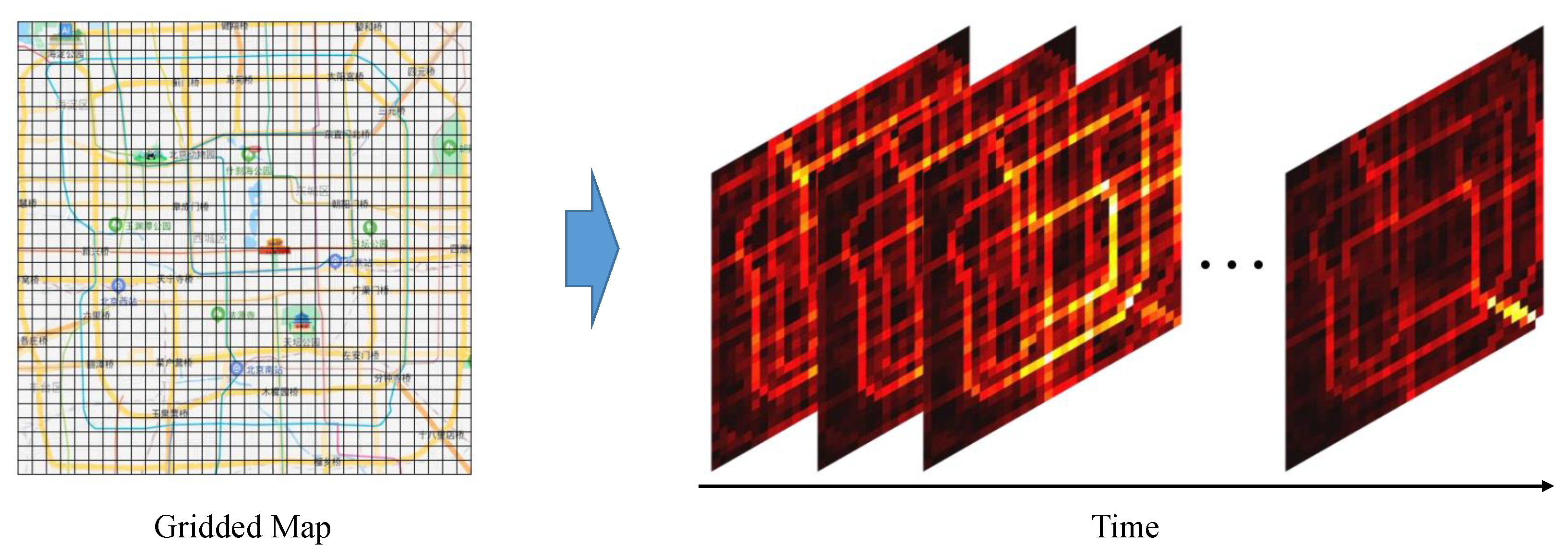
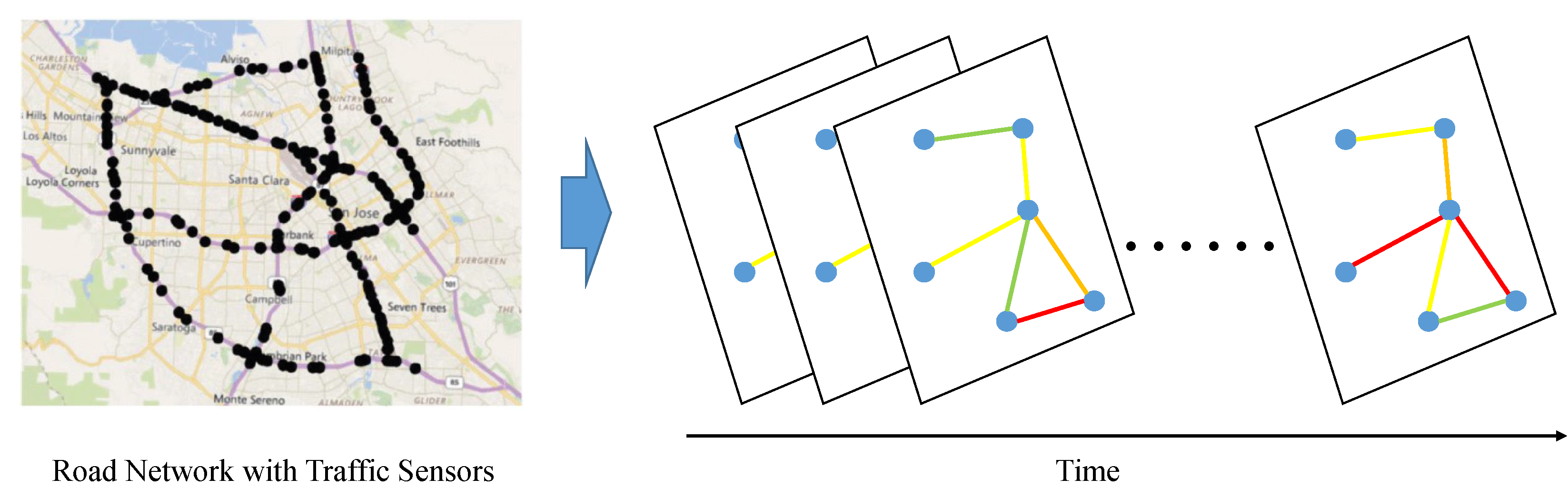
| Study | Traffic Attributes | Spatial Range | Temporal Range | Download Link (Accessed on 2 February 2023) |
|---|---|---|---|---|
| [114] | Aggregated taxi speed | Seoul, South Korea | 1–30 April 2018 | https://github.com/SNU-DRL/ddpgcn-dataset |
| [126] | Aggregated taxi flow | Wuhan, China | 1–28 July 2015 | http://ggssc.whu.edu.cn/ggsscAssets/download/AttentionModel/code_and_data.zip |
| HZMF2019 [146] | Aggregated metro passenger flow | Hangzhou, China | 1–25 January 2019 | https://github.com/lixus7/MTMGNN |
| TaxiBJ21 [23] | Aggregated taxi flow | Beijing, China | November 2012, November 2014, and November 2015 | https://github.com/jwwthu/DL4Traffic/tree/main/TaxiBJ21 |
| [216] | Aggregated traffic flow | Beijing, China | 1 June–15 July 2009 | https://github.com/gao0628/Dataset |
| [217] | Aggregated traffic flow | Six intersections in an urban area | 56 days | https://zenodo.org/record/3653880#.Y20cPHZBzT6 |
| XiAn Road Traffic [218] | Aggregated traffic flow, weather data | Xi’an, China | 1 August–30 September 2019 | https://github.com/FIGHTINGithub/Xi-an-Road-Traffic-Data |
| [219] | Aggregated traffic flow | Aveiro, Portugal | 2019, 2020, and 2021 | https://figshare.com/s/d324f5be912e7f7a0d21 |
| [220] | Aggregated taxi and bike trips | New York City, USA | 2019, 2020 | https://github.com/Evens1sen/Deep-NYC-Taxi-Bike |
| [221] | Aggregated taxi and bike trips | Chicago, USA | 2013 to 2020 | https://github.com/iipr/mobility-demand |
| [222] | Citywide crowd flow | Tokyo and Osaka | 1 April–9 July 2017 | https://github.com/deepkashiwa20/DeepCrowd |
Disclaimer/Publisher’s Note: The statements, opinions and data contained in all publications are solely those of the individual author(s) and contributor(s) and not of MDPI and/or the editor(s). MDPI and/or the editor(s) disclaim responsibility for any injury to people or property resulting from any ideas, methods, instructions or products referred to in the content. |
© 2023 by the authors. Licensee MDPI, Basel, Switzerland. This article is an open access article distributed under the terms and conditions of the Creative Commons Attribution (CC BY) license (https://creativecommons.org/licenses/by/4.0/).
Share and Cite
Jiang, W.; Luo, J.; He, M.; Gu, W. Graph Neural Network for Traffic Forecasting: The Research Progress. ISPRS Int. J. Geo-Inf. 2023, 12, 100. https://doi.org/10.3390/ijgi12030100
Jiang W, Luo J, He M, Gu W. Graph Neural Network for Traffic Forecasting: The Research Progress. ISPRS International Journal of Geo-Information. 2023; 12(3):100. https://doi.org/10.3390/ijgi12030100
Chicago/Turabian StyleJiang, Weiwei, Jiayun Luo, Miao He, and Weixi Gu. 2023. "Graph Neural Network for Traffic Forecasting: The Research Progress" ISPRS International Journal of Geo-Information 12, no. 3: 100. https://doi.org/10.3390/ijgi12030100
APA StyleJiang, W., Luo, J., He, M., & Gu, W. (2023). Graph Neural Network for Traffic Forecasting: The Research Progress. ISPRS International Journal of Geo-Information, 12(3), 100. https://doi.org/10.3390/ijgi12030100

