Article

Identification of Eco-Climatic Factors Driving Yields and Genotype by Environment Interactions for Yield in Early Maturity Soybean Using Crop Simulation


1
AGHYLE, UniLaSalle, 19 rue Pierre Waguet, 60000 Beauvais, France
2
Lidea Seeds, 6 chemin de Panedautes, 31700 Mondonville, France
3
Transformations & Agro-Ressources Research Unit–ULR 7519, UniLaSalle, 19 rue Pierre Waguet, 60000 Beauvais, France
*
Authors to whom correspondence should be addressed.
Agronomy 2023, 13(2), 322; https://doi.org/10.3390/agronomy13020322

Submission received: 20 December 2022 / Revised: 13 January 2023 / Accepted: 18 January 2023 / Published: 20 January 2023

Abstract

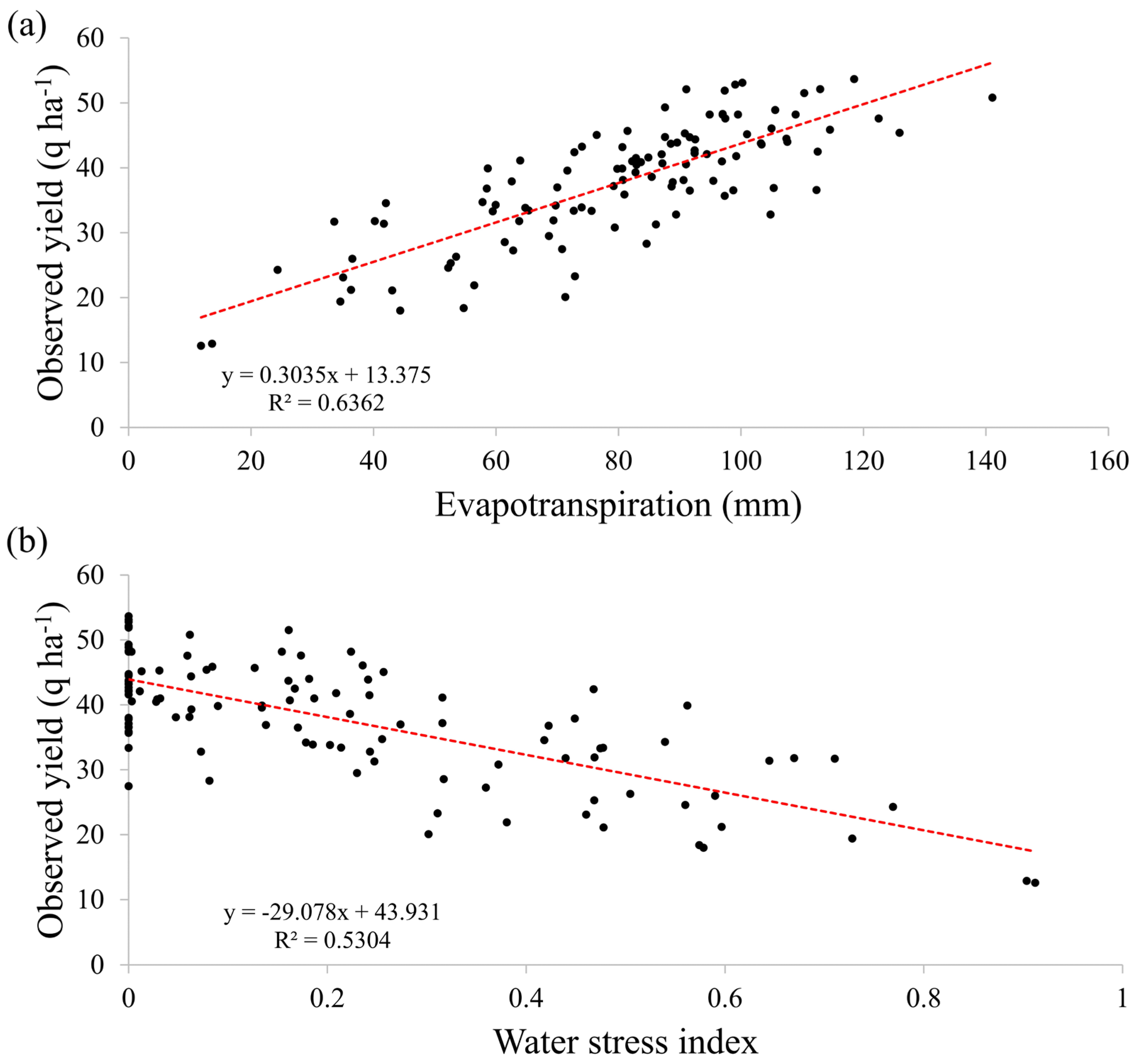
Deploying crops in regions bordering their initial distribution area requires adapting existing cultivars to particular environmental constraints. In this study, we revealed the main Eco-climatic Factors (EFs)—climatic factors recorded over specific phenological periods—impacting both yields and Genotype by Environment Interactions (GEI) for yield in early maturity soybeans (Glycine max (L.) Merrill) under high latitudes. A multi-year (2017–2021) and multi-environment (n = 112) database was built based on the official post-inscription French soybean trial network “SOJA Terres Inovia-GEVES-Partenaires”. Yields of 57 cultivars covering MG00 and MG000 maturity groups were considered. For each environment, 126 EFs were calculated using a Crop Growth Model (CGM) based on observed weather data and simulated developmental stages. Partial Least Square (PLS) regression analyses using the Variable Importance in Projection (VIP) score were used to sort out the most relevant EFs for their impact on yield levels on the one side and on GEI for yield on the other side. Our results confirmed that yield levels for both maturity groups were greatly influenced by climatic factors from the seed filling phenophases, mainly End of Pod to Physiological Maturity. The cumulative potential evapotranspiration during the End of Pod to Physiological Maturity period was the main EF affecting yield levels positively for both maturity groups (VIP = 2.86; R2 = 0.64). Interestingly, EFs explaining yield levels strongly differed from those explaining GEI, in terms of both climatic factors and phenophases. GEI were mostly influenced by climatic factors from First Flower to End of Pod; these factors were maximum temperatures and solar radiation intensity. Cold stress from Sowing to First Seed also appeared to be a critical driver for GEI in MG00 soybeans. The contrasted responses of several cultivars to the main GEI-drivers highlighted a potential genetic variability that could be exploited in early maturity soybean breeding. This study revealed the complexity of GEI ecophysiology, and our results should help breeding strategies to deliver germplasm that outperforms the existing genetic material for expanding the crop to northern European regions.
Keywords: CROPGRO; crop growth model; DSSAT; genotype × environment interactions; phenophase; protein crop; soybean breeding CROPGRO; crop growth model; DSSAT; genotype × environment interactions; phenophase; protein crop; soybean breeding