Article

Quality Management Outweighs Pandemic: Retrospective Analysis Shows Improved Quality of Care for Staphylococcus aureus Bacteremia Despite SARS-CoV-2


1
Institute for Hygiene and Public Health, Medical Faculty, University of Bonn, 53127 Bonn, Germany
2
Department of Microbiology and Hospital Hygiene, Bundeswehr Central Hospital Koblenz, 56072 Koblenz, Germany
3
Institute of Medical Microbiology, Immunology and Parasitology, Medical Faculty, University of Bonn, 53127 Bonn, Germany
4
Division of Infectious Diseases, Department IB of Internal Medicine, Bundeswehr Central Hospital Koblenz, 56072 Koblenz, Germany
5
Division of Infectious Diseases, Department I of Internal Medicine, University of Cologne, 50923 Köln, Germany
*
Author to whom correspondence should be addressed.
These authors contributed equally to this work.
Diseases 2025, 13(4), 104; https://doi.org/10.3390/diseases13040104

Submission received: 21 February 2025 / Revised: 21 March 2025 / Accepted: 28 March 2025 / Published: 30 March 2025
(This article belongs to the Special Issue Infectious Disease Epidemiology 2024)

Abstract

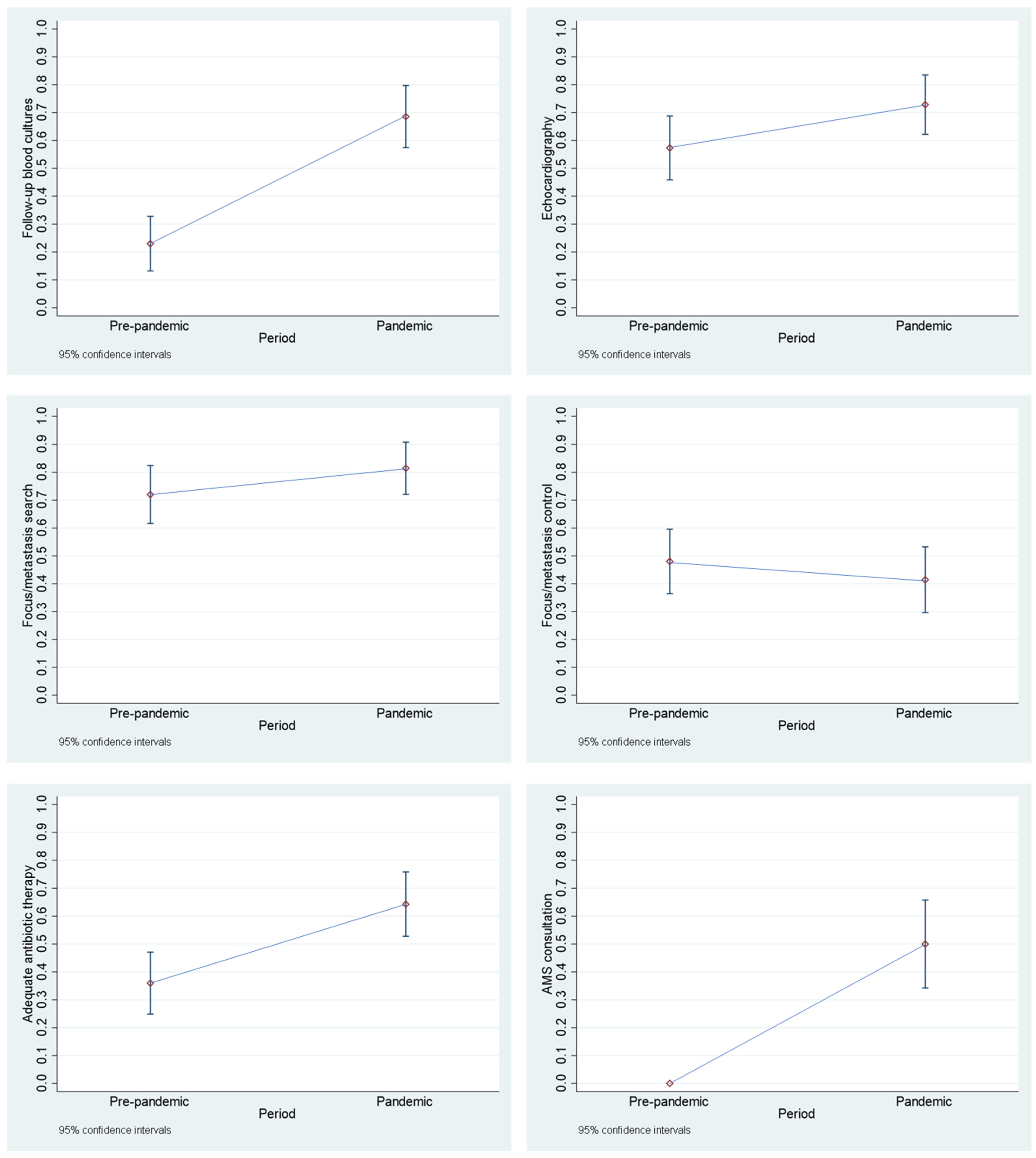
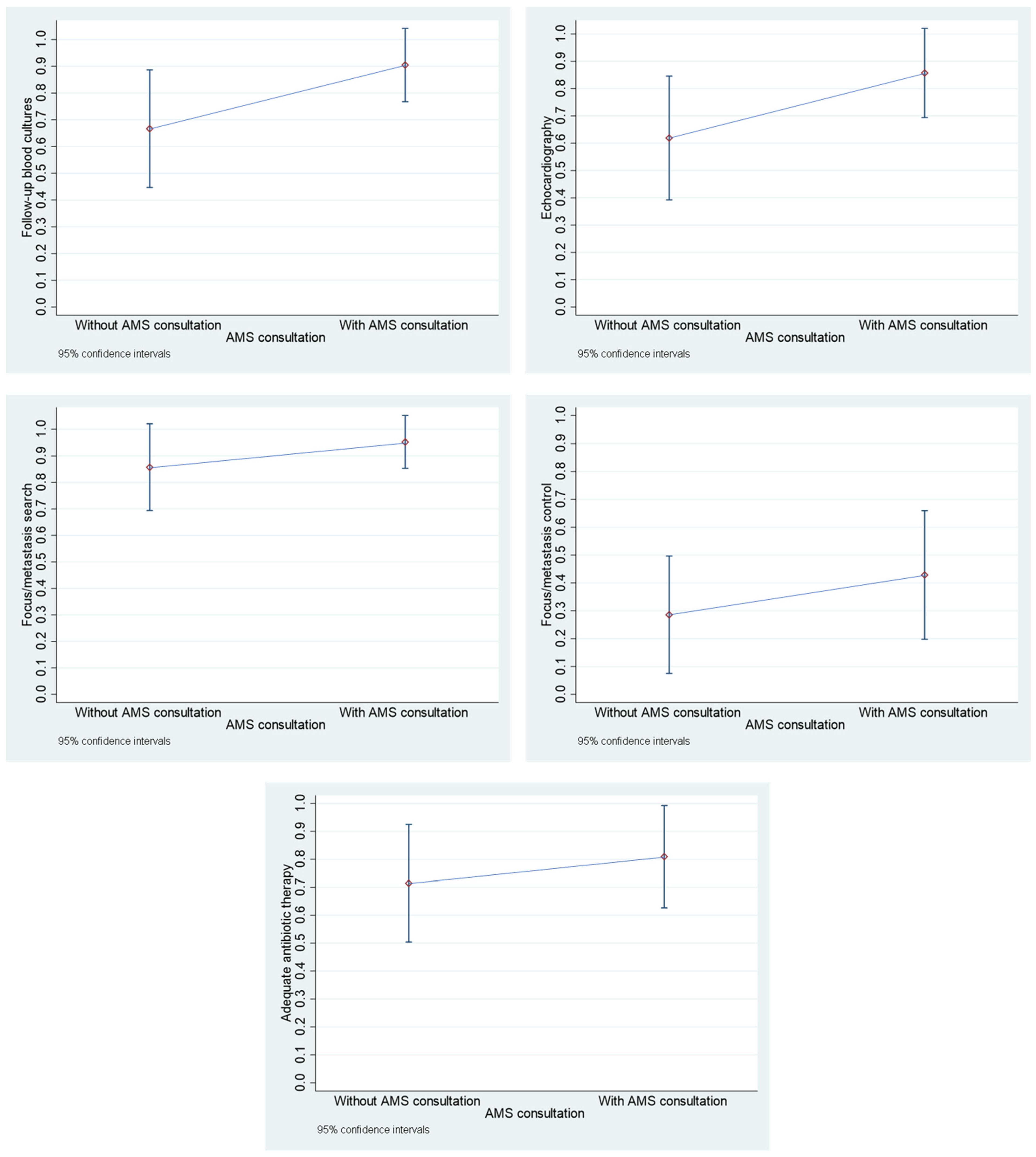
Background: Staphylococcus aureus bacteremia (SAB) is of great clinical relevance, as it is the most common type of bacteremia. Several studies show that the quality of care and thus the outcome can be positively influenced by the involvement of infectious disease specialists and structured programs like Antimicrobial Stewardship (AMS). In 2020, the SARS-CoV-2 pandemic occurred, which dominated the healthcare system and global events during this time. At the same time, a standard operational procedure (SOP) for SAB quality management (SABQM) was introduced in a German maximum-care hospital with 500 beds. Additionally, voluntary AMS team consultations were introduced in June 2021. This work addresses whether the introduction of SABQM has led to an improvement in the quality of care for SAB, despite the possible negative influences of the pandemic. Methods: Retrospective statistical analyses were conducted on all 145 cases coded as SAB at this hospital during the “pre-pandemic” period (2017 to 2019, 75 cases) and the pandemic period (2020 to 2022, 70 cases). Population parameters and quality management parameters were extracted from the clinical patient documentation. In a first analysis, the SARS-CoV-2 status served as a discriminatory parameter to determine its influence on the quality of care within the “pandemic period”. In a second analysis, the period served as a discriminatory parameter to determine its influence on the quality of care. In a third analysis, the use of AMS team consultation served as a discriminatory parameter to determine its influence on the quality of care in a subgroup of 42 cases from June 2021 to 2022. Results: The SARS-CoV-2 status had no influence on the population parameters or the quality management parameters. Between both analyzed periods, there was an improvement in the quality management parameters, with statistically significant higher rates of follow-up blood cultures, transthoracic echocardiography and adequate antibiotic therapy. AMS team consultation led to a relevant, but not statistically significant improvement in the quality management indicators. Conclusions: An SOP for SABQM leads to an improvement in the quality of care, even under the possible negative influences of a pandemic. AMS team consultations further strengthen this positive influence, even if this is not statistically significant due to the small number of cases in the subgroup analyzed.
Keywords: staphylococcal infections; Staphylococcus aureus; bacteremia; SARS-CoV-2; quality of health care; antimicrobial stewardship staphylococcal infections; Staphylococcus aureus; bacteremia; SARS-CoV-2; quality of health care; antimicrobial stewardship